<?xml version="1.0" encoding="ISO-8859-1"?><article xmlns:mml="http://www.w3.org/1998/Math/MathML" xmlns:xlink="http://www.w3.org/1999/xlink" xmlns:xsi="http://www.w3.org/2001/XMLSchema-instance">
<front>
<journal-meta>
<journal-id>0034-7744</journal-id>
<journal-title><![CDATA[Revista de Biología Tropical]]></journal-title>
<abbrev-journal-title><![CDATA[Rev. biol. trop]]></abbrev-journal-title>
<issn>0034-7744</issn>
<publisher>
<publisher-name><![CDATA[Universidad de Costa Rica]]></publisher-name>
</publisher>
</journal-meta>
<article-meta>
<article-id>S0034-77442013000100001</article-id>
<title-group>
<article-title xml:lang="en"><![CDATA[Inter-cohort growth patterns of pharaoh cuttlefish Sepia pharaonis (Sepioidea: Sepiidae) in Eastern Arabian Sea]]></article-title>
</title-group>
<contrib-group>
<contrib contrib-type="author">
<name>
<surname><![CDATA[Sasikumar]]></surname>
<given-names><![CDATA[Geetha]]></given-names>
</name>
<xref ref-type="aff" rid="A03"/>
</contrib>
<contrib contrib-type="author">
<name>
<surname><![CDATA[Mohamed]]></surname>
<given-names><![CDATA[K.S.]]></given-names>
</name>
<xref ref-type="aff" rid="A02"/>
</contrib>
<contrib contrib-type="author">
<name>
<surname><![CDATA[Bhat]]></surname>
<given-names><![CDATA[U.S.]]></given-names>
</name>
<xref ref-type="aff" rid="A01"/>
</contrib>
</contrib-group>
<aff id="A01">
<institution><![CDATA[,Research Centre Central Marine Fisheries Research Institute ]]></institution>
<addr-line><![CDATA[ ]]></addr-line>
<country>India</country>
</aff>
<aff id="A02">
<institution><![CDATA[,Central Marine Fisheries Research Institute  ]]></institution>
<addr-line><![CDATA[ ]]></addr-line>
<country>India</country>
</aff>
<aff id="A03">
<institution><![CDATA[,Corresponding author  ]]></institution>
<addr-line><![CDATA[ ]]></addr-line>
</aff>
<pub-date pub-type="pub">
<day>00</day>
<month>03</month>
<year>2013</year>
</pub-date>
<pub-date pub-type="epub">
<day>00</day>
<month>03</month>
<year>2013</year>
</pub-date>
<volume>61</volume>
<numero>1</numero>
<fpage>01</fpage>
<lpage>14</lpage>
<copyright-statement/>
<copyright-year/>
<self-uri xlink:href="http://www.scielo.sa.cr/scielo.php?script=sci_arttext&amp;pid=S0034-77442013000100001&amp;lng=en&amp;nrm=iso"></self-uri><self-uri xlink:href="http://www.scielo.sa.cr/scielo.php?script=sci_abstract&amp;pid=S0034-77442013000100001&amp;lng=en&amp;nrm=iso"></self-uri><self-uri xlink:href="http://www.scielo.sa.cr/scielo.php?script=sci_pdf&amp;pid=S0034-77442013000100001&amp;lng=en&amp;nrm=iso"></self-uri><abstract abstract-type="short" xml:lang="en"><p><![CDATA[Sepia pharaonis is an important commercial species endemic to the tropical Indo-Pacific region. Despite its commercial significance, only few information on natural populations is available. This study was aimed to describe the aspects of size-composition, length-weight relationship, catch rates, seasonal recruitment and inter-cohort growth patterns of S. pharaonis population (Clade C), distributed along the Eastern Arabian Sea (South-West coast of India). For this, the Dorsal Mantle Length (DML) and weight of cuttlefishes was obtained from commercial trawl catches, from April 2002 to October 2006. Data was analyzed by normal length-weight methods such as von Bertalanffy. A total of 12 454 cuttlefishes, ranging in length from four to 41cm were analyzed. Size-composition patterns discriminated two pulses in recruitment to the fishery, discernible by a decrease in the monthly mean size of the population. The DMLs of the two seasonal cohorts were subjected to modalprogression analysis using the Bhattacharya&#8217;s method for the estimation of growth. The estimated parameters L&#8734; and K in von Bertalanffy Growth Function (VBGF) were used to model growth curves in length for the cohorts. The first cohort, (post-monsoon cohort) which supports the major fishery, was composed of mediumsized, fast growing individuals, whereas the second cohort (pre-monsoon cohort), comprised of slow growing and large-sized individuals. There were differential growth characteristics between the sexes and the life span was estimated at less than 2.3years for males and 2.1years for females. Negative allometric growth in weight (W) with length (L) was observed for males (W=0.33069.L2.5389) and females (W=0.32542.L2.6057). The females were heavier compared to males at any given mantle length, and the males were found to attain larger ultimate lengths. The major fishing season for cuttlefish was from May to November, when higher monthly catch rates of 1.67-13.02kg/h were observed in comparison with 0.03-0.85kg/h in December-April. Seasonal catch rates indicated a migratory life cycle of S. pharaonis between offshore and inshore coastal zones.]]></p></abstract>
<abstract abstract-type="short" xml:lang="es"><p><![CDATA[Sepia pharaonis es una importante especie endémica comercial del trópico Indo-Pacífico. A pesar de su valor comercial, hay muy poca información de sus poblaciones naturales disponible. En este estudio se describen aspectos como composición de tallas, relación longitud-peso, tasas de captura, reclutamiento estacional y patrones de crecimiento entre cohortes de la población (Clado C), distribuidos a lo largo del Mar Arábigo del Este (costa Suroeste de India). Se obtuvo la Longitud del Manto Dorsal (LMD) y el peso de las capturas de los arrastres comerciales, de Abril 2002 a Octubre 2006. Los datos fueron analizados mediante FiSAT y von Bertalanffy. Se capturó un total de 12 454 sepias, con una longitud entre 4-41cm. Los patrones de composición de tallas discriminaron dos pulsos en el reclutamiento de la pesquería, perceptibles por una disminución en el tamaño promedio mensual de la población. Los LMD de las dos cohortes estacionales se sometieron a un análisis de progresión modal mediante el método de Bhattacharya para la estimación del crecimiento. La primera cohorte (después de los monzones) mantiene la principal pesquería, se compone de individuos medianos de rápido crecimiento, mientras que el segundo grupo (pre-monzón) está compuesto por individuos de crecimiento lento y de gran tamaño. Se encontraron diferencias en las características de crecimiento entre sexos y la duración de vida útil se estima en menos de 2.3 años para machos y 2.1 años para hembras. Se observó crecimiento alométrico negativo entre el peso (W) y la longitud (L) para machos (W=0.33069. L2.5389) y hembras (W=0.32542.L2.6057). Las hembras fueron más pesadas en comparación con los machos en cualquier longitud de manto. La temporada de pesca más importante fue de mayo a noviembre, cuando se tuvieron las tasas de captura mensual más altas, de 1.67-13.02kg/h en comparación con 0.03-0.85kg/h entre diciembre y abril. Las tasas de captura estacional indican un ciclo de vida migratorio de S. pharaonis entre las zonas marinas y costeras de las áreas someras.]]></p></abstract>
<kwd-group>
<kwd lng="en"><![CDATA[cuttlefish]]></kwd>
<kwd lng="en"><![CDATA[Sepia pharaonis]]></kwd>
<kwd lng="en"><![CDATA[growth]]></kwd>
<kwd lng="en"><![CDATA[length-weight relationship]]></kwd>
<kwd lng="en"><![CDATA[age]]></kwd>
<kwd lng="en"><![CDATA[Eastern Arabian Sea]]></kwd>
<kwd lng="es"><![CDATA[sepia]]></kwd>
<kwd lng="es"><![CDATA[Sepia pharaonis]]></kwd>
<kwd lng="es"><![CDATA[crecimiento]]></kwd>
<kwd lng="es"><![CDATA[relación longitud-peso]]></kwd>
<kwd lng="es"><![CDATA[edad]]></kwd>
<kwd lng="es"><![CDATA[Mar Arábigo del Este]]></kwd>
</kwd-group>
</article-meta>
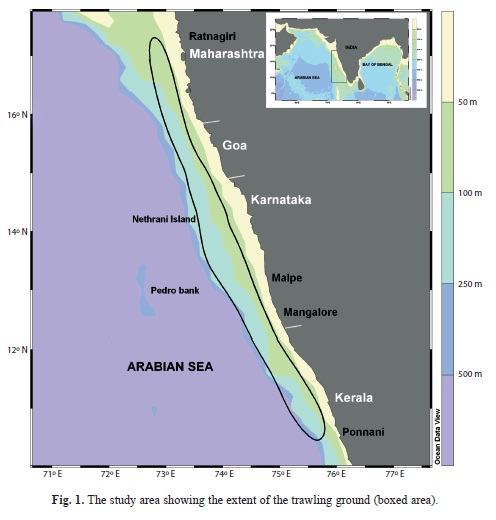
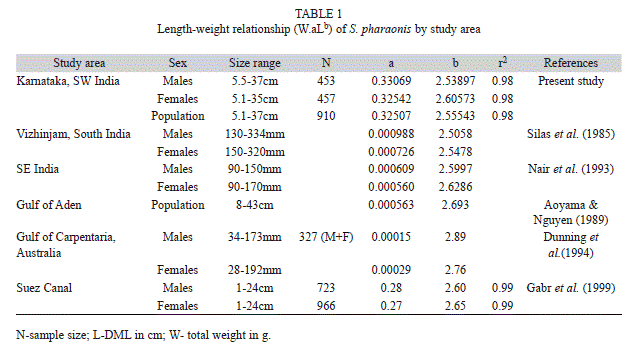
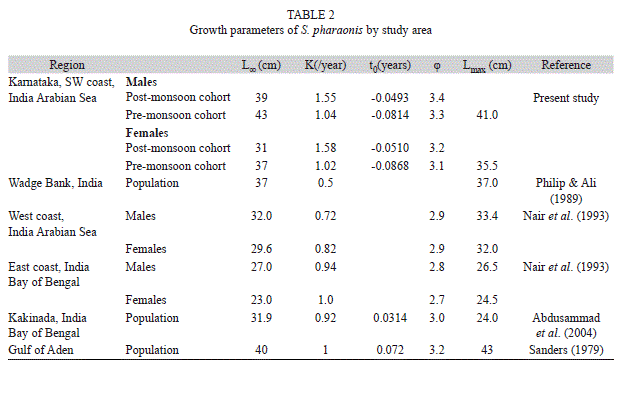
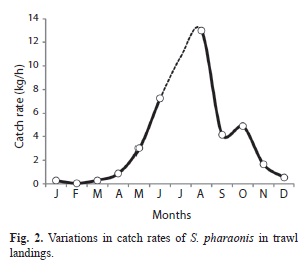
</front><body><![CDATA[ <div style="text-align: justify;">     <div style="text-align: justify;">     <div style="text-align: center;"><font style="font-weight: bold;"  size="4"><span style="font-family: verdana;">Inter-cohort growth patterns of pharaoh cuttlefish <span style="font-style: italic;">Sepia pharaonis</span> (Sepioidea: Sepiidae) in Eastern Arabian Sea</span></font><br style="font-family: verdana;"> </div> <br style="font-family: verdana;">     <div style="text-align: center;"><font size="2"><span  style="font-family: verdana;">Geetha Sasikumar<sup><a href="#3">3</a><a  name="6"></a>*,<a href="#1">1</a><a name="4"></a>*</sup>, K.S. Mohamed<sup><a href="#2">2</a><a name="5"></a>*</sup> &amp; U.S. Bhat<a href="#1"><sup>1</sup></a></span></font><br  style="font-family: verdana;"> </div> <font size="2"><span style="font-family: verdana;">    <br> <a name="Correspodencia2"></a>*<a href="#Correspondencia1">Direcci&oacute;n para correspondencia:</a><br style="font-family: verdana;"> </span></font><font size="2"></font> <hr style="width: 100%; height: 2px;"><br style="font-family: verdana;"> <font style="font-weight: bold;" size="3"><span  style="font-family: verdana;">Abstract</span></font><br  style="font-family: verdana;"> <font size="2"><span style="font-family: verdana;"><span  style="font-style: italic;">Sepia pharaonis</span> is an important commercial species endemic to the tropical Indo-Pacific region. Despite its commercial significance, only few information on natural populations is available. This study was aimed to describe the aspects of size-composition, length-weight relationship, catch rates, seasonal recruitment and inter-cohort growth patterns of <span  style="font-style: italic;">S. pharaonis</span> population (Clade C), distributed along the Eastern Arabian Sea (South-West coast of India). For this, the Dorsal Mantle Length (DML) and weight of cuttlefishes was obtained from commercial trawl catches, from April 2002 to October 2006. Data was analyzed by normal length-weight methods such as von Bertalanffy. A total of 12 454 cuttlefishes, ranging in length from four to 41cm were analyzed. Size-composition patterns discriminated two pulses in recruitment to the fishery, discernible by a decrease in the monthly mean size of the population. The DMLs of the two seasonal cohorts were subjected to modalprogression analysis using the Bhattacharya&#8217;s method for the estimation of growth. The estimated parameters L&#8734; and K in von Bertalanffy Growth Function (VBGF) were used to model growth curves in length for the cohorts. The first cohort, (post-monsoon cohort) which supports the major fishery, was composed of mediumsized, fast growing individuals, whereas the second cohort (pre-monsoon cohort), comprised of slow growing and large-sized individuals. There were differential growth characteristics between the sexes and the life span was estimated at less than 2.3years for males and 2.1years for females. Negative allometric growth in weight (W) with length (L) was observed for males (W=0.33069.L<sup>2.5389</sup>) and females (W=0.32542.L<sup>2.6057</sup>). The females were heavier compared to males at any given mantle length, and the males were found to attain larger ultimate lengths. The major fishing season for cuttlefish was from May to November, when higher monthly catch rates of 1.67-13.02kg/h were observed in comparison with 0.03-0.85kg/h in December-April. Seasonal catch rates indicated a migratory life cycle of <span  style="font-style: italic;">S. pharaonis</span> between offshore and inshore coastal zones. </span></font><br  style="font-family: verdana;"> <font size="2"></font><br style="font-family: verdana;"> <font size="2"><span style="font-family: verdana;"><span  style="font-weight: bold;">Key words:</span> cuttlefish, <span  style="font-style: italic;">Sepia pharaonis</span>, growth, length-weight relationship, age, Eastern Arabian Sea.</span></font><br style="font-family: verdana;"> <font size="2"></font><br style="font-family: verdana;"> <font style="font-weight: bold;" size="3"><span  style="font-family: verdana;">Resumen</span></font><br  style="font-family: verdana;"> <font size="2"><span style="font-family: verdana;"><span  style="font-style: italic;">Sepia pharaonis</span> es una importante especie end&eacute;mica comercial del tr&oacute;pico Indo-Pac&iacute;fico. A pesar de su valor comercial, hay muy poca informaci&oacute;n de sus poblaciones naturales disponible. En este estudio se describen aspectos como composici&oacute;n de tallas, relaci&oacute;n longitud-peso, tasas de captura, reclutamiento estacional y patrones de crecimiento entre cohortes de la poblaci&oacute;n (Clado C), distribuidos a lo largo del Mar Ar&aacute;bigo del Este (costa Suroeste de India). Se obtuvo la Longitud del Manto Dorsal (LMD) y el peso de las capturas de los arrastres comerciales, de Abril 2002 a Octubre 2006. Los datos fueron analizados mediante FiSAT y von Bertalanffy. Se captur&oacute; un total de 12 454 sepias, con una longitud entre 4-41cm. Los patrones de composici&oacute;n de tallas discriminaron dos pulsos en el reclutamiento de la pesquer&iacute;a, perceptibles por una disminuci&oacute;n en el tama&ntilde;o promedio mensual de la poblaci&oacute;n. Los LMD de las dos cohortes estacionales se sometieron a un an&aacute;lisis de progresi&oacute;n modal mediante el m&eacute;todo de Bhattacharya para la estimaci&oacute;n del crecimiento. La primera cohorte (despu&eacute;s de los monzones) mantiene la principal pesquer&iacute;a, se compone de individuos medianos de r&aacute;pido crecimiento, mientras que el segundo grupo (pre-monz&oacute;n) est&aacute; compuesto por individuos de crecimiento lento y de gran tama&ntilde;o. Se encontraron diferencias en las caracter&iacute;sticas de crecimiento entre sexos y la duraci&oacute;n de vida &uacute;til se estima en menos de 2.3 a&ntilde;os para machos y 2.1 a&ntilde;os para&nbsp; hembras. Se observ&oacute; crecimiento alom&eacute;trico negativo entre el peso (W) y la longitud (L) para machos (W=0.33069. L<sup>2.5389) </sup>y hembras (W=0.32542.L<sup>2.6057</sup>). Las hembras fueron m&aacute;s pesadas en comparaci&oacute;n con los machos en cualquier longitud de manto. La temporada de pesca m&aacute;s importante fue de mayo a noviembre, cuando se tuvieron las tasas de captura mensual m&aacute;s altas, de 1.67-13.02kg/h en comparaci&oacute;n con 0.03-0.85kg/h entre diciembre y abril. Las tasas de captura estacional indican un ciclo de vida migratorio de <span  style="font-style: italic;">S. pharaonis</span> entre las zonas marinas y costeras de las &aacute;reas someras. </span></font><br style="font-family: verdana;"> <font size="2"></font><br style="font-family: verdana;"> <font size="2"><span style="font-family: verdana;"><span  style="font-weight: bold;">Palabras clave:</span> sepia, <span  style="font-style: italic;">Sepia pharaonis</span>, crecimiento, relaci&oacute;n longitud-peso, edad, Mar Ar&aacute;bigo del Este.    <br> <br style="font-family: verdana;"> </span></font><font size="2"></font> <hr style="width: 100%; height: 2px;"><br style="font-family: verdana;"> <font size="2"><span style="font-family: verdana;">Cephalopod resources have gained topical importance internationally as a commercial fishery only in the recent decades (Boyle 1990). The pharaoh cuttlefish <span  style="font-style: italic;">Sepia pharaonis</span> Ehrenberg, 1831, is one of the most important species exploited along the Eastern Arabian Sea. Being a neritic demersal species endemic to the tropical waters of the Indo-Pacific region (Including Red Sea, Arabian Sea, Andaman Sea to South China Sea, East China Sea, Japan, Eastern Indonesia to Southern Australia including Gulf of Carpentaria) commercial catches of <span style="font-style: italic;">S. pharaonis</span> are reported from coastal waters up to a depth of 130m. The species is known to undertake seasonal migrations between the continental shelf waters and shallow coastal waters for feeding and spawning (Reid et al. 2005). The maximum sizes reported for the species is 420mm. Phylogenetic analyses of <span  style="font-style: italic;">S. pharaonis</span> in its distributional range revealed five distinct clades within the <span style="font-style: italic;">S. pharaonis</span> species complex (Anderson et al. 2007). Accordingly, the Clade C of the <span style="font-style: italic;">S. pharaonis</span> population confined to Arabian Sea, Bay of Bengal and Andaman Sea (Andaman Sea coast of Thailand) is exploited in the Eastern Arabian Sea.</span></font><br  style="font-family: verdana;"> <font size="2"></font><br style="font-family: verdana;"> <font size="2"><span style="font-family: verdana;">In spite of the <span  style="font-style: italic;">S. pharaonis</span> wide distribution along the Eastern Arabian Sea, the biology of this resource has not been studied comprehensively and the information is scarce on its growth patterns. Some aspects of <span  style="font-style: italic;">S. pharaonis</span> fishery have been addressed from Australia (Dunning et al. 1994), Yemen (Sanders 1979, Aoyama &amp; Nguyen 1989), Thailand (Chotiyaputta&nbsp; 1993) Philippines (Watanuki et al. 1993) and Egypt (Gabr et al. 1999). <span style="font-style: italic;">S. pharaonis</span> is also a highly promising species for aquaculture (Nabhitabhata 1995) and is extensively studied under controlled laboratory conditions (Nabhitabhata &amp; Nilaphat 1999, Minton et al. 2001, Anil et al. 2005, Barord et al. 2010). </span></font><br  style="font-family: verdana;"> <font size="2"></font><br style="font-family: verdana;"> <font size="2"><span style="font-family: verdana;">Along the Indian coast, cephalopods constitute a fishery of commercial significance, where the production exhibited a quantum leap in the past few decades. The production from fishery in India reached 111 534t from 94t in four decades, at a significantly greater rate of increase than the finfish group (Meiyappan &amp; Mohamed 2003). Catches of <span  style="font-style: italic;">S. pharaonis</span> in the State of Karnataka, along the Eastern Arabian Sea, have increased substantially from 3t-1980 to 6 703t-2006, raising concern about the species and consideration for development of a resource management plan. The commercial trawl fleet of Karnataka consists of two types of fleets, the single-day fleet (SDF) comprising of smaller trawlers (&lt;9m overall length) and the multi-day fleet (MDF) of medium sized (&gt;9m overall length; majority 11-17.1m overall length) trawlers. SDF undertake daily fishing operations in the inshore waters up to 25m depth zone whereas, MDF carry out longer voyages and operate beyond 25m. The average gross registered tonnage of the MDF vessels is 27t with engine power ranging from 80 to 120HP (Zacharia et al. 1996). Cuttlefishes are targeted by MDF, catching more than 98% of the resource. Mechanized fishing, including trawling is closed for a period of 45 days (June 15 to July 30) as a regulatory measure. </span></font><br  style="font-family: verdana;"> <font size="2"></font><br style="font-family: verdana;"> <font size="2"><span style="font-family: verdana;">The commercial fishing ground extends from 10&ordm;30&#8217;00&#8217;&#8217;N - 75&ordm;45&#8217;00&#8217;&#8217;E off Ponnani in South to 17&ordm;20&#8217;00&#8217;&#8217;N - 72&ordm;42&#8217;00&#8217;&#8217;E off Ratnagiri in the North (GPS data). This included the area lying in the depth zone of the <span  style="font-style: italic;">Bassasde- Pedro Bank/Padua Bank</span> (13&ordm;07&#8217;00.57&#8217;&#8217;N - 72&ordm;25&#8217;00.15&#8217;&#8217;E) and around the Netrani Islands, (14&ordm;08&#8217;00&#8217;&#8217;N - 74&ordm;47&#8217;00&#8217;&#8217;E) which are known for their abundance in cephalopods, yielding higher catch rates (Nair et al. 1992). The depth of operation of MDF increased over the years from 50m-1986 (Rao 1998) to 70m-1991 (Mohamed 1996). In 1995, the trawling depth increased beyond 70m when cephalopods were targeted reaching 100m (Zacharia et al. 1996) and continued to increase further, reaching depths of 150m since 2001 (Dineshbabu et al. 2001). This neritic demersal cuttlefish species is targeted almost throughout the year, excluding the mechanized fishing ban period, by bottom trawl (22 to 24mm cod end mesh size) in the commercial trawling ground of MDF.</span></font><br  style="font-family: verdana;"> <font size="2"></font><br style="font-family: verdana;"> <font size="2"><span style="font-family: verdana;">Earlier studies reported from India on this resource are by Silas et al. (1985), Philip &amp; Ali (1989), Nair et al. (1993) and Abdussamad et al. (2004) based on the <span  style="font-style: italic;">S. pharaonis</span> from the Southern coastal waters of India. However, little has been reported on the growth and stock assessment of <span  style="font-style: italic;">S. pharaonis</span> in the region. The present study therefore describes the lengthweight relationship, catch rates, seasonal recruitment and inter-cohort growth patterns of <span style="font-style: italic;">S. pharaonis</span> from this tropical monsoon region based on commercial catches.</span></font><br style="font-family: verdana;"> <font size="2"></font><br  style="font-weight: bold; font-family: verdana;"> <font size="3"><span style="font-weight: bold; font-family: verdana;">Materials and methods</span></font>    <br> <font size="2"><span style="font-weight: bold; font-family: verdana;"></span></font>    <br> <font size="2"><span style="font-weight: bold; font-family: verdana;">Study area and oceanography:</span><span style="font-family: verdana;"> Arabian Sea experiences seasonal reversal in current patterns, changing with the monsoon winds. With the onset of the South-West monsoon (June-September), the surface waters move away from the coast under the influence of the SW winds and are replaced by colder, nutrient-rich and often oxygen depleted waters from the subsurface (Ekman pumping/ transport) (Madhupratap 2001). The upwelling lasts throughout the SW monsoon period until September-October. Coastal currents during this period are South-flowing (Johannessen et al. 1981). From November, the surface circulation is dominated by a weak westward, countermonsoon flow when, the coastal currents flow Northwards associated with the influx of low salinity water from the South.</span></font><br  style="font-family: verdana;"> <font size="2"></font><br style="font-family: verdana;"> <font size="2"><span style="font-family: verdana;">The SST in the study area shows a primary peak during April-May and a secondary peak during October-November, with lowest temperatures during July-September (Krishnakumar &amp; Bhat 2008).</span></font><br  style="font-family: verdana;"> <font size="2"></font><br style="font-family: verdana;"> <font size="2"><span style="font-weight: bold; font-family: verdana;">Sampling:</span><span  style="font-family: verdana;"> A total of 12 454 individuals of <span  style="font-style: italic;">Sepia pharaonis</span> were examined, ranging in length from four to 41cm DML. <span style="font-style: italic;">S. pharaonis</span> samples were collected from commercial MDF trawl catches during April 2002-October 2006. The data were collected weekly, recording the catch and effort from the major fishing harbours at Mangalore and Malpe (<a href="/img/revistas/rbt/v61n1/a01i1.jpg">Fig. 1</a>). The cuttlefishes were weighed to the nearest 0.1g and measured to the nearest 0.1cm in dorsal mantle length (DML-measured as the distance from the base of the spine to the anterior tip of the mantle) and sexed by macroscopic examination of the gonads. The length frequencies of cuttlefish in each sample were regrouped at an interval of 10mm in DML, projected to the day&#8217;s catches and used for representing the length-frequency of the estimated catch in the trawl landings during each sampling period, as outlined by Mohamed &amp; Rao (1997). These length frequencies were weighted to the estimated <span style="font-style: italic;">S. pharaonis</span> catch of Karnataka State. The data was analysed seasonally (Pre-monsoon- February to May; monsoon-June to September; Post-monsoon-October to January).    <br>     <br> </span></font> <font size="2"><span style="font-family: verdana;">The catch and effort were estimated following a multi-stage random sampling design (Srinath et al. 2005). Briefly, the method involves observations of catch (kg/trawl) and effort (h) for a period of 12h in a &#8220;center-day&#8221; comprising of two consecutive calendar days. This cuttlefish daily catch and effort from at least 10% of the vessels were multiplied with the number of vessels on the observation day to arrive at the daily estimate. To obtain the monthly estimates, the daily data were pooled and multiplied by the number of fishing days in a month. The catch-per-unit-effort (CPUE), in terms of catch (kg) per trawling hours was used as an index of abundance. </span></font><br style="font-family: verdana;"> <font size="2"></font><br style="font-family: verdana;"> <font size="2"><span style="font-family: verdana;">Length-weight relationships were established for females and males separately applying the linear form of the equation, W=a. L<sup>b</sup>. The parameters <span  style="font-style: italic;">a</span> and <span  style="font-style: italic;">b</span> were estimated by least square linear regression on the logtransformed length (log<sub>e</sub>x) and weight (log<sub>e</sub>y) data: ln (total wet weight) = <span  style="font-style: italic;">b</span> ln (DML) + ln <span  style="font-style: italic;">a</span>. The coefficient of determination (r<sup>2</sup>) was used as an indicator of the appropriateness of the model. The regression functions of males and females were compared using the analysis of covariance (ANCOVA). F-test was used for determining significant differences (p=0.01) in the weight-at-length relationship between the sexes and to test the significant differences between the intercepts (Snedecor &amp; Cochran 1967). Further, in order to validate whether the values of the slope (<span style="font-style: italic;">b</span>) obtained in the linear regression were significantly different from the isometric value (b=3), a t-test was used following the equation (Sokal &amp; Rohlf 1995): t<sub>s</sub>=(b- 3)/sb where, t<sub>s</sub>=t-test value, b=slope and s<sub>b</sub> = standard error of the slope (b). Subsequently, the value obtained was compared with the table critical value to determine whether growth is isometric or allometric.</span></font><br  style="font-family: verdana;"> <font size="2"></font><br style="font-family: verdana;"> <font size="2"><span style="font-family: verdana;">Techniques based on length frequency analysis, broadly suggested for tropical fish growth evaluations (Sparre &amp; Venema 1998) were applied to describe the growth parameters of <span style="font-style: italic;">S. pharaonis</span>, from the study area. Lengthfrequency data collected was analysed to discern differences in cohorts within the fishery annually. Since, monthly frequencies within the commercial fishery showed evidence of cohort dominance when compared graphically using histograms, they were subjected to modalprogression analysis to identify differences in growth. The separation of normal distributions from the composite size distributions was performed using the Bhattacharya&#8217;s method using the routine in FAO-ICLARM Fisheries Assessment Tools (FiSAT) software (Gayanilo et al. 1995) preceded by a correction for the gear selectivity on the length frequency of each size present in the sample (Sparre &amp; Venema 1998). For this purpose, a preliminary estimate of L<sub>&#8734;</sub> and K were used to derive probabilities of capture by length class. The probabilities of capture were used to correct the length distribution data to account for incomplete selection and recruitment. The mean lengths of each cohort component were linked by modal progression analysis to represent the growth pattern. The final estimates of L&#8734; and K were obtained by Gulland &amp; Holt plot (Sparre &amp; Venema 1998) by plotting the growth rate against the mean length derived from modal progression analysis in the time series of length frequency data. Estimates of growth parameters obtained were used for calculating the length of the cohorts for different arbitrary ages by fitting the von Bertalanffy Growth Function (VBGF) model, following the equation: L<sub>t</sub> = L<sub>&#8734;</sub>(1-e<sup>[K(t&#8722;t0)]</sup> where, L<sub>&#8734;</sub> is the asymptotic length, K is the von Bertalanffy growth coefficient synonymous to the rate at which L<sub>&#8734;</sub> is attained (per year), L<sub>t </sub>length at age t, t<sub>0</sub> is the length for the hypothetical age at zero length. The growth performance index, &#966;=log<sub>10</sub>K+2 log<sub>10</sub>L<sub>&#8734;</sub> (Pauly &amp; Munro 1984), was computed using the L&#8734; and K values for comparison of growth performance of <span  style="font-style: italic;">S. pharaonis</span> from the study area with those from other areas.</span></font><br  style="font-family: verdana;"> <font size="2"></font><br style="font-family: verdana;"> <font size="2"><span style="font-family: verdana;">Peak spawning of <span  style="font-style: italic;">S. pharaonis</span> is reported in October/November (Lm<sub>50%</sub>-214mm) and in February/March (Lm<sub>50%</sub>-121mm) (Sasikumar 2011).</span></font><br  style="font-family: verdana;"> <font size="2"></font><br style="font-family: verdana;"> <font size="2"><span style="font-family: verdana;">The length-weight relationship and growth parameters results of <span style="font-style: italic;">S. pharaonis</span> were compared with those reported along its distributional range in <a  href="/img/revistas/rbt/v61n1/a01t1.gif">tables 1</a> and <a  href="/img/revistas/rbt/v61n1/a01t2.gif">2</a> respectively.<br  style="font-family: verdana;"> </span></font><br style="font-weight: bold; font-family: verdana;"> <font size="3"><span style="font-weight: bold; font-family: verdana;">Results</span></font><br  style="font-family: verdana;"> <font size="2"></font><br style="font-family: verdana;"> <font size="2"><span style="font-family: verdana;"><span  style="font-weight: bold;">Catch rates: </span>Subsequent to the fishing ban (June-July) in the monsoon season, the commercial fishing operations in the region commences from August. The major fishing season of cuttlefish is during May-November, when monthly catches (1.67-13.02kg/h) are several times higher than those in December- April (0.03-0.85kg/h). In the post-monsoon season, higher catch rates (4.16-13.02kg/h) in cuttlefish landings occurred in the beginning of the fishing season, from August to October (<a  href="/img/revistas/rbt/v61n1/a01i2.jpg">Fig. 2</a>). The catch rates showed that cuttlefish became progressively less abundant from December onwards.    ]]></body>
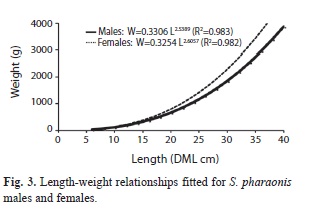
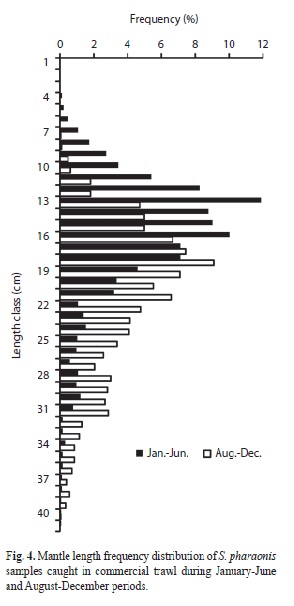
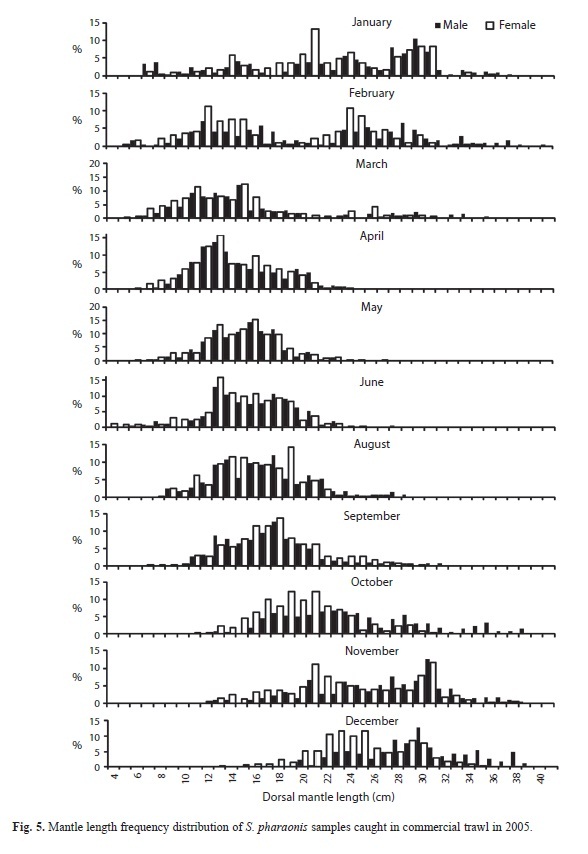
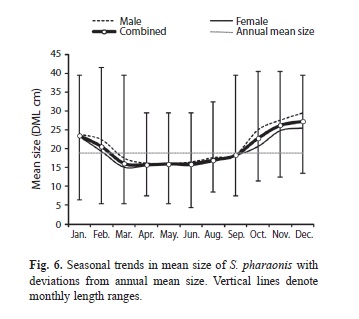
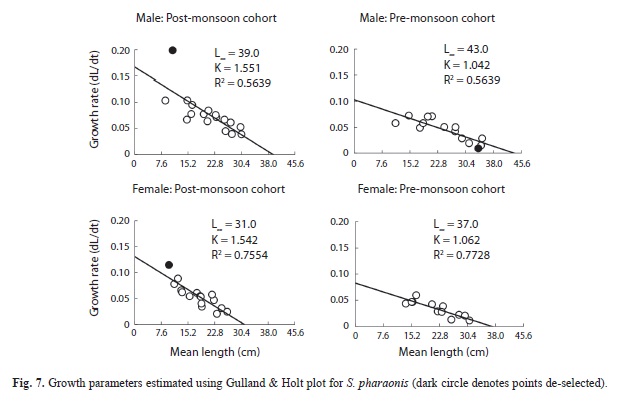
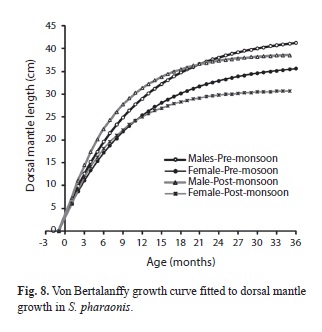
<body><![CDATA[<br>     <br> </span></font> <font size="2"><span style="font-weight: bold; font-family: verdana;">Length-weight relationships:</span><span style="font-family: verdana;"> Lengthweight relationships calculated for males and females <span  style="font-style: italic;">S. pharaonis</span> are presented in <a href="/img/revistas/rbt/v61n1/a01i3.jpg">figure 3</a>. The <span style="font-style: italic;">b</span> values for both sets of data were below three indicating negative (<span style="font-style: italic;">b</span>&lt;3) allometric growth of weight with length for males, females and for the sexes combined (<span  style="font-style: italic;">b</span> significantly different from three, <span style="font-style: italic;">t</span>-test, <span style="font-style: italic;">t</span>&gt; t<sub>0.01</sub>). ANCOVA also showed significant differences between sexes for slope, (F=8.83&gt;F<sub>1907</sub>=6.66; p&lt;0.01) and for the intercept (F=34.47&gt;F<sub>1908</sub>=6.66; p&lt;0.01).    <br> </span></font><br style="font-family: verdana;"> <font size="2"><span style="font-weight: bold; font-family: verdana;">Size distribution:</span><span style="font-family: verdana;"> The monthly size distribution of <span style="font-style: italic;">S. pharaonis</span> followed an identical intra-annual pattern. The DML of <span style="font-style: italic;">S. pharaonis</span> in the commercial fishery ranged from four to 41cm with size groups 12-25cm dominating the catch. The fishery during the early monsoon (June) months, late monsoon (September) and early post-monsoon (October to December) was supported by larger size groups of 13-30cm, whereas, in late post-monsoon and pre-monsoon it was supported by 11-21cm sized cuttlefish (<a  href="/img/revistas/rbt/v61n1/a01i4.jpg">Fig. 4</a>). Results of the analysis of the seasonal size structure indicated that the catches were dominated by medium sized cuttlefish until September while, larger sized individuals were less abundant. Smaller size group in the range of 4-8cm was represented from January to June. Monthly length distribution of males and females showed a bimodal distribution from October to March, with larger size groups evident during the post-monsoon months (<a href="/img/revistas/rbt/v61n1/a01i5.jpg">Fig. 5</a>). In April a unimodal distribution was evident with progression of the mode through December.</span></font><br  style="font-family: verdana;">     <br> <font size="2"><span style="font-family: verdana;">Analysis of the seasonal trends in mean length indicated that the monthly mean sizes of males were higher than the females throughout the fishery. The mean length of males was 19.6cm (SD=4.9) and female was 18.1cm (SD=4.0). The mean size of females was greater from October to January, whereas smaller individuals were represented in the fishery from February to April (<a href="/img/revistas/rbt/v61n1/a01i6.jpg">Fig. 6</a>). Females were less numerous than males among the larger individuals above size group 27cm and were not present above size group 35cm.    <br> </span></font><br style="font-family: verdana;"> <font size="2"><span style="font-family: verdana;">The mean size of the cuttlefish population, in the commercial landings progressed from 16cm in May/June to 22cm in October subsequently attaining 27cm by November/ December. Recruitment was apparent with the entry of smaller sized cuttlefish in January and in May/June, discernible by a decrease in the mean size of the population. In January, though the mean size declined to 23cm, it was above the annual mean size (18.8cm) of the population. It was observed from the length frequency distribution that recruitment to the fishery occurs in two spells with a major one in May/ June before the onset of monsoon and subsequently in January/February. The proportion of smaller individuals in the fishery is above 50% in January and in May/June, consequent to the recruitments. Hence, two distinct age groups or cohorts were apparent in the population. </span></font><br  style="font-family: verdana;"> <font size="2"></font><br style="font-family: verdana;"> <font size="2"><span style="font-weight: bold; font-family: verdana;">Growth parameters: </span><span style="font-family: verdana;">Two cohorts were identified, the first cohort that recruits to the fishery in January, which originate from a more extended spawning period from October/ November (post-monsoon spawning) and the second cohort that originated from a second spawning spell in February/March (pre-monsoon spawning).</span></font><br style="font-family: verdana;"> <font size="2"></font><br style="font-family: verdana;"> <font size="2"><span style="font-family: verdana;">The separation of modes from the size distributions of females using Bhattacharya method and fitting of the Gulland &amp; Holt plots resulted in higher estimates of curvature parameter K, 1.579&plusmn;0.22/year for an L<sub>&#8734;</sub> of 31&plusmn;1.42cm for the post-monsoon cohort and lower estimates of K (1.067&plusmn;0.31/year) and higher L<sub>&#8734;</sub> (37&plusmn;3.81cm) for the pre-monsoon cohort (<a href="/img/revistas/rbt/v61n1/a01i7.jpg">Fig. 7</a>). In males, the post-monsoon cohort showed lower estimates of L<sub>&#8734;</sub> (39&plusmn;3.26cm) and higher estimates of K (1.551&plusmn;0.32/year) whereas, for the pre-monsoon cohort higher estimates of L&#8734; (43&plusmn;3.43cm) and lower K (1.042&plusmn;0.26/year) were obtained. The estimated parameters L<sub>&#8734;</sub> and K in VBGF were used to model growth curves in length for males and females (<a  href="/img/revistas/rbt/v61n1/a01i8.jpg">Fig. 8</a>).    <br>     <br> </span></font> <font size="2"><span style="font-family: verdana;">Growth models fitted were: </span></font><br style="font-family: verdana;"> <font size="2"></font><br style="font-family: verdana;"> <font size="2"><span style="font-family: verdana;">Post-monsoon cohort</span></font><br  style="font-family: verdana;"> <font size="2"><span style="font-family: verdana;">Males: Lt = 39 (1-e<sup>[1.551(t+0.0493)]</sup>)</span></font><br  style="font-family: verdana;"> <font size="2"><span style="font-family: verdana;">Females: Lt = 31 (1-e<sup>[1.579(t+0.0510)]</sup>)</span></font><br  style="font-family: verdana;"> <font size="2"><span style="font-family: verdana;">Pre-monsoon cohort</span></font><br  style="font-family: verdana;"> <font size="2"><span style="font-family: verdana;">Males: Lt = 43 (1-e<sup>[1.042(t+0.0814)]</sup>)</span></font><br  style="font-family: verdana;"> <font size="2"><span style="font-family: verdana;">Females: Lt = 37 (1-e<sup>[1.067(t+0.0827)]</sup>)</span></font><br  style="font-family: verdana;"> <font size="2"></font><br style="font-family: verdana;"> <font size="2"><span style="font-family: verdana;">The t<sub>max</sub>, the maximum observed age in the fishery (years), of female <span style="font-style: italic;">S. pharaonis</span> was calculated as 2.1 for post-monsoon cohort and 2.6years for pre-monsoon cohort and correspondingly 2.3 and 2.8years for male. Modal analysis of the length frequency distribution indicated that the commercial trawl fishery was mostly supported by 0+year group dominated by the post-monsoon cohort (<a href="/img/revistas/rbt/v61n1/a01i5.jpg">Fig. 5</a>). Individuals in the size classes less than 8cm corresponding to the juveniles were represented occasionally in the fishery. The phi-prime index was estimated as 3.3-3.4 for males and 3.1-3.2 for females.</span></font><br style="font-family: verdana;"> <font size="2"></font><br style="font-family: verdana;"> <font size="3"><span style="font-weight: bold; font-family: verdana;">Discussion</span></font>    <br> <font size="2"><span style="font-weight: bold; font-family: verdana;"></span></font>    <br>     <font size="2"><span style="font-weight: bold; font-family: verdana;"></span><span     ]]></body>
<body><![CDATA[ style="font-family: verdana;">Information on the     size-composition of the fishery is critical in establishing management     measures aimed at sustainable exploitation of the resources. Size     structure of <span style="font-style: italic;">S. pharaonis</span>     observed reflects the length distribution of     the catch over the recent past, representing almost all size categories     including juveniles. The L<sub>max</sub> observed in the catches (41cm     DML) was     higher than that reported elsewhere in Indian waters (Silas et al.     1985, Nair et al. 1993), which can be attributed to the targeted     ]]></body>
<body><![CDATA[fishery for the resource, together with expansion in trawling grounds.</span></font><br      style="font-family: verdana;">     <font size="2"></font><br style="font-family: verdana;">     <font size="2"><span style="font-family: verdana;">Length-weight     relationships in <span style="font-style: italic;">S.     pharaonis</span> suggest that the estimated &#8220;<span      style="font-style: italic;">b</span>&#8221; values for males, females and     for the population were significantly smaller than the isometric value     of 3. Analysis of the length-weight relationship of this species using     samples collected in beach seines, hook &amp; line and trawl indicated     ]]></body>
<body><![CDATA[that the exponent &#8220;<span style="font-style: italic;">b</span>&#8221; of the     length-weight relationship in this species     ranges from 2.5 (Silas et al. 1985) to 2.89 (Dunning et al. 1994),     displaying negative allometric growth. Negative allometric     relationships, where growth in length is significantly higher than a     corresponding increase in weight; have been described in many     cuttlefish species (Dunning et al. 1994, Reid et al. 2005).</span></font><br      style="font-family: verdana;">     <font size="2"></font><br style="font-family: verdana;">     <font size="2"><span style="font-family: verdana;">It was observed that     ]]></body>
<body><![CDATA[females were     heavier than males at any given mantle length. Though the females were     heavier compared to males throughout the life cycle, the males were     found to attain greater ultimate lengths. It appears that the female     growth in length declines with maturation and the weight gain during     the period is largely attributable to the increase in the weight of the     gonad. Yet another possibility of females weighing heavier than males     lies in their morphometric difference where the females have a     relatively wider posterior mantle than the males, a characteristic that     is also reported in other species (for instance in <span     ]]></body>
<body><![CDATA[ style="font-style: italic;">Sepia orbignyana</span>)     (Bello 1988). Higher ultimate lengths attained by males can also partly     explain the different growth patterns for <span      style="font-style: italic;">S. pharaonis</span> between the     sexes. Higher &#8220;<span style="font-style: italic;">b</span>&#8221; values for     female have been reported in many of the     previous investigations. Gabr et al. (1999) observed that the sex-wise     differences in &#8220;b&#8221; values for <span style="font-style: italic;">S.     pharaonis</span> from Suez Canal were not     significant. It is highly probable that this observation was because,     ]]></body>
<body><![CDATA[the length range in the data set used for the Suez Canal study was     small (1-24cm), while the present study included a larger size range     (4-41cm). The differences in the ultimate lengths attained by males and     females can bring about wider variations in the weight-at-length,     particularly in larger size classes. </span></font><br      style="font-family: verdana;">     <font size="2"></font><br style="font-family: verdana;">     <font size="2"><span style="font-family: verdana;">Age and growth of <span      style="font-style: italic;">S. pharaonis</span> have     been described only by few investigators in its distributional range.     ]]></body>
<body><![CDATA[By assigning ages to length frequency modes, Silas et al. (1985)     projected a L<sub>&#8734;</sub> for male as 36.5cm and as 34.2cm for female     and worked     out a life span of three years with lower K values. Later, Nair et al.     (1993) estimated the L<sub>&#8734;</sub> of 32cm for male and 29cm for female     cuttlefish     from the West coast of India (Arabian Sea) with a growth coefficient of     less than 1. Similarly, they estimated the L<sub>&#8734;</sub> for cuttlefish     from the     East coast of India (Bay of Bengal) as 27cm for male and 23cm for     ]]></body>
<body><![CDATA[female with higher K values. In a recent study, the L<sub>&#8734;</sub> for     the <span style="font-style: italic;">S.     pharaonis</span> population from East coast of India was estimated as     31cm     (Abdussamad et al. 2004). The estimates obtained by the present study     differed from the results of the earlier studies from India, probably     because of the absence of older specimens in the former studies,     whereas, the current estimates were strongly influenced by the wide     length distribution. In 1980s cephalopods were caught as by-catch in     shrimp trawlers (Meiyappan &amp; Mohamed 2003). Therefore, it is likely     ]]></body>
<body><![CDATA[that exclusion of adult habitats probably resulted in absence of larger     specimens in earlier samples. On the other hand, Sanders (1979) while     working on trawl samples <span style="font-style: italic;">S. pharaonis</span>     along Western Arabian Sea found a     similar growth trend with a higher L&#8734; estimate of 40cm, for a growth     coefficient of one.</span></font><br style="font-family: verdana;">     <font size="2"></font><br style="font-family: verdana;">     <font size="2"><span style="font-family: verdana;">The size-at-age     estimated for <span style="font-style: italic;">S.     pharaonis</span> in the South-West coast of India was 29-31cm for males     ]]></body>
<body><![CDATA[and     24-25cm for females in one year. Silas et al. (1985) estimated that <span      style="font-style: italic;">S.     pharaonis</span> grows to 18.6-19.7cm in the first year with longevity     of     3years. In Western Arabian Sea, Sanders (1979) described two cohorts     based on the discrete spawning season and concluded that <span      style="font-style: italic;">S. pharaonis</span>     can attain large mantle lengths (&gt;25cm) in less than a year and     survive for two years. Under controlled laboratory conditions <span     ]]></body>
<body><![CDATA[ style="font-style: italic;">S.     pharaonis</span> has been reported to attain up to 30cm in 8.4 months     (Minton     et al. 2001). Considering the faster growth rate in <span      style="font-style: italic;">S. pharaonis</span>, modes     in the length frequency data in the present study can be considered as     comprising distinct age classes. Therefore, the growth curves fitted     through these modes can aptly describe the growth of the species and     the phi-prime index values were comparable across different geographic     locations.</span></font><br style="font-family: verdana;">     ]]></body>
<body><![CDATA[<font size="2"></font><br style="font-family: verdana;">     <font size="2"><span style="font-family: verdana;">Exploited population     of <span style="font-style: italic;">S.     pharaonis</span> is composed of a wide range of age/size classes so     that any     effects of fishing are spread across a number of cohorts. Modeled     growth parameters revealed that <span style="font-style: italic;">S.     pharaonis</span> is a fast-growing species.     Approximately 65% (in female) to 70% (in male) of linear growth to L<sub>max</sub>     is accomplished within the first year of the lifespan. The growth curve     ]]></body>
<body><![CDATA[suggests rapid growth rate for <span style="font-style: italic;">S.     pharaonis</span> up to an age of one year in     the case of females and 1.5years for males, after which an asymptote is     approached. Along the Indian East coast, <span      style="font-style: italic;">S. pharaonis</span> exhibited similar     patterns in initial growth during the first year of its lifespan     (Abdussamad et al. 2004). The differential growth characteristics     observed here are comparable to the general pattern for the group,     where males tend to grow to a larger mean length-at-age than females of     a similar age (Sanders 1979, Minton et al. 2001). The rate of increase     ]]></body>
<body><![CDATA[in length with age was greater for males than females, evident from     three months onwards; corresponding to a mean size of 9cm. In culture     systems, commencement of mating behaviour in <span      style="font-style: italic;">S. pharaonis</span> was observed     from three months of hatching (Anil et al. 2005). Therefore, the     differential growth in the females may possibly be related to the     erratic growth at the onset of sexual maturity/ development of gonad     besides, the transformation from exponential growth (in about 60 days)     to linear growth recorded (Minton 2004). </span></font><br      style="font-family: verdana;">     ]]></body>
<body><![CDATA[<font size="2"></font><br style="font-family: verdana;">     <font size="2"><span style="font-family: verdana;">Analysis of length     composition in     the fishery indicated that the 0+ year class was well represented in     the population, resulting in a left-skewed length frequency     distribution. The strong representation of the 0+year groups would be     expected considering the targeted fishery for the resource.     Smaller-sized individuals in the fishery appeared from January/     February onwards due to juveniles remaining in the shallow coastal     waters. However, during the monsoon and post-monsoon season     ]]></body>
<body><![CDATA[(August-December), smaller individuals of this species were not     frequent in the fishing grounds, while smaller species (<span      style="font-style: italic;">Sepia     elliptica</span>) were represented (Silas et al. 1985). Bimodal     patterns with     a smaller modal length appeared for a short period from January     onwards, when adults remained in the fishing ground at the same time     when the recruits enter the fishery. Given that the catch rates during     January- March were very low, it is fair to infer that the major     fraction of the cuttlefish, which hatch out from the post-monsoon     ]]></body>
<body><![CDATA[spawning migrate offshore to spend their early life in deeper waters.</span></font><br      style="font-family: verdana;">     <font size="2"></font><br style="font-family: verdana;">     <font size="2"><span style="font-family: verdana;">The seasonal     fluctuations in catch     rates, suggest the migratory nature of <span      style="font-style: italic;">S. pharaonis</span> between deeper     offshore and inshore coastal zones for feeding and spawning in the     Eastern Arabian Sea. Shoreward migration is evident from the increase     in catch rates/abundance associated with the arrival of <span     ]]></body>
<body><![CDATA[ style="font-style: italic;">S. pharaonis</span> by     May/June to inshore waters. The migratory life cycle appears to be     similar to the group inhabiting the Western Arabian Sea (Sanders 1979)     and Hong Kong waters (Reid et al. 2005), undertaking seasonal     migrations between the inshore and offshore waters. With the     advancement of monsoon, migration of cuttlefish towards the coastal     waters and a corresponding increase in the abundance of cuttlefish in     the inshore waters of the Eastern Arabian Sea was observed in trawl     surveys (Naik &amp; Tamilarasan 1998). It should be emphasized that the     commencement of shoreward migration influences the landings in     ]]></body>
<body><![CDATA[commercial fishery and the catch rates. The high proportion of fully     mature and spawning specimens in the commercial landings suggests that     the species undertakes inshore migration for spawning. This is     further&nbsp; supported by the presence of egg clusters of <span      style="font-style: italic;">S. pharaonis</span>     found attached to the hard substratum in the inshore rocky area along     the South-West coast of India (Anil et al. 2005). It follows that the     juveniles then migrate offshore where they feed, grow, mature and later     return to shallow waters to complete the life cycle. Thus the     distribution may be partly determined by physical parameters and partly     ]]></body>
<body><![CDATA[by prey availability, besides spawning migration.</span></font><br      style="font-family: verdana;">     <font size="2"></font><br style="font-family: verdana;">     <font size="2"><span style="font-family: verdana;">The relationship     between     environmental variables and cuttlefish abundance have been widely     reported for temperate cephalopods including <span      style="font-style: italic;">Sepia officinalis</span> (Dunn     1999, Dennis &amp; Robin 2001). Demersal surveys in the Eastern Arabian     Sea at 50-200m depth zones from 130 to180 N recorded reduced catch     ]]></body>
<body><![CDATA[rates for cuttlefish in 100-200m, compared to shallower area with the     advancement of monsoon in May, whereas, by August the cuttlefish     occurred within the inshore waters (within 50-100 m) (Naik &amp;     Tamilarasan 1998). It appears that the timing of migration corresponds     to the seasonal semi-annual reversal in current patterns that occur in     the Eastern Arabian Sea with the monsoon winds by mid-May (inshore) and     by November (offshore).</span></font><br style="font-family: verdana;">     <font size="2"></font><br style="font-family: verdana;">     <font size="2"><span style="font-family: verdana;">In January/February,     recruitment to     ]]></body>
<body><![CDATA[the fishery occurs, as evident from increasing proportions of smaller     individuals resulting in a reduction in mean size. Major recruitment     occurs in May/June, manifested with rapidly increasing catch rates in     addition to an increase in the proportion of smaller individuals.     Spawning in inshore waters in October/ November (Sasikumar et al. 2006)     accounts for the smaller size groups (4-5cm) appearing in     January/February in commercial landings, comprising the early recruits     from the postmonsoon spawning. In February/March, these smaller     cuttlefish are observed to attain maturity even at a minimum size of     7cm in males and 12cm in females (Sasikumar 2011). They form part of     ]]></body>
<body><![CDATA[the reproductive stock, spawn in inshore waters, and contribute to the     premonsoon cohort. </span></font><br style="font-family: verdana;">     <font size="2"></font><br style="font-family: verdana;">     <font size="2"><span style="font-family: verdana;">The growth rates of     the two     sub-annual cohorts described in the present study displayed     variability. The curvature parameter K indicated rapid growth mainly     for the postmonsoon cohort in the region. When species undertake     seasonal migrations, they are subjected to higher variability in biotic     and abiotic factors, influencing the growth patterns of cohorts     ]]></body>
<body><![CDATA[(Forsythe &amp; Van Heukelem 1987, Villegas 2001). In temperate waters,     several authors have proposed Mesnil&#8217;s model for cephalopods with late     autumn and late summer cohorts, having different growth rates (Mangold     1987). In the study area, shorter daylight and increasing temperature     (Krishnakumar &amp; Bhat 2008), at the time of hatching and recruitment     of <span style="font-style: italic;">S. pharaonis</span> in     post-monsoon periods, induce faster growth and early     maturity in the early recruits from the post-monsoon spawning.     Pre-monsoon cohort after recruitment in May/June, remains in the     inshore waters during monsoon where the growth rate is relatively     ]]></body>
<body><![CDATA[reduced under the lowered monsoon temperatures. The rapid growth     displayed by many cephalopods makes them sensitive to changes in     environmental temperatures (Jackson 1994). Similar patterns in     population structure comprising of two cohorts have been elucidated     based on the maturity, timing of spawning and the distribution of early     life stages of <span style="font-style: italic;">S. pharaonis</span>     in Western Arabian Sea (Sanders 1979,     Aoyama &amp; Nguyen 1989). This variability in growth rates among the     cohorts are attributable to minor temperature changes experienced     during the early growth phase (Villegas 2001).</span></font><br     ]]></body>
<body><![CDATA[ style="font-family: verdana;">     <font size="2"></font><br style="font-family: verdana;">     <font size="3"><span style="font-weight: bold; font-family: verdana;">Acknowledgments</span></font><br      style="font-family: verdana;">     <font size="2"></font><br style="font-family: verdana;">     <font size="2"><span style="font-family: verdana;">We wish to thank the     Director,     CMFRI and the Scientist-in-Charge, Research Centre of CMFRI, Mangalore,     for facilities and encouragements. Special appreciation is extended to     D. Nagaraja and G. Sampathkumar for their technical assistance in     ]]></body>
<body><![CDATA[sampling.</span></font><br style="font-family: verdana;">     <font size="2"></font>     <hr style="width: 100%; height: 2px;"><br style="font-family: verdana;">     <font size="3"><span style="font-weight: bold; font-family: verdana;">References</span></font>    <br> <font size="2"><span style="font-weight: bold; font-family: verdana;"></span></font>    <!-- ref --><br> <font size="2"><span style="font-weight: bold; font-family: verdana;"></span><span  style="font-family: verdana;">Abdussamad, E.M., M.M. Meiyappan &amp; K.R. Somayajulu. 2004. Fishery, population characteristics and stock assessment of cuttlefishes, <span  style="font-style: italic;">Sepia aculeata</span> and <span style="font-style: italic;">Sepia pharaonis</span> at Kakinada along the East coast of India. Bangladesh J. Fish. Res. 8: 143-150.    &nbsp;&nbsp;&nbsp;&nbsp;&nbsp;&nbsp;&nbsp;&nbsp;[&#160;<a href="javascript:void(0);" onclick="javascript: window.open('/scielo.php?script=sci_nlinks&ref=1818329&pid=S0034-7744201300010000100001&lng=','','width=640,height=500,resizable=yes,scrollbars=1,menubar=yes,');">Links</a>&#160;]<!-- end-ref --><!-- ref --></span></font><br  style="font-family: verdana;"> <font size="2"></font><br style="font-family: verdana;"> <font size="2"><span style="font-family: verdana;">Anderson, F.E., T. Valinassab, C.W. Ho, K.S. Mohamed, P.K. Asokan, G.S. Rao, P. Nootmorn, C. Chotiyaputta, M. Dunning &amp; C.C. Lu. 2007. Phylogeography of the pharaoh cuttle <span style="font-style: italic;">Sepia pharaonis</span> based on partial mitochondrial 16S sequence data. Rev. Fish. Biol. Fisheries 17: 345-352.    &nbsp;&nbsp;&nbsp;&nbsp;&nbsp;&nbsp;&nbsp;&nbsp;[&#160;<a href="javascript:void(0);" onclick="javascript: window.open('/scielo.php?script=sci_nlinks&ref=1818330&pid=S0034-7744201300010000100002&lng=','','width=640,height=500,resizable=yes,scrollbars=1,menubar=yes,');">Links</a>&#160;]<!-- end-ref --><!-- ref --></span></font><br  style="font-family: verdana;"> <font size="2"></font><br style="font-family: verdana;"> <font size="2"><span style="font-family: verdana;">Anil, M.K., J. Andrews &amp; C. Unnikrishnan. 2005. Growth, behavior and mating of pharaoh cuttlefish (<span style="font-style: italic;">Sepia&nbsp; pharaonis</span> Ehrenberg) in captivity. Isr. J. Aquac. Bamidgeh 57: 25-31.    &nbsp;&nbsp;&nbsp;&nbsp;&nbsp;&nbsp;&nbsp;&nbsp;[&#160;<a href="javascript:void(0);" onclick="javascript: window.open('/scielo.php?script=sci_nlinks&ref=1818331&pid=S0034-7744201300010000100003&lng=','','width=640,height=500,resizable=yes,scrollbars=1,menubar=yes,');">Links</a>&#160;]<!-- end-ref --><!-- ref --></span></font><br style="font-family: verdana;"> <font size="2"></font><br style="font-family: verdana;"> <font size="2"><span style="font-family: verdana;">Aoyama, T. &amp; T. Nguyen. 1989. Stock assessment of cuttlefish off the coast of People&#8217;s Democratic Republic of Yemen. J. Shimonoseki Univ. Fish. 37: 61-112.    &nbsp;&nbsp;&nbsp;&nbsp;&nbsp;&nbsp;&nbsp;&nbsp;[&#160;<a href="javascript:void(0);" onclick="javascript: window.open('/scielo.php?script=sci_nlinks&ref=1818332&pid=S0034-7744201300010000100004&lng=','','width=640,height=500,resizable=yes,scrollbars=1,menubar=yes,');">Links</a>&#160;]<!-- end-ref --><!-- ref --></span></font><br  style="font-family: verdana;"> <font size="2"></font><br style="font-family: verdana;"> <font size="2"><span style="font-family: verdana;">Barord, G.J., K.N. Keister &amp; P.G. Lee. 2010. Determining the effects of stocking density and temperature on growth and food consumption in the pharaoh cuttlefish, <span style="font-style: italic;">Sepia pharaonis</span>, Ehrenberg 1890. Aquacult. Int. 18: 271-283.    &nbsp;&nbsp;&nbsp;&nbsp;&nbsp;&nbsp;&nbsp;&nbsp;[&#160;<a href="javascript:void(0);" onclick="javascript: window.open('/scielo.php?script=sci_nlinks&ref=1818333&pid=S0034-7744201300010000100005&lng=','','width=640,height=500,resizable=yes,scrollbars=1,menubar=yes,');">Links</a>&#160;]<!-- end-ref --><!-- ref --></span></font><br  style="font-family: verdana;"> <font size="2"></font><br style="font-family: verdana;"> <font size="2"><span style="font-family: verdana;">Bello, G. 1988. Length-weight relationship in males and females of <span style="font-style: italic;">Sepia orbignyana</span> and <span style="font-style: italic;">Sepia elegans</span> (Cephalopoda: Sepiidae). Rapp. Comm. Int. Mer. M&eacute;dit. 31: 254.    &nbsp;&nbsp;&nbsp;&nbsp;&nbsp;&nbsp;&nbsp;&nbsp;[&#160;<a href="javascript:void(0);" onclick="javascript: window.open('/scielo.php?script=sci_nlinks&ref=1818334&pid=S0034-7744201300010000100006&lng=','','width=640,height=500,resizable=yes,scrollbars=1,menubar=yes,');">Links</a>&#160;]<!-- end-ref --><!-- ref --></span></font><br  style="font-family: verdana;"> <font size="2"></font><br style="font-family: verdana;"> <font size="2"><span style="font-family: verdana;">Boyle, P.R. 1990. Cephalopod biology in the fisheries context. Fish. Res. 8: 303-321.    &nbsp;&nbsp;&nbsp;&nbsp;&nbsp;&nbsp;&nbsp;&nbsp;[&#160;<a href="javascript:void(0);" onclick="javascript: window.open('/scielo.php?script=sci_nlinks&ref=1818335&pid=S0034-7744201300010000100007&lng=','','width=640,height=500,resizable=yes,scrollbars=1,menubar=yes,');">Links</a>&#160;]<!-- end-ref --><!-- ref --></span></font><br  style="font-family: verdana;"> <font size="2"></font><br style="font-family: verdana;"> <font size="2"><span style="font-family: verdana;">Chotiyaputta, C. 1993. Cephalopod resources of Thailand, p. 71-80. <span style="font-style: italic;">In </span>T. Okutani, R.K. O&acute;Dor &amp; T. Kubodera (eds.). Recent Advances in Cephalopod Fisheries Biology. Tokai University, Tokyo.    &nbsp;&nbsp;&nbsp;&nbsp;&nbsp;&nbsp;&nbsp;&nbsp;[&#160;<a href="javascript:void(0);" onclick="javascript: window.open('/scielo.php?script=sci_nlinks&ref=1818336&pid=S0034-7744201300010000100008&lng=','','width=640,height=500,resizable=yes,scrollbars=1,menubar=yes,');">Links</a>&#160;]<!-- end-ref --><!-- ref --></span></font><br style="font-family: verdana;"> <font size="2"></font><br style="font-family: verdana;"> <font size="2"><span style="font-family: verdana;">Dennis, V. &amp; J.P. Robin. 2001. Present status of French Atlantic fishery for cuttlefish (<span  style="font-style: italic;">Sepia officinalis</span>). Fish. Res. 182: 1-12.    &nbsp;&nbsp;&nbsp;&nbsp;&nbsp;&nbsp;&nbsp;&nbsp;[&#160;<a href="javascript:void(0);" onclick="javascript: window.open('/scielo.php?script=sci_nlinks&ref=1818337&pid=S0034-7744201300010000100009&lng=','','width=640,height=500,resizable=yes,scrollbars=1,menubar=yes,');">Links</a>&#160;]<!-- end-ref --><!-- ref --></span></font><br  style="font-family: verdana;"> <font size="2"></font><br style="font-family: verdana;"> <font size="2"><span style="font-family: verdana;">Dineshbabu, A.P., B. Sridhara &amp; Y. Muniyappa. 2001. New crustacean resources in the trawl fishery off Mangalore coast. Mar. Fish. Infor. Serv. T. &amp; E. Ser. 170: 3-5.    &nbsp;&nbsp;&nbsp;&nbsp;&nbsp;&nbsp;&nbsp;&nbsp;[&#160;<a href="javascript:void(0);" onclick="javascript: window.open('/scielo.php?script=sci_nlinks&ref=1818338&pid=S0034-7744201300010000100010&lng=','','width=640,height=500,resizable=yes,scrollbars=1,menubar=yes,');">Links</a>&#160;]<!-- end-ref --><!-- ref --></span></font><br  style="font-family: verdana;"> <font size="2"></font><br style="font-family: verdana;"> <font size="2"><span style="font-family: verdana;">Dunn, M.R. 1999. Aspects of the stock dynamics and exploitation of cuttlefish, <span  style="font-style: italic;">Sepia officinalis</span> (Linnaeus, 1758), in the English Channel. Fish. Res. 40: 277-293.    &nbsp;&nbsp;&nbsp;&nbsp;&nbsp;&nbsp;&nbsp;&nbsp;[&#160;<a href="javascript:void(0);" onclick="javascript: window.open('/scielo.php?script=sci_nlinks&ref=1818339&pid=S0034-7744201300010000100011&lng=','','width=640,height=500,resizable=yes,scrollbars=1,menubar=yes,');">Links</a>&#160;]<!-- end-ref --><!-- ref --></span></font><br  style="font-family: verdana;"> <font size="2"></font><br style="font-family: verdana;"> <font size="2"><span style="font-family: verdana;">Dunning, M., S. McKinnon, C. Lu, J. Yeatman &amp; D. Cameron. 1994. Demersal cephalopods of the Gulf of Carpentaria, Australia. Aust. J. Mar. Freshw. Res. 45: 351-374.    &nbsp;&nbsp;&nbsp;&nbsp;&nbsp;&nbsp;&nbsp;&nbsp;[&#160;<a href="javascript:void(0);" onclick="javascript: window.open('/scielo.php?script=sci_nlinks&ref=1818340&pid=S0034-7744201300010000100012&lng=','','width=640,height=500,resizable=yes,scrollbars=1,menubar=yes,');">Links</a>&#160;]<!-- end-ref --><!-- ref --></span></font><br  style="font-family: verdana;"> <font size="2"></font><br style="font-family: verdana;"> <font size="2"><span style="font-family: verdana;">Forsythe, J.M. &amp; W.F. Van Heukelem. 1987. Cephalopod growth, p. 135-156. <span  style="font-style: italic;">In</span> P.R. Boyle (ed.). Cephalopod Life Cycles, Vol II. Academic, London, England.    &nbsp;&nbsp;&nbsp;&nbsp;&nbsp;&nbsp;&nbsp;&nbsp;[&#160;<a href="javascript:void(0);" onclick="javascript: window.open('/scielo.php?script=sci_nlinks&ref=1818341&pid=S0034-7744201300010000100013&lng=','','width=640,height=500,resizable=yes,scrollbars=1,menubar=yes,');">Links</a>&#160;]<!-- end-ref --><!-- ref --></span></font><br  style="font-family: verdana;"> <font size="2"></font><br style="font-family: verdana;"> <font size="2"><span style="font-family: verdana;">Gabr, H.R., R.T. Hanlon, S.G. El-Etreby &amp; M.H. Hanafy. 1999. Reproductive versus somatic tissue growth during the life cycle of the cuttlefish <span  style="font-style: italic;">Sepia pharaonis</span> Erenberg, 1831. Fish. Bull. 97: 802-811.    &nbsp;&nbsp;&nbsp;&nbsp;&nbsp;&nbsp;&nbsp;&nbsp;[&#160;<a href="javascript:void(0);" onclick="javascript: window.open('/scielo.php?script=sci_nlinks&ref=1818342&pid=S0034-7744201300010000100014&lng=','','width=640,height=500,resizable=yes,scrollbars=1,menubar=yes,');">Links</a>&#160;]<!-- end-ref --><!-- ref --></span></font><br  style="font-family: verdana;"> <font size="2"></font><br style="font-family: verdana;"> <font size="2"><span style="font-family: verdana;">Gayanilo, Jr. F.C., P. Sparre &amp; D. Pauly. 1995. The FAOICLARM Stock Assessment Tools (FiSAT) User&#8217;s guide FAO Computerized Information Series (Fisheries) 8 FAO Rome.    &nbsp;&nbsp;&nbsp;&nbsp;&nbsp;&nbsp;&nbsp;&nbsp;[&#160;<a href="javascript:void(0);" onclick="javascript: window.open('/scielo.php?script=sci_nlinks&ref=1818343&pid=S0034-7744201300010000100015&lng=','','width=640,height=500,resizable=yes,scrollbars=1,menubar=yes,');">Links</a>&#160;]<!-- end-ref --><!-- ref --></span></font><br  style="font-family: verdana;"> <font size="2"></font><br style="font-family: verdana;"> <font size="2"><span style="font-family: verdana;">Jackson, G.D. 1994. Applications and future potential on statolith increments analysis in squids and sepioids. Can. J. Fish. Aquat. Sci. 51: 2612-2625.    &nbsp;&nbsp;&nbsp;&nbsp;&nbsp;&nbsp;&nbsp;&nbsp;[&#160;<a href="javascript:void(0);" onclick="javascript: window.open('/scielo.php?script=sci_nlinks&ref=1818344&pid=S0034-7744201300010000100016&lng=','','width=640,height=500,resizable=yes,scrollbars=1,menubar=yes,');">Links</a>&#160;]<!-- end-ref --><!-- ref --></span></font><br  style="font-family: verdana;"> <font size="2"></font><br style="font-family: verdana;"> <font size="2"><span style="font-family: verdana;">Johannessen, O.M., G. Subharaju &amp; J. Blindheim. 1981. Seasonal variations of the oceanographic conditions off the southwest cost of India during 1971-75. Fisk- Dir Skr Serie HavUnders 18: 247-261.    &nbsp;&nbsp;&nbsp;&nbsp;&nbsp;&nbsp;&nbsp;&nbsp;[&#160;<a href="javascript:void(0);" onclick="javascript: window.open('/scielo.php?script=sci_nlinks&ref=1818345&pid=S0034-7744201300010000100017&lng=','','width=640,height=500,resizable=yes,scrollbars=1,menubar=yes,');">Links</a>&#160;]<!-- end-ref --><!-- ref --></span></font><br  style="font-family: verdana;"> <font size="2"></font><br style="font-family: verdana;"> <font size="2"><span style="font-family: verdana;">Krishnakumar, P.K. &amp; G.S. Bhat. 2008. Seasonal and interannual variations of oceanographic conditions off Mangalore coast (Karnataka, India) in the Malabar upwelling system during 1995-2004 and their influences on pelagic fishery. Fish. Oceanogr. 17: 45-60.    &nbsp;&nbsp;&nbsp;&nbsp;&nbsp;&nbsp;&nbsp;&nbsp;[&#160;<a href="javascript:void(0);" onclick="javascript: window.open('/scielo.php?script=sci_nlinks&ref=1818346&pid=S0034-7744201300010000100018&lng=','','width=640,height=500,resizable=yes,scrollbars=1,menubar=yes,');">Links</a>&#160;]<!-- end-ref --><!-- ref --></span></font><br style="font-family: verdana;"> <font size="2"></font><br style="font-family: verdana;"> <font size="2"><span style="font-family: verdana;">Madhupratap, M., K.N.V. Nair, T.C. Gopalakrishnan, P. Haridas, K.K.C. Nair, P. Venugopal &amp; M. Gauns. 2001. Arabian Sea oceanography and fisheries of the west coast of India. Curr. Sci. 81: 355-361.    &nbsp;&nbsp;&nbsp;&nbsp;&nbsp;&nbsp;&nbsp;&nbsp;[&#160;<a href="javascript:void(0);" onclick="javascript: window.open('/scielo.php?script=sci_nlinks&ref=1818347&pid=S0034-7744201300010000100019&lng=','','width=640,height=500,resizable=yes,scrollbars=1,menubar=yes,');">Links</a>&#160;]<!-- end-ref --><!-- ref --></span></font><br  style="font-family: verdana;"> <font size="2"></font><br style="font-family: verdana;"> <font size="2"><span style="font-family: verdana;">Mangold, K. 1987. Reproduction, p. 157-200. <span style="font-style: italic;">In</span> P.R. Boyle (ed.). Cephalopod Life Cycles, Vol II, Comparative Reviews. Academic, London, England.    &nbsp;&nbsp;&nbsp;&nbsp;&nbsp;&nbsp;&nbsp;&nbsp;[&#160;<a href="javascript:void(0);" onclick="javascript: window.open('/scielo.php?script=sci_nlinks&ref=1818348&pid=S0034-7744201300010000100020&lng=','','width=640,height=500,resizable=yes,scrollbars=1,menubar=yes,');">Links</a>&#160;]<!-- end-ref --><!-- ref --></span></font><br  style="font-family: verdana;"> <font size="2"></font><br style="font-family: verdana;"> <font size="2"><span style="font-family: verdana;">Meiyappan, M.M. &amp; K.S. Mohamed. 2003. Cephalopods, p. 221-227. <span style="font-style: italic;">In</span> M.M. Joseph &amp; A.A. Jayaprakash (eds.). Status of Exploited Marine Fishery Resources of India, Central Marine Fisheries Research Institute, Kochi, India.    &nbsp;&nbsp;&nbsp;&nbsp;&nbsp;&nbsp;&nbsp;&nbsp;[&#160;<a href="javascript:void(0);" onclick="javascript: window.open('/scielo.php?script=sci_nlinks&ref=1818349&pid=S0034-7744201300010000100021&lng=','','width=640,height=500,resizable=yes,scrollbars=1,menubar=yes,');">Links</a>&#160;]<!-- end-ref --><!-- ref --></span></font><br  style="font-family: verdana;"> <font size="2"></font><br style="font-family: verdana;"> <font size="2"><span style="font-family: verdana;">Minton, J.W., L.S. Walsh, P.G. Lee &amp; J.W. Forsythe. 2001. First multi-generation culture of the tropical cuttlefish <span style="font-style: italic;">Sepia pharaonis</span> Ehrenberg, 1831. Aquac. Int. 375-392.    &nbsp;&nbsp;&nbsp;&nbsp;&nbsp;&nbsp;&nbsp;&nbsp;[&#160;<a href="javascript:void(0);" onclick="javascript: window.open('/scielo.php?script=sci_nlinks&ref=1818350&pid=S0034-7744201300010000100022&lng=','','width=640,height=500,resizable=yes,scrollbars=1,menubar=yes,');">Links</a>&#160;]<!-- end-ref --><!-- ref --></span></font><br style="font-family: verdana;"> <font size="2"></font><br style="font-family: verdana;"> <font size="2"><span style="font-family: verdana;">Minton, J.W. 2004. The pattern of growth in the early life cycle of individual <span  style="font-style: italic;">Sepia pharaonis</span>. Aust. J. Mar. Freshw. Res. 55: 415-422.    &nbsp;&nbsp;&nbsp;&nbsp;&nbsp;&nbsp;&nbsp;&nbsp;[&#160;<a href="javascript:void(0);" onclick="javascript: window.open('/scielo.php?script=sci_nlinks&ref=1818351&pid=S0034-7744201300010000100023&lng=','','width=640,height=500,resizable=yes,scrollbars=1,menubar=yes,');">Links</a>&#160;]<!-- end-ref --><!-- ref --></span></font><br  style="font-family: verdana;"> <font size="2"></font><br style="font-family: verdana;"> <font size="2"><span style="font-family: verdana;">Mohamed, K.S. 1996. Estimates of growth, mortality and stock of the Indian squid <span  style="font-style: italic;">Loligo duvauceli</span> Orbigny, exploited off Mangalore, southwest coast of India. Bull. Mar. Sci. 58: 393-403.    &nbsp;&nbsp;&nbsp;&nbsp;&nbsp;&nbsp;&nbsp;&nbsp;[&#160;<a href="javascript:void(0);" onclick="javascript: window.open('/scielo.php?script=sci_nlinks&ref=1818352&pid=S0034-7744201300010000100024&lng=','','width=640,height=500,resizable=yes,scrollbars=1,menubar=yes,');">Links</a>&#160;]<!-- end-ref --><!-- ref --></span></font><br style="font-family: verdana;"> <font size="2"></font><br style="font-family: verdana;"> <font size="2"><span style="font-family: verdana;">Mohamed, K.S. &amp; G.S. Rao. 1997. Seasonal growth, stockrecruitment relationship and predictive yield of the Indian squid, <span style="font-style: italic;">Loligo duvauceli</span> (Orbigny) exploited off Karnataka coast. Indian J. Fish. 44: 319-329.    &nbsp;&nbsp;&nbsp;&nbsp;&nbsp;&nbsp;&nbsp;&nbsp;[&#160;<a href="javascript:void(0);" onclick="javascript: window.open('/scielo.php?script=sci_nlinks&ref=1818353&pid=S0034-7744201300010000100025&lng=','','width=640,height=500,resizable=yes,scrollbars=1,menubar=yes,');">Links</a>&#160;]<!-- end-ref --><!-- ref --> </span></font><br  style="font-family: verdana;"> <font size="2"></font><br style="font-family: verdana;"> <font size="2"><span style="font-family: verdana;">Nabhitabhata, J. 1995. Mass culture of cephalopods in Thailand. World Aquac. 26: 25-29.    &nbsp;&nbsp;&nbsp;&nbsp;&nbsp;&nbsp;&nbsp;&nbsp;[&#160;<a href="javascript:void(0);" onclick="javascript: window.open('/scielo.php?script=sci_nlinks&ref=1818354&pid=S0034-7744201300010000100026&lng=','','width=640,height=500,resizable=yes,scrollbars=1,menubar=yes,');">Links</a>&#160;]<!-- end-ref --><!-- ref --></span></font><br  style="font-family: verdana;"> <font size="2"></font><br style="font-family: verdana;"> <font size="2"><span style="font-family: verdana;">Nabhitabhata, J. &amp; P. Nilaphat. 1999. Life cycle of cultured pharaoh cuttlefish, <span  style="font-style: italic;">Sepia pharaonis</span> Ehrenberg, 1831. Spec. Publ. Phuket Mar. Biol. Cent. 19: 25-40.    &nbsp;&nbsp;&nbsp;&nbsp;&nbsp;&nbsp;&nbsp;&nbsp;[&#160;<a href="javascript:void(0);" onclick="javascript: window.open('/scielo.php?script=sci_nlinks&ref=1818355&pid=S0034-7744201300010000100027&lng=','','width=640,height=500,resizable=yes,scrollbars=1,menubar=yes,');">Links</a>&#160;]<!-- end-ref --><!-- ref --></span></font><br  style="font-family: verdana;"> <font size="2"></font><br style="font-family: verdana;"> <font size="2"><span style="font-family: verdana;">Naik, S.K. &amp; P. Tamilarasan. 1998. Demersal fishery resources of monsoon months along central West coast of India. Indian J. Mar. Sci. 27: 449-456.    &nbsp;&nbsp;&nbsp;&nbsp;&nbsp;&nbsp;&nbsp;&nbsp;[&#160;<a href="javascript:void(0);" onclick="javascript: window.open('/scielo.php?script=sci_nlinks&ref=1818356&pid=S0034-7744201300010000100028&lng=','','width=640,height=500,resizable=yes,scrollbars=1,menubar=yes,');">Links</a>&#160;]<!-- end-ref --><!-- ref --></span></font><br  style="font-family: verdana;"> <font size="2"></font><br style="font-family: verdana;"> <font size="2"><span style="font-family: verdana;">Nair, K.P., M.M. Meiyappan, P.S. Kuriakose, R. Sarvesan, A.P. Lipton, K.S. Mohamed, P.K. Asokan, M. Joseph &amp; D. Nagaraja. 1992. Biology of squids caught by squid jigging. Bull. Fish. Surv. India 23: 27-42.    &nbsp;&nbsp;&nbsp;&nbsp;&nbsp;&nbsp;&nbsp;&nbsp;[&#160;<a href="javascript:void(0);" onclick="javascript: window.open('/scielo.php?script=sci_nlinks&ref=1818357&pid=S0034-7744201300010000100029&lng=','','width=640,height=500,resizable=yes,scrollbars=1,menubar=yes,');">Links</a>&#160;]<!-- end-ref --><!-- ref --></span></font><br  style="font-family: verdana;"> <font size="2"></font><br style="font-family: verdana;"> <font size="2"><span style="font-family: verdana;">Nair, K.P., M.M. Meiyappan, K.S. Rao, R. Sreenivasan, K. Vidyasagar, K.S. Sundaram, G.S. Rao, A.P. Lipton, P. Natarajan, G. Radhakrishnan, K.S. Mohamed, K.A. Narasimham, K. Balan, V. Kripa &amp; T.V. Satianandan. 1993. Stock assessment of the pharaoh cuttlefish, <span style="font-style: italic;">Sepia pharaonis</span>. Indian J. Fish. 40: 85-94.    &nbsp;&nbsp;&nbsp;&nbsp;&nbsp;&nbsp;&nbsp;&nbsp;[&#160;<a href="javascript:void(0);" onclick="javascript: window.open('/scielo.php?script=sci_nlinks&ref=1818358&pid=S0034-7744201300010000100030&lng=','','width=640,height=500,resizable=yes,scrollbars=1,menubar=yes,');">Links</a>&#160;]<!-- end-ref --><!-- ref --></span></font><br  style="font-family: verdana;"> <font size="2"></font><br style="font-family: verdana;"> <font size="2"><span style="font-family: verdana;">Pauly, D. &amp; J.L. Munro. 1984. Once more on growth comparison in fish and invertebrates. Fishbyte 2: 21.    &nbsp;&nbsp;&nbsp;&nbsp;&nbsp;&nbsp;&nbsp;&nbsp;[&#160;<a href="javascript:void(0);" onclick="javascript: window.open('/scielo.php?script=sci_nlinks&ref=1818359&pid=S0034-7744201300010000100031&lng=','','width=640,height=500,resizable=yes,scrollbars=1,menubar=yes,');">Links</a>&#160;]<!-- end-ref --><!-- ref --> </span></font><br style="font-family: verdana;"> <font size="2"></font><br style="font-family: verdana;"> <font size="2"><span style="font-family: verdana;">Philip, K.P. &amp; D.M. Ali. 1989. Population dynamics and stock assessment of the cuttlefish, <span  style="font-style: italic;">Sepia pharaonis</span> (Ehrenberg) in Wadge Bank, p 66-75. <span  style="font-style: italic;">In</span> Studies of fish stock assessment in Indian waters. Special Publication 2, Fishery Survey of India.    &nbsp;&nbsp;&nbsp;&nbsp;&nbsp;&nbsp;&nbsp;&nbsp;[&#160;<a href="javascript:void(0);" onclick="javascript: window.open('/scielo.php?script=sci_nlinks&ref=1818360&pid=S0034-7744201300010000100032&lng=','','width=640,height=500,resizable=yes,scrollbars=1,menubar=yes,');">Links</a>&#160;]<!-- end-ref --><!-- ref --></span></font><br style="font-family: verdana;"> <font size="2"></font><br style="font-family: verdana;"> <font size="2"><span style="font-family: verdana;">Rao, G.S. 1988. Biology of inshore squid <span style="font-style: italic;">Loligo duvauceli</span> Orbigny with a note on its fishery off Mangalore. Indian J. Fish. 35: 121-130.    &nbsp;&nbsp;&nbsp;&nbsp;&nbsp;&nbsp;&nbsp;&nbsp;[&#160;<a href="javascript:void(0);" onclick="javascript: window.open('/scielo.php?script=sci_nlinks&ref=1818361&pid=S0034-7744201300010000100033&lng=','','width=640,height=500,resizable=yes,scrollbars=1,menubar=yes,');">Links</a>&#160;]<!-- end-ref --><!-- ref --></span></font><br  style="font-family: verdana;"> <font size="2"></font><br style="font-family: verdana;"> <font size="2"><span style="font-family: verdana;">Reid, A., P. Jereb &amp; C.F.E. Roper. 2005. Family Sepiidae, p. 57-152. <span  style="font-style: italic;">In</span> P. Jereb &amp; C.F.E. Roper (eds.). &#8216;Cephalopods of the world An annotated and illustrated catalogue of species known to date Volume 1 Chambered nautiluses and sepioids (<span style="font-style: italic;">Nautilidae</span>, <span  style="font-style: italic;">Sepiidae</span>, <span  style="font-style: italic;">Sepiolidae</span>, <span  style="font-style: italic;">Sepiadariidae</span>, <span  style="font-style: italic;">Idiosepiidae </span>and <span style="font-style: italic;">Spirulidae</span>) FAO Species Catalogue for Fishery Purposes 4(1), FAO Rome.    &nbsp;&nbsp;&nbsp;&nbsp;&nbsp;&nbsp;&nbsp;&nbsp;[&#160;<a href="javascript:void(0);" onclick="javascript: window.open('/scielo.php?script=sci_nlinks&ref=1818362&pid=S0034-7744201300010000100034&lng=','','width=640,height=500,resizable=yes,scrollbars=1,menubar=yes,');">Links</a>&#160;]<!-- end-ref --><!-- ref --></span></font><br style="font-family: verdana;"> <font size="2"></font><br style="font-family: verdana;"> <font size="2"><span style="font-family: verdana;">Sanders, M.J. 1979. Preliminary stock assessment for the cuttlefish <span style="font-style: italic;">Sepia pharaonis</span> taken off the coast of the People&#8217;s Democratic Republic of Yemen UNDP/ FAO, RAB/77/008/6: 1-56.    &nbsp;&nbsp;&nbsp;&nbsp;&nbsp;&nbsp;&nbsp;&nbsp;[&#160;<a href="javascript:void(0);" onclick="javascript: window.open('/scielo.php?script=sci_nlinks&ref=1818363&pid=S0034-7744201300010000100035&lng=','','width=640,height=500,resizable=yes,scrollbars=1,menubar=yes,');">Links</a>&#160;]<!-- end-ref --><!-- ref --></span></font><br style="font-family: verdana;"> <font size="2"></font><br style="font-family: verdana;"> <font size="2"><span style="font-family: verdana;">Sasikumar, G., P. Rohit, D. Nagaraja Lingappa &amp; R.A. Naik. 2006. Fish aggregating devices used for cephalopod fishery along the Karnataka coast. Mar. Fish. Infor. Serv. T. &amp; E. Ser. 189: 9-13.    &nbsp;&nbsp;&nbsp;&nbsp;&nbsp;&nbsp;&nbsp;&nbsp;[&#160;<a href="javascript:void(0);" onclick="javascript: window.open('/scielo.php?script=sci_nlinks&ref=1818364&pid=S0034-7744201300010000100036&lng=','','width=640,height=500,resizable=yes,scrollbars=1,menubar=yes,');">Links</a>&#160;]<!-- end-ref --><!-- ref --></span></font><br  style="font-family: verdana;"> <font size="2"></font><br style="font-family: verdana;"> <font size="2"><span style="font-family: verdana;">Sasikumar, G. 2011. Mantle length and maturation in exploited stock of pharaoh cuttlefish <span  style="font-style: italic;">Sepia pharaonis</span> along Karnataka coast, p. 68-69. <span style="font-style: italic;">In</span> A. Gopalakrishnan et al. (eds). Renaissance in Fisheries: Outlook and Strategies-Book of Abstracts, 9<sup>th</sup> Indian Fisheries Forum, Central Marine Fisheries Research Institute, Kochi and Asian Fisheries Society, Indian Branch, 19-23 December 2011, Chennai, India.    &nbsp;&nbsp;&nbsp;&nbsp;&nbsp;&nbsp;&nbsp;&nbsp;[&#160;<a href="javascript:void(0);" onclick="javascript: window.open('/scielo.php?script=sci_nlinks&ref=1818365&pid=S0034-7744201300010000100037&lng=','','width=640,height=500,resizable=yes,scrollbars=1,menubar=yes,');">Links</a>&#160;]<!-- end-ref --><!-- ref --></span></font><br style="font-family: verdana;"> <font size="2"></font><br style="font-family: verdana;"> <font size="2"><span style="font-family: verdana;">Silas, E.G., K.S. Rao, R. Sarvesan, K.P. Nair, K. Vidyasagar, M.M. Meiyappan, Y.A. Sastry &amp; B.N. Rao. 1985. Some aspects of the biology of cuttlefish, p. 49-70. <span  style="font-style: italic;">In</span> E.G. Silas (ed). Cephalopod bionomics, fisheries and resources of the EEZ of India. Bulletin, No 37. Central Marine Fisheries Research Institute, India.    &nbsp;&nbsp;&nbsp;&nbsp;&nbsp;&nbsp;&nbsp;&nbsp;[&#160;<a href="javascript:void(0);" onclick="javascript: window.open('/scielo.php?script=sci_nlinks&ref=1818366&pid=S0034-7744201300010000100038&lng=','','width=640,height=500,resizable=yes,scrollbars=1,menubar=yes,');">Links</a>&#160;]<!-- end-ref --><!-- ref --></span></font><br style="font-family: verdana;"> <font size="2"></font><br style="font-family: verdana;"> <font size="2"><span style="font-family: verdana;">Snedecor, G.W. &amp; W.G. Cochran. 1967. Statistical methods, Oxford and IBH Publishing Co, New Delhi.    &nbsp;&nbsp;&nbsp;&nbsp;&nbsp;&nbsp;&nbsp;&nbsp;[&#160;<a href="javascript:void(0);" onclick="javascript: window.open('/scielo.php?script=sci_nlinks&ref=1818367&pid=S0034-7744201300010000100039&lng=','','width=640,height=500,resizable=yes,scrollbars=1,menubar=yes,');">Links</a>&#160;]<!-- end-ref --><!-- ref --> </span></font><br  style="font-family: verdana;"> <font size="2"></font><br style="font-family: verdana;"> <font size="2"><span style="font-family: verdana;">Sokal, R.R. &amp; F.J. Rohlf. 1995. Biometry. Freeman, New York, USA.    &nbsp;&nbsp;&nbsp;&nbsp;&nbsp;&nbsp;&nbsp;&nbsp;[&#160;<a href="javascript:void(0);" onclick="javascript: window.open('/scielo.php?script=sci_nlinks&ref=1818368&pid=S0034-7744201300010000100040&lng=','','width=640,height=500,resizable=yes,scrollbars=1,menubar=yes,');">Links</a>&#160;]<!-- end-ref --><!-- ref --></span></font><br  style="font-family: verdana;"> <font size="2"></font><br style="font-family: verdana;"> <font size="2"><span style="font-family: verdana;">Sparre, P. &amp; S.C. Venema. 1998. Introduction to tropical fish stock assessment Part 1 Manual (Rev 2) FAO Fisheries Technical Paper 306(1) FAO, Rome.    &nbsp;&nbsp;&nbsp;&nbsp;&nbsp;&nbsp;&nbsp;&nbsp;[&#160;<a href="javascript:void(0);" onclick="javascript: window.open('/scielo.php?script=sci_nlinks&ref=1818369&pid=S0034-7744201300010000100041&lng=','','width=640,height=500,resizable=yes,scrollbars=1,menubar=yes,');">Links</a>&#160;]<!-- end-ref --><!-- ref --></span></font><br  style="font-family: verdana;"> <font size="2"></font><br style="font-family: verdana;"> <font size="2"><span style="font-family: verdana;">Srinath, M., S. Kuriakose &amp; K.G. Mini. 2005. Methodology for estimation of marine fish landings in India. Central Marine Fisheries Research Institute, Spl. Publ. 86: 1-57.    &nbsp;&nbsp;&nbsp;&nbsp;&nbsp;&nbsp;&nbsp;&nbsp;[&#160;<a href="javascript:void(0);" onclick="javascript: window.open('/scielo.php?script=sci_nlinks&ref=1818370&pid=S0034-7744201300010000100042&lng=','','width=640,height=500,resizable=yes,scrollbars=1,menubar=yes,');">Links</a>&#160;]<!-- end-ref --><!-- ref --></span></font><br  style="font-family: verdana;"> <font size="2"></font><br style="font-family: verdana;"> <font size="2"><span style="font-family: verdana;">Villegas, P. 2001. Growth, life cycle and fishery biology of <span style="font-style: italic;">Loligo gahi</span> (d&#8217;Orbigny, 1835) off the Peruvian coast. Fish. Res. 54: 123-131.    &nbsp;&nbsp;&nbsp;&nbsp;&nbsp;&nbsp;&nbsp;&nbsp;[&#160;<a href="javascript:void(0);" onclick="javascript: window.open('/scielo.php?script=sci_nlinks&ref=1818371&pid=S0034-7744201300010000100043&lng=','','width=640,height=500,resizable=yes,scrollbars=1,menubar=yes,');">Links</a>&#160;]<!-- end-ref --><!-- ref --></span></font><br  style="font-family: verdana;"> <font size="2"></font><br style="font-family: verdana;"> <font size="2"><span style="font-family: verdana;">Watanuki, N., E. Rodriguez, R. Blanco &amp; R. Badan 1993. Introduction of Cuttlefish Basket Trap in Palawan, Philippines, p. 627-631. <span style="font-style: italic;">In</span> T. Okutani, R.K. O&#8217;Dor &amp; T. Kubodera (eds.). Recent Advances in Fisheries Biology. Tokai University, Tokyo.    &nbsp;&nbsp;&nbsp;&nbsp;&nbsp;&nbsp;&nbsp;&nbsp;[&#160;<a href="javascript:void(0);" onclick="javascript: window.open('/scielo.php?script=sci_nlinks&ref=1818372&pid=S0034-7744201300010000100044&lng=','','width=640,height=500,resizable=yes,scrollbars=1,menubar=yes,');">Links</a>&#160;]<!-- end-ref --><!-- ref --></span></font><br style="font-family: verdana;"> <font size="2"></font><br style="font-family: verdana;"> <font size="2"><span style="font-family: verdana;">Zacharia, P.U., K.S. Mohamed, C. Purandhara, H.S. Mahadevaswamy, A.C. Gupta, D. Nagaraja &amp; U.S. Bhat. 1996. A bio-economic evaluation of the dual fleet trawl fishery of Mangalore and Malpe coast. Mar. Fish. Infor. Serv. T. &amp; E. Ser. 144: 1-12.    &nbsp;&nbsp;&nbsp;&nbsp;&nbsp;&nbsp;&nbsp;&nbsp;[&#160;<a href="javascript:void(0);" onclick="javascript: window.open('/scielo.php?script=sci_nlinks&ref=1818373&pid=S0034-7744201300010000100045&lng=','','width=640,height=500,resizable=yes,scrollbars=1,menubar=yes,');">Links</a>&#160;]<!-- end-ref --><br>     <br> <a name="Correspondencia1"></a><a href="#Correspodencia2">*</a>Correspondencia:    <br> </span></font><font size="2"><span style="font-family: verdana;">Geetha Sasikumar: </span></font><font size="2"><span  style="font-family: verdana;">Central Marine Fisheries Research Institute, Research Centre, Mangalore, PB 244, Karnataka 575001, India; geetha_sasikumar@yahoo.com/ </span></font><font size="2"><span style="font-family: verdana;">Corresponding author</span></font>    <br> <font size="2"><span style="font-family: verdana;">K.S. Mohamed: </span></font><font  size="2"><span style="font-family: verdana;">Central Marine Fisheries Research Institute, Kochi, PB 1603, Kerala 682018, India; ksmohamed@vsnl.com </span></font>    <br> <font size="2"><span style="font-family: verdana;">U.S. Bhat: </span></font><font  size="2"><span style="font-family: verdana;">Central Marine Fisheries Research Institute, Research Centre, Mangalore, PB 244, Karnataka 575001, India; umas.bhat@rediffmail.com</span></font><br  style="font-family: verdana;"> <font size="2"> </font><font size="2"><span style="font-family: verdana;"></span></font><font  size="2"><span style="font-family: verdana;"></span></font><font  size="2"><span style="font-family: verdana;"><a name="1"></a><a  href="#4">1</a>. Central Marine Fisheries Research Institute, Research Centre, Mangalore, PB 244, Karnataka 575001, India; geetha_sasikumar@yahoo.com, umas.bhat@rediffmail.com</span></font><br style="font-family: verdana;"> <font size="2"><span style="font-family: verdana;"><a name="2"></a><a  href="#5">2</a>. Central Marine Fisheries Research Institute, Kochi, PB 1603, Kerala 682018, India; ksmohamed@vsnl.com </span></font><br style="font-family: verdana;"> <font size="2"><span style="font-family: verdana;"><a name="3"></a><a  href="#6">3</a>. Corresponding author</span></font><br style="font-family: verdana;"> <font size="2"></font> <hr style="width: 100%; height: 2px;">     <div style="text-align: center;"><font size="2"><span  style="font-weight: bold; font-family: verdana;">Received 17-I-2012. Corrected 30-VII-2012. Accepted 28-VIII-2012.</span></font><br  style="font-family: verdana;"> </div> </div> </div>      ]]></body><back>
<ref-list>
<ref id="B1">
<nlm-citation citation-type="journal">
<person-group person-group-type="author">
<name>
<surname><![CDATA[Abdussamad]]></surname>
<given-names><![CDATA[E.M.]]></given-names>
</name>
<name>
<surname><![CDATA[Meiyappan]]></surname>
<given-names><![CDATA[M.M.]]></given-names>
</name>
<name>
<surname><![CDATA[Somayajulu]]></surname>
<given-names><![CDATA[K.R.]]></given-names>
</name>
</person-group>
<article-title xml:lang="en"><![CDATA[Fishery, population characteristics and stock assessment of cuttlefishes, Sepia aculeata and Sepia pharaonis at Kakinada along the East coast of India]]></article-title>
<source><![CDATA[Bangladesh J. Fish. Res.]]></source>
<year>2004</year>
<volume>8</volume>
<page-range>143-150</page-range></nlm-citation>
</ref>
<ref id="B2">
<nlm-citation citation-type="journal">
<person-group person-group-type="author">
<name>
<surname><![CDATA[Anderson]]></surname>
<given-names><![CDATA[F.E.]]></given-names>
</name>
<name>
<surname><![CDATA[Valinassab]]></surname>
<given-names><![CDATA[T.]]></given-names>
</name>
<name>
<surname><![CDATA[Ho]]></surname>
<given-names><![CDATA[C.W.]]></given-names>
</name>
<name>
<surname><![CDATA[Mohamed]]></surname>
<given-names><![CDATA[K.S.]]></given-names>
</name>
<name>
<surname><![CDATA[Asokan]]></surname>
<given-names><![CDATA[P.K.]]></given-names>
</name>
<name>
<surname><![CDATA[Rao]]></surname>
<given-names><![CDATA[G.S.]]></given-names>
</name>
<name>
<surname><![CDATA[Nootmorn]]></surname>
<given-names><![CDATA[P.]]></given-names>
</name>
<name>
<surname><![CDATA[Chotiyaputta]]></surname>
<given-names><![CDATA[C.]]></given-names>
</name>
<name>
<surname><![CDATA[Dunning]]></surname>
<given-names><![CDATA[M.]]></given-names>
</name>
<name>
<surname><![CDATA[Lu]]></surname>
<given-names><![CDATA[C.C.]]></given-names>
</name>
</person-group>
<article-title xml:lang="en"><![CDATA[Phylogeography of the pharaoh cuttle Sepia pharaonis based on partial mitochondrial 16S sequence data]]></article-title>
<source><![CDATA[Rev. Fish. Biol. Fisheries]]></source>
<year>2007</year>
<volume>17</volume>
<page-range>345-352</page-range></nlm-citation>
</ref>
<ref id="B3">
<nlm-citation citation-type="journal">
<person-group person-group-type="author">
<name>
<surname><![CDATA[Anil]]></surname>
<given-names><![CDATA[M.K.]]></given-names>
</name>
<name>
<surname><![CDATA[Andrews]]></surname>
<given-names><![CDATA[J.]]></given-names>
</name>
<name>
<surname><![CDATA[Unnikrishnan]]></surname>
<given-names><![CDATA[C.]]></given-names>
</name>
</person-group>
<article-title xml:lang="en"><![CDATA[Growth, behavior and mating of pharaoh cuttlefish (Sepia pharaonis Ehrenberg) in captivity]]></article-title>
<source><![CDATA[Isr. J. Aquac. Bamidgeh]]></source>
<year>2005</year>
<volume>57</volume>
<page-range>25-31</page-range></nlm-citation>
</ref>
<ref id="B4">
<nlm-citation citation-type="journal">
<person-group person-group-type="author">
<name>
<surname><![CDATA[Aoyama]]></surname>
<given-names><![CDATA[T]]></given-names>
</name>
<name>
<surname><![CDATA[Nguyen]]></surname>
<given-names><![CDATA[T.]]></given-names>
</name>
</person-group>
<article-title xml:lang="en"><![CDATA[Stock assessment of cuttlefish off the coast of People&#8217;s Democratic Republic of Yemen]]></article-title>
<source><![CDATA[J. Shimonoseki Univ. Fish.]]></source>
<year>1989</year>
<volume>37</volume>
<page-range>61-112</page-range></nlm-citation>
</ref>
<ref id="B5">
<nlm-citation citation-type="journal">
<person-group person-group-type="author">
<name>
<surname><![CDATA[Barord]]></surname>
<given-names><![CDATA[G.J.]]></given-names>
</name>
<name>
<surname><![CDATA[Keister]]></surname>
<given-names><![CDATA[K.N.]]></given-names>
</name>
<name>
<surname><![CDATA[Lee]]></surname>
<given-names><![CDATA[P.G.]]></given-names>
</name>
</person-group>
<article-title xml:lang="en"><![CDATA[Determining the effects of stocking density and temperature on growth and food consumption in the pharaoh cuttlefish, Sepia pharaonis, Ehrenberg 1890]]></article-title>
<source><![CDATA[Aquacult. Int.]]></source>
<year>2010</year>
<volume>18</volume>
<page-range>271-283</page-range></nlm-citation>
</ref>
<ref id="B6">
<nlm-citation citation-type="journal">
<person-group person-group-type="author">
<name>
<surname><![CDATA[Bello]]></surname>
<given-names><![CDATA[G]]></given-names>
</name>
</person-group>
<article-title xml:lang="en"><![CDATA[Length-weight relationship in males and females of Sepia orbignyana and Sepia elegans (Cephalopoda: Sepiidae)]]></article-title>
<source><![CDATA[Rapp. Comm. Int. Mer. Médit.]]></source>
<year>1988</year>
<volume>31</volume>
<page-range>254</page-range></nlm-citation>
</ref>
<ref id="B7">
<nlm-citation citation-type="journal">
<person-group person-group-type="author">
<name>
<surname><![CDATA[Boyle]]></surname>
<given-names><![CDATA[P.R.]]></given-names>
</name>
</person-group>
<article-title xml:lang="en"><![CDATA[Cephalopod biology in the fisheries context]]></article-title>
<source><![CDATA[Fish. Res.]]></source>
<year>1990</year>
<volume>8</volume>
<page-range>303-321</page-range></nlm-citation>
</ref>
<ref id="B8">
<nlm-citation citation-type="book">
<person-group person-group-type="author">
<name>
<surname><![CDATA[Chotiyaputta]]></surname>
<given-names><![CDATA[C]]></given-names>
</name>
</person-group>
<article-title xml:lang="en"><![CDATA[Cephalopod resources of Thailand]]></article-title>
<person-group person-group-type="editor">
<name>
<surname><![CDATA[Okutani]]></surname>
<given-names><![CDATA[T.]]></given-names>
</name>
<name>
<surname><![CDATA[O´Dor]]></surname>
<given-names><![CDATA[R.K.]]></given-names>
</name>
<name>
<surname><![CDATA[Kubodera]]></surname>
<given-names><![CDATA[T.]]></given-names>
</name>
</person-group>
<source><![CDATA[Recent Advances in Cephalopod Fisheries Biology]]></source>
<year>1993</year>
<page-range>71-80</page-range><publisher-loc><![CDATA[^eTokyo Tokyo]]></publisher-loc>
<publisher-name><![CDATA[Tokai University]]></publisher-name>
</nlm-citation>
</ref>
<ref id="B9">
<nlm-citation citation-type="journal">
<person-group person-group-type="author">
<name>
<surname><![CDATA[Dennis]]></surname>
<given-names><![CDATA[V.]]></given-names>
</name>
<name>
<surname><![CDATA[Robin]]></surname>
<given-names><![CDATA[J.P.]]></given-names>
</name>
</person-group>
<article-title xml:lang="en"><![CDATA[Present status of French Atlantic fishery for cuttlefish (Sepia officinalis).]]></article-title>
<source><![CDATA[Fish. Res.]]></source>
<year>2001</year>
<volume>182</volume>
<page-range>1-12</page-range></nlm-citation>
</ref>
<ref id="B10">
<nlm-citation citation-type="journal">
<person-group person-group-type="author">
<name>
<surname><![CDATA[Dineshbabu]]></surname>
<given-names><![CDATA[A.P.]]></given-names>
</name>
<name>
<surname><![CDATA[Sridhara]]></surname>
<given-names><![CDATA[B.]]></given-names>
</name>
<name>
<surname><![CDATA[Muniyappa]]></surname>
<given-names><![CDATA[Y.]]></given-names>
</name>
</person-group>
<article-title xml:lang="en"><![CDATA[New crustacean resources in the trawl fishery off Mangalore coast.]]></article-title>
<source><![CDATA[Mar. Fish. Infor. Serv. T. & E. Ser.]]></source>
<year>2001</year>
<volume>170</volume>
<page-range>3-5</page-range></nlm-citation>
</ref>
<ref id="B11">
<nlm-citation citation-type="journal">
<person-group person-group-type="author">
<name>
<surname><![CDATA[Dunn]]></surname>
<given-names><![CDATA[M.R]]></given-names>
</name>
</person-group>
<article-title xml:lang="en"><![CDATA[Aspects of the stock dynamics and exploitation of cuttlefish, Sepia officinalis (Linnaeus, 1758), in the English Channel.]]></article-title>
<source><![CDATA[Fish. Res.]]></source>
<year>1999</year>
<volume>40</volume>
<page-range>277-293</page-range></nlm-citation>
</ref>
<ref id="B12">
<nlm-citation citation-type="journal">
<person-group person-group-type="author">
<name>
<surname><![CDATA[Dunning]]></surname>
<given-names><![CDATA[M.]]></given-names>
</name>
<name>
<surname><![CDATA[McKinnon]]></surname>
<given-names><![CDATA[S.]]></given-names>
</name>
<name>
<surname><![CDATA[Lu]]></surname>
<given-names><![CDATA[C.]]></given-names>
</name>
<name>
<surname><![CDATA[Yeatman]]></surname>
<given-names><![CDATA[J.]]></given-names>
</name>
<name>
<surname><![CDATA[Cameron]]></surname>
<given-names><![CDATA[D.]]></given-names>
</name>
</person-group>
<article-title xml:lang="en"><![CDATA[Demersal cephalopods of the Gulf of Carpentaria, Australia]]></article-title>
<source><![CDATA[Aust. J. Mar. Freshw. Res.]]></source>
<year>1994</year>
<volume>45</volume>
<page-range>351-374</page-range></nlm-citation>
</ref>
<ref id="B13">
<nlm-citation citation-type="book">
<person-group person-group-type="author">
<name>
<surname><![CDATA[Forsythe]]></surname>
<given-names><![CDATA[J.M.]]></given-names>
</name>
<name>
<surname><![CDATA[Van Heukelem]]></surname>
<given-names><![CDATA[W.F.]]></given-names>
</name>
</person-group>
<article-title xml:lang="en"><![CDATA[Cephalopod growth]]></article-title>
<person-group person-group-type="editor">
<name>
<surname><![CDATA[Boyle]]></surname>
<given-names><![CDATA[P.R.]]></given-names>
</name>
</person-group>
<source><![CDATA[Cephalopod Life Cycles, Vol II]]></source>
<year>1987</year>
<page-range>135-156</page-range><publisher-loc><![CDATA[^eLondon London]]></publisher-loc>
<publisher-name><![CDATA[Academic]]></publisher-name>
</nlm-citation>
</ref>
<ref id="B14">
<nlm-citation citation-type="journal">
<person-group person-group-type="author">
<name>
<surname><![CDATA[Gabr]]></surname>
<given-names><![CDATA[H.R]]></given-names>
</name>
<name>
<surname><![CDATA[Hanlon]]></surname>
<given-names><![CDATA[R.T.]]></given-names>
</name>
<name>
<surname><![CDATA[El-Etreby]]></surname>
<given-names><![CDATA[S.G.]]></given-names>
</name>
<name>
<surname><![CDATA[Hanafy]]></surname>
<given-names><![CDATA[M.H.]]></given-names>
</name>
</person-group>
<article-title xml:lang="en"><![CDATA[Reproductive versus somatic tissue growth during the life cycle of the cuttlefish Sepia pharaonis Erenberg,: 1831]]></article-title>
<source><![CDATA[Fish. Bull.]]></source>
<year>1999</year>
<volume>97</volume>
<page-range>802-811</page-range></nlm-citation>
</ref>
<ref id="B15">
<nlm-citation citation-type="book">
<person-group person-group-type="author">
<name>
<surname><![CDATA[Gayanilo, Jr.]]></surname>
<given-names><![CDATA[F.C.]]></given-names>
</name>
<name>
<surname><![CDATA[Sparre]]></surname>
<given-names><![CDATA[P.]]></given-names>
</name>
<name>
<surname><![CDATA[Pauly]]></surname>
<given-names><![CDATA[D.]]></given-names>
</name>
</person-group>
<source><![CDATA[The FAOICLARM Stock Assessment Tools (FiSAT): User&#8217;s guide]]></source>
<year>1995</year>
<publisher-loc><![CDATA[^eRome Rome]]></publisher-loc>
<publisher-name><![CDATA[FAO]]></publisher-name>
</nlm-citation>
</ref>
<ref id="B16">
<nlm-citation citation-type="journal">
<person-group person-group-type="author">
<name>
<surname><![CDATA[Jackson]]></surname>
<given-names><![CDATA[G.D.]]></given-names>
</name>
</person-group>
<article-title xml:lang="en"><![CDATA[Applications and future potential on statolith increments analysis in squids and sepioids]]></article-title>
<source><![CDATA[Can. J. Fish. Aquat. Sci.]]></source>
<year>1994</year>
<volume>51</volume>
<page-range>2612-2625</page-range></nlm-citation>
</ref>
<ref id="B17">
<nlm-citation citation-type="journal">
<person-group person-group-type="author">
<name>
<surname><![CDATA[Johannessen]]></surname>
<given-names><![CDATA[O.M.]]></given-names>
</name>
<name>
<surname><![CDATA[Subharaju]]></surname>
<given-names><![CDATA[G.]]></given-names>
</name>
<name>
<surname><![CDATA[Blindheim]]></surname>
<given-names><![CDATA[J.]]></given-names>
</name>
</person-group>
<article-title xml:lang="en"><![CDATA[Seasonal variations of the oceanographic conditions off the southwest cost of India during 1971-75]]></article-title>
<source><![CDATA[Fisk- Dir Skr Serie HavUnders]]></source>
<year>1981</year>
<volume>18</volume>
<page-range>247-261</page-range></nlm-citation>
</ref>
<ref id="B18">
<nlm-citation citation-type="journal">
<person-group person-group-type="author">
<name>
<surname><![CDATA[Krishnakumar]]></surname>
<given-names><![CDATA[P.K.]]></given-names>
</name>
<name>
<surname><![CDATA[Bhat]]></surname>
<given-names><![CDATA[G.S.]]></given-names>
</name>
</person-group>
<article-title xml:lang="en"><![CDATA[Seasonal and interannual variations of oceanographic conditions off Mangalore coast (Karnataka, India) in the Malabar upwelling system during 1995-2004 and their influences on pelagic fishery]]></article-title>
<source><![CDATA[Fish. Oceanogr.]]></source>
<year>2008</year>
<volume>17</volume>
<page-range>45-60</page-range></nlm-citation>
</ref>
<ref id="B19">
<nlm-citation citation-type="journal">
<person-group person-group-type="author">
<name>
<surname><![CDATA[Madhupratap]]></surname>
<given-names><![CDATA[M.]]></given-names>
</name>
<name>
<surname><![CDATA[Nair]]></surname>
<given-names><![CDATA[K.N.V.]]></given-names>
</name>
<name>
<surname><![CDATA[Gopalakrishnan]]></surname>
<given-names><![CDATA[T.C.]]></given-names>
</name>
<name>
<surname><![CDATA[Haridas]]></surname>
<given-names><![CDATA[P.]]></given-names>
</name>
<name>
<surname><![CDATA[Nair]]></surname>
<given-names><![CDATA[K.K.C.]]></given-names>
</name>
<name>
<surname><![CDATA[Venugopal]]></surname>
<given-names><![CDATA[P.]]></given-names>
</name>
<name>
<surname><![CDATA[Gauns]]></surname>
<given-names><![CDATA[M.]]></given-names>
</name>
</person-group>
<article-title xml:lang="en"><![CDATA[Arabian Sea oceanography and fisheries of the west coast of India]]></article-title>
<source><![CDATA[Curr. Sci.]]></source>
<year>2001</year>
<volume>81</volume>
<page-range>355-361</page-range></nlm-citation>
</ref>
<ref id="B20">
<nlm-citation citation-type="book">
<person-group person-group-type="author">
<name>
<surname><![CDATA[Mangold]]></surname>
<given-names><![CDATA[K]]></given-names>
</name>
</person-group>
<article-title xml:lang="en"><![CDATA[Reproduction]]></article-title>
<person-group person-group-type="editor">
<name>
<surname><![CDATA[Boyle]]></surname>
<given-names><![CDATA[P.R.]]></given-names>
</name>
</person-group>
<source><![CDATA[Cephalopod Life Cycles, Vol II,: Comparative Reviews]]></source>
<year>1987</year>
<page-range>157-200</page-range><publisher-loc><![CDATA[^eLondon London]]></publisher-loc>
<publisher-name><![CDATA[Academic]]></publisher-name>
</nlm-citation>
</ref>
<ref id="B21">
<nlm-citation citation-type="book">
<person-group person-group-type="author">
<name>
<surname><![CDATA[Meiyappan]]></surname>
<given-names><![CDATA[M.M.]]></given-names>
</name>
<name>
<surname><![CDATA[Mohamed]]></surname>
<given-names><![CDATA[K.S.]]></given-names>
</name>
</person-group>
<article-title xml:lang="en"><![CDATA[Cephalopods]]></article-title>
<person-group person-group-type="editor">
<name>
<surname><![CDATA[Joseph]]></surname>
<given-names><![CDATA[M.M.]]></given-names>
</name>
<name>
<surname><![CDATA[Jayaprakash]]></surname>
<given-names><![CDATA[A.A.]]></given-names>
</name>
</person-group>
<source><![CDATA[Status of Exploited Marine Fishery Resources of India]]></source>
<year>2003</year>
<page-range>221-227</page-range><publisher-loc><![CDATA[^eKochi Kochi]]></publisher-loc>
<publisher-name><![CDATA[Central Marine Fisheries Research Institute]]></publisher-name>
</nlm-citation>
</ref>
<ref id="B22">
<nlm-citation citation-type="journal">
<person-group person-group-type="author">
<name>
<surname><![CDATA[Minton]]></surname>
<given-names><![CDATA[J.W.]]></given-names>
</name>
<name>
<surname><![CDATA[Walsh]]></surname>
<given-names><![CDATA[L.S.]]></given-names>
</name>
<name>
<surname><![CDATA[Lee]]></surname>
<given-names><![CDATA[P.G.]]></given-names>
</name>
<name>
<surname><![CDATA[Forsythe]]></surname>
<given-names><![CDATA[J.W.]]></given-names>
</name>
</person-group>
<article-title xml:lang="en"><![CDATA[First multi-generation culture of the tropical cuttlefish Sepia pharaonis Ehrenberg,: 1831]]></article-title>
<source><![CDATA[Aquac. Int.]]></source>
<year>2001</year>
<page-range>375-392</page-range></nlm-citation>
</ref>
<ref id="B23">
<nlm-citation citation-type="journal">
<person-group person-group-type="author">
<name>
<surname><![CDATA[Minton]]></surname>
<given-names><![CDATA[J.W.]]></given-names>
</name>
</person-group>
<article-title xml:lang="en"><![CDATA[The pattern of growth in the early life cycle of individual Sepia pharaonis.]]></article-title>
<source><![CDATA[Aust. J. Mar. Freshw. Res.]]></source>
<year>2004</year>
<volume>55</volume>
<page-range>415-422</page-range></nlm-citation>
</ref>
<ref id="B24">
<nlm-citation citation-type="journal">
<person-group person-group-type="author">
<name>
<surname><![CDATA[Mohamed]]></surname>
<given-names><![CDATA[K.S.]]></given-names>
</name>
</person-group>
<article-title xml:lang="en"><![CDATA[Estimates of growth, mortality and stock of the Indian squid Loligo duvauceli Orbigny, exploited off Mangalore, southwest coast of India.]]></article-title>
<source><![CDATA[Bull. Mar. Sci.]]></source>
<year>1996</year>
<volume>58</volume>
<page-range>393-403</page-range></nlm-citation>
</ref>
<ref id="B25">
<nlm-citation citation-type="journal">
<person-group person-group-type="author">
<name>
<surname><![CDATA[Mohamed]]></surname>
<given-names><![CDATA[K.S.]]></given-names>
</name>
<name>
<surname><![CDATA[Rao]]></surname>
<given-names><![CDATA[G.S.]]></given-names>
</name>
</person-group>
<article-title xml:lang="en"><![CDATA[Seasonal growth, stockrecruitment relationship and predictive yield of the Indian squid, Loligo duvauceli (Orbigny) exploited off Karnataka coast.]]></article-title>
<source><![CDATA[Indian J. Fish.]]></source>
<year>1997</year>
<volume>44</volume>
<page-range>319-329</page-range></nlm-citation>
</ref>
<ref id="B26">
<nlm-citation citation-type="journal">
<person-group person-group-type="author">
<name>
<surname><![CDATA[Nabhitabhata]]></surname>
<given-names><![CDATA[J.]]></given-names>
</name>
</person-group>
<article-title xml:lang="en"><![CDATA[Mass culture of cephalopods in Thailand]]></article-title>
<source><![CDATA[World Aquac.]]></source>
<year>1995</year>
<volume>26</volume>
<page-range>25-29</page-range></nlm-citation>
</ref>
<ref id="B27">
<nlm-citation citation-type="journal">
<person-group person-group-type="author">
<name>
<surname><![CDATA[Nabhitabhata]]></surname>
<given-names><![CDATA[J.]]></given-names>
</name>
<name>
<surname><![CDATA[Nilaphat]]></surname>
<given-names><![CDATA[P.]]></given-names>
</name>
</person-group>
<article-title xml:lang="en"><![CDATA[Life cycle of cultured pharaoh cuttlefish, Sepia pharaonis Ehrenberg,: 1831]]></article-title>
<source><![CDATA[. Publ. Phuket Mar. Biol. Cent.]]></source>
<year>1999</year>
<volume>19</volume>
<page-range>25-40</page-range></nlm-citation>
</ref>
<ref id="B28">
<nlm-citation citation-type="journal">
<person-group person-group-type="author">
<name>
<surname><![CDATA[Naik]]></surname>
<given-names><![CDATA[S.K.]]></given-names>
</name>
<name>
<surname><![CDATA[Tamilarasan]]></surname>
<given-names><![CDATA[P.]]></given-names>
</name>
</person-group>
<article-title xml:lang="en"><![CDATA[Demersal fishery resources of monsoon months along central West coast of India.]]></article-title>
<source><![CDATA[Indian J. Mar. Sci.]]></source>
<year>1998</year>
<volume>27</volume>
<page-range>449-456</page-range></nlm-citation>
</ref>
<ref id="B29">
<nlm-citation citation-type="journal">
<person-group person-group-type="author">
<name>
<surname><![CDATA[Nair]]></surname>
<given-names><![CDATA[K.P.]]></given-names>
</name>
<name>
<surname><![CDATA[Meiyappan]]></surname>
<given-names><![CDATA[M.M.]]></given-names>
</name>
<name>
<surname><![CDATA[Kuriakose]]></surname>
<given-names><![CDATA[P.S.]]></given-names>
</name>
<name>
<surname><![CDATA[Sarvesan]]></surname>
<given-names><![CDATA[R.]]></given-names>
</name>
<name>
<surname><![CDATA[Lipton]]></surname>
<given-names><![CDATA[A.P.]]></given-names>
</name>
<name>
<surname><![CDATA[Mohamed]]></surname>
<given-names><![CDATA[K.S.]]></given-names>
</name>
<name>
<surname><![CDATA[Asokan]]></surname>
<given-names><![CDATA[P.K.]]></given-names>
</name>
<name>
<surname><![CDATA[Joseph]]></surname>
<given-names><![CDATA[M.]]></given-names>
</name>
<name>
<surname><![CDATA[Nagaraja]]></surname>
<given-names><![CDATA[D.]]></given-names>
</name>
</person-group>
<article-title xml:lang="en"><![CDATA[Biology of squids caught by squid jigging.]]></article-title>
<source><![CDATA[Bull. Fish. Surv. India]]></source>
<year>1992</year>
<volume>23</volume>
<page-range>27-42</page-range></nlm-citation>
</ref>
<ref id="B30">
<nlm-citation citation-type="journal">
<person-group person-group-type="author">
<name>
<surname><![CDATA[Nair]]></surname>
<given-names><![CDATA[K.P.]]></given-names>
</name>
<name>
<surname><![CDATA[Meiyappan]]></surname>
<given-names><![CDATA[M.M.]]></given-names>
</name>
<name>
<surname><![CDATA[Rao]]></surname>
<given-names><![CDATA[K.S.]]></given-names>
</name>
<name>
<surname><![CDATA[Sreenivasan]]></surname>
<given-names><![CDATA[R.]]></given-names>
</name>
<name>
<surname><![CDATA[Vidyasagar]]></surname>
<given-names><![CDATA[K.]]></given-names>
</name>
<name>
<surname><![CDATA[Sundaram]]></surname>
<given-names><![CDATA[K.S.]]></given-names>
</name>
<name>
<surname><![CDATA[Rao]]></surname>
<given-names><![CDATA[G.S.]]></given-names>
</name>
<name>
<surname><![CDATA[Lipton]]></surname>
<given-names><![CDATA[A.P.]]></given-names>
</name>
<name>
<surname><![CDATA[Natarajan]]></surname>
<given-names><![CDATA[P.]]></given-names>
</name>
<name>
<surname><![CDATA[Radhakrishnan]]></surname>
<given-names><![CDATA[G.]]></given-names>
</name>
<name>
<surname><![CDATA[Mohamed]]></surname>
<given-names><![CDATA[K.S.]]></given-names>
</name>
<name>
<surname><![CDATA[Narasimham]]></surname>
<given-names><![CDATA[K.A.]]></given-names>
</name>
<name>
<surname><![CDATA[Balan]]></surname>
<given-names><![CDATA[K.]]></given-names>
</name>
<name>
<surname><![CDATA[Kripa]]></surname>
<given-names><![CDATA[V.]]></given-names>
</name>
<name>
<surname><![CDATA[Satianandan]]></surname>
<given-names><![CDATA[T.V.]]></given-names>
</name>
</person-group>
<article-title xml:lang="en"><![CDATA[Stock assessment of the pharaoh cuttlefish,: Sepia pharaonis]]></article-title>
<source><![CDATA[Indian J. Fish.]]></source>
<year>1993</year>
<volume>40</volume>
<page-range>85-94</page-range></nlm-citation>
</ref>
<ref id="B31">
<nlm-citation citation-type="journal">
<person-group person-group-type="author">
<name>
<surname><![CDATA[Pauly]]></surname>
<given-names><![CDATA[D.]]></given-names>
</name>
<name>
<surname><![CDATA[Munro]]></surname>
<given-names><![CDATA[J.L.]]></given-names>
</name>
</person-group>
<article-title xml:lang="en"><![CDATA[Once more on growth comparison in fish and invertebrates]]></article-title>
<source><![CDATA[Fishbyte]]></source>
<year>1984</year>
<volume>2</volume>
<page-range>21</page-range></nlm-citation>
</ref>
<ref id="B32">
<nlm-citation citation-type="book">
<person-group person-group-type="author">
<name>
<surname><![CDATA[Philip]]></surname>
<given-names><![CDATA[K.P.]]></given-names>
</name>
<name>
<surname><![CDATA[Ali]]></surname>
<given-names><![CDATA[D.M.]]></given-names>
</name>
</person-group>
<article-title xml:lang="en"><![CDATA[Population dynamics and stock assessment of the cuttlefish,: Sepia pharaonis (Ehrenberg) in Wadge Bank]]></article-title>
<source><![CDATA[Studies of fish stock assessment in Indian waters]]></source>
<year>1989</year>
<volume>2</volume>
<page-range>66-75</page-range><publisher-name><![CDATA[Fishery Survey of India]]></publisher-name>
</nlm-citation>
</ref>
<ref id="B33">
<nlm-citation citation-type="journal">
<person-group person-group-type="author">
<name>
<surname><![CDATA[Rao]]></surname>
<given-names><![CDATA[G.S.]]></given-names>
</name>
</person-group>
<article-title xml:lang="en"><![CDATA[Biology of inshore squid Loligo duvauceli Orbigny with a note on its fishery off Mangalore.]]></article-title>
<source><![CDATA[Indian J. Fish.]]></source>
<year>1988</year>
<volume>35</volume>
<page-range>121-130</page-range></nlm-citation>
</ref>
<ref id="B34">
<nlm-citation citation-type="book">
<person-group person-group-type="author">
<name>
<surname><![CDATA[Reid]]></surname>
<given-names><![CDATA[A.]]></given-names>
</name>
<name>
<surname><![CDATA[Jereb]]></surname>
<given-names><![CDATA[P.]]></given-names>
</name>
<name>
<surname><![CDATA[Roper]]></surname>
<given-names><![CDATA[C.F.E.]]></given-names>
</name>
</person-group>
<article-title xml:lang="en"><![CDATA[Family Sepiidae]]></article-title>
<person-group person-group-type="editor">
<name>
<surname><![CDATA[Jereb]]></surname>
<given-names><![CDATA[P.]]></given-names>
</name>
<name>
<surname><![CDATA[Roper]]></surname>
<given-names><![CDATA[C.F.E.]]></given-names>
</name>
</person-group>
<source><![CDATA[&#8216;Cephalopods of the world: An annotated and illustrated catalogue of species known to date Volume 1 Chambered nautiluses and sepioids (Nautilidae, Sepiidae, Sepiolidae, Sepiadariidae, Idiosepiidae and Spirulidae)]]></source>
<year>2005</year>
<volume>4</volume>
<page-range>57-152</page-range><publisher-loc><![CDATA[^eRome Rome]]></publisher-loc>
<publisher-name><![CDATA[FAO]]></publisher-name>
</nlm-citation>
</ref>
<ref id="B35">
<nlm-citation citation-type="">
<person-group person-group-type="author">
<name>
<surname><![CDATA[Sanders]]></surname>
<given-names><![CDATA[M.J]]></given-names>
</name>
</person-group>
<source><![CDATA[Preliminary stock assessment for the cuttlefish Sepia pharaonis taken off the coast of the People&#8217;s Democratic Republic of Yemen]]></source>
<year>1979</year>
<page-range>1-56</page-range></nlm-citation>
</ref>
<ref id="B36">
<nlm-citation citation-type="journal">
<person-group person-group-type="author">
<name>
<surname><![CDATA[Sasikumar]]></surname>
<given-names><![CDATA[G.]]></given-names>
</name>
<name>
<surname><![CDATA[Rohit]]></surname>
<given-names><![CDATA[P.]]></given-names>
</name>
<name>
<surname><![CDATA[Nagaraja Lingappa]]></surname>
<given-names><![CDATA[D.]]></given-names>
</name>
<name>
<surname><![CDATA[Naik]]></surname>
<given-names><![CDATA[R.A.]]></given-names>
</name>
</person-group>
<article-title xml:lang="en"><![CDATA[Fish aggregating devices used for cephalopod fishery along the Karnataka coast]]></article-title>
<source><![CDATA[Mar. Fish. Infor. Serv. T. & E. Ser.]]></source>
<year>2006</year>
<volume>189</volume>
<page-range>9-13</page-range></nlm-citation>
</ref>
<ref id="B37">
<nlm-citation citation-type="">
<person-group person-group-type="author">
<name>
<surname><![CDATA[Sasikumar]]></surname>
<given-names><![CDATA[G.]]></given-names>
</name>
</person-group>
<article-title xml:lang="en"><![CDATA[Mantle length and maturation in exploited stock of pharaoh cuttlefish Sepia pharaonis along Karnataka coast]]></article-title>
<person-group person-group-type="editor">
<name>
<surname><![CDATA[Gopalakrishnan]]></surname>
<given-names><![CDATA[A.]]></given-names>
</name>
</person-group>
<source><![CDATA[Renaissance in Fisheries: Outlook and Strategies-Book of Abstracts]]></source>
<year>2011</year>
<page-range>68-69</page-range><publisher-loc><![CDATA[Chennai ]]></publisher-loc>
</nlm-citation>
</ref>
<ref id="B38">
<nlm-citation citation-type="book">
<person-group person-group-type="author">
<name>
<surname><![CDATA[Silas]]></surname>
<given-names><![CDATA[E.G.]]></given-names>
</name>
<name>
<surname><![CDATA[Rao]]></surname>
<given-names><![CDATA[K.S.]]></given-names>
</name>
<name>
<surname><![CDATA[Sarvesan]]></surname>
<given-names><![CDATA[R.]]></given-names>
</name>
<name>
<surname><![CDATA[Nair]]></surname>
<given-names><![CDATA[K.P.]]></given-names>
</name>
<name>
<surname><![CDATA[Vidyasagar]]></surname>
<given-names><![CDATA[K.]]></given-names>
</name>
<name>
<surname><![CDATA[Meiyappan]]></surname>
<given-names><![CDATA[M.M.]]></given-names>
</name>
<name>
<surname><![CDATA[Sastry]]></surname>
<given-names><![CDATA[Y.A.]]></given-names>
</name>
<name>
<surname><![CDATA[Rao]]></surname>
<given-names><![CDATA[B.N.]]></given-names>
</name>
</person-group>
<article-title xml:lang="en"><![CDATA[Some aspects of the biology of cuttlefish]]></article-title>
<person-group person-group-type="editor">
<name>
<surname><![CDATA[Silas]]></surname>
<given-names><![CDATA[E.G.]]></given-names>
</name>
</person-group>
<source><![CDATA[bionomics, fisheries and resources of the EEZ of India]]></source>
<year>1985</year>
<volume>37</volume>
<page-range>49-70</page-range><publisher-name><![CDATA[Central Marine Fisheries Research Institute]]></publisher-name>
</nlm-citation>
</ref>
<ref id="B39">
<nlm-citation citation-type="book">
<person-group person-group-type="author">
<name>
<surname><![CDATA[Snedecor]]></surname>
<given-names><![CDATA[G.W.]]></given-names>
</name>
<name>
<surname><![CDATA[Cochran]]></surname>
<given-names><![CDATA[W.G.]]></given-names>
</name>
</person-group>
<source><![CDATA[Statistical methods]]></source>
<year>1967</year>
<publisher-loc><![CDATA[^eNew Delhi New Delhi]]></publisher-loc>
<publisher-name><![CDATA[Oxford and IBH Publishing Co]]></publisher-name>
</nlm-citation>
</ref>
<ref id="B40">
<nlm-citation citation-type="">
<person-group person-group-type="author">
<name>
<surname><![CDATA[Sokal]]></surname>
<given-names><![CDATA[R.R]]></given-names>
</name>
<name>
<surname><![CDATA[Rohlf]]></surname>
<given-names><![CDATA[F.J]]></given-names>
</name>
</person-group>
<source><![CDATA[Biometry]]></source>
<year>1995</year>
<publisher-loc><![CDATA[Freeman^eNew York New York]]></publisher-loc>
</nlm-citation>
</ref>
<ref id="B41">
<nlm-citation citation-type="book">
<person-group person-group-type="author">
<name>
<surname><![CDATA[Sparre]]></surname>
<given-names><![CDATA[P]]></given-names>
</name>
<name>
<surname><![CDATA[Venema]]></surname>
<given-names><![CDATA[S.C.]]></given-names>
</name>
</person-group>
<source><![CDATA[Introduction to tropical fish stock assessment Part 1: Manual (Rev 2)]]></source>
<year>1998</year>
<volume>306</volume>
<publisher-loc><![CDATA[^eRome Rome]]></publisher-loc>
<publisher-name><![CDATA[FAO]]></publisher-name>
</nlm-citation>
</ref>
<ref id="B42">
<nlm-citation citation-type="book">
<person-group person-group-type="author">
<name>
<surname><![CDATA[Srinath]]></surname>
<given-names><![CDATA[M.]]></given-names>
</name>
<name>
<surname><![CDATA[Kuriakose]]></surname>
<given-names><![CDATA[S.]]></given-names>
</name>
<name>
<surname><![CDATA[Mini]]></surname>
<given-names><![CDATA[K.G.]]></given-names>
</name>
</person-group>
<source><![CDATA[Methodology for estimation of marine fish landings in India]]></source>
<year>2005</year>
<volume>86</volume>
<page-range>1-57</page-range><publisher-name><![CDATA[Central Marine Fisheries Research Institute]]></publisher-name>
</nlm-citation>
</ref>
<ref id="B43">
<nlm-citation citation-type="journal">
<person-group person-group-type="author">
<name>
<surname><![CDATA[Villegas]]></surname>
<given-names><![CDATA[P.]]></given-names>
</name>
</person-group>
<article-title xml:lang="en"><![CDATA[Growth, life cycle and fishery biology of Loligo gahi (d&#8217;Orbigny, 1835) off the Peruvian coast.]]></article-title>
<source><![CDATA[Fish. Res.]]></source>
<year>2001</year>
<volume>54</volume>
<page-range>123-131</page-range></nlm-citation>
</ref>
<ref id="B44">
<nlm-citation citation-type="book">
<person-group person-group-type="author">
<name>
<surname><![CDATA[Watanuki]]></surname>
<given-names><![CDATA[N.]]></given-names>
</name>
<name>
<surname><![CDATA[Rodriguez]]></surname>
<given-names><![CDATA[E.]]></given-names>
</name>
<name>
<surname><![CDATA[Blanco]]></surname>
<given-names><![CDATA[R.]]></given-names>
</name>
<name>
<surname><![CDATA[Badan]]></surname>
<given-names><![CDATA[R.]]></given-names>
</name>
</person-group>
<article-title xml:lang="en"><![CDATA[Introduction of Cuttlefish Basket Trap in Palawan, Philippines]]></article-title>
<person-group person-group-type="editor">
<name>
<surname><![CDATA[Okutani]]></surname>
<given-names><![CDATA[T.]]></given-names>
</name>
<name>
<surname><![CDATA[O&#8217;Dor]]></surname>
<given-names><![CDATA[R.K.]]></given-names>
</name>
<name>
<surname><![CDATA[Kubodera]]></surname>
<given-names><![CDATA[T.]]></given-names>
</name>
</person-group>
<source><![CDATA[Recent Advances in Fisheries Biology]]></source>
<year>1993</year>
<page-range>627-631</page-range><publisher-loc><![CDATA[^eTokyo Tokyo]]></publisher-loc>
<publisher-name><![CDATA[Tokai University]]></publisher-name>
</nlm-citation>
</ref>
<ref id="B45">
<nlm-citation citation-type="journal">
<person-group person-group-type="author">
<name>
<surname><![CDATA[Zacharia]]></surname>
<given-names><![CDATA[P.U.]]></given-names>
</name>
<name>
<surname><![CDATA[Mohamed]]></surname>
<given-names><![CDATA[K.S.]]></given-names>
</name>
<name>
<surname><![CDATA[Purandhara]]></surname>
<given-names><![CDATA[C.]]></given-names>
</name>
<name>
<surname><![CDATA[Mahadevaswamy]]></surname>
<given-names><![CDATA[H.S.]]></given-names>
</name>
<name>
<surname><![CDATA[Gupta]]></surname>
<given-names><![CDATA[A.C.]]></given-names>
</name>
<name>
<surname><![CDATA[Nagaraja]]></surname>
<given-names><![CDATA[D.]]></given-names>
</name>
<name>
<surname><![CDATA[Bhat]]></surname>
<given-names><![CDATA[U.S.]]></given-names>
</name>
</person-group>
<article-title xml:lang="en"><![CDATA[A bio-economic evaluation of the dual fleet trawl fishery of Mangalore and Malpe coast]]></article-title>
<source><![CDATA[Mar. Fish. Infor. Serv. T. & E. Ser.]]></source>
<year>1996</year>
<volume>144</volume>
<page-range>1-12</page-range></nlm-citation>
</ref>
</ref-list>
</back>
</article>