<?xml version="1.0" encoding="ISO-8859-1"?><article xmlns:mml="http://www.w3.org/1998/Math/MathML" xmlns:xlink="http://www.w3.org/1999/xlink" xmlns:xsi="http://www.w3.org/2001/XMLSchema-instance">
<front>
<journal-meta>
<journal-id>0034-7744</journal-id>
<journal-title><![CDATA[Revista de Biología Tropical]]></journal-title>
<abbrev-journal-title><![CDATA[Rev. biol. trop]]></abbrev-journal-title>
<issn>0034-7744</issn>
<publisher>
<publisher-name><![CDATA[Universidad de Costa Rica]]></publisher-name>
</publisher>
</journal-meta>
<article-meta>
<article-id>S0034-77442012000800022</article-id>
<title-group>
<article-title xml:lang="es"><![CDATA[Abundancia, tamaño y estructura poblacional del tiburón punta blanca de arrecife, Triaenodon obesus (Carcharhiniformes: Carcharhinidae), en Bahía Chatham, Parque Nacional Isla del Coco, Costa Rica]]></article-title>
<article-title xml:lang="en"><![CDATA[Abundance, size and population structure of whitetip reef sharks, Triaenodon obesus (Carcharhiniformes: Carcharhinidae), in Bahía Chatham, Parque Nacional Isla del Coco, Costa Rica]]></article-title>
</title-group>
<contrib-group>
<contrib contrib-type="author">
<name>
<surname><![CDATA[Zanella]]></surname>
<given-names><![CDATA[Ilena]]></given-names>
</name>
<xref ref-type="aff" rid="A01"/>
</contrib>
<contrib contrib-type="author">
<name>
<surname><![CDATA[López-Garro]]></surname>
<given-names><![CDATA[Andrés]]></given-names>
</name>
<xref ref-type="aff" rid="A01"/>
</contrib>
<contrib contrib-type="author">
<name>
<surname><![CDATA[Golfín-Duarte]]></surname>
<given-names><![CDATA[Geiner]]></given-names>
</name>
<xref ref-type="aff" rid="A02"/>
</contrib>
<contrib contrib-type="author">
<name>
<surname><![CDATA[Saenz]]></surname>
<given-names><![CDATA[Joel C.]]></given-names>
</name>
<xref ref-type="aff" rid="A03"/>
</contrib>
</contrib-group>
<aff id="A01">
<institution><![CDATA[,Asociación Conservacionista Misión Tiburón  ]]></institution>
<addr-line><![CDATA[Playas del Coco Guanacaste]]></addr-line>
<country>Costa Rica</country>
</aff>
<aff id="A02">
<institution><![CDATA[,Ministerio del Ambiente, Energía y Telecomunicaciones Sistema Nacional de Áreas de Conservación Parque Nacional Isla del Coco]]></institution>
<addr-line><![CDATA[ San José]]></addr-line>
<country>Costa Rica</country>
</aff>
<aff id="A03">
<institution><![CDATA[,Universidad Nacional de Costa Rica Instituto Internacional en Conservación y Manejo de Vida Silvestre ]]></institution>
<addr-line><![CDATA[ Heredia]]></addr-line>
<country>Costa Rica</country>
</aff>
<pub-date pub-type="pub">
<day>00</day>
<month>11</month>
<year>2012</year>
</pub-date>
<pub-date pub-type="epub">
<day>00</day>
<month>11</month>
<year>2012</year>
</pub-date>
<volume>60</volume>
<fpage>339</fpage>
<lpage>346</lpage>
<copyright-statement/>
<copyright-year/>
<self-uri xlink:href="http://www.scielo.sa.cr/scielo.php?script=sci_arttext&amp;pid=S0034-77442012000800022&amp;lng=en&amp;nrm=iso"></self-uri><self-uri xlink:href="http://www.scielo.sa.cr/scielo.php?script=sci_abstract&amp;pid=S0034-77442012000800022&amp;lng=en&amp;nrm=iso"></self-uri><self-uri xlink:href="http://www.scielo.sa.cr/scielo.php?script=sci_pdf&amp;pid=S0034-77442012000800022&amp;lng=en&amp;nrm=iso"></self-uri><abstract abstract-type="short" xml:lang="en"><p><![CDATA[Approximately 12 species of shark inhabit at Coco Island National Park (PNIC); some are migratory, such as the hammerhead shark (Sphyrna lewini) and whale shark (Rincodon typus), and others are resident, like the whitetip shark (Triaenodon obesus). The whitetip shark is a species related to coral reefs, it inhabits coastal environments and is nocturnal and, it is very common in tropical waters, but there are few studies worldwide. In fact, only short researches have been done about their behavior at PNIC. Therefore, this study aimed to give data about the abundance, size and population structure of the whitetip shark at Chatham Bay in Coco Island National Park, providing baseline information for monitoring its population which is also very vulnerable to climate change. In order to accomplish this aim, a mark-recapture method was used, as well as underwater visual counts to determine their relative abundance and visual recaptures at Chatham Bay. The most effective hours for tagging were between 18:00 and 22:00 (sunset), when the whitetip sharks were more active probably related to foraging behavior. In addition, the depth was a relevant factor for tagging, sharks were caught in shallow water (10.9±1.9m). This species prefers to feed in shallow water and this behavior is probably related to the distribution and occurrence of rock and coral reefs in Chatham Bay. Based on the results, whitetip shark do not have a defined spatial ontogenic segregation, since in the same sites both juveniles and adults were found. The study confirmed that whitetip shark use specific residence sites: during the tagging trips, different individuals were recaptured; and during the underwater counts, at least 32.76% of tagged sharks were observed. The average length of the tagged sharks was 101.8±12.1cm (130.0cm maximum and 71.0cm minimum). The relative abundance of the whitetip shark in Chatham Bay observed was estimated on 49.5±10.4 sharks/hour. Furthermore, using the recapture data obtained during the night tagging expeditions, a population of 408 (IC = 181-1050) sharks was estimated.]]></p></abstract>
<abstract abstract-type="short" xml:lang="es"><p><![CDATA[Doce especies de tiburones habitan las aguas del Parque Nacional Isla del Coco (PNIC) y uno de los más abundantes es el tiburón punta blanca de arrecife, Triaenodon obesus. El presente estudio determinó la abundancia, tallas y estructura de la población de esta especie en la zona de Bahía Chatham, PNIC. Se utilizó el método de marcaje y recaptura y se realizaron conteos subacuáticos visuales, con el fin de determinar su abundancia relativa y contabilizar recapturas visuales. Los tiburones punta blanca de Bahía Chatham no presentan segregación ontogénica espacial definida; pero si una alta fidelidad a los a sitios de residencia dentro de esta bahía. La longitud total promedio de los tiburones marcados fue de 101.8±12.1cm, con una longitud total máxima de 130.0cm y una mínima de 71.0cm. La mediana de las longitudes totales de los tiburones machos (103.5±21.33cm) y hembras (100.1±11.2cm) no difirieron significativamente (H = 1.78; p=0.1818). La abundancia relativa en Bahía Chatham, PNIC fue de 49.5±10.4 tiburones/h. El tamaño estimado de la población usando el método de de captura-recaptura fue de 408 (IC=181-1050).]]></p></abstract>
<kwd-group>
<kwd lng="en"><![CDATA[Parque Nacional Isla del Coco]]></kwd>
<kwd lng="en"><![CDATA[Bahía Chatham]]></kwd>
<kwd lng="en"><![CDATA[shark tagging]]></kwd>
<kwd lng="en"><![CDATA[underwater visual counts]]></kwd>
<kwd lng="en"><![CDATA[Cocos Island]]></kwd>
<kwd lng="en"><![CDATA[Costa Rica]]></kwd>
<kwd lng="es"><![CDATA[Parque Nacional Isla del Coco]]></kwd>
<kwd lng="es"><![CDATA[Triaenodon obesus]]></kwd>
<kwd lng="es"><![CDATA[Bahía Chatham]]></kwd>
<kwd lng="es"><![CDATA[marcaje]]></kwd>
<kwd lng="es"><![CDATA[conteos subacuáticos visuales]]></kwd>
<kwd lng="es"><![CDATA[tiburones]]></kwd>
<kwd lng="es"><![CDATA[Costa Rica]]></kwd>
</kwd-group>
</article-meta>
</front><body><![CDATA[ <div style="text-align: center;"><font style="font-weight: bold;"  size="4"><span style="font-family: verdana;">Abundancia, tama&ntilde;o y estructura poblacional del tibur&oacute;n punta blanca de arrecife, Triaenodon obesus (Carcharhiniformes: Carcharhinidae), en Bah&iacute;a Chatham, Parque Nacional Isla del Coco, Costa Rica    <br>     <br> </span></font><font style="font-weight: bold;" size="4"><span  style="font-family: verdana;">Abundance, size and population structure of whitetip reef sharks, </span></font><font style="font-weight: bold;"  size="4"><span style="font-family: verdana;">Triaenodon obesus (Carcharhiniformes:    <br> Carcharhinidae), in Bah&iacute;a Chatham, Parque Nacional Isla del Coco, Costa Rica.&nbsp;</span></font><font size="2"><span  style="font-family: verdana;"><span style="font-weight: bold;"></span> </span></font><br style="font-family: verdana;"> </div>     <div style="text-align: left;"><br style="font-family: verdana;">     <div style="text-align: justify;">     <div style="text-align: center;"><font size="2"><span  style="font-family: verdana;">Ilena Zanella<sup><a href="#1">1</a><a  name="4"></a>*</sup>, Andr&eacute;s L&oacute;pez-Garro<a href="#1"><sup>1</sup></a>, Geiner Golf&iacute;n-Duarte<sup><a href="#2">2</a><a name="5"></a>*</sup>&nbsp; &amp; Joel C. Saenz<sup><a href="#3">3</a><a name="6"></a>*</sup></span></font>    <br> </div> <font size="2"><span style="font-family: verdana;"></span></font><font  size="2"><span style="font-family: verdana;"></span></font>    <br> <font size="2"><span style="font-family: verdana;"><a  name="Correspondencia2"></a>*<a href="#Correspondencia1">Direcci&oacute;n para correspondencia:</a></span></font><br style="font-family: verdana;"> <font size="2"><span style="font-family: verdana;"></span></font></div> </div>     <div style="text-align: justify;"></div> <hr  style="width: 100%; height: 2px; margin-left: 0px; margin-right: 0px;">     ]]></body>
<body><![CDATA[<div style="text-align: justify;"></div> <br style="font-family: verdana;"> <font style="font-weight: bold;" size="3"><span  style="font-family: verdana;">Abstract</span></font>    <br> <font style="font-weight: bold;" size="3"><span  style="font-family: verdana;"></span></font><br  style="font-family: verdana;">     <div style="text-align: justify;"><font style="font-weight: bold;"  size="3"><span style="font-family: verdana;"></span></font><font  size="2"><span style="font-family: verdana;"><span  style="font-weight: bold;"></span>Approximately 12 species of shark inhabit at Coco Island National Park (PNIC); some are migratory, such as the&nbsp; hammerhead shark (<span style="font-style: italic;">Sphyrna lewini</span>) and whale shark (<span style="font-style: italic;">Rincodon typus</span>), and others&nbsp; are&nbsp; resident, like the whitetip shark (<span  style="font-style: italic;">Triaenodon obesus</span>). The whitetip shark is a species related to coral reefs, it inhabits coastal environments and is nocturnal and, it is very common in tropical waters, but there are few studies worldwide. In fact, only short researches have been done about their behavior at PNIC. Therefore, this study aimed to give data about the abundance, size and population structure of the whitetip shark at Chatham Bay in Coco Island National Park, providing baseline information for monitoring its population which is also very vulnerable to climate change. In order to accomplish this aim, a mark-recapture method was used, as well as underwater visual counts to determine their relative abundance and visual recaptures at Chatham Bay. The most effective hours for tagging were between 18:00 and 22:00 (sunset), when the whitetip sharks were more active probably related to foraging behavior. In addition, the depth was a relevant factor for tagging, sharks were caught in shallow water (10.9&plusmn;1.9m). This species prefers to feed in shallow water and this behavior is probably related to the distribution and occurrence of rock and coral reefs in Chatham Bay. Based on the results, whitetip shark do not have a defined spatial ontogenic segregation, since in the same sites both juveniles and adults were found. The study confirmed that whitetip shark use specific residence sites: during the tagging trips, different individuals were recaptured; and during the underwater counts, at least 32.76% of tagged sharks were observed. The average length of the tagged sharks was 101.8&plusmn;12.1cm (130.0cm maximum and 71.0cm minimum). The relative abundance of the whitetip shark in Chatham Bay observed was estimated on 49.5&plusmn;10.4 sharks/hour. Furthermore, using the recapture data obtained during the night tagging expeditions, a population of 408 (IC = 181-1050) sharks was estimated. </span></font><br  style="font-family: verdana;"> <br style="font-family: verdana;"> <font size="2"><span style="font-family: verdana;"><span  style="font-weight: bold;">Key&nbsp; words:</span> Parque Nacional Isla del Coco, <span style="font-style: italic;">Triaenodon obesus</span>, Bah&iacute;a Chatham,&nbsp; shark&nbsp; tagging, underwater visual counts, Cocos Island, sharks, Costa Rica.</span></font><br  style="font-family: verdana;"> </div> <br style="font-family: verdana;"> <font style="font-weight: bold;" size="3"><span  style="font-family: verdana;">Resumen</span></font><br  style="font-family: verdana;"> <br style="font-family: verdana;">     <div style="text-align: justify;"><font size="2"><span  style="font-family: verdana;">Doce especies de tiburones habitan las aguas del Parque Nacional Isla del Coco (PNIC) y uno de los m&aacute;s abundantes es el tibur&oacute;n punta blanca de arrecife, <span  style="font-style: italic;">Triaenodon obesus</span>. El presente estudio determin&oacute; la abundancia, tallas y estructura de la poblaci&oacute;n de esta especie en la zona de Bah&iacute;a Chatham, PNIC. Se utiliz&oacute; el m&eacute;todo de marcaje y recaptura y se realizaron conteos subacu&aacute;ticos visuales, con el fin de determinar su abundancia relativa y contabilizar recapturas&nbsp; visuales. Los tiburones punta blanca de&nbsp; Bah&iacute;a Chatham&nbsp; no&nbsp; presentan&nbsp; segregaci&oacute;n&nbsp; ontog&eacute;nica&nbsp; espacial definida; pero si una alta fidelidad a los a sitios de residencia dentro de esta bah&iacute;a. La longitud total promedio de los tiburones marcados fue de 101.8&plusmn;12.1cm, con una longitud total m&aacute;xima de 130.0cm y una&nbsp; m&iacute;nima de 71.0cm. La mediana de las longitudes totales de los tiburones machos (103.5&plusmn;21.33cm) y hembras (100.1&plusmn;11.2cm) no difirieron significativamente&nbsp; (H&nbsp; =&nbsp; 1.78;&nbsp; p=0.1818).&nbsp; La&nbsp; abundancia relativa en&nbsp; Bah&iacute;a Chatham, PNIC fue de 49.5&plusmn;10.4 tiburones/h. El tama&ntilde;o estimado de la poblaci&oacute;n usando el m&eacute;todo de de captura-recaptura fue de 408 (IC=181-1050).</span></font><br  style="font-family: verdana;"> <font size="2"><span style="font-family: verdana;"></span></font></div> <br style="font-family: verdana;"> <font size="2"><span style="font-family: verdana;"><span  style="font-weight: bold;">Palabras&nbsp; claves:</span> Parque Nacional Isla del&nbsp; Coco, <span style="font-style: italic;">Triaenodon obesus</span>, Bah&iacute;a Chatham, marcaje, conteos subacu&aacute;ticos visuales, tiburones, Costa Rica</span></font>    <br> <font size="2"><span style="font-family: verdana;"></span></font><br  style="font-family: verdana;"> <font size="2"><span style="font-family: verdana;"></span></font>     <div></div> <hr  style="width: 100%; height: 2px; margin-left: 0px; margin-right: 0px;">     <div style="text-align: justify;"></div> <br style="font-family: verdana;">     <div style="text-align: justify;"><font size="2"><span  style="font-family: verdana;">El Parque Nacional Isla del Coco (PNIC) es reconocido a nivel mundial por la alta diversidad &iacute;ctica, encontr&aacute;ndose entre sus arrecifes y aguas costeras m&aacute;s de 270 especies de peces. Por su condici&oacute;n de isla oce&aacute;nica posee una alta cantidad de especies end&eacute;micas (27) y otras (20) que solo comparte con las Islas Gal&aacute;pagos (Ecuador) y la Isla Malpelo (Colombia) (Garrison 2005). Adem&aacute;s, en el PNIC se han&nbsp; registrado 12&nbsp; especies&nbsp; de&nbsp; tiburones&nbsp; que habitan o visitan peri&oacute;dicamente sus aguas, sobresalen especies migratorias como el tibur&oacute;n martillo (<span style="font-style: italic;">Sphyrna lewini</span>) y el tibur&oacute;n ballena (<span style="font-style: italic;">Rincodon typus</span>). Sin embargo, son comunes especies m&aacute;s locales como el tibur&oacute;n punta blanca de arrecife (<span  style="font-style: italic;">Triaenodon obesus</span>) (Sibaja 2008). Durante a&ntilde;os, esta riqueza marina ha atra&iacute;do buzos y fot&oacute;grafos submarinos, por lo que actualmente el PNIC es uno de los sitios de buceo m&aacute;s importante y reconocido en el mundo (Onca Natural &amp; ACMIC 2007).</span></font><br  style="font-family: verdana;"> <br style="font-family: verdana;"> <font size="2"><span style="font-family: verdana;">El tibur&oacute;n punta blanca de arrecife aunque vive tambi&eacute;n en islas oce&aacute;nicas, es una especie costera y de aguas tropicales, de h&aacute;bitos bent&oacute;nicos o demersales. Por lo general, descansa en cuevas durante el d&iacute;a, y act&uacute;a como un depredador activo nocturno, formando grupos para alimentarse en los arrecifes (Whitney <span style="font-style: italic;">et al.</span> 2007). Se ha demostrado que en la noche permanece activo entre el 42% y el 67% de ese tiempo; mientras que en el d&iacute;a permanece poco activo, con periodos de actividad entre 10% y 24% (Whitney <span style="font-style: italic;">et al.</span> 2007). Diferentes autores han informado sobre aspectos de la biolog&iacute;a y ecolog&iacute;a de la especie, tales como su distribuci&oacute;n, presencia y abundancia (Randall 1977,&nbsp; Robbins&nbsp; 2006, Ayling&nbsp; &amp;&nbsp; Choat&nbsp; 2008, Lanyon&nbsp; 2011).&nbsp; Adem&aacute;s,&nbsp; se&nbsp; ha&nbsp; comprobado que en PNIC, esta especie presenta una relaci&oacute;n negativa con anomal&iacute;as de la temperatura superficial del agua del mar (Sibaja 2008). Por lo tanto, parece ser muy sensible y vulnerable a anomal&iacute;as de temperatura relacionadas a los cambios clim&aacute;ticos.</span></font><br style="font-family: verdana;"> <br style="font-family: verdana;"> <font size="2"><span style="font-family: verdana;">Es considerado un tibur&oacute;n de talla mediana,&nbsp; con&nbsp; una&nbsp; longitud&nbsp; m&aacute;xima&nbsp; reportada&nbsp; de 213cm (Compagno <span style="font-style: italic;">et al.</span> 1995). Al igual que la mayor&iacute;a de tiburones actuales, es una especie viv&iacute;para cuyas hembras poseen un periodo de gestaci&oacute;n aproximado de 11 meses. Debido a su estrategia viv&iacute;para las hembras de tibur&oacute;n punta blanca de arrecife paren cada dos a&ntilde;os un promedio de dos cr&iacute;as, con una talla de nacimiento de aproximadamente 60cm (Robbins 2006).</span></font><br  style="font-family: verdana;"> <br style="font-family: verdana;"> <font size="2"><span style="font-family: verdana;">En la actualidad es una de las especies m&aacute;s abundantes en el PNIC, donde probablemente habita la poblaci&oacute;n menos perturbada del mundo. Esto la ha convertido en una atracci&oacute;n para el turismo, en especial cuando forrajean en el arrecife. A pesar de ser una especie muy com&uacute;n en aguas tropicales y de su importancia tur&iacute;stica,&nbsp; pocos&nbsp; son&nbsp; los&nbsp; estudios&nbsp; biol&oacute;gicos y ecol&oacute;gicos que existen, como abundancia, reproducci&oacute;n, crecimiento y longevidad (Robbins 2006). En el PNIC, existe poca informaci&oacute;n sobre este tibur&oacute;n y, los estudios que existen fueron enfocados en aspectos de su comportamiento (Whitney <span style="font-style: italic;">et al.</span> 2004, Whitney &amp; Motta 2007). Por lo anterior, los objetivos de este estudio fueron aportar datos sobre la abundancia, tallas y estructura de la poblaci&oacute;n del tibur&oacute;n punta blanca de arrecife en la zona de Bah&iacute;a Chatham, PNIC.</span></font><br  style="font-family: verdana;"> <br style="font-family: verdana;"> <font style="font-weight: bold;" size="3"><span  style="font-family: verdana;">Materiales y m&eacute;todos</span></font><br  style="font-family: verdana;"> <br style="font-family: verdana;"> <font size="2"><span style="font-family: verdana;"><span  style="font-weight: bold;">&Aacute;rea de estudio:</span> La Isla del Coco se ubica en aguas oce&aacute;nicas del Pac&iacute;fico costarricense (5&ordm;32&#8217;N, 87&ordm;04&#8217;W) y fue declarada Parque Nacional en 1978. Su creaci&oacute;n responde a proteger y conservar la biodiversidad terrestre y marina de esta singular isla oce&aacute;nica (Cort&eacute;s 2008). A su vez el PNIC fue inscrito en 1997 como Sitio Patrimonio Mundial, justificando su nomina en los h&aacute;bitats cr&iacute;ticos que presenta el &aacute;rea para la vida marina, en especial para las especies pel&aacute;gicas, particularmente los tiburones (ACMIC 2002). El &aacute;rea de estudio se ubic&oacute; en Bah&iacute;a Chatham (entre las coordenadas 5&ordm;33&#8217;25.28&#8221;N, 87&ordm;02&#8217;53.11&#8221;W y 5&ordm;33&#8217;04.71&#8221;N, 87&ordm;02&#8217;13.76&#8221;W), que es semi-encerrada entre dos puntas: Punta Agujas y Punta Pacheco. Al tomar como referencia dichas puntas, la Bah&iacute;a Chatham tiene un ancho de 1350m y 610m de fondo. Distintas quebradas desembocan en la Bah&iacute;a, sin embargo la principal entrada de agua dulce proviene del R&iacute;o Chatham, ubicado en el sector central de la misma. El fondo de la Bah&iacute;a se caracteriza por la presencia de distintas acumulaciones de rocas y arrecifes, aunque en la Bah&iacute;a predomina el fondo arenoso con un fuerte cambio batim&eacute;trico o de profundidad (Sinergia 69 2002).</span></font><br  style="font-family: verdana;"> </div> <br style="font-family: verdana;">     <div style="text-align: justify;"><font size="2"><span  style="font-family: verdana;"><span style="font-weight: bold;">Marcaje de tiburones:</span> Se realizaron dos expediciones&nbsp; al&nbsp; PNIC&nbsp; para&nbsp; marcar&nbsp; tiburones. La primera del 16-30 diciembre 2010 y la segunda del 20-30 marzo 2011. Durante ambas expediciones se capturaron y marcaron tiburones&nbsp; punta&nbsp; blanca&nbsp; de&nbsp; arrecife&nbsp; con&nbsp; marcas convencionales tipo &#8220;flexi-tags&#8221; en Bah&iacute;a Chatham.&nbsp; Se&nbsp; realizaron&nbsp; recorridos&nbsp; entre&nbsp; las 17:00-24:00h a bordo de una embarcaci&oacute;n dotada&nbsp; de&nbsp; equipo&nbsp; para&nbsp; realizar&nbsp; las&nbsp; capturas de los tiburones. Los tiburones Se capturaron con una cuerda de mano en diferentes zonas y profundidades de la Bah&iacute;a y, con anzuelos circulares #5 (sin muesca para minimizar el da&ntilde;o f&iacute;sico en el tibur&oacute;n), utilizando como carnada calamar gigante y calamar torpedo (Loliginidae). Una vez que los tiburones estuvieron enganchados, fueron subidos a la embarcaci&oacute;n por medio de un &#8220;scoop&#8221; o &#8220;Dip Net&#8221;, un tipo de cesta de red con una extensi&oacute;n met&aacute;lica que permite su manipulaci&oacute;n. Inmediatamente, se tom&oacute; la posici&oacute;n geogr&aacute;fica con un GPS, la hora de captura, profundidad de captura y temperatura superficial del agua.</span></font><br  style="font-family: verdana;"> <br style="font-family: verdana;"> <font size="2"><span style="font-family: verdana;">A cada tibur&oacute;n se le retir&oacute; el anzuelo, posteriormente se le evalu&oacute; el sexo (mediante la presencia o ausencia de los hemipenes), y fue medido con un icti&oacute;metro: longitud total (LT: medida desde la punta del hocico, hasta el extremo final de la aleta caudal, con un error de medici&oacute;n de &plusmn;0.1cm). A los tiburones machos se les determin&oacute; el estado reproductivo seg&uacute;n la calcificaci&oacute;n de los hemipenes, utilizando la clasificaci&oacute;n para <span style="font-style: italic;">Mustelus canis</span> de la Patagon&iacute;a (Chiaramonte &amp; Pettovello 2000), la cual se describe a continuaci&oacute;n:</span></font><br style="font-family: verdana;"> <br style="font-family: verdana;"> <font size="2"><span style="font-family: verdana;">&#8226; &nbsp;&nbsp; &nbsp;Estado I - Hemipenes cortos y suaves. </span></font><br  style="font-family: verdana;"> <font size="2"><span style="font-family: verdana;">&#8226; &nbsp;&nbsp; &nbsp;Estado II - Hemipenes cortos y parcialmente calcificados.</span></font><br style="font-family: verdana;"> <font size="2"><span style="font-family: verdana;">&#8226;&nbsp;&nbsp;&nbsp; Estado III - Hemipenes totalmente calcificados, la base de los hemipenes puede ser rotada 180&deg; y vuelve a su posici&oacute;n original. Presencia de semen en los hemipenes.</span></font><br  style="font-family: verdana;"> <br style="font-family: verdana;"> <font size="2"><span style="font-family: verdana;">Posterior a la toma de datos biom&eacute;tricos, a cada tibur&oacute;n se coloc&oacute; una marca de pl&aacute;stico enumerada, en su primera aleta dorsal. Luego del marcaje y antes de ser devuelto al mar, a cada tibur&oacute;n se les aplic&oacute; una dosis de antiinflamatorio&nbsp; (Betametasona)&nbsp; para&nbsp; disminuir las probabilidades de infecciones. Por &uacute;ltimo, para los tiburones recapturados, se calcul&oacute; el crecimiento, que corresponde a la diferencia entre la medida actual y la anterior, utilizando la f&oacute;rmula: C= (LT2-LT1)/(tiempo2-tiempo1).</span></font><br  style="font-family: verdana;"> <br style="font-family: verdana;"> <font size="2"><span style="font-family: verdana;"><span  style="font-weight: bold;">Conteos subacu&aacute;ticos visuales:</span> Se llevaron a cabo seis conteos subacu&aacute;ticos visuales de tiburones punta blanca de arrecife durante inmersiones SCUBA en Bah&iacute;a Chatham. Para ello, se realizaron transectos paralelos a la l&iacute;nea de bajamar de la Bah&iacute;a, de aproximadamente 500x20m, utilizando la metodolog&iacute;a propuesta por Ayling y Choat (2008). En cada conteo se registr&oacute; la cantidad de tiburones marcados, as&iacute; como la temperatura y profundidad relacionadas a cada individuo. Adem&aacute;s, se registr&oacute;: la duraci&oacute;n de la inmersi&oacute;n, el tiempo efectivo destinado al conteo, temperatura y profundidad m&aacute;xima durante la inmersi&oacute;n.</span></font><br  style="font-family: verdana;"> <br style="font-family: verdana;"> <font size="2"><span style="font-family: verdana;">La abundancia relativa durante los conteos se estim&oacute; utilizando la siguiente f&oacute;rmula:</span></font>    <br> <font size="2"><span style="font-family: verdana;"></span></font>    ]]></body>
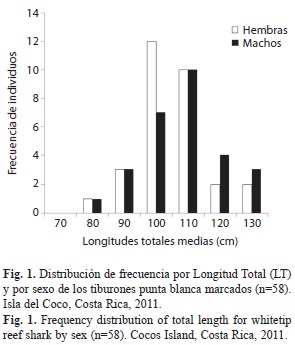
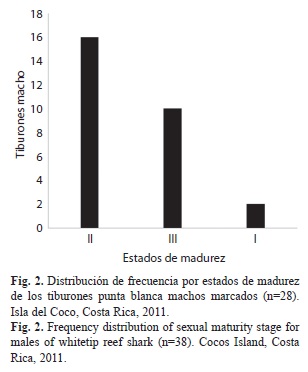
<body><![CDATA[<br> <font size="2"><span style="font-family: verdana;"></span></font><br  style="font-family: verdana;"> <font size="2"><span style="font-family: verdana;"></span></font>     <br>     <div style="text-align: center;"><img alt=""  src="/img/revistas/rbt/v60s3/a22f1.jpg"  style="width: 365px; height: 47px;">    <br> </div>     <br> <br style="font-family: verdana;"> <font size="2"><span style="font-family: verdana;"><span  style="font-weight: bold;">An&aacute;lisis de datos:</span> Se calcul&oacute; la longitud total promedio y desviaciones est&aacute;ndar (DE) de los tiburones punta blanca, machos y hembras. Se utiliz&oacute; un an&aacute;lisis de varianza no param&eacute;trico de una v&iacute;a (Kruskall-Wallis) para determinar diferencias entre la longitud total de machos y hembras utilizando el programa InfoStat (Di Rienzo <span style="font-style: italic;">et al.</span> 2008). Con el mismo programa, se calcul&oacute; el m&iacute;nimo (min), m&aacute;ximo (max) y la desviaci&oacute;n est&aacute;ndar (DE) de la longitud total. Se calcul&oacute; el porcentaje de madurez de los machos seg&uacute;n los estadios encontrados.</span></font><br style="font-family: verdana;"> <br style="font-family: verdana;"> <font size="2"><span style="font-family: verdana;">Finalmente, se estim&oacute; el tama&ntilde;o poblacional para la especie en Bah&iacute;a Chatham, utilizando el programa Capture (White <span style="font-style: italic;">et al.</span> 1978) y seleccionando el modelo m&aacute;s apropiado (Mt), este modelo corrige el sesgo temporal producto del muestro o condiciones clim&aacute;ticas que impiden muestreos entre unidades de tiempo iguales (Otis <span style="font-style: italic;">et al.</span> 1978). Se realizaron dos estimaciones: la primera a partir de datos de las recapturas&nbsp; obtenidas&nbsp; exclusivamente&nbsp; durante las giras de marcaje nocturnas; y la segunda a partir de la fusi&oacute;n de las recapturas visuales, realizadas durante los conteos subacu&aacute;ticos, con las recapturas obtenidas durante las giras nocturnas.</span></font><br  style="font-family: verdana;"> <br style="font-family: verdana;"> <font style="font-weight: bold;" size="3"><span  style="font-family: verdana;">Resultados</span></font><br  style="font-family: verdana; font-weight: bold;"> <br style="font-family: verdana;"> <font size="2"><span style="font-family: verdana;"><span  style="font-weight: bold;">Marcaje de tiburones:</span> Se realizaron nueve&nbsp; recorridos&nbsp; nocturnos,&nbsp; entre&nbsp; las&nbsp; 18:00-22:00h, para el marcaje de tiburones punta blanca de arrecife. En los sitios de marcaje la profundidad y temperatura superficial del agua promedio fue de 10.9&plusmn;1.9m y 28.4&plusmn;1.2&deg;C, respectivamente. Durante los nueve recorridos se marcaron 58 tiburones, de estos el 51.7% (n=30) fueron hembras y el 48.3% machos (n=28) para una proporci&oacute;n sexual de 1.07:1. La longitud total promedio de los tiburones marcados fue 101.8&plusmn;12.1cm, con una longitud total&nbsp; m&aacute;xima&nbsp; de&nbsp; 130.0cm&nbsp; y&nbsp; una&nbsp; m&iacute;nima&nbsp; de 71.0cm. La mediana de las longitudes totales de los tiburones machos (103.5&plusmn;21.33cm) y hembras (100.1&plusmn;11.2cm) no difirieron significativamente (H=1.78; p=0.1818). Con respecto a&nbsp; la&nbsp; distribuci&oacute;n&nbsp; de&nbsp; tiburones&nbsp; analizados,&nbsp; el 73% hembras y el 60% de los machos registraron longitudes totales 90 y 110cm. Mientras solo el 15% de las hembras y 25% de los machos&nbsp; presentaron&nbsp; longitudes&nbsp; entre&nbsp; 111&nbsp; y</span></font><font size="2"><span  style="font-family: verdana;"> 130cm (<a  href="/img/revistas/rbt/v60s3/a22i1.jpg">Fig. 1</a>).</span></font><br  style="font-family: verdana;"> <br style="font-family: verdana;"> <font size="2"><span style="font-family: verdana;">La mayor&iacute;a de los machos marcados (57%) se encontraban en el estado II o madurando (sub-adultos); mientras que, la menor proporci&oacute;n de los machos correspondi&oacute; al estado I, inmaduros (j&oacute;venes) (<a href="/img/revistas/rbt/v60s3/a22i2.jpg">Fig. 2</a>).</span></font><br style="font-family: verdana;"> </div> <font size="2"><span style="font-family: verdana;"></span></font>    <br> <font size="2"><span style="font-family: verdana;">Durante&nbsp; las&nbsp; giras&nbsp; nocturnas&nbsp; de&nbsp; marcaje se recapturaron cinco individuos: cuatro marcados unos d&iacute;as antes de la recaptura y uno marcado m&aacute;s de tres meses antes de la recaptura&nbsp; (<a href="/img/revistas/rbt/v60s3/a22t1.gif">Cuadro&nbsp; 1</a>).&nbsp; Para&nbsp; este&nbsp; &uacute;ltimo&nbsp; es&nbsp; estim&oacute; el crecimiento mensual, el cual result&oacute; ser de aproximadamente 1.9cm por mes.</span></font>    <br> <font size="2"><span style="font-family: verdana;"></span></font><br  style="font-family: verdana;">     <div style="text-align: justify;"><font size="2"><span      style="font-family: verdana;"><span style="font-weight: bold;">Conteos&nbsp;     visuales     ]]></body>
<body><![CDATA[subacu&aacute;ticos:</span> Se realizaron&nbsp;     seis&nbsp; inmersiones&nbsp; diurnas,&nbsp; entre&nbsp; las     10:00-13:00, en Bah&iacute;a Chatham. Durante los&nbsp; conteos, la     temperatura y profundidad media fue de 28.5&plusmn;1.3&deg;C y     13.0&plusmn;2.4 m, respectivamente. La abundancia relativa de tiburones     en Bah&iacute;a Chatham fue de 49.5&plusmn;10.4 tiburones/h. Durante     los conteos se hicieron 27 recapturas visuales, siendo posible     identificar 19 tiburones de los 58 marcados previamente.</span></font><br      style="font-family: verdana;">     <br style="font-family: verdana;">     ]]></body>
<body><![CDATA[<font size="2"><span style="font-family: verdana;">Con los datos de las     recapturas     obtenidas exclusivamente durante las     giras nocturnas, la poblaci&oacute;n se estim&oacute; en 408, con     intervalos de confianza (IC) del 95% (IC =181-1054). Con la     fusi&oacute;n de las recapturas visuales y las recapturas durante las     giras nocturnas, fue de 94 (IC= 76-128) con un 95% de nivel de     confianza.</span></font><br style="font-family: verdana;">     <br style="font-family: verdana;">     <font style="font-weight: bold;" size="3"><span     ]]></body>
<body><![CDATA[ style="font-family: verdana;">Discusi&oacute;n</span></font><br      style="font-family: verdana;">     <br style="font-family: verdana;">     <font size="2"><span style="font-family: verdana;">Los tiburones punta     blanca de     arrecife se capturaron y marcaron en     giras nocturnas, entre las 18:00-22:00h. Se realizaron intentos de     capturas antes y despu&eacute;s de este intervalo, sin embargo no     resultaron ser efectivos. Es un tibur&oacute;n nocturno, manifestando     niveles m&aacute;s altos de actividad y tasa metab&oacute;lica durante     ]]></body>
<body><![CDATA[la noche respecto al d&iacute;a (Whitney <span      style="font-style: italic;">et al.</span> 2007, Fitzpatrick <span      style="font-style: italic;">et     al.</span> 2011); sin embargo, resulta ser a&uacute;n m&aacute;s activa     durante el atardecer, siendo este comportamiento un resultado     relacionado al forrajeo (Hobson&nbsp; 1963, Whitney&nbsp; <span      style="font-style: italic;">et&nbsp;     al.</span>&nbsp; 2007).&nbsp; De&nbsp; la misma forma, la profundidad     result&oacute; ser un factor relevante para el marcaje ya que se     logr&oacute; capturar a los tiburones solo en zonas poco profundas     ]]></body>
<body><![CDATA[(10.9&plusmn;1.9m) de Bah&iacute;a Chatham.</span></font><br      style="font-family: verdana;">     <br style="font-family: verdana;">     <font size="2"><span style="font-family: verdana;">El rango de la LT de     los     espec&iacute;menes capturados&nbsp;     durante&nbsp; las&nbsp; faenas&nbsp; nocturnas&nbsp; de marcaje     coincide con lo reportado por Robbins (2006) para la Gran Barrera de     Coral de Australia, en donde los autores reportaron tallas de capturas     del tibur&oacute;n punta blanca por parte de&nbsp; pescadores&nbsp;     ]]></body>
<body><![CDATA[comerciales,&nbsp; entre&nbsp; los&nbsp; 70.0&nbsp; y 140.0cm.     Adem&aacute;s, seg&uacute;n el an&aacute;lisis de estados reproductivos     en machos, se encontraron tiburones inmaduros (cr&iacute;as), madurando     (j&oacute;venes) y maduros (adultos), lo cual confirma que esta especie     no posee una segregaci&oacute;n ontog&eacute;nica espacial bien     definida, como s&iacute; se ha reportado para otras especies como <span      style="font-style: italic;">S.     lewini</span> (Klimley 1987, Torres 2004, Zanella <span      style="font-style: italic;">et al.</span> 2009) y el     tibur&oacute;n toro, Carcharhinus leucas (Heupel &amp;     ]]></body>
<body><![CDATA[Simpfendorfer&nbsp; 2008,&nbsp; McCord&nbsp; &amp;&nbsp; Lamberth     2009). A pesar de esto, la longitud total m&aacute;xima registrada en     el estudio est&aacute; por debajo de los 213 cm reportada por Compagno     <span style="font-style: italic;">et al.</span> (1995) para esta     especie. Esto puede ser consecuencia del arte     de pesca utilizado para su captura (referente a tama&ntilde;o de los     anzuelos) o bien, a que los individuos m&aacute;s grandes y longevos se     encuentren en aguas m&aacute;s profundas, ubicadas fuera de     Bah&iacute;a Chatham. Lanyon (2011) en las Islas Catalinas, Golfo de     Papagayo, Costa Rica, report&oacute; una relaci&oacute;n directa entre     ]]></body>
<body><![CDATA[la longitud total del tibur&oacute;n punta blanca y la profundidad,     sugiriendo que en aguas m&aacute;s profundas se encuentran los     individuos m&aacute;s grandes. A su vez, Heupel <span      style="font-style: italic;">et al.</span> (2010)     describieron como el tibur&oacute;n gris de arrecife (<span      style="font-style: italic;">Carcharhinus     amblyrhynchos</span>) en Ribbons Reef, Australia, mostr&oacute; un     cambio de     patrones de movimiento, seg&uacute;n la talla. Las cr&iacute;as y     j&oacute;venes tienen una mayor fidelidad a los sitios, mientras que     ]]></body>
<body><![CDATA[los adultos tienden a desplazarse m&aacute;s. Por tanto, conforme van     creciendo muestran una menor fidelidad a los sitios, comportamiento     probablemente relacionado al forrajeo.</span></font><br      style="font-family: verdana;">     <br style="font-family: verdana;">     <font size="2"><span style="font-family: verdana;">Durante el marcaje,     tambi&eacute;n     se obtuvo una proporci&oacute;n alta     de recapturas, lo cual sugiere una alta fidelidad a los sitios de     algunos individuos. Sin embargo, los datos no permitieron estimar     ]]></body>
<body><![CDATA[debidamente el crecimiento mensual. Para poder describir de manera     apropiada una curva de crecimiento para esta especie en el PNIC, se     deber&aacute;n llevar a cabo m&aacute;s estudios y marcar un mayor     n&uacute;mero de individuos. Esto debido a que el crecimiento en     vertebrados marinos no es constante, sino que decrece con la edad (Di     Benedetti &amp; Ramos 2004). El tibur&oacute;n punta blanca de     arrecife, comparado con otros tiburones, manifiesta una tasa de     crecimiento inicial relativamente baja, aumentando un 38% de su talla     de nacimiento durante el primer a&ntilde;o (Robbins 2006). Otros     tiburones, como el picudo (<span style="font-style: italic;">Rhizoprionodon     ]]></body>
<body><![CDATA[taylori</span>) tienen un     crecimiento inicial mucho m&aacute;s r&aacute;pido, aumentando hasta un     140% de su talla de nacimiento durante su primer a&ntilde;o de vida     (Simpfendorfer 1993, Robbins 2006).</span></font><br      style="font-family: verdana;">     <font size="2"><span style="font-family: verdana;">Durante los conteos     se     report&oacute; una abundancia&nbsp;     relativa&nbsp; de&nbsp; tiburones&nbsp; punta&nbsp; blanca de arrecife     en Bah&iacute;a Chatham de 49.5&plusmn;10.4 tiburones/h, lo cual es     ]]></body>
<body><![CDATA[notablemente mayor a lo encontrado por Arauz <span      style="font-style: italic;">et al.</span> (2009) para     Bah&iacute;a Culebra y alrededores, cuyas estimaciones de abundancia     relativa fueron entre 2.37&plusmn;1.24 tiburones/h en enero, y     12.77&plusmn;11.16 tiburones/ hora en junio. Distintos autores han     indicado como la temperatura influye en la presencia y abundancia     relativa del tibur&oacute;n punta blanca. En el PNIC, durante los     eventos de El Ni&ntilde;o se encontr&oacute; una disminuci&oacute;n en     los avistamientos del&nbsp; tibur&oacute;n&nbsp; punta&nbsp;     blanca&nbsp; (Sibaja&nbsp; 2008).&nbsp; En las Islas Catalinas, Golfo     ]]></body>
<body><![CDATA[de Papagayo (Costa Rica) se observ&oacute; que esta especie est&aacute;     presente cuando la temperatura estuvo entre los 25-30&deg;C (Lanyon     2011). La temperatura promedio durante las inmersiones realizadas en     Bah&iacute;a Chatham fue de 28.5&plusmn;1.3&deg;C; sin embargo, con el     fin de monitorear esta poblaci&oacute;n en el &aacute;rea se&nbsp;     recomienda&nbsp; realizar&nbsp; conteos&nbsp; subacu&aacute;ticos     mensuales a largo del tiempo, y relacionar su abundancia con la     temperatura del agua.</span></font><br style="font-family: verdana;">     <br style="font-family: verdana;">     <font size="2"><span style="font-family: verdana;">Los conteos     ]]></body>
<body><![CDATA[subacu&aacute;ticos     confirmaron la alta fidelidad del     tibur&oacute;n punta blanca en Bah&iacute;a Chatham, de hecho por lo     menos el 32.8% de los tiburones marcados fueron re-observados durante     las inmersiones. Esta especie utiliza distintos&nbsp; sitios&nbsp;     de&nbsp; residencia&nbsp; con&nbsp; alta&nbsp; fidelidad (Randall 1977,     Pe&ntilde;aherrera <span style="font-style: italic;">et al.</span>     2011); Randall (1977) describe como estos     sitios distan aproximadamente&nbsp; tres&nbsp; km&nbsp; entre ellos.     Por lo tanto, es posible que los tiburones durante el d&iacute;a se     ]]></body>
<body><![CDATA[dispersen entre los distintos sitios de residencia y se congreguen     durante las primeras horas de la noche en aguas de Bah&iacute;a Chatham     para alimentarse. Esto explicar&iacute;a tambi&eacute;n la alta     variaci&oacute;n obtenida entre las dos estimaciones del tama&ntilde;o     poblacional. Sin embargo, debido a la alta varianza reportada en la     estimaci&oacute;n durante los muestreos nocturnos (408.0, IC=181-1054),     se recomienda aumentar el n&uacute;mero de muestreos y marcar una mayor     cantidad de individuos, con el fin de obtener datos m&aacute;s robustos.</span></font><br      style="font-family: verdana;">     <br style="font-family: verdana;">     ]]></body>
<body><![CDATA[<font style="font-weight: bold;" size="3"><span      style="font-family: verdana;">Agradecimientos</span></font><br      style="font-family: verdana;">     <br style="font-family: verdana;">     <font size="2"><span style="font-family: verdana;">Al&nbsp;     Parque&nbsp;     Nacional&nbsp; Isla&nbsp; del&nbsp; Coco&nbsp;     y&nbsp; al &Aacute;rea de Conservaci&oacute;n Marina Isla del Coco por     habernos apoyado durante las expediciones con recursos, personal y     embarcaciones. A los&nbsp; funcionarios&nbsp; del&nbsp; Parque&nbsp;     ]]></body>
<body><![CDATA[Nacional&nbsp; Isla del Coco que han participado activamente en     la&nbsp; investigaci&oacute;n,&nbsp; un&nbsp; agradecimiento&nbsp;     especial a Maikel P&eacute;rez Montero y Keilor Morales por su&nbsp;     ayuda&nbsp; durante&nbsp; la&nbsp; captura&nbsp; y&nbsp;     manipulaci&oacute;n de los tiburones; a Mois&eacute;s G&oacute;mez por     sus valiosos aportes en el m&eacute;todo de captura. A Carlos Hiller     por asistirnos durante la segunda expedici&oacute;n. Flying Sharks por     brindarnos el apoyo financiero necesario para llevar a cabo esta     investigaci&oacute;n.</span></font>    <br> </div> <font size="2"><span style="font-family: verdana;"></span></font><font  size="2"><span style="font-family: verdana;"></span></font><font  size="2"><span style="font-family: verdana;"></span></font><br  style="font-family: verdana;">     ]]></body>
<body><![CDATA[<div style="text-align: justify;"> </div> <hr  style="width: 100%; height: 2px; margin-left: 0px; margin-right: 0px;">     <div style="text-align: justify;"></div> <br style="font-family: verdana;"> <font style="font-weight: bold;" size="3"><span  style="font-family: verdana;">Referencias</span></font><br  style="font-family: verdana;"> <br style="font-family: verdana;">     <!-- ref --><div style="text-align: justify;"><font size="2"><span  style="font-family: verdana;">ACMIC. 2002. La presentaci&oacute;n de informes&nbsp; peri&oacute;dicos sobre la aplicaci&oacute;n de la Convenci&oacute;n del Patrimonio Mundial. Secci&oacute;n II: Estado de conservaci&oacute;n de bienes espec&iacute;ficos del Patrimonio&nbsp; Mundial. UNESCO, San Jos&eacute;, Costa Rica.    &nbsp;&nbsp;&nbsp;&nbsp;&nbsp;&nbsp;&nbsp;&nbsp;[&#160;<a href="javascript:void(0);" onclick="javascript: window.open('/scielo.php?script=sci_nlinks&ref=1786967&pid=S0034-7744201200080002200001&lng=','','width=640,height=500,resizable=yes,scrollbars=1,menubar=yes,');">Links</a>&#160;]<!-- end-ref --><!-- ref --></span></font><br style="font-family: verdana;"> <br style="font-family: verdana;"> <font size="2"><span style="font-family: verdana;">Arauz, R., I. Zanella &amp; A. L&oacute;pez. 2009. Caracterizaci&oacute;n de los elasmobranquios avistados en sitios de buceo, en el Golfo de Papagayo, Costa Rica. PRETOMA. San Jos&eacute;, Costa Rica.    &nbsp;&nbsp;&nbsp;&nbsp;&nbsp;&nbsp;&nbsp;&nbsp;[&#160;<a href="javascript:void(0);" onclick="javascript: window.open('/scielo.php?script=sci_nlinks&ref=1786968&pid=S0034-7744201200080002200002&lng=','','width=640,height=500,resizable=yes,scrollbars=1,menubar=yes,');">Links</a>&#160;]<!-- end-ref --><!-- ref --></span></font><br style="font-family: verdana;"> <br style="font-family: verdana;"> <font size="2"><span style="font-family: verdana;">Ayling, A. &amp; J. Choat. 2008. Abundance&nbsp; patterns of reef sharks and predatory fishes on differently zoned reefs in the offshore Townsville region: Final Report to the Great Barrier Reef Marine Park Authority, Queensland, Australia.    &nbsp;&nbsp;&nbsp;&nbsp;&nbsp;&nbsp;&nbsp;&nbsp;[&#160;<a href="javascript:void(0);" onclick="javascript: window.open('/scielo.php?script=sci_nlinks&ref=1786969&pid=S0034-7744201200080002200003&lng=','','width=640,height=500,resizable=yes,scrollbars=1,menubar=yes,');">Links</a>&#160;]<!-- end-ref --><!-- ref --></span></font><br  style="font-family: verdana;"> <br style="font-family: verdana;"> <font size="2"><span style="font-family: verdana;">Chiaramonte,&nbsp; G. &amp; A. Pettovello. 2000. The&nbsp; biology of Mustelus schmitti in southern&nbsp; Patagonia, Argentina. J. Fish Biol. 57: 930-942.    &nbsp;&nbsp;&nbsp;&nbsp;&nbsp;&nbsp;&nbsp;&nbsp;[&#160;<a href="javascript:void(0);" onclick="javascript: window.open('/scielo.php?script=sci_nlinks&ref=1786970&pid=S0034-7744201200080002200004&lng=','','width=640,height=500,resizable=yes,scrollbars=1,menubar=yes,');">Links</a>&#160;]<!-- end-ref --><!-- ref --></span></font><br style="font-family: verdana;"> <br style="font-family: verdana;"> <font size="2"><span style="font-family: verdana;">Compagno, L., F. Krupp &amp; W. Schneider. 1995. Tiburones, p. 647-743 <span style="font-style: italic;">In</span>: W. Fischer, F.&nbsp; Krupp, W. Schneider, C. Sommer, K. Carpenter &amp; V. Niem (eds). Pac&iacute;fico centro-oriental.&nbsp; Volumen&nbsp; II.&nbsp; Vertebrados-&nbsp; Parte&nbsp; I. Gu&iacute;a FAO para la identificaci&oacute;n de especies para los fines de la pesca. FAO, Roma, Italia.    &nbsp;&nbsp;&nbsp;&nbsp;&nbsp;&nbsp;&nbsp;&nbsp;[&#160;<a href="javascript:void(0);" onclick="javascript: window.open('/scielo.php?script=sci_nlinks&ref=1786971&pid=S0034-7744201200080002200005&lng=','','width=640,height=500,resizable=yes,scrollbars=1,menubar=yes,');">Links</a>&#160;]<!-- end-ref --><!-- ref --></span></font><br style="font-family: verdana;"> <br style="font-family: verdana;"> <font size="2"><span style="font-family: verdana;">Cort&eacute;s, J. 2008. Historia de la investigaci&oacute;n marina de la Isla del Coco, Costa Rica. Rev. Biol. Trop. 56 (Supl. 2): 1-18.    &nbsp;&nbsp;&nbsp;&nbsp;&nbsp;&nbsp;&nbsp;&nbsp;[&#160;<a href="javascript:void(0);" onclick="javascript: window.open('/scielo.php?script=sci_nlinks&ref=1786972&pid=S0034-7744201200080002200006&lng=','','width=640,height=500,resizable=yes,scrollbars=1,menubar=yes,');">Links</a>&#160;]<!-- end-ref --><!-- ref --></span></font><br  style="font-family: verdana;"> <br style="font-family: verdana;"> <font size="2"><span style="font-family: verdana;">Di Benedetti, A.P. &amp; R.M. Ramos. 2004.&nbsp; Biology&nbsp; of the&nbsp; marine&nbsp; tucuxi&nbsp; dolphin&nbsp;&nbsp; (Sotalia&nbsp; fluviatilis)&nbsp; in south-eastern&nbsp; Brazil.&nbsp; J.&nbsp; Mar.&nbsp; Biol. Assoc.&nbsp; UK&nbsp; 84:</span></font><br  style="font-family: verdana;"> <font size="2"><span style="font-family: verdana;">1245-1250.    &nbsp;&nbsp;&nbsp;&nbsp;&nbsp;&nbsp;&nbsp;&nbsp;[&#160;<a href="javascript:void(0);" onclick="javascript: window.open('/scielo.php?script=sci_nlinks&ref=1786973&pid=S0034-7744201200080002200007&lng=','','width=640,height=500,resizable=yes,scrollbars=1,menubar=yes,');">Links</a>&#160;]<!-- end-ref --><!-- ref --></span></font><br  style="font-family: verdana;"> <br style="font-family: verdana;"> <font size="2"><span style="font-family: verdana;">Di Rienzo, J.A, F. Casanoves, M. Balzarini, L. Gonzalez, M. Cuadroda &amp; C. Robledo. 2008. InfoStat versi&oacute;n 2008. Grupo InfoStat, FCA, Universidad Nacional de C&oacute;rdoba, Argentina.    &nbsp;&nbsp;&nbsp;&nbsp;&nbsp;&nbsp;&nbsp;&nbsp;[&#160;<a href="javascript:void(0);" onclick="javascript: window.open('/scielo.php?script=sci_nlinks&ref=1786974&pid=S0034-7744201200080002200008&lng=','','width=640,height=500,resizable=yes,scrollbars=1,menubar=yes,');">Links</a>&#160;]<!-- end-ref --><!-- ref --></span></font><br  style="font-family: verdana;"> <br style="font-family: verdana;"> <font size="2"><span style="font-family: verdana;">Fitzpatrick,&nbsp; R., K. Abrantes, J. Seymour &amp; A.&nbsp; Barnett. 2011. Variation in depth of whitetip reef sharks: does provisioning&nbsp; ecotourism&nbsp;&nbsp; change&nbsp; their&nbsp; behaviour? Coral Reefs 30: 569-577.    &nbsp;&nbsp;&nbsp;&nbsp;&nbsp;&nbsp;&nbsp;&nbsp;[&#160;<a href="javascript:void(0);" onclick="javascript: window.open('/scielo.php?script=sci_nlinks&ref=1786975&pid=S0034-7744201200080002200009&lng=','','width=640,height=500,resizable=yes,scrollbars=1,menubar=yes,');">Links</a>&#160;]<!-- end-ref --><!-- ref --></span></font><br  style="font-family: verdana;"> <br style="font-family: verdana;"> <font size="2"><span style="font-family: verdana;">Garrison, G. 2005. Peces de la Isla del Coco. 2da Ed. Edit. INBio, Santo Domingo de Heredia, Costa Rica.    &nbsp;&nbsp;&nbsp;&nbsp;&nbsp;&nbsp;&nbsp;&nbsp;[&#160;<a href="javascript:void(0);" onclick="javascript: window.open('/scielo.php?script=sci_nlinks&ref=1786976&pid=S0034-7744201200080002200010&lng=','','width=640,height=500,resizable=yes,scrollbars=1,menubar=yes,');">Links</a>&#160;]<!-- end-ref --><!-- ref --></span></font><br  style="font-family: verdana;"> <br style="font-family: verdana;"> <font size="2"><span style="font-family: verdana;">Heupel,&nbsp; M. &amp; C. Simpfendorfer. 2008.&nbsp; Movements and distribution&nbsp; of&nbsp; young&nbsp;&nbsp; bull&nbsp; sharks&nbsp; (Carcharhinus leucas) in a&nbsp; variable estuarine environment. Aquat. Biol. 1: 277&#8211;289.    &nbsp;&nbsp;&nbsp;&nbsp;&nbsp;&nbsp;&nbsp;&nbsp;[&#160;<a href="javascript:void(0);" onclick="javascript: window.open('/scielo.php?script=sci_nlinks&ref=1786977&pid=S0034-7744201200080002200011&lng=','','width=640,height=500,resizable=yes,scrollbars=1,menubar=yes,');">Links</a>&#160;]<!-- end-ref --><!-- ref --></span></font><br style="font-family: verdana;"> <br style="font-family: verdana;"> <font size="2"><span style="font-family: verdana;">Heupel,&nbsp; M.,&nbsp; C.&nbsp; Simpfendorfer&nbsp; &amp;&nbsp; R.&nbsp; Fitzpatrick.&nbsp; 2010. Large-scale movement and reef fidelity of grey reef sharks. PLoS ONE 5(3): e9650.    &nbsp;&nbsp;&nbsp;&nbsp;&nbsp;&nbsp;&nbsp;&nbsp;[&#160;<a href="javascript:void(0);" onclick="javascript: window.open('/scielo.php?script=sci_nlinks&ref=1786978&pid=S0034-7744201200080002200012&lng=','','width=640,height=500,resizable=yes,scrollbars=1,menubar=yes,');">Links</a>&#160;]<!-- end-ref --><!-- ref --></span></font><br  style="font-family: verdana;"> <br style="font-family: verdana;"> <font size="2"><span style="font-family: verdana;">Hobson, E. S. 1963. Feeding behavior in three species of sharks. Pac. Sci. 17: 171-194.    &nbsp;&nbsp;&nbsp;&nbsp;&nbsp;&nbsp;&nbsp;&nbsp;[&#160;<a href="javascript:void(0);" onclick="javascript: window.open('/scielo.php?script=sci_nlinks&ref=1786979&pid=S0034-7744201200080002200013&lng=','','width=640,height=500,resizable=yes,scrollbars=1,menubar=yes,');">Links</a>&#160;]<!-- end-ref --><!-- ref --></span></font><br style="font-family: verdana;"> <br style="font-family: verdana;"> <font size="2"><span style="font-family: verdana;">Klimley, A. P. 1987. The determinants of&nbsp; sexual segregation in the scalloped hammerhead shark, <span style="font-style: italic;">Sphyrna lewini</span>. Environ. Biol. Fish. 18:27-40.    &nbsp;&nbsp;&nbsp;&nbsp;&nbsp;&nbsp;&nbsp;&nbsp;[&#160;<a href="javascript:void(0);" onclick="javascript: window.open('/scielo.php?script=sci_nlinks&ref=1786980&pid=S0034-7744201200080002200014&lng=','','width=640,height=500,resizable=yes,scrollbars=1,menubar=yes,');">Links</a>&#160;]<!-- end-ref --><!-- ref --></span></font><br style="font-family: verdana;"> <br style="font-family: verdana;"> <font size="2"><span style="font-family: verdana;">Lanyon, A. 2011. Influencia de la temperatura&nbsp; y profundidad del mar en la&nbsp; distribuci&oacute;n y abundancia del tibur&oacute;n&nbsp; puntablanca <span style="font-style: italic;">Triaenodon obesus</span>&nbsp; (Carcharhiniformes: Carcharhinidae) en el Golfo de Papagayo, Costa&nbsp; Rica.&nbsp; Informe&nbsp; final&nbsp; BSc,&nbsp; Univ.&nbsp; Latina,&nbsp; San Jos&eacute;, Costa Rica.    &nbsp;&nbsp;&nbsp;&nbsp;&nbsp;&nbsp;&nbsp;&nbsp;[&#160;<a href="javascript:void(0);" onclick="javascript: window.open('/scielo.php?script=sci_nlinks&ref=1786981&pid=S0034-7744201200080002200015&lng=','','width=640,height=500,resizable=yes,scrollbars=1,menubar=yes,');">Links</a>&#160;]<!-- end-ref --><!-- ref --></span></font><br  style="font-family: verdana;"> <br style="font-family: verdana;"> <font size="2"><span style="font-family: verdana;">McCord, M &amp; S. Lamberth. 2009. Catching and tracking the world&#8217;s largest Zambezi (bull) shark Carcharhinus leucas in the&nbsp; Breede Estuary, South Africa: the first 43 hours. Afr. J. Ecol. 31: 107&#8211;111.    &nbsp;&nbsp;&nbsp;&nbsp;&nbsp;&nbsp;&nbsp;&nbsp;[&#160;<a href="javascript:void(0);" onclick="javascript: window.open('/scielo.php?script=sci_nlinks&ref=1786982&pid=S0034-7744201200080002200016&lng=','','width=640,height=500,resizable=yes,scrollbars=1,menubar=yes,');">Links</a>&#160;]<!-- end-ref --><!-- ref --></span></font><br  style="font-family: verdana;"> <br style="font-family: verdana;"> <font size="2"><span style="font-family: verdana;">Onca Natural &amp; ACMIC. 2007. Plan de Manejo del Parque Nacional Isla del Coco.&nbsp; Ministerio del Ambiente y Energ&iacute;a, Sistema Nacional de &Aacute;reas de conservaci&oacute;n, &Aacute;rea&nbsp; de&nbsp; Conservaci&oacute;n&nbsp; Marina&nbsp; Isla&nbsp; del&nbsp; Coco,&nbsp; San Jos&eacute;, Costa Rica.    &nbsp;&nbsp;&nbsp;&nbsp;&nbsp;&nbsp;&nbsp;&nbsp;[&#160;<a href="javascript:void(0);" onclick="javascript: window.open('/scielo.php?script=sci_nlinks&ref=1786983&pid=S0034-7744201200080002200017&lng=','','width=640,height=500,resizable=yes,scrollbars=1,menubar=yes,');">Links</a>&#160;]<!-- end-ref --><!-- ref --></span></font><br  style="font-family: verdana;"> <br style="font-family: verdana;"> <font size="2"><span style="font-family: verdana;">Otis,&nbsp; D.; K.P. Burnham; G.C. White &amp; D.R.&nbsp; Anderson. 1978. Statistical Inference from Capture Data on Closed Animal Populations.Wildlife Monogr. 62: 1-135.    &nbsp;&nbsp;&nbsp;&nbsp;&nbsp;&nbsp;&nbsp;&nbsp;[&#160;<a href="javascript:void(0);" onclick="javascript: window.open('/scielo.php?script=sci_nlinks&ref=1786984&pid=S0034-7744201200080002200018&lng=','','width=640,height=500,resizable=yes,scrollbars=1,menubar=yes,');">Links</a>&#160;]<!-- end-ref --><!-- ref --></span></font><br  style="font-family: verdana;"> <br style="font-family: verdana;"> <font size="2"><span style="font-family: verdana;">Pe&ntilde;aherrera, C., A. Hearn &amp; A. Kuhn. 2011. Diel use of a saltwater creek by white tip reef sharks <span  style="font-style: italic;">Triaenodon obesus</span> (Carcharhinidae) in Academy Bay, Galapagos Islands. Islas Gal&aacute;pagos, Ecuador. Sin publicar.    &nbsp;&nbsp;&nbsp;&nbsp;&nbsp;&nbsp;&nbsp;&nbsp;[&#160;<a href="javascript:void(0);" onclick="javascript: window.open('/scielo.php?script=sci_nlinks&ref=1786985&pid=S0034-7744201200080002200019&lng=','','width=640,height=500,resizable=yes,scrollbars=1,menubar=yes,');">Links</a>&#160;]<!-- end-ref --><!-- ref --></span></font><br  style="font-family: verdana;"> <br style="font-family: verdana;"> <font size="2"><span style="font-family: verdana;">Randall, J. 1977. Contribution to the biology of the whitetip reef shark (<span style="font-style: italic;">Triaenodon&nbsp; obesus</span>). Pac. Sci. 31: 143-164.    &nbsp;&nbsp;&nbsp;&nbsp;&nbsp;&nbsp;&nbsp;&nbsp;[&#160;<a href="javascript:void(0);" onclick="javascript: window.open('/scielo.php?script=sci_nlinks&ref=1786986&pid=S0034-7744201200080002200020&lng=','','width=640,height=500,resizable=yes,scrollbars=1,menubar=yes,');">Links</a>&#160;]<!-- end-ref --><!-- ref --></span></font><br style="font-family: verdana;"> <br style="font-family: verdana;"> <font size="2"><span style="font-family: verdana;">Robbins,&nbsp; W. 2006. Abundance, demography&nbsp; and population structure of the grey&nbsp; reef shark (<span  style="font-style: italic;">Carcharhinus amblyrhynchos</span>)&nbsp; and the whitetip reef shark (<span  style="font-style: italic;">Triaenodon obesus</span>) (Fam. Carcharhinidae).&nbsp; Tesis&nbsp; PhD, James Cook Univ., Townsville, Australia.    &nbsp;&nbsp;&nbsp;&nbsp;&nbsp;&nbsp;&nbsp;&nbsp;[&#160;<a href="javascript:void(0);" onclick="javascript: window.open('/scielo.php?script=sci_nlinks&ref=1786987&pid=S0034-7744201200080002200021&lng=','','width=640,height=500,resizable=yes,scrollbars=1,menubar=yes,');">Links</a>&#160;]<!-- end-ref --><!-- ref --></span></font><br style="font-family: verdana;"> <br style="font-family: verdana;"> <font size="2"><span style="font-family: verdana;">Sibaja, J. 2008. Tendencias espacio-temporales de los avistamientos de fauna marina&nbsp; en&nbsp; los buceos tur&iacute;sticos (Isla del Coco, Costa Rica). Rev. Biol. Trop. 56 (Supl. 2): 113-132.    &nbsp;&nbsp;&nbsp;&nbsp;&nbsp;&nbsp;&nbsp;&nbsp;[&#160;<a href="javascript:void(0);" onclick="javascript: window.open('/scielo.php?script=sci_nlinks&ref=1786988&pid=S0034-7744201200080002200022&lng=','','width=640,height=500,resizable=yes,scrollbars=1,menubar=yes,');">Links</a>&#160;]<!-- end-ref --><!-- ref --></span></font><br  style="font-family: verdana;"> <br style="font-family: verdana;"> <font size="2"><span style="font-family: verdana;">Simpfendorfer, C. 1993. Age and growth of the Australian sharpnose shark,&nbsp; <span style="font-style: italic;">Rhizoprionodon taylori</span>, from north Queensland, Australia. Environ. Biol.Fish 36: 233-24.    &nbsp;&nbsp;&nbsp;&nbsp;&nbsp;&nbsp;&nbsp;&nbsp;[&#160;<a href="javascript:void(0);" onclick="javascript: window.open('/scielo.php?script=sci_nlinks&ref=1786989&pid=S0034-7744201200080002200023&lng=','','width=640,height=500,resizable=yes,scrollbars=1,menubar=yes,');">Links</a>&#160;]<!-- end-ref --><!-- ref --></span></font><br  style="font-family: verdana;"> <br style="font-family: verdana;"> <font size="2"><span style="font-family: verdana;">Sinergia 69. 2002. Anexo V: Caracterizaci&oacute;n de las bah&iacute;as de Chatham y Wafer e inventario preliminar de especies marinas. &Aacute;rea de Conservaci&oacute;n Marina Isla del Coco (ACMIC). Proyecto: Estudio de factibilidad y dise&ntilde;o para la construcci&oacute;n de infraestructura y servicios de apoyo en el Parque Nacional Isla del Coco. Sinergia, San Jos&eacute;, Costa Rica.    &nbsp;&nbsp;&nbsp;&nbsp;&nbsp;&nbsp;&nbsp;&nbsp;[&#160;<a href="javascript:void(0);" onclick="javascript: window.open('/scielo.php?script=sci_nlinks&ref=1786990&pid=S0034-7744201200080002200024&lng=','','width=640,height=500,resizable=yes,scrollbars=1,menubar=yes,');">Links</a>&#160;]<!-- end-ref --><!-- ref --></span></font><br  style="font-family: verdana;"> <br style="font-family: verdana;"> <font size="2"><span style="font-family: verdana;">Torres, A. 2004. Distribuci&oacute;n, abundancia y&nbsp; h&aacute;bitos alimentarios de juveniles del&nbsp; tibur&oacute;n martillo <span  style="font-style: italic;">Sphyrna lewini</span>, Griffith y Smith (SPHYRNIDAE) en la costa de Sinaloa, M&eacute;xico durante el evento El Ni&ntilde;o 1997-98. Tesis MSc, Univ. Mar. Oaxaca, M&eacute;xico.    &nbsp;&nbsp;&nbsp;&nbsp;&nbsp;&nbsp;&nbsp;&nbsp;[&#160;<a href="javascript:void(0);" onclick="javascript: window.open('/scielo.php?script=sci_nlinks&ref=1786991&pid=S0034-7744201200080002200025&lng=','','width=640,height=500,resizable=yes,scrollbars=1,menubar=yes,');">Links</a>&#160;]<!-- end-ref --><!-- ref --></span></font><br  style="font-family: verdana;"> <font size="2"><span style="font-family: verdana;">&nbsp;</span></font><br  style="font-family: verdana;"> <font size="2"><span style="font-family: verdana;">White,&nbsp; G., K. Burnham, D. Otis &amp; D.&nbsp; Anderson. 1978. Program&nbsp; Capture.&nbsp; Utah&nbsp; State&nbsp; Univ.&nbsp; Press.&nbsp; Logan, Utah, EUA.    &nbsp;&nbsp;&nbsp;&nbsp;&nbsp;&nbsp;&nbsp;&nbsp;[&#160;<a href="javascript:void(0);" onclick="javascript: window.open('/scielo.php?script=sci_nlinks&ref=1786992&pid=S0034-7744201200080002200026&lng=','','width=640,height=500,resizable=yes,scrollbars=1,menubar=yes,');">Links</a>&#160;]<!-- end-ref --><!-- ref --></span></font><br  style="font-family: verdana;"> <br style="font-family: verdana;"> <font size="2"><span style="font-family: verdana;">Whitney, N. &amp; P. Motta. 2007. Cleaner host posing behavior of whitetip reef sharks&nbsp; (<span  style="font-style: italic;">Triaenodon obesus</span>) in a swarm of hyperiid amphipods. Coral Reefs: 363.    &nbsp;&nbsp;&nbsp;&nbsp;&nbsp;&nbsp;&nbsp;&nbsp;[&#160;<a href="javascript:void(0);" onclick="javascript: window.open('/scielo.php?script=sci_nlinks&ref=1786993&pid=S0034-7744201200080002200027&lng=','','width=640,height=500,resizable=yes,scrollbars=1,menubar=yes,');">Links</a>&#160;]<!-- end-ref --><!-- ref --></span></font><br  style="font-family: verdana;"> <br style="font-family: verdana;"> <font size="2"><span style="font-family: verdana;">Whitney, N., H. Pratt, &amp; J. Carrier. 2004. Group courtship, mating behaviour and siphon sacfunction in the whitetip reef shark,&nbsp; <span style="font-style: italic;">Triaenodon obesus</span>. Anim. Behav. 68: 1435-1442.    &nbsp;&nbsp;&nbsp;&nbsp;&nbsp;&nbsp;&nbsp;&nbsp;[&#160;<a href="javascript:void(0);" onclick="javascript: window.open('/scielo.php?script=sci_nlinks&ref=1786994&pid=S0034-7744201200080002200028&lng=','','width=640,height=500,resizable=yes,scrollbars=1,menubar=yes,');">Links</a>&#160;]<!-- end-ref --><!-- ref --></span></font><br style="font-family: verdana;"> <br style="font-family: verdana;"> <font size="2"><span style="font-family: verdana;">Whitney, N., Y. Papastamatiou, K. Holland &amp;&nbsp; C. Lowe. 2007. Use of an acceleration data logger to measure diel activity patterns in captive whitetip reef sharks, <span style="font-style: italic;">Triaenodon obesus</span>. Aquat. Liv. Resour. 20: 299-305.    &nbsp;&nbsp;&nbsp;&nbsp;&nbsp;&nbsp;&nbsp;&nbsp;[&#160;<a href="javascript:void(0);" onclick="javascript: window.open('/scielo.php?script=sci_nlinks&ref=1786995&pid=S0034-7744201200080002200029&lng=','','width=640,height=500,resizable=yes,scrollbars=1,menubar=yes,');">Links</a>&#160;]<!-- end-ref --><!-- ref --></span></font><br style="font-family: verdana;"> <br style="font-family: verdana;"> <font size="2"><span style="font-family: verdana;">Zanella,&nbsp; I., A. L&oacute;pez &amp; R. Arauz. 2009.&nbsp; Caracterizaci&oacute;n de las descargas del tibur&oacute;n martillo, <span style="font-style: italic;">Sphyrna lewini</span>, en un &aacute;rea de crianza ubicada en el Golfo de Nicoya, Costa Rica. Rev. Cienc. Mar. Cost. 1:175-195.    &nbsp;&nbsp;&nbsp;&nbsp;&nbsp;&nbsp;&nbsp;&nbsp;[&#160;<a href="javascript:void(0);" onclick="javascript: window.open('/scielo.php?script=sci_nlinks&ref=1786996&pid=S0034-7744201200080002200030&lng=','','width=640,height=500,resizable=yes,scrollbars=1,menubar=yes,');">Links</a>&#160;]<!-- end-ref --></span></font><br  style="font-family: verdana;"> </div>     <br> <font size="2"><span style="font-family: verdana;"><a  name="Correspondencia1"></a><a href="#Correspondencia2">*</a>Correspondencia:</span></font><font  size="2"><span style="font-family: verdana;"></span></font><font  size="2"><span style="font-family: verdana;"></span></font><br  style="font-family: verdana;"> <font size="2"><span style="font-family: verdana;"><sup> </sup></span></font><font size="2"><span style="font-family: verdana;">Ilena Zanella. </span></font><font size="2"><span  style="font-family: verdana;">Asociaci&oacute;n Conservacionista Misi&oacute;n Tibur&oacute;n, Playas del Coco, Guanacaste, Costa Rica; izanella@misiontiburon.org.</span></font>    <br> <font size="2"><span style="font-family: verdana;"></span></font><font  size="2"><span style="font-family: verdana;">Andr&eacute;s L&oacute;pez-Garro. </span></font><font size="2"><span  style="font-family: verdana;">Asociaci&oacute;n Conservacionista Misi&oacute;n Tibur&oacute;n, Playas del Coco, Guanacaste, Costa Rica; alopez@misiontiburon.org.</span></font><br style="font-family: verdana;"> <font size="2"><span style="font-family: verdana;">Geiner Golf&iacute;n-Duarte</span></font><font size="2"><span  style="font-family: verdana;">. Parque Nacional Isla del Coco. Sistema Nacional de &Aacute;reas de Conservaci&oacute;n, Ministerio&nbsp; del Ambiente, Energ&iacute;a y Telecomunicaciones, San Jos&eacute;, Costa Rica; geiner.golfin@sinac.go.cr.</span></font><br  style="font-family: verdana;"> <span style="font-family: verdana;">J</span><font size="2"><span  style="font-family: verdana;">oel C. Saenz</span></font><font size="2"><span  style="font-family: verdana;">.&nbsp; Instituto Internacional en Conserv.aci&oacute;n y Manejo de Vida Silvestre, Universidad Nacional de Costa Rica, Heredia, Costa Rica; jsaenz@una.ac.cr.    <br> </span></font><font size="2"><span style="font-family: verdana;"><a  name="1"></a><a href="#4">1</a>. Asociaci&oacute;n Conservacionista Misi&oacute;n Tibur&oacute;n, Playas del Coco, Guanacaste, Costa Rica; izanella@misiontiburon.org; alopez@misiontiburon.org</span></font><br style="font-family: verdana;"> <font size="2"><span style="font-family: verdana;"><a name="2"></a><a  href="#5">2</a>. Parque Nacional Isla del Coco. Sistema Nacional de &Aacute;reas de Conservaci&oacute;n, Ministerio&nbsp; del Ambiente, Energ&iacute;a y Telecomunicaciones, San Jos&eacute;, Costa Rica; geiner.golfin@sinac.go.cr</span></font><br style="font-family: verdana;"> <font size="2"><span style="font-family: verdana;"><a name="3"></a><a  href="#6">3</a>.&nbsp; Instituto Internacional en Conservaci&oacute;n y Manejo de Vida Silvestre, Universidad Nacional de Costa Rica, Heredia, Costa Rica; jsaenz@una.ac.cr</span></font><br  style="font-family: verdana;">     <div style="text-align: justify;"> </div> <hr  style="width: 100%; height: 2px; margin-left: 0px; margin-right: 0px;">     <div style="text-align: justify;"></div>     <div style="text-align: left;">     <div style="text-align: justify;"></div>     ]]></body>
<body><![CDATA[<div style="text-align: center;"><font style="font-weight: bold;"  size="2"><span style="font-family: verdana;">Recibido 28-III-2012.&nbsp;&nbsp; &nbsp;Corregido 05-VII-2012.&nbsp;&nbsp; &nbsp;Aceptado 24-Ix-2012.</span></font><br  style="font-family: verdana;"> </div> <font size="2"><span style="font-family: verdana;"></span></font><font  size="2"> </font></div>      ]]></body><back>
<ref-list>
<ref id="B1">
<nlm-citation citation-type="book">
<collab>ACMIC</collab>
<source><![CDATA[La presentación de informes periódicos sobre la aplicación de la Convención del Patrimonio Mundial: Sección II: Estado de conservación de bienes específicos del Patrimonio Mundial]]></source>
<year>2002</year>
<publisher-loc><![CDATA[^eSan José San José]]></publisher-loc>
<publisher-name><![CDATA[UNESCO]]></publisher-name>
</nlm-citation>
</ref>
<ref id="B2">
<nlm-citation citation-type="book">
<person-group person-group-type="author">
<name>
<surname><![CDATA[Arauz]]></surname>
<given-names><![CDATA[R]]></given-names>
</name>
<name>
<surname><![CDATA[Zanella]]></surname>
<given-names><![CDATA[I]]></given-names>
</name>
<name>
<surname><![CDATA[López]]></surname>
<given-names><![CDATA[A]]></given-names>
</name>
</person-group>
<source><![CDATA[Caracterización de los elasmobranquios avistados en sitios de buceo, en el Golfo de Papagayo, Costa Rica]]></source>
<year>2009</year>
<publisher-loc><![CDATA[^eSan José San José]]></publisher-loc>
<publisher-name><![CDATA[PRETOMA]]></publisher-name>
</nlm-citation>
</ref>
<ref id="B3">
<nlm-citation citation-type="">
<person-group person-group-type="author">
<name>
<surname><![CDATA[Ayling]]></surname>
<given-names><![CDATA[A]]></given-names>
</name>
<name>
<surname><![CDATA[Choat]]></surname>
<given-names><![CDATA[J]]></given-names>
</name>
</person-group>
<source><![CDATA[Abundance patterns of reef sharks and predatory fishes on differently zoned reefs in the offshore Townsville region: Final Report to the Great Barrier Reef Marine Park Authority]]></source>
<year>2008</year>
<publisher-loc><![CDATA[^eQueensland Queensland]]></publisher-loc>
</nlm-citation>
</ref>
<ref id="B4">
<nlm-citation citation-type="journal">
<person-group person-group-type="author">
<name>
<surname><![CDATA[Chiaramonte]]></surname>
<given-names><![CDATA[G]]></given-names>
</name>
<name>
<surname><![CDATA[Pettovello]]></surname>
<given-names><![CDATA[A]]></given-names>
</name>
</person-group>
<article-title xml:lang="en"><![CDATA[The biology of Mustelus schmitti in southern Patagonia, Argentina]]></article-title>
<source><![CDATA[J. Fish Biol]]></source>
<year>2000</year>
<volume>57</volume>
<page-range>930-942</page-range></nlm-citation>
</ref>
<ref id="B5">
<nlm-citation citation-type="book">
<person-group person-group-type="author">
<name>
<surname><![CDATA[Compagno]]></surname>
<given-names><![CDATA[L]]></given-names>
</name>
<name>
<surname><![CDATA[Krupp]]></surname>
<given-names><![CDATA[F]]></given-names>
</name>
<name>
<surname><![CDATA[Schneider]]></surname>
<given-names><![CDATA[W]]></given-names>
</name>
</person-group>
<article-title xml:lang="es"><![CDATA[Tiburones]]></article-title>
<person-group person-group-type="editor">
<name>
<surname><![CDATA[Fischer]]></surname>
<given-names><![CDATA[W]]></given-names>
</name>
<name>
<surname><![CDATA[Krupp]]></surname>
<given-names><![CDATA[F]]></given-names>
</name>
<name>
<surname><![CDATA[Schneider]]></surname>
<given-names><![CDATA[W]]></given-names>
</name>
<name>
<surname><![CDATA[Sommer]]></surname>
<given-names><![CDATA[C]]></given-names>
</name>
<name>
<surname><![CDATA[Carpenter]]></surname>
<given-names><![CDATA[K]]></given-names>
</name>
<name>
<surname><![CDATA[Niem]]></surname>
<given-names><![CDATA[V]]></given-names>
</name>
</person-group>
<source><![CDATA[Pacífico centro-oriental]]></source>
<year>1995</year>
<volume>II</volume>
<page-range>647-743</page-range><publisher-loc><![CDATA[^eRoma Roma]]></publisher-loc>
<publisher-name><![CDATA[FAO]]></publisher-name>
</nlm-citation>
</ref>
<ref id="B6">
<nlm-citation citation-type="journal">
<person-group person-group-type="author">
<name>
<surname><![CDATA[Cortés]]></surname>
<given-names><![CDATA[J]]></given-names>
</name>
</person-group>
<article-title xml:lang="es"><![CDATA[Historia de la investigación marina de la Isla del Coco, Costa Rica]]></article-title>
<source><![CDATA[Rev. Biol. Trop]]></source>
<year>2008</year>
<volume>56</volume>
<numero>2</numero>
<issue>2</issue>
<page-range>1-18</page-range></nlm-citation>
</ref>
<ref id="B7">
<nlm-citation citation-type="journal">
<person-group person-group-type="author">
<name>
<surname><![CDATA[Di Benedetti]]></surname>
<given-names><![CDATA[A.P]]></given-names>
</name>
<name>
<surname><![CDATA[Ramos]]></surname>
<given-names><![CDATA[R.M.]]></given-names>
</name>
</person-group>
<article-title xml:lang="en"><![CDATA[Biology of the marine tucuxi dolphin (Sotalia fluviatilis) in south-eastern Brazil]]></article-title>
<source><![CDATA[J. Mar. Biol. Assoc. UK]]></source>
<year>2004</year>
<volume>84</volume>
<page-range>1245-1250</page-range></nlm-citation>
</ref>
<ref id="B8">
<nlm-citation citation-type="book">
<person-group person-group-type="author">
<name>
<surname><![CDATA[Di Rienzo]]></surname>
<given-names><![CDATA[J.A]]></given-names>
</name>
<name>
<surname><![CDATA[Casanoves]]></surname>
<given-names><![CDATA[F]]></given-names>
</name>
<name>
<surname><![CDATA[Balzarini]]></surname>
<given-names><![CDATA[M]]></given-names>
</name>
<name>
<surname><![CDATA[Gonzalez]]></surname>
<given-names><![CDATA[L]]></given-names>
</name>
<name>
<surname><![CDATA[Cuadroda]]></surname>
<given-names><![CDATA[M]]></given-names>
</name>
<name>
<surname><![CDATA[Robledo]]></surname>
<given-names><![CDATA[C]]></given-names>
</name>
</person-group>
<source><![CDATA[InfoStat versión 2008]]></source>
<year>2008</year>
<publisher-name><![CDATA[Grupo InfoStatFCAUniversidad Nacional de Córdoba]]></publisher-name>
</nlm-citation>
</ref>
<ref id="B9">
<nlm-citation citation-type="journal">
<person-group person-group-type="author">
<name>
<surname><![CDATA[Fitzpatrick]]></surname>
<given-names><![CDATA[R]]></given-names>
</name>
<name>
<surname><![CDATA[Abrantes]]></surname>
<given-names><![CDATA[K]]></given-names>
</name>
<name>
<surname><![CDATA[Seymour]]></surname>
<given-names><![CDATA[J]]></given-names>
</name>
<name>
<surname><![CDATA[Barnett]]></surname>
<given-names><![CDATA[A]]></given-names>
</name>
</person-group>
<article-title xml:lang="en"><![CDATA[Variation in depth of whitetip reef sharks: does provisioning ecotourism change their behaviour?]]></article-title>
<source><![CDATA[Coral Reefs]]></source>
<year>2011</year>
<volume>30</volume>
<page-range>569-577</page-range></nlm-citation>
</ref>
<ref id="B10">
<nlm-citation citation-type="book">
<person-group person-group-type="author">
<name>
<surname><![CDATA[Garrison]]></surname>
<given-names><![CDATA[G]]></given-names>
</name>
</person-group>
<source><![CDATA[Peces de la Isla del Coco]]></source>
<year>2005</year>
<edition>2da</edition>
<publisher-loc><![CDATA[Santo Domingo^eHeredia Heredia]]></publisher-loc>
<publisher-name><![CDATA[Edit. INBio]]></publisher-name>
</nlm-citation>
</ref>
<ref id="B11">
<nlm-citation citation-type="journal">
<person-group person-group-type="author">
<name>
<surname><![CDATA[Heupel]]></surname>
<given-names><![CDATA[M]]></given-names>
</name>
<name>
<surname><![CDATA[Simpfendorfer]]></surname>
<given-names><![CDATA[C]]></given-names>
</name>
</person-group>
<article-title xml:lang="en"><![CDATA[Movements and distribution of young bull sharks (Carcharhinus leucas) in a variable estuarine environment]]></article-title>
<source><![CDATA[Aquat. Biol]]></source>
<year>2008</year>
<volume>1</volume>
<page-range>277-289</page-range></nlm-citation>
</ref>
<ref id="B12">
<nlm-citation citation-type="journal">
<person-group person-group-type="author">
<name>
<surname><![CDATA[Heupel]]></surname>
<given-names><![CDATA[M]]></given-names>
</name>
<name>
<surname><![CDATA[Simpfendorfer]]></surname>
<given-names><![CDATA[C]]></given-names>
</name>
<name>
<surname><![CDATA[Fitzpatrick]]></surname>
<given-names><![CDATA[R]]></given-names>
</name>
</person-group>
<article-title xml:lang="en"><![CDATA[Large-scale movement and reef fidelity of grey reef sharks]]></article-title>
<source><![CDATA[PLoS ONE]]></source>
<year>2010</year>
<volume>5</volume>
<numero>3</numero>
<issue>3</issue>
<page-range>e9650</page-range></nlm-citation>
</ref>
<ref id="B13">
<nlm-citation citation-type="journal">
<person-group person-group-type="author">
<name>
<surname><![CDATA[Hobson]]></surname>
<given-names><![CDATA[E. S]]></given-names>
</name>
</person-group>
<article-title xml:lang="en"><![CDATA[Feeding behavior in three species of sharks]]></article-title>
<source><![CDATA[Pac. Sci]]></source>
<year>1963</year>
<volume>17</volume>
<page-range>171-194</page-range></nlm-citation>
</ref>
<ref id="B14">
<nlm-citation citation-type="journal">
<person-group person-group-type="author">
<name>
<surname><![CDATA[Klimley]]></surname>
<given-names><![CDATA[A. P]]></given-names>
</name>
</person-group>
<article-title xml:lang="en"><![CDATA[The determinants of sexual segregation in the scalloped hammerhead shark, Sphyrna lewini]]></article-title>
<source><![CDATA[Environ. Biol. Fish]]></source>
<year>1987</year>
<volume>18</volume>
<page-range>27-40</page-range></nlm-citation>
</ref>
<ref id="B15">
<nlm-citation citation-type="">
<person-group person-group-type="author">
<name>
<surname><![CDATA[Lanyon]]></surname>
<given-names><![CDATA[A]]></given-names>
</name>
</person-group>
<source><![CDATA[Influencia de la temperatura y profundidad del mar en la distribución y abundancia del tiburón puntablanca Triaenodon obesus (Carcharhiniformes: Carcharhinidae) en el Golfo de Papagayo, Costa Rica]]></source>
<year>2011</year>
</nlm-citation>
</ref>
<ref id="B16">
<nlm-citation citation-type="journal">
<person-group person-group-type="author">
<name>
<surname><![CDATA[McCord]]></surname>
<given-names><![CDATA[M]]></given-names>
</name>
<name>
<surname><![CDATA[Lamberth]]></surname>
<given-names><![CDATA[S]]></given-names>
</name>
</person-group>
<article-title xml:lang="en"><![CDATA[Catching and tracking the world&#8217;s largest Zambezi (bull) shark Carcharhinus leucas in the Breede Estuary, South Africa: the first 43 hours]]></article-title>
<source><![CDATA[Afr. J. Ecol]]></source>
<year>2009</year>
<volume>31</volume>
<page-range>107-111</page-range></nlm-citation>
</ref>
<ref id="B17">
<nlm-citation citation-type="book">
<collab>Onca Natural</collab>
<collab>ACMIC</collab>
<source><![CDATA[Plan de Manejo del Parque Nacional Isla del Coco]]></source>
<year>2007</year>
<publisher-loc><![CDATA[^eSan José San José]]></publisher-loc>
<publisher-name><![CDATA[Ministerio del Ambiente y Energía, Sistema Nacional de Áreas de conservación, Área de Conservación Marina Isla del Coco]]></publisher-name>
</nlm-citation>
</ref>
<ref id="B18">
<nlm-citation citation-type="journal">
<person-group person-group-type="author">
<name>
<surname><![CDATA[Otis]]></surname>
<given-names><![CDATA[D]]></given-names>
</name>
<name>
<surname><![CDATA[Burnham]]></surname>
<given-names><![CDATA[K.P]]></given-names>
</name>
<name>
<surname><![CDATA[White]]></surname>
<given-names><![CDATA[G.C]]></given-names>
</name>
<name>
<surname><![CDATA[Anderson]]></surname>
<given-names><![CDATA[D.R]]></given-names>
</name>
</person-group>
<article-title xml:lang="en"><![CDATA[Statistical Inference from Capture Data on Closed Animal Populations]]></article-title>
<source><![CDATA[Wildlife Monogr]]></source>
<year>1978</year>
<volume>62</volume>
<page-range>1-135</page-range></nlm-citation>
</ref>
<ref id="B19">
<nlm-citation citation-type="">
<person-group person-group-type="author">
<name>
<surname><![CDATA[Peñaherrera]]></surname>
<given-names><![CDATA[C]]></given-names>
</name>
<name>
<surname><![CDATA[Hearn]]></surname>
<given-names><![CDATA[A]]></given-names>
</name>
<name>
<surname><![CDATA[Kuhn]]></surname>
<given-names><![CDATA[A]]></given-names>
</name>
</person-group>
<source><![CDATA[Diel use of a saltwater creek by white tip reef sharks Triaenodon obesus (Carcharhinidae) in Academy Bay, Galapagos Islands]]></source>
<year>2011</year>
<publisher-loc><![CDATA[Islas Galápagos ]]></publisher-loc>
</nlm-citation>
</ref>
<ref id="B20">
<nlm-citation citation-type="journal">
<person-group person-group-type="author">
<name>
<surname><![CDATA[Randall]]></surname>
<given-names><![CDATA[J]]></given-names>
</name>
</person-group>
<article-title xml:lang="en"><![CDATA[Contribution to the biology of the whitetip reef shark (Triaenodon obesus)]]></article-title>
<source><![CDATA[Pac. Sci]]></source>
<year>1977</year>
<volume>31</volume>
<page-range>143-164</page-range></nlm-citation>
</ref>
<ref id="B21">
<nlm-citation citation-type="">
<person-group person-group-type="author">
<name>
<surname><![CDATA[Robbins]]></surname>
<given-names><![CDATA[W]]></given-names>
</name>
</person-group>
<source><![CDATA[Abundance, demography and population structure of the grey reef shark (Carcharhinus amblyrhynchos) and the whitetip reef shark (Triaenodon obesus) (Fam. Carcharhinidae)]]></source>
<year>2006</year>
</nlm-citation>
</ref>
<ref id="B22">
<nlm-citation citation-type="journal">
<person-group person-group-type="author">
<name>
<surname><![CDATA[Sibaja]]></surname>
<given-names><![CDATA[J]]></given-names>
</name>
</person-group>
<article-title xml:lang="es"><![CDATA[Tendencias espacio-temporales de los avistamientos de fauna marina en los buceos turísticos (Isla del Coco, Costa Rica)]]></article-title>
<source><![CDATA[Rev. Biol. Trop]]></source>
<year>2008</year>
<volume>56</volume>
<numero>^s2</numero>
<issue>^s2</issue>
<supplement>2</supplement>
<page-range>113-132</page-range></nlm-citation>
</ref>
<ref id="B23">
<nlm-citation citation-type="journal">
<person-group person-group-type="author">
<name>
<surname><![CDATA[Simpfendorfer]]></surname>
<given-names><![CDATA[C]]></given-names>
</name>
</person-group>
<article-title xml:lang="en"><![CDATA[Age and growth of the Australian sharpnose shark, Rhizoprionodon taylori, from north Queensland, Australia]]></article-title>
<source><![CDATA[Environ. Biol.Fish]]></source>
<year>1993</year>
<volume>36</volume>
<page-range>233-24</page-range></nlm-citation>
</ref>
<ref id="B24">
<nlm-citation citation-type="book">
<collab>Sinergia 69</collab>
<source><![CDATA[Anexo V: Caracterización de las bahías de Chatham y Wafer e inventario preliminar de especies marinas: Área de Conservación Marina Isla del Coco (ACMIC)]]></source>
<year>2002</year>
<publisher-loc><![CDATA[^eSan José San José]]></publisher-loc>
<publisher-name><![CDATA[Sinergia]]></publisher-name>
</nlm-citation>
</ref>
<ref id="B25">
<nlm-citation citation-type="">
<person-group person-group-type="author">
<name>
<surname><![CDATA[Torres]]></surname>
<given-names><![CDATA[A]]></given-names>
</name>
</person-group>
<source><![CDATA[Distribución, abundancia y hábitos alimentarios de juveniles del tiburón martillo Sphyrna lewini, Griffith y Smith (SPHYRNIDAE) en la costa de Sinaloa, México durante el evento El Niño 1997-98]]></source>
<year>2004</year>
</nlm-citation>
</ref>
<ref id="B26">
<nlm-citation citation-type="book">
<person-group person-group-type="author">
<name>
<surname><![CDATA[White]]></surname>
<given-names><![CDATA[G]]></given-names>
</name>
<name>
<surname><![CDATA[Burnham]]></surname>
<given-names><![CDATA[K]]></given-names>
</name>
<name>
<surname><![CDATA[Otis]]></surname>
<given-names><![CDATA[D]]></given-names>
</name>
<name>
<surname><![CDATA[Anderson]]></surname>
<given-names><![CDATA[D]]></given-names>
</name>
</person-group>
<source><![CDATA[Program Capture]]></source>
<year>1978</year>
<publisher-loc><![CDATA[Logan^eUtah Utah]]></publisher-loc>
<publisher-name><![CDATA[Utah State Univ. Press]]></publisher-name>
</nlm-citation>
</ref>
<ref id="B27">
<nlm-citation citation-type="journal">
<person-group person-group-type="author">
<name>
<surname><![CDATA[Whitney]]></surname>
<given-names><![CDATA[N]]></given-names>
</name>
<name>
<surname><![CDATA[Motta]]></surname>
<given-names><![CDATA[P]]></given-names>
</name>
</person-group>
<article-title xml:lang="en"><![CDATA[Cleaner host posing behavior of whitetip reef sharks (Triaenodon obesus) in a swarm of hyperiid amphipods]]></article-title>
<source><![CDATA[Coral Reefs]]></source>
<year>2007</year>
<page-range>363</page-range></nlm-citation>
</ref>
<ref id="B28">
<nlm-citation citation-type="journal">
<person-group person-group-type="author">
<name>
<surname><![CDATA[Whitney]]></surname>
<given-names><![CDATA[N]]></given-names>
</name>
<name>
<surname><![CDATA[Pratt]]></surname>
<given-names><![CDATA[H]]></given-names>
</name>
<name>
<surname><![CDATA[Carrier]]></surname>
<given-names><![CDATA[J]]></given-names>
</name>
</person-group>
<article-title xml:lang="en"><![CDATA[Group courtship, mating behaviour and siphon sacfunction in the whitetip reef shark, Triaenodon obesus]]></article-title>
<source><![CDATA[Anim. Behav]]></source>
<year>2004</year>
<volume>68</volume>
<page-range>1435-1442</page-range></nlm-citation>
</ref>
<ref id="B29">
<nlm-citation citation-type="journal">
<person-group person-group-type="author">
<name>
<surname><![CDATA[Whitney]]></surname>
<given-names><![CDATA[N]]></given-names>
</name>
<name>
<surname><![CDATA[Papastamatiou]]></surname>
<given-names><![CDATA[Y]]></given-names>
</name>
<name>
<surname><![CDATA[Holland]]></surname>
<given-names><![CDATA[K]]></given-names>
</name>
<name>
<surname><![CDATA[Lowe]]></surname>
<given-names><![CDATA[C]]></given-names>
</name>
</person-group>
<article-title xml:lang="en"><![CDATA[Use of an acceleration data logger to measure diel activity patterns in captive whitetip reef sharks, Triaenodon obesus]]></article-title>
<source><![CDATA[Aquat. Liv. Resour]]></source>
<year>2007</year>
<volume>20</volume>
<page-range>299-305</page-range></nlm-citation>
</ref>
<ref id="B30">
<nlm-citation citation-type="journal">
<person-group person-group-type="author">
<name>
<surname><![CDATA[Zanella]]></surname>
<given-names><![CDATA[I]]></given-names>
</name>
<name>
<surname><![CDATA[López]]></surname>
<given-names><![CDATA[A]]></given-names>
</name>
<name>
<surname><![CDATA[Arauz]]></surname>
<given-names><![CDATA[R]]></given-names>
</name>
</person-group>
<article-title xml:lang="es"><![CDATA[Caracterización de las descargas del tiburón martillo, Sphyrna lewini, en un área de crianza ubicada en el Golfo de Nicoya, Costa Rica]]></article-title>
<source><![CDATA[Rev. Cienc. Mar. Cost]]></source>
<year>2009</year>
<volume>1</volume>
<page-range>175-195</page-range></nlm-citation>
</ref>
</ref-list>
</back>
</article>