<?xml version="1.0" encoding="ISO-8859-1"?><article xmlns:mml="http://www.w3.org/1998/Math/MathML" xmlns:xlink="http://www.w3.org/1999/xlink" xmlns:xsi="http://www.w3.org/2001/XMLSchema-instance">
<front>
<journal-meta>
<journal-id>0034-7744</journal-id>
<journal-title><![CDATA[Revista de Biología Tropical]]></journal-title>
<abbrev-journal-title><![CDATA[Rev. biol. trop]]></abbrev-journal-title>
<issn>0034-7744</issn>
<publisher>
<publisher-name><![CDATA[Universidad de Costa Rica]]></publisher-name>
</publisher>
</journal-meta>
<article-meta>
<article-id>S0034-77442012000800014</article-id>
<title-group>
<article-title xml:lang="en"><![CDATA[A new Lepeophtheirus (Copepoda: Siphonostomatoida: Caligidae) from Isla del Coco National Park, Costa Rica, Eastern Tropical Pacific]]></article-title>
</title-group>
<contrib-group>
<contrib contrib-type="author">
<name>
<surname><![CDATA[Suárez-Morales]]></surname>
<given-names><![CDATA[Eduardo]]></given-names>
</name>
<xref ref-type="aff" rid="A01"/>
</contrib>
<contrib contrib-type="author">
<name>
<surname><![CDATA[Gasca]]></surname>
<given-names><![CDATA[Rebeca]]></given-names>
</name>
<xref ref-type="aff" rid="A01"/>
</contrib>
</contrib-group>
<aff id="A01">
<institution><![CDATA[,El Colegio de la Frontera Sur (ECOSUR), Unidad Chetumal  ]]></institution>
<addr-line><![CDATA[Chetumal Quintana Roo]]></addr-line>
<country>México</country>
</aff>
<pub-date pub-type="pub">
<day>00</day>
<month>11</month>
<year>2012</year>
</pub-date>
<pub-date pub-type="epub">
<day>00</day>
<month>11</month>
<year>2012</year>
</pub-date>
<volume>60</volume>
<fpage>235</fpage>
<lpage>242</lpage>
<copyright-statement/>
<copyright-year/>
<self-uri xlink:href="http://www.scielo.sa.cr/scielo.php?script=sci_arttext&amp;pid=S0034-77442012000800014&amp;lng=en&amp;nrm=iso"></self-uri><self-uri xlink:href="http://www.scielo.sa.cr/scielo.php?script=sci_abstract&amp;pid=S0034-77442012000800014&amp;lng=en&amp;nrm=iso"></self-uri><self-uri xlink:href="http://www.scielo.sa.cr/scielo.php?script=sci_pdf&amp;pid=S0034-77442012000800014&amp;lng=en&amp;nrm=iso"></self-uri><abstract abstract-type="short" xml:lang="en"><p><![CDATA[Among the several groups of copepods that are teleost parasites, the siphonostomatoid family Caligidae is by far the most widespread and diverse. With more than 108 nominal species, the caligid genus Lepeophtheirus von Nordmann is one of the most speciose. There are no reports of this genus in Costa Rican waters. A new species of Lepeophtheirus is herein described based on female specimens collected from plankton samples in waters off Bahía Wafer, isla del Coco, an oceanic island in the Eastern Tropical Pacific. The new species, L. alvaroi sp. nov., has some affinities with other congeners bearing a relatively short abdomen, a wider than long genital complex and a 3-segmented exopod of leg 4. it differs from most of these species by the presence of an unbranched maxillular process and by the relative lengths of the terminal claws of leg 4, with two equally long elements. it is most closely related to two other Eastern Pacific species: L. dissimulatus Wilson, 1905 and L. clarionensis Shiino, 1959. it differs from these species by the proportions and shape of the genital complex, the shape of the sternal furca, the relative length of the maxillar segments, the absence of a pectiniform process on the distal maxillar segment, the length of leg 4 and the armature of leg 5. The new species represents the first Lepeophtheirus described from Costa Rican waters of the Pacific. The low diversity of this genus in this tropi- cal region is explained by its tendency to prefer hosts from temperate latitudes. Until further evidence is found, the host of this Lepeophtheirus species remains unknown.]]></p></abstract>
<abstract abstract-type="short" xml:lang="es"><p><![CDATA[Entre los varios grupos de copépodos que son parásitos de teleósteos, la familia sifonostomatoide Caligidae incluye los más dispersos y diversos. Con más de 108 especies nominales, el género de calígidos Lepeophtheirus von Nordmann es uno de los más diversos. No existen registros previos de este género en aguas de Costa Rica. Se describe una nueva especie de copépodo calígido del género Lepeophtheirus con base en especímenes femeninos recolectados a partir de muestras de plancton en aguas de Bahía Wafer, isla del Coco, una isla oceánica del Pacífico Tropical Oriental. La nueva especie, L. alvaroi sp. nov., tiene algunas afinidades con congéneres que poseen un abdomen relativamente corto, un complejo genital más ancho que largo y un exópodo de la pata 4 con 3 segmentos. Esta especie difiere de la mayoría de estas especies por la presencia de un proceso maxilular no ramificado y por el tamaño relativo de las garras terminales de la pata 4, con dos elementos igualmente largos. Está más cercanamente relacionada con otras dos especies del Pacífico Oriental: L. dissimulatus Wilson, 1905 y L. clarionensis Shiino, 1959. Difiere de estas especies por las proporciones y forma del complejo genital, la forma de la furca esternal, la longitud relativa de los segmentos maxilares, la ausencia de un proceso pectiniforme en el segmento maxilar distal, la longitud de la pata 4 y la armadura de la pata 5. La nueva especie representa el primer Lepeophtheirus descrito en aguas del Pacífico de Costa Rica. La baja diversidad del género en esta región tropical se explica por su tendencia a preferir hospederos de latitudes templadas. Hasta encontrar más evidencia, el hospedero de esta especie de Lepeophtheirus permanece desconocida.]]></p></abstract>
<kwd-group>
<kwd lng="en"><![CDATA[parasitic crustaceans]]></kwd>
<kwd lng="en"><![CDATA[zooplankton]]></kwd>
<kwd lng="en"><![CDATA[diversity]]></kwd>
<kwd lng="en"><![CDATA[copepods]]></kwd>
<kwd lng="es"><![CDATA[crustáceos parásitos]]></kwd>
<kwd lng="es"><![CDATA[zooplancton]]></kwd>
<kwd lng="es"><![CDATA[diversidad]]></kwd>
<kwd lng="es"><![CDATA[copépodos]]></kwd>
<kwd lng="es"><![CDATA[nueva especie]]></kwd>
<kwd lng="es"><![CDATA[Isla del Coco]]></kwd>
<kwd lng="es"><![CDATA[Costa Rica]]></kwd>
</kwd-group>
</article-meta>
</front><body><![CDATA[ <div style="text-align: justify;">     <div style="text-align: center;"><font style="font-weight: bold;"  size="4"><span style="font-family: verdana;">A new </span></font><font  style="font-style: italic;" size="4"><span  style="font-family: verdana;">Lepeophtheirus</span></font><font  style="font-weight: bold;" size="4"><span style="font-family: verdana;"> (Copepoda: Siphonostomatoida: Caligidae) from Isla del Coco National Park, Costa Rica, Eastern Tropical Pacific</span></font><br  style="font-family: verdana;"> </div> <br style="font-family: verdana;">     <div style="text-align: center;"><font size="2"><span  style="font-family: verdana;">Eduardo Su&aacute;rez-Morales<sup><a href="#1">1</a><a name="2"></a>*</sup> &amp; Rebeca Gasca<a href="#1"><sup>1</sup></a></span></font>    <br> <font size="2"><span style="font-family: verdana;"></span></font></div> <font size="2"><span style="font-family: verdana;"></span></font><font  size="2"><span style="font-family: verdana;">    <br> <a name="Correspondencia2"></a>*<a href="#Correspondencia1">Direcci&oacute;n de correspondencia:</a><br style="font-family: verdana;"> </span></font> <hr style="width: 100%; height: 2px;"><font style="font-weight: bold;"  size="3"><span style="font-family: verdana;">    <br> Abstract    <br> <br style="font-family: verdana;"> </span></font><font size="2"><span style="font-family: verdana;">Among the several groups of copepods that are teleost parasites, the siphonostomatoid family Caligidae is by far the most widespread and diverse. With more than 108 nominal species, the caligid genus <span style="font-style: italic;">Lepeophtheirus</span> von Nordmann is one of the most speciose. There are no reports of this genus in Costa Rican waters. A new species of <span style="font-style: italic;">Lepeophtheirus</span> is herein described based on female specimens collected from plankton samples in waters off Bah&iacute;a Wafer, isla del Coco, an oceanic island in the Eastern Tropical Pacific. The new species, <span style="font-style: italic;">L. alvaroi</span> sp. nov., has some affinities with other congeners bearing a relatively short abdomen, a wider than long genital complex and a 3-segmented exopod of leg 4. it differs from most of these species by the presence of an unbranched maxillular process and by the relative lengths of the terminal claws of leg 4, with two equally long elements. it is most closely related to two other Eastern Pacific species: <span style="font-style: italic;">L. dissimulatus</span> Wilson, 1905 and <span style="font-style: italic;">L. clarionensis</span> Shiino, 1959. it differs from these species by the proportions and shape of the genital complex, the shape of the sternal furca, the relative length of the maxillar segments, the absence of a pectiniform process on the distal maxillar segment, the length of leg 4 and the armature of leg 5. The new species represents the first <span style="font-style: italic;">Lepeophtheirus</span> described from Costa Rican waters of the Pacific. The low diversity of this genus in this tropical region is explained by its tendency to prefer hosts from temperate latitudes. Until further evidence is found, the host of this <span style="font-style: italic;">Lepeophtheirus</span> species remains unknown. </span></font><br style="font-family: verdana;"> <br style="font-family: verdana;"> <font size="2"><span style="font-family: verdana;"><span  style="font-weight: bold;">Key words: </span>parasitic crustaceans, zooplankton, diversity, copepods.</span></font><br  style="font-family: verdana;"> <br style="font-family: verdana;"> <font style="font-weight: bold;" size="3"><span  style="font-family: verdana;">Resumen    <br> <br style="font-family: verdana;"> </span></font><font size="2"><span style="font-family: verdana;">Entre los varios grupos de cop&eacute;podos que son par&aacute;sitos de tele&oacute;steos, la familia sifonostomatoide Caligidae incluye los m&aacute;s dispersos y diversos. Con m&aacute;s de 108 especies nominales, el g&eacute;nero de cal&iacute;gidos <span style="font-style: italic;">Lepeophtheirus</span> von Nordmann es uno de los m&aacute;s diversos. No existen registros previos de este g&eacute;nero en aguas de Costa Rica. Se describe una nueva especie de cop&eacute;podo cal&iacute;gido del g&eacute;nero <span style="font-style: italic;">Lepeophtheirus</span> con base en espec&iacute;menes femeninos recolectados a partir de muestras de plancton en aguas de Bah&iacute;a Wafer, isla del Coco, una isla oce&aacute;nica del Pac&iacute;fico Tropical Oriental. La nueva especie, <span style="font-style: italic;">L. alvaroi</span> sp. nov., tiene algunas afinidades con cong&eacute;neres que poseen un abdomen relativamente corto, un complejo genital m&aacute;s ancho que largo y un ex&oacute;podo de la pata 4 con 3 segmentos. Esta especie difiere de la mayor&iacute;a de estas especies por la presencia de un proceso maxilular no ramificado y por el tama&ntilde;o relativo de las garras terminales de la pata 4, con dos elementos igualmente largos. Est&aacute; m&aacute;s cercanamente relacionada con otras dos especies del Pac&iacute;fico Oriental: <span style="font-style: italic;">L. dissimulatus</span> Wilson, 1905 y <span style="font-style: italic;">L. clarionensis</span> Shiino, 1959. Difiere de estas especies por las proporciones y forma del complejo genital, la forma de la furca esternal, la longitud relativa de los segmentos maxilares, la ausencia de un proceso pectiniforme en el segmento maxilar distal, la longitud de la pata 4 y la armadura de la pata 5. La nueva especie representa el primer <span style="font-style: italic;">Lepeophtheirus</span> descrito en aguas del Pac&iacute;fico de Costa Rica. La baja diversidad del g&eacute;nero en esta regi&oacute;n tropical se explica por su tendencia a preferir hospederos de latitudes templadas. Hasta encontrar m&aacute;s evidencia, el hospedero de esta especie de <span style="font-style: italic;">Lepeophtheirus</span> permanece desconocida.</span></font><br style="font-family: verdana;">     <br> <font size="2"><span style="font-family: verdana;"><span  style="font-weight: bold;">Palabras&nbsp; clave: </span>crust&aacute;ceos par&aacute;sitos, zooplancton, diversidad, cop&eacute;podos, nueva especie, Isla del Coco, Costa Rica    <br>     ]]></body>
<body><![CDATA[<br style="font-family: verdana;">     </span></font>     <hr style="width: 100%; height: 2px;"><br style="font-family: verdana;">     <font size="2"><span style="font-family: verdana;">Caligids are the     most widely     distributed group of siphonostomatoid copepods in the world seas (Ho <span      style="font-style: italic;">et     al.</span> 2000, Boxshall &amp; Halsey 2004). <span      style="font-style: italic;">Lepeophtheirus</span> von Nordmann is     the second most diverse genus of the family Caligidae; the most     ]]></body>
<body><![CDATA[speciose is <span style="font-style: italic;">Caligus</span>     M&uuml;ller, which contains more than 250 species.     Currently, it is known to contain 108 nominal species (Ho <span      style="font-style: italic;">et al.</span> 2001).     Morphologically, this genus is characterized by the lack of lunules, a     three-segmented exopod of the fourth leg, and the presence of a     postantennary process (Ho &amp; Lin 2004). Members of this genus are     known as parasites of a wide variety of&nbsp; teleosts&nbsp; and&nbsp;     elasmobranchs&nbsp; (Kabata&nbsp; 1979, Cressey &amp; Cressey 1980, Ho     &amp; Lin 2004) and one species, <span style="font-style: italic;">L.     ]]></body>
<body><![CDATA[salmonis</span> Kr&oslash;yer, is deemed     as the most serious parasite of farmed fish (Jackson &amp; Minchin     1992; Johnson <span style="font-style: italic;">et al.</span> 2004).</span></font><br      style="font-family: verdana;">     <br style="font-family: verdana;">     <font size="2"><span style="font-family: verdana;">Caligid copepods     attach themselves     to the cavity of the mouth, the gills, and the operculum of their hosts     (Boxshall &amp; Mont&uacute; 1997). However, adult caligids can also be     found in the water column and some species are known only from plankton     ]]></body>
<body><![CDATA[surveys (Venmathi&nbsp; Maran &amp; Ohtsuka 2008). Each of these two     main genera of the Caligoida, <span style="font-style: italic;">Caligus</span>     and <span style="font-style: italic;">Lepeophtheirus</span>, appear to     have a well-defined tendency to distribute at different latitudes. The     former&nbsp; genus is clearly more diverse in tropical waters and&nbsp;     <span style="font-style: italic;">Lepeophtheirus</span>&nbsp;     parasitizes&nbsp; mainly&nbsp; fishes from     temperate-cold latitudes (Ho &amp; Lin 2004, Mu&ntilde;oz &amp; Olmos     2007). There are only a few works dealing with the caligid fauna of the     Eastern Tropical Pacific and only a reduced number of species of this     ]]></body>
<body><![CDATA[genus has been recorded in the region: <span      style="font-style: italic;">L. dissimulatus</span> Wilson, 1905, L.     parvus Wilson, 1908, <span style="font-style: italic;">L. clarionensis</span>     Shiino, 1959, <span style="font-style: italic;">L. thompsoni</span>     Baird,     1850, and <span style="font-style: italic;">L. simplex</span> Ho,     G&oacute;mez &amp; Fajer-Avila, 2001 (Wilson     1905, Shiino 1959, Causey 1960, Ho <span style="font-style: italic;">et     al.</span> 2001).</span></font><br style="font-family: verdana;">     <br style="font-family: verdana;">     ]]></body>
<body><![CDATA[<font size="2"><span style="font-family: verdana;">As&nbsp; a&nbsp;     part of&nbsp;     a&nbsp; biological&nbsp; survey&nbsp; of&nbsp; the marine&nbsp;     biota&nbsp; of&nbsp; the&nbsp; oceanic&nbsp; island&nbsp; isla&nbsp;     del Coco, Costa Rica, zooplankton samples were recorded at different     sites and environments around this protected area     (Morales-Ram&iacute;rez 2008). During the examination of these samples     female specimens of a species of <span style="font-style: italic;">Lepeophtheirus</span>     were observed. This     caligid copepod was found to represent a new species, which is     ]]></body>
<body><![CDATA[described in full based on female specimens.</span></font><br      style="font-family: verdana;">     <br style="font-family: verdana; font-weight: bold;">     <font style="font-weight: bold;" size="3"><span      style="font-family: verdana;">Materials and methods</span></font><br      style="font-family: verdana; font-weight: bold;">     <br style="font-family: verdana;">     <font size="2"><span style="font-family: verdana;">During the last week     of November,     2001 an oceanographic cruise was carried out in neritic and oceanic     ]]></body>
<body><![CDATA[waters of the isla del Coco in order to evaluate different aspects of     the geology and ecology of this marine protected area of the Eastern     Tropical Pacific (Graziano 2001).&nbsp; Zooplankton&nbsp; samples&nbsp;     were&nbsp; obtained at 6 stations located around the island:     Bah&iacute;a Chatham, Bah&iacute;a Wafer, Wafer externa, Punta     Mar&iacute;a, isla Dos Amigos, Bah&iacute;a Yglesias, and Cabo     Atrevido. Plankton hauls were vertical (0-50m) and horizontal (3-4     min.). Standard plankton nets (0.49m mouth-diameter, 200 and     500&micro;m mesh sizes) were used in each case. Samples were fixed in     4% formalin solution and then transferred to 70 % ethanol for     ]]></body>
<body><![CDATA[preservation and long-term storage. The caligid copepods were sorted     from the samples collected at Bah&iacute;a Wafer. Drawings were     prepared using a camera lucida mounted on an E-200 Nikon&nbsp;     compound&nbsp; microscope.&nbsp; Terminology of the body parts and     appendages follows Ho and Lin (2004). A full description and     illustrations of the females are provided. The holotype specimen was     deposited in the collection of Crustacea, Museum of Zoology, University     of Costa Rica (MUZCR) and the paratype was deposited in the collection     of Zooplankton at El Colegio de la Frontera Sur (ECOSUR) in Chetumal,     Quintana Roo, Mexico (ECO-CHZ).</span></font><br     ]]></body>
<body><![CDATA[ style="font-family: verdana;">     <br style="font-family: verdana; font-weight: bold;">     <font style="font-weight: bold;" size="3"><span      style="font-family: verdana;">Results</span></font><br      style="font-family: verdana;">     <br style="font-family: verdana;">     <font size="2"><span style="font-family: verdana;">Order     Siphonostomatoida Thorell,     1859</span></font><br style="font-family: verdana;">     <font size="2"><span style="font-family: verdana;">Family Caligidae     ]]></body>
<body><![CDATA[Burmeister, 1835</span></font><br style="font-family: verdana;">     <font size="2"><span style="font-family: verdana;">Genus <span      style="font-style: italic;">Lepeophtheirus</span> von Nordmann,     1832</span></font><br style="font-family: verdana;">     <br style="font-family: verdana;">     <font style="font-weight: bold;" size="2"><span      style="font-family: verdana;"><span style="font-style: italic;">Lepeophtheirus</span>     <span style="font-style: italic;">alvaroi</span> sp. nov.</span></font><br      style="font-family: verdana;">     <font size="2"><span style="font-family: verdana;">(<a     ]]></body>
<body><![CDATA[ href="/img/revistas/rbt/v60s3/a14i1.jpg">Figs. 1</a>, <a      href="/img/revistas/rbt/v60s3/a14i2.jpg">2</a>)</span></font><br      style="font-family: verdana;">     <br style="font-family: verdana;">     <font size="2"><span style="font-family: verdana;"><span      style="font-weight: bold;">Description of female:</span> Body (<a      href="/img/revistas/rbt/v60s3/a14i1.jpg">Figs.     1A</a>, <a href="/img/revistas/rbt/v60s3/a14i2.jpg">2A</a>) lengths of     two specimens: 2.28mm (holotype) and 2.16mm     (paratype), excluding setae on caudal rami. Cephalothoracic shield     ]]></body>
<body><![CDATA[robust, medially expanded, 1.15 times as long (1.6, 1.5mm) as it is     wide (1.4mm), including narrow marginal hyaline membranes. Genital     complex relatively small (400, 330&micro;m), rounded, wider than long,     about 24% the length of cephalothorax. Complex widest medially (500,     515&micro;m), naked surface; anterocentral portion tapering into fourth     pediger, posterior margin rounded, not produced, bearing fifth legs.     Abdomen short, about 23% the length of the genital complex. Abdominal     margin abruptly tapering from genital complex, separated by weak     cuticular suture; subquadrate, wider (360, 390&micro;m) than long (120,     130&micro;m), with pair of rounded processes on distal inner margin,     ]]></body>
<body><![CDATA[between insertion of caudal rami (<a      href="/img/revistas/rbt/v60s3/a14i1.jpg">Fig. 1H</a>). Caudal ramus     small,     subquadrate, 70&micro;m long and 85&micro;m wide, carrying 6 elements:     short inner seta as long as ramus, 3 long terminal setae plus two short     outer setae (<a href="/img/revistas/rbt/v60s3/a14i1.jpg">Fig. 1H</a>),     the outermost about 2.5 times as long as ramus     (<a href="/img/revistas/rbt/v60s3/a14i1.jpg">Figs. 1H</a>, <a      href="/img/revistas/rbt/v60s3/a14i2.jpg">2G</a>).</span></font><br      style="font-family: verdana;">     ]]></body>
<body><![CDATA[<br style="font-family: verdana;">     <font size="2"><span style="font-family: verdana;">Antennule (<a      href="/img/revistas/rbt/v60s3/a14i1.jpg">Fig. 1B</a>)     2-segmented;     proximal segment with shallow, incomplete suture on dorsal surface,     segment armed with 26 plumose setae on frontal surface; second     segment&nbsp; with&nbsp; 11&nbsp; setae&nbsp; plus&nbsp; 2&nbsp;     aesthetascs&nbsp; on distal&nbsp; margin.&nbsp; Antenna&nbsp;     3-segmented&nbsp; (<a href="/img/revistas/rbt/v60s3/a14i1.jpg">Fig. 1C</a>);     proximal segment largest, robust, with     ]]></body>
<body><![CDATA[sharply pointed postero-medial process; second segment&nbsp;     relatively&nbsp; short,&nbsp; with&nbsp; small&nbsp; cuticular pad on     posterior surface; third antennal segment&nbsp; claw-like,&nbsp;     armed&nbsp; with&nbsp; short&nbsp; proximal and medial setae.     Postantennal process unbranched, comprising broad base and     subtriangular shaft; proximal surface with two papillae each bearing     two     slender setae (<a href="/img/revistas/rbt/v60s3/a14i1.jpg">Fig. 1C</a>).     Sternal furca with large, subtriangular box     and moderately divergent and distally blunt tines (<a     ]]></body>
<body><![CDATA[ href="/img/revistas/rbt/v60s3/a14i1.jpg">Fig. 1D</a>). Maxillule     (<a href="/img/revistas/rbt/v60s3/a14i1.jpg">Fig. 1E</a>) comprising     slender, unbranched pointed process, proximal     papilla bearing 2 equal setae and one long seta. Two additional     papillae with branched setal elements on medial proximal position.     Maxilla (<a href="/img/revistas/rbt/v60s3/a14i1.jpg">Fig. 1F</a>)     2-segmented; proximal segment (lacertus) unarmed;     distal segment (brachium) slender, slightly longer than first segment.     Brachium without ornamentation or armature on outer edge, with 2     unequal elements (calamus and&nbsp; canna)&nbsp; terminally.&nbsp;     ]]></body>
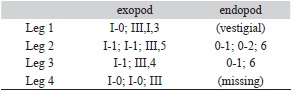
<body><![CDATA[Maxilliped&nbsp; (<a href="/img/revistas/rbt/v60s3/a14i1.jpg">Fig.&nbsp;     1G</a>) 3-segmented; proximal segment (corpus)     largest but unarmed; middle and distal segments partially fused to form     strong, sharply pointed claw with short medial spiniform seta.</span></font><br      style="font-family: verdana;">     <br style="font-family: verdana;">     <font size="2"><span style="font-family: verdana;">Armature on rami of     legs 1-4 as     follows (Roman numeral indicating spines and Arabic numeral, setae):</span></font><br      style="font-family: verdana;">     ]]></body>
<body><![CDATA[<br> <br style="font-family: verdana;">     <div style="text-align: center;"><img alt=""  src="/img/revistas/rbt/v60s3/a14f1.jpg"  style="width: 296px; height: 95px;">    <br> </div>     <br>     <br style="font-family: verdana;">     <font size="2"><span style="font-family: verdana;">Leg 1 (<a      href="/img/revistas/rbt/v60s3/a14i1.jpg">Figs. 1I</a>, <a      href="/img/revistas/rbt/v60s3/a14i2.jpg">2A</a>)     protopod with     short plumose outer seta and inner seta; endopod represented by short     ]]></body>
<body><![CDATA[bulb-like process with acute distal end (arrowed in <a      href="/img/revistas/rbt/v60s3/a14i1.jpg">Fig. 1I</a>). First     segment of exopod longest, with short spiniform seta on outer distal     corner; inner margin with row of short and medium-sized setules. Second     segment about half the length of first one, middle 2 of 4 terminal     elements on last exopodal segment with accessory setal processes (<a      href="/img/revistas/rbt/v60s3/a14i2.jpg">Fig.     2A</a>); 3&nbsp; curved&nbsp; subequal&nbsp; setae&nbsp; on&nbsp;     medial&nbsp; margin. Leg 2 (<a href="/img/revistas/rbt/v60s3/a14i2.jpg">Fig.     2B</a>) with small coxa armed with large     ]]></body>
<body><![CDATA[plumose inner seta on posterior edge; basis large, with small, plumose     outer seta and medial patch of spinules. inner margin ornamented with     short setules. Distal exopodal segment with three spines; modified seta     weakly sinusoid (<a href="/img/revistas/rbt/v60s3/a14i2.jpg">Fig. 2C</a>).     Leg 3 (Fig. 3D) protopod (apron) with narrow     marginal membrane, posterior edge with small, plumose setae at distal     outer and distal inner corners. Both rami 2-segmented; exopodal spine     on proximal segment robust. Two subdistal elements on third exopodal     segment curled. Leg 4 (<a href="/img/revistas/rbt/v60s3/a14i2.jpg">Fig.     2E</a>) protopod with short, plumose outer seta     ]]></body>
<body><![CDATA[on subdistal position; first exopodal segment slender, with short     terminal spine. Pectens on third exopodal segment weakly developed, at     insertion of each spine except middle one (<a      href="/img/revistas/rbt/v60s3/a14i2.jpg">Fig. 2F</a>). Leg 5     represented     by a broad rounded plate armed with three biserially plumose setae and     an isolated papilla bearing a single plumose seta at posteroventral     corner of genital complex (<a href="/img/revistas/rbt/v60s3/a14i2.jpg">Fig.     2G</a>).</span></font><br style="font-family: verdana;">     <br style="font-family: verdana;">     ]]></body>
<body><![CDATA[<font size="2"><span style="font-family: verdana;"><span      style="font-weight: bold;">Type material: holotype:</span> adult     female collected from the plankton at Bah&iacute;a Wafer, isla del     Coco, Costa Rica, coll. J. Picado, November 4, 2001, specimen partially     dissected, slide with appendages sealed with Entellan &reg;, specimen     ethanol-preserved, vial (MZUCR-283501). Paratype: adult female from     same locality and date, specimen undissected, ethanol-preserved, vial     deposited in ECO-CHZ-07567.</span></font><br      style="font-family: verdana;">     <br style="font-family: verdana;">     ]]></body>
<body><![CDATA[<font size="2"><span style="font-family: verdana;"><span      style="font-weight: bold;">Male:</span> Unknown.</span></font><br      style="font-family: verdana;">     <font size="2"><span style="font-family: verdana;"><span      style="font-weight: bold;">Host:</span> Unknown.</span></font><br      style="font-family: verdana;">     <font size="2"><span style="font-family: verdana;"><span      style="font-weight: bold;">Type locality:</span> Bah&iacute;a Wafer,     isla del Coco, Costa Rica (5&deg;32&acute;N, 87&deg;04&#8217;W), in the     Eastern Tropical&nbsp; Pacific&nbsp; Ocean.&nbsp; Temperature&nbsp;     ]]></body>
<body><![CDATA[at&nbsp; site of collection: 27&deg;C, salinity: 30 PSU, depth: 5.5 m.</span></font><br      style="font-family: verdana;">     <br style="font-family: verdana;">     <font size="2"><span style="font-family: verdana;"><span      style="font-weight: bold;">Etymology:</span> This species is named     after Dr. Alvaro Morales-Ram&iacute;rez (CiMAR-University of Costa     Rica), a Costa Rican zooplanktologist who has encouraged, for many     years, different kinds of surveys of the planktonic fauna of Costa Rica     and Central America.</span></font><br style="font-family: verdana;">     <br style="font-family: verdana;">     ]]></body>
<body><![CDATA[<font size="2"><span style="font-family: verdana;"><span      style="font-weight: bold;">Remarks:</span> The specimens examined     herein were identified as belonging to the genus <span      style="font-style: italic;">Lepeophtheirus</span> because     of the absence of lunules, the anterior margin of the cephalothorax is     not folded, and its possession of a three-segmented exopod of the     fourth leg (Ho &amp; Lin 2004). There&nbsp; are&nbsp; many&nbsp;     species&nbsp; of&nbsp; <span style="font-style: italic;">Lepeophtheirus</span>&nbsp;     (more than 50) with a     relatively short abdomen (Castro &amp; Baeza 1981) as in the new     ]]></body>
<body><![CDATA[species from isla del Coco. However, the number of species to compare     decreases when additional characters (i.e. structure and armature     details of legs 4 and 5) are added (Dojiri 1979). Hence, the     combination of characters of the new species is comparable with other     congeners having: 1) a short, 1-segmented abdomen less than half the     length of the genital complex; 2) a genital complex distinctly wider     than long; 3) leg 4 exopod 3-segmented and longer than the protopod; 4)     leg 4 with middle terminal claw as long as inner one; 5) accessory     processes on terminal elements ii and iii&nbsp; of the exopod of leg 1.     Among the species with more than three of these characters are <span     ]]></body>
<body><![CDATA[ style="font-style: italic;">L.     exilipes</span> Ho &amp; Lin, 2003, <span style="font-style: italic;">L.     atypicus</span> Lin, Ho &amp; Chen, 1996, L.     goniistii Yamaguti, 1936, <span style="font-style: italic;">L.     lagocephali</span> Pillai, 1963, <span style="font-style: italic;">L.     rotundipes</span>     Dojiri, 1979, and <span style="font-style: italic;">L. erecsoni</span>     Thompson, 1891.</span></font><br style="font-family: verdana;">     <br style="font-family: verdana;">     <font size="2"><span style="font-family: verdana;"><span     ]]></body>
<body><![CDATA[ style="font-style: italic;">Lepeophtheirus</span> gonistii has a     characteristic forked spine on the first exopodal segment of female leg     4, a structure which is simple in the new species. In&nbsp; both <span      style="font-style: italic;">L.     erecsoni</span> and <span style="font-style: italic;">L. lagocephali</span>     the terminal claws of leg 4 decrease in     length from the inner to the outer margin&nbsp; (Dojiri&nbsp;     1979,&nbsp; Boxshall&nbsp; &amp;&nbsp; Bellwood</span></font><font      size="2"><span style="font-family: verdana;"> 1981),&nbsp; thus&nbsp;     differing&nbsp; from&nbsp; the&nbsp; new&nbsp; species. In&nbsp; <span     ]]></body>
<body><![CDATA[ style="font-style: italic;">L.     rotundipes</span> the general habitus and the shape and proportions of     the     genital complex are different (see Dojiri 1979, <a      href="/img/revistas/rbt/v60s3/a14i2.jpg">Fig. 2G</a>). The     postantennal&nbsp; processes&nbsp; are&nbsp; relatively&nbsp; straight     in <span style="font-style: italic;">L. alvaroi</span> sp. nov. and     strongly curved in <span style="font-style: italic;">L. rotundipes</span>,     the     maxillule in <span style="font-style: italic;">L. rotundipes</span> is     ]]></body>
<body><![CDATA[forked vs. a single tine in specimens     from isla&nbsp; del Coco. The sternal furca is U-shaped in <span      style="font-style: italic;">L.     rotundipes</span> whereas it is more V-shaped in the new species. In     both <span style="font-style: italic;">L.     exilipes</span> and <span style="font-style: italic;">L. atypicus</span>,     with equally long middle and inner terminal     claws of leg 4, the genital somite is produced posteriorly on both     sides of the abdomen (Ho &amp; Lin 2004), a character absent in the new     species; also, in both species the second maxillar segment has a     ]]></body>
<body><![CDATA[pectiniform process which is absent in the new species. Moreover, both     species have a bifurcate maxillular process, thus diverging from <span      style="font-style: italic;">L.     alvaroi</span> sp. nov., which has a simple process (<a      href="/img/revistas/rbt/v60s3/a14i1.jpg">Fig. 1E</a>). Another     Pacific     species with a general resemblance with <span      style="font-style: italic;">L. alvaroi</span> sp. nov. is <span      style="font-style: italic;">L.     mugiloidis</span> Villalba &amp; Dur&aacute;n, 1985, both have similar     ]]></body>
<body><![CDATA[body     proportions, a reduced abdomen, identical armature of leg 1 and distal     elements of leg 4 (with inner element only slightly longer than medial     one). Differences include a posteriorly produced genital complex in <span      style="font-style: italic;">L.     mugiloidis</span>, a bifid maxilla, a reduced first exopodal spine of     leg 4,     and a sternal furca with clearly wider tines than in the new species     (see Villalba &amp; Dur&aacute;n 1985).</span></font><br      style="font-family: verdana;">     ]]></body>
<body><![CDATA[<br style="font-family: verdana;">     <font size="2"><span style="font-family: verdana;">There are two other     species, both     known also&nbsp; from&nbsp; the&nbsp; Eastern&nbsp; Tropical&nbsp;     Pacific,&nbsp; that have the same general combination of characters     including, most importantly, an unbranched maxillular process and a     similar structure and armature&nbsp; of&nbsp; leg&nbsp; 4,&nbsp;     with&nbsp; the&nbsp; middle&nbsp; claw&nbsp; as long as the inner one.     These are <span style="font-style: italic;">L. dissimulatus</span>     Wilson, 1905 and <span style="font-style: italic;">L. clarionensis</span>     ]]></body>
<body><![CDATA[Shiino,     1959. With respect to the former species, it differs from <span      style="font-style: italic;">L. alvaroi</span>     sp. nov. in the following characters: the length/width ratio and shape     of the genital complex is different in both species; in <span      style="font-style: italic;">L. dissimulatus</span>     the genital complex is relatively larger than in <span      style="font-style: italic;">L. alvaroi</span> sp. nov.     and only slightly longer than wide; the abdomen is clearly shorter than     in the new species (see Shiino 1959, fig.15A). This species is easily     ]]></body>
<body><![CDATA[distinguished by having a pair of posterior subtriangular processes     in the postero-lateral margin of the genital complex, which are absent     in the new species (see Wilson, 1905; Castro &amp; Baeza 1981; <a      href="/img/revistas/rbt/v60s3/a14i1.jpg">Fig.     1A</a>). Also, in <span style="font-style: italic;">L. dissimulatus</span>     the middle seta of the fifth leg is     clearly shorter than the other two (see Castro &amp; Baeza 1981, fig 6)     vs. a middle seta equal to the outer one in the new species (<a      href="/img/revistas/rbt/v60s3/a14i2.jpg">Fig. 2G</a>).</span></font><br      style="font-family: verdana;">     ]]></body>
<body><![CDATA[<br style="font-family: verdana;">     <font size="2"><span style="font-family: verdana;"><span      style="font-style: italic;">Lepeophtheirus</span> <span      style="font-style: italic;">clarionensis</span> Shiino,     1959 from isla Clari&oacute;n, a Mexican Pacific oceanic island, is     probably the most similar to <span style="font-style: italic;">L.     alvaroi</span> sp. nov. Like the new species,     it has a short abdomen,&nbsp; an&nbsp; unbranched&nbsp;     maxillular&nbsp; process and a leg 4 with two exopodal elements (inner     and middle ones) of the same size (see Shiino 1959, figs.14C, K). it     ]]></body>
<body><![CDATA[differs from the new species in the proportions and shape of the     genital complex; it is subrectangular vs. rounded in <span      style="font-style: italic;">L. alvaroi</span> sp.     nov.; it is also clearly larger, about half as wide as the     cephalothorax whereas this structure is about 1/3 as wide. The     cephalothorax has a different shape in both species; it is more robust     and widest at its distal 1/3 in the new species, whereas it is     relatively uniformly wide in <span style="font-style: italic;">L.     clarionensis</span> (see Shiino 1959, fig.     14A). Legs 4 are longer in our specimens from isla&nbsp; del&nbsp;     ]]></body>
<body><![CDATA[Coco,&nbsp; they&nbsp; reach&nbsp; the&nbsp; distal&nbsp; margin of the     caudal rami, whereas these are clearly shorter in <span      style="font-style: italic;">L. clarionensis</span>,     barely reaching beyond half length of the genital complex (Shiino 1959,     fig. 14A). The first segment of the maxilla is shorter than the second     segment in <span style="font-style: italic;">L. clarionensis</span>     (Shiino 1959, fig.14D) whereas it is     relatively longer in the new species. Also, the fifth leg is armed with     a single seta (see Shiino 1959, fig.14M) vs. a set of three setae in <span      style="font-style: italic;">L.     ]]></body>
<body><![CDATA[alvaroi</span> sp. nov. (<a href="/img/revistas/rbt/v60s3/a14i2.jpg">Fig.     2G</a>).</span></font><br style="font-family: verdana;">     <br style="font-family: verdana;">     <font size="2"><span style="font-family: verdana;">Overall, it is     concluded that the     new species&nbsp; has&nbsp; a&nbsp; unique&nbsp; combination&nbsp;     of&nbsp; diagnostic characters that includes: rounded genital complex     without posterior processes, a short, 1-segmented abdomen less than     half the length (about 25%) of the genital complex, a simple,     unbranched maxillular process, first segment of maxilla longer than     ]]></body>
<body><![CDATA[second, the latter unarmed, leg 4 with a 3-segmented exopod which is     longer than the protopod, spine on first exopodal segment well     developed, third segment of exopod with the middle terminal claw as     long as the inner one, and a short, broad leg 5 armed with three setae.</span></font><br      style="font-family: verdana;">     <br style="font-family: verdana;">     <font style="font-weight: bold;" size="3"><span      style="font-family: verdana;">Discussion</span></font><br      style="font-family: verdana;">     <br style="font-family: verdana;">     ]]></body>
<body><![CDATA[<font size="2"><span style="font-family: verdana;">The host of this     species remains     unknown, it was recorded in plankton samples; many caligids are found     in the water column and this has been deemed as a possible, little     known life mode of these parasites (Venmathi Maran &amp; Ohtsuka 2008).     Some species, such as <span style="font-style: italic;">Caligus</span>     <span style="font-style: italic;">undulatus</span> Shen &amp; Li, 1959     have been     recorded&nbsp; only&nbsp; from&nbsp; the&nbsp; plankton.&nbsp;     This&nbsp; also may be the case for the specimens reported herein.     ]]></body>
<body><![CDATA[Parasitological surveys of the local ichthyofauna of isla del Coco     should provide additional elements about this species. Members&nbsp;     of&nbsp; <span style="font-style: italic;">Lepeophtheirus</span>&nbsp;     have&nbsp; been&nbsp; recorded in many     different teleost families, and in the Eastern Pacific hosts include     species belonging to Sciaenidae, Tetraodontidae, Balistidae, Labridae,     and Serranidae (Shiino 1959, Causey 1960, Ho <span      style="font-style: italic;">et al.</span> 2001).</span></font><br      style="font-family: verdana;">     <br style="font-family: verdana;">     ]]></body>
<body><![CDATA[<font size="2"><span style="font-family: verdana;">Most species of <span      style="font-style: italic;">Caligus</span> have been     found to parasitize mainly warm water fishes distributed in low     latitudes; contrastingly, members of <span style="font-style: italic;">Lepeophtheirus</span>     are found mostly on     fish from cold water at higher latitudes. Hence, despite being the     second most speciose group of the Caligidae, the diversity of this     genus in tropical areas tends to be low, i.e., only three species have     been recorded in waters of Taiwan vs. 34 of <span      style="font-style: italic;">Caligus</span> (Ho &amp; Lin     ]]></body>
<body><![CDATA[2004), and 4 vs. +25 of <span style="font-style: italic;">Caligus</span>     in Brazilian waters (Boxshall &amp;     Mont&uacute; 1997, Luque &amp; Tavares 2007). The same tendency is true     in the Eastern Tropical Pacific; Shiino (1959) reported 8 species of     <span style="font-style: italic;">Caligus</span> and 3 of <span      style="font-style: italic;">Lepeophtheirus</span> and Causey (1960) 8     vs. 2 species,     respectively. in Chilean waters, at lower and intermediate latitudes of     the South Pacific, the number of species of these genera is almost     equal (12 <span style="font-style: italic;">Caligus</span> vs. 11 <span     ]]></body>
<body><![CDATA[ style="font-style: italic;">Lepeophtheirus</span>) (Mu&ntilde;oz &amp;     Olmos     2007).</span></font><br style="font-family: verdana;">     <br style="font-family: verdana;">     <font style="font-weight: bold;" size="3"><span      style="font-family: verdana;">Acknowledgments</span></font><br      style="font-family: verdana;">     <br style="font-family: verdana;">     <font size="2"><span style="font-family: verdana;">This work was     possible with the     ]]></body>
<body><![CDATA[kind support from colleagues and technicians collaborating in the field     during the sampling period at isla&nbsp; del Coco. We are particularly     indebted to Jorge Picado and Jairo Garc&iacute;a for their help and     advice during field work. We are especially grateful to Alvaro     Morales-Ram&iacute;rez, who kindly allowed us to examine these     specimens. We also appreciate the support from the Vicerrector&iacute;a     de investigaci&oacute;n of the University of&nbsp; Costa&nbsp;     Rica&nbsp; through&nbsp; projects&nbsp; 808-3A-062 and 808-B0-060. Rosa     Ma. Hern&aacute;ndez Flores, El Colegio de la Frontera Sur (ECOSUR)     provided the catalogue number of the Zooplankton collection at ECOSUR.     ]]></body>
<body><![CDATA[We appreciate the useful comments from three anonymous reviewers.    <br> <br style="font-family: verdana;"> </span></font> <hr style="width: 100%; height: 2px;">    <!-- ref --><br> <br style="font-family: verdana;"> <font style="font-weight: bold;" size="3"><span  style="font-family: verdana;">References</span></font><br  style="font-family: verdana;"> <br style="font-family: verdana;"> <font size="2"><span style="font-family: verdana;">Boxshall, G.A. &amp; D.R. Bellwood. 1981. A redescription of <span style="font-style: italic;">Lepeophtheirus</span> <span style="font-style: italic;">erecsoni</span>&nbsp; Thomson, 1891 and some comparisons with <span style="font-style: italic;">L. scutiger</span> Shiino, 1952&nbsp; </span></font><font size="2"><span  style="font-family: verdana;">and a new species, L. sheni (Crustacea: Copepoda). J. Roy. Soc. N. Z. 11:75-85.    &nbsp;&nbsp;&nbsp;&nbsp;&nbsp;&nbsp;&nbsp;&nbsp;[&#160;<a href="javascript:void(0);" onclick="javascript: window.open('/scielo.php?script=sci_nlinks&ref=1796155&pid=S0034-7744201200080001400001&lng=','','width=640,height=500,resizable=yes,scrollbars=1,menubar=yes,');">Links</a>&#160;]<!-- end-ref --><!-- ref --></span></font><br  style="font-family: verdana;"> <br style="font-family: verdana;"> <font size="2"><span style="font-family: verdana;">Boxshall, G.A. &amp; M.A. Mont&uacute;. 1997. Copepods parasitic on Brazilian coastal fishes: a handbook. Nauplius 5: 1-225.    &nbsp;&nbsp;&nbsp;&nbsp;&nbsp;&nbsp;&nbsp;&nbsp;[&#160;<a href="javascript:void(0);" onclick="javascript: window.open('/scielo.php?script=sci_nlinks&ref=1796156&pid=S0034-7744201200080001400002&lng=','','width=640,height=500,resizable=yes,scrollbars=1,menubar=yes,');">Links</a>&#160;]<!-- end-ref --><!-- ref --></span></font><br  style="font-family: verdana;"> <br style="font-family: verdana;"> <font size="2"><span style="font-family: verdana;">Boxshall,&nbsp; G.A. &amp; S.H. Halsey. 2004. An&nbsp; introduction to Copepod Diversity. The Ray Society, London, United Kingdom.    &nbsp;&nbsp;&nbsp;&nbsp;&nbsp;&nbsp;&nbsp;&nbsp;[&#160;<a href="javascript:void(0);" onclick="javascript: window.open('/scielo.php?script=sci_nlinks&ref=1796157&pid=S0034-7744201200080001400003&lng=','','width=640,height=500,resizable=yes,scrollbars=1,menubar=yes,');">Links</a>&#160;]<!-- end-ref --><!-- ref --></span></font><br  style="font-family: verdana;"> <br style="font-family: verdana;"> <font size="2"><span style="font-family: verdana;">Castro, R. &amp; H. Baeza. 1981. <span style="font-style: italic;">Lepeophtheirus</span> <span  style="font-style: italic;">dissimulatus</span> Wilson, 1905 and <span  style="font-style: italic;">Lepeophtheirus</span> zbigniewi new species (Copepoda: Caligidae) parasites of inshore fishes from the Pacific coast of Chile, South America. Bull. Mar. Sci. 3: 318-328.    &nbsp;&nbsp;&nbsp;&nbsp;&nbsp;&nbsp;&nbsp;&nbsp;[&#160;<a href="javascript:void(0);" onclick="javascript: window.open('/scielo.php?script=sci_nlinks&ref=1796158&pid=S0034-7744201200080001400004&lng=','','width=640,height=500,resizable=yes,scrollbars=1,menubar=yes,');">Links</a>&#160;]<!-- end-ref --><!-- ref --></span></font><br  style="font-family: verdana;"> <br style="font-family: verdana;"> <font size="2"><span style="font-family: verdana;">Causey, D. 1960. Parasitic Copepoda from Mexican coastal fishes. Bull. Mar. Sci. 10: 323-337.    &nbsp;&nbsp;&nbsp;&nbsp;&nbsp;&nbsp;&nbsp;&nbsp;[&#160;<a href="javascript:void(0);" onclick="javascript: window.open('/scielo.php?script=sci_nlinks&ref=1796159&pid=S0034-7744201200080001400005&lng=','','width=640,height=500,resizable=yes,scrollbars=1,menubar=yes,');">Links</a>&#160;]<!-- end-ref --><!-- ref --></span></font><br  style="font-family: verdana;"> <br style="font-family: verdana;"> <font size="2"><span style="font-family: verdana;">Cressey, R. &amp; H.B. Cressey. 1980. Parasitic&nbsp; copepods of mackerel and tuna-like&nbsp; fishes (Scombridae) of the World. Smithson. Contr. Zool. 311:1 -186.    &nbsp;&nbsp;&nbsp;&nbsp;&nbsp;&nbsp;&nbsp;&nbsp;[&#160;<a href="javascript:void(0);" onclick="javascript: window.open('/scielo.php?script=sci_nlinks&ref=1796160&pid=S0034-7744201200080001400006&lng=','','width=640,height=500,resizable=yes,scrollbars=1,menubar=yes,');">Links</a>&#160;]<!-- end-ref --><!-- ref --></span></font><br  style="font-family: verdana;"> <br style="font-family: verdana;"> <font size="2"><span style="font-family: verdana;">Dojiri, M. 1979. Two new species of <span style="font-style: italic;">Lepeophtheirus</span> (Copepoda: Caligidae)&nbsp; parasitic on fishes from southern California waters. Parasitology 78: 251-262.    &nbsp;&nbsp;&nbsp;&nbsp;&nbsp;&nbsp;&nbsp;&nbsp;[&#160;<a href="javascript:void(0);" onclick="javascript: window.open('/scielo.php?script=sci_nlinks&ref=1796161&pid=S0034-7744201200080001400007&lng=','','width=640,height=500,resizable=yes,scrollbars=1,menubar=yes,');">Links</a>&#160;]<!-- end-ref --><!-- ref --></span></font><br  style="font-family: verdana;"> <br style="font-family: verdana;"> <font size="2"><span style="font-family: verdana;">Graziano, L. 2001. Cruise Report S-177, Scientific Activities Undertaken Aboard SSV Robert C. Seamans, San Diego, California-Puntarenas, Costa Rica, October 10 2001-November&nbsp; 18, 2001. Sea Education&nbsp; Association, Woods Hole, Massachusetts. 45p.    &nbsp;&nbsp;&nbsp;&nbsp;&nbsp;&nbsp;&nbsp;&nbsp;[&#160;<a href="javascript:void(0);" onclick="javascript: window.open('/scielo.php?script=sci_nlinks&ref=1796162&pid=S0034-7744201200080001400008&lng=','','width=640,height=500,resizable=yes,scrollbars=1,menubar=yes,');">Links</a>&#160;]<!-- end-ref --><!-- ref --></span></font><br style="font-family: verdana;"> <br style="font-family: verdana;"> <font size="2"><span style="font-family: verdana;">Ho, J.-s., G&oacute;mez S., Fajer-Avila E. 2001: <span style="font-style: italic;">Lepeophtheirus</span> simplex sp. n., a caligid copepod (Siphonostomatoida) parasitic on &#8220;botete&#8221; (bullseye puffer, Sphoeroides annulatus) in Sinaloa, Mexico. Folia&nbsp; Parasitol. 48: 240-248.    &nbsp;&nbsp;&nbsp;&nbsp;&nbsp;&nbsp;&nbsp;&nbsp;[&#160;<a href="javascript:void(0);" onclick="javascript: window.open('/scielo.php?script=sci_nlinks&ref=1796163&pid=S0034-7744201200080001400009&lng=','','width=640,height=500,resizable=yes,scrollbars=1,menubar=yes,');">Links</a>&#160;]<!-- end-ref --><!-- ref --></span></font><br  style="font-family: verdana;"> <br style="font-family: verdana;"> <font size="2"><span style="font-family: verdana;">Ho,&nbsp; J.-S. &amp; C.-L. Lin. 2004. Sea Lice of Taiwan (Copepoda: Siphonostomatoida:&nbsp; Caligidae). The Sueichan Press, Keelung, Taiwan.    &nbsp;&nbsp;&nbsp;&nbsp;&nbsp;&nbsp;&nbsp;&nbsp;[&#160;<a href="javascript:void(0);" onclick="javascript: window.open('/scielo.php?script=sci_nlinks&ref=1796164&pid=S0034-7744201200080001400010&lng=','','width=640,height=500,resizable=yes,scrollbars=1,menubar=yes,');">Links</a>&#160;]<!-- end-ref --><!-- ref --></span></font><br  style="font-family: verdana;"> <br style="font-family: verdana;"> <font size="2"><span style="font-family: verdana;">Jackson,&nbsp; D. &amp; D. Minchin. 1992. Aspects of&nbsp; the reproductive&nbsp; output&nbsp; of&nbsp; two&nbsp; caligid&nbsp; copepod&nbsp; species&nbsp; on cultivated salmon.Invertebr. Reprod. Dev. 22: 87-90.    &nbsp;&nbsp;&nbsp;&nbsp;&nbsp;&nbsp;&nbsp;&nbsp;[&#160;<a href="javascript:void(0);" onclick="javascript: window.open('/scielo.php?script=sci_nlinks&ref=1796165&pid=S0034-7744201200080001400011&lng=','','width=640,height=500,resizable=yes,scrollbars=1,menubar=yes,');">Links</a>&#160;]<!-- end-ref --><!-- ref --></span></font><br  style="font-family: verdana;"> <br style="font-family: verdana;"> <font size="2"><span style="font-family: verdana;">Johnson, S. C., J. W. Treasurer, S. Bravo, K. Nagasawa &amp; Z. Kabata. 2004. A review of the impact of parasitic copepods&nbsp; on&nbsp; marine&nbsp; aquaculture.&nbsp; Zool.&nbsp; Stud.&nbsp; 43: 229-243.    &nbsp;&nbsp;&nbsp;&nbsp;&nbsp;&nbsp;&nbsp;&nbsp;[&#160;<a href="javascript:void(0);" onclick="javascript: window.open('/scielo.php?script=sci_nlinks&ref=1796166&pid=S0034-7744201200080001400012&lng=','','width=640,height=500,resizable=yes,scrollbars=1,menubar=yes,');">Links</a>&#160;]<!-- end-ref --><!-- ref --></span></font><br  style="font-family: verdana;"> <br style="font-family: verdana;"> <font size="2"><span style="font-family: verdana;">Kabata,&nbsp; Z.&nbsp; 1979.&nbsp; Parasitic&nbsp; Copepoda&nbsp; of&nbsp; British&nbsp; Fishes. The&nbsp; Ray Society, British Museum,&nbsp; London,&nbsp; United Kingdom.    &nbsp;&nbsp;&nbsp;&nbsp;&nbsp;&nbsp;&nbsp;&nbsp;[&#160;<a href="javascript:void(0);" onclick="javascript: window.open('/scielo.php?script=sci_nlinks&ref=1796167&pid=S0034-7744201200080001400013&lng=','','width=640,height=500,resizable=yes,scrollbars=1,menubar=yes,');">Links</a>&#160;]<!-- end-ref --><!-- ref --></span></font><br  style="font-family: verdana;"> <br style="font-family: verdana;"> <font size="2"><span style="font-family: verdana;">Luque, J.L. &amp; L.E.E. Tavares. 2007. Checklist of Copepoda associated with fishes from&nbsp; Brazil. Zootaxa 1579: 1-39.    &nbsp;&nbsp;&nbsp;&nbsp;&nbsp;&nbsp;&nbsp;&nbsp;[&#160;<a href="javascript:void(0);" onclick="javascript: window.open('/scielo.php?script=sci_nlinks&ref=1796168&pid=S0034-7744201200080001400014&lng=','','width=640,height=500,resizable=yes,scrollbars=1,menubar=yes,');">Links</a>&#160;]<!-- end-ref --><!-- ref --></span></font><br style="font-family: verdana;"> <br style="font-family: verdana;"> <font size="2"><span style="font-family: verdana;">Morales-Ram&iacute;rez, A. 2008. Caracterizaci&oacute;n cualitativa del zooplancton del &Aacute;rea de&nbsp; Conservaci&oacute;n Marina isla del Coco (ACMIC), Oc&eacute;ano Pac&iacute;fico de Costa Rica. Rev. Biol. Trop.56 (Supl. 2): 159-169.    &nbsp;&nbsp;&nbsp;&nbsp;&nbsp;&nbsp;&nbsp;&nbsp;[&#160;<a href="javascript:void(0);" onclick="javascript: window.open('/scielo.php?script=sci_nlinks&ref=1796169&pid=S0034-7744201200080001400015&lng=','','width=640,height=500,resizable=yes,scrollbars=1,menubar=yes,');">Links</a>&#160;]<!-- end-ref --><!-- ref --></span></font><br style="font-family: verdana;"> <br style="font-family: verdana;"> <font size="2"><span style="font-family: verdana;">Mu&ntilde;oz,&nbsp; G. &amp; V. Olmos. 2007. Revisi&oacute;n&nbsp; bibliogr&aacute;fica de especies&nbsp; ectopar&aacute;sitas&nbsp; y&nbsp; hospedadoras&nbsp; de&nbsp; sistemas acu&aacute;ticos de&nbsp; Chile. Rev. Biol. Mar. Oceanogr. 42: 89-148.    &nbsp;&nbsp;&nbsp;&nbsp;&nbsp;&nbsp;&nbsp;&nbsp;[&#160;<a href="javascript:void(0);" onclick="javascript: window.open('/scielo.php?script=sci_nlinks&ref=1796170&pid=S0034-7744201200080001400016&lng=','','width=640,height=500,resizable=yes,scrollbars=1,menubar=yes,');">Links</a>&#160;]<!-- end-ref --><!-- ref --></span></font><br style="font-family: verdana;"> <br style="font-family: verdana;"> <font size="2"><span style="font-family: verdana;">Shiino,&nbsp; S.M. 1959. Ostpazifische&nbsp; parasitierende Copepoden. Rep. Fac. Fish. Pref. Univ. Mie 3: 267-333.    &nbsp;&nbsp;&nbsp;&nbsp;&nbsp;&nbsp;&nbsp;&nbsp;[&#160;<a href="javascript:void(0);" onclick="javascript: window.open('/scielo.php?script=sci_nlinks&ref=1796171&pid=S0034-7744201200080001400017&lng=','','width=640,height=500,resizable=yes,scrollbars=1,menubar=yes,');">Links</a>&#160;]<!-- end-ref --><!-- ref --></span></font><br style="font-family: verdana;"> <br style="font-family: verdana;"> <font size="2"><span style="font-family: verdana;">Villalba, C. &amp; L. Dur&aacute;n. 1985. <span style="font-style: italic;">Lepeophtheirus</span> mugiloidis sp. n. (Copepoda: Caligidae), parasito de Mugiloides chilensis (Molina,&nbsp; 1782) (Pisces: Mugiloididae), en Chile. Bol. Soc. Biol. Concepci&oacute;n 56: 59-66.    &nbsp;&nbsp;&nbsp;&nbsp;&nbsp;&nbsp;&nbsp;&nbsp;[&#160;<a href="javascript:void(0);" onclick="javascript: window.open('/scielo.php?script=sci_nlinks&ref=1796172&pid=S0034-7744201200080001400018&lng=','','width=640,height=500,resizable=yes,scrollbars=1,menubar=yes,');">Links</a>&#160;]<!-- end-ref --><!-- ref --></span></font><br  style="font-family: verdana;"> <br style="font-family: verdana;"> <font size="2"><span style="font-family: verdana;">Venmathi Maran, B.A. &amp; S. Ohtsuka. 2008. Descriptions of caligiform copepods in&nbsp; plankton samples collected&nbsp; from&nbsp; East&nbsp; Asia:&nbsp; accidental&nbsp; occurrences&nbsp; or&nbsp; a new&nbsp; mode of life cycles? Plankton Benthos&nbsp; Res. 3: 202-215.    &nbsp;&nbsp;&nbsp;&nbsp;&nbsp;&nbsp;&nbsp;&nbsp;[&#160;<a href="javascript:void(0);" onclick="javascript: window.open('/scielo.php?script=sci_nlinks&ref=1796173&pid=S0034-7744201200080001400019&lng=','','width=640,height=500,resizable=yes,scrollbars=1,menubar=yes,');">Links</a>&#160;]<!-- end-ref --><!-- ref --></span></font><br  style="font-family: verdana;"> <br style="font-family: verdana;"> <font size="2"><span style="font-family: verdana;">Wilson,&nbsp; C.B.&nbsp; 1905.&nbsp; North American&nbsp; parasitic&nbsp; copepods belonging to the family Caligidae. Part 1. The Caliginae. Proc. U.S. Nat. Mus. 28: 479-672.    &nbsp;&nbsp;&nbsp;&nbsp;&nbsp;&nbsp;&nbsp;&nbsp;[&#160;<a href="javascript:void(0);" onclick="javascript: window.open('/scielo.php?script=sci_nlinks&ref=1796174&pid=S0034-7744201200080001400020&lng=','','width=640,height=500,resizable=yes,scrollbars=1,menubar=yes,');">Links</a>&#160;]<!-- end-ref --><br>     <br> <a name="Correspondencia1"></a><a href="#Correspondencia2">*</a>Correspondencia a:    <br> </span></font><font size="2"><span style="font-family: verdana;">Eduardo Su&aacute;rez-Morales. </span></font><font size="2"><span  style="font-family: verdana;">El Colegio de la Frontera Sur (ECOSUR), Unidad Chetumal, Av. Centenario Km 5.5, Chetumal, Quintana Roo 77000, M&eacute;xico; esuarez@ecosur.mx</span></font><font size="2"><span  style="font-family: verdana;">.     <br> </span></font><font size="2"><span style="font-family: verdana;">Rebeca Gasca. </span></font><font size="2"><span style="font-family: verdana;">El Colegio de la Frontera Sur (ECOSUR), Unidad Chetumal, Av. Centenario Km 5.5, Chetumal, Quintana Roo 77000, M&eacute;xico.    <br>     <br> </span></font><font size="2"><span style="font-family: verdana;"><a  name="1"></a><a href="#2">1</a>. El Colegio de la Frontera Sur (ECOSUR), Unidad Chetumal, Av. Centenario Km 5.5, Chetumal, Quintana Roo 77000, M&eacute;xico; esuarez@ecosur.mx</span></font>    <br> <hr style="width: 100%; height: 2px;">     <div style="text-align: center;"><font style="font-weight: bold;"  size="2"><span style="font-family: verdana;">Received 02-III-2012. Corrected 30-V-2012. Accepted 24-IX-2012.</span></font><br  style="font-family: verdana;"> </div> </div> <font size="2"> </font>     ]]></body>
<body><![CDATA[ ]]></body><back>
<ref-list>
<ref id="B1">
<nlm-citation citation-type="journal">
<person-group person-group-type="author">
<name>
<surname><![CDATA[Boxshall]]></surname>
<given-names><![CDATA[G.A.]]></given-names>
</name>
<name>
<surname><![CDATA[Bellwood.]]></surname>
<given-names><![CDATA[D.R.]]></given-names>
</name>
</person-group>
<article-title xml:lang="en"><![CDATA[A redescription of Lepeophtheirus erecsoni Thomson, 1891 and some comparisons with L. scutiger Shiino, 1952 and a new species, L. sheni (Crustacea: Copepoda).]]></article-title>
<source><![CDATA[J. Roy. Soc. N. Z.]]></source>
<year>1981</year>
<volume>11</volume>
<page-range>75-85.</page-range></nlm-citation>
</ref>
<ref id="B2">
<nlm-citation citation-type="journal">
<person-group person-group-type="author">
<name>
<surname><![CDATA[Boxshall]]></surname>
<given-names><![CDATA[G.A.]]></given-names>
</name>
<name>
<surname><![CDATA[Montú]]></surname>
<given-names><![CDATA[M.A.]]></given-names>
</name>
</person-group>
<article-title xml:lang="en"><![CDATA[Copepods parasitic on Brazilian coastal fishes: a handbook]]></article-title>
<source><![CDATA[Nauplius]]></source>
<year>1997</year>
<volume>5</volume>
<page-range>1-225</page-range></nlm-citation>
</ref>
<ref id="B3">
<nlm-citation citation-type="book">
<person-group person-group-type="author">
<name>
<surname><![CDATA[Boxshall]]></surname>
<given-names><![CDATA[G.A.]]></given-names>
</name>
<name>
<surname><![CDATA[Halsey]]></surname>
<given-names><![CDATA[S.H.]]></given-names>
</name>
</person-group>
<source><![CDATA[An introduction to Copepod Diversity]]></source>
<year>2004</year>
<publisher-loc><![CDATA[^eLondon London]]></publisher-loc>
<publisher-name><![CDATA[The Ray Society]]></publisher-name>
</nlm-citation>
</ref>
<ref id="B4">
<nlm-citation citation-type="journal">
<person-group person-group-type="author">
<name>
<surname><![CDATA[Castro]]></surname>
<given-names><![CDATA[R.]]></given-names>
</name>
<name>
<surname><![CDATA[Baeza]]></surname>
<given-names><![CDATA[H.]]></given-names>
</name>
</person-group>
<article-title xml:lang="en"><![CDATA[Lepeophtheirus dissimulatus Wilson, 1905 and Lepeophtheirus zbigniewi new species (Copepoda: Caligidae) parasites of inshore fishes from the Pacific coast of Chile, South America]]></article-title>
<source><![CDATA[Bull. Mar. Sci.]]></source>
<year>1981</year>
<volume>3</volume>
<page-range>318-328</page-range></nlm-citation>
</ref>
<ref id="B5">
<nlm-citation citation-type="journal">
<person-group person-group-type="author">
<name>
<surname><![CDATA[Causey]]></surname>
<given-names><![CDATA[D.]]></given-names>
</name>
</person-group>
<article-title xml:lang="en"><![CDATA[Parasitic Copepoda from Mexican coastal fishes]]></article-title>
<source><![CDATA[Bull. Mar. Sci.]]></source>
<year>1960</year>
<volume>10</volume>
<page-range>323-337</page-range></nlm-citation>
</ref>
<ref id="B6">
<nlm-citation citation-type="journal">
<person-group person-group-type="author">
<name>
<surname><![CDATA[Cressey]]></surname>
<given-names><![CDATA[R.]]></given-names>
</name>
<name>
<surname><![CDATA[Cressey]]></surname>
<given-names><![CDATA[H.B.]]></given-names>
</name>
</person-group>
<article-title xml:lang="en"><![CDATA[Parasitic copepods of mackerel- and tuna-like fishes (Scombridae) of the World. Smithson]]></article-title>
<source><![CDATA[Contr. Zool.]]></source>
<year>1980</year>
<volume>311</volume>
<page-range>1 -186</page-range></nlm-citation>
</ref>
<ref id="B7">
<nlm-citation citation-type="journal">
<person-group person-group-type="author">
<name>
<surname><![CDATA[Dojiri]]></surname>
<given-names><![CDATA[M.]]></given-names>
</name>
</person-group>
<article-title xml:lang="en"><![CDATA[Two new species of Lepeophtheirus (Cope- poda: Caligidae) parasitic on fishes from southern California waters.]]></article-title>
<source><![CDATA[Parasitology]]></source>
<year>1979</year>
<volume>78</volume>
<page-range>251-262</page-range></nlm-citation>
</ref>
<ref id="B8">
<nlm-citation citation-type="book">
<person-group person-group-type="author">
<name>
<surname><![CDATA[Graziano]]></surname>
<given-names><![CDATA[L.]]></given-names>
</name>
</person-group>
<source><![CDATA[Cruise Report S-177, Scientific Activities Undertaken Aboard SSV Robert C. Seamans, San Diego, California-Puntarenas, Costa Rica, October 10 2001-November 18, 2001]]></source>
<year>2001</year>
<page-range>45</page-range><publisher-loc><![CDATA[Woods Hole^eMassachusetts Massachusetts]]></publisher-loc>
<publisher-name><![CDATA[Sea Education Association]]></publisher-name>
</nlm-citation>
</ref>
<ref id="B9">
<nlm-citation citation-type="journal">
<person-group person-group-type="author">
<name>
<surname><![CDATA[Ho]]></surname>
<given-names><![CDATA[J.-S.]]></given-names>
</name>
<name>
<surname><![CDATA[Gómez]]></surname>
<given-names><![CDATA[S.]]></given-names>
</name>
<name>
<surname><![CDATA[Fajer-Avila]]></surname>
<given-names><![CDATA[E.]]></given-names>
</name>
</person-group>
<article-title xml:lang="en"><![CDATA[Lepeophtheirus simplex sp. n., a caligid copepod (Siphonostomatoida) parasitic on &#8220;botete&#8221; (bullseye puffer, Sphoeroides annulatus) in Sinaloa, Mexico.]]></article-title>
<source><![CDATA[Folia Parasitol.]]></source>
<year>2001</year>
<volume>48</volume>
<page-range>240-248</page-range></nlm-citation>
</ref>
<ref id="B10">
<nlm-citation citation-type="book">
<person-group person-group-type="author">
<name>
<surname><![CDATA[Ho]]></surname>
<given-names><![CDATA[J.-S.]]></given-names>
</name>
<name>
<surname><![CDATA[Lin]]></surname>
<given-names><![CDATA[C.-L.]]></given-names>
</name>
</person-group>
<source><![CDATA[Sea Lice of Taiwan (Copepoda: Siphonostomatoida: Caligidae)]]></source>
<year>2004</year>
<publisher-loc><![CDATA[^eKeelung Keelung]]></publisher-loc>
<publisher-name><![CDATA[The Sueichan Press]]></publisher-name>
</nlm-citation>
</ref>
<ref id="B11">
<nlm-citation citation-type="journal">
<person-group person-group-type="author">
<name>
<surname><![CDATA[Jackson]]></surname>
<given-names><![CDATA[D.]]></given-names>
</name>
<name>
<surname><![CDATA[Minchin]]></surname>
<given-names><![CDATA[D.]]></given-names>
</name>
</person-group>
<article-title xml:lang="en"><![CDATA[Aspects of the reproductive output of two caligid copepod species on cultivated salmon.]]></article-title>
<source><![CDATA[Invertebr. Reprod. Dev.]]></source>
<year>1992</year>
<volume>22</volume>
<page-range>87-90</page-range></nlm-citation>
</ref>
<ref id="B12">
<nlm-citation citation-type="journal">
<person-group person-group-type="author">
<name>
<surname><![CDATA[Johnson]]></surname>
<given-names><![CDATA[S. C.]]></given-names>
</name>
<name>
<surname><![CDATA[Treasurer]]></surname>
<given-names><![CDATA[J. W.]]></given-names>
</name>
<name>
<surname><![CDATA[Bravo]]></surname>
<given-names><![CDATA[S.]]></given-names>
</name>
<name>
<surname><![CDATA[Nagasawa]]></surname>
<given-names><![CDATA[K.]]></given-names>
</name>
<name>
<surname><![CDATA[Kabata]]></surname>
<given-names><![CDATA[Z.]]></given-names>
</name>
</person-group>
<article-title xml:lang="en"><![CDATA[A review of the impact of parasitic copepods on marine aquaculture]]></article-title>
<source><![CDATA[Zool. Stud.]]></source>
<year>2004</year>
<volume>43</volume>
<page-range>229-243</page-range></nlm-citation>
</ref>
<ref id="B13">
<nlm-citation citation-type="book">
<person-group person-group-type="author">
<name>
<surname><![CDATA[Kabata]]></surname>
<given-names><![CDATA[Z.]]></given-names>
</name>
</person-group>
<source><![CDATA[Parasitic Copepoda of British Fishes]]></source>
<year>1979</year>
<publisher-loc><![CDATA[^eLondon London]]></publisher-loc>
<publisher-name><![CDATA[The Ray SocietyBritish Museum]]></publisher-name>
</nlm-citation>
</ref>
<ref id="B14">
<nlm-citation citation-type="journal">
<person-group person-group-type="author">
<name>
<surname><![CDATA[Luque]]></surname>
<given-names><![CDATA[J.L.]]></given-names>
</name>
<name>
<surname><![CDATA[Tavares]]></surname>
<given-names><![CDATA[L.E.E.]]></given-names>
</name>
</person-group>
<article-title xml:lang="en"><![CDATA[Checklist of Copepoda associated with fishes from Brazil]]></article-title>
<source><![CDATA[Zootaxa]]></source>
<year>2007</year>
<volume>1579</volume>
<page-range>1-39</page-range></nlm-citation>
</ref>
<ref id="B15">
<nlm-citation citation-type="journal">
<person-group person-group-type="author">
<name>
<surname><![CDATA[Morales-Ramírez]]></surname>
<given-names><![CDATA[A.]]></given-names>
</name>
</person-group>
<article-title xml:lang="es"><![CDATA[Caracterización cualitativa del zooplancton del Área de Conservación Marina isla del Coco (ACMIC), Océano Pacífico de Costa Rica]]></article-title>
<source><![CDATA[Rev. Biol. Trop.]]></source>
<year>2008</year>
<volume>56</volume>
<numero>^s2</numero>
<issue>^s2</issue>
<supplement>2</supplement>
<page-range>159-169</page-range></nlm-citation>
</ref>
<ref id="B16">
<nlm-citation citation-type="journal">
<person-group person-group-type="author">
<name>
<surname><![CDATA[Muñoz]]></surname>
<given-names><![CDATA[G.]]></given-names>
</name>
<name>
<surname><![CDATA[Olmos]]></surname>
<given-names><![CDATA[V.]]></given-names>
</name>
</person-group>
<article-title xml:lang="es"><![CDATA[Revisión bibliográfica de especies ectoparásitas y hospedadoras de sistemas acuáticos de Chile]]></article-title>
<source><![CDATA[Rev. Biol. Mar. Oceanogr.]]></source>
<year>2007</year>
<volume>42</volume>
<page-range>89-148</page-range></nlm-citation>
</ref>
<ref id="B17">
<nlm-citation citation-type="journal">
<person-group person-group-type="author">
<name>
<surname><![CDATA[Shiino]]></surname>
<given-names><![CDATA[S.M]]></given-names>
</name>
</person-group>
<article-title xml:lang="en"><![CDATA[Ostpazifische parasitierende Copepoden]]></article-title>
<source><![CDATA[Rep. Fac. Fish. Pref. Univ. Mie]]></source>
<year>1959</year>
<volume>3</volume>
<page-range>267-333</page-range></nlm-citation>
</ref>
<ref id="B18">
<nlm-citation citation-type="journal">
<person-group person-group-type="author">
<name>
<surname><![CDATA[Villalba]]></surname>
<given-names><![CDATA[C.]]></given-names>
</name>
<name>
<surname><![CDATA[Durán]]></surname>
<given-names><![CDATA[L.]]></given-names>
</name>
</person-group>
<article-title xml:lang="es"><![CDATA[Lepeophtheirus mugiloidis sp. n. (Copepoda: Caligidae), parasito de Mugiloides chilensis (Molina, 1782) (Pisces: Mugiloididae), en Chile]]></article-title>
<source><![CDATA[Bol. Soc. Biol. Concepción]]></source>
<year>1985</year>
<volume>56</volume>
<page-range>59-66</page-range></nlm-citation>
</ref>
<ref id="B19">
<nlm-citation citation-type="journal">
<person-group person-group-type="author">
<name>
<surname><![CDATA[Venmathi Maran]]></surname>
<given-names><![CDATA[B.A.]]></given-names>
</name>
<name>
<surname><![CDATA[Ohtsuka]]></surname>
<given-names><![CDATA[S.]]></given-names>
</name>
</person-group>
<article-title xml:lang="en"><![CDATA[Descriptions of caligiform copepods in plankton samples collected from East Asia: accidental occurrences or a new mode of life cycles?]]></article-title>
<source><![CDATA[Plankton Benthos Res.]]></source>
<year>2008</year>
<volume>3</volume>
<page-range>202-215</page-range></nlm-citation>
</ref>
<ref id="B20">
<nlm-citation citation-type="journal">
<person-group person-group-type="author">
<name>
<surname><![CDATA[Wilson]]></surname>
<given-names><![CDATA[C.B.]]></given-names>
</name>
</person-group>
<article-title xml:lang="en"><![CDATA[North American parasitic copepods belonging to the family Caligidae: Part 1. The Caliginae]]></article-title>
<source><![CDATA[Proc. U.S. Nat. Mus.]]></source>
<year>1905</year>
<volume>28</volume>
<page-range>479-672</page-range></nlm-citation>
</ref>
</ref-list>
</back>
</article>