<?xml version="1.0" encoding="ISO-8859-1"?><article xmlns:mml="http://www.w3.org/1998/Math/MathML" xmlns:xlink="http://www.w3.org/1999/xlink" xmlns:xsi="http://www.w3.org/2001/XMLSchema-instance">
<front>
<journal-meta>
<journal-id>0034-7744</journal-id>
<journal-title><![CDATA[Revista de Biología Tropical]]></journal-title>
<abbrev-journal-title><![CDATA[Rev. biol. trop]]></abbrev-journal-title>
<issn>0034-7744</issn>
<publisher>
<publisher-name><![CDATA[Universidad de Costa Rica]]></publisher-name>
</publisher>
</journal-meta>
<article-meta>
<article-id>S0034-77442012000800006</article-id>
<title-group>
<article-title xml:lang="en"><![CDATA[Global Model selection for evaluation of Climate Change projections in the Eastern Tropical Pacific Seascape]]></article-title>
</title-group>
<contrib-group>
<contrib contrib-type="author">
<name>
<surname><![CDATA[Hidalgo]]></surname>
<given-names><![CDATA[Hugo G.]]></given-names>
</name>
<xref ref-type="aff" rid="A01"/>
</contrib>
<contrib contrib-type="author">
<name>
<surname><![CDATA[Alfaro]]></surname>
<given-names><![CDATA[Eric J.]]></given-names>
</name>
<xref ref-type="aff" rid="A01"/>
</contrib>
</contrib-group>
<aff id="A01">
<institution><![CDATA[,Universidad de Costa Rica Escuela de Física ]]></institution>
<addr-line><![CDATA[ San José]]></addr-line>
<country>Costa Rica</country>
</aff>
<aff id="A02">
<institution><![CDATA[,Universidad de Costa Rica Centro de Investigaciones Geofísicas ]]></institution>
<addr-line><![CDATA[ San José]]></addr-line>
<country>Costa Rica</country>
</aff>
<aff id="A03">
<institution><![CDATA[,Universidad de Costa Rica Centro de Investigación en Ciencias del Mar y Limnología ]]></institution>
<addr-line><![CDATA[ San José]]></addr-line>
<country>Costa Rica</country>
</aff>
<pub-date pub-type="pub">
<day>00</day>
<month>11</month>
<year>2012</year>
</pub-date>
<pub-date pub-type="epub">
<day>00</day>
<month>11</month>
<year>2012</year>
</pub-date>
<volume>60</volume>
<fpage>67</fpage>
<lpage>81</lpage>
<copyright-statement/>
<copyright-year/>
<self-uri xlink:href="http://www.scielo.sa.cr/scielo.php?script=sci_arttext&amp;pid=S0034-77442012000800006&amp;lng=en&amp;nrm=iso"></self-uri><self-uri xlink:href="http://www.scielo.sa.cr/scielo.php?script=sci_abstract&amp;pid=S0034-77442012000800006&amp;lng=en&amp;nrm=iso"></self-uri><self-uri xlink:href="http://www.scielo.sa.cr/scielo.php?script=sci_pdf&amp;pid=S0034-77442012000800006&amp;lng=en&amp;nrm=iso"></self-uri><abstract abstract-type="short" xml:lang="en"><p><![CDATA[Two methods for selecting a subset of simulations and/or general circulation models (GCMs) from a set of 30 available simulations are compared: 1) Selecting the models based on their performance on reproducing 20th century climate, and 2) random sampling. In the first case, it was found that the performance methodology is very sensitive to the type and number of metrics used to rank the models and therefore the results are not robust to these conditions. In general, including more models in a multi-model ensemble according to their rank (of skill in reproducing 20th century climate) results in an increase in the multi-model skill up to a certain point and then the inclusion of more models degrades the skill of the multi-model ensemble. In a similar fashion when the models are introduced in the ensemble at random, there is a point where the inclusion of more models does not change significantly the skill of the multi-model ensemble. For precipitation the subset of models that produces the maximum skill in reproducing 20th century climate also showed some skill in reproducing the climate change projections of the multi-model ensemble of all simulations. For temperature, more models/simulations are needed to be included in the ensemble (at the expense of a decrease in the skill of reproducing the climate of the 20th century for the selection based on their ranks). For precipitation and temperature the use of 7 simulations out of 30 resulted in the maximum skill for both approaches to introduce the models.]]></p></abstract>
<abstract abstract-type="short" xml:lang="es"><p><![CDATA[Se emplearon dos métodos para escoger un subconjunto a partir de treinta simulaciones de Modelos de Circulación General. El primer método se basó en la habilidad de cada uno de los modelos en reproducir el clima del siglo XX y el segundo en un muestreo aleatorio. Se encontró que el primero de ellos es muy sensible al tipo y métrica usada para categorizar los modelos, lo que no arrojó resultados robustos bajo estas condiciones. En general, la inclusión de más modelos en el agrupamiento de multi-modelos ordenados de acuerdo a su destreza en reproducir el clima del siglo XX, resultó en un aumento en la destreza del agrupamiento de multi-modelos hasta cierto punto, y luego la inclusión de más modelos/simulaciones degrada la destreza del agrupamiento de multi-modelos. De manera similar, en la inclusión de modelos de forma aleatoria, existe un punto en que agregar más modelos no cambia significativamente la destreza del agrupamiento de muti-modelos. Para el caso de la precipitación, el subconjunto de modelos que produce la máxima destreza en reproducir el clima del siglo XX también mostró alguna destreza en reproducir las proyecciones de cambio climático del agrupamiento de multi-modelos para todas las simulaciones. Para temperatura, más modelos/simulaciones son necesarios para ser incluidos en el agrupamiento (con la consecuente disminución en la destreza para reproducir el clima del siglo XX). Para precipitación y temperatura, el uso de 7 simulaciones de 30 posibles resultó en el punto de máxima destreza para ambos métodos de inclusión de modelos.]]></p></abstract>
<kwd-group>
<kwd lng="en"><![CDATA[Eastern Tropical Pacific Seascape]]></kwd>
<kwd lng="en"><![CDATA[General Circulation Models]]></kwd>
<kwd lng="en"><![CDATA[Climate Change]]></kwd>
<kwd lng="en"><![CDATA[Precipitation]]></kwd>
<kwd lng="en"><![CDATA[Air Surface Temperature]]></kwd>
<kwd lng="es"><![CDATA[Corredor del Pacífico Tropical del Este]]></kwd>
<kwd lng="es"><![CDATA[Modelos de Circulación General]]></kwd>
<kwd lng="es"><![CDATA[Cambio Climático]]></kwd>
<kwd lng="es"><![CDATA[Precipitación]]></kwd>
<kwd lng="es"><![CDATA[Temperatura superficial del aire]]></kwd>
</kwd-group>
</article-meta>
</front><body><![CDATA[ <div style="text-align: justify;"><font style="font-weight: bold;"  size="4"><span style="font-family: verdana;">Global Model selection for evaluation of Climate Change projections in the Eastern Tropical Pacific Seascape</span></font><br style="font-family: verdana;"> <br style="font-family: verdana;">     <div style="text-align: center;"><font size="2"><span  style="font-family: verdana;">Hugo G. Hidalgo<sup><a href="#1">1</a><a  name="4"></a>*,<a href="#2">2</a><a name="5"></a>*</sup>&nbsp; &amp; Eric J. Alfaro<sup><a href="#1">1</a>,<a href="#2">2</a>,<a href="#3">3</a><a  name="6"></a>*</sup></span></font><br style="font-family: verdana;"> </div> <font size="2"><span style="font-family: verdana;"></span></font><font  size="2"><span style="font-family: verdana;">    <br> <a name="Correspondencia2"></a>*<a href="#Correspondencia1">Direcci&oacute;n para correspondencia:</a><br style="font-family: verdana;"> </span></font> <hr style="width: 100%; height: 2px;"><font style="font-weight: bold;"  size="3"><span style="font-family: verdana;">Abstract</span></font><br  style="font-family: verdana;"> <br style="font-family: verdana;"> <font size="2"><span style="font-family: verdana;">Two methods for selecting a subset of simulations and/or general circulation models (GCMs) from a set of 30 available simulations are compared: 1) Selecting the models based on their performance on reproducing 20<sup>th</sup>&nbsp; century climate, and 2) random sampling.&nbsp; In the first case, it was found that the performance methodology is very sensitive to the type and number of metrics used to rank the models and therefore the results are not robust to these conditions. In general, including more models in a multi-model ensemble according to their rank (of skill in reproducing 20<sup>th&nbsp;</sup> century climate) results in an increase in the multi-model skill up to a certain point and then the inclusion of more models degrades the skill of the multi-model ensemble. In a similar fashion when the models are introduced in the ensemble at random, there is a point where the inclusion of more models does not change significantly the skill of the multi-model ensemble. For precipitation the subset of models that produces the maximum skill in reproducing 20<sup>th</sup>&nbsp; century climate also showed some skill in reproducing the climate change projections of the multi-model ensemble of all simulations. For temperature, more models/simulations are needed to be included in the ensemble (at the expense of a decrease in the skill of reproducing the climate of the 20<sup>th</sup>&nbsp; century for the selection based on their ranks). For precipitation and temperature the use of 7 simulations out of 30 resulted in the maximum skill for both approaches to introduce the models. </span></font><br style="font-family: verdana;"> <br style="font-family: verdana;"> <font size="2"><span style="font-family: verdana;"><span  style="font-weight: bold;">Key words:</span> Eastern Tropical Pacific Seascape, General Circulation Models, Climate Change, Precipitation, Air Surface Temperature.</span></font><br style="font-family: verdana;"> <br style="font-family: verdana;"> <font style="font-weight: bold;" size="3"><span  style="font-family: verdana;">Resumen</span></font><br  style="font-family: verdana;"> <br style="font-family: verdana;"> <font size="2"><span style="font-family: verdana;">Se emplearon dos m&eacute;todos para escoger un subconjunto a partir de treinta simulaciones de Modelos de Circulaci&oacute;n General. El primer m&eacute;todo se bas&oacute; en la habilidad de cada uno de los modelos en reproducir el clima del siglo XX y el segundo en un muestreo aleatorio. Se encontr&oacute; que el primero de ellos es muy sensible al tipo y m&eacute;trica usada para categorizar los modelos, lo que no arroj&oacute; resultados robustos bajo estas&nbsp; condiciones. En general, la inclusi&oacute;n de&nbsp; m&aacute;s&nbsp; modelos&nbsp; en&nbsp; el&nbsp; agrupamiento&nbsp; de&nbsp; multi-modelos ordenados de acuerdo a su destreza en reproducir el clima del siglo XX, result&oacute; en un aumento en la destreza del agrupamiento de multi-modelos hasta cierto punto, y luego la inclusi&oacute;n de m&aacute;s modelos/simulaciones degrada la destreza del agrupamiento de multi-modelos. De manera similar, en la inclusi&oacute;n de modelos de forma aleatoria, existe un punto en que agregar m&aacute;s modelos no cambia significativamente la&nbsp; destreza del agrupamiento de muti-modelos.&nbsp; Para&nbsp; el caso de la precipitaci&oacute;n, el&nbsp; subconjunto de modelos que produce la&nbsp; m&aacute;xima destreza en reproducir el clima del siglo XX tambi&eacute;n mostr&oacute; alguna destreza&nbsp; en reproducir las proyecciones de cambio clim&aacute;tico del agrupamiento de multi-modelos para todas las simulaciones. Para temperatura, m&aacute;s modelos/simulaciones son&nbsp; necesarios para ser incluidos en el agrupamiento (con la consecuente disminuci&oacute;n en la destreza para reproducir el clima del siglo XX). Para precipitaci&oacute;n y temperatura, el uso de 7 simulaciones de 30 posibles result&oacute; en el punto de m&aacute;xima destreza para ambos m&eacute;todos de inclusi&oacute;n de modelos.</span></font><br  style="font-family: verdana;"> <br style="font-family: verdana;"> <font size="2"><span style="font-family: verdana;"><span  style="font-weight: bold;">Palabras Clave:</span> Corredor del Pac&iacute;fico Tropical del Este, Modelos de Circulaci&oacute;n General, Cambio Clim&aacute;tico, Precipitaci&oacute;n, Temperatura superficial del aire.    <br>     <br style="font-family: verdana;">     </span></font>     <hr style="width: 100%; height: 2px;"><font size="2"><span      style="font-family: verdana;">The&nbsp; impacts&nbsp; of&nbsp;     anthropogenic&nbsp; forcings in&nbsp; the&nbsp; Earth&#8217;s&nbsp;     climate&nbsp; are&nbsp; a&nbsp; reality&nbsp; that&nbsp; is already     ]]></body>
<body><![CDATA[affecting and will continue to affect human&nbsp; and&nbsp;     environmental&nbsp; systems&nbsp; (Barnett <span      style="font-style: italic;">et&nbsp; al.</span>&nbsp;     2008,&nbsp; Pierce&nbsp; <span style="font-style: italic;">et&nbsp; al.</span>&nbsp;     2008,&nbsp; Hidalgo&nbsp;     <span style="font-style: italic;">et al.</span> 2009). Because     anthropogenic causes and consequences represented     by modifications of the natural climate patterns are lagged by a number     of years (or even decades), it is necessary to assess the state of     future climates with some lead time using numerical global climate     ]]></body>
<body><![CDATA[models, also known as General Circulation Models (GCMs). The final     objective is that the GCMs would be used to estimate a range of     possible climate change projections, given the uncertainties in the     future climate forcing data and the limitations of the models in     simulating climate in a realistic manner. This exercise is therefore     crucial for guiding mitigation and adaptation actions associated with     significant changes in policy and/or infrastructure which require some     time for implementation (Amador &amp; Alfaro 2009).</span></font><br      style="font-family: verdana;">     <br style="font-family: verdana;">     ]]></body>
<body><![CDATA[<font size="2"><span style="font-family: verdana;">Unfortunately, the     GCM climate raw     data alone are not generally useful for regional impact studies     (Hidalgo <span style="font-style: italic;">et al.</span> 2009, Maurer     &amp; Hidalgo 2008, Pierce <span style="font-style: italic;">et al.</span>     2009).     Not only does the current generation of models provide a much coarser     spatial (and sometimes temporal) resolution that in many cases is     needed, but also climate data have to be interpreted in terms of the     impacts in diverse sectors (i.e. water supply, agriculture, hydropower     ]]></body>
<body><![CDATA[generation, wildfire potential, social and economic aspects, public     health) using statistical or physical models for downscaling the GCM     climate data to a finer resolution and/or including additional analysis     or models for the estimation of these impacts (Amador &amp; Alfaro     2009). For reasons of simplicity or for limitations in processing     capacity or resources, this process of transforming the GCM climate     data into regional climate change impacts assessments have been usually     done using a subset of a few models from the range of all available     models in the repositories of GCM data (i.e. Cayan <span      style="font-style: italic;">et al.</span> 2008).     ]]></body>
<body><![CDATA[Therefore, selecting the models to use for a certain region needs to be     evaluated using logical criteria (see examples in Pierce <span      style="font-style: italic;">et al.</span> 2009,     Cayan <span style="font-style: italic;">et al.</span> 2008, Brekke <span      style="font-style: italic;">et al.</span> 2008). This article presents     a     comparison between two methods of selecting models. The first method     consists of selecting the models based&nbsp; on&nbsp; their&nbsp;     performance&nbsp; of&nbsp; reproducing 20<sup>th</sup>&nbsp; century&#8217;s     climate,     ]]></body>
<body><![CDATA[and the second method is simply choosing the models at random. In     particular, the main objective of the article is to determine how many     simulations are needed to be selected to form an n-ensemble from a     total of N=30 simulations in order to optimize the skill in reproducing     statistics of the climate of the 20<sup>th</sup>&nbsp; century or to     obtain     similar climate change projections of temperature and precipitation     changes as the multi-model ensemble of the N models (MME<sub>N</sub>)     at two     projection horizons: 2000-2049 and 2050-2099.</span></font><br     ]]></body>
<body><![CDATA[ style="font-family: verdana;">     <br style="font-family: verdana;">     <font size="2"><span style="font-family: verdana;">Previous&nbsp;&nbsp;     studies&nbsp;&nbsp; have&nbsp;&nbsp; suggested&nbsp;&nbsp; that risk     assessment could be influenced by the accounting for model credibility,     and that this assessment is also sensitive to projected quantity     (Brekke <span style="font-style: italic;">et al.</span> 2008). Like     Brekke <span style="font-style: italic;">et al.</span> (2008) we are     interested in     determining if selecting fewer simulations than the total available in     ]]></body>
<body><![CDATA[the dataset results in different climate change projections compared to     the ensemble of all available&nbsp; simulations&nbsp; (in&nbsp;     our&nbsp; case&nbsp; MME<sub>N</sub>), but our approach is somewhat     different than     Brekke&#8217;s. We are interested in determining if the work spent of     calculating the weights of the simulations for culling is worth it, or     if instead a random selection of models results in a similar subset of     n=nr models. (Also we are interested in determining if nr &lt;&lt; N or     not). Pierce <span style="font-style: italic;">et al.</span> (2009)     already showed that model selection&nbsp;     ]]></body>
<body><![CDATA[using&nbsp; performance&nbsp; metrics&nbsp; showed no systematically     different conclusions than random sampling on detection and attribution     (D&amp;A) analysis of January-February-March (JFM) temperature for the     western United States (US) data. The authors also demonstrated that     multi-model ensembles showed superior results&nbsp; compared&nbsp;     to&nbsp; individual&nbsp; models&nbsp; and that enough realizations     should be chosen to account for natural climate variability in D&amp;A     studies. The authors found that model skill tend to asymptote after a     few numbers of models are considered in the ensemble, but their work     does not refer to 21<sup>st</sup>&nbsp;&nbsp; century climate     ]]></body>
<body><![CDATA[projections. They     mention, however, that the ordering the models by performance has the     effect of ordering&nbsp; them&nbsp; by&nbsp; climate&nbsp;     sensitivity&nbsp; (during the 20<sup>th</sup>&nbsp;&nbsp; century) more     than would     be expected by chance, with the better models having higher     sensitivities.</span></font><br style="font-family: verdana;">     <br style="font-family: verdana;">     <font size="2"><span style="font-family: verdana;">The area of study of     this article     ]]></body>
<body><![CDATA[is the Eastern Tropical Pacific Seascape (ETPS; <a      href="/img/revistas/rbt/v60s3/a06i1.jpg">Fig. 1</a>). It is a very     important region covering more than 2 million km<sup>2</sup>, the     national waters     of many countries, immense concentration of endangered pelagic species,     unique variety of tropical and temperate marine life, and four UNESCO     World Heritage Sites, including Costa Rica&#8217;s Isla del Coco National     Park (Cort&eacute;s 2008; Henderson <span style="font-style: italic;">et     al.</span> 2008). The ETPS is also an     important center of action of El Ni&ntilde;o-Southern Oscillation     ]]></body>
<body><![CDATA[(ENSO) phenomena (Alfaro 2008; Quir&oacute;s-Badilla &amp; Alfaro 2009).</span></font><br      style="font-family: verdana;">     <br style="font-family: verdana;">     <font size="2"><span style="font-family: verdana;">In the next section     the used data     will be described, then the analysis is divided in three parts: 1) Part     I is the selection based on performance criteria of the models on     reproducing the 20<sup>th</sup>&nbsp; century climate features, 2) Part     II is the     selection at random, and 3) Part III is the analysis of the results in     ]]></body>
<body><![CDATA[terms of the 21<sup>st</sup>&nbsp; century projections. The discussion     of the     results will be presented in the last section.</span></font><br      style="font-family: verdana;">     <br style="font-family: verdana;">     <font style="font-weight: bold;" size="3"><span      style="font-family: verdana;">Data</span></font><br      style="font-family: verdana;">     <br style="font-family: verdana;">     <font size="2"><span style="font-family: verdana;">Global climate     ]]></body>
<body><![CDATA[simulations     corresponding to monthly precipitation and temperature runs for the     climate of the 20<sup>th</sup>&nbsp; century (known&nbsp; as 20c3m     runs) and     climate projections for the 21<sup>st</sup> century for the A1B     greenhouse gas     emission scenario were obtained from the US Lawrence Livermore National     Laboratory Program for Climate Model Diagnosis and Intercomparison     (PCMDI 2010) and from the Intergovernmental Panel on Climate Change     (IPCC 2010). These data were collected as a response of an activity of     ]]></body>
<body><![CDATA[the World Climate Research Programme (WCRP) of the World Meteorological     Organization (WMO) and constitutes phase 3 of the Coupled Model     Intercomparison Project (CMIP Phase 3) in support of research relied on     by the 4<sup>th</sup> Assessment Report (AR4) of the IPCC (Meehl <span      style="font-style: italic;">et al.</span> 2007).     Redundant runs from the PCMDI and IPCC datasets were compared and&nbsp;     discarded.&nbsp; Only&nbsp; those&nbsp; models&nbsp; that&nbsp; had     complete runs for all of the&nbsp; following periods were considered in     the&nbsp; analysis: a) climate of the 20<sup>th</sup>&nbsp; century or     20c3m type     ]]></body>
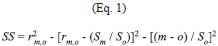
<body><![CDATA[of&nbsp; simulations (covering the time period 1950 to 1999), b) the     climate change projection for the horizon 1 or CC1 (2000 to 2049), and     c) the climate change projection for the horizon 2 or&nbsp; CC2 (2050     to 2099). Some of the models that had more than one climate change     realization were also considered in the analysis. There were a total of     N=30 simulations that met these requirements. The list of models and     runs can be found in <a href="/img/revistas/rbt/v60s3/a06t1.gif">Table     1</a>.    <br> </span></font><br style="font-family: verdana;"> <font size="2"><span style="font-family: verdana;">Global climate change data from their original resolution were interpolated to the resolution of the coarsest model (2<sup>o</sup>&nbsp; latitude x 5<sup>o</sup> longitude) by the nearest grid-point method, but considering separate interpolations for the ocean and land grid-points according to the individual land-sea masks of the models. The data were visually inspected at selected grid- points.&nbsp; The&nbsp; data&nbsp; were&nbsp; also&nbsp; changed&nbsp; to&nbsp; the same units and same file format for the rest of the analysis.</span></font><br style="font-family: verdana;"> <br style="font-family: verdana;"> <font size="2"><span style="font-family: verdana;">Performance of the GCM 20c3m precipitation and temperature data was estimated in reference to the US National Center of Environmental Prediction (NCEP) and US National Center for Atmospheric Research (NCAR) Reanalysis (Kalnay <span  style="font-style: italic;">et al.</span> 1996), hereinafter the Reanalysis.&nbsp; The&nbsp; data&nbsp; for&nbsp; comparison&nbsp; covers the period from 1950 to 1999. It should be mentioned that the precipitation of the Reanalysis is modeled (not observed) and thus it may have larger errors than the temperature data.</span></font><br  style="font-family: verdana;"> <br style="font-family: verdana;"> <font style="font-weight: bold;" size="3"><span  style="font-family: verdana;">Part I</span></font><br  style="font-family: verdana;"> <font style="font-weight: bold;" size="3"><span  style="font-family: verdana;">Selection of models using performance metrics</span></font><br style="font-family: verdana;"> <br style="font-family: verdana;"> <font size="2"><span style="font-family: verdana;">In this part, the GCMs were culled according to their performance on reproducing&nbsp; 20<sup>th</sup>&nbsp;&nbsp;&nbsp; century&nbsp; climate,&nbsp; as&nbsp; represented in the Reanalysis.</span></font><br  style="font-family: verdana;"> <br style="font-family: verdana;"> <font style="font-style: italic;" size="2"><span  style="font-family: verdana;">Metrics</span></font><br  style="font-family: verdana;"> <br style="font-family: verdana;"> <font size="2"><span style="font-family: verdana;">Several&nbsp; metrics&nbsp; were&nbsp; used&nbsp; to&nbsp; determine the performance of the models on reproducing 20<sup>th</sup>&nbsp;&nbsp; century statistics for the first part of the analysis (selection of models using performance metrics). The metrics were divided in three categories: 1) metrics on the <span  style="font-style: italic;">mean</span>, 2) metrics on the <span style="font-style: italic;">variability </span>and 3) metrics on the <span style="font-style: italic;">spectral </span>characteristics. There are 13 metrics of the <span  style="font-style: italic;">mean </span>type corresponding to the mean of the annual averages (denoted by <span  style="font-style: italic;">mY</span>) plus the means for each of the 12 individual months (climatologies) of climate patterns (denoted by <span style="font-style: italic;">mJ, mF, &#8230; mD</span>) over the shaded region (<a href="/img/revistas/rbt/v60s3/a06i1.jpg">Fig. 1</a>). In a similar fashion there are 13 metrics on the <span style="font-style: italic;">variability </span>corresponding to the standard deviations of the 13 annual and monthly averages&nbsp; defined&nbsp; before&nbsp; (denoted&nbsp; by&nbsp; <span  style="font-style: italic;">sY,&nbsp; sJ, ...sD</span>) . Finally, there are two <span style="font-style: italic;">spectral </span>types of metrics: the first was calculated by running a 2 to 8 year elliptical band-pass filter (Ginde &amp; Noronha 2012) on the annual precipitation or temperature time-series at each grid-point and calculating the ratio of the standard deviation of the filtered data to the standard deviation of the unfiltered data. This metric is a measure of how much &#8220;high-frequency&#8221; climate variability (a large part related to ENSO) is captured by the model (denoted as fH). The second spectral metric is defined similarly, except that it captures the &#8220;low frequency&#8221; climate variability contained in the spectral band between 9 and 20 years (denoted as fL). There are no global climate metrics such as ENSO, Pacific Decadal Oscillation, Atlantic Multidecadal Oscillation or&nbsp; corresponding&nbsp; tele-connection&nbsp; metrics&nbsp; in the present analysis as in Brekke <span style="font-style: italic;">et al.</span> (2008). Because the study region is almost at the equatorial Pacific, it was considered here that a large part of the dominating ENSO signal is represented in the temperature and precipitation metrics already (Alfaro 2008; Quir&oacute;s-Badilla &amp; Alfaro 2009) and that a similar analysis of the determination of nr due to global tele-connections will follow in a separate article.</span></font><br  style="font-family: verdana;"> <br style="font-family: verdana;"> <font style="font-style: italic;" size="2"><span  style="font-family: verdana;">Skill Score</span></font><br  style="font-family: verdana;"> <br style="font-family: verdana;"> <font size="2"><span style="font-family: verdana;">Following Pierce <span  style="font-style: italic;">et al.</span> (2009), the degree of similarity between any two climate patterns (for&nbsp; example&nbsp; between&nbsp; the&nbsp; Reanalysis&nbsp; metric and the same metric from one of the GCM simulations) was calculated using the Skill Score (SS) defined by:</span></font><br  style="font-family: verdana;">     <br>     ]]></body>
<body><![CDATA[<div style="text-align: center;"><img alt=""  src="/img/revistas/rbt/v60s3/a06f1.jpg"  style="width: 218px; height: 46px;"><br style="font-family: verdana;"> </div> <br style="font-family: verdana;"> <font size="2"><span style="font-family: verdana;">where <span  style="font-style: italic;">r</span><sub style="font-style: italic;">m,o</sub>&nbsp;&nbsp; is the Pearson&acute;s spatial correlation between modeled (i.e. GCM) and &#8220;observed&#8221; (i.e. Reanalysis) patterns, <span  style="font-style: italic;">s<sub>m</sub></span> and <span  style="font-style: italic;">s<sub>o</sub></span> are the sample spatial standard deviations for the modeled and observed patterns respectively. The ratio <span style="font-style: italic;">s<sub>m</sub>/s<sub>o</sub></span>&nbsp; is denoted as g in following sections. The <span  style="font-style: italic;">m </span>and <span style="font-style: italic;">o</span> over-bars correspond to the spatial average of the modeled and observed climate patterns respectively. <span  style="font-style: italic;">SS</span> varies from minus infinity (no skill) to 1 (perfect match between the patterns). Zero <span  style="font-style: italic;">SS </span>values correspond to cases in which the mean of the observations is reproduced correctly by the model in a certain region, but only as a featureless uniform pattern (Pierce <span style="font-style: italic;">et al.</span> 2009). Inspection of the right hand side of Equation 1 shows that <span style="font-style: italic;">SS</span> is composed of three squared terms, and therefore <span style="font-style: italic;">SS</span> can also be expressed as:</span></font><br style="font-family: verdana;">     <br>     <div style="text-align: center;"><img alt=""  src="/img/revistas/rbt/v60s3/a06f2.jpg"  style="width: 147px; height: 28px;">    <br>     </div>     <br style="font-family: verdana;">     <font size="2"><span style="font-family: verdana;">where <span      style="font-style: italic;">RHO</span> is the square of the     spatial correlation between the observed and modeled patterns; and     <span style="font-style: italic;">CBIAS </span>and <span     ]]></body>
<body><![CDATA[ style="font-style: italic;">UBIAS </span>are the Conditional and     Unconditional Biases     respectively (see Pierce <span style="font-style: italic;">et al.</span>     2009). Note that SS not only reflects     correlation coherence between the pat- terns but also biases play an     important role in <span style="font-style: italic;">SS&#8217;s</span>     calculation.</span></font><br style="font-family: verdana;">     <br style="font-family: verdana;">     <font size="2"><span style="font-family: verdana;">The&nbsp;     spreads&nbsp; of&nbsp;     ]]></body>
<body><![CDATA[the&nbsp; SS&nbsp; values&nbsp; calculated for individual models and by     individual metrics are shown in <a      href="/img/revistas/rbt/v60s3/a06i2.jpg">Figure 2</a>. As can be seen     precipitation     SSs are generally lower than for temperature.&nbsp; This&nbsp;     suggests&nbsp; that&nbsp; precipitation is not reproduced well in this     region of the world by many of the GCMs, compared to the Reanalysis.     Temperature <span style="font-style: italic;">mean </span>type of     metrics showed good skill for many models,     even for the <span style="font-style: italic;">spectral </span>type     ]]></body>
<body><![CDATA[of metrics. This calculation of metrics for     each individual model is necessary in order to rank the models. The     rank is actually computed by combining the SSs of individual metrics     through calculation of the Euclidean distances (hereafter denoted by </span></font><font      size="2"><span style="font-family: verdana;">&#916;<span      style="font-style: italic;"></span></span></font><font size="2"><span      style="font-family: verdana;"><span style="font-style: italic;">SS</span>)     between the obtained <span style="font-style: italic;">SSs</span> for     each metric and the &#8220;perfect&#8221; or     &#8220;optimal&#8221; vector <span style="font-style: italic;">SS</span>=(1,1,1,&#8230;1).     ]]></body>
<body><![CDATA[In order to determine the sensitivity     to the type of metrics used, three types of Euclidean distances were     calculated: 1) only the precipitation metrics were used in the     calculation of <span style="font-style: italic;">SS</span>, 2) the     precipitation and temperature metrics were     used and 3) only the temperature metrics were used. These distances     were used to rank the models and for determining the order on which the     models form the ensemble in groups of n=1,2,...30. That is, with the     exception of <a href="/img/revistas/rbt/v60s3/a06i2.jpg">Figures 2</a>     and <a href="/img/revistas/rbt/v60s3/a06i3.jpg">3</a> the average <span     ]]></body>
<body><![CDATA[ style="font-style: italic;">SSs</span> and <span      style="font-style: italic;">SSs</span> will always be     computed for model ensembles. The reason for this is that, as mentioned     in Pierce <span style="font-style: italic;">et al.</span> (2009), the     model ensembles are generally better than     the individual model results; a result also partially suggested in     <a href="/img/revistas/rbt/v60s3/a06i3.jpg">Figure 3</a>. For     precipitation the <span style="font-style: italic;">median     </span>SS for the simple model ensemble     at using the best 10 models n=10 (MME<sub>10</sub>) is always better     ]]></body>
<body><![CDATA[than the     results for the best 10 individual models (<a      href="/img/revistas/rbt/v60s3/a06i3.jpg">Fig. 3</a>); and also the     MME<sub>10</sub>&nbsp; showed g values close to the unity. Models or     ensembles     with g closer to the unity have a desirable feature that is discussed     in Pierce <span style="font-style: italic;">et al.</span> 2009. For     temperature, some of the individual models     showed better median SS.</span></font><br style="font-family: verdana;">     <br style="font-family: verdana;">     ]]></body>
<body><![CDATA[<font style="font-style: italic;" size="2"><span      style="font-family: verdana;">Selection of model ensembles</span></font><br      style="font-family: verdana;">     <br style="font-family: verdana;">     <font size="2"><span style="font-family: verdana;">Each model and     metric has a     particular SS. In order to determine the performance of any single     particular model at representing all of the metrics, the Euclidean     distance or </span></font><font size="2"><span      style="font-family: verdana;">&#916;<span style="font-style: italic;"></span></span></font><font     ]]></body>
<body><![CDATA[ size="2"><span style="font-family: verdana;"><span      style="font-style: italic;">SS</span> between the SSs of all the     metrics of that model and     the &#8220;perfect&#8221; or &#8220;optimal&#8221; vector <span style="font-style: italic;">SS</span>=(1,1,1,...1)     of length <span style="font-style: italic;">nm</span>, where     <span style="font-style: italic;">nm=number of metrics used</span>, was     computed. These distances were used to     rank&nbsp; the&nbsp; models&nbsp; according&nbsp; to&nbsp; their&nbsp;     distance to&nbsp; form&nbsp; multi-model&nbsp; n-ensembles&nbsp; (MME<sub>n</sub>)     composed&nbsp; of&nbsp; the&nbsp; best&nbsp; n&nbsp; individual&nbsp;     ]]></body>
<body><![CDATA[models introduced in increasing ranking of <span      style="font-style: italic;"></span></span></font><font size="2"><span      style="font-family: verdana;">&#916;<span style="font-style: italic;"></span></span></font><font      size="2"><span style="font-family: verdana;"><span      style="font-style: italic;">SS</span>. The normalized     Euclidean distances or <span style="font-style: italic;"></span></span></font><font      size="2"><span style="font-family: verdana;">&#916;<span      style="font-style: italic;"></span></span></font><font size="2"><span      style="font-family: verdana;"><span style="font-style: italic;">SS/</span></span></font><font      size="2"><span style="font-family: verdana;">&#916;<span     ]]></body>
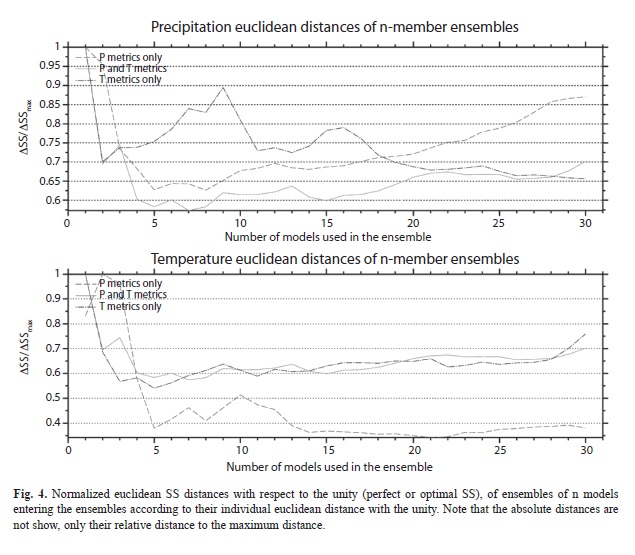
<body><![CDATA[ style="font-style: italic;"></span></span></font><font size="2"><span      style="font-family: verdana;"><span style="font-style: italic;">SS<sub>max</sub></span>     for each resulting ensemble are shown     in <a href="/img/revistas/rbt/v60s3/a06i4.jpg">Figure 4</a>, using     different variables in the calculation of the     metrics. In <a href="/img/revistas/rbt/v60s3/a06i4.jpg">Figure 4</a> <span      style="font-style: italic;"></span></span></font><font size="2"><span      style="font-family: verdana;">&#916;<span style="font-style: italic;"></span></span></font><font      size="2"><span style="font-family: verdana;"><span      style="font-style: italic;">SS<sub>max</sub></span>&nbsp;     ]]></body>
<body><![CDATA[is the <span style="font-style: italic;"></span></span></font><font      size="2"><span style="font-family: verdana;">&#916;<span      style="font-style: italic;"></span></span></font><font size="2"><span      style="font-family: verdana;"><span style="font-style: italic;">SS</span>     that showed the maximum     deviation from the optimum&nbsp; vector&nbsp; SS=(1,1,1,&#8230;1).&nbsp;     As&nbsp; mentioned previously, regardless of the variable to be     analyzed, the calculation of the Euclidean distances was performed     using precipitation metrics only (nm=13+13+2=28, corresponding to&nbsp;     the&nbsp; <span style="font-style: italic;">mean,&nbsp; variability</span>&nbsp;     ]]></body>
<body><![CDATA[and&nbsp; <span style="font-style: italic;">spectral&nbsp;</span>     types     of&nbsp; metrics&nbsp; mentioned&nbsp; before),&nbsp; precipitation and     temperature metrics (nm=28*2=56) and temperature metrics only (nm=28).     Note that in <a href="/img/revistas/rbt/v60s3/a06i4.jpg">Figure 4</a>,     only the normalized distances are of interest,     and the different curves are not directly comparable to each other.     From <a href="/img/revistas/rbt/v60s3/a06i4.jpg">Figure 4</a> and for     precipitation and temperature metrics (solid     curves), it can be seen that the inclusion of more models <span     ]]></body>
<body><![CDATA[ style="font-style: italic;">generally     </span>increases the skill of the n-ensemble to reproduce the     Reanalysis     precipitation and temperature patterns up to a certain number of models     and then the skill generally decreases when the worse models are     included in the ensembles. Therefore, there is an optimum number of     models to be included in the ensembles in order to obtain the greatest     skill. Note also that there is a strong dependence&nbsp; of&nbsp;     the&nbsp; results&nbsp; on&nbsp; the&nbsp; type&nbsp; of&nbsp; metrics     used and whether precipitation, temperature or both type of patterns     ]]></body>
<body><![CDATA[are used to determine the order in which the models are introduced in     the ensembles. Thus, it is clear that the variables included in the     calculation of the metrics significantly influences the results. In     fact, the type of metrics used also influenced the results, as the     analysis was repeated using all possible combinations of type of     metrics (<span style="font-style: italic;">mean, variability</span> and     <span style="font-style: italic;">spectral</span>) which resulted in     different     results (not shown). This problem was also mentioned in Pierce <span      style="font-style: italic;">et al.</span>     ]]></body>
<body><![CDATA[(2009) and Brekke <span style="font-style: italic;">et al.</span>     (2008). Precipitation&#8217;s <span style="font-style: italic;"></span></span></font><font      size="2"><span style="font-family: verdana;">&#916;<span      style="font-style: italic;"></span></span></font><font size="2"><span      style="font-family: verdana;"><span style="font-style: italic;">SS/</span></span></font><font      size="2"><span style="font-family: verdana;">&#916;<span      style="font-style: italic;"></span></span></font><font size="2"><span      style="font-family: verdana;"><span style="font-style: italic;">SS<sub>max</sub></span>     is the     lowest (for the precipitation and temperature metrics) at around n=nr=7     ]]></body>
<body><![CDATA[(the lowest point for the solid curve of top <a      href="/img/revistas/rbt/v60s3/a06i4.jpg">Figure 4</a>), and     temperature     results show a lowest distance value at n=nr=7 (the lowest point for     the solid curve of bottom <a href="/img/revistas/rbt/v60s3/a06i4.jpg">Figure     4</a>).</span></font><br style="font-family: verdana;">     <br style="font-family: verdana;">     <font style="font-weight: bold;" size="3"><span      style="font-family: verdana;">Part II</span></font><br      style="font-family: verdana;">     ]]></body>
<body><![CDATA[<font style="font-weight: bold;" size="3"><span      style="font-family: verdana;">Random selection of models</span></font><br      style="font-family: verdana;">     <br style="font-family: verdana;">     <font size="2"><span style="font-family: verdana;">In&nbsp; this&nbsp;     part&nbsp;     of&nbsp; the&nbsp; analysis,&nbsp; the&nbsp; models form ensembles of     size n, chosen randomly.</span></font><br style="font-family: verdana;">     <br style="font-family: verdana;">     <font style="font-style: italic;" size="2"><span     ]]></body>
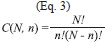
<body><![CDATA[ style="font-family: verdana;">Selecting a representative sample</span></font><br      style="font-family: verdana;">     <br style="font-family: verdana;">     <font size="2"><span style="font-family: verdana;">In order to obtain     statistical     significance in the results it is necessary to obtain a certain sample     from a population of possible combinations of N models, taken in     ensembles of n members. The&nbsp; possible&nbsp; number&nbsp; of&nbsp;     combinations for ensembles of n simulations from a total of N=30     individual possible simulations is given in any elementary     ]]></body>
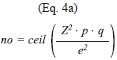
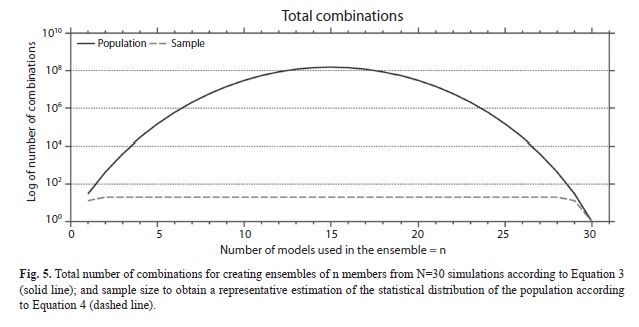
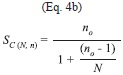
<body><![CDATA[combinatorics text-book by (see for example Spiegel 1998):</span></font><br      style="font-family: verdana;">     <br style="font-family: verdana;">     <div style="text-align: center;"><font size="2"><span  style="font-family: verdana;"></span></font><img alt=""  src="/img/revistas/rbt/v60s3/a06f3.jpg"  style="width: 108px; height: 43px;"><br style="font-family: verdana;"> </div> <br style="font-family: verdana;"> <font size="2"><span style="font-family: verdana;">C(N,n) increases very rapidly until the maximum at n=15 where it reaches values higher than 1x10<sup>8</sup>&nbsp;&nbsp; possible combinations and then decreases rapidly to become equal to 1 for n=N=30 (<a  href="/img/revistas/rbt/v60s3/a06i4.jpg">Fig. 5</a>). Since the calculation of all possible combinations is extremely large, representative&nbsp; samples&nbsp; of&nbsp; the&nbsp; population&nbsp; of size S<sub>C(N,n)</sub> were taken that resulted in the same statistical distribution as the population with a 95% confidence level using the following formulas from Israel (2009):</span></font><br style="font-family: verdana;">     <br>     <div style="text-align: center;"><img alt=""  src="/img/revistas/rbt/v60s3/a06f4a.jpg"  style="width: 117px; height: 60px;"><br style="font-family: verdana;"> </div> <font size="2"><span style="font-family: verdana;"></span></font>    <br>     <div style="text-align: center;"><img alt=""      src="/img/revistas/rbt/v60s3/a06f4b.jpg"      style="width: 123px; height: 75px;"><br style="font-family: verdana;">     ]]></body>
<body><![CDATA[</div>     <br style="font-family: verdana;">     <font size="2"><span style="font-family: verdana;">where <span      style="font-style: italic;">&#8220;ceil&#8221;</span> is the rounding to the     higher integer, Z<sup>2 </sup>is the abscissa of the normal curve that     cuts off an     area at the tails (1-confidence level, e.g. 95%), p is equal to the     estimate proportion that is present in the population, while the value     of q is given by q=1-p. Since p has an unknown aspect, the most     conservative option for p and q (p=q=0.5) was used as it produces the     ]]></body>
<body><![CDATA[largest <span style="font-style: italic;">n<sub>o</sub></span> value.     Also e=0.05 is the error that is anticipated to be     committed. Inspection of the equation showed that it converges to a     plateau very rapidly (<a href="/img/revistas/rbt/v60s3/a06i5.jpg">Fig. 5</a>).</span></font><br      style="font-family: verdana;">     <br style="font-family: verdana;">     <font size="2"><span style="font-family: verdana;">Equation 4 was     tested using a Monte     Carlo simulation for ensembles of sizes n=1 to n=6. The SS     distributions for the populations were computed, and 100 000 samples of     ]]></body>
<body><![CDATA[S<sub>C(N,n)</sub> combinations of n simulations were computed. The     samples and     the population distributions were compared using a Kolmogorov&#8211;Smirnov     or K&#8211;S test. It was verified that the error committed was below 5% and     therefore this serves as an indication&nbsp; that Equation 4 gives     useful estimations of the needed sample size.</span></font><br      style="font-family: verdana;">     <br style="font-family: verdana;">     <font style="font-style: italic;" size="2"><span      style="font-family: verdana;">Selection of model ensembles</span></font><br     ]]></body>
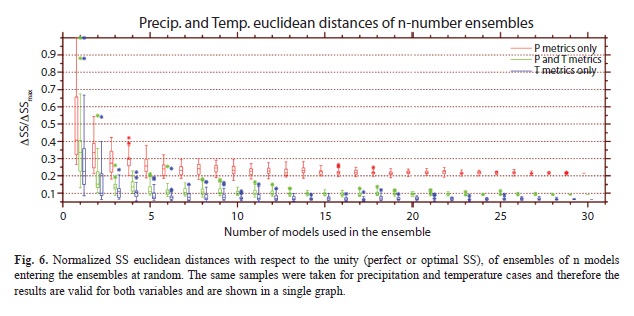
<body><![CDATA[ style="font-family: verdana;">     <br style="font-family: verdana;">     <font size="2"><span style="font-family: verdana;">In <a      href="/img/revistas/rbt/v60s3/a06i6.jpg">Figure 6</a> the     results for the     random selection of simulations are shown. The same samples were     selected for precipitation and temperature and therefore the results     for both variables are the same in <a      href="/img/revistas/rbt/v60s3/a06i6.jpg">Figure 6</a>. At around     n=nr=7 there is     ]]></body>
<body><![CDATA[a plateau in the values of </span></font><font size="2"><span      style="font-family: verdana;">&#916;<span style="font-style: italic;"></span></span></font><font      size="2"><span style="font-family: verdana;"><span      style="font-style: italic;">SS/</span></span></font><font size="2"><span      style="font-family: verdana;">&#916;<span style="font-style: italic;"></span></span></font><font      size="2"><span style="font-family: verdana;"><span      style="font-style: italic;">SS<sub>max</sub></span>, suggesting that     the&nbsp;     inclusion of more models at random does not substantially improve the     skill beyond that point.</span></font><br style="font-family: verdana;">     ]]></body>
<body><![CDATA[<br style="font-family: verdana;">     <font style="font-weight: bold;" size="3"><span      style="font-family: verdana;">Part III</span></font><br      style="font-family: verdana;">     <font style="font-weight: bold;" size="3"><span      style="font-family: verdana;">Implication for climate change     projections</span></font><br style="font-family: verdana;">     <br style="font-family: verdana;">     <font size="2"><span style="font-family: verdana;">In this section we     are interested     ]]></body>
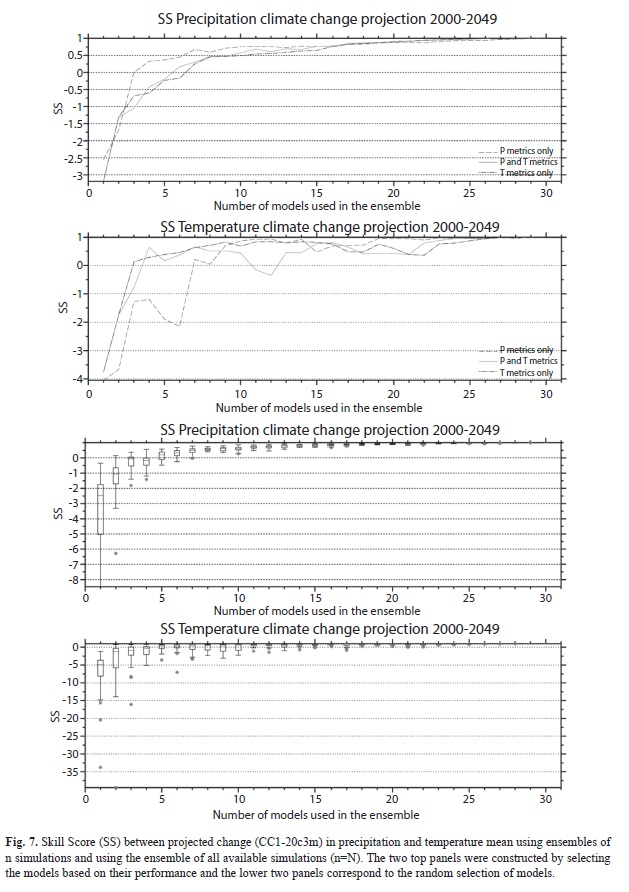
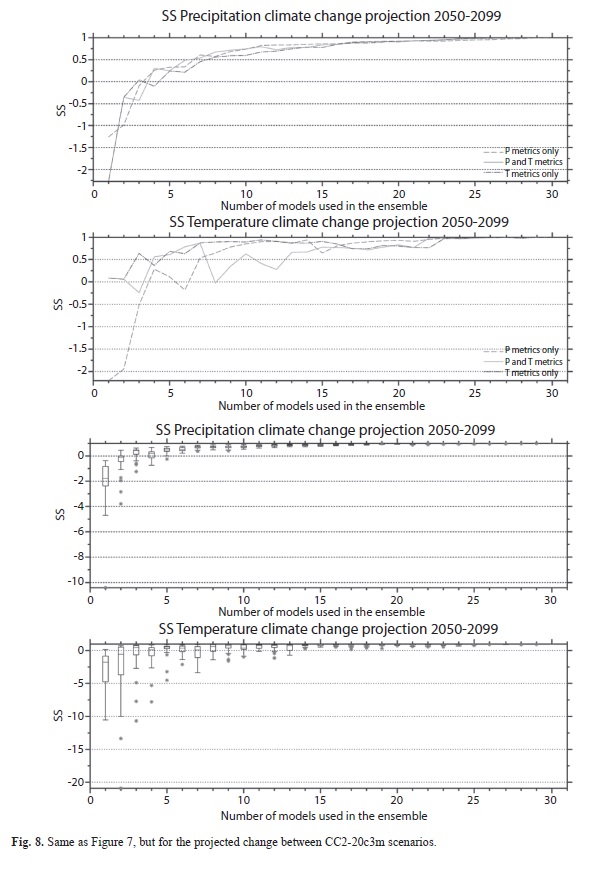
<body><![CDATA[in determining whether the nr values obtained previously in Parts I and     II result in similar projected precipitation and temperature change for     two climate change horizons: CC1 (2000 to 2049) and CC2 (2050 to 2099).     The difference in the mean January to December future conditions (CC1     or CC2) and the 20c3m &#8220;historical&#8221; scenarios were computed for the same     ensembles determined in <a href="/img/revistas/rbt/v60s3/a06i4.jpg">Figure     4</a> and <a href="/img/revistas/rbt/v60s3/a06i6.jpg">Figure 6</a>     (See Brekke <span style="font-style: italic;">et al.</span> 2008     for a discussion on how the climate change variable to be used affects     the results). The SSs between the climate change patterns of each     ]]></body>
<body><![CDATA[individual n-member ensemble and the MME<sub>N </sub>for the two     climate change     horizons are shown in <a href="/img/revistas/rbt/v60s3/a06i7.jpg">Figures     7</a> and <a href="/img/revistas/rbt/v60s3/a06i8.jpg">8</a>. For the     CC1 climate change     horizon (and for the precipitation and temperature metrics),     precipitation ensembles using the selection based on performance is     positive (and stays positive) at around n=ncc1=6. In other words, the     ensemble of 6 models (or more) is needed in order to guarantee that     there is some skill in reproducing the climate change pattern of the     ]]></body>
<body><![CDATA[MME<sub>N</sub>. This also implies that the <span      style="font-style: italic;">most conservative</span> number of models     used to create the ensemble between nr=7 and ncc1=6 would ensure that     1) the best performance of the model in reproducing the features of the     &#8220;historical&#8221; period as shown in the Reanalysis is found and 2) the     ensemble also has some skill in reproducing the same climate projection     using as basis the ensemble of all available simulations. As can be     seen both numbers of models are very similar and with n=7 the maximum     skill in reproducing 20<sup>th</sup> century climate is found, along     with some     ]]></body>
<body><![CDATA[skill in reproducing the climate change patterns of the MME<sub>N</sub>.     In the     case of precipitation random sampling, all the simulations have SSs     greater than zero at n=ncc1=8, while the less conservative value of     nr=7 found in Part II suggests that the constraint of having some skill     in reproducing the climate change of the MME<sub>N</sub> is more     conservative.     Note that the <span style="font-style: italic;">normalized </span>Euclidean     distances shown on <a href="/img/revistas/rbt/v60s3/a06i4.jpg">figures     4</a> and <a href="/img/revistas/rbt/v60s3/a06i6.jpg">6</a>,     ]]></body>
<body><![CDATA[do not say anything about the <span style="font-style: italic;">absolute     </span>distances and therefore both     figures are not comparable to each other. But in <a      href="/img/revistas/rbt/v60s3/a06i7.jpg">Figures 7</a> and <a      href="/img/revistas/rbt/v60s3/a06i8.jpg">8</a>, the     use of the Skill Score (Equation 1) to test the similarity between the     projected climate of the MME<sub>n</sub> and MME<sub>N </sub>allow     comparison between the     charts for any single climatic parameter (precipitation or temperature)     and climate change scenario.</span></font><br     ]]></body>
<body><![CDATA[ style="font-family: verdana;">     <br style="font-family: verdana;">     <font size="2"><span style="font-family: verdana;">In the case of     temperature, the     creation of ensembles using the performance criteria suggests that     n=ncc1=13 is needed (point where solid line is positive and stays     positive in second panel from the top in <a      href="/img/revistas/rbt/v60s3/a06i7.jpg">Figure 7</a>) in order to     obtain     positive SS values, contrasting with the n=nr=7 found in Part I of the     ]]></body>
<body><![CDATA[analysis. This suggests that if the sampling is based on performance     criteria, the ensemble of the best 13 models are needed in order to     guarantee some skill in reproducing the climate change patterns of the     multi-model ensemble, and that the maximum skill is achieved. In the     case of random sampling, n=ncc1=15 is needed, in contrast with n=nr=6     found before. In <a href="/img/revistas/rbt/v60s3/a06t2.gif">Table 2</a>     a summary of the results is presented for both     climate change horizons. The results are very similar and support the     same conclusions discussed in this part of the analysis.    <br>     ]]></body>
<body><![CDATA[</span></font><br style="font-family: verdana;">     <font style="font-weight: bold;" size="3"><span      style="font-family: verdana;">Discussion</span></font><br      style="font-family: verdana;">     <br style="font-family: verdana;">     <font size="2"><span style="font-family: verdana;">When selecting a     subset of     simulations and/or models for a regional study, it is very common to     use some performance criteria to determine which simulations to use.     Consistent with other studies, it was found here, that the selection     ]]></body>
<body><![CDATA[and the results are very sensitive to the metrics used to rank the     simulations. In this study, this multi-model ensemble of all available     simulations was used as a benchmark to compare the results of the     climate change simulations with the objective of&nbsp; determining if     using a smaller subset of simulations results in very different climate     projections.</span></font><br style="font-family: verdana;">     <br style="font-family: verdana;">     <font size="2"><span style="font-family: verdana;">The results showed     that culling the     models based on performance criteria or on random sampling, results in     ]]></body>
<body><![CDATA[future precipitation projections that have some similarity to the     projections obtained from the MME<sub>N</sub>. For temperature, more     models are     needed to be added to the ensemble to guarantee skill in reproducing     climate change patterns of the MMEN. It could be argued that the use of     the MME<sub>N</sub>&nbsp; as a benchmark is not justified as it     contains models     with very low skill in reproducing observations, but it is assumed here     that as more simulations are included in the ensemble, the more noise     is going to be filtered out and therefore this benchmark has superior     ]]></body>
<body><![CDATA[characteristic than the multi-model ensemble of a subset of n&lt;N     simulations or MME<sub>n</sub>.</span></font><br      style="font-family: verdana;">     <br style="font-family: verdana;">     <font size="2"><span style="font-family: verdana;">Among other aspects     discussed here,     this assumption depends also on the sensitivity of the models in the     area of study and the parameter used. This particular area showed low     sensitivity (in particular to precipitation) when the&nbsp; skill&nbsp;     of&nbsp; individual&nbsp; models&nbsp; were&nbsp; computed (<a     ]]></body>
<body><![CDATA[ href="/img/revistas/rbt/v60s3/a06i2.jpg">Fig. 2</a>).     Moreover the region also shows no clear and consistent trend in     precipitation means&nbsp; during&nbsp; the&nbsp; projected&nbsp;     21<sup>st</sup>&nbsp;&nbsp;&nbsp; century&nbsp; climate (Maldonado     &amp; Alfaro     2011,&nbsp; Hidalgo&nbsp; &amp; Alfaro 2012), although it does show an     evident warming tendency (Hidalgo&nbsp; &amp; Alfaro 2012).     Studies&nbsp; in&nbsp; other&nbsp; regions&nbsp; may&nbsp;     provide&nbsp; more information regarding the size of the ensembles     needed in other cases.</span></font><br style="font-family: verdana;">     ]]></body>
<body><![CDATA[<br style="font-family: verdana;">     <font style="font-weight: bold;" size="3"><span      style="font-family: verdana;">Conclusion</span></font><br      style="font-family: verdana;">     <br style="font-family: verdana;">     <font size="2"><span style="font-family: verdana;">The inclusion of     models in the     multi-model ensemble based on their rank of reproducing 20th&nbsp;     century climate showed great&nbsp; variability depending on which type     of metrics were used to&nbsp; determine&nbsp; their&nbsp; rank.&nbsp;     ]]></body>
<body><![CDATA[For&nbsp; the&nbsp; precipitation variable, ranks based on     precipitation and temperature metrics (solid curve of top panel of     <a href="/img/revistas/rbt/v60s3/a06i4.jpg">Figure 4</a>) showed that     inclusion of models reach a maximum skill (lowest     <span style="font-style: italic;"></span></span></font><font size="2"><span      style="font-family: verdana;">&#916;<span style="font-style: italic;"></span></span></font><font      size="2"><span style="font-family: verdana;"><span      style="font-style: italic;">SS/</span></span></font><font size="2"><span      style="font-family: verdana;">&#916;<span style="font-style: italic;"></span></span></font><font      size="2"><span style="font-family: verdana;"><span     ]]></body>
<body><![CDATA[ style="font-style: italic;">SS<sub>max</sub></span>) at around 7     models. When the models are introduced at     random we found that around that same number of models the maximum     skill is found. Therefore it seems that the inclusion of around 7     models out of 30 is the optimum number of models to produce an ensemble     if the ranks are based on precipitation and temperature metrics. Note     that it is not suggested that the 7 models culled according to their     rank or selected at random have the same absolute skill; it only means     that beyond 7 models there is not much change in the skill (or actually     there is a degradation of the skill caused by models that do not     ]]></body>
<body><![CDATA[contribute to improve the overall skill of the MME<sub>n</sub>). If we     use     temperature metrics to determine the rank of the models for the     precipitation variable (dark dash dotted line of top <a      href="/img/revistas/rbt/v60s3/a06i4.jpg">Figure 4</a>), the     maximum skill is found at the MME<sub>N</sub>. It is difficult to     interpret what     this means in terms of the distribution of the skill of the MME<sub>n</sub>.     For     the temperature variable, if we use precipitation and temperature     ]]></body>
<body><![CDATA[metrics (solid curves of bottom <a      href="/img/revistas/rbt/v60s3/a06i4.jpg">Figure 4</a>), when we reach     7 models there     is a point of maximum skill (lowest &#916;<span style="font-style: italic;">SS</span>/&#916;<span      style="font-style: italic;">SS<sub>max</sub></span>) and then the     skill     changes slightly until the 30 models are introduced in the MME<sub>N</sub>.     This     is the same than the 7 randomly selected models that can be combined to     reach the plateau in skill in <a     ]]></body>
<body><![CDATA[ href="/img/revistas/rbt/v60s3/a06i6.jpg">Figure 6</a>. When the     precipitation patterns     are used to determine the ranks of the models to be used to compute the     skill for the temperature variable, the maximum skill is reach at     around 21 models (light dashed line of bottom <a      href="/img/revistas/rbt/v60s3/a06i4.jpg">Figure 4</a>). It can be     concluded from all this that in general there is an optimum number of     models/ simulations to be used in the ensemble and that number could be     significantly lower than the total number of models/simulations.     However, finding this optimum number is difficult as it is heavily     ]]></body>
<body><![CDATA[dependent on how the models are introduced into the multi-model     ensemble and on the type of metrics used. This however, does not     guarantee that the climate change patterns produced by the MME<sub>n</sub>&nbsp;     are similar to the patterns produced by the MME<sub>N</sub> as this has     to be     determined in a separate analysis.</span></font><br      style="font-family: verdana;">     <br style="font-family: verdana;">     <font style="font-weight: bold;" size="3"><span      style="font-family: verdana;">Acknowledgments</span></font><br     ]]></body>
<body><![CDATA[ style="font-family: verdana;">     <br style="font-family: verdana;">     <font size="2"><span style="font-family: verdana;">This work was     partially financed by     projects (808-A9-180, 805-A9-224, 805-A9-532, 808-B0-092,&nbsp;     805-A9-742,&nbsp; 805-A8-606&nbsp; and 808-A9-070) from the Center for     Geophysical Research&nbsp; (CIGEFI)&nbsp; and&nbsp; the&nbsp;     Marine&nbsp; Science and Limnology Research Center (CIMAR) of the     University of Costa Rica (UCR). Thanks for the logistics support of the     School of Physics of UCR. The authors were also funded through an Award     ]]></body>
<body><![CDATA[from Florida Ice and Farm Company (Amador, Alfaro and Hidalgo). HH is     also funded through a grant from the Panamerican Institute of Geography     and History (GEOF.02.2011). The&nbsp; authors&nbsp; are&nbsp;     obliged&nbsp; to Andr&eacute; Stahl from UCR who processed much of the     raw GCM data and Mary Tyree from Scripps Institution of Oceanography     who provided the land-sea masks of the models. Also to Mar&iacute;a     Fernanda Padilla and Natalie Mora for their help with the data base.     Finally, to the National Council of Public University Presidents     (CONARE), for the support of a FEES project &#8220;Interacciones     oce&aacute;no-atm&oacute;sfera y la biodiversidad marina del Parque     ]]></body>
<body><![CDATA[Nacional Isla del Coco&#8221; (project 808-B0-654, UCR). We would like to     thank two anonymous reviewers and Dr. Javier Soley that helped improve     the quality of this article.    <br> <br style="font-family: verdana;"> </span></font> <hr style="width: 100%; height: 2px;">    <!-- ref --><br> <font style="font-weight: bold;" size="3"><span  style="font-family: verdana;">References</span></font><br  style="font-family: verdana;"> <br style="font-family: verdana;"> <font size="2"><span style="font-family: verdana;">Alfaro, E. 2008. Ciclo diario y anual de variables troposf&eacute;ricas y oce&aacute;nicas en la Isla del Coco, Costa Rica. Rev. Biol. Trop. 56 (Supl. 2): 19-29.    &nbsp;&nbsp;&nbsp;&nbsp;&nbsp;&nbsp;&nbsp;&nbsp;[&#160;<a href="javascript:void(0);" onclick="javascript: window.open('/scielo.php?script=sci_nlinks&ref=1787921&pid=S0034-7744201200080000600001&lng=','','width=640,height=500,resizable=yes,scrollbars=1,menubar=yes,');">Links</a>&#160;]<!-- end-ref --><!-- ref --></span></font><br  style="font-family: verdana;"> <br style="font-family: verdana;"> <font size="2"><span style="font-family: verdana;">Amador, J.A. &amp; E.J. Alfaro. 2009. M&eacute;todos de reducci&oacute;n de escala: Aplicaciones al tiempo, clima, variabilidad clim&aacute;tica y cambio clim&aacute;tico. Rev. Iberoamer. Econ. Ecol. 11: 39-52.    &nbsp;&nbsp;&nbsp;&nbsp;&nbsp;&nbsp;&nbsp;&nbsp;[&#160;<a href="javascript:void(0);" onclick="javascript: window.open('/scielo.php?script=sci_nlinks&ref=1787922&pid=S0034-7744201200080000600002&lng=','','width=640,height=500,resizable=yes,scrollbars=1,menubar=yes,');">Links</a>&#160;]<!-- end-ref --><!-- ref --></span></font><br  style="font-family: verdana;"> <br style="font-family: verdana;"> <font size="2"><span style="font-family: verdana;">Barnett, T., D.W. Pierce, H. Hidalgo, C. Bonfils, B.D. Santer, T. Das, G. Bala, A.W. Wood, T. Nazawa, A. Mirin, D.&nbsp; Cayan,&nbsp; &amp;&nbsp; M.&nbsp; Dettinger,&nbsp; 2008,&nbsp; Human-induced changes in the hydrology of the western United States. Science 319: 1080-1083.    &nbsp;&nbsp;&nbsp;&nbsp;&nbsp;&nbsp;&nbsp;&nbsp;[&#160;<a href="javascript:void(0);" onclick="javascript: window.open('/scielo.php?script=sci_nlinks&ref=1787923&pid=S0034-7744201200080000600003&lng=','','width=640,height=500,resizable=yes,scrollbars=1,menubar=yes,');">Links</a>&#160;]<!-- end-ref --><!-- ref --></span></font><br  style="font-family: verdana;"> <br style="font-family: verdana;"> <font size="2"><span style="font-family: verdana;">Brekke, L.D., M.D. Dettinger, E.P. Maurer &amp; M. Anderson. 2008. Significance of model credibility in estimating climate projection&nbsp; distributions for regional hydro- climatological risk assessments. Clim.&nbsp; Change 89: 371-394.    &nbsp;&nbsp;&nbsp;&nbsp;&nbsp;&nbsp;&nbsp;&nbsp;[&#160;<a href="javascript:void(0);" onclick="javascript: window.open('/scielo.php?script=sci_nlinks&ref=1787924&pid=S0034-7744201200080000600004&lng=','','width=640,height=500,resizable=yes,scrollbars=1,menubar=yes,');">Links</a>&#160;]<!-- end-ref --><!-- ref --></span></font><br  style="font-family: verdana;"> <br style="font-family: verdana;"> <font size="2"><span style="font-family: verdana;">Cayan, D.R., E.P. Maurer, M.D. Dettinger, M. Tyree &amp; K. Hayhoe. 2008. Climate change scenarios for the California region. Clim. Change 87: S21-S42.    &nbsp;&nbsp;&nbsp;&nbsp;&nbsp;&nbsp;&nbsp;&nbsp;[&#160;<a href="javascript:void(0);" onclick="javascript: window.open('/scielo.php?script=sci_nlinks&ref=1787925&pid=S0034-7744201200080000600005&lng=','','width=640,height=500,resizable=yes,scrollbars=1,menubar=yes,');">Links</a>&#160;]<!-- end-ref --><!-- ref --></span></font><br  style="font-family: verdana;"> <br style="font-family: verdana;"> <font size="2"><span style="font-family: verdana;">Cort&eacute;s, J. 2008. Historia de la investigaci&oacute;n marina de la Isla del Coco, Costa Rica. Rev. Biol. Trop. 56 (Supl. 2): 1-18.    &nbsp;&nbsp;&nbsp;&nbsp;&nbsp;&nbsp;&nbsp;&nbsp;[&#160;<a href="javascript:void(0);" onclick="javascript: window.open('/scielo.php?script=sci_nlinks&ref=1787926&pid=S0034-7744201200080000600006&lng=','','width=640,height=500,resizable=yes,scrollbars=1,menubar=yes,');">Links</a>&#160;]<!-- end-ref --><!-- ref --></span></font><br  style="font-family: verdana;"> <br style="font-family: verdana;"> <font size="2"><span style="font-family: verdana;">Guinde S. V. &amp; J.A.N. Noronha. 2012, Design of IRR filters (last visit: July 4<sup>th</sup>,&nbsp; 2012,&nbsp; available at http://www.ee.vt.edu/~jnoronha/dsp_proj2_report.pdf).    &nbsp;&nbsp;&nbsp;&nbsp;&nbsp;&nbsp;&nbsp;&nbsp;[&#160;<a href="javascript:void(0);" onclick="javascript: window.open('/scielo.php?script=sci_nlinks&ref=1787927&pid=S0034-7744201200080000600007&lng=','','width=640,height=500,resizable=yes,scrollbars=1,menubar=yes,');">Links</a>&#160;]<!-- end-ref --><!-- ref --></span></font><br  style="font-family: verdana;"> <br style="font-family: verdana;"> <font size="2"><span style="font-family: verdana;">Henderson, S., A.M. Rodr&iacute;guez &amp; R. McManus. 2008. A new future for marine conservation. Eastern Tropical Pacific&nbsp; Seascape.&nbsp; Technical&nbsp; Document:&nbsp; 4&nbsp; p.&nbsp; (last visit: May 6<sup>th</sup>, 2010, available at http://www.conservation.org/).    &nbsp;&nbsp;&nbsp;&nbsp;&nbsp;&nbsp;&nbsp;&nbsp;[&#160;<a href="javascript:void(0);" onclick="javascript: window.open('/scielo.php?script=sci_nlinks&ref=1787928&pid=S0034-7744201200080000600008&lng=','','width=640,height=500,resizable=yes,scrollbars=1,menubar=yes,');">Links</a>&#160;]<!-- end-ref --><!-- ref --></span></font><br  style="font-family: verdana;"> <br style="font-family: verdana;"> <font size="2"><span style="font-family: verdana;">Hidalgo,&nbsp; H.G., &amp; E.J. Alfaro. 2012. Some&nbsp; physical and socio-economic aspects of climate change in Central America. Prog. Phys. Geog. 36: 379-399.    &nbsp;&nbsp;&nbsp;&nbsp;&nbsp;&nbsp;&nbsp;&nbsp;[&#160;<a href="javascript:void(0);" onclick="javascript: window.open('/scielo.php?script=sci_nlinks&ref=1787929&pid=S0034-7744201200080000600009&lng=','','width=640,height=500,resizable=yes,scrollbars=1,menubar=yes,');">Links</a>&#160;]<!-- end-ref --><!-- ref --></span></font><br  style="font-family: verdana;"> <br style="font-family: verdana;"> <font size="2"><span style="font-family: verdana;">Hidalgo, H.G., T. Das, M.D. Dettinger, D.R. Cayan, D.W. Pierce, T.P. Barnett, G. Bala, A. Mirin, A.W. Wood, C. Bonfils, B.D. Santer &amp; T. Nozawa. 2009. Detection&nbsp; and&nbsp; attribution&nbsp; of&nbsp; streamflow&nbsp; timing&nbsp; changes to Climate Change in the&nbsp; Western United States. J. Clim. 22: 3838-3855.    &nbsp;&nbsp;&nbsp;&nbsp;&nbsp;&nbsp;&nbsp;&nbsp;[&#160;<a href="javascript:void(0);" onclick="javascript: window.open('/scielo.php?script=sci_nlinks&ref=1787930&pid=S0034-7744201200080000600010&lng=','','width=640,height=500,resizable=yes,scrollbars=1,menubar=yes,');">Links</a>&#160;]<!-- end-ref --><!-- ref --></span></font><br  style="font-family: verdana;"> <br style="font-family: verdana;"> <font size="2"><span style="font-family: verdana;">IPCC.&nbsp; 2010.&nbsp; The&nbsp; Intergovernmental&nbsp; Panel&nbsp; on&nbsp; Climate Change. The IPCC Data&nbsp; Distribution Centre. Available at http://www.ipcc-data.org/. Accessed January to July 2010.    &nbsp;&nbsp;&nbsp;&nbsp;&nbsp;&nbsp;&nbsp;&nbsp;[&#160;<a href="javascript:void(0);" onclick="javascript: window.open('/scielo.php?script=sci_nlinks&ref=1787931&pid=S0034-7744201200080000600011&lng=','','width=640,height=500,resizable=yes,scrollbars=1,menubar=yes,');">Links</a>&#160;]<!-- end-ref --><!-- ref --></span></font><br  style="font-family: verdana;"> <br style="font-family: verdana;"> <font size="2"><span style="font-family: verdana;">Israel G.D. 2009. Determining Sample Size. University of Florida Institute of Food&nbsp; and Agricultural Sciences (IFAS) Extension publication. PEOD6. 7 pp.    &nbsp;&nbsp;&nbsp;&nbsp;&nbsp;&nbsp;&nbsp;&nbsp;[&#160;<a href="javascript:void(0);" onclick="javascript: window.open('/scielo.php?script=sci_nlinks&ref=1787932&pid=S0034-7744201200080000600012&lng=','','width=640,height=500,resizable=yes,scrollbars=1,menubar=yes,');">Links</a>&#160;]<!-- end-ref --><!-- ref --></span></font><br  style="font-family: verdana;"> <br style="font-family: verdana;"> <font size="2"><span style="font-family: verdana;">Kalnay,&nbsp; E.,&nbsp; M.&nbsp; Kanamitsu,&nbsp; R.&nbsp; Kistler,&nbsp; W.&nbsp; Collins,&nbsp; D. Deaven, L. Gandin, M. Iredell, S. Saha, G. White, J. Woollen, Y. Zhu, A. Leetmaa &amp; R. Reynolds. 1996. The NCEP/NCAR 40-Year Reanalysis Project. Bull. Amer. Meteor. Soc. 77: 437-471.    &nbsp;&nbsp;&nbsp;&nbsp;&nbsp;&nbsp;&nbsp;&nbsp;[&#160;<a href="javascript:void(0);" onclick="javascript: window.open('/scielo.php?script=sci_nlinks&ref=1787933&pid=S0034-7744201200080000600013&lng=','','width=640,height=500,resizable=yes,scrollbars=1,menubar=yes,');">Links</a>&#160;]<!-- end-ref --><!-- ref --> </span></font><br  style="font-family: verdana;"> <br style="font-family: verdana;"> <font size="2"><span style="font-family: verdana;">Maldonado, T. &amp; E. Alfaro. 2011. Revisi&oacute;n y comparaci&oacute;n de escenarios de cambio&nbsp; clim&aacute;tico para el Parque Nacional Isla del Coco, Costa Rica. Rev. Biol. Trop. This volume.    &nbsp;&nbsp;&nbsp;&nbsp;&nbsp;&nbsp;&nbsp;&nbsp;[&#160;<a href="javascript:void(0);" onclick="javascript: window.open('/scielo.php?script=sci_nlinks&ref=1787934&pid=S0034-7744201200080000600014&lng=','','width=640,height=500,resizable=yes,scrollbars=1,menubar=yes,');">Links</a>&#160;]<!-- end-ref --><!-- ref --></span></font><br  style="font-family: verdana;"> <br style="font-family: verdana;"> <font size="2"><span style="font-family: verdana;">Maurer, E.P. &amp; H.G. Hidalgo. 2008. Utility&nbsp; of daily vs. monthly large-scale climate data: an intercomparison of two statistical downscaling methods. Hydrol. Earth Syst. Sci. 12: 551-563.    &nbsp;&nbsp;&nbsp;&nbsp;&nbsp;&nbsp;&nbsp;&nbsp;[&#160;<a href="javascript:void(0);" onclick="javascript: window.open('/scielo.php?script=sci_nlinks&ref=1787935&pid=S0034-7744201200080000600015&lng=','','width=640,height=500,resizable=yes,scrollbars=1,menubar=yes,');">Links</a>&#160;]<!-- end-ref --><!-- ref --></span></font><br style="font-family: verdana;"> <br style="font-family: verdana;"> <font size="2"><span style="font-family: verdana;">Meehl&nbsp; G.A., C. Covey, T. Delworth, M.&nbsp; Latif,&nbsp; B. McAvaney, J. F. B. Mitchel, R.J. Stouffer &amp; K.E. Taylor. 2007. The WRCP CMIP3 multimodel&nbsp;&nbsp; dataset. Bulletin&nbsp; of&nbsp; the&nbsp; American&nbsp; Meteorological Society. DOI:10.1175/BAMS-88-9-1383: 1383-1394.    &nbsp;&nbsp;&nbsp;&nbsp;&nbsp;&nbsp;&nbsp;&nbsp;[&#160;<a href="javascript:void(0);" onclick="javascript: window.open('/scielo.php?script=sci_nlinks&ref=1787936&pid=S0034-7744201200080000600016&lng=','','width=640,height=500,resizable=yes,scrollbars=1,menubar=yes,');">Links</a>&#160;]<!-- end-ref --><!-- ref --></span></font><br  style="font-family: verdana;"> <br style="font-family: verdana;"> <font size="2"><span style="font-family: verdana;">PCMDI.&nbsp;&nbsp; 2010.&nbsp; Lawrence&nbsp; Livermore&nbsp;&nbsp; National&nbsp; Laboratory&nbsp; Program&nbsp; for&nbsp;&nbsp; Climate&nbsp; Model&nbsp; Diagnosis&nbsp; and Intercomparison. Available at http://www-pcmdi.llnl.gov/. Accessed August 2009 to July 2010.    &nbsp;&nbsp;&nbsp;&nbsp;&nbsp;&nbsp;&nbsp;&nbsp;[&#160;<a href="javascript:void(0);" onclick="javascript: window.open('/scielo.php?script=sci_nlinks&ref=1787937&pid=S0034-7744201200080000600017&lng=','','width=640,height=500,resizable=yes,scrollbars=1,menubar=yes,');">Links</a>&#160;]<!-- end-ref --><!-- ref --></span></font><br style="font-family: verdana;"> <br style="font-family: verdana;"> <font size="2"><span style="font-family: verdana;">Pierce D.W., T.P. Barnett, H.G. Hidalgo. T. Das, C. Bonfils, B. Sander, G. Bala,&nbsp; M.&nbsp; Dettinger, D. Cayan &amp; A. Mirin. 2008. Attribution of declining western US snowpack to human effects. J. Clim, 21: 6425-6444.    &nbsp;&nbsp;&nbsp;&nbsp;&nbsp;&nbsp;&nbsp;&nbsp;[&#160;<a href="javascript:void(0);" onclick="javascript: window.open('/scielo.php?script=sci_nlinks&ref=1787938&pid=S0034-7744201200080000600018&lng=','','width=640,height=500,resizable=yes,scrollbars=1,menubar=yes,');">Links</a>&#160;]<!-- end-ref --><!-- ref --></span></font><br  style="font-family: verdana;"> <br style="font-family: verdana;"> <font size="2"><span style="font-family: verdana;">Pierce,&nbsp; D.W., T.P. Barnett, B.D. Santer &amp; P.J.&nbsp; Gleckler. 2009.&nbsp; Selecting global climate models for&nbsp; regional climate change studies. Proc.&nbsp; Nat. Acad. Sci. USA 106: 8441-8446.    &nbsp;&nbsp;&nbsp;&nbsp;&nbsp;&nbsp;&nbsp;&nbsp;[&#160;<a href="javascript:void(0);" onclick="javascript: window.open('/scielo.php?script=sci_nlinks&ref=1787939&pid=S0034-7744201200080000600019&lng=','','width=640,height=500,resizable=yes,scrollbars=1,menubar=yes,');">Links</a>&#160;]<!-- end-ref --><!-- ref --></span></font><br  style="font-family: verdana;"> <br style="font-family: verdana;"> <font size="2"><span style="font-family: verdana;">Quir&oacute;s-Badilla,&nbsp; E. &amp; E. Alfaro. 2009. Algunos&nbsp; aspectos relacionados con la variabilidad clim&aacute;tica en la Isla del Coco, Costa Rica. Rev. Clim. 9: 33-34.    &nbsp;&nbsp;&nbsp;&nbsp;&nbsp;&nbsp;&nbsp;&nbsp;[&#160;<a href="javascript:void(0);" onclick="javascript: window.open('/scielo.php?script=sci_nlinks&ref=1787940&pid=S0034-7744201200080000600020&lng=','','width=640,height=500,resizable=yes,scrollbars=1,menubar=yes,');">Links</a>&#160;]<!-- end-ref --><!-- ref --></span></font><br style="font-family: verdana;"> <br style="font-family: verdana;"> <font size="2"><span style="font-family: verdana;">Spiegel,&nbsp; M.&nbsp; 1998.&nbsp; Estad&iacute;stica.&nbsp; Serie&nbsp; Shaum.&nbsp;&nbsp; 2da&nbsp; ed. McGraw-Hill, M&eacute;xico D.F., M&eacute;xico. 556 p.    &nbsp;&nbsp;&nbsp;&nbsp;&nbsp;&nbsp;&nbsp;&nbsp;[&#160;<a href="javascript:void(0);" onclick="javascript: window.open('/scielo.php?script=sci_nlinks&ref=1787941&pid=S0034-7744201200080000600021&lng=','','width=640,height=500,resizable=yes,scrollbars=1,menubar=yes,');">Links</a>&#160;]<!-- end-ref --><br>     <br> <a name="Correspondencia1"></a><a href="#Correspondencia2">*</a>Corespondencia: </span></font><font size="2"><span style="font-family: verdana;">Hugo G. Hidalgo:&nbsp; </span></font><font size="2"><span  style="font-family: verdana;">Escuela de F&iacute;sica, Universidad de Costa Rica, 11501-2060 San Jos&eacute;, Costa Rica; hugo.hidalgo@ucr.ac.cr. </span></font><font size="2"><span style="font-family: verdana;">Centro de Investigaciones Geof&iacute;sicas, Universidad de Costa Rica, 11501-2060 San Jos&eacute;, Costa Rica.</span></font><font size="2"><span  style="font-family: verdana;">     <br> Eric J. Alfaro: </span></font><font size="2"><span  style="font-family: verdana;">Escuela de F&iacute;sica, Universidad de Costa Rica, 11501-2060 San Jos&eacute;, Costa Rica; erick.alfaro@ucr.ac.cr. </span></font><font size="2"><span  style="font-family: verdana;">Centro de Investigaciones Geof&iacute;sicas, Universidad de Costa Rica, 11501-2060 San Jos&eacute;, Costa Rica.</span></font><font size="2"><span  style="font-family: verdana;"> Centro de Investigaci&oacute;n en Ciencias del Mar y Limnolog&iacute;a, Universidad de Costa Rica, 11501-2060, San Jos&eacute;, Costa Rica.    <br>     <br> </span></font><font size="2"><span style="font-family: verdana;"><a  name="1"></a><a href="#4">1</a>. Escuela de F&iacute;sica, Universidad de Costa Rica, 11501-2060 San Jos&eacute;, Costa Rica; hugo.hidalgo@ucr.ac.cr, erick.alfaro@ucr.ac.cr..</span></font><br style="font-family: verdana;"> <font size="2"><span style="font-family: verdana;"><a name="2"></a><a  href="#5">2</a>. Centro de Investigaciones Geof&iacute;sicas, Universidad de Costa Rica, 11501-2060 San Jos&eacute;, Costa Rica.</span></font><br  style="font-family: verdana;"> <font size="2"><span style="font-family: verdana;"><a name="3"></a><a  href="#6">3</a>. Centro de Investigaci&oacute;n en Ciencias del Mar y Limnolog&iacute;a, Universidad de Costa Rica, 11501-2060, San Jos&eacute;, Costa Rica.</span></font>    ]]></body>
<body><![CDATA[<br> <hr style="width: 100%; height: 2px;">     <div style="text-align: center;"><font style="font-weight: bold;"  size="2"><span style="font-family: verdana;">Received 29-IX-2010. Corrected 16-VII-2012. Accepted 24-IX-2012.</span> </font></div> </div>      ]]></body><back>
<ref-list>
<ref id="B1">
<nlm-citation citation-type="journal">
<person-group person-group-type="author">
<name>
<surname><![CDATA[Alfaro]]></surname>
<given-names><![CDATA[E.]]></given-names>
</name>
</person-group>
<article-title xml:lang="es"><![CDATA[Ciclo diario y anual de variables troposféricas y oceánicas en la Isla del Coco, Costa Rica.]]></article-title>
<source><![CDATA[Rev. Biol. Trop.]]></source>
<year>2008</year>
<volume>56</volume>
<numero>^s2</numero>
<issue>^s2</issue>
<supplement>2</supplement>
<page-range>19-29</page-range></nlm-citation>
</ref>
<ref id="B2">
<nlm-citation citation-type="journal">
<person-group person-group-type="author">
<name>
<surname><![CDATA[Amador]]></surname>
<given-names><![CDATA[J.A.]]></given-names>
</name>
<name>
<surname><![CDATA[Alfaro]]></surname>
<given-names><![CDATA[E.J.]]></given-names>
</name>
</person-group>
<article-title xml:lang="es"><![CDATA[Métodos de reducción de escala:: Aplicaciones al tiempo, clima, variabilidad climática y cambio climático.]]></article-title>
<source><![CDATA[Rev. Iberoamer. Econ. Ecol.]]></source>
<year>2009</year>
<volume>11</volume>
<page-range>39-52</page-range></nlm-citation>
</ref>
<ref id="B3">
<nlm-citation citation-type="journal">
<person-group person-group-type="author">
<name>
<surname><![CDATA[Barnett]]></surname>
<given-names><![CDATA[T.]]></given-names>
</name>
<name>
<surname><![CDATA[Pierce]]></surname>
<given-names><![CDATA[D.W.]]></given-names>
</name>
<name>
<surname><![CDATA[Hidalgo]]></surname>
<given-names><![CDATA[H.]]></given-names>
</name>
<name>
<surname><![CDATA[Bonfils]]></surname>
<given-names><![CDATA[C.]]></given-names>
</name>
<name>
<surname><![CDATA[Santer]]></surname>
<given-names><![CDATA[B.D.]]></given-names>
</name>
<name>
<surname><![CDATA[Das]]></surname>
<given-names><![CDATA[T.]]></given-names>
</name>
<name>
<surname><![CDATA[Bala]]></surname>
<given-names><![CDATA[G.]]></given-names>
</name>
<name>
<surname><![CDATA[Wood]]></surname>
<given-names><![CDATA[A.W.]]></given-names>
</name>
<name>
<surname><![CDATA[Nazawa]]></surname>
<given-names><![CDATA[T.]]></given-names>
</name>
<name>
<surname><![CDATA[Mirin]]></surname>
<given-names><![CDATA[A.]]></given-names>
</name>
<name>
<surname><![CDATA[Cayan]]></surname>
<given-names><![CDATA[D.]]></given-names>
</name>
<name>
<surname><![CDATA[Dettinger]]></surname>
<given-names><![CDATA[M.]]></given-names>
</name>
</person-group>
<article-title xml:lang="en"><![CDATA[Human-induced changes in the hydrology of the western United States.]]></article-title>
<source><![CDATA[Science]]></source>
<year>2008</year>
<volume>319</volume>
<page-range>1080-1083</page-range></nlm-citation>
</ref>
<ref id="B4">
<nlm-citation citation-type="journal">
<person-group person-group-type="author">
<name>
<surname><![CDATA[Brekke]]></surname>
<given-names><![CDATA[L.D.]]></given-names>
</name>
<name>
<surname><![CDATA[Dettinger]]></surname>
<given-names><![CDATA[M.D.]]></given-names>
</name>
<name>
<surname><![CDATA[Maurer]]></surname>
<given-names><![CDATA[E.P.]]></given-names>
</name>
<name>
<surname><![CDATA[Anderson]]></surname>
<given-names><![CDATA[M.]]></given-names>
</name>
</person-group>
<article-title xml:lang="en"><![CDATA[Significance of model credibility in estimating climate projection distributions for regional hydro- climatological risk assessments.]]></article-title>
<source><![CDATA[Clim. Change]]></source>
<year>2008</year>
<volume>89</volume>
<page-range>371-394</page-range></nlm-citation>
</ref>
<ref id="B5">
<nlm-citation citation-type="journal">
<person-group person-group-type="author">
<name>
<surname><![CDATA[Cayan]]></surname>
<given-names><![CDATA[D.R.]]></given-names>
</name>
<name>
<surname><![CDATA[Maurer]]></surname>
<given-names><![CDATA[E.P.]]></given-names>
</name>
<name>
<surname><![CDATA[Dettinger]]></surname>
<given-names><![CDATA[M.D.]]></given-names>
</name>
<name>
<surname><![CDATA[Tyree]]></surname>
<given-names><![CDATA[M.]]></given-names>
</name>
<name>
<surname><![CDATA[Hayhoe]]></surname>
<given-names><![CDATA[K.]]></given-names>
</name>
</person-group>
<article-title xml:lang="en"><![CDATA[Climate change scenarios for the California region.]]></article-title>
<source><![CDATA[Clim. Change]]></source>
<year>2008</year>
<volume>87</volume>
<page-range>S21-S42</page-range></nlm-citation>
</ref>
<ref id="B6">
<nlm-citation citation-type="journal">
<person-group person-group-type="author">
<name>
<surname><![CDATA[Cortés]]></surname>
<given-names><![CDATA[J.]]></given-names>
</name>
</person-group>
<article-title xml:lang="es"><![CDATA[Historia de la investigación marina de la Isla del Coco, Costa Rica.]]></article-title>
<source><![CDATA[Rev. Biol. Trop.]]></source>
<year>2008</year>
<volume>56</volume>
<numero>^s2</numero>
<issue>^s2</issue>
<supplement>2</supplement>
<page-range>1-18</page-range></nlm-citation>
</ref>
<ref id="B7">
<nlm-citation citation-type="">
<person-group person-group-type="author">
<name>
<surname><![CDATA[Guinde]]></surname>
<given-names><![CDATA[S. V.]]></given-names>
</name>
<name>
<surname><![CDATA[Noronha]]></surname>
<given-names><![CDATA[J.A.N.]]></given-names>
</name>
</person-group>
<source><![CDATA[Design of IRR filters]]></source>
<year>2012</year>
</nlm-citation>
</ref>
<ref id="B8">
<nlm-citation citation-type="">
<person-group person-group-type="author">
<name>
<surname><![CDATA[Henderson]]></surname>
<given-names><![CDATA[S.]]></given-names>
</name>
<name>
<surname><![CDATA[Rodríguez]]></surname>
<given-names><![CDATA[A.M.]]></given-names>
</name>
<name>
<surname><![CDATA[McManus]]></surname>
<given-names><![CDATA[R.]]></given-names>
</name>
</person-group>
<source><![CDATA[A new future for marine conservation.: Eastern Tropical Pacific Seascape.]]></source>
<year>2008</year>
<page-range>4</page-range></nlm-citation>
</ref>
<ref id="B9">
<nlm-citation citation-type="journal">
<person-group person-group-type="author">
<name>
<surname><![CDATA[Hidalgo]]></surname>
<given-names><![CDATA[H.G.]]></given-names>
</name>
<name>
<surname><![CDATA[Alfaro]]></surname>
<given-names><![CDATA[E.J.]]></given-names>
</name>
</person-group>
<article-title xml:lang="en"><![CDATA[Some physical and socio-economic aspects of climate change in Central America.]]></article-title>
<source><![CDATA[Prog. Phys. Geog.]]></source>
<year>2012</year>
<volume>36</volume>
<page-range>379-399</page-range></nlm-citation>
</ref>
<ref id="B10">
<nlm-citation citation-type="journal">
<person-group person-group-type="author">
<name>
<surname><![CDATA[Hidalgo]]></surname>
<given-names><![CDATA[H.G.]]></given-names>
</name>
<name>
<surname><![CDATA[Das]]></surname>
<given-names><![CDATA[T.]]></given-names>
</name>
<name>
<surname><![CDATA[Dettinger]]></surname>
<given-names><![CDATA[M.D.]]></given-names>
</name>
<name>
<surname><![CDATA[Cayan]]></surname>
<given-names><![CDATA[D.R.]]></given-names>
</name>
<name>
<surname><![CDATA[Pierce]]></surname>
<given-names><![CDATA[D.W.]]></given-names>
</name>
<name>
<surname><![CDATA[Barnett]]></surname>
<given-names><![CDATA[T.P.]]></given-names>
</name>
<name>
<surname><![CDATA[Bala]]></surname>
<given-names><![CDATA[G.]]></given-names>
</name>
<name>
<surname><![CDATA[Mirin]]></surname>
<given-names><![CDATA[A.]]></given-names>
</name>
<name>
<surname><![CDATA[Wood]]></surname>
<given-names><![CDATA[A.W.]]></given-names>
</name>
<name>
<surname><![CDATA[Bonfils]]></surname>
<given-names><![CDATA[C.]]></given-names>
</name>
<name>
<surname><![CDATA[Santer]]></surname>
<given-names><![CDATA[B.D.]]></given-names>
</name>
<name>
<surname><![CDATA[Nozawa]]></surname>
<given-names><![CDATA[T.]]></given-names>
</name>
</person-group>
<article-title xml:lang="en"><![CDATA[Detection and attribution of streamflow timing changes to Climate Change in the Western United States.]]></article-title>
<source><![CDATA[J. Clim.]]></source>
<year>2009</year>
<volume>22</volume>
<page-range>3838-3855</page-range></nlm-citation>
</ref>
<ref id="B11">
<nlm-citation citation-type="">
<collab>IPCC</collab>
<source><![CDATA[The Intergovernmental Panel on Climate Change.: The IPCC Data Distribution Centre.]]></source>
<year>2010</year>
</nlm-citation>
</ref>
<ref id="B12">
<nlm-citation citation-type="book">
<person-group person-group-type="author">
<name>
<surname><![CDATA[Israel]]></surname>
<given-names><![CDATA[G.D.]]></given-names>
</name>
</person-group>
<source><![CDATA[Determining Sample Size.]]></source>
<year>2009</year>
<page-range>7</page-range><publisher-name><![CDATA[University of Florida Institute of Food and Agricultural Sciences (IFAS) Extension publication.]]></publisher-name>
</nlm-citation>
</ref>
<ref id="B13">
<nlm-citation citation-type="journal">
<person-group person-group-type="author">
<name>
<surname><![CDATA[Kalnay]]></surname>
<given-names><![CDATA[E.]]></given-names>
</name>
<name>
<surname><![CDATA[Kanamitsu]]></surname>
<given-names><![CDATA[M.]]></given-names>
</name>
<name>
<surname><![CDATA[Kistler]]></surname>
<given-names><![CDATA[R.]]></given-names>
</name>
<name>
<surname><![CDATA[Collins]]></surname>
<given-names><![CDATA[W.]]></given-names>
</name>
<name>
<surname><![CDATA[Deaven]]></surname>
<given-names><![CDATA[D.]]></given-names>
</name>
<name>
<surname><![CDATA[Gandin]]></surname>
<given-names><![CDATA[L.]]></given-names>
</name>
<name>
<surname><![CDATA[Iredell]]></surname>
<given-names><![CDATA[M.]]></given-names>
</name>
<name>
<surname><![CDATA[Saha]]></surname>
<given-names><![CDATA[S.]]></given-names>
</name>
<name>
<surname><![CDATA[White]]></surname>
<given-names><![CDATA[G.]]></given-names>
</name>
<name>
<surname><![CDATA[Woollen]]></surname>
<given-names><![CDATA[J.]]></given-names>
</name>
<name>
<surname><![CDATA[Zhu]]></surname>
<given-names><![CDATA[Y.]]></given-names>
</name>
<name>
<surname><![CDATA[Leetmaa]]></surname>
<given-names><![CDATA[A.]]></given-names>
</name>
<name>
<surname><![CDATA[Reynolds]]></surname>
<given-names><![CDATA[R.]]></given-names>
</name>
</person-group>
<article-title xml:lang="en"><![CDATA[The NCEP/NCAR 40-Year Reanalysis Project.]]></article-title>
<source><![CDATA[Bull. Amer. Meteor. Soc.]]></source>
<year>1996</year>
<volume>77</volume>
<page-range>437-471</page-range></nlm-citation>
</ref>
<ref id="B14">
<nlm-citation citation-type="journal">
<person-group person-group-type="author">
<name>
<surname><![CDATA[Maldonado]]></surname>
<given-names><![CDATA[T.]]></given-names>
</name>
<name>
<surname><![CDATA[Alfaro]]></surname>
<given-names><![CDATA[E.]]></given-names>
</name>
</person-group>
<article-title xml:lang="es"><![CDATA[Revisión y comparación de escenarios de cambio climático para el Parque Nacional Isla del Coco, Costa Rica.]]></article-title>
<source><![CDATA[Rev. Biol. Trop.]]></source>
<year>2011</year>
</nlm-citation>
</ref>
<ref id="B15">
<nlm-citation citation-type="journal">
<person-group person-group-type="author">
<name>
<surname><![CDATA[Maurer]]></surname>
<given-names><![CDATA[E.P.]]></given-names>
</name>
<name>
<surname><![CDATA[Hidalgo]]></surname>
<given-names><![CDATA[H.G.]]></given-names>
</name>
</person-group>
<article-title xml:lang="en"><![CDATA[Utility of daily vs. monthly large-scale climate data:: an intercomparison of two statistical downscaling methods.]]></article-title>
<source><![CDATA[Hydrol. Earth Syst. Sci.]]></source>
<year>2008</year>
<volume>12</volume>
<page-range>551-563</page-range></nlm-citation>
</ref>
<ref id="B16">
<nlm-citation citation-type="journal">
<person-group person-group-type="author">
<name>
<surname><![CDATA[Meehl]]></surname>
<given-names><![CDATA[G.A.]]></given-names>
</name>
<name>
<surname><![CDATA[Covey]]></surname>
<given-names><![CDATA[C.]]></given-names>
</name>
<name>
<surname><![CDATA[Delworth]]></surname>
<given-names><![CDATA[T.]]></given-names>
</name>
<name>
<surname><![CDATA[Latif]]></surname>
<given-names><![CDATA[M.]]></given-names>
</name>
<name>
<surname><![CDATA[McAvaney]]></surname>
<given-names><![CDATA[B.]]></given-names>
</name>
<name>
<surname><![CDATA[Mitchel]]></surname>
<given-names><![CDATA[J. F. B.]]></given-names>
</name>
<name>
<surname><![CDATA[Stouffer]]></surname>
<given-names><![CDATA[R.J.]]></given-names>
</name>
<name>
<surname><![CDATA[Taylor]]></surname>
<given-names><![CDATA[K.E.]]></given-names>
</name>
</person-group>
<article-title xml:lang="en"><![CDATA[The WRCP CMIP3 multimodel dataset.]]></article-title>
<source><![CDATA[Bulletin of the American Meteorological Society]]></source>
<year>2007</year>
<page-range>1383-1394</page-range></nlm-citation>
</ref>
<ref id="B17">
<nlm-citation citation-type="">
<collab>PCMDI</collab>
<source><![CDATA[Lawrence Livermore National Laboratory Program for Climate Model Diagnosis and Intercomparison.]]></source>
<year>2010</year>
</nlm-citation>
</ref>
<ref id="B18">
<nlm-citation citation-type="journal">
<person-group person-group-type="author">
<name>
<surname><![CDATA[Pierce]]></surname>
<given-names><![CDATA[D.W.]]></given-names>
</name>
<name>
<surname><![CDATA[Barnett]]></surname>
<given-names><![CDATA[T.P.]]></given-names>
</name>
<name>
<surname><![CDATA[Hidalgo]]></surname>
<given-names><![CDATA[H.G.]]></given-names>
</name>
<name>
<surname><![CDATA[Das]]></surname>
<given-names><![CDATA[T.]]></given-names>
</name>
<name>
<surname><![CDATA[Bonfils]]></surname>
<given-names><![CDATA[C.]]></given-names>
</name>
<name>
<surname><![CDATA[Sander]]></surname>
<given-names><![CDATA[B.]]></given-names>
</name>
<name>
<surname><![CDATA[Bala]]></surname>
<given-names><![CDATA[G.]]></given-names>
</name>
<name>
<surname><![CDATA[Dettinger]]></surname>
<given-names><![CDATA[M.]]></given-names>
</name>
<name>
<surname><![CDATA[Cayan]]></surname>
<given-names><![CDATA[D.]]></given-names>
</name>
<name>
<surname><![CDATA[Mirin]]></surname>
<given-names><![CDATA[A.]]></given-names>
</name>
</person-group>
<article-title xml:lang="en"><![CDATA[Attribution of declining western US snowpack to human effects.]]></article-title>
<source><![CDATA[J. Clim]]></source>
<year>2008</year>
<volume>21</volume>
<page-range>6425-6444</page-range></nlm-citation>
</ref>
<ref id="B19">
<nlm-citation citation-type="journal">
<person-group person-group-type="author">
<name>
<surname><![CDATA[Pierce]]></surname>
<given-names><![CDATA[D.W.]]></given-names>
</name>
<name>
<surname><![CDATA[Barnett]]></surname>
<given-names><![CDATA[T.P.]]></given-names>
</name>
<name>
<surname><![CDATA[Santer]]></surname>
<given-names><![CDATA[B.D.]]></given-names>
</name>
<name>
<surname><![CDATA[Gleckler]]></surname>
<given-names><![CDATA[P.J.]]></given-names>
</name>
</person-group>
<article-title xml:lang="en"><![CDATA[Selecting global climate models for regional climate change studies.]]></article-title>
<source><![CDATA[Proc. Nat. Acad. Sci.]]></source>
<year>2009</year>
<volume>106</volume>
<page-range>8441-8446</page-range></nlm-citation>
</ref>
<ref id="B20">
<nlm-citation citation-type="journal">
<person-group person-group-type="author">
<name>
<surname><![CDATA[Quirós-Badilla]]></surname>
<given-names><![CDATA[E.]]></given-names>
</name>
<name>
<surname><![CDATA[Alfaro]]></surname>
<given-names><![CDATA[E.]]></given-names>
</name>
</person-group>
<article-title xml:lang="es"><![CDATA[Algunos aspectos relacionados con la variabilidad climática en la Isla del Coco, Costa Rica.]]></article-title>
<source><![CDATA[Rev. Clim.]]></source>
<year>2009</year>
<volume>9</volume>
<page-range>33-34</page-range></nlm-citation>
</ref>
<ref id="B21">
<nlm-citation citation-type="book">
<person-group person-group-type="author">
<name>
<surname><![CDATA[Spiegel]]></surname>
<given-names><![CDATA[M.]]></given-names>
</name>
</person-group>
<source><![CDATA[Estadística.]]></source>
<year>1998</year>
<edition>2da</edition>
<page-range>556</page-range><publisher-loc><![CDATA[^eMéxico D.F. México D.F.]]></publisher-loc>
<publisher-name><![CDATA[McGraw-Hill]]></publisher-name>
</nlm-citation>
</ref>
</ref-list>
</back>
</article>