<?xml version="1.0" encoding="ISO-8859-1"?><article xmlns:mml="http://www.w3.org/1998/Math/MathML" xmlns:xlink="http://www.w3.org/1999/xlink" xmlns:xsi="http://www.w3.org/2001/XMLSchema-instance">
<front>
<journal-meta>
<journal-id>0034-7744</journal-id>
<journal-title><![CDATA[Revista de Biología Tropical]]></journal-title>
<abbrev-journal-title><![CDATA[Rev. biol. trop]]></abbrev-journal-title>
<issn>0034-7744</issn>
<publisher>
<publisher-name><![CDATA[Universidad de Costa Rica]]></publisher-name>
</publisher>
</journal-meta>
<article-meta>
<article-id>S0034-77442012000800003</article-id>
<title-group>
<article-title xml:lang="en"><![CDATA[Isla del Coco, on Cocos Plate, converges with Isla de San Andrés, on the Caribbean Plate, at 78mm/yr]]></article-title>
</title-group>
<contrib-group>
<contrib contrib-type="author">
<name>
<surname><![CDATA[Protti]]></surname>
<given-names><![CDATA[Marino]]></given-names>
</name>
<xref ref-type="aff" rid="A01"/>
</contrib>
<contrib contrib-type="author">
<name>
<surname><![CDATA[González]]></surname>
<given-names><![CDATA[Víctor]]></given-names>
</name>
<xref ref-type="aff" rid="A01"/>
</contrib>
<contrib contrib-type="author">
<name>
<surname><![CDATA[Freymueller]]></surname>
<given-names><![CDATA[Jeffrey]]></given-names>
</name>
<xref ref-type="aff" rid="A02"/>
</contrib>
<contrib contrib-type="author">
<name>
<surname><![CDATA[Doelger]]></surname>
<given-names><![CDATA[Sarah]]></given-names>
</name>
<xref ref-type="aff" rid="A03"/>
</contrib>
</contrib-group>
<aff id="A01">
<institution><![CDATA[,Universidad Nacional Observatorio Vulcanológico y Sismológico de Costa Rica ]]></institution>
<addr-line><![CDATA[ Heredia]]></addr-line>
<country>Costa Rica</country>
</aff>
<aff id="A02">
<institution><![CDATA[,University of Alaska Fairbanks Geophysical Institute and Department of Geology and Geophysics ]]></institution>
<addr-line><![CDATA[ Fairbanks]]></addr-line>
<country>AK</country>
</aff>
<aff id="A03">
<institution><![CDATA[,UNAVCO  ]]></institution>
<addr-line><![CDATA[ Colorado]]></addr-line>
</aff>
<pub-date pub-type="pub">
<day>00</day>
<month>11</month>
<year>2012</year>
</pub-date>
<pub-date pub-type="epub">
<day>00</day>
<month>11</month>
<year>2012</year>
</pub-date>
<volume>60</volume>
<fpage>33</fpage>
<lpage>41</lpage>
<copyright-statement/>
<copyright-year/>
<self-uri xlink:href="http://www.scielo.sa.cr/scielo.php?script=sci_arttext&amp;pid=S0034-77442012000800003&amp;lng=en&amp;nrm=iso"></self-uri><self-uri xlink:href="http://www.scielo.sa.cr/scielo.php?script=sci_abstract&amp;pid=S0034-77442012000800003&amp;lng=en&amp;nrm=iso"></self-uri><self-uri xlink:href="http://www.scielo.sa.cr/scielo.php?script=sci_pdf&amp;pid=S0034-77442012000800003&amp;lng=en&amp;nrm=iso"></self-uri><abstract abstract-type="short" xml:lang="en"><p><![CDATA[Isla del Coco is the only land mass of the Cocos Plate that emerges above sea level. This makes it the only place where Cocos Plate motion can be measured using Global Navigation Satellite System (GNSS) monitoring. Global Positioning System (GPS) observations have been carried out sporadically over more than two decades on Isla del Coco, allowing precise measurement of the motion of the Cocos Plate. Recently, in May 2011, a continuous GPS station was built and instrumented at Isla del Coco, in Wafer Bay, by OVSICORI-UNA and UNAVCO, as part of the COCONet regional GNSS network. Position time series from this CGPS station (ISCO: Isla del Coco) show a steady motion of Isla del Coco at a speed of 90.9±1.5mm/yr in the N35oE direction in ITRF2008 and convergence with the Caribbean Plate at 78±1mm/yr. This result is consistent with the findings of the earliest GPS studies, and agrees within uncertainty with the estimated convergence rate of 76.4±x mm/ yr of the MORVEL plate motion model. MORVEL is based on an average over the last 780,000 years, and our result suggests that Cocos-Caribbean plate motions have been constant over that time interval.]]></p></abstract>
<abstract abstract-type="short" xml:lang="es"><p><![CDATA[La Isla del Coco es la única porción emergida en la placa del Coco. Esta condición la hace el único lugar donde se puede medir, usando Sistemas de Navegación Global por Satélite (GNSS), la velocidad de dicha placa. Las mediciones con GPS en la Isla del Coco se han realizado por más de dos décadas, permitiendo obtener velocidades precisas. En mayo del 2001 se instaló una estación continua de GPS en la Isla del Coco como parte, tanto de la Red Regional de GNSS COCONet, como del Sistema de Monitoreo Geodinámico de Nicoya (SISMOGENICO). Resultados de esta estación continua muestran movimiento continuo de la Isla del Coco, con respecto a ITRF2008, a una velocidad de 90.9±1.5mm/año con dirección N35oE y convergencia con la placa del Caribe a 78±1mm/año. Estas velocidades son consistentes con las obtenidas por MORVEL, un modelo geológico de velocidades de placas representativo de los últimos 780,000 años, y sugieren que la convergencia de estas placas se ha mantenido constante durante ese lapso de tiempo.]]></p></abstract>
<kwd-group>
<kwd lng="en"><![CDATA[Isla del Coco]]></kwd>
<kwd lng="en"><![CDATA[Cocos Plate]]></kwd>
<kwd lng="en"><![CDATA[Caribbean Plate]]></kwd>
<kwd lng="en"><![CDATA[GPS]]></kwd>
<kwd lng="en"><![CDATA[continuous GPS (CGPS)]]></kwd>
<kwd lng="en"><![CDATA[plate motion]]></kwd>
<kwd lng="es"><![CDATA[Isla del Coco]]></kwd>
<kwd lng="es"><![CDATA[Placa del Coco]]></kwd>
<kwd lng="es"><![CDATA[Placa del Caribe]]></kwd>
<kwd lng="es"><![CDATA[GPS continuo]]></kwd>
<kwd lng="es"><![CDATA[velocidad de placas]]></kwd>
</kwd-group>
</article-meta>
</front><body><![CDATA[ <div style="text-align: justify;">     <div style="text-align: justify;">     <div style="text-align: center;"><font  style="font-family: verdana; font-weight: bold;" 2="" size="4">Isla del Coco, on Cocos Plate, converges with Isla de San Andr&eacute;s, on the Caribbean Plate, at 78mm/yr</font>    <br> </div>     <br>     <div style="text-align: center;"><font style="font-family: verdana;"  2="" size="-1">Marino Protti<sup><a href="#1">1</a><a name="4"></a>*</sup>, V&iacute;ctor Gonz&aacute;lez<a href="#1"><sup>1</sup></a>, Jeffrey Freymueller<sup><a href="#2">2</a><a name="5"></a>*</sup> &amp; Sarah Doelger<sup><a href="#3">3</a><a name="6"></a>*</sup></font>    <br> </div> <font style="font-family: verdana;" size="-1">    <br> <a name="Correspondencia2"></a>*<a href="#Correspondencia1">Direcci&oacute;n para correspondencia</a></font><a href="#Correspondencia1">:</a>    <br> <hr style="width: 100%; height: 2px;"><font  style="font-family: verdana; font-weight: bold;" 2="" size="3">Abstract</font><br  style="font-weight: bold;"> <font style="font-family: verdana; font-weight: bold;" 2="" size="-1"></font>    <br> <font style="font-family: verdana;" 2="" size="-1">Isla del Coco is the only land mass of the Cocos Plate that emerges above sea level. This makes it the only place where Cocos Plate motion can be measured using Global Navigation Satellite System (GNSS) monitoring. Global Positioning System (GPS) observations have been carried out sporadically over more than two decades on Isla del Coco, allowing precise measurement of the motion of the Cocos Plate. Recently, in May 2011, a continuous GPS station was built and instrumented at Isla del Coco, in Wafer Bay, by OVSICORI-UNA and UNAVCO, as part of the COCONet regional GNSS network. Position time series from this CGPS station (ISCO: Isla del Coco) show a steady motion of Isla del Coco at a speed of 90.9&plusmn;1.5mm/yr in the N35oE direction in ITRF2008 and convergence with the Caribbean Plate at 78&plusmn;1mm/yr. This result is consistent with the findings of the earliest GPS studies, and agrees within uncertainty with the estimated convergence rate of 76.4&plusmn;x mm/ yr of the MORVEL plate motion model. MORVEL is based on an average over the last 780,000 years, and our result suggests that Cocos-Caribbean plate motions have been constant over that time interval. <span style="font-weight: bold;"></span></font>    ]]></body>
<body><![CDATA[<br> <font style="font-family: verdana;" 2="" size="-1"></font>    <br> <font style="font-family: verdana;" 2="" size="-1"><span  style="font-weight: bold;">Key words:</span> Isla del Coco, Cocos Plate, Caribbean Plate, GPS, continuous GPS (CGPS), plate motion.</font>    <br> <font style="font-family: verdana;" 2="" size="-1"></font>    <br> <font style="font-family: verdana; font-weight: bold;" 2="" size="3">Resumen</font>    <br> <font style="font-family: verdana;" 2="" size="-1"></font>    <br> <font style="font-family: verdana;" 2="" size="-1">La Isla del Coco es la &uacute;nica porci&oacute;n emergida en la placa del Coco. Esta condici&oacute;n la hace el &uacute;nico lugar donde se puede medir, usando Sistemas de Navegaci&oacute;n Global por Sat&eacute;lite (GNSS), la velocidad de dicha placa. Las mediciones con GPS en la Isla del Coco se han realizado por m&aacute;s de dos d&eacute;cadas, permitiendo obtener velocidades precisas. En mayo del 2001 se instal&oacute; una estaci&oacute;n continua de GPS en la Isla del Coco como parte, tanto de la Red Regional de GNSS COCONet, como del Sistema de Monitoreo Geodin&aacute;mico de Nicoya (SISMOGENICO). Resultados de esta estaci&oacute;n continua muestran movimiento continuo de la Isla del Coco, con respecto a ITRF2008, a </font><font  style="font-family: verdana;" 2="" size="-1">una velocidad de 90.9&plusmn;1.5mm/a&ntilde;o con direcci&oacute;n N35oE y convergencia con la placa del Caribe a 78&plusmn;1mm/a&ntilde;o. Estas velocidades son consistentes con las obtenidas por MORVEL, un modelo geol&oacute;gico de velocidades de placas representativo de los &uacute;ltimos 780,000 a&ntilde;os, y sugieren que la convergencia de estas placas se ha mantenido constante durante ese lapso de tiempo.</font>    <br> <font style="font-family: verdana;" 2="" size="-1"></font>    <br> <font style="font-family: verdana;" 2="" size="-1"><span  style="font-weight: bold;">Palabras clave:</span> Isla del Coco, Placa del Coco, Placa del Caribe, GPS continuo, velocidad de placas.</font>    <br> <hr style="width: 100%; height: 2px;"><font  style="font-family: verdana;" 2="" size="-1">Measurements&nbsp; of&nbsp; positions&nbsp; using&nbsp; Global Navigation Satellite System (GNSS) technologies like the Global Positioning System (GPS) have been used to determine present-day&nbsp; tectonic&nbsp; plate&nbsp; velocities&nbsp; since&nbsp; the&nbsp; late 1980s (Freymueller <span style="font-style: italic;">et al.</span>, 1993, Dixon 1993). Initially, data was only collected in campaigns of observations during a few days per site, but now continuous recording receivers are being installed worldwide. At Isla del Coco, some 500km SW from mainland Costa Rica, campaign style GPS observation have been carried out sporadically since 1988. In May 2011 a continuous recording GPS (CGPS) station was installed at Isla del Coco as part of both, the regional Continuous Caribbean Observation Network (COCONet), as well as the Nicoya Geodynamic Monitoring System (SISMOGENICO, the Spanish acronym), a joint research project between OVSICORI-UNA and several US academic institutions.</font>    <br> <font style="font-family: verdana;" 2="" size="-1"></font>    ]]></body>
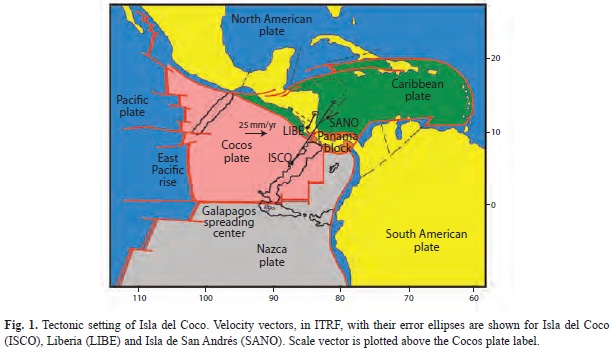
<body><![CDATA[<br> <font style="font-family: verdana;" 2="" size="-1">We present here results from the GPS campaigns and preliminary results from almost one year of continuous recording at Isla del Coco. Taking advantage of another CGPS station running at Isla de San Andr&eacute;s, on the stable Caribbean Plate (away from deformation associated with its plate boundaries), we also present the first continuous measurements of Cocos-Caribbean plate convergence.</font>    <br> <font style="font-family: verdana;" 2="" size="-1"></font>    <br> <font style="font-family: verdana;" 2="" size="-1"><span  style="font-weight: bold;">Tectonic setting:</span> Isla del Coco is an intra-oceanic island that emerges from a submarine ridge. It is part of a series of young volcanoes on an old hot-spot trace (Castillo <span  style="font-style: italic;">et al.</span> 1988). This submarine ridge, the Cocos ridge, is one of the traces of the Galapagos hot spot; it was created by volcanism at the Galapagos Islands and is transported to the northeast toward Central America by Cocos Plate motion, where it subducts beneath the Osa Peninsula in&nbsp; southern Costa Rica (<a href="/img/revistas/rbt/v60s3/a03i1.jpg">Fig. 1</a>). This development history gives the ridge a N40oE orientation, roughly normal to the trend of the Middle American Trench. The oceanic Cocos Plate is being crea- ted from both the fast-spreading East Pacific Rise (EPR), as well as from the slow Galapagos Spreading Center (GSC). The GSP originated when the Farallon plate broke out into Cocos and Nazca plate some 25 to 28 mya (Hey 1977, Lonsdale and Klitgord, 1978). Cocos is a fast moving plate with periods of superfast motion (around 200mm/yr of spreading at the EPR during the Mid-Miocene) (Wilson 1996).    <br>     <br> </font><font style="font-family: verdana;" 2="" size="-1">The Cocos Plate subducts beneath the North American Plate in SE Mexico, under the Caribbean Plate in most of Central America, and beneath the Panama Block in SW Costa Rica. Convergence rates of the Cocos and Caribbean plates varies from about 65mm/yr in Guatemala to about 85mm/yr in Costa Rica (computed from DeMets 2001). The recent MORVEL&nbsp; plate&nbsp; motion&nbsp; model&nbsp; (DeMets&nbsp; <span  style="font-style: italic;">et al.</span> 2010), which is an average over the last 780,000 years rather than ~3 million years for DeMets (2001), predicts slower convergence rates about 10 mm/yr slower, but a similar spatial variation.</font>    <br> <font style="font-family: verdana;" 2="" size="-1"></font>    <br> <font style="font-family: verdana; font-weight: bold;" 2="" size="3">Observations</font>    <br> <font style="font-family: verdana;" 2="" size="-1"></font>    <br> <font style="font-family: verdana;" 2="" size="-1"><span  style="font-weight: bold;">Campaign measurements:</span> A geodetic monument in Isla del Coco was first measured by GPS early in 1988 as part of the regional CASA UNO campaign. Two other campaigns were carried out in 1990 and 1991 as part of the CORBAS project and the monument was remeasured again then. GPS occupations were also done at Isla del Coco in 1994 and 2008. Unfortunately, the 1994 measurements were made at the wrong geodetic monument, and these data cannot be used to measure tectonic motions because the offset between these two monuments has never been measured precisely. The 1988-1991 data were used by Dixon&nbsp; (1993) and Freymueller <span style="font-style: italic;">et al.</span> (1993) to make the first estimates of Cocos Plate motion relative to sites on Central America and in the Caribbean, which confirmed that the motions measured with GPS were generally consistent with the geologic global plate motion models. These early estimates however had large uncertainties in the motion rates, 4-7mm/year. Data prior to 1991 are difficult to use today due to changes in data formats, lack of calibration of the equipment used then relative to the modern equipment we now use, and, most importantly, a lack of precise coordinates for the limited global tracking&nbsp; network&nbsp; that&nbsp; was&nbsp; in&nbsp; place at that time. While the results of these early studies generally agree with modern data at about the level expected given their uncertainties, post-1991 data are so much more precise because of the completion of the GPS satellite constellation and the development of a robust global tracking network that the early data do not contribute much information beyond what we obtain using 1991 and later data.</font>    <br> <font style="font-family: verdana;" 2="" size="-1"></font>    ]]></body>
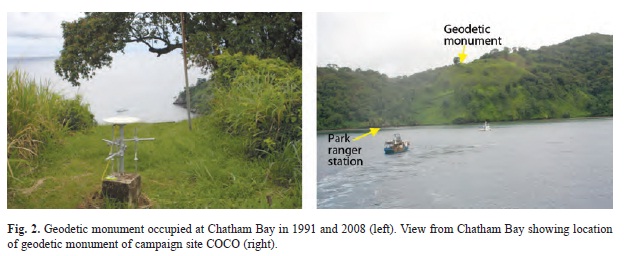
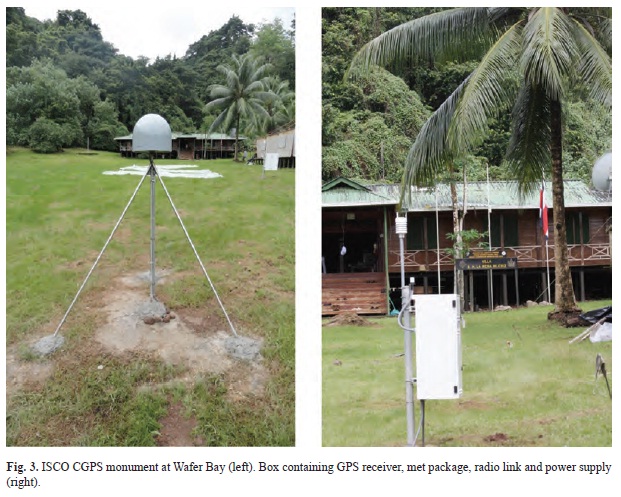
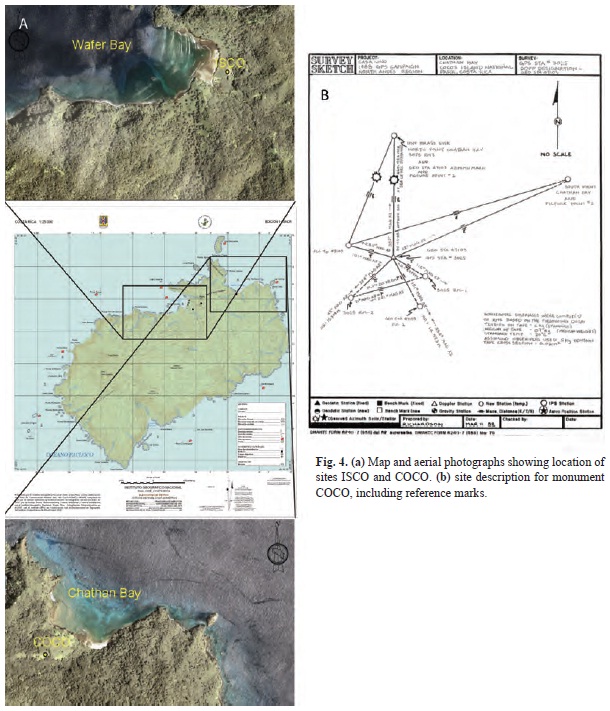
<body><![CDATA[<br> <font style="font-family: verdana;" 2="" size="-1">We&nbsp; present&nbsp; here&nbsp; results&nbsp; from&nbsp; the&nbsp; 1991 and 2008 campaigns. These occupations were done at a geodetic monument (<a href="/img/revistas/rbt/v60s3/a03i2.jpg">Fig. 2</a>) located at ~140 m.a.s.l. on a bare hill inland from the ranger station in Chatham Bay (<a  href="/img/revistas/rbt/v60s3/a03i2.jpg">Fig. 2</a>). We also included data from 1991, 1994 and 1996 campaigns from the site Liberia on the Costa Rica mainland, to compare with and assess the quality of the velocities estimated for the 1988-1991 data (Dixon 1993, Freymueller <span  style="font-style: italic;">et al.</span> 1993).    <br>     <br> </font><font style="font-family: verdana;" 2="" size="-1">Data processing was done at the Geophysical Institute, University of Alaska at Fairbanks. We&nbsp; use&nbsp; the&nbsp; GIPSY-OASIS&nbsp; software&nbsp; version goa-5.0, developed by the Jet Propulsion Laboratory (JPL). For all data prior to 1996, we estimate the satellite orbits using all of the available global sites operating at the time. For more recent data, we fix the satellite orbit and clock parameters to the current JPL satellite orbit and clock products. We process all stations one by one in a point positioning mode (Zumberge <span  style="font-style: italic;">et al.</span> 1997), and then combine all stations across a broad region to get a single set of coordinates each day. The daily coordinate solutions are then aligned with the International Terrestrial Reference Frame (ITRF2008) solution to resolve the origin, orientation and scale of the network. We then estimate station velocities by fitting a linear model to the station coordinates over time.</font>    <br> <font style="font-family: verdana;" 2="" size="-1"></font><br  style="font-weight: bold;"> <font style="font-family: verdana;" 2="" size="-1"><span  style="font-weight: bold;">The Isla del Coco (ISCO) CGPS:</span> A continuous GPS station was built and instrumented in May 2011 on Isla del Coco. This CGPS station is located at 5.5444oN and 87.0556oW on a sandy terrace at the Genio River delta in Wafer Bay,&nbsp; at&nbsp; ~2&nbsp; m.a.s.l.&nbsp; The&nbsp; antenna&nbsp; monument is located right in the middle of this alluvial terrace, 40m NW from the Villa Beatriz, the Park ranger station in Wafer Bay. The shoreline is 60m NW from the monument and there is a marsh in between.</font>    <br> <font style="font-family: verdana;" 2="" size="-1"></font>    <br> <font style="font-family: verdana;" 2="" size="-1">The antenna is on a shallow drilled braced monument, built following the Plate Boundary Observatory standards (http://pbo.unavco.org/instruments/gps) (<a  href="/img/revistas/rbt/v60s3/a03i3.jpg">Fig. 3</a>). It has four legs, 4m long on 2.5cm diameter solid stainless steel rod; one vertical and three inclined 35o from the vertical and horizontally separated by 120o. A hand auger was used to dig, into fine sand, the four holes where the rods were cemented. The water table was only 2m deep and therefore the possibility of monument subsidence over the first few months after installation was a concern. Liquefaction at the site from strong ground motion could also occur, but there are no records of large and close enough earthquakes around Isla del Coco that could generate high enough accelerations to trigger liquefaction.    <br>     <br> </font><font style="font-family: verdana;" 2="" size="-1">The site is equipped with a Trimble choke ring antenna and a Trimble NetRS receiver. It is also equipped with a Vaisala WTX510/520 meteorological package that records temperature, humidity, atmospheric pressure, wind velocity and direction, and rain and hail precipitation by impact. The instruments are placed in an aluminum box located some 30m SW from the monument (<a href="/img/revistas/rbt/v60s3/a03i3.jpg">Fig. 3</a>). Data are transmitted via radio link from this box to a wireless router on Villa Beatriz and then served on the web via the VSAT link on the island. All data from this station, including met records, can be freely downloaded from the UNAVCO ftp site (ftp://data-out.unavco.org).</font>    <br> <font style="font-family: verdana;" 2="" size="-1"></font>    <br> <font style="font-family: verdana;" 2="" size="-1">The location of the campaign site COCO and the CGPS station are shown in <a href="/img/revistas/rbt/v60s3/a03i4.jpg">Figure 4 a</a>. A site description for the monument COCO, including reference marks is given in <a href="/img/revistas/rbt/v60s3/a03i4.jpg">Fig. 4b</a>.    ]]></body>
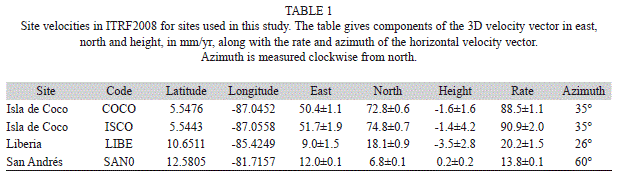
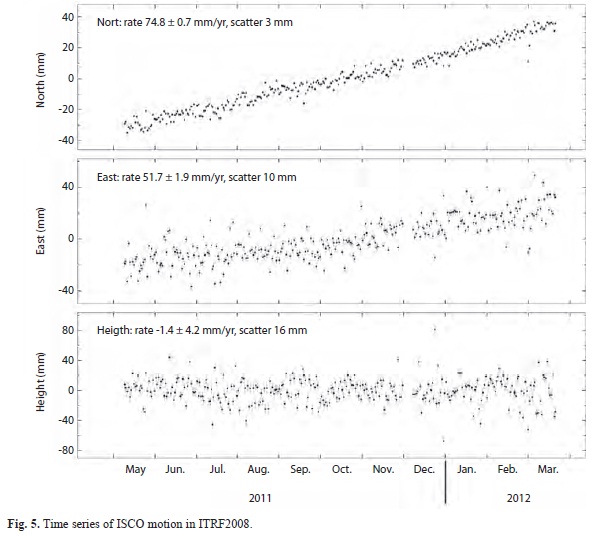
<body><![CDATA[<br>     <br> </font><font style="font-family: verdana;" 2="" size="3"><span  style="font-weight: bold;">Results</span>    <br>     <br> </font><font style="font-family: verdana;" 2="" size="-1"><span  style="font-weight: bold;">Campaign results:</span> The GPS campaigns show that the average Isla del Coco motion in the ITRF2008 frame is 88.5&plusmn;1.1mm/yr over the 17-year data span, and the station subsides at a rate of 1.6&plusmn;1.6 mm/yr (<a href="/img/revistas/rbt/v60s3/a03t1.gif">Table 1</a>). Zero velocity in ITRF2008 is defined such that the motions all over the earth in ITRF2008 approximate a no-net-rotation of the lithosphere condition. This definition does not have any direct geological significance, but ITRF2008 is ideal for combining and comparing geodetic estimates, and the motions of most major plates in ITRF2008 are well known. However, motions of the Cocos and Caribbean plates are not constrained as well as other plates. After presenting the velocity for the new CGPS station ISCO, we will discuss the motion of Isla del Coco and the Cocos Plate relative to the Caribbean Plate.    <br>     <br> </font><font style="font-family: verdana;" 2="" size="-1">It is interesting to compare the new results for the sites on Isla del Coco with the early studies of Dixon (1993) and Freymueller <span  style="font-style: italic;">et al.</span> (1993). These earlier studies reported only relative motions (changes of baselines), because no robust &#8220;absolute motion&#8221; frame like ITRF2008 existed at that time. The early studies estimated that the baseline between Isla del Coco and Liberia on the Costa Rica mainland shortened at a rate of 70&plusmn;5mm/yr (Dixon 1993) or 71&plusmn;4mm/yr (Freymueller <span style="font-style: italic;">et al.</span> 1993), based on independent analyses of the same data. Using our 1991-2008 velocity for COCO and the 1991-1996 velocity for Liberia (LIBE), we estimate a more precise shortening rate of 69&plusmn;2mm/yr, indicating that the early studies using 1988-1991 data had no significant biases.    <br>     <br> </font><font style="font-family: verdana;" 2="" size="-1"><span  style="font-weight: bold;">Isla del Coco movement based on ISCO:</span> We processed continuous data from ISCO for the period May 20, 2011 to March 24, 2012. Data processing was done at the Geophysical Institute, University of Alaska at Fairbanks using the point positioning approach identical to that described above for the campaign data. A site on Isla San Andr&eacute;s in the Caribbean (SAN0) is included among the many regional stations included in each daily solution. </font>    <br> <font style="font-family: verdana;" 2="" size="-1"></font>    <br> <font style="font-family: verdana;" 2="" size="-1">Time series for the NS, EW and vertical components of motion at ISCO are shown in <a href="/img/revistas/rbt/v60s3/a03i5.jpg">Figure 5</a>. Motion is given relative to ITRF2008. </font><font style="font-family: verdana;" 2="" size="-1">The observed horizontal components of the velocity&nbsp; vector&nbsp; for&nbsp; ISCO&nbsp; result&nbsp; in&nbsp; a&nbsp; total speed of 90.9&plusmn;1.5mm/yr in the N35oE direction (<a  href="/img/revistas/rbt/v60s3/a03t1.gif">Table 1</a>). This estimate differs by only 2mm/ yr from the estimate based on the campaign data, which is within the estimated measurement uncertainties. ISCO subsides at a rate of 1&plusmn;4mm/yr. Given the very short CGPS time period, it is not surprising that the vertical rate is not significant relative to the uncertainty. The scatter of the daily solutions about the best-fit trend is (10, 3, 16) mm for the east, north and height&nbsp; components,&nbsp; respectively.&nbsp; The&nbsp; scatter in the data is quite large compared to most sites in North America and Europe, probably because of the large amount and variability of water vapor in the atmosphere in this tropical island environment.    ]]></body>
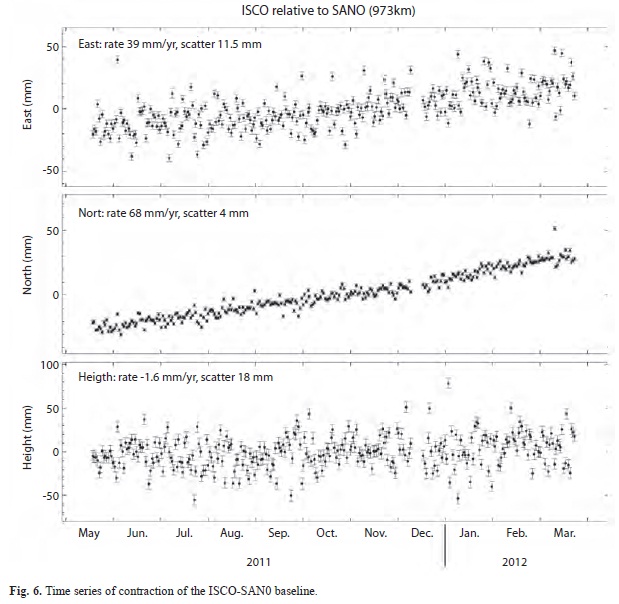
<body><![CDATA[<br> </font><br style="font-weight: bold;"> <font style="font-family: verdana;" 2="" size="-1"><span  style="font-weight: bold;">Cocos-Caribbean convergence:</span> We use the CGPS station running at Isla de San Andr&eacute;s (SAN0), presumed to lie on the stable Caribbean Plate, and present here the first CGPS measurement of Cocos-Caribbean plate convergence (<a href="/img/revistas/rbt/v60s3/a03i6.jpg">Fig. 6</a>). The ISCO-SAN0 base- line is ~973km long and has a N36.5oE orientation, almost parallel to Cocos Plate motion direction&nbsp; in&nbsp; ITR2008&nbsp; and&nbsp; the&nbsp; orientation&nbsp; of convergence off central Costa Rica where the baseline crosses the trench.    <br>     <br> </font><font style="font-family: verdana;" 2="" size="-1">Our results show contraction of the baseline at 78&plusmn;1mm/yr, in agreement with the MOR- VEL&nbsp; estimate&nbsp; of&nbsp; 76.4&plusmn;2.5&nbsp; mm/yr&nbsp; (DeMets <span  style="font-style: italic;">et al.</span> 2010; online calculator at http://www. geoscience.wisc.edu/~chuck/MORVEL). In contrast, the model of DeMets (2001) predicts 86.4 mm/yr contraction for this baseline, and NUVEL-1A predicts 85.7 mm/yr (DeMets <span  style="font-style: italic;">et al.</span>, 1994). MORVEL represents an average of plate motions over the last 780,000 years, while the older models represent ~3 million year averages. Our result supports the conclusion of DeMets <span  style="font-style: italic;">et al.</span> (2010) that Cocos-Caribbean convergence has slowed over the last 3 million years, but suggests that Cocos-Caribbean convergence has occurred at a steady rate over the last 780,000 years.</font>    <br> <font style="font-family: verdana;" 2="" size="-1"></font>    <br> <font style="font-family: verdana;" 2="" size="-1">Liberia moves relative to SAN0 at a rate of 11.7&plusmn;1.5 mm/yr. The motion of Liberia relative to SAN0 results from a combination of motion of the Costa Rica forearc and elastic deformation resulting from the locked subduction plate interface (Lundgren <span  style="font-style: italic;">et al.</span> 1999; Iinuma <span  style="font-style: italic;">et al.</span>, 2004; LaFemina <span style="font-style: italic;">et al.</span>, 2009). Dixon (1993) estimated a larger rate of almost 20mm/yr. This difference might result from a measurement bias, but also could indicate temporal changes in the locked region. Transient slow slip events involving creep on part of the plate interface have been observed at the Nicoya Peninsula (Outerbridge <span  style="font-style: italic;">et al.</span>, 2010), which means the rate elastic deformation observed in campaign data will depend on whether or not slow slip events occurred during the measurement inter- val. Our velocity for Liberia is consistent with the model prediction of Iinuma <span  style="font-style: italic;">et al.</span> (2004).</font>    <br> <font style="font-family: verdana;" 2="" size="-1"></font>    <br> <font style="font-family: verdana;" 2="" size="-1">The precision of these CGPS plate motion vectors&nbsp; will&nbsp; improve&nbsp; considerably&nbsp; over&nbsp; the next&nbsp; few&nbsp; years,&nbsp; although&nbsp; the&nbsp; general&nbsp; trend will probably not change too much. With the addition this year of many more CGPS stations in and around the Caribbean Plate, as part of the COCONet initiative, we will have a better knowledge of the amount and concentration of internal&nbsp; deformation&nbsp; of&nbsp; the&nbsp; Caribbean&nbsp; Plate, and&nbsp; we&nbsp; will&nbsp; be&nbsp; able&nbsp; to&nbsp; distinguish&nbsp; between these two possibilities. </font>    <br> <font style="font-family: verdana;" 2="" size="-1"></font>    <br> <font style="font-family: verdana; font-weight: bold;" 2="" size="3">Conclusions</font>    <br> <font style="font-family: verdana;" 2="" size="-1"></font>    ]]></body>
<body><![CDATA[<br> <font style="font-family: verdana;" 2="" size="-1">We obtained a velocity vector for the motion of Isla del Coco of 90.7&plusmn;1.5 mm/yr in the N35oE direction, based on 10 months of data. This rate is equal within uncertainties to the rate estimated from two campaign surveys 17 years apart. A comparison of our results to the early studies of Dixon (1993) and Freymueller <span  style="font-style: italic;">et al.</span> (1993) shows the early studies suffered from no substantial biases as their results are consistent with ours at the level expected from&nbsp; the&nbsp; uncertainties,&nbsp; with&nbsp; the&nbsp; exception of the Liberia-San Andr&eacute;s estimate of Dixon (1993). Assuming no internal deformation of Isla del Coco, the estimated velocity should be representative of the velocity of the Cocos Plate in ITRF2008. We also obtained contraction of the ISCO-SAN0 baseline at a rate of 78&plusmn;1mm/ yr, within 1.5 mm/yr of the 76.4&plusmn;2.5 mm/yr convergence rate expected from the MORVEL model. This suggests that Cocos-Caribbean plate&nbsp; convergence&nbsp; has&nbsp; remained&nbsp; steady&nbsp; over the last 780,000 years, at a slower rate than predicted by the ~3 million year average of the NUVEL1A model.</font>    <br> <font style="font-family: verdana;" 2="" size="-1"></font>    <br> <font style="font-family: verdana;" 2="" size="-1">The precision of the motion estimate from ISCO will become considerably more precise over the next few years, and the campaign estimate could also be improved substantially by adding the 1994 data (after measuring the offset between monuments and correcting for this offset), as the uncertainty is dominated by the 1991 survey. With the addition this year of many more CGPS stations in and around the Caribbean Plate, as part of the COCONet initiative, we will soon gain a much better knowledge&nbsp; of&nbsp; the&nbsp; amount&nbsp; and&nbsp; concentration of internal deformation of the Caribbean Plate, and the tectonic motions of the region.</font>    <br> <font style="font-family: verdana;" 2="" size="-1"></font><br  style="font-weight: bold;"> <font style="font-family: verdana; font-weight: bold;" 2="" size="3">Acknowledgments</font>    <br> <font style="font-family: verdana;" 2="" size="-1"></font>    <br> <font style="font-family: verdana;" 2="" size="-1">We would like to thank Fernando Cort&eacute;s and Francisco Gonz&aacute;lez (r.i.p) for providing permits and logistical support to install the continuous GPS station in Isla del Coco. Park Rangers and other personnel from MINAET, Ministerio de Seguridad and Agua Viva Foundation, made the work in Isla del Coco a pleasant experience. The installation of ISCO is part of a joint initiative with the Escuela Centroamericana de Geolog&iacute;a, at Universidad de Costa Rica, to instrument Isla del Coco. The air photographs shown in <a  href="/img/revistas/rbt/v60s3/a03i4.jpg">Fig. 4</a> were facilitated by the Alexander Gonz&aacute;lez Salas from the Programa de Regularizaci&oacute;n de Catastro y Registro de Costa Rica. The site SAN0 was established as part of the Caribbean Hurricane Prediction and Geodetic Network (PI John Braun of UCAR), and we appreciate the free and open availability of these data. We thank John Weber and two anonymous reviewers for reviews that helped us improve this manuscript.</font>    <br> <hr style="width: 100%; height: 2px;"><font  style="font-family: verdana; font-weight: bold;" 2="" size="3">References</font>    <br> <font style="font-family: verdana;" 2="" size="-1"></font>    <!-- ref --><br> <font style="font-family: verdana;" 2="" size="-1">Castillo,&nbsp; P., R. Batiza, D. Vanko, E.&nbsp; Malavassi, J. Barquero &amp; E.&nbsp; Fern&aacute;ndez. 1988. Anomalously young volcanoes on old hot-spot traces. I.&nbsp; Geology&nbsp; and petrology of Cocos Island.&nbsp; Geol. Soc. Amer. Bull. 100: 1400-1414.    &nbsp;&nbsp;&nbsp;&nbsp;&nbsp;&nbsp;&nbsp;&nbsp;[&#160;<a href="javascript:void(0);" onclick="javascript: window.open('/scielo.php?script=sci_nlinks&ref=1778970&pid=S0034-7744201200080000300001&lng=','','width=640,height=500,resizable=yes,scrollbars=1,menubar=yes,');">Links</a>&#160;]<!-- end-ref --></font>    ]]></body>
<body><![CDATA[<br> <font style="font-family: verdana;" 2="" size="-1"></font>    <!-- ref --><br> <font style="font-family: verdana;" 2="" size="-1">DeMets, C. 2001. A new estimate for present-day Cocos- Caribbean plate&nbsp; motion: Implications for slip along the&nbsp; Central American volcanic arc.&nbsp; Geophys. Res. Lett. 28: 4043-4046.    &nbsp;&nbsp;&nbsp;&nbsp;&nbsp;&nbsp;&nbsp;&nbsp;[&#160;<a href="javascript:void(0);" onclick="javascript: window.open('/scielo.php?script=sci_nlinks&ref=1778973&pid=S0034-7744201200080000300002&lng=','','width=640,height=500,resizable=yes,scrollbars=1,menubar=yes,');">Links</a>&#160;]<!-- end-ref --></font>    <br> <font style="font-family: verdana;" 2="" size="-1"></font>    <!-- ref --><br> <font style="font-family: verdana;" 2="" size="-1">DeMets,&nbsp; C., R.G. Gordon, D.F. Argus &amp; S.&nbsp; Stein. 1994. Effect of recent revisions to the geomagnetic reversal time&nbsp; scale&nbsp; on&nbsp; estimates of current plate motions. Geophys. Res. Lett. 21: 2191-2194.    &nbsp;&nbsp;&nbsp;&nbsp;&nbsp;&nbsp;&nbsp;&nbsp;[&#160;<a href="javascript:void(0);" onclick="javascript: window.open('/scielo.php?script=sci_nlinks&ref=1778976&pid=S0034-7744201200080000300003&lng=','','width=640,height=500,resizable=yes,scrollbars=1,menubar=yes,');">Links</a>&#160;]<!-- end-ref --></font>    <br> <font style="font-family: verdana;" 2="" size="-1"></font>    <!-- ref --><br> <font style="font-family: verdana;" 2="" size="-1">DeMets, C., R.G. Gordon &amp; D.F. Argus. 2010. Geologically current plate motions. Geophys. J. Int. 181: 1-80; doi:10.1111/j.1365-246x.2009.04491.x.    &nbsp;&nbsp;&nbsp;&nbsp;&nbsp;&nbsp;&nbsp;&nbsp;[&#160;<a href="javascript:void(0);" onclick="javascript: window.open('/scielo.php?script=sci_nlinks&ref=1778979&pid=S0034-7744201200080000300004&lng=','','width=640,height=500,resizable=yes,scrollbars=1,menubar=yes,');">Links</a>&#160;]<!-- end-ref --></font>    <br> <font style="font-family: verdana;" 2="" size="-1"></font>    ]]></body>
<body><![CDATA[<!-- ref --><br> <font style="font-family: verdana;" 2="" size="-1">Dixon, T. 1993. GPS Measurement of relative&nbsp; motion of the Cocos and Caribbean&nbsp; plates&nbsp; and strain accumulation across&nbsp; the Middle America Trench. Geophys. Res. Lett. 20: 2167-2170.    &nbsp;&nbsp;&nbsp;&nbsp;&nbsp;&nbsp;&nbsp;&nbsp;[&#160;<a href="javascript:void(0);" onclick="javascript: window.open('/scielo.php?script=sci_nlinks&ref=1778982&pid=S0034-7744201200080000300005&lng=','','width=640,height=500,resizable=yes,scrollbars=1,menubar=yes,');">Links</a>&#160;]<!-- end-ref --></font>    <br> <font style="font-family: verdana;" 2="" size="-1"></font>    <!-- ref --><br> <font style="font-family: verdana;" 2="" size="-1">Freymueller, J.T., J.N. Kellogg &amp; V. Vega.&nbsp; 1993. Plate motions in the North&nbsp; Andean Region. J. Geophys. Res. 98: 21,853-21,863.    &nbsp;&nbsp;&nbsp;&nbsp;&nbsp;&nbsp;&nbsp;&nbsp;[&#160;<a href="javascript:void(0);" onclick="javascript: window.open('/scielo.php?script=sci_nlinks&ref=1778985&pid=S0034-7744201200080000300006&lng=','','width=640,height=500,resizable=yes,scrollbars=1,menubar=yes,');">Links</a>&#160;]<!-- end-ref --></font>    <br> <font style="font-family: verdana;" 2="" size="-1"></font>    <!-- ref --><br> <font style="font-family: verdana;" 2="" size="-1">Hey, R.N.&nbsp;&nbsp; 1977 Tectonic evolution of the&nbsp; Cocos-Nazca&nbsp; spreading&nbsp; center,&nbsp; Geol.&nbsp;&nbsp; Soc.&nbsp; Am.&nbsp; Bull.,&nbsp; 88: 1404-1420.    &nbsp;&nbsp;&nbsp;&nbsp;&nbsp;&nbsp;&nbsp;&nbsp;[&#160;<a href="javascript:void(0);" onclick="javascript: window.open('/scielo.php?script=sci_nlinks&ref=1778988&pid=S0034-7744201200080000300007&lng=','','width=640,height=500,resizable=yes,scrollbars=1,menubar=yes,');">Links</a>&#160;]<!-- end-ref --></font>    <br> <font style="font-family: verdana;" 2="" size="-1"></font>    <!-- ref --><br> <font style="font-family: verdana;" 2="" size="-1">Iinuma, T., M. Protti, K. Obana, V. Gonz&aacute;lez, R. Van der Laat, T. Kato, S. Miyazaki,&nbsp; Y. Kaneda &amp; E. Hern&aacute;ndez.&nbsp; 2004.&nbsp; Inter-plate coupling in the Nicoya Peninsula,&nbsp; Costa&nbsp; Rica,&nbsp; as&nbsp; deduced&nbsp; from&nbsp; a&nbsp; trans-peninsula GPS&nbsp; experiment.&nbsp; Earth Planet. Sci. Lett. 223: 203-212.    &nbsp;&nbsp;&nbsp;&nbsp;&nbsp;&nbsp;&nbsp;&nbsp;[&#160;<a href="javascript:void(0);" onclick="javascript: window.open('/scielo.php?script=sci_nlinks&ref=1778991&pid=S0034-7744201200080000300008&lng=','','width=640,height=500,resizable=yes,scrollbars=1,menubar=yes,');">Links</a>&#160;]<!-- end-ref --></font>    <br> <font style="font-family: verdana;" 2="" size="-1"></font>    <!-- ref --><br> <font style="font-family: verdana;" 2="" size="-1">LaFemina,&nbsp; P., T.H. Dixon, R. Govers, E.&nbsp; Norabuena, H. Turner, A.&nbsp; Saballos,&nbsp; G.&nbsp; Mattioli,&nbsp; M.&nbsp; Protti&nbsp; &amp;&nbsp; W. Strauch.&nbsp; 2009.&nbsp; Fore-arc&nbsp; motion&nbsp; and&nbsp; Cocos&nbsp; Ridge collision&nbsp; in&nbsp; Central America.&nbsp; Geochem.&nbsp; Geophys. Geosyst. 10:Q05S14, doi:10.1029/2008GC002181.    &nbsp;&nbsp;&nbsp;&nbsp;&nbsp;&nbsp;&nbsp;&nbsp;[&#160;<a href="javascript:void(0);" onclick="javascript: window.open('/scielo.php?script=sci_nlinks&ref=1778994&pid=S0034-7744201200080000300009&lng=','','width=640,height=500,resizable=yes,scrollbars=1,menubar=yes,');">Links</a>&#160;]<!-- end-ref --></font>    <br> <font style="font-family: verdana;" 2="" size="-1"></font>    <!-- ref --><br> <font style="font-family: verdana;" 2="" size="-1">Lonsdale, P.F. &amp; K.D. Klitgord&nbsp; 1978 Structure and tectonic history of the eastern&nbsp; Panama basin, Geol. Soc. Am. Bull. 89: 981-999.    &nbsp;&nbsp;&nbsp;&nbsp;&nbsp;&nbsp;&nbsp;&nbsp;[&#160;<a href="javascript:void(0);" onclick="javascript: window.open('/scielo.php?script=sci_nlinks&ref=1778997&pid=S0034-7744201200080000300010&lng=','','width=640,height=500,resizable=yes,scrollbars=1,menubar=yes,');">Links</a>&#160;]<!-- end-ref --></font>    <br> <font style="font-family: verdana;" 2="" size="-1"></font>    <!-- ref --><br> <font style="font-family: verdana;" 2="" size="-1">Lundgren,&nbsp; P.,&nbsp; M.&nbsp; Protti,&nbsp; A.&nbsp; Donnellan,&nbsp; M.&nbsp; Heflin,&nbsp; E. Hernandez &amp; D. Jefferson. 1999. Seismic cycle and plate margin deformation in Costa Rica: GPS observations from&nbsp; 1994&nbsp; to 1997. J. Geophys. Res. 104: 28,915-28,926.    &nbsp;&nbsp;&nbsp;&nbsp;&nbsp;&nbsp;&nbsp;&nbsp;[&#160;<a href="javascript:void(0);" onclick="javascript: window.open('/scielo.php?script=sci_nlinks&ref=1779000&pid=S0034-7744201200080000300011&lng=','','width=640,height=500,resizable=yes,scrollbars=1,menubar=yes,');">Links</a>&#160;]<!-- end-ref --></font>    ]]></body>
<body><![CDATA[<br> <font style="font-family: verdana;" 2="" size="-1"></font>    <!-- ref --><br> <font style="font-family: verdana;" 2="" size="-1">Outerbridge, K.C., T.H. Dixon, S.Y. Schwartz, J.I. Walter, M. Protti, V. Gonzalez, J. Biggs, M. Thorwart &amp; W. Rabbel. 2010. A tremor and slip event on the Cocos&#8217; Caribbean subduction zone as measured by a global positioning system (GPS) and seismic network on the Nicoya Peninsula, Costa Rica. J. Geophys. Res. 115: B10408, doi:10.1029/2009JB006845.    &nbsp;&nbsp;&nbsp;&nbsp;&nbsp;&nbsp;&nbsp;&nbsp;[&#160;<a href="javascript:void(0);" onclick="javascript: window.open('/scielo.php?script=sci_nlinks&ref=1779003&pid=S0034-7744201200080000300012&lng=','','width=640,height=500,resizable=yes,scrollbars=1,menubar=yes,');">Links</a>&#160;]<!-- end-ref --></font>    <br> <font style="font-family: verdana;" 2="" size="-1"></font>    <!-- ref --><br> <font style="font-family: verdana;" 2="" size="-1">Wilson, D.S. 1996. Fastest known spreading on the Miocene Cocos-Pacific Plate&nbsp; Boundary. Geophys. Res. Lett. 23: 3003-3006.    &nbsp;&nbsp;&nbsp;&nbsp;&nbsp;&nbsp;&nbsp;&nbsp;[&#160;<a href="javascript:void(0);" onclick="javascript: window.open('/scielo.php?script=sci_nlinks&ref=1779006&pid=S0034-7744201200080000300013&lng=','','width=640,height=500,resizable=yes,scrollbars=1,menubar=yes,');">Links</a>&#160;]<!-- end-ref --></font>    <br> <font style="font-family: verdana;" 2="" size="-1"></font>    <!-- ref --><br> <font style="font-family: verdana;" 2="" size="-1">Zumberge, J., M. Heflin, D. Jefferson, M.&nbsp; Watkins &amp; F. Webb. 1997. Precise point positioning&nbsp; for the efficient&nbsp; and&nbsp; robust&nbsp; analysis&nbsp; of&nbsp; GPS&nbsp; data&nbsp; from&nbsp; large networks. J. Geophys. Res. 102: 5005-5017.    &nbsp;&nbsp;&nbsp;&nbsp;&nbsp;&nbsp;&nbsp;&nbsp;[&#160;<a href="javascript:void(0);" onclick="javascript: window.open('/scielo.php?script=sci_nlinks&ref=1779009&pid=S0034-7744201200080000300014&lng=','','width=640,height=500,resizable=yes,scrollbars=1,menubar=yes,');">Links</a>&#160;]<!-- end-ref --></font>    <br> <font style="font-family: verdana;" 2="" size="-1"></font>    ]]></body>
<body><![CDATA[<br> <font style="font-family: verdana;" size="-1"><a name="Correspondencia1"></a><a  href="#Correspondencia2">*</a>Correspondencia a:</font>    <br> <font style="font-family: verdana;" 2="" size="-1">Marino Protti. </font><font  style="font-family: verdana;" 2="" size="-1">Observatorio Vulcanol&oacute;gico y Sismol&oacute;gico de Costa Rica, Universidad Nacional,&nbsp; Apartado 1718-3000, Heredia, Costa Rica; jprotti@una.ac.cr</font>    <br> <font style="font-family: verdana;" 2="" size="-1">V&iacute;ctor Gonz&aacute;lez. </font><font style="font-family: verdana;" 2=""  size="-1">Observatorio Vulcanol&oacute;gico y Sismol&oacute;gico de Costa Rica, Universidad Nacional,&nbsp; Apartado 1718-3000, Heredia, Costa Rica; vgonzale@una.ac.cr</font>    <br> <font style="font-family: verdana;" 2="" size="-1">Jeffrey Freymueller. </font><font style="font-family: verdana;" 2="" size="-1">Geophysical Institute and Department of Geology and Geophysics, University of Alaska Fairbanks, 903 Koyukuk </font><font  style="font-family: verdana;" 2="" size="-1">Drive, Univ. of Alaska, Fairbanks, AK 99775-7320; jeff.freymueller -at- gi.alaska.edu</font>    <br> <font style="font-family: verdana;" 2="" size="-1">Sarah Doelger. </font><font  style="font-family: verdana;" 2="" size="-1">UNAVCO, 3340 Mitchell Lane, Boulder, Colorado, 80301; doelger@unavco.org    <br>     <br> </font><font style="font-family: verdana;" 2="" size="-1"><a name="1"></a><a  href="#4">1</a>.&nbsp; Observatorio Vulcanol&oacute;gico y Sismol&oacute;gico de Costa Rica, Universidad Nacional,&nbsp; Apartado 1718-3000, Heredia, Costa Rica; jprotti@una.ac.cr, vgonzale@una.ac.cr</font>    <br> <font style="font-family: verdana;" 2="" size="-1"><a name="2"></a><a  href="#5">2</a>.&nbsp; Geophysical Institute and Department of Geology and Geophysics, University of Alaska Fairbanks, 903 Koyukuk </font><font  style="font-family: verdana;" 2="" size="-1">Drive, Univ. of Alaska, Fairbanks, AK 99775-7320; jeff.freymueller -at- gi.alaska.edu</font>    <br> <font style="font-family: verdana;" 2="" size="-1"><a name="3"></a><a  href="#6">3</a>.&nbsp; UNAVCO, 3340 Mitchell Lane, Boulder, Colorado, 80301; doelger@unavco.org</font>    <br>     ]]></body>
<body><![CDATA[<div style="text-align: center;"> <hr style="width: 100%; height: 2px;"><font  style="font-family: verdana; font-weight: bold;" 2="" size="-1">Received 23-III-2012. Corrected 22-VI-2012. Accepted 24-IX-2012</font><font  style="font-family: verdana;" 2="" size="-1"><span  style="font-weight: bold;"></span></font><font  style="font-family: verdana;" 2="" size="-1"></font>    <br> </div> </div> </div> <font style="font-family: verdana;" 2="" size="-1"></font>      ]]></body><back>
<ref-list>
<ref id="B1">
<nlm-citation citation-type="journal">
<person-group person-group-type="author">
<name>
<surname><![CDATA[Castillo]]></surname>
<given-names><![CDATA[P.]]></given-names>
</name>
<name>
<surname><![CDATA[Batiza]]></surname>
<given-names><![CDATA[R.]]></given-names>
</name>
<name>
<surname><![CDATA[Vanko]]></surname>
<given-names><![CDATA[D.]]></given-names>
</name>
<name>
<surname><![CDATA[Malavassi]]></surname>
<given-names><![CDATA[E.]]></given-names>
</name>
<name>
<surname><![CDATA[Barquero]]></surname>
<given-names><![CDATA[J.]]></given-names>
</name>
<name>
<surname><![CDATA[Fernández]]></surname>
<given-names><![CDATA[E.]]></given-names>
</name>
</person-group>
<article-title xml:lang="en"><![CDATA[Anomalously young volcanoes on old hot-spot traces. I. Geology and petrology of Cocos Island]]></article-title>
<source><![CDATA[Geol. Soc. Amer. Bull.]]></source>
<year>1988</year>
<volume>100</volume>
<page-range>1400-1414</page-range></nlm-citation>
</ref>
<ref id="B2">
<nlm-citation citation-type="journal">
<person-group person-group-type="author">
<name>
<surname><![CDATA[DeMets]]></surname>
<given-names><![CDATA[C.]]></given-names>
</name>
</person-group>
<article-title xml:lang="en"><![CDATA[A new estimate for present-day Cocos- Caribbean plate motion: Implications for slip along the Central American volcanic arc]]></article-title>
<source><![CDATA[Geophys. Res. Lett.]]></source>
<year>2001</year>
<volume>28</volume>
<page-range>4043-4046</page-range></nlm-citation>
</ref>
<ref id="B3">
<nlm-citation citation-type="journal">
<person-group person-group-type="author">
<name>
<surname><![CDATA[DeMets]]></surname>
<given-names><![CDATA[C.]]></given-names>
</name>
<name>
<surname><![CDATA[Gordon]]></surname>
<given-names><![CDATA[R.G.]]></given-names>
</name>
<name>
<surname><![CDATA[Argus]]></surname>
<given-names><![CDATA[D.F.]]></given-names>
</name>
<name>
<surname><![CDATA[Stein]]></surname>
<given-names><![CDATA[S.]]></given-names>
</name>
</person-group>
<article-title xml:lang="en"><![CDATA[Effect of recent revisions to the geomagnetic reversal time scale on estimates of current plate motions]]></article-title>
<source><![CDATA[Geophys. Res. Lett.]]></source>
<year>1994</year>
<volume>21</volume>
<page-range>2191-2194</page-range></nlm-citation>
</ref>
<ref id="B4">
<nlm-citation citation-type="journal">
<person-group person-group-type="author">
<name>
<surname><![CDATA[DeMets]]></surname>
<given-names><![CDATA[C.]]></given-names>
</name>
<name>
<surname><![CDATA[Gordon]]></surname>
<given-names><![CDATA[R.G.]]></given-names>
</name>
<name>
<surname><![CDATA[Argus]]></surname>
<given-names><![CDATA[D.F.]]></given-names>
</name>
</person-group>
<article-title xml:lang="en"><![CDATA[Geologically current plate motions]]></article-title>
<source><![CDATA[Geophys. J. Int.]]></source>
<year>2010</year>
<volume>181</volume>
<page-range>1-80</page-range></nlm-citation>
</ref>
<ref id="B5">
<nlm-citation citation-type="journal">
<person-group person-group-type="author">
<name>
<surname><![CDATA[Dixon]]></surname>
<given-names><![CDATA[T.]]></given-names>
</name>
</person-group>
<article-title xml:lang="en"><![CDATA[GPS Measurement of relative motion of the Cocos and Caribbean plates and strain accumulation across the Middle America Trench]]></article-title>
<source><![CDATA[Geophys. Res. Lett]]></source>
<year>1993</year>
<volume>20</volume>
<page-range>2167-2170</page-range></nlm-citation>
</ref>
<ref id="B6">
<nlm-citation citation-type="journal">
<person-group person-group-type="author">
<name>
<surname><![CDATA[Freymueller]]></surname>
<given-names><![CDATA[J.T.]]></given-names>
</name>
<name>
<surname><![CDATA[Kellogg]]></surname>
<given-names><![CDATA[J.N.]]></given-names>
</name>
<name>
<surname><![CDATA[Vega]]></surname>
<given-names><![CDATA[V.]]></given-names>
</name>
</person-group>
<article-title xml:lang="en"><![CDATA[Plate motions in the North Andean Region]]></article-title>
<source><![CDATA[J. Geophys. Res.]]></source>
<year>1993</year>
<volume>98</volume>
<page-range>21,853-21,863</page-range></nlm-citation>
</ref>
<ref id="B7">
<nlm-citation citation-type="journal">
<person-group person-group-type="author">
<name>
<surname><![CDATA[Hey]]></surname>
<given-names><![CDATA[R.N.]]></given-names>
</name>
</person-group>
<article-title xml:lang="en"><![CDATA[Tectonic evolution of the Cocos-Nazca spreading center]]></article-title>
<source><![CDATA[Geol. Soc. Am. Bull.]]></source>
<year>1977</year>
<volume>88</volume>
<page-range>1404-1420</page-range></nlm-citation>
</ref>
<ref id="B8">
<nlm-citation citation-type="journal">
<person-group person-group-type="author">
<name>
<surname><![CDATA[Iinuma]]></surname>
<given-names><![CDATA[T.]]></given-names>
</name>
<name>
<surname><![CDATA[Protti]]></surname>
<given-names><![CDATA[M.]]></given-names>
</name>
<name>
<surname><![CDATA[Obana]]></surname>
<given-names><![CDATA[K.]]></given-names>
</name>
<name>
<surname><![CDATA[González]]></surname>
<given-names><![CDATA[V.]]></given-names>
</name>
<name>
<surname><![CDATA[Van der Laat]]></surname>
<given-names><![CDATA[R.]]></given-names>
</name>
<name>
<surname><![CDATA[Kato]]></surname>
<given-names><![CDATA[T.]]></given-names>
</name>
<name>
<surname><![CDATA[Miyazaki]]></surname>
<given-names><![CDATA[S.]]></given-names>
</name>
<name>
<surname><![CDATA[Kaneda]]></surname>
<given-names><![CDATA[Y.]]></given-names>
</name>
<name>
<surname><![CDATA[Hernández]]></surname>
<given-names><![CDATA[E.]]></given-names>
</name>
</person-group>
<article-title xml:lang="en"><![CDATA[Inter-plate coupling in the Nicoya Peninsula, Costa Rica, as deduced from a trans-peninsula GPS experiment]]></article-title>
<source><![CDATA[Earth Planet. Sci. Lett.]]></source>
<year>2004</year>
<volume>223</volume>
<page-range>203-212</page-range></nlm-citation>
</ref>
<ref id="B9">
<nlm-citation citation-type="journal">
<person-group person-group-type="author">
<name>
<surname><![CDATA[LaFemina]]></surname>
<given-names><![CDATA[P.]]></given-names>
</name>
<name>
<surname><![CDATA[Dixon]]></surname>
<given-names><![CDATA[T.H.]]></given-names>
</name>
<name>
<surname><![CDATA[Govers]]></surname>
<given-names><![CDATA[R.]]></given-names>
</name>
<name>
<surname><![CDATA[Norabuena]]></surname>
<given-names><![CDATA[E.]]></given-names>
</name>
<name>
<surname><![CDATA[Turner]]></surname>
<given-names><![CDATA[H.]]></given-names>
</name>
<name>
<surname><![CDATA[Saballos]]></surname>
<given-names><![CDATA[A.]]></given-names>
</name>
<name>
<surname><![CDATA[Mattioli]]></surname>
<given-names><![CDATA[G.]]></given-names>
</name>
<name>
<surname><![CDATA[Protti]]></surname>
<given-names><![CDATA[M.]]></given-names>
</name>
<name>
<surname><![CDATA[Strauch]]></surname>
<given-names><![CDATA[W.]]></given-names>
</name>
</person-group>
<article-title xml:lang="en"><![CDATA[Fore-arc motion and Cocos Ridge collision in Central America.]]></article-title>
<source><![CDATA[Geochem. Geophys. Geosyst.]]></source>
<year>2009</year>
<volume>10</volume>
<page-range>Q05S14</page-range></nlm-citation>
</ref>
<ref id="B10">
<nlm-citation citation-type="journal">
<person-group person-group-type="author">
<name>
<surname><![CDATA[Lonsdale]]></surname>
<given-names><![CDATA[P.F.]]></given-names>
</name>
<name>
<surname><![CDATA[Klitgord]]></surname>
<given-names><![CDATA[K.D.]]></given-names>
</name>
</person-group>
<article-title xml:lang="en"><![CDATA[Structure and tectonic history of the eastern Panama basin]]></article-title>
<source><![CDATA[Geol. Soc. Am. Bull.]]></source>
<year>1978</year>
<volume>89</volume>
<page-range>981-999</page-range></nlm-citation>
</ref>
<ref id="B11">
<nlm-citation citation-type="journal">
<person-group person-group-type="author">
<name>
<surname><![CDATA[Lundgren]]></surname>
<given-names><![CDATA[P.]]></given-names>
</name>
<name>
<surname><![CDATA[Protti]]></surname>
<given-names><![CDATA[M.]]></given-names>
</name>
<name>
<surname><![CDATA[Donnellan]]></surname>
<given-names><![CDATA[A.]]></given-names>
</name>
<name>
<surname><![CDATA[Heflin]]></surname>
<given-names><![CDATA[M.]]></given-names>
</name>
<name>
<surname><![CDATA[Hernandez]]></surname>
<given-names><![CDATA[E.]]></given-names>
</name>
<name>
<surname><![CDATA[Jefferson]]></surname>
<given-names><![CDATA[D.]]></given-names>
</name>
</person-group>
<article-title xml:lang="en"><![CDATA[Seismic cycle and plate margin deformation in Costa Rica: GPS observations from 1994 to 1997]]></article-title>
<source><![CDATA[J. Geophys. Res.]]></source>
<year>1999</year>
<volume>104</volume>
<page-range>28,915-28,926</page-range></nlm-citation>
</ref>
<ref id="B12">
<nlm-citation citation-type="journal">
<person-group person-group-type="author">
<name>
<surname><![CDATA[Outerbridge]]></surname>
<given-names><![CDATA[K.C.]]></given-names>
</name>
<name>
<surname><![CDATA[Dixon]]></surname>
<given-names><![CDATA[T.H.]]></given-names>
</name>
<name>
<surname><![CDATA[Schwartz]]></surname>
<given-names><![CDATA[S.Y.]]></given-names>
</name>
<name>
<surname><![CDATA[Walter]]></surname>
<given-names><![CDATA[J.I.]]></given-names>
</name>
<name>
<surname><![CDATA[Protti]]></surname>
<given-names><![CDATA[M.]]></given-names>
</name>
<name>
<surname><![CDATA[Gonzalez]]></surname>
<given-names><![CDATA[V.]]></given-names>
</name>
<name>
<surname><![CDATA[Biggs]]></surname>
<given-names><![CDATA[J.]]></given-names>
</name>
<name>
<surname><![CDATA[Thorwart]]></surname>
<given-names><![CDATA[M.]]></given-names>
</name>
<name>
<surname><![CDATA[Rabbel]]></surname>
<given-names><![CDATA[W.]]></given-names>
</name>
</person-group>
<article-title xml:lang="en"><![CDATA[A tremor and slip event on the Cocos&#8217; Caribbean subduction zone as measured by a global positioning system (GPS) and seismic network on the Nicoya Peninsula, Costa Rica]]></article-title>
<source><![CDATA[J. Geophys. Res.]]></source>
<year>2010</year>
<volume>115</volume>
<page-range>B10408</page-range></nlm-citation>
</ref>
<ref id="B13">
<nlm-citation citation-type="journal">
<person-group person-group-type="author">
<name>
<surname><![CDATA[Wilson]]></surname>
<given-names><![CDATA[D.S.]]></given-names>
</name>
</person-group>
<article-title xml:lang="en"><![CDATA[Fastest known spreading on the Miocene Cocos-Pacific Plate Boundary]]></article-title>
<source><![CDATA[Geophys. Res. Lett.]]></source>
<year>1996</year>
<volume>23</volume>
<page-range>3003-3006</page-range></nlm-citation>
</ref>
<ref id="B14">
<nlm-citation citation-type="journal">
<person-group person-group-type="author">
<name>
<surname><![CDATA[Zumberge]]></surname>
<given-names><![CDATA[J.]]></given-names>
</name>
<name>
<surname><![CDATA[Heflin]]></surname>
<given-names><![CDATA[M.]]></given-names>
</name>
<name>
<surname><![CDATA[Jefferson]]></surname>
<given-names><![CDATA[D.]]></given-names>
</name>
<name>
<surname><![CDATA[Watkins]]></surname>
<given-names><![CDATA[M.]]></given-names>
</name>
<name>
<surname><![CDATA[Webb]]></surname>
<given-names><![CDATA[F.]]></given-names>
</name>
</person-group>
<article-title xml:lang="en"><![CDATA[Precise point positioning for the efficient and robust analysis of GPS data from large networks]]></article-title>
<source><![CDATA[J. Geophys. Res.]]></source>
<year>1997</year>
<volume>102</volume>
<page-range>5005-5017</page-range></nlm-citation>
</ref>
</ref-list>
</back>
</article>