<?xml version="1.0" encoding="ISO-8859-1"?><article xmlns:mml="http://www.w3.org/1998/Math/MathML" xmlns:xlink="http://www.w3.org/1999/xlink" xmlns:xsi="http://www.w3.org/2001/XMLSchema-instance">
<front>
<journal-meta>
<journal-id>0034-7744</journal-id>
<journal-title><![CDATA[Revista de Biología Tropical]]></journal-title>
<abbrev-journal-title><![CDATA[Rev. biol. trop]]></abbrev-journal-title>
<issn>0034-7744</issn>
<publisher>
<publisher-name><![CDATA[Universidad de Costa Rica]]></publisher-name>
</publisher>
</journal-meta>
<article-meta>
<article-id>S0034-77442012000600013</article-id>
<title-group>
<article-title xml:lang="en"><![CDATA[Impact of upwelling events on the sea water carbonate chemistry and dissolved oxygen concentration in the Gulf of Papagayo (Culebra Bay), Costa Rica: Implications for coral reefs]]></article-title>
</title-group>
<contrib-group>
<contrib contrib-type="author">
<name>
<surname><![CDATA[Rixen]]></surname>
<given-names><![CDATA[Tim]]></given-names>
</name>
<xref ref-type="aff" rid="A01"/>
</contrib>
<contrib contrib-type="author">
<name>
<surname><![CDATA[Jiménez]]></surname>
<given-names><![CDATA[Carlos]]></given-names>
</name>
<xref ref-type="aff" rid="A02"/>
</contrib>
<contrib contrib-type="author">
<name>
<surname><![CDATA[Cortés]]></surname>
<given-names><![CDATA[Jorge]]></given-names>
</name>
<xref ref-type="aff" rid="A03"/>
</contrib>
</contrib-group>
<aff id="A01">
<institution><![CDATA[,Leibniz Center for Tropical Marine Ecology (ZMT)  ]]></institution>
<addr-line><![CDATA[ Bremen]]></addr-line>
<country>Germany</country>
</aff>
<aff id="A02">
<institution><![CDATA[,University of Cyprus Oceanography Center ]]></institution>
<addr-line><![CDATA[ Nicosia]]></addr-line>
<country>Cyprus</country>
</aff>
<aff id="A03">
<institution><![CDATA[,Universidad de Costa Rica Centro de Investigación en Ciencias del Mar y Limnologías (CIMAR) ]]></institution>
<addr-line><![CDATA[San Pedro San José]]></addr-line>
<country>Costa Rica</country>
</aff>
<pub-date pub-type="pub">
<day>00</day>
<month>04</month>
<year>2012</year>
</pub-date>
<pub-date pub-type="epub">
<day>00</day>
<month>04</month>
<year>2012</year>
</pub-date>
<volume>60</volume>
<fpage>187</fpage>
<lpage>195</lpage>
<copyright-statement/>
<copyright-year/>
<self-uri xlink:href="http://www.scielo.sa.cr/scielo.php?script=sci_arttext&amp;pid=S0034-77442012000600013&amp;lng=en&amp;nrm=iso"></self-uri><self-uri xlink:href="http://www.scielo.sa.cr/scielo.php?script=sci_abstract&amp;pid=S0034-77442012000600013&amp;lng=en&amp;nrm=iso"></self-uri><self-uri xlink:href="http://www.scielo.sa.cr/scielo.php?script=sci_pdf&amp;pid=S0034-77442012000600013&amp;lng=en&amp;nrm=iso"></self-uri><abstract abstract-type="short" xml:lang="en"><p><![CDATA[The Gulf of Papagayo, Pacific coast of Costa Rica, is one of the three seasonal upwelling areas of Mesoamerica. In April 2009, a 29-hour experiment was carried out at the pier of the Marina Papagayo, Culebra Bay. We determined sea surface temperature (SST), dissolved oxygen concentration, salinity, pH, and the partial pressure of CO2 (pCO2). The aragonite saturation state (&#937;a) as well as the other parameters of the marine carbonate system such as the total dissolved inorganic carbon (DIC) and the total alkalinity (TA) were calculated based on the measured pH and the pCO2. The entrainment of subsurface waters raised the pCO2 up to 645 µatm. SSTs, dissolved oxygen concentrations decreased form 26.4 to 23.7°C and from 228 to 144 µmol l-1. &#937;a dropped down to values of 2.1. Although these changes are assumed to reduce the coral growth, the main reef building coral species within the region (Pocillopora spp. and Pavona clavus) reveal growth rates exceeding those measured at other sites in the eastern tropical Pacific. This implies that the negative impact of upwelling on coral growth might be overcompensated by an enhanced energy supply caused by the high density of food and nutrients and more favorable condition for coral growth during the non-upwelling season.]]></p></abstract>
<abstract abstract-type="short" xml:lang="es"><p><![CDATA[El Golfo de Papagayo, costa Pacífica de Costa Rica, es una de las tres regiones de afloramiento estacional de Mesoamérica. Las características físicas y químicas del agua que aflora no habían sido estudiadas. Durante 29 horas en Abril 2009, se estudiaron la temperatura superficial del mar (TSM), la concentración de oxígeno disuelto, salinidad, pH y la presión parcial de CO2 (pCO2), en la Marina Papagayo, Bahía Culebra. Con base en las mediciones de pH y pCO2 se calculó el estado de saturación de la aragonita (&#937;) y otros parámetros del sistema de carbonatos como lo es el carbono orgánico disuelto (COD) y la alcalinidad total (AT). Los resultados indican que el arrastre por convección del agua sub-superficial durante los eventos de afloramiento aumenta la pCO2 y disminuye la TSM, la concentración de oxígeno disuelto y &#937;. Aunque se asume que estas condiciones reducen el crecimiento coralino, las principales especies constructoras de arrecife en la región de Papagayo (Pocillopora spp. y Pavona clavus) tienen las mayores tasas de crecimiento en el Pacífico Tropical Oriental. Esto posiblemente implica que el efecto negativo del afloramiento es compensado por el crecimiento durante la época de no afloramiento.]]></p></abstract>
<kwd-group>
<kwd lng="en"><![CDATA[pCO2]]></kwd>
<kwd lng="en"><![CDATA[dissolved oxygen]]></kwd>
<kwd lng="en"><![CDATA[upwelling]]></kwd>
<kwd lng="en"><![CDATA[Gulf of Papagayo]]></kwd>
<kwd lng="en"><![CDATA[aragonite saturation state]]></kwd>
<kwd lng="en"><![CDATA[Costa Rica]]></kwd>
<kwd lng="en"><![CDATA[corals]]></kwd>
</kwd-group>
</article-meta>
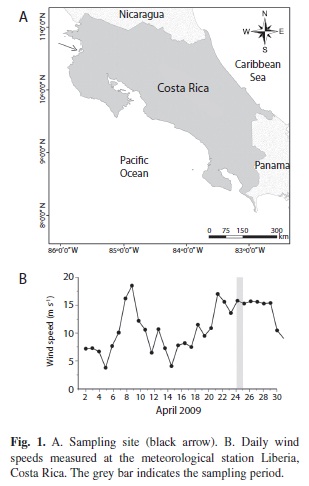
</front><body><![CDATA[ <div style="text-align: justify;">     <div style="text-align: center;"><font style="font-weight: bold;"  size="4"><span style="font-family: verdana;">Impact of upwelling events on the sea water carbonate chemistry and dissolved oxygen concentration in the Gulf of Papagayo     <br> (Culebra Bay), Costa Rica: Implications for coral reefs</span></font><br  style="font-family: verdana;"> </div> <br style="font-family: verdana;">     <div style="text-align: center;"><font size="2"><span  style="font-family: verdana;">Tim Rixen<sup><a href="#1">1</a><a  name="4"></a>*</sup>, Carlos Jim&eacute;nez<sup><a href="#2">2</a><a name="5"></a>*,<a href="#3">3</a><a  name="6"></a>*</sup>&nbsp; &amp; Jorge Cort&eacute;s<a href="#3"><sup>3</sup></a></span></font><br  style="font-family: verdana;"> </div> <font size="2"><span style="font-family: verdana;"></span></font><br  style="font-family: verdana;"> <font style="font-family: verdana;" size="-1"><a name="Correspondencia2"></a>*<a  href="#Correspondencia1">Direcci&oacute;n para correspondencia</a></font><br style="font-family: verdana;"> <font style="font-weight: bold;" size="3"><span  style="font-family: verdana;"></span></font> <hr style="width: 100%; height: 2px;"><font style="font-weight: bold;"  size="3"><span style="font-family: verdana;">Abstract</span></font><br  style="font-family: verdana;"> <br style="font-family: verdana;"> <font size="2"><span style="font-family: verdana;">The Gulf of Papagayo, Pacific coast of Costa Rica, is one of the three seasonal upwelling areas of Mesoamerica. In April 2009, a 29-hour experiment was carried out at the pier of the Marina Papagayo, Culebra Bay. We determined sea surface temperature (SST), dissolved oxygen concentration, salinity, pH, and the partial pressure of CO<sub>2</sub> (<span style="font-style: italic;">p</span>CO<sub>2</sub>). The aragonite saturation state (&#937;<sub>a</sub>) as well as the other parameters of the marine carbonate system such as the total dissolved inorganic carbon (DIC) and the total alkalinity (TA) were calculated based on the measured pH and the <span style="font-style: italic;">p</span>CO<sub>2</sub>. The entrainment of subsurface waters raised the <span style="font-style: italic;">pCO<sub>2</sub>&nbsp;</span> up to 645 &micro;atm. SSTs, dissolved oxygen concentrations decreased form 26.4 to 23.7&deg;C and from 228 to 144 &micro;mol l<sup>-1</sup>. &#937;<sub>a</sub> dropped down to values of 2.1. Although these changes are assumed to reduce the coral growth, the main reef building coral species within the region (<span style="font-style: italic;">Pocillopora</span> spp. and <span style="font-style: italic;">Pavona clavus</span>) reveal growth rates exceeding those measured at other sites in the eastern tropical Pacific. This implies that the negative impact of upwelling on coral growth might be overcompensated by an enhanced energy supply caused by the high density of food and nutrients and more favorable condition for coral growth during the&nbsp; non-upwelling season. </span></font><br style="font-family: verdana;"> <br style="font-family: verdana;"> <font size="2"><span style="font-family: verdana;"><span  style="font-weight: bold;">Key words:</span> <span  style="font-style: italic;">p</span>CO<sub>2</sub>, dissolved oxygen, upwelling, Gulf of Papagayo, aragonite saturation state, Costa Rica, corals.</span></font><br  style="font-family: verdana;"> <br style="font-family: verdana;"> <font style="font-weight: bold;" size="3"><span  style="font-family: verdana;">Resumen</span></font><br  style="font-family: verdana;"> <br style="font-family: verdana;"> <font size="2"><span style="font-family: verdana;">El Golfo de Papagayo, costa Pac&iacute;fica de Costa Rica, es una de las tres regiones de afloramiento estacional de Mesoam&eacute;rica. Las caracter&iacute;sticas f&iacute;sicas y qu&iacute;micas del agua que aflora no hab&iacute;an sido estudiadas. Durante 29 horas en Abril 2009, se estudiaron la temperatura superficial del mar (TSM), la concentraci&oacute;n de ox&iacute;geno disuelto, salinidad, pH y la presi&oacute;n parcial de CO<sub>2</sub> (pCO<sub>2</sub>), en la Marina Papagayo, Bah&iacute;a Culebra. Con base en las mediciones de pH y <span  style="font-style: italic;">p</span>CO<sub>2</sub>&nbsp; se calcul&oacute; el estado de saturaci&oacute;n de&nbsp; la&nbsp; aragonita&nbsp; (&#937;) y&nbsp; otros&nbsp; par&aacute;metros&nbsp; del sistema de carbonatos como lo es el carbono org&aacute;nico disuelto (COD) y la alcalinidad total (AT). Los resultados indican que el arrastre por convecci&oacute;n&nbsp; del&nbsp; agua&nbsp; sub-superficial&nbsp; durante los eventos de afloramiento aumenta la <span style="font-style: italic;">p</span>CO2 y disminuye la TSM, la concentraci&oacute;n de ox&iacute;geno disuelto y &#937;. Aunque se asume que estas condiciones reducen el crecimiento coralino, las principales especies constructoras de arrecife en la regi&oacute;n de Papagayo (<span  style="font-style: italic;">Pocillopora </span>spp. y<span  style="font-style: italic;"> Pavona clavus</span>) tienen las mayores tasas de crecimiento en el Pac&iacute;fico Tropical Oriental. Esto posiblemente implica que el efecto negativo del afloramiento es compensado por el crecimiento durante la &eacute;poca de no afloramiento.</span></font><font size="2"><span  style="font-family: verdana;">    <br> </span></font> <hr style="width: 100%; height: 2px;"><font size="2"><span  style="font-family: verdana;">    <br> The eastern tropical Pacific (ETP) contains one of the most pronounced and largest mid-water oxygen minimum zones (OMZ) in the world&#8217;s oceans (Conkright <span style="font-style: italic;">et al.</span> 2002). Along the Californian coast, upwelling is known to carry oxygen-depleted and carbonenriched subsurface waters into the surface layers, which leads to <span  style="font-style: italic;">p</span>CO<sub>2</sub>&#8217;s of ~ 1000 &micro;atm and&nbsp; &#937;a&nbsp;&nbsp; of&nbsp; &lt;&nbsp; 1&nbsp; (Feely&nbsp; <span style="font-style: italic;">et&nbsp; al.</span>&nbsp; 2008).&nbsp; Experiments have shown that calcification of many scleractinian&nbsp; corals&nbsp; decline&nbsp; with&nbsp; decreasing &#937;<sub>a</sub>. Accordingly&nbsp; ocean&nbsp; acidification&nbsp; caused by the rising CO2&nbsp; concentration in the atmosphere is assumed to be a significant threat to coral reefs (Kleypas <span style="font-style: italic;">et al.</span> 2006). A tripling of the pre-industrial CO<sub>2&nbsp;</sub>&nbsp; concentration from 280 to 840 &micro;atm which is predicted to occur within&nbsp; the&nbsp; forthcoming&nbsp; 100&nbsp; years&nbsp; (Meehl <span style="font-style: italic;">et al.</span> 2007) could decrease &#937;<sub>a</sub>&nbsp; from 3.44 to 1.81 and calcification of specific corals species by up to 85% (Kleypas <span  style="font-style: italic;">et al.</span> 2006). In order to study possible effects of upwelling on reef forming corals in Culebra Bay within the Gulf of Papagayo, SST, salinity, dissolved oxygen&nbsp; concentration,&nbsp; pH,&nbsp; and&nbsp; <span style="font-style: italic;">p</span>CO<sub>2</sub>&nbsp;&nbsp;&nbsp; were measured&nbsp; during&nbsp; upwelling&nbsp; events&nbsp; triggered by the Papagayo winds at the end of April 2009 (<a href="#fig_1">Fig. 1</a>).    <br>     <br> </span></font>     <div style="text-align: center;"><font size="2"><a name="fig_1"></a><img      alt="" src="/img/revistas/rbt/v60s2/a13i1.jpg"     ]]></body>
<body><![CDATA[ style="width: 309px; height: 486px;"><span      style="font-family: verdana;"></span></font><br      style="font-family: verdana;">     <font size="2"><span style="font-family: verdana;"></span></font></div>     <br style="font-family: verdana;">     <font style="font-weight: bold;" size="3"><span      style="font-family: verdana;">Material and Methods</span></font><br      style="font-family: verdana;">     <br style="font-family: verdana; font-weight: bold;">     <font size="2"><span style="font-family: verdana;"><span     ]]></body>
<body><![CDATA[ style="font-weight: bold;">Study site:</span> The     Papagayo wind is a     strong north-easterly jet blowing     through low elevation gaps of the Central American cordillera in     southern Nicaragua and northern Costa Rica. The jet is driven by the     sea level pressure difference between the Caribbean Sea and the     eastern tropical Pacific (ETP) which develops during the boreal winter     and the associated south-eastward migration of the subtropical     Azores-Bermuda high (Clarke 1988, Amador <span      style="font-style: italic;">et al.</span> 2006, Romero-Centeno <span     ]]></body>
<body><![CDATA[ style="font-style: italic;">et     al.</span> 2007). Outbreaks of cold air masses from the North American     continent into the Caribbean occasionally increase the sea level     pressure difference between the two oceans and intensify the Papagayo     winds (Clarke 1988, Alfaro &amp; Cort&eacute;s 2011).&nbsp;     During&nbsp; such&nbsp; wind&nbsp; events,&nbsp; offshoreadvecting     cyclonic and anticyclonic eddies spin&nbsp; up south and north of the     axis of the Papagayo Jet leading to upwelling of subsurface waters     along the Nicaraguan coast and in the Gulf of Papagayo (McCreary <span      style="font-style: italic;">et al.</span>     ]]></body>
<body><![CDATA[1989, Ballestero &amp; Coen 2004, Kessler 2006). The cyclonic eddies     south of the Papagayo Jet intensify the shoaling of the thermocline     within the Costa Rica Dome region, which is connected to the coast     between March and April (Fiedler 2002, Fiedler &amp; Talley 2006).     Due to upwelling and wind mixing the SST can drop by up to 10&deg;C     within hours within the Gulf of Papagayo (Jim&eacute;nez 2001,     Alfaro &amp; Cort&eacute;s 2011). The coral habitats of the Gulf of     Papagayo are of special interest due to the high abundance of large     reefs built almost entirely by P<span style="font-style: italic;">avona     clavus </span>and<span style="font-style: italic;"> Pocillopora</span>     ]]></body>
<body><![CDATA[spp. and     the presence of rare or endangered coral species with restricted     distributions (Cort&eacute;s &amp; Jim&eacute;nez 2003, Jim&eacute;nez     <span style="font-style: italic;">et al.</span> 2010).</span></font><br      style="font-family: verdana;">     <br style="font-family: verdana; font-weight: bold;">     <font size="2"><span style="font-family: verdana;"><span      style="font-weight: bold;">Methods:</span> The SST and     the mole     fraction&nbsp; of CO<sub>2</sub>&nbsp; (xCO<sub>2</sub>) was     ]]></body>
<body><![CDATA[measured by an underway pCO2&nbsp; system (SUNDANS) at a water-depth of     ~ 3 m. The system was set up on April 24<sup>th</sup>&nbsp; at&nbsp;     1:00 am at     one of the outer piers of the Marina Papagayo&nbsp;     (85&deg;39&#8217;21.41&#8221;W;&nbsp; 10&deg;32&#8217;32.89&#8221;N) in order to reduced     impacts from the Marina at our sampling site. However, during the     sampling period there was no ship traffic and the pier moved up and     down with the tide so that water-depth from which we pumped the water     remained constant throughout the experiment. SUNDANS was developed by     &#8220;Marine Analytics and Data&#8221; (MARIANDA, Germany, www.marianda.com)     ]]></body>
<body><![CDATA[according to the recommendations of the 2002 underway     pCO<sub>2</sub>&nbsp;&nbsp; system workshop in Miami, Florida (NOAA     &amp; AOML     2002). It was equipped with a shower type equilibrator, an open     pre-equilibrator and a non-dispersive dual cell infrared gas analyzer     (LI-7000). The LI-7000 was calibrated by using nitrogen gas (zero CO<sub>2</sub>)     and a standard gas for CO<sub>2</sub>. The CO<sub>2</sub>&nbsp;     standard gases     were checked against the standard gases provided by NOAA (CA07600 and     CC311968) at the Institute for Baltic Sea Research in Warnem&uuml;nde,     ]]></body>
<body><![CDATA[Germany. The accuracy of the measured xCO<sub>2</sub>&nbsp; was     &plusmn;1.6&nbsp;     ppm. The xCO<sub>2</sub>&nbsp;&nbsp; data were recorded every six     seconds and     subsequently averaged minute by minute. xCO2 was converted into pCO<sub>2</sub>     and the fugacity of CO<sub>2</sub>&nbsp; (&#402;CO<sub>2</sub>) according to     equations provided by     Zeebe and Wolf-Gladrow (2001). The SSTs were measured within the     equilibrator. The atmospheric pressure and the wind speed were     obtained from the meteorological station in Liberia approximately 30 km     ]]></body>
<body><![CDATA[east of the sampling site (NCDC 2011). Salinity and the dissolved     oxygen concentrations were determined by using WTW probes (Cond3310 and     Multi 340i). The pH was measured using an Orion ROSS electrode and an     Orion Star<sup>TM</sup>. The Orion ROSS electrode was calibrated by     using NBS     standards and re-calibrated by using the RCM standards (Batch 82:     http://andrew. ucsd.edu/co2qc/). &#937;<sub>a</sub>, DIC, and TA were     calculated&nbsp; based&nbsp; on&nbsp; the&nbsp; &#402;CO<sub>2</sub>&nbsp;&nbsp;     and&nbsp;     the pH.&nbsp; In order remove effects caused by temperature changes,     ]]></body>
<body><![CDATA[DIC and TA were used to compute the &#402;CO<sub>2(DIC/TA)</sub> using a     constant     salinity&nbsp; and temperature of 34.51 and 25.01&deg;C.</span></font><br      style="font-family: verdana;">     <br style="font-family: verdana;">     <font style="font-weight: bold;" size="3"><span      style="font-family: verdana;">Results</span></font><br      style="font-family: verdana; font-weight: bold;">     <br style="font-family: verdana;">     <font size="2"><span style="font-family: verdana;">During the     ]]></body>
<body><![CDATA[experiment the salinity     and temperature&nbsp; varied&nbsp;     between&nbsp; 34.4&nbsp; and&nbsp; 34.9 and 23.7 and 26.2&deg;C. The     mean salinity and temperature of 34.51 and 25.01&deg;C were used to     calculate &#402;CO<sub>2(DIC/TA)</sub> as mentioned before. On April&nbsp;     24<sup>th</sup> between&nbsp; 05:00&nbsp; and&nbsp; 06:00&nbsp;     am the SST dropped precipitously from 26.4&deg;C to 24.1&deg;C (<a      href="/img/revistas/rbt/v60s2/a13i2.jpg">Fig.     2</a>). This drop was associated with decreases in pH and oxygen     concentration from 8.01 to 7.86 and 228 to 144 &micro;mol l<sup>-1</sup>,     ]]></body>
<body><![CDATA[respec-tively, as well as an increase in pCO2&nbsp; from 475 to 645     &micro;atm. Between 06:00 and 12:00 am, the SST increased from     24.1&deg;C to 25.9&deg;C, and then steadily decreased to a minimum     value of&nbsp; around&nbsp; 23.9&deg;C&nbsp; at&nbsp; ~&nbsp; 23:00.     The&nbsp; first&nbsp; and the second period during which cold water     occurred at the surface are referred to as the first and the second     upwelling event during the following discussion (<a      href="/img/revistas/rbt/v60s2/a13i2.jpg">Fig. 2</a>). The period     prior to the first upwelling event is considered as pre-upwelling     period. Wind speeds measured at the Meteorological Station Liberia     ]]></body>
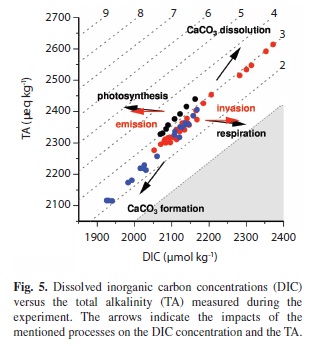
<body><![CDATA[indicate that the sampling period was characterized by an     intensification of the Papagayo winds (<a href="#fig_1">Fig. 1</a>).    <br>     <br> </span></font><font style="font-weight: bold;" size="3"><span  style="font-family: verdana;">Discussion</span></font><br  style="font-family: verdana;"> <br style="font-family: verdana;"> <font size="2"><span style="font-family: verdana;">The simultaneous drop of SST, dissolved oxygen, and pH indicate that oxygen-depleted and CO2-enriched subsurface waters were entrained&nbsp; into&nbsp; the&nbsp; surface&nbsp; layer&nbsp; in&nbsp; the&nbsp; early morning hours on April 24th (<a  href="/img/revistas/rbt/v60s2/a13i2.jpg">Fig. 2</a>). The observed SST drop of 2.3&deg;C was associated with a decrease in the oxygen concentration of 84 &micro;mol l<sup>-1</sup>&nbsp; corresponding to a 37% reduction of the dissolved oxygen concentration. During the second upwelling event the decrease in oxygen concentration and pH was less pronounced but reveal as the data obtained during the first upwelling&nbsp; event&nbsp; and&nbsp; elsewhere&nbsp; (Feely&nbsp; <span style="font-style: italic;">et&nbsp; al.</span> 2008, Manzello <span  style="font-style: italic;">et al.</span> 2008, Manzello 2010b), that wind-driven upwelling events in the ETP can deliver oxygen-poor, acidic waters to the surface along the coast. Continuous measurements of SST in the vicinity of our sampling site between 1993 and 1996, within a reef built by the massive coral species Pavona clavus, show as&nbsp; mentioned&nbsp; before,&nbsp; that&nbsp; SST&nbsp; can&nbsp; decrease by up 8-10&deg;C for some hours during upwelling&nbsp; events&nbsp; (Jim&eacute;nez&nbsp; 2001).&nbsp; This&nbsp; SST-record was extended until March 2009 and revealed a mean SST of 25&deg;C in April (<a  href="/img/revistas/rbt/v60s2/a13i3.jpg">Fig. 3a</a>) which almost equals the mean SST of 25.09&deg;C measured during our experiment. As indicated by the 1x1 degree gridded World Ocean Atlas Data (WOA09 2009) a temperature of 25&deg;C associated with oxygen concentrations of 209 &micro;mol l-1&nbsp; occur on average at water-depth between 20 and 30 m within the this region in April (<a  href="/img/revistas/rbt/v60s2/a13i3.jpg">Fig. 3b</a>). Since this oxygen concentration is similar to those measured during our experiment (<a href="/img/revistas/rbt/v60s2/a13i2.jpg">Fig. 2</a>) it is assumed that the upwelled water was originated at this depth-range during our experiment. Oxygen concentrations between 40 and 80 &micro;mol l<sup>-1</sup> which are assumed to represent a range below which benthic fauna and reef fishes start to respond to oxygen depletion (Nilsson <span  style="font-style: italic;">et al.</span> 2007, Diaz &amp; Rosenberg 2008) occurred at water-depth between 75 and 100 m (<a  href="/img/revistas/rbt/v60s2/a13i3.jpg">Fig. 3b</a>). These&nbsp; oxygen&nbsp; concentrations&nbsp; are&nbsp; associated with temperatures between approximately 14.5 and 16.5 C&deg;. Since such low SSTs occur only during extreme strong upwelling events at the surface (<a href="/img/revistas/rbt/v60s2/a13i3.jpg">Fig. 3a</a>) oxygen-depletion caused the entrainment of oxygen-poor subsurface water appears only occasionally be of importance at the study site. However, this might change in future because mid-water oxygen minimum zone are expanding in the ETA (Stramma <span  style="font-style: italic;">et al.</span> 2008, Stramma <span style="font-style: italic;">et al.</span> 2010) and a strengthening of the trade winds system and the associated upwelling systems is assumed to be caused by global warming (Mitas &amp; Clement 2005, 2006, Bakun <span  style="font-style: italic;">et al.</span> 2010).    <br>     <br> </span></font><font size="2"><span style="font-family: verdana;"></span></font><font  size="2"><span style="font-family: verdana;">SSTs correlate not only with the oxygen concentrations but also with the pH and DIC/TA ratios (<a href="/img/revistas/rbt/v60s2/a13i4.jpg">Fig.4 a,b</a>). varying&nbsp; values&nbsp; and relationships between these parameters and the SSTs indicate a different history of the water masses, which were entrained into the surface waters during the pre-upwelling period and the two upwelling events. The main factor controlling the pH and the <span style="font-style: italic;">p</span>CO<sub>2</sub>&nbsp; is the DIC/TA ratio as indicated by the correlation between this ratio, the pH and <span style="font-style: italic;">p</span>CO<sub>2(DIC/TA)</sub> (<a href="/img/revistas/rbt/v60s2/a13i4.jpg">Fig. 4 c, d</a>). The DIC concentration and the TA are&nbsp; influenced by the precipitation and dissolution of calcium carbonate as well as by the photosynthesis and the respiration of organic&nbsp; matter (<a href="#fig_5">Fig. 5</a>). In addition to these two biological processes windinduced turbulent&nbsp; mixing of surface and subsurface water could be another important factor affecting these parameters at our sampling site. Contrary&nbsp; to biological processes and mixing, the&nbsp; CO<sub>2</sub>&nbsp;&nbsp; fluxes&nbsp; across&nbsp; the&nbsp; air-sea&nbsp; interface, which&nbsp; as&nbsp; assumed to be minor importance on the time scale considered here (Frankignoulle <span style="font-style: italic;">et al.</span> 1996) influence the DIC concentration, only. Since respiration consumes oxygen and release DIC, oxygen-depleted subsurface waters are generally enriched in DIC. This appears not be the case at our study during the first upwelling event (<a  href="/img/revistas/rbt/v60s2/a13i2.jpg">Fig. 2</a>). During this event water depleted in oxygen, DIC, and TA welled up and displaced surface waters enriched in all these parameters. </span></font><font  size="2"><span style="font-family: verdana;">Enhanced DIC concentrations and high TA imply that the dissolution of carbonates was a dominant process within the surface water during the pre-upwelling period. The much slower entrainment of subsurface water and resulting stronger effect of the carbonate dissolution on the carbonate chemistry within the upwelled water might also explain the higher pH values within the surface water during the second upwelling event. Ignoring physical effects, increases of the DIC concentration and the TA would imply a mean carbonate dissolution to respiration ratio of ~1.8 during the pre-upwelling period as indicated by the linear correlation between DIC and TA (<a href="#fig_5">Fig. 5</a>). During the first upwelling event the mean carbonate dissolution to respiration ratio was 1.3. If this ratio would have been &lt; ~1 due to reduced dissolution of calcium carbonate and an enhanced respiration an increase in DIC and TA would have reduces instead of increased &#937;<sub>a</sub> (<a href="#fig_5">Fig 5</a>).    <br>     <br> </span></font>     <div style="text-align: center;"><font size="2"><a name="fig_5"></a><img  alt="" src="/img/revistas/rbt/v60s2/a13i5.jpg"  style="width: 309px; height: 346px;"><span  style="font-family: verdana;"></span></font>    <br> <font size="2"><span style="font-family: verdana;"></span></font></div> <font size="2"><span style="font-family: verdana;">    ]]></body>
<body><![CDATA[<br> </span></font><font size="2"><span style="font-family: verdana;">Prior to the first upwelling event between 1:00 and 5:00 am, &#937;<sub>a</sub>&nbsp; was ~3.2 with slightly lower than the values shown on maps (~3.5-3.6) derived from climatological data for the region off Costa Rica (Manzello <span style="font-style: italic;">et al.</span> 2008). During the first upwelling event, &#937;<sub>a</sub>&nbsp; fell to values as low as ~2.1. During the second, slower entrainment of subsurface waters, &#937;<sub>a</sub>&nbsp; reached a value of ~2.5 which is similar to those measured in reefs effected by upwelling in Gal&aacute;pagos (<a  href="/img/revistas/rbt/v60s2/a13i6.jpg">Fig. 6</a>).&nbsp; Such&nbsp; low&nbsp; &#937;<sub>a</sub>&#8217;s could&nbsp; reduce&nbsp; the&nbsp; growth of many coral species (Langdon &amp; Atkinson 2005, Kleypas <span  style="font-style: italic;">et al.</span> 2006) and favor, at the same time, bioerosion within reefs by reducing the formation of carbonate cements (Manzello&nbsp; <span style="font-style: italic;">et&nbsp; al.</span>&nbsp; 2008).&nbsp; Bioerosion&nbsp; could&nbsp; explain carbonate dissolution in water supersaturated with respect to calcium carbonates (&#937;<sub>a</sub> &lt;1, <a href="#fig_5">Fig. 5</a>) and lowers impacts of acidic water in reefs by increasing &#937;<sub>a</sub> during upwelling periods.    <br>     <br> </span></font><font size="2"><span style="font-family: verdana;">The main reef building corals in the vicin-ity of our study sites <span style="font-style: italic;">Pocillopora </span>spp. and<span  style="font-style: italic;"> Pavona clavus</span> reveal growth rates exceeding those measured in Gal&aacute;pagos, Panam&aacute;, and Colombia (<a  href="/img/revistas/rbt/v60s2/a13i6.jpg">Fig. 6</a>, Jim&eacute;nez &amp; Cort&eacute;s 2003). Coral calcification is an energy demanding process in the course of which proton pumps such as the Ca<sup>2+</sup>-ATPase increase pH and the Ca<sup>2+</sup> concentration within the calcifying cells (Al-Horani&nbsp; <span  style="font-style: italic;">et&nbsp; al.</span>&nbsp; 2003). Accordingly&nbsp; it&nbsp; was suggested that an enhanced energy supply could also counteract effects of a reduced &#937;<sub>a</sub> on the coral calcification by increasing the activity&nbsp; of&nbsp; the Ca<sup>2+</sup>-ATPase&nbsp; (Cohen&nbsp; &amp;&nbsp; Holcomb 2009). High density of nutrient and biomass and the resulting enhanced autotrophic and heterotrophic energy supply might in addition to hosting growth supporting thermally less tolerant zooxanthellae, be a process explaining the high growth rate of Pocillopora spp. and Pavona clavus at our study site (Manzello 2010a). However, in high productive regions shading caused by the high biomass density could reduce the penetration depth of light and thus the photosynthesis. Compared to Pavona calvus, Pocillopora damicornis seem to be less efficient in compensating a reduced energy supply of its zooxanthellae by an increased heterotrophic feeding (Houlbr&egrave;que &amp; Ferrier-Pag&egrave;s 2009). This might be a reason for the growth rates of <span  style="font-style: italic;">Pocillopora damicornis</span> which are lower in upwelling regions off Gal&aacute;pagos and Panam&aacute; than in the non-upwelling region off Panam&aacute; and their enhanced sensitively against ocean acidification in the ETA (Manzello 2010a). However, the high growth rates at our study site in Culebra Bay might additionally be favored by a higher &#937;<sub>a</sub> during the non-upwelling season, which needs to be proved </span></font><font  size="2"><span style="font-family: verdana;">in future studies. Such future studies should also consider impacts of reduced availability of dissolved oxygen on the heterotrophic energy supply, which is assumed to be of importance for counteracting ocean acidification effects in upwelling influence reef in future.</span></font><br  style="font-family: verdana;"> <br style="font-family: verdana;"> <font style="font-weight: bold;" size="3"><span  style="font-family: verdana;">Acknowledgments</span></font><br  style="font-family: verdana;"> <br style="font-family: verdana;"> <font size="2"><span style="font-family: verdana;">We&nbsp;&nbsp; would&nbsp;&nbsp; like&nbsp;&nbsp; to&nbsp;&nbsp; thank&nbsp;&nbsp; the&nbsp;&nbsp; ZMT and&nbsp;&nbsp; the&nbsp;&nbsp; CIMAR&nbsp;&nbsp; (projects&nbsp;&nbsp; 808-A7-520, FUNDEvI-2059) for the financial support, Ludger Mintrop, Eleazar Ru&iacute;z (Gaspa), Celeste S&aacute;nchez-Noguera and Nicolas Duprey for discussions and support during the fieldwork as well as Eric Alfaro, Joanie Kleypas and one anonymous reviewer for constructive comments and suggestions which were very helpful&nbsp; for&nbsp; improving&nbsp; the&nbsp; manuscript.&nbsp; We&nbsp; are also grateful to Robert Schmidt and Bernd Schneider&nbsp; for&nbsp; calibrating&nbsp; our&nbsp; CO2&nbsp;&nbsp;&nbsp; standards</span></font><br  style="font-family: verdana;"> <font size="2"><span style="font-family: verdana;">with&nbsp; the&nbsp; NOAA&nbsp; gas&nbsp; and&nbsp; to&nbsp; P. Wessels&nbsp; and W.H.F. Smith for providing the generic mapping tools (GMT).</span></font><br style="font-family: verdana;"> <font style="font-weight: bold;" size="3"><span  style="font-family: verdana;"></span></font> <hr style="width: 100%; height: 2px;"><font style="font-weight: bold;"  size="3">    <!-- ref --><br> <span style="font-family: verdana;">References</span></font><br  style="font-family: verdana;"> <br style="font-family: verdana;"> <font size="2"><span style="font-family: verdana;">Al-Horani,&nbsp; F.A., S.M. Al-Moghrabi &amp; D. de&nbsp; Beer. 2003. The&nbsp; mechanism of calcification and its&nbsp; relation to photosynthesis and respiration in the&nbsp; scleractinian coral Galaxea fascicularis. Mar. Biol. 142: 419-426.    &nbsp;&nbsp;&nbsp;&nbsp;&nbsp;&nbsp;&nbsp;&nbsp;[&#160;<a href="javascript:void(0);" onclick="javascript: window.open('/scielo.php?script=sci_nlinks&ref=1447019&pid=S0034-7744201200060001300001&lng=','','width=640,height=500,resizable=yes,scrollbars=1,menubar=yes,');">Links</a>&#160;]<!-- end-ref --><!-- ref --></span></font><br  style="font-family: verdana;"> <br style="font-family: verdana;"> <font size="2"><span style="font-family: verdana;">Alfaro, E.J. &amp; J. Cort&eacute;s. 2012. Atmospheric forcing of cold subsurface water events in Bah&iacute;a Culebra, Costa Rica. Rev. Biol. Trop. 60 (Suppl. 2): 173-186.    &nbsp;&nbsp;&nbsp;&nbsp;&nbsp;&nbsp;&nbsp;&nbsp;[&#160;<a href="javascript:void(0);" onclick="javascript: window.open('/scielo.php?script=sci_nlinks&ref=1447020&pid=S0034-7744201200060001300002&lng=','','width=640,height=500,resizable=yes,scrollbars=1,menubar=yes,');">Links</a>&#160;]<!-- end-ref --><!-- ref --></span></font><br  style="font-family: verdana;"> <br style="font-family: verdana;"> <font size="2"><span style="font-family: verdana;">Amador, J.A., E.J. Alfaro, O.G. Lizano &amp; v.O.&nbsp; Maga&ntilde;a. 2006.&nbsp; Atmospheric forcing in the Eastern&nbsp; Tropical Pacific: A review. Prog. Oceanog. 69: 101-142.    &nbsp;&nbsp;&nbsp;&nbsp;&nbsp;&nbsp;&nbsp;&nbsp;[&#160;<a href="javascript:void(0);" onclick="javascript: window.open('/scielo.php?script=sci_nlinks&ref=1447021&pid=S0034-7744201200060001300003&lng=','','width=640,height=500,resizable=yes,scrollbars=1,menubar=yes,');">Links</a>&#160;]<!-- end-ref --><!-- ref --></span></font><br  style="font-family: verdana;"> <br style="font-family: verdana;"> <font size="2"><span style="font-family: verdana;">Bakun,&nbsp; A.,&nbsp; D.B.&nbsp; Field,&nbsp; A.&nbsp; Redondo-Rodriguez&nbsp; &amp;&nbsp; S.J. Weeks. 2010. Greenhouse gas,&nbsp; upwelling-favorable winds,&nbsp; and&nbsp; the&nbsp; future of coastal ocean upwelling ecosystems. Glob. Change Biol 16: 1213-1228.    &nbsp;&nbsp;&nbsp;&nbsp;&nbsp;&nbsp;&nbsp;&nbsp;[&#160;<a href="javascript:void(0);" onclick="javascript: window.open('/scielo.php?script=sci_nlinks&ref=1447022&pid=S0034-7744201200060001300004&lng=','','width=640,height=500,resizable=yes,scrollbars=1,menubar=yes,');">Links</a>&#160;]<!-- end-ref --><!-- ref --></span></font><br  style="font-family: verdana;"> <br style="font-family: verdana;"> <font size="2"><span style="font-family: verdana;">Ballestero, D. &amp; J.E. Coen. 2004. Generation and propagation of anticyclonic rings in the Gulf of Papagayo. Int. J. Remote Sens. 25: 2217-2224.    &nbsp;&nbsp;&nbsp;&nbsp;&nbsp;&nbsp;&nbsp;&nbsp;[&#160;<a href="javascript:void(0);" onclick="javascript: window.open('/scielo.php?script=sci_nlinks&ref=1447023&pid=S0034-7744201200060001300005&lng=','','width=640,height=500,resizable=yes,scrollbars=1,menubar=yes,');">Links</a>&#160;]<!-- end-ref --><!-- ref --></span></font><br style="font-family: verdana;"> <br style="font-family: verdana;"> <font size="2"><span style="font-family: verdana;">Clarke, A.J. 1988. Inertial wind path and sea surface temperature patterns near the Gulf of Tehuantepec and Gulf of Papagayo. J. Geophys. Res. 93: 15491-15501.    &nbsp;&nbsp;&nbsp;&nbsp;&nbsp;&nbsp;&nbsp;&nbsp;[&#160;<a href="javascript:void(0);" onclick="javascript: window.open('/scielo.php?script=sci_nlinks&ref=1447024&pid=S0034-7744201200060001300006&lng=','','width=640,height=500,resizable=yes,scrollbars=1,menubar=yes,');">Links</a>&#160;]<!-- end-ref --><!-- ref --></span></font><br style="font-family: verdana;"> <br style="font-family: verdana;"> <font size="2"><span style="font-family: verdana;">Cohen, A.L. &amp; M. Holcomb. 2009. Why corals care about ocean&nbsp; acidification: Uncovering&nbsp; the&nbsp; mechanism. Oceanography 22: 118-127.    &nbsp;&nbsp;&nbsp;&nbsp;&nbsp;&nbsp;&nbsp;&nbsp;[&#160;<a href="javascript:void(0);" onclick="javascript: window.open('/scielo.php?script=sci_nlinks&ref=1447025&pid=S0034-7744201200060001300007&lng=','','width=640,height=500,resizable=yes,scrollbars=1,menubar=yes,');">Links</a>&#160;]<!-- end-ref --><!-- ref --></span></font><br style="font-family: verdana;"> <br style="font-family: verdana;"> <font size="2"><span style="font-family: verdana;">Cort&eacute;s, J. &amp; C.E. Jim&eacute;nez. 2003. Corals and coral reefs of the Pacific of Costa Rica: history, research and status, pp.&nbsp; 361-385.&nbsp; In:&nbsp; J.&nbsp; Cort&eacute;s&nbsp; (Ed.).&nbsp; Latin&nbsp; American Coral Reefs. Elsevier, Amsterdam.    &nbsp;&nbsp;&nbsp;&nbsp;&nbsp;&nbsp;&nbsp;&nbsp;[&#160;<a href="javascript:void(0);" onclick="javascript: window.open('/scielo.php?script=sci_nlinks&ref=1447026&pid=S0034-7744201200060001300008&lng=','','width=640,height=500,resizable=yes,scrollbars=1,menubar=yes,');">Links</a>&#160;]<!-- end-ref --><!-- ref --></span></font><br  style="font-family: verdana;"> <br style="font-family: verdana;"> <font size="2"><span style="font-family: verdana;">Diaz,&nbsp; R.J. &amp; R. Rosenberg. 2008. Spreading&nbsp; dead zones and&nbsp; consequences&nbsp; for&nbsp; marine&nbsp; ecosystems.&nbsp; Science 321: 926-929.    &nbsp;&nbsp;&nbsp;&nbsp;&nbsp;&nbsp;&nbsp;&nbsp;[&#160;<a href="javascript:void(0);" onclick="javascript: window.open('/scielo.php?script=sci_nlinks&ref=1447027&pid=S0034-7744201200060001300009&lng=','','width=640,height=500,resizable=yes,scrollbars=1,menubar=yes,');">Links</a>&#160;]<!-- end-ref --><!-- ref --></span></font><br style="font-family: verdana;"> <br style="font-family: verdana;"> <font size="2"><span style="font-family: verdana;">Feely, R.A., C.L. Sabine, J.M.&nbsp; Hernandez-Ayon, D. Ianson &amp; B.&nbsp; Hales. 2008. Evidence for upwelling of corrosive &#8220;acidified&#8221; water onto the continental shelf. Science 320: 1490-1492.    &nbsp;&nbsp;&nbsp;&nbsp;&nbsp;&nbsp;&nbsp;&nbsp;[&#160;<a href="javascript:void(0);" onclick="javascript: window.open('/scielo.php?script=sci_nlinks&ref=1447028&pid=S0034-7744201200060001300010&lng=','','width=640,height=500,resizable=yes,scrollbars=1,menubar=yes,');">Links</a>&#160;]<!-- end-ref --><!-- ref --></span></font><br  style="font-family: verdana;"> <br style="font-family: verdana;"> <font size="2"><span style="font-family: verdana;">Fiedler, P.C. 2002. Environmental change in&nbsp; the eastern tropical Pacific Ocean: review of ENSO and decadal variability. Mar. Ecol. Prog. Ser. 244: 265-283.    &nbsp;&nbsp;&nbsp;&nbsp;&nbsp;&nbsp;&nbsp;&nbsp;[&#160;<a href="javascript:void(0);" onclick="javascript: window.open('/scielo.php?script=sci_nlinks&ref=1447029&pid=S0034-7744201200060001300011&lng=','','width=640,height=500,resizable=yes,scrollbars=1,menubar=yes,');">Links</a>&#160;]<!-- end-ref --><!-- ref --></span></font><br style="font-family: verdana;"> <br style="font-family: verdana;"> <font size="2"><span style="font-family: verdana;">Fiedler,&nbsp; P.C.&nbsp; &amp;&nbsp; L.D. Talley.&nbsp; 2006.&nbsp; Hydrography&nbsp; of&nbsp; the eastern tropical Pacific: a review. Prog. Oceanog 69: 143-180.    &nbsp;&nbsp;&nbsp;&nbsp;&nbsp;&nbsp;&nbsp;&nbsp;[&#160;<a href="javascript:void(0);" onclick="javascript: window.open('/scielo.php?script=sci_nlinks&ref=1447030&pid=S0034-7744201200060001300012&lng=','','width=640,height=500,resizable=yes,scrollbars=1,menubar=yes,');">Links</a>&#160;]<!-- end-ref --><!-- ref --></span></font><br  style="font-family: verdana;"> <br style="font-family: verdana;"> <font size="2"><span style="font-family: verdana;">Frankignoulle, M., J.P. Gattuso, R. Biondo, I. Bourge, G. Copin-Mont&eacute;gut &amp; M. Pichon. 1996. Carbon fluxes in coral reefs. II. Eulerian study of inorganic carbon dynamics and&nbsp; measurement of air-sea CO2 exchanges. Mar. Ecol. Prog. Ser 145: 123-132.    &nbsp;&nbsp;&nbsp;&nbsp;&nbsp;&nbsp;&nbsp;&nbsp;[&#160;<a href="javascript:void(0);" onclick="javascript: window.open('/scielo.php?script=sci_nlinks&ref=1447031&pid=S0034-7744201200060001300013&lng=','','width=640,height=500,resizable=yes,scrollbars=1,menubar=yes,');">Links</a>&#160;]<!-- end-ref --><!-- ref --></span></font><br style="font-family: verdana;"> <br style="font-family: verdana;"> <font size="2"><span style="font-family: verdana;">Houlbr&egrave;que, F. &amp; C. Ferrier-Pag&egrave;s. 2009. Heterotrophy in tropical Scleractinian corals. Biol. Rev. 84: 1-17    &nbsp;&nbsp;&nbsp;&nbsp;&nbsp;&nbsp;&nbsp;&nbsp;[&#160;<a href="javascript:void(0);" onclick="javascript: window.open('/scielo.php?script=sci_nlinks&ref=1447032&pid=S0034-7744201200060001300014&lng=','','width=640,height=500,resizable=yes,scrollbars=1,menubar=yes,');">Links</a>&#160;]<!-- end-ref --><!-- ref --><br> <br style="font-family: verdana;"> </span></font><font size="2"><span style="font-family: verdana;">Jim&eacute;nez,&nbsp; C. 2001. Seawater temperature&nbsp; measured at the surface and at two depths (7 and 12 m) in one coral reef at Culebra Bay, Gulf of Papagayo, Costa Rica. Rev. Biol. Trop. 49 (Suppl. 2): 153-161.    &nbsp;&nbsp;&nbsp;&nbsp;&nbsp;&nbsp;&nbsp;&nbsp;[&#160;<a href="javascript:void(0);" onclick="javascript: window.open('/scielo.php?script=sci_nlinks&ref=1447033&pid=S0034-7744201200060001300015&lng=','','width=640,height=500,resizable=yes,scrollbars=1,menubar=yes,');">Links</a>&#160;]<!-- end-ref --><!-- ref --></span></font><br style="font-family: verdana;"> <br style="font-family: verdana;"> <font size="2"><span style="font-family: verdana;">Jim&eacute;nez, C. &amp; J. Cort&eacute;s. 2003. Growth of seven species of scleractinian corals in an&nbsp; upwelling environment of the eastern Pacific (Golfo de Papagayo, Costa Rica). Bull Mar Sci 72: 187-198.    &nbsp;&nbsp;&nbsp;&nbsp;&nbsp;&nbsp;&nbsp;&nbsp;[&#160;<a href="javascript:void(0);" onclick="javascript: window.open('/scielo.php?script=sci_nlinks&ref=1447034&pid=S0034-7744201200060001300016&lng=','','width=640,height=500,resizable=yes,scrollbars=1,menubar=yes,');">Links</a>&#160;]<!-- end-ref --><!-- ref --></span></font><br style="font-family: verdana;"> <br style="font-family: verdana;"> <font size="2"><span style="font-family: verdana;">Jim&eacute;nez,&nbsp; C.,&nbsp; G.&nbsp; Bassey, A.&nbsp; Segura&nbsp; &amp;&nbsp; J.&nbsp; Cort&eacute;s.&nbsp; 2010. Characterization of the coral communities and reefs of two previously undescribed locations in the upwelling region of Golfo de Papagayo (Costa Rica). Rev. Cienc. Mar. Cost 2: 95-108.    &nbsp;&nbsp;&nbsp;&nbsp;&nbsp;&nbsp;&nbsp;&nbsp;[&#160;<a href="javascript:void(0);" onclick="javascript: window.open('/scielo.php?script=sci_nlinks&ref=1447035&pid=S0034-7744201200060001300017&lng=','','width=640,height=500,resizable=yes,scrollbars=1,menubar=yes,');">Links</a>&#160;]<!-- end-ref --><!-- ref --></span></font><br style="font-family: verdana;"> <br style="font-family: verdana;"> <font size="2"><span style="font-family: verdana;">Kessler, W.S. 2006. The circulation of the eastern tropical Pacific: A review. Prog. Oceanog. 69: 181-217.    &nbsp;&nbsp;&nbsp;&nbsp;&nbsp;&nbsp;&nbsp;&nbsp;[&#160;<a href="javascript:void(0);" onclick="javascript: window.open('/scielo.php?script=sci_nlinks&ref=1447036&pid=S0034-7744201200060001300018&lng=','','width=640,height=500,resizable=yes,scrollbars=1,menubar=yes,');">Links</a>&#160;]<!-- end-ref --><!-- ref --></span></font><br  style="font-family: verdana;"> <br style="font-family: verdana;"> <font size="2"><span style="font-family: verdana;">Kleypas, J.A., R.A. Feely, v.J. Fabry, C.&nbsp; Langdon, C.L. Sabine &amp; L.L. Robbins. 2006. Impacts of Ocean Acidification on Coral Reef and Other Marine Calcifiers: A Guide for Future Research. NSF, NOAA and the U.S. Geological Survey. St. Petersburg, Florida.    &nbsp;&nbsp;&nbsp;&nbsp;&nbsp;&nbsp;&nbsp;&nbsp;[&#160;<a href="javascript:void(0);" onclick="javascript: window.open('/scielo.php?script=sci_nlinks&ref=1447037&pid=S0034-7744201200060001300019&lng=','','width=640,height=500,resizable=yes,scrollbars=1,menubar=yes,');">Links</a>&#160;]<!-- end-ref --><!-- ref --></span></font><br  style="font-family: verdana;"> <br style="font-family: verdana;"> <font size="2"><span style="font-family: verdana;">Langdon,&nbsp; C. &amp; M.J. Atkinson. 2005. Effect&nbsp; of elevated <span style="font-style: italic;">p</span>CO<sub>2</sub> on&nbsp; photosynthesis and&nbsp; calcification of corals and interactions with seasonal change in temperature/irradiance and nutrient enrichment,. J. Geophys. Res. 110: C09S07.    &nbsp;&nbsp;&nbsp;&nbsp;&nbsp;&nbsp;&nbsp;&nbsp;[&#160;<a href="javascript:void(0);" onclick="javascript: window.open('/scielo.php?script=sci_nlinks&ref=1447038&pid=S0034-7744201200060001300020&lng=','','width=640,height=500,resizable=yes,scrollbars=1,menubar=yes,');">Links</a>&#160;]<!-- end-ref --><!-- ref --></span></font><br style="font-family: verdana;"> <br style="font-family: verdana;"> <font size="2"><span style="font-family: verdana;">Manzello, D. 2010a. Coral growth with thermal stress and ocean acidification: lessons from the eastern tropical Pacific. Coral Reefs 29: 749-758.    &nbsp;&nbsp;&nbsp;&nbsp;&nbsp;&nbsp;&nbsp;&nbsp;[&#160;<a href="javascript:void(0);" onclick="javascript: window.open('/scielo.php?script=sci_nlinks&ref=1447039&pid=S0034-7744201200060001300021&lng=','','width=640,height=500,resizable=yes,scrollbars=1,menubar=yes,');">Links</a>&#160;]<!-- end-ref --><!-- ref --></span></font><br style="font-family: verdana;"> <br style="font-family: verdana;"> <font size="2"><span style="font-family: verdana;">Manzello,&nbsp; D. 2010b. Ocean acidification&nbsp; hotspots: Spatiotemporal dynamics of&nbsp; the seawater CO2 system of eastern Pacific coral reefs. Limnol. Oceanogr. 55: 239-248.    &nbsp;&nbsp;&nbsp;&nbsp;&nbsp;&nbsp;&nbsp;&nbsp;[&#160;<a href="javascript:void(0);" onclick="javascript: window.open('/scielo.php?script=sci_nlinks&ref=1447040&pid=S0034-7744201200060001300022&lng=','','width=640,height=500,resizable=yes,scrollbars=1,menubar=yes,');">Links</a>&#160;]<!-- end-ref --><!-- ref --></span></font><br  style="font-family: verdana;"> <br style="font-family: verdana;"> <font size="2"><span style="font-family: verdana;">Manzello, D.P., J.A. Kleypas, D.A. Budd, C.M. Eakin, P.W. Glynn&nbsp; &amp; C. Langdon. 2008. Poorly&nbsp; cemented coral reefs of the eastern tropical Pacific: Possible insights into reef&nbsp; development in a high-CO2&nbsp;&nbsp;&nbsp;&nbsp; world.&nbsp; Proc. Natl. Acad. Sci. USA 105: 10450-10455.    &nbsp;&nbsp;&nbsp;&nbsp;&nbsp;&nbsp;&nbsp;&nbsp;[&#160;<a href="javascript:void(0);" onclick="javascript: window.open('/scielo.php?script=sci_nlinks&ref=1447041&pid=S0034-7744201200060001300023&lng=','','width=640,height=500,resizable=yes,scrollbars=1,menubar=yes,');">Links</a>&#160;]<!-- end-ref --><!-- ref --></span></font><br  style="font-family: verdana;"> <br style="font-family: verdana;"> <font size="2"><span style="font-family: verdana;">McCreary, J.P., H.S. Lee &amp; D.B. Enfield.&nbsp; 1989. The response of the coastal ocean to strong offshore winds: with&nbsp;&nbsp; application&nbsp;&nbsp; to&nbsp; circulations&nbsp; in&nbsp; the&nbsp;&nbsp; Gulfs&nbsp; of Tehuantepec and Papagayo. J. Mar. Res. 47: 81-109.    &nbsp;&nbsp;&nbsp;&nbsp;&nbsp;&nbsp;&nbsp;&nbsp;[&#160;<a href="javascript:void(0);" onclick="javascript: window.open('/scielo.php?script=sci_nlinks&ref=1447042&pid=S0034-7744201200060001300024&lng=','','width=640,height=500,resizable=yes,scrollbars=1,menubar=yes,');">Links</a>&#160;]<!-- end-ref --><!-- ref --></span></font><br style="font-family: verdana;"> <br style="font-family: verdana;"> <font size="2"><span style="font-family: verdana;">Meehl, G.A., T.F. Stocker, W.D. Collins, P. Friedlingstein, A.T. Gaye, J.M. Gregory, A. Kitoh, R. Knutti, J.M.</span></font><font size="2"><span  style="font-family: verdana;"> Murphy, A. Noda, S.C.B. Raper, I.G. Watterson, A.J. Weaver &amp; Z.-C. Zhao. 2007. Global climate projections, pp.&nbsp; sm10-1-sm10-8. <span  style="font-style: italic;">In</span>: S. Solomon, D.&nbsp; Qin, M. Manning, Z. Chen, M. Marquis, K.B. Averyt, M. Tignor &amp; H.L. Miller&nbsp; (eds) Climate Change 2007: The Physical Science Basis. Contribution of Working Group I to the Fourth Assessment Report of the Intergovernmental Panel on Climate Change. Cambridge University Press, Cambridge, United Kingdom.    &nbsp;&nbsp;&nbsp;&nbsp;&nbsp;&nbsp;&nbsp;&nbsp;[&#160;<a href="javascript:void(0);" onclick="javascript: window.open('/scielo.php?script=sci_nlinks&ref=1447043&pid=S0034-7744201200060001300025&lng=','','width=640,height=500,resizable=yes,scrollbars=1,menubar=yes,');">Links</a>&#160;]<!-- end-ref --><!-- ref --></span></font><br  style="font-family: verdana;"> <br style="font-family: verdana;"> <font size="2"><span style="font-family: verdana;">Mitas, C.M. &amp; A. Clement. 2005. Has the Hadley cell been strengthening in recent decades? Geophys. Res. Lett. 32: L03809.    &nbsp;&nbsp;&nbsp;&nbsp;&nbsp;&nbsp;&nbsp;&nbsp;[&#160;<a href="javascript:void(0);" onclick="javascript: window.open('/scielo.php?script=sci_nlinks&ref=1447044&pid=S0034-7744201200060001300026&lng=','','width=640,height=500,resizable=yes,scrollbars=1,menubar=yes,');">Links</a>&#160;]<!-- end-ref --><!-- ref --></span></font><br  style="font-family: verdana;"> <br style="font-family: verdana;"> <font size="2"><span style="font-family: verdana;">Mitas, C.M. &amp; A. Clement. 2006. Recent behavior of the Hadley cell and tropical thermodynamics in climate models&nbsp; and&nbsp;&nbsp; reanalyses. Geophys. Res. Lett. 33: L01810.    &nbsp;&nbsp;&nbsp;&nbsp;&nbsp;&nbsp;&nbsp;&nbsp;[&#160;<a href="javascript:void(0);" onclick="javascript: window.open('/scielo.php?script=sci_nlinks&ref=1447045&pid=S0034-7744201200060001300027&lng=','','width=640,height=500,resizable=yes,scrollbars=1,menubar=yes,');">Links</a>&#160;]<!-- end-ref --><!-- ref --></span></font><br  style="font-family: verdana;"> <br style="font-family: verdana;"> <font size="2"><span style="font-family: verdana;">NCDC. 2011. http://www.geodata.us/weather/show.php?usaf=787740 &amp; uban=99999 &amp; m=5 &amp; c=Costa%20Rica &amp; y=2011.    &nbsp;&nbsp;&nbsp;&nbsp;&nbsp;&nbsp;&nbsp;&nbsp;[&#160;<a href="javascript:void(0);" onclick="javascript: window.open('/scielo.php?script=sci_nlinks&ref=1447046&pid=S0034-7744201200060001300028&lng=','','width=640,height=500,resizable=yes,scrollbars=1,menubar=yes,');">Links</a>&#160;]<!-- end-ref --><!-- ref --></span></font><br  style="font-family: verdana;"> <br style="font-family: verdana;"> <font size="2"><span style="font-family: verdana;">Nilsson, G., J.P. Hobbs, S. &Ouml;stlund-Nilsson &amp; P. Munday. 2007.&nbsp; Hypoxia&nbsp; tolerance&nbsp; and&nbsp; air-breathing&nbsp; ability correlate&nbsp; with&nbsp; habitat&nbsp; preference&nbsp; in&nbsp; coral-dwelling fishes. Coral Reefs 26: 241-248.    &nbsp;&nbsp;&nbsp;&nbsp;&nbsp;&nbsp;&nbsp;&nbsp;[&#160;<a href="javascript:void(0);" onclick="javascript: window.open('/scielo.php?script=sci_nlinks&ref=1447047&pid=S0034-7744201200060001300029&lng=','','width=640,height=500,resizable=yes,scrollbars=1,menubar=yes,');">Links</a>&#160;]<!-- end-ref --><!-- ref --></span></font><br  style="font-family: verdana;"> <br style="font-family: verdana;"> <font size="2"><span style="font-family: verdana;">NOAA&nbsp; &amp;&nbsp; AOML&nbsp; 2002.&nbsp; <a  href="http://www.aoml.noaa.gov/ocd/gcc/uwpco2/workshops/%20workshop2002/">http://www.aoml.noaa.gov/ocd/gcc/uwpco2/workshops/workshop2002/</a>.    &nbsp;&nbsp;&nbsp;&nbsp;&nbsp;&nbsp;&nbsp;&nbsp;[&#160;<a href="javascript:void(0);" onclick="javascript: window.open('/scielo.php?script=sci_nlinks&ref=1447048&pid=S0034-7744201200060001300030&lng=','','width=640,height=500,resizable=yes,scrollbars=1,menubar=yes,');">Links</a>&#160;]<!-- end-ref --><!-- ref --></span></font><br  style="font-family: verdana;"> <br style="font-family: verdana;"> <font size="2"><span style="font-family: verdana;">Romero-Centeno,&nbsp; R.,&nbsp; J.&nbsp; Zavala-Hidalgo&nbsp; &amp;&nbsp; G.B.&nbsp; Raga. 2007. Midsummer gap winds and low-level circulation over the Eastern&nbsp; Tropical Pacific. J. Clim. 20: 3768-3784.    &nbsp;&nbsp;&nbsp;&nbsp;&nbsp;&nbsp;&nbsp;&nbsp;[&#160;<a href="javascript:void(0);" onclick="javascript: window.open('/scielo.php?script=sci_nlinks&ref=1447049&pid=S0034-7744201200060001300031&lng=','','width=640,height=500,resizable=yes,scrollbars=1,menubar=yes,');">Links</a>&#160;]<!-- end-ref --><!-- ref --></span></font><br style="font-family: verdana;"> <br style="font-family: verdana;"> <font size="2"><span style="font-family: verdana;">Stramma, L., G.C. Johnson, E. Firing &amp; S.&nbsp; Schmidtko. 2010. Eastern Pacific&nbsp; oxygen minimum zones: Supply paths and multidecadal changes. J. Geophys. Res. 115: C09011.    &nbsp;&nbsp;&nbsp;&nbsp;&nbsp;&nbsp;&nbsp;&nbsp;[&#160;<a href="javascript:void(0);" onclick="javascript: window.open('/scielo.php?script=sci_nlinks&ref=1447050&pid=S0034-7744201200060001300032&lng=','','width=640,height=500,resizable=yes,scrollbars=1,menubar=yes,');">Links</a>&#160;]<!-- end-ref --><!-- ref --></span></font><br  style="font-family: verdana;"> <br style="font-family: verdana;"> <font size="2"><span style="font-family: verdana;">Stramma,&nbsp; L., G.C. Johnson, J. Sprintall &amp; v.&nbsp; Mohrholz. 2008. Expanding oxygen-minimum zones in the tropical oceans. Science 320: 655-658.    &nbsp;&nbsp;&nbsp;&nbsp;&nbsp;&nbsp;&nbsp;&nbsp;[&#160;<a href="javascript:void(0);" onclick="javascript: window.open('/scielo.php?script=sci_nlinks&ref=1447051&pid=S0034-7744201200060001300033&lng=','','width=640,height=500,resizable=yes,scrollbars=1,menubar=yes,');">Links</a>&#160;]<!-- end-ref --><!-- ref --></span></font><br style="font-family: verdana;"> <br style="font-family: verdana;"> <font size="2"><span style="font-family: verdana;">WOA09.&nbsp; 2009.&nbsp; National&nbsp; Oceanographic&nbsp;&nbsp; Data&nbsp; Center: <a  href="http://www.nodc.noaa.gov/OC5/WOA09/woa09data.html">http://www.nodc.noaa.gov/OC5/WOA09/woa09data.html</a>.    &nbsp;&nbsp;&nbsp;&nbsp;&nbsp;&nbsp;&nbsp;&nbsp;[&#160;<a href="javascript:void(0);" onclick="javascript: window.open('/scielo.php?script=sci_nlinks&ref=1447052&pid=S0034-7744201200060001300034&lng=','','width=640,height=500,resizable=yes,scrollbars=1,menubar=yes,');">Links</a>&#160;]<!-- end-ref --><!-- ref --></span></font><br  style="font-family: verdana;"> <br style="font-family: verdana;"> <font size="2"><span style="font-family: verdana;">Zeebe, R.E. &amp; D. Wolf-Gladrow. 2001. CO2&nbsp; in Seawater: Equilibrium, Kinetics, Isotopes. Elsevier, Amsterdam.    &nbsp;&nbsp;&nbsp;&nbsp;&nbsp;&nbsp;&nbsp;&nbsp;[&#160;<a href="javascript:void(0);" onclick="javascript: window.open('/scielo.php?script=sci_nlinks&ref=1447053&pid=S0034-7744201200060001300035&lng=','','width=640,height=500,resizable=yes,scrollbars=1,menubar=yes,');">Links</a>&#160;]<!-- end-ref --></span></font><br  style="font-family: verdana;"> <font size="2">&nbsp; <span style="font-family: verdana;">    <br> <a name="Correspondencia1"></a><a href="#Correspondencia2">*</a>Correspondencia a:    ]]></body>
<body><![CDATA[<br> </span></font><font size="2"><span style="font-family: verdana;">Tim Rixen. </span></font><font size="2"><span style="font-family: verdana;">Leibniz Center for Tropical Marine Ecology (ZMT), Fahrenheitstr. 6, D-28359 Bremen, Germany</span></font>    <br> <font size="2"><span style="font-family: verdana;">Carlos Jim&eacute;nez.&nbsp;</span></font><font size="2"><span  style="font-family: verdana;">Oceanography Center, University of Cyprus, P.O. Box 20537, 1678 Nicosia, Cyprus. </span></font><font size="2"><span  style="font-family: verdana;">Centro de Investigaci&oacute;n en Ciencias del Mar y Limnolog&iacute;as (CIMAR), Ciudad de la Investigaci&oacute;n, Universidad de Costa Rica, San Pedro, 11501-2060 San Jos&eacute;, Costa Rica.</span></font><font size="2"><span style="font-family: verdana;">    <br> Jorge Cort&eacute;s</span></font><font size="2"><span  style="font-family: verdana;">. Centro de Investigaci&oacute;n en Ciencias del Mar y Limnolog&iacute;as (CIMAR), Ciudad de la Investigaci&oacute;n, Universidad de Costa Rica, San Pedro, 11501-2060 San Jos&eacute;, Costa Rica.</span></font><font size="2"><span style="font-family: verdana;"></span></font>     <br> <font size="2"><span style="font-family: verdana;"><a name="1"></a><a  href="#4">1</a>. Leibniz Center for Tropical Marine Ecology (ZMT), Fahrenheitstr. 6, D-28359 Bremen, Germany</span></font><br  style="font-family: verdana;"> <font size="2"><span style="font-family: verdana;"><a name="2"></a><a  href="#5">2</a>. Oceanography Center, University of Cyprus, P.O. Box 20537, 1678 Nicosia, Cyprus</span></font><br  style="font-family: verdana;"> <font size="2"><span style="font-family: verdana;"><a name="3"></a><a  href="#6">3</a>. Centro de Investigaci&oacute;n en Ciencias del Mar y Limnolog&iacute;as (CIMAR), Ciudad de la Investigaci&oacute;n, Universidad de Costa Rica, San Pedro, 11501-2060 San Jos&eacute;, Costa Rica.</span></font><span style="font-family: verdana;"></span><span  style="font-family: verdana;"></span>     <div style="text-align: center; font-weight: bold;"> <hr style="width: 100%; height: 2px;"><font size="2"><span  style="font-family: verdana;">Received 05-VIII-2011.Corrected 04-X-2011.Accepted 15-II-2012.</span></font><br  style="font-family: verdana;"> </div> </div>      ]]></body><back>
<ref-list>
<ref id="B1">
<nlm-citation citation-type="journal">
<person-group person-group-type="author">
<name>
<surname><![CDATA[Al-Horani]]></surname>
<given-names><![CDATA[F.A.]]></given-names>
</name>
<name>
<surname><![CDATA[Al-Moghrabi]]></surname>
<given-names><![CDATA[S.M.]]></given-names>
</name>
<name>
<surname><![CDATA[de Beer]]></surname>
<given-names><![CDATA[D.]]></given-names>
</name>
</person-group>
<article-title xml:lang="en"><![CDATA[The mechanism of calcification and its relation to photosynthesis and respiration in the scleractinian coral Galaxea fascicularis]]></article-title>
<source><![CDATA[Mar. Biol.]]></source>
<year>2003</year>
<volume>142</volume>
<page-range>419-426</page-range></nlm-citation>
</ref>
<ref id="B2">
<nlm-citation citation-type="journal">
<person-group person-group-type="author">
<name>
<surname><![CDATA[Alfaro]]></surname>
<given-names><![CDATA[E.J.]]></given-names>
</name>
<name>
<surname><![CDATA[Cortés]]></surname>
<given-names><![CDATA[J.]]></given-names>
</name>
</person-group>
<article-title xml:lang="en"><![CDATA[Atmospheric forcing of cold subsurface water events in Bahía Culebra, Costa Rica]]></article-title>
<source><![CDATA[Rev. Biol. Trop.]]></source>
<year>2012</year>
<volume>60</volume>
<numero>^s2</numero>
<issue>^s2</issue>
<supplement>2</supplement>
<page-range>173-186</page-range></nlm-citation>
</ref>
<ref id="B3">
<nlm-citation citation-type="journal">
<person-group person-group-type="author">
<name>
<surname><![CDATA[Amador]]></surname>
<given-names><![CDATA[J.A.]]></given-names>
</name>
<name>
<surname><![CDATA[Alfaro]]></surname>
<given-names><![CDATA[E.J.]]></given-names>
</name>
<name>
<surname><![CDATA[Lizano]]></surname>
<given-names><![CDATA[O.G.]]></given-names>
</name>
<name>
<surname><![CDATA[Magaña]]></surname>
<given-names><![CDATA[V.O.]]></given-names>
</name>
</person-group>
<article-title xml:lang="en"><![CDATA[Atmospheric forcing in the Eastern Tropical Pacific: A review]]></article-title>
<source><![CDATA[Prog. Oceanog.]]></source>
<year>2006</year>
<volume>69</volume>
<page-range>101-142</page-range></nlm-citation>
</ref>
<ref id="B4">
<nlm-citation citation-type="journal">
<person-group person-group-type="author">
<name>
<surname><![CDATA[Bakun]]></surname>
<given-names><![CDATA[A.]]></given-names>
</name>
<name>
<surname><![CDATA[Field]]></surname>
<given-names><![CDATA[D.B.]]></given-names>
</name>
<name>
<surname><![CDATA[Redondo-Rodriguez]]></surname>
<given-names><![CDATA[A.]]></given-names>
</name>
<name>
<surname><![CDATA[Weeks]]></surname>
<given-names><![CDATA[S.J.]]></given-names>
</name>
</person-group>
<article-title xml:lang="en"><![CDATA[Greenhouse gas, upwelling-favorable winds, and the future of coastal ocean upwelling ecosystems]]></article-title>
<source><![CDATA[Glob. Change Biol]]></source>
<year>2010</year>
<volume>16</volume>
<page-range>1213-1228</page-range></nlm-citation>
</ref>
<ref id="B5">
<nlm-citation citation-type="journal">
<person-group person-group-type="author">
<name>
<surname><![CDATA[Ballestero]]></surname>
<given-names><![CDATA[D.]]></given-names>
</name>
<name>
<surname><![CDATA[Coen]]></surname>
<given-names><![CDATA[J.E.]]></given-names>
</name>
</person-group>
<article-title xml:lang="en"><![CDATA[Generation and propagation of anticyclonic rings in the Gulf of Papagayo]]></article-title>
<source><![CDATA[Int. J. Remote Sens.]]></source>
<year>2004</year>
<volume>25</volume>
<page-range>2217-2224</page-range></nlm-citation>
</ref>
<ref id="B6">
<nlm-citation citation-type="journal">
<person-group person-group-type="author">
<name>
<surname><![CDATA[Clarke]]></surname>
<given-names><![CDATA[A.J.]]></given-names>
</name>
</person-group>
<article-title xml:lang="en"><![CDATA[Inertial wind path and sea surface temperature patterns near the Gulf of Tehuantepec and Gulf of Papagayo]]></article-title>
<source><![CDATA[J. Geophys. Res.]]></source>
<year>1988</year>
<volume>93</volume>
<page-range>15491-15501</page-range></nlm-citation>
</ref>
<ref id="B7">
<nlm-citation citation-type="journal">
<person-group person-group-type="author">
<name>
<surname><![CDATA[Cohen]]></surname>
<given-names><![CDATA[A.L.]]></given-names>
</name>
<name>
<surname><![CDATA[Holcomb]]></surname>
<given-names><![CDATA[M.]]></given-names>
</name>
</person-group>
<article-title xml:lang="en"><![CDATA[Why corals care about ocean acidification: Uncovering the mechanism]]></article-title>
<source><![CDATA[Oceanography]]></source>
<year>2009</year>
<volume>22</volume>
<page-range>118-127</page-range></nlm-citation>
</ref>
<ref id="B8">
<nlm-citation citation-type="book">
<person-group person-group-type="author">
<name>
<surname><![CDATA[Cortés]]></surname>
<given-names><![CDATA[J.]]></given-names>
</name>
<name>
<surname><![CDATA[Jiménez]]></surname>
<given-names><![CDATA[C.E.]]></given-names>
</name>
</person-group>
<article-title xml:lang="en"><![CDATA[Corals and coral reefs of the Pacific of Costa Rica: history, research and status]]></article-title>
<person-group person-group-type="editor">
<name>
<surname><![CDATA[Cortés]]></surname>
<given-names><![CDATA[J.]]></given-names>
</name>
</person-group>
<source><![CDATA[Latin American Coral Reefs]]></source>
<year>2003</year>
<page-range>361-385</page-range><publisher-loc><![CDATA[^eAmsterdam Amsterdam]]></publisher-loc>
<publisher-name><![CDATA[Elsevier]]></publisher-name>
</nlm-citation>
</ref>
<ref id="B9">
<nlm-citation citation-type="journal">
<person-group person-group-type="author">
<name>
<surname><![CDATA[Diaz]]></surname>
<given-names><![CDATA[R.J.]]></given-names>
</name>
<name>
<surname><![CDATA[Rosenberg]]></surname>
<given-names><![CDATA[R.]]></given-names>
</name>
</person-group>
<article-title xml:lang="en"><![CDATA[Spreading dead zones and consequences for marine ecosystems]]></article-title>
<source><![CDATA[Science]]></source>
<year>2008</year>
<volume>321</volume>
<page-range>926-929</page-range></nlm-citation>
</ref>
<ref id="B10">
<nlm-citation citation-type="journal">
<person-group person-group-type="author">
<name>
<surname><![CDATA[Feely]]></surname>
<given-names><![CDATA[R.A.]]></given-names>
</name>
<name>
<surname><![CDATA[Sabine]]></surname>
<given-names><![CDATA[C.L.]]></given-names>
</name>
<name>
<surname><![CDATA[Hernandez-Ayon]]></surname>
<given-names><![CDATA[J.M.]]></given-names>
</name>
<name>
<surname><![CDATA[Ianson]]></surname>
<given-names><![CDATA[D.]]></given-names>
</name>
<name>
<surname><![CDATA[Hales]]></surname>
<given-names><![CDATA[B.]]></given-names>
</name>
</person-group>
<article-title xml:lang="en"><![CDATA[Evidence for upwelling of corrosive &#8220;acidified&#8221; water onto the continental shelf]]></article-title>
<source><![CDATA[Science]]></source>
<year>2008</year>
<volume>320</volume>
<page-range>1490-1492</page-range></nlm-citation>
</ref>
<ref id="B11">
<nlm-citation citation-type="journal">
<person-group person-group-type="author">
<name>
<surname><![CDATA[Fiedler]]></surname>
<given-names><![CDATA[P.C.]]></given-names>
</name>
</person-group>
<article-title xml:lang="en"><![CDATA[Environmental change in the eastern tropical Pacific Ocean: review of ENSO and decadal variability]]></article-title>
<source><![CDATA[Mar. Ecol. Prog. Ser.]]></source>
<year>2002</year>
<volume>244</volume>
<page-range>265-283</page-range></nlm-citation>
</ref>
<ref id="B12">
<nlm-citation citation-type="journal">
<person-group person-group-type="author">
<name>
<surname><![CDATA[Fiedler]]></surname>
<given-names><![CDATA[P.C.]]></given-names>
</name>
<name>
<surname><![CDATA[Talley]]></surname>
<given-names><![CDATA[L.D.]]></given-names>
</name>
</person-group>
<article-title xml:lang="en"><![CDATA[Hydrography of the eastern tropical Pacific: a review]]></article-title>
<source><![CDATA[Prog. Oceanog]]></source>
<year>2006</year>
<volume>69</volume>
<page-range>143-180</page-range></nlm-citation>
</ref>
<ref id="B13">
<nlm-citation citation-type="journal">
<person-group person-group-type="author">
<name>
<surname><![CDATA[Frankignoulle]]></surname>
<given-names><![CDATA[M.]]></given-names>
</name>
<name>
<surname><![CDATA[Gattuso]]></surname>
<given-names><![CDATA[J.P.]]></given-names>
</name>
<name>
<surname><![CDATA[Biondo]]></surname>
<given-names><![CDATA[R.]]></given-names>
</name>
<name>
<surname><![CDATA[Bourge]]></surname>
<given-names><![CDATA[I.]]></given-names>
</name>
<name>
<surname><![CDATA[Copin-Montégut]]></surname>
<given-names><![CDATA[G.]]></given-names>
</name>
<name>
<surname><![CDATA[Pichon]]></surname>
<given-names><![CDATA[M.]]></given-names>
</name>
</person-group>
<article-title xml:lang="en"><![CDATA[Carbon fluxes in coral reefs. II.: Eulerian study of inorganic carbon dynamics and measurement of air-sea CO2 exchanges]]></article-title>
<source><![CDATA[Mar. Ecol. Prog. Ser]]></source>
<year>1996</year>
<volume>145</volume>
<page-range>123-132</page-range></nlm-citation>
</ref>
<ref id="B14">
<nlm-citation citation-type="journal">
<person-group person-group-type="author">
<name>
<surname><![CDATA[Houlbrèque]]></surname>
<given-names><![CDATA[F.]]></given-names>
</name>
<name>
<surname><![CDATA[Ferrier-Pagès]]></surname>
<given-names><![CDATA[C.]]></given-names>
</name>
</person-group>
<article-title xml:lang="en"><![CDATA[Heterotrophy in tropical Scleractinian corals]]></article-title>
<source><![CDATA[Biol. Rev.]]></source>
<year>2009</year>
<volume>84</volume>
<page-range>1-17</page-range></nlm-citation>
</ref>
<ref id="B15">
<nlm-citation citation-type="journal">
<person-group person-group-type="author">
<name>
<surname><![CDATA[Jiménez]]></surname>
<given-names><![CDATA[C.]]></given-names>
</name>
</person-group>
<article-title xml:lang="en"><![CDATA[Seawater temperature measured at the surface and at two depths (7 and 12 m) in one coral reef at Culebra Bay, Gulf of Papagayo, Costa Rica]]></article-title>
<source><![CDATA[Rev. Biol. Trop.]]></source>
<year>2001</year>
<volume>49</volume>
<numero>^s2</numero>
<issue>^s2</issue>
<supplement>2</supplement>
<page-range>153-161</page-range></nlm-citation>
</ref>
<ref id="B16">
<nlm-citation citation-type="journal">
<person-group person-group-type="author">
<name>
<surname><![CDATA[Jiménez]]></surname>
<given-names><![CDATA[C.]]></given-names>
</name>
<name>
<surname><![CDATA[Cortés]]></surname>
<given-names><![CDATA[J.]]></given-names>
</name>
</person-group>
<article-title xml:lang="en"><![CDATA[Growth of seven species of scleractinian corals in an upwelling environment of the eastern Pacific (Golfo de Papagayo, Costa Rica)]]></article-title>
<source><![CDATA[Bull Mar Sci]]></source>
<year>2003</year>
<volume>72</volume>
<page-range>187-198</page-range></nlm-citation>
</ref>
<ref id="B17">
<nlm-citation citation-type="journal">
<person-group person-group-type="author">
<name>
<surname><![CDATA[Jiménez]]></surname>
<given-names><![CDATA[C.]]></given-names>
</name>
<name>
<surname><![CDATA[Bassey]]></surname>
<given-names><![CDATA[G.]]></given-names>
</name>
<name>
<surname><![CDATA[Segura]]></surname>
<given-names><![CDATA[A.]]></given-names>
</name>
<name>
<surname><![CDATA[Cortés]]></surname>
<given-names><![CDATA[J.]]></given-names>
</name>
</person-group>
<article-title xml:lang="en"><![CDATA[Characterization of the coral communities and reefs of two previously undescribed locations in the upwelling region of Golfo de Papagayo (Costa Rica)]]></article-title>
<source><![CDATA[Rev. Cienc. Mar. Cost]]></source>
<year>2010</year>
<volume>2</volume>
<page-range>95-108</page-range></nlm-citation>
</ref>
<ref id="B18">
<nlm-citation citation-type="journal">
<person-group person-group-type="author">
<name>
<surname><![CDATA[Kessler]]></surname>
<given-names><![CDATA[W.S.]]></given-names>
</name>
</person-group>
<article-title xml:lang="en"><![CDATA[The circulation of the eastern tropical Pacific: A review]]></article-title>
<source><![CDATA[Prog. Oceanog.]]></source>
<year>2006</year>
<volume>69</volume>
<page-range>181-217</page-range></nlm-citation>
</ref>
<ref id="B19">
<nlm-citation citation-type="">
<person-group person-group-type="author">
<name>
<surname><![CDATA[Kleypas]]></surname>
<given-names><![CDATA[J.A]]></given-names>
</name>
<name>
<surname><![CDATA[Feely]]></surname>
<given-names><![CDATA[R.A]]></given-names>
</name>
<name>
<surname><![CDATA[Fabry]]></surname>
<given-names><![CDATA[V.J]]></given-names>
</name>
<name>
<surname><![CDATA[Langdon]]></surname>
<given-names><![CDATA[C]]></given-names>
</name>
<name>
<surname><![CDATA[Sabine]]></surname>
<given-names><![CDATA[C.L]]></given-names>
</name>
<name>
<surname><![CDATA[Robbins]]></surname>
<given-names><![CDATA[L.L]]></given-names>
</name>
</person-group>
<source><![CDATA[Impacts of Ocean Acidification on Coral Reef and Other Marine Calcifiers: A Guide for Future Research]]></source>
<year>2006</year>
<publisher-loc><![CDATA[St. Petersburg, Florida ]]></publisher-loc>
</nlm-citation>
</ref>
<ref id="B20">
<nlm-citation citation-type="journal">
<person-group person-group-type="author">
<name>
<surname><![CDATA[Langdon]]></surname>
<given-names><![CDATA[C.]]></given-names>
</name>
<name>
<surname><![CDATA[Atkinson]]></surname>
<given-names><![CDATA[M.J.]]></given-names>
</name>
</person-group>
<article-title xml:lang="en"><![CDATA[Effect of elevated pCO2 on photosynthesis and calcification of corals and interactions with seasonal change in temperature/irradiance and nutrient enrichment]]></article-title>
<source><![CDATA[J. Geophys. Res.]]></source>
<year>2005</year>
<volume>110</volume>
</nlm-citation>
</ref>
<ref id="B21">
<nlm-citation citation-type="journal">
<person-group person-group-type="author">
<name>
<surname><![CDATA[Manzello]]></surname>
<given-names><![CDATA[D.]]></given-names>
</name>
</person-group>
<article-title xml:lang="en"><![CDATA[Coral growth with thermal stress and ocean acidification: lessons from the eastern tropical Pacific]]></article-title>
<source><![CDATA[Coral Reefs]]></source>
<year>2010</year>
<volume>29</volume>
<page-range>749-758</page-range></nlm-citation>
</ref>
<ref id="B22">
<nlm-citation citation-type="journal">
<person-group person-group-type="author">
<name>
<surname><![CDATA[Manzello]]></surname>
<given-names><![CDATA[D.]]></given-names>
</name>
</person-group>
<article-title xml:lang="en"><![CDATA[Ocean acidification hotspots: Spatiotemporal dynamics of the seawater CO2 system of eastern Pacific coral reefs]]></article-title>
<source><![CDATA[Limnol. Oceanogr.]]></source>
<year>2010</year>
<volume>55</volume>
<page-range>239-248</page-range></nlm-citation>
</ref>
<ref id="B23">
<nlm-citation citation-type="journal">
<person-group person-group-type="author">
<name>
<surname><![CDATA[Manzello]]></surname>
<given-names><![CDATA[D.P.]]></given-names>
</name>
<name>
<surname><![CDATA[Kleypas]]></surname>
<given-names><![CDATA[J.A.]]></given-names>
</name>
<name>
<surname><![CDATA[Budd]]></surname>
<given-names><![CDATA[D.A.]]></given-names>
</name>
<name>
<surname><![CDATA[Eakin]]></surname>
<given-names><![CDATA[C.M.]]></given-names>
</name>
<name>
<surname><![CDATA[Glynn]]></surname>
<given-names><![CDATA[P.W.]]></given-names>
</name>
<name>
<surname><![CDATA[Langdon]]></surname>
<given-names><![CDATA[C.]]></given-names>
</name>
</person-group>
<article-title xml:lang="en"><![CDATA[Poorly cemented coral reefs of the eastern tropical Pacific: insights into reef development in a high-CO2 world]]></article-title>
<source><![CDATA[Proc. Natl. Acad. Sci.]]></source>
<year>2008</year>
<volume>105</volume>
<page-range>10450-10455</page-range></nlm-citation>
</ref>
<ref id="B24">
<nlm-citation citation-type="journal">
<person-group person-group-type="author">
<name>
<surname><![CDATA[McCreary]]></surname>
<given-names><![CDATA[J.P.]]></given-names>
</name>
<name>
<surname><![CDATA[Lee]]></surname>
<given-names><![CDATA[H.S.]]></given-names>
</name>
<name>
<surname><![CDATA[Enfield]]></surname>
<given-names><![CDATA[D.B.]]></given-names>
</name>
</person-group>
<article-title xml:lang="en"><![CDATA[The response of the coastal ocean to strong offshore winds: with application to circulations in the Gulfs of Tehuantepec and Papagayo]]></article-title>
<source><![CDATA[J. Mar. Res.]]></source>
<year>1989</year>
<volume>47</volume>
<page-range>81-109</page-range></nlm-citation>
</ref>
<ref id="B25">
<nlm-citation citation-type="book">
<person-group person-group-type="author">
<name>
<surname><![CDATA[Meehl]]></surname>
<given-names><![CDATA[G.A.]]></given-names>
</name>
<name>
<surname><![CDATA[Stocker]]></surname>
<given-names><![CDATA[T.F.]]></given-names>
</name>
<name>
<surname><![CDATA[Collins]]></surname>
<given-names><![CDATA[W.D.]]></given-names>
</name>
<name>
<surname><![CDATA[Friedlingstein]]></surname>
<given-names><![CDATA[P.]]></given-names>
</name>
<name>
<surname><![CDATA[Gaye]]></surname>
<given-names><![CDATA[A.T.]]></given-names>
</name>
<name>
<surname><![CDATA[Gregory]]></surname>
<given-names><![CDATA[J.M.]]></given-names>
</name>
<name>
<surname><![CDATA[Kitoh]]></surname>
<given-names><![CDATA[A.]]></given-names>
</name>
<name>
<surname><![CDATA[Knutti]]></surname>
<given-names><![CDATA[R.]]></given-names>
</name>
<name>
<surname><![CDATA[Murphy]]></surname>
<given-names><![CDATA[J.M.]]></given-names>
</name>
<name>
<surname><![CDATA[Noda]]></surname>
<given-names><![CDATA[A.]]></given-names>
</name>
<name>
<surname><![CDATA[Raper]]></surname>
<given-names><![CDATA[S.C.B.]]></given-names>
</name>
<name>
<surname><![CDATA[Watterson]]></surname>
<given-names><![CDATA[I.G.]]></given-names>
</name>
<name>
<surname><![CDATA[Weaver]]></surname>
<given-names><![CDATA[A.J.]]></given-names>
</name>
<name>
<surname><![CDATA[Zhao]]></surname>
<given-names><![CDATA[.-C.]]></given-names>
</name>
</person-group>
<article-title xml:lang="en"><![CDATA[Global climate projections]]></article-title>
<person-group person-group-type="editor">
<name>
<surname><![CDATA[Solomon]]></surname>
<given-names><![CDATA[S.]]></given-names>
</name>
<name>
<surname><![CDATA[Qin]]></surname>
<given-names><![CDATA[D.]]></given-names>
</name>
<name>
<surname><![CDATA[Manning]]></surname>
<given-names><![CDATA[M.]]></given-names>
</name>
<name>
<surname><![CDATA[Chen]]></surname>
<given-names><![CDATA[Z.]]></given-names>
</name>
<name>
<surname><![CDATA[Marquis]]></surname>
<given-names><![CDATA[M.]]></given-names>
</name>
<name>
<surname><![CDATA[Averyt]]></surname>
<given-names><![CDATA[K.B.]]></given-names>
</name>
<name>
<surname><![CDATA[Tignor]]></surname>
<given-names><![CDATA[M.]]></given-names>
</name>
<name>
<surname><![CDATA[Miller]]></surname>
<given-names><![CDATA[H.L.]]></given-names>
</name>
</person-group>
<source><![CDATA[Climate Change 2007: The Physical Science Basis]]></source>
<year>2007</year>
<page-range>sm10-1-sm10-8</page-range><publisher-loc><![CDATA[^eCambridge Cambridge]]></publisher-loc>
<publisher-name><![CDATA[Cambridge University Press]]></publisher-name>
</nlm-citation>
</ref>
<ref id="B26">
<nlm-citation citation-type="journal">
<person-group person-group-type="author">
<name>
<surname><![CDATA[Mitas]]></surname>
<given-names><![CDATA[C.M.]]></given-names>
</name>
<name>
<surname><![CDATA[Clement]]></surname>
<given-names><![CDATA[A.]]></given-names>
</name>
</person-group>
<article-title xml:lang="en"><![CDATA[Has the Hadley cell been strengthening in recent decades?]]></article-title>
<source><![CDATA[Geophys. Res. Lett.]]></source>
<year>2005</year>
<volume>32</volume>
</nlm-citation>
</ref>
<ref id="B27">
<nlm-citation citation-type="journal">
<person-group person-group-type="author">
<name>
<surname><![CDATA[Mitas]]></surname>
<given-names><![CDATA[C.M.]]></given-names>
</name>
<name>
<surname><![CDATA[Clement]]></surname>
<given-names><![CDATA[A.]]></given-names>
</name>
</person-group>
<article-title xml:lang="en"><![CDATA[Recent behavior of the Hadley cell and tropical thermodynamics in climate models and reanalyses]]></article-title>
<source><![CDATA[Geophys. Res. Lett.]]></source>
<year>2006</year>
<volume>33</volume>
</nlm-citation>
</ref>
<ref id="B28">
<nlm-citation citation-type="">
<collab>NCDC</collab>
<source><![CDATA[]]></source>
<year>2011</year>
</nlm-citation>
</ref>
<ref id="B29">
<nlm-citation citation-type="journal">
<person-group person-group-type="author">
<name>
<surname><![CDATA[Nilsson]]></surname>
<given-names><![CDATA[G.]]></given-names>
</name>
<name>
<surname><![CDATA[Hobbs]]></surname>
<given-names><![CDATA[J.P.]]></given-names>
</name>
<name>
<surname><![CDATA[Östlund -Nilsson]]></surname>
<given-names><![CDATA[S]]></given-names>
</name>
</person-group>
<source><![CDATA[Coral Reefs]]></source>
<year></year>
<volume>26</volume>
<page-range>241-248</page-range></nlm-citation>
</ref>
<ref id="B30">
<nlm-citation citation-type="">
<collab>NOAA & AOML</collab>
<source><![CDATA[]]></source>
<year>2002</year>
</nlm-citation>
</ref>
<ref id="B31">
<nlm-citation citation-type="journal">
<person-group person-group-type="author">
<name>
<surname><![CDATA[Romero-Centeno]]></surname>
<given-names><![CDATA[R.]]></given-names>
</name>
<name>
<surname><![CDATA[Zavala-Hidalgo]]></surname>
<given-names><![CDATA[J.]]></given-names>
</name>
<name>
<surname><![CDATA[Raga]]></surname>
<given-names><![CDATA[G.B.]]></given-names>
</name>
</person-group>
<article-title xml:lang="en"><![CDATA[Midsummer gap winds and low-level circulation over the Eastern Tropical Pacific]]></article-title>
<source><![CDATA[J. Clim.]]></source>
<year>2007</year>
<volume>20</volume>
<page-range>3768-3784</page-range></nlm-citation>
</ref>
<ref id="B32">
<nlm-citation citation-type="journal">
<person-group person-group-type="author">
<name>
<surname><![CDATA[Stramma]]></surname>
<given-names><![CDATA[L.]]></given-names>
</name>
<name>
<surname><![CDATA[Johnson]]></surname>
<given-names><![CDATA[G.C.]]></given-names>
</name>
<name>
<surname><![CDATA[Firing]]></surname>
<given-names><![CDATA[E.]]></given-names>
</name>
<name>
<surname><![CDATA[Schmidtko]]></surname>
<given-names><![CDATA[S.]]></given-names>
</name>
</person-group>
<article-title xml:lang="en"><![CDATA[Eastern Pacific oxygen minimum zones: Supply paths and multidecadal changes]]></article-title>
<source><![CDATA[J. Geophys. Res.]]></source>
<year>2010</year>
<volume>115</volume>
</nlm-citation>
</ref>
<ref id="B33">
<nlm-citation citation-type="journal">
<person-group person-group-type="author">
<name>
<surname><![CDATA[Stramma]]></surname>
<given-names><![CDATA[L.]]></given-names>
</name>
<name>
<surname><![CDATA[Johnson]]></surname>
<given-names><![CDATA[G.C.]]></given-names>
</name>
<name>
<surname><![CDATA[Sprintall]]></surname>
<given-names><![CDATA[J.]]></given-names>
</name>
<name>
<surname><![CDATA[Mohrholz]]></surname>
<given-names><![CDATA[V.]]></given-names>
</name>
</person-group>
<article-title xml:lang="en"><![CDATA[Expanding oxygen-minimum zones in the tropical oceans]]></article-title>
<source><![CDATA[Science]]></source>
<year>2008</year>
<volume>320</volume>
<page-range>655-658</page-range></nlm-citation>
</ref>
<ref id="B34">
<nlm-citation citation-type="">
<collab>WOA09</collab>
<source><![CDATA[National Oceanographic Data Center]]></source>
<year>2009</year>
</nlm-citation>
</ref>
<ref id="B35">
<nlm-citation citation-type="book">
<person-group person-group-type="author">
<name>
<surname><![CDATA[Zeebe]]></surname>
<given-names><![CDATA[R.E.]]></given-names>
</name>
<name>
<surname><![CDATA[Wolf-Gladrow]]></surname>
<given-names><![CDATA[D.]]></given-names>
</name>
</person-group>
<source><![CDATA[CO2 in Seawater: Equilibrium, Kinetics, Isotopes]]></source>
<year>2001</year>
<publisher-name><![CDATA[Elsevier]]></publisher-name>
</nlm-citation>
</ref>
</ref-list>
</back>
</article>