<?xml version="1.0" encoding="ISO-8859-1"?><article xmlns:mml="http://www.w3.org/1998/Math/MathML" xmlns:xlink="http://www.w3.org/1999/xlink" xmlns:xsi="http://www.w3.org/2001/XMLSchema-instance">
<front>
<journal-meta>
<journal-id>0034-7744</journal-id>
<journal-title><![CDATA[Revista de Biología Tropical]]></journal-title>
<abbrev-journal-title><![CDATA[Rev. biol. trop]]></abbrev-journal-title>
<issn>0034-7744</issn>
<publisher>
<publisher-name><![CDATA[Universidad de Costa Rica]]></publisher-name>
</publisher>
</journal-meta>
<article-meta>
<article-id>S0034-77442012000600009</article-id>
<title-group>
<article-title xml:lang="en"><![CDATA[Small-scale estimation of relative abundance for the coastal spotted dolphins (Stenella attenuata) in Costa Rica: the effect of habitat and seasonality]]></article-title>
</title-group>
<contrib-group>
<contrib contrib-type="author">
<name>
<surname><![CDATA[May-Collado]]></surname>
<given-names><![CDATA[Laura J]]></given-names>
</name>
<xref ref-type="aff" rid="A01"/>
</contrib>
<contrib contrib-type="author">
<name>
<surname><![CDATA[Forcada]]></surname>
<given-names><![CDATA[Jaume]]></given-names>
</name>
<xref ref-type="aff" rid="A03"/>
</contrib>
</contrib-group>
<aff id="A01">
<institution><![CDATA[,University of Puerto Rico Department of Biology ]]></institution>
<addr-line><![CDATA[ San Juan]]></addr-line>
<country>Puerto Rico</country>
</aff>
<aff id="A02">
<institution><![CDATA[,George Mason University Department of Environmental Science & Policy ]]></institution>
<addr-line><![CDATA[ Virginia]]></addr-line>
<country>USA</country>
</aff>
<aff id="A03">
<institution><![CDATA[,British Antarctic Survey  ]]></institution>
<addr-line><![CDATA[ Cambridge]]></addr-line>
<country>United Kingdom</country>
</aff>
<pub-date pub-type="pub">
<day>00</day>
<month>04</month>
<year>2012</year>
</pub-date>
<pub-date pub-type="epub">
<day>00</day>
<month>04</month>
<year>2012</year>
</pub-date>
<volume>60</volume>
<fpage>133</fpage>
<lpage>142</lpage>
<copyright-statement/>
<copyright-year/>
<self-uri xlink:href="http://www.scielo.sa.cr/scielo.php?script=sci_arttext&amp;pid=S0034-77442012000600009&amp;lng=en&amp;nrm=iso"></self-uri><self-uri xlink:href="http://www.scielo.sa.cr/scielo.php?script=sci_abstract&amp;pid=S0034-77442012000600009&amp;lng=en&amp;nrm=iso"></self-uri><self-uri xlink:href="http://www.scielo.sa.cr/scielo.php?script=sci_pdf&amp;pid=S0034-77442012000600009&amp;lng=en&amp;nrm=iso"></self-uri><abstract abstract-type="short" xml:lang="en"><p><![CDATA[The coastal spotted dolphin (Stenella attenuata graffmani) is one of the most common species of dolphin in inshore Pacific waters of Costa Rica. We conducted surveys in protected waters of the Papagayo Gulf, Costa Rica, to determine relative abundance of dolphins in relation to environmental variables. We used Generalized Additive Models to investigate the influence of a particular set of environmental factors and determine inter-annual trends in relative abundance. School sizes ranged from 1 to 50 individuals ( mean 9.95, SD=10.28). The number of dolphins increased linearly with water depth and transparency, and non-linearly with the dissolved oxygen concentration. High variability in the relative abundance occurred during the dry season (January-April). A previous study on this population found that high number of groups are involved in foraging activities during the dry season. Seasonal changes in relative abundance probably are associated with food availability, a variable that we did not measure. Understanding local resident populations may have important implications for conservation and management strategies. Large-scale studies may overlook variables affecting the abundance of local resident populations that may be detected with studies on a smaller scale such as this one.]]></p></abstract>
<abstract abstract-type="short" xml:lang="es"><p><![CDATA[El delfín manchado costero (Stenella attenuata graffmani) es una de las especies de delfines mas comunes de las aguas costeras del Pacifico de Costa Rica. En este estudio realizamos muestreos dentro de las aguas protegidas del Golfo de Papagayo para determinar su abundancia relativa en relación a características físico-químicas de su hábitat. Usamos modelos aditivos generalizados para investigar la influencia de un juego de variables ambientales y determinar tendencias inter-anuales en la abundancia relativa. El tamaño de los grupos varió de 1 a 50 individuos (promedio 9.95, SD=10.28). La cantidad de delfines aumentó linealmente con la profundidad y claridad del agua, y de forma no lineal con el oxígeno disuelto. Durante la época seca (enero-abril) encontramos la mayor variabilidad en la abundancia relativa. Un estudio anterior sugiere que una cantidad importante de delfines se alimenta aquí en la época seca. Ello sugiere que los cambios estacionales en la abundancia relativa de delfines manchados costeros podría estar asociada con la disponibilidad de alimento, una variable que no medimos pero que podría explicar la variación observada debido a la naturaleza productiva estacional del área. Los estudios de poblaciones locales y residentes pueden tener un mayor impacto en estrategias de conservación y manejo. Por lo general, los estudios a mayor escala geográfica pueden pasar por alto variables importantes que afectan la abundancia local de poblaciones residentes, las cuales pueden ser detectadas en estudios de menor escala como el presente.]]></p></abstract>
<kwd-group>
<kwd lng="en"><![CDATA[Pantropical Spotted Dolphin]]></kwd>
<kwd lng="en"><![CDATA[relative abundance]]></kwd>
<kwd lng="en"><![CDATA[Habitat]]></kwd>
<kwd lng="en"><![CDATA[Conservation]]></kwd>
<kwd lng="en"><![CDATA[Pacific Ocean]]></kwd>
<kwd lng="en"><![CDATA[Central America]]></kwd>
<kwd lng="en"><![CDATA[Costa Rica]]></kwd>
<kwd lng="en"><![CDATA[Cetacea]]></kwd>
<kwd lng="es"><![CDATA[Delfín manchado pantropical]]></kwd>
<kwd lng="es"><![CDATA[abundancia]]></kwd>
<kwd lng="es"><![CDATA[hábitat]]></kwd>
<kwd lng="es"><![CDATA[conservación]]></kwd>
<kwd lng="es"><![CDATA[Océano Pacifico]]></kwd>
<kwd lng="es"><![CDATA[América Central]]></kwd>
<kwd lng="es"><![CDATA[Población]]></kwd>
</kwd-group>
</article-meta>
</front><body><![CDATA[ <div style="text-align: justify;">     <div style="text-align: center;"><font style="font-weight: bold;"  size="4"><span style="font-family: verdana;">Small-scale estimation of relative abundance for the coastal spotted dolphins </span></font><font style="font-style: italic;" size="4"><span  style="font-family: verdana;">(Stenella attenuata)</span></font><font  style="font-weight: bold;" size="4"><span style="font-family: verdana;"> in Costa Rica: the effect of habitat and seasonality</span></font><br style="font-family: verdana;"> </div> <br style="font-family: verdana;">     <div style="text-align: center;"><font size="2"><span  style="font-family: verdana;">Laura J. May-Collado<sup><a href="#1">1</a><a  name="4"></a>*, <a href="#2">2</a><a name="5"></a>*</sup> &amp; Jaume Forcada<sup><a href="#3">3</a><a name="6"></a>*</sup></span></font><br  style="font-family: verdana;"> </div> <font size="2"><span style="font-family: verdana;"><a  href="#correspondencia">    <br>     </a><a name="Correspondencia2"></a>*<a href="#Correspondencia1">Direcci&oacute;n     para correspondencia</a></span></font><br style="font-family: verdana;">     <font size="3"><span style="font-family: verdana;"></span></font>     <hr style="width: 100%; height: 2px;"><font style="font-weight: bold;"      size="3"><span style="font-family: verdana;">Abstract</span></font><br      style="font-family: verdana;">     ]]></body>
<body><![CDATA[<font size="2"></font><br style="font-family: verdana;">     <font size="2"><span style="font-family: verdana;">The coastal spotted     dolphin     (<span style="font-style: italic;">Stenella attenuata graffmani</span>)     is one of     the most common species of dolphin in inshore Pacific waters of Costa     Rica. We conducted&nbsp; surveys in protected waters of the Papagayo     Gulf, Costa Rica, to determine relative&nbsp; abundance of dolphins in     relation to environmental variables. We used Generalized Additive     Models to investigate the influence of a particular set of     ]]></body>
<body><![CDATA[environmental factors and determine inter-annual trends in relative     abundance. School sizes ranged from 1 to 50 individuals ( mean 9.95,     SD=10.28). The number of dolphins increased linearly with water depth     and transparency, and non-linearly with the dissolved oxygen     concentration.&nbsp; High variability in the relative abundance     occurred during the dry season (January-April). A previous study on     this population found that high number of groups are involved in     foraging activities during the dry season. Seasonal changes in relative     abundance probably are associated with food availability, a variable     that we did not measure. Understanding local resident populations may     ]]></body>
<body><![CDATA[have important implications for conservation and management strategies.     Large-scale studies may overlook variables affecting the abundance of     local resident populations that may be detected with studies on a     smaller scale such as this one. </span></font><br      style="font-family: verdana;">     <font size="2"></font><br style="font-family: verdana;">     <font size="2"><span style="font-family: verdana;"><span      style="font-weight: bold;">Key words:</span> Pantropical Spotted     Dolphin; relative abundance; Habitat;     Conservation;&nbsp; Pacific Ocean; Central America; Costa Rica, Cetacea.</span></font><br     ]]></body>
<body><![CDATA[ style="font-family: verdana;">     <font size="2"></font><br style="font-family: verdana;">     <font style="font-weight: bold;" size="3"><span      style="font-family: verdana;">Resumen</span></font><br      style="font-family: verdana;">     <font size="2"></font><br style="font-family: verdana;">     <font size="2"><span style="font-family: verdana;">El delf&iacute;n     manchado costero     (<span style="font-style: italic;">Stenella attenuata graffmani</span>)     es     ]]></body>
<body><![CDATA[una de las especies de delfines mas comunes de las aguas costeras del     Pacifico de Costa Rica. En este estudio realizamos muestreos dentro     de las aguas protegidas del Golfo de Papagayo para determinar su     abundancia relativa en relaci&oacute;n a caracter&iacute;sticas     f&iacute;sico-qu&iacute;micas de su h&aacute;bitat. Usamos modelos     aditivos generalizados para investigar la influencia de un juego de     variables ambientales y&nbsp; determinar&nbsp; tendencias     inter-anuales en la abundancia&nbsp; relativa. El tama&ntilde;o de los     grupos vari&oacute; de 1 a 50 individuos (promedio 9.95, SD=10.28).     La cantidad de delfines aument&oacute; linealmente&nbsp; con la     ]]></body>
<body><![CDATA[profundidad y claridad del agua, y de forma no lineal con el     ox&iacute;geno disuelto. Durante la &eacute;poca seca     (enero-abril)&nbsp; encontramos la mayor variabilidad en la&nbsp;     abundancia&nbsp; relativa.&nbsp; Un&nbsp; estudio&nbsp; anterior&nbsp;     sugiere&nbsp; que una cantidad importante de delfines se alimenta     aqu&iacute; en la &eacute;poca seca. Ello sugiere que los cambios     estacionales en la abundancia relativa de delfines manchados costeros     podr&iacute;a estar asociada con la disponibilidad de alimento, una     variable que no medimos pero que podr&iacute;a explicar la     variaci&oacute;n observada&nbsp; debido&nbsp; a&nbsp; la&nbsp;     ]]></body>
<body><![CDATA[naturaleza&nbsp; productiva&nbsp; estacional del &aacute;rea. Los     estudios de poblaciones locales y residentes pueden tener un mayor     impacto en estrategias de conservaci&oacute;n y manejo. Por lo     general, los estudios a mayor escala geogr&aacute;fica pueden pasar por     alto variables importantes que afectan la abundancia local de     poblaciones residentes, las cuales pueden ser detectadas en estudios de     menor escala como el presente.</span></font><br      style="font-family: verdana;">     <font size="2"></font><br style="font-family: verdana;">     <font size="2"><span style="font-family: verdana;"><span     ]]></body>
<body><![CDATA[ style="font-weight: bold;">Palabras&nbsp; clave:&nbsp;</span>     Delf&iacute;n&nbsp; manchado&nbsp;&nbsp;     pantropical,&nbsp; abundancia,&nbsp; h&aacute;bitat,&nbsp;     conservaci&oacute;n,&nbsp; Oc&eacute;ano&nbsp; Pacifico,&nbsp;     Am&eacute;rica Central, Poblaci&oacute;n.</span></font><br      style="font-family: verdana;">     <font size="2"><span style="font-family: verdana;"></span></font>     <hr style="width: 100%; height: 2px;"><font size="2"><span      style="font-family: verdana;">The spotted dolphin <span      style="font-style: italic;">Stenella     ]]></body>
<body><![CDATA[attenuata</span> is one of the most common     dolphin species in the eastern tropical Pacific (ETP) and at same time     the most affected by the tuna industry (Dizon <span      style="font-style: italic;">et al.</span> 1994, Hall 1998).     For management&nbsp; purposes,&nbsp; the&nbsp; species&nbsp;     has&nbsp; been&nbsp; classified into four stocks based on     morphological and geographical differences: Northerwestern, Southern     offshore, Coastal, and Hawaiian (e.g., Perrin 1975, Douglas <span      style="font-style: italic;">et al.</span>1984,     Schnell <span style="font-style: italic;">et al.</span>1986, Perrin <span     ]]></body>
<body><![CDATA[ style="font-style: italic;">et al.</span>1987, Dizon <span      style="font-style: italic;">et al.</span> 1994,     Escorza-Trevi&ntilde;o <span style="font-style: italic;">et al.</span>     2005). The Northernwestern&nbsp;     offshore&nbsp; stock&nbsp; is&nbsp; the&nbsp; most&nbsp; affected by     the tuna fishery because of its association with the yellow-fin tuna     (<span style="font-style: italic;">Thunnus albacares</span>), and more     efforts have been put in estimating the     abundance and trends in abundance of the offshore than the Coastal or     other stocks (e.g., Perrin <span style="font-style: italic;">et al.</span>1982,     ]]></body>
<body><![CDATA[Polacheck 1987, DeMaster <span style="font-style: italic;">et al.</span>     1992, Wade &amp; Gerrodette 1993, Fiedler &amp; Reilly 1994, Wade 1995,     Gerrodette &amp; Palacios 1996, Archer <span      style="font-style: italic;">et al.</span> 2004, Gerrodette &amp;     Forcada 2005, Wade <span style="font-style: italic;">et al.</span>     2007, Cramer <span style="font-style: italic;">et al.</span> 2008,     Archer <span style="font-style: italic;">et al.</span> 2010).</span></font><br      style="font-family: verdana;">     <font size="2"></font><br style="font-family: verdana;">     <font size="2"><span style="font-family: verdana;">The Coastal stock (<span     ]]></body>
<body><![CDATA[ style="font-style: italic;">S. attenuata     graffmani</span>), ranges within a 200 km band     of coastal waters from southern M&eacute;xico to Ecuador (Dizon <span      style="font-style: italic;">et al.</span>     1994). Genetic studies indicate the presence of several resident     populations (Escorza-Trevi&ntilde;o <span style="font-style: italic;">et     al.</span>&nbsp; 2005)&nbsp;     along&nbsp; its&nbsp; distribution.&nbsp; Some&nbsp; of the latest     abundance estimations include Gerrodette and Forcada (2006) using     simulation approaches. They reanalyzed data collected over 21 years and     ]]></body>
<body><![CDATA[found that coastal spotted dolphin abundances ranged between 96, 738 to     228, 038 dolphins, with a CV of 35%. The population trends for the     offshore stock indicate a possible decline of the population over the     past 21 years (Wade <span style="font-style: italic;">et al.</span>     2007). However, estimations for the coastal     stock have not been possible due to limitations in survey effort in     coastal waters (Gerrodette &amp; Forcada 2006). Abundance estimations     of coastal spotted dolphins for the Exclusive Economical Zone of     Costa Rica are limited to an old report in which relative abundance was     estimated to be around 16, 600 dolphins, approximately 4.3-9.5% of the     ]]></body>
<body><![CDATA[population size for all small cetaceans combined (Gerrodette &amp;     Palacios 1996).</span></font><br style="font-family: verdana;">     <font size="2"></font><br style="font-family: verdana;">     <font size="2"><span style="font-family: verdana;">Cetacean abundance     is generally     estimated with reference to a large     regional-scale (e.g. Eastern Tropical Pacific); however for the coastal     spotted dolphins, which have small distribution range, high residency     times in regionally limited areas, and high annual mortality in     fisheries operations, smaller scale studies are likely to provide more     ]]></body>
<body><![CDATA[useful information for local conservation and management.&nbsp;     Previous studies indicate that fluctuations in abundance of the     Pantropical spotted dolphin in the Eastern Tropical Pacific are related     to sea surface water temperature&nbsp; and&nbsp; thermocline&nbsp;     depth&nbsp; throughout its distribution (Au &amp; Perryman 1985,     Reilly 1990, Reilly &amp; Fielder 1994, Fieldler &amp; Reilly 1994,     Reilly <span style="font-style: italic;">et al.</span> 2002). The role     of local environmental variation in the     population dynamics of dolphin resident populations is thus considered     important in temperate waters, but very little has been documented in     ]]></body>
<body><![CDATA[tropical waters (e.g., Reilly 1990, Garcia &amp; Dawson 2003). Within     the tropical surface water province in the Pacific Ocean, the Central     American waters are considered the most variable, in which coastal     upwellings are generated seasonally (Wyrki 1964, 1967, 1974, Au &amp;     Perryman 1985, Lizano 2008, Amador <span style="font-style: italic;">et     al.</span> 2006, Levin <span style="font-style: italic;">et al.</span>     2006) and     dolphin abundance is likely to respond to this environmental variation.</span></font><br      style="font-family: verdana;">     <font size="2"></font><br style="font-family: verdana;">     ]]></body>
<body><![CDATA[<font size="2"><span style="font-family: verdana;">Generalized Additive     Models (GAMs;     Hastie &amp; Tibshirani 1990) are     useful to study abundance and distribution of highly mobile animals in     relation with the environment at different scales, and in a more     flexible way than linear analyses. The GAMs help determining whether     apparent spatial and temporal trends represent real abundance changes     or just natural fluctuations in distribution due to habitat variation     (Forney 2000).</span></font><br style="font-family: verdana;">     <font size="2"></font><br style="font-family: verdana;">     ]]></body>
<body><![CDATA[<font size="2"><span style="font-family: verdana;">At the Pagayo Gulf,     Costa Rica,     coastal spotted dolphins appear to be     resident year round (May-Collado 2001, 2009, May-Collado &amp;     Morales-Ram&iacute;rez 2005, May-Collado <span      style="font-style: italic;">et al.</span> 2005,     Mart&iacute;nez-Fern&aacute;ndez <span style="font-style: italic;">et     al.</span> 2011). The gulf is     characterized by two clearly marked seasons, dry and rainy, of which     the dry season is characterized by strong northeast trade winds that     ]]></body>
<body><![CDATA[generate the richest coastal upwelling of the country. Using GAMs, we     modeled changes in relative abundance over time to evaluate how the     local environment and seasonality can determine variations in     resident populations of dolphins.</span></font><br      style="font-family: verdana;">     <font size="2"></font><br style="font-family: verdana;">     <font size="2"></font><font style="font-weight: bold;" size="3"><span      style="font-family: verdana;">Methods</span></font><br      style="font-family: verdana;">     <font size="2"></font><br style="font-family: verdana;">     ]]></body>
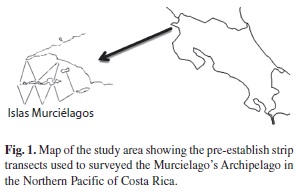
<body><![CDATA[<font size="2"><span style="font-family: verdana;"><span      style="font-weight: bold;">Study site:</span>&nbsp;     Murci&eacute;lago&nbsp;&nbsp; Archipelago     (N10&deg;51&#8217;/W085&deg;54&#8217;) is a set of old continental islands     located in the northern part of the Papagayo Gulf, Costa Rica (<a      href="#fig_1">Fig. 1</a>).     The area is affected by annual north-south migration of the     inter-Tropical&nbsp; Convergent Zone (iTCZ);&nbsp; during the dry     season (December-April) the iTCZ moves southward, the northeast trade     winds are intensify generating superficial currents and the richest     ]]></body>
<body><![CDATA[coastal upwelling of the country. During the second half of the year     (rainy season, May to November) the iTCZ moves northward, the southeast     trade winds bring rains, reducing salinity and intensifying the     equatorial countercurrent near the coast of Central America (Wyrtki     1964, 1967, 1974, Amador <span style="font-style: italic;">et al.</span>     2006, Lavin <span style="font-style: italic;">et al.</span> 2006,     Alfaro &amp;     Lizano 2001).    <br>     <br> </span></font>     ]]></body>
<body><![CDATA[<div style="text-align: center;"><font size="2"><a name="fig_1"></a><img  alt="" src="/img/revistas/rbt/v60s2/a09i1.jpg"  style="width: 299px; height: 194px;"><span  style="font-family: verdana;"></span></font><br  style="font-family: verdana;"> <font size="2"><span style="font-family: verdana;"></span></font></div> <br style="font-family: verdana;"> <font size="2"><span style="font-family: verdana;"><span  style="font-weight: bold;">Sampling Methods:</span> A total of 13 strip transects (1000 m x1000 m) were surveyed during the morning (6 a.m. to 12 p.m) and afternoon&nbsp; (1&nbsp; p.m.&nbsp; to&nbsp; 6&nbsp; p.m.)&nbsp; from&nbsp; January 1999 to November 2000, using small outboard engine boat.&nbsp; Because of the small range of the area sampled and the constant sighting cues of dolphin groups, we assumed total detection groups up to a distance of approximately 500 m at each side of the transect lines. This distance was the maximum distance at which dolphins were&nbsp; reliably&nbsp; detected&nbsp; from&nbsp; our&nbsp; small&nbsp; boat. We established this maximum distance using a range finder at different distances from a buoy. For every group detected we measured: sea surface temperature (Celsius) using a normal thermometer, concentration of dissolved oxygen (mg O<sub>2</sub>/L) was obtained using a dissolve oxygen meter (YSi 52), salinity was measured with a refractometer (ATAGO S/Mill-E) and water transparency (m) using a Secchi disk. in addition, thermocline depth was estimated in two stations that were monthly surveyed using a Niskin bottle we sampled the water column every 10 meters from the surface up to 50 m and measure dissolved oxygen, salinity, and temperature for each sample. Station Termo was&nbsp; located&nbsp; between&nbsp; the&nbsp; Archipelago&nbsp; and the&nbsp; mainland&nbsp; (N10&ordm;51.976&#8217;&nbsp; -&nbsp; W085&ordm;54.283&#8217;, 40m deep) and station Catalina was located behind the main island, San Jose, facing offshore&nbsp; waters&nbsp; (N10&ordm;50.703&#8217;&nbsp; -&nbsp; W085&ordm;55.016&#8217;, 50m deep). The thermocline was defined as a rapid change in the water temperature along the water column (Philander 1996, Thurman 1996).&nbsp; The&nbsp; thermocline&nbsp; occurs&nbsp; particularly in&nbsp; tropical&nbsp; and&nbsp; subtropical&nbsp; waters&nbsp; where&nbsp; it plays a significant role on the distribution of many marine organisms (Quesada-Alpizar and Morales-Ramirez 2004).</span></font><br style="font-family: verdana;"> <font size="2"></font><br style="font-family: verdana;"> <font size="2"><span style="font-family: verdana;">We&nbsp; also&nbsp; measured&nbsp; cloud&nbsp; cover&nbsp; using&nbsp; a scale of 0-8, sea state and wind speed based by discretely categorizing both as (1) zero with ocean surface flat and little wind, (2) light sea state when ocean surface had a few white caps, (3) moderate sea state, when ocean surface had considerably occurrence of white caps and, (4) strong sea state when wave action generated high waves, and many white caps. The data analyzed in this study was collected when sea state was zero and light. Finally, water depth was estimated from digital maps of the area with contour lines using ArcGiS tools.</span></font><br style="font-family: verdana;"> <font size="2"></font><br style="font-family: verdana;"> <font size="2"></font><font style="font-weight: bold;" size="3"><span  style="font-family: verdana;">Analysis</span></font><br  style="font-family: verdana;"> <font size="2"></font><br style="font-family: verdana;"> <font size="2"><span style="font-family: verdana;">We used generalized additive models (Hastie &amp; Tibshirani 1990) to evaluate changes in relative abundance corresponding to the total length of the transects surveyed as a function of environmental variables in a descriptive analysis, and second, we analyzed seasonal changes in relative abundance.</span></font><br  style="font-family: verdana;"> <font size="2"></font><br style="font-family: verdana;"> <font size="2"><span style="font-family: verdana;">In the descriptive analysis, the estimated number&nbsp; of&nbsp; dolphins&nbsp;<img alt="" src="/img/revistas/rbt/v60s2/a09f4.jpg"  style="width: 26px; height: 31px;">of each&nbsp; encountered school was the response variable to a set of environmental predictors&nbsp;<img alt=""  src="/img/revistas/rbt/v60s2/a09f5.jpg"  style="width: 26px; height: 30px;">, where the j sub-script corresponds to the jth survey. Since the response described dolphin counts we assumed a&nbsp; Poisson&nbsp; distribution&nbsp; error&nbsp; in&nbsp; the&nbsp; model, and, because of the sparseness of our data we allowed for over-dispersion by specifying an error structure with variance proportional to the mean. We used a logarithmic function to link response and predictors. Our model had the general structure:    <br>     <br>     <br> </span></font>     <div style="text-align: center;"><font size="2"><img alt=""  src="/img/revistas/rbt/v60s2/a09f1.jpg"  style="width: 207px; height: 43px;"><span style="font-family: verdana;"></span></font>    <br> <font size="2"><span style="font-family: verdana;"></span></font></div> <font size="2"><span style="font-family: verdana;"><br  style="font-family: verdana;"> </span></font><font size="2"></font><br style="font-family: verdana;"> <font size="2"><span style="font-family: verdana;">where &#8220;off&#8221; was an offset variable corresponding to the total length (sum) of the transects of survey j; &#952; is the intercept of the model to be estimated while fitting the data; and the fj&nbsp; are smoothed functions of the environmental covariates, which we chose to be smoothing splines. Smoothness, measured in degrees of freedom, was selected as a compromise between bias and variance of the fitted model, and described the linearity between&nbsp;<img alt=""  src="/img/revistas/rbt/v60s2/a09f4.jpg"  style="width: 26px; height: 31px;"> and&nbsp;<img alt=""  src="/img/revistas/rbt/v60s2/a09f5.jpg"  style="width: 26px; height: 30px;"> .     <br>     <br> To&nbsp; select&nbsp; environmental&nbsp; covariates&nbsp; with high&nbsp; explanatory&nbsp; power&nbsp; of&nbsp; the&nbsp; response&nbsp; we used forward stepwise model fitting, starting with a general model including all possible covariates as linear terms and, at each step, one linear covariate was either replaced by a smoothed function with increasing degrees of freedom, from two to six, or was dropped from the model according to what option provided best fit of the model to the data. At each step, the best options were selected by the model with lowest Akaike information Criteria (AiC, Akaike 1973), a statistic that measures the best compromise&nbsp; between&nbsp; number&nbsp; of&nbsp; parameters, i.e. covariates or degrees of freedom of covariates, and an adequate description of the data.</span></font><br  style="font-family: verdana;"> <font size="2"></font><br style="font-family: verdana;"> <font size="2"><span style="font-family: verdana;">To investigate seasonality, we modified a trend analysis based on GAMs developed by Fewster <span style="font-style: italic;">et al.</span> (2000).&nbsp; in contrast to Fewster <span style="font-style: italic;">et al.</span> (2000) analysis, we did not sample different sites, and we measured within season variability by replicated surveys of the same group of transects each month. Replicates within one month were considered independent, since were conducted at different times of the day. in our model, each survey was assumed to follow an independent Poisson distribution with mean number of dolphins &#956;it in replicate i and month t. Within the GAM framework, month becomes an additive non-linear predictor:    <br>     <br> </span></font>     ]]></body>
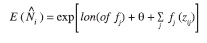
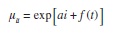
<body><![CDATA[<div style="text-align: center;"><font size="2"><img alt=""  src="/img/revistas/rbt/v60s2/a09f2.jpg"  style="width: 117px; height: 33px;">    <br> <span style="font-family: verdana;"></span></font><br  style="font-family: verdana;"> <font size="2"><span style="font-family: verdana;"></span></font></div> <font size="2"><span style="font-family: verdana;"></span></font><br  style="font-family: verdana;"> <font size="2"><span style="font-family: verdana;">where &#945;<sub>i</sub> is the replicate effect and f(t)&nbsp; was the&nbsp; month&nbsp; effect,&nbsp; estimated&nbsp; with&nbsp; a&nbsp; smoothing spline&nbsp;&nbsp; &nbsp;. With this&nbsp; model, the trend in the logarithm of the expected count over time is the same for&nbsp; each replicate; even absolute counts differed&nbsp; between replicates.&nbsp; An index of abundance over time is then constructed with the ratio of the estimates of&nbsp;&nbsp;<img  alt="" src="/img/revistas/rbt/v60s2/a09f6.jpg"  style="width: 27px; height: 25px;"> &nbsp;over&nbsp;<img alt="" src="/img/revistas/rbt/v60s2/a09f7.jpg"  style="width: 31px; height: 25px;">the estimated effect of the first month:    <br>     <br>     <br> </span></font>     <div style="text-align: center;"><font size="2"><img alt=""  src="/img/revistas/rbt/v60s2/a09f3.jpg"  style="width: 76px; height: 42px;">    <br> <span style="font-family: verdana;"></span></font><br  style="font-family: verdana;"> <font size="2"><span style="font-family: verdana;"></span></font></div> <font size="2"><span style="font-family: verdana;"></span></font><br  style="font-family: verdana;"> <font size="2"><span style="font-family: verdana;">To provide a reasonable account of short term changes in dolphin counts, we selected smoothing splines with 7 degrees of freedom which revealed fine scale changes over time without decreasing unnecessarily the smoothing the output trend curve. To estimate the variance of this index we used a non-parametric bootstrap approach proposed by Fewster <span style="font-style: italic;">et al.</span> (2000), in which replicated surveys in each month were treated as resampling units.</span></font><br  style="font-family: verdana;"> <font size="2"></font><br style="font-family: verdana;"> <font size="2"><span style="font-family: verdana;">We estimated second derivatives of the smoothed index I(t) to identify major change points over time. At these points the second derivative is different from 0. if the second derivative was positive there was a change upwards,&nbsp; and&nbsp; if&nbsp; it&nbsp; was&nbsp; negative&nbsp; the&nbsp; change was downwards, i.e. a significant increase or decrease in abundance. The significant changes in the second derivatives were assessed with the approximate confidence intervals of the second derivatives, estimated from the bootstrap replicates of the indices.</span></font><br  style="font-family: verdana;"> <font size="2"></font><br style="font-family: verdana;"> <font style="font-weight: bold;" size="3"><span  style="font-family: verdana;">Results</span></font><br  style="font-family: verdana;"> <font size="2"></font><br style="font-family: verdana;"> <font size="2"><span style="font-family: verdana;">A total of 7,524 km of survey effort was completed&nbsp; in&nbsp; the&nbsp; two&nbsp; years&nbsp; of&nbsp; study&nbsp; and&nbsp; a high proportion of the surveys (62.5%) were completed with good sighting conditions (see methods). A total of 637 dolphins were seen in&nbsp; 64&nbsp; groups.&nbsp; Group&nbsp; size&nbsp; ranged&nbsp; from&nbsp; 1&nbsp; to 50&nbsp; dolphins,&nbsp; two&nbsp; to&nbsp; five&nbsp; individuals&nbsp; being that&nbsp; most&nbsp; frequently&nbsp; observed.&nbsp; Mean&nbsp; group size was 9.95 (SD=10.28). The best-adjusted model retained three environmental variables: concentration of dissolved oxygen, water transparency and depth, based on the smallest AiC (<a href="/img/revistas/rbt/v60s2/a09t1.gif">Table 1</a>, <a href="/img/revistas/rbt/v60s2/a09i2.jpg">Fig. 2</a>). The number of coastal spotted dolphins increased non-linearly with increasing superficial dissolved oxygen concentration and linearly with the water transparency and depth&nbsp; (<a href="/img/revistas/rbt/v60s2/a09i2.jpg">Fig.&nbsp; 2</a>).&nbsp; Despite&nbsp; of&nbsp; the&nbsp; variability&nbsp; in the data there is a trend in that coastal spotted dolphins seem to aggregate in relatively larger schools in clearer and deeper waters around the islands (<a  href="/img/revistas/rbt/v60s2/a09i2.jpg">Fig. 2</a>).    <br>     <br> </span></font><font size="2"><span style="font-family: verdana;"></span></font><font  size="2"><span style="font-family: verdana;">The&nbsp; trend&nbsp; analysis&nbsp; confirmed&nbsp; the&nbsp; effect of the month in the dolphin&#8217;s counts, showing a gradual decrease in the counts from the dry season to mid-rains (<a  href="/img/revistas/rbt/v60s2/a09i3.jpg">Fig. 3</a>). The wider stan dard error bands show large within-season variability, as estimated by the 95% bootstrap confidence intervals (<a  href="/img/revistas/rbt/v60s2/a09i4.jpg">Fig. 4</a>).&nbsp; The largest variability is observed during the dry season in both years and the lowest during the months of rain. Overall, relative abundance of spotted dolphins varied annually, increasing in numbers at the end of the rainy season and reaching its peak in the dry season, during the months of upwelling. Afterwards, during the early and mid-rainy season there was a dramatic decrease in dolphin abundance. These results indicate that coastal spotted dolphins relative abundance varies annually in response to the environmental seasonality of the habitat.    <br>     ]]></body>
<body><![CDATA[<br>     </span></font><font size="2"><span style="font-family: verdana;"></span></font><font      size="2"><span style="font-family: verdana;">Furthermore,&nbsp;     differences&nbsp; in&nbsp; the&nbsp; months in which     abundance reached its highest and lowest values suggest that dolphin     inter-annual variation&nbsp; may&nbsp; be&nbsp; occurring&nbsp;     as&nbsp; well.&nbsp; During 2000 the largest variability in abundance     was in January, followed by a decrease in the number of dolphins during     the early and midrainy season (May to September). This decrease is     revealed by significant upturns of the trend line (<a     ]]></body>
<body><![CDATA[ href="/img/revistas/rbt/v60s2/a09i2.jpg">Fig. 2</a>) from April     to July of 2000, which could be detected given the low variability in     dolphin counts during these months. in July 2000 the relative abundance     of the dolphins increased again and continued to increase throughout     the last months of rains, and during the dry season. During the     previous year, the higher number of dolphins was observed in March, and     a significant&nbsp; decrease&nbsp; occurred&nbsp; from&nbsp; July&nbsp;     to September. The abundance of dolphins started to increase in October.</span></font><br      style="font-family: verdana;">     <font size="2"></font><br style="font-family: verdana;">     ]]></body>
<body><![CDATA[<font size="2"></font><font style="font-weight: bold;" size="3"><span      style="font-family: verdana;">Discussion</span></font><br      style="font-family: verdana;">     <font size="2"></font><br style="font-family: verdana;">     <font size="2"><span style="font-family: verdana;">Generalized Additive     Models are an     effective way to detect     environmental variables that best predict changes in the relative     abundance of the coastal spotted dolphin in the waters surrounding     the Murci&eacute;lago islands, Costa Rica. These models may allow for a     ]]></body>
<body><![CDATA[better detection of seasonal trends in abundance of small study     areas. Month effects were not significant probably because each month     represented a small time window to detect changes in abundance. The     trend analysis, however, clearly indicated a seasonal pattern both in     relative number of dolphins and its variability.</span></font><br      style="font-family: verdana;">     <font size="2"></font><br style="font-family: verdana;">     <font size="2"><span style="font-family: verdana;">Regional scale     seasonal variation     in tropical waters plays an     ]]></body>
<body><![CDATA[important role in the relative abundance of coastal spotted dolphins     as suggested by our models; relative abundance of dolphins increased     linearly with water depth and water transparency, and non-linearly with     the concentration of dissolved oxygen. These results did not indicate     direct environmental forcing of dolphin abundance. instead these     environmental&nbsp; factors&nbsp; appear&nbsp; to&nbsp; be&nbsp;     associated with the onset of the dry season where the highest     relative abundance occurred, from December to April.</span></font><br      style="font-family: verdana;">     <font size="2"></font><br style="font-family: verdana;">     ]]></body>
<body><![CDATA[<font size="2"><span style="font-family: verdana;">The Pacific waters     of Costa Rica     are part of the tropical waters of the     &#8220;Central American Bight&#8221; (near coastal waters from Guatemala to     Ecuador). These waters are considered the most variable within the     Tropical Surface Water Province due to the influence of the     inter-Tropical Convergence Zone (iTCZ) which annual migration generates     dramatic     changes in the oceanography&nbsp; of&nbsp; the&nbsp; area&nbsp;     (Au&nbsp; &amp;&nbsp; Perryman 1985,&nbsp; Rasmusson&nbsp; &amp;     ]]></body>
<body><![CDATA[Akin&nbsp; 1993).&nbsp; Moreover, these&nbsp; waters&nbsp;     constitute&nbsp; the&nbsp; most&nbsp; important area&nbsp; of&nbsp;     overlap&nbsp; for&nbsp; spotted,&nbsp; spinner,&nbsp; striped and     common dolphins (Au &amp; Perryman 1985). Our studied area is probably     the most affected by the iTCZ in Costa Rica when this feature is     located in its most southward position (dry season) and the northeast     trade winds are intensified generating the richest upwelling of the     country. An approximate five-fold increase in the biomass and     zooplankton abundance occurs during the dry season, compared to the     rainy season, due to a seasonal upwelling (Bednarski &amp;     ]]></body>
<body><![CDATA[Morales-Ramirez 2004). Thus, we propose that this well marked seasonal     variation in the environment may be influencing prey availability and     therefore affects the presence of dolphins in the area.</span></font><br      style="font-family: verdana;">     <font size="2"></font><br style="font-family: verdana;">     <font size="2"><span style="font-family: verdana;">in agreement with     this suggestion,     MayCollado &amp;     Morales-Ram&iacute;rez (2005) reports that seasonal changes in     behavioral patterns and abundance of dolphins in the Gulf of     ]]></body>
<body><![CDATA[Papagayo&nbsp; are&nbsp; likely&nbsp; to&nbsp; be&nbsp;     associated&nbsp; with that&nbsp; increase&nbsp; in&nbsp;     zooplankton&nbsp; biomass. They reported at high number of groups     involved in foraging behaviors, and a high investment in foraging     activities during the dry season. Other predators seem to respond as     well to seasonal changes, for example the normally pelagic mahi-mahi     (Coryphaena hippurus), which feeds on prey similar to that of dolphins,     approaches the shore during the dry season,&nbsp; to&nbsp;     feed&nbsp; (Allen&nbsp; &amp;&nbsp; Robertson&nbsp; 1998). Very little     is known about the feeding habits of coastal spotted dolphins. in the     ]]></body>
<body><![CDATA[Eastern Tropical Pacific the oceanic ecotype is consider a     generalist&nbsp; feeder,&nbsp; which&nbsp; distribution&nbsp; seems to     be largely influenced by prey availability (Perrin <span      style="font-style: italic;">et al.</span> 1973,     Fieldler <span style="font-style: italic;">et al.</span> 1998). These     changes in tropical areas might be     particularly more&nbsp; intense&nbsp; in&nbsp; local&nbsp;     populations,&nbsp; perhaps not as dramatic as in local temperate     dolphin populations, but sufficient to have an impact in the abundance     and distribution of the dolphins and their prey.&nbsp;&nbsp;     ]]></body>
<body><![CDATA[Furthermore, more recent studies comparing northern and southern     populations of spotted dolphins of the Pacific coast of Costa Rica have     found similar results, primarily the relationship between water     transparency and dolphin abundance (Mart&iacute;nez-Fern&aacute;ndez <span      style="font-style: italic;">et     al.</span> 2011).</span></font><br style="font-family: verdana;">     <font size="2"></font><br style="font-family: verdana;">     <font size="2"><span style="font-family: verdana;">in conclusion,     Generalized Additive     Models&nbsp; helped&nbsp; us&nbsp;     ]]></body>
<body><![CDATA[in&nbsp; identifying&nbsp; what&nbsp; factors might be driving     small-scale dolphin abundance and what are the implications of     seasonality in dolphin abundance for conservation and management     strategies of local resident populations. Large-scale studies may     overlook&nbsp; variables&nbsp; affecting&nbsp; the&nbsp; abundance of     local resident populations that may be detected with studies on smaller     scale such as this one. Genetic studies on the coastal spotted     dolphins suggest that these dolphins are highly resident and are likely     to have limited distribution&nbsp; ranges&nbsp;     (Escorza-Trevi&ntilde;o&nbsp; <span style="font-style: italic;">et&nbsp;     ]]></body>
<body><![CDATA[al.</span> 2005) subject to seasonal     variation. Therefore, designing conservation strategies relies on the     knowledge of their occurrence and seasonal use of important areas.</span></font><br      style="font-family: verdana;">     <font size="2"></font><br style="font-family: verdana;">     <font style="font-weight: bold;" size="3"><span      style="font-family: verdana;">Acknowledgments</span></font><br      style="font-family: verdana;">     <font size="2"></font><br style="font-family: verdana;">     <font size="2"><span style="font-family: verdana;">Funding and logistic     ]]></body>
<body><![CDATA[support was     provided by The Nature Conservancy,     Emily Shane Award&nbsp; 1998,&nbsp; Society&nbsp; of&nbsp; Marine&nbsp;     Mammals, and Vicerrectoria de investigaci&oacute;n and Centro de     investigaci&oacute;n en Ciencias del Mar y Limnolog&iacute;a (CiMAR)     of the Universidad de Costa Rica, and finally to the Parque Nacional     Santa Rosa, Area de Conservaci&oacute;n Guanacaste. For assistance on     the field we thank F. Lara (father and son), Samba, M. Lara, Guicha, M.     Quesada, and many students that volunteer along the way. Thanks to     Alvaro Morales, Roger Blanco, Frank Joyce, Do&ntilde;a Carmen for all     ]]></body>
<body><![CDATA[their support along the study. Thanks to ingi Agnarsson and Tim     Gerrodette for important comments to the manuscript.</span></font><br      style="font-family: verdana;">     <font size="3"><span style="font-family: verdana;"></span></font>     <hr style="width: 100%; height: 2px;"><font style="font-weight: bold;"      size="3"><span style="font-family: verdana;">References</span></font><br      style="font-family: verdana;">     <font size="2"></font><br style="font-family: verdana;">     <font size="2"><span style="font-family: verdana;">Akaike,&nbsp;     H.&nbsp; 1973.&nbsp;     ]]></body>
<body><![CDATA[information&nbsp; and&nbsp; an&nbsp;     extension&nbsp; of&nbsp; the maximum likelihood principle, Pp. 267-281.     In: B.N. Petran &amp; F. Cs&aacute;ki (eds). international Symposium on     information Theory. Akad&eacute;miai Kiadi&nbsp; Press, Budapest,     <!-- ref -->Hungary.    &nbsp;&nbsp;&nbsp;&nbsp;&nbsp;&nbsp;&nbsp;&nbsp;[&#160;<a href="javascript:void(0);" onclick="javascript: window.open('/scielo.php?script=sci_nlinks&ref=1445453&pid=S0034-7744201200060000900001&lng=','','width=640,height=500,resizable=yes,scrollbars=1,menubar=yes,');">Links</a>&#160;]<!-- end-ref --><!-- ref --></span></font><br style="font-family: verdana;"> <font size="2"></font><br style="font-family: verdana;"> <font size="2"><span style="font-family: verdana;">Archer, F. i.,&nbsp; Gerrodette, T., Chivers, S., &amp;&nbsp; A.&nbsp; Jackson. 2004.&nbsp; Annual estimates of the unobserved incidental kill of pantropical spotted dolphin (<span style="font-style: italic;">Stenella attenuata</span> attenuata)&nbsp; calves in the tuna-seine fishery of the eastern tropical Pacific.&nbsp; Fish.&nbsp; Bull. 102: 233-244.    &nbsp;&nbsp;&nbsp;&nbsp;&nbsp;&nbsp;&nbsp;&nbsp;[&#160;<a href="javascript:void(0);" onclick="javascript: window.open('/scielo.php?script=sci_nlinks&ref=1445454&pid=S0034-7744201200060000900002&lng=','','width=640,height=500,resizable=yes,scrollbars=1,menubar=yes,');">Links</a>&#160;]<!-- end-ref --><!-- ref --></span></font><br  style="font-family: verdana;"> <font size="2"></font><br style="font-family: verdana;"> <font size="2"><span style="font-family: verdana;">Archer, F. i., Redfern, J. V., Gerrodette, T., Chivers, S. J., &amp; W. F. Perrin. 2010. Estimation of relative exposure of dolphins to fishery activity.&nbsp; Mar. Ecol. Prog. Ser. 410: 245-255.    &nbsp;&nbsp;&nbsp;&nbsp;&nbsp;&nbsp;&nbsp;&nbsp;[&#160;<a href="javascript:void(0);" onclick="javascript: window.open('/scielo.php?script=sci_nlinks&ref=1445455&pid=S0034-7744201200060000900003&lng=','','width=640,height=500,resizable=yes,scrollbars=1,menubar=yes,');">Links</a>&#160;]<!-- end-ref --><!-- ref --></span></font><br  style="font-family: verdana;"> <font size="2"></font><br style="font-family: verdana;"> <font size="2"><span style="font-family: verdana;">Alfaro, E.J. &amp; O.G. Lizano. 2001. Some&nbsp; relationships between upwelling zones&nbsp; of the Central American Pacific and tropical Atlantic and Pacific oceans. Rev. Biol. Trop. 49: 187-193.    &nbsp;&nbsp;&nbsp;&nbsp;&nbsp;&nbsp;&nbsp;&nbsp;[&#160;<a href="javascript:void(0);" onclick="javascript: window.open('/scielo.php?script=sci_nlinks&ref=1445456&pid=S0034-7744201200060000900004&lng=','','width=640,height=500,resizable=yes,scrollbars=1,menubar=yes,');">Links</a>&#160;]<!-- end-ref --><!-- ref --></span></font><br  style="font-family: verdana;"> <font size="2"></font><br style="font-family: verdana;"> <font size="2"><span style="font-family: verdana;">Allen, G.R. &amp; D.R. Robertson. 1998. Peces&nbsp; del Pac&iacute;fico Oriental Tropical. CONABiO Press, Distrito Federal, Mexico.    &nbsp;&nbsp;&nbsp;&nbsp;&nbsp;&nbsp;&nbsp;&nbsp;[&#160;<a href="javascript:void(0);" onclick="javascript: window.open('/scielo.php?script=sci_nlinks&ref=1445457&pid=S0034-7744201200060000900005&lng=','','width=640,height=500,resizable=yes,scrollbars=1,menubar=yes,');">Links</a>&#160;]<!-- end-ref --><!-- ref --></span></font><br style="font-family: verdana;"> <font size="2"></font><br style="font-family: verdana;"> <font size="2"><span style="font-family: verdana;">Amador, J.A., Alfaro, E. J. &amp; O.G. Lizano. 2006. Atmospheric forcing of the eastern tropical Pacific: a review. Progr. Oceanog. 69: 101-142.    &nbsp;&nbsp;&nbsp;&nbsp;&nbsp;&nbsp;&nbsp;&nbsp;[&#160;<a href="javascript:void(0);" onclick="javascript: window.open('/scielo.php?script=sci_nlinks&ref=1445458&pid=S0034-7744201200060000900006&lng=','','width=640,height=500,resizable=yes,scrollbars=1,menubar=yes,');">Links</a>&#160;]<!-- end-ref --><!-- ref --></span></font><br style="font-family: verdana;"> <font size="2"></font><br style="font-family: verdana;"> <font size="2"><span style="font-family: verdana;">Archer, F.i.,&nbsp; J.V. Redfern, T. Gerrodette &amp;&nbsp; W.F. Perrin. 2010. Estimation of relative exposure of dolphins to fishery activity. Mar. Ecol. Prog. Ser. 410: 245-255.    &nbsp;&nbsp;&nbsp;&nbsp;&nbsp;&nbsp;&nbsp;&nbsp;[&#160;<a href="javascript:void(0);" onclick="javascript: window.open('/scielo.php?script=sci_nlinks&ref=1445459&pid=S0034-7744201200060000900007&lng=','','width=640,height=500,resizable=yes,scrollbars=1,menubar=yes,');">Links</a>&#160;]<!-- end-ref --><!-- ref --></span></font><br  style="font-family: verdana;"> <font size="2"></font><br style="font-family: verdana;"> <font size="2"><span style="font-family: verdana;">Au, D.W.K. &amp; W.L. Perryman. 1986. Dolphin habitats in the eastern tropical Pacific. Fish. Bull. 83: 623-643.    &nbsp;&nbsp;&nbsp;&nbsp;&nbsp;&nbsp;&nbsp;&nbsp;[&#160;<a href="javascript:void(0);" onclick="javascript: window.open('/scielo.php?script=sci_nlinks&ref=1445460&pid=S0034-7744201200060000900008&lng=','','width=640,height=500,resizable=yes,scrollbars=1,menubar=yes,');">Links</a>&#160;]<!-- end-ref --><!-- ref --></span></font><br  style="font-family: verdana;"> <font size="2"></font><br style="font-family: verdana;"> <font size="2"><span style="font-family: verdana;">Bednarski, M. &amp; A. Morales-Ramirez. 2004. Composition, abundance, and distribution of macrozooplankton in Culebra Bay, Gulf of Papagayo, Pacific coast of Costa Rica and its value as bioindicator of pollution. Rev. Biol. Trop. 52: 105-119.    &nbsp;&nbsp;&nbsp;&nbsp;&nbsp;&nbsp;&nbsp;&nbsp;[&#160;<a href="javascript:void(0);" onclick="javascript: window.open('/scielo.php?script=sci_nlinks&ref=1445461&pid=S0034-7744201200060000900009&lng=','','width=640,height=500,resizable=yes,scrollbars=1,menubar=yes,');">Links</a>&#160;]<!-- end-ref --><!-- ref --></span></font><br  style="font-family: verdana;"> <font size="2"></font><br style="font-family: verdana;"> <font size="2"><span style="font-family: verdana;">Cramer, K.L., W.L. Perryman &amp; T.Gerrodette. 2008. Declines in reproductive output in two dolphin populations depleted by the&nbsp; yellowfin tuna purse seine fishery. Mar. Ecol. Prog. Ser. 369: 273-285.    &nbsp;&nbsp;&nbsp;&nbsp;&nbsp;&nbsp;&nbsp;&nbsp;[&#160;<a href="javascript:void(0);" onclick="javascript: window.open('/scielo.php?script=sci_nlinks&ref=1445462&pid=S0034-7744201200060000900010&lng=','','width=640,height=500,resizable=yes,scrollbars=1,menubar=yes,');">Links</a>&#160;]<!-- end-ref --><!-- ref --></span></font><br  style="font-family: verdana;"> <font size="2"></font><br style="font-family: verdana;"> <font size="2"><span style="font-family: verdana;">De&nbsp; Master, D.P., E.F. Edwards, P. Wade &amp;&nbsp; J.E. Sisson. 1992. Status of dolphin stocks in the eastern tropical Pacific, Pp.1038-1050. In: D.R. MaCullough &amp; R.H. Barrett&nbsp; (eds).&nbsp; Wildlife&nbsp; 2001:&nbsp; Populations.&nbsp; Proceedings of an international conference on&nbsp; population dynamics and management of vertebrates (exclusive of primates and&nbsp; fish) (July 29-31, 1991, Oakland, California). Elsevier, New York, USA.    &nbsp;&nbsp;&nbsp;&nbsp;&nbsp;&nbsp;&nbsp;&nbsp;[&#160;<a href="javascript:void(0);" onclick="javascript: window.open('/scielo.php?script=sci_nlinks&ref=1445463&pid=S0034-7744201200060000900011&lng=','','width=640,height=500,resizable=yes,scrollbars=1,menubar=yes,');">Links</a>&#160;]<!-- end-ref --><!-- ref --></span></font><br  style="font-family: verdana;"> <font size="2"></font><br style="font-family: verdana;"> <font size="2"><span style="font-family: verdana;">Dizon,&nbsp; A.E., W.F. Perrin &amp; P.A. Akin. 1994.&nbsp; Stocks of dolphins&nbsp; (<span style="font-style: italic;">Stenella&nbsp; </span>spp.&nbsp; and<span style="font-style: italic;">&nbsp; Delphinus&nbsp; delphis</span>)&nbsp; in the eastern tropical Pacific: a phylogeographic classification.&nbsp; U.S.&nbsp; Department&nbsp; of&nbsp; Commerce.&nbsp; NOAA Technical Report NMFS 119: 20p.    &nbsp;&nbsp;&nbsp;&nbsp;&nbsp;&nbsp;&nbsp;&nbsp;[&#160;<a href="javascript:void(0);" onclick="javascript: window.open('/scielo.php?script=sci_nlinks&ref=1445464&pid=S0034-7744201200060000900012&lng=','','width=640,height=500,resizable=yes,scrollbars=1,menubar=yes,');">Links</a>&#160;]<!-- end-ref --><!-- ref --></span></font><br  style="font-family: verdana;"> <font size="2"></font><br style="font-family: verdana;"> <font size="2"><span style="font-family: verdana;">Douglas, M.E. G.D. Schnell &amp; D.J. Hough. 1984. Differentiation between inshore and offshore spotted dolphins in the eastern tropical Pacific Ocean. J. Mammal. 65: 375-387.    &nbsp;&nbsp;&nbsp;&nbsp;&nbsp;&nbsp;&nbsp;&nbsp;[&#160;<a href="javascript:void(0);" onclick="javascript: window.open('/scielo.php?script=sci_nlinks&ref=1445465&pid=S0034-7744201200060000900013&lng=','','width=640,height=500,resizable=yes,scrollbars=1,menubar=yes,');">Links</a>&#160;]<!-- end-ref --><!-- ref --></span></font><br  style="font-family: verdana;"> <font size="2"></font><br style="font-family: verdana;"> <font size="2"><span style="font-family: verdana;">Escorza-Trevino S., F.i. Archer, M. Rosales,&nbsp; A. Lang &amp; A.E. Dizon. 2005. Genetic differentiation and intraspecific structure&nbsp; of eastern tropical Pacific spotted dolphins, <span  style="font-style: italic;">Stenella attenuata</span>, revealed by DNA analyses. Conserv. Genet. 6: 587-600.    &nbsp;&nbsp;&nbsp;&nbsp;&nbsp;&nbsp;&nbsp;&nbsp;[&#160;<a href="javascript:void(0);" onclick="javascript: window.open('/scielo.php?script=sci_nlinks&ref=1445466&pid=S0034-7744201200060000900014&lng=','','width=640,height=500,resizable=yes,scrollbars=1,menubar=yes,');">Links</a>&#160;]<!-- end-ref --><!-- ref --></span></font><br  style="font-family: verdana;"> <font size="2"></font><br style="font-family: verdana;"> <font size="2"><span style="font-family: verdana;">Fewster,&nbsp; R.M.,&nbsp; S.T.&nbsp; Buckland,&nbsp; G.M.&nbsp; Siriwardena,&nbsp; S.R. Baillie &amp; J.D. Wilson. 2000. Analysis of population trends for farmland birds using generalized additive models. Ecology 81: 1970-1984.    &nbsp;&nbsp;&nbsp;&nbsp;&nbsp;&nbsp;&nbsp;&nbsp;[&#160;<a href="javascript:void(0);" onclick="javascript: window.open('/scielo.php?script=sci_nlinks&ref=1445467&pid=S0034-7744201200060000900015&lng=','','width=640,height=500,resizable=yes,scrollbars=1,menubar=yes,');">Links</a>&#160;]<!-- end-ref --><!-- ref --></span></font><br style="font-family: verdana;"> <font size="2"></font><br style="font-family: verdana;"> <font size="2"><span style="font-family: verdana;">Fiedler, P.C. &amp; S.B. Reilly. 1994. interannual&nbsp; variability of&nbsp; dolphin&nbsp; habitats&nbsp; in&nbsp; the&nbsp; eastern&nbsp; tropical&nbsp; Pacific. ii: effects on abundances estimated from tuna vessel sightings, 1975-1990. Fish. Bull. 92: 451-463.    &nbsp;&nbsp;&nbsp;&nbsp;&nbsp;&nbsp;&nbsp;&nbsp;[&#160;<a href="javascript:void(0);" onclick="javascript: window.open('/scielo.php?script=sci_nlinks&ref=1445468&pid=S0034-7744201200060000900016&lng=','','width=640,height=500,resizable=yes,scrollbars=1,menubar=yes,');">Links</a>&#160;]<!-- end-ref --><!-- ref --></span></font><br  style="font-family: verdana;"> <font size="2"></font><br style="font-family: verdana;"> <font size="2"><span style="font-family: verdana;">Fiedler, P. C., Barlow, J. &amp; T. Gerrodette.&nbsp; 1998. Dolphin prey abundance determined from acoustic backscatter data in eastern&nbsp; Pacific surveys. Fish. Bull. US 96: 237-247.    &nbsp;&nbsp;&nbsp;&nbsp;&nbsp;&nbsp;&nbsp;&nbsp;[&#160;<a href="javascript:void(0);" onclick="javascript: window.open('/scielo.php?script=sci_nlinks&ref=1445469&pid=S0034-7744201200060000900017&lng=','','width=640,height=500,resizable=yes,scrollbars=1,menubar=yes,');">Links</a>&#160;]<!-- end-ref --><!-- ref --></span></font><br  style="font-family: verdana;"> <font size="2"></font><br style="font-family: verdana;"> <font size="2"><span style="font-family: verdana;">Forney,&nbsp; K.A.&nbsp; 2000.&nbsp; Environmental&nbsp; models&nbsp; of&nbsp; cetacean abundance:&nbsp;&nbsp; reducing&nbsp;&nbsp; uncertainity&nbsp;&nbsp; in&nbsp;&nbsp; population trends. Conserv. Biol. 14: 1271-1286.    &nbsp;&nbsp;&nbsp;&nbsp;&nbsp;&nbsp;&nbsp;&nbsp;[&#160;<a href="javascript:void(0);" onclick="javascript: window.open('/scielo.php?script=sci_nlinks&ref=1445470&pid=S0034-7744201200060000900018&lng=','','width=640,height=500,resizable=yes,scrollbars=1,menubar=yes,');">Links</a>&#160;]<!-- end-ref --><!-- ref --></span></font><br style="font-family: verdana;"> <font size="2"></font><br style="font-family: verdana;"> <font size="2"><span style="font-family: verdana;">Garcia,&nbsp; C. &amp; S. M. Dawson. 2003.&nbsp; Distribution of pantropical spotted dolphins in Pacific coastal waters of Panama. LAJAM. 21: 1676-7497.    &nbsp;&nbsp;&nbsp;&nbsp;&nbsp;&nbsp;&nbsp;&nbsp;[&#160;<a href="javascript:void(0);" onclick="javascript: window.open('/scielo.php?script=sci_nlinks&ref=1445471&pid=S0034-7744201200060000900019&lng=','','width=640,height=500,resizable=yes,scrollbars=1,menubar=yes,');">Links</a>&#160;]<!-- end-ref --><!-- ref --></span></font><br style="font-family: verdana;"> <font size="2"></font><br style="font-family: verdana;"> <font size="2"><span style="font-family: verdana;">Gerrodette, T. &amp; D.M. Palacios. 1996. Estimates of cetacean abundance in EEZ waters of the eastern tropical Pacific. Southwest Fisheries Science Center Administrative Report LJ-96-10. 28 p.    &nbsp;&nbsp;&nbsp;&nbsp;&nbsp;&nbsp;&nbsp;&nbsp;[&#160;<a href="javascript:void(0);" onclick="javascript: window.open('/scielo.php?script=sci_nlinks&ref=1445472&pid=S0034-7744201200060000900020&lng=','','width=640,height=500,resizable=yes,scrollbars=1,menubar=yes,');">Links</a>&#160;]<!-- end-ref --><!-- ref --></span></font><br  style="font-family: verdana;"> <font size="2"></font><br style="font-family: verdana;"> <font size="2"><span style="font-family: verdana;">Gerrodette&nbsp; T. &amp; J. Forcada. 2005.&nbsp; Non-recovery of two spotted and spinner&nbsp; dolphin populations in the eastern&nbsp; tropical Pacific Ocean. Mar. Ecol. Prog.&nbsp; Ser. 291: 1-21.    &nbsp;&nbsp;&nbsp;&nbsp;&nbsp;&nbsp;&nbsp;&nbsp;[&#160;<a href="javascript:void(0);" onclick="javascript: window.open('/scielo.php?script=sci_nlinks&ref=1445473&pid=S0034-7744201200060000900021&lng=','','width=640,height=500,resizable=yes,scrollbars=1,menubar=yes,');">Links</a>&#160;]<!-- end-ref --><!-- ref --></span></font><br  style="font-family: verdana;"> <font size="2"></font><br style="font-family: verdana;"> <font size="2"><span style="font-family: verdana;">Gerrodette, T. &amp; J. Forcada. 2006. Estimates of abundance of northeastern offshore spotted, coastal spotted, and eastern spinner dolphins in the eastern tropical Pacific Ocean. Southwest Fisheries&nbsp; Science Center Administrative Report LJ-02-06, La Jolla, California 41p.    &nbsp;&nbsp;&nbsp;&nbsp;&nbsp;&nbsp;&nbsp;&nbsp;[&#160;<a href="javascript:void(0);" onclick="javascript: window.open('/scielo.php?script=sci_nlinks&ref=1445474&pid=S0034-7744201200060000900022&lng=','','width=640,height=500,resizable=yes,scrollbars=1,menubar=yes,');">Links</a>&#160;]<!-- end-ref --><!-- ref --></span></font><br style="font-family: verdana;"> <font size="2"></font><br style="font-family: verdana;"> <font size="2"><span style="font-family: verdana;">Hall, M.A. 1998. An ecological view of the tuna-dolphin problem:impacts and trade offs. Rev. Fish. Biol. Fish. 8: 1-34.    &nbsp;&nbsp;&nbsp;&nbsp;&nbsp;&nbsp;&nbsp;&nbsp;[&#160;<a href="javascript:void(0);" onclick="javascript: window.open('/scielo.php?script=sci_nlinks&ref=1445475&pid=S0034-7744201200060000900023&lng=','','width=640,height=500,resizable=yes,scrollbars=1,menubar=yes,');">Links</a>&#160;]<!-- end-ref --><!-- ref --></span></font><br  style="font-family: verdana;"> <font size="2"></font><br style="font-family: verdana;"> <font size="2"><span style="font-family: verdana;">Hastie, T.J. &amp; R.J. Tibishirani. 1990. Monographs on Statistics and Applied Probability: Generalized Additive Models. Chapman and Hall Press, Florida, USA.    &nbsp;&nbsp;&nbsp;&nbsp;&nbsp;&nbsp;&nbsp;&nbsp;[&#160;<a href="javascript:void(0);" onclick="javascript: window.open('/scielo.php?script=sci_nlinks&ref=1445476&pid=S0034-7744201200060000900024&lng=','','width=640,height=500,resizable=yes,scrollbars=1,menubar=yes,');">Links</a>&#160;]<!-- end-ref --><!-- ref --></span></font><br style="font-family: verdana;"> <font size="2"></font><br style="font-family: verdana;"> <font size="2"><span style="font-family: verdana;">Levin, M.F., Fiedler, P.C. &amp; J.A. Amador. 2006. A review of eastern tropical&nbsp; Pacific oceanography: summary. Progr. Oceanog. 69:391-398.    &nbsp;&nbsp;&nbsp;&nbsp;&nbsp;&nbsp;&nbsp;&nbsp;[&#160;<a href="javascript:void(0);" onclick="javascript: window.open('/scielo.php?script=sci_nlinks&ref=1445477&pid=S0034-7744201200060000900025&lng=','','width=640,height=500,resizable=yes,scrollbars=1,menubar=yes,');">Links</a>&#160;]<!-- end-ref --><!-- ref --></span></font><br style="font-family: verdana;"> <font size="2"></font><br style="font-family: verdana;"> <font size="2"><span style="font-family: verdana;">Lizano, O.G. 2008. Water dynamics around Cocos island, Costa Rica. Rev. Biol. Trop. 56: 31-48.    &nbsp;&nbsp;&nbsp;&nbsp;&nbsp;&nbsp;&nbsp;&nbsp;[&#160;<a href="javascript:void(0);" onclick="javascript: window.open('/scielo.php?script=sci_nlinks&ref=1445478&pid=S0034-7744201200060000900026&lng=','','width=640,height=500,resizable=yes,scrollbars=1,menubar=yes,');">Links</a>&#160;]<!-- end-ref --><!-- ref --></span></font><br style="font-family: verdana;"> <font size="2"></font><br style="font-family: verdana;"> <font size="2"><span style="font-family: verdana;">Mart&iacute;nez-Fern&aacute;ndez,&nbsp;&nbsp; J.D.,&nbsp; A.&nbsp; Montero-Cordero&nbsp;&nbsp; &amp;&nbsp;&nbsp; L.J. May-Collado.&nbsp; 2011. Cetaceos de las aguas&nbsp; costeras de Pacifico norte de Costa Rica. Rev. Biol. Trop. 59: 283-290.    &nbsp;&nbsp;&nbsp;&nbsp;&nbsp;&nbsp;&nbsp;&nbsp;[&#160;<a href="javascript:void(0);" onclick="javascript: window.open('/scielo.php?script=sci_nlinks&ref=1445479&pid=S0034-7744201200060000900027&lng=','','width=640,height=500,resizable=yes,scrollbars=1,menubar=yes,');">Links</a>&#160;]<!-- end-ref --><!-- ref --></span></font><br  style="font-family: verdana;"> <font size="2"></font><br style="font-family: verdana;"> <font size="2"><span style="font-family: verdana;">May-Collado, L.J. 2009. Marine Mammals, p. 479-496. In: i.S. Wehrmann &amp; J. Cortes&nbsp; (eds). Marine Biodiversity of Costa&nbsp; Rica, Central America. Springer, The Netherlands.    &nbsp;&nbsp;&nbsp;&nbsp;&nbsp;&nbsp;&nbsp;&nbsp;[&#160;<a href="javascript:void(0);" onclick="javascript: window.open('/scielo.php?script=sci_nlinks&ref=1445480&pid=S0034-7744201200060000900028&lng=','','width=640,height=500,resizable=yes,scrollbars=1,menubar=yes,');">Links</a>&#160;]<!-- end-ref --><!-- ref --></span></font><br  style="font-family: verdana;"> <font size="2"></font><br style="font-family: verdana;"> <font size="2"><span style="font-family: verdana;">May-Collado, L.J. &amp; A. Morales-Ram&iacute;rez. 2005. Presencia y patrones de comportamiento&nbsp; del delf&iacute;n manchado costero, Stenella attenuata<span style="font-style: italic;"> graffmani</span> (Cetacea: Delphinidae) en el Golfo de Papagayo, Costa Rica. Rev. Biol. Trop. 53: 265-276.    &nbsp;&nbsp;&nbsp;&nbsp;&nbsp;&nbsp;&nbsp;&nbsp;[&#160;<a href="javascript:void(0);" onclick="javascript: window.open('/scielo.php?script=sci_nlinks&ref=1445481&pid=S0034-7744201200060000900029&lng=','','width=640,height=500,resizable=yes,scrollbars=1,menubar=yes,');">Links</a>&#160;]<!-- end-ref --><!-- ref --></span></font><br  style="font-family: verdana;"> <font size="2"></font><br style="font-family: verdana;"> <font size="2"><span style="font-family: verdana;">May-Collado,&nbsp; L.J.,&nbsp; T.&nbsp; Gerrodette,&nbsp; J.&nbsp; Calambokidis,&nbsp; K. Rassmusen&nbsp; &amp; i.&nbsp; Sereg. 2005. Distribution&nbsp; of cetaceans sightings in the EEZ of Costa Rica. Rev. Biol. Trop. 53: 249-263.    &nbsp;&nbsp;&nbsp;&nbsp;&nbsp;&nbsp;&nbsp;&nbsp;[&#160;<a href="javascript:void(0);" onclick="javascript: window.open('/scielo.php?script=sci_nlinks&ref=1445482&pid=S0034-7744201200060000900030&lng=','','width=640,height=500,resizable=yes,scrollbars=1,menubar=yes,');">Links</a>&#160;]<!-- end-ref --><!-- ref --></span></font><br  style="font-family: verdana;"> <font size="2"></font><br style="font-family: verdana;"> <font size="2"><span style="font-family: verdana;">Schnell, G.D., M.E. Douglas &amp; D.J. Hough. 1986. Geographic patterns of variation in offshore spotted dolphins (<span  style="font-style: italic;">Stenella&nbsp; attenuata</span>)&nbsp; of&nbsp; the&nbsp; eastern&nbsp; tropical&nbsp; Pacific ocean. Mar. Mamm. Sci. 2: 186-213.    &nbsp;&nbsp;&nbsp;&nbsp;&nbsp;&nbsp;&nbsp;&nbsp;[&#160;<a href="javascript:void(0);" onclick="javascript: window.open('/scielo.php?script=sci_nlinks&ref=1445483&pid=S0034-7744201200060000900031&lng=','','width=640,height=500,resizable=yes,scrollbars=1,menubar=yes,');">Links</a>&#160;]<!-- end-ref --><!-- ref --></span></font><br  style="font-family: verdana;"> <font size="2"></font><br style="font-family: verdana;"> <font size="2"><span style="font-family: verdana;">Oviedo, L. 2007. Dolphin sympatric ecology in a tropical fjord: habitat partitioning by bathymetry and topography as a strategy to coexist. J. Mar. Biol. Assoc. U.K. 87: 1327-1335.    &nbsp;&nbsp;&nbsp;&nbsp;&nbsp;&nbsp;&nbsp;&nbsp;[&#160;<a href="javascript:void(0);" onclick="javascript: window.open('/scielo.php?script=sci_nlinks&ref=1445484&pid=S0034-7744201200060000900032&lng=','','width=640,height=500,resizable=yes,scrollbars=1,menubar=yes,');">Links</a>&#160;]<!-- end-ref --><!-- ref --></span></font><br  style="font-family: verdana;"> <font size="2"></font><br style="font-family: verdana;"> <font size="2"><span style="font-family: verdana;">Philander, G. 1996. El Ni&ntilde;o and La Ni&ntilde;a, p. 72-87. In R.G. Pirie (ed). Oceanography: contemporary readings in ocean science. Oxford Univ. New York, N.Y.    &nbsp;&nbsp;&nbsp;&nbsp;&nbsp;&nbsp;&nbsp;&nbsp;[&#160;<a href="javascript:void(0);" onclick="javascript: window.open('/scielo.php?script=sci_nlinks&ref=1445485&pid=S0034-7744201200060000900033&lng=','','width=640,height=500,resizable=yes,scrollbars=1,menubar=yes,');">Links</a>&#160;]<!-- end-ref --><!-- ref --></span></font><br  style="font-family: verdana;"> <font size="2"></font><br style="font-family: verdana;"> <font size="2"><span style="font-family: verdana;">Perrin,&nbsp; W.F.,&nbsp; R.R.&nbsp; Warner,&nbsp; C.H.&nbsp; Fiscus&nbsp; &amp;&nbsp; D.B.&nbsp; Holts. 1973. Stomach contents of porpoise Stenella spp. and yellowfin tuna, <span  style="font-style: italic;">Thunnus albacares</span>, in mixed-species aggregations. Fish. Bull. 71: 1077-1092.    &nbsp;&nbsp;&nbsp;&nbsp;&nbsp;&nbsp;&nbsp;&nbsp;[&#160;<a href="javascript:void(0);" onclick="javascript: window.open('/scielo.php?script=sci_nlinks&ref=1445486&pid=S0034-7744201200060000900034&lng=','','width=640,height=500,resizable=yes,scrollbars=1,menubar=yes,');">Links</a>&#160;]<!-- end-ref --><!-- ref --></span></font><br  style="font-family: verdana;"> <font size="2"></font><br style="font-family: verdana;"> <font size="2"><span style="font-family: verdana;">Perrin,&nbsp; W.F., T.D. Smith &amp; G.T. Sakagawa.&nbsp; 1982. Status of populations of spotted dolphin, <span style="font-style: italic;">Stenella attenuata</span>, and&nbsp; spinner&nbsp; dolphin,&nbsp; <span style="font-style: italic;">S. longirostris</span>&nbsp; in&nbsp; the&nbsp; eastern tropical Pacific. Mammals in the Seas, FAO. Fisheries Series No.5, Vol.iV, ISBN 92-5-100514-1.    &nbsp;&nbsp;&nbsp;&nbsp;&nbsp;&nbsp;&nbsp;&nbsp;[&#160;<a href="javascript:void(0);" onclick="javascript: window.open('/scielo.php?script=sci_nlinks&ref=1445487&pid=S0034-7744201200060000900035&lng=','','width=640,height=500,resizable=yes,scrollbars=1,menubar=yes,');">Links</a>&#160;]<!-- end-ref --><!-- ref --></span></font><br  style="font-family: verdana;"> <font size="2"></font><br style="font-family: verdana;"> <font size="2"><span style="font-family: verdana;">Perrin, W.F., M.D. Scott, J.G. Walker &amp; V.L. Cass. 1985. Review of geographical stocks of&nbsp; tropical&nbsp; dolphins (Stenella spp. and Delphinus delphis) in the eastern Pacific. U.S. Department of Commerce. NOAA Technical Report NMFS 28: 28p.    &nbsp;&nbsp;&nbsp;&nbsp;&nbsp;&nbsp;&nbsp;&nbsp;[&#160;<a href="javascript:void(0);" onclick="javascript: window.open('/scielo.php?script=sci_nlinks&ref=1445488&pid=S0034-7744201200060000900036&lng=','','width=640,height=500,resizable=yes,scrollbars=1,menubar=yes,');">Links</a>&#160;]<!-- end-ref --><!-- ref --></span></font><br  style="font-family: verdana;"> <font size="2"></font><br style="font-family: verdana;"> <font size="2"><span style="font-family: verdana;">Perrin,&nbsp; W.F., E.D. Mitchell, J.G. Mead, D.K.&nbsp; Caldwell, M.C.&nbsp; Caldwell,&nbsp; P.J.H. Van&nbsp; Bree&nbsp; &amp; W.H.&nbsp; Dawbin. 1987. Revision of the spotted dolphins Stenella spp. Mar. Mamm. Sci. 3:&nbsp; 99-170.    &nbsp;&nbsp;&nbsp;&nbsp;&nbsp;&nbsp;&nbsp;&nbsp;[&#160;<a href="javascript:void(0);" onclick="javascript: window.open('/scielo.php?script=sci_nlinks&ref=1445489&pid=S0034-7744201200060000900037&lng=','','width=640,height=500,resizable=yes,scrollbars=1,menubar=yes,');">Links</a>&#160;]<!-- end-ref --><!-- ref --></span></font><br style="font-family: verdana;"> <font size="2"></font><br style="font-family: verdana;"> <font size="2"><span style="font-family: verdana;">Polacheck,&nbsp; T. 1987. Relative abundance,&nbsp; distribution and inter.specific relationship&nbsp; of cetacean schools in the eastern tropical Pacific. Mar. Mamm. Sci. 3: 54-77.    &nbsp;&nbsp;&nbsp;&nbsp;&nbsp;&nbsp;&nbsp;&nbsp;[&#160;<a href="javascript:void(0);" onclick="javascript: window.open('/scielo.php?script=sci_nlinks&ref=1445490&pid=S0034-7744201200060000900038&lng=','','width=640,height=500,resizable=yes,scrollbars=1,menubar=yes,');">Links</a>&#160;]<!-- end-ref --><!-- ref --></span></font><br  style="font-family: verdana;"> <font size="2"></font><br style="font-family: verdana;"> <font size="2"><span style="font-family: verdana;">Quesada-Alpizar,&nbsp; M.&nbsp; A.&nbsp; &amp;&nbsp; A.&nbsp; Morales-Ramirez.&nbsp; 2004. Comportamiento de las masas de agua en el GolfoDulce, Costa Rica durante El Nino (1997-1998). Rev. Biol. Trop. 52(2): 95-103.    &nbsp;&nbsp;&nbsp;&nbsp;&nbsp;&nbsp;&nbsp;&nbsp;[&#160;<a href="javascript:void(0);" onclick="javascript: window.open('/scielo.php?script=sci_nlinks&ref=1445491&pid=S0034-7744201200060000900039&lng=','','width=640,height=500,resizable=yes,scrollbars=1,menubar=yes,');">Links</a>&#160;]<!-- end-ref --><!-- ref --></span></font><br style="font-family: verdana;"> <font size="2"></font><br style="font-family: verdana;"> <font size="2"><span style="font-family: verdana;">Rasmusson,&nbsp; E. M. &amp; P. A. Akin. 1993. A&nbsp; global view of&nbsp; large-scale&nbsp; precipitation&nbsp; variability.&nbsp; J&nbsp; Clim.&nbsp; 6: 1495-1522.    &nbsp;&nbsp;&nbsp;&nbsp;&nbsp;&nbsp;&nbsp;&nbsp;[&#160;<a href="javascript:void(0);" onclick="javascript: window.open('/scielo.php?script=sci_nlinks&ref=1445492&pid=S0034-7744201200060000900040&lng=','','width=640,height=500,resizable=yes,scrollbars=1,menubar=yes,');">Links</a>&#160;]<!-- end-ref --><!-- ref --></span></font><br  style="font-family: verdana;"> <font size="2"></font><br style="font-family: verdana;"> <font size="2"><span style="font-family: verdana;">Reilly, S.B. 1990. Seasonal changes in&nbsp; distribution and habitat&nbsp; differences&nbsp; among&nbsp; dolphins&nbsp; in&nbsp; the&nbsp; eastern tropical Pacific. Mar. Ecol. Prog. Ser. 66: 1-11.    &nbsp;&nbsp;&nbsp;&nbsp;&nbsp;&nbsp;&nbsp;&nbsp;[&#160;<a href="javascript:void(0);" onclick="javascript: window.open('/scielo.php?script=sci_nlinks&ref=1445493&pid=S0034-7744201200060000900041&lng=','','width=640,height=500,resizable=yes,scrollbars=1,menubar=yes,');">Links</a>&#160;]<!-- end-ref --><!-- ref --></span></font><br  style="font-family: verdana;"> <font size="2"></font><br style="font-family: verdana;"> <font size="2"><span style="font-family: verdana;">Reilly, S.B. &amp; P.C. Fiedler. 1994. interannual&nbsp; variability of dolphin habitats in the&nbsp; eastern tropical Pacific i: Research&nbsp; vessel&nbsp; surveys 1986-1990. Fish. Bull.&nbsp; 92: 451-463.    &nbsp;&nbsp;&nbsp;&nbsp;&nbsp;&nbsp;&nbsp;&nbsp;[&#160;<a href="javascript:void(0);" onclick="javascript: window.open('/scielo.php?script=sci_nlinks&ref=1445494&pid=S0034-7744201200060000900042&lng=','','width=640,height=500,resizable=yes,scrollbars=1,menubar=yes,');">Links</a>&#160;]<!-- end-ref --><!-- ref --></span></font><br style="font-family: verdana;"> <font size="2"></font><br style="font-family: verdana;"> <font size="2"><span style="font-family: verdana;">Thurman, H.V. 1996. Essentials of Oceanography. Prentice Hall, New Jersey, New Jersey. 400 p.    &nbsp;&nbsp;&nbsp;&nbsp;&nbsp;&nbsp;&nbsp;&nbsp;[&#160;<a href="javascript:void(0);" onclick="javascript: window.open('/scielo.php?script=sci_nlinks&ref=1445495&pid=S0034-7744201200060000900043&lng=','','width=640,height=500,resizable=yes,scrollbars=1,menubar=yes,');">Links</a>&#160;]<!-- end-ref --><!-- ref --></span></font><br  style="font-family: verdana;"> <font size="2"></font><br style="font-family: verdana;"> <font size="2"><span style="font-family: verdana;">Wade, P.R. 1995. Revised estimates of&nbsp; incidental kill of dolphins (Delphinidae) by the purse-seine tuna fishery in the&nbsp; eastern tropical Pacific, 1959-1972. Fish. Bull. 93: 345-353.    &nbsp;&nbsp;&nbsp;&nbsp;&nbsp;&nbsp;&nbsp;&nbsp;[&#160;<a href="javascript:void(0);" onclick="javascript: window.open('/scielo.php?script=sci_nlinks&ref=1445496&pid=S0034-7744201200060000900044&lng=','','width=640,height=500,resizable=yes,scrollbars=1,menubar=yes,');">Links</a>&#160;]<!-- end-ref --><!-- ref --></span></font><br  style="font-family: verdana;"> <font size="2"></font><br style="font-family: verdana;"> <font size="2"><span style="font-family: verdana;">Wade, P.R. &amp; T. Gerrodette. 1993.Estimates&nbsp; of Cetacean abundance&nbsp; and&nbsp; distribution&nbsp; in&nbsp; the&nbsp; eastern&nbsp; tropical Pacific. Rep. int. Whal. Commn. 43: 477-483.    &nbsp;&nbsp;&nbsp;&nbsp;&nbsp;&nbsp;&nbsp;&nbsp;[&#160;<a href="javascript:void(0);" onclick="javascript: window.open('/scielo.php?script=sci_nlinks&ref=1445497&pid=S0034-7744201200060000900045&lng=','','width=640,height=500,resizable=yes,scrollbars=1,menubar=yes,');">Links</a>&#160;]<!-- end-ref --><!-- ref --></span></font><br  style="font-family: verdana;"> <font size="2"></font><br style="font-family: verdana;"> <font size="2"><span style="font-family: verdana;">Wade, P. R., Watters, G. M., Gerrodette, T. &amp; S. B. Reilly. 2007.&nbsp; Depletion of spotted and spinner&nbsp; dolphins in the eastern tropical Pacific: modeling hypotheses for their lack of recovery. Mar. Ecol. Prog. Ser. 343: 1-14.    &nbsp;&nbsp;&nbsp;&nbsp;&nbsp;&nbsp;&nbsp;&nbsp;[&#160;<a href="javascript:void(0);" onclick="javascript: window.open('/scielo.php?script=sci_nlinks&ref=1445498&pid=S0034-7744201200060000900046&lng=','','width=640,height=500,resizable=yes,scrollbars=1,menubar=yes,');">Links</a>&#160;]<!-- end-ref --><!-- ref --></span></font><br  style="font-family: verdana;"> <font size="2"></font><br style="font-family: verdana;"> <font size="2"><span style="font-family: verdana;">Wyrtki, K. 1964. Upwelling in the Costa Rica Dome. U.S. Fishery and Wildlife Service. Fish. Bull. 63: 355-372.    &nbsp;&nbsp;&nbsp;&nbsp;&nbsp;&nbsp;&nbsp;&nbsp;[&#160;<a href="javascript:void(0);" onclick="javascript: window.open('/scielo.php?script=sci_nlinks&ref=1445499&pid=S0034-7744201200060000900047&lng=','','width=640,height=500,resizable=yes,scrollbars=1,menubar=yes,');">Links</a>&#160;]<!-- end-ref --><!-- ref --></span></font><br  style="font-family: verdana;"> <font size="2"></font><br style="font-family: verdana;"> <font size="2"><span style="font-family: verdana;">Wyrtki, K. 1967. Circulation and water masses in the eastern equatorial Pacific Ocean. int. J. Oceanol. Limnol. 1: 117-147.    &nbsp;&nbsp;&nbsp;&nbsp;&nbsp;&nbsp;&nbsp;&nbsp;[&#160;<a href="javascript:void(0);" onclick="javascript: window.open('/scielo.php?script=sci_nlinks&ref=1445500&pid=S0034-7744201200060000900048&lng=','','width=640,height=500,resizable=yes,scrollbars=1,menubar=yes,');">Links</a>&#160;]<!-- end-ref --><!-- ref --></span></font><br  style="font-family: verdana;"> <font size="2"></font><br style="font-family: verdana;"> <font size="2"><span style="font-family: verdana;">Wyrtki, K. 1974. Equatorial currents in the Pacific 1950 to 1970 and their relations to the trade winds. J. Phys. Oceanogr. 4: 372-380.    &nbsp;&nbsp;&nbsp;&nbsp;&nbsp;&nbsp;&nbsp;&nbsp;[&#160;<a href="javascript:void(0);" onclick="javascript: window.open('/scielo.php?script=sci_nlinks&ref=1445501&pid=S0034-7744201200060000900049&lng=','','width=640,height=500,resizable=yes,scrollbars=1,menubar=yes,');">Links</a>&#160;]<!-- end-ref --></span></font><br  style="font-family: verdana;"> <font size="2"></font><font style="font-family: verdana;" size="-1">    <br> </font><font style="font-family: verdana;" size="-1"><a  name="Correspondencia1"></a><a href="#Correspondencia2">*</a>Correspondencia a:</font>    <br> <font size="2"><span style="font-family: verdana;">Laura J. May-Collado.</span></font><font  size="2"><span style="font-family: verdana;">University of Puerto Rico, Department of Biology, San Juan, Puerto Rico, 00931&cedil;<a  href="mailto:lmaycollado@gmail.com">lmaycollado@gmail.com</a>. </span></font><font  size="2"><span style="font-family: verdana;">George Mason University, Department of Environmental Science &amp; Policy, MSN 5F2, 4400 University Drive, Fairfax, Virginia, USA 22030</span></font>    <br> <font size="2"><span style="font-family: verdana;">Jaume Forcada. </span></font><font  size="2"><span style="font-family: verdana;">NERC, British Antarctic Survey, High Cross, Madingley Road, Cambridge CB3 0ET, United Kingdom; <a  href="mailto:jfor@bas.ac.uk">jfor@bas.ac.uk</a>    <br> </span></font><font size="2"><span style="font-family: verdana;"><a  name="1"></a><a href="#4">1</a>. University of Puerto Rico, Department of Biology, San Juan, Puerto Rico, 00931&cedil;<a  href="mailto:lmaycollado@gmail.com">lmaycollado@gmail.com</a></span></font><br  style="font-family: verdana;"> <font size="2"><span style="font-family: verdana;"><a name="2"></a><a  href="#5">2</a>. George Mason University, Department of Environmental Science &amp; Policy, MSN 5F2, 4400 University Drive, Fairfax, Virginia, USA 22030</span></font><br  style="font-family: verdana;"> <font size="2"><span style="font-family: verdana;"><a name="3"></a><a  href="#6">3</a>. NERC, British Antarctic Survey, High Cross, Madingley Road, Cambridge CB3 0ET, United Kingdom; <a  href="mailto:jfor@bas.ac.uk">jfor@bas.ac.uk</a></span></font>    <br>     <div style="text-align: center;"><font style="font-weight: bold;"  size="2"></font> <hr style="width: 100%; height: 2px;"><font style="font-weight: bold;"  size="2"><span style="font-family: verdana;">Received 22-IV-2011.&nbsp;&nbsp; &nbsp; Corrected 01-XII-2011.&nbsp;&nbsp; &nbsp;Accepted 15-II-2012.</span></font><br  style="font-family: verdana;"> </div> </div>     ]]></body>
<body><![CDATA[ ]]></body><back>
<ref-list>
<ref id="B1">
<nlm-citation citation-type="book">
<person-group person-group-type="author">
<name>
<surname><![CDATA[Akaike]]></surname>
<given-names><![CDATA[H.]]></given-names>
</name>
</person-group>
<article-title xml:lang="en"><![CDATA[Information and an extension of the maximum likelihood principle]]></article-title>
<person-group person-group-type="editor">
<name>
<surname><![CDATA[Petran]]></surname>
<given-names><![CDATA[B.N.]]></given-names>
</name>
<name>
<surname><![CDATA[Csáki]]></surname>
<given-names><![CDATA[F.]]></given-names>
</name>
</person-group>
<source><![CDATA[International Symposium on information Theory]]></source>
<year>1973</year>
<page-range>267-281</page-range><publisher-loc><![CDATA[^eBudapest Budapest]]></publisher-loc>
<publisher-name><![CDATA[Akadémiai Kiadi Press]]></publisher-name>
</nlm-citation>
</ref>
<ref id="B2">
<nlm-citation citation-type="journal">
<person-group person-group-type="author">
<name>
<surname><![CDATA[Archer]]></surname>
<given-names><![CDATA[F. I.]]></given-names>
</name>
<name>
<surname><![CDATA[Gerrodette]]></surname>
<given-names><![CDATA[T.]]></given-names>
</name>
<name>
<surname><![CDATA[Chivers]]></surname>
<given-names><![CDATA[S.]]></given-names>
</name>
<name>
<surname><![CDATA[Jackson]]></surname>
<given-names><![CDATA[A.]]></given-names>
</name>
</person-group>
<article-title xml:lang="en"><![CDATA[Annual estimates of the unobserved incidental kill of pantropical spotted dolphin (Stenella attenuata attenuata) calves in the tuna-seine fishery of the eastern tropical Pacific]]></article-title>
<source><![CDATA[Fish. Bull.]]></source>
<year>2004</year>
<volume>102</volume>
<page-range>233-244</page-range></nlm-citation>
</ref>
<ref id="B3">
<nlm-citation citation-type="journal">
<person-group person-group-type="author">
<name>
<surname><![CDATA[Archer]]></surname>
<given-names><![CDATA[F. I.]]></given-names>
</name>
<name>
<surname><![CDATA[Redfern]]></surname>
<given-names><![CDATA[J. V.]]></given-names>
</name>
<name>
<surname><![CDATA[Gerrodette]]></surname>
<given-names><![CDATA[T.]]></given-names>
</name>
<name>
<surname><![CDATA[Chivers]]></surname>
<given-names><![CDATA[S. J.]]></given-names>
</name>
<name>
<surname><![CDATA[Perrin]]></surname>
<given-names><![CDATA[W. F.]]></given-names>
</name>
</person-group>
<article-title xml:lang="en"><![CDATA[Estimation of relative exposure of dolphins to fishery activity]]></article-title>
<source><![CDATA[Mar. Ecol. Prog. Ser.]]></source>
<year>2010</year>
<volume>410</volume>
<page-range>245-255</page-range></nlm-citation>
</ref>
<ref id="B4">
<nlm-citation citation-type="journal">
<person-group person-group-type="author">
<name>
<surname><![CDATA[Alfaro]]></surname>
<given-names><![CDATA[E.J.]]></given-names>
</name>
<name>
<surname><![CDATA[Lizano]]></surname>
<given-names><![CDATA[O.G.]]></given-names>
</name>
</person-group>
<article-title xml:lang="en"><![CDATA[Some relationships between upwelling zones of the Central American Pacific and tropical Atlantic and Pacific oceans]]></article-title>
<source><![CDATA[Rev. Biol. Trop.]]></source>
<year>2001</year>
<volume>49</volume>
<page-range>187-193</page-range></nlm-citation>
</ref>
<ref id="B5">
<nlm-citation citation-type="book">
<person-group person-group-type="author">
<name>
<surname><![CDATA[Allen]]></surname>
<given-names><![CDATA[G.R.]]></given-names>
</name>
<name>
<surname><![CDATA[Robertson.]]></surname>
<given-names><![CDATA[D.R.]]></given-names>
</name>
</person-group>
<source><![CDATA[Peces del Pacífico Oriental Tropical.]]></source>
<year>1998</year>
<publisher-loc><![CDATA[Distrito Federal ]]></publisher-loc>
<publisher-name><![CDATA[CONABiO Press]]></publisher-name>
</nlm-citation>
</ref>
<ref id="B6">
<nlm-citation citation-type="journal">
<person-group person-group-type="author">
<name>
<surname><![CDATA[Amador]]></surname>
<given-names><![CDATA[J.A.]]></given-names>
</name>
<name>
<surname><![CDATA[Alfaro]]></surname>
<given-names><![CDATA[E. J.]]></given-names>
</name>
<name>
<surname><![CDATA[Lizano]]></surname>
<given-names><![CDATA[O.G.]]></given-names>
</name>
</person-group>
<article-title xml:lang="en"><![CDATA[Atmospheric forcing of the eastern tropical Pacific: a review]]></article-title>
<source><![CDATA[Progr. Oceanog.]]></source>
<year>2006</year>
<volume>69</volume>
<page-range>101-142</page-range></nlm-citation>
</ref>
<ref id="B7">
<nlm-citation citation-type="journal">
<person-group person-group-type="author">
<name>
<surname><![CDATA[Archer]]></surname>
<given-names><![CDATA[F.I.]]></given-names>
</name>
<name>
<surname><![CDATA[Redfern]]></surname>
<given-names><![CDATA[J.V.]]></given-names>
</name>
<name>
<surname><![CDATA[Gerrodette]]></surname>
<given-names><![CDATA[T.]]></given-names>
</name>
<name>
<surname><![CDATA[Perrin]]></surname>
<given-names><![CDATA[W.F.]]></given-names>
</name>
</person-group>
<article-title xml:lang="en"><![CDATA[Estimation of relative exposure of dolphins to fishery activity]]></article-title>
<source><![CDATA[Mar. Ecol. Prog. Ser.]]></source>
<year>2010</year>
<volume>410</volume>
<page-range>245-255</page-range></nlm-citation>
</ref>
<ref id="B8">
<nlm-citation citation-type="journal">
<person-group person-group-type="author">
<name>
<surname><![CDATA[Au]]></surname>
<given-names><![CDATA[D.W.K.]]></given-names>
</name>
<name>
<surname><![CDATA[Perryman]]></surname>
<given-names><![CDATA[W.L.]]></given-names>
</name>
</person-group>
<article-title xml:lang="en"><![CDATA[Dolphin habitats in the eastern tropical Pacific]]></article-title>
<source><![CDATA[Fish. Bull.]]></source>
<year>1986</year>
<volume>83</volume>
<page-range>623-643</page-range></nlm-citation>
</ref>
<ref id="B9">
<nlm-citation citation-type="journal">
<person-group person-group-type="author">
<name>
<surname><![CDATA[Bednarski]]></surname>
<given-names><![CDATA[M.]]></given-names>
</name>
<name>
<surname><![CDATA[Morales-Ramirez]]></surname>
<given-names><![CDATA[A.]]></given-names>
</name>
</person-group>
<article-title xml:lang="en"><![CDATA[Composition, abundance, and distribution of macrozooplankton in Culebra Bay, Gulf of Papagayo, Pacific coast of Costa Rica and its value as bioindicator of pollution]]></article-title>
<source><![CDATA[Rev. Biol. Trop]]></source>
<year>2004</year>
<volume>52</volume>
<page-range>105-119</page-range></nlm-citation>
</ref>
<ref id="B10">
<nlm-citation citation-type="journal">
<person-group person-group-type="author">
<name>
<surname><![CDATA[Cramer]]></surname>
<given-names><![CDATA[K.L.]]></given-names>
</name>
<name>
<surname><![CDATA[Perryman]]></surname>
<given-names><![CDATA[W.L.]]></given-names>
</name>
<name>
<surname><![CDATA[Gerrodette]]></surname>
<given-names><![CDATA[T.]]></given-names>
</name>
</person-group>
<article-title xml:lang="en"><![CDATA[Declines in reproductive output in two dolphin populations depleted by the yellowfin tuna purse seine fishery]]></article-title>
<source><![CDATA[Mar. Ecol. Prog. Ser.]]></source>
<year>2008</year>
<volume>369</volume>
<page-range>273-285</page-range></nlm-citation>
</ref>
<ref id="B11">
<nlm-citation citation-type="confpro">
<person-group person-group-type="author">
<name>
<surname><![CDATA[De Master]]></surname>
<given-names><![CDATA[D.P.]]></given-names>
</name>
<name>
<surname><![CDATA[Edwards]]></surname>
<given-names><![CDATA[E.F.]]></given-names>
</name>
<name>
<surname><![CDATA[Wade]]></surname>
<given-names><![CDATA[P.]]></given-names>
</name>
<name>
<surname><![CDATA[Sisson]]></surname>
<given-names><![CDATA[J.E.]]></given-names>
</name>
</person-group>
<article-title xml:lang="en"><![CDATA[Status of dolphin stocks in the eastern tropical Pacific: 1038-1050]]></article-title>
<person-group person-group-type="editor">
<name>
<surname><![CDATA[MaCullough]]></surname>
<given-names><![CDATA[D.R.]]></given-names>
</name>
<name>
<surname><![CDATA[Barrett]]></surname>
<given-names><![CDATA[R.H.]]></given-names>
</name>
</person-group>
<source><![CDATA[Wildlife 2001: Populations]]></source>
<year>1992</year>
<conf-name><![CDATA[ Proceedings of an international conference on population dynamics and management of vertebrates (exclusive of primates and fish)]]></conf-name>
<conf-date>July 29-31, 1991</conf-date>
<conf-loc>OaklandElsevier CaliforniaNew York</conf-loc>
</nlm-citation>
</ref>
<ref id="B12">
<nlm-citation citation-type="book">
<person-group person-group-type="author">
<name>
<surname><![CDATA[Dizon]]></surname>
<given-names><![CDATA[A.E.]]></given-names>
</name>
<name>
<surname><![CDATA[Perrin]]></surname>
<given-names><![CDATA[W.F.]]></given-names>
</name>
<name>
<surname><![CDATA[Akin]]></surname>
<given-names><![CDATA[P.A.]]></given-names>
</name>
</person-group>
<source><![CDATA[Stocks of dolphins (Stenella spp. and Delphinus delphis) in the eastern tropical Pacific: a phylogeographic classification]]></source>
<year>1994</year>
<page-range>20</page-range><publisher-name><![CDATA[U.S. Department of Commerce]]></publisher-name>
</nlm-citation>
</ref>
<ref id="B13">
<nlm-citation citation-type="journal">
<person-group person-group-type="author">
<name>
<surname><![CDATA[Douglas]]></surname>
<given-names><![CDATA[M.E.]]></given-names>
</name>
<name>
<surname><![CDATA[Schnell]]></surname>
<given-names><![CDATA[G.D.]]></given-names>
</name>
<name>
<surname><![CDATA[Hough]]></surname>
<given-names><![CDATA[D.J.]]></given-names>
</name>
</person-group>
<article-title xml:lang="en"><![CDATA[Differentiation between inshore and offshore spotted dolphins in the eastern tropical Pacific Ocean]]></article-title>
<source><![CDATA[J. Mammal.]]></source>
<year>1984</year>
<volume>65</volume>
<page-range>375-387</page-range></nlm-citation>
</ref>
<ref id="B14">
<nlm-citation citation-type="journal">
<person-group person-group-type="author">
<name>
<surname><![CDATA[Escorza-Trevino]]></surname>
<given-names><![CDATA[S.]]></given-names>
</name>
<name>
<surname><![CDATA[Archer]]></surname>
<given-names><![CDATA[F.I.]]></given-names>
</name>
<name>
<surname><![CDATA[Rosales]]></surname>
<given-names><![CDATA[M.]]></given-names>
</name>
<name>
<surname><![CDATA[Lang]]></surname>
<given-names><![CDATA[A.]]></given-names>
</name>
<name>
<surname><![CDATA[Dizon]]></surname>
<given-names><![CDATA[A.E.]]></given-names>
</name>
</person-group>
<article-title xml:lang="en"><![CDATA[Genetic differentiation and intraspecific structure of eastern tropical Pacific spotted dolphins, Stenella attenuata, revealed by DNA analyses]]></article-title>
<source><![CDATA[Conserv. Genet.]]></source>
<year>2005</year>
<volume>6</volume>
<page-range>587-600</page-range></nlm-citation>
</ref>
<ref id="B15">
<nlm-citation citation-type="journal">
<person-group person-group-type="author">
<name>
<surname><![CDATA[Fewster]]></surname>
<given-names><![CDATA[R.M.]]></given-names>
</name>
<name>
<surname><![CDATA[Buckland]]></surname>
<given-names><![CDATA[S.T.]]></given-names>
</name>
<name>
<surname><![CDATA[Siriwardena]]></surname>
<given-names><![CDATA[G.M.]]></given-names>
</name>
<name>
<surname><![CDATA[Baillie]]></surname>
<given-names><![CDATA[S.R.]]></given-names>
</name>
<name>
<surname><![CDATA[Wilson]]></surname>
<given-names><![CDATA[J.D.]]></given-names>
</name>
</person-group>
<article-title xml:lang="en"><![CDATA[Analysis of population trends for farmland birds using generalized additive models]]></article-title>
<source><![CDATA[Ecology]]></source>
<year>2000</year>
<volume>81</volume>
<page-range>1970-1984</page-range></nlm-citation>
</ref>
<ref id="B16">
<nlm-citation citation-type="journal">
<person-group person-group-type="author">
<name>
<surname><![CDATA[Fiedler]]></surname>
<given-names><![CDATA[P.C.]]></given-names>
</name>
<name>
<surname><![CDATA[Reilly]]></surname>
<given-names><![CDATA[S.B.]]></given-names>
</name>
</person-group>
<article-title xml:lang="en"><![CDATA[Interannual variability of dolphin habitats in the eastern tropical Pacific. II: effects on abundances estimated from tuna vessel sightings, 1975-1990.]]></article-title>
<source><![CDATA[Fish. Bull.]]></source>
<year>1994</year>
<volume>92</volume>
<page-range>451-463</page-range></nlm-citation>
</ref>
<ref id="B17">
<nlm-citation citation-type="journal">
<person-group person-group-type="author">
<name>
<surname><![CDATA[Fiedler]]></surname>
<given-names><![CDATA[P. C.]]></given-names>
</name>
<name>
<surname><![CDATA[Barlow]]></surname>
<given-names><![CDATA[J.]]></given-names>
</name>
<name>
<surname><![CDATA[Gerrodette]]></surname>
<given-names><![CDATA[T.]]></given-names>
</name>
</person-group>
<article-title xml:lang="en"><![CDATA[Dolphin prey abundance determined from acoustic backscatter data in eastern Pacific surveys]]></article-title>
<source><![CDATA[Fish. Bull. US]]></source>
<year>1998</year>
<volume>96</volume>
<page-range>237-247</page-range></nlm-citation>
</ref>
<ref id="B18">
<nlm-citation citation-type="journal">
<person-group person-group-type="author">
<name>
<surname><![CDATA[Forney]]></surname>
<given-names><![CDATA[K.A.]]></given-names>
</name>
</person-group>
<article-title xml:lang="en"><![CDATA[Environmental models of cetacean abundance: reducing uncertainity in population trends]]></article-title>
<source><![CDATA[Conserv. Biol.]]></source>
<year>2000</year>
<volume>14</volume>
<page-range>1271-1286</page-range></nlm-citation>
</ref>
<ref id="B19">
<nlm-citation citation-type="journal">
<person-group person-group-type="author">
<name>
<surname><![CDATA[Garcia]]></surname>
<given-names><![CDATA[C.]]></given-names>
</name>
<name>
<surname><![CDATA[Dawson]]></surname>
<given-names><![CDATA[S. M.]]></given-names>
</name>
</person-group>
<article-title xml:lang="en"><![CDATA[Distribution of pantropical spotted dolphins in Pacific coastal waters of Panama]]></article-title>
<source><![CDATA[LAJAM]]></source>
<year>2003</year>
<volume>21</volume>
<page-range>1676-7497</page-range></nlm-citation>
</ref>
<ref id="B20">
<nlm-citation citation-type="">
<person-group person-group-type="author">
<name>
<surname><![CDATA[Gerrodette]]></surname>
<given-names><![CDATA[T.]]></given-names>
</name>
<name>
<surname><![CDATA[Palacios]]></surname>
<given-names><![CDATA[D.M.]]></given-names>
</name>
</person-group>
<source><![CDATA[Estimates of cetacean abundance in EEZ waters of the eastern tropical Pacific]]></source>
<year>1996</year>
<page-range>28</page-range></nlm-citation>
</ref>
<ref id="B21">
<nlm-citation citation-type="journal">
<person-group person-group-type="author">
<name>
<surname><![CDATA[Gerrodette]]></surname>
<given-names><![CDATA[T.]]></given-names>
</name>
<name>
<surname><![CDATA[Forcada]]></surname>
<given-names><![CDATA[J.]]></given-names>
</name>
</person-group>
<article-title xml:lang="en"><![CDATA[Non-recovery of two spotted and spinner dolphin populations in the eastern tropical Pacific Ocean]]></article-title>
<source><![CDATA[Mar. Ecol. Prog. Ser.]]></source>
<year>2005</year>
<volume>291</volume>
<page-range>1-21</page-range></nlm-citation>
</ref>
<ref id="B22">
<nlm-citation citation-type="">
<person-group person-group-type="author">
<name>
<surname><![CDATA[Gerrodette]]></surname>
<given-names><![CDATA[T.]]></given-names>
</name>
<name>
<surname><![CDATA[Forcada]]></surname>
<given-names><![CDATA[J.]]></given-names>
</name>
</person-group>
<source><![CDATA[Estimates of abundance of northeastern offshore spotted, coastal spotted, and eastern spinner dolphins in the eastern tropical Pacific Ocean]]></source>
<year>2006</year>
<page-range>41</page-range><publisher-loc><![CDATA[La Jolla^eCalifornia California]]></publisher-loc>
</nlm-citation>
</ref>
<ref id="B23">
<nlm-citation citation-type="journal">
<person-group person-group-type="author">
<name>
<surname><![CDATA[Hall]]></surname>
<given-names><![CDATA[M.A.]]></given-names>
</name>
</person-group>
<article-title xml:lang="en"><![CDATA[An ecological view of the tuna-dolphin problem: impacts and trade offs]]></article-title>
<source><![CDATA[Rev. Fish. Biol. Fish.]]></source>
<year>1998</year>
<volume>8</volume>
<page-range>1-34</page-range></nlm-citation>
</ref>
<ref id="B24">
<nlm-citation citation-type="book">
<person-group person-group-type="author">
<name>
<surname><![CDATA[Hastie]]></surname>
<given-names><![CDATA[T.J.]]></given-names>
</name>
<name>
<surname><![CDATA[Tibishirani]]></surname>
<given-names><![CDATA[R.J.]]></given-names>
</name>
</person-group>
<source><![CDATA[Monographs on Statistics and Applied Probability: Generalized Additive Models]]></source>
<year>1990</year>
<publisher-loc><![CDATA[^eFlorida Florida]]></publisher-loc>
<publisher-name><![CDATA[Chapman and Hall Press]]></publisher-name>
</nlm-citation>
</ref>
<ref id="B25">
<nlm-citation citation-type="journal">
<person-group person-group-type="author">
<name>
<surname><![CDATA[Levin]]></surname>
<given-names><![CDATA[M.F.]]></given-names>
</name>
<name>
<surname><![CDATA[Fiedler]]></surname>
<given-names><![CDATA[P.C.]]></given-names>
</name>
<name>
<surname><![CDATA[Amador]]></surname>
<given-names><![CDATA[J.A.]]></given-names>
</name>
</person-group>
<article-title xml:lang="en"><![CDATA[A review of eastern tropical Pacific oceanography: summary]]></article-title>
<source><![CDATA[Progr. Oceanog.]]></source>
<year>2006</year>
<volume>69</volume>
<page-range>391-398</page-range></nlm-citation>
</ref>
<ref id="B26">
<nlm-citation citation-type="journal">
<person-group person-group-type="author">
<name>
<surname><![CDATA[Lizano]]></surname>
<given-names><![CDATA[O.G.]]></given-names>
</name>
</person-group>
<article-title xml:lang="en"><![CDATA[Water dynamics around Cocos island, Costa Rica]]></article-title>
<source><![CDATA[Rev. Biol. Trop.]]></source>
<year>2008</year>
<volume>56</volume>
<page-range>31-48</page-range></nlm-citation>
</ref>
<ref id="B27">
<nlm-citation citation-type="journal">
<person-group person-group-type="author">
<name>
<surname><![CDATA[Martínez-Fernández]]></surname>
<given-names><![CDATA[J.D.]]></given-names>
</name>
<name>
<surname><![CDATA[Montero-Cordero]]></surname>
<given-names><![CDATA[A.]]></given-names>
</name>
<name>
<surname><![CDATA[May-Collado]]></surname>
<given-names><![CDATA[L.J.]]></given-names>
</name>
</person-group>
<article-title xml:lang="es"><![CDATA[Cetaceos de las aguas costeras de Pacifico norte de Costa Rica]]></article-title>
<source><![CDATA[Rev. Biol. Trop.]]></source>
<year>2011</year>
<volume>59</volume>
<page-range>283-290</page-range></nlm-citation>
</ref>
<ref id="B28">
<nlm-citation citation-type="book">
<person-group person-group-type="author">
<name>
<surname><![CDATA[May-Collado]]></surname>
<given-names><![CDATA[L.J.]]></given-names>
</name>
</person-group>
<article-title xml:lang="en"><![CDATA[Marine Mammals]]></article-title>
<person-group person-group-type="editor">
<name>
<surname><![CDATA[Wehrmann]]></surname>
<given-names><![CDATA[I.S.]]></given-names>
</name>
<name>
<surname><![CDATA[Cortes]]></surname>
<given-names><![CDATA[J.]]></given-names>
</name>
</person-group>
<source><![CDATA[Marine Biodiversity of Costa Rica, Central America]]></source>
<year>2009</year>
<page-range>479-496</page-range><publisher-name><![CDATA[Springer]]></publisher-name>
</nlm-citation>
</ref>
<ref id="B29">
<nlm-citation citation-type="journal">
<person-group person-group-type="author">
<name>
<surname><![CDATA[May-Collado]]></surname>
<given-names><![CDATA[L.J.]]></given-names>
</name>
<name>
<surname><![CDATA[Morales-Ramírez]]></surname>
<given-names><![CDATA[A.]]></given-names>
</name>
</person-group>
<article-title xml:lang="es"><![CDATA[Presencia y patrones de comportamiento del delfín manchado costero, Stenella attenuata graffmani (Cetacea: Delphinidae) en el Golfo de Papagayo, Costa Rica]]></article-title>
<source><![CDATA[Rev. Biol. Trop.]]></source>
<year>2005</year>
<volume>53</volume>
<page-range>265-276</page-range></nlm-citation>
</ref>
<ref id="B30">
<nlm-citation citation-type="journal">
<person-group person-group-type="author">
<name>
<surname><![CDATA[May-Collado]]></surname>
<given-names><![CDATA[L.J]]></given-names>
</name>
<name>
<surname><![CDATA[Gerrodette]]></surname>
<given-names><![CDATA[T.]]></given-names>
</name>
<name>
<surname><![CDATA[Calambokidis]]></surname>
<given-names><![CDATA[J.]]></given-names>
</name>
<name>
<surname><![CDATA[Rassmusen]]></surname>
<given-names><![CDATA[K.]]></given-names>
</name>
<name>
<surname><![CDATA[Sereg]]></surname>
<given-names><![CDATA[I.]]></given-names>
</name>
</person-group>
<article-title xml:lang="en"><![CDATA[Distribution of cetaceans sightings in the EEZ of Costa Rica]]></article-title>
<source><![CDATA[Rev. Biol. Trop.]]></source>
<year>2005</year>
<volume>53</volume>
<page-range>249-263</page-range></nlm-citation>
</ref>
<ref id="B31">
<nlm-citation citation-type="journal">
<person-group person-group-type="author">
<name>
<surname><![CDATA[Schnell]]></surname>
<given-names><![CDATA[G.D.]]></given-names>
</name>
<name>
<surname><![CDATA[Douglas]]></surname>
<given-names><![CDATA[M.E.]]></given-names>
</name>
<name>
<surname><![CDATA[Hough]]></surname>
<given-names><![CDATA[D.J.]]></given-names>
</name>
</person-group>
<article-title xml:lang="en"><![CDATA[Geographic patterns of variation in offshore spotted dolphins (Stenella attenuata) of the eastern tropical Pacific ocean]]></article-title>
<source><![CDATA[Mar. Mamm. Sci.]]></source>
<year>1986</year>
<volume>2</volume>
<page-range>186-213</page-range></nlm-citation>
</ref>
<ref id="B32">
<nlm-citation citation-type="journal">
<person-group person-group-type="author">
<name>
<surname><![CDATA[Oviedo]]></surname>
<given-names><![CDATA[L.]]></given-names>
</name>
</person-group>
<article-title xml:lang="en"><![CDATA[Dolphin sympatric ecology in a tropical fjord: partitioning by bathymetry and topography as a strategy to coexist]]></article-title>
<source><![CDATA[J. Mar. Biol. Assoc. U.K.]]></source>
<year>2007</year>
<volume>87</volume>
<page-range>1327-1335</page-range></nlm-citation>
</ref>
<ref id="B33">
<nlm-citation citation-type="book">
<person-group person-group-type="author">
<name>
<surname><![CDATA[Philander]]></surname>
<given-names><![CDATA[G.]]></given-names>
</name>
</person-group>
<article-title xml:lang="en"><![CDATA[El Niño and La Niña: 72-87]]></article-title>
<person-group person-group-type="editor">
<name>
<surname><![CDATA[Pirie]]></surname>
<given-names><![CDATA[R.G.]]></given-names>
</name>
</person-group>
<source><![CDATA[Oceanography: contemporary readings in ocean science]]></source>
<year>1996</year>
<publisher-loc><![CDATA[^eNew York, N.Y. New York, N.Y.]]></publisher-loc>
<publisher-name><![CDATA[Oxford Univ.]]></publisher-name>
</nlm-citation>
</ref>
<ref id="B34">
<nlm-citation citation-type="journal">
<person-group person-group-type="author">
<name>
<surname><![CDATA[Perrin]]></surname>
<given-names><![CDATA[W.F.]]></given-names>
</name>
<name>
<surname><![CDATA[Warner]]></surname>
<given-names><![CDATA[R.R.]]></given-names>
</name>
<name>
<surname><![CDATA[Fiscus]]></surname>
<given-names><![CDATA[C.H.]]></given-names>
</name>
<name>
<surname><![CDATA[Holts]]></surname>
<given-names><![CDATA[D.B.]]></given-names>
</name>
</person-group>
<article-title xml:lang="en"><![CDATA[Stomach contents of porpoise Stenella spp. and yellowfin tuna, Thunnus albacares, in mixed-species aggregations]]></article-title>
<source><![CDATA[Fish. Bull.]]></source>
<year>1973</year>
<volume>71</volume>
<page-range>1077-1092</page-range></nlm-citation>
</ref>
<ref id="B35">
<nlm-citation citation-type="book">
<person-group person-group-type="author">
<name>
<surname><![CDATA[Perrin]]></surname>
<given-names><![CDATA[W.F.]]></given-names>
</name>
<name>
<surname><![CDATA[Smith]]></surname>
<given-names><![CDATA[T.D.]]></given-names>
</name>
<name>
<surname><![CDATA[Sakagawa]]></surname>
<given-names><![CDATA[G.T.]]></given-names>
</name>
</person-group>
<source><![CDATA[Status of populations of spotted dolphin, Stenella attenuata, and spinner dolphin, S. longirostris in the eastern tropical Pacific.]]></source>
<year>1982</year>
<volume>IV</volume>
<publisher-name><![CDATA[Mammals in the Seas, FAO.]]></publisher-name>
</nlm-citation>
</ref>
<ref id="B36">
<nlm-citation citation-type="book">
<person-group person-group-type="author">
<name>
<surname><![CDATA[Perrin]]></surname>
<given-names><![CDATA[W.F.]]></given-names>
</name>
<name>
<surname><![CDATA[Scott]]></surname>
<given-names><![CDATA[M.D.]]></given-names>
</name>
<name>
<surname><![CDATA[Walker]]></surname>
<given-names><![CDATA[J.G.]]></given-names>
</name>
<name>
<surname><![CDATA[Cass]]></surname>
<given-names><![CDATA[V.L.]]></given-names>
</name>
</person-group>
<source><![CDATA[Review of geographical stocks of tropical dolphins (Stenella spp. and Delphinus delphis) in the eastern Pacific]]></source>
<year>1985</year>
<page-range>28</page-range><publisher-name><![CDATA[U.S. Department of Commerce]]></publisher-name>
</nlm-citation>
</ref>
<ref id="B37">
<nlm-citation citation-type="journal">
<person-group person-group-type="author">
<name>
<surname><![CDATA[Perrin]]></surname>
<given-names><![CDATA[W.F.]]></given-names>
</name>
<name>
<surname><![CDATA[Mitchell]]></surname>
<given-names><![CDATA[E.D.]]></given-names>
</name>
<name>
<surname><![CDATA[Mead]]></surname>
<given-names><![CDATA[J.G.]]></given-names>
</name>
<name>
<surname><![CDATA[Caldwell]]></surname>
<given-names><![CDATA[D.K.]]></given-names>
</name>
<name>
<surname><![CDATA[Caldwell]]></surname>
<given-names><![CDATA[M.C.]]></given-names>
</name>
<name>
<surname><![CDATA[Van Bree]]></surname>
<given-names><![CDATA[P.J.H.]]></given-names>
</name>
<name>
<surname><![CDATA[Dawbin]]></surname>
<given-names><![CDATA[W.H.]]></given-names>
</name>
</person-group>
<article-title xml:lang="en"><![CDATA[Revision of the spotted dolphins Stenella spp]]></article-title>
<source><![CDATA[Mar. Mamm. Sci.]]></source>
<year>1987</year>
<volume>3</volume>
<page-range>99-170</page-range></nlm-citation>
</ref>
<ref id="B38">
<nlm-citation citation-type="journal">
<person-group person-group-type="author">
<name>
<surname><![CDATA[Polacheck]]></surname>
<given-names><![CDATA[T.]]></given-names>
</name>
</person-group>
<article-title xml:lang="es"><![CDATA[Relative abundance, distribution and inter.specific relationship of cetacean schools in the eastern tropical Pacific]]></article-title>
<source><![CDATA[Mar. Mamm. Sci.]]></source>
<year>1987</year>
<volume>3</volume>
<page-range>54-77</page-range></nlm-citation>
</ref>
<ref id="B39">
<nlm-citation citation-type="journal">
<person-group person-group-type="author">
<name>
<surname><![CDATA[Quesada-Alpizar]]></surname>
<given-names><![CDATA[M. A.]]></given-names>
</name>
<name>
<surname><![CDATA[Morales-Ramirez]]></surname>
<given-names><![CDATA[A.]]></given-names>
</name>
</person-group>
<article-title xml:lang="es"><![CDATA[Comportamiento de las masas de agua en el GolfoDulce, Costa Rica durante El Nino (1997-1998)]]></article-title>
<source><![CDATA[Rev. Biol. Trop.]]></source>
<year>2004</year>
<volume>52</volume>
<numero>2</numero>
<issue>2</issue>
<page-range>95-103</page-range></nlm-citation>
</ref>
<ref id="B40">
<nlm-citation citation-type="journal">
<person-group person-group-type="author">
<name>
<surname><![CDATA[Rasmusson]]></surname>
<given-names><![CDATA[E. M.]]></given-names>
</name>
<name>
<surname><![CDATA[Akin]]></surname>
<given-names><![CDATA[P. A.]]></given-names>
</name>
</person-group>
<article-title xml:lang="en"><![CDATA[A global view of large-scale precipitation variability]]></article-title>
<source><![CDATA[J Clim.]]></source>
<year>1993</year>
<volume>6</volume>
<page-range>1495-1522</page-range></nlm-citation>
</ref>
<ref id="B41">
<nlm-citation citation-type="journal">
<person-group person-group-type="author">
<name>
<surname><![CDATA[Reilly]]></surname>
<given-names><![CDATA[S.B.]]></given-names>
</name>
</person-group>
<article-title xml:lang="en"><![CDATA[Seasonal changes in distribution and habitat differences among dolphins in the eastern tropical Pacific]]></article-title>
<source><![CDATA[Mar. Ecol. Prog. Ser.]]></source>
<year>1990</year>
<volume>66</volume>
<page-range>1-11</page-range></nlm-citation>
</ref>
<ref id="B42">
<nlm-citation citation-type="journal">
<person-group person-group-type="author">
<name>
<surname><![CDATA[Reilly]]></surname>
<given-names><![CDATA[S.B.]]></given-names>
</name>
<name>
<surname><![CDATA[Fiedler]]></surname>
<given-names><![CDATA[P.C.]]></given-names>
</name>
</person-group>
<article-title xml:lang="en"><![CDATA[interannual variability of dolphin habitats in the eastern tropical Pacific i: Research vessel surveys 1986-1990]]></article-title>
<source><![CDATA[Fish. Bull.]]></source>
<year>1994</year>
<volume>92</volume>
<page-range>451-463</page-range></nlm-citation>
</ref>
<ref id="B43">
<nlm-citation citation-type="book">
<person-group person-group-type="author">
<name>
<surname><![CDATA[Thurman]]></surname>
<given-names><![CDATA[H.V.]]></given-names>
</name>
</person-group>
<source><![CDATA[Essentials of Oceanography]]></source>
<year>1996</year>
<page-range>400</page-range><publisher-loc><![CDATA[New Jersey^eNew Jersey New Jersey]]></publisher-loc>
<publisher-name><![CDATA[Prentice Hall]]></publisher-name>
</nlm-citation>
</ref>
<ref id="B44">
<nlm-citation citation-type="journal">
<person-group person-group-type="author">
<name>
<surname><![CDATA[Wade]]></surname>
<given-names><![CDATA[P.R.]]></given-names>
</name>
</person-group>
<article-title xml:lang="en"><![CDATA[Revised estimates of incidental kill of dolphins (Delphinidae) by the purse-seine tuna fishery in the eastern tropical Pacific: 1959-1972]]></article-title>
<source><![CDATA[Fish. Bull.]]></source>
<year>1995</year>
<volume>93</volume>
<page-range>345-353</page-range></nlm-citation>
</ref>
<ref id="B45">
<nlm-citation citation-type="journal">
<person-group person-group-type="author">
<name>
<surname><![CDATA[Wade]]></surname>
<given-names><![CDATA[P.R.]]></given-names>
</name>
<name>
<surname><![CDATA[Gerrodette]]></surname>
<given-names><![CDATA[T.]]></given-names>
</name>
</person-group>
<article-title xml:lang="en"><![CDATA[Estimates of Cetacean abundance and distribution in the eastern tropical Pacific]]></article-title>
<source><![CDATA[Rep. int. Whal. Commn.]]></source>
<year>1993</year>
<volume>43</volume>
<page-range>477-483</page-range></nlm-citation>
</ref>
<ref id="B46">
<nlm-citation citation-type="journal">
<person-group person-group-type="author">
<name>
<surname><![CDATA[Wade]]></surname>
<given-names><![CDATA[P. R.]]></given-names>
</name>
<name>
<surname><![CDATA[Watters]]></surname>
<given-names><![CDATA[G. M.]]></given-names>
</name>
<name>
<surname><![CDATA[Gerrodette]]></surname>
<given-names><![CDATA[T.]]></given-names>
</name>
<name>
<surname><![CDATA[Reilly]]></surname>
<given-names><![CDATA[S. B.]]></given-names>
</name>
</person-group>
<article-title xml:lang="en"><![CDATA[Depletion of spotted and spinner dolphins in the eastern tropical Pacific: modeling hypotheses for their lack of recovery]]></article-title>
<source><![CDATA[Mar. Ecol. Prog. Ser.]]></source>
<year>2007</year>
<volume>343</volume>
<page-range>1-14</page-range></nlm-citation>
</ref>
<ref id="B47">
<nlm-citation citation-type="journal">
<person-group person-group-type="author">
<name>
<surname><![CDATA[Wyrtki]]></surname>
<given-names><![CDATA[K.]]></given-names>
</name>
</person-group>
<article-title xml:lang="en"><![CDATA[Upwelling in the Costa Rica Dome. U.S. Fishery and Wildlife Service]]></article-title>
<source><![CDATA[Fish. Bull.]]></source>
<year>1964</year>
<volume>63</volume>
<page-range>355-372</page-range></nlm-citation>
</ref>
<ref id="B48">
<nlm-citation citation-type="journal">
<person-group person-group-type="author">
<name>
<surname><![CDATA[Wyrtki]]></surname>
<given-names><![CDATA[K.]]></given-names>
</name>
</person-group>
<article-title xml:lang="en"><![CDATA[Circulation and water masses in the eastern equatorial Pacific Ocean]]></article-title>
<source><![CDATA[Int. J. Oceanol. Limnol.]]></source>
<year>1967</year>
<volume>1</volume>
<page-range>117-147</page-range></nlm-citation>
</ref>
<ref id="B49">
<nlm-citation citation-type="journal">
<person-group person-group-type="author">
<name>
<surname><![CDATA[Wyrtki]]></surname>
<given-names><![CDATA[K.]]></given-names>
</name>
</person-group>
<article-title xml:lang="en"><![CDATA[Equatorial currents in the Pacific 1950 to 1970 and their relations to the trade winds]]></article-title>
<source><![CDATA[J. Phys. Oceanogr.]]></source>
<year>1974</year>
<volume>4</volume>
<page-range>372-380</page-range></nlm-citation>
</ref>
</ref-list>
</back>
</article>