<?xml version="1.0" encoding="ISO-8859-1"?><article xmlns:mml="http://www.w3.org/1998/Math/MathML" xmlns:xlink="http://www.w3.org/1999/xlink" xmlns:xsi="http://www.w3.org/2001/XMLSchema-instance">
<front>
<journal-meta>
<journal-id>0034-7744</journal-id>
<journal-title><![CDATA[Revista de Biología Tropical]]></journal-title>
<abbrev-journal-title><![CDATA[Rev. biol. trop]]></abbrev-journal-title>
<issn>0034-7744</issn>
<publisher>
<publisher-name><![CDATA[Universidad de Costa Rica]]></publisher-name>
</publisher>
</journal-meta>
<article-meta>
<article-id>S0034-77442012000600008</article-id>
<title-group>
<article-title xml:lang="en"><![CDATA[Reconstruction of Diadema mexicanum bioerosion impact on three Costa Rican Pacific coral reefs]]></article-title>
</title-group>
<contrib-group>
<contrib contrib-type="author">
<name>
<surname><![CDATA[Alvarado]]></surname>
<given-names><![CDATA[Juan José]]></given-names>
</name>
<xref ref-type="aff" rid="A01"/>
</contrib>
<contrib contrib-type="author">
<name>
<surname><![CDATA[Cortés]]></surname>
<given-names><![CDATA[Jorge]]></given-names>
</name>
<xref ref-type="aff" rid="A01"/>
</contrib>
<contrib contrib-type="author">
<name>
<surname><![CDATA[Reyes-Bonilla]]></surname>
<given-names><![CDATA[Héctor]]></given-names>
</name>
<xref ref-type="aff" rid="A04"/>
</contrib>
</contrib-group>
<aff id="A01">
<institution><![CDATA[,Universidad de Costa Rica Centro de Investigación en Ciencias del Mar y Limnología (CIMAR) ]]></institution>
<addr-line><![CDATA[San Pedro San José]]></addr-line>
<country>Costa Rica</country>
</aff>
<aff id="A02">
<institution><![CDATA[,Universidad Autónoma de Baja California Sur Posgrado en Ciencias Marinas y Costeras ]]></institution>
<addr-line><![CDATA[ La Paz]]></addr-line>
<country>México</country>
</aff>
<aff id="A03">
<institution><![CDATA[,Universidad de Costa Rica Escuela de Biología ]]></institution>
<addr-line><![CDATA[ ]]></addr-line>
</aff>
<aff id="A04">
<institution><![CDATA[,Universidad Autónoma de Baja California Sur Departamento de Biología Marina ]]></institution>
<addr-line><![CDATA[ La Paz]]></addr-line>
<country>México</country>
</aff>
<pub-date pub-type="pub">
<day>00</day>
<month>04</month>
<year>2012</year>
</pub-date>
<pub-date pub-type="epub">
<day>00</day>
<month>04</month>
<year>2012</year>
</pub-date>
<volume>60</volume>
<fpage>121</fpage>
<lpage>132</lpage>
<copyright-statement/>
<copyright-year/>
<self-uri xlink:href="http://www.scielo.sa.cr/scielo.php?script=sci_arttext&amp;pid=S0034-77442012000600008&amp;lng=en&amp;nrm=iso"></self-uri><self-uri xlink:href="http://www.scielo.sa.cr/scielo.php?script=sci_abstract&amp;pid=S0034-77442012000600008&amp;lng=en&amp;nrm=iso"></self-uri><self-uri xlink:href="http://www.scielo.sa.cr/scielo.php?script=sci_pdf&amp;pid=S0034-77442012000600008&amp;lng=en&amp;nrm=iso"></self-uri><abstract abstract-type="short" xml:lang="en"><p><![CDATA[The 1982-83 El Niño event produced a high coral mortality (50-90%) in several localities in the Eastern Tropical Pacific, which resulted in an outbreak of the sea urchin populations of Diadema mexicanum A. Agassiz, 1863 in some reefs, leading to an increase in coral framework bioerosion. In Costa Rica, El Niño impact varied among three of the most important coral reefs localities, being higher in Cocos Island, moderate in Caño Island, and lower in Culebra Bay; D. mexicanum densities followed the same pattern. To understand the historic role of this sea urchin on the balance between bioerosion and bioacretion, we made a reconstruction of bioerosion impact based on current patterns of carbonate ingestion by the sea urchins, growth rates and skeletal density of the main coral builders, and historical information of sea urchin population density and coral cover. The reconstruction model varied depending on locality. At Cocos Island, the effect on the reef carbonate budget ranged from negative to positive, improving coral recruitment and the recovery of the reef. At Caño Island, there was no apparent effect. In Culebra Bay, the effects ranged from a positive-neutral effect to a negative one, the latter possibly associated with an increase of eutrophic conditions that facilitated bioerosion of the coral framework. The importance of this sea urchin in reef dynamics varies with amount of reef protection, overfishing, and coastal management, and it has a large influence on the carbonate balances of the Pacific Costa Rican coral reefs.]]></p></abstract>
<abstract abstract-type="short" xml:lang="es"><p><![CDATA[El fenómeno de El Niño de 1982-83 produjo una alta mortalidad coralina (50-90%) en varias localidades del Pacífico Tropical Oriental, lo que en algunos arrecifes trajo como consecuencia una explosión en la poblaciones de erizos de mar, Diadema mexicanum, y por consiguiente un aumento en la bioerosión del basamento coralino. En Costa Rica, el impacto fue diferencial en tres localidades arrecifales, siendo mayor en la Isla del Coco, intermedio en la Isla del Caño, y menor en Bahía Culebra, con similares patrones en la presencia del erizo D. mexicanum. Con el fin de poder entender el papel histórico que desempeña este erizo de mar en el balance entre bioerosión y bioacreción, se reconstruyó el impacto bioerosivo basándose en patrones actuales de ingestión de carbonatos por parte del erizo, tasas de crecimiento y densidad del esqueleto coralino, y datos históricos de densidad poblacional del erizo y cobertura coralina. Los resultados de las reconstrucciones variaron dependiendo de la localidad. En la Isla del Coco, el efecto de los erizos de mar varío de un efecto negativo sobre el balance arrecifal de carbonatos a un efecto positivo, favoreciendo el reclutamiento coralino y la recuperación del arrecife. En la Isla del Caño, Diadema presentó un efecto neutro, al no tener una participación preponderante en el balance de carbonatos de esta isla. Mientras, que en Bahía Culebra, los efectos de los erizos de mar pasaron de tener un efecto positivo-neutro, a uno negativo, posiblemente asociado a un incremento en condiciones eutróficas de la bahía que están favoreciendo un incremento en la bioerosión del basamento coralino. El valor de este erizo en la dinámica arrecifal y su relación con la protección, sobrepesca, y manejo costero, posee una gran influencia en el balance de carbonatos en los arrecifes coralinos del Pacífico de Costa Rica.]]></p></abstract>
<kwd-group>
<kwd lng="en"><![CDATA[Density]]></kwd>
<kwd lng="en"><![CDATA[coral cover]]></kwd>
<kwd lng="en"><![CDATA[bioerosion]]></kwd>
<kwd lng="en"><![CDATA[bioacretion]]></kwd>
<kwd lng="en"><![CDATA[management]]></kwd>
<kwd lng="en"><![CDATA[reef budget]]></kwd>
<kwd lng="en"><![CDATA[Eastern Tropical Pacific]]></kwd>
<kwd lng="es"><![CDATA[Densidad]]></kwd>
<kwd lng="es"><![CDATA[cobertura coralina]]></kwd>
<kwd lng="es"><![CDATA[bioerosión]]></kwd>
<kwd lng="es"><![CDATA[bioacreción]]></kwd>
<kwd lng="es"><![CDATA[manejo]]></kwd>
<kwd lng="es"><![CDATA[balance arrecifal]]></kwd>
<kwd lng="es"><![CDATA[Pacífico Tropical Oriental]]></kwd>
</kwd-group>
</article-meta>
</front><body><![CDATA[ <div style="text-align: justify;">     <div style="text-align: center;"><font style="font-weight: bold;"  size="4"><span style="font-family: verdana;">Reconstruction of </span></font><font  style="font-style: italic;" size="4"><span  style="font-family: verdana;">Diadema mexicanum</span></font><font  style="font-weight: bold;" size="4"><span style="font-family: verdana;"> bioerosion impact on three Costa Rican Pacific coral reefs</span></font><br style="font-family: verdana;"> </div> <br style="font-family: verdana;">     <div style="text-align: center;"><font size="2"><span  style="font-family: verdana;">Juan Jos&eacute; Alvarado<sup><a href="#1">1</a><a name="5"></a>*,<a href="#2">2</a><a  name="6"></a>*</sup>, Jorge Cort&eacute;s<sup><a href="#1">1</a>,<a href="#3">3</a><a name="7"></a>*&nbsp;</sup> &amp; H&eacute;ctor Reyes-Bonilla<sup><a href="#4">4</a><a name="8"></a>*</sup></span></font><br  style="font-family: verdana;"> </div> <font size="2"><span style="font-family: verdana;"><a  href="mailto:hreyes@uabcs.mx"></a></span></font><font  style="font-family: verdana;" size="-1">    <br>     <a name="Correspondencia2"></a>*<a href="#Correspondencia1">Direcci&oacute;n     para correspondencia</a></font><br style="font-family: verdana;">     <font size="3"><span style="font-family: verdana;"></span></font>     <hr style="width: 100%; height: 2px;"><font style="font-weight: bold;"      size="3"><span style="font-family: verdana;">Abstract</span></font><br      style="font-family: verdana;">     ]]></body>
<body><![CDATA[<font size="2"></font><br style="font-family: verdana;">     <font size="2"><span style="font-family: verdana;">The 1982-83 El     Ni&ntilde;o event     produced a high coral mortality     (50-90%) in several localities in the Eastern Tropical Pacific, which     resulted in an outbreak of the sea urchin populations of <span      style="font-style: italic;">Diadema     mexicanum </span>A. Agassiz, 1863 in some reefs, leading to an     increase in     coral framework bioerosion. In Costa Rica, El Ni&ntilde;o impact varied     ]]></body>
<body><![CDATA[among three of the most important coral reefs localities, being higher     in Cocos Island, moderate in Ca&ntilde;o Island, and lower in Culebra     Bay; <span style="font-style: italic;">D. mexicanum</span> densities     followed the same pattern. To understand     the historic role of this sea urchin on the balance between bioerosion     and bioacretion, we made a reconstruction of bioerosion impact based on     current patterns of carbonate ingestion by the sea urchins, growth     rates and skeletal density of the main coral builders, and historical     information of sea urchin population density and coral cover. The     reconstruction model varied depending on locality. At Cocos Island, the     ]]></body>
<body><![CDATA[effect on the reef carbonate budget ranged from negative to positive,     improving coral recruitment and the recovery of the reef. At     Ca&ntilde;o Island, there was no apparent effect. In Culebra Bay, the     effects ranged from a positive-neutral effect to a negative one, the     latter possibly associated with an increase of eutrophic conditions     that facilitated bioerosion of the coral framework. The importance of     this sea urchin in reef dynamics varies with amount of reef protection,     overfishing, and coastal management, and it has a large influence on     the carbonate balances of the Pacific Costa Rican coral reefs. </span></font><br      style="font-family: verdana;">     ]]></body>
<body><![CDATA[<font size="2"></font><br style="font-family: verdana;">     <font size="2"><span style="font-family: verdana;"><span      style="font-weight: bold;">Keywords:</span> Density, coral cover,     bioerosion, bioacretion, management,     reef budget, Eastern Tropical Pacific.</span></font><br      style="font-family: verdana;">     <font size="2"></font><br style="font-family: verdana;">     <font style="font-weight: bold;" size="3"><span      style="font-family: verdana;">Resumen</span></font><br      style="font-family: verdana;">     ]]></body>
<body><![CDATA[<font size="2"></font><br style="font-family: verdana;">     <font size="2"><span style="font-family: verdana;">El&nbsp;     fen&oacute;meno de El     Ni&ntilde;o de 1982-83&nbsp; produjo una     alta&nbsp; mortalidad&nbsp; coralina&nbsp; (50-90%)&nbsp; en&nbsp;     varias&nbsp; localidades del Pac&iacute;fico Tropical Oriental, lo que     en algunos arrecifes trajo como consecuencia una explosi&oacute;n en la     poblaciones de erizos de mar, Diadema mexicanum, y por consiguiente un     aumento en&nbsp; la bioerosi&oacute;n del basamento coralino. En Costa     Rica, el impacto fue diferencial en tres localidades arrecifales,     ]]></body>
<body><![CDATA[siendo mayor en la Isla del Coco, intermedio en la Isla del     Ca&ntilde;o, y menor en Bah&iacute;a Culebra, con similares patrones en     la presencia del erizo <span style="font-style: italic;">D.&nbsp;     mexicanum</span>. Con el fin de poder entender     el&nbsp; papel hist&oacute;rico que desempe&ntilde;a este erizo     de&nbsp; mar en el balance entre bioerosi&oacute;n y     bioacreci&oacute;n, se reconstruy&oacute; el impacto&nbsp; bioerosivo     bas&aacute;ndose en patrones actuales de ingesti&oacute;n de carbonatos     por parte del erizo,&nbsp; tasas de crecimiento y densidad del&nbsp;     esqueleto coralino, y datos hist&oacute;ricos de&nbsp; densidad     ]]></body>
<body><![CDATA[poblacional del erizo y cobertura&nbsp; coralina. Los resultados de las     reconstrucciones variaron dependiendo de la&nbsp; localidad.&nbsp;     En&nbsp; la Isla del Coco, el efecto de los erizos de mar&nbsp;     var&iacute;o de un efecto negativo sobre el balance arrecifal de     carbonatos a un efecto positivo, favoreciendo el reclutamiento coralino     y la recuperaci&oacute;n del arrecife. En la Isla del Ca&ntilde;o,     Diadema present&oacute; un efecto&nbsp; neutro, al no tener una     participaci&oacute;n preponderante en el balance de carbonatos&nbsp;     de&nbsp; esta isla. Mientras, que en Bah&iacute;a Culebra, los efectos     de los erizos de mar pasaron de tener un efecto positivo-neutro, a uno     ]]></body>
<body><![CDATA[negativo, posiblemente asociado a un incremento en condiciones     eutr&oacute;ficas de la bah&iacute;a que est&aacute;n favoreciendo un     incremento&nbsp; en la bioerosi&oacute;n del basamento coralino. El     valor de este erizo en la din&aacute;mica arrecifal y&nbsp; su     relaci&oacute;n con la protecci&oacute;n, sobrepesca, y manejo costero,     posee una gran influencia en el balance de carbonatos en los arrecifes     coralinos del Pac&iacute;fico de Costa Rica.</span></font><br      style="font-family: verdana;">     <font size="2"></font><br style="font-family: verdana;">     <font size="2"><span style="font-family: verdana;"><span     ]]></body>
<body><![CDATA[ style="font-weight: bold;">Palabras&nbsp; claves:</span>&nbsp;     Densidad,&nbsp; cobertura&nbsp;     coralina,&nbsp; bioerosi&oacute;n,&nbsp; bioacreci&oacute;n,&nbsp;     manejo,&nbsp;&nbsp; balance&nbsp; arrecifal,&nbsp; Pac&iacute;fico     Tropical Oriental.</span></font><br style="font-family: verdana;">     <font size="2"><span style="font-family: verdana;"></span></font>     <hr style="width: 100%; height: 2px;"><font size="2"><span      style="font-family: verdana;">Eastern&nbsp;&nbsp;     Tropical&nbsp;&nbsp; Pacific&nbsp;&nbsp;     (ETP)&nbsp;&nbsp; reefs are thin CaCO<sub>3 </sub>accumulations     ]]></body>
<body><![CDATA[in relation to their counterparts from the Indo-Pacific and Caribbean     (Cort&eacute;s 1997, Manzello <span style="font-style: italic;">et al.</span>     2008). Most are relative small     (1-2 ha), discontinuous, limited to shallow depths (10 m), built by few     species, ephemeral in geological time (with low rates of carbonate     production but fairly rapid framework accumulation), low cemetation,     and have complex food webs (Glynn 1977, Glynn &amp; Macintyre 1977,     Macintyre <span style="font-style: italic;">et al.</span> 1992,     Cort&eacute;s <span style="font-style: italic;">et al.</span> 1994,     Cort&eacute;s 1997,     ]]></body>
<body><![CDATA[Glynn 2004, 2008, Manzello <span style="font-style: italic;">et al.</span>     2008). Two main types of reef     structures can be observed in the region (Cort&eacute;s 1997, 2003):     reefs in Mexico, Panama, Colombia and some areas in Costa Rica and     Ecuador are built by species of the genus <span      style="font-style: italic;">Pocillopora</span>. The other type     of reef consists of <span style="font-style: italic;">Porites lobata</span>     or <span style="font-style: italic;">Pavona clavus</span> massive     corals,     with the best developed being at Cocos, Clipperton and Galapagos     ]]></body>
<body><![CDATA[islands.</span></font><br style="font-family: verdana;">     <font size="2"></font><br style="font-family: verdana;">     <font size="2"><span style="font-family: verdana;">The Eastern Tropical     Pacific has     been one of the most affected regions     by sea warming as a result of El Ni&ntilde;o events (Glynn &amp; Colley     2001), with significant live coral cover losses at most localities     (50-100%) due to bleaching (Glynn&nbsp; 1988,1990,&nbsp; 1996,&nbsp;     Guzman&nbsp; &amp;&nbsp; Cort&eacute;s 1992, 2001, 2007, Glynn <span      style="font-style: italic;">et al.</span>     ]]></body>
<body><![CDATA[2001, Jim&eacute;nez &amp;&nbsp; Cort&eacute;s&nbsp; 2001,&nbsp;     Jim&eacute;nez&nbsp; <span style="font-style: italic;">et&nbsp; al.</span>&nbsp;     2001,&nbsp; Baker <span style="font-style: italic;">et al.</span>     2008),     which facilitated the growth of macroalgae and increased bioerosion by     sea urchins (Glynn <span style="font-style: italic;">et al.</span>     1979, 1988, 1997, Eakin 1992, 1996, 2001,     Reaka-Kudla <span style="font-style: italic;">et al.</span> 1996,     Guzman&nbsp; &amp;&nbsp; Cort&eacute;s&nbsp;     1992,&nbsp; 2007).&nbsp; During&nbsp; the 1982-83 El Ni&ntilde;o event     ]]></body>
<body><![CDATA[in Costa Rica, a high coral mortality (90%) was observed at Cocos     Island (Guzman &amp; Cort&eacute;s 1992), 50% mortality at     Ca&ntilde;o Island (Guzman <span style="font-style: italic;">et al.</span>     1987), and death&nbsp; of&nbsp;     coral&nbsp; colonies&nbsp; of&nbsp; <span style="font-style: italic;">Pocillopora</span>&nbsp;     spp. was&nbsp;     observed&nbsp; in&nbsp; Culebra&nbsp; Bay&nbsp; (Cort&eacute;s&nbsp;     <span style="font-style: italic;">et&nbsp; al.</span> 1984). During the     1997-98 El Ni&ntilde;o event, the coral     reefs of these three localities were less impacted (~5% coral     ]]></body>
<body><![CDATA[mortality) than other ETP reefs (Guzman &amp; Cort&eacute;s 2001,     Jim&eacute;nez <span style="font-style: italic;">et al.</span> 2001),     despite the fact that this El Ni&ntilde;o     was considered to be the most intense one of the last century (Enfield     2001).</span></font><br style="font-family: verdana;">     <font size="2"></font><br style="font-family: verdana;">     <font size="2"><span style="font-family: verdana;">After the 1982-83 El     Ni&ntilde;o     event in Cocos Island, Guzman and     Cort&eacute;s (1992) predicted that coral recovery was going to take     ]]></body>
<body><![CDATA[centuries due&nbsp; to&nbsp; the&nbsp; high&nbsp; densities&nbsp;     of&nbsp; bioeroders&nbsp; and the low coral reproduction rates. Guzman     and Cort&eacute;s (1992, 2007) indicated that part of the deterioration     of the reef structures on Cocos island was due to the bioerosive action     of <span style="font-style: italic;">Diadema mexicanum </span>A.     Agassiz, 1863. In 2002, there was a five-fold     increased of coral cover and a notable reduction in sea urchins. Guzman     &amp; Cort&eacute;s (2007), determined that <span      style="font-style: italic;">D. mexicanum</span> was not     playing a relevant role in the reef bioerosion. However, the urchin     ]]></body>
<body><![CDATA[still could fulfill its key role in assisting the recruitment of     corals, as has been observed in other reefs in the Caribbean (Sammarco     <span style="font-style: italic;">et al.</span> 1974, Sammarco 1980,     1982a, b, Mumby <span style="font-style: italic;">et al.</span> 2006).</span></font><br      style="font-family: verdana;">     <font size="2"></font><br style="font-family: verdana;">     <font size="2"></font><font size="2"><span style="font-family: verdana;">We     reconstruct the behavior of the     bioerosion and bioacretion rates     on the reef at Cocos and Ca&ntilde;o islands and from Culebra Bay from     ]]></body>
<body><![CDATA[1980&nbsp; until&nbsp; 2009,&nbsp; using&nbsp; published&nbsp;     and&nbsp; field information of coral cover, growth and skeletal     density, as well as population densities and daily carbonates&nbsp;     ingestions of <span style="font-style: italic;">D. mexicanum</span>.     Our goal was to understand the role that <span      style="font-style: italic;">D.     mexicanum</span> plays in the balance of reef growth and destruction     through     time </span></font><br style="font-family: verdana;">     <font size="2"></font><br style="font-family: verdana;">     ]]></body>
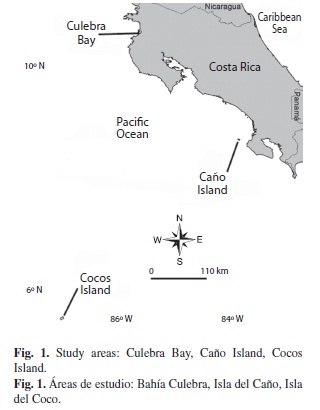
<body><![CDATA[<font style="font-weight: bold;" size="3"><span      style="font-family: verdana;">Materials and Methods</span></font><br      style="font-family: verdana;">     <font size="2"></font><br style="font-family: verdana;">     <font size="2"><span style="font-family: verdana;">To reconstruct a     reef budget it was     necessary to estimated the     current bioacretion and bioerosion rates. For this, we visited three     reef sites per study area (<a href="#fig_1">Fig. 1</a>), where     transects to&nbsp;     ]]></body>
<body><![CDATA[measure&nbsp; coral&nbsp; cover&nbsp; and&nbsp; sea&nbsp; urchin&nbsp;     density were deployed. Three field studies were done in 2009: 1) 1-5     March, Cocos Island (5&deg;31&#8217;45&#8217;&#8217;N-87&deg;03&#8217;37&#8217;&#8217;W); 2) 18-20 July,     Ca&ntilde;o Island (8&deg;41&#8217;36&#8217;&#8217;N-83&deg;52&#8217;05&#8217;&#8217;W); and 3) 29-31 July,     Culebra Bay (10&deg;35&#8217;19&#8217;&#8217;N-85&deg;40&#8217;27&#8217;&#8217;W).    <br>     <br> </span></font>     <div style="text-align: center;"><font size="2"><a name="fig_1"></a><img      alt="" src="/img/revistas/rbt/v60s2/a08i1.jpg"      style="width: 320px; height: 410px;"><span     ]]></body>
<body><![CDATA[ style="font-family: verdana;"></span></font><br      style="font-family: verdana;">     <font size="2"><span style="font-family: verdana;"></span></font></div>     <br style="font-family: verdana;">     <font size="2"><span style="font-family: verdana;">Three 10 m long and     1 m wide     transects were deployed parallel to the     coast, between 4 and 8 m deep. A 1 m<sup>2&nbsp;</sup> quadrat, divided     into 0.01     m<sup>2</sup> cells was placed every meter, on the right side of the     ]]></body>
<body><![CDATA[transect line (Weinberg 1981). The amount of live, dead, and bleached     coral cover, and also macroalgae, crustose coralline algae, rocks and     sand cover were determined for each quadrat. In addition, sea urchin     (<span style="font-style: italic;">D. mexicanum</span>)&nbsp;     abundances&nbsp; were&nbsp; counted&nbsp; along     the 20m<sup>2</sup>&nbsp; belt transect.</span></font><br      style="font-family: verdana;">     <font size="2"></font><br style="font-family: verdana;">     <font size="2"><span style="font-family: verdana;">To determine the     bioerosion rate     ]]></body>
<body><![CDATA[per locality (removal of CaCO<sub>3</sub>&nbsp;     per time unit), 30 sea urchins&nbsp; were&nbsp; collected&nbsp;     (between&nbsp; 08:00&nbsp; and 10:00 hours) and placed in plastic     buckets (5 l), leaving them to evacuated the gut content for a period     of 24 hours (Glynn 1988, Reyes-Bonilla &amp; Calder&oacute;n-Aguilera     1999). The evacuated material was collected and later dried in an oven     at 60&ordm;C for 24 h. The samples were weighted on an analytic balance     (0.0001 g) and transferred to a furnace at 500&ordm;C for 6 h. After     this period, the samples (ashes) were measured again. The difference     between the weights determined the amount of organic matter that is     ]]></body>
<body><![CDATA[present in the sea urchin&#8217;s gut (Carreiro-Silva &amp; McClanahan     2001). The remaining portion represents the&nbsp; inorganic&nbsp;     fraction,&nbsp; composed&nbsp; by&nbsp; CaCO<sub>3</sub> and     non-soluble residues     (silica fragments like quartz grains, sponge spicules, diatoms,     radiolarians and lime). Inorganic fractions were digested with 10% HCl.     The     remaining material, after dissolution of the carbonates, was filtered     with a pre-weighed fiberglass filter. The weight of the residue     material retained on the filter corresponds with the non-carbonate     ]]></body>
<body><![CDATA[fraction (NCF). The difference between the ashes and the weight of     the residue equals the CaCO<sub>3</sub> (Carreiro-Silva &amp;     McClanahan 2001).     This gives us the amount of carbonates removed by each sea urchin     (CaCO<sup>3</sup> g ind<sup>-1&nbsp;</sup> d<sup>-1</sup>).</span></font><br      style="font-family: verdana;">     <font size="2"></font><br style="font-family: verdana;">     <font size="2"><span style="font-family: verdana;">The bioerosion rates     per urchin (kg     m<sup>-2</sup> y<sup>-1</sup>) at the different study     ]]></body>
<body><![CDATA[areas were calculated&nbsp; by&nbsp; multiplying&nbsp; the&nbsp;     daily&nbsp; carbonate&nbsp; content (CaCO<sub>3</sub> g ind<sup>-1</sup>&nbsp;     d<sup>-1</sup>) by     density of the sea urchins (ind m<sup>-2</sup>) over 365 days (modified     from     Carreiro-Silva &amp; McClanahan 2001).</span></font><br      style="font-family: verdana;">     <font size="2"></font><br style="font-family: verdana;">     <font size="2"><span style="font-family: verdana;">To&nbsp;     obtain&nbsp; the&nbsp;     ]]></body>
<body><![CDATA[carbonate&nbsp; deposition&nbsp; rate     of the coral, we used the method proposed by Chave <span      style="font-style: italic;">et al.</span> (1972), which     combines the coral growth rate (cm y<sup>-1</sup>) and the coral     skeletal density (g cm<sup>-3</sup>) to calculate the gross carbonate     production. We&nbsp;     multiplied&nbsp; this&nbsp; result&nbsp; by&nbsp; the amount of live     coral cover (LCC) to estimate the net deposition of carbonates on the     reef (CaCO<sub>3</sub> kg m<sup>-2</sup> y<sup>-1</sup>).</span></font><br      style="font-family: verdana;">     ]]></body>
<body><![CDATA[<font size="2"></font><br style="font-family: verdana;">     <font size="2"><span style="font-family: verdana;">To&nbsp;     obtain&nbsp; the&nbsp;     skeletal&nbsp; and&nbsp; coral&nbsp;     growth rates,&nbsp; we&nbsp; sampled&nbsp; 10&nbsp; fragments&nbsp;     of&nbsp; colonies of <span style="font-style: italic;">Porites lobata</span>     from Cocos Island, five of <span style="font-style: italic;">P.     lobata</span> from Ca&ntilde;o Island, five of <span      style="font-style: italic;">Pocillopora</span> elegans from     Ca&ntilde;o Island, and five of <span style="font-style: italic;">P.     ]]></body>
<body><![CDATA[elegans</span> from Culebra Bay. The     samples were sent to the laboratory of&nbsp; Ecolog&iacute;a Marina,     Centro de Investigaci&oacute;n Cient&iacute;fica y Educaci&oacute;n     Superior de Ensenada (CICESE), Baja California, M&eacute;xico, where     the Carricart-Gavinet and Barnes (2007) protocol was applied to     obtain density values. The values for coral growth were taken from     the literature (Guzman &amp; Cort&eacute;s 1989, Jim&eacute;nez &amp;     Cort&eacute;s 2003). For Cocos Island, 10 colonies were stained with     Alizarin Red (Lamberts 1978) in August 2007, removed in September 2008,     then sliced, measured and the growth rate calculated.</span></font><br     ]]></body>
<body><![CDATA[ style="font-family: verdana;">     <font size="2"></font><br style="font-family: verdana;">     <font size="2"><span style="font-family: verdana;">To reconstruct the     carbonate     budgets, we assumed that coral growth and     skeletal density were the same for all the analyzed years, as well as     the carbonate content present in the sea urchin&#8217;s guts. Coral growth     can varied between years or seasons, so our reconstruction assumed an     &#8220;ideal scenario&#8221; to asses only the impact&nbsp; of&nbsp; <span      style="font-style: italic;">D.&nbsp;     ]]></body>
<body><![CDATA[mexicanum</span>&nbsp; on&nbsp; reef&nbsp; accretion. To&nbsp;     determine&nbsp;     the&nbsp; past&nbsp; bioerosion&nbsp; rates,&nbsp; we used literature     information about historical <span style="font-style: italic;">D.     mexicanum</span> densities (Guzman 1986,     Guzman &amp; Cort&eacute;s 1992, 2007, Lessios <span      style="font-style: italic;">et al.</span> 1996,     Jim&eacute;nez 1998, Alvarado &amp; Chiriboga 2008, J.J. Alvarado     unpubl. data) and present densities. In addition, to determine past     bioacretion rates, we&nbsp; used&nbsp; historical&nbsp; live&nbsp;     ]]></body>
<body><![CDATA[coral&nbsp; cover&nbsp; information (Guzman <span      style="font-style: italic;">et al.</span> 1987, Guzman &amp;     Cort&eacute;s 1992, 2007, Jim&eacute;nez 2001, J.J. Alvarado &amp; J.     Cort&eacute;s unpubl. data), and present covers. The carbonate balance     is a quantitative measured of the functional state of the reef (Perry     <span style="font-style: italic;">et al. </span></span></font><font      size="2"><span style="font-family: verdana;">2008). As used here,     balance refers     to the net carbonate budget change     in each reef system by comparing the production and the erosion. It is     ]]></body>
<body><![CDATA[positive if the reef is growing and negative if the reef is eroding     (Eakin 2001).</span></font><br style="font-family: verdana;">     <font size="2"></font><br style="font-family: verdana;">     <font size="2"><span style="font-family: verdana;">Finally, we analyzed     the     relationship between&nbsp; <span style="font-style: italic;">D.&nbsp;     mexicanum</span>&nbsp; density&nbsp; and&nbsp; the&nbsp; results of     reef     balance with a logarithmic regression. The regression equation was used     to calculate possible scenarios of reef balance in Culebra Bay at     ]]></body>
<body><![CDATA[different urchin densities (3, 4, 5 and 11 ind m<sup><sub>-2</sub></sup>).</span></font><br      style="font-family: verdana;">     <font size="2"></font><br style="font-family: verdana;">     <font style="font-weight: bold;" size="3"><span      style="font-family: verdana;">Results</span></font><br      style="font-family: verdana;">     <a href="/img/revistas/rbt/v60s2/a08t1.gif"><br      style="font-family: verdana;">     </a><font size="2"><span style="font-family: verdana;"><a      href="/img/revistas/rbt/v60s2/a08t1.gif">Table 1</a> displays: 1)     ]]></body>
<body><![CDATA[carbonate     amounts present in the <span style="font-style: italic;">D. mexicanum</span>&#8216;s     gut, and 2) coral growth and skeletal density for the main reefbuilder     species. The highest amount of carbonate present in the     urchin guts was at Cocos Island, and lowest at Ca&ntilde;o Island     (<a href="/img/revistas/rbt/v60s2/a08t1.gif">Table 1</a>). <span      style="font-style: italic;">Pocillopora</span> <span      style="font-style: italic;">elegans</span> possesses a higher growth     rate than     <span style="font-style: italic;">Porites lobata</span> (<a     ]]></body>
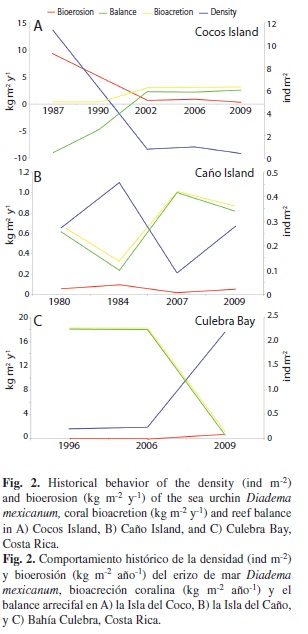
<body><![CDATA[ href="/img/revistas/rbt/v60s2/a08t1.gif">Table 1</a>).     Coral skeletal density was similar in the     three study areas, being higher at the species level for P. lobata than     for <span style="font-style: italic;">P. elegans</span> (<a      href="/img/revistas/rbt/v60s2/a08t1.gif">Table 1</a>).    <br>     <br> </span></font><font size="2"><span style="font-family: verdana;">At Cocos Island, we observed a reduction of <span style="font-style: italic;">D. mexicanum</span> density from 1987 to 2009, and a gradual increase in live coral cover (<a  href="/img/revistas/rbt/v60s2/a08t2.gif">Table 2</a>, <a href="#fig_2">Fig. 2A</a>). At this island, the highest sea urchin densities were reported (11.4 ind m<sup>-2</sup>) in 1987, whereas they were &#8804; 1 ind m<sup>-2</sup>&nbsp; (<a href="/img/revistas/rbt/v60s2/a08t2.gif">Table 2</a>) from 2002 to 2009. At Ca&ntilde;o Island, the densities were&nbsp; below&nbsp; 0.50&nbsp; ind&nbsp; m<sup>-2</sup>,&nbsp; while&nbsp; in&nbsp; Culebra Bay they increased 900% from 2006 to 2009 (<a  href="/img/revistas/rbt/v60s2/a08t2.gif">Table 2</a>). In the three study areas, live coral cover was high (~20-50%) during times when urchin densities were low (&lt; 1 ind m-2, except for Ca&ntilde;o in 1984), and low (~3%) when the densities of <span  style="font-style: italic;">D. mexicanum</span> were close to 3 ind m<sup>-2</sup> (<a href="/img/revistas/rbt/v60s2/a08t2.gif">Table 2</a>). From the three study areas, Ca&ntilde;o Island&nbsp; maintained&nbsp; a&nbsp; relatively&nbsp; constant&nbsp; coral cover&nbsp; and&nbsp; urchin&nbsp; density,&nbsp; except&nbsp; that&nbsp; coral cover decreased in 1984, with a slight increase in <span  style="font-style: italic;">D. mexicanum</span> density (<a href="/img/revistas/rbt/v60s2/a08t2.gif">Table 2</a>).    <br>     <br> </span></font>     <div style="text-align: center;"><font size="2"><a name="fig_2"></a><img  alt="" src="/img/revistas/rbt/v60s2/a08i2.jpg"  style="width: 308px; height: 634px;"><span  style="font-family: verdana;"></span></font><br  style="font-family: verdana;"> <font size="2"><span style="font-family: verdana;"></span></font></div> <br style="font-family: verdana;"> <font size="2"><span style="font-family: verdana;">In Cocos Island, as the density of <span style="font-style: italic;">Diadema</span> decreased, its bioerosion impact decreased (Fig. 2A). In 1987, intense bioerosion (9.3 kg m<sup>-2</sup>&nbsp; y<sup>-1</sup>) and very low bioacretion (0.4 kg m<sup>-2</sup> y-1) were observed, resulting in a negative balance in the carbonate budget (Fig. 2A). At this locality&nbsp; there&nbsp; was&nbsp; a&nbsp; positive&nbsp; balance&nbsp; in 2002, which was maintained until 2009, with net accretion of 3.1 kg m<sup>-2</sup>&nbsp; y<sup>-1</sup>&nbsp; (<a  href="#fig_2">Fig. 2A</a>).</span></font><br  style="font-family: verdana;"> <font size="2"></font><br style="font-family: verdana;"> <font size="2"><span style="font-family: verdana;">In Ca&ntilde;o Island, <span style="font-style: italic;">D. mexicanum</span> had little impact on bioerosion (&lt;1 kg m<sup>-2</sup>&nbsp; y<sup>-1</sup>) in comparison to Cocos Island (Fig. 2A-B). Also, bioacretion has been high (~11 kg m<sup>-2</sup> y<sup>-1</sup>), producing a positive carbonate balance (<a href="#fig_2">Fig. 2B</a>).</span></font><br  style="font-family: verdana;"> <font size="2"></font><br style="font-family: verdana;"> <font size="2"><span style="font-family: verdana;">Finally, in Culebra Bay the carbonate balance was highly positive, with bioacretion rates of 18 kg m<sup>-2</sup>&nbsp; y<sup>-1</sup> and low bioerosion rates (0.07 kg m<sup>-2</sup> y<sup>-1</sup>) until 2006. After that&nbsp; date, there&nbsp; was&nbsp; a&nbsp; drastic&nbsp; change&nbsp; in&nbsp; the&nbsp; carbonate budget,&nbsp; becoming&nbsp; almost&nbsp; negative&nbsp;&nbsp; &nbsp;by&nbsp; 2009 (0.43 kg m<sup>-2</sup>&nbsp; y<sup>-1</sup>; <a href="#fig_2">Fig. 2C</a>). The bioerosion rate increased from 0.07 to 0.75&nbsp; kg&nbsp; m<sup>-2</sup> y<sup>-1</sup>, as a result of the increase in sea urchin density (<a href="#fig_2">Fig. 2C</a>). Loss of coral cover (<a  href="/img/revistas/rbt/v60s2/a08t2.gif">Table 2</a>) resulted from the&nbsp; proliferations&nbsp; of&nbsp; harmful&nbsp; phytoplankton that caused high mortality in the area (Jim&eacute;nez 2007, Jim&eacute;nez <span  style="font-style: italic;">et al.</span> in prep).</span></font><br style="font-family: verdana;"> <font size="2"></font><br style="font-family: verdana;"> <font size="2"><span style="font-family: verdana;">The relationship between <span style="font-style: italic;">D. mexicanum</span> density and reef carbonate balance is negative (<a href="/img/revistas/rbt/v60s2/a08i3.jpg">Fig. 3</a>). When there are few sea urchins, carbonate balance is highly positive (Culebra Bay: 1996 and 2006). When the density of sea urchins exceeds ~1.5 ind m<sup>-2</sup>, reef balance start to be negative, becoming highly erosive when urchin density exceeds 4 ind m<sup><sub>-2</sub></sup>. Figure 3 help to explain how quickly can be a negative process, such as in Culebra Bay, where in less than 3 years there was a fast loss on reef balance. Also, this analysis help to visualized the slow process of recovery took Cocos Island after a strong disturbance until now days. In the case of Ca&ntilde;o Island, it seems that <span  style="font-style: italic;">D. mexicanum</span> does not possess a key role in reef balance. For Culebra Bay, a continuing increase in sea urchin density will produce a negative balance. </span></font><font size="2"><span  style="font-family: verdana;">The 2009 densities were 2.19 ind m<sup>-2</sup>, pushing the reefs near negative balance. An increase to&nbsp; 3&nbsp; ind&nbsp; m<sup>-2</sup> would produce a considerable reduction on reef erosion, and an increase to 11 ind m<sup>-2&nbsp;</sup> would produce a similar impact to reef balance as the one seen in&nbsp; Cocos Island after the 1982-1983 El Ni&ntilde;o event.    ]]></body>
<body><![CDATA[<br>     <br>     </span></font><font style="font-weight: bold;" size="3"><span      style="font-family: verdana;">Discussion</span></font><br      style="font-family: verdana;">     <font size="2"></font><br style="font-family: verdana;">     <font size="2"><span style="font-family: verdana;">Guzman&nbsp;&nbsp;     and&nbsp;&nbsp;     Cort&eacute;s&nbsp;&nbsp;     (2001)&nbsp;&nbsp; observed that after severe disturbance, the recovery     ]]></body>
<body><![CDATA[of ETP reefs has been slow, due to the lack of recruitment and the     continuous predation by corallivorous&nbsp; organisms.&nbsp; In&nbsp;     the&nbsp; case&nbsp; of&nbsp; the 1982-83 El Ni&ntilde;o, the recovery     was limited by 1)&nbsp; the&nbsp; extreme&nbsp; oceanographic&nbsp;     conditions&nbsp; of the region, 2) the high coral mortality suffered     during the El Ni&ntilde;o, 3) the intense herbivory resulting from high     sea urchin concentrations produced high rates of bieorosion, 4) low     abundance of recruits due to reduced sexual activity of the main reef     builder species, and 5) low potential for successful recruitment due to     the low abundance of crustose coralline algae (Guzman &amp;     ]]></body>
<body><![CDATA[Cort&eacute;s 2001). Baker <span style="font-style: italic;">et al.</span>     (2008) indicated that, for a reef     affected by bleaching to recover, a change in the balance between reef     accumulation and erosion, the ability to maintain healthy levels of     herbivory, and macroalgae cover and coral recruitment are required.</span></font><br      style="font-family: verdana;">     <font size="2"></font><br style="font-family: verdana;">     <font size="2"><span style="font-family: verdana;">After the 1982-83 El     Ni&ntilde;o,     there was a high incidence of coral     ]]></body>
<body><![CDATA[mortality and bleaching at Cocos Island. During this period there were     high sea urchin densities (Guzman &amp; Cort&eacute;s 1992), producing     a negative carbonate budget, and reef erosion in 1987. It took     approximately 15 years for those reefs to switch back to a positive     balance. Probably, as Guzman and Cort&eacute;s (2007) indicated, the     impact of the sea urchin as bioeroder declined, and its action as a     herbivore facilitated coral recruitment. Thus, the role of the sea     urchin can change in accordance with its density.</span></font><br      style="font-family: verdana;">     <font size="2"></font><br style="font-family: verdana;">     ]]></body>
<body><![CDATA[<font size="2"><span style="font-family: verdana;">Glynn <span      style="font-style: italic;">et al.</span> (2009) indicated a     similar recovery pattern for the coral     reefs at Darwin Island, northern Galapagos Archipelago, which     underwent&nbsp; lower&nbsp; bioerosion&nbsp; in&nbsp; comparison     with&nbsp; other&nbsp; reefs&nbsp; in&nbsp; the&nbsp; Archipelago&nbsp;     (Glynn 1988). This resulted in an intact reef framework and, together     with successful sexual and asexual&nbsp; coral&nbsp;     recruitment&nbsp; (Glynn&nbsp; <span style="font-style: italic;">et&nbsp;     al.&nbsp;</span> 2009), there was a     ]]></body>
<body><![CDATA[similar recovery as observed at Cocos Island.</span></font><br      style="font-family: verdana;">     <font size="2"></font><br style="font-family: verdana;">     <font size="2"><span style="font-family: verdana;">The recovery in reef     balance     observed at Cocos Island, like at Darwin     Island, could be due in part to the positive role that <span      style="font-style: italic;">Diadema </span>can have     through creating spaces for settlement (Carleton &amp; Sammarco 1987)     and increasing the cover of crustose coralline algae, which enhances     ]]></body>
<body><![CDATA[successful settlement (Morse <span style="font-style: italic;">et al.</span>     1988). Vance (1979) found that the     sea urchin <span style="font-style: italic;">Centrostephanus coronatus</span>,     a member of the Diadematidae     family, avoids consuming crustose coralline algae when eating other     algae, favoring development of coralline algae. Nevertheless, the sea     urchin in search of its food can erode the substrate simply by scraping     areas where algae grow (Toro-Farmer 1998). Therefore, in the case of     Cocos Island, the herbivorous activity of <span      style="font-style: italic;">D. mexicanum</span> possibly     ]]></body>
<body><![CDATA[resulted in a larger abundance of calcareous algae, and a greater     availability of substrate for recruitment of new coral recruits,     favoring its recovery.</span></font><br style="font-family: verdana;">     <font size="2"></font><br style="font-family: verdana;">     <font size="2"><span style="font-family: verdana;">Eakin (2001)     indicated that the     reef budget in Uva Island, Panama,     between 1985 and 2000,&nbsp; was&nbsp; negative,&nbsp; without&nbsp;     showing&nbsp; signs of recovery. In some places the densities of     Diadema diminished due to the reduction in the reef complexity due to     ]]></body>
<body><![CDATA[the urchin&#8217;s erosion, diminishing their refuge. In Cocos Island, reef     complexity has remained high (Alvarado <span      style="font-style: italic;">et al.</span> in prep.), but density of     sea urchins has diminished (<a href="#fig_2">Fig. 2A</a>, <a      href="/img/revistas/rbt/v60s2/a08t2.gif">Table 2</a>), which is     probably     related to predation. This island has been a no-take Marine Protected     Area for the last 30 years, and protection has been strictly enforced     for the last 10 years. This has favored the recovery of trophic webs.     This contrasts with Panama, where the reefs were under strong fishing     ]]></body>
<body><![CDATA[pressure for many years, diminishing the presence of predators on <span      style="font-style: italic;">D.     mexicanum</span>. It has been observed that inside marine reserves,     where the     fishing pressure has been reduced, the trophic interactions are     re-established between the sea urchins and their predators (McClanahan     <span style="font-style: italic;">et al.</span> 1999), as opposed to     places where intense fishing is occurring     and densities of Diadema are high (Harborne <span      style="font-style: italic;">et al.</span> 2009).</span></font><br     ]]></body>
<body><![CDATA[ style="font-family: verdana;">     <font size="2"></font><br style="font-family: verdana;">     <font size="2"><span style="font-family: verdana;">At Ca&ntilde;o     Island, from the     historic densities of <span style="font-style: italic;">D. mexicanum</span>     (Fonseca 1999, Guzman &amp; Cort&eacute;s 2001, Fonseca <span      style="font-style: italic;">et al.</span> 2006),     it seems that this sea urchin has not been an important bioeroder and     that its impact has been minimum (<a href="#fig_2">Fig. 2B</a>). Scott <span      style="font-style: italic;">et al.</span> (1988)     ]]></body>
<body><![CDATA[indicated that after the 1982-83 El Ni&ntilde;o, this island     experienced intense bioerosion (9 kg m<sup>-2</sup>&nbsp; y<sup>-1</sup>).     Later, in 1996,     Fonseca (1999) determined a lower bioerosion rate (0.05 kg m<sup><sub>-2</sub></sup>     y<sup>-1</sup>) for     Platanillo Reef, as well as high bioacretion (7.1 kg m<sup>-2</sup> y<sup>-1</sup>).     Guzman     and Cort&eacute;s (2001) indicated that these reefs in the 1997-98 El     Ni&ntilde;o had less effect than prior events because of high crustose     coralline cover (80-95%) and successful coral recruitment.</span></font><br     ]]></body>
<body><![CDATA[ style="font-family: verdana;">     <font size="2"></font><br style="font-family: verdana;">     <font size="2"><span style="font-family: verdana;">In Culebra Bay,     bioerosion     increased after 2009, when a massive     explosion of <span style="font-style: italic;">D. mexicanum</span>     occurred. The reefs from this area     underwent intense mortality due to recurrent proliferations of     phytoplankton between 2006 and 2009; these produced intense bleaching     resulting from the anoxic conditions of the water&nbsp; and&nbsp;     ]]></body>
<body><![CDATA[the&nbsp; lack&nbsp; of&nbsp; sun&nbsp; light&nbsp; penetrating to the     bottom (Jim&eacute;nez <span style="font-style: italic;">et al.</span>     en prep.). Dead corals were replaced by     turf algae. This availability of algae could have caused an increase     in the recruitment of sea urchins, increasing their densities, and     their bioerosional effect. If this bioerosion continues, the coral     framework will be weakened and may collapse (Colgan &amp; Glynn 1990).     <a href="/img/revistas/rbt/v60s2/a08i4.jpg">Figure 4</a> illustrates     the difference in conditions     in 2005 compared to     ]]></body>
<body><![CDATA[now.    <br>     <br>     </span></font>     <font size="2"><span style="font-family: verdana;">Bioerosion intensity     depends on     several environmental factors, like     depth, light and nutrient supply (Chazottes <span      style="font-style: italic;">et al.</span> 1995). Baker <span      style="font-style: italic;">et al.</span>     ]]></body>
<body><![CDATA[(2008) indicated that a variety of disturbances can cause a     significant reduction in live coral cover. Eutrophication,     sedimentation and bleaching can quickly initiate to an erosive phase,     resulting in a loss of structural integrity and topographical relief.     Moreover, Edinger <span style="font-style: italic;">et al.</span>     (2000) mentioned that coral reefs growing in     eutrophic coastal environments are exposed to higher bioerosion than     those in clear oceanic waters, resulting in negative carbonate budgets.     In Dominican Republic, Tewfik <span style="font-style: italic;">et al.</span>     (2005) found that a nutrient     ]]></body>
<body><![CDATA[enrichment together with overfishing accelerated the environment     deterioration, and facilitated an increase in sea urchin densities     (<span style="font-style: italic;">Lytechinus variegatus</span>). As     consequence of this population increase     there was a considerable reduction on the diversity on the affected     areas.</span></font><br style="font-family: verdana;">     <font size="2"></font><br style="font-family: verdana;">     <font size="2"><span style="font-family: verdana;">In Culebra Bay, the     environmental     conditions have deteriorated in     ]]></body>
<body><![CDATA[recent years due to anthropogenic eutrophication (Fern&aacute;ndez     2007, Fern&aacute;ndez <span style="font-style: italic;">et al.</span>     in prep.). This has resulted in invasions     by <span style="font-style: italic;">Caulerpa sertularoides</span>     (Fern&aacute;ndez &amp; Cort&eacute;s 2005,     Fern&aacute;ndez 2007) and phytoplankton&nbsp; proliferations&nbsp;     (Jim&eacute;nez&nbsp; 2007, Jim&eacute;nez <span      style="font-style: italic;">et al.</span> in prep.). As a     consequence, live coral cover in the Bay has declined (Jim&eacute;nez     2007, Bezy <span style="font-style: italic;">et al.</span> 2006,     ]]></body>
<body><![CDATA[Cort&eacute;s <span style="font-style: italic;">et al.</span> 2010,     Fern&aacute;ndez <span style="font-style: italic;">et     al.</span> in prep.). When nutrients become&nbsp; abundant,&nbsp;     reef&nbsp;     carbonate&nbsp; producers&nbsp; tend to be overgrown by fast-growing     fleshy and filamentous algae. Meanwhile the bioeroders tend to increase     due to the food availability, magnifying the negative effects     (Chazottes <span style="font-style: italic;">et al.</span> 1995).     Additionally, successful recruitment by     juvenile sea urchins have been attributed to algal proliferation     ]]></body>
<body><![CDATA[because of the increase in nutrient availability, favoring a greater     density of sea urchins in organically enriched areas (Ekl&ouml;f <span      style="font-style: italic;">et al.</span>     2008).</span></font><br style="font-family: verdana;">     <font size="2"></font><br style="font-family: verdana;">     <font size="2"><span style="font-family: verdana;">Another negative     factor that could     have promoted an increase in <span style="font-style: italic;">D.     mexicanum</span> high densities&nbsp; at&nbsp; Culebra&nbsp; Bay,&nbsp;     is&nbsp; that&nbsp; this&nbsp; area suffers&nbsp; from&nbsp; a&nbsp;     ]]></body>
<body><![CDATA[strong&nbsp; fishing&nbsp; pressure,&nbsp; with few controls and     complete lack of protection of the resources. With few or no sea urchin     predators and with more food available, Diadema reached densities     never before reported for the area (<a      href="/img/revistas/rbt/v60s2/a08t2.gif">Table 2</a>), causing an     increase in     bioerosion of the coral framework. On Mar&iacute;as Island in Mexico,     and in the Canary, Galapagos and Hawai&#8217;i archipelagos, it has been     observed that reductions in the populations of predator fishes by     overfishing resulted in an increase in sea urchin abundance     ]]></body>
<body><![CDATA[(Torrej&oacute;n-Arellano <span style="font-style: italic;">et al.</span>     2008, Clemente <span style="font-style: italic;">et al.</span> 2009,     Sonnenholzner <span style="font-style: italic;">et al.</span> 2009,     Vermeij <span style="font-style: italic;">et al.</span> 2010).</span></font><br      style="font-family: verdana;">     <font size="2"></font><br style="font-family: verdana;">     <font size="2"><span style="font-family: verdana;">According to Muthiga     and McClanahan     (2007) it is of interest to record     the historical level of the Diadema populations, as it may indicate the     ]]></body>
<body><![CDATA[degree to which the sea urchin are required for the maintenance of the     coral reef ecology or a negative factor that has been released&nbsp;     from&nbsp; predation&nbsp; by&nbsp; overfishing.&nbsp; Through the     reconstructions presented here (<a href="#fig_2">Fig. 2</a>), it is     possible to visualize     how <span style="font-style: italic;">Diadema mexicanum </span>can     have either a positive or a negative effect     on coral reef development in the Eastern Tropical Pacific. Moreover, it     was shown that for the sea urchin to have a positive or negative     role, a series of synergies are required to switch it in one direction     ]]></body>
<body><![CDATA[or another. Bad coastal management (anthropogenic eutropfication) and     overfishing (lack of sea urchin predators), can result in this sea     urchin eroding the coral framework, as seen in Culebra Bay. However,     where the trophic webs are &#8220;healthy&#8221;, <span style="font-style: italic;">Diadema     mexicanum </span>facilitates the     growth of crustose coralline algae, which at the same time helps the     recovery of coral cover. As Veron <span style="font-style: italic;">et     al.</span> (2009) pointed out, &#8220;a reef     far from additional human stress can realize a rapid recovery,     returning to its own diversity in less than a decade&#8221;. Cocos Island, is     ]]></body>
<body><![CDATA[an     example of this statement, while Culebra Bay, being subjected to     additional stress, likely will take longer to recover. MPAs provide     the means for effectively limiting the number of urchins on coral     reefs and subsequently returning the calcium carbonate cycle to a more     balanced state (Brown-Saracino <span style="font-style: italic;">et al.</span>     2007). However, if the     anthropogenic eutrophied conditions diminish, there is fishery     management, and there is stronger protection of the reef environments,     it is possible that Diadema can help in the recovery of those     ]]></body>
<body><![CDATA[reefs.&nbsp; To&nbsp; assess&nbsp; the&nbsp; future&nbsp;     development&nbsp; of reef structures and their relationship with sea     urchins it is important to continue monitoring the populations on all     of these reefs. However, it is currently extremely important to do this     in Culebra Bay, so that management measures can be initiated if <span      style="font-style: italic;">D.     mexicanum</span> attain densities of &gt; 3 ind m-2. Also, it is     extremely     important to begin studying recruitment and reproduction patterns, as     well as to initiate efficient coastal and fishery management     ]]></body>
<body><![CDATA[practices. Glynn and Fong (2006) stated that if corals survive total     mortality and if environmental conditions return&nbsp; to&nbsp;     pre-disturbance&nbsp; levels,&nbsp; there&nbsp; exits the potential for     rapid coral recovery in a few years. For Culebra Bay, this statement is     extremely important, because its highlight the need for a better     coastal management that would improve coastal ecosystems and their     services.</span></font><br style="font-family: verdana;">     <font size="2"></font><br style="font-family: verdana;">     <font size="2"></font><font style="font-weight: bold;" size="3"><span      style="font-family: verdana;">Acknowlegments</span></font><br     ]]></body>
<body><![CDATA[ style="font-family: verdana;">     <font size="2"></font><br style="font-family: verdana;">     <font size="2"><span style="font-family: verdana;">We&nbsp;     acknowledge&nbsp;     the&nbsp; following&nbsp; persons and     institutions that collaborate during the development of this work: C.     Fern&aacute;ndez, O. Breedy, C. S&aacute;nchez, S. Mart&iacute;nez, E.     G&oacute;mez,&nbsp; </span></font><font size="2"><span      style="font-family: verdana;">A. Planas, V. Flores, O.     Norzagaray, L.E. Calder&oacute;n-Aguilera,     ]]></body>
<body><![CDATA[Centro de Investigaci&oacute;n en Ciencias del Mar y Limnolog&iacute;a     (CIMAR, Universidad de Costa Rica), Universidad Aut&oacute;noma de     Baja California Sur (UABCS), Reserva Biol&oacute;gica Isla del     Ca&ntilde;o and Parque Nacional Isla del Coco park-rangers, MY     Adventure crew, Instituto Costarricense de Turismo, Hotel Punta Marenco     Lodge, &Aacute;guila de Osa Inn, Centro de Investigaci&oacute;n     Cient&iacute;fica y Educaci&oacute;n Superior de Ensenada (CICESE). A     special acknowledgement for their economic support of this research:     Vicerrector&iacute;a de Investigaci&oacute;n of the Universidad de     Costa Rica, Ministerio de Ciencia y Tecnolog&iacute;a de Costa Rica     ]]></body>
<body><![CDATA[(MICIT), Consejo Nacional para Investigaciones Cient&iacute;ficas y     Tecnol&oacute;gicas de Costa Rica (CONICIT), Consejo Nacional de     Ciencia y Tecnolog&iacute;a de M&eacute;xico (CONACYT), Fonds     Fran&ccedil;ais pour l&#8217;Environnement Mondial (FFEM) and Ecodesarrollo     Papagayo. We appreciated the comments made by four anonymous     reviewers that enrich this paper.</span></font><br      style="font-family: verdana;">     <font style="font-weight: bold;" size="3"><span      style="font-family: verdana;"></span></font>     <hr style="width: 100%; height: 2px;"><font style="font-weight: bold;"     ]]></body>
<body><![CDATA[ size="3"><span style="font-family: verdana;">References</span></font><br      style="font-family: verdana;">     <font size="2"></font><br style="font-family: verdana;">     <font size="2"><span style="font-family: verdana;">Alvarado, J.J. &amp;     A. Chiriboga.     2008. Distribuci&oacute;n y abundancia de equinodermos en las aguas     someras de la Isla del Coco, Costa     Rica (Pac&iacute;fico&nbsp; Oriental). Rev. Biol. Trop. 56 (Supl. 2):     <!-- ref -->99-111.    &nbsp;&nbsp;&nbsp;&nbsp;&nbsp;&nbsp;&nbsp;&nbsp;[&#160;<a href="javascript:void(0);" onclick="javascript: window.open('/scielo.php?script=sci_nlinks&ref=1439571&pid=S0034-7744201200060000800001&lng=','','width=640,height=500,resizable=yes,scrollbars=1,menubar=yes,');">Links</a>&#160;]<!-- end-ref --><!-- ref --></span></font><br style="font-family: verdana;"> <font size="2"></font><br style="font-family: verdana;"> <font size="2"><span style="font-family: verdana;">Baker, A.C., P.W. Glynn &amp; B. Riegl. 2008. Climate change and coral reef bleaching: An ecological assessment of long-term impacts, recovery trends and future outlook. Estuar. Coast. Shelf Sci. 80: 435-471.    &nbsp;&nbsp;&nbsp;&nbsp;&nbsp;&nbsp;&nbsp;&nbsp;[&#160;<a href="javascript:void(0);" onclick="javascript: window.open('/scielo.php?script=sci_nlinks&ref=1439572&pid=S0034-7744201200060000800002&lng=','','width=640,height=500,resizable=yes,scrollbars=1,menubar=yes,');">Links</a>&#160;]<!-- end-ref --><!-- ref --></span></font><br  style="font-family: verdana;"> <font size="2"></font><br style="font-family: verdana;"> <font size="2"><span style="font-family: verdana;">Bezy, M.B., C. Jim&eacute;nez, J. Cort&eacute;s, A. Segura, A. Le&oacute;n, J.J. Alvarado, C. Gill&eacute;n &amp; E. Mej&iacute;a. 2006.&nbsp; Contrasting Psammocora-dominated coral communities in Costa Rica, tropical&nbsp; eastern Pacific. Proc. 10th&nbsp;&nbsp;&nbsp;&nbsp; Int.&nbsp; Coral Reef Symp., Okinawa: 376-381.    &nbsp;&nbsp;&nbsp;&nbsp;&nbsp;&nbsp;&nbsp;&nbsp;[&#160;<a href="javascript:void(0);" onclick="javascript: window.open('/scielo.php?script=sci_nlinks&ref=1439573&pid=S0034-7744201200060000800003&lng=','','width=640,height=500,resizable=yes,scrollbars=1,menubar=yes,');">Links</a>&#160;]<!-- end-ref --><!-- ref --></span></font><br style="font-family: verdana;"> <font size="2"></font><br style="font-family: verdana;"> <font size="2"><span style="font-family: verdana;">Brown-Saracino, J., P. Peckol, H.A. Curran &amp; M.L. Robbart. 2007. Spatial variation in sea urchins, fish predators, and&nbsp; bioerosi&oacute;n rates on coral reefs of&nbsp; Belize. Rev. Biol. Trop. 26: 71-78.    &nbsp;&nbsp;&nbsp;&nbsp;&nbsp;&nbsp;&nbsp;&nbsp;[&#160;<a href="javascript:void(0);" onclick="javascript: window.open('/scielo.php?script=sci_nlinks&ref=1439574&pid=S0034-7744201200060000800004&lng=','','width=640,height=500,resizable=yes,scrollbars=1,menubar=yes,');">Links</a>&#160;]<!-- end-ref --><!-- ref --></span></font><br style="font-family: verdana;"> <font size="2"></font><br style="font-family: verdana;"> <font size="2"><span style="font-family: verdana;">Carleton, J.H. &amp; P.W. Sammarco. 1987. Effects of substratum&nbsp; irregularity&nbsp; on&nbsp; success&nbsp; of&nbsp; coral&nbsp; settlement: quantification by comparative&nbsp;&nbsp; geomorphological techniques. Bull. Mar. Sci. 40: 85-98.    &nbsp;&nbsp;&nbsp;&nbsp;&nbsp;&nbsp;&nbsp;&nbsp;[&#160;<a href="javascript:void(0);" onclick="javascript: window.open('/scielo.php?script=sci_nlinks&ref=1439575&pid=S0034-7744201200060000800005&lng=','','width=640,height=500,resizable=yes,scrollbars=1,menubar=yes,');">Links</a>&#160;]<!-- end-ref --><!-- ref --></span></font><br  style="font-family: verdana;"> <font size="2"></font><br style="font-family: verdana;"> <font size="2"><span style="font-family: verdana;">Carreiro-Silva, M. &amp; T.R. McClanahan. 2001.&nbsp; Echinoid bioerosion and herbivory on Kenyan coral reefs: the role of protection&nbsp; from fishing. J. Exp. Mar. Biol. Ecol. 262: 133-153.    &nbsp;&nbsp;&nbsp;&nbsp;&nbsp;&nbsp;&nbsp;&nbsp;[&#160;<a href="javascript:void(0);" onclick="javascript: window.open('/scielo.php?script=sci_nlinks&ref=1439576&pid=S0034-7744201200060000800006&lng=','','width=640,height=500,resizable=yes,scrollbars=1,menubar=yes,');">Links</a>&#160;]<!-- end-ref --><!-- ref --></span></font><br  style="font-family: verdana;"> <font size="2"></font><br style="font-family: verdana;"> <font size="2"><span style="font-family: verdana;">Carricart-Gavinet, J.P. &amp; D.J. Barnes. 2007. Densitometry from digitized images of X radiographs: Methodology for measurement of coral skeletal density. J. Exp. Mar. Biol. Ecol. 344: 67&#8211;72.    &nbsp;&nbsp;&nbsp;&nbsp;&nbsp;&nbsp;&nbsp;&nbsp;[&#160;<a href="javascript:void(0);" onclick="javascript: window.open('/scielo.php?script=sci_nlinks&ref=1439577&pid=S0034-7744201200060000800007&lng=','','width=640,height=500,resizable=yes,scrollbars=1,menubar=yes,');">Links</a>&#160;]<!-- end-ref --><!-- ref --></span></font><br  style="font-family: verdana;"> <font size="2"></font><br style="font-family: verdana;"> <font size="2"><span style="font-family: verdana;">Chave, K.E., S.V. Smith &amp; K.J. Roy. 1972.&nbsp; Carbonate production by coral reefs. Mar. Geol. 12: 123-140.    &nbsp;&nbsp;&nbsp;&nbsp;&nbsp;&nbsp;&nbsp;&nbsp;[&#160;<a href="javascript:void(0);" onclick="javascript: window.open('/scielo.php?script=sci_nlinks&ref=1439578&pid=S0034-7744201200060000800008&lng=','','width=640,height=500,resizable=yes,scrollbars=1,menubar=yes,');">Links</a>&#160;]<!-- end-ref --><!-- ref --></span></font><br  style="font-family: verdana;"> <font size="2"></font><br style="font-family: verdana;"> <font size="2"><span style="font-family: verdana;">Chazottes, V., T. Le Campion-Alsumard &amp; M. Peyrot-Clausade. 1995. Bioerosion rates on coral reefs: interactions between macroborers, microborers and grazers (Moorea, French Polynesia). PALAEO 113: 189-198.    &nbsp;&nbsp;&nbsp;&nbsp;&nbsp;&nbsp;&nbsp;&nbsp;[&#160;<a href="javascript:void(0);" onclick="javascript: window.open('/scielo.php?script=sci_nlinks&ref=1439579&pid=S0034-7744201200060000800009&lng=','','width=640,height=500,resizable=yes,scrollbars=1,menubar=yes,');">Links</a>&#160;]<!-- end-ref --><!-- ref --></span></font><br  style="font-family: verdana;"> <font size="2"></font><br style="font-family: verdana;"> <font size="2"><span style="font-family: verdana;">Clemente,&nbsp; S., J.C. Hern&aacute;ndez &amp; A. Brito.&nbsp; 2009.&nbsp; Evidence of the top-down role&nbsp; of predators in structuring sublittoral rocky-reef communities in a Marine Protected Area and nearby areas of the Canary Islands. ICES J. Mar. Sci. 66: 64-71.    &nbsp;&nbsp;&nbsp;&nbsp;&nbsp;&nbsp;&nbsp;&nbsp;[&#160;<a href="javascript:void(0);" onclick="javascript: window.open('/scielo.php?script=sci_nlinks&ref=1439580&pid=S0034-7744201200060000800010&lng=','','width=640,height=500,resizable=yes,scrollbars=1,menubar=yes,');">Links</a>&#160;]<!-- end-ref --><!-- ref --></span></font><br style="font-family: verdana;"> <font size="2"></font><br style="font-family: verdana;"> <font size="2"><span style="font-family: verdana;">Colgan, M. 1990. El Ni&ntilde;o and the history of Eastern Pacific reef building, p.&nbsp; 183-232. <span style="font-style: italic;">In</span>: P.W. Glynn (ed.). Global&nbsp; Ecological Consequences of the 1982-83&nbsp; El Ni&ntilde;o-Southern Oscillation. Elsevier&nbsp; Oceanographic Series, Netherlands.    &nbsp;&nbsp;&nbsp;&nbsp;&nbsp;&nbsp;&nbsp;&nbsp;[&#160;<a href="javascript:void(0);" onclick="javascript: window.open('/scielo.php?script=sci_nlinks&ref=1439581&pid=S0034-7744201200060000800011&lng=','','width=640,height=500,resizable=yes,scrollbars=1,menubar=yes,');">Links</a>&#160;]<!-- end-ref --><!-- ref --></span></font><br  style="font-family: verdana;"> <font size="2"></font><br style="font-family: verdana;"> <font size="2"><span style="font-family: verdana;">Cort&eacute;s,&nbsp; J. 1997. Biology and geology of&nbsp; eastern Pacific coral reefs. Coral Reefs 16 (Suppl.): S39-S46.    &nbsp;&nbsp;&nbsp;&nbsp;&nbsp;&nbsp;&nbsp;&nbsp;[&#160;<a href="javascript:void(0);" onclick="javascript: window.open('/scielo.php?script=sci_nlinks&ref=1439582&pid=S0034-7744201200060000800012&lng=','','width=640,height=500,resizable=yes,scrollbars=1,menubar=yes,');">Links</a>&#160;]<!-- end-ref --><!-- ref --></span></font><br  style="font-family: verdana;"> <font size="2"></font><br style="font-family: verdana;"> <font size="2"><span style="font-family: verdana;">Cort&eacute;s,&nbsp; J. 2003. Coral reefs of the Americas:&nbsp; An introduction to Latin American Coral Reefs, p. 1-7. <span  style="font-style: italic;">In</span> J. Cort&eacute;s (ed.).&nbsp; Latin American Coral Reefs. Elsevier, Amsterdam.    &nbsp;&nbsp;&nbsp;&nbsp;&nbsp;&nbsp;&nbsp;&nbsp;[&#160;<a href="javascript:void(0);" onclick="javascript: window.open('/scielo.php?script=sci_nlinks&ref=1439583&pid=S0034-7744201200060000800013&lng=','','width=640,height=500,resizable=yes,scrollbars=1,menubar=yes,');">Links</a>&#160;]<!-- end-ref --><!-- ref --></span></font><br style="font-family: verdana;"> <font size="2"></font><br style="font-family: verdana;"> <font size="2"><span style="font-family: verdana;">Cort&eacute;s, J., M.M. Murillo, H.M. Guzman &amp; J. Acu&ntilde;a. 1984. P&eacute;rdida&nbsp; de zooxantelas y muerte de&nbsp; corales y otros organismos&nbsp; arrecifales&nbsp; en&nbsp; el&nbsp; Caribe&nbsp; y&nbsp; Pac&iacute;fico&nbsp; de Costa Rica. Rev. Biol. Trop. 32: 227-231.    &nbsp;&nbsp;&nbsp;&nbsp;&nbsp;&nbsp;&nbsp;&nbsp;[&#160;<a href="javascript:void(0);" onclick="javascript: window.open('/scielo.php?script=sci_nlinks&ref=1439584&pid=S0034-7744201200060000800014&lng=','','width=640,height=500,resizable=yes,scrollbars=1,menubar=yes,');">Links</a>&#160;]<!-- end-ref --><!-- ref --></span></font><br style="font-family: verdana;"> <font size="2"></font><br style="font-family: verdana;"> <font size="2"><span style="font-family: verdana;">Cort&eacute;s,&nbsp; J., C.E. Jim&eacute;nez, A.C. Fonseca &amp; J.J.&nbsp; Alvarado. 2010. Status and conservation of coral reefs in Costa Rica. Rev. Biol. Trop. 58 (Suppl. 1): 33-50.    &nbsp;&nbsp;&nbsp;&nbsp;&nbsp;&nbsp;&nbsp;&nbsp;[&#160;<a href="javascript:void(0);" onclick="javascript: window.open('/scielo.php?script=sci_nlinks&ref=1439585&pid=S0034-7744201200060000800015&lng=','','width=640,height=500,resizable=yes,scrollbars=1,menubar=yes,');">Links</a>&#160;]<!-- end-ref --><!-- ref --></span></font><br  style="font-family: verdana;"> <font size="2"></font><br style="font-family: verdana;"> <font size="2"><span style="font-family: verdana;">Eakin,&nbsp; CM. 1992. Post-El Ni&ntilde;o Panamanian&nbsp; reefs: less accretion, more erosion and&nbsp; damselfish protection. Proc. 7th&nbsp;&nbsp; Int. Coral Reef Symp., Guam 1: 387-396.    &nbsp;&nbsp;&nbsp;&nbsp;&nbsp;&nbsp;&nbsp;&nbsp;[&#160;<a href="javascript:void(0);" onclick="javascript: window.open('/scielo.php?script=sci_nlinks&ref=1439586&pid=S0034-7744201200060000800016&lng=','','width=640,height=500,resizable=yes,scrollbars=1,menubar=yes,');">Links</a>&#160;]<!-- end-ref --><!-- ref --></span></font><br  style="font-family: verdana;"> <font size="2"></font><br style="font-family: verdana;"> <font size="2"><span style="font-family: verdana;">Eakin,&nbsp; C.M. 1996. Where have all the&nbsp; carbonates gone? A&nbsp; model comparison of calcium&nbsp; carbonate budgets before and after the 1982-1983 El Ni&ntilde;o at Uva Island in the eastern Pacific. Coral Reefs 15: 109-119.    &nbsp;&nbsp;&nbsp;&nbsp;&nbsp;&nbsp;&nbsp;&nbsp;[&#160;<a href="javascript:void(0);" onclick="javascript: window.open('/scielo.php?script=sci_nlinks&ref=1439587&pid=S0034-7744201200060000800017&lng=','','width=640,height=500,resizable=yes,scrollbars=1,menubar=yes,');">Links</a>&#160;]<!-- end-ref --><!-- ref --></span></font><br  style="font-family: verdana;"> <font size="2"></font><br style="font-family: verdana;"> <font size="2"><span style="font-family: verdana;">Eakin, C.M. 2001. A tale of two events: carbonate budgets and the influence of&nbsp; two warming disturbances and intervening variability, Uva Island,&nbsp; Panama.&nbsp; Bull. Mar. Sci. 69: 171-186.    &nbsp;&nbsp;&nbsp;&nbsp;&nbsp;&nbsp;&nbsp;&nbsp;[&#160;<a href="javascript:void(0);" onclick="javascript: window.open('/scielo.php?script=sci_nlinks&ref=1439588&pid=S0034-7744201200060000800018&lng=','','width=640,height=500,resizable=yes,scrollbars=1,menubar=yes,');">Links</a>&#160;]<!-- end-ref --><!-- ref --></span></font><br style="font-family: verdana;"> <font size="2"></font><br style="font-family: verdana;"> <font size="2"><span style="font-family: verdana;">Edinger, E.N., G.V. Limmon, J. Jompa, W. Widjatmokos, J.M.&nbsp; Heikoop&nbsp; &amp;&nbsp; M.J.&nbsp; Risk.&nbsp; 2000.&nbsp; Normal&nbsp; coral growth rates&nbsp; on dying reefs: are coral growth rates good indicators of reef health? Mar.&nbsp; Poll.&nbsp; Bull. 40: 404-425.    &nbsp;&nbsp;&nbsp;&nbsp;&nbsp;&nbsp;&nbsp;&nbsp;[&#160;<a href="javascript:void(0);" onclick="javascript: window.open('/scielo.php?script=sci_nlinks&ref=1439589&pid=S0034-7744201200060000800019&lng=','','width=640,height=500,resizable=yes,scrollbars=1,menubar=yes,');">Links</a>&#160;]<!-- end-ref --><!-- ref --></span></font><br style="font-family: verdana;"> <font size="2"></font><br style="font-family: verdana;"> <font size="2"><span style="font-family: verdana;">Ekl&ouml;f, J.S., M. de la Torrre-Castro, M. Gullstr&ouml;m, J. Uku, N. Muthinga, T. Lyimo &amp; S.O. Bandeira. 2008. Sea urchin overgrrazing of seagrasses: a review of current knowledge&nbsp; on&nbsp; causes,&nbsp; consequences,&nbsp; and&nbsp; management. Estuar. Coast. Shelf Sci. 79: 559-580.    &nbsp;&nbsp;&nbsp;&nbsp;&nbsp;&nbsp;&nbsp;&nbsp;[&#160;<a href="javascript:void(0);" onclick="javascript: window.open('/scielo.php?script=sci_nlinks&ref=1439590&pid=S0034-7744201200060000800020&lng=','','width=640,height=500,resizable=yes,scrollbars=1,menubar=yes,');">Links</a>&#160;]<!-- end-ref --><!-- ref --></span></font><br  style="font-family: verdana;"> <font size="2"></font><br style="font-family: verdana;"> <font size="2"><span style="font-family: verdana;">Enfield, D.B. 2001. Evolution and historical perspective of the 1997-1998 El&nbsp; Ni&ntilde;o-Southern Oscillation event. Bull. Mar. Sci. 69: 7-25.    &nbsp;&nbsp;&nbsp;&nbsp;&nbsp;&nbsp;&nbsp;&nbsp;[&#160;<a href="javascript:void(0);" onclick="javascript: window.open('/scielo.php?script=sci_nlinks&ref=1439591&pid=S0034-7744201200060000800021&lng=','','width=640,height=500,resizable=yes,scrollbars=1,menubar=yes,');">Links</a>&#160;]<!-- end-ref --><!-- ref --></span></font><br style="font-family: verdana;"> <font size="2"></font><br style="font-family: verdana;"> <font size="2"><span style="font-family: verdana;">Fern&aacute;ndez,&nbsp; C. 2007. Propagaci&oacute;n del alga&nbsp; <span style="font-style: italic;">Caulerpa sertularoides</span>&nbsp; en&nbsp; Bah&iacute;a&nbsp; Culebra,&nbsp; Golfo&nbsp; de&nbsp; Papagayo, Pac&iacute;fico norte de Costa Rica. Tesis de maestr&iacute;a, Universidad de Costa Rica, San Jos&eacute;, Costa Rica. 92 p.    &nbsp;&nbsp;&nbsp;&nbsp;&nbsp;&nbsp;&nbsp;&nbsp;[&#160;<a href="javascript:void(0);" onclick="javascript: window.open('/scielo.php?script=sci_nlinks&ref=1439592&pid=S0034-7744201200060000800022&lng=','','width=640,height=500,resizable=yes,scrollbars=1,menubar=yes,');">Links</a>&#160;]<!-- end-ref --><!-- ref --></span></font><br  style="font-family: verdana;"> <font size="2"></font><br style="font-family: verdana;"> <font size="2"><span style="font-family: verdana;">Fern&aacute;ndez, C. &amp; J. Cort&eacute;s. 2005. Caulerpa sertularioides, a green alga spreading&nbsp; aggressively over coral reef communities in Culebra Bay, North Pacific of Costa Rica. Coral Reefs 24: 10.    &nbsp;&nbsp;&nbsp;&nbsp;&nbsp;&nbsp;&nbsp;&nbsp;[&#160;<a href="javascript:void(0);" onclick="javascript: window.open('/scielo.php?script=sci_nlinks&ref=1439593&pid=S0034-7744201200060000800023&lng=','','width=640,height=500,resizable=yes,scrollbars=1,menubar=yes,');">Links</a>&#160;]<!-- end-ref --><!-- ref --></span></font><br style="font-family: verdana;"> <font size="2"></font><br style="font-family: verdana;"> <font size="2"><span style="font-family: verdana;">Fonseca, A.C. 1999. Bioerosi&oacute;n y&nbsp; bioacreci&oacute;n en arrecifes coralinos del&nbsp; Pac&iacute;fico sur de Costa Rica. M.Sc. Thesis, Universidad de Costa Rica, San Jos&eacute;, Costa Rica. 206 p.    &nbsp;&nbsp;&nbsp;&nbsp;&nbsp;&nbsp;&nbsp;&nbsp;[&#160;<a href="javascript:void(0);" onclick="javascript: window.open('/scielo.php?script=sci_nlinks&ref=1439594&pid=S0034-7744201200060000800024&lng=','','width=640,height=500,resizable=yes,scrollbars=1,menubar=yes,');">Links</a>&#160;]<!-- end-ref --><!-- ref --></span></font><br style="font-family: verdana;"> <font size="2"></font><br style="font-family: verdana;"> <font size="2"><span style="font-family: verdana;">Fonseca, A.C., H.K. Dean &amp; J. Cort&eacute;s. 2006. Non-colonial coral macroborers as&nbsp; indicators of coral reef stress in the&nbsp; south Pacific of Costa Rica. Rev. Biol. Trop. 54: 101-115.    &nbsp;&nbsp;&nbsp;&nbsp;&nbsp;&nbsp;&nbsp;&nbsp;[&#160;<a href="javascript:void(0);" onclick="javascript: window.open('/scielo.php?script=sci_nlinks&ref=1439595&pid=S0034-7744201200060000800025&lng=','','width=640,height=500,resizable=yes,scrollbars=1,menubar=yes,');">Links</a>&#160;]<!-- end-ref --><!-- ref --></span></font><br  style="font-family: verdana;"> <font size="2"></font><br style="font-family: verdana;"> <font size="2"><span style="font-family: verdana;">Glynn,&nbsp; P.W. 1977. Coral growth in upwelling&nbsp; and nonupwelling areas off the Pacific coast of Panama. J. Mar. Res. 35:567-585.    &nbsp;&nbsp;&nbsp;&nbsp;&nbsp;&nbsp;&nbsp;&nbsp;[&#160;<a href="javascript:void(0);" onclick="javascript: window.open('/scielo.php?script=sci_nlinks&ref=1439596&pid=S0034-7744201200060000800026&lng=','','width=640,height=500,resizable=yes,scrollbars=1,menubar=yes,');">Links</a>&#160;]<!-- end-ref --><!-- ref --></span></font><br  style="font-family: verdana;"> <font size="2"></font><br style="font-family: verdana;"> <font size="2"><span style="font-family: verdana;">Glynn,&nbsp; P.W. 1988. El Ni&ntilde;o warming, coral&nbsp; mortality and reef framework destruction by echinoid bioerosion in the eastern Pacific. Galaxea 7: 129-160.    &nbsp;&nbsp;&nbsp;&nbsp;&nbsp;&nbsp;&nbsp;&nbsp;[&#160;<a href="javascript:void(0);" onclick="javascript: window.open('/scielo.php?script=sci_nlinks&ref=1439597&pid=S0034-7744201200060000800027&lng=','','width=640,height=500,resizable=yes,scrollbars=1,menubar=yes,');">Links</a>&#160;]<!-- end-ref --><!-- ref --></span></font><br  style="font-family: verdana;"> <font size="2"></font><br style="font-family: verdana;"> <font size="2"><span style="font-family: verdana;">Glynn, P.W. 1990. Coral mortality and disturbances to coral reefs in the tropical&nbsp; eastern Pacific, p. 55-126. In: P.W. Glynn (ed.). Global Ecological Consequences of the 1982-83 El&nbsp; Ni&ntilde;o-Southern Oscillation. Elsevier Oceanographic Series, Netherlands.    &nbsp;&nbsp;&nbsp;&nbsp;&nbsp;&nbsp;&nbsp;&nbsp;[&#160;<a href="javascript:void(0);" onclick="javascript: window.open('/scielo.php?script=sci_nlinks&ref=1439598&pid=S0034-7744201200060000800028&lng=','','width=640,height=500,resizable=yes,scrollbars=1,menubar=yes,');">Links</a>&#160;]<!-- end-ref --><!-- ref --></span></font><br style="font-family: verdana;"> <font size="2"></font><br style="font-family: verdana;"> <font size="2"><span style="font-family: verdana;">Glynn, P.W. 1996. Coral reef bleaching: facts, hypotheses and implications. Glob. Change Biol. 2: 495-509.    &nbsp;&nbsp;&nbsp;&nbsp;&nbsp;&nbsp;&nbsp;&nbsp;[&#160;<a href="javascript:void(0);" onclick="javascript: window.open('/scielo.php?script=sci_nlinks&ref=1439599&pid=S0034-7744201200060000800029&lng=','','width=640,height=500,resizable=yes,scrollbars=1,menubar=yes,');">Links</a>&#160;]<!-- end-ref --><!-- ref --></span></font><br  style="font-family: verdana;"> <font size="2"></font><br style="font-family: verdana;"> <font size="2"><span style="font-family: verdana;">Glynn, P.W. 1997. Bioerosion and coral-reef&nbsp; growth:&nbsp; a dynamic&nbsp; balance,&nbsp; p.&nbsp; 68-95.&nbsp; <span  style="font-style: italic;">In</span>&nbsp; C.&nbsp; Birkeland&nbsp; (ed.). Life and Death of&nbsp; Coral Reefs. Chapman &amp; Hall, New York.    &nbsp;&nbsp;&nbsp;&nbsp;&nbsp;&nbsp;&nbsp;&nbsp;[&#160;<a href="javascript:void(0);" onclick="javascript: window.open('/scielo.php?script=sci_nlinks&ref=1439600&pid=S0034-7744201200060000800030&lng=','','width=640,height=500,resizable=yes,scrollbars=1,menubar=yes,');">Links</a>&#160;]<!-- end-ref --><!-- ref --></span></font><br style="font-family: verdana;"> <font size="2"></font><br style="font-family: verdana;"> <font size="2"><span style="font-family: verdana;">Glynn,&nbsp; P.W. 2004. High complexity food&nbsp; webs in lowdiversity&nbsp; Eastern&nbsp; Pacific&nbsp;&nbsp; reef-coral&nbsp; communities. Ecosystems 7: 358-367.    &nbsp;&nbsp;&nbsp;&nbsp;&nbsp;&nbsp;&nbsp;&nbsp;[&#160;<a href="javascript:void(0);" onclick="javascript: window.open('/scielo.php?script=sci_nlinks&ref=1439601&pid=S0034-7744201200060000800031&lng=','','width=640,height=500,resizable=yes,scrollbars=1,menubar=yes,');">Links</a>&#160;]<!-- end-ref --><!-- ref --></span></font><br  style="font-family: verdana;"> <font size="2"></font><br style="font-family: verdana;"> <font size="2"><span style="font-family: verdana;">Glynn, P.W. 2008. Food-web structurestructure and dynamics of Eastern Tropical Pacific coral reefs: Panam&aacute; and Gal&aacute;pagos, p. 185-208. In: T.R. McClanahan &amp; G.M. Branch (eds.). Food Webs and the Dynamics of Marine Reefs. Oxford University Press, Oxford.    &nbsp;&nbsp;&nbsp;&nbsp;&nbsp;&nbsp;&nbsp;&nbsp;[&#160;<a href="javascript:void(0);" onclick="javascript: window.open('/scielo.php?script=sci_nlinks&ref=1439602&pid=S0034-7744201200060000800032&lng=','','width=640,height=500,resizable=yes,scrollbars=1,menubar=yes,');">Links</a>&#160;]<!-- end-ref --><!-- ref --></span></font><br  style="font-family: verdana;"> <font size="2"></font><br style="font-family: verdana;"> <font size="2"><span style="font-family: verdana;">Glynn,&nbsp; P.W., &amp; I.G. Macintyre 1977. Growth rate and age of coral reefs on the Pacific coast of Panama. Proc 3th&nbsp;&nbsp; Int. Coral Reef Symp., Miami 2: 251-259.    &nbsp;&nbsp;&nbsp;&nbsp;&nbsp;&nbsp;&nbsp;&nbsp;[&#160;<a href="javascript:void(0);" onclick="javascript: window.open('/scielo.php?script=sci_nlinks&ref=1439603&pid=S0034-7744201200060000800033&lng=','','width=640,height=500,resizable=yes,scrollbars=1,menubar=yes,');">Links</a>&#160;]<!-- end-ref --><!-- ref --></span></font><br  style="font-family: verdana;"> <font size="2"></font><br style="font-family: verdana;"> <font size="2"><span style="font-family: verdana;">Glynn, P.W. &amp; S.B. Colley (Eds.). 2001. A collection on the effects of the 1997-98 El Ni&ntilde;o-Southern Oscillation events on corals and corals reefs in the eastern tropical Pacific. Bull. Mar. Sci. 69: 288 p.    &nbsp;&nbsp;&nbsp;&nbsp;&nbsp;&nbsp;&nbsp;&nbsp;[&#160;<a href="javascript:void(0);" onclick="javascript: window.open('/scielo.php?script=sci_nlinks&ref=1439604&pid=S0034-7744201200060000800034&lng=','','width=640,height=500,resizable=yes,scrollbars=1,menubar=yes,');">Links</a>&#160;]<!-- end-ref --><!-- ref --></span></font><br style="font-family: verdana;"> <font size="2"></font><br style="font-family: verdana;"> <font size="2"><span style="font-family: verdana;">Glynn, P.W. &amp; P. Fong. 2006. Patterns of reef coral recovery by the regrowth of&nbsp; surviving tissues following the 1997-98 El Ni&ntilde;o warming and 200, 2001 upwelling cool events in Panam&aacute;, Eastern&nbsp; Pacific. Proc. 10th&nbsp;&nbsp; Int. Coral Reef Symp., Okinawa: 624-630.    &nbsp;&nbsp;&nbsp;&nbsp;&nbsp;&nbsp;&nbsp;&nbsp;[&#160;<a href="javascript:void(0);" onclick="javascript: window.open('/scielo.php?script=sci_nlinks&ref=1439605&pid=S0034-7744201200060000800035&lng=','','width=640,height=500,resizable=yes,scrollbars=1,menubar=yes,');">Links</a>&#160;]<!-- end-ref --><!-- ref --></span></font><br  style="font-family: verdana;"> <font size="2"></font><br style="font-family: verdana;"> <font size="2"><span style="font-family: verdana;">Glynn&nbsp; P.W.,&nbsp; G.M.&nbsp; Wellington,&nbsp; &amp;&nbsp; C.&nbsp; Birkeland.&nbsp; 1979. Coral reef growth in the Gal&aacute;pagos: limitation by sea urchins. Science 203: 47-49.    &nbsp;&nbsp;&nbsp;&nbsp;&nbsp;&nbsp;&nbsp;&nbsp;[&#160;<a href="javascript:void(0);" onclick="javascript: window.open('/scielo.php?script=sci_nlinks&ref=1439606&pid=S0034-7744201200060000800036&lng=','','width=640,height=500,resizable=yes,scrollbars=1,menubar=yes,');">Links</a>&#160;]<!-- end-ref --><!-- ref --></span></font><br  style="font-family: verdana;"> <font size="2"></font><br style="font-family: verdana;"> <font size="2"><span style="font-family: verdana;">Glynn,&nbsp; P.W., J.L. Mat&eacute;, A.C. Baker, &amp; M.O.&nbsp; Calderon. 2001. Coral bleaching and mortality in Panama and Ecuador&nbsp; during&nbsp; the&nbsp; 1997-1998&nbsp; El&nbsp; Nino-Southern Oscillation event: spatial/temporal patterns and comparisons with the 1982-1983 event. Bull.&nbsp; Mar. Sci. 69: 79-109.    &nbsp;&nbsp;&nbsp;&nbsp;&nbsp;&nbsp;&nbsp;&nbsp;[&#160;<a href="javascript:void(0);" onclick="javascript: window.open('/scielo.php?script=sci_nlinks&ref=1439607&pid=S0034-7744201200060000800037&lng=','','width=640,height=500,resizable=yes,scrollbars=1,menubar=yes,');">Links</a>&#160;]<!-- end-ref --><!-- ref --></span></font><br  style="font-family: verdana;"> <font size="2"><span style="font-family: verdana;">&nbsp;</span></font><br  style="font-family: verdana;"> <font size="2"><span style="font-family: verdana;">Glynn, P.W., B. Riegl, A.M.S. Correa &amp; I.B. Baums. 2009. Rapid&nbsp; recovery of a coral reefs at&nbsp; Darwin Island, Galapagos Islands. Galapagos Res. 66: 6-13.    &nbsp;&nbsp;&nbsp;&nbsp;&nbsp;&nbsp;&nbsp;&nbsp;[&#160;<a href="javascript:void(0);" onclick="javascript: window.open('/scielo.php?script=sci_nlinks&ref=1439608&pid=S0034-7744201200060000800038&lng=','','width=640,height=500,resizable=yes,scrollbars=1,menubar=yes,');">Links</a>&#160;]<!-- end-ref --><!-- ref --></span></font><br  style="font-family: verdana;"> <font size="2"></font><br style="font-family: verdana;"> <font size="2"><span style="font-family: verdana;">Guzm&aacute;n, H.M. 1986. Estructura de la comunidad arrecifal de la Isla del Ca&ntilde;o, Costa Rica, y el efecto de perturbaciones&nbsp; naturales severas. Tesis de Maestr&iacute;a,&nbsp; Universidad de Costa Rica, San Jos&eacute;, Costa Rica. 179 p.    &nbsp;&nbsp;&nbsp;&nbsp;&nbsp;&nbsp;&nbsp;&nbsp;[&#160;<a href="javascript:void(0);" onclick="javascript: window.open('/scielo.php?script=sci_nlinks&ref=1439609&pid=S0034-7744201200060000800039&lng=','','width=640,height=500,resizable=yes,scrollbars=1,menubar=yes,');">Links</a>&#160;]<!-- end-ref --><!-- ref --></span></font><br  style="font-family: verdana;"> <font size="2"></font><br style="font-family: verdana;"> <font size="2"><span style="font-family: verdana;">Guzm&aacute;n, H.M. &amp; J. Cort&eacute;s. 1989. Growth of eight species of scleractinian corals in&nbsp; the&nbsp; eastern Pacific (Costa Rica). Bull. Mar. Sci. 44: 1186-1194.    &nbsp;&nbsp;&nbsp;&nbsp;&nbsp;&nbsp;&nbsp;&nbsp;[&#160;<a href="javascript:void(0);" onclick="javascript: window.open('/scielo.php?script=sci_nlinks&ref=1439610&pid=S0034-7744201200060000800040&lng=','','width=640,height=500,resizable=yes,scrollbars=1,menubar=yes,');">Links</a>&#160;]<!-- end-ref --><!-- ref --></span></font><br  style="font-family: verdana;"> <font size="2"></font><br style="font-family: verdana;"> <font size="2"><span style="font-family: verdana;">Guzman, H.M. &amp; J. Cort&eacute;s. 1992. Cocos Island (Pacifico of Costa Rica) coral reefs after the1982-83 El Ni&ntilde;o disturbance. Rev. Biol. Trop. 40: 309-324.    &nbsp;&nbsp;&nbsp;&nbsp;&nbsp;&nbsp;&nbsp;&nbsp;[&#160;<a href="javascript:void(0);" onclick="javascript: window.open('/scielo.php?script=sci_nlinks&ref=1439611&pid=S0034-7744201200060000800041&lng=','','width=640,height=500,resizable=yes,scrollbars=1,menubar=yes,');">Links</a>&#160;]<!-- end-ref --><!-- ref --></span></font><br  style="font-family: verdana;"> <font size="2"></font><br style="font-family: verdana;"> <font size="2"><span style="font-family: verdana;">Guzman,&nbsp; H.M. &amp; J. Cort&eacute;s. 2001. Changes in&nbsp; reef community structure after fifteen years of natural disturbances in the eastern Pacific (Costa Rica). Bull. Mar. Sci. 69: 133-149.    &nbsp;&nbsp;&nbsp;&nbsp;&nbsp;&nbsp;&nbsp;&nbsp;[&#160;<a href="javascript:void(0);" onclick="javascript: window.open('/scielo.php?script=sci_nlinks&ref=1439612&pid=S0034-7744201200060000800042&lng=','','width=640,height=500,resizable=yes,scrollbars=1,menubar=yes,');">Links</a>&#160;]<!-- end-ref --><!-- ref --></span></font><br  style="font-family: verdana;"> <font size="2"></font><br style="font-family: verdana;"> <font size="2"><span style="font-family: verdana;">Guzman, H.M. &amp; J. Cort&eacute;s 2007. Reef recovery 20 years after the 1982-1983 El Ni&ntilde;o massive mortality. Mar. Biol. 151: 401-411.    &nbsp;&nbsp;&nbsp;&nbsp;&nbsp;&nbsp;&nbsp;&nbsp;[&#160;<a href="javascript:void(0);" onclick="javascript: window.open('/scielo.php?script=sci_nlinks&ref=1439613&pid=S0034-7744201200060000800043&lng=','','width=640,height=500,resizable=yes,scrollbars=1,menubar=yes,');">Links</a>&#160;]<!-- end-ref --><!-- ref --></span></font><br  style="font-family: verdana;"> <font size="2"></font><br style="font-family: verdana;"> <font size="2"><span style="font-family: verdana;">Guzman, H.M., J. Cort&eacute;s, R.H. Richmond &amp; P.W. Glynn. 1987. Efectos del fen&oacute;meno de &laquo;El Ni&ntilde;o-Oscilaci&oacute;n Sure&ntilde;a&raquo; 1982-83 en los arrecifes coralinos de la Isla del Ca&ntilde;o, Costa Rica. Rev. Biol. Trop. 35: 325-332.    &nbsp;&nbsp;&nbsp;&nbsp;&nbsp;&nbsp;&nbsp;&nbsp;[&#160;<a href="javascript:void(0);" onclick="javascript: window.open('/scielo.php?script=sci_nlinks&ref=1439614&pid=S0034-7744201200060000800044&lng=','','width=640,height=500,resizable=yes,scrollbars=1,menubar=yes,');">Links</a>&#160;]<!-- end-ref --><!-- ref --></span></font><br  style="font-family: verdana;"> <font size="2"></font><br style="font-family: verdana;"> <font size="2"><span style="font-family: verdana;">Harborne, A.R., P.G. Renaud, E.H.M. Tyler &amp; P.J. Mumby. 2009.&nbsp; Reduced&nbsp; density&nbsp; of&nbsp; the&nbsp; herbivorous&nbsp; urchin <span style="font-style: italic;">Diadema antillarum</span> inside a Caribbean marine reserve linked&nbsp; to increased predation pressure by&nbsp; fishes. Coral Reefs 28: 783-791.    &nbsp;&nbsp;&nbsp;&nbsp;&nbsp;&nbsp;&nbsp;&nbsp;[&#160;<a href="javascript:void(0);" onclick="javascript: window.open('/scielo.php?script=sci_nlinks&ref=1439615&pid=S0034-7744201200060000800045&lng=','','width=640,height=500,resizable=yes,scrollbars=1,menubar=yes,');">Links</a>&#160;]<!-- end-ref --><!-- ref --></span></font><br  style="font-family: verdana;"> <font size="2"></font><br style="font-family: verdana;"> <font size="2"><span style="font-family: verdana;">Jim&eacute;nez,&nbsp; C. 1998. Arrecifes y comunidades&nbsp; coralinas de Bah&iacute;a Culebra, Pacifico Norte de Costa Rica (Golfo de Papagayo). Tesis de maestr&iacute;a,&nbsp; Universidad&nbsp; de Costa Rica, San Jos&eacute;, Costa Rica. 218 p.    &nbsp;&nbsp;&nbsp;&nbsp;&nbsp;&nbsp;&nbsp;&nbsp;[&#160;<a href="javascript:void(0);" onclick="javascript: window.open('/scielo.php?script=sci_nlinks&ref=1439616&pid=S0034-7744201200060000800046&lng=','','width=640,height=500,resizable=yes,scrollbars=1,menubar=yes,');">Links</a>&#160;]<!-- end-ref --><!-- ref --></span></font><br  style="font-family: verdana;"> <font size="2"></font><br style="font-family: verdana;"> <font size="2"><span style="font-family: verdana;">Jim&eacute;nez, C. 2001. Arrecifes y ambientes coralinos de Bah&iacute;a Culebra, Pac&iacute;fico de Costa Rica: aspectos biol&oacute;gicos, econ&oacute;mico-recreativos y de manejo. Rev. Biol. Trop. 49 (Supl. 2): 215-231.    &nbsp;&nbsp;&nbsp;&nbsp;&nbsp;&nbsp;&nbsp;&nbsp;[&#160;<a href="javascript:void(0);" onclick="javascript: window.open('/scielo.php?script=sci_nlinks&ref=1439617&pid=S0034-7744201200060000800047&lng=','','width=640,height=500,resizable=yes,scrollbars=1,menubar=yes,');">Links</a>&#160;]<!-- end-ref --><!-- ref --></span></font><br  style="font-family: verdana;"> <font size="2"></font><br style="font-family: verdana;"> <font size="2"><span style="font-family: verdana;">Jim&eacute;nez,&nbsp; C.&nbsp; 2007. Arrecifes&nbsp; coralinos&nbsp; &iquest;v&iacute;ctimas&nbsp; de&nbsp; los cambios? Ambientico 171: 5-7.    &nbsp;&nbsp;&nbsp;&nbsp;&nbsp;&nbsp;&nbsp;&nbsp;[&#160;<a href="javascript:void(0);" onclick="javascript: window.open('/scielo.php?script=sci_nlinks&ref=1439618&pid=S0034-7744201200060000800048&lng=','','width=640,height=500,resizable=yes,scrollbars=1,menubar=yes,');">Links</a>&#160;]<!-- end-ref --><!-- ref --></span></font><br  style="font-family: verdana;"> <font size="2"></font><br style="font-family: verdana;"> <font size="2"><span style="font-family: verdana;">Jim&eacute;nez,&nbsp; C. &amp; J. Cort&eacute;s. 2001. Effects of the&nbsp; 1991-1992 El&nbsp; Ni&ntilde;o on scleractinian corals of the&nbsp; Costa Rican central Pacific coast. Rev. Biol. Trop. 49 (Suppl. 2): 239-250.    &nbsp;&nbsp;&nbsp;&nbsp;&nbsp;&nbsp;&nbsp;&nbsp;[&#160;<a href="javascript:void(0);" onclick="javascript: window.open('/scielo.php?script=sci_nlinks&ref=1439619&pid=S0034-7744201200060000800049&lng=','','width=640,height=500,resizable=yes,scrollbars=1,menubar=yes,');">Links</a>&#160;]<!-- end-ref --><!-- ref --></span></font><br style="font-family: verdana;"> <font size="2"></font><br style="font-family: verdana;"> <font size="2"><span style="font-family: verdana;">Jim&eacute;nez, C.E. &amp; J. Cort&eacute;s. 2003. Growth of seven species of scleractinian corals in an upwelling environment of the eastern Pacific (Golfo de Papagayo, Costa Rica). Bull. Mar. Sci. 72: 187-198.    &nbsp;&nbsp;&nbsp;&nbsp;&nbsp;&nbsp;&nbsp;&nbsp;[&#160;<a href="javascript:void(0);" onclick="javascript: window.open('/scielo.php?script=sci_nlinks&ref=1439620&pid=S0034-7744201200060000800050&lng=','','width=640,height=500,resizable=yes,scrollbars=1,menubar=yes,');">Links</a>&#160;]<!-- end-ref --><!-- ref --></span></font><br style="font-family: verdana;"> <font size="2"></font><br style="font-family: verdana;"> <font size="2"><span style="font-family: verdana;">Jim&eacute;nez,&nbsp; C., J. Cort&eacute;s, A. Le&oacute;n &amp; E. Ruiz.&nbsp; 2001. Coral bleaching and mortality&nbsp; associated with the1997-98 El Ni&ntilde;o in an upwelling environment in the eastern Pacific (Gulf of Papagayo,&nbsp; Costa Rica). Bull. Mar. Sci. 69: 151-169.    &nbsp;&nbsp;&nbsp;&nbsp;&nbsp;&nbsp;&nbsp;&nbsp;[&#160;<a href="javascript:void(0);" onclick="javascript: window.open('/scielo.php?script=sci_nlinks&ref=1439621&pid=S0034-7744201200060000800051&lng=','','width=640,height=500,resizable=yes,scrollbars=1,menubar=yes,');">Links</a>&#160;]<!-- end-ref --><!-- ref --></span></font><br style="font-family: verdana;"> <font size="2"></font><br style="font-family: verdana;"> <font size="2"><span style="font-family: verdana;">Lamberts,&nbsp; A.&nbsp; 1978.&nbsp; Coral&nbsp; growth:&nbsp; alizarin&nbsp; method,&nbsp; p. 523-527. In D. Stoddart &amp; R. Johannes (eds.). Coral Reefs: Research Methods. UNESCO, Paris.    &nbsp;&nbsp;&nbsp;&nbsp;&nbsp;&nbsp;&nbsp;&nbsp;[&#160;<a href="javascript:void(0);" onclick="javascript: window.open('/scielo.php?script=sci_nlinks&ref=1439622&pid=S0034-7744201200060000800052&lng=','','width=640,height=500,resizable=yes,scrollbars=1,menubar=yes,');">Links</a>&#160;]<!-- end-ref --><!-- ref --></span></font><br  style="font-family: verdana;"> <font size="2"></font><br style="font-family: verdana;"> <font size="2"><span style="font-family: verdana;">Lessios, H.A., B.D. Kessing, G.M. Wellington &amp; A. Graybeal. 1996. Indo-Pacific&nbsp; echinoids in the tropical eastern Pacific. Coral Reefs 15: 133-142.    &nbsp;&nbsp;&nbsp;&nbsp;&nbsp;&nbsp;&nbsp;&nbsp;[&#160;<a href="javascript:void(0);" onclick="javascript: window.open('/scielo.php?script=sci_nlinks&ref=1439623&pid=S0034-7744201200060000800053&lng=','','width=640,height=500,resizable=yes,scrollbars=1,menubar=yes,');">Links</a>&#160;]<!-- end-ref --><!-- ref --></span></font><br style="font-family: verdana;"> <font size="2"></font><br style="font-family: verdana;"> <font size="2"><span style="font-family: verdana;">Macintyre, I.G., P.W. Glynn &amp; J. Cort&eacute;s. 1992. Holocene reef history in the eastern&nbsp; Pacific: mainland Costa Rica,&nbsp; Ca&ntilde;o&nbsp; Island, Cocos Island, and Gal&aacute;pagos Islands. Proc. 7<sup>th</sup> Int.&nbsp; Coral Reef Symp.,&nbsp; Guam 2: 1174-1184.    &nbsp;&nbsp;&nbsp;&nbsp;&nbsp;&nbsp;&nbsp;&nbsp;[&#160;<a href="javascript:void(0);" onclick="javascript: window.open('/scielo.php?script=sci_nlinks&ref=1439624&pid=S0034-7744201200060000800054&lng=','','width=640,height=500,resizable=yes,scrollbars=1,menubar=yes,');">Links</a>&#160;]<!-- end-ref --><!-- ref --></span></font><br style="font-family: verdana;"> <font size="2"></font><br style="font-family: verdana;"> <font size="2"><span style="font-family: verdana;">Manzello, D.P., J.A. Kleypas, D.A. Budd, C.M. Eakin, P.W. Glynn&nbsp; &amp; C. Langdon. 2008. Poorly&nbsp; cemented coral reefs of the eastern tropical Pacific: possible insights into reef development in a high-CO2&nbsp; world. Proc. Nat. Acad. Sci. 105: 10450-10455.    &nbsp;&nbsp;&nbsp;&nbsp;&nbsp;&nbsp;&nbsp;&nbsp;[&#160;<a href="javascript:void(0);" onclick="javascript: window.open('/scielo.php?script=sci_nlinks&ref=1439625&pid=S0034-7744201200060000800055&lng=','','width=640,height=500,resizable=yes,scrollbars=1,menubar=yes,');">Links</a>&#160;]<!-- end-ref --><!-- ref --></span></font><br  style="font-family: verdana;"> <font size="2"></font><br style="font-family: verdana;"> <font size="2"><span style="font-family: verdana;">McClanahan,&nbsp; T.R.,&nbsp; N.A.&nbsp; Muthinga, A.T.&nbsp; Kamukuru,&nbsp; H. Machado&nbsp; &amp;&nbsp; R.W.&nbsp; Kiambo.&nbsp; 1999.&nbsp; The&nbsp; effects&nbsp; of marine parks and fishing on&nbsp; coral reefs of northern Tanzania. Biol. Conserv. 89: 161-182.    &nbsp;&nbsp;&nbsp;&nbsp;&nbsp;&nbsp;&nbsp;&nbsp;[&#160;<a href="javascript:void(0);" onclick="javascript: window.open('/scielo.php?script=sci_nlinks&ref=1439626&pid=S0034-7744201200060000800056&lng=','','width=640,height=500,resizable=yes,scrollbars=1,menubar=yes,');">Links</a>&#160;]<!-- end-ref --><!-- ref --></span></font><br  style="font-family: verdana;"> <font size="2"></font><br style="font-family: verdana;"> <font size="2"><span style="font-family: verdana;">Morse,&nbsp; D.E.N., N. Hooker, A.N.C. Morse &amp;&nbsp; R.A. Jensen.&nbsp; 1988.&nbsp; Control&nbsp; of&nbsp; larval&nbsp;&nbsp; metamorphosis&nbsp; and recruitment in sympatric agariciid coral. J. Exp. Mar. Biol. Ecol. 116: 193-217.    &nbsp;&nbsp;&nbsp;&nbsp;&nbsp;&nbsp;&nbsp;&nbsp;[&#160;<a href="javascript:void(0);" onclick="javascript: window.open('/scielo.php?script=sci_nlinks&ref=1439627&pid=S0034-7744201200060000800057&lng=','','width=640,height=500,resizable=yes,scrollbars=1,menubar=yes,');">Links</a>&#160;]<!-- end-ref --><!-- ref --></span></font><br  style="font-family: verdana;"> <font size="2"></font><br style="font-family: verdana;"> <font size="2"><span style="font-family: verdana;">Muthiga, N.A. &amp; T.R. McClanahan. 2007. Ecology of <span style="font-style: italic;">Diadema</span>, p. 205-219. <span style="font-style: italic;">In</span> J.M. Lawrence (ed.). Edible Sea Urchins: Biology and Ecology. Elsevier, Amsterdam, The Netherlands.    &nbsp;&nbsp;&nbsp;&nbsp;&nbsp;&nbsp;&nbsp;&nbsp;[&#160;<a href="javascript:void(0);" onclick="javascript: window.open('/scielo.php?script=sci_nlinks&ref=1439628&pid=S0034-7744201200060000800058&lng=','','width=640,height=500,resizable=yes,scrollbars=1,menubar=yes,');">Links</a>&#160;]<!-- end-ref --><!-- ref --></span></font><br  style="font-family: verdana;"> <font size="2"></font><br style="font-family: verdana;"> <font size="2"><span style="font-family: verdana;">Perry, C.T., T. Spencer, &amp; P.S. Kench. 2008.&nbsp; Carbonate budgets&nbsp; and&nbsp; reef&nbsp; production&nbsp; states:&nbsp; a&nbsp; geomorphic perspective&nbsp; on&nbsp; the&nbsp; ecological&nbsp; phase-shift&nbsp; concept. Coral Reefs 27: 853-866.    &nbsp;&nbsp;&nbsp;&nbsp;&nbsp;&nbsp;&nbsp;&nbsp;[&#160;<a href="javascript:void(0);" onclick="javascript: window.open('/scielo.php?script=sci_nlinks&ref=1439629&pid=S0034-7744201200060000800059&lng=','','width=640,height=500,resizable=yes,scrollbars=1,menubar=yes,');">Links</a>&#160;]<!-- end-ref --><!-- ref --></span></font><br  style="font-family: verdana;"> <font size="2"></font><br style="font-family: verdana;"> <font size="2"><span style="font-family: verdana;">Reaka-Kudla M.L., J.S. Feingold, &amp; P.W.&nbsp; Glynn. 1996. Experimental&nbsp; studies&nbsp; of&nbsp; rapid&nbsp; bioerosion&nbsp; of&nbsp; coral reefs&nbsp; in&nbsp; the&nbsp; Gal&aacute;pagos&nbsp; Islands.&nbsp; Coral&nbsp; Reefs&nbsp; 15: 101-107.    &nbsp;&nbsp;&nbsp;&nbsp;&nbsp;&nbsp;&nbsp;&nbsp;[&#160;<a href="javascript:void(0);" onclick="javascript: window.open('/scielo.php?script=sci_nlinks&ref=1439630&pid=S0034-7744201200060000800060&lng=','','width=640,height=500,resizable=yes,scrollbars=1,menubar=yes,');">Links</a>&#160;]<!-- end-ref --><!-- ref --></span></font><br  style="font-family: verdana;"> <font size="2"></font><br style="font-family: verdana;"> <font size="2"><span style="font-family: verdana;">Reyes-Bonilla, H. &amp; L.E. Calder&oacute;n-Aguilera. 1999. Population density, distribution and consumption rates of three corallivores at Cabo Pulmo reef, Gulf of California. P.Z.N.S.I.: Mar. Ecol. 20: 347-357.    &nbsp;&nbsp;&nbsp;&nbsp;&nbsp;&nbsp;&nbsp;&nbsp;[&#160;<a href="javascript:void(0);" onclick="javascript: window.open('/scielo.php?script=sci_nlinks&ref=1439631&pid=S0034-7744201200060000800061&lng=','','width=640,height=500,resizable=yes,scrollbars=1,menubar=yes,');">Links</a>&#160;]<!-- end-ref --><!-- ref --></span></font><br style="font-family: verdana;"> <font size="2"></font><br style="font-family: verdana;"> <font size="2"><span style="font-family: verdana;">Scott, P.J.B., M.J. Risk &amp; J.D. Carriquiry. 1988. El Ni&ntilde;o, bioerosion and the survival of east Pacific reefs. Proc. 6th&nbsp;&nbsp; Int. Coral. Reef. Symp., Australia 2: 517-520.    &nbsp;&nbsp;&nbsp;&nbsp;&nbsp;&nbsp;&nbsp;&nbsp;[&#160;<a href="javascript:void(0);" onclick="javascript: window.open('/scielo.php?script=sci_nlinks&ref=1439632&pid=S0034-7744201200060000800062&lng=','','width=640,height=500,resizable=yes,scrollbars=1,menubar=yes,');">Links</a>&#160;]<!-- end-ref --><!-- ref --></span></font><br  style="font-family: verdana;"> <font size="2"></font><br style="font-family: verdana;"> <font size="2"><span style="font-family: verdana;">Sonnenholzner, J.I., L.B. Ladah &amp; K.D.&nbsp; Lafferty. 2009. Cascading effects of fishing on Galapagos rocky reef communities: reanalysis using&nbsp; corrected data. Mar. Ecol. Prog. Ser. 375: 209-218.    &nbsp;&nbsp;&nbsp;&nbsp;&nbsp;&nbsp;&nbsp;&nbsp;[&#160;<a href="javascript:void(0);" onclick="javascript: window.open('/scielo.php?script=sci_nlinks&ref=1439633&pid=S0034-7744201200060000800063&lng=','','width=640,height=500,resizable=yes,scrollbars=1,menubar=yes,');">Links</a>&#160;]<!-- end-ref --><!-- ref --></span></font><br style="font-family: verdana;"> <font size="2"></font><br style="font-family: verdana;"> <font size="2"><span style="font-family: verdana;">Tewfik, A., J.B. Rasmussen &amp; K.S. McCann. 2005. Anthropogenic enrichment alters a marine benthic food web. Ecol. 86: 2726-2736.    &nbsp;&nbsp;&nbsp;&nbsp;&nbsp;&nbsp;&nbsp;&nbsp;[&#160;<a href="javascript:void(0);" onclick="javascript: window.open('/scielo.php?script=sci_nlinks&ref=1439634&pid=S0034-7744201200060000800064&lng=','','width=640,height=500,resizable=yes,scrollbars=1,menubar=yes,');">Links</a>&#160;]<!-- end-ref --><!-- ref --></span></font><br  style="font-family: verdana;"> <font size="2"></font><br style="font-family: verdana;"> <font size="2"><span style="font-family: verdana;">Toro-Farmer, G.A. 1998. Estimaci&oacute;n de la&nbsp;&nbsp; intensidad bioerosionadora de los erizos (Echinodermata) en un arrecife coralino de la Isla Gorgona-Pac&iacute;fico colombiano. Tesis Licenciatura, Facultad de Ciencias, Universidad del Valle, Cali, Colombia. 53 p.    &nbsp;&nbsp;&nbsp;&nbsp;&nbsp;&nbsp;&nbsp;&nbsp;[&#160;<a href="javascript:void(0);" onclick="javascript: window.open('/scielo.php?script=sci_nlinks&ref=1439635&pid=S0034-7744201200060000800065&lng=','','width=640,height=500,resizable=yes,scrollbars=1,menubar=yes,');">Links</a>&#160;]<!-- end-ref --><!-- ref --></span></font><br  style="font-family: verdana;"> <font size="2"></font><br style="font-family: verdana;"> <font size="2"><span style="font-family: verdana;">Torrej&oacute;n-Arellano, N., G. Ram&iacute;rez-Ort&iacute;z, H.&nbsp; Reyes-Bonilla, A.L. Cupul-Maga&ntilde;a &amp; D. Herrero-P&eacute;rezrul. 2008. Community&nbsp; structure of echinoderms in the only pristine area of western Mexico. Gulf of Mexico Sci. 26: 166-167.    &nbsp;&nbsp;&nbsp;&nbsp;&nbsp;&nbsp;&nbsp;&nbsp;[&#160;<a href="javascript:void(0);" onclick="javascript: window.open('/scielo.php?script=sci_nlinks&ref=1439636&pid=S0034-7744201200060000800066&lng=','','width=640,height=500,resizable=yes,scrollbars=1,menubar=yes,');">Links</a>&#160;]<!-- end-ref --><!-- ref --></span></font><br style="font-family: verdana;"> <font size="2"></font><br style="font-family: verdana;"> <font size="2"><span style="font-family: verdana;">Vance, R.R. 1979. Effects of grazing by the urchin, Centrostephanus coronatus, on prey community composition. Ecology 60: 537-546.    &nbsp;&nbsp;&nbsp;&nbsp;&nbsp;&nbsp;&nbsp;&nbsp;[&#160;<a href="javascript:void(0);" onclick="javascript: window.open('/scielo.php?script=sci_nlinks&ref=1439637&pid=S0034-7744201200060000800067&lng=','','width=640,height=500,resizable=yes,scrollbars=1,menubar=yes,');">Links</a>&#160;]<!-- end-ref --><!-- ref --></span></font><br  style="font-family: verdana;"> <font size="2"></font><br style="font-family: verdana;"> <font size="2"><span style="font-family: verdana;">Vermeij, M.J.A., M.L. Dayler, S.M. Walsh, M.K. Donovan, &amp; C.M. Smith. 2010. The effects of trophic interactions&nbsp; and&nbsp; spatial&nbsp; competition on algal community composition on Hawaiian coral reefs. Mar. Ecol. 31: 291-299.    &nbsp;&nbsp;&nbsp;&nbsp;&nbsp;&nbsp;&nbsp;&nbsp;[&#160;<a href="javascript:void(0);" onclick="javascript: window.open('/scielo.php?script=sci_nlinks&ref=1439638&pid=S0034-7744201200060000800068&lng=','','width=640,height=500,resizable=yes,scrollbars=1,menubar=yes,');">Links</a>&#160;]<!-- end-ref --><!-- ref --></span></font><br  style="font-family: verdana;"> <font size="2"></font><br style="font-family: verdana;"> <font size="2"><span style="font-family: verdana;">Veron,&nbsp; J.E.N.,&nbsp; O.&nbsp; Hoegh-Gulberg,&nbsp;&nbsp;&nbsp; T.M.&nbsp; Lenton,&nbsp; J.M. Lough, D.O. Obura, P. Pearce-Kelly,&nbsp;&nbsp;&nbsp; C.R.C. Sheppard,&nbsp; M.&nbsp; Spalding,&nbsp; M.G.&nbsp;&nbsp; Stafford-Smith&nbsp; &amp; A.D. Rogers. 2009. The coral reef crisis: The critical importance of &lt; 350 ppm CO2. Mar. Poll. Bull. 58: 1428-1436.    &nbsp;&nbsp;&nbsp;&nbsp;&nbsp;&nbsp;&nbsp;&nbsp;[&#160;<a href="javascript:void(0);" onclick="javascript: window.open('/scielo.php?script=sci_nlinks&ref=1439639&pid=S0034-7744201200060000800069&lng=','','width=640,height=500,resizable=yes,scrollbars=1,menubar=yes,');">Links</a>&#160;]<!-- end-ref --><!-- ref --></span></font><br  style="font-family: verdana;"> <font size="2"></font><br style="font-family: verdana;"> <font size="2"><span style="font-family: verdana;">Weinberg,&nbsp; S.&nbsp; 1981. A&nbsp; comparison&nbsp; of&nbsp; coral&nbsp; reef&nbsp; survey methods. Bijdr. Dierk. 51: 199-218.    &nbsp;&nbsp;&nbsp;&nbsp;&nbsp;&nbsp;&nbsp;&nbsp;[&#160;<a href="javascript:void(0);" onclick="javascript: window.open('/scielo.php?script=sci_nlinks&ref=1439640&pid=S0034-7744201200060000800070&lng=','','width=640,height=500,resizable=yes,scrollbars=1,menubar=yes,');">Links</a>&#160;]<!-- end-ref --></span></font><br  style="font-family: verdana;"> <font size="2"></font><br style="font-family: verdana;"> <font style="font-family: verdana;" size="-1"><a name="Correspondencia1"></a><a  href="#Correspondencia2">*</a>Correspondencia a:</font>    <br> <font size="2"><span style="font-family: verdana;">Juan Jos&eacute; Alvarado. </span></font><font size="2"><span  style="font-family: verdana;">Centro de Investigaci&oacute;n en Ciencias del Mar y Limnolog&iacute;a (CIMAR), Universidad de Costa Rica, San Pedro, 11501-2060 San Jos&eacute;, Costa Rica; <a  href="mailto:juanalva76@yahoo.com">juanalva76@yahoo.com</a>.&nbsp;</span></font><font  size="2"><span style="font-family: verdana;"> </span></font><font  size="2"><span style="font-family: verdana;">Posgrado en Ciencias Marinas y Costeras, Universidad Aut&oacute;noma de Baja California Sur, La Paz, M&eacute;xico.</span></font><font size="2"><span  style="font-family: verdana;">    ]]></body>
<body><![CDATA[<br> Jorge Cort&eacute;s. </span></font><font size="2"><span  style="font-family: verdana;">Centro de Investigaci&oacute;n en Ciencias del Mar y Limnolog&iacute;a (CIMAR), Universidad de Costa Rica, San Pedro, 11501-2060 San Jos&eacute;, Costa Rica; <a href="mailto:jorge.cortes@ucr.ac.cr">jorge.cortes@ucr.ac.cr</a>. </span></font><font  size="2"><span style="font-family: verdana;">Escuela de Biolog&iacute;a, Universidad de Costa Rica.</span></font><font size="2"><span style="font-family: verdana;">    <br> H&eacute;ctor Reyes-Bonilla. </span></font><font size="2"><span  style="font-family: verdana;">Departamento de Biolog&iacute;a Marina, Universidad Aut&oacute;noma de Baja California Sur, La Paz, M&eacute;xico; <a href="mailto:hreyes@uabcs.mx">hreyes@uabcs.mx</a>    <br> </span></font><font size="2"><span style="font-family: verdana;"><a  name="1"></a><a href="#5">1</a>. Centro de Investigaci&oacute;n en Ciencias del Mar y Limnolog&iacute;a (CIMAR), Universidad de Costa Rica, San Pedro, 11501-2060 San Jos&eacute;, Costa Rica; <a  href="mailto:juanalva76@yahoo.com">juanalva76@yahoo.com</a>; <a href="mailto:jorge.cortes@ucr.ac.cr">jorge.cortes@ucr.ac.cr</a></span></font><br  style="font-family: verdana;"> <font size="2"><span style="font-family: verdana;"><a name="2"></a><a  href="#6">2</a>. Posgrado en Ciencias Marinas y Costeras, Universidad Aut&oacute;noma de Baja California Sur, La Paz, M&eacute;xico.</span></font><br style="font-family: verdana;"> <font size="2"><span style="font-family: verdana;"><a name="3"></a><a  href="#7">3</a>. Escuela de Biolog&iacute;a, Universidad de Costa Rica.</span></font><br style="font-family: verdana;"> <font size="2"><span style="font-family: verdana;"><a name="4"></a><a  href="#8">4</a>. Departamento de Biolog&iacute;a Marina, Universidad Aut&oacute;noma de Baja California Sur, La Paz, M&eacute;xico; <a href="mailto:hreyes@uabcs.mx">hreyes@uabcs.mx</a></span></font><font  size="2"><span style="font-family: verdana;"></span></font><font  size="2"><span style="font-family: verdana;"></span></font><br  style="font-family: verdana;">     <div style="text-align: center;"><font style="font-weight: bold;"  size="2"><span style="font-family: verdana;"></span></font> <hr style="width: 100%; height: 2px;"><font style="font-weight: bold;"  size="2"><span style="font-family: verdana;">Received 23-II-2011.&nbsp;&nbsp; &nbsp;Corrected 05-X-2011.Accepted 29-II-2012.</span></font><font size="2"><span  style="font-family: verdana;"></span></font><br  style="font-family: verdana;"> </div> </div>      ]]></body><back>
<ref-list>
<ref id="B1">
<nlm-citation citation-type="journal">
<person-group person-group-type="author">
<name>
<surname><![CDATA[Alvarado]]></surname>
<given-names><![CDATA[J.J.]]></given-names>
</name>
<name>
<surname><![CDATA[Chiriboga]]></surname>
<given-names><![CDATA[A.]]></given-names>
</name>
</person-group>
<article-title xml:lang="es"><![CDATA[Distribución y abundancia de equinodermos en las aguas someras de la Isla del Coco, Costa Rica (Pacífico Oriental)]]></article-title>
<source><![CDATA[Rev. Biol. Trop.]]></source>
<year>2008</year>
<volume>56</volume>
<numero>^s2</numero>
<issue>^s2</issue>
<supplement>2</supplement>
<page-range>99-111</page-range></nlm-citation>
</ref>
<ref id="B2">
<nlm-citation citation-type="journal">
<person-group person-group-type="author">
<name>
<surname><![CDATA[Baker]]></surname>
<given-names><![CDATA[A.C.]]></given-names>
</name>
<name>
<surname><![CDATA[Glynn]]></surname>
<given-names><![CDATA[P.W.]]></given-names>
</name>
<name>
<surname><![CDATA[Riegl]]></surname>
<given-names><![CDATA[B.]]></given-names>
</name>
</person-group>
<article-title xml:lang="en"><![CDATA[Climate change and coral reef bleaching: An ecological assessment of long-term impacts, recovery trends and future outlook]]></article-title>
<source><![CDATA[Estuar. Coast. Shelf Sci.]]></source>
<year>2008</year>
<volume>80</volume>
<page-range>435-471</page-range></nlm-citation>
</ref>
<ref id="B3">
<nlm-citation citation-type="confpro">
<person-group person-group-type="author">
<name>
<surname><![CDATA[Bezy]]></surname>
<given-names><![CDATA[M.B.]]></given-names>
</name>
<name>
<surname><![CDATA[Jiménez]]></surname>
<given-names><![CDATA[C.]]></given-names>
</name>
<name>
<surname><![CDATA[Cortés]]></surname>
<given-names><![CDATA[J.]]></given-names>
</name>
<name>
<surname><![CDATA[Segura]]></surname>
<given-names><![CDATA[A.]]></given-names>
</name>
<name>
<surname><![CDATA[León]]></surname>
<given-names><![CDATA[A.]]></given-names>
</name>
<name>
<surname><![CDATA[Alvarado]]></surname>
<given-names><![CDATA[J.J.]]></given-names>
</name>
<name>
<surname><![CDATA[Gillén]]></surname>
<given-names><![CDATA[C.]]></given-names>
</name>
<name>
<surname><![CDATA[Mejía]]></surname>
<given-names><![CDATA[E.]]></given-names>
</name>
</person-group>
<source><![CDATA[Contrasting Psammocora-dominated coral communities in Costa Rica, tropical eastern Pacific]]></source>
<year>2006</year>
<conf-name><![CDATA[ Proc. 10th Int. Coral Reef Symp.]]></conf-name>
<conf-loc> </conf-loc>
<page-range>376-381</page-range></nlm-citation>
</ref>
<ref id="B4">
<nlm-citation citation-type="journal">
<person-group person-group-type="author">
<name>
<surname><![CDATA[Brown-Saracino]]></surname>
<given-names><![CDATA[J.]]></given-names>
</name>
<name>
<surname><![CDATA[Peckol]]></surname>
<given-names><![CDATA[P.]]></given-names>
</name>
<name>
<surname><![CDATA[Curran]]></surname>
<given-names><![CDATA[H.A.]]></given-names>
</name>
<name>
<surname><![CDATA[Robbart]]></surname>
<given-names><![CDATA[M.L.]]></given-names>
</name>
</person-group>
<article-title xml:lang="en"><![CDATA[Spatial variation in sea urchins, fish predators, and bioerosión rates on coral reefs of Belize]]></article-title>
<source><![CDATA[Rev. Biol. Trop.]]></source>
<year>2007</year>
<volume>26</volume>
<page-range>71-78</page-range></nlm-citation>
</ref>
<ref id="B5">
<nlm-citation citation-type="journal">
<person-group person-group-type="author">
<name>
<surname><![CDATA[Carleton]]></surname>
<given-names><![CDATA[J.H.]]></given-names>
</name>
<name>
<surname><![CDATA[Sammarco]]></surname>
<given-names><![CDATA[P.W.]]></given-names>
</name>
</person-group>
<article-title xml:lang="en"><![CDATA[Effects of substratum irregularity on success of coral settlement: quantification by comparative geomorphological techniques]]></article-title>
<source><![CDATA[Bull. Mar. Sci.]]></source>
<year>1987</year>
<volume>40</volume>
<page-range>85-98</page-range></nlm-citation>
</ref>
<ref id="B6">
<nlm-citation citation-type="journal">
<person-group person-group-type="author">
<name>
<surname><![CDATA[Carreiro-Silva]]></surname>
<given-names><![CDATA[M.]]></given-names>
</name>
<name>
<surname><![CDATA[McClanahan]]></surname>
<given-names><![CDATA[T.R.]]></given-names>
</name>
</person-group>
<article-title xml:lang="en"><![CDATA[Echinoid bioerosion and herbivory on Kenyan coral reefs: the role of protection from fishing]]></article-title>
<source><![CDATA[J. Exp. Mar. Biol. Ecol.]]></source>
<year>2001</year>
<volume>262</volume>
<page-range>133-153</page-range></nlm-citation>
</ref>
<ref id="B7">
<nlm-citation citation-type="journal">
<person-group person-group-type="author">
<name>
<surname><![CDATA[Carricart-Gavinet]]></surname>
<given-names><![CDATA[J.P.]]></given-names>
</name>
<name>
<surname><![CDATA[Barnes]]></surname>
<given-names><![CDATA[D.J.]]></given-names>
</name>
</person-group>
<article-title xml:lang="en"><![CDATA[Densitometry from digitized images of X radiographs: Methodology for measurement of coral skeletal density]]></article-title>
<source><![CDATA[J. Exp. Mar. Biol. Ecol.]]></source>
<year>2007</year>
<volume>344</volume>
<page-range>67-72</page-range></nlm-citation>
</ref>
<ref id="B8">
<nlm-citation citation-type="journal">
<person-group person-group-type="author">
<name>
<surname><![CDATA[Chave]]></surname>
<given-names><![CDATA[K.E.]]></given-names>
</name>
<name>
<surname><![CDATA[Smith]]></surname>
<given-names><![CDATA[S.V.]]></given-names>
</name>
<name>
<surname><![CDATA[Roy]]></surname>
<given-names><![CDATA[K.J.]]></given-names>
</name>
</person-group>
<article-title xml:lang="en"><![CDATA[Carbonate production by coral reefs]]></article-title>
<source><![CDATA[Mar. Geol.]]></source>
<year>1972</year>
<volume>12</volume>
<page-range>123-140</page-range></nlm-citation>
</ref>
<ref id="B9">
<nlm-citation citation-type="journal">
<person-group person-group-type="author">
<name>
<surname><![CDATA[Chazottes]]></surname>
<given-names><![CDATA[V.]]></given-names>
</name>
<name>
<surname><![CDATA[Le Campion-Alsumard]]></surname>
<given-names><![CDATA[T.]]></given-names>
</name>
<name>
<surname><![CDATA[Peyrot-Clausade]]></surname>
<given-names><![CDATA[M.]]></given-names>
</name>
</person-group>
<article-title xml:lang="en"><![CDATA[Bioerosion rates on coral reefs: interactions between macroborers, microborers and grazers (Moorea, French Polynesia)]]></article-title>
<source><![CDATA[PALAEO]]></source>
<year>1995</year>
<volume>113</volume>
<page-range>189-198</page-range></nlm-citation>
</ref>
<ref id="B10">
<nlm-citation citation-type="journal">
<person-group person-group-type="author">
<name>
<surname><![CDATA[Clemente]]></surname>
<given-names><![CDATA[S.]]></given-names>
</name>
<name>
<surname><![CDATA[Hernández]]></surname>
<given-names><![CDATA[J.C.]]></given-names>
</name>
<name>
<surname><![CDATA[Brito]]></surname>
<given-names><![CDATA[A.]]></given-names>
</name>
</person-group>
<article-title xml:lang="en"><![CDATA[Evidence of the top-down role of predators in structuring sublittoral rocky-reef communities in a Marine Protected Area and nearby areas of the Canary Islands]]></article-title>
<source><![CDATA[ICES J. Mar. Sci.]]></source>
<year>2009</year>
<volume>66</volume>
<page-range>64-71</page-range></nlm-citation>
</ref>
<ref id="B11">
<nlm-citation citation-type="book">
<person-group person-group-type="author">
<name>
<surname><![CDATA[Colgan]]></surname>
<given-names><![CDATA[M.]]></given-names>
</name>
</person-group>
<article-title xml:lang="en"><![CDATA[El Niño and the history of Eastern Pacific reef building]]></article-title>
<person-group person-group-type="editor">
<name>
<surname><![CDATA[Glynn]]></surname>
<given-names><![CDATA[P.W.]]></given-names>
</name>
</person-group>
<source><![CDATA[Global Ecological Consequences of the 1982-83 El Niño-Southern Oscillation]]></source>
<year>1990</year>
<page-range>183-232</page-range><publisher-name><![CDATA[Elsevier Oceanographic Series]]></publisher-name>
</nlm-citation>
</ref>
<ref id="B12">
<nlm-citation citation-type="journal">
<person-group person-group-type="author">
<name>
<surname><![CDATA[Cortés]]></surname>
<given-names><![CDATA[J.]]></given-names>
</name>
</person-group>
<article-title xml:lang="en"><![CDATA[Biology and geology of eastern Pacific coral reefs]]></article-title>
<source><![CDATA[Coral Reefs]]></source>
<year>1997</year>
<volume>16</volume>
<page-range>S39-S46</page-range></nlm-citation>
</ref>
<ref id="B13">
<nlm-citation citation-type="book">
<person-group person-group-type="author">
<name>
<surname><![CDATA[Cortés]]></surname>
<given-names><![CDATA[J.]]></given-names>
</name>
</person-group>
<article-title xml:lang="en"><![CDATA[Coral reefs of the Americas: An introduction to Latin American Coral Reefs]]></article-title>
<person-group person-group-type="editor">
<name>
<surname><![CDATA[Cortés]]></surname>
<given-names><![CDATA[J.]]></given-names>
</name>
</person-group>
<source><![CDATA[Latin American Coral Reefs]]></source>
<year>2003</year>
<page-range>1-7</page-range><publisher-loc><![CDATA[^eAmsterdam Amsterdam]]></publisher-loc>
<publisher-name><![CDATA[Elsevier]]></publisher-name>
</nlm-citation>
</ref>
<ref id="B14">
<nlm-citation citation-type="journal">
<person-group person-group-type="author">
<name>
<surname><![CDATA[Cortés]]></surname>
<given-names><![CDATA[J.]]></given-names>
</name>
<name>
<surname><![CDATA[Murillo]]></surname>
<given-names><![CDATA[M.M.]]></given-names>
</name>
<name>
<surname><![CDATA[Guzman]]></surname>
<given-names><![CDATA[H.M.]]></given-names>
</name>
<name>
<surname><![CDATA[Acuña]]></surname>
<given-names><![CDATA[J.]]></given-names>
</name>
</person-group>
<article-title xml:lang="es"><![CDATA[de zooxantelas y muerte de corales y otros organismos arrecifales en el Caribe y Pacífico de Costa Rica]]></article-title>
<source><![CDATA[Rev. Biol. Trop.]]></source>
<year>1984</year>
<volume>32</volume>
<page-range>227-231</page-range></nlm-citation>
</ref>
<ref id="B15">
<nlm-citation citation-type="journal">
<person-group person-group-type="author">
<name>
<surname><![CDATA[Cortés]]></surname>
<given-names><![CDATA[J.]]></given-names>
</name>
<name>
<surname><![CDATA[Jiménez]]></surname>
<given-names><![CDATA[C.E.]]></given-names>
</name>
<name>
<surname><![CDATA[Fonseca]]></surname>
<given-names><![CDATA[A.C.]]></given-names>
</name>
<name>
<surname><![CDATA[Alvarado]]></surname>
<given-names><![CDATA[J.J.]]></given-names>
</name>
</person-group>
<article-title xml:lang="en"><![CDATA[Status and conservation of coral reefs in Costa Rica]]></article-title>
<source><![CDATA[Rev. Biol. Trop.]]></source>
<year>2010</year>
<volume>58</volume>
<numero>^s1</numero>
<issue>^s1</issue>
<supplement>1</supplement>
<page-range>33-50</page-range></nlm-citation>
</ref>
<ref id="B16">
<nlm-citation citation-type="confpro">
<person-group person-group-type="author">
<name>
<surname><![CDATA[Eakin]]></surname>
<given-names><![CDATA[CM.]]></given-names>
</name>
</person-group>
<source><![CDATA[Post-El Niño Panamanian reefs: less accretion, more erosion and damselfish protection]]></source>
<year>1992</year>
<conf-name><![CDATA[ Proc. 7th Int. Coral Reef Symp.]]></conf-name>
<conf-loc> </conf-loc>
<page-range>387-396</page-range></nlm-citation>
</ref>
<ref id="B17">
<nlm-citation citation-type="journal">
<person-group person-group-type="author">
<name>
<surname><![CDATA[Eakin]]></surname>
<given-names><![CDATA[C.M.]]></given-names>
</name>
</person-group>
<article-title xml:lang="en"><![CDATA[Where have all the carbonates gone? A model comparison of calcium carbonate budgets before and after the 1982-1983 El Niño at Uva Island in the eastern Pacific]]></article-title>
<source><![CDATA[Coral Reefs]]></source>
<year>1996</year>
<volume>15</volume>
<page-range>109-119</page-range></nlm-citation>
</ref>
<ref id="B18">
<nlm-citation citation-type="journal">
<person-group person-group-type="author">
<name>
<surname><![CDATA[Eakin]]></surname>
<given-names><![CDATA[C.M.]]></given-names>
</name>
</person-group>
<article-title xml:lang="en"><![CDATA[A tale of two events: carbonate budgets and the influence of two warming disturbances and intervening variability, Uva Island, Panama]]></article-title>
<source><![CDATA[Bull. Mar. Sci.]]></source>
<year>2001</year>
<volume>69</volume>
<page-range>171-186</page-range></nlm-citation>
</ref>
<ref id="B19">
<nlm-citation citation-type="journal">
<person-group person-group-type="author">
<name>
<surname><![CDATA[Edinger]]></surname>
<given-names><![CDATA[E.N.]]></given-names>
</name>
<name>
<surname><![CDATA[Limmon]]></surname>
<given-names><![CDATA[G.V.]]></given-names>
</name>
<name>
<surname><![CDATA[Jompa]]></surname>
<given-names><![CDATA[J.]]></given-names>
</name>
<name>
<surname><![CDATA[Widjatmokos]]></surname>
<given-names><![CDATA[W.]]></given-names>
</name>
<name>
<surname><![CDATA[Heikoop]]></surname>
<given-names><![CDATA[J.M.]]></given-names>
</name>
<name>
<surname><![CDATA[Risk]]></surname>
<given-names><![CDATA[M.J.]]></given-names>
</name>
</person-group>
<article-title xml:lang="en"><![CDATA[Normal coral growth rates on dying reefs: are coral growth rates good indicators of reef health?]]></article-title>
<source><![CDATA[Mar. Poll. Bull.]]></source>
<year>2000</year>
<volume>40</volume>
<page-range>404-425</page-range></nlm-citation>
</ref>
<ref id="B20">
<nlm-citation citation-type="journal">
<person-group person-group-type="author">
<name>
<surname><![CDATA[Eklöf]]></surname>
<given-names><![CDATA[J.S.]]></given-names>
</name>
<name>
<surname><![CDATA[de la Torrre-Castro]]></surname>
<given-names><![CDATA[M.]]></given-names>
</name>
<name>
<surname><![CDATA[Gullström]]></surname>
<given-names><![CDATA[M.]]></given-names>
</name>
<name>
<surname><![CDATA[Uku]]></surname>
<given-names><![CDATA[J.]]></given-names>
</name>
<name>
<surname><![CDATA[Muthinga]]></surname>
<given-names><![CDATA[N.]]></given-names>
</name>
<name>
<surname><![CDATA[Lyimo]]></surname>
<given-names><![CDATA[T.]]></given-names>
</name>
<name>
<surname><![CDATA[Bandeira]]></surname>
<given-names><![CDATA[S.O.]]></given-names>
</name>
</person-group>
<article-title xml:lang="en"><![CDATA[Sea urchin overgrrazing of seagrasses: a review of current knowledge on causes, consequences, and management]]></article-title>
<source><![CDATA[Estuar. Coast. Shelf Sci.]]></source>
<year>2008</year>
<volume>79</volume>
<page-range>559-</page-range></nlm-citation>
</ref>
<ref id="B21">
<nlm-citation citation-type="journal">
<person-group person-group-type="author">
<name>
<surname><![CDATA[Enfield]]></surname>
<given-names><![CDATA[D.B.]]></given-names>
</name>
</person-group>
<article-title xml:lang="en"><![CDATA[Evolution and historical perspective of the 1997-1998 El Niño-Southern Oscillation event]]></article-title>
<source><![CDATA[Bull. Mar. Sci.]]></source>
<year>2001</year>
<volume>69</volume>
<page-range>7-25</page-range></nlm-citation>
</ref>
<ref id="B22">
<nlm-citation citation-type="">
<person-group person-group-type="author">
<name>
<surname><![CDATA[Fernández]]></surname>
<given-names><![CDATA[C.]]></given-names>
</name>
</person-group>
<source><![CDATA[Propagación del alga Caulerpa sertularoides en Bahía Culebra, Golfo de Papagayo, Pacífico norte de Costa Rica]]></source>
<year>2007</year>
<page-range>92</page-range></nlm-citation>
</ref>
<ref id="B23">
<nlm-citation citation-type="journal">
<person-group person-group-type="author">
<name>
<surname><![CDATA[Fernández]]></surname>
<given-names><![CDATA[C.]]></given-names>
</name>
<name>
<surname><![CDATA[Cortés]]></surname>
<given-names><![CDATA[J.]]></given-names>
</name>
</person-group>
<article-title xml:lang="en"><![CDATA[Caulerpa sertularioides, a green alga spreading aggressively over coral reef communities in Culebra Bay, North Pacific of Costa Rica]]></article-title>
<source><![CDATA[Coral Reefs]]></source>
<year>2005</year>
<volume>24</volume>
<page-range>10</page-range></nlm-citation>
</ref>
<ref id="B24">
<nlm-citation citation-type="">
<person-group person-group-type="author">
<name>
<surname><![CDATA[Fonseca]]></surname>
<given-names><![CDATA[A.C.]]></given-names>
</name>
</person-group>
<source><![CDATA[Bioerosión y bioacreción en arrecifes coralinos del Pacífico sur de Costa Rica]]></source>
<year>1999</year>
<page-range>206</page-range></nlm-citation>
</ref>
<ref id="B25">
<nlm-citation citation-type="journal">
<person-group person-group-type="author">
<name>
<surname><![CDATA[Fonseca]]></surname>
<given-names><![CDATA[A.C.]]></given-names>
</name>
<name>
<surname><![CDATA[Dean]]></surname>
<given-names><![CDATA[H.K.]]></given-names>
</name>
<name>
<surname><![CDATA[Cortés]]></surname>
<given-names><![CDATA[J.]]></given-names>
</name>
</person-group>
<article-title xml:lang="en"><![CDATA[Non-colonial coral macroborers as indicators of coral reef stress in the south Pacific of Costa Rica]]></article-title>
<source><![CDATA[Rev. Biol. Trop.]]></source>
<year>2006</year>
<volume>54</volume>
<page-range>101-115</page-range></nlm-citation>
</ref>
<ref id="B26">
<nlm-citation citation-type="journal">
<person-group person-group-type="author">
<name>
<surname><![CDATA[Glynn]]></surname>
<given-names><![CDATA[P.W.]]></given-names>
</name>
</person-group>
<article-title xml:lang="en"><![CDATA[Coral growth in upwelling and nonupwelling areas off the Pacific coast of Panama]]></article-title>
<source><![CDATA[J. Mar. Res.]]></source>
<year>1977</year>
<volume>35</volume>
<page-range>567-585</page-range></nlm-citation>
</ref>
<ref id="B27">
<nlm-citation citation-type="journal">
<person-group person-group-type="author">
<name>
<surname><![CDATA[Glynn]]></surname>
<given-names><![CDATA[P.W.]]></given-names>
</name>
</person-group>
<article-title xml:lang="en"><![CDATA[El Niño warming, coral mortality and reef framework destruction by echinoid bioerosion in the eastern Pacific]]></article-title>
<source><![CDATA[Galaxea]]></source>
<year>1988</year>
<volume>7</volume>
<page-range>129-160</page-range></nlm-citation>
</ref>
<ref id="B28">
<nlm-citation citation-type="book">
<person-group person-group-type="author">
<name>
<surname><![CDATA[Glynn]]></surname>
<given-names><![CDATA[P.W.]]></given-names>
</name>
</person-group>
<article-title xml:lang="en"><![CDATA[Coral mortality and disturbances to coral reefs in the tropical eastern Pacific]]></article-title>
<person-group person-group-type="editor">
<name>
<surname><![CDATA[Glynn]]></surname>
<given-names><![CDATA[P.W.]]></given-names>
</name>
</person-group>
<source><![CDATA[Global Ecological Consequences of the 1982-83 El Niño-Southern Oscillation]]></source>
<year>1990</year>
<page-range>55-126</page-range><publisher-name><![CDATA[Elsevier Oceanographic Series]]></publisher-name>
</nlm-citation>
</ref>
<ref id="B29">
<nlm-citation citation-type="journal">
<person-group person-group-type="author">
<name>
<surname><![CDATA[Glynn]]></surname>
<given-names><![CDATA[P.W.]]></given-names>
</name>
</person-group>
<article-title xml:lang="en"><![CDATA[Coral reef bleaching: facts, hypotheses and implications]]></article-title>
<source><![CDATA[Glob. Change Biol.]]></source>
<year>1996</year>
</nlm-citation>
</ref>
<ref id="B30">
<nlm-citation citation-type="book">
<person-group person-group-type="author">
<name>
<surname><![CDATA[Glynn]]></surname>
<given-names><![CDATA[P.W.]]></given-names>
</name>
</person-group>
<article-title xml:lang="en"><![CDATA[Bioerosion and coral-reef growth: a dynamic balance]]></article-title>
<person-group person-group-type="editor">
<name>
<surname><![CDATA[Birkeland]]></surname>
<given-names><![CDATA[C.]]></given-names>
</name>
</person-group>
<source><![CDATA[Life and Death of Coral Reefs]]></source>
<year>1997</year>
<page-range>68-95</page-range><publisher-loc><![CDATA[^eNew York New York]]></publisher-loc>
<publisher-name><![CDATA[Chapman & Hall]]></publisher-name>
</nlm-citation>
</ref>
<ref id="B31">
<nlm-citation citation-type="journal">
<person-group person-group-type="author">
<name>
<surname><![CDATA[Glynn]]></surname>
<given-names><![CDATA[P.W.]]></given-names>
</name>
</person-group>
<article-title xml:lang="en"><![CDATA[High complexity food webs in lowdiversity Eastern Pacific reef-coral communities]]></article-title>
<source><![CDATA[Ecosystems]]></source>
<year>2004</year>
<volume>7</volume>
<page-range>358-367</page-range></nlm-citation>
</ref>
<ref id="B32">
<nlm-citation citation-type="book">
<person-group person-group-type="author">
<name>
<surname><![CDATA[Glynn]]></surname>
<given-names><![CDATA[P.W.]]></given-names>
</name>
</person-group>
<article-title xml:lang="en"><![CDATA[Food-web structurestructure and dynamics of Eastern Tropical Pacific coral reefs: Panamá and Galápagos]]></article-title>
<person-group person-group-type="editor">
<name>
<surname><![CDATA[McClanahan]]></surname>
<given-names><![CDATA[T.R.]]></given-names>
</name>
<name>
<surname><![CDATA[Branch]]></surname>
<given-names><![CDATA[G.M.]]></given-names>
</name>
</person-group>
<source><![CDATA[Food Webs and the Dynamics of Marine Reefs]]></source>
<year>2008</year>
<page-range>185-208</page-range><publisher-loc><![CDATA[^eOxford Oxford]]></publisher-loc>
<publisher-name><![CDATA[Oxford University Press]]></publisher-name>
</nlm-citation>
</ref>
<ref id="B33">
<nlm-citation citation-type="journal">
<person-group person-group-type="author">
<name>
<surname><![CDATA[Glynn]]></surname>
<given-names><![CDATA[P.W.]]></given-names>
</name>
<name>
<surname><![CDATA[Macintyre]]></surname>
<given-names><![CDATA[I.G.]]></given-names>
</name>
</person-group>
<article-title xml:lang="en"><![CDATA[Growth rate and age of coral reefs on the Pacific coast of Panama.]]></article-title>
<source><![CDATA[Proc 3th Int. Coral Reef Symp.]]></source>
<year>1977</year>
<volume>2</volume>
<page-range>251-259.</page-range><publisher-loc><![CDATA[Miami ]]></publisher-loc>
</nlm-citation>
</ref>
<ref id="B34">
<nlm-citation citation-type="journal">
<person-group person-group-type="author">
<name>
<surname><![CDATA[Glynn]]></surname>
<given-names><![CDATA[P.W.]]></given-names>
</name>
<name>
<surname><![CDATA[Colley]]></surname>
<given-names><![CDATA[S.B.]]></given-names>
</name>
</person-group>
<article-title xml:lang="en"><![CDATA[A collection on the effects of the 1997-98 El Niño-Southern Oscillation events on corals and corals reefs in the eastern tropical Pacific]]></article-title>
<source><![CDATA[Bull. Mar. Sci.]]></source>
<year>2001</year>
<volume>69</volume>
<page-range>288</page-range></nlm-citation>
</ref>
<ref id="B35">
<nlm-citation citation-type="confpro">
<person-group person-group-type="author">
<name>
<surname><![CDATA[Glynn]]></surname>
<given-names><![CDATA[P.W.]]></given-names>
</name>
<name>
<surname><![CDATA[Fong]]></surname>
<given-names><![CDATA[P.]]></given-names>
</name>
</person-group>
<source><![CDATA[Patterns of reef coral recovery by the regrowth of surviving tissues following the 1997-98 El Niño warming and 200, 2001 upwelling cool events in Panamá, Eastern Pacific]]></source>
<year>2006</year>
<conf-name><![CDATA[ Proc. 10th Int. Coral Reef Symp.]]></conf-name>
<conf-loc>Okinawa Okinawa</conf-loc>
<page-range>624-630</page-range></nlm-citation>
</ref>
<ref id="B36">
<nlm-citation citation-type="journal">
<person-group person-group-type="author">
<name>
<surname><![CDATA[Glynn]]></surname>
<given-names><![CDATA[P.W.]]></given-names>
</name>
<name>
<surname><![CDATA[Wellington]]></surname>
<given-names><![CDATA[G.M.]]></given-names>
</name>
<name>
<surname><![CDATA[Birkeland]]></surname>
<given-names><![CDATA[C.]]></given-names>
</name>
</person-group>
<article-title xml:lang="en"><![CDATA[Coral reef growth in the Galápagos: limitation by sea urchins]]></article-title>
<source><![CDATA[Science]]></source>
<year>1979</year>
<volume>203</volume>
<page-range>47-49</page-range></nlm-citation>
</ref>
<ref id="B37">
<nlm-citation citation-type="journal">
<person-group person-group-type="author">
<name>
<surname><![CDATA[Glynn]]></surname>
<given-names><![CDATA[P.W.]]></given-names>
</name>
<name>
<surname><![CDATA[Maté]]></surname>
<given-names><![CDATA[J.L.]]></given-names>
</name>
<name>
<surname><![CDATA[Baker]]></surname>
<given-names><![CDATA[A.C.]]></given-names>
</name>
<name>
<surname><![CDATA[Calderon]]></surname>
<given-names><![CDATA[M.O.]]></given-names>
</name>
</person-group>
<article-title xml:lang="en"><![CDATA[Coral bleaching and mortality in Panama and Ecuador during the 1997-1998 El Nino-Southern Oscillation event: spatial/temporal patterns and comparisons with the 1982-1983 event]]></article-title>
<source><![CDATA[Bull. Mar. Sci]]></source>
<year>2001</year>
<volume>69</volume>
<page-range>79-109</page-range></nlm-citation>
</ref>
<ref id="B38">
<nlm-citation citation-type="journal">
<person-group person-group-type="author">
<name>
<surname><![CDATA[Glynn]]></surname>
<given-names><![CDATA[P.W.]]></given-names>
</name>
<name>
<surname><![CDATA[Riegl]]></surname>
<given-names><![CDATA[B.]]></given-names>
</name>
<name>
<surname><![CDATA[Correa]]></surname>
<given-names><![CDATA[A.M.S.]]></given-names>
</name>
<name>
<surname><![CDATA[Baums]]></surname>
<given-names><![CDATA[I.B.]]></given-names>
</name>
</person-group>
<article-title xml:lang="en"><![CDATA[Rapid recovery of a coral reefs at Darwin Island, Galapagos Islands]]></article-title>
<source><![CDATA[Galapagos Res.]]></source>
<year>2009</year>
<volume>66</volume>
<page-range>6-13</page-range></nlm-citation>
</ref>
<ref id="B39">
<nlm-citation citation-type="">
<person-group person-group-type="author">
<name>
<surname><![CDATA[Guzmán]]></surname>
<given-names><![CDATA[H.M.]]></given-names>
</name>
</person-group>
<source><![CDATA[Estructura de la comunidad arrecifal de la Isla del Caño, Costa Rica, y el efecto de perturbaciones naturales severas]]></source>
<year>1986</year>
<page-range>179</page-range></nlm-citation>
</ref>
<ref id="B40">
<nlm-citation citation-type="journal">
<person-group person-group-type="author">
<name>
<surname><![CDATA[Guzmán]]></surname>
<given-names><![CDATA[H.M.]]></given-names>
</name>
<name>
<surname><![CDATA[Cortés]]></surname>
<given-names><![CDATA[J.]]></given-names>
</name>
</person-group>
<article-title xml:lang="en"><![CDATA[Growth of eight species of scleractinian corals in the eastern Pacific (Costa Rica)]]></article-title>
<source><![CDATA[Bull. Mar. Sci.]]></source>
<year>1989</year>
<volume>44</volume>
<page-range>-1194</page-range></nlm-citation>
</ref>
<ref id="B41">
<nlm-citation citation-type="journal">
<person-group person-group-type="author">
<name>
<surname><![CDATA[Guzman]]></surname>
<given-names><![CDATA[H.M.]]></given-names>
</name>
<name>
<surname><![CDATA[Cortés]]></surname>
<given-names><![CDATA[J.]]></given-names>
</name>
</person-group>
<article-title xml:lang="en"><![CDATA[Cocos Island (Pacifico of Costa Rica) coral reefs after the1982-83 El Niño disturbance]]></article-title>
<source><![CDATA[Rev. Biol. Trop.]]></source>
<year>1992</year>
<volume>40</volume>
<page-range>309-324</page-range></nlm-citation>
</ref>
<ref id="B42">
<nlm-citation citation-type="journal">
<person-group person-group-type="author">
<name>
<surname><![CDATA[Guzman]]></surname>
<given-names><![CDATA[H.M.]]></given-names>
</name>
<name>
<surname><![CDATA[Cortés]]></surname>
<given-names><![CDATA[J.]]></given-names>
</name>
</person-group>
<article-title xml:lang="en"><![CDATA[Changes in reef community structure after fifteen years of natural disturbances in the eastern Pacific (Costa Rica)]]></article-title>
<source><![CDATA[Bull. Mar. Sci.]]></source>
<year>2001</year>
<volume>69</volume>
<page-range>133-149</page-range></nlm-citation>
</ref>
<ref id="B43">
<nlm-citation citation-type="journal">
<person-group person-group-type="author">
<name>
<surname><![CDATA[Guzman]]></surname>
<given-names><![CDATA[H.M.]]></given-names>
</name>
<name>
<surname><![CDATA[Cortés]]></surname>
<given-names><![CDATA[J.]]></given-names>
</name>
</person-group>
<article-title xml:lang="en"><![CDATA[Reef recovery 20 years after the 1982-1983 El Niño massive mortality]]></article-title>
<source><![CDATA[Mar. Biol.]]></source>
<year>2007</year>
<volume>151</volume>
<page-range>401-411</page-range></nlm-citation>
</ref>
<ref id="B44">
<nlm-citation citation-type="journal">
<person-group person-group-type="author">
<name>
<surname><![CDATA[Guzman]]></surname>
<given-names><![CDATA[H.M.]]></given-names>
</name>
<name>
<surname><![CDATA[Cortés]]></surname>
<given-names><![CDATA[J.]]></given-names>
</name>
<name>
<surname><![CDATA[Richmond]]></surname>
<given-names><![CDATA[R.H.]]></given-names>
</name>
<name>
<surname><![CDATA[Glynn]]></surname>
<given-names><![CDATA[P.W.]]></given-names>
</name>
</person-group>
<article-title xml:lang="es"><![CDATA[Efectos del fenómeno de «El Niño-Oscilación Sureña» 1982-83 en los arrecifes coralinos de la Isla del Caño, Costa Rica]]></article-title>
<source><![CDATA[Rev. Biol. Trop.]]></source>
<year>1987</year>
<volume>35</volume>
<page-range>325-332</page-range></nlm-citation>
</ref>
<ref id="B45">
<nlm-citation citation-type="journal">
<person-group person-group-type="author">
<name>
<surname><![CDATA[Harborne]]></surname>
<given-names><![CDATA[A.R.]]></given-names>
</name>
<name>
<surname><![CDATA[Renaud]]></surname>
<given-names><![CDATA[P.G.]]></given-names>
</name>
<name>
<surname><![CDATA[Tyler]]></surname>
<given-names><![CDATA[E.H.M.]]></given-names>
</name>
<name>
<surname><![CDATA[Mumby]]></surname>
<given-names><![CDATA[P.J.]]></given-names>
</name>
</person-group>
<article-title xml:lang="en"><![CDATA[Reduced density of the herbivorous urchin Diadema antillarum inside a Caribbean marine reserve linked to increased predation pressure by fishes]]></article-title>
<source><![CDATA[Coral Reefs]]></source>
<year>2009</year>
<volume>28</volume>
<page-range>783-791</page-range></nlm-citation>
</ref>
<ref id="B46">
<nlm-citation citation-type="">
<person-group person-group-type="author">
<name>
<surname><![CDATA[Jiménez]]></surname>
<given-names><![CDATA[C.]]></given-names>
</name>
</person-group>
<source><![CDATA[Arrecifes y comunidades coralinas de Bahía Culebra, Pacifico Norte de Costa Rica (Golfo de Papagayo)]]></source>
<year>1998</year>
<page-range>218</page-range></nlm-citation>
</ref>
<ref id="B47">
<nlm-citation citation-type="journal">
<person-group person-group-type="author">
<name>
<surname><![CDATA[Jiménez]]></surname>
<given-names><![CDATA[C.]]></given-names>
</name>
</person-group>
<article-title xml:lang="es"><![CDATA[Arrecifes y ambientes coralinos de Bahía Culebra, Pacífico de Costa Rica: aspectos biológicos, económico-recreativos y de manejo]]></article-title>
<source><![CDATA[Rev. Biol. Trop.]]></source>
<year>2001</year>
<volume>49</volume>
<numero>^s2</numero>
<issue>^s2</issue>
<supplement>2</supplement>
<page-range>215-231</page-range></nlm-citation>
</ref>
<ref id="B48">
<nlm-citation citation-type="journal">
<person-group person-group-type="author">
<name>
<surname><![CDATA[Jiménez]]></surname>
<given-names><![CDATA[C.]]></given-names>
</name>
</person-group>
<article-title xml:lang="es"><![CDATA[Arrecifes coralinos ¿víctimas de los cambios?]]></article-title>
<source><![CDATA[Ambientico]]></source>
<year>2007</year>
<volume>171</volume>
<page-range>5-7</page-range></nlm-citation>
</ref>
<ref id="B49">
<nlm-citation citation-type="journal">
<person-group person-group-type="author">
<name>
<surname><![CDATA[Jiménez]]></surname>
<given-names><![CDATA[C.]]></given-names>
</name>
<name>
<surname><![CDATA[Cortés]]></surname>
<given-names><![CDATA[J.]]></given-names>
</name>
</person-group>
<article-title xml:lang="en"><![CDATA[Effects of the 1991-1992 El Niño on scleractinian corals of the Costa Rican central Pacific coast]]></article-title>
<source><![CDATA[Rev. Biol. Trop.]]></source>
<year>2001</year>
<volume>49</volume>
<numero>^s2</numero>
<issue>^s2</issue>
<supplement>2</supplement>
<page-range>239-250</page-range></nlm-citation>
</ref>
<ref id="B50">
<nlm-citation citation-type="journal">
<person-group person-group-type="author">
<name>
<surname><![CDATA[Jiménez]]></surname>
<given-names><![CDATA[C.E.]]></given-names>
</name>
<name>
<surname><![CDATA[Cortés]]></surname>
<given-names><![CDATA[J.]]></given-names>
</name>
</person-group>
<article-title xml:lang="en"><![CDATA[Growth of seven species of scleractinian corals in an upwelling environment of the eastern Pacific (Golfo de Papagayo, Costa Rica).]]></article-title>
<source><![CDATA[Bull. Mar. Sci.]]></source>
<year>2003</year>
<volume>72</volume>
<page-range>187-198</page-range></nlm-citation>
</ref>
<ref id="B51">
<nlm-citation citation-type="journal">
<person-group person-group-type="author">
<name>
<surname><![CDATA[Jiménez]]></surname>
<given-names><![CDATA[C.]]></given-names>
</name>
<name>
<surname><![CDATA[Cortés]]></surname>
<given-names><![CDATA[J.]]></given-names>
</name>
<name>
<surname><![CDATA[León]]></surname>
<given-names><![CDATA[A.]]></given-names>
</name>
<name>
<surname><![CDATA[Ruiz]]></surname>
<given-names><![CDATA[E.]]></given-names>
</name>
</person-group>
<article-title xml:lang="en"><![CDATA[Coral bleaching and mortality associated with the1997-98 El Niño in an upwelling environment in the eastern Pacific (Gulf of Papagayo, Costa Rica).]]></article-title>
<source><![CDATA[Bull. Mar. Sci.]]></source>
<year>2001</year>
<volume>69</volume>
<page-range>151-169</page-range></nlm-citation>
</ref>
<ref id="B52">
<nlm-citation citation-type="book">
<person-group person-group-type="author">
<name>
<surname><![CDATA[Lamberts]]></surname>
<given-names><![CDATA[A.]]></given-names>
</name>
</person-group>
<article-title xml:lang="en"><![CDATA[Coral growth: alizarin method]]></article-title>
<person-group person-group-type="editor">
<name>
<surname><![CDATA[Stoddart]]></surname>
<given-names><![CDATA[D.]]></given-names>
</name>
<name>
<surname><![CDATA[Johannes]]></surname>
<given-names><![CDATA[R.]]></given-names>
</name>
</person-group>
<source><![CDATA[Coral Reefs: Research Methods]]></source>
<year>1978</year>
<page-range>523-527</page-range><publisher-loc><![CDATA[^eParis Paris]]></publisher-loc>
<publisher-name><![CDATA[UNESCO]]></publisher-name>
</nlm-citation>
</ref>
<ref id="B53">
<nlm-citation citation-type="journal">
<person-group person-group-type="author">
<name>
<surname><![CDATA[Lessios]]></surname>
<given-names><![CDATA[H.A.]]></given-names>
</name>
<name>
<surname><![CDATA[Kessing]]></surname>
<given-names><![CDATA[B.D.]]></given-names>
</name>
<name>
<surname><![CDATA[Wellington]]></surname>
<given-names><![CDATA[G.M.]]></given-names>
</name>
<name>
<surname><![CDATA[Graybeal]]></surname>
<given-names><![CDATA[A.]]></given-names>
</name>
</person-group>
<article-title xml:lang="en"><![CDATA[Indo-Pacific echinoids in the tropical eastern Pacific]]></article-title>
<source><![CDATA[Coral Reefs]]></source>
<year>1996</year>
<volume>15</volume>
<page-range>-142</page-range></nlm-citation>
</ref>
<ref id="B54">
<nlm-citation citation-type="confpro">
<person-group person-group-type="author">
<name>
<surname><![CDATA[Macintyre]]></surname>
<given-names><![CDATA[I.G.]]></given-names>
</name>
<name>
<surname><![CDATA[Glynn]]></surname>
<given-names><![CDATA[P.W.]]></given-names>
</name>
<name>
<surname><![CDATA[Cortés]]></surname>
<given-names><![CDATA[J.]]></given-names>
</name>
</person-group>
<source><![CDATA[Holocene reef history in the eastern Pacific: mainland Costa Rica, Caño Island, Cocos Island, and Galápagos Islands]]></source>
<year>1992</year>
<conf-name><![CDATA[ Proc. 7th Int. Coral Reef Symp.]]></conf-name>
<conf-loc> </conf-loc>
<page-range>1174-1184</page-range></nlm-citation>
</ref>
<ref id="B55">
<nlm-citation citation-type="journal">
<person-group person-group-type="author">
<name>
<surname><![CDATA[Manzello]]></surname>
<given-names><![CDATA[D.P.]]></given-names>
</name>
<name>
<surname><![CDATA[Kleypas]]></surname>
<given-names><![CDATA[J.A.]]></given-names>
</name>
<name>
<surname><![CDATA[Budd]]></surname>
<given-names><![CDATA[D.A.]]></given-names>
</name>
<name>
<surname><![CDATA[Eakin]]></surname>
<given-names><![CDATA[C.M.]]></given-names>
</name>
<name>
<surname><![CDATA[Glynn]]></surname>
<given-names><![CDATA[P.W.]]></given-names>
</name>
<name>
<surname><![CDATA[Langdon]]></surname>
<given-names><![CDATA[C.]]></given-names>
</name>
</person-group>
<article-title xml:lang="en"><![CDATA[Poorly cemented coral reefs of the eastern tropical Pacific: possible insights into reef development in a high-CO2 world]]></article-title>
<source><![CDATA[Proc. Nat. Acad. Sci.]]></source>
<year>2008</year>
<volume>105</volume>
<page-range>10450-10455</page-range></nlm-citation>
</ref>
<ref id="B56">
<nlm-citation citation-type="journal">
<person-group person-group-type="author">
<name>
<surname><![CDATA[McClanahan]]></surname>
<given-names><![CDATA[T.R.]]></given-names>
</name>
<name>
<surname><![CDATA[Muthinga]]></surname>
<given-names><![CDATA[N.A.]]></given-names>
</name>
<name>
<surname><![CDATA[Kamukuru]]></surname>
<given-names><![CDATA[A.T.]]></given-names>
</name>
<name>
<surname><![CDATA[Machado]]></surname>
<given-names><![CDATA[H.]]></given-names>
</name>
<name>
<surname><![CDATA[Kiambo]]></surname>
<given-names><![CDATA[R.W.]]></given-names>
</name>
</person-group>
<article-title xml:lang="en"><![CDATA[The effects of marine parks and fishing on coral reefs of northern Tanzania]]></article-title>
<source><![CDATA[Biol. Conserv.]]></source>
<year>1999</year>
<volume>89</volume>
<page-range>161-182</page-range></nlm-citation>
</ref>
<ref id="B57">
<nlm-citation citation-type="journal">
<person-group person-group-type="author">
<name>
<surname><![CDATA[Morse]]></surname>
<given-names><![CDATA[D.E.N.]]></given-names>
</name>
<name>
<surname><![CDATA[Hooker]]></surname>
<given-names><![CDATA[N.]]></given-names>
</name>
<name>
<surname><![CDATA[Morse]]></surname>
<given-names><![CDATA[A.N.C.]]></given-names>
</name>
<name>
<surname><![CDATA[Jensen]]></surname>
<given-names><![CDATA[R.A.]]></given-names>
</name>
</person-group>
<article-title xml:lang="en"><![CDATA[Control of larval metamorphosis and recruitment in sympatric agariciid coral]]></article-title>
<source><![CDATA[J. Exp. Mar. Biol. Ecol.]]></source>
<year>1988</year>
<volume>116</volume>
<page-range>193-217</page-range></nlm-citation>
</ref>
<ref id="B58">
<nlm-citation citation-type="book">
<person-group person-group-type="author">
<name>
<surname><![CDATA[Muthiga]]></surname>
<given-names><![CDATA[N.A.]]></given-names>
</name>
<name>
<surname><![CDATA[McClanahan]]></surname>
<given-names><![CDATA[T.R.]]></given-names>
</name>
</person-group>
<article-title xml:lang="en"><![CDATA[Ecology of Diadema]]></article-title>
<person-group person-group-type="editor">
<name>
<surname><![CDATA[Lawrence]]></surname>
<given-names><![CDATA[J.M.]]></given-names>
</name>
</person-group>
<source><![CDATA[Edible Sea Urchins: Biology and Ecology]]></source>
<year>2007</year>
<page-range>205-219</page-range><publisher-loc><![CDATA[^eAmsterdam Amsterdam]]></publisher-loc>
<publisher-name><![CDATA[Elsevier]]></publisher-name>
</nlm-citation>
</ref>
<ref id="B59">
<nlm-citation citation-type="journal">
<person-group person-group-type="author">
<name>
<surname><![CDATA[Perry]]></surname>
<given-names><![CDATA[C.T.]]></given-names>
</name>
<name>
<surname><![CDATA[Spencer]]></surname>
<given-names><![CDATA[T.]]></given-names>
</name>
<name>
<surname><![CDATA[Kench]]></surname>
<given-names><![CDATA[P.S.]]></given-names>
</name>
</person-group>
<article-title xml:lang="en"><![CDATA[Carbonate budgets and reef production states: a geomorphic perspective on the ecological phase-shift concept]]></article-title>
<source><![CDATA[Coral Reefs]]></source>
<year>2008</year>
<volume>27</volume>
<page-range>853-866</page-range></nlm-citation>
</ref>
<ref id="B60">
<nlm-citation citation-type="journal">
<person-group person-group-type="author">
<name>
<surname><![CDATA[Reaka-Kudla]]></surname>
<given-names><![CDATA[M.L.]]></given-names>
</name>
<name>
<surname><![CDATA[Feingold]]></surname>
<given-names><![CDATA[J.S.]]></given-names>
</name>
<name>
<surname><![CDATA[Glynn]]></surname>
<given-names><![CDATA[P.W.]]></given-names>
</name>
</person-group>
<article-title xml:lang="en"><![CDATA[Experimental studies of rapid bioerosion of coral reefs in the Galápagos Islands]]></article-title>
<source><![CDATA[Coral Reefs]]></source>
<year>1996</year>
<volume>15</volume>
<page-range>101-107</page-range></nlm-citation>
</ref>
<ref id="B61">
<nlm-citation citation-type="journal">
<person-group person-group-type="author">
<name>
<surname><![CDATA[Reyes-Bonilla]]></surname>
<given-names><![CDATA[H.]]></given-names>
</name>
<name>
<surname><![CDATA[Calderón-Aguilera]]></surname>
<given-names><![CDATA[L.E.]]></given-names>
</name>
</person-group>
<article-title xml:lang="en"><![CDATA[Population density, distribution and consumption rates of three corallivores at Cabo Pulmo reef, Gulf of California]]></article-title>
<source><![CDATA[P.Z.N.S.I.: Mar. Ecol.]]></source>
<year>1999</year>
<volume>20</volume>
<page-range>347-357</page-range></nlm-citation>
</ref>
<ref id="B62">
<nlm-citation citation-type="confpro">
<person-group person-group-type="author">
<name>
<surname><![CDATA[Scott]]></surname>
<given-names><![CDATA[P.J.B.]]></given-names>
</name>
<name>
<surname><![CDATA[Risk]]></surname>
<given-names><![CDATA[M.J.]]></given-names>
</name>
<name>
<surname><![CDATA[Carriquiry]]></surname>
<given-names><![CDATA[J.D.]]></given-names>
</name>
</person-group>
<source><![CDATA[El Niño, bioerosion and the survival of east Pacific reefs]]></source>
<year>1988</year>
<conf-name><![CDATA[2 Proc. 6th Int. Coral. Reef. Symp.]]></conf-name>
<conf-loc> </conf-loc>
<page-range>517-520</page-range></nlm-citation>
</ref>
<ref id="B63">
<nlm-citation citation-type="journal">
<person-group person-group-type="author">
<name>
<surname><![CDATA[Sonnenholzner]]></surname>
<given-names><![CDATA[J.I.]]></given-names>
</name>
<name>
<surname><![CDATA[Ladah]]></surname>
<given-names><![CDATA[L.B.]]></given-names>
</name>
<name>
<surname><![CDATA[Lafferty]]></surname>
<given-names><![CDATA[K.D.]]></given-names>
</name>
</person-group>
<article-title xml:lang="en"><![CDATA[Cascading effects of fishing on Galapagos rocky reef communities: reanalysis using corrected data]]></article-title>
<source><![CDATA[Mar. Ecol. Prog. Ser.]]></source>
<year>2009</year>
<volume>375</volume>
<page-range>209-218</page-range></nlm-citation>
</ref>
<ref id="B64">
<nlm-citation citation-type="journal">
<person-group person-group-type="author">
<name>
<surname><![CDATA[Tewfik]]></surname>
<given-names><![CDATA[A.]]></given-names>
</name>
<name>
<surname><![CDATA[Rasmussen]]></surname>
<given-names><![CDATA[J.B.]]></given-names>
</name>
<name>
<surname><![CDATA[McCann]]></surname>
<given-names><![CDATA[K.S.]]></given-names>
</name>
</person-group>
<article-title xml:lang="en"><![CDATA[Anthropogenic enrichment alters a marine benthic food web]]></article-title>
<source><![CDATA[Ecol.]]></source>
<year>2005</year>
<volume>86</volume>
<page-range>2726-2736</page-range></nlm-citation>
</ref>
<ref id="B65">
<nlm-citation citation-type="">
<person-group person-group-type="author">
<name>
<surname><![CDATA[Toro-Farmer]]></surname>
<given-names><![CDATA[G.A.]]></given-names>
</name>
</person-group>
<source><![CDATA[Estimación de la intensidad bioerosionadora de los erizos (Echinodermata) en un arrecife coralino de la Isla Gorgona-Pacífico colombiano]]></source>
<year>1998</year>
<page-range>53</page-range></nlm-citation>
</ref>
<ref id="B66">
<nlm-citation citation-type="journal">
<person-group person-group-type="author">
<name>
<surname><![CDATA[Torrejón-Arellano]]></surname>
<given-names><![CDATA[N.]]></given-names>
</name>
<name>
<surname><![CDATA[Ramírez-Ortíz]]></surname>
<given-names><![CDATA[G.]]></given-names>
</name>
<name>
<surname><![CDATA[Reyes-Bonilla]]></surname>
<given-names><![CDATA[H.]]></given-names>
</name>
<name>
<surname><![CDATA[Cupul-Magaña]]></surname>
<given-names><![CDATA[A.L.]]></given-names>
</name>
<name>
<surname><![CDATA[Herrero-Pérezrul]]></surname>
<given-names><![CDATA[D.]]></given-names>
</name>
</person-group>
<article-title xml:lang="en"><![CDATA[Community structure of echinoderms in the only pristine area of western Mexico]]></article-title>
<source><![CDATA[Gulf of Mexico Sci.]]></source>
<year>2008</year>
<volume>26</volume>
<page-range>166-167</page-range></nlm-citation>
</ref>
<ref id="B67">
<nlm-citation citation-type="journal">
<person-group person-group-type="author">
<name>
<surname><![CDATA[Vance]]></surname>
<given-names><![CDATA[R.R.]]></given-names>
</name>
</person-group>
<article-title xml:lang="en"><![CDATA[Effects of grazing by the urchin, Centrostephanus coronatus, on prey community composition]]></article-title>
<source><![CDATA[Ecology]]></source>
<year>1979</year>
<volume>60</volume>
</nlm-citation>
</ref>
<ref id="B68">
<nlm-citation citation-type="journal">
<person-group person-group-type="author">
<name>
<surname><![CDATA[Vermeij]]></surname>
<given-names><![CDATA[M.J.A.]]></given-names>
</name>
<name>
<surname><![CDATA[Dayler]]></surname>
<given-names><![CDATA[M.L.]]></given-names>
</name>
<name>
<surname><![CDATA[Walsh]]></surname>
<given-names><![CDATA[S.M.]]></given-names>
</name>
<name>
<surname><![CDATA[Donovan]]></surname>
<given-names><![CDATA[M.K.]]></given-names>
</name>
<name>
<surname><![CDATA[Smith]]></surname>
<given-names><![CDATA[C.M.]]></given-names>
</name>
</person-group>
<article-title xml:lang="en"><![CDATA[The effects of trophic interactions and spatial competition on algal community composition on Hawaiian coral reefs]]></article-title>
<source><![CDATA[Mar. Ecol.]]></source>
<year>2010</year>
<volume>31</volume>
<page-range>291-299</page-range></nlm-citation>
</ref>
<ref id="B69">
<nlm-citation citation-type="journal">
<person-group person-group-type="author">
<name>
<surname><![CDATA[Veron]]></surname>
<given-names><![CDATA[J.E.N.]]></given-names>
</name>
<name>
<surname><![CDATA[Hoegh-Gulberg]]></surname>
<given-names><![CDATA[O.]]></given-names>
</name>
<name>
<surname><![CDATA[Lenton]]></surname>
<given-names><![CDATA[T.M.]]></given-names>
</name>
<name>
<surname><![CDATA[Lough]]></surname>
<given-names><![CDATA[J.M.]]></given-names>
</name>
<name>
<surname><![CDATA[Obura]]></surname>
<given-names><![CDATA[D.O.]]></given-names>
</name>
<name>
<surname><![CDATA[Pearce-Kelly]]></surname>
<given-names><![CDATA[P.]]></given-names>
</name>
<name>
<surname><![CDATA[Sheppard]]></surname>
<given-names><![CDATA[C.R.C.]]></given-names>
</name>
<name>
<surname><![CDATA[Spalding]]></surname>
<given-names><![CDATA[M.]]></given-names>
</name>
<name>
<surname><![CDATA[Stafford-Smith]]></surname>
<given-names><![CDATA[M.G.]]></given-names>
</name>
<name>
<surname><![CDATA[Rogers]]></surname>
<given-names><![CDATA[A.D.]]></given-names>
</name>
</person-group>
<article-title xml:lang="en"><![CDATA[The coral reef crisis: The critical importance of < 350 ppm CO2]]></article-title>
<source><![CDATA[Mar. Poll. Bull.]]></source>
<year>2009</year>
<volume>58</volume>
<page-range>1428-1436</page-range></nlm-citation>
</ref>
<ref id="B70">
<nlm-citation citation-type="journal">
<person-group person-group-type="author">
<name>
<surname><![CDATA[Weinberg]]></surname>
<given-names><![CDATA[S.]]></given-names>
</name>
</person-group>
<article-title xml:lang="en"><![CDATA[A comparison of coral reef survey methods]]></article-title>
<source><![CDATA[Bijdr. Dierk.]]></source>
<year>1981</year>
<volume>51</volume>
<page-range>199-218</page-range></nlm-citation>
</ref>
</ref-list>
</back>
</article>