<?xml version="1.0" encoding="ISO-8859-1"?><article xmlns:mml="http://www.w3.org/1998/Math/MathML" xmlns:xlink="http://www.w3.org/1999/xlink" xmlns:xsi="http://www.w3.org/2001/XMLSchema-instance">
<front>
<journal-meta>
<journal-id>0034-7744</journal-id>
<journal-title><![CDATA[Revista de Biología Tropical]]></journal-title>
<abbrev-journal-title><![CDATA[Rev. biol. trop]]></abbrev-journal-title>
<issn>0034-7744</issn>
<publisher>
<publisher-name><![CDATA[Universidad de Costa Rica]]></publisher-name>
</publisher>
</journal-meta>
<article-meta>
<article-id>S0034-77442012000600006</article-id>
<title-group>
<article-title xml:lang="en"><![CDATA[Physical factors contributing to the benthic dominance of the alga Caulerpa sertularioides (Caulerpaceae, Chlorophyta) in the upwelling Bahía Culebra, north Pacific of Costa Rica]]></article-title>
</title-group>
<contrib-group>
<contrib contrib-type="author">
<name>
<surname><![CDATA[Fernández-García]]></surname>
<given-names><![CDATA[Cindy]]></given-names>
</name>
<xref ref-type="aff" rid="A01"/>
</contrib>
<contrib contrib-type="author">
<name>
<surname><![CDATA[Cortés]]></surname>
<given-names><![CDATA[Jorge]]></given-names>
</name>
<xref ref-type="aff" rid="A01"/>
</contrib>
<contrib contrib-type="author">
<name>
<surname><![CDATA[Alvarado]]></surname>
<given-names><![CDATA[Juan José]]></given-names>
</name>
<xref ref-type="aff" rid="A01"/>
</contrib>
<contrib contrib-type="author">
<name>
<surname><![CDATA[Nivia-Ruiz]]></surname>
<given-names><![CDATA[Jaime]]></given-names>
</name>
<xref ref-type="aff" rid="A01"/>
</contrib>
</contrib-group>
<aff id="A01">
<institution><![CDATA[,Universidad de Costa Rica Centro de Investigación en Ciencias del Mar y Limnología (CIMAR) ]]></institution>
<addr-line><![CDATA[San Pedro San José]]></addr-line>
<country>Costa Rica</country>
</aff>
<aff id="A02">
<institution><![CDATA[,Universidad de Costa Rica Escuela de Biología ]]></institution>
<addr-line><![CDATA[San Pedro San José]]></addr-line>
<country>Costa Rica</country>
</aff>
<aff id="A03">
<institution><![CDATA[,Universidad Autónoma de Baja California Sur Posgrado en Ciencias Marinas y Costeras ]]></institution>
<addr-line><![CDATA[ La Paz]]></addr-line>
<country>México</country>
</aff>
<pub-date pub-type="pub">
<day>00</day>
<month>04</month>
<year>2012</year>
</pub-date>
<pub-date pub-type="epub">
<day>00</day>
<month>04</month>
<year>2012</year>
</pub-date>
<volume>60</volume>
<fpage>93</fpage>
<lpage>107</lpage>
<copyright-statement/>
<copyright-year/>
<self-uri xlink:href="http://www.scielo.sa.cr/scielo.php?script=sci_arttext&amp;pid=S0034-77442012000600006&amp;lng=en&amp;nrm=iso"></self-uri><self-uri xlink:href="http://www.scielo.sa.cr/scielo.php?script=sci_abstract&amp;pid=S0034-77442012000600006&amp;lng=en&amp;nrm=iso"></self-uri><self-uri xlink:href="http://www.scielo.sa.cr/scielo.php?script=sci_pdf&amp;pid=S0034-77442012000600006&amp;lng=en&amp;nrm=iso"></self-uri><abstract abstract-type="short" xml:lang="en"><p><![CDATA[Caulerpa sertularioides has been spreading in Bahía Culebra, a seasonal upwelling bay in the north Pacific of Costa Rica, since 2001. The survey was carried out from December 2003 to March 2005, in several locations around Bahía Culebra, located inside the Gulf of Papagayo. This study investigated spatial and temporal patterns, percent coverage, monthly growth rate, reproductive adaptations, and morphological variations of frond length and stolon diameter of Caulerpa sertularioides, at different environmental physical and chemical factors at the bay. The alga extended to depths of 23 m on a variety of substrates. The stolons extended quickly, with a maximum growth rate of 31.2 cm month-1. This alga grows mainly by fragmentation of its fronds and stolons; nevertheless it can also reproduce sexually by releasing gametes in the water column. These two modes of spreading promote the adaptation of this opportunistic species to environmental, chemical, and physical changes at this bay. At the same time the alga showed variations in the length of its fronds and stolons, adapting to conditions such as depth and season. Average percent cover and frond density increased during the dry season when the upwelling of nutrients and cold water occurs. In the rainy season the average percent cover and frond density decreased; however there was a peak in September, when high precipitation resulted in runoff into the bay of nutrient-rich waters. The morphological and physiological plasticity of C. sertularioides, in synergy with its predominant clonal propagation and sexual reproduction provided this species with a great adaptability to changes in temperature and nutrient concentration at Bahía Culebra.]]></p></abstract>
<abstract abstract-type="short" xml:lang="es"><p><![CDATA[Desde el 2001 se ha observado una propagación del alga verde Caulerpa sertularioides en Bahía Culebra, zona de afloramiento costero, en el Pacífico norte de Costa Rica. El muestreo se llevó acabo entre Diciembre 2003 a marzo 2005, en varias localidades de Bahía Culebra. En este estudio se presentan los patrones de distribución, cobertura, tasa mensual de crecimiento, adaptaciones reproductivas y variaciones morfológicas del largo de la fronda y diámetro del estolón de Caulerpa sertularioides, a diferentes factores ambientales físico-químicos en Bahía Culebra. Esta alga se extiende hasta profundidades de 23 m, en una gran variedad de sustratos. Los estolones se extienden rápidamente, con un crecimiento máximo de 31.2 cm mes-1. Esta alga se propaga principalmente por la fragmentación de sus frondas y estolones, así mismo se reproduce sexualmente liberando gametos a la columna de agua. Estos modos de reproducción promueven la adaptación de esta especie oportunista, a los cambios ambientales, tanto químicos, como físicos, de la bahía. Al mismo tiempo esta alga presenta variaciones en el largo de sus frondas y el diámetro del rizoma, adaptándose a diferentes profundidades y condiciones de la época del año. El porcentaje de cobertura y densidad de frondas aumentan durante la época seca, cuando emergen aguas frías y nutrientes por el afloramiento costero. Por otro lado, en la época lluviosa estas medidas decrecen, sin embargo se presenta un pico en setiembre, cuando la precipitación aumenta y llega una carga extra de nutrientes a la bahía por escorrentía. La plasticidad morfológica y fisiológica de C. sertularioides, en sinergia con su propagación clonal, proveen a esta alga con una gran adaptabilidad a los cambios en temperatura y nutrientes de Bahía Culebra.]]></p></abstract>
<kwd-group>
<kwd lng="en"><![CDATA[Caulerpa sertularioides]]></kwd>
<kwd lng="en"><![CDATA[Bryopsidales]]></kwd>
<kwd lng="en"><![CDATA[Central America]]></kwd>
<kwd lng="en"><![CDATA[growth rates]]></kwd>
<kwd lng="en"><![CDATA[nutrients]]></kwd>
<kwd lng="en"><![CDATA[seasonal upwelling]]></kwd>
<kwd lng="es"><![CDATA[Caulerpa sertularioides]]></kwd>
<kwd lng="es"><![CDATA[afloramiento costero]]></kwd>
<kwd lng="es"><![CDATA[América Central]]></kwd>
<kwd lng="es"><![CDATA[Bryopsidales]]></kwd>
<kwd lng="es"><![CDATA[nutrientes]]></kwd>
<kwd lng="es"><![CDATA[tasa de crecimiento]]></kwd>
</kwd-group>
</article-meta>
</front><body><![CDATA[ <div style="text-align: justify;">     <div style="text-align: center;"><font size="4"><span  style="font-family: verdana;"><span style="font-weight: bold;">Physical factors contributing to the benthic dominance of the alga</span><span  style="font-style: italic;"> Caulerpa sertularioides</span> <span style="font-weight: bold;">(Caulerpaceae, Chlorophyta) in the upwelling Bah&iacute;a Culebra,</span> <span style="font-weight: bold;">north Pacific of Costa Rica</span></span></font><br  style="font-family: verdana;"> </div> <font size="2"></font><br style="font-family: verdana;">     <br>     <div style="text-align: center;"><font size="2"><span  style="font-family: verdana;">Cindy Fern&aacute;ndez-Garc&iacute;a<sup><a href="#1">1</a><a name="4"></a>*,<a  href="#2">2</a><a name="5"></a>*,<a href="#3">3</a><a name="6"></a>*</sup>, Jorge Cort&eacute;s<sup><a href="#1">1</a>,<a href="#2">2</a></sup>, Juan Jos&eacute; Alvarado<sup><a href="#1">1</a>,<a href="#3">3</a></sup>&nbsp; &amp; Jaime Nivia-Ruiz<a href="#1"><sup>1</sup></a></span></font><br  style="font-family: verdana;"> </div> <font size="2"><span style="font-family: verdana;"></span></font>    <br> <font style="font-family: verdana;" size="-1"><a name="Correspondencia2"></a>*<a  href="#Correspondencia1">Direcci&oacute;n para correspondencia</a></font><br style="font-family: verdana;"> <font size="3"><span style="font-family: verdana;"></span></font> <hr  style="width: 100%; height: 2px; margin-left: 0px; margin-right: auto;"><font  style="font-weight: bold;" size="3"><span style="font-family: verdana;">Abstract</span></font><br  style="font-family: verdana;"> <font size="2"></font><br style="font-family: verdana;"> <font size="2"><span style="font-family: verdana;"><span  style="font-style: italic;">Caulerpa sertularioides</span> has been spreading in Bah&iacute;a Culebra, a seasonal upwelling bay in the north Pacific of Costa Rica, since 2001. The survey was carried out from December 2003 to March 2005, in several locations around Bah&iacute;a Culebra, located inside the Gulf of Papagayo. This study investigated spatial and temporal patterns, percent coverage, monthly growth rate, reproductive adaptations, and morphological variations of frond length and stolon diameter of <span style="font-style: italic;">Caulerpa sertularioides</span>, at different environmental physical and chemical factors at the bay. The alga extended to depths of 23 m on a variety of substrates. The stolons extended quickly, with a maximum growth rate of 31.2 cm month<sup>-1</sup>. This alga grows mainly by fragmentation of its fronds and stolons; nevertheless it can also reproduce sexually by releasing gametes in the water column. These two modes of spreading promote the adaptation of this opportunistic&nbsp; species to environmental, chemical, and physical changes at this bay. At the same time the alga showed variations in the length of its fronds and stolons, adapting to conditions such as depth and season. Average percent cover and frond density increased during the dry season when the upwelling of nutrients and cold water occurs. In the rainy season the average percent cover and frond density decreased; however there was a peak in September, when high precipitation resulted in runoff into the bay of nutrient-rich waters. The morphological and physiological plasticity of <span style="font-style: italic;">C. sertularioides</span>, in synergy with its predominant clonal propagation and sexual reproduction provided this species with a great adaptability to changes in temperature and nutrient concentration at Bah&iacute;a Culebra. </span></font><br  style="font-family: verdana;"> <font size="2"></font><br style="font-family: verdana;"> <font size="2"><span style="font-family: verdana;"><span  style="font-weight: bold;">Key words:</span> <span  style="font-style: italic;">Caulerpa sertularioides</span>, Bryopsidales, Central America, growth rates, nutrients, seasonal upwelling.</span></font>    <br> <font size="2"><span style="font-family: verdana;"></span></font>    <br>     <font size="2"><span style="font-family: verdana;"></span></font><font      style="font-weight: bold;" size="3"><span style="font-family: verdana;">Resumen</span></font><br      style="font-family: verdana;">     ]]></body>
<body><![CDATA[<font size="2">     </font><br style="font-family: verdana;">     <font size="2">     <span style="font-family: verdana;">Desde el 2001 se ha observado una     propagaci&oacute;n del alga verde     <span style="font-style: italic;">Caulerpa sertularioides</span> en     Bah&iacute;a Culebra, zona de afloramiento     costero, en el Pac&iacute;fico norte de Costa Rica. El muestreo se     llev&oacute; acabo entre Diciembre 2003 a marzo 2005,&nbsp; en&nbsp;     varias&nbsp; localidades&nbsp; de&nbsp; Bah&iacute;a&nbsp;     ]]></body>
<body><![CDATA[Culebra.&nbsp; En&nbsp; este estudio se presentan los patrones de     distribuci&oacute;n, cobertura, tasa mensual de crecimiento,     adaptaciones reproductivas y variaciones morfol&oacute;gicas del largo     de la fronda y di&aacute;metro del estol&oacute;n de <span      style="font-style: italic;">Caulerpa     sertularioides</span>, a diferentes factores ambientales     f&iacute;sico-qu&iacute;micos en Bah&iacute;a Culebra. Esta alga se     extiende hasta profundidades de 23 m, en una gran variedad de     sustratos. Los estolones se extienden r&aacute;pidamente, con un     crecimiento m&aacute;ximo de 31.2 cm mes<sup>-1</sup>. Esta alga se     ]]></body>
<body><![CDATA[propaga     principalmente por la fragmentaci&oacute;n de sus frondas y estolones,     as&iacute; mismo se reproduce sexualmente liberando gametos a la     columna de agua. Estos modos de reproducci&oacute;n promueven la     adaptaci&oacute;n de esta especie oportunista, a los cambios     ambientales, tanto qu&iacute;micos, como f&iacute;sicos, de la     bah&iacute;a. Al mismo tiempo esta alga presenta variaciones en el     largo de sus frondas y el di&aacute;metro del rizoma,     adapt&aacute;ndose a diferentes profundidades y condiciones de la     &eacute;poca del     ]]></body>
<body><![CDATA[a&ntilde;o. El porcentaje de cobertura y densidad de frondas aumentan     durante la&nbsp; &eacute;poca seca, cuando emergen aguas fr&iacute;as y     nutrientes por el afloramiento costero. Por otro lado, en la     &eacute;poca lluviosa estas medidas decrecen, sin embargo se presenta     un pico en setiembre, cuando la precipitaci&oacute;n aumenta y llega     una carga extra de nutrientes a la bah&iacute;a por escorrent&iacute;a.     La plasticidad morfol&oacute;gica y fisiol&oacute;gica de <span      style="font-style: italic;">C.     sertularioides</span>, en sinergia con su propagaci&oacute;n clonal,     proveen     ]]></body>
<body><![CDATA[a esta alga con una gran adaptabilidad a los cambios en temperatura y     nutrientes de Bah&iacute;a Culebra.</span></font><br      style="font-family: verdana;">     <font size="2">     </font><br style="font-family: verdana;">     <font size="2">     <span style="font-family: verdana;"><span style="font-weight: bold;">Palabras     clave:</span> <span style="font-style: italic;">Caulerpa     sertularioides</span>, afloramiento     costero, Am&eacute;rica Central, Bryopsidales, nutrientes, tasa de     ]]></body>
<body><![CDATA[crecimiento.</span></font><br style="font-family: verdana;">     <font size="2"><span style="font-family: verdana;"></span></font>     <hr      style="width: 100%; height: 2px; margin-left: 0px; margin-right: auto;"><font      size="2"><span style="font-family: verdana;">The genus Caulerpa has 86     current     accepted&nbsp; species&nbsp;     (Guiry&nbsp; &amp;&nbsp; Guiry&nbsp; 2011)&nbsp; distributed     throughout the world oceans, and in Central America 8 species have been     reported (Fern&aacute;ndez-Garc&iacute;a <span     ]]></body>
<body><![CDATA[ style="font-style: italic;">et al. </span>2011). It is a common     inhabitant of intertidal and subtidal tropical and semitropical marine     waters. These algae have a creeping green stolon with root-like     colorless rhizoids and erect uprights called fronds (Lee 2008).     Propagation     of Caulerpa is mainly clonal, and its phenotypic plasticity provides an     opportunity to adapt to different changes in physical environments     (Sernerpont <span style="font-style: italic;">et al. </span>2003).     Most species in the genus have been studied,     mainly due to its invasive capacity and the consequent economical     ]]></body>
<body><![CDATA[impact on coastal communities (Knowlton 2000, West <span      style="font-style: italic;">et al. </span>2009).</span></font><br      style="font-family: verdana;">     <font size="2"></font><br style="font-family: verdana;">     <font size="2"><span style="font-family: verdana;">The species Caulerpa<span      style="font-style: italic;"> sertularioides</span>     (S.G. Gmelin) Howe, 1905, is     characterized by feather-like fronds, sometimes branched, with     cylindrical&nbsp; and&nbsp; needle&nbsp; shaped&nbsp; branchlets&nbsp;     20 cm length and 1-2 cm wide (Howe 1905). This species is distributed     ]]></body>
<body><![CDATA[within tropical and subtropical waters and is most commonly observed     forming patches in benthic sandy habitats and growing within the     seagrasses to a depth of 10 m (Schnetter &amp; Bula-Meyer 1982, Littler     &amp;Littler 2000). Despite its broad distribution, studies on this     species are scarce in comparison with other <span      style="font-style: italic;">Caulerpa</span> species (Scrosati     2001).</span></font><br style="font-family: verdana;">     <font size="2"></font><br style="font-family: verdana;">     <font size="2"><span style="font-family: verdana;">In the Eastern     Tropical Pacific     ]]></body>
<body><![CDATA[(ETP), <span style="font-style: italic;">Caulerpa sertularioides</span>     is     distributed from the Gulf of California, Mexico (Dawson 1944) to a     reported southern limit of Gorgona Island, Colombia (Schnetter &amp;     Bula-Meyer 1982). It has been reported for Mexico (Taylor 1945,     Scrosati 2001), Nicaragua (Dawson 1962), Costa Rica (Fern&aacute;ndez     &amp; Cort&eacute;s 2005), Panama (Wysor 2004, Smith <span      style="font-style: italic;">et al. </span>2010) and     Colombia (Schnetter &amp; Bula-Meyer 1982).</span></font><br      style="font-family: verdana;">     ]]></body>
<body><![CDATA[<font size="2"></font><br style="font-family: verdana;">     <font size="2"><span style="font-family: verdana;">In the Pacific coast     of Costa Rica,     at Bah&iacute;a Culebra, a coastal     upwelling zone, this green alga has been spreading around the bay since     2001 (Fern&aacute;ndez &amp; Cort&eacute;s 2005). As a result, <span      style="font-style: italic;">C.     sertularioides</span> has become dominant with the subsequent     replacement of     native algae species and overgrowth on coral colonies. This has     ]]></body>
<body><![CDATA[caused changes on the local diversity and abundance of benthic flora     and fauna (Fern&aacute;ndez &amp; Cort&eacute;s 2005). In other regions     of the Eastern Pacific, <span style="font-style: italic;">C.     sertularioides</span> has exhibited similar bloom     patterns, some of them ephemeral such in Panama (Glynn &amp;     Mat&eacute; 1997) and Gulf of California (Scrosati 2001), while in     Costa Rica and other localities of Panama (Fern&aacute;ndez &amp;     Cort&eacute;s 2005, Smith <span style="font-style: italic;">et al. </span>2010)     the alga has maintained high     densities over several years.</span></font><br     ]]></body>
<body><![CDATA[ style="font-family: verdana;">     <font size="2"></font><br style="font-family: verdana;">     <font size="2"><span style="font-family: verdana;">Under specific     conditions <span style="font-style: italic;">Caulerpa</span>     species can easily spread and cover     high percentages of the substrate (Withgott 2002). Is well-known, that     the spreading of some species of <span style="font-style: italic;">Caulerpa</span>     is triggered by changes in     environmental conditions such as: water temperature, an increase in     nutrient concentrations and light intensity (Raven &amp; Geider 1988,     ]]></body>
<body><![CDATA[Bell 1992, Lapointe 1997, Scrosati 2001, Malta <span      style="font-style: italic;">et al. </span>2005). Furthermore, this     factors, combined with water motion and depth, can     induce variations in the morphology, which is an advantage in adapting     to different environments (Ohba <span style="font-style: italic;">et     al. </span>1992, Collado-vides &amp;     Robledo 1999, De Senerpont Domis <span style="font-style: italic;">et     al. </span>2003, Malta <span style="font-style: italic;">et al. </span>2005).</span></font><br      style="font-family: verdana;">     <font size="2"></font><br style="font-family: verdana;">     ]]></body>
<body><![CDATA[<font size="2"><span style="font-family: verdana;">In addition the     spreading of     <span style="font-style: italic;">Caulerpa</span> species&nbsp;     is&nbsp;     favored&nbsp; by&nbsp; intrinsic&nbsp; characteristics of this genus,     such as toxins to avoid herbivory, morphological and physiological     plasticity, asexual reproduction by fragmentation (Graham <span      style="font-style: italic;">et al.     </span>2009), rapid nutrient uptake, rapid lateral growth of stolons     and     ]]></body>
<body><![CDATA[fragments, and associations with unpalatable species (Tyler <span      style="font-style: italic;">et al.     </span>2010).</span></font><br style="font-family: verdana;">     <font size="2"></font><br style="font-family: verdana;">     <font size="2"><span style="font-family: verdana;">In the Gulf of     California, Scrosati     (2001) found that water temperature     is one of the most important&nbsp; abiotic&nbsp; factors&nbsp;     that&nbsp; affect&nbsp; growth rates of <span      style="font-style: italic;">C. sertularioides</span>. However     ]]></body>
<body><![CDATA[there are few studies to date on other factors favoring the spreading     of this species and how these factors influence the morphology of     this species. This is why the objectives of the present study were to     describe the spreading of this alga in an upwelling region and to     determine those factors that influence the spreading of <span      style="font-style: italic;">C. sertularioides</span>, by analyzing the     spatial and temporal coverage, density and     growth rates patterns. Also to determine, if there are morphological     adaptations, of fronds and stolons, in relation to environmental     conditions.</span></font><br style="font-family: verdana;">     ]]></body>
<body><![CDATA[<font size="2"></font><br style="font-family: verdana;">     <font size="2"></font><font style="font-weight: bold;" size="3"><span      style="font-family: verdana;">Materials and methods</span></font><br      style="font-family: verdana;">     <font size="2"></font><br style="font-family: verdana;">     <font size="2"><span style="font-family: verdana;"><span      style="font-weight: bold;">Study site:</span> The&nbsp;     survey&nbsp; was&nbsp; carried&nbsp; out in     Bah&iacute;a Culebra (10&ordm;35&#8217;N-85&ordm;40&#8217;W), located in the Gulf     of Papagayo, north Pacific coast of Costa Rica, from December 2003 to     ]]></body>
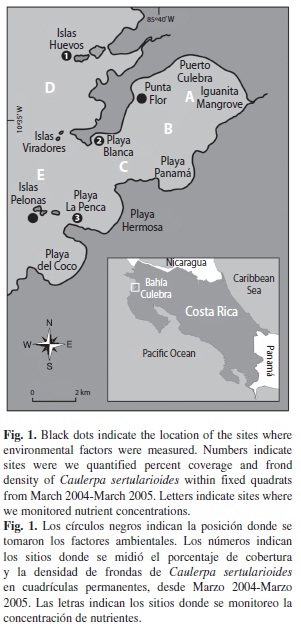
<body><![CDATA[March 2005. This bay extends from Islas Huevos to Islas Pelonas,     including the inner part of the bay, Puerto Culebra and the Iguanita     mangrove (Jim&eacute;nez 2001) (<a href="#fig_1">Fig. 1</a>). The Gulf     of Papagayo is highly     influenced by trade winds that move southward during the dry season     (December to April). These winds displace surface waters away from the     coast. This results in the upwelling of cold and nutrient rich water     (Brenes <span style="font-style: italic;">et al. </span>1995,     Jim&eacute;nez &amp; Cort&eacute;s 2003). During     the dry season, when upwelling occurs, the mean water temperature is     ]]></body>
<body><![CDATA[22.9 + 0.3&ordm;C, while during the wet,&nbsp; non-upwelling&nbsp;     season&nbsp; (May-November) the temperature rises to a mean of 27.0 +     0.1&ordm;C (Jim&eacute;nez &amp; Cort&eacute;s 2003).    <br>     <br> </span></font>     <div style="text-align: center;"><font size="2"><a name="fig_1"></a><img      alt="" src="/img/revistas/rbt/v60s2/a06i1.jpg"      style="width: 301px; height: 628px;"><span      style="font-family: verdana;"></span></font><br      style="font-family: verdana;">     ]]></body>
<body><![CDATA[<font size="2"><span style="font-family: verdana;"></span></font></div>     <font size="2"></font><br      style="font-family: verdana; font-weight: bold;">     <font size="2"><span style="font-family: verdana;"><span      style="font-weight: bold;">Environmental conditions:</span> The     following environmental factors were     measured monthly at five sites: Islas Huevos, Playa Blanca, Punta Flor,     La Penca and Isla Pelonas (Fig. 1): Salinity (&#8240;), using a manual     refractometer (ATAGO, model S/Mill-E). Temperature (&ordm;C), measured     at 30 min intervals with in situ continuous logging sensors (Stow     ]]></body>
<body><![CDATA[Away XTI) located at each site, converted to monthly mean averages for     the&nbsp; analysis. As&nbsp; an&nbsp; indirect&nbsp; measurement&nbsp;     of primary productivity, we measured the concentration of chlorophyll     a (&#956;g l<sup>-1</sup>) according to Lorenzen and Jeffrey (1978). Also we     calcu-lated the concentration of suspended sediments&nbsp; (mg l<sup>-1</sup>),     collected with a 3.8 l bottle, filtered with fiberglass filters     (Whatman GF/C)&nbsp;&nbsp; that were dried and weighted,&nbsp;&nbsp;     and sedimentation rate (mg cm<sup>-2 </sup>day<sup>-1</sup>) measured     with three sedi-ment     traps at each sampling site, following the methodology of     ]]></body>
<body><![CDATA[Cintr&oacute;n <span style="font-style: italic;">et al. </span>(1994)     and Rog ers <span style="font-style: italic;">et al. </span>(1994).     These two last     factors were measured as an indirect measurement of runoff.</span></font><br      style="font-family: verdana;">     <font size="2"></font><br style="font-family: verdana;">     <font size="2"><span style="font-family: verdana;">Nutrients were     analyzed from water     samples&nbsp; collected&nbsp;     with&nbsp; a&nbsp; Niskin&nbsp; bottle&nbsp; at&nbsp; 15&nbsp; m deep,     ]]></body>
<body><![CDATA[at five sites in the bay (<a href="#fig_1">Fig. 1</a>). Each     sample&nbsp; was&nbsp;     transferred&nbsp; to&nbsp; 1&nbsp; L&nbsp; dark&nbsp; bottles, which     were placed in a cooler with ice. We estimated the concentration     (&micro;M) of: phosphate&nbsp; (PO<sub>4</sub><sup>-3</sup>),&nbsp;     nitrite&nbsp;     (NO<sub>2</sub><sup>-</sup>),&nbsp; nitrate&nbsp; (NO<sub>3</sub><sup>-</sup>),     ammonium (NH4+) and silicate&nbsp;     (SiO<sub>4</sub>). These nutrients were measured&nbsp; following     Strickland     ]]></body>
<body><![CDATA[&amp;&nbsp; Parsons&nbsp; (1972)&nbsp; and&nbsp; the&nbsp;     protocol&nbsp; of&nbsp; the Chemical Oceanography Laboratory of the     Centro de Investigaci&oacute;n en Ciencias del Mar y Limnolog&iacute;a     (CIMAR).</span></font><br style="font-family: verdana;">     <font size="2"></font><br style="font-family: verdana;">     <font size="2"><span style="font-family: verdana;">To determine     climatic changes,     precipitation&nbsp; (mm),&nbsp;     solar&nbsp; intensity&nbsp; (sun&nbsp; hours&nbsp; day<sup>-1</sup>)     and wind     ]]></body>
<body><![CDATA[velocity (km h<sup>-1</sup>) data were obtained from&nbsp; the&nbsp;     National&nbsp; Meteorological&nbsp; Institute of Costa Rica, at the     Daniel Oduber Quir&oacute;s International Airport Station (10&ordm;35&#8217;     N-85&ordm;32&#8217; W, 80 m above sea level); the closest station to     Bah&iacute;a Culebra.</span></font><br style="font-family: verdana;">     <font size="2"></font><br style="font-family: verdana;">     <font size="2"><span style="font-family: verdana;">To determine the     most important     marine environmental factors     influencing Bah&iacute;a Culebra, we applied a principal component     ]]></body>
<body><![CDATA[analysis (PCA) based on a correlation matrix (Clarke &amp; Warwick     1994) using the mean value per month of each environmental variable.     Once we determined the most important environmental&nbsp;     factors,&nbsp; graphed&nbsp; the&nbsp; average per month and we applied     a Kruskal-Wallis non parametric analysis to determinate whether or     not these factors vary between the dry and&nbsp; wet&nbsp; season.     All&nbsp; the&nbsp; statistical&nbsp; analyses were performed using the     software Systat 8.0 and JMP IN 4.0.4.</span></font><br      style="font-family: verdana;">     <font size="2"></font><br     ]]></body>
<body><![CDATA[ style="font-family: verdana; font-weight: bold;">     <font size="2"><span style="font-family: verdana;"><span      style="font-weight: bold;">Ecology and morphology of <span      style="font-style: italic;">Caulerpa</span></span><span      style="font-style: italic; font-weight: bold;">     sertularioides</span><span style="font-weight: bold;">:</span> With a     manta tow     method (Rogers <span style="font-style: italic;">et al. </span>1994),     we identified the main <span style="font-style: italic;">C.     sertularioides</span> patches in Bah&iacute;a Culebra. At each site we     ]]></body>
<body><![CDATA[recorded the     maximum and minimum depth where the alga was growing.</span></font><br      style="font-family: verdana;">     <font size="2"></font><br style="font-family: verdana;">     <font size="2"><span style="font-family: verdana;">In order to     determine morphological     variations of the fronds and     stolons of <span style="font-style: italic;">C. sertularioides</span>     at different depths and seasons, we     collected&nbsp; thalli&nbsp; of&nbsp; the&nbsp; green&nbsp; alga,&nbsp;     ]]></body>
<body><![CDATA[in&nbsp; March 2004 (dry season) and in October 2004 (rainy season), at     three depths and from three different sites as replicates: 2 m (Playa     La Penca, Islas Huevos and Punta Flor), 5 m (Playa La Penca&nbsp;     and&nbsp; Playa&nbsp; Blanca)&nbsp; and&nbsp; 10&nbsp; m&nbsp; (Playa     La Penca, Islas Huevos and Islas Pelonas). According&nbsp; to&nbsp;     Meinesz&nbsp; <span style="font-style: italic;">et&nbsp; al.&nbsp;</span>     1995,&nbsp; Dumay <span style="font-style: italic;">et al. </span>2002     and De     Senerpont Domis <span style="font-style: italic;">et al. </span>(2003),&nbsp;     who&nbsp; found&nbsp; that&nbsp;     ]]></body>
<body><![CDATA[fronds&nbsp; and&nbsp; stolons vary with physical conditions, we chose     frond length and stolon diameter as morphological measurements.     Therefore, we randomly chose 50 fronds and 50 stolons from each sample.     We photographed each section of the thallus and digitized frond length     and stolon diameter (UTHSCSA software Image Tool version 3.0). For each     parameter, we took 3-5 measurements and&nbsp; we&nbsp; calculated&nbsp;     an&nbsp; average&nbsp; per&nbsp; thallus. To determine if morphological     characteristics varied between depths, we applied an analysis of     variance (ANOvA) and an a posteriori test (Tukey),&nbsp; for&nbsp;     each&nbsp; factor.&nbsp; Frond&nbsp; length&nbsp; data were&nbsp;     ]]></body>
<body><![CDATA[log<sub>10</sub> (x+1)&nbsp; transformed,&nbsp; while&nbsp;     stolon diameter data fit a normal distribution.</span></font><br      style="font-family: verdana;">     <font size="2"></font><br      style="font-family: verdana; font-weight: bold;">     <font size="2"><span style="font-family: verdana;"><span      style="font-weight: bold;">Growth rate:</span> Growth rate of <span      style="font-style: italic;">C.     sertularioides</span> was estimated from     stolon growth rates per month. <span style="font-style: italic;">In     ]]></body>
<body><![CDATA[situ</span> measurements of re-growth stolon     length at three sites in the bay (Islas Huevos, Playa Blanca and Playa     La Penca: <a href="#fig_1">Fig. 1</a>) were collected at approximately     4 m deep. At each     site, we removed all the thali from five permanent 50 cm<sup>2</sup>&nbsp;     quadrats, marked with construction rods, located over a patch of C.     sertularioides. After a month, we measured all the re-growth stolons     inside the fixed quadrat using a caliper (&plusmn;0.05 mm). Plots were     cleared at the end of November 2003, February 2004 and August 2004 and     were allowed to re-grow until the end of December 2003, March 2004, and     ]]></body>
<body><![CDATA[September 2004. Finally, we applied an ANOvA and a posteriori Tukey     test to determine&nbsp; differences&nbsp; between&nbsp; growth&nbsp;     rates,&nbsp; at each month. The stolon length data were log<sub>10</sub>     (x+1)     transformed.</span></font><br style="font-family: verdana;">     <font size="2"></font><br style="font-family: verdana;">     <font size="2"><span style="font-family: verdana;"><span      style="font-weight: bold;">Temporal algal percent coverage and     frond density:</span> Between March 2004     and March 2005 we measured the frond density and percent coverage of C.     ]]></body>
<body><![CDATA[sertularioides monthly, at three sites in the bay: Islas Huevos, Playa     Blanca and Playa La Penca (<a href="#fig_1">Fig. 1</a>). At each site     we calculated the     percent coverage, as a visual estimation of how much substrate fronds     and stolons cover the substrate, from five 50 x 50 cm<sup>2</sup>     quadrats     permanently located over a C. sertularioides patch. From these quadrats     we choose six 10 cm2&nbsp; subquadrats where we counted the fronds.     Finally, to determine coverage and frond density differences between     sites and seasons we applied an ANOvA. Data were tested for assumptions     ]]></body>
<body><![CDATA[of normality and homogeneity and were transformed with Box-Cox.</span></font><br      style="font-family: verdana;">     <font size="2"></font><br style="font-family: verdana;">     <font size="2"></font><font style="font-weight: bold;" size="3"><span      style="font-family: verdana;">Results</span></font><br      style="font-family: verdana;">     <font size="2"></font><br      style="font-family: verdana; font-weight: bold;">     <font size="2"><span style="font-family: verdana;"><span      style="font-weight: bold;">Environmental&nbsp; factors:</span>&nbsp;     ]]></body>
<body><![CDATA[Bah&iacute;a&nbsp; Culebra has high     local seasonality, primarily related to precipitation, number of solar     hours, and wind velocity (<a href="/img/revistas/rbt/v60s2/a06t1.gif">Table     1</a>). The rainy season begins in May and     ends in October, the rainiest months of this season are September and     October. The dry season extends from December to April. Relative to the     rainy season, the dry season had 212 mm less precipitation, an average     of three more hours of sun light and an increase of 8.8 km h-1&nbsp; in     wind velocity (<a href="/img/revistas/rbt/v60s2/a06t1.gif">Table 1</a>).    <br>     ]]></body>
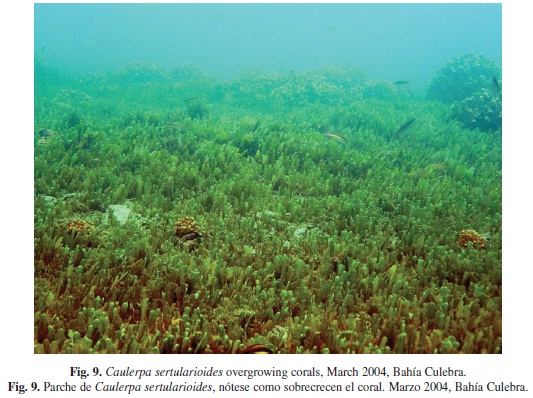
<body><![CDATA[<br> </span></font><font size="2"></font><font size="2"><span  style="font-family: verdana;">According to the Principal Component Analysis (PCA), five main environmental factors explained 65.2% of the variance of the environmental conditions in Bah&iacute;a Culebra from March 2004 to March 2005. Nitrate, phosphate and suspended sediments (PC1) contributed 26.7% of the variance, while sedimentation rate contributed 22.5% (PC2) and temperature contributed 16.0% (PC3) (<a  href="/img/revistas/rbt/v60s2/a06i2.jpg">Fig. 2</a>). Of these factors, only the mean temperature was significantly different between seasons (F<sub>1,11</sub> = 12.099, P &lt; 0.005).    <br>     <br> </span></font><font size="2"></font><font size="2"><span  style="font-family: verdana;">Water temperature exhibited high season-ality, showing decreased temperatures in the dry season, when the wind velocity increased, producing a displacement of the thermocline to the surface and coastal upwelling (<a href="/img/revistas/rbt/v60s2/a06t1.gif">Table 1</a>, <a  href="/img/revistas/rbt/v60s2/a06i3.jpg">Fig. 3A</a>). The lowest temperature was recorded in&nbsp; March&nbsp; 2004&nbsp; (22.9&deg;C,&nbsp; dry&nbsp; season),&nbsp; while the highest was recorded in September 2004 (29.6&deg;C, wet season). Salinity was higher during the dry season (34.3&#8240;) and lowest (30.0&#8240;) during the rainy season (<a  href="/img/revistas/rbt/v60s2/a06t1.gif">Table 1</a>). The highest chlorophyll&nbsp; a&nbsp; concentration&nbsp; (3.8&nbsp; &micro;g l-1)&nbsp; was recorded in October (wet season) (<a  href="/img/revistas/rbt/v60s2/a06t1.gif">Table 1</a>). Suspended sediments showed similar fluctuation patterns to precipitation during the wet season, when streams and rains carry sediments and nutrients into the sea (<a  href="/img/revistas/rbt/v60s2/a06t1.gif">Table 1</a>, <a  href="/img/revistas/rbt/v60s2/a06i3.jpg">Fig. 3A</a>). Sedimentation rates were less variable than suspended sediments (<a  href="/img/revistas/rbt/v60s2/a06t1.gif">Table 1</a>, <a  href="/img/revistas/rbt/v60s2/a06i3.jpg">Fig. 3A</a>).    <br>     <br> </span></font><font size="2"></font><font size="2"><span  style="font-family: verdana;">Nutrient concentration differed between seasons. Average phosphate, nitrate and ammonium were higher in the dry season, while average silicate and nitrite were higher during the wet season (<a  href="/img/revistas/rbt/v60s2/a06t1.gif">Table 1</a>). However, nutrient concentrations were highly variable within seasons. phosphate increased in December 2004 (PO<sub>4</sub><sup>-3</sup>=1.45) and September (PO<sub>4</sub><sup>-3</sup>=0.69 &micro;M), while&nbsp; nitrate&nbsp; was&nbsp; higher&nbsp; in&nbsp; December&nbsp; 2004 (NO<sub>3</sub><sup>-1</sup>=15.6 &micro;M) (<a href="/img/revistas/rbt/v60s2/a06i3.jpg">Fig. 3B</a>)</span></font><br  style="font-family: verdana;"> <font size="2"></font><br style="font-family: verdana;"> <font size="2"><span style="font-family: verdana;"><span  style="font-weight: bold;">Ecology and morphology of Caulerpa</span><span  style="font-style: italic; font-weight: bold;"> sertularioides</span><span style="font-weight: bold;">:</span> We found <span style="font-style: italic;">C. sertularioides</span> ranged in Bah&iacute;a Culebra from the intertidal zone to 23 m deep. It was present on different substrates (rocks, sand, and live and dead corals) forming patches that can cover 6 ha. The greatest coverage (~90%) was observed in sites between 3 to 6 m deep, where we found 108 fronds 10 cm<sup>-2</sup>. However, at depths &gt;12 m, the coverage and frond density decreased, and only isolated stolons were observed.</span></font><br style="font-family: verdana;"> <font size="2"></font><br style="font-family: verdana;"> <font size="2"><span style="font-family: verdana;">We also observed some algal patches simultaneously releasing gametes (<a href="/img/revistas/rbt/v60s2/a06i4.jpg">Fig. 4A</a>) at Punta Flor at 07:40 a.m., on January 3<sup>rd</sup> 2005 (Fig. 1). After gamete releases finished, all stolons and fronds turned white (Fig. 4B). This signal was later used to recognize other spawning events. Thus,&nbsp; most&nbsp; spawning&nbsp; events&nbsp; were&nbsp; observed in months when water temperature changes occured&nbsp; (February&nbsp; 2004,&nbsp; January&nbsp; 2005)&nbsp; and rain intensity was high (October 2004).    <br>     <br> </span></font><font size="2"></font><font size="2"><span  style="font-family: verdana;"><span style="font-style: italic;">Caulerpa sertularioides</span> showed different frond lengths at different depths (<a href="/img/revistas/rbt/v60s2/a06i5.jpg">Fig. 5</a>). The average stolon diameter of all the thalli measured was 0.18 mm (Min=0.04 mm, Max= 0.34 mm), while frond length average was 5.3 cm (Min=0.79 cm, Max= 15.9 cm). Stolon diameter was larger at 5 m than 2 m depth (F<sub>2,1055</sub> = 9.5, P &lt; 0.000), while fronds were significantly longer at greater depths (F<sub>2,985</sub>&nbsp; = 116.8, P &lt;0.000) (<a href="/img/revistas/rbt/v60s2/a06i5.jpg">Fig. 5</a>).    <br>     <br> </span></font><font size="2"></font><font size="2"><span  style="font-family: verdana;"><span style="font-weight: bold;">Growth rate:</span> Mean stolon growth rate was 11.7 &plusmn; 6.2 cm month<sup>-1</sup>, minimum in December 2004 (1.4 cm month-1) and maximum in September 2004 (33.2 cm month<sup>-1</sup>, <a  href="/img/revistas/rbt/v60s2/a06i5.jpg">Fig. 5</a>). Significant differences were found between&nbsp;&nbsp; the&nbsp;&nbsp; stolon&nbsp;&nbsp; growth&nbsp;&nbsp; rates&nbsp;&nbsp; during the&nbsp; three&nbsp; sampling&nbsp; months&nbsp; (F<sub>2,144&nbsp;</sub> =&nbsp; 5.797 p&lt;0.004), mainly between March and September 2004 (<a  href="/img/revistas/rbt/v60s2/a06i6.jpg">Fig. 6</a>).</span></font><br  style="font-family: verdana;"> <font size="2"></font><br style="font-family: verdana;"> <font size="2"><span style="font-family: verdana;"><span  style="font-weight: bold;">Temporal algal percent coverage and frond density:</span> Average percent coverage and frond density had similar dynamic patterns throughout the sampling time (<a  href="/img/revistas/rbt/v60s2/a06i6.jpg">Fig. 7</a>). During the wet season the values of cover percentage tended to be &lt;40%, however in September 2004 we documented a peak of 46.3%, while the frond density during those months was &lt;29.5 fronds 10 cm-2. After November bothparameters&nbsp; increase&nbsp; continuously&nbsp; until&nbsp; they reach the maximum values at February 2005, 70.7% cover and 50 fronds 10 cm<sup>-2</sup>, dropping in March to less than 20% of cover and 20 fronds 10 cm<sup>-2 </sup>(<a href="/img/revistas/rbt/v60s2/a06i7.jpg">Fig. 7</a>). </span></font><br  style="font-family: verdana;"> <font size="2"></font><br style="font-family: verdana;"> <font size="2"><span style="font-family: verdana;">The&nbsp; average&nbsp; percent&nbsp; cover&nbsp; (F<sub>5,183</sub>=7.9, p&lt;0.0001)&nbsp; and&nbsp; frond&nbsp; densities&nbsp; (F<sub>5,183</sub>=13.5, p&lt;0.0001) were statistically different between seasons (<a  href="/img/revistas/rbt/v60s2/a06i8.jpg">Fig. 8</a>), being higher during the dry season (<a  href="/img/revistas/rbt/v60s2/a06i8.jpg">Fig. 8A</a> and <a  href="/img/revistas/rbt/v60s2/a06i8.jpg">8B</a>). Also we found differences in coverage (F<sub>5,183</sub>=12.1, p=0.02) and frond density (F<sub>5,183</sub>=20.5, p&lt;0.03) values, between sites. Playa Blanca exhibited the highest percent coverage and frond density values while Isla Huevos showed the lowest values (<a  href="/img/revistas/rbt/v60s2/a06i8.jpg">Fig. 8A</a>). When comparing seasons, we found higher during the dry season (<a  href="/img/revistas/rbt/v60s2/a06i8.jpg">Fig. 8B</a>).</span></font><br  style="font-family: verdana;"> <font size="2"></font><br style="font-family: verdana;"> <font size="2"></font><font style="font-weight: bold;" size="3"><span  style="font-family: verdana;">Discussion</span></font><br  style="font-family: verdana;"> <font size="2"></font><br style="font-family: verdana;"> <font size="2"><span style="font-family: verdana;">Caulerpa<span  style="font-style: italic;">&nbsp; sertularioides</span>&nbsp; is&nbsp; a&nbsp; native&nbsp; alga from the Pacific coast of Costa Rica, but since 2001 its abundance and growth rate have increased, colonizing a wide range of substrates and depths at Bah&iacute;a Culebra (<a href="#fig_9">Fig. 9</a>). In fact, we documented the greatest depth (23 m) reported for the species. In the Pacific coast of Panama, <span style="font-style: italic;">C. sertularioides</span> grows from the intertidal zone to 16 m (Wysor 2004), while in Colombia, it grows to 1 m deep (Schnetter &amp; Bula-Meyer 1982). In the Caribbean and Central&nbsp; Pacific,&nbsp; <span style="font-style: italic;">C.&nbsp; sertularioides</span>&nbsp; grows&nbsp; in reef habitats to a depth of 10 m (Littler &amp; Littler 2000, 2003). However, <span  style="font-style: italic;">C. sertularioides</span> has not been found as deep as other <span  style="font-style: italic;">Caulerpa</span> species, such as <span style="font-style: italic;">C. taxifolia</span> in the Mediterranean that grows from 0-30 m deep, with highest densities between 5-15 m (Belsher &amp; Meinesz 1995). <span style="font-style: italic;">C. sertularioides</span> at Bah&iacute;a Culebra grew faster (1.1 cm day<sup>-1</sup>) than some other <span style="font-style: italic;">Caulerpa</span> species. For example, Williams <span style="font-style: italic;">et al. </span>(1985) reported that <span style="font-style: italic;">C. mexicana</span> grew 1.0 cm day<sup>-1</sup>, while C. cupressoides 0.8 cm day<sup>-1</sup>, and C. prolifera 0.4 cm day-1. But slower than other <span style="font-style: italic;">Caulerpa</span> species, such as <span style="font-style: italic;">C. taxifolia</span> (8 cm day<sup>-1</sup>) and C. racemosa (2 cm<sup>-1</sup>day<sup>-1</sup>) (Dalton 2000), the first being one of the most invasive species of the genus.    <br>     ]]></body>
<body><![CDATA[<br> </span></font>     <div style="text-align: center;"><font size="2"><a name="fig_9"></a><img      alt="" src="/img/revistas/rbt/v60s2/a06i9.jpg"      style="width: 533px; height: 398px;"><span      style="font-family: verdana;"></span></font><br      style="font-family: verdana;">     <font size="2"><span style="font-family: verdana;"></span></font></div>     <font size="2"></font><br style="font-family: verdana;">     <font size="2"><span style="font-family: verdana;">We often observed     floating <span style="font-style: italic;">C.     ]]></body>
<body><![CDATA[sertularioides</span> fronds and stolons     during the study period, which suggest that local spreading is mainly     driven by fragmentation of the thallus and dispersion around the bay by     currents. As described by Benzie <span style="font-style: italic;">et     al. </span>(2000), <span style="font-style: italic;">C. sertularioides</span>     can     has the capacity to resist high solar radiation allows its thalli to     float for several days without desiccation until it reaches a substrate     to grow. Once a thallus has colonized a substrate, it can easily     spread, due to intrinsic characteristics of the species, such as rapid     ]]></body>
<body><![CDATA[and efficient&nbsp; growth&nbsp; (Collado-Vides&nbsp;&nbsp; &amp;&nbsp;     Robledo 1999). Thallus attachment is favored at sites with large coarse     sediment. We found that coverage and density of the fronds was higher     at sites with substrate composed mainly by Pocillopora spp. fragments     (a common coral species at Playa La Penca, Ocotal and Playa Blanca).     Most of these reefs develop over a structure of dead coral (Glynn <span      style="font-style: italic;">et     al. </span>1983, Cort&eacute;s 1997, Jim&eacute;nez 1998) which     provide an     appropriate surface that favors the attachment of the <span     ]]></body>
<body><![CDATA[ style="font-style: italic;">C. sertularioides</span>     stolons and rhizoids (Dumay <span style="font-style: italic;">et al. </span>2002).     While substrates composed by     fine sediments are less likely to be colonized by <span      style="font-style: italic;">C. sertularioides</span>.     Sites with the highest coverage of <span style="font-style: italic;">C.     sertularioides</span> were located     adjacent to coastal development, such as hotels, human communities,     boat anchorage sites as well as complex coral reef structures. At     sites, such as Playa Penca, Ocotal and Playa Blanca (<a href="#fig_1">Fig.     ]]></body>
<body><![CDATA[1</a>), with     coral reefs present, the bottom was composed of coarse sediments from     fragments of dead coral (<span style="font-style: italic;">Pocillopora     spp.</span>), where the algae can attach     easily.</span></font><br style="font-family: verdana;">     <font size="2"></font><br style="font-family: verdana;">     <font size="2"><span style="font-family: verdana;">In addition, frond     and stolon     morphology can adapt also to a     combination of physical factors such as depth and substrate, as has     ]]></body>
<body><![CDATA[been found&nbsp; for&nbsp; other&nbsp; <span      style="font-style: italic;">Caulerpa</span>&nbsp; species&nbsp;     (Meinesz <span style="font-style: italic;">et al. </span>1995). When <span      style="font-style: italic;">C. sertularioides</span> grew on     rocky&nbsp;     substrates&nbsp; in&nbsp; shallow&nbsp; water&nbsp; the&nbsp; stolon     was thicker, this adaptation allows the alga to hold to the substrate     and resist the swell. Fronds in theses shallow depths (high solar     radiation) tended to be smaller, and sometimes were not present. At     greater depths and in finer sediments, stolons were thinner and more     ]]></body>
<body><![CDATA[branched. This adaptation&nbsp; allows&nbsp; the&nbsp; alga&nbsp;     to&nbsp; intercalate&nbsp; into fine sediments, and to easily obtain     nutrients. This change in morphology with depth has been previously     found to occur with <span style="font-style: italic;">Caulerpa</span>     cupressoides, where fronds size     decreased as the swell influence increased (Collado-vides &amp; Robledo     1999). This adaptation provides (<span style="font-style: italic;">i</span>)     resistance to strong hydrodynamic     forces (Collado-vides &amp; Robledo 1999) in high energy coastal zones,     and (<span style="font-style: italic;">ii</span>) efficiency of     ]]></body>
<body><![CDATA[nutrient uptake.</span></font><br style="font-family: verdana;">     <font size="2"></font><br style="font-family: verdana;">     <font size="2"><span style="font-family: verdana;">High genetic     variability due to     sexual reproduction of this     opportunistic species at Bah&iacute;a Culebra may promote adaptation to     different environmental physical-chemical conditions (i.e depth,     temperature, water motion, nutrients) (Allendorf &amp; Lundquist 2003).     This is evident at the bay, where <span style="font-style: italic;">C.     sertularioides</span> showed     ]]></body>
<body><![CDATA[morphological differences when growing on different substrates and     depths, favoring local spreading of the green alga (Colladovides     &amp; Robledo 1999). As Clifton (1997) and Clifton and Clifton (1999)     demonstrated for other species of <span style="font-style: italic;">Caulerpa</span>,     <span style="font-style: italic;">C. sertularioides</span> in     Bah&iacute;a Culebra exhibit a synchronous release of sexual gametes     and fertilization occurs in the water column. This green alga     transforms all its vegetative inner content into gametes (holocarpic)     that are released by papillae in the stolons and fronds (Dawes 1981,     Bold &amp; Wynne 1985, van den Hoek <span style="font-style: italic;">et     ]]></body>
<body><![CDATA[al. </span>1998), leaving the cell     walls empty, which make the thallus turn white (van den Hoek <span      style="font-style: italic;">et al.     </span>1998).</span></font><br style="font-family: verdana;">     <font size="2"></font><br style="font-family: verdana;">     <font size="2"><span style="font-family: verdana;">Bah&iacute;a     Culebra, as in Gulf of     California (Mexico), percent     coverage and frond density of <span style="font-style: italic;">C.     sertularioides</span> seasonally fluctuated     ]]></body>
<body><![CDATA[in relation to environmental factors (Scrosati 2001). During the dry     season, when upwelling occurs, percent coverage and frond density     increased. Such high algal biomass is typically caused by the presence     of high nutrients concentrations (Bell 1992, Lapointe 1997, Szmant     2002) as during upwelling events. These nutrients are rapidly taken     up from the environment, and are consumed in relatively short time     periods (Rodr&iacute;guez-S&eacute;nz 2005, J.     Acu&ntilde;a-Gonz&aacute;lez pers. comm.).</span></font><br      style="font-family: verdana;">     <font size="2"></font><br style="font-family: verdana;">     ]]></body>
<body><![CDATA[<font size="2"><span style="font-family: verdana;">Coverage&nbsp;     and&nbsp;     frond&nbsp; density&nbsp; decreased 40% in     March (2004, 2005), one month after the upwelling peak (<a      href="/img/revistas/rbt/v60s2/a06i7.jpg">Fig. 7</a>). This     is consistent with Rodr&iacute;guez-S&aacute;enz (2005) who found that     phytoplankton concentration and zooplankton density decreased after     upwelling in Bah&iacute;a Culebra as evident with other algal biomasses     (e.g. <span style="font-style: italic;">Ulva </span>spp. and<span      style="font-style: italic;"> Dictyota </span>spp., pers. observ.)     ]]></body>
<body><![CDATA[that clearly     decreased.</span></font><br style="font-family: verdana;">     <font size="2"></font><br style="font-family: verdana;">     <font size="2"><span style="font-family: verdana;">Although coverage     and density of <span style="font-style: italic;">C.     sertularioides </span>decreased during     some months of the rainy months when nutrients decrease, it remained     covering an average of 10% of the substrate&nbsp; (<a      href="/img/revistas/rbt/v60s2/a06i7.jpg">Fig.&nbsp; 7</a>).&nbsp;     In&nbsp; Uva&nbsp; Island,&nbsp; Panama, Smith <span     ]]></body>
<body><![CDATA[ style="font-style: italic;">et al. </span>(2010) found that     the maintenance of <span style="font-style: italic;">C. sertularioides</span>     patches, where there are no     external nutrient inputs from the upwelling, is due to an association     with epiphytic cyanobacteria, together with spatial refuges,     suggesting mechanisms that maintain <span style="font-style: italic;">C.     sertularioides</span> near reef systems     in the absence of high nutrients.&nbsp; Then&nbsp; from&nbsp;     August&nbsp; to&nbsp; September&nbsp; the cover and frond density     increased again when precipitation, organic material as well as     ]]></body>
<body><![CDATA[phytoplankton biomass and zooplankton abundance increase in the bay     (Rodr&iacute;guez-S&aacute;enz 2005).</span></font><br      style="font-family: verdana;">     <font size="2"></font><br style="font-family: verdana;">     <font size="2"><span style="font-family: verdana;">Algal frond density     and cover     porcentage may be&nbsp;     related&nbsp; to&nbsp; nutrient&nbsp; concentration&nbsp; in the     environment, and our study suggests that a non-natural supply of     nutrients during the wet season may trigger algae overgrowth, as has     ]]></body>
<body><![CDATA[been reported in other areas (Lapointe 1997, Schaffelke &amp; Klumpp     1997, Little 2000). This is of concern because in Bah&iacute;a Culebra     there is no infrastructure to treat water derived from human     activities, such as golf courts, hotels and agriculture. Phosphate and     nitrate are the most important&nbsp; nutrients&nbsp; influencing&nbsp;     algal&nbsp; growth at the bay, that&nbsp; can come from upwelling and     anthropogenic sources, spreading at Bah&iacute;a Culebra mainly by     currents (Jim&eacute;nez 1998). Water quality near coastal communities     is currently a global problem (PNUMA 2007) and nutrient overloading in     the ocean is one of the factors influencing coastal water quality and     ]]></body>
<body><![CDATA[can have effects on different ecosystem dynamics, such as those in     coral reefs (Fabricius 2005). Thus, nutrient supply in Bah&iacute;a     Culebra must be better understood to determine non-natural sources and     to improve coastal management.</span></font><br      style="font-family: verdana;">     <font size="2"></font><br style="font-family: verdana;">     <font size="2"><span style="font-family: verdana;">Although decreasing     and increasing     nutrient concentrations may have     an important role in driving algal patterns, it can act in synergy with     ]]></body>
<body><![CDATA[the temperature, which is another of the main abiotic factors     influencing the dynamic in the bay (<a      href="/img/revistas/rbt/v60s2/a06i3.jpg">Fig. 3</a>). Coverage and     frond density     of <span style="font-style: italic;">C. sertularioides</span> can     increase with nutrient uploads, however there     is a peak in the values of those measurements in February with lower     temperatures, during the upwelling, than in September, during the rainy     season (<a href="/img/revistas/rbt/v60s2/a06i7.jpg">Fig. 7</a>).</span></font><br      style="font-family: verdana;">     ]]></body>
<body><![CDATA[<font size="2"></font><br style="font-family: verdana;">     <font size="2"><span style="font-family: verdana;">According to     Terrados and Ros     (1992) seasonal adaptations of     macroalgae, are more common in temperate regions and in areas where     upwelling occurs. These seasonal temperature variations can cause     algal physiological adaptations in response to photosynthetic and     growth requirements. </span></font><font size="2"><span      style="font-family: verdana;">At Bah&iacute;a Culebra, we     registered temperature differences of     ]]></body>
<body><![CDATA[10&ordm;C between seasons, which increase probabilities of a synergic     action with high nutrient concentration on <span      style="font-style: italic;">C. sertularioides</span>     abundance. Other <span style="font-style: italic;">Caulerpa</span>     species, such as C. taxifolia, have     demonstrated the capacity to adapt to low temperatures (Jousson <span      style="font-style: italic;">et     al. </span>2000), providing the ability for growth at deeper depths     and large     temperature ranges (Belsher &amp; Meinesz 1995), thus increasing its     ]]></body>
<body><![CDATA[invasive capacity (Allendorf </span></font><font size="2"><span      style="font-family: verdana;">&amp; Lundquist 2003). Another     important factor may be the attenuation     of herbivory in upwelling environments, as suggested by Floeter <span      style="font-style: italic;">et     al. </span>(2005) and Smith (2008), however this factor was not     measured in     our study.</span></font><br style="font-family: verdana;">     <font size="2"></font><br style="font-family: verdana;">     <font size="2"></font><font style="font-weight: bold;" size="3"><span     ]]></body>
<body><![CDATA[ style="font-family: verdana;">Acknowledgments</span></font><br      style="font-family: verdana;">     <font size="2"></font><br style="font-family: verdana;">     <font size="2"><span style="font-family: verdana;">We are grateful to     Davis Morera,     Eva Salas, Bernadette Bezy, Eddy     G&oacute;mez and Eleazar Ruiz for their collaboration in the field     and in the laboratory. Specially thank to Bernadette Bezy for revising     the English. We also want to&nbsp; thank&nbsp; the&nbsp; Costa&nbsp;     Rican&nbsp; Institute&nbsp; of&nbsp; Tourism (ICT) by facilitating us     ]]></body>
<body><![CDATA[the installations in Playa Panama and to the National     Meteorological&nbsp; Institute&nbsp; of&nbsp; Costa&nbsp; Rica&nbsp;     for&nbsp; providing meteorogical data. This manuscript was improved     with the comments made by Ricardo Soto, Gerardo &Aacute;valos and     Javier Carri&oacute;n. This work was supported through the     Ecodesarrollo de Papagayo project and by project no. 808-</span></font><font      size="2"><span style="font-family: verdana;">98-013, of the     vicerrector&iacute;a     de Investigaci&oacute;n,     Universidad de Costa Rica.</span></font><br     ]]></body>
<body><![CDATA[ style="font-family: verdana;">     <font size="2"></font><font size="2"><span style="font-family: verdana;"></span></font><font      style="font-weight: bold;" size="3"><span style="font-family: verdana;"></span></font>     <hr      style="width: 100%; height: 2px; margin-left: 0px; margin-right: auto;"><font      style="font-weight: bold;" size="3"><span style="font-family: verdana;">References</span></font><br      style="font-family: verdana;">     <font size="2"></font><br style="font-family: verdana;">     <font size="2"><span style="font-family: verdana;">Allendorf, F.W.     &amp; L.L.     ]]></body>
<body><![CDATA[Lundquist. 2003.&nbsp; Introduction:     population biology, evolution, and control of invasive species.     <!-- ref -->Conserv. Biol. 17: 24-30.    &nbsp;&nbsp;&nbsp;&nbsp;&nbsp;&nbsp;&nbsp;&nbsp;[&#160;<a href="javascript:void(0);" onclick="javascript: window.open('/scielo.php?script=sci_nlinks&ref=1438088&pid=S0034-7744201200060000600001&lng=','','width=640,height=500,resizable=yes,scrollbars=1,menubar=yes,');">Links</a>&#160;]<!-- end-ref --><!-- ref --></span></font><br style="font-family: verdana;"> <font size="2"></font><br style="font-family: verdana;"> <font size="2"><span style="font-family: verdana;">Bell,&nbsp; E.I.&nbsp; 1992.&nbsp; Eutrophication&nbsp; and&nbsp; coral&nbsp; reefs,&nbsp; some examples in the Great Barrier Reef lagoon. Wat. Res. 5: 553-568.    &nbsp;&nbsp;&nbsp;&nbsp;&nbsp;&nbsp;&nbsp;&nbsp;[&#160;<a href="javascript:void(0);" onclick="javascript: window.open('/scielo.php?script=sci_nlinks&ref=1438089&pid=S0034-7744201200060000600002&lng=','','width=640,height=500,resizable=yes,scrollbars=1,menubar=yes,');">Links</a>&#160;]<!-- end-ref --><!-- ref --></span></font><br  style="font-family: verdana;"> <font size="2"></font><br style="font-family: verdana;"> <font size="2"><span style="font-family: verdana;">Belsher, T. &amp; A. Meinesz. 1995. Deep water dispersal of the tropical alga <span style="font-style: italic;">Caulerpa</span> <span  style="font-style: italic;">taxifolia</span> introduced into the Mediterranean. Aquat. Bot. 51: 163-169.    &nbsp;&nbsp;&nbsp;&nbsp;&nbsp;&nbsp;&nbsp;&nbsp;[&#160;<a href="javascript:void(0);" onclick="javascript: window.open('/scielo.php?script=sci_nlinks&ref=1438090&pid=S0034-7744201200060000600003&lng=','','width=640,height=500,resizable=yes,scrollbars=1,menubar=yes,');">Links</a>&#160;]<!-- end-ref --><!-- ref --></span></font><br  style="font-family: verdana;"> <font size="2"></font><br style="font-family: verdana;"> <font size="2"><span style="font-family: verdana;">Benzie,&nbsp; J.A.H.,&nbsp; E.&nbsp; Ballment,&nbsp; J.R.M.&nbsp; Chisholm&nbsp; &amp;&nbsp; J.M. Jaubert.&nbsp; 2000. Genetic variation in the&nbsp; green alga <span style="font-style: italic;">Caulerpa</span> taxifolia. Aquat.Bot. 66: 131-139.    &nbsp;&nbsp;&nbsp;&nbsp;&nbsp;&nbsp;&nbsp;&nbsp;[&#160;<a href="javascript:void(0);" onclick="javascript: window.open('/scielo.php?script=sci_nlinks&ref=1438091&pid=S0034-7744201200060000600004&lng=','','width=640,height=500,resizable=yes,scrollbars=1,menubar=yes,');">Links</a>&#160;]<!-- end-ref --><!-- ref --></span></font><br  style="font-family: verdana;"> <font size="2"></font><br style="font-family: verdana;"> <font size="2"><span style="font-family: verdana;">Bold, H.C. &amp; M.J. Wynne. 1985. Introduction to the Algae: Structure and Reproduction. Prentice-Hall, New Jersey. 720 p.    &nbsp;&nbsp;&nbsp;&nbsp;&nbsp;&nbsp;&nbsp;&nbsp;[&#160;<a href="javascript:void(0);" onclick="javascript: window.open('/scielo.php?script=sci_nlinks&ref=1438092&pid=S0034-7744201200060000600005&lng=','','width=640,height=500,resizable=yes,scrollbars=1,menubar=yes,');">Links</a>&#160;]<!-- end-ref --><!-- ref --></span></font><br  style="font-family: verdana;"> <font size="2"></font><br style="font-family: verdana;"> <font size="2"><span style="font-family: verdana;">Br&eacute;nes, C., B. Kwiecinski, L. D&#8217;Croz &amp; J. Ch&aacute;ves. 1995. Caracter&iacute;sticas oceanogr&aacute;ficas de la plataforma Pac&iacute;fica de Am&eacute;rica Central y aguas oce&aacute;nicas adyacentes. PRADEPESCA, Panam&aacute;. 75 p.    &nbsp;&nbsp;&nbsp;&nbsp;&nbsp;&nbsp;&nbsp;&nbsp;[&#160;<a href="javascript:void(0);" onclick="javascript: window.open('/scielo.php?script=sci_nlinks&ref=1438093&pid=S0034-7744201200060000600006&lng=','','width=640,height=500,resizable=yes,scrollbars=1,menubar=yes,');">Links</a>&#160;]<!-- end-ref --><!-- ref --></span></font><br  style="font-family: verdana;"> <font size="2"></font><br style="font-family: verdana;"> <font size="2"><span style="font-family: verdana;">Cintr&oacute;n, G., J.R. Garc&iacute;a &amp; F. Geraldes. 1994. Manual de m&eacute;todos para la caracterizaci&oacute;n y monitoreo de arrecifes de coral. W.W.F., Washington D.C. 67 p.    &nbsp;&nbsp;&nbsp;&nbsp;&nbsp;&nbsp;&nbsp;&nbsp;[&#160;<a href="javascript:void(0);" onclick="javascript: window.open('/scielo.php?script=sci_nlinks&ref=1438094&pid=S0034-7744201200060000600007&lng=','','width=640,height=500,resizable=yes,scrollbars=1,menubar=yes,');">Links</a>&#160;]<!-- end-ref --><!-- ref --></span></font><br  style="font-family: verdana;"> <font size="2"></font><br style="font-family: verdana;"> <font size="2"><span style="font-family: verdana;">Clarke, K.R. &amp; R.M. Warwick. 1994. Change&nbsp; in Marine Communities: An Approach&nbsp; to&nbsp; Statistical Analysis and&nbsp;&nbsp; Interpretation. Plymouth Marine&nbsp;&nbsp; Laboratory, United Kingdom. 144 p.    &nbsp;&nbsp;&nbsp;&nbsp;&nbsp;&nbsp;&nbsp;&nbsp;[&#160;<a href="javascript:void(0);" onclick="javascript: window.open('/scielo.php?script=sci_nlinks&ref=1438095&pid=S0034-7744201200060000600008&lng=','','width=640,height=500,resizable=yes,scrollbars=1,menubar=yes,');">Links</a>&#160;]<!-- end-ref --><!-- ref --></span></font><br style="font-family: verdana;"> <font size="2"></font><br style="font-family: verdana;"> <font size="2"><span style="font-family: verdana;">Clifton, K.E. 1997. Mass spawning by green algae on coral reefs. Science 275: 1116-1118.    &nbsp;&nbsp;&nbsp;&nbsp;&nbsp;&nbsp;&nbsp;&nbsp;[&#160;<a href="javascript:void(0);" onclick="javascript: window.open('/scielo.php?script=sci_nlinks&ref=1438096&pid=S0034-7744201200060000600009&lng=','','width=640,height=500,resizable=yes,scrollbars=1,menubar=yes,');">Links</a>&#160;]<!-- end-ref --><!-- ref --></span></font><br style="font-family: verdana;"> <font size="2"></font><br style="font-family: verdana;"> <font size="2"><span style="font-family: verdana;">Clifton, K.E. y L.M. Clifton.1999. The&nbsp; phenology&nbsp; of sexual reproduction by green algae (Briopsidales) on Caribbean coral reefs. J. Phycol. 35: 24-34.    &nbsp;&nbsp;&nbsp;&nbsp;&nbsp;&nbsp;&nbsp;&nbsp;[&#160;<a href="javascript:void(0);" onclick="javascript: window.open('/scielo.php?script=sci_nlinks&ref=1438097&pid=S0034-7744201200060000600010&lng=','','width=640,height=500,resizable=yes,scrollbars=1,menubar=yes,');">Links</a>&#160;]<!-- end-ref --><!-- ref --></span></font><br style="font-family: verdana;"> <font size="2"></font><br style="font-family: verdana;"> <font size="2"><span style="font-family: verdana;">Collado-vides, L. &amp; D. Robledo. 1999.&nbsp; Morphology and photosynthesis of <span style="font-style: italic;">Caulerpa</span> (Chlorophyta) in relation to growth form. J. Phycol. 35: 325-330.    &nbsp;&nbsp;&nbsp;&nbsp;&nbsp;&nbsp;&nbsp;&nbsp;[&#160;<a href="javascript:void(0);" onclick="javascript: window.open('/scielo.php?script=sci_nlinks&ref=1438098&pid=S0034-7744201200060000600011&lng=','','width=640,height=500,resizable=yes,scrollbars=1,menubar=yes,');">Links</a>&#160;]<!-- end-ref --><!-- ref --></span></font><br style="font-family: verdana;"> <font size="2"></font><br style="font-family: verdana;"> <font size="2"><span style="font-family: verdana;">Cort&eacute;s, J. 1997. Biology and geology of coral reefs of the eastern Pacific. Coral Reefs 16 (Suppl.): S39-S46.    &nbsp;&nbsp;&nbsp;&nbsp;&nbsp;&nbsp;&nbsp;&nbsp;[&#160;<a href="javascript:void(0);" onclick="javascript: window.open('/scielo.php?script=sci_nlinks&ref=1438099&pid=S0034-7744201200060000600012&lng=','','width=640,height=500,resizable=yes,scrollbars=1,menubar=yes,');">Links</a>&#160;]<!-- end-ref --><!-- ref --><br> <br style="font-family: verdana;"> </span></font><font size="2"><span style="font-family: verdana;">Dalton,&nbsp; R. 2000. Researchers criticize&nbsp; response&nbsp; to killer algae. Nature 406: 447.    &nbsp;&nbsp;&nbsp;&nbsp;&nbsp;&nbsp;&nbsp;&nbsp;[&#160;<a href="javascript:void(0);" onclick="javascript: window.open('/scielo.php?script=sci_nlinks&ref=1438100&pid=S0034-7744201200060000600013&lng=','','width=640,height=500,resizable=yes,scrollbars=1,menubar=yes,');">Links</a>&#160;]<!-- end-ref --><!-- ref --></span></font><br  style="font-family: verdana;"> <font size="2"></font><br style="font-family: verdana;"> <font size="2"><span style="font-family: verdana;">Dawes, C.J. 1981. Marine Botany. John&nbsp; Wiley &amp; Sons, New York. 628 p.    &nbsp;&nbsp;&nbsp;&nbsp;&nbsp;&nbsp;&nbsp;&nbsp;[&#160;<a href="javascript:void(0);" onclick="javascript: window.open('/scielo.php?script=sci_nlinks&ref=1438101&pid=S0034-7744201200060000600014&lng=','','width=640,height=500,resizable=yes,scrollbars=1,menubar=yes,');">Links</a>&#160;]<!-- end-ref --><!-- ref --></span></font><br style="font-family: verdana;"> <font size="2"></font><br style="font-family: verdana;"> <font size="2"><span style="font-family: verdana;">Dawson, E.Y. 1944. The marine algae of the Gulf of California. Allan Hancock Pac. Exped. 3: 31-77.    &nbsp;&nbsp;&nbsp;&nbsp;&nbsp;&nbsp;&nbsp;&nbsp;[&#160;<a href="javascript:void(0);" onclick="javascript: window.open('/scielo.php?script=sci_nlinks&ref=1438102&pid=S0034-7744201200060000600015&lng=','','width=640,height=500,resizable=yes,scrollbars=1,menubar=yes,');">Links</a>&#160;]<!-- end-ref --><!-- ref --></span></font><br  style="font-family: verdana;"> <font size="2"></font><br style="font-family: verdana;"> <font size="2"><span style="font-family: verdana;">Dawson, E.Y. 1962. Additions to the marine flora of Costa Rica and Nicaragua. Pac. Nat. 3: 375-395.    &nbsp;&nbsp;&nbsp;&nbsp;&nbsp;&nbsp;&nbsp;&nbsp;[&#160;<a href="javascript:void(0);" onclick="javascript: window.open('/scielo.php?script=sci_nlinks&ref=1438103&pid=S0034-7744201200060000600016&lng=','','width=640,height=500,resizable=yes,scrollbars=1,menubar=yes,');">Links</a>&#160;]<!-- end-ref --><!-- ref --></span></font><br  style="font-family: verdana;"> <font size="2"></font><br style="font-family: verdana;"> <font size="2"><span style="font-family: verdana;">Dumay, O., G. Pergent, C. Pergent-Martini &amp;&nbsp; P. Amade. 2002.&nbsp; variations&nbsp; in Caulerpenyne&nbsp; contents in Caulerpa taxifolia and C. racemosa. J. Chem. Ecol. 28: 342-352.    &nbsp;&nbsp;&nbsp;&nbsp;&nbsp;&nbsp;&nbsp;&nbsp;[&#160;<a href="javascript:void(0);" onclick="javascript: window.open('/scielo.php?script=sci_nlinks&ref=1438104&pid=S0034-7744201200060000600017&lng=','','width=640,height=500,resizable=yes,scrollbars=1,menubar=yes,');">Links</a>&#160;]<!-- end-ref --><!-- ref --></span></font><br  style="font-family: verdana;"> <font size="2"></font><br style="font-family: verdana;"> <font size="2"><span style="font-family: verdana;">Fabricius, K.E. 2005. Effects of terrestrial&nbsp; runoff on the ecology of corals and coral reefs: review and synthesis. Mar. Poll. Bull. 50: 125-146.    &nbsp;&nbsp;&nbsp;&nbsp;&nbsp;&nbsp;&nbsp;&nbsp;[&#160;<a href="javascript:void(0);" onclick="javascript: window.open('/scielo.php?script=sci_nlinks&ref=1438105&pid=S0034-7744201200060000600018&lng=','','width=640,height=500,resizable=yes,scrollbars=1,menubar=yes,');">Links</a>&#160;]<!-- end-ref --><!-- ref --></span></font><br style="font-family: verdana;"> <font size="2"></font><br style="font-family: verdana;"> <font size="2"><span style="font-family: verdana;">Fern&aacute;ndez, C. &amp; J. Cort&eacute;s. 2005. <span style="font-style: italic;">Caulerpa sertularioides</span>, a green alga spreading&nbsp; aggressively over coral reef communities in Culebra Bay, North Pacific of Costa Rica. Coral Reefs, Reef Site 24:10.    &nbsp;&nbsp;&nbsp;&nbsp;&nbsp;&nbsp;&nbsp;&nbsp;[&#160;<a href="javascript:void(0);" onclick="javascript: window.open('/scielo.php?script=sci_nlinks&ref=1438106&pid=S0034-7744201200060000600019&lng=','','width=640,height=500,resizable=yes,scrollbars=1,menubar=yes,');">Links</a>&#160;]<!-- end-ref --><!-- ref --></span></font><br style="font-family: verdana;"> <font size="2"></font><br style="font-family: verdana;"> <font size="2"><span style="font-family: verdana;">Fern&aacute;ndez-Garc&iacute;a, C., R. Riosmena-Rodr&iacute;guez, B. Wysor, O.L. Tejada &amp; J. Cort&eacute;s. 2011. Checklist of the Pacific marine macroalgae of Central America. Bot. Mar. 54: 53-73.    &nbsp;&nbsp;&nbsp;&nbsp;&nbsp;&nbsp;&nbsp;&nbsp;[&#160;<a href="javascript:void(0);" onclick="javascript: window.open('/scielo.php?script=sci_nlinks&ref=1438107&pid=S0034-7744201200060000600020&lng=','','width=640,height=500,resizable=yes,scrollbars=1,menubar=yes,');">Links</a>&#160;]<!-- end-ref --><!-- ref --></span></font><br  style="font-family: verdana;"> <font size="2"></font><br style="font-family: verdana;"> <font size="2"><span style="font-family: verdana;">Floeter, S.R., M.D. Behrens, C.E.L. Ferreira, M.J. Paddack &amp; M.H. Horn. 2005. Geographical gradients of marine herbivorous fishes:&nbsp; patterns and processes. Mar. Biol. 147:1432-1793.    &nbsp;&nbsp;&nbsp;&nbsp;&nbsp;&nbsp;&nbsp;&nbsp;[&#160;<a href="javascript:void(0);" onclick="javascript: window.open('/scielo.php?script=sci_nlinks&ref=1438108&pid=S0034-7744201200060000600021&lng=','','width=640,height=500,resizable=yes,scrollbars=1,menubar=yes,');">Links</a>&#160;]<!-- end-ref --><!-- ref --></span></font><br  style="font-family: verdana;"> <font size="2"></font><br style="font-family: verdana;"> <font size="2"><span style="font-family: verdana;">Garcia,&nbsp; E.,&nbsp; M.M&nbsp; Littler&nbsp; &amp;&nbsp; D.S.&nbsp; Littler.&nbsp; 1996.&nbsp; The&nbsp; relationships&nbsp; between&nbsp; morphology&nbsp; and&nbsp; photosynthetic parameters within the polymorphic genes of <span style="font-style: italic;">Caulerpa</span>. J. Exp. Mar. Biol. Ecol. 204: 209-224.    &nbsp;&nbsp;&nbsp;&nbsp;&nbsp;&nbsp;&nbsp;&nbsp;[&#160;<a href="javascript:void(0);" onclick="javascript: window.open('/scielo.php?script=sci_nlinks&ref=1438109&pid=S0034-7744201200060000600022&lng=','','width=640,height=500,resizable=yes,scrollbars=1,menubar=yes,');">Links</a>&#160;]<!-- end-ref --><!-- ref --></span></font><br style="font-family: verdana;"> <font size="2"></font><br style="font-family: verdana;"> <font size="2"><span style="font-family: verdana;">Glynn, P.W. &amp; J. Mat&eacute;. 1997.&nbsp; Field guide to Pacific coral reefs of Panama. Proc 8<sup>th</sup> Int.Coral Reef Symp. Panam&aacute;1: 145-166.    &nbsp;&nbsp;&nbsp;&nbsp;&nbsp;&nbsp;&nbsp;&nbsp;[&#160;<a href="javascript:void(0);" onclick="javascript: window.open('/scielo.php?script=sci_nlinks&ref=1438110&pid=S0034-7744201200060000600023&lng=','','width=640,height=500,resizable=yes,scrollbars=1,menubar=yes,');">Links</a>&#160;]<!-- end-ref --><!-- ref --></span></font><br style="font-family: verdana;"> <font size="2"></font><br style="font-family: verdana;"> <font size="2"><span style="font-family: verdana;">Glynn, P.W., E.M. Druffel &amp; R.B. Dunbar. 1983. A dead Central America coral reef&nbsp; tract: possible link with the Litle Ice Age. J. Mar. Res. 41:605-637.    &nbsp;&nbsp;&nbsp;&nbsp;&nbsp;&nbsp;&nbsp;&nbsp;[&#160;<a href="javascript:void(0);" onclick="javascript: window.open('/scielo.php?script=sci_nlinks&ref=1438111&pid=S0034-7744201200060000600024&lng=','','width=640,height=500,resizable=yes,scrollbars=1,menubar=yes,');">Links</a>&#160;]<!-- end-ref --><!-- ref --></span></font><br style="font-family: verdana;"> <font size="2"></font><br style="font-family: verdana;"> <font size="2"><span style="font-family: verdana;">Graham, L., J. Graham &amp; L.W. Wilcox. 2009. Algae. 2<sup>nd</sup> Edit.,&nbsp; Pearson Education Inc,&nbsp; San Francisco, California. 616 p.    &nbsp;&nbsp;&nbsp;&nbsp;&nbsp;&nbsp;&nbsp;&nbsp;[&#160;<a href="javascript:void(0);" onclick="javascript: window.open('/scielo.php?script=sci_nlinks&ref=1438112&pid=S0034-7744201200060000600025&lng=','','width=640,height=500,resizable=yes,scrollbars=1,menubar=yes,');">Links</a>&#160;]<!-- end-ref --><!-- ref --></span></font><br  style="font-family: verdana;"> <font size="2"></font><br style="font-family: verdana;"> <font size="2"><span style="font-family: verdana;">Howe,&nbsp; M.A.&nbsp; 1905.&nbsp; Phycological&nbsp; studies&nbsp; II.&nbsp; New&nbsp; Chlorophyceae,&nbsp; new&nbsp; Rhodophyceae&nbsp; and&nbsp; miscellaneous notes. Bull. Torrey Bot. Club 32: 563-586.    &nbsp;&nbsp;&nbsp;&nbsp;&nbsp;&nbsp;&nbsp;&nbsp;[&#160;<a href="javascript:void(0);" onclick="javascript: window.open('/scielo.php?script=sci_nlinks&ref=1438113&pid=S0034-7744201200060000600026&lng=','','width=640,height=500,resizable=yes,scrollbars=1,menubar=yes,');">Links</a>&#160;]<!-- end-ref --><!-- ref --></span></font><br  style="font-family: verdana;"> <font size="2"></font><br style="font-family: verdana;"> <font size="2"><span style="font-family: verdana;">Jim&eacute;nez, C.E. 1998. Arrecifes y comunidades coralinas de Bah&iacute;a Culebra. Pac&iacute;fico Norte de Costa Rica (Golfo de&nbsp; Papagayo).&nbsp; M.Sc. Thesis, Univ. Costa&nbsp; Rica. San Jos&eacute;, Costa Rica. 218 p.    &nbsp;&nbsp;&nbsp;&nbsp;&nbsp;&nbsp;&nbsp;&nbsp;[&#160;<a href="javascript:void(0);" onclick="javascript: window.open('/scielo.php?script=sci_nlinks&ref=1438114&pid=S0034-7744201200060000600027&lng=','','width=640,height=500,resizable=yes,scrollbars=1,menubar=yes,');">Links</a>&#160;]<!-- end-ref --><!-- ref --></span></font><br  style="font-family: verdana;"> <font size="2"></font><br style="font-family: verdana;"> <font size="2"><span style="font-family: verdana;">Jim&eacute;nez,&nbsp; C.E. 2001. Arrecifes y ambientes&nbsp; coralinos de Bah&iacute;a&nbsp; Culebra,&nbsp; Pac&iacute;fico&nbsp; de&nbsp; Costa&nbsp; Rica:&nbsp; Aspectos biol&oacute;gicos, econ&oacute;micos-recreativos y de manejo. Rev. Biol. Trop. 49 (Supl. 2): 215-231.    &nbsp;&nbsp;&nbsp;&nbsp;&nbsp;&nbsp;&nbsp;&nbsp;[&#160;<a href="javascript:void(0);" onclick="javascript: window.open('/scielo.php?script=sci_nlinks&ref=1438115&pid=S0034-7744201200060000600028&lng=','','width=640,height=500,resizable=yes,scrollbars=1,menubar=yes,');">Links</a>&#160;]<!-- end-ref --><!-- ref --></span></font><br style="font-family: verdana;"> <font size="2"></font><br style="font-family: verdana;"> <font size="2"><span style="font-family: verdana;">Jim&eacute;nez, C. E. &amp; J. Cort&eacute;s. 2003. Growth of seven species of scleractinian corals in an upwelling environment of the Eastern Pacific, Golfo de Papagayo, Costa Rica. Bull. Mar. Sci. 72: 187-198.    &nbsp;&nbsp;&nbsp;&nbsp;&nbsp;&nbsp;&nbsp;&nbsp;[&#160;<a href="javascript:void(0);" onclick="javascript: window.open('/scielo.php?script=sci_nlinks&ref=1438116&pid=S0034-7744201200060000600029&lng=','','width=640,height=500,resizable=yes,scrollbars=1,menubar=yes,');">Links</a>&#160;]<!-- end-ref --><!-- ref --></span></font><br style="font-family: verdana;"> <font size="2"></font><br style="font-family: verdana;"> <font size="2"><span style="font-family: verdana;">Jousson,&nbsp; O., J. Pawlowski, L. Zaninetti, F.W&nbsp; Zechman, F. Dini, G. Di Giuseppe, R. Woodfield, A. Millar &amp; A. Meinesz.&nbsp; 2000. Invasive alga reaches California. Nature 408: 157-158.    &nbsp;&nbsp;&nbsp;&nbsp;&nbsp;&nbsp;&nbsp;&nbsp;[&#160;<a href="javascript:void(0);" onclick="javascript: window.open('/scielo.php?script=sci_nlinks&ref=1438117&pid=S0034-7744201200060000600030&lng=','','width=640,height=500,resizable=yes,scrollbars=1,menubar=yes,');">Links</a>&#160;]<!-- end-ref --><!-- ref --></span></font><br  style="font-family: verdana;"> <font size="2"></font><br style="font-family: verdana;"> <font size="2"><span style="font-family: verdana;">Knowlton, N. 2000. Molecular genetic analysis of species boundaries in the sea. Hydrobiology420: 73-90.    &nbsp;&nbsp;&nbsp;&nbsp;&nbsp;&nbsp;&nbsp;&nbsp;[&#160;<a href="javascript:void(0);" onclick="javascript: window.open('/scielo.php?script=sci_nlinks&ref=1438118&pid=S0034-7744201200060000600031&lng=','','width=640,height=500,resizable=yes,scrollbars=1,menubar=yes,');">Links</a>&#160;]<!-- end-ref --><!-- ref --></span></font><br  style="font-family: verdana;"> <font size="2"></font><br style="font-family: verdana;"> <font size="2"><span style="font-family: verdana;">Lapointe, B.E. 1997. Nutrient threshold for&nbsp; bottom-up control&nbsp; of&nbsp; macroalgal&nbsp;&nbsp; blooms&nbsp; on&nbsp; coral&nbsp; reefs&nbsp; in Jamaica&nbsp; and&nbsp; southeast&nbsp; Florida.&nbsp; Limnol.&nbsp; Oceanogr. 42: 1119-1131.    &nbsp;&nbsp;&nbsp;&nbsp;&nbsp;&nbsp;&nbsp;&nbsp;[&#160;<a href="javascript:void(0);" onclick="javascript: window.open('/scielo.php?script=sci_nlinks&ref=1438119&pid=S0034-7744201200060000600032&lng=','','width=640,height=500,resizable=yes,scrollbars=1,menubar=yes,');">Links</a>&#160;]<!-- end-ref --><!-- ref --></span></font><br  style="font-family: verdana;"> <font size="2"></font><br style="font-family: verdana;"> <font size="2"><span style="font-family: verdana;">Lee, R.E.&nbsp; 2008. Phycology. 4th Edit. Cambridge University Press, Cambridge. 560 p.    &nbsp;&nbsp;&nbsp;&nbsp;&nbsp;&nbsp;&nbsp;&nbsp;[&#160;<a href="javascript:void(0);" onclick="javascript: window.open('/scielo.php?script=sci_nlinks&ref=1438120&pid=S0034-7744201200060000600033&lng=','','width=640,height=500,resizable=yes,scrollbars=1,menubar=yes,');">Links</a>&#160;]<!-- end-ref --><!-- ref --> </span></font><br  style="font-family: verdana;"> <font size="2"></font><br style="font-family: verdana;"> <font size="2"><span style="font-family: verdana;">Little, C. 2000. The Biology of Soft Shores and Estuaries. Oxford Unv. Press, New York. 252 p.    &nbsp;&nbsp;&nbsp;&nbsp;&nbsp;&nbsp;&nbsp;&nbsp;[&#160;<a href="javascript:void(0);" onclick="javascript: window.open('/scielo.php?script=sci_nlinks&ref=1438121&pid=S0034-7744201200060000600034&lng=','','width=640,height=500,resizable=yes,scrollbars=1,menubar=yes,');">Links</a>&#160;]<!-- end-ref --><!-- ref --></span></font><br style="font-family: verdana;"> <font size="2"></font><br style="font-family: verdana;"> <font size="2"><span style="font-family: verdana;">Littler, D.S. &amp; M.M. Littler. 2000. Carribbean Reef Plants. OffShore Graphics, Washington D.C. 541 p.    &nbsp;&nbsp;&nbsp;&nbsp;&nbsp;&nbsp;&nbsp;&nbsp;[&#160;<a href="javascript:void(0);" onclick="javascript: window.open('/scielo.php?script=sci_nlinks&ref=1438122&pid=S0034-7744201200060000600035&lng=','','width=640,height=500,resizable=yes,scrollbars=1,menubar=yes,');">Links</a>&#160;]<!-- end-ref --><!-- ref --></span></font><br  style="font-family: verdana;"> <font size="2"></font><br style="font-family: verdana;"> <font size="2"><span style="font-family: verdana;">Littler,&nbsp; D.S.&nbsp; &amp;&nbsp; M.M.&nbsp; Littler.&nbsp; 2003.&nbsp; South&nbsp; Pacific&nbsp; Reef Plants. OffShore Graphics, Washington D.C. 331 p.    &nbsp;&nbsp;&nbsp;&nbsp;&nbsp;&nbsp;&nbsp;&nbsp;[&#160;<a href="javascript:void(0);" onclick="javascript: window.open('/scielo.php?script=sci_nlinks&ref=1438123&pid=S0034-7744201200060000600036&lng=','','width=640,height=500,resizable=yes,scrollbars=1,menubar=yes,');">Links</a>&#160;]<!-- end-ref --><!-- ref --></span></font><br style="font-family: verdana;"> <font size="2"><span style="font-family: verdana;">&nbsp;</span></font><br  style="font-family: verdana;"> <font size="2"><span style="font-family: verdana;">Lorenzen, C. &amp; C. Jeffrey. 1978. Determination of chlorophyll in seawater. UNESCO Tech. Papers Mar. Sci. 35: 1-20.    &nbsp;&nbsp;&nbsp;&nbsp;&nbsp;&nbsp;&nbsp;&nbsp;[&#160;<a href="javascript:void(0);" onclick="javascript: window.open('/scielo.php?script=sci_nlinks&ref=1438124&pid=S0034-7744201200060000600037&lng=','','width=640,height=500,resizable=yes,scrollbars=1,menubar=yes,');">Links</a>&#160;]<!-- end-ref --><!-- ref --></span></font><br  style="font-family: verdana;"> <font size="2"></font><br style="font-family: verdana;"> <font size="2"><span style="font-family: verdana;">Malta, E.J., D.G. Ferreira, J.J. vergara, J.L. Perez-Llorens. 2005. Nitrogen load and irradiance affect morphology, photosynthesis and growth of <span style="font-style: italic;">Caulerpa</span> prolifera (Bryopsidales:&nbsp; Chlorophyta). Mar. Ecol. Prog. Ser. 298: 101-114.    &nbsp;&nbsp;&nbsp;&nbsp;&nbsp;&nbsp;&nbsp;&nbsp;[&#160;<a href="javascript:void(0);" onclick="javascript: window.open('/scielo.php?script=sci_nlinks&ref=1438125&pid=S0034-7744201200060000600038&lng=','','width=640,height=500,resizable=yes,scrollbars=1,menubar=yes,');">Links</a>&#160;]<!-- end-ref --><!-- ref --></span></font><br  style="font-family: verdana;"> <font size="2"></font><br style="font-family: verdana;"> <font size="2"><span style="font-family: verdana;">Meinesz,&nbsp; A.,&nbsp; L.&nbsp; Benichou,&nbsp; J.&nbsp; Blachier,&nbsp; T.&nbsp; Komatsu,&nbsp; R. Lem&eacute;e, H. Molenaar &amp; X. Mari. 1995. variations in the structure, morphology and biomass of <span style="font-style: italic;">Caulerpa</span> taxifolia&nbsp; in&nbsp; the&nbsp; Mediterranean&nbsp; Sea.&nbsp; Bot.&nbsp; Mar.&nbsp; 38: 499-508.    &nbsp;&nbsp;&nbsp;&nbsp;&nbsp;&nbsp;&nbsp;&nbsp;[&#160;<a href="javascript:void(0);" onclick="javascript: window.open('/scielo.php?script=sci_nlinks&ref=1438126&pid=S0034-7744201200060000600039&lng=','','width=640,height=500,resizable=yes,scrollbars=1,menubar=yes,');">Links</a>&#160;]<!-- end-ref --><!-- ref --></span></font><br  style="font-family: verdana;"> <font size="2"></font><br style="font-family: verdana;"> <font size="2"><span style="font-family: verdana;">Ohba, H., Nashima, H. &amp; Enomoto, S. 1992. Culture studies on <span style="font-style: italic;">Caulerpa</span>&nbsp; (<span  style="font-style: italic;">Caulerpa</span>les, Chlorophyceae) III. Reproduction, development and morphological variation of laboratory-cultured <span  style="font-style: italic;">C. racemosa var. peltata. Botanical Magazine, Tokyo</span> 105: 589-600.    &nbsp;&nbsp;&nbsp;&nbsp;&nbsp;&nbsp;&nbsp;&nbsp;[&#160;<a href="javascript:void(0);" onclick="javascript: window.open('/scielo.php?script=sci_nlinks&ref=1438127&pid=S0034-7744201200060000600040&lng=','','width=640,height=500,resizable=yes,scrollbars=1,menubar=yes,');">Links</a>&#160;]<!-- end-ref --><!-- ref --></span></font><br  style="font-family: verdana;"> <font size="2"></font><br style="font-family: verdana;"> <font size="2"><span style="font-family: verdana;">PNUMA (Programa de las Naciones Unidas para le Medio Ambiente). 2007. Perspectivas&nbsp; del medio ambiente mundial&nbsp; Geo4.&nbsp; Phoenix&nbsp; Desing&nbsp; AID,&nbsp; Dinamarca. 540p.    &nbsp;&nbsp;&nbsp;&nbsp;&nbsp;&nbsp;&nbsp;&nbsp;[&#160;<a href="javascript:void(0);" onclick="javascript: window.open('/scielo.php?script=sci_nlinks&ref=1438128&pid=S0034-7744201200060000600041&lng=','','width=640,height=500,resizable=yes,scrollbars=1,menubar=yes,');">Links</a>&#160;]<!-- end-ref --><!-- ref --></span></font><br  style="font-family: verdana;"> <font size="2"></font><br style="font-family: verdana;"> <font size="2"><span style="font-family: verdana;">Raven, J.A. &amp; R.J. Geider. 1988.&nbsp; Temperature&nbsp; and algal growth. New Phytol. 110: 441-461.    &nbsp;&nbsp;&nbsp;&nbsp;&nbsp;&nbsp;&nbsp;&nbsp;[&#160;<a href="javascript:void(0);" onclick="javascript: window.open('/scielo.php?script=sci_nlinks&ref=1438129&pid=S0034-7744201200060000600042&lng=','','width=640,height=500,resizable=yes,scrollbars=1,menubar=yes,');">Links</a>&#160;]<!-- end-ref --><!-- ref --></span></font><br  style="font-family: verdana;"> <font size="2"></font><br style="font-family: verdana;"> <font size="2"><span style="font-family: verdana;">Rodr&iacute;guez-S&aacute;enz,&nbsp; K. 2005. Distribuci&oacute;n espacial&nbsp; y temporal de la biomasa,&nbsp; composici&oacute;n y abundancia del zooplancton, con &eacute;nfasis en&nbsp; hidromedusas&nbsp; de Bah&iacute;a Culebra durante La Ni&ntilde;a 1999 y 2000. M.Sc. Thesis, Univ. Costa Rica, San Jos&eacute;, Costa Rica. 156 p.    &nbsp;&nbsp;&nbsp;&nbsp;&nbsp;&nbsp;&nbsp;&nbsp;[&#160;<a href="javascript:void(0);" onclick="javascript: window.open('/scielo.php?script=sci_nlinks&ref=1438130&pid=S0034-7744201200060000600043&lng=','','width=640,height=500,resizable=yes,scrollbars=1,menubar=yes,');">Links</a>&#160;]<!-- end-ref --><!-- ref --></span></font><br style="font-family: verdana;"> <font size="2"></font><br style="font-family: verdana;"> <font size="2"><span style="font-family: verdana;">Rogers, C.S., G. Garrison, R. Grober, Z.M. Hillis &amp; M.A. Franke. 1994. Coral Reef Monitoring Manual for the Caribbean and Western Atlantic. U.S. National Park Service, TNC, WWF. 104 p.    &nbsp;&nbsp;&nbsp;&nbsp;&nbsp;&nbsp;&nbsp;&nbsp;[&#160;<a href="javascript:void(0);" onclick="javascript: window.open('/scielo.php?script=sci_nlinks&ref=1438131&pid=S0034-7744201200060000600044&lng=','','width=640,height=500,resizable=yes,scrollbars=1,menubar=yes,');">Links</a>&#160;]<!-- end-ref --><!-- ref --></span></font><br  style="font-family: verdana;"> <font size="2"></font><br style="font-family: verdana;"> <font size="2"><span style="font-family: verdana;">Schaffelke, B. &amp; D.W. Klumpp. 1997. Growth of germlings of the macroalga Sargassum baccularia (Phaeophyta) is&nbsp; stimulated&nbsp; by&nbsp; enhanced&nbsp; nutrients.&nbsp; Proc.&nbsp; 8th&nbsp;&nbsp;&nbsp;&nbsp; Int. Coral Reef Symp. Panam&aacute; 2: 1839-1842.    &nbsp;&nbsp;&nbsp;&nbsp;&nbsp;&nbsp;&nbsp;&nbsp;[&#160;<a href="javascript:void(0);" onclick="javascript: window.open('/scielo.php?script=sci_nlinks&ref=1438132&pid=S0034-7744201200060000600045&lng=','','width=640,height=500,resizable=yes,scrollbars=1,menubar=yes,');">Links</a>&#160;]<!-- end-ref --><!-- ref --></span></font><br style="font-family: verdana;"> <font size="2"></font><br style="font-family: verdana;"> <font size="2"><span style="font-family: verdana;">Schnetter, R. &amp; G. Bula-Meyer. 1982. Algas&nbsp; marinas del litoral Pac&iacute;fico de Colombia.&nbsp; Edit. Gantner verlag, Alemania. 287 p.    &nbsp;&nbsp;&nbsp;&nbsp;&nbsp;&nbsp;&nbsp;&nbsp;[&#160;<a href="javascript:void(0);" onclick="javascript: window.open('/scielo.php?script=sci_nlinks&ref=1438133&pid=S0034-7744201200060000600046&lng=','','width=640,height=500,resizable=yes,scrollbars=1,menubar=yes,');">Links</a>&#160;]<!-- end-ref --><!-- ref --></span></font><br style="font-family: verdana;"> <font size="2"></font><br style="font-family: verdana;"> <font size="2"><span style="font-family: verdana;">Scrosati,&nbsp; R. 2001. Population dynamics of&nbsp; <span style="font-style: italic;">Caulerpa</span> sertularioides&nbsp; (Chlorophyta:&nbsp; Bryopsidales)&nbsp; from&nbsp; Baja California,&nbsp; Mexico,&nbsp; during&nbsp; El&nbsp; Ni&ntilde;o&nbsp; and&nbsp; La&nbsp; Ni&ntilde;a years. J. Mar. Biol. Assoc. U.K. 81: 721-726.    &nbsp;&nbsp;&nbsp;&nbsp;&nbsp;&nbsp;&nbsp;&nbsp;[&#160;<a href="javascript:void(0);" onclick="javascript: window.open('/scielo.php?script=sci_nlinks&ref=1438134&pid=S0034-7744201200060000600047&lng=','','width=640,height=500,resizable=yes,scrollbars=1,menubar=yes,');">Links</a>&#160;]<!-- end-ref --><!-- ref --></span></font><br style="font-family: verdana;"> <font size="2"></font><br style="font-family: verdana;"> <font size="2"><span style="font-family: verdana;">De&nbsp; Senerpont Domis, L.N., P. Fama, A.J.&nbsp; Bartlett, W.F. Prud&#8217;homme van Reine, C. Espinosa &amp; G.C. Trono. 2003. Defining taxon boundaries in members of the morphologically and&nbsp; genetically plastic genus Caulerpa (Chlorophyta). J. Phycol. 39: 1019-1037.    &nbsp;&nbsp;&nbsp;&nbsp;&nbsp;&nbsp;&nbsp;&nbsp;[&#160;<a href="javascript:void(0);" onclick="javascript: window.open('/scielo.php?script=sci_nlinks&ref=1438135&pid=S0034-7744201200060000600048&lng=','','width=640,height=500,resizable=yes,scrollbars=1,menubar=yes,');">Links</a>&#160;]<!-- end-ref --><!-- ref --></span></font><br style="font-family: verdana;"> <font size="2"></font><br style="font-family: verdana;"> <font size="2"><span style="font-family: verdana;">Smith,&nbsp; C.M.&nbsp; &amp;&nbsp; L.J. Walters.&nbsp; 1999.&nbsp; Fragmentation&nbsp; as&nbsp; a strategy for <span  style="font-style: italic;">Caulerpa</span> species: Fates of fragments and implications for management of an&nbsp; invasive weed. Mar. Ecol. 20: 307-319.    &nbsp;&nbsp;&nbsp;&nbsp;&nbsp;&nbsp;&nbsp;&nbsp;[&#160;<a href="javascript:void(0);" onclick="javascript: window.open('/scielo.php?script=sci_nlinks&ref=1438136&pid=S0034-7744201200060000600049&lng=','','width=640,height=500,resizable=yes,scrollbars=1,menubar=yes,');">Links</a>&#160;]<!-- end-ref --><!-- ref --></span></font><br style="font-family: verdana;"> <font size="2"></font><br style="font-family: verdana;"> <font size="2"><span style="font-family: verdana;">Smith,&nbsp; T. 2008. Temperature effects on&nbsp; herbivory for an Indo-Pacific parrotfish&nbsp; in Panam&aacute;: implications for coral-algal competition. Coral Reefs 27:397-405.    &nbsp;&nbsp;&nbsp;&nbsp;&nbsp;&nbsp;&nbsp;&nbsp;[&#160;<a href="javascript:void(0);" onclick="javascript: window.open('/scielo.php?script=sci_nlinks&ref=1438137&pid=S0034-7744201200060000600050&lng=','','width=640,height=500,resizable=yes,scrollbars=1,menubar=yes,');">Links</a>&#160;]<!-- end-ref --><!-- ref --></span></font><br  style="font-family: verdana;"> <font size="2"></font><br style="font-family: verdana;"> <font size="2"><span style="font-family: verdana;">Smith, T.B., P. Fong, R. Kennison &amp; J. Smith. 2010. Spatial refuges and associational&nbsp; defenses promote harmful blooms of the alga Caulerpa<span style="font-style: italic;"> sertularioides</span> onto coral reefs. Oecologia 164: 1039-1048.    &nbsp;&nbsp;&nbsp;&nbsp;&nbsp;&nbsp;&nbsp;&nbsp;[&#160;<a href="javascript:void(0);" onclick="javascript: window.open('/scielo.php?script=sci_nlinks&ref=1438138&pid=S0034-7744201200060000600051&lng=','','width=640,height=500,resizable=yes,scrollbars=1,menubar=yes,');">Links</a>&#160;]<!-- end-ref --><!-- ref --></span></font><br  style="font-family: verdana;"> <font size="2"></font><br style="font-family: verdana;"> <font size="2"><span style="font-family: verdana;">Strickland, J.D.H. &amp; T.R. Parsons. 1972. A Practical Handbook of Seawater Analysis. Fish. Res. Board Canada Bull. 310 p.    &nbsp;&nbsp;&nbsp;&nbsp;&nbsp;&nbsp;&nbsp;&nbsp;[&#160;<a href="javascript:void(0);" onclick="javascript: window.open('/scielo.php?script=sci_nlinks&ref=1438139&pid=S0034-7744201200060000600052&lng=','','width=640,height=500,resizable=yes,scrollbars=1,menubar=yes,');">Links</a>&#160;]<!-- end-ref --><!-- ref --></span></font><br  style="font-family: verdana;"> <font size="2"></font><br style="font-family: verdana;"> <font size="2"><span style="font-family: verdana;">Szmant, A.M. 2002. Nutrient enrichment on coral reefs: is it a major cause of coral reef decline? Estuaries 25: 743-766.    &nbsp;&nbsp;&nbsp;&nbsp;&nbsp;&nbsp;&nbsp;&nbsp;[&#160;<a href="javascript:void(0);" onclick="javascript: window.open('/scielo.php?script=sci_nlinks&ref=1438140&pid=S0034-7744201200060000600053&lng=','','width=640,height=500,resizable=yes,scrollbars=1,menubar=yes,');">Links</a>&#160;]<!-- end-ref --><!-- ref --></span></font><br  style="font-family: verdana;"> <font size="2"></font><br style="font-family: verdana;"> <font size="2"><span style="font-family: verdana;">Taylor, W.R. 1945. Pacific marine algae of the Allan Hancock&nbsp; Expeditions&nbsp; to&nbsp; the&nbsp; Galapagos&nbsp; Islands. Allan Hancock Pacific Expeditions, California. 528 p.    &nbsp;&nbsp;&nbsp;&nbsp;&nbsp;&nbsp;&nbsp;&nbsp;[&#160;<a href="javascript:void(0);" onclick="javascript: window.open('/scielo.php?script=sci_nlinks&ref=1438141&pid=S0034-7744201200060000600054&lng=','','width=640,height=500,resizable=yes,scrollbars=1,menubar=yes,');">Links</a>&#160;]<!-- end-ref --><!-- ref --></span></font><br  style="font-family: verdana;"> <font size="2"></font><br style="font-family: verdana;"> <font size="2"><span style="font-family: verdana;">Terrados, J. &amp; J.D. Ros. 1992. The&nbsp; influence of temperature&nbsp; on&nbsp; seasonal&nbsp; variation of <span style="font-style: italic;">Caulerpa</span> prolifera photosynthesis and respiration. J. Exp.&nbsp; Mar.&nbsp; Biol. Ecol. 162: 199-212.    &nbsp;&nbsp;&nbsp;&nbsp;&nbsp;&nbsp;&nbsp;&nbsp;[&#160;<a href="javascript:void(0);" onclick="javascript: window.open('/scielo.php?script=sci_nlinks&ref=1438142&pid=S0034-7744201200060000600055&lng=','','width=640,height=500,resizable=yes,scrollbars=1,menubar=yes,');">Links</a>&#160;]<!-- end-ref --><!-- ref --></span></font><br style="font-family: verdana;"> <font size="2"></font><br style="font-family: verdana;"> <font size="2"><span style="font-family: verdana;">van den Hoek, C., D.G. Mann &amp; H.M. Jahns. 1998. Algae: An&nbsp; Introduction&nbsp; to&nbsp;&nbsp; Phycology.&nbsp; Cambridge&nbsp; Univ. Press, United Kingdom. 627 p.    &nbsp;&nbsp;&nbsp;&nbsp;&nbsp;&nbsp;&nbsp;&nbsp;[&#160;<a href="javascript:void(0);" onclick="javascript: window.open('/scielo.php?script=sci_nlinks&ref=1438143&pid=S0034-7744201200060000600056&lng=','','width=640,height=500,resizable=yes,scrollbars=1,menubar=yes,');">Links</a>&#160;]<!-- end-ref --><!-- ref --></span></font><br  style="font-family: verdana;"> <font size="2"></font><br style="font-family: verdana;"> <font size="2"><span style="font-family: verdana;">West, E.L, A.R. Davis, P.B. Barnes &amp; J.T. Wright. 2009. The&nbsp; role of recreational activities in&nbsp; creating fragments of invasive&nbsp; <span style="font-style: italic;">Caulerpa</span>&nbsp; taxifolia. J. Exp. Mar. Biol. Ecol. 376:17-25.    &nbsp;&nbsp;&nbsp;&nbsp;&nbsp;&nbsp;&nbsp;&nbsp;[&#160;<a href="javascript:void(0);" onclick="javascript: window.open('/scielo.php?script=sci_nlinks&ref=1438144&pid=S0034-7744201200060000600057&lng=','','width=640,height=500,resizable=yes,scrollbars=1,menubar=yes,');">Links</a>&#160;]<!-- end-ref --><!-- ref --></span></font><br style="font-family: verdana;"> <font size="2"></font><br style="font-family: verdana;"> <font size="2"><span style="font-family: verdana;">Williams, S.L, v.A. Breda, T.W. Anderson &amp; B.B. Nyden. 1985. Growth and sediment disturbances of <span style="font-style: italic;">Caulerpa</span> spp. (Chlorophyta) in a submarine canyon. Mar. Ecol. Prog. Ser. 21:275-281.    &nbsp;&nbsp;&nbsp;&nbsp;&nbsp;&nbsp;&nbsp;&nbsp;[&#160;<a href="javascript:void(0);" onclick="javascript: window.open('/scielo.php?script=sci_nlinks&ref=1438145&pid=S0034-7744201200060000600058&lng=','','width=640,height=500,resizable=yes,scrollbars=1,menubar=yes,');">Links</a>&#160;]<!-- end-ref --><!-- ref --></span></font><br  style="font-family: verdana;"> <font size="2"></font><br style="font-family: verdana;"> <font size="2"><span style="font-family: verdana;">Withgott, J. 2002. California tries to rub out the monster of the lagoon. Science 295: 2201-2202.    &nbsp;&nbsp;&nbsp;&nbsp;&nbsp;&nbsp;&nbsp;&nbsp;[&#160;<a href="javascript:void(0);" onclick="javascript: window.open('/scielo.php?script=sci_nlinks&ref=1438146&pid=S0034-7744201200060000600059&lng=','','width=640,height=500,resizable=yes,scrollbars=1,menubar=yes,');">Links</a>&#160;]<!-- end-ref --><!-- ref --></span></font><br  style="font-family: verdana;"> <font size="2"></font><br style="font-family: verdana;"> <font size="2"><span style="font-family: verdana;">Wysor, B. 2004. An annotated list of marine Chlorophyta from Pacific coast of the&nbsp; Republic of Panama with a comparison&nbsp; to Caribbean Panama species. Nova Hedwigia 78: 209-241.    &nbsp;&nbsp;&nbsp;&nbsp;&nbsp;&nbsp;&nbsp;&nbsp;[&#160;<a href="javascript:void(0);" onclick="javascript: window.open('/scielo.php?script=sci_nlinks&ref=1438147&pid=S0034-7744201200060000600060&lng=','','width=640,height=500,resizable=yes,scrollbars=1,menubar=yes,');">Links</a>&#160;]<!-- end-ref --><!-- ref --></span></font><br  style="font-family: verdana;"> <font size="2"></font><br style="font-family: verdana;"> <font style="font-weight: bold;" size="2"><span  style="font-family: verdana;">Internet references</span></font><br  style="font-family: verdana;"> <font size="2"></font><br style="font-family: verdana;"> <font size="2"><span style="font-family: verdana;">Guiry, M.D. &amp; Guiry, G.M. 2011. <span style="font-style: italic;">AlgaeBase</span>. World-wide electronic publication, National University of Ireland, Galway.&nbsp; http://www.algaebase.org;&nbsp; searched&nbsp; on&nbsp; 21 February 2011.    &nbsp;&nbsp;&nbsp;&nbsp;&nbsp;&nbsp;&nbsp;&nbsp;[&#160;<a href="javascript:void(0);" onclick="javascript: window.open('/scielo.php?script=sci_nlinks&ref=1438148&pid=S0034-7744201200060000600061&lng=','','width=640,height=500,resizable=yes,scrollbars=1,menubar=yes,');">Links</a>&#160;]<!-- end-ref --></span></font><br style="font-family: verdana;"> <font size="2"></font>    <br> <font style="font-family: verdana;" size="-1"><a name="Correspondencia1"></a><a  href="#Correspondencia2">*</a>Correspondencia a:</font>    <br> <font size="2"><span style="font-family: verdana;">Cindy Fern&aacute;ndez-Garc&iacute;a</span></font><font size="2"><span  style="font-family: verdana;">.</span></font><font size="2"><span  style="font-family: verdana;">Centro de Investigaci&oacute;n en Ciencias del Mar y Limnolog&iacute;a (CIMAR), Ciudad de la Investigaci&oacute;n, Universidad de Costa Rica, San Pedro, 11501-2060 San Jos&eacute;, Costa Rica; <a href="mailto:cindy@biologia.ucr.ac.cr">cindy@biologia.ucr.ac.cr</a>.</span></font><font  size="2"><span style="font-family: verdana;"> </span></font><font  size="2"><span style="font-family: verdana;">Escuela de Biolog&iacute;a, Universidad de Costa Rica, San Pedro, 11501-2060 San Jos&eacute;, Costa Rica. </span></font><font  size="2"><span style="font-family: verdana;">Posgrado en Ciencias Marinas y Costeras, Universidad Aut&oacute;noma de Baja California Sur, Carretera al sur km 5.5, La Paz, C.P. 23080, M&eacute;xico.</span></font><font size="2"><span  style="font-family: verdana;"></span></font>    <br> <font size="2"><span style="font-family: verdana;">Jorge Cort&eacute;s. </span></font><font size="2"><span style="font-family: verdana;">Centro de Investigaci&oacute;n en Ciencias del Mar y Limnolog&iacute;a (CIMAR), Ciudad de la Investigaci&oacute;n, Universidad de Costa Rica, San Pedro, 11501-2060 San Jos&eacute;, Costa Rica. </span></font><font size="2"><span style="font-family: verdana;">Escuela de Biolog&iacute;a, Universidad de Costa Rica, San Pedro, 11501-2060 San Jos&eacute;, Costa Rica.</span></font><font  size="2"><span style="font-family: verdana;"></span></font>    <br> <font size="2"><span style="font-family: verdana;">Juan Jos&eacute; Alvarado. </span></font><font size="2"><span  style="font-family: verdana;">Centro de Investigaci&oacute;n en Ciencias del Mar y Limnolog&iacute;a (CIMAR), Ciudad de la Investigaci&oacute;n, Universidad de Costa Rica, San Pedro, 11501-2060 San Jos&eacute;, Costa Rica. </span></font><font size="2"><span style="font-family: verdana;">Posgrado en Ciencias Marinas y Costeras, Universidad Aut&oacute;noma de Baja California Sur, Carretera al sur km 5.5, La Paz, C.P. 23080, M&eacute;xico.</span></font>    <br> <font size="2"><span style="font-family: verdana;">Jaime Nivia-Ruiz. </span></font><font  size="2"><span style="font-family: verdana;">Centro de Investigaci&oacute;n en Ciencias del Mar y Limnolog&iacute;a (CIMAR), Ciudad de la Investigaci&oacute;n, Universidad de Costa Rica, San Pedro, 11501-2060 San Jos&eacute;, Costa Rica.    <br>     ]]></body>
<body><![CDATA[<br> </span></font><font size="2"><span style="font-family: verdana;"><a  name="1"></a><a href="#4">1</a>. Centro de Investigaci&oacute;n en Ciencias del Mar y Limnolog&iacute;a (CIMAR), Ciudad de la Investigaci&oacute;n, Universidad de Costa Rica, San Pedro, 11501-2060 San Jos&eacute;, Costa Rica; <a href="mailto:cindy@biologia.ucr.ac.cr">cindy@biologia.ucr.ac.cr</a></span></font><br  style="font-family: verdana;"> <font size="2"><span style="font-family: verdana;"><a name="2"></a><a  href="#5">2</a>. Escuela de Biolog&iacute;a, Universidad de Costa Rica, San Pedro, 11501-2060 San Jos&eacute;, Costa Rica.</span></font><br  style="font-family: verdana;"> <font size="2"><span style="font-family: verdana;"><a name="3"></a><a  href="#6">3</a>. Posgrado en Ciencias Marinas y Costeras, Universidad Aut&oacute;noma de Baja California Sur, Carretera al sur km 5.5, La Paz, C.P. 23080, M&eacute;xico.</span></font><font size="2"><span  style="font-family: verdana;"></span></font>    <br>     <div style="text-align: left;"><font style="font-weight: bold;" size="2"><span  style="font-family: verdana;"></span></font></div> <hr  style="width: 100%; height: 2px; margin-left: 0px; margin-right: auto;">     <div style="text-align: center;"><font style="font-weight: bold;"  size="2"><span style="font-family: verdana;">Received 28-II-2011.&nbsp;&nbsp; &nbsp;Corrected 28-VI-2011.&nbsp;&nbsp; &nbsp;Accepted 05-III-2011.</span></font><font  size="2"><span style="font-family: verdana;"></span></font><br  style="font-family: verdana;"> </div> </div> <font size="2"></font>      ]]></body><back>
<ref-list>
<ref id="B1">
<nlm-citation citation-type="journal">
<person-group person-group-type="author">
<name>
<surname><![CDATA[Allendorf]]></surname>
<given-names><![CDATA[F.W.]]></given-names>
</name>
<name>
<surname><![CDATA[Lundquist]]></surname>
<given-names><![CDATA[L.L.]]></given-names>
</name>
</person-group>
<article-title xml:lang="en"><![CDATA[Introduction: population biology, evolution, and control of invasive species]]></article-title>
<source><![CDATA[Conserv. Biol.]]></source>
<year>2003</year>
<volume>17</volume>
<page-range>24-30</page-range></nlm-citation>
</ref>
<ref id="B2">
<nlm-citation citation-type="journal">
<person-group person-group-type="author">
<name>
<surname><![CDATA[Bell]]></surname>
<given-names><![CDATA[E.I.]]></given-names>
</name>
</person-group>
<article-title xml:lang="en"><![CDATA[Eutrophication and coral reefs, some examples in the Great Barrier Reef lagoon]]></article-title>
<source><![CDATA[Wat. Res.]]></source>
<year>1992</year>
<volume>5</volume>
<page-range>553-568</page-range></nlm-citation>
</ref>
<ref id="B3">
<nlm-citation citation-type="journal">
<person-group person-group-type="author">
<name>
<surname><![CDATA[Belsher]]></surname>
<given-names><![CDATA[T.]]></given-names>
</name>
<name>
<surname><![CDATA[Meinesz]]></surname>
<given-names><![CDATA[A.]]></given-names>
</name>
</person-group>
<article-title xml:lang="en"><![CDATA[Deep water dispersal of the tropical alga Caulerpa taxifolia introduced into the Mediterranean]]></article-title>
<source><![CDATA[Aquat. Bot.]]></source>
<year>1995</year>
<volume>51</volume>
<page-range>163-169</page-range></nlm-citation>
</ref>
<ref id="B4">
<nlm-citation citation-type="journal">
<person-group person-group-type="author">
<name>
<surname><![CDATA[Benzie]]></surname>
<given-names><![CDATA[J.A.H.]]></given-names>
</name>
<name>
<surname><![CDATA[Ballment]]></surname>
<given-names><![CDATA[E.]]></given-names>
</name>
<name>
<surname><![CDATA[Chisholm]]></surname>
<given-names><![CDATA[J.R.M.]]></given-names>
</name>
<name>
<surname><![CDATA[Jaubert]]></surname>
<given-names><![CDATA[J.M.]]></given-names>
</name>
</person-group>
<article-title xml:lang="en"><![CDATA[Genetic variation in the green alga Caulerpa taxifolia]]></article-title>
<source><![CDATA[Aquat.Bot.]]></source>
<year>2000</year>
<volume>66</volume>
<page-range>131-139.</page-range></nlm-citation>
</ref>
<ref id="B5">
<nlm-citation citation-type="book">
<person-group person-group-type="author">
<name>
<surname><![CDATA[Bold]]></surname>
<given-names><![CDATA[H.C.]]></given-names>
</name>
<name>
<surname><![CDATA[Wynne]]></surname>
<given-names><![CDATA[M.J.]]></given-names>
</name>
</person-group>
<source><![CDATA[Introduction to the Algae: Structure and Reproduction]]></source>
<year>1985</year>
<page-range>720</page-range><publisher-loc><![CDATA[^eNew Jersey New Jersey]]></publisher-loc>
<publisher-name><![CDATA[Prentice-Hall]]></publisher-name>
</nlm-citation>
</ref>
<ref id="B6">
<nlm-citation citation-type="book">
<person-group person-group-type="author">
<name>
<surname><![CDATA[Brénes]]></surname>
<given-names><![CDATA[C.]]></given-names>
</name>
<name>
<surname><![CDATA[Kwiecinski]]></surname>
<given-names><![CDATA[B.]]></given-names>
</name>
<name>
<surname><![CDATA[D&#8217;Croz]]></surname>
<given-names><![CDATA[L.]]></given-names>
</name>
<name>
<surname><![CDATA[Cháves]]></surname>
<given-names><![CDATA[J.]]></given-names>
</name>
</person-group>
<source><![CDATA[Características oceanográficas de la plataforma Pacífica de América Central y aguas oceánicas adyacentes]]></source>
<year>1995</year>
<page-range>75</page-range><publisher-name><![CDATA[PRADEPESCA]]></publisher-name>
</nlm-citation>
</ref>
<ref id="B7">
<nlm-citation citation-type="book">
<person-group person-group-type="author">
<name>
<surname><![CDATA[Cintrón]]></surname>
<given-names><![CDATA[G.]]></given-names>
</name>
<name>
<surname><![CDATA[García]]></surname>
<given-names><![CDATA[J.R.]]></given-names>
</name>
<name>
<surname><![CDATA[Geraldes]]></surname>
<given-names><![CDATA[F.]]></given-names>
</name>
</person-group>
<source><![CDATA[Manual de métodos para la caracterización y monitoreo de arrecifes de coral]]></source>
<year>1994</year>
<page-range>67</page-range><publisher-loc><![CDATA[^eWashington D.C. Washington D.C.]]></publisher-loc>
<publisher-name><![CDATA[W.W.F.]]></publisher-name>
</nlm-citation>
</ref>
<ref id="B8">
<nlm-citation citation-type="book">
<person-group person-group-type="author">
<name>
<surname><![CDATA[Clarke]]></surname>
<given-names><![CDATA[K.R.]]></given-names>
</name>
<name>
<surname><![CDATA[Warwick]]></surname>
<given-names><![CDATA[R.M.]]></given-names>
</name>
</person-group>
<source><![CDATA[Change in Marine Communities: An Approach to Statistical Analysis and Interpretation]]></source>
<year>1994</year>
<page-range>144</page-range><publisher-name><![CDATA[Plymouth Marine Laboratory]]></publisher-name>
</nlm-citation>
</ref>
<ref id="B9">
<nlm-citation citation-type="journal">
<person-group person-group-type="author">
<name>
<surname><![CDATA[Clifton]]></surname>
<given-names><![CDATA[K.E.]]></given-names>
</name>
</person-group>
<article-title xml:lang="en"><![CDATA[Mass spawning by green algae on coral reefs]]></article-title>
<source><![CDATA[Science]]></source>
<year>1997</year>
<volume>275</volume>
<page-range>1116-1118</page-range></nlm-citation>
</ref>
<ref id="B10">
<nlm-citation citation-type="journal">
<person-group person-group-type="author">
<name>
<surname><![CDATA[Clifton]]></surname>
<given-names><![CDATA[K.E.]]></given-names>
</name>
<name>
<surname><![CDATA[Clifton]]></surname>
<given-names><![CDATA[L.M.]]></given-names>
</name>
</person-group>
<article-title xml:lang="en"><![CDATA[The phenology of sexual reproduction by green algae (Briopsidales) on Caribbean coral reefs]]></article-title>
<source><![CDATA[J. Phycol.]]></source>
<year>1999</year>
<volume>35</volume>
<page-range>24-34</page-range></nlm-citation>
</ref>
<ref id="B11">
<nlm-citation citation-type="journal">
<person-group person-group-type="author">
<name>
<surname><![CDATA[Collado-vides]]></surname>
<given-names><![CDATA[L.]]></given-names>
</name>
<name>
<surname><![CDATA[Robledo]]></surname>
<given-names><![CDATA[D.]]></given-names>
</name>
</person-group>
<article-title xml:lang="en"><![CDATA[Morphology and photosynthesis of Caulerpa (Chlorophyta) in relation to growth form]]></article-title>
<source><![CDATA[J. Phycol.]]></source>
<year>1999</year>
<volume>35</volume>
<page-range>325-330</page-range></nlm-citation>
</ref>
<ref id="B12">
<nlm-citation citation-type="journal">
<person-group person-group-type="author">
<name>
<surname><![CDATA[Cortés]]></surname>
<given-names><![CDATA[J.]]></given-names>
</name>
</person-group>
<article-title xml:lang="en"><![CDATA[Biology and geology of coral reefs of the eastern Pacific]]></article-title>
<source><![CDATA[Coral Reefs]]></source>
<year>1997</year>
<volume>16</volume>
<numero>^sSuppl</numero>
<issue>^sSuppl</issue>
<supplement>Suppl</supplement>
<page-range>S39-S46</page-range></nlm-citation>
</ref>
<ref id="B13">
<nlm-citation citation-type="journal">
<person-group person-group-type="author">
<name>
<surname><![CDATA[Dalton]]></surname>
<given-names><![CDATA[R.]]></given-names>
</name>
</person-group>
<article-title xml:lang="en"><![CDATA[Researchers criticize response to killer algae]]></article-title>
<source><![CDATA[Nature]]></source>
<year>2000</year>
<volume>406</volume>
<page-range>447</page-range></nlm-citation>
</ref>
<ref id="B14">
<nlm-citation citation-type="book">
<person-group person-group-type="author">
<name>
<surname><![CDATA[Dawes]]></surname>
<given-names><![CDATA[C.J.]]></given-names>
</name>
</person-group>
<source><![CDATA[Marine Botany]]></source>
<year>1981</year>
<page-range>628</page-range><publisher-loc><![CDATA[^eNew York New York]]></publisher-loc>
<publisher-name><![CDATA[John Wiley & Sons]]></publisher-name>
</nlm-citation>
</ref>
<ref id="B15">
<nlm-citation citation-type="journal">
<person-group person-group-type="author">
<name>
<surname><![CDATA[Dawson]]></surname>
<given-names><![CDATA[E.Y.]]></given-names>
</name>
</person-group>
<article-title xml:lang="en"><![CDATA[The marine algae of the Gulf of California]]></article-title>
<source><![CDATA[Allan Hancock Pac. Exped.]]></source>
<year>1944</year>
<volume>3</volume>
<page-range>31-77</page-range></nlm-citation>
</ref>
<ref id="B16">
<nlm-citation citation-type="journal">
<person-group person-group-type="author">
<name>
<surname><![CDATA[Dawson]]></surname>
<given-names><![CDATA[E.Y.]]></given-names>
</name>
</person-group>
<article-title xml:lang="en"><![CDATA[Additions to the marine flora of Costa Rica and Nicaragua]]></article-title>
<source><![CDATA[Pac. Nat]]></source>
<year>1962</year>
<volume>3</volume>
<page-range>375-395</page-range></nlm-citation>
</ref>
<ref id="B17">
<nlm-citation citation-type="journal">
<person-group person-group-type="author">
<name>
<surname><![CDATA[Dumay]]></surname>
<given-names><![CDATA[O.]]></given-names>
</name>
<name>
<surname><![CDATA[Pergent]]></surname>
<given-names><![CDATA[G.]]></given-names>
</name>
<name>
<surname><![CDATA[Pergent-Martini]]></surname>
<given-names><![CDATA[C.]]></given-names>
</name>
<name>
<surname><![CDATA[Amade]]></surname>
<given-names><![CDATA[P.]]></given-names>
</name>
</person-group>
<article-title xml:lang="en"><![CDATA[variations in Caulerpenyne contents in Caulerpa taxifolia and C. racemosa]]></article-title>
<source><![CDATA[J. Chem. Ecol.]]></source>
<year>2002</year>
<volume>28</volume>
<page-range>342-352</page-range></nlm-citation>
</ref>
<ref id="B18">
<nlm-citation citation-type="journal">
<person-group person-group-type="author">
<name>
<surname><![CDATA[Fabricius]]></surname>
<given-names><![CDATA[K.E.]]></given-names>
</name>
</person-group>
<article-title xml:lang="en"><![CDATA[Effects of terrestrial runoff on the ecology of corals and coral reefs: review and synthesis]]></article-title>
<source><![CDATA[Mar. Poll. Bull.]]></source>
<year>2005</year>
<volume>50</volume>
<page-range>125-146</page-range></nlm-citation>
</ref>
<ref id="B19">
<nlm-citation citation-type="journal">
<person-group person-group-type="author">
<name>
<surname><![CDATA[Fernández]]></surname>
<given-names><![CDATA[C.]]></given-names>
</name>
<name>
<surname><![CDATA[Cortés]]></surname>
<given-names><![CDATA[J.]]></given-names>
</name>
</person-group>
<article-title xml:lang="en"><![CDATA[Caulerpa sertularioides, a green alga spreading aggressively over coral reef communities in Culebra Bay, North Pacific of Costa Rica]]></article-title>
<source><![CDATA[Coral Reefs, Reef Site]]></source>
<year>2005</year>
<volume>24</volume>
<page-range>10</page-range></nlm-citation>
</ref>
<ref id="B20">
<nlm-citation citation-type="journal">
<person-group person-group-type="author">
<name>
<surname><![CDATA[Fernández-García]]></surname>
<given-names><![CDATA[C.]]></given-names>
</name>
<name>
<surname><![CDATA[Riosmena-Rodríguez]]></surname>
<given-names><![CDATA[R.]]></given-names>
</name>
<name>
<surname><![CDATA[Wysor]]></surname>
<given-names><![CDATA[B.]]></given-names>
</name>
<name>
<surname><![CDATA[Tejada]]></surname>
<given-names><![CDATA[O.L.]]></given-names>
</name>
<name>
<surname><![CDATA[Cortés]]></surname>
<given-names><![CDATA[J.]]></given-names>
</name>
</person-group>
<article-title xml:lang="en"><![CDATA[Checklist of the Pacific marine macroalgae of Central America]]></article-title>
<source><![CDATA[Bot. Mar.]]></source>
<year>2011</year>
<volume>54</volume>
<page-range>53-73</page-range></nlm-citation>
</ref>
<ref id="B21">
<nlm-citation citation-type="journal">
<person-group person-group-type="author">
<name>
<surname><![CDATA[Floeter]]></surname>
<given-names><![CDATA[S.R.]]></given-names>
</name>
<name>
<surname><![CDATA[Behrens]]></surname>
<given-names><![CDATA[M.D.]]></given-names>
</name>
<name>
<surname><![CDATA[Ferreira]]></surname>
<given-names><![CDATA[C.E.L.]]></given-names>
</name>
<name>
<surname><![CDATA[Paddack]]></surname>
<given-names><![CDATA[M.J.]]></given-names>
</name>
<name>
<surname><![CDATA[Horn]]></surname>
<given-names><![CDATA[M.H.]]></given-names>
</name>
</person-group>
<article-title xml:lang="en"><![CDATA[Geographical gradients of marine herbivorous fishes: patterns and processes]]></article-title>
<source><![CDATA[Mar. Biol.]]></source>
<year>2005</year>
<volume>147</volume>
<page-range>1432-1793</page-range></nlm-citation>
</ref>
<ref id="B22">
<nlm-citation citation-type="journal">
<person-group person-group-type="author">
<name>
<surname><![CDATA[Garcia]]></surname>
<given-names><![CDATA[E.]]></given-names>
</name>
<name>
<surname><![CDATA[Littler]]></surname>
<given-names><![CDATA[M.M]]></given-names>
</name>
<name>
<surname><![CDATA[Littler]]></surname>
<given-names><![CDATA[D.S.]]></given-names>
</name>
</person-group>
<article-title xml:lang="en"><![CDATA[The relationships between morphology and photosynthetic parameters within the polymorphic genes of Caulerpa]]></article-title>
<source><![CDATA[J. Exp. Mar. Biol. Ecol.]]></source>
<year>1996</year>
<volume>204</volume>
<page-range>209-224</page-range></nlm-citation>
</ref>
<ref id="B23">
<nlm-citation citation-type="confpro">
<person-group person-group-type="author">
<name>
<surname><![CDATA[Glynn]]></surname>
<given-names><![CDATA[P.W.]]></given-names>
</name>
<name>
<surname><![CDATA[Maté]]></surname>
<given-names><![CDATA[J.]]></given-names>
</name>
</person-group>
<source><![CDATA[guide to Pacific coral reefs of Panama]]></source>
<year>1997</year>
<conf-name><![CDATA[1 Proc 8th Int.Coral Reef Symp]]></conf-name>
<conf-loc> </conf-loc>
<page-range>145-166</page-range></nlm-citation>
</ref>
<ref id="B24">
<nlm-citation citation-type="journal">
<person-group person-group-type="author">
<name>
<surname><![CDATA[Glynn]]></surname>
<given-names><![CDATA[P.W.]]></given-names>
</name>
<name>
<surname><![CDATA[Druffel]]></surname>
<given-names><![CDATA[E.M.]]></given-names>
</name>
<name>
<surname><![CDATA[Dunbar]]></surname>
<given-names><![CDATA[R.B.]]></given-names>
</name>
</person-group>
<article-title xml:lang="en"><![CDATA[A dead Central America coral reef tract: possible link with the Litle Ice Age]]></article-title>
<source><![CDATA[J. Mar. Res.]]></source>
<year>1983</year>
<volume>41</volume>
<page-range>605-637</page-range></nlm-citation>
</ref>
<ref id="B25">
<nlm-citation citation-type="book">
<person-group person-group-type="author">
<name>
<surname><![CDATA[Graham]]></surname>
<given-names><![CDATA[L.]]></given-names>
</name>
<name>
<surname><![CDATA[Graham]]></surname>
<given-names><![CDATA[J.]]></given-names>
</name>
<name>
<surname><![CDATA[Wilcox]]></surname>
<given-names><![CDATA[L.W.]]></given-names>
</name>
</person-group>
<source><![CDATA[Algae]]></source>
<year>2009</year>
<edition>2nd</edition>
<page-range>616</page-range><publisher-loc><![CDATA[^eSan Francisco^eCalifornia San FranciscoCalifornia]]></publisher-loc>
<publisher-name><![CDATA[Pearson Education Inc]]></publisher-name>
</nlm-citation>
</ref>
<ref id="B26">
<nlm-citation citation-type="journal">
<person-group person-group-type="author">
<name>
<surname><![CDATA[Howe]]></surname>
<given-names><![CDATA[M.A.]]></given-names>
</name>
</person-group>
<article-title xml:lang="en"><![CDATA[Phycological studies II.: New Chlorophyceae, new Rhodophyceae and miscellaneous notes]]></article-title>
<source><![CDATA[Bull. Torrey Bot. Club]]></source>
<year>1905</year>
<volume>32</volume>
<page-range>563-586</page-range></nlm-citation>
</ref>
<ref id="B27">
<nlm-citation citation-type="">
<person-group person-group-type="author">
<name>
<surname><![CDATA[Jiménez]]></surname>
<given-names><![CDATA[C.E.]]></given-names>
</name>
</person-group>
<source><![CDATA[Arrecifes y comunidades coralinas de Bahía Culebra: Pacífico Norte de Costa Rica (Golfo de Papagayo)]]></source>
<year>1998</year>
<page-range>218</page-range></nlm-citation>
</ref>
<ref id="B28">
<nlm-citation citation-type="journal">
<person-group person-group-type="author">
<name>
<surname><![CDATA[Jiménez]]></surname>
<given-names><![CDATA[C.E.]]></given-names>
</name>
</person-group>
<article-title xml:lang="es"><![CDATA[Arrecifes y ambientes coralinos de Bahía Culebra, Pacífico de Costa Rica: Aspectos biológicos, económicos-recreativos y de manejo]]></article-title>
<source><![CDATA[Rev. Biol. Trop.]]></source>
<year>2001</year>
<volume>49</volume>
<numero>^s2</numero>
<issue>^s2</issue>
<supplement>2</supplement>
<page-range>215-231</page-range></nlm-citation>
</ref>
<ref id="B29">
<nlm-citation citation-type="journal">
<person-group person-group-type="author">
<name>
<surname><![CDATA[Jiménez]]></surname>
<given-names><![CDATA[C. E.]]></given-names>
</name>
<name>
<surname><![CDATA[Cortés]]></surname>
<given-names><![CDATA[J.]]></given-names>
</name>
</person-group>
<article-title xml:lang="en"><![CDATA[Growth of seven species of scleractinian corals in an upwelling environment of the Eastern Pacific, Golfo de Papagayo, Costa Rica]]></article-title>
<source><![CDATA[Bull. Mar. Sci.]]></source>
<year>2003</year>
<volume>72</volume>
<page-range>187-198</page-range></nlm-citation>
</ref>
<ref id="B30">
<nlm-citation citation-type="journal">
<person-group person-group-type="author">
<name>
<surname><![CDATA[Jousson]]></surname>
<given-names><![CDATA[O.]]></given-names>
</name>
<name>
<surname><![CDATA[Pawlowski]]></surname>
<given-names><![CDATA[J.]]></given-names>
</name>
<name>
<surname><![CDATA[Zaninetti]]></surname>
<given-names><![CDATA[L.]]></given-names>
</name>
<name>
<surname><![CDATA[Zechman]]></surname>
<given-names><![CDATA[F.W]]></given-names>
</name>
<name>
<surname><![CDATA[Dini]]></surname>
<given-names><![CDATA[F.]]></given-names>
</name>
<name>
<surname><![CDATA[Di Giuseppe]]></surname>
<given-names><![CDATA[G.]]></given-names>
</name>
<name>
<surname><![CDATA[Woodfield]]></surname>
<given-names><![CDATA[R.]]></given-names>
</name>
<name>
<surname><![CDATA[Millar]]></surname>
<given-names><![CDATA[A.]]></given-names>
</name>
<name>
<surname><![CDATA[Meinesz]]></surname>
<given-names><![CDATA[A.]]></given-names>
</name>
</person-group>
<article-title xml:lang="en"><![CDATA[Invasive alga reaches California]]></article-title>
<source><![CDATA[Nature]]></source>
<year>2000</year>
<volume>408</volume>
<page-range>157-158</page-range></nlm-citation>
</ref>
<ref id="B31">
<nlm-citation citation-type="journal">
<person-group person-group-type="author">
<name>
<surname><![CDATA[Knowlton]]></surname>
<given-names><![CDATA[N.]]></given-names>
</name>
</person-group>
<article-title xml:lang="en"><![CDATA[Molecular genetic analysis of species boundaries in the sea]]></article-title>
<source><![CDATA[Hydrobiology]]></source>
<year>2000</year>
<volume>420</volume>
<page-range>73-90</page-range></nlm-citation>
</ref>
<ref id="B32">
<nlm-citation citation-type="journal">
<person-group person-group-type="author">
<name>
<surname><![CDATA[Lapointe]]></surname>
<given-names><![CDATA[B.E.]]></given-names>
</name>
</person-group>
<article-title xml:lang="en"><![CDATA[Nutrient threshold for bottom-up control of macroalgal blooms on coral reefs in Jamaica and southeast Florida]]></article-title>
<source><![CDATA[Limnol. Oceanogr.]]></source>
<year>1997</year>
<volume>42</volume>
<page-range>1119-1131</page-range></nlm-citation>
</ref>
<ref id="B33">
<nlm-citation citation-type="book">
<person-group person-group-type="author">
<name>
<surname><![CDATA[Lee]]></surname>
<given-names><![CDATA[R.E.]]></given-names>
</name>
</person-group>
<source><![CDATA[Phycology]]></source>
<year>2008</year>
<edition>4th</edition>
<page-range>560</page-range><publisher-loc><![CDATA[^eCambridge Cambridge]]></publisher-loc>
<publisher-name><![CDATA[. Cambridge University Press]]></publisher-name>
</nlm-citation>
</ref>
<ref id="B34">
<nlm-citation citation-type="book">
<person-group person-group-type="author">
<name>
<surname><![CDATA[Little]]></surname>
<given-names><![CDATA[C.]]></given-names>
</name>
</person-group>
<source><![CDATA[The Biology of Soft Shores and Estuaries]]></source>
<year>2000</year>
<page-range>252</page-range><publisher-loc><![CDATA[^eNew York New York]]></publisher-loc>
<publisher-name><![CDATA[Oxford Unv. Press]]></publisher-name>
</nlm-citation>
</ref>
<ref id="B35">
<nlm-citation citation-type="book">
<person-group person-group-type="author">
<name>
<surname><![CDATA[Littler]]></surname>
<given-names><![CDATA[D.S.]]></given-names>
</name>
<name>
<surname><![CDATA[Littler]]></surname>
<given-names><![CDATA[M.M.]]></given-names>
</name>
</person-group>
<source><![CDATA[Carribbean Reef Plants]]></source>
<year>2000</year>
<page-range>541</page-range><publisher-loc><![CDATA[^eWashington D.C. Washington D.C.]]></publisher-loc>
<publisher-name><![CDATA[OffShore Graphics]]></publisher-name>
</nlm-citation>
</ref>
<ref id="B36">
<nlm-citation citation-type="book">
<person-group person-group-type="author">
<name>
<surname><![CDATA[Littler]]></surname>
<given-names><![CDATA[D.S.]]></given-names>
</name>
<name>
<surname><![CDATA[Littler]]></surname>
<given-names><![CDATA[M.M.]]></given-names>
</name>
</person-group>
<source><![CDATA[South Pacific Reef Plants]]></source>
<year>2003</year>
<page-range>331</page-range><publisher-loc><![CDATA[^eWashington D.C. Washington D.C.]]></publisher-loc>
<publisher-name><![CDATA[OffShore Graphics]]></publisher-name>
</nlm-citation>
</ref>
<ref id="B37">
<nlm-citation citation-type="journal">
<person-group person-group-type="author">
<name>
<surname><![CDATA[Lorenzen]]></surname>
<given-names><![CDATA[C.]]></given-names>
</name>
<name>
<surname><![CDATA[Jeffrey]]></surname>
<given-names><![CDATA[C.]]></given-names>
</name>
</person-group>
<article-title xml:lang="en"><![CDATA[Determination of chlorophyll in seawater: UNESCO Tech]]></article-title>
<source><![CDATA[Papers Mar. Sci.]]></source>
<year>1978</year>
<volume>35</volume>
<page-range>1-20</page-range></nlm-citation>
</ref>
<ref id="B38">
<nlm-citation citation-type="journal">
<person-group person-group-type="author">
<name>
<surname><![CDATA[Malta]]></surname>
<given-names><![CDATA[E.J.]]></given-names>
</name>
<name>
<surname><![CDATA[Ferreira]]></surname>
<given-names><![CDATA[D.G.]]></given-names>
</name>
<name>
<surname><![CDATA[Vergara]]></surname>
<given-names><![CDATA[J.J.]]></given-names>
</name>
<name>
<surname><![CDATA[Perez-Llorens]]></surname>
<given-names><![CDATA[J.L.]]></given-names>
</name>
</person-group>
<article-title xml:lang="en"><![CDATA[Nitrogen load and irradiance affect morphology, photosynthesis and growth of Caulerpa prolifera (Bryopsidales: Chlorophyta)]]></article-title>
<source><![CDATA[Mar. Ecol. Prog. Ser]]></source>
<year>2005</year>
<volume>298</volume>
<page-range>101-114</page-range></nlm-citation>
</ref>
<ref id="B39">
<nlm-citation citation-type="journal">
<person-group person-group-type="author">
<name>
<surname><![CDATA[Meinesz]]></surname>
<given-names><![CDATA[A.]]></given-names>
</name>
<name>
<surname><![CDATA[Benichou]]></surname>
<given-names><![CDATA[L.]]></given-names>
</name>
<name>
<surname><![CDATA[Blachier]]></surname>
<given-names><![CDATA[J.]]></given-names>
</name>
<name>
<surname><![CDATA[Komatsu]]></surname>
<given-names><![CDATA[T.]]></given-names>
</name>
<name>
<surname><![CDATA[Lemée]]></surname>
<given-names><![CDATA[R.]]></given-names>
</name>
<name>
<surname><![CDATA[Molenaar]]></surname>
<given-names><![CDATA[H.]]></given-names>
</name>
<name>
<surname><![CDATA[Mari]]></surname>
<given-names><![CDATA[X.]]></given-names>
</name>
</person-group>
<article-title xml:lang="en"><![CDATA[Variations in the structure, morphology and biomass of Caulerpa taxifolia in the Mediterranean Sea]]></article-title>
<source><![CDATA[Bot. Mar.]]></source>
<year>1995</year>
<volume>38</volume>
<page-range>499-508</page-range></nlm-citation>
</ref>
<ref id="B40">
<nlm-citation citation-type="journal">
<person-group person-group-type="author">
<name>
<surname><![CDATA[Ohba]]></surname>
<given-names><![CDATA[H.]]></given-names>
</name>
<name>
<surname><![CDATA[Nashima]]></surname>
<given-names><![CDATA[H.]]></given-names>
</name>
<name>
<surname><![CDATA[Enomoto]]></surname>
<given-names><![CDATA[S.]]></given-names>
</name>
</person-group>
<article-title xml:lang="en"><![CDATA[Culture studies on Caulerpa (Caulerpales, Chlorophyceae) III. Reproduction, development and morphological variation of laboratory-cultured C. racemosa var. peltata]]></article-title>
<source><![CDATA[Botanical Magazine]]></source>
<year>1992</year>
<volume>105</volume>
<page-range>589-600</page-range></nlm-citation>
</ref>
<ref id="B41">
<nlm-citation citation-type="book">
<collab>PNUMA (Programa de las Naciones Unidas para le Medio Ambiente)</collab>
<source><![CDATA[Perspectivas del medio ambiente mundial Geo4]]></source>
<year>2007</year>
<page-range>540</page-range><publisher-name><![CDATA[Phoenix Desing AID]]></publisher-name>
</nlm-citation>
</ref>
<ref id="B42">
<nlm-citation citation-type="journal">
<person-group person-group-type="author">
<name>
<surname><![CDATA[Raven]]></surname>
<given-names><![CDATA[J.A.]]></given-names>
</name>
<name>
<surname><![CDATA[Geider]]></surname>
<given-names><![CDATA[R.J.]]></given-names>
</name>
</person-group>
<article-title xml:lang="en"><![CDATA[Temperature and algal growth]]></article-title>
<source><![CDATA[New Phytol.]]></source>
<year>1988</year>
<volume>110</volume>
<page-range>441-461</page-range></nlm-citation>
</ref>
<ref id="B43">
<nlm-citation citation-type="">
<person-group person-group-type="author">
<name>
<surname><![CDATA[Rodríguez-Sáenz]]></surname>
<given-names><![CDATA[K.]]></given-names>
</name>
</person-group>
<source><![CDATA[Distribución espacial y temporal de la biomasa, composición y abundancia del zooplancton, con énfasis en hidromedusas de Bahía Culebra durante La Niña 1999 y 2000]]></source>
<year>2005</year>
<page-range>156</page-range></nlm-citation>
</ref>
<ref id="B44">
<nlm-citation citation-type="book">
<person-group person-group-type="author">
<name>
<surname><![CDATA[Rogers]]></surname>
<given-names><![CDATA[C.S.]]></given-names>
</name>
<name>
<surname><![CDATA[Garrison]]></surname>
<given-names><![CDATA[G.]]></given-names>
</name>
<name>
<surname><![CDATA[Grober]]></surname>
<given-names><![CDATA[R.]]></given-names>
</name>
<name>
<surname><![CDATA[Hillis]]></surname>
<given-names><![CDATA[Z.M.]]></given-names>
</name>
<name>
<surname><![CDATA[Franke]]></surname>
<given-names><![CDATA[M.A.]]></given-names>
</name>
</person-group>
<source><![CDATA[Coral Reef Monitoring Manual for the Caribbean and Western Atlantic]]></source>
<year>1994</year>
<page-range>104</page-range><publisher-name><![CDATA[U.S. National Park ServiceTNCWWF]]></publisher-name>
</nlm-citation>
</ref>
<ref id="B45">
<nlm-citation citation-type="confpro">
<person-group person-group-type="author">
<name>
<surname><![CDATA[Schaffelke]]></surname>
<given-names><![CDATA[B.]]></given-names>
</name>
<name>
<surname><![CDATA[Klumpp]]></surname>
<given-names><![CDATA[D.W.]]></given-names>
</name>
</person-group>
<source><![CDATA[Growth of germlings of the macroalga Sargassum baccularia (Phaeophyta) is stimulated by enhanced nutrients]]></source>
<year>1997</year>
<conf-name><![CDATA[8th Int. Coral Reef Symp]]></conf-name>
<conf-loc> </conf-loc>
<page-range>1839-1842</page-range></nlm-citation>
</ref>
<ref id="B46">
<nlm-citation citation-type="book">
<person-group person-group-type="author">
<name>
<surname><![CDATA[Schnetter]]></surname>
<given-names><![CDATA[R.]]></given-names>
</name>
<name>
<surname><![CDATA[Bula-Meyer]]></surname>
<given-names><![CDATA[G.]]></given-names>
</name>
</person-group>
<source><![CDATA[Algas marinas del litoral Pacífico de Colombia]]></source>
<year>1982</year>
<page-range>287</page-range><publisher-name><![CDATA[Edit. Gantner verlag]]></publisher-name>
</nlm-citation>
</ref>
<ref id="B47">
<nlm-citation citation-type="journal">
<person-group person-group-type="author">
<name>
<surname><![CDATA[Scrosati]]></surname>
<given-names><![CDATA[R.]]></given-names>
</name>
</person-group>
<article-title xml:lang="en"><![CDATA[Population dynamics of Caulerpa sertularioides (Chlorophyta: Bryopsidales) from Baja California, Mexico, during El Niño and La Niña years]]></article-title>
<source><![CDATA[J. Mar. Biol. Assoc.]]></source>
<year>2001</year>
<volume>81</volume>
<page-range>721-726.</page-range></nlm-citation>
</ref>
<ref id="B48">
<nlm-citation citation-type="journal">
<person-group person-group-type="author">
<name>
<surname><![CDATA[De Senerpont Domis]]></surname>
<given-names><![CDATA[L.N]]></given-names>
</name>
<name>
<surname><![CDATA[Fama]]></surname>
<given-names><![CDATA[P.]]></given-names>
</name>
<name>
<surname><![CDATA[Bartlett]]></surname>
<given-names><![CDATA[A.J.]]></given-names>
</name>
<name>
<surname><![CDATA[Prud&#8217;homme van Reine]]></surname>
<given-names><![CDATA[W.F.]]></given-names>
</name>
<name>
<surname><![CDATA[Espinosa]]></surname>
<given-names><![CDATA[C.]]></given-names>
</name>
<name>
<surname><![CDATA[Trono]]></surname>
<given-names><![CDATA[G.C.]]></given-names>
</name>
</person-group>
<article-title xml:lang="en"><![CDATA[Defining taxon boundaries in members of the morphologically and genetically plastic genus Caulerpa (Chlorophyta)]]></article-title>
<source><![CDATA[J. Phycol.]]></source>
<year>2003</year>
<volume>39</volume>
<page-range>1019-1037</page-range></nlm-citation>
</ref>
<ref id="B49">
<nlm-citation citation-type="journal">
<person-group person-group-type="author">
<name>
<surname><![CDATA[Smith]]></surname>
<given-names><![CDATA[C.M.]]></given-names>
</name>
<name>
<surname><![CDATA[Walters]]></surname>
<given-names><![CDATA[L.J.]]></given-names>
</name>
</person-group>
<article-title xml:lang="en"><![CDATA[Fragmentation as a strategy for Caulerpa species: Fates of fragments and implications for management of an invasive weed]]></article-title>
<source><![CDATA[Mar. Ecol.]]></source>
<year>1999</year>
<volume>20</volume>
<page-range>307-319</page-range></nlm-citation>
</ref>
<ref id="B50">
<nlm-citation citation-type="journal">
<person-group person-group-type="author">
<name>
<surname><![CDATA[Smith]]></surname>
<given-names><![CDATA[T.]]></given-names>
</name>
</person-group>
<article-title xml:lang="en"><![CDATA[Temperature effects on herbivory for an Indo-Pacific parrotfish in Panamá: implications for coral-algal competition]]></article-title>
<source><![CDATA[Coral Reefs]]></source>
<year>2008</year>
<volume>27</volume>
<page-range>397-405</page-range></nlm-citation>
</ref>
<ref id="B51">
<nlm-citation citation-type="journal">
<person-group person-group-type="author">
<name>
<surname><![CDATA[Smith]]></surname>
<given-names><![CDATA[T.B.]]></given-names>
</name>
<name>
<surname><![CDATA[Fong]]></surname>
<given-names><![CDATA[P.]]></given-names>
</name>
<name>
<surname><![CDATA[Kennison]]></surname>
<given-names><![CDATA[R.]]></given-names>
</name>
<name>
<surname><![CDATA[Smith]]></surname>
<given-names><![CDATA[J.]]></given-names>
</name>
</person-group>
<article-title xml:lang="en"><![CDATA[refuges and associational defenses promote harmful blooms of the alga Caulerpa sertularioides onto coral reefs]]></article-title>
<source><![CDATA[Oecologia]]></source>
<year>2010</year>
<volume>164</volume>
<page-range>1039-1048</page-range></nlm-citation>
</ref>
<ref id="B52">
<nlm-citation citation-type="">
<person-group person-group-type="author">
<name>
<surname><![CDATA[Strickland]]></surname>
<given-names><![CDATA[J.D.H.]]></given-names>
</name>
<name>
<surname><![CDATA[Parsons]]></surname>
<given-names><![CDATA[T.R.]]></given-names>
</name>
</person-group>
<source><![CDATA[A Practical Handbook of Seawater Analysis]]></source>
<year>1972</year>
<page-range>310</page-range></nlm-citation>
</ref>
<ref id="B53">
<nlm-citation citation-type="journal">
<person-group person-group-type="author">
<name>
<surname><![CDATA[Szmant]]></surname>
<given-names><![CDATA[A.M.]]></given-names>
</name>
</person-group>
<article-title xml:lang="en"><![CDATA[Nutrient enrichment on coral reefs: is it a major cause of coral reef decline?]]></article-title>
<source><![CDATA[Estuaries]]></source>
<year>2002</year>
<volume>25</volume>
<page-range>743-766</page-range></nlm-citation>
</ref>
<ref id="B54">
<nlm-citation citation-type="book">
<person-group person-group-type="author">
<name>
<surname><![CDATA[Taylor]]></surname>
<given-names><![CDATA[W.R.]]></given-names>
</name>
</person-group>
<source><![CDATA[Pacific marine algae of the Allan Hancock Expeditions to the Galapagos Islands]]></source>
<year>1945</year>
<page-range>528</page-range><publisher-loc><![CDATA[^eCalifornia California]]></publisher-loc>
<publisher-name><![CDATA[Allan Hancock Pacific Expeditions]]></publisher-name>
</nlm-citation>
</ref>
<ref id="B55">
<nlm-citation citation-type="journal">
<person-group person-group-type="author">
<name>
<surname><![CDATA[Terrados]]></surname>
<given-names><![CDATA[J.]]></given-names>
</name>
<name>
<surname><![CDATA[Ros]]></surname>
<given-names><![CDATA[J.D.]]></given-names>
</name>
</person-group>
<article-title xml:lang="en"><![CDATA[The influence of temperature on seasonal variation of Caulerpa prolifera photosynthesis and respiration]]></article-title>
<source><![CDATA[J. Exp. Mar. Biol. Ecol.]]></source>
<year>1992</year>
<volume>162</volume>
<page-range>199-212</page-range></nlm-citation>
</ref>
<ref id="B56">
<nlm-citation citation-type="book">
<person-group person-group-type="author">
<name>
<surname><![CDATA[van den Hoek]]></surname>
<given-names><![CDATA[C.]]></given-names>
</name>
<name>
<surname><![CDATA[Mann]]></surname>
<given-names><![CDATA[D.G.]]></given-names>
</name>
<name>
<surname><![CDATA[Jahns]]></surname>
<given-names><![CDATA[H.M.]]></given-names>
</name>
</person-group>
<source><![CDATA[Algae: An Introduction to Phycology]]></source>
<year>1998</year>
<page-range>627</page-range><publisher-name><![CDATA[Cambridge Univ. Press]]></publisher-name>
</nlm-citation>
</ref>
<ref id="B57">
<nlm-citation citation-type="journal">
<person-group person-group-type="author">
<name>
<surname><![CDATA[West]]></surname>
<given-names><![CDATA[E.L]]></given-names>
</name>
<name>
<surname><![CDATA[Davis]]></surname>
<given-names><![CDATA[A.R.]]></given-names>
</name>
<name>
<surname><![CDATA[Barnes]]></surname>
<given-names><![CDATA[P.B.]]></given-names>
</name>
<name>
<surname><![CDATA[Wright]]></surname>
<given-names><![CDATA[J.T.]]></given-names>
</name>
</person-group>
<article-title xml:lang="en"><![CDATA[The role of recreational activities in creating fragments of invasive Caulerpa taxifolia]]></article-title>
<source><![CDATA[J. Exp. Mar. Biol. Ecol.]]></source>
<year>2009</year>
<volume>376</volume>
<page-range>17-25</page-range></nlm-citation>
</ref>
<ref id="B58">
<nlm-citation citation-type="journal">
<person-group person-group-type="author">
<name>
<surname><![CDATA[Williams]]></surname>
<given-names><![CDATA[S.L]]></given-names>
</name>
<name>
<surname><![CDATA[Breda]]></surname>
<given-names><![CDATA[V.A.]]></given-names>
</name>
<name>
<surname><![CDATA[Anderson]]></surname>
<given-names><![CDATA[T.W.]]></given-names>
</name>
<name>
<surname><![CDATA[Nyden]]></surname>
<given-names><![CDATA[B.B.]]></given-names>
</name>
</person-group>
<article-title xml:lang="en"><![CDATA[Growth and sediment disturbances of Caulerpa spp. (Chlorophyta) in a submarine canyon]]></article-title>
<source><![CDATA[Mar. Ecol. Prog. Ser.]]></source>
<year>1985</year>
<volume>21</volume>
<page-range>275-281</page-range></nlm-citation>
</ref>
<ref id="B59">
<nlm-citation citation-type="journal">
<person-group person-group-type="author">
<name>
<surname><![CDATA[Withgott]]></surname>
<given-names><![CDATA[J.]]></given-names>
</name>
</person-group>
<article-title xml:lang="en"><![CDATA[California tries to rub out the monster of the lagoon]]></article-title>
<source><![CDATA[Science]]></source>
<year>2002</year>
<volume>295</volume>
<page-range>2201-2202</page-range></nlm-citation>
</ref>
<ref id="B60">
<nlm-citation citation-type="journal">
<person-group person-group-type="author">
<name>
<surname><![CDATA[Wysor]]></surname>
<given-names><![CDATA[B.]]></given-names>
</name>
</person-group>
<article-title xml:lang="en"><![CDATA[An annotated list of marine Chlorophyta from Pacific coast of the Republic of Panama with a comparison to Caribbean Panama species]]></article-title>
<source><![CDATA[Nova Hedwigia]]></source>
<year>2004</year>
<volume>78</volume>
<page-range>209-241</page-range></nlm-citation>
</ref>
<ref id="B61">
<nlm-citation citation-type="book">
<person-group person-group-type="author">
<name>
<surname><![CDATA[Guiry]]></surname>
<given-names><![CDATA[M.D.]]></given-names>
</name>
<name>
<surname><![CDATA[Guiry]]></surname>
<given-names><![CDATA[G.M.]]></given-names>
</name>
</person-group>
<source><![CDATA[AlgaeBase.]]></source>
<year>2011</year>
<publisher-loc><![CDATA[^eGalway Galway]]></publisher-loc>
<publisher-name><![CDATA[National University of Ireland]]></publisher-name>
</nlm-citation>
</ref>
</ref-list>
</back>
</article>