<?xml version="1.0" encoding="ISO-8859-1"?><article xmlns:mml="http://www.w3.org/1998/Math/MathML" xmlns:xlink="http://www.w3.org/1999/xlink" xmlns:xsi="http://www.w3.org/2001/XMLSchema-instance">
<front>
<journal-meta>
<journal-id>0034-7744</journal-id>
<journal-title><![CDATA[Revista de Biología Tropical]]></journal-title>
<abbrev-journal-title><![CDATA[Rev. biol. trop]]></abbrev-journal-title>
<issn>0034-7744</issn>
<publisher>
<publisher-name><![CDATA[Universidad de Costa Rica]]></publisher-name>
</publisher>
</journal-meta>
<article-meta>
<article-id>S0034-77442012000500009</article-id>
<title-group>
<article-title xml:lang="en"><![CDATA[Coral recruitment to two vessel grounding sites off southeast Florida, USA]]></article-title>
</title-group>
<contrib-group>
<contrib contrib-type="author">
<name>
<surname><![CDATA[Moulding]]></surname>
<given-names><![CDATA[Alison L.]]></given-names>
</name>
</contrib>
<contrib contrib-type="author">
<name>
<surname><![CDATA[Kosmynin]]></surname>
<given-names><![CDATA[Vladimir N]]></given-names>
</name>
</contrib>
<contrib contrib-type="author">
<name>
<surname><![CDATA[Gilliam]]></surname>
<given-names><![CDATA[David S.]]></given-names>
</name>
</contrib>
</contrib-group>
<aff id="A01">
<institution><![CDATA[,Nova Southeastern University National Coral Reef Institute ]]></institution>
<addr-line><![CDATA[Dania Beach FL]]></addr-line>
<country>USA</country>
</aff>
<aff id="A02">
<institution><![CDATA[,Bureau of Beaches and Coastal Systems Florida Department of Environmental Protection ]]></institution>
<addr-line><![CDATA[Tallahassee Florida]]></addr-line>
<country>USA</country>
</aff>
<pub-date pub-type="pub">
<day>00</day>
<month>03</month>
<year>2012</year>
</pub-date>
<pub-date pub-type="epub">
<day>00</day>
<month>03</month>
<year>2012</year>
</pub-date>
<volume>60</volume>
<fpage>99</fpage>
<lpage>108</lpage>
<copyright-statement/>
<copyright-year/>
<self-uri xlink:href="http://www.scielo.sa.cr/scielo.php?script=sci_arttext&amp;pid=S0034-77442012000500009&amp;lng=en&amp;nrm=iso"></self-uri><self-uri xlink:href="http://www.scielo.sa.cr/scielo.php?script=sci_abstract&amp;pid=S0034-77442012000500009&amp;lng=en&amp;nrm=iso"></self-uri><self-uri xlink:href="http://www.scielo.sa.cr/scielo.php?script=sci_pdf&amp;pid=S0034-77442012000500009&amp;lng=en&amp;nrm=iso"></self-uri><abstract abstract-type="short" xml:lang="en"><p><![CDATA[Over the last two decades, more than 10 major vessel groundings have occurred on coral reefs offshore southeast Florida. Lack of any published information on coral settlement, post-settlement survival, and juvenile coral growth in the southeast Florida region inhibits efforts to determine if coral populations will be able to effectively re-establish themselves. The goal of this study was to examine these processes to obtain background data needed to determine the potential for natural recovery. Over a three year period annual coral recruitment, juvenile growth, and mortality rates were measured in 20 permanent quadrats at each of two ship grounding and two control sites. The density of new recruits was generally low, ranging from 0.2±0.1 (SE) to 7.1±1.0 recruits m-2. Although the density of coral recruits was generally higher at the grounding sites, mortality rates were high at all sites during the study period. Growth rates of individual colonies were highly variable, and many of the colonies shrank in size due to partial mortality. Results indicate that corals are able to recruit to the damaged reefs but that slow growth rates and high mortality rates may keep these areas in a perpetual cycle of settlement and mortality with little or extremely slow growth to larger size classes, thus inhibiting recovery.]]></p></abstract>
<abstract abstract-type="short" xml:lang="es"><p><![CDATA[En las dos últimas décadas, más de10 grandes encallamientos de embarcaciones se han producido en los arrecifes de coral mar afuera en el sureste de Florida. La falta de información publicada sobre el asentamiento de corales y sobrevivencia post-asentamiento y de los corales juveniles que crecen en la región, limita los esfuerzos para determinar si las poblaciones de coral serán capaces de restablecerse por ellas mismas. El objetivo de este estudio fue examinar estos procesos para obtener la información necesaria para determinar el potencial de recuperación natural. Se midió el reclutamiento anual de coral joven, el crecimiento y las tasas de mortalidad por un período de tres años, mediante 20 cuadrantes permanentes en cada uno de los dos encallamientos de barcos y dos sitios de control. La densidad de nuevos reclutamientos fue generalmente baja, de 0.2±0.1 a 7.1±1.0 reclutamientos m-2. Aunque la densidad del reclutamiento fue generalmente más alta en los sitios de encallamiento también hubo mayor mortalidad de corales juveniles en esos sitios durante el período de estudio. Las tasas de crecimiento de las colonias individuales fueron altamente variables, y muchas de las colonias se redujeron en tallas debido a mortalidad parcial. Los resultados indican que los corales presentan una disposición a reclutarse en arrecifes dañados, pero las lentas tasas de crecimiento y la alta mortalidad pueden mantener esas áreas en un perpetuo ciclo de asentamiento y mortalidad con poco o extremadamente lento crecimiento hacia las clases de tallas largas, por lo tanto inhibiendo la recuperación.]]></p></abstract>
<kwd-group>
<kwd lng="en"><![CDATA[recruitment]]></kwd>
<kwd lng="en"><![CDATA[reef recovery]]></kwd>
<kwd lng="en"><![CDATA[vessel groundings]]></kwd>
<kwd lng="en"><![CDATA[growth rates]]></kwd>
<kwd lng="en"><![CDATA[post settlement survival]]></kwd>
<kwd lng="es"><![CDATA[reclutamiento]]></kwd>
<kwd lng="es"><![CDATA[recuperación de coral]]></kwd>
<kwd lng="es"><![CDATA[encallamiento de barcos]]></kwd>
<kwd lng="es"><![CDATA[tasas de crecimiento]]></kwd>
<kwd lng="es"><![CDATA[sobrevivencia post-asentamiento]]></kwd>
</kwd-group>
</article-meta>
</front><body><![CDATA[ <div style="text-align: justify;">     <div style="text-align: center;"><font size="4"><span  style="font-weight: bold; font-family: verdana;">Coral recruitment to two vessel grounding sites off southeast Florida, USA</span></font><br  style="font-family: verdana;"> </div> <font size="2"></font><br style="font-family: verdana;">     <div style="text-align: center;"><font size="2"><span      style="font-family: verdana;">Alison L. Moulding<sup><a href="#1">1</a><a      name="3"></a>*</sup>,     Vladimir     N.     Kosmynin<sup><a href="#2">2</a><a name="4"></a>*</sup>, David S. Gilliam<a      href="#1"><sup>1</sup></a></span></font><br      style="font-family: verdana;">     ]]></body>
<body><![CDATA[</div>     <font size="2"><span style="font-family: verdana;"><a      href="mailto:Vladimir.Kosmynin@dep.state.fl.us"></a></span></font><br      style="font-family: verdana;">     <font size="2"><span style="font-family: verdana;"><a      name="Correspondencia2"></a>*<a href="#Correspondencia1">Direcci&oacute;n     para     correspondencia</a></span></font><br style="font-family: verdana;">     <font size="2"></font>     <hr style="width: 100%; height: 2px;"><br style="font-family: verdana;">     ]]></body>
<body><![CDATA[<font size="3"><span style="font-weight: bold; font-family: verdana;">Abstract</span></font><br      style="font-family: verdana;">     <font size="2"></font><br style="font-family: verdana;">     <font size="2"><span style="font-family: verdana;">Over the last two     decades, more     than 10 major vessel groundings have occurred on coral reefs offshore     southeast Florida. Lack of any published information on coral     settlement, post-settlement survival, and juvenile coral growth in the     southeast Florida region inhibits efforts to determine if coral     populations will be able to effectively re-establish themselves. The     ]]></body>
<body><![CDATA[goal of this study was to examine these processes to obtain background     data needed to determine the potential for natural recovery. Over a     three year period annual coral recruitment, juvenile growth, and     mortality rates were measured in 20 permanent quadrats at each of two     ship grounding and two control sites. The density of new recruits was     generally low, ranging from 0.2&plusmn;0.1 (SE) to 7.1&plusmn;1.0     recruits m<sup>-2</sup>. Although the density of coral recruits was     generally     higher at the grounding sites, mortality rates were high at all sites     during the study period. Growth rates of individual colonies were     ]]></body>
<body><![CDATA[highly variable, and many of the colonies shrank in size due to partial     mortality. Results indicate that corals are able to recruit to the     damaged reefs but that slow growth rates and high mortality rates may     keep these areas in a perpetual cycle of settlement and mortality with     little or extremely slow growth to larger size classes, thus inhibiting     recovery. </span></font><br style="font-family: verdana;">     <font size="2"></font><br style="font-family: verdana;">     <font size="2"><span style="font-weight: bold; font-family: verdana;">Key     words:</span><span style="font-family: verdana;"> recruitment, reef     recovery, vessel     ]]></body>
<body><![CDATA[groundings, growth rates, post settlement survival.</span></font><br      style="font-family: verdana;">     <font size="2"></font><br style="font-family: verdana;">     <font size="3"><span style="font-weight: bold; font-family: verdana;">Resumen</span></font><br      style="font-family: verdana;">     <font size="2"></font><br style="font-family: verdana;">     <font size="2"><span style="font-family: verdana;">En&nbsp; las&nbsp;     dos&nbsp;     &uacute;ltimas&nbsp; d&eacute;cadas,&nbsp; m&aacute;s&nbsp; de&nbsp;     10&nbsp; grandes encallamientos de embarcaciones se han producido en     ]]></body>
<body><![CDATA[los arrecifes de coral mar afuera en el sureste de Florida. La falta     de&nbsp; informaci&oacute;n publicada sobre el asentamiento&nbsp; de     corales y sobrevivencia post-asentamiento y de los corales juveniles     que crecen en la regi&oacute;n, limita los esfuerzos para determinar     si&nbsp; las poblaciones de coral ser&aacute;n capaces de restablecerse     por ellas mismas. El objetivo de este estudio fue examinar estos     procesos para&nbsp; obtener la informaci&oacute;n necesaria&nbsp;     para&nbsp; determinar&nbsp; el&nbsp; potencial&nbsp; de&nbsp;     recuperaci&oacute;n natural. Se midi&oacute; el reclutamiento anual de     coral joven, el crecimiento y las tasas de mortalidad por un     ]]></body>
<body><![CDATA[per&iacute;odo de tres a&ntilde;os, mediante 20 cuadrantes permanentes     en cada uno de los dos encallamientos de barcos y&nbsp; dos&nbsp;     sitios de control. La&nbsp; densidad de nuevos reclutamientos fue&nbsp;     generalmente baja, de 0.2&plusmn;0.1 a 7.1&plusmn;1.0 reclutamientos     m</span></font><font size="2"><span style="font-family: verdana;"><sup>-2</sup></span></font><font      size="2"><span style="font-family: verdana;">. Aunque la densidad     del&nbsp; reclutamiento fue generalmente     m&aacute;s alta en los sitios de encallamiento tambi&eacute;n hubo     mayor mortalidad de corales juveniles en esos sitios&nbsp; durante el     per&iacute;odo de estudio. Las tasas de crecimiento de las colonias     ]]></body>
<body><![CDATA[individuales&nbsp; fueron altamente variables, y muchas de las&nbsp;     colonias se redujeron en tallas debido a&nbsp; mortalidad parcial. Los     resultados indican&nbsp; que los corales presentan una     disposici&oacute;n a reclutarse en arrecifes da&ntilde;ados, pero las     lentas tasas de crecimiento y la alta mortalidad pueden mantener esas     &aacute;reas en un perpetuo&nbsp; ciclo de asentamiento y mortalidad     con poco o extremadamente lento crecimiento hacia las clases de tallas     largas, por lo tanto inhibiendo la recuperaci&oacute;n.</span></font><br      style="font-family: verdana;">     <font size="2"></font><br style="font-family: verdana;">     ]]></body>
<body><![CDATA[<font size="2"><span style="font-weight: bold; font-family: verdana;">Palabras&nbsp;     clave:</span><span style="font-family: verdana;"> reclutamiento,&nbsp;     recuperaci&oacute;n&nbsp;&nbsp; de&nbsp; coral, encallamiento de     barcos, tasas de crecimiento, sobrevivencia post-asentamiento</span></font><br      style="font-family: verdana;">     <font size="2"></font>     <hr style="width: 100%; height: 2px;"><br style="font-family: verdana;">     <font size="2"><span style="font-family: verdana;">The southeast     Florida reef tract     consists of four shore-parallel&nbsp; ridges&nbsp; with&nbsp; a&nbsp;     ]]></body>
<body><![CDATA[diverse coral reef community similar to that found in the Western     Atlantic and Caribbean (Moyer <span style="font-style: italic;">et al.</span>     2003, Banks <span style="font-style: italic;">et al.</span> 2008).     Though     similar in fauna, community structure of this high latitude (26&deg; N)     region differs from that found in other areas&nbsp; of&nbsp; the&nbsp;     Caribbean&nbsp; and&nbsp; Florida Keys (Moyer <span      style="font-style: italic;">et al.</span> 2003). <span      style="font-style: italic;">Montastraea     cavernosa</span> Linnaeus, 1767 replaces the <span     ]]></body>
<body><![CDATA[ style="font-style: italic;">Montastraea annularis</span> (Ellis     &amp; Solander, 1786) species complex as the dominant species.     Additionally, average coral colony size is typically small, and cover     is generally low (Moyer <span style="font-style: italic;">et al.</span>     2003).</span></font><br style="font-family: verdana;">     <font size="2"></font><br style="font-family: verdana;">     <font size="2"><span style="font-family: verdana;">Coral reefs in     southeast Florida     are located near a highly developed and heavily populated coastline.     As&nbsp; a&nbsp; result,&nbsp; they&nbsp; are&nbsp; subjected&nbsp; to     ]]></body>
<body><![CDATA[a number of anthropogenic stressors, one of which is physical impact     from vessel groundings and anchor damage. Over the past 17 years, at     least ten large ship groundings and six anchor damage events associated     with the Port Everglades anchorage area have occurred near Ft.     Lauderdale, Florida. Impacts include flattening of reef topography,     removal of living benthic resources, and creation of large rubble     fields. Restoration of these sites has been generally limited to     reattachment of scleractinian corals. Removal of rubble was initiated     at grounding sites occurring in 2004 and later in an effort to reduce     further damage due to high mobility of debris that could hinder     ]]></body>
<body><![CDATA[recovery of benthic communities. In general, there has been&nbsp;     little&nbsp; attempt&nbsp; to&nbsp; restore&nbsp; topography&nbsp; at     the damaged sites with the exception of some localized efforts     initiated in 2004 that have accompanied rubble stabilization (e.g.,     cementing larger sized rubble created by the grounding of the <span      style="font-style: italic;">M/V     Eastwind</span>) (Marine Resources Inc. 2005). However, efforts have     been     relatively small scale as compared to the larger scale efforts to     stabilize reef framework and restore reef topography further south in     ]]></body>
<body><![CDATA[the Florida Keys that have included use of artificial structures such     as prefabricated cement modules and placement of limestone boulders     (Jaap <span style="font-style: italic;">et al.</span> 2006).</span></font><br      style="font-family: verdana;">     <font size="2"></font><br style="font-family: verdana;">     <font size="2"><span style="font-family: verdana;">Recovery of damaged     sites is     generally defined as the return of both community structure and     function to a state similar to that which existed pre-impact (Edwards     &amp; Gomez 2007). Although there are thousands of organisms which     ]]></body>
<body><![CDATA[contribute to this structure and function, scleractinian corals are     often used as indicators of recovery since they are the main builders     of habitat. One of the first steps of recovery after damage has     occurred is the recruitment of new colonies to the area.     Re-establishment of coral populations is highly dependent on settlement     of coral planulae, post-settlement survival, and juvenile coral growth.     However, coral recruitment in the Caribbean and western Atlantic is     typically low (Rogers <span style="font-style: italic;">et al.</span>     1984, Hughes &amp; Jackson 1985, Smith     1997, Miller <span style="font-style: italic;">et al.</span> 2000).     ]]></body>
<body><![CDATA[Furthermore, slow growth rates of generally     less than 1 cm yr</span></font><font size="2"><span      style="font-family: verdana;"><sup>-1 </sup></span></font><font      size="2"><span style="font-family: verdana;">for many Caribbean     species (Bak &amp; Engel 1979,     Rogers <span style="font-style: italic;">et al.</span> 1984, van     Moorsel 1988, Edmunds 2000) can influence     recovery times. Currently no information on coral recruitment rates or     juvenile survival and growth rates has been published for southeast     Florida. Therefore, the goal of this study was to examine these     ]]></body>
<body><![CDATA[processes on a small number of sites off Ft. Lauderdale, Florida to     obtain background data needed to determine the potential for natural     recovery from damage due to vessel groundings that have occurred in     this area.</span></font><br style="font-family: verdana;">     <font size="2"></font><br style="font-family: verdana;">     <font size="3"><span style="font-weight: bold; font-family: verdana;">Methods</span></font><br      style="font-family: verdana;">     <font size="2"></font><br style="font-family: verdana;">     <font size="2"><span style="font-family: verdana;">Two ship grounding     sites were     ]]></body>
<body><![CDATA[chosen for study:&nbsp; the&nbsp; Eastwind&nbsp; (26&deg;7&#8217;2&#8221;N,&nbsp;     80&deg;5&#8217;32&#8221;W)&nbsp; and Federal Pescadores (26&deg;6&#8217;44&#8221;N,     80&deg;5&#8217;30&#8221;W). The <span style="font-style: italic;">M/V Eastwind</span>     grounded in March&nbsp; 2004&nbsp;     and&nbsp; resulted&nbsp; in&nbsp; approximately 11 000 </span></font><font      size="2"><span style="font-family: verdana;">m<sup>2</sup></span></font><font      size="2"><span style="font-family: verdana;"> of     damage on the inner reef&nbsp; just north of     Port Everglades (Hudson Marine Management Services 2004a). The <span      style="font-style: italic;">M/V     ]]></body>
<body><![CDATA[Federal Pescadores</span> created approximately 23 400 </span></font><font      size="2"><span style="font-family: verdana;">m<sup>2</sup></span></font><font      size="2"><span style="font-family: verdana;"> of damage 0.4 km     south of the Eastwind grounding site when it ran aground in October     2004 (Hudson Marine Management Services 2004b). Both groundings     destroyed the existing relief, creating large rubble fields from which     large rubble was subsequently removed or stabilized during restoration     activities (Marine Resources Inc. 2005), but smaller sized debris     remained on site.</span></font><br style="font-family: verdana;">     <font size="2"></font><br style="font-family: verdana;">     ]]></body>
<body><![CDATA[<font size="2"><span style="font-family: verdana;">Two control sites     were chosen for     comparison to the grounding sites. Because most of the large vessel     groundings and anchor damage events off Ft. Lauderdale have occurred     just west of the Port Everglades anchorage, this area was avoided when     control sites were selected due to the potential for previous impact.     Using GIS, a grid consisting of 15x15 m plots was overlaid on the inner     reef just north of the anchorage area, and two plots were randomly     picked for the control sites (control sites one: 26&deg;9&#8217;37&#8221;N,     80&deg;5&#8217;18&#8221;W and two: 26&deg;10&#8217;4&#8221;N, 80&deg;5&#8217;15&#8221;W).</span></font><br     ]]></body>
<body><![CDATA[ style="font-family: verdana;">     <font size="2"></font><br style="font-family: verdana;">     <font size="2"><span style="font-family: verdana;">Twenty permanently     marked 1 </span></font><font size="2"><span      style="font-family: verdana;">m<sup>2</sup></span></font><font size="2"><span      style="font-family: verdana;">     quadrats at each of the four sites were surveyed annually between May     2006 and June 2009. Quadrats were marked at the corners using a     stainless steel&nbsp; pin&nbsp; and&nbsp; galvanized&nbsp; nails.     A&nbsp; 1&nbsp; </span></font><font size="2"><span     ]]></body>
<body><![CDATA[ style="font-family: verdana;">m<sup>2</sup></span></font><font size="2"><span      style="font-family: verdana;"><sup></sup>&nbsp;&nbsp; pvc frame     subdivided into 100 squares     10x10&nbsp; cm in size was placed over the pins to accurately locate     corals within the quadrat.&nbsp; All juvenile corals (&#8804;5 cm in     diameter) in each quadrat were identified,&nbsp; measured,&nbsp;     and&nbsp;&nbsp; mapped.&nbsp; Juvenile corals appearing in the quadrats     that were not present in the previous&nbsp; years and were not a     product of colony fission were considered coral recruits.&nbsp; Any     corals that appeared in the quadrats but were absent in subsequent     ]]></body>
<body><![CDATA[years were assumed to be dead. The change in maximum diameter of all     corals that appeared in multiple years was calculated and used for     measures of coral growth.</span></font><br style="font-family: verdana;">     <font size="2"></font><br style="font-family: verdana;">     <font size="2"><span style="font-family: verdana;">Differences in     density of recruits     among sites&nbsp; and&nbsp; among&nbsp; years&nbsp; were&nbsp;     tested&nbsp; using&nbsp; a two-way ANOVA&nbsp; on&nbsp; ranks&nbsp;     after&nbsp; data&nbsp; transformations failed to achieve normality due     to the presence of multiple zero values. Differences in average annual     ]]></body>
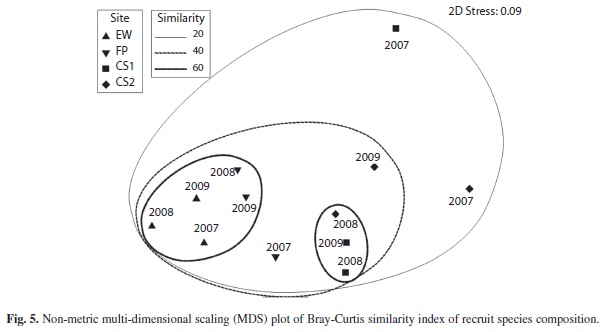
<body><![CDATA[mortality among sites were tested using ANOVA. Post hoc pair-wise     comparisons were performed with Tukey tests when significant     differences were found.</span></font><br style="font-family: verdana;">     <font size="2"></font><br style="font-family: verdana;">     <font size="2"><span style="font-family: verdana;">To further examine     similarity in     species composition of recruits among sites, a Bray-Curtis similarity     index was determined. Species abundance data were pooled for all     quadrats within a site during a survey year, and the data were     square-root transformed (PRIMER v6). The results were also used to     ]]></body>
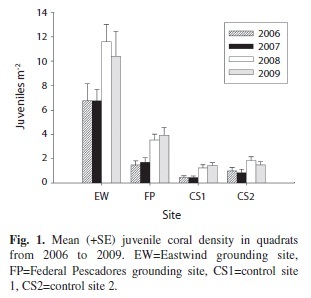
<body><![CDATA[construct a non-metric, multi-dimensional scaling (MDS) plot.</span></font><br      style="font-family: verdana;">     <font size="2"></font><br style="font-family: verdana;">     <font size="3"><span style="font-weight: bold; font-family: verdana;">Results</span></font><br      style="font-family: verdana;">     <font size="2"></font><br style="font-family: verdana;">     <font size="2"><span style="font-family: verdana;">Mean juvenile coral     density ranged     from a low of 0.5&plusmn;0.1 (SE) juveniles m</span></font><font      size="2"><span style="font-family: verdana;"><sup>-2</sup></span></font><font     ]]></body>
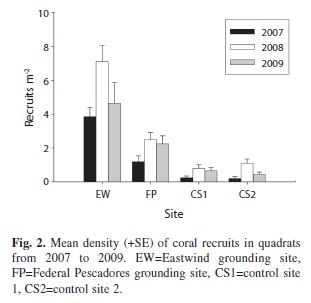
<body><![CDATA[ size="2"><span style="font-family: verdana;"> at control site 1 to a     high of 11.6&plusmn;1.4 juveniles m</span></font><font size="2"><span      style="font-family: verdana;"><sup>-2</sup></span></font><font size="2"><span      style="font-family: verdana;"> at the Eastwind grounding site     (<a href="/img/revistas/rbt/v60s1/a09i1.jpg">Fig. 1</a>). The density     of recruits ranged from 0.2&plusmn;0.1 recruits     m</span></font><font size="2"><span style="font-family: verdana;"><sup>-2</sup></span></font><font      size="2"><span style="font-family: verdana;"> at control site 2 to     7.1&plusmn;1.0 recruits m</span></font><font size="2"><span      style="font-family: verdana;"><sup>-2</sup></span></font><font size="2"><span     ]]></body>
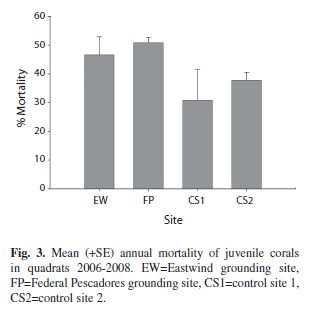
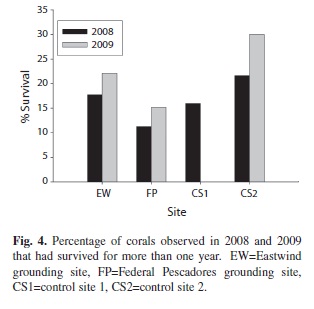
<body><![CDATA[ style="font-family: verdana;"> at the Eastwind     grounding site (<a href="/img/revistas/rbt/v60s1/a09i2.jpg">Fig. 2</a>).     The results of a two-way ANOVA on ranks     indicated that there was a significant difference in density of new     recruits both among sites (p&lt;0.001) and years (p&lt;0.001). A Tukey     pair-wise comparison test indicated that the two grounding sites each    <br> had a significantly higher density of recruits than either control site (p&lt;0.001) and that density of recruits was significantly higher at the Eastwind grounding site than at the Federal Pescadores grounding site (p&lt;0.001). There was no significant difference in recruit density between the two control sites. Recruit density was significantly higher in 2008 than in 2007 (Tukey, p&lt;0.001) or 2009 (p&lt;0.01).    <br> </span></font>    <br> <font size="2"><span style="font-family: verdana;">Annual mortality rates of juvenile corals ranged from 11% to 58%. Mean annual mortality rates were higher at the grounding sites than the control sites during the study period, but the difference was not significant (<a href="/img/revistas/rbt/v60s1/a09i3.jpg">Fig. 3</a>). Survival of juvenile corals for longer than one year ranged from 0 to 30% of the total corals    <br> observed at each site in 2008 and 2009 (<a  href="/img/revistas/rbt/v60s1/a09i4.jpg">Fig. 4</a>).</span></font><font  size="2"><span style="font-family: verdana;"></span></font><font  size="2"><span style="font-family: verdana;">    ]]></body>
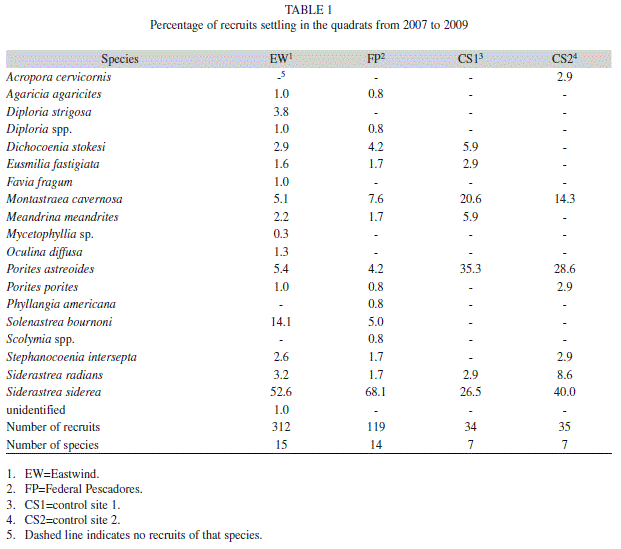
<body><![CDATA[<br>     <br>     </span></font><font size="2"><span style="font-family: verdana;"></span></font>     <font size="2"><span style="font-family: verdana;">A total of 18     species recruited to the study sites, but the maximum     number of species that recruited to any one site was 15 (<a      href="/img/revistas/rbt/v60s1/a09t1.gif">Table 1</a>).     Twice as many species recruited to the grounding sites compared to the     control sites (<a href="/img/revistas/rbt/v60s1/a09t1.gif">Table 1</a>).     Four common species, <span style="font-style: italic;">Siderastrea     ]]></body>
<body><![CDATA[siderea</span> (Ellis &amp;     Solander 1786), <span style="font-style: italic;">Siderastrea radians</span>     (Pallas 1766), <span style="font-style: italic;">Porites astreoides</span>     Lamarck, 1816, and <span style="font-style: italic;">Montastraea     cavernosa</span>, recruited to all the sites. Over half of the recruits     at the grounding sites were <span style="font-style: italic;">S.     siderea. Porites astreoides</span> and S. <span      style="font-style: italic;">siderea</span> comprised a     majority of the total recruits (64% to 67% combined)&nbsp; at the     control sites though <span style="font-style: italic;">M. cavernosa</span>     ]]></body>
<body><![CDATA[also contributed to a relatively     large portion (14% to 21%) compared to the grounding sites (5% to 8%).</span></font><br      style="font-family: verdana;">     <font size="2"></font><br style="font-family: verdana;">     <font size="2"><span style="font-family: verdana;">A non-metric     multi-dimensional     scaling (MDS) plot was used to visualize the Bray-Curtis similarity of     sites based on species abundance of recruits (<a      href="/img/revistas/rbt/v60s1/a09i5.jpg">Fig. 5</a>). Two main     clusters with 60% similarity were formed, one consisting of all the     ]]></body>
<body><![CDATA[grounding sites (minus the 2007 Federal Pescadores) and the other     consisting of 2008 and 2009 control site1 and 2008 control site 2. The     2007 Federal Pescadores data and 2009 control site 2 clustered with the     above mentioned data at 40% similarity, and the 2007 data for both     control sites clustered with the rest of the sites at 20% similarity.</span></font><br      style="font-family: verdana;">     <font size="2"></font><br style="font-family: verdana;">     <font size="2"><span style="font-family: verdana;">Growth rates were     highly variable     both within and between species and often between sites (<a     ]]></body>
<body><![CDATA[ href="/img/revistas/rbt/v60s1/a09t2.gif">Table 2</a>). Most     species grew less than 1 cm yr<sup>-1 </sup>except for <span      style="font-style: italic;">Agaricia     agaricites</span> (Linnaeus 1758) which was only observed&nbsp; at the     grounding sites. Many colonies (23%) suffered partial mortality,&nbsp;     resulting&nbsp; in&nbsp; smaller&nbsp; colony size in subsequent years,     and 6% of the colonies did not grow between survey periods. For some     species, the number of corals measure has been observed at higher     latitudes (Hughes <span style="font-style: italic;">et al.</span>     2000, St. Gelais 2010), which may contribute     ]]></body>
<body><![CDATA[to lower recruitment rates. Differential recruitment among sites in the     current study is probably not impacted&nbsp; by&nbsp; larval&nbsp;     supply since recruitment was significantly higher at the grounding     sites compared to the controls. Higher recruitment to the grounding     sites may be the result of the&nbsp; greater&nbsp; availability&nbsp;     of less-colonized substrate. The presence of well-established     communities at the control sites may have resulted in lower settlement     through the preemption of space and lower survival through competitive     interactions (Birkeland 1977, Bak &amp; Engel 1979, Maida <span      style="font-style: italic;">et al.</span> 2001,     ]]></body>
<body><![CDATA[Kuffner <span style="font-style: italic;">et al.</span> 2006, Vermeij     2006, Arnold <span style="font-style: italic;">et al.</span> 2010).</span></font><br      style="font-family: verdana;">     <font size="2"></font><br style="font-family: verdana;">     <font size="2"><span style="font-family: verdana;">As is the case in     other studies     (Rylaarsdam 1983, Babcock 1985, van Moorsel 1988, Vermeij 2006), growth     rates of individual colonies in this study were highly variable.&nbsp;     Nevertheless, mean growth rates were within the range reported in the     literature though on the lower end&nbsp; for&nbsp; most&nbsp;     ]]></body>
<body><![CDATA[species&nbsp; (Bak&nbsp; &amp;&nbsp; Engel&nbsp; 1979, van Moorsel     1988, Edmunds 2000). The vast majority of colonies grew less than 1 cm     yr</span></font><font size="2"><span style="font-family: verdana;"><sup>-1     </sup></span></font><font size="2"><span style="font-family: verdana;">.     However, many of the colonies (23%) experienced negative growth     and shrank in size due to partial mortality. Average colony size in the     region tends to be small (&lt; 50 cm, Moyer <span      style="font-style: italic;">et al.</span> 2003) in comparison     to other areas, and partial mortality and slow growth rates observed in     the current study likely contribute to these patterns.</span></font><br     ]]></body>
<body><![CDATA[ style="font-family: verdana;">     <font size="2"></font><br style="font-family: verdana;">     <font size="2"><span style="font-family: verdana;">Although mean annual     mortality     rates were not significantly different among sites, total     mortality&nbsp; of&nbsp; juvenile&nbsp; corals&nbsp; was&nbsp; about     50% at the grounding sites and 40% at the control sites during the     study period, indicating a slightly higher mortality of juvenile corals     at the grounding sites over the three year study period. Additionally,     the percentage of corals that survived more than one year was generally     ]]></body>
<body><![CDATA[low (&lt; 30%), indicating low longer-term (&gt; 1 year) survival     across both grounding and control sites.</span></font><br      style="font-family: verdana;">     <font size="2"></font><br style="font-family: verdana;">     <font size="2"><span style="font-family: verdana;">Low survival of     corals was likely     mediated by different processes at the grounding and control sites due     to the differences in habitat. Although no&nbsp; physical&nbsp;     measurements were taken, qualitatively it appeared that sand and rubble     movement occurred at the grounding sites at an increased rate in     ]]></body>
<body><![CDATA[comparison to undisturbed sites. Some of the quadrats that were     initially established&nbsp; on&nbsp; hard&nbsp; substrate at the     grounding sites were noted to be covered with sand and rubble during     subsequent surveys. The movement and accumulation of sand and rubble     was likely facilitated by the flattening and destruction of the relief     by the grounded ships. The presence and movement of sand and rubble     likely inhibited recruit survival at the grounding sites through both     burial and scour (Bak &amp; Engel 1979).</span></font><br      style="font-family: verdana;">     <font size="2"></font><br style="font-family: verdana;">     ]]></body>
<body><![CDATA[<font size="2"><span style="font-family: verdana;">Low survival at the     control sites     may have been affected by competitive interactions with more     established benthic organisms and algae (Birkeland 1977, Bak &amp;     Engel 1979, Maida <span style="font-style: italic;">et al.</span>     2001, Kuffner <span style="font-style: italic;">et al.</span> 2006,     Vermeij 2006).     Though no quantitative data of percent cover were taken within the     quadrats, visually the grounding sites appeared more barren in     comparison to the control sites (<a     ]]></body>
<body><![CDATA[ href="/img/revistas/rbt/v60s1/a09i6.jpg">Fig. 6</a>). In contrast,     Thanner <span style="font-style: italic;">et al.</span>     (2006) found that community structure on artificial reefs in southeast     Florida reached between 45% to 58% similarity to natural reefs in     benthic species composition 4 to 5 years after deployment and that     scleractinian corals on the artificial reefs had similar cover, though     higher abundance of juvenile corals, compared to the natural reef after     the same period.&nbsp; The impoverished benthic community at the     grounding sites 5 years post-grounding provides&nbsp; a&nbsp;     sharp&nbsp; contrast&nbsp; to&nbsp; the&nbsp; moderately high     ]]></body>
<body><![CDATA[similarity in benthic community structure between the natural reef and     artificial reef structures 5 years post deployment that Thanner <span      style="font-style: italic;">et al.</span>     (2006) reported and indicates that topographic complexity may be     important for the recovery of the grounding sites.</span></font><br      style="font-family: verdana;">     <font size="2"></font><br style="font-family: verdana;">     <font size="2"><span style="font-family: verdana;">Community structure     of newly     settled recruits was distinct at the grounding sites. More species     ]]></body>
<body><![CDATA[recruited to the grounding sites (14-15 species) compared to the     reference sites (7 species), but settlement was heavily dominated     (53-68%) by S. <span style="font-style: italic;">siderea</span>. <span      style="font-style: italic;">Siderastrea</span> spp. are able&nbsp;     to&nbsp;     live&nbsp; in&nbsp; conditions&nbsp; generally considered inimical to     coral survival such as fluctuating salinity, low temperatures, and high     sedimentation (Macintyre &amp; Pilkey 1969, Muthiga &amp; Szmant 1987,     Lirman &amp; Manzello 2007). Their dominance at the grounding sites     might be a result of their tolerance to the high sedimentation observed     ]]></body>
<body><![CDATA[due to the&nbsp; destruction of topography from the ship groundings.     <span style="font-style: italic;">Montastraea cavernosa</span>, the     dominant species in the region (Moyer <span style="font-style: italic;">et     al.</span>     2003), comprised a much smaller proportion of the recruits at the     grounding sites (&lt;8%) compared to the reference sites (14-20%).</span></font><br      style="font-family: verdana;">     <font size="2"></font><br style="font-family: verdana;">     <font size="2"><span style="font-family: verdana;">The concern is that     even though     ]]></body>
<body><![CDATA[corals are recruiting to the grounding sites, they are not surviving     and growing to larger size classes. This phenomenon has been observed     in other studies where corals have recruited to damaged sites but have     failed to achieve larger size classes even on a decadal time scale     (Gittings <span style="font-style: italic;">et al.</span> 1990, Rogers     1984, Cook <span style="font-style: italic;">et al.</span> 1994,     Rogers &amp;     Garrison 2001). Corals that have low recruitment and growth rates, as     many of the broadcast spawning, reef building corals do, may take even     longer to recover as models have determined that convergence to     ]]></body>
<body><![CDATA[pre-disturbance levels&nbsp; are&nbsp; highly&nbsp; dependent&nbsp;     on&nbsp; recruitment rates (Hughes &amp; Tanner 2000, Lirman &amp;     Miller 2003). Given the pattern of low recruitment and slow growth of     the broadcast spawning corals observed in the present study, natural     recovery is likely to be slow. Additionally, the low survival of all     corals beyond a year observed at the study sites will contribute to     slow recovery.</span></font><br style="font-family: verdana;">     <font size="2"></font><br style="font-family: verdana;">     <font size="2"><span style="font-family: verdana;">Recovery is     generally defined as     ]]></body>
<body><![CDATA[the return of community structure and function of the injured site to     conditions similar to those that existed pre-disturbance (Edwards &amp;     Gomez 2007). However, injured sites have been known to recover to     alternate community states distinct from those present pre-disturbance     (Hatcher 1984).&nbsp; Aronson and Swanson (1997) found that a decade     after the injury occurred, the Wellwood grounding site in the Florida     Keys was more similar to a hard bottom community than to its original     spur and groove structure. The grounding sites in the current study     were visually distinct from control sites. They were noticeably flat     and devoid of larger coral colonies and other benthic invertebrates     ]]></body>
<body><![CDATA[such as sponges and gorgonians common at the control sites. Though     return of benthic community structure, if possible, is expected to take     on the order of decades, return of topography is expected to take much     longer and may never occur. Thus, it is possible that the grounding     sites may stabilize to some alternate state that is dissimilar from     what was previously present before impact. </span></font><br      style="font-family: verdana;">     <font size="2"></font><br style="font-family: verdana;">     <font size="2"><span style="font-family: verdana;">In conclusion, ship     groundings on     ]]></body>
<body><![CDATA[coral reefs cause not only serious damage to the reef builders, but     also result in a loss of habitat for other organisms, consequently     leading to barren areas. They often flatten the topography, leaving a     source of sand and rubble that may move over the area and inhibit     benthic organism settlement, growth, and&nbsp; survival.&nbsp; This     study has shown that corals are able to recruit to damaged areas but     that slow growth rates and high mortality rates may keep these areas in     a perpetual cycle of settlement and mortality with little or extremely     slow growth to larger size classes,&nbsp; thus&nbsp; inhibiting&nbsp;     recovery.&nbsp; While the exact processes underlying differences in     ]]></body>
<body><![CDATA[recruitment, growth, and mortality, both among sites in this study and     in comparison to other areas of Florida, are unknown, we believe that     the loss of topography at the grounding sites will negatively impact     coral recovery. Therefore, methods of restoration compensating for     increased sediment mobility and flattened relief are recommended to     enhance natural recovery potential of grounding sites.</span></font><br      style="font-family: verdana;">     <font size="2"></font><br style="font-family: verdana;">     <font size="3"><span style="font-weight: bold; font-family: verdana;">Acknowledgments</span></font><br      style="font-family: verdana;">     ]]></body>
<body><![CDATA[<font size="2"></font><br style="font-family: verdana;">     <font size="2"><span style="font-family: verdana;">We thank Nova     Southeastern     University graduate students for their assistance with field work and     Brian Walker for GIS assistance. The Hillsboro Inlet District and     Florida Department of Environmental Protection provided funding for     this project.</span></font><br style="font-family: verdana;">     <font size="2"></font>     <hr style="width: 100%; height: 2px;"><br      style="font-weight: bold; font-family: verdana;">     ]]></body>
<body><![CDATA[<font size="3"><span style="font-weight: bold; font-family: verdana;">References</span></font><br      style="font-family: verdana;">     <font size="2"></font><br style="font-family: verdana;">     <font size="2"><span style="font-family: verdana;">Arnold, S.N., R.S.     Steneck &amp;     P.J. Mumby. 2010. Running the gauntlet: inhibitory&nbsp; effects of     algal turfs on the processes of coral recruitment. Mar. Ecol. Prog.     <!-- ref -->Ser. 414: 91-105.    &nbsp;&nbsp;&nbsp;&nbsp;&nbsp;&nbsp;&nbsp;&nbsp;[&#160;<a href="javascript:void(0);" onclick="javascript: window.open('/scielo.php?script=sci_nlinks&ref=1448973&pid=S0034-7744201200050000900001&lng=','','width=640,height=500,resizable=yes,scrollbars=1,menubar=yes,');">Links</a>&#160;]<!-- end-ref --><!-- ref --></span></font><br style="font-family: verdana;"> <font size="2"></font><br style="font-family: verdana;"> <font size="2"><span style="font-family: verdana;">Aronson, R.B. &amp; D.W. Swanson. 1997. Video surveys of coral reefs: uniand multivariate applications. Proc. 8th&nbsp;&nbsp; Int. Coral Reef Symp., Panama 2: 1441-1446.    &nbsp;&nbsp;&nbsp;&nbsp;&nbsp;&nbsp;&nbsp;&nbsp;[&#160;<a href="javascript:void(0);" onclick="javascript: window.open('/scielo.php?script=sci_nlinks&ref=1448974&pid=S0034-7744201200050000900002&lng=','','width=640,height=500,resizable=yes,scrollbars=1,menubar=yes,');">Links</a>&#160;]<!-- end-ref --><!-- ref --></span></font><br  style="font-family: verdana;"> <font size="2"></font><br style="font-family: verdana;"> <font size="2"><span style="font-family: verdana;">Babcock,&nbsp; R.C.&nbsp; 1985.&nbsp; Growth&nbsp; and&nbsp; mortality&nbsp; in&nbsp; juvenile corals&nbsp; (Goniastrea,&nbsp; Platygyra,&nbsp; and&nbsp; Acropora):&nbsp; the first year. Proc. 5th&nbsp;&nbsp; Int. Coral Reef Congr., Tahiti 4: 355-360.    &nbsp;&nbsp;&nbsp;&nbsp;&nbsp;&nbsp;&nbsp;&nbsp;[&#160;<a href="javascript:void(0);" onclick="javascript: window.open('/scielo.php?script=sci_nlinks&ref=1448975&pid=S0034-7744201200050000900003&lng=','','width=640,height=500,resizable=yes,scrollbars=1,menubar=yes,');">Links</a>&#160;]<!-- end-ref --><!-- ref --></span></font><br  style="font-family: verdana;"> <font size="2"></font><br style="font-family: verdana;"> <font size="2"><span style="font-family: verdana;">Bak, R.P.M. &amp; M.S. Engel. 1979. Distribution, abundance and&nbsp; survival&nbsp; of&nbsp; juvenile&nbsp; hermatypic&nbsp; corals&nbsp; (Scleractinia)&nbsp; and&nbsp; the importance of early life history strategies in the parent coral community. Mar. Biol. 54: 341-352.    &nbsp;&nbsp;&nbsp;&nbsp;&nbsp;&nbsp;&nbsp;&nbsp;[&#160;<a href="javascript:void(0);" onclick="javascript: window.open('/scielo.php?script=sci_nlinks&ref=1448976&pid=S0034-7744201200050000900004&lng=','','width=640,height=500,resizable=yes,scrollbars=1,menubar=yes,');">Links</a>&#160;]<!-- end-ref --><!-- ref --></span></font><br  style="font-family: verdana;"> <font size="2"></font><br style="font-family: verdana;"> <font size="2"><span style="font-family: verdana;">Banks,&nbsp; K.W.,&nbsp; B.M.&nbsp; Riegl,&nbsp; V.P.&nbsp; Richards,&nbsp; B.K.&nbsp; Walker, K.P. Helmle, L.K.B.&nbsp; Jordan,&nbsp; J. Phipps, M.S. Shivji, R.E. Spieler &amp; R.E. Dodge. 2008. The reef tract of continental southeast Florida (Miami-Dade, Broward and Palm Beach Counties, USA), p. 175-220. In B.M. Riegl and R.E. Dodge (eds). Coral Reefs of the USA. Springer, London, England.    &nbsp;&nbsp;&nbsp;&nbsp;&nbsp;&nbsp;&nbsp;&nbsp;[&#160;<a href="javascript:void(0);" onclick="javascript: window.open('/scielo.php?script=sci_nlinks&ref=1448977&pid=S0034-7744201200050000900005&lng=','','width=640,height=500,resizable=yes,scrollbars=1,menubar=yes,');">Links</a>&#160;]<!-- end-ref --><!-- ref --></span></font><br style="font-family: verdana;"> <font size="2"></font><br style="font-family: verdana;"> <font size="2"><span style="font-family: verdana;">Birkeland, C. 1977. The importance of rate&nbsp; of biomass accumulation in early successional stages of benthic communities to the survival of coral recruits. Proc. 3rd Int. Coral Reef Symp., Miami 1: 15-21.    &nbsp;&nbsp;&nbsp;&nbsp;&nbsp;&nbsp;&nbsp;&nbsp;[&#160;<a href="javascript:void(0);" onclick="javascript: window.open('/scielo.php?script=sci_nlinks&ref=1448978&pid=S0034-7744201200050000900006&lng=','','width=640,height=500,resizable=yes,scrollbars=1,menubar=yes,');">Links</a>&#160;]<!-- end-ref --><!-- ref --></span></font><br  style="font-family: verdana;"> <font size="2"></font><br style="font-family: verdana;"> <font size="2"><span style="font-family: verdana;">Cook, C.B., R.E. Dodge, &amp; S.R. Smith. 1994. Fifty years of impacts on coral reefs in&nbsp; Bermuda. p. 160-166. In R.N. Ginsburg&nbsp; (compiler). Proc. Colloquium on Global Aspects of Coral Reefs: Health, Hazards, and History. University of Miami, Miami, Florida, USA.    &nbsp;&nbsp;&nbsp;&nbsp;&nbsp;&nbsp;&nbsp;&nbsp;[&#160;<a href="javascript:void(0);" onclick="javascript: window.open('/scielo.php?script=sci_nlinks&ref=1448979&pid=S0034-7744201200050000900007&lng=','','width=640,height=500,resizable=yes,scrollbars=1,menubar=yes,');">Links</a>&#160;]<!-- end-ref --><!-- ref --></span></font><br  style="font-family: verdana;"> <font size="2"></font><br style="font-family: verdana;"> <font size="2"><span style="font-family: verdana;">Edmunds,&nbsp; P.J. 2000. Patterns in the&nbsp; distribution of juvenile corals and coral reef community structure in St. John, US Virgin Islands. Mar. Ecol. Prog. Ser.&nbsp; 202: 113-124.    &nbsp;&nbsp;&nbsp;&nbsp;&nbsp;&nbsp;&nbsp;&nbsp;[&#160;<a href="javascript:void(0);" onclick="javascript: window.open('/scielo.php?script=sci_nlinks&ref=1448980&pid=S0034-7744201200050000900008&lng=','','width=640,height=500,resizable=yes,scrollbars=1,menubar=yes,');">Links</a>&#160;]<!-- end-ref --><!-- ref --></span></font><br style="font-family: verdana;"> <font size="2"></font><br style="font-family: verdana;"> <font size="2"><span style="font-family: verdana;">Edwards, A.J. &amp; E.D. Gomez. 2007. Reef restoration concepts and guidelines:&nbsp; making sensible management choices in the face of uncertainty. Coral Reef Targeted Research &amp; Capacity Building for&nbsp; Management Programme, St. Lucia, Australia.    &nbsp;&nbsp;&nbsp;&nbsp;&nbsp;&nbsp;&nbsp;&nbsp;[&#160;<a href="javascript:void(0);" onclick="javascript: window.open('/scielo.php?script=sci_nlinks&ref=1448981&pid=S0034-7744201200050000900009&lng=','','width=640,height=500,resizable=yes,scrollbars=1,menubar=yes,');">Links</a>&#160;]<!-- end-ref --><!-- ref --></span></font><br style="font-family: verdana;"> <font size="2"></font><br style="font-family: verdana;"> <font size="2"><span style="font-family: verdana;">Gittings,&nbsp; S.R.,&nbsp; T.J.&nbsp; Bright&nbsp; &amp;&nbsp; B.S.&nbsp; Holland.&nbsp; 1990.&nbsp; Five years of coral recovery following a freighter grounding in the&nbsp; Florida Keys. p. 89-105. In W.A. Jaap (ed). Diving for Science: Proceedings of&nbsp; the American Academy of Underwater Sciences 10th&nbsp;&nbsp; Annual Scientific Diving Symposium. American Academy of Underwater Sciences, Costa Mesa, California, USA.    &nbsp;&nbsp;&nbsp;&nbsp;&nbsp;&nbsp;&nbsp;&nbsp;[&#160;<a href="javascript:void(0);" onclick="javascript: window.open('/scielo.php?script=sci_nlinks&ref=1448982&pid=S0034-7744201200050000900010&lng=','','width=640,height=500,resizable=yes,scrollbars=1,menubar=yes,');">Links</a>&#160;]<!-- end-ref --><!-- ref --></span></font><br style="font-family: verdana;"> <font size="2"></font><br style="font-family: verdana;"> <font size="2"><span style="font-family: verdana;">Harriott,&nbsp; V.J. 1999. Coral recruitment at a&nbsp; high latitude Pacific site: a comparison&nbsp; with Atlantic reefs. Bull. Mar. Sci. 65: 881-891.    &nbsp;&nbsp;&nbsp;&nbsp;&nbsp;&nbsp;&nbsp;&nbsp;[&#160;<a href="javascript:void(0);" onclick="javascript: window.open('/scielo.php?script=sci_nlinks&ref=1448983&pid=S0034-7744201200050000900011&lng=','','width=640,height=500,resizable=yes,scrollbars=1,menubar=yes,');">Links</a>&#160;]<!-- end-ref --><!-- ref --></span></font><br  style="font-family: verdana;"> <font size="2"></font><br style="font-family: verdana;"> <font size="2"><span style="font-family: verdana;">Harriott, V.J. &amp; S.A. Banks. 1995. Recruitment of scleractinian corals in the Solitary Islands Marine Reserve, a high latitude coral-dominated community in eastern Australia. Mar. Ecol. Prog. Ser. 123: 155-161.    &nbsp;&nbsp;&nbsp;&nbsp;&nbsp;&nbsp;&nbsp;&nbsp;[&#160;<a href="javascript:void(0);" onclick="javascript: window.open('/scielo.php?script=sci_nlinks&ref=1448984&pid=S0034-7744201200050000900012&lng=','','width=640,height=500,resizable=yes,scrollbars=1,menubar=yes,');">Links</a>&#160;]<!-- end-ref --><!-- ref --></span></font><br  style="font-family: verdana;"> <font size="2"></font><br style="font-family: verdana;"> <font size="2"><span style="font-family: verdana;">Hatcher, B.G. 1984. A maritime accident provides evidence for alternate stable states in benthic communities on coral reefs. Coral Reefs 3: 199-204.    &nbsp;&nbsp;&nbsp;&nbsp;&nbsp;&nbsp;&nbsp;&nbsp;[&#160;<a href="javascript:void(0);" onclick="javascript: window.open('/scielo.php?script=sci_nlinks&ref=1448985&pid=S0034-7744201200050000900013&lng=','','width=640,height=500,resizable=yes,scrollbars=1,menubar=yes,');">Links</a>&#160;]<!-- end-ref --><!-- ref --></span></font><br  style="font-family: verdana;"> <font size="2"></font><br style="font-family: verdana;"> <font size="2"><span style="font-family: verdana;">Hudson&nbsp;&nbsp; Marine&nbsp;&nbsp; Management&nbsp;&nbsp; Services.&nbsp;&nbsp; 2004a.&nbsp;&nbsp; <span style="font-style: italic;">M/V Eastwind</span>&nbsp; Grounding&nbsp; Site&nbsp; Ft.&nbsp; Lauderdale,&nbsp; Florida Injury&nbsp; Assessment.&nbsp; Thomas&nbsp; Miller&nbsp; Inc.,&nbsp;&nbsp; Miami, Florida, USA.    &nbsp;&nbsp;&nbsp;&nbsp;&nbsp;&nbsp;&nbsp;&nbsp;[&#160;<a href="javascript:void(0);" onclick="javascript: window.open('/scielo.php?script=sci_nlinks&ref=1448986&pid=S0034-7744201200050000900014&lng=','','width=640,height=500,resizable=yes,scrollbars=1,menubar=yes,');">Links</a>&#160;]<!-- end-ref --><!-- ref --></span></font><br  style="font-family: verdana;"> <font size="2"></font><br style="font-family: verdana;"> <font size="2"><span style="font-family: verdana;">Hudson Marine Management Services. 2004b. <span style="font-style: italic;">M/V Federal&nbsp; Pescadores</span>&nbsp; Site&nbsp; Ft.&nbsp; Lauderdale,&nbsp; Florida&nbsp; Injury Assessment Report. Vandeventer Black LLP, Norfolk, Virginia, USA.    &nbsp;&nbsp;&nbsp;&nbsp;&nbsp;&nbsp;&nbsp;&nbsp;[&#160;<a href="javascript:void(0);" onclick="javascript: window.open('/scielo.php?script=sci_nlinks&ref=1448987&pid=S0034-7744201200050000900015&lng=','','width=640,height=500,resizable=yes,scrollbars=1,menubar=yes,');">Links</a>&#160;]<!-- end-ref --><!-- ref --></span></font><br  style="font-family: verdana;"> <font size="2"></font><br style="font-family: verdana;"> <font size="2"><span style="font-family: verdana;">Hughes, T.P. &amp; J.B.C. Jackson. 1985. Population dynamics and life histories of foliaceous corals. Ecol. Monogr. 55: 141-166.    &nbsp;&nbsp;&nbsp;&nbsp;&nbsp;&nbsp;&nbsp;&nbsp;[&#160;<a href="javascript:void(0);" onclick="javascript: window.open('/scielo.php?script=sci_nlinks&ref=1448988&pid=S0034-7744201200050000900016&lng=','','width=640,height=500,resizable=yes,scrollbars=1,menubar=yes,');">Links</a>&#160;]<!-- end-ref --><!-- ref --></span></font><br  style="font-family: verdana;"> <font size="2"></font><br style="font-family: verdana;"> <font size="2"><span style="font-family: verdana;">Hughes, T. P. &amp; J. Tanner. 2000. Recruitment failure, life histories, and long-term decline of Caribbean corals. Ecology 81: 2250-2263.    &nbsp;&nbsp;&nbsp;&nbsp;&nbsp;&nbsp;&nbsp;&nbsp;[&#160;<a href="javascript:void(0);" onclick="javascript: window.open('/scielo.php?script=sci_nlinks&ref=1448989&pid=S0034-7744201200050000900017&lng=','','width=640,height=500,resizable=yes,scrollbars=1,menubar=yes,');">Links</a>&#160;]<!-- end-ref --><!-- ref --></span></font><br  style="font-family: verdana;"> <font size="2"></font><br style="font-family: verdana;"> <font size="2"><span style="font-family: verdana;">Hughes,&nbsp; T.P, A.H. Baird, E.A. Dinsdale, N.A.&nbsp; Moltschaniwsky, M.S. Pratchet, J.E.&nbsp; Tanner &amp; B.L. Willis. 2000. Supply-side ecology works both ways: the link between benthic adults, fecundity, and larval recruits. Ecology 81: 2241-2249.    &nbsp;&nbsp;&nbsp;&nbsp;&nbsp;&nbsp;&nbsp;&nbsp;[&#160;<a href="javascript:void(0);" onclick="javascript: window.open('/scielo.php?script=sci_nlinks&ref=1448990&pid=S0034-7744201200050000900018&lng=','','width=640,height=500,resizable=yes,scrollbars=1,menubar=yes,');">Links</a>&#160;]<!-- end-ref --><!-- ref --> </span></font><br style="font-family: verdana;"> <font size="2"></font><br style="font-family: verdana;"> <font size="2"><span style="font-family: verdana;">Hughes,&nbsp; T.P., A.H.&nbsp; Baird,&nbsp; E.A.&nbsp; Dinsdale,&nbsp; V.J.&nbsp; Harriott, N.A. Moltschaniwsky,&nbsp; Pratchet, J.E. Tanner &amp; B.L. Willis. 2002. Detecting regional variation using meta-analysis and large-scale sampling: latitudinal patterns in recruitment. Ecology 83: 436-451.    &nbsp;&nbsp;&nbsp;&nbsp;&nbsp;&nbsp;&nbsp;&nbsp;[&#160;<a href="javascript:void(0);" onclick="javascript: window.open('/scielo.php?script=sci_nlinks&ref=1448991&pid=S0034-7744201200050000900019&lng=','','width=640,height=500,resizable=yes,scrollbars=1,menubar=yes,');">Links</a>&#160;]<!-- end-ref --><!-- ref --></span></font><br  style="font-family: verdana;"> <font size="2"></font><br style="font-family: verdana;"> <font size="2"><span style="font-family: verdana;">Jaap,&nbsp; W.C., J.H. Hudson R.E. Dodge, D.&nbsp; Gilliam &amp; R. Shaul. 2006. Coral reef restoration with case studies from Florida. p. 478-514. In I.M. Cote &amp; J.D. Reynolds&nbsp; (eds).&nbsp; Coral Reef Conservation. Cambridge University, Cambridge, England.    &nbsp;&nbsp;&nbsp;&nbsp;&nbsp;&nbsp;&nbsp;&nbsp;[&#160;<a href="javascript:void(0);" onclick="javascript: window.open('/scielo.php?script=sci_nlinks&ref=1448992&pid=S0034-7744201200050000900020&lng=','','width=640,height=500,resizable=yes,scrollbars=1,menubar=yes,');">Links</a>&#160;]<!-- end-ref --><!-- ref --></span></font><br  style="font-family: verdana;"> <font size="2"></font><br style="font-family: verdana;"> <font size="2"><span style="font-family: verdana;">Kuffner, I.B., L.J. Walters, M.A. Becerro,&nbsp; V.J. Paul, R. Ritson-Williams &amp; K.S. Beach. 2006.&nbsp; Inhibition of coral recruitment by&nbsp; macroalgae and cyanobacteria. Mar. Ecol. Prog. Ser. 323: 107-117.    &nbsp;&nbsp;&nbsp;&nbsp;&nbsp;&nbsp;&nbsp;&nbsp;[&#160;<a href="javascript:void(0);" onclick="javascript: window.open('/scielo.php?script=sci_nlinks&ref=1448993&pid=S0034-7744201200050000900021&lng=','','width=640,height=500,resizable=yes,scrollbars=1,menubar=yes,');">Links</a>&#160;]<!-- end-ref --><!-- ref --></span></font><br  style="font-family: verdana;"> <font size="2"></font><br style="font-family: verdana;"> <font size="2"><span style="font-family: verdana;">Lirman, D. &amp; M.W. Miller. 2003. Modeling and monitoring tools to assess recovery status and convergence rates between restored and undisturbed coral reef habitats. Restor. Ecol. 11: 448-456.    &nbsp;&nbsp;&nbsp;&nbsp;&nbsp;&nbsp;&nbsp;&nbsp;[&#160;<a href="javascript:void(0);" onclick="javascript: window.open('/scielo.php?script=sci_nlinks&ref=1448994&pid=S0034-7744201200050000900022&lng=','','width=640,height=500,resizable=yes,scrollbars=1,menubar=yes,');">Links</a>&#160;]<!-- end-ref --><!-- ref --></span></font><br style="font-family: verdana;"> <font size="2"></font><br style="font-family: verdana;"> <font size="2"><span style="font-family: verdana;">Lirman,&nbsp; D. &amp; D. Manzello. 2007. Patterns of&nbsp; resistance and resilience of the stress-tolerant coral <span style="font-style: italic;">Siderastrea radians</span> (Pallas) to sub-optimal salinity and sediment burial. J. Exp. Mar. Biol. Ecol. 369: 72-77.    &nbsp;&nbsp;&nbsp;&nbsp;&nbsp;&nbsp;&nbsp;&nbsp;[&#160;<a href="javascript:void(0);" onclick="javascript: window.open('/scielo.php?script=sci_nlinks&ref=1448995&pid=S0034-7744201200050000900023&lng=','','width=640,height=500,resizable=yes,scrollbars=1,menubar=yes,');">Links</a>&#160;]<!-- end-ref --><!-- ref --></span></font><br  style="font-family: verdana;"> <font size="2"></font><br style="font-family: verdana;"> <font size="2"><span style="font-family: verdana;">Macintyre, I.G. &amp; O.H. Pilkey. 1969. Tropical reef corals: tolerance of low temperatures on the North Carolina continental shelf. Science 166: 374-375.    &nbsp;&nbsp;&nbsp;&nbsp;&nbsp;&nbsp;&nbsp;&nbsp;[&#160;<a href="javascript:void(0);" onclick="javascript: window.open('/scielo.php?script=sci_nlinks&ref=1448996&pid=S0034-7744201200050000900024&lng=','','width=640,height=500,resizable=yes,scrollbars=1,menubar=yes,');">Links</a>&#160;]<!-- end-ref --><!-- ref --></span></font><br  style="font-family: verdana;"> <font size="2"></font><br style="font-family: verdana;"> <font size="2"><span style="font-family: verdana;">Maida,&nbsp; M.,&nbsp; P.W.&nbsp; Sammarco&nbsp; &amp;&nbsp; J.C.&nbsp; Coll.&nbsp; 2001.&nbsp; Effects of soft corals on&nbsp; scleractinian coral recruitment. 2: Allelopathy, spat survivorship and reef&nbsp; community structure. Mar. Ecol. 22: 397-414.    &nbsp;&nbsp;&nbsp;&nbsp;&nbsp;&nbsp;&nbsp;&nbsp;[&#160;<a href="javascript:void(0);" onclick="javascript: window.open('/scielo.php?script=sci_nlinks&ref=1448997&pid=S0034-7744201200050000900025&lng=','','width=640,height=500,resizable=yes,scrollbars=1,menubar=yes,');">Links</a>&#160;]<!-- end-ref --><!-- ref --></span></font><br style="font-family: verdana;"> <font size="2"></font><br style="font-family: verdana;"> <font size="2"><span style="font-family: verdana;">Marine&nbsp; Resources Inc. 2005. Proposed&nbsp; Restoration Plan for Post-Grounding Activities: <span  style="font-style: italic;">M/V Eastwind</span> Grounding Site Offshore Broward County, Florida. Houck, Hamilton, &amp; Anderson, P.A., Miami, Florida, USA.    &nbsp;&nbsp;&nbsp;&nbsp;&nbsp;&nbsp;&nbsp;&nbsp;[&#160;<a href="javascript:void(0);" onclick="javascript: window.open('/scielo.php?script=sci_nlinks&ref=1448998&pid=S0034-7744201200050000900026&lng=','','width=640,height=500,resizable=yes,scrollbars=1,menubar=yes,');">Links</a>&#160;]<!-- end-ref --><!-- ref --></span></font><br  style="font-family: verdana;"> <font size="2"></font><br style="font-family: verdana;"> <font size="2"><span style="font-family: verdana;">Miller,&nbsp; M.W.,&nbsp; E.&nbsp; Weil&nbsp; &amp;&nbsp; A.M.&nbsp; Szmant.&nbsp;&nbsp;&nbsp;&nbsp; 2000.&nbsp; Coral recruitment&nbsp; and&nbsp; juvenile&nbsp;&nbsp; mortality&nbsp; as&nbsp; structuring factors&nbsp; for&nbsp; reef&nbsp; benthic&nbsp; communities&nbsp; in&nbsp; Biscayne National Park, USA. Coral Reefs 19: 115-123.    &nbsp;&nbsp;&nbsp;&nbsp;&nbsp;&nbsp;&nbsp;&nbsp;[&#160;<a href="javascript:void(0);" onclick="javascript: window.open('/scielo.php?script=sci_nlinks&ref=1448999&pid=S0034-7744201200050000900027&lng=','','width=640,height=500,resizable=yes,scrollbars=1,menubar=yes,');">Links</a>&#160;]<!-- end-ref --><!-- ref --></span></font><br style="font-family: verdana;"> <font size="2"></font><br style="font-family: verdana;"> <font size="2"><span style="font-family: verdana;">Moyer, R.P., B. Riegl, K. Banks &amp; R.E. Dodge. 2003. Spatial patterns and ecology of benthic communities on a high-latitude South Florida (Broward County, USA) reef system. Coral Reefs 22: 447-464.    &nbsp;&nbsp;&nbsp;&nbsp;&nbsp;&nbsp;&nbsp;&nbsp;[&#160;<a href="javascript:void(0);" onclick="javascript: window.open('/scielo.php?script=sci_nlinks&ref=1449000&pid=S0034-7744201200050000900028&lng=','','width=640,height=500,resizable=yes,scrollbars=1,menubar=yes,');">Links</a>&#160;]<!-- end-ref --><!-- ref --></span></font><br  style="font-family: verdana;"> <font size="2"></font><br style="font-family: verdana;"> <font size="2"><span style="font-family: verdana;">Muthiga, N.A. &amp; A.M. Szmant. 1987. The&nbsp; effects&nbsp; of salinity stress on the rates of aerobic respiration and photosynthesis in&nbsp; the hermatypic coral <span style="font-style: italic;">Siderastrea siderea</span>. Biol. Bull. 173: 539-551.    &nbsp;&nbsp;&nbsp;&nbsp;&nbsp;&nbsp;&nbsp;&nbsp;[&#160;<a href="javascript:void(0);" onclick="javascript: window.open('/scielo.php?script=sci_nlinks&ref=1449001&pid=S0034-7744201200050000900029&lng=','','width=640,height=500,resizable=yes,scrollbars=1,menubar=yes,');">Links</a>&#160;]<!-- end-ref --><!-- ref --></span></font><br style="font-family: verdana;"> <font size="2"></font><br style="font-family: verdana;"> <font size="2"><span style="font-family: verdana;">Rogers, C.S, H.C. Fitz III, M. Gilnack, J. Beets &amp; J. Hardin. 1984. Scleractinian coral recruitment patterns at Salt River Submarine Canyon, St. Croix, U.S. Virgin Islands. Coral Reefs 3: 69-76.    &nbsp;&nbsp;&nbsp;&nbsp;&nbsp;&nbsp;&nbsp;&nbsp;[&#160;<a href="javascript:void(0);" onclick="javascript: window.open('/scielo.php?script=sci_nlinks&ref=1449002&pid=S0034-7744201200050000900030&lng=','','width=640,height=500,resizable=yes,scrollbars=1,menubar=yes,');">Links</a>&#160;]<!-- end-ref --><!-- ref --></span></font><br  style="font-family: verdana;"> <font size="2"></font><br style="font-family: verdana;"> <font size="2"><span style="font-family: verdana;">Rogers,&nbsp; C.S.&nbsp; &amp; V.&nbsp; Garrison.&nbsp; 2001. Ten&nbsp; years&nbsp; after&nbsp; the crime: lasting effects of&nbsp; damage&nbsp; from a cruise ship anchor on a coral reef in St. John, U.S. Virgin Islands. Bull. Mar. Sci. 69: 793-803.    &nbsp;&nbsp;&nbsp;&nbsp;&nbsp;&nbsp;&nbsp;&nbsp;[&#160;<a href="javascript:void(0);" onclick="javascript: window.open('/scielo.php?script=sci_nlinks&ref=1449003&pid=S0034-7744201200050000900031&lng=','','width=640,height=500,resizable=yes,scrollbars=1,menubar=yes,');">Links</a>&#160;]<!-- end-ref --><!-- ref --></span></font><br style="font-family: verdana;"> <font size="2"></font><br style="font-family: verdana;"> <font size="2"><span style="font-family: verdana;">Rylaarsdam, K.W. 1983. Life histories and abundance patterns of colonial corals on Jamaican reefs. Mar. Ecol. Prog. Ser. 13: 249-260.    &nbsp;&nbsp;&nbsp;&nbsp;&nbsp;&nbsp;&nbsp;&nbsp;[&#160;<a href="javascript:void(0);" onclick="javascript: window.open('/scielo.php?script=sci_nlinks&ref=1449004&pid=S0034-7744201200050000900032&lng=','','width=640,height=500,resizable=yes,scrollbars=1,menubar=yes,');">Links</a>&#160;]<!-- end-ref --><!-- ref --></span></font><br  style="font-family: verdana;"> <font size="2"></font><br style="font-family: verdana;"> <font size="2"><span style="font-family: verdana;">Smith, S.R. 1997. Patterns of coral settlement, recruitment and&nbsp; juvenile&nbsp; mortality&nbsp; with&nbsp; depth&nbsp; at&nbsp; Conch&nbsp; Reef, Florida. Proc. 8th&nbsp; Int. Coral Reef Symp., Panama 2: 1197-1202.    &nbsp;&nbsp;&nbsp;&nbsp;&nbsp;&nbsp;&nbsp;&nbsp;[&#160;<a href="javascript:void(0);" onclick="javascript: window.open('/scielo.php?script=sci_nlinks&ref=1449005&pid=S0034-7744201200050000900033&lng=','','width=640,height=500,resizable=yes,scrollbars=1,menubar=yes,');">Links</a>&#160;]<!-- end-ref --><!-- ref --></span></font><br  style="font-family: verdana;"> <font size="2"></font><br style="font-family: verdana;"> <font size="2"><span style="font-family: verdana;">St.&nbsp; Gelais, A.T. 2010. Reproductive ecology&nbsp; of <span style="font-style: italic;">Siderastrea&nbsp; siderea</span>:&nbsp; histological&nbsp; analysis&nbsp; of&nbsp; gametogenesis,&nbsp; spawning,&nbsp; and latitudinal fecundity variation. Master&#8217;s Thesis, Nova Southeastern&nbsp;&nbsp; University, Dania Beach, Florida, USA.    &nbsp;&nbsp;&nbsp;&nbsp;&nbsp;&nbsp;&nbsp;&nbsp;[&#160;<a href="javascript:void(0);" onclick="javascript: window.open('/scielo.php?script=sci_nlinks&ref=1449006&pid=S0034-7744201200050000900034&lng=','','width=640,height=500,resizable=yes,scrollbars=1,menubar=yes,');">Links</a>&#160;]<!-- end-ref --><!-- ref --></span></font><br  style="font-family: verdana;"> <font size="2"></font><br style="font-family: verdana;"> <font size="2"><span style="font-family: verdana;">Thanner, S.E., T.L. McIntosh &amp; S.M. Blair. 2006. Development of benthic and fish&nbsp; assemblages on artificial reef&nbsp; materials&nbsp;&nbsp; compared to adjacent natural reef assemblages in Miami-Dade County, Florida.&nbsp; Bull. Mar. Sci. 78: 57-70.    &nbsp;&nbsp;&nbsp;&nbsp;&nbsp;&nbsp;&nbsp;&nbsp;[&#160;<a href="javascript:void(0);" onclick="javascript: window.open('/scielo.php?script=sci_nlinks&ref=1449007&pid=S0034-7744201200050000900035&lng=','','width=640,height=500,resizable=yes,scrollbars=1,menubar=yes,');">Links</a>&#160;]<!-- end-ref --><!-- ref --></span></font><br style="font-family: verdana;"> <font size="2"></font><br style="font-family: verdana;"> <font size="2"><span style="font-family: verdana;">Van Moorsel, G.W.N.M. 1988. Early maximum growth of stony corals&nbsp; (Scleractinia) after settlement on artificial substrata on a Caribbean reef. Mar. Ecol. Prog. Ser. 50: 127-135.    &nbsp;&nbsp;&nbsp;&nbsp;&nbsp;&nbsp;&nbsp;&nbsp;[&#160;<a href="javascript:void(0);" onclick="javascript: window.open('/scielo.php?script=sci_nlinks&ref=1449008&pid=S0034-7744201200050000900036&lng=','','width=640,height=500,resizable=yes,scrollbars=1,menubar=yes,');">Links</a>&#160;]<!-- end-ref --><!-- ref --></span></font><br style="font-family: verdana;"> <font size="2"></font><br style="font-family: verdana;"> <font size="2"><span style="font-family: verdana;">Vermeij, M.J.A. 2006. Early life-history dynamics of Caribbean coral species on artificial substratum: the importance of&nbsp; competition, growth and variation in life-history strategy. Coral Reefs 25: 59-71.    &nbsp;&nbsp;&nbsp;&nbsp;&nbsp;&nbsp;&nbsp;&nbsp;[&#160;<a href="javascript:void(0);" onclick="javascript: window.open('/scielo.php?script=sci_nlinks&ref=1449009&pid=S0034-7744201200050000900037&lng=','','width=640,height=500,resizable=yes,scrollbars=1,menubar=yes,');">Links</a>&#160;]<!-- end-ref --></span></font><br  style="font-family: verdana;"> <font size="2"></font><br style="font-family: verdana;"> <font size="2"><span style="font-family: verdana;"><a  name="Correspondencia1"></a><a href="#Correspondencia2">*</a>Correspondencia:</span></font><br  style="font-family: verdana;"> <font size="2"><span style="font-family: verdana;">Alison L. Moulding: National Coral Reef Institute, Nova Southeastern University, Oceanographic Center, 8000 North Ocean Dr., Dania Beach, FL 33161 USA; <a  href="mailto:gilliam@nova.edu">moulding@nova.edu</a></span></font><br  style="font-family: verdana;"> <font size="2"><span style="font-family: verdana;">Vladimir N. Kosmynin: Florida Department of Environmental Protection, Bureau of Beaches and Coastal Systems,&nbsp; 3900 Commonwealth Boulevard, Mail Station 300, Tallahassee, Florida 32399 USA;&nbsp; <a href="mailto:gilliam@nova.edu">Vladimir.Kosmynin@dep.state.fl.us</a></span></font><br  style="font-family: verdana;"> <font size="2"><span style="font-family: verdana;">David S. Gilliam: National Coral Reef Institute, Nova Southeastern University, Oceanographic Center, 8000 North Ocean Dr., Dania Beach, FL 33161 USA; <a  href="milto:gilliam@nova.edu">gilliam@nova.edu</a>    <br>     <br> </span></font><font size="2"><span style="font-family: verdana;"><a  name="1"></a><a href="#3">1</a>.&nbsp; National Coral Reef Institute, Nova Southeastern University, Oceanographic Center, 8000 North Ocean Dr., Dania</span><span style="font-family: verdana;"> Beach, FL 33161 USA; <a href="mailto:moulding@nova.edu">moulding@nova.edu</a>,<a  href="mailto:gilliam@nova.edu"> gilliam@nova.edu</a></span></font><br  style="font-family: verdana;"> <font size="2"><span style="font-family: verdana;"><a name="2"></a><a  href="#4">2</a>. Florida Department of Environmental Protection, Bureau of Beaches and Coastal Systems, 3900 Commonwealth Boulevard, Mail Station 300, Tallahassee, Florida 32399 USA;&nbsp; <a  href="mailto:Vladimir.Kosmynin@dep.state.fl.us">Vladimir.Kosmynin@dep.state.fl.us</a></span></font><br  style="font-family: verdana;"> <hr style="width: 100%; height: 2px;">     <div style="text-align: center;"><font size="2"><span  style="font-weight: bold; font-family: verdana;">Received 12-VII-2011. Corrected 22-XI-2011.&nbsp;&nbsp; &nbsp;Accepted 20-XII-2011.</span> </font></div> </div>      ]]></body><back>
<ref-list>
<ref id="B1">
<nlm-citation citation-type="journal">
<person-group person-group-type="author">
<name>
<surname><![CDATA[Arnold]]></surname>
<given-names><![CDATA[S.N]]></given-names>
</name>
<name>
<surname><![CDATA[Steneck]]></surname>
<given-names><![CDATA[R.S]]></given-names>
</name>
<name>
<surname><![CDATA[Mumby]]></surname>
<given-names><![CDATA[P.J]]></given-names>
</name>
</person-group>
<article-title xml:lang="en"><![CDATA[Running the gauntlet: inhibitory effects of algal turfs on the processes of coral recruitment]]></article-title>
<source><![CDATA[Mar. Ecol. Prog. Ser]]></source>
<year>2010</year>
<volume>414</volume>
<page-range>91-105</page-range></nlm-citation>
</ref>
<ref id="B2">
<nlm-citation citation-type="confpro">
<person-group person-group-type="author">
<name>
<surname><![CDATA[Aronson]]></surname>
<given-names><![CDATA[R.B]]></given-names>
</name>
<name>
<surname><![CDATA[Swanson]]></surname>
<given-names><![CDATA[D.W]]></given-names>
</name>
</person-group>
<source><![CDATA[Video surveys of coral reefs: uniand multivariate applications]]></source>
<year>1997</year>
<volume>2</volume>
<conf-name><![CDATA[ Proc. 8th Int. Coral Reef Symp]]></conf-name>
<conf-loc> </conf-loc>
<page-range>1441-1446</page-range></nlm-citation>
</ref>
<ref id="B3">
<nlm-citation citation-type="confpro">
<person-group person-group-type="author">
<name>
<surname><![CDATA[Babcock]]></surname>
<given-names><![CDATA[R.C]]></given-names>
</name>
</person-group>
<source><![CDATA[Growth and mortality in juvenile corals (Goniastrea, Platygyra, and Acropora): the first year]]></source>
<year>1985</year>
<volume>4</volume>
<conf-name><![CDATA[ Proc. 5th Int. Coral Reef Congr]]></conf-name>
<conf-loc> </conf-loc>
<page-range>355-360</page-range></nlm-citation>
</ref>
<ref id="B4">
<nlm-citation citation-type="journal">
<person-group person-group-type="author">
<name>
<surname><![CDATA[Bak]]></surname>
<given-names><![CDATA[R.P.M]]></given-names>
</name>
<name>
<surname><![CDATA[Engel]]></surname>
<given-names><![CDATA[M.S]]></given-names>
</name>
</person-group>
<article-title xml:lang="en"><![CDATA[Distribution, abundance and survival of juvenile hermatypic corals (Scleractinia) and the importance of early life history strategies in the parent coral community]]></article-title>
<source><![CDATA[Mar. Biol]]></source>
<year>1979</year>
<volume>54</volume>
<page-range>341-352</page-range></nlm-citation>
</ref>
<ref id="B5">
<nlm-citation citation-type="book">
<person-group person-group-type="author">
<name>
<surname><![CDATA[Banks]]></surname>
<given-names><![CDATA[K.W]]></given-names>
</name>
<name>
<surname><![CDATA[Riegl]]></surname>
<given-names><![CDATA[B.M]]></given-names>
</name>
<name>
<surname><![CDATA[Richards]]></surname>
<given-names><![CDATA[V.P]]></given-names>
</name>
<name>
<surname><![CDATA[Walker]]></surname>
<given-names><![CDATA[B.K]]></given-names>
</name>
<name>
<surname><![CDATA[Helmle]]></surname>
<given-names><![CDATA[K.P]]></given-names>
</name>
<name>
<surname><![CDATA[Jordan]]></surname>
<given-names><![CDATA[L.K.B]]></given-names>
</name>
<name>
<surname><![CDATA[Phipps]]></surname>
<given-names><![CDATA[J]]></given-names>
</name>
<name>
<surname><![CDATA[Shivji]]></surname>
<given-names><![CDATA[M.S]]></given-names>
</name>
<name>
<surname><![CDATA[Spieler]]></surname>
<given-names><![CDATA[R.E]]></given-names>
</name>
<name>
<surname><![CDATA[Dodge]]></surname>
<given-names><![CDATA[R.E]]></given-names>
</name>
</person-group>
<article-title xml:lang="en"><![CDATA[The reef tract of continental southeast Florida (Miami-Dade, Broward and Palm Beach Counties, USA),]]></article-title>
<person-group person-group-type="editor">
<name>
<surname><![CDATA[Riegl]]></surname>
<given-names><![CDATA[B.M]]></given-names>
</name>
<name>
<surname><![CDATA[Dodge]]></surname>
<given-names><![CDATA[R.E]]></given-names>
</name>
</person-group>
<source><![CDATA[Coral Reefs of the USA]]></source>
<year>2008</year>
<page-range>175-220</page-range><publisher-loc><![CDATA[^eLondon London]]></publisher-loc>
<publisher-name><![CDATA[Springer]]></publisher-name>
</nlm-citation>
</ref>
<ref id="B6">
<nlm-citation citation-type="confpro">
<person-group person-group-type="author">
<name>
<surname><![CDATA[Birkeland]]></surname>
<given-names><![CDATA[C]]></given-names>
</name>
</person-group>
<source><![CDATA[The importance of rate of biomass accumulation in early successional stages of benthic communities to the survival of coral recruits]]></source>
<year>1977</year>
<volume>1</volume>
<conf-name><![CDATA[ Proc. 3rd Int. Coral Reef Symp]]></conf-name>
<conf-loc>Miami Miami</conf-loc>
<page-range>15-21</page-range></nlm-citation>
</ref>
<ref id="B7">
<nlm-citation citation-type="book">
<person-group person-group-type="author">
<name>
<surname><![CDATA[Cook]]></surname>
<given-names><![CDATA[C.B]]></given-names>
</name>
<name>
<surname><![CDATA[Dodge]]></surname>
<given-names><![CDATA[R.E]]></given-names>
</name>
<name>
<surname><![CDATA[Smith]]></surname>
<given-names><![CDATA[S.R]]></given-names>
</name>
</person-group>
<article-title xml:lang="en"><![CDATA[Fifty years of impacts on coral reefs in Bermuda]]></article-title>
<person-group person-group-type="editor">
<name>
<surname><![CDATA[Ginsburg]]></surname>
<given-names><![CDATA[R.N]]></given-names>
</name>
</person-group>
<source><![CDATA[Proc. Colloquium on Global Aspects of Coral Reefs: Health, Hazards, and History]]></source>
<year>1994</year>
<page-range>160-166</page-range><publisher-loc><![CDATA[Miami^eFlorida Florida]]></publisher-loc>
<publisher-name><![CDATA[University of Miami]]></publisher-name>
</nlm-citation>
</ref>
<ref id="B8">
<nlm-citation citation-type="journal">
<person-group person-group-type="author">
<name>
<surname><![CDATA[Edmunds]]></surname>
<given-names><![CDATA[P.J]]></given-names>
</name>
</person-group>
<article-title xml:lang="en"><![CDATA[Patterns in the distribution of juvenile corals and coral reef community structure in St. John, US Virgin Islands]]></article-title>
<source><![CDATA[Mar. Ecol. Prog. Ser]]></source>
<year>2000</year>
<volume>202</volume>
<page-range>113-124</page-range></nlm-citation>
</ref>
<ref id="B9">
<nlm-citation citation-type="book">
<person-group person-group-type="author">
<name>
<surname><![CDATA[Edwards]]></surname>
<given-names><![CDATA[A.J]]></given-names>
</name>
<name>
<surname><![CDATA[Gomez]]></surname>
<given-names><![CDATA[E.D]]></given-names>
</name>
</person-group>
<source><![CDATA[Reef restoration concepts and guidelines: making sensible management choices in the face of uncertainty]]></source>
<year>2007</year>
<publisher-loc><![CDATA[^eSt. Lucia St. Lucia]]></publisher-loc>
<publisher-name><![CDATA[Coral Reef Targeted Research & Capacity Building for Management Programme]]></publisher-name>
</nlm-citation>
</ref>
<ref id="B10">
<nlm-citation citation-type="book">
<person-group person-group-type="author">
<name>
<surname><![CDATA[Gittings]]></surname>
<given-names><![CDATA[S.R]]></given-names>
</name>
<name>
<surname><![CDATA[Bright]]></surname>
<given-names><![CDATA[T.J]]></given-names>
</name>
<name>
<surname><![CDATA[Holland]]></surname>
<given-names><![CDATA[B.S]]></given-names>
</name>
</person-group>
<article-title xml:lang="en"><![CDATA[Five years of coral recovery following a freighter grounding in the Florida Keys]]></article-title>
<person-group person-group-type="editor">
<name>
<surname><![CDATA[Jaap]]></surname>
<given-names><![CDATA[W.A]]></given-names>
</name>
</person-group>
<source><![CDATA[Diving for Science: Proceedings of the American Academy of Underwater Sciences 10th Annual Scientific Diving Symposium]]></source>
<year>1990</year>
<page-range>89-105</page-range><publisher-loc><![CDATA[Costa Mesa^eCalifornia California]]></publisher-loc>
<publisher-name><![CDATA[American Academy of Underwater Sciences]]></publisher-name>
</nlm-citation>
</ref>
<ref id="B11">
<nlm-citation citation-type="journal">
<person-group person-group-type="author">
<name>
<surname><![CDATA[Harriott]]></surname>
<given-names><![CDATA[V.J]]></given-names>
</name>
</person-group>
<article-title xml:lang="en"><![CDATA[Coral recruitment at a high latitude Pacific site: a comparison with Atlantic reefs]]></article-title>
<source><![CDATA[Bull. Mar. Sci]]></source>
<year>1999</year>
<volume>65</volume>
<page-range>881-891</page-range></nlm-citation>
</ref>
<ref id="B12">
<nlm-citation citation-type="journal">
<person-group person-group-type="author">
<name>
<surname><![CDATA[Harriott]]></surname>
<given-names><![CDATA[V.J]]></given-names>
</name>
<name>
<surname><![CDATA[Banks]]></surname>
<given-names><![CDATA[S.A]]></given-names>
</name>
</person-group>
<article-title xml:lang="en"><![CDATA[Recruitment of scleractinian corals in the Solitary Islands Marine Reserve, a high latitude coral-dominated community in eastern Australia]]></article-title>
<source><![CDATA[Mar. Ecol. Prog. Ser]]></source>
<year>1995</year>
<volume>123</volume>
<page-range>155-161</page-range></nlm-citation>
</ref>
<ref id="B13">
<nlm-citation citation-type="journal">
<person-group person-group-type="author">
<name>
<surname><![CDATA[Hatcher]]></surname>
<given-names><![CDATA[B.G]]></given-names>
</name>
</person-group>
<article-title xml:lang="en"><![CDATA[A maritime accident provides evidence for alternate stable states in benthic communities on coral reefs]]></article-title>
<source><![CDATA[Coral Reefs]]></source>
<year>1984</year>
<volume>3</volume>
<page-range>199-204</page-range></nlm-citation>
</ref>
<ref id="B14">
<nlm-citation citation-type="book">
<collab>Hudson Marine Management Services</collab>
<source><![CDATA[M/V Eastwind Grounding Site Ft. Lauderdale, Florida Injury Assessment]]></source>
<year>2004</year>
<month>a</month>
<publisher-loc><![CDATA[Miami^eFlorida Florida]]></publisher-loc>
<publisher-name><![CDATA[Thomas Miller Inc]]></publisher-name>
</nlm-citation>
</ref>
<ref id="B15">
<nlm-citation citation-type="book">
<collab>Hudson Marine Management Services</collab>
<source><![CDATA[M/V Federal Pescadores Site Ft. Lauderdale, Florida Injury Assessment Report]]></source>
<year>2004</year>
<month>b</month>
<publisher-loc><![CDATA[Norfolk^eVirginia Virginia]]></publisher-loc>
<publisher-name><![CDATA[Vandeventer Black LLP]]></publisher-name>
</nlm-citation>
</ref>
<ref id="B16">
<nlm-citation citation-type="journal">
<person-group person-group-type="author">
<name>
<surname><![CDATA[Hughes]]></surname>
<given-names><![CDATA[T.P]]></given-names>
</name>
<name>
<surname><![CDATA[Jackson]]></surname>
<given-names><![CDATA[J.B.C]]></given-names>
</name>
</person-group>
<article-title xml:lang="en"><![CDATA[Population dynamics and life histories of foliaceous corals]]></article-title>
<source><![CDATA[Ecol. Monogr]]></source>
<year>1985</year>
<volume>55</volume>
<page-range>141-166</page-range></nlm-citation>
</ref>
<ref id="B17">
<nlm-citation citation-type="journal">
<person-group person-group-type="author">
<name>
<surname><![CDATA[Hughes]]></surname>
<given-names><![CDATA[T. P]]></given-names>
</name>
<name>
<surname><![CDATA[Tanner]]></surname>
<given-names><![CDATA[J]]></given-names>
</name>
</person-group>
<article-title xml:lang="en"><![CDATA[Recruitment failure, life histories, and long-term decline of Caribbean corals]]></article-title>
<source><![CDATA[Ecology]]></source>
<year>2000</year>
<volume>81</volume>
<page-range>2250-2263</page-range></nlm-citation>
</ref>
<ref id="B18">
<nlm-citation citation-type="journal">
<person-group person-group-type="author">
<name>
<surname><![CDATA[Hughes]]></surname>
<given-names><![CDATA[T.P]]></given-names>
</name>
<name>
<surname><![CDATA[Baird]]></surname>
<given-names><![CDATA[A.H]]></given-names>
</name>
<name>
<surname><![CDATA[Dinsdale]]></surname>
<given-names><![CDATA[E.A]]></given-names>
</name>
<name>
<surname><![CDATA[Moltschaniwsky]]></surname>
<given-names><![CDATA[N.A]]></given-names>
</name>
<name>
<surname><![CDATA[Pratchet]]></surname>
<given-names><![CDATA[M.S]]></given-names>
</name>
<name>
<surname><![CDATA[Tanner]]></surname>
<given-names><![CDATA[J.E]]></given-names>
</name>
<name>
<surname><![CDATA[Willis]]></surname>
<given-names><![CDATA[B.L]]></given-names>
</name>
</person-group>
<article-title xml:lang="en"><![CDATA[Supply-side ecology works both ways: the link between benthic adults, fecundity, and larval recruits]]></article-title>
<source><![CDATA[Ecology]]></source>
<year>2000</year>
<volume>81</volume>
<page-range>2241-2249</page-range></nlm-citation>
</ref>
<ref id="B19">
<nlm-citation citation-type="journal">
<person-group person-group-type="author">
<name>
<surname><![CDATA[Hughes]]></surname>
<given-names><![CDATA[T.P]]></given-names>
</name>
<name>
<surname><![CDATA[Baird]]></surname>
<given-names><![CDATA[A.H]]></given-names>
</name>
<name>
<surname><![CDATA[Dinsdale]]></surname>
<given-names><![CDATA[E.A]]></given-names>
</name>
<name>
<surname><![CDATA[Harriott]]></surname>
<given-names><![CDATA[V.J.]]></given-names>
</name>
<name>
<surname><![CDATA[Moltschaniwsky]]></surname>
<given-names><![CDATA[N.A]]></given-names>
</name>
<name>
<surname><![CDATA[Pratchet]]></surname>
</name>
<name>
<surname><![CDATA[Tanner]]></surname>
<given-names><![CDATA[J. E]]></given-names>
</name>
<name>
<surname><![CDATA[Willis]]></surname>
<given-names><![CDATA[B.L]]></given-names>
</name>
</person-group>
<article-title xml:lang="en"><![CDATA[Detecting regional variation using meta-analysis and large-scale sampling: latitudinal patterns in recruitment]]></article-title>
<source><![CDATA[Ecology]]></source>
<year>2002</year>
<volume>83</volume>
<page-range>436-451</page-range></nlm-citation>
</ref>
<ref id="B20">
<nlm-citation citation-type="book">
<person-group person-group-type="author">
<name>
<surname><![CDATA[Jaap]]></surname>
<given-names><![CDATA[W.C]]></given-names>
</name>
<name>
<surname><![CDATA[Hudson]]></surname>
<given-names><![CDATA[J.H]]></given-names>
</name>
<name>
<surname><![CDATA[Dodge]]></surname>
<given-names><![CDATA[R.E]]></given-names>
</name>
<name>
<surname><![CDATA[Gilliam]]></surname>
<given-names><![CDATA[D.]]></given-names>
</name>
<name>
<surname><![CDATA[Shaul]]></surname>
<given-names><![CDATA[R]]></given-names>
</name>
</person-group>
<article-title xml:lang="en"><![CDATA[Coral reef restoration with case studies from Florida]]></article-title>
<person-group person-group-type="editor">
<name>
<surname><![CDATA[Cote]]></surname>
<given-names><![CDATA[I.M]]></given-names>
</name>
<name>
<surname><![CDATA[Reynolds]]></surname>
<given-names><![CDATA[J.D]]></given-names>
</name>
</person-group>
<source><![CDATA[Coral Reef Conservation]]></source>
<year>2006</year>
<page-range>478-514</page-range><publisher-loc><![CDATA[^eCambridge Cambridge]]></publisher-loc>
<publisher-name><![CDATA[Cambridge University]]></publisher-name>
</nlm-citation>
</ref>
<ref id="B21">
<nlm-citation citation-type="journal">
<person-group person-group-type="author">
<name>
<surname><![CDATA[Kuffner]]></surname>
<given-names><![CDATA[I.B]]></given-names>
</name>
<name>
<surname><![CDATA[Walters]]></surname>
<given-names><![CDATA[L.J]]></given-names>
</name>
<name>
<surname><![CDATA[Becerro]]></surname>
<given-names><![CDATA[M.A]]></given-names>
</name>
<name>
<surname><![CDATA[Paul]]></surname>
<given-names><![CDATA[V.J]]></given-names>
</name>
<name>
<surname><![CDATA[Ritson-Williams]]></surname>
<given-names><![CDATA[R]]></given-names>
</name>
<name>
<surname><![CDATA[Beach]]></surname>
<given-names><![CDATA[K.S]]></given-names>
</name>
</person-group>
<source><![CDATA[Mar. Ecol. Prog. Ser]]></source>
<year></year>
<volume>323</volume>
<page-range>107-117</page-range></nlm-citation>
</ref>
<ref id="B22">
<nlm-citation citation-type="journal">
<person-group person-group-type="author">
<name>
<surname><![CDATA[Lirman]]></surname>
<given-names><![CDATA[D]]></given-names>
</name>
<name>
<surname><![CDATA[Miller]]></surname>
<given-names><![CDATA[M.W]]></given-names>
</name>
</person-group>
<article-title xml:lang="en"><![CDATA[Modeling and monitoring tools to assess recovery status and convergence rates between restored and undisturbed coral reef habitats]]></article-title>
<source><![CDATA[Restor. Ecol]]></source>
<year>2003</year>
<volume>11</volume>
<page-range>448-456</page-range></nlm-citation>
</ref>
<ref id="B23">
<nlm-citation citation-type="journal">
<person-group person-group-type="author">
<name>
<surname><![CDATA[Lirman]]></surname>
<given-names><![CDATA[D]]></given-names>
</name>
<name>
<surname><![CDATA[Manzello]]></surname>
<given-names><![CDATA[D]]></given-names>
</name>
</person-group>
<article-title xml:lang="en"><![CDATA[Patterns of resistance and resilience of the stress-tolerant coral Siderastrea radians (Pallas) to sub-optimal salinity and sediment burial.]]></article-title>
<source><![CDATA[J. Exp. Mar. Biol. Ecol]]></source>
<year>2007</year>
<volume>369</volume>
<page-range>72-77</page-range></nlm-citation>
</ref>
<ref id="B24">
<nlm-citation citation-type="journal">
<person-group person-group-type="author">
<name>
<surname><![CDATA[Macintyre]]></surname>
<given-names><![CDATA[I.G]]></given-names>
</name>
<name>
<surname><![CDATA[Pilkey]]></surname>
<given-names><![CDATA[O.H]]></given-names>
</name>
</person-group>
<article-title xml:lang="en"><![CDATA[Tropical reef corals: tolerance of low temperatures on the North Carolina continental shelf]]></article-title>
<source><![CDATA[Science]]></source>
<year>1969</year>
<volume>166</volume>
<page-range>374-375</page-range></nlm-citation>
</ref>
<ref id="B25">
<nlm-citation citation-type="journal">
<person-group person-group-type="author">
<name>
<surname><![CDATA[Maida]]></surname>
<given-names><![CDATA[M]]></given-names>
</name>
<name>
<surname><![CDATA[Sammarco]]></surname>
<given-names><![CDATA[P.W]]></given-names>
</name>
<name>
<surname><![CDATA[Coll]]></surname>
<given-names><![CDATA[J.C]]></given-names>
</name>
</person-group>
<article-title xml:lang="en"><![CDATA[Effects of soft corals on scleractinian coral recruitment: 2: Allelopathy, spat survivorship and reef community structure]]></article-title>
<source><![CDATA[Mar. Ecol]]></source>
<year>2001</year>
<volume>22</volume>
<page-range>397-414</page-range></nlm-citation>
</ref>
<ref id="B26">
<nlm-citation citation-type="">
<collab>Marine Resources Inc</collab>
<source><![CDATA[Proposed Restoration Plan for Post-Grounding Activities: M/V Eastwind Grounding Site Offshore Broward County, Florida]]></source>
<year>2005</year>
<publisher-loc><![CDATA[Miami^eFlorida Florida]]></publisher-loc>
</nlm-citation>
</ref>
<ref id="B27">
<nlm-citation citation-type="journal">
<person-group person-group-type="author">
<name>
<surname><![CDATA[Miller]]></surname>
<given-names><![CDATA[M.W]]></given-names>
</name>
<name>
<surname><![CDATA[Weil]]></surname>
<given-names><![CDATA[E]]></given-names>
</name>
<name>
<surname><![CDATA[Szmant]]></surname>
<given-names><![CDATA[A.M]]></given-names>
</name>
</person-group>
<article-title xml:lang="en"><![CDATA[Coral recruitment and juvenile mortality as structuring factors for reef benthic communities in Biscayne National Park, USA]]></article-title>
<source><![CDATA[Coral Reefs]]></source>
<year>2000</year>
<volume>19</volume>
<page-range>115-123</page-range></nlm-citation>
</ref>
<ref id="B28">
<nlm-citation citation-type="journal">
<person-group person-group-type="author">
<name>
<surname><![CDATA[Moyer]]></surname>
<given-names><![CDATA[R.P]]></given-names>
</name>
<name>
<surname><![CDATA[Riegl]]></surname>
<given-names><![CDATA[B]]></given-names>
</name>
<name>
<surname><![CDATA[Banks]]></surname>
<given-names><![CDATA[K]]></given-names>
</name>
<name>
<surname><![CDATA[Dodge]]></surname>
<given-names><![CDATA[R.E]]></given-names>
</name>
</person-group>
<article-title xml:lang="en"><![CDATA[Spatial patterns and ecology of benthic communities on a high-latitude South Florida (Broward County, USA) reef system]]></article-title>
<source><![CDATA[Coral Reefs]]></source>
<year>2003</year>
<volume>22</volume>
<page-range>447-464</page-range></nlm-citation>
</ref>
<ref id="B29">
<nlm-citation citation-type="journal">
<person-group person-group-type="author">
<name>
<surname><![CDATA[Muthiga]]></surname>
<given-names><![CDATA[N.A]]></given-names>
</name>
<name>
<surname><![CDATA[Szmant]]></surname>
<given-names><![CDATA[A.M]]></given-names>
</name>
</person-group>
<article-title xml:lang="en"><![CDATA[The effects of salinity stress on the rates of aerobic respiration and photosynthesis in the hermatypic coral Siderastrea siderea]]></article-title>
<source><![CDATA[Biol. Bull]]></source>
<year>1987</year>
<volume>173</volume>
<page-range>539-551</page-range></nlm-citation>
</ref>
<ref id="B30">
<nlm-citation citation-type="">
<person-group person-group-type="author">
<name>
<surname><![CDATA[Rogers]]></surname>
<given-names><![CDATA[C.S]]></given-names>
</name>
<name>
<surname><![CDATA[Fitz III]]></surname>
<given-names><![CDATA[H.C]]></given-names>
</name>
<name>
<surname><![CDATA[Gilnack]]></surname>
<given-names><![CDATA[M]]></given-names>
</name>
<name>
<surname><![CDATA[Beets]]></surname>
<given-names><![CDATA[J]]></given-names>
</name>
<name>
<surname><![CDATA[Hardin]]></surname>
<given-names><![CDATA[J]]></given-names>
</name>
</person-group>
<article-title xml:lang="en"><![CDATA[Scleractinian coral recruitment patterns at Salt River Submarine Canyon, St. Croix, U.S. Virgin Islands.]]></article-title>
<source><![CDATA[]]></source>
<year>1984</year>
<volume>3</volume>
<page-range>69-76</page-range></nlm-citation>
</ref>
<ref id="B31">
<nlm-citation citation-type="journal">
<person-group person-group-type="author">
<name>
<surname><![CDATA[Rogers]]></surname>
<given-names><![CDATA[C.S]]></given-names>
</name>
<name>
<surname><![CDATA[Garrison]]></surname>
<given-names><![CDATA[V]]></given-names>
</name>
</person-group>
<article-title xml:lang="en"><![CDATA[Ten years after the crime: lasting effects of damage from a cruise ship anchor on a coral reef in St. John, U.S. Virgin Islands]]></article-title>
<source><![CDATA[Bull. Mar. Sci.]]></source>
<year>2001</year>
<volume>69</volume>
<page-range>793-803</page-range></nlm-citation>
</ref>
<ref id="B32">
<nlm-citation citation-type="journal">
<person-group person-group-type="author">
<name>
<surname><![CDATA[Rylaarsdam]]></surname>
<given-names><![CDATA[K.W]]></given-names>
</name>
</person-group>
<article-title xml:lang="en"><![CDATA[Life histories and abundance patterns of colonial corals on Jamaican reefs]]></article-title>
<source><![CDATA[Mar. Ecol. Prog. Ser]]></source>
<year>1983</year>
<volume>13</volume>
<page-range>249-260</page-range></nlm-citation>
</ref>
<ref id="B33">
<nlm-citation citation-type="confpro">
<person-group person-group-type="author">
<name>
<surname><![CDATA[Smith]]></surname>
<given-names><![CDATA[S.R]]></given-names>
</name>
</person-group>
<source><![CDATA[Patterns of coral settlement, recruitment and juvenile mortality with depth at Conch Reef, Florida]]></source>
<year>1997</year>
<volume>2</volume>
<conf-name><![CDATA[ Proc. 8th Int. Coral Reef Symp]]></conf-name>
<conf-loc> </conf-loc>
<page-range>1197-1202</page-range></nlm-citation>
</ref>
<ref id="B34">
<nlm-citation citation-type="">
<person-group person-group-type="author">
<name>
<surname><![CDATA[St. Gelais]]></surname>
<given-names><![CDATA[A.T]]></given-names>
</name>
</person-group>
<source><![CDATA[Reproductive ecology of Siderastrea siderea: histological analysis of gametogenesis, spawning, and latitudinal fecundity variation.]]></source>
<year>2010</year>
</nlm-citation>
</ref>
<ref id="B35">
<nlm-citation citation-type="journal">
<person-group person-group-type="author">
<name>
<surname><![CDATA[Thanner]]></surname>
<given-names><![CDATA[S.E]]></given-names>
</name>
<name>
<surname><![CDATA[McIntosh]]></surname>
<given-names><![CDATA[T.L]]></given-names>
</name>
<name>
<surname><![CDATA[Blair]]></surname>
<given-names><![CDATA[S.M]]></given-names>
</name>
</person-group>
<article-title xml:lang="en"><![CDATA[Development of benthic and fish assemblages on artificial reef materials compared to adjacent natural reef assemblages in Miami-Dade County, Florida]]></article-title>
<source><![CDATA[Bull. Mar. Sci]]></source>
<year>2006</year>
<volume>78</volume>
<page-range>57-70</page-range></nlm-citation>
</ref>
<ref id="B36">
<nlm-citation citation-type="journal">
<person-group person-group-type="author">
<name>
<surname><![CDATA[Van Moorsel]]></surname>
<given-names><![CDATA[G.W.N.M]]></given-names>
</name>
</person-group>
<article-title xml:lang="en"><![CDATA[Early maximum growth of stony corals (Scleractinia) after settlement on artificial substrata on a Caribbean reef]]></article-title>
<source><![CDATA[Mar. Ecol. Prog. Ser]]></source>
<year>1988</year>
<volume>50</volume>
<page-range>127-135</page-range></nlm-citation>
</ref>
<ref id="B37">
<nlm-citation citation-type="journal">
<person-group person-group-type="author">
<name>
<surname><![CDATA[Vermeij]]></surname>
<given-names><![CDATA[M.J.A]]></given-names>
</name>
</person-group>
<article-title xml:lang="en"><![CDATA[Early life-history dynamics of Caribbean coral species on artificial substratum: the importance of competition, growth and variation in life-history strategy]]></article-title>
<source><![CDATA[Coral Reefs]]></source>
<year>2006</year>
<volume>25</volume>
<page-range>59-71</page-range></nlm-citation>
</ref>
</ref-list>
</back>
</article>