<?xml version="1.0" encoding="ISO-8859-1"?><article xmlns:mml="http://www.w3.org/1998/Math/MathML" xmlns:xlink="http://www.w3.org/1999/xlink" xmlns:xsi="http://www.w3.org/2001/XMLSchema-instance">
<front>
<journal-meta>
<journal-id>0034-7744</journal-id>
<journal-title><![CDATA[Revista de Biología Tropical]]></journal-title>
<abbrev-journal-title><![CDATA[Rev. biol. trop]]></abbrev-journal-title>
<issn>0034-7744</issn>
<publisher>
<publisher-name><![CDATA[Universidad de Costa Rica]]></publisher-name>
</publisher>
</journal-meta>
<article-meta>
<article-id>S0034-77442012000500008</article-id>
<title-group>
<article-title xml:lang="es"><![CDATA[Abundancia y distribución de larvas de Strombus gigas (Mesogastropoda: Strombidae) durante el período reproductivo de la especie en el Caribe Mexicano]]></article-title>
<article-title xml:lang="en"><![CDATA[Abundance and distribution of Strombus gigas (Mesogastropoda: Strombidae) larvae during their reproductive period in the Mexican Caribbean]]></article-title>
</title-group>
<contrib-group>
<contrib contrib-type="author">
<name>
<surname><![CDATA[Chávez Villegas]]></surname>
<given-names><![CDATA[José Francisco]]></given-names>
</name>
</contrib>
<contrib contrib-type="author">
<name>
<surname><![CDATA[Enríquez Díaz]]></surname>
<given-names><![CDATA[Martha]]></given-names>
</name>
</contrib>
<contrib contrib-type="author">
<name>
<surname><![CDATA[Cid Becerra]]></surname>
<given-names><![CDATA[Jorge Arturo]]></given-names>
</name>
</contrib>
<contrib contrib-type="author">
<name>
<surname><![CDATA[Aldana Aranda]]></surname>
<given-names><![CDATA[Dalila]]></given-names>
</name>
</contrib>
</contrib-group>
<aff id="A01">
<institution><![CDATA[,Centro de Investigación y de Estudios Avanzados del Instituto Politécnico Nacional  ]]></institution>
<addr-line><![CDATA[Mérida Yucatán]]></addr-line>
<country>México</country>
</aff>
<aff id="A02">
<institution><![CDATA[,Universidad de Occidente Laboratorio de Ecología Costera ]]></institution>
<addr-line><![CDATA[Los Mochis Sinaloa]]></addr-line>
<country>México</country>
</aff>
<pub-date pub-type="pub">
<day>00</day>
<month>03</month>
<year>2012</year>
</pub-date>
<pub-date pub-type="epub">
<day>00</day>
<month>03</month>
<year>2012</year>
</pub-date>
<volume>60</volume>
<fpage>89</fpage>
<lpage>97</lpage>
<copyright-statement/>
<copyright-year/>
<self-uri xlink:href="http://www.scielo.sa.cr/scielo.php?script=sci_arttext&amp;pid=S0034-77442012000500008&amp;lng=en&amp;nrm=iso"></self-uri><self-uri xlink:href="http://www.scielo.sa.cr/scielo.php?script=sci_abstract&amp;pid=S0034-77442012000500008&amp;lng=en&amp;nrm=iso"></self-uri><self-uri xlink:href="http://www.scielo.sa.cr/scielo.php?script=sci_pdf&amp;pid=S0034-77442012000500008&amp;lng=en&amp;nrm=iso"></self-uri><abstract abstract-type="short" xml:lang="en"><p><![CDATA[Abundance and distribution of Strombus gigas (Mesogastropoda: Strombidae) larvae during their reproductive period in the Mexican Caribbean. The Queen Conch (Strombus gigas Linnaeus, 1758) is a species of economic importance in the Caribbean Sea, which, in the 1980&#8217;s represented the second fishery after de spiny lobster, reason that is currently in a state of overfishing. In order to determine the larval abundance variation during the reproductive season, four locations of the Mexican Caribbean &#8220;MC&#8221; (Mexico: Puerto Morelos, Sian Ka&#8217;an, Mahahual; Belize: San Pedro) were sampled. Monthly, from May to October 2008, planktonic net drags (300&#956;m) were carried out at each location. Temperature (°C), salinity (ppm) and dissolved oxygen (mg L-1) were recorded for each site. A mean larval density of 0.34±0.87 (larvae 10 m-3) was registered between locations, with a peak in August and September (0.82±1.00 and 0.76±1.68 larvae 10m-3, respectively). The larval density was 60% correlated with salinity (r=0.6063, p<0.05). A one-way ANOVA showed significant statistical larval density in time (p<0.05) and space (p<0.05), where Puerto Morelos displayed the higher records during the study (0.54±1.49 larvae 10m-3). An average larval size of 332.44±59.66µm was recorded. Larval sizes differed significantly between locations (p<0.05), but not considering months (p&gt;0.05). A 100% of the captured larvae correspond to stage I, showing local reproductive activity, that might indicate the sampled sites in the MC are a source of larvae to S. gigas. Rev. Biol. Trop. 60 (Suppl. 1): 89-97. Epub 2012 March 01.]]></p></abstract>
<abstract abstract-type="short" xml:lang="es"><p><![CDATA[El caracol rosa (Strombus gigas, Linnaeus, 1758) es una especie de importancia económica en el Mar Caribe, por lo cual, en la década de 1980 representó la segunda pesquería después de la langosta espinosa, razón por la que actualmente se encuentra en estado de sobrepesca. Con el objetivo de determinar la variación en la abundancia de larvas durante la época reproductiva, cuatro localidades del Caribe Mexicano &#8220;CM&#8221; (México: Puerto Morelos, Sian Ka&#8217;an, Mahahual; Belice: San Pedro) fueron muestreadas. Mensualmente, de mayo a octubre del 2008, se realizaron arrastres de plancton en cada localidad empleando una red cónica (300&#956;m). Temperatura (°C), salinidad (ppm) y oxígeno disuelto (mg L-1) fueron registrados para cada sitio. Una densidad media larval de 0.34±0.87 larvas&#8226;10m-3 fue registrada entre localidades, con un pico de abundancia entre agosto y septiembre (0.82±1.00 y 0.76±1.68 larvas 10m-3, respectivamente). La densidad larval tuvo una correlación del 60% con la salinidad (r=0.6063, p<0.05). El ANOVA de una vía mostró significancia estadística en tiempo (p<0.05) y espacio (p<0.05), donde Puerto Morelos tuvo los mayores registros durante el estudio (0.54±1.49 larvas 10m-3). Fue registrada una talla media de 332.44±59.66µm. Las tallas variaron significativamente entre localidades (p<0.05), pero no entre meses (p&gt;0.05). El 100% de las larvas capturadas corresponden al estadio I definido por Davis et al (1993), mostrando actividad reproductiva local, de esta manera, se considera que los sitios muestreados en el CM son fuente de larvas para la especie S. gigas.]]></p></abstract>
<kwd-group>
<kwd lng="en"><![CDATA[Reproductive season]]></kwd>
<kwd lng="en"><![CDATA[larval densities]]></kwd>
<kwd lng="en"><![CDATA[Strombus gigas]]></kwd>
<kwd lng="es"><![CDATA[Temporada reproductiva]]></kwd>
<kwd lng="es"><![CDATA[densidad larval]]></kwd>
<kwd lng="es"><![CDATA[Strombus gigas]]></kwd>
</kwd-group>
</article-meta>
</front><body><![CDATA[ <div style="text-align: justify;">     <div style="text-align: center;"><font size="4"><span  style="font-weight: bold; font-family: verdana;">Abundancia y distribuci&oacute;n de larvas de <span style="font-style: italic;">Strombus gigas</span> (Mesogastropoda: Strombidae) durante el per&iacute;odo reproductivo de la especie en el Caribe Mexicano</span></font><br style="font-family: verdana;"> </div> <br style="font-family: verdana;">     <div style="text-align: center;"><font size="2"><span  style="font-family: verdana;">Jos&eacute; Francisco Ch&aacute;vez Villegas<sup><a href="#1">1</a><a name="3"></a>*</sup>, Martha Enr&iacute;quez D&iacute;az<a href="#1"><sup>1</sup></a>, Jorge Arturo Cid Becerra<sup><a href="#2">2</a><a name="4"></a>*</sup>&nbsp; &amp; Dalila Aldana Aranda<a href="#1"><sup>1</sup></a></span></font><br  style="font-family: verdana;"> </div> <font size="2"><span style="font-family: verdana;">    <br>     <a name="Correspondencia2"></a>*<a href="#Correspondencia1">Direcci&oacute;n     para correspondencia</a><br style="font-family: verdana;">     </span></font>     <hr style="width: 100%; height: 2px;"><br style="font-family: verdana;">     <font size="3"><span style="font-weight: bold; font-family: verdana;">Abstract</span></font><br      style="font-family: verdana;">     ]]></body>
<body><![CDATA[<br style="font-family: verdana;">     <font size="2"><span style="font-family: verdana;">Abundance and     distribution of     <span style="font-style: italic;">Strombus gigas</span>     (Mesogastropoda: Strombidae) larvae during their     reproductive period in the Mexican Caribbean. The Queen Conch (<span      style="font-style: italic;">Strombus     gigas</span> <span style="font-style: italic;">Linnaeus</span>, 1758)     is a species of economic importance in the     Caribbean Sea, which, in the 1980&#8217;s represented the second fishery     ]]></body>
<body><![CDATA[after de spiny lobster, reason that is currently in a state of     overfishing. In order to determine the larval abundance variation     during the reproductive season, four locations of the Mexican Caribbean     &#8220;MC&#8221; (Mexico: Puerto Morelos, Sian Ka&#8217;an, Mahahual; Belize: San Pedro)     were sampled. Monthly, from May to October 2008, planktonic net drags     (300&#956;m) were carried out at each location. Temperature (&deg;C),     salinity (ppm) and dissolved oxygen (mg L<sup>-1</sup>) were recorded     for each     site. A mean larval density of 0.34&plusmn;0.87 (larvae 10 m</span></font><font      size="2"><span style="font-family: verdana;"><sup>-3</sup></span></font><font     ]]></body>
<body><![CDATA[ size="2"><span style="font-family: verdana;">) was     registered between locations, with a peak in August and September     (0.82&plusmn;1.00 and 0.76&plusmn;1.68 larvae 10m</span></font><font      size="2"><span style="font-family: verdana;"><sup>-3</sup></span></font><font      size="2"><span style="font-family: verdana;">, respectively). The     larval density was 60% correlated with salinity (r=0.6063, p&lt;0.05).     A one-way ANOVA showed significant statistical larval density in time     (p&lt;0.05) and space (p&lt;0.05), where Puerto Morelos displayed the     higher records during the study (0.54&plusmn;1.49 larvae 10m</span></font><font      size="2"><span style="font-family: verdana;"><sup>-3</sup></span></font><font     ]]></body>
<body><![CDATA[ size="2"><span style="font-family: verdana;">). An     average larval size of 332.44&plusmn;59.66&micro;m was recorded. Larval     sizes differed significantly between locations (p&lt;0.05), but not     considering months (p&gt;0.05). A 100% of the captured larvae     correspond to stage I, showing local reproductive activity, that might     indicate the sampled sites in the MC are a source of larvae to <span      style="font-style: italic;">S.     gigas</span>. Rev. Biol. Trop. 60 (Suppl. 1): 89-97. Epub 2012 March 01.</span></font><br      style="font-family: verdana;">     <br style="font-family: verdana;">     ]]></body>
<body><![CDATA[<font size="2"><span style="font-weight: bold; font-family: verdana;">Key     words:</span><span style="font-family: verdana;"> Reproductive season,     larval densities,     <span style="font-style: italic;">Strombus gigas</span>.</span></font><br      style="font-family: verdana;">     <br style="font-family: verdana;">     <font size="3"><span style="font-weight: bold; font-family: verdana;">Resumen</span></font><br      style="font-family: verdana;">     <br style="font-family: verdana;">     <font size="2"><span style="font-family: verdana;">El caracol rosa (<span     ]]></body>
<body><![CDATA[ style="font-style: italic;">Strombus gigas</span>,     <span style="font-style: italic;">Linnaeus</span>, 1758) es una especie     de importancia econ&oacute;mica en el     Mar Caribe, por lo cual, en&nbsp; la d&eacute;cada de 1980     represent&oacute; la segunda pesquer&iacute;a despu&eacute;s de la     langosta espinosa, raz&oacute;n por la que actualmente se encuentra en     estado de sobrepesca. Con el objetivo de&nbsp; determinar la     variaci&oacute;n en la abundancia de larvas durante la &eacute;poca     reproductiva, cuatro&nbsp; localidades del Caribe Mexicano &#8220;CM&#8221;     (M&eacute;xico: Puerto Morelos, Sian Ka&#8217;an, Mahahual; Belice: San     ]]></body>
<body><![CDATA[Pedro) fueron muestreadas. Mensualmente, de mayo a octubre del 2008, se     realizaron arrastres&nbsp; de&nbsp; plancton&nbsp; en&nbsp; cada&nbsp;     localidad&nbsp; empleando&nbsp; una red c&oacute;nica (300&#956;m).     Temperatura (&deg;C),&nbsp; salinidad (ppm) y ox&iacute;geno disuelto     (mg L</span></font><font size="2"><span style="font-family: verdana;"><sup>-1</sup></span></font><font      size="2"><span style="font-family: verdana;">)&nbsp; fueron     registrados para cada sitio. Una densidad media     larval de 0.34&plusmn;0.87 larvas&#8226;10m</span></font><font size="2"><span      style="font-family: verdana;"><sup>-3</sup></span></font><font size="2"><span      style="font-family: verdana;"> fue registrada entre     ]]></body>
<body><![CDATA[localidades, con un pico de abundancia entre agosto y&nbsp; septiembre     (0.82&plusmn;1.00 y 0.76&plusmn;1.68 larvas 10m</span></font><font      size="2"><span style="font-family: verdana;"><sup>-3</sup></span></font><font      size="2"><span style="font-family: verdana;">,&nbsp;&nbsp;     respectivamente).&nbsp; La&nbsp; densidad&nbsp; larval&nbsp;&nbsp;     tuvo&nbsp; una correlaci&oacute;n&nbsp; del 60% con la salinidad&nbsp;     (r=0.6063, p&lt;0.05). El ANOVA&nbsp; de&nbsp; una&nbsp;     v&iacute;a&nbsp; mostr&oacute;&nbsp; significancia&nbsp;     estad&iacute;stica en&nbsp; tiempo&nbsp; (p&lt;0.05) y espacio     (p&lt;0.05), donde Puerto Morelos&nbsp; tuvo&nbsp; los&nbsp;     ]]></body>
<body><![CDATA[mayores&nbsp; registros&nbsp; durante&nbsp; el&nbsp; estudio     (0.54&plusmn;1.49 larvas 10m</span></font><font size="2"><span      style="font-family: verdana;"><sup>-3</sup></span></font><font size="2"><span      style="font-family: verdana;">).&nbsp; Fue&nbsp; registrada una talla     media de 332.44&plusmn;59.66&micro;m. Las tallas variaron     significativamente entre localidades (p&lt;0.05), pero no entre meses     (p&gt;0.05). El 100% de las larvas capturadas corresponden al estadio     I&nbsp; definido por Davis et al (1993), mostrando&nbsp; actividad     reproductiva local, de esta manera,&nbsp; se considera que los sitios     muestreados en el CM son fuente de larvas para la especie <span     ]]></body>
<body><![CDATA[ style="font-style: italic;">S. gigas</span>.</span></font><br      style="font-family: verdana;">     <br style="font-family: verdana;">     <font size="2"><span style="font-weight: bold; font-family: verdana;">Palabras     clave:</span><span style="font-family: verdana;"> Temporada     reproductiva, densidad     larval, <span style="font-style: italic;">Strombus gigas</span>.</span></font><br      style="font-family: verdana;">     <hr style="width: 100%; height: 2px;"><br style="font-family: verdana;">     <font size="2"><span style="font-family: verdana;">El Caracol rosa <span     ]]></body>
<body><![CDATA[ style="font-style: italic;">Strombus gigas</span> (L.)     se distribuye en el Mar Caribe del sureste de Florida al norte de     Sudam&eacute;rica, incluyendo las Antillas menores&nbsp; y&nbsp;     Bermudas&nbsp; (Randall&nbsp; 1964,&nbsp; Stoner 1997). En el Caribe,     la duraci&oacute;n de la temporada reproductiva presenta un periodo     de 5 meses observado en Bermuda (Berg &amp; Olsen 1989) a 12 meses     reportado en M&eacute;xico (Corral &amp; Ogawa 1987), con mayor     incidencia de mayo a&nbsp; octubre&nbsp; (de&nbsp; Jes&uacute;s&nbsp;     Navarrete&nbsp; 1999, Aldana Aranda &amp; P&eacute;rez P&eacute;rez     2007; de Jes&uacute;s Navarrete &amp; P&eacute;rez Flores 2007, Bravo     ]]></body>
<body><![CDATA[Castro 2009). </span></font><br style="font-family: verdana;">     <br style="font-family: verdana;">     <font size="2"><span style="font-family: verdana;">La larva veliger de <span      style="font-style: italic;">S. gigas</span> tiene     un lapso de desarrollo de 21</span></font><font size="2"><span      style="font-family: verdana;"><sup>-3</sup></span></font><font size="2"><span      style="font-family: verdana;">0 d&iacute;as (Davis <span      style="font-style: italic;">et al.</span> 1993, Aldana     Aranda&nbsp; &amp;&nbsp; Pati&ntilde;o&nbsp; Su&aacute;rez&nbsp;     1998).&nbsp; Los estudios de abundancia larval de <span     ]]></body>
<body><![CDATA[ style="font-style: italic;">S. gigas</span> inician en     los 90, cit&aacute;ndose los pa&iacute;ses de Bahamas (Chaplin &amp;     Sandt 1992, Stoner &amp; Davis 1997a, Stoner &amp; Davis 1997b),     Florida (Stoner <span style="font-style: italic;">et al.</span> 1997,     Delgado <span style="font-style: italic;">et al.</span> 2008),     M&eacute;xico (de     Jes&uacute;s Navarrete 1999, de Jes&uacute;s Navarrete &amp; Aldana     Aranda 2000, Oliva Rivera &amp; de Jes&uacute;s Navarrete 2000, de     Jes&uacute;s Navarrete 2001, P&eacute;rez P&eacute;rez <span      style="font-style: italic;">et al.</span> 2003, de     ]]></body>
<body><![CDATA[Jes&uacute;s Navarrete &amp; P&eacute;rez Flores&nbsp; 2007, Aldana     Aranda&nbsp; &amp;&nbsp; P&eacute;rez&nbsp; P&eacute;rez 2007, Pacheco     Archundia 2007, Bravo Castro 2009), Venezuela (Posada 2003) y Puerto     Rico (Appeldoorn 1993).</span></font><br style="font-family: verdana;">     <br style="font-family: verdana;">     <font size="2"><span style="font-family: verdana;">La mayor&iacute;a de     estos estudios     se han realizado de forma puntual, as&iacute; como en un ciclo anual,     y unos pocos han sido realizados durante la temporada reproductiva de     esta especie (Stoner &amp; Davis 1997a, Stoner &amp; Davis 1997b,     ]]></body>
<body><![CDATA[Stoner <span style="font-style: italic;">et al.</span> 1997) mientras     que regionalmente se cita s&oacute;lo un     trabajo para el norte de la Pen&iacute;nsula de Yucat&aacute;n     (P&eacute;rez P&eacute;rez <span style="font-style: italic;">et al.</span>     2003),en raz&oacute;n de ello, se     propus&oacute; est&aacute; investigaci&oacute;n, cuyo objetivo&nbsp;     fundamental&nbsp; es&nbsp; el&nbsp; conocimiento&nbsp; de la     distribuci&oacute;n y abundancia espacio-temporal de larvas de <span      style="font-style: italic;">S.     gigas</span>, en cuatro localidades del Caribe Mexicano (CM) durante la     ]]></body>
<body><![CDATA[temporada reproductiva de la especie.</span></font><br      style="font-family: verdana;">     <br style="font-family: verdana;">     <font size="3"><span style="font-weight: bold; font-family: verdana;">Materiales     y     M&eacute;todos</span></font><br style="font-family: verdana;">     <br style="font-family: verdana;">     <font size="2"><span style="font-family: verdana;">&Aacute;rea de     estudio: De mayo a     octubre de 2008 se realizaron muestreos mensuales en cuatro sitios     ]]></body>
<body><![CDATA[del Caribe Mexicano: M&eacute;xico (Puerto Morelos:     20&deg;49&#8217;21&#8221;-20&deg;51&#8217;21&#8221;N, y 86&deg;51&#8217;50&#8221;-86&deg;52&#8217;45&#8221;W;&nbsp;     Sian Ka&#8217;an: 19&deg;44&#8217;28&#8221;-20&deg;00&#8217;58&#8221;N, y     87&deg;27&#8217;10&#8221;-87&deg;28&#8217;10&#8221;W; Mahahual: 18&deg;42&#8217;15&#8221; 18&deg;42&#8217;57&#8221;N, y     87&deg;42&#8217;10&#8221;-87&deg;42&#8217;30&#8221;W) y Belice (San     Pedro:&nbsp; 17&deg;50&#8217;44&#8221;-18&deg;06&#8217;41&#8221;N,&nbsp; y&nbsp;     87&deg;50&#8217;09&#8221;-88&deg;01&#8217;14&#8221;) (<a      href="/img/revistas/rbt/v60s1/a08i1.jpg">Fig. 1</a>).    <br> </span></font>    <br> <font size="2"><span style="font-family: verdana;">An&aacute;lisis de muestras: Se efectuaron arrastres de plancton (n=3) en cada sitio de muestreo desde una embarcaci&oacute;n con motor fuera de borda a una velocidad constante de 5m min</span></font><font size="2"><span  style="font-family: verdana;"><sup>-1</sup></span></font><font size="2"><span  style="font-family: verdana;">, con una duraci&oacute;n de 5 minutos y a una profundidad m&aacute;xima de 1m de la l&iacute;nea costera hacia la barrera arrecifal. Se utiliz&oacute; una red c&oacute;nica de 30cm de di&aacute;metro de boca, 1.5m de largo y una abertura de malla de 300&#956;m. Se&nbsp; emple&oacute;&nbsp; un&nbsp; fluj&oacute;metro&nbsp; <span style="font-style: italic;">General&nbsp; Oceanics</span> para conocer el volumen colectado en cada muestra. En cada sitio de muestreo se registr&oacute; temperatura&nbsp; (&deg;C),&nbsp; salinidad&nbsp; (0/00)&nbsp; y&nbsp; ox&iacute;geno disuelto (mg L</span></font><font size="2"><span  style="font-family: verdana;"><sup>-1</sup></span></font><font size="2"><span  style="font-family: verdana;">) con un medidor YSI 85. Las muestras obtenidas fueron fijadas en formol salino al 4% y llevadas al laboratorio para su posterior an&aacute;lisis e identificaci&oacute;n. Las larvas de gaster&oacute;podos fueron separadas del plancton y preservadas en alcohol al 70%. Las larvas de <span style="font-style: italic;">S. gigas</span> se identificaron y clasificaron en clases de tallas de acuerdo a Davis <span  style="font-style: italic;">et al.</span> (1993). Se midi&oacute; la longitud sifonal (&micro;m), emple&aacute;ndose un micr&oacute;metro ocular instalado en el objetivo 10x de un microscopio Carl Zeiss AxioStar Plus. El n&uacute;mero de larvas registradas fue estandarizado para obtener la densidad larval (larvas 10m</span></font><font size="2"><span  style="font-family: verdana;"><sup>-3</sup></span></font><font size="2"><span  style="font-family: verdana;">).</span></font><br  style="font-family: verdana;"> <br style="font-family: verdana;"> <font size="2"><span style="font-family: verdana;">An&aacute;lisis estad&iacute;stico: Se calcul&oacute; media y desviaci&oacute;n est&aacute;ndar para los par&aacute;metros fisicoqu&iacute;micos, densidad larval y tallas. An&aacute;lisis de varianza de una v&iacute;a (p<sub>&#945;0.05</sub>) (Sokal y Rohlf 1995) fue empleado para conocer la variaci&oacute;n espacio-temporal&nbsp; de&nbsp; densidad&nbsp; larval,&nbsp; tallas y par&aacute;metros fisicoqu&iacute;micos. Se emple&oacute; la prueba de Tukey (p&#8804;0.05) para conocer la variaci&oacute;n de la abundancia larval entre sitios y la prueba de Duncan (p&#8804;0.05) para evaluar la variaci&oacute;n de las tallas entre localidades. Se realiz&oacute; un an&aacute;lisis de correlaci&oacute;n (<span style="font-style: italic;">Spearman</span>) entre par&aacute;metros fisicoqu&iacute;micos y densidad larval. Los an&aacute;lisis se realizaron en InfoStat/ Profesional Versi&oacute;n 1.1.</span></font><br style="font-family: verdana;"> <br style="font-weight: bold; font-family: verdana;"> <font size="3"><span style="font-weight: bold; font-family: verdana;">Resultados</span></font><br  style="font-family: verdana;"> <br style="font-family: verdana;"> <font size="2"><span style="font-family: verdana;"><span  style="font-weight: bold;">Par&aacute;metros fisicoqu&iacute;micos</span>: La salinidad (n=12) no present&oacute; variaci&oacute;n significativa en el per&iacute;odo de estudio (Media: 34.82&plusmn;0.82 ppm, p=0.2870). La densidad larval present&oacute; 60% de asociaci&oacute;n con la salinidad (r=0.6063; p=0.0036), mientras que temperatura y ox&iacute;geno disuelto se asociaron en 16% y 9%, respectivamente (<a href="/img/revistas/rbt/v60s1/a08t1.gif">Cuadro 1</a>).</span></font><br style="font-family: verdana;"> <br style="font-family: verdana;"> <font size="2"><span style="font-family: verdana;"><span  style="font-weight: bold;">Abundancia espacial:</span> En la <a  href="/img/revistas/rbt/v60s1/a08i2.jpg">Figura 2</a> se muestra la densidad larval de <span style="font-style: italic;">S. gigas</span> para las diferentes localidades. La mayor abundancia media se present&oacute; en Puerto Morelos, seguido&nbsp; de&nbsp; San&nbsp; Pedro&nbsp; y&nbsp; Sian&nbsp; Ka&#8217;an&nbsp; (0.54&plusmn;1.38, 0.47&plusmn;0.88 y 0.30&plusmn;0.57 larvas 10m</span></font><font size="2"><span  style="font-family: verdana;"><sup>-3</sup></span></font><font size="2"><span  style="font-family: verdana;">, respectivamente). El an&aacute;lisis de varianza de las medias de la abundancia present&oacute; diferencias significativas (p=0.0439). El <a  href="/img/revistas/rbt/v60s1/a08t2.gif">Cuadro 2</a> muestra los resultados de la prueba de Tukey, observ&aacute;ndose que Puerto Morelos fue estad&iacute;sticamente diferente del resto de las localidades.    ]]></body>
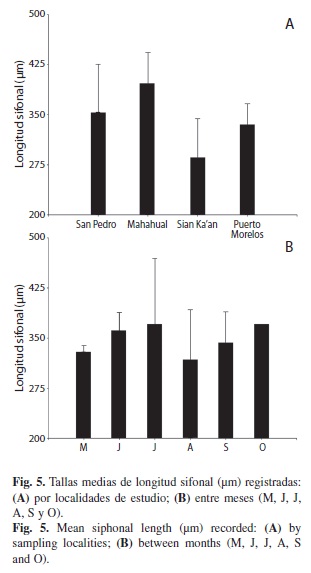
<body><![CDATA[<br> </span></font>    <br> <font size="2"><span style="font-family: verdana;"><span  style="font-weight: bold;">Abundancia temporal:</span> La <a  href="/img/revistas/rbt/v60s1/a08i3.jpg">Figura 3</a> muestra la densidad larval de <span style="font-style: italic;">S. gigas</span> para los meses analizados. En general, se observ&oacute; la presencia de larvas de mayo a octubre, con mayor abundancia de agosto a septiembre (0.82&plusmn;1.00 y&nbsp; 0.76&plusmn;1.68&nbsp; larvas&nbsp; 10m</span></font><font size="2"><span  style="font-family: verdana;"><sup>-3</sup></span></font><font size="2"><span  style="font-family: verdana;">,&nbsp; respectivamente). El ANOVA mostr&oacute; diferencias significativas (p=0.0105). La <a  href="/img/revistas/rbt/v60s1/a08i4.jpg">Figura 4</a> muestra la densidad media&nbsp; larval&nbsp; para&nbsp; las&nbsp; diferentes&nbsp; localidades en el tiempo. En Puerto Morelos se observ&oacute; larvas en tres meses, mientras que las otras localidades s&oacute;lo en dos meses. Se observaron dos per&iacute;odos de abundancia larval s&oacute;lo para Puerto Morelos. Septiembre present&oacute; la mayor incidencia de larvas (n=3 larvas), seguido de agosto (n=2 larvas).</span></font><br style="font-family: verdana;">     <div style="text-align: center;"><font size="2"><span  style="font-family: verdana;"><span style="font-weight: bold;">    <br> </span></span></font>     <div style="text-align: justify;"><font size="2"><span  style="font-family: verdana;"><span style="font-weight: bold;">Tallas de larvas de <span style="font-style: italic;">S. gigas</span>:</span> La talla media de larvas de <span style="font-style: italic;">S. gigas</span> por localidad se presenta en la <a href="/img/revistas/rbt/v60s1/a08i5.jpg">Figura 5a</a>, con tallas entre 285.00&plusmn;58.55&micro;m (Sian Ka&#8217;an) y 396.67&plusmn;46.19&micro;m (Mahahual). </span></font><br  style="font-family: verdana;"> </div> </div>     <div style="text-align: center;"><br style="font-family: verdana;"> </div> <font size="2"><span style="font-family: verdana;">El an&aacute;lisis de varianza entre tallas y localidades present&oacute; diferencias significativas (p=0.0060). La prueba de Duncan mostr&oacute; que Sian Ka&#8217;an difiere de los otros sitios al presentar larvas de menor talla (<a  href="/img/revistas/rbt/v60s1/a08t2.gif">Cuadro 2</a>). En la <a href="/img/revistas/rbt/v60s1/a08i5.jpg">Figura 5b</a> se presenta la talla media en el tiempo. No se registr&oacute; variaci&oacute;n significativa entre meses (p=0.6989). El 100.00% de las larvas observadas corresponden al estadio I (150.00-450.00&micro;m de LS).    <br> </span></font>    <br>     <font size="3"><span style="font-weight: bold; font-family: verdana;">Discusi&oacute;n</span></font><br      style="font-family: verdana;">     ]]></body>
<body><![CDATA[<br style="font-family: verdana;">     <font size="2"><span style="font-family: verdana;">Randall (1964), Weil     y Laughlin     (1984) y Stoner <span style="font-style: italic;">et al.</span>     (1996), se&ntilde;alan que el inicio de la     actividad reproductiva de <span style="font-style: italic;">S. gigas</span>     est&aacute; controlado por la     temperatura, asimismo de Jes&uacute;s Navarrete (1999) se&ntilde;ala     que este par&aacute;metro determina la puesta de masas de huevo,     el&nbsp; tiempo&nbsp; de&nbsp; maduraci&oacute;n&nbsp; de&nbsp;     ]]></body>
<body><![CDATA[los&nbsp; embriones, las tasas de crecimiento de las vel&iacute;geras y     su tiempo de residencia en la columna de agua. Stoner <span      style="font-style: italic;">et al.</span> (1992) y     Barile <span style="font-style: italic;">et al.</span> (1994)     se&ntilde;alan que la abundancia larval de <span      style="font-style: italic;">S.     gigas</span> est&aacute; asociada a la temperatura y al fotoperiodo.     Contrariamente, de Jes&uacute;s Navarrete (1999) no registr&oacute;     relaci&oacute;n entre la abundancia y la temperatura, salinidad y el     ox&iacute;geno disuelto. En el presente estudio la prueba de <span     ]]></body>
<body><![CDATA[ style="font-style: italic;">Spearman</span>     entre abundancia larval y temperatura mostr&oacute; 16% de     asociaci&oacute;n, observ&aacute;ndose mayor correlaci&oacute;n con la     salinidad (60%).</span></font><br style="font-family: verdana;">     <br style="font-family: verdana;">     <font size="2"><span style="font-family: verdana;">En cuanto a la     abundancia larval,     los mayores&nbsp; registros&nbsp; han&nbsp; sido&nbsp; para&nbsp;     el&nbsp; Arrecife&nbsp; Alacranes&nbsp; con&nbsp;     3.40&plusmn;6.73&nbsp; larvas&nbsp; 10m</span></font><font size="2"><span     ]]></body>
<body><![CDATA[ style="font-family: verdana;"><sup>-3</sup></span></font><font size="2"><span      style="font-family: verdana;"> (Aldana Aranda &amp;     P&eacute;rez P&eacute;rez 2007), seguido por Bahamas con     1.44&plusmn;1.80 larvas 10m</span></font><font size="2"><span      style="font-family: verdana;"><sup>-3</sup></span></font><font size="2"><span      style="font-family: verdana;">&nbsp; (Stoner &amp; Davis, 1997b). Los     registros m&aacute;s bajos est&aacute;n reportados para la Bah&iacute;a     de la Ascensi&oacute;n con 0.02&plusmn;0.07 larvas 10m</span></font><font      size="2"><span style="font-family: verdana;"><sup>-3</sup></span></font><font      size="2"><span style="font-family: verdana;">&nbsp; (de     ]]></body>
<body><![CDATA[Jes&uacute;s Navarrete &amp; P&eacute;rez Flores 2007). En este     estudio para el&nbsp; SAM,&nbsp; la&nbsp; abundancia&nbsp; larval&nbsp;     media&nbsp; fue&nbsp; de 0.34&plusmn;0.87 larvas 10m</span></font><font      size="2"><span style="font-family: verdana;"><sup>-3</sup></span></font><font      size="2"><span style="font-family: verdana;"> (n=64),     valor similar a lo reportado por P&eacute;rez P&eacute;rez <span      style="font-style: italic;">et al.</span>     (2003) para la Pen&iacute;nsula de Yucat&aacute;n (0.34&plusmn;0.87     larvas 10m</span></font><font size="2"><span      style="font-family: verdana;"><sup>-3</sup></span></font><font size="2"><span     ]]></body>
<body><![CDATA[ style="font-family: verdana;">). Puerto Morelos fue la localidad con     mayor     abundancia,&nbsp; presentando&nbsp; valores&nbsp; menores&nbsp; a los     reportados por Bravo Castro (2009), pero mayores a los observados por     P&eacute;rez P&eacute;rez <span style="font-style: italic;">et al.</span>     (2003) para el norte de Cozumel     (1.03&plusmn;1.16 y 0.02&plusmn;0.03 larvas 10m</span></font><font      size="2"><span style="font-family: verdana;"><sup>-3</sup></span></font><font      size="2"><span style="font-family: verdana;">, respectivamente).</span></font><br      style="font-family: verdana;">     ]]></body>
<body><![CDATA[<br style="font-family: verdana;">     <font size="2"><span style="font-family: verdana;">Respecto a la     abundancia larval     temporal reportada en la literatura, los autores registran larvas     durante todo el a&ntilde;o, con mayor incidencia de junio a agosto     (4.70&plusmn;7.03-17.80&plusmn;24.77 larvas&nbsp; 10m</span></font><font      size="2"><span style="font-family: verdana;"><sup>-3</sup></span></font><font      size="2"><span style="font-family: verdana;">)&nbsp;     (Appeldoorn&nbsp; 1993,&nbsp; Stoner&nbsp; <span      style="font-style: italic;">et al.</span>&nbsp; 1997,&nbsp;     ]]></body>
<body><![CDATA[Stoner&nbsp; &amp;&nbsp; Davis&nbsp; 1997a,&nbsp; b, Aldana Aranda     &amp; P&eacute;rez P&eacute;rez 2007, de Jes&uacute;s Navarrete &amp;     P&eacute;rez Flores 2007). Mientras febrero y diciembre presentan las     m&aacute;s bajas densidades (0.70&plusmn;0.38 y 0.81&plusmn;0.31 larvas     10m</span></font><font size="2"><span style="font-family: verdana;"><sup>-3</sup></span></font><font      size="2"><span style="font-family: verdana;">) (Aldana Aranda &amp;     P&eacute;rez P&eacute;rez 2007). En este     estudio se observaron larvas de mayo a octubre, donde la mayor densidad     (0.76&plusmn;1.68 larvas 10m</span></font><font size="2"><span      style="font-family: verdana;"><sup>-3</sup></span></font><font size="2"><span     ]]></body>
<body><![CDATA[ style="font-family: verdana;">) correspondi&oacute; a septiembre,     coincidiendo con los estudios realizados por P&eacute;rez P&eacute;rez     (2004) y Bravo Castro (2009) para esta regi&oacute;n. De acuerdo a los     estudios realizados en 2005 por Bravo Castro (2009) y los resultados     del presente trabajo, en Puerto Morelos se observa la presencia de     dos ciclos con presencia de larvas (mayo y agosto-septiembre), sin     embargo, de 2005 a 2008 se ha observado que la abundancia larval para     esta localidad ha disminuido de 1.03&plusmn;1.16 a 0.54&plusmn;1.38     larvas 10 m</span></font><font size="2"><span      style="font-family: verdana;"><sup>-3</sup></span></font><font size="2"><span     ]]></body>
<body><![CDATA[ style="font-family: verdana;">.</span></font><br      style="font-family: verdana;">     <br style="font-family: verdana;">     <font size="2"><span style="font-family: verdana;">Las tallas de larvas     registradas en     el presente estudio oscilaron entre 285.00&plusmn;58.55 y     396.67&plusmn;46.19&micro;m, donde el 100.00% de las larvas&nbsp;     correspondi&oacute;&nbsp; al&nbsp; estadio&nbsp; I,&nbsp; de&nbsp;     acuerdo a la clasificaci&oacute;n de Davis <span      style="font-style: italic;">et al.</span> (1993).     ]]></body>
<body><![CDATA[Resultado&nbsp; que&nbsp; es&nbsp; similar&nbsp; a&nbsp; los&nbsp;     registrados para Banco Chinchorro (89.10%) por de Jes&uacute;s     Navarrete&nbsp; &amp; Aldana Aranda&nbsp; (2000),&nbsp; para&nbsp; el     Arrecife Alacranes (86.42%) por Aldana Aranda &amp; P&eacute;rez     P&eacute;rez (2007) y para el norte de Quintana Roo (96.16%) por Bravo     Castro (2009). De acuerdo a la clasificaci&oacute;n de Stoner     (1997),&nbsp; las&nbsp; localidades&nbsp; del&nbsp; presente&nbsp;     trabajo son sitios fuente, con larvas provenientes de reproductores     locales.</span></font><br style="font-family: verdana;">     <br style="font-family: verdana;">     ]]></body>
<body><![CDATA[<font size="2"><span style="font-family: verdana;">La     distribuci&oacute;n de <span style="font-style: italic;">S. gigas</span>     en su fase larval est&aacute; regida por las corrientes superficiales,     de Jes&uacute;s Navarrete (1999) se&ntilde;ala que existe dependencia     del flujo larval en el Caribe, pudiendo la larva de <span      style="font-style: italic;">S. gigas</span> ser     transportada desde sitios ubicados en Belice y M&eacute;xico hasta     Florida al presentarse corrientes de 0.8 m.s</span></font><font size="2"><span      style="font-family: verdana;"><sup>-1</sup></span></font><font size="2"><span      style="font-family: verdana;">. En el Caribe se ha     ]]></body>
<body><![CDATA[registrado un patr&oacute;n de circulaci&oacute;n de sur a norte con     deriva hacia el oeste (Kinder 1983, Carrillo Gonz&aacute;lez <span      style="font-style: italic;">et al.</span>     2007),present&aacute;ndose velocidades de 0.70ms</span></font><font      size="2"><span style="font-family: verdana;"><sup>-1</sup></span></font><font      size="2"><span style="font-family: verdana;">&nbsp; a&nbsp;     2.72ms</span></font><font size="2"><span style="font-family: verdana;"><sup>-1</sup></span></font><font      size="2"><span style="font-family: verdana;">&nbsp; para&nbsp; el CM,     as&iacute; como un incremento de hasta     el doble en el Canal de Yucat&aacute;n (Merino Ibarra 1986), sin     ]]></body>
<body><![CDATA[embargo para la zona norte del CM se ha determinado mayor efecto de los     vientos en las masas de agua (Merino Ibarra 1986) provoc&aacute;ndose     un fen&oacute;meno de contracorriente, as&iacute;, para Puerto Morelos     se ha reportado la presencia de giros los cuales producen     circulaci&oacute;n interna en la laguna arrecifal, as&iacute; como     transporte hacia la costa y&nbsp; mayor tiempo de residencia del agua     (Coronado 2007).</span></font><br style="font-family: verdana;">     <br style="font-family: verdana;">     <font size="2"><span style="font-family: verdana;">Con base en los     resultados     ]]></body>
<body><![CDATA[obtenidos en este trabajo resalta la necesidad de realizar los estudios     de monitoreo larval con la medici&oacute;n de corrientes que ayudaran a     determinar el grado de dispersi&oacute;n y/o retenci&oacute;n entre     larvas y sitios. Se recomienda proteger el parque Nacional Arrecifes     de Puerto Morelos dado que en el presente estudio, as&iacute; como en     los realizados por P&eacute;rez P&eacute;rez (2004) y Bravo Castro     (2009) se ha observado que las larvas se concentran en esta     regi&oacute;n, siendo un potencial sitio de reclutamiento para <span      style="font-style: italic;">S.     gigas</span>.</span></font><br style="font-family: verdana;">     ]]></body>
<body><![CDATA[<br style="font-family: verdana;">     <font size="3"><span style="font-weight: bold; font-family: verdana;">Conclusi&oacute;n</span></font><br      style="font-family: verdana;">     <br style="font-family: verdana;">     <font size="2"><span style="font-family: verdana;">Se detect&oacute; la     presencia de     larvas de <span style="font-style: italic;">S. gigas</span> en todas     las estaciones de estudio, con mayor     incidencia en la zona norte, observando mayor&nbsp; abundancia&nbsp;     entre&nbsp; julio&nbsp; y&nbsp; septiembre, as&iacute; como dos picos     ]]></body>
<body><![CDATA[de abundancia para Puerto Morelos. La salinidad influy&oacute; en la     distribuci&oacute;n de <span style="font-style: italic;">S. gigas</span>     m&aacute;s que la temperatura. Se     observ&oacute; que el 100% de las larvas corresponde a la clase I     establecida por los autores Davis <span style="font-style: italic;">et     al.</span> (1993) y Stoner y Davis     (1997a), raz&oacute;n por la cual se clasifican los sitios como fuente     de larvas de <span style="font-style: italic;">S. gigas</span>, en     base a este resultado, se considera que el     Caribe Mexicano puede suministrar larvas a las poblaciones de <span     ]]></body>
<body><![CDATA[ style="font-style: italic;">S. gigas</span>     de la zona norte del Caribe, sin embargo, es necesario realizar nuevas     investigaciones incluyendo m&aacute;s puntos del CM para reafirmar este     resultado, as&iacute; como estudiar patrones de corrientes en el     &aacute;rea, a fin de conocer el grado de dispersi&oacute;n larval a     nivel espacio-temporal.</span></font><br style="font-family: verdana;">     <font size="2"><span style="font-weight: bold; font-family: verdana;"></span></font>    <br> <font size="3"><span style="font-weight: bold; font-family: verdana;">Agradecimientos</span></font><br  style="font-family: verdana;"> <br style="font-family: verdana;"> <font size="2"><span style="font-family: verdana;">Al Centro de Investigaci&oacute;n y de Estudios Avanzados del Instituto Polit&eacute;cnico Nacional, por el apoyo para participar en el congreso. Al Consejo Nacional de Ciencia y Tecnolog&iacute;a (Conacyt)&nbsp; por&nbsp; la&nbsp; beca&nbsp; N&deg;&nbsp; 340911/240157&nbsp; y al proyecto &#8220;Variaci&oacute;n espacio temporal del patr&oacute;n reproductivo del caracol rosado Strombus gigas en diferentes h&aacute;bitats y su modelo biof&iacute;sico de conectividad para el Caribe&#8221; (Clave:&nbsp; 50094).&nbsp; A&nbsp; Manuel&nbsp; S&aacute;nchez&nbsp; Crespo por su colaboraci&oacute;n en la colecta de muestras. A Uriel Ordo&ntilde;ez L&oacute;pez y a Montserrat Bravo Castro por la asesor&iacute;a en el an&aacute;lisis e identificaci&oacute;n de larvas. A Ximena Ren&aacute;n por sus valiosos comentarios hacia este trabajo.</span></font><br  style="font-family: verdana;"> <hr style="width: 100%; height: 2px;"><br style="font-family: verdana;"> <font size="3">    <!-- ref --><br> <span style="font-weight: bold; font-family: verdana;">Referencias</span></font><br  style="font-family: verdana;"> <br style="font-family: verdana;"> <font size="2"><span style="font-family: verdana;">Aldana Aranda, D. &amp; M. P&eacute;rez P&eacute;rez. 2007. Abundance and&nbsp; distribution&nbsp; of&nbsp; queen&nbsp; conch&nbsp; (<span style="font-style: italic;">Strombus&nbsp; gigas</span>, Linn&eacute;&nbsp; 1758)&nbsp; veligers&nbsp; of Alacranes&nbsp; Reef, Yucatan, Mexico. J. Shellfish Res. 26: 59-63.    &nbsp;&nbsp;&nbsp;&nbsp;&nbsp;&nbsp;&nbsp;&nbsp;[&#160;<a href="javascript:void(0);" onclick="javascript: window.open('/scielo.php?script=sci_nlinks&ref=1454064&pid=S0034-7744201200050000800001&lng=','','width=640,height=500,resizable=yes,scrollbars=1,menubar=yes,');">Links</a>&#160;]<!-- end-ref --><!-- ref --></span></font><br  style="font-family: verdana;"> <br style="font-family: verdana;"> <font size="2"><span style="font-family: verdana;">Aldana Aranda, D. &amp; V. Pati&ntilde;o Su&aacute;rez. 1998. Overview of diets used in larviculture of three Caribbean Conchs: Queen Conch <span  style="font-style: italic;">Strombus gigas</span>, Milk Conch Strombus costatus and Fighting Conch Strombus pugilis. Aquaculture 167: 163-178.    &nbsp;&nbsp;&nbsp;&nbsp;&nbsp;&nbsp;&nbsp;&nbsp;[&#160;<a href="javascript:void(0);" onclick="javascript: window.open('/scielo.php?script=sci_nlinks&ref=1454065&pid=S0034-7744201200050000800002&lng=','','width=640,height=500,resizable=yes,scrollbars=1,menubar=yes,');">Links</a>&#160;]<!-- end-ref --><!-- ref --></span></font><br style="font-family: verdana;"> <br style="font-family: verdana;"> <font size="2"><span style="font-family: verdana;">Appeldoorn,&nbsp; R.S.&nbsp; 1993.&nbsp; Reproduction,&nbsp; spawning&nbsp; potential radio and larval&nbsp; abundance of queen conch off La&nbsp; Parguera, Puerto Rico. Rept. Caribbean&nbsp; Fishery Management Council, Mayaguez, Puerto Rico.    &nbsp;&nbsp;&nbsp;&nbsp;&nbsp;&nbsp;&nbsp;&nbsp;[&#160;<a href="javascript:void(0);" onclick="javascript: window.open('/scielo.php?script=sci_nlinks&ref=1454066&pid=S0034-7744201200050000800003&lng=','','width=640,height=500,resizable=yes,scrollbars=1,menubar=yes,');">Links</a>&#160;]<!-- end-ref --><!-- ref --></span></font><br style="font-family: verdana;"> <br style="font-family: verdana;"> <font size="2"><span style="font-family: verdana;">Barile, P.J., A.W. Stoner &amp; C.M. Young. 1994.&nbsp; Phototaxis and vertical migration of the queen conch (<span style="font-style: italic;">Strombus gigas</span>, Linn&eacute;) veliger larvae. J. Exp. Mar. Biol. Ecol.</span></font><br style="font-family: verdana;"> <font size="2"><span style="font-family: verdana;">183: 147-162.    &nbsp;&nbsp;&nbsp;&nbsp;&nbsp;&nbsp;&nbsp;&nbsp;[&#160;<a href="javascript:void(0);" onclick="javascript: window.open('/scielo.php?script=sci_nlinks&ref=1454067&pid=S0034-7744201200050000800004&lng=','','width=640,height=500,resizable=yes,scrollbars=1,menubar=yes,');">Links</a>&#160;]<!-- end-ref --><!-- ref --></span></font><br  style="font-family: verdana;"> <br style="font-family: verdana;"> <font size="2"><span style="font-family: verdana;">Berg, C.J. &amp; D.A. Olsen. 1989. Conservation and management of queen conch (<span  style="font-style: italic;">Strombus gigas</span>) fisheries in the Caribbean. Cap. 18, pp 421-442. In J.F. Caddy (ed.). Marine Invertebrate&nbsp; Fisheries Their Assesment and Management. John Wiley and Sons, New York, New York, USA.    &nbsp;&nbsp;&nbsp;&nbsp;&nbsp;&nbsp;&nbsp;&nbsp;[&#160;<a href="javascript:void(0);" onclick="javascript: window.open('/scielo.php?script=sci_nlinks&ref=1454068&pid=S0034-7744201200050000800005&lng=','','width=640,height=500,resizable=yes,scrollbars=1,menubar=yes,');">Links</a>&#160;]<!-- end-ref --><!-- ref --></span></font><br  style="font-family: verdana;"> <br style="font-family: verdana;"> <font size="2"><span style="font-family: verdana;">Bravo Castro, M.H. 2009. Abundancia de larvas de Caracol rosa <span style="font-style: italic;">Strombus gigas</span> en Quintana Roo. M&eacute;xico. Tesis de&nbsp; Licenciatura, Instituto Tecnol&oacute;gico de&nbsp; Conkal, Conkal, Yucat&aacute;n, M&eacute;xico.    &nbsp;&nbsp;&nbsp;&nbsp;&nbsp;&nbsp;&nbsp;&nbsp;[&#160;<a href="javascript:void(0);" onclick="javascript: window.open('/scielo.php?script=sci_nlinks&ref=1454069&pid=S0034-7744201200050000800006&lng=','','width=640,height=500,resizable=yes,scrollbars=1,menubar=yes,');">Links</a>&#160;]<!-- end-ref --><!-- ref --></span></font><br style="font-family: verdana;"> <br style="font-family: verdana;"> <font size="2"><span style="font-family: verdana;">Chaplin, J. &amp; V.J. Sandt. 1992. Vertical migration and distribution of queen conch veligers, a progress report. Proc. Gulf. Carib. Fish. Inst. 42: 158-160.    &nbsp;&nbsp;&nbsp;&nbsp;&nbsp;&nbsp;&nbsp;&nbsp;[&#160;<a href="javascript:void(0);" onclick="javascript: window.open('/scielo.php?script=sci_nlinks&ref=1454070&pid=S0034-7744201200050000800007&lng=','','width=640,height=500,resizable=yes,scrollbars=1,menubar=yes,');">Links</a>&#160;]<!-- end-ref --><!-- ref --></span></font><br  style="font-family: verdana;"> <br style="font-family: verdana;"> <font size="2"><span style="font-family: verdana;">Carrillo&nbsp; Gonz&aacute;lez F., J. Ochoa, J. Candela, A.&nbsp; Badan, J. Sheinbaum &amp; J.I. Gonz&aacute;lez Navarro. Tidal currents in the Yucat&aacute;n Channel. Geof&iacute;s. Int. 46: 199-209.    &nbsp;&nbsp;&nbsp;&nbsp;&nbsp;&nbsp;&nbsp;&nbsp;[&#160;<a href="javascript:void(0);" onclick="javascript: window.open('/scielo.php?script=sci_nlinks&ref=1454071&pid=S0034-7744201200050000800008&lng=','','width=640,height=500,resizable=yes,scrollbars=1,menubar=yes,');">Links</a>&#160;]<!-- end-ref --><!-- ref --></span></font><br  style="font-family: verdana;"> <br style="font-family: verdana;"> <font size="2"><span style="font-family: verdana;">Coronado C., J. Candela, R. Iglesias Prieto, J. Sheinbaum, M. L&oacute;pez &amp; F.J.&nbsp; Ocampo-Torres. 2007. On the circulation in the Puerto Morelos fringing reef lagoon. Coral Reefs 26:149-163.    &nbsp;&nbsp;&nbsp;&nbsp;&nbsp;&nbsp;&nbsp;&nbsp;[&#160;<a href="javascript:void(0);" onclick="javascript: window.open('/scielo.php?script=sci_nlinks&ref=1454072&pid=S0034-7744201200050000800009&lng=','','width=640,height=500,resizable=yes,scrollbars=1,menubar=yes,');">Links</a>&#160;]<!-- end-ref --><!-- ref --></span></font><br  style="font-family: verdana;"> <br style="font-family: verdana;"> <font size="2"><span style="font-family: verdana;">Corral, J.L. &amp; J. Ogawa. 1987. Cultivo masivo de <span style="font-style: italic;">Strombus gigas</span> en estanques de&nbsp; concreto. Proc. Gulf. Carib. Fish. Inst. 38: 354</span></font><font size="2"><span  style="font-family: verdana;">-3</span></font><font size="2"><span  style="font-family: verdana;">51.    &nbsp;&nbsp;&nbsp;&nbsp;&nbsp;&nbsp;&nbsp;&nbsp;[&#160;<a href="javascript:void(0);" onclick="javascript: window.open('/scielo.php?script=sci_nlinks&ref=1454073&pid=S0034-7744201200050000800010&lng=','','width=640,height=500,resizable=yes,scrollbars=1,menubar=yes,');">Links</a>&#160;]<!-- end-ref --><!-- ref --></span></font><br  style="font-family: verdana;"> <br style="font-family: verdana;"> <font size="2"><span style="font-family: verdana;">Davis, M., C.A. Bolton &amp; A.W. Stoner.&nbsp; 1993. A comparison of larval development, growth, and shell morphology in three Caribbean Strombus species. Veliger 36: 236-244.    &nbsp;&nbsp;&nbsp;&nbsp;&nbsp;&nbsp;&nbsp;&nbsp;[&#160;<a href="javascript:void(0);" onclick="javascript: window.open('/scielo.php?script=sci_nlinks&ref=1454074&pid=S0034-7744201200050000800011&lng=','','width=640,height=500,resizable=yes,scrollbars=1,menubar=yes,');">Links</a>&#160;]<!-- end-ref --><!-- ref --></span></font><br style="font-family: verdana;"> <br style="font-family: verdana;"> <font size="2"><span style="font-family: verdana;">de Jes&uacute;s Navarrete, A. 1999. Distribuci&oacute;n y abundancia de larvas vel&iacute;geras de&nbsp; <span style="font-style: italic;">Strombus gigas</span> en Banco Chinchorro Quintana Roo, M&eacute;xico. Tesis de Ph.D., Centro de Investigaci&oacute;n y de Estudios Avanzados del Instituto Polit&eacute;cnico Nacional, M&eacute;rida, Yucat&aacute;n, M&eacute;xico.    &nbsp;&nbsp;&nbsp;&nbsp;&nbsp;&nbsp;&nbsp;&nbsp;[&#160;<a href="javascript:void(0);" onclick="javascript: window.open('/scielo.php?script=sci_nlinks&ref=1454075&pid=S0034-7744201200050000800012&lng=','','width=640,height=500,resizable=yes,scrollbars=1,menubar=yes,');">Links</a>&#160;]<!-- end-ref --><!-- ref --></span></font><br style="font-family: verdana;"> <br style="font-family: verdana;"> <font size="2"><span style="font-family: verdana;">de Jes&uacute;s Navarrete, A. 2001. Distribuci&oacute;n y abundancia de larvas vel&iacute;geras de&nbsp; <span style="font-style: italic;">Strombus gigas</span> en Banco Chinchorro&nbsp; Quintana&nbsp; Roo,&nbsp; M&eacute;xico.&nbsp; Proc.&nbsp; Gulf.&nbsp; Carib. Fish. Inst. 52: 174-183.    &nbsp;&nbsp;&nbsp;&nbsp;&nbsp;&nbsp;&nbsp;&nbsp;[&#160;<a href="javascript:void(0);" onclick="javascript: window.open('/scielo.php?script=sci_nlinks&ref=1454076&pid=S0034-7744201200050000800013&lng=','','width=640,height=500,resizable=yes,scrollbars=1,menubar=yes,');">Links</a>&#160;]<!-- end-ref --><!-- ref --></span></font><br style="font-family: verdana;"> <br style="font-family: verdana;"> <font size="2"><span style="font-family: verdana;">de Jes&uacute;s Navarrete, A. &amp; D. Aldana Aranda. 2000. Distribution and abundance of <span  style="font-style: italic;">Strombus gigas</span> veligers at six fishing sites on Banco Chinchorro, Quintana Roo, Mexico. J. Shellfish Res. 19: 891-895.    &nbsp;&nbsp;&nbsp;&nbsp;&nbsp;&nbsp;&nbsp;&nbsp;[&#160;<a href="javascript:void(0);" onclick="javascript: window.open('/scielo.php?script=sci_nlinks&ref=1454077&pid=S0034-7744201200050000800014&lng=','','width=640,height=500,resizable=yes,scrollbars=1,menubar=yes,');">Links</a>&#160;]<!-- end-ref --><!-- ref --></span></font><br  style="font-family: verdana;"> <br style="font-family: verdana;"> <font size="2"><span style="font-family: verdana;">de Jes&uacute;s Navarrete, A. &amp; M. P&eacute;rez Flores. 2007. Distribution and abundance of strombid larvae in the Bahia de la Ascension, Quintana Roo, Mexico. 2007. Proc. Gulf. Carib. Fish. Inst. 58: 411-416.    &nbsp;&nbsp;&nbsp;&nbsp;&nbsp;&nbsp;&nbsp;&nbsp;[&#160;<a href="javascript:void(0);" onclick="javascript: window.open('/scielo.php?script=sci_nlinks&ref=1454078&pid=S0034-7744201200050000800015&lng=','','width=640,height=500,resizable=yes,scrollbars=1,menubar=yes,');">Links</a>&#160;]<!-- end-ref --><!-- ref --></span></font><br  style="font-family: verdana;"> <br style="font-family: verdana;"> <font size="2"><span style="font-family: verdana;">Delgado, G.A., R.A. Glazer, D. Hawtof, D. Aldana Aranda, L.A. Rodr&iacute;guez-Gil &amp; A. de Jes&uacute;s Navarrete. 2008. Do queen&nbsp; conch&nbsp; (<span  style="font-style: italic;">Strombus gigas</span>) larvae recruiting to the Florida Keys originate from upstream sources? Evidence&nbsp; from&nbsp; plankton&nbsp; and&nbsp; drifter&nbsp; studies.&nbsp; In&nbsp; R. Grober-Dunsmore &amp; B.D. Keller (eds.).&nbsp; Caribbean Connectivity: Implications for Marine Protected Area Management.&nbsp; Proc.&nbsp; Spec.&nbsp; Symp.,&nbsp; 9-11&nbsp; November 2006,&nbsp; 59th&nbsp;&nbsp;&nbsp;&nbsp;&nbsp; Meet.&nbsp; Gulf.&nbsp; Carib.&nbsp; Fish.&nbsp; Inst.,&nbsp; Belize City, Belize. Marine Sanctuaries Conservation Series ONMS-08-07. U.S. Depart. Com., NOAA, Off. Nat. Mar. Sanct., Silver Spring, Maryland, USA.    &nbsp;&nbsp;&nbsp;&nbsp;&nbsp;&nbsp;&nbsp;&nbsp;[&#160;<a href="javascript:void(0);" onclick="javascript: window.open('/scielo.php?script=sci_nlinks&ref=1454079&pid=S0034-7744201200050000800016&lng=','','width=640,height=500,resizable=yes,scrollbars=1,menubar=yes,');">Links</a>&#160;]<!-- end-ref --><!-- ref --></span></font><br  style="font-family: verdana;"> <br style="font-family: verdana;"> <font size="2"><span style="font-family: verdana;">Kinder, T.H. 1983. Shallow currents in the Caribbean sea and Gulf of Mexico as observed with satellite tracked drifters. Bull. Mar. Sci. 33: 239-246.    &nbsp;&nbsp;&nbsp;&nbsp;&nbsp;&nbsp;&nbsp;&nbsp;[&#160;<a href="javascript:void(0);" onclick="javascript: window.open('/scielo.php?script=sci_nlinks&ref=1454080&pid=S0034-7744201200050000800017&lng=','','width=640,height=500,resizable=yes,scrollbars=1,menubar=yes,');">Links</a>&#160;]<!-- end-ref --><!-- ref --></span></font><br  style="font-family: verdana;"> <br style="font-family: verdana;"> <font size="2"><span style="font-family: verdana;">Merino Ibarra, M. 1986. Aspectos de la circulaci&oacute;n costera superficial del Caribe&nbsp; Mexicano con base en observaciones&nbsp; utilizando tarjetas de deriva. Anales&nbsp; Inst. Cienc. Mar Limnol., U.N.A.M. 13: 31-46.    &nbsp;&nbsp;&nbsp;&nbsp;&nbsp;&nbsp;&nbsp;&nbsp;[&#160;<a href="javascript:void(0);" onclick="javascript: window.open('/scielo.php?script=sci_nlinks&ref=1454081&pid=S0034-7744201200050000800018&lng=','','width=640,height=500,resizable=yes,scrollbars=1,menubar=yes,');">Links</a>&#160;]<!-- end-ref --><!-- ref --></span></font><br  style="font-family: verdana;"> <br style="font-family: verdana;"> <font size="2"><span style="font-family: verdana;">Oliva Rivera, J.J. &amp; A. de Jes&uacute;s Navarrete. 2000. Composici&oacute;n, distribuci&oacute;n y abundancia de larvas de moluscos gastr&oacute;podos en el sur de Quintana Roo,&nbsp; M&eacute;xico y norte de Belice. Rev. Biol Trop. 48: 77-83.    &nbsp;&nbsp;&nbsp;&nbsp;&nbsp;&nbsp;&nbsp;&nbsp;[&#160;<a href="javascript:void(0);" onclick="javascript: window.open('/scielo.php?script=sci_nlinks&ref=1454082&pid=S0034-7744201200050000800019&lng=','','width=640,height=500,resizable=yes,scrollbars=1,menubar=yes,');">Links</a>&#160;]<!-- end-ref --><!-- ref --></span></font><br style="font-family: verdana;"> <br style="font-family: verdana;"> <font size="2"><span style="font-family: verdana;">Pacheco Archundia,&nbsp; V.&nbsp; 2007. Abundancia&nbsp; de&nbsp; larvas&nbsp; de Caracol rosa <span  style="font-style: italic;">Strombus gigas</span> en el &aacute;rea de Xcaret y Xel-H&aacute;, Quintana Roo, M&eacute;xico. Tesis de Licenciatura, Tecnol&oacute;gico de Estudios Superiores de Huixquiluc&aacute;n, Huixquiluc&aacute;n, Estado de M&eacute;xico, M&eacute;xico.    &nbsp;&nbsp;&nbsp;&nbsp;&nbsp;&nbsp;&nbsp;&nbsp;[&#160;<a href="javascript:void(0);" onclick="javascript: window.open('/scielo.php?script=sci_nlinks&ref=1454083&pid=S0034-7744201200050000800020&lng=','','width=640,height=500,resizable=yes,scrollbars=1,menubar=yes,');">Links</a>&#160;]<!-- end-ref --><!-- ref --></span></font><br  style="font-family: verdana;"> <br style="font-family: verdana;"> <font size="2"><span style="font-family: verdana;">P&eacute;rez P&eacute;rez, M. 2004.Segregaci&oacute;n de la&nbsp; poblaci&oacute;n&nbsp; de <span  style="font-style: italic;">Strombus gigas</span> del Arrecife Alacranes con respecto a las&nbsp; poblaciones del Norte de Yucat&aacute;n y el&nbsp; Caribe Mexicano Tesis de Ph.D., Centro&nbsp; de Investigaci&oacute;n y&nbsp; de&nbsp; Estudios&nbsp; Avanzados del Instituto Polit&eacute;cnico Nacional, M&eacute;rida, Yucat&aacute;n, M&eacute;xico.    &nbsp;&nbsp;&nbsp;&nbsp;&nbsp;&nbsp;&nbsp;&nbsp;[&#160;<a href="javascript:void(0);" onclick="javascript: window.open('/scielo.php?script=sci_nlinks&ref=1454084&pid=S0034-7744201200050000800021&lng=','','width=640,height=500,resizable=yes,scrollbars=1,menubar=yes,');">Links</a>&#160;]<!-- end-ref --><!-- ref --></span></font><br  style="font-family: verdana;"> <br style="font-family: verdana;"> <font size="2"><span style="font-family: verdana;">P&eacute;rez&nbsp; P&eacute;rez, M., D. Aldana Aranda, &amp; V.&nbsp; Pati&ntilde;o Su&aacute;rez. 2003. Abundancia de larvas de Strombus en la costa norte de la Pen&iacute;nsula de Yucat&aacute;n, M&eacute;xico,&nbsp; p. 81-87. In&nbsp; D.&nbsp; Aldana&nbsp; Aranda&nbsp; (eds.).&nbsp; El&nbsp; caracol&nbsp; <span style="font-style: italic;">Strombus gigas</span>: conocimiento integral para su manejo sustentable en el Caribe. CYTED, M&eacute;rida, Yucat&aacute;n, M&eacute;xico.    &nbsp;&nbsp;&nbsp;&nbsp;&nbsp;&nbsp;&nbsp;&nbsp;[&#160;<a href="javascript:void(0);" onclick="javascript: window.open('/scielo.php?script=sci_nlinks&ref=1454085&pid=S0034-7744201200050000800022&lng=','','width=640,height=500,resizable=yes,scrollbars=1,menubar=yes,');">Links</a>&#160;]<!-- end-ref --><!-- ref --></span></font><br style="font-family: verdana;"> <br style="font-family: verdana;"> <font size="2"><span style="font-family: verdana;">Posada, J.M. 2003. Potencial para el transporte y retenci&oacute;n de larvas de <span  style="font-style: italic;">Strombus gigas</span> <span  style="font-style: italic;">Linnaeus</span>, 1758 (Gastropoda:&nbsp; Caenogastropoda: Strombidae) en el&nbsp; Parque Nacional Archipi&eacute;lago de los Roques, Venezuela, p. 89-97. In D. Aldana Aranda (eds.). El caracol Strombus&nbsp; gigas:&nbsp; conocimiento&nbsp; integral&nbsp; para&nbsp; su&nbsp; manejo sustentable en el Caribe. CYTED, M&eacute;rida, Yucat&aacute;n, M&eacute;xico.    &nbsp;&nbsp;&nbsp;&nbsp;&nbsp;&nbsp;&nbsp;&nbsp;[&#160;<a href="javascript:void(0);" onclick="javascript: window.open('/scielo.php?script=sci_nlinks&ref=1454086&pid=S0034-7744201200050000800023&lng=','','width=640,height=500,resizable=yes,scrollbars=1,menubar=yes,');">Links</a>&#160;]<!-- end-ref --><!-- ref --></span></font><br style="font-family: verdana;"> <br style="font-family: verdana;"> <font size="2"><span style="font-family: verdana;">Randall,&nbsp; J.E. 1964. Contributions to the&nbsp; biology of the queen conch, <span  style="font-style: italic;">Strombus&nbsp; gigas</span>. Bull. Mar. Sci. Gulf Carib. 14: 246-295.    &nbsp;&nbsp;&nbsp;&nbsp;&nbsp;&nbsp;&nbsp;&nbsp;[&#160;<a href="javascript:void(0);" onclick="javascript: window.open('/scielo.php?script=sci_nlinks&ref=1454087&pid=S0034-7744201200050000800024&lng=','','width=640,height=500,resizable=yes,scrollbars=1,menubar=yes,');">Links</a>&#160;]<!-- end-ref --><!-- ref --></span></font><br  style="font-family: verdana;"> <br style="font-family: verdana;"> <font size="2"><span style="font-family: verdana;">Sokal, R &amp; F. Rohlf. 1995. Biometry. The principles and practice of statistics in biological research. Freeman and Company, New York, USA.    &nbsp;&nbsp;&nbsp;&nbsp;&nbsp;&nbsp;&nbsp;&nbsp;[&#160;<a href="javascript:void(0);" onclick="javascript: window.open('/scielo.php?script=sci_nlinks&ref=1454088&pid=S0034-7744201200050000800025&lng=','','width=640,height=500,resizable=yes,scrollbars=1,menubar=yes,');">Links</a>&#160;]<!-- end-ref --><!-- ref --></span></font><br  style="font-family: verdana;"> <br style="font-family: verdana;"> <font size="2"><span style="font-family: verdana;">Stoner, A.W. 1997. The status of queen&nbsp; conch <span style="font-style: italic;">Strombus gigas</span> research in the Caribbean. Mar. Fish. Rev. 59: 14-22.    &nbsp;&nbsp;&nbsp;&nbsp;&nbsp;&nbsp;&nbsp;&nbsp;[&#160;<a href="javascript:void(0);" onclick="javascript: window.open('/scielo.php?script=sci_nlinks&ref=1454089&pid=S0034-7744201200050000800026&lng=','','width=640,height=500,resizable=yes,scrollbars=1,menubar=yes,');">Links</a>&#160;]<!-- end-ref --><!-- ref --></span></font><br style="font-family: verdana;"> <br style="font-family: verdana;"> <font size="2"><span style="font-family: verdana;">Stoner, A.W. &amp; M. Davis. 1997a. Abundance and distribution of queen conch veligers (Strombus gigas, Linn&eacute;) in the central Bahamas. I. Horizontal patterns in relation to reproductive and nursery grounds. J. Shellfish Res. 16: 7-18.    &nbsp;&nbsp;&nbsp;&nbsp;&nbsp;&nbsp;&nbsp;&nbsp;[&#160;<a href="javascript:void(0);" onclick="javascript: window.open('/scielo.php?script=sci_nlinks&ref=1454090&pid=S0034-7744201200050000800027&lng=','','width=640,height=500,resizable=yes,scrollbars=1,menubar=yes,');">Links</a>&#160;]<!-- end-ref --><!-- ref --></span></font><br style="font-family: verdana;"> <br style="font-family: verdana;"> <font size="2"><span style="font-family: verdana;">Stoner, A.W. &amp; M. Davis. 1997b. Abundance&nbsp; and distribution&nbsp; of&nbsp; queen&nbsp; conch&nbsp; veligers&nbsp; (<span style="font-style: italic;">Strombus&nbsp; gigas</span>, Linn&eacute;) in the central Bahamas. II. Vertical patterns in nearshore and deep-water habitats. J.&nbsp; Shellfish Res. 16: 19-29.    &nbsp;&nbsp;&nbsp;&nbsp;&nbsp;&nbsp;&nbsp;&nbsp;[&#160;<a href="javascript:void(0);" onclick="javascript: window.open('/scielo.php?script=sci_nlinks&ref=1454091&pid=S0034-7744201200050000800028&lng=','','width=640,height=500,resizable=yes,scrollbars=1,menubar=yes,');">Links</a>&#160;]<!-- end-ref --><!-- ref --></span></font><br  style="font-family: verdana;"> <br style="font-family: verdana;"> <font size="2"><span style="font-family: verdana;">Stoner, A.W., V.J. Sandt &amp; I.F. Boidron&nbsp; Metairon. 1992. Seasonality in reproductive activity and larval abundance of queen conch,&nbsp; <span  style="font-style: italic;">Strombus gigas</span>. Fish. Bull. 90: 161-170.    &nbsp;&nbsp;&nbsp;&nbsp;&nbsp;&nbsp;&nbsp;&nbsp;[&#160;<a href="javascript:void(0);" onclick="javascript: window.open('/scielo.php?script=sci_nlinks&ref=1454092&pid=S0034-7744201200050000800029&lng=','','width=640,height=500,resizable=yes,scrollbars=1,menubar=yes,');">Links</a>&#160;]<!-- end-ref --><!-- ref --></span></font><br style="font-family: verdana;"> <br style="font-family: verdana;"> <font size="2"><span style="font-family: verdana;">Stoner, A.W., R. Glazer &amp; P. Barile. 1996. Larval supply to&nbsp;&nbsp; queen&nbsp;&nbsp; conch&nbsp;&nbsp; nurseries:&nbsp;&nbsp; Relationships&nbsp;&nbsp; with recruitment process and population size&nbsp; in Florida and the Bahamas. J. Shellfish Res. 15: 404-420.    &nbsp;&nbsp;&nbsp;&nbsp;&nbsp;&nbsp;&nbsp;&nbsp;[&#160;<a href="javascript:void(0);" onclick="javascript: window.open('/scielo.php?script=sci_nlinks&ref=1454093&pid=S0034-7744201200050000800030&lng=','','width=640,height=500,resizable=yes,scrollbars=1,menubar=yes,');">Links</a>&#160;]<!-- end-ref --><!-- ref --></span></font><br  style="font-family: verdana;"> <br style="font-family: verdana;"> <font size="2"><span style="font-family: verdana;">Stoner, A.W., N. Mehta &amp; T.N. Lee. 1997. Recruitment of Strombus veligers to the Florida keys reef tract: Relation to hydrographic events. J. Shellfish Res. 16: 1-6.    &nbsp;&nbsp;&nbsp;&nbsp;&nbsp;&nbsp;&nbsp;&nbsp;[&#160;<a href="javascript:void(0);" onclick="javascript: window.open('/scielo.php?script=sci_nlinks&ref=1454094&pid=S0034-7744201200050000800031&lng=','','width=640,height=500,resizable=yes,scrollbars=1,menubar=yes,');">Links</a>&#160;]<!-- end-ref --><!-- ref --></span></font><br  style="font-family: verdana;"> <br style="font-family: verdana;"> <font size="2"><span style="font-family: verdana;">Theile S. 2005. Status of the Queen Conch <span style="font-style: italic;">Strombus gigas</span> stocks, management and&nbsp; trade in the Caribbean: A CITES Secretariat. TRAFFIC Europe, Brussels.    &nbsp;&nbsp;&nbsp;&nbsp;&nbsp;&nbsp;&nbsp;&nbsp;[&#160;<a href="javascript:void(0);" onclick="javascript: window.open('/scielo.php?script=sci_nlinks&ref=1454095&pid=S0034-7744201200050000800032&lng=','','width=640,height=500,resizable=yes,scrollbars=1,menubar=yes,');">Links</a>&#160;]<!-- end-ref --><!-- ref --></span></font><br  style="font-family: verdana;"> <br style="font-family: verdana;"> <font size="2"><span style="font-family: verdana;">Weil, E. &amp; R. Laughlin. 1984. Biology, population dynamics, and reproduction of the Queen Conch <span style="font-style: italic;">Strombus gigas</span>&nbsp; Linn&eacute;&nbsp; in&nbsp; the&nbsp; Archipielago&nbsp; de&nbsp; Los&nbsp; Roques National Park. J. Shellfish Res. 4: 45-62.    &nbsp;&nbsp;&nbsp;&nbsp;&nbsp;&nbsp;&nbsp;&nbsp;[&#160;<a href="javascript:void(0);" onclick="javascript: window.open('/scielo.php?script=sci_nlinks&ref=1454096&pid=S0034-7744201200050000800033&lng=','','width=640,height=500,resizable=yes,scrollbars=1,menubar=yes,');">Links</a>&#160;]<!-- end-ref --><br>     <br> <a name="Correspondencia1"></a><a href="#Correspondencia2">*</a>Correspondencia:    <br> </span></font><font size="2"><span style="font-family: verdana;">Jos&eacute; Francisco Ch&aacute;vez Villegas: </span></font><font size="2"><span  style="font-family: verdana;">Laboratorio de Biolog&iacute;a y Cultivo de Moluscos. Centro de Investigaci&oacute;n y de Estudios&nbsp; Avanzados del Instituto Polit&eacute;cnico Nacional, Unidad M&eacute;rida, Carretera Antigua a Progreso, Km. 6, A.P. 73 Cordemex, C.P. 97310, M&eacute;rida, Yucat&aacute;n, M&eacute;xico. Tel. +52(999)9429400&nbsp; ext. 2538; <a  href="mailto:jchavez@mda.cinvestav.mx.">jchavez@mda.cinvestav.mx.</a></span></font>    <br> <font size="2"><span style="font-family: verdana;">Martha Enr&iacute;quez D&iacute;az: </span></font><font size="2"><span  style="font-family: verdana;">Laboratorio de Biolog&iacute;a y Cultivo de Moluscos. Centro de Investigaci&oacute;n y de Estudios&nbsp; Avanzados del Instituto Polit&eacute;cnico Nacional, Unidad M&eacute;rida, Carretera Antigua a Progreso, Km. 6, A.P. 73 Cordemex, C.P. 97310, M&eacute;rida, Yucat&aacute;n, M&eacute;xico. Tel. +52(999)9429400&nbsp; ext. 2538; <a  href="maitlo:menriquez@mda.cinvestav.mx.">menriquez@mda.cinvestav.mx.</a></span></font>    <br> <font size="2"><span style="font-family: verdana;">Jorge Arturo Cid Becerra: </span></font><font size="2"><span  style="font-family: verdana;">Laboratorio de Ecolog&iacute;a Costera. Universidad de Occidente, Unidad Los Mochis, Blvd. Macario Gaxiola y Carretera</span></font><font size="2"><span  style="font-family: verdana;"> Internacional s/n, A.P. 936, C.P.81223, Los Mochis, Sinaloa, M&eacute;xico; <a  href="mailto:jcid@mochis.udo.mx">jcid@mochis.udo.mx</a></span></font>    <br> <font size="2"><span style="font-family: verdana;">Dalila Aldana Aranda: </span></font><font size="2"><span  style="font-family: verdana;">Laboratorio de Biolog&iacute;a y Cultivo de Moluscos. Centro de Investigaci&oacute;n y de Estudios&nbsp; Avanzados del Instituto Polit&eacute;cnico Nacional, Unidad M&eacute;rida, Carretera Antigua a Progreso, Km. 6, A.P. 73 Cordemex, C.P. 97310, M&eacute;rida, Yucat&aacute;n, M&eacute;xico. Tel. +52(999)9429400&nbsp; ext. 2538; <a  href="mailto:daldana@mda.cinvestav.mx.">daldana@mda.cinvestav.mx.</a>    <br>     <br> </span></font><font size="2"><span style="font-family: verdana;"><a  name="1"></a><a href="#3">1</a>.&nbsp; Laboratorio de Biolog&iacute;a y Cultivo de Moluscos. Centro de Investigaci&oacute;n y de Estudios&nbsp; Avanzados del Instituto Polit&eacute;cnico Nacional, Unidad M&eacute;rida, Carretera Antigua a Progreso, Km. 6, A.P. 73 Cordemex, C.P. 97310, M&eacute;rida, Yucat&aacute;n, M&eacute;xico. Tel. +52(999)9429400&nbsp; ext. 2538; <a  href="mailto:jchavez@mda.cinvestav.mx">jchavez@mda.cinvestav.mx</a>, <a href="mailto:menriquez@mda.cinvestav.mx">menriquez@mda.cinvestav.mx</a> &amp; <a href="mailto:daldana@mda.cinvestav.mx">daldana@mda.cinvestav.mx</a></span></font><br  style="font-family: verdana;"> <font size="2"><span style="font-family: verdana;"><a name="2"></a><a  href="#4">2</a>.&nbsp; Laboratorio de Ecolog&iacute;a Costera. Universidad de Occidente, Unidad Los Mochis, Blvd. Macario Gaxiola y Carretera</span></font><font size="2"><span  style="font-family: verdana;"> Internacional s/n, A.P. 936, C.P.81223, Los Mochis, Sinaloa, M&eacute;xico; <a  href="mailto:jcid@mochis.udo.mx">jcid@mochis.udo.mx</a>.</span></font><font  size="2"><span style="font-family: verdana;"></span></font><br  style="font-family: verdana;"> <hr style="width: 100%; height: 2px;">     <div style="text-align: center;"><font size="2"><span  style="font-weight: bold; font-family: verdana;">Recibido 14-VII-2011.&nbsp;&nbsp; &nbsp;Corregido 20-X-2011.&nbsp;&nbsp; &nbsp;Aceptado 20-XII-2011</span> </font></div> </div>     ]]></body>
<body><![CDATA[ ]]></body><back>
<ref-list>
<ref id="B1">
<nlm-citation citation-type="journal">
<person-group person-group-type="author">
<name>
<surname><![CDATA[Aldana Aranda]]></surname>
<given-names><![CDATA[D]]></given-names>
</name>
<name>
<surname><![CDATA[Pérez Pérez]]></surname>
<given-names><![CDATA[M]]></given-names>
</name>
</person-group>
<article-title xml:lang="en"><![CDATA[Abundance and distribution of queen conch (Strombus gigas, Linné 1758) veligers of Alacranes Reef, Yucatan, Mexico]]></article-title>
<source><![CDATA[J. Shellfish Res]]></source>
<year>2007</year>
<volume>26</volume>
<page-range>59-63</page-range></nlm-citation>
</ref>
<ref id="B2">
<nlm-citation citation-type="journal">
<person-group person-group-type="author">
<name>
<surname><![CDATA[Aldana Aranda]]></surname>
<given-names><![CDATA[D]]></given-names>
</name>
<name>
<surname><![CDATA[Patiño Suárez]]></surname>
<given-names><![CDATA[V]]></given-names>
</name>
</person-group>
<article-title xml:lang="en"><![CDATA[Overview of diets used in larviculture of three Caribbean Conchs: Queen Conch Strombus gigas, Milk Conch Strombus costatus and Fighting Conch Strombus pugilis]]></article-title>
<source><![CDATA[Aquaculture]]></source>
<year>1998</year>
<volume>167</volume>
<page-range>163-178</page-range></nlm-citation>
</ref>
<ref id="B3">
<nlm-citation citation-type="book">
<person-group person-group-type="author">
<name>
<surname><![CDATA[Appeldoorn]]></surname>
<given-names><![CDATA[R.S]]></given-names>
</name>
</person-group>
<source><![CDATA[Reproduction, spawning potential radio and larval abundance of queen conch off La Parguera, Puerto Rico]]></source>
<year>1993</year>
<publisher-loc><![CDATA[^eMayaguez Mayaguez]]></publisher-loc>
<publisher-name><![CDATA[Rept. Caribbean Fishery Management Council]]></publisher-name>
</nlm-citation>
</ref>
<ref id="B4">
<nlm-citation citation-type="journal">
<person-group person-group-type="author">
<name>
<surname><![CDATA[Barile]]></surname>
<given-names><![CDATA[P.J]]></given-names>
</name>
<name>
<surname><![CDATA[Stoner]]></surname>
<given-names><![CDATA[A.W]]></given-names>
</name>
<name>
<surname><![CDATA[Young]]></surname>
<given-names><![CDATA[C.M]]></given-names>
</name>
</person-group>
<article-title xml:lang="en"><![CDATA[Phototaxis and vertical migration of the queen conch (Strombus gigas, Linné) veliger larvae]]></article-title>
<source><![CDATA[J. Exp. Mar. Biol. Ecol]]></source>
<year>1994</year>
<volume>183</volume>
<page-range>147-162</page-range></nlm-citation>
</ref>
<ref id="B5">
<nlm-citation citation-type="book">
<person-group person-group-type="author">
<name>
<surname><![CDATA[Berg]]></surname>
<given-names><![CDATA[C.J]]></given-names>
</name>
<name>
<surname><![CDATA[Olsen]]></surname>
<given-names><![CDATA[D.A.]]></given-names>
</name>
<name>
<surname><![CDATA[Caddy]]></surname>
<given-names><![CDATA[J.F]]></given-names>
</name>
</person-group>
<source><![CDATA[Conservation and management of queen conch (Strombus gigas) fisheries in the Caribbean.]]></source>
<year>1989</year>
<volume>18</volume>
<page-range>421-442</page-range><publisher-loc><![CDATA[New York^eNew York New York]]></publisher-loc>
<publisher-name><![CDATA[John Wiley and Sons]]></publisher-name>
</nlm-citation>
</ref>
<ref id="B6">
<nlm-citation citation-type="">
<person-group person-group-type="author">
<name>
<surname><![CDATA[Bravo Castro]]></surname>
<given-names><![CDATA[M.H]]></given-names>
</name>
</person-group>
<source><![CDATA[Abundancia de larvas de Caracol rosa Strombus gigas en Quintana Roo. México]]></source>
<year>2009</year>
</nlm-citation>
</ref>
<ref id="B7">
<nlm-citation citation-type="journal">
<person-group person-group-type="author">
<name>
<surname><![CDATA[Chaplin]]></surname>
<given-names><![CDATA[J]]></given-names>
</name>
<name>
<surname><![CDATA[Sandt]]></surname>
<given-names><![CDATA[V.J]]></given-names>
</name>
</person-group>
<article-title xml:lang="en"><![CDATA[Vertical migration and distribution of queen conch veligers, a progress report]]></article-title>
<source><![CDATA[Proc. Gulf. Carib. Fish. Inst]]></source>
<year>1992</year>
<volume>42</volume>
<page-range>158-160</page-range></nlm-citation>
</ref>
<ref id="B8">
<nlm-citation citation-type="journal">
<person-group person-group-type="author">
<name>
<surname><![CDATA[Carrillo González]]></surname>
<given-names><![CDATA[F]]></given-names>
</name>
<name>
<surname><![CDATA[Ochoa]]></surname>
<given-names><![CDATA[J]]></given-names>
</name>
<name>
<surname><![CDATA[Candela]]></surname>
<given-names><![CDATA[J.]]></given-names>
</name>
<name>
<surname><![CDATA[Badan]]></surname>
<given-names><![CDATA[A]]></given-names>
</name>
<name>
<surname><![CDATA[Sheinbaum]]></surname>
<given-names><![CDATA[J]]></given-names>
</name>
<name>
<surname><![CDATA[González Navarro]]></surname>
<given-names><![CDATA[J.I]]></given-names>
</name>
</person-group>
<article-title xml:lang="en"><![CDATA[Tidal currents in the Yucatán Channel]]></article-title>
<source><![CDATA[Geofís. Int]]></source>
<year></year>
<volume>46</volume>
<page-range>199-209.</page-range></nlm-citation>
</ref>
<ref id="B9">
<nlm-citation citation-type="journal">
<person-group person-group-type="author">
<name>
<surname><![CDATA[Coronado]]></surname>
<given-names><![CDATA[C]]></given-names>
</name>
<name>
<surname><![CDATA[Candela]]></surname>
<given-names><![CDATA[J]]></given-names>
</name>
<name>
<surname><![CDATA[Iglesias Prieto]]></surname>
<given-names><![CDATA[R]]></given-names>
</name>
<name>
<surname><![CDATA[Sheinbaum]]></surname>
<given-names><![CDATA[J]]></given-names>
</name>
<name>
<surname><![CDATA[López]]></surname>
<given-names><![CDATA[M]]></given-names>
</name>
<name>
<surname><![CDATA[Ocampo-Torres]]></surname>
<given-names><![CDATA[F.J]]></given-names>
</name>
</person-group>
<article-title xml:lang="en"><![CDATA[On the circulation in the Puerto Morelos fringing reef lagoon]]></article-title>
<source><![CDATA[Coral Reefs]]></source>
<year>2007</year>
<volume>26</volume>
<page-range>149-163.</page-range></nlm-citation>
</ref>
<ref id="B10">
<nlm-citation citation-type="journal">
<person-group person-group-type="author">
<name>
<surname><![CDATA[Corral]]></surname>
<given-names><![CDATA[J.L]]></given-names>
</name>
<name>
<surname><![CDATA[Ogawa]]></surname>
<given-names><![CDATA[J]]></given-names>
</name>
</person-group>
<article-title xml:lang="es"><![CDATA[Cultivo masivo de Strombus gigas en estanques de concreto]]></article-title>
<source><![CDATA[Proc. Gulf. Carib. Fish. Inst]]></source>
<year>1987</year>
<volume>38</volume>
<page-range>354-351</page-range></nlm-citation>
</ref>
<ref id="B11">
<nlm-citation citation-type="journal">
<person-group person-group-type="author">
<name>
<surname><![CDATA[Davis]]></surname>
<given-names><![CDATA[M]]></given-names>
</name>
<name>
<surname><![CDATA[Bolton]]></surname>
<given-names><![CDATA[C.A]]></given-names>
</name>
<name>
<surname><![CDATA[Stoner]]></surname>
<given-names><![CDATA[A.W]]></given-names>
</name>
</person-group>
<article-title xml:lang="en"><![CDATA[A comparison of larval development, growth, and shell morphology in three Caribbean Strombus species]]></article-title>
<source><![CDATA[Veliger]]></source>
<year>1993</year>
<volume>36</volume>
<page-range>236-244</page-range></nlm-citation>
</ref>
<ref id="B12">
<nlm-citation citation-type="">
<person-group person-group-type="author">
<name>
<surname><![CDATA[de Jesús Navarrete]]></surname>
<given-names><![CDATA[A]]></given-names>
</name>
</person-group>
<source><![CDATA[Distribución y abundancia de larvas velígeras de Strombus gigas en Banco Chinchorro Quintana Roo, México]]></source>
<year>1999</year>
</nlm-citation>
</ref>
<ref id="B13">
<nlm-citation citation-type="journal">
<person-group person-group-type="author">
<name>
<surname><![CDATA[de Jesús Navarrete]]></surname>
<given-names><![CDATA[A]]></given-names>
</name>
</person-group>
<article-title xml:lang="en"><![CDATA[Distribución y abundancia de larvas velígeras de Strombus gigas en Banco Chinchorro Quintana Roo, México]]></article-title>
<source><![CDATA[Proc. Gulf. Carib. Fish. Inst]]></source>
<year>2001</year>
<volume>52</volume>
<page-range>174-183</page-range></nlm-citation>
</ref>
<ref id="B14">
<nlm-citation citation-type="journal">
<person-group person-group-type="author">
<name>
<surname><![CDATA[de Jesús Navarrete]]></surname>
<given-names><![CDATA[A]]></given-names>
</name>
<name>
<surname><![CDATA[Aldana Aranda]]></surname>
<given-names><![CDATA[D]]></given-names>
</name>
</person-group>
<article-title xml:lang="en"><![CDATA[Distribution and abundance of Strombus gigas veligers at six fishing sites on Banco Chinchorro, Quintana Roo, Mexico]]></article-title>
<source><![CDATA[J. Shellfish Res]]></source>
<year>2000</year>
<volume>19</volume>
<page-range>891-895</page-range></nlm-citation>
</ref>
<ref id="B15">
<nlm-citation citation-type="journal">
<person-group person-group-type="author">
<name>
<surname><![CDATA[de Jesús Navarrete]]></surname>
<given-names><![CDATA[A]]></given-names>
</name>
<name>
<surname><![CDATA[Pérez Flores]]></surname>
<given-names><![CDATA[M]]></given-names>
</name>
</person-group>
<article-title xml:lang="en"><![CDATA[Distribution and abundance of strombid larvae in the Bahia de la Ascension, Quintana Roo, Mexico]]></article-title>
<source><![CDATA[Proc. Gulf. Carib. Fish. Inst]]></source>
<year>2007</year>
<volume>58</volume>
<page-range>411-416</page-range></nlm-citation>
</ref>
<ref id="B16">
<nlm-citation citation-type="confpro">
<person-group person-group-type="author">
<name>
<surname><![CDATA[Delgado]]></surname>
<given-names><![CDATA[G.A]]></given-names>
</name>
<name>
<surname><![CDATA[Glazer]]></surname>
<given-names><![CDATA[R.A]]></given-names>
</name>
<name>
<surname><![CDATA[Hawtof]]></surname>
<given-names><![CDATA[D]]></given-names>
</name>
<name>
<surname><![CDATA[Aldana Aranda]]></surname>
<given-names><![CDATA[D]]></given-names>
</name>
<name>
<surname><![CDATA[Rodríguez-Gil]]></surname>
<given-names><![CDATA[L.A]]></given-names>
</name>
<name>
<surname><![CDATA[Navarrete]]></surname>
<given-names><![CDATA[A. de Jesús]]></given-names>
</name>
</person-group>
<article-title xml:lang="en"><![CDATA[Do queen conch (Strombus gigas) larvae recruiting to the Florida Keys originate from upstream sources?: Evidence from plankton and drifter studies]]></article-title>
<person-group person-group-type="editor">
<name>
<surname><![CDATA[Grober-Dunsmore]]></surname>
<given-names><![CDATA[R]]></given-names>
</name>
<name>
<surname><![CDATA[Keller]]></surname>
<given-names><![CDATA[B.D]]></given-names>
</name>
</person-group>
<source><![CDATA[Caribbean Connectivity: for Marine Protected Area Management]]></source>
<year>2008</year>
<conf-name><![CDATA[59 th Proc. Spec. Symp]]></conf-name>
<conf-date>9-11 November 2006</conf-date>
<conf-loc>Belize City </conf-loc>
<publisher-loc><![CDATA[Silver Spring^eMaryland Maryland]]></publisher-loc>
<publisher-name><![CDATA[U.S. Depart. ComNOAAOff. Nat. Mar. Sanct]]></publisher-name>
</nlm-citation>
</ref>
<ref id="B17">
<nlm-citation citation-type="journal">
<person-group person-group-type="author">
<name>
<surname><![CDATA[Kinder]]></surname>
<given-names><![CDATA[T.H]]></given-names>
</name>
</person-group>
<article-title xml:lang="en"><![CDATA[Shallow currents in the Caribbean sea and Gulf of Mexico as observed with satellite tracked drifters]]></article-title>
<source><![CDATA[Bull. Mar. Sci]]></source>
<year>1983</year>
<volume>33</volume>
<page-range>239-246</page-range></nlm-citation>
</ref>
<ref id="B18">
<nlm-citation citation-type="journal">
<person-group person-group-type="author">
<name>
<surname><![CDATA[Merino Ibarra]]></surname>
<given-names><![CDATA[M]]></given-names>
</name>
</person-group>
<article-title xml:lang="es"><![CDATA[Aspectos de la circulación costera superficial del Caribe Mexicano con base en observaciones utilizando tarjetas de deriva]]></article-title>
<source><![CDATA[Anales Inst. Cienc. Mar Limnol]]></source>
<year>1986</year>
<volume>13</volume>
<page-range>31-46</page-range><publisher-name><![CDATA[U.N.A.M]]></publisher-name>
</nlm-citation>
</ref>
<ref id="B19">
<nlm-citation citation-type="journal">
<person-group person-group-type="author">
<name>
<surname><![CDATA[Oliva Rivera]]></surname>
<given-names><![CDATA[J.J]]></given-names>
</name>
<name>
<surname><![CDATA[Navarrete]]></surname>
<given-names><![CDATA[A. de Jesús]]></given-names>
</name>
</person-group>
<article-title xml:lang="es"><![CDATA[Composición, distribución y abundancia de larvas de moluscos gastrópodos en el sur de Quintana Roo, México y norte de Belice]]></article-title>
<source><![CDATA[Rev. Biol Trop]]></source>
<year>2000</year>
<volume>48</volume>
<page-range>77-83</page-range></nlm-citation>
</ref>
<ref id="B20">
<nlm-citation citation-type="">
<person-group person-group-type="author">
<name>
<surname><![CDATA[Pacheco Archundia]]></surname>
<given-names><![CDATA[V]]></given-names>
</name>
</person-group>
<source><![CDATA[Abundancia de larvas de Caracol rosa Strombus gigas en el área de Xcaret y Xel-Há, Quintana Roo, México]]></source>
<year>2007</year>
</nlm-citation>
</ref>
<ref id="B21">
<nlm-citation citation-type="">
<person-group person-group-type="author">
<name>
<surname><![CDATA[Pérez Pérez]]></surname>
<given-names><![CDATA[M]]></given-names>
</name>
</person-group>
<source><![CDATA[Segregación de la población de Strombus gigas del Arrecife Alacranes con respecto a las poblaciones del Norte de Yucatán y el Caribe Mexicano]]></source>
<year>2004</year>
</nlm-citation>
</ref>
<ref id="B22">
<nlm-citation citation-type="book">
<person-group person-group-type="author">
<name>
<surname><![CDATA[Pérez Pérez]]></surname>
<given-names><![CDATA[M.,]]></given-names>
</name>
<name>
<surname><![CDATA[Aldana Aranda]]></surname>
<given-names><![CDATA[D]]></given-names>
</name>
<name>
<surname><![CDATA[Patiño Suárez]]></surname>
<given-names><![CDATA[V]]></given-names>
</name>
<name>
<surname><![CDATA[Aldana Aranda]]></surname>
<given-names><![CDATA[D]]></given-names>
</name>
</person-group>
<source><![CDATA[Abundancia de larvas de Strombus en la costa norte de la Península de Yucatán, México]]></source>
<year>2003</year>
<page-range>81-87</page-range><publisher-loc><![CDATA[Mérida^eYucatán Yucatán]]></publisher-loc>
<publisher-name><![CDATA[CYTED]]></publisher-name>
</nlm-citation>
</ref>
<ref id="B23">
<nlm-citation citation-type="book">
<person-group person-group-type="author">
<name>
<surname><![CDATA[Posada]]></surname>
<given-names><![CDATA[J.M]]></given-names>
</name>
<name>
<surname><![CDATA[Aldana Aranda]]></surname>
<given-names><![CDATA[D]]></given-names>
</name>
</person-group>
<source><![CDATA[Potencial para el transporte y retención de larvas de Strombus gigas Linnaeus, 1758 (Gastropoda: Caenogastropoda: Strombidae) en el Parque Nacional Archipiélago de los Roques, Venezuela]]></source>
<year>2003</year>
<page-range>89-97</page-range><publisher-loc><![CDATA[Mérida^eYucatán Yucatán]]></publisher-loc>
<publisher-name><![CDATA[CYTED]]></publisher-name>
</nlm-citation>
</ref>
<ref id="B24">
<nlm-citation citation-type="journal">
<person-group person-group-type="author">
<name>
<surname><![CDATA[Randall]]></surname>
<given-names><![CDATA[J.E]]></given-names>
</name>
</person-group>
<article-title xml:lang="en"><![CDATA[Contributions to the biology of the queen conch, Strombus gigas]]></article-title>
<source><![CDATA[Bull. Mar. Sci. Gulf Carib]]></source>
<year>1964</year>
<volume>14</volume>
<page-range>246-295</page-range></nlm-citation>
</ref>
<ref id="B25">
<nlm-citation citation-type="book">
<person-group person-group-type="author">
<name>
<surname><![CDATA[Sokal]]></surname>
<given-names><![CDATA[R]]></given-names>
</name>
<name>
<surname><![CDATA[Rohlf]]></surname>
<given-names><![CDATA[F]]></given-names>
</name>
</person-group>
<source><![CDATA[Biometry: The principles and practice of statistics in biological research]]></source>
<year>1995</year>
<publisher-loc><![CDATA[^eNew York New York]]></publisher-loc>
<publisher-name><![CDATA[Freeman and Company]]></publisher-name>
</nlm-citation>
</ref>
<ref id="B26">
<nlm-citation citation-type="journal">
<person-group person-group-type="author">
<name>
<surname><![CDATA[Stoner]]></surname>
<given-names><![CDATA[A.W]]></given-names>
</name>
</person-group>
<article-title xml:lang="en"><![CDATA[The status of queen conch Strombus gigas research in the Caribbean]]></article-title>
<source><![CDATA[Mar. Fish. Rev]]></source>
<year>1997</year>
<volume>59</volume>
<page-range>14-22</page-range></nlm-citation>
</ref>
<ref id="B27">
<nlm-citation citation-type="journal">
<person-group person-group-type="author">
<name>
<surname><![CDATA[Stoner]]></surname>
<given-names><![CDATA[A.W]]></given-names>
</name>
<name>
<surname><![CDATA[Davis]]></surname>
<given-names><![CDATA[M]]></given-names>
</name>
</person-group>
<article-title xml:lang="en"><![CDATA[Abundance and distribution of queen conch veligers (Strombus gigas, Linné) in the central Bahamas: I. Horizontal patterns in relation to reproductive and nursery grounds]]></article-title>
<source><![CDATA[J. Shellfish Res]]></source>
<year>1997</year>
<month>a</month>
<volume>16</volume>
<page-range>7-18</page-range></nlm-citation>
</ref>
<ref id="B28">
<nlm-citation citation-type="journal">
<person-group person-group-type="author">
<name>
<surname><![CDATA[Stoner]]></surname>
<given-names><![CDATA[A.W]]></given-names>
</name>
<name>
<surname><![CDATA[Davis]]></surname>
<given-names><![CDATA[M]]></given-names>
</name>
</person-group>
<article-title xml:lang="en"><![CDATA[Abundance and distribution of queen conch veligers (Strombus gigas, Linné) in the central Bahamas: II. Vertical patterns in nearshore and deep-water habitats]]></article-title>
<source><![CDATA[J. Shellfish Res]]></source>
<year>1997</year>
<month>b</month>
<volume>16</volume>
<page-range>19-29</page-range></nlm-citation>
</ref>
<ref id="B29">
<nlm-citation citation-type="journal">
<person-group person-group-type="author">
<name>
<surname><![CDATA[Stoner]]></surname>
<given-names><![CDATA[A.W]]></given-names>
</name>
<name>
<surname><![CDATA[Sandt]]></surname>
<given-names><![CDATA[V.J.]]></given-names>
</name>
<name>
<surname><![CDATA[Boidron Metairon]]></surname>
<given-names><![CDATA[I.F]]></given-names>
</name>
</person-group>
<article-title xml:lang="en"><![CDATA[Seasonality in reproductive activity and larval abundance of queen conch, Strombus gigas]]></article-title>
<source><![CDATA[Fish. Bull]]></source>
<year>1992</year>
<volume>90</volume>
<page-range>161-170</page-range></nlm-citation>
</ref>
<ref id="B30">
<nlm-citation citation-type="journal">
<person-group person-group-type="author">
<name>
<surname><![CDATA[Stoner]]></surname>
<given-names><![CDATA[A.W]]></given-names>
</name>
<name>
<surname><![CDATA[Glazer]]></surname>
<given-names><![CDATA[R]]></given-names>
</name>
<name>
<surname><![CDATA[Barile]]></surname>
<given-names><![CDATA[P]]></given-names>
</name>
</person-group>
<article-title xml:lang="en"><![CDATA[Larval supply to queen conch nurseries: Relationships with recruitment process and population size in Florida and the Bahamas]]></article-title>
<source><![CDATA[J. Shellfish Res]]></source>
<year>1996</year>
<volume>15</volume>
<page-range>404-420</page-range></nlm-citation>
</ref>
<ref id="B31">
<nlm-citation citation-type="journal">
<person-group person-group-type="author">
<name>
<surname><![CDATA[Stoner]]></surname>
<given-names><![CDATA[A.W]]></given-names>
</name>
<name>
<surname><![CDATA[Mehta]]></surname>
<given-names><![CDATA[N]]></given-names>
</name>
<name>
<surname><![CDATA[Lee]]></surname>
<given-names><![CDATA[T.N]]></given-names>
</name>
</person-group>
<article-title xml:lang="en"><![CDATA[Recruitment of Strombus veligers to the Florida keys reef tract: Relation to hydrographic events]]></article-title>
<source><![CDATA[J. Shellfish Res]]></source>
<year>1997</year>
<volume>16</volume>
<page-range>1-6</page-range></nlm-citation>
</ref>
<ref id="B32">
<nlm-citation citation-type="book">
<person-group person-group-type="author">
<name>
<surname><![CDATA[Theile]]></surname>
<given-names><![CDATA[S]]></given-names>
</name>
</person-group>
<source><![CDATA[Status of the Queen Conch Strombus gigas stocks, management and trade in the Caribbean: A CITES Secretariat]]></source>
<year>2005</year>
<publisher-loc><![CDATA[^eBrussels Brussels]]></publisher-loc>
<publisher-name><![CDATA[TRAFFIC Europe]]></publisher-name>
</nlm-citation>
</ref>
<ref id="B33">
<nlm-citation citation-type="journal">
<person-group person-group-type="author">
<name>
<surname><![CDATA[Weil]]></surname>
<given-names><![CDATA[E]]></given-names>
</name>
<name>
<surname><![CDATA[Laughlin]]></surname>
<given-names><![CDATA[R]]></given-names>
</name>
</person-group>
<article-title xml:lang="en"><![CDATA[Biology, population dynamics, and reproduction of the Queen Conch Strombus gigas Linné in the Archipielago de Los Roques National Park]]></article-title>
<source><![CDATA[J. Shellfish Res]]></source>
<year>1984</year>
<volume>4</volume>
<page-range>45-62</page-range></nlm-citation>
</ref>
</ref-list>
</back>
</article>