<?xml version="1.0" encoding="ISO-8859-1"?><article xmlns:mml="http://www.w3.org/1998/Math/MathML" xmlns:xlink="http://www.w3.org/1999/xlink" xmlns:xsi="http://www.w3.org/2001/XMLSchema-instance">
<front>
<journal-meta>
<journal-id>0034-7744</journal-id>
<journal-title><![CDATA[Revista de Biología Tropical]]></journal-title>
<abbrev-journal-title><![CDATA[Rev. biol. trop]]></abbrev-journal-title>
<issn>0034-7744</issn>
<publisher>
<publisher-name><![CDATA[Universidad de Costa Rica]]></publisher-name>
</publisher>
</journal-meta>
<article-meta>
<article-id>S0034-77442012000500004</article-id>
<title-group>
<article-title xml:lang="en"><![CDATA[Massive hard coral loss after a severe bleaching event in 2010 at Los Roques, Venezuela]]></article-title>
</title-group>
<contrib-group>
<contrib contrib-type="author">
<name>
<surname><![CDATA[Bastidas]]></surname>
<given-names><![CDATA[Carolina]]></given-names>
</name>
</contrib>
<contrib contrib-type="author">
<name>
<surname><![CDATA[Bone]]></surname>
<given-names><![CDATA[David]]></given-names>
</name>
</contrib>
<contrib contrib-type="author">
<name>
<surname><![CDATA[Croquer]]></surname>
<given-names><![CDATA[Aldo]]></given-names>
</name>
</contrib>
<contrib contrib-type="author">
<name>
<surname><![CDATA[Debrot]]></surname>
<given-names><![CDATA[Denise]]></given-names>
</name>
</contrib>
<contrib contrib-type="author">
<name>
<surname><![CDATA[Garcia]]></surname>
<given-names><![CDATA[Elia]]></given-names>
</name>
</contrib>
<contrib contrib-type="author">
<name>
<surname><![CDATA[Humanes]]></surname>
<given-names><![CDATA[Adriana]]></given-names>
</name>
</contrib>
<contrib contrib-type="author">
<name>
<surname><![CDATA[Ramos]]></surname>
<given-names><![CDATA[Ruth]]></given-names>
</name>
</contrib>
<contrib contrib-type="author">
<name>
<surname><![CDATA[Rodríguez]]></surname>
<given-names><![CDATA[Sebastian]]></given-names>
</name>
</contrib>
</contrib-group>
<aff id="A01">
<institution><![CDATA[,Universidad Simón Bolívar Dept. Biología de Organismos ]]></institution>
<addr-line><![CDATA[ Caracas]]></addr-line>
<country>Venezuela</country>
</aff>
<aff id="A02">
<institution><![CDATA[,Universidad Simón Bolívar Dept. Estudios Ambientales ]]></institution>
<addr-line><![CDATA[ Caracas]]></addr-line>
<country>Venezuela</country>
</aff>
<aff id="A03">
<institution><![CDATA[,Universidad Simón Bolívar Centro de Estudios Ecotoxicológicos en Ambientes Marinos CETOXMAR ]]></institution>
<addr-line><![CDATA[ Caracas]]></addr-line>
<country>Venezuela</country>
</aff>
<aff id="A04">
<institution><![CDATA[,Email of all authors  ]]></institution>
<addr-line><![CDATA[ ]]></addr-line>
</aff>
<aff id="A05">
<institution><![CDATA[,Corresponding author  ]]></institution>
<addr-line><![CDATA[ ]]></addr-line>
</aff>
<pub-date pub-type="pub">
<day>00</day>
<month>03</month>
<year>2012</year>
</pub-date>
<pub-date pub-type="epub">
<day>00</day>
<month>03</month>
<year>2012</year>
</pub-date>
<volume>60</volume>
<fpage>29</fpage>
<lpage>37</lpage>
<copyright-statement/>
<copyright-year/>
<self-uri xlink:href="http://www.scielo.sa.cr/scielo.php?script=sci_arttext&amp;pid=S0034-77442012000500004&amp;lng=en&amp;nrm=iso"></self-uri><self-uri xlink:href="http://www.scielo.sa.cr/scielo.php?script=sci_abstract&amp;pid=S0034-77442012000500004&amp;lng=en&amp;nrm=iso"></self-uri><self-uri xlink:href="http://www.scielo.sa.cr/scielo.php?script=sci_pdf&amp;pid=S0034-77442012000500004&amp;lng=en&amp;nrm=iso"></self-uri><abstract abstract-type="short" xml:lang="en"><p><![CDATA[Thermal anomalies have become more severe, frequent and well-documented across the Caribbean for the past 30 years. This increase in temperature has caused coral bleaching resulting in reef decline. At Los Roques National Park, Venezuela, temperature has been monitored at four reef sites. In mid-September 2010, seawater temperature reached 30.85°C at 5 m depth in Los Roques, an archipelago only slightly affected by previous bleaching events. For example, bleaching in Los Roques in 2005 was mild compared to the rest of the Caribbean and to the results in this study. In 2010, seawater temperatures remained above 29.0°C from mid-August until the first week of November, resulting in +16 Degree Heating Weeks by that time. Our annual survey of four reef sites indicated that 72% of 563 scleractinian colonies were partial or totally bleached (white) or pale (discolored) in October 2010. In February 2011, there were still 46% of coral colonies affected; but most of them were pale and only 2% were bleached. By February, coral cover had declined 4 to 30% per transect, with a mean of 14.3%. Thus, mean coral cover dropped significantly from 45 to 31% cover (a 34% reduction). In addition to bleaching, corals showed a high prevalence (up to 16%) of black band disease in October 2010 and of white plague (11%) in February 2011. As a consequence, coral mortality is expected to be larger than reported here. Reef surveys since 2002 and personal observations for more than 20 years indicated that this bleaching event and its consequences in Los Roques have no precedent. Our results suggest that reef sites with no previous record of significant deterioration are more likely to become affected by thermal anomalies. However, this archipelago is relatively unaffected by local anthropogenic disturbance and has a high coral recruitment, which may contribute to its recovery]]></p></abstract>
<abstract abstract-type="short" xml:lang="es"><p><![CDATA[Durante las últimas décadas las anomalías térmicas han sido más frecuentes y severas en el Caribe, quedando pocos arrecifes exentos de eventos masivos de blanqueamiento (EMB). En el Parque Nacional Los Roques, Venezuela, un archipiélago poco afectado previamente por EMB, la temperatura del agua a 5m de profundidad alcanzó 30,85°C en septiembre 2010, y fue >29,0°C entre mediados de agosto y la primera semana de noviembre en cuatro arrecifes. El 72% de 563 colonias de escleractinios estaban blanqueadas o pálidas para octubre de 2010, mientras que para febrero 2011, el 46% de las colonias aún estaban afectadas. Para febrero 2011, la cobertura béntica coralina promedio disminuyó de 45 a 31%. Además, los arrecifes mostraron una alta prevalencia (de hasta 16%) de enfermedad de banda negra en Octubre 2010, y de plaga blanca (11%) en Febrero 2011. Como consecuencia, es probable que la mortalidad coralina resulte mayor a la reportada acá. Sin embargo, Los Roques es poco afectado por perturbaciones antropogénicas y cuenta con un alto reclutamiento de corales, lo cual podría contribuir a su recuperación]]></p></abstract>
<kwd-group>
<kwd lng="en"><![CDATA[coral bleaching]]></kwd>
<kwd lng="en"><![CDATA[mortality]]></kwd>
<kwd lng="en"><![CDATA[loss of coral cover]]></kwd>
<kwd lng="en"><![CDATA[Caribbean]]></kwd>
<kwd lng="en"><![CDATA[coral reefs]]></kwd>
<kwd lng="es"><![CDATA[blanqueamiento coralino]]></kwd>
<kwd lng="es"><![CDATA[mortalidad]]></kwd>
<kwd lng="es"><![CDATA[pérdida de cobertura de coral]]></kwd>
<kwd lng="es"><![CDATA[Caribe]]></kwd>
<kwd lng="es"><![CDATA[arrecife coralino]]></kwd>
</kwd-group>
</article-meta>
</front><body><![CDATA[ <div> </div>     <div style="font-family: verdana; text-align: center;"><span  style="font-weight: bold;"><font size="4">Massive hard coral loss after a severe bleaching event in 2010 at Los Roques, Venezuela</font></span><font  size="2"><br style="font-weight: bold;"> <br style="font-weight: bold;"> Carolina Bastidas<sup><a href="#1">1</a><a name="6"></a>*,<a href="#3">3</a><a  name="8"></a>*,<a href="#4">4</a><a name="9"></a>*,<a href="#5">5</a><a  name="10"></a>*</sup>, David Bone<sup><a href="#1">1</a>,<a href="#3">3</a>,<a  href="#4">4</a></sup>, Aldo Croquer<sup><a href="#2">2</a><a name="7"></a>*,<a href="#3">3</a>,<a  href="#4">4</a></sup>, Denise Debrot<sup><a href="#3">3</a>,<a  href="#4">4</a></sup>, Elia Garcia<sup><a href="#1">1</a>,<a href="#3">3</a>,<a  href="#4">4</a></sup>, Adriana Humanes</font><small><sup><a href="#3">3</a>,<a href="#4">4</a></sup></small><font  size="2"> Ruth Ramos</font><small><sup><a href="#3">3</a>,<a href="#4">4</a></sup></small><font  size="2">, Sebastian Rodr&iacute;guez</font><small><sup><a href="#3">3</a>,<a  href="#4">4</a></sup></small><font size="2">    <br> </font></div>     <div style="text-align: justify;"><font size="2"><span  style="font-family: verdana;"></span></font>    <br> <font size="2"><span style="font-family: verdana;"><a  name="Correspondencia2"></a>*<a href="#Correspondencia1">Direcci&oacute;n para correspondencia</a></span></font><br style="font-family: verdana;"> <font size="2"><span style="font-family: verdana;"></span></font> </div> <hr  style="width: 100%; height: 2px; margin-left: 0px; margin-right: 0px;">     <div style="text-align: justify;"><br style="font-family: verdana;"> <font size="3"><span style="font-weight: bold; font-family: verdana;">Abstract</span></font><br  style="font-family: verdana;"> <br style="font-family: verdana;"> <font size="2"><span style="font-family: verdana;">Thermal anomalies have become more severe, frequent and well-documented across the Caribbean for the past 30 years. This increase in temperature has caused coral bleaching resulting in reef decline. At Los Roques National Park, Venezuela, temperature has been monitored at four reef sites. In mid-September 2010, seawater temperature reached 30.85&deg;C at 5 m depth in Los Roques, an archipelago only slightly affected by previous bleaching events. For example, bleaching in Los Roques in 2005 was mild compared to the rest of the Caribbean and to the results in this study. In 2010, seawater temperatures remained above 29.0&deg;C from mid-August until the first week of November, resulting in +16 Degree Heating Weeks by that time. Our annual survey of four reef sites indicated that 72% of 563 scleractinian colonies were partial or totally bleached (white) or pale (discolored) in October 2010. In February 2011, there were still 46% of coral colonies affected; but most of them were pale and only 2% were bleached. By February, coral cover had declined 4 to 30% per transect, with a mean of 14.3%. Thus, mean coral cover dropped significantly from 45 to 31% cover (a 34% reduction). In addition to bleaching, corals showed a high prevalence (up to 16%) of black band disease in October 2010 and of white plague (11%) in February 2011. As a consequence, coral mortality is expected to be larger than reported here. Reef surveys since 2002 and personal observations for more than 20 years indicated that this bleaching event and its consequences in Los Roques have no precedent. Our results suggest that reef sites with no previous record of significant deterioration are more likely to become affected by thermal anomalies. However, this archipelago is relatively unaffected by local anthropogenic disturbance and has a high coral recruitment, which may contribute to its recovery. Rev. Biol. Trop. 60 (Suppl. 1): 29-37. Epub 2012 March 01.</span></font><br  style="font-family: verdana;"> <br style="font-family: verdana;"> <font size="2"><span style="font-weight: bold; font-family: verdana;">Key words</span><span style="font-family: verdana;">: coral bleaching, mortality, loss of coral cover, Caribbean, coral reefs.</span></font><br  style="font-family: verdana;"> <br style="font-family: verdana;"> <font size="3"><span style="font-weight: bold; font-family: verdana;">Resumen</span></font><br  style="font-family: verdana;"> <br style="font-family: verdana;"> <font size="2"><span style="font-family: verdana;">Durante las &uacute;ltimas d&eacute;cadas las anomal&iacute;as t&eacute;rmicas han sido m&aacute;s frecuentes y severas en el Caribe, quedando pocos arrecifes exentos de eventos masivos de blanqueamiento (EMB). En el Parque Nacional Los Roques, Venezuela, un archipi&eacute;lago poco afectado previamente por EMB, la temperatura del agua a 5m de profundidad alcanz&oacute; 30,85&deg;C en septiembre 2010, y fue &gt;29,0&deg;C entre mediados de agosto y la primera semana de noviembre en cuatro arrecifes. El 72% de 563 colonias de escleractinios estaban blanqueadas o p&aacute;lidas para octubre de 2010, mientras que para febrero 2011, el 46% de las colonias a&uacute;n estaban afectadas. Para febrero 2011, la cobertura b&eacute;ntica coralina promedio disminuy&oacute; de 45 a 31%. Adem&aacute;s, los arrecifes mostraron una alta prevalencia (de hasta 16%) de enfermedad de banda negra en Octubre 2010, y de plaga blanca (11%) en Febrero 2011. Como consecuencia, es probable que la mortalidad coralina resulte mayor a la reportada ac&aacute;. Sin embargo, Los Roques es poco afectado por perturbaciones antropog&eacute;nicas y cuenta con un alto reclutamiento de corales, lo cual podr&iacute;a contribuir a su recuperaci&oacute;n.</span></font><br  style="font-family: verdana;"> <br style="font-family: verdana;"> <font size="2"><span style="font-weight: bold; font-family: verdana;">Palabras clave: </span><span style="font-family: verdana;">blanqueamiento coralino, mortalidad, p&eacute;rdida de cobertura de coral, Caribe, arrecife coralino.</span></font><br  style="font-family: verdana;"> </div> <hr  style="width: 100%; height: 2px; margin-left: 0px; margin-right: 0px;">     <div style="text-align: justify;"><br style="font-family: verdana;">     <font size="2"><span style="font-family: verdana;">Coral reefs are     tropical ecosystems     with high productivity and therefore they provide a myriad of     ]]></body>
<body><![CDATA[ecological goods and services to human societies, particularly in     developing countries (Moberg &amp; Folke 1999). Coral reefs world-wide     have shown signs of deterioration, mainly reported by the loss of coral     cover. Hurricanes, bleaching, coral diseases, thermal anomalies and     overfishing are among the factors that have been associated with coral     reef deterioration (e.g. Bellwood <span style="font-style: italic;">et     al.</span> 2004, Rogers 2009). In the     Caribbean this phenomenon has been particularly evident, as extensive     reductions of coral cover and the concomitant loss of architectural     complexity have occurred (Gardner <span style="font-style: italic;">et     ]]></body>
<body><![CDATA[al.</span> 2003, Weil <span style="font-style: italic;">et al.</span>     2006,     Alvarez-Filip <span style="font-style: italic;">et al.</span> 2009).</span></font><br      style="font-family: verdana;">     <br style="font-family: verdana;">     <font size="2"><span style="font-family: verdana;">Mass bleaching     events (MBE, events     that reduce the density of <span style="font-style: italic;">Symbiodinium</span>     in its hosts over a large     geographic area) have increased in frequency and intensity (e.g.     ]]></body>
<body><![CDATA[McWilliams <span style="font-style: italic;">et al.</span> 2005); and     it appears that they act synergistically     with other detrimental factors to produce negative consequences for     coral reef organisms, populations and communities (reviewed in Brown     1997). Thus, MBE have been reported across the Caribbean as a factor     that reduces coral cover (e.g. Cort&eacute;s 2003, Gardner <span      style="font-style: italic;">et al.</span>     2003). However, the effects and consequences of a particular bleaching     event may vary between localities depending on oceanographic processes     which is partly determined by reef morphology and topography;     ]]></body>
<body><![CDATA[population size structure and species composition of coral communities     (Brandt 2009). In 2005, prolonged thermal anomalies and its associated     MBE occurred on a regional scale (e.g. Donner <span      style="font-style: italic;">et al.</span> 2007, Wilkinson     &amp; Souter 2008, Brandt &amp; McManus 2009), but the largest coral     cover losses related to this MBE were detected in the eastern     Caribbean, where also epizootic events came after a prolonged bleaching     period (Miller <span style="font-style: italic;">et al.</span> 2006,     Muller <span style="font-style: italic;">et al.</span> 2008). In     contrast, this     ]]></body>
<body><![CDATA[bleaching event had mild effects in the southern Caribbean (Croquer     &amp; Weil 2009); particularly, in Venezuela (Rodr&iacute;guez <span      style="font-style: italic;">et al.</span>     2010).</span></font><br style="font-family: verdana;">     <br style="font-family: verdana;">     <font size="2"><span style="font-family: verdana;">In 2010, another     mass bleaching     event was recorded worldwide (Normile 2010), although apparently not as     severe as in 2005 for the Caribbean. However, coral reefs at Los Roques     National Park (LRNP) were severely affected in 2010. Los Roques is a     ]]></body>
<body><![CDATA[marine protected area characterized by healthy coral reef ecosystems     compared to other sites in the Caribbean (Villamizar <span      style="font-style: italic;">et al.</span> 2003,     Croquer <span style="font-style: italic;">et al.</span> 2010; but see     Croquer <span style="font-style: italic;">et al.</span> 2005). The     relatively good     conditions of coral reefs ecosystems at LRNP (e.g. Schweizer <span      style="font-style: italic;">et al.</span>     2005) might be explained by low anthropogenic impacts, absence of     runoff; and perhaps by the combination of low hurricane activity, low     ]]></body>
<body><![CDATA[frequency of bleaching events, and thermal anomalies which seldom     exceed few weeks over this geographic area. In this paper we provide     the first evidence of a mass bleaching event producing significant     impacts on coral reefs at Los Roques National Park.</span></font><br      style="font-family: verdana;">     <br style="font-family: verdana;">     <font size="3"><span style="font-weight: bold; font-family: verdana;">Materials     and     Methods</span></font><br style="font-family: verdana;">     <br style="font-family: verdana;">     ]]></body>
<body><![CDATA[<font size="2"><span style="font-family: verdana;">Study site: LRNP is     located about     150 km north of the Venezuelan coast. This marine protected area     encompasses 2211.4 km2 of tropical marine ecosystems including     mangroves, seagrass beds, soft-bottom communities, sandy and rocky     shores and coral reefs. Reef development in Los Roques is extensive     showing high diversity and live cover of scleractinian corals compared     with other reef areas in Venezuela (Ram&iacute;rez-Villarroel 2001) and     other areas of the Caribbean (Rodr&iacute;guez-Ram&iacute;rez <span      style="font-style: italic;">et al.</span>     ]]></body>
<body><![CDATA[2008). Coral reefs at LRNP also differ within the region because of the     presence of recovering populations of the threatened species <span      style="font-style: italic;">Acropora     palmata</span> (Zubillaga <span style="font-style: italic;">et al.</span>     2005) and <span style="font-style: italic;">A. cervicornis</span>.</span></font><br      style="font-family: verdana;">     <br style="font-family: verdana;">     <font size="2"><span style="font-family: verdana;">Seawater     Temperatures: seawater     temperatures were monitored with four HOBO data loggers (Pro-V2), at     ]]></body>
<body><![CDATA[the four reef sites of the archipelago every 12 minutes. The loggers     were fixed to the bottom near the coral, at an average depth of 5 m and     the data shown here were from the 3rd of March 2010 to the 3rd of     February 2011. The Degree Heating Weeks index (DHW) was calculated     according to Liu <span style="font-style: italic;">et al.</span>     (2006). The estimation of monthly mean     temperatures was done with a time series from May 2003 till July 2011     obtained from the MODIS-SCAR sensor (data obtained from     http://cariaco.ws/).</span></font><br style="font-family: verdana;">     <br style="font-family: verdana;">     ]]></body>
<body><![CDATA[<font size="2"><span style="font-family: verdana;">Surveys of coral     bleaching: In     order to assess the magnitude of the 2010 MBE and its effects on coral     reefs in LRNP, the proportion of bleached or paled colonies as well as     the live coral cover was determined along ten, 10-m long, permanent     transects located at each reef site, covering a depth interval of 5 to     15 m. This was carried out in October 2010, about one month after the     onset of bleaching, and then again five months after the initial     survey, in February 2011. During the initial survey, four reef sites     (i.e. reefs located in the slope of different cays) were sampled: two     ]]></body>
<body><![CDATA[located at the south-western edge of LRNP (Dos Mosquises and Cayo de     Agua) and two located in the north-east (Madrizqu&iacute; and     Rabusqu&iacute;). The maximum distance among reef sites was 36 km, and     their location and other characteristics have been described (Zubillaga     <span style="font-style: italic;">et al.</span> 2008, Croquer <span      style="font-style: italic;">et al.</span> 2010). Coral cover was     estimated from chain     transects (CARICOMP 2001), and the condition of coral colonies     intercepted were also recorded (coloration, diseased, surface of     partial mortality). In February of 2011, two sites were resurveyed     ]]></body>
<body><![CDATA[(Cayo de Agua and Dos Mosquises Sur) to ascertain the effect of the     bleaching event, six months after its onset. Therefore, comparisons     between October 2010 and February 2011 were made only for these two     sites, whereas results that pertain only to October 2010 were obtained     from the observations at the four sites.</span></font><br      style="font-family: verdana;">     <br style="font-family: verdana;">     <font size="2"><span style="font-family: verdana;">Statistical     analysis: Null     hypothesis of no temporal changes in live coral cover was compared with     ]]></body>
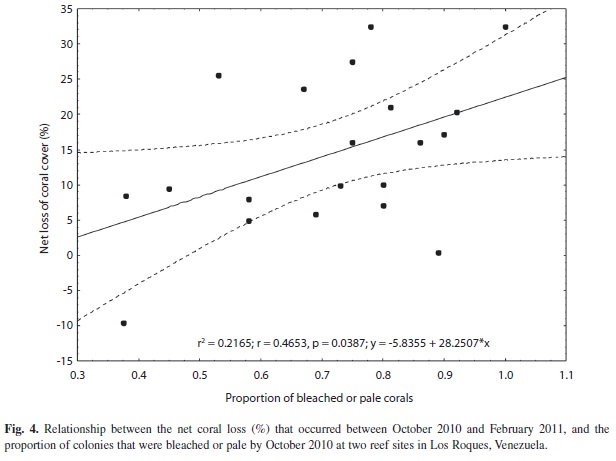
<body><![CDATA[a repeated measures analysis of variances after checking ANOVA     assumptions (i.e., normality and homogeneity of variances). Also a     regression analysis was done to test whether the loss of live coral     cover in each transect by February 2011 was linearly correlated with     the proportion of colonies bleached in October 2010.</span></font><br      style="font-family: verdana;">     <br style="font-family: verdana;">     <font size="3"><span style="font-weight: bold; font-family: verdana;">Results</span></font><br      style="font-family: verdana;">     <br style="font-family: verdana;">     ]]></body>
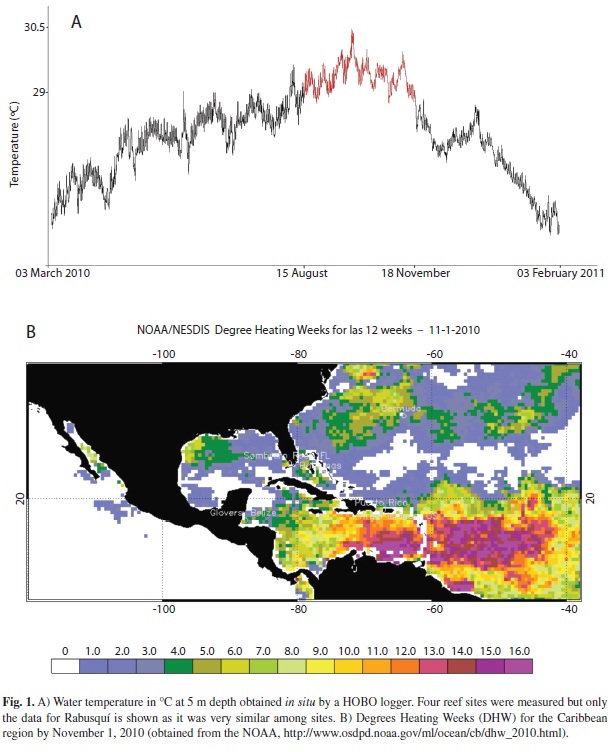
<body><![CDATA[<font size="2"><span style="font-family: verdana;">Seawater Temperature     and Degree     Heating Weeks: During 2010, the maximum temperature of 30.85 &deg;C at     5 m depth was reached between the 17 and 19 of September at all four     reef sites. At that depth, the seawater temperatures remained above     29.0 &deg;C from mid-August until the first week of November 2010 (<a      href="/img/revistas/rbt/v60s1/a04i1.jpg">Fig.     1A</a>).&nbsp; By that time, Degree Heating Weeks (DWH) reached a     maximum     value of 16 &deg;Cweeks in the superficial waters of the archipelago     ]]></body>
<body><![CDATA[(<a href="/img/revistas/rbt/v60s1/a04i1.jpg">Fig. 1B</a>, from NOAA)     and 13 &deg;C-weeks in waters at 5 m (data from in     situ loggers).</span></font><br style="font-family: verdana;">     <br style="font-family: verdana;">     <font size="2"><span style="font-family: verdana;">Percentage of     bleached and diseased     coral colonies: In October 2010, 72% of the 563 scleractinian colonies     were bleached or pale. In February 2011, there were still 46% of coral     colonies affected; but the recovery of zooxanthellae density was in     place, as most of them were pale, and only 2% were bleached (<a     ]]></body>
<body><![CDATA[ href="/img/revistas/rbt/v60s1/a04i2.jpg">Fig. 2</a>).    <br>     <br style="font-family: verdana;">     </span></font>     <font size="2"><span style="font-family: verdana;">The high prevalence     of Black Band     Disease (BBD) had no precedent since the beginning of our surveys in     2002. In fact, BBD has been only detected once before, in 2007, when it     reached 1% in Dos Mosquises (DMS). In contrast, the prevalence of BBD     was 6% in DMS and 16% in Cayo de Agua (AGU) in October 2010. By     ]]></body>
<body><![CDATA[February 2011, we did not observe any sign of BBD in these localities.     In 2010, the prevalence of White Plague (WP, with no differentiation     made between type I and II) was also high compared to previous years.     Contrasting with the drop in prevalence of BBD, the prevalence of WP     was higher in February 2011 (10 -11%) than in October 2010 (4 - 8%).</span></font><br      style="font-family: verdana;">     <br style="font-family: verdana;">     <font size="2"><span style="font-family: verdana;">Analysis of the     cover change: By     October 2010, mean coral cover was 42.5% &plusmn; 3.97 (&plusmn;     ]]></body>
<body><![CDATA[standard error) in AGU and 47.4% &plusmn; 3.41 in DMS. By February     2011, it was 32.2% &plusmn; 4.60 and 29.1 &plusmn; 3.44, respectively.     Thus, the coral cover dropped similarly between sites (repeated     measures ANOVA Time*Reef p&gt; 0.05; <a      href="/img/revistas/rbt/v60s1/a04i3.jpg">Fig. 3</a>) and significantly     from a     mean of 44.9 to 30.6% (Time p&lt; 0.05), with a concomitant loss of 17%     in the number of colonies.</span></font><br      style="font-family: verdana;">     <br style="font-family: verdana;">     ]]></body>
<body><![CDATA[<font size="2"><span style="font-family: verdana;">Although there could     be other     causes for the rapid loss of coral cover (including the onset of     diseases), a great proportion is certainly attributable to the     bleaching event of 2010. This assumption is based on the relatively     short time period elapsed between the high seawater temperature anomaly     and both surveys. Also, the proportion of bleached or pale colonies     explained about 22% of the variability obtained in the net loss of     coral cover in each transect (r2= 0.2165 for the regression shown in     <a href="/img/revistas/rbt/v60s1/a04i4.jpg">Fig. 4</a>).</span></font><br     ]]></body>
<body><![CDATA[ style="font-family: verdana;">     <br style="font-family: verdana;">     <font size="3"><span style="font-weight: bold; font-family: verdana;">Discussion</span></font><br      style="font-family: verdana;">     <br style="font-family: verdana;">     <font size="2"><span style="font-family: verdana;">Considering the     combined global     land and ocean surface temperature, the year 2010 tied with 2005 as the     warmest on record (NOAA 2010). Also, both are known as years were mass     bleaching events (MBE) have occurred across the Caribbean. However, the     ]]></body>
<body><![CDATA[intensity of the bleaching event and its consequences in Los Roques,     Venezuela, were markedly different between these years. The bleaching     event observed in October 2010 in Los Roques, and the consequences     recorded up to February 2011, had no precedent since we started our     surveys in 2002 and have no match with our observations for more than     20 years in Venezuelan reefs. Thus, these coral reefs fall within the     expectations of a higher incidence and/or frequency of massive event of     bleaching as temperatures rise above coral bleaching thresholds     (Hoegh-Guldberg 1999).</span></font><br style="font-family: verdana;">     <br style="font-family: verdana;">     ]]></body>
<body><![CDATA[<font size="2"><span style="font-family: verdana;">Previous bleaching     events observed     in Venezuelan coral reefs have been mild compared with those that     occurred during the same periods in other Caribbean localities (e.g.     Lang <span style="font-style: italic;">et al.</span> 1992, Eakin <span      style="font-style: italic;">et al.</span> 2010). In Los Roques, in     particular,     less than 4% of coral colonies were bleached in August and September     2005 (Rodr&iacute;guez <span style="font-style: italic;">et al.</span>     2010), and &lt;10% across the archipelago     ]]></body>
<body><![CDATA[at the peak of the event in November 2005 (Villamizar <span      style="font-style: italic;">et al.</span> 2008). In     contrast, the 2005 MBE was severe across the Caribbean, particularly in     the eastern reefs, where percentage of bleached corals reached up to     80% (Ballantine <span style="font-style: italic;">et al.</span> 2008,     Oxenford <span style="font-style: italic;">et al.</span> 2008, Brandt     &amp; McManus     2009, Croquer &amp; Weil 2009, Miller <span style="font-style: italic;">et     al.</span> 2009, Eakin <span style="font-style: italic;">et al.</span>     2010).     ]]></body>
<body><![CDATA[A series of climatic and oceanic factors contribute to the variability     in the thermal stress across the region (e.g. hurricanes, irradiance,     water flow), which in turn results in spatial and temporal variations     of the bleaching intensity (e.g. Jokiel &amp; Brown 2004).</span></font><br      style="font-family: verdana;">     <br style="font-family: verdana;">     <font size="2"><span style="font-family: verdana;">The distribution of     heat in the     superficial water masses along the Venezuelan coast was completely     different between 2005 and 2010 (Fig. 1A in Eakin <span     ]]></body>
<body><![CDATA[ style="font-style: italic;">et al.</span> 2010 versus     Fig. 1B in this study) and this can be considered a factor contributing     to the differences in bleaching intensity observed between 2005 and     2010. It is well known that bleaching severity is determined by a     combination of intensity and duration of thermal stress and irradiance     conditions (Glynn &amp; D&#8217;Croz 1990, Lesser &amp; Farrell 2004). In     situ measurements indicated that maximum temperatures in the     archipelago (excluding the internal lagoon) were about 1&deg;C higher     in 2010 than in 2005 for the same period (29.92 &deg;C in 2005 vs.     30.85 &deg;C in 2010). Concomitantly, Degree Heating Weeks (DHW)     ]]></body>
<body><![CDATA[calculated from in situ loggers did not exceed the value of 5     &deg;C-weeks in 2005 (Villamizar <span style="font-style: italic;">et     al.</span> 2008) for the reefs surveyed in     this study, whereas it reached 13 &deg;C-weeks in 2010. It has been     generalized that values of over 4&deg;C-weeks cause significant     bleaching, and values over 8&deg;C-weeks cause widespread bleaching and     some mortality (Liu <span style="font-style: italic;">et al.</span>     2006), which was also the case in this study.</span></font><br      style="font-family: verdana;">     <br style="font-family: verdana;">     ]]></body>
<body><![CDATA[<font size="2"><span style="font-family: verdana;">Another example of     the variability     in bleaching intensity is illustrated by the differences found between     the 2005 and 2010 MBE in Venezuela. In 2005, bleaching intensity was     higher in coastal rather than oceanic reefs (16% vs. &lt;4 of bleached     corals, Rodr&iacute;guez <span style="font-style: italic;">et al.</span>     2010). The opposite trend was found in     2010, when intensity seemed higher for the oceanic reefs of Los Roques     compared to coastal reefs of Morrocoy (personal observations). These     results contrasted with other studies that have consistently found more     ]]></body>
<body><![CDATA[severe MBE in inshore waters compared to outer reefs (e.g. Berkelmans     <span style="font-style: italic;">et al.</span> 2004).</span></font><br      style="font-family: verdana;">     <br style="font-family: verdana;">     <font size="2"><span style="font-family: verdana;">Coral cover was     severely reduced     (by 36%) at our study sites in Los Roques after the 2010 bleaching     event, which was similar to the 40% mortality observed in 2005 across     the Caribbean (Eakin <span style="font-style: italic;">et al.</span>     2010). However, we suspect that the longterm consequences could be     ]]></body>
<body><![CDATA[worse in Los Roques, because during our last     survey (February 2011): a) the bleaching was still ongoing as 46% of     colonies remained pale, despite a drop in seawater temperature; and b)     there was a high prevalence of white plague (~10%) by that time.     Previous studies indicate that after a MBE, the mortality of corals can     span for about two years (e.g. Eakin <span style="font-style: italic;">et     al.</span> 2010), as well as its     detrimental consequences on coral reproduction (e.g. Szmant &amp;     Gassman 1990). Also, the onset of diseases associated to the MBE,     particularly black band disease, white plague and yellow band disease,     ]]></body>
<body><![CDATA[can contribute further to the loss of coral cover (e.g. Brandt &amp;     McManus 2009, Miller <span style="font-style: italic;">et al.</span>     2009, Weil <span style="font-style: italic;">et al.</span> 2009).</span></font><br      style="font-family: verdana;">     <br style="font-family: verdana;">     <font size="2"><span style="font-family: verdana;">The loss of coral     cover induced by     the 2010 MBE in Los Roques has no precedent at least in 20 years.     Although we expect that MBEinduced coral mortality to continue for     several months after our last survey, a rapid recovery in Los Roques     ]]></body>
<body><![CDATA[could be possible because a relatively high coral cover (~30%) is still     present in many reefs of the archipelago, there is relative low     anthropogenic impact (e.g. a permanent population of ~ 2,000     inhabitants), and high coral recruitment rates have been found (Humanes     2009). Venezuelan coastal reefs, that lack these conditions, have shown     very slow</span></font><font size="2"><span      style="font-family: verdana;"> recovery after     massive mortality     events (Bastidas <span style="font-style: italic;">et al.</span>     2006). Unfortunately, the positiveexpectations     ]]></body>
<body><![CDATA[for the recovery of reefs in Los Roques depend on other large scale     factors that are difficult to foresee, such as the distribution of     thermal anomalies across the Caribbean.</span></font><br      style="font-family: verdana;">     <br style="font-family: verdana;">     <font size="3"><span style="font-weight: bold; font-family: verdana;">Acknowledgments</span></font><br      style="font-family: verdana;">     <br style="font-family: verdana;">     <font size="2"><span style="font-family: verdana;">We would like to     thank Mitsui Ltd     ]]></body>
<body><![CDATA[for funding a project that includes the environmental monitoring of Los     Roques in 2009 and 2010; the Instituto Nacional de Parques (INPARQUES)     for issuing the permits to work in the park; and the useful comments of     two anonymous reviewers that greatly helped to improve the manuscript.</span></font><br      style="font-family: verdana;">     </div>     <hr      style="width: 100%; height: 2px; margin-left: 0px; margin-right: 0px;">     <!-- ref --><div style="text-align: justify;"><br style="font-family: verdana;"> <font size="3"><span style="font-weight: bold; font-family: verdana;">References</span></font><br  style="font-family: verdana;"> <br style="font-family: verdana;"> <font size="2"><span style="font-family: verdana;">Alvarez-Filip, L., N.K. Dulvy, J.A. Gill1, I.M. C&ocirc;t&eacute; &amp; A.R. Watkinson. 2009. Flattening of Caribbean coral reefs: region-wide declines in architectural complexity. Proc. Roy. Soc. B 276: 3019-3025.    &nbsp;&nbsp;&nbsp;&nbsp;&nbsp;&nbsp;&nbsp;&nbsp;[&#160;<a href="javascript:void(0);" onclick="javascript: window.open('/scielo.php?script=sci_nlinks&ref=1450622&pid=S0034-7744201200050000400001&lng=','','width=640,height=500,resizable=yes,scrollbars=1,menubar=yes,');">Links</a>&#160;]<!-- end-ref --><!-- ref --></span></font><br  style="font-family: verdana;"> <br style="font-family: verdana;"> <font size="2"><span style="font-family: verdana;">Bastidas, C., A. Croquer &amp; D. Bone. 2006. Shifts of dominance species after a mass mortality on a Caribbean Reef. Proc. 10th Int. Coral Reef Symp., Okinawa: 989-993.    &nbsp;&nbsp;&nbsp;&nbsp;&nbsp;&nbsp;&nbsp;&nbsp;[&#160;<a href="javascript:void(0);" onclick="javascript: window.open('/scielo.php?script=sci_nlinks&ref=1450623&pid=S0034-7744201200050000400002&lng=','','width=640,height=500,resizable=yes,scrollbars=1,menubar=yes,');">Links</a>&#160;]<!-- end-ref --><!-- ref --></span></font><br  style="font-family: verdana;"> <br style="font-family: verdana;"> <font size="2"><span style="font-family: verdana;">Ballantine, D.L., R.S. Appeldoorn, P. Yoshioka, E. Weil, R. Armstrong, J.R. Garcia, E. Otero, F. Pagan, C. Sherman, E. Hernandez-Delgado, A. Bruckner &amp; C. Lilyestrom. 2008. Chapter 9. Biology and ecology of Puerto Rican coral reefs, pp 375-406. In: B. Riegl &amp; R.E. Dodge (eds.). Coral Reefs of the USA. Springer, Dortrecht.    &nbsp;&nbsp;&nbsp;&nbsp;&nbsp;&nbsp;&nbsp;&nbsp;[&#160;<a href="javascript:void(0);" onclick="javascript: window.open('/scielo.php?script=sci_nlinks&ref=1450624&pid=S0034-7744201200050000400003&lng=','','width=640,height=500,resizable=yes,scrollbars=1,menubar=yes,');">Links</a>&#160;]<!-- end-ref --><!-- ref --></span></font><br style="font-family: verdana;"> <br style="font-family: verdana;"> <font size="2"><span style="font-family: verdana;">Bellwood, D.R., T.P. Hughes, C. Folke &amp; M. Nystrom. 2004. Confronting the coral reef crisis. Nature 429: 827-833.    &nbsp;&nbsp;&nbsp;&nbsp;&nbsp;&nbsp;&nbsp;&nbsp;[&#160;<a href="javascript:void(0);" onclick="javascript: window.open('/scielo.php?script=sci_nlinks&ref=1450625&pid=S0034-7744201200050000400004&lng=','','width=640,height=500,resizable=yes,scrollbars=1,menubar=yes,');">Links</a>&#160;]<!-- end-ref --><!-- ref --></span></font><br style="font-family: verdana;"> <br style="font-family: verdana;"> <font size="2"><span style="font-family: verdana;">Berkelmans, R., G. De&#8217;ath, S. Kininmonth &amp; W.J. Skirving. 2004. A comparison of the 1998 and 2002 coral bleaching events on the Great Barrier Reef: spatial correlation, patterns and predictions. Coral Reefs 23: 74-83.    &nbsp;&nbsp;&nbsp;&nbsp;&nbsp;&nbsp;&nbsp;&nbsp;[&#160;<a href="javascript:void(0);" onclick="javascript: window.open('/scielo.php?script=sci_nlinks&ref=1450626&pid=S0034-7744201200050000400005&lng=','','width=640,height=500,resizable=yes,scrollbars=1,menubar=yes,');">Links</a>&#160;]<!-- end-ref --><!-- ref --></span></font><br  style="font-family: verdana;"> <br style="font-family: verdana;"> <font size="2"><span style="font-family: verdana;">Brandt, M.E. 2009. The effect of species and colony size on the bleaching response of reef-building corals in the Florida Keys during the 2005 mass bleaching event. Coral Reefs 28: 911-924.    &nbsp;&nbsp;&nbsp;&nbsp;&nbsp;&nbsp;&nbsp;&nbsp;[&#160;<a href="javascript:void(0);" onclick="javascript: window.open('/scielo.php?script=sci_nlinks&ref=1450627&pid=S0034-7744201200050000400006&lng=','','width=640,height=500,resizable=yes,scrollbars=1,menubar=yes,');">Links</a>&#160;]<!-- end-ref --><!-- ref --></span></font><br style="font-family: verdana;"> <br style="font-family: verdana;"> <font size="2"><span style="font-family: verdana;">Brandt, M.E. &amp; J.W. McManus. 2009. Disease incidence is related to bleaching extent in reef-building corals. Ecology 90: 2859-2867.    &nbsp;&nbsp;&nbsp;&nbsp;&nbsp;&nbsp;&nbsp;&nbsp;[&#160;<a href="javascript:void(0);" onclick="javascript: window.open('/scielo.php?script=sci_nlinks&ref=1450628&pid=S0034-7744201200050000400007&lng=','','width=640,height=500,resizable=yes,scrollbars=1,menubar=yes,');">Links</a>&#160;]<!-- end-ref --><!-- ref --></span></font><br  style="font-family: verdana;"> <br style="font-family: verdana;"> <font size="2"><span style="font-family: verdana;">Brown, B.E. 1997. Coral bleaching: causes and consequences. Coral Reefs 16 (Suppl): S129&#8211;S138.    &nbsp;&nbsp;&nbsp;&nbsp;&nbsp;&nbsp;&nbsp;&nbsp;[&#160;<a href="javascript:void(0);" onclick="javascript: window.open('/scielo.php?script=sci_nlinks&ref=1450629&pid=S0034-7744201200050000400008&lng=','','width=640,height=500,resizable=yes,scrollbars=1,menubar=yes,');">Links</a>&#160;]<!-- end-ref --><!-- ref --></span></font><br  style="font-family: verdana;"> <br style="font-family: verdana;"> <font size="2"><span style="font-family: verdana;">CARICOMP. 2001. Methods Manual Level 1 and 2: Manual of Methods for Mapping and Monitoring of Physical and Biological Parameters in the Coastal Zone of the Caribbean. Kingston.    &nbsp;&nbsp;&nbsp;&nbsp;&nbsp;&nbsp;&nbsp;&nbsp;[&#160;<a href="javascript:void(0);" onclick="javascript: window.open('/scielo.php?script=sci_nlinks&ref=1450630&pid=S0034-7744201200050000400009&lng=','','width=640,height=500,resizable=yes,scrollbars=1,menubar=yes,');">Links</a>&#160;]<!-- end-ref --><!-- ref --></span></font><br style="font-family: verdana;"> <br style="font-family: verdana;"> <font size="2"><span style="font-family: verdana;">Cort&eacute;s, J. 2003. Latin American Coral Reefs. Elsevier, Amsterdam, The Netherlands.    &nbsp;&nbsp;&nbsp;&nbsp;&nbsp;&nbsp;&nbsp;&nbsp;[&#160;<a href="javascript:void(0);" onclick="javascript: window.open('/scielo.php?script=sci_nlinks&ref=1450631&pid=S0034-7744201200050000400010&lng=','','width=640,height=500,resizable=yes,scrollbars=1,menubar=yes,');">Links</a>&#160;]<!-- end-ref --></span></font><font  size="2"><span style="font-family: verdana;">    <br>     ]]></body>
<body><![CDATA[<!-- ref --><br> Croquer, A., E. Weil &amp; A.L. Zubillaga. 2005. Effects of white plague disease-II outbreak on the coral community structure of Madrizqu&iacute; Key, Los Roques National Park, Venezuela. Carib. J. Sci. 41: 815-823.    &nbsp;&nbsp;&nbsp;&nbsp;&nbsp;&nbsp;&nbsp;&nbsp;[&#160;<a href="javascript:void(0);" onclick="javascript: window.open('/scielo.php?script=sci_nlinks&ref=1450634&pid=S0034-7744201200050000400011&lng=','','width=640,height=500,resizable=yes,scrollbars=1,menubar=yes,');">Links</a>&#160;]<!-- end-ref --><!-- ref --></span></font><br  style="font-family: verdana;"> <br style="font-family: verdana;"> <font size="2"><span style="font-family: verdana;">Croquer, A., D. Debrot, E. Klein, M. Kurten, S. Rodr&iacute;guez &amp; C. Bastidas. 2010. What two years of monitoring tell us about Venezuelan coral reefs? The southern Tropical America node of the Global coral reef monitoring network (STA-GCRMN). Rev Biol. Trop. 58 (Suppl. 1): 51-65.    &nbsp;&nbsp;&nbsp;&nbsp;&nbsp;&nbsp;&nbsp;&nbsp;[&#160;<a href="javascript:void(0);" onclick="javascript: window.open('/scielo.php?script=sci_nlinks&ref=1450635&pid=S0034-7744201200050000400012&lng=','','width=640,height=500,resizable=yes,scrollbars=1,menubar=yes,');">Links</a>&#160;]<!-- end-ref --><!-- ref --></span></font><br  style="font-family: verdana;"> <br style="font-family: verdana;"> <font size="2"><span style="font-family: verdana;">Croquer, A. &amp; E. Weil. 2009. Changes in disease prevalence after the 2005 bleaching event. Dis. Aquat. Org. 87: 33-43.    &nbsp;&nbsp;&nbsp;&nbsp;&nbsp;&nbsp;&nbsp;&nbsp;[&#160;<a href="javascript:void(0);" onclick="javascript: window.open('/scielo.php?script=sci_nlinks&ref=1450636&pid=S0034-7744201200050000400013&lng=','','width=640,height=500,resizable=yes,scrollbars=1,menubar=yes,');">Links</a>&#160;]<!-- end-ref --><!-- ref --></span></font><br style="font-family: verdana;"> <br style="font-family: verdana;"> <font size="2"><span style="font-family: verdana;">Donner S.D., T.R. Knutson &amp; M. Oppenheimer. 2007. Model-based assessment of the role of human-induced climate change in the 2005 Caribbean coral bleaching event. Proc Natl. Acad. Sci. USA 104: 5483-5488.    &nbsp;&nbsp;&nbsp;&nbsp;&nbsp;&nbsp;&nbsp;&nbsp;[&#160;<a href="javascript:void(0);" onclick="javascript: window.open('/scielo.php?script=sci_nlinks&ref=1450637&pid=S0034-7744201200050000400014&lng=','','width=640,height=500,resizable=yes,scrollbars=1,menubar=yes,');">Links</a>&#160;]<!-- end-ref --><!-- ref --></span></font><br  style="font-family: verdana;"> <br style="font-family: verdana;"> <font size="2"><span style="font-family: verdana;">Eakin, M., J.A. Morgan, S.F. Heron, T.B. Smith, G. Liu, L. Alvarez-Filip, B. Baca, E. Bartels, C. Bastidas, <span style="font-style: italic;">et al.</span> 2010. Caribbean corals in crisis: record thermal stress, bleaching, and mortality in 2005. PLoS ONE 5(11): e13696.    &nbsp;&nbsp;&nbsp;&nbsp;&nbsp;&nbsp;&nbsp;&nbsp;[&#160;<a href="javascript:void(0);" onclick="javascript: window.open('/scielo.php?script=sci_nlinks&ref=1450638&pid=S0034-7744201200050000400015&lng=','','width=640,height=500,resizable=yes,scrollbars=1,menubar=yes,');">Links</a>&#160;]<!-- end-ref --><!-- ref --></span></font><br  style="font-family: verdana;"> <br style="font-family: verdana;"> <font size="2"><span style="font-family: verdana;">Gardner, T., I.M. C&ocirc;t&eacute;, J.A. Gill, A. Grant &amp; A.R. Watkinson. 2003. Long-term region-wide declines in Caribbean corals. Science 301: 958-960.    &nbsp;&nbsp;&nbsp;&nbsp;&nbsp;&nbsp;&nbsp;&nbsp;[&#160;<a href="javascript:void(0);" onclick="javascript: window.open('/scielo.php?script=sci_nlinks&ref=1450639&pid=S0034-7744201200050000400016&lng=','','width=640,height=500,resizable=yes,scrollbars=1,menubar=yes,');">Links</a>&#160;]<!-- end-ref --><!-- ref --></span></font><br style="font-family: verdana;"> <br style="font-family: verdana;"> <font size="2"><span style="font-family: verdana;">Glynn P.W. &amp; L. D&#8217;Croz. 1990. Experimental evidence for high temperature stress as the cause of El Ni&ntilde;o mortality. Coral Reefs 8: 181-191.    &nbsp;&nbsp;&nbsp;&nbsp;&nbsp;&nbsp;&nbsp;&nbsp;[&#160;<a href="javascript:void(0);" onclick="javascript: window.open('/scielo.php?script=sci_nlinks&ref=1450640&pid=S0034-7744201200050000400017&lng=','','width=640,height=500,resizable=yes,scrollbars=1,menubar=yes,');">Links</a>&#160;]<!-- end-ref --><!-- ref --></span></font><br  style="font-family: verdana;"> <br style="font-family: verdana;"> <font size="2"><span style="font-family: verdana;">Hoegh-Guldberg, O. 1999. Climate change, coral bleaching and the future of the world&#8217;s coral reefs. Mar. Freshwater Res. 50: 839-866.    &nbsp;&nbsp;&nbsp;&nbsp;&nbsp;&nbsp;&nbsp;&nbsp;[&#160;<a href="javascript:void(0);" onclick="javascript: window.open('/scielo.php?script=sci_nlinks&ref=1450641&pid=S0034-7744201200050000400018&lng=','','width=640,height=500,resizable=yes,scrollbars=1,menubar=yes,');">Links</a>&#160;]<!-- end-ref --><!-- ref --></span></font><br  style="font-family: verdana;"> <br style="font-family: verdana;"> <font size="2"><span style="font-family: verdana;">Humanes, A. 2009. Asentamiento y sobrevivencia de corales p&eacute;treos en el Parque Nacional Archipi&eacute;lago Los Roques. Tesis de Maestr&iacute;a en la Universidad Sim&oacute;n Bol&iacute;var, Caracas.    &nbsp;&nbsp;&nbsp;&nbsp;&nbsp;&nbsp;&nbsp;&nbsp;[&#160;<a href="javascript:void(0);" onclick="javascript: window.open('/scielo.php?script=sci_nlinks&ref=1450642&pid=S0034-7744201200050000400019&lng=','','width=640,height=500,resizable=yes,scrollbars=1,menubar=yes,');">Links</a>&#160;]<!-- end-ref --><!-- ref --></span></font><br  style="font-family: verdana;"> <br style="font-family: verdana;"> <font size="2"><span style="font-family: verdana;">Jokiel, P.L. &amp; E.K. Brown. 2004. Global warming, regional trends and inshore environmental conditions influence coral bleaching in Hawaii. Glob. Change Biol. 10: 1627-1641.    &nbsp;&nbsp;&nbsp;&nbsp;&nbsp;&nbsp;&nbsp;&nbsp;[&#160;<a href="javascript:void(0);" onclick="javascript: window.open('/scielo.php?script=sci_nlinks&ref=1450643&pid=S0034-7744201200050000400020&lng=','','width=640,height=500,resizable=yes,scrollbars=1,menubar=yes,');">Links</a>&#160;]<!-- end-ref --><!-- ref --></span></font><br style="font-family: verdana;"> <br style="font-family: verdana;"> <font size="2"><span style="font-family: verdana;">Lang, J., H.R. Lasker, E.H. Gladfelter, P. Hallock, W.C. Jaap, F.J. Losada &amp; R.G. Muller. 1992. Spatial and temporal variability during periods of &#8220;recovery&#8221; after mass bleaching on Western Atlantic coral reefs. Amer. Zool. 32: 696-706.    &nbsp;&nbsp;&nbsp;&nbsp;&nbsp;&nbsp;&nbsp;&nbsp;[&#160;<a href="javascript:void(0);" onclick="javascript: window.open('/scielo.php?script=sci_nlinks&ref=1450644&pid=S0034-7744201200050000400021&lng=','','width=640,height=500,resizable=yes,scrollbars=1,menubar=yes,');">Links</a>&#160;]<!-- end-ref --><!-- ref --></span></font><br  style="font-family: verdana;"> <br style="font-family: verdana;"> <font size="2"><span style="font-family: verdana;">Lesser, M.P. &amp; J.H. Farrell. 2004. Exposure to solar radiation increases damage to both host tissues and algal symbionts of corals Turing thermal stress. Coral Reefs 23: 367-377.    &nbsp;&nbsp;&nbsp;&nbsp;&nbsp;&nbsp;&nbsp;&nbsp;[&#160;<a href="javascript:void(0);" onclick="javascript: window.open('/scielo.php?script=sci_nlinks&ref=1450645&pid=S0034-7744201200050000400022&lng=','','width=640,height=500,resizable=yes,scrollbars=1,menubar=yes,');">Links</a>&#160;]<!-- end-ref --><!-- ref --></span></font><br style="font-family: verdana;"> <br style="font-family: verdana;"> <font size="2"><span style="font-family: verdana;">Liu, G., A.E. Strong, W.J. Skirving &amp; L.F. Arzayus. 2006. Overview of NOAA Coral Reef Watch Program&#8217;s near-real-time satellite global coral bleaching monitoring activities. Proc. 10th Int. Coral Reef Symp., Okinawa: 1783-1793.    &nbsp;&nbsp;&nbsp;&nbsp;&nbsp;&nbsp;&nbsp;&nbsp;[&#160;<a href="javascript:void(0);" onclick="javascript: window.open('/scielo.php?script=sci_nlinks&ref=1450646&pid=S0034-7744201200050000400023&lng=','','width=640,height=500,resizable=yes,scrollbars=1,menubar=yes,');">Links</a>&#160;]<!-- end-ref --><!-- ref --></span></font><br  style="font-family: verdana;"> <br style="font-family: verdana;"> <font size="2"><span style="font-family: verdana;">McWilliams, J.P., I.M. Co&#770;te, J.A. Gill, W.J. Sutherland &amp; A.R. Watkinson. 2005. Accelerating impacts of temperature- induced coral bleaching in the Caribbean. Ecology 86: 2055-2060.    &nbsp;&nbsp;&nbsp;&nbsp;&nbsp;&nbsp;&nbsp;&nbsp;[&#160;<a href="javascript:void(0);" onclick="javascript: window.open('/scielo.php?script=sci_nlinks&ref=1450647&pid=S0034-7744201200050000400024&lng=','','width=640,height=500,resizable=yes,scrollbars=1,menubar=yes,');">Links</a>&#160;]<!-- end-ref --><!-- ref --></span></font><br style="font-family: verdana;"> <br style="font-family: verdana;"> <font size="2"><span style="font-family: verdana;">Miller, J., R. Waara, E. Muller &amp; C. Rogers. 2006. Coral bleaching and disease combine to cause extensive mortality on reefs in US Virgin Islands. Coral Reefs 25: 418-418.    &nbsp;&nbsp;&nbsp;&nbsp;&nbsp;&nbsp;&nbsp;&nbsp;[&#160;<a href="javascript:void(0);" onclick="javascript: window.open('/scielo.php?script=sci_nlinks&ref=1450648&pid=S0034-7744201200050000400025&lng=','','width=640,height=500,resizable=yes,scrollbars=1,menubar=yes,');">Links</a>&#160;]<!-- end-ref --><!-- ref --></span></font><br style="font-family: verdana;"> <br style="font-family: verdana;"> <font size="2"><span style="font-family: verdana;">Miller, J., E. Muller, C. Rogers, R. Waara, A. Atkinson, K.R.T. Whelan, M. Patterson &amp; B. Witcher. 2009. Coral disease following massive bleaching in 2005 causes 60% decline in coral cover on reefs in the US Virgin Islands. Coral Reefs 28: 925-937.    &nbsp;&nbsp;&nbsp;&nbsp;&nbsp;&nbsp;&nbsp;&nbsp;[&#160;<a href="javascript:void(0);" onclick="javascript: window.open('/scielo.php?script=sci_nlinks&ref=1450649&pid=S0034-7744201200050000400026&lng=','','width=640,height=500,resizable=yes,scrollbars=1,menubar=yes,');">Links</a>&#160;]<!-- end-ref --><!-- ref --></span></font><br style="font-family: verdana;"> <br style="font-family: verdana;"> <font size="2"><span style="font-family: verdana;">Muller, E.M., C.S. Rogers, A.S. Spitzack &amp; R. van Woesik. 2008. Bleaching increases likelihood of disease on <span style="font-style: italic;">Acropora palmata</span> (Lamarck) in Hawksnest Bay, St. John, U.S. Virgin Islands. Coral Reefs 27: 191-195.    &nbsp;&nbsp;&nbsp;&nbsp;&nbsp;&nbsp;&nbsp;&nbsp;[&#160;<a href="javascript:void(0);" onclick="javascript: window.open('/scielo.php?script=sci_nlinks&ref=1450650&pid=S0034-7744201200050000400027&lng=','','width=640,height=500,resizable=yes,scrollbars=1,menubar=yes,');">Links</a>&#160;]<!-- end-ref --><!-- ref --></span></font><br  style="font-family: verdana;"> <br style="font-family: verdana;"> <font size="2"><span style="font-family: verdana;">Moberg, F. &amp; C. Folke. 1999. Ecological goods and services of coral reef ecosystems. Ecol. Econ. 29: 215-233.    &nbsp;&nbsp;&nbsp;&nbsp;&nbsp;&nbsp;&nbsp;&nbsp;[&#160;<a href="javascript:void(0);" onclick="javascript: window.open('/scielo.php?script=sci_nlinks&ref=1450651&pid=S0034-7744201200050000400028&lng=','','width=640,height=500,resizable=yes,scrollbars=1,menubar=yes,');">Links</a>&#160;]<!-- end-ref --><!-- ref --></span></font><br style="font-family: verdana;"> <br style="font-family: verdana;"> <font size="2"><span style="font-family: verdana;">NOAA. 2010. National Climatic Data Center, State of the Climate: National Overview for Annual 2010, published online December 2010, retrieved on July 14, 2011 from <a href="http://www.ncdc.noaa.gov/sotc/2010/13">http://www.ncdc.noaa.gov/sotc/2010/13</a>.    &nbsp;&nbsp;&nbsp;&nbsp;&nbsp;&nbsp;&nbsp;&nbsp;[&#160;<a href="javascript:void(0);" onclick="javascript: window.open('/scielo.php?script=sci_nlinks&ref=1450652&pid=S0034-7744201200050000400029&lng=','','width=640,height=500,resizable=yes,scrollbars=1,menubar=yes,');">Links</a>&#160;]<!-- end-ref --><!-- ref --></span></font><br  style="font-family: verdana;"> <br style="font-family: verdana;"> <font size="2"><span style="font-family: verdana;">Normile, D. 2010. Hard summer for corals kindles fears for survival of reefs. Science 329: 1001.    &nbsp;&nbsp;&nbsp;&nbsp;&nbsp;&nbsp;&nbsp;&nbsp;[&#160;<a href="javascript:void(0);" onclick="javascript: window.open('/scielo.php?script=sci_nlinks&ref=1450653&pid=S0034-7744201200050000400030&lng=','','width=640,height=500,resizable=yes,scrollbars=1,menubar=yes,');">Links</a>&#160;]<!-- end-ref --><br>     <!-- ref --><br> Oxenford, H.A., R. Roach, A. Brathwaite, L. Nurse, R.</span></font><font  size="2"><span style="font-family: verdana;"> Goodridge, F. Hinds, K. Baldwin &amp; C. Finney. 2008. Quantitative observations of a major coral bleaching event in Barbados, Southeastern Caribbean. Climat. Chan. 87: 435-449.    &nbsp;&nbsp;&nbsp;&nbsp;&nbsp;&nbsp;&nbsp;&nbsp;[&#160;<a href="javascript:void(0);" onclick="javascript: window.open('/scielo.php?script=sci_nlinks&ref=1450655&pid=S0034-7744201200050000400031&lng=','','width=640,height=500,resizable=yes,scrollbars=1,menubar=yes,');">Links</a>&#160;]<!-- end-ref --><!-- ref --></span></font><br style="font-family: verdana;"> <br style="font-family: verdana;"> <font size="2"><span style="font-family: verdana;">Ram&iacute;rez-Villarroel, P. 2001. Corales de Venezuela. Gr&aacute;ficas Internacional, Porlamar. 254 p.    &nbsp;&nbsp;&nbsp;&nbsp;&nbsp;&nbsp;&nbsp;&nbsp;[&#160;<a href="javascript:void(0);" onclick="javascript: window.open('/scielo.php?script=sci_nlinks&ref=1450656&pid=S0034-7744201200050000400032&lng=','','width=640,height=500,resizable=yes,scrollbars=1,menubar=yes,');">Links</a>&#160;]<!-- end-ref --><!-- ref --></span></font><br  style="font-family: verdana;"> <br style="font-family: verdana;"> <font size="2"><span style="font-family: verdana;">Rogers, C. 2009. Coral bleaching and disease should not be underestimated as causes of Caribbean coral reef decline. Proc. Royal Soc. B 276: 197-198.    &nbsp;&nbsp;&nbsp;&nbsp;&nbsp;&nbsp;&nbsp;&nbsp;[&#160;<a href="javascript:void(0);" onclick="javascript: window.open('/scielo.php?script=sci_nlinks&ref=1450657&pid=S0034-7744201200050000400033&lng=','','width=640,height=500,resizable=yes,scrollbars=1,menubar=yes,');">Links</a>&#160;]<!-- end-ref --><!-- ref --></span></font><br  style="font-family: verdana;"> <br style="font-family: verdana;"> <font size="2"><span style="font-family: verdana;">Rodr&iacute;guez, S., A. Croquer, D. Bone &amp; C. Bastidas. 2010. Severity of the 1998 and 2005 bleaching events in Venezuela, southern Caribbean. Rev. Biol. Trop. 58 (Suppl. 3): 189-196.    &nbsp;&nbsp;&nbsp;&nbsp;&nbsp;&nbsp;&nbsp;&nbsp;[&#160;<a href="javascript:void(0);" onclick="javascript: window.open('/scielo.php?script=sci_nlinks&ref=1450658&pid=S0034-7744201200050000400034&lng=','','width=640,height=500,resizable=yes,scrollbars=1,menubar=yes,');">Links</a>&#160;]<!-- end-ref --><!-- ref --></span></font><br style="font-family: verdana;"> <br style="font-family: verdana;"> <font size="2"><span style="font-family: verdana;">Rodr&iacute;guez-Ram&iacute;rez, A., C. Bastidas, S. Rodr&iacute;guez, Z. Le&atilde;o, R. Kikuchi, M. Oliveira, D. Gil, J. Garz&oacute;n- Ferreira, M.C. Reyes-Nivia, R. Navas-Camacho <span style="font-style: italic;">et al.</span> 2008. The effects of coral bleaching in Southern Tropical America: Brazil, Colombia, and Venezuela: p. 105-114. In C. Wilkinson &amp; D. Souter (Eds). Status of Caribbean Coral Reefs After Bleaching and</span></font><font size="2"><span  style="font-family: verdana;"> Hurricanes in 2005. Global Coral Reef Monitoring Network, and Reef and Rainforest Research Centre, Townsville, Australia.    &nbsp;&nbsp;&nbsp;&nbsp;&nbsp;&nbsp;&nbsp;&nbsp;[&#160;<a href="javascript:void(0);" onclick="javascript: window.open('/scielo.php?script=sci_nlinks&ref=1450659&pid=S0034-7744201200050000400035&lng=','','width=640,height=500,resizable=yes,scrollbars=1,menubar=yes,');">Links</a>&#160;]<!-- end-ref --><!-- ref --></span></font><br style="font-family: verdana;"> <br style="font-family: verdana;"> <font size="2"><span style="font-family: verdana;">Schweizer, D., R.A. Armstrong &amp; J. Posada. 2005. Remote sensing characterization of benthic habitats and submerged vegetation biomass in Los Roques Archipelago National Park, Venezuela. Int. J. Rem. Sen. 26: 2657-2667.    &nbsp;&nbsp;&nbsp;&nbsp;&nbsp;&nbsp;&nbsp;&nbsp;[&#160;<a href="javascript:void(0);" onclick="javascript: window.open('/scielo.php?script=sci_nlinks&ref=1450660&pid=S0034-7744201200050000400036&lng=','','width=640,height=500,resizable=yes,scrollbars=1,menubar=yes,');">Links</a>&#160;]<!-- end-ref --><!-- ref --></span></font><br  style="font-family: verdana;"> <br style="font-family: verdana;"> <font size="2"><span style="font-family: verdana;">Szmant, A.M. &amp; N.J. Gassman. 1990. The effects of prolonged &#8220;bleaching&#8221; on the tissue biomass and reproduction of the reef coral Montastrea annularis. Coral Reefs 8: 217- 224.    &nbsp;&nbsp;&nbsp;&nbsp;&nbsp;&nbsp;&nbsp;&nbsp;[&#160;<a href="javascript:void(0);" onclick="javascript: window.open('/scielo.php?script=sci_nlinks&ref=1450661&pid=S0034-7744201200050000400037&lng=','','width=640,height=500,resizable=yes,scrollbars=1,menubar=yes,');">Links</a>&#160;]<!-- end-ref --><!-- ref --></span></font><br style="font-family: verdana;"> <br style="font-family: verdana;"> <font size="2"><span style="font-family: verdana;">Villamizar, E., J.M. Posada &amp; S. G&oacute;mez. 2003. Rapid assessment of coral reefs in the Archipi&eacute;lago de Los Roques National Park, Venezuela (Part I: stony corals and algae). In: J.C. Lang (ed.). Status of Coral Reefs in the Western Atlantic: Results of Initial Surveys, Atlantic and Gulf Rapid Reef Assessment. Atoll Res. Bull. 496: 512-529.    &nbsp;&nbsp;&nbsp;&nbsp;&nbsp;&nbsp;&nbsp;&nbsp;[&#160;<a href="javascript:void(0);" onclick="javascript: window.open('/scielo.php?script=sci_nlinks&ref=1450662&pid=S0034-7744201200050000400038&lng=','','width=640,height=500,resizable=yes,scrollbars=1,menubar=yes,');">Links</a>&#160;]<!-- end-ref --><!-- ref --></span></font><br  style="font-family: verdana;"> <br style="font-family: verdana;"> <font size="2"><span style="font-family: verdana;">Villamizar, E., H. Camisotti, B. Rodr&iacute;guez, J. P&eacute;rez &amp; M. Romero. 2008. Impacts of the 2005 Caribbean bleaching event at Archipi&eacute;lago de Los Roques National Park, Venezuela. Rev. Biol. Trop. 56 (Suppl. 1): 255- 270.    &nbsp;&nbsp;&nbsp;&nbsp;&nbsp;&nbsp;&nbsp;&nbsp;[&#160;<a href="javascript:void(0);" onclick="javascript: window.open('/scielo.php?script=sci_nlinks&ref=1450663&pid=S0034-7744201200050000400039&lng=','','width=640,height=500,resizable=yes,scrollbars=1,menubar=yes,');">Links</a>&#160;]<!-- end-ref --><!-- ref --></span></font><br  style="font-family: verdana;"> <br style="font-family: verdana;"> <font size="2"><span style="font-family: verdana;">Weil, E., G. Smith &amp; D.L. Gil-Agudelo. 2006. Status and progress in coral reef disease research. Dis. Aquat. Org. 69: 1-7.    &nbsp;&nbsp;&nbsp;&nbsp;&nbsp;&nbsp;&nbsp;&nbsp;[&#160;<a href="javascript:void(0);" onclick="javascript: window.open('/scielo.php?script=sci_nlinks&ref=1450664&pid=S0034-7744201200050000400040&lng=','','width=640,height=500,resizable=yes,scrollbars=1,menubar=yes,');">Links</a>&#160;]<!-- end-ref --><!-- ref --></span></font><br style="font-family: verdana;"> <br style="font-family: verdana;"> <font size="2"><span style="font-family: verdana;">Weil, E., A. Croquer, I. Urreiztieta &amp; E. Irizarry. 2009. Temporal variability and impact of coral diseases and bleaching in La Parguera Puerto Rico, from 2003- 2007. Carib. J. Sci. 45: 1-26.    &nbsp;&nbsp;&nbsp;&nbsp;&nbsp;&nbsp;&nbsp;&nbsp;[&#160;<a href="javascript:void(0);" onclick="javascript: window.open('/scielo.php?script=sci_nlinks&ref=1450665&pid=S0034-7744201200050000400041&lng=','','width=640,height=500,resizable=yes,scrollbars=1,menubar=yes,');">Links</a>&#160;]<!-- end-ref --><!-- ref --></span></font><br  style="font-family: verdana;"> <br style="font-family: verdana;"> <font size="2"><span style="font-family: verdana;">Wilkinson, C.R. &amp; D. Souter (eds.). 2008. Status of Caribbean Coral Reefs After Bleaching and Hurricanes in 2005. Global Coral Reef Monitoring Network, and Reef and Rainforest Research Centre, Townsville, Australia.    &nbsp;&nbsp;&nbsp;&nbsp;&nbsp;&nbsp;&nbsp;&nbsp;[&#160;<a href="javascript:void(0);" onclick="javascript: window.open('/scielo.php?script=sci_nlinks&ref=1450666&pid=S0034-7744201200050000400042&lng=','','width=640,height=500,resizable=yes,scrollbars=1,menubar=yes,');">Links</a>&#160;]<!-- end-ref --><!-- ref --></span></font><br  style="font-family: verdana;"> <br style="font-family: verdana;"> <font size="2"><span style="font-family: verdana;">Zubillaga, A.L., C. Bastidas &amp; A. Croquer. 2005. High densities of the coral <span  style="font-style: italic;">Acropora palmata</span> in Cayo de Agua, Archipelago Los Roques National Park, Venezuela. Coral Reefs 24: 86.    &nbsp;&nbsp;&nbsp;&nbsp;&nbsp;&nbsp;&nbsp;&nbsp;[&#160;<a href="javascript:void(0);" onclick="javascript: window.open('/scielo.php?script=sci_nlinks&ref=1450667&pid=S0034-7744201200050000400043&lng=','','width=640,height=500,resizable=yes,scrollbars=1,menubar=yes,');">Links</a>&#160;]<!-- end-ref --><!-- ref --></span></font><br style="font-family: verdana;"> <br style="font-family: verdana;"> <font size="2"><span style="font-family: verdana;">Zubillaga, A.L., L.M. Marquez, A. Croquer &amp; C. Bastidas. 2008. Ecological and molecular approaches indicate recovery of the endangered coral species <span  style="font-style: italic;">Acropora palmata</span>. Coral Reefs 27:63-72.    &nbsp;&nbsp;&nbsp;&nbsp;&nbsp;&nbsp;&nbsp;&nbsp;[&#160;<a href="javascript:void(0);" onclick="javascript: window.open('/scielo.php?script=sci_nlinks&ref=1450668&pid=S0034-7744201200050000400044&lng=','','width=640,height=500,resizable=yes,scrollbars=1,menubar=yes,');">Links</a>&#160;]<!-- end-ref --></span></font>    <br> <font size="2"><span style="font-family: verdana;"></span></font>    <br> <font size="2"><span style="font-family: verdana;"><a  name="Correspondencia1"></a><a href="#Correspondencia2">*</a>Correspondencia:</span></font><br  style="font-weight: bold;"> <font size="2"><span style="font-family: verdana;">Carolina Bastidas: </span></font><font  size="2"><span style="font-family: verdana;">Dept. Biolog&iacute;a de Organismos, Universidad Sim&oacute;n Bol&iacute;var. Caracas 1080 Venezuela</span></font><font size="2"><span  style="font-family: verdana;">Centro de Estudios Ecotoxicol&oacute;gicos en Ambientes Marinos CETOXMAR-Universidad Sim&oacute;n Bol&iacute;var. Caracas 1080 Venezuela. </span></font><font  size="2"><span style="font-family: verdana;">Corresponding author: Carolina Bastidas, Tel/Fax 58-212-9063415. </span></font><a  href="mailto:cbastidas@usb.ve"><font size="2"><span  style="font-family: verdana;">cbastidas@usb.ve</span></font></a>    <br> <font size="2"><span style="font-family: verdana;">David Bone: </span></font><font size="2"><span style="font-family: verdana;">Dept. Biolog&iacute;a de Organismos, Universidad Sim&oacute;n Bol&iacute;var. Caracas 1080 Venezuela</span></font><font size="2"><span  style="font-family: verdana;">Centro de Estudios Ecotoxicol&oacute;gicos en Ambientes Marinos CETOXMAR-Universidad Sim&oacute;n Bol&iacute;var. Caracas 1080 Venezuela. </span></font><a  href="mailto:dbone@usb.ve"><font size="2"><span  style="font-family: verdana;">dbone@usb.ve</span></font></a>    <br> <font size="2"><span style="font-family: verdana;">Aldo Croquer: </span></font><font  size="2"><span style="font-family: verdana;">Dept. Estudios Ambientales, Universidad Sim&oacute;n Bol&iacute;var. Caracas 1080 Venezuela</span></font><font  size="2"><span style="font-family: verdana;">Centro de Estudios Ecotoxicol&oacute;gicos en Ambientes Marinos CETOXMAR-Universidad Sim&oacute;n Bol&iacute;var. Caracas 1080 Venezuela. </span></font><a  href="mailto:acroquer@usb.ve"><font size="2"><span  style="font-family: verdana;">acroquer@usb.ve</span></font></a>    ]]></body>
<body><![CDATA[<br> <font size="2"><span style="font-family: verdana;">Denise Debrot: </span></font><font  size="2"><span style="font-family: verdana;">Centro de Estudios Ecotoxicol&oacute;gicos en Ambientes Marinos CETOXMAR- Universidad Sim&oacute;n Bol&iacute;var. Caracas 1080 Venezuela. </span></font><a  href="mailto:ddebrot@gmail.com"><font size="2"><span  style="font-family: verdana;">ddebrot@gmail.com</span></font></a>    <br> <font size="2"><span style="font-family: verdana;">Elia Garcia: </span></font><font  size="2"><span style="font-family: verdana;">Dept. Biolog&iacute;a de Organismos, Universidad Sim&oacute;n Bol&iacute;var. Caracas 1080 Venezuela. </span></font><font size="2"><span  style="font-family: verdana;">Centro de Estudios Ecotoxicol&oacute;gicos en Ambientes Marinos CETOXMAR-Universidad Sim&oacute;n Bol&iacute;var. Caracas 1080 Venezuela. </span></font><a  href="mailto:emgarcia@usb.ve"><font size="2"><span  style="font-family: verdana;">emgarcia@usb.ve</span></font></a>    <br> <font size="2"><span style="font-family: verdana;">Adriana Humanes: </span></font><font  size="2"><span style="font-family: verdana;">Centro de Estudios Ecotoxicol&oacute;gicos en Ambientes Marinos CETOXMAR-Universidad Sim&oacute;n Bol&iacute;var. Caracas 1080 Venezuela. </span></font><a  href="mailto:adrihumanes@gmail.com"><font size="2"><span  style="font-family: verdana;">adrihumanes@gmail.com</span></font></a>    <br> <font size="2"><span style="font-family: verdana;">Ruth Ramos: </span></font><font size="2"><span style="font-family: verdana;">Centro de Estudios Ecotoxicol&oacute;gicos en Ambientes Marinos CETOXMAR- Universidad Sim&oacute;n Bol&iacute;var. Caracas 1080 Venezuela. </span></font><a  href="mailto:ruthr@usb.ve"><font size="2"><span  style="font-family: verdana;">ruthr@usb.ve</span></font></a>    <br> <font size="2"><span style="font-family: verdana;">Sebastian Rodr&iacute;guez: </span></font><font size="2"><span  style="font-family: verdana;">Centro de Estudios Ecotoxicol&oacute;gicos en Ambientes Marinos CETOXMAR-Universidad Sim&oacute;n Bol&iacute;var. Caracas 1080 Venezuela. </span></font><a  href="mailto:sebastianr@usb.ve"><font size="2"><span  style="font-family: verdana;">sebastianr@usb.ve</span></font></a>    <br>     <br> <font size="2"><span style="font-family: verdana;"><a name="1"></a><a  href="#6">1</a>. Dept. Biolog&iacute;a de Organismos, Universidad Sim&oacute;n Bol&iacute;var. Caracas 1080 Venezuela</span></font><br style="font-family: verdana;"> <font size="2"><span style="font-family: verdana;"><a name="2"></a><a  href="#7">2</a>. Dept. Estudios Ambientales, Universidad Sim&oacute;n Bol&iacute;var. Caracas 1080 Venezuela</span></font><br  style="font-family: verdana;"> <font size="2"><span style="font-family: verdana;"><a name="3"></a><a  href="#8">3</a>. Centro de Estudios Ecotoxicol&oacute;gicos en Ambientes Marinos CETOXMAR-Universidad Sim&oacute;n Bol&iacute;var. Caracas 1080 Venezuela </span></font><br  style="font-family: verdana;"> <font size="2"><span style="font-family: verdana;"><a name="4"></a><a  href="#9">4</a>. Email of all authors: <a href="mailto:cbastidas@usb.ve">cbastidas@usb.ve</a>; <a  href="mailto:dbone@usb.ve">dbone@usb.ve</a>; <a  href="mailto:acroquer@usb.ve">acroquer@usb.ve</a>; <a  href="mailto:ddebrot@gmail.com">ddebrot@gmail.com</a>; <a href="mailto:emgarcia@usb.ve">emgarcia@usb.ve</a>; <a  href="mailto:adrihumanes@gmail.com">adrihumanes@gmail.com</a>, <a  href="mailto:ruthr@usb.ve">ruthr@usb.ve</a>; <a  href="mailto:sebastianr@usb.ve">sebastianr@usb.ve</a></span></font><br  style="font-family: verdana;"> <font size="2"><span style="font-family: verdana;"><a name="5"></a><a  href="#10">5</a>. Corresponding author: Carolina Bastidas, Tel/Fax 58-212-9063415</span></font><font size="2"><span  style="font-family: verdana;"></span></font><font size="2"><span  style="font-family: verdana;"></span></font><br  style="font-family: verdana;"> </div> <hr  style="width: 100%; height: 2px; margin-left: 0px; margin-right: 0px;">     <div  style="font-weight: bold; font-family: verdana; text-align: center;"><font  size="2">Received 15-VII-2011. Corrected 16-XII-2011. Accepted 20-XII-2011.</font></div>      ]]></body><back>
<ref-list>
<ref id="B1">
<nlm-citation citation-type="journal">
<person-group person-group-type="author">
<name>
<surname><![CDATA[Alvarez-Filip]]></surname>
<given-names><![CDATA[L]]></given-names>
</name>
<name>
<surname><![CDATA[Dulvy]]></surname>
<given-names><![CDATA[N.K]]></given-names>
</name>
<name>
<surname><![CDATA[Gill]]></surname>
<given-names><![CDATA[J.A]]></given-names>
</name>
<name>
<surname><![CDATA[Côté]]></surname>
<given-names><![CDATA[I.M]]></given-names>
</name>
<name>
<surname><![CDATA[Watkinson]]></surname>
<given-names><![CDATA[A. R.]]></given-names>
</name>
</person-group>
<article-title xml:lang="en"><![CDATA[Flattening of Caribbean coral reefs: region-wide declines in architectural complexity]]></article-title>
<source><![CDATA[Proc. Roy. Soc. B]]></source>
<year>2009</year>
<volume>276</volume>
<page-range>3019-3025</page-range></nlm-citation>
</ref>
<ref id="B2">
<nlm-citation citation-type="confpro">
<person-group person-group-type="author">
<name>
<surname><![CDATA[Bastidas]]></surname>
<given-names><![CDATA[C]]></given-names>
</name>
<name>
<surname><![CDATA[Croquer]]></surname>
<given-names><![CDATA[A]]></given-names>
</name>
<name>
<surname><![CDATA[Bone]]></surname>
<given-names><![CDATA[D]]></given-names>
</name>
</person-group>
<source><![CDATA[Shifts of dominance species after a mass mortality on a Caribbean Reef]]></source>
<year>2006</year>
<conf-name><![CDATA[ Proc. 10th Int. Coral Reef Symp]]></conf-name>
<conf-loc>Okinawa Okinawa</conf-loc>
<page-range>989-993</page-range></nlm-citation>
</ref>
<ref id="B3">
<nlm-citation citation-type="book">
<person-group person-group-type="author">
<name>
<surname><![CDATA[Ballantine]]></surname>
<given-names><![CDATA[D.L]]></given-names>
</name>
<name>
<surname><![CDATA[Appeldoorn]]></surname>
<given-names><![CDATA[R.S]]></given-names>
</name>
<name>
<surname><![CDATA[Yoshioka]]></surname>
<given-names><![CDATA[P]]></given-names>
</name>
<name>
<surname><![CDATA[Weil]]></surname>
<given-names><![CDATA[E]]></given-names>
</name>
<name>
<surname><![CDATA[Armstrong]]></surname>
<given-names><![CDATA[R]]></given-names>
</name>
<name>
<surname><![CDATA[Garcia]]></surname>
<given-names><![CDATA[J.R]]></given-names>
</name>
<name>
<surname><![CDATA[Otero]]></surname>
<given-names><![CDATA[E]]></given-names>
</name>
<name>
<surname><![CDATA[Pagan]]></surname>
<given-names><![CDATA[F]]></given-names>
</name>
<name>
<surname><![CDATA[Sherman]]></surname>
<given-names><![CDATA[C.]]></given-names>
</name>
<name>
<surname><![CDATA[Hernandez-Delgado]]></surname>
<given-names><![CDATA[E]]></given-names>
</name>
<name>
<surname><![CDATA[Bruckner]]></surname>
<given-names><![CDATA[A]]></given-names>
</name>
<name>
<surname><![CDATA[Lilyestrom]]></surname>
<given-names><![CDATA[C]]></given-names>
</name>
</person-group>
<article-title xml:lang="en"><![CDATA[Biology and ecology of Puerto Rican coral reefs]]></article-title>
<person-group person-group-type="editor">
<name>
<surname><![CDATA[Riegl]]></surname>
<given-names><![CDATA[B]]></given-names>
</name>
<name>
<surname><![CDATA[Dodge]]></surname>
<given-names><![CDATA[R.E.]]></given-names>
</name>
</person-group>
<source><![CDATA[Coral Reefs of the USA]]></source>
<year>2008</year>
<page-range>375-406</page-range><publisher-loc><![CDATA[^eDortrecht Dortrecht]]></publisher-loc>
<publisher-name><![CDATA[Springer]]></publisher-name>
</nlm-citation>
</ref>
<ref id="B4">
<nlm-citation citation-type="journal">
<person-group person-group-type="author">
<name>
<surname><![CDATA[Bellwood]]></surname>
<given-names><![CDATA[D.R]]></given-names>
</name>
<name>
<surname><![CDATA[Hughes]]></surname>
<given-names><![CDATA[T.P]]></given-names>
</name>
<name>
<surname><![CDATA[Folke]]></surname>
<given-names><![CDATA[C]]></given-names>
</name>
<name>
<surname><![CDATA[Nystrom]]></surname>
<given-names><![CDATA[M]]></given-names>
</name>
</person-group>
<article-title xml:lang="en"><![CDATA[Confronting the coral reef crisis]]></article-title>
<source><![CDATA[Nature]]></source>
<year>2004</year>
<volume>429</volume>
<page-range>827-833</page-range></nlm-citation>
</ref>
<ref id="B5">
<nlm-citation citation-type="journal">
<person-group person-group-type="author">
<name>
<surname><![CDATA[Berkelmans]]></surname>
<given-names><![CDATA[R]]></given-names>
</name>
<name>
<surname><![CDATA[De&#8217;ath]]></surname>
<given-names><![CDATA[G]]></given-names>
</name>
<name>
<surname><![CDATA[Kininmonth]]></surname>
<given-names><![CDATA[S]]></given-names>
</name>
<name>
<surname><![CDATA[Skirving]]></surname>
<given-names><![CDATA[W.J]]></given-names>
</name>
</person-group>
<article-title xml:lang="en"><![CDATA[A comparison of the 1998 and 2002 coral bleaching events on the Great Barrier Reef: spatial correlation, patterns and predictions]]></article-title>
<source><![CDATA[Coral Reefs]]></source>
<year>2004</year>
<volume>23</volume>
<page-range>74-83</page-range></nlm-citation>
</ref>
<ref id="B6">
<nlm-citation citation-type="journal">
<person-group person-group-type="author">
<name>
<surname><![CDATA[Brandt]]></surname>
<given-names><![CDATA[M.E]]></given-names>
</name>
</person-group>
<article-title xml:lang="en"><![CDATA[The effect of species and colony size on the bleaching response of reef-building corals in the Florida Keys during the 2005 mass bleaching event]]></article-title>
<source><![CDATA[Coral Reefs]]></source>
<year>2009</year>
<volume>28</volume>
<page-range>911-924</page-range></nlm-citation>
</ref>
<ref id="B7">
<nlm-citation citation-type="journal">
<person-group person-group-type="author">
<name>
<surname><![CDATA[Brandt]]></surname>
<given-names><![CDATA[M.E]]></given-names>
</name>
<name>
<surname><![CDATA[McManus]]></surname>
<given-names><![CDATA[J.W]]></given-names>
</name>
</person-group>
<article-title xml:lang="en"><![CDATA[Disease incidence is related to bleaching extent in reef-building corals]]></article-title>
<source><![CDATA[Ecology]]></source>
<year>2009</year>
<volume>90</volume>
<page-range>2859-2867</page-range></nlm-citation>
</ref>
<ref id="B8">
<nlm-citation citation-type="journal">
<person-group person-group-type="author">
<name>
<surname><![CDATA[Brown]]></surname>
<given-names><![CDATA[B.E]]></given-names>
</name>
</person-group>
<article-title xml:lang="en"><![CDATA[Coral bleaching: causes and consequences]]></article-title>
<source><![CDATA[Coral Reefs]]></source>
<year>1997</year>
<volume>16</volume>
<numero>Suppl</numero>
<issue>Suppl</issue>
<page-range>S129-S138</page-range></nlm-citation>
</ref>
<ref id="B9">
<nlm-citation citation-type="book">
<collab>CARICOMP</collab>
<source><![CDATA[Manual of Methods for Mapping and Monitoring of Physical and Biological Parameters in the Coastal Zone of the Caribbean]]></source>
<year>2001</year>
<publisher-name><![CDATA[Kingston]]></publisher-name>
</nlm-citation>
</ref>
<ref id="B10">
<nlm-citation citation-type="book">
<person-group person-group-type="author">
<name>
<surname><![CDATA[Cortés]]></surname>
<given-names><![CDATA[J]]></given-names>
</name>
</person-group>
<source><![CDATA[Latin American Coral Reefs]]></source>
<year>2003</year>
<publisher-loc><![CDATA[^eAmsterdam Amsterdam]]></publisher-loc>
<publisher-name><![CDATA[Elsevier]]></publisher-name>
</nlm-citation>
</ref>
<ref id="B11">
<nlm-citation citation-type="journal">
<person-group person-group-type="author">
<name>
<surname><![CDATA[Croquer]]></surname>
<given-names><![CDATA[A]]></given-names>
</name>
<name>
<surname><![CDATA[Weil]]></surname>
<given-names><![CDATA[E]]></given-names>
</name>
<name>
<surname><![CDATA[Zubillaga]]></surname>
<given-names><![CDATA[A.L]]></given-names>
</name>
</person-group>
<article-title xml:lang="en"><![CDATA[Effects of white plague disease-II outbreak on the coral community structure of Madrizquí Key, Los Roques National Park, Venezuela]]></article-title>
<source><![CDATA[Carib. J. Sci]]></source>
<year>2005</year>
<volume>41</volume>
<page-range>815-823.</page-range></nlm-citation>
</ref>
<ref id="B12">
<nlm-citation citation-type="journal">
<person-group person-group-type="author">
<name>
<surname><![CDATA[Croquer]]></surname>
<given-names><![CDATA[A]]></given-names>
</name>
<name>
<surname><![CDATA[Debrot]]></surname>
<given-names><![CDATA[D]]></given-names>
</name>
<name>
<surname><![CDATA[Klein]]></surname>
<given-names><![CDATA[E]]></given-names>
</name>
<name>
<surname><![CDATA[Kurten]]></surname>
<given-names><![CDATA[M]]></given-names>
</name>
<name>
<surname><![CDATA[Rodríguez]]></surname>
<given-names><![CDATA[S]]></given-names>
</name>
<name>
<surname><![CDATA[Bastidas]]></surname>
<given-names><![CDATA[C]]></given-names>
</name>
</person-group>
<article-title xml:lang="en"><![CDATA[What two years of monitoring tell us about Venezuelan coral reefs?: The southern Tropical America node of the Global coral reef monitoring network (STA-GCRMN).]]></article-title>
<source><![CDATA[Rev Biol. Trop.]]></source>
<year>2010</year>
<volume>58</volume>
<numero>Suppl. 1</numero>
<issue>Suppl. 1</issue>
<page-range>51-65.</page-range></nlm-citation>
</ref>
<ref id="B13">
<nlm-citation citation-type="journal">
<person-group person-group-type="author">
<name>
<surname><![CDATA[Croquer]]></surname>
<given-names><![CDATA[A]]></given-names>
</name>
<name>
<surname><![CDATA[Weil]]></surname>
<given-names><![CDATA[E]]></given-names>
</name>
</person-group>
<article-title xml:lang="en"><![CDATA[Changes in disease prevalence after the 2005 bleaching event]]></article-title>
<source><![CDATA[Dis. Aquat. Org]]></source>
<year>2009</year>
<volume>87</volume>
<page-range>33-43</page-range></nlm-citation>
</ref>
<ref id="B14">
<nlm-citation citation-type="journal">
<person-group person-group-type="author">
<name>
<surname><![CDATA[Donner]]></surname>
<given-names><![CDATA[S.D]]></given-names>
</name>
<name>
<surname><![CDATA[Knutson]]></surname>
<given-names><![CDATA[T.R.]]></given-names>
</name>
<name>
<surname><![CDATA[Oppenheimer]]></surname>
<given-names><![CDATA[M]]></given-names>
</name>
</person-group>
<article-title xml:lang="en"><![CDATA[Model-based assessment of the role of human-induced climate change in the 2005 Caribbean coral bleaching event]]></article-title>
<source><![CDATA[Proc Natl. Acad. Sci]]></source>
<year>2007</year>
<volume>104</volume>
<page-range>5483-5488.</page-range></nlm-citation>
</ref>
<ref id="B15">
<nlm-citation citation-type="journal">
<person-group person-group-type="author">
<name>
<surname><![CDATA[Eakin]]></surname>
<given-names><![CDATA[M]]></given-names>
</name>
<name>
<surname><![CDATA[Morgan]]></surname>
<given-names><![CDATA[J.A.]]></given-names>
</name>
<name>
<surname><![CDATA[Heron]]></surname>
<given-names><![CDATA[S.F.]]></given-names>
</name>
<name>
<surname><![CDATA[Smith]]></surname>
<given-names><![CDATA[T.B.]]></given-names>
</name>
<name>
<surname><![CDATA[Liu]]></surname>
<given-names><![CDATA[G]]></given-names>
</name>
<name>
<surname><![CDATA[Alvarez-Filip]]></surname>
<given-names><![CDATA[L]]></given-names>
</name>
<name>
<surname><![CDATA[Baca]]></surname>
<given-names><![CDATA[B]]></given-names>
</name>
<name>
<surname><![CDATA[Bartels]]></surname>
<given-names><![CDATA[E]]></given-names>
</name>
<name>
<surname><![CDATA[Bastidas]]></surname>
<given-names><![CDATA[C]]></given-names>
</name>
</person-group>
<article-title xml:lang="en"><![CDATA[Caribbean corals in crisis: record thermal stress, bleaching, and mortality in 2005.]]></article-title>
<source><![CDATA[PLoS ONE]]></source>
<year>2010</year>
<volume>5</volume>
<numero>11</numero>
<issue>11</issue>
<page-range>13696</page-range></nlm-citation>
</ref>
<ref id="B16">
<nlm-citation citation-type="journal">
<person-group person-group-type="author">
<name>
<surname><![CDATA[Gardner]]></surname>
<given-names><![CDATA[T]]></given-names>
</name>
<name>
<surname><![CDATA[Côté]]></surname>
<given-names><![CDATA[I.M]]></given-names>
</name>
<name>
<surname><![CDATA[Gill]]></surname>
<given-names><![CDATA[J.A.]]></given-names>
</name>
<name>
<surname><![CDATA[Grant]]></surname>
<given-names><![CDATA[A.]]></given-names>
</name>
<name>
<surname><![CDATA[Watkinson]]></surname>
<given-names><![CDATA[A.R]]></given-names>
</name>
</person-group>
<article-title xml:lang="en"><![CDATA[Long-term region-wide declines in Caribbean corals]]></article-title>
<source><![CDATA[Science]]></source>
<year>2003</year>
<volume>301</volume>
<page-range>958-960</page-range></nlm-citation>
</ref>
<ref id="B17">
<nlm-citation citation-type="journal">
<person-group person-group-type="author">
<name>
<surname><![CDATA[Glynn]]></surname>
<given-names><![CDATA[P.W]]></given-names>
</name>
<name>
<surname><![CDATA[D&#8217;Croz]]></surname>
<given-names><![CDATA[L]]></given-names>
</name>
</person-group>
<article-title xml:lang="en"><![CDATA[Experimental evidence for high temperature stress as the cause of El Niño mortality]]></article-title>
<source><![CDATA[Coral Reefs]]></source>
<year>1990</year>
<volume>8</volume>
<page-range>181-191.</page-range></nlm-citation>
</ref>
<ref id="B18">
<nlm-citation citation-type="journal">
<person-group person-group-type="author">
<name>
<surname><![CDATA[Hoegh-Guldberg]]></surname>
<given-names><![CDATA[O]]></given-names>
</name>
</person-group>
<article-title xml:lang="en"><![CDATA[Climate change, coral bleaching and the future of the world&#8217;s coral reefs]]></article-title>
<source><![CDATA[Mar. Freshwater Res]]></source>
<year>1999</year>
<volume>50</volume>
<page-range>839-866</page-range></nlm-citation>
</ref>
<ref id="B19">
<nlm-citation citation-type="">
<person-group person-group-type="author">
<name>
<surname><![CDATA[Humanes]]></surname>
<given-names><![CDATA[A]]></given-names>
</name>
</person-group>
<source><![CDATA[Asentamiento y sobrevivencia de corales pétreos en el Parque Nacional Archipiélago Los Roques]]></source>
<year>2009</year>
</nlm-citation>
</ref>
<ref id="B20">
<nlm-citation citation-type="journal">
<person-group person-group-type="author">
<name>
<surname><![CDATA[Jokiel]]></surname>
<given-names><![CDATA[P.L]]></given-names>
</name>
<name>
<surname><![CDATA[Brown]]></surname>
<given-names><![CDATA[E.K]]></given-names>
</name>
</person-group>
<article-title xml:lang="en"><![CDATA[Global warming, regional trends and inshore environmental conditions influence coral bleaching in Hawaii]]></article-title>
<source><![CDATA[Glob. Change Biol.]]></source>
<year>2004</year>
<volume>10</volume>
<page-range>1627-1641</page-range></nlm-citation>
</ref>
<ref id="B21">
<nlm-citation citation-type="journal">
<person-group person-group-type="author">
<name>
<surname><![CDATA[Lang]]></surname>
<given-names><![CDATA[J]]></given-names>
</name>
<name>
<surname><![CDATA[Lasker]]></surname>
<given-names><![CDATA[H.R]]></given-names>
</name>
<name>
<surname><![CDATA[Gladfelter]]></surname>
<given-names><![CDATA[E.H]]></given-names>
</name>
<name>
<surname><![CDATA[Hallock]]></surname>
<given-names><![CDATA[P]]></given-names>
</name>
<name>
<surname><![CDATA[Jaap]]></surname>
<given-names><![CDATA[W.C]]></given-names>
</name>
<name>
<surname><![CDATA[Losada]]></surname>
<given-names><![CDATA[F.J]]></given-names>
</name>
<name>
<surname><![CDATA[Muller]]></surname>
<given-names><![CDATA[R.G]]></given-names>
</name>
</person-group>
<article-title xml:lang="en"><![CDATA[Spatial and temporal variability during periods of &#8220;recovery&#8221; after mass bleaching on Western Atlantic coral reefs]]></article-title>
<source><![CDATA[Amer. Zool]]></source>
<year>1992</year>
<volume>32</volume>
<page-range>696-706</page-range></nlm-citation>
</ref>
<ref id="B22">
<nlm-citation citation-type="journal">
<person-group person-group-type="author">
<name>
<surname><![CDATA[Lesser]]></surname>
<given-names><![CDATA[M.P]]></given-names>
</name>
<name>
<surname><![CDATA[Farrell]]></surname>
<given-names><![CDATA[J.H]]></given-names>
</name>
</person-group>
<article-title xml:lang="en"><![CDATA[Exposure to solar radiation increases damage to both host tissues and algal symbionts of corals Turing thermal stress]]></article-title>
<source><![CDATA[Coral Reefs]]></source>
<year>2004</year>
<volume>23</volume>
<page-range>367-377</page-range></nlm-citation>
</ref>
<ref id="B23">
<nlm-citation citation-type="confpro">
<person-group person-group-type="author">
<name>
<surname><![CDATA[Liu]]></surname>
<given-names><![CDATA[G]]></given-names>
</name>
<name>
<surname><![CDATA[Strong]]></surname>
<given-names><![CDATA[A.E]]></given-names>
</name>
<name>
<surname><![CDATA[Skirving]]></surname>
<given-names><![CDATA[W.J]]></given-names>
</name>
<name>
<surname><![CDATA[Arzayus]]></surname>
<given-names><![CDATA[L.F]]></given-names>
</name>
</person-group>
<source><![CDATA[Overview of NOAA Coral Reef Watch Program&#8217;s near-real-time satellite global coral bleaching monitoring activities]]></source>
<year>2006</year>
<conf-name><![CDATA[ Proc. 10th Int. Coral Reef Symp]]></conf-name>
<conf-loc>Okinawa Okinawa</conf-loc>
<page-range>1783-1793</page-range></nlm-citation>
</ref>
<ref id="B24">
<nlm-citation citation-type="journal">
<person-group person-group-type="author">
<name>
<surname><![CDATA[McWilliams]]></surname>
<given-names><![CDATA[J.P]]></given-names>
</name>
<name>
<surname><![CDATA[Co&#770;te]]></surname>
<given-names><![CDATA[I.M]]></given-names>
</name>
<name>
<surname><![CDATA[Gill]]></surname>
<given-names><![CDATA[J.A.]]></given-names>
</name>
<name>
<surname><![CDATA[Sutherland]]></surname>
<given-names><![CDATA[W.J]]></given-names>
</name>
<name>
<surname><![CDATA[Watkinson]]></surname>
<given-names><![CDATA[A.R]]></given-names>
</name>
</person-group>
<article-title xml:lang="en"><![CDATA[Accelerating impacts of temperature- induced coral bleaching in the Caribbean]]></article-title>
<source><![CDATA[Ecology]]></source>
<year>2005</year>
<volume>86</volume>
<page-range>2055-2060</page-range></nlm-citation>
</ref>
<ref id="B25">
<nlm-citation citation-type="journal">
<person-group person-group-type="author">
<name>
<surname><![CDATA[Miller]]></surname>
<given-names><![CDATA[J]]></given-names>
</name>
<name>
<surname><![CDATA[Waara]]></surname>
<given-names><![CDATA[R]]></given-names>
</name>
<name>
<surname><![CDATA[Muller]]></surname>
<given-names><![CDATA[E]]></given-names>
</name>
<name>
<surname><![CDATA[Rogers]]></surname>
<given-names><![CDATA[C]]></given-names>
</name>
</person-group>
<article-title xml:lang="en"><![CDATA[Coral bleaching and disease combine to cause extensive mortality on reefs in US Virgin Islands]]></article-title>
<source><![CDATA[Coral Reefs]]></source>
<year>2006</year>
<volume>25</volume>
<page-range>418-418</page-range></nlm-citation>
</ref>
<ref id="B26">
<nlm-citation citation-type="journal">
<person-group person-group-type="author">
<name>
<surname><![CDATA[Miller]]></surname>
<given-names><![CDATA[J]]></given-names>
</name>
<name>
<surname><![CDATA[Muller]]></surname>
<given-names><![CDATA[E]]></given-names>
</name>
<name>
<surname><![CDATA[Rogers]]></surname>
<given-names><![CDATA[C]]></given-names>
</name>
<name>
<surname><![CDATA[Waara]]></surname>
<given-names><![CDATA[R]]></given-names>
</name>
<name>
<surname><![CDATA[Atkinson]]></surname>
<given-names><![CDATA[A]]></given-names>
</name>
<name>
<surname><![CDATA[Whelan]]></surname>
<given-names><![CDATA[K.R.T]]></given-names>
</name>
<name>
<surname><![CDATA[Patterson]]></surname>
<given-names><![CDATA[M]]></given-names>
</name>
<name>
<surname><![CDATA[Witcher]]></surname>
<given-names><![CDATA[B]]></given-names>
</name>
</person-group>
<article-title xml:lang="en"><![CDATA[Coral disease following massive bleaching in 2005 causes 60% decline in coral cover on reefs in the US Virgin Islands]]></article-title>
<source><![CDATA[Coral Reefs]]></source>
<year>2009</year>
<volume>28</volume>
<page-range>925-937</page-range></nlm-citation>
</ref>
<ref id="B27">
<nlm-citation citation-type="journal">
<person-group person-group-type="author">
<name>
<surname><![CDATA[Muller]]></surname>
<given-names><![CDATA[E.M]]></given-names>
</name>
<name>
<surname><![CDATA[Rogers]]></surname>
<given-names><![CDATA[C.S]]></given-names>
</name>
<name>
<surname><![CDATA[Spitzack]]></surname>
<given-names><![CDATA[A.S]]></given-names>
</name>
<name>
<surname><![CDATA[van Woesik]]></surname>
<given-names><![CDATA[R]]></given-names>
</name>
</person-group>
<article-title xml:lang="en"><![CDATA[Bleaching increases likelihood of disease on Acropora palmata (Lamarck) in Hawksnest Bay, St. John, U.S. Virgin Islands]]></article-title>
<source><![CDATA[Coral Reefs]]></source>
<year>2008</year>
<volume>27</volume>
<page-range>191-195</page-range></nlm-citation>
</ref>
<ref id="B28">
<nlm-citation citation-type="journal">
<person-group person-group-type="author">
<name>
<surname><![CDATA[Moberg]]></surname>
<given-names><![CDATA[F]]></given-names>
</name>
<name>
<surname><![CDATA[Folke]]></surname>
<given-names><![CDATA[C]]></given-names>
</name>
</person-group>
<article-title xml:lang="en"><![CDATA[Ecological goods and services of coral reef ecosystems]]></article-title>
<source><![CDATA[Ecol. Econ]]></source>
<year>1999</year>
<volume>29</volume>
<page-range>215-233</page-range></nlm-citation>
</ref>
<ref id="B29">
<nlm-citation citation-type="">
<collab>NOAA</collab>
<source><![CDATA[National Climatic Data Center, State of the Climate: National Overview for Annual 2010]]></source>
<year>2010</year>
</nlm-citation>
</ref>
<ref id="B30">
<nlm-citation citation-type="journal">
<person-group person-group-type="author">
<name>
<surname><![CDATA[Normile]]></surname>
<given-names><![CDATA[D]]></given-names>
</name>
</person-group>
<article-title xml:lang="en"><![CDATA[Hard summer for corals kindles fears for survival of reefs]]></article-title>
<source><![CDATA[Science]]></source>
<year>2010</year>
<volume>329</volume>
<page-range>1001</page-range></nlm-citation>
</ref>
<ref id="B31">
<nlm-citation citation-type="journal">
<person-group person-group-type="author">
<name>
<surname><![CDATA[Oxenford]]></surname>
<given-names><![CDATA[H.A]]></given-names>
</name>
<name>
<surname><![CDATA[Roach]]></surname>
<given-names><![CDATA[R]]></given-names>
</name>
<name>
<surname><![CDATA[Brathwaite]]></surname>
<given-names><![CDATA[A]]></given-names>
</name>
<name>
<surname><![CDATA[Nurse]]></surname>
<given-names><![CDATA[L]]></given-names>
</name>
<name>
<surname><![CDATA[Goodridge]]></surname>
<given-names><![CDATA[R]]></given-names>
</name>
<name>
<surname><![CDATA[Hinds]]></surname>
<given-names><![CDATA[F]]></given-names>
</name>
<name>
<surname><![CDATA[Baldwin]]></surname>
<given-names><![CDATA[K]]></given-names>
</name>
<name>
<surname><![CDATA[Finney]]></surname>
<given-names><![CDATA[C]]></given-names>
</name>
</person-group>
<article-title xml:lang="en"><![CDATA[Quantitative observations of a major coral bleaching event in Barbados, Southeastern Caribbean]]></article-title>
<source><![CDATA[Climat. Chan]]></source>
<year>2008</year>
<volume>87</volume>
<page-range>435-449.</page-range></nlm-citation>
</ref>
<ref id="B32">
<nlm-citation citation-type="book">
<person-group person-group-type="author">
<name>
<surname><![CDATA[Ramírez-Villarroel]]></surname>
<given-names><![CDATA[P]]></given-names>
</name>
</person-group>
<source><![CDATA[Corales de Venezuela]]></source>
<year>2001</year>
<page-range>254</page-range><publisher-name><![CDATA[Gráficas InternacionalPorlamar]]></publisher-name>
</nlm-citation>
</ref>
<ref id="B33">
<nlm-citation citation-type="journal">
<person-group person-group-type="author">
<name>
<surname><![CDATA[Rogers]]></surname>
<given-names><![CDATA[C]]></given-names>
</name>
</person-group>
<article-title xml:lang="en"><![CDATA[Coral bleaching and disease should not be underestimated as causes of Caribbean coral reef decline]]></article-title>
<source><![CDATA[Proc. Royal Soc. B]]></source>
<year>2009</year>
<volume>276</volume>
<page-range>197-198</page-range></nlm-citation>
</ref>
<ref id="B34">
<nlm-citation citation-type="journal">
<person-group person-group-type="author">
<name>
<surname><![CDATA[Rodríguez]]></surname>
<given-names><![CDATA[S]]></given-names>
</name>
<name>
<surname><![CDATA[Croquer]]></surname>
<given-names><![CDATA[A]]></given-names>
</name>
<name>
<surname><![CDATA[Bone]]></surname>
<given-names><![CDATA[D]]></given-names>
</name>
<name>
<surname><![CDATA[Bastidas]]></surname>
<given-names><![CDATA[C]]></given-names>
</name>
</person-group>
<article-title xml:lang="en"><![CDATA[Severity of the 1998 and 2005 bleaching events in Venezuela, southern Caribbean]]></article-title>
<source><![CDATA[Rev. Biol. Trop]]></source>
<year>2010</year>
<volume>58</volume>
<numero>Suppl. 3</numero>
<issue>Suppl. 3</issue>
<page-range>189-196</page-range></nlm-citation>
</ref>
<ref id="B35">
<nlm-citation citation-type="">
<person-group person-group-type="author">
<name>
<surname><![CDATA[Rodríguez-Ramírez]]></surname>
<given-names><![CDATA[A]]></given-names>
</name>
<name>
<surname><![CDATA[Bastidas]]></surname>
<given-names><![CDATA[C]]></given-names>
</name>
<name>
<surname><![CDATA[Rodríguez]]></surname>
<given-names><![CDATA[S]]></given-names>
</name>
<name>
<surname><![CDATA[Leão]]></surname>
<given-names><![CDATA[Z]]></given-names>
</name>
<name>
<surname><![CDATA[Kikuchi]]></surname>
<given-names><![CDATA[R]]></given-names>
</name>
<name>
<surname><![CDATA[Oliveira]]></surname>
<given-names><![CDATA[M]]></given-names>
</name>
<name>
<surname><![CDATA[Gil]]></surname>
<given-names><![CDATA[D]]></given-names>
</name>
<name>
<surname><![CDATA[Garzón- Ferreira]]></surname>
<given-names><![CDATA[J]]></given-names>
</name>
<name>
<surname><![CDATA[Reyes-Nivia]]></surname>
<given-names><![CDATA[M.C]]></given-names>
</name>
<name>
<surname><![CDATA[Navas-Camacho]]></surname>
<given-names><![CDATA[R]]></given-names>
</name>
<name>
<surname><![CDATA[Wilkinson]]></surname>
<given-names><![CDATA[C]]></given-names>
</name>
<name>
<surname><![CDATA[Souter]]></surname>
<given-names><![CDATA[D]]></given-names>
</name>
</person-group>
<source><![CDATA[The effects of coral bleaching in Southern Tropical America: Brazil, Colombia, and Venezuela]]></source>
<year>2008</year>
<page-range>105-114</page-range></nlm-citation>
</ref>
<ref id="B36">
<nlm-citation citation-type="journal">
<person-group person-group-type="author">
<name>
<surname><![CDATA[Schweizer]]></surname>
<given-names><![CDATA[D]]></given-names>
</name>
<name>
<surname><![CDATA[Armstrong]]></surname>
<given-names><![CDATA[R.A]]></given-names>
</name>
<name>
<surname><![CDATA[Posada]]></surname>
<given-names><![CDATA[J]]></given-names>
</name>
</person-group>
<article-title xml:lang="en"><![CDATA[Remote sensing characterization of benthic habitats and submerged vegetation biomass in Los Roques Archipelago National Park, Venezuela]]></article-title>
<source><![CDATA[Int. J. Rem. Sen]]></source>
<year>2005</year>
<volume>26</volume>
<page-range>2657-2667</page-range></nlm-citation>
</ref>
<ref id="B37">
<nlm-citation citation-type="journal">
<person-group person-group-type="author">
<name>
<surname><![CDATA[Szmant]]></surname>
<given-names><![CDATA[A.M]]></given-names>
</name>
<name>
<surname><![CDATA[Gassman]]></surname>
<given-names><![CDATA[N.J]]></given-names>
</name>
</person-group>
<article-title xml:lang="en"><![CDATA[The effects of prolonged &#8220;bleaching&#8221; on the tissue biomass and reproduction of the reef coral Montastrea annularis]]></article-title>
<source><![CDATA[Coral Reefs]]></source>
<year>1990</year>
<volume>8</volume>
<page-range>217- 224</page-range></nlm-citation>
</ref>
<ref id="B38">
<nlm-citation citation-type="journal">
<person-group person-group-type="author">
<name>
<surname><![CDATA[Villamizar]]></surname>
<given-names><![CDATA[E]]></given-names>
</name>
<name>
<surname><![CDATA[Posada]]></surname>
<given-names><![CDATA[J.M]]></given-names>
</name>
<name>
<surname><![CDATA[Gómez]]></surname>
<given-names><![CDATA[S]]></given-names>
</name>
</person-group>
<article-title xml:lang="en"><![CDATA[Rapid assessment of coral reefs in the Archipiélago de Los Roques National Park, Venezuela: (Part I: stony corals and algae)]]></article-title>
<person-group person-group-type="editor">
<name>
<surname><![CDATA[Lang]]></surname>
<given-names><![CDATA[J.C]]></given-names>
</name>
</person-group>
<source><![CDATA[Atoll Res. BullStatus of Coral Reefs in the Western Atlantic: Results of Initial Surveys, Atlantic and Gulf Rapid Reef Assessment]]></source>
<year>2003</year>
<volume>496</volume>
<page-range>512-529</page-range></nlm-citation>
</ref>
<ref id="B39">
<nlm-citation citation-type="journal">
<person-group person-group-type="author">
<name>
<surname><![CDATA[Villamizar]]></surname>
<given-names><![CDATA[E]]></given-names>
</name>
<name>
<surname><![CDATA[Camisotti]]></surname>
<given-names><![CDATA[H]]></given-names>
</name>
<name>
<surname><![CDATA[Rodríguez]]></surname>
<given-names><![CDATA[B]]></given-names>
</name>
<name>
<surname><![CDATA[Pérez]]></surname>
<given-names><![CDATA[J]]></given-names>
</name>
<name>
<surname><![CDATA[Romero]]></surname>
<given-names><![CDATA[M]]></given-names>
</name>
</person-group>
<article-title xml:lang="en"><![CDATA[Impacts of the 2005 Caribbean bleaching event at Archipiélago de Los Roques National Park, Venezuela]]></article-title>
<source><![CDATA[Rev. Biol. Trop]]></source>
<year>2008</year>
<volume>56</volume>
<numero>Suppl. 1</numero>
<issue>Suppl. 1</issue>
<page-range>255- 270</page-range></nlm-citation>
</ref>
<ref id="B40">
<nlm-citation citation-type="journal">
<person-group person-group-type="author">
<name>
<surname><![CDATA[Weil]]></surname>
<given-names><![CDATA[E]]></given-names>
</name>
<name>
<surname><![CDATA[Smith]]></surname>
<given-names><![CDATA[G]]></given-names>
</name>
<name>
<surname><![CDATA[Gil-Agudelo]]></surname>
<given-names><![CDATA[D.L]]></given-names>
</name>
</person-group>
<article-title xml:lang="en"><![CDATA[Status and progress in coral reef disease research]]></article-title>
<source><![CDATA[Dis. Aquat. Org]]></source>
<year>2006</year>
<volume>69</volume>
<page-range>1-7</page-range></nlm-citation>
</ref>
<ref id="B41">
<nlm-citation citation-type="journal">
<person-group person-group-type="author">
<name>
<surname><![CDATA[Weil]]></surname>
<given-names><![CDATA[E]]></given-names>
</name>
<name>
<surname><![CDATA[Croquer]]></surname>
<given-names><![CDATA[A]]></given-names>
</name>
<name>
<surname><![CDATA[Urreiztieta]]></surname>
<given-names><![CDATA[I]]></given-names>
</name>
<name>
<surname><![CDATA[Irizarry]]></surname>
<given-names><![CDATA[E]]></given-names>
</name>
</person-group>
<article-title xml:lang="en"><![CDATA[Temporal variability and impact of coral diseases and bleaching in La Parguera Puerto Rico, from 2003- 2007]]></article-title>
<source><![CDATA[Carib. J. Sci]]></source>
<year>2009</year>
<volume>45</volume>
<page-range>1-26</page-range></nlm-citation>
</ref>
<ref id="B42">
<nlm-citation citation-type="">
<person-group person-group-type="author">
<name>
<surname><![CDATA[Wilkinson]]></surname>
<given-names><![CDATA[C.R.]]></given-names>
</name>
<name>
<surname><![CDATA[Souter]]></surname>
<given-names><![CDATA[D]]></given-names>
</name>
</person-group>
<source><![CDATA[Status of Caribbean Coral Reefs After Bleaching and Hurricanes in 2005.: Global Coral Reef Monitoring Network, and Reef and Rainforest Research Centre, Townsville, Australia.]]></source>
<year>2008</year>
</nlm-citation>
</ref>
<ref id="B43">
<nlm-citation citation-type="journal">
<person-group person-group-type="author">
<name>
<surname><![CDATA[Zubillaga]]></surname>
<given-names><![CDATA[A.L]]></given-names>
</name>
<name>
<surname><![CDATA[Bastidas]]></surname>
<given-names><![CDATA[C]]></given-names>
</name>
<name>
<surname><![CDATA[Croquer]]></surname>
<given-names><![CDATA[A]]></given-names>
</name>
</person-group>
<article-title xml:lang="en"><![CDATA[High densities of the coral Acropora palmata in Cayo de Agua, Archipelago Los Roques National Park, Venezuela]]></article-title>
<source><![CDATA[Coral Reefs]]></source>
<year>2005</year>
<volume>24</volume>
<page-range>86</page-range></nlm-citation>
</ref>
<ref id="B44">
<nlm-citation citation-type="journal">
<person-group person-group-type="author">
<name>
<surname><![CDATA[Zubillaga]]></surname>
<given-names><![CDATA[A.L]]></given-names>
</name>
<name>
<surname><![CDATA[Marquez]]></surname>
<given-names><![CDATA[L.M]]></given-names>
</name>
<name>
<surname><![CDATA[Croquer]]></surname>
<given-names><![CDATA[A]]></given-names>
</name>
<name>
<surname><![CDATA[Bastidas]]></surname>
<given-names><![CDATA[C]]></given-names>
</name>
</person-group>
<article-title xml:lang="en"><![CDATA[Ecological and molecular approaches indicate recovery of the endangered coral species Acropora palmata]]></article-title>
<source><![CDATA[Coral Reefs]]></source>
<year>2008</year>
<volume>27</volume>
<page-range>63-72</page-range></nlm-citation>
</ref>
</ref-list>
</back>
</article>