<?xml version="1.0" encoding="ISO-8859-1"?><article xmlns:mml="http://www.w3.org/1998/Math/MathML" xmlns:xlink="http://www.w3.org/1999/xlink" xmlns:xsi="http://www.w3.org/2001/XMLSchema-instance">
<front>
<journal-meta>
<journal-id>0034-7744</journal-id>
<journal-title><![CDATA[Revista de Biología Tropical]]></journal-title>
<abbrev-journal-title><![CDATA[Rev. biol. trop]]></abbrev-journal-title>
<issn>0034-7744</issn>
<publisher>
<publisher-name><![CDATA[Universidad de Costa Rica]]></publisher-name>
</publisher>
</journal-meta>
<article-meta>
<article-id>S0034-77442012000400038</article-id>
<title-group>
<article-title xml:lang="es"><![CDATA[Biología alimentaria y reproductiva de Farlowella vittata (Siluriformes: Loricariidae) en la cuenca del río Güejar, Orinoquía, Colombia]]></article-title>
<article-title xml:lang="en"><![CDATA[Food and reproductive biology of Farlowella vittata (Siluriformes: Loricariidae) in Güejar River Basin, Orinoco, Colombia]]></article-title>
</title-group>
<contrib-group>
<contrib contrib-type="author">
<name>
<surname><![CDATA[García-Alzate]]></surname>
<given-names><![CDATA[Carlos A.]]></given-names>
</name>
<xref ref-type="aff" rid="A01"/>
</contrib>
<contrib contrib-type="author">
<name>
<surname><![CDATA[Román-Valencia]]></surname>
<given-names><![CDATA[César]]></given-names>
</name>
<xref ref-type="aff" rid="A01"/>
</contrib>
<contrib contrib-type="author">
<name>
<surname><![CDATA[Barrero]]></surname>
<given-names><![CDATA[Ana M.]]></given-names>
</name>
<xref ref-type="aff" rid="A01"/>
</contrib>
</contrib-group>
<aff id="A01">
<institution><![CDATA[,Universidad del Quindío Laboratorio de Ictiología ]]></institution>
<addr-line><![CDATA[Armenia Quindío]]></addr-line>
<country>Colombia</country>
</aff>
<aff id="A02">
<institution><![CDATA[,Universidad del Atlántico Departamento de Biología ]]></institution>
<addr-line><![CDATA[ Barranquilla]]></addr-line>
<country>Colombia</country>
</aff>
<pub-date pub-type="pub">
<day>00</day>
<month>12</month>
<year>2012</year>
</pub-date>
<pub-date pub-type="epub">
<day>00</day>
<month>12</month>
<year>2012</year>
</pub-date>
<volume>60</volume>
<numero>4</numero>
<fpage>1873</fpage>
<lpage>1888</lpage>
<copyright-statement/>
<copyright-year/>
<self-uri xlink:href="http://www.scielo.sa.cr/scielo.php?script=sci_arttext&amp;pid=S0034-77442012000400038&amp;lng=en&amp;nrm=iso"></self-uri><self-uri xlink:href="http://www.scielo.sa.cr/scielo.php?script=sci_abstract&amp;pid=S0034-77442012000400038&amp;lng=en&amp;nrm=iso"></self-uri><self-uri xlink:href="http://www.scielo.sa.cr/scielo.php?script=sci_pdf&amp;pid=S0034-77442012000400038&amp;lng=en&amp;nrm=iso"></self-uri><abstract abstract-type="short" xml:lang="en"><p><![CDATA[Food and reproductive biology of Farlowella vittata (Siluriformes: Loricariidae) in Güejar River Basin, Orinoco, Colombia. Neotropical fish live in streams with considerable spatial and temporal variability of their food items. Food availability depends on different factors such as discharge, channel morphology, physicochemical conditions and interactions with other species, as well as their food habits. On the other side, good food availability results in reproductive success. Because the study of those changes contributes to a better understanding of trophic interactions in fish populations, the present work describes and evaluates aspects of diet and reproduction of Farlowella vittata in Pringamosal Creek, Güejar River drainage, Orinoco River basin, Colombia. Five collecting expeditions were done during both high and low rain seasons of 2008 and 2009. Physical and chemical water parameters were measured, and fish were captured from several points along the total length of the 7km stream, to characterize their biometry and stomach contents. Our results showed that Pringamosal creek is a first order stream, about 3.5m wide and with an average depth of 1m in our study area. Dissolved oxygen values were 6.2mg/L during low water and 2.7mg/L during high water phase. The creek is classified as oligotrophic but with a tendency to eutrophication. A total of 130 fish samples were analyzed. Fishes were assigned to seven size range categories between 86.0 and 175.5mm standard length (SL). Stomach contents revealed that the diet of this species consisted mainly of algae (Bacillariophyceae) (84.6% Abundance Relative), but we observed a variation in the diet according to season; during low rainfall it feeds on phytoplankton (86.47% A.R.) and during high rainfall on zooplankton as well as plant material and organic material (0.685% A.R. and 18.83% A.R., respectively). A Kruskal-Wallis ANOVA showed statistically significant differences in food items between sexes. The condition factor (K) indicated that the species was well fed. Size at sexual maturity was 154mm SL for males and 124mm SL for females. The gonadosomatic index (RGS) showed that this fish reproduced during high water (April-May) season, and females showed a fecundity of 1 819 ovocites, with an average diameter of 1.4mm. Although parental care was not observed during this study, it is well known that males protect their eggs and juveniles, making them easy to capture during the breeding periods identified in this study, and at the same time, vulnerable to overexploitation. We recommend an urgent management plan for the conservation of this species, since at this time, no fishing controls are enforced even though it is harvested as an ornamental species.]]></p></abstract>
<abstract abstract-type="short" xml:lang="es"><p><![CDATA[Los peces de quebradas neotropicales conviven con una considerable variación espacial y temporal de sus alimentos. La disponibilidad de estos alimentos depende de diferentes factores tales como la morfología de los canales, la descarga, atributos físico-químicos y las interacciones con otras especies. Es así como estudios de los hábitos alimenticios contribuyen a la comprensión de las interacciones tróficas de las poblaciones de peces. En el presente trabajo se describen y evalúan los aspectos de la dieta y la reproducción de Farlowella vittata (Siluriformes: Loricariidae) en el Arroyo Pringamosal, cuenca del río Güejar, cuenca del río Orinoco, Colombia. Se realizaron cinco expediciones de recolecta durante las temporadas de altas y bajas lluvias. Variables físicas y químicas del agua fueron medidas y los peces fueron capturados en varios puntos a lo largo de toda la cuenca. El arroyo Pringamosal es una corriente de primer orden con 3.5m de ancho y una profundidad media de 1m en el área de estudio. Valores de oxígeno disuelto son de 6.2mg/L durante bajas lluvias y 2.7mg/L durante altas lluvias, es oligotrófico con tendencia a la eutrofización. Ciento treinta ejemplares fueron analizados, 7 intervalos de tallas fueron recolectadas entre los 86.0 y 175.5mm de longitud estándar. La dieta de esta especie consiste principalmente de algas (Bacillariophyceae) (84.6% AR), pero se observó una variación en la dieta de acuerdo a la temporada; en bajas lluvias se alimenta de fitoplancton (86.47% A.R.) y en altas lluvias de zooplankton y material de origen vegetal y orgánico (0.685% A.R y 18.83% A.R. respectivamente), el ANDEVA de KruskalWallis mostró diferencias estadísticamente significativas de los ítems alimenticios entre sexos. El factor de condición (K) indicó que la especie se encontró bien alimentada. El índice gonadosomático (RGS) mostró que este pez se reproduce en aguas altas (abril-mayo). La fecundidad fue 1 819 ovocitos con un diámetro medio de 1.4mm. Talla de primera madurez sexual fue de 154mm de longitud estándar para machos, y SL 124mm para hembras. Aunque no se observo cuidado parental es bien conocido que los machos de esta especie lo presentan, haciendo mas fácil su captura durante los periodos reproductivos identificados en este estudio y vulnerable a la sobreexplotación. Se recomienda establecer planes de manejo y conservación de esta especie ya que es explotada sin control como especie ornamental.]]></p></abstract>
<kwd-group>
<kwd lng="en"><![CDATA[diet]]></kwd>
<kwd lng="en"><![CDATA[reproduction]]></kwd>
<kwd lng="en"><![CDATA[Teleostei]]></kwd>
<kwd lng="en"><![CDATA[tropical freshwater fish]]></kwd>
<kwd lng="es"><![CDATA[dieta]]></kwd>
<kwd lng="es"><![CDATA[reproducción]]></kwd>
<kwd lng="es"><![CDATA[Teleostei]]></kwd>
<kwd lng="es"><![CDATA[pez tropical]]></kwd>
</kwd-group>
</article-meta>
</front><body><![CDATA[ <div style="text-align: right;">     <div style="text-align: justify;">     <div style="text-align: justify;">     <div style="text-align: center;"><font style="font-weight: bold;"  size="4"><span style="font-family: verdana;">Biolog&iacute;a alimentaria y reproductiva de <span style="font-style: italic;">Farlowella vittata</span> (Siluriformes: Loricariidae) en la cuenca del r&iacute;o G&uuml;ejar, Orinoqu&iacute;a, Colombia    <br> </span></font><font style="font-weight: bold;" size="4"><span  style="font-family: verdana;">    <br> Food and reproductive biology of </span></font><font  style="font-weight: bold;" size="4"><span style="font-family: verdana;"><span  style="font-style: italic;">Farlowella vittata</span> (Siluriformes: Loricariidae)</span></font><font  style="font-weight: bold;" size="4"><span style="font-family: verdana;"> in </span></font><font style="font-weight: bold;" size="4"><span  style="font-family: verdana;">G&uuml;ejar River Basin, Orinoco, Colombia</span></font>    <br> <font style="font-weight: bold;" size="4"><span  style="font-family: verdana;"></span></font></div> <br style="font-family: verdana;">     <div style="text-align: center;"><font size="2"><span  style="font-family: verdana;">Carlos A. Garc&iacute;a-Alzate<sup><a href="#1">1</a><a name="3"></a>*</sup>,<sup><a  href="#2">2</a><a name="4"></a>*</sup>, C&eacute;sar Rom&aacute;n-Valencia<a href="#1"><sup>1</sup></a> &amp; Ana M. Barrero<a href="#1"><sup>1</sup></a></span></font><br  style="font-family: verdana;"> </div> <font size="2"><span style="font-family: verdana;"></span></font><font  size="2"><span style="font-family: verdana;">    <br>     <a name="Correspondencia2"></a>*<a href="#Correspondencia1">Direcci&oacute;n     ]]></body>
<body><![CDATA[para correspondencia</a><br style="font-family: verdana;">     </span></font><font size="2"></font>     <hr style="width: 100%; height: 2px;"><br style="font-family: verdana;">     <font style="font-weight: bold;" size="3"><span      style="font-family: verdana;">Abstract</span></font><br      style="font-family: verdana;">     <font size="2"></font><br style="font-family: verdana;">     <font size="2"><span style="font-family: verdana;">Food and     reproductive biology of     <span style="font-style: italic;">Farlowella vittata</span>     ]]></body>
<body><![CDATA[(Siluriformes:&nbsp; Loricariidae) in G&uuml;ejar     River Basin, Orinoco, Colombia. Neotropical fish live in streams with     considerable spatial and temporal variability of their food items. Food     availability depends on different factors such as discharge, channel     morphology, physicochemical conditions and interactions with other     species, as well as their food habits. On the other side, good food     availability results in reproductive success.&nbsp; Because the study     of those changes contributes to a better understanding of trophic     interactions in fish populations, the present work describes and     evaluates aspects of diet and reproduction of <span     ]]></body>
<body><![CDATA[ style="font-style: italic;">Farlowella vittata</span> in     Pringamosal Creek, G&uuml;ejar River drainage, Orinoco River basin,     Colombia. Five collecting expeditions were done during both high and     low rain seasons of 2008 and 2009. Physical and chemical water     parameters were measured, and fish were captured from several points     along the total length of the&nbsp; 7km&nbsp; stream, to characterize     their biometry and stomach contents. Our results showed that     Pringamosal creek is a first order stream, about 3.5m wide and with an     average depth of 1m in our study area. Dissolved oxygen values were     6.2mg/L during low water and 2.7mg/L during high water phase. The creek     ]]></body>
<body><![CDATA[is classified as oligotrophic but with a tendency to eutrophication. A     total of 130 fish samples were analyzed. Fishes were assigned to seven     size range categories between 86.0 and 175.5mm standard length (SL).     Stomach contents revealed that the diet of this species consisted     mainly of algae (Bacillariophyceae) (84.6% Abundance Relative), but we     observed a variation in the diet according to season; during low     rainfall it feeds on phytoplankton (86.47% A.R.) and during high     rainfall on zooplankton as well as plant material and organic material     (0.685% A.R. and 18.83% A.R., respectively). A Kruskal-Wallis ANOVA     showed statistically significant differences in food items between     ]]></body>
<body><![CDATA[sexes. The condition factor (K) indicated that the species was well     fed. Size at sexual maturity was 154mm SL for males and 124mm SL for     females. The gonadosomatic index (RGS) showed that this fish reproduced     during high water (April-May) season, and females showed a fecundity of     1 819 ovocites, with an average diameter of 1.4mm. Although parental     care was not observed during this study, it is well known that males     protect their eggs and juveniles, making them easy to capture during     the breeding periods identified in this study, and at the same time,     vulnerable to overexploitation. We recommend an urgent management plan     for the conservation of this species, since at this time, no fishing     ]]></body>
<body><![CDATA[controls are enforced even though it is harvested as an ornamental     species. </span></font><br style="font-family: verdana;">     <font size="2"></font><br style="font-family: verdana;">     <font size="2"><span style="font-family: verdana;"><span      style="font-weight: bold;">Key words:</span> diet, reproduction,     Teleostei, tropical freshwater fish.</span></font><br      style="font-family: verdana;">     <font size="2"></font><br style="font-family: verdana;">     <font size="2"></font><br style="font-family: verdana;">     <font style="font-weight: bold;" size="3"><span     ]]></body>
<body><![CDATA[ style="font-family: verdana;">Resumen</span></font><br      style="font-family: verdana;">     <font size="2"></font><br style="font-family: verdana;">     <font size="2"><span style="font-family: verdana;">Los peces de     quebradas     neotropicales conviven con una&nbsp; considerable&nbsp;     variaci&oacute;n&nbsp; espacial&nbsp; y&nbsp; temporal&nbsp; de&nbsp;     sus alimentos. La&nbsp; disponibilidad de estos alimentos depende     de&nbsp; diferentes&nbsp; factores&nbsp; tales&nbsp; como&nbsp;     la&nbsp; morfolog&iacute;a&nbsp; de&nbsp; los canales, la     ]]></body>
<body><![CDATA[descarga,&nbsp; atributos f&iacute;sico-qu&iacute;micos y las     interacciones con otras especies. Es as&iacute; como estudios de los     h&aacute;bitos alimenticios contribuyen a la&nbsp; comprensi&oacute;n     de las interacciones&nbsp; tr&oacute;ficas de las poblaciones de&nbsp;     peces. En el presente trabajo se describen y eval&uacute;an los     aspectos de la dieta y la reproducci&oacute;n de <span      style="font-style: italic;">Farlowella vittata</span>     (Siluriformes: Loricariidae)&nbsp; en&nbsp; el Arroyo&nbsp;     Pringamosal,&nbsp; cuenca&nbsp; del&nbsp; r&iacute;o G&uuml;ejar,     cuenca&nbsp; del r&iacute;o Orinoco, Colombia. Se realizaron cinco     ]]></body>
<body><![CDATA[expediciones de recolecta durante las temporadas de altas y bajas     lluvias. Variables f&iacute;sicas y qu&iacute;micas del agua fueron     medidas y&nbsp; los peces fueron capturados en varios puntos a lo largo     de toda la cuenca. El arroyo Pringamosal es una corriente de primer     orden con 3.5m de ancho y una profundidad media de 1m en el &aacute;rea     de estudio. Valores de ox&iacute;geno&nbsp; disuelto son de 6.2mg/L     durante&nbsp; bajas lluvias y </span></font><font size="2"><span      style="font-family: verdana;">2.7mg/L durante     altas lluvias, es     oligotr&oacute;fico con tendencia a la eutrofizaci&oacute;n. Ciento     ]]></body>
<body><![CDATA[treinta ejemplares fueron analizados, 7 intervalos de tallas fueron     recolectadas entre los 86.0 y 175.5mm de longitud est&aacute;ndar. La     dieta de esta especie consiste principalmente de&nbsp; algas     (Bacillariophyceae) (84.6% AR), pero se observ&oacute; una     variaci&oacute;n en la dieta de acuerdo a la temporada; en bajas     lluvias se alimenta de fitoplancton (86.47% A.R.) y en altas lluvias de     zooplankton y material de&nbsp; origen vegetal y org&aacute;nico     (0.685% A.R y 18.83% A.R. respectivamente), el ANDEVA de     KruskalWallis&nbsp; mostr&oacute;&nbsp; diferencias&nbsp;     estad&iacute;sticamente&nbsp; significativas de los &iacute;tems     ]]></body>
<body><![CDATA[alimenticios entre sexos. El factor de condici&oacute;n (K)     indic&oacute; que la especie se encontr&oacute; bien alimentada. El     &iacute;ndice gonadosom&aacute;tico (RGS)&nbsp; mostr&oacute; que este     pez se reproduce en aguas altas (abril-mayo). La fecundidad fue 1 819     ovocitos con un di&aacute;metro medio de 1.4mm. Talla de primera     madurez sexual fue de 154mm de longitud est&aacute;ndar para machos, y     SL 124mm para hembras. Aunque no se observo cuidado parental es bien     conocido que los machos de esta especie lo presentan, haciendo mas     f&aacute;cil su captura durante los&nbsp; periodos reproductivos     identificados en este estudio y vulnerable a la     ]]></body>
<body><![CDATA[sobreexplotaci&oacute;n. Se recomienda establecer planes de manejo y     conservaci&oacute;n de esta especie ya que es explotada sin control     como especie ornamental.</span></font><br style="font-family: verdana;">     <font size="2"></font><br style="font-family: verdana;">     <font size="2"><span style="font-family: verdana;"><span      style="font-weight: bold;">Palabras clave:</span> dieta,     reproducci&oacute;n, Teleostei, pez tropical.</span></font><br      style="font-family: verdana;">     <font size="2"><span style="font-family: verdana;">&nbsp;</span></font><br      style="font-family: verdana;">     ]]></body>
<body><![CDATA[<hr style="width: 100%; height: 2px;"><font size="2"><span      style="font-family: verdana;">En las &uacute;ltimas     d&eacute;cadas la fauna de peces asociada a los cuerpos de agua dulce     se est&aacute; viendo afectada por actividades antr&oacute;picas que     ocasionan un deterioro en la calidad del recurso h&iacute;drico, y que     alteran las propiedades f&iacute;sicoqu&iacute;micas y     biol&oacute;gicas propias de estos sistemas. Esto ha resultado en     cambios severos en la distribuci&oacute;n y estructura de la ictiofauna     que habitan en estos ambientes. El gran reto para los icti&oacute;logos     es conocer los recursos &iacute;cticos a una velocidad mayor a la que     ]]></body>
<body><![CDATA[estamos afectando sus poblaciones y h&aacute;bitats, para destacar su     importancia ecol&oacute;gica, social y econ&oacute;mica     (Maldonado-Ocampo &amp; Usma 2006).</span></font><br      style="font-family: verdana;">     <font size="2"></font><br style="font-family: verdana;">     <font size="2"><span style="font-family: verdana;">Es importante     realizar estudios     ecol&oacute;gicos que permitan conocer m&aacute;s sobre las diversas     especies de peces que habitan estos ecosistemas y las interacciones de     las poblaciones de otros vertebrados e invertebrados que lo habitan.     ]]></body>
<body><![CDATA[Adicionalmente, los estudios sobre h&aacute;bitos alimenticios son     esenciales para entender la biolog&iacute;a de la ictiofauna en     r&iacute;os y quebradas, dado que contribuyen a la comprensi&oacute;n     de las interacciones tr&oacute;ficas de las poblaciones (Deus &amp;     Petrere-Junior 2003). Asimismo, la ecolog&iacute;a de la     alimentaci&oacute;n permite explorar mediante la cuantificaci&oacute;n     de la variaci&oacute;n en la utilizaci&oacute;n de recursos, la     amplitud del nicho tr&oacute;fico y su intensidad, aspectos     influenciados todos por la disponibilidad y diversidad de presas, la     competencia y los factores abi&oacute;ticos, as&iacute; como las     ]]></body>
<body><![CDATA[fluctuaciones en el nivel del agua.</span></font><br      style="font-family: verdana;">     <font size="2"></font><br style="font-family: verdana;">     <font size="2"><span style="font-family: verdana;">El g&eacute;nero <span      style="font-style: italic;">Farlowella</span> es un     representante de la familia de peces Loricariidae, que comprende 25     especies v&aacute;lidas que se distribuyen desde el norte de Venezuela     hasta la cuenca del r&iacute;o La Plata en Argentina. Por su parte,     <span style="font-style: italic;">Farlowella vittata</span>, se     distribuye en la cuenca del Orinoco que incluye     ]]></body>
<body><![CDATA[Colombia (Retzer &amp; Page 1996, Retzer 2004). Esta es una especie     altamente&nbsp; apreciada&nbsp; y&nbsp; explotada&nbsp; como&nbsp; pez     ornamental por los acuaristas, y actualmente se desconocen aspectos     sobre su ecolog&iacute;a, h&aacute;bitos tr&oacute;ficos,&nbsp;     reproductivos&nbsp; y&nbsp; ecosist&eacute;micos. Adicionalmente, no ha     sido catalogada en alguna de las categor&iacute;as de la Uni&oacute;n     Internacional para la Conservaci&oacute;n de la Naturaleza (IUCN) por     la falta de informaci&oacute;n bioecol&oacute;gica, que en definitiva     permita crear estrategias de conservaci&oacute;n en su h&aacute;bitat     natural. Por lo anterior, y con la finalidad de contar con     ]]></body>
<body><![CDATA[informaci&oacute;n orientadora para su manejo, el prop&oacute;sito de     este trabajo fue evaluar los aspectos de la dieta y reproducci&oacute;n     del pez <span style="font-style: italic;">Farlowella vittata</span>.</span></font><br      style="font-family: verdana;">     <font size="2"></font><br style="font-family: verdana;">     <font style="font-weight: bold;" size="3"><span      style="font-family: verdana;">Materiales y M&eacute;todos</span></font><br      style="font-family: verdana;">     <font size="2"></font><br style="font-family: verdana;">     <font size="2"><span style="font-family: verdana;"><span     ]]></body>
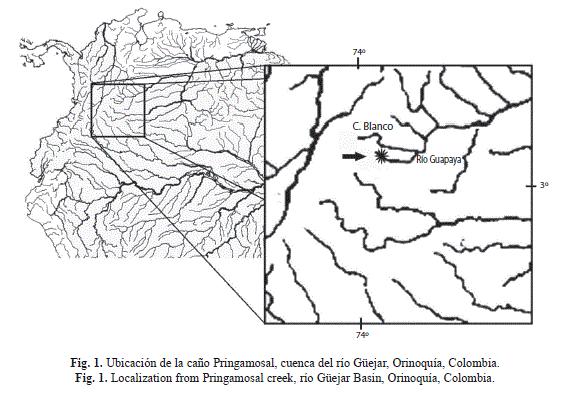
<body><![CDATA[ style="font-weight: bold;">&Aacute;rea&nbsp;     de&nbsp;     estudio:&nbsp;</span> El&nbsp; trabajo&nbsp; se&nbsp; realiz&oacute;     en&nbsp;     el&nbsp; arroyo&nbsp; o&nbsp; ca&ntilde;o&nbsp; Pringamosal&nbsp;     afluente del ca&ntilde;o Blanco a 211m.s.n.m., y &eacute;ste a su vez     afluente del R&iacute;o G&uuml;ejar, en el Municipio de Vista Hermosa,     Meta, Colombia (<a href="/img/revistas/rbt/v60n4/a38i1.gif">Fig. 1</a>).     Nace en La Serran&iacute;a de La Macarena     dentro del complejo fitogeogr&aacute;fico Guayano-Colombiano a     ]]></body>
<body><![CDATA[375m.s.n.m. (Ca&ntilde;as 2001). El ca&ntilde;o Pringamosal en su parte     alta se encuentra a 3&ordm;05&#8217;13.6&#8221; N - 73&ordm;49&#8217;46.9&#8221; W a     278m.s.n.m., en la parte media a 3&ordm;05&#8217;21.9&#8221; N - 73&ordm;49&#8217;27.1&#8221; W     a 240m.s.n.m. y en la baja 3&ordm;05&#8217;38.7&#8221; N - 73&ordm;48&#8217;35.9&#8221; W a     211m.s.n.m., con una longitud aproximada&nbsp; de&nbsp; 7km.&nbsp;     Registra&nbsp; una&nbsp; temperatura anual promedio de 26&ordm;C, y un     patr&oacute;n de distribuci&oacute;n de la precipitaci&oacute;n     bimodal, con un per&iacute;odo de altas lluvias desde abril hasta     junio,&nbsp; y&nbsp; desde&nbsp; septiembre&nbsp; hasta&nbsp;     noviembre, un per&iacute;odo corto de bajas lluvias durante julio y     ]]></body>
<body><![CDATA[agosto, y m&aacute;s pronunciado de diciembre a marzo. El promedio de     precipitaci&oacute;n mensual durante&nbsp; 2008&nbsp; fue&nbsp;     de&nbsp; 338mm;&nbsp; mayo&nbsp; fue&nbsp; el m&aacute;s lluvioso, con     557mm y enero el m&aacute;s bajo con 58.8mm (estaci&oacute;n     meteorol&oacute;gica HIMAT en la Macarena).    <br>     <br>     </span></font>     <font size="2"><span style="font-family: verdana;">Recolecta de datos:     Se     ]]></body>
<body><![CDATA[realiz&oacute; un total de cinco expediciones entre agosto y octubre     del 2008, y enero a junio del 2009, que incluyeron los per&iacute;odos     de bajas y altas lluvias para la regi&oacute;n. En cada muestreo se     recorri&oacute; el arroyo e incluyeron todos los biotopos posibles para     evaluar la presencia de la especie. Las capturas se llevaron a cabo con     red de arrastre de 2m de largo, 0.50m de altura, con un tama&ntilde;o     de ojo de malla 0.5cm; y tambi&eacute;n con nasa acu&aacute;tica; entre     tres y cinco lances por punto de muestreo. Se hicieron barridos tanto a     favor como en contra de la corriente, y de ribera a ribera, y en ellos     se procur&oacute; incluir todos los biotopos del arroyo. Adem&aacute;s,     ]]></body>
<body><![CDATA[se utiliz&oacute; la t&eacute;cnica artesanal de utilizar una     m&aacute;scara de buceo para la visualizaci&oacute;n de los individuos,     y posterior captura manual, la cual result&oacute; ser la m&aacute;s     efectiva. En total se recolectaron 130 ejemplares, los cuales se     ubicaron en neveras de poliestireno con hielo inmediatamente     despu&eacute;s de su captura, para evitar la digesti&oacute;n del     contenido estomacal; los espec&iacute;menes fueron posteriormente     fijados en formol al 10%. Adicionalmente, se recolect&oacute;     individuos de la fauna ictiol&oacute;gica acompa&ntilde;ante&nbsp;     que&nbsp; fueron&nbsp; fijados&nbsp; en&nbsp; formol&nbsp; al&nbsp;     ]]></body>
<body><![CDATA[10%. Las muestras se transportaron al Laboratorio de Ictiolog&iacute;a     de la Universidad del Quind&iacute;o, Armenia (IUQ), para la     identificaci&oacute;n del contenido estomacal y la determinaci&oacute;n     de la fauna acompa&ntilde;ante. Se evaluaron algunas variables     fisicoqu&iacute;micas <span style="font-style: italic;">In situ</span>     como: ox&iacute;geno disuelto (mg/L),     porcentaje de saturaci&oacute;n de ox&iacute;geno (%) temperatura     superficial del agua (&ordm;C) y temperatura aire (&ordm;C) con     ox&iacute;metro (OXI196-Microprocesador), y conductividad (&micro;s/cm)     con conduct&iacute;metro (HANNA HI98842). Ancho y profundidad por medio     ]]></body>
<body><![CDATA[de un dec&aacute;metro y flex&oacute;metro, respectivamente. El color     del sustrato se obtuvo por observaci&oacute;n directa, y para definir     el tipo de sustrato, se utiliz&oacute; la escala propuesta por     Wentworth (1922).</span></font><br style="font-family: verdana;">     <font size="2"></font><br style="font-family: verdana;">     <font size="2"><span style="font-family: verdana;">Los 130 ejemplares     recolectados     fueron debidamente etiquetados con un n&uacute;mero, fecha, lugar y el     nombre de recolectores. Para cada individuo se evalu&oacute; el peso     total (g) con una pesa anal&iacute;tica (Adventurer-Ohaus H226) hasta     ]]></body>
<body><![CDATA[cuatro d&eacute;cimas de precisi&oacute;n (0.0001g), y la longitud     total y est&aacute;ndar (mm) con un calibrador digital hasta     cent&eacute;simas de mil&iacute;metro. Las muestras fueron seguidamente     diseccionadas uroventralmente para extraer est&oacute;mago, intestino y     g&oacute;nadas. Cada una de estas estructuras fue pesada (g), medida     (mm), fijadas en formol al 5% y depositadas en frascos debidamente     rotulados con la informaci&oacute;n pertinente del ejemplar     (n&uacute;mero de etiqueta y de ejemplar, fecha y lugar de colecta,     sexo y estructura fijada). Los ejemplares del <span      style="font-style: italic;">F. vittata</span> se preservaron     ]]></body>
<body><![CDATA[en alcohol al 70% y fueron depositados en el Laboratorio de     Ictiolog&iacute;a de la Universidad del Quind&iacute;o, Armenia,     Colombia (IUQ). Para evaluar el contenido estomacal se procedi&oacute;     a tomar una peque&ntilde;a porci&oacute;n de contenido del     est&oacute;mago y del intestino, se diluy&oacute; en 5mm de agua     destilada, se agregaron dos gotas de lugol, se tomaron cinco gotas y se     examinaron en el microscopio (Hyslop 1980). El contenido fue agrupado     por grupos taxon&oacute;micos o categor&iacute;a ecol&oacute;gica, de     acuerdo a su origen e identificado con ayuda de claves (Lackey 1959,     Bicudo &amp; Bicudo 1970, Uherkovich 1976, Needhan &amp; Needhan 1978,     ]]></body>
<body><![CDATA[Bicudo &amp; Menezes 2006, Franceschini <span      style="font-style: italic;">et al</span>. 2010). Los contenidos     estomacales se analizaron con el m&eacute;todo num&eacute;rico y de     frecuencia (Hyslop 1980), y se evaluaron por &eacute;poca, talla y sexo.</span></font><br      style="font-family: verdana;">     <font size="2"></font><br style="font-family: verdana;">     <font size="2"><span style="font-family: verdana;">Adem&aacute;s, se     analiz&oacute; el     coeficiente de vacuidad (V) (Hyslop 1980) que permite conocer     per&iacute;odo de alimentaci&oacute;n de la especie, y se     ]]></body>
<body><![CDATA[calcul&oacute; al aplicar la ecuaci&oacute;n V=(n/N)*100, donde:     n=n&uacute;mero de est&oacute;magos vac&iacute;os, N=N&uacute;mero de     est&oacute;magos examinados. Se determin&oacute; la proporci&oacute;n     de sexos (Vazzoler 1996) por medio de una prueba de Chi cuadrado. La     talla de madurez sexual se determin&oacute; mediante el m&eacute;todo     estad&iacute;stico gr&aacute;fico, cuando m&aacute;s del 50% de la     poblaci&oacute;n entra en la fase reproductiva (Sokal &amp; Rohlf 1995).</span></font><br      style="font-family: verdana;">     <font size="2"></font><br style="font-family: verdana;">     <font size="2"><span style="font-family: verdana;">Se calcul&oacute; el     ]]></body>
<body><![CDATA[factor de     condici&oacute;n K (Vazzoler 1996): para reconocer el grado de robustez     y bienestar del pez, que presupone un incremento alom&eacute;trico, del     peso como funci&oacute;n del tama&ntilde;o del individuo. Se     calcul&oacute; con la ecuaci&oacute;n K=Wt/Ls<sup>b</sup>&nbsp;&nbsp;     donde:     Wt=peso total del ejemplar (g), Ls=longitud est&aacute;ndar (en mm),     b=coeficiente angular de la regresi&oacute;n peso total-longitud     est&aacute;ndar. Para el &iacute;tem de reproducci&oacute;n se     utiliz&oacute; la relaci&oacute;n gonadosom&aacute;tica (RGS) (Vazzoler     ]]></body>
<body><![CDATA[1996), que indica la relaci&oacute;n entre el avance de la     maduraci&oacute;n ovocitaria y el peso del cuerpo, y refleja el grado     de desarrollo de la g&oacute;nada. Se calcul&oacute; al aplicar la     ecuaci&oacute;n: RGS=Wo/We X100 donde Wo=peso de la g&oacute;nada,     We=peso del cuerpo (Wt&#8211;Wo; Wt=peso total).</span></font><br      style="font-family: verdana;">     <font size="2"></font><br style="font-family: verdana;">     <font size="2"><span style="font-family: verdana;">La fecundidad     (Ricker 1968) se     determin&oacute; mediante el m&eacute;todo de las submuestras secas, y     ]]></body>
<body><![CDATA[se utiliz&oacute; la fecundidad absoluta (Fa) con la&nbsp;     ecuaci&oacute;n:&nbsp; Fa=&#8721;n&ordm;/N&ordm;,&nbsp; donde&nbsp;     n&ordm;=n&uacute;mero de ovocitos por hembra, N&ordm;=n&uacute;mero     total de hembras. Para realizar el conteo directo, los ovocitos fueron     secados en un horno a 40&ordm;C durante 25 minutos. El di&aacute;metro     del ovocito se determin&oacute; con ayuda de papel milimetrado mediante     la alineaci&oacute;n de todos los ovocitos cuando estuvieron secos,     posibles en 10mm y el n&uacute;mero total se dividi&oacute; en 10,     luego se calcul&oacute; la media para cada g&oacute;nada, seg&uacute;n     el m&eacute;todo de sub muestras secas (Ricker 1968). Se incluye     ]]></body>
<body><![CDATA[an&aacute;lisis de Desviaci&oacute;n Est&aacute;ndar (D.E).</span></font><br      style="font-family: verdana;">     <font size="2"></font><br style="font-family: verdana;">     <font size="2"><span style="font-family: verdana;">El total de     ejemplares se     distribuyeron en tallas seg&uacute;n su longitud est&aacute;ndar. Al     utilizar la ecuaci&oacute;n: A=N/R, R=&#8730;n y N=Max-Min, donde A=amplitud     de los intervalos, R=n&uacute;mero de intervalos, n=n&uacute;mero de     observaciones, Max=valor&nbsp; m&aacute;ximo,&nbsp; Min=valor&nbsp;     m&iacute;nimo.&nbsp; Se realiz&oacute; un an&aacute;lisis de     ]]></body>
<body><![CDATA[regresi&oacute;n y otro de correlaci&oacute;n para establecer las     correspondencias entre las variables: longitud est&aacute;ndar,     longitud intestino, longitud y ancho est&oacute;mago, peso total, peso     intestino, peso est&oacute;mago y fecundidad. Adem&aacute;s, se     realiz&oacute; un an&aacute;lisis componentes principales (ACP) y un     ANDEVA de Kruskal-Wallis para los &iacute;tems consumidos entre tallas,     &eacute;pocas y sexo. En ambos casos se utilizaron los programas     estad&iacute;sticos Statgraphics plus versi&oacute;n 5.0 y PAST 2.11     bajo Windows.</span></font><br style="font-family: verdana;">     <font size="2"></font><br style="font-family: verdana;">     ]]></body>
<body><![CDATA[<font size="2"></font><br style="font-family: verdana;">     <font style="font-weight: bold;" size="3"><span      style="font-family: verdana;">Resultados</span></font><br      style="font-family: verdana;">     <font size="2"></font><br style="font-family: verdana;">     <font size="2"><span style="font-family: verdana;"><span      style="font-weight: bold;">H&aacute;bitat:</span> El ca&ntilde;o     Pringamosal es de tipo primario, de agua t&iacute;picamente cristalina,     ancho promedio de 3m y una profundidad de 0.5m durante las bajas     lluvias, que aumentan a 5.2m y 1.3m respectivamente, durante las altas     ]]></body>
<body><![CDATA[lluvias, presenta sustrato conformado principalmente por piedras y/o     arena. La temperatura ambiente y superficial del agua present&oacute;     un promedio 26.3&ordm;C y 26.2&ordm;C durante las bajas lluvias, y     30.3&ordm;C y 26.3&ordm;C en altas lluvias, respectivamente.&nbsp;     El&nbsp; porcentaje&nbsp; de&nbsp; saturaci&oacute;n de ox&iacute;geno     estuvo alrededor del 79.2% y el ox&iacute;geno en 6.2mg/L durante las     bajas lluvias, disminuyendo a 73.3% y 2.7mg/L para la &eacute;poca de     altas lluvias respectivamente, mientras la conductividad     present&oacute; incremento de 28.3&micro;s para las bajas lluvias a     33.0&micro;s en las altas lluvias (<a     ]]></body>
<body><![CDATA[ href="/img/revistas/rbt/v60n4/a38t1.gif">Cuadro 1</a>).<br      style="font-family: verdana;">     </span></font><br style="font-family: verdana;">     <font size="2"><span style="font-family: verdana;"><span      style="font-style: italic;">Farlowella&nbsp; vittata</span>&nbsp;     convive&nbsp; en&nbsp; sintopia con grupos de peces Characiformes     (cuatro familias).&nbsp; Characidae&nbsp; result&oacute;&nbsp;     ser&nbsp; la&nbsp; familia m&aacute;s representativa con 15     g&eacute;neros y 17 especies, seguido por Lebiasinidae con dos     especies,&nbsp; y&nbsp; por&nbsp; Crenuchidae&nbsp; y&nbsp;     ]]></body>
<body><![CDATA[Curimatidae&nbsp; con una especie. Siluriformes con dos familias, y     Loricariidae result&oacute; la m&aacute;s representativa con cuatro     especies.</span></font><br style="font-family: verdana;">     <font size="2"></font><br style="font-family: verdana;">     <font size="2"><span style="font-family: verdana;"><span      style="font-weight: bold;">Frecuencia&nbsp; de&nbsp;     tallas:</span>&nbsp; Se&nbsp; examinaron en total 130 ejemplares, que     comprendieron siete&nbsp; tallas&nbsp; (I&nbsp; a&nbsp; VII),&nbsp;     escala&nbsp; 86.0-190.4mm de&nbsp; largo&nbsp; est&aacute;ndar&nbsp;     (LE)&nbsp; y&nbsp; una&nbsp; amplitud&nbsp; de 14.8mm&nbsp; entre&nbsp;     ]]></body>
<body><![CDATA[las&nbsp; tallas.&nbsp; La&nbsp; talla&nbsp; III&nbsp; fue&nbsp; la     m&aacute;s&nbsp;&nbsp; abundante&nbsp;&nbsp; (115.9-130.8mm&nbsp;&nbsp;     LE)&nbsp;&nbsp; con 38&nbsp; individuos&nbsp; (32.2%),&nbsp;     seguida&nbsp; por&nbsp; la&nbsp; talla II (101.0-115.9mm LE) con 22     ejemplares (28.6%), y por IV (130.8-145.7mm LE) con 20 (16.9%), la     talla VII (175.5-190.4mm LE) y VI (160.6-175.5mm LE) fueron las menos     abundantes, con cuatro (3.4%) y siete (5.9%) ejemplares,     respectivamente (<a href="/img/revistas/rbt/v60n4/a38i2.gif">Fig. 2</a>),     no fueron observadas diferencias entre las     tallas y los periodos clim&aacute;ticos.</span></font><br     ]]></body>
<body><![CDATA[ style="font-family: verdana;">     <font size="2"></font><br style="font-family: verdana;">     <font size="2"><span style="font-family: verdana;"><span      style="font-weight: bold;">Morfolog&iacute;a del tracto     digestivo:</span> <span style="font-style: italic;">F. vittata</span>     posee boca ventral, con dientes filiformes que     forman&nbsp; una&nbsp; estructura&nbsp; similar&nbsp; a&nbsp; un&nbsp;     rastrillo, los labios son carnosos en forma de embudo, con papilas     adhesivas para fijarse al sustrato. El est&oacute;mago es oblongo y se     diferencia del intestino por medio de un esf&iacute;nter     ]]></body>
<body><![CDATA[pil&oacute;rico, de paredes blandas y/o fr&aacute;giles, se encuentra     en la regi&oacute;n dorsal de la cavidad abdominal. El intestino se     caracteriz&oacute; por una red de lazos dispuestos en un plano     horizontal dentro de la regi&oacute;n ventral de la cavidad abdominal,     bucles en forma de espiral alrededor de un eje central, su longitud     alcanza casi dos veces la longitud est&aacute;ndar del ejemplar.</span></font><br      style="font-family: verdana;">     <font size="2"></font><br style="font-family: verdana;">     <font size="2"><span style="font-family: verdana;">El intestino     present&oacute; un     ]]></body>
<body><![CDATA[largo promedio de 469.5mm (248.4-689.4mm) y un peso promedio de 0.3g     (0.01-0.6g); en los machos la longitud dio un promedio de 381.9mm     (193.7-576.7mm) y un peso 0.21g (0.03-0.53g), mientras que en las     hembras no se observ&oacute; diferencias en la longitud y en el peso     del intestino con respecto a las &eacute;pocas. En general se mantuvo     la relaci&oacute;n de valores altos de longitud y peso del intestino en     machos. Se observ&oacute; una alta y positiva correlaci&oacute;n entre     la longitud est&aacute;ndar y la longitud del intestino     (Y=-10.368+3.35692*x, r=0.71) y entre el peso total y el peso del     intestino&nbsp;&nbsp; (Y=0.0459807+0,0632708*x,&nbsp;&nbsp; r=0.79). Se     ]]></body>
<body><![CDATA[observ&oacute; una correlaci&oacute;n positiva entre la longitud&nbsp;     est&aacute;ndar&nbsp; y&nbsp; la&nbsp; longitud&nbsp; del&nbsp;     est&oacute;mago (Y=1.72291+.0389835*x, r=0.52), entre el peso total de     los ejemplares y el peso del est&oacute;mago (Y=0.00347963+0.00390658x,     r=0.72).</span></font><br style="font-family: verdana;">     <font size="2"></font><br style="font-family: verdana;">     <font size="2"><span style="font-family: verdana;"><span      style="font-weight: bold;">Dieta:</span>&nbsp; <span      style="font-style: italic;">F.&nbsp; vittata</span>&nbsp;     se&nbsp; alimenta&nbsp; al&nbsp; raspar rocas, troncos y     ]]></body>
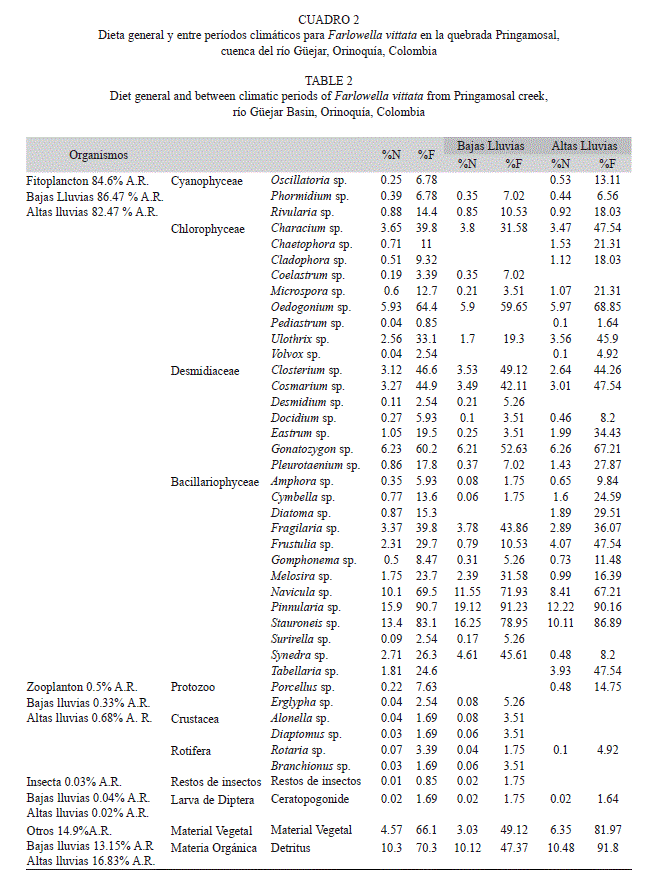
<body><![CDATA[vegetaci&oacute;n que se encuentra en el sustrato (observaci&oacute;n     personal). El an&aacute;lisis de 118 contenidos de est&oacute;magos e     intestinos, result&oacute; en que su dieta se bas&oacute;     principalmente de&nbsp; fitoplancton&nbsp; (84.6% Abundancia&nbsp;     relativa; A.R.), seguido por materia org&aacute;nica en     descomposici&oacute;n (detritus) y material vegetal (14.9% A.R.), menos     zooplancton (0.5% A.R.) y larvas o partes de insectos (0.03% A.R.),     este &uacute;ltimo considerado ocasional. Se determin&oacute; la     presencia de 42 &iacute;tems (<a      href="/img/revistas/rbt/v60n4/a38t2.gif">Cuadro 2</a>). A     ]]></body>
<body><![CDATA[trav&eacute;s del     m&eacute;todo num&eacute;rico (%N) y frecuencia de ocurrencia (%F) se     observ&oacute; que el organismo m&aacute;s consumido fue <span      style="font-style: italic;">Pinnularia</span> sp.     (15.94%N-90.68%F), seguido por <span style="font-style: italic;">Stauroneis</span>     sp. (13.42%N-83.05%F),     detritus (10.28%N-0.34%F) y <span style="font-style: italic;">Navicula</span>     sp. (10.11%N-69.49%F).     Adem&aacute;s, de <span style="font-style: italic;">Gonatozygon</span>&nbsp;     sp.&nbsp; (6.23%N-60.17%F),&nbsp;     ]]></body>
<body><![CDATA[<span style="font-style: italic;">Oedogonium</span> sp.     (5.93%N-64.41%F) y material vegetal     (4.57%N-66.10%F).&nbsp; Los&nbsp; menos&nbsp; consumidos y&nbsp;     que&nbsp; constituyen&nbsp; alimento&nbsp; ocasional,&nbsp; con     bajo&nbsp; aporte&nbsp; a&nbsp; la&nbsp; dieta&nbsp; de&nbsp; la&nbsp;     especie&nbsp; fueron: <span style="font-style: italic;">Alonella</span>     sp. (0.04%N-1.69%F),     <span style="font-style: italic;">Pediastrum</span>&nbsp;&nbsp;     &nbsp;&nbsp;&nbsp; &nbsp;sp.     (0.04%N-0.85%F)&nbsp;&nbsp; &nbsp;<span style="font-style: italic;">Diaptomus</span>     ]]></body>
<body><![CDATA[sp.&nbsp;&nbsp;     &nbsp;(0.03%N-1.69%F),&nbsp;&nbsp; &nbsp;<span      style="font-style: italic;">Branchionus</span>&nbsp;&nbsp;     &nbsp;sp. (0.03%N-1.69%F), larva de d&iacute;ptera; Ceratopogonide     (0.02%N-1.69%F) y restos de insectos (0.01%N-0.85%F) (<a      href="/img/revistas/rbt/v60n4/a38t2.gif">Cuadro 2</a>). El     &iacute;ndice de diversidad de Shanon-Weaver para los organismos     consumidos por <span style="font-style: italic;">F. vittata</span>     registr&oacute; un valor de 3.2 bits, por lo     que se deduce que la especie tiende a ser eur&iacute;faga.</span></font>    ]]></body>
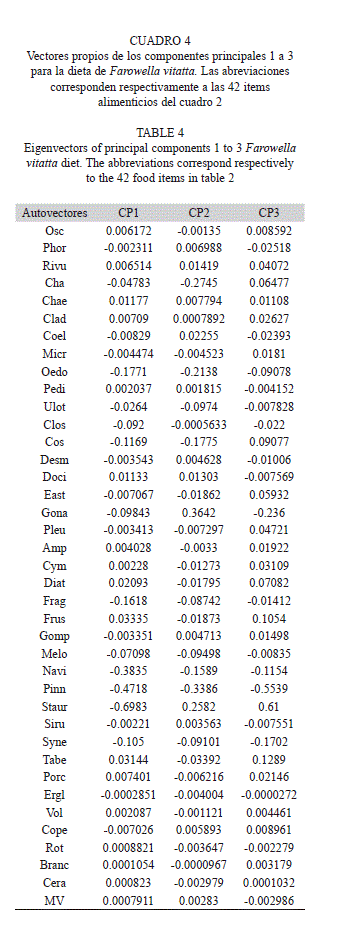
<body><![CDATA[<br> <br style="font-family: verdana;"> <font size="2"><span style="font-family: verdana;">El An&aacute;lisis&nbsp; de&nbsp; Componentes&nbsp; Principales (ACP) para de la dieta arroj&oacute; registros muy cercanos a los observados en los porcentajes de&nbsp; los&nbsp; &iacute;tems&nbsp; para&nbsp; las&nbsp; heterog&eacute;neas&nbsp; medidas (<a  href="/img/revistas/rbt/v60n4/a38i3.jpg">Fig. 3</a>), donde el componente uno (27.24%), dos&nbsp; (20.77%)&nbsp; y&nbsp; tres&nbsp; (8.74%)&nbsp; expresaron&nbsp; un 53.75% de la variaci&oacute;n, esta fue explicada principalmente en el componente uno por los &iacute;tems; <span  style="font-style: italic;">Pinnularia</span> sp., <span style="font-style: italic;">Stauroneis</span> sp., Detritus y <span style="font-style: italic;">Navicula</span> sp., en el componente dos por: <span style="font-style: italic;">Sirurella</span> sp. y <span  style="font-style: italic;">Gonatozigon</span> sp. y en el componente tres por <span style="font-style: italic;">Pleurotaenium</span> sp. (<a  href="/img/revistas/rbt/v60n4/a38t3.gif">Cuadro 3</a> y <a href="/img/revistas/rbt/v60n4/a38t4.gif">4</a>).    <br>     <br>     </span></font>     <font size="2"><span style="font-family: verdana;">Se observ&oacute; un     mayor consumo     de fitoplancton durante bajas lluvias (86.47% A.R.), as&iacute; como     larvas o partes de insectos (0.04% A.R.) al comparar con la     &eacute;poca de altas lluvias (82.47%-0.02% A.R., respectivamente).     Adem&aacute;s, se observ&oacute; en cuanto al consumo de fitoplancton:     ]]></body>
<body><![CDATA[<span style="font-style: italic;">Coelastrum </span>sp.     (0.35%N-7.02%F), <span style="font-style: italic;">Desmidium&nbsp; </span>sp.&nbsp;     (0.21%N-5.26%F)&nbsp; y&nbsp; <span style="font-style: italic;">Surirella&nbsp;&nbsp;     &nbsp;&nbsp;&nbsp;     &nbsp;</span>sp. 0.17%N-5.26%F);&nbsp;&nbsp; &nbsp;<span      style="font-style: italic;">Zooplancton</span>:&nbsp;&nbsp;     &nbsp; <span style="font-style: italic;">Erglypha&nbsp;&nbsp; &nbsp;</span>sp.&nbsp;&nbsp;     &nbsp;(0.08%N-5.26%F), <span style="font-style: italic;">Alonella</span>&nbsp;&nbsp;     sp.&nbsp;&nbsp;     (0.08%N-3.51%F),&nbsp;&nbsp; &nbsp;<span style="font-style: italic;">Diaptomus</span>&nbsp;&nbsp;     ]]></body>
<body><![CDATA[sp.&nbsp;&nbsp; (0.06%N-3.51%F),&nbsp;&nbsp; sp.     (0.06%N-3.51%F) y restos de insectos (0.02%N-1.75%F), los cuales no     fueron registrados durante las altas lluvias. El &iacute;ndice de     diversidad de Shanon-Weaver para los organismos consumidos por <span      style="font-style: italic;">F.     vittata</span> en este per&iacute;odo fue 2.96 bits.</span></font><br      style="font-family: verdana;">     <font size="2"></font><br style="font-family: verdana;">     <font size="2"><span style="font-family: verdana;">Durante las altas     lluvias fue mayor     ]]></body>
<body><![CDATA[el consumo de zooplancton (0.68% A.R.), material&nbsp; de&nbsp;     origen&nbsp; vegetal&nbsp; y&nbsp; org&aacute;nico&nbsp; (18.83% A.R.)     con respecto a las bajas lluvias (0.33%-13.15% A.R., respectivamente).     A su vez se registraron los siguientes organismos de fitoplancton:     <span style="font-style: italic;">Oscillatoria </span>sp.     (0.53%N-13.11%F), <span style="font-style: italic;">Chaetophora&nbsp;&nbsp;     &nbsp;     </span>sp.&nbsp;&nbsp; &nbsp; (1.53%N-21.31%F), <span      style="font-style: italic;">Cladophora&nbsp;&nbsp; &nbsp;     </span>sp. (1.12%N-18.03%F), <span style="font-style: italic;">Pediastrum</span>&nbsp;&nbsp;     ]]></body>
<body><![CDATA[&nbsp; sp.&nbsp;&nbsp;     &nbsp;&nbsp;&nbsp; &nbsp;(0.10%N-1.64%F),&nbsp;&nbsp; &nbsp;<span      style="font-style: italic;">Diaoma </span></span></font><font size="2"><span      style="font-family: verdana;">sp.&nbsp;&nbsp;     &nbsp;(1.89%N-29.51%F),&nbsp;&nbsp; &nbsp;<span      style="font-style: italic;">Tabellaria </span>sp.     (3.93%N-47.54%F) y <span style="font-style: italic;">Volvox </span>sp.     (0.10%N-4.92%F); zooplancton: <span style="font-style: italic;">Porcellus     </span>sp. (0.48%N-3.51%F), que no se determinaron en bajas lluvias     (<a href="/img/revistas/rbt/v60n4/a38t2.gif">Cuadro     ]]></body>
<body><![CDATA[2</a>). El &iacute;ndice de diversidad de Shanon-Weaver para los     organismos     consumidos por <span style="font-style: italic;">F. vittata </span>en     este per&iacute;odo fue 3.21 bits.</span></font><br      style="font-family: verdana;">     <font size="2"></font><br style="font-family: verdana;">     <font size="2"><span style="font-family: verdana;">Durante&nbsp;&nbsp;     &nbsp;las&nbsp;&nbsp; &nbsp;dos&nbsp;&nbsp;     &nbsp;&eacute;pocas,&nbsp;&nbsp; &nbsp;el&nbsp;&nbsp;     &nbsp;organismo&nbsp;&nbsp; &nbsp;m&aacute;s&nbsp;&nbsp;     ]]></body>
<body><![CDATA[&nbsp;abundante&nbsp;&nbsp; &nbsp;fue&nbsp;&nbsp; &nbsp;     <span style="font-style: italic;">Pinnularia</span>&nbsp; sp.&nbsp;     (19.12%N-91.23%F&nbsp; bajas&nbsp;     lluvias&nbsp; y 12.22%N-90.16%F altas lluvias), detritus     (10.48%N-91.80%F) para la &eacute;poca de altas lluvias y <span      style="font-style: italic;">Stauroneis</span>     sp. (10.11%N-86.89%F altas lluvias y 16.25%N-78.95%F bajas lluvias).     Los &iacute;tems menos consumidos en volumen y en frecuencia para las     dos &eacute;pocas fueron: Ceratopogonidae (0.02%N-1.75%F bajas&nbsp;     lluvias&nbsp; y&nbsp; 0.02%N-1.64&nbsp; %F&nbsp; altas&nbsp; lluvias),     ]]></body>
<body><![CDATA[<span style="font-style: italic;">Rotaria </span>sp. (0.04%N-1.75%F     bajas lluvias y 0.10%N-4.92%F altas lluvias)     y restos de insectos (0.02%N-1.75%F bajas lluvias) (<a      href="/img/revistas/rbt/v60n4/a38t2.gif">Cuadro 2</a>).</span></font><br      style="font-family: verdana;">     <font size="2"></font><br style="font-family: verdana;">     <font size="2"><span style="font-family: verdana;">El ANDEVA de     Kruskal-Wallis     mostr&oacute; diferencias estad&iacute;sticamente significativas de los     &iacute;tems alimenticios entre sexos: <span     ]]></body>
<body><![CDATA[ style="font-style: italic;">Characium </span>sp. (p=0.018),     <span style="font-style: italic;">Cosmarium </span>sp. (p=0.020) y <span      style="font-style: italic;">Gonatozygon</span>     sp. (p=0.0123), y entre tallas:     <span style="font-style: italic;">Surirella </span>sp. (p=0.0197), <span      style="font-style: italic;">Tabellaria </span>sp. (p=0.006), <span      style="font-style: italic;">Characium </span>sp.     (p=0.0002), <span style="font-style: italic;">Porcellus </span>sp.     (p=0.0052), <span style="font-style: italic;">Eastrum </span>sp.     (p=0.005) y <span style="font-style: italic;">Diatoma     ]]></body>
<body><![CDATA[</span>sp. (p=0.0008). No fueron encontrados est&oacute;magos     vac&iacute;os     durante los per&iacute;odos de muestreo, por lo cual el &iacute;ndice     de vacuidad no se aplic&oacute;.</span></font><br      style="font-family: verdana;">     <font size="2"></font><br      style="font-family: verdana; font-weight: bold;">     <font size="2"><span style="font-family: verdana;"><span      style="font-weight: bold;">Factor de     condici&oacute;n (K):</span> El     ]]></body>
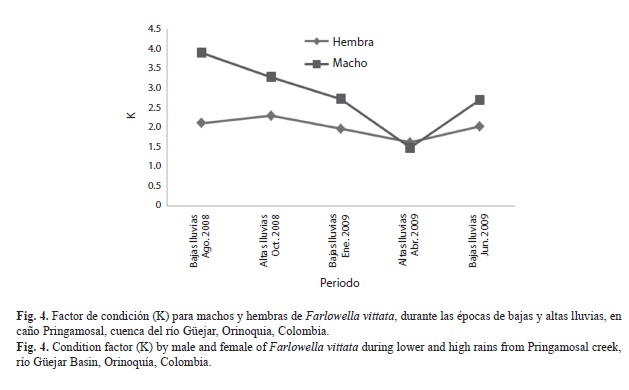
<body><![CDATA[valor promedio de K obtenido oscil&oacute; entre 1.3 y 4, se     adec&uacute;a para el crecimiento alom&eacute;trico e indic&oacute; que     la especie se encontr&oacute; bien alimentada. En hembras, el valor     m&iacute;nimo se registr&oacute; durante el segundo per&iacute;odo de     altas lluvias (1.5), mientras el m&aacute;s alto en el primer     per&iacute;odo de altas lluvias (2.3) coincide con el RGS. Se     observaron registros altos en machos, debido a que estos tienen mayor     talla y peso; se registra un valor m&aacute;ximo para la &eacute;poca     de bajas lluvias (4) y su consecuente disminuci&oacute;n durante ambas     &eacute;pocas, donde el valor m&iacute;nimo (1.4) coincide con el de     ]]></body>
<body><![CDATA[hembras para la segunda &eacute;poca de altas lluvias (<a      href="/img/revistas/rbt/v60n4/a38i4.jpg">Fig. 4</a>). Se     present&oacute; una alta y positiva correlaci&oacute;n entre la     longitud est&aacute;ndar y el peso total (Y=-5.64885+0.0678988*x,     r=0.95).</span></font><br style="font-family: verdana;">     <br style="font-family: verdana;">     <font size="2"><span style="font-family: verdana;"><span      style="font-weight: bold;">Reproducci&oacute;n:</span>     De 118     ejemplares examinados, a 108 se les determin&oacute; el sexo; 56 fueron     ]]></body>
<body><![CDATA[hembras (51.9%) y 52 machos (48.1%). Se observ&oacute; relaci&oacute;n     1:1 (X<sup>2</sup>=0,16 p&#8805;0.05 gl=1) esperado para poblaciones     naturales. Las     hembras&nbsp; fueron&nbsp; m&aacute;s&nbsp; abundantes&nbsp;     durante&nbsp; la&nbsp; primera &eacute;poca de bajas y altas lluvias     (16 y 20 individuos, respectivamente) y los machos en la segunda     &eacute;poca de bajas lluvias (20 ejemplares). En el segundo     per&iacute;odo de altas lluvias se colect&oacute; igual cantidad de     machos y hembras (15 individuos cada uno). La talla de     maduraci&oacute;n sexual en hembras para el 50% se registr&oacute; a     ]]></body>
<body><![CDATA[122mm de longitud est&aacute;ndar y 138mm de longitud est&aacute;ndar     en machos (<a href="/img/revistas/rbt/v60n4/a38i5.jpg">Fig. 5</a>).<br      style="font-family: verdana;">     </span></font><br style="font-family: verdana;">     <font size="2"><span style="font-family: verdana;"><span      style="font-weight: bold;">Relaci&oacute;n     gonadosom&aacute;tica (RGS):</span> En machos var&iacute;a durante las     &eacute;pocas; con valores m&iacute;nimos durante las bajas lluvias     (0.42 y 0.20) y&nbsp; m&aacute;ximos&nbsp; durante&nbsp; las&nbsp;     altas&nbsp; lluvias&nbsp; (0.70&nbsp; y 0.65). Los valores de RGS     ]]></body>
<body><![CDATA[m&aacute;s altos para hembras se presentaron durante las altas lluvias     (8.62), seguido por disminuci&oacute;n abrupta para la siguiente de     bajas (0.98) y un nuevo aumento para la posterior &eacute;poca de altas     lluvias (5.12). Los registros bajos de RGS, para machos y hembras     correspondieron a la &eacute;poca de bajas lluvias&nbsp;     (julio-agosto,&nbsp; diciembre-marzo);&nbsp; &eacute;ste a su vez     constituye el momento en el cual la poblaci&oacute;n lleva a cabo su     desove (<a href="/img/revistas/rbt/v60n4/a38i6.jpg">Fig. 6</a>), y     coincide con registros del factor de     condici&oacute;n (K) (<a href="/img/revistas/rbt/v60n4/a38i4.jpg">Fig. 4</a>).<br     ]]></body>
<body><![CDATA[ style="font-family: verdana;">     </span></font><br style="font-family: verdana;">     <font size="2"><span style="font-family: verdana;"><span      style="font-weight: bold;">Fecundidad:&nbsp;</span>&nbsp;     &nbsp;Los&nbsp;&nbsp; &nbsp;conteos&nbsp;&nbsp; &nbsp;arrojaron un     promedio de 46 ovocitos (21-73; D.E=26) por hembra en bajas y 54     ovocitos (31-80; D.E=24.5) por hembra durante altas lluvias.&nbsp;     Se&nbsp; observ&oacute;&nbsp; un&nbsp; correlaci&oacute;n&nbsp;     positiva entre&nbsp; la&nbsp; longitud&nbsp; est&aacute;ndar&nbsp;     y&nbsp; la&nbsp; fecundidad (Y=-42.4447+0.752507*x;&nbsp;     ]]></body>
<body><![CDATA[r=0.65),&nbsp; mientras la correlaci&oacute;n peso de g&oacute;nada y     la fecundidad fue baja (Y=41.5362+44.2703*x, r=0.43). Los ovocitos     presentaron en general un di&aacute;metro promedio de 1.3 (0.8-1.6mm;     D.E.=0.44) para las bajas y 1.4mm (1-1.6mm; D.E.=0.33) en &eacute;poca     de altas lluvias. Se obtuvo una baja correspondencia&nbsp; entre&nbsp;     el&nbsp; n&uacute;mero&nbsp; de&nbsp; ovocitos y su di&aacute;metro     (Y=1.01799+0.00681009*x, r=0.35), y alta entre el di&aacute;metro del     ovocito y el peso de las g&oacute;nadas (Y=1.05932+1.40797*x, r=0.70).     Los ovocitos son de color amarillo claro y esf&eacute;ricos.</span></font><br      style="font-family: verdana;">     ]]></body>
<body><![CDATA[<font size="2"></font><br style="font-family: verdana;">     <font size="2"></font><br style="font-family: verdana;">     <font style="font-weight: bold;" size="3"><span      style="font-family: verdana;">Discusi&oacute;n</span></font><br      style="font-family: verdana;">     <font size="2"></font><br style="font-family: verdana;">     <font size="2"><span style="font-family: verdana;"><span      style="font-style: italic;">Farlowella vittata</span> es un pez     bent&oacute;nico y por carecer de vejiga gaseosa se le facilita nadar     en el fondo y barrer el sustrato con el labio y papilas en busca de     ]]></body>
<body><![CDATA[presas que succionan (Braga 2005). Este modo de forrajeo es corroborado     por la existencia de los &iacute;tems alimenticios como el perifiton;     para cuya obtenci&oacute;n es necesario raspar el sustrato (Braga <span      style="font-style: italic;">et     al</span>. 2008). <span style="font-style: italic;">F. vittata</span>     posee un est&oacute;mago definido y se encuentra     separado del intestino por la presencia de un esf&iacute;nter     pil&oacute;rico. No se encontraron est&oacute;magos vac&iacute;os;     indican digesti&oacute;n y respiraci&oacute;n (Agostinho &amp; Delariva     2001).</span></font><br style="font-family: verdana;">     ]]></body>
<body><![CDATA[<font size="2"></font><br style="font-family: verdana;">     <font size="2"><span style="font-family: verdana;">En peces     detrit&iacute;voros como     Prochilodontidae, Curimatidae y Loricariidae de Am&eacute;rica del Sur,     el aprovechamiento de un abundante alimento y su bajo valor nutritivo     hace m&aacute;s dif&iacute;cil la digesti&oacute;n, lo que da como     respuesta adaptativa un intestino estrecho, largo y enrollado para el     aprovechamiento del alimento (Rom&aacute;n-Valencia&nbsp; 1993&nbsp;     a,&nbsp; b,&nbsp; Agostinho&nbsp; &amp;&nbsp; Delariva 2001). Las     longitudes del intestino y est&aacute;ndar presentaron alta y positiva     ]]></body>
<body><![CDATA[correlaci&oacute;n, que se asocian con la eficiencia digestiva y     expresan que la longitud del intestino es indicador de la dieta, por lo     que, especies que consumen preferiblemente algas y partes de plantas     poseen intestino largo (Kramer &amp; Bryant 1995). Esta relaci&oacute;n     refleja la generalidad de los peces herb&iacute;voros que poseen un     intestino con una mayor longitud que los peces carn&iacute;voros     (Rom&aacute;n-Valencia <span style="font-style: italic;">et al</span>.     2003).</span></font><br style="font-family: verdana;">     <font size="2"></font><br style="font-family: verdana;">     <font size="2"><span style="font-family: verdana;">La dieta de <span     ]]></body>
<body><![CDATA[ style="font-style: italic;">F. vittata</span> se     bas&oacute; principalmente en fitoplancton. Se encontr&oacute;,     adem&aacute;s zooplancton, material vegetal, detritus/sedimento     (materia org&aacute;nica particulada asociada a porciones variables de     part&iacute;culas minerales), y como alimento ocasional se encontraron     algunos restos de insectos (en un est&oacute;mago) y&nbsp; larvas&nbsp;     de&nbsp; Diptera&nbsp; (Ceratopogonidae)&nbsp; (en dos     est&oacute;magos). Agostinho &amp; Delariva (2001) reportan un amplio     espectro de &iacute;tems alimentarios (detritus, algas, larvas de     insectos acu&aacute;ticos gaster&oacute;podos, sedimentos, esponjas y     ]]></body>
<body><![CDATA[rot&iacute;feros) para algunas especies de Loricariidae (<span      style="font-style: italic;">Megalancistrus     aculeatus, Hypostomus microstomus, Hypostomus margartifer</span> entre     otros).     Power (1983) y Gerking (1994) comentan que la boca con labios     succionadores puede dificultar la ingesti&oacute;n de peque&ntilde;os     organismos selectivamente al raspar el sustrato; lo que explica la     presencia de partes y larvas de insectos en la dieta de <span      style="font-style: italic;">F. vittata</span>; que     por el bajo porcentaje de estos &iacute;tems, es considerado como un     ]]></body>
<body><![CDATA[recurso alimenticio accidental.</span></font><br      style="font-family: verdana;">     <font size="2"></font><br style="font-family: verdana;">     <font size="2"><span style="font-family: verdana;">Los &iacute;tems     m&aacute;s     consumidos fueron <span style="font-style: italic;">Pinnularia</span>     sp., <span style="font-style: italic;">Stauroneis</span> sp. y <span      style="font-style: italic;">Navicula</span> sp.;     consideradas&nbsp; como&nbsp; algas&nbsp; epil&iacute;ticas&nbsp;     (adhieren a rocas y troncos) y epif&iacute;ticas (se adhieren a     ]]></body>
<body><![CDATA[plantas&nbsp; y&nbsp; ra&iacute;ces)&nbsp; (Hynes&nbsp; 1972),&nbsp;     acorde&nbsp; con el tipo de sustrato del arroyo muestreado.     Rom&aacute;n-Valencia &amp; Samudio (2007) afirman que la diferencia     entre los sustratos o la predominancia del alguno en especial     determinan en parte los &iacute;tems alimenticios de las especies. Se     presentaron diferencias en la dieta de <span      style="font-style: italic;">F. vittata</span> seg&uacute;n&nbsp;     la&nbsp; &eacute;poca.&nbsp; Se&nbsp; observa&nbsp; mayor&nbsp; consumo     de fitoplancton y larvas o partes de insectos durante las bajas     lluvias, y de zooplancton y materia&nbsp; vegetal&nbsp; y&nbsp;     ]]></body>
<body><![CDATA[org&aacute;nica&nbsp; (detritus)&nbsp; en&nbsp; las altas lluvias. La     actividad tr&oacute;fica estacional sigue los patrones m&aacute;s     com&uacute;nmente encontrados en peces, donde su din&aacute;mica es     mayor en la temporada m&aacute;s c&aacute;lida del a&ntilde;o. La     variaci&oacute;n anual de temperatura desencadena activaci&oacute;n de     ciclos end&oacute;genos, que afectan el apetito de los peces,     as&iacute; como la tasa de metabolismo e incluso la disponibilidad de     alimentos (Hynes 1950, Hahn <span style="font-style: italic;">et al</span>.     1999).</span></font><br style="font-family: verdana;">     <font size="2"></font><br style="font-family: verdana;">     ]]></body>
<body><![CDATA[<font size="2"><span style="font-family: verdana;">Se destaca el efecto     de la     estacionalidad porque los cambios temporales de los factores     bi&oacute;ticos&nbsp; y&nbsp; abi&oacute;ticos&nbsp; alteran&nbsp;     la&nbsp; estructura&nbsp; de la red alimentaria a lo largo del     a&ntilde;o y, como consecuencia, los peces a menudo muestran cambios     estacionales en la dieta (Shalloof &amp; Khalifa 2009). Estas     diferencias son esperadas por la incorporaci&oacute;n de nuevos     organismos transportados por las aguas de las lluvias a partir de los     h&aacute;bitats terrestres, y probablemente, por el efecto de los     ]]></body>
<body><![CDATA[pulsos de las inundaciones sobre la dominancia (Borba <span      style="font-style: italic;">et al</span>. 2008).</span></font><br      style="font-family: verdana;">     <font size="2"></font><br style="font-family: verdana;">     <font size="2"><span style="font-family: verdana;">Dentro de la     perspectiva de la     supervivencia, el crecimiento y la reproducci&oacute;n, los peces     dependen de la energ&iacute;a y nutrientes generados por ingesta de     alimento (Wootton 1992, Gerking 1994). Hahn <span      style="font-style: italic;">et al</span>. (1999) enfatizaron     ]]></body>
<body><![CDATA[que, en&nbsp; &aacute;reas&nbsp; inundables,&nbsp; tanto&nbsp; el&nbsp;     espectro&nbsp; como la tasa de alimentaci&oacute;n de los peces     est&aacute;n determinados por las fluctuaciones hidrol&oacute;gicas     ambientales a las que est&eacute;n sometidos. Al considerar que en esta     zona los ambientes est&aacute;n sometidos a per&iacute;odos de bajas y     altas lluvias, se espera que durante la inundaci&oacute;n se produzca     aumento en el consumo de alimentos de origen terrestre, ya que gran     cantidad de material es llevado al agua (Silva <span      style="font-style: italic;">et al</span>. 2007). Esta     asociaci&oacute;n es evidente por el mayor consumo de material vegetal     ]]></body>
<body><![CDATA[durante la &eacute;poca de altas lluvias, registrado para la especie.     Esteves &amp; Aranha (1999) resaltan que el efecto de la variabilidad     hidrol&oacute;gica sobre los recursos alimentarios es un factor que     debe considerarse en el an&aacute;lisis de las relaciones     tr&oacute;ficas para entender las variaciones estacionales de la     dietaen los patrones de obtenci&oacute;n de alimento y partici&oacute;n     de los recursos.</span></font><br style="font-family: verdana;">     <font size="2"></font><br style="font-family: verdana;">     <font size="2"><span style="font-family: verdana;">El factor de     condici&oacute;n     ]]></body>
<body><![CDATA[alom&eacute;trico (K), present&oacute; variaciones a lo largo del     a&ntilde;o. Los machos presentaron siempre valores superiores sobre las     hembras. Los registros bajos de K para&nbsp; hembras&nbsp; pueden&nbsp;     estar&nbsp; relacionados&nbsp; con una mayor exigencia     fisiol&oacute;gica de las hembras en relaci&oacute;n con los machos. Se     reconoce que la demanda para las actividades reproductivas es mayor     entre las hembras. La acumulaci&oacute;n de vitelo durante la fase de     maduraci&oacute;n de las g&oacute;nadas, junto con la migraci&oacute;n     a las zonas de desove y el propio proceso de desove, requieren reservas     energ&eacute;ticas adicionales en las hembras en relaci&oacute;n con     ]]></body>
<body><![CDATA[los machos (Monteiro <span style="font-style: italic;">et al</span>.     2007). El aumento y descenso del factor de     condici&oacute;n (K) en machos sucede de manera asincr&oacute;nica con     hembras. El aumento, permite suponer una buena ingesti&oacute;n previa     de alimento con el fin de obtener reservas energ&eacute;ticas para el     evento reproductivo y tambi&eacute;n se puede considerar como indicador     de la liberaci&oacute;n de ovocitos (Rom&aacute;n-Valencia <span      style="font-style: italic;">et al</span>. 2007,     Rom&aacute;n- Valencia &amp; Hern&aacute;ndez 2007).</span></font><br      style="font-family: verdana;">     ]]></body>
<body><![CDATA[<font size="2"></font><br style="font-family: verdana;">     <font size="2"><span style="font-family: verdana;">El ciclo     reproductivo en peces es     un proceso din&aacute;mico y puede estar acompa&ntilde;ado por la     asociaci&oacute;n a las variaciones estacionales de los estadios de     maduraci&oacute;n gonadal, la relaci&oacute;n gonadosom&aacute;tica y     el factor de condici&oacute;n, que al estar relacionados y al     analizarse conjuntamente proporcionan indicaciones del per&iacute;odo     reproductivo (Braga <span style="font-style: italic;">et al</span>.     2008). En <span style="font-style: italic;">F. vittata</span> se     ]]></body>
<body><![CDATA[encontr&oacute;     presencia de grasa en la cavidad cel&oacute;mica, que puede ser     considerada como reserva energ&eacute;tica utilizada en el     per&iacute;odo reproductivo; ya que durante el desove los peces     necesitan m&aacute;s&nbsp; energ&iacute;a&nbsp; para&nbsp;     cumplir&nbsp; los&nbsp; requisitos&nbsp; de la reproducci&oacute;n     (Tsikliras <span style="font-style: italic;">et al</span>. 2005, Braga     2005). Las diferencias en contenido de     grasa en las especies, est&aacute; estrechamente relacionadas con la     historia de vida (Nikolskii 1963). La ca&iacute;da del factor de     ]]></body>
<body><![CDATA[condici&oacute;n (K) coincidi&oacute; con la &eacute;poca reproductiva;     como lo afirma Weatherley (1972) que una baja de condici&oacute;n sigue     a una liberaci&oacute;n de ovocitos o esperma. Agostinho (1985) reporta     para <span style="font-style: italic;">Rhinelepis aspera</span> una     reducci&oacute;n progresiva en valores     medios del factor de condici&oacute;n e &iacute;ndice     hepatosom&aacute;tico durante el per&iacute;odo de maduraci&oacute;n     gonadal, teniendo valores m&iacute;nimos durante la     reproducci&oacute;n, que se refleja durante el inicio de las altas     lluvias, donde &#8220;K&#8221; tiene su menor valor tanto en machos como en hembras     ]]></body>
<body><![CDATA[y el RGS tiene registros m&aacute;s altos para ambos sexos.</span></font><br      style="font-family: verdana;">     <font size="2"></font><br style="font-family: verdana;">     <font size="2"><span style="font-family: verdana;">No existe     informaci&oacute;n     disponible relativa a las zonas de desove de especies de <span      style="font-style: italic;">Farlowella</span>,     sin embargo, se observ&oacute; que el pico de desarrollo gonadal de <span      style="font-style: italic;">F.     vittata</span> es al final de las altas lluvias e inicio de las bajas,     ]]></body>
<body><![CDATA[posiblemente para evitar los depredadores que lo hacen a principios de     estas o para evadir la competencia interespecifica por alimento y     espacio con otros loric&aacute;ridos e intraespecifica por alimento por     abundancia de j&oacute;venes en una sola &eacute;poca. Seg&uacute;n     Cede&ntilde;o (1984) para <span style="font-style: italic;">Chaetostoma     thomsoni</span> el aumento del     ox&iacute;geno facilita la postura y el cuidado parental de los huevos,     necesario para una alta oxigenaci&oacute;n de las camadas en su&nbsp;     desarrollo&nbsp; normal;&nbsp; lo&nbsp; que&nbsp; concuerda&nbsp; con     los valores altos de ox&iacute;geno y porcentaje de saturaci&oacute;n     ]]></body>
<body><![CDATA[en el inicio de las bajas lluvias. La longitud media de una     poblaci&oacute;n que llega a la primera maduraci&oacute;n gonadal es     una t&aacute;ctica del ciclo de vida, ya que aumenta la     participaci&oacute;n de la gen&eacute;tica de poblaciones en la     pr&oacute;xima generaci&oacute;n (Vazzoler 1996).</span></font><br      style="font-family: verdana;">     <font size="2"></font><br style="font-family: verdana;">     <font size="2"><span style="font-family: verdana;">Lamas (1993)     encontr&oacute; una     correlaci&oacute;n entre la fecundidad y el tama&ntilde;o de primera     ]]></body>
<body><![CDATA[maduraci&oacute;n gonadal, analizando dos grupos de peces: el primero     representado por especies de alta fecundidad, que alcanzan grandes     tama&ntilde;os y son migratorias y la otra representada por especies de     baja fecundidad y peque&ntilde;os, que son&nbsp; estacionarias.&nbsp;     <span style="font-style: italic;">Farlowella&nbsp; vittata</span>&nbsp;     present&oacute; una baja fecundidad     (21-80 ovocitos), al compararla con otras especies de Loricariidae: Dei     Tos <span style="font-style: italic;">et al</span>. (1997) para     <span style="font-style: italic;">Loricariichthys platymetopom</span>     (508 ovocitos),     ]]></body>
<body><![CDATA[<span style="font-style: italic;">Agostinho </span>(1985) para&nbsp; <span      style="font-style: italic;">Rhinelepis&nbsp; aspera</span>&nbsp;     (47&nbsp;     370&nbsp; ovocitos). Baja&nbsp; fecundidad&nbsp; tambi&eacute;n&nbsp;     ha&nbsp; sido&nbsp; reportada para&nbsp; Ancistrus&nbsp; sp.&nbsp;     (20-200&nbsp; ovocitos)&nbsp; (Sabaj <span style="font-style: italic;">et     al</span>. 1999), en <span style="font-style: italic;">Chaetostoma     thomsoni</span> (198 ovocitos) (Cede&ntilde;o, 1984) y en <span      style="font-style: italic;">Chaeostoma fischeri</span>     (168 ovocitos) (Rom&aacute;n-Valencia &amp; L&oacute;pez 1996). La     ]]></body>
<body><![CDATA[fecundidad de los peces var&iacute;a con la longitud de la hembra y     aumenta con el crecimiento corporal, relacionada m&aacute;s con la     longitud que con la edad del ejemplar, lo cual se pudo establecer para     <span style="font-style: italic;">F. vittata</span>, puesto que se     encontr&oacute; una alta correlaci&oacute;n     entre la fecundidad y la longitud est&aacute;ndar.</span></font><br      style="font-family: verdana;">     <font size="2"></font><br style="font-family: verdana;">     <font size="2"><span style="font-family: verdana;">De acuerdo con Gross     &amp; Sargent     ]]></body>
<body><![CDATA[(1985) los machos del 61% de las especies de Loricariidae tienen     cuidado parental. <span style="font-style: italic;">F. vittata</span>     al presentar una baja fecundidad y un     ovocito grande (0.8-1.6mm) es probable que presenten cuidado parental,     Retzer (com. pers.) observ&oacute; individuos de <span      style="font-style: italic;">F. vittata</span> en un     acuario. En el momento de la reproducci&oacute;n, los huevos fueron     colocados en el cristal, aun teniendo diversos sustratos para     ovopositar. La hembra seleccion&oacute; este lugar y los machos     estimularon a poner los huevos por medio de los odontodes en su     ]]></body>
<body><![CDATA[&aacute;rea urogenital, una vez que los huevos fueron liberados, el     macho liber&oacute; su esperma y qued&oacute; a cargo del cuidado de     las cr&iacute;as.</span></font><br style="font-family: verdana;">     <font size="2"></font><br style="font-family: verdana;">     <font size="2"></font><br style="font-family: verdana;">     <font style="font-weight: bold;" size="3"><span      style="font-family: verdana;">Agradecimientos</span></font><br      style="font-family: verdana;">     <font size="2"></font><br style="font-family: verdana;">     <font size="2"><span style="font-family: verdana;">Se recibi&oacute;     ]]></body>
<body><![CDATA[apoyo de la     Universidad del Quind&iacute;o, Vicerrector&iacute;a de Investigaciones     y Programa Acad&eacute;mico de Biolog&iacute;a. La corporaci&oacute;n     aut&oacute;noma regional del Quind&iacute;o (CRQ) facilit&oacute; el     permiso de investigaci&oacute;n cient&iacute;fica correspondiente. Juan     Bautista Barrero docente de la escuela &#8220;La Palestina&#8221; en La Macarena,     Meta, por el generoso respaldo en alojamiento en&nbsp; campo.&nbsp;     Donald&nbsp; C.&nbsp; Taphorn&nbsp; ley&oacute;&nbsp; y&nbsp; reviso el     abstract. Beatriz E. HerreraMurcia, Melissa I. Gonz&aacute;lez y Diana     X. Lopera por su ayuda durante la fase de muestreos y actividades de     ]]></body>
<body><![CDATA[laboratorio. Este art&iacute;culo se benefici&oacute; de     cr&iacute;ticas y sugerencias recibidas de tres evaluadores     an&oacute;nimos.</span></font><br style="font-family: verdana;">     <font size="2"></font>     <hr style="width: 100%; height: 2px;"><br style="font-family: verdana;">     <font style="font-weight: bold;" size="3"><span      style="font-family: verdana;">Referencias</span></font><br      style="font-family: verdana;">     <font size="2"></font><br style="font-family: verdana;">     <font size="2"><span style="font-family: verdana;">Agostinho, A.A.     ]]></body>
<body><![CDATA[1985. Estrutura da     populacao, idade crescimento e reprodu&ccedil;&atilde;o de <span      style="font-style: italic;">Rhinelepis     aspera</span> (Agassiz 1829) (Osteichthyes, Loricariidae) do r&iacute;o     Paranapaema. Tese du Doutorado, Universidade Federal de S&atilde;o     <!-- ref -->Carlos, S&atilde;o Carlos, Brasil.    &nbsp;&nbsp;&nbsp;&nbsp;&nbsp;&nbsp;&nbsp;&nbsp;[&#160;<a href="javascript:void(0);" onclick="javascript: window.open('/scielo.php?script=sci_nlinks&ref=1822830&pid=S0034-7744201200040003800001&lng=','','width=640,height=500,resizable=yes,scrollbars=1,menubar=yes,');">Links</a>&#160;]<!-- end-ref --><!-- ref --></span></font><br  style="font-family: verdana;"> <font size="2"></font><br style="font-family: verdana;"> <font size="2"><span style="font-family: verdana;">Agostinho, A.A. &amp; R.L. Delariva. 2001.&nbsp;&nbsp; Relationship between&nbsp; morphology&nbsp; and&nbsp; diets&nbsp; of&nbsp; six&nbsp; Neotropical loric&aacute;ridos. J. Fish Biol. 58: 832-847.    &nbsp;&nbsp;&nbsp;&nbsp;&nbsp;&nbsp;&nbsp;&nbsp;[&#160;<a href="javascript:void(0);" onclick="javascript: window.open('/scielo.php?script=sci_nlinks&ref=1822831&pid=S0034-7744201200040003800002&lng=','','width=640,height=500,resizable=yes,scrollbars=1,menubar=yes,');">Links</a>&#160;]<!-- end-ref --><!-- ref --></span></font><br  style="font-family: verdana;"> <font size="2"></font><br style="font-family: verdana;"> <font size="2"><span style="font-family: verdana;">Bicudo,&nbsp; C.E.M. &amp; R.M.T. Bicudo. 1970. Algas de &aacute;guas continentais para o&nbsp; desenvolvimento do ensino em ciencias. S&atilde;o Paulo, Brasil.    &nbsp;&nbsp;&nbsp;&nbsp;&nbsp;&nbsp;&nbsp;&nbsp;[&#160;<a href="javascript:void(0);" onclick="javascript: window.open('/scielo.php?script=sci_nlinks&ref=1822832&pid=S0034-7744201200040003800003&lng=','','width=640,height=500,resizable=yes,scrollbars=1,menubar=yes,');">Links</a>&#160;]<!-- end-ref --><!-- ref --></span></font><br  style="font-family: verdana;"> <font size="2"></font><br style="font-family: verdana;"> <font size="2"><span style="font-family: verdana;">Bicudo, C.E.M. &amp; M. Menezes. 2006. Algas de &aacute;guas continentais brasileiras. S&atilde;o Carlos, Brasil.    &nbsp;&nbsp;&nbsp;&nbsp;&nbsp;&nbsp;&nbsp;&nbsp;[&#160;<a href="javascript:void(0);" onclick="javascript: window.open('/scielo.php?script=sci_nlinks&ref=1822833&pid=S0034-7744201200040003800004&lng=','','width=640,height=500,resizable=yes,scrollbars=1,menubar=yes,');">Links</a>&#160;]<!-- end-ref --><!-- ref --></span></font><br style="font-family: verdana;"> <font size="2"></font><br style="font-family: verdana;"> <font size="2"><span style="font-family: verdana;">Borba, C.S., R. Fugi, A.A. Agostinho &amp; G.C Novakowski. 2008. Dieta de <span  style="font-style: italic;">Astyanax asuncionensis</span> (Characiformes, Characidae), em riachos da bacia do r&iacute;o Cuiab&aacute;, Estado de Mato Grosso. Acta Sci. Biol. Sci. Maring&aacute; 30: 39-45.    &nbsp;&nbsp;&nbsp;&nbsp;&nbsp;&nbsp;&nbsp;&nbsp;[&#160;<a href="javascript:void(0);" onclick="javascript: window.open('/scielo.php?script=sci_nlinks&ref=1822834&pid=S0034-7744201200040003800005&lng=','','width=640,height=500,resizable=yes,scrollbars=1,menubar=yes,');">Links</a>&#160;]<!-- end-ref --><!-- ref --></span></font><br style="font-family: verdana;"> <font size="2"></font><br style="font-family: verdana;"> <font size="2"><span style="font-family: verdana;">Braga, F.M. 2005. Feeding and condition factor of characidiin fish in Ribeir&atilde;o Grande system, Southeastern Brazil. Acta Sci. Biol. Sci. Maring&aacute; 27: 271-276.    &nbsp;&nbsp;&nbsp;&nbsp;&nbsp;&nbsp;&nbsp;&nbsp;[&#160;<a href="javascript:void(0);" onclick="javascript: window.open('/scielo.php?script=sci_nlinks&ref=1822835&pid=S0034-7744201200040003800006&lng=','','width=640,height=500,resizable=yes,scrollbars=1,menubar=yes,');">Links</a>&#160;]<!-- end-ref --><!-- ref --></span></font><br  style="font-family: verdana;"> <font size="2"></font><br style="font-family: verdana;"> <font size="2"><span style="font-family: verdana;">Braga, F.M., L.M. Gomiero &amp; U.P. Souza. 2008. Aspectos da&nbsp; reprodu&ccedil;&atilde;o&nbsp; e&nbsp;&nbsp; alimenta&ccedil;&atilde;o&nbsp; de&nbsp; <span  style="font-style: italic;">Neoplecostomus microps</span> (Loricariidae, Neoplecostominae) na microbacia&nbsp; do&nbsp; Ribeir&atilde;o&nbsp; Grande,&nbsp; serra&nbsp;&nbsp; da&nbsp; Mantiqueira oriental (Estado de S&atilde;o&nbsp; Paulo). Acta Sci. Biol. Sci. Maring&aacute; 30: 455-463.    &nbsp;&nbsp;&nbsp;&nbsp;&nbsp;&nbsp;&nbsp;&nbsp;[&#160;<a href="javascript:void(0);" onclick="javascript: window.open('/scielo.php?script=sci_nlinks&ref=1822836&pid=S0034-7744201200040003800007&lng=','','width=640,height=500,resizable=yes,scrollbars=1,menubar=yes,');">Links</a>&#160;]<!-- end-ref --><!-- ref --><br> <br style="font-family: verdana;"> </span></font><font size="2"><span style="font-family: verdana;">Ca&ntilde;as, D.G. 2001. Relaciones fitogeogr&aacute;ficas de las sierras y afloramientos rocosos de la&nbsp; Guayana Colombiana: un estudio&nbsp; preliminar. Rev. Chil. Hist. Nat. 74: 353-364.    &nbsp;&nbsp;&nbsp;&nbsp;&nbsp;&nbsp;&nbsp;&nbsp;[&#160;<a href="javascript:void(0);" onclick="javascript: window.open('/scielo.php?script=sci_nlinks&ref=1822837&pid=S0034-7744201200040003800008&lng=','','width=640,height=500,resizable=yes,scrollbars=1,menubar=yes,');">Links</a>&#160;]<!-- end-ref --><!-- ref --></span></font><br style="font-family: verdana;"> <font size="2"></font><br style="font-family: verdana;"> <font size="2"><span style="font-family: verdana;">Cede&ntilde;o, J. 1984. Contribuci&oacute;n al conocimiento del corroncho, <span  style="font-style: italic;">Chaetostoma thomsoni</span> en el r&iacute;o Ambic&aacute;, Huila. Trabajo de grado,&nbsp; Universidad Nacional de Colombia, Bogot&aacute;    &nbsp;&nbsp;&nbsp;&nbsp;&nbsp;&nbsp;&nbsp;&nbsp;[&#160;<a href="javascript:void(0);" onclick="javascript: window.open('/scielo.php?script=sci_nlinks&ref=1822838&pid=S0034-7744201200040003800009&lng=','','width=640,height=500,resizable=yes,scrollbars=1,menubar=yes,');">Links</a>&#160;]<!-- end-ref --><!-- ref -->.</span></font><br  style="font-family: verdana;"> <font size="2"></font><br style="font-family: verdana;"> <font size="2"><span style="font-family: verdana;">Dei To&acute;s, C., A.A. Agostinho &amp; H.I. Suzuki. 1997. Population structure and reproductive biology of <span style="font-style: italic;">Loricariichthys&nbsp; platymetopon</span> (Siluriformes, Pisces) in&nbsp; the upper river Paran&aacute;. Braz. Arch.&nbsp; Biol.&nbsp; Technol. 40: 793-807.    &nbsp;&nbsp;&nbsp;&nbsp;&nbsp;&nbsp;&nbsp;&nbsp;[&#160;<a href="javascript:void(0);" onclick="javascript: window.open('/scielo.php?script=sci_nlinks&ref=1822839&pid=S0034-7744201200040003800010&lng=','','width=640,height=500,resizable=yes,scrollbars=1,menubar=yes,');">Links</a>&#160;]<!-- end-ref --><!-- ref --></span></font><br style="font-family: verdana;"> <font size="2"></font><br style="font-family: verdana;"> <font size="2"><span style="font-family: verdana;">Deus, C.P. &amp; M. Petrere-Junior. 2003. Seasonal diet shifts of seven fish species in an Atlantic rainforest stream in southeastern Brazil. Braz. J. Biol. 63: 579-588.    &nbsp;&nbsp;&nbsp;&nbsp;&nbsp;&nbsp;&nbsp;&nbsp;[&#160;<a href="javascript:void(0);" onclick="javascript: window.open('/scielo.php?script=sci_nlinks&ref=1822840&pid=S0034-7744201200040003800011&lng=','','width=640,height=500,resizable=yes,scrollbars=1,menubar=yes,');">Links</a>&#160;]<!-- end-ref --><!-- ref --></span></font><br  style="font-family: verdana;"> <font size="2"></font><br style="font-family: verdana;"> <font size="2"><span style="font-family: verdana;">Esteves, K.E. &amp; J.M.R. Aranha. 1999. Ecologia tr&oacute;fica de peixes de riachos. <span  style="font-style: italic;">In</span> E.P. Caramaschi, R. Mazzoni &amp; P.R. Peres-Neto (eds.). Ecologia de Peixes de Riacho. PPGE-UFRJ, Rio de Janeiro, Brasil.    &nbsp;&nbsp;&nbsp;&nbsp;&nbsp;&nbsp;&nbsp;&nbsp;[&#160;<a href="javascript:void(0);" onclick="javascript: window.open('/scielo.php?script=sci_nlinks&ref=1822841&pid=S0034-7744201200040003800012&lng=','','width=640,height=500,resizable=yes,scrollbars=1,menubar=yes,');">Links</a>&#160;]<!-- end-ref --><!-- ref --></span></font><br  style="font-family: verdana;"> <font size="2"></font><br style="font-family: verdana;"> <font size="2"><span style="font-family: verdana;">Franceschini,&nbsp;&nbsp; I.M.,&nbsp; A.L.&nbsp; Burliga,&nbsp; B.&nbsp; De&nbsp;&nbsp; Reviers,&nbsp; J.F. Prado&nbsp; &amp; S.H. R&eacute;zig. 2010. Algas: uma&nbsp; abordagem filogen&eacute;tica, taxon&ocirc;mica e ecol&oacute;gica. Artmed, Porto Alegre, Brasil.    &nbsp;&nbsp;&nbsp;&nbsp;&nbsp;&nbsp;&nbsp;&nbsp;[&#160;<a href="javascript:void(0);" onclick="javascript: window.open('/scielo.php?script=sci_nlinks&ref=1822842&pid=S0034-7744201200040003800013&lng=','','width=640,height=500,resizable=yes,scrollbars=1,menubar=yes,');">Links</a>&#160;]<!-- end-ref --><!-- ref --></span></font><br  style="font-family: verdana;"> <font size="2"></font><br style="font-family: verdana;"> <font size="2"><span style="font-family: verdana;">Gerking,&nbsp; S.D. 1994. Feeding ecology of fish. Academic, Nueva York, USA.    &nbsp;&nbsp;&nbsp;&nbsp;&nbsp;&nbsp;&nbsp;&nbsp;[&#160;<a href="javascript:void(0);" onclick="javascript: window.open('/scielo.php?script=sci_nlinks&ref=1822843&pid=S0034-7744201200040003800014&lng=','','width=640,height=500,resizable=yes,scrollbars=1,menubar=yes,');">Links</a>&#160;]<!-- end-ref --><!-- ref --></span></font><br  style="font-family: verdana;"> <font size="2"></font><br style="font-family: verdana;"> <font size="2"><span style="font-family: verdana;">Hahn, N.S., V.E. Loureiro &amp; R.L Delariva. 1999. Atividade alimentar&nbsp; da&nbsp; curvina&nbsp; <span style="font-style: italic;">Plagioscion&nbsp; squamosissimus </span>(Heckel, 1840) (Perciformes, Sciaenidae) no r&iacute;o Paran&aacute;. Acta Scientiarum 21: 309-314.    &nbsp;&nbsp;&nbsp;&nbsp;&nbsp;&nbsp;&nbsp;&nbsp;[&#160;<a href="javascript:void(0);" onclick="javascript: window.open('/scielo.php?script=sci_nlinks&ref=1822844&pid=S0034-7744201200040003800015&lng=','','width=640,height=500,resizable=yes,scrollbars=1,menubar=yes,');">Links</a>&#160;]<!-- end-ref --><!-- ref --></span></font><br  style="font-family: verdana;"> <font size="2"></font><br style="font-family: verdana;"> <font size="2"><span style="font-family: verdana;">Hynes, H.B.N. 1950. The food of fresh water Sticklebacks (<span style="font-style: italic;">Gasterosteus&nbsp; aculeatus</span>&nbsp; and&nbsp; <span style="font-style: italic;">Pygosteus&nbsp; pungitius</span>), with a review of methods used in studies of the food of fiches. J. Anim. Ecol. 19: 36-58.    &nbsp;&nbsp;&nbsp;&nbsp;&nbsp;&nbsp;&nbsp;&nbsp;[&#160;<a href="javascript:void(0);" onclick="javascript: window.open('/scielo.php?script=sci_nlinks&ref=1822845&pid=S0034-7744201200040003800016&lng=','','width=640,height=500,resizable=yes,scrollbars=1,menubar=yes,');">Links</a>&#160;]<!-- end-ref --><!-- ref --></span></font><br  style="font-family: verdana;"> <font size="2"></font><br style="font-family: verdana;"> <font size="2"><span style="font-family: verdana;">Hynes, H.B.N. 1972. The Ecology of running waters. University of Toronto, Toronto, Canada.    &nbsp;&nbsp;&nbsp;&nbsp;&nbsp;&nbsp;&nbsp;&nbsp;[&#160;<a href="javascript:void(0);" onclick="javascript: window.open('/scielo.php?script=sci_nlinks&ref=1822846&pid=S0034-7744201200040003800017&lng=','','width=640,height=500,resizable=yes,scrollbars=1,menubar=yes,');">Links</a>&#160;]<!-- end-ref --><!-- ref --></span></font><br  style="font-family: verdana;"> <font size="2"></font><br style="font-family: verdana;"> <font size="2"><span style="font-family: verdana;">Hyslop,&nbsp; E.J.&nbsp; 1980.&nbsp; Stomach&nbsp; contents&nbsp; analysis&nbsp; a&nbsp; review and methods and their application. J. Fish Biol. 17: 411-429.    &nbsp;&nbsp;&nbsp;&nbsp;&nbsp;&nbsp;&nbsp;&nbsp;[&#160;<a href="javascript:void(0);" onclick="javascript: window.open('/scielo.php?script=sci_nlinks&ref=1822847&pid=S0034-7744201200040003800018&lng=','','width=640,height=500,resizable=yes,scrollbars=1,menubar=yes,');">Links</a>&#160;]<!-- end-ref --><!-- ref --></span></font><br  style="font-family: verdana;"> <font size="2"></font><br style="font-family: verdana;"> <font size="2"><span style="font-family: verdana;">Kramer, D.L. &amp; M.J. Bryant. 1995. Intestine length in the fishes of a tropical stream 2. Relationships to dietthe long and short of a convoluted issue. Environ. Biol. Fish. 42: 129-141.    &nbsp;&nbsp;&nbsp;&nbsp;&nbsp;&nbsp;&nbsp;&nbsp;[&#160;<a href="javascript:void(0);" onclick="javascript: window.open('/scielo.php?script=sci_nlinks&ref=1822848&pid=S0034-7744201200040003800019&lng=','','width=640,height=500,resizable=yes,scrollbars=1,menubar=yes,');">Links</a>&#160;]<!-- end-ref --><!-- ref --></span></font><br style="font-family: verdana;"> <font size="2"></font><br style="font-family: verdana;"> <font size="2"><span style="font-family: verdana;">Maldonado-Ocampo, J.A. &amp; J.S. Usma. 2006. Estado del conocimiento sobre peces dulceacu&iacute;colas en Colombia, p.&nbsp; 174-194.&nbsp; <span style="font-style: italic;">In </span>M.E Ch&aacute;vez &amp; M.&nbsp; Santamar&iacute;a (eds.). Informe Nacional sobre el avance en el conocimiento y la informaci&oacute;n sobre la biodiversidad 19982004 Instituto de Recursos Biol&oacute;gicos Alexander von Humboldt, Bogot&aacute; D.C., Colombia.    &nbsp;&nbsp;&nbsp;&nbsp;&nbsp;&nbsp;&nbsp;&nbsp;[&#160;<a href="javascript:void(0);" onclick="javascript: window.open('/scielo.php?script=sci_nlinks&ref=1822849&pid=S0034-7744201200040003800020&lng=','','width=640,height=500,resizable=yes,scrollbars=1,menubar=yes,');">Links</a>&#160;]<!-- end-ref --><!-- ref --></span></font><br  style="font-family: verdana;"> <font size="2"></font><br style="font-family: verdana;"> <font size="2"><span style="font-family: verdana;">Monteiro,&nbsp; V.,&nbsp; E.&nbsp; Benedito&nbsp; &amp;&nbsp; W.M.&nbsp; Domingues.&nbsp; 2007. Efeito&nbsp; da estrat&eacute;gia de vida sobre as&nbsp; varia&ccedil;&otilde;es no conte&uacute;do&nbsp; de&nbsp; energia&nbsp; de&nbsp; duas&nbsp; esp&eacute;cies&nbsp; de&nbsp; peixes (<span  style="font-style: italic;">Brycon hilarii</span> e <span style="font-style: italic;">Hypophthalmus edentatus</span>), durante o ciclo reprodutivo. Acta Sci. Biol. Sci. Maring&aacute; 29: 151-159.    &nbsp;&nbsp;&nbsp;&nbsp;&nbsp;&nbsp;&nbsp;&nbsp;[&#160;<a href="javascript:void(0);" onclick="javascript: window.open('/scielo.php?script=sci_nlinks&ref=1822850&pid=S0034-7744201200040003800021&lng=','','width=640,height=500,resizable=yes,scrollbars=1,menubar=yes,');">Links</a>&#160;]<!-- end-ref --><!-- ref --></span></font><br  style="font-family: verdana;"> <font size="2"></font><br style="font-family: verdana;"> <font size="2"><span style="font-family: verdana;">Power,&nbsp; M.E.&nbsp; 1983.&nbsp; Grazing&nbsp; responses&nbsp; of&nbsp; tropical&nbsp; freshwaters fishes to different scales of variation in their food. Environ. Biol. Fish. 9: 103-115.    &nbsp;&nbsp;&nbsp;&nbsp;&nbsp;&nbsp;&nbsp;&nbsp;[&#160;<a href="javascript:void(0);" onclick="javascript: window.open('/scielo.php?script=sci_nlinks&ref=1822851&pid=S0034-7744201200040003800022&lng=','','width=640,height=500,resizable=yes,scrollbars=1,menubar=yes,');">Links</a>&#160;]<!-- end-ref --><!-- ref --></span></font><br style="font-family: verdana;"> <font size="2"></font><br style="font-family: verdana;"> <font size="2"><span style="font-family: verdana;">Retzer, M.E. 2004. Taxonomic studies of the catfish genus <span style="font-style: italic;">Farlowella</span> (Loricariidae)&nbsp; and Subfamily Auchenoglanidae (Claroteidae). Cybium 22: 223-236.    &nbsp;&nbsp;&nbsp;&nbsp;&nbsp;&nbsp;&nbsp;&nbsp;[&#160;<a href="javascript:void(0);" onclick="javascript: window.open('/scielo.php?script=sci_nlinks&ref=1822852&pid=S0034-7744201200040003800023&lng=','','width=640,height=500,resizable=yes,scrollbars=1,menubar=yes,');">Links</a>&#160;]<!-- end-ref --><!-- ref --></span></font><br  style="font-family: verdana;"> <font size="2"></font><br style="font-family: verdana;"> <font size="2"><span style="font-family: verdana;">Retzer, M.E. &amp; L.M Page. 1996. Systematics of the stick catfish, <span style="font-style: italic;">Farlowella</span>&nbsp; Eigenmann &amp; Eigenmann (Pisces,&nbsp; Loricariidae). Proc. Acad. Nat. Sci. Phil.&nbsp; 147: 33-88.    &nbsp;&nbsp;&nbsp;&nbsp;&nbsp;&nbsp;&nbsp;&nbsp;[&#160;<a href="javascript:void(0);" onclick="javascript: window.open('/scielo.php?script=sci_nlinks&ref=1822853&pid=S0034-7744201200040003800024&lng=','','width=640,height=500,resizable=yes,scrollbars=1,menubar=yes,');">Links</a>&#160;]<!-- end-ref --><!-- ref --></span></font><br style="font-family: verdana;"> <font size="2"></font><br style="font-family: verdana;"> <font size="2"><span style="font-family: verdana;">Ricker, W.E. (ed.). 1968. Methods for&nbsp;&nbsp; assessment&nbsp; of fish production in freshwaters, Blackwell Scientific, Oxford, England.    &nbsp;&nbsp;&nbsp;&nbsp;&nbsp;&nbsp;&nbsp;&nbsp;[&#160;<a href="javascript:void(0);" onclick="javascript: window.open('/scielo.php?script=sci_nlinks&ref=1822854&pid=S0034-7744201200040003800025&lng=','','width=640,height=500,resizable=yes,scrollbars=1,menubar=yes,');">Links</a>&#160;]<!-- end-ref --><!-- ref --></span></font><br  style="font-family: verdana;"> <font size="2"></font><br style="font-family: verdana;"> <font size="2"><span style="font-family: verdana;">Rom&aacute;n-Valencia, C. 1993a. Ciclo biol&oacute;gico del Bocachico Prochilodus&nbsp; magdalenae&nbsp; (Steindachner&nbsp; 1879)&nbsp; Pisces:&nbsp; Prochilodontidae) en la cuenca del R&iacute;o Atrato, Colombia. Brenesia 39-40: 59-70.    &nbsp;&nbsp;&nbsp;&nbsp;&nbsp;&nbsp;&nbsp;&nbsp;[&#160;<a href="javascript:void(0);" onclick="javascript: window.open('/scielo.php?script=sci_nlinks&ref=1822855&pid=S0034-7744201200040003800026&lng=','','width=640,height=500,resizable=yes,scrollbars=1,menubar=yes,');">Links</a>&#160;]<!-- end-ref --><!-- ref --></span></font><br  style="font-family: verdana;"> <font size="2"></font><br style="font-family: verdana;"> <font size="2"><span style="font-family: verdana;">Rom&aacute;n-Valencia,&nbsp; C.&nbsp; 1993b.&nbsp; Historia&nbsp; natural&nbsp; del&nbsp; Jetudo <span style="font-style: italic;">Ichthyoelephas longirostris</span> (Steindachner 1879) (Pisces, Prochilodontidae) en la cuenca del R&iacute;o la Vieja, Alto Cauca, Colombia. Brenesia 39-40: 71-80.    &nbsp;&nbsp;&nbsp;&nbsp;&nbsp;&nbsp;&nbsp;&nbsp;[&#160;<a href="javascript:void(0);" onclick="javascript: window.open('/scielo.php?script=sci_nlinks&ref=1822856&pid=S0034-7744201200040003800027&lng=','','width=640,height=500,resizable=yes,scrollbars=1,menubar=yes,');">Links</a>&#160;]<!-- end-ref --><!-- ref --></span></font><br  style="font-family: verdana;"> <font size="2"></font><br style="font-family: verdana;"> <font size="2"><span style="font-family: verdana;">Rom&aacute;n-Valencia, C. &amp; J. L&oacute;pez. 1996. Sobre&nbsp; la biolog&iacute;a del&nbsp; Corroncho&nbsp; <span style="font-style: italic;">Chaetostoma&nbsp; fischeri</span>&nbsp; (Steindacher, 1879) (Pisces: Loricariidae) en el r&iacute;o La Vieja, Alto Cauca,&nbsp; Colombia.&nbsp; Bolet&iacute;n&nbsp; Ecotr&oacute;pica:&nbsp; ecosistemas tropicales 30: 37-56.    &nbsp;&nbsp;&nbsp;&nbsp;&nbsp;&nbsp;&nbsp;&nbsp;[&#160;<a href="javascript:void(0);" onclick="javascript: window.open('/scielo.php?script=sci_nlinks&ref=1822857&pid=S0034-7744201200040003800028&lng=','','width=640,height=500,resizable=yes,scrollbars=1,menubar=yes,');">Links</a>&#160;]<!-- end-ref --><!-- ref --></span></font><br  style="font-family: verdana;"> <font size="2"></font><br style="font-family: verdana;"> <font size="2"><span style="font-family: verdana;">Rom&aacute;n-Valencia, C. &amp; J. Hern&aacute;ndez. 2007. Ecolog&iacute;a tr&oacute;fica y reproducci&oacute;n de&nbsp; <span style="font-style: italic;">Imparfinis nemacheir</span> (Siluriformes:&nbsp; Heptateridae) de la cuenca del R&iacute;o La Vieja, Alto R&iacute;o Cauca, Colombia. Dahlia (Rev. Asoc. Colomb. Ictiol.) 9: 25-32.    &nbsp;&nbsp;&nbsp;&nbsp;&nbsp;&nbsp;&nbsp;&nbsp;[&#160;<a href="javascript:void(0);" onclick="javascript: window.open('/scielo.php?script=sci_nlinks&ref=1822858&pid=S0034-7744201200040003800029&lng=','','width=640,height=500,resizable=yes,scrollbars=1,menubar=yes,');">Links</a>&#160;]<!-- end-ref --><!-- ref --></span></font><br  style="font-family: verdana;"> <font size="2"></font><br style="font-family: verdana;"> <font size="2"><span style="font-family: verdana;">Rom&aacute;n-Valencia, C., A. Botero &amp; R.I. Ruiz. 2003. Trophic and reproductive ecology of <span style="font-style: italic;">Roeboides dayi</span> (Teleostei: Characidae)&nbsp; from upper Rio Cauca, Colombia. Bull. Mus. Reg. Hist. Nat. Torino 20: 16-20.    &nbsp;&nbsp;&nbsp;&nbsp;&nbsp;&nbsp;&nbsp;&nbsp;[&#160;<a href="javascript:void(0);" onclick="javascript: window.open('/scielo.php?script=sci_nlinks&ref=1822859&pid=S0034-7744201200040003800030&lng=','','width=640,height=500,resizable=yes,scrollbars=1,menubar=yes,');">Links</a>&#160;]<!-- end-ref --><!-- ref --></span></font><br  style="font-family: verdana;"> <font size="2"></font><br style="font-family: verdana;"> <font size="2"><span style="font-family: verdana;">Rom&aacute;n-Valencia, C., J. Hern&aacute;ndez &amp; H.F. Samudio. 2007. Sobre&nbsp; ecolog&iacute;a de <span style="font-style: italic;">Characidium&nbsp; caucanum</span>&nbsp; (Pisces: Crenuchidae) en el Alto R&iacute;o Cauca, Colombia. Dahlia (Rev. Asoc. Colomb. Ictiol.) 9: 33-42.    &nbsp;&nbsp;&nbsp;&nbsp;&nbsp;&nbsp;&nbsp;&nbsp;[&#160;<a href="javascript:void(0);" onclick="javascript: window.open('/scielo.php?script=sci_nlinks&ref=1822860&pid=S0034-7744201200040003800031&lng=','','width=640,height=500,resizable=yes,scrollbars=1,menubar=yes,');">Links</a>&#160;]<!-- end-ref --><!-- ref --></span></font><br style="font-family: verdana;"> <font size="2"></font><br style="font-family: verdana;"> <font size="2"><span style="font-family: verdana;">Rom&aacute;n-Valencia, C. &amp; H. Samudio. 2007. Dieta y reproducci&oacute;n&nbsp; de&nbsp; <span style="font-style: italic;">Lasiancistrus&nbsp; caucanus&nbsp;</span> (Pisces:&nbsp; Loricariidae) en la cuenca del r&iacute;o La Vieja, Alto Cauca, Colombia. Rev. Mus. Argentino Cienc.&nbsp; Nat., n.s. 9: 95-101.    &nbsp;&nbsp;&nbsp;&nbsp;&nbsp;&nbsp;&nbsp;&nbsp;[&#160;<a href="javascript:void(0);" onclick="javascript: window.open('/scielo.php?script=sci_nlinks&ref=1822861&pid=S0034-7744201200040003800032&lng=','','width=640,height=500,resizable=yes,scrollbars=1,menubar=yes,');">Links</a>&#160;]<!-- end-ref --><!-- ref --></span></font><br  style="font-family: verdana;"> <font size="2"></font><br style="font-family: verdana;"> <font size="2"><span style="font-family: verdana;">Sabaj, M.H., A. Ambruster &amp; L.M. Page. 1999. Spawning in <span style="font-style: italic;">Ancistrus</span> (Siluriformes:&nbsp; Loricariidae) with comments on the evolution of snout tentacles as a novel reproductive strategy: larval mimicry. Ichthyological Exploration of Freshwaters 10: 217-229.    &nbsp;&nbsp;&nbsp;&nbsp;&nbsp;&nbsp;&nbsp;&nbsp;[&#160;<a href="javascript:void(0);" onclick="javascript: window.open('/scielo.php?script=sci_nlinks&ref=1822862&pid=S0034-7744201200040003800033&lng=','','width=640,height=500,resizable=yes,scrollbars=1,menubar=yes,');">Links</a>&#160;]<!-- end-ref --><!-- ref --></span></font><br  style="font-family: verdana;"> <font size="2"></font><br style="font-family: verdana;"> <font size="2"><span style="font-family: verdana;">Shalloof, K.A. &amp; N. Khalifa. 2009. Stomach contents and feeding&nbsp; habits&nbsp; of&nbsp; <span style="font-style: italic;">Oreochromis&nbsp; niloticus</span>&nbsp; (L.)&nbsp; from Abu-Zabal lakes, Egypt. World Appl. Sci. J. 6: 1-5.    &nbsp;&nbsp;&nbsp;&nbsp;&nbsp;&nbsp;&nbsp;&nbsp;[&#160;<a href="javascript:void(0);" onclick="javascript: window.open('/scielo.php?script=sci_nlinks&ref=1822863&pid=S0034-7744201200040003800034&lng=','','width=640,height=500,resizable=yes,scrollbars=1,menubar=yes,');">Links</a>&#160;]<!-- end-ref --><!-- ref --></span></font><br  style="font-family: verdana;"> <font size="2"></font><br style="font-family: verdana;"> <font size="2"><span style="font-family: verdana;">Silva,&nbsp; E.L., R. Fugi &amp; N.S. Hahn. 2007.&nbsp; Varia&ccedil;&otilde;es temporais e ontogen&eacute;tica na dieta de um peixe on&iacute;voro em ambiente impactado (reservat&oacute;r&iacute;o) e em ambiente natural (ba&iacute;a) da bacia do r&iacute;o Cuiab&aacute;. Acta Sci. Biol. Sci. Maring&aacute; 29: 387-394.    &nbsp;&nbsp;&nbsp;&nbsp;&nbsp;&nbsp;&nbsp;&nbsp;[&#160;<a href="javascript:void(0);" onclick="javascript: window.open('/scielo.php?script=sci_nlinks&ref=1822864&pid=S0034-7744201200040003800035&lng=','','width=640,height=500,resizable=yes,scrollbars=1,menubar=yes,');">Links</a>&#160;]<!-- end-ref --><!-- ref --></span></font><br  style="font-family: verdana;"> <font size="2"></font><br style="font-family: verdana;"> <font size="2"><span style="font-family: verdana;">Sokal, R.R. &amp; F.J. Rohlf. 1995. Biometry. W.H. Freemand, San Francisco, California, U.S.A.    &nbsp;&nbsp;&nbsp;&nbsp;&nbsp;&nbsp;&nbsp;&nbsp;[&#160;<a href="javascript:void(0);" onclick="javascript: window.open('/scielo.php?script=sci_nlinks&ref=1822865&pid=S0034-7744201200040003800036&lng=','','width=640,height=500,resizable=yes,scrollbars=1,menubar=yes,');">Links</a>&#160;]<!-- end-ref --><!-- ref --></span></font><br  style="font-family: verdana;"> <font size="2"></font><br style="font-family: verdana;"> <font size="2"><span style="font-family: verdana;">Tsikliras, A.C., M. Torre &amp; K.I. Stergiou.&nbsp; 2005. Feeding habits and trophic level of round Sardinella (<span style="font-style: italic;">Sardinella aurita</span>) in the northeastern Mediterranean (Aegean Sea, Greece). J. Biol. Res. 3: 67-75.    &nbsp;&nbsp;&nbsp;&nbsp;&nbsp;&nbsp;&nbsp;&nbsp;[&#160;<a href="javascript:void(0);" onclick="javascript: window.open('/scielo.php?script=sci_nlinks&ref=1822866&pid=S0034-7744201200040003800037&lng=','','width=640,height=500,resizable=yes,scrollbars=1,menubar=yes,');">Links</a>&#160;]<!-- end-ref --><!-- ref --></span></font><br  style="font-family: verdana;"> <font size="2"></font><br style="font-family: verdana;"> <font size="2"><span style="font-family: verdana;">Uherkovich, G. 1976. Algen aus des flussen r&iacute;o Negro und r&iacute;o Tapajos. Amazonia, Colombiana. Amazoniana 4: 517-528.    &nbsp;&nbsp;&nbsp;&nbsp;&nbsp;&nbsp;&nbsp;&nbsp;[&#160;<a href="javascript:void(0);" onclick="javascript: window.open('/scielo.php?script=sci_nlinks&ref=1822867&pid=S0034-7744201200040003800038&lng=','','width=640,height=500,resizable=yes,scrollbars=1,menubar=yes,');">Links</a>&#160;]<!-- end-ref --><!-- ref --></span></font><br style="font-family: verdana;"> <font size="2"></font><br style="font-family: verdana;"> <font size="2"><span style="font-family: verdana;">Vazzoler, A.E. de A. 1996. Biolog&iacute;a de reproducao de pexis teleosteos: teor&iacute;a y&nbsp; pr&aacute;ctica. Universidad Estatal do Brasil. Maringa, EDUEM; Sau Paulo, Brasil.    &nbsp;&nbsp;&nbsp;&nbsp;&nbsp;&nbsp;&nbsp;&nbsp;[&#160;<a href="javascript:void(0);" onclick="javascript: window.open('/scielo.php?script=sci_nlinks&ref=1822868&pid=S0034-7744201200040003800039&lng=','','width=640,height=500,resizable=yes,scrollbars=1,menubar=yes,');">Links</a>&#160;]<!-- end-ref --><!-- ref --></span></font><br style="font-family: verdana;"> <font size="2"></font><br style="font-family: verdana;"> <font size="2"><span style="font-family: verdana;">Wentworth, C. 1922. A scale of grade and class terms for clastic sediments. J. Geology 30: 377-392.    &nbsp;&nbsp;&nbsp;&nbsp;&nbsp;&nbsp;&nbsp;&nbsp;[&#160;<a href="javascript:void(0);" onclick="javascript: window.open('/scielo.php?script=sci_nlinks&ref=1822869&pid=S0034-7744201200040003800040&lng=','','width=640,height=500,resizable=yes,scrollbars=1,menubar=yes,');">Links</a>&#160;]<!-- end-ref --><!-- ref --></span></font><br  style="font-family: verdana;"> <font size="2"></font><br style="font-family: verdana;"> <font size="2"><span style="font-family: verdana;">Wootton, R.J. 1992. Fish ecology. London, Great Britain.    &nbsp;&nbsp;&nbsp;&nbsp;&nbsp;&nbsp;&nbsp;&nbsp;[&#160;<a href="javascript:void(0);" onclick="javascript: window.open('/scielo.php?script=sci_nlinks&ref=1822870&pid=S0034-7744201200040003800041&lng=','','width=640,height=500,resizable=yes,scrollbars=1,menubar=yes,');">Links</a>&#160;]<!-- end-ref --><br>     <br> <a name="Correspondencia1"></a><a href="#Correspondencia2">*</a>Correspondencia:    <br> </span></font><font size="2"><span style="font-family: verdana;"></span></font><font  size="2"> <span style="font-family: verdana;">Carlos A. Garc&iacute;a-Alzate: </span></font><font  size="2"><span style="font-family: verdana;">Laboratorio de Ictiolog&iacute;a, Universidad del Quind&iacute;o, A.A. 2639, Armenia, Quind&iacute;o, Colombia. cagarcia@uniquindio.edu.co. </span></font><font  size="2"><span style="font-family: verdana;">Departamento de Biolog&iacute;a, Universidad del Atl&aacute;ntico, Km 7 antigua&nbsp; v&iacute;a a Puerto Colombia, Barranquilla, Atl&aacute;ntico Colombia; <a href="mailto:carlosalzate@mail.uniatlantico.edu.co">c</a>arlosalzate@mail.uniatlantico.edu.co</span></font>    <br> <font size="2"><span style="font-family: verdana;">C&eacute;sar Rom&aacute;n-Valencia: </span></font><font size="2"><span  style="font-family: verdana;">Laboratorio de Ictiolog&iacute;a, Universidad del Quind&iacute;o, A.A. 2639, Armenia, Quind&iacute;o, Colombia. </span></font><font size="2"><span  style="font-family: verdana;">ceroman@uniquindio.edu.co</span></font><font  size="2"><span style="font-family: verdana;"></span></font>    ]]></body>
<body><![CDATA[<br> <font size="2"><span style="font-family: verdana;">Ana M. Barrero: </span></font><font  size="2"><span style="font-family: verdana;">Laboratorio de Ictiolog&iacute;a, Universidad del Quind&iacute;o, A.A. 2639, Armenia, Quind&iacute;o, Colombia. </span></font><font size="2"><span  style="font-family: verdana;">nanyanamaria@hotmail.com</span></font><br  style="font-family: verdana;"> <font size="2"> <span style="font-family: verdana;"></span></font><font size="2"><span  style="font-family: verdana;">    <br> <a name="1"></a><a href="#3">1</a>. Laboratorio de Ictiolog&iacute;a, Universidad del Quind&iacute;o, A.A. 2639, Armenia, Quind&iacute;o, Colombia; cagarcia@uniquindio.edu.co, ceroman@uniquindio.edu.co, nanyanamaria@hotmail.com</span></font><br style="font-family: verdana;"> <font size="2"><span style="font-family: verdana;"><a name="2"></a><a  href="#4">2</a>. Correspondencia: Departamento de Biolog&iacute;a, Universidad del Atl&aacute;ntico, Km 7 antigua&nbsp; v&iacute;a a Puerto Colombia, Barranquilla, Atl&aacute;ntico Colombia; carlosalzate@mail.uniatlantico.edu.co</span></font><br  style="font-family: verdana;"> <font size="2"></font> <hr style="width: 100%; height: 2px;">     <div style="text-align: center;"><font style="font-weight: bold;"  size="2"><span style="font-family: verdana;">Recibido 21-VI-2011.&nbsp;&nbsp; &nbsp;Corregido 20-III-2012.&nbsp;&nbsp; &nbsp;Aceptado 24-IV-2012.</span></font><br  style="font-family: verdana;"> </div> </div> </div> </div>      ]]></body><back>
<ref-list>
<ref id="B1">
<nlm-citation citation-type="">
<person-group person-group-type="author">
<name>
<surname><![CDATA[Agostinho]]></surname>
<given-names><![CDATA[A.A]]></given-names>
</name>
</person-group>
<source><![CDATA[Estrutura da populacao, idade crescimento e reprodução de Rhinelepis aspera (Agassiz 1829) (Osteichthyes, Loricariidae) do río Paranapaema]]></source>
<year>1985</year>
</nlm-citation>
</ref>
<ref id="B2">
<nlm-citation citation-type="journal">
<person-group person-group-type="author">
<name>
<surname><![CDATA[Agostinho]]></surname>
<given-names><![CDATA[A.A]]></given-names>
</name>
<name>
<surname><![CDATA[Delariva]]></surname>
<given-names><![CDATA[R.L]]></given-names>
</name>
</person-group>
<article-title xml:lang="en"><![CDATA[Relationship between morphology and diets of six Neotropical loricáridos]]></article-title>
<source><![CDATA[J. Fish Biol]]></source>
<year>2001</year>
<volume>58</volume>
<page-range>-847</page-range></nlm-citation>
</ref>
<ref id="B3">
<nlm-citation citation-type="">
<person-group person-group-type="author">
<name>
<surname><![CDATA[Bicudo]]></surname>
<given-names><![CDATA[C.E.M]]></given-names>
</name>
<name>
<surname><![CDATA[Bicudo]]></surname>
<given-names><![CDATA[R.M.T]]></given-names>
</name>
</person-group>
<source><![CDATA[Algas de águas continentais para o desenvolvimento do ensino em ciencias]]></source>
<year>1970</year>
<publisher-loc><![CDATA[^eSão Paulo São Paulo]]></publisher-loc>
</nlm-citation>
</ref>
<ref id="B4">
<nlm-citation citation-type="">
<person-group person-group-type="author">
<name>
<surname><![CDATA[Bicudo]]></surname>
<given-names><![CDATA[C.E.M]]></given-names>
</name>
<name>
<surname><![CDATA[Menezes]]></surname>
<given-names><![CDATA[M]]></given-names>
</name>
</person-group>
<source><![CDATA[Algas de águas continentais brasileiras]]></source>
<year>2006</year>
<publisher-loc><![CDATA[São Carlos ]]></publisher-loc>
</nlm-citation>
</ref>
<ref id="B5">
<nlm-citation citation-type="journal">
<person-group person-group-type="author">
<name>
<surname><![CDATA[Borba]]></surname>
<given-names><![CDATA[C.S]]></given-names>
</name>
<name>
<surname><![CDATA[Fugi]]></surname>
<given-names><![CDATA[R]]></given-names>
</name>
<name>
<surname><![CDATA[Agostinho]]></surname>
<given-names><![CDATA[A.A]]></given-names>
</name>
<name>
<surname><![CDATA[Novakowski]]></surname>
<given-names><![CDATA[G.C]]></given-names>
</name>
</person-group>
<article-title xml:lang="pt"><![CDATA[Dieta de Astyanax asuncionensis (Characiformes, Characidae), em riachos da bacia do río Cuiabá, Estado de Mato Grosso]]></article-title>
<source><![CDATA[Acta Sci. Biol. Sci. Maringá]]></source>
<year>2008</year>
<volume>30</volume>
<page-range>39-45</page-range></nlm-citation>
</ref>
<ref id="B6">
<nlm-citation citation-type="journal">
<person-group person-group-type="author">
<name>
<surname><![CDATA[Braga]]></surname>
<given-names><![CDATA[F.M]]></given-names>
</name>
</person-group>
<article-title xml:lang="pt"><![CDATA[Feeding and condition factor of characidiin fish in Ribeirão Grande system, Southeastern Brazil]]></article-title>
<source><![CDATA[Acta Sci. Biol. Sci. Maringá]]></source>
<year>2005</year>
<volume>27</volume>
<page-range>271-276</page-range></nlm-citation>
</ref>
<ref id="B7">
<nlm-citation citation-type="journal">
<person-group person-group-type="author">
<name>
<surname><![CDATA[Braga]]></surname>
<given-names><![CDATA[F.M]]></given-names>
</name>
<name>
<surname><![CDATA[Gomiero]]></surname>
<given-names><![CDATA[L.M]]></given-names>
</name>
<name>
<surname><![CDATA[Souza]]></surname>
<given-names><![CDATA[U.P]]></given-names>
</name>
</person-group>
<article-title xml:lang="pt"><![CDATA[Aspectos da reprodução e alimentação de Neoplecostomus microps (Loricariidae, Neoplecostominae) na microbacia do Ribeirão Grande, serra da Mantiqueira oriental (Estado de São Paulo)]]></article-title>
<source><![CDATA[Acta Sci. Biol. Sci. Maringá]]></source>
<year>2008</year>
<volume>30</volume>
<page-range>455-463</page-range></nlm-citation>
</ref>
<ref id="B8">
<nlm-citation citation-type="journal">
<person-group person-group-type="author">
<name>
<surname><![CDATA[Cañas]]></surname>
<given-names><![CDATA[D.G]]></given-names>
</name>
</person-group>
<article-title xml:lang="es"><![CDATA[Relaciones fitogeográficas de las sierras y afloramientos rocosos de la Guayana Colombiana: un estudio preliminar]]></article-title>
<source><![CDATA[Rev. Chil. Hist. Nat]]></source>
<year>2001</year>
<volume>74</volume>
<page-range>353-364</page-range></nlm-citation>
</ref>
<ref id="B9">
<nlm-citation citation-type="">
<person-group person-group-type="author">
<name>
<surname><![CDATA[Cedeño]]></surname>
<given-names><![CDATA[J]]></given-names>
</name>
</person-group>
<source><![CDATA[Contribución al conocimiento del corroncho, Chaetostoma thomsoni en el río Ambicá, Huila]]></source>
<year>1984</year>
</nlm-citation>
</ref>
<ref id="B10">
<nlm-citation citation-type="journal">
<person-group person-group-type="author">
<name>
<surname><![CDATA[Dei To´s]]></surname>
<given-names><![CDATA[C]]></given-names>
</name>
<name>
<surname><![CDATA[Agostinho]]></surname>
<given-names><![CDATA[A.A]]></given-names>
</name>
<name>
<surname><![CDATA[Suzuki]]></surname>
<given-names><![CDATA[H.I]]></given-names>
</name>
</person-group>
<article-title xml:lang="en"><![CDATA[Population structure and reproductive biology of Loricariichthys platymetopon (Siluriformes, Pisces) in the upper river Paraná]]></article-title>
<source><![CDATA[Braz. Arch. Biol. Technol]]></source>
<year>1997</year>
<volume>40</volume>
<page-range>793-807</page-range></nlm-citation>
</ref>
<ref id="B11">
<nlm-citation citation-type="journal">
<person-group person-group-type="author">
<name>
<surname><![CDATA[Deus]]></surname>
<given-names><![CDATA[C.P]]></given-names>
</name>
<name>
<surname><![CDATA[Petrere-Junior]]></surname>
<given-names><![CDATA[M]]></given-names>
</name>
</person-group>
<article-title xml:lang="en"><![CDATA[Seasonal diet shifts of seven fish species in an Atlantic rainforest stream in southeastern Brazil]]></article-title>
<source><![CDATA[Braz. J. Biol]]></source>
<year>2003</year>
<volume>63</volume>
<page-range>579-588</page-range></nlm-citation>
</ref>
<ref id="B12">
<nlm-citation citation-type="book">
<person-group person-group-type="author">
<name>
<surname><![CDATA[Esteves]]></surname>
<given-names><![CDATA[K.E]]></given-names>
</name>
<name>
<surname><![CDATA[Aranha]]></surname>
<given-names><![CDATA[J.M.R]]></given-names>
</name>
</person-group>
<article-title xml:lang="es"><![CDATA[Ecologia trófica de peixes de riachos]]></article-title>
<person-group person-group-type="editor">
<name>
<surname><![CDATA[Caramaschi]]></surname>
<given-names><![CDATA[E.P]]></given-names>
</name>
<name>
<surname><![CDATA[Mazzoni]]></surname>
<given-names><![CDATA[R]]></given-names>
</name>
<name>
<surname><![CDATA[Peres-Neto]]></surname>
<given-names><![CDATA[P.R]]></given-names>
</name>
</person-group>
<source><![CDATA[Ecologia de Peixes de Riacho]]></source>
<year>1999</year>
<publisher-loc><![CDATA[^eRio de Janeiro Rio de Janeiro]]></publisher-loc>
<publisher-name><![CDATA[PPGE-UFRJ]]></publisher-name>
</nlm-citation>
</ref>
<ref id="B13">
<nlm-citation citation-type="book">
<person-group person-group-type="author">
<name>
<surname><![CDATA[Franceschini]]></surname>
<given-names><![CDATA[I.M]]></given-names>
</name>
<name>
<surname><![CDATA[Burliga]]></surname>
<given-names><![CDATA[A.L]]></given-names>
</name>
<name>
<surname><![CDATA[De Reviers]]></surname>
<given-names><![CDATA[B]]></given-names>
</name>
<name>
<surname><![CDATA[Prado]]></surname>
<given-names><![CDATA[J.F]]></given-names>
</name>
<name>
<surname><![CDATA[Rézig]]></surname>
<given-names><![CDATA[S.H]]></given-names>
</name>
</person-group>
<source><![CDATA[Algas: uma abordagem filogenética, taxonômica e ecológica]]></source>
<year>2010</year>
<publisher-loc><![CDATA[Porto Alegre ]]></publisher-loc>
<publisher-name><![CDATA[Artmed]]></publisher-name>
</nlm-citation>
</ref>
<ref id="B14">
<nlm-citation citation-type="book">
<person-group person-group-type="author">
<name>
<surname><![CDATA[Gerking]]></surname>
<given-names><![CDATA[S.D]]></given-names>
</name>
</person-group>
<source><![CDATA[Feeding ecology of fish]]></source>
<year>1994</year>
<publisher-loc><![CDATA[^eNueva York Nueva York]]></publisher-loc>
<publisher-name><![CDATA[Academic]]></publisher-name>
</nlm-citation>
</ref>
<ref id="B15">
<nlm-citation citation-type="journal">
<person-group person-group-type="author">
<name>
<surname><![CDATA[Hahn]]></surname>
<given-names><![CDATA[N.S]]></given-names>
</name>
<name>
<surname><![CDATA[Loureiro]]></surname>
<given-names><![CDATA[V.E]]></given-names>
</name>
<name>
<surname><![CDATA[Delariva]]></surname>
<given-names><![CDATA[R.L]]></given-names>
</name>
</person-group>
<article-title xml:lang="pt"><![CDATA[Atividade alimentar da curvina Plagioscion squamosissimus (Heckel, 1840) (Perciformes, Sciaenidae) no río Paraná]]></article-title>
<source><![CDATA[Acta Scientiarum]]></source>
<year>1999</year>
<volume>21</volume>
<page-range>309-314</page-range></nlm-citation>
</ref>
<ref id="B16">
<nlm-citation citation-type="journal">
<person-group person-group-type="author">
<name>
<surname><![CDATA[Hynes]]></surname>
<given-names><![CDATA[H.B.N]]></given-names>
</name>
</person-group>
<article-title xml:lang="en"><![CDATA[The food of fresh water Sticklebacks (Gasterosteus aculeatus and Pygosteus pungitius), with a review of methods used in studies of the food of fiches]]></article-title>
<source><![CDATA[J. Anim. Ecol]]></source>
<year>1950</year>
<volume>19</volume>
<page-range>36-58</page-range></nlm-citation>
</ref>
<ref id="B17">
<nlm-citation citation-type="book">
<person-group person-group-type="author">
<name>
<surname><![CDATA[Hynes]]></surname>
<given-names><![CDATA[H.B.N]]></given-names>
</name>
</person-group>
<source><![CDATA[The Ecology of running waters]]></source>
<year>1972</year>
<publisher-loc><![CDATA[^eToronto Toronto]]></publisher-loc>
<publisher-name><![CDATA[University of Toronto]]></publisher-name>
</nlm-citation>
</ref>
<ref id="B18">
<nlm-citation citation-type="journal">
<person-group person-group-type="author">
<name>
<surname><![CDATA[Hyslop]]></surname>
<given-names><![CDATA[E.J]]></given-names>
</name>
</person-group>
<article-title xml:lang="en"><![CDATA[Stomach contents analysis a review and methods and their application]]></article-title>
<source><![CDATA[J. Fish Biol]]></source>
<year>1980</year>
<volume>17</volume>
<page-range>411-429</page-range></nlm-citation>
</ref>
<ref id="B19">
<nlm-citation citation-type="journal">
<person-group person-group-type="author">
<name>
<surname><![CDATA[Kramer]]></surname>
<given-names><![CDATA[D.L]]></given-names>
</name>
<name>
<surname><![CDATA[Bryant]]></surname>
<given-names><![CDATA[M.J]]></given-names>
</name>
</person-group>
<article-title xml:lang="en"><![CDATA[Intestine length in the fishes of a tropical stream 2: Relationships to dietthe long and short of a convoluted issue]]></article-title>
<source><![CDATA[Environ. Biol. Fish]]></source>
<year>1995</year>
<volume>42</volume>
<page-range>129-141</page-range></nlm-citation>
</ref>
<ref id="B20">
<nlm-citation citation-type="book">
<person-group person-group-type="author">
<name>
<surname><![CDATA[Maldonado-Ocampo]]></surname>
<given-names><![CDATA[J.A]]></given-names>
</name>
<name>
<surname><![CDATA[Usma]]></surname>
<given-names><![CDATA[J.S]]></given-names>
</name>
</person-group>
<article-title xml:lang="es"><![CDATA[Estado del conocimiento sobre peces dulceacuícolas en Colombia]]></article-title>
<person-group person-group-type="editor">
<name>
<surname><![CDATA[Chávez]]></surname>
<given-names><![CDATA[M.E]]></given-names>
</name>
<name>
<surname><![CDATA[Santamaría]]></surname>
<given-names><![CDATA[M]]></given-names>
</name>
</person-group>
<source><![CDATA[Informe Nacional sobre el avance en el conocimiento y la información sobre la biodiversidad 19982004]]></source>
<year>2006</year>
<page-range>174-194</page-range><publisher-loc><![CDATA[^eBogotá D.C Bogotá D.C]]></publisher-loc>
<publisher-name><![CDATA[Instituto de Recursos Biológicos Alexander von Humboldt]]></publisher-name>
</nlm-citation>
</ref>
<ref id="B21">
<nlm-citation citation-type="journal">
<person-group person-group-type="author">
<name>
<surname><![CDATA[Monteiro]]></surname>
<given-names><![CDATA[V]]></given-names>
</name>
<name>
<surname><![CDATA[Benedito]]></surname>
<given-names><![CDATA[E]]></given-names>
</name>
<name>
<surname><![CDATA[Domingues]]></surname>
<given-names><![CDATA[W.M]]></given-names>
</name>
</person-group>
<article-title xml:lang="pt"><![CDATA[Efeito da estratégia de vida sobre as variações no conteúdo de energia de duas espécies de peixes (Brycon hilarii e Hypophthalmus edentatus), durante o ciclo reprodutivo]]></article-title>
<source><![CDATA[Acta Sci. Biol. Sci. Maringá]]></source>
<year>2007</year>
<volume>29</volume>
<page-range>151-159</page-range></nlm-citation>
</ref>
<ref id="B22">
<nlm-citation citation-type="journal">
<person-group person-group-type="author">
<name>
<surname><![CDATA[Power]]></surname>
<given-names><![CDATA[M.E]]></given-names>
</name>
</person-group>
<article-title xml:lang="en"><![CDATA[Grazing responses of tropical freshwaters fishes to different scales of variation in their food]]></article-title>
<source><![CDATA[Environ. Biol. Fish]]></source>
<year>1983</year>
<volume>9</volume>
<page-range>103-115</page-range></nlm-citation>
</ref>
<ref id="B23">
<nlm-citation citation-type="journal">
<person-group person-group-type="author">
<name>
<surname><![CDATA[Retzer]]></surname>
<given-names><![CDATA[M.E]]></given-names>
</name>
</person-group>
<article-title xml:lang="en"><![CDATA[Taxonomic studies of the catfish genus Farlowella (Loricariidae) and Subfamily Auchenoglanidae (Claroteidae)]]></article-title>
<source><![CDATA[Cybium]]></source>
<year>2004</year>
<volume>22</volume>
<page-range>223-236</page-range></nlm-citation>
</ref>
<ref id="B24">
<nlm-citation citation-type="journal">
<person-group person-group-type="author">
<name>
<surname><![CDATA[Retzer]]></surname>
<given-names><![CDATA[M.E]]></given-names>
</name>
<name>
<surname><![CDATA[Page]]></surname>
<given-names><![CDATA[L.M]]></given-names>
</name>
</person-group>
<article-title xml:lang="en"><![CDATA[Systematics of the stick catfish, Farlowella Eigenmann & Eigenmann (Pisces, Loricariidae)]]></article-title>
<source><![CDATA[Proc. Acad. Nat. Sci. Phil]]></source>
<year>1996</year>
<volume>147</volume>
<page-range>33-88</page-range></nlm-citation>
</ref>
<ref id="B25">
<nlm-citation citation-type="book">
<person-group person-group-type="author">
<name>
<surname><![CDATA[Ricker]]></surname>
<given-names><![CDATA[W.E]]></given-names>
</name>
</person-group>
<source><![CDATA[Methods for assessment of fish production in freshwaters]]></source>
<year>1968</year>
<publisher-loc><![CDATA[Oxford ]]></publisher-loc>
<publisher-name><![CDATA[Blackwell Scientific]]></publisher-name>
</nlm-citation>
</ref>
<ref id="B26">
<nlm-citation citation-type="journal">
<person-group person-group-type="author">
<name>
<surname><![CDATA[Román-Valencia]]></surname>
<given-names><![CDATA[C]]></given-names>
</name>
</person-group>
<article-title xml:lang="es"><![CDATA[Ciclo biológico del Bocachico Prochilodus magdalenae (Steindachner 1879) Pisces: Prochilodontidae) en la cuenca del Río Atrato, Colombia]]></article-title>
<source><![CDATA[Brenesia]]></source>
<year>1993</year>
<month>a</month>
<volume>39-40</volume>
<page-range>59-70</page-range></nlm-citation>
</ref>
<ref id="B27">
<nlm-citation citation-type="journal">
<person-group person-group-type="author">
<name>
<surname><![CDATA[Román-Valencia]]></surname>
<given-names><![CDATA[C]]></given-names>
</name>
</person-group>
<article-title xml:lang="es"><![CDATA[Historia natural del Jetudo Ichthyoelephas longirostris (Steindachner 1879) (Pisces, Prochilodontidae) en la cuenca del Río la Vieja, Alto Cauca, Colombia]]></article-title>
<source><![CDATA[Brenesia]]></source>
<year>1993</year>
<month>b</month>
<volume>39-40</volume>
<page-range>71-80</page-range></nlm-citation>
</ref>
<ref id="B28">
<nlm-citation citation-type="journal">
<person-group person-group-type="author">
<name>
<surname><![CDATA[Román-Valencia]]></surname>
<given-names><![CDATA[C]]></given-names>
</name>
<name>
<surname><![CDATA[López]]></surname>
<given-names><![CDATA[J]]></given-names>
</name>
</person-group>
<article-title xml:lang="es"><![CDATA[Sobre la biología del Corroncho Chaetostoma fischeri (Steindacher, 1879) (Pisces: Loricariidae) en el río La Vieja, Alto Cauca, Colombia]]></article-title>
<source><![CDATA[Boletín Ecotrópica: ecosistemas tropicales]]></source>
<year>1996</year>
<volume>30</volume>
<page-range>37-56</page-range></nlm-citation>
</ref>
<ref id="B29">
<nlm-citation citation-type="journal">
<person-group person-group-type="author">
<name>
<surname><![CDATA[Román-Valencia]]></surname>
<given-names><![CDATA[C]]></given-names>
</name>
<name>
<surname><![CDATA[Hernández]]></surname>
<given-names><![CDATA[J]]></given-names>
</name>
</person-group>
<article-title xml:lang="es"><![CDATA[Ecología trófica y reproducción de Imparfinis nemacheir (Siluriformes: Heptateridae) de la cuenca del Río La Vieja, Alto Río Cauca, Colombia]]></article-title>
<source><![CDATA[Dahlia (Rev. Asoc. Colomb. Ictiol.)]]></source>
<year>2007</year>
<volume>9</volume>
<page-range>25-32</page-range></nlm-citation>
</ref>
<ref id="B30">
<nlm-citation citation-type="journal">
<person-group person-group-type="author">
<name>
<surname><![CDATA[Román-Valencia]]></surname>
<given-names><![CDATA[C]]></given-names>
</name>
<name>
<surname><![CDATA[Botero]]></surname>
<given-names><![CDATA[A]]></given-names>
</name>
<name>
<surname><![CDATA[Ruiz]]></surname>
<given-names><![CDATA[R.I]]></given-names>
</name>
</person-group>
<article-title xml:lang="en"><![CDATA[Trophic and reproductive ecology of Roeboides dayi (Teleostei: Characidae) from upper Rio Cauca, Colombia]]></article-title>
<source><![CDATA[Bull. Mus. Reg. Hist. Nat. Torino]]></source>
<year>2003</year>
<volume>20</volume>
<page-range>16-20</page-range></nlm-citation>
</ref>
<ref id="B31">
<nlm-citation citation-type="journal">
<person-group person-group-type="author">
<name>
<surname><![CDATA[Román-Valencia]]></surname>
<given-names><![CDATA[C]]></given-names>
</name>
<name>
<surname><![CDATA[Hernández]]></surname>
<given-names><![CDATA[J]]></given-names>
</name>
<name>
<surname><![CDATA[Samudio]]></surname>
<given-names><![CDATA[H.F]]></given-names>
</name>
</person-group>
<article-title xml:lang="es"><![CDATA[Sobre ecología de Characidium caucanum (Pisces: Crenuchidae) en el Alto Río Cauca, Colombia]]></article-title>
<source><![CDATA[Dahlia (Rev. Asoc. Colomb. Ictiol.)]]></source>
<year>2007</year>
<volume>9</volume>
<page-range>33-42</page-range></nlm-citation>
</ref>
<ref id="B32">
<nlm-citation citation-type="journal">
<person-group person-group-type="author">
<name>
<surname><![CDATA[Román-Valencia]]></surname>
<given-names><![CDATA[C]]></given-names>
</name>
<name>
<surname><![CDATA[Samudio]]></surname>
<given-names><![CDATA[H]]></given-names>
</name>
</person-group>
<article-title xml:lang="es"><![CDATA[Dieta y reproducción de Lasiancistrus caucanus (Pisces: Loricariidae) en la cuenca del río La Vieja, Alto Cauca, Colombia]]></article-title>
<source><![CDATA[Rev. Mus. Argentino Cienc. Nat., n.s]]></source>
<year>2007</year>
<volume>9</volume>
<page-range>95-101</page-range></nlm-citation>
</ref>
<ref id="B33">
<nlm-citation citation-type="journal">
<person-group person-group-type="author">
<name>
<surname><![CDATA[Sabaj]]></surname>
<given-names><![CDATA[M.H]]></given-names>
</name>
<name>
<surname><![CDATA[Ambruster]]></surname>
<given-names><![CDATA[A]]></given-names>
</name>
<name>
<surname><![CDATA[Page]]></surname>
<given-names><![CDATA[L.M]]></given-names>
</name>
</person-group>
<article-title xml:lang="en"><![CDATA[Spawning in Ancistrus (Siluriformes: Loricariidae) with comments on the evolution of snout tentacles as a novel reproductive strategy: larval mimicry]]></article-title>
<source><![CDATA[Ichthyological Exploration of Freshwaters]]></source>
<year>1999</year>
<volume>10</volume>
<page-range>217-229</page-range></nlm-citation>
</ref>
<ref id="B34">
<nlm-citation citation-type="journal">
<person-group person-group-type="author">
<name>
<surname><![CDATA[Shalloof]]></surname>
<given-names><![CDATA[K.A]]></given-names>
</name>
<name>
<surname><![CDATA[Khalifa]]></surname>
<given-names><![CDATA[N]]></given-names>
</name>
</person-group>
<article-title xml:lang="en"><![CDATA[Stomach contents and feeding habits of Oreochromis niloticus (L.) from Abu-Zabal lakes, Egypt]]></article-title>
<source><![CDATA[World Appl. Sci. J]]></source>
<year>2009</year>
<volume>6</volume>
<page-range>1-5</page-range></nlm-citation>
</ref>
<ref id="B35">
<nlm-citation citation-type="journal">
<person-group person-group-type="author">
<name>
<surname><![CDATA[Silva]]></surname>
<given-names><![CDATA[E.L]]></given-names>
</name>
<name>
<surname><![CDATA[Fugi]]></surname>
<given-names><![CDATA[R]]></given-names>
</name>
<name>
<surname><![CDATA[Hahn]]></surname>
<given-names><![CDATA[N.S]]></given-names>
</name>
</person-group>
<article-title xml:lang="pt"><![CDATA[Variações temporais e ontogenética na dieta de um peixe onívoro em ambiente impactado (reservatórío) e em ambiente natural (baía) da bacia do río Cuiabá]]></article-title>
<source><![CDATA[Acta Sci. Biol. Sci. Maringá]]></source>
<year>2007</year>
<volume>29</volume>
<page-range>387-394</page-range></nlm-citation>
</ref>
<ref id="B36">
<nlm-citation citation-type="book">
<person-group person-group-type="author">
<name>
<surname><![CDATA[Sokal]]></surname>
<given-names><![CDATA[R.R]]></given-names>
</name>
<name>
<surname><![CDATA[Rohlf]]></surname>
<given-names><![CDATA[F.J]]></given-names>
</name>
</person-group>
<source><![CDATA[Biometry]]></source>
<year>1995</year>
<publisher-loc><![CDATA[San Francisco^eCalifornia California]]></publisher-loc>
<publisher-name><![CDATA[W.H. Freemand]]></publisher-name>
</nlm-citation>
</ref>
<ref id="B37">
<nlm-citation citation-type="journal">
<person-group person-group-type="author">
<name>
<surname><![CDATA[Tsikliras]]></surname>
<given-names><![CDATA[A.C]]></given-names>
</name>
<name>
<surname><![CDATA[Torre]]></surname>
<given-names><![CDATA[M]]></given-names>
</name>
<name>
<surname><![CDATA[Stergiou]]></surname>
<given-names><![CDATA[K.I]]></given-names>
</name>
</person-group>
<article-title xml:lang="en"><![CDATA[Feeding habits and trophic level of round Sardinella (Sardinella aurita) in the northeastern Mediterranean (Aegean Sea, Greece)]]></article-title>
<source><![CDATA[J. Biol. Res]]></source>
<year>2005</year>
<volume>3</volume>
<page-range>67-75</page-range></nlm-citation>
</ref>
<ref id="B38">
<nlm-citation citation-type="journal">
<person-group person-group-type="author">
<name>
<surname><![CDATA[Uherkovich]]></surname>
<given-names><![CDATA[G]]></given-names>
</name>
</person-group>
<article-title xml:lang="de"><![CDATA[Algen aus des flussen río Negro und río Tapajos. Amazonia, Colombiana]]></article-title>
<source><![CDATA[Amazoniana]]></source>
<year>1976</year>
<volume>4</volume>
<page-range>517-528</page-range></nlm-citation>
</ref>
<ref id="B39">
<nlm-citation citation-type="book">
<person-group person-group-type="author">
<name>
<surname><![CDATA[Vazzoler]]></surname>
<given-names><![CDATA[A.E. de A]]></given-names>
</name>
</person-group>
<source><![CDATA[Biología de reproducao de pexis teleosteos: teoría y práctica]]></source>
<year>1996</year>
<publisher-loc><![CDATA[Maringa^eSau Paulo Sau Paulo]]></publisher-loc>
<publisher-name><![CDATA[Universidad Estatal do BrasilEDUEM]]></publisher-name>
</nlm-citation>
</ref>
<ref id="B40">
<nlm-citation citation-type="journal">
<person-group person-group-type="author">
<name>
<surname><![CDATA[Wentworth]]></surname>
<given-names><![CDATA[C]]></given-names>
</name>
</person-group>
<article-title xml:lang="en"><![CDATA[A scale of grade and class terms for clastic sediments]]></article-title>
<source><![CDATA[J. Geology]]></source>
<year>1922</year>
<volume>30</volume>
<page-range>377-392</page-range></nlm-citation>
</ref>
<ref id="B41">
<nlm-citation citation-type="">
<person-group person-group-type="author">
<name>
<surname><![CDATA[Wootton]]></surname>
<given-names><![CDATA[R.J]]></given-names>
</name>
</person-group>
<source><![CDATA[Fish ecology]]></source>
<year>1992</year>
<publisher-loc><![CDATA[^eLondon^eGreat Britain LondonGreat Britain]]></publisher-loc>
</nlm-citation>
</ref>
</ref-list>
</back>
</article>