<?xml version="1.0" encoding="ISO-8859-1"?><article xmlns:mml="http://www.w3.org/1998/Math/MathML" xmlns:xlink="http://www.w3.org/1999/xlink" xmlns:xsi="http://www.w3.org/2001/XMLSchema-instance">
<front>
<journal-meta>
<journal-id>0034-7744</journal-id>
<journal-title><![CDATA[Revista de Biología Tropical]]></journal-title>
<abbrev-journal-title><![CDATA[Rev. biol. trop]]></abbrev-journal-title>
<issn>0034-7744</issn>
<publisher>
<publisher-name><![CDATA[Universidad de Costa Rica]]></publisher-name>
</publisher>
</journal-meta>
<article-meta>
<article-id>S0034-77442012000400035</article-id>
<title-group>
<article-title xml:lang="en"><![CDATA[Population assessment of the American crocodile, Crocodylus acutus (Crocodilia: Crocodylidae) on the Pacific coast of Costa Rica]]></article-title>
</title-group>
<contrib-group>
<contrib contrib-type="author">
<name>
<surname><![CDATA[Mauger]]></surname>
<given-names><![CDATA[Laurie A.]]></given-names>
</name>
<xref ref-type="aff" rid="A01"/>
</contrib>
<contrib contrib-type="author">
<name>
<surname><![CDATA[Velez]]></surname>
<given-names><![CDATA[Elizabeth]]></given-names>
</name>
<xref ref-type="aff" rid="A02"/>
</contrib>
<contrib contrib-type="author">
<name>
<surname><![CDATA[Cherkiss]]></surname>
<given-names><![CDATA[Michael S.]]></given-names>
</name>
<xref ref-type="aff" rid="A03"/>
</contrib>
<contrib contrib-type="author">
<name>
<surname><![CDATA[Brien]]></surname>
<given-names><![CDATA[Matthew L.]]></given-names>
</name>
<xref ref-type="aff" rid="A04"/>
</contrib>
<contrib contrib-type="author">
<name>
<surname><![CDATA[Boston]]></surname>
<given-names><![CDATA[Michael]]></given-names>
</name>
<xref ref-type="aff" rid="A05"/>
</contrib>
<contrib contrib-type="author">
<name>
<surname><![CDATA[Mazzotti]]></surname>
<given-names><![CDATA[Frank J.]]></given-names>
</name>
<xref ref-type="aff" rid="A03"/>
</contrib>
<contrib contrib-type="author">
<name>
<surname><![CDATA[Spotila]]></surname>
<given-names><![CDATA[James R.]]></given-names>
</name>
<xref ref-type="aff" rid="A06"/>
</contrib>
</contrib-group>
<aff id="A01">
<institution><![CDATA[,Southern Utah University Department of Biology ]]></institution>
<addr-line><![CDATA[ ]]></addr-line>
<country>USA</country>
</aff>
<aff id="A02">
<institution><![CDATA[,Kelonian Conservation Society  ]]></institution>
<addr-line><![CDATA[ Heredia]]></addr-line>
<country>Costa Rica</country>
</aff>
<aff id="A03">
<institution><![CDATA[,University of Florida Fort Lauderdale Research and Education Center  ]]></institution>
<addr-line><![CDATA[ ]]></addr-line>
<country>USA</country>
</aff>
<aff id="A04">
<institution><![CDATA[,Charles Darwin University  ]]></institution>
<addr-line><![CDATA[ ]]></addr-line>
<country>Australia</country>
</aff>
<aff id="A05">
<institution><![CDATA[,Casa Verde  ]]></institution>
<addr-line><![CDATA[Puerto Jimenez Puntarenas]]></addr-line>
<country>Costa Rica</country>
</aff>
<aff id="A06">
<institution><![CDATA[,Drexel University Department of Biology ]]></institution>
<addr-line><![CDATA[ ]]></addr-line>
<country>USA</country>
</aff>
<pub-date pub-type="pub">
<day>00</day>
<month>12</month>
<year>2012</year>
</pub-date>
<pub-date pub-type="epub">
<day>00</day>
<month>12</month>
<year>2012</year>
</pub-date>
<volume>60</volume>
<numero>4</numero>
<fpage>1889</fpage>
<lpage>1901</lpage>
<copyright-statement/>
<copyright-year/>
<self-uri xlink:href="http://www.scielo.sa.cr/scielo.php?script=sci_arttext&amp;pid=S0034-77442012000400035&amp;lng=en&amp;nrm=iso"></self-uri><self-uri xlink:href="http://www.scielo.sa.cr/scielo.php?script=sci_abstract&amp;pid=S0034-77442012000400035&amp;lng=en&amp;nrm=iso"></self-uri><self-uri xlink:href="http://www.scielo.sa.cr/scielo.php?script=sci_pdf&amp;pid=S0034-77442012000400035&amp;lng=en&amp;nrm=iso"></self-uri><abstract abstract-type="short" xml:lang="en"><p><![CDATA[The American crocodile, Crocodylus acutus, is widely distributed in the American neotropics. It is endangered throughout most of its range and is listed as vulnerable by the International Union for the Conservation of Natural Fauna and Flora (IUCN) and on Appendix I of the Convention for the International Trade in Endangered Species of Wild Flora and Fauna (CITES). Despite this listing, there are few published reports on population status throughout most of its range. We investigated the status of the C. acutus, at several locations along the Pacific coast of Costa Rica. We carried out spotlight and nesting surveys from 2007-2009 along the Costa Rican Pacific coast in four distinct areas, coastal areas of Las Baulas (N=40) and Santa Rosa (N=9) National Parks and the Osa Conservation Area (N=13), and upriver in Palo Verde National Park (N=11). We recorded crocodile locations and standard environmental data at each observation. Encounter rates, population structure, distribution within each area and data on successful nesting (presence of hatchlings, nests, etc) were determined. We attempted to capture all crocodiles to record standard morphometrics. A total of 586 crocodiles were observed along 185.8km of survey route. The majority of animals encountered (54.9%) were either hatchlings (<0.5m) or juveniles (0.5-1.25m). The average non-hatchling encounter rate per survey for the Pacific coast was 3.1 crocodiles/km, with individual encounter rates ranging from 1.2 crocodiles/km to 4.3 crocodiles/ km in Las Baulas National Park and the Osa Conservation Area respectively. Distribution of size classes within the individual locations did not differ with the exception of Santa Rosa and Las Baulas National Parks, where hatchlings were found in water with lower salinities. These were the first systematic surveys in several of the areas studied and additional work is needed to further characterize the American crocodile population in Costa Rica.]]></p></abstract>
<abstract abstract-type="short" xml:lang="es"><p><![CDATA[El cocodrilo americano, Crocodylus acutus, se encuentra ampliamente distribuido en el neotrópico Americano y hay pocos estudios publicados sobre el estado de sus poblaciones en la mayor parte de su rango de distribución. Investigamos el estado del Cocodylus acutus en varias ubicaciones a lo largo de la costa del Pacífico de Costa Rica. Se realizaron muestreos nocturnos y de anidación a lo largo de la Costa Pacífica de Costa Rica en cuatro áreas en particular desde 2007-2009,&#8217;áreas costeras en los Parque Nacionales de Las Baulas (N=40) y Santa Rosa (N=9), y en el Área de Conservación de la Osa (N=13) y en el curso alto del Parque Nacional de Palo Verde (N=11). Se registraron datos de la ubicación de los cocodrilos y datos ambientales estándar en cada observación. Se determinó la tasa de encuentros, estructura de la población, distribución dentro de cada área y evidencia de anidación exitosa (presencia de neonatos, nidos, etc.). Intentamos capturar todos los cocodrilos para registrar información morfométrica estándar. En total, se observaron 586 cocodrilos a lo largo de 185.8km de ruta de muestreo. La mayoría de los animales encontrados (54.9%) fueron neonatos (<0.5m) o juveniles (0.5-1.25m). La tasa promedio de encuentros por muestreo de no-neonatos en la costa del Pacífico fue de 3.1 cocodrilos/km; con rangos de encuentro de individuos de entre 1.2 a 4.3 cocodrilos/km en el Parque Nacional de Las Baulas y el Área de Conservación Osa. La distribución por clases de tamaño no varió, a excepción de los Parques Nacionales de Santa Rosa y Las Baulas, donde se encontró a los neonatos en aguas con bajas salinidades. Estos fueron los primeros muestreos sistemáticos en varias de las áreas estudiadas y son necesarios trabajos adicionales para caracterizar las poblaciones de cocodrilo Americano en Costa Rica.]]></p></abstract>
<kwd-group>
<kwd lng="en"><![CDATA[American crocodile]]></kwd>
<kwd lng="en"><![CDATA[Crocodylus acutus]]></kwd>
<kwd lng="en"><![CDATA[Costa Rica]]></kwd>
<kwd lng="en"><![CDATA[encounter rates]]></kwd>
<kwd lng="en"><![CDATA[population surveys]]></kwd>
<kwd lng="en"><![CDATA[size class distribution]]></kwd>
<kwd lng="es"><![CDATA[cocodrilo Americano]]></kwd>
<kwd lng="es"><![CDATA[Crocodylus acutus]]></kwd>
<kwd lng="es"><![CDATA[Costa Rica]]></kwd>
<kwd lng="es"><![CDATA[promedio de encuentros]]></kwd>
<kwd lng="es"><![CDATA[distribución por clases de tamaño]]></kwd>
</kwd-group>
</article-meta>
</front><body><![CDATA[ <div style="text-align: justify;">     <div style="text-align: justify;">     <div style="text-align: center;"><font style="font-weight: bold;"  size="4"><span style="font-family: verdana;">Population assessment of the American crocodile, <span style="font-style: italic;">Crocodylus acutus</span> (Crocodilia: Crocodylidae) on the Pacific coast of Costa Rica</span></font><br  style="font-family: verdana;"> </div> <br style="font-family: verdana;">     <div style="text-align: center;"><font size="2"><span  style="font-family: verdana;">Laurie A. Mauger<sup><a href="#1">1</a><a  name="7"></a>*,<a href="#6">6</a><a name="12"></a>*</sup>, Elizabeth Velez<sup><a href="#2">2</a><a name="8"></a>*</sup>, Michael S. Cherkiss<sup><a  href="#3">3</a><a name="9"></a>*</sup>, Matthew L. Brien<sup><a  href="#4">4</a><a name="10"></a>*</sup>, Michael Boston<sup><a href="#5">5</a><a name="11"></a>*</sup>, Frank J. Mazzotti<a href="#3"><sup>3</sup></a>&nbsp; &amp; James R. Spotila<a href="#6"><sup>6</sup></a></span></font><br  style="font-family: verdana;"> </div> <font size="2"><span style="font-family: verdana;"></span></font><font  size="2"><span style="font-family: verdana;">    <br>     <br> <a name="Correspondencia2"></a>*<a href="#Correspondencia1">Direcci&oacute;n para correspondencia</a><br style="font-family: verdana;"> </span></font> <hr style="width: 100%; height: 2px;"><br style="font-family: verdana;"> <font style="font-weight: bold;" size="3"><span  style="font-family: verdana;">Abstract</span></font><br  style="font-family: verdana;"> <font size="2"></font><br style="font-family: verdana;"> <font size="2"><span style="font-family: verdana;">The American crocodile, <span style="font-style: italic;">Crocodylus acutus</span>, is widely distributed in the&nbsp; American neotropics. It is endangered throughout most of its range and is listed as&nbsp; vulnerable by the International Union for the Conservation of Natural Fauna and Flora (IUCN) and on Appendix I of the Convention for the International Trade in Endangered Species of Wild Flora and Fauna (CITES). Despite this listing, there are few published reports on population status throughout most of its range. We investigated the status of the <span style="font-style: italic;">C. acutus</span>, at several locations along the Pacific coast of Costa Rica. We carried out spotlight and nesting surveys from 2007-2009 along the Costa Rican Pacific coast in four distinct areas, coastal areas of Las Baulas (N=40) and Santa Rosa (N=9) National Parks and the Osa Conservation Area (N=13), and upriver in Palo Verde National Park (N=11). We recorded crocodile locations and standard environmental data at each observation. Encounter rates, population structure, distribution within each area and data on successful nesting (presence of hatchlings, nests, etc) were determined. We attempted to capture all crocodiles to record standard morphometrics. A total of 586 crocodiles were observed along 185.8km of survey route. The majority of animals encountered (54.9%) were either hatchlings (&lt;0.5m) or juveniles (0.5-1.25m). The average non-hatchling encounter rate per survey for the Pacific coast was 3.1 crocodiles/km, with individual encounter rates ranging from 1.2 crocodiles/km to 4.3 crocodiles/ km in Las Baulas National Park and the Osa Conservation Area respectively. Distribution of size classes within the individual locations did not differ with the exception of Santa Rosa and Las Baulas National Parks, where hatchlings were found in water with lower salinities. These were the first systematic surveys in several of the areas studied and additional work is needed to further characterize the American crocodile population in Costa Rica.</span></font><br  style="font-family: verdana;"> <font size="2"></font><br style="font-family: verdana;"> <font size="2"><span style="font-family: verdana;"><span  style="font-weight: bold;">Key words:</span> American crocodile, <span style="font-style: italic;">Crocodylus acutus</span>, Costa Rica, encounter rates, population surveys, size class distribution.</span></font><br style="font-family: verdana;"> <font size="2"></font><br style="font-family: verdana;"> <font size="2"></font><br style="font-family: verdana;"> <font style="font-weight: bold;" size="3"><span  style="font-family: verdana;">Resumen</span></font><br  style="font-family: verdana;"> <font size="2"></font><br style="font-family: verdana;"> <font size="2"><span style="font-family: verdana;">El cocodrilo americano, <span style="font-style: italic;">Crocodylus&nbsp;&nbsp; acutus</span>,&nbsp; se encuentra ampliamente distribuido en el neotr&oacute;pico Americano y hay pocos estudios publicados sobre el estado de sus poblaciones en la mayor parte de su rango de distribuci&oacute;n. Investigamos&nbsp; el&nbsp; estado&nbsp; del&nbsp; Cocodylus&nbsp; acutus&nbsp; en&nbsp; varias ubicaciones a lo&nbsp; largo de la costa del Pac&iacute;fico de Costa Rica. Se realizaron muestreos nocturnos y de anidaci&oacute;n a lo largo de la Costa Pac&iacute;fica de Costa Rica en cuatro &aacute;reas en particular desde 2007-2009,&#8217;&aacute;reas costeras en los Parque Nacionales de Las Baulas (N=40) y Santa Rosa (N=9), y en el &Aacute;rea de Conservaci&oacute;n de la Osa (N=13) y en el curso alto del Parque Nacional de Palo Verde (N=11). Se registraron datos de la ubicaci&oacute;n de los cocodrilos y datos ambientales est&aacute;ndar en cada observaci&oacute;n. Se determin&oacute; la tasa de encuentros, estructura de la poblaci&oacute;n, distribuci&oacute;n dentro de&nbsp; cada &aacute;rea y evidencia de anidaci&oacute;n exitosa (presencia de neonatos,&nbsp; nidos, etc.). Intentamos capturar todos los cocodrilos para registrar informaci&oacute;n morfom&eacute;trica est&aacute;ndar. En total, se&nbsp; observaron 586 cocodrilos a lo largo de 185.8km de ruta de muestreo. La mayor&iacute;a de los animales encontrados (54.9%) fueron neonatos (&lt;0.5m) o juveniles (0.5-1.25m). La tasa promedio de encuentros por muestreo de no-neonatos en la costa del Pac&iacute;fico fue de 3.1 cocodrilos/km; con rangos de encuentro de individuos de entre 1.2 a 4.3 cocodrilos/km en el Parque Nacional de Las Baulas y el &Aacute;rea de Conservaci&oacute;n Osa. La distribuci&oacute;n por clases de tama&ntilde;o no vari&oacute;, a excepci&oacute;n de los Parques Nacionales de Santa Rosa y Las Baulas, donde se encontr&oacute; a los neonatos en aguas con bajas salinidades. Estos fueron los primeros muestreos sistem&aacute;ticos en varias de las &aacute;reas estudiadas y son&nbsp; necesarios trabajos adicionales para&nbsp; caracterizar las poblaciones de cocodrilo Americano en Costa Rica.</span></font><br  style="font-family: verdana;"> <font size="2"></font><br style="font-family: verdana;"> <font size="2"><span style="font-family: verdana;"><span  style="font-weight: bold;">Palabras clave:</span> cocodrilo Americano, <span style="font-style: italic;">Crocodylus acutus</span>, Costa Rica, promedio de encuentros, distribuci&oacute;n por clases de tama&ntilde;o.    <br>     <br style="font-family: verdana;">     </span></font><font size="2"><span style="font-family: verdana;"></span></font>     <hr style="width: 100%; height: 2px;"><font size="2"><span     ]]></body>
<body><![CDATA[ style="font-family: verdana;">&nbsp;</span></font><br      style="font-family: verdana;">     <font size="2"><span style="font-family: verdana;">Crocodilians&nbsp;     are&nbsp;     keystone&nbsp; species&nbsp; that play an important role in     biodiversity and maintenance&nbsp; of&nbsp; ecosystems&nbsp;     (Mazzotti&nbsp; <span style="font-style: italic;">et&nbsp; al</span>.     2009, Thorbjarnarson 2010). Effective     management plans are critical to continued existence&nbsp; of&nbsp;     crocodile&nbsp; populations&nbsp; and&nbsp; should consider factors     ]]></body>
<body><![CDATA[influencing a population, such as nesting and nursery habitat, feeding     grounds, population structure and distribution and salinity levels     (Kushlan 1988). Limited data on the population biology of many     crocodilian species makes it crucial to gain a better understanding of     connections between different populations. The American crocodile,     <span style="font-style: italic;">Crocodylus acutus</span> (Cuvier     1807), is the most widely distributed of the     New World crocodilians (Thorbjarnarson 2010). This species ranges from     the extreme Southern tip of Florida, throughout the Caribbean and along     the Pacific and Caribbean coasts of Central and Northern South America     ]]></body>
<body><![CDATA[(Thorbjarnarson <span style="font-style: italic;">et al</span>. 2006,     Thorbjarnarson 2010). <span style="font-style: italic;">Crocodylus     acutus</span> is     considered a coastal species, inhabiting lagoons and estuaries, areas     with lower salinities and can also be found inland along major rivers     and land-locked lakes (Kushlan &amp; Mazzotti 1989a, Platt &amp;     Thorbjarnarson 2000, Thorbjarnarson <span style="font-style: italic;">et     al</span>. 2006, Mazzotti <span style="font-style: italic;">et al</span>.     2009,     Cherkiss <span style="font-style: italic;">et al</span>. 2011). <span     ]]></body>
<body><![CDATA[ style="font-style: italic;">Crocodylus acutus</span> can also be found     in marine     habitats (full-strength sea water) along offshore islands and atolls     (Platt &amp; Thorjarnarson 2000).</span></font><br      style="font-family: verdana;">     <font size="2"></font><br style="font-family: verdana;">     <font size="2"><span style="font-family: verdana;">Populations of <span      style="font-style: italic;">C. acutus</span> were     severely depleted throughout the range during the 20<sup>th</sup>     century due to     ]]></body>
<body><![CDATA[hunting and over-harvesting (Thorbjarnarson <span      style="font-style: italic;">et al</span>. 2006). As a result,     <span style="font-style: italic;">C. acutus</span> was placed on the     United States Endangered&nbsp;     Species&nbsp; Act&nbsp; (1975)&nbsp; and&nbsp; Appendix&nbsp; I     of&nbsp; the&nbsp; Convention&nbsp; on&nbsp; International Trade&nbsp;     in Endangered Species of Wild Fauna and Flora (CITES) in 1979 and is     currently recognized as vulnerable by the International Union for the     Conservation of Nature and Natural Resources&nbsp; (IUCN)&nbsp;     Red&nbsp; Book&nbsp; (Baillie&nbsp; <span style="font-style: italic;">et&nbsp;     ]]></body>
<body><![CDATA[al</span>.&nbsp; 2004). The     Florida population was down listed from endangered&nbsp; to&nbsp;     threatened&nbsp; in&nbsp; 2007&nbsp; (Mazzotti <span      style="font-style: italic;">et al</span>. 2007, Federal     Register 72: 13027 2007). Availability&nbsp; of&nbsp; survey&nbsp;     data&nbsp; for&nbsp; <span style="font-style: italic;">C.&nbsp; acutus</span>&nbsp;     is poor throughout much of     its range with the exception&nbsp; of&nbsp; the&nbsp; Florida&nbsp;     population&nbsp; (Ogden 1978, Dunson 1982, Gaby <span      style="font-style: italic;">et al</span>. 1985, Kushlan </span></font><font     ]]></body>
<body><![CDATA[ size="2"><span style="font-family: verdana;">1988, Kushlan &amp;     Mazzotti 1989a,     Kushlan &amp; Mazzotti 1989b, Mazzotti 1999, Mazzotti &amp; Cherkiss     2003, Thorbjarnarson <span style="font-style: italic;">et al</span>.     2006).</span></font><br style="font-family: verdana;">     <font size="2"></font><br style="font-family: verdana;">     <font size="2"><span style="font-family: verdana;">Establishing the     status and ecology     of <span style="font-style: italic;">C. acutus</span> in Costa Rica is     recognized as a high priority by the IUCN     ]]></body>
<body><![CDATA[Crocodile Specialist Group (Ross 1998). Investigating the ecology of <span      style="font-style: italic;">C.     acutus</span> throughout its range was further recognized as a moderate     priority (Thorbjarnarson 2010).&nbsp; The population of <span      style="font-style: italic;">C. acutus</span> in     Costa Rica is considered one of the largest, with reports of healthy     populations throughout the country (Ross 1998). However, suitable     coastal habitat is more disjunct along the Pacific coast, which has     resulted in a series of smaller, isolated populations of <span      style="font-style: italic;">C. acutus</span>     ]]></body>
<body><![CDATA[(Thorjarnarson <span style="font-style: italic;">et al</span>. 2006).     This makes the estuary system of the     Pacific coast of Costa Rica an ideal place to study metapopulation     structure of crocodiles. In Costa Rica, the Tempisque (2.28-11.1     crocodiles/km) and Tarcoles (10-35 crocodiles/ km) rivers support very     large, dense populations&nbsp; of&nbsp; <span      style="font-style: italic;">C.&nbsp; acutus</span>&nbsp;     (Motte&nbsp; 1994,&nbsp; Sanchez&nbsp; <span      style="font-style: italic;">et al</span>. 1997, Sanchez 2001).     While the status of the Tempisque River population is considered stable     ]]></body>
<body><![CDATA[and increasing, the population in the Tarcoles&nbsp; River&nbsp;     is&nbsp; declining&nbsp; due&nbsp; to&nbsp; pollution and alteration of     habitat (Sanchez <span style="font-style: italic;">et al</span>. 1997,     Abadia &amp; Orjuela 1998, Sanchez 2001).     Metals and organochlorine pesticides have been found in measurable     quantities in crocodiles scutes from the Tempisque and Tarcoles rivers     (Rainwater <span style="font-style: italic;">et al</span>. 2007). This     shows that crocodiles accumulate     environmental contaminants that are found in the Central Pacific region     (Fuller <span style="font-style: italic;">et al</span>.&nbsp;     ]]></body>
<body><![CDATA[1990).&nbsp; Reports&nbsp; of&nbsp; healthy&nbsp;     populations around the country, along with an excellent infrastructure,     make Costa Rica an ideal place to study the population structure of <span      style="font-style: italic;">C.     acutus</span> for management and conservation.</span></font><br      style="font-family: verdana;">     <font size="2"></font><br style="font-family: verdana;">     <font size="2"><span style="font-family: verdana;">The primary     objective of this study     was to conduct population assessments in several estuaries, rivers and     ]]></body>
<body><![CDATA[coastal lagoons along the Pacific coast of Costa Rica. <span      style="font-style: italic;">Crocodylus     acutus</span> are hypothesized to live in isolated populations in small     estuaries with minimal contact occurring&nbsp; between&nbsp;     distant&nbsp; habitats. The&nbsp; data obtained during surveys were     used with an ongoing study examining the genetic structure of crocodile     populations in Pacific Costa Rica. Understanding linkages between these     potential metapopulations is crucial in developing management plans for     <span style="font-style: italic;">C. acutus</span> within Costa Rica.</span></font><br      style="font-family: verdana;">     ]]></body>
<body><![CDATA[<font size="2"></font><br style="font-family: verdana;">     <font style="font-weight: bold;" size="3"><span      style="font-family: verdana;">Materials and Methods</span></font><br      style="font-family: verdana;">     <font size="2"></font><br style="font-family: verdana;">     <font size="2"><span style="font-family: verdana;"><span      style="font-weight: bold;">Study Area:</span> We conducted spotlight     surveys of <span style="font-style: italic;">C. acutus</span> in four     areas on the Pacific coast of Costa Rica     (2007-2009) including Las Baulas&nbsp; National&nbsp; Park&nbsp;     ]]></body>
<body><![CDATA[(LB;&nbsp; 10&ordm;19.3&#8217;28.4&#8221;&nbsp; N - 85&ordm;49.5&#8217;42.32&#8221; W) in the     Tempisque Conservation Area (ACT); Palo Verde National Park (PV;     10&ordm;19.6&#8217;28.1&#8221; N - 85&ordm;22&#8217;29.2&#8221; W), in the Arenal-Tempisque     Conservation Area (ACAT);&nbsp; Santa&nbsp; Rosa&nbsp; National&nbsp;     Park&nbsp; (SR;&nbsp; 10&ordm;46.7&#8217; N-85&ordm;39.8&#8217; W)&nbsp; in&nbsp;     the&nbsp; Guanacaste&nbsp; Conservation Area&nbsp; (ACG);&nbsp;     and&nbsp; six&nbsp; areas&nbsp; throughout the Osa Conservation Area     (ACOSA) including,&nbsp; Pejeperrito&nbsp; Lagoon&nbsp; (PTL;&nbsp;     8&ordm;26.1&#8217;17.6&#8221; N - 83&ordm;26&#8217;31.9&#8221; W), Pejeperro Lagoon (PL;     8&ordm;24.1&#8217;46&#8221; N - 83&ordm;22.7&#8217;29.2&#8221; W), R&iacute;o Esquinas&nbsp;     ]]></body>
<body><![CDATA[(RE;&nbsp; 8&ordm;43.7&#8217;36.1&#8221;&nbsp; N-83&ordm;17.9&#8217;38.3&#8221;&nbsp; W),     R&iacute;o Coto (RC; 8&ordm;32.6&#8217;14.5&#8221; N-83&ordm;5.7&#8217;31.4&#8221; W),&nbsp;     R&iacute;o&nbsp; Sierpe&nbsp; (RS;&nbsp; 8&ordm;50.6&#8217; N-83&ordm;26.8&#8217;     W) and the Parrot Bay Lodge area (PB; 8&ordm;32&#8217;18.9&#8221;     N-83&ordm;17&#8217;59.2&#8221; W) in Puerto Jimenez. Localities ranged from large     river systems (PV, RS, RE, RC), to estuaries (LB, SR) and coastal     lagoons (SR, PL, PTL, PB). The rainy season began in late May/early     June and reached its height in late September. The dry season in the     Northern Pacific region (LB, PV, SR) extended from January to late May.     The dry season in the South (ACOSA) is shorter and lasts two months on     ]]></body>
<body><![CDATA[average.</span></font><br style="font-family: verdana;">     <font size="2"></font><br style="font-family: verdana;">     <font size="2"><span style="font-family: verdana;">Las&nbsp;     Baulas&nbsp;     National&nbsp; Park&nbsp; (LB),&nbsp; located in the ACT, was formed in     1990 and includes three beaches (Playa Ventanas, Playa Grande and Playa     Langosta), two estuaries (Tamarindo and San Francisco) and extends 20km     offshore. The Tamarindo Estuary is one of the largest mangrove swamps     in dry Central America (Spotila &amp; Paladino 2004) covering 440ha and     was listed on the Ramsar list of wetlands of international importance     ]]></body>
<body><![CDATA[(Boza &amp; Cevo 2001). It has been named as one of the most important     wetlands in the Guanacaste Province (Fuller <span      style="font-style: italic;">et al</span>. 2004). This brackish     coastal environment is home to five species of mangrove trees, numerous     bird and mammal species and the American crocodile.</span></font><br      style="font-family: verdana;">     <font size="2"></font><br style="font-family: verdana;">     <font size="2"><span style="font-family: verdana;">Palo Verde National     Park (PV),     located in the ACA-T, contains the valley of the Tempisque River, the     ]]></body>
<body><![CDATA[largest hydrological region of Guanacaste at 5 460km<sup>2</sup>     (Frankie <span style="font-style: italic;">et al</span>.     2004). Twelve&nbsp; different&nbsp; habitats&nbsp; exist&nbsp; in&nbsp;     the&nbsp; park </span></font><font size="2"><span      style="font-family: verdana;">including lagoons, freshwater and     brackish swamps, mangrove forests, grasslands and dry forests (Boza     &amp; Cevo 2001). Palo Verde is an important area for resident and     migratory birds and contained a large population of American crocodiles     (Thorbjarnarson 2010). The Tempisque&nbsp; River,&nbsp; which&nbsp;     passes&nbsp; through&nbsp; the&nbsp; park, is 144km long. Palo Verde     ]]></body>
<body><![CDATA[National Park was formed in 1978 and has been an important Ramsar site     since 1991.</span></font><br style="font-family: verdana;">     <font size="2"></font><br style="font-family: verdana;">     <font size="2"><span style="font-family: verdana;">Santa&nbsp;     Rosa&nbsp;     National&nbsp; Park&nbsp; (SR),&nbsp; located in the ACG, is on the     Santa Elena Peninsula, the oldest (85 million years) and driest area of     the country (Boza &amp; Cevo 2001). SR was initially established to     restore the dry forests in the area and to protect the neighboring rain     forests, cloud forests and marine environments. Most of this park is on     ]]></body>
<body><![CDATA[the Santa Rosa Plateau and includes a variety of habitats including     grassland, deciduous forest, mesquite-nacasol swamps and mangrove     swamps (Boza &amp; Cevo 2001). The Naranjo Estuary and Laguna el     Limbo&nbsp; are&nbsp; located&nbsp; on&nbsp; the&nbsp; beaches&nbsp;     of&nbsp; Santa Rosa National Park in the Santa Rosa Sector. The lagoon     was separated from the estuary by approximately 2km of beach and dry     forest.</span></font><br style="font-family: verdana;">     <font size="2"></font><br style="font-family: verdana;">     <font size="2"><span style="font-family: verdana;">The Osa Peninsula     and areas of the     ]]></body>
<body><![CDATA[adjacent mainland in the southwest of Costa Rica (ACOSA) have extensive     areas of wetland habitat that is ideal for <span      style="font-style: italic;">C. acutus</span>. Over 50%,     approximately 20 254ha, of Costa Rica&#8217;s mangrove wetlands are found in     this area. The Terraba-Sierpe National Wetland is made up of the delta     of the Terraba and Sierpe Rivers and is the most extensive mangrove     swamp in the country (Boza &amp; Cevo 2001). ACOSA also has 6 986ha of     evergreen, broad-leaf swamp forest that is dominated by raffia palm     (<span style="font-style: italic;">Raphia taegidrea</span>), cerillo (<span      style="font-style: italic;">Symphonia globulifera</span>) and hog plum     ]]></body>
<body><![CDATA[(<span style="font-style: italic;">Spondias</span> sp.), and 822ha of     freshwater, herbaceous swamps and lagoons.     Open waterways and rivers also provide important habitat for <span      style="font-style: italic;">C. acutus</span>.</span></font><br      style="font-family: verdana;">     <font size="2"></font><br style="font-family: verdana;">     <font size="2"><span style="font-family: verdana;"><span      style="font-weight: bold;">Crocodile Surveys:</span> Crocodiles were     surveyed in a mix of lagoons (SR, PTL, PL, PB), estuaries (LB, SR) and     rivers (PV, RE, RC, RS) of different sizes and locations in Pacific     ]]></body>
<body><![CDATA[Costa Rica. We conducted nighttime spotlight surveys (Bayliss 1987) in     LB, PV, SR, and ACOSA when waterways were accessible. An LED headlamp     and a 12 000 candle power Pelican&reg; Sabrelite 2000 spotlight were     used to locate crocodiles by their eyeshine. Surveys were conducted at     the beginning of the rainy season in SR (2007) and PV (2008-2009);     throughout the year in LB (2007-2009) and during the end of the dry     season in ACOSA (2008-2009). We conducted surveys by boat in all     locations and by foot in some locations (SR, LB and PB). Walking     surveys were conducted mainly to catch crocodiles that had been spotted     during previous spotlight surveys. The entire navigable length of the     ]]></body>
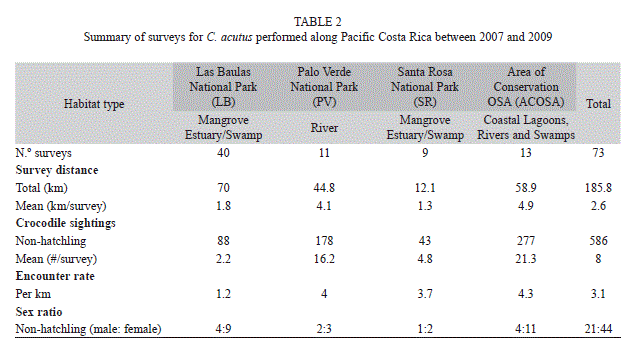
<body><![CDATA[estuaries in SR and LB and the lagoons in SR, PB, PL and PTL were     surveyed. Portions of the navigable length were surveyed at the other     localities (<a href="/img/revistas/rbt/v60n4/a39t1.gif">Table 1</a>).     Surveys in SR were conducted in the Naranjo     Estuary and the Laguna el Limbo roughly one kilometer to the South. One     survey was conducted on Nancite Beach approximately one kilometer to     the North. Survey lengths (<a href="/img/revistas/rbt/v60n4/a39t2.gif">Table     2</a>) were calculated on ArcMap 9.3.1     using the start and end points of each survey as determined by GPS.     Crocodiles were only counted during the survey and were not counted     ]]></body>
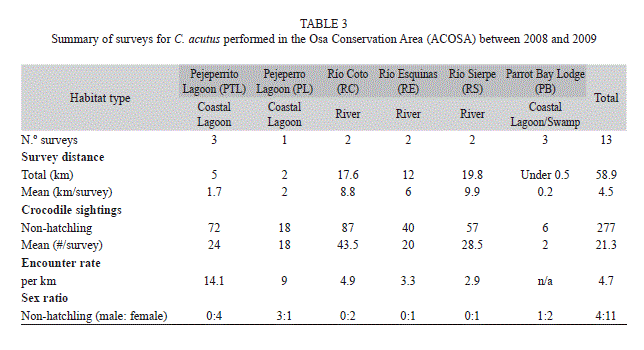
<body><![CDATA[when returning after the survey. We conducted between 12 and 40 surveys     in the four main areas studied on the Pacific coast (<a      href="/img/revistas/rbt/v60n4/a39t2.gif">Table 2</a>) with an     average of 18 surveys per locality. We conducted a minimum of one and a     maximum of three surveys per river or lagoon within ACOSA (<a      href="/img/revistas/rbt/v60n4/a39t3.gif">Table 3</a>)     with an average of 2.2 surveys per location.<br      style="font-family: verdana;">     </span></font><br style="font-family: verdana;">     <font size="2"><span style="font-family: verdana;">We recorded a     ]]></body>
<body><![CDATA[location with a GPS,     salinity (parts per thousand, ppt), and air and water temperatures     (&ordm;C) for all crocodiles observed. Indication of nesting activity     was recorded by either finding a nest or the presence of hatchlings in     the estuary. Tide measurements were obtained from Port Quepos or     Puntarenas (Central Pacific, Costa Rica). All boat surveys in the     Naranjo Estuary (SR) were conducted during high tide when the waters     were navigable. We conducted walking surveys in SR during low tide.     Surveys were conducted during all tide cycles in LB, PV and ACOSA.</span></font><br      style="font-family: verdana;">     ]]></body>
<body><![CDATA[<font size="2"></font><br style="font-family: verdana;">     <font size="2"><span style="font-family: verdana;"><span      style="font-weight: bold;">Crocodile Capture:</span> We attempted to     capture all crocodiles observed using the breakaway snare method     (Hutton <span style="font-style: italic;">et al</span>. 1987, Hutton     &amp; Woodhouse 1989), snake tongs or by     hand. Crocodiles were individually marked by removing caudal scutes in     a numbered sequence (Mazzotti 1983, Richardson <span      style="font-style: italic;">et al</span>. 2002). This     technique has been utilized in numerous studies and does not adversely     ]]></body>
<body><![CDATA[affect crocodiles (Gaby <span style="font-style: italic;">et al</span>     1985, Kushlan &amp; Mazzotti 1989a,     Jennings <span style="font-style: italic;">et al</span>. 1991, Leslie     1997, Davis <span style="font-style: italic;">et al</span>. 2001,     Dever &amp;     Densmore 2001). We measured head length (HL; measured from the tip of     the snout to the posterior edge of the supra-occipital bone),     snout-vent length (SVL; measure from the tip of the snout to the     posteR&iacute;or end of vent), total length (TL; measured from tip of     snout to tip of tail), tail girth (TG; measured at the fourth whorl at     ]]></body>
<body><![CDATA[the base of the tail) in centimeters, mass (grams), and determined sex     of animals &gt;0.75m TL. Crocodiles were released into the water at the     capture site upon completion of measurements.</span></font><br      style="font-family: verdana;">     <font size="2"></font><br style="font-family: verdana;">     <font size="2"><span style="font-family: verdana;"><span      style="font-weight: bold;">Data Analysis:</span> Crocodiles were     separated into four size classes: hatchlings (&lt;0.5m), juveniles     (0.5m-1.25m), sub-adults (1.25m-2.25m) and&nbsp; adults&nbsp;     (&gt;2.25m)&nbsp; (Kushlan&nbsp; &amp;&nbsp; Mazzotti 1989a). The size     ]]></body>
<body><![CDATA[class distribution was calculated as the percentage of crocodiles     sighted or&nbsp; captured&nbsp; in&nbsp; each&nbsp; size&nbsp;     class.&nbsp; Individuals that could not be placed into a size class     were recorded as eyeshine only. We calculated encounter rates for each     location as total number of non-hatchling crocodiles sighted per     kilometer surveyed (<a href="/img/revistas/rbt/v60n4/a39t2.gif">Tables 2</a>     and <a href="/img/revistas/rbt/v60n4/a39t3.gif">3</a>). Hatchlings     were not included in     encounter rates due to their high mortality rate. We compared the     salinity of crocodile sightings and captures within and between sites     ]]></body>
<body><![CDATA[using an analysis of variance (ANOVA).</span></font><br      style="font-family: verdana;">     <font size="2"></font><br style="font-family: verdana;">     <font style="font-weight: bold;" size="3"><span      style="font-family: verdana;">Results</span></font><br      style="font-family: verdana;">     <font size="2"></font><br style="font-family: verdana;">     <font size="2"><span style="font-family: verdana;">We conducted 73     crocodile surveys     on the Pacific coast of Costa Rica covering 185.8km of&nbsp;     ]]></body>
<body><![CDATA[crocodile&nbsp; habitat&nbsp; (<a      href="/img/revistas/rbt/v60n4/a39t2.gif">Tables&nbsp; 2</a>&nbsp;     and&nbsp; <a href="/img/revistas/rbt/v60n4/a39t3.gif">3</a>).&nbsp;     50% of surveys were conducted in the Tamarindo Estuary of Las Baulas     National Park; the remainder of the surveys were spread between Palo     Verde National Park (Tempisque River), Santa Rosa National Park     (Naranjo Estuary and Laguna el Limbo) and the Osa Conservation Area     (<a href="/img/revistas/rbt/v60n4/a39t2.gif">Tables 2</a> and <a      href="/img/revistas/rbt/v60n4/a39t3.gif">3</a>). We observed     crocodiles during all surveys.</span></font><br     ]]></body>
<body><![CDATA[ style="font-family: verdana;">     <font size="2"></font><br style="font-family: verdana;">     <font size="2"><span style="font-family: verdana;">We observed a total     of 763     crocodiles (586 non-hatchling; <a      href="/img/revistas/rbt/v60n4/a39t2.gif">Table 2</a>) over the Pacific     coast with an     average of 8 non-hatchling crocodiles per survey. The spectacled     caiman, <span style="font-style: italic;">Caiman crocodilus</span>,&nbsp;     was&nbsp; encountered&nbsp; in&nbsp;     ]]></body>
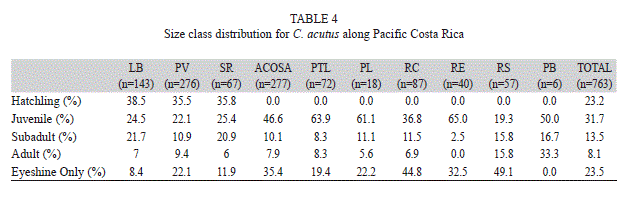
<body><![CDATA[the ACOSA making up 17% of all encounters with the remainder <span      style="font-style: italic;">C. acutus</span>     or eye shine. Over 89% (n=548) of crocodiles for which a size could be     estimated or directly measured were &lt;2.25m (reproductive size; <a      href="/img/revistas/rbt/v60n4/a39t4.gif">Table     4</a>).</span></font><br style="font-family: verdana;">     <font size="2"></font><br style="font-family: verdana;">     <font size="2"><span style="font-family: verdana;">The mean encounter     rate over all     areas was 3.1 crocodiles/km with the highest encounter rate occurring     ]]></body>
<body><![CDATA[in the ACOSA (4.3 crocodiles/ km). Encounter rates differed between     sites (ANOVA, F=13.845, p&#8804;0.01). The sex ratio over all locations was     approximately 1:2 males to females (<a      href="/img/revistas/rbt/v60n4/a39t2.gif">Table 2</a>).</span></font><br      style="font-family: verdana;">     <font size="2"></font><br style="font-family: verdana;">     <font size="2"><span style="font-family: verdana;"><span      style="font-weight: bold;">Las Baulas National Park (LB):</span> We     conducted 40 surveys (54.5% of total) in LB covering 70km of crocodile     habitat (<a href="/img/revistas/rbt/v60n4/a39t2.gif">Table 2</a>).     ]]></body>
<body><![CDATA[The&nbsp; majority&nbsp; of&nbsp; the&nbsp;     surveys&nbsp; (39&nbsp; out&nbsp; of&nbsp; 40) were conducted in the     Tamarindo Estuary. One survey was conducted in the San Francisco     Estuary&nbsp; to&nbsp; the&nbsp; South.&nbsp; Overall,&nbsp; we&nbsp;     observed 88 non-hatchlings (1.2 crocodiles/km) with an average of 2.2     per survey. We classified over 60% (n=90) of the crocodiles as     hatchlings or juveniles (<a href="/img/revistas/rbt/v60n4/a39t4.gif">Table     4</a>). Crocodiles were not distributed in     the estuary according to size class with&nbsp; the&nbsp;     exception&nbsp; of&nbsp; hatchlings,&nbsp; who&nbsp; were only     ]]></body>
<body><![CDATA[encountered in the right branch of the estuary moving upstream which     had significantly lower salinity values. The average salinity value of     hatchling observations was 9.4ppt which was significantly lower than     the average salinity of all crocodile observations (21.8ppt, ANOVA,     F=40.14, p&lt;0.001).</span></font><br style="font-family: verdana;">     <font size="2"></font><br style="font-family: verdana;">     <font size="2"><span style="font-family: verdana;">Individuals captured     ranged in size     from hatchlings to adults (30.8cm-347cm). Hatchlings were     35.1&plusmn;4.5cm in TL (n=31); juveniles were 76.7&plusmn;28.2cm in TL     ]]></body>
<body><![CDATA[(n=23); subadults were 186.8&plusmn;25.3cm in TL (n=14); and adults     were&nbsp; 238.0&plusmn;8.7cm&nbsp; in TL (n=4). The&nbsp; largest     adult encountered was 347cm. There was a bias towards catching smaller     crocodiles in all locations due to the weariness of larger animals. The     sex ratio of captured non-hatchling crocodiles was approximately 1:2     (males:females).</span></font><br style="font-family: verdana;">     <font size="2"></font><br style="font-family: verdana;">     <font size="2"><span style="font-family: verdana;"><span      style="font-weight: bold;">Palo Verde National Park (PV):</span> We     conducted 11 surveys (15.1% of total) on the Tempisque River covering     ]]></body>
<body><![CDATA[44.8km of crocodile habitat (<a href="/img/revistas/rbt/v60n4/a39t2.gif">Table     2</a>). We observed 178 nonhatchling (4     crocodiles/km) with an average of 16.2 non-hatchlings per survey. The     sex ratio of captured non-hatchling crocodiles was 2:3 (males: females).</span></font><br      style="font-family: verdana;">     <font size="2"></font><br style="font-family: verdana;">     <font size="2"><span style="font-family: verdana;">Individuals&nbsp;     ranged&nbsp;     in&nbsp; size&nbsp; from&nbsp; hatchling&nbsp;&nbsp; to&nbsp;&nbsp;     adult&nbsp;&nbsp; (30cm-314cm).&nbsp;&nbsp; Hatchlings were&nbsp;&nbsp;     ]]></body>
<body><![CDATA[34.8&plusmn;3.1cm&nbsp;&nbsp; TL&nbsp;&nbsp; (n=32);&nbsp;&nbsp;     juveniles were 79.1&plusmn;15.1cm in TL (n=22); subadults were 166.5cm     in TL (n=1); and adults were 291.1&plusmn;24.6cm in TL (n=3). Over 55%     (n=159) of crocodiles observed were hatchlings or juveniles (<a      href="/img/revistas/rbt/v60n4/a39t4.gif">Table 4</a>).     Crocodiles were not distributed in the river according to size class.     The average salinity at all observations was 1.6ppt and did not differ     between size classes (ANOVA, F=0.312, p=0.82).</span></font><br      style="font-family: verdana;">     <font size="2"></font><br style="font-family: verdana;">     ]]></body>
<body><![CDATA[<font size="2"><span style="font-family: verdana;"><span      style="font-weight: bold;">Santa Rosa National Park (SR):</span> We     conducted 9 surveys (12.3% of the total) in SR covering 12.1km (<a      href="/img/revistas/rbt/v60n4/a39t2.gif">Table     2</a>). A large crocodile (approximately&nbsp; 3.5m)&nbsp; was&nbsp;     known&nbsp; to&nbsp; live&nbsp; in the Nancite Estuary (Shaya Honovar,     personal&nbsp; communication).&nbsp; This&nbsp; individual&nbsp; was     not observed. We observed 43 non-hatchling crocodiles     (3.7crocodiles/km) with an average of 4.8 non-hatchling crocodile per     survey. Sex ratio of captured non-hatchling crocodiles was 1:2 (male:     ]]></body>
<body><![CDATA[female).</span></font><br style="font-family: verdana;">     <font size="2"></font><br style="font-family: verdana;">     <font size="2"><span style="font-family: verdana;">Individuals ranged     in size from     hatchling to sub-adult (31.7cm-184.4cm). Hatchlings were     32.6&plusmn;0.6cm TL (n=13); juveniles were 79.6&plusmn;25.7cm&nbsp;     TL&nbsp; (n=8);&nbsp; and&nbsp; subadults&nbsp; were     144.0&plusmn;23.5cm TL (n=5) with no adults captured.&nbsp; Two&nbsp;     adults&nbsp; (approximately&nbsp; 2.5m&nbsp; and 3m)&nbsp; were&nbsp;     observed&nbsp; but&nbsp; not&nbsp; captured.&nbsp; Over 60% (n=41) of     ]]></body>
<body><![CDATA[the encountered crocodiles were hatchlings&nbsp; or&nbsp;     juveniles&nbsp; (<a href="/img/revistas/rbt/v60n4/a39t4.gif">Table 4</a>).&nbsp;     No&nbsp; hatchlings were observed in     the estuary. Juveniles were&nbsp; only&nbsp; encountered&nbsp; in&nbsp;     the&nbsp; upper&nbsp; reaches of the estuary. All size classes were     observed in the Laguna el Limbo, with hatchlings only being observed in     the right branch. Hatchlings were found in lower salinities than other     size classes (ANOVA, F=11, p&lt;0.001). Average salinity of the estuary     and lagoon were 5.2ppt and 0.9ppt respectively.</span></font><br      style="font-family: verdana;">     ]]></body>
<body><![CDATA[<font size="2"></font><br style="font-family: verdana;">     <font size="2"><span style="font-family: verdana;"><span      style="font-weight: bold;">Osa Conservation Area (ACOSA):</span> We     conducted 13 surveys (17% of the total) in ACOSA covering 58.9km     (<a href="/img/revistas/rbt/v60n4/a39t2.gif">Tables 2</a> and <a      href="/img/revistas/rbt/v60n4/a39t3.gif">3</a>). We observed a total     of 277 non-hatchling crocodiles     (4.3 crocodiles/km). Individual encounter rates ranged from 2.9 (RS) to     14.1 (PTL) crocodiles/km with non-hatchling observations ranging from 6     (PB) to 87 (RC) with an average of 21.3 non-hatchling crocodiles per     ]]></body>
<body><![CDATA[survey. The sex ratio of non-hatchling crocodiles was approximately     4:11 (male: female).</span></font><br style="font-family: verdana;">     <font size="2"></font><br style="font-family: verdana;">     <font size="2"><span style="font-family: verdana;">Individuals&nbsp;     ranged&nbsp;     in&nbsp; size&nbsp; from&nbsp; juvenile to adult (50.2-273.7cm).     Juveniles were 71.6&plusmn;17.1cm&nbsp;&nbsp; TL&nbsp;&nbsp;     (n=35);&nbsp;&nbsp; subadults&nbsp;&nbsp; were     150.5&plusmn;21.3cm&nbsp; TL&nbsp; (n=3);&nbsp; and&nbsp; adults&nbsp;     were 273.7cm TL (n=1).&nbsp; No&nbsp; observed&nbsp; individuals were     ]]></body>
<body><![CDATA[classified as hatchlings and approximately 46% were classified as     juveniles (n=133, <a href="/img/revistas/rbt/v60n4/a39t4.gif">Table 4</a>).</span></font><br      style="font-family: verdana;">     <font size="2"></font><br style="font-family: verdana;">     <font size="2"></font><br style="font-family: verdana;">     <font style="font-weight: bold;" size="3"><span      style="font-family: verdana;">Discussion</span></font><br      style="font-family: verdana;">     <font size="2"></font><br style="font-family: verdana;">     <font size="2"><span style="font-family: verdana;">There are few     ]]></body>
<body><![CDATA[population     assessments of <span style="font-style: italic;">C.&nbsp; acutus</span>&nbsp;     from&nbsp; Costa&nbsp; Rica,&nbsp;     with&nbsp; those&nbsp; that have been undertaken having been conducted     in Central and Northern rivers (Sasa &amp; Chaves 1992, Bola&ntilde;os     <span style="font-style: italic;">et al</span>. 1996, Porras 2004,     Barrantes 2008). This study was the first to     assess the population status of <span style="font-style: italic;">C.     acutus</span> in Las Baulas and Santa Rosa     National Parks.</span></font><br style="font-family: verdana;">     ]]></body>
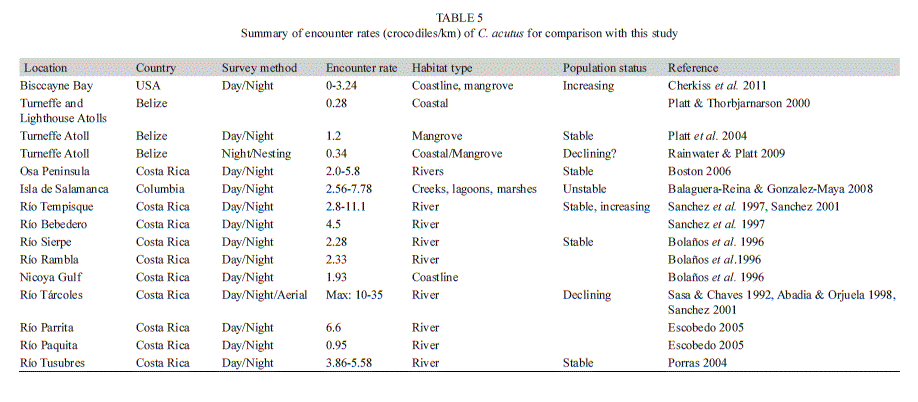
<body><![CDATA[<font size="2"></font><br style="font-family: verdana;">     <font size="2"><span style="font-family: verdana;"><span      style="font-style: italic;">Crocodylus acutus</span> encounter rates     on the Pacific coast of Costa Rica were comparable to&nbsp; the&nbsp;     majority&nbsp; of&nbsp; other&nbsp; population&nbsp; surveys on <span      style="font-style: italic;">C.     acutus</span> populations (<a href="/img/revistas/rbt/v60n4/a39t5.gif">Table     5</a>). These encounter rates support the     hypothesis that <span style="font-style: italic;">C. acutus</span>     populations within Costa Rica are large (Ross     ]]></body>
<body><![CDATA[1998).</span></font><br style="font-family: verdana;">     <font size="2"></font><br style="font-family: verdana;">     <font size="2"><span style="font-family: verdana;">The American     crocodile is known to     prefer habitats&nbsp; of&nbsp; lower&nbsp; salinity&nbsp;     (Kushlan&nbsp; &amp;&nbsp; Mazzotti 1989a, Mazzotti <span      style="font-style: italic;">et al</span>. 2007).     Crocodiles in this study were encountered in water with salinities     ranging from 0ppt to over 50ppt. However, most (61%) encounters     occurred in water with lower salinities (0-5ppt). Hatchlings were     ]]></body>
<body><![CDATA[always encountered in lower saline environments than larger size     classes with the exception of the Tempisque River in Palo Verde     National Park where all size classes were in water of low salinity. All     surveys on the Tempisque River were conducted further up river and     salinity values of individual encounters did not differ significantly     among size classes.</span></font><br style="font-family: verdana;">     <font size="2"></font><br style="font-family: verdana;">     <font size="2"><span style="font-family: verdana;">Crocodiles were     encountered at     different rates during our surveys (<a     ]]></body>
<body><![CDATA[ href="/img/revistas/rbt/v60n4/a39t2.gif">Tables 2 </a>and <a      href="/img/revistas/rbt/v60n4/a39t3.gif">3</a>) with the highest     encounter rates within the ACOSA. These values may be skewed due to the     large numbers of individuals encountered in the Pejeperrito and     Pejeperro Lagoons and the timing of our surveys which coincided with     nesting season (<a href="/img/revistas/rbt/v60n4/a39t3.gif">Table 3</a>).     These neighboring lagoons are small in size     and had large numbers of crocodiles. This is possibly due to an     abundance of food, protection from ocean currents and presence of     suitable nesting habitat. The highest encounter rate within the     ]]></body>
<body><![CDATA[Northwestern province of Guanacaste occurred in the Tempisque River     (PV) which is known to have a large crocodile population (Ross 1998,     Thorbjarnarson <span style="font-style: italic;">et al</span>. 2006,     Barrantes 2008). Since only a small number     of surveys were conducted at each site, it is probable that the     crocodile density along the Pacific coast of Costa Rica has been     underestimated in this study, which has been shown during studies of     other crocodiles (<span style="font-style: italic;">C. porosus</span>;     Stuebing <span style="font-style: italic;">et al</span>. 1994). We     recommend long     ]]></body>
<body><![CDATA[term population monitoring of&nbsp; crocodile&nbsp; populations&nbsp;     in&nbsp; different&nbsp; parks in Costa Rica.</span></font><br      style="font-family: verdana;">     <font size="2"></font><br style="font-family: verdana;">     <font size="2"><span style="font-family: verdana;">The majority of all     crocodiles     encountered (54.9%)&nbsp; in&nbsp; each&nbsp; population&nbsp;     were&nbsp; hatchlings and juveniles. Very few large adult animals     (8.1%) were observed in this study. The smallest size classes were     present in the highest numbers with frequencies decreasing as TL     ]]></body>
<body><![CDATA[increased. The majority (86%) of the crocodiles captured during this     study were smaller than 1.5m. Larger crocodiles are inherently more     &#8216;wary&#8217; and thus less likely to be observed (Messel <span      style="font-style: italic;">et al</span>. 1981, Ouboter     &amp; Nanhoe 1989). Therefore, they may be underestimated in this     study. This low number of adults is consistent with the results of     other studies (Webb <span style="font-style: italic;">et al</span>.     1984, Kushlan &amp; Mazzotti 1989a, Ouboter     &amp; Nanhoe 1989, Stuebing <span style="font-style: italic;">et al</span>.     1994, Read <span style="font-style: italic;">et al</span>. 2004,     ]]></body>
<body><![CDATA[Cherkiss <span style="font-style: italic;">et     al</span>. 2011) and could be indicative of a recovering population     (Ouboter     &amp; Nanhoe 1989). If hatchlings were excluded, roughly 40% of the     entire coast and each of the Northern populations were composed of     juveniles. Many of the sites in ACOSA were close to or greater than 50%     juvenile (<a href="/img/revistas/rbt/v60n4/a39t3.gif">Table 3</a>).     Therefore, further work is needed to determine the     size structure and growth rates of <span style="font-style: italic;">C.     acutus</span> in Costa Rica to better     ]]></body>
<body><![CDATA[understand the overall population structure and to ensure that good     environmental conditions are maintained.</span></font><br      style="font-family: verdana;">     <font size="2"></font><br style="font-family: verdana;">     <font size="2"><span style="font-family: verdana;">Distribution of the     American     crocodile populations in Florida are known to change seasonally for     nesting, feeding or to find new territories, and individuals are known     to have large over lapping activity areas (Kushlan &amp; Mazzotti     1989a). Shoreline development and other anthropogenic effects may limit     ]]></body>
<body><![CDATA[a crocodile&#8217;s ability to find proper nesting and feeding areas along     Pacific Costa Rica. The patchy distribution of suitable habitat within     Costa Rica may make it necessary for crocodiles to move between areas.     We noted during these surveys that some of the estuaries studied did     not have suitable nesting habitat. Interviews with local fisherman also     supported this observation. We hypothesize that crocodiles move between     neighboring estuaries to fulfill different needs. For example, only     large crocodiles have ever been observed in the San Francisco Estuary     of Las Baulas Park. It is likely that adults from the larger Tamarindo     Estuary to the North are moving to this estuary for feeding. Salinities     ]]></body>
<body><![CDATA[are also higher in the San Francisco Estuary suggesting that this may     not be suitable nursery habitat. However, we observed hatchlings in the     Tamarindo Estuary so it appears to be the nesting area for this     population. It is possible that a similar relationship exists between     other estuaries and coastal lagoons along the Pacific coast of Costa     Rica. Detailed studies investigating the migration of crocodiles among     and between esturaries are needed to further understand this phenomenon.</span></font><br      style="font-family: verdana;">     <font size="2"></font><br style="font-family: verdana;">     <font size="2"><span style="font-family: verdana;"><span     ]]></body>
<body><![CDATA[ style="font-weight: bold;">Conservation Implications:</span>     Protection of the American crocodile and coastal habitat in Costa Rica     is crucial to its continued survival. The central location of these     populations within the species range makes them important in their     regional management. The ability of individual crocodiles to migrate     long distances (Webb &amp; Messel 1978, Kushlan &amp; Mazzotti 1989a,     Kay 2004, Read <span style="font-style: italic;">et al</span>. 2007)     illustrates the importance of protecting     all potential crocodile habitat. <span style="font-style: italic;">Crocodylus     acutus</span> habitats in Costa     ]]></body>
<body><![CDATA[Rica are linked by gene flow (Cotroneo 2010), indicating that <span      style="font-style: italic;">C. acutus</span>     populations exist as metapopulations along the Pacific coast of Costa     Rica. Therefore, management of the American crocodile in Costa Rica     should be aimed at protecting and conserving all populations</span></font><br      style="font-family: verdana;">     <font size="2"></font><br style="font-family: verdana;">     <font size="2"><span style="font-family: verdana;">Hunting and habitat     alteration have     confined <span style="font-style: italic;">C. acutus</span>     ]]></body>
<body><![CDATA[populations to disjunct population&nbsp;     centers&nbsp; throughout&nbsp; its&nbsp; range&nbsp; (Kushlan 1988,     Thorbjarnarson <span style="font-style: italic;">et al</span>. 2006)     including Costa&nbsp; Rica.&nbsp; The&nbsp;     largest&nbsp; potential&nbsp; threat&nbsp; to <span      style="font-style: italic;">C.&nbsp; acutus</span>&nbsp;     in&nbsp; Costa&nbsp; Rica&nbsp; is&nbsp; habitat&nbsp; destruction and     fragmentation (Thorbjarnarson <span style="font-style: italic;">et al</span>.     2006, Thorbjarnarson 2010). Land     use has increased exponentially in Costa Rica due to its growing urban     ]]></body>
<body><![CDATA[and rural populations. It has especially intensified within the Central     Valley and has expanded into more rural areas with deforestation being     the key disturbance to the natural ecosystems (Veldkamp &amp; Fresco     1997). Impacts of anthropogenic land use adversely affects biodiversity     in Costa Rica (Dale <span style="font-style: italic;">et al</span>.     1994, Daily <span style="font-style: italic;">et al</span>. 2001). The     Tarcoles     River, which drains the urbanized central valley of Costa Rica, is one     of the most polluted rivers&nbsp; in&nbsp; Central America&nbsp;     (Fuller&nbsp; <span style="font-style: italic;">et&nbsp; al</span>.&nbsp;     ]]></body>
<body><![CDATA[1990). Environmental contaminants have     been found in the scutes of crocodiles captured in the Tarcoles and     Tempisque Rivers (Rainwater <span style="font-style: italic;">et al</span>.     2007, Rainwater <span style="font-style: italic;">et al</span>. 2011).     Our     results indicate that the crocodile populations studied in Pacific     Costa Rica are large, although they may be recovering from past     reductions due to the large numbers of juveniles observed. It is     important to maintain the environmental conditions necessary to ensure     the continued survival of these populations.</span></font><br     ]]></body>
<body><![CDATA[ style="font-family: verdana;">     <font size="2"></font><br style="font-family: verdana;">     <font size="2"></font><br style="font-family: verdana;">     <font style="font-weight: bold;" size="3"><span      style="font-family: verdana;">Acknowledgments</span></font><br      style="font-family: verdana;">     <font size="2"></font><br style="font-family: verdana;">     <font size="2"><span style="font-family: verdana;">We would like to     thank everyone     that helped us in the field especially Bernal Cortes, Luis Fernando     ]]></body>
<body><![CDATA[Lopez Lara, Juan Jose Victor Villalobos, Guillermo Briceo, Ademar     Rosales, Fabricio&nbsp; Alvarez,&nbsp; Issac&nbsp; Ehresman,&nbsp;     Gareth Blakemore and Jim Tamarack. We would also like to thank the     Ministerio del Ambiente, Energa y Telecomunicaciones (MINAET) and the     Sistema Nacional de &Aacute;reas de Conservaci&oacute;n (SINAC),     especially Rodney Piedra, Jose Quiroz and Roger Blanco, for research     permits. This work was largely supported by the Betz Chair of     Environmental Sciences at Drexel University, and the Sophie Danforth     Conservation Biology Fund from the Roger Williams Park Zoo in Rhode     Island. The field research in Las Baulas National Park was partially     ]]></body>
<body><![CDATA[supported by the Leatherback Trust. Research in the Osa Peninsula was     also partially funded by the El Tigre Fund. The Leatherback Trust     provided&nbsp; vehicles&nbsp; in&nbsp; Guanacaste,&nbsp; lodging&nbsp;     at the Goldring Gund Marine Biology Station at Playa Grande, and a boat     and motor for many of the crocodile surveys.</span></font><br      style="font-family: verdana;">     <font size="2"></font><br style="font-family: verdana;">     <font size="2"></font>     <hr style="width: 100%; height: 2px;"><br style="font-family: verdana;">     <font style="font-weight: bold;" size="3"><span     ]]></body>
<body><![CDATA[ style="font-family: verdana;">References</span></font><br      style="font-family: verdana;">     <font size="2"></font><br style="font-family: verdana;">     <font size="2"><span style="font-family: verdana;">Abadia, G. &amp;     M.F. Orjuela.     1998. <span style="font-style: italic;">Crocodylus acutus</span> in     the Tarcoles River, Costa Rica,&nbsp; p.     378. <span style="font-style: italic;">In</span> Proceedings of&nbsp;     the&nbsp; Fourteenth&nbsp; Working&nbsp;     Meeting&nbsp; of&nbsp; Crocodile Specialist Group (eds.). IUCN Gland,     ]]></body>
<body><![CDATA[<!-- ref -->Swizerland.    &nbsp;&nbsp;&nbsp;&nbsp;&nbsp;&nbsp;&nbsp;&nbsp;[&#160;<a href="javascript:void(0);" onclick="javascript: window.open('/scielo.php?script=sci_nlinks&ref=1823603&pid=S0034-7744201200040003500001&lng=','','width=640,height=500,resizable=yes,scrollbars=1,menubar=yes,');">Links</a>&#160;]<!-- end-ref --><!-- ref --></span></font><br style="font-family: verdana;"> <font size="2"></font><br style="font-family: verdana;"> <font size="2"><span style="font-family: verdana;">Baillie,&nbsp; J.E.M.,&nbsp; C.&nbsp; Hilton-Taylor&nbsp; &amp;&nbsp; S.N.&nbsp; Stuart.&nbsp; 2004. 2004 IUCN Red List of Threatened Species: A Global Species Assessment.&nbsp; IUCN, Cambridge, United Kingdom.    &nbsp;&nbsp;&nbsp;&nbsp;&nbsp;&nbsp;&nbsp;&nbsp;[&#160;<a href="javascript:void(0);" onclick="javascript: window.open('/scielo.php?script=sci_nlinks&ref=1823604&pid=S0034-7744201200040003500002&lng=','','width=640,height=500,resizable=yes,scrollbars=1,menubar=yes,');">Links</a>&#160;]<!-- end-ref --><!-- ref --></span></font><br  style="font-family: verdana;"> <font size="2"></font><br style="font-family: verdana;"> <font size="2"><span style="font-family: verdana;">Balaguera-Reina, S.A. &amp; J.F. Gonzalez-Maya. 2008. Population structure, density, and&nbsp; habitat of <span style="font-style: italic;">Crocodylus acutus</span> Cuvier&nbsp; 1807&nbsp; in the Via Parque Isla de Salamanca, Magdelena Department, Columbia. Herpetotropicos 4: 59-63.    &nbsp;&nbsp;&nbsp;&nbsp;&nbsp;&nbsp;&nbsp;&nbsp;[&#160;<a href="javascript:void(0);" onclick="javascript: window.open('/scielo.php?script=sci_nlinks&ref=1823605&pid=S0034-7744201200040003500003&lng=','','width=640,height=500,resizable=yes,scrollbars=1,menubar=yes,');">Links</a>&#160;]<!-- end-ref --><!-- ref --></span></font><br  style="font-family: verdana;"> <font size="2"></font><br style="font-family: verdana;"> <font size="2"><span style="font-family: verdana;">Barrantes, L.D. 2008. Determinaci&oacute;n de la&nbsp; variabilidad gen&eacute;tica y flujo gen&eacute;tico&nbsp; entre las poblaciones de cocodrilo (<span  style="font-style: italic;">Crocodylus acutus</span>) de los r&iacute;os Tempisque, T&aacute;rcoles y el complejo T&eacute;rraba-Sierpe; con menci&oacute;n especial a la condici&oacute;n de la poblaci&oacute;n del R&iacute;o Tempisque. Tesis de Maestr&iacute;a, Universidad&nbsp; Nacional, Heredia, Costa Rica.    &nbsp;&nbsp;&nbsp;&nbsp;&nbsp;&nbsp;&nbsp;&nbsp;[&#160;<a href="javascript:void(0);" onclick="javascript: window.open('/scielo.php?script=sci_nlinks&ref=1823606&pid=S0034-7744201200040003500004&lng=','','width=640,height=500,resizable=yes,scrollbars=1,menubar=yes,');">Links</a>&#160;]<!-- end-ref --><!-- ref --></span></font><br  style="font-family: verdana;"> <font size="2"></font><br style="font-family: verdana;"> <font size="2"><span style="font-family: verdana;">Bayliss,&nbsp; P. 1987. Survey methods and&nbsp; monitoring within crocodile management&nbsp; programmes, p. 157-175. <span style="font-style: italic;">In </span>G.J.W. Webb, S.C. Manolis &amp; P.J. Whitehead (eds.). Wildlife&nbsp; management:&nbsp;&nbsp; Crocodiles&nbsp; and&nbsp; alligators. Surrey Beatty &amp; Sons, Australia.    &nbsp;&nbsp;&nbsp;&nbsp;&nbsp;&nbsp;&nbsp;&nbsp;[&#160;<a href="javascript:void(0);" onclick="javascript: window.open('/scielo.php?script=sci_nlinks&ref=1823607&pid=S0034-7744201200040003500005&lng=','','width=640,height=500,resizable=yes,scrollbars=1,menubar=yes,');">Links</a>&#160;]<!-- end-ref --><!-- ref --></span></font><br style="font-family: verdana;"> <font size="2"></font><br style="font-family: verdana;"> <font size="2"><span style="font-family: verdana;">Bola&ntilde;os,&nbsp; J., L. S&aacute;nchez &amp; L. Piedra. 1996.&nbsp; Inventario y estructura poblacional de crocodrilos en tres zonas de Costa Rica. Rev. Biol. Trop. 44/45: 283-287.    &nbsp;&nbsp;&nbsp;&nbsp;&nbsp;&nbsp;&nbsp;&nbsp;[&#160;<a href="javascript:void(0);" onclick="javascript: window.open('/scielo.php?script=sci_nlinks&ref=1823608&pid=S0034-7744201200040003500006&lng=','','width=640,height=500,resizable=yes,scrollbars=1,menubar=yes,');">Links</a>&#160;]<!-- end-ref --><!-- ref --></span></font><br style="font-family: verdana;"> <font size="2"></font><br style="font-family: verdana;"> <font size="2"><span style="font-family: verdana;">Boston, M. 2006. Recent surveys of the American crocodile (<span style="font-style: italic;">Crocodylus acutus</span>) in the Osa Peninsula Region (ACOSA) of&nbsp; southwestern Costa Rica: Justification for&nbsp;&nbsp; long&nbsp; term&nbsp; studies&nbsp; and&nbsp;&nbsp; conservation.&nbsp; Friends of&nbsp; the&nbsp; Osa&nbsp;&nbsp; Newsletter. (Available online: http:// www.southerncostaricamap.com/member-listing. php ? ID=149 &amp; url=/articles.php &amp; get=).    &nbsp;&nbsp;&nbsp;&nbsp;&nbsp;&nbsp;&nbsp;&nbsp;[&#160;<a href="javascript:void(0);" onclick="javascript: window.open('/scielo.php?script=sci_nlinks&ref=1823609&pid=S0034-7744201200040003500007&lng=','','width=640,height=500,resizable=yes,scrollbars=1,menubar=yes,');">Links</a>&#160;]<!-- end-ref --><!-- ref --></span></font><br  style="font-family: verdana;"> <font size="2"></font><br style="font-family: verdana;"> <font size="2"><span style="font-family: verdana;">Boza, M.A. &amp; J.H. Cevo. 2001. Costa Rica National Parks and other Protected&nbsp; Areas.&nbsp; Incafo Costa Rica, San Jos&eacute;, Costa Rica.    &nbsp;&nbsp;&nbsp;&nbsp;&nbsp;&nbsp;&nbsp;&nbsp;[&#160;<a href="javascript:void(0);" onclick="javascript: window.open('/scielo.php?script=sci_nlinks&ref=1823610&pid=S0034-7744201200040003500008&lng=','','width=640,height=500,resizable=yes,scrollbars=1,menubar=yes,');">Links</a>&#160;]<!-- end-ref --><!-- ref --></span></font><br  style="font-family: verdana;"> <font size="2"></font><br style="font-family: verdana;"> <font size="2"><span style="font-family: verdana;">Cherkiss, M.S., S.S. Romanach &amp; F.J. Mazzotti. 2011. The American crocodile in Biscayne Bay, Florida. Estuar. Coast. 34: 529-535.    &nbsp;&nbsp;&nbsp;&nbsp;&nbsp;&nbsp;&nbsp;&nbsp;[&#160;<a href="javascript:void(0);" onclick="javascript: window.open('/scielo.php?script=sci_nlinks&ref=1823611&pid=S0034-7744201200040003500009&lng=','','width=640,height=500,resizable=yes,scrollbars=1,menubar=yes,');">Links</a>&#160;]<!-- end-ref --><!-- ref --></span></font><br  style="font-family: verdana;"> <font size="2"></font><br style="font-family: verdana;"> <font size="2"><span style="font-family: verdana;">Cotroneo, L.A. 2010. Population genetics and conservation of&nbsp; the American&nbsp; crocodile,&nbsp; <span style="font-style: italic;">Crocodylus&nbsp; acutus</span>,&nbsp; on the Pacific coast of Costa Rica. Ph.D. Thesis, Drexel University, Philadelphia, Pennsylvania, USA.    &nbsp;&nbsp;&nbsp;&nbsp;&nbsp;&nbsp;&nbsp;&nbsp;[&#160;<a href="javascript:void(0);" onclick="javascript: window.open('/scielo.php?script=sci_nlinks&ref=1823612&pid=S0034-7744201200040003500010&lng=','','width=640,height=500,resizable=yes,scrollbars=1,menubar=yes,');">Links</a>&#160;]<!-- end-ref --><!-- ref --></span></font><br  style="font-family: verdana;"> <font size="2"></font><br style="font-family: verdana;"> <font size="2"><span style="font-family: verdana;">Daily, G.C., P.R. Ehrlich &amp; G.A. Sanchez-Azofeifa. 2001. Countryside biogeography: use of human dominated habitats by the avifauna of southern Costa Rica. Ecol. Appl. 11: 1-13.    &nbsp;&nbsp;&nbsp;&nbsp;&nbsp;&nbsp;&nbsp;&nbsp;[&#160;<a href="javascript:void(0);" onclick="javascript: window.open('/scielo.php?script=sci_nlinks&ref=1823613&pid=S0034-7744201200040003500011&lng=','','width=640,height=500,resizable=yes,scrollbars=1,menubar=yes,');">Links</a>&#160;]<!-- end-ref --><!-- ref --></span></font><br style="font-family: verdana;"> <font size="2"></font><br style="font-family: verdana;"> <font size="2"><span style="font-family: verdana;">Dale, V.H., S.M. Pearson, H.L Offerman &amp; R.V. O&#8217;Neill. 1994. Relating patterns of land-use change to faunal biodiversity&nbsp; in&nbsp; Central&nbsp; Amazon.&nbsp; Conserv.&nbsp; Biol.&nbsp; 8: 1027-1036.    &nbsp;&nbsp;&nbsp;&nbsp;&nbsp;&nbsp;&nbsp;&nbsp;[&#160;<a href="javascript:void(0);" onclick="javascript: window.open('/scielo.php?script=sci_nlinks&ref=1823614&pid=S0034-7744201200040003500012&lng=','','width=640,height=500,resizable=yes,scrollbars=1,menubar=yes,');">Links</a>&#160;]<!-- end-ref --><!-- ref --></span></font><br  style="font-family: verdana;"> <font size="2"></font><br style="font-family: verdana;"> <font size="2"><span style="font-family: verdana;">Davis,&nbsp; L.M., T.C. Glenn, R.M. Elsey, H.C.&nbsp; Dessauer &amp; R.H. Sawyer. 2001.&nbsp; Multiple&nbsp; paternity and mating patterns&nbsp; in&nbsp; the American alligator, <span style="font-style: italic;">Alligator&nbsp; mississippiensis</span>. Mol. Ecol. 10: 1011-1024.    &nbsp;&nbsp;&nbsp;&nbsp;&nbsp;&nbsp;&nbsp;&nbsp;[&#160;<a href="javascript:void(0);" onclick="javascript: window.open('/scielo.php?script=sci_nlinks&ref=1823615&pid=S0034-7744201200040003500013&lng=','','width=640,height=500,resizable=yes,scrollbars=1,menubar=yes,');">Links</a>&#160;]<!-- end-ref --><!-- ref --></span></font><br style="font-family: verdana;"> <font size="2"></font><br style="font-family: verdana;"> <font size="2"><span style="font-family: verdana;">Dever, J.A. &amp; L.D. Densmore. 2001.&nbsp; Microsatellite&#8217;s in Morelet&#8217;s crocodile (Crocodylus moreletti) and their utility in&nbsp; addressing crocodilian population&nbsp; genetics questions. J. Herpetol. 35: 541-544.    &nbsp;&nbsp;&nbsp;&nbsp;&nbsp;&nbsp;&nbsp;&nbsp;[&#160;<a href="javascript:void(0);" onclick="javascript: window.open('/scielo.php?script=sci_nlinks&ref=1823616&pid=S0034-7744201200040003500014&lng=','','width=640,height=500,resizable=yes,scrollbars=1,menubar=yes,');">Links</a>&#160;]<!-- end-ref --><!-- ref --></span></font><br  style="font-family: verdana;"> <font size="2"></font><br style="font-family: verdana;"> <font size="2"><span style="font-family: verdana;">Dunson, WA. 1982. Osmoreguation of crocodiles: salinity as a possible limiting factor to <span  style="font-style: italic;">Crocodylus acutus</span> in Florida Bay. Copeia 1982: 374-385.    &nbsp;&nbsp;&nbsp;&nbsp;&nbsp;&nbsp;&nbsp;&nbsp;[&#160;<a href="javascript:void(0);" onclick="javascript: window.open('/scielo.php?script=sci_nlinks&ref=1823617&pid=S0034-7744201200040003500015&lng=','','width=640,height=500,resizable=yes,scrollbars=1,menubar=yes,');">Links</a>&#160;]<!-- end-ref --><!-- ref --></span></font><br  style="font-family: verdana;"> <font size="2"></font><br style="font-family: verdana;"> <font size="2"><span style="font-family: verdana;">Escobedo, A.H. 2005. El lagarto amarillo&nbsp; (<span style="font-style: italic;">Crocodylus acutus</span>, Crocodylia: Crocodylidae): su estado poblacional en dos r&iacute;os del Pac&iacute;fico Central de Costa Rica. Brenesia 63/64: 113-120.    &nbsp;&nbsp;&nbsp;&nbsp;&nbsp;&nbsp;&nbsp;&nbsp;[&#160;<a href="javascript:void(0);" onclick="javascript: window.open('/scielo.php?script=sci_nlinks&ref=1823618&pid=S0034-7744201200040003500016&lng=','','width=640,height=500,resizable=yes,scrollbars=1,menubar=yes,');">Links</a>&#160;]<!-- end-ref --><!-- ref --></span></font><br  style="font-family: verdana;"> <font size="2"></font><br style="font-family: verdana;"> <font size="2"><span style="font-family: verdana;">Frankie, G.W., A. Mata &amp; S.B. Vinson. 2004. Biodiversity conservation in Costa Rica: Learning the lessons in a seasonal dry&nbsp; forest. University of California, Los Angeles, USA.    &nbsp;&nbsp;&nbsp;&nbsp;&nbsp;&nbsp;&nbsp;&nbsp;[&#160;<a href="javascript:void(0);" onclick="javascript: window.open('/scielo.php?script=sci_nlinks&ref=1823619&pid=S0034-7744201200040003500017&lng=','','width=640,height=500,resizable=yes,scrollbars=1,menubar=yes,');">Links</a>&#160;]<!-- end-ref --><!-- ref --></span></font><br style="font-family: verdana;"> <font size="2"></font><br style="font-family: verdana;"> <font size="2"><span style="font-family: verdana;">Fuller, C.C., J.A. Davis, D.J. Cain, P.J. Lamothe, T.L. Fries, G. Fernandez, J.A. Vargas &amp;&nbsp; M.M. Murillo. 1990. Distribution and&nbsp; transport of sediment-bound metal contaminants in the R&iacute;o Grande de&nbsp; T&aacute;rcoles, Costa Rica (Central America). Wat. Res. 24: 805-812.    &nbsp;&nbsp;&nbsp;&nbsp;&nbsp;&nbsp;&nbsp;&nbsp;[&#160;<a href="javascript:void(0);" onclick="javascript: window.open('/scielo.php?script=sci_nlinks&ref=1823620&pid=S0034-7744201200040003500018&lng=','','width=640,height=500,resizable=yes,scrollbars=1,menubar=yes,');">Links</a>&#160;]<!-- end-ref --><!-- ref --></span></font><br  style="font-family: verdana;"> <font size="2"></font><br style="font-family: verdana;"> <font size="2"><span style="font-family: verdana;">Gaby,&nbsp; R.,&nbsp; M.P.&nbsp; McMahon,&nbsp; F.J.&nbsp; Mazzotti,&nbsp; W.N.&nbsp; Gillies &amp;&nbsp; J.R. Wilcox. 1985. Ecology of a&nbsp; population of <span style="font-style: italic;">Crocodylus acutus</span> at a power plant site in Florida. J. Herpetol. 19: 189-198.    &nbsp;&nbsp;&nbsp;&nbsp;&nbsp;&nbsp;&nbsp;&nbsp;[&#160;<a href="javascript:void(0);" onclick="javascript: window.open('/scielo.php?script=sci_nlinks&ref=1823621&pid=S0034-7744201200040003500019&lng=','','width=640,height=500,resizable=yes,scrollbars=1,menubar=yes,');">Links</a>&#160;]<!-- end-ref --><!-- ref --></span></font><br style="font-family: verdana;"> <font size="2"></font><br style="font-family: verdana;"> <font size="2"><span style="font-family: verdana;">Hutton, J.M., J.P. Loveride &amp; D.K. Blake. 1987. Capture methods&nbsp; for&nbsp; the&nbsp; Nile&nbsp; crocodile&nbsp; in&nbsp; Zimbabwe,&nbsp; pp. 243-247. In G.J.W. Webb, S.C. Manolis &amp; P.J. Whitehead (eds.). Wildlife management: Crocodiles and alligators. Surrey Beatty &amp; Sons, Australia.    &nbsp;&nbsp;&nbsp;&nbsp;&nbsp;&nbsp;&nbsp;&nbsp;[&#160;<a href="javascript:void(0);" onclick="javascript: window.open('/scielo.php?script=sci_nlinks&ref=1823622&pid=S0034-7744201200040003500020&lng=','','width=640,height=500,resizable=yes,scrollbars=1,menubar=yes,');">Links</a>&#160;]<!-- end-ref --><!-- ref --></span></font><br  style="font-family: verdana;"> <font size="2"></font><br style="font-family: verdana;"> <font size="2"><span style="font-family: verdana;">Hutton,&nbsp; J.M. &amp; M.E. Woodhouse. 1989.&nbsp; Mark-recapture to assess factors&nbsp; affecting&nbsp; the proportion of a Nile crocodile population seen during spotlight counts at Ngezi, Zimbabwe, and the use&nbsp; of spotlight counts to monitor crocodile&nbsp; abundance. J. Appl. Ecol. 26: 381-395.    &nbsp;&nbsp;&nbsp;&nbsp;&nbsp;&nbsp;&nbsp;&nbsp;[&#160;<a href="javascript:void(0);" onclick="javascript: window.open('/scielo.php?script=sci_nlinks&ref=1823623&pid=S0034-7744201200040003500021&lng=','','width=640,height=500,resizable=yes,scrollbars=1,menubar=yes,');">Links</a>&#160;]<!-- end-ref --><!-- ref --></span></font><br style="font-family: verdana;"> <font size="2"></font><br style="font-family: verdana;"> <font size="2"><span style="font-family: verdana;">Jennings, M.L., D.N. David &amp; K.M. Portier. 1991. Effect of marking techniques on growth and survivorship of hatchling alligators. Wildl. Soc. Bull. 19: 204-207.    &nbsp;&nbsp;&nbsp;&nbsp;&nbsp;&nbsp;&nbsp;&nbsp;[&#160;<a href="javascript:void(0);" onclick="javascript: window.open('/scielo.php?script=sci_nlinks&ref=1823624&pid=S0034-7744201200040003500022&lng=','','width=640,height=500,resizable=yes,scrollbars=1,menubar=yes,');">Links</a>&#160;]<!-- end-ref --><!-- ref --></span></font><br  style="font-family: verdana;"> <font size="2"></font><br style="font-family: verdana;"> <font size="2"><span style="font-family: verdana;">Kay, W.R. 2004. Movements and home&nbsp; ranges of radiotracked <span style="font-style: italic;">Crocodylus&nbsp; porosus</span> in the Cambridge Gulf region of Western Australia. Wildl. Res. 31: 495-508.    &nbsp;&nbsp;&nbsp;&nbsp;&nbsp;&nbsp;&nbsp;&nbsp;[&#160;<a href="javascript:void(0);" onclick="javascript: window.open('/scielo.php?script=sci_nlinks&ref=1823625&pid=S0034-7744201200040003500023&lng=','','width=640,height=500,resizable=yes,scrollbars=1,menubar=yes,');">Links</a>&#160;]<!-- end-ref --><!-- ref --></span></font><br  style="font-family: verdana;"> <font size="2"></font><br style="font-family: verdana;"> <font size="2"><span style="font-family: verdana;">Kushlan, J.A. 1988. Conservation and management of the American crocodile. Environ. Manage. 12: 777-790.    &nbsp;&nbsp;&nbsp;&nbsp;&nbsp;&nbsp;&nbsp;&nbsp;[&#160;<a href="javascript:void(0);" onclick="javascript: window.open('/scielo.php?script=sci_nlinks&ref=1823626&pid=S0034-7744201200040003500024&lng=','','width=640,height=500,resizable=yes,scrollbars=1,menubar=yes,');">Links</a>&#160;]<!-- end-ref --><!-- ref --></span></font><br  style="font-family: verdana;"> <font size="2"></font><br style="font-family: verdana;"> <font size="2"><span style="font-family: verdana;">Kushlan, J.A. &amp; F.J. Mazzotti. 1989a. Population biology of the American crocodile. J. Herpetol. 23: 7-21.    &nbsp;&nbsp;&nbsp;&nbsp;&nbsp;&nbsp;&nbsp;&nbsp;[&#160;<a href="javascript:void(0);" onclick="javascript: window.open('/scielo.php?script=sci_nlinks&ref=1823627&pid=S0034-7744201200040003500025&lng=','','width=640,height=500,resizable=yes,scrollbars=1,menubar=yes,');">Links</a>&#160;]<!-- end-ref --><!-- ref --></span></font><br style="font-family: verdana;"> <font size="2"></font><br style="font-family: verdana;"> <font size="2"><span style="font-family: verdana;">Kushan, J.A. &amp; F.J. Mazzotti. 1989b. Historic and present distribution of the American crocodile in Florida. J. Herpetol. 23: 1-7.    &nbsp;&nbsp;&nbsp;&nbsp;&nbsp;&nbsp;&nbsp;&nbsp;[&#160;<a href="javascript:void(0);" onclick="javascript: window.open('/scielo.php?script=sci_nlinks&ref=1823628&pid=S0034-7744201200040003500026&lng=','','width=640,height=500,resizable=yes,scrollbars=1,menubar=yes,');">Links</a>&#160;]<!-- end-ref --><!-- ref --></span></font><br  style="font-family: verdana;"> <font size="2"></font><br style="font-family: verdana;"> <font size="2"><span style="font-family: verdana;">Leslie, A.J. 1997. The ecology and physiology of the Nile crocodile, <span style="font-style: italic;">Crocodylus&nbsp; niloticus</span>, in Lake St. Lucia, Kwazulu/Natal, South Africa. Ph.D.&nbsp; Thesis. Drexel University, Philadelphia, Pennsylvania, USA.    &nbsp;&nbsp;&nbsp;&nbsp;&nbsp;&nbsp;&nbsp;&nbsp;[&#160;<a href="javascript:void(0);" onclick="javascript: window.open('/scielo.php?script=sci_nlinks&ref=1823629&pid=S0034-7744201200040003500027&lng=','','width=640,height=500,resizable=yes,scrollbars=1,menubar=yes,');">Links</a>&#160;]<!-- end-ref --><!-- ref --></span></font><br  style="font-family: verdana;"> <font size="2"></font><br style="font-family: verdana;"> <font size="2"><span style="font-family: verdana;">Mazzotti, F.J. 1983. The ecology of <span style="font-style: italic;">Crocodylus acutus</span> in Florida. Ph.D. Thesis, Pennsylvania State University, USA.    &nbsp;&nbsp;&nbsp;&nbsp;&nbsp;&nbsp;&nbsp;&nbsp;[&#160;<a href="javascript:void(0);" onclick="javascript: window.open('/scielo.php?script=sci_nlinks&ref=1823630&pid=S0034-7744201200040003500028&lng=','','width=640,height=500,resizable=yes,scrollbars=1,menubar=yes,');">Links</a>&#160;]<!-- end-ref --><!-- ref --></span></font><br style="font-family: verdana;"> <font size="2"></font><br style="font-family: verdana;"> <font size="2"><span style="font-family: verdana;">Mazzotti,&nbsp; F.J. 1999. The American Crocodile&nbsp; in&nbsp; Florida Bay. Estuaries 22: 552-561.    &nbsp;&nbsp;&nbsp;&nbsp;&nbsp;&nbsp;&nbsp;&nbsp;[&#160;<a href="javascript:void(0);" onclick="javascript: window.open('/scielo.php?script=sci_nlinks&ref=1823631&pid=S0034-7744201200040003500029&lng=','','width=640,height=500,resizable=yes,scrollbars=1,menubar=yes,');">Links</a>&#160;]<!-- end-ref --><!-- ref --></span></font><br  style="font-family: verdana;"> <font size="2"></font><br style="font-family: verdana;"> <font size="2"><span style="font-family: verdana;">Mazzotti,&nbsp; F.J. &amp; M.S. Cherkiss. 2003. Status&nbsp; and Conservation&nbsp; of&nbsp; the&nbsp; American&nbsp;&nbsp; Crocodile&nbsp; in&nbsp; Florida: Recovering an Endangered Species While Restoring an Endangered Ecosystem. University of Florida, Ft. Lauderdale Research and&nbsp; Education Center, Davie, Florida, USA.    &nbsp;&nbsp;&nbsp;&nbsp;&nbsp;&nbsp;&nbsp;&nbsp;[&#160;<a href="javascript:void(0);" onclick="javascript: window.open('/scielo.php?script=sci_nlinks&ref=1823632&pid=S0034-7744201200040003500030&lng=','','width=640,height=500,resizable=yes,scrollbars=1,menubar=yes,');">Links</a>&#160;]<!-- end-ref --><!-- ref --></span></font><br style="font-family: verdana;"> <font size="2"></font><br style="font-family: verdana;"> <font size="2"><span style="font-family: verdana;">Mazzotti,&nbsp; F.J., L.A. Brandt, P. Moler &amp; M.S.&nbsp; Cherkiss. 2007. American crocodile (<span style="font-style: italic;">Crocodylus&nbsp; acutus</span>)&nbsp; in Florida:&nbsp; Recommendations&nbsp; for&nbsp; endangered&nbsp; species recovery and ecosystem restoration. J. Herpetol. 41: 121-131.    &nbsp;&nbsp;&nbsp;&nbsp;&nbsp;&nbsp;&nbsp;&nbsp;[&#160;<a href="javascript:void(0);" onclick="javascript: window.open('/scielo.php?script=sci_nlinks&ref=1823633&pid=S0034-7744201200040003500031&lng=','','width=640,height=500,resizable=yes,scrollbars=1,menubar=yes,');">Links</a>&#160;]<!-- end-ref --><!-- ref --></span></font><br style="font-family: verdana;"> <font size="2"></font><br style="font-family: verdana;"> <font size="2"><span style="font-family: verdana;">Mazzotti,&nbsp; F.J., G. R. Best, L.A. Brandt, M.S.&nbsp; Cherkiss, B.M.&nbsp; Jeffery&nbsp; &amp;&nbsp; K.G.&nbsp; Rice.&nbsp; 2009.&nbsp; Alligators&nbsp; and crocodiles as indicators for restoration of Everglades ecosystems. Ecol. Indic. 9: S137-S149.    &nbsp;&nbsp;&nbsp;&nbsp;&nbsp;&nbsp;&nbsp;&nbsp;[&#160;<a href="javascript:void(0);" onclick="javascript: window.open('/scielo.php?script=sci_nlinks&ref=1823634&pid=S0034-7744201200040003500032&lng=','','width=640,height=500,resizable=yes,scrollbars=1,menubar=yes,');">Links</a>&#160;]<!-- end-ref --><!-- ref --></span></font><br style="font-family: verdana;"> <font size="2"></font><br style="font-family: verdana;"> <font size="2"><span style="font-family: verdana;">Messel,&nbsp; H.,&nbsp; G.C.&nbsp; Vorlicek,&nbsp; A.G.&nbsp; Wells&nbsp; &amp;&nbsp; W.J.&nbsp; Green. 1981. Surveys of tidal river systems in the Northern Territory of Australia and their crocodile populations. Monograph No. 1. Pergamon, Sydney, Australia.    &nbsp;&nbsp;&nbsp;&nbsp;&nbsp;&nbsp;&nbsp;&nbsp;[&#160;<a href="javascript:void(0);" onclick="javascript: window.open('/scielo.php?script=sci_nlinks&ref=1823635&pid=S0034-7744201200040003500033&lng=','','width=640,height=500,resizable=yes,scrollbars=1,menubar=yes,');">Links</a>&#160;]<!-- end-ref --><!-- ref --></span></font><br style="font-family: verdana;"> <font size="2"></font><br style="font-family: verdana;"> <font size="2"><span style="font-family: verdana;">Motte,&nbsp; M. 1994. Abundancia, distribuci&oacute;n e&nbsp; impacto de predaci&oacute;n del cocodrilo&nbsp; (<span style="font-style: italic;">Crocodylus acutus</span> Cuvier 1807) sobre el ganado vacuno en las fincas aleda&ntilde;as al r&iacute;o Grande de T&aacute;rcoles, Costa Rica. Tesis de Maestr&iacute;a, Universidad Nacional, Heredia, Costa Rica.    &nbsp;&nbsp;&nbsp;&nbsp;&nbsp;&nbsp;&nbsp;&nbsp;[&#160;<a href="javascript:void(0);" onclick="javascript: window.open('/scielo.php?script=sci_nlinks&ref=1823636&pid=S0034-7744201200040003500034&lng=','','width=640,height=500,resizable=yes,scrollbars=1,menubar=yes,');">Links</a>&#160;]<!-- end-ref --><!-- ref --></span></font><br style="font-family: verdana;"> <font size="2"></font><br style="font-family: verdana;"> <font size="2"><span style="font-family: verdana;">Ogden, J.C. 1978. Status and nesting biology of the American crocodile, <span  style="font-style: italic;">Crocodylus acutus</span>, (Reptilia, Crocodilidae) in Florida. J. Herpetol. 12: 183-196.    &nbsp;&nbsp;&nbsp;&nbsp;&nbsp;&nbsp;&nbsp;&nbsp;[&#160;<a href="javascript:void(0);" onclick="javascript: window.open('/scielo.php?script=sci_nlinks&ref=1823637&pid=S0034-7744201200040003500035&lng=','','width=640,height=500,resizable=yes,scrollbars=1,menubar=yes,');">Links</a>&#160;]<!-- end-ref --><!-- ref --></span></font><br  style="font-family: verdana;"> <font size="2"></font><br style="font-family: verdana;"> <font size="2"><span style="font-family: verdana;">Ouboter, P.E. &amp; L.M.R. Nanhoe. 1989. Notes on the dynamics of a population of <span  style="font-style: italic;">Caiman crocodius</span> crocodilus in Northern Suriname and its implications for management. Biol. Conserv. 48: 243-264.    &nbsp;&nbsp;&nbsp;&nbsp;&nbsp;&nbsp;&nbsp;&nbsp;[&#160;<a href="javascript:void(0);" onclick="javascript: window.open('/scielo.php?script=sci_nlinks&ref=1823638&pid=S0034-7744201200040003500036&lng=','','width=640,height=500,resizable=yes,scrollbars=1,menubar=yes,');">Links</a>&#160;]<!-- end-ref --><!-- ref --></span></font><br  style="font-family: verdana;"> <font size="2"></font><br style="font-family: verdana;"> <font size="2"><span style="font-family: verdana;">Platt, S.G. &amp; J.B. Thorbjarnarson. 2000. Status and conservation of the American crocodile, <span style="font-style: italic;">Crocodylus acutus</span>, in Belize. Biol. Conserv. 96: 13-20.    &nbsp;&nbsp;&nbsp;&nbsp;&nbsp;&nbsp;&nbsp;&nbsp;[&#160;<a href="javascript:void(0);" onclick="javascript: window.open('/scielo.php?script=sci_nlinks&ref=1823639&pid=S0034-7744201200040003500037&lng=','','width=640,height=500,resizable=yes,scrollbars=1,menubar=yes,');">Links</a>&#160;]<!-- end-ref --><!-- ref --></span></font><br  style="font-family: verdana;"> <font size="2"></font><br style="font-family: verdana;"> <font size="2"><span style="font-family: verdana;">Platt,&nbsp; S.G., T.R. Rainwater &amp; S. Nichols.&nbsp; 2004. A recent population&nbsp; assessment&nbsp; of&nbsp; the American&nbsp; crocodile, <span  style="font-style: italic;">Crocodylus acutus</span>, Turneffe Atoll in Belize. Herpetol. Bull. 89: 26-32.    &nbsp;&nbsp;&nbsp;&nbsp;&nbsp;&nbsp;&nbsp;&nbsp;[&#160;<a href="javascript:void(0);" onclick="javascript: window.open('/scielo.php?script=sci_nlinks&ref=1823640&pid=S0034-7744201200040003500038&lng=','','width=640,height=500,resizable=yes,scrollbars=1,menubar=yes,');">Links</a>&#160;]<!-- end-ref --><!-- ref --></span></font><br  style="font-family: verdana;"> <font size="2"></font><br style="font-family: verdana;"> <font size="2"><span style="font-family: verdana;">Porras, L.P. 2004. Situaci&oacute;n actual del cocodrilo Americano (<span style="font-style: italic;">Crocodylus acutus</span>) en R&iacute;os Jes&uacute;s Mar&iacute;a, T&aacute;rcoles y Tusubres. Tesis de Maestr&iacute;a, Universidad Nacional, Heredia, Costa Rica.    &nbsp;&nbsp;&nbsp;&nbsp;&nbsp;&nbsp;&nbsp;&nbsp;[&#160;<a href="javascript:void(0);" onclick="javascript: window.open('/scielo.php?script=sci_nlinks&ref=1823641&pid=S0034-7744201200040003500039&lng=','','width=640,height=500,resizable=yes,scrollbars=1,menubar=yes,');">Links</a>&#160;]<!-- end-ref --><!-- ref --></span></font><br  style="font-family: verdana;"> <font size="2"></font><br style="font-family: verdana;"> <font size="2"><span style="font-family: verdana;">Rainwater, T.R., T.H. Wu, A.G. Finger, J.E. Ca&ntilde;as, L. Yu, K.D. Reynolds, G.&nbsp; Coimbatore, B. Barr, S.G. Platt, G.P.&nbsp; Cobb, T.A. Anderson &amp; S.T. McMurry.&nbsp; 2007. Metals and organochlorine pesticides in caudal scutes of crocodiles from Belize and Costa Rica. Sci. Total Environ. 373: 146-156.    &nbsp;&nbsp;&nbsp;&nbsp;&nbsp;&nbsp;&nbsp;&nbsp;[&#160;<a href="javascript:void(0);" onclick="javascript: window.open('/scielo.php?script=sci_nlinks&ref=1823642&pid=S0034-7744201200040003500040&lng=','','width=640,height=500,resizable=yes,scrollbars=1,menubar=yes,');">Links</a>&#160;]<!-- end-ref --><!-- ref --></span></font><br style="font-family: verdana;"> <font size="2"></font><br style="font-family: verdana;"> <font size="2"><span style="font-family: verdana;">Rainwater, T.R. &amp; S.G. Platt. 2009. Possible decline of an American Crocodile (<span  style="font-style: italic;">Crocodylus acutus</span>) population in Turneffe Atoll, Belize. Herpetol. Bull. 107: 3-11.    &nbsp;&nbsp;&nbsp;&nbsp;&nbsp;&nbsp;&nbsp;&nbsp;[&#160;<a href="javascript:void(0);" onclick="javascript: window.open('/scielo.php?script=sci_nlinks&ref=1823643&pid=S0034-7744201200040003500041&lng=','','width=640,height=500,resizable=yes,scrollbars=1,menubar=yes,');">Links</a>&#160;]<!-- end-ref --><!-- ref --><br> <br style="font-family: verdana;"> </span></font><font size="2"><span style="font-family: verdana;">Rainwater,&nbsp; T.R.,&nbsp; N.J.&nbsp; Millichamp,&nbsp; L.D.&nbsp; Barrantes,&nbsp; B.R. Barr, J.R. Bola&ntilde;os, S.G. Platt, M.T. Abel, G.P. Cobb &amp; T.A. Anderson. 2011. Ocular disease in American crocodiles (<span  style="font-style: italic;">Crocodylus acutus</span>) in Costa Rica. J. Wildlife Dis. 47: 415-426.    &nbsp;&nbsp;&nbsp;&nbsp;&nbsp;&nbsp;&nbsp;&nbsp;[&#160;<a href="javascript:void(0);" onclick="javascript: window.open('/scielo.php?script=sci_nlinks&ref=1823644&pid=S0034-7744201200040003500042&lng=','','width=640,height=500,resizable=yes,scrollbars=1,menubar=yes,');">Links</a>&#160;]<!-- end-ref --><!-- ref --></span></font><br  style="font-family: verdana;"> <font size="2"></font><br style="font-family: verdana;"> <font size="2"><span style="font-family: verdana;">Read, M.A., J.D. Miller, I.P. Bell &amp; A. Felton. 2004. The distribution and abundance of the estuarine crocodile, Crocodylus porosus, in Queensland. Wildlife Res. 31: 527-534.    &nbsp;&nbsp;&nbsp;&nbsp;&nbsp;&nbsp;&nbsp;&nbsp;[&#160;<a href="javascript:void(0);" onclick="javascript: window.open('/scielo.php?script=sci_nlinks&ref=1823645&pid=S0034-7744201200040003500043&lng=','','width=640,height=500,resizable=yes,scrollbars=1,menubar=yes,');">Links</a>&#160;]<!-- end-ref --><!-- ref --></span></font><br  style="font-family: verdana;"> <font size="2"></font><br style="font-family: verdana;"> <font size="2"><span style="font-family: verdana;">Read, M.A., G.C. Grigg, S.R. Irwin, D. Shanahan &amp; C.E. Franklin. 2007. Satellite tracking reveals long distance coastal travel and homing by translocated estuarine crocodiles, Crocodylus porosus. PLoS ONE 9: e949.    &nbsp;&nbsp;&nbsp;&nbsp;&nbsp;&nbsp;&nbsp;&nbsp;[&#160;<a href="javascript:void(0);" onclick="javascript: window.open('/scielo.php?script=sci_nlinks&ref=1823646&pid=S0034-7744201200040003500044&lng=','','width=640,height=500,resizable=yes,scrollbars=1,menubar=yes,');">Links</a>&#160;]<!-- end-ref --><!-- ref --></span></font><br  style="font-family: verdana;"> <font size="2"></font><br style="font-family: verdana;"> <font size="2"><span style="font-family: verdana;">Richardson,&nbsp; K.C., G.J.W. Webb &amp; S.C.&nbsp; Manolis.&nbsp; 2002. Crocodile:&nbsp; Inside Out. Chipping Norton,&nbsp; Australia: Surrey Beatty.    &nbsp;&nbsp;&nbsp;&nbsp;&nbsp;&nbsp;&nbsp;&nbsp;[&#160;<a href="javascript:void(0);" onclick="javascript: window.open('/scielo.php?script=sci_nlinks&ref=1823647&pid=S0034-7744201200040003500045&lng=','','width=640,height=500,resizable=yes,scrollbars=1,menubar=yes,');">Links</a>&#160;]<!-- end-ref --><!-- ref --></span></font><br  style="font-family: verdana;"> <font size="2"></font><br style="font-family: verdana;"> <font size="2"><span style="font-family: verdana;">Ross, J.P. 1998. Crocodiles: an action plan for their conservation,&nbsp; IUCN/SSG&nbsp;&nbsp; Crocodile&nbsp; Specialist&nbsp; Group Publication. Oxford, Oxford.    &nbsp;&nbsp;&nbsp;&nbsp;&nbsp;&nbsp;&nbsp;&nbsp;[&#160;<a href="javascript:void(0);" onclick="javascript: window.open('/scielo.php?script=sci_nlinks&ref=1823648&pid=S0034-7744201200040003500046&lng=','','width=640,height=500,resizable=yes,scrollbars=1,menubar=yes,');">Links</a>&#160;]<!-- end-ref --><!-- ref --></span></font><br  style="font-family: verdana;"> <font size="2"></font><br style="font-family: verdana;"> <font size="2"><span style="font-family: verdana;">S&aacute;nchez, J.J., J. Bola&ntilde;os &amp; L. Piedra. 1997. Poblaci&oacute;n de <span style="font-style: italic;">Crocodylus&nbsp; acutus</span>&nbsp; (Crocodylia:&nbsp; Crocodylidae)&nbsp; en dos r&iacute;os de Costa Rica. Rev. Biol. Trop. 44: 835-840.    &nbsp;&nbsp;&nbsp;&nbsp;&nbsp;&nbsp;&nbsp;&nbsp;[&#160;<a href="javascript:void(0);" onclick="javascript: window.open('/scielo.php?script=sci_nlinks&ref=1823649&pid=S0034-7744201200040003500047&lng=','','width=640,height=500,resizable=yes,scrollbars=1,menubar=yes,');">Links</a>&#160;]<!-- end-ref --><!-- ref --></span></font><br  style="font-family: verdana;"> <font size="2"></font><br style="font-family: verdana;"> <font size="2"><span style="font-family: verdana;">S&aacute;nchez,&nbsp; J. 2001. Estado de la poblaci&oacute;n de&nbsp; cocodrilos (<span  style="font-style: italic;">Crocodylus acutus</span>) en el r&iacute;o Tempisque, Guanacaste, Costa Rica. Unpublished Report, &Aacute;rea de Conservaci&oacute;n Tempisque-Instituto Nacional de Biodiversidad (INBio), Heredia, Costa Rica.    &nbsp;&nbsp;&nbsp;&nbsp;&nbsp;&nbsp;&nbsp;&nbsp;[&#160;<a href="javascript:void(0);" onclick="javascript: window.open('/scielo.php?script=sci_nlinks&ref=1823650&pid=S0034-7744201200040003500048&lng=','','width=640,height=500,resizable=yes,scrollbars=1,menubar=yes,');">Links</a>&#160;]<!-- end-ref --><!-- ref --></span></font><br  style="font-family: verdana;"> <font size="2"></font><br style="font-family: verdana;"> <font size="2"><span style="font-family: verdana;">Sasa,&nbsp; M.&nbsp; &amp;&nbsp; G.&nbsp; Chaves&nbsp; G.&nbsp; 1992. Tama&ntilde;o,&nbsp; estructura&nbsp; y distribucion de una poblaci&oacute;n de <span  style="font-style: italic;">Crocodylus acutus</span> (Crocodylia: Crocodilidae) en Costa Rica. Rev. Biol. Trop. 40: 131-134.    &nbsp;&nbsp;&nbsp;&nbsp;&nbsp;&nbsp;&nbsp;&nbsp;[&#160;<a href="javascript:void(0);" onclick="javascript: window.open('/scielo.php?script=sci_nlinks&ref=1823651&pid=S0034-7744201200040003500049&lng=','','width=640,height=500,resizable=yes,scrollbars=1,menubar=yes,');">Links</a>&#160;]<!-- end-ref --><!-- ref --></span></font><br style="font-family: verdana;"> <font size="2"></font><br style="font-family: verdana;"> <font size="2"><span style="font-family: verdana;">Spotila, J. &amp; F. Paladino. 2004. Parque Marino Las Baulas: conservation lessons from a&nbsp; new national park and from 45 years of conservation of sea turtles in Costa Rica, p. 194-209. <span style="font-style: italic;">In </span>G.W. Frankie, A. Mata &amp; S.B. Vinson&nbsp; (eds.).&nbsp; Biodiversity&nbsp; conservation&nbsp; in&nbsp; Costa Rica: learning the&nbsp; lessons in a seasonal dry forest. University&nbsp; of&nbsp; California,&nbsp; Los Angeles,&nbsp; California, USA.    &nbsp;&nbsp;&nbsp;&nbsp;&nbsp;&nbsp;&nbsp;&nbsp;[&#160;<a href="javascript:void(0);" onclick="javascript: window.open('/scielo.php?script=sci_nlinks&ref=1823652&pid=S0034-7744201200040003500050&lng=','','width=640,height=500,resizable=yes,scrollbars=1,menubar=yes,');">Links</a>&#160;]<!-- end-ref --><!-- ref --> </span></font><br style="font-family: verdana;"> <font size="2"><span style="font-family: verdana;">&nbsp;</span></font><br  style="font-family: verdana;"> <font size="2"><span style="font-family: verdana;">Stuebing, R.B., G. Ismail &amp; L.H. Ching. 1994. The distribution and abundance </span></font><font  size="2"><span style="font-family: verdana;">of the&nbsp; indo-Pacific crocodile <span style="font-style: italic;">Crocodylus&nbsp; porosus</span> Schneider in the Klias River, Sabah, East Malaysia. Biol. Cons. 69: 1-7.    &nbsp;&nbsp;&nbsp;&nbsp;&nbsp;&nbsp;&nbsp;&nbsp;[&#160;<a href="javascript:void(0);" onclick="javascript: window.open('/scielo.php?script=sci_nlinks&ref=1823653&pid=S0034-7744201200040003500051&lng=','','width=640,height=500,resizable=yes,scrollbars=1,menubar=yes,');">Links</a>&#160;]<!-- end-ref --><!-- ref --></span></font><br  style="font-family: verdana;"> <font size="2"></font><br style="font-family: verdana;"> <font size="2"><span style="font-family: verdana;">Thorbjarnarson,&nbsp; J.B.,&nbsp; F.J.&nbsp; Mazzotti,&nbsp; E.&nbsp;&nbsp; Sanderson,&nbsp; F. Buitrago, M. Lazcano, K. Minkowski, M.&nbsp; Muniz, P. Ponce, L. Sigler, R. Soberon,&nbsp; A.M. Trelancia &amp; A.&nbsp; Velasco.&nbsp; 2006.&nbsp;&nbsp; Regional&nbsp; habitat&nbsp; conservation priorities&nbsp; for&nbsp; the American&nbsp; crocodile.&nbsp; Biol.&nbsp; Cons. 128: 25-36.    &nbsp;&nbsp;&nbsp;&nbsp;&nbsp;&nbsp;&nbsp;&nbsp;[&#160;<a href="javascript:void(0);" onclick="javascript: window.open('/scielo.php?script=sci_nlinks&ref=1823654&pid=S0034-7744201200040003500052&lng=','','width=640,height=500,resizable=yes,scrollbars=1,menubar=yes,');">Links</a>&#160;]<!-- end-ref --><!-- ref --></span></font><br  style="font-family: verdana;"> <font size="2"></font><br style="font-family: verdana;"> <font size="2"><span style="font-family: verdana;">Thorbjarnarson,&nbsp; J.B.&nbsp; 2010. American&nbsp; crocodile,&nbsp; <span style="font-style: italic;">Crocodylus acutus</span>, p. 46-53. <span style="font-style: italic;">In </span>S.C. Manolis &amp; C. Stevenson (ed.). Crocodiles. Status Survey and Conservation Action Plan. Crocodile Specialist Group, Darwin, Australia.    &nbsp;&nbsp;&nbsp;&nbsp;&nbsp;&nbsp;&nbsp;&nbsp;[&#160;<a href="javascript:void(0);" onclick="javascript: window.open('/scielo.php?script=sci_nlinks&ref=1823655&pid=S0034-7744201200040003500053&lng=','','width=640,height=500,resizable=yes,scrollbars=1,menubar=yes,');">Links</a>&#160;]<!-- end-ref --><!-- ref --></span></font><br  style="font-family: verdana;"> <font size="2"></font><br style="font-family: verdana;"> <font size="2"><span style="font-family: verdana;">Veldkamp, A. &amp; L.O. Fresco. 1997. Reconstructing land use drivers and their spatial scale dependence for Costa Rica (1973 and 1984). Agr. Syst. 55: 19-43.    &nbsp;&nbsp;&nbsp;&nbsp;&nbsp;&nbsp;&nbsp;&nbsp;[&#160;<a href="javascript:void(0);" onclick="javascript: window.open('/scielo.php?script=sci_nlinks&ref=1823656&pid=S0034-7744201200040003500054&lng=','','width=640,height=500,resizable=yes,scrollbars=1,menubar=yes,');">Links</a>&#160;]<!-- end-ref --><!-- ref --></span></font><br  style="font-family: verdana;"> <font size="2"></font><br style="font-family: verdana;"> <font size="2"><span style="font-family: verdana;">Webb, G.J.W. &amp; H. Messel. 1978. Movement and dispersal patterns of <span style="font-style: italic;">Crocodylus porosus</span> in some rivers of Arnhem Land, Northern Australia. Aust. Wildl. Res. 5: 263-283.    &nbsp;&nbsp;&nbsp;&nbsp;&nbsp;&nbsp;&nbsp;&nbsp;[&#160;<a href="javascript:void(0);" onclick="javascript: window.open('/scielo.php?script=sci_nlinks&ref=1823657&pid=S0034-7744201200040003500055&lng=','','width=640,height=500,resizable=yes,scrollbars=1,menubar=yes,');">Links</a>&#160;]<!-- end-ref --><!-- ref --></span></font><br  style="font-family: verdana;"> <font size="2"></font><br style="font-family: verdana;"> <font size="2"><span style="font-family: verdana;">Webb, G.J.W., S. Manolis, P. Whitehead &amp; G. Lettis. 1984. A proposal for the transfer of the Austrailian population of <span style="font-style: italic;">Crocodylus porosus </span>Schneider (1801), from Appendix I to Appendix II of C.I.T.E.S. Cons. Comm. N.T. Tech. Rep. 21.    &nbsp;&nbsp;&nbsp;&nbsp;&nbsp;&nbsp;&nbsp;&nbsp;[&#160;<a href="javascript:void(0);" onclick="javascript: window.open('/scielo.php?script=sci_nlinks&ref=1823658&pid=S0034-7744201200040003500056&lng=','','width=640,height=500,resizable=yes,scrollbars=1,menubar=yes,');">Links</a>&#160;]<!-- end-ref --><br>     <br> <a name="Correspondencia1"></a><a href="#Correspondencia2">*</a>Correspondencia:    <br> </span></font><font size="2"><span style="font-family: verdana;">Laurie A. Mauger: </span></font><font size="2"><span  style="font-family: verdana;">Department of Biology, Drexel University, 3141 Chestnut St, Philadelphia, PA 19104, USA/ </span></font><font size="2"><span style="font-family: verdana;">Department of Biology, Southern Utah University, 351 West University Boulevard, Cedar&nbsp; City, UT 84720, USA. lauriecotroneo@suu.edu; </span></font><font  size="2"><span style="font-family: verdana;">lcotroneo@gmail.com</span></font>    <br> <font size="2"><span style="font-family: verdana;">Elizabeth Velez: </span></font><font size="2"><span style="font-family: verdana;">Kelonian Conservation Society, P.O. Box 473-3000, Heredia, Costa Rica. evbaulas@yahoo.com</span></font>    ]]></body>
<body><![CDATA[<br> <font size="2"><span style="font-family: verdana;">Michael S. Cherkiss: </span></font><font size="2"><span style="font-family: verdana;">University of Florida Fort Lauderdale Research and Education Center, 3205 College Ave, Davie, FL 33314, USA. mcherkis@ufl.edu</span></font>    <br> <font size="2"><span style="font-family: verdana;">Matthew L. Brien: </span></font><font  size="2"><span style="font-family: verdana;">Charles Darwin University, Casuarina 0810, Australia. crocmatt@hotmail.com</span></font>    <br> <font size="2"><span style="font-family: verdana;">Michael Boston:&nbsp; </span></font><font size="2"><span  style="font-family: verdana;">Casa Verde, 100 meters east of the Catholic Church, Puerto Jimenez, Puntarenas 8203, Costa Rica. mike@osaaventura.com</span></font>    <br> <font size="2"><span style="font-family: verdana;">Frank J. Mazzotti: </span></font><font size="2"><span  style="font-family: verdana;">University of Florida Fort Lauderdale Research and Education Center, 3205 College Ave, Davie, FL 33314, USA. </span></font><font size="2"><span  style="font-family: verdana;">fjma@ufl.edu</span></font>    <br> <font size="2"><span style="font-family: verdana;">James R. Spotila: </span></font><font  size="2"><span style="font-family: verdana;">Department of Biology, Drexel University, 3141 Chestnut St, Philadelphia, PA 19104, USA. spotiljr@drexel.edu</span></font><br style="font-family: verdana;"> <font size="2"> <span style="font-family: verdana;"></span></font><font size="2"><span  style="font-family: verdana;"></span></font><font size="2"><span  style="font-family: verdana;">    <br> <a name="1"></a><a href="#7">1</a>. Department of Biology, Southern Utah University, 351 West University Boulevard, Cedar&nbsp; City, UT 84720, USA; lauriecotroneo@suu.edu</span></font><br  style="font-family: verdana;"> <font size="2"><span style="font-family: verdana;"><a name="2"></a><a  href="#8">2</a>. Kelonian Conservation Society, P.O. Box 473-3000, Heredia, Costa Rica; evbaulas@yahoo.com</span></font><br style="font-family: verdana;"> <font size="2"><span style="font-family: verdana;"><a name="3"></a><a  href="#9">3</a>. University of Florida Fort Lauderdale Research and Education Center, 3205 College Ave, Davie, FL 33314, USA; mcherkis@ufl.edu, fjma@ufl.edu</span></font><br style="font-family: verdana;"> <font size="2"><span style="font-family: verdana;"><a name="4"></a><a  href="#10">4</a>. Charles Darwin University, Casuarina 0810, Australia; crocmatt@hotmail.com</span></font><br  style="font-family: verdana;"> <font size="2"><span style="font-family: verdana;"><a name="5"></a>5. Casa Verde, 100 meters east of the Catholic Church, Puerto Jimenez, Puntarenas 8203, Costa Rica; mike@osaaventura.com</span></font><br  style="font-family: verdana;"> <font size="2"><span style="font-family: verdana;"><a name="6"></a>6. Department of Biology, Drexel University, 3141 Chestnut St, Philadelphia, PA 19104, USA; lcotroneo@gmail.com, spotiljr@drexel.edu</span></font><br  style="font-family: verdana;"> <font size="2"></font> <hr style="width: 100%; height: 2px;">     <div style="text-align: center;"><font style="font-weight: bold;"  size="2"><span style="font-family: verdana;">Received 11-X-2011.&nbsp;&nbsp; &nbsp;Corrected 30-IV-2012.&nbsp;&nbsp; &nbsp;Accepted 29-V-2012.</span></font><br  style="font-family: verdana;"> <font size="2"><span style="font-family: verdana;"></span></font> </div> </div> </div>      ]]></body><back>
<ref-list>
<ref id="B1">
<nlm-citation citation-type="book">
<person-group person-group-type="author">
<name>
<surname><![CDATA[Abadia]]></surname>
<given-names><![CDATA[G]]></given-names>
</name>
<name>
<surname><![CDATA[Orjuela]]></surname>
<given-names><![CDATA[M.F]]></given-names>
</name>
</person-group>
<article-title xml:lang="en"><![CDATA[Crocodylus acutus in the Tarcoles River, Costa Rica]]></article-title>
<collab>Proceedings of the Fourteenth Working Meeting of Crocodile Specialist Group</collab>
<source><![CDATA[]]></source>
<year>1998</year>
<page-range>378</page-range><publisher-name><![CDATA[IUCN Gland]]></publisher-name>
</nlm-citation>
</ref>
<ref id="B2">
<nlm-citation citation-type="book">
<person-group person-group-type="author">
<name>
<surname><![CDATA[Baillie]]></surname>
<given-names><![CDATA[J.E.M]]></given-names>
</name>
<name>
<surname><![CDATA[Hilton-Taylor]]></surname>
<given-names><![CDATA[C]]></given-names>
</name>
<name>
<surname><![CDATA[Stuart]]></surname>
<given-names><![CDATA[S.N]]></given-names>
</name>
</person-group>
<source><![CDATA[2004 IUCN Red List of Threatened Species: A Global Species Assessment]]></source>
<year>2004</year>
<publisher-loc><![CDATA[Cambridge ]]></publisher-loc>
<publisher-name><![CDATA[IUCN]]></publisher-name>
</nlm-citation>
</ref>
<ref id="B3">
<nlm-citation citation-type="journal">
<person-group person-group-type="author">
<name>
<surname><![CDATA[Balaguera-Reina]]></surname>
<given-names><![CDATA[S.A]]></given-names>
</name>
<name>
<surname><![CDATA[Gonzalez-Maya]]></surname>
<given-names><![CDATA[J.F]]></given-names>
</name>
</person-group>
<article-title xml:lang="en"><![CDATA[Population structure, density, and habitat of Crocodylus acutus Cuvier 1807 in the Via Parque Isla de Salamanca, Magdelena Department, Columbia]]></article-title>
<source><![CDATA[Herpetotropicos]]></source>
<year>2008</year>
<volume>4</volume>
<page-range>59-63</page-range></nlm-citation>
</ref>
<ref id="B4">
<nlm-citation citation-type="">
<person-group person-group-type="author">
<name>
<surname><![CDATA[Barrantes]]></surname>
<given-names><![CDATA[L.D]]></given-names>
</name>
</person-group>
<source><![CDATA[Determinación de la variabilidad genética y flujo genético entre las poblaciones de cocodrilo (Crocodylus acutus) de los ríos Tempisque, Tárcoles y el complejo Térraba-Sierpe; con mención especial a la condición de la población del Río Tempisque]]></source>
<year>2008</year>
</nlm-citation>
</ref>
<ref id="B5">
<nlm-citation citation-type="book">
<person-group person-group-type="author">
<name>
<surname><![CDATA[Bayliss]]></surname>
<given-names><![CDATA[P]]></given-names>
</name>
</person-group>
<article-title xml:lang="en"><![CDATA[Survey methods and monitoring within crocodile management programmes]]></article-title>
<person-group person-group-type="editor">
<name>
<surname><![CDATA[Webb]]></surname>
<given-names><![CDATA[G.J.W]]></given-names>
</name>
<name>
<surname><![CDATA[Manolis]]></surname>
<given-names><![CDATA[S.C.]]></given-names>
</name>
<name>
<surname><![CDATA[Whitehead]]></surname>
<given-names><![CDATA[P.J]]></given-names>
</name>
</person-group>
<source><![CDATA[Wildlife management: Crocodiles and alligators]]></source>
<year>1987</year>
<page-range>157-175</page-range><publisher-name><![CDATA[Surrey Beatty & Sons]]></publisher-name>
</nlm-citation>
</ref>
<ref id="B6">
<nlm-citation citation-type="journal">
<person-group person-group-type="author">
<name>
<surname><![CDATA[Bolaños]]></surname>
<given-names><![CDATA[J]]></given-names>
</name>
<name>
<surname><![CDATA[Sánchez]]></surname>
<given-names><![CDATA[L]]></given-names>
</name>
<name>
<surname><![CDATA[Piedra]]></surname>
<given-names><![CDATA[L]]></given-names>
</name>
</person-group>
<article-title xml:lang="es"><![CDATA[Inventario y estructura poblacional de crocodrilos en tres zonas de Costa Rica]]></article-title>
<source><![CDATA[Rev. Biol. Trop]]></source>
<year>1996</year>
<volume>44/45</volume>
<page-range>283-287</page-range></nlm-citation>
</ref>
<ref id="B7">
<nlm-citation citation-type="book">
<person-group person-group-type="author">
<name>
<surname><![CDATA[Boston]]></surname>
<given-names><![CDATA[M]]></given-names>
</name>
</person-group>
<source><![CDATA[Recent surveys of the American crocodile (Crocodylus acutus) in the Osa Peninsula Region (ACOSA) of southwestern Costa Rica: Justification for long term studies and conservation]]></source>
<year>2006</year>
<publisher-name><![CDATA[Friends of the Osa Newsletter]]></publisher-name>
</nlm-citation>
</ref>
<ref id="B8">
<nlm-citation citation-type="book">
<person-group person-group-type="author">
<name>
<surname><![CDATA[Boza]]></surname>
<given-names><![CDATA[M.A]]></given-names>
</name>
<name>
<surname><![CDATA[Cevo]]></surname>
<given-names><![CDATA[J.H]]></given-names>
</name>
</person-group>
<source><![CDATA[Costa Rica National Parks and other Protected Areas]]></source>
<year>2001</year>
<publisher-loc><![CDATA[^eSan José San José]]></publisher-loc>
<publisher-name><![CDATA[Incafo Costa Rica]]></publisher-name>
</nlm-citation>
</ref>
<ref id="B9">
<nlm-citation citation-type="journal">
<person-group person-group-type="author">
<name>
<surname><![CDATA[Cherkiss]]></surname>
<given-names><![CDATA[M.S]]></given-names>
</name>
<name>
<surname><![CDATA[Romanach]]></surname>
<given-names><![CDATA[S.S]]></given-names>
</name>
<name>
<surname><![CDATA[Mazzotti]]></surname>
<given-names><![CDATA[F.J]]></given-names>
</name>
</person-group>
<article-title xml:lang="en"><![CDATA[The American crocodile in Biscayne Bay, Florida]]></article-title>
<source><![CDATA[Estuar. Coast]]></source>
<year>2011</year>
<volume>34</volume>
<page-range>529-535</page-range></nlm-citation>
</ref>
<ref id="B10">
<nlm-citation citation-type="">
<person-group person-group-type="author">
<name>
<surname><![CDATA[Cotroneo]]></surname>
<given-names><![CDATA[L.A]]></given-names>
</name>
</person-group>
<source><![CDATA[Population genetics and conservation of the American crocodile, Crocodylus acutus, on the Pacific coast of Costa Rica]]></source>
<year>2010</year>
</nlm-citation>
</ref>
<ref id="B11">
<nlm-citation citation-type="journal">
<person-group person-group-type="author">
<name>
<surname><![CDATA[Daily]]></surname>
<given-names><![CDATA[G.C]]></given-names>
</name>
<name>
<surname><![CDATA[Ehrlich]]></surname>
<given-names><![CDATA[P.R]]></given-names>
</name>
<name>
<surname><![CDATA[Sanchez-Azofeifa]]></surname>
<given-names><![CDATA[G.A]]></given-names>
</name>
</person-group>
<article-title xml:lang="en"><![CDATA[Countryside biogeography: use of human dominated habitats by the avifauna of southern Costa Rica]]></article-title>
<source><![CDATA[Ecol. Appl]]></source>
<year>2001</year>
<volume>11</volume>
<page-range>1-13</page-range></nlm-citation>
</ref>
<ref id="B12">
<nlm-citation citation-type="journal">
<person-group person-group-type="author">
<name>
<surname><![CDATA[Dale]]></surname>
<given-names><![CDATA[V.H]]></given-names>
</name>
<name>
<surname><![CDATA[Pearson]]></surname>
<given-names><![CDATA[S.M]]></given-names>
</name>
<name>
<surname><![CDATA[Offerman]]></surname>
<given-names><![CDATA[H.L]]></given-names>
</name>
<name>
<surname><![CDATA[O&#8217;Neill]]></surname>
<given-names><![CDATA[R.V]]></given-names>
</name>
</person-group>
<article-title xml:lang="en"><![CDATA[Relating patterns of land-use change to faunal biodiversity in Central Amazon]]></article-title>
<source><![CDATA[Conserv. Biol]]></source>
<year>1994</year>
<volume>8</volume>
<page-range>1027-1036</page-range></nlm-citation>
</ref>
<ref id="B13">
<nlm-citation citation-type="journal">
<person-group person-group-type="author">
<name>
<surname><![CDATA[Davis]]></surname>
<given-names><![CDATA[L.M]]></given-names>
</name>
<name>
<surname><![CDATA[Glenn]]></surname>
<given-names><![CDATA[T.C]]></given-names>
</name>
<name>
<surname><![CDATA[Elsey]]></surname>
<given-names><![CDATA[R.M]]></given-names>
</name>
<name>
<surname><![CDATA[Dessauer]]></surname>
<given-names><![CDATA[H.C]]></given-names>
</name>
<name>
<surname><![CDATA[Sawyer]]></surname>
<given-names><![CDATA[R.H]]></given-names>
</name>
</person-group>
<article-title xml:lang="en"><![CDATA[Multiple paternity and mating patterns in the American alligator: Alligator mississippiensis]]></article-title>
<source><![CDATA[Mol. Ecol]]></source>
<year>2001</year>
<volume>10</volume>
<page-range>1011-1024</page-range></nlm-citation>
</ref>
<ref id="B14">
<nlm-citation citation-type="journal">
<person-group person-group-type="author">
<name>
<surname><![CDATA[Dever]]></surname>
<given-names><![CDATA[J.A]]></given-names>
</name>
<name>
<surname><![CDATA[Densmore]]></surname>
<given-names><![CDATA[L.D]]></given-names>
</name>
</person-group>
<article-title xml:lang="en"><![CDATA[Microsatellite&#8217;s in Morelet&#8217;s crocodile (Crocodylus moreletti) and their utility in addressing crocodilian population genetics questions]]></article-title>
<source><![CDATA[J. Herpetol]]></source>
<year>2001</year>
<volume>35</volume>
<page-range>541-544</page-range></nlm-citation>
</ref>
<ref id="B15">
<nlm-citation citation-type="journal">
<person-group person-group-type="author">
<name>
<surname><![CDATA[Dunson]]></surname>
<given-names><![CDATA[WA]]></given-names>
</name>
</person-group>
<article-title xml:lang="en"><![CDATA[Osmoreguation of crocodiles: salinity as a possible limiting factor to Crocodylus acutus in Florida Bay]]></article-title>
<source><![CDATA[Copeia]]></source>
<year>1982</year>
<volume>1982</volume>
<page-range>374-385</page-range></nlm-citation>
</ref>
<ref id="B16">
<nlm-citation citation-type="journal">
<person-group person-group-type="author">
<name>
<surname><![CDATA[Escobedo]]></surname>
<given-names><![CDATA[A.H]]></given-names>
</name>
</person-group>
<article-title xml:lang="es"><![CDATA[El lagarto amarillo (Crocodylus acutus, Crocodylia: Crocodylidae): su estado poblacional en dos ríos del Pacífico Central de Costa Rica]]></article-title>
<source><![CDATA[Brenesia]]></source>
<year>2005</year>
<volume>63/64</volume>
<page-range>113-120</page-range></nlm-citation>
</ref>
<ref id="B17">
<nlm-citation citation-type="book">
<person-group person-group-type="author">
<name>
<surname><![CDATA[Frankie]]></surname>
<given-names><![CDATA[G.W]]></given-names>
</name>
<name>
<surname><![CDATA[Mata]]></surname>
<given-names><![CDATA[A]]></given-names>
</name>
<name>
<surname><![CDATA[Vinson]]></surname>
<given-names><![CDATA[S.B]]></given-names>
</name>
</person-group>
<source><![CDATA[Biodiversity conservation in Costa Rica: Learning the lessons in a seasonal dry forest]]></source>
<year>2004</year>
<publisher-loc><![CDATA[Los Angeles ]]></publisher-loc>
<publisher-name><![CDATA[University of California]]></publisher-name>
</nlm-citation>
</ref>
<ref id="B18">
<nlm-citation citation-type="journal">
<person-group person-group-type="author">
<name>
<surname><![CDATA[Fuller]]></surname>
<given-names><![CDATA[C.C]]></given-names>
</name>
<name>
<surname><![CDATA[Davis]]></surname>
<given-names><![CDATA[J.A]]></given-names>
</name>
<name>
<surname><![CDATA[Cain]]></surname>
<given-names><![CDATA[D.J]]></given-names>
</name>
<name>
<surname><![CDATA[Lamothe]]></surname>
<given-names><![CDATA[P.J]]></given-names>
</name>
<name>
<surname><![CDATA[Fries]]></surname>
<given-names><![CDATA[T.L]]></given-names>
</name>
<name>
<surname><![CDATA[Fernandez]]></surname>
<given-names><![CDATA[G]]></given-names>
</name>
<name>
<surname><![CDATA[Vargas]]></surname>
<given-names><![CDATA[J.A]]></given-names>
</name>
<name>
<surname><![CDATA[Murillo]]></surname>
<given-names><![CDATA[M.M]]></given-names>
</name>
</person-group>
<article-title xml:lang="en"><![CDATA[Distribution and transport of sediment-bound metal contaminants in the Río Grande de Tárcoles, Costa Rica (Central America)]]></article-title>
<source><![CDATA[Wat. Res]]></source>
<year>1990</year>
<volume>24</volume>
<page-range>805-812</page-range></nlm-citation>
</ref>
<ref id="B19">
<nlm-citation citation-type="journal">
<person-group person-group-type="author">
<name>
<surname><![CDATA[Gaby]]></surname>
<given-names><![CDATA[R]]></given-names>
</name>
<name>
<surname><![CDATA[McMahon]]></surname>
<given-names><![CDATA[M.P]]></given-names>
</name>
<name>
<surname><![CDATA[Mazzotti]]></surname>
<given-names><![CDATA[F.J]]></given-names>
</name>
<name>
<surname><![CDATA[Gillies]]></surname>
<given-names><![CDATA[W.N]]></given-names>
</name>
<name>
<surname><![CDATA[Wilcox]]></surname>
<given-names><![CDATA[J.R]]></given-names>
</name>
</person-group>
<article-title xml:lang="en"><![CDATA[Ecology of a population of Crocodylus acutus at a power plant site in Florida]]></article-title>
<source><![CDATA[J. Herpetol]]></source>
<year>1985</year>
<volume>19</volume>
<page-range>189-198</page-range></nlm-citation>
</ref>
<ref id="B20">
<nlm-citation citation-type="book">
<person-group person-group-type="author">
<name>
<surname><![CDATA[Hutton]]></surname>
<given-names><![CDATA[J.M]]></given-names>
</name>
<name>
<surname><![CDATA[Loveride]]></surname>
<given-names><![CDATA[J.P]]></given-names>
</name>
<name>
<surname><![CDATA[Blake]]></surname>
<given-names><![CDATA[D.K]]></given-names>
</name>
</person-group>
<article-title xml:lang="en"><![CDATA[Capture methods for the Nile crocodile in Zimbabwe]]></article-title>
<person-group person-group-type="editor">
<name>
<surname><![CDATA[Webb]]></surname>
<given-names><![CDATA[G.J.W]]></given-names>
</name>
<name>
<surname><![CDATA[Manolis]]></surname>
<given-names><![CDATA[S.C]]></given-names>
</name>
<name>
<surname><![CDATA[Whitehead]]></surname>
<given-names><![CDATA[P.J]]></given-names>
</name>
</person-group>
<source><![CDATA[Wildlife management: Crocodiles and alligators]]></source>
<year>1987</year>
<page-range>243-247</page-range><publisher-name><![CDATA[Surrey Beatty & Sons]]></publisher-name>
</nlm-citation>
</ref>
<ref id="B21">
<nlm-citation citation-type="journal">
<person-group person-group-type="author">
<name>
<surname><![CDATA[Hutton]]></surname>
<given-names><![CDATA[J.M]]></given-names>
</name>
<name>
<surname><![CDATA[Woodhouse]]></surname>
<given-names><![CDATA[M.E]]></given-names>
</name>
</person-group>
<article-title xml:lang="en"><![CDATA[Mark-recapture to assess factors affecting the proportion of a Nile crocodile population seen during spotlight counts at Ngezi, Zimbabwe, and the use of spotlight counts to monitor crocodile abundance]]></article-title>
<source><![CDATA[J. Appl. Ecol]]></source>
<year>1989</year>
<volume>26</volume>
<page-range>381-395</page-range></nlm-citation>
</ref>
<ref id="B22">
<nlm-citation citation-type="journal">
<person-group person-group-type="author">
<name>
<surname><![CDATA[Jennings]]></surname>
<given-names><![CDATA[M.L]]></given-names>
</name>
<name>
<surname><![CDATA[David]]></surname>
<given-names><![CDATA[D.N]]></given-names>
</name>
<name>
<surname><![CDATA[Portier]]></surname>
<given-names><![CDATA[K.M]]></given-names>
</name>
</person-group>
<article-title xml:lang="en"><![CDATA[Effect of marking techniques on growth and survivorship of hatchling alligators]]></article-title>
<source><![CDATA[Wildl. Soc. Bull]]></source>
<year>1991</year>
<volume>19</volume>
<page-range>204-207</page-range></nlm-citation>
</ref>
<ref id="B23">
<nlm-citation citation-type="journal">
<person-group person-group-type="author">
<name>
<surname><![CDATA[Kay]]></surname>
<given-names><![CDATA[W.R]]></given-names>
</name>
</person-group>
<article-title xml:lang="en"><![CDATA[Movements and home ranges of radiotracked Crocodylus porosus in the Cambridge Gulf region of Western Australia]]></article-title>
<source><![CDATA[Wildl. Res]]></source>
<year>2004</year>
<volume>31</volume>
<page-range>495-508</page-range></nlm-citation>
</ref>
<ref id="B24">
<nlm-citation citation-type="journal">
<person-group person-group-type="author">
<name>
<surname><![CDATA[Kushlan]]></surname>
<given-names><![CDATA[J.A]]></given-names>
</name>
</person-group>
<article-title xml:lang="en"><![CDATA[Conservation and management of the American crocodile]]></article-title>
<source><![CDATA[Environ. Manage]]></source>
<year>1988</year>
<volume>12</volume>
<page-range>777-790</page-range></nlm-citation>
</ref>
<ref id="B25">
<nlm-citation citation-type="journal">
<person-group person-group-type="author">
<name>
<surname><![CDATA[Kushlan]]></surname>
<given-names><![CDATA[J.A]]></given-names>
</name>
<name>
<surname><![CDATA[Mazzotti]]></surname>
<given-names><![CDATA[F.J]]></given-names>
</name>
</person-group>
<article-title xml:lang="en"><![CDATA[Population biology of the American crocodile]]></article-title>
<source><![CDATA[J. Herpetol]]></source>
<year>1989</year>
<volume>23</volume>
<page-range>7-21</page-range></nlm-citation>
</ref>
<ref id="B26">
<nlm-citation citation-type="journal">
<person-group person-group-type="author">
<name>
<surname><![CDATA[Kushan]]></surname>
<given-names><![CDATA[J.A]]></given-names>
</name>
<name>
<surname><![CDATA[Mazzotti]]></surname>
<given-names><![CDATA[F.J]]></given-names>
</name>
</person-group>
<article-title xml:lang="en"><![CDATA[Historic and present distribution of the American crocodile in Florida]]></article-title>
<source><![CDATA[J. Herpetol]]></source>
<year>1989</year>
<volume>23</volume>
<page-range>1-7</page-range></nlm-citation>
</ref>
<ref id="B27">
<nlm-citation citation-type="">
<person-group person-group-type="author">
<name>
<surname><![CDATA[Leslie]]></surname>
<given-names><![CDATA[A.J]]></given-names>
</name>
</person-group>
<source><![CDATA[The ecology and physiology of the Nile crocodile, Crocodylus niloticus, in Lake St. Lucia, Kwazulu/Natal, South Africa]]></source>
<year>1997</year>
</nlm-citation>
</ref>
<ref id="B28">
<nlm-citation citation-type="">
<person-group person-group-type="author">
<name>
<surname><![CDATA[Mazzotti]]></surname>
<given-names><![CDATA[F.J]]></given-names>
</name>
</person-group>
<source><![CDATA[The ecology of Crocodylus acutus in Florida]]></source>
<year>1983</year>
</nlm-citation>
</ref>
<ref id="B29">
<nlm-citation citation-type="journal">
<person-group person-group-type="author">
<name>
<surname><![CDATA[Mazzotti]]></surname>
<given-names><![CDATA[F.J]]></given-names>
</name>
</person-group>
<article-title xml:lang="en"><![CDATA[The American Crocodile in Florida Bay]]></article-title>
<source><![CDATA[Estuaries]]></source>
<year>1999</year>
<volume>22</volume>
<page-range>552-561</page-range></nlm-citation>
</ref>
<ref id="B30">
<nlm-citation citation-type="book">
<person-group person-group-type="author">
<name>
<surname><![CDATA[Mazzotti]]></surname>
<given-names><![CDATA[F.J]]></given-names>
</name>
<name>
<surname><![CDATA[Cherkiss]]></surname>
<given-names><![CDATA[M.S]]></given-names>
</name>
</person-group>
<source><![CDATA[Status and Conservation of the American Crocodile in Florida: Recovering an Endangered Species While Restoring an Endangered Ecosystem]]></source>
<year>2003</year>
<publisher-loc><![CDATA[Davie^eFlorida Florida]]></publisher-loc>
<publisher-name><![CDATA[University of FloridaFt. Lauderdale Research and Education Center]]></publisher-name>
</nlm-citation>
</ref>
<ref id="B31">
<nlm-citation citation-type="journal">
<person-group person-group-type="author">
<name>
<surname><![CDATA[Mazzotti]]></surname>
<given-names><![CDATA[F.J]]></given-names>
</name>
<name>
<surname><![CDATA[Brandt]]></surname>
<given-names><![CDATA[L.A]]></given-names>
</name>
<name>
<surname><![CDATA[Moler]]></surname>
<given-names><![CDATA[P]]></given-names>
</name>
<name>
<surname><![CDATA[Cherkiss]]></surname>
<given-names><![CDATA[M.S]]></given-names>
</name>
</person-group>
<article-title xml:lang="en"><![CDATA[American crocodile (Crocodylus acutus) in Florida: Recommendations for endangered species recovery and ecosystem restoration]]></article-title>
<source><![CDATA[J. Herpetol]]></source>
<year>2007</year>
<volume>41</volume>
<page-range>121-131</page-range></nlm-citation>
</ref>
<ref id="B32">
<nlm-citation citation-type="journal">
<person-group person-group-type="author">
<name>
<surname><![CDATA[Mazzotti]]></surname>
<given-names><![CDATA[F.J]]></given-names>
</name>
<name>
<surname><![CDATA[Best]]></surname>
<given-names><![CDATA[G. R]]></given-names>
</name>
<name>
<surname><![CDATA[Brandt]]></surname>
<given-names><![CDATA[L.A]]></given-names>
</name>
<name>
<surname><![CDATA[Cherkiss]]></surname>
<given-names><![CDATA[M.S]]></given-names>
</name>
<name>
<surname><![CDATA[Jeffery]]></surname>
<given-names><![CDATA[B.M]]></given-names>
</name>
<name>
<surname><![CDATA[Rice]]></surname>
<given-names><![CDATA[K.G]]></given-names>
</name>
</person-group>
<article-title xml:lang="en"><![CDATA[Alligators and crocodiles as indicators for restoration of Everglades ecosystems]]></article-title>
<source><![CDATA[Ecol. Indic]]></source>
<year>2009</year>
<volume>9</volume>
<page-range>S137-S149</page-range></nlm-citation>
</ref>
<ref id="B33">
<nlm-citation citation-type="">
<person-group person-group-type="author">
<name>
<surname><![CDATA[Messel]]></surname>
<given-names><![CDATA[H]]></given-names>
</name>
<name>
<surname><![CDATA[Vorlicek]]></surname>
<given-names><![CDATA[G.C]]></given-names>
</name>
<name>
<surname><![CDATA[Wells]]></surname>
<given-names><![CDATA[A.G]]></given-names>
</name>
<name>
<surname><![CDATA[Green]]></surname>
<given-names><![CDATA[W.J]]></given-names>
</name>
</person-group>
<source><![CDATA[Surveys of tidal river systems in the Northern Territory of Australia and their crocodile populations]]></source>
<year>1981</year>
<publisher-loc><![CDATA[Pergamon^eSydney Sydney]]></publisher-loc>
</nlm-citation>
</ref>
<ref id="B34">
<nlm-citation citation-type="">
<person-group person-group-type="author">
<name>
<surname><![CDATA[Motte]]></surname>
<given-names><![CDATA[M]]></given-names>
</name>
</person-group>
<source><![CDATA[Abundancia, distribución e impacto de predación del cocodrilo (Crocodylus acutus Cuvier 1807) sobre el ganado vacuno en las fincas aledañas al río Grande de Tárcoles, Costa Rica]]></source>
<year>1994</year>
</nlm-citation>
</ref>
<ref id="B35">
<nlm-citation citation-type="journal">
<person-group person-group-type="author">
<name>
<surname><![CDATA[Ogden]]></surname>
<given-names><![CDATA[J.C]]></given-names>
</name>
</person-group>
<article-title xml:lang="es"><![CDATA[Status and nesting biology of the American crocodile, Crocodylus acutus, (Reptilia, Crocodilidae) in Florida]]></article-title>
<source><![CDATA[J. Herpetol]]></source>
<year>1978</year>
<volume>12</volume>
<page-range>183-196</page-range></nlm-citation>
</ref>
<ref id="B36">
<nlm-citation citation-type="journal">
<person-group person-group-type="author">
<name>
<surname><![CDATA[Ouboter]]></surname>
<given-names><![CDATA[P.E]]></given-names>
</name>
<name>
<surname><![CDATA[Nanhoe]]></surname>
<given-names><![CDATA[L.M.R]]></given-names>
</name>
</person-group>
<article-title xml:lang="en"><![CDATA[Notes on the dynamics of a population of Caiman crocodius crocodilus in Northern Suriname and its implications for management]]></article-title>
<source><![CDATA[Biol. Conserv]]></source>
<year>1989</year>
<volume>48</volume>
<page-range>243-264</page-range></nlm-citation>
</ref>
<ref id="B37">
<nlm-citation citation-type="journal">
<person-group person-group-type="author">
<name>
<surname><![CDATA[Platt]]></surname>
<given-names><![CDATA[S.G]]></given-names>
</name>
<name>
<surname><![CDATA[Thorbjarnarson]]></surname>
<given-names><![CDATA[J.B]]></given-names>
</name>
</person-group>
<article-title xml:lang="en"><![CDATA[Status and conservation of the American crocodile, Crocodylus acutus, in Belize]]></article-title>
<source><![CDATA[Biol. Conserv]]></source>
<year>2000</year>
<volume>96</volume>
<page-range>13-20</page-range></nlm-citation>
</ref>
<ref id="B38">
<nlm-citation citation-type="journal">
<person-group person-group-type="author">
<name>
<surname><![CDATA[Platt]]></surname>
<given-names><![CDATA[S.G]]></given-names>
</name>
<name>
<surname><![CDATA[Rainwater]]></surname>
<given-names><![CDATA[T.R]]></given-names>
</name>
<name>
<surname><![CDATA[Nichols]]></surname>
<given-names><![CDATA[S]]></given-names>
</name>
</person-group>
<article-title xml:lang="en"><![CDATA[A recent population assessment of the American crocodile, Crocodylus acutus, Turneffe Atoll in Belize]]></article-title>
<source><![CDATA[Herpetol. Bull]]></source>
<year>2004</year>
<volume>89</volume>
<page-range>26-32</page-range></nlm-citation>
</ref>
<ref id="B39">
<nlm-citation citation-type="">
<person-group person-group-type="author">
<name>
<surname><![CDATA[Porras]]></surname>
<given-names><![CDATA[L.P]]></given-names>
</name>
</person-group>
<source><![CDATA[Situación actual del cocodrilo Americano (Crocodylus acutus) en Ríos Jesús María, Tárcoles y Tusubres]]></source>
<year>2004</year>
</nlm-citation>
</ref>
<ref id="B40">
<nlm-citation citation-type="journal">
<person-group person-group-type="author">
<name>
<surname><![CDATA[Rainwater]]></surname>
<given-names><![CDATA[T.R]]></given-names>
</name>
<name>
<surname><![CDATA[Wu]]></surname>
<given-names><![CDATA[T.H]]></given-names>
</name>
<name>
<surname><![CDATA[Finger]]></surname>
<given-names><![CDATA[A.G]]></given-names>
</name>
<name>
<surname><![CDATA[Cañas]]></surname>
<given-names><![CDATA[J.E]]></given-names>
</name>
<name>
<surname><![CDATA[Yu]]></surname>
<given-names><![CDATA[L]]></given-names>
</name>
<name>
<surname><![CDATA[Reynolds]]></surname>
<given-names><![CDATA[K.D]]></given-names>
</name>
<name>
<surname><![CDATA[Coimbatore]]></surname>
<given-names><![CDATA[G]]></given-names>
</name>
<name>
<surname><![CDATA[Barr]]></surname>
<given-names><![CDATA[B]]></given-names>
</name>
<name>
<surname><![CDATA[Platt]]></surname>
<given-names><![CDATA[S.G]]></given-names>
</name>
<name>
<surname><![CDATA[Cobb]]></surname>
<given-names><![CDATA[G.P]]></given-names>
</name>
<name>
<surname><![CDATA[Anderson]]></surname>
<given-names><![CDATA[T.A]]></given-names>
</name>
<name>
<surname><![CDATA[McMurry]]></surname>
<given-names><![CDATA[S.T]]></given-names>
</name>
</person-group>
<article-title xml:lang="en"><![CDATA[Metals and organochlorine pesticides in caudal scutes of crocodiles from Belize and Costa Rica]]></article-title>
<source><![CDATA[Sci. Total Environ]]></source>
<year>2007</year>
<volume>373</volume>
<page-range>146-156</page-range></nlm-citation>
</ref>
<ref id="B41">
<nlm-citation citation-type="journal">
<person-group person-group-type="author">
<name>
<surname><![CDATA[Rainwater]]></surname>
<given-names><![CDATA[T.R]]></given-names>
</name>
<name>
<surname><![CDATA[Platt]]></surname>
<given-names><![CDATA[S.G]]></given-names>
</name>
</person-group>
<article-title xml:lang="en"><![CDATA[Possible decline of an American Crocodile (Crocodylus acutus) population in Turneffe Atoll, Belize]]></article-title>
<source><![CDATA[Herpetol. Bull]]></source>
<year>2009</year>
<volume>107</volume>
<page-range>3-11</page-range></nlm-citation>
</ref>
<ref id="B42">
<nlm-citation citation-type="journal">
<person-group person-group-type="author">
<name>
<surname><![CDATA[Rainwater]]></surname>
<given-names><![CDATA[T.R]]></given-names>
</name>
<name>
<surname><![CDATA[Millichamp]]></surname>
<given-names><![CDATA[N.J]]></given-names>
</name>
<name>
<surname><![CDATA[Barrantes]]></surname>
<given-names><![CDATA[L.D]]></given-names>
</name>
<name>
<surname><![CDATA[Barr]]></surname>
<given-names><![CDATA[B.R]]></given-names>
</name>
<name>
<surname><![CDATA[Bolaños]]></surname>
<given-names><![CDATA[J.R]]></given-names>
</name>
<name>
<surname><![CDATA[Platt]]></surname>
<given-names><![CDATA[S.G]]></given-names>
</name>
<name>
<surname><![CDATA[Abel]]></surname>
<given-names><![CDATA[M.T]]></given-names>
</name>
<name>
<surname><![CDATA[Cobb]]></surname>
<given-names><![CDATA[G.P]]></given-names>
</name>
<name>
<surname><![CDATA[Anderson]]></surname>
<given-names><![CDATA[T.A]]></given-names>
</name>
</person-group>
<article-title xml:lang="en"><![CDATA[Ocular disease in American crocodiles (Crocodylus acutus) in Costa Rica]]></article-title>
<source><![CDATA[J. Wildlife Dis]]></source>
<year>2011</year>
<volume>47</volume>
<page-range>415-426</page-range></nlm-citation>
</ref>
<ref id="B43">
<nlm-citation citation-type="journal">
<person-group person-group-type="author">
<name>
<surname><![CDATA[Read]]></surname>
<given-names><![CDATA[M.A]]></given-names>
</name>
<name>
<surname><![CDATA[Miller]]></surname>
<given-names><![CDATA[J.D]]></given-names>
</name>
<name>
<surname><![CDATA[Bell]]></surname>
<given-names><![CDATA[I.P]]></given-names>
</name>
<name>
<surname><![CDATA[Felton]]></surname>
<given-names><![CDATA[A]]></given-names>
</name>
</person-group>
<article-title xml:lang="en"><![CDATA[The distribution and abundance of the estuarine crocodile, Crocodylus porosus, in Queensland]]></article-title>
<source><![CDATA[Wildlife Res]]></source>
<year>2004</year>
<volume>31</volume>
<page-range>527-534</page-range></nlm-citation>
</ref>
<ref id="B44">
<nlm-citation citation-type="journal">
<person-group person-group-type="author">
<name>
<surname><![CDATA[Read]]></surname>
<given-names><![CDATA[M.A]]></given-names>
</name>
<name>
<surname><![CDATA[Grigg]]></surname>
<given-names><![CDATA[G.C]]></given-names>
</name>
<name>
<surname><![CDATA[Irwin]]></surname>
<given-names><![CDATA[S.R]]></given-names>
</name>
<name>
<surname><![CDATA[Shanahan]]></surname>
<given-names><![CDATA[D]]></given-names>
</name>
<name>
<surname><![CDATA[Franklin]]></surname>
<given-names><![CDATA[C.E]]></given-names>
</name>
</person-group>
<article-title xml:lang="en"><![CDATA[Satellite tracking reveals long distance coastal travel and homing by translocated estuarine crocodiles, Crocodylus porosus]]></article-title>
<source><![CDATA[PLoS ONE]]></source>
<year>2007</year>
<volume>9</volume>
<page-range>e949</page-range></nlm-citation>
</ref>
<ref id="B45">
<nlm-citation citation-type="book">
<person-group person-group-type="author">
<name>
<surname><![CDATA[Richardson]]></surname>
<given-names><![CDATA[K.C]]></given-names>
</name>
<name>
<surname><![CDATA[Webb]]></surname>
<given-names><![CDATA[G.J.W]]></given-names>
</name>
<name>
<surname><![CDATA[Manolis]]></surname>
<given-names><![CDATA[S.C]]></given-names>
</name>
</person-group>
<source><![CDATA[Crocodile: Inside Out]]></source>
<year>2002</year>
<publisher-loc><![CDATA[Chipping Norton ]]></publisher-loc>
<publisher-name><![CDATA[Surrey Beatty]]></publisher-name>
</nlm-citation>
</ref>
<ref id="B46">
<nlm-citation citation-type="book">
<person-group person-group-type="author">
<name>
<surname><![CDATA[Ross]]></surname>
<given-names><![CDATA[J.P]]></given-names>
</name>
</person-group>
<source><![CDATA[Crocodiles: an action plan for their conservation]]></source>
<year>1998</year>
<publisher-loc><![CDATA[Oxford^eOxford Oxford]]></publisher-loc>
<publisher-name><![CDATA[IUCN/SSG Crocodile Specialist Group Publication]]></publisher-name>
</nlm-citation>
</ref>
<ref id="B47">
<nlm-citation citation-type="journal">
<person-group person-group-type="author">
<name>
<surname><![CDATA[Sánchez]]></surname>
<given-names><![CDATA[J.J]]></given-names>
</name>
<name>
<surname><![CDATA[Bolaños]]></surname>
<given-names><![CDATA[J]]></given-names>
</name>
<name>
<surname><![CDATA[Piedra]]></surname>
<given-names><![CDATA[L]]></given-names>
</name>
</person-group>
<article-title xml:lang="es"><![CDATA[Población de Crocodylus acutus (Crocodylia: Crocodylidae) en dos ríos de Costa Rica]]></article-title>
<source><![CDATA[Rev. Biol. Trop]]></source>
<year>1997</year>
<volume>44</volume>
<page-range>835-840</page-range></nlm-citation>
</ref>
<ref id="B48">
<nlm-citation citation-type="book">
<person-group person-group-type="author">
<name>
<surname><![CDATA[Sánchez]]></surname>
<given-names><![CDATA[J]]></given-names>
</name>
</person-group>
<source><![CDATA[Estado de la población de cocodrilos (Crocodylus acutus) en el río Tempisque, Guanacaste, Costa Rica]]></source>
<year>2001</year>
<publisher-loc><![CDATA[^eHeredia Heredia]]></publisher-loc>
<publisher-name><![CDATA[Unpublished Report, Área de Conservación Tempisque-Instituto Nacional de Biodiversidad (INBio)]]></publisher-name>
</nlm-citation>
</ref>
<ref id="B49">
<nlm-citation citation-type="journal">
<person-group person-group-type="author">
<name>
<surname><![CDATA[Sasa]]></surname>
<given-names><![CDATA[M]]></given-names>
</name>
<name>
<surname><![CDATA[Chaves]]></surname>
<given-names><![CDATA[G]]></given-names>
</name>
</person-group>
<article-title xml:lang="es"><![CDATA[Tamaño, estructura y distribucion de una población de Crocodylus acutus (Crocodylia: Crocodilidae) en Costa Rica]]></article-title>
<source><![CDATA[Rev. Biol. Trop]]></source>
<year>1992</year>
<volume>40</volume>
<page-range>131-134</page-range></nlm-citation>
</ref>
<ref id="B50">
<nlm-citation citation-type="book">
<person-group person-group-type="author">
<name>
<surname><![CDATA[Spotila]]></surname>
<given-names><![CDATA[J]]></given-names>
</name>
<name>
<surname><![CDATA[Paladino]]></surname>
<given-names><![CDATA[F]]></given-names>
</name>
</person-group>
<article-title xml:lang="es"><![CDATA[Parque Marino Las Baulas: conservation lessons from a new national park and from 45 years of conservation of sea turtles in Costa Rica]]></article-title>
<person-group person-group-type="editor">
<name>
<surname><![CDATA[Frankie]]></surname>
<given-names><![CDATA[G.W]]></given-names>
</name>
<name>
<surname><![CDATA[Mata]]></surname>
<given-names><![CDATA[A]]></given-names>
</name>
<name>
<surname><![CDATA[Vinson]]></surname>
<given-names><![CDATA[S.B]]></given-names>
</name>
</person-group>
<source><![CDATA[Biodiversity conservation in Costa Rica: learning the lessons in a seasonal dry forest]]></source>
<year>2004</year>
<page-range>194-209</page-range><publisher-loc><![CDATA[Los Angeles^eCalifornia California]]></publisher-loc>
<publisher-name><![CDATA[University of California]]></publisher-name>
</nlm-citation>
</ref>
<ref id="B51">
<nlm-citation citation-type="journal">
<person-group person-group-type="author">
<name>
<surname><![CDATA[Stuebing]]></surname>
<given-names><![CDATA[R.B]]></given-names>
</name>
<name>
<surname><![CDATA[Ismail]]></surname>
<given-names><![CDATA[G]]></given-names>
</name>
<name>
<surname><![CDATA[Ching]]></surname>
<given-names><![CDATA[L.H]]></given-names>
</name>
</person-group>
<article-title xml:lang="en"><![CDATA[The distribution and abundance of the indo-Pacific crocodile Crocodylus porosus Schneider in the Klias River, Sabah, East Malaysia]]></article-title>
<source><![CDATA[Biol. Cons]]></source>
<year>1994</year>
<volume>69</volume>
<page-range>1-7</page-range></nlm-citation>
</ref>
<ref id="B52">
<nlm-citation citation-type="journal">
<person-group person-group-type="author">
<name>
<surname><![CDATA[Thorbjarnarson]]></surname>
<given-names><![CDATA[J.B]]></given-names>
</name>
<name>
<surname><![CDATA[Mazzotti]]></surname>
<given-names><![CDATA[F.J]]></given-names>
</name>
<name>
<surname><![CDATA[Sanderson]]></surname>
<given-names><![CDATA[E]]></given-names>
</name>
<name>
<surname><![CDATA[Buitrago]]></surname>
<given-names><![CDATA[F]]></given-names>
</name>
<name>
<surname><![CDATA[Lazcano]]></surname>
<given-names><![CDATA[M]]></given-names>
</name>
<name>
<surname><![CDATA[Minkowski]]></surname>
<given-names><![CDATA[K]]></given-names>
</name>
<name>
<surname><![CDATA[Muniz]]></surname>
<given-names><![CDATA[M]]></given-names>
</name>
<name>
<surname><![CDATA[Ponce]]></surname>
<given-names><![CDATA[P]]></given-names>
</name>
<name>
<surname><![CDATA[Sigler]]></surname>
<given-names><![CDATA[L]]></given-names>
</name>
<name>
<surname><![CDATA[Soberon]]></surname>
<given-names><![CDATA[R]]></given-names>
</name>
<name>
<surname><![CDATA[Trelancia]]></surname>
<given-names><![CDATA[A.M]]></given-names>
</name>
<name>
<surname><![CDATA[Velasco]]></surname>
<given-names><![CDATA[A]]></given-names>
</name>
</person-group>
<article-title xml:lang="en"><![CDATA[Regional habitat conservation priorities for the American crocodile]]></article-title>
<source><![CDATA[Biol. Cons]]></source>
<year>2006</year>
<volume>128</volume>
<page-range>25-36</page-range></nlm-citation>
</ref>
<ref id="B53">
<nlm-citation citation-type="book">
<person-group person-group-type="author">
<name>
<surname><![CDATA[Thorbjarnarson]]></surname>
<given-names><![CDATA[J. B]]></given-names>
</name>
</person-group>
<article-title xml:lang="en"><![CDATA[American crocodile, Crocodylus acutus]]></article-title>
<person-group person-group-type="editor">
<name>
<surname><![CDATA[Manolis]]></surname>
<given-names><![CDATA[S.C]]></given-names>
</name>
<name>
<surname><![CDATA[Stevenson]]></surname>
<given-names><![CDATA[C]]></given-names>
</name>
</person-group>
<source><![CDATA[]]></source>
<year>2010</year>
<page-range>46-53</page-range><publisher-loc><![CDATA[^eDarwin Darwin]]></publisher-loc>
<publisher-name><![CDATA[Crocodile Specialist Group]]></publisher-name>
</nlm-citation>
</ref>
<ref id="B54">
<nlm-citation citation-type="journal">
<person-group person-group-type="author">
<name>
<surname><![CDATA[Veldkamp]]></surname>
<given-names><![CDATA[A]]></given-names>
</name>
<name>
<surname><![CDATA[Fresco]]></surname>
<given-names><![CDATA[L.O]]></given-names>
</name>
</person-group>
<article-title xml:lang="en"><![CDATA[Reconstructing land use drivers and their spatial scale dependence for Costa Rica (1973 and 1984)]]></article-title>
<source><![CDATA[Agr. Syst]]></source>
<year>1997</year>
<volume>55</volume>
<page-range>19-43</page-range></nlm-citation>
</ref>
<ref id="B55">
<nlm-citation citation-type="journal">
<person-group person-group-type="author">
<name>
<surname><![CDATA[Webb]]></surname>
<given-names><![CDATA[G.J.W]]></given-names>
</name>
<name>
<surname><![CDATA[Messel]]></surname>
<given-names><![CDATA[H]]></given-names>
</name>
</person-group>
<article-title xml:lang="en"><![CDATA[Movement and dispersal patterns of Crocodylus porosus in some rivers of Arnhem Land, Northern Australia]]></article-title>
<source><![CDATA[Aust. Wildl. Res]]></source>
<year>1978</year>
<volume>5</volume>
<page-range>263-283</page-range></nlm-citation>
</ref>
<ref id="B56">
<nlm-citation citation-type="journal">
<person-group person-group-type="author">
<name>
<surname><![CDATA[Webb]]></surname>
<given-names><![CDATA[G.J.W]]></given-names>
</name>
<name>
<surname><![CDATA[Manolis]]></surname>
<given-names><![CDATA[S]]></given-names>
</name>
<name>
<surname><![CDATA[Whitehead]]></surname>
<given-names><![CDATA[P]]></given-names>
</name>
<name>
<surname><![CDATA[Lettis]]></surname>
<given-names><![CDATA[G]]></given-names>
</name>
</person-group>
<article-title xml:lang="en"><![CDATA[A proposal for the transfer of the Austrailian population of Crocodylus porosus Schneider (1801), from Appendix I to Appendix II of C.I.T.E.S]]></article-title>
<source><![CDATA[Cons. Comm. N.T. Tech. Rep]]></source>
<year>1984</year>
<volume>21</volume>
</nlm-citation>
</ref>
</ref-list>
</back>
</article>