<?xml version="1.0" encoding="ISO-8859-1"?><article xmlns:mml="http://www.w3.org/1998/Math/MathML" xmlns:xlink="http://www.w3.org/1999/xlink" xmlns:xsi="http://www.w3.org/2001/XMLSchema-instance">
<front>
<journal-meta>
<journal-id>0034-7744</journal-id>
<journal-title><![CDATA[Revista de Biología Tropical]]></journal-title>
<abbrev-journal-title><![CDATA[Rev. biol. trop]]></abbrev-journal-title>
<issn>0034-7744</issn>
<publisher>
<publisher-name><![CDATA[Universidad de Costa Rica]]></publisher-name>
</publisher>
</journal-meta>
<article-meta>
<article-id>S0034-77442012000400010</article-id>
<title-group>
<article-title xml:lang="en"><![CDATA[Reproductive biology characteristic of Jatropha curcas (Euphorbiaceae)]]></article-title>
</title-group>
<contrib-group>
<contrib contrib-type="author">
<name>
<surname><![CDATA[Wang]]></surname>
<given-names><![CDATA[Xiu-Rong]]></given-names>
</name>
</contrib>
<contrib contrib-type="author">
<name>
<surname><![CDATA[Ding]]></surname>
<given-names><![CDATA[Gui-Jie]]></given-names>
</name>
</contrib>
</contrib-group>
<aff id="A01">
<institution><![CDATA[,Guizhou University College of Forestry ]]></institution>
<addr-line><![CDATA[ Guiyang]]></addr-line>
<country>China</country>
</aff>
<pub-date pub-type="pub">
<day>00</day>
<month>12</month>
<year>2012</year>
</pub-date>
<pub-date pub-type="epub">
<day>00</day>
<month>12</month>
<year>2012</year>
</pub-date>
<volume>60</volume>
<numero>4</numero>
<fpage>1525</fpage>
<lpage>1533</lpage>
<copyright-statement/>
<copyright-year/>
<self-uri xlink:href="http://www.scielo.sa.cr/scielo.php?script=sci_arttext&amp;pid=S0034-77442012000400010&amp;lng=en&amp;nrm=iso"></self-uri><self-uri xlink:href="http://www.scielo.sa.cr/scielo.php?script=sci_abstract&amp;pid=S0034-77442012000400010&amp;lng=en&amp;nrm=iso"></self-uri><self-uri xlink:href="http://www.scielo.sa.cr/scielo.php?script=sci_pdf&amp;pid=S0034-77442012000400010&amp;lng=en&amp;nrm=iso"></self-uri><abstract abstract-type="short" xml:lang="en"><p><![CDATA[Jatropha curcas belongs to family of Euphorbiaceae, and is an important biological tree species for diesel production. The current descriptions of the phenotypic traits for male and female flowers are not comprehensive and there have been no reports about the process of J. curcas from pollen germination on stigma to pollen tubes conducting fertilization after entering the ovary and ovule. To assess this, experiments were undertaken to study the reproductive biology characteristic of J. curcas in Guiyang Guizhou Province, China. Floral structure and pollen germination process were described in detail and the breeding system was determined. The results showed that flower of J. curcas was both unisexual and monoecious, with a flowering phase between April-November. Both female and male flowers have five petals in contorted arrangement and five calyxes in imbricated arrangement. Female flower originated from bisexual flower finally formed unisexual flowers as the stamen ceased growth in different period. The pistil had 3-5 styles, connected at base and separated into 3-5 stigmas on the top. Each stigma had 2-4 lobes. The styles were hollow. The pollen germinated on the surface of the stigma, is then transported via the vascular tissues, which was arranged in bundles, and finally channeled through the micropyle to enter the blastula. The pollen tube was shaped in a long uneven cylinder. The top end of it became swollen and formed a small round hole for the purpose of releasing sperm nuclei while the pollen tube itself was growing and extending. Estimation of out-crossing index and artificial pollination experiments indicated that J. curcas was capable of both self-pollination and cross-pollination. The germination speed of the pollen on the stigma did not differ so much between the one by self-pollination and the one by cross-pollination, and the pollen from the two different sources could both reach the ovary within one day. Both artificial pollination test and out-crossing index have indicated that: J. curcas has both self-pollination and cross-pollination systems]]></p></abstract>
<abstract abstract-type="short" xml:lang="es"><p><![CDATA[Jatropha curcas pertenece a la familia Euphorbiaceae, y es una importante especie arbórea para la producción de diesel. Las descripciones actuales de los rasgos fenotípicos de flores masculinas y femeninas no son exhaustivas y no hay informes sobre la germinación del polen en el estigma, que viaja a través de los tubos polínicos hasta el ovario y se de la fertilización de los óvulos de J. curcas. Para evaluar esto, se llevaron a cabo experimentos para estudiar la biología reproductiva de J. curcas en la provincia de Guizhou, Guiyang, China. La estructura floral y el proceso de germinación de polen se describen en detalle y se determinó el sistema reproductivo. Los resultados mostraron que las flores de J. curcas eran a la vez unisexuales y monoicas, la floración se dio entre abril y noviembre. Las flores femeninas y masculinas tienen cinco pétalos en disposición retorcida y cinco cálices en disposición imbricada. La flor femenina originada de flores bisexuales finalmente formo flores unisexuales, cuando el estambre ceso el crecimiento en un período diferente. El pistilo tuvo 3-5 estilos, unidos en la base y separados en 3-5 estigmas en la parte superior. Cada estigma tenía de 2-4 lóbulos. Los estilos eran huecos. El polen germinado en la superficie del estigma, se transporta a través de los tejidos vasculares, que se disponen en haces, y finalmente son canalizados a través del micrópilo para entrar a la blástula. El tubo polínico tenía forma de cilindro irregular largo. El extremo superior del mismo se hincho y formó un pequeño agujero redondo con el fin de liberar los núcleos de esperma mientras que el tubo de polen crecía y se extendía. Estimaciones del índice de cruzamiento y experimentos de polinización artificial indicaron que J. curcas era capaz tanto de auto-polinización como de polinización cruzada. La velocidad de germinación del polen en el estigma no difiere mucho entre una planta con autopolinización y otra con polinización cruzada, y el polen de dos fuentes diferentes podría alcanzar el ovario en un día. Tanto la prueba de polinización artificial como el índice de cruzamiento indicaron que: J. curcas tiene tanto sistemas de autopolinización como de polinización cruzada]]></p></abstract>
<kwd-group>
<kwd lng="en"><![CDATA[Jatropha curcas]]></kwd>
<kwd lng="en"><![CDATA[floral structure]]></kwd>
<kwd lng="en"><![CDATA[artificial pollination]]></kwd>
<kwd lng="en"><![CDATA[pollen germinate]]></kwd>
<kwd lng="en"><![CDATA[breeding system]]></kwd>
<kwd lng="es"><![CDATA[Jatropha curcas]]></kwd>
<kwd lng="es"><![CDATA[estructura floral]]></kwd>
<kwd lng="es"><![CDATA[polinización artificial]]></kwd>
<kwd lng="es"><![CDATA[germinación de polen]]></kwd>
<kwd lng="es"><![CDATA[sistemas de crianza]]></kwd>
</kwd-group>
</article-meta>
</front><body><![CDATA[ <div style="text-align: justify;">     <div style="text-align: center;"></div>     <div style="text-align: justify;">     <div style="text-align: center;"><font style="font-weight: bold;"  size="4"><span style="font-family: verdana;">Reproductive biology characteristic of </span></font><font size="4"><span style="font-family: verdana;"></span></font><font  style="font-style: italic;" size="4"><span  style="font-family: verdana;">Jatropha curcas </span></font><font  style="font-weight: bold;" size="4"><span style="font-family: verdana;">(Euphorbiaceae)</span></font><br  style="font-family: verdana;"> </div> <br style="font-family: verdana;">     <div style="text-align: center;"><font size="2"><span  style="font-family: verdana;">Xiu-Rong Wang<sup><a href="#1">1</a><a  name="2"></a>*</sup> &amp; Gui-Jie Ding<a href="#1"><sup>1</sup></a></span></font><br  style="font-family: verdana;"> </div> <font size="-1"><span style="font-family: verdana;">    <br>     <a name="Correspondencia2"></a>*<a href="#Correspondencia1">Direcci&oacute;n     para correspondencia</a></span></font><br style="font-family: verdana;">     <hr style="width: 100%; height: 2px;"><font style="font-weight: bold;"      size="3"><span style="font-family: verdana;">Abstract</span></font><br     ]]></body>
<body><![CDATA[ style="font-family: verdana;">     <font size="2"></font><br style="font-family: verdana;">     <font size="2"><span style="font-family: verdana;"><span      style="font-style: italic;">Jatropha curcas</span>     belongs to family     of Euphorbiaceae, and is an important biological tree species for     diesel production. The current descriptions of the phenotypic traits     for male and female flowers are not comprehensive and there have been     no reports about the process of <span style="font-style: italic;">J.     curcas</span> from pollen germination on     ]]></body>
<body><![CDATA[stigma to pollen tubes conducting fertilization after entering the     ovary and ovule. To assess this, experiments were undertaken to study     the reproductive biology characteristic of <span      style="font-style: italic;">J. curcas </span>in Guiyang Guizhou     Province, China. Floral structure and pollen germination process were     described in detail and the breeding system was determined. The results     showed that flower of <span style="font-style: italic;">J. curcas</span>     was both unisexual and monoecious, with     a flowering phase between April-November. Both female and male flowers     have five petals in contorted arrangement and five calyxes in     ]]></body>
<body><![CDATA[imbricated arrangement. Female flower originated from bisexual flower     finally formed unisexual flowers as the stamen ceased growth in     different period. The pistil had 3-5 styles, connected at base and     separated into 3-5 stigmas on the top. Each stigma had 2-4 lobes. The     styles were hollow. The pollen germinated on the surface of the stigma,     is then transported via the vascular tissues, which was arranged in     bundles, and finally channeled through the micropyle to enter the     blastula. The pollen tube was shaped in a long uneven cylinder. The top     end of it became swollen and formed a small round hole for the purpose     of releasing sperm nuclei while the pollen tube itself was growing and     ]]></body>
<body><![CDATA[extending. Estimation of out-crossing index and artificial pollination     experiments indicated that <span style="font-style: italic;">J. curcas     </span>was capable of both     self-pollination and cross-pollination. The germination speed of the     pollen on the stigma did not differ so much between the one by     self-pollination and the one by cross-pollination, and the pollen from     the two different sources could both reach the ovary within one day.     Both artificial pollination test and out-crossing index have indicated     that: <span style="font-style: italic;">J. curcas</span> has both     self-pollination and cross-pollination     ]]></body>
<body><![CDATA[systems. </span></font><br style="font-family: verdana;">     <font size="2"></font><br style="font-family: verdana;">     <font size="2"><span style="font-family: verdana;"><span      style="font-weight: bold;">Key words:</span> <span      style="font-style: italic;">Jatropha curcas</span>, floral     structure, artificial pollination, pollen germinate, breeding system.</span></font><br      style="font-family: verdana;">     <font size="2"></font><br style="font-family: verdana;">     <font style="font-weight: bold;" size="3"><span      style="font-family: verdana;">Resumen</span></font><br     ]]></body>
<body><![CDATA[ style="font-family: verdana;">     <font size="2"></font><br style="font-family: verdana;">     <font size="2"><span style="font-family: verdana;"><span      style="font-style: italic;">Jatropha&nbsp;     curcas&nbsp;</span>     pertenece&nbsp; a&nbsp; la&nbsp;&nbsp; familia&nbsp;&nbsp;     Euphorbiaceae,&nbsp; y&nbsp; es&nbsp; una&nbsp; importante&nbsp;     especie&nbsp; arb&oacute;rea&nbsp; para&nbsp; la producci&oacute;n de     diesel. Las descripciones&nbsp; actuales de los rasgos     fenot&iacute;picos de flores masculinas y femeninas no son exhaustivas     ]]></body>
<body><![CDATA[y&nbsp; no hay informes sobre la germinaci&oacute;n del polen en el     estigma, que viaja a trav&eacute;s de los tubos pol&iacute;nicos hasta     el ovario y se de la fertilizaci&oacute;n de los &oacute;vulos de <span      style="font-style: italic;">J.     curcas.</span> Para evaluar esto, se llevaron a cabo experimentos para     estudiar la biolog&iacute;a reproductiva de <span      style="font-style: italic;">J. curcas </span>en la provincia     de Guizhou, Guiyang, China. La estructura floral y el proceso de     germinaci&oacute;n de polen se describen en detalle y se     determin&oacute; el sistema&nbsp; reproductivo.&nbsp; Los resultados     ]]></body>
<body><![CDATA[mostraron que las flores de <span style="font-style: italic;">J. curcas</span>     eran a la vez unisexuales y     monoicas, la floraci&oacute;n se dio entre abril y noviembre. Las     flores&nbsp; femeninas&nbsp; y masculinas tienen cinco     p&eacute;talos&nbsp; en disposici&oacute;n retorcida y cinco     c&aacute;lices en disposici&oacute;n imbricada. La flor femenina     originada de flores bisexuales finalmente formo flores unisexuales,     cuando el estambre&nbsp; ceso el crecimiento en un per&iacute;odo     diferente.&nbsp; El pistilo tuvo 3-5 estilos, unidos en la base y     separados en 3-5 estigmas en la parte superior. Cada estigma     ]]></body>
<body><![CDATA[ten&iacute;a de 2-4 l&oacute;bulos. Los estilos eran huecos. El polen     germinado en la superficie del estigma, se transporta a trav&eacute;s     de los tejidos vasculares, que se disponen en haces, y&nbsp; finalmente     son canalizados a trav&eacute;s del micr&oacute;pilo para entrar a la     bl&aacute;stula. El tubo pol&iacute;nico ten&iacute;a forma de cilindro     irregular largo. El extremo superior del mismo se hincho y form&oacute;     un peque&ntilde;o agujero&nbsp; redondo con el fin de liberar los     n&uacute;cleos de esperma mientras que el tubo de polen crec&iacute;a y     se extend&iacute;a. Estimaciones del &iacute;ndice de&nbsp; cruzamiento     y experimentos de polinizaci&oacute;n artificial indicaron que <span     ]]></body>
<body><![CDATA[ style="font-style: italic;">J.     curcas </span>era capaz tanto de auto-polinizaci&oacute;n como de     polinizaci&oacute;n cruzada. La velocidad de&nbsp; germinaci&oacute;n     del polen en el estigma no difiere mucho entre una planta con     autopolinizaci&oacute;n y otra con polinizaci&oacute;n cruzada, y el     polen de dos fuentes diferentes podr&iacute;a alcanzar el ovario en un     d&iacute;a. Tanto la prueba de polinizaci&oacute;n artificial como     el&nbsp; &iacute;ndice de cruzamiento indicaron&nbsp; que:&nbsp;<span      style="font-style: italic;">     J.&nbsp; curcas</span> tiene tanto sistemas de autopolinizaci&oacute;n     ]]></body>
<body><![CDATA[como de     polinizaci&oacute;n cruzada.</span></font><br      style="font-family: verdana;">     <font size="2"></font><br style="font-family: verdana;">     <font size="2"><span style="font-family: verdana;"><span      style="font-weight: bold;">Key&nbsp; words:</span> <span      style="font-style: italic;">Jatropha curcas</span>,     estructura&nbsp; floral, polinizaci&oacute;n artificial,     germinaci&oacute;n de polen, sistemas de crianza.</span></font><br      style="font-family: verdana;">     ]]></body>
<body><![CDATA[<br style="font-family: verdana;">     <hr style="width: 100%; height: 2px;"><font size="2"><span      style="font-family: verdana;"><span style="font-style: italic;">Jatropha     curcas</span> is     an important     biological tree species for diesel production that belongs to the     family of Euphorbiaceae. Low numbers of female flowers in <span      style="font-style: italic;">J. curcas</span>,     less branching and inadequate pollination are the major factors that     limit seed production and oil yield of <span     ]]></body>
<body><![CDATA[ style="font-style: italic;">J. curcas</span> (Abdelgadir <span      style="font-style: italic;">et al.</span>     2008). Blooming period and the number of level-2 branchs are the two     important indexes for <span style="font-style: italic;">J. curcas&#8217;s</span>     breeding and cultivation (Xie <span style="font-style: italic;">et al.</span>     2009). In recent years, more research has been done on bloom habits and     biological characteristics of pollination in <span      style="font-style: italic;">J. curcas</span> (Li <span      style="font-style: italic;">et al.</span> 2007,     Luo <span style="font-style: italic;">et al.</span> 2007, Abdelgadir <span     ]]></body>
<body><![CDATA[ style="font-style: italic;">et al.</span> 2009). The pistil stigma has     the     strongest vigorous viability in 1-5d after anthesis, and pollen     vitality is highest during 0-6h after anthesis and fruit setting is     higher in this condition (Bhattacharya <span      style="font-style: italic;">et al.</span>, 2005, Luo <span      style="font-style: italic;">et al.</span> 2007).     Both of the fruit set rate are about 90% of the first and second     flowering (Yang <span style="font-style: italic;">et al.</span> 2007).     The fruit setting rate of artificial     ]]></body>
<body><![CDATA[pollination was obviously higher than that of the natural pollination     and <span style="font-style: italic;">J. curcas</span> is with the     tendency of cross-pollination (Yang <span style="font-style: italic;">et     al.</span>     2007). Cross-pollinated flowers had significantly higher fruit set than     self-pollinated flowers. Flowers exposed to single and multiple visits     by honeybees set significantly more fruits than those which received no     visits, indicating that honeybees are effective pollinators (Yang <span      style="font-style: italic;">et     al.</span> 2007, Abdelgadir <span style="font-style: italic;">et al.</span>     ]]></body>
<body><![CDATA[2009). Simple descriptions and relevant     research reports on the floral structure of <span      style="font-style: italic;">J. curcas</span> could be found in     <span style="font-style: italic;">Flora of China</span> (Huang <span      style="font-style: italic;">et al.</span>     1997) and <span style="font-style: italic;">Flora of Guizhou </span>(Li     <span style="font-style: italic;">et al.</span>     1992), yet the descriptions of the phenotypic traits for male and     female flowers are not accurate or comprehensive. Besides, there have     been no reports about the process on <span style="font-style: italic;">J.     ]]></body>
<body><![CDATA[curcas</span> from pollen germination     stigma to pollen tubes conducting fertilization after entering the     ovary and ovule. Therefore, this paper observed on the floral structure     of <span style="font-style: italic;">J. curcas</span>, which     supplemented and rectified some existing     descriptions about the floral structure in prior reports. Through     experiment of artificial pollination and estimation of OCI, put forward     the characters of <span style="font-style: italic;">J. curcas</span>     propagating system, which would fill up the     blank of the research on pollen grains germinating after pollination,     ]]></body>
<body><![CDATA[complemented the reproduction characters of <span      style="font-style: italic;">J. curcas</span> and provide     theory foundation for taxonomy.</span></font><br      style="font-family: verdana;">     <font size="2"></font><br style="font-family: verdana;">     <font style="font-weight: bold;" size="3"><span      style="font-family: verdana;">Materials and Methods</span></font><br      style="font-family: verdana;">     <font size="2"></font><br style="font-family: verdana;">     <font size="2"><span style="font-family: verdana;">All&nbsp; of&nbsp;     ]]></body>
<body><![CDATA[the&nbsp;     experiments&nbsp; were&nbsp; conducted for two years. Floral structure     and pollination characteristics were observed in 2010 through field     artificial pollination experiments as well as observation of prepared     slides under the microscope. Field experiments were undertaken at     Forestry Center of Luodian County, Guizhou Province, China. On this     basis, pollen&nbsp; germination&nbsp; experiment&nbsp; was&nbsp;     undertaken in 2011&nbsp; through&nbsp; artificial&nbsp;     pollination&nbsp; experiments by water-trainning in Forest Breeding     Laboratory of Guizhou University, in Guiyang city&nbsp; Guizhou&nbsp;     ]]></body>
<body><![CDATA[Province.&nbsp; The&nbsp; main&nbsp; methods were as follows:</span></font><br      style="font-family: verdana;">     <font size="2"></font><br style="font-family: verdana;">     <font size="2"><span style="font-family: verdana;"><span      style="font-weight: bold;">Study site:</span> This study was carried     out in Forestry Center of Luodian County (25&deg;43&#8217;58&#8221; N     106&deg;42&#8217;56&#8221; E) located in the South of Guizhou Province at 500m in     elevation, subtropical monsoon climate, annual average temperature was     20&ordm;C, annual rainfall 1 335mm. </span></font><br      style="font-family: verdana;">     ]]></body>
<body><![CDATA[<font size="2"></font><br style="font-family: verdana;">     <font size="2"><span style="font-family: verdana;"><span      style="font-weight: bold;">Observation on the characteristics     of <span style="font-style: italic;">J. curcas</span> flowers:</span>     The experiment materials were collected     from the     trees aged over four years, and flowers in different development stages     were collected in May-June, 2010, which were put in the FAA Fixing     Liquid (the ratio of formalin, glacial acetic acid and 70% of alcohol     was 5:5:90) and taken back to the laboratory, undertaking dehydration,     ]]></body>
<body><![CDATA[transparent treatment with xylene, embedding with paraffin, cuttings on     LEICA RM 2015 microtome and observation and photo-taking under an     OLYMPUS C&times;41 microscope.</span></font><br      style="font-family: verdana;">     <font size="2"></font><br style="font-family: verdana;">     <font size="2"><span style="font-family: verdana;">Male and female     flowers of the     inflorescence were collected, dissected for observation and     photographed under a stereomicroscope, to describe the external     characteristics of the male and female flowers.</span></font><br     ]]></body>
<body><![CDATA[ style="font-family: verdana;">     <font size="2"></font><br style="font-family: verdana;">     <font size="2"><span style="font-family: verdana;"><span      style="font-weight: bold;">Estimation of OCI (Outcrossing     Index):</span> Measurement of flower sizes and flowering behaviors as     well as     deduction of the breeding system was conducted according to Dafni     (1992) Standard. The specific method was as follows: firstly, if the     flower diameter was less than 1mm, mark it as 0 point; between 1-2mm,     mark as 1 point; between 2-6mm, mark as 2 points; larger than 6mm, mark     ]]></body>
<body><![CDATA[as 3 points. Secondly, concerning the time interval between anther     cracking and stigma receptivity, simultaneous or pistil ripens first,     mark it as 0 point. If stamen ripens first, mark as 1 point. Thirdly,     concerning the spatial location of stigma and anther, if they are of a     height, marked it as 0 point; if they are isolated spatially, mark as 1     point. The total of the above three is the OCI value. The standards for     judgment are as follows: when OCI is 0 point, the breeding system is     cleistogamy; when OCI is 1 point, the breeding system is obligate     autogamy; when OCI is 3 points, the breeding system is of autogamy     compatibility, and pollinators are needed sometimes; when OCI is 4     ]]></body>
<body><![CDATA[points, the breeding system is of partial autogamy compatibility, and     pollinators are needed for outbreeding.</span></font><br      style="font-family: verdana;">     <font size="2"></font><br style="font-family: verdana;">     <font size="2"><span style="font-family: verdana;"><span      style="font-weight: bold;">Observation on pollination     characteristics: </span>A batch of inflorescences, which will bloom,     were     collected in August 2011 and water-cultivated in the laboratory to     understand the pollen germination, and artificial pollination was     ]]></body>
<body><![CDATA[conducted to female flowers blooming: A)&nbsp; self-pollination:&nbsp;     pollen&nbsp; was&nbsp; selected to pollinate the female flower of the     same inflorescence. B) cross-pollination: pollen from inflorescences of     different individual plants were selected to pollinate the female     flowers of other individual plants, placed in an artificial climate box     at a temperature of 35&ordm;C, sampled regularly 1hr, 2hr or the like     after pollination and&nbsp; then&nbsp; fixed&nbsp; by&nbsp; using&nbsp;     FAA fixing&nbsp; liquid. The fixed material was then put into solution     of 2N NaOH, bathed in water for 30-40min, and then dyed in the solution     of 0.25% (w/v) Aniline Blue for 4hrs. The pistil was then placed on the     ]]></body>
<body><![CDATA[slide, pressed flat by cover glass, and then was observed through an     Olympus fluorescence microscope.</span></font><br      style="font-family: verdana;">     <font size="2"></font><br style="font-family: verdana;">     <font size="2"><span style="font-family: verdana;"><span      style="font-weight: bold;">Experiment of artificial     pollination:</span> To acquire detailed knowledge of the situation of     pollination and fruit set, 90 inflorescences of <span      style="font-style: italic;">J. curcas</span> were randomly     selected between MayJune in Forestry Center of Luodian County, of which     ]]></body>
<body><![CDATA[the first 30 were bagged with castration, pollinated by using the     pollen of other plants when their female flowers were in blossom; the     next 30 bagged without astration, the female flowers were pollinated by     the pollen of the same inflorescences; the rest 30 were not bagged     without castration as contrast. The number of female flower of each     inflorescence was recorded respectively, and about 30 days later the     bags were removed and the number of fruit was surveyed. The fruit set     rate (%) (Rf) was determined following: Rf=(n1/n2)*100, where     n1&nbsp;&nbsp; is the number of fruit and n2&nbsp;&nbsp; is&nbsp; the     number of female flower per inflorescence.</span></font><br     ]]></body>
<body><![CDATA[ style="font-family: verdana;">     <font size="2"></font><br style="font-family: verdana;">     <font size="2"><span style="font-family: verdana;">The data obtained     were handled with     Microsoft Excel 2003 and analyzed for ANOVA using DPS7.05 (Data     Processing System) software.</span></font><br      style="font-family: verdana;">     <font size="2"></font><br style="font-family: verdana;">     <font style="font-weight: bold;" size="3"><span      style="font-family: verdana;">Results</span></font><br     ]]></body>
<body><![CDATA[ style="font-family: verdana;">     <font size="2"></font><br style="font-family: verdana;">     <font style="font-weight: bold;" size="2"><span      style="font-family: verdana;">Main characteristics of <span      style="font-style: italic;">J. curcas</span>     flowers:</span></font><br style="font-family: verdana;">     <font size="2"></font><br style="font-family: verdana;">     <font size="2"><span style="font-family: verdana;"><span      style="font-weight: bold;">a) Inflorescence development: </span><span      style="font-style: italic;">J.     ]]></body>
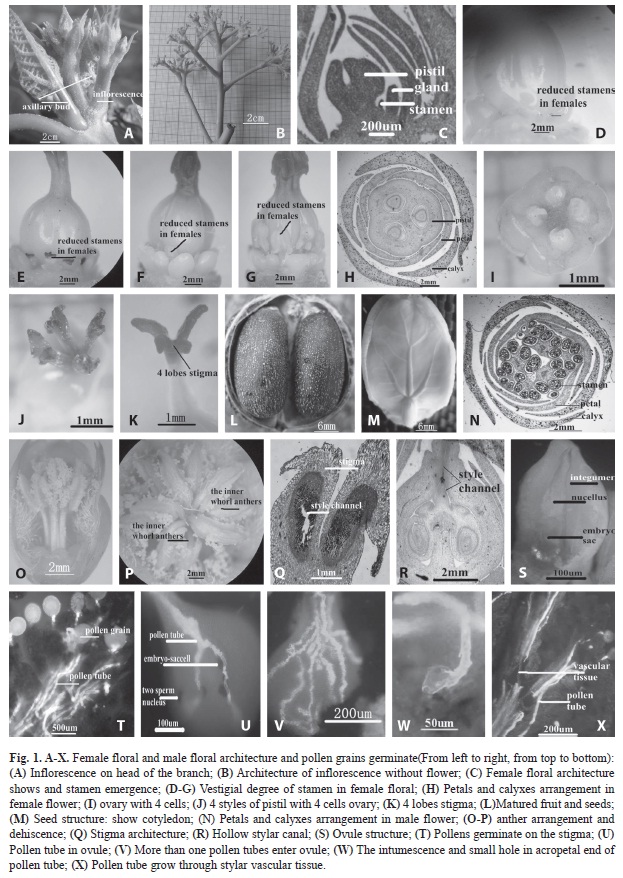
<body><![CDATA[curcas</span> flowers were of unisexuality and monoecism, dichasial     inflorescences were mainly produced on the top of freshly-grown twigs     (<a href="/img/revistas/rbt/v60n4/a10i1.jpg">Fig. 1A</a>), and     insertion inflorescences were occasionally seen on the     one-year-old branches. The inflorescence had a length of 6-12cm,     lanceolate bracts could be found at its base with a length of 4-8cm,     5-11 secondary inflorescence axes (<a      href="/img/revistas/rbt/v60n4/a10i1.jpg">Fig. 1B</a>) could be found     on the main     inflorescence axis, a bract could be seen at the base of each secondary     ]]></body>
<body><![CDATA[inflorescence axes, which was in false dichotomous branching. In the     development process, the top of the dichasial inflorescence stopped     growing first and formed top flowers at the top, then the secondary     inflorescence axes grew in succession, afterwards, tops of secondary     inflorescence axes stopped growing to form top flowers, which appeared     alternately with the growth of next-level lateral inflorescence axes,     forming dichasial inflorescences eventually. Early inflorescence axes     had a slow elongation growth and elongated accompany the growth of     flower organs afterwards. Concerning the gradual elongation of     inflorescence axes at all levels, inflorescence axes at the lower part     ]]></body>
<body><![CDATA[generally outgrew those at the upper part (<a      href="/img/revistas/rbt/v60n4/a10i1.jpg">Fig. 1B</a>), moreover, the     more     upward the position of the side inflorescence axis was, the smaller its     length was and the larger concluded angle it had with the lord     inflorescence axis. Eventually, only before florets came out did the     flower stalk elongate.</span></font><br style="font-family: verdana;">     <font size="2"></font><br style="font-family: verdana;">     <font size="2"><span style="font-family: verdana;"><span      style="font-weight: bold;">b) Female flower characteristic:</span>     ]]></body>
<body><![CDATA[Female flowers&nbsp;&nbsp; originated&nbsp;&nbsp; from&nbsp;&nbsp;     bisexuality&nbsp;&nbsp; (<a href="/img/revistas/rbt/v60n4/a10i1.jpg">Fig.     1C-1G</a>). Initially, pistil and stamen in     one flower grew simultaneously, and the stamen stopped growing during     the process of development, thereby forming functional unisexual     flowers. Observation showed that the period of development arrest for     stamens in female flowers was not unified. For some female flowers,     their stamens stopped growing (<a      href="/img/revistas/rbt/v60n4/a10i1.jpg">Fig. 1C</a>) when the top of     their pistil     ]]></body>
<body><![CDATA[concaved downward to form an ovary, and finally leaving a trace of     stamens&nbsp; inside&nbsp; the&nbsp; female&nbsp; flower&nbsp;     (<a href="/img/revistas/rbt/v60n4/a10i1.jpg">Fig.&nbsp; 1D, 1E</a>).     For some stamens, they continued to grow along     with the formation of ovaries and were forced to stop growing due to     mature pistils or pollination eventually, and then stamens have been     provided with the basic structure of male flower such as silk and     anthers, but that pollen was not fully mature and did not have the     ability of pollination (<a href="/img/revistas/rbt/v60n4/a10i1.jpg">Fig.     1F, 1G</a>).</span></font><br style="font-family: verdana;">     ]]></body>
<body><![CDATA[<font size="2"></font><br style="font-family: verdana;">     <font size="2"><span style="font-family: verdana;">Female and male     flowers of <span style="font-style: italic;">J.     curcas</span> had five sepals in repeat imbricate arrangement and five     petals     in contorted arrangement respectively (<a      href="/img/revistas/rbt/v60n4/a10i1.jpg">Fig. 1H, 1N</a>). The sepals     were     1-2mm beyond the bud top, coated with white fluff and the petals were     pale yellow in color, and internal middle and lower parts coated with     ]]></body>
<body><![CDATA[white fluff. The gland, five in number, was yellow in color (<a      href="/img/revistas/rbt/v60n4/a10i1.jpg">Fig. 1G</a>),     and ten stamens which have stopped growing (or a degenerated trace)     were found inside the gland. The ovary was superior, orbicularovate,     hairless and provided with 3-5 loculi (<a      href="/img/revistas/rbt/v60n4/a10i1.jpg">Fig. 1I</a>: a 4-loculi     ovary), and     each loculus was provided with one ovule. The number of style was the     same as that of cell, that was 3-5 (<a      href="/img/revistas/rbt/v60n4/a10i1.jpg">Fig. 1J</a>: 4 stigmas), the     ]]></body>
<body><![CDATA[base of     the style was joined and the upper part was separated, each stigma was     provided with 2-4 lobes, the stigma was V-shaped with two lobes but     antlershaped (<a href="/img/revistas/rbt/v60n4/a10i1.jpg">Fig. 1K</a>,     4 lobes), that was, two longer ones and two     shorter ones, in the case of four lobes. The capsule was of elliptic or     spherical shape, 2.5-3cm in diameter, yellow when mature while black     when dry, its seed was 1.52cm in length (<a      href="/img/revistas/rbt/v60n4/a10i1.jpg">Fig. 1L</a>), black in color,     provided with caruncle, the episperm was a black and fragile shell, the     ]]></body>
<body><![CDATA[endothelium was white and membranous, and the endosperm was pulpy with     two cotyledons wide and flat (<a      href="/img/revistas/rbt/v60n4/a10i1.jpg">Fig. 1M</a>). Flowering     period was     April-November.</span></font><br style="font-family: verdana;">     <font size="2"></font><br style="font-family: verdana;">     <font size="2"><span style="font-family: verdana;"><span      style="font-weight: bold;">c) Male flower characteristic:</span> The     male flower was provided with five sepals and five petals respectively     (<a href="/img/revistas/rbt/v60n4/a10i1.jpg">Fig. 1N</a>), and the     ]]></body>
<body><![CDATA[calyx, with a length of around 4mm and concrescent     for the middle and lower part, was arranged in&nbsp; repeat&nbsp;     imbricate&nbsp; arrangement.&nbsp; The&nbsp; petal was long circular,     pale yellow-green in color, arrayed in a spiral way, and its middle and     lower parts were coated with white fluff. The stamen was ten in number,     the five exterior were distinct and the lower part of the internal     thrum was concrescent. The anther was basifixed on the thrum and     two-layered high and low. The five interior were at the top, the other     five exterior were at the bottom, and they were arrayed in a     criss-cross way and crack outwards longitudinally (<a     ]]></body>
<body><![CDATA[ href="/img/revistas/rbt/v60n4/a10i1.jpg">Fig. 1O, 1P</a>). The     male flower was provided with five glands, yellow in color, apopetalous     and arrayed with petals in alternate arrangement.</span></font><br      style="font-family: verdana;">     <font size="2"></font><br style="font-family: verdana;">     <font style="font-weight: bold;" size="2"><span      style="font-family: verdana;">Breeding system characteristics for     <span style="font-style: italic;">J. curcas</span>:</span></font><br      style="font-family: verdana;">     <font size="2"></font><br style="font-family: verdana;">     ]]></body>
<body><![CDATA[<font size="2"><span style="font-family: verdana;"><span      style="font-weight: bold;">a) Style structure and process of     pollen germination: </span>Observation showed that a single female     stigma of a     <span style="font-style: italic;">J. curcas</span> was usually provided     with 2-4 lobes and the surface of stigma     was provided with many convexes and concaves (<a      href="/img/revistas/rbt/v60n4/a10i1.jpg">Fig. 1Q</a>), which helped to     adhere and embed pollen. The style was open and hollow (<a      href="/img/revistas/rbt/v60n4/a10i1.jpg">Fig. 1Q, 1R</a>)     ]]></body>
<body><![CDATA[with a passage provided inside. Pollen, after germination on the     surface of&nbsp; stigma&nbsp; (<a      href="/img/revistas/rbt/v60n4/a10i1.jpg">Fig.&nbsp; 1T</a>),&nbsp;     penetrated&nbsp;     the&nbsp; epidermic cells of stigma vertically. While passing through     the hollow stylar passage, pollen tube traveled along the passage     surface and grew among the materials secreted by the passage cells,     (bunch-arrayed vascular tissues were provided inside the stylar passage     (<a href="/img/revistas/rbt/v60n4/a10i1.jpg">Fig. 1X</a>), entered the     ovary and then entered the embryo sac&nbsp;     ]]></body>
<body><![CDATA[through&nbsp; micropyles.&nbsp; The&nbsp; pollen&nbsp; tube&nbsp; of <span      style="font-style: italic;">J.     curcas</span>, uneven and cylinder-shaped, grew relying on its tail     end. After     grown to a certain length, materials contained in the original pollen     would all gather at the front end of the pollen tube, causing the top     to expand and then forming&nbsp; a&nbsp; round&nbsp; micropore&nbsp;     at&nbsp; the&nbsp; top&nbsp; (<a      href="/img/revistas/rbt/v60n4/a10i1.jpg">Fig. 1W</a>), so that sperm     nucleus could be     ]]></body>
<body><![CDATA[released out of the micropore for fertilization (<a      href="/img/revistas/rbt/v60n4/a10i1.jpg">Fig. 1U</a>).</span></font><br      style="font-family: verdana;">     <font size="2">&nbsp;     <span style="font-family: verdana;"></span></font><font size="2"><span      style="font-family: verdana;"></span></font><br      style="font-family: verdana;">     <font size="2"><span style="font-family: verdana;">Observation after     pollination found     that one or more pollen tubes entered the nucellus tissue (<a     ]]></body>
<body><![CDATA[ href="/img/revistas/rbt/v60n4/a10i1.jpg">Fig. 1V</a>)     through the micropyle in succession, however, some pollen tubes would     produce&nbsp; micropores&nbsp; during&nbsp; their&nbsp; elongation, and     some others would produce micropores when elongating into the ovule,     enter the embryo sac eventually and be discharged from the pollen tube     of the reproductive cell, thus completing the fertilization. After     entering the ovule (<a href="/img/revistas/rbt/v60n4/a10i1.jpg">Fig. 1S</a>),     the pollen tube would produce more bends     (<a href="/img/revistas/rbt/v60n4/a10i1.jpg">Fig. 1U, 1V</a>) modally,     which was probably due to the fact that no     ]]></body>
<body><![CDATA[special passage like that inside the style was provided inside the     ovule and that pollen would have to reach the embryo sac only through     intercellular space or cell walls.</span></font><br      style="font-family: verdana;">     <font size="2"></font><br style="font-family: verdana;">     <font size="2"><span style="font-family: verdana;"><span      style="font-weight: bold;">b) Distribution characteristics and     pollination tendency of flowers:</span> The distribution     characteristics and     pollination medium of <span style="font-style: italic;">J. curcas</span>     ]]></body>
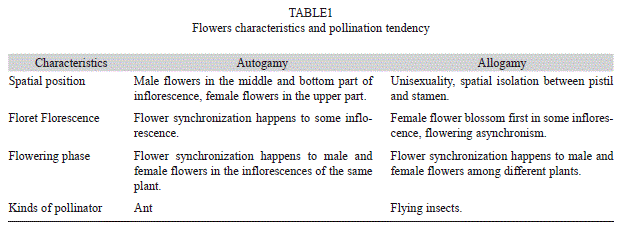
<body><![CDATA[flowers indicated that the breeding     system&nbsp; of&nbsp; <span style="font-style: italic;">J.&nbsp; curcas</span>&nbsp;     was&nbsp; of&nbsp;     self-pollination and cross-pollination. In general, a plant will choose     pollen from another plant to complete fertilization, yet a selective     abortion contains the fruit of self-pollen seeds to avoid inbreeding     depression and improve the average quality and suitability of the later     generation. Concerning the lack of pollen, the fruit of     selffertilization will mature as well to ensure the reproduction of     species. From <a href="/img/revistas/rbt/v60n4/a10t1.gif">table 1</a>,     ]]></body>
<body><![CDATA[it could be seen that the floral and pollination     characteristics of <span style="font-style: italic;">J. curcas</span>     provided its breeding system with two     tendencies, i.e. self-pollination and cross-pollination, which was the     result of its long-term adaptation to nature.</span></font><br      style="font-family: verdana;">     <font size="2"></font><br style="font-family: verdana;">     <font size="2"><span style="font-family: verdana;"><span      style="font-weight: bold;">c) Outcrossing index estimation:     </span>The OCI&nbsp; of&nbsp; <span style="font-style: italic;">J.&nbsp;     ]]></body>
<body><![CDATA[curcas</span>&nbsp; was&nbsp;     measured&nbsp;     according to&nbsp; Dafni&nbsp; (1992)&nbsp; standard&nbsp; as&nbsp;     follows.&nbsp; The mean diameter of <span style="font-style: italic;">J.     curcas</span> flower was about 6-10mm,     so marked as 3 points. In one inflorescence&nbsp; the&nbsp;     pistil&nbsp; ripened&nbsp; first,&nbsp; marked&nbsp; as 0point.&nbsp;     The&nbsp; stigma&nbsp; and&nbsp; anther&nbsp; of&nbsp; <span      style="font-style: italic;">J.&nbsp; curcas</span>     were isolated spatially, so marked as 1point. The total of the above     ]]></body>
<body><![CDATA[was the OCI value, ie 4 points. The breeding system of <span      style="font-style: italic;">J. curcas</span> was of     partial autogamy compatibility, and pollinators were needed for     outbreeding, which was in agreement with the above observation and     research of other aspects of <span style="font-style: italic;">J.     curcas</span>.</span></font><br style="font-family: verdana;">     <font size="2"></font><br style="font-family: verdana;">     <font size="2"><span style="font-family: verdana;">d<span      style="font-weight: bold;">) Result of pollen grains     germination by different ways of pollination:</span> The observation on     ]]></body>
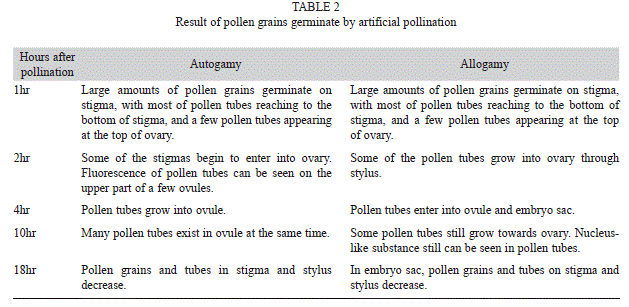
<body><![CDATA[pollen     tube germination after pollination suggested that pollen germinated and     grew very quickly on stigma of the flower itself as well as others,     growing to the bottom of stylus within 1hr, to ovary 2hr, to ovule 4hr,     without notable differences.</span></font><br      style="font-family: verdana;">     <font size="2"></font><br style="font-family: verdana;">     <font size="2"><span style="font-family: verdana;"><a      href="/img/revistas/rbt/v60n4/a10t2.gif">Table 2</a> showed that     pollen grains     ]]></body>
<body><![CDATA[germinated rapidly after reaching stigma, that pollen tube grew to     bottom of stigma within 1hr, then went on to ovary, that pollen tube     came into ovule through micropyle and reached embryo sac within 4hr,     and finally discharged sperm through the small hole on the top of     pollen tube to get fertilized. Pollen grains and pollen tubes in stigma     and stylus began to decrease at the 18th hour after pollination.</span></font><br      style="font-family: verdana;">     <font size="2"></font><br style="font-family: verdana;">     <font size="2"><span style="font-family: verdana;"><span      style="font-weight: bold;">e) Experiment on artificial     ]]></body>
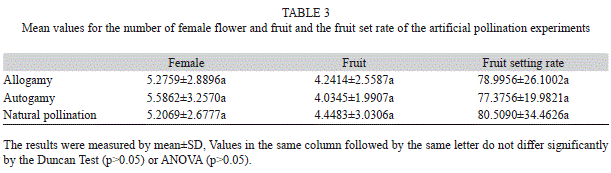
<body><![CDATA[pollination: </span>Investigation on fruit setting rate of artificial     pollination showed (<a href="/img/revistas/rbt/v60n4/a10t3.gif">Table 3</a>):     fruit setting rate of&nbsp;     self-pollination&nbsp; was&nbsp; 77.38%,&nbsp; fruit&nbsp; setting rate     of cross-pollination was 79.00%, fruit setting rate of natural     pollination was 80.51%.</span></font><br style="font-family: verdana;">     <font size="2"></font><br style="font-family: verdana;">     <font size="2"><span style="font-family: verdana;">There was no     marketable differences     among the fruit setting rates of the three ways of&nbsp;     ]]></body>
<body><![CDATA[pollination,&nbsp; with&nbsp; natural&nbsp; pollination&nbsp; rate a     little higher than cross-pollination, crosspollination than     self-pollination. The fruit setting rate of artificial pollination was     a little bit lower than natural pollination for the reason that fruit     bagging resulted in the weakening of sunlight, which was harmful to     fruit setting. It also showed that pollination of <span      style="font-style: italic;">J. curcas</span> was     adequate under natural conditions.</span></font><br      style="font-family: verdana;">     <font size="2"></font><br style="font-family: verdana;">     ]]></body>
<body><![CDATA[<font style="font-weight: bold;" size="3"><span      style="font-family: verdana;">Discussion</span></font><br      style="font-family: verdana;">     <font size="2"></font><br style="font-family: verdana;">     <font size="2"><span style="font-family: verdana;">Both <span      style="font-style: italic;">Flora of China</span>     (Huang <span style="font-style: italic;">et al.</span>     1997) and <span style="font-style: italic;">Flora of Guizhou</span>     (Li <span style="font-style: italic;">et al.</span> 1992) described     inflorescence of     ]]></body>
<body><![CDATA[<span style="font-style: italic;">J. curcas</span> as axillary.     However, the author of the paper observed that     the inflorescence of <span style="font-style: italic;">J. curcas</span>     germinated from the top of branch, with     the upper end of the branch stopping growing upward because of the     formation of inflorescence. After a span of time, 1-3 (usually 2)     lateral buds under inflorescence germinated, taking place of bough     growing upward, which looked like inflorescence grew from the body of     branch, leading to the false conclusion that inflorescence of <span      style="font-style: italic;">J. curcas</span>     ]]></body>
<body><![CDATA[was axillary. It was in agreement with the opinion of Yang <span      style="font-style: italic;">et al.</span>     (2008) and Xie <span style="font-style: italic;">et al.</span> (2009).</span></font><br      style="font-family: verdana;">     <font size="2"></font><br style="font-family: verdana;">     <font size="2"><span style="font-family: verdana;">Most of female     flowers of <span style="font-style: italic;">J. curcas</span>     had 3-loculi ovary, but some of them even had ovary with four or five     loculi, which also happened&nbsp; to&nbsp; other&nbsp; species&nbsp;     of&nbsp; <span style="font-style: italic;">Jatropha.</span>&nbsp;     ]]></body>
<body><![CDATA[Stigma and ovary were same in number, with     each stigma having 2-4 lobes. However, both <span      style="font-style: italic;">Flora of China</span> (Huang <span      style="font-style: italic;">et     al.</span> 1997) and <span style="font-style: italic;">Flora of Guizhou</span>     (Li <span style="font-style: italic;">et al.</span> 1992) described as     &#8220;ovary has     three loculi and 2 lobes at the head of each stigma&#8221;, which was     incomplete.</span></font><br style="font-family: verdana;">     <font size="2"></font><br style="font-family: verdana;">     ]]></body>
<body><![CDATA[<font size="2"><span style="font-family: verdana;">As to the     arrangement of sepals and     petals of <span style="font-style: italic;">J. curcas</span>, <span      style="font-style: italic;">Flora of China </span>(Huang <span      style="font-style: italic;">et al.</span> 1997)     and <span style="font-style: italic;">Flora of     Guizhou</span> (Li <span style="font-style: italic;">et al.</span>     1992) described <span style="font-style: italic;">J. curcas</span> as     imbricate. Li <span style="font-style: italic;">et al.</span>     (2007) found that sepals of male flowers were in imbricate arrangement,     ]]></body>
<body><![CDATA[however, researched on the slice in this paper showed that sepals both     in male and female flowers were in repeat imbricate arrangement, with     petals in rotating pattern.</span></font><br      style="font-family: verdana;">     <font size="2"></font><br style="font-family: verdana;">     <font size="2"><span style="font-family: verdana;"><span      style="font-style: italic;">J. curcas</span> began to     geminate     inflorescence in April after new branches gave birth to 5-8 new leaves.     Productive grew and vegetative grew appear by turns, with several     ]]></body>
<body><![CDATA[flowering phase each year. <span style="font-style: italic;">J. curcas</span>     in Luodian had two mass flowering     in a year, and the blooming period lasted to October or November. Yang     <span style="font-style: italic;">et al.</span> (2007) found that <span      style="font-style: italic;">J. curcas&#8217;s</span>     flowering period lasted to late     November in Menglun of Xishuangbanna. Hence, flowering phase of <span      style="font-style: italic;">J.     curcas</span> should range from April to November, which was not in     concordance with &#8220;flowering phase September-October&#8221; in <span     ]]></body>
<body><![CDATA[ style="font-style: italic;">Flora of China</span>     (Huang <span style="font-style: italic;">et al.</span> 1997) and     &#8220;flowering phase AprilMay&#8221; in <span style="font-style: italic;">Flora     of Guizhou</span>     (Li <span style="font-style: italic;">et al.</span> 1992).</span></font><br      style="font-family: verdana;">     <font size="2"></font><br style="font-family: verdana;">     <font size="2"><span style="font-family: verdana;">Generally speaking,     pollen tube     enters into blastula through a synergid, and the synergid will     ]]></body>
<body><![CDATA[disintegrate after that. And pollen tube will release contents at the     location of the synergid. However, in my study, there were two even     more pollen tubes were seen in blastula after pollination. Pollen tubes     did not enter into blastula directly but through the base of it after     grew&nbsp; into&nbsp; nucellus.&nbsp; There&nbsp; was&nbsp; no&nbsp;     synergid at the place where two sperms were released after several     pollen tubes entered into blastula. Therefore, the process of     federalization and the action of pollen tube after entering to blastula     required further research.</span></font><br      style="font-family: verdana;">     ]]></body>
<body><![CDATA[<font size="2"></font><br style="font-family: verdana;">     <font size="2"><span style="font-family: verdana;">Lu <span      style="font-style: italic;">et al.</span> (2008)     believed that     stigma of female flower could secrete mucus and had many small holes on     it, easily to stick pollen grains carried by insect, which showed that     stigma of <span style="font-style: italic;">J. curcas</span> was wet.     Luo <span style="font-style: italic;">et al.</span> (2007) found that     there was no     notable secreting substance, which proved that stigma of <span     ]]></body>
<body><![CDATA[ style="font-style: italic;">J. curcas</span> was     dry. The research conducted in this paper showed that the surface of     stigma glows after flowering, which looked like there was secreting     substance, but observation on slice showed that stigma didn&#8217;t have     secreting gland. Therefore, whether <span style="font-style: italic;">J.     curcas&#8217;s</span> stigma is wet or not     needs further research.</span></font><br style="font-family: verdana;">     <font size="2"></font><br style="font-family: verdana;">     <font size="2"><span style="font-family: verdana;">In addition,     according to Yang <span style="font-style: italic;">et     ]]></body>
<body><![CDATA[al.</span> (2007), fruit-bearing rate was 0 if they emasculation and     bagging     it by parchment bag to segregate pollinators before flowering. However,     according to Li <span style="font-style: italic;">et al.</span>     (2007), fruit-bearing rate was 12% by the same     method. Therefore, they believed that <span style="font-style: italic;">J.     curcas</span> belongs to apomixis     plant. The authors found that there were large numbers of antes on the     plant under discussion; was it effective enough to segregate antes as     pollinators by bagging in Li&#8217;s experiments (Li <span     ]]></body>
<body><![CDATA[ style="font-style: italic;">et al.</span> 2007)? Whether <span      style="font-style: italic;">J.     curcas</span> is apomixes or not, which still lack sound proof and cry     for     further study.</span></font><br style="font-family: verdana;">     <font size="2"></font><br style="font-family: verdana;">     <font style="font-weight: bold;" size="3"><span      style="font-family: verdana;">Acknowledgments</span></font><br      style="font-family: verdana;">     <font size="2"></font><br style="font-family: verdana;">     ]]></body>
<body><![CDATA[<font size="2"><span style="font-family: verdana;">The work was     supported by of Major     Project&nbsp; of&nbsp; Guizhou&nbsp; province:&nbsp; Project&nbsp;     number&nbsp; 20076004-5,&nbsp; Natural&nbsp; Science&nbsp; Foundation     of Guizhou province: Project number J(2010)2048, Guizhou Science and     Technology Department, the People&#8217;s Republic of China and doctor fund     project: Project number 20070657001, Ministry of Education, the     People&#8217;s Republic of China. The authors thank Yang Lixia from Sanmenxia     Foreign Language Primary School, Sanmenxia, China and Marcus&nbsp;     Ching&nbsp; from&nbsp; University&nbsp; of&nbsp; California, USA, for     ]]></body>
<body><![CDATA[their valuable help in English grammar at sentence.</span></font><br      style="font-family: verdana;">     <font size="2"><span style="font-family: verdana;">&nbsp;</span></font>     <hr style="width: 100%; height: 2px;"><font size="2"><span      style="font-family: verdana;"> </span></font><font      style="font-weight: bold;" size="3"><span style="font-family: verdana;">References</span></font><br      style="font-family: verdana;">     <font size="2"></font><br style="font-family: verdana;">     <font size="2"><span style="font-family: verdana;">Abdelgadir, H.A.,     S.D. Johnson     ]]></body>
<body><![CDATA[&amp; J. Van&nbsp; Staden. 2008 Approaches to improve seed production     of <span style="font-style: italic;">J. curcas</span> L. SAAB Annu.     <!-- ref -->Meet. Abst. 359.    &nbsp;&nbsp;&nbsp;&nbsp;&nbsp;&nbsp;&nbsp;&nbsp;[&#160;<a href="javascript:void(0);" onclick="javascript: window.open('/scielo.php?script=sci_nlinks&ref=1809022&pid=S0034-7744201200040001000001&lng=','','width=640,height=500,resizable=yes,scrollbars=1,menubar=yes,');">Links</a>&#160;]<!-- end-ref --><!-- ref --></span></font><br style="font-family: verdana;"> <font size="2"></font><br style="font-family: verdana;"> <font size="2"><span style="font-family: verdana;">Abdelgadir, H.A., S.D. Johnson &amp; J. Van&nbsp; Staden. 2009. Pollinator&nbsp; effectiveness, breeding system,&nbsp; and tests for inbreeding depression in the biofuel seed crop, <span style="font-style: italic;">J. curcas</span>. J. Hortic. Sci. Biotech. 84: 319-324.    &nbsp;&nbsp;&nbsp;&nbsp;&nbsp;&nbsp;&nbsp;&nbsp;[&#160;<a href="javascript:void(0);" onclick="javascript: window.open('/scielo.php?script=sci_nlinks&ref=1809023&pid=S0034-7744201200040001000002&lng=','','width=640,height=500,resizable=yes,scrollbars=1,menubar=yes,');">Links</a>&#160;]<!-- end-ref --><!-- ref --></span></font><br  style="font-family: verdana;"> <font size="2"></font><br style="font-family: verdana;"> <font size="2"><span style="font-family: verdana;">Bhattacharya,&nbsp; A.,&nbsp; K.&nbsp; Datta&nbsp; &amp;&nbsp; S.K.&nbsp; Datta.&nbsp; 2005.&nbsp; Floral biology, floral resource&nbsp; constraints and pollination limitation in <span style="font-style: italic;">J. curcas</span> L. Pak J. Biol. Sci. 8: 456-460.    &nbsp;&nbsp;&nbsp;&nbsp;&nbsp;&nbsp;&nbsp;&nbsp;[&#160;<a href="javascript:void(0);" onclick="javascript: window.open('/scielo.php?script=sci_nlinks&ref=1809024&pid=S0034-7744201200040001000003&lng=','','width=640,height=500,resizable=yes,scrollbars=1,menubar=yes,');">Links</a>&#160;]<!-- end-ref --><!-- ref --></span></font><br  style="font-family: verdana;"> <font size="2"></font><br style="font-family: verdana;"> <font size="2"><span style="font-family: verdana;">Dafni, A. 1992. Pollination ecology: a practical approach. Oxford University, Oxford.    &nbsp;&nbsp;&nbsp;&nbsp;&nbsp;&nbsp;&nbsp;&nbsp;[&#160;<a href="javascript:void(0);" onclick="javascript: window.open('/scielo.php?script=sci_nlinks&ref=1809025&pid=S0034-7744201200040001000004&lng=','','width=640,height=500,resizable=yes,scrollbars=1,menubar=yes,');">Links</a>&#160;]<!-- end-ref --><!-- ref --></span></font><br  style="font-family: verdana;"> <font size="2"></font><br style="font-family: verdana;"> <font size="2"><span style="font-family: verdana;">Huang, C.J., B.X. Huang &amp; L.Y. Xu. 1997. Flora of China. Sci., Beijing, Beijing, China.    &nbsp;&nbsp;&nbsp;&nbsp;&nbsp;&nbsp;&nbsp;&nbsp;[&#160;<a href="javascript:void(0);" onclick="javascript: window.open('/scielo.php?script=sci_nlinks&ref=1809026&pid=S0034-7744201200040001000005&lng=','','width=640,height=500,resizable=yes,scrollbars=1,menubar=yes,');">Links</a>&#160;]<!-- end-ref --><!-- ref --></span></font><br  style="font-family: verdana;"> <font size="2"></font><br style="font-family: verdana;"> <font size="2"><span style="font-family: verdana;">Li, K., W.L. Yin &amp; C.W. Luo. 2007. Breeding System and Pollination&nbsp; Ecology&nbsp; in&nbsp; <span style="font-style: italic;">J.&nbsp; curcas</span>.&nbsp; Forest&nbsp; Res.&nbsp; 20: 775-781.    &nbsp;&nbsp;&nbsp;&nbsp;&nbsp;&nbsp;&nbsp;&nbsp;[&#160;<a href="javascript:void(0);" onclick="javascript: window.open('/scielo.php?script=sci_nlinks&ref=1809027&pid=S0034-7744201200040001000006&lng=','','width=640,height=500,resizable=yes,scrollbars=1,menubar=yes,');">Links</a>&#160;]<!-- end-ref --><!-- ref --></span></font><br  style="font-family: verdana;"> <font size="2"></font><br style="font-family: verdana;"> <font size="2"><span style="font-family: verdana;">Li, Y.K., W.L. Huang, X.G. Wang, X.S. Zhang &amp; J.R. Wu. 1992. Flora of Guizhou. Guizhou people&#8217;s Publishing House, Guiyang, China.    &nbsp;&nbsp;&nbsp;&nbsp;&nbsp;&nbsp;&nbsp;&nbsp;[&#160;<a href="javascript:void(0);" onclick="javascript: window.open('/scielo.php?script=sci_nlinks&ref=1809028&pid=S0034-7744201200040001000007&lng=','','width=640,height=500,resizable=yes,scrollbars=1,menubar=yes,');">Links</a>&#160;]<!-- end-ref --><!-- ref --></span></font><br  style="font-family: verdana;"> <font size="2"></font><br style="font-family: verdana;"> <font size="2"><span style="font-family: verdana;">Lu, J.H., J. Wu, K. Xiao &amp; L. Tang. 2008. Studies on the relation between the structures of flowers and pollination in <span style="font-style: italic;">J. curcas</span>. J. Sichuan Univ. (Nat. Sci. Edi.). 45: 1485-1488.    &nbsp;&nbsp;&nbsp;&nbsp;&nbsp;&nbsp;&nbsp;&nbsp;[&#160;<a href="javascript:void(0);" onclick="javascript: window.open('/scielo.php?script=sci_nlinks&ref=1809029&pid=S0034-7744201200040001000008&lng=','','width=640,height=500,resizable=yes,scrollbars=1,menubar=yes,');">Links</a>&#160;]<!-- end-ref --><!-- ref --></span></font><br style="font-family: verdana;"> <font size="2"></font><br style="font-family: verdana;"> <font size="2"><span style="font-family: verdana;">Luo, C.W., K. Li, Y. Chen, Y.Y. Sun &amp; W.Y. Yang. 2007. Pollen viability, stigma receptivity and reproductive features of <span style="font-style: italic;">J. curcas</span> L.&nbsp; (Euphorbiaceae). Acta Bot. Borea1-Occident. Sin. 27: 1994-2001.    &nbsp;&nbsp;&nbsp;&nbsp;&nbsp;&nbsp;&nbsp;&nbsp;[&#160;<a href="javascript:void(0);" onclick="javascript: window.open('/scielo.php?script=sci_nlinks&ref=1809030&pid=S0034-7744201200040001000009&lng=','','width=640,height=500,resizable=yes,scrollbars=1,menubar=yes,');">Links</a>&#160;]<!-- end-ref --><!-- ref --></span></font><br  style="font-family: verdana;"> <font size="2"></font><br style="font-family: verdana;"> <font size="2"><span style="font-family: verdana;">Xie, W.W., F.R. Lin, Y. Xu, S.H. Wang &amp; F. Chen. 2009. Investigation on the breed ing indexes of <span  style="font-style: italic;">J. curcas</span> L. J. Anhui Agr. Univ. 36: 387-392.    &nbsp;&nbsp;&nbsp;&nbsp;&nbsp;&nbsp;&nbsp;&nbsp;[&#160;<a href="javascript:void(0);" onclick="javascript: window.open('/scielo.php?script=sci_nlinks&ref=1809031&pid=S0034-7744201200040001000010&lng=','','width=640,height=500,resizable=yes,scrollbars=1,menubar=yes,');">Links</a>&#160;]<!-- end-ref --><!-- ref --></span></font><br  style="font-family: verdana;"> <font size="2"></font><br style="font-family: verdana;"> <font size="2"><span style="font-family: verdana;">Yang, Q., D.P. Peng, Z.B. Duan, Z.L. Wang &amp; Q.X. Sun. 2007.&nbsp; Study&nbsp; on&nbsp; Pollination&nbsp; Biology&nbsp; of&nbsp; <span  style="font-style: italic;">J.&nbsp; curcas</span></span></font><br  style="font-family: verdana;"> <font size="2"><span style="font-family: verdana;">(Euphorbiaceae). J. South China Agr.&nbsp;&nbsp; Univ.&nbsp; 28: 62-66.    &nbsp;&nbsp;&nbsp;&nbsp;&nbsp;&nbsp;&nbsp;&nbsp;[&#160;<a href="javascript:void(0);" onclick="javascript: window.open('/scielo.php?script=sci_nlinks&ref=1809032&pid=S0034-7744201200040001000011&lng=','','width=640,height=500,resizable=yes,scrollbars=1,menubar=yes,');">Links</a>&#160;]<!-- end-ref --><!-- ref --></span></font><br  style="font-family: verdana;"> <font size="2"></font><br style="font-family: verdana;"> <font size="2"><span style="font-family: verdana;">Yang, Q., D.P. Peng, Z.B. Duan, Z.L. Wang, Q.X. Sun &amp; Z.H. Peng. 2008. Floral biology of <span  style="font-style: italic;">Jatropha curcas</span>. J. Fujian Col. Forest. 28: 52-55.    &nbsp;&nbsp;&nbsp;&nbsp;&nbsp;&nbsp;&nbsp;&nbsp;[&#160;<a href="javascript:void(0);" onclick="javascript: window.open('/scielo.php?script=sci_nlinks&ref=1809033&pid=S0034-7744201200040001000012&lng=','','width=640,height=500,resizable=yes,scrollbars=1,menubar=yes,');">Links</a>&#160;]<!-- end-ref --></span></font><font  size="2"><span style="font-family: verdana;"></span></font><br  style="font-family: verdana;">     <br> <font size="-1"><span style="font-family: verdana;"><a  name="Correspondencia1"></a><a href="#Correspondencia2">*</a>Correspondencia:</span></font><font  size="2"><span style="font-family: verdana;"> Xiu-Rong Wang:&nbsp;</span></font><font  size="2"><span style="font-family: verdana;">College of Forestry, Guizhou University, Guiyang 550025, China; wxr7211@126.com    <br> </span></font><font size="2"><span style="font-family: verdana;">Gui-Jie Ding: </span></font><font size="2"><span style="font-family: verdana;">College of Forestry, Guizhou University, Guiyang 550025, China; guijieding@yahoo.com.cn    <br> </span></font><font size="2"><span style="font-family: verdana;"><a  name="1"></a><a href="#2">1</a>. College of Forestry, Guizhou University, Guiyang 550025, China; wxr7211@126.com, guijieding@yahoo.com.cn</span></font>    <br> <font size="-1"><span style="font-family: verdana;"></span></font> <hr style="width: 100%; height: 2px;">     <div style="text-align: center;"><font style="font-weight: bold;"  size="2"><span style="font-family: verdana;">Received 02-XII-2011.Corrected 30-IV-2012.Accepted 29-V-2012. </span></font>    ]]></body>
<body><![CDATA[<br> </div> </div>     <div style="text-align: center;"><font size="2"></font></div> </div> <font size="2"></font>      ]]></body><back>
<ref-list>
<ref id="B1">
<nlm-citation citation-type="journal">
<person-group person-group-type="author">
<name>
<surname><![CDATA[Abdelgadir]]></surname>
<given-names><![CDATA[H.A]]></given-names>
</name>
<name>
<surname><![CDATA[Johnson]]></surname>
<given-names><![CDATA[S.D]]></given-names>
</name>
<name>
<surname><![CDATA[Van Staden]]></surname>
<given-names><![CDATA[J]]></given-names>
</name>
</person-group>
<article-title xml:lang="en"><![CDATA[Approaches to improve seed production of J. curcas L]]></article-title>
<source><![CDATA[SAAB Annu. Meet. Abst]]></source>
<year>2008</year>
<numero>359</numero>
<issue>359</issue>
</nlm-citation>
</ref>
<ref id="B2">
<nlm-citation citation-type="journal">
<person-group person-group-type="author">
<name>
<surname><![CDATA[Abdelgadir]]></surname>
<given-names><![CDATA[H.A]]></given-names>
</name>
<name>
<surname><![CDATA[Johnson]]></surname>
<given-names><![CDATA[S.D]]></given-names>
</name>
<name>
<surname><![CDATA[Van Staden]]></surname>
<given-names><![CDATA[J]]></given-names>
</name>
</person-group>
<article-title xml:lang="en"><![CDATA[Pollinator effectiveness, breeding system, and tests for inbreeding depression in the biofuel seed crop, J. curcas]]></article-title>
<source><![CDATA[J. Hortic. Sci. Biotech]]></source>
<year>2009</year>
<volume>84</volume>
<page-range>319-324</page-range></nlm-citation>
</ref>
<ref id="B3">
<nlm-citation citation-type="journal">
<person-group person-group-type="author">
<name>
<surname><![CDATA[Bhattacharya]]></surname>
<given-names><![CDATA[A]]></given-names>
</name>
<name>
<surname><![CDATA[Datta]]></surname>
<given-names><![CDATA[K]]></given-names>
</name>
<name>
<surname><![CDATA[Datta]]></surname>
<given-names><![CDATA[S.K]]></given-names>
</name>
</person-group>
<article-title xml:lang="en"><![CDATA[Floral biology, floral resource constraints and pollination limitation in J. curcas L]]></article-title>
<source><![CDATA[Pak J. Biol. Sci]]></source>
<year>2005</year>
<volume>8</volume>
<page-range>456-460</page-range></nlm-citation>
</ref>
<ref id="B4">
<nlm-citation citation-type="book">
<person-group person-group-type="author">
<name>
<surname><![CDATA[Dafni]]></surname>
<given-names><![CDATA[A]]></given-names>
</name>
</person-group>
<source><![CDATA[Pollination ecology: a practical approach]]></source>
<year>1992</year>
<publisher-loc><![CDATA[^eOxford Oxford]]></publisher-loc>
<publisher-name><![CDATA[Oxford University]]></publisher-name>
</nlm-citation>
</ref>
<ref id="B5">
<nlm-citation citation-type="book">
<person-group person-group-type="author">
<name>
<surname><![CDATA[Huang]]></surname>
<given-names><![CDATA[C.J]]></given-names>
</name>
<name>
<surname><![CDATA[Huang]]></surname>
<given-names><![CDATA[B.X]]></given-names>
</name>
<name>
<surname><![CDATA[Xu]]></surname>
<given-names><![CDATA[L.Y]]></given-names>
</name>
</person-group>
<source><![CDATA[Flora of China]]></source>
<year>1997</year>
<publisher-loc><![CDATA[Beijing^eBeijing Beijing]]></publisher-loc>
<publisher-name><![CDATA[Sci]]></publisher-name>
</nlm-citation>
</ref>
<ref id="B6">
<nlm-citation citation-type="journal">
<person-group person-group-type="author">
<name>
<surname><![CDATA[Li]]></surname>
<given-names><![CDATA[K]]></given-names>
</name>
<name>
<surname><![CDATA[Yin]]></surname>
<given-names><![CDATA[W.L]]></given-names>
</name>
<name>
<surname><![CDATA[Luo]]></surname>
<given-names><![CDATA[C.W]]></given-names>
</name>
</person-group>
<article-title xml:lang="en"><![CDATA[Breeding System and Pollination Ecology in J. curcas]]></article-title>
<source><![CDATA[Forest Res]]></source>
<year>2007</year>
<volume>20</volume>
<page-range>775-781</page-range></nlm-citation>
</ref>
<ref id="B7">
<nlm-citation citation-type="book">
<person-group person-group-type="author">
<name>
<surname><![CDATA[Li]]></surname>
<given-names><![CDATA[Y.K]]></given-names>
</name>
<name>
<surname><![CDATA[Huang]]></surname>
<given-names><![CDATA[W.L]]></given-names>
</name>
<name>
<surname><![CDATA[Wang]]></surname>
<given-names><![CDATA[X.G]]></given-names>
</name>
<name>
<surname><![CDATA[Zhang]]></surname>
<given-names><![CDATA[X.S]]></given-names>
</name>
<name>
<surname><![CDATA[Wu]]></surname>
<given-names><![CDATA[J.R]]></given-names>
</name>
</person-group>
<source><![CDATA[Flora of Guizhou]]></source>
<year>1992</year>
<publisher-loc><![CDATA[^eGuiyang Guiyang]]></publisher-loc>
<publisher-name><![CDATA[Guizhou people&#8217;s Publishing House]]></publisher-name>
</nlm-citation>
</ref>
<ref id="B8">
<nlm-citation citation-type="journal">
<person-group person-group-type="author">
<name>
<surname><![CDATA[Lu]]></surname>
<given-names><![CDATA[J.H]]></given-names>
</name>
<name>
<surname><![CDATA[Wu]]></surname>
<given-names><![CDATA[J]]></given-names>
</name>
<name>
<surname><![CDATA[Xiao]]></surname>
<given-names><![CDATA[K]]></given-names>
</name>
<name>
<surname><![CDATA[Tang]]></surname>
<given-names><![CDATA[L]]></given-names>
</name>
</person-group>
<article-title xml:lang="en"><![CDATA[Studies on the relation between the structures of flowers and pollination in J. curcas.]]></article-title>
<source><![CDATA[J. Sichuan Univ. (Nat. Sci. Edi.).]]></source>
<year>2008</year>
<volume>45</volume>
<page-range>1485-1488</page-range></nlm-citation>
</ref>
<ref id="B9">
<nlm-citation citation-type="journal">
<person-group person-group-type="author">
<name>
<surname><![CDATA[Luo]]></surname>
<given-names><![CDATA[C.W]]></given-names>
</name>
<name>
<surname><![CDATA[Li]]></surname>
<given-names><![CDATA[K]]></given-names>
</name>
<name>
<surname><![CDATA[Chen]]></surname>
<given-names><![CDATA[Y]]></given-names>
</name>
<name>
<surname><![CDATA[Sun]]></surname>
<given-names><![CDATA[Y.Y]]></given-names>
</name>
<name>
<surname><![CDATA[Yang]]></surname>
<given-names><![CDATA[W.Y]]></given-names>
</name>
</person-group>
<article-title xml:lang="en"><![CDATA[Pollen viability, stigma receptivity and reproductive features of J. curcas L. (Euphorbiaceae).]]></article-title>
<source><![CDATA[Acta Bot. Borea1-Occident. Sin]]></source>
<year>2007</year>
<volume>27</volume>
<page-range>1994-2001</page-range></nlm-citation>
</ref>
<ref id="B10">
<nlm-citation citation-type="journal">
<person-group person-group-type="author">
<name>
<surname><![CDATA[Xie]]></surname>
<given-names><![CDATA[W.W]]></given-names>
</name>
<name>
<surname><![CDATA[Lin]]></surname>
<given-names><![CDATA[F.R]]></given-names>
</name>
<name>
<surname><![CDATA[Xu]]></surname>
<given-names><![CDATA[Y]]></given-names>
</name>
<name>
<surname><![CDATA[Wang]]></surname>
<given-names><![CDATA[S.H]]></given-names>
</name>
<name>
<surname><![CDATA[Chen]]></surname>
<given-names><![CDATA[F.]]></given-names>
</name>
</person-group>
<article-title xml:lang="en"><![CDATA[Investigation on the breed ing indexes of J. curcas L.]]></article-title>
<source><![CDATA[J. Anhui Agr. Univ]]></source>
<year>2009</year>
<volume>36</volume>
<page-range>387-392</page-range></nlm-citation>
</ref>
<ref id="B11">
<nlm-citation citation-type="journal">
<person-group person-group-type="author">
<name>
<surname><![CDATA[Yang]]></surname>
<given-names><![CDATA[Q]]></given-names>
</name>
<name>
<surname><![CDATA[Peng]]></surname>
<given-names><![CDATA[D.P]]></given-names>
</name>
<name>
<surname><![CDATA[Duan]]></surname>
<given-names><![CDATA[Z.B]]></given-names>
</name>
<name>
<surname><![CDATA[Wang]]></surname>
<given-names><![CDATA[Z.L]]></given-names>
</name>
<name>
<surname><![CDATA[Sun]]></surname>
<given-names><![CDATA[Q.X]]></given-names>
</name>
</person-group>
<article-title xml:lang="en"><![CDATA[Study on Pollination Biology of J. curcas (Euphorbiaceae)]]></article-title>
<source><![CDATA[J. South China Agr. Univ]]></source>
<year>2007</year>
<volume>28</volume>
<page-range>62-66</page-range></nlm-citation>
</ref>
<ref id="B12">
<nlm-citation citation-type="journal">
<person-group person-group-type="author">
<name>
<surname><![CDATA[Yang]]></surname>
<given-names><![CDATA[Q]]></given-names>
</name>
<name>
<surname><![CDATA[Peng]]></surname>
<given-names><![CDATA[D.P]]></given-names>
</name>
<name>
<surname><![CDATA[Duan]]></surname>
<given-names><![CDATA[Z.B]]></given-names>
</name>
<name>
<surname><![CDATA[Wang]]></surname>
<given-names><![CDATA[Z.L.]]></given-names>
</name>
<name>
<surname><![CDATA[Sun]]></surname>
<given-names><![CDATA[Q.X.]]></given-names>
</name>
<name>
<surname><![CDATA[Peng]]></surname>
<given-names><![CDATA[Z.H]]></given-names>
</name>
</person-group>
<article-title xml:lang="en"><![CDATA[Floral biology of Jatropha curcas]]></article-title>
<source><![CDATA[J. Fujian Col. Forest.]]></source>
<year>2008</year>
<volume>28</volume>
<page-range>52-55</page-range></nlm-citation>
</ref>
</ref-list>
</back>
</article>