<?xml version="1.0" encoding="ISO-8859-1"?><article xmlns:mml="http://www.w3.org/1998/Math/MathML" xmlns:xlink="http://www.w3.org/1999/xlink" xmlns:xsi="http://www.w3.org/2001/XMLSchema-instance">
<front>
<journal-meta>
<journal-id>0034-7744</journal-id>
<journal-title><![CDATA[Revista de Biología Tropical]]></journal-title>
<abbrev-journal-title><![CDATA[Rev. biol. trop]]></abbrev-journal-title>
<issn>0034-7744</issn>
<publisher>
<publisher-name><![CDATA[Universidad de Costa Rica]]></publisher-name>
</publisher>
</journal-meta>
<article-meta>
<article-id>S0034-77442012000400006</article-id>
<title-group>
<article-title xml:lang="en"><![CDATA[Germination and initial growth of tree seedlings on deforested and natural forest soil at Dulhazara, Bangladesh]]></article-title>
</title-group>
<contrib-group>
<contrib contrib-type="author">
<name>
<surname><![CDATA[Hossain]]></surname>
<given-names><![CDATA[Md. Mohitul]]></given-names>
</name>
<xref ref-type="aff" rid="A01"/>
</contrib>
</contrib-group>
<aff id="A01">
<institution><![CDATA[,University of Chittagong Institute of Forestry and Environmental Sciences ]]></institution>
<addr-line><![CDATA[ ]]></addr-line>
<country>Bangladesh</country>
</aff>
<pub-date pub-type="pub">
<day>00</day>
<month>12</month>
<year>2012</year>
</pub-date>
<pub-date pub-type="epub">
<day>00</day>
<month>12</month>
<year>2012</year>
</pub-date>
<volume>60</volume>
<numero>4</numero>
<fpage>1479</fpage>
<lpage>1489</lpage>
<copyright-statement/>
<copyright-year/>
<self-uri xlink:href="http://www.scielo.sa.cr/scielo.php?script=sci_arttext&amp;pid=S0034-77442012000400006&amp;lng=en&amp;nrm=iso"></self-uri><self-uri xlink:href="http://www.scielo.sa.cr/scielo.php?script=sci_abstract&amp;pid=S0034-77442012000400006&amp;lng=en&amp;nrm=iso"></self-uri><self-uri xlink:href="http://www.scielo.sa.cr/scielo.php?script=sci_pdf&amp;pid=S0034-77442012000400006&amp;lng=en&amp;nrm=iso"></self-uri><abstract abstract-type="short" xml:lang="en"><p><![CDATA[The destruction of natural forest is increasing due to urbanization, industrialization, settlement and for the agricultural expansion over last few decades, and studies for their recovery need to be undertaken. With this aim, this comparative study was designed to see the effects of deforested soil on germination and growth performance of five different tree species. In the experiment, five species namely Gmelina arborea, Swieteniamahagoni, Dipterocarpus turbinatus, Acacia auriculiformis and Syzygium grande were germinated for six weeks on seedbeds and raised in pots (25cm diameter, 30cm height), that were filled with two soil and type of land use: deforested and adjacent natural forest of Dulhazara Safari Park. Growth performance of seedling was observed up to 15 months based on height, collar diameter and biomass production at the end. Our results showed that the germination rate was almost similar in both type of land uses. Height growth of D. turbinatus, G. arborea and S. mahagoni seedlings was almost similar and A. auriculiformis and S. grande lower in deforested soil compared to natural forest soil, while collar diameter of A. auriculiformis, G. arborea, S. grande and S. mahagoni lower and D. turbinatus similar in deforested soil compared to natural forest soil. After uprooting at 19 months, S. mahagoni seedlings were showed significantly (p&#8804;0.05) higher oven dry biomass, D. turbinatus and A. auriculiformis higher, while G. arborea showed significantly (p&#8804;0.05) lower and S. grande almost similar oven dry biomass in deforested soil compared to natural forest soil. Oven dry biomass of D. turbinatus seedlings at 19 month age in deforested soil was 21.96g (n=5) and in natural forest soil 18.86g (n=5). However, differences in germination rate and growth performance for different tree species indicated that soil are not too much deteriorated through deforestation at Dulhazara and without any failure such deforested lands would be possible to bring under forest through plantation.]]></p></abstract>
<abstract abstract-type="short" xml:lang="es"><p><![CDATA[La destrucción de los bosques naturales se está incrementando debido a la urbanización y la industrialización, así como por la expansión agrícola en las últimas décadas, por lo tanto deben llevarse a cabo los respectivos estudios para su recuperación. Este estudio comparativo fue diseñado para ver los efectos de la tierra deforestada en la germinación y crecimiento de cinco especies diferentes de árboles. Las especies Gmelina arborea, Swietenia mahagoni, Dipterocarpus turbinatus, Acacia auriculiformis y Syzygium grande fueron germinadas por seis semanas en semilleros y criadas en macetas que se llenaron con dos tipos de tierra: de los bosques deforestados y los adyacentes de Dulhazara Safari Park. El crecimiento de plántulas se observó por 15 meses basándose en altura, diámetro del cuello y producción de biomasa. La tasa de germinación fue casi similar en ambos tipos de tierra. El crecimiento en altura de plántulas de D. turbinatus, G. arborea y S. mahagoni fue casi similar y para A. auriculiformis y S. grande fue menor en el suelo deforestado en comparación con el bosque, mientras que el diámetro del cuello de A. auriculiformis, G. arborea, S. grande y S. mahagoni fue inferior y D. turbinatus similar en la tierra deforestada comparada con la del bosque. Después de arrancar de raíz a los 19 meses, S. mahagoni mostró mayor biomasa seca, así como D. turbinatus y A. auriculiformis, mientras que G. arbórea mostró ser más baja y S. grande casi similar en ambos tipos de suelo. Las diferencias en la tasa de germinación y de crecimiento para diferentes especies de árboles indica que el suelo no está muy deteriorado por la deforestación en Dulhazara y sin fallar esas tierras deforestadas podrían ser restauradas a través de la plantación.]]></p></abstract>
<kwd-group>
<kwd lng="en"><![CDATA[deforestation]]></kwd>
<kwd lng="en"><![CDATA[growth performance]]></kwd>
<kwd lng="en"><![CDATA[dry biomass]]></kwd>
<kwd lng="en"><![CDATA[desiccators]]></kwd>
<kwd lng="en"><![CDATA[Dulhazara Safari Park]]></kwd>
<kwd lng="en"><![CDATA[Bangladesh]]></kwd>
<kwd lng="es"><![CDATA[deforestación]]></kwd>
<kwd lng="es"><![CDATA[crecimiento]]></kwd>
<kwd lng="es"><![CDATA[biomasa seca]]></kwd>
<kwd lng="es"><![CDATA[desecadores]]></kwd>
<kwd lng="es"><![CDATA[Dulhazara Safari Park]]></kwd>
<kwd lng="es"><![CDATA[Bangladesh]]></kwd>
</kwd-group>
</article-meta>
</front><body><![CDATA[ <div style="text-align: justify;">     <div style="text-align: center;"><font style="font-weight: bold;"  size="4"><span style="font-family: verdana;">Germination and initial growth of tree seedlings on deforested and natural forest soil at Dulhazara, Bangladesh</span></font><br style="font-family: verdana;"> </div> <br style="font-family: verdana;">     <div style="text-align: center;"><font size="2"><span  style="font-family: verdana;">Md. Mohitul Hossain<sup><a href="#1">1</a><a  name="2"></a>*</sup> </span></font>    <br> <font size="2"><span style="font-family: verdana;"></span></font></div> <font size="2"><span style="font-family: verdana;">    <br> <a name="Correspondencia2"></a>*<a href="#Correspondencia1">Direcci&oacute;n para correspondencia</a><br style="font-family: verdana;"> </span></font> <hr style="width: 100%; height: 2px;"><font style="font-weight: bold;"  size="3"><span style="font-family: verdana;">Abstract</span></font><br  style="font-family: verdana;"> <br style="font-family: verdana;"> <font size="2"><span style="font-family: verdana;">The destruction of natural forest is increasing due to urbanization, industrialization, settlement and for the agricultural expansion over last few decades, and studies for their recovery need to be undertaken. With this aim, this comparative study was designed to see the effects of deforested soil on germination and growth performance of five different tree species. In the experiment, five species namely <span style="font-style: italic;">Gmelina arborea, Swieteniamahagoni, Dipterocarpus turbinatus, Acacia auriculiformis</span> and <span  style="font-style: italic;">Syzygium grande</span> were germinated for six weeks on seedbeds and raised in pots (25cm diameter, 30cm height), that were filled with two soil and type of land use: deforested and adjacent natural forest of Dulhazara Safari Park. Growth performance of seedling was observed up to 15 months based on height, collar diameter and biomass production at the end. Our results showed that the germination rate was almost similar in both type of land uses. Height growth of <span style="font-style: italic;">D. turbinatus, G. arborea</span> and <span style="font-style: italic;">S. mahagoni</span> seedlings was almost similar and <span style="font-style: italic;">A. auriculiformis</span> and <span style="font-style: italic;">S. grande</span> lower in deforested soil compared to natural forest soil, while collar diameter of <span style="font-style: italic;">A. auriculiformis, G. arborea, S. grande </span>and <span style="font-style: italic;">S. mahagoni</span> lower and <span style="font-style: italic;">D. turbinatus</span> similar in deforested soil compared to natural forest soil. After uprooting at 19 months, <span  style="font-style: italic;">S. mahagoni</span> seedlings were showed significantly (p&#8804;0.05) higher oven dry biomass, <span  style="font-style: italic;">D. turbinatus</span> and <span style="font-style: italic;">A. auriculiformis</span> higher, while <span style="font-style: italic;">G. arborea showed</span> significantly (p&#8804;0.05) lower and <span style="font-style: italic;">S. grande</span> almost similar oven dry biomass in deforested soil compared to natural forest soil. Oven dry biomass of <span  style="font-style: italic;">D. turbinatus </span>seedlings at 19 month age in deforested soil was 21.96g (n=5) and in natural forest soil 18.86g (n=5). However, differences in germination rate and growth performance for different tree species indicated that soil are not too much deteriorated through deforestation at Dulhazara and without any failure such deforested lands would be possible to bring under forest through plantation.</span></font><br  style="font-family: verdana;"> <br style="font-family: verdana;"> <font size="2"><span style="font-family: verdana;"><span  style="font-weight: bold;">Key words:</span> deforestation, growth performance, dry biomass, desiccators, Dulhazara Safari Park, Bangladesh.</span></font><br style="font-family: verdana;"> <br style="font-family: verdana;"> <font style="font-weight: bold;" size="3"><span  style="font-family: verdana;">Resumen</span></font><br  style="font-family: verdana;"> <br style="font-family: verdana;"> <font size="2"><span style="font-family: verdana;">La destrucci&oacute;n de los bosques naturales se est&aacute; incrementando debido a la urbanizaci&oacute;n y la industrializaci&oacute;n, as&iacute; como por la expansi&oacute;n agr&iacute;cola en las &uacute;ltimas d&eacute;cadas, por lo tanto deben llevarse a cabo los respectivos estudios para su recuperaci&oacute;n. Este estudio comparativo fue dise&ntilde;ado para ver los efectos de la tierra deforestada en la germinaci&oacute;n y crecimiento de cinco especies diferentes de &aacute;rboles. Las especies <span style="font-style: italic;">Gmelina arborea, Swietenia mahagoni, Dipterocarpus turbinatus, Acacia auriculiformis</span> y <span  style="font-style: italic;">Syzygium grande</span> fueron germinadas por seis semanas en semilleros y criadas en macetas que se llenaron con dos tipos de tierra: de los bosques deforestados y los adyacentes de Dulhazara Safari Park. El crecimiento de pl&aacute;ntulas se observ&oacute; por 15 meses bas&aacute;ndose en altura, di&aacute;metro del cuello y producci&oacute;n de biomasa. La tasa de germinaci&oacute;n fue casi similar en ambos tipos de tierra. El crecimiento en altura de pl&aacute;ntulas de <span  style="font-style: italic;">D. turbinatus, G. arborea</span> y <span style="font-style: italic;">S. mahagoni </span>fue casi similar y para <span style="font-style: italic;">A. auriculiformis</span> y <span style="font-style: italic;">S. grande</span> fue menor en el suelo deforestado en comparaci&oacute;n con el bosque, mientras que el di&aacute;metro del cuello de <span  style="font-style: italic;">A. auriculiformis, G. arborea, S. grande</span> y <span  style="font-style: italic;">S. mahagoni </span>fue inferior y<span  style="font-style: italic;"> D. turbinatus</span> similar en la tierra deforestada comparada con la del bosque. Despu&eacute;s de arrancar de ra&iacute;z a los 19 meses, <span  style="font-style: italic;">S. mahagoni </span>mostr&oacute; mayor biomasa seca, as&iacute; como <span  style="font-style: italic;">D. turbinatus</span> y <span style="font-style: italic;">A. auriculiformis,</span> mientras que <span style="font-style: italic;">G. arb&oacute;rea</span> mostr&oacute; ser m&aacute;s baja y <span style="font-style: italic;">S. grande</span> casi similar en ambos tipos de suelo. Las diferencias en la tasa de germinaci&oacute;n y de crecimiento para diferentes especies de &aacute;rboles indica que el suelo no est&aacute; muy deteriorado por la deforestaci&oacute;n en Dulhazara y sin fallar esas tierras deforestadas podr&iacute;an ser restauradas a trav&eacute;s de la plantaci&oacute;n.</span></font><br  style="font-family: verdana;"> <br style="font-family: verdana;"> <font size="2"><span style="font-family: verdana;"><span  style="font-weight: bold;">Palabras clave:</span> deforestaci&oacute;n, crecimiento, biomasa seca, desecadores, Dulhazara Safari Park, Bangladesh    <br>     <br style="font-family: verdana;">     </span></font>     <hr style="width: 100%; height: 2px;"><font size="2"><span      style="font-family: verdana;">Deforestation has become a severe     ]]></body>
<body><![CDATA[phenomenon in all over the world, particularly in developing countries     in the recent years. It has been an issue of the global environmental     agenda for many years, but remains a serious problem till today. In the     tropics and many other parts of the world, nations continue to lose     their natural forests along with its valuable biodiversity. Nearly one     half of the forests, that once covered the earth, have been converted     into farms, pastures and other land uses (FAO 1995). Large areas of     deforested and degraded land particularly exist in the humid tropics.     Tropical forests of the world that existed around 1960, about 25% have     been cleared during 1970s. Tropical countries were deforested at an     ]]></body>
<body><![CDATA[annual rate of 11 million ha in 1970s, this rate increased to about     16.3 million ha in 1980s and somewhat fallen to 14.6 million ha in     1990s (FAO 2001). After accounting new plantations, the net annual     deforestation amounted to 13.1 million ha in 1980s and 9.4 million ha     in 1990s. If this rate continues, all tropical forests may be     destructed by the year 2050 (Dinerstein et al. 1995). Bangladesh is not     an exception, which also experienced with a considerable deforestation     rate (Evans 1982). Bangladesh once endowed with dense forest, has     suffered forest decrease at an alarming rate due to rapid population     growth and human poverty, expansion of agricultural land for producing     ]]></body>
<body><![CDATA[more food for the increased population, shortage of fuel wood, fodder     and timber, land encroachment, habitation, urbanization and     industrialization. Total forest land in Bangladesh is about 2.53     million ha corresponding to 17.50% of the surface area of the country;     this represents the lowest (0.02ha) <span style="font-style: italic;">per     capita</span> forest resources in the     world (FMP 1992). The annual deforestation rate in Bangladesh is about     3.3% in comparison to 0.6% in South Asia (Rasul &amp; Kakri 2007). The     amount of forest cover in Bangladesh was reduced from 15.6% in 1973 to     14.6% in 1985 and eventually to 13.4% in 1987, while minimum of 25%     ]]></body>
<body><![CDATA[forest cover is suggested for a healthy ecosystem. Amount of forest     cover in Bangladesh at the present time believed to be less than 10%     (FRA 2000). Among the three major forest categories: hilly, inland and     mangrove, the hill forests constituting 48%, are the most important     watershed of the country and composed of tropical evergreen and     semi-evergreen tree species (Douglas 1981). The hill forest supplies     around 40% of the commercial timber of the country. This over     exploitation of forest resources makes vulnerable the major species of     the forest such as <span style="font-style: italic;">Dipterocarpus     turbinatus </span>(Garjan), <span style="font-style: italic;">Gmelina     ]]></body>
<body><![CDATA[arborea</span>     (Gamar), <span style="font-style: italic;">Artocarpus chaplasha</span>     (Chapalish), <span style="font-style: italic;">Toona ciliata</span>     (Toon),     <span style="font-style: italic;">Albizia</span> spp. (Koroi), <span      style="font-style: italic;">Bombyx ceiba</span> (Simul), <span      style="font-style: italic;">Swintonia floribunda</span>     (Civit), <span style="font-style: italic;">Tetrameles nudiflora</span>     (Chandul) and <span style="font-style: italic;">Michelia champaca</span>     (Champa).     ]]></body>
<body><![CDATA[The obvious effect of deforestation in most places are the complete     loss of trees with undergrowth vegetation and in some places only     presence of bushy vegetation. A rapid deforestation of hill forests not     only diminishes vegetative cover and species diversity, it also     accelerates surface runoff, increase soil erosion and deteriorate soil     biochemical properties, and often affects climate by releasing stored     soil carbon as CO<sub>2</sub> into atmosphere (Houghton 1990, Islam     &amp; Weil     2000). Deforestation also deteriorates soil quality through loss of     organic matter and nutrient elements with the removal of forest     ]]></body>
<body><![CDATA[vegetation and top fertile soil (Pritchett &amp; Fisher 1987, Islam     &amp; Weil 2000).</span></font><br style="font-family: verdana;">     <br style="font-family: verdana;">     <font size="2"><span style="font-family: verdana;">In Bangladesh, there     is limited or     no scope for horizontal expansion of forest. So, the vast tracts of     deforested and degraded lands could be reforested with suitable species     to alleviate widespread deforestation (Islam et al. 1999). Many of such     areas are difficult to do afforestation due to loss of potentiality to     support tree growth. For the better utilization of deforested and     ]]></body>
<body><![CDATA[degraded lands, a good management plan is required, and in this regard,     information of site potentiality to support initial seedlings growth of     different species on similar site is essential. As nutrient requirement     of different species are different and also differ with environmental     conditions. If a particular nutrient is deficient, seedlings may     compensate to some extent by increasing capacity to take up the     deficient ion. But, deficient of several necessary nutrients alongside     environmental deterioration may cause failure of plantation. Both in     national and international level, many studies (Ahmed 1990, Mahmud et     al. 2005, Lusiana et al. 2004, Carpenter et al. 2004, Roshetko &amp;     ]]></body>
<body><![CDATA[Purnomosidhi 1999) were conducted on survival rate and growth     performance of different tree species. However, all the studies were     conducted using different media and fertilizers, but no research has     been conducted to magnify the effect of deforested soil on the     germination and initial growth of tree seedlings. This experiment was     therefore, undertaken (i) to see the potentiality of deforested land of     Dulhazara on seed germination and seedlings growth, and (ii) to find     potential species to rehabilitate such degraded lands.</span></font><br      style="font-family: verdana;">     <br style="font-family: verdana;">     ]]></body>
<body><![CDATA[<font style="font-weight: bold;" size="3"><span      style="font-family: verdana;">Materials and methods</span></font><br      style="font-family: verdana;">     <br style="font-family: verdana;">     <font size="2"><span style="font-family: verdana;">General description     of the area:     Dulhazara is an important natural <span style="font-style: italic;">Dipterocarpus     turbinatus</span> forest belt     in Chittagong-Cox&#8217;s Bazar region. Dulhazara Safari Park is under the     administration of Wildlife Management and Nature Conservation Division,     ]]></body>
<body><![CDATA[Chittagong, Bangladesh. The study area of the park lies between     20&ordm;43&#8217; - 21&ordm;56&#8217; N latitudes and between 91&ordm;50&#8217; -     92&ordm;23&#8217; E longitudes beside Chittagong-Cox&#8217;s Bazar road. Topography     of the park is almost flat to little undulating with a slope of zero to     4%. Approximately 10% of the landscape is occupied by flood plains in     Cox&#8217;s Bazar region (Chowdhury et al. 2004).</span></font><font size="2"><span      style="font-family: verdana;">Soils on the alluvial plains and     valleys are mainly of silty loam to silty clay loam soil and neutral to     medium acidic in reaction (WCMC 1998). Locally soils are sandy loam on     ridges and clayey to silty clay in depressions. Raised areas in the     ]]></body>
<body><![CDATA[region are well drained and narrow valleys retain moisture all the year     (Mabud 2001). Climate in the region is moist tropical maritime with     mean annual temperature 25&deg;C and mean annual rainfall 261.60cm,     most of which fall between June to October. The region experiences high     humidity, except in the hot dry season, and winter heavy dew and thick     mist. From this region, a natural forest site and a deforested site     were selected to take the soil samples for the study:</span></font><br      style="font-family: verdana;">     <br style="font-family: verdana;">     <font size="2"><span style="font-family: verdana;"><span     ]]></body>
<body><![CDATA[ style="font-weight: bold;">Natural forest of Dulhazara Safari     Park:</span> Natural forest Dulhazara Safari Park is characterized by     the     presence of dominant species such as <span style="font-style: italic;">Dipterocarpus</span>     spp., <span style="font-style: italic;">Syzygium</span> spp.,     <span style="font-style: italic;">Albizia</span> spp. and shrub species     like <span style="font-style: italic;">Clerodendrum indicum</span>, <span      style="font-style: italic;">Mussaenda     roseburghii, Melastoma malabatricwn</span> among others, with several     natural     ]]></body>
<body><![CDATA[and artificial lakes. Tree canopy coverage of the forest was ranged     from 10-50%, and undergrowth coverage varied from 40-100%. There was no     grass vegetation, but existence of remarkable amount of litter on the     forest floor. Tree size varied greatly in this natural forest. Mean     height of the dominant species was 30m with close canopy coverage. Four     types of bamboos and two types of canes occurred in this park.</span></font><br      style="font-family: verdana;">     <br style="font-family: verdana;">     <font size="2"><span style="font-family: verdana;"><span      style="font-weight: bold;">Deforested land of Dulhazara:</span> About     ]]></body>
<body><![CDATA[five years before, the deforested land possessed similar ecological     characteristics as exists today in the natural forest vegetation of     Dulhazara Safari Park. Nowadays, the site includes small sized     scattered distribution of <span style="font-style: italic;">Hollarrhena     antidycenterica, Dipterocarpus     turbinatus, Emblica officinalis, Cimmamomum</span> spp., <span      style="font-style: italic;">Ficus benghalensis,     Syzygium fruticosum</span> and others, with herbs and shrubs of 1-2.5m     height     giving coverage of 30-40%. No litter coverage was found on the floor     ]]></body>
<body><![CDATA[due to complete burning.</span></font><br style="font-family: verdana;">     <br style="font-family: verdana;">     <font size="2"><span style="font-family: verdana;"><span      style="font-weight: bold;">Soil profile study:</span> One soil     profile was dug in each type of land, i.e. natural forest land and     deforested land, to see the variation in soil layer. Soil profile was     dug at right angles to the slope to avoid any consistent spatial     variation in soil physical properties. Each profile in the field was     divided into horizons based on variations in a number of properties     including color, degree of mottling, structure, compactness,     ]]></body>
<body><![CDATA[consistency, internal drainage and root characteristics. In the     experiment upper litter layer comprised of fresh, partially decomposed     and completely decomposed litter and designated as O-horizon. Soil     color was determined using a Munsell color chart (1954).</span></font><br      style="font-family: verdana;">     <br style="font-family: verdana;">     <font size="2"><span style="font-family: verdana;"><span      style="font-weight: bold;">Germination experiment: </span>To     determine the germination capabilities of seeds of selected tree     species on deforested and forest soils, six seedbeds were set up within     ]]></body>
<body><![CDATA[the park. Three seedbeds were set up within the Safari Park using     sieved (No.12) natural forest soil and another three by using sieved     soil from the adjacent deforested land (<a      href="/img/revistas/rbt/v60n4/a06i1.jpg">Fig. 1</a>). Apparently same     quality seeds of five different tree species namely <span      style="font-style: italic;">Gmelina arborea,     Swietenia mahagoni, D. turbinatus, Acacia auriculiformis</span> and <span      style="font-style: italic;">Syzygium     grande</span> were collected from local nursery. Drills were made up to     6mm     ]]></body>
<body><![CDATA[depth in the sand at 2.5cm intervals in each seedbed. Ten seeds of each     species irrespective of seed size were sown in each of the six seedbeds     i.e. 30 seeds of each species in forest soil seedbeds and another 30     seeds in deforested soil seedbeds. The soil was lightly watered again     with a fine mist spray and germination of seeds was followed for six     weeks.</span></font><br style="font-family: verdana;">     <br style="font-family: verdana;">     <font size="2"><span style="font-family: verdana;"><span      style="font-weight: bold;">Growth performance experiment:</span> To     see the effect of deforested soil on growth performance, five species     ]]></body>
<body><![CDATA[namely <span style="font-style: italic;">G. arborea, S. mahagoni, D.     turbinatus, A. auriculiformis </span>and <span      style="font-style: italic;">S.     grande</span> were raised in earthen pots in Dulhazara Safari Park.     These     species were chosen for the experiment because they are normally found     in plantation forests in this region. For the experiment, soils were     collected at a depth of 0-25cm from both natural forest and deforested     land of Dulhazara Safari Park in 31 October, 2007. From each land use,     five soil samples were collected randomly and mixed together to fill     ]]></body>
<body><![CDATA[the pots. The earthen pots of diameter 25cm and height 30cm were used     for the experiment. For each species five pots were filled with soils     from natural forest and other five with deforested soil. Same sized     seedlings of one and half month aged were uprooted from the     experimental seedbeds of germination and directly planted on each of     the pots in October 31, 2007. Pots with forest soils were kept within     the Safari Park and pots with deforested soils were set up in the     adjacent deforested land. Watering was done in a controlled way to     avoid the leaching out of nutrients from the soil.</span></font><br      style="font-family: verdana;">     ]]></body>
<body><![CDATA[<br style="font-family: verdana;">     <font size="2"><span style="font-family: verdana;">Height and collar     diameter of     seedlings were measured, after transplanting of seedlings from seed bed     to the pots, using scale and slide caliper at 5cm above from pot soil,     respectively; measurements were taken at three months interval and     continued up to 15 month after planting. <span      style="font-style: italic;">A. auriculiformis</span> and <span      style="font-style: italic;">S.     mahagoni</span> seedlings were uprooted on April 15, 2009 and <span     ]]></body>
<body><![CDATA[ style="font-style: italic;">D. turbinatus,     S. grande</span> and <span style="font-style: italic;">G. arborea</span>     seedlings were uprooted on May 10, 2009. Then,     green and dry weight of the seedlings was determined in the following     way:</span></font><br style="font-family: verdana;">     <br style="font-family: verdana;">     <font size="2"><span style="font-family: verdana;"><span      style="font-weight: bold;">Green weight of seedling:</span> All the     seedlings uprooted using shovel in such way that roots of seedling     remain undisturbed. Before uprooting each pot, sufficient water was     ]]></body>
<body><![CDATA[added to make the soil loose. After uprooting, all the three parts:     leaf, branch and root of seedlings were separated using bypass     secateurs. Then weight of each part was taken using an electronic     balance (EK-120i, 0.01g precision). The green weight of all three parts     was added to give whole weight of each seedling.</span></font><br      style="font-family: verdana;">     <br style="font-family: verdana;">     <font size="2"><span style="font-family: verdana;"><span      style="font-weight: bold;">Oven dry weight of seedlings:</span>     Moisture content of each seedling was determined from three different     ]]></body>
<body><![CDATA[plant parts namely root, branch and leaf separately. For each plant     part, three replicated samples were taken and dried in the oven at     70&ordm;C for four days. Then samples were taken out and kept in     desiccator for cooling and weighted in balance. Moisture content of     samples was calculated as follows:</span></font><br      style="font-family: verdana;">     <br style="font-family: verdana;">     <div style="text-align: center;"><img alt=""      src="/img/revistas/rbt/v60n4/a06f1.jpg"      style="width: 420px; height: 81px;"><br style="font-family: verdana;">     ]]></body>
<body><![CDATA[</div>     <br style="font-family: verdana;">     <font size="2"><span style="font-family: verdana;">One way analysis of     variance     (ANOVA)&nbsp; was done for each growth data obtained from deforested     and natural forest soil seedlings to determine any growth&nbsp;     difference between the two analyzed land uses using statistical package     SPSS 16.</span></font><br style="font-family: verdana;">     <br style="font-family: verdana;">     <font style="font-weight: bold;" size="3"><span     ]]></body>
<body><![CDATA[ style="font-family: verdana;">Results</span></font><br      style="font-family: verdana;">     <br style="font-family: verdana;">     <font size="2"><span style="font-family: verdana;"><span      style="font-weight: bold;">Soil profiles:</span> Soil profile     characteristics of deforested and natural forest soils differed in     relation to characteristics of soil colour, structure, consistency,     internal drainage and root characteristics. Slight variation was     observed in the upper horizons of deforested land soil profile compared     to the natural forest soil. Their characteristics are presented below:</span></font><br     ]]></body>
<body><![CDATA[ style="font-family: verdana;">     <br style="font-family: verdana;">     <font style="font-weight: bold;" size="2"><span      style="font-family: verdana;">Soil profile of deforested land</span></font><br      style="font-family: verdana;">     <br style="font-family: verdana;">     <font size="2"><span style="font-family: verdana;"><span      style="font-weight: bold;">A1:</span> 0-17cm; 7.5YR 4/2, brown (dry);     sandy clay loam weak medium sub angular blocky; slightly sticky,     slightly plastic, friable, slightly hard; common medium tabular pores;     ]]></body>
<body><![CDATA[few medium and fine roots; crotovina; pH 3.02; clear smooth boundary.</span></font><br      style="font-family: verdana;">     <br style="font-family: verdana;">     <font size="2"><span style="font-family: verdana;"><span      style="font-weight: bold;">B1:</span> 17-50cm; 10YR 5/6 , yellowish     brown (moist) with 7.5YR 4/3, brown patches along ped faces; sandy clay     loam; strong large sub angular blocky; soft iron-clay nodules; sticky,     plastic, friable, hard; few medium tabular pores; few medium roots;     crotovina; hard and compact soil; pH 3.31; diffuse smooth boundary.</span></font><br      style="font-family: verdana;">     ]]></body>
<body><![CDATA[<br style="font-family: verdana;">     <font size="2"><span style="font-family: verdana;"><span      style="font-weight: bold;">B2:</span> 50-110+cm; 7.5YR 5/6, strong     brownish (moist); clay loam; strong large sub angular blocky; Common     fine and medium tabular pores; few very fine and fine roots; crotovina;     sticky, plastic, friable, hard; pH 3.20; few soft reddish brown (5YR     4/4) iron concretions.</span></font><br style="font-family: verdana;">     <br style="font-family: verdana;">     <font style="font-weight: bold;" size="2"><span      style="font-family: verdana;">Soil profile of natural forest</span></font><br     ]]></body>
<body><![CDATA[ style="font-family: verdana;">     <br style="font-family: verdana;">     <font size="2"><span style="font-family: verdana;"><span      style="font-weight: bold;">O:</span> 0-4.5cm; litter layer.</span></font><br      style="font-family: verdana;">     <br style="font-family: verdana;">     <font size="2"><span style="font-family: verdana;"><span      style="font-weight: bold;">A1:</span> 4.5-20cm; 7.5YR 5/6, strong     brown (dry) with few 7.5 YR 4/1, dark grey nodules and few 7.5 YR 5/8,     strong brown mottles; sandy clay loam; weak medium subangular blocky;     ]]></body>
<body><![CDATA[slightly sticky, plastic, very friable, slightly hard; few fine and     medium tabular pores; common fine and medium roots; pH 3.60; diffuse     smooth boundary.</span></font><br style="font-family: verdana;">     <br style="font-family: verdana;">     <font size="2"><span style="font-family: verdana;"><span      style="font-weight: bold;">B1:</span> 20-50cm; 10YR 5/6, strong brown     (moist) with common fine 5YR 4/6, yellowish red mottles; sandy clay     loam; moderate medium angular blocky; light brownish grey (10YR 6/2)     staining along ped faces; many black Mn concretions; sticky, plastic,     friable, hard; few fine and medium tabular pores; few fine to very     ]]></body>
<body><![CDATA[coarse roots; pH 3.46; diffuse smooth boundary.</span></font><br      style="font-family: verdana;">     <br style="font-family: verdana;">     <font size="2"><span style="font-family: verdana;"><span      style="font-weight: bold;">B2:</span> 50-90+cm; 2.5YR 4/6, red and     5YR 5/4, yellowish brown (moist) with 2.5YR 4/6, red staining along     pores and ped faces; sandy clay loam; moderate medium angular blocky;     few black Mn concretions; common fine and medium tabular pores; few     very fine and medium roots; non sticky, plastic, friable, hard; pH 4.20.</span></font><br      style="font-family: verdana;">     ]]></body>
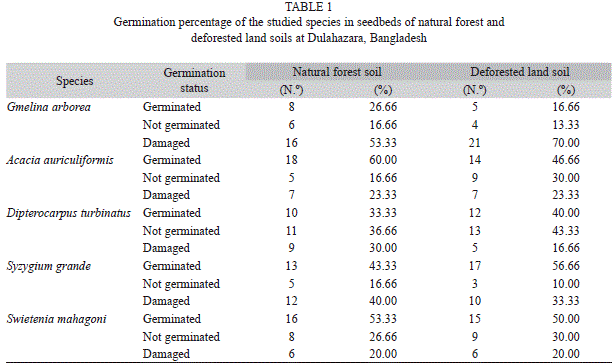
<body><![CDATA[<br style="font-family: verdana;">     <font size="2"><span style="font-family: verdana;"><span      style="font-weight: bold;">Germination performance:</span> There was     no substantial difference found in germination for the studied species     in both type of soils, except for <span style="font-style: italic;">G.     arborea</span>, that was much higher in     natural forest (26.66%) than in deforested land (16.66%). Among the     other species,<span style="font-style: italic;"> A. auriculiformis</span>     and <span style="font-style: italic;">S. mahagoni</span> showed a     little lower     ]]></body>
<body><![CDATA[germination while <span style="font-style: italic;">S. grande</span>     and <span style="font-style: italic;">D. turbinatus</span> showed a     little higher     germination in deforested soil compared to natural forest soil.     Overall, <span style="font-style: italic;">A. auriculiformis</span>     showed the highest germination rate,     followed by <span style="font-style: italic;">S. grande</span> and <span      style="font-style: italic;">S. mahagoni</span>, and the lowest was     found for <span style="font-style: italic;">G.     arborea.</span> Besides, fairly large amount of seeds were damaged in     ]]></body>
<body><![CDATA[both     type of seedbeds. The highest damaged seeds were found for<span      style="font-style: italic;"> G. arborea</span>     i.e. 53% in forest soil seedbeds and 70% in deforested soil seedbeds.     The second species with higher damaged seeds was <span      style="font-style: italic;">S. grande.</span> Near about     50% seeds of these two species were destroyed in the deforested land     experiment (<a href="/img/revistas/rbt/v60n4/a06t1.gif">Table 1</a>).     Excluding damaged seeds, lower germination power     was found for<span style="font-style: italic;"> D. turbinatus,</span>     ]]></body>
<body><![CDATA[i.e. higher amount of seeds were not     germinated in both type of land uses.</span></font><br      style="font-family: verdana;">     <br style="font-family: verdana;">     <font style="font-weight: bold;" size="2"><span      style="font-family: verdana;">Growth performance based on height     and diameter:</span></font><br style="font-family: verdana;">     <br style="font-family: verdana;">     <font size="2"><span style="font-family: verdana;"><span      style="font-weight: bold; font-style: italic;">Swietenia mahagoni:</span>     ]]></body>
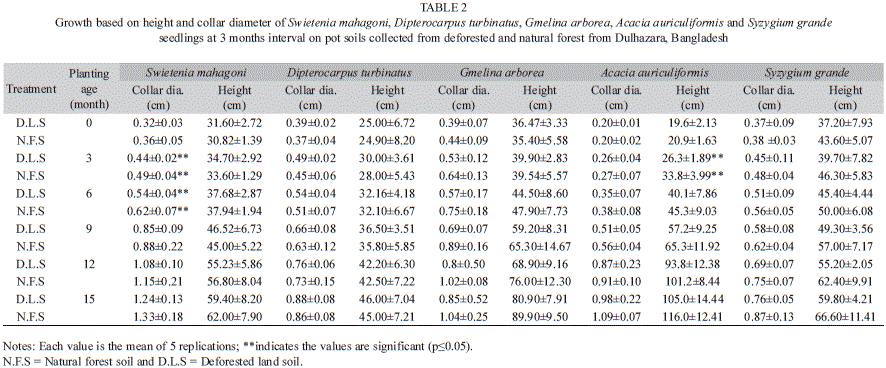
<body><![CDATA[Height growth     of <span style="font-style: italic;">S. mahagoni</span> seedlings in     deforested soil was almost similar compared     to natural forest soil for all the growth period. Collar diameter of     the seedlings grown in deforested soil was significantly (p&#8804;0.05) lower     at three and six month age, and for other period slightly lower     compared to the natural forest soil. Collar diameter of <span      style="font-style: italic;">S. mahagoni</span> at     15 month age in deforested soil was 1.24&plusmn;0.13cm (n=5) and in     natural forest soil 1.33&plusmn;0.18cm (n=5) (<a     ]]></body>
<body><![CDATA[ href="/img/revistas/rbt/v60n4/a06t2.gif">Table 2</a>).</span></font><br      style="font-family: verdana;">     <br style="font-family: verdana;">     <font size="2"><span style="font-family: verdana;"><span      style="font-weight: bold; font-style: italic;">Dipterocarpus     turbinatus:</span> Height     growth of <span style="font-style: italic;">D. turbinatus</span>     seedlings was almost similar in deforested soil     compared to natural forest soil. Height of the seedlings at 15 month     age in deforested soil was 46&plusmn;7.04cm (n=5) and in natural forest     ]]></body>
<body><![CDATA[soil 45&plusmn;7.21cm (n=5) (<a href="/img/revistas/rbt/v60n4/a06t2.gif">Table     2</a>). Reverse trend was found in     collar diameter growth of the species. Collar diameter of <span      style="font-style: italic;">D. turbinatus     </span>was slightly higher for all the growth period in deforested soil     compared to natural forest soil. Collar diameter of the species at 15     month age in deforested soil was 0.88&plusmn;0.08cm (n=5) and in     natural forest soil 0.86&plusmn;0.08cm (n=5) (<a      href="/img/revistas/rbt/v60n4/a06t2.gif">Table 2</a>).</span></font><br      style="font-family: verdana;">     ]]></body>
<body><![CDATA[<br style="font-family: verdana;">     <font size="2"><span style="font-family: verdana;"><span      style="font-weight: bold; font-style: italic;">Gmelina arborea:</span>     Height growth of     <span style="font-style: italic;">G. arborea</span> seedlings on     deforested soil was almost similar to slightly     lower compared to natural forest soil. Height of the species at 15     month age in deforested soil was 80.90&plusmn;7.91cm (n=5) and in     natural forest soil 89.90&plusmn;9.50cm (n=5). Collar diameter of <span      style="font-style: italic;">G.     ]]></body>
<body><![CDATA[arborea</span> was lower at all the ages of seedlings compared to     natural     forest soil (<a href="/img/revistas/rbt/v60n4/a06t2.gif">Table 2</a>).     It clearly showed that the height, collar     diameter of 10 individuals for both sites with very close differences.     The trend focused that significant variation may create in near future     between two land uses.</span></font><br style="font-family: verdana;">     <br style="font-family: verdana;">     <font size="2"><span style="font-family: verdana;"><span      style="font-weight: bold; font-style: italic;">Acacia auriculiformis:</span>     ]]></body>
<body><![CDATA[Height     growth of <span style="font-style: italic;">A. auriculiformis</span>     seedlings grown on deforested soil was     significantly (p&#8804;0.05) lower at three month age, and for other period     slightly lower compared to natural forest soil. At 15 month age, <span      style="font-style: italic;">A.     auriculiformis</span> seedlings attained only 105.0&plusmn;14.44cm     (n=5) in     deforested soiland 116.0&plusmn;12.41cm (n=5) in natural forest soil.     Collar diameter of <span style="font-style: italic;">A. auriculiformis</span>     ]]></body>
<body><![CDATA[was lower compared to natural     forest soil. Collar diameter of the species at 15 month age in     deforested soil was 0.98&plusmn;0.22cm (n=5) and in natural forest soil     1.09&plusmn;0.07cm (n=5) (<a href="/img/revistas/rbt/v60n4/a06t2.gif">Table     2</a>).</span></font><br style="font-family: verdana;">     <br style="font-family: verdana;">     <font size="2"><span style="font-family: verdana;"><span      style="font-style: italic; font-weight: bold;">Syzygium grande:</span>     Growth of <span style="font-style: italic;">S.     grande</span> seedlings grown on deforested soil was lower compared to     ]]></body>
<body><![CDATA[natural     forest soil for all the growth period. Height of the species at 15     month age in deforested soil was 59.80&plusmn;4.21cm (n=5) and in     natural forest soil 66.60&plusmn;11.41cm (n=5). Collar diameter of <span      style="font-style: italic;">S.     grande</span> was slightly lower for all the growth period in     deforested soil     compared to natural forest soil (<a      href="/img/revistas/rbt/v60n4/a06t2.gif">Table 2</a>).</span></font><br      style="font-family: verdana;">     ]]></body>
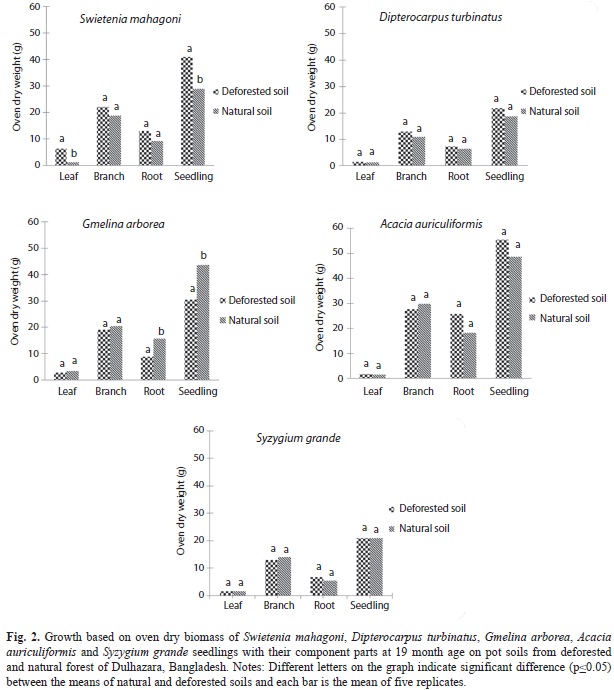
<body><![CDATA[<br style="font-family: verdana;">     <font size="2"><span style="font-family: verdana;"><span      style="font-weight: bold;">Growth performance based on biomass     production:</span> Growth based on oven dry weight of <span      style="font-style: italic;">G. arborea</span>     seedlings and     root was significantly (p&#8804;0.05) lower and other component parts     slightly lower in deforested soil compared to natural forest soil (<a      href="/img/revistas/rbt/v60n4/a06i2.jpg">Fig.     2</a>). Oven dry weight of <span style="font-style: italic;">G. arborea</span>     ]]></body>
<body><![CDATA[seedlings at 19 month age in     deforested soil was 30.56g (n=5) and in natural forest soil 43.69g     (n=5). At 19 month age, reverse trend was found for <span      style="font-style: italic;">S. mahagoni</span> and     their component parts, i.e. <span style="font-style: italic;">S.     mahagoni</span> seedlings and leaf     significantly (p&#8804;0.05) higher and other component parts slightly higher     in deforested soil compared to natural forest soil (<a      href="/img/revistas/rbt/v60n4/a06i2.jpg">Fig. 2</a>). Oven dry     weight of <span style="font-style: italic;">S. mahagoni</span>     ]]></body>
<body><![CDATA[seedlings at 19 month age in deforested soil was     41.13g (n=5) and in natural forest soil 28.95g (n=5). Similar trend was     also found for <span style="font-style: italic;">D. turbinatus</span>     and their component parts at 19 month age.     At 19 month age, growth of <span style="font-style: italic;">S. grande</span>     seedlings based on oven dry weight     was almost similar, root higher and branch growth lower in deforested     soil compared to natural forest soil. Similarly, oven dry biomass     production of <span style="font-style: italic;">A. auriculiformis</span>     seedlings and root were higher and     ]]></body>
<body><![CDATA[branch growth lower in deforested soil compared to natural forest soil     (<a href="/img/revistas/rbt/v60n4/a06i2.jpg">Fig. 2</a>). Oven dry     weight of the seedlings at 19 month age in     deforested soil was 55.60g (n=5) and in natural forest soil 48.82g     (n=5).</span></font><br style="font-family: verdana;">     <br style="font-family: verdana;">     <font style="font-weight: bold;" size="3"><span      style="font-family: verdana;">Discussion</span></font><br      style="font-family: verdana;">     <br style="font-family: verdana;">     ]]></body>
<body><![CDATA[<font size="2"><span style="font-family: verdana;">The results of seed     germination and     seedling growth of the present study clearly demonstrated that     deforested soils still had the conditions for survival and growth of     tree seedlings in Dulhazara. In the study, though fairly large amount     of seeds were damaged, germination rate of the species in deforested     soil was found satisfactory when compared to natural forest soil.     Almost similar germination percentage in both types of land uses in the     study indicated that condition of deforested areas still favor seed     germination.</span></font><br style="font-family: verdana;">     ]]></body>
<body><![CDATA[<br style="font-family: verdana;">     <font size="2"><span style="font-family: verdana;">Instead of favorable     condition for     seed germination in deforested land at Dulhazara, germination rate of     the studied species were quite low when compared to findings from     Pareliussen et al. (2006) and Anderson (1866), because of excessive     biotic interference i.e. wildlife (deer, sambur, wild boar among others     in forest soil seedbeds and domestic animals (cows, dogs, goats, etc.)     in deforested soil seedbeds. Besides, higher seed damage of <span      style="font-style: italic;">G. arborea</span>     ]]></body>
<body><![CDATA[and <span style="font-style: italic;">S. grande</span> were because,     seeds of these species are the favorite     food for many wild birds and animals. Islam et al. (1999) also reported     harmful impact of biotic interference on germination and initial growth     of tree seedlings.</span></font><br style="font-family: verdana;">     <br style="font-family: verdana;">     <font size="2"><span style="font-family: verdana;">However, the     alteration of     microclimate during germination could also limit the seed germination     and result in a negative feedback by the plant as growth progresses.     ]]></body>
<body><![CDATA[Though height growth <span style="font-style: italic;">S. mahagoni</span>     was almost similar in both types of     land use, a significant variation was observed in collar diameter     growth, which depicts negative influence of deforested soils. Anderson     (1866) revealed that under favorable conditions within seven months S.     mahagoni obtained similar height that observed after 15 month age in     the study. The reason might be close affection of <span      style="font-style: italic;">S. mahagoni</span> seedlings     towards flat sandy alluvium (Chowdhury et al. 2004), but sandy loam and     clay to silt clay soil were used in the present experiment. Although     ]]></body>
<body><![CDATA[Shono et al. (2007) reported a poor survival and growth of reforested     tree species in degraded lands, in this study <span      style="font-style: italic;">S. mahagoni</span> obtained     higher height and the oven dry biomass compared to all other studied     species, and indicate its adaptability in such deforested land to some     extent.</span></font><br style="font-family: verdana;">     <br style="font-family: verdana;">     <font size="2"><span style="font-family: verdana;">Among the other     studied species <span style="font-style: italic;">D.     turbinatus</span> is a natural and native tree species ofthis region,     ]]></body>
<body><![CDATA[which     also responded quite well to the deforested soils. <span      style="font-style: italic;">D. turbinatus     </span>seedlings at one year age attained height of 0.92m in natural     forest     soil and 0.86m in deforested soil. Beniwal (2006) conducted an     experiment on <span style="font-style: italic;">D. turbinatus</span>     seedlings growing in forest area and found     heights of 0.27m at one year age. In the study, height growth of <span      style="font-style: italic;">D.     ]]></body>
<body><![CDATA[turbinatus</span> was comparatively higher due to growing in nursery     with     taking more care and maintenance compared to seedlings grown in field     (Blanford 1915). Besides, growth has been found to vary with climatic     condition of sites, microsite differences in soil drainage, nutrient     status and genetic variation, which interact to influence diameter     increments of individual trees and resulting wide inter-individual     variability in growth rates (Whigham et al. 1998, Lamb 1966, Bird     1998). In the current study, <span style="font-style: italic;">A.     auriculiformis</span> seedlings attained only     ]]></body>
<body><![CDATA[1.90m in deforested soil at 15 month age while in Srilanka <span      style="font-style: italic;">A.     auriculiformis</span>&nbsp; was reported to grow up to 6.70m in one and     half     year, and 5m after two year in U.S.A. with 1x1m spacing (Mahmud et al.     2005). Though in the present study height growth of <span      style="font-style: italic;">A. auriculiformis</span>     was found lower than that in Sri Lanka and USA, but among the other     studied species, it was found to be a highly adaptable species in terms     of germination rate, height growth and dry biomass production. Several     ]]></body>
<body><![CDATA[other authors have also reported that <span style="font-style: italic;">A.     auriculiformis</span> grow well in a     wide range of soils under different conditions (Nas 1980, Akkasaeng et     al. 1989, Duguma et al. 1994, Kamara &amp; Maghembe 1994). This     fast-growing tree has extensive root systems with profuse bundles of     N-fixing nodules that have allowed them to survive and grow on degraded     sites, compete with weeds successfully, and improve the soil     characteristics over time (Nas 1980, Cole et al. 1996).</span></font><br      style="font-family: verdana;">     <br style="font-family: verdana;">     ]]></body>
<body><![CDATA[<font size="2"><span style="font-family: verdana;">The growth trend of     tree seedlings     in the study also focused that nutrient deficiency may be created in     near future in deforested land. Therefore, to protect the environment     from ecological disaster as well as for sustainable production from     plantation forest, such deforested land should be covered immediately     through the plantation of <span style="font-style: italic;">A.     auriculiformis, G. arborea, S. mahagoni,     D. turbinatus, S. grande</span> and <span style="font-style: italic;">S.     mahagoni.</span> Though, <span style="font-style: italic;">D.     ]]></body>
<body><![CDATA[turbinatus</span> was not     showed satisfactory growth performance in deforested land, still it is     preferred to be planted along with other species considering their     value in biodiversity conservation. In addition, other common species     of the region are needed to be tested for rehabilitating such degraded     land in future. Further, sustainable development programs need to be     spread among the people so that they can live in harmony with the     forest without destroying it.</span></font><br      style="font-family: verdana;">     <br style="font-family: verdana;">     ]]></body>
<body><![CDATA[<font style="font-weight: bold;" size="3"><span      style="font-family: verdana;">Acknowledgments</span></font><br      style="font-family: verdana;">     <br style="font-family: verdana;">     <font size="2"><span style="font-family: verdana;">The author thanks     USDA for funding     this study and all the IFESCU nursery staff for their considerate help.    <br> <br style="font-family: verdana;"> </span></font> <hr style="width: 100%; height: 2px;">    <!-- ref --><br> <font style="font-weight: bold;" size="3"><span  style="font-family: verdana;">References</span></font><br  style="font-family: verdana;"> <br style="font-family: verdana;"> <font size="2"><span style="font-family: verdana;">Ahmed, G.U. 1990. Survival Percentage and Growth Statistics of Some Plantation Species at Chittagong&nbsp; University Campus. Chittagong University Studies Part II. Science. 14: 45-50.    &nbsp;&nbsp;&nbsp;&nbsp;&nbsp;&nbsp;&nbsp;&nbsp;[&#160;<a href="javascript:void(0);" onclick="javascript: window.open('/scielo.php?script=sci_nlinks&ref=1804735&pid=S0034-7744201200040000600001&lng=','','width=640,height=500,resizable=yes,scrollbars=1,menubar=yes,');">Links</a>&#160;]<!-- end-ref --><!-- ref --></span></font><br style="font-family: verdana;"> <br style="font-family: verdana;"> <font size="2"><span style="font-family: verdana;">Akkasaeng, R., R.C. Gutteridge &amp; M. Wanapat. 1989. Evaluation of trees and shrubs for forage and fuelwood in Northeast Thailand. Int. Tree Crops J. 5: 209-220.    &nbsp;&nbsp;&nbsp;&nbsp;&nbsp;&nbsp;&nbsp;&nbsp;[&#160;<a href="javascript:void(0);" onclick="javascript: window.open('/scielo.php?script=sci_nlinks&ref=1804736&pid=S0034-7744201200040000600002&lng=','','width=640,height=500,resizable=yes,scrollbars=1,menubar=yes,');">Links</a>&#160;]<!-- end-ref --><!-- ref --></span></font><br  style="font-family: verdana;"> <br style="font-family: verdana;"> <font size="2"><span style="font-family: verdana;">Anderson, T. 1866. Indian forester, XXXIX (1913): 327.    &nbsp;&nbsp;&nbsp;&nbsp;&nbsp;&nbsp;&nbsp;&nbsp;[&#160;<a href="javascript:void(0);" onclick="javascript: window.open('/scielo.php?script=sci_nlinks&ref=1804737&pid=S0034-7744201200040000600003&lng=','','width=640,height=500,resizable=yes,scrollbars=1,menubar=yes,');">Links</a>&#160;]<!-- end-ref --><!-- ref --></span></font><br style="font-family: verdana;"> <br style="font-family: verdana;"> <font size="2"><span style="font-family: verdana;">Beniwal, B.S. 2006. Genetic improvement of forest trees in Arunachal Pradesh. Indian For. 116: 3-10.    &nbsp;&nbsp;&nbsp;&nbsp;&nbsp;&nbsp;&nbsp;&nbsp;[&#160;<a href="javascript:void(0);" onclick="javascript: window.open('/scielo.php?script=sci_nlinks&ref=1804738&pid=S0034-7744201200040000600004&lng=','','width=640,height=500,resizable=yes,scrollbars=1,menubar=yes,');">Links</a>&#160;]<!-- end-ref --><!-- ref --></span></font><br  style="font-family: verdana;"> <br style="font-family: verdana;"> <font size="2"><span style="font-family: verdana;">Bird, N.M. 1998. Sustaining the Yield: Improved Timber Harvesting Practices in Belize 1992-1998. Natural Resources Institute, University of Greenwich, United Kingdom.    &nbsp;&nbsp;&nbsp;&nbsp;&nbsp;&nbsp;&nbsp;&nbsp;[&#160;<a href="javascript:void(0);" onclick="javascript: window.open('/scielo.php?script=sci_nlinks&ref=1804739&pid=S0034-7744201200040000600005&lng=','','width=640,height=500,resizable=yes,scrollbars=1,menubar=yes,');">Links</a>&#160;]<!-- end-ref --><!-- ref --></span></font><br  style="font-family: verdana;"> <font size="2"><span style="font-family: verdana;">Blanford, H.R. 1915. Indian Forester, 12: 78.    &nbsp;&nbsp;&nbsp;&nbsp;&nbsp;&nbsp;&nbsp;&nbsp;[&#160;<a href="javascript:void(0);" onclick="javascript: window.open('/scielo.php?script=sci_nlinks&ref=1804740&pid=S0034-7744201200040000600006&lng=','','width=640,height=500,resizable=yes,scrollbars=1,menubar=yes,');">Links</a>&#160;]<!-- end-ref --><!-- ref --></span></font><br style="font-family: verdana;"> <br style="font-family: verdana;"> <font size="2"><span style="font-family: verdana;">Carpenter, F.L., J.D. Nichols &amp; E. Sandi. 2004. Early growth of native and exotic trees planted on degraded pasture. Forest Ecol. Manag. 196: 367-378.    &nbsp;&nbsp;&nbsp;&nbsp;&nbsp;&nbsp;&nbsp;&nbsp;[&#160;<a href="javascript:void(0);" onclick="javascript: window.open('/scielo.php?script=sci_nlinks&ref=1804741&pid=S0034-7744201200040000600007&lng=','','width=640,height=500,resizable=yes,scrollbars=1,menubar=yes,');">Links</a>&#160;]<!-- end-ref --><!-- ref --></span></font><br  style="font-family: verdana;"> <br style="font-family: verdana;"> <font size="2"><span style="font-family: verdana;">Chowdhury, J.K., S.R. Biswas, S.M. Rahman &amp; S.N. Uddin. 2004. Biodiversity of Dulahazara Safari Park, Cox&#8217;s Bazar. IUCN Bangladesh Country Office, Dhaka, Bangladesh.    &nbsp;&nbsp;&nbsp;&nbsp;&nbsp;&nbsp;&nbsp;&nbsp;[&#160;<a href="javascript:void(0);" onclick="javascript: window.open('/scielo.php?script=sci_nlinks&ref=1804742&pid=S0034-7744201200040000600008&lng=','','width=640,height=500,resizable=yes,scrollbars=1,menubar=yes,');">Links</a>&#160;]<!-- end-ref --><!-- ref --></span></font><br  style="font-family: verdana;"> <br style="font-family: verdana;"> <font size="2"><span style="font-family: verdana;">Cole, T.G., R.S. Yost, R. Kablan &amp; T. Olsen. 1996. Growth potential of twelve Acacia species on acid soils in Hawaii. Forest Ecol. Manag. 80: 175-186.    &nbsp;&nbsp;&nbsp;&nbsp;&nbsp;&nbsp;&nbsp;&nbsp;[&#160;<a href="javascript:void(0);" onclick="javascript: window.open('/scielo.php?script=sci_nlinks&ref=1804743&pid=S0034-7744201200040000600009&lng=','','width=640,height=500,resizable=yes,scrollbars=1,menubar=yes,');">Links</a>&#160;]<!-- end-ref --><!-- ref --></span></font><br  style="font-family: verdana;"> <br style="font-family: verdana;"> <font size="2"><span style="font-family: verdana;">Dinerstein, E., D.M. Olson, D.J. Graham, A.L. Webster, S.A. Primm, M.P. Bookbinder &amp; G. Ledec. 1995. A conservation assessment of the terrestrial ecoregions of Latin America and the Carribean. World Wildlife Fund/World Bank, Washington, DC, USA.    &nbsp;&nbsp;&nbsp;&nbsp;&nbsp;&nbsp;&nbsp;&nbsp;[&#160;<a href="javascript:void(0);" onclick="javascript: window.open('/scielo.php?script=sci_nlinks&ref=1804744&pid=S0034-7744201200040000600010&lng=','','width=640,height=500,resizable=yes,scrollbars=1,menubar=yes,');">Links</a>&#160;]<!-- end-ref --><!-- ref --></span></font><br style="font-family: verdana;"> <br style="font-family: verdana;"> <font size="2"><span style="font-family: verdana;">Douglas. 1981. Quoted in Village Forest Inventory, Statistical Report Forestry Master Plan, 1992.ADB (TA 1355-BAN), UNDP/FAO/BGD/025/1992. Ministry of Environment and Forests, Government of Bangladesh, Bangladesh.    &nbsp;&nbsp;&nbsp;&nbsp;&nbsp;&nbsp;&nbsp;&nbsp;[&#160;<a href="javascript:void(0);" onclick="javascript: window.open('/scielo.php?script=sci_nlinks&ref=1804745&pid=S0034-7744201200040000600011&lng=','','width=640,height=500,resizable=yes,scrollbars=1,menubar=yes,');">Links</a>&#160;]<!-- end-ref --><!-- ref --></span></font><br  style="font-family: verdana;"> <br style="font-family: verdana;"> <font size="2"><span style="font-family: verdana;">Dugua. B., J. Tonye, J. Kanmegne, T. Manga &amp; T. Enoch. 1994. Growth of ten multipurpose tree species on acid soils in Sangmelina, Cameroon. Agroforest. Syst. 27: 107-119.    &nbsp;&nbsp;&nbsp;&nbsp;&nbsp;&nbsp;&nbsp;&nbsp;[&#160;<a href="javascript:void(0);" onclick="javascript: window.open('/scielo.php?script=sci_nlinks&ref=1804746&pid=S0034-7744201200040000600012&lng=','','width=640,height=500,resizable=yes,scrollbars=1,menubar=yes,');">Links</a>&#160;]<!-- end-ref --><!-- ref --></span></font><br  style="font-family: verdana;"> <br style="font-family: verdana;"> <font size="2"><span style="font-family: verdana;">Evans. J. 1982. Plantation forestry in the tropics. Clarendon, Oxford, United Kingdom.    &nbsp;&nbsp;&nbsp;&nbsp;&nbsp;&nbsp;&nbsp;&nbsp;[&#160;<a href="javascript:void(0);" onclick="javascript: window.open('/scielo.php?script=sci_nlinks&ref=1804747&pid=S0034-7744201200040000600013&lng=','','width=640,height=500,resizable=yes,scrollbars=1,menubar=yes,');">Links</a>&#160;]<!-- end-ref --><!-- ref --></span></font><br  style="font-family: verdana;"> <br style="font-family: verdana;"> <font size="2"><span style="font-family: verdana;">FAO. 1995. Forest Resources Assessment 1990: Global Synthesis. FAO Forestry Paper 124. Rome, Italy.    &nbsp;&nbsp;&nbsp;&nbsp;&nbsp;&nbsp;&nbsp;&nbsp;[&#160;<a href="javascript:void(0);" onclick="javascript: window.open('/scielo.php?script=sci_nlinks&ref=1804748&pid=S0034-7744201200040000600014&lng=','','width=640,height=500,resizable=yes,scrollbars=1,menubar=yes,');">Links</a>&#160;]<!-- end-ref --><!-- ref --></span></font><br  style="font-family: verdana;"> <br style="font-family: verdana;"> <font size="2"><span style="font-family: verdana;">FAO. 2001. Technical Notes on Forestry Aspects. WFP Assisted Projects. November 1993, FAO, Dhaka, Bangladesh.    &nbsp;&nbsp;&nbsp;&nbsp;&nbsp;&nbsp;&nbsp;&nbsp;[&#160;<a href="javascript:void(0);" onclick="javascript: window.open('/scielo.php?script=sci_nlinks&ref=1804749&pid=S0034-7744201200040000600015&lng=','','width=640,height=500,resizable=yes,scrollbars=1,menubar=yes,');">Links</a>&#160;]<!-- end-ref --><!-- ref --></span></font><br style="font-family: verdana;"> <br style="font-family: verdana;"> <font size="2"><span style="font-family: verdana;">FMP. 1992. Main Plan -1993/2012 and supporting volumes, Forestry Master Plan, Bangladesh, Asian Development Bank (TA No. 1355-BAN). UNDP /FAO /BGD /88 /025.    &nbsp;&nbsp;&nbsp;&nbsp;&nbsp;&nbsp;&nbsp;&nbsp;[&#160;<a href="javascript:void(0);" onclick="javascript: window.open('/scielo.php?script=sci_nlinks&ref=1804750&pid=S0034-7744201200040000600016&lng=','','width=640,height=500,resizable=yes,scrollbars=1,menubar=yes,');">Links</a>&#160;]<!-- end-ref --><!-- ref --></span></font><br  style="font-family: verdana;"> <br style="font-family: verdana;"> <font size="2"><span style="font-family: verdana;">FRA. 2000. Forest resources of Bangladesh country report. FAO, Rome, Italy.    &nbsp;&nbsp;&nbsp;&nbsp;&nbsp;&nbsp;&nbsp;&nbsp;[&#160;<a href="javascript:void(0);" onclick="javascript: window.open('/scielo.php?script=sci_nlinks&ref=1804751&pid=S0034-7744201200040000600017&lng=','','width=640,height=500,resizable=yes,scrollbars=1,menubar=yes,');">Links</a>&#160;]<!-- end-ref --><!-- ref --></span></font><br  style="font-family: verdana;"> <br style="font-family: verdana;"> <font size="2"><span style="font-family: verdana;">Houghton, R.A. 1990. The future role of tropical forests in affecting the CO<sub>2</sub> concentration in the atmosphere. Ambio 19: 204-209.    &nbsp;&nbsp;&nbsp;&nbsp;&nbsp;&nbsp;&nbsp;&nbsp;[&#160;<a href="javascript:void(0);" onclick="javascript: window.open('/scielo.php?script=sci_nlinks&ref=1804752&pid=S0034-7744201200040000600018&lng=','','width=640,height=500,resizable=yes,scrollbars=1,menubar=yes,');">Links</a>&#160;]<!-- end-ref --><!-- ref --></span></font><br  style="font-family: verdana;"> <br style="font-family: verdana;"> <font size="2"><span style="font-family: verdana;">Islam, K.R., M. Kamaluddin, M.K. Bhuyan &amp; A. Badruddin. 1999. Comparative performance of exotic and indigenous forest species for tropical semi- evergreen degraded forest land reforestation in Chittagong, Bangladesh. Land Degrad. Dev. 10: 241-249.    &nbsp;&nbsp;&nbsp;&nbsp;&nbsp;&nbsp;&nbsp;&nbsp;[&#160;<a href="javascript:void(0);" onclick="javascript: window.open('/scielo.php?script=sci_nlinks&ref=1804753&pid=S0034-7744201200040000600019&lng=','','width=640,height=500,resizable=yes,scrollbars=1,menubar=yes,');">Links</a>&#160;]<!-- end-ref --><!-- ref --></span></font><br style="font-family: verdana;"> <br style="font-family: verdana;"> <font size="2"><span style="font-family: verdana;">Islam, K.R. &amp; R.R. Weil. 2000. Land use effects on soil quality in a tropical forest ecosystem of Bangladesh. Agr. Ecosyst. Environ. 79: 9-16.    &nbsp;&nbsp;&nbsp;&nbsp;&nbsp;&nbsp;&nbsp;&nbsp;[&#160;<a href="javascript:void(0);" onclick="javascript: window.open('/scielo.php?script=sci_nlinks&ref=1804754&pid=S0034-7744201200040000600020&lng=','','width=640,height=500,resizable=yes,scrollbars=1,menubar=yes,');">Links</a>&#160;]<!-- end-ref --><!-- ref --></span></font><br  style="font-family: verdana;"> <br style="font-family: verdana;"> <font size="2"><span style="font-family: verdana;">Kamara, C.S. &amp; J.A. Maghembe. 1994. Performance of multipurpose tree and shrub species 28 months after planting at Chalimbana, Zambia. Forest Ecol. Manag. 64: 145-151.    &nbsp;&nbsp;&nbsp;&nbsp;&nbsp;&nbsp;&nbsp;&nbsp;[&#160;<a href="javascript:void(0);" onclick="javascript: window.open('/scielo.php?script=sci_nlinks&ref=1804755&pid=S0034-7744201200040000600021&lng=','','width=640,height=500,resizable=yes,scrollbars=1,menubar=yes,');">Links</a>&#160;]<!-- end-ref --><!-- ref --></span></font><br  style="font-family: verdana;"> <br style="font-family: verdana;"> <font size="2"><span style="font-family: verdana;">Lamb, F.B. 1966. Mahogany of Tropical America: its Ecology and Management. The University of Michigan Press, Ann Arbor, USA.    &nbsp;&nbsp;&nbsp;&nbsp;&nbsp;&nbsp;&nbsp;&nbsp;[&#160;<a href="javascript:void(0);" onclick="javascript: window.open('/scielo.php?script=sci_nlinks&ref=1804756&pid=S0034-7744201200040000600022&lng=','','width=640,height=500,resizable=yes,scrollbars=1,menubar=yes,');">Links</a>&#160;]<!-- end-ref --><!-- ref --></span></font><br  style="font-family: verdana;"> <br style="font-family: verdana;"> <font size="2"><span style="font-family: verdana;">Lusiana. B., P. Purnomosidhi, S. Rahayu &amp; J. Roshetko. 2004. Survival and Initial Growth of Various Timber Trees Species in Degraded Soils of North Lampung, Indonesia.    &nbsp;&nbsp;&nbsp;&nbsp;&nbsp;&nbsp;&nbsp;&nbsp;[&#160;<a href="javascript:void(0);" onclick="javascript: window.open('/scielo.php?script=sci_nlinks&ref=1804757&pid=S0034-7744201200040000600023&lng=','','width=640,height=500,resizable=yes,scrollbars=1,menubar=yes,');">Links</a>&#160;]<!-- end-ref --><!-- ref --></span></font><br  style="font-family: verdana;"> <br style="font-family: verdana;"> <font size="2"><span style="font-family: verdana;">Mabud, A. 2001. Integrated Forest Management Plan For Chittagong Forest Division (2002-2009). Final Draft Book no. 1. Forest Department, Bangladesh.    &nbsp;&nbsp;&nbsp;&nbsp;&nbsp;&nbsp;&nbsp;&nbsp;[&#160;<a href="javascript:void(0);" onclick="javascript: window.open('/scielo.php?script=sci_nlinks&ref=1804758&pid=S0034-7744201200040000600024&lng=','','width=640,height=500,resizable=yes,scrollbars=1,menubar=yes,');">Links</a>&#160;]<!-- end-ref --><!-- ref --></span></font><br  style="font-family: verdana;"> <br style="font-family: verdana;"> <font size="2"><span style="font-family: verdana;">Mahmud, S., A.T.M.R. Hoque &amp; M. Mohiuddin. 2005. Germination behavior and initial growth performance of eight multipurpose tree species. Int. J. Agric. Biol. 4: 539-542.    &nbsp;&nbsp;&nbsp;&nbsp;&nbsp;&nbsp;&nbsp;&nbsp;[&#160;<a href="javascript:void(0);" onclick="javascript: window.open('/scielo.php?script=sci_nlinks&ref=1804759&pid=S0034-7744201200040000600025&lng=','','width=640,height=500,resizable=yes,scrollbars=1,menubar=yes,');">Links</a>&#160;]<!-- end-ref --><!-- ref --></span></font><br  style="font-family: verdana;"> <br style="font-family: verdana;"> <font size="2"><span style="font-family: verdana;">Munsell Soil Color Charts. 1954. Munsell Color Company, Inc., Baltimore, USA.    &nbsp;&nbsp;&nbsp;&nbsp;&nbsp;&nbsp;&nbsp;&nbsp;[&#160;<a href="javascript:void(0);" onclick="javascript: window.open('/scielo.php?script=sci_nlinks&ref=1804760&pid=S0034-7744201200040000600026&lng=','','width=640,height=500,resizable=yes,scrollbars=1,menubar=yes,');">Links</a>&#160;]<!-- end-ref --><br>     <!-- ref --><br> Nas. 1980. Firewood Crops - Shrubs and Tree Species for Energy Production, National Academy of Sciences, Washington DC, USA.    &nbsp;&nbsp;&nbsp;&nbsp;&nbsp;&nbsp;&nbsp;&nbsp;[&#160;<a href="javascript:void(0);" onclick="javascript: window.open('/scielo.php?script=sci_nlinks&ref=1804762&pid=S0034-7744201200040000600027&lng=','','width=640,height=500,resizable=yes,scrollbars=1,menubar=yes,');">Links</a>&#160;]<!-- end-ref --><!-- ref --></span></font><br  style="font-family: verdana;"> <br style="font-family: verdana;"> <font size="2"><span style="font-family: verdana;">Pareliussen, I., E.G.A. Olsson &amp; W.S. Armbruster. 2006. Factors limiting the survival of native tree seedlings used in conservation efforts at the edges of forest fragments in upland Madagascar. Restor. Ecol. 14: 196-203.    &nbsp;&nbsp;&nbsp;&nbsp;&nbsp;&nbsp;&nbsp;&nbsp;[&#160;<a href="javascript:void(0);" onclick="javascript: window.open('/scielo.php?script=sci_nlinks&ref=1804763&pid=S0034-7744201200040000600028&lng=','','width=640,height=500,resizable=yes,scrollbars=1,menubar=yes,');">Links</a>&#160;]<!-- end-ref --><!-- ref --></span></font><br  style="font-family: verdana;"> <br style="font-family: verdana;"> <font size="2"><span style="font-family: verdana;">Pritchett, W.L. &amp; R.F. Fisher. 1987. Properties and Management of Forest Soils. John Wiley and Sons, New York, USA.    &nbsp;&nbsp;&nbsp;&nbsp;&nbsp;&nbsp;&nbsp;&nbsp;[&#160;<a href="javascript:void(0);" onclick="javascript: window.open('/scielo.php?script=sci_nlinks&ref=1804764&pid=S0034-7744201200040000600029&lng=','','width=640,height=500,resizable=yes,scrollbars=1,menubar=yes,');">Links</a>&#160;]<!-- end-ref --><!-- ref --></span></font><br style="font-family: verdana;"> <br style="font-family: verdana;"> <font size="2"><span style="font-family: verdana;">Rasul, G. &amp; M. Kakri. 2007. Participatory Forest Management in South Asia. A comparative analysis of policies, institutions and approaches. Published by ICIMOD, Kathmandu, Nepal.    &nbsp;&nbsp;&nbsp;&nbsp;&nbsp;&nbsp;&nbsp;&nbsp;[&#160;<a href="javascript:void(0);" onclick="javascript: window.open('/scielo.php?script=sci_nlinks&ref=1804765&pid=S0034-7744201200040000600030&lng=','','width=640,height=500,resizable=yes,scrollbars=1,menubar=yes,');">Links</a>&#160;]<!-- end-ref --><!-- ref --></span></font><br style="font-family: verdana;"> <br style="font-family: verdana;"> <font size="2"><span style="font-family: verdana;">Roshetko, J.M. &amp; P. Purnomosidhi. 1999. Establishment and early growth of five timber species under smallholder conditions in Lampung, Indonesia. Forest Farm and Community Tree Research Reports. 4: 4-10.    &nbsp;&nbsp;&nbsp;&nbsp;&nbsp;&nbsp;&nbsp;&nbsp;[&#160;<a href="javascript:void(0);" onclick="javascript: window.open('/scielo.php?script=sci_nlinks&ref=1804766&pid=S0034-7744201200040000600031&lng=','','width=640,height=500,resizable=yes,scrollbars=1,menubar=yes,');">Links</a>&#160;]<!-- end-ref --><!-- ref --></span></font><br  style="font-family: verdana;"> <br style="font-family: verdana;"> <font size="2"><span style="font-family: verdana;">Shono, K., S.J. Davies &amp; Y.K. Chua. 2007. Performance of 45 native tree species on degraded lands in Singapore. J. Trop. For. Sci. 19: 25-34.    &nbsp;&nbsp;&nbsp;&nbsp;&nbsp;&nbsp;&nbsp;&nbsp;[&#160;<a href="javascript:void(0);" onclick="javascript: window.open('/scielo.php?script=sci_nlinks&ref=1804767&pid=S0034-7744201200040000600032&lng=','','width=640,height=500,resizable=yes,scrollbars=1,menubar=yes,');">Links</a>&#160;]<!-- end-ref --><!-- ref --></span></font><br  style="font-family: verdana;"> <font size="2"><span style="font-family: verdana;">WCMC. 1998. Directory of South Asian Protected Areas. IUCN. 95-113.    &nbsp;&nbsp;&nbsp;&nbsp;&nbsp;&nbsp;&nbsp;&nbsp;[&#160;<a href="javascript:void(0);" onclick="javascript: window.open('/scielo.php?script=sci_nlinks&ref=1804768&pid=S0034-7744201200040000600033&lng=','','width=640,height=500,resizable=yes,scrollbars=1,menubar=yes,');">Links</a>&#160;]<!-- end-ref --><!-- ref --></span></font><br  style="font-family: verdana;"> <br style="font-family: verdana;"> <font size="2"><span style="font-family: verdana;">Whigham, D.F., J.F. Lynch &amp; M.B. Dickinson. 1998. Dynamics and ecology of natural and managed forests in Quintana Roo, Mexico, p. 267-281. <span  style="font-style: italic;">In</span> R.B. Primack (eds.). Timber, tourists, and temples: conservation and development in the Maya Forests of Belize, Guatemala and Mexico. Island, Washington DC, USA.    &nbsp;&nbsp;&nbsp;&nbsp;&nbsp;&nbsp;&nbsp;&nbsp;[&#160;<a href="javascript:void(0);" onclick="javascript: window.open('/scielo.php?script=sci_nlinks&ref=1804769&pid=S0034-7744201200040000600034&lng=','','width=640,height=500,resizable=yes,scrollbars=1,menubar=yes,');">Links</a>&#160;]<!-- end-ref --><br>     <br> </span></font><font size="2"><span style="font-family: verdana;"><a  name="Correspondencia1"></a><a href="#Correspondencia2">*</a>Correspondencia: Md. Mohitul Hossain: Institute of Forestry and Environmental Sciences, University of Chittagong, Chittagong-4331, Bangladesh; mohitulh@yahoo.com    <br> </span></font><font size="2"><span style="font-family: verdana;"><a  name="1"></a><a href="#2">1</a>. Institute of Forestry and Environmental Sciences, University of Chittagong, Chittagong-4331, Bangladesh; mohitulh@yahoo.com</span></font><br  style="font-family: verdana;"> <font size="2"><span style="font-family: verdana;"></span></font> <hr style="width: 100%; height: 2px;">     <div style="text-align: center;"><font style="font-weight: bold;"  size="2"><span style="font-family: verdana;">Received 11-II-2011. Corrected 20-IV-2012. Accepted 29-V-2012.</span> </font></div> </div>      ]]></body><back>
<ref-list>
<ref id="B1">
<nlm-citation citation-type="journal">
<person-group person-group-type="author">
<name>
<surname><![CDATA[Ahmed]]></surname>
<given-names><![CDATA[G.U]]></given-names>
</name>
</person-group>
<article-title xml:lang="en"><![CDATA[Survival Percentage and Growth Statistics of Some Plantation Species at Chittagong University Campus: Chittagong University Studies Part II]]></article-title>
<source><![CDATA[Science]]></source>
<year>1990</year>
<volume>14</volume>
<page-range>45-50</page-range></nlm-citation>
</ref>
<ref id="B2">
<nlm-citation citation-type="journal">
<person-group person-group-type="author">
<name>
<surname><![CDATA[Akkasaeng]]></surname>
<given-names><![CDATA[R]]></given-names>
</name>
<name>
<surname><![CDATA[Gutteridge]]></surname>
<given-names><![CDATA[R.C.]]></given-names>
</name>
<name>
<surname><![CDATA[Wanapat]]></surname>
<given-names><![CDATA[M]]></given-names>
</name>
</person-group>
<article-title xml:lang="en"><![CDATA[Evaluation of trees and shrubs for forage and fuelwood in Northeast Thailand]]></article-title>
<source><![CDATA[Int. Tree Crops J]]></source>
<year>1989</year>
<volume>5</volume>
<page-range>209-220</page-range></nlm-citation>
</ref>
<ref id="B3">
<nlm-citation citation-type="journal">
<person-group person-group-type="author">
<name>
<surname><![CDATA[Anderson]]></surname>
<given-names><![CDATA[T]]></given-names>
</name>
</person-group>
<source><![CDATA[Indian forester]]></source>
<year>1866</year>
<volume>XXXIX</volume>
<numero>1913</numero>
<issue>1913</issue>
<page-range>327</page-range></nlm-citation>
</ref>
<ref id="B4">
<nlm-citation citation-type="journal">
<person-group person-group-type="author">
<name>
<surname><![CDATA[Beniwal]]></surname>
<given-names><![CDATA[B.S]]></given-names>
</name>
</person-group>
<article-title xml:lang="en"><![CDATA[Genetic improvement of forest trees in Arunachal Pradesh]]></article-title>
<source><![CDATA[Indian For]]></source>
<year>2006</year>
<volume>116</volume>
<page-range>3-10</page-range></nlm-citation>
</ref>
<ref id="B5">
<nlm-citation citation-type="book">
<person-group person-group-type="author">
<name>
<surname><![CDATA[Bird]]></surname>
<given-names><![CDATA[N.M]]></given-names>
</name>
</person-group>
<source><![CDATA[Sustaining the Yield: Improved Timber Harvesting Practices in Belize 1992-1998]]></source>
<year>1998</year>
<publisher-name><![CDATA[Natural Resources InstituteUniversity of Greenwich]]></publisher-name>
</nlm-citation>
</ref>
<ref id="B6">
<nlm-citation citation-type="journal">
<person-group person-group-type="author">
<name>
<surname><![CDATA[Blanford]]></surname>
<given-names><![CDATA[H.R]]></given-names>
</name>
</person-group>
<source><![CDATA[Indian Forester]]></source>
<year>1915</year>
<volume>12</volume>
<page-range>78</page-range></nlm-citation>
</ref>
<ref id="B7">
<nlm-citation citation-type="journal">
<person-group person-group-type="author">
<name>
<surname><![CDATA[Carpenter]]></surname>
<given-names><![CDATA[F.L]]></given-names>
</name>
<name>
<surname><![CDATA[Nichols]]></surname>
<given-names><![CDATA[J.D]]></given-names>
</name>
<name>
<surname><![CDATA[Sandi]]></surname>
<given-names><![CDATA[E]]></given-names>
</name>
</person-group>
<article-title xml:lang="en"><![CDATA[Early growth of native and exotic trees planted on degraded pasture]]></article-title>
<source><![CDATA[Forest Ecol. Manag]]></source>
<year>2004</year>
<volume>196</volume>
<page-range>367-378</page-range></nlm-citation>
</ref>
<ref id="B8">
<nlm-citation citation-type="book">
<person-group person-group-type="author">
<name>
<surname><![CDATA[Chowdhury]]></surname>
<given-names><![CDATA[J.K]]></given-names>
</name>
<name>
<surname><![CDATA[Biswas]]></surname>
<given-names><![CDATA[S.R]]></given-names>
</name>
<name>
<surname><![CDATA[Rahman]]></surname>
<given-names><![CDATA[S.M]]></given-names>
</name>
<name>
<surname><![CDATA[Uddin]]></surname>
<given-names><![CDATA[S.N]]></given-names>
</name>
</person-group>
<source><![CDATA[Biodiversity of Dulahazara Safari Park, Cox&#8217;s Bazar]]></source>
<year>2004</year>
<publisher-loc><![CDATA[^eDhaka Dhaka]]></publisher-loc>
<publisher-name><![CDATA[IUCN Bangladesh Country Office]]></publisher-name>
</nlm-citation>
</ref>
<ref id="B9">
<nlm-citation citation-type="journal">
<person-group person-group-type="author">
<name>
<surname><![CDATA[Cole]]></surname>
<given-names><![CDATA[T.G]]></given-names>
</name>
<name>
<surname><![CDATA[Yost]]></surname>
<given-names><![CDATA[R.S]]></given-names>
</name>
<name>
<surname><![CDATA[Kablan]]></surname>
<given-names><![CDATA[R.]]></given-names>
</name>
<name>
<surname><![CDATA[Olsen]]></surname>
<given-names><![CDATA[T]]></given-names>
</name>
</person-group>
<article-title xml:lang="en"><![CDATA[Growth potential of twelve Acacia species on acid soils in Hawaii]]></article-title>
<source><![CDATA[Forest Ecol. Manag]]></source>
<year>1996</year>
<volume>80</volume>
<page-range>175-186</page-range></nlm-citation>
</ref>
<ref id="B10">
<nlm-citation citation-type="book">
<person-group person-group-type="author">
<name>
<surname><![CDATA[Dinerstein]]></surname>
<given-names><![CDATA[E]]></given-names>
</name>
<name>
<surname><![CDATA[Olson]]></surname>
<given-names><![CDATA[D.M]]></given-names>
</name>
<name>
<surname><![CDATA[Graham]]></surname>
<given-names><![CDATA[D.J]]></given-names>
</name>
<name>
<surname><![CDATA[Webster]]></surname>
<given-names><![CDATA[A.L]]></given-names>
</name>
<name>
<surname><![CDATA[Primm]]></surname>
<given-names><![CDATA[S.A]]></given-names>
</name>
<name>
<surname><![CDATA[Bookbinder]]></surname>
<given-names><![CDATA[M.P]]></given-names>
</name>
<name>
<surname><![CDATA[Ledec]]></surname>
<given-names><![CDATA[G]]></given-names>
</name>
</person-group>
<source><![CDATA[A conservation assessment of the terrestrial ecoregions of Latin America and the Carribean]]></source>
<year>1995</year>
<publisher-loc><![CDATA[^eWashington, DC Washington, DC]]></publisher-loc>
<publisher-name><![CDATA[World Wildlife Fund/World Bank]]></publisher-name>
</nlm-citation>
</ref>
<ref id="B11">
<nlm-citation citation-type="book">
<person-group person-group-type="author">
<name>
<surname><![CDATA[Douglas]]></surname>
</name>
</person-group>
<source><![CDATA[Quoted in Village Forest Inventory, Statistical Report Forestry Master Plan, 1992.ADB (TA 1355-BAN), UNDP/FAO/BGD/025/1992]]></source>
<year>1981</year>
<publisher-name><![CDATA[Ministry of Environment and ForestsGovernment of Bangladesh]]></publisher-name>
</nlm-citation>
</ref>
<ref id="B12">
<nlm-citation citation-type="journal">
<person-group person-group-type="author">
<name>
<surname><![CDATA[Dugua]]></surname>
<given-names><![CDATA[B]]></given-names>
</name>
<name>
<surname><![CDATA[Tonye]]></surname>
<given-names><![CDATA[J]]></given-names>
</name>
<name>
<surname><![CDATA[Kanmegne]]></surname>
<given-names><![CDATA[J]]></given-names>
</name>
<name>
<surname><![CDATA[Manga]]></surname>
<given-names><![CDATA[T]]></given-names>
</name>
<name>
<surname><![CDATA[Enoch]]></surname>
<given-names><![CDATA[T]]></given-names>
</name>
</person-group>
<article-title xml:lang="en"><![CDATA[Growth of ten multipurpose tree species on acid soils in Sangmelina, Cameroon]]></article-title>
<source><![CDATA[Agroforest. Syst]]></source>
<year>1994</year>
<volume>27</volume>
<page-range>107-119</page-range></nlm-citation>
</ref>
<ref id="B13">
<nlm-citation citation-type="book">
<person-group person-group-type="author">
<name>
<surname><![CDATA[Evans]]></surname>
<given-names><![CDATA[J]]></given-names>
</name>
</person-group>
<source><![CDATA[Plantation forestry in the tropics]]></source>
<year>1982</year>
<publisher-loc><![CDATA[^eOxford Oxford]]></publisher-loc>
<publisher-name><![CDATA[Clarendon]]></publisher-name>
</nlm-citation>
</ref>
<ref id="B14">
<nlm-citation citation-type="book">
<collab>FAO</collab>
<source><![CDATA[Forest Resources Assessment 1990: Global Synthesis]]></source>
<year>1995</year>
<volume>124</volume>
<publisher-loc><![CDATA[^eRome Rome]]></publisher-loc>
<publisher-name><![CDATA[FAO]]></publisher-name>
</nlm-citation>
</ref>
<ref id="B15">
<nlm-citation citation-type="book">
<collab>FAO</collab>
<source><![CDATA[Technical Notes on Forestry Aspects]]></source>
<year>2001</year>
<publisher-loc><![CDATA[^eDhaka Dhaka]]></publisher-loc>
<publisher-name><![CDATA[FAO]]></publisher-name>
</nlm-citation>
</ref>
<ref id="B16">
<nlm-citation citation-type="book">
<collab>FMP</collab>
<source><![CDATA[Main Plan -1993/2012 and supporting volumes]]></source>
<year>1992</year>
<publisher-name><![CDATA[Forestry Master PlanAsian Development Bank]]></publisher-name>
</nlm-citation>
</ref>
<ref id="B17">
<nlm-citation citation-type="book">
<collab>FRA</collab>
<source><![CDATA[Forest resources of Bangladesh country report]]></source>
<year>2000</year>
<publisher-loc><![CDATA[^eRome Rome]]></publisher-loc>
<publisher-name><![CDATA[FAO]]></publisher-name>
</nlm-citation>
</ref>
<ref id="B18">
<nlm-citation citation-type="journal">
<person-group person-group-type="author">
<name>
<surname><![CDATA[Houghton]]></surname>
<given-names><![CDATA[R.A.]]></given-names>
</name>
</person-group>
<article-title xml:lang="en"><![CDATA[The future role of tropical forests in affecting the CO2 concentration in the atmosphere]]></article-title>
<source><![CDATA[Ambio]]></source>
<year>1990</year>
<volume>19</volume>
<page-range>204-209</page-range></nlm-citation>
</ref>
<ref id="B19">
<nlm-citation citation-type="journal">
<person-group person-group-type="author">
<name>
<surname><![CDATA[Islam]]></surname>
<given-names><![CDATA[K.R.]]></given-names>
</name>
<name>
<surname><![CDATA[Kamaluddin]]></surname>
<given-names><![CDATA[M.]]></given-names>
</name>
<name>
<surname><![CDATA[Bhuyan]]></surname>
<given-names><![CDATA[M.K.]]></given-names>
</name>
<name>
<surname><![CDATA[Badruddin]]></surname>
<given-names><![CDATA[A.]]></given-names>
</name>
</person-group>
<article-title xml:lang="en"><![CDATA[Comparative performance of exotic and indigenous forest species for tropical semi- evergreen degraded forest land reforestation in Chittagong, Bangladesh]]></article-title>
<source><![CDATA[Land Degrad. Dev.]]></source>
<year>1999</year>
<volume>10</volume>
<page-range>241-249</page-range></nlm-citation>
</ref>
<ref id="B20">
<nlm-citation citation-type="journal">
<person-group person-group-type="author">
<name>
<surname><![CDATA[Islam]]></surname>
<given-names><![CDATA[K.R.]]></given-names>
</name>
<name>
<surname><![CDATA[Weil]]></surname>
<given-names><![CDATA[R.R.]]></given-names>
</name>
</person-group>
<article-title xml:lang="en"><![CDATA[Land use effects on soil quality in a tropical forest ecosystem of Bangladesh]]></article-title>
<source><![CDATA[Agr. Ecosyst. Environ.]]></source>
<year>2000</year>
<volume>79</volume>
<page-range>9-16</page-range></nlm-citation>
</ref>
<ref id="B21">
<nlm-citation citation-type="journal">
<person-group person-group-type="author">
<name>
<surname><![CDATA[Kamara]]></surname>
<given-names><![CDATA[C.S.]]></given-names>
</name>
<name>
<surname><![CDATA[Maghembe]]></surname>
<given-names><![CDATA[J.A.]]></given-names>
</name>
</person-group>
<article-title xml:lang="en"><![CDATA[Performance of multipurpose tree and shrub species 28 months after planting at Chalimbana, Zambia]]></article-title>
<source><![CDATA[Forest Ecol. Manag.]]></source>
<year>1994</year>
<volume>64</volume>
<page-range>145-151</page-range></nlm-citation>
</ref>
<ref id="B22">
<nlm-citation citation-type="book">
<person-group person-group-type="author">
<name>
<surname><![CDATA[Lamb]]></surname>
<given-names><![CDATA[F.B.]]></given-names>
</name>
</person-group>
<source><![CDATA[Mahogany of Tropical America: its Ecology and Management]]></source>
<year>1966</year>
<publisher-loc><![CDATA[^eAnn Arbor Ann Arbor]]></publisher-loc>
<publisher-name><![CDATA[The University of Michigan Press]]></publisher-name>
</nlm-citation>
</ref>
<ref id="B23">
<nlm-citation citation-type="">
<person-group person-group-type="author">
<name>
<surname><![CDATA[Lusiana]]></surname>
<given-names><![CDATA[B.]]></given-names>
</name>
<name>
<surname><![CDATA[Purnomosidhi]]></surname>
<given-names><![CDATA[P.]]></given-names>
</name>
<name>
<surname><![CDATA[Rahayu]]></surname>
<given-names><![CDATA[S.]]></given-names>
</name>
<name>
<surname><![CDATA[Roshetko]]></surname>
<given-names><![CDATA[J.]]></given-names>
</name>
</person-group>
<source><![CDATA[Survival and Initial Growth of Various Timber Trees Species in Degraded Soils of North Lampung]]></source>
<year>2004</year>
</nlm-citation>
</ref>
<ref id="B24">
<nlm-citation citation-type="book">
<person-group person-group-type="author">
<name>
<surname><![CDATA[Mabud]]></surname>
<given-names><![CDATA[A.]]></given-names>
</name>
</person-group>
<source><![CDATA[Integrated Forest Management Plan For Chittagong Forest Division (2002-2009)]]></source>
<year>2001</year>
<publisher-name><![CDATA[Forest Department]]></publisher-name>
</nlm-citation>
</ref>
<ref id="B25">
<nlm-citation citation-type="journal">
<person-group person-group-type="author">
<name>
<surname><![CDATA[Mahmud]]></surname>
<given-names><![CDATA[S.]]></given-names>
</name>
<name>
<surname><![CDATA[Hoque]]></surname>
<given-names><![CDATA[A.T.M.R.]]></given-names>
</name>
<name>
<surname><![CDATA[Mohiuddin]]></surname>
<given-names><![CDATA[M.]]></given-names>
</name>
</person-group>
<article-title xml:lang="en"><![CDATA[Germination behavior and initial growth performance of eight multipurpose tree species]]></article-title>
<source><![CDATA[Int. J. Agric. Biol.]]></source>
<year>2005</year>
<volume>4</volume>
<page-range>539-542</page-range></nlm-citation>
</ref>
<ref id="B26">
<nlm-citation citation-type="">
<collab>Munsell Soil Color Charts</collab>
<source><![CDATA[Munsell Color Company, Inc.]]></source>
<year>1954</year>
<publisher-loc><![CDATA[^eBaltimore Baltimore]]></publisher-loc>
</nlm-citation>
</ref>
<ref id="B27">
<nlm-citation citation-type="book">
<collab>Nas</collab>
<source><![CDATA[Firewood Crops - Shrubs and Tree Species for Energy Production]]></source>
<year>1980</year>
<publisher-loc><![CDATA[^eWashington DC Washington DC]]></publisher-loc>
<publisher-name><![CDATA[National Academy of Sciences]]></publisher-name>
</nlm-citation>
</ref>
<ref id="B28">
<nlm-citation citation-type="journal">
<person-group person-group-type="author">
<name>
<surname><![CDATA[Pareliussen]]></surname>
<given-names><![CDATA[I.]]></given-names>
</name>
<name>
<surname><![CDATA[Olsson]]></surname>
<given-names><![CDATA[E.G.A.]]></given-names>
</name>
<name>
<surname><![CDATA[Armbruster]]></surname>
<given-names><![CDATA[W.S.]]></given-names>
</name>
</person-group>
<article-title xml:lang="en"><![CDATA[Factors limiting the survival of native tree seedlings used in conservation efforts at the edges of forest fragments in upland Madagascar]]></article-title>
<source><![CDATA[Restor. Ecol.]]></source>
<year>2006</year>
<volume>14</volume>
<page-range>196-203</page-range></nlm-citation>
</ref>
<ref id="B29">
<nlm-citation citation-type="book">
<person-group person-group-type="author">
<name>
<surname><![CDATA[Pritchett]]></surname>
<given-names><![CDATA[W.L.]]></given-names>
</name>
<name>
<surname><![CDATA[Fisher]]></surname>
<given-names><![CDATA[R.F.]]></given-names>
</name>
</person-group>
<source><![CDATA[Properties and Management of Forest Soils]]></source>
<year>1987</year>
<publisher-loc><![CDATA[^eNew York New York]]></publisher-loc>
<publisher-name><![CDATA[John Wiley and Sons]]></publisher-name>
</nlm-citation>
</ref>
<ref id="B30">
<nlm-citation citation-type="book">
<person-group person-group-type="author">
<name>
<surname><![CDATA[Rasul]]></surname>
<given-names><![CDATA[G.]]></given-names>
</name>
<name>
<surname><![CDATA[Kakri]]></surname>
<given-names><![CDATA[M.]]></given-names>
</name>
</person-group>
<source><![CDATA[Participatory Forest Management in South Asia: A comparative analysis of policies, institutions and approaches]]></source>
<year>2007</year>
<publisher-loc><![CDATA[^eKathmandu Kathmandu]]></publisher-loc>
<publisher-name><![CDATA[Published by ICIMOD]]></publisher-name>
</nlm-citation>
</ref>
<ref id="B31">
<nlm-citation citation-type="journal">
<person-group person-group-type="author">
<name>
<surname><![CDATA[Roshetko]]></surname>
<given-names><![CDATA[J.M.]]></given-names>
</name>
<name>
<surname><![CDATA[Purnomosidhi]]></surname>
<given-names><![CDATA[P.]]></given-names>
</name>
</person-group>
<article-title xml:lang="en"><![CDATA[Establishment and early growth of five timber species under smallholder conditions in Lampung, Indonesia]]></article-title>
<source><![CDATA[Forest Farm and Community Tree Research Reports]]></source>
<year>1999</year>
<volume>4</volume>
<page-range>4-10</page-range></nlm-citation>
</ref>
<ref id="B32">
<nlm-citation citation-type="journal">
<person-group person-group-type="author">
<name>
<surname><![CDATA[Shono]]></surname>
<given-names><![CDATA[K.]]></given-names>
</name>
<name>
<surname><![CDATA[Davies]]></surname>
<given-names><![CDATA[S.J.]]></given-names>
</name>
<name>
<surname><![CDATA[Chua]]></surname>
<given-names><![CDATA[Y.K.]]></given-names>
</name>
</person-group>
<article-title xml:lang="en"><![CDATA[Performance of 45 native tree species on degraded lands in Singapore]]></article-title>
<source><![CDATA[J. Trop. For. Sci.]]></source>
<year>2007</year>
<volume>19</volume>
<page-range>25-34</page-range></nlm-citation>
</ref>
<ref id="B33">
<nlm-citation citation-type="journal">
<collab>WCMC</collab>
<article-title xml:lang="en"><![CDATA[Directory of South Asian Protected Areas]]></article-title>
<source><![CDATA[IUCN]]></source>
<year>1998</year>
<page-range>95-113</page-range></nlm-citation>
</ref>
<ref id="B34">
<nlm-citation citation-type="">
<person-group person-group-type="author">
<name>
<surname><![CDATA[Whigham]]></surname>
<given-names><![CDATA[D.F.]]></given-names>
</name>
<name>
<surname><![CDATA[Lynch]]></surname>
<given-names><![CDATA[J.F.]]></given-names>
</name>
<name>
<surname><![CDATA[Dickinson]]></surname>
<given-names><![CDATA[M.B.]]></given-names>
</name>
</person-group>
<article-title xml:lang="en"><![CDATA[Dynamics and ecology of natural and managed forests in Quintana Roo, Mexico]]></article-title>
<person-group person-group-type="editor">
<name>
<surname><![CDATA[Primack]]></surname>
<given-names><![CDATA[R.B.]]></given-names>
</name>
</person-group>
<source><![CDATA[Timber, tourists, and temples: conservation and development in the Maya Forests of Belize, Guatemala and Mexico]]></source>
<year>1998</year>
<page-range>267-281</page-range><publisher-loc><![CDATA[Island^eWashington DC Washington DC]]></publisher-loc>
</nlm-citation>
</ref>
</ref-list>
</back>
</article>