<?xml version="1.0" encoding="ISO-8859-1"?><article xmlns:mml="http://www.w3.org/1998/Math/MathML" xmlns:xlink="http://www.w3.org/1999/xlink" xmlns:xsi="http://www.w3.org/2001/XMLSchema-instance">
<front>
<journal-meta>
<journal-id>0034-7744</journal-id>
<journal-title><![CDATA[Revista de Biología Tropical]]></journal-title>
<abbrev-journal-title><![CDATA[Rev. biol. trop]]></abbrev-journal-title>
<issn>0034-7744</issn>
<publisher>
<publisher-name><![CDATA[Universidad de Costa Rica]]></publisher-name>
</publisher>
</journal-meta>
<article-meta>
<article-id>S0034-77442012000400005</article-id>
<title-group>
<article-title xml:lang="en"><![CDATA[Comparison of microsatellites and isozymes in genetic diversity studies of Oryza glumaepatula (Poaceae) populations]]></article-title>
</title-group>
<contrib-group>
<contrib contrib-type="author">
<name>
<surname><![CDATA[Karasawa]]></surname>
<given-names><![CDATA[Marines M. G]]></given-names>
</name>
</contrib>
<contrib contrib-type="author">
<name>
<surname><![CDATA[Vencovsky]]></surname>
<given-names><![CDATA[Roland]]></given-names>
</name>
</contrib>
<contrib contrib-type="author">
<name>
<surname><![CDATA[Silva]]></surname>
<given-names><![CDATA[Cynthia M]]></given-names>
</name>
</contrib>
<contrib contrib-type="author">
<name>
<surname><![CDATA[Cardim]]></surname>
<given-names><![CDATA[Daruska C]]></given-names>
</name>
</contrib>
<contrib contrib-type="author">
<name>
<surname><![CDATA[Bressan]]></surname>
<given-names><![CDATA[Eduardo de A]]></given-names>
</name>
</contrib>
<contrib contrib-type="author">
<name>
<surname><![CDATA[Oliveira]]></surname>
<given-names><![CDATA[Giancarlo C.X]]></given-names>
</name>
</contrib>
<contrib contrib-type="author">
<name>
<surname><![CDATA[Veasey]]></surname>
<given-names><![CDATA[Elizabeth A.]]></given-names>
</name>
</contrib>
</contrib-group>
<aff id="A01">
<institution><![CDATA[,Universidade Federal de Alfenas (UNIFAL) Departamento de Ciências Biológicas e da Terra ]]></institution>
<addr-line><![CDATA[Alfenas Minas Gerais]]></addr-line>
<country>Brazil</country>
</aff>
<aff id="A02">
<institution><![CDATA[,Universidade de São Paulo  ]]></institution>
<addr-line><![CDATA[ ]]></addr-line>
</aff>
<aff id="A03">
<institution><![CDATA[,SEMASA-Serviço Municipal de Saneamento Ambiental de Santo André  ]]></institution>
<addr-line><![CDATA[Santo André São Paulo]]></addr-line>
<country>Brazil</country>
</aff>
<aff id="A04">
<institution><![CDATA[,Centro de Energia Nuclear na Agricultura  ]]></institution>
<addr-line><![CDATA[Piracicaba SP]]></addr-line>
<country>Brazil</country>
</aff>
<pub-date pub-type="pub">
<day>00</day>
<month>12</month>
<year>2012</year>
</pub-date>
<pub-date pub-type="epub">
<day>00</day>
<month>12</month>
<year>2012</year>
</pub-date>
<volume>60</volume>
<numero>4</numero>
<fpage>1463</fpage>
<lpage>1478</lpage>
<copyright-statement/>
<copyright-year/>
<self-uri xlink:href="http://www.scielo.sa.cr/scielo.php?script=sci_arttext&amp;pid=S0034-77442012000400005&amp;lng=en&amp;nrm=iso"></self-uri><self-uri xlink:href="http://www.scielo.sa.cr/scielo.php?script=sci_abstract&amp;pid=S0034-77442012000400005&amp;lng=en&amp;nrm=iso"></self-uri><self-uri xlink:href="http://www.scielo.sa.cr/scielo.php?script=sci_pdf&amp;pid=S0034-77442012000400005&amp;lng=en&amp;nrm=iso"></self-uri><abstract abstract-type="short" xml:lang="en"><p><![CDATA[The study of the genetic structure of wild plant populations is essential for their management and conservation. Several DNA markers have been used in such studies, as well as isozyme markers. In order to provide a better comprehension of the results obtained and a comparison between markers which will help choose tools for future studies in natural populations of Oryza glumaepatula, a predominantly autogamous species, this study used both isozymes and microsatellites to assess the genetic diversity and genetic structure of 13 populations, pointing to similarities and divergences of each marker, and evaluating the relative importance of the results for studies of population genetics and conservation. A bulk sample for each population was obtained, by sampling two to three seeds of each plant, up to a set of 50 seeds. Amplified products of eight SSR loci were electrophoresed on non-denaturing polyacrylamide gels, and the fragments were visualized using silver staining procedure. Isozyme analyses were conducted in polyacrylamide gels, under a discontinuous system, using six enzymatic loci. SSR loci showed higher mean levels of genetic diversity (A=2.83, p=0.71, A P=3.17, Ho=0.081, He=0.351) than isozyme loci (A=1.20, p=0.20, A P=1.38, Ho=0.006, He=0.056). Interpopulation genetic differentiation detected by SSR loci (R ST=0.631, equivalent to F ST=0.533) was lower than that obtained with isozymes (F ST=0.772). However, both markers showed high deviation from Hardy-Weinberg expectations (F IS=0.744 and 0.899, respectively for SSR and isozymes). The mean apparent outcrossing rate for SSR ( =0.14) was higher than that obtained using isozymes ( =0.043), although both markers detected lower levels of outcrossing in Amazonia compared to the Pantanal. The migrant number estimation was also higher for SSR (Nm=0.219) than isozymes (Nm=0.074), although a small number for both markers was expected due to the mode of reproduction of this species, defined as mixed with predominance of self fertilization. No correlation was obtained between genetic and geographic distances with SSR, but a positive correlation was found between genetic and geographic distances with isozymes. We conclude that these markers are divergent in detecting genetic diversity parameters in O. glumaepatula and that microsatellites are powerful for detecting information at the intra-population level, while isozymes are more powerful for inter-population diversity, since clustering of populations agreed with the expectations based on the geographic distribution of the populations using this marker]]></p></abstract>
<abstract abstract-type="short" xml:lang="es"><p><![CDATA[El estudio de la estructura genética de poblaciones de plantas silvestres es esencial para su manejo y conservación. Varios marcadores de ADN e isoenzimas se han utilizado en este tipo de análisis. Con el fin de proporcionar una mejor comprensión de los resultados obtenidos y saber que marcador codominante elegir para futuros estudios en poblaciones naturales de Oryza glumaepatula, este trabajo busco evaluar y comparar dos marcadores de ADN, isoenzimas y microsatélites, en la diversidad y estructura genética de 13 poblaciones, destacando las similitudes y divergencias de cada marcador, así como la importancia relativa de los resultados en genética de poblaciones y conservación. Para los SSR, ocho loci SSR fueron evaluados, y los fragmentos se visualizaron utilizando el procedimiento de coloración con plata. Los análisis de isoenzimas se realizaron en geles de poliacrilamida, en los seis loci enzimáticos. Los loci SSR mostraron mayores niveles de diversidad genética que los loci isoenzimáticos, en promedio. La diferenciación genética entre los loci SSR (R ST=0.631, equivalente a F ST=0.533) fue inferior a la obtenida con las isoenzimas (F ST=0.772). Ambos marcadores mostraron alta desviación del equilibrio de Hardy-Weinberg (F IS=0.744 y 0.899, respectivamente, para SSR e isoenzimas). La tasa media aparente de cruzamiento para SSR ( =0.14) fue mayor que la obtenida con isoenzimas ( =0.043), aunque ambos marcadores detectaron niveles más bajos en la tasa de fecundación cruzada para la Amazonia, en comparación con la región del Pantanal. La estimación de número de migrantes también fue mayor para los SSR (Nm=0.219) que en isoenzimas (Nm=0.074). No se obtuvo ninguna correlación entre las distancias genéticas y geográficas para los SSR, y para las isoenzimas se obtuvo una correlación positiva entre las distancias genéticas y geográficas. Llegamos a la conclusión de que estos marcadores son divergentes en la detección de los parámetros de la diversidad genética en O. glumaepatula y que los microsatélites son más eficientes para detectar la información a nivel intra-poblacional, mientras que las isoenzimas son más potentes para detectar la diversidad entre poblaciones.]]></p></abstract>
<kwd-group>
<kwd lng="en"><![CDATA[genetic structure]]></kwd>
<kwd lng="en"><![CDATA[gene flow]]></kwd>
<kwd lng="en"><![CDATA[isozymes]]></kwd>
<kwd lng="en"><![CDATA[mating system]]></kwd>
<kwd lng="en"><![CDATA[SSR]]></kwd>
<kwd lng="es"><![CDATA[estructura genética]]></kwd>
<kwd lng="es"><![CDATA[flujo de genes]]></kwd>
<kwd lng="es"><![CDATA[isoenzimas]]></kwd>
<kwd lng="es"><![CDATA[SSR]]></kwd>
<kwd lng="es"><![CDATA[sistema de cruzamiento]]></kwd>
</kwd-group>
</article-meta>
</front><body><![CDATA[ <div style="text-align: justify;">     <div style="text-align: justify;">     <div style="text-align: center;"><font style="font-weight: bold;"  size="4"><span style="font-family: verdana;">Comparison of microsatellites and isozymes in genetic diversity studies of </span></font><font size="4"><span style="font-family: verdana;"><span  style="font-style: italic;">Oryza glumaepatula</span> <span  style="font-weight: bold;">(Poaceae) populations</span></span></font><br  style="font-family: verdana;"> </div> <br style="font-family: verdana;">     <div style="text-align: center;"><font size="2"><span  style="font-family: verdana;">Marines M. G. Karasawa<sup><a href="#1">1</a><a name="5"></a>*</sup>, Roland Vencovsky<sup><a href="#2">2</a><a name="6"></a>*</sup>, Cynthia M. Silva<a href="#2"><sup>2</sup></a>, Daruska C. Cardim<sup><a href="#3">3</a><a name="7"></a>*</sup>, Eduardo de A. Bressan<sup><a href="#4">4</a><a name="8"></a>*</sup>, Giancarlo C.X. Oliveira<a href="#2"><sup>2</sup></a>&nbsp; &amp; Elizabeth A. Veasey<a href="#2"><sup>2</sup></a></span></font><br  style="font-family: verdana;"> </div> <font size="2"><span style="font-family: verdana;">    <br>     <a name="Correspondencia2"></a>*<a href="#Correspondencia1">Direcci&oacute;n     de correspondencia </a><br style="font-family: verdana;">     </span></font>     <hr style="width: 100%; height: 2px;"><font style="font-weight: bold;"      size="3"><span style="font-family: verdana;">Abstract</span></font><br     ]]></body>
<body><![CDATA[ style="font-family: verdana;">     <br style="font-family: verdana;">     <font size="2"><span style="font-family: verdana;">The study of the     genetic structure     of wild plant populations is     essential for their management and conservation. Several DNA markers     have been used in such studies, as well as isozyme markers. In order to     provide a better comprehension of the&nbsp; results obtained and a     comparison between markers which will help choose tools for future     studies in natural populations of <span style="font-style: italic;">Oryza     ]]></body>
<body><![CDATA[glumaepatula,</span> a predominantly     autogamous species, this study used both isozymes and microsatellites     to assess the genetic diversity and genetic structure of 13     populations, pointing to similarities and divergences of each marker,     and evaluating the relative importance of the results for studies of     population genetics and conservation. A bulk sample for each population     was obtained, by sampling two to three seeds of each plant, up to a set     of 50 seeds. Amplified products of eight SSR loci were electrophoresed     on non-denaturing polyacrylamide gels, and the fragments were     visualized using silver staining procedure. Isozyme analyses were     ]]></body>
<body><![CDATA[conducted in polyacrylamide gels, under a discontinuous system, using     six enzymatic loci. SSR loci showed higher mean levels of genetic     diversity (<span style="font-style: italic;">A</span>=2.83, <span      style="font-style: italic;">p</span>=0.71,<span      style="font-style: italic;"> A</span><sub style="font-style: italic;">P</sub>=3.17,     <span style="font-style: italic;">H</span><sub      style="font-style: italic;">o</sub>=0.081, <span      style="font-style: italic;">H</span><sub style="font-style: italic;">e</sub>=0.351)     than isozyme     loci (<span style="font-style: italic;">A</span>=1.20, <span     ]]></body>
<body><![CDATA[ style="font-style: italic;">p</span>=0.20, <span      style="font-style: italic;">A</span><sub style="font-style: italic;">P</sub>=1.38,     <span style="font-style: italic;">H</span><sub      style="font-style: italic;">o</sub>=0.006, <span      style="font-style: italic;">H</span><sub style="font-style: italic;">e</sub>=0.056).     Interpopulation     genetic differentiation detected by SSR loci (<span      style="font-style: italic;">R</span><sub style="font-style: italic;">ST</sub>=0.631,     equivalent to     <span style="font-style: italic;">F</span><sub     ]]></body>
<body><![CDATA[ style="font-style: italic;">ST</sub>=0.533) was lower than that     obtained with isozymes (<span style="font-style: italic;">F</span><sub      style="font-style: italic;">ST</sub>=0.772).     However, both markers showed high deviation from Hardy-Weinberg     expectations (<span style="font-style: italic;">F</span><sub      style="font-style: italic;">IS</sub>=0.744 and 0.899, respectively for     SSR and isozymes).     The mean apparent outcrossing rate for SSR (<sub><img alt=""      src="/img/revistas/rbt/v60n4/a05i6.jpg"      style="height: 25px; width: 18px;"></sub>=0.14)     ]]></body>
<body><![CDATA[was     higher than that obtained using isozymes (<sub><img alt=""      src="/img/revistas/rbt/v60n4/a05i6.jpg"      style="width: 18px; height: 25px;"></sub>=0.043),     although both     markers detected lower levels of outcrossing in Amazonia compared to     the Pantanal. The migrant number estimation was also higher for SSR     (<span style="font-style: italic;">Nm</span>=0.219) than isozymes (<span      style="font-style: italic;">Nm</span>=0.074), although a small number     for both     ]]></body>
<body><![CDATA[markers was expected due to the mode of reproduction of this species,     defined as mixed with predominance of self fertilization. No     correlation was obtained between genetic and geographic distances with     SSR, but a positive correlation was found between genetic and     geographic distances with isozymes. We conclude that these markers are     divergent in detecting genetic diversity parameters in <span      style="font-style: italic;">O. glumaepatula</span>     and that microsatellites are powerful for detecting information at the     intra-population level, while isozymes are more powerful for     inter-population diversity, since clustering of populations agreed with     ]]></body>
<body><![CDATA[the expectations based on the geographic distribution of the     populations using this marker. </span></font><br      style="font-family: verdana;">     <br style="font-family: verdana;">     <font size="2"><span style="font-family: verdana;"><span      style="font-weight: bold;">Key words:</span> genetic structure, gene     flow, isozymes, mating system, SSR.</span></font><br      style="font-family: verdana;">     <br style="font-family: verdana;">     <font style="font-weight: bold;" size="3"><span     ]]></body>
<body><![CDATA[ style="font-family: verdana;">Resumen</span></font><br      style="font-family: verdana;">     <br style="font-family: verdana;">     <font size="2"><span style="font-family: verdana;">El&nbsp; estudio de     la estructura     gen&eacute;tica de&nbsp; poblaciones     de plantas silvestres es esencial para su manejo y conservaci&oacute;n.     Varios&nbsp; marcadores de ADN e isoenzimas se han utilizado en este     tipo de an&aacute;lisis. Con el fin de proporcionar una mejor     comprensi&oacute;n de los resultados obtenidos y saber que marcador     ]]></body>
<body><![CDATA[codominante&nbsp; elegir para futuros     estudios en poblaciones naturales de<span style="font-style: italic;">     Oryza glumaepatula</span>, este trabajo busco evaluar y     comparar     dos marcadores de ADN, isoenzimas y microsat&eacute;lites, en la     diversidad y estructura gen&eacute;tica de 13 poblaciones,     destacando las similitudes y divergencias de cada marcador,     as&iacute; como la importancia relativa de los resultados en     gen&eacute;tica de poblaciones y conservaci&oacute;n. Para los SSR,     ocho loci SSR fueron evaluados, y los fragmentos se visualizaron     ]]></body>
<body><![CDATA[utilizando el procedimiento de&nbsp; coloraci&oacute;n&nbsp; con&nbsp;     plata.&nbsp; Los&nbsp; an&aacute;lisis&nbsp; de&nbsp; isoenzimas&nbsp;     se realizaron en geles de poliacrilamida, en los seis loci     enzim&aacute;ticos. Los loci SSR mostraron mayores niveles de     diversidad gen&eacute;tica que&nbsp; los loci isoenzim&aacute;ticos, en     promedio. La diferenciaci&oacute;n gen&eacute;tica entre los loci SSR     (<span style="font-style: italic;">R</span><sub      style="font-style: italic;">ST</sub>=0.631, equivalente a <span      style="font-style: italic;">F</span><sub style="font-style: italic;">ST</sub>=0.533)     fue inferior a la obtenida con las     ]]></body>
<body><![CDATA[isoenzimas (<span style="font-style: italic;">F</span><sub      style="font-style: italic;">ST</sub>=0.772). Ambos marcadores     mostraron alta     desviaci&oacute;n del equilibrio de Hardy-Weinberg (<span      style="font-style: italic;">F</span><sub style="font-style: italic;">IS</sub>=0.744     y     0.899, respectivamente, para SSR e&nbsp; isoenzimas). La tasa     media&nbsp; aparente de cruzamiento para SSR (<sub><img alt=""      src="/img/revistas/rbt/v60n4/a05i6.jpg"      style="width: 18px; height: 25px;"></sub>=0.14)     ]]></body>
<body><![CDATA[fue     mayor que la obtenida con isoenzimas (<sub><img alt=""      src="/img/revistas/rbt/v60n4/a05i6.jpg"      style="width: 18px; height: 25px;"></sub>=0.043),     aunque ambos     marcadores detectaron niveles m&aacute;s bajos en la tasa de     fecundaci&oacute;n cruzada para la Amazonia, en comparaci&oacute;n con     la regi&oacute;n del Pantanal.&nbsp; La&nbsp; estimaci&oacute;n de     n&uacute;mero de migrantes&nbsp; tambi&eacute;n fue mayor para los     SSR&nbsp; (<span style="font-style: italic;">Nm</span>=0.219) que     ]]></body>
<body><![CDATA[en isoenzimas     (<span style="font-style: italic;">Nm</span>=0.074).&nbsp; No se     obtuvo&nbsp; ninguna     correlaci&oacute;n entre las distancias gen&eacute;ticas y     geogr&aacute;ficas para los SSR, y para las isoenzimas se obtuvo una     correlaci&oacute;n positiva entre las distancias&nbsp; gen&eacute;ticas     y geogr&aacute;ficas. Llegamos a la conclusi&oacute;n de que estos     marcadores son divergentes en la detecci&oacute;n de los     par&aacute;metros de la diversidad gen&eacute;tica en <span      style="font-style: italic;">O. glumaepatula</span> y     ]]></body>
<body><![CDATA[que los microsat&eacute;lites son m&aacute;s eficientes para     detectar la informaci&oacute;n a nivel intra-poblacional, mientras que     las isoenzimas son m&aacute;s potentes para detectar la diversidad     entre poblaciones.</span></font><br style="font-family: verdana;">     <br style="font-family: verdana;">     <font size="2"><span style="font-family: verdana;"><span      style="font-weight: bold;">Palabras clave: </span>estructura     gen&eacute;tica, flujo de genes, isoenzimas,     SSR, sistema de cruzamiento.</span></font><br      style="font-family: verdana;">     ]]></body>
<body><![CDATA[<font size="2"><span style="font-family: verdana;"></span></font><br      style="font-family: verdana;">     <hr style="width: 100%; height: 2px;"><font size="2"><span      style="font-family: verdana;"><span style="font-style: italic;">Oryza     glumaepatula</span> Steud. (Poaceae)     is one of the four wild rice     species originated in America, the others being <span      style="font-style: italic;">O. latifolia</span>, <span      style="font-style: italic;">O.     grandiglumis</span> and <span style="font-style: italic;">O. alta</span>     ]]></body>
<body><![CDATA[(Morishima 1994), and occurs widely in Latin     America from 23&deg;N in Cuba to 23&deg;S in Brazil (Vaughan <span      style="font-style: italic;">et al</span>.     2003). It is the only diploid wild American species and its importance     relies on its use in crosses with <span style="font-style: italic;">O.     sativa</span> in plant breeding programs     (Brondani <span style="font-style: italic;">et al</span>. 2001,     Yoshimura <span style="font-style: italic;">et al</span>. 2010) aiming     at introgression     of important traits from the wild species and amplifying the genetic     ]]></body>
<body><![CDATA[basis of the cultivated crop.</span></font><br      style="font-family: verdana;">     <font size="2"><span style="font-family: verdana;"></span></font><br      style="font-family: verdana;">     <font size="2"><span style="font-family: verdana;">The Brazilian <span      style="font-style: italic;">O. glumaepatula</span>     populations are found in the extensive     river basins of the Amazon and Pantanal&nbsp; Matogrossense and the     smaller river basins which occur in the states of Goi&aacute;s and     Tocantins (Oliveira 1994, Brondani et al. 2005). This species presents     ]]></body>
<body><![CDATA[annual, bi-annual or perennial populations, depending on its     geographical location (Oliveira 1993, Akimoto et al. 1998), growing     along the riverbeds and margins, presenting behavior typical of weeds     or colonizing plants. As limited portions of their culms rot and their     bodies are released to float on the surface, they are dispersed on the     rivers by the force of wind and water, mostly downstream (Akimoto et     al. 1998), but sometimes upstream (Black 1950), founding new     populations or clustering to those already existing.</span></font><br      style="font-family: verdana;">     <br style="font-family: verdana;">     ]]></body>
<body><![CDATA[<font size="2"><span style="font-family: verdana;">The <span      style="font-style: italic;">Oryza</span> genus presents different     reproductive systems such as     outcrossing, inbreeding, intermediate crossing rates and vegetative     reproduction. Several studies have indicated that<span      style="font-style: italic;"> O. glumaepatula</span> is a     self-fertilizing species (Akimoto et al. 1998, Buso et al. 1998, Ge et     al. 1999), but recently studies have reported that this species has     different outcrossing rates in different populations, with values     ranging from 9.3% to 30% (Brondani et al. 2005, Karasawa et al.     ]]></body>
<body><![CDATA[2007a,b, Vaz et al. 2009). The breeding system was classified as mixed     with predominance of inbreeding by Karasawa et al. (2007b). </span></font><br      style="font-family: verdana;">     <font size="2"><span style="font-family: verdana;"></span></font><br      style="font-family: verdana;">     <font size="2"><span style="font-family: verdana;">The knowledge of     genetic diversity     and genetic structure of populations     is essential for understanding species evolution, the genetics of     natural populations, as well as the adoption of collecting strategies     ]]></body>
<body><![CDATA[aiming at <span style="font-style: italic;">in situ</span> or <span      style="font-style: italic;">ex situ</span> management, restoration and     conservation     practices (Slatkin 1987, Vigouroux et al. 2008). Several molecular     techniques are available for the detection of genetic variability in     natural populations (Agarwal et al. 2008). Among the different     molecular markers, the first to be established were the isozymes in the     60s (Lewontin &amp; Hubby 1966). Isozyme markers have been widely used     in different genetic studies in the genus <span      style="font-style: italic;">Oryza</span>, including studies of     ]]></body>
<body><![CDATA[population genetics aiming at characterizing the diversity and genetic     structure (Glaszmann 1988,&nbsp; Barbier&nbsp; 1989,&nbsp;     Morishima&nbsp; &amp;&nbsp; Barbier 1990, Akimoto et al. 1998, Gao et     al. 2000, Gao et al. 2002a, Veasey et al. 2008). This marker is     relatively simple and cheap, and presents a codominant nature and known     genetic control. However, its use is limited due to the low number of     loci and alleles per locus detected, to post-translational     modifications, tissue-specific forms, modifications in response to     environmental conditions and to the developmental stage of the     individual (Murphy et al. 1990).</span></font><br     ]]></body>
<body><![CDATA[ style="font-family: verdana;">     <font size="2"><span style="font-family: verdana;"></span></font><br      style="font-family: verdana;">     <font size="2"><span style="font-family: verdana;">With the advent of     PCR in the late     1980s, which made the analysis and     genotyping straightforward, microsatellites, characterized by high     heterozygosity and the presence of multiple alleles, became the marker     of choice in genome mapping and also in population genetics studies and     related areas (Ellegren 2004). Microsatellites or simple sequence     ]]></body>
<body><![CDATA[repeats (SSRs) consist of repeated tandem sequences with motifs of one     to four base pairs. The advantages of this marker are the codominant     nature, high frequency and random distribution in genomes and the high     polymorphism it usually shows (Schl&ouml;tterer 2004). Microsatellites     have been used in several conservation and genetic diversity studies in     wild rice species (Gao et al. 2002b, Zhou et al. 2003, Gao 2004, Gao     2005, Gao et al. 2006, Xu et al. 2006, Wang et al. 2008), and     specifically in studies of <span style="font-style: italic;">Oryza     glumaepatula</span> natural populations,     including the genetic structure and diversity (Brondani et al. 2005,     ]]></body>
<body><![CDATA[Karasawa et al. 2007a, Silva et al. 2007, Vaz et al. 2009), the mating     system determination (Karasawa et al. 2007b, Vaz et al. 2009), genetic     mapping (Brondani et al. 2001) and phylogeny (Bautista et al. 2001).</span></font><br      style="font-family: verdana;">     <br style="font-family: verdana;">     <font size="2"><span style="font-family: verdana;">Studies comparing     genetic structure     of natural populations with these     two markers (isozymes and microsatellites) have been conducted for     quite a few species, such as <span style="font-style: italic;">Sorghum     ]]></body>
<body><![CDATA[bicolor</span> (Dj&eacute; et al. 1999),     <span style="font-style: italic;">Elymus caninus</span> (Sun et al.     2001), oaks (<span style="font-style: italic;">Quercus </span>spp.)     (Curtu et     al.2007), and <span style="font-style: italic;">Euterpe edulis</span>     (Conte et al. 2008). But the only report     to-date comparing isozymes and microsatellite markers in the genus     <span style="font-style: italic;">Oryza </span>was conducted for <span      style="font-style: italic;">O. rufipogon</span>, a predominantly     cross-pollinated     ]]></body>
<body><![CDATA[species, studying genetic structure and genetic diversity parameters of     natural populations (Gao et al. 2002b). Therefore, in order to provide     a better comprehension of the results     obtained and a comparison between codominant markers which will     help choose tools for future studies in natural populations of <span      style="font-style: italic;">O.     glumaepatula</span>, this study used both isozyme and microsatellite     markers     to assess (1) the level and distribution of genetic diversity; (2) the     distribution of this diversity within and among populations, pointing     ]]></body>
<body><![CDATA[to similarities and divergences; and (3) evaluating the relative     importance of the results for studies of population genetics and     conservation, considering the same set of populations and individuals     of<span style="font-style: italic;"> O. glumaepatula. </span></span></font><br      style="font-family: verdana; font-style: italic;">     <br style="font-family: verdana;">     <font style="font-weight: bold;" size="3"><span      style="font-family: verdana;">Materials and Methods</span></font><br      style="font-family: verdana;">     <br style="font-family: verdana;">     ]]></body>
<body><![CDATA[<font size="2"><span style="font-family: verdana;"><span      style="font-weight: bold;">Populations&nbsp;&nbsp;     studied&nbsp;&nbsp; and&nbsp;&nbsp; sampling:</span>     Thirteen <span style="font-style: italic;">O.&nbsp; glumaepatula     populations</span>&nbsp; were assessed in this     study, belonging to the wild rice collection in the Genetics Department     of the Luiz de Queiroz College of Agriculture, University of S&atilde;o     Paulo. The populations were selected from three regions in Brazil: (I)     Amazon region, in Amazonas and Roraima States, with eight populations     originating from the Purus, Solim&otilde;es, Japur&aacute;,     ]]></body>
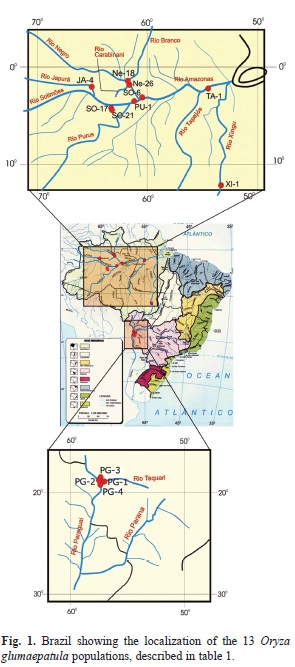
<body><![CDATA[Tapaj&oacute;s, Negro and Branco River basins; (II) Xingu region, in     Goi&aacute;s State, which also belongs to the Amazon region but will be     referred to in this study as the Xingu region, with one     population&nbsp; collected at the Xingu River basin, located far from     the other Amazonian populations; (III) Pantanal region, in Mato Grosso     do Sul State, with four populations from the Paraguay River basin and     one from Taquari River basin, which belong to the Pantanal ecosystem     (<a href="/img/revistas/rbt/v60n4/a05t1.gif">Table 1</a>, <a      href="/img/revistas/rbt/v60n4/a05i1.jpg">Fig. 1</a>). These     populations were sampled during two     ]]></body>
<body><![CDATA[expeditions to the Rio Negro basin in 1992 and of the Rio     Solim&otilde;es basin in 1993 (Ando 1994), except for the Xingu     population included in the collection more recently. During field     collection, populations were sampled on an individual plant basis (Ando     1994). Since then these population samples have been maintained in     refrigerators at -4&ordm;C, inside plastic boxes with silica to avoid     humidity, and have not been previously multiplied.</span></font><br      style="font-family: verdana;">     <br>     <font size="2"><span style="font-family: verdana;">Each population     ]]></body>
<body><![CDATA[sample in the     collection is maintained as a set of     maternal progenies, each progeny having been collected from an     open-pollinated panicle of an individual plant in the field. For the     analysis in this study, a bulk sample was obtained from each     population, by sampling two to three seeds of each individual plant, up     to a set of 50 seeds. These seeds were germinated in square plastic     Gerboxes (11x11cm) with damp tissue paper at a temperature of 27     &plusmn; 5&ordm;C in the dark. Germinated seeds were transplanted to     pots in the green-house where they were grown up to adult stage. Each     ]]></body>
<body><![CDATA[population was composed, on average, of 30 individuals.</span></font><br      style="font-family: verdana;">     <br style="font-family: verdana;">     <font size="2"><span style="font-family: verdana;"><span      style="font-weight: bold;">DNA extraction and amplification of     SSR loci: </span>Total genomic DNA was     extracted from adult lyophilized leaves of individual plants using the     CTAB method according to Hoisington et al. (1994), modified by Karasawa     et al. (2007a). DNA was quantified on 4% (w/v) polyacrylamide gels and     bands were revealed using the silver nitrate staining procedure (Bassam     ]]></body>
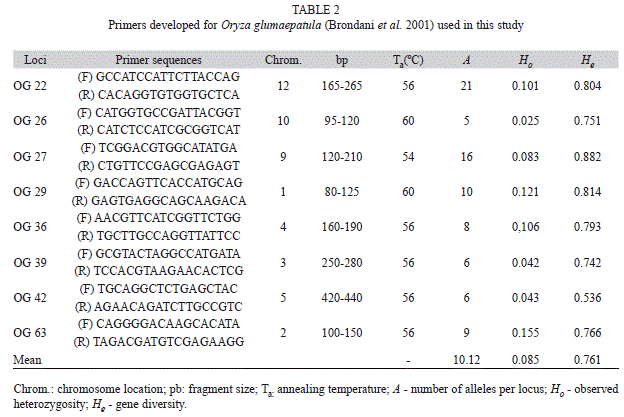
<body><![CDATA[et al. 1991). Eight SSR loci (OG-22, OG-26, OG-27, OG-29, OG-36, OG-39,     OG-42 e OG-63), developed by Brondani et al. (2001), were used in this     study (<a href="/img/revistas/rbt/v60n4/a05t2.gif">Table 2</a>).</span></font><br      style="font-family: verdana;">     <br style="font-family: verdana;">     <font size="2"><span style="font-family: verdana;">For each PCR     reaction, 30ng of     genomic DNA from individual plants were     used in a 12&#956;L volume containing 0.3&#956;M of each primer, 0.25mM of each     dNTP, 1.5mM of MgCl<sub>2</sub>, 10mM Tris-HCl, and 0.6 unit of Taq DNA     ]]></body>
<body><![CDATA[polymerase     enzyme (Invitrogen, Eugene, Oregon, USA). The reactions were performed     in a Primus 96 Thermocycler with 4min initial denaturation at     94&ordm;C, 30 subsequent cycles (1 min at 94&ordm;C, 1 min at     54&ordm;C, 56&ordm;C or 60&ordm;C, 1 min elongation at 72&ordm;C),     followed by a final elongation of 5min at 72&ordm;C. Amplified products     were electrophoresed on 6% non-denaturing polyacrylamide gels (4cm/V,     for three hours). Amplified fragments were visualized using silver     staining procedure (Bassam et al. 1991).</span></font><br      style="font-family: verdana;">     ]]></body>
<body><![CDATA[<br style="font-family: verdana;">     <font size="2"><span style="font-family: verdana;"><span      style="font-weight: bold;">Isozyme analyses procedures:</span>     Isozyme analyses were conducted in     polyacrylamide gels, under a discontinuous system. The gel and     electrode buffers used were a basic buffer (Hames 1996), with pH 8.8     for the 5.5% resolving gel and pH 6.8 for the 3.5% stacking gel.</span></font><br      style="font-family: verdana;">     <br style="font-family: verdana;">     <font size="2"><span style="font-family: verdana;">The newest expanded     ]]></body>
<body><![CDATA[leaves (200mg)     were used for enzyme extraction of     each plant. The leaves were ground in liquid nitrogen in     micro-centrifuge tubes using a power homogenizer, adding 1mL of     extraction buffer 1 (Alfenas et al. 1991), leaving out     diethyldithiocarbamic acid (DIECA) and 2-mercaptoethanol. The extract     was centrifuged at 18 000g for 20min at 4&ordm;C. Afterwards, 130mL of     the supernatant were diluted in 150mL of a solution containing Tris-HCl     pH 6.8 and Coomassie blue, the latter component indicating the protein     migration in the gel. This amount of extract was sufficient for four     ]]></body>
<body><![CDATA[gels, which allowed the assessment of 38 individuals each. The same     control plant was added to each gel as a marker. The voltage was set at     50V during three hours, adjusted to 100V for the next 13 hours, usually     staying overnight at 4&ordm;C.</span></font><br      style="font-family: verdana;">     <br style="font-family: verdana;">     <font size="2"><span style="font-family: verdana;">From a total of 10     promising     enzymatic systems (Veasey et al. 2008),     four were selected in this study due to the presence of higher band     ]]></body>
<body><![CDATA[resolution: aspartate aminotransferase (AAT; E.C. 2.6.1.1, with three     loci), phosphoglucomutase (PGM; E.C. 2.7.5.1), shikimate dehydrogenase     (SKD; E.C. 1.1.1.25) and glutamate dehydrogenase (GDH; E.C. 1.4.1.2).</span></font><br      style="font-family: verdana;">     <br style="font-family: verdana;">     <font size="2"><span style="font-family: verdana;">For the statistical     analysis, the     GDA program (Lewis     &amp; Zaykin&nbsp; 2000) was used to estimate     allelic and genotypic frequencies, number of alleles per locus (<span     ]]></body>
<body><![CDATA[ style="font-style: italic;">A</span>),     observed heterozygosities (<span style="font-style: italic;">H</span><sub      style="font-style: italic;">o</sub>), gene diversity (<span      style="font-style: italic;">H</span><sub style="font-style: italic;">e</sub>),     and fixation     indices (<span style="font-style: italic;">f</span>). Genotypic     frequencies obtained from both markers     were submitted to Fisher&#8217;s exact test considering the Hardy-Weinberg     equilibrium, as defined by Weir (1996), using the TFPGA software     (Miller 1997). </span></font><br style="font-family: verdana;">     ]]></body>
<body><![CDATA[<br style="font-family: verdana;">     <font size="2"><span style="font-family: verdana;">Wright&#8217;s F     statistics were     estimated considering a random model,     defined according to Weir (1996), where the sampled populations were     considered representative of the species and with a common evolutionary     history. These estimates (<span style="font-style: italic;">F</span><sub      style="font-style: italic;">IS</sub><span style="font-style: italic;">,     F</span><sub style="font-style: italic;">ST</sub> e <span      style="font-style: italic;">F</span><sub style="font-style: italic;">IT</sub>)     ]]></body>
<body><![CDATA[were obtained using the     software F<sub>STAT</sub> (Goudet 1995). Confidence intervals (95%)     were also     obtained for each of these estimates. Private alleles were also     identified with the GDA program (Lewis &amp; Zaykin 2000). </span></font><br      style="font-family: verdana;">     <br style="font-family: verdana;">     <font size="2"><span style="font-family: verdana;">Considering that the     mutation     process in microsatellite loci is not in     ]]></body>
<body><![CDATA[line with the expectations under the infinite alleles model with low     rates, the analogue of <span style="font-style: italic;">F</span><sub      style="font-style: italic;">ST</sub> parameter (Slatkin 1995)     developed specifically for microsatellite data (<span      style="font-style: italic;">R</span><sub style="font-style: italic;">ST</sub>)     was also     estimated. Parameters <span style="font-style: italic;">R</span><sub      style="font-style: italic;">ST</sub> and gene flow (Nm) were     estimated using     the R<sub>ST</sub>Cal program (Goodman 1997). Dendrograms were     ]]></body>
<body><![CDATA[constructed from     Nei&#8217;s genetic distances matrix and the UPGMA clustering criteria, using     the TFPGA software (Miller 1997). </span></font><br      style="font-family: verdana;">     <br style="font-family: verdana;">     <font size="2"><span style="font-family: verdana;">Patterns of spatial     variation were     analyzed using Pearson&#8217;s coefficient     of correlation (r) between Nei&#8217;s genetic distances matrix (Nei 1978)     and the matrix of geographic distances (shortest distance between two     ]]></body>
<body><![CDATA[given points on the map) between populations, using NTSYS-pc (Rohlf     1992). Significance of these correlations was tested by Mantel&#8217;s     statistic Z (Mantel 1967), using 1000 random permutations. Average     apparent outcrossing rate was estimated considering the     relation&nbsp; <sub><img alt="" src="/img/revistas/rbt/v60n4/a05i6.jpg"      style="width: 18px; height: 25px;"></sub>= (1-<span      style="font-style: italic;">F</span><sub style="font-style: italic;">IS</sub>)/(1+<span      style="font-style: italic;">F</span><sub style="font-style: italic;">IS</sub>).     The parameter&nbsp;     was also estimated for each population [<sub><img alt=""     ]]></body>
<body><![CDATA[ src="/img/revistas/rbt/v60n4/a05i6.jpg"      style="width: 18px; height: 25px;"></sub>=     (1-<span style="font-style: italic;">f</span>)/(1+<span      style="font-style: italic;">f</span>)] (Weir 1996)</span></font><br      style="font-family: verdana;">     <br style="font-family: verdana;">     <font style="font-weight: bold;" size="3"><span      style="font-family: verdana;">Results</span></font><br      style="font-family: verdana;">     <br style="font-family: verdana;">     ]]></body>
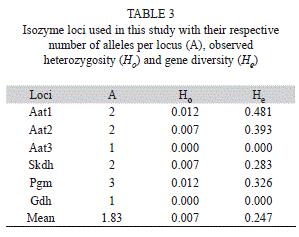
<body><![CDATA[<font size="2"><span style="font-family: verdana;"><span      style="font-weight: bold;">Genetic diversity levels:</span> All SSR     loci showed polymorphism (<a href="/img/revistas/rbt/v60n4/a05t2.gif">Table     2</a>)     while isozymes were monomorphic for two of the six loci,<span      style="font-style: italic;"> Aat3</span> and <span      style="font-style: italic;">Gdh</span>     (<a href="/img/revistas/rbt/v60n4/a05t3.gif">Table 3</a>). A total of     81 alleles were found for the SSR markers,     varying from five to 21 alleles per locus (<a     ]]></body>
<body><![CDATA[ href="/img/revistas/rbt/v60n4/a05t2.gif">Table 2</a>), while 11     alleles     were found for the isozyme markers, varying from one to three alleles     per locus (<a href="/img/revistas/rbt/v60n4/a05t3.gif">Table 3</a>).     For both markers, the mean expected heterozygosity     or gene diversity was higher than the mean observed heterozygosity     (<span style="font-style: italic;">H</span><sub      style="font-style: italic;">o</sub>=0.085 and <span      style="font-style: italic;">H</span><sub style="font-style: italic;">e</sub>=0.761     for SSR; <span style="font-style: italic;">H</span><sub     ]]></body>
<body><![CDATA[ style="font-style: italic;">o</sub>=0.007 and <span      style="font-style: italic;">H</span><sub style="font-style: italic;">e</sub>=0.247     for isozymes)     (<a href="/img/revistas/rbt/v60n4/a05t2.gif">Tables 2</a> and <a      href="/img/revistas/rbt/v60n4/a05t3.gif">3</a>).    <br>     <br style="font-family: verdana;">     </span></font>     <font size="2"><span style="font-family: verdana;"></span></font><font      size="2"><span style="font-family: verdana;">Considering     ]]></body>
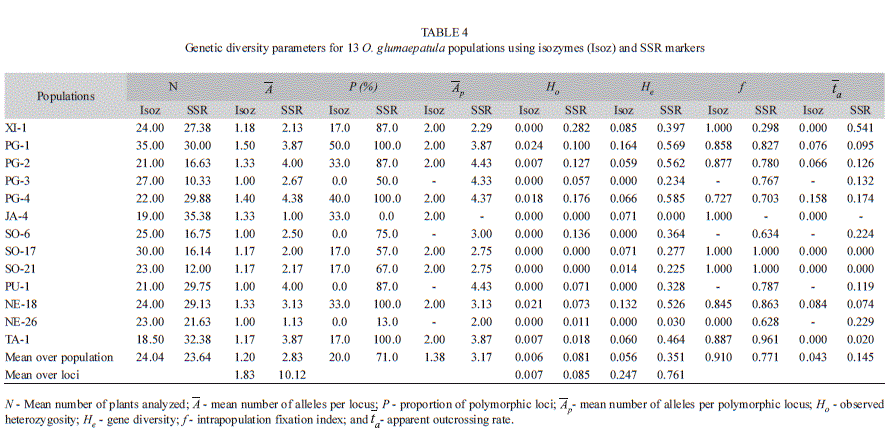
<body><![CDATA[each     population, JA-4     was monomorphic for all eight SSR     loci, while populations PG-3, SO-6, PU-1 and NE-26 were monomorphic for     the six isozyme loci. The average polymorphism rate was 20% for     isozymes and 71% for microsatellites (<a      href="/img/revistas/rbt/v60n4/a05t4.gif">Table 4</a>). The average     number of     alleles per locus per population (<sub><img alt=""      src="/img/revistas/rbt/v60n4/a05i4.jpg"     ]]></body>
<body><![CDATA[ style="width: 12px; height: 17px;"></sub>) was     1.20 and 2.83, with     means over loci of 1.83 and 10.12, respectively, and the average number     of alleles per polymorphic locus (<sub><img alt=""      src="/img/revistas/rbt/v60n4/a05i5.jpg"      style="width: 19px; height: 25px;"></sub>) of     1.83 and     3.17, respectively, for isozymes and microsatellites (<a      href="/img/revistas/rbt/v60n4/a05t4.gif">Table 4</a>).</span></font><br      style="font-family: verdana;">     ]]></body>
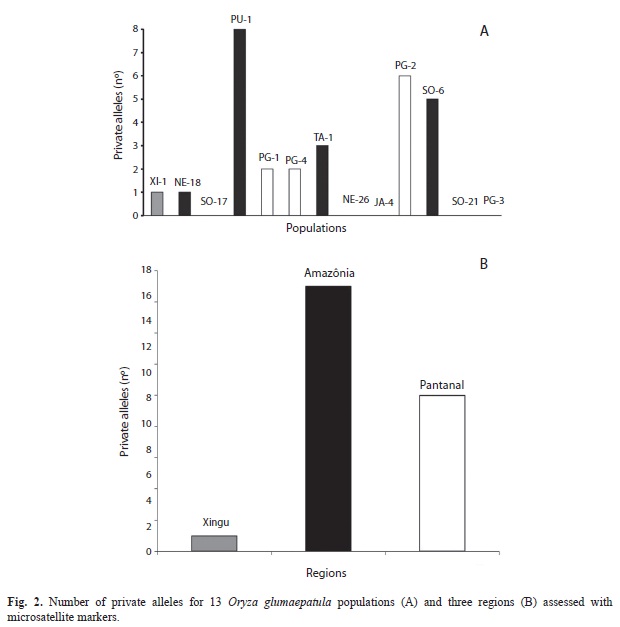
<body><![CDATA[<br style="font-family: verdana;">     <font size="2"><span style="font-family: verdana;">No private alleles     were detected     for the isozyme markers, probably due     to the small number of alleles and small number of enzyme loci, whereas     the SSR markers were effective in detecting private alleles (<a      href="/img/revistas/rbt/v60n4/a05i2.jpg">Fig. 2</a>).     There was only one private allele detected in the Xingu region, 19 in     the Amazon and eight in the Pantanal region (<a      href="/img/revistas/rbt/v60n4/a05i2.jpg">Fig. 2B</a>). At the     ]]></body>
<body><![CDATA[population level, the number of private alleles detected with SSR     varied from 0 to 8 (<a href="/img/revistas/rbt/v60n4/a05i2.jpg">Fig. 2A</a>).</span></font><br      style="font-family: verdana;">     <font size="2"><span style="font-family: verdana;">&nbsp;</span></font><br      style="font-family: verdana;">     <font size="2"><span style="font-family: verdana;">The average observed     heterozygosity     (<span style="font-style: italic;">H</span><sub      style="font-style: italic;">o</sub>) and gene diversity (<span      style="font-style: italic;">H</span><sub style="font-style: italic;">e</sub>)     ]]></body>
<body><![CDATA[assessed with isozymes and SSR markers for the 13 populations were     0.006 and 0.056, and 0.081 and 0.351, respectively (<a      href="/img/revistas/rbt/v60n4/a05t4.gif">Table 4</a>). On the     other hand, when considering <span style="font-style: italic;">H</span><sub      style="font-style: italic;">o</sub> and <span      style="font-style: italic;">H</span><sub style="font-style: italic;">e</sub>     as the mean over loci, we     detected <span style="font-style: italic;">H</span><sub      style="font-style: italic;">o</sub>=0.007 and 0.085, and <span      style="font-style: italic;">H</span><sub style="font-style: italic;">e</sub>=0.247     ]]></body>
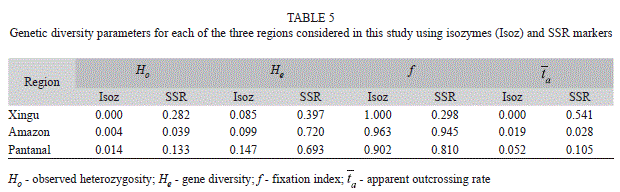
<body><![CDATA[and 0.766 for isozymes and     SSR, respectively. The tendency for the microsatellites to detect     higher <span style="font-style: italic;">H<sub>o</sub></span> and <span      style="font-style: italic;">H<sub>e</sub></span> levels, within each     of the three regions, was     maintained (<a href="/img/revistas/rbt/v60n4/a05t5.gif">Table 5</a>).     The apparent&nbsp; outcrossing&nbsp; rate     (<sub><img alt="" src="/img/revistas/rbt/v60n4/a05i7.jpg"      style="width: 13px; height: 19px;"></sub>) estimated&nbsp; by these     markers showed     ]]></body>
<body><![CDATA[surprising differences at the populational (<a      href="/img/revistas/rbt/v60n4/a05t4.gif">Table 4</a>) and regional     (<a href="/img/revistas/rbt/v60n4/a05t5.gif">Table 5</a>) levels, but     both markers showed lower levels in the Amazon     region (1.9% and 2.8%), while the&nbsp; highest&nbsp; levels occurred     in the Pantanal region,&nbsp; with&nbsp;     5.2%&nbsp; and&nbsp; 10.5%,&nbsp; respectively, for     isozymes and microsatellites (<a      href="/img/revistas/rbt/v60n4/a05t5.gif">Table&nbsp; 5</a>).     However, the markers were not in agreement in the case of the Xingu     ]]></body>
<body><![CDATA[region, represented by the XI-1 population, which registered absence of     outcrossing when assessed with isozymes but showed outcrossing rates of     54.1% when analyzed with microsatellites. These results showed that, in     general, SSR markers are more efficient than isozymes to detect     outcrossing events both at the populational and regional levels and     that, except for the Xingu region, with only one population assessed,     this species presents a mixed mating system with predominance of     self-fertilization.</span></font><br style="font-family: verdana;">     <br style="font-family: verdana;">     <font size="2"><span style="font-family: verdana;"><span     ]]></body>
<body><![CDATA[ style="font-weight: bold;">Genetic population structure:</span> Mean     inbreeding registered within each     population (<span style="font-style: italic;">f</span>) was higher, in     general, for the isozymes (0.910) when     compared to microsatellites (0.771) (<a      href="/img/revistas/rbt/v60n4/a05t4.gif">Table 4</a>). This tendency     was     maintained for both markers also at the regional level (<a      href="/img/revistas/rbt/v60n4/a05t5.gif">Table 5</a>). The     estimates of F statistics revealed that total inbreeding coefficient     ]]></body>
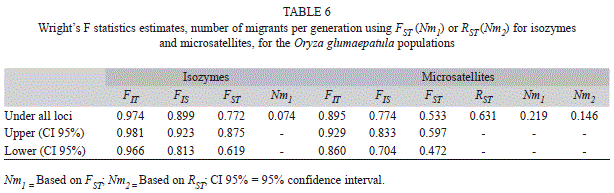
<body><![CDATA[(F<sub style="font-style: italic;">IT</sub>) in this species is very     high, 0.974 for isozymes and 0.895 for     microsatellites (<a href="/img/revistas/rbt/v60n4/a05t6.gif">Table 6</a>),     and that the main factor promoting the     deviation from Hardy-Weinberg equilibrium is the mating system     (<span style="font-style: italic;">F</span><sub      style="font-style: italic;">IS</sub>=0.899 and 0.774, respectively,     for isozymes and microsatellites).     However, although of a lower magnitude, but also expressive, the     genetic differentiation among populations (<span     ]]></body>
<body><![CDATA[ style="font-style: italic;">F</span><sub style="font-style: italic;">ST</sub>)     contributed for the     total inbreeding levels observed, with the isozyme markers showing a     value of 0.772 for this parameter, while the level registered for the     SSR markers was 0.533 (or 0.631 for the corrected value of <span      style="font-style: italic;">R</span><sub style="font-style: italic;">ST</sub>).     On the     other hand, the number of migrants per generation (<span      style="font-style: italic;">Nm</span> = &frac14;     [(1/<span style="font-style: italic;">F</span><sub     ]]></body>
<body><![CDATA[ style="font-style: italic;">ST</sub> or <span      style="font-style: italic;">R</span><sub style="font-style: italic;">ST</sub>)-1])     observed for both markers was small, only 0.074 for     the isozymes and 0.146 for the SSR marker (<a      href="/img/revistas/rbt/v60n4/a05t6.gif">Table 6</a>). </span></font><br      style="font-family: verdana;">     <br style="font-family: verdana;">     <font size="2"><span style="font-family: verdana;">The cluster     analysis, based on     Nei&acute;s genetic distances (Nei 1978)     ]]></body>
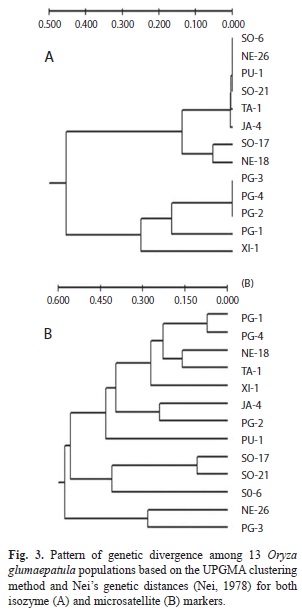
<body><![CDATA[and the UPGMA method, showed that isozyme data tended to exhibit     clustering according to the origins of the populations,&nbsp; with two     clear groups: the Amazon populations in the first group and the     Pantanal populations as well as the Xingu population (as a sub-group)     in the second group. For <span style="font-style: italic;">Aat-1</span>     and <span style="font-style: italic;">Aat-2</span> loci, different     alleles     predominated in each of the two regions, Pantanal and the Amazon     (<a href="/img/revistas/rbt/v60n4/a05i3.jpg">Fig.&nbsp; 3A</a>). The     Xingu population (XI-1) and the Pantanal&nbsp;     ]]></body>
<body><![CDATA[populations shared the same     allele frequencies for these two loci, which explains its proximity to     the Pantanal populations&nbsp; in the dendrogram. However, it was     classified in a sub-group within the second group, differing from the     Pantanal populations for presenting a fixed a2 allele at <span      style="font-style: italic;">Skd-1</span> locus     and from all the others for presenting a high frequency of the <span      style="font-style: italic;">a3     </span>allele at <span style="font-style: italic;">Pgm-1</span> locus.     </span></font><br style="font-family: verdana;">     ]]></body>
<body><![CDATA[<br>     <font size="2"><span style="font-family: verdana;">However, data from     microsatellites     tended to exhibit a random     clustering, not in agreement with the geographic origins (<a      href="/img/revistas/rbt/v60n4/a05i3.jpg">Fig. 3B</a>).     These results were confirmed in the correlation tests between genetic     and geographic distances obtained for each marker. In this sense,     correlations between genetic and geographic distances showed a positive     and significant result (r=0.6594, p&lt;0.05) when estimated with     ]]></body>
<body><![CDATA[isozymes and an absence of correlation (r=-0.1789, p&gt;0.05), when     estimated with microsatellites. On the other hand, no correlation     (r=-0.0005,&nbsp; p&gt;0.05) was found between     the two markers, when their genetic distances were analyzed.</span></font><br      style="font-family: verdana;">     <br style="font-family: verdana;">     <font style="font-weight: bold;" size="3"><span      style="font-family: verdana;">Discussion</span></font><br      style="font-family: verdana;">     <br style="font-family: verdana;">     ]]></body>
<body><![CDATA[<font size="2"><span style="font-family: verdana;"><span      style="font-weight: bold;">Genetic diversity levels:</span> This     study compared the levels of diversity     assessed with isozymes and microsatellite markers in 13 <span      style="font-style: italic;">O. glumaepatula</span>     populations in order to establish the potential of each marker for a     predominantly inbreeding wild rice species. The results of the analysis     of microsatellite and isozyme loci are consistent with the principles     of each marker, considering the fact that microsatellites showed a wide     range of alleles at each locus whereas isozymes showed only one to     ]]></body>
<body><![CDATA[three alleles per locus. Possibly, the adaptive nature of some genes     that govern the production of proteins, when under environmental     effect, tends to express monomorphism within populations     (Schl&ouml;tterer 2004, Lowe et al. 2007). Another reason for the     relatively fewer apparent alleles in isozymes is the ineffectiveness of     most mutations in changing the electrophoretic mobility of the bands     (i. e., the visualization of different alleles), since only a few     aminoacid changes modify the net electric charge of the proteins,     whereas most length changes in SSRs cause their band speed to vary.     Additionally, the types of mutation process that give rise to SSR     ]]></body>
<body><![CDATA[alleles and to isozyme alleles are different and the former is more     common. On the other hand, microsatellites are usually found in     non-coding repetitive DNA regions and the high mutation rate through     gain and/or loss of repeats (Goldstein &amp;     Schl&ouml;tterer 2000) can be explained by     their usual neutrality. Recently, however, increasingly more     microsatellites have been found and characterized within protein-coding     genes and their untranslated regions (UTRs), which subjects them to     stronger selective pressure&nbsp; than other&nbsp; genomic&nbsp;     regions&nbsp; because&nbsp; of their functional importance (Li et al.     ]]></body>
<body><![CDATA[2004). In our study, however, most of the SSR loci used (six out of     eight loci) were not located within genes (Karasawa et al. 2007b). But     irrespective of their location in the genome, polymorphism is common in     SSR markers while the presence of monomorphism tends to be a rare     condition (Panaud et al. 1995).</span></font><br      style="font-family: verdana;">     <br style="font-family: verdana;">     <font size="2"><span style="font-family: verdana;">In this study,     isozymes showed only     42.4% to 43.5% of the     ]]></body>
<body><![CDATA[microsatellites&#8217; diversity detected in the parameters average number of     alleles (<sub><img alt="" src="/img/revistas/rbt/v60n4/a05i4.jpg"      style="width: 12px; height: 17px;"></sub>) and average number of     alleles per polymorphic     locus (<sub><img alt="" src="/img/revistas/rbt/v60n4/a05i5.jpg"      style="width: 19px; height: 25px;"></sub>), respectively. Similarly,     we found     that microsatellites detected private alleles, whereas no private     alleles were found with isozyme markers, which may be due to a lower     number of apparent alleles per locus and a lower number of loci used in     ]]></body>
<body><![CDATA[this study.</span></font><br style="font-family: verdana;">     <br style="font-family: verdana;">     <font size="2"><span style="font-family: verdana;">The levels of     observed     heterozygosity (<span style="font-style: italic;">H</span><sub      style="font-style: italic;">o</sub>) and gene diversity (<span      style="font-style: italic;">H</span><sub style="font-style: italic;">e</sub>)     assessed with isozymes represented, on average, 7.4% and 15.9% of those     observed with microsatellites, respectively.&nbsp; However, when gene     diversity was considered over loci we could verify that the amount is     ]]></body>
<body><![CDATA[higher than at the population level. This fact occurred because the     split of the ancestral population led to a fixation of specific alleles     in each population. This reduction in the number of alleles in each     population, from 1.83 to 1.20 and from 10.12 to 2.83, respectively for     isozymes and microsatellites, led to lower gene diversity at the     population level. Microsatellites are considered genetically more     informative than other markers, especially when dealing with     populations with low genetic diversity content at the DNA level     (Paetkau et al. 1995). The low gene diversity (<span      style="font-style: italic;">H</span><sub style="font-style: italic;">e</sub>)     ]]></body>
<body><![CDATA[levels in this     species has already been shown in previous studies with isozymes,     revealing variations from 0.044 to 0.060 (Akimoto et al. 1998,     Buso&nbsp; et&nbsp; al. 1998, Veasey et al. 2008), as compared with     microsatellites with higher levels, ranging from 0.113 to 0.491     (Brondani et al. 2005, Karasawa et al. 2007a, Silva et al. 2007). Thus,     considering the information obtained in this study with isozymes and     microsatellites, we can conclude that microsatellite markers are in     fact more informative as they were able to detect higher levels of     intra-population diversity in this species. Gao et al. (2002b) also     ]]></body>
<body><![CDATA[found higher levels of genetic variation with microsatellite loci than     isozyme loci when studying <span style="font-style: italic;">O.     rufipogon</span> populations from China.     Similarly, higher levels of polymorphism revealed by microsatellites     when compared to isozymes were found in natural populations of <span      style="font-style: italic;">Euterpe     edulis</span> Mart. in Brazil (Conte et al. 2008), oaks (Quercus spp.)     in     West-Central Romania (Curtu et al. 2007), in a natural <span      style="font-style: italic;">Elymus caninus</span>     ]]></body>
<body><![CDATA[(L.) L. population from Denmark (Sun et al. 2001) and in sorghum     (<span style="font-style: italic;">Sorghum bicolor </span>L.)     landraces in North-Western Morocco (Dj&egrave; et     al. 1999).</span></font><br style="font-family: verdana;">     <br style="font-family: verdana;">     <font size="2"><span style="font-family: verdana;"><span      style="font-weight: bold;">Population genetic structure:</span>     Isozyme markers showed similar inbreeding     levels (<span style="font-style: italic;">f</span>) as microsatellites     for populations, regions and for total     ]]></body>
<body><![CDATA[inbreeding of the species (<span style="font-style: italic;">F</span><sub      style="font-style: italic;">IT</sub>), except for the Xingu     population. The     existence of inbreeding within populations showed, with both markers,     that this species has an inbred maternal family structure within     populations and that this structure was established primarily by the     reproductive system (<span style="font-style: italic;">F</span><sub      style="font-style: italic;">IS</sub>), and that most of the total     diversity is     located among families within populations. In fact, the reproductive     ]]></body>
<body><![CDATA[system of this species, classified as mixed with predominance of     self-fertilization (Karasawa et al. 2007b, Vaz et al. 2009), seems to     have a predominant effect on differentiation within and between     populations. Both markers are also congruent in that the fragmentation     of the species led to a considerable and important amount of genetic     diversity among populations (<span style="font-style: italic;">F</span><sub      style="font-style: italic;">ST</sub>). Gao et al. (2002b) also found     an     agreement in this type of result with both markers, but in <span      style="font-style: italic;">O. rufipogon</span>     ]]></body>
<body><![CDATA[the greatest effect was in the formation of genetic structure due to     fragmentation (<span style="font-style: italic;">F</span><sub      style="font-style: italic;">ST</sub>). Measures of genetic structure,     such as     Wright&acute;s F statistics, or Nei&#8217;s coefficient of gene     differentiation (<span style="font-style: italic;">G</span><sub      style="font-style: italic;">ST</sub>) (Nei 1973), were similar for the     two sets of     markers (isozymes and SSR) assessed in natural populations of <span      style="font-style: italic;">Sorghum     ]]></body>
<body><![CDATA[bicolor</span> (Dj&eacute; et al. 1999), <span      style="font-style: italic;">Elymus caninus</span> (Sun et al. 2001)     and     <span style="font-style: italic;">Euterpe edulis</span> (Conte et al.     2008). </span></font><br style="font-family: verdana;">     <br style="font-family: verdana;">     <font size="2"><span style="font-family: verdana;">Previous studies on     genetic     structure conducted in the genus <span style="font-style: italic;">Oryza     </span>have     ]]></body>
<body><![CDATA[recorded several <span style="font-style: italic;">F</span><sub      style="font-style: italic;">ST</sub> (<span style="font-style: italic;">G</span><sub      style="font-style: italic;">ST</sub>) values, but largely agree that     the mode of     reproduction of the species has generated prominent effect on the     differentiation observed. In <span style="font-style: italic;">O.     glumaepatula</span>, studies using allozymes     showed <span style="font-style: italic;">F</span><sub      style="font-style: italic;">ST</sub>&nbsp;&nbsp; values of 0.346     (Akimoto et al. 1998), 0.310     ]]></body>
<body><![CDATA[(Buso et al. 1998) and 0.763 (Veasey et al. 2008), while those using     microsatellites showed values such as 0.847 (Brondani et al. 2005),     0.491 (Karasawa et al. 2007a) and 0.715 (Silva et al. 2007). In progeny     studies, the value recorded with microsatellites was 0.451 for the     parental populations, and 0.284 for the families of these populations     (Karasawa et al. 2007b).</span></font><br style="font-family: verdana;">     <br style="font-family: verdana;">     <font size="2"><span style="font-family: verdana;"><span      style="font-style: italic;">O. rufipogon</span> studies with isozymes     showed genetic structure levels     ]]></body>
<body><![CDATA[(<span style="font-style: italic;">F</span><sub      style="font-style: italic;">ST</sub>) dependent on the developmental     stages (seed, young and adults     plants) and the life cycle (annual or perennial). Annual populations     showed <span style="font-style: italic;">F</span><sub      style="font-style: italic;">ST</sub> values varying from 0.085 to     0.208 for seeds, from 0.087 to     0.145 for young plants and 0.193 for adults, while among the perennial     populations higher values were found, ranging from 0.327 to 0.366 at     the seed level, from 0.129 to 0.356 for young plants and from 0.360 to     ]]></body>
<body><![CDATA[0.390 for the adults (Barbier 1989). Morishima &amp; Barbier (1990)     obtained <span style="font-style: italic;">F</span><sub      style="font-style: italic;">ST</sub><span style="font-style: italic;">     </span>values of 0.289 for intermediate populations, 0.396 for     perennials and 0.600 for annuals. Gao et al. (2000) and Gao et al.     (2002a) reported values such as 0.310 and 0.254 in perennial     populations with isozymes. With microsatellites, Gao (2004) obtained an     <span style="font-style: italic;">F</span><sub      style="font-style: italic;">ST</sub> value of 0.246, whereas when     comparing isozymes and     ]]></body>
<body><![CDATA[microsatellites, Gao et al. (2002b) obtained values of 0.468 for     isozymes and 0.388 for microsatellites. Among Chinese <span      style="font-style: italic;">O. officinalis</span>     perennial populations, an <span style="font-style: italic;">F</span><sub      style="font-style: italic;">ST</sub> value of 0.442 was reported (Gao     2005).</span></font><br style="font-family: verdana;">     <br style="font-family: verdana;">     <font size="2"><span style="font-family: verdana;">The results in our     study with     <span style="font-style: italic;">O.glumaepatula</span> populations,     ]]></body>
<body><![CDATA[comparing     microsatellites (<span style="font-style: italic;">F</span><sub      style="font-style: italic;">ST</sub>=0.533) with isozymes (<span      style="font-style: italic;">F</span><sub style="font-style: italic;">ST</sub>=0.772),     are in     accordance with the results obtained by Gao et al. (2002b) for     perennial outcrossing <span style="font-style: italic;">O. rufipogon </span>populations,     although these values     were lower than those found in <span style="font-style: italic;">O.     glumaepatula</span>. It is difficult to     ]]></body>
<body><![CDATA[conclude whether the heterogeneity of the <span      style="font-style: italic;">F</span><sub style="font-style: italic;">ST</sub>     values found with isozyme     loci compared with microsatellites was caused by stochastic processes     or as an indirect effect of selection. According to a survey by Frankel     et al. (1995), the genetic diversity among populations (<span      style="font-style: italic;">G</span><sub style="font-style: italic;">ST</sub>)     with     isozymes should be lower in cross-pollinating and perennial plants, and     higher in autogamous and annual plants, which may explain the results     ]]></body>
<body><![CDATA[discussed above. </span></font><br style="font-family: verdana;">     <br style="font-family: verdana;">     <font size="2"><span style="font-family: verdana;">Due to the mode of     reproduction of     this species, the number of migrants     (<span style="font-style: italic;">Nm</span>) estimated promoting gene     flow among populations was small, only     0.074 for isozymes and 0.146 for microsatellites. Gene flow is     important in the evolution of plant populations, because the     geographical variation observed in morphology and gene frequencies of a     ]]></body>
<body><![CDATA[species results from the balance between forces that act to cause local     differentiation counterbalanced by forces that tend to produce     homogeneous populations (Slatkin 1987).</span></font><br      style="font-family: verdana;">     <br style="font-family: verdana;">     <font size="2"><span style="font-family: verdana;">Cluster analysis     grouped the     populations according to their     geographical origin with isozymes, whereas a pattern of random     clustering of populations not consistent with the geographical origin     ]]></body>
<body><![CDATA[was observed for microsatellites. Dj&egrave; et al. (1999) also found     no concordance between the cluster analysis based on allozymes and the     cluster based on microsatellites for sorghum landraces. Gao et al.     (2002b), comparing data obtained with isozymes and microsatellites in     <span style="font-style: italic;">O. rufipogon</span>, found that     information obtained by both markers were not     completely correlated. The grouping of maternal plants of <span      style="font-style: italic;">Elymus     caninus</span> based on isozymes and microsatellites were also     not     ]]></body>
<body><![CDATA[completely consistent&nbsp; with each other (Sun et al. 2001).</span></font><br      style="font-family: verdana;">     <font size="2"><span style="font-family: verdana;">&nbsp;</span></font><br      style="font-family: verdana;">     <font size="2"><span style="font-family: verdana;">In our study, we     verified a     positive correlation between genetic and     geographical distances for isozymes and a negligible negative     correlation when estimated with microsatellites. A positive correlation     between genetic and geographical distances, when the genetic markers     ]]></body>
<body><![CDATA[are neutral, is frequently assumed as a result of limited gene flow     between contiguous populations, while a lack of correlation may result     from long-distance dispersal, geographic barriers or unlimited gene     flow between contiguous populations. The positive correlation found     with isozymes may thus be explained by gene flow dependent on     geographic distance; the lack of correlation with microsatellites is     more difficult to explain and could be due to the rapid allele turnover     caused by the high mutation rate in the loci, which would have blurred     the geographic pattern still visible with isozymes. When comparing the     genetic distances obtained from both markers, the result was an absence     ]]></body>
<body><![CDATA[of correlation. Therefore, inferences made from one of the markers     cannot be considered for the other marker.</span></font><br      style="font-family: verdana;">     <br style="font-family: verdana;">     <font size="2"><span style="font-family: verdana;">Our results showed     that     microsatellites generate a higher volume of     intra-population genetic diversity information compared to those     obtained with isozymes in this species. Microsatellites showed 130%     more alleles and 3.5 times higher rate of polymorphism, being more     ]]></body>
<body><![CDATA[effective, therefore, in the analysis of diversity in a predominantly     inbreeding species. Therefore, the superiority of microsatellites in     detecting intra-population diversity, private alleles and the relative     agreement with isozymes considering the migrant levels between     populations, make this an important marker in the study of population     genetics and conservation. However, isozymes had the advantage in this     study of clustering the populations according to their origins, which     was not observed for microsatellites. As no correlation between genetic     distances was obtained between the two markers, inferences made from     one of the markers cannot be considered for the other marker.</span></font><br     ]]></body>
<body><![CDATA[ style="font-family: verdana;">     <br style="font-family: verdana;">     <font size="2"><span style="font-family: verdana;">In summary, it can     be said that SSR     markers showed more power for     investigating neutral intra-population diversity, as expected. At the     inter-population level, however, despite the relatively small number of     loci used, isozymes led to better results, since clustering of     populations agreed with the expectations based on the geographic     distribution of the populations. </span></font><br     ]]></body>
<body><![CDATA[ style="font-family: verdana;">     <br style="font-family: verdana;">     <font style="font-weight: bold;" size="3"><span      style="font-family: verdana;">Acknowledgments</span></font><br      style="font-family: verdana;">     <br style="font-family: verdana;">     <font size="2"><span style="font-family: verdana;">This research was     supported by     grants and scholarships provided by     Funda&ccedil;&atilde;o de Amparo &agrave; Pesquisa do Estado de     ]]></body>
<body><![CDATA[S&atilde;o Paulo (FAPESP) and Conselho Nacional de Desenvolvimento     Cient&iacute;fico e Tecnol&oacute;gico (CNPq). The authors wish to     thank Professors Paulo Sodero Martins (in memoriam) and Akihiko Ando,     from the Genetics Department at ESALQ/USP, and Hiroko Morishima (in     memoriam), from the National Institute of Genetics, Mishima, Japan, for     coordinating the projects through which the wild rice germplasm used in     this study was collected. The authors also wish to thank the valuable     contributions by two referees.</span></font><br      style="font-family: verdana;">     <br> <hr style="width: 100%; height: 2px;">    ]]></body>
<body><![CDATA[<!-- ref --><br> <font style="font-weight: bold;" size="3"><span  style="font-family: verdana;">References</span></font><br  style="font-family: verdana;"> <br style="font-family: verdana;"> <font size="2"><span style="font-family: verdana;">Agarwal, M., N. Shrivastava &amp; H. Padh. 2008. Advances in molecular marker techniques and their applications in plant sciences. Plant. Cell. Rep. 27: 617-631.    &nbsp;&nbsp;&nbsp;&nbsp;&nbsp;&nbsp;&nbsp;&nbsp;[&#160;<a href="javascript:void(0);" onclick="javascript: window.open('/scielo.php?script=sci_nlinks&ref=1803977&pid=S0034-7744201200040000500001&lng=','','width=640,height=500,resizable=yes,scrollbars=1,menubar=yes,');">Links</a>&#160;]<!-- end-ref --><!-- ref --></span></font><br style="font-family: verdana;"> <br style="font-family: verdana;"> <font size="2"><span style="font-family: verdana;">Akimoto, M., Y. Shimamoto &amp; H. Morishima. 1998. Population genetic structure of wild rice <span style="font-style: italic;">Oryza glumaepatula</span> distributed in the Amazon flood area influenced by life-history traits. Mol. Ecol. 7: 1371-1381.    &nbsp;&nbsp;&nbsp;&nbsp;&nbsp;&nbsp;&nbsp;&nbsp;[&#160;<a href="javascript:void(0);" onclick="javascript: window.open('/scielo.php?script=sci_nlinks&ref=1803978&pid=S0034-7744201200040000500002&lng=','','width=640,height=500,resizable=yes,scrollbars=1,menubar=yes,');">Links</a>&#160;]<!-- end-ref --><!-- ref --></span></font><br  style="font-family: verdana;"> <br style="font-family: verdana;"> <font size="2"><span style="font-family: verdana;">Alfenas, A.C., I. Peters, W. Brune &amp; G.C. Passador. 1991. Eletroforese&nbsp; de prote&iacute;nas e isoenzimas de&nbsp; fungos e ess&ecirc;ncias florestais. UFV, Vi&ccedil;osa, Brazil.    &nbsp;&nbsp;&nbsp;&nbsp;&nbsp;&nbsp;&nbsp;&nbsp;[&#160;<a href="javascript:void(0);" onclick="javascript: window.open('/scielo.php?script=sci_nlinks&ref=1803979&pid=S0034-7744201200040000500003&lng=','','width=640,height=500,resizable=yes,scrollbars=1,menubar=yes,');">Links</a>&#160;]<!-- end-ref --><!-- ref --></span></font><br  style="font-family: verdana;"> <br style="font-family: verdana;"> <font size="2"><span style="font-family: verdana;">Ando, A. 1994. Outline of the project and field methods. In H. Morishima &amp; P.S. Martins (eds.).&nbsp; Investigations of plant genetic resources in the Amazon basin with the emphasis on the genus <span style="font-style: italic;">Oryza</span>: Report of 1992/93 Amazon Project. The Monbusho International Scientific Research Program, Mishima, Japan and Research Support Foundation of the State of S&atilde;o Paulo, S&atilde;o Paulo, Brazil.    &nbsp;&nbsp;&nbsp;&nbsp;&nbsp;&nbsp;&nbsp;&nbsp;[&#160;<a href="javascript:void(0);" onclick="javascript: window.open('/scielo.php?script=sci_nlinks&ref=1803980&pid=S0034-7744201200040000500004&lng=','','width=640,height=500,resizable=yes,scrollbars=1,menubar=yes,');">Links</a>&#160;]<!-- end-ref --><!-- ref --> </span></font><br  style="font-family: verdana;"> <br style="font-family: verdana;"> <font size="2"><span style="font-family: verdana;">Bassam, B.J., G. Caetano-Anolles &amp; P.M. Gresshof. 1991. Fast and sensitive silver staining of DNA&nbsp; in polyacrylamide gels. Anal. Biochem. 196: 80-83.    &nbsp;&nbsp;&nbsp;&nbsp;&nbsp;&nbsp;&nbsp;&nbsp;[&#160;<a href="javascript:void(0);" onclick="javascript: window.open('/scielo.php?script=sci_nlinks&ref=1803981&pid=S0034-7744201200040000500005&lng=','','width=640,height=500,resizable=yes,scrollbars=1,menubar=yes,');">Links</a>&#160;]<!-- end-ref --><!-- ref --></span></font><br style="font-family: verdana;"> <br style="font-family: verdana;"> <font size="2"><span style="font-family: verdana;">Bautista,&nbsp; N.S., R. Solis, O. Kamijima &amp; T.&nbsp; Ishii. 2001. RAPD, RFLP and SSLP analyses of phylogenetic relationships between cultivated and wild species of rice. Genes. Genet. Syst. 76: 71-79.    &nbsp;&nbsp;&nbsp;&nbsp;&nbsp;&nbsp;&nbsp;&nbsp;[&#160;<a href="javascript:void(0);" onclick="javascript: window.open('/scielo.php?script=sci_nlinks&ref=1803982&pid=S0034-7744201200040000500006&lng=','','width=640,height=500,resizable=yes,scrollbars=1,menubar=yes,');">Links</a>&#160;]<!-- end-ref --><!-- ref --></span></font><br  style="font-family: verdana;"> <br style="font-family: verdana;"> <font size="2"><span style="font-family: verdana;">Barbier, P. 1989. Genetic variation and ecotypic differentiation in the wild rice species <span style="font-style: italic;">Oryza rufipogon.</span> II Influence of the mating system and life-history traits on the genetic structure of populations. Jpn. J. Genet. 64: 273-285.    &nbsp;&nbsp;&nbsp;&nbsp;&nbsp;&nbsp;&nbsp;&nbsp;[&#160;<a href="javascript:void(0);" onclick="javascript: window.open('/scielo.php?script=sci_nlinks&ref=1803983&pid=S0034-7744201200040000500007&lng=','','width=640,height=500,resizable=yes,scrollbars=1,menubar=yes,');">Links</a>&#160;]<!-- end-ref --><!-- ref --></span></font><br style="font-family: verdana;"> <br style="font-family: verdana;"> <font size="2"><span style="font-family: verdana;">Black, G.A. 1950. Os capins aqu&aacute;ticos da Amaz&ocirc;nia. Boletim T&eacute;cnico do Instituto Agron&ocirc;mico do Norte, 19. Notas sobre a flora neotr&oacute;pica III. 96 p.    &nbsp;&nbsp;&nbsp;&nbsp;&nbsp;&nbsp;&nbsp;&nbsp;[&#160;<a href="javascript:void(0);" onclick="javascript: window.open('/scielo.php?script=sci_nlinks&ref=1803984&pid=S0034-7744201200040000500008&lng=','','width=640,height=500,resizable=yes,scrollbars=1,menubar=yes,');">Links</a>&#160;]<!-- end-ref --><!-- ref --></span></font><br  style="font-family: verdana;"> <br style="font-family: verdana;"> <font size="2"><span style="font-family: verdana;">Brondani, C., R.P.V. Brondani, P.H.N. Rangel &amp; M.E. Ferreira. 2001. Development and mapping of <span style="font-style: italic;">Oryza glumaepatula</span>-derived microsatellite markers in the interspecific cross <span style="font-style: italic;">Oryza glumaepatula</span> x <span style="font-style: italic;">O. sativa.</span> Hereditas 134: 59-71.    &nbsp;&nbsp;&nbsp;&nbsp;&nbsp;&nbsp;&nbsp;&nbsp;[&#160;<a href="javascript:void(0);" onclick="javascript: window.open('/scielo.php?script=sci_nlinks&ref=1803985&pid=S0034-7744201200040000500009&lng=','','width=640,height=500,resizable=yes,scrollbars=1,menubar=yes,');">Links</a>&#160;]<!-- end-ref --><!-- ref --></span></font><br style="font-family: verdana;"> <br style="font-family: verdana;"> <font size="2"><span style="font-family: verdana;">Brondani,&nbsp; R.P.V., M.I. Zucchi, C. Brondani,&nbsp; P.H.N. Rangel, T.C.O. Borba, P.N.&nbsp; Rangel, M.R. Magalh&atilde;es &amp; R. Vencovsky. 2005. Genetic structure of wild rice <span  style="font-style: italic;">Oryza glumaepatula</span> populations in three Brazilian biomes using microsatellite markers. Genetica 125: 115-123.    &nbsp;&nbsp;&nbsp;&nbsp;&nbsp;&nbsp;&nbsp;&nbsp;[&#160;<a href="javascript:void(0);" onclick="javascript: window.open('/scielo.php?script=sci_nlinks&ref=1803986&pid=S0034-7744201200040000500010&lng=','','width=640,height=500,resizable=yes,scrollbars=1,menubar=yes,');">Links</a>&#160;]<!-- end-ref --><!-- ref --></span></font><br  style="font-family: verdana;"> <br style="font-family: verdana;"> <font size="2"><span style="font-family: verdana;">Buso, G.S.C., P.H. Rangel &amp; M.E. Ferreira. 1998. Analysis of genetic variability of South American wild rice populations (<span  style="font-style: italic;">Oryza glumaepatula</span>) with isozymes and RAPD markers. Mol. Ecol. 7: 107-117.    &nbsp;&nbsp;&nbsp;&nbsp;&nbsp;&nbsp;&nbsp;&nbsp;[&#160;<a href="javascript:void(0);" onclick="javascript: window.open('/scielo.php?script=sci_nlinks&ref=1803987&pid=S0034-7744201200040000500011&lng=','','width=640,height=500,resizable=yes,scrollbars=1,menubar=yes,');">Links</a>&#160;]<!-- end-ref --><!-- ref --></span></font><br style="font-family: verdana;"> <br style="font-family: verdana;"> <font size="2"><span style="font-family: verdana;">Conte, R., M.S. Reis, A. Mantovani &amp; R. Vencovsky. 2008. Genetic structure and mating system of <span style="font-style: italic;">Euterpe edulis</span> Mart. populations: a comparative analysis using microsatellites and allozyme markers. J.&nbsp; Hered. 99: 476-482.    &nbsp;&nbsp;&nbsp;&nbsp;&nbsp;&nbsp;&nbsp;&nbsp;[&#160;<a href="javascript:void(0);" onclick="javascript: window.open('/scielo.php?script=sci_nlinks&ref=1803988&pid=S0034-7744201200040000500012&lng=','','width=640,height=500,resizable=yes,scrollbars=1,menubar=yes,');">Links</a>&#160;]<!-- end-ref --><!-- ref --></span></font><br  style="font-family: verdana;"> <br style="font-family: verdana;"> <font size="2"><span style="font-family: verdana;">Curtu, A.L., O. Gailing, L. Leinemann &amp; R. Finkeldey. 2007. Genetic variation and differentiation within a natural community of five oak species (<span style="font-style: italic;">Quercus</span> spp.). Plant Biol. 9: 116-126.    &nbsp;&nbsp;&nbsp;&nbsp;&nbsp;&nbsp;&nbsp;&nbsp;[&#160;<a href="javascript:void(0);" onclick="javascript: window.open('/scielo.php?script=sci_nlinks&ref=1803989&pid=S0034-7744201200040000500013&lng=','','width=640,height=500,resizable=yes,scrollbars=1,menubar=yes,');">Links</a>&#160;]<!-- end-ref --><!-- ref --></span></font><br style="font-family: verdana;"> <br style="font-family: verdana;"> <font size="2"><span style="font-family: verdana;">Dj&eacute;, Y., D. Forcioli, M. Ater, C. Lef&egrave;bvre &amp; C. Vekemans. 1999. Assessing population genetic structure of <span  style="font-style: italic;">Sorghum</span> landraces from North-western Morocco using isozyme and microsatellite&nbsp; markers. Theor. Appl. Genet. 99: 157-163.    &nbsp;&nbsp;&nbsp;&nbsp;&nbsp;&nbsp;&nbsp;&nbsp;[&#160;<a href="javascript:void(0);" onclick="javascript: window.open('/scielo.php?script=sci_nlinks&ref=1803990&pid=S0034-7744201200040000500014&lng=','','width=640,height=500,resizable=yes,scrollbars=1,menubar=yes,');">Links</a>&#160;]<!-- end-ref --><!-- ref --></span></font><br style="font-family: verdana;"> <br style="font-family: verdana;"> <font size="2"><span style="font-family: verdana;">Ellegren, H. 2004. Microsatellites: simple sequences with complex evolution. Nature Rev. Genet. 5: 435-444.    &nbsp;&nbsp;&nbsp;&nbsp;&nbsp;&nbsp;&nbsp;&nbsp;[&#160;<a href="javascript:void(0);" onclick="javascript: window.open('/scielo.php?script=sci_nlinks&ref=1803991&pid=S0034-7744201200040000500015&lng=','','width=640,height=500,resizable=yes,scrollbars=1,menubar=yes,');">Links</a>&#160;]<!-- end-ref --><!-- ref --> </span></font><br  style="font-family: verdana;"> <br style="font-family: verdana;"> <font size="2"><span style="font-family: verdana;">Frankel, O.H., A.H.D. Brown &amp; J.J. Burdon.&nbsp; 1995. The conservation of plant&nbsp; biodiversity. Cambridge University, Cambridge, United Kingdom.    &nbsp;&nbsp;&nbsp;&nbsp;&nbsp;&nbsp;&nbsp;&nbsp;[&#160;<a href="javascript:void(0);" onclick="javascript: window.open('/scielo.php?script=sci_nlinks&ref=1803992&pid=S0034-7744201200040000500016&lng=','','width=640,height=500,resizable=yes,scrollbars=1,menubar=yes,');">Links</a>&#160;]<!-- end-ref --><!-- ref --></span></font><br  style="font-family: verdana;"> <br style="font-family: verdana;"> <font size="2"><span style="font-family: verdana;">Gao, L.Z. 2004. Population structure and conservation genetics of wild rice <span style="font-style: italic;">Oryza&nbsp; rufipogon</span> (Poaceae): a region-wide perspective from microsatellite variation. Mol. Ecol. 13: 1009-1024.    &nbsp;&nbsp;&nbsp;&nbsp;&nbsp;&nbsp;&nbsp;&nbsp;[&#160;<a href="javascript:void(0);" onclick="javascript: window.open('/scielo.php?script=sci_nlinks&ref=1803993&pid=S0034-7744201200040000500017&lng=','','width=640,height=500,resizable=yes,scrollbars=1,menubar=yes,');">Links</a>&#160;]<!-- end-ref --><!-- ref --></span></font><br style="font-family: verdana;"> <br style="font-family: verdana;"> <font size="2"><span style="font-family: verdana;">Gao, L.Z. 2005. Microsatellite variation within and among populations of <span style="font-style: italic;">Oryza officinalis</span> (Poaceae), an endangered wild rice from China. Mol. Ecol. 14: 4287-4297.    &nbsp;&nbsp;&nbsp;&nbsp;&nbsp;&nbsp;&nbsp;&nbsp;[&#160;<a href="javascript:void(0);" onclick="javascript: window.open('/scielo.php?script=sci_nlinks&ref=1803994&pid=S0034-7744201200040000500018&lng=','','width=640,height=500,resizable=yes,scrollbars=1,menubar=yes,');">Links</a>&#160;]<!-- end-ref --><!-- ref --></span></font><br  style="font-family: verdana;"> <br style="font-family: verdana;"> <font size="2"><span style="font-family: verdana;">Gao, L.Z., S. Ge &amp; D.Y. Hong. 2000. Allozyme variation and population genetic structure of common wild rice <span  style="font-style: italic;">Oryza rufipogon</span> Griff. in China. Theor. Appl. Genet. 101: 494-502.    &nbsp;&nbsp;&nbsp;&nbsp;&nbsp;&nbsp;&nbsp;&nbsp;[&#160;<a href="javascript:void(0);" onclick="javascript: window.open('/scielo.php?script=sci_nlinks&ref=1803995&pid=S0034-7744201200040000500019&lng=','','width=640,height=500,resizable=yes,scrollbars=1,menubar=yes,');">Links</a>&#160;]<!-- end-ref --><!-- ref --></span></font><br  style="font-family: verdana;"> <br style="font-family: verdana;"> <font size="2"><span style="font-family: verdana;">Gao, L.Z., S. Ge &amp; D.Y. Hong. 2002a. Allozyme variation and conservation genetics of common wild rice (<span  style="font-style: italic;">Oryza rufipogon</span> Griff.) in Yunnan, China. Euphytica 124: 273-281.    &nbsp;&nbsp;&nbsp;&nbsp;&nbsp;&nbsp;&nbsp;&nbsp;[&#160;<a href="javascript:void(0);" onclick="javascript: window.open('/scielo.php?script=sci_nlinks&ref=1803996&pid=S0034-7744201200040000500020&lng=','','width=640,height=500,resizable=yes,scrollbars=1,menubar=yes,');">Links</a>&#160;]<!-- end-ref --><!-- ref --></span></font><br  style="font-family: verdana;"> <br style="font-family: verdana;"> <font size="2"><span style="font-family: verdana;">Gao, L.Z., B.A. Schaal, C.H. Zhang, J.Z. Jia &amp; Y.S. Dong. 2002b.&nbsp; Assessment of population genetic&nbsp; structure in common wild rice <span style="font-style: italic;">Oryza rufipogon </span>Griff. using microsatellite&nbsp; and&nbsp; allozyme&nbsp; markers.&nbsp; Theor. Appl. Genet. 106: 173-180.    &nbsp;&nbsp;&nbsp;&nbsp;&nbsp;&nbsp;&nbsp;&nbsp;[&#160;<a href="javascript:void(0);" onclick="javascript: window.open('/scielo.php?script=sci_nlinks&ref=1803997&pid=S0034-7744201200040000500021&lng=','','width=640,height=500,resizable=yes,scrollbars=1,menubar=yes,');">Links</a>&#160;]<!-- end-ref --><!-- ref --></span></font><br style="font-family: verdana;"> <br style="font-family: verdana;"> <font size="2"><span style="font-family: verdana;">Gao, L.Z. 2004. Population structure and conservation genetics of wild rice <span style="font-style: italic;">Oryza rufipogon</span> (Poaceae): a region-wide perspective from microsatellite variation. Mol. Ecol. 13: 1009-1024.    &nbsp;&nbsp;&nbsp;&nbsp;&nbsp;&nbsp;&nbsp;&nbsp;[&#160;<a href="javascript:void(0);" onclick="javascript: window.open('/scielo.php?script=sci_nlinks&ref=1803998&pid=S0034-7744201200040000500022&lng=','','width=640,height=500,resizable=yes,scrollbars=1,menubar=yes,');">Links</a>&#160;]<!-- end-ref --><!-- ref --></span></font><br  style="font-family: verdana;"> <br style="font-family: verdana;"> <font size="2"><span style="font-family: verdana;">Gao, L.Z., C.H. Zhang, D.Y. Li, D.J. Pan, J.Z. Jia &amp; Y.S. Dong. 2006. Genetic diversity within <span style="font-style: italic;">Oryza rufipogon</span> germplasms preserved in Chinese field gene banks of wild rice as revealed by microsatellite markers. Biol. Conservat. 15: 4059-4077.    &nbsp;&nbsp;&nbsp;&nbsp;&nbsp;&nbsp;&nbsp;&nbsp;[&#160;<a href="javascript:void(0);" onclick="javascript: window.open('/scielo.php?script=sci_nlinks&ref=1803999&pid=S0034-7744201200040000500023&lng=','','width=640,height=500,resizable=yes,scrollbars=1,menubar=yes,');">Links</a>&#160;]<!-- end-ref --><!-- ref --></span></font><br style="font-family: verdana;"> <br style="font-family: verdana;"> <font size="2"><span style="font-family: verdana;">Ge, S., G.C.X. Oliveira, B.A. Schaal, L.Z. Gao &amp; D.Y. Hong. 1999. RAPD variation within and between natural populations of the wild rice <span style="font-style: italic;">Oryza rufipogon</span> from China and Brazil. Heredity 82: 638-644.    &nbsp;&nbsp;&nbsp;&nbsp;&nbsp;&nbsp;&nbsp;&nbsp;[&#160;<a href="javascript:void(0);" onclick="javascript: window.open('/scielo.php?script=sci_nlinks&ref=1804000&pid=S0034-7744201200040000500024&lng=','','width=640,height=500,resizable=yes,scrollbars=1,menubar=yes,');">Links</a>&#160;]<!-- end-ref --><!-- ref --></span></font><br  style="font-family: verdana;"> <br style="font-family: verdana;"> <font size="2"><span style="font-family: verdana;">Glaszmann, J.C. 1988. Geographical pattern of variation among Asian native rice cultivars (<span style="font-style: italic;">Oryza sativa</span> L.) based on 15 isozyme loci. Genome 30: 782-792.    &nbsp;&nbsp;&nbsp;&nbsp;&nbsp;&nbsp;&nbsp;&nbsp;[&#160;<a href="javascript:void(0);" onclick="javascript: window.open('/scielo.php?script=sci_nlinks&ref=1804001&pid=S0034-7744201200040000500025&lng=','','width=640,height=500,resizable=yes,scrollbars=1,menubar=yes,');">Links</a>&#160;]<!-- end-ref --><!-- ref --> </span></font><br style="font-family: verdana;"> <br style="font-family: verdana;"> <font size="2"><span style="font-family: verdana;">Goldstein, D.B. &amp; C. Schl&ouml;terrer. 2000. Microsatellites: evolution and applications. Oxford University, New York, USA.    &nbsp;&nbsp;&nbsp;&nbsp;&nbsp;&nbsp;&nbsp;&nbsp;[&#160;<a href="javascript:void(0);" onclick="javascript: window.open('/scielo.php?script=sci_nlinks&ref=1804002&pid=S0034-7744201200040000500026&lng=','','width=640,height=500,resizable=yes,scrollbars=1,menubar=yes,');">Links</a>&#160;]<!-- end-ref --><!-- ref --></span></font><br  style="font-family: verdana;"> <br style="font-family: verdana;"> <font size="2"><span style="font-family: verdana;">Goodman, S.J. 1997. R<sub>ST</sub>Calc: a collection of computer program for calculating estimates of genetic differentiation from microsatellite and determining their significance. Mol. Ecol. 6: 881-885.    &nbsp;&nbsp;&nbsp;&nbsp;&nbsp;&nbsp;&nbsp;&nbsp;[&#160;<a href="javascript:void(0);" onclick="javascript: window.open('/scielo.php?script=sci_nlinks&ref=1804003&pid=S0034-7744201200040000500027&lng=','','width=640,height=500,resizable=yes,scrollbars=1,menubar=yes,');">Links</a>&#160;]<!-- end-ref --><!-- ref --> </span></font><br  style="font-family: verdana;"> <br style="font-family: verdana;"> <font size="2"><span style="font-family: verdana;">Goudet, J. 1995. FSTAT (Version 1.2): A computer program to calculate F-statistics. J. Hered. 86: 485-486.    &nbsp;&nbsp;&nbsp;&nbsp;&nbsp;&nbsp;&nbsp;&nbsp;[&#160;<a href="javascript:void(0);" onclick="javascript: window.open('/scielo.php?script=sci_nlinks&ref=1804004&pid=S0034-7744201200040000500028&lng=','','width=640,height=500,resizable=yes,scrollbars=1,menubar=yes,');">Links</a>&#160;]<!-- end-ref --><!-- ref --></span></font><br  style="font-family: verdana;"> <br style="font-family: verdana;"> <font size="2"><span style="font-family: verdana;">Hames, D.B. 1996. One-dimensional polyacrylamide gel electrophoresis, p. 1-139. <span style="font-style: italic;">In</span> D.B. Hames &amp; D. Rickwood (eds.). Gel electrophoresis of proteins: a practical approach. Oxford, New York, USA.    &nbsp;&nbsp;&nbsp;&nbsp;&nbsp;&nbsp;&nbsp;&nbsp;[&#160;<a href="javascript:void(0);" onclick="javascript: window.open('/scielo.php?script=sci_nlinks&ref=1804005&pid=S0034-7744201200040000500029&lng=','','width=640,height=500,resizable=yes,scrollbars=1,menubar=yes,');">Links</a>&#160;]<!-- end-ref --><!-- ref --></span></font><br style="font-family: verdana;"> <br style="font-family: verdana;"> <font size="2"><span style="font-family: verdana;">Hoisington, D., M. Khairallah &amp; D. Gonzalez-de-Leon. 1994. Laboratory Protocols: CYMMYT Applied Molecular Genetics&nbsp; Laboratory. CYMMYT, El Batan, Texcoco, Mexico.    &nbsp;&nbsp;&nbsp;&nbsp;&nbsp;&nbsp;&nbsp;&nbsp;[&#160;<a href="javascript:void(0);" onclick="javascript: window.open('/scielo.php?script=sci_nlinks&ref=1804006&pid=S0034-7744201200040000500030&lng=','','width=640,height=500,resizable=yes,scrollbars=1,menubar=yes,');">Links</a>&#160;]<!-- end-ref --><!-- ref --></span></font><br  style="font-family: verdana;"> <br style="font-family: verdana;"> <font size="2"><span style="font-family: verdana;">Karasawa, M.M.G., R. Vencovsky, C.M. Silva, M.I. Zucchi, G.C.X. Oliveira &amp; E.A. Veasey. 2007a. Genetic structure of Brazilian wild rice (<span  style="font-style: italic;">Oryza glumaepatula</span> Steud., Poaceae) populations analyzed using microsatellite markers. Genet. Mol.&nbsp; Biol. 30: 400-410.    &nbsp;&nbsp;&nbsp;&nbsp;&nbsp;&nbsp;&nbsp;&nbsp;[&#160;<a href="javascript:void(0);" onclick="javascript: window.open('/scielo.php?script=sci_nlinks&ref=1804007&pid=S0034-7744201200040000500031&lng=','','width=640,height=500,resizable=yes,scrollbars=1,menubar=yes,');">Links</a>&#160;]<!-- end-ref --><!-- ref --></span></font><br  style="font-family: verdana;"> <br style="font-family: verdana;"> <font size="2"><span style="font-family: verdana;">Karasawa, M.M.G., R. Vencovsky, C.M. Silva, M.I. Zucchi, G.C.X. Oliveira &amp; E.A. Veasey. 2007b. Mating system of Brazilian <span  style="font-style: italic;">Oryza glumaepatula</span> populations studied with microsatellite markers.&nbsp; Ann.&nbsp; Bot. 99: 245-253.    &nbsp;&nbsp;&nbsp;&nbsp;&nbsp;&nbsp;&nbsp;&nbsp;[&#160;<a href="javascript:void(0);" onclick="javascript: window.open('/scielo.php?script=sci_nlinks&ref=1804008&pid=S0034-7744201200040000500032&lng=','','width=640,height=500,resizable=yes,scrollbars=1,menubar=yes,');">Links</a>&#160;]<!-- end-ref --><!-- ref --></span></font><br  style="font-family: verdana;"> <br style="font-family: verdana;"> <font size="2"><span style="font-family: verdana;">Lewis, P.O. &amp; D. Zaykin. 2000. Genetic Data Analysis: computer program for the&nbsp; analysis of allelic data. Version 1.0 (d15). Department of Ecology and Evolutionary Biology, University of&nbsp; Connecticut, Connecticut,&nbsp; United&nbsp; States&nbsp; of America.&nbsp; (Downloaded: December 20, 2000, http://hydrodictyon.eeb.uconn.edu/people/plewis/software.php).    &nbsp;&nbsp;&nbsp;&nbsp;&nbsp;&nbsp;&nbsp;&nbsp;[&#160;<a href="javascript:void(0);" onclick="javascript: window.open('/scielo.php?script=sci_nlinks&ref=1804009&pid=S0034-7744201200040000500033&lng=','','width=640,height=500,resizable=yes,scrollbars=1,menubar=yes,');">Links</a>&#160;]<!-- end-ref --><!-- ref --></span></font><br  style="font-family: verdana;"> <br style="font-family: verdana;"> <font size="2"><span style="font-family: verdana;">Lewontin, R.C. &amp; J. Hubby. 1966. A molecular approach to the study of genetic heterozygosity in natural populations. II. Amounts of variation and degree of heterozygosity in natural populations of <span style="font-style: italic;">Drosophyla pseudoobscura.</span> Genetics 54: 595-609.    &nbsp;&nbsp;&nbsp;&nbsp;&nbsp;&nbsp;&nbsp;&nbsp;[&#160;<a href="javascript:void(0);" onclick="javascript: window.open('/scielo.php?script=sci_nlinks&ref=1804010&pid=S0034-7744201200040000500034&lng=','','width=640,height=500,resizable=yes,scrollbars=1,menubar=yes,');">Links</a>&#160;]<!-- end-ref --><!-- ref --></span></font><br style="font-family: verdana;"> <br style="font-family: verdana;"> <font size="2"><span style="font-family: verdana;">Li, Y.C., A.B. Korol, T. Fahima &amp; E. Nevo. 2004. Microsatellites within genes: structure, function, and evolution. Mol. Biol. Evol. 21: 991-1007.    &nbsp;&nbsp;&nbsp;&nbsp;&nbsp;&nbsp;&nbsp;&nbsp;[&#160;<a href="javascript:void(0);" onclick="javascript: window.open('/scielo.php?script=sci_nlinks&ref=1804011&pid=S0034-7744201200040000500035&lng=','','width=640,height=500,resizable=yes,scrollbars=1,menubar=yes,');">Links</a>&#160;]<!-- end-ref --><!-- ref --></span></font><br style="font-family: verdana;"> <br style="font-family: verdana;"> <font size="2"><span style="font-family: verdana;">Lowe, A., S. Harris &amp; P. Ashton. 2007. Ecological genetics: design, analysis and application. Blackwell, Oxford, United Kingdom.    &nbsp;&nbsp;&nbsp;&nbsp;&nbsp;&nbsp;&nbsp;&nbsp;[&#160;<a href="javascript:void(0);" onclick="javascript: window.open('/scielo.php?script=sci_nlinks&ref=1804012&pid=S0034-7744201200040000500036&lng=','','width=640,height=500,resizable=yes,scrollbars=1,menubar=yes,');">Links</a>&#160;]<!-- end-ref --><!-- ref --></span></font><br  style="font-family: verdana;"> <br style="font-family: verdana;"> <font size="2"><span style="font-family: verdana;">Mantel, N. 1967. The detection of disease clustering and a generalized regression approach. Cancer Res. 27: 209-220.    &nbsp;&nbsp;&nbsp;&nbsp;&nbsp;&nbsp;&nbsp;&nbsp;[&#160;<a href="javascript:void(0);" onclick="javascript: window.open('/scielo.php?script=sci_nlinks&ref=1804013&pid=S0034-7744201200040000500037&lng=','','width=640,height=500,resizable=yes,scrollbars=1,menubar=yes,');">Links</a>&#160;]<!-- end-ref --><!-- ref --></span></font><br  style="font-family: verdana;"> <br style="font-family: verdana;"> <font size="2"><span style="font-family: verdana;">Miller, M. 1997. Tools for population genetic analyses (TFPGA) 1.3: A&nbsp; windows program for analysis of allozyme and molecular population genetic data. Northern Arizona University, Flagstaff, Arizona, United States of America. (Downloaded: April 13, 2000, www.public.asu.edu).    &nbsp;&nbsp;&nbsp;&nbsp;&nbsp;&nbsp;&nbsp;&nbsp;[&#160;<a href="javascript:void(0);" onclick="javascript: window.open('/scielo.php?script=sci_nlinks&ref=1804014&pid=S0034-7744201200040000500038&lng=','','width=640,height=500,resizable=yes,scrollbars=1,menubar=yes,');">Links</a>&#160;]<!-- end-ref --><!-- ref --></span></font><br style="font-family: verdana;"> <br style="font-family: verdana;"> <font size="2"><span style="font-family: verdana;">Morishima, H. 1994. Background information about Oryza species in tropical America, p. 4-5. <span style="font-style: italic;">In</span> H. Morishima &amp; P.S. Martins (eds.). Investigations of plant genetic resources in the Amazon basin with the emphasis on the genus <span style="font-style: italic;">Oryza</span>: Report of 1992/93 Amazon Project. The Monbusho International Scientific Research Program, Mishima, Japan and Research Support Foundation of the State of S&atilde;o Paulo, S&atilde;o Paulo, Brazil.    &nbsp;&nbsp;&nbsp;&nbsp;&nbsp;&nbsp;&nbsp;&nbsp;[&#160;<a href="javascript:void(0);" onclick="javascript: window.open('/scielo.php?script=sci_nlinks&ref=1804015&pid=S0034-7744201200040000500039&lng=','','width=640,height=500,resizable=yes,scrollbars=1,menubar=yes,');">Links</a>&#160;]<!-- end-ref --><!-- ref --></span></font><br style="font-family: verdana;"> <br style="font-family: verdana;"> <font size="2"><span style="font-family: verdana;">Morishima, H. &amp; P. Barbier. 1990. Mating system and genetic structure of natural&nbsp; populations in wild rice <span style="font-style: italic;">Oryza rufipogon</span>. Plant Species Biol. 5: 31-39.    &nbsp;&nbsp;&nbsp;&nbsp;&nbsp;&nbsp;&nbsp;&nbsp;[&#160;<a href="javascript:void(0);" onclick="javascript: window.open('/scielo.php?script=sci_nlinks&ref=1804016&pid=S0034-7744201200040000500040&lng=','','width=640,height=500,resizable=yes,scrollbars=1,menubar=yes,');">Links</a>&#160;]<!-- end-ref --><!-- ref --></span></font><br  style="font-family: verdana;"> <br style="font-family: verdana;"> <font size="2"><span style="font-family: verdana;">Murphy, R.W., J.W. Sites, D.G. Buth &amp; C.H.H. Haufler. 1990. Proteins I: Isozyme electrophoresis. <span  style="font-style: italic;">In </span>D.M. Hillis &amp; C. Moritz (eds.). Molecular Systematics. Part II. Sinauer, Sunderland, Massachusetts, USA.    &nbsp;&nbsp;&nbsp;&nbsp;&nbsp;&nbsp;&nbsp;&nbsp;[&#160;<a href="javascript:void(0);" onclick="javascript: window.open('/scielo.php?script=sci_nlinks&ref=1804017&pid=S0034-7744201200040000500041&lng=','','width=640,height=500,resizable=yes,scrollbars=1,menubar=yes,');">Links</a>&#160;]<!-- end-ref --><!-- ref --></span></font><br style="font-family: verdana;"> <br style="font-family: verdana;"> <font size="2"><span style="font-family: verdana;">Nei, M. 1973. Analysis of gene diversity in subdivided populations. Proc. Natl. Acad. Sci. USA. 70: 3321-3323.    &nbsp;&nbsp;&nbsp;&nbsp;&nbsp;&nbsp;&nbsp;&nbsp;[&#160;<a href="javascript:void(0);" onclick="javascript: window.open('/scielo.php?script=sci_nlinks&ref=1804018&pid=S0034-7744201200040000500042&lng=','','width=640,height=500,resizable=yes,scrollbars=1,menubar=yes,');">Links</a>&#160;]<!-- end-ref --><!-- ref --></span></font><br style="font-family: verdana;"> <br style="font-family: verdana;"> <font size="2"><span style="font-family: verdana;">Nei, M. 1978. Estimation of average heterozygosity and genetic distance from a small number of individuals. Genetics 89: 583-590.    &nbsp;&nbsp;&nbsp;&nbsp;&nbsp;&nbsp;&nbsp;&nbsp;[&#160;<a href="javascript:void(0);" onclick="javascript: window.open('/scielo.php?script=sci_nlinks&ref=1804019&pid=S0034-7744201200040000500043&lng=','','width=640,height=500,resizable=yes,scrollbars=1,menubar=yes,');">Links</a>&#160;]<!-- end-ref --><!-- ref --></span></font><br  style="font-family: verdana;"> <br style="font-family: verdana;"> <font size="2"><span style="font-family: verdana;">Oliveira, G.C.X. 1993. <span style="font-style: italic;">Padr&otilde;es de varia&ccedil;&atilde;o fenot&iacute;pica e ecologia de Oryzae&nbsp; selvagens da Amaz&ocirc;nia.</span>&nbsp; M.S. Dissertation, Escola Superior de&nbsp; Agricultura&nbsp; &#8220;Luiz de Queiroz&#8221;, Universidade de S&atilde;o Paulo, Piracicaba, Brazil.    &nbsp;&nbsp;&nbsp;&nbsp;&nbsp;&nbsp;&nbsp;&nbsp;[&#160;<a href="javascript:void(0);" onclick="javascript: window.open('/scielo.php?script=sci_nlinks&ref=1804020&pid=S0034-7744201200040000500044&lng=','','width=640,height=500,resizable=yes,scrollbars=1,menubar=yes,');">Links</a>&#160;]<!-- end-ref --><!-- ref --></span></font><br style="font-family: verdana;"> <br style="font-family: verdana;"> <font size="2"><span style="font-family: verdana;">Oliveira,&nbsp; G.C.X.&nbsp; 1994.&nbsp; Geographic&nbsp; distribution&nbsp; of&nbsp; wild Oryza&nbsp; species in Brazil, p. 10-15. <span style="font-style: italic;">In</span> H.&nbsp; Morishima &amp; P.S. Martins (eds.). Investigations of plant genetic resources in the Amazon basin with emphasis on the genus <span style="font-style: italic;">Oryza</span>.&nbsp; Report of 1992/93 Amazon Project, The Monbusho International Scientific&nbsp;&nbsp; Research Program, Japan, and FAPESP, Brazil.    &nbsp;&nbsp;&nbsp;&nbsp;&nbsp;&nbsp;&nbsp;&nbsp;[&#160;<a href="javascript:void(0);" onclick="javascript: window.open('/scielo.php?script=sci_nlinks&ref=1804021&pid=S0034-7744201200040000500045&lng=','','width=640,height=500,resizable=yes,scrollbars=1,menubar=yes,');">Links</a>&#160;]<!-- end-ref --><!-- ref --></span></font><br style="font-family: verdana;"> <br style="font-family: verdana;"> <font size="2"><span style="font-family: verdana;">Panaud, O., X. Chen &amp; S.R. McCouch. 1995. Frequency of microsatellite sequences in rice (<span style="font-style: italic;">Oryza sativa</span> L.). Genome 38:1170-1176.    &nbsp;&nbsp;&nbsp;&nbsp;&nbsp;&nbsp;&nbsp;&nbsp;[&#160;<a href="javascript:void(0);" onclick="javascript: window.open('/scielo.php?script=sci_nlinks&ref=1804022&pid=S0034-7744201200040000500046&lng=','','width=640,height=500,resizable=yes,scrollbars=1,menubar=yes,');">Links</a>&#160;]<!-- end-ref --><!-- ref --></span></font><br  style="font-family: verdana;"> <br style="font-family: verdana;"> <font size="2"><span style="font-family: verdana;">Paetkau, D., W. Calvert, I. Stirling &amp; C.&nbsp; Strobeck. 1995. Microsatellite analysis of population structure in Canadian polar bears. Mol. Ecol. 4: 347-354.    &nbsp;&nbsp;&nbsp;&nbsp;&nbsp;&nbsp;&nbsp;&nbsp;[&#160;<a href="javascript:void(0);" onclick="javascript: window.open('/scielo.php?script=sci_nlinks&ref=1804023&pid=S0034-7744201200040000500047&lng=','','width=640,height=500,resizable=yes,scrollbars=1,menubar=yes,');">Links</a>&#160;]<!-- end-ref --><!-- ref --></span></font><br  style="font-family: verdana;"> <br style="font-family: verdana;"> <font size="2"><span style="font-family: verdana;">Rohlf, J. 1992. NTSYS-pc: numerical taxonomy and multivariate analysis system. Version 1.70 (software). Applied Biostatistics, New York, USA.    &nbsp;&nbsp;&nbsp;&nbsp;&nbsp;&nbsp;&nbsp;&nbsp;[&#160;<a href="javascript:void(0);" onclick="javascript: window.open('/scielo.php?script=sci_nlinks&ref=1804024&pid=S0034-7744201200040000500048&lng=','','width=640,height=500,resizable=yes,scrollbars=1,menubar=yes,');">Links</a>&#160;]<!-- end-ref --><!-- ref --></span></font><br style="font-family: verdana;"> <br style="font-family: verdana;"> <font size="2"><span style="font-family: verdana;">Schl&ouml;tterer, C. 2004. The evolution of molecular markers &#8211; just a matter of fashion? Nat. Rev. Genet. 5: 63-69.    &nbsp;&nbsp;&nbsp;&nbsp;&nbsp;&nbsp;&nbsp;&nbsp;[&#160;<a href="javascript:void(0);" onclick="javascript: window.open('/scielo.php?script=sci_nlinks&ref=1804025&pid=S0034-7744201200040000500049&lng=','','width=640,height=500,resizable=yes,scrollbars=1,menubar=yes,');">Links</a>&#160;]<!-- end-ref --><!-- ref --></span></font><br  style="font-family: verdana;"> <br style="font-family: verdana;"> <font size="2"><span style="font-family: verdana;">Silva, C.M., M.M.G. Karasawa, R. Vencovsky &amp; E.A. Veasey. 2007. Elevada diversidade gen&eacute;tica interpo-pulacional em <span  style="font-style: italic;">Oryza glumaepatula</span> Steud. (Poaceae) avaliada com microssat&eacute;lites. Biota Neotrop. 7: 1-7.    &nbsp;&nbsp;&nbsp;&nbsp;&nbsp;&nbsp;&nbsp;&nbsp;[&#160;<a href="javascript:void(0);" onclick="javascript: window.open('/scielo.php?script=sci_nlinks&ref=1804026&pid=S0034-7744201200040000500050&lng=','','width=640,height=500,resizable=yes,scrollbars=1,menubar=yes,');">Links</a>&#160;]<!-- end-ref --><!-- ref --></span></font><br style="font-family: verdana;"> <br style="font-family: verdana;"> <font size="2"><span style="font-family: verdana;">Slatkin, M. 1987. Gene flow and the geographic structure of natural populations. Science 236: 787-792.    &nbsp;&nbsp;&nbsp;&nbsp;&nbsp;&nbsp;&nbsp;&nbsp;[&#160;<a href="javascript:void(0);" onclick="javascript: window.open('/scielo.php?script=sci_nlinks&ref=1804027&pid=S0034-7744201200040000500051&lng=','','width=640,height=500,resizable=yes,scrollbars=1,menubar=yes,');">Links</a>&#160;]<!-- end-ref --><!-- ref --></span></font><br  style="font-family: verdana;"> <br style="font-family: verdana;"> <font size="2"><span style="font-family: verdana;">Slatkin, M. 1995. Measure of population subdivision based on microsatellite allele frequencies. Genetics 139: 457-462.    &nbsp;&nbsp;&nbsp;&nbsp;&nbsp;&nbsp;&nbsp;&nbsp;[&#160;<a href="javascript:void(0);" onclick="javascript: window.open('/scielo.php?script=sci_nlinks&ref=1804028&pid=S0034-7744201200040000500052&lng=','','width=640,height=500,resizable=yes,scrollbars=1,menubar=yes,');">Links</a>&#160;]<!-- end-ref --><!-- ref --></span></font><br  style="font-family: verdana;"> <br style="font-family: verdana;"> <font size="2"><span style="font-family: verdana;">Sun, G.L., O. D&iacute;az, B. Solomon &amp; R. von Bothmer. 2001. Genetic diversity and structure in a natural <span  style="font-style: italic;">Elymus caninus</span> population from Denmark based on microsatellite and isozyme analyses. Plant. Syst. Evol. 227: 235-244.    &nbsp;&nbsp;&nbsp;&nbsp;&nbsp;&nbsp;&nbsp;&nbsp;[&#160;<a href="javascript:void(0);" onclick="javascript: window.open('/scielo.php?script=sci_nlinks&ref=1804029&pid=S0034-7744201200040000500053&lng=','','width=640,height=500,resizable=yes,scrollbars=1,menubar=yes,');">Links</a>&#160;]<!-- end-ref --><!-- ref --></span></font><br  style="font-family: verdana;"> <br style="font-family: verdana;"> <font size="2"><span style="font-family: verdana;">Vaughan, D.A., H. Morishima &amp; K. Kadowaki. 2003. Diversity in the <span style="font-style: italic;">Oryza genus</span>. Curr. Opin. Plant Biol. 6: 139-146.    &nbsp;&nbsp;&nbsp;&nbsp;&nbsp;&nbsp;&nbsp;&nbsp;[&#160;<a href="javascript:void(0);" onclick="javascript: window.open('/scielo.php?script=sci_nlinks&ref=1804030&pid=S0034-7744201200040000500054&lng=','','width=640,height=500,resizable=yes,scrollbars=1,menubar=yes,');">Links</a>&#160;]<!-- end-ref --><!-- ref --></span></font><br style="font-family: verdana;"> &nbsp; <font size="2"><span style="font-family: verdana;"></span></font><font  size="2"><span style="font-family: verdana;"></span></font><br  style="font-family: verdana;"> <font size="2"><span style="font-family: verdana;">Vaz, A.R.C., T.C.O. Borba, C. Brondani, P.H.N. Rangel, G.S.O. Camargo, M.P.C.&nbsp; Telles, J.A.F. Diniz Filho &amp; R.F.V. Brondani. 2009. Genetic analysis of a local population of <span  style="font-style: italic;">Oryza glumaepatula </span>using SSR markers: implications for management and conservation programs. Genetica 137: 221-231.    &nbsp;&nbsp;&nbsp;&nbsp;&nbsp;&nbsp;&nbsp;&nbsp;[&#160;<a href="javascript:void(0);" onclick="javascript: window.open('/scielo.php?script=sci_nlinks&ref=1804031&pid=S0034-7744201200040000500055&lng=','','width=640,height=500,resizable=yes,scrollbars=1,menubar=yes,');">Links</a>&#160;]<!-- end-ref --><!-- ref --></span></font><br style="font-family: verdana;"> <br style="font-family: verdana;"> <font size="2"><span style="font-family: verdana;">Veasey, E.A., D.C. Cardin, R.M. Silva, E.A. Bressan &amp; R. Vencovsky. 2008. Assessing the genetic structure of <span  style="font-style: italic;">Oryza glumaepatula</span> populations with isozyme markers. Braz. Arch. Biol. Technol. 51: 873-882.    &nbsp;&nbsp;&nbsp;&nbsp;&nbsp;&nbsp;&nbsp;&nbsp;[&#160;<a href="javascript:void(0);" onclick="javascript: window.open('/scielo.php?script=sci_nlinks&ref=1804032&pid=S0034-7744201200040000500056&lng=','','width=640,height=500,resizable=yes,scrollbars=1,menubar=yes,');">Links</a>&#160;]<!-- end-ref --><!-- ref --></span></font><br  style="font-family: verdana;"> <font size="2"><span style="font-family: verdana;">&nbsp;</span></font><br  style="font-family: verdana;"> <font size="2"><span style="font-family: verdana;">Vigouroux, Y., J.C. Glaubitz, Y. Matsuoka, M.M. Goodman, G.J. S&aacute;nchez &amp; J.&nbsp; Doebley. 2008. Population structure and genetic diversity of new world maize races assessed by DNA microsatellites. Am. J. Bot. 95: 1240-1253.    &nbsp;&nbsp;&nbsp;&nbsp;&nbsp;&nbsp;&nbsp;&nbsp;[&#160;<a href="javascript:void(0);" onclick="javascript: window.open('/scielo.php?script=sci_nlinks&ref=1804033&pid=S0034-7744201200040000500057&lng=','','width=640,height=500,resizable=yes,scrollbars=1,menubar=yes,');">Links</a>&#160;]<!-- end-ref --><!-- ref --></span></font><br  style="font-family: verdana;"> <br style="font-family: verdana;"> <font size="2"><span style="font-family: verdana;">Wang, M.X., H.L. Zhang, D.L. Zhang, Y.W. Qi, Z.L. Fan, D.Y. Li, D.J. Pan, Y.S.&nbsp; Cao, Z.E. Qiu, P. Yu, Q.W Yang, X.K. Wang &amp; Z.C. Li. 2008. Genetic structure of <span style="font-style: italic;">Oryza rufipogon</span> Griff. in China.&nbsp; Heredity 101: 527-535.    &nbsp;&nbsp;&nbsp;&nbsp;&nbsp;&nbsp;&nbsp;&nbsp;[&#160;<a href="javascript:void(0);" onclick="javascript: window.open('/scielo.php?script=sci_nlinks&ref=1804034&pid=S0034-7744201200040000500058&lng=','','width=640,height=500,resizable=yes,scrollbars=1,menubar=yes,');">Links</a>&#160;]<!-- end-ref --><!-- ref --></span></font><br style="font-family: verdana;"> <br style="font-family: verdana;"> <font size="2"><span style="font-family: verdana;">Weir, B.S. 1996. Genetic data analysis II:Methods for discrete population genetic&nbsp; data. Sinauer, Sunderland, USA.    &nbsp;&nbsp;&nbsp;&nbsp;&nbsp;&nbsp;&nbsp;&nbsp;[&#160;<a href="javascript:void(0);" onclick="javascript: window.open('/scielo.php?script=sci_nlinks&ref=1804035&pid=S0034-7744201200040000500059&lng=','','width=640,height=500,resizable=yes,scrollbars=1,menubar=yes,');">Links</a>&#160;]<!-- end-ref --><!-- ref --></span></font><br  style="font-family: verdana;"> <br style="font-family: verdana;"> <font size="2"><span style="font-family: verdana;">Xu, X., B.R. Lu, Y.H. Chen, M. Xu, J. Rong, P. Ye, J. Chen &amp; Z. Song. 2006. Inferring population history from fine-scale spatial genetic analysis in <span style="font-style: italic;">Oryza rufipogon</span> (Poaceae). Mol. Ecol. 15: 1535-1544.    &nbsp;&nbsp;&nbsp;&nbsp;&nbsp;&nbsp;&nbsp;&nbsp;[&#160;<a href="javascript:void(0);" onclick="javascript: window.open('/scielo.php?script=sci_nlinks&ref=1804036&pid=S0034-7744201200040000500060&lng=','','width=640,height=500,resizable=yes,scrollbars=1,menubar=yes,');">Links</a>&#160;]<!-- end-ref --><!-- ref --></span></font><br  style="font-family: verdana;"> <br style="font-family: verdana;"> <font size="2"><span style="font-family: verdana;">Yoshimura, A., H.N. Sobrizal, T. Kurakazu, P.L. Sanchez, K. Doi, Y. Yamagata &amp; H. Yasui. 2010. Introgression lines of rice (<span style="font-style: italic;">Oryza sativa</span> L.) carrying a donor genome from the wild. Breed. Sci. 60: 5 97-603.    &nbsp;&nbsp;&nbsp;&nbsp;&nbsp;&nbsp;&nbsp;&nbsp;[&#160;<a href="javascript:void(0);" onclick="javascript: window.open('/scielo.php?script=sci_nlinks&ref=1804037&pid=S0034-7744201200040000500061&lng=','','width=640,height=500,resizable=yes,scrollbars=1,menubar=yes,');">Links</a>&#160;]<!-- end-ref --><!-- ref --></span></font><br style="font-family: verdana;"> <br style="font-family: verdana;"> <font size="2"><span style="font-family: verdana;">Zhou, H.F., W.X. Zhong &amp; S. Ge. 2003. Microsatellite analysis of genetic diversity and population genetic structure of a wild rice (<span style="font-style: italic;">Oryza rufipogon</span> Griff.) in China. Theor. Appl. Genet. 107: 332-339.    &nbsp;&nbsp;&nbsp;&nbsp;&nbsp;&nbsp;&nbsp;&nbsp;[&#160;<a href="javascript:void(0);" onclick="javascript: window.open('/scielo.php?script=sci_nlinks&ref=1804038&pid=S0034-7744201200040000500062&lng=','','width=640,height=500,resizable=yes,scrollbars=1,menubar=yes,');">Links</a>&#160;]<!-- end-ref --><br>     <br> <a name="Correspondencia1"></a><a href="#Correspondencia2">*</a>Correspondencia: </span></font><font size="2"><span style="font-family: verdana;">Marines M. G. Karasawa: </span></font><font size="2"><span  style="font-family: verdana;">Departamento de Ci&ecirc;ncias Biol&oacute;gicas e da Terra, Universidade Federal de Alfenas (UNIFAL), 37300-000 Alfenas, Minas Gerais, Brazil; mgniechk@yahoo.com.br</span></font><font size="2"><span  style="font-family: verdana;">     <br> Roland Vencovsky: </span></font><font size="2"><span  style="font-family: verdana;">Departamento de Gen&eacute;tica, Escola Superior de Agricultura &#8220;Luiz de Queiroz&#8221;, Universidade de S&atilde;o Paulo, ESALQ/ USP, Caixa Postal 83, 13400-970 Piracicaba, S&atilde;o Paulo, Brazil; rvencovs@esalq.usp.br</span></font><font size="2"><span  style="font-family: verdana;">     <br> Cynthia M. Silva: </span></font><font size="2"><span  style="font-family: verdana;">Departamento de Gen&eacute;tica, Escola Superior de Agricultura &#8220;Luiz de Queiroz&#8221;, Universidade de S&atilde;o Paulo, ESALQ/ USP, Caixa Postal 83, 13400-970 Piracicaba, S&atilde;o Paulo, Brazil; cynthia.esalq@gmail.com    <br> </span></font><font size="2"><span style="font-family: verdana;">Daruska C. Cardim: </span></font><font size="2"><span  style="font-family: verdana;">SEMASA-Servi&ccedil;o Municipal de Saneamento Ambiental de Santo Andr&eacute;, R. Jos&eacute; Caballero, 143, 09040-210 Santo Andr&eacute;, S&atilde;o Paulo, Brazil; daruskacardim@yahoo.com.br    <br> </span></font><font size="2"><span style="font-family: verdana;">Eduardo de A. Bressan: </span></font><font size="2"><span  style="font-family: verdana;">Centro de Energia Nuclear na Agricultura, CENA/USP, Piracicaba, SP, Brazil; ebressan@cena.usp.br</span></font><font  size="2"><span style="font-family: verdana;">     <br> Giancarlo C.X. Oliveira:</span></font><font size="2"><span  style="font-family: verdana;"> Departamento de Gen&eacute;tica, Escola Superior de Agricultura &#8220;Luiz de Queiroz&#8221;, Universidade de S&atilde;o Paulo, ESALQ/ USP, Caixa Postal 83, 13400-970 Piracicaba, S&atilde;o Paulo, Brazil; gcxolive@gmail.com</span></font><font size="2"><span  style="font-family: verdana;">&nbsp;     <br> Elizabeth A. Veasey:</span></font><font size="2"><span  style="font-family: verdana;"> Departamento de Gen&eacute;tica, Escola Superior de Agricultura &#8220;Luiz de Queiroz&#8221;, Universidade de S&atilde;o Paulo, ESALQ/ USP, Caixa Postal 83, 13400-970 Piracicaba, S&atilde;o Paulo, Brazil; eaveasey@esalq.usp.br    ]]></body>
<body><![CDATA[<br> </span></font><font size="2"><span style="font-family: verdana;">    <br> <a name="1"></a><a href="#5">1</a>.&nbsp;&nbsp; &nbsp;Departamento de Ci&ecirc;ncias Biol&oacute;gicas e da Terra, Universidade Federal de Alfenas (UNIFAL), 37300-000 Alfenas, Minas Gerais, Brazil; mgniechk@yahoo.com.br</span></font><br  style="font-family: verdana;"> <font size="2"><span style="font-family: verdana;"><a name="2"></a><a  href="#6">2</a>.&nbsp;&nbsp;&nbsp; Departamento de Gen&eacute;tica, Escola Superior de Agricultura &#8220;Luiz de Queiroz&#8221;, Universidade de S&atilde;o Paulo, ESALQ/ USP, Caixa Postal 83, 13400-970 Piracicaba, S&atilde;o Paulo, Brazil; rvencovs@esalq.usp.br, cynthia.esalq@gmail.com, eaveasey@esalq.usp.br, gcxolive@gmail.com</span></font><br  style="font-family: verdana;"> <font size="2"><span style="font-family: verdana;"><a name="3"></a><a  href="#7">3</a>.&nbsp;&nbsp; &nbsp;SEMASA-Servi&ccedil;o Municipal de Saneamento Ambiental de Santo Andr&eacute;, R. Jos&eacute; Caballero, 143, 09040-210 Santo Andr&eacute;, S&atilde;o Paulo, Brazil; daruskacardim@yahoo.com.br</span></font><br  style="font-family: verdana;"> <font size="2"><span style="font-family: verdana;"><a name="4"></a><a  href="#8">4</a>.&nbsp;&nbsp; &nbsp;Centro de Energia Nuclear na Agricultura, CENA/USP, Piracicaba, SP, Brazil; ebressan@cena.usp.br    <br> </span></font><font size="2"><span style="font-family: verdana;"></span></font> <hr style="width: 100%; height: 2px;">     <div style="text-align: center;"><font size="2"><span  style="font-family: verdana;"></span></font><font  style="font-weight: bold;" size="2"><span style="font-family: verdana;">Received 03-XI-2011. Corrected 06-V-2012. Accepted 07-VI-2012.</span></font><br  style="font-family: verdana;"> </div> </div> </div>      ]]></body><back>
<ref-list>
<ref id="B1">
<nlm-citation citation-type="journal">
<person-group person-group-type="author">
<name>
<surname><![CDATA[Agarwal]]></surname>
<given-names><![CDATA[M]]></given-names>
</name>
<name>
<surname><![CDATA[Shrivastava]]></surname>
<given-names><![CDATA[N]]></given-names>
</name>
<name>
<surname><![CDATA[Padh]]></surname>
<given-names><![CDATA[H]]></given-names>
</name>
</person-group>
<article-title xml:lang="en"><![CDATA[Advances in molecular marker techniques and their applications in plant sciences.]]></article-title>
<source><![CDATA[Plant. Cell. Rep.]]></source>
<year>2008</year>
<volume>27</volume>
<page-range>617-631</page-range></nlm-citation>
</ref>
<ref id="B2">
<nlm-citation citation-type="journal">
<person-group person-group-type="author">
<name>
<surname><![CDATA[Akimoto]]></surname>
<given-names><![CDATA[M]]></given-names>
</name>
<name>
<surname><![CDATA[Shimamoto]]></surname>
<given-names><![CDATA[Y]]></given-names>
</name>
<name>
<surname><![CDATA[Morishima]]></surname>
<given-names><![CDATA[H]]></given-names>
</name>
</person-group>
<article-title xml:lang="en"><![CDATA[Population genetic structure of wild rice Oryza glumaepatula distributed in the Amazon flood area influenced by life-history traits]]></article-title>
<source><![CDATA[Mol. Ecol]]></source>
<year>1998</year>
<volume>7</volume>
<page-range>1371-1381</page-range></nlm-citation>
</ref>
<ref id="B3">
<nlm-citation citation-type="book">
<person-group person-group-type="author">
<name>
<surname><![CDATA[Alfenas]]></surname>
<given-names><![CDATA[A.C]]></given-names>
</name>
<name>
<surname><![CDATA[Peters]]></surname>
<given-names><![CDATA[I]]></given-names>
</name>
<name>
<surname><![CDATA[Brune]]></surname>
<given-names><![CDATA[W]]></given-names>
</name>
<name>
<surname><![CDATA[Passador]]></surname>
<given-names><![CDATA[G.C.]]></given-names>
</name>
</person-group>
<source><![CDATA[Eletroforese de proteínas e isoenzimas de fungos e essências florestais.]]></source>
<year>1991</year>
<publisher-loc><![CDATA[^eViçosa Viçosa]]></publisher-loc>
<publisher-name><![CDATA[UFV]]></publisher-name>
</nlm-citation>
</ref>
<ref id="B4">
<nlm-citation citation-type="">
<person-group person-group-type="author">
<name>
<surname><![CDATA[Ando]]></surname>
<given-names><![CDATA[A.]]></given-names>
</name>
<name>
<surname><![CDATA[Morishima]]></surname>
<given-names><![CDATA[H.]]></given-names>
</name>
<name>
<surname><![CDATA[Martins]]></surname>
<given-names><![CDATA[P.S.]]></given-names>
</name>
</person-group>
<source><![CDATA[Outline of the project and field methods.]]></source>
<year>1994</year>
<publisher-loc><![CDATA[São Paulo ]]></publisher-loc>
</nlm-citation>
</ref>
<ref id="B5">
<nlm-citation citation-type="journal">
<person-group person-group-type="author">
<name>
<surname><![CDATA[Bassam,]]></surname>
<given-names><![CDATA[B.J]]></given-names>
</name>
<name>
<surname><![CDATA[Caetano-Anolles]]></surname>
<given-names><![CDATA[G.]]></given-names>
</name>
<name>
<surname><![CDATA[Gresshof]]></surname>
<given-names><![CDATA[P.M]]></given-names>
</name>
</person-group>
<article-title xml:lang="en"><![CDATA[Fast and sensitive silver staining of DNA in polyacrylamide gels]]></article-title>
<source><![CDATA[Anal. Biochem]]></source>
<year>1991</year>
<volume>196</volume>
<page-range>80-83</page-range></nlm-citation>
</ref>
<ref id="B6">
<nlm-citation citation-type="journal">
<person-group person-group-type="author">
<name>
<surname><![CDATA[Bautista]]></surname>
<given-names><![CDATA[N.S.]]></given-names>
</name>
<name>
<surname><![CDATA[Solis]]></surname>
<given-names><![CDATA[R.]]></given-names>
</name>
<name>
<surname><![CDATA[Kamijima]]></surname>
<given-names><![CDATA[O.]]></given-names>
</name>
<name>
<surname><![CDATA[Ishii.]]></surname>
<given-names><![CDATA[T.]]></given-names>
</name>
</person-group>
<article-title xml:lang="en"><![CDATA[RAPD, RFLP and SSLP analyses of phylogenetic relationships between cultivated and wild species of rice.]]></article-title>
<source><![CDATA[Genes. Genet. Syst.]]></source>
<year>2001</year>
<volume>76</volume>
<page-range>71-79.</page-range></nlm-citation>
</ref>
<ref id="B7">
<nlm-citation citation-type="journal">
<person-group person-group-type="author">
<name>
<surname><![CDATA[Barbier]]></surname>
<given-names><![CDATA[P]]></given-names>
</name>
</person-group>
<article-title xml:lang="en"><![CDATA[Genetic variation and ecotypic differentiation in the wild rice species Oryza rufipogon. II Influence of the mating system and life-history traits on the genetic structure of populations]]></article-title>
<source><![CDATA[Jpn. J. Genet.]]></source>
<year>1989</year>
<volume>64</volume>
<page-range>273-285</page-range></nlm-citation>
</ref>
<ref id="B8">
<nlm-citation citation-type="journal">
<person-group person-group-type="author">
<name>
<surname><![CDATA[Black]]></surname>
<given-names><![CDATA[G.A]]></given-names>
</name>
</person-group>
<article-title xml:lang="pt"><![CDATA[Os capins aquáticos da Amazônia]]></article-title>
<source><![CDATA[Boletim Técnico do Instituto Agronômico do Norte]]></source>
<year>1950</year>
<volume>III</volume>
<numero>19</numero>
<issue>19</issue>
<page-range>96</page-range></nlm-citation>
</ref>
<ref id="B9">
<nlm-citation citation-type="">
<person-group person-group-type="author">
<name>
<surname><![CDATA[Brondani]]></surname>
<given-names><![CDATA[C.]]></given-names>
</name>
<name>
<surname><![CDATA[Brondani]]></surname>
<given-names><![CDATA[R.P.V.]]></given-names>
</name>
<name>
<surname><![CDATA[Rangel]]></surname>
<given-names><![CDATA[P.H.N.]]></given-names>
</name>
<name>
<surname><![CDATA[Ferreira.]]></surname>
<given-names><![CDATA[M.E.]]></given-names>
</name>
</person-group>
<article-title xml:lang="en"><![CDATA[Development and mapping of Oryza glumaepatula-derived microsatellite markers in the interspecific cross Oryza glumaepatula x O. sativa.]]></article-title>
<source><![CDATA[]]></source>
<year>2001</year>
<volume>134</volume>
<page-range>59-71</page-range></nlm-citation>
</ref>
<ref id="B10">
<nlm-citation citation-type="journal">
<person-group person-group-type="author">
<name>
<surname><![CDATA[Brondani]]></surname>
<given-names><![CDATA[R.P.V]]></given-names>
</name>
<name>
<surname><![CDATA[Zucchi]]></surname>
<given-names><![CDATA[M.I]]></given-names>
</name>
<name>
<surname><![CDATA[Brondani]]></surname>
<given-names><![CDATA[C]]></given-names>
</name>
<name>
<surname><![CDATA[Rangel]]></surname>
<given-names><![CDATA[P.H.N]]></given-names>
</name>
<name>
<surname><![CDATA[Borba]]></surname>
<given-names><![CDATA[T.C.O]]></given-names>
</name>
<name>
<surname><![CDATA[Rangel]]></surname>
<given-names><![CDATA[P.N]]></given-names>
</name>
<name>
<surname><![CDATA[Magalhães]]></surname>
<given-names><![CDATA[M.R]]></given-names>
</name>
<name>
<surname><![CDATA[Vencovsky]]></surname>
<given-names><![CDATA[R]]></given-names>
</name>
</person-group>
<article-title xml:lang="en"><![CDATA[Genetic structure of wild rice Oryza glumaepatula populations in three Brazilian biomes using microsatellite markers]]></article-title>
<source><![CDATA[Genetica]]></source>
<year>2005</year>
<volume>125</volume>
<page-range>115-123</page-range></nlm-citation>
</ref>
<ref id="B11">
<nlm-citation citation-type="journal">
<person-group person-group-type="author">
<name>
<surname><![CDATA[Buso]]></surname>
<given-names><![CDATA[G.S.C]]></given-names>
</name>
<name>
<surname><![CDATA[Rangel]]></surname>
<given-names><![CDATA[P.H]]></given-names>
</name>
<name>
<surname><![CDATA[Ferreira]]></surname>
<given-names><![CDATA[M.E]]></given-names>
</name>
</person-group>
<article-title xml:lang="en"><![CDATA[Analysis of genetic variability of South American wild rice populations (Oryza glumaepatula) with isozymes and RAPD markers]]></article-title>
<source><![CDATA[Mol. Ecol]]></source>
<year>1998</year>
<volume>7</volume>
<page-range>107-117</page-range></nlm-citation>
</ref>
<ref id="B12">
<nlm-citation citation-type="journal">
<person-group person-group-type="author">
<name>
<surname><![CDATA[Conte]]></surname>
<given-names><![CDATA[R]]></given-names>
</name>
<name>
<surname><![CDATA[Reis]]></surname>
<given-names><![CDATA[M.S]]></given-names>
</name>
<name>
<surname><![CDATA[Mantovani]]></surname>
<given-names><![CDATA[A.]]></given-names>
</name>
<name>
<surname><![CDATA[Vencovsky]]></surname>
<given-names><![CDATA[R]]></given-names>
</name>
</person-group>
<article-title xml:lang="en"><![CDATA[Genetic structure and mating system of Euterpe edulis Mart. populations: a comparative analysis using microsatellites and allozyme markers]]></article-title>
<source><![CDATA[J. Hered]]></source>
<year>2008</year>
<volume>99</volume>
<page-range>476-482</page-range></nlm-citation>
</ref>
<ref id="B13">
<nlm-citation citation-type="journal">
<person-group person-group-type="author">
<name>
<surname><![CDATA[Curtu]]></surname>
<given-names><![CDATA[A.L]]></given-names>
</name>
<name>
<surname><![CDATA[Gailing]]></surname>
<given-names><![CDATA[O]]></given-names>
</name>
<name>
<surname><![CDATA[Leinemann]]></surname>
<given-names><![CDATA[L]]></given-names>
</name>
<name>
<surname><![CDATA[Finkeldey]]></surname>
<given-names><![CDATA[R]]></given-names>
</name>
</person-group>
<article-title xml:lang="en"><![CDATA[Genetic variation and differentiation within a natural community of five oak species (Quercus spp.)]]></article-title>
<source><![CDATA[Plant Biol]]></source>
<year>2007</year>
<volume>9</volume>
<page-range>116-126</page-range></nlm-citation>
</ref>
<ref id="B14">
<nlm-citation citation-type="journal">
<person-group person-group-type="author">
<name>
<surname><![CDATA[Djé]]></surname>
<given-names><![CDATA[Y]]></given-names>
</name>
<name>
<surname><![CDATA[Forcioli]]></surname>
<given-names><![CDATA[D]]></given-names>
</name>
<name>
<surname><![CDATA[Ater]]></surname>
<given-names><![CDATA[M]]></given-names>
</name>
<name>
<surname><![CDATA[Lefèbvre]]></surname>
<given-names><![CDATA[C]]></given-names>
</name>
<name>
<surname><![CDATA[Vekemans]]></surname>
<given-names><![CDATA[C]]></given-names>
</name>
</person-group>
<article-title xml:lang="en"><![CDATA[Assessing population genetic structure of Sorghum landraces from North-western Morocco using isozyme and microsatellite markers]]></article-title>
<source><![CDATA[Theor. Appl. Genet]]></source>
<year>1999</year>
<volume>99</volume>
<page-range>157-163</page-range></nlm-citation>
</ref>
<ref id="B15">
<nlm-citation citation-type="journal">
<person-group person-group-type="author">
<name>
<surname><![CDATA[Ellegren]]></surname>
<given-names><![CDATA[H]]></given-names>
</name>
</person-group>
<article-title xml:lang="en"><![CDATA[Microsatellites:: simple sequences with complex evolution]]></article-title>
<source><![CDATA[Nature Rev. Genet.]]></source>
<year>2004</year>
<volume>5</volume>
<page-range>435-444</page-range></nlm-citation>
</ref>
<ref id="B16">
<nlm-citation citation-type="book">
<person-group person-group-type="author">
<name>
<surname><![CDATA[Frankel]]></surname>
<given-names><![CDATA[O.H]]></given-names>
</name>
<name>
<surname><![CDATA[Brown]]></surname>
<given-names><![CDATA[A.H.D]]></given-names>
</name>
<name>
<surname><![CDATA[Burdon]]></surname>
<given-names><![CDATA[J.J]]></given-names>
</name>
</person-group>
<source><![CDATA[The conservation of plant biodiversity.]]></source>
<year>1995</year>
<publisher-loc><![CDATA[^eCambridge Cambridge]]></publisher-loc>
<publisher-name><![CDATA[Cambridge University]]></publisher-name>
</nlm-citation>
</ref>
<ref id="B17">
<nlm-citation citation-type="journal">
<person-group person-group-type="author">
<name>
<surname><![CDATA[Gao]]></surname>
<given-names><![CDATA[L.Z]]></given-names>
</name>
</person-group>
<article-title xml:lang="en"><![CDATA[Population structure and conservation genetics of wild rice Oryza rufipogon (Poaceae):: a region-wide perspective from microsatellite variation.]]></article-title>
<source><![CDATA[Mol. Ecol.]]></source>
<year>2004</year>
<volume>13</volume>
<page-range>1009-1024</page-range></nlm-citation>
</ref>
<ref id="B18">
<nlm-citation citation-type="journal">
<person-group person-group-type="author">
<name>
<surname><![CDATA[Gao]]></surname>
<given-names><![CDATA[L.Z]]></given-names>
</name>
</person-group>
<article-title xml:lang="en"><![CDATA[Microsatellite variation within and among populations of Oryza officinalis (Poaceae), an endangered wild rice from China.]]></article-title>
<source><![CDATA[Mol. Ecol.]]></source>
<year>2005</year>
<volume>14</volume>
<page-range>4287-4297</page-range></nlm-citation>
</ref>
<ref id="B19">
<nlm-citation citation-type="journal">
<person-group person-group-type="author">
<name>
<surname><![CDATA[Gao]]></surname>
<given-names><![CDATA[L.Z]]></given-names>
</name>
<name>
<surname><![CDATA[Ge]]></surname>
<given-names><![CDATA[S]]></given-names>
</name>
<name>
<surname><![CDATA[Hong]]></surname>
<given-names><![CDATA[D.Y]]></given-names>
</name>
</person-group>
<article-title xml:lang="en"><![CDATA[Allozyme variation and population genetic structure of common wild rice Oryza rufipogon Griff. in China.]]></article-title>
<source><![CDATA[Theor. Appl. Genet]]></source>
<year>2000</year>
<volume>101</volume>
<page-range>494-502</page-range></nlm-citation>
</ref>
<ref id="B20">
<nlm-citation citation-type="journal">
<person-group person-group-type="author">
<name>
<surname><![CDATA[Gao]]></surname>
<given-names><![CDATA[L.Z]]></given-names>
</name>
<name>
<surname><![CDATA[Ge]]></surname>
<given-names><![CDATA[S]]></given-names>
</name>
<name>
<surname><![CDATA[Hong]]></surname>
<given-names><![CDATA[D.Y]]></given-names>
</name>
</person-group>
<article-title xml:lang="en"><![CDATA[Allozyme variation and conservation genetics of common wild rice (Oryza rufipogon Griff.) in Yunnan, China.]]></article-title>
<source><![CDATA[Euphytica]]></source>
<year>2002</year>
<volume>124</volume>
<page-range>273-281</page-range></nlm-citation>
</ref>
<ref id="B21">
<nlm-citation citation-type="journal">
<person-group person-group-type="author">
<name>
<surname><![CDATA[Gao]]></surname>
<given-names><![CDATA[L.Z]]></given-names>
</name>
<name>
<surname><![CDATA[Schaal]]></surname>
<given-names><![CDATA[B.A]]></given-names>
</name>
<name>
<surname><![CDATA[Zhang]]></surname>
<given-names><![CDATA[C.H]]></given-names>
</name>
<name>
<surname><![CDATA[Jia]]></surname>
<given-names><![CDATA[J.Z]]></given-names>
</name>
<name>
<surname><![CDATA[Dong]]></surname>
<given-names><![CDATA[Y.S]]></given-names>
</name>
</person-group>
<article-title xml:lang="en"><![CDATA[Assessment of population genetic structure in common wild rice Oryza rufipogon Griff. using microsatellite and allozyme markers]]></article-title>
<source><![CDATA[Theor. Appl. Genet]]></source>
<year>2002</year>
<volume>106</volume>
<page-range>173-180</page-range></nlm-citation>
</ref>
<ref id="B22">
<nlm-citation citation-type="journal">
<person-group person-group-type="author">
<name>
<surname><![CDATA[Gao]]></surname>
<given-names><![CDATA[L.Z]]></given-names>
</name>
</person-group>
<article-title xml:lang="en"><![CDATA[Population structure and conservation genetics of wild rice Oryza rufipogon (Poaceae):: a region-wide perspective from microsatellite variation]]></article-title>
<source><![CDATA[Mol. Ecol.]]></source>
<year>2004</year>
<volume>13</volume>
<page-range>1009-1024</page-range></nlm-citation>
</ref>
<ref id="B23">
<nlm-citation citation-type="journal">
<person-group person-group-type="author">
<name>
<surname><![CDATA[Gao]]></surname>
<given-names><![CDATA[L.Z]]></given-names>
</name>
<name>
<surname><![CDATA[Zhang]]></surname>
<given-names><![CDATA[C.H]]></given-names>
</name>
<name>
<surname><![CDATA[Li]]></surname>
<given-names><![CDATA[D.Y]]></given-names>
</name>
<name>
<surname><![CDATA[Pan]]></surname>
<given-names><![CDATA[D.J]]></given-names>
</name>
<name>
<surname><![CDATA[Jia]]></surname>
<given-names><![CDATA[J.Z]]></given-names>
</name>
<name>
<surname><![CDATA[Dong]]></surname>
<given-names><![CDATA[Y.S.]]></given-names>
</name>
</person-group>
<article-title xml:lang="en"><![CDATA[Genetic diversity within Oryza rufipogon germplasms preserved in Chinese field gene banks of wild rice as revealed by microsatellite markers]]></article-title>
<source><![CDATA[Biol. Conservat.]]></source>
<year>2006</year>
<volume>15</volume>
<page-range>4059-4077</page-range></nlm-citation>
</ref>
<ref id="B24">
<nlm-citation citation-type="journal">
<person-group person-group-type="author">
<name>
<surname><![CDATA[Ge]]></surname>
<given-names><![CDATA[S]]></given-names>
</name>
<name>
<surname><![CDATA[Oliveira]]></surname>
<given-names><![CDATA[G.C.X]]></given-names>
</name>
<name>
<surname><![CDATA[Schaal]]></surname>
<given-names><![CDATA[B.A.]]></given-names>
</name>
<name>
<surname><![CDATA[Gao]]></surname>
<given-names><![CDATA[L.Z]]></given-names>
</name>
<name>
<surname><![CDATA[Hong]]></surname>
<given-names><![CDATA[D.Y]]></given-names>
</name>
</person-group>
<article-title xml:lang="en"><![CDATA[RAPD variation within and between natural populations of the wild rice Oryza rufipogon from China and Brazil.]]></article-title>
<source><![CDATA[Heredity]]></source>
<year>1999</year>
<volume>82</volume>
<page-range>638-644</page-range></nlm-citation>
</ref>
<ref id="B25">
<nlm-citation citation-type="journal">
<person-group person-group-type="author">
<name>
<surname><![CDATA[Glaszmann]]></surname>
<given-names><![CDATA[J.C]]></given-names>
</name>
</person-group>
<article-title xml:lang="en"><![CDATA[Geographical pattern of variation among Asian native rice cultivars (Oryza sativa L.) based on 15 isozyme loci.]]></article-title>
<source><![CDATA[Genome]]></source>
<year>1988</year>
<volume>30</volume>
<page-range>782-792</page-range></nlm-citation>
</ref>
<ref id="B26">
<nlm-citation citation-type="book">
<person-group person-group-type="author">
<name>
<surname><![CDATA[Goldstein]]></surname>
<given-names><![CDATA[D.B]]></given-names>
</name>
<name>
<surname><![CDATA[Schlöterrer]]></surname>
<given-names><![CDATA[C]]></given-names>
</name>
</person-group>
<source><![CDATA[Microsatellites:: evolution and applications.]]></source>
<year>2000</year>
<publisher-loc><![CDATA[^eNew York New York]]></publisher-loc>
<publisher-name><![CDATA[Oxford University]]></publisher-name>
</nlm-citation>
</ref>
<ref id="B27">
<nlm-citation citation-type="journal">
<person-group person-group-type="author">
<name>
<surname><![CDATA[Goodman]]></surname>
<given-names><![CDATA[S.J]]></given-names>
</name>
</person-group>
<article-title xml:lang="en"><![CDATA[R ST Calc: a collection of computer program for calculating estimates of genetic differentiation from microsatellite and determining their significance]]></article-title>
<source><![CDATA[Mol. Ecol.]]></source>
<year>1997</year>
<volume>6</volume>
<page-range>881-885.</page-range></nlm-citation>
</ref>
<ref id="B28">
<nlm-citation citation-type="journal">
<person-group person-group-type="author">
<name>
<surname><![CDATA[Goudet]]></surname>
<given-names><![CDATA[J]]></given-names>
</name>
</person-group>
<article-title xml:lang="en"><![CDATA[FSTAT (Version 1.2):: A computer program to calculate F-statistics.]]></article-title>
<source><![CDATA[J. Hered.]]></source>
<year>1995</year>
<volume>86</volume>
<page-range>485-486.</page-range></nlm-citation>
</ref>
<ref id="B29">
<nlm-citation citation-type="book">
<person-group person-group-type="author">
<name>
<surname><![CDATA[Hames]]></surname>
<given-names><![CDATA[D.B]]></given-names>
</name>
</person-group>
<article-title xml:lang="en"><![CDATA[One-dimensional polyacrylamide gel electrophoresis]]></article-title>
<person-group person-group-type="editor">
<name>
<surname><![CDATA[Hames]]></surname>
<given-names><![CDATA[D.B]]></given-names>
</name>
<name>
<surname><![CDATA[Rickwood]]></surname>
<given-names><![CDATA[D]]></given-names>
</name>
</person-group>
<source><![CDATA[Gel electrophoresis of proteins:: a practical approach]]></source>
<year>1996</year>
<page-range>1-139</page-range><publisher-loc><![CDATA[^eNew York New York]]></publisher-loc>
<publisher-name><![CDATA[Oxford]]></publisher-name>
</nlm-citation>
</ref>
<ref id="B30">
<nlm-citation citation-type="book">
<person-group person-group-type="author">
<name>
<surname><![CDATA[Hoisington]]></surname>
<given-names><![CDATA[D]]></given-names>
</name>
<name>
<surname><![CDATA[Khairallah]]></surname>
<given-names><![CDATA[M]]></given-names>
</name>
<name>
<surname><![CDATA[Gonzalez-de-Leon]]></surname>
<given-names><![CDATA[D]]></given-names>
</name>
</person-group>
<source><![CDATA[Laboratory Protocols:: CYMMYT Applied Molecular Genetics Laboratory]]></source>
<year>1994</year>
<publisher-loc><![CDATA[El Batan^eTexcoco Texcoco]]></publisher-loc>
<publisher-name><![CDATA[CYMMYT]]></publisher-name>
</nlm-citation>
</ref>
<ref id="B31">
<nlm-citation citation-type="journal">
<person-group person-group-type="author">
<name>
<surname><![CDATA[Karasawa]]></surname>
<given-names><![CDATA[M.M.G]]></given-names>
</name>
<name>
<surname><![CDATA[Vencovsky]]></surname>
<given-names><![CDATA[R]]></given-names>
</name>
<name>
<surname><![CDATA[Silva]]></surname>
<given-names><![CDATA[C.M]]></given-names>
</name>
<name>
<surname><![CDATA[Zucchi]]></surname>
<given-names><![CDATA[M.I]]></given-names>
</name>
<name>
<surname><![CDATA[Oliveira]]></surname>
<given-names><![CDATA[G.C.X.]]></given-names>
</name>
<name>
<surname><![CDATA[Veasey]]></surname>
<given-names><![CDATA[E.A]]></given-names>
</name>
</person-group>
<article-title xml:lang="en"><![CDATA[Genetic structure of Brazilian wild rice (Oryza glumaepatula Steud., Poaceae) populations analyzed using microsatellite markers.]]></article-title>
<source><![CDATA[Genet. Mol. Biol]]></source>
<year>2007</year>
<volume>30</volume>
<page-range>400-410</page-range></nlm-citation>
</ref>
<ref id="B32">
<nlm-citation citation-type="journal">
<person-group person-group-type="author">
<name>
<surname><![CDATA[Karasawa]]></surname>
<given-names><![CDATA[M.M.G.]]></given-names>
</name>
<name>
<surname><![CDATA[Vencovsky]]></surname>
<given-names><![CDATA[R]]></given-names>
</name>
<name>
<surname><![CDATA[Silva]]></surname>
<given-names><![CDATA[C.M]]></given-names>
</name>
<name>
<surname><![CDATA[Zucchi]]></surname>
<given-names><![CDATA[M.I]]></given-names>
</name>
<name>
<surname><![CDATA[Oliveira]]></surname>
<given-names><![CDATA[G.C.X]]></given-names>
</name>
<name>
<surname><![CDATA[Veasey]]></surname>
<given-names><![CDATA[E.A]]></given-names>
</name>
</person-group>
<article-title xml:lang="en"><![CDATA[Mating system of Brazilian Oryza glumaepatula populations studied with microsatellite markers]]></article-title>
<source><![CDATA[Ann. Bot.]]></source>
<year>2007</year>
<volume>99</volume>
<page-range>245-253</page-range></nlm-citation>
</ref>
<ref id="B33">
<nlm-citation citation-type="book">
<person-group person-group-type="author">
<name>
<surname><![CDATA[Lewis]]></surname>
<given-names><![CDATA[P.O]]></given-names>
</name>
<name>
<surname><![CDATA[Zaykin]]></surname>
<given-names><![CDATA[D]]></given-names>
</name>
</person-group>
<source><![CDATA[Genetic Data Analysis:: computer program for the analysis of allelic data. Version 1.0 (d15).]]></source>
<year>2000</year>
<publisher-loc><![CDATA[^eConnecticut Connecticut]]></publisher-loc>
<publisher-name><![CDATA[Department of Ecology and Evolutionary Biology, University of Connecticut]]></publisher-name>
</nlm-citation>
</ref>
<ref id="B34">
<nlm-citation citation-type="journal">
<person-group person-group-type="author">
<name>
<surname><![CDATA[Lewontin]]></surname>
<given-names><![CDATA[R.C]]></given-names>
</name>
<name>
<surname><![CDATA[Hubby]]></surname>
<given-names><![CDATA[J]]></given-names>
</name>
</person-group>
<article-title xml:lang="en"><![CDATA[A molecular approach to the study of genetic heterozygosity in natural populations.: II. Amounts of variation and degree of heterozygosity in natural populations of Drosophyla pseudoobscura]]></article-title>
<source><![CDATA[Genetics]]></source>
<year>1966</year>
<volume>54</volume>
<page-range>595-609</page-range></nlm-citation>
</ref>
<ref id="B35">
<nlm-citation citation-type="journal">
<person-group person-group-type="author">
<name>
<surname><![CDATA[Li]]></surname>
<given-names><![CDATA[Y.C]]></given-names>
</name>
<name>
<surname><![CDATA[Korol]]></surname>
<given-names><![CDATA[A.B]]></given-names>
</name>
<name>
<surname><![CDATA[Fahima]]></surname>
<given-names><![CDATA[T]]></given-names>
</name>
<name>
<surname><![CDATA[Nevo]]></surname>
<given-names><![CDATA[E]]></given-names>
</name>
</person-group>
<article-title xml:lang="en"><![CDATA[Microsatellites within genes:: structure, function, and evolution.]]></article-title>
<source><![CDATA[Mol. Biol. Evol.]]></source>
<year>2004</year>
<volume>21</volume>
<page-range>991-1007</page-range></nlm-citation>
</ref>
<ref id="B36">
<nlm-citation citation-type="book">
<person-group person-group-type="author">
<name>
<surname><![CDATA[Lowe]]></surname>
<given-names><![CDATA[A]]></given-names>
</name>
<name>
<surname><![CDATA[Harris]]></surname>
<given-names><![CDATA[S]]></given-names>
</name>
<name>
<surname><![CDATA[Ashton]]></surname>
<given-names><![CDATA[P]]></given-names>
</name>
</person-group>
<source><![CDATA[Ecological genetics:: design, analysis and application.]]></source>
<year>2007</year>
<publisher-loc><![CDATA[^eOxford Oxford]]></publisher-loc>
<publisher-name><![CDATA[Blackwell]]></publisher-name>
</nlm-citation>
</ref>
<ref id="B37">
<nlm-citation citation-type="journal">
<person-group person-group-type="author">
<name>
<surname><![CDATA[Mantel]]></surname>
<given-names><![CDATA[N]]></given-names>
</name>
</person-group>
<article-title xml:lang="en"><![CDATA[The detection of disease clustering and a generalized regression approach]]></article-title>
<source><![CDATA[Cancer Res.]]></source>
<year>1967</year>
<volume>27</volume>
<page-range>209-220</page-range></nlm-citation>
</ref>
<ref id="B38">
<nlm-citation citation-type="book">
<person-group person-group-type="author">
<name>
<surname><![CDATA[Miller]]></surname>
<given-names><![CDATA[M]]></given-names>
</name>
</person-group>
<source><![CDATA[Tools for population genetic analyses (TFPGA) 1.3: A windows program for analysis of allozyme and molecular population genetic data]]></source>
<year>1997</year>
<publisher-loc><![CDATA[Flagstaff^eArizona Arizona]]></publisher-loc>
<publisher-name><![CDATA[Northern Arizona University]]></publisher-name>
</nlm-citation>
</ref>
<ref id="B39">
<nlm-citation citation-type="book">
<person-group person-group-type="author">
<name>
<surname><![CDATA[Morishima]]></surname>
<given-names><![CDATA[H]]></given-names>
</name>
</person-group>
<article-title xml:lang="en"><![CDATA[Background information about Oryza species in tropical America]]></article-title>
<person-group person-group-type="editor">
<name>
<surname><![CDATA[Morishima]]></surname>
<given-names><![CDATA[H]]></given-names>
</name>
<name>
<surname><![CDATA[Martins]]></surname>
<given-names><![CDATA[P.S]]></given-names>
</name>
</person-group>
<source><![CDATA[Investigations of plant genetic resources in the Amazon basin with the emphasis on the genus Oryza:]]></source>
<year>1994</year>
<page-range>4-5</page-range><publisher-loc><![CDATA[^eSão Paulo São Paulo]]></publisher-loc>
<publisher-name><![CDATA[The Monbusho International Scientific Research Program, Mishima, Japan and Research Support Foundation of the State of São Paulo]]></publisher-name>
</nlm-citation>
</ref>
<ref id="B40">
<nlm-citation citation-type="journal">
<person-group person-group-type="author">
<name>
<surname><![CDATA[Morishima]]></surname>
<given-names><![CDATA[H]]></given-names>
</name>
<name>
<surname><![CDATA[Barbier]]></surname>
<given-names><![CDATA[P]]></given-names>
</name>
</person-group>
<article-title xml:lang="en"><![CDATA[Mating system and genetic structure of natural populations in wild rice Oryza rufipogon.]]></article-title>
<source><![CDATA[Plant Species Biol.]]></source>
<year>1990</year>
<volume>5</volume>
<page-range>31-39</page-range></nlm-citation>
</ref>
<ref id="B41">
<nlm-citation citation-type="book">
<person-group person-group-type="author">
<name>
<surname><![CDATA[Murphy]]></surname>
<given-names><![CDATA[R.W]]></given-names>
</name>
<name>
<surname><![CDATA[Sites]]></surname>
<given-names><![CDATA[J.W]]></given-names>
</name>
<name>
<surname><![CDATA[Buth]]></surname>
<given-names><![CDATA[D.G]]></given-names>
</name>
<name>
<surname><![CDATA[Haufler]]></surname>
<given-names><![CDATA[C.H.H]]></given-names>
</name>
</person-group>
<article-title xml:lang="en"><![CDATA[Proteins I:: Isozyme electrophoresis.]]></article-title>
<person-group person-group-type="editor">
<name>
<surname><![CDATA[Hillis]]></surname>
<given-names><![CDATA[D.M]]></given-names>
</name>
<name>
<surname><![CDATA[Moritz]]></surname>
<given-names><![CDATA[C]]></given-names>
</name>
</person-group>
<source><![CDATA[Molecular Systematics.: Part II]]></source>
<year>1990</year>
<publisher-loc><![CDATA[Sunderland^eMassachusetts Massachusetts]]></publisher-loc>
<publisher-name><![CDATA[Sinauer]]></publisher-name>
</nlm-citation>
</ref>
<ref id="B42">
<nlm-citation citation-type="journal">
<person-group person-group-type="author">
<name>
<surname><![CDATA[Nei]]></surname>
<given-names><![CDATA[M]]></given-names>
</name>
</person-group>
<source><![CDATA[Proc. Natl. Acad. Sci.]]></source>
<year>1973</year>
<volume>70</volume>
<page-range>3321-3323</page-range></nlm-citation>
</ref>
<ref id="B43">
<nlm-citation citation-type="journal">
<person-group person-group-type="author">
<name>
<surname><![CDATA[Nei]]></surname>
<given-names><![CDATA[M]]></given-names>
</name>
</person-group>
<article-title xml:lang="en"><![CDATA[Estimation of average heterozygosity and genetic distance from a small number of individuals.]]></article-title>
<source><![CDATA[Genetics]]></source>
<year>1978</year>
<volume>89</volume>
<page-range>583-590</page-range></nlm-citation>
</ref>
<ref id="B44">
<nlm-citation citation-type="book">
<person-group person-group-type="author">
<name>
<surname><![CDATA[Oliveira]]></surname>
<given-names><![CDATA[G.C.X]]></given-names>
</name>
</person-group>
<source><![CDATA[Padrões de variação fenotípica e ecologia de Oryzae selvagens da Amazônia.]]></source>
<year>1993</year>
<publisher-loc><![CDATA[Piracicaba ]]></publisher-loc>
<publisher-name><![CDATA[Escola Superior de Agricultura &#8220;Luiz de Queiroz&#8221;, Universidade de São Paulo]]></publisher-name>
</nlm-citation>
</ref>
<ref id="B45">
<nlm-citation citation-type="book">
<person-group person-group-type="author">
<name>
<surname><![CDATA[Oliveira]]></surname>
<given-names><![CDATA[G.C.X.]]></given-names>
</name>
</person-group>
<article-title xml:lang="en"><![CDATA[Geographic distribution of wild Oryza species in Brazil]]></article-title>
<person-group person-group-type="editor">
<name>
<surname><![CDATA[Morishima]]></surname>
<given-names><![CDATA[H]]></given-names>
</name>
<name>
<surname><![CDATA[Martins]]></surname>
<given-names><![CDATA[P.S]]></given-names>
</name>
</person-group>
<source><![CDATA[Investigations of plant genetic resources in the Amazon basin with emphasis on the genus Oryza.]]></source>
<year>1994</year>
<page-range>10-15</page-range><publisher-name><![CDATA[The Monbusho International Scientific Research Program, Japan, and FAPESP]]></publisher-name>
</nlm-citation>
</ref>
<ref id="B46">
<nlm-citation citation-type="journal">
<person-group person-group-type="author">
<name>
<surname><![CDATA[Panaud]]></surname>
<given-names><![CDATA[O]]></given-names>
</name>
<name>
<surname><![CDATA[Chen]]></surname>
<given-names><![CDATA[X]]></given-names>
</name>
<name>
<surname><![CDATA[McCouch]]></surname>
<given-names><![CDATA[S.R]]></given-names>
</name>
</person-group>
<article-title xml:lang="en"><![CDATA[Frequency of microsatellite sequences in rice (Oryza sativa L.).]]></article-title>
<source><![CDATA[Genome]]></source>
<year>1995</year>
<volume>38</volume>
<page-range>1170-1176</page-range></nlm-citation>
</ref>
<ref id="B47">
<nlm-citation citation-type="journal">
<person-group person-group-type="author">
<name>
<surname><![CDATA[Paetkau]]></surname>
<given-names><![CDATA[D]]></given-names>
</name>
<name>
<surname><![CDATA[Calvert]]></surname>
<given-names><![CDATA[W]]></given-names>
</name>
<name>
<surname><![CDATA[Stirling]]></surname>
<given-names><![CDATA[I]]></given-names>
</name>
<name>
<surname><![CDATA[Strobeck]]></surname>
<given-names><![CDATA[C]]></given-names>
</name>
</person-group>
<article-title xml:lang="en"><![CDATA[Microsatellite analysis of population structure in Canadian polar bears.]]></article-title>
<source><![CDATA[Mol. Ecol.]]></source>
<year>1995</year>
<volume>4</volume>
<page-range>347-354</page-range></nlm-citation>
</ref>
<ref id="B48">
<nlm-citation citation-type="book">
<person-group person-group-type="author">
<name>
<surname><![CDATA[Rohlf]]></surname>
<given-names><![CDATA[J]]></given-names>
</name>
</person-group>
<source><![CDATA[NTSYS-pc:: numerical taxonomy and multivariate analysis system. Version 1.70 (software).]]></source>
<year>1992</year>
<publisher-loc><![CDATA[^eNew York New York]]></publisher-loc>
<publisher-name><![CDATA[Applied Biostatistics]]></publisher-name>
</nlm-citation>
</ref>
<ref id="B49">
<nlm-citation citation-type="journal">
<person-group person-group-type="author">
<name>
<surname><![CDATA[Schlötterer]]></surname>
<given-names><![CDATA[C]]></given-names>
</name>
</person-group>
<article-title xml:lang="en"><![CDATA[evolution of molecular markers - just a matter of fashion?]]></article-title>
<source><![CDATA[Nat. Rev. Genet.]]></source>
<year>2004</year>
<volume>5</volume>
<page-range>63-69.</page-range></nlm-citation>
</ref>
<ref id="B50">
<nlm-citation citation-type="journal">
<person-group person-group-type="author">
<name>
<surname><![CDATA[Silva]]></surname>
<given-names><![CDATA[C.M]]></given-names>
</name>
<name>
<surname><![CDATA[Karasawa]]></surname>
<given-names><![CDATA[M.M.G]]></given-names>
</name>
<name>
<surname><![CDATA[Vencovsky]]></surname>
<given-names><![CDATA[R]]></given-names>
</name>
<name>
<surname><![CDATA[Veasey]]></surname>
<given-names><![CDATA[E.A]]></given-names>
</name>
</person-group>
<article-title xml:lang="pt"><![CDATA[Elevada diversidade genética interpo-pulacional em Oryza glumaepatula Steud. (Poaceae) avaliada com microssatélites.]]></article-title>
<source><![CDATA[Biota Neotrop]]></source>
<year>2007</year>
<volume>7</volume>
<page-range>1-7</page-range></nlm-citation>
</ref>
<ref id="B51">
<nlm-citation citation-type="journal">
<person-group person-group-type="author">
<name>
<surname><![CDATA[Slatkin]]></surname>
<given-names><![CDATA[M]]></given-names>
</name>
</person-group>
<article-title xml:lang="en"><![CDATA[Gene flow and the geographic structure of natural populations.]]></article-title>
<source><![CDATA[Science]]></source>
<year>1987</year>
<volume>236</volume>
<page-range>787-792.</page-range></nlm-citation>
</ref>
<ref id="B52">
<nlm-citation citation-type="journal">
<person-group person-group-type="author">
<name>
<surname><![CDATA[Slatkin]]></surname>
<given-names><![CDATA[M]]></given-names>
</name>
</person-group>
<article-title xml:lang="en"><![CDATA[Measure of population subdivision based on microsatellite allele frequencies.]]></article-title>
<source><![CDATA[Genetics]]></source>
<year>1995</year>
<volume>139</volume>
<page-range>457-462</page-range></nlm-citation>
</ref>
<ref id="B53">
<nlm-citation citation-type="journal">
<person-group person-group-type="author">
<name>
<surname><![CDATA[Sun]]></surname>
<given-names><![CDATA[G.L.]]></given-names>
</name>
<name>
<surname><![CDATA[Díaz]]></surname>
<given-names><![CDATA[O.]]></given-names>
</name>
<name>
<surname><![CDATA[Solomon]]></surname>
<given-names><![CDATA[B.]]></given-names>
</name>
<name>
<surname><![CDATA[von Bothmer]]></surname>
<given-names><![CDATA[R.]]></given-names>
</name>
</person-group>
<article-title xml:lang="en"><![CDATA[Genetic diversity and structure in a natural Elymus caninus population from Denmark based on microsatellite and isozyme analyses.]]></article-title>
<source><![CDATA[Plant. Syst. Evol.]]></source>
<year>2001</year>
<volume>227</volume>
<page-range>235-244</page-range></nlm-citation>
</ref>
<ref id="B54">
<nlm-citation citation-type="journal">
<person-group person-group-type="author">
<name>
<surname><![CDATA[Vaughan]]></surname>
<given-names><![CDATA[D.A.]]></given-names>
</name>
<name>
<surname><![CDATA[Morishima]]></surname>
<given-names><![CDATA[H.]]></given-names>
</name>
<name>
<surname><![CDATA[Kadowaki.]]></surname>
<given-names><![CDATA[K.]]></given-names>
</name>
</person-group>
<article-title xml:lang="en"><![CDATA[Diversity in the Oryza genus.]]></article-title>
<source><![CDATA[Curr. Opin. Plant Biol.]]></source>
<year>2003</year>
<month>.</month>
<volume>6</volume>
<page-range>139-146</page-range></nlm-citation>
</ref>
<ref id="B55">
<nlm-citation citation-type="">
<person-group person-group-type="author">
<name>
<surname><![CDATA[Vaz]]></surname>
<given-names><![CDATA[A.R.C.]]></given-names>
</name>
<name>
<surname><![CDATA[Borba]]></surname>
<given-names><![CDATA[T.C.O.]]></given-names>
</name>
<name>
<surname><![CDATA[Brondani]]></surname>
<given-names><![CDATA[C.]]></given-names>
</name>
<name>
<surname><![CDATA[Rangel]]></surname>
<given-names><![CDATA[P.H.N.]]></given-names>
</name>
<name>
<surname><![CDATA[Camargo]]></surname>
<given-names><![CDATA[G.S.O.]]></given-names>
</name>
<name>
<surname><![CDATA[Telles]]></surname>
<given-names><![CDATA[M.P.C.]]></given-names>
</name>
<name>
<surname><![CDATA[Diniz Filho]]></surname>
<given-names><![CDATA[J.A.F.]]></given-names>
</name>
<name>
<surname><![CDATA[Brondani.]]></surname>
<given-names><![CDATA[R.F.V.]]></given-names>
</name>
</person-group>
<article-title xml:lang="en"><![CDATA[Genetic analysis of a local population of Oryza glumaepatula using SSR markers: implications for management and conservation programs.]]></article-title>
<source><![CDATA[]]></source>
<year>2009</year>
<volume>137</volume>
<page-range>221-231</page-range></nlm-citation>
</ref>
<ref id="B56">
<nlm-citation citation-type="journal">
<person-group person-group-type="author">
<name>
<surname><![CDATA[Veasey]]></surname>
<given-names><![CDATA[E.A.]]></given-names>
</name>
<name>
<surname><![CDATA[Cardin]]></surname>
<given-names><![CDATA[D.C.]]></given-names>
</name>
<name>
<surname><![CDATA[Silva]]></surname>
<given-names><![CDATA[R.M.]]></given-names>
</name>
<name>
<surname><![CDATA[Bressan]]></surname>
<given-names><![CDATA[E.A.]]></given-names>
</name>
<name>
<surname><![CDATA[Vencovsky.]]></surname>
<given-names><![CDATA[R.]]></given-names>
</name>
</person-group>
<article-title xml:lang="en"><![CDATA[Assessing the genetic structure of Oryza glumaepatula populations with isozyme markers.]]></article-title>
<source><![CDATA[Braz. Arch. Biol. Technol.]]></source>
<year>2008</year>
<volume>51</volume>
<page-range>873-882</page-range></nlm-citation>
</ref>
<ref id="B57">
<nlm-citation citation-type="journal">
<person-group person-group-type="author">
<name>
<surname><![CDATA[Vigouroux]]></surname>
<given-names><![CDATA[Y.]]></given-names>
</name>
<name>
<surname><![CDATA[Glaubitz]]></surname>
<given-names><![CDATA[J.C.]]></given-names>
</name>
<name>
<surname><![CDATA[Matsuoka]]></surname>
<given-names><![CDATA[Y.]]></given-names>
</name>
<name>
<surname><![CDATA[Goodman]]></surname>
<given-names><![CDATA[M.M.]]></given-names>
</name>
<name>
<surname><![CDATA[Sánchez]]></surname>
<given-names><![CDATA[G.J.]]></given-names>
</name>
<name>
<surname><![CDATA[Doebley.]]></surname>
<given-names><![CDATA[J.]]></given-names>
</name>
</person-group>
<article-title xml:lang="en"><![CDATA[Population structure and genetic diversity of new world maize races assessed by DNA microsatellites.]]></article-title>
<source><![CDATA[Am. J. Bot.]]></source>
<year>2008</year>
<volume>95</volume>
<page-range>1240-1253</page-range></nlm-citation>
</ref>
<ref id="B58">
<nlm-citation citation-type="">
<person-group person-group-type="author">
<name>
<surname><![CDATA[Wang]]></surname>
<given-names><![CDATA[M.X.]]></given-names>
</name>
<name>
<surname><![CDATA[Zhang]]></surname>
<given-names><![CDATA[H.L.]]></given-names>
</name>
<name>
<surname><![CDATA[Zhang]]></surname>
<given-names><![CDATA[D.L.]]></given-names>
</name>
<name>
<surname><![CDATA[Qi]]></surname>
<given-names><![CDATA[Y.W.]]></given-names>
</name>
<name>
<surname><![CDATA[Fan]]></surname>
<given-names><![CDATA[Z.L.]]></given-names>
</name>
<name>
<surname><![CDATA[Li]]></surname>
<given-names><![CDATA[D.Y.]]></given-names>
</name>
<name>
<surname><![CDATA[Pan]]></surname>
<given-names><![CDATA[D.J.]]></given-names>
</name>
<name>
<surname><![CDATA[Cao]]></surname>
<given-names><![CDATA[Y.S.]]></given-names>
</name>
<name>
<surname><![CDATA[Qiu]]></surname>
<given-names><![CDATA[Z.E.]]></given-names>
</name>
<name>
<surname><![CDATA[Yu]]></surname>
<given-names><![CDATA[P.]]></given-names>
</name>
<name>
<surname><![CDATA[Yang]]></surname>
<given-names><![CDATA[Q.W]]></given-names>
</name>
<name>
<surname><![CDATA[Wang]]></surname>
<given-names><![CDATA[X.K.]]></given-names>
</name>
<name>
<surname><![CDATA[Li.]]></surname>
<given-names><![CDATA[Z.C.]]></given-names>
</name>
</person-group>
<article-title xml:lang="en"><![CDATA[Genetic structure of Oryza rufipogon Griff. in China.]]></article-title>
<source><![CDATA[]]></source>
<year>2008</year>
<volume>101</volume>
<page-range>527-535</page-range></nlm-citation>
</ref>
<ref id="B59">
<nlm-citation citation-type="">
<person-group person-group-type="author">
<name>
<surname><![CDATA[Weir]]></surname>
<given-names><![CDATA[B.S.]]></given-names>
</name>
</person-group>
<source><![CDATA[Genetic data analysis II: Methods for discrete population genetic data.]]></source>
<year>1996</year>
<publisher-loc><![CDATA[Sinauer^eSunderland Sunderland]]></publisher-loc>
</nlm-citation>
</ref>
<ref id="B60">
<nlm-citation citation-type="journal">
<person-group person-group-type="author">
<name>
<surname><![CDATA[Xu]]></surname>
<given-names><![CDATA[X.]]></given-names>
</name>
<name>
<surname><![CDATA[B.R.]]></surname>
<given-names><![CDATA[Lu]]></given-names>
</name>
<name>
<surname><![CDATA[Chen]]></surname>
<given-names><![CDATA[Y.H.]]></given-names>
</name>
<name>
<surname><![CDATA[Xu]]></surname>
<given-names><![CDATA[M.]]></given-names>
</name>
<name>
<surname><![CDATA[Rong]]></surname>
<given-names><![CDATA[J.]]></given-names>
</name>
<name>
<surname><![CDATA[Ye]]></surname>
<given-names><![CDATA[P.]]></given-names>
</name>
<name>
<surname><![CDATA[Chen]]></surname>
<given-names><![CDATA[J.]]></given-names>
</name>
<name>
<surname><![CDATA[Song.]]></surname>
<given-names><![CDATA[Z.]]></given-names>
</name>
</person-group>
<article-title xml:lang="en"><![CDATA[Inferring population history from fine-scale spatial genetic analysis in Oryza rufipogon (Poaceae).]]></article-title>
<source><![CDATA[Mol. Ecol.]]></source>
<year>2006</year>
<month>.</month>
<volume>15</volume>
<page-range>1535-1544</page-range></nlm-citation>
</ref>
<ref id="B61">
<nlm-citation citation-type="">
<person-group person-group-type="author">
<name>
<surname><![CDATA[Yoshimura]]></surname>
<given-names><![CDATA[A.]]></given-names>
</name>
<name>
<surname><![CDATA[Sobrizal]]></surname>
<given-names><![CDATA[H.N.]]></given-names>
</name>
<name>
<surname><![CDATA[Kurakazu]]></surname>
<given-names><![CDATA[T.]]></given-names>
</name>
<name>
<surname><![CDATA[Sanchez]]></surname>
<given-names><![CDATA[P.L.]]></given-names>
</name>
<name>
<surname><![CDATA[Doi]]></surname>
<given-names><![CDATA[K.]]></given-names>
</name>
<name>
<surname><![CDATA[Yamagata]]></surname>
<given-names><![CDATA[Y.]]></given-names>
</name>
<name>
<surname><![CDATA[Yasui.]]></surname>
<given-names><![CDATA[H.]]></given-names>
</name>
</person-group>
<source><![CDATA[]]></source>
<year>2010</year>
<volume>60</volume>
<numero>5</numero>
<issue>5</issue>
<page-range>97-603.</page-range></nlm-citation>
</ref>
<ref id="B62">
<nlm-citation citation-type="journal">
<person-group person-group-type="author">
<name>
<surname><![CDATA[Zhou]]></surname>
<given-names><![CDATA[H.F.]]></given-names>
</name>
<name>
<surname><![CDATA[Zhong]]></surname>
<given-names><![CDATA[W.X.]]></given-names>
</name>
<name>
<surname><![CDATA[Ge.]]></surname>
<given-names><![CDATA[S.]]></given-names>
</name>
</person-group>
<article-title xml:lang="en"><![CDATA[Microsatellite analysis of genetic diversity and population genetic structure of a wild rice (Oryza rufipogon Griff.) in China.]]></article-title>
<source><![CDATA[Theor. Appl. Genet.]]></source>
<year>2003</year>
<month>.</month>
<volume>107</volume>
<page-range>332-339</page-range></nlm-citation>
</ref>
</ref-list>
</back>
</article>