<?xml version="1.0" encoding="ISO-8859-1"?><article xmlns:mml="http://www.w3.org/1998/Math/MathML" xmlns:xlink="http://www.w3.org/1999/xlink" xmlns:xsi="http://www.w3.org/2001/XMLSchema-instance">
<front>
<journal-meta>
<journal-id>0034-7744</journal-id>
<journal-title><![CDATA[Revista de Biología Tropical]]></journal-title>
<abbrev-journal-title><![CDATA[Rev. biol. trop]]></abbrev-journal-title>
<issn>0034-7744</issn>
<publisher>
<publisher-name><![CDATA[Universidad de Costa Rica]]></publisher-name>
</publisher>
</journal-meta>
<article-meta>
<article-id>S0034-77442012000400002</article-id>
<title-group>
<article-title xml:lang="en"><![CDATA[Phenology of tropical understory trees: patterns and correlates]]></article-title>
</title-group>
<contrib-group>
<contrib contrib-type="author">
<name>
<surname><![CDATA[Boyle]]></surname>
<given-names><![CDATA[W. Alice]]></given-names>
</name>
<xref ref-type="aff" rid="A01"/>
</contrib>
<contrib contrib-type="author">
<name>
<surname><![CDATA[Bronstein]]></surname>
<given-names><![CDATA[Judith L.]]></given-names>
</name>
<xref ref-type="aff" rid="A02"/>
</contrib>
</contrib-group>
<aff id="A01">
<institution><![CDATA[,, University of British Columbia Department of Forest Sciences Centre for Applied Conservation Biology]]></institution>
<addr-line><![CDATA[ Vancouver]]></addr-line>
<country>Canada</country>
</aff>
<aff id="A02">
<institution><![CDATA[,University of Arizona Biological Sciences West Bldg Department of Ecology and Evolutionary Biology]]></institution>
<addr-line><![CDATA[ ]]></addr-line>
<country>USA</country>
</aff>
<pub-date pub-type="pub">
<day>00</day>
<month>12</month>
<year>2012</year>
</pub-date>
<pub-date pub-type="epub">
<day>00</day>
<month>12</month>
<year>2012</year>
</pub-date>
<volume>60</volume>
<numero>4</numero>
<fpage>1415</fpage>
<lpage>1430</lpage>
<copyright-statement/>
<copyright-year/>
<self-uri xlink:href="http://www.scielo.sa.cr/scielo.php?script=sci_arttext&amp;pid=S0034-77442012000400002&amp;lng=en&amp;nrm=iso"></self-uri><self-uri xlink:href="http://www.scielo.sa.cr/scielo.php?script=sci_abstract&amp;pid=S0034-77442012000400002&amp;lng=en&amp;nrm=iso"></self-uri><self-uri xlink:href="http://www.scielo.sa.cr/scielo.php?script=sci_pdf&amp;pid=S0034-77442012000400002&amp;lng=en&amp;nrm=iso"></self-uri><abstract abstract-type="short" xml:lang="en"><p><![CDATA[Reproductive phenologies of plants are constrained by climate in highly seasonal regions. In contrast, plants growing in wet tropical forests are freed from many abiotic constraints, which in canopy tree communities lead to a rich diversity of phenological patterns within and among individuals, species and communities. However, basic descriptions of tropical phenological patterns and the processes that shape them are rare. Here, we document the individual-, population-, and landscape-level phenological patterns of two dominant families of understory woody plants important to avian frugivores, the Melastomataceae and Rubiaceae, along an elevational transect in Costa Rica. The 226 individual plants belonging to 35 species in this study, varied in the number of reproductive bouts/year, and the timing, duration, and synchrony of reproductive stages. This variation was not related to factors related to their interactions with mutualists and antagonists, nor did it appear to be constrained by phylogeny. Diverse phenological patterns among species led to relatively aseasonal patterns at the community and landscape level. Overall, evidence for biotic processes shaping temporal patterns of fruiting phenology was weak or absent. These findings reveal a number of unexplained patterns, and suggest that factors shaping phenology in relatively aseasonal forests operate in idiosyncratic ways at the species level.]]></p></abstract>
<abstract abstract-type="short" xml:lang="es"><p><![CDATA[En regiones con marcada estacionalidad, los patrones fenológicos de las plantas están limitados por el clima. Por el contrario, las plantas que crecen en bosques húmedos tropicales, no tienen tantas limitaciones abióticas y es por esto que el dosel presenta una diversidad muy rica en los patrones fenológicos de individuos, especies y comunidades. Sin embargo, es muy escasa la información sobre la descripción básica de los patrones fenológicos tropicales y de los procesos que los afectan. En este documento, presentamos los patrones fenológicos, a nivel de individuo, población y paisaje, a lo largo de un transecto altitudinal en Costa Rica, para dos familias dominantes de plantas leñosas (Melastomataceae y Rubiaceae) que son de gran importancia en la dieta de aves frugívoras. En este estudio, las plantas variaron en el número de brotes reproductivos por año, así como en el tiempo, duración y sincronización de la reproducción. Esta variación no estuvo relacionada con interacciones con mutualistas y antagonistas, ni aparentemente estuvo limitada por la filogenia. Los diversos patrones fenológicos de las especies fueron relativamente no estacionales a nivel de comunidad y paisaje. En conjunto, hubo poca evidencia de que los procesos abióticos hayan afectado los patrones fenológicos de fructificación. Estos resultados revelan una serie de patrones sin explicación aparente, y sugieren que los factores que determinan la fenología en los bosques relativamente no estacionales, funcionan de manera idiosincrática a nivel de especie.]]></p></abstract>
<kwd-group>
<kwd lng="en"><![CDATA[climate]]></kwd>
<kwd lng="en"><![CDATA[Costa Rica]]></kwd>
<kwd lng="en"><![CDATA[frugivory]]></kwd>
<kwd lng="en"><![CDATA[fruit pathogens]]></kwd>
<kwd lng="en"><![CDATA[phonological patterns]]></kwd>
<kwd lng="en"><![CDATA[seed dispersal mutualisms]]></kwd>
<kwd lng="en"><![CDATA[tropical wet forest]]></kwd>
<kwd lng="es"><![CDATA[clima]]></kwd>
<kwd lng="es"><![CDATA[aves frugívoras]]></kwd>
<kwd lng="es"><![CDATA[patógenos]]></kwd>
<kwd lng="es"><![CDATA[patrones fenológicos]]></kwd>
<kwd lng="es"><![CDATA[dispersión de semillas]]></kwd>
<kwd lng="es"><![CDATA[mutualismo]]></kwd>
<kwd lng="es"><![CDATA[bosque húmedo tropical]]></kwd>
</kwd-group>
</article-meta>
</front><body><![CDATA[ <div style="text-align: justify; font-family: verdana;">     <div style="text-align: justify;">     <div style="text-align: center;"><font style="font-weight: bold;"  size="4">Phenology of tropical understory trees: patterns and correlates</font>    <br> </div>     <br>     <div style="text-align: center;"><font size="2">W. Alice Boyle<sup><a  href="#1">1</a><a name="3"></a>*</sup> &amp; Judith L. Bronstein<sup><a href="#2">2</a><a name="4"></a>*</sup></font>    <br> </div> <font size="2"> </font><small><span style="font-family: verdana;">    <br> <a name="Correspondencia2"></a>*<a href="#Correspondencia1">Direcci&oacute;n para correspondecia</a></span></small>    <br> <hr style="width: 100%; height: 2px;"><font style="font-weight: bold;"  size="3">Abstract</font>    <br> <font size="2"></font>    ]]></body>
<body><![CDATA[<br> <font size="2">Reproductive phenologies of plants are constrained by climate in highly seasonal regions. In contrast, plants growing in wet tropical forests are freed from many abiotic constraints, which in canopy tree communities lead to a rich diversity of phenological patterns within and among individuals, species and communities. However, basic descriptions of tropical phenological patterns and the processes that shape them are rare. Here, we document the individual-, population-, and landscape-level phenological patterns of two dominant families of understory woody plants important to avian frugivores, the Melastomataceae and Rubiaceae, along an elevational transect in Costa Rica. The 226 individual plants belonging to 35 species in this study, varied in the number of reproductive bouts/year, and the timing, duration, and synchrony of reproductive stages. This variation was not related to factors related to their interactions with mutualists and antagonists, nor did it appear to be constrained by phylogeny. Diverse phenological patterns among species led to relatively aseasonal patterns at the community and landscape level. Overall, evidence for biotic processes shaping temporal patterns of fruiting phenology was weak or absent. These findings reveal a number of unexplained patterns, and suggest that factors shaping phenology in relatively aseasonal forests operate in idiosyncratic ways at the species level. </font>    <br> <font size="2"></font>    <br> <font size="2"><span style="font-weight: bold;">Key words:</span> climate, Costa Rica, frugivory, fruit pathogens, phonological patterns, seed dispersal mutualisms, tropical wet forest.</font>    <br> <font size="2"></font>    <br> <font style="font-weight: bold;" size="3">Resumen</font>    <br> <font size="2"></font>    <br> <font size="2">En regiones con marcada estacionalidad, los patrones&nbsp; fenol&oacute;gicos&nbsp; de&nbsp; las&nbsp; plantas&nbsp; est&aacute;n&nbsp; limitados&nbsp; por&nbsp; el clima. Por el contrario, las plantas que crecen en bosques h&uacute;medos tropicales, no tienen tantas limitaciones abi&oacute;ticas y es por esto que el dosel presenta una diversidad muy rica en los patrones fenol&oacute;gicos de individuos, especies y comunidades. Sin embargo, es muy escasa la informaci&oacute;n sobre la descripci&oacute;n b&aacute;sica de&nbsp; los patrones fenol&oacute;gicos tropicales y de los procesos que los afectan. En este documento, presentamos los patrones fenol&oacute;gicos, a nivel de individuo, poblaci&oacute;n y paisaje, a lo largo de un transecto altitudinal en Costa Rica, para dos familias dominantes de plantas&nbsp; le&ntilde;osas (Melastomataceae y Rubiaceae) que son de gran importancia en la dieta de aves frug&iacute;voras. En este estudio, las plantas variaron en el n&uacute;mero de brotes reproductivos&nbsp; por a&ntilde;o, as&iacute; como en el tiempo, duraci&oacute;n y&nbsp; sincronizaci&oacute;n de la reproducci&oacute;n. Esta&nbsp; variaci&oacute;n no estuvo&nbsp; relacionada&nbsp; con&nbsp;&nbsp; interacciones&nbsp; con&nbsp; mutualistas y&nbsp; antagonistas,&nbsp; ni&nbsp; aparentemente&nbsp; estuvo&nbsp; limitada&nbsp; por la&nbsp; filogenia. Los diversos patrones fenol&oacute;gicos de las especies fueron relativamente no estacionales a nivel de comunidad y paisaje. En conjunto, hubo&nbsp; poca evidencia de que los procesos abi&oacute;ticos hayan afectado los patrones fenol&oacute;gicos de fructificaci&oacute;n. Estos resultados revelan una serie de patrones sin explicaci&oacute;n aparente, y sugieren que los factores que determinan la fenolog&iacute;a en los bosques relativamente no estacionales, funcionan de manera idiosincr&aacute;tica a nivel de especie.</font>    <br> <font size="2"></font>    <br> <font size="2"><span style="font-weight: bold;">Palabras clave:</span> clima, aves frug&iacute;voras, pat&oacute;genos, patrones fenol&oacute;gicos, dispersi&oacute;n de semillas, mutualismo, bosque h&uacute;medo tropical.     <br>     ]]></body>
<body><![CDATA[<br> </font><font size="2"></font> <hr style="width: 100%; height: 2px;"><font size="2">Interest in phenological patterns and the processes controlling them has increased dramatically in recent years, in part due to growing interest in how changing climate affects the timing of life cycles of plants (Corlett &amp; LaFrankie 1998, Price &amp; Waser 1998, Gordo &amp; Sanz 2005) and animals (Cotton 2003, MacMynowski &amp; Root 2007).&nbsp; Recent phenological studies have primarily focused on temperate communities, in which phenologies are constrained by seasonality of temperature and moisture regimes (Ting <span  style="font-style: italic;">et al.</span> 2008). In contrast, conditions remain conducive to growth and reproduction over the entire year in wet tropical regions. For this reason, phenological patterns of tropical organisms are more diverse and are influenced by a broader set of selective pressures than those of temperate-dwelling organisms.</font>    <br> <font size="2"></font>    <br> <font size="2">Most plants of temperate (Rathcke &amp; Lacey 1985, Lechowicz 1995) and seasonally dry tropical regions (McLaren &amp; McDonald 2005, Mduma <span  style="font-style: italic;">et al.</span> 2007) complete only a single, relatively synchronous reproductive cycle each year. In less seasonal tropical regions, plants exhibit a wide variety of phenologies (Bawa 1983, Newstrom <span  style="font-style: italic;">et al</span>. 1994, Reich 1995, Singh &amp; Kushwaha 2006), reproducing on supra-annual (Sakai 2002) to sub-annual (Galetto <span style="font-style: italic;">et al.</span> 2000) cycles. Tropical species also differ in the degree of within- and among- individual synchrony, from extreme synchrony (Augspurger 1983) to high asynchrony (Bronstein &amp; Patel 1992). </font>    <br> <font size="2"></font>    <br> <font size="2">Our primary goal was to characterize reproductive phenologies (temporal patterns of both flowering and fruiting) of a group of understory plants most prevalent in diets of understory tropical frugivorous birds. Community-level surveys of plant phenology in the wet tropics have mainly focused on canopy trees (Newstrom <span  style="font-style: italic;">et al.</span> 1991, Bhat 1992, Berlin <span style="font-style: italic;">et al.</span> 2000, Sakai 2002, Anderson <span style="font-style: italic;">et al.</span> 2005, Haugaasen &amp; Peres 2005, Brearley <span style="font-style: italic;">et al.</span> 2007, Cannon <span style="font-style: italic;">et al</span>. 2007), with little attention paid to woody plants of the forest understory. However, the phenology of understory trees is of great relevance to understanding tropical plant-animal interactions, especially mutualisms between pollinating and seed-dispersing vertebrates and the plants they feed on. Phenologies of understory trees and shrubs are likely to differ from those of canopy plants due to their smaller size, shorter lifespan, lower visibility to potential mutualists, and lower levels of light (carbon) available to allocate to reproduction.</font>    <br> <font size="2">&nbsp;</font>    <br> <font size="2">Our second goal was to examine how phenological patterns scale up from the level of the individual to the landscape, a scaling process dependent upon the duration and the degree of synchrony of reproductive stages at lower levels. In tropical wet forest communities, flowers and fruits are available to mutualists and antagonists year-round with landscape-level phenology being the product of patterns that vary among individuals, populations and habitat types (Newstrom <span  style="font-style: italic;">et al.</span> 1994). Understanding whether year-round flower and fruit availability reflects year-round flowering and fruiting of individuals or species, or is the result of multiple asynchronous phenologies is critical to understanding the structure of species interaction networks (Bascompte 2009), the evolution of dietary specialization in animal communities and the potential for competition among plants for pollinating and dispersing mutualists (Snow 1965, Poulin <span  style="font-style: italic;">et al</span>. 1999).    <br>     <br> </font><font size="2">Because species often vary greatly in their phenological patterns, we took initial steps towards determining if population-level and community-level patterns of fruiting phenology might be the product of selection exerted by biotic interactions. We did this by analyzing two potential important ecological variables that could influence the evolution of phenological patterns: crop size and susceptibility to pathogen attack. Plants producing crops of different sizes are likely to attract different suites of seed dispersers (Gautier-Hion <span  style="font-style: italic;">et al</span>. 1985, Wheelwright &amp; Janson 1985, Foster 1990, Carlo <span  style="font-style: italic;">et al</span>. 2003). Susceptibility to pathogen attack could reflect the degree to which fruits and seeds are chemically defended (Tewksbury <span  style="font-style: italic;">et al</span>. 2008) which likely affects disperser identity and the relative benefits of different phenological patterns (Cipollini &amp; Levey 1997). Phenological patterns at the species level may be constrained by their evolutionary history such that closely related species have similar phenologies despite divergence in current selective pressures. Thus, we included analyses that took into account nested patterns of relatedness among species.</font>    <br> <font size="2">&nbsp; </font>    ]]></body>
<body><![CDATA[<br> <font size="2">We compared the temporal patterns of community-level phenology (i.e., both the proportions of plant species bearing fruit and fruit production rates) with frugivorous bird abundance, levels of pathogen attack, and rainfall at three sites differing in elevation. Community-level fruiting patterns are thought to influence frugivore movements, yet may in turn have been influenced by temporal variation in disperser abundance if effective seed dispersal is an important component of the fitness equation (Aizen 2003, Elzinga <span  style="font-style: italic;">et al</span>. 2007). Pre-dispersal attack by pathogens that cause fruits to rot (e.g., fungi, bacteria) or consumers that destroy seeds prior to dispersal (e.g., insect larvae) represent increased costs of dispersal due to wasted resources invested in seeds and fruit pulp. If attack rates vary in seasonally predictable ways, pathogens could also contribute to shaping temporal patterns of fruiting. Finally, because rainfall is a major axis of seasonality in these forests, influencing plant growth (Brearley <span style="font-style: italic;">et al</span>. 2007), seed disperser behavior (Boyle <span style="font-style: italic;">et al</span>. 2010), and likely pathogen populations, we related precipitation to community-level phenological patterns.</font>    <br> <font size="2">&nbsp;</font>    <br> <font size="2">To address these goals, we followed the reproductive phenology of marked individuals for one year in the understory of three forested sites in NE Costa Rica. We characterized phenological patterns following Newstrom <span style="font-style: italic;">et al</span>. (1994) in a hierarchical fashion based on the number of reproductive bouts/yr at nested levels of organization. Because Newstrom <span style="font-style: italic;">et al</span>. (1994) did not develop quantitative measures to differentiate the phenological classes they describe, we expand their framework by more explicitly articulating criteria for classification decisions. We also quantified the proportions of fruits lost to pre-dispersal pathogens and the relative abundance of seed-dispersing frugivorous birds.</font>    <br> <font size="2">&nbsp; </font>    <br> <font style="font-weight: bold;" size="3">Materials and Methods</font>    <br> <font size="2"></font>    <br> <font size="2">We studied phenology at three sites along an elevational gradient in and near the 47572ha Braulio Carrillo National Park (BCNP). We monitored plants in each month of 2004, spending one week per site per month. We chose these sites because, despite their prox- imity (15km between most distant sites), they span major biotic and abiotic gradients while sharing many plant species. Thus, they represent communities in which the same or closely-related plant species experience considerably different selective regimes potentially affecting phenology.</font>    <br> <font size="2"></font>    <br> <font size="2">Our highest-elevation site was at 750m (Rara Avis Reserve, 10&ordm;17&#8217;3&#8221; N - 84&ordm;02&#8217;47&#8221; W). Forests at this site are classified as premontane pluvial (sensu Holdridge 1967), have a mean annual temperature of 22.3&ordm;C, and receive a mean annual rainfall of 8 267mm (&plusmn; SE 228mm). Our lowest-elevation site was at 100m (La Selva Biological Station, 10&ordm;24&#8217;59&#8221; N - 84&ordm;01&#8217;55&#8221; W). Forests at this site are classified as lowland tropical wet (Holdridge 1967), have a mean annual temperature of 25.6&ordm;C, and receive a mean annual rainfall of 4 306mm (&plusmn;SE 101mm).&nbsp; Even during drier months, these sites receive substantial precipitation, with mean monthly rainfall ranging from 501-849mm at Rara Avis and 168-533mm at La Selva. The intermediate site was at 300m in BCNP (near the Cantarrana refuge, 10&ordm;22&#8217;16&#8221; N - 84&ordm;02&#8217;45&#8221; W), and is located roughly equidistant between the other two sites. Using rainfall data collected at 300m in 2004, we estimated annual rainfall to be 6 845mm. Hereafter we refer to these three sites by their elevations. Mean daily temperature varies little (at 100m, 25&ordm;C&plusmn;SD 1.3&ordm;C, &gt;23yr daily records), and seasonal patterns of rainfall are similar along the gradient. At all elevations, May-Aug and Dec are the rainiest months and Feb-Apr the driest months (Sanford <span  style="font-style: italic;">et al</span>. 1994, La Selva, Rara Avis, and W. A. Boyle, unpublished data).</font>    <br> <font size="2">&nbsp;</font>    ]]></body>
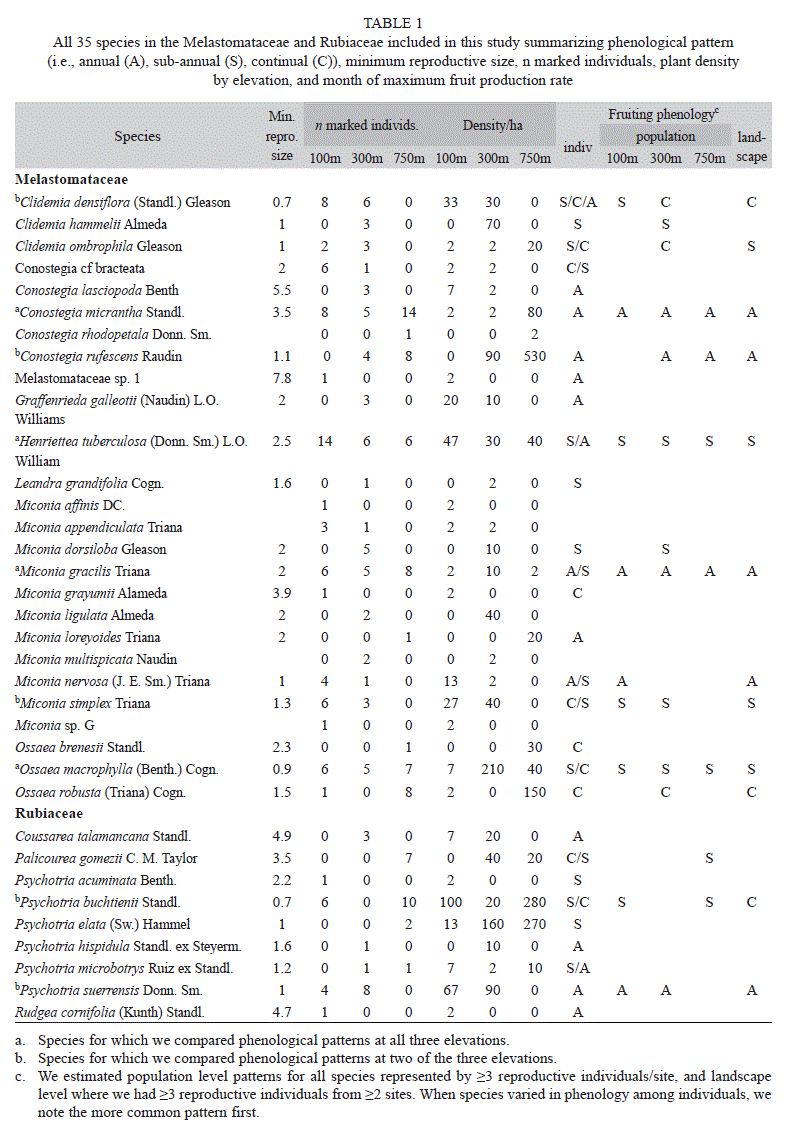
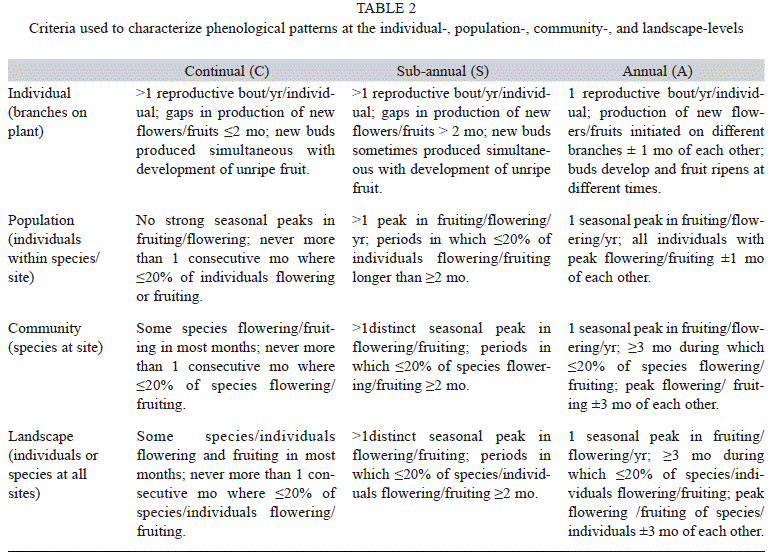
<body><![CDATA[<br> <font size="2">We monitored phenology on 226 individually-marked plants belonging to 35 species in the Melastomataceae and Rubiaceae (<a  href="/img/revistas/rbt/v60n4/a02t1.gif">Table 1</a>). We chose species due to their importance in the diets of understory frugivorous birds based on fecal samples (Rosselli 1989, Loiselle &amp; Blake 1990, Stiles &amp; Rosselli 1993, Loiselle &amp; Blake 1999, Boyle <span  style="font-style: italic;">et al</span>. 2011) and traits indicative of avian seed dispersal, (fruit size, color and fleshiness). Voucher specimens of all species in this study were deposited at the Museo Nacional de Costa Rica, INBio and the Missouri Botanical Garden. We measured plant diameter at breast height (dbh), basal diameter, and estimated height to the nearest 0.5m. We visited each marked plant at the beginning of a week&#8217;s sampling period, noted if it bore buds or flowers, and counted all unripe and ripe fruits. </font>    <br> <font size="2"></font>    <br> <font size="2"><span style="font-weight: bold;">Phenological classification:</span> We followed Newstrom <span  style="font-style: italic;">et al</span>. (1994) framework which differs from previous tropical phenological classifications (Frankie <span style="font-style: italic;">et al</span>. 1974, Gentry 1974, Bawa 1983) in explicitly differentiating between patterns repeating at nested levels of organization from inflorescences up through individuals, populations and communities. Although Newstrom <span style="font-style: italic;">et al</span>. (1994) identified multiple attributes that contribute to the diversity of phenological patterns&nbsp; (e.g., regularity, duration, amplitude), their classification relies on the number of reproductive bouts per year at any given level of biological organization: (1) continual, with new reproductive structures being produced more or less year-round; (2) sub-annual, with more than one discrete reproductive bout per year; (3) annual, with a single reproductive bout per year; and (4) supra-annual, with reproductive bouts occurring less than once per year.     <br> </font><font size="2">&nbsp;</font>    <br> <font size="2">The ways in which phenological patterns scale up from one level to the next depend upon the degree of reproductive synchrony at lower levels (e.g., proportions of branches, individuals, species). Newstrom <span  style="font-style: italic;">et al</span>. (1994) did not quantitatively describe criteria for determining what proportion of units reproducing constituted &#8220;synchronous&#8221; reproduction, and further-more, these authors considered only flowering phenology, whereas we consider the entire reproductive episode, especially focusing on fruiting phenology. Consequently, classification of some patterns in our dataset depended upon articulating explicit criteria and numeric thresholds to make this system a useful tool for comparisons among studies. We summarize these criteria in <a  href="/img/revistas/rbt/v60n4/a02t2.gif">table 2</a>. Note that flowering and fruiting can lead to different phenological classifications if either fruit maturation periods vary considerably or if pathogen attack results in loss of all developing fruits following flowering. When patterns of fruiting and flowering differed, we based our classification upon fruiting patterns due to our interest in fruit-frugivore interactions.    <br>     <br> </font><font size="2"><span style="font-weight: bold;">Correlates of species phenologies:</span> We analyzed the correlates of species&#8217; phonologies in two ways.&nbsp; First, we examined correlates of patterns evident at the individual level. Because patterns were fairly consistent at the individual&nbsp; level in species reproducing once per year but more variable in those reproducing more frequently, we grouped species having more than one reproductive bout per year (sub-annual and continual). Second, in species for which we could characterize community- level or landscape-level patterns, we examined correlates of phenological strategy at these broader scales, using patterns derived from all reproductive individuals within each species. With each approach, we considered the relationship between phenological pattern (i.e., continual, sub-annual or annual) and crop size (Eriksson &amp; Ehrl&eacute;n 1991), levels of pathogen attack, and the role of phylogenetic relatedness in constraining phenological strategy.    <br> </font>    <br> <font size="2">To quantify fruit crop size and levels of pathogen attack, we estimated standing crop of ripe and rotting fruits and daily production rates of ripe fruits and rates of pathogen attack. We estimated these rates by marking and following 1-11 infructescences (mean=4.1 infructescences/plant) one week each month. On each marked infructescence, we counted all ripe, unripe and pathogen-attacked fruits at the beginning of the sampling week, removing attacked fruits. We re-counted fruits at the end of the sampling week (mean=4.9d between checks) and estimated per-infructescence ripening rates as [<span  style="font-style: italic;">n</span> unripe 1<sup>st</sup> check] &#8211; [<span style="font-style: italic;">n</span> unripe 2<sup>nd</sup>&nbsp;&nbsp; check] &#8211; [<span style="font-style: italic;">n</span> attacked 2<sup>nd&nbsp;</sup>&nbsp; check] and per-infructescence daily attack rates as [<span style="font-style: italic;">n</span> attacked 2<sup>nd</sup> check] &#8725; [<span style="font-style: italic;">n</span> d between checks]. We estimated daily production and attack rates per plant during each month as the mean per-infructescence production (or attack) multiplied by the total n infructescences bearing fruit that month. We used data from all individuals bearing fruit in that month and ln-transformed fruit counts and daily rates prior to analysis. We used general linear models to evaluate the relationship between phenological pattern (i.e., continual, sub-annual or annual) and both crop size and pathogen attack separately, as well as models that included both these factors and genus (nested within family) to account for phylogenetic constraints. </font>    <br> <font size="2">&nbsp;</font>    ]]></body>
<body><![CDATA[<br> <font size="2"><span style="font-weight: bold;">Community-level correlates:</span> We used patterns of community-level phenology (proportions of species) and fruit abundance (daily production rates of ripe fruit) at the three sites to evaluate some of the potential biotic and abiotic correlates of fruiting patterns (i.e., frugivore abundance, pathogen attack rates and rainfall). To estimate community-level fruit production rates, we estimated the density of individuals/species by surveying 10 (at the 300m and 750m sites) or 15 (at the 100m site) 0.01-ha belt transects (2x50m) systematically spaced &#8805;100m apart. Along each transect, we identified, recorded reproductive status, and measured the dbh, basal diameter, and height of all plants in the Melastomataceae and Rubiaceae. We estimated the minimum size at which a species is reproductive by three sets of measurements (basal diameter, diameter at breast height and height of tree) for all marked individuals and all individuals entering into plant transects. We chose the best predictor of reproductive status by conducting three sets of logistic regression analyses. Because basal diameter was more strongly associated with reproductive status than either dbh or tree height, we used basal diameter (cm) as the measure of minimum reproductive size. We then searched all records of plants from all sites for the smallest individual found flowering or fruiting and used this as the minimum reproductive size for the species as a whole. We then used the number of individuals in transects &#8805; this size to estimate the density of reproductive-sized individuals/ species/ha at each elevation (<a  href="/img/revistas/rbt/v60n4/a02t1.gif">Table 1</a>).</font>    <br> <font size="2"></font>    <br> <font size="2">We multiplied the mean per-individual estimates of fruit production each month by the number of reproductive-sized individuals/ha for each species. In a few cases, marked plant species did not occur along plant transects, yielding estimates of fewer than 10 individuals per ha. We arbitrarily assigned these species densities of two individuals/ha as a conservative estimate of their abundance. Finally, we summed the monthly rates for all species at a site to obtain overall production rate estimates by month and site.</font>    <br> <font size="2"></font>    <br> <font size="2">To determine patterns of seasonal abundance of dispersers at each elevation, we captured birds for 5-7d at each site each month in 6-16 mist nets (12m wide x 3m tall, 38mm mesh). We located nets in the same places in successive months in the understory of old-growth forest in the vicinity of marked plants. We opened mist nets at 06:00, and kept them open until noon or until rain began, checking nets every 20min. This capture effort resulted in 3 069 captures in 13 321 mist-net-hours (mnh). We classified birds as frugivores and potential seed dispersers based on Stiles &amp; Skutch (1989). We banded birds, collected data on age, sex, diet, and morphology for other studies (Boyle 2008, Boyle <span  style="font-style: italic;">et al</span>. 2011), then released birds at the capture site.</font>    <br> <font size="2"></font>    <br> <font size="2">We used monthly rainfall totals from the 100m and 750m sites (derived from 20-40yr data) and interpolated mean monthly amounts for the 300m site based on regression equations using daily measurements from all three sites in 2004. We examined the relationships among community-wide phenological patterns, disperser abundance, pathogen attack and rainfall, at each site separately, accounting for the temporal autocorrelation of monthly data in ANOVA models by incorporating month coded numerically and testing for significance of the time*predictor variable interaction term.</font>    <br> <font size="2"></font>    <br> <font style="font-weight: bold;" size="3">Results</font>    <br> <font size="2"></font>    ]]></body>
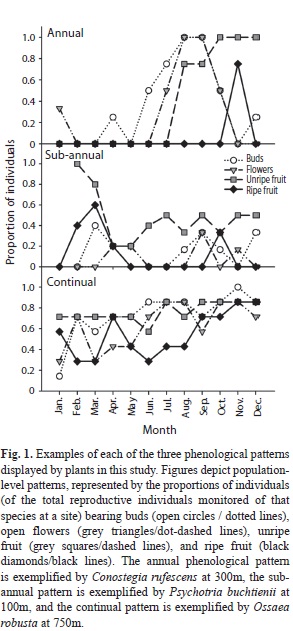
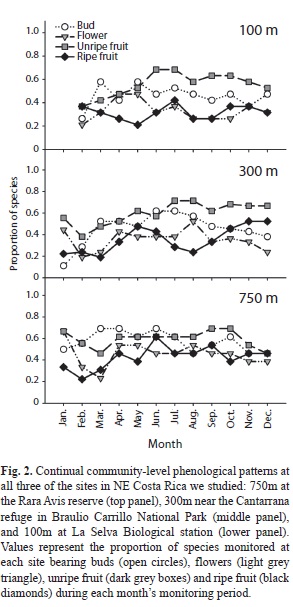
<body><![CDATA[<br> <font size="2"><span style="font-weight: bold;">Phenological diversity: </span>Of the 226 individuals of 35 plant species that we monitored, 168 individuals of 29 species reproduced during 2004 (<a href="/img/revistas/rbt/v60n4/a02t1.gif">Table 1</a>). The total duration of the reproductive period (month of first buds to last month of fruiting) varied from 6mo (e.g., <span  style="font-style: italic;">Miconia nervosa</span>) to 12mo (e.g., <span style="font-style: italic;">Psychotria suerrensis</span>). However, even in plants exhibiting annual phenological patterns, reproduction was relatively protracted: on average, individuals were non-reproductive for only 2.6 mo of the year. Individuals exhibiting continual phenologies bore buds 51% of the year, flowers 38% of the year, unripe fruit 76% of the year and ripe fruit 40% of the year.&nbsp;&nbsp; Most individuals bore reproductive structures in every month of the year. Within species, phenological patterns frequently differed among individuals, with continual and sub-annual patterns, or sub-annual and annual patterns occurring in the same species (<a  href="/img/revistas/rbt/v60n4/a02t1.gif">Table 1</a>).</font>    <br> <font size="2"></font>    <br> <font size="2">Fifteen species were represented by &#8805;3 reproductive individuals at two or more sites permitting examination of phenological patterns within species at higher levels of organization (<a  href="/img/revistas/rbt/v60n4/a02t1.gif">Table 1</a>; <a  href="/img/revistas/rbt/v60n4/a02i1.jpg">Fig. 1</a>; see <a  href="/img/revistas/rbt/v60n4/a02a1.jpg">Appendix </a>for graphical representations of phenologies of all species at all sites in online version). Among the eight species for which we were able to characterize phenological patterns at more than one site, only in <span style="font-style: italic;">Clidemia densiflora</span> did the population-level patterns differ among sites (<a href="/img/revistas/rbt/v60n4/a02t1.gif">Table 1</a>; <a  href="/img/revistas/rbt/v60n4/a02a1.jpg">Appendix</a>).&nbsp; Phenological&nbsp; patterns at the landscape level typically mirrored the population-level patterns within species, with three exceptions: (1) in <span  style="font-style: italic;">Clidemia densiflora,</span> the landscape-level continual pattern was consistent with the population-level pattern at the 100m site but not the 300m site; (2) in <span style="font-style: italic;">Clidemia ombrophila,</span> the&nbsp; continual&nbsp; pattern&nbsp; evident&nbsp; at the 300m site shifted to a sub-annual pattern when additional reproductive individuals from the 100m site were included; and (3) in <span style="font-style: italic;">Psychotria buchtienii,</span> sub-annual patterns at two sites (e.g., <a href="/img/revistas/rbt/v60n4/a02i1.jpg">Fig. 1</a>) were asynchronous enough that patterns over the broader geographic area were more accurately classified as continual. At the landscape scale, five species exhibited annual phenological patterns, and these were mirrored in annual patterns down to the level of the individual.    <br>     <br> </font> <font size="2">Because our study lasted only one year, our methods precluded detecting supra-annual reproductive cycles, which could result in a few species being incorrectly classified as having annual patterns or could account for some of the species we marked that did not reproduce in 2004. However, field observations, notes, and botanical collections assembled in the same region over 14 mo during 2001-2003 and 2007-2011 confirm that temporal patterns observed in 2004 represent repeatable phenomena in most, if not all, of the species (W. A. Boyle, unpubl. data).</font>    <br> <font size="2">&nbsp;</font>    <br> <font size="2">Among species, phenological patterns were asynchronous, with the result that community-level patterns at all three sites (<a  href="/img/revistas/rbt/v60n4/a02i2.jpg">Fig. 2</a>) as well as the overall landscape-level patterns were continual. Even when we considered only the populations exhibiting annual phenological patterns, all phenological stages were present in at least one species in all months at all sites. Likewise, sub-annual fruiters exhibited considerable asynchrony, with no two species having both peak fruiting periods in the same months. Ripe fruits were produced by a similar proportion of the species we studied at all three sites throughout the year (<a href="/img/revistas/rbt/v60n4/a02i2.jpg">Fig. 2</a>). The month with the fewest species producing ripe fruit differed among sites (Feb at 750m, Mar at 300m and May at 100m), but occurred during or within one month of the drier season at all sites (Feb-Apr).     <br>     <br> &nbsp; </font><font size="2"></font>    <br> <font size="2">In summary, the reproductive phonologies of the species in the Melastomataceae and Rubiaceae that we studied exhibited considerable diversity in terms of the number of reproductive bouts per year as well as the timing and synchrony of those bouts within and among individuals. However, regardless of where a plant grew, individual level patterns were consistent within species. </font>    ]]></body>
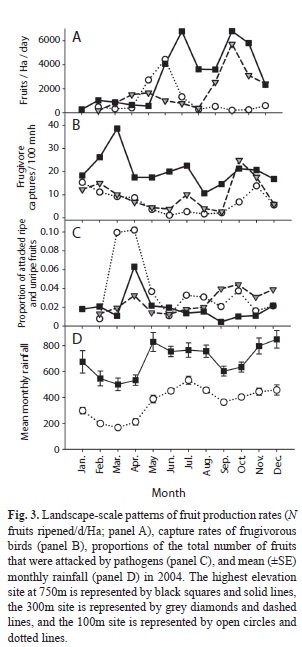
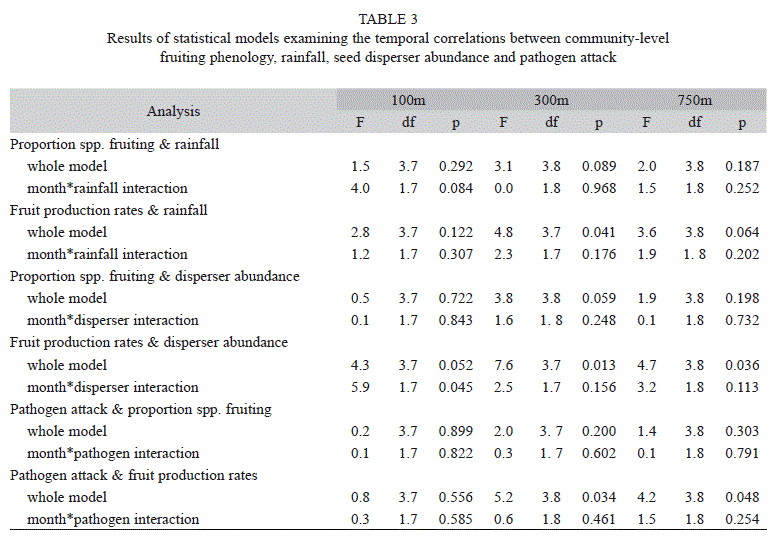
<body><![CDATA[<br> <font size="2"></font>    <br> <font size="2"><span style="font-weight: bold;">Correlates of species phenological patterns: </span>Individual-level phenological patterns were not related to the size of the fruit crop produced (<span style="font-style: italic;">ln</span>-transformed mean standing crop of ripe fruit, t<sub>24</sub>=-1.6, p=0.129; <span style="font-style: italic;">ln</span>-transformed ripening rate, t<span style="font-style: italic;">25</span>=-1.6, p=0.113) nor to the species&#8217; level of pathogen attack (<span style="font-style: italic;">ln</span>-transformed mean standing crop of rotten fruit, t<sub>23</sub>=-0.9, p=0.396; <span  style="font-style: italic;">ln</span>-transformed rotting rate, t<sub>23</sub>=-0.1, p=0.921). Combining standing crop measures with genus (nested within family) revealed that together, these variables were not related to phenological patterns (effect likelihood &#967;<sup>2</sup>=11.5, df=10, p=0.317).    <br> </font>    <br> <font size="2">Restricting analyses to only those species for which we could characterize phenological patterns at the population or landscape level did not change the results. A species&#8217; pheno- logical pattern at these higher levels was not related&nbsp; to&nbsp; the&nbsp; average&nbsp; size&nbsp; of&nbsp; its&nbsp; fruit&nbsp; crop (<span  style="font-style: italic;">ln</span>-transformed mean standing crop of ripe fruit, F<sub>2,12</sub>=0.7, p=0.530; <span  style="font-style: italic;">ln</span>-transformed ripening rate, F<sub>2,12</sub>=0.5, p=0.608) nor to its level of pathogen attack (<span style="font-style: italic;">ln</span>-transformed mean standing crop of rotten fruit, F<sub>2,12</sub>=0.1, p=0.919; <span style="font-style: italic;">ln</span>-transformed rotting rate, F<sub>2,12</sub>=0.3, p=0.729). Including genus nested within family was not possible given the reduced sample size in this analysis. However, accounting for phylogenetic effects by including plant family together with standing crop measures revealed that these variables were not related to phenological patterns (effect likelihood<span style="font-style: italic;"> </span>&#967;<sup>2</sup>=3.8, df=6, p=0.698).</font>    <br> <font size="2"></font>    <br> <font size="2"><span style="font-weight: bold;">Correlates of community-level phenological patterns:</span> Although the proportions of species bearing ripe fruit did not fluctuate greatly over the course of the year or among elevations (<a  href="/img/revistas/rbt/v60n4/a02i2.jpg">Fig. 2</a>), the production rates of ripe fruits did fluctuate considerably over these temporal and spatial scales (<a href="/img/revistas/rbt/v60n4/a02i3.jpg">Fig. 3</a><a href="/img/revistas/rbt/v60n4/a03f3.jpg">a</a>), withpeaks in fruit production in Jun at 100m, Oct at 300m, and both Jul and Oct at 750m. Peaks in fruit production were primarily driven by one or two species at each site bearing very large fruit crops.    <br>     <br> </font> <font size="2"><a href="/img/revistas/rbt/v60n4/a02t3.gif">Table 3</a> summarizes the relationships between phenology and rainfall, disperser abundance, and pathogen attack. The nature of these relationships depended upon the site and the response variable considered (proportion of species bearing ripe fruit or fruit production rates). The only rainfall model that explained a significant portion of the variation was that of fruit production rates at the 300m site (whole model, F<sub>3,7</sub>=4.8, p=0.041; <a  href="/img/revistas/rbt/v60n4/a02t3.gif">Table 3</a>). As rainfall increased, fruit production rates tended to decrease (rainfall partial effect test, F<sub>1,7</sub>=5.3, p=0.055).     <br> </font>    <br> <font size="2">Nearly half (<span style="font-style: italic;">n</span>=1 462) of bird captures were of seed-dispersing frugivores belonging to 41 species.&nbsp; Of these individuals, 741 (51%; 12 species) were altitudinal migrants and 301 (21%; 4 species) were long-distance migrants (Boyle 2006). Seasonal movements of migrants created considerable seasonality of potential seed dispersers at all elevations (<a href="/img/revistas/rbt/v60n4/a02i3.jpg">Fig. 3b</a>).     ]]></body>
<body><![CDATA[<br> </font>    <br> <font size="2">Disperser abundance was related to fruit production rates at all three sites, but was not related to the proportion of species bearing fruits at any site. The nature of the relationship between dispersers and fruit production rate differed among sites. At only the 300m site was this relationship positive. At the other two sites, high fruit production rates were associated with low numbers of potential dispersers. At none of the three sites did the month of peak proportions of species bearing ripe fruit coincide with the month of peak disperser abundance, and only at 300m did dispersers and fruiting phenology peak within one month of each other.</font>    <br> <font size="2"></font>    <br> <font size="2">A diverse assemblage of organisms attacked fruits and seeds prior to dispersal. Evidence of pathogen attack included holes, tumor-like growths, discoloring, hardening, premature softening, filamentous webs, and mould. Rates of fruit pathogen attack varied greatly among species (e.g., some like <span style="font-style: italic;">Miconia&nbsp; grayumii</span>&nbsp; lost&nbsp; almost&nbsp; their&nbsp; entire&nbsp; fruit crop, whereas others such as <span  style="font-style: italic;">Rudgea acuminata</span>&nbsp; and&nbsp; <span style="font-style: italic;">Miconia&nbsp; loreyoides</span>&nbsp; lost&nbsp; almost no fruits). Incidence of pathogen attack also differed considerably among sites; mean (&plusmn;SE) attack rates varied from 4.5 (&plusmn;3.5) fruits/plant/d at 750m, to 15.2 (&plusmn;2.9) fruits/plant/d at 100m. The proportions of fruits attacked showed similar trends (mean&plusmn;SE monthly proportions attacked; 750m, 0.019&plusmn;0.006; 300m, 0.025&plusmn;0.006; 100m, 0.038&plusmn;0.007). However, pathogen attack was not related to the proportion of species producing fruit at any site. At the 300m site, increases in fruit production rates were associated with increases in the proportion of fruits attacked (pathogen attack partial effect test, F<sub>1,7</sub>=4.8, p=0.063). In only one of the models that we evaluated (disperser abundance and fruit production rates at the 100m site) did there appear to be any temporal autocorrelation (i.e., significant interaction between the main effect and month).</font>    <br> <font size="2"></font>    <br> <font size="2">In general, temporal patterns of fruit production rates were better explained by the biotic and abiotic correlates we examined than were the proportions of species bearing ripe fruit (<a  href="/img/revistas/rbt/v60n4/a02t3.gif">Table 3</a>). Although several of the associations were statistically significant, results were inconsistent from site to site, and were not always associated in the ways predicted if mutualists and antagonists influence fruiting phenology of plant species they interact with. </font>    <br> <font size="2">&nbsp;</font>    <br> <font style="font-weight: bold;" size="3">Discussion</font>    <br> <font size="2"></font>    <br> <font size="2">Phenologies of plants growing in year-round warm, wet environments are freed from the constraints that limit the number and the timing of reproductive bouts. As a consequence, a diversity of reproductive strategies is viable, and these strategies can be shaped by a broad set of selective pressures. We found great phenological diversity, even in a narrow taxonomic subset of plants growing in one stratum of tropical wet forest. The number of reproductive bouts per year, and the timing, duration, and synchrony of those bouts varied to some extent among individuals of the same species, and to a large extent among populations of different species. Patterns at the individual level were usually reflected at the population level. However, the idiosyncratic nature of species-level phenological patterns was obscured at the community-level where we found little temporal or spatial variation in the proportion of fruiting species. This species-level variability and community-level constancy may well contribute to the lack of dietary specialization among frugivores (Schleuning <span  style="font-style: italic;">et al</span>. 2011) as well as the persistence of large frugivorous guilds in many tropical vertebrate and invertebrate lineages.</font>    ]]></body>
<body><![CDATA[<br> <font size="2">&nbsp;</font>    <br> <font size="2">Phenologies of the species in this study have clearly been shaped in individualistic ways, probably by a much broader array of biotic and abiotic factors than considered in this study. Even among congeners (e.g., <span style="font-style: italic;">Miconia, Psychotria</span>), all three of the phenological types were evident, and even in species of the same genus with the same phenological pattern (e.g., annual fruiting in <span  style="font-style: italic;">Conostegia micrantha</span> and <span style="font-style: italic;">C. rufescens</span>), the timing of reproduction often differed. Given this species-level individuality, perhaps it is not surprising that no one correlate we studied was consistently related to phenological patterns at the community level.</font>    <br> <font size="2"></font>    <br> <font size="2">Interestingly, not all possible phenological patterns were represented in this assemblage of plants. Notable was the absence of high among-individual asynchrony in annual (or sub-annual) patterns. Such patterns are characteristic of reproduction in tropical New World fig (<span style="font-style: italic;">Ficus</span>) species (Milton <span  style="font-style: italic;">et al</span>. 1982, Bronstein <span style="font-style: italic;">et al</span>. 1990) and is one of the factors that permits persistence of specialization of the fig pollination mutualism. Frugivores are rarely as specialized in their interactions with plants as are fig wasps, and the phenological patterns of these plant groups may reflects these differences.</font>    <br> <font size="2"></font>    <br> <font size="2">Within species, individuals had very similar phenologies, regardless of where they grew. The individual-level variation we did observe often appeared to reflect the health of the plant. For instance, some individuals ceased reproduction following defoliation by leafcutter ants (unpubl. data) and some lost entire fruit crops to pathogens. Additionally, in some species in which individuals exhibited either continual or sub-annual patterns, different classifications resulted from differences among individuals in the duration of non-reproductive periods. Likely such differences reflected variation in light or nutrient resources available for reproduction.</font>    <br> <font size="2"></font>    <br> <font size="2">Although biotic interactions have long been proposed to shape plant phenologies (Rathcke &amp; Lacey 1985), abiotic constraints on phenologies are much better understood. We predicted that wet tropical forest would be the most likely environment in which to find evidence that mutualists and antagonists shape reproductive phenologies. Yet while phenological patterns were highly variable among species, they were not related to factors associated with seed dispersal or pathogen interactions. Although elevational differences in patterns of frugivore abundance implies that the potential exists for disperser-mediated selection on phenology, disperser abundance was not positively related&nbsp; to&nbsp; community-level&nbsp; fruiting&nbsp; patterns, in contrast to findings in different parts of the world (Noma &amp; Yumoto 1997, Poulin <span style="font-style: italic;">et al</span>. 1999, Malizia 2001).</font>    <br> <font size="2"></font>    <br> <font size="2">Failure to find the fingerprint of biotic selection on fruiting phenology could reflect one or a combination of factors. First, gene flow may swamp local selective pressures. Seed dispersers often range widely (Holbrook &amp; Smith 2000) and dispersal distances can reach nearly 1km in this region (Sezen <span style="font-style: italic;">et al</span>. 2005). This fact suggests that populations of plants with ranges spanning several hundred meters of elevation may exchange genes regularly, precluding adaptation to the local biotic environment. Second, the timing of fruiting may be constrained by selection on the timing of flowering and pollinator abundance. That is, biotic interactions may indeed shape phenologies, but of flowering rather than fruiting time. Similarly, phenology of vegetative growth may constrain fruiting time. Third, the movements of frugivores may not be predictable enough for selection to act on fruiting phenology (Jordano 1993). Indeed, migratory tendency appears to be highly evolutionarily labile (Able &amp; Belthoff 1998, Berthold 2001, Greenberg &amp; Marra 2005), perhaps especially in short-distance tropical migrants. Fourth, selection may be too weak at the seed dispersal stage for dispersers to affect phenology: effective dispersal location is unpredictable, and seeds experience high post-dispersal mortality (Wheelwright &amp; Orians 1982, Houle 1995). Finally, phenology of tropical species may also be constrained by abiotic conditions. While our analyses of rainfall and phenology suggest that water availability does not constrain reproduction, seasonal variation in solar irradiation (Zimmerman <span style="font-style: italic;">et al</span>. 2007) likely influences the carbon available that plants require to produce fruit (Levey 1990, van Schaik <span style="font-style: italic;">et al</span>. 1993). If so, the variability we found in phenological patterns may reflect species-specific physiological responses to local abiotic conditions.</font>    ]]></body>
<body><![CDATA[<br> <font size="2"></font>    <br> <font size="2">The timing and intensity of pathogen attack has been given minimal attention as possible factors shaping plant phenologies. Potential&nbsp; causes&nbsp; of the general decrease in pathogen attack with increasing elevation may involve temperature (3.3&ordm;C difference in mean annual temperature between 100m and 750m) or precipitation (4 306mm at the 100m site vs. 8 267mm at the 750m site). Potentially, warmer (but drier) environments favor a greater abundance and/or diversity of insects, fungi and bacteria that attack fruits and seeds (Dalling <span style="font-style: italic;">et al</span>. 2010). Alternatively, environmental differences could influence the incidence or effectiveness of chemical defenses employed by plants to defend reproductive structures from antagonists. </font>    <br> <font size="2"></font>    <br> <font size="2">This study revealed a number of intriguing and unexplained patterns. Foremost among them is the striking variation in phenology among closely-related understory plants that are similar in so many other respects, running contrary to studies that report relative phylogenetic conservatism in tropical tree phenology (Bawa <span  style="font-style: italic;">et al</span>. 2003). Exploring the proximate and ultimate causes of this within-family and -genus variation would be valuable, especially in a more explicit phylogenetic framework than was possible in this study (Chazdon <span  style="font-style: italic;">et al</span>. 2003, Bolmgren &amp; L&ouml;nnberg 2005). The clear spatial patterns but apparent lack of interpretable seasonal patterns of pathogen attack in this study also begs for explanation. What factors result in plant species differing so dramatically in rates of pathogen attack? Can elevational patterns be explained by temporal or spatial distributions of different types of pathogens? (Biere &amp; Honders 1996, Mahoro 2003). </font>    <br> <font size="2"></font>    <br> <font size="2">To better understand the degree to which climate and species interactions affect phenological patterns of tropical plants, studies in other tropical forests will be required, ideally spanning several years (Newstrom <span style="font-style: italic;">et al</span>. 1992, Chapman <span style="font-style: italic;">et al</span>.&nbsp; 2005). A full understanding of tropical phenologies is made difficult by the fact that measurements must be made frequently during the entire year. Nevertheless, studies such as this one that focus on testing hypotheses explaining a few components of diverse phenological patterns contribute to our understanding of the whole system.</font>    <br> <font size="2"></font>    <br> <font style="font-weight: bold;" size="3">Acknowledgments    <br>     <br> </font><font size="2">B. Boyle, J. Brokaw, M. Burke, W. Goulding, M. Hill, C. Leumas, J. Montoya-Morera and J. Wolfe provided exceptional field assistance. B. Boyle, J. Gonzalez, B. Hammel, R. Kriebel, F. Morales, C. Taylor, O. Vargas and N. Zamora helped identify plants. J. Hurtado checked the Spanish. C. Conway, B. Enquist, D.&nbsp; Papaj and R. Steidl provided advice on the design and execution of this project. A. Bien, L. D. G&oacute;mez, staff of Rara Avis and La Selva Biological Station, MINAE, ACCVC, J. Guevara, R. Tenorio, and the University of Arizona&#8217;s IACUC committee assisted with logistics, permits, and support in the field. This work was supported by the National Science Foundation (DEB-0410531), NSERC PGS-B and PDF fellowships to WAB, the Helen Battle Memorial Fellowship to WAB, and grants from the University of Arizona.</font>    ]]></body>
<body><![CDATA[<br> <font size="2">&nbsp;     <br> </font> <hr style="width: 100%; height: 2px;"><font style="font-weight: bold;"  size="3">References</font>    <br> <font size="2"></font>    <!-- ref --><br> <font size="2">Able, K.P. &amp; J.R. Belthoff. 1998. Rapid &#8216;evolution&#8217; of migratory behaviour in the introduced house finch of eastern North America. Proc. R. Soc. B 265: 2063-2071.    &nbsp;&nbsp;&nbsp;&nbsp;&nbsp;&nbsp;&nbsp;&nbsp;[&#160;<a href="javascript:void(0);" onclick="javascript: window.open('/scielo.php?script=sci_nlinks&ref=1811017&pid=S0034-7744201200040000200001&lng=','','width=640,height=500,resizable=yes,scrollbars=1,menubar=yes,');">Links</a>&#160;]<!-- end-ref --></font>    <br> <font size="2"></font>    <!-- ref --><br> <font size="2">Aizen, M.A. 2003. Influences of animal pollination and seed dispersal on winter flowering in atemperate mistletoe. Ecology 84: 2613-2627.    &nbsp;&nbsp;&nbsp;&nbsp;&nbsp;&nbsp;&nbsp;&nbsp;[&#160;<a href="javascript:void(0);" onclick="javascript: window.open('/scielo.php?script=sci_nlinks&ref=1811020&pid=S0034-7744201200040000200002&lng=','','width=640,height=500,resizable=yes,scrollbars=1,menubar=yes,');">Links</a>&#160;]<!-- end-ref --></font>    <br> <font size="2"></font>    <!-- ref --><br> <font size="2">Anderson, D.P., E.V. Nordheim, T.C.&nbsp; Moermond, Z.B.G. Bi &amp; C. Boesch. 2005. Factors influencing tree phenology in Tai National Park, Cote d&#8217;Ivoire. Biotropica 37: 631-640.    &nbsp;&nbsp;&nbsp;&nbsp;&nbsp;&nbsp;&nbsp;&nbsp;[&#160;<a href="javascript:void(0);" onclick="javascript: window.open('/scielo.php?script=sci_nlinks&ref=1811023&pid=S0034-7744201200040000200003&lng=','','width=640,height=500,resizable=yes,scrollbars=1,menubar=yes,');">Links</a>&#160;]<!-- end-ref --></font>    <br> <font size="2"></font>    <!-- ref --><br> <font size="2">Augspurger, C.K. 1983. Phenology, flowering synchrony, and fruit set of six neotropical shrubs. Biotropica 15: 257-267.    &nbsp;&nbsp;&nbsp;&nbsp;&nbsp;&nbsp;&nbsp;&nbsp;[&#160;<a href="javascript:void(0);" onclick="javascript: window.open('/scielo.php?script=sci_nlinks&ref=1811026&pid=S0034-7744201200040000200004&lng=','','width=640,height=500,resizable=yes,scrollbars=1,menubar=yes,');">Links</a>&#160;]<!-- end-ref --></font>    <br> <font size="2"></font>    <!-- ref --><br> <font size="2">Bascompte, J. 2009. Disentangling the web of life. Science 325: 416-419.    &nbsp;&nbsp;&nbsp;&nbsp;&nbsp;&nbsp;&nbsp;&nbsp;[&#160;<a href="javascript:void(0);" onclick="javascript: window.open('/scielo.php?script=sci_nlinks&ref=1811029&pid=S0034-7744201200040000200005&lng=','','width=640,height=500,resizable=yes,scrollbars=1,menubar=yes,');">Links</a>&#160;]<!-- end-ref --></font>    <br> <font size="2"></font>    <!-- ref --><br> <font size="2">Bawa, K.S. 1983. Patterns of flowering in tropical plants, pp.&nbsp; 394-410. In C.E.&nbsp; Jones &amp; R.J.&nbsp; Little (eds.). Handbook of Experimental Pollination Biology. Van Nostrand Reinhold, New York, New York, USA.    &nbsp;&nbsp;&nbsp;&nbsp;&nbsp;&nbsp;&nbsp;&nbsp;[&#160;<a href="javascript:void(0);" onclick="javascript: window.open('/scielo.php?script=sci_nlinks&ref=1811032&pid=S0034-7744201200040000200006&lng=','','width=640,height=500,resizable=yes,scrollbars=1,menubar=yes,');">Links</a>&#160;]<!-- end-ref --></font>    ]]></body>
<body><![CDATA[<br> <font size="2"></font>    <!-- ref --><br> <font size="2">Bawa, K.S., H.S. Kang &amp; M.H. Grayum. 2003. Relationships among time, frequency, and duration of flowering in&nbsp; tropical rain forest trees. Am. J. Bot. 90: 877-887.    &nbsp;&nbsp;&nbsp;&nbsp;&nbsp;&nbsp;&nbsp;&nbsp;[&#160;<a href="javascript:void(0);" onclick="javascript: window.open('/scielo.php?script=sci_nlinks&ref=1811035&pid=S0034-7744201200040000200007&lng=','','width=640,height=500,resizable=yes,scrollbars=1,menubar=yes,');">Links</a>&#160;]<!-- end-ref --></font>    <br> <font size="2"></font>    <!-- ref --><br> <font size="2">Berlin, K.E., T.K. Pratt, J.C. Simon, J.R. Kowalsky &amp; J.S. Hatfield. 2000. Plant phenology in a cloud forest on the island of Maui, Hawaii. Biotropica 32: 90-99.    &nbsp;&nbsp;&nbsp;&nbsp;&nbsp;&nbsp;&nbsp;&nbsp;[&#160;<a href="javascript:void(0);" onclick="javascript: window.open('/scielo.php?script=sci_nlinks&ref=1811038&pid=S0034-7744201200040000200008&lng=','','width=640,height=500,resizable=yes,scrollbars=1,menubar=yes,');">Links</a>&#160;]<!-- end-ref --></font>    <br> <font size="2"></font>    <!-- ref --><br> <font size="2">Berthold, P. 2001. Bird migration: a novel theory for the evolution, the control and the adaptability of bird migration. J. Ornithol. 142: 148-159.    &nbsp;&nbsp;&nbsp;&nbsp;&nbsp;&nbsp;&nbsp;&nbsp;[&#160;<a href="javascript:void(0);" onclick="javascript: window.open('/scielo.php?script=sci_nlinks&ref=1811041&pid=S0034-7744201200040000200009&lng=','','width=640,height=500,resizable=yes,scrollbars=1,menubar=yes,');">Links</a>&#160;]<!-- end-ref --></font>    <br> <font size="2"></font>    ]]></body>
<body><![CDATA[<!-- ref --><br> <font size="2">Bhat, D.M. 1992. Phenology of tree species of tropical moist forest of Uttara-Kannada District, Karnataka, India. J. Biosci. 17: 325-352.    &nbsp;&nbsp;&nbsp;&nbsp;&nbsp;&nbsp;&nbsp;&nbsp;[&#160;<a href="javascript:void(0);" onclick="javascript: window.open('/scielo.php?script=sci_nlinks&ref=1811044&pid=S0034-7744201200040000200010&lng=','','width=640,height=500,resizable=yes,scrollbars=1,menubar=yes,');">Links</a>&#160;]<!-- end-ref --></font>    <br> <font size="2"></font>    <!-- ref --><br> <font size="2">Biere, A. &amp; S.J. Honders. 1996. Impact of flowering phe- nology of Silene alba and S. dioica on susceptibility to fungal infection and seed predation. Oikos 77: 467-480.    &nbsp;&nbsp;&nbsp;&nbsp;&nbsp;&nbsp;&nbsp;&nbsp;[&#160;<a href="javascript:void(0);" onclick="javascript: window.open('/scielo.php?script=sci_nlinks&ref=1811047&pid=S0034-7744201200040000200011&lng=','','width=640,height=500,resizable=yes,scrollbars=1,menubar=yes,');">Links</a>&#160;]<!-- end-ref --></font>    <br> <font size="2"></font>    <!-- ref --><br> <font size="2">Bolmgren, K. &amp; K. L&ouml;nnberg. 2005. Herbarium data reveal an association between fleshy fruit type and earlier flowering time. Int. J. Plant Sci. 166: 663-670.    &nbsp;&nbsp;&nbsp;&nbsp;&nbsp;&nbsp;&nbsp;&nbsp;[&#160;<a href="javascript:void(0);" onclick="javascript: window.open('/scielo.php?script=sci_nlinks&ref=1811050&pid=S0034-7744201200040000200012&lng=','','width=640,height=500,resizable=yes,scrollbars=1,menubar=yes,');">Links</a>&#160;]<!-- end-ref --></font>    <br> <font size="2"></font>    <!-- ref --><br> <font size="2">Boyle, W.A. 2006. Why do birds migrate? The role of food, habitat, predation, and competition. Ph.D. Thesis, University of Arizona, Tucson, USA.    &nbsp;&nbsp;&nbsp;&nbsp;&nbsp;&nbsp;&nbsp;&nbsp;[&#160;<a href="javascript:void(0);" onclick="javascript: window.open('/scielo.php?script=sci_nlinks&ref=1811053&pid=S0034-7744201200040000200013&lng=','','width=640,height=500,resizable=yes,scrollbars=1,menubar=yes,');">Links</a>&#160;]<!-- end-ref --></font>    <br> <font size="2"></font>    <!-- ref --><br> <font size="2">Boyle, W.A. 2008. Partial migration in birds: tests of three hypotheses in a tropical lekking frugivore. J. Anim. Ecol. 77: 1122-1128.    &nbsp;&nbsp;&nbsp;&nbsp;&nbsp;&nbsp;&nbsp;&nbsp;[&#160;<a href="javascript:void(0);" onclick="javascript: window.open('/scielo.php?script=sci_nlinks&ref=1811056&pid=S0034-7744201200040000200014&lng=','','width=640,height=500,resizable=yes,scrollbars=1,menubar=yes,');">Links</a>&#160;]<!-- end-ref --></font>    <br> <font size="2"></font>    <!-- ref --><br> <font size="2">Boyle, W.A., D.R. Norris &amp; C.G. Guglielmo. 2010. Storms drive altitudinal migration in a tropical bird. Proc. Roy. Soc. B 277: 2511-2519.    &nbsp;&nbsp;&nbsp;&nbsp;&nbsp;&nbsp;&nbsp;&nbsp;[&#160;<a href="javascript:void(0);" onclick="javascript: window.open('/scielo.php?script=sci_nlinks&ref=1811059&pid=S0034-7744201200040000200015&lng=','','width=640,height=500,resizable=yes,scrollbars=1,menubar=yes,');">Links</a>&#160;]<!-- end-ref --></font>    <br> <font size="2"></font>    <!-- ref --><br> <font size="2">Boyle, W.A., C.J. Conway &amp; J.L. Bronstein. 2011. Why do some, but not all, tropical birds migrate? A comparative study of diet breadth and preference. Evol. Ecol.25: 219-236.    &nbsp;&nbsp;&nbsp;&nbsp;&nbsp;&nbsp;&nbsp;&nbsp;[&#160;<a href="javascript:void(0);" onclick="javascript: window.open('/scielo.php?script=sci_nlinks&ref=1811062&pid=S0034-7744201200040000200016&lng=','','width=640,height=500,resizable=yes,scrollbars=1,menubar=yes,');">Links</a>&#160;]<!-- end-ref --></font>    ]]></body>
<body><![CDATA[<br> <font size="2"></font>    <!-- ref --><br> <font size="2">Brearley, F.Q., J. Proctor, Suriantata, L. Nagy, G. Dalrym- ple &amp; B.C. Voysey. 2007.&nbsp; Reproductive phenology over a 10-year period in a lowland evergreen rain forest of central Borneo. J. Ecol. 95: 828-839.    &nbsp;&nbsp;&nbsp;&nbsp;&nbsp;&nbsp;&nbsp;&nbsp;[&#160;<a href="javascript:void(0);" onclick="javascript: window.open('/scielo.php?script=sci_nlinks&ref=1811065&pid=S0034-7744201200040000200017&lng=','','width=640,height=500,resizable=yes,scrollbars=1,menubar=yes,');">Links</a>&#160;]<!-- end-ref --></font>    <br> <font size="2"></font>    <!-- ref --><br> <font size="2">Bronstein, J.L., P.H. Gouyon, C. Gliddon, F. Kjellberg &amp; G. Michaloud. 1990. The ecological consequences of flowering asynchrony in monoecious figs: a simulation study. Ecology 71: 2145-2156.    &nbsp;&nbsp;&nbsp;&nbsp;&nbsp;&nbsp;&nbsp;&nbsp;[&#160;<a href="javascript:void(0);" onclick="javascript: window.open('/scielo.php?script=sci_nlinks&ref=1811068&pid=S0034-7744201200040000200018&lng=','','width=640,height=500,resizable=yes,scrollbars=1,menubar=yes,');">Links</a>&#160;]<!-- end-ref --></font>    <br> <font size="2"></font>    <!-- ref --><br> <font size="2">Bronstein, J.L. &amp; A. Patel. 1992. Causes and consequences of within-tree phenological patterns in the Florida strangling fig, Ficus aurea (Moraceae). Am. J. Bot. 79: 41-48.    &nbsp;&nbsp;&nbsp;&nbsp;&nbsp;&nbsp;&nbsp;&nbsp;[&#160;<a href="javascript:void(0);" onclick="javascript: window.open('/scielo.php?script=sci_nlinks&ref=1811071&pid=S0034-7744201200040000200019&lng=','','width=640,height=500,resizable=yes,scrollbars=1,menubar=yes,');">Links</a>&#160;]<!-- end-ref --></font>    <br> <font size="2"></font>    ]]></body>
<body><![CDATA[<!-- ref --><br> <font size="2">Cannon, C.H., L.M. Curran, A.J. Marshall &amp; M. Leighton. 2007.&nbsp; Long-term reproductive behaviour&nbsp; of woody plants&nbsp; across&nbsp; seven Bornean&nbsp;&nbsp; forest&nbsp; types&nbsp; in&nbsp; the Gunung Palung&nbsp; National Park (Indonesia): suprannual&nbsp; synchrony, temporal productivity and&nbsp; fruiting diversity. Ecol. Lett. 10: 956-969.    &nbsp;&nbsp;&nbsp;&nbsp;&nbsp;&nbsp;&nbsp;&nbsp;[&#160;<a href="javascript:void(0);" onclick="javascript: window.open('/scielo.php?script=sci_nlinks&ref=1811074&pid=S0034-7744201200040000200020&lng=','','width=640,height=500,resizable=yes,scrollbars=1,menubar=yes,');">Links</a>&#160;]<!-- end-ref --></font>    <br> <font size="2"></font>    <!-- ref --><br> <font size="2">Carlo, T.A., J.A. Collazo &amp; M.J. Groom. 2003. Avian fruit preferences across a Puerto Rican forested landscape: pattern consistency and implications for seed removal. Oecologia 134: 119-131.    &nbsp;&nbsp;&nbsp;&nbsp;&nbsp;&nbsp;&nbsp;&nbsp;[&#160;<a href="javascript:void(0);" onclick="javascript: window.open('/scielo.php?script=sci_nlinks&ref=1811077&pid=S0034-7744201200040000200021&lng=','','width=640,height=500,resizable=yes,scrollbars=1,menubar=yes,');">Links</a>&#160;]<!-- end-ref --></font>    <br> <font size="2"></font>    <!-- ref --><br> <font size="2">Chapman, C.A., L.J. Chapman, T.T.&nbsp; Struhsaker, A.E. Zanne, C.J. Clark &amp; J.R. Poulsen. 2005. A long-term evaluation of fruiting phenology: importance of climate change. J. Trop. Ecol. 21: 31-45.    &nbsp;&nbsp;&nbsp;&nbsp;&nbsp;&nbsp;&nbsp;&nbsp;[&#160;<a href="javascript:void(0);" onclick="javascript: window.open('/scielo.php?script=sci_nlinks&ref=1811080&pid=S0034-7744201200040000200022&lng=','','width=640,height=500,resizable=yes,scrollbars=1,menubar=yes,');">Links</a>&#160;]<!-- end-ref --></font>    <br> <font size="2"></font>    <!-- ref --><br> <font size="2">Chazdon, R.L., S. Careaga, C. Webb &amp; O. Vargas. 2003. Community and phylogenetic structure of reproductive traits of woody species in wet tropical forests. Ecol. Monogr. 73: 331-348.    &nbsp;&nbsp;&nbsp;&nbsp;&nbsp;&nbsp;&nbsp;&nbsp;[&#160;<a href="javascript:void(0);" onclick="javascript: window.open('/scielo.php?script=sci_nlinks&ref=1811083&pid=S0034-7744201200040000200023&lng=','','width=640,height=500,resizable=yes,scrollbars=1,menubar=yes,');">Links</a>&#160;]<!-- end-ref --></font>    <br> <font size="2"></font>    <!-- ref --><br> <font size="2">Cipollini, M.L. &amp; D.J. Levey. 1997. Antifungal activity of Solanum fruit glycoalkaloids: Implications for frugivory and seed dispersal. Ecology 78: 799-809.    &nbsp;&nbsp;&nbsp;&nbsp;&nbsp;&nbsp;&nbsp;&nbsp;[&#160;<a href="javascript:void(0);" onclick="javascript: window.open('/scielo.php?script=sci_nlinks&ref=1811086&pid=S0034-7744201200040000200024&lng=','','width=640,height=500,resizable=yes,scrollbars=1,menubar=yes,');">Links</a>&#160;]<!-- end-ref --></font>    <br> <font size="2"></font>    <!-- ref --><br> <font size="2">Corlett,&nbsp; R.T. &amp; J.V. LaFrankie. 1998.&nbsp; Potential impacts of climate change on tropical Asian forests through an influence on phenology. Climatic Change 39: 439-453.    &nbsp;&nbsp;&nbsp;&nbsp;&nbsp;&nbsp;&nbsp;&nbsp;[&#160;<a href="javascript:void(0);" onclick="javascript: window.open('/scielo.php?script=sci_nlinks&ref=1811089&pid=S0034-7744201200040000200025&lng=','','width=640,height=500,resizable=yes,scrollbars=1,menubar=yes,');">Links</a>&#160;]<!-- end-ref --></font>    <br> <font size="2"></font>    <!-- ref --><br> <font size="2">Cotton, P.A. 2003. Avian migration phenology and global climate change. Proc. Nat. Acad. Sci. USA 100: 12219-12222.    &nbsp;&nbsp;&nbsp;&nbsp;&nbsp;&nbsp;&nbsp;&nbsp;[&#160;<a href="javascript:void(0);" onclick="javascript: window.open('/scielo.php?script=sci_nlinks&ref=1811092&pid=S0034-7744201200040000200026&lng=','','width=640,height=500,resizable=yes,scrollbars=1,menubar=yes,');">Links</a>&#160;]<!-- end-ref --></font>    ]]></body>
<body><![CDATA[<br> <font size="2"></font>    <!-- ref --><br> <font size="2">Dalling, J.W., A.S. Davis, B.J. Schutte &amp; A.E.&nbsp; Arnold. 2010. Seed survival in soil: interacting effects of predation, dormancy and the soil microbial community. J. Ecol. 99:89-95.    &nbsp;&nbsp;&nbsp;&nbsp;&nbsp;&nbsp;&nbsp;&nbsp;[&#160;<a href="javascript:void(0);" onclick="javascript: window.open('/scielo.php?script=sci_nlinks&ref=1811095&pid=S0034-7744201200040000200027&lng=','','width=640,height=500,resizable=yes,scrollbars=1,menubar=yes,');">Links</a>&#160;]<!-- end-ref --></font>    <br> <font size="2"></font>    <!-- ref --><br> <font size="2">Elzinga,&nbsp; J.A., A. Atlan, A. Biere, L. Gigord,&nbsp; A.E. Weis &amp;&nbsp; G. Bernasconi. 2007. Time after time:&nbsp; flowering phenology and biotic interaction. Trends Ecol. Evol. 22: 432-439.    &nbsp;&nbsp;&nbsp;&nbsp;&nbsp;&nbsp;&nbsp;&nbsp;[&#160;<a href="javascript:void(0);" onclick="javascript: window.open('/scielo.php?script=sci_nlinks&ref=1811098&pid=S0034-7744201200040000200028&lng=','','width=640,height=500,resizable=yes,scrollbars=1,menubar=yes,');">Links</a>&#160;]<!-- end-ref --></font>    <br> <font size="2"></font>    <!-- ref --><br> <font size="2">Eriksson, O. &amp; J. Ehrl&eacute;n. 1991. Phenological variation in fruit characteristics in vertebrate-dispersed plants. Oecologia 86: 463-470.    &nbsp;&nbsp;&nbsp;&nbsp;&nbsp;&nbsp;&nbsp;&nbsp;[&#160;<a href="javascript:void(0);" onclick="javascript: window.open('/scielo.php?script=sci_nlinks&ref=1811101&pid=S0034-7744201200040000200029&lng=','','width=640,height=500,resizable=yes,scrollbars=1,menubar=yes,');">Links</a>&#160;]<!-- end-ref --></font>    <br> <font size="2"></font>    ]]></body>
<body><![CDATA[<!-- ref --><br> <font size="2">Foster, M.S. 1990. Factors influencing bird foraging preferences among conspecific fruit-trees. Condor 92: 844-854.    &nbsp;&nbsp;&nbsp;&nbsp;&nbsp;&nbsp;&nbsp;&nbsp;[&#160;<a href="javascript:void(0);" onclick="javascript: window.open('/scielo.php?script=sci_nlinks&ref=1811104&pid=S0034-7744201200040000200030&lng=','','width=640,height=500,resizable=yes,scrollbars=1,menubar=yes,');">Links</a>&#160;]<!-- end-ref --></font>    <br> <font size="2"></font>    <!-- ref --><br> <font size="2">Frankie, G.W., H.G. Baker &amp; P.A. Opler.&nbsp; 1974. Comparative phenological studies of trees in tropical wet and dry forests in lowlands of Costa Rica. J.&nbsp; Ecol. 62: 881-919.    &nbsp;&nbsp;&nbsp;&nbsp;&nbsp;&nbsp;&nbsp;&nbsp;[&#160;<a href="javascript:void(0);" onclick="javascript: window.open('/scielo.php?script=sci_nlinks&ref=1811107&pid=S0034-7744201200040000200031&lng=','','width=640,height=500,resizable=yes,scrollbars=1,menubar=yes,');">Links</a>&#160;]<!-- end-ref --></font>    <br> <font size="2"></font>    <!-- ref --><br> <font size="2">Galetto,&nbsp; L.,&nbsp; G.&nbsp; Bernardello,&nbsp; I.C.&nbsp; Isele,&nbsp; J.&nbsp; Vesprini,&nbsp; G. Speroni &amp; A. Berduc. 2000. Reproductive biology of Erythrina crista-galli (Fabaceae). Ann. Missouri Bot. Gard. 87: 127-145.    &nbsp;&nbsp;&nbsp;&nbsp;&nbsp;&nbsp;&nbsp;&nbsp;[&#160;<a href="javascript:void(0);" onclick="javascript: window.open('/scielo.php?script=sci_nlinks&ref=1811110&pid=S0034-7744201200040000200032&lng=','','width=640,height=500,resizable=yes,scrollbars=1,menubar=yes,');">Links</a>&#160;]<!-- end-ref --></font>    <br> <font size="2"></font>    <!-- ref --><br> <font size="2">Gautier-Hion, A., J.M. Duplantier, R. Quris, F.&nbsp; Feer, C. Sourd, J. P. Decoux, G. Dubost, L. Emmons, C. Erard, P. Hecketsweiler, A. Moungazi, C. Roussilhon &amp; J.M. Thiollay. 1985.&nbsp; Fruit characters as a basis of fruit choice and seed dispersal in a tropical forest vertebrate community. Oecologia 65: 324-337.    &nbsp;&nbsp;&nbsp;&nbsp;&nbsp;&nbsp;&nbsp;&nbsp;[&#160;<a href="javascript:void(0);" onclick="javascript: window.open('/scielo.php?script=sci_nlinks&ref=1811113&pid=S0034-7744201200040000200033&lng=','','width=640,height=500,resizable=yes,scrollbars=1,menubar=yes,');">Links</a>&#160;]<!-- end-ref --></font>    <br> <font size="2"></font>    <!-- ref --><br> <font size="2">Gentry, A.H. 1974. Coevolutionary patterns in Central American Bignoniaceae. Ann. Missouri&nbsp; Bot. Gard. 61: 728-759.    &nbsp;&nbsp;&nbsp;&nbsp;&nbsp;&nbsp;&nbsp;&nbsp;[&#160;<a href="javascript:void(0);" onclick="javascript: window.open('/scielo.php?script=sci_nlinks&ref=1811116&pid=S0034-7744201200040000200034&lng=','','width=640,height=500,resizable=yes,scrollbars=1,menubar=yes,');">Links</a>&#160;]<!-- end-ref --></font>    <br> <font size="2"></font>    <!-- ref --><br> <font size="2">Gordo, O. &amp; J.J. Sanz. 2005. Phenology and climate change: a long-term study in a Mediterranean locality. Oecologia 146: 484-495.    &nbsp;&nbsp;&nbsp;&nbsp;&nbsp;&nbsp;&nbsp;&nbsp;[&#160;<a href="javascript:void(0);" onclick="javascript: window.open('/scielo.php?script=sci_nlinks&ref=1811119&pid=S0034-7744201200040000200035&lng=','','width=640,height=500,resizable=yes,scrollbars=1,menubar=yes,');">Links</a>&#160;]<!-- end-ref --></font>    <br> <font size="2"></font>    <!-- ref --><br> <font size="2">Greenberg, R. &amp; P.P. Marra. (eds.) 2005.&nbsp; Birds of Two Worlds: The Ecology and Evolution of Migration. Johns Hopkins University, Baltimore, Maryland, USA.    &nbsp;&nbsp;&nbsp;&nbsp;&nbsp;&nbsp;&nbsp;&nbsp;[&#160;<a href="javascript:void(0);" onclick="javascript: window.open('/scielo.php?script=sci_nlinks&ref=1811122&pid=S0034-7744201200040000200036&lng=','','width=640,height=500,resizable=yes,scrollbars=1,menubar=yes,');">Links</a>&#160;]<!-- end-ref --></font>    ]]></body>
<body><![CDATA[<br> <font size="2"></font>    <!-- ref --><br> <font size="2">Haugaasen, T. &amp; C.A. Peres. 2005. Tree phenology in adjacent Amazonian flooded and unflooded forests. Biotropica 37: 620-630.    &nbsp;&nbsp;&nbsp;&nbsp;&nbsp;&nbsp;&nbsp;&nbsp;[&#160;<a href="javascript:void(0);" onclick="javascript: window.open('/scielo.php?script=sci_nlinks&ref=1811125&pid=S0034-7744201200040000200037&lng=','','width=640,height=500,resizable=yes,scrollbars=1,menubar=yes,');">Links</a>&#160;]<!-- end-ref --></font>    <br> <font size="2"></font>    <!-- ref --><br> <font size="2">Holbrook, K.M. &amp; T.B. Smith. 2000. Seed dispersal and movement patterns in two species of Ceratogymna hornbills in a West African tropical lowland forest. Oecologia 125: 249-257.    &nbsp;&nbsp;&nbsp;&nbsp;&nbsp;&nbsp;&nbsp;&nbsp;[&#160;<a href="javascript:void(0);" onclick="javascript: window.open('/scielo.php?script=sci_nlinks&ref=1811128&pid=S0034-7744201200040000200038&lng=','','width=640,height=500,resizable=yes,scrollbars=1,menubar=yes,');">Links</a>&#160;]<!-- end-ref --></font>    <br> <font size="2"></font>    <!-- ref --><br> <font size="2">Holdridge, L.R. 1967. Life Zone Ecology. Tropical Science Center, San Jos&eacute;, Costa Rica.    &nbsp;&nbsp;&nbsp;&nbsp;&nbsp;&nbsp;&nbsp;&nbsp;[&#160;<a href="javascript:void(0);" onclick="javascript: window.open('/scielo.php?script=sci_nlinks&ref=1811131&pid=S0034-7744201200040000200039&lng=','','width=640,height=500,resizable=yes,scrollbars=1,menubar=yes,');">Links</a>&#160;]<!-- end-ref --></font>    <br> <font size="2"></font>    ]]></body>
<body><![CDATA[<!-- ref --><br> <font size="2">Houle, G. 1995. Seed dispersal and seedling recruitment: the missing link(s). Ecoscience 2: 238-244.    &nbsp;&nbsp;&nbsp;&nbsp;&nbsp;&nbsp;&nbsp;&nbsp;[&#160;<a href="javascript:void(0);" onclick="javascript: window.open('/scielo.php?script=sci_nlinks&ref=1811134&pid=S0034-7744201200040000200040&lng=','','width=640,height=500,resizable=yes,scrollbars=1,menubar=yes,');">Links</a>&#160;]<!-- end-ref --></font>    <br> <font size="2"></font>    <!-- ref --><br> <font size="2">Jordano, P. 1993. Geographical ecology and variation of plant-seed disperser interactions: southern Spanish junipers and frugivorous thrushes. Vegetatio 108: 85-104.    &nbsp;&nbsp;&nbsp;&nbsp;&nbsp;&nbsp;&nbsp;&nbsp;[&#160;<a href="javascript:void(0);" onclick="javascript: window.open('/scielo.php?script=sci_nlinks&ref=1811137&pid=S0034-7744201200040000200041&lng=','','width=640,height=500,resizable=yes,scrollbars=1,menubar=yes,');">Links</a>&#160;]<!-- end-ref --></font>    <br> <font size="2"></font>    <!-- ref --><br> <font size="2">Lechowicz, M.J. 1995. Seasonality of flowering and fruiting in temperate forest trees. Can. J. Bot. 73: 175-182.    &nbsp;&nbsp;&nbsp;&nbsp;&nbsp;&nbsp;&nbsp;&nbsp;[&#160;<a href="javascript:void(0);" onclick="javascript: window.open('/scielo.php?script=sci_nlinks&ref=1811140&pid=S0034-7744201200040000200042&lng=','','width=640,height=500,resizable=yes,scrollbars=1,menubar=yes,');">Links</a>&#160;]<!-- end-ref --></font>    <br> <font size="2"></font>    <!-- ref --><br> <font size="2">Levey, D.J. 1990. Habitat-dependent fruiting behaviour of an understorey tree, Miconia centrodesma, and tropical treefall gaps as keystone habitats for frugivores in Costa Rica. J. Trop. Ecol. 6: 409-420.    &nbsp;&nbsp;&nbsp;&nbsp;&nbsp;&nbsp;&nbsp;&nbsp;[&#160;<a href="javascript:void(0);" onclick="javascript: window.open('/scielo.php?script=sci_nlinks&ref=1811143&pid=S0034-7744201200040000200043&lng=','','width=640,height=500,resizable=yes,scrollbars=1,menubar=yes,');">Links</a>&#160;]<!-- end-ref --></font>    <br> <font size="2"></font>    <!-- ref --><br> <font size="2">Loiselle, B.A. &amp; J.G. Blake. 1990. Diets of understory fruit-eating birds in Costa Rica: seasonality and resource abundance. Stud. Avian Biol. 13: 91-103.    &nbsp;&nbsp;&nbsp;&nbsp;&nbsp;&nbsp;&nbsp;&nbsp;[&#160;<a href="javascript:void(0);" onclick="javascript: window.open('/scielo.php?script=sci_nlinks&ref=1811146&pid=S0034-7744201200040000200044&lng=','','width=640,height=500,resizable=yes,scrollbars=1,menubar=yes,');">Links</a>&#160;]<!-- end-ref --></font>    <br> <font size="2">&nbsp;</font>    <br> <font size="2">&nbsp;</font>    <!-- ref --><br> <font size="2">Loiselle, B.A. &amp; J.G. Blake. 1999. Dispersal of Melastome seeds by fruit-eating birds of tropical forest understory. Ecology 80: 330-336.    &nbsp;&nbsp;&nbsp;&nbsp;&nbsp;&nbsp;&nbsp;&nbsp;[&#160;<a href="javascript:void(0);" onclick="javascript: window.open('/scielo.php?script=sci_nlinks&ref=1811150&pid=S0034-7744201200040000200045&lng=','','width=640,height=500,resizable=yes,scrollbars=1,menubar=yes,');">Links</a>&#160;]<!-- end-ref --></font>    <br> <font size="2"></font>    <!-- ref --><br> <font size="2">MacMynowski, D.P. &amp; T.L. Root. 2007. Climate and the complexity of migratory phenology: sexes, migratory distance, and arrival distributions. Int. J. Biometeorol. 51: 361-373.    &nbsp;&nbsp;&nbsp;&nbsp;&nbsp;&nbsp;&nbsp;&nbsp;[&#160;<a href="javascript:void(0);" onclick="javascript: window.open('/scielo.php?script=sci_nlinks&ref=1811153&pid=S0034-7744201200040000200046&lng=','','width=640,height=500,resizable=yes,scrollbars=1,menubar=yes,');">Links</a>&#160;]<!-- end-ref --></font>    <br> <font size="2"></font>    <!-- ref --><br> <font size="2">Mahoro, S. 2003. Effects of flower and seed predators and pollinators on fruit production in two sequentially flowering congeners. Plant Ecol. 166: 37-48.    &nbsp;&nbsp;&nbsp;&nbsp;&nbsp;&nbsp;&nbsp;&nbsp;[&#160;<a href="javascript:void(0);" onclick="javascript: window.open('/scielo.php?script=sci_nlinks&ref=1811156&pid=S0034-7744201200040000200047&lng=','','width=640,height=500,resizable=yes,scrollbars=1,menubar=yes,');">Links</a>&#160;]<!-- end-ref --></font>    <br> <font size="2"></font>    <!-- ref --><br> <font size="2">Malizia, L.R. 2001. Seasonal fluctuations of birds, fruits, and flowers in a subtropical forest of Argentina. Condor 103: 45-61.    &nbsp;&nbsp;&nbsp;&nbsp;&nbsp;&nbsp;&nbsp;&nbsp;[&#160;<a href="javascript:void(0);" onclick="javascript: window.open('/scielo.php?script=sci_nlinks&ref=1811159&pid=S0034-7744201200040000200048&lng=','','width=640,height=500,resizable=yes,scrollbars=1,menubar=yes,');">Links</a>&#160;]<!-- end-ref --></font>    <br> <font size="2"></font>    <!-- ref --><br> <font size="2">McLaren, K.P. &amp; M.A. McDonald. 2005. Seasonal patterns of flowering and fruiting&nbsp; in a dry tropical forest in Jamaica. Biotropica 37: 584-590.    &nbsp;&nbsp;&nbsp;&nbsp;&nbsp;&nbsp;&nbsp;&nbsp;[&#160;<a href="javascript:void(0);" onclick="javascript: window.open('/scielo.php?script=sci_nlinks&ref=1811162&pid=S0034-7744201200040000200049&lng=','','width=640,height=500,resizable=yes,scrollbars=1,menubar=yes,');">Links</a>&#160;]<!-- end-ref --></font>    ]]></body>
<body><![CDATA[<br> <font size="2"></font>    <!-- ref --><br> <font size="2">Mduma,&nbsp; S.A.R., A.R.E. Sinclair &amp; R.&nbsp; Turkington. 2007. The role of rainfall and predators in determining synchrony in reproduction of savanna trees in Serengeti National Park, Tanzania. J. Ecol. 95: 184-196.    &nbsp;&nbsp;&nbsp;&nbsp;&nbsp;&nbsp;&nbsp;&nbsp;[&#160;<a href="javascript:void(0);" onclick="javascript: window.open('/scielo.php?script=sci_nlinks&ref=1811165&pid=S0034-7744201200040000200050&lng=','','width=640,height=500,resizable=yes,scrollbars=1,menubar=yes,');">Links</a>&#160;]<!-- end-ref --></font>    <br> <font size="2"></font>    <!-- ref --><br> <font size="2">Milton, K., D.M. Windsor, D.W. Morrison &amp; M.A. Estribi. 1982. Fruiting phenologies of two Neotropical Ficus species. Ecology 63: 752-762.    &nbsp;&nbsp;&nbsp;&nbsp;&nbsp;&nbsp;&nbsp;&nbsp;[&#160;<a href="javascript:void(0);" onclick="javascript: window.open('/scielo.php?script=sci_nlinks&ref=1811168&pid=S0034-7744201200040000200051&lng=','','width=640,height=500,resizable=yes,scrollbars=1,menubar=yes,');">Links</a>&#160;]<!-- end-ref --></font>    <br> <font size="2"></font>    <!-- ref --><br> <font size="2">Newstrom, L.E., G.W. Frankie &amp; H.G. Baker. 1991. Survey of long-term flowering patterns in lowland tropical rain forest trees at La Selva, Costa Rica, p. 345-366. In C. Edelin (ed.). L&#8217;Arbre, Biologie et D&eacute;veloppement, Naturalia Monspeliensia, Montpellier, France.    &nbsp;&nbsp;&nbsp;&nbsp;&nbsp;&nbsp;&nbsp;&nbsp;[&#160;<a href="javascript:void(0);" onclick="javascript: window.open('/scielo.php?script=sci_nlinks&ref=1811171&pid=S0034-7744201200040000200052&lng=','','width=640,height=500,resizable=yes,scrollbars=1,menubar=yes,');">Links</a>&#160;]<!-- end-ref --> </font>    <br> <font size="2"></font>    ]]></body>
<body><![CDATA[<!-- ref --><br> <font size="2">Newstrom, L.E., G.W. Frankie, H.G. Baker &amp; R.K. Colwell. 1992. Diversity of long-term flowering patterns at La Selva, p. 142-160. In L.A. McDade, K.S. Bawa, G.S. Hartshorn &amp; H.A. Hespenheide (eds.). La Selva: Ecology and Natural History of a Neotropical Rain Forest. University of Chicago, Chicago, Illinois, USA.    &nbsp;&nbsp;&nbsp;&nbsp;&nbsp;&nbsp;&nbsp;&nbsp;[&#160;<a href="javascript:void(0);" onclick="javascript: window.open('/scielo.php?script=sci_nlinks&ref=1811174&pid=S0034-7744201200040000200053&lng=','','width=640,height=500,resizable=yes,scrollbars=1,menubar=yes,');">Links</a>&#160;]<!-- end-ref --></font>    <br> <font size="2"></font>    <!-- ref --><br> <font size="2">Newstrom, L.E., G.W. Frankie &amp; H.G. Baker. 1994. A new classification for plant phenology based on flowering patterns in lowland tropical rain forest trees at La Selva, Costa Rica. Biotropica 26: 141-159.    &nbsp;&nbsp;&nbsp;&nbsp;&nbsp;&nbsp;&nbsp;&nbsp;[&#160;<a href="javascript:void(0);" onclick="javascript: window.open('/scielo.php?script=sci_nlinks&ref=1811177&pid=S0034-7744201200040000200054&lng=','','width=640,height=500,resizable=yes,scrollbars=1,menubar=yes,');">Links</a>&#160;]<!-- end-ref --></font>    <br> <font size="2"></font>    <!-- ref --><br> <font size="2">Noma, N. &amp; T. Yumoto. 1997. Fruiting phenology of animal-dispersed plants in response to winter migration of frugivores in a warm temperate forest on Yakushima Island, Japan. Ecol. Res. 12: 119-129.    &nbsp;&nbsp;&nbsp;&nbsp;&nbsp;&nbsp;&nbsp;&nbsp;[&#160;<a href="javascript:void(0);" onclick="javascript: window.open('/scielo.php?script=sci_nlinks&ref=1811180&pid=S0034-7744201200040000200055&lng=','','width=640,height=500,resizable=yes,scrollbars=1,menubar=yes,');">Links</a>&#160;]<!-- end-ref --></font>    <br> <font size="2"></font>    <!-- ref --><br> <font size="2">Poulin, B., S.J. Wright, G. Lefebvre &amp; O. Calderon. 1999. Interspecific synchrony and asynchrony in the fruiting phenologies of congeneric bird-dispersed plants in Panama. J. Trop. Ecol. 15: 213-227.    &nbsp;&nbsp;&nbsp;&nbsp;&nbsp;&nbsp;&nbsp;&nbsp;[&#160;<a href="javascript:void(0);" onclick="javascript: window.open('/scielo.php?script=sci_nlinks&ref=1811183&pid=S0034-7744201200040000200056&lng=','','width=640,height=500,resizable=yes,scrollbars=1,menubar=yes,');">Links</a>&#160;]<!-- end-ref --></font>    <br> <font size="2"></font>    <!-- ref --><br> <font size="2">Price, M.V. &amp; N.M. Waser. 1998. Effects of experimental warming on plant reproductive phenology in a subalpine meadow. Ecology 79: 1261-1271.    &nbsp;&nbsp;&nbsp;&nbsp;&nbsp;&nbsp;&nbsp;&nbsp;[&#160;<a href="javascript:void(0);" onclick="javascript: window.open('/scielo.php?script=sci_nlinks&ref=1811186&pid=S0034-7744201200040000200057&lng=','','width=640,height=500,resizable=yes,scrollbars=1,menubar=yes,');">Links</a>&#160;]<!-- end-ref --></font>    <br> <font size="2"></font>    <!-- ref --><br> <font size="2">Rathcke, B. &amp; E.P. Lacey. 1985. Phenological patterns of terrestrial plants. Annu. Rev. Ecol. Syst. 16: 179-214.    &nbsp;&nbsp;&nbsp;&nbsp;&nbsp;&nbsp;&nbsp;&nbsp;[&#160;<a href="javascript:void(0);" onclick="javascript: window.open('/scielo.php?script=sci_nlinks&ref=1811189&pid=S0034-7744201200040000200058&lng=','','width=640,height=500,resizable=yes,scrollbars=1,menubar=yes,');">Links</a>&#160;]<!-- end-ref --></font>    <br> <font size="2"></font>    <!-- ref --><br> <font size="2">Reich, P.B. 1995. Phenology of tropical forests: patterns, causes, and consequences. Can. J. Bot. 73: 164-174.    &nbsp;&nbsp;&nbsp;&nbsp;&nbsp;&nbsp;&nbsp;&nbsp;[&#160;<a href="javascript:void(0);" onclick="javascript: window.open('/scielo.php?script=sci_nlinks&ref=1811192&pid=S0034-7744201200040000200059&lng=','','width=640,height=500,resizable=yes,scrollbars=1,menubar=yes,');">Links</a>&#160;]<!-- end-ref --></font>    ]]></body>
<body><![CDATA[<br> <font size="2"></font>    <!-- ref --><br> <font size="2">Rosselli, L. 1989. El ciclo anual de un ave frug&iacute;vora migratoria altitudinal, Corapipo leucorrhoa (Pipridae) y los frutos que consume. Tesis de Maestr&iacute;a, Universidad de Costa Rica, San Jos&eacute;, Costa Rica.    &nbsp;&nbsp;&nbsp;&nbsp;&nbsp;&nbsp;&nbsp;&nbsp;[&#160;<a href="javascript:void(0);" onclick="javascript: window.open('/scielo.php?script=sci_nlinks&ref=1811195&pid=S0034-7744201200040000200060&lng=','','width=640,height=500,resizable=yes,scrollbars=1,menubar=yes,');">Links</a>&#160;]<!-- end-ref --></font>    <br> <font size="2"></font>    <!-- ref --><br> <font size="2">Sakai, S. 2002. General flowering in lowland mixed dipterocarp forests of South-east Asia. Biol. J. Linnean Soc. 75: 233-247.    &nbsp;&nbsp;&nbsp;&nbsp;&nbsp;&nbsp;&nbsp;&nbsp;[&#160;<a href="javascript:void(0);" onclick="javascript: window.open('/scielo.php?script=sci_nlinks&ref=1811198&pid=S0034-7744201200040000200061&lng=','','width=640,height=500,resizable=yes,scrollbars=1,menubar=yes,');">Links</a>&#160;]<!-- end-ref --></font>    <br> <font size="2"></font>    <!-- ref --><br> <font size="2">Sanford, R.L. Jr., P. Paaby, J.C. Luvall &amp; E. Phillips. 1994. Climate, geomorphology, and aquatic systems, p. 19-33.&nbsp; In L.A. McDade, K.S. Bawa, H.A.&nbsp; Hespen- heide &amp; G.S. Hartshorn (eds.).&nbsp; La Selva: Ecology and Natural History of a Neotropical Rain Forest. University of Chicago, Chicago, Illinois, USA.    &nbsp;&nbsp;&nbsp;&nbsp;&nbsp;&nbsp;&nbsp;&nbsp;[&#160;<a href="javascript:void(0);" onclick="javascript: window.open('/scielo.php?script=sci_nlinks&ref=1811201&pid=S0034-7744201200040000200062&lng=','','width=640,height=500,resizable=yes,scrollbars=1,menubar=yes,');">Links</a>&#160;]<!-- end-ref --></font>    <br> <font size="2"></font>    ]]></body>
<body><![CDATA[<!-- ref --><br> <font size="2">Schleuning, M., N. Bluthgen, M. Florchinger, J. Braun, H.M. Schaefer &amp; K. Bohning-Gaese. 2011. Specialization and interaction strength in a tropical plant-frugivore network differ among forest strata. Ecology 92: 26-36.    &nbsp;&nbsp;&nbsp;&nbsp;&nbsp;&nbsp;&nbsp;&nbsp;[&#160;<a href="javascript:void(0);" onclick="javascript: window.open('/scielo.php?script=sci_nlinks&ref=1811204&pid=S0034-7744201200040000200063&lng=','','width=640,height=500,resizable=yes,scrollbars=1,menubar=yes,');">Links</a>&#160;]<!-- end-ref --></font>    <br> <font size="2"></font>    <!-- ref --><br> <font size="2">Sezen, U.U., R.L. Chazdon &amp; K.E. Holsinger. 2005. Genetic consequences of tropical&nbsp; second-growth&nbsp; forest regeneration. Science 307: 891-891.    &nbsp;&nbsp;&nbsp;&nbsp;&nbsp;&nbsp;&nbsp;&nbsp;[&#160;<a href="javascript:void(0);" onclick="javascript: window.open('/scielo.php?script=sci_nlinks&ref=1811207&pid=S0034-7744201200040000200064&lng=','','width=640,height=500,resizable=yes,scrollbars=1,menubar=yes,');">Links</a>&#160;]<!-- end-ref --></font>    <br> <font size="2"></font>    <!-- ref --><br> <font size="2">Singh, K.P. &amp; C.P. Kushwaha. 2006. Diversity of flowering and fruiting phenology of trees in a tropical deciduous forest in India. Ann. Bot. 97: 265-276.    &nbsp;&nbsp;&nbsp;&nbsp;&nbsp;&nbsp;&nbsp;&nbsp;[&#160;<a href="javascript:void(0);" onclick="javascript: window.open('/scielo.php?script=sci_nlinks&ref=1811210&pid=S0034-7744201200040000200065&lng=','','width=640,height=500,resizable=yes,scrollbars=1,menubar=yes,');">Links</a>&#160;]<!-- end-ref --></font>    <br> <font size="2"></font>    <!-- ref --><br> <font size="2">Snow, D.W. 1965. A possible selective factor in the evolution of fruiting seasons in a tropical forest. Oikos 15: 274-281.    &nbsp;&nbsp;&nbsp;&nbsp;&nbsp;&nbsp;&nbsp;&nbsp;[&#160;<a href="javascript:void(0);" onclick="javascript: window.open('/scielo.php?script=sci_nlinks&ref=1811213&pid=S0034-7744201200040000200066&lng=','','width=640,height=500,resizable=yes,scrollbars=1,menubar=yes,');">Links</a>&#160;]<!-- end-ref --></font>    <br> <font size="2"></font>    <!-- ref --><br> <font size="2">Stiles, F.G. &amp; L. Rosselli. 1993. Consumption of fruits of the Melastomataceae by birds: how diffuse is the coevolution? Vegetatio 108: 57-73.    &nbsp;&nbsp;&nbsp;&nbsp;&nbsp;&nbsp;&nbsp;&nbsp;[&#160;<a href="javascript:void(0);" onclick="javascript: window.open('/scielo.php?script=sci_nlinks&ref=1811216&pid=S0034-7744201200040000200067&lng=','','width=640,height=500,resizable=yes,scrollbars=1,menubar=yes,');">Links</a>&#160;]<!-- end-ref --></font>    <br> <font size="2"></font>    <!-- ref --><br> <font size="2">Stiles, F.G. &amp; A.F. Skutch. 1989. A Field Guide to the Birds of Costa Rica. Cornell University, Ithaca, New York, USA.    &nbsp;&nbsp;&nbsp;&nbsp;&nbsp;&nbsp;&nbsp;&nbsp;[&#160;<a href="javascript:void(0);" onclick="javascript: window.open('/scielo.php?script=sci_nlinks&ref=1811219&pid=S0034-7744201200040000200068&lng=','','width=640,height=500,resizable=yes,scrollbars=1,menubar=yes,');">Links</a>&#160;]<!-- end-ref --></font>    <br> <font size="2"></font>    <!-- ref --><br> <font size="2">Tewksbury, J.J., K.M. Reagan, N.J. Machnicki, T.A. Carlo, D.C. Haak, A.L.C. Penaloza &amp; D.J. Levey. 2008. Evolutionary ecology of pungency in wild chilies. Proc. Natl. Acad. Sci. USA 105: 11808-11811.    &nbsp;&nbsp;&nbsp;&nbsp;&nbsp;&nbsp;&nbsp;&nbsp;[&#160;<a href="javascript:void(0);" onclick="javascript: window.open('/scielo.php?script=sci_nlinks&ref=1811222&pid=S0034-7744201200040000200069&lng=','','width=640,height=500,resizable=yes,scrollbars=1,menubar=yes,');">Links</a>&#160;]<!-- end-ref --></font>    ]]></body>
<body><![CDATA[<br> <font size="2"></font>    <!-- ref --><br> <font size="2">Ting, S., S. Hartley &amp; K.C. Burns. 2008. Global patterns in fruiting seasons. Glob. Ecol. Biogeogr. 17: 648-657.    &nbsp;&nbsp;&nbsp;&nbsp;&nbsp;&nbsp;&nbsp;&nbsp;[&#160;<a href="javascript:void(0);" onclick="javascript: window.open('/scielo.php?script=sci_nlinks&ref=1811225&pid=S0034-7744201200040000200070&lng=','','width=640,height=500,resizable=yes,scrollbars=1,menubar=yes,');">Links</a>&#160;]<!-- end-ref --></font>    <br> <font size="2"></font>    <!-- ref --><br> <font size="2">van Schaik, C.P., J.W. Terborgh &amp; S.J. Wright. 1993. The phenology of tropical forests:&nbsp; adaptive significance and consequences for primary consumers. Ann. Rev. Ecol. Syst. 24: 353-377.    &nbsp;&nbsp;&nbsp;&nbsp;&nbsp;&nbsp;&nbsp;&nbsp;[&#160;<a href="javascript:void(0);" onclick="javascript: window.open('/scielo.php?script=sci_nlinks&ref=1811228&pid=S0034-7744201200040000200071&lng=','','width=640,height=500,resizable=yes,scrollbars=1,menubar=yes,');">Links</a>&#160;]<!-- end-ref --></font>    <br> <font size="2"></font>    <!-- ref --><br> <font size="2">Wheelwright, N.T. &amp; C.H. Janson. 1985. Colors of fruit displays of bird-dispersed plants in two tropical forests. Am. Nat. 126: 777-799.    &nbsp;&nbsp;&nbsp;&nbsp;&nbsp;&nbsp;&nbsp;&nbsp;[&#160;<a href="javascript:void(0);" onclick="javascript: window.open('/scielo.php?script=sci_nlinks&ref=1811231&pid=S0034-7744201200040000200072&lng=','','width=640,height=500,resizable=yes,scrollbars=1,menubar=yes,');">Links</a>&#160;]<!-- end-ref --></font>    <br> <font size="2"></font>    ]]></body>
<body><![CDATA[<!-- ref --><br> <font size="2">Wheelwright, N.T. &amp; G.H. Orians. 1982. Seed dispersal by animals: contrasts with pollen dispersal, problems with terminology, constraints on coevolution. Am. Nat. 119: 402-413.    &nbsp;&nbsp;&nbsp;&nbsp;&nbsp;&nbsp;&nbsp;&nbsp;[&#160;<a href="javascript:void(0);" onclick="javascript: window.open('/scielo.php?script=sci_nlinks&ref=1811234&pid=S0034-7744201200040000200073&lng=','','width=640,height=500,resizable=yes,scrollbars=1,menubar=yes,');">Links</a>&#160;]<!-- end-ref --></font>    <br> <font size="2">    <!-- ref --><br> Zimmerman, J.K., S.J. Wright, O. Calderon, M.A. Pagan &amp; S. Paton. 2007. Flowering and fruiting phenologies of seasonal and aseasonal neotropical forests:&nbsp; the role of annual changes in irradiance. J. Trop. Ecol. 23: 231-251.    &nbsp;&nbsp;&nbsp;&nbsp;&nbsp;&nbsp;&nbsp;&nbsp;[&#160;<a href="javascript:void(0);" onclick="javascript: window.open('/scielo.php?script=sci_nlinks&ref=1811237&pid=S0034-7744201200040000200074&lng=','','width=640,height=500,resizable=yes,scrollbars=1,menubar=yes,');">Links</a>&#160;]<!-- end-ref --></font>    <br>     <br> <a href="#Correspondencia2" name="Correspondencia1">*</a><small>Correspondencia:    <br> </small><font size="2">W. Alice Boyle: </font><font size="2">Centre for Applied Conservation Biology, Department of Forest Sciences, 3004-2424 Main Mall, University of British Columbia, Vancouver, BC, Canada, V6T 1Z4; aboyle7@uwo.ca</font>    <br> <font size="2">Judith L. Bronstein: </font><font size="2"> Department of Ecology and Evolutionary Biology, Biological Sciences West Bldg., room 310, 1041 E Lowell St., University of Arizona, Tucson, AZ, 85721-0088, USA; judieb@email.arizona.edu</font>    <br> <font size="2"> </font><font size="2">    ]]></body>
<body><![CDATA[<br> <a name="1"></a><a href="#3">1</a>. Centre for Applied Conservation Biology, Department of Forest Sciences,3004-2424 Main Mall, University of British Columbia, Vancouver, BC, Canada, V6T 1Z4; aboyle7@uwo.ca</font>    <br> <font size="2"><a name="2"></a><a href="#4">2</a>. Department of Ecology and Evolutionary Biology, Biological Sciences West Bldg., room 310, 1041 E Lowell St., University of Arizona, Tucson, AZ, 85721-0088, USA; judieb@email.arizona.edu</font>    <br> <hr style="width: 100%; height: 2px;">     <div style="text-align: center;"><font style="font-weight: bold;"  size="2">Received 29-VIII-2011. Corrected 20-III-2012. Accepted 19-IV-2012.</font>    <br> </div> </div> </div>      ]]></body><back>
<ref-list>
<ref id="B1">
<nlm-citation citation-type="journal">
<person-group person-group-type="author">
<name>
<surname><![CDATA[Able]]></surname>
<given-names><![CDATA[K.P]]></given-names>
</name>
<name>
<surname><![CDATA[Belthoff]]></surname>
<given-names><![CDATA[J.R]]></given-names>
</name>
</person-group>
<article-title xml:lang="en"><![CDATA[Rapid &#8216;evolution&#8217; of migratory behaviour in the introduced house finch of eastern North America]]></article-title>
<source><![CDATA[Proc. R. Soc. B]]></source>
<year>1998</year>
<volume>265</volume>
<page-range>2063-2071</page-range></nlm-citation>
</ref>
<ref id="B2">
<nlm-citation citation-type="journal">
<person-group person-group-type="author">
<name>
<surname><![CDATA[Aizen]]></surname>
<given-names><![CDATA[M.A]]></given-names>
</name>
</person-group>
<article-title xml:lang="en"><![CDATA[Influences of animal pollination and seed dispersal on winter flowering in atemperate mistletoe]]></article-title>
<source><![CDATA[Ecology]]></source>
<year>2003</year>
<volume>84</volume>
<page-range>2613-2627</page-range></nlm-citation>
</ref>
<ref id="B3">
<nlm-citation citation-type="journal">
<person-group person-group-type="author">
<name>
<surname><![CDATA[Anderson]]></surname>
<given-names><![CDATA[D.P]]></given-names>
</name>
<name>
<surname><![CDATA[Nordheim]]></surname>
<given-names><![CDATA[E.V]]></given-names>
</name>
<name>
<surname><![CDATA[Moermond]]></surname>
<given-names><![CDATA[T.C]]></given-names>
</name>
<name>
<surname><![CDATA[Bi]]></surname>
<given-names><![CDATA[Z.B.G]]></given-names>
</name>
<name>
<surname><![CDATA[Boesch]]></surname>
<given-names><![CDATA[C]]></given-names>
</name>
</person-group>
<article-title xml:lang="en"><![CDATA[Factors influencing tree phenology in Tai National Park, Cote d&#8217;Ivoire]]></article-title>
<source><![CDATA[Biotropica]]></source>
<year>2005</year>
<volume>37</volume>
<page-range>631-640</page-range></nlm-citation>
</ref>
<ref id="B4">
<nlm-citation citation-type="journal">
<person-group person-group-type="author">
<name>
<surname><![CDATA[Augspurger]]></surname>
<given-names><![CDATA[C.K]]></given-names>
</name>
</person-group>
<article-title xml:lang="en"><![CDATA[Phenology, flowering synchrony, and fruit set of six neotropical shrubs]]></article-title>
<source><![CDATA[Biotropica]]></source>
<year>1983</year>
<volume>15</volume>
<page-range>257-267</page-range></nlm-citation>
</ref>
<ref id="B5">
<nlm-citation citation-type="journal">
<person-group person-group-type="author">
<name>
<surname><![CDATA[Bascompte]]></surname>
<given-names><![CDATA[J]]></given-names>
</name>
</person-group>
<article-title xml:lang="en"><![CDATA[Disentangling the web of life]]></article-title>
<source><![CDATA[Science]]></source>
<year>2009</year>
<volume>325</volume>
<page-range>416-419</page-range></nlm-citation>
</ref>
<ref id="B6">
<nlm-citation citation-type="book">
<person-group person-group-type="author">
<name>
<surname><![CDATA[Bawa]]></surname>
<given-names><![CDATA[K.S]]></given-names>
</name>
</person-group>
<article-title xml:lang="en"><![CDATA[Patterns of flowering in tropical plants]]></article-title>
<person-group person-group-type="editor">
<name>
<surname><![CDATA[Jones]]></surname>
<given-names><![CDATA[C.E]]></given-names>
</name>
<name>
<surname><![CDATA[Little]]></surname>
<given-names><![CDATA[R.J]]></given-names>
</name>
</person-group>
<source><![CDATA[Handbook of Experimental Pollination Biology]]></source>
<year>1983</year>
<page-range>pp. 394-410</page-range><publisher-loc><![CDATA[New York^eNew York New York]]></publisher-loc>
<publisher-name><![CDATA[Van Nostrand Reinhold]]></publisher-name>
</nlm-citation>
</ref>
<ref id="B7">
<nlm-citation citation-type="journal">
<person-group person-group-type="author">
<name>
<surname><![CDATA[Bawa]]></surname>
<given-names><![CDATA[K.S]]></given-names>
</name>
<name>
<surname><![CDATA[Kang]]></surname>
<given-names><![CDATA[H.S]]></given-names>
</name>
<name>
<surname><![CDATA[Grayum]]></surname>
<given-names><![CDATA[M.H]]></given-names>
</name>
</person-group>
<article-title xml:lang="en"><![CDATA[Relationships among time, frequency, and duration of flowering in tropical rain forest trees]]></article-title>
<source><![CDATA[Am. J. Bot]]></source>
<year>2003</year>
<volume>90</volume>
<page-range>877-887</page-range></nlm-citation>
</ref>
<ref id="B8">
<nlm-citation citation-type="journal">
<person-group person-group-type="author">
<name>
<surname><![CDATA[Berlin]]></surname>
<given-names><![CDATA[K.E]]></given-names>
</name>
<name>
<surname><![CDATA[Pratt]]></surname>
<given-names><![CDATA[T.K]]></given-names>
</name>
<name>
<surname><![CDATA[Simon]]></surname>
<given-names><![CDATA[J.C]]></given-names>
</name>
<name>
<surname><![CDATA[Kowalsky]]></surname>
<given-names><![CDATA[J.R]]></given-names>
</name>
<name>
<surname><![CDATA[Hatfield]]></surname>
<given-names><![CDATA[J.S]]></given-names>
</name>
</person-group>
<article-title xml:lang="en"><![CDATA[Plant phenology in a cloud forest on the island of Maui, Hawaii]]></article-title>
<source><![CDATA[Biotropica]]></source>
<year>2000</year>
<volume>32</volume>
<page-range>90-99</page-range></nlm-citation>
</ref>
<ref id="B9">
<nlm-citation citation-type="journal">
<person-group person-group-type="author">
<name>
<surname><![CDATA[Berthold]]></surname>
<given-names><![CDATA[P]]></given-names>
</name>
</person-group>
<article-title xml:lang="en"><![CDATA[Bird migration: a novel theory for the evolution, the control and the adaptability of bird migration]]></article-title>
<source><![CDATA[J. Ornithol]]></source>
<year>2001</year>
<volume>142</volume>
<page-range>148-159</page-range></nlm-citation>
</ref>
<ref id="B10">
<nlm-citation citation-type="journal">
<person-group person-group-type="author">
<name>
<surname><![CDATA[Bhat]]></surname>
<given-names><![CDATA[D.M]]></given-names>
</name>
</person-group>
<article-title xml:lang="en"><![CDATA[Phenology of tree species of tropical moist forest of Uttara-Kannada District, Karnataka, India]]></article-title>
<source><![CDATA[J. Biosci]]></source>
<year>1992</year>
<volume>17</volume>
<page-range>325-352</page-range></nlm-citation>
</ref>
<ref id="B11">
<nlm-citation citation-type="journal">
<person-group person-group-type="author">
<name>
<surname><![CDATA[Biere]]></surname>
<given-names><![CDATA[A]]></given-names>
</name>
<name>
<surname><![CDATA[Honders]]></surname>
<given-names><![CDATA[S.J]]></given-names>
</name>
</person-group>
<article-title xml:lang="en"><![CDATA[Impact of flowering phenology of Silene alba and S. dioica on susceptibility to fungal infection and seed predation]]></article-title>
<source><![CDATA[Oikos]]></source>
<year>1996</year>
<volume>77</volume>
<page-range>467-480</page-range></nlm-citation>
</ref>
<ref id="B12">
<nlm-citation citation-type="journal">
<person-group person-group-type="author">
<name>
<surname><![CDATA[Bolmgren]]></surname>
<given-names><![CDATA[K]]></given-names>
</name>
<name>
<surname><![CDATA[Lönnberg]]></surname>
<given-names><![CDATA[K]]></given-names>
</name>
</person-group>
<article-title xml:lang="en"><![CDATA[Herbarium data reveal an association between fleshy fruit type and earlier flowering time]]></article-title>
<source><![CDATA[Int. J. Plant Sci]]></source>
<year>2005</year>
<volume>166</volume>
<page-range>663-670</page-range></nlm-citation>
</ref>
<ref id="B13">
<nlm-citation citation-type="">
<person-group person-group-type="author">
<name>
<surname><![CDATA[Boyle]]></surname>
<given-names><![CDATA[W.A]]></given-names>
</name>
</person-group>
<source><![CDATA[Why do birds migrate?: The role of food, habitat, predation, and competition]]></source>
<year>2006</year>
</nlm-citation>
</ref>
<ref id="B14">
<nlm-citation citation-type="journal">
<person-group person-group-type="author">
<name>
<surname><![CDATA[Boyle]]></surname>
<given-names><![CDATA[W.A]]></given-names>
</name>
</person-group>
<article-title xml:lang="en"><![CDATA[Partial migration in birds: tests of three hypotheses in a tropical lekking frugivore]]></article-title>
<source><![CDATA[J. Anim. Ecol]]></source>
<year>2008</year>
<volume>77</volume>
<page-range>1122-1128</page-range></nlm-citation>
</ref>
<ref id="B15">
<nlm-citation citation-type="journal">
<person-group person-group-type="author">
<name>
<surname><![CDATA[Boyle]]></surname>
<given-names><![CDATA[W.A]]></given-names>
</name>
<name>
<surname><![CDATA[Norris]]></surname>
<given-names><![CDATA[D.R]]></given-names>
</name>
<name>
<surname><![CDATA[Guglielmo]]></surname>
<given-names><![CDATA[C.G]]></given-names>
</name>
</person-group>
<article-title xml:lang="en"><![CDATA[Storms drive altitudinal migration in a tropical bird]]></article-title>
<source><![CDATA[Proc. Roy. Soc]]></source>
<year>2010</year>
<volume>B 277</volume>
<page-range>2511-2519</page-range></nlm-citation>
</ref>
<ref id="B16">
<nlm-citation citation-type="journal">
<person-group person-group-type="author">
<name>
<surname><![CDATA[Boyle]]></surname>
<given-names><![CDATA[W.A]]></given-names>
</name>
<name>
<surname><![CDATA[Conway]]></surname>
<given-names><![CDATA[C.J]]></given-names>
</name>
<name>
<surname><![CDATA[Bronstein]]></surname>
<given-names><![CDATA[J.L]]></given-names>
</name>
</person-group>
<article-title xml:lang="en"><![CDATA[Why do some, but not all, tropical birds migrate?: A comparative study of diet breadth and preference]]></article-title>
<source><![CDATA[Evol. Ecol]]></source>
<year>2011</year>
<volume>25</volume>
<page-range>219-236</page-range></nlm-citation>
</ref>
<ref id="B17">
<nlm-citation citation-type="journal">
<person-group person-group-type="author">
<name>
<surname><![CDATA[Brearley]]></surname>
<given-names><![CDATA[F.Q]]></given-names>
</name>
<name>
<surname><![CDATA[Proctor]]></surname>
<given-names><![CDATA[J]]></given-names>
</name>
<name>
<surname><![CDATA[Suriantata]]></surname>
<given-names><![CDATA[L]]></given-names>
</name>
<name>
<surname><![CDATA[Nagy]]></surname>
<given-names><![CDATA[G]]></given-names>
</name>
<name>
<surname><![CDATA[Voysey]]></surname>
<given-names><![CDATA[B.C]]></given-names>
</name>
</person-group>
<article-title xml:lang="en"><![CDATA[Reproductive phenology over a 10-year period in a lowland evergreen rain forest of central Borneo]]></article-title>
<source><![CDATA[J. Ecol]]></source>
<year>2007</year>
<volume>95</volume>
<page-range>828-839</page-range></nlm-citation>
</ref>
<ref id="B18">
<nlm-citation citation-type="journal">
<person-group person-group-type="author">
<name>
<surname><![CDATA[Bronstein]]></surname>
<given-names><![CDATA[J.L]]></given-names>
</name>
<name>
<surname><![CDATA[Gouyon]]></surname>
<given-names><![CDATA[P.H]]></given-names>
</name>
<name>
<surname><![CDATA[Gliddon]]></surname>
<given-names><![CDATA[C]]></given-names>
</name>
<name>
<surname><![CDATA[Kjellberg]]></surname>
<given-names><![CDATA[F]]></given-names>
</name>
<name>
<surname><![CDATA[Michaloud]]></surname>
<given-names><![CDATA[G]]></given-names>
</name>
</person-group>
<article-title xml:lang="en"><![CDATA[The ecological consequences of flowering asynchrony in monoecious figs: a simulation study]]></article-title>
<source><![CDATA[Ecology]]></source>
<year>1990</year>
<volume>71</volume>
<page-range>2145-2156</page-range></nlm-citation>
</ref>
<ref id="B19">
<nlm-citation citation-type="journal">
<person-group person-group-type="author">
<name>
<surname><![CDATA[Bronstein]]></surname>
<given-names><![CDATA[J.L]]></given-names>
</name>
<name>
<surname><![CDATA[Patel]]></surname>
<given-names><![CDATA[A]]></given-names>
</name>
</person-group>
<article-title xml:lang="en"><![CDATA[Causes and consequences of within-tree phenological patterns in the Florida strangling fig, Ficus aurea (Moraceae)]]></article-title>
<source><![CDATA[Am. J. Bot]]></source>
<year>1992</year>
<volume>79</volume>
<page-range>41-48</page-range></nlm-citation>
</ref>
<ref id="B20">
<nlm-citation citation-type="journal">
<person-group person-group-type="author">
<name>
<surname><![CDATA[Cannon]]></surname>
<given-names><![CDATA[C.H]]></given-names>
</name>
<name>
<surname><![CDATA[Curran]]></surname>
<given-names><![CDATA[L.M]]></given-names>
</name>
<name>
<surname><![CDATA[Marshall]]></surname>
<given-names><![CDATA[A.J]]></given-names>
</name>
<name>
<surname><![CDATA[Leighton]]></surname>
<given-names><![CDATA[M]]></given-names>
</name>
</person-group>
<article-title xml:lang="en"><![CDATA[Long-term reproductive behaviour of woody plants across seven Bornean forest types in the Gunung Palung National Park (Indonesia): suprannual synchrony, temporal productivity and fruiting diversity]]></article-title>
<source><![CDATA[Ecol. Lett]]></source>
<year>2007</year>
<volume>10</volume>
<page-range>956-969</page-range></nlm-citation>
</ref>
<ref id="B21">
<nlm-citation citation-type="journal">
<person-group person-group-type="author">
<name>
<surname><![CDATA[Carlo]]></surname>
<given-names><![CDATA[T.A]]></given-names>
</name>
<name>
<surname><![CDATA[Collazo]]></surname>
<given-names><![CDATA[J.A]]></given-names>
</name>
<name>
<surname><![CDATA[Groom]]></surname>
<given-names><![CDATA[M.J]]></given-names>
</name>
</person-group>
<article-title xml:lang="en"><![CDATA[Avian fruit preferences across a Puerto Rican forested landscape: pattern consistency and implications for seed removal]]></article-title>
<source><![CDATA[Oecologia]]></source>
<year>2003</year>
<volume>134</volume>
<page-range>119-131</page-range></nlm-citation>
</ref>
<ref id="B22">
<nlm-citation citation-type="journal">
<person-group person-group-type="author">
<name>
<surname><![CDATA[Chapman]]></surname>
<given-names><![CDATA[C.A]]></given-names>
</name>
<name>
<surname><![CDATA[Chapman]]></surname>
<given-names><![CDATA[L.J]]></given-names>
</name>
<name>
<surname><![CDATA[Struhsaker]]></surname>
<given-names><![CDATA[T.T]]></given-names>
</name>
<name>
<surname><![CDATA[Zanne]]></surname>
<given-names><![CDATA[A.E]]></given-names>
</name>
<name>
<surname><![CDATA[Clark]]></surname>
<given-names><![CDATA[C.J]]></given-names>
</name>
<name>
<surname><![CDATA[Poulsen]]></surname>
<given-names><![CDATA[J.R]]></given-names>
</name>
</person-group>
<article-title xml:lang="en"><![CDATA[A long-term evaluation of fruiting phenology: importance of climate change]]></article-title>
<source><![CDATA[J. Trop. Ecol]]></source>
<year>2005</year>
<volume>21</volume>
<page-range>31-45</page-range></nlm-citation>
</ref>
<ref id="B23">
<nlm-citation citation-type="journal">
<person-group person-group-type="author">
<name>
<surname><![CDATA[Chazdon]]></surname>
<given-names><![CDATA[R.L]]></given-names>
</name>
<name>
<surname><![CDATA[Careaga]]></surname>
<given-names><![CDATA[S]]></given-names>
</name>
<name>
<surname><![CDATA[Webb]]></surname>
<given-names><![CDATA[C]]></given-names>
</name>
<name>
<surname><![CDATA[Vargas]]></surname>
<given-names><![CDATA[O]]></given-names>
</name>
</person-group>
<article-title xml:lang="en"><![CDATA[Community and phylogenetic structure of reproductive traits of woody species in wet tropical forests]]></article-title>
<source><![CDATA[Ecol. Monogr]]></source>
<year>2003</year>
<volume>73</volume>
<page-range>331-348</page-range></nlm-citation>
</ref>
<ref id="B24">
<nlm-citation citation-type="journal">
<person-group person-group-type="author">
<name>
<surname><![CDATA[Cipollini]]></surname>
<given-names><![CDATA[M.L]]></given-names>
</name>
<name>
<surname><![CDATA[Levey]]></surname>
<given-names><![CDATA[D.J]]></given-names>
</name>
</person-group>
<article-title xml:lang="en"><![CDATA[Antifungal activity of Solanum fruit glycoalkaloids: Implications for frugivory and seed dispersal]]></article-title>
<source><![CDATA[Ecology]]></source>
<year>1997</year>
<volume>78</volume>
<page-range>799-809</page-range></nlm-citation>
</ref>
<ref id="B25">
<nlm-citation citation-type="journal">
<person-group person-group-type="author">
<name>
<surname><![CDATA[Corlett]]></surname>
<given-names><![CDATA[R.T]]></given-names>
</name>
<name>
<surname><![CDATA[LaFrankie]]></surname>
<given-names><![CDATA[J.V]]></given-names>
</name>
</person-group>
<article-title xml:lang="en"><![CDATA[Potential impacts of climate change on tropical Asian forests through an influence on phenology]]></article-title>
<source><![CDATA[Climatic Change]]></source>
<year>1998</year>
<volume>39</volume>
<page-range>439-453</page-range></nlm-citation>
</ref>
<ref id="B26">
<nlm-citation citation-type="journal">
<person-group person-group-type="author">
<name>
<surname><![CDATA[Cotton]]></surname>
<given-names><![CDATA[P.A]]></given-names>
</name>
</person-group>
<article-title xml:lang="en"><![CDATA[Avian migration phenology and global climate change]]></article-title>
<source><![CDATA[Proc. Nat. Acad. Sci. USA]]></source>
<year>2003</year>
<volume>100</volume>
<page-range>12219-12222</page-range></nlm-citation>
</ref>
<ref id="B27">
<nlm-citation citation-type="journal">
<person-group person-group-type="author">
<name>
<surname><![CDATA[Dalling]]></surname>
<given-names><![CDATA[J.W]]></given-names>
</name>
<name>
<surname><![CDATA[Davis]]></surname>
<given-names><![CDATA[A.S]]></given-names>
</name>
<name>
<surname><![CDATA[Schutte]]></surname>
<given-names><![CDATA[B.J]]></given-names>
</name>
<name>
<surname><![CDATA[Arnold]]></surname>
<given-names><![CDATA[A.E]]></given-names>
</name>
</person-group>
<article-title xml:lang="en"><![CDATA[Seed survival in soil: interacting effects of predation, dormancy and the soil microbial community]]></article-title>
<source><![CDATA[J. Ecol]]></source>
<year>2010</year>
<volume>99</volume>
<page-range>89-95</page-range></nlm-citation>
</ref>
<ref id="B28">
<nlm-citation citation-type="journal">
<person-group person-group-type="author">
<name>
<surname><![CDATA[Elzinga]]></surname>
<given-names><![CDATA[J.A]]></given-names>
</name>
<name>
<surname><![CDATA[Atlan]]></surname>
<given-names><![CDATA[A]]></given-names>
</name>
<name>
<surname><![CDATA[Biere]]></surname>
<given-names><![CDATA[A]]></given-names>
</name>
<name>
<surname><![CDATA[Gigord]]></surname>
<given-names><![CDATA[L]]></given-names>
</name>
<name>
<surname><![CDATA[Weis]]></surname>
<given-names><![CDATA[A.E]]></given-names>
</name>
<name>
<surname><![CDATA[Bernasconi]]></surname>
<given-names><![CDATA[G]]></given-names>
</name>
</person-group>
<article-title xml:lang="en"><![CDATA[Time after time: flowering phenology and biotic interaction]]></article-title>
<source><![CDATA[Trends Ecol. Evol]]></source>
<year>2007</year>
<volume>22</volume>
<page-range>432-439</page-range></nlm-citation>
</ref>
<ref id="B29">
<nlm-citation citation-type="journal">
<person-group person-group-type="author">
<name>
<surname><![CDATA[Eriksson]]></surname>
<given-names><![CDATA[O]]></given-names>
</name>
<name>
<surname><![CDATA[Ehrlén]]></surname>
<given-names><![CDATA[J]]></given-names>
</name>
</person-group>
<article-title xml:lang="en"><![CDATA[Phenological variation in fruit characteristics in vertebrate-dispersed plants]]></article-title>
<source><![CDATA[Oecologia]]></source>
<year>1991</year>
<volume>86</volume>
<page-range>463-470</page-range></nlm-citation>
</ref>
<ref id="B30">
<nlm-citation citation-type="journal">
<person-group person-group-type="author">
<name>
<surname><![CDATA[Foster]]></surname>
<given-names><![CDATA[M.S]]></given-names>
</name>
</person-group>
<article-title xml:lang="en"><![CDATA[Factors influencing bird foraging preferences among conspecific fruit-trees]]></article-title>
<source><![CDATA[Condor]]></source>
<year>1990</year>
<volume>92</volume>
<page-range>844-854</page-range></nlm-citation>
</ref>
<ref id="B31">
<nlm-citation citation-type="journal">
<person-group person-group-type="author">
<name>
<surname><![CDATA[Frankie]]></surname>
<given-names><![CDATA[G.W]]></given-names>
</name>
<name>
<surname><![CDATA[Baker]]></surname>
<given-names><![CDATA[H.G]]></given-names>
</name>
<name>
<surname><![CDATA[Opler]]></surname>
<given-names><![CDATA[P.A]]></given-names>
</name>
</person-group>
<article-title xml:lang="en"><![CDATA[Comparative phenological studies of trees in tropical wet and dry forests in lowlands of Costa Rica]]></article-title>
<source><![CDATA[J. Ecol]]></source>
<year>1974</year>
<volume>62</volume>
<page-range>881-919</page-range></nlm-citation>
</ref>
<ref id="B32">
<nlm-citation citation-type="journal">
<person-group person-group-type="author">
<name>
<surname><![CDATA[Galetto]]></surname>
<given-names><![CDATA[L]]></given-names>
</name>
<name>
<surname><![CDATA[Bernardello]]></surname>
<given-names><![CDATA[G]]></given-names>
</name>
<name>
<surname><![CDATA[Isele]]></surname>
<given-names><![CDATA[I.C]]></given-names>
</name>
<name>
<surname><![CDATA[Vesprini]]></surname>
<given-names><![CDATA[J]]></given-names>
</name>
<name>
<surname><![CDATA[Speroni]]></surname>
<given-names><![CDATA[G]]></given-names>
</name>
<name>
<surname><![CDATA[Berduc]]></surname>
<given-names><![CDATA[A]]></given-names>
</name>
</person-group>
<article-title xml:lang="en"><![CDATA[Reproductive biology of Erythrina crista-galli (Fabaceae)]]></article-title>
<source><![CDATA[Ann. Missouri Bot. Gard]]></source>
<year>2000</year>
<volume>87</volume>
<page-range>127-145</page-range></nlm-citation>
</ref>
<ref id="B33">
<nlm-citation citation-type="journal">
<person-group person-group-type="author">
<name>
<surname><![CDATA[Gautier-Hion]]></surname>
<given-names><![CDATA[A]]></given-names>
</name>
<name>
<surname><![CDATA[Duplantier]]></surname>
<given-names><![CDATA[J.M]]></given-names>
</name>
<name>
<surname><![CDATA[Quris]]></surname>
<given-names><![CDATA[R]]></given-names>
</name>
<name>
<surname><![CDATA[Feer]]></surname>
<given-names><![CDATA[F]]></given-names>
</name>
<name>
<surname><![CDATA[Sourd]]></surname>
<given-names><![CDATA[C]]></given-names>
</name>
<name>
<surname><![CDATA[Decoux]]></surname>
<given-names><![CDATA[J. P]]></given-names>
</name>
<name>
<surname><![CDATA[Dubost]]></surname>
<given-names><![CDATA[G]]></given-names>
</name>
<name>
<surname><![CDATA[Emmons]]></surname>
<given-names><![CDATA[L]]></given-names>
</name>
<name>
<surname><![CDATA[Erard]]></surname>
<given-names><![CDATA[C]]></given-names>
</name>
<name>
<surname><![CDATA[Hecketsweiler]]></surname>
<given-names><![CDATA[P]]></given-names>
</name>
<name>
<surname><![CDATA[Moungazi]]></surname>
<given-names><![CDATA[A]]></given-names>
</name>
<name>
<surname><![CDATA[Roussilhon]]></surname>
<given-names><![CDATA[C]]></given-names>
</name>
<name>
<surname><![CDATA[Thiollay]]></surname>
<given-names><![CDATA[J.M]]></given-names>
</name>
</person-group>
<article-title xml:lang="en"><![CDATA[Fruit characters as a basis of fruit choice and seed dispersal in a tropical forest vertebrate community]]></article-title>
<source><![CDATA[Oecologia]]></source>
<year>1985</year>
<volume>65</volume>
<page-range>324-337</page-range></nlm-citation>
</ref>
<ref id="B34">
<nlm-citation citation-type="journal">
<person-group person-group-type="author">
<name>
<surname><![CDATA[Gentry]]></surname>
<given-names><![CDATA[A.H]]></given-names>
</name>
</person-group>
<article-title xml:lang="en"><![CDATA[Coevolutionary patterns in Central American Bignoniaceae]]></article-title>
<source><![CDATA[Ann. Missouri Bot. Gard]]></source>
<year>1974</year>
<volume>61</volume>
<page-range>728-759</page-range></nlm-citation>
</ref>
<ref id="B35">
<nlm-citation citation-type="journal">
<person-group person-group-type="author">
<name>
<surname><![CDATA[Gordo]]></surname>
<given-names><![CDATA[O]]></given-names>
</name>
<name>
<surname><![CDATA[Sanz]]></surname>
<given-names><![CDATA[J.J]]></given-names>
</name>
</person-group>
<article-title xml:lang="en"><![CDATA[Phenology and climate change: a long-term study in a Mediterranean locality]]></article-title>
<source><![CDATA[Oecologia]]></source>
<year>2005</year>
<volume>146</volume>
<page-range>484-495</page-range></nlm-citation>
</ref>
<ref id="B36">
<nlm-citation citation-type="book">
<person-group person-group-type="author">
<name>
<surname><![CDATA[Greenberg]]></surname>
<given-names><![CDATA[R]]></given-names>
</name>
<name>
<surname><![CDATA[Marra]]></surname>
<given-names><![CDATA[P.P]]></given-names>
</name>
</person-group>
<source><![CDATA[Birds of Two Worlds: The Ecology and Evolution of Migration]]></source>
<year>2005</year>
<publisher-loc><![CDATA[Baltimore^eMaryland Maryland]]></publisher-loc>
<publisher-name><![CDATA[Johns Hopkins University]]></publisher-name>
</nlm-citation>
</ref>
<ref id="B37">
<nlm-citation citation-type="journal">
<person-group person-group-type="author">
<name>
<surname><![CDATA[Haugaasen]]></surname>
<given-names><![CDATA[T]]></given-names>
</name>
<name>
<surname><![CDATA[Peres]]></surname>
<given-names><![CDATA[C.A]]></given-names>
</name>
</person-group>
<article-title xml:lang="en"><![CDATA[Tree phenology in adjacent Amazonian flooded and unflooded forests]]></article-title>
<source><![CDATA[Biotropica]]></source>
<year>2005</year>
<volume>37</volume>
<page-range>620-630</page-range></nlm-citation>
</ref>
<ref id="B38">
<nlm-citation citation-type="journal">
<person-group person-group-type="author">
<name>
<surname><![CDATA[Holbrook]]></surname>
<given-names><![CDATA[K.M]]></given-names>
</name>
<name>
<surname><![CDATA[Smith]]></surname>
<given-names><![CDATA[T.B]]></given-names>
</name>
</person-group>
<article-title xml:lang="en"><![CDATA[Seed dispersal and movement patterns in two species of Ceratogymna hornbills in a West African tropical lowland forest]]></article-title>
<source><![CDATA[Oecologia]]></source>
<year>2000</year>
<volume>125</volume>
<page-range>249-257</page-range></nlm-citation>
</ref>
<ref id="B39">
<nlm-citation citation-type="book">
<person-group person-group-type="author">
<name>
<surname><![CDATA[Holdridge]]></surname>
<given-names><![CDATA[L.R]]></given-names>
</name>
</person-group>
<source><![CDATA[Life Zone Ecology]]></source>
<year>1967</year>
<publisher-loc><![CDATA[^eSan José San José]]></publisher-loc>
<publisher-name><![CDATA[Tropical Science Center]]></publisher-name>
</nlm-citation>
</ref>
<ref id="B40">
<nlm-citation citation-type="journal">
<person-group person-group-type="author">
<name>
<surname><![CDATA[Houle]]></surname>
<given-names><![CDATA[G]]></given-names>
</name>
</person-group>
<article-title xml:lang="en"><![CDATA[Seed dispersal and seedling recruitment: the missing link(s)]]></article-title>
<source><![CDATA[Ecoscience]]></source>
<year>1995</year>
<volume>2</volume>
<page-range>238-244</page-range></nlm-citation>
</ref>
<ref id="B41">
<nlm-citation citation-type="journal">
<person-group person-group-type="author">
<name>
<surname><![CDATA[Jordano]]></surname>
<given-names><![CDATA[P]]></given-names>
</name>
</person-group>
<article-title xml:lang="en"><![CDATA[Geographical ecology and variation of plant-seed disperser interactions: southern Spanish junipers and frugivorous thrushes]]></article-title>
<source><![CDATA[Vegetatio]]></source>
<year>1993</year>
<volume>108</volume>
<page-range>85-104</page-range></nlm-citation>
</ref>
<ref id="B42">
<nlm-citation citation-type="journal">
<person-group person-group-type="author">
<name>
<surname><![CDATA[Lechowicz]]></surname>
<given-names><![CDATA[M.J]]></given-names>
</name>
</person-group>
<article-title xml:lang="en"><![CDATA[Seasonality of flowering and fruiting in temperate forest trees]]></article-title>
<source><![CDATA[Can. J. Bot]]></source>
<year>1995</year>
<volume>73</volume>
<page-range>175-182</page-range></nlm-citation>
</ref>
<ref id="B43">
<nlm-citation citation-type="journal">
<person-group person-group-type="author">
<name>
<surname><![CDATA[Levey]]></surname>
<given-names><![CDATA[D.J]]></given-names>
</name>
</person-group>
<article-title xml:lang="en"><![CDATA[Habitat-dependent fruiting behaviour of an understorey tree, Miconia centrodesma, and tropical treefall gaps as keystone habitats for frugivores in Costa Rica]]></article-title>
<source><![CDATA[J. Trop. Ecol]]></source>
<year>1990</year>
<volume>6</volume>
<page-range>409-420</page-range></nlm-citation>
</ref>
<ref id="B44">
<nlm-citation citation-type="journal">
<person-group person-group-type="author">
<name>
<surname><![CDATA[Loiselle]]></surname>
<given-names><![CDATA[B.A]]></given-names>
</name>
<name>
<surname><![CDATA[Blake]]></surname>
<given-names><![CDATA[J.G]]></given-names>
</name>
</person-group>
<article-title xml:lang="en"><![CDATA[Diets of understory fruit-eating birds in Costa Rica: seasonality and resource abundance]]></article-title>
<source><![CDATA[Stud. Avian Biol]]></source>
<year>1990</year>
<volume>13</volume>
<page-range>91-103</page-range></nlm-citation>
</ref>
<ref id="B45">
<nlm-citation citation-type="journal">
<person-group person-group-type="author">
<name>
<surname><![CDATA[Loiselle]]></surname>
<given-names><![CDATA[B.A]]></given-names>
</name>
<name>
<surname><![CDATA[Blake]]></surname>
<given-names><![CDATA[J.G]]></given-names>
</name>
</person-group>
<article-title xml:lang="en"><![CDATA[Dispersal of Melastome seeds by fruit-eating birds of tropical forest understory]]></article-title>
<source><![CDATA[Ecology]]></source>
<year>1999</year>
<volume>80</volume>
<page-range>330-336</page-range></nlm-citation>
</ref>
<ref id="B46">
<nlm-citation citation-type="journal">
<person-group person-group-type="author">
<name>
<surname><![CDATA[MacMynowski]]></surname>
<given-names><![CDATA[D.P]]></given-names>
</name>
<name>
<surname><![CDATA[Root]]></surname>
<given-names><![CDATA[T.L]]></given-names>
</name>
</person-group>
<article-title xml:lang="en"><![CDATA[Climate and the complexity of migratory phenology: sexes, migratory distance, and arrival distributions]]></article-title>
<source><![CDATA[Int. J. Biometeorol]]></source>
<year>2007</year>
<volume>51</volume>
<page-range>361-373</page-range></nlm-citation>
</ref>
<ref id="B47">
<nlm-citation citation-type="journal">
<person-group person-group-type="author">
<name>
<surname><![CDATA[Mahoro]]></surname>
<given-names><![CDATA[S]]></given-names>
</name>
</person-group>
<article-title xml:lang="en"><![CDATA[Effects of flower and seed predators and pollinators on fruit production in two sequentially flowering congeners]]></article-title>
<source><![CDATA[Plant Ecol]]></source>
<year>2003</year>
<volume>166</volume>
<page-range>37-48</page-range></nlm-citation>
</ref>
<ref id="B48">
<nlm-citation citation-type="journal">
<person-group person-group-type="author">
<name>
<surname><![CDATA[Malizia]]></surname>
<given-names><![CDATA[L.R]]></given-names>
</name>
</person-group>
<article-title xml:lang="en"><![CDATA[Seasonal fluctuations of birds, fruits, and flowers in a subtropical forest of Argentina]]></article-title>
<source><![CDATA[Condor]]></source>
<year>2001</year>
<volume>103</volume>
<page-range>45-61</page-range></nlm-citation>
</ref>
<ref id="B49">
<nlm-citation citation-type="journal">
<person-group person-group-type="author">
<name>
<surname><![CDATA[McLaren]]></surname>
<given-names><![CDATA[K.P]]></given-names>
</name>
<name>
<surname><![CDATA[McDonald]]></surname>
<given-names><![CDATA[M.A]]></given-names>
</name>
</person-group>
<article-title xml:lang="en"><![CDATA[Seasonal patterns of flowering and fruiting in a dry tropical forest in Jamaica]]></article-title>
<source><![CDATA[Biotropica]]></source>
<year>2005</year>
<volume>37</volume>
<page-range>584-590</page-range></nlm-citation>
</ref>
<ref id="B50">
<nlm-citation citation-type="journal">
<person-group person-group-type="author">
<name>
<surname><![CDATA[Mduma]]></surname>
<given-names><![CDATA[S.A.R]]></given-names>
</name>
<name>
<surname><![CDATA[Sinclair]]></surname>
<given-names><![CDATA[A.R.E]]></given-names>
</name>
<name>
<surname><![CDATA[Turkington]]></surname>
<given-names><![CDATA[R]]></given-names>
</name>
</person-group>
<article-title xml:lang="en"><![CDATA[The role of rainfall and predators in determining synchrony in reproduction of savanna trees in Serengeti National Park, Tanzania]]></article-title>
<source><![CDATA[J. Ecol]]></source>
<year>2007</year>
<volume>95</volume>
<page-range>184-196</page-range></nlm-citation>
</ref>
<ref id="B51">
<nlm-citation citation-type="journal">
<person-group person-group-type="author">
<name>
<surname><![CDATA[Milton]]></surname>
<given-names><![CDATA[K]]></given-names>
</name>
<name>
<surname><![CDATA[Windsor]]></surname>
<given-names><![CDATA[D.M]]></given-names>
</name>
<name>
<surname><![CDATA[Morrison]]></surname>
<given-names><![CDATA[D.W]]></given-names>
</name>
<name>
<surname><![CDATA[Estribi]]></surname>
<given-names><![CDATA[M.A]]></given-names>
</name>
</person-group>
<article-title xml:lang="en"><![CDATA[Fruiting phenologies of two Neotropical Ficus species]]></article-title>
<source><![CDATA[Ecology]]></source>
<year>1982</year>
<volume>63</volume>
<page-range>752-762</page-range></nlm-citation>
</ref>
<ref id="B52">
<nlm-citation citation-type="book">
<person-group person-group-type="author">
<name>
<surname><![CDATA[Newstrom]]></surname>
<given-names><![CDATA[L.E]]></given-names>
</name>
<name>
<surname><![CDATA[Frankie]]></surname>
<given-names><![CDATA[G.W]]></given-names>
</name>
<name>
<surname><![CDATA[Baker]]></surname>
<given-names><![CDATA[H.G]]></given-names>
</name>
</person-group>
<article-title xml:lang="en"><![CDATA[Survey of long-term flowering patterns in lowland tropical rain forest trees at La Selva, Costa Rica]]></article-title>
<person-group person-group-type="editor">
<name>
<surname><![CDATA[Edelin]]></surname>
<given-names><![CDATA[C]]></given-names>
</name>
</person-group>
<source><![CDATA[L&#8217;Arbre, Biologie et Développement]]></source>
<year>1991</year>
<page-range>p. 345-366</page-range><publisher-loc><![CDATA[Montpellier ]]></publisher-loc>
<publisher-name><![CDATA[Naturalia Monspeliensia]]></publisher-name>
</nlm-citation>
</ref>
<ref id="B53">
<nlm-citation citation-type="book">
<person-group person-group-type="author">
<name>
<surname><![CDATA[Newstrom]]></surname>
<given-names><![CDATA[L.E]]></given-names>
</name>
<name>
<surname><![CDATA[Frankie]]></surname>
<given-names><![CDATA[G.W]]></given-names>
</name>
<name>
<surname><![CDATA[Baker]]></surname>
<given-names><![CDATA[H.G]]></given-names>
</name>
<name>
<surname><![CDATA[Colwell]]></surname>
<given-names><![CDATA[R.K]]></given-names>
</name>
</person-group>
<article-title xml:lang="en"><![CDATA[Diversity of long-term flowering patterns at La Selva]]></article-title>
<person-group person-group-type="editor">
<name>
<surname><![CDATA[McDade]]></surname>
<given-names><![CDATA[L.A]]></given-names>
</name>
<name>
<surname><![CDATA[Bawa]]></surname>
<given-names><![CDATA[K.S]]></given-names>
</name>
<name>
<surname><![CDATA[Hartshorn]]></surname>
<given-names><![CDATA[G.S]]></given-names>
</name>
<name>
<surname><![CDATA[Hespenheide]]></surname>
<given-names><![CDATA[H.A]]></given-names>
</name>
</person-group>
<source><![CDATA[La Selva: Ecology and Natural History of a Neotropical Rain Forest]]></source>
<year>1992</year>
<page-range>p. 142-160</page-range><publisher-loc><![CDATA[Chicago^eIllinois Illinois]]></publisher-loc>
<publisher-name><![CDATA[University of Chicago]]></publisher-name>
</nlm-citation>
</ref>
<ref id="B54">
<nlm-citation citation-type="journal">
<person-group person-group-type="author">
<name>
<surname><![CDATA[Newstrom]]></surname>
<given-names><![CDATA[L.E]]></given-names>
</name>
<name>
<surname><![CDATA[Frankie]]></surname>
<given-names><![CDATA[G.W]]></given-names>
</name>
<name>
<surname><![CDATA[Baker]]></surname>
<given-names><![CDATA[H.G]]></given-names>
</name>
</person-group>
<article-title xml:lang="en"><![CDATA[A new classification for plant phenology based on flowering patterns in lowland tropical rain forest trees at La Selva, Costa Rica]]></article-title>
<source><![CDATA[Biotropica]]></source>
<year>1994</year>
<volume>26</volume>
<page-range>141-159</page-range></nlm-citation>
</ref>
<ref id="B55">
<nlm-citation citation-type="journal">
<person-group person-group-type="author">
<name>
<surname><![CDATA[Noma]]></surname>
<given-names><![CDATA[N]]></given-names>
</name>
<name>
<surname><![CDATA[Yumoto]]></surname>
<given-names><![CDATA[T]]></given-names>
</name>
</person-group>
<article-title xml:lang="en"><![CDATA[Fruiting phenology of animal-dispersed plants in response to winter migration of frugivores in a warm temperate forest on Yakushima Island, Japan]]></article-title>
<source><![CDATA[Ecol. Res]]></source>
<year>1997</year>
<volume>12</volume>
<page-range>119-129</page-range></nlm-citation>
</ref>
<ref id="B56">
<nlm-citation citation-type="journal">
<person-group person-group-type="author">
<name>
<surname><![CDATA[Poulin]]></surname>
<given-names><![CDATA[B]]></given-names>
</name>
<name>
<surname><![CDATA[Wright]]></surname>
<given-names><![CDATA[S.J]]></given-names>
</name>
<name>
<surname><![CDATA[Lefebvre]]></surname>
<given-names><![CDATA[G]]></given-names>
</name>
<name>
<surname><![CDATA[Calderon]]></surname>
<given-names><![CDATA[O]]></given-names>
</name>
</person-group>
<article-title xml:lang="en"><![CDATA[Interspecific synchrony and asynchrony in the fruiting phenologies of congeneric bird-dispersed plants in Panama]]></article-title>
<source><![CDATA[J. Trop. Ecol]]></source>
<year>1999</year>
<volume>15</volume>
<page-range>213-227</page-range></nlm-citation>
</ref>
<ref id="B57">
<nlm-citation citation-type="journal">
<person-group person-group-type="author">
<name>
<surname><![CDATA[Price]]></surname>
<given-names><![CDATA[M.V]]></given-names>
</name>
<name>
<surname><![CDATA[Waser]]></surname>
<given-names><![CDATA[N.M]]></given-names>
</name>
</person-group>
<article-title xml:lang="en"><![CDATA[Effects of experimental warming on plant reproductive phenology in a subalpine meadow]]></article-title>
<source><![CDATA[Ecology]]></source>
<year>1998</year>
<volume>79</volume>
<page-range>1261-1271</page-range></nlm-citation>
</ref>
<ref id="B58">
<nlm-citation citation-type="journal">
<person-group person-group-type="author">
<name>
<surname><![CDATA[Rathcke]]></surname>
<given-names><![CDATA[B]]></given-names>
</name>
<name>
<surname><![CDATA[Lacey]]></surname>
<given-names><![CDATA[E.P]]></given-names>
</name>
</person-group>
<article-title xml:lang="en"><![CDATA[Phenological patterns of terrestrial plants]]></article-title>
<source><![CDATA[Annu. Rev. Ecol. Syst]]></source>
<year>1985</year>
<volume>16</volume>
<page-range>179-214</page-range></nlm-citation>
</ref>
<ref id="B59">
<nlm-citation citation-type="journal">
<person-group person-group-type="author">
<name>
<surname><![CDATA[Reich]]></surname>
<given-names><![CDATA[P.B]]></given-names>
</name>
</person-group>
<article-title xml:lang="en"><![CDATA[Phenology of tropical forests: patterns, causes, and consequences]]></article-title>
<source><![CDATA[Can. J. Bot]]></source>
<year>1995</year>
<volume>73</volume>
<page-range>164-174</page-range></nlm-citation>
</ref>
<ref id="B60">
<nlm-citation citation-type="">
<person-group person-group-type="author">
<name>
<surname><![CDATA[Rosselli]]></surname>
<given-names><![CDATA[L]]></given-names>
</name>
</person-group>
<source><![CDATA[El ciclo anual de un ave frugívora migratoria altitudinal, Corapipo leucorrhoa (Pipridae) y los frutos que consume]]></source>
<year>1989</year>
</nlm-citation>
</ref>
<ref id="B61">
<nlm-citation citation-type="journal">
<person-group person-group-type="author">
<name>
<surname><![CDATA[Sakai]]></surname>
<given-names><![CDATA[S]]></given-names>
</name>
</person-group>
<article-title xml:lang="en"><![CDATA[General flowering in lowland mixed dipterocarp forests of South-east Asia]]></article-title>
<source><![CDATA[Biol. J. Linnean Soc]]></source>
<year>2002</year>
<volume>75</volume>
<page-range>233-247</page-range></nlm-citation>
</ref>
<ref id="B62">
<nlm-citation citation-type="book">
<person-group person-group-type="author">
<name>
<surname><![CDATA[Sanford]]></surname>
<given-names><![CDATA[R.L. Jr]]></given-names>
</name>
<name>
<surname><![CDATA[Paaby]]></surname>
<given-names><![CDATA[P]]></given-names>
</name>
<name>
<surname><![CDATA[Luvall]]></surname>
<given-names><![CDATA[J.C]]></given-names>
</name>
<name>
<surname><![CDATA[Phillips]]></surname>
<given-names><![CDATA[E]]></given-names>
</name>
</person-group>
<article-title xml:lang="en"><![CDATA[Climate, geomorphology, and aquatic systems]]></article-title>
<person-group person-group-type="editor">
<name>
<surname><![CDATA[McDade]]></surname>
<given-names><![CDATA[L.A]]></given-names>
</name>
<name>
<surname><![CDATA[Bawa]]></surname>
<given-names><![CDATA[K.S]]></given-names>
</name>
<name>
<surname><![CDATA[Hespenheide]]></surname>
<given-names><![CDATA[H.A]]></given-names>
</name>
<name>
<surname><![CDATA[Hartshorn]]></surname>
<given-names><![CDATA[G.S]]></given-names>
</name>
</person-group>
<source><![CDATA[La Selva: Ecology and Natural History of a Neotropical Rain Forest]]></source>
<year>1994</year>
<page-range>p. 19-33</page-range><publisher-loc><![CDATA[Chicago^eIllinois Illinois]]></publisher-loc>
<publisher-name><![CDATA[University of Chicago]]></publisher-name>
</nlm-citation>
</ref>
<ref id="B63">
<nlm-citation citation-type="journal">
<person-group person-group-type="author">
<name>
<surname><![CDATA[Schleuning]]></surname>
<given-names><![CDATA[M]]></given-names>
</name>
<name>
<surname><![CDATA[Bluthgen]]></surname>
<given-names><![CDATA[N]]></given-names>
</name>
<name>
<surname><![CDATA[Florchinger]]></surname>
<given-names><![CDATA[M]]></given-names>
</name>
<name>
<surname><![CDATA[Braun]]></surname>
<given-names><![CDATA[J]]></given-names>
</name>
<name>
<surname><![CDATA[Schaefer]]></surname>
<given-names><![CDATA[H.M]]></given-names>
</name>
<name>
<surname><![CDATA[Bohning-Gaese]]></surname>
<given-names><![CDATA[K]]></given-names>
</name>
</person-group>
<article-title xml:lang="en"><![CDATA[Specialization and interaction strength in a tropical plant-frugivore network differ among forest strata]]></article-title>
<source><![CDATA[Ecology]]></source>
<year>2011</year>
<volume>92</volume>
<page-range>26-36</page-range></nlm-citation>
</ref>
<ref id="B64">
<nlm-citation citation-type="journal">
<person-group person-group-type="author">
<name>
<surname><![CDATA[Sezen]]></surname>
<given-names><![CDATA[U.U]]></given-names>
</name>
<name>
<surname><![CDATA[Chazdon]]></surname>
<given-names><![CDATA[R.L]]></given-names>
</name>
<name>
<surname><![CDATA[Holsinger]]></surname>
<given-names><![CDATA[K.E]]></given-names>
</name>
</person-group>
<article-title xml:lang="en"><![CDATA[Genetic consequences of tropical second-growth forest regeneration]]></article-title>
<source><![CDATA[Science]]></source>
<year>2005</year>
<volume>307</volume>
<page-range>891-891</page-range></nlm-citation>
</ref>
<ref id="B65">
<nlm-citation citation-type="journal">
<person-group person-group-type="author">
<name>
<surname><![CDATA[Singh]]></surname>
<given-names><![CDATA[K.P]]></given-names>
</name>
<name>
<surname><![CDATA[Kushwaha]]></surname>
<given-names><![CDATA[C.P]]></given-names>
</name>
</person-group>
<article-title xml:lang="en"><![CDATA[Diversity of flowering and fruiting phenology of trees in a tropical deciduous forest in India]]></article-title>
<source><![CDATA[Ann. Bot]]></source>
<year>2006</year>
<volume>97</volume>
<page-range>265-276</page-range></nlm-citation>
</ref>
<ref id="B66">
<nlm-citation citation-type="journal">
<person-group person-group-type="author">
<name>
<surname><![CDATA[Snow]]></surname>
<given-names><![CDATA[D.W]]></given-names>
</name>
</person-group>
<article-title xml:lang="en"><![CDATA[A possible selective factor in the evolution of fruiting seasons in a tropical forest]]></article-title>
<source><![CDATA[Oikos]]></source>
<year>1965</year>
<volume>15</volume>
<page-range>274-281</page-range></nlm-citation>
</ref>
<ref id="B67">
<nlm-citation citation-type="journal">
<person-group person-group-type="author">
<name>
<surname><![CDATA[Stiles]]></surname>
<given-names><![CDATA[F.G]]></given-names>
</name>
<name>
<surname><![CDATA[Rosselli]]></surname>
<given-names><![CDATA[L]]></given-names>
</name>
</person-group>
<article-title xml:lang="en"><![CDATA[Consumption of fruits of the Melastomataceae by birds: how diffuse is the coevolution?]]></article-title>
<source><![CDATA[Vegetatio]]></source>
<year>1993</year>
<volume>108</volume>
<page-range>57-73</page-range></nlm-citation>
</ref>
<ref id="B68">
<nlm-citation citation-type="book">
<person-group person-group-type="author">
<name>
<surname><![CDATA[Stiles]]></surname>
<given-names><![CDATA[F.G]]></given-names>
</name>
<name>
<surname><![CDATA[Skutch]]></surname>
<given-names><![CDATA[A.F]]></given-names>
</name>
</person-group>
<source><![CDATA[A Field Guide to the Birds of Costa Rica]]></source>
<year>1989</year>
<publisher-loc><![CDATA[Ithaca^eNew York New York]]></publisher-loc>
<publisher-name><![CDATA[Cornell University]]></publisher-name>
</nlm-citation>
</ref>
<ref id="B69">
<nlm-citation citation-type="journal">
<person-group person-group-type="author">
<name>
<surname><![CDATA[Tewksbury]]></surname>
<given-names><![CDATA[J.J]]></given-names>
</name>
<name>
<surname><![CDATA[Reagan]]></surname>
<given-names><![CDATA[K.M]]></given-names>
</name>
<name>
<surname><![CDATA[Machnicki]]></surname>
<given-names><![CDATA[N.J]]></given-names>
</name>
<name>
<surname><![CDATA[Carlo]]></surname>
<given-names><![CDATA[T.A]]></given-names>
</name>
<name>
<surname><![CDATA[Haak]]></surname>
<given-names><![CDATA[D.C]]></given-names>
</name>
<name>
<surname><![CDATA[Penaloza]]></surname>
<given-names><![CDATA[A.L.C]]></given-names>
</name>
<name>
<surname><![CDATA[Levey]]></surname>
<given-names><![CDATA[D.J]]></given-names>
</name>
</person-group>
<article-title xml:lang="en"><![CDATA[Evolutionary ecology of pungency in wild chilies]]></article-title>
<source><![CDATA[Proc. Natl. Acad. Sci. USA]]></source>
<year>2008</year>
<volume>105</volume>
<page-range>11808-11811</page-range></nlm-citation>
</ref>
<ref id="B70">
<nlm-citation citation-type="journal">
<person-group person-group-type="author">
<name>
<surname><![CDATA[Ting]]></surname>
<given-names><![CDATA[S]]></given-names>
</name>
<name>
<surname><![CDATA[Hartley]]></surname>
<given-names><![CDATA[S]]></given-names>
</name>
<name>
<surname><![CDATA[Burns]]></surname>
<given-names><![CDATA[K.C]]></given-names>
</name>
</person-group>
<article-title xml:lang="en"><![CDATA[Global patterns in fruiting seasons]]></article-title>
<source><![CDATA[Glob. Ecol. Biogeogr]]></source>
<year>2008</year>
<volume>17</volume>
<page-range>648-657</page-range></nlm-citation>
</ref>
<ref id="B71">
<nlm-citation citation-type="journal">
<person-group person-group-type="author">
<name>
<surname><![CDATA[van Schaik]]></surname>
<given-names><![CDATA[C.P]]></given-names>
</name>
<name>
<surname><![CDATA[Terborgh]]></surname>
<given-names><![CDATA[J.W]]></given-names>
</name>
<name>
<surname><![CDATA[Wright]]></surname>
<given-names><![CDATA[S.J]]></given-names>
</name>
</person-group>
<article-title xml:lang="en"><![CDATA[The phenology of tropical forests: adaptive significance and consequences for primary consumers]]></article-title>
<source><![CDATA[Ann. Rev. Ecol. Syst]]></source>
<year>1993</year>
<volume>24</volume>
<page-range>353-377</page-range></nlm-citation>
</ref>
<ref id="B72">
<nlm-citation citation-type="journal">
<person-group person-group-type="author">
<name>
<surname><![CDATA[Wheelwright]]></surname>
<given-names><![CDATA[N.T]]></given-names>
</name>
<name>
<surname><![CDATA[Janson]]></surname>
<given-names><![CDATA[C.H]]></given-names>
</name>
</person-group>
<article-title xml:lang="en"><![CDATA[Colors of fruit displays of bird-dispersed plants in two tropical forests]]></article-title>
<source><![CDATA[Am. Nat]]></source>
<year>1985</year>
<volume>126</volume>
<page-range>777-799</page-range></nlm-citation>
</ref>
<ref id="B73">
<nlm-citation citation-type="journal">
<person-group person-group-type="author">
<name>
<surname><![CDATA[Wheelwright]]></surname>
<given-names><![CDATA[N.T]]></given-names>
</name>
<name>
<surname><![CDATA[Orians]]></surname>
<given-names><![CDATA[G.H]]></given-names>
</name>
</person-group>
<article-title xml:lang="en"><![CDATA[Seed dispersal by animals: contrasts with pollen dispersal, problems with terminology, constraints on coevolution]]></article-title>
<source><![CDATA[Am. Nat]]></source>
<year>1982</year>
<volume>119</volume>
<page-range>402-413</page-range></nlm-citation>
</ref>
<ref id="B74">
<nlm-citation citation-type="journal">
<person-group person-group-type="author">
<name>
<surname><![CDATA[Zimmerman]]></surname>
<given-names><![CDATA[J.K]]></given-names>
</name>
<name>
<surname><![CDATA[Wright]]></surname>
<given-names><![CDATA[S.J]]></given-names>
</name>
<name>
<surname><![CDATA[Calderon]]></surname>
<given-names><![CDATA[O]]></given-names>
</name>
<name>
<surname><![CDATA[Pagan]]></surname>
<given-names><![CDATA[M.A]]></given-names>
</name>
<name>
<surname><![CDATA[Paton]]></surname>
<given-names><![CDATA[S]]></given-names>
</name>
</person-group>
<article-title xml:lang="en"><![CDATA[Flowering and fruiting phenologies of seasonal and aseasonal neotropical forests: the role of annual changes in irradiance]]></article-title>
<source><![CDATA[J. Trop. Ecol]]></source>
<year>2007</year>
<volume>23</volume>
<page-range>231-251</page-range></nlm-citation>
</ref>
</ref-list>
</back>
</article>