<?xml version="1.0" encoding="ISO-8859-1"?><article xmlns:mml="http://www.w3.org/1998/Math/MathML" xmlns:xlink="http://www.w3.org/1999/xlink" xmlns:xsi="http://www.w3.org/2001/XMLSchema-instance">
<front>
<journal-meta>
<journal-id>0034-7744</journal-id>
<journal-title><![CDATA[Revista de Biología Tropical]]></journal-title>
<abbrev-journal-title><![CDATA[Rev. biol. trop]]></abbrev-journal-title>
<issn>0034-7744</issn>
<publisher>
<publisher-name><![CDATA[Universidad de Costa Rica]]></publisher-name>
</publisher>
</journal-meta>
<article-meta>
<article-id>S0034-77442012000300033</article-id>
<title-group>
<article-title xml:lang="es"><![CDATA[Distribución potencial del jaguar Panthera onca (Carnivora: Felidae) en Guerrero, México: persistencia de zonas para su conservación]]></article-title>
<article-title xml:lang="en"><![CDATA[Potential distribution of jaguar, Panthera onca (Carnivora: Felidae) in Guerrero, Mexico: per- sistence of areas for its conservation]]></article-title>
</title-group>
<contrib-group>
<contrib contrib-type="author">
<name>
<surname><![CDATA[Cuervo-Robayo]]></surname>
<given-names><![CDATA[Angela P.]]></given-names>
</name>
<xref ref-type="aff" rid="A01"/>
</contrib>
<contrib contrib-type="author">
<name>
<surname><![CDATA[Monroy-Vilchis]]></surname>
<given-names><![CDATA[Octavio]]></given-names>
</name>
<xref ref-type="aff" rid="A01"/>
</contrib>
</contrib-group>
<aff id="A01">
<institution><![CDATA[,Universidad Autónoma del Estado de México Estación Biológica Sierra Nanchititla ]]></institution>
<addr-line><![CDATA[ ]]></addr-line>
</aff>
<pub-date pub-type="pub">
<day>00</day>
<month>09</month>
<year>2012</year>
</pub-date>
<pub-date pub-type="epub">
<day>00</day>
<month>09</month>
<year>2012</year>
</pub-date>
<volume>60</volume>
<numero>3</numero>
<fpage>1357</fpage>
<lpage>1367</lpage>
<copyright-statement/>
<copyright-year/>
<self-uri xlink:href="http://www.scielo.sa.cr/scielo.php?script=sci_arttext&amp;pid=S0034-77442012000300033&amp;lng=en&amp;nrm=iso"></self-uri><self-uri xlink:href="http://www.scielo.sa.cr/scielo.php?script=sci_abstract&amp;pid=S0034-77442012000300033&amp;lng=en&amp;nrm=iso"></self-uri><self-uri xlink:href="http://www.scielo.sa.cr/scielo.php?script=sci_pdf&amp;pid=S0034-77442012000300033&amp;lng=en&amp;nrm=iso"></self-uri><abstract abstract-type="short" xml:lang="en"><p><![CDATA[Studies about the permanence of natural protected areas are important, because they contribute to the promotion of the conservation target and to optimize economical and human resources of specific areas. Although there are no natural protected areas in Guerrero, it has suitable habitat for the jaguar, a common species used for planning and management of conservation areas. Since, there is actual evidence that environmental and anthropogenic variables may modify vertebrate species distribution with time, in this study we predicted the potential distribution of Panthera onca using MaxEnt for this Southeastern region. In addition, we made a projection considering the effect of a moderate climate change scenario, to evaluate the stability of the conservation area for a period of 24 years. Furthermore, we applied three threat scenarios for the actual prediction to define conservation priorities areas. In our results, we have found that 18 361Km2 (29%) of this state has a permanent suitable habitat for jaguar conservation in the Sierra Madre del Sur and Pacific coast, with a possible loss of 2 000km2 in 24 years. This habitat is characterized by a 56% of temperate forest (mainly conifers and hardwoods 34%), and 35% of tropical deciduous forest. With the projections, the Southeastern region resulted with the higher anthropogenic impacts, while at the same time, an area of 7 900km2 in the Central-Western state was determined as a priority for conservation. To assure jaguar conservation, we propose the inclusion of this new conservation area, which is located in the Sierra Madre del Sur, with which we may potentially preserve other 250 species of threatened vertebrates. This way, the suggested habitat conservation may represent a local effort in Guerrero and will strengthen the biological corridor network for P. onca protection in Latin America.]]></p></abstract>
<abstract abstract-type="short" xml:lang="en"><p><![CDATA[Guerrero se caracteriza por presentar extensiones considerables y adecuadas de hábitat para el jaguar, pero carece de áreas naturales protegidas. Son importantes los estudios sobre la persistencia de las áreas naturales protegidas debido a que ofrecen escenarios geográficos con mayor certidumbre de cumplir con el objetivo de la conservación biológica a largo plazo y con la optimización de recursos humanos y económicos. Existe evidencia de que variables ambientales y antropogénicas modifican la distribución de muchas especies de vertebrados, por lo que es necesario incluir estas variables como criterio en la selección de reservas. Se estimó la distribución potencial del jaguar utilizando MAxENT, misma que se uso como criterio para proponer áreas naturales protegidas en el Estado. Se realizó una proyección en el futuro para considerar el efecto de un escenario moderado de cambio climático y así poder proponer una zona de conservación que sea estable en un periodo de 24 años. También se aplicaron tres criterios de riesgo en la predicción actual para definir prioridades de conservación. Se determino que el 29% del estado es hábitat idóneo para el jaguar y será persistente en el futuro. Se propone al área ubicada en la Sierra Madre del Sur para la conservación de P. onca y potencialmente 250 especies de vertebrados amenazados ante la UICN. Conservar el hábitat de P. onca en Guerrero fortalecerá la red de corredores para la conservación del jaguar en Latinoamérica.]]></p></abstract>
<kwd-group>
<kwd lng="en"><![CDATA[Guerrero]]></kwd>
<kwd lng="en"><![CDATA[MaxEnt]]></kwd>
<kwd lng="en"><![CDATA[natural protected areas]]></kwd>
<kwd lng="en"><![CDATA[Panthera onca]]></kwd>
<kwd lng="en"><![CDATA[áreas naturales protegidas]]></kwd>
<kwd lng="en"><![CDATA[Guerrero]]></kwd>
<kwd lng="en"><![CDATA[MaxEnt]]></kwd>
<kwd lng="en"><![CDATA[Panthera onca]]></kwd>
</kwd-group>
</article-meta>
</front><body><![CDATA[  <font size="2"></font>     <div style="font-family: verdana; text-align: center;"><span  style="font-weight: bold;"><font size="4">Distribuci&oacute;n potencial del jaguar </font></span><font style="font-style: italic;" size="4">Panthera onca</font><span  style="font-weight: bold;"><font size="4"> (Carnivora: Felidae) en Guerrero, M&eacute;xico: persistencia de zonas para su conservaci&oacute;n</font></span><font  size="2">    <br> </font></div>     <div style="text-align: justify;"><br style="font-family: verdana;">     <div style="text-align: center;"><font size="2"><span  style="font-family: verdana;">Angela P. Cuervo-Robayo<sup><a href="#1">1</a><a name="2"></a>*</sup>&nbsp; &amp; Octavio Monroy-Vilchis<a href="#1"><sup>1</sup></a></span></font><br  style="font-family: verdana;"> </div> <font size="2"><span style="font-family: verdana;"></span></font><font  size="2"><span style="font-family: verdana;"></span></font><font  size="2"><span style="font-family: verdana;">    <br>     <a name="Correspondencia2"></a>*<a href="#Correspondencia1">Direcci&oacute;n     para correspondencia</a><br style="font-family: verdana;">     </span></font><font size="2"></font>     <hr style="width: 100%; height: 2px;"><br style="font-family: verdana;">     ]]></body>
<body><![CDATA[<font style="font-weight: bold;" size="3"><span      style="font-family: verdana;">Abstract</span></font><br      style="font-family: verdana;">     <font size="2"></font><br      style="font-family: verdana; font-weight: bold;">     <font size="2"><span style="font-family: verdana;"><span      style="font-weight: bold;"></span>Studies about the permanence of     natural     protected areas are important, because they contribute to the&nbsp;     promotion of the conservation target and to optimize economical and     ]]></body>
<body><![CDATA[human resources of specific areas. Although there are no natural     protected areas in Guerrero, it has suitable habitat for the jaguar, a     common species used for planning and management of conservation areas.     Since, there is actual evidence that environmental and anthropogenic     variables may modify vertebrate species distribution with time, in this     study we predicted the potential distribution of <span      style="font-style: italic;">Panthera onca </span>using     MaxEnt for this Southeastern region. In addition, we made a projection     considering the effect of a moderate climate change scenario, to     evaluate the stability of the conservation area for a period of 24     ]]></body>
<body><![CDATA[years. Furthermore, we applied three threat scenarios for the actual     prediction to define conservation priorities areas. In our results, we     have found that 18 361Km2&nbsp;&nbsp; (29%) of this state has a     permanent suitable habitat for jaguar conservation in the Sierra Madre     del Sur and Pacific coast, with a possible loss of 2 000km2&nbsp;&nbsp;     in 24 years. This habitat is characterized by a 56% of temperate forest     (mainly conifers and hardwoods&nbsp; 34%), and 35% of tropical     deciduous forest. With the projections, the Southeastern region     resulted with the higher anthropogenic impacts, while at the same time,     an&nbsp; area of 7 900km2&nbsp;&nbsp; in&nbsp; the Central-Western     ]]></body>
<body><![CDATA[state was determined as a priority for conservation. To assure jaguar     conservation, we propose the inclusion of this new conservation area,     which is located in the Sierra Madre del Sur, with which we may     potentially preserve other 250 species of threatened vertebrates. This     way, the suggested habitat conservation may represent a local effort in     Guerrero and will strengthen the biological corridor network for <span      style="font-style: italic;">P.     onca</span> protection in Latin America.</span></font><br      style="font-family: verdana;">     <font size="2"></font><br style="font-family: verdana;">     ]]></body>
<body><![CDATA[<font size="2"><span style="font-family: verdana;"><span      style="font-weight: bold;">Key words</span>: Guerrero,     MaxEnt,     natural protected areas, Panthera onca.</span></font><br      style="font-family: verdana;">     <font size="2"></font><br style="font-family: verdana;">     <font style="font-weight: bold;" size="3"><span      style="font-family: verdana;">Resumen</span></font><br      style="font-family: verdana;">     <font size="2"></font><br style="font-family: verdana;">     ]]></body>
<body><![CDATA[<font size="2"><span style="font-family: verdana;">Guerrero se     caracteriza por     presentar&nbsp; extensiones considerables y adecuadas de h&aacute;bitat     para el jaguar, pero carece de &aacute;reas naturales protegidas. Son     importantes los estudios sobre la persistencia de las &aacute;reas     naturales protegidas debido a que ofrecen escenarios     geogr&aacute;ficos con mayor certidumbre de cumplir con el objetivo de     la conservaci&oacute;n biol&oacute;gica a largo plazo y con la     optimizaci&oacute;n de recursos humanos y econ&oacute;micos. Existe     evidencia de que variables ambientales y antropog&eacute;nicas     ]]></body>
<body><![CDATA[modifican la distribuci&oacute;n de muchas especies de vertebrados, por     lo que&nbsp; es necesario incluir&nbsp; estas&nbsp; variables&nbsp;     como&nbsp; criterio en&nbsp; la&nbsp; selecci&oacute;n&nbsp; de     reservas.&nbsp; Se&nbsp; estim&oacute; la distribuci&oacute;n potencial     del jaguar utilizando MAxENT, misma que se uso como criterio para     proponer &aacute;reas naturales protegidas en el Estado. Se     realiz&oacute; una&nbsp; proyecci&oacute;n en el futuro para considerar     el&nbsp; efecto de un escenario moderado de cambio&nbsp;     clim&aacute;tico y as&iacute; poder proponer una zona de     conservaci&oacute;n que sea estable en un periodo de 24 a&ntilde;os.     ]]></body>
<body><![CDATA[Tambi&eacute;n se aplicaron tres criterios de riesgo en la     predicci&oacute;n actual para definir&nbsp; prioridades de     conservaci&oacute;n. Se determino que el 29% del estado es     h&aacute;bitat id&oacute;neo para el jaguar y ser&aacute; persistente     en el     futuro. Se propone al &aacute;rea ubicada en la Sierra Madre del Sur     para la conservaci&oacute;n de <span style="font-style: italic;">P.     onca</span> y potencialmente 250 especies de     vertebrados amenazados ante la UICN. Conservar el h&aacute;bitat de     <span style="font-style: italic;">P. onca</span> en Guerrero     ]]></body>
<body><![CDATA[fortalecer&aacute; la red de corredores para la     conservaci&oacute;n del jaguar en Latinoam&eacute;rica.</span></font><br      style="font-family: verdana;">     <font size="2"></font><br style="font-family: verdana;">     <font size="2"><span style="font-family: verdana;"><span      style="font-weight: bold;">Palabras clave:</span> &aacute;reas     naturales protegidas,&nbsp;&nbsp; Guerrero, MaxEnt, Panthera onca.</span></font><br      style="font-family: verdana;">     <font size="2"></font>     <hr style="width: 100%; height: 2px;"><br style="font-family: verdana;">     ]]></body>
<body><![CDATA[<font size="2"><span style="font-family: verdana;">Los estudios     enfocados en la     persistencia de las &aacute;reas naturales protegidas son importantes     debido a que ofrecen escenarios geogr&aacute;ficos con mayor     certidumbre de cumplir con el objetivo de la conservaci&oacute;n     biol&oacute;gica a largo plazo y con la optimizaci&oacute;n de recursos     humanos y econ&oacute;micos. Actualmente, existen pocos estudios     enfocados a la persistencia temporal de las &aacute;reas naturales     protegidas, se ha estimado que entre 6-11% de las especies de plantas     de Europa se perder&aacute;n de las reservas naturales en los     ]]></body>
<body><![CDATA[pr&oacute;ximos 50 a&ntilde;os (Ara&uacute;jo et al. 2004). Es     necesario identificar y proponer zonas de conservaci&oacute;n     persistentes espacial y temporalmente, ya que par&aacute;metros     ambientales como temperatura, precipitaci&oacute;n as&iacute; como     coberturas vegetales y actividades antr&oacute;pog&eacute;nicas     est&aacute;n cambiando y esto modifica la distribuci&oacute;n de     algunas especies (Margules &amp; Preseey 2000, Ara&uacute;jo et al.     2004, Ara&uacute;jo <span style="font-style: italic;">et al</span>.     2011).</span></font><br style="font-family: verdana;">     <font size="2"></font><br style="font-family: verdana;">     ]]></body>
<body><![CDATA[<font size="2"><span style="font-family: verdana;">En&nbsp; el&nbsp;     caso&nbsp;     del&nbsp; jaguar&nbsp; (Panthera&nbsp; onca) se tiene documentado el     efecto en su distribuci&oacute;n de algunas actividades     antr&oacute;picas como la fragmentaci&oacute;n, carreteras y poblados     principalmente (Zarza et al. 2007, Conde et al. 2010, Colchero <span      style="font-style: italic;">et al</span>.     2011). Debido a sus caracter&iacute;sticas ecol&oacute;gicas es una     especie utilizada en la planeaci&oacute;n y manejo de &aacute;reas     naturales protegidas (Miller &amp; Rabinowitz 2002). Esta especie se     ]]></body>
<body><![CDATA[encuentra amenazada principalmente por la p&eacute;rdida y/o     fragmentaci&oacute;n del h&aacute;bitat que junto con su cacer&iacute;a     y la de sus presas, ha generado una disminuci&oacute;n     dr&aacute;stica en su distribuci&oacute;n y poblaciones (Sanderson <span      style="font-style: italic;">et     al</span>. 2002, Rabinowitz &amp; Zeller 2010, Rodr&iacute;guez- Soto <span      style="font-style: italic;">et al</span>.     2011), de tal manera que, en M&eacute;xico, se encuentra en peligro de     extinci&oacute;n (SEMARNAT 2010), a nivel mundial est&aacute; casi     amenazada (UICN 2009) y su comercializaci&oacute;n est&aacute;     ]]></body>
<body><![CDATA[prohibida por CITES (UNEP-WCMC 2005). Aunado a esto, la FAO (2001),     inform&oacute; en M&eacute;xico tasas de deforestaci&oacute;n de 631     000ha/ a&ntilde;o&nbsp; entre&nbsp; 1990-2000,&nbsp; esto&nbsp;     ha&nbsp; contribuido&nbsp; a la disminuci&oacute;n del h&aacute;bitat     del jaguar ya que se estima que para M&eacute;xico s&oacute;lo el 16%     del territorio es h&aacute;bitat potencial para esta especie     (Rodr&iacute;guez-Soto <span style="font-style: italic;">et al</span>.     2011).</span></font><br style="font-family: verdana;">     <font size="2"></font><br style="font-family: verdana;">     <font size="2"><span style="font-family: verdana;">En varias regiones     ]]></body>
<body><![CDATA[de M&eacute;xico     se han aportado nuevos datos ecol&oacute;gicos sobre <span      style="font-style: italic;">P. onca</span>     (Grigione <span style="font-style: italic;">et al</span>. 2009,     Monroy-Vilchis <span style="font-style: italic;">et al</span>. 2009,     Rosas-Rosas <span style="font-style: italic;">et al</span>.     2010), as&iacute; como estudios sobre su distribuci&oacute;n espacial     y su relaci&oacute;n con coberturas vegetales (Aranda 1996,     L&oacute;pez-Gonz&aacute;lez &amp; Brown 2002, Rosas-Rosas &amp;&nbsp;     L&oacute;pez-Soto&nbsp; 2002,&nbsp; Grigione&nbsp; <span     ]]></body>
<body><![CDATA[ style="font-style: italic;">et&nbsp; al</span>.&nbsp;     2009), estos son limitados, ya que no consideran otras variables     ambientales que pueden modificar la distribuci&oacute;n de la especie.     Actualmente, se han desarrollado diferentes m&eacute;todos que incluyen     diversos tipos de variables (ambientales, biol&oacute;gicas y     antr&oacute;pog&eacute;nicas), que permiten conocer con mayor     precisi&oacute;n los factores que limitan la distribuci&oacute;n de las     especies. Estos m&eacute;todos, a trav&eacute;s del an&aacute;lisis     espacial han contribuido para establecer planes de conservaci&oacute;n     a diferentes escalas (Peterson &amp; Vieglais 2001, Ara&uacute;jo <span     ]]></body>
<body><![CDATA[ style="font-style: italic;">et     al</span>. 2002, Ferrier 2002, Anderson &amp; Mart&iacute;nez- Meyer     2004,     Graham <span style="font-style: italic;">et al</span>. 2006,     Ara&uacute;jo <span style="font-style: italic;">et al</span>. 2008,     Thorn <span style="font-style: italic;">et al</span>. 2009).     Recientemente, en&nbsp; M&eacute;xico&nbsp; se&nbsp; han&nbsp;     propuesto&nbsp; diversas&nbsp; zonas para la conservaci&oacute;n del     jaguar a trav&eacute;s de metodolog&iacute;as robustas de     modelaci&oacute;n (Rodr&iacute;guez-Soto <span     ]]></body>
<body><![CDATA[ style="font-style: italic;">et al</span>. 2011). Esta propuesta     considera al estado de Guerrero importante para identificar zonas     espec&iacute;ficas para el estudio y conservaci&oacute;n del jaguar. Al     ser Guerrero, uno de los estados mexicanos con menor n&uacute;mero de     &aacute;reas naturales protegidas (Bezaury-Creel &amp; Guti&eacute;rrez     2009), este estudio aportar&aacute; informaci&oacute;n para planear     la conservaci&oacute;n espacial a nivel regional, considerando diversas     variables ambientales e incluyendo algunas actividades     antropog&eacute;nicas&nbsp; as&iacute;&nbsp; como&nbsp; la&nbsp;     persistencia&nbsp; de estas &aacute;reas al a&ntilde;o 2024. </span></font><br     ]]></body>
<body><![CDATA[ style="font-family: verdana;">     <font size="2"></font><br style="font-family: verdana;">     <font size="2"><span style="font-family: verdana;">Existen varios     m&eacute;todos para     modelar la distribuci&oacute;n potencial de las especies (Guisan &amp;     Zimmermann 2000) y su precisi&oacute;n ha sido ampliamente&nbsp;     evaluada&nbsp; (Segurado&nbsp; &amp;&nbsp; Araujo 2004, Elith <span      style="font-style: italic;">et al</span>.     2006, Phillips <span style="font-style: italic;">et al</span>. 2006).     El algoritmo de m&aacute;xima     ]]></body>
<body><![CDATA[entrop&iacute;a (MaxEnt) ha demostrado ser robusto en     comparaci&oacute;n con otros m&eacute;todos (Elith <span      style="font-style: italic;">et al</span>. 2006),     adem&aacute;s es estable al utilizar un n&uacute;mero reducido de     registros (Hernandez <span style="font-style: italic;">et al</span>.     2006, Wisz <span style="font-style: italic;">et al</span>. 2008).</span></font><br      style="font-family: verdana;">     <font size="2"></font><br style="font-family: verdana;">     <font style="font-weight: bold;" size="3"><span      style="font-family: verdana;">Materiales y m&eacute;todos</span></font><br     ]]></body>
<body><![CDATA[ style="font-family: verdana;">     <font size="2"></font><br style="font-family: verdana;">     <font size="2"><span style="font-family: verdana;">&Aacute;rea de     estudio: El estado     de Guerrero se ubica en el sureste de M&eacute;xico     (16&deg;17&#8217;-18&deg;59&#8217; N and 98&deg;04&#8217; - 102&deg;10&#8217; O), con una     extensi&oacute;n territorial de 63 796km2&nbsp; (3.3% del     pa&iacute;s). Presenta altitudes que van desde el nivel del mar&nbsp;     hasta&nbsp; m&aacute;s&nbsp; de&nbsp; 3&nbsp; 500msnm&nbsp; (SEMAREN     2007). Se pueden distinguir cinco unidades geomorfol&oacute;gicas     ]]></body>
<body><![CDATA[b&aacute;sicas: la Sierra Madre del Sur, la cuenca alta del R&iacute;o     Balsas, la Faja neovolc&aacute;nica transversa, la Costa del     Pac&iacute;fico y los manglares mesoamericanos del norte     Pac&iacute;fico (Olson <span style="font-style: italic;">et al</span>.     2001). </span></font><br style="font-family: verdana;">     <font size="2"></font><br style="font-family: verdana;">     <font size="2"><span style="font-family: verdana;">De acuerdo con     Vel&aacute;zquez <span style="font-style: italic;">et     al</span>. (2002), los principales tipos de vegetaci&oacute;n y usos de     suelo     ]]></body>
<body><![CDATA[son: selva baja caducifolia (31.04%), agricultura (17.16%), pastizales     inducidos (15.73%) y asentamientos humanos (0.37%).</span></font><br      style="font-family: verdana;">     <font size="2"></font><br style="font-family: verdana;">     <font size="2"><span style="font-family: verdana;">Los registros de     presencia de     jaguar, se obtuvieron a trav&eacute;s de tres v&iacute;as: a)     Revisi&oacute;n de literatura cient&iacute;fica actualizada     (Rodr&iacute;guez- Soto <span style="font-style: italic;">et al</span>.     2011), b) Consulta de bases de datos     ]]></body>
<body><![CDATA[electr&oacute;nicas como Global Biodiversity Information Facility     (GBIF), c) Trabajo de campo, buscando&nbsp; evidencias&nbsp; como&nbsp;     rastros&nbsp; (huellas y excrementos), pieles o avistamientos. Para el     caso de los rastros se consideraron los criterios propuestos por Aranda     (1996) y en el caso de los excrementos, estos se compararon con     muestras de animales cautivos (Monroy-Vilchis <span      style="font-style: italic;">et al</span>. 2009). S&oacute;lo     se consideraron registros a partir de 1990 con referencias     geogr&aacute;ficas precisas.</span></font><br      style="font-family: verdana;">     ]]></body>
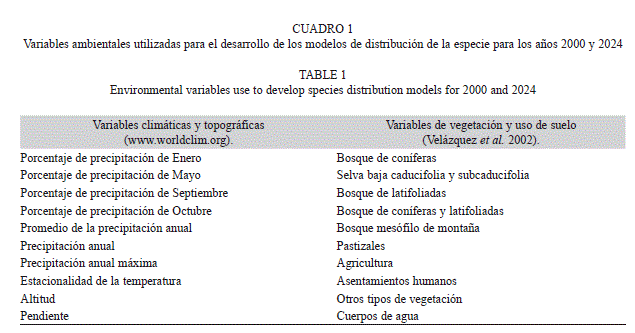
<body><![CDATA[<font size="2"></font><br style="font-family: verdana;">     <font size="2"><span style="font-family: verdana;">Para realizar los     modelos de     distribuci&oacute;n se utilizaron 20 variables (<a      href="/img/revistas/rbt/v60n3/a33t1.gif">Cuadro 1</a>) que     comprenden ocho bioclim&aacute;ticas, derivadas de datos mensuales de     precipitaci&oacute;n y temperatura (Hijmans <span      style="font-style: italic;">et al</span>. 2005, Worldclim     2006), 10 variables&nbsp; de&nbsp; cobertura&nbsp; vegetal&nbsp;     (Vel&aacute;zquez&nbsp; <span style="font-style: italic;">et al</span>.     ]]></body>
<body><![CDATA[2002) y dos variables     topogr&aacute;ficas: altitud (www.worldclim.org)&nbsp;     y&nbsp;     pendiente,&nbsp; calculada a partir de la capa de altitud con el     m&oacute;dulo de SLOPE del programa Idrisi Taiga. Todas las variables     fueron ajustadas a un sistema geogr&aacute;fico de latitud-longitud,     con una resoluci&oacute;n de 1km2. Debido a que en el Estado de     Guerrero se ha evidenciado una disminuci&oacute;n en el crecimiento de     la poblaci&oacute;n humana de 1990-2000 (CONAPO 2004), s&oacute;lo se     consideraron los niveles de actividad humana sobre los mapas finales.     ]]></body>
<body><![CDATA[Se model&oacute; la distribuci&oacute;n potencial&nbsp; actual&nbsp;     y&nbsp; se&nbsp; realiz&oacute;&nbsp; una&nbsp; predicci&oacute;n para     el a&ntilde;o 2024, debido a que existen 24 a&ntilde;os de&nbsp;     diferencia&nbsp; entre&nbsp; las&nbsp; capas&nbsp; que&nbsp; se&nbsp;     usaron para realizar los modelos (1976 y 2000). Las variables     clim&aacute;ticas del 2024 se representaron considerando un escenario     de cambio clim&aacute;tico moderado (Worldclim 2006). El mapa de tipo     de vegetaci&oacute;n y uso de suelo para el 2024 (b) se calcul&oacute;     con el m&oacute;dulo Land Change Modeler de Idrisi Taiga. Para esto se     usaron como base los mapas de vegetaci&oacute;n y uso del suelo de     ]]></body>
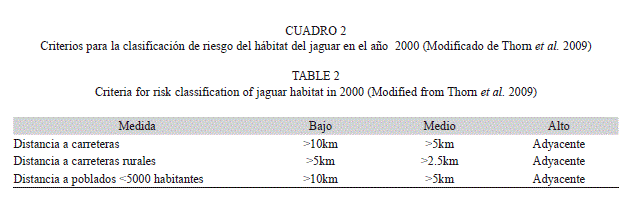
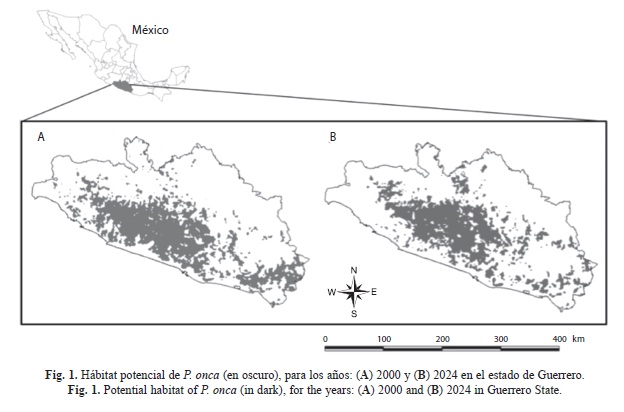
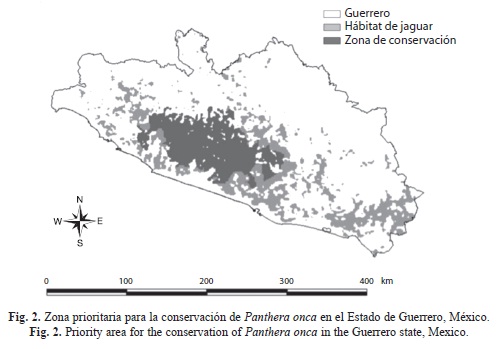
<body><![CDATA[M&eacute;xico de los a&ntilde;os 1976 y 2000 (a) para proyectar los     cambios en 2024, y se consideraron siete variables: altitud, pendiente,     distancias a poblaciones humanas rurales, distancias a los     asentamientos humanos y agricultura (Eastman 2009).    <br> </span></font><font size="2"><span style="font-family: verdana;"><br  style="font-family: verdana;"> </span></font><font size="2"><span style="font-family: verdana;">Para estimar la distribuci&oacute;n potencial de <span style="font-style: italic;">P. onca </span>para 2000 y 2024, se utiliz&oacute; la versi&oacute;n 3.2 de MaxEnt (http://www.cs.princeton. edu/~schapire/maxent/).&nbsp; Este&nbsp; m&eacute;todo&nbsp; estima la distribuci&oacute;n de probabilidad de m&aacute;xima entrop&iacute;a (es decir, la m&aacute;s cercana a la uniformidad), sujeta a la condici&oacute;n de que el valor esperado&nbsp; de&nbsp; cada&nbsp; variable&nbsp; ambiental,&nbsp; seg&uacute;n esta distribuci&oacute;n, coincide con su media emp&iacute;rica (Phillips <span  style="font-style: italic;">et al</span>. 2006). MaxEnt permite hacer predicciones en condiciones diferentes (clim&aacute;ticas, geogr&aacute;ficas, entre otras), proyectando los valores de los datos del estado inicial, en este caso las condiciones en las que se da el jaguar en el h&aacute;bitat potencial del 2000 sobre el nuevo contexto, clima y coberturas vegetales del 2024. Se mantuvieron los par&aacute;metros establecidos por el programa umbral de convergencia=105, iteraciones m&aacute;ximas=500, valor &#946; de regularizaci&oacute;n=auto, sugeridos por Phillips <span  style="font-style: italic;">et al</span>. (2006), excepto el porcentaje utilizado para la evaluaci&oacute;n del modelo que se modific&oacute; al 25% de los puntos; adem&aacute;s se utiliz&oacute; la prueba de Jackniffe para estimar la importancia de las variables.</span></font><br style="font-family: verdana;"> <font size="2"></font><br style="font-family: verdana;"> <font size="2"><span style="font-family: verdana;">Fueron considerados como modelos robustos aquellos con valores de &aacute;rea bajo la curva mayores a 0.85 (Marmion <span style="font-style: italic;">et al</span>. 2009). El modelo potencial de distribuci&oacute;n lo generamos a partir de un mapa binario de presenciaausencia, donde el valor del d&eacute;cimo percentil se us&oacute; como umbral de corte (Pearson <span style="font-style: italic;">et al</span>. 2007, Tinco <span  style="font-style: italic;">et al</span>. 2009). Finalmente, en ambas predicciones (2000 y 2024) se combinaron las coberturas vegetales correspondientes, para estimar el porcentaje de estas en las &aacute;reas potenciales del jaguar.</span></font><br  style="font-family: verdana;"> <font size="2"></font><br style="font-family: verdana;"> <font size="2"><span style="font-family: verdana;">La no persistencia del h&aacute;bitat se asoci&oacute; a la p&eacute;rdida de h&aacute;bitat y/o aumento de su fragmentaci&oacute;n. Para esto, se midi&oacute; y compar&oacute; el &aacute;rea total del h&aacute;bitat potencial y el n&uacute;mero de parches entre los a&ntilde;os 2000 y 2024, se utiliz&oacute; el m&oacute;dulo de AREA de Idrisi Taiga. La significancia de las diferencias en la p&eacute;rdida del h&aacute;bitat potencial y su fragmentaci&oacute;n (n&uacute;mero de parches) se evalu&oacute; a trav&eacute;s de una prueba de x2.    <br> <br style="font-family: verdana;"> </span></font><font size="2"><span style="font-family: verdana;">Realizamos una evaluaci&oacute;n del riesgo antropog&eacute;nico (cacer&iacute;a), con base en las v&iacute;as de acceso (CONABIO 2008), que se presenta en el h&aacute;bitat potencial de <span style="font-style: italic;">P. onca </span>del a&ntilde;o 2000. Sobre este, se colocaron las v&iacute;as de acceso (autopistas, carreteras y caminos), y en estas se aplicaron buffers de 10 y 5km para calcular tres niveles de riesgo de acuerdo con Thorn <span style="font-style: italic;">et al</span>. (2009), quien propone que 10km son una estimaci&oacute;n conservadora de la distancia que puede caminar una persona desde puntos de acceso humanos (caminos y carreteras), por lo tanto m&aacute;s all&aacute; de esta distancia se considera como riesgo bajo. Para el caso de carreteras rurales se modific&oacute; la distancia a 5km, debido a que varias de estas v&iacute;as en las monta&ntilde;as del estado se encuentran abandonadas (<a href="/img/revistas/rbt/v60n3/a33t2.gif">Cuadro 2</a>).     <br> <br style="font-family: verdana;"> </span></font><font size="2"><span style="font-family: verdana;">Posterior a la clasificaci&oacute;n del h&aacute;bitat id&oacute;neo del 2000, se identificaron las zonas catalogadas con un criterio bajo de amenaza que presentar&aacute;n 900km2&nbsp;&nbsp; de extensi&oacute;n m&iacute;nima para conservar una poblaci&oacute;n viable de jaguar (Rodr&iacute;guez-Soto <span  style="font-style: italic;">et al</span>. 2011). Finalmente, con la intensi&oacute;n de evidenciar la cantidad de otras especies, que tuvieran alguna categor&iacute;a de riesgo (IUCN 2009), se proteger&iacute;an con las mismas &aacute;reas seleccionadas para el jaguar, sobrepusimos la distribuci&oacute;n de estas especies con el modelo del 2000.</span></font><br style="font-family: verdana;"> <font size="2"></font><br style="font-family: verdana;"> <font style="font-weight: bold;" size="3"><span  style="font-family: verdana;">Resultados</span></font><br  style="font-family: verdana;"> <font size="2"></font><br style="font-family: verdana;"> <font size="2"><span style="font-family: verdana;">Se obtuvieron 39 registros (34 de trabajo de campo, cuatro de literatura cient&iacute;fica y uno de bases de datos) para realizar los modelos de distribuci&oacute;n potencial, y se estim&oacute; que 18 361km2&nbsp;&nbsp;&nbsp;&nbsp; (29%)&nbsp; del&nbsp; estado,&nbsp; presenta&nbsp;&nbsp; h&aacute;bitat potencial para el jaguar (<a href="/img/revistas/rbt/v60n3/a33i1.jpg">Fig. 1A</a>). El h&aacute;bitat de <span style="font-style: italic;">P. onca </span>incluy&oacute; principalmente las regiones biogeogr&aacute;ficas de la Sierra Madre del Sur y la Costa&nbsp; del&nbsp; Pac&iacute;fico.&nbsp; Este&nbsp; sitio,&nbsp; se&nbsp; caracteriza por el bajo porcentaje de cobertura de agricultura y pastizal, una variaci&oacute;n estacional de la temperatura 18&deg;C-25&deg;C, con una precipitaci&oacute;n m&aacute;xima&nbsp; de&nbsp; 620mm&nbsp; y&nbsp; pendientes&nbsp; mayores a&nbsp; los&nbsp; 10&deg;,&nbsp; que&nbsp; origina&nbsp; un&nbsp; bosque&nbsp; mes&oacute;filo importante. Finalmente, este modelo tiene alta capacidad de predecir el comportamiento de los datos con base en el valor del &aacute;rea bajo la curva (ABC=0.874). El h&aacute;bitat potencial del jaguar se caracteriza por presentar las coberturas vegetales de bosque templado (56%) y selva baja caducifolia (35%); dentro del bosque templado, el bosque de con&iacute;feras y latifoliadas ocupa el 34%.    <br> <br style="font-family: verdana;"> </span></font><font size="2"><span style="font-family: verdana;">Para el 2000 el Estado de Guerrero presenta una extensi&oacute;n de 18 361km2&nbsp;&nbsp; de h&aacute;bitat potencial de jaguar, extensi&oacute;n que se reducir&iacute;a&nbsp; 16 240km2&nbsp;&nbsp;&nbsp; para&nbsp; el&nbsp; 2024,&nbsp; que&nbsp; representa una p&eacute;rdida de h&aacute;bitat significativa&nbsp; (x2=23.9, g.l.=1, p&lt;0.001) en 24 a&ntilde;os. Por&nbsp; otra parte, mientras que el n&uacute;mero de parches del h&aacute;bitat en el 2000 fue de 153, para el&nbsp; 2024 aumenta a&nbsp; 183;&nbsp; este&nbsp; incremento&nbsp; no&nbsp; present&oacute;&nbsp; diferencias estad&iacute;sticamente&nbsp; significativas (x2=1.68, g.l.=1, p&gt;0.01). Aunque no aumenta significativamente el n&uacute;mero de parches en el 2024, la zona del sur-este del estado se ver&iacute;a m&aacute;s afectada por este hecho (Fig. 1A y B).</span></font><br style="font-family: verdana;"> <font size="2"></font><br style="font-family: verdana;"> <font size="2"><span style="font-family: verdana;">El 45.75% del h&aacute;bitat de <span style="font-style: italic;">P. onca</span>, principalmente ubicado en la Sierra Madre del Sur (16&deg;41&#8217; - 17&deg;24&#8217; N and 99&deg;58&#8217; - 99&deg;24&#8217; O), observ&oacute; un riesgo bajo de actividad humana, mientras que el 33.60%, que presenta un riesgo alto se ubica hacia el sur-este (16&deg;31&#8217; - 16&deg;59&#8217; N and 99&deg;4&#8217; - 98&deg;5&#8217; O). Al considerar la extensi&oacute;n de 900km2&nbsp; mencionada por Rodr&iacute;guez- Soto&nbsp; <span  style="font-style: italic;">et&nbsp; al</span>.&nbsp; (2011)&nbsp; junto&nbsp; con&nbsp; el&nbsp; criterio&nbsp; del riesgo antropog&eacute;nico bajo, se identific&oacute; un &aacute;rea en el centro-oeste del Estado con extensi&oacute;n de 7 900km2, como prioritaria para la conservaci&oacute;n de <span  style="font-style: italic;">P. onca </span>(<a  href="/img/revistas/rbt/v60n3/a33i2.jpg">Fig. 2</a>). Potencialmente, esta zona, adem&aacute;s podr&iacute;a proteger alrededor de 237 especies de mam&iacute;feros, reptiles y anfibios, que actualmente se encuentran bajo alguna categor&iacute;a de riesgo (UICN 2009).    <br> </span></font><font style="font-weight: bold;" size="3"><span  style="font-family: verdana;">    <br>     ]]></body>
<body><![CDATA[Discusi&oacute;n</span></font><br style="font-family: verdana;">     <font size="2"></font><br style="font-family: verdana;">     <font size="2"><span style="font-family: verdana;">El estado de     Guerrero,     hist&oacute;ricamente ha sido&nbsp; ambientalmente&nbsp; poco&nbsp;     estudiado&nbsp; debido a la problem&aacute;tica social que lo ha     enmarcado (presencia&nbsp; de&nbsp; grupos&nbsp; armados).&nbsp;     Con&nbsp; respecto a <span style="font-style: italic;">P. onca </span>en     particular, se ha evidenciado     por&nbsp; varios&nbsp; autores,&nbsp; la&nbsp; imperante&nbsp;     ]]></body>
<body><![CDATA[necesidad de generar informaci&oacute;n sobre la presencia y     distribuci&oacute;n de esta especie en el Estado, ya que es fundamental     para estructurar estrategias de conservaci&oacute;n, y de conectar     poblaciones reproductivas del jaguar identificadas en la costa norte y     sur del Pac&iacute;fico (Sanderson <span style="font-style: italic;">et     al</span>. 2002, Rabinowitz &amp; Zeller     2010, Rodr&iacute;guez- Soto <span style="font-style: italic;">et al</span>.     2011), que podr&iacute;an quedar     separadas (Rodr&iacute;guez-Soto <span style="font-style: italic;">et     al</span>. 2011).</span></font><br style="font-family: verdana;">     ]]></body>
<body><![CDATA[<font size="2"></font><br style="font-family: verdana;">     <font size="2"><span style="font-family: verdana;">Las actividades     agr&iacute;colas y     pecuarias, realizadas a la fecha, han reducido y fragmentado el     h&aacute;bitat del jaguar y de sus presas a lo largo de su     distribuci&oacute;n (Sunquist &amp; Sunquist 2001). El pastizal     inducido con cortas extensiones tambi&eacute;n ha sido mencionado como     una de las coberturas que usa el jaguar para desplazarse (Brown &amp;     L&oacute;pez-Gonz&aacute;lez 2001), estan asociadas con la actividad     ganadera y por ende conflictos con los ganaderos (Rosas-Rosas <span     ]]></body>
<body><![CDATA[ style="font-style: italic;">et al</span>.     2010) y muertes del jaguar.</span></font><br      style="font-family: verdana;">     <font size="2"></font><br style="font-family: verdana;">     <font size="2"><span style="font-family: verdana;">La variaci&oacute;n     moderada en la     estacionalidad de la temperatura es importante ya que determina&nbsp;     la&nbsp; disponibilidad&nbsp; de&nbsp; los&nbsp; recursos y la     productividad primaria (Badgley &amp; Fox 2000). Por lo anterior, zonas     con baja variaci&oacute;n presentan mayor disponibilidad de recursos     ]]></body>
<body><![CDATA[(pastos&nbsp; y&nbsp; herb&iacute;voros),&nbsp; en&nbsp;     comparaci&oacute;n&nbsp; con otras zonas con estacionalidad marcada,     donde se pueden ver mayormente afectadas las densidades poblacionales     de <span style="font-style: italic;">P. onca </span>(Rabinowitz     1999). Recientemente se estim&oacute; para     M&eacute;xico, que la biomasa de los artiod&aacute;ctilos, grupo que     re&uacute;ne a unas de las principales presas del jaguar (Rosas-Rosas     <span style="font-style: italic;">et al</span>. 2008), aumenta en zonas     con precipitaciones que van de 500-1     000mm ya que permiten alta productividad primaria (Mandujano &amp;     ]]></body>
<body><![CDATA[Naranjo 2010). La precipitaci&oacute;n es un factor cr&iacute;tico que     regula la productividad del ecosistema (Svoray &amp; Karnieli 2010),     seg&uacute;n los valores de porcentaje de precipitaci&oacute;n, los     cuales reflejan la productividad primaria, esta zona presenta     &aacute;reas con vegetaci&oacute;n densa y pendientes pronunciadas,     lugares menos perturbados que proveen refugio a este felino     (Monroy-Vilchis <span style="font-style: italic;">et al</span>. 2008,     Monroy-Vilchis <span style="font-style: italic;">et al</span>. 2009).     Las     caracter&iacute;sticas anteriormente mencionadas adem&aacute;s de la     ]]></body>
<body><![CDATA[temperatura y precipitaci&oacute;n favorables se presentan en la zona     ubicada como h&aacute;bitat potencial del jaguar.</span></font><br      style="font-family: verdana;">     <font size="2"></font><br style="font-family: verdana;">     <font size="2"><span style="font-family: verdana;">En la latitud de     Guerrero, las     coberturas densas y tropicales como h&aacute;bitat de <span      style="font-style: italic;">P. onca </span>han sido     importantes para este felino (Ortega- Huerta &amp;&nbsp; Medley&nbsp;     1999,&nbsp; N&uacute;&ntilde;ez&nbsp; <span style="font-style: italic;">et     ]]></body>
<body><![CDATA[al</span>.&nbsp; 2002, Valdez <span style="font-style: italic;">et al</span>.     2002, Rodr&iacute;guez- Soto <span style="font-style: italic;">et al</span>.     2011) por ser zonas donde la     especie puede alimentarse y refugiarse. Por otro lado, la presencia     del felino en condiciones templadas en esta latitud ha sido considerada     como at&iacute;pica (Monroy- Vilchis <span style="font-style: italic;">et     al</span>. 2008), pero debido a los     recientes hallazgos de esta especie en dichas zonas     (Rodr&iacute;guez-Soto <span style="font-style: italic;">et al</span>.     2011), estas coberturas de bosque     ]]></body>
<body><![CDATA[necesitan m&aacute;s estudios con respecto a la presencia del jaguar y     su ecolog&iacute;a, ya que aunque cada vez son m&aacute;s frecuentes     los registros en estas zonas podr&iacute;an no ser las mejores para     el jaguar, aunque en otras latitudes no es raro encontrar a esta     especie en sabanas y p&aacute;ramos y ambientes templados. En     Guerrero, la selva caducifolia es una de las coberturas m&aacute;s     afectadas por la expansi&oacute;n de la agricultura; entre los     a&ntilde;os 1976-2000 se perdi&oacute; aproximadamente el 10% de su     extensi&oacute;n original (SEMAREN 2007). Por lo que la     reducci&oacute;n en el h&aacute;bitat potencial entre los a&ntilde;os     ]]></body>
<body><![CDATA[2000-2024, se puede deber principalmente al aumento de 9.2% de las     zonas de actividad humana. Este aumento en las zonas agr&iacute;colas     afecta principalmente la selva caducifolia, reduci&eacute;ndose en 6%     su extensi&oacute;n original. Aunque el n&uacute;mero de parches no     vari&oacute; significativamente entre el 2000-2024, si existi&oacute;     una reducci&oacute;n en la extensi&oacute;n de los mismos,     principalmente hacia las zonas donde el riesgo de actividad humana es     mayor, es decir cerca de las carreteras y poblados, puntos de acceso     humano que permiten la extracci&oacute;n de los recursos naturales     (Thorn <span style="font-style: italic;">et al</span>. 2009). Es     ]]></body>
<body><![CDATA[conveniente identificar si existen conflictos     ganaderos con el jaguar, con el fin de desarrollar planes que eviten la     depredaci&oacute;n del ganado, adem&aacute;s de actividades que     minimicen la ampliaci&oacute;n de la frontera agr&iacute;cola     (Hoogesteijn <span style="font-style: italic;">et al</span>. 2002).</span></font><br      style="font-family: verdana;">     <font size="2"></font><br style="font-family: verdana;">     <font size="2"><span style="font-family: verdana;">El &aacute;rea que     se encuentra     hacia el sur-este del&nbsp; estado&nbsp; entre&nbsp; las&nbsp;     ]]></body>
<body><![CDATA[coordenadas:&nbsp; 16&deg;41&#8217;&nbsp; - 17&deg;24&#8217; N and 99&deg;&nbsp; 8&#8217;     - 99&deg;24&#8217; W, es la zona m&aacute;s&nbsp; vulnerable,&nbsp;     debido&nbsp; tanto&nbsp; a&nbsp; la&nbsp; reducci&oacute;n del     h&aacute;bitat, como por aumento en el n&uacute;mero de parches.     Adem&aacute;s, es de gran importancia por su ubicaci&oacute;n. Aunque     presenta &aacute;reas menores a 900km2&nbsp; que no podr&iacute;an     soportar una poblaci&oacute;n de jaguar, pueden ser utilizados por la     especie para descansar o alimentarse, aumentando la habilidad de los     individuos para desplazarse (Rabinowitz &amp; Zeller 2010). Esta zona     es prioritaria&nbsp; para&nbsp; comunicar&nbsp; a&nbsp; las&nbsp;     ]]></body>
<body><![CDATA[poblaciones de <span style="font-style: italic;">P. onca </span>de     Guerrero, con las de Oaxaca, en donde es     necesario realizar un an&aacute;lisis de fragmentaci&oacute;n     m&aacute;s detallado, junto con an&aacute;lisis de riesgo, a una escala     espacial m&aacute;s fina, para as&iacute; poder conservar una de las     zonas identificadas como la m&aacute;s vulnerable dentro del     h&aacute;bitat del jaguar en Guerrero.</span></font><br      style="font-family: verdana;">     <font size="2"></font><br style="font-family: verdana;">     <font size="2"><span style="font-family: verdana;">&nbsp;En el centro     ]]></body>
<body><![CDATA[del estado, el     riesgo de actividad humana es bajo, y se encuentra el &aacute;rea     menos perturbada y estable. Esto puede deberse principalmente a la     topograf&iacute;a tan compleja, con pendientes pronunciadas que     dificultan el acceso a los seres humanos. Adicionalmente,     tambi&eacute;n podr&iacute;a originarse a la hist&oacute;rica presencia     de uno de los grupos armados m&aacute;s antiguos del pa&iacute;s,     el cual no ha facilitado el crecimiento urbano y por lo tanto     expansi&oacute;n de la frontera agr&iacute;cola, esta ser&iacute;a una     situaci&oacute;n similar a la de la cordillera central de los Andes     ]]></body>
<body><![CDATA[Colombianos (D&aacute;valos 2001). </span></font><br      style="font-family: verdana;">     <font size="2"></font><br style="font-family: verdana;">     <font size="2"><span style="font-family: verdana;">Las &aacute;reas con     diversas     extensiones para proteger al jaguar pueden ser utilizadas en conjunto     como red de reservas para la conservaci&oacute;n de la especie (Weber     &amp; Rabinowitz 1996). Loyola <span style="font-style: italic;">et al</span>.     (2008), creen muy importante     crear reservas extensas, en lugares que alberguen a carn&iacute;voros     ]]></body>
<body><![CDATA[de talla grande, ya que consideran que la fragmentaci&oacute;n del     bosque incrementa la sensibilidad a la presi&oacute;n por     cacer&iacute;a&nbsp; a&nbsp; poblaciones&nbsp; de&nbsp; estos&nbsp;     vertebrados. Este estudio propone una zona prioritaria para la     conservaci&oacute;n del jaguar que considera principalmente la Sierra     Madre del Sur, que adem&aacute;s presenta persistencia al 2024. Esta     eco-regi&oacute;n ha sido catalogada clave para la conservaci&oacute;n     de especies end&eacute;micas y en peligro de extinci&oacute;n (Loyola     <span style="font-style: italic;">et al</span>. 2009). Adem&aacute;s,     fortalece la presencia de la Regi&oacute;n     ]]></body>
<body><![CDATA[Terrestre Prioritaria Sierra Madre del Sur de Guerrero, la cual se     caracteriza por ser una regi&oacute;n de alto endemismo y riqueza en     todos los grupos de vertebrados (Arriaga <span      style="font-style: italic;">et al</span>. 2000), principalmente     en aves (Koleff <span style="font-style: italic;">et al</span>. 2008).     Es una zona de captaci&oacute;n de agua     muy importante para la zona urbana costera y la cuenca del Balsas.     Debido a su integridad biol&oacute;gica y continuidad en     vegetaci&oacute;n natural, ha sido considerada como corredor     biol&oacute;gico importante, pero carece de &aacute;reas bajo     ]]></body>
<body><![CDATA[alg&uacute;n tipo de protecci&oacute;n (Arriaga <span      style="font-style: italic;">et al</span>. 2000) por lo que     se propone a la zona como &aacute;rea natural para la protecci&oacute;n     del jaguar y como apoyo para la conservaci&oacute;n de los corredores     del jaguar en Latinoam&eacute;rica (Rabinowitz &amp; Zeller 2010).</span></font><br      style="font-family: verdana;">     <font size="2"></font><br style="font-family: verdana;">     <font style="font-weight: bold;" size="3"><span      style="font-family: verdana;">Agradecimientos </span></font><br      style="font-family: verdana;">     ]]></body>
<body><![CDATA[<font size="2"></font><br style="font-family: verdana;">     <font size="2"><span style="font-family: verdana;">Agradecemos&nbsp;     al&nbsp;     pueblo&nbsp; mexicano&nbsp; por financiar este estudio a trav&eacute;s     de la Universidad&nbsp; Aut&oacute;noma&nbsp; del&nbsp; Estado&nbsp;     de&nbsp; M&eacute;xico&nbsp; con los proyectos FE014/2007-2009; del     CONACYT con el proyecto 101254 y con la beca 217650/269863 y el     PROMEP con el proyecto 103.5/10/0942. A Fernando&nbsp; Ruiz,&nbsp;     por&nbsp; facilitarnos algunos registros de campo, a Clarita     Rodr&iacute;guez-Soto y Crystian Sadiel Venegas por su asesor&iacute;a     ]]></body>
<body><![CDATA[para realizar los modelos y a tres revisores an&oacute;nimos por     sus&nbsp; omentarios, as&iacute; como Daisy Arroyo M., quienes     fortalecieron la primera versi&oacute;n del manuscrito.</span></font><br      style="font-family: verdana;">     <font size="2"></font>     <hr style="width: 100%; height: 2px;"><br style="font-family: verdana;">     <font style="font-weight: bold;" size="3"><span      style="font-family: verdana;">Referencias</span></font><br      style="font-family: verdana;">     <font size="2"></font><br style="font-family: verdana;">     ]]></body>
<body><![CDATA[<font size="2"><span style="font-family: verdana;">Anderson, R.P. &amp;     E.     Mart&iacute;nez-Meyer. 2004.&nbsp; Modeling species&#8217;&nbsp;     geographic&nbsp;&nbsp; distributions&nbsp; for&nbsp; conservation     assessments: an implementation with the spiny pocket mice (<span      style="font-style: italic;">Heteromys</span>)     of Ecuador. Biol. Conserv. 116: </span></font><font size="2"><span     <!-- ref --> style="font-family: verdana;">167-179.    &nbsp;&nbsp;&nbsp;&nbsp;&nbsp;&nbsp;&nbsp;&nbsp;[&#160;<a href="javascript:void(0);" onclick="javascript: window.open('/scielo.php?script=sci_nlinks&ref=1474713&pid=S0034-7744201200030003300001&lng=','','width=640,height=500,resizable=yes,scrollbars=1,menubar=yes,');">Links</a>&#160;]<!-- end-ref --><!-- ref --></span></font><br  style="font-family: verdana;"> <font size="2"></font><br style="font-family: verdana;"> <font size="2"><span style="font-family: verdana;">Aranda,&nbsp; M. 1996. Distribuci&oacute;n y abundancia&nbsp; del jaguar <span  style="font-style: italic;">Panthera onca </span>(Carnivora;&nbsp; Felidae) en el estado de Chiapas, M&eacute;xico. Acta Zool. Mex. 68: 45-52.    &nbsp;&nbsp;&nbsp;&nbsp;&nbsp;&nbsp;&nbsp;&nbsp;[&#160;<a href="javascript:void(0);" onclick="javascript: window.open('/scielo.php?script=sci_nlinks&ref=1474714&pid=S0034-7744201200030003300002&lng=','','width=640,height=500,resizable=yes,scrollbars=1,menubar=yes,');">Links</a>&#160;]<!-- end-ref --><!-- ref --></span></font><br style="font-family: verdana;"> <font size="2"></font><br style="font-family: verdana;"> <font size="2"><span style="font-family: verdana;">Ara&uacute;jo, M.B., P.H. Williams &amp; R. Fuller. 2002. Dynamics of extinction and the&nbsp; selection&nbsp; of nature reserves. Proc. R. Soc. London, Ser. B. 269: 1971-1980.    &nbsp;&nbsp;&nbsp;&nbsp;&nbsp;&nbsp;&nbsp;&nbsp;[&#160;<a href="javascript:void(0);" onclick="javascript: window.open('/scielo.php?script=sci_nlinks&ref=1474715&pid=S0034-7744201200030003300003&lng=','','width=640,height=500,resizable=yes,scrollbars=1,menubar=yes,');">Links</a>&#160;]<!-- end-ref --><!-- ref --></span></font><br style="font-family: verdana;"> <font size="2"></font><br style="font-family: verdana;"> <font size="2"><span style="font-family: verdana;">Ara&uacute;jo, M.B., M. Cabezas, W. Thuiller &amp; L. Hannah. 2004. Would climate change drive species out of reserves? An assessment of existing reserve-selection methods. Glob. Change Biol. 10: 1618-1626.    &nbsp;&nbsp;&nbsp;&nbsp;&nbsp;&nbsp;&nbsp;&nbsp;[&#160;<a href="javascript:void(0);" onclick="javascript: window.open('/scielo.php?script=sci_nlinks&ref=1474716&pid=S0034-7744201200030003300004&lng=','','width=640,height=500,resizable=yes,scrollbars=1,menubar=yes,');">Links</a>&#160;]<!-- end-ref --><!-- ref --></span></font><br  style="font-family: verdana;"> <font size="2"></font><br style="font-family: verdana;"> <font size="2"><span style="font-family: verdana;">Ara&uacute;jo,&nbsp; M.B., D. Nogu&eacute;s-Bravo, A.F.&nbsp; Diniz-Filho, A.M.Haywood, P.J. Valdes &amp; C. Rahbeck. 2008. Quaternary climate changes explain diversity among reptiles and amphibians. Ecography 31: 8-15.    &nbsp;&nbsp;&nbsp;&nbsp;&nbsp;&nbsp;&nbsp;&nbsp;[&#160;<a href="javascript:void(0);" onclick="javascript: window.open('/scielo.php?script=sci_nlinks&ref=1474717&pid=S0034-7744201200030003300005&lng=','','width=640,height=500,resizable=yes,scrollbars=1,menubar=yes,');">Links</a>&#160;]<!-- end-ref --><!-- ref --></span></font><br  style="font-family: verdana;"> <font size="2"></font><br style="font-family: verdana;"> <font size="2"><span style="font-family: verdana;">Ara&uacute;jo, M.B., D. Alagador, M. Cabeza, D. Nogu&eacute;s-Bravo &amp; W. Thuiller. 2011. Climate change threatens European conservation areas. Ecol. Lett. 14: 484-489.    &nbsp;&nbsp;&nbsp;&nbsp;&nbsp;&nbsp;&nbsp;&nbsp;[&#160;<a href="javascript:void(0);" onclick="javascript: window.open('/scielo.php?script=sci_nlinks&ref=1474718&pid=S0034-7744201200030003300006&lng=','','width=640,height=500,resizable=yes,scrollbars=1,menubar=yes,');">Links</a>&#160;]<!-- end-ref --><!-- ref --></span></font><br  style="font-family: verdana;"> <font size="2"></font><br style="font-family: verdana;"> <font size="2"><span style="font-family: verdana;">Arriaga,&nbsp; L., J.M. Espinoza, C. Aguilar, E.&nbsp; Mart&iacute;nez, L. G&oacute;mez &amp; E. Loa. 2000. Regiones terrestres prioritarias de M&eacute;xico. Comisi&oacute;n Nacional para el Conocimiento y uso de la Biodiversidad, M&eacute;xico, D.F.    &nbsp;&nbsp;&nbsp;&nbsp;&nbsp;&nbsp;&nbsp;&nbsp;[&#160;<a href="javascript:void(0);" onclick="javascript: window.open('/scielo.php?script=sci_nlinks&ref=1474719&pid=S0034-7744201200030003300007&lng=','','width=640,height=500,resizable=yes,scrollbars=1,menubar=yes,');">Links</a>&#160;]<!-- end-ref --><!-- ref --></span></font><br  style="font-family: verdana;"> <font size="2"></font><br style="font-family: verdana;"> <font size="2"><span style="font-family: verdana;">Badgley, C. &amp; D.L. Fox. 2000. Ecological Biogeography of North American&nbsp; Mammals: Species Density and Ecological Structure in Relation to&nbsp; Environmental Gradients. J. Biogeogr. 27: 1437-1467.    &nbsp;&nbsp;&nbsp;&nbsp;&nbsp;&nbsp;&nbsp;&nbsp;[&#160;<a href="javascript:void(0);" onclick="javascript: window.open('/scielo.php?script=sci_nlinks&ref=1474720&pid=S0034-7744201200030003300008&lng=','','width=640,height=500,resizable=yes,scrollbars=1,menubar=yes,');">Links</a>&#160;]<!-- end-ref --><!-- ref --></span></font><br  style="font-family: verdana;"> <font size="2"></font><br style="font-family: verdana;"> <font size="2"><span style="font-family: verdana;">Bezaury-Creel,&nbsp; J. &amp; D. Guti&eacute;rrez. 2009. &Aacute;reas&nbsp; naturales protegidas y desarrollo social en M&eacute;xico. CONABIO, M&eacute;xico.    &nbsp;&nbsp;&nbsp;&nbsp;&nbsp;&nbsp;&nbsp;&nbsp;[&#160;<a href="javascript:void(0);" onclick="javascript: window.open('/scielo.php?script=sci_nlinks&ref=1474721&pid=S0034-7744201200030003300009&lng=','','width=640,height=500,resizable=yes,scrollbars=1,menubar=yes,');">Links</a>&#160;]<!-- end-ref --><!-- ref --></span></font><br  style="font-family: verdana;"> <font size="2"></font><br style="font-family: verdana;"> <font size="2"><span style="font-family: verdana;">Brown,&nbsp; D.E. &amp; C.A. L&oacute;pez-Gonz&aacute;lez. 2001.&nbsp; Borderland jaguars: Tigres de la&nbsp; frontera.&nbsp; University of Utah, Utah, EEUU.    &nbsp;&nbsp;&nbsp;&nbsp;&nbsp;&nbsp;&nbsp;&nbsp;[&#160;<a href="javascript:void(0);" onclick="javascript: window.open('/scielo.php?script=sci_nlinks&ref=1474722&pid=S0034-7744201200030003300010&lng=','','width=640,height=500,resizable=yes,scrollbars=1,menubar=yes,');">Links</a>&#160;]<!-- end-ref --><!-- ref --></span></font><br  style="font-family: verdana;"> <font size="2"></font><br style="font-family: verdana;"> <font size="2"><span style="font-family: verdana;">Colchero, C., D.A. Conde, C. Manterola, C.&nbsp; Ch&aacute;vez, A. Rivera&nbsp; &amp;&nbsp; G.&nbsp; Ceballos.&nbsp;&nbsp; 2011.&nbsp; Jaguar&nbsp; on&nbsp; the move: modelling to mitigate fragmentation from road expansion in the Mayan Forests. Anim. Conserv. 14: 158-166.    &nbsp;&nbsp;&nbsp;&nbsp;&nbsp;&nbsp;&nbsp;&nbsp;[&#160;<a href="javascript:void(0);" onclick="javascript: window.open('/scielo.php?script=sci_nlinks&ref=1474723&pid=S0034-7744201200030003300011&lng=','','width=640,height=500,resizable=yes,scrollbars=1,menubar=yes,');">Links</a>&#160;]<!-- end-ref --><!-- ref --></span></font><br  style="font-family: verdana;"> <font size="2"></font><br style="font-family: verdana;"> <font size="2"><span style="font-family: verdana;">CONABIO. 2008. Red de carreteras de M&eacute;xico. Escala 1: 1000000. CONABIO, M&eacute;xico.    &nbsp;&nbsp;&nbsp;&nbsp;&nbsp;&nbsp;&nbsp;&nbsp;[&#160;<a href="javascript:void(0);" onclick="javascript: window.open('/scielo.php?script=sci_nlinks&ref=1474724&pid=S0034-7744201200030003300012&lng=','','width=640,height=500,resizable=yes,scrollbars=1,menubar=yes,');">Links</a>&#160;]<!-- end-ref --><!-- ref --></span></font><br  style="font-family: verdana;"> <font size="2"></font><br style="font-family: verdana;"> <font size="2"><span style="font-family: verdana;">CONAPO.&nbsp; 2004.&nbsp; Carpeta&nbsp; informativa,&nbsp; 11&nbsp; de&nbsp; julio&nbsp; D&iacute;a Mundial de la Poblaci&oacute;n, M&eacute;xico.    &nbsp;&nbsp;&nbsp;&nbsp;&nbsp;&nbsp;&nbsp;&nbsp;[&#160;<a href="javascript:void(0);" onclick="javascript: window.open('/scielo.php?script=sci_nlinks&ref=1474725&pid=S0034-7744201200030003300013&lng=','','width=640,height=500,resizable=yes,scrollbars=1,menubar=yes,');">Links</a>&#160;]<!-- end-ref --><!-- ref --></span></font><br  style="font-family: verdana;"> <font size="2"></font><br style="font-family: verdana;"> <font size="2"><span style="font-family: verdana;">Conde,&nbsp; D.A., F. Colchero, H. Zarza, N.L.&nbsp; Cristensen, J. Sexton,&nbsp; C.&nbsp; Manterola,&nbsp; C.&nbsp; Ch&aacute;vez,&nbsp; A.&nbsp; Rivera,&nbsp; D. Azuara &amp; G. Ceballos. 2010. Sex matters: modelling male and female habitat differences for jaguar conservation. Biol. Conserv. 143: 1980-1988.    &nbsp;&nbsp;&nbsp;&nbsp;&nbsp;&nbsp;&nbsp;&nbsp;[&#160;<a href="javascript:void(0);" onclick="javascript: window.open('/scielo.php?script=sci_nlinks&ref=1474726&pid=S0034-7744201200030003300014&lng=','','width=640,height=500,resizable=yes,scrollbars=1,menubar=yes,');">Links</a>&#160;]<!-- end-ref --><!-- ref --></span></font><br style="font-family: verdana;"> <font size="2"></font><br style="font-family: verdana;"> <font size="2"><span style="font-family: verdana;">D&aacute;valos,&nbsp; L.M. 2001. The San Lucas&nbsp; mountain range in Colombia: how much&nbsp; conservation is owed to the violence? Biodivers. Conserv. 10: 69-78.    &nbsp;&nbsp;&nbsp;&nbsp;&nbsp;&nbsp;&nbsp;&nbsp;[&#160;<a href="javascript:void(0);" onclick="javascript: window.open('/scielo.php?script=sci_nlinks&ref=1474727&pid=S0034-7744201200030003300015&lng=','','width=640,height=500,resizable=yes,scrollbars=1,menubar=yes,');">Links</a>&#160;]<!-- end-ref --><!-- ref --></span></font><br  style="font-family: verdana;"> <font size="2"></font><br style="font-family: verdana;"> <font size="2"><span style="font-family: verdana;">Eastman, J.R. 2009. IDRISI Taiga Guide to GIS and Image Processing. Clark University,&nbsp; Worcester, Massachusetts, EEUU.    &nbsp;&nbsp;&nbsp;&nbsp;&nbsp;&nbsp;&nbsp;&nbsp;[&#160;<a href="javascript:void(0);" onclick="javascript: window.open('/scielo.php?script=sci_nlinks&ref=1474728&pid=S0034-7744201200030003300016&lng=','','width=640,height=500,resizable=yes,scrollbars=1,menubar=yes,');">Links</a>&#160;]<!-- end-ref --><!-- ref --></span></font><br style="font-family: verdana;"> <font size="2"></font><br style="font-family: verdana;"> <font size="2"><span style="font-family: verdana;">Elith,&nbsp; J.,&nbsp; C.H.&nbsp; Graham,&nbsp; R.P.&nbsp; Anderson,&nbsp; M.&nbsp; Dudik,&nbsp; S. Ferrier, A. Guisan, R.J. Hijmans, F. Hueffmann, J.R. Leathwick, A. Lehmann, J. Li, L.G. Lohmann, B.A. Loiselle, G.&nbsp; Manion, C. Moritz, M. Nakamura, Y. Nakazawa, J.M. Overton, A.T. Peterson, S.J. Phillips, K. Richardson, R.&nbsp; Scachetti-Pereira, R.E. Schapire, J.&nbsp; Sober&oacute;n, S. Williams, M.S. Wisz &amp;&nbsp; N.E. Zimmermann. 2006. Novel&nbsp; methods improve prediction of species of&nbsp; species&#8217; distributions from occurrence data. Ecography 29: 129-151.    &nbsp;&nbsp;&nbsp;&nbsp;&nbsp;&nbsp;&nbsp;&nbsp;[&#160;<a href="javascript:void(0);" onclick="javascript: window.open('/scielo.php?script=sci_nlinks&ref=1474729&pid=S0034-7744201200030003300017&lng=','','width=640,height=500,resizable=yes,scrollbars=1,menubar=yes,');">Links</a>&#160;]<!-- end-ref --><!-- ref --></span></font><br style="font-family: verdana;"> <font size="2"></font><br style="font-family: verdana;"> <font size="2"><span style="font-family: verdana;">Ferrier, S. 2002. Mapping spatial pattern in biodiversity for regional conservation planning: where to from here? Syst. Biol. 51: 331-363.    &nbsp;&nbsp;&nbsp;&nbsp;&nbsp;&nbsp;&nbsp;&nbsp;[&#160;<a href="javascript:void(0);" onclick="javascript: window.open('/scielo.php?script=sci_nlinks&ref=1474730&pid=S0034-7744201200030003300018&lng=','','width=640,height=500,resizable=yes,scrollbars=1,menubar=yes,');">Links</a>&#160;]<!-- end-ref --><!-- ref --></span></font><br  style="font-family: verdana;"> <font size="2"></font><br style="font-family: verdana;"> <font size="2"><span style="font-family: verdana;">Food and Agriculture Organization of the United Nations (FAO). 2001. Global&nbsp; Forest Resources Assessment. ISSN&nbsp; 0258-6150, Forestry Paper 140, FAO,&nbsp; Rome, Italy. (Consultado: 24 abril 2009, http://www.fao.org/forestry/fo/fra/index.jsp).    &nbsp;&nbsp;&nbsp;&nbsp;&nbsp;&nbsp;&nbsp;&nbsp;[&#160;<a href="javascript:void(0);" onclick="javascript: window.open('/scielo.php?script=sci_nlinks&ref=1474731&pid=S0034-7744201200030003300019&lng=','','width=640,height=500,resizable=yes,scrollbars=1,menubar=yes,');">Links</a>&#160;]<!-- end-ref --><!-- ref --></span></font><br  style="font-family: verdana;"> <font size="2"></font><br style="font-family: verdana;"> <font size="2"><span style="font-family: verdana;">Gobal Biodiversity Information Facility (GBIF). Gobierno de Dinamarca. (Consultado: 25 octubre 2008, www. gbif.org).    &nbsp;&nbsp;&nbsp;&nbsp;&nbsp;&nbsp;&nbsp;&nbsp;[&#160;<a href="javascript:void(0);" onclick="javascript: window.open('/scielo.php?script=sci_nlinks&ref=1474732&pid=S0034-7744201200030003300020&lng=','','width=640,height=500,resizable=yes,scrollbars=1,menubar=yes,');">Links</a>&#160;]<!-- end-ref --><!-- ref --></span></font><br style="font-family: verdana;"> <font size="2"></font><br style="font-family: verdana;"> <font size="2"><span style="font-family: verdana;">Graham, C.H., C. Moritz &amp; S.E. Williams. 2006. Habitat history improves prediction of biodiversity in rainforest fauna. Proc. Natl. Acad. Sci. USA 103: 632-636.    &nbsp;&nbsp;&nbsp;&nbsp;&nbsp;&nbsp;&nbsp;&nbsp;[&#160;<a href="javascript:void(0);" onclick="javascript: window.open('/scielo.php?script=sci_nlinks&ref=1474733&pid=S0034-7744201200030003300021&lng=','','width=640,height=500,resizable=yes,scrollbars=1,menubar=yes,');">Links</a>&#160;]<!-- end-ref --><!-- ref --></span></font><br  style="font-family: verdana;"> <font size="2"></font><br style="font-family: verdana;"> <font size="2"><span style="font-family: verdana;">Grigione,&nbsp; M.M., K. Menke, C.&nbsp; L&oacute;pez-Gonz&aacute;lez, R. List, A. Banda, J.&nbsp; Carrera, R. Carrera, A.J. Giordano, J. Morrison, M. Sternberg, R. Thomas &amp; B. Van Pelt. 2009. Identifying potential conservation&nbsp; areas&nbsp; for felids in the USA and&nbsp; Mexico: integrating reliable knowledge&nbsp; across an international border. Oryx 43: 78-86.    &nbsp;&nbsp;&nbsp;&nbsp;&nbsp;&nbsp;&nbsp;&nbsp;[&#160;<a href="javascript:void(0);" onclick="javascript: window.open('/scielo.php?script=sci_nlinks&ref=1474734&pid=S0034-7744201200030003300022&lng=','','width=640,height=500,resizable=yes,scrollbars=1,menubar=yes,');">Links</a>&#160;]<!-- end-ref --><!-- ref --></span></font><br style="font-family: verdana;"> <font size="2"></font><br style="font-family: verdana;"> <font size="2"><span style="font-family: verdana;">Guisan, A. &amp; N.E. Zimmermann. 2000. Predictive habitat distribution models in&nbsp; ecology. Ecol. Modell. 135: 147-186.    &nbsp;&nbsp;&nbsp;&nbsp;&nbsp;&nbsp;&nbsp;&nbsp;[&#160;<a href="javascript:void(0);" onclick="javascript: window.open('/scielo.php?script=sci_nlinks&ref=1474735&pid=S0034-7744201200030003300023&lng=','','width=640,height=500,resizable=yes,scrollbars=1,menubar=yes,');">Links</a>&#160;]<!-- end-ref --><!-- ref --></span></font><br style="font-family: verdana;"> <font size="2"></font><br style="font-family: verdana;"> <font size="2"><span style="font-family: verdana;">Hernandez,&nbsp; P.A., C.H. Graham, L. Master, M.&nbsp; Albert &amp; D.L. Albert.&nbsp; 2006. The&nbsp; effect&nbsp; of&nbsp; sample&nbsp; size&nbsp; and species&nbsp; characteristics&nbsp; on performance of&nbsp; different species&nbsp; distribution&nbsp; modeling&nbsp; methods.&nbsp; Ecography 29: 773-785.    &nbsp;&nbsp;&nbsp;&nbsp;&nbsp;&nbsp;&nbsp;&nbsp;[&#160;<a href="javascript:void(0);" onclick="javascript: window.open('/scielo.php?script=sci_nlinks&ref=1474736&pid=S0034-7744201200030003300024&lng=','','width=640,height=500,resizable=yes,scrollbars=1,menubar=yes,');">Links</a>&#160;]<!-- end-ref --><!-- ref --></span></font><br  style="font-family: verdana;"> <font size="2"></font><br style="font-family: verdana;"> <font size="2"><span style="font-family: verdana;">Hijmans, R.J., S.E. Cameron, J.L. Parra, P.G. Jones &amp; A. Jarvis. 2005. Very high resolution interpolated climate surface for global land&nbsp; reas. Int. J. Climatol. 25: 1965-1978.    &nbsp;&nbsp;&nbsp;&nbsp;&nbsp;&nbsp;&nbsp;&nbsp;[&#160;<a href="javascript:void(0);" onclick="javascript: window.open('/scielo.php?script=sci_nlinks&ref=1474737&pid=S0034-7744201200030003300025&lng=','','width=640,height=500,resizable=yes,scrollbars=1,menubar=yes,');">Links</a>&#160;]<!-- end-ref --><!-- ref --></span></font><br style="font-family: verdana;"> <font size="2"></font><br style="font-family: verdana;"> <font size="2"><span style="font-family: verdana;">Hoogesteijn, R., E.O. Boede &amp; E. Mondolfi. 2002. Observaciones de la depredaci&oacute;n de bovinos por jaguares en Venezuela y&nbsp; los programas gubernamentales de control, p. 183-198. In R. Medell&iacute;n, C. Equihua, C. Chetkiewicz, P.G. Crawshaw&nbsp; Jr., A.R. Rabinowitz, K. Redford, J.&nbsp; Robinson, E. Sanderson &amp; A. Taber (eds.). Jaguar en el nuevo milenio. Fondo de Cultura Econ&oacute;mica, M&eacute;xico.    &nbsp;&nbsp;&nbsp;&nbsp;&nbsp;&nbsp;&nbsp;&nbsp;[&#160;<a href="javascript:void(0);" onclick="javascript: window.open('/scielo.php?script=sci_nlinks&ref=1474738&pid=S0034-7744201200030003300026&lng=','','width=640,height=500,resizable=yes,scrollbars=1,menubar=yes,');">Links</a>&#160;]<!-- end-ref --><!-- ref --></span></font><br  style="font-family: verdana;"> <font size="2"></font><br style="font-family: verdana;"> <font size="2"><span style="font-family: verdana;">International&nbsp; Union for Conservation of Nature&nbsp; (IUCN). 2009. Red List Threatened Species. Suiza. (Consultado: 3 febrero, www.iucn.org).    &nbsp;&nbsp;&nbsp;&nbsp;&nbsp;&nbsp;&nbsp;&nbsp;[&#160;<a href="javascript:void(0);" onclick="javascript: window.open('/scielo.php?script=sci_nlinks&ref=1474739&pid=S0034-7744201200030003300027&lng=','','width=640,height=500,resizable=yes,scrollbars=1,menubar=yes,');">Links</a>&#160;]<!-- end-ref --><!-- ref --></span></font><br  style="font-family: verdana;"> <font size="2"></font><br style="font-family: verdana;"> <font size="2"><span style="font-family: verdana;">Koleff,&nbsp; P.,&nbsp; J. Sober&oacute;n&nbsp; &amp; A.G.&nbsp; Navarro.&nbsp; 2008.&nbsp; Patrones de diversidad espacial en&nbsp; grupos selectos de especies,&nbsp; p.&nbsp; 323-364.&nbsp; In&nbsp; J.&nbsp; Sober&oacute;n,&nbsp; G.&nbsp; Halffter&nbsp; &amp;&nbsp; J. Llorente-Bousquets (eds.). Capital Natural de M&eacute;xico Vol.&nbsp; 1:&nbsp; Conocimiento&nbsp; actual&nbsp; de&nbsp; la&nbsp; biodiversidad. CONABIO, M&eacute;xico.    &nbsp;&nbsp;&nbsp;&nbsp;&nbsp;&nbsp;&nbsp;&nbsp;[&#160;<a href="javascript:void(0);" onclick="javascript: window.open('/scielo.php?script=sci_nlinks&ref=1474740&pid=S0034-7744201200030003300028&lng=','','width=640,height=500,resizable=yes,scrollbars=1,menubar=yes,');">Links</a>&#160;]<!-- end-ref --><!-- ref --></span></font><br  style="font-family: verdana;"> <font size="2"></font><br style="font-family: verdana;"> <font size="2"><span style="font-family: verdana;">L&oacute;pez-Gonzalez, C.A. &amp; D.E. Brown. 2002. Distribuci&oacute;n y estado de conservaci&oacute;n&nbsp; actuales del jaguar en el noroeste&nbsp; de&nbsp; M&eacute;xico,&nbsp; p.&nbsp; 379-392.&nbsp; In&nbsp; R.&nbsp; Medell&iacute;n, C.&nbsp; Equihua, C. Chetkiewicz, P.G.&nbsp; Crawshaw&nbsp; Jr., A. Robinowitz, K.&nbsp; Redford,&nbsp; J.G. Robinson, E. Sanderson &amp; A. Taber (eds.). El jaguar en el nuevo milenio. Fondo de Cultura Econ&oacute;mica, M&eacute;xico.    &nbsp;&nbsp;&nbsp;&nbsp;&nbsp;&nbsp;&nbsp;&nbsp;[&#160;<a href="javascript:void(0);" onclick="javascript: window.open('/scielo.php?script=sci_nlinks&ref=1474741&pid=S0034-7744201200030003300029&lng=','','width=640,height=500,resizable=yes,scrollbars=1,menubar=yes,');">Links</a>&#160;]<!-- end-ref --><!-- ref --></span></font><br  style="font-family: verdana;"> <font size="2"></font><br style="font-family: verdana;"> <font size="2"><span style="font-family: verdana;">Loyola,&nbsp; R.D.,&nbsp; G.&nbsp; de&nbsp; Oliveira,&nbsp; J.A.F.&nbsp; Diniz-Filho&nbsp; &amp;&nbsp; M. Lewinsohn.&nbsp; 2008. Conservation of&nbsp; Neotropical carnivores under different prioritization scenarios: mapping species traits to minimize conservation conflicts. Divers. Distrib. 14: 949-960.    &nbsp;&nbsp;&nbsp;&nbsp;&nbsp;&nbsp;&nbsp;&nbsp;[&#160;<a href="javascript:void(0);" onclick="javascript: window.open('/scielo.php?script=sci_nlinks&ref=1474742&pid=S0034-7744201200030003300030&lng=','','width=640,height=500,resizable=yes,scrollbars=1,menubar=yes,');">Links</a>&#160;]<!-- end-ref --><!-- ref --></span></font><br  style="font-family: verdana;"> <font size="2"></font><br style="font-family: verdana;"> <font size="2"><span style="font-family: verdana;">Loyola, R.D., U. Kubota, G.A.B. da Fonseca &amp; M. Lewin- sohn. 2009. Key Neotropical ecoregions for conservation of&nbsp; terrestrial&nbsp; vertebrates. Biodivers.&nbsp; Conserv. 18: 2017-2031.    &nbsp;&nbsp;&nbsp;&nbsp;&nbsp;&nbsp;&nbsp;&nbsp;[&#160;<a href="javascript:void(0);" onclick="javascript: window.open('/scielo.php?script=sci_nlinks&ref=1474743&pid=S0034-7744201200030003300031&lng=','','width=640,height=500,resizable=yes,scrollbars=1,menubar=yes,');">Links</a>&#160;]<!-- end-ref --><!-- ref --></span></font><br style="font-family: verdana;"> <font size="2"></font><br style="font-family: verdana;"> <font size="2"><span style="font-family: verdana;">Mandujano,&nbsp; S. &amp; E.J. Naranjo. 2010. Ungulate&nbsp; biomass across a rainfall gradient: a comparison of data from Neotropical&nbsp; and&nbsp;&nbsp; Palaeotropical&nbsp; forests&nbsp; and&nbsp; local analyses in Mexico. J. Trop. Ecol. 26: 13-23.    &nbsp;&nbsp;&nbsp;&nbsp;&nbsp;&nbsp;&nbsp;&nbsp;[&#160;<a href="javascript:void(0);" onclick="javascript: window.open('/scielo.php?script=sci_nlinks&ref=1474744&pid=S0034-7744201200030003300032&lng=','','width=640,height=500,resizable=yes,scrollbars=1,menubar=yes,');">Links</a>&#160;]<!-- end-ref --></span></font><br style="font-family: verdana;"> <font size="2"><span style="font-family: verdana;">    ]]></body>
<body><![CDATA[<!-- ref --><br> Margules, C.R. &amp; L. Preseey. 2000. Systematic conservation planning. Nature 405: 243-253.    &nbsp;&nbsp;&nbsp;&nbsp;&nbsp;&nbsp;&nbsp;&nbsp;[&#160;<a href="javascript:void(0);" onclick="javascript: window.open('/scielo.php?script=sci_nlinks&ref=1474746&pid=S0034-7744201200030003300033&lng=','','width=640,height=500,resizable=yes,scrollbars=1,menubar=yes,');">Links</a>&#160;]<!-- end-ref --><!-- ref --></span></font><br  style="font-family: verdana;"> <font size="2"></font><br style="font-family: verdana;"> <font size="2"><span style="font-family: verdana;">Marmion, M., M. Parviainen, M. Luoto, R.K. Heikkinen &amp; W. Thuilier. 2009. Evaluation of consensus methods in&nbsp; predictive species distribution modelling.&nbsp; Divers. Distrib. 15: 59-69.    &nbsp;&nbsp;&nbsp;&nbsp;&nbsp;&nbsp;&nbsp;&nbsp;[&#160;<a href="javascript:void(0);" onclick="javascript: window.open('/scielo.php?script=sci_nlinks&ref=1474747&pid=S0034-7744201200030003300034&lng=','','width=640,height=500,resizable=yes,scrollbars=1,menubar=yes,');">Links</a>&#160;]<!-- end-ref --><!-- ref --></span></font><br  style="font-family: verdana;"> <font size="2"></font><br style="font-family: verdana;"> <font size="2"><span style="font-family: verdana;">Miller, B.W. &amp; A.R. Rabinowitz. 2002. &iquest;Por qu&eacute; conservar al jaguar?, p. 303-315. In&nbsp; R. Medell&iacute;n, C. Equihua, C. Chetkiewicz, P.G. Crashaw Jr., A.R. Rabinowitz, K. Redford, J.G. Robinson, E. Sanderson &amp; A. Taber (eds.). El jaguar en el nuevo milenio. Fondo de Cultura Econ&oacute;mica, M&eacute;xico.    &nbsp;&nbsp;&nbsp;&nbsp;&nbsp;&nbsp;&nbsp;&nbsp;[&#160;<a href="javascript:void(0);" onclick="javascript: window.open('/scielo.php?script=sci_nlinks&ref=1474748&pid=S0034-7744201200030003300035&lng=','','width=640,height=500,resizable=yes,scrollbars=1,menubar=yes,');">Links</a>&#160;]<!-- end-ref --><!-- ref --></span></font><br  style="font-family: verdana;"> <font size="2"></font><br style="font-family: verdana;"> <font size="2"><span style="font-family: verdana;">Monroy-Vilchis, O., O. S&aacute;nchez, U. Aguilera, P. Su&aacute;rez &amp; V. Urios. 2008. Jaguar (<span style="font-style: italic;">Panthera onca</span>) in the State of Mexico. Southwest. Nat. 53: 533-537.    &nbsp;&nbsp;&nbsp;&nbsp;&nbsp;&nbsp;&nbsp;&nbsp;[&#160;<a href="javascript:void(0);" onclick="javascript: window.open('/scielo.php?script=sci_nlinks&ref=1474749&pid=S0034-7744201200030003300036&lng=','','width=640,height=500,resizable=yes,scrollbars=1,menubar=yes,');">Links</a>&#160;]<!-- end-ref --><!-- ref --></span></font><br style="font-family: verdana;"> <font size="2"></font><br style="font-family: verdana;"> <font size="2"><span style="font-family: verdana;">Monroy-Vilchis, O., C. Rodr&iacute;guez-Soto, M. Zarco-Gonz&aacute;lez &amp; V. Urios. 2009. Cougar and jaguar habitat use and activity patterns in central Mexico. Anim. Biol. 59:145-157.    &nbsp;&nbsp;&nbsp;&nbsp;&nbsp;&nbsp;&nbsp;&nbsp;[&#160;<a href="javascript:void(0);" onclick="javascript: window.open('/scielo.php?script=sci_nlinks&ref=1474750&pid=S0034-7744201200030003300037&lng=','','width=640,height=500,resizable=yes,scrollbars=1,menubar=yes,');">Links</a>&#160;]<!-- end-ref --><!-- ref --></span></font><br style="font-family: verdana;"> <font size="2"></font><br style="font-family: verdana;"> <font size="2"><span style="font-family: verdana;">Morueta-Holme, N., C. Flojgaard &amp; J.C. Svenning. 2010. Climate&nbsp; change risks and conservation&nbsp; implications for a threatened small-range mammals species. PLoS One 5: e10360.    &nbsp;&nbsp;&nbsp;&nbsp;&nbsp;&nbsp;&nbsp;&nbsp;[&#160;<a href="javascript:void(0);" onclick="javascript: window.open('/scielo.php?script=sci_nlinks&ref=1474751&pid=S0034-7744201200030003300038&lng=','','width=640,height=500,resizable=yes,scrollbars=1,menubar=yes,');">Links</a>&#160;]<!-- end-ref --><!-- ref --></span></font><br  style="font-family: verdana;"> <font size="2"></font><br style="font-family: verdana;"> <font size="2"><span style="font-family: verdana;">N&uacute;&ntilde;ez,&nbsp; R., B. Miller &amp; F. Lyndzey. 2002.&nbsp; Ecolog&iacute;a del jaguar en la reserva de la biosfera Chamela-Cuixmala, p. 107-126. <span  style="font-style: italic;">In </span>R. Medell&iacute;n, C. Equihua, C. Chetkiewicz, A.R. Rabinowitz, K. Redford, J. Robinson, E. Sanderson &amp; A. Taber (eds.). El jaguar en el nuevo milenio. Fondo de Cultura Econ&oacute;mica, M&eacute;xico.    &nbsp;&nbsp;&nbsp;&nbsp;&nbsp;&nbsp;&nbsp;&nbsp;[&#160;<a href="javascript:void(0);" onclick="javascript: window.open('/scielo.php?script=sci_nlinks&ref=1474752&pid=S0034-7744201200030003300039&lng=','','width=640,height=500,resizable=yes,scrollbars=1,menubar=yes,');">Links</a>&#160;]<!-- end-ref --><!-- ref --></span></font><br  style="font-family: verdana;"> <font size="2"></font><br style="font-family: verdana;"> <font size="2"><span style="font-family: verdana;">Olson, D.M., E. Dinerstein, E.D. Wiramanayake, N.D. Burgess, G.V.V. Powell, E.C. Underwood, J.A. D&#8217;amico, I.&nbsp; Itoua,&nbsp; H.E.&nbsp; Strand,&nbsp; J.C.&nbsp; Morrison,&nbsp; C.J.&nbsp; Loucks, T.E. Allnutt, T.H. Ricketts, Y. Kura, J.F.&nbsp; Lamoreux, W.W. Wettengel, P. Hedaq &amp;&nbsp; K.R. Kassem. 2001. Terrestrial ecoregions of the word: a new map of life on Earth. Bioscience 51: 933-938.    &nbsp;&nbsp;&nbsp;&nbsp;&nbsp;&nbsp;&nbsp;&nbsp;[&#160;<a href="javascript:void(0);" onclick="javascript: window.open('/scielo.php?script=sci_nlinks&ref=1474753&pid=S0034-7744201200030003300040&lng=','','width=640,height=500,resizable=yes,scrollbars=1,menubar=yes,');">Links</a>&#160;]<!-- end-ref --><!-- ref --></span></font><br  style="font-family: verdana;"> <font size="2"></font><br style="font-family: verdana;"> <font size="2"><span style="font-family: verdana;">Pearson,&nbsp; R.G.,&nbsp; C.J.&nbsp; Raxworthy,&nbsp; M.&nbsp; Nakamura&nbsp; &amp;&nbsp; T.A. Peterson. 2007. Predicting species distributions from small&nbsp; numbers&nbsp; of&nbsp; occurrence&nbsp; records:&nbsp; a&nbsp; test&nbsp; case using cryptic geckos in Madagascar. J. Biogeogr. 34: </span></font><font  size="2"><span style="font-family: verdana;">102-117.    &nbsp;&nbsp;&nbsp;&nbsp;&nbsp;&nbsp;&nbsp;&nbsp;[&#160;<a href="javascript:void(0);" onclick="javascript: window.open('/scielo.php?script=sci_nlinks&ref=1474754&pid=S0034-7744201200030003300041&lng=','','width=640,height=500,resizable=yes,scrollbars=1,menubar=yes,');">Links</a>&#160;]<!-- end-ref --><!-- ref --></span></font><br  style="font-family: verdana;"> <font size="2"></font><br style="font-family: verdana;"> <font size="2"><span style="font-family: verdana;">Peterson, A.T. &amp; D.A. Vieglais. 2001.&nbsp; Predicting species invasions&nbsp; using&nbsp;&nbsp; ecological niche modeling: new approaches&nbsp; from&nbsp; bioinformatics&nbsp; attack&nbsp; a&nbsp; pressing problem. Bioscience 51: 363-371.    &nbsp;&nbsp;&nbsp;&nbsp;&nbsp;&nbsp;&nbsp;&nbsp;[&#160;<a href="javascript:void(0);" onclick="javascript: window.open('/scielo.php?script=sci_nlinks&ref=1474755&pid=S0034-7744201200030003300042&lng=','','width=640,height=500,resizable=yes,scrollbars=1,menubar=yes,');">Links</a>&#160;]<!-- end-ref --><!-- ref --></span></font><br style="font-family: verdana;"> <font size="2"></font><br style="font-family: verdana;"> <font size="2"><span style="font-family: verdana;">Phillips,&nbsp; S.J.,&nbsp; R.P.&nbsp; Anderson&nbsp; &amp;&nbsp; R.E.&nbsp;&nbsp; Schapire.&nbsp; 2006. Maximum&nbsp; entropy modeling of species&nbsp; geographic distributions. Ecol. Modell. 190: 231-259.    &nbsp;&nbsp;&nbsp;&nbsp;&nbsp;&nbsp;&nbsp;&nbsp;[&#160;<a href="javascript:void(0);" onclick="javascript: window.open('/scielo.php?script=sci_nlinks&ref=1474756&pid=S0034-7744201200030003300043&lng=','','width=640,height=500,resizable=yes,scrollbars=1,menubar=yes,');">Links</a>&#160;]<!-- end-ref --><!-- ref --></span></font><br  style="font-family: verdana;"> <font size="2"></font><br style="font-family: verdana;"> <font size="2"><span style="font-family: verdana;">Rabinowitz, A.R. &amp; K.A. Zeller. 2010. A range-wide model of landscape&nbsp; connectivity and conservation for the jaguar, <span style="font-style: italic;">Panthera onca</span>. Biol. Conserv. 143: 939-945.    &nbsp;&nbsp;&nbsp;&nbsp;&nbsp;&nbsp;&nbsp;&nbsp;[&#160;<a href="javascript:void(0);" onclick="javascript: window.open('/scielo.php?script=sci_nlinks&ref=1474757&pid=S0034-7744201200030003300044&lng=','','width=640,height=500,resizable=yes,scrollbars=1,menubar=yes,');">Links</a>&#160;]<!-- end-ref --><!-- ref --></span></font><br  style="font-family: verdana;"> <font size="2"></font><br style="font-family: verdana;"> <font size="2"><span style="font-family: verdana;">Rodr&iacute;guez-Soto, C., O. Monroy-Vilchis, L.&nbsp;&nbsp; Maiorano, L. Boitani, J.C. Faller, M.&Aacute;. Briones, R. N&uacute;&ntilde;ez, O. Rosas-Rosas, G. Ceballos &amp; A. Falcucci. 2011. Predicting&nbsp; potential distribution of the&nbsp; jaguar in Mexico: identification of&nbsp; priority areas for conservation. Divers. Distrib. 17: 350-361.    &nbsp;&nbsp;&nbsp;&nbsp;&nbsp;&nbsp;&nbsp;&nbsp;[&#160;<a href="javascript:void(0);" onclick="javascript: window.open('/scielo.php?script=sci_nlinks&ref=1474758&pid=S0034-7744201200030003300045&lng=','','width=640,height=500,resizable=yes,scrollbars=1,menubar=yes,');">Links</a>&#160;]<!-- end-ref --><!-- ref --></span></font><br  style="font-family: verdana;"> <font size="2"></font><br style="font-family: verdana;"> <font size="2"><span style="font-family: verdana;">Rosas-Rosas, O. &amp; J.H. L&oacute;pez-Soto. 2002. Distribuci&oacute;n y estado de conservaci&oacute;n&nbsp; del jaguar en Nuevo Le&oacute;n, M&eacute;xico,&nbsp; p.&nbsp; 379-392.&nbsp; <span  style="font-style: italic;">In&nbsp; </span>R.&nbsp; Medell&iacute;n,&nbsp; C.&nbsp; Equihua, C. Chetkiewicz, P. Crawshaw, A.R.&nbsp;&nbsp; Rabinowitz, K. Redford, J. Robinson, E.&nbsp; Sanderson &amp; A. Taber (eds.). El jaguar en el nuevo milenio. Fondo de Cultura Econ&oacute;mica, M&eacute;xico.    &nbsp;&nbsp;&nbsp;&nbsp;&nbsp;&nbsp;&nbsp;&nbsp;[&#160;<a href="javascript:void(0);" onclick="javascript: window.open('/scielo.php?script=sci_nlinks&ref=1474759&pid=S0034-7744201200030003300046&lng=','','width=640,height=500,resizable=yes,scrollbars=1,menubar=yes,');">Links</a>&#160;]<!-- end-ref --><!-- ref --></span></font><br  style="font-family: verdana;"> <font size="2"></font><br style="font-family: verdana;"> <font size="2"><span style="font-family: verdana;">Rosas-Rosas, O.C., L.C. Bender &amp; R. Valdez. 2008. Jaguar and&nbsp; puma&nbsp; predation&nbsp; on&nbsp; cattle&nbsp; calves&nbsp; in&nbsp; northeastern Sonora,&nbsp; Mexico. Rangeland Ecol. Manag. 61: 554-560.    &nbsp;&nbsp;&nbsp;&nbsp;&nbsp;&nbsp;&nbsp;&nbsp;[&#160;<a href="javascript:void(0);" onclick="javascript: window.open('/scielo.php?script=sci_nlinks&ref=1474760&pid=S0034-7744201200030003300047&lng=','','width=640,height=500,resizable=yes,scrollbars=1,menubar=yes,');">Links</a>&#160;]<!-- end-ref --><!-- ref --></span></font><br  style="font-family: verdana;"> <font size="2"></font><br style="font-family: verdana;"> <font size="2"><span style="font-family: verdana;">Rosas-Rosas, O., L.C. Bender &amp; R. Valdez. 2010. Habitat correlates of jaguar&nbsp; kill-sites of cattle in northeastern&nbsp; Sonora, Mexico. Human-Wildlife&nbsp; interactions 4: 103-111.    &nbsp;&nbsp;&nbsp;&nbsp;&nbsp;&nbsp;&nbsp;&nbsp;[&#160;<a href="javascript:void(0);" onclick="javascript: window.open('/scielo.php?script=sci_nlinks&ref=1474761&pid=S0034-7744201200030003300048&lng=','','width=640,height=500,resizable=yes,scrollbars=1,menubar=yes,');">Links</a>&#160;]<!-- end-ref --><!-- ref --></span></font><br style="font-family: verdana;"> <font size="2"></font><br style="font-family: verdana;"> <font size="2"><span style="font-family: verdana;">Sanderson, E.W., K.H. Redford, C. Chetkiewicz, R. Medellin, A.R.&nbsp; Rabinowitz,&nbsp; J.G.&nbsp; Robinson&nbsp; &amp; A. Taber. 2002.&nbsp; Planning to save a species: the&nbsp; jaguar as a model. Conserv. Biol. 16: 58-72.    &nbsp;&nbsp;&nbsp;&nbsp;&nbsp;&nbsp;&nbsp;&nbsp;[&#160;<a href="javascript:void(0);" onclick="javascript: window.open('/scielo.php?script=sci_nlinks&ref=1474762&pid=S0034-7744201200030003300049&lng=','','width=640,height=500,resizable=yes,scrollbars=1,menubar=yes,');">Links</a>&#160;]<!-- end-ref --><!-- ref --></span></font><br  style="font-family: verdana;"> <font size="2"></font><br style="font-family: verdana;"> <font size="2"><span style="font-family: verdana;">Segurado,&nbsp; P.&nbsp; &amp;&nbsp; M.B.&nbsp; Araujo.&nbsp; 2004.&nbsp; An&nbsp; evaluation&nbsp; of methods for modeling&nbsp; species distributions. J. Biogeogr. 31: 1555-1568.    &nbsp;&nbsp;&nbsp;&nbsp;&nbsp;&nbsp;&nbsp;&nbsp;[&#160;<a href="javascript:void(0);" onclick="javascript: window.open('/scielo.php?script=sci_nlinks&ref=1474763&pid=S0034-7744201200030003300050&lng=','','width=640,height=500,resizable=yes,scrollbars=1,menubar=yes,');">Links</a>&#160;]<!-- end-ref --><!-- ref --></span></font><br  style="font-family: verdana;"> <font size="2"></font><br style="font-family: verdana;"> <font size="2"><span style="font-family: verdana;">Secretar&iacute;a&nbsp; de Medio Ambiente y Recursos&nbsp; Naturales del Estado de Guerrero&nbsp; (SEMAREN). 2007. Programa Estatal&nbsp; de&nbsp; Ordenamiento Ecol&oacute;gico Territorial del Estado&nbsp; de&nbsp; Guerrero&nbsp; (POET).&nbsp; Secretaria&nbsp; de&nbsp; Medio Ambiente y Recursos Naturales, Guerrero, M&eacute;xico.    &nbsp;&nbsp;&nbsp;&nbsp;&nbsp;&nbsp;&nbsp;&nbsp;[&#160;<a href="javascript:void(0);" onclick="javascript: window.open('/scielo.php?script=sci_nlinks&ref=1474764&pid=S0034-7744201200030003300051&lng=','','width=640,height=500,resizable=yes,scrollbars=1,menubar=yes,');">Links</a>&#160;]<!-- end-ref --><!-- ref --></span></font><br  style="font-family: verdana;"> <font size="2"></font><br style="font-family: verdana;"> <font size="2"><span style="font-family: verdana;">Secretar&iacute;a de Medio Ambiente y Recursos&nbsp;&nbsp; Naturales (SEMARNAT).&nbsp; 2010.&nbsp; Norma&nbsp;&nbsp; Oficial&nbsp; Mexicana NOM-059-ECOL-2010. Protecci&oacute;n ambiental, especies nativas de M&eacute;xico&nbsp; de flora y fauna silvestres, categor&iacute;as de riesgo y especificaci&oacute;n por su inclusi&oacute;n, exclusi&oacute;n o cambio. Lista de especies en riesgo. Diario Oficial de la Federaci&oacute;n.    &nbsp;&nbsp;&nbsp;&nbsp;&nbsp;&nbsp;&nbsp;&nbsp;[&#160;<a href="javascript:void(0);" onclick="javascript: window.open('/scielo.php?script=sci_nlinks&ref=1474765&pid=S0034-7744201200030003300052&lng=','','width=640,height=500,resizable=yes,scrollbars=1,menubar=yes,');">Links</a>&#160;]<!-- end-ref --><!-- ref --></span></font><br style="font-family: verdana;"> <font size="2"></font><br style="font-family: verdana;"> <font size="2"><span style="font-family: verdana;">Sunquist,&nbsp; M. &amp; F. Sunquist. 2001. Changing&nbsp; landscapes: consequences&nbsp; for&nbsp; carnivores,&nbsp; p.&nbsp; 399-418.&nbsp; In&nbsp; J.L. Gittleman, S.M. Funk, D. Macdonal &amp; R.K. Wayne (eds.).&nbsp; Carnivore Conservation. Cambridge&nbsp; University, Reino Unido.    &nbsp;&nbsp;&nbsp;&nbsp;&nbsp;&nbsp;&nbsp;&nbsp;[&#160;<a href="javascript:void(0);" onclick="javascript: window.open('/scielo.php?script=sci_nlinks&ref=1474766&pid=S0034-7744201200030003300053&lng=','','width=640,height=500,resizable=yes,scrollbars=1,menubar=yes,');">Links</a>&#160;]<!-- end-ref --><!-- ref --></span></font><br  style="font-family: verdana;"> <font size="2"></font><br style="font-family: verdana;"> <font size="2"><span style="font-family: verdana;">Svoray, T. &amp; A. Karnieli. 2010. Rainfall,&nbsp; topography and primary production&nbsp; relationships in a semiarid ecosystem. Ecohydrology 4: 56-66.    &nbsp;&nbsp;&nbsp;&nbsp;&nbsp;&nbsp;&nbsp;&nbsp;[&#160;<a href="javascript:void(0);" onclick="javascript: window.open('/scielo.php?script=sci_nlinks&ref=1474767&pid=S0034-7744201200030003300054&lng=','','width=640,height=500,resizable=yes,scrollbars=1,menubar=yes,');">Links</a>&#160;]<!-- end-ref --><!-- ref --></span></font><br  style="font-family: verdana;"> <font size="2"></font><br style="font-family: verdana;"> <font size="2"><span style="font-family: verdana;">Thorn,&nbsp; J.S., V. Nijman, D. Smith &amp; K.A.&nbsp; Nekaris. 2009. Ecological niche modelling as a technique for assessing&nbsp; threats&nbsp; and&nbsp; setting&nbsp; conservation&nbsp; priorities&nbsp; for Asian&nbsp; slow&nbsp; lorises (Primates: Nycticebus). Divers. Distrib. 15: 289-298.    &nbsp;&nbsp;&nbsp;&nbsp;&nbsp;&nbsp;&nbsp;&nbsp;[&#160;<a href="javascript:void(0);" onclick="javascript: window.open('/scielo.php?script=sci_nlinks&ref=1474768&pid=S0034-7744201200030003300055&lng=','','width=640,height=500,resizable=yes,scrollbars=1,menubar=yes,');">Links</a>&#160;]<!-- end-ref --><!-- ref --></span></font><br  style="font-family: verdana;"> <font size="2"></font><br style="font-family: verdana;"> <font size="2"><span style="font-family: verdana;">Tinco, B.A., P.x.&nbsp; Astudillo, S.C. Latta &amp;&nbsp; C.H. Graham . 2009. Distribution, ecology and&nbsp;&nbsp; conservation&nbsp; of an&nbsp; endangered&nbsp; Andean&nbsp; hummingbird:&nbsp; the&nbsp; Violetthroated Metaltail (Metallura baroni). Bird Conserv. Int. 19: 63-76.    &nbsp;&nbsp;&nbsp;&nbsp;&nbsp;&nbsp;&nbsp;&nbsp;[&#160;<a href="javascript:void(0);" onclick="javascript: window.open('/scielo.php?script=sci_nlinks&ref=1474769&pid=S0034-7744201200030003300056&lng=','','width=640,height=500,resizable=yes,scrollbars=1,menubar=yes,');">Links</a>&#160;]<!-- end-ref --><!-- ref --></span></font><br  style="font-family: verdana;"> <font size="2"></font><br style="font-family: verdana;"> <font size="2"><span style="font-family: verdana;">UNEP-WCMC.&nbsp; 2005.&nbsp; ANEP-WCMC&nbsp; Species&nbsp; database. CITES-listed&nbsp; species. (Consultado: 12&nbsp; enero&nbsp; 2009, http://www.cites.org).    &nbsp;&nbsp;&nbsp;&nbsp;&nbsp;&nbsp;&nbsp;&nbsp;[&#160;<a href="javascript:void(0);" onclick="javascript: window.open('/scielo.php?script=sci_nlinks&ref=1474770&pid=S0034-7744201200030003300057&lng=','','width=640,height=500,resizable=yes,scrollbars=1,menubar=yes,');">Links</a>&#160;]<!-- end-ref --><!-- ref --></span></font><br  style="font-family: verdana;"> <font size="2"></font><br style="font-family: verdana;"> <font size="2"><span style="font-family: verdana;">Vel&aacute;zquez, M.A., J.F. Mas, G. D&iacute;az &amp; R. Mayorga. 2002. Patrones y tasas de cambio de uso del suelo en M&eacute;xico. Gaceta Ecol. 62: 21-37.    &nbsp;&nbsp;&nbsp;&nbsp;&nbsp;&nbsp;&nbsp;&nbsp;[&#160;<a href="javascript:void(0);" onclick="javascript: window.open('/scielo.php?script=sci_nlinks&ref=1474771&pid=S0034-7744201200030003300058&lng=','','width=640,height=500,resizable=yes,scrollbars=1,menubar=yes,');">Links</a>&#160;]<!-- end-ref --><!-- ref --></span></font><br  style="font-family: verdana;"> <font size="2"></font><br style="font-family: verdana;"> <font size="2"><span style="font-family: verdana;">Weber, W. &amp; A.R. Rabinowitz. 1996. A global perspective on large carnivore&nbsp; conservation. Conserv. Biol. 10: 1046-1054.    &nbsp;&nbsp;&nbsp;&nbsp;&nbsp;&nbsp;&nbsp;&nbsp;[&#160;<a href="javascript:void(0);" onclick="javascript: window.open('/scielo.php?script=sci_nlinks&ref=1474772&pid=S0034-7744201200030003300059&lng=','','width=640,height=500,resizable=yes,scrollbars=1,menubar=yes,');">Links</a>&#160;]<!-- end-ref --><!-- ref --></span></font><br  style="font-family: verdana;"> <font size="2"></font><br style="font-family: verdana;"> <font size="2"><span style="font-family: verdana;">Wisz, M.S., R.J. Hijmans, A.T. Peterson, A.&nbsp; Graham, A. Guisan &amp; N.P.S.D.W. Group. 2008. Effects of sample size on the performance of&nbsp; species distribution models. Diver. Distrib. 14: 763-773.    &nbsp;&nbsp;&nbsp;&nbsp;&nbsp;&nbsp;&nbsp;&nbsp;[&#160;<a href="javascript:void(0);" onclick="javascript: window.open('/scielo.php?script=sci_nlinks&ref=1474773&pid=S0034-7744201200030003300060&lng=','','width=640,height=500,resizable=yes,scrollbars=1,menubar=yes,');">Links</a>&#160;]<!-- end-ref --><!-- ref --></span></font><br  style="font-family: verdana;"> <font size="2"></font><br style="font-family: verdana;"> <font size="2"><span style="font-family: verdana;">Worldclim.&nbsp; 2006.&nbsp; Universidad&nbsp; de&nbsp; Califormia,&nbsp; Berkeley. (Consultado: 4 febrero 2010, www.worldclim.org).    &nbsp;&nbsp;&nbsp;&nbsp;&nbsp;&nbsp;&nbsp;&nbsp;[&#160;<a href="javascript:void(0);" onclick="javascript: window.open('/scielo.php?script=sci_nlinks&ref=1474774&pid=S0034-7744201200030003300061&lng=','','width=640,height=500,resizable=yes,scrollbars=1,menubar=yes,');">Links</a>&#160;]<!-- end-ref --><!-- ref --></span></font><br  style="font-family: verdana;"> <font size="2"></font><br style="font-family: verdana;"> <font size="2"><span style="font-family: verdana;">Zarza, H., C. Ch&aacute;vez &amp; G. Ceballos. 2007. Uso de h&aacute;bitat del jaguar a escala regional en un paisaje con actividades humanas en el sur de la Pen&iacute;nsula de Yucat&aacute;n, p. 101-110. <span  style="font-style: italic;">In </span>G. Ceballos, C. Ch&aacute;vez, R. List &amp; H. Zarza (eds.). Conservaci&oacute;n y&nbsp; manejo del jaguar en M&eacute;xico: estudios&nbsp; de&nbsp; caso y perspectivas. Conabio- Alianza WWF- Telcel Universidad Nacional Aut&oacute;-noma de M&eacute;xico, M&eacute;xico.    &nbsp;&nbsp;&nbsp;&nbsp;&nbsp;&nbsp;&nbsp;&nbsp;[&#160;<a href="javascript:void(0);" onclick="javascript: window.open('/scielo.php?script=sci_nlinks&ref=1474775&pid=S0034-7744201200030003300062&lng=','','width=640,height=500,resizable=yes,scrollbars=1,menubar=yes,');">Links</a>&#160;]<!-- end-ref --><br>     <br> <a name="Correspondencia1"></a><a href="#Correspondencia2">*</a>Correspondencia:    <br> </span></font><font size="2"><span style="font-family: verdana;">Angela P. Cuervo-Robayo: </span></font><font size="2"><span  style="font-family: verdana;">Estaci&oacute;n Biol&oacute;gica Sierra Nanchititla, Universidad Aut&oacute;noma del Estado de M&eacute;xico, Instituto Literario 100, Centro,</span></font><br style="font-family: verdana;"> <font size="2"> <span style="font-family: verdana;">50000, Toluca, M&eacute;xico. </span></font><font  size="2"><span style="font-family: verdana;">omv@uaemex.mx</span></font>    <br> <font size="2"><span style="font-family: verdana;">Octavio Monroy-Vilchis:&nbsp; </span></font><font size="2"><span  style="font-family: verdana;">Estaci&oacute;n Biol&oacute;gica Sierra Nanchititla, Universidad Aut&oacute;noma del Estado de M&eacute;xico, Instituto Literario 100, Centro,</span></font><br style="font-family: verdana;"> <font size="2"> <span style="font-family: verdana;">50000, Toluca, M&eacute;xico. </span></font><font  size="2"><span style="font-family: verdana;">tavomonroyvilchis@gmail.com</span></font><br  style="font-family: verdana;"> <font size="2"> <span style="font-family: verdana;"></span></font><font size="2"><span  style="font-family: verdana;"></span></font><font size="2"><span  style="font-family: verdana;"><a name="1"></a><a href="#2">1</a>. Estaci&oacute;n Biol&oacute;gica Sierra Nanchititla, Universidad Aut&oacute;noma del Estado de M&eacute;xico, Instituto Literario 100, Centro, </span></font><font size="2"><span  style="font-family: verdana;">50000, Toluca, M&eacute;xico; omv@uaemex.mx, tavomonroyvilchis@gmail.com</span></font><br  style="font-family: verdana;"> <font size="2"></font> <hr style="width: 100%; height: 2px;"></div>     <div style="font-family: verdana; text-align: center;"><span  style="font-weight: bold;"><font size="2">Recibido 01-VI-2011.&nbsp;&nbsp; &nbsp;Corregido 14-xII-2011.&nbsp;&nbsp; &nbsp;Aceptado 30-I-2012.</font></span><font  size="2">    <br> </font></div>      ]]></body><back>
<ref-list>
<ref id="B1">
<nlm-citation citation-type="journal">
<person-group person-group-type="author">
<name>
<surname><![CDATA[Anderson]]></surname>
<given-names><![CDATA[R.P.]]></given-names>
</name>
<name>
<surname><![CDATA[Martínez-Meyer]]></surname>
<given-names><![CDATA[E.]]></given-names>
</name>
</person-group>
<article-title xml:lang="en"><![CDATA[Modeling species&#8217; geographic distributions for conservation assessments: an implementation with the spiny pocket mice (Heteromys) of Ecuador.]]></article-title>
<source><![CDATA[Biol. Conserv.]]></source>
<year>2004</year>
<volume>116</volume>
<page-range>167-179</page-range></nlm-citation>
</ref>
<ref id="B2">
<nlm-citation citation-type="journal">
<person-group person-group-type="author">
<name>
<surname><![CDATA[Aranda]]></surname>
<given-names><![CDATA[M.]]></given-names>
</name>
</person-group>
<article-title xml:lang="es"><![CDATA[Distribución y abundancia del jaguar Panthera onca (Carnivora; Felidae) en el estado de Chiapas, México]]></article-title>
<source><![CDATA[Acta Zool. Mex.]]></source>
<year>1996</year>
<volume>68</volume>
<page-range>45-52</page-range></nlm-citation>
</ref>
<ref id="B3">
<nlm-citation citation-type="journal">
<person-group person-group-type="author">
<name>
<surname><![CDATA[Araújo]]></surname>
<given-names><![CDATA[M.B.]]></given-names>
</name>
<name>
<surname><![CDATA[Williams]]></surname>
<given-names><![CDATA[P.H.]]></given-names>
</name>
<name>
<surname><![CDATA[Fuller]]></surname>
<given-names><![CDATA[R.]]></given-names>
</name>
</person-group>
<article-title xml:lang="en"><![CDATA[Dynamics of extinction and the selection of nature reserves]]></article-title>
<source><![CDATA[Proc. R. Soc. London, Ser. B.]]></source>
<year>2002</year>
<volume>269</volume>
<page-range>1971-1980</page-range></nlm-citation>
</ref>
<ref id="B4">
<nlm-citation citation-type="journal">
<person-group person-group-type="author">
<name>
<surname><![CDATA[Araújo]]></surname>
<given-names><![CDATA[M.B.]]></given-names>
</name>
<name>
<surname><![CDATA[Cabezas]]></surname>
<given-names><![CDATA[M.]]></given-names>
</name>
<name>
<surname><![CDATA[Thuiller]]></surname>
<given-names><![CDATA[W.]]></given-names>
</name>
<name>
<surname><![CDATA[Hannah]]></surname>
<given-names><![CDATA[L.]]></given-names>
</name>
</person-group>
<article-title xml:lang="en"><![CDATA[Would climate change drive species out of reserves? An assessment of existing reserve-selection methods]]></article-title>
<source><![CDATA[Glob. Change Biol.]]></source>
<year>2004</year>
<volume>10</volume>
<page-range>1618-1626</page-range></nlm-citation>
</ref>
<ref id="B5">
<nlm-citation citation-type="journal">
<person-group person-group-type="author">
<name>
<surname><![CDATA[Araújo]]></surname>
<given-names><![CDATA[M.B.]]></given-names>
</name>
<name>
<surname><![CDATA[Nogués-Bravo]]></surname>
<given-names><![CDATA[D.]]></given-names>
</name>
<name>
<surname><![CDATA[Diniz-Filho]]></surname>
<given-names><![CDATA[A.F.]]></given-names>
</name>
<name>
<surname><![CDATA[Haywood]]></surname>
<given-names><![CDATA[A.M.]]></given-names>
</name>
<name>
<surname><![CDATA[Valdes]]></surname>
<given-names><![CDATA[P.J.]]></given-names>
</name>
<name>
<surname><![CDATA[Rahbeck]]></surname>
<given-names><![CDATA[C.]]></given-names>
</name>
</person-group>
<article-title xml:lang="en"><![CDATA[Quaternary climate changes explain diversity among reptiles and amphibians]]></article-title>
<source><![CDATA[Ecography]]></source>
<year>2008</year>
<volume>31</volume>
<page-range>8-15</page-range></nlm-citation>
</ref>
<ref id="B6">
<nlm-citation citation-type="journal">
<person-group person-group-type="author">
<name>
<surname><![CDATA[Araújo]]></surname>
<given-names><![CDATA[M.B.]]></given-names>
</name>
<name>
<surname><![CDATA[Alagador]]></surname>
<given-names><![CDATA[D.]]></given-names>
</name>
<name>
<surname><![CDATA[Cabeza]]></surname>
<given-names><![CDATA[M.]]></given-names>
</name>
<name>
<surname><![CDATA[Nogués-Bravo]]></surname>
<given-names><![CDATA[D.]]></given-names>
</name>
<name>
<surname><![CDATA[Thuiller]]></surname>
<given-names><![CDATA[W.]]></given-names>
</name>
</person-group>
<article-title xml:lang="en"><![CDATA[Climate change threatens European conservation areas]]></article-title>
<source><![CDATA[Ecol. Lett.]]></source>
<year>2011</year>
<volume>14</volume>
<page-range>484-489</page-range></nlm-citation>
</ref>
<ref id="B7">
<nlm-citation citation-type="book">
<person-group person-group-type="author">
<name>
<surname><![CDATA[Arriaga]]></surname>
<given-names><![CDATA[L.]]></given-names>
</name>
<name>
<surname><![CDATA[Espinoza]]></surname>
<given-names><![CDATA[J.M.]]></given-names>
</name>
<name>
<surname><![CDATA[Aguilar]]></surname>
<given-names><![CDATA[C.]]></given-names>
</name>
<name>
<surname><![CDATA[Martínez]]></surname>
<given-names><![CDATA[E.]]></given-names>
</name>
<name>
<surname><![CDATA[Gómez]]></surname>
<given-names><![CDATA[L.]]></given-names>
</name>
<name>
<surname><![CDATA[Loa]]></surname>
<given-names><![CDATA[E.]]></given-names>
</name>
</person-group>
<source><![CDATA[Regiones terrestres prioritarias de México]]></source>
<year>2000</year>
<publisher-loc><![CDATA[^eMéxico, D.F México, D.F]]></publisher-loc>
<publisher-name><![CDATA[Comisión Nacional para el Conocimiento y uso de la Biodiversidad]]></publisher-name>
</nlm-citation>
</ref>
<ref id="B8">
<nlm-citation citation-type="journal">
<person-group person-group-type="author">
<name>
<surname><![CDATA[Badgley]]></surname>
<given-names><![CDATA[C.]]></given-names>
</name>
<name>
<surname><![CDATA[Fox]]></surname>
<given-names><![CDATA[D.L.]]></given-names>
</name>
</person-group>
<article-title xml:lang="en"><![CDATA[Biogeography of North American Mammals: Species Density and Ecological Structure in Relation to Environmental Gradients]]></article-title>
<source><![CDATA[J. Biogeogr.]]></source>
<year>2000</year>
<volume>27</volume>
<page-range>1437-1467</page-range></nlm-citation>
</ref>
<ref id="B9">
<nlm-citation citation-type="book">
<person-group person-group-type="author">
<name>
<surname><![CDATA[Bezaury-Creel]]></surname>
<given-names><![CDATA[J.]]></given-names>
</name>
<name>
<surname><![CDATA[Gutiérrez]]></surname>
<given-names><![CDATA[D.]]></given-names>
</name>
</person-group>
<source><![CDATA[Áreas naturales protegidas y desarrollo social en México]]></source>
<year>2009</year>
<publisher-name><![CDATA[CONABIO]]></publisher-name>
</nlm-citation>
</ref>
<ref id="B10">
<nlm-citation citation-type="book">
<person-group person-group-type="author">
<name>
<surname><![CDATA[Brown]]></surname>
<given-names><![CDATA[D.E.]]></given-names>
</name>
<name>
<surname><![CDATA[López-González]]></surname>
<given-names><![CDATA[C.A.]]></given-names>
</name>
</person-group>
<source><![CDATA[Borderland jaguars: Tigres de la frontera]]></source>
<year>2001</year>
<publisher-loc><![CDATA[^eUtah Utah]]></publisher-loc>
<publisher-name><![CDATA[University of Utah]]></publisher-name>
</nlm-citation>
</ref>
<ref id="B11">
<nlm-citation citation-type="journal">
<person-group person-group-type="author">
<name>
<surname><![CDATA[Colchero]]></surname>
<given-names><![CDATA[C.]]></given-names>
</name>
<name>
<surname><![CDATA[Conde]]></surname>
<given-names><![CDATA[D.A.]]></given-names>
</name>
<name>
<surname><![CDATA[Manterola]]></surname>
<given-names><![CDATA[C.]]></given-names>
</name>
<name>
<surname><![CDATA[Chávez]]></surname>
<given-names><![CDATA[C.]]></given-names>
</name>
<name>
<surname><![CDATA[Rivera]]></surname>
<given-names><![CDATA[A.]]></given-names>
</name>
<name>
<surname><![CDATA[Ceballos]]></surname>
<given-names><![CDATA[G.]]></given-names>
</name>
</person-group>
<article-title xml:lang="en"><![CDATA[Jaguar on the move: modelling to mitigate fragmentation from road expansion in the Mayan Forests]]></article-title>
<source><![CDATA[Anim. Conserv.]]></source>
<year>2011</year>
<volume>14</volume>
<page-range>158-166</page-range></nlm-citation>
</ref>
<ref id="B12">
<nlm-citation citation-type="book">
<collab>CONABIO</collab>
<source><![CDATA[Red de carreteras de México]]></source>
<year>2008</year>
<publisher-name><![CDATA[CONABIO]]></publisher-name>
</nlm-citation>
</ref>
<ref id="B13">
<nlm-citation citation-type="">
<collab>CONAPO</collab>
<source><![CDATA[Carpeta informativa, 11 de julio Día Mundial de la Población]]></source>
<year>2004</year>
</nlm-citation>
</ref>
<ref id="B14">
<nlm-citation citation-type="journal">
<person-group person-group-type="author">
<name>
<surname><![CDATA[Conde]]></surname>
<given-names><![CDATA[D.A.]]></given-names>
</name>
<name>
<surname><![CDATA[Colchero]]></surname>
<given-names><![CDATA[F.]]></given-names>
</name>
<name>
<surname><![CDATA[Zarza]]></surname>
<given-names><![CDATA[H.]]></given-names>
</name>
<name>
<surname><![CDATA[Cristensen]]></surname>
<given-names><![CDATA[N.L.]]></given-names>
</name>
<name>
<surname><![CDATA[Sexton]]></surname>
<given-names><![CDATA[J.]]></given-names>
</name>
<name>
<surname><![CDATA[Manterola]]></surname>
<given-names><![CDATA[C.]]></given-names>
</name>
<name>
<surname><![CDATA[Chávez]]></surname>
<given-names><![CDATA[C.]]></given-names>
</name>
<name>
<surname><![CDATA[Rivera]]></surname>
<given-names><![CDATA[A.]]></given-names>
</name>
<name>
<surname><![CDATA[Azuara]]></surname>
<given-names><![CDATA[D.]]></given-names>
</name>
<name>
<surname><![CDATA[Ceballos]]></surname>
<given-names><![CDATA[G.]]></given-names>
</name>
</person-group>
<article-title xml:lang="en"><![CDATA[Sex matters: modelling male and female habitat differences for jaguar conservation]]></article-title>
<source><![CDATA[Biol. Conserv.]]></source>
<year>2010</year>
<volume>143</volume>
<page-range>1980-1988</page-range></nlm-citation>
</ref>
<ref id="B15">
<nlm-citation citation-type="journal">
<person-group person-group-type="author">
<name>
<surname><![CDATA[Dávalos]]></surname>
<given-names><![CDATA[L.M.]]></given-names>
</name>
</person-group>
<article-title xml:lang="en"><![CDATA[The San Lucas mountain range in Colombia: how much conservation is owed to the violence?]]></article-title>
<source><![CDATA[Biodivers. Conserv.]]></source>
<year>2001</year>
<volume>10</volume>
<page-range>69-78</page-range></nlm-citation>
</ref>
<ref id="B16">
<nlm-citation citation-type="book">
<person-group person-group-type="author">
<name>
<surname><![CDATA[Eastman]]></surname>
<given-names><![CDATA[J.R.]]></given-names>
</name>
</person-group>
<source><![CDATA[IDRISI Taiga Guide to GIS and Image Processing]]></source>
<year>2009</year>
<publisher-loc><![CDATA[Worcester^eMassachusetts Massachusetts]]></publisher-loc>
<publisher-name><![CDATA[University]]></publisher-name>
</nlm-citation>
</ref>
<ref id="B17">
<nlm-citation citation-type="journal">
<person-group person-group-type="author">
<name>
<surname><![CDATA[Elith]]></surname>
<given-names><![CDATA[J.]]></given-names>
</name>
<name>
<surname><![CDATA[Graham]]></surname>
<given-names><![CDATA[C.H.]]></given-names>
</name>
<name>
<surname><![CDATA[Anderson]]></surname>
<given-names><![CDATA[R.P.]]></given-names>
</name>
<name>
<surname><![CDATA[Dudik]]></surname>
<given-names><![CDATA[M.]]></given-names>
</name>
<name>
<surname><![CDATA[Ferrier]]></surname>
<given-names><![CDATA[S.]]></given-names>
</name>
<name>
<surname><![CDATA[Guisan]]></surname>
<given-names><![CDATA[A.]]></given-names>
</name>
<name>
<surname><![CDATA[Hijmans]]></surname>
<given-names><![CDATA[R.J.]]></given-names>
</name>
<name>
<surname><![CDATA[Hueffmann]]></surname>
<given-names><![CDATA[F.]]></given-names>
</name>
<name>
<surname><![CDATA[Leathwick]]></surname>
<given-names><![CDATA[J.R.]]></given-names>
</name>
<name>
<surname><![CDATA[Lehmann]]></surname>
<given-names><![CDATA[A.]]></given-names>
</name>
<name>
<surname><![CDATA[Li]]></surname>
<given-names><![CDATA[J.]]></given-names>
</name>
<name>
<surname><![CDATA[Lohmann]]></surname>
<given-names><![CDATA[L.G.]]></given-names>
</name>
<name>
<surname><![CDATA[Loiselle]]></surname>
<given-names><![CDATA[B.A.]]></given-names>
</name>
<name>
<surname><![CDATA[Manion]]></surname>
<given-names><![CDATA[G.]]></given-names>
</name>
<name>
<surname><![CDATA[Moritz]]></surname>
<given-names><![CDATA[C.]]></given-names>
</name>
<name>
<surname><![CDATA[Nakamura]]></surname>
<given-names><![CDATA[M.]]></given-names>
</name>
<name>
<surname><![CDATA[Nakazawa]]></surname>
<given-names><![CDATA[Y.]]></given-names>
</name>
<name>
<surname><![CDATA[Overton]]></surname>
<given-names><![CDATA[J.M.]]></given-names>
</name>
<name>
<surname><![CDATA[Peterson]]></surname>
<given-names><![CDATA[A.T.]]></given-names>
</name>
<name>
<surname><![CDATA[Phillips]]></surname>
<given-names><![CDATA[S.J.]]></given-names>
</name>
<name>
<surname><![CDATA[Richardson]]></surname>
<given-names><![CDATA[K.]]></given-names>
</name>
<name>
<surname><![CDATA[Scachetti-Pereira]]></surname>
<given-names><![CDATA[R.]]></given-names>
</name>
<name>
<surname><![CDATA[Schapire]]></surname>
<given-names><![CDATA[R.E.]]></given-names>
</name>
<name>
<surname><![CDATA[Soberón]]></surname>
<given-names><![CDATA[J.]]></given-names>
</name>
<name>
<surname><![CDATA[Williams]]></surname>
<given-names><![CDATA[S.]]></given-names>
</name>
<name>
<surname><![CDATA[Wisz]]></surname>
<given-names><![CDATA[M.S.]]></given-names>
</name>
<name>
<surname><![CDATA[Zimmermann]]></surname>
<given-names><![CDATA[N.E.]]></given-names>
</name>
</person-group>
<article-title xml:lang="en"><![CDATA[Novel methods improve prediction of species of species&#8217; distributions from occurrence data]]></article-title>
<source><![CDATA[Ecography]]></source>
<year>2006</year>
<volume>29</volume>
<page-range>129-151</page-range></nlm-citation>
</ref>
<ref id="B18">
<nlm-citation citation-type="journal">
<person-group person-group-type="author">
<name>
<surname><![CDATA[Ferrier]]></surname>
<given-names><![CDATA[S.]]></given-names>
</name>
</person-group>
<article-title xml:lang="en"><![CDATA[Mapping spatial pattern in biodiversity for regional conservation planning: where to from here?]]></article-title>
<source><![CDATA[Syst. Biol.]]></source>
<year>2002</year>
<volume>51</volume>
<page-range>331-363</page-range></nlm-citation>
</ref>
<ref id="B19">
<nlm-citation citation-type="">
<collab>Food and Agriculture Organization of the United Nations (FAO)</collab>
<source><![CDATA[Global Forest Resources Assessment.]]></source>
<year>2001</year>
<publisher-loc><![CDATA[Rome ]]></publisher-loc>
</nlm-citation>
</ref>
<ref id="B20">
<nlm-citation citation-type="">
<collab>Gobal Biodiversity Information Facility (GBIF)</collab>
<source><![CDATA[Gobierno de Dinamarca]]></source>
<year></year>
</nlm-citation>
</ref>
<ref id="B21">
<nlm-citation citation-type="journal">
<person-group person-group-type="author">
<name>
<surname><![CDATA[Graham]]></surname>
<given-names><![CDATA[C.H.]]></given-names>
</name>
<name>
<surname><![CDATA[Moritz]]></surname>
<given-names><![CDATA[C.]]></given-names>
</name>
<name>
<surname><![CDATA[Williams]]></surname>
<given-names><![CDATA[S.E.]]></given-names>
</name>
</person-group>
<article-title xml:lang="en"><![CDATA[Habitat history improves prediction of biodiversity in rainforest fauna.]]></article-title>
<source><![CDATA[Proc. Natl. Acad. Sci.]]></source>
<year>2006</year>
<volume>103</volume>
<page-range>632-636</page-range></nlm-citation>
</ref>
<ref id="B22">
<nlm-citation citation-type="journal">
<person-group person-group-type="author">
<name>
<surname><![CDATA[Grigione]]></surname>
<given-names><![CDATA[M.M.]]></given-names>
</name>
<name>
<surname><![CDATA[Menke]]></surname>
<given-names><![CDATA[K.]]></given-names>
</name>
<name>
<surname><![CDATA[López-González]]></surname>
<given-names><![CDATA[C.]]></given-names>
</name>
<name>
<surname><![CDATA[List]]></surname>
<given-names><![CDATA[R.]]></given-names>
</name>
<name>
<surname><![CDATA[Banda]]></surname>
<given-names><![CDATA[A.]]></given-names>
</name>
<name>
<surname><![CDATA[Carrera]]></surname>
<given-names><![CDATA[J.]]></given-names>
</name>
<name>
<surname><![CDATA[Carrera]]></surname>
<given-names><![CDATA[R.]]></given-names>
</name>
<name>
<surname><![CDATA[Giordano]]></surname>
<given-names><![CDATA[A.J.]]></given-names>
</name>
<name>
<surname><![CDATA[Morrison]]></surname>
<given-names><![CDATA[J.]]></given-names>
</name>
<name>
<surname><![CDATA[Sternberg]]></surname>
<given-names><![CDATA[M.]]></given-names>
</name>
<name>
<surname><![CDATA[Thomas]]></surname>
<given-names><![CDATA[R.]]></given-names>
</name>
<name>
<surname><![CDATA[Van Pelt]]></surname>
<given-names><![CDATA[B.]]></given-names>
</name>
</person-group>
<article-title xml:lang="en"><![CDATA[Identifying potential conservation areas for felids in the USA and Mexico: integrating reliable knowledge across an international border.]]></article-title>
<source><![CDATA[Oryx]]></source>
<year>2009</year>
<volume>43</volume>
<page-range>78-86</page-range></nlm-citation>
</ref>
<ref id="B23">
<nlm-citation citation-type="journal">
<person-group person-group-type="author">
<name>
<surname><![CDATA[Guisan]]></surname>
<given-names><![CDATA[A.]]></given-names>
</name>
<name>
<surname><![CDATA[Zimmermann]]></surname>
<given-names><![CDATA[N.E.]]></given-names>
</name>
</person-group>
<article-title xml:lang="en"><![CDATA[Predictive habitat distribution models in ecology]]></article-title>
<source><![CDATA[Ecol. Modell.]]></source>
<year>2000</year>
<volume>135</volume>
<page-range>147-186</page-range></nlm-citation>
</ref>
<ref id="B24">
<nlm-citation citation-type="journal">
<person-group person-group-type="author">
<name>
<surname><![CDATA[Hernandez]]></surname>
<given-names><![CDATA[P.A.]]></given-names>
</name>
<name>
<surname><![CDATA[Graham]]></surname>
<given-names><![CDATA[C.H.]]></given-names>
</name>
<name>
<surname><![CDATA[Master]]></surname>
<given-names><![CDATA[L.]]></given-names>
</name>
<name>
<surname><![CDATA[Albert]]></surname>
<given-names><![CDATA[M.]]></given-names>
</name>
<name>
<surname><![CDATA[Albert]]></surname>
<given-names><![CDATA[D.L.]]></given-names>
</name>
</person-group>
<article-title xml:lang="en"><![CDATA[The effect of sample size and species characteristics on performance of different species distribution modeling methods]]></article-title>
<source><![CDATA[Ecography]]></source>
<year>2006</year>
<volume>29</volume>
<page-range>773-785</page-range></nlm-citation>
</ref>
<ref id="B25">
<nlm-citation citation-type="journal">
<person-group person-group-type="author">
<name>
<surname><![CDATA[Hijmans]]></surname>
<given-names><![CDATA[R.J.]]></given-names>
</name>
<name>
<surname><![CDATA[Cameron]]></surname>
<given-names><![CDATA[S.E.]]></given-names>
</name>
<name>
<surname><![CDATA[Parra]]></surname>
<given-names><![CDATA[J.L.]]></given-names>
</name>
<name>
<surname><![CDATA[Jones]]></surname>
<given-names><![CDATA[P.G.]]></given-names>
</name>
<name>
<surname><![CDATA[Jarvis]]></surname>
<given-names><![CDATA[A.]]></given-names>
</name>
</person-group>
<article-title xml:lang="en"><![CDATA[Very high resolution interpolated climate surface for global land reas]]></article-title>
<source><![CDATA[Int. J. Climatol.]]></source>
<year>2005</year>
<volume>25</volume>
<page-range>1965-1978</page-range></nlm-citation>
</ref>
<ref id="B26">
<nlm-citation citation-type="book">
<person-group person-group-type="author">
<name>
<surname><![CDATA[Hoogesteijn]]></surname>
<given-names><![CDATA[R.]]></given-names>
</name>
<name>
<surname><![CDATA[Boede]]></surname>
<given-names><![CDATA[E.O.]]></given-names>
</name>
<name>
<surname><![CDATA[Mondolfi]]></surname>
<given-names><![CDATA[E.]]></given-names>
</name>
</person-group>
<article-title xml:lang="es"><![CDATA[Observaciones de la depredación de bovinos por jaguares en Venezuela y los programas gubernamentales de control]]></article-title>
<person-group person-group-type="editor">
<name>
<surname><![CDATA[Medellín]]></surname>
<given-names><![CDATA[R.]]></given-names>
</name>
<name>
<surname><![CDATA[Equihua]]></surname>
<given-names><![CDATA[C.]]></given-names>
</name>
<name>
<surname><![CDATA[Chetkiewicz]]></surname>
<given-names><![CDATA[C.]]></given-names>
</name>
<name>
<surname><![CDATA[Crawshaw Jr.]]></surname>
<given-names><![CDATA[P.G.]]></given-names>
</name>
<name>
<surname><![CDATA[Rabinowitz]]></surname>
<given-names><![CDATA[A.R.]]></given-names>
</name>
<name>
<surname><![CDATA[Redford]]></surname>
<given-names><![CDATA[K.]]></given-names>
</name>
<name>
<surname><![CDATA[Robinson]]></surname>
<given-names><![CDATA[J.]]></given-names>
</name>
<name>
<surname><![CDATA[Sanderson]]></surname>
<given-names><![CDATA[E.]]></given-names>
</name>
<name>
<surname><![CDATA[Taber]]></surname>
<given-names><![CDATA[A.]]></given-names>
</name>
</person-group>
<source><![CDATA[Jaguar en el nuevo milenio]]></source>
<year>2002</year>
<page-range>183-198</page-range><publisher-name><![CDATA[Fondo de Cultura Económica]]></publisher-name>
</nlm-citation>
</ref>
<ref id="B27">
<nlm-citation citation-type="">
<collab>International Union for Conservation of Nature (IUCN)</collab>
<source><![CDATA[Red List Threatened Species]]></source>
<year>2009</year>
</nlm-citation>
</ref>
<ref id="B28">
<nlm-citation citation-type="book">
<person-group person-group-type="author">
<name>
<surname><![CDATA[Koleff]]></surname>
<given-names><![CDATA[P.]]></given-names>
</name>
<name>
<surname><![CDATA[Soberón]]></surname>
<given-names><![CDATA[J.]]></given-names>
</name>
<name>
<surname><![CDATA[Navarro]]></surname>
<given-names><![CDATA[A.G.]]></given-names>
</name>
</person-group>
<article-title xml:lang="es"><![CDATA[Patrones de diversidad espacial en grupos selectos de especies]]></article-title>
<person-group person-group-type="editor">
<name>
<surname><![CDATA[Soberón]]></surname>
<given-names><![CDATA[J.]]></given-names>
</name>
<name>
<surname><![CDATA[Halffter]]></surname>
<given-names><![CDATA[G.]]></given-names>
</name>
<name>
<surname><![CDATA[Llorente-Bousquets]]></surname>
<given-names><![CDATA[J.]]></given-names>
</name>
</person-group>
<source><![CDATA[Capital Natural de México Vol. 1: Conocimiento actual de la biodiversidad]]></source>
<year>2008</year>
<page-range>323-364</page-range><publisher-name><![CDATA[CONABIO]]></publisher-name>
</nlm-citation>
</ref>
<ref id="B29">
<nlm-citation citation-type="book">
<person-group person-group-type="author">
<name>
<surname><![CDATA[López-Gonzalez]]></surname>
<given-names><![CDATA[C.A.]]></given-names>
</name>
<name>
<surname><![CDATA[Brown]]></surname>
<given-names><![CDATA[D.E.]]></given-names>
</name>
</person-group>
<article-title xml:lang="es"><![CDATA[Distribución y estado de conservación actuales del jaguar en el noroeste de México]]></article-title>
<person-group person-group-type="editor">
<name>
<surname><![CDATA[Medellín]]></surname>
<given-names><![CDATA[R.]]></given-names>
</name>
<name>
<surname><![CDATA[Equihua]]></surname>
<given-names><![CDATA[C.]]></given-names>
</name>
<name>
<surname><![CDATA[Chetkiewicz]]></surname>
<given-names><![CDATA[C.]]></given-names>
</name>
<name>
<surname><![CDATA[Crawshaw Jr.]]></surname>
<given-names><![CDATA[P.G.]]></given-names>
</name>
<name>
<surname><![CDATA[Robinowitz]]></surname>
<given-names><![CDATA[A.]]></given-names>
</name>
<name>
<surname><![CDATA[Redford]]></surname>
<given-names><![CDATA[K.]]></given-names>
</name>
<name>
<surname><![CDATA[Robinson]]></surname>
<given-names><![CDATA[J.G.]]></given-names>
</name>
<name>
<surname><![CDATA[Sanderson]]></surname>
<given-names><![CDATA[E.]]></given-names>
</name>
<name>
<surname><![CDATA[Taber]]></surname>
<given-names><![CDATA[A.]]></given-names>
</name>
</person-group>
<source><![CDATA[El jaguar en el nuevo milenio]]></source>
<year>2002</year>
<page-range>379-392</page-range><publisher-name><![CDATA[Fondo de Cultura Económica]]></publisher-name>
</nlm-citation>
</ref>
<ref id="B30">
<nlm-citation citation-type="journal">
<person-group person-group-type="author">
<name>
<surname><![CDATA[Loyola]]></surname>
<given-names><![CDATA[R.D.]]></given-names>
</name>
<name>
<surname><![CDATA[de Oliveira]]></surname>
<given-names><![CDATA[G.]]></given-names>
</name>
<name>
<surname><![CDATA[Diniz-Filho]]></surname>
<given-names><![CDATA[J.A.F.]]></given-names>
</name>
<name>
<surname><![CDATA[Lewinsohn]]></surname>
<given-names><![CDATA[M.]]></given-names>
</name>
</person-group>
<article-title xml:lang="es"><![CDATA[Conservation of Neotropical carnivores under different prioritization scenarios: mapping species traits to minimize conservation conflicts]]></article-title>
<source><![CDATA[Divers. Distrib.]]></source>
<year>2008</year>
<volume>14</volume>
<page-range>949-960</page-range></nlm-citation>
</ref>
<ref id="B31">
<nlm-citation citation-type="journal">
<person-group person-group-type="author">
<name>
<surname><![CDATA[Loyola]]></surname>
<given-names><![CDATA[R.D.]]></given-names>
</name>
<name>
<surname><![CDATA[Kubota]]></surname>
<given-names><![CDATA[U.]]></given-names>
</name>
<name>
<surname><![CDATA[da Fonseca]]></surname>
<given-names><![CDATA[G.A.B.]]></given-names>
</name>
<name>
<surname><![CDATA[Lewinsohn]]></surname>
<given-names><![CDATA[M.]]></given-names>
</name>
</person-group>
<article-title xml:lang="en"><![CDATA[Key Neotropical ecoregions for conservation of terrestrial vertebrates]]></article-title>
<source><![CDATA[Biodivers. Conserv.]]></source>
<year>2009</year>
<volume>18</volume>
<page-range>2017-2031</page-range></nlm-citation>
</ref>
<ref id="B32">
<nlm-citation citation-type="journal">
<person-group person-group-type="author">
<name>
<surname><![CDATA[Mandujano]]></surname>
<given-names><![CDATA[S.]]></given-names>
</name>
<name>
<surname><![CDATA[Naranjo]]></surname>
<given-names><![CDATA[E.J.]]></given-names>
</name>
</person-group>
<article-title xml:lang="en"><![CDATA[Ungulate biomass across a rainfall gradient: a comparison of data from Neotropical and Palaeotropical forests and local analyses in Mexico]]></article-title>
<source><![CDATA[J. Trop. Ecol.]]></source>
<year>2010</year>
<volume>26</volume>
<page-range>13-23</page-range></nlm-citation>
</ref>
<ref id="B33">
<nlm-citation citation-type="journal">
<person-group person-group-type="author">
<name>
<surname><![CDATA[Margules]]></surname>
<given-names><![CDATA[C.R.]]></given-names>
</name>
<name>
<surname><![CDATA[Preseey]]></surname>
<given-names><![CDATA[L.]]></given-names>
</name>
</person-group>
<article-title xml:lang="en"><![CDATA[Systematic conservation planning]]></article-title>
<source><![CDATA[Nature]]></source>
<year>2000</year>
<volume>405</volume>
<page-range>243-253</page-range></nlm-citation>
</ref>
<ref id="B34">
<nlm-citation citation-type="journal">
<person-group person-group-type="author">
<name>
<surname><![CDATA[Marmion]]></surname>
<given-names><![CDATA[M]]></given-names>
</name>
<name>
<surname><![CDATA[Parviainen]]></surname>
<given-names><![CDATA[M.]]></given-names>
</name>
<name>
<surname><![CDATA[Luoto]]></surname>
<given-names><![CDATA[M.]]></given-names>
</name>
<name>
<surname><![CDATA[Heikkinen]]></surname>
<given-names><![CDATA[R.K.]]></given-names>
</name>
<name>
<surname><![CDATA[Thuilier]]></surname>
<given-names><![CDATA[W.]]></given-names>
</name>
</person-group>
<article-title xml:lang="en"><![CDATA[Evaluation of consensus methods in predictive species distribution modelling]]></article-title>
<source><![CDATA[Divers. Distrib.]]></source>
<year>2009</year>
<volume>15</volume>
<page-range>59-69</page-range></nlm-citation>
</ref>
<ref id="B35">
<nlm-citation citation-type="book">
<person-group person-group-type="author">
<name>
<surname><![CDATA[Miller]]></surname>
<given-names><![CDATA[B.W.]]></given-names>
</name>
<name>
<surname><![CDATA[Rabinowitz]]></surname>
<given-names><![CDATA[A.R.]]></given-names>
</name>
</person-group>
<article-title xml:lang="es"><![CDATA[¿Por qué conservar al jaguar?]]></article-title>
<person-group person-group-type="editor">
<name>
<surname><![CDATA[Medellín]]></surname>
<given-names><![CDATA[R.]]></given-names>
</name>
<name>
<surname><![CDATA[Equihua]]></surname>
<given-names><![CDATA[C.]]></given-names>
</name>
<name>
<surname><![CDATA[Chetkiewicz]]></surname>
<given-names><![CDATA[C.]]></given-names>
</name>
<name>
<surname><![CDATA[Crashaw Jr.]]></surname>
<given-names><![CDATA[P.G.]]></given-names>
</name>
<name>
<surname><![CDATA[Rabinowitz]]></surname>
<given-names><![CDATA[A.R.]]></given-names>
</name>
<name>
<surname><![CDATA[Redford]]></surname>
<given-names><![CDATA[K.]]></given-names>
</name>
<name>
<surname><![CDATA[Robinson]]></surname>
<given-names><![CDATA[J.G.]]></given-names>
</name>
<name>
<surname><![CDATA[Sanderson]]></surname>
<given-names><![CDATA[E.]]></given-names>
</name>
<name>
<surname><![CDATA[Taber]]></surname>
<given-names><![CDATA[A.]]></given-names>
</name>
</person-group>
<source><![CDATA[El jaguar en el nuevo milenio]]></source>
<year>2002</year>
<page-range>303-315</page-range><publisher-name><![CDATA[Fondo de Cultura Económica]]></publisher-name>
</nlm-citation>
</ref>
<ref id="B36">
<nlm-citation citation-type="journal">
<person-group person-group-type="author">
<name>
<surname><![CDATA[Monroy-Vilchis]]></surname>
<given-names><![CDATA[O.]]></given-names>
</name>
<name>
<surname><![CDATA[Sánchez]]></surname>
<given-names><![CDATA[O.]]></given-names>
</name>
<name>
<surname><![CDATA[Aguilera]]></surname>
<given-names><![CDATA[U.]]></given-names>
</name>
<name>
<surname><![CDATA[Suárez]]></surname>
<given-names><![CDATA[P.]]></given-names>
</name>
<name>
<surname><![CDATA[Urios]]></surname>
<given-names><![CDATA[V.]]></given-names>
</name>
</person-group>
<article-title xml:lang="en"><![CDATA[Jaguar (Panthera onca) in the State of Mexico.]]></article-title>
<source><![CDATA[Southwest. Nat.]]></source>
<year>2008</year>
<volume>53</volume>
<page-range>533-537</page-range></nlm-citation>
</ref>
<ref id="B37">
<nlm-citation citation-type="journal">
<person-group person-group-type="author">
<name>
<surname><![CDATA[Monroy-Vilchis]]></surname>
<given-names><![CDATA[O.]]></given-names>
</name>
<name>
<surname><![CDATA[Rodríguez-Soto]]></surname>
<given-names><![CDATA[C.]]></given-names>
</name>
<name>
<surname><![CDATA[Zarco-González]]></surname>
<given-names><![CDATA[M.]]></given-names>
</name>
<name>
<surname><![CDATA[Urios]]></surname>
<given-names><![CDATA[V.]]></given-names>
</name>
</person-group>
<article-title xml:lang="en"><![CDATA[Cougar and jaguar habitat use and activity patterns in central Mexico]]></article-title>
<source><![CDATA[Anim. Biol.]]></source>
<year>2009</year>
<volume>59</volume>
<page-range>145-157</page-range></nlm-citation>
</ref>
<ref id="B38">
<nlm-citation citation-type="">
<person-group person-group-type="author">
<name>
<surname><![CDATA[Morueta-Holme]]></surname>
<given-names><![CDATA[N.]]></given-names>
</name>
<name>
<surname><![CDATA[Flojgaard]]></surname>
<given-names><![CDATA[C.]]></given-names>
</name>
<name>
<surname><![CDATA[Svenning]]></surname>
<given-names><![CDATA[J.C.]]></given-names>
</name>
</person-group>
<article-title xml:lang="en"><![CDATA[Climate change risks and conservation implications for a threatened small-range mammals species.]]></article-title>
<source><![CDATA[]]></source>
<year>2010</year>
<volume>5</volume>
<page-range>e10360</page-range></nlm-citation>
</ref>
<ref id="B39">
<nlm-citation citation-type="book">
<person-group person-group-type="author">
<name>
<surname><![CDATA[Núñez]]></surname>
<given-names><![CDATA[R.]]></given-names>
</name>
<name>
<surname><![CDATA[Miller]]></surname>
<given-names><![CDATA[B.]]></given-names>
</name>
<name>
<surname><![CDATA[Lyndzey]]></surname>
<given-names><![CDATA[F.]]></given-names>
</name>
</person-group>
<article-title xml:lang="es"><![CDATA[Ecología del jaguar en la reserva de la biosfera Chamela-Cuixmala]]></article-title>
<person-group person-group-type="editor">
<name>
<surname><![CDATA[Medellín]]></surname>
<given-names><![CDATA[R.]]></given-names>
</name>
<name>
<surname><![CDATA[Equihua]]></surname>
<given-names><![CDATA[C.]]></given-names>
</name>
<name>
<surname><![CDATA[Chetkiewicz]]></surname>
<given-names><![CDATA[C.]]></given-names>
</name>
<name>
<surname><![CDATA[Rabinowitz]]></surname>
<given-names><![CDATA[A.R.]]></given-names>
</name>
<name>
<surname><![CDATA[Redford]]></surname>
<given-names><![CDATA[K.]]></given-names>
</name>
<name>
<surname><![CDATA[Robinson]]></surname>
<given-names><![CDATA[J.]]></given-names>
</name>
<name>
<surname><![CDATA[Sanderson]]></surname>
<given-names><![CDATA[E.]]></given-names>
</name>
<name>
<surname><![CDATA[Taber]]></surname>
<given-names><![CDATA[A.]]></given-names>
</name>
</person-group>
<source><![CDATA[El jaguar en el nuevo milenio]]></source>
<year>2002</year>
<page-range>107-126</page-range><publisher-name><![CDATA[Fondo de Cultura Económica]]></publisher-name>
</nlm-citation>
</ref>
<ref id="B40">
<nlm-citation citation-type="journal">
<person-group person-group-type="author">
<name>
<surname><![CDATA[Olson]]></surname>
<given-names><![CDATA[D.M.]]></given-names>
</name>
<name>
<surname><![CDATA[Dinerstein]]></surname>
<given-names><![CDATA[E.]]></given-names>
</name>
<name>
<surname><![CDATA[Wiramanayake]]></surname>
<given-names><![CDATA[E.D.]]></given-names>
</name>
<name>
<surname><![CDATA[Burgess]]></surname>
<given-names><![CDATA[N.D.]]></given-names>
</name>
<name>
<surname><![CDATA[Powell]]></surname>
<given-names><![CDATA[G.V.V.]]></given-names>
</name>
<name>
<surname><![CDATA[Underwood]]></surname>
<given-names><![CDATA[E.C.]]></given-names>
</name>
<name>
<surname><![CDATA[D&#8217;amico]]></surname>
<given-names><![CDATA[J.A.]]></given-names>
</name>
<name>
<surname><![CDATA[Itoua]]></surname>
<given-names><![CDATA[I.]]></given-names>
</name>
<name>
<surname><![CDATA[Strand]]></surname>
<given-names><![CDATA[H.E.]]></given-names>
</name>
<name>
<surname><![CDATA[Morrison]]></surname>
<given-names><![CDATA[J.C.]]></given-names>
</name>
<name>
<surname><![CDATA[Loucks]]></surname>
<given-names><![CDATA[C.J.]]></given-names>
</name>
<name>
<surname><![CDATA[Allnutt]]></surname>
<given-names><![CDATA[T.E.]]></given-names>
</name>
<name>
<surname><![CDATA[Ricketts]]></surname>
<given-names><![CDATA[T.H.]]></given-names>
</name>
<name>
<surname><![CDATA[Kura]]></surname>
<given-names><![CDATA[Y.]]></given-names>
</name>
<name>
<surname><![CDATA[Lamoreux]]></surname>
<given-names><![CDATA[J.F.]]></given-names>
</name>
<name>
<surname><![CDATA[Wettengel]]></surname>
<given-names><![CDATA[W.W.]]></given-names>
</name>
<name>
<surname><![CDATA[Hedaq]]></surname>
<given-names><![CDATA[P.]]></given-names>
</name>
<name>
<surname><![CDATA[Kassem]]></surname>
<given-names><![CDATA[K.R.]]></given-names>
</name>
</person-group>
<article-title xml:lang="en"><![CDATA[Terrestrial ecoregions of the word: a new map of life on Earth]]></article-title>
<source><![CDATA[Bioscience]]></source>
<year>2001</year>
<volume>51</volume>
<page-range>933-938</page-range></nlm-citation>
</ref>
<ref id="B41">
<nlm-citation citation-type="journal">
<person-group person-group-type="author">
<name>
<surname><![CDATA[Pearson]]></surname>
<given-names><![CDATA[R.G.]]></given-names>
</name>
<name>
<surname><![CDATA[Raxworthy]]></surname>
<given-names><![CDATA[C.J.]]></given-names>
</name>
<name>
<surname><![CDATA[Nakamura]]></surname>
<given-names><![CDATA[M.]]></given-names>
</name>
<name>
<surname><![CDATA[Peterson]]></surname>
<given-names><![CDATA[T.A.]]></given-names>
</name>
</person-group>
<article-title xml:lang="en"><![CDATA[Predicting species distributions from small numbers of occurrence records: a test case using cryptic geckos in Madagascar]]></article-title>
<source><![CDATA[J. Biogeogr.]]></source>
<year>2007</year>
<volume>34</volume>
<page-range>102-117</page-range></nlm-citation>
</ref>
<ref id="B42">
<nlm-citation citation-type="journal">
<person-group person-group-type="author">
<name>
<surname><![CDATA[Peterson]]></surname>
<given-names><![CDATA[A.T.]]></given-names>
</name>
<name>
<surname><![CDATA[Vieglais]]></surname>
<given-names><![CDATA[D.A.]]></given-names>
</name>
</person-group>
<article-title xml:lang="en"><![CDATA[Predicting species invasions using ecological niche modeling: new approaches from bioinformatics attack a pressing problem]]></article-title>
<source><![CDATA[Bioscience]]></source>
<year>2001</year>
<volume>51</volume>
<page-range>363-371</page-range></nlm-citation>
</ref>
<ref id="B43">
<nlm-citation citation-type="journal">
<person-group person-group-type="author">
<name>
<surname><![CDATA[Phillips]]></surname>
<given-names><![CDATA[S.J.]]></given-names>
</name>
<name>
<surname><![CDATA[Anderson]]></surname>
<given-names><![CDATA[R.P.]]></given-names>
</name>
<name>
<surname><![CDATA[Schapire]]></surname>
<given-names><![CDATA[R.E.]]></given-names>
</name>
</person-group>
<article-title xml:lang="en"><![CDATA[Maximum entropy modeling of species geographic distributions]]></article-title>
<source><![CDATA[Ecol. Modell.]]></source>
<year>2006</year>
<volume>190</volume>
<page-range>231-259</page-range></nlm-citation>
</ref>
<ref id="B44">
<nlm-citation citation-type="journal">
<person-group person-group-type="author">
<name>
<surname><![CDATA[Rabinowitz]]></surname>
<given-names><![CDATA[A.R]]></given-names>
</name>
<name>
<surname><![CDATA[Zeller]]></surname>
<given-names><![CDATA[K.A]]></given-names>
</name>
</person-group>
<article-title xml:lang="en"><![CDATA[A range-wide model of landscape connectivity and conservation for the jaguar, Panthera onca.]]></article-title>
<source><![CDATA[Biol. Conserv.]]></source>
<year>2010</year>
<volume>143</volume>
<page-range>939-945</page-range></nlm-citation>
</ref>
<ref id="B45">
<nlm-citation citation-type="journal">
<person-group person-group-type="author">
<name>
<surname><![CDATA[Rodríguez-Soto]]></surname>
<given-names><![CDATA[C.]]></given-names>
</name>
<name>
<surname><![CDATA[Monroy-Vilchis]]></surname>
<given-names><![CDATA[O.]]></given-names>
</name>
<name>
<surname><![CDATA[Maiorano]]></surname>
<given-names><![CDATA[L.]]></given-names>
</name>
<name>
<surname><![CDATA[Boitani]]></surname>
<given-names><![CDATA[L.]]></given-names>
</name>
<name>
<surname><![CDATA[Faller]]></surname>
<given-names><![CDATA[J.C.]]></given-names>
</name>
<name>
<surname><![CDATA[Briones]]></surname>
<given-names><![CDATA[M.Á.]]></given-names>
</name>
<name>
<surname><![CDATA[Núñez]]></surname>
<given-names><![CDATA[R.]]></given-names>
</name>
<name>
<surname><![CDATA[Rosas-Rosas]]></surname>
<given-names><![CDATA[O.]]></given-names>
</name>
<name>
<surname><![CDATA[Ceballos]]></surname>
<given-names><![CDATA[G.]]></given-names>
</name>
<name>
<surname><![CDATA[Falcucci]]></surname>
<given-names><![CDATA[A.]]></given-names>
</name>
</person-group>
<article-title xml:lang="en"><![CDATA[Predicting potential distribution of the jaguar in Mexico: identification of priority areas for conservation.]]></article-title>
<source><![CDATA[Divers. Distrib.]]></source>
<year>2011</year>
<volume>17</volume>
<page-range>350-361</page-range></nlm-citation>
</ref>
<ref id="B46">
<nlm-citation citation-type="book">
<person-group person-group-type="author">
<name>
<surname><![CDATA[Rosas-Rosas]]></surname>
<given-names><![CDATA[O.]]></given-names>
</name>
<name>
<surname><![CDATA[López-Soto]]></surname>
<given-names><![CDATA[J.H.]]></given-names>
</name>
</person-group>
<article-title xml:lang="es"><![CDATA[Distribución y estado de conservación del jaguar en Nuevo León, México]]></article-title>
<person-group person-group-type="editor">
<name>
<surname><![CDATA[Medellín]]></surname>
<given-names><![CDATA[R.]]></given-names>
</name>
<name>
<surname><![CDATA[Equihua]]></surname>
<given-names><![CDATA[C.]]></given-names>
</name>
<name>
<surname><![CDATA[Chetkiewicz]]></surname>
<given-names><![CDATA[C.]]></given-names>
</name>
<name>
<surname><![CDATA[Crawshaw]]></surname>
<given-names><![CDATA[P.]]></given-names>
</name>
<name>
<surname><![CDATA[Rabinowitz]]></surname>
<given-names><![CDATA[A.R.]]></given-names>
</name>
<name>
<surname><![CDATA[Redford]]></surname>
<given-names><![CDATA[K.]]></given-names>
</name>
<name>
<surname><![CDATA[Robinson]]></surname>
<given-names><![CDATA[J.]]></given-names>
</name>
<name>
<surname><![CDATA[Sanderson]]></surname>
<given-names><![CDATA[E.]]></given-names>
</name>
<name>
<surname><![CDATA[Taber]]></surname>
<given-names><![CDATA[A.]]></given-names>
</name>
</person-group>
<source><![CDATA[El jaguar en el nuevo milenio]]></source>
<year>2002</year>
<page-range>379-392</page-range><publisher-name><![CDATA[Fondo de Cultura Económica]]></publisher-name>
</nlm-citation>
</ref>
<ref id="B47">
<nlm-citation citation-type="journal">
<person-group person-group-type="author">
<name>
<surname><![CDATA[Rosas-Rosas]]></surname>
<given-names><![CDATA[O.C.]]></given-names>
</name>
<name>
<surname><![CDATA[Bender]]></surname>
<given-names><![CDATA[L.C.]]></given-names>
</name>
<name>
<surname><![CDATA[Valdez]]></surname>
<given-names><![CDATA[R.]]></given-names>
</name>
</person-group>
<article-title xml:lang="en"><![CDATA[Jaguar and puma predation on cattle calves in northeastern Sonora, Mexico.]]></article-title>
<source><![CDATA[Rangeland Ecol. Manag]]></source>
<year>2008</year>
<volume>61</volume>
<page-range>554-560</page-range></nlm-citation>
</ref>
<ref id="B48">
<nlm-citation citation-type="journal">
<person-group person-group-type="author">
<name>
<surname><![CDATA[Rosas-Rosas]]></surname>
<given-names><![CDATA[O.]]></given-names>
</name>
<name>
<surname><![CDATA[Bender]]></surname>
<given-names><![CDATA[L.C.]]></given-names>
</name>
<name>
<surname><![CDATA[Valdez]]></surname>
<given-names><![CDATA[R.]]></given-names>
</name>
</person-group>
<article-title xml:lang="en"><![CDATA[Habitat correlates of jaguar kill-sites of cattle in northeastern Sonora, Mexico.]]></article-title>
<source><![CDATA[Human-Wildlife interactions]]></source>
<year>2010</year>
<volume>4</volume>
<page-range>103-111</page-range></nlm-citation>
</ref>
<ref id="B49">
<nlm-citation citation-type="journal">
<person-group person-group-type="author">
<name>
<surname><![CDATA[Sanderson]]></surname>
<given-names><![CDATA[E.W.]]></given-names>
</name>
<name>
<surname><![CDATA[Redford]]></surname>
<given-names><![CDATA[K.H.]]></given-names>
</name>
<name>
<surname><![CDATA[Chetkiewicz]]></surname>
<given-names><![CDATA[C.]]></given-names>
</name>
<name>
<surname><![CDATA[Medellin]]></surname>
<given-names><![CDATA[R.]]></given-names>
</name>
<name>
<surname><![CDATA[Rabinowitz]]></surname>
<given-names><![CDATA[A.R.]]></given-names>
</name>
<name>
<surname><![CDATA[Robinson]]></surname>
<given-names><![CDATA[J.G.]]></given-names>
</name>
<name>
<surname><![CDATA[Taber]]></surname>
<given-names><![CDATA[A.]]></given-names>
</name>
</person-group>
<article-title xml:lang="en"><![CDATA[Planning to save a species: the jaguar as a model]]></article-title>
<source><![CDATA[Conserv. Biol.]]></source>
<year>2002</year>
<volume>16</volume>
<page-range>58-72</page-range></nlm-citation>
</ref>
<ref id="B50">
<nlm-citation citation-type="journal">
<person-group person-group-type="author">
<name>
<surname><![CDATA[Segurado]]></surname>
<given-names><![CDATA[P.]]></given-names>
</name>
<name>
<surname><![CDATA[Araujo]]></surname>
<given-names><![CDATA[M.B.]]></given-names>
</name>
</person-group>
<article-title xml:lang="en"><![CDATA[An evaluation of methods for modeling species distributions]]></article-title>
<source><![CDATA[J. Biogeogr.]]></source>
<year>2004</year>
<volume>31</volume>
<page-range>1555-1568</page-range></nlm-citation>
</ref>
<ref id="B51">
<nlm-citation citation-type="book">
<collab>Secretaría de Medio Ambiente y Recursos Naturales del Estado de Guerrero (SEMAREN)</collab>
<source><![CDATA[Programa Estatal de Ordenamiento Ecológico Territorial del Estado de Guerrero (POET)]]></source>
<year>2007</year>
<publisher-loc><![CDATA[^eGuerrero Guerrero]]></publisher-loc>
<publisher-name><![CDATA[Secretaria de Medio Ambiente y Recursos Naturales]]></publisher-name>
</nlm-citation>
</ref>
<ref id="B52">
<nlm-citation citation-type="book">
<collab>Secretaría de Medio Ambiente y Recursos Naturales (SEMARNAT)</collab>
<source><![CDATA[Norma Oficial Mexicana NOM-059-ECOL-2010: Protección ambiental, especies nativas de México de flora y fauna silvestres, categorías de riesgo y especificación por su inclusión, exclusión o cambio. Lista de especies en riesgo.]]></source>
<year>2010</year>
<publisher-name><![CDATA[Diario Oficial de la Federación]]></publisher-name>
</nlm-citation>
</ref>
<ref id="B53">
<nlm-citation citation-type="book">
<person-group person-group-type="author">
<name>
<surname><![CDATA[Sunquist]]></surname>
<given-names><![CDATA[M.]]></given-names>
</name>
<name>
<surname><![CDATA[Sunquist]]></surname>
<given-names><![CDATA[F.]]></given-names>
</name>
</person-group>
<article-title xml:lang="en"><![CDATA[Changing landscapes: consequences for carnivores]]></article-title>
<person-group person-group-type="editor">
<name>
<surname><![CDATA[Gittleman]]></surname>
<given-names><![CDATA[J.L.]]></given-names>
</name>
<name>
<surname><![CDATA[Funk]]></surname>
<given-names><![CDATA[S.M.]]></given-names>
</name>
<name>
<surname><![CDATA[Macdonal]]></surname>
<given-names><![CDATA[D.]]></given-names>
</name>
<name>
<surname><![CDATA[Wayne]]></surname>
<given-names><![CDATA[R.K.]]></given-names>
</name>
</person-group>
<source><![CDATA[Carnivore Conservation]]></source>
<year>2001</year>
<page-range>399-418</page-range><publisher-name><![CDATA[Cambridge University]]></publisher-name>
</nlm-citation>
</ref>
<ref id="B54">
<nlm-citation citation-type="journal">
<person-group person-group-type="author">
<name>
<surname><![CDATA[Svoray]]></surname>
<given-names><![CDATA[T.]]></given-names>
</name>
<name>
<surname><![CDATA[Karnieli]]></surname>
<given-names><![CDATA[A.]]></given-names>
</name>
</person-group>
<article-title xml:lang="en"><![CDATA[Rainfall, topography and primary production relationships in a semiarid ecosystem]]></article-title>
<source><![CDATA[Ecohydrology]]></source>
<year>2010</year>
<volume>4</volume>
<page-range>56-66</page-range></nlm-citation>
</ref>
<ref id="B55">
<nlm-citation citation-type="journal">
<person-group person-group-type="author">
<name>
<surname><![CDATA[Thorn]]></surname>
<given-names><![CDATA[J.S.]]></given-names>
</name>
<name>
<surname><![CDATA[Nijman]]></surname>
<given-names><![CDATA[V.]]></given-names>
</name>
<name>
<surname><![CDATA[Smith]]></surname>
<given-names><![CDATA[D.]]></given-names>
</name>
<name>
<surname><![CDATA[Nekaris]]></surname>
<given-names><![CDATA[K.A.]]></given-names>
</name>
</person-group>
<article-title xml:lang="en"><![CDATA[Ecological niche modelling as a technique for assessing threats and setting conservation priorities for Asian slow lorises (Primates: Nycticebus).]]></article-title>
<source><![CDATA[Divers. Distrib.]]></source>
<year>2009</year>
<volume>15</volume>
<page-range>289-298</page-range></nlm-citation>
</ref>
<ref id="B56">
<nlm-citation citation-type="journal">
<person-group person-group-type="author">
<name>
<surname><![CDATA[Tinco]]></surname>
<given-names><![CDATA[B.A.]]></given-names>
</name>
<name>
<surname><![CDATA[Astudillo]]></surname>
<given-names><![CDATA[P. X.]]></given-names>
</name>
<name>
<surname><![CDATA[Latta]]></surname>
<given-names><![CDATA[S.C.]]></given-names>
</name>
<name>
<surname><![CDATA[Graham]]></surname>
<given-names><![CDATA[C.H.]]></given-names>
</name>
</person-group>
<article-title xml:lang="en"><![CDATA[Distribution, ecology and conservation of an endangered Andean hummingbird: the Violetthroated Metaltail (Metallura baroni).]]></article-title>
<source><![CDATA[Bird Conserv. Int.]]></source>
<year>2009</year>
<volume>19</volume>
<page-range>63-76</page-range></nlm-citation>
</ref>
<ref id="B57">
<nlm-citation citation-type="">
<collab>UNEP-WCMC</collab>
<source><![CDATA[ANEP-WCMC Species database]]></source>
<year>2005</year>
</nlm-citation>
</ref>
<ref id="B58">
<nlm-citation citation-type="journal">
<person-group person-group-type="author">
<name>
<surname><![CDATA[Velázquez]]></surname>
<given-names><![CDATA[M.A.]]></given-names>
</name>
<name>
<surname><![CDATA[Mas]]></surname>
<given-names><![CDATA[J.F.]]></given-names>
</name>
<name>
<surname><![CDATA[Díaz]]></surname>
<given-names><![CDATA[G.]]></given-names>
</name>
<name>
<surname><![CDATA[Mayorga]]></surname>
<given-names><![CDATA[R.]]></given-names>
</name>
</person-group>
<article-title xml:lang="es"><![CDATA[Patrones y tasas de cambio de uso del suelo en México]]></article-title>
<source><![CDATA[Gaceta Ecol.]]></source>
<year>2002</year>
<volume>62</volume>
<page-range>21-37</page-range></nlm-citation>
</ref>
<ref id="B59">
<nlm-citation citation-type="journal">
<person-group person-group-type="author">
<name>
<surname><![CDATA[Weber]]></surname>
<given-names><![CDATA[W.]]></given-names>
</name>
<name>
<surname><![CDATA[Rabinowitz]]></surname>
<given-names><![CDATA[A.R.]]></given-names>
</name>
</person-group>
<article-title xml:lang="en"><![CDATA[A global perspective on large carnivore conservation]]></article-title>
<source><![CDATA[Conserv. Biol.]]></source>
<year>1996</year>
<volume>10</volume>
<page-range>1046-1054</page-range></nlm-citation>
</ref>
<ref id="B60">
<nlm-citation citation-type="journal">
<person-group person-group-type="author">
<name>
<surname><![CDATA[Wisz]]></surname>
<given-names><![CDATA[M.S.]]></given-names>
</name>
<name>
<surname><![CDATA[Hijmans]]></surname>
<given-names><![CDATA[R.J.]]></given-names>
</name>
<name>
<surname><![CDATA[Peterson]]></surname>
<given-names><![CDATA[A.T.]]></given-names>
</name>
<name>
<surname><![CDATA[Graham]]></surname>
<given-names><![CDATA[A.]]></given-names>
</name>
<name>
<surname><![CDATA[Guisan]]></surname>
<given-names><![CDATA[A.]]></given-names>
</name>
<name>
<surname><![CDATA[Group]]></surname>
<given-names><![CDATA[N.P.S.D.W.]]></given-names>
</name>
</person-group>
<article-title xml:lang="en"><![CDATA[Effects of sample size on the performance of species distribution models.]]></article-title>
<source><![CDATA[Diver. Distrib.]]></source>
<year>2008</year>
<volume>14</volume>
<page-range>763-773</page-range></nlm-citation>
</ref>
<ref id="B61">
<nlm-citation citation-type="book">
<collab>Worldclim</collab>
<source><![CDATA[]]></source>
<year>2006</year>
<publisher-loc><![CDATA[Berkeley ]]></publisher-loc>
<publisher-name><![CDATA[Universidad de Califormia]]></publisher-name>
</nlm-citation>
</ref>
<ref id="B62">
<nlm-citation citation-type="book">
<person-group person-group-type="author">
<name>
<surname><![CDATA[Zarza]]></surname>
<given-names><![CDATA[H.]]></given-names>
</name>
<name>
<surname><![CDATA[Chávez]]></surname>
<given-names><![CDATA[C.]]></given-names>
</name>
<name>
<surname><![CDATA[Ceballos]]></surname>
<given-names><![CDATA[G.]]></given-names>
</name>
</person-group>
<article-title xml:lang="es"><![CDATA[Uso de hábitat del jaguar a escala regional en un paisaje con actividades humanas en el sur de la Península de Yucatán]]></article-title>
<person-group person-group-type="editor">
<name>
<surname><![CDATA[Ceballos]]></surname>
<given-names><![CDATA[G.]]></given-names>
</name>
<name>
<surname><![CDATA[Chávez]]></surname>
<given-names><![CDATA[C.]]></given-names>
</name>
<name>
<surname><![CDATA[List]]></surname>
<given-names><![CDATA[R.]]></given-names>
</name>
<name>
<surname><![CDATA[Zarza]]></surname>
<given-names><![CDATA[H.]]></given-names>
</name>
</person-group>
<source><![CDATA[Conservación y manejo del jaguar en México: estudios de caso y perspectivas]]></source>
<year>2007</year>
<page-range>101-110</page-range><publisher-name><![CDATA[Conabio- Alianza WWF-Telcel Universidad Nacional Autónoma de México]]></publisher-name>
</nlm-citation>
</ref>
</ref-list>
</back>
</article>