<?xml version="1.0" encoding="ISO-8859-1"?><article xmlns:mml="http://www.w3.org/1998/Math/MathML" xmlns:xlink="http://www.w3.org/1999/xlink" xmlns:xsi="http://www.w3.org/2001/XMLSchema-instance">
<front>
<journal-meta>
<journal-id>0034-7744</journal-id>
<journal-title><![CDATA[Revista de Biología Tropical]]></journal-title>
<abbrev-journal-title><![CDATA[Rev. biol. trop]]></abbrev-journal-title>
<issn>0034-7744</issn>
<publisher>
<publisher-name><![CDATA[Universidad de Costa Rica]]></publisher-name>
</publisher>
</journal-meta>
<article-meta>
<article-id>S0034-77442012000300032</article-id>
<title-group>
<article-title xml:lang="en"><![CDATA[Use of the paca, Cuniculus paca (Rodentia: Agoutidae) in the Sierra de Tabasco State Park, Mexico]]></article-title>
</title-group>
<contrib-group>
<contrib contrib-type="author">
<name>
<surname><![CDATA[Gallina]]></surname>
<given-names><![CDATA[Sonia]]></given-names>
</name>
<xref ref-type="aff" rid="A01"/>
</contrib>
<contrib contrib-type="author">
<name>
<surname><![CDATA[Pérez-Torres]]></surname>
<given-names><![CDATA[Jairo]]></given-names>
</name>
<xref ref-type="aff" rid="A02"/>
</contrib>
<contrib contrib-type="author">
<name>
<surname><![CDATA[Guzmán-Aguirre]]></surname>
<given-names><![CDATA[Carlos César]]></given-names>
</name>
<xref ref-type="aff" rid="A03"/>
</contrib>
</contrib-group>
<aff id="A01">
<institution><![CDATA[,Instituto de Ecología Red de Biología y Conservación de Vertebrados ]]></institution>
<addr-line><![CDATA[Xalapa Veracruz]]></addr-line>
<country>México</country>
</aff>
<aff id="A02">
<institution><![CDATA[,Pontificia Universidad Javeriana Departamento de Biología Unidad de Ecología y Sistemática (UNESIS)]]></institution>
<addr-line><![CDATA[ Bogotá]]></addr-line>
<country>Colombia</country>
</aff>
<aff id="A03">
<institution><![CDATA[,Estudiante del Posgrado del Instituto de Ecología  ]]></institution>
<addr-line><![CDATA[ ]]></addr-line>
</aff>
<pub-date pub-type="pub">
<day>00</day>
<month>09</month>
<year>2012</year>
</pub-date>
<pub-date pub-type="epub">
<day>00</day>
<month>09</month>
<year>2012</year>
</pub-date>
<volume>60</volume>
<numero>3</numero>
<fpage>1345</fpage>
<lpage>1355</lpage>
<copyright-statement/>
<copyright-year/>
<self-uri xlink:href="http://www.scielo.sa.cr/scielo.php?script=sci_arttext&amp;pid=S0034-77442012000300032&amp;lng=en&amp;nrm=iso"></self-uri><self-uri xlink:href="http://www.scielo.sa.cr/scielo.php?script=sci_abstract&amp;pid=S0034-77442012000300032&amp;lng=en&amp;nrm=iso"></self-uri><self-uri xlink:href="http://www.scielo.sa.cr/scielo.php?script=sci_pdf&amp;pid=S0034-77442012000300032&amp;lng=en&amp;nrm=iso"></self-uri><abstract abstract-type="short" xml:lang="en"><p><![CDATA[Cuniculus paca is widely distributed throughout the Neotropics. Known as the paca, it is the largest rodent in the Mexican tropical forests, and one of the most used as a subsistence species for its meat. Since colonial times, this species has been subject of an unreported hunting pressure. For this reason, the aim of this work was to describe the use of the paca by the inhabitants of the Sierra de Tabasco State Park (STSP) using sampling areas in a matrix of vegetation with different degrees of disturbance, and different types of land use. We included both preserved areas: owing to the presence of large continuous areas of fragmented rainforest and areas that are not preserved, with smaller rainforest fragments and more isolated. To obtain information about paca use, we interviewed 176 people (>18 years old) who live in the STSP. All those interviewed had eaten paca meat, and indicated that this species is most frequently observed in the rainforest during the dry season. Hunting and trapping were the most common ways to obtain pacas, rather than gifting or purchasing, and firearms and dogs are used to hunt them. We estimated that these interviewed group had hunted a total of 488 paca in the year prior to the study.]]></p></abstract>
<abstract abstract-type="short" xml:lang="es"><p><![CDATA[Cuniculus paca está ampliamente distribuido en el Neotrópico. El tepezcuintle o paca es el roedor más grande que se encuentra en las selvas tropicales de México. En cuanto a la cacería de subsistencia es una de las especies más buscadas por su carne. Como se desconoce el impacto de esta actividad, se describe el aprovechamiento que le dan las comunidades humanas en el Parque Estatal de la Sierra de Tabasco (PEST). También, se determinaron zonas de muestreo, las cuales se encontraban en una matriz perturbada en menor o mayor grado, con diferentes tipos de uso de suelo. Además, se consideraron zonas conservadas por la presencia continua de grandes extensiones de selvas fragmentadas y las zonas no conservadas por tener fragmentos menores de selvas y estar más aisladas. Para conocer el aprovechamiento que se le da al tepezcuintle se realizaron 176 encuestas a campesinos o pobladores del PEST mayores de 18 años. El 100% de las personas encuestadas dijo conocer al tepezcuintle y haberlo consumido. La sequía fue la época en que significativamente se le observó más en la selva. Las formas de obtención del tepezcuintle que prevalecen son la cacería y el trampeo en contraste con la donación y la compra. Por otro lado, también utilizan armas de fuego y perros para su cacería. Consecuentemente, se estimó que las personas entrevistadas cazaron un total de 488 tepezcuintles en el año.]]></p></abstract>
<kwd-group>
<kwd lng="en"><![CDATA[dogs]]></kwd>
<kwd lng="en"><![CDATA[firearms]]></kwd>
<kwd lng="en"><![CDATA[hunting]]></kwd>
<kwd lng="en"><![CDATA[interview]]></kwd>
<kwd lng="en"><![CDATA[paca]]></kwd>
<kwd lng="en"><![CDATA[preserved areas]]></kwd>
<kwd lng="en"><![CDATA[rainforest]]></kwd>
<kwd lng="en"><![CDATA[seasons]]></kwd>
<kwd lng="en"><![CDATA[unpreserved areas]]></kwd>
<kwd lng="es"><![CDATA[entrevista]]></kwd>
<kwd lng="es"><![CDATA[cacería]]></kwd>
<kwd lng="es"><![CDATA[armas de fuego]]></kwd>
<kwd lng="es"><![CDATA[perros]]></kwd>
<kwd lng="es"><![CDATA[épocas]]></kwd>
<kwd lng="es"><![CDATA[selva]]></kwd>
<kwd lng="es"><![CDATA[tepezcuintle]]></kwd>
<kwd lng="es"><![CDATA[zonas conservadas]]></kwd>
<kwd lng="es"><![CDATA[zonas no conservadas]]></kwd>
</kwd-group>
</article-meta>
</front><body><![CDATA[ <div> </div>     <div style="font-family: verdana; text-align: center;"><span  style="font-weight: bold;"><font size="4">Use of the paca, </font></span><font  size="4">Cuniculus paca</font><span style="font-weight: bold;"><font  size="4"> (Rodentia: Agoutidae) in the Sierra de Tabasco State Park, Mexico</font></span><font  size="2">    <br> </font></div>     <div style="text-align: justify;"></div> <br style="font-family: verdana;">     <div style="text-align: center;"><font size="2"><span  style="font-family: verdana;">Sonia Gallina<sup><a href="#1">1</a><a  name="4"></a>*</sup>, Jairo P&eacute;rez-Torres<sup><a href="#2">2</a><a name="5"></a>*</sup> &amp; Carlos C&eacute;sar Guzm&aacute;n-Aguirre<sup><sub><a href="#3">3</a><a name="6"></a>*</sub></sup></span></font>    <br> <font size="2"><span style="font-family: verdana;"></span></font></div> <font size="2"><span style="font-family: verdana;"></span></font>    <br> <font size="2"><span style="font-family: verdana;"><a  name="Correspondencia2"></a>*<a href="#Correspondencia1">Direcci&oacute;n para correspondencia</a><br style="font-family: verdana;"> </span></font><font size="2"><span style="font-family: verdana;"></span></font> <hr  style="width: 100%; height: 2px; margin-left: 0px; margin-right: 0px;"><font  size="3"><span style="font-family: verdana;"><span  style="font-weight: bold;">Abstract</span></span></font>    <br>     <div style="text-align: justify;"><font size="2"><span  style="font-family: verdana;"><span style="font-weight: bold;"></span></span></font>    <br> <font size="2"><span style="font-family: verdana;"><span  style="font-weight: bold;"></span><span style="font-style: italic;">Cuniculus paca</span> is widely distributed throughout the Neotropics. Known as the paca, it is the largest rodent in the Mexican tropical forests, and one of the most used as a subsistence species for its meat. Since colonial times, this species has been subject of an unreported hunting pressure. For this reason, the aim of this work was to describe the use of the paca by the inhabitants of the Sierra de Tabasco State Park (STSP) using sampling areas in a matrix of vegetation with different degrees of disturbance, and different types of land use. We included both preserved areas: owing to the presence of large continuous areas of fragmented rainforest and areas that are not preserved, with smaller rainforest fragments and more isolated. To obtain information about paca use, we interviewed 176 people (&gt;18 years old) who live in the STSP. All those interviewed had eaten paca meat, and indicated that this species is most frequently observed in the rainforest during the dry season. Hunting and trapping were the most common ways to obtain pacas, rather than gifting or purchasing, and firearms and dogs are used to hunt them. We estimated that these interviewed group had hunted a total of 488 paca in the year prior to the study. </span></font><br  style="font-family: verdana;"> <br style="font-family: verdana;"> <font size="2"><span style="font-family: verdana;"><span  style="font-weight: bold;">Key words:</span> dogs, firearms, hunting, interview, paca, preserved areas, rainforest, seasons, unpreserved areas.</span></font><br style="font-family: verdana;"> <br style="font-family: verdana;"> <font style="font-weight: bold;" size="3"><span  style="font-family: verdana;">Resumen</span></font><br  style="font-family: verdana;"> <br style="font-family: verdana;"> <font size="2"><span style="font-family: verdana;"><span  style="font-style: italic;">Cuniculus&nbsp; paca</span> est&aacute; ampliamente&nbsp; distribuido en el Neotr&oacute;pico. El tepezcuintle o paca es el roedor m&aacute;s grande que se encuentra&nbsp; en las selvas tropicales de M&eacute;xico. En cuanto a la cacer&iacute;a de subsistencia es una de las especies m&aacute;s buscadas por su carne. Como se desconoce el impacto de esta actividad, se&nbsp; describe el aprovechamiento que le dan&nbsp; las&nbsp; comunidades&nbsp; humanas&nbsp; en&nbsp; el&nbsp; Parque&nbsp; Estatal&nbsp; de la Sierra de Tabasco (PEST). Tambi&eacute;n,&nbsp; se&nbsp; determinaron zonas de muestreo, las cuales se encontraban en una matriz perturbada en menor o mayor grado, con diferentes tipos de&nbsp; uso de suelo. Adem&aacute;s, se consideraron zonas&nbsp; conservadas por la presencia continua de grandes extensiones de selvas fragmentadas y las zonas no conservadas por tener fragmentos&nbsp; menores de selvas y estar m&aacute;s aisladas. Para conocer el aprovechamiento que se le da al&nbsp; tepezcuintle se realizaron 176 encuestas a&nbsp; campesinos o pobladores del PEST mayores&nbsp; de 18 a&ntilde;os. El 100% de las personas encuestadas dijo conocer al tepezcuintle y haberlo consumido. La sequ&iacute;a fue la &eacute;poca en que significativamente se le observ&oacute; m&aacute;s&nbsp; en la selva. Las formas de obtenci&oacute;n del tepezcuintle que prevalecen son la cacer&iacute;a y&nbsp; el trampeo en contraste con la donaci&oacute;n y la&nbsp; compra. Por otro lado, tambi&eacute;n utilizan armas de fuego y perros para su cacer&iacute;a. Consecuentemente, se estim&oacute; que las personas entrevistadas cazaron un total de 488 tepezcuintles en el a&ntilde;o.</span></font><br style="font-family: verdana;"> <br style="font-family: verdana;"> <font size="2"><span style="font-family: verdana;"><span  style="font-weight: bold;">Palabras clave:</span> entrevista, cacer&iacute;a, armas de fuego, perros, &eacute;pocas,&nbsp; selva,&nbsp; tepezcuintle,&nbsp;&nbsp; zonas&nbsp; conservadas,&nbsp; zonas no conservadas.</span></font><br style="font-family: verdana;"> </div> <hr  style="width: 100%; height: 2px; margin-left: 0px; margin-right: 0px;">     ]]></body>
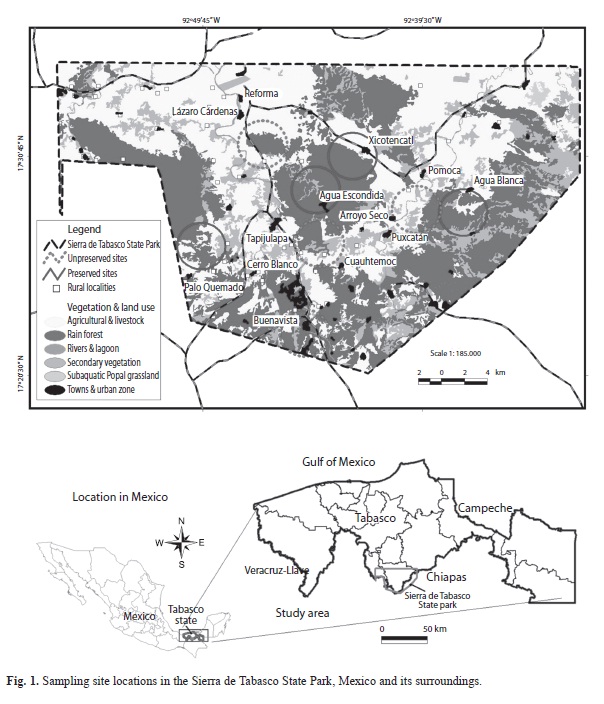
<body><![CDATA[<div style="text-align: justify;"><font size="2"><span  style="font-family: verdana;">Subsistence hunting, along with deforestation and the transformation of native rainforest are common activities in the Neotropics (Robinson &amp; Redford 1991, Robinson &amp; Bennett </span></font><font size="2"><span  style="font-family: verdana;">2000), and have caused a considerable decrease in the populations of many species. In Mexico, subsistence hunting is an important source of protein for rural populations, particularly in the Southeastern part of the country. This kind of hunting is legal and therefore is not recorded or quantified. However, as populations expand they quickly transform and fragment tropical forests (Galetti <span style="font-style: italic;">et al</span>. 2006), and the resulting pressure on wildlife is increasing.</span></font>    <br> </div>     <div style="text-align: justify;">     <div style="text-align: justify;"><font size="2"><span  style="font-family: verdana;"></span></font><br  style="font-family: verdana;"> </div> <font size="2"><span style="font-family: verdana;"></span></font><font  size="2"><span style="font-family: verdana;">In&nbsp; Tabasco,&nbsp; for&nbsp; example,&nbsp; the&nbsp; expansion of agriculture has resulted in a 90% decrease in high and medium rainforest relative to its original distribution (Tudela 1990). In response, the state government of Tabasco created the Sierra de Tabasco State Park (STSP) in 1988 as part of the System of Protected Natural Areas of the state of Tabasco. This park was created to protect the high and medium rainforests still present in the region, though within the reserve there are crops and areas with secondary vegetation (Peri&oacute;dico Oficial del Estado de Tabasco </span></font><font size="2"><span  style="font-family: verdana;">1988). Subsistence hunting is practiced in rural communities, and the paca is one of the most hunted species as it is the meatiest (De la Cruz- Felix 2008).</span></font><br  style="font-family: verdana;"> <br style="font-family: verdana;"> <font size="2"><span style="font-family: verdana;"><span  style="font-style: italic;">Cuniculus paca</span> is widely distributed throughout the Neotropics and its delicious, tender meat is greatly enjoyed throughout its range (P&eacute;rez 1992). This species is found in Mesoamerica and South America in Guatemala, Belize, Panama, Colombia, Venezuela, Trinidad, Guiana, Brazil, and from Peru to Paraguay and Northern Argentina, which is the Southern limit of its distribution (Matamoros </span></font><font size="2"><span  style="font-family: verdana;">1985, Eisenberg 1989, P&eacute;rez 1992). In Mexico it is distributed from the Southern part of the state&nbsp; of Tamaulipas&nbsp; down&nbsp; through&nbsp; San&nbsp; Luis Potos&iacute;, Veracruz and Tabasco, and Eastwards in the Yucatan Peninsula. On the Pacific coast, it occurs from the state of Guerrero, through Oaxaca to Chiapas (Aranda 2000).</span></font>    <br> <font size="2"><span style="font-family: verdana;"></span></font><br  style="font-family: verdana;"> <font size="2"><span style="font-family: verdana;"></span></font><font  size="2"><span style="font-family: verdana;">Owing to its broad distribution, the paca has many other common names. In Central America it is called &#8220;gibnut&#8221; or &#8220;gibnot&#8221; (Belize), &#8220;tepezcuintle&#8221; (Guatemala and Costa Rica), &#8220;conejo pintado&#8221; (Panam&aacute;). In South America&nbsp; it&nbsp; is&nbsp; known&nbsp; as&nbsp; &#8220;lapa&#8221;&nbsp; (Venezuela and Colombia), &#8220;borugo&#8221;, &#8220;guagua&#8221;, &#8220;tinajo&#8221;, &#8220;guartinajo&#8221; (Colombia), &#8220;lape&#8221; and &#8220;majaz&#8221; (Per&uacute;), &#8220;paca&#8221; (Brazil) and &#8220;Guanta&#8221; o &#8220;lumucha&#8221; (Ecuador); &#8220;jochi pintado&#8221; (Bolivia). In Mexico it is called &#8220;tepezcuintle&#8221;, &#8220;guatuza real&#8221;, &#8220;tuza real&#8221; or &#8220;perro de monte&#8221; (Smythe &amp; Brown de Guanti 1995, P&eacute;rez-Torres 1996) and in English it is known as the paca.</span></font>    <br> <font size="2"><span style="font-family: verdana;"></span></font><br  style="font-family: verdana;"> <font size="2"><span style="font-family: verdana;"></span></font><font  size="2"><span style="font-family: verdana;"><span  style="font-style: italic;">Cuniculus paca</span> (Linnaeus 1766) inhabits dry&nbsp; forests,&nbsp; rainforests,&nbsp; and&nbsp; mangroves,&nbsp; and is generally found near rivers, lagoons and ravines (Matamoros 1982). This species is mainly frugivorous and eats a wide variety of wild and cultivated fruit, though it also eats seeds and plant material, including sprouts, roots, tubers, bulbs, rhizomes, leaves and herbs (Borrero 1967, M&eacute;ndez 1970, Leopold 1977, Matamoros 1985).&nbsp; Its&nbsp; territory&nbsp; spans&nbsp; two&nbsp; to three ha, and its population density varies throughout the year, depending on local fruit production (Smythe 1983). The male and the female live&nbsp; in&nbsp; separate&nbsp; burrows,&nbsp; at&nbsp; opposite ends of the territory, allowing them to defend their turf together.</span></font><br style="font-family: verdana;"> <br style="font-family: verdana;"> <font size="2"><span style="font-family: verdana;">For Mexico there is little information about pacas under natural conditions. The available information is mainly about burrow characteristics, ectoparasites, and feeding habits (based on fecal analysis to determine the composition&nbsp; and&nbsp; preference;&nbsp; Gallina&nbsp; 1981).</span></font><br  style="font-family: verdana;"> <font size="2"><span style="font-family: verdana;">For pacas in captivity, there have been studies on burrow preferences and behavior (Aguirre </span></font><font  size="2"><span style="font-family: verdana;">&amp; Fey 1981), and there is information about sexing and marking the animals, and also about management with the aim of breeding pacas in captivity (Aguirre &amp; Fey 1981). Reproductive activity has been described during puberty and postpartum, as has postpartum ovarian activity (Montes 2001).</span></font>    <br> <font size="2"><span style="font-family: verdana;"></span></font><br  style="font-family: verdana;"> <font size="2"><span style="font-family: verdana;"></span></font><font  size="2"><span style="font-family: verdana;">Medell&iacute;n (1994) reported that <span style="font-style: italic;">C. paca</span> is vulnerable to the processes associated with forest fragmentation in the Lacandona rainforest in the state of Chiapas, Mexico and that this species is threatened owing to its habitat specialization (Rodr&iacute;guez 1994).</span></font><br  style="font-family: verdana;"> <br style="font-family: verdana;"> <font size="2"><span style="font-family: verdana;">The paca is the largest rodent in Mexican tropical forests, and is one of the most used as a subsistence species because of its meat. By way of example, compared to all species hunted in the Lacandona rainforest, the annual extraction rate of paca was reported as the highest, at 0.49 individuals/km2/year (Guerra &amp; Naranjo 2003). However, the degree of hunting pressure on this species is still not known for many protected areas. This way, our goal was to document the extent to which the inhabitants of the STSP and its surroundings, use <span style="font-style: italic;">C. paca</span>, by comparing information from preserved and non preserved areas, and to obtain information that would allow us to propose suitable management and conservation strategies, for the sustainable use of this species within the protected area.</span></font><br  style="font-family: verdana;"> <br style="font-family: verdana;"> <font style="font-weight: bold;" size="3"><span  style="font-family: verdana;">Materials and Methods</span></font><br  style="font-family: verdana;"> <br style="font-family: verdana;"> <font size="2"><span style="font-family: verdana;"><span  style="font-weight: bold;">Location&nbsp; of&nbsp; the&nbsp; study&nbsp; area:</span>&nbsp; The&nbsp; state park is located in the subregion of the Sierra de Tabasco Mountain Range, in the Usumacinta region (17&ordm; 25&#8217; - 17&ordm; 40&#8217; N y 92&ordm; 37&#8217; - 92&ordm; 52&#8217; W) of the Tabasco State. It has an area of 15 113.2 ha and covers 5.98% of the state&#8217;s land surface (SEDESPA 2004). The climate is warm-subhumid with rain throughout the year (AF), and thermal changes in October, November and December. Mean annual temperature is 25.6&deg;C, with a mean monthly maximum of 29.2&deg;C in May, and a mean monthly minimum of 22&deg;C in December. This is the rainiest part of the country and one of the four rainiest regions in the world: precipitation is 3 515-5 139mm/ year. Maximum mean relative humidity is approximately 95% in the wet season (September, October and November) and the minimum is 78% in the dry season (March, April and May; INEGI 1998).</span></font>    <br> <font size="2"><span style="font-family: verdana;"></span></font><br  style="font-family: verdana;"> <font size="2"><span style="font-family: verdana;"></span></font><font  size="2"><span style="font-family: verdana;">There are several types of vegetation in the region, including tropical evergreen forest that ranges from 15-35m tall and different stages of secondary vegetation. In the three types of rainforest the vegetation is composed of arboreal species such as: <span style="font-style: italic;">Pouteria zapota, Manilkara zapota, Pterocarpus rohrii, Platimiscyum yucatanum, Sterculia mexicana, Brosimum alicastrum, Guarea bijuga and Spondias mombin; and species of palm such as: Astrocarium mexicanum, Chamaedorea tepejilote and Reinhardtia gracilis</span> (SEDESPA 2004, De la Cruz-F&eacute;lix </span></font><font  size="2"><span style="font-family: verdana;">2008). The secondary vegetation is characterized by <span style="font-style: italic;">Cecropia obtusifolia, Cochlospermum vitifolium, Cestrum nocturnum, Hampea integerrima, Hibiscus tiliaceus, Piper auritum and Heliconia bihai</span> (SEDESPA 2004, De la Cruz- F&eacute;lix 2008). The most representative crops in the area are corn (<span  style="font-style: italic;">Zea mays</span>), beans (<span style="font-style: italic;">Phaseolus vulgaris</span>), bananas (<span style="font-style: italic;">Musa paradisiaca</span>), cacao (<span style="font-style: italic;">Theobroma cacao</span>), coffee (<span  style="font-style: italic;">Coffea arabica</span>), pineapple (<span  style="font-style: italic;">Ananas comosus</span>) and habanero chilli peppers (<span style="font-style: italic;">Capsicum&nbsp; sp.</span>). Grasses,&nbsp; such as <span style="font-style: italic;">Cynodon plectostachium and Brachiaria humidicola</span>, are also grown (SEDESPA 2004).</span></font>    <br> <font size="2"><span style="font-family: verdana;"></span></font><br  style="font-family: verdana;"> <font size="2"><span style="font-family: verdana;"></span></font><font  size="2"><span style="font-family: verdana;"><span  style="font-weight: bold;">Field work:</span> One prospective and three preliminary pre-sampling expeditions were made from September-December 2005, along with four sampling expeditions from February- May 2006. Each trip lasted approximately 10 days. Using a geographic information system (GIS) and based on the vegetation degree of disturbance, we classified the STSP and surroundings as preserved (i.e. with a continuous rainforest area) and unpreserved (i.e. characterized by patches of rainforest that were much more fragmented and smaller); though in the preserved areas there were also different degrees of disturbance. Four preserved areas and four unpreserved areas were defined using a geographic information system based on the size of the patches of the rain forest (<a  href="/img/revistas/rbt/v60n3/a32i1.jpg">Fig. 1</a>). Eight different sites were visited in the preserved areas and eight in the unpreserved areas to carry out the interviews.</span></font>    <br> <font size="2"><span style="font-family: verdana;"></span></font><br  style="font-family: verdana; font-weight: bold;"> <font size="2"><span style="font-family: verdana;"></span></font><font  size="2"><span style="font-family: verdana;"><span  style="font-weight: bold;">Interviewing the local inhabitants:</span> To determine the hunting pressure exerted on <span  style="font-style: italic;">C. paca</span> by the local communities in the STSP and its surroundings, 16 of the 24 communities (67%) within the reserve were visited and interviewed (Guerra &amp; Naranjo 2003). This method has been widely used in the study of several species&nbsp; and&nbsp; is&nbsp; especially&nbsp; effective&nbsp; for&nbsp; those that are commonly hunted and observed by the local inhabitants (Lawes <span style="font-style: italic;">et al</span>. 2000, Michalski </span></font><font size="2"><span  style="font-family: verdana;">&amp; Peres 2005, Urquiza-Haas <span  style="font-style: italic;">et al</span>. 2009).</span></font>    ]]></body>
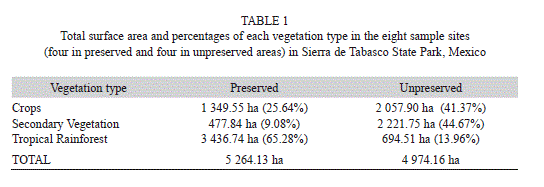
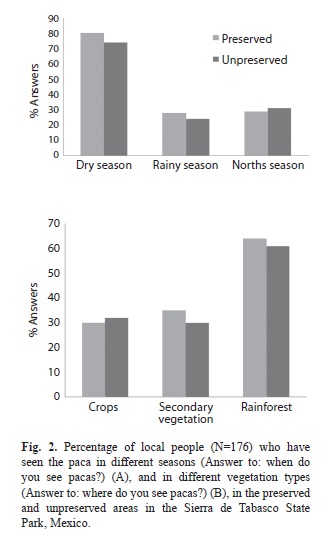
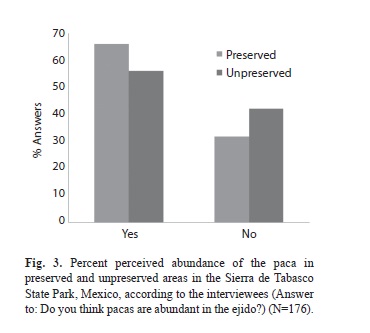
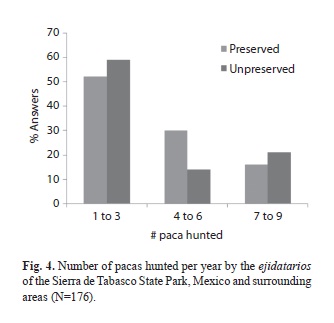
<body><![CDATA[<br> <font size="2"><span style="font-family: verdana;"></span></font><br  style="font-family: verdana;"> <font size="2"><span style="font-family: verdana;"></span></font><font  size="2"><span style="font-family: verdana;">One hundred and seventy-six of the inhabitants over 18 years of age, and who carry out some kind of activity in the field, were interviewed by direct questioning (<a  href="/img/revistas/rbt/v60n3/a32a1.gif">see the Appendix</a>). The results were compared between the eight communities in the preserved areas and the eight communities in the unpreserved areas. To analyze the results of the interviews we used Wilcoxon&#8217;s paired samples test, Cochran&#8217;s Q or McNemar&#8217;s test as appropriate, to determine whether there were significant differences among the categories of answers to each question (Zar 1996). When Cochran&#8217;s Q detected a significant difference Marascuilo and McSweeney&#8217;s multiple comparison test (1967) with Scheff&eacute;&#8217;s S statistic was used (Zar 1996).</span></font><br style="font-family: verdana;"> <br style="font-family: verdana;"> <font style="font-weight: bold;" size="3"><span  style="font-family: verdana;">Results</span></font>    <br> <font style="font-weight: bold;" size="3"><span  style="font-family: verdana;"></span></font><br  style="font-family: verdana;"> <font style="font-weight: bold;" size="3"><span  style="font-family: verdana;"></span></font><font size="2"><span  style="font-family: verdana;">In <a href="/img/revistas/rbt/v60n3/a32t1.gif">table 1</a> the total surface area and percentage of each vegetation type (crops, secondary vegetation and tropical rainforest) in the eight sample sites (four in preserved and four in unpreserved areas) in Sierra de Tabasco State Park, Mexico are shown in order to highlight the habitat fragmentation of the study area.</span></font>    <br> <font size="2"><span style="font-family: verdana;"></span></font><br  style="font-family: verdana;"> <font size="2"><span style="font-family: verdana;"></span></font><font  size="2"><span style="font-family: verdana;">The results of the 176 interviews revealed that 100% of the people interviewed said they knew of and had eaten paca, both in the preserved and unpreserved areas. There were significant differences in the number of times <span  style="font-style: italic;">C. </span></span></font><font size="2"><span  style="font-family: verdana;"><span style="font-style: italic;">paca</span> was observed between seasons and for different vegetation types (Cochran&#8217;s Q, p&lt;0.01) with the animal being sighted more often in the dry season and in the rainforest (<a href="/img/revistas/rbt/v60n3/a32i2.jpg">Fig. 2</a>).</span></font>    <br> <font size="2"><span style="font-family: verdana;"></span></font><br  style="font-family: verdana;"> <font size="2"><span style="font-family: verdana;"></span></font><font  size="2"><span style="font-family: verdana;">When studying the methods, hunting and trapping were prevalent in both preserved and unpreserved areas, more so than gifting or buying pacas in terms of their frequency as a method of obtaining the animals. In the preserved and the unpreserved areas, Cochran&#8217;s Q rejected the hypothesis that there are no differences in the methods used to obtain pacas (p&lt;0.01). Hunting and trapping were significantly more common (75%) than gifting and purchasing. McNemar&#8217;s test indicated that pacas are acquired significantly (p&lt;0.01) more frequently&nbsp; (98%)&nbsp; for&nbsp; personal&nbsp; consumption than to sell.</span></font>    <br> <font size="2"><span style="font-family: verdana;"></span></font><br  style="font-family: verdana;"> <font size="2"><span style="font-family: verdana;"></span></font><font  size="2"><span style="font-family: verdana;">On analyzing whether the interviewees felt that the paca is abundant in the ejidos, McNemar&#8217;s test revealed a significant difference (p&lt;0.01) between the answers &#8220;yes&#8221; and &#8220;no&#8221; for both the preserved and unpreserved study areas (<a  href="/img/revistas/rbt/v60n3/a32i3.jpg">Fig. 3).</a></span></font>    <br> <font size="2"><span style="font-family: verdana;"></span></font><br  style="font-family: verdana;"> <font size="2"><span style="font-family: verdana;"></span></font><font  size="2"><span style="font-family: verdana;">There was a significant difference in the techniques used by the inhabitants for hunting the paca (p&lt;0.01). Dogs (50%) and firearms (60%) are the most commonly used aids for hunting (p&lt;0.05), and are particularly evident in the unpreserved areas. Trapping is the less used technique (25%).</span></font>    <br> <font size="2"><span style="font-family: verdana;"></span></font><br  style="font-family: verdana;"> <font size="2"><span style="font-family: verdana;"></span></font><font  size="2"><span style="font-family: verdana;">Recall that a total of 16 communities were visited. The number of pacas hunted per year differs between the preserved and unpreserved areas and 1-3, 4-6 and 7-9 animals are hunted per year per person, with 1-3 pacas per person the predominant number (<a href="/img/revistas/rbt/v60n3/a32i4.jpg">Fig. 4</a>). The minimum number of each interval was multiplied by the total number of people interviewed, to obtain a total of 488 paca hunted/year. That means that if we use the mean weight of 7.3kg/ paca (Guerra &amp; Naranjo 2003) this is the equivalent of 3 562kg of paca being caught. This is different from other sites where extraction estimates are 173 (Caquet&aacute;, Colombia; Rodr&iacute;guez&nbsp; &amp;&nbsp; Van&nbsp; Der&nbsp; Hammen&nbsp; 2003),&nbsp; 271 (the Lacandona rainforest, Chiapas; Guerra &amp; Naranjo 2003) and 799 (Pasco, Per&uacute;; Gonz&aacute;lez </span></font><font  size="2"><span style="font-family: verdana;">2003) pacas per year.</span></font>    <br> </div> <font size="2"><span style="font-family: verdana;"></span></font>    <br>     <div style="text-align: justify;"><font style="font-weight: bold;"  size="3"><span style="font-family: verdana;">Discussion</span></font><br  style="font-family: verdana;"> <br style="font-family: verdana;"> <font size="2"><span style="font-family: verdana;">From pre-Colombian times the paca has been used as a food source obtained by subsistence hunting (Ojasti 1993). Its meat is still eaten in the communities located in the study area since all those interviewed know of and have&nbsp; eaten&nbsp; this&nbsp; animal.&nbsp; The&nbsp; rate&nbsp; of&nbsp; extraction in the study area was estimated to be 488 pacas per year, and this is among the highest values recorded for other localities: Caquet&aacute;, Colombia (173; Rodr&iacute;guez &amp; Van Der Hammen 2003); the Lacandona rainforest, Chiapas, Mexico (271; Guerra &amp; Naranjo 2003) and Pasco, Peru (799; Gonz&aacute;lez 2003).</span></font>    ]]></body>
<body><![CDATA[<br> <font size="2"><span style="font-family: verdana;"></span></font><br  style="font-family: verdana;"> <font size="2"><span style="font-family: verdana;"></span></font><font  size="2"><span style="font-family: verdana;">Hunting&nbsp; in&nbsp; the&nbsp; study&nbsp; area&nbsp; has&nbsp; provided a complementary source of animal protein. Eighty percent of the people interviewed hunt the paca for food (98%). This concurs with the findings of Guerra &amp; Naranjo (2003) for two sites in the Lacandona rainforest in Chiapas, Mexico, where they mention that subsistence hunting is a complementary activity since they met no one who spends all of their time hunting wildlife, because it cannot provide the same income as that generated by cattle ranching, trading or agriculture. This is similar to the findings of our study.</span></font>    <br> <font size="2"><span style="font-family: verdana;"></span></font><br  style="font-family: verdana;"> <font size="2"><span style="font-family: verdana;"></span></font><font  size="2"><span style="font-family: verdana;">Many species are affected by hunting to a greater extent than they are by deforestation (Bodmer 1994). The rural inhabitants of the Neotropics mainly hunt for subsistence or to sell the meat and fur in city markets. This is why implementing sustainable hunting practices&nbsp; is&nbsp; a&nbsp; complex&nbsp; process&nbsp; that&nbsp; must&nbsp; take into account the socio-economic status of the rural inhabitants, the biology of the species, institutional capacity and national and global economic pressure (Bodmer 2003). In the STSP and its surroundings, there is no sustainable management, and nule control on hunting. This highlights the importance of implementing Units for Management (known as UMAs, for their initials in Spanish) to oversee intensive and extensive management, and protect species such as <span  style="font-style: italic;">Cuniculus paca</span> and other wildlife populations.</span></font>    <br> <font size="2"><span style="font-family: verdana;"></span></font><br  style="font-family: verdana;"> <font size="2"><span style="font-family: verdana;"></span></font><font  size="2"><span style="font-family: verdana;">Attempts in the STSP and surrounding areas to set up captive breeding programs for the paca have been scarce. Only two percent of the inhabitants we interviewed have tried to raise this species. This may reflect the cultural hunting tradition of the inhabitants since selling the meat and fur of this species, is not considered a viable commercial endeavor. Because of this, there is a fair amount of pressure on the paca populations, which could exhaust this resource in the medium term.</span></font>    <br> <font size="2"><span style="font-family: verdana;"></span></font><br  style="font-family: verdana;"> <font size="2"><span style="font-family: verdana;"></span></font><font  size="2"><span style="font-family: verdana;">Although, the paca has been found to be vulnerable to the processes of habitat fragmentation (Rodriguez 1994), given that it prefers forest, there is evidence that it is tolerant to habitat modification as shown in this study, where&nbsp; pacas&nbsp; were&nbsp; associated&nbsp; with&nbsp; secondary vegetation and crops. This has also been reported for similar species such as agoutis (<span style="font-style: italic;">Dasyprocta</span> spp.) and the armadillo (<span style="font-style: italic;">Dasypus novemcinctus</span>), both of which are associated with vegetation mosaics composed of near climax primary rainforest, mature secondary vegetation, crop fields and pastures (Brack 1981). This type of landscape configuration is characteristic of the Sierra de Tabasco State Park and its surroundings, and suggests that the paca is likely to encounter suitable habitats for feeding, refuge and breeding. Therefore, it would be possible to develop management plans for this species by protecting those areas within the landscape mosaic that favor the species.</span></font>    <br> <font size="2"><span style="font-family: verdana;"></span></font><br  style="font-family: verdana;"> <font size="2"><span style="font-family: verdana;"></span></font><font  size="2"><span style="font-family: verdana;">Preserving the sites that ensure access to water could favor the continued presence of this species in the region. The local inhabitants see this species most frequently (80%) during the dry season, in both preserved and unpreserved areas. This occurs, because when water availability is limited, the animals spend more time around water troughs, ponds and perennial springs, and at sites where a variety of plants are fruiting (Yockteng 1982). Hunters take advantage of this, due to the ease with which they can capture the pacas under these conditions. Additionally, in the context of setting up breeding programs, this would also be the best time to capture the animals to set up the founding colony. The importance of these preserved areas is evident given that it is there that the inhabitants report the greatest number of sightings of this species.</span></font>    <br> <font size="2"><span style="font-family: verdana;"></span></font><br  style="font-family: verdana;"> <font size="2"><span style="font-family: verdana;"></span></font><font  size="2"><span style="font-family: verdana;">There is no difference in the methods used to hunt pacas and those used to hunt the other fauna of the region. The significant increase in the use of firearms is not particular to this region, but rather is occurring throughout the rural areas of the Neotropics. In Mexico, as in other countries, the introduction of modern agricultural&nbsp; tools&nbsp; and&nbsp; practices&nbsp; has&nbsp; resulted in the&nbsp; loss&nbsp; of&nbsp; traditional&nbsp; practices. This&nbsp; has occurred in the Lacandona rainforest in Chiapas (Guerra &amp; Naranjo 2003) and in other countries such as Peru, where 90% of the inhabitants of the Yanesha Communal Reserve in Pasco use firearms (Gonz&aacute;lez 2003). This is detrimental to many species because, for example, it has been estimated that with firearms as many as 10 pacas can be caught in one day (Gonz&aacute;lez&nbsp; 2003). Trapping is a nonselective traditional method and is used to a lesser extent in the three locations mentioned above. Dogs were also commonly used; mainly to locate the burrows and then to get the pacas to leave. It is not common for pacas to be bred in Mexico or in Latin America. The most recent studies to report captive breeding experiments are those of Smythe &amp; Brown de Guanti (1995) and Barrera &amp; Gonz&aacute;lez (1999). These authors state that breeding this species is difficult owing to its low reproduction rate and the high cost of facilities. This was evident in our study area given that only 2% of the interviewees said they had tried to breed pacas, unsuccessfully, and that was why they continued hunting the wild populations in the forest directly.</span></font><br style="font-family: verdana;"> <br style="font-family: verdana;"> <br style="font-family: verdana;"> <font style="font-weight: bold;" size="3"><span  style="font-family: verdana;">Acknoledgments</span></font><br  style="font-family: verdana;"> <br style="font-family: verdana;"> <font size="2"><span style="font-family: verdana;">We thank all the people of the Reserve who generously shared their knowledge with us. We are grateful to Christian Delfin Alfonso of the Instituto de Ecolog&iacute;a, A.C. for preparing the map, and to Bianca Delfosse for the English translation.</span></font><br style="font-family: verdana;"> </div> <hr  style="width: 100%; height: 2px; margin-left: 0px; margin-right: 0px;">     <!-- ref --><div style="text-align: justify;"><br style="font-family: verdana;"> <font style="font-weight: bold;" size="3"><span  style="font-family: verdana;">&nbsp;References</span></font><br  style="font-family: verdana;"> <br style="font-family: verdana;"> <font size="2"><span style="font-family: verdana;">Aguirre, G.L. &amp; E. Fey. 1981. Estudio preliminar del tepezcuintle (Agouti paca nelsoni&nbsp; Godman) en la Selva Lacandona,&nbsp; Chiapas, p. 45-54. In P. Reyes-Castillo (ed.). Estudios Ecol&oacute;gicos en el Tr&oacute;pico&nbsp; Mexicano. Instituto de Ecolog&iacute;a, A.C., M&eacute;xico.    &nbsp;&nbsp;&nbsp;&nbsp;&nbsp;&nbsp;&nbsp;&nbsp;[&#160;<a href="javascript:void(0);" onclick="javascript: window.open('/scielo.php?script=sci_nlinks&ref=1479461&pid=S0034-7744201200030003200001&lng=','','width=640,height=500,resizable=yes,scrollbars=1,menubar=yes,');">Links</a>&#160;]<!-- end-ref --><!-- ref --></span></font><br style="font-family: verdana;"> <br style="font-family: verdana;"> <font size="2"><span style="font-family: verdana;">Aranda, J.M. 2000. Huellas y otros rastros de los mam&iacute;feros grandes y medianos de M&eacute;xico. Comisi&oacute;n Nacional para el Conocimiento y Uso de la Biodiversidad (CONABIO). Instituto de Ecolog&iacute;a, A.&nbsp; C. Xalapa, Veracruz, M&eacute;xico.    &nbsp;&nbsp;&nbsp;&nbsp;&nbsp;&nbsp;&nbsp;&nbsp;[&#160;<a href="javascript:void(0);" onclick="javascript: window.open('/scielo.php?script=sci_nlinks&ref=1479462&pid=S0034-7744201200030003200002&lng=','','width=640,height=500,resizable=yes,scrollbars=1,menubar=yes,');">Links</a>&#160;]<!-- end-ref --><!-- ref --></span></font><br  style="font-family: verdana;"> <br style="font-family: verdana;"> <font size="2"><span style="font-family: verdana;">Barrera, I. &amp; A. Gonz&aacute;lez. 1999. La cr&iacute;a y domesticaci&oacute;n del&nbsp; conejo&nbsp; pintado&nbsp; (Agouti&nbsp; paca):&nbsp; un&nbsp; proyecto&nbsp; en la cuenca hidrogr&aacute;fica del canal de Panam&aacute;. IUCNANCON-ATVSC, San Jos&eacute;, Costa Rica.    &nbsp;&nbsp;&nbsp;&nbsp;&nbsp;&nbsp;&nbsp;&nbsp;[&#160;<a href="javascript:void(0);" onclick="javascript: window.open('/scielo.php?script=sci_nlinks&ref=1479463&pid=S0034-7744201200030003200003&lng=','','width=640,height=500,resizable=yes,scrollbars=1,menubar=yes,');">Links</a>&#160;]<!-- end-ref --><!-- ref --></span></font><br  style="font-family: verdana;"> <br style="font-family: verdana;"> <font size="2"><span style="font-family: verdana;">Bodmer, R. 1994. Managing wildlife with local communities: The case of the Reserva Comunal TamshiyacuTahuayo, p. 113-134. In D. Western, M. Wright &amp; S. Strum (eds.). Natural Connections:&nbsp; Perspectives on Community-Based Management. Island, Washington D.C., USA.    &nbsp;&nbsp;&nbsp;&nbsp;&nbsp;&nbsp;&nbsp;&nbsp;[&#160;<a href="javascript:void(0);" onclick="javascript: window.open('/scielo.php?script=sci_nlinks&ref=1479464&pid=S0034-7744201200030003200004&lng=','','width=640,height=500,resizable=yes,scrollbars=1,menubar=yes,');">Links</a>&#160;]<!-- end-ref --><!-- ref --></span></font><br  style="font-family: verdana;"> <br style="font-family: verdana;"> <font size="2"><span style="font-family: verdana;">Bodmer, R. 2003. Evaluaci&oacute;n de la&nbsp; sustentabilidad de la caza en los Neotr&oacute;picos: el modelo de cosecha unificado, p. 252-262. In R. Polanco-Ochoa (ed.). Manejo de Fauna Silvestre en&nbsp; Amazon&iacute;a y Latinoam&eacute;rica. Selecci&oacute;n de trabajos V Congreso Internacional. The Convention on International Trade in&nbsp; Endangered Species of Wild Fauna and Flora (CITES), Fundaci&oacute;n Natura Colombia, Bogot&aacute;, Colombia.    &nbsp;&nbsp;&nbsp;&nbsp;&nbsp;&nbsp;&nbsp;&nbsp;[&#160;<a href="javascript:void(0);" onclick="javascript: window.open('/scielo.php?script=sci_nlinks&ref=1479465&pid=S0034-7744201200030003200005&lng=','','width=640,height=500,resizable=yes,scrollbars=1,menubar=yes,');">Links</a>&#160;]<!-- end-ref --><!-- ref --></span></font><br  style="font-family: verdana;"> <br style="font-family: verdana;"> <font size="2"><span style="font-family: verdana;">Borrero,&nbsp; J.I. 1967. Mamiferos neotropicales.&nbsp; Universidad del Valle. Cali, Colombia.    &nbsp;&nbsp;&nbsp;&nbsp;&nbsp;&nbsp;&nbsp;&nbsp;[&#160;<a href="javascript:void(0);" onclick="javascript: window.open('/scielo.php?script=sci_nlinks&ref=1479466&pid=S0034-7744201200030003200006&lng=','','width=640,height=500,resizable=yes,scrollbars=1,menubar=yes,');">Links</a>&#160;]<!-- end-ref --><!-- ref --></span></font><br  style="font-family: verdana;"> <br style="font-family: verdana;"> <font size="2"><span style="font-family: verdana;">Brack, A. 1981. Ecological evaluation of the Palcazu River Valley (Pasco, Peru) and&nbsp; guidelines for an environmental conservation program. Central Selva Resources Management Project, Vol. II., Appendix D. JRB Associates Inc., Lima. 2: D1-D39.    &nbsp;&nbsp;&nbsp;&nbsp;&nbsp;&nbsp;&nbsp;&nbsp;[&#160;<a href="javascript:void(0);" onclick="javascript: window.open('/scielo.php?script=sci_nlinks&ref=1479467&pid=S0034-7744201200030003200007&lng=','','width=640,height=500,resizable=yes,scrollbars=1,menubar=yes,');">Links</a>&#160;]<!-- end-ref --><!-- ref --></span></font><br style="font-family: verdana;"> <br style="font-family: verdana;"> <font size="2"><span style="font-family: verdana;">De&nbsp; la Cruz-F&eacute;lix, K.H. 2008. Cacer&iacute;a de&nbsp; subsistencia de mam&iacute;feros silvestres en dos sierras del Parque Estatal de La Sierra, Tabasco. Tesis de Maestr&iacute;a, Universidad Ju&aacute;rez Aut&oacute;noma de Tabasco, Tabasco, M&eacute;xico.    &nbsp;&nbsp;&nbsp;&nbsp;&nbsp;&nbsp;&nbsp;&nbsp;[&#160;<a href="javascript:void(0);" onclick="javascript: window.open('/scielo.php?script=sci_nlinks&ref=1479468&pid=S0034-7744201200030003200008&lng=','','width=640,height=500,resizable=yes,scrollbars=1,menubar=yes,');">Links</a>&#160;]<!-- end-ref --><!-- ref --></span></font><br  style="font-family: verdana;"> <br style="font-family: verdana;"> <font size="2"><span style="font-family: verdana;">Eisenberg, J.F. 1989. Mammals of the Neotropics. The northern tropics. Panama, Colombia, Venezuela, Guayanas, Surinam. University of Chicago, Chicago, USA.    &nbsp;&nbsp;&nbsp;&nbsp;&nbsp;&nbsp;&nbsp;&nbsp;[&#160;<a href="javascript:void(0);" onclick="javascript: window.open('/scielo.php?script=sci_nlinks&ref=1479469&pid=S0034-7744201200030003200009&lng=','','width=640,height=500,resizable=yes,scrollbars=1,menubar=yes,');">Links</a>&#160;]<!-- end-ref --><!-- ref --></span></font><br  style="font-family: verdana;"> <br style="font-family: verdana;"> <font size="2"><span style="font-family: verdana;">Galetti,&nbsp; M., C.I. Donatti, A.S. Pires, P.R.&nbsp; Guimar&atilde;es &amp; P. Jordano. 2006. Seed&nbsp; survival and dispersal of an endemic&nbsp; Atlantic Forest pal: The combined&nbsp; effects of defaunation and forest fragmentation. Bot. J. Linn. Soc. 151: 141-149.    &nbsp;&nbsp;&nbsp;&nbsp;&nbsp;&nbsp;&nbsp;&nbsp;[&#160;<a href="javascript:void(0);" onclick="javascript: window.open('/scielo.php?script=sci_nlinks&ref=1479470&pid=S0034-7744201200030003200010&lng=','','width=640,height=500,resizable=yes,scrollbars=1,menubar=yes,');">Links</a>&#160;]<!-- end-ref --></span></font>    <!-- ref --><br> <font size="2"><span style="font-family: verdana;"></span></font><br  style="font-family: verdana;"> <font size="2"><span style="font-family: verdana;"></span></font><font  size="2"><span style="font-family: verdana;">Gallina,&nbsp; S.&nbsp; 1981.&nbsp; Contribuci&oacute;n&nbsp; al&nbsp; conocimiento&nbsp; de&nbsp; los h&aacute;bitos de&nbsp; alimentaci&oacute;n del &#8220;tepezcuintle&#8221; (Agouti paca) en Lancaj&aacute;-Chansayab, Chiapas, p. 55-57. In P. Reyes-Castillo (ed.). Estudios Ecol&oacute;gicos en el Tr&oacute;pico Mexicano.&nbsp; Instituto de Ecolog&iacute;a, A.C. M&eacute;xico D.F., M&eacute;xico.    &nbsp;&nbsp;&nbsp;&nbsp;&nbsp;&nbsp;&nbsp;&nbsp;[&#160;<a href="javascript:void(0);" onclick="javascript: window.open('/scielo.php?script=sci_nlinks&ref=1479472&pid=S0034-7744201200030003200011&lng=','','width=640,height=500,resizable=yes,scrollbars=1,menubar=yes,');">Links</a>&#160;]<!-- end-ref --><!-- ref --></span></font><br style="font-family: verdana;"> <br style="font-family: verdana;"> <font size="2"><span style="font-family: verdana;">Gonz&aacute;lez, J.A. 2003. Patrones generales de caza y pesca en comunidades nativas y asentamientos de colonos aleda&ntilde;os a la Reserva Comunal Yanesha, Pasco, Per&uacute;, p. 89-102. In R. Polanco-Ochoa (ed.). Manejo de Fauna Silvestre en Amazon&iacute;a y Latinoam&eacute;rica. Selecci&oacute;n de trabajos V&nbsp; Congreso Internacional. CITES, Fundaci&oacute;n Natura Colombia, Bogot&aacute;, Colombia.    &nbsp;&nbsp;&nbsp;&nbsp;&nbsp;&nbsp;&nbsp;&nbsp;[&#160;<a href="javascript:void(0);" onclick="javascript: window.open('/scielo.php?script=sci_nlinks&ref=1479473&pid=S0034-7744201200030003200012&lng=','','width=640,height=500,resizable=yes,scrollbars=1,menubar=yes,');">Links</a>&#160;]<!-- end-ref --><!-- ref --></span></font><br  style="font-family: verdana;"> <br style="font-family: verdana;"> <font size="2"><span style="font-family: verdana;">Guerra,&nbsp; M.M. &amp; E.J. Naranjo. 2003. Cacer&iacute;a&nbsp; de subsistencia&nbsp; en&nbsp; dos&nbsp; localidades&nbsp; de&nbsp; la&nbsp; selva&nbsp; Lacandona, Chiapas, M&eacute;xico, p.&nbsp; 339-344. In R. Polanco-Ochoa (ed.).&nbsp; Manejo&nbsp; de&nbsp; Fauna&nbsp; Silvestre&nbsp; en&nbsp; Amazon&iacute;a&nbsp; y Latinoam&eacute;rica.&nbsp; Selecci&oacute;n&nbsp; de&nbsp; trabajos&nbsp; V&nbsp; Congreso Internacional.&nbsp; CITES, Fundaci&oacute;n Natura Colombia, Bogot&aacute;, Colombia.    &nbsp;&nbsp;&nbsp;&nbsp;&nbsp;&nbsp;&nbsp;&nbsp;[&#160;<a href="javascript:void(0);" onclick="javascript: window.open('/scielo.php?script=sci_nlinks&ref=1479474&pid=S0034-7744201200030003200013&lng=','','width=640,height=500,resizable=yes,scrollbars=1,menubar=yes,');">Links</a>&#160;]<!-- end-ref --><!-- ref --></span></font><br style="font-family: verdana;"> <br style="font-family: verdana;"> <font size="2"><span style="font-family: verdana;">INEGI. 1998. Anuario Estad&iacute;stico del Estado de Tabasco. Tabasco, M&eacute;xico. Instituto Nacional de&nbsp; Estad&iacute;stica, Geograf&iacute;a e Inform&aacute;tica.    &nbsp;&nbsp;&nbsp;&nbsp;&nbsp;&nbsp;&nbsp;&nbsp;[&#160;<a href="javascript:void(0);" onclick="javascript: window.open('/scielo.php?script=sci_nlinks&ref=1479475&pid=S0034-7744201200030003200014&lng=','','width=640,height=500,resizable=yes,scrollbars=1,menubar=yes,');">Links</a>&#160;]<!-- end-ref --><!-- ref --></span></font><br style="font-family: verdana;"> <br style="font-family: verdana;"> <font size="2"><span style="font-family: verdana;">Lawes,&nbsp;&nbsp; M.J.,&nbsp; P.E.&nbsp; Mealin&nbsp; &amp;&nbsp; S.E.&nbsp; Piper.&nbsp;&nbsp; 2000.&nbsp; Patch occupancy&nbsp; and&nbsp; potential&nbsp; metapopulation&nbsp; dynamics of&nbsp; three&nbsp; forest&nbsp; mammals&nbsp; in&nbsp; fragmented&nbsp; afromontane&nbsp; forest&nbsp; in&nbsp; South&nbsp; Africa.&nbsp; Conservat.&nbsp; Biol.&nbsp; 14: 1088-1098.    &nbsp;&nbsp;&nbsp;&nbsp;&nbsp;&nbsp;&nbsp;&nbsp;[&#160;<a href="javascript:void(0);" onclick="javascript: window.open('/scielo.php?script=sci_nlinks&ref=1479476&pid=S0034-7744201200030003200015&lng=','','width=640,height=500,resizable=yes,scrollbars=1,menubar=yes,');">Links</a>&#160;]<!-- end-ref --><!-- ref --></span></font><br  style="font-family: verdana;"> <br style="font-family: verdana;"> <font size="2"><span style="font-family: verdana;">Leopold, A.S. 1977. Fauna silvestre de&nbsp; M&eacute;xico. Instituto Mexicano de Recursos Naturales Renovables. M&eacute;xico, D.F., M&eacute;xico.    &nbsp;&nbsp;&nbsp;&nbsp;&nbsp;&nbsp;&nbsp;&nbsp;[&#160;<a href="javascript:void(0);" onclick="javascript: window.open('/scielo.php?script=sci_nlinks&ref=1479477&pid=S0034-7744201200030003200016&lng=','','width=640,height=500,resizable=yes,scrollbars=1,menubar=yes,');">Links</a>&#160;]<!-- end-ref --><!-- ref --></span></font><br  style="font-family: verdana;"> <br style="font-family: verdana;"> <font size="2"><span style="font-family: verdana;">Marascuilo,&nbsp; L. &amp; M. McSweeney. 1967.&nbsp; Nonparametric post hoc comparisons for&nbsp; trend. Psychol. Bull. 67:</span></font><font size="2"><span  style="font-family: verdana;"> 401-412.    &nbsp;&nbsp;&nbsp;&nbsp;&nbsp;&nbsp;&nbsp;&nbsp;[&#160;<a href="javascript:void(0);" onclick="javascript: window.open('/scielo.php?script=sci_nlinks&ref=1479478&pid=S0034-7744201200030003200017&lng=','','width=640,height=500,resizable=yes,scrollbars=1,menubar=yes,');">Links</a>&#160;]<!-- end-ref --><!-- ref --></span></font><br  style="font-family: verdana;"> <br style="font-family: verdana;"> <font size="2"><span style="font-family: verdana;">Matamoros,&nbsp; Y. 1982. Notas sobre la biolog&iacute;a&nbsp; del tepezcuintle <span  style="font-style: italic;">Cuniculus paca</span> (Rodentia: Dasiproctydae) en cautiverio. Brenesia 20: 71-82.    &nbsp;&nbsp;&nbsp;&nbsp;&nbsp;&nbsp;&nbsp;&nbsp;[&#160;<a href="javascript:void(0);" onclick="javascript: window.open('/scielo.php?script=sci_nlinks&ref=1479479&pid=S0034-7744201200030003200018&lng=','','width=640,height=500,resizable=yes,scrollbars=1,menubar=yes,');">Links</a>&#160;]<!-- end-ref --></span></font>    <!-- ref --><br> <font size="2"><span style="font-family: verdana;"></span></font><br  style="font-family: verdana;"> <font size="2"><span style="font-family: verdana;"></span></font><font  size="2"><span style="font-family: verdana;">Matamoros, Y. 1985. El tepezcuintle. Biocenosis 1: 21-22.    &nbsp;&nbsp;&nbsp;&nbsp;&nbsp;&nbsp;&nbsp;&nbsp;[&#160;<a href="javascript:void(0);" onclick="javascript: window.open('/scielo.php?script=sci_nlinks&ref=1479481&pid=S0034-7744201200030003200019&lng=','','width=640,height=500,resizable=yes,scrollbars=1,menubar=yes,');">Links</a>&#160;]<!-- end-ref --><br>     <!-- ref --><br> Medell&iacute;n, R.A. 1994. Mammal diversity and conservation </span></font><font size="2"><span  style="font-family: verdana;">in the Selva Lacandona, Chiapas, Mexico. Conservat. Biol. 8: 780-799.    &nbsp;&nbsp;&nbsp;&nbsp;&nbsp;&nbsp;&nbsp;&nbsp;[&#160;<a href="javascript:void(0);" onclick="javascript: window.open('/scielo.php?script=sci_nlinks&ref=1479483&pid=S0034-7744201200030003200020&lng=','','width=640,height=500,resizable=yes,scrollbars=1,menubar=yes,');">Links</a>&#160;]<!-- end-ref --><!-- ref --></span></font><br  style="font-family: verdana;"> <br style="font-family: verdana;"> <font size="2"><span style="font-family: verdana;">Mendez, E. 1970. Los principales mam&iacute;feros silvestres de Panam&aacute;. Panam&aacute;    &nbsp;&nbsp;&nbsp;&nbsp;&nbsp;&nbsp;&nbsp;&nbsp;[&#160;<a href="javascript:void(0);" onclick="javascript: window.open('/scielo.php?script=sci_nlinks&ref=1479484&pid=S0034-7744201200030003200021&lng=','','width=640,height=500,resizable=yes,scrollbars=1,menubar=yes,');">Links</a>&#160;]<!-- end-ref --><!-- ref -->.</span></font><br  style="font-family: verdana;"> <br style="font-family: verdana;"> <font size="2"><span style="font-family: verdana;">Michalski, F. &amp; C.A. Peres. 2005. Anthropogenic determinants of primate and carnivore local extinctions in a fragmented forest landscape of southern Amazonia. Biol. Conservat. 124: 383-396.    &nbsp;&nbsp;&nbsp;&nbsp;&nbsp;&nbsp;&nbsp;&nbsp;[&#160;<a href="javascript:void(0);" onclick="javascript: window.open('/scielo.php?script=sci_nlinks&ref=1479485&pid=S0034-7744201200030003200022&lng=','','width=640,height=500,resizable=yes,scrollbars=1,menubar=yes,');">Links</a>&#160;]<!-- end-ref --></span></font>    <!-- ref --><br> <font size="2"><span style="font-family: verdana;"></span></font><br  style="font-family: verdana;"> <font size="2"><span style="font-family: verdana;"></span></font><font  size="2"><span style="font-family: verdana;">Montes, R. 2001. Caracterizaci&oacute;n de la actividad reproductiva del tepezcuintle (Agouti paca) bajo crianza controlada. Universidad Aut&oacute;noma de Yucat&aacute;n, Facultad de Medicina Veterinaria y Zootecnia, M&eacute;rida, Yucat&aacute;n, M&eacute;xico.    &nbsp;&nbsp;&nbsp;&nbsp;&nbsp;&nbsp;&nbsp;&nbsp;[&#160;<a href="javascript:void(0);" onclick="javascript: window.open('/scielo.php?script=sci_nlinks&ref=1479487&pid=S0034-7744201200030003200023&lng=','','width=640,height=500,resizable=yes,scrollbars=1,menubar=yes,');">Links</a>&#160;]<!-- end-ref --><!-- ref --></span></font><br  style="font-family: verdana;"> <br style="font-family: verdana;"> <font size="2"><span style="font-family: verdana;">Ojasti, J. 1993. Utilizaci&oacute;n de la fauna silvestre en Am&eacute;rica Latina. Situaci&oacute;n y perspectivas para un manejo sostenible. Gu&iacute;a FAO No. 25. Roma, Italy.    &nbsp;&nbsp;&nbsp;&nbsp;&nbsp;&nbsp;&nbsp;&nbsp;[&#160;<a href="javascript:void(0);" onclick="javascript: window.open('/scielo.php?script=sci_nlinks&ref=1479488&pid=S0034-7744201200030003200024&lng=','','width=640,height=500,resizable=yes,scrollbars=1,menubar=yes,');">Links</a>&#160;]<!-- end-ref --><!-- ref --></span></font><br style="font-family: verdana;"> <br style="font-family: verdana;"> <font size="2"><span style="font-family: verdana;">P&eacute;rez, E.M. 1992. Agouti paca. Mammalian Species 404: 01-7.    &nbsp;&nbsp;&nbsp;&nbsp;&nbsp;&nbsp;&nbsp;&nbsp;[&#160;<a href="javascript:void(0);" onclick="javascript: window.open('/scielo.php?script=sci_nlinks&ref=1479489&pid=S0034-7744201200030003200025&lng=','','width=640,height=500,resizable=yes,scrollbars=1,menubar=yes,');">Links</a>&#160;]<!-- end-ref --><!-- ref --></span></font><br  style="font-family: verdana;"> <br style="font-family: verdana;"> <font size="2"><span style="font-family: verdana;">P&eacute;rez-Torres, J. 1996. Gu&iacute;a para el manejo y cr&iacute;a de la paca (Agouti paca). Convenio&nbsp; Andr&eacute;s Bello. Asociaci&oacute;n Colombiana para el Avance de la Ciencia, Colombia.    &nbsp;&nbsp;&nbsp;&nbsp;&nbsp;&nbsp;&nbsp;&nbsp;[&#160;<a href="javascript:void(0);" onclick="javascript: window.open('/scielo.php?script=sci_nlinks&ref=1479490&pid=S0034-7744201200030003200026&lng=','','width=640,height=500,resizable=yes,scrollbars=1,menubar=yes,');">Links</a>&#160;]<!-- end-ref --><!-- ref --></span></font><br  style="font-family: verdana;"> <br style="font-family: verdana;"> <font size="2"><span style="font-family: verdana;">Estado de Tabasco. 1988. Decreto 0660. Peri&oacute;dico Oficial del Edo. de Tabasco. Gobierno del Estado de Tabasco, M&eacute;xico.    &nbsp;&nbsp;&nbsp;&nbsp;&nbsp;&nbsp;&nbsp;&nbsp;[&#160;<a href="javascript:void(0);" onclick="javascript: window.open('/scielo.php?script=sci_nlinks&ref=1479491&pid=S0034-7744201200030003200027&lng=','','width=640,height=500,resizable=yes,scrollbars=1,menubar=yes,');">Links</a>&#160;]<!-- end-ref --><!-- ref --></span></font><br  style="font-family: verdana;"> <br style="font-family: verdana;"> <font size="2"><span style="font-family: verdana;">Robinson, J.G. &amp; K.H. Redford. 1991. Sustainable harvest of&nbsp; Neotropical&nbsp; forest&nbsp; mammals,&nbsp; p.&nbsp; 415-429.&nbsp; In&nbsp; J. Robinson &amp; K.H. Redford (eds.). Neotropical Wildlife use and Conservation. The University of Chicago, Chicago, USA.    &nbsp;&nbsp;&nbsp;&nbsp;&nbsp;&nbsp;&nbsp;&nbsp;[&#160;<a href="javascript:void(0);" onclick="javascript: window.open('/scielo.php?script=sci_nlinks&ref=1479492&pid=S0034-7744201200030003200028&lng=','','width=640,height=500,resizable=yes,scrollbars=1,menubar=yes,');">Links</a>&#160;]<!-- end-ref --><!-- ref --></span></font><br  style="font-family: verdana;"> <br style="font-family: verdana;"> <font size="2"><span style="font-family: verdana;">Robinson, J.G. &amp; E.L. Bennett. 2000. Hunting for sustainability in tropical forest. Columbia University, New York, USA.    &nbsp;&nbsp;&nbsp;&nbsp;&nbsp;&nbsp;&nbsp;&nbsp;[&#160;<a href="javascript:void(0);" onclick="javascript: window.open('/scielo.php?script=sci_nlinks&ref=1479493&pid=S0034-7744201200030003200029&lng=','','width=640,height=500,resizable=yes,scrollbars=1,menubar=yes,');">Links</a>&#160;]<!-- end-ref --><!-- ref --></span></font><br  style="font-family: verdana;"> <br style="font-family: verdana;"> <font size="2"><span style="font-family: verdana;">Rodr&iacute;guez,&nbsp; D. 1994. Consecuencias de la&nbsp; fragmentaci&oacute;n del&nbsp; bosque&nbsp; tropical&nbsp; y&nbsp; la&nbsp; presi&oacute;n&nbsp; de&nbsp; cacer&iacute;a&nbsp; sobre poblaciones&nbsp; de&nbsp; &#8220;guardantinaja&#8221;&nbsp; Agouti&nbsp; paca&nbsp; en&nbsp; el norte&nbsp; de Colombia. Informe Proyecto&nbsp; Guardatinaja. Fundaci&oacute;n Pro-Sierra Nevada de Santa Marta, Santa F&eacute; de Bogot&aacute;, Colombia.    &nbsp;&nbsp;&nbsp;&nbsp;&nbsp;&nbsp;&nbsp;&nbsp;[&#160;<a href="javascript:void(0);" onclick="javascript: window.open('/scielo.php?script=sci_nlinks&ref=1479494&pid=S0034-7744201200030003200030&lng=','','width=640,height=500,resizable=yes,scrollbars=1,menubar=yes,');">Links</a>&#160;]<!-- end-ref --><!-- ref --></span></font><br style="font-family: verdana;"> <br style="font-family: verdana;"> <font size="2"><span style="font-family: verdana;">Rodr&iacute;guez, A.C. &amp; M.C. Van der Hammen. 2003. Manejo ind&iacute;gena de la fauna en el medio y bajo r&iacute;o Caquet&aacute; (Amazonia colombiana). Tradici&oacute;n, transformaciones y desaf&iacute;os para su uso sostenible, p. 325-338. In R. Polanco-Ochoa (ed.). Manejo de Fauna Silvestre en Amazon&iacute;a y Latinoam&eacute;rica. Selecci&oacute;n de trabajos V Congreso&nbsp; Internacional. CITES, Fundaci&oacute;n Natura Colombia, Bogot&aacute;, Colombia.    &nbsp;&nbsp;&nbsp;&nbsp;&nbsp;&nbsp;&nbsp;&nbsp;[&#160;<a href="javascript:void(0);" onclick="javascript: window.open('/scielo.php?script=sci_nlinks&ref=1479495&pid=S0034-7744201200030003200031&lng=','','width=640,height=500,resizable=yes,scrollbars=1,menubar=yes,');">Links</a>&#160;]<!-- end-ref --><!-- ref --></span></font><br style="font-family: verdana;"> <br style="font-family: verdana;"> <font size="2"><span style="font-family: verdana;">SEDESPA. 2004. Secretaria de Desarrollo&nbsp; Social y Protecci&oacute;n Ambiental. Direcci&oacute;n de Recursos Naturales. Programa rector &uacute;nico de gesti&oacute;n. El Parque Estatal de la Sierra de Tabasco.    &nbsp;&nbsp;&nbsp;&nbsp;&nbsp;&nbsp;&nbsp;&nbsp;[&#160;<a href="javascript:void(0);" onclick="javascript: window.open('/scielo.php?script=sci_nlinks&ref=1479496&pid=S0034-7744201200030003200032&lng=','','width=640,height=500,resizable=yes,scrollbars=1,menubar=yes,');">Links</a>&#160;]<!-- end-ref --><!-- ref --></span></font><br  style="font-family: verdana;"> <br style="font-family: verdana;"> <font size="2"><span style="font-family: verdana;">Smythe, N. 1983. Dasyprocta punctata and Agouti paca, p. 463-465. In&nbsp; D.H. Janzen (ed.). Costa Rican Natural History. University of Chicago, Chicago, USA.    &nbsp;&nbsp;&nbsp;&nbsp;&nbsp;&nbsp;&nbsp;&nbsp;[&#160;<a href="javascript:void(0);" onclick="javascript: window.open('/scielo.php?script=sci_nlinks&ref=1479497&pid=S0034-7744201200030003200033&lng=','','width=640,height=500,resizable=yes,scrollbars=1,menubar=yes,');">Links</a>&#160;]<!-- end-ref --><!-- ref --></span></font><br  style="font-family: verdana;"> <br style="font-family: verdana;"> <font size="2"><span style="font-family: verdana;">Smythe, N. &amp; O. Brown de Guanti. 1995. La domesticaci&oacute;n y cr&iacute;a de la paca (Agouti paca). Gu&iacute;a de Conservaci&oacute;n #26. FAO, Roma, Italy.    &nbsp;&nbsp;&nbsp;&nbsp;&nbsp;&nbsp;&nbsp;&nbsp;[&#160;<a href="javascript:void(0);" onclick="javascript: window.open('/scielo.php?script=sci_nlinks&ref=1479498&pid=S0034-7744201200030003200034&lng=','','width=640,height=500,resizable=yes,scrollbars=1,menubar=yes,');">Links</a>&#160;]<!-- end-ref --><!-- ref --></span></font><br style="font-family: verdana;"> <br style="font-family: verdana;"> <font size="2"><span style="font-family: verdana;">Tudela, F. 1990. Recursos naturales y sociedad en el tr&oacute;pico h&uacute;medo, p.&nbsp; 149-182. In E. Leff (ed.). Medio ambiente y desarrollo en M&eacute;xico. Universidad Aut&oacute;noma de M&eacute;xico, M&eacute;xico D.F., M&eacute;xico.    &nbsp;&nbsp;&nbsp;&nbsp;&nbsp;&nbsp;&nbsp;&nbsp;[&#160;<a href="javascript:void(0);" onclick="javascript: window.open('/scielo.php?script=sci_nlinks&ref=1479499&pid=S0034-7744201200030003200035&lng=','','width=640,height=500,resizable=yes,scrollbars=1,menubar=yes,');">Links</a>&#160;]<!-- end-ref --><!-- ref --></span></font><br style="font-family: verdana;"> <br style="font-family: verdana;"> <font size="2"><span style="font-family: verdana;">Urquiza-Haas,&nbsp; T.,&nbsp; C.A.&nbsp; Peres&nbsp; &amp;&nbsp; P.M.&nbsp;&nbsp; Dolman.&nbsp;&nbsp; 2009. Regional&nbsp; scale effects of human density&nbsp; and forest&nbsp; isturbance on large-bodied&nbsp; vertebrates throughout the Yucat&aacute;n Peninsula, Mexico. Biol. Conservat. 142: 134-148.    &nbsp;&nbsp;&nbsp;&nbsp;&nbsp;&nbsp;&nbsp;&nbsp;[&#160;<a href="javascript:void(0);" onclick="javascript: window.open('/scielo.php?script=sci_nlinks&ref=1479500&pid=S0034-7744201200030003200036&lng=','','width=640,height=500,resizable=yes,scrollbars=1,menubar=yes,');">Links</a>&#160;]<!-- end-ref --><!-- ref --></span></font><br  style="font-family: verdana;"> <br style="font-family: verdana;"> <font size="2"><span style="font-family: verdana;">Yockteng, F.C. 1982. Observaciones ecol&oacute;gicas y ensayos en zoocriadero del &#8220;majaz&#8221; (Agouti sp.), p. 121-154. In S. Moller-Hergt (ed.). Investigaci&oacute;n y utilizaci&oacute;n de&nbsp; la&nbsp; fauna&nbsp; silvestre&nbsp; del&nbsp; bosque&nbsp; h&uacute;medo&nbsp; tropical. Comit&eacute; Nacional de Programa el Hombre y La Biosfera: Proyecto UNESCO-PNUDA, Loreto, Per&uacute;    &nbsp;&nbsp;&nbsp;&nbsp;&nbsp;&nbsp;&nbsp;&nbsp;[&#160;<a href="javascript:void(0);" onclick="javascript: window.open('/scielo.php?script=sci_nlinks&ref=1479501&pid=S0034-7744201200030003200037&lng=','','width=640,height=500,resizable=yes,scrollbars=1,menubar=yes,');">Links</a>&#160;]<!-- end-ref --><!-- ref -->.</span></font><br style="font-family: verdana;"> <br style="font-family: verdana;"> <font size="2"><span style="font-family: verdana;">Zar, J. 1996. Biostatistical Analysis. Prentice&nbsp; Hall, New Jersey, USA.    &nbsp;&nbsp;&nbsp;&nbsp;&nbsp;&nbsp;&nbsp;&nbsp;[&#160;<a href="javascript:void(0);" onclick="javascript: window.open('/scielo.php?script=sci_nlinks&ref=1479502&pid=S0034-7744201200030003200038&lng=','','width=640,height=500,resizable=yes,scrollbars=1,menubar=yes,');">Links</a>&#160;]<!-- end-ref --> </span></font>    <br> </div> <font size="2"><span style="font-family: verdana;"></span></font>    ]]></body>
<body><![CDATA[<br> <font size="2"><span style="font-family: verdana;"><a  name="Correspondencia1"></a><a href="#Correspondencia2">*</a>Correspondencia:</span></font>    <br> <font size="2"><span style="font-family: verdana;"></span></font><font  size="2"><span style="font-family: verdana;">Sonia Gallina: </span></font><font size="2"><span  style="font-family: verdana;">Red de Biolog&iacute;a y Conservaci&oacute;n de Vertebrados. Instituto de Ecolog&iacute;a, A.C. Carretera Antigua a Coatepec #351, Las </span></font><font  size="2"><span style="font-family: verdana;">Hayas, C.P. 91070, Xalapa, Veracruz, M&eacute;xico. sonia.gallina@inecol.edu.mx</span></font>    <br> <font size="2"><span style="font-family: verdana;">Jairo P&eacute;rez-Torres: </span></font><font size="2"><span  style="font-family: verdana;">Laboratorio&nbsp; de&nbsp; Ecolog&iacute;a&nbsp; Funcional.&nbsp; Unidad&nbsp; de&nbsp; Ecolog&iacute;a&nbsp; y&nbsp; Sistem&aacute;tica&nbsp; (UNESIS),&nbsp; Departamento&nbsp; de&nbsp; Biolog&iacute;a. </span></font><font size="2"><span  style="font-family: verdana;">Pontificia Universidad Javeriana Cra. 7 No. 43-82. Bogot&aacute;, Colombia. jaiperez@javeriana.edu.co</span></font>    <br> <font size="2"><span style="font-family: verdana;">Carlos C&eacute;sar Guzm&aacute;n-Aguirre: </span></font><font size="2"><span  style="font-family: verdana;">Estudiante del Posgrado del Instituto de Ecolog&iacute;a, A.C. Carretera Antigua a Coatepec #351, Las Hayas, C.P. 91070, Xalapa, Veracruz, M&eacute;xico. Present address: Instituto de Neuroetolog&iacute;a. Universidad Veracruzana; caguzman@uv.mx</span></font><br  style="font-family: verdana;"> <font size="2"><span style="font-family: verdana;"></span></font><font  size="2"> </font><font size="2"><span style="font-family: verdana;"></span></font><font  size="2"><span style="font-family: verdana;"></span></font><font  size="2"><span style="font-family: verdana;"><a name="1"></a><a  href="#4">1</a>. Red de Biolog&iacute;a y Conservaci&oacute;n de Vertebrados. Instituto de Ecolog&iacute;a, A.C. Carretera Antigua a Coatepec #351, Las </span></font><font  size="2"><span style="font-family: verdana;">Hayas, C.P. 91070, Xalapa, Veracruz, M&eacute;xico; sonia.gallina@inecol.edu.mx</span></font><br  style="font-family: verdana;"> <font size="2"><span style="font-family: verdana;"><a name="2"></a><a  href="#5">2</a>. Laboratorio&nbsp; de&nbsp; Ecolog&iacute;a&nbsp; Funcional.&nbsp; Unidad&nbsp; de&nbsp; Ecolog&iacute;a&nbsp; y&nbsp; Sistem&aacute;tica&nbsp; (UNESIS),&nbsp; Departamento&nbsp; de&nbsp; Biolog&iacute;a. </span></font><font size="2"><span  style="font-family: verdana;">Pontificia Universidad Javeriana Cra. 7 No. 43-82. Bogot&aacute;, Colombia; jaiperez@javeriana.edu.co</span></font><br  style="font-family: verdana;"> <font size="2"><span style="font-family: verdana;"><a name="3"></a><a  href="#6">3</a>. Estudiante del Posgrado del Instituto de Ecolog&iacute;a, A.C. Carretera Antigua a Coatepec #351, Las Hayas, C.P. 91070, Xalapa, Veracruz, M&eacute;xico. Present address: Instituto de Neuroetolog&iacute;a. Universidad Veracruzana; caguzman@uv.mx</span></font>    <br> <font size="2"><span style="font-family: verdana;"></span></font> <hr  style="width: 100%; height: 2px; margin-left: 0px; margin-right: 0px;">     <div style="text-align: center;"><font style="font-weight: bold;"  size="2"><span style="font-family: verdana;">Received 10-V-2011.&nbsp;&nbsp; &nbsp;Corrected 08-I-2012.&nbsp;&nbsp; &nbsp;Accepted 08-II-2012.</span></font><br  style="font-family: verdana; font-weight: bold;"> </div> <font style="font-weight: bold;" size="2"><span  style="font-family: verdana;"></span></font>     <div style="text-align: justify;"></div>      ]]></body><back>
<ref-list>
<ref id="B1">
<nlm-citation citation-type="book">
<person-group person-group-type="author">
<name>
<surname><![CDATA[Aguirre]]></surname>
<given-names><![CDATA[G.L.]]></given-names>
</name>
<name>
<surname><![CDATA[Fey]]></surname>
<given-names><![CDATA[E.]]></given-names>
</name>
</person-group>
<article-title xml:lang="es"><![CDATA[Estudio preliminar del tepezcuintle (Agouti paca nelsoni Godman) en la Selva Lacandona, Chiapas]]></article-title>
<person-group person-group-type="editor">
<name>
<surname><![CDATA[Reyes-Castillo]]></surname>
<given-names><![CDATA[P.]]></given-names>
</name>
</person-group>
<source><![CDATA[Estudios Ecológicos en el Trópico Mexicano]]></source>
<year>1981</year>
<page-range>45-54</page-range><publisher-name><![CDATA[Instituto de Ecología, A.C.]]></publisher-name>
</nlm-citation>
</ref>
<ref id="B2">
<nlm-citation citation-type="book">
<person-group person-group-type="author">
<name>
<surname><![CDATA[Aranda]]></surname>
<given-names><![CDATA[J.M.]]></given-names>
</name>
</person-group>
<source><![CDATA[Huellas y otros rastros de los mamíferos grandes y medianos de México]]></source>
<year>2000</year>
<publisher-loc><![CDATA[Xalapa^eVeracruz Veracruz]]></publisher-loc>
<publisher-name><![CDATA[Comisión Nacional para el Conocimiento y Uso de la Biodiversidad (CONABIO)Instituto de Ecología, A. C.]]></publisher-name>
</nlm-citation>
</ref>
<ref id="B3">
<nlm-citation citation-type="book">
<person-group person-group-type="author">
<name>
<surname><![CDATA[Barrera]]></surname>
<given-names><![CDATA[I.]]></given-names>
</name>
<name>
<surname><![CDATA[González]]></surname>
<given-names><![CDATA[A.]]></given-names>
</name>
</person-group>
<source><![CDATA[La cría y domesticación del conejo pintado (Agouti paca): un proyecto en la cuenca hidrográfica del canal de Panamá]]></source>
<year>1999</year>
<publisher-loc><![CDATA[^eSan José San José]]></publisher-loc>
<publisher-name><![CDATA[IUCNANCON-ATVSC]]></publisher-name>
</nlm-citation>
</ref>
<ref id="B4">
<nlm-citation citation-type="">
<person-group person-group-type="author">
<name>
<surname><![CDATA[Bodmer]]></surname>
<given-names><![CDATA[R.]]></given-names>
</name>
</person-group>
<article-title xml:lang="en"><![CDATA[Managing wildlife with local communities: The case of the Reserva Comunal TamshiyacuTahuayo]]></article-title>
<person-group person-group-type="editor">
<name>
<surname><![CDATA[Western]]></surname>
<given-names><![CDATA[D.]]></given-names>
</name>
<name>
<surname><![CDATA[Wright]]></surname>
<given-names><![CDATA[M.]]></given-names>
</name>
<name>
<surname><![CDATA[Strum]]></surname>
<given-names><![CDATA[S.]]></given-names>
</name>
</person-group>
<source><![CDATA[Natural Connections: Perspectives on Community-Based Management]]></source>
<year>1994</year>
<page-range>113-134</page-range><publisher-loc><![CDATA[Island^eWashington D.C. Washington D.C.]]></publisher-loc>
</nlm-citation>
</ref>
<ref id="B5">
<nlm-citation citation-type="confpro">
<person-group person-group-type="author">
<name>
<surname><![CDATA[Bodmer]]></surname>
<given-names><![CDATA[R.]]></given-names>
</name>
</person-group>
<article-title xml:lang="es"><![CDATA[Evaluación de la sustentabilidad de la caza en los Neotrópicos: el modelo de cosecha unificado]]></article-title>
<person-group person-group-type="editor">
<name>
<surname><![CDATA[Polanco-Ochoa]]></surname>
<given-names><![CDATA[R.]]></given-names>
</name>
</person-group>
<source><![CDATA[Manejo de Fauna Silvestre en Amazonía y Latinoamérica: Selección de trabajos]]></source>
<year>2003</year>
<conf-name><![CDATA[V Congreso Internacional. The Convention on International Trade in Endangered Species of Wild Fauna and Flora (CITES)]]></conf-name>
<conf-loc>Bogotá Bogotá</conf-loc>
<page-range>252-262</page-range></nlm-citation>
</ref>
<ref id="B6">
<nlm-citation citation-type="book">
<person-group person-group-type="author">
<name>
<surname><![CDATA[Borrero]]></surname>
<given-names><![CDATA[J.I.]]></given-names>
</name>
</person-group>
<source><![CDATA[Mamiferos neotropicales]]></source>
<year>1967</year>
<publisher-loc><![CDATA[^eCali Cali]]></publisher-loc>
<publisher-name><![CDATA[Universidad del Valle]]></publisher-name>
</nlm-citation>
</ref>
<ref id="B7">
<nlm-citation citation-type="book">
<person-group person-group-type="author">
<name>
<surname><![CDATA[Brack]]></surname>
<given-names><![CDATA[A.]]></given-names>
</name>
</person-group>
<source><![CDATA[Ecological evaluation of the Palcazu River Valley (Pasco, Peru) and guidelines for an environmental conservation program]]></source>
<year>1981</year>
<volume>II</volume>
<publisher-loc><![CDATA[^eLima Lima]]></publisher-loc>
<publisher-name><![CDATA[Central Selva Resources Management ProjectAppendix D. JRB Associates Inc.]]></publisher-name>
</nlm-citation>
</ref>
<ref id="B8">
<nlm-citation citation-type="">
<person-group person-group-type="author">
<name>
<surname><![CDATA[De la Cruz-Félix]]></surname>
<given-names><![CDATA[K.H.]]></given-names>
</name>
</person-group>
<source><![CDATA[Cacería de subsistencia de mamíferos silvestres en dos sierras del Parque Estatal de La Sierra, Tabasco]]></source>
<year>2008</year>
</nlm-citation>
</ref>
<ref id="B9">
<nlm-citation citation-type="book">
<person-group person-group-type="author">
<name>
<surname><![CDATA[Eisenberg]]></surname>
<given-names><![CDATA[J.F.]]></given-names>
</name>
</person-group>
<source><![CDATA[Mammals of the Neotropics: The northern tropics]]></source>
<year>1989</year>
<publisher-loc><![CDATA[^eChicago Chicago]]></publisher-loc>
<publisher-name><![CDATA[University of Chicago]]></publisher-name>
</nlm-citation>
</ref>
<ref id="B10">
<nlm-citation citation-type="journal">
<person-group person-group-type="author">
<name>
<surname><![CDATA[Galetti]]></surname>
<given-names><![CDATA[M.]]></given-names>
</name>
<name>
<surname><![CDATA[Donatti]]></surname>
<given-names><![CDATA[C.I.]]></given-names>
</name>
<name>
<surname><![CDATA[Pires]]></surname>
<given-names><![CDATA[A.S.]]></given-names>
</name>
<name>
<surname><![CDATA[Guimarães]]></surname>
<given-names><![CDATA[P.R.]]></given-names>
</name>
<name>
<surname><![CDATA[Jordano]]></surname>
<given-names><![CDATA[P.]]></given-names>
</name>
</person-group>
<article-title xml:lang="en"><![CDATA[Seed survival and dispersal of an endemic Atlantic Forest pal: The combined effects of defaunation and forest fragmentation]]></article-title>
<source><![CDATA[Bot. J. Linn. Soc.]]></source>
<year>2006</year>
<volume>151</volume>
<page-range>141-149</page-range></nlm-citation>
</ref>
<ref id="B11">
<nlm-citation citation-type="book">
<person-group person-group-type="author">
<name>
<surname><![CDATA[Gallina]]></surname>
<given-names><![CDATA[S.]]></given-names>
</name>
</person-group>
<article-title xml:lang="es"><![CDATA[Contribución al conocimiento de los hábitos de alimentación del &#8220;tepezcuintle&#8221; (Agouti paca) en Lancajá-Chansayab, Chiapas]]></article-title>
<person-group person-group-type="editor">
<name>
<surname><![CDATA[Reyes-Castillo]]></surname>
<given-names><![CDATA[P.]]></given-names>
</name>
</person-group>
<source><![CDATA[Estudios Ecológicos en el Trópico Mexicano]]></source>
<year>1981</year>
<page-range>55-57</page-range><publisher-loc><![CDATA[^eMéxico D.F México D.F]]></publisher-loc>
<publisher-name><![CDATA[Instituto de Ecología, A.C.]]></publisher-name>
</nlm-citation>
</ref>
<ref id="B12">
<nlm-citation citation-type="confpro">
<person-group person-group-type="author">
<name>
<surname><![CDATA[González]]></surname>
<given-names><![CDATA[J.A.]]></given-names>
</name>
</person-group>
<article-title xml:lang="es"><![CDATA[Patrones generales de caza y pesca en comunidades nativas y asentamientos de colonos aledaños a la Reserva Comunal Yanesha, Pasco, Perú]]></article-title>
<person-group person-group-type="editor">
<name>
<surname><![CDATA[Polanco-Ochoa]]></surname>
<given-names><![CDATA[R.]]></given-names>
</name>
</person-group>
<source><![CDATA[Manejo de Fauna Silvestre en Amazonía y Latinoamérica: Selección de trabajos]]></source>
<year>2003</year>
<conf-name><![CDATA[V Congreso Internacional]]></conf-name>
<conf-loc>Bogotá Bogotá</conf-loc>
<page-range>89-102</page-range></nlm-citation>
</ref>
<ref id="B13">
<nlm-citation citation-type="confpro">
<person-group person-group-type="author">
<name>
<surname><![CDATA[Guerra]]></surname>
<given-names><![CDATA[M.M.]]></given-names>
</name>
<name>
<surname><![CDATA[Naranjo]]></surname>
<given-names><![CDATA[E.J.]]></given-names>
</name>
</person-group>
<article-title xml:lang="es"><![CDATA[Cacería de subsistencia en dos localidades de la selva Lacandona, Chiapas, México]]></article-title>
<person-group person-group-type="editor">
<name>
<surname><![CDATA[Polanco-Ochoa]]></surname>
<given-names><![CDATA[R.]]></given-names>
</name>
</person-group>
<source><![CDATA[Manejo de Fauna Silvestre en Amazonía y Latinoamérica: Selección de trabajos]]></source>
<year>2003</year>
<conf-name><![CDATA[V Congreso Internacional]]></conf-name>
<conf-loc>Bogotá Bogotá</conf-loc>
<page-range>339-344</page-range></nlm-citation>
</ref>
<ref id="B14">
<nlm-citation citation-type="book">
<collab>INEGI</collab>
<source><![CDATA[Anuario Estadístico del Estado de Tabasco]]></source>
<year>1998</year>
<publisher-loc><![CDATA[^eTabasco Tabasco]]></publisher-loc>
<publisher-name><![CDATA[Instituto Nacional de EstadísticaGeografía e Informática]]></publisher-name>
</nlm-citation>
</ref>
<ref id="B15">
<nlm-citation citation-type="journal">
<person-group person-group-type="author">
<name>
<surname><![CDATA[Lawes]]></surname>
<given-names><![CDATA[M.J.]]></given-names>
</name>
<name>
<surname><![CDATA[Mealin]]></surname>
<given-names><![CDATA[P.E.]]></given-names>
</name>
<name>
<surname><![CDATA[Piper]]></surname>
<given-names><![CDATA[S.E.]]></given-names>
</name>
</person-group>
<article-title xml:lang="en"><![CDATA[Patch occupancy and potential metapopulation dynamics of three forest mammals in fragmented afromontane forest in South Africa.]]></article-title>
<source><![CDATA[Conservat. Biol.]]></source>
<year>2000</year>
<volume>14</volume>
<page-range>1088-1098</page-range></nlm-citation>
</ref>
<ref id="B16">
<nlm-citation citation-type="book">
<person-group person-group-type="author">
<name>
<surname><![CDATA[Leopold]]></surname>
<given-names><![CDATA[A.S.]]></given-names>
</name>
</person-group>
<source><![CDATA[Fauna silvestre de México.]]></source>
<year>1977</year>
<publisher-loc><![CDATA[^eMéxico, D.F. México, D.F.]]></publisher-loc>
<publisher-name><![CDATA[Instituto Mexicano de Recursos Naturales Renovables]]></publisher-name>
</nlm-citation>
</ref>
<ref id="B17">
<nlm-citation citation-type="journal">
<person-group person-group-type="author">
<name>
<surname><![CDATA[Marascuilo]]></surname>
<given-names><![CDATA[L.]]></given-names>
</name>
<name>
<surname><![CDATA[McSweeney]]></surname>
<given-names><![CDATA[M.]]></given-names>
</name>
</person-group>
<article-title xml:lang="en"><![CDATA[Nonparametric post hoc comparisons for trend]]></article-title>
<source><![CDATA[Psychol. Bull.]]></source>
<year>1967</year>
<volume>67</volume>
<page-range>401-412</page-range></nlm-citation>
</ref>
<ref id="B18">
<nlm-citation citation-type="journal">
<person-group person-group-type="author">
<name>
<surname><![CDATA[Matamoros]]></surname>
<given-names><![CDATA[Y.]]></given-names>
</name>
</person-group>
<article-title xml:lang="es"><![CDATA[Notas sobre la biología del tepezcuintle Cuniculus paca (Rodentia: Dasiproctydae) en cautiverio]]></article-title>
<source><![CDATA[Brenesia]]></source>
<year>1982</year>
<volume>20</volume>
<page-range>71-82</page-range></nlm-citation>
</ref>
<ref id="B19">
<nlm-citation citation-type="journal">
<person-group person-group-type="author">
<name>
<surname><![CDATA[Matamoros]]></surname>
<given-names><![CDATA[Y.]]></given-names>
</name>
</person-group>
<article-title xml:lang="es"><![CDATA[El tepezcuintle]]></article-title>
<source><![CDATA[Biocenosis]]></source>
<year>1985</year>
<volume>1</volume>
<page-range>21-22</page-range></nlm-citation>
</ref>
<ref id="B20">
<nlm-citation citation-type="journal">
<person-group person-group-type="author">
<name>
<surname><![CDATA[Medellín]]></surname>
<given-names><![CDATA[R.A.]]></given-names>
</name>
</person-group>
<article-title xml:lang="en"><![CDATA[Mammal diversity and conservation in the Selva Lacandona, Chiapas, Mexico]]></article-title>
<source><![CDATA[Conservat. Biol.]]></source>
<year>1994</year>
<volume>8</volume>
<page-range>780-799</page-range></nlm-citation>
</ref>
<ref id="B21">
<nlm-citation citation-type="">
<person-group person-group-type="author">
<name>
<surname><![CDATA[Mendez]]></surname>
<given-names><![CDATA[E.]]></given-names>
</name>
</person-group>
<source><![CDATA[Los principales mamíferos silvestres de Panamá]]></source>
<year>1970</year>
</nlm-citation>
</ref>
<ref id="B22">
<nlm-citation citation-type="journal">
<person-group person-group-type="author">
<name>
<surname><![CDATA[Michalski]]></surname>
<given-names><![CDATA[F.]]></given-names>
</name>
<name>
<surname><![CDATA[Peres]]></surname>
<given-names><![CDATA[C.A.]]></given-names>
</name>
</person-group>
<article-title xml:lang="en"><![CDATA[Anthropogenic determinants of primate and carnivore local extinctions in a fragmented forest landscape of southern Amazonia]]></article-title>
<source><![CDATA[Biol. Conservat.]]></source>
<year>2005</year>
<volume>124</volume>
<page-range>383-396</page-range></nlm-citation>
</ref>
<ref id="B23">
<nlm-citation citation-type="book">
<person-group person-group-type="author">
<name>
<surname><![CDATA[Montes]]></surname>
<given-names><![CDATA[R.]]></given-names>
</name>
</person-group>
<source><![CDATA[Caracterización de la actividad reproductiva del tepezcuintle (Agouti paca) bajo crianza controlada]]></source>
<year>2001</year>
<publisher-loc><![CDATA[Mérida^eYucatán Yucatán]]></publisher-loc>
<publisher-name><![CDATA[Universidad Autónoma de YucatánFacultad de Medicina Veterinaria y Zootecnia]]></publisher-name>
</nlm-citation>
</ref>
<ref id="B24">
<nlm-citation citation-type="">
<person-group person-group-type="author">
<name>
<surname><![CDATA[Ojasti]]></surname>
<given-names><![CDATA[J.]]></given-names>
</name>
</person-group>
<source><![CDATA[Utilización de la fauna silvestre en América Latina: Situación y perspectivas para un manejo sostenible]]></source>
<year>1993</year>
<publisher-loc><![CDATA[^eRoma Roma]]></publisher-loc>
</nlm-citation>
</ref>
<ref id="B25">
<nlm-citation citation-type="journal">
<person-group person-group-type="author">
<name>
<surname><![CDATA[Pérez]]></surname>
<given-names><![CDATA[E.M.]]></given-names>
</name>
</person-group>
<article-title xml:lang="en"><![CDATA[Agouti paca]]></article-title>
<source><![CDATA[Mammalian Species]]></source>
<year>1992</year>
<volume>404</volume>
<page-range>01-7</page-range></nlm-citation>
</ref>
<ref id="B26">
<nlm-citation citation-type="book">
<person-group person-group-type="author">
<name>
<surname><![CDATA[Pérez-Torres]]></surname>
<given-names><![CDATA[J.]]></given-names>
</name>
</person-group>
<source><![CDATA[Guía para el manejo y cría de la paca (Agouti paca)]]></source>
<year>1996</year>
<publisher-name><![CDATA[Convenio Andrés BelloAsociación Colombiana para el Avance de la Ciencia]]></publisher-name>
</nlm-citation>
</ref>
<ref id="B27">
<nlm-citation citation-type="">
<collab>Estado de Tabasco</collab>
<source><![CDATA[Decreto 0660]]></source>
<year>1988</year>
<publisher-loc><![CDATA[^eGobierno del Estado de Tabasco Gobierno del Estado de Tabasco]]></publisher-loc>
</nlm-citation>
</ref>
<ref id="B28">
<nlm-citation citation-type="book">
<person-group person-group-type="author">
<name>
<surname><![CDATA[Robinson]]></surname>
<given-names><![CDATA[J.G.]]></given-names>
</name>
<name>
<surname><![CDATA[Redford]]></surname>
<given-names><![CDATA[K.H.]]></given-names>
</name>
</person-group>
<article-title xml:lang="en"><![CDATA[Sustainable harvest of Neotropical forest mammals]]></article-title>
<person-group person-group-type="editor">
<name>
<surname><![CDATA[Robinson]]></surname>
<given-names><![CDATA[J.]]></given-names>
</name>
<name>
<surname><![CDATA[Redford]]></surname>
<given-names><![CDATA[K.H.]]></given-names>
</name>
</person-group>
<source><![CDATA[Neotropical Wildlife use and Conservation]]></source>
<year>1991</year>
<page-range>415-429</page-range><publisher-loc><![CDATA[^eChicago Chicago]]></publisher-loc>
<publisher-name><![CDATA[The University of Chicago]]></publisher-name>
</nlm-citation>
</ref>
<ref id="B29">
<nlm-citation citation-type="book">
<person-group person-group-type="author">
<name>
<surname><![CDATA[Robinson]]></surname>
<given-names><![CDATA[J.G.]]></given-names>
</name>
<name>
<surname><![CDATA[Bennett]]></surname>
<given-names><![CDATA[E.L.]]></given-names>
</name>
</person-group>
<source><![CDATA[Hunting for sustainability in tropical forest]]></source>
<year>2000</year>
<publisher-loc><![CDATA[^eNew York New York]]></publisher-loc>
<publisher-name><![CDATA[Columbia University]]></publisher-name>
</nlm-citation>
</ref>
<ref id="B30">
<nlm-citation citation-type="book">
<person-group person-group-type="author">
<name>
<surname><![CDATA[Rodríguez]]></surname>
<given-names><![CDATA[D.]]></given-names>
</name>
</person-group>
<source><![CDATA[Consecuencias de la fragmentación del bosque tropical y la presión de cacería sobre poblaciones de &#8220;guardantinaja&#8221; Agouti paca en el norte de Colombia]]></source>
<year>1994</year>
<publisher-loc><![CDATA[^eSanta Fé de Bogotá Santa Fé de Bogotá]]></publisher-loc>
<publisher-name><![CDATA[Fundación Pro-Sierra Nevada de Santa Marta]]></publisher-name>
</nlm-citation>
</ref>
<ref id="B31">
<nlm-citation citation-type="confpro">
<person-group person-group-type="author">
<name>
<surname><![CDATA[Rodríguez]]></surname>
<given-names><![CDATA[A.C.]]></given-names>
</name>
<name>
<surname><![CDATA[Van der Hammen]]></surname>
<given-names><![CDATA[M.C.]]></given-names>
</name>
</person-group>
<article-title xml:lang="es"><![CDATA[Manejo indígena de la fauna en el medio y bajo río Caquetá (Amazonia colombiana): Tradición, transformaciones y desafíos para su uso sostenible]]></article-title>
<person-group person-group-type="editor">
<name>
<surname><![CDATA[Polanco-Ochoa]]></surname>
<given-names><![CDATA[R.]]></given-names>
</name>
</person-group>
<source><![CDATA[Manejo de Fauna Silvestre en Amazonía y Latinoamérica: Selección de trabajos]]></source>
<year>2003</year>
<conf-name><![CDATA[V Congreso Internacional]]></conf-name>
<conf-loc>Bogotá Bogotá</conf-loc>
<page-range>325-338</page-range></nlm-citation>
</ref>
<ref id="B32">
<nlm-citation citation-type="book">
<collab>SEDESPA</collab>
<source><![CDATA[Secretaria de Desarrollo Social y Protección Ambiental]]></source>
<year>2004</year>
<publisher-loc><![CDATA[El Parque Estatal de la Sierra de Tabasco ]]></publisher-loc>
<publisher-name><![CDATA[Dirección de Recursos NaturalesPrograma rector único de gestión]]></publisher-name>
</nlm-citation>
</ref>
<ref id="B33">
<nlm-citation citation-type="book">
<person-group person-group-type="author">
<name>
<surname><![CDATA[Smythe]]></surname>
<given-names><![CDATA[N.]]></given-names>
</name>
</person-group>
<article-title xml:lang="en"><![CDATA[Dasyprocta punctata and Agouti paca]]></article-title>
<person-group person-group-type="editor">
<name>
<surname><![CDATA[Janzen]]></surname>
<given-names><![CDATA[D.H.]]></given-names>
</name>
</person-group>
<source><![CDATA[Costa Rican Natural History]]></source>
<year>1983</year>
<page-range>463-465</page-range><publisher-loc><![CDATA[^eChicago Chicago]]></publisher-loc>
<publisher-name><![CDATA[University of Chicago]]></publisher-name>
</nlm-citation>
</ref>
<ref id="B34">
<nlm-citation citation-type="book">
<person-group person-group-type="author">
<name>
<surname><![CDATA[Smythe]]></surname>
<given-names><![CDATA[N.]]></given-names>
</name>
<name>
<surname><![CDATA[Brown de Guanti]]></surname>
<given-names><![CDATA[O.]]></given-names>
</name>
</person-group>
<source><![CDATA[La domesticación y cría de la paca (Agouti paca)]]></source>
<year>1995</year>
<publisher-loc><![CDATA[^eRoma Roma]]></publisher-loc>
<publisher-name><![CDATA[FAO]]></publisher-name>
</nlm-citation>
</ref>
<ref id="B35">
<nlm-citation citation-type="book">
<person-group person-group-type="author">
<name>
<surname><![CDATA[Tudela]]></surname>
<given-names><![CDATA[F.]]></given-names>
</name>
</person-group>
<article-title xml:lang="es"><![CDATA[Recursos naturales y sociedad en el trópico húmedo]]></article-title>
<person-group person-group-type="editor">
<name>
<surname><![CDATA[Leff]]></surname>
<given-names><![CDATA[E.]]></given-names>
</name>
</person-group>
<source><![CDATA[Medio ambiente y desarrollo en México]]></source>
<year>1990</year>
<page-range>149-182</page-range><publisher-loc><![CDATA[^eMéxico D.F. México D.F.]]></publisher-loc>
<publisher-name><![CDATA[Universidad Autónoma de México]]></publisher-name>
</nlm-citation>
</ref>
<ref id="B36">
<nlm-citation citation-type="journal">
<person-group person-group-type="author">
<name>
<surname><![CDATA[Urquiza-Haas]]></surname>
<given-names><![CDATA[T.]]></given-names>
</name>
<name>
<surname><![CDATA[Peres]]></surname>
<given-names><![CDATA[C.A.]]></given-names>
</name>
<name>
<surname><![CDATA[Dolman]]></surname>
<given-names><![CDATA[P.M.]]></given-names>
</name>
</person-group>
<article-title xml:lang="en"><![CDATA[Regional scale effects of human density and forest isturbance on large-bodied vertebrates throughout the Yucatán Peninsula, Mexico]]></article-title>
<source><![CDATA[Biol. Conservat.]]></source>
<year>2009</year>
<volume>142</volume>
<page-range>134-148</page-range></nlm-citation>
</ref>
<ref id="B37">
<nlm-citation citation-type="book">
<person-group person-group-type="author">
<name>
<surname><![CDATA[Yockteng]]></surname>
<given-names><![CDATA[F.C.]]></given-names>
</name>
</person-group>
<article-title xml:lang="es"><![CDATA[Observaciones ecológicas y ensayos en zoocriadero del &#8220;majaz&#8221; (Agouti sp.)]]></article-title>
<person-group person-group-type="editor">
<name>
<surname><![CDATA[Moller-Hergt]]></surname>
<given-names><![CDATA[S.]]></given-names>
</name>
</person-group>
<source><![CDATA[Investigación y utilización de la fauna silvestre del bosque húmedo tropical]]></source>
<year>1982</year>
<page-range>121-154</page-range><publisher-loc><![CDATA[^eLoreto Loreto]]></publisher-loc>
<publisher-name><![CDATA[Comité Nacional de Programa el Hombre y La Biosfera: Proyecto UNESCO-PNUDA]]></publisher-name>
</nlm-citation>
</ref>
<ref id="B38">
<nlm-citation citation-type="book">
<person-group person-group-type="author">
<name>
<surname><![CDATA[Zar]]></surname>
<given-names><![CDATA[J.]]></given-names>
</name>
</person-group>
<source><![CDATA[Biostatistical Analysis]]></source>
<year>1996</year>
<publisher-loc><![CDATA[^eNew Jersey New Jersey]]></publisher-loc>
<publisher-name><![CDATA[Prentice Hall]]></publisher-name>
</nlm-citation>
</ref>
</ref-list>
</back>
</article>