<?xml version="1.0" encoding="ISO-8859-1"?><article xmlns:mml="http://www.w3.org/1998/Math/MathML" xmlns:xlink="http://www.w3.org/1999/xlink" xmlns:xsi="http://www.w3.org/2001/XMLSchema-instance">
<front>
<journal-meta>
<journal-id>0034-7744</journal-id>
<journal-title><![CDATA[Revista de Biología Tropical]]></journal-title>
<abbrev-journal-title><![CDATA[Rev. biol. trop]]></abbrev-journal-title>
<issn>0034-7744</issn>
<publisher>
<publisher-name><![CDATA[Universidad de Costa Rica]]></publisher-name>
</publisher>
</journal-meta>
<article-meta>
<article-id>S0034-77442012000300031</article-id>
<title-group>
<article-title xml:lang="en"><![CDATA[Composition and abundance of small mammal communities in forest fragments and vegetation corridors in Southern Minas Gerais, Brazil]]></article-title>
</title-group>
<contrib-group>
<contrib contrib-type="author">
<name>
<surname><![CDATA[Mesquita]]></surname>
<given-names><![CDATA[Andréa O.]]></given-names>
</name>
<xref ref-type="aff" rid="A01"/>
</contrib>
<contrib contrib-type="author">
<name>
<surname><![CDATA[Passamani]]></surname>
<given-names><![CDATA[Marcelo]]></given-names>
</name>
<xref ref-type="aff" rid="A01"/>
</contrib>
</contrib-group>
<aff id="A01">
<institution><![CDATA[,Universidade Federal de Lavras Pós-Graduação em Ecologia Aplicada ]]></institution>
<addr-line><![CDATA[ ]]></addr-line>
<country>Brazil</country>
</aff>
<aff id="A02">
<institution><![CDATA[,Universidade Federal de Lavras Setor de Ecologia ]]></institution>
<addr-line><![CDATA[ ]]></addr-line>
<country>Brazil</country>
</aff>
<pub-date pub-type="pub">
<day>00</day>
<month>09</month>
<year>2012</year>
</pub-date>
<pub-date pub-type="epub">
<day>00</day>
<month>09</month>
<year>2012</year>
</pub-date>
<volume>60</volume>
<numero>3</numero>
<fpage>1335</fpage>
<lpage>1343</lpage>
<copyright-statement/>
<copyright-year/>
<self-uri xlink:href="http://www.scielo.sa.cr/scielo.php?script=sci_arttext&amp;pid=S0034-77442012000300031&amp;lng=en&amp;nrm=iso"></self-uri><self-uri xlink:href="http://www.scielo.sa.cr/scielo.php?script=sci_abstract&amp;pid=S0034-77442012000300031&amp;lng=en&amp;nrm=iso"></self-uri><self-uri xlink:href="http://www.scielo.sa.cr/scielo.php?script=sci_pdf&amp;pid=S0034-77442012000300031&amp;lng=en&amp;nrm=iso"></self-uri><abstract abstract-type="short" xml:lang="en"><p><![CDATA[Habitat fragmentation leads to isolation and reduce habitat areas, in addition to a series of negative effects on natural populations, affecting richness, abundance and distribution of animal species. In such a text, habitat corridors serve as an alternative for connectivity in fragmented landscapes, minimizing the effects of structural isolation of different habitat areas. This study evaluated the richness, composition and abundance of small mammal communities in forest fragments and in the relevant vegetation corridors that connect these fragments, located in Southern Minas Gerais, Southeastern Brazil. Ten sites were sampled (five forest fragments and five vegetation corridors) using the capture-mark-recapture method, from April 2007-March 2008. A total sampling effort of 6 300 trapnights resulted in 656 captures of 249 individuals. Across the 10 sites sampled, 11 small mammal species were recorded. Multidimensional scaling (MDS) ordinations and ANOSIM based on the composition of small mammal communities within the corridor and fragment revealed a qualitative difference between the two environments. Regarding abundance, there was no significant difference between corridors and fragments. In comparing mean values of abundance per species in each environment, only Cerradomys subflavus showed a significant difference, being more abundant in the corridor environment. Results suggest that the presence of several small mammal species in the corridor environment, in relatively high abundances, could indicate corridors use as habitat, though they might also facilitate and/or allow the movement of individuals using different habitat patches (fragments).]]></p></abstract>
<abstract abstract-type="short" xml:lang="es"><p><![CDATA[La fragmentación del hábitat conduce al aislamiento y la reducción de los hábitats, además provoca una serie de efectos negativos sobre las poblaciones naturales, afectando la riqueza, abundancia y distribución de las especies de animales. Dentro de este contexto, los corredores biológicos sirven como una alternativa para la conectividad de los paisajes fragmentados, minimizando los efectos del aislamiento estructural de las áreas con diferentes hábitats. Este estudio evaluó la riqueza, la composición y la abundancia de las comunidades de mamíferos pequeños en fragmentos de bosque y en los corredores de vegetación relevantes que conectan estos fragmentos, localizados en el sur de Minas Gerais, sudeste de Brasil. Diez sitios fueron muestraeados (cinco fragamentos de bosque y cinco corredores biológicos ) usando el método de captura-marcaje-recaptura, desde abril de 2007-marzo de 2008. Un esfuerzo total de muestreo de 6 300 trampas nocturnas resultó en 656 capturas de 249 individuos. En los 10 sitios muestreados, se registraron 11 especies de mamíferos pequeños. Las ordenaciones del escalamiento Multidimensional (MDS) y el ANOSIM basados en la composición de las comunidades de mamíferos pequeños dentro de los corredores y los fragmentos revelan una diferencia cualitativa entre estos dos ambientes. En cuanto a la abundancia, no hubo una diferencia significativa entre los corredores y los fragmentos. Al comparar los valores promedio de abundancia por especie en cada ambiente, sólo Cerradomys subflavus mostró una diferencia significativa, siendo más abundante en el ambiente del corredor biológico. Los resultados sugieren que la presencia de varias especies de mamíferos pequeños en el entorno del corredor biológico, en abundancias relativamente altas, podría indicar el uso de los corredores como hábitat, aunque estos también podrían facilitar y/o permitir el movimiento de individuos que utilizan los diferentes parches de hábitat (fragmentos).]]></p></abstract>
<kwd-group>
<kwd lng="en"><![CDATA[rodents]]></kwd>
<kwd lng="en"><![CDATA[marsupials]]></kwd>
<kwd lng="en"><![CDATA[fragmentation]]></kwd>
<kwd lng="en"><![CDATA[vegetation corridors]]></kwd>
<kwd lng="en"><![CDATA[Brazilian Atlantic forest]]></kwd>
<kwd lng="es"><![CDATA[roedores]]></kwd>
<kwd lng="es"><![CDATA[marsupiales]]></kwd>
<kwd lng="es"><![CDATA[fragmentación]]></kwd>
<kwd lng="es"><![CDATA[corredores biológicos]]></kwd>
<kwd lng="es"><![CDATA[bosque Atlántico brasileño]]></kwd>
</kwd-group>
</article-meta>
</front><body><![CDATA[ <div style="text-align: justify;">     <div style="text-align: center;"><font style="font-weight: bold;"  size="4"><span style="font-family: verdana;">Composition and abundance of small mammal communities in forest fragments and vegetation corridors in Southern Minas Gerais, Brazil</span></font><br  style="font-family: verdana;"> </div> <br style="font-family: verdana;">     <div style="text-align: center;"><font size="2"><span  style="font-family: verdana;">Andr&eacute;a O. Mesquita<sup><a href="#1">1</a><a name="3"></a>*</sup>&nbsp; &amp; Marcelo Passamani<sup><a href="#1">1</a>-<a href="#2">2</a><a  name="4"></a>*</sup></span></font>    <br> <font size="2"><span style="font-family: verdana;"></span></font></div> <font size="2"><span style="font-family: verdana;"></span></font><font  size="2"><span style="font-family: verdana;"></span></font>     <br> <font size="-1"><span style="font-family: verdana;"><a  name="Correspondencia2"></a>*<a href="#Correspondencia1">Direcci&oacute;n para correspondencia</a></span><span style="font-family: verdana;"><br  style="font-family: verdana;"> </span></font></div> <hr  style="width: 100%; height: 2px; margin-left: 0px; margin-right: 0px;">     <div style="text-align: justify;"><font size="3"><span  style="font-family: verdana;"><span style="font-weight: bold;">Abstract    <br>     <br> </span></span></font><font size="2"><span style="font-family: verdana;">Habitat fragmentation leads to isolation and reduce habitat areas, in addition to a series of negative effects on natural populations, affecting richness, abundance and distribution of animal species. In such a text, habitat corridors serve as an alternative for connectivity in fragmented landscapes, minimizing the effects of structural isolation of different habitat areas. This study evaluated the richness, composition and abundance of small mammal communities in forest fragments and in the relevant vegetation corridors that connect these fragments, located in Southern Minas Gerais, Southeastern Brazil. Ten sites were sampled (five forest fragments and five vegetation corridors) using the capture-mark-recapture method, from April 2007-March 2008. A total sampling effort of 6 300 trapnights resulted in 656 captures of 249 individuals. Across the 10 sites sampled, 11 small mammal species were recorded. Multidimensional scaling (MDS) ordinations and ANOSIM based on the composition of small mammal communities within the corridor and fragment revealed a qualitative difference between the two environments. Regarding abundance, there was no&nbsp; significant difference between corridors and fragments. In comparing mean values of&nbsp; abundance per species in each environment, only <span  style="font-style: italic;">Cerradomys subflavus</span> showed a significant difference, being more abundant in the corridor environment. Results suggest that the presence of several small mammal species in the corridor environment, in relatively high abundances, could indicate corridors use as habitat, though they might also facilitate and/or allow the movement of individuals using different habitat patches (fragments).</span></font><br  style="font-family: verdana;"> <br style="font-family: verdana;"> <font size="2"><span style="font-family: verdana;"><span  style="font-weight: bold;">Key words:</span> rodents, marsupials, fragmentation, vegetation corridors, Brazilian Atlantic forest.</span></font><br  style="font-family: verdana;"> <br style="font-family: verdana;"> <font style="font-weight: bold;" size="3"><span  style="font-family: verdana;">Resumen</span></font><br  style="font-family: verdana;"> <br style="font-family: verdana;"> <font size="2"><span style="font-family: verdana;">La fragmentaci&oacute;n del h&aacute;bitat conduce al aislamiento y la reducci&oacute;n de los h&aacute;bitats, adem&aacute;s provoca una serie de efectos negativos sobre las poblaciones naturales, afectando la riqueza, abundancia y distribuci&oacute;n de las especies de animales. Dentro de este contexto, los corredores biol&oacute;gicos sirven como una alternativa para la conectividad de los paisajes fragmentados, minimizando los efectos del aislamiento estructural de las &aacute;reas con diferentes h&aacute;bitats. Este estudio evalu&oacute; la riqueza, la composici&oacute;n y la abundancia de las comunidades de mam&iacute;feros peque&ntilde;os en fragmentos de bosque y en los corredores de vegetaci&oacute;n relevantes que conectan estos fragmentos, localizados en el sur de Minas Gerais, sudeste de Brasil. Diez sitios fueron muestraeados (cinco fragamentos de bosque&nbsp; y cinco corredores biol&oacute;gicos ) usando el&nbsp; m&eacute;todo de captura-marcaje-recaptura, desde&nbsp; abril&nbsp; de&nbsp; 2007-marzo&nbsp; de&nbsp; 2008.&nbsp; Un&nbsp; esfuerzo&nbsp; total de muestreo de 6 300 trampas&nbsp; nocturnas result&oacute; en 656 capturas de 249 individuos. En los 10 sitios muestreados, se&nbsp; registraron 11 especies de mam&iacute;feros&nbsp; peque&ntilde;os. Las ordenaciones del escalamiento Multidimensional (MDS) y el ANOSIM basados en la composici&oacute;n de las comunidades de mam&iacute;feros peque&ntilde;os dentro de los corredores y los fragmentos revelan una&nbsp; diferencia cualitativa entre estos dos&nbsp; ambientes. En cuanto a la abundancia, no&nbsp; hubo una diferencia significativa entre los corredores y los fragmentos. Al comparar los valores promedio de abundancia por especie en cada ambiente, s&oacute;lo <span style="font-style: italic;">Cerradomys subflavus</span> mostr&oacute; una diferencia significativa, siendo m&aacute;s abundante en el ambiente del corredor&nbsp; biol&oacute;gico. Los resultados sugieren que la presencia de varias especies de mam&iacute;feros peque&ntilde;os en el entorno del corredor biol&oacute;gico, en abundancias relativamente altas, podr&iacute;a indicar el uso de los corredores como h&aacute;bitat, aunque estos tambi&eacute;n podr&iacute;an facilitar y/o permitir el movimiento de individuos que&nbsp; utilizan los diferentes parches de h&aacute;bitat (fragmentos).</span></font><br  style="font-family: verdana;"> <br style="font-family: verdana;"> <font size="2"><span style="font-family: verdana;"><span  style="font-weight: bold;">Palabras clave:</span> roedores, marsupiales,&nbsp;&nbsp; fragmentaci&oacute;n, corredores biol&oacute;gicos, bosque Atl&aacute;ntico brasile&ntilde;o.</span></font><br  style="font-family: verdana;"> </div> <hr  style="width: 100%; height: 2px; margin-left: 0px; margin-right: 0px;">     <div style="text-align: justify;"><br style="font-family: verdana;">     <font size="2"><span style="font-family: verdana;">Brazil is among the     ]]></body>
<body><![CDATA[richest     countries in the world in animal species diversity, and it is&nbsp;     the&nbsp; richest&nbsp; in&nbsp; mammal&nbsp; species&nbsp;     (Costa&nbsp; <span style="font-style: italic;">et al</span>. 2005).     Despite high rates of deforestation, the     Atlantic forest of Brazil host an enormous biological diversity and a     very high degree of endemism, being considered one of the most     important biodiversity hotspots (Myers <span      style="font-style: italic;">et al</span>. 2000, Brooks <span      style="font-style: italic;">et al</span>. 2002,     ]]></body>
<body><![CDATA[Orme <span style="font-style: italic;">et al</span>. 2005, Ceballos     &amp; Ehrlich 2006). Forest fragmentation     and loss of habitat constitute major threats to biodiversity,     particularly in tropical regions, where population density and     outspread agriculture are increasing rapidly (Saunders <span      style="font-style: italic;">et al</span>. 1991,     Turner 1996, Cuar&oacute;n 2000, Fahrig 2003, Bennett <span      style="font-style: italic;">et al</span>. 2006).     Fragmentation leads to isolation too and triggers a number of negative     effects on wildlife populations, affecting the richness, abundance, and     ]]></body>
<body><![CDATA[distribution of species (Brooks <span style="font-style: italic;">et al</span>.     2002, Fahrig 2002, Fischer &amp;     Lindenmayer 2007, Pardini <span style="font-style: italic;">et al</span>.     2009, vieira <span style="font-style: italic;">et al</span>. 2009). On     a     broader time scale, fragmentation also affects genetic variability     and persistence of populations, potentially leading to local     extinctions (Fahrig &amp; Merriam 1994, Gibbs 2001, viveiros&nbsp; de     Castro &amp; Fernandez 2004). To survive in fragmented landscapes the     individuals need to move between patches of habitat in search of     ]]></body>
<body><![CDATA[conditions and resources, and many species are unable to travel across     open matrix areas (Knaapen <span style="font-style: italic;">et al</span>.     1992, Gascon <span style="font-style: italic;">et al</span>. 1999,     Umetsu     &amp; Pardini 2007, Passamani &amp; Fernandez 2011a,b). Studies     suggest that vegetation corridors could act as habitat or facilitators     of dispersion and genetic exchange between populations on fragmented     landscapes (Bennett&nbsp; 1990, Aars&nbsp; &amp;&nbsp; Ims&nbsp;     1999,&nbsp; Mech&nbsp; &amp; Hallet 2001).</span></font><br      style="font-family: verdana;">     ]]></body>
<body><![CDATA[<br style="font-family: verdana;">     <font size="2"><span style="font-family: verdana;">One of the focuses     of related     research has been the use of vegetation corridors by small mammals     especially in temperate countries (Hobbs 1992, Aars &amp; Ims 1999,     Haddad <span style="font-style: italic;">et al</span>. 2003) while in     tropical forests there are few studies     (Bennett 1990, Downes <span style="font-style: italic;">et al</span>.     1997, Pardini <span style="font-style: italic;">et al</span>. 2005,     Rocha <span style="font-style: italic;">et al</span>.     ]]></body>
<body><![CDATA[2011). The small mammals responses to environmental changes like     fragmentation, edge effect, matrix quality, and corridor presence     (Saunders <span style="font-style: italic;">et al</span>. 1991,     Malcolm 1994, Lidicker 1999, Pardini <span style="font-style: italic;">et     al</span>.     2005, Umetsu &amp; Pardini 2007, Passamani &amp; Fernandez 2011a) and     their responses, can help researchers understand ecological processes     like population dynamics and community structure, and in particular the     role of corridors in metapopulation dynamics (Lidicker 1999). Overall,     generalist species respond positively to fragmentation, persisting in     ]]></body>
<body><![CDATA[modified areas and&nbsp; increasing&nbsp; their&nbsp; densities,&nbsp;     while&nbsp; species that are more selective in habitat and diet reduce     their densities and often become locally extinct&nbsp; (Pardini&nbsp;     2004, viveiros&nbsp; de&nbsp; Castro&nbsp; &amp; Fernandez 2004,     P&uuml;tker <span style="font-style: italic;">et al</span>. 2008,     Pardini <span style="font-style: italic;">et al</span>. 2010). In     Southern Minas     Gerais, Brazil, the landscape consists of many small forest fragments     imersed in an anthropogenic matrix (agricultural crops and pastures)     and some of these fragments are connected through vegetation     ]]></body>
<body><![CDATA[corridors. However studies concerning the composition and abundance on     faunal species in&nbsp; these&nbsp; corridors,&nbsp; are&nbsp;     incipients.&nbsp; Thus,&nbsp; the aim of this study was to evaluate the     richness, composition, and abundance of small-mammal communities in     forest fragments and in connecting vegetation corridors.</span></font><br      style="font-family: verdana;">     <br style="font-family: verdana;">     <font style="font-weight: bold;" size="3"><span      style="font-family: verdana;">Materials and methods</span></font><br      style="font-family: verdana;">     ]]></body>
<body><![CDATA[<br style="font-family: verdana;">     <font size="2"><span style="font-family: verdana;"><span      style="font-weight: bold;">Study site:</span> The corridor-fragment     system studied is located in the municipality of Lavras, in Southern     Minas Gerais, Brazil (21&ordm;17&#8217;15.1&#8217;&#8217; S - 44&deg;58&#8217;59.3&#8217;&#8217; W), at ca.     950m of altitude (Castro 2004). The climate of the region is the Cwa of     Koeppen&#8217;s classification, with dry winters and wet summers, and the     average annual temperature is 20.4&deg;C. The average annual     precipitation is 1 460mm, with a rainy season from November&nbsp;     through&nbsp; February&nbsp; (Dantas&nbsp; <span     ]]></body>
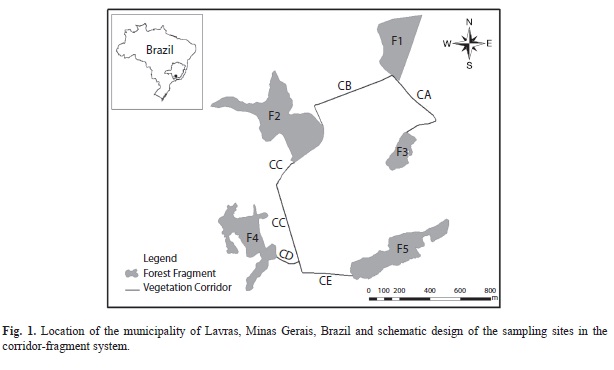
<body><![CDATA[ style="font-style: italic;">et&nbsp; al</span>. 2007). The     local vegetation is defined as being a disjointed portion of Cerrado     biome, inserted into the semideciduous, seasonal Atlantic forest region     of Southeastern Brazil (Oliveira-Filho <span      style="font-style: italic;">et al</span>. 1994), and the areas     sampled are comprised of secondary forests at different regeneration     stages. The small mammals were sampled in five forest fragments (F1,     F2, F3, F4 and F5) and&nbsp; five&nbsp; vegetation corridors&nbsp;     (CA,&nbsp; CB,&nbsp; CC, CD and CE) connecting them (<a      href="/img/revistas/rbt/v60n3/a31i1.jpg">Fig. 1</a>). The     ]]></body>
<body><![CDATA[forest fragments size was F1=7.2ha, F2=11.8ha, F3=1.03ha, F4=7.4ha and     F5=7.8ha. According to Castro (2004) the origin of the vegetation     corridors in Southern Minas Gerais can be connected to two different     factors: One of them would be the linear strips of remnant     vegetation&nbsp; left&nbsp; after&nbsp; clearcut&nbsp; in&nbsp;     the&nbsp; forests to create boundaries between rural properties     (also&nbsp; known&nbsp; as&nbsp; fencerows&nbsp; or&nbsp; headgerows).     The other factor would be the natural trees colonization of ditches,     excavations built&nbsp; by slaves in the late 19th&nbsp;&nbsp; Century     to divide rural properties. The vegetation corridor studied has 4m     ]]></body>
<body><![CDATA[width and ca. 1.5m depth and length was CA=568m, CB=667m, CC=789m,     CD=170m and CE=333m.</span></font><br style="font-family: verdana;">     <font size="2"><span style="font-family: verdana;"></span></font><br      style="font-family: verdana;">     <font size="2"><span style="font-family: verdana;"><span      style="font-weight: bold;">Sampling:</span> In each fragment, two     transects of&nbsp; 100m&nbsp; were&nbsp; established,&nbsp; 50m&nbsp;     apart,&nbsp; with one capture station placed along each transect at 20m     spacing. Two traps were set in each capture&nbsp; station:&nbsp;     one&nbsp; on&nbsp; the&nbsp; ground&nbsp; and&nbsp; one in the     ]]></body>
<body><![CDATA[understory, fastened in tree branches (between 1-2m height). In each     corridor, one transect of 100m was established, and traps were&nbsp;     distributed&nbsp; as&nbsp; with&nbsp; the&nbsp; fragments.&nbsp; On the     ground of each transect two Tomahawk traps     (45.0&times;16.0&times;16.0cm), two Sherman small traps&nbsp;     (25.0&times;&nbsp; 9.0&times;8.0cm),&nbsp; and&nbsp; two&nbsp; Sherman     big traps (43.0&times;12.5&times;14.5cm), were placed alternately. For     the understory portion, only Sherman&nbsp; small&nbsp; traps&nbsp;     were&nbsp; used. Traps&nbsp; were baited with banana, commercial     codfish oil, peanut butter and corn flour that were replaced every two     ]]></body>
<body><![CDATA[days. The traps were placed at dusk and checked the following morning     for five consecutive&nbsp; nights&nbsp; per&nbsp; month,&nbsp;     during&nbsp; April 2007-March&nbsp; 2008.&nbsp; In&nbsp; the&nbsp;     first&nbsp; two&nbsp; months, the corridors and fragments were sampled     together, but over the 10 subsequent months, the&nbsp; sites&nbsp;     were&nbsp; sampled&nbsp; alternately,&nbsp; with&nbsp; a total of seven     sampling months in each site. The capture-mark-recapture method was     used, and the animals captured were marked with numbered ear tags     (National Band &amp; Tag Co., Newport, KY, USA) and then released at     the same point of capture. The marsupials were identified&nbsp;     ]]></body>
<body><![CDATA[according&nbsp; to&nbsp; Rossi&nbsp; <span style="font-style: italic;">et&nbsp;     al</span>.&nbsp; (2006) and the     rodents according to Oliveira &amp; Bonvicino (2006), except     <span style="font-style: italic;">Cerradomys subflavus</span> and <span      style="font-style: italic;">Calomys cerqueirai</span>, for which the     classification proposed by Weksler <span style="font-style: italic;">et     al</span>. (2006) and Bonvicino <span style="font-style: italic;">et al</span>.     (2010)     was used, respectively. Some specimens of all species were collected     and hosted to the collection of the Laboratory of Ecology and     ]]></body>
<body><![CDATA[Conservation of Mammals of the Universidade Federal de Lavras.</span></font><br      style="font-family: verdana;">     <br style="font-family: verdana;">     <font size="2"><span style="font-family: verdana;">To compare the     richness of corridor     and fragment sites, rarefaction curves were constructed using     EstimateS 8.0 software (Colwell 2008). To evaluate abundance, only the     first capture of each individual was considered. To verify if there     were differences between the total&nbsp; abundance&nbsp; of&nbsp;     fragments&nbsp; and&nbsp; corridors, and between the abundance of each     ]]></body>
<body><![CDATA[species in these&nbsp; two&nbsp; environments,&nbsp; the&nbsp;     Student&#8217;s&nbsp; t-test was performed using STATISTICA 6.0 software     (StatSoft 2001) with a significance level of 0.05. The extrapolation of     group patterns of the multidimensional scaling (MDS) ordination was     used for analyze community composition and abundance in the fragments     and corridors, and similarity matrices of communities were     constructed&nbsp; using&nbsp; the&nbsp; Bray-Curtis&nbsp; similarity     index. Additionally, we used one way analysis of similarities (ANOSIM)     to test for the significant differences in composition and abundance     of small-mammal communities between corridor and fragment sites. Both     ]]></body>
<body><![CDATA[analyses were performed using PRIMER v-5 software (Clarke &amp; Gorley     2001).</span></font><br style="font-family: verdana;">     <br style="font-family: verdana;">     <font style="font-weight: bold;" size="3"><span      style="font-family: verdana;">Results</span></font><br      style="font-family: verdana;">     <br style="font-family: verdana;">     <font size="2"><span style="font-family: verdana;">A total sampling     effort of 6 300     trapnights resulted in 656 captures of 249 individuals,     ]]></body>
<body><![CDATA[corresponding&nbsp; to&nbsp; a&nbsp; capture&nbsp; success&nbsp;     rate&nbsp; of 10.4%.&nbsp; Overall,&nbsp; 11&nbsp; small&nbsp;     mammal&nbsp; species were recorded: <span style="font-style: italic;">Akodon     montensis</span>, <span style="font-style: italic;">Calomys     cerqueirai, Cerradomys subflavus, Necromys lasiurus, Nectomys     squamipes, Oligoryzomys nigripes, Rhipidomys</span> sp., <span      style="font-style: italic;">Didelphis albiventris, D. aurita,     Gracilinanus microtarsus and Marmosops incanus</span>.</span></font><br      style="font-family: verdana;">     <br style="font-family: verdana;">     ]]></body>
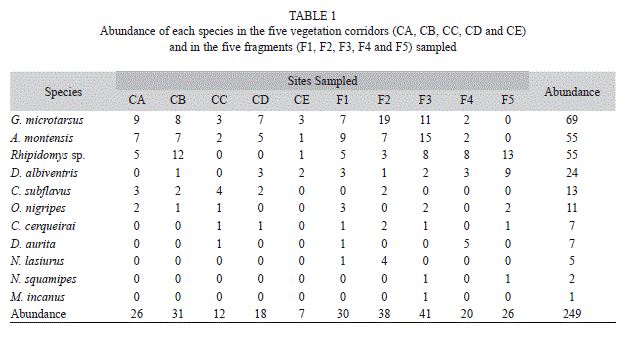
<body><![CDATA[<font size="2"><span style="font-family: verdana;">The rarefaction     curves (<a href="/img/revistas/rbt/v60n3/a31t1.gif">Fig. 2</a>)     produced from the sampling effort of 70 individuals showed that     fragments have higher species richness, with around 30% more species     sampled than in vegetation corridors. Out of the total number of     captures, 59% were rodents and 41% were marsupials, with rodents being     more abundant both in corridors (61%) and in fragments (59%). The     most abundant species were <span style="font-style: italic;">G.     microtarsus</span> (69 individuals), <span style="font-style: italic;">A.     montensis</span> (55) and <span style="font-style: italic;">Rhipidomys</span>     ]]></body>
<body><![CDATA[sp. (55), while the least abundant were     N. lasiurus (5), <span style="font-style: italic;">N. squamipes</span>     (2) and <span style="font-style: italic;">M. incanus</span> (1) (<a      href="/img/revistas/rbt/v60n3/a31t1.gif">Table     1</a>).</span></font>    <br>     <font size="2"><span style="font-family: verdana;"></span></font><br      style="font-family: verdana;">     <font size="2"><span style="font-family: verdana;"></span></font><font      size="2"><span style="font-family: verdana;">Considering     ]]></body>
<body><![CDATA[each     type of     environment, the abundance of small mammals in corridors was </span></font><font      size="2"><span style="font-family: verdana;">4.48     (SD=&plusmn;2.34) and in     fragments was 3.69 (SD=&plusmn;1.02), but the difference was not     significant (t=0.69, p=0.50). When comparing mean abundance per     species in each environment, only <span style="font-style: italic;">C.     subflavus</span> showed a significant     difference (t=-2.89, p=0.02), being more abundant in corridor     ]]></body>
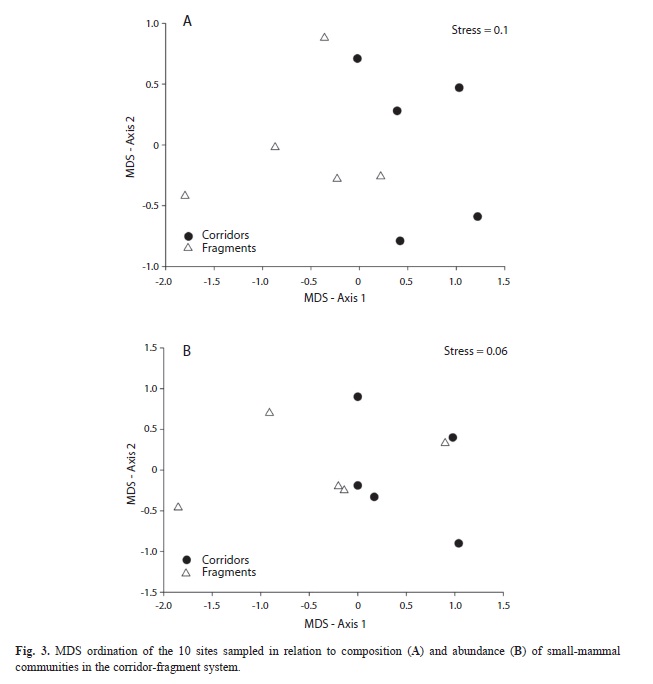
<body><![CDATA[environments than in fragments. The group pattern ordination analysis     (MDS) suggested a difference in the composition of smallmammal     communities (presence and absence) from corridor to fragment, with two     spatially distinct groups noted (<a      href="/img/revistas/rbt/v60n3/a31i3.jpg">Fig. 3A</a>). While for the     abundance, the     MDS did not detect any difference between the small mammal     communities in these environments (<a      href="/img/revistas/rbt/v60n3/a31i3.jpg">Fig. 3B</a>).</span></font><br      style="font-family: verdana;">     ]]></body>
<body><![CDATA[<font size="2"><span style="font-family: verdana;"></span></font><br      style="font-family: verdana;">     <font size="2"><span style="font-family: verdana;">Patterns&nbsp;     depicted&nbsp;     by&nbsp; the&nbsp; MDS&nbsp; analysis for&nbsp; the&nbsp;     small-mammal&nbsp; species&nbsp; in&nbsp; the&nbsp; corridor-fragment     system were reinforced by the ANOSIM&nbsp; analysis,&nbsp; with&nbsp;     corridors&nbsp; differing from fragments in terms of species     composition (ANOSIM, Global R=0.27, p=0.03) but not in terms of     abundance     ]]></body>
<body><![CDATA[(ANOSIM, Global R=0.02, p=0.43).</span></font><br      style="font-family: verdana;">     <br style="font-family: verdana;">     <font style="font-weight: bold;" size="3"><span      style="font-family: verdana;">Discussion</span></font><br      style="font-family: verdana;">     <br style="font-family: verdana;">     <font size="2"><span style="font-family: verdana;">These results     demonstrate that     smallmammal communities present in the corridors and fragments differ     ]]></body>
<body><![CDATA[in species richness and composition but are similar with respect to     abundance. This difference could be related to the presence of three     species (<span style="font-style: italic;">N. squamipes</span>, <span      style="font-style: italic;">N. lasiurus</span> and <span      style="font-style: italic;">M. incanus</span>) exclusive to fragments.     <span style="font-style: italic;">Nectomys squamipes</span> was     detected only in two of the fragments (F3     and F5) that have areas boasting watercourses and permanently flooded     soil. This species has semiaquatic habits (Bonvicino <span      style="font-style: italic;">et al</span>. 2008);     ]]></body>
<body><![CDATA[hence its presence&nbsp; was&nbsp; restricted&nbsp; to&nbsp;     these&nbsp; two&nbsp; fragments. The occurrence of <span      style="font-style: italic;">N. lasiurus</span> was     restricted to&nbsp; another&nbsp; two&nbsp; fragments&nbsp; (F1&nbsp;     and&nbsp; F2),&nbsp; but both fragments showed low abundance. This     species appears in open and forested Cerrado formations and in the     transitional Cerrado- Atlantic forest ecotone (Bonvicino <span      style="font-style: italic;">et al</span>. 2008),     it being the dominant species in cerrado and <span      style="font-style: italic;">campo sujo</span> habitats, but     ]]></body>
<body><![CDATA[not in riparian forests (Alho 1981). According to Castro (2004), these     fragments (F1 and F2) have floristic characteristics common to     Cerrado areas which explains the presence of <span      style="font-style: italic;">N. lasiurus</span>. The other     exclusive species was <span style="font-style: italic;">M. incanus</span>,     recorded only once in one of the     fragments (F3). Considering our data during a year of study, the     presence of <span style="font-style: italic;">M. incanus</span> may be     a casual recorded of as individual. Its     occasional capture is probably related to an isolated event of     ]]></body>
<body><![CDATA[movements, since typically this species moves across open areas     (Passamani &amp; Fernandez 2011b), occupying portions of agroforest     crops     (Fonseca 1997, Passamani &amp; Ribeiro 2009).</span></font><br      style="font-family: verdana;">     <br style="font-family: verdana;">     <font size="2"><span style="font-family: verdana;">In the     corridor-fragment system,     only <span style="font-style: italic;">C. subflavus</span> was more     frequent and significantly more abundant in     ]]></body>
<body><![CDATA[the corridors than in fragment sites, a finding that is similar to     verified by Rocha <span style="font-style: italic;">et al</span>.     (2011) regarding corridors connecting     fragments near this area. In addition, the studied corridors harbour a     considerable number of species in common with the fragments and     similarity in abundance. The presence of small-mammal species in     corridor and fragment sites could be related to the fact that corridors     effectively play the role of habitats for small-mammal species rather     than being mere linking&nbsp; environments for their movement.</span></font><br      style="font-family: verdana;">     ]]></body>
<body><![CDATA[<br style="font-family: verdana;">     <font size="2"><span style="font-family: verdana;">Several studies in     temperate     countries have&nbsp; pointed&nbsp; to&nbsp; the&nbsp;     effectiveness&nbsp; of linear vegetation corridors in preserving small     mammals&#8217; fauna. Wegner &amp; Merriam (1979) monitored the movements     of small mammals in forest fragments and fencerows in Canada and     detected movements of three small-mammal species, most of which     occurred between fragments and fencerows, and rarely in cultivated     fields. Andreassen <span style="font-style: italic;">et al</span>.     ]]></body>
<body><![CDATA[(1998), in studying the wild rodent <span style="font-style: italic;">Microtus     oeconomus</span>, observed that corridor presence increases the chance     of     individuals incorporating more than one habitat patch into their home     range. Bolger <span style="font-style: italic;">et al</span>. (2001),     in evaluating the use of remnant shrub     strips and straight-line revegetated areas connecting forest     remainder in California (USA), found no significant difference in the     richness of small-mammal species between corridors and forest     remainders. Haddad &amp; Tewksbury&nbsp; (2006) evaluated the effects     ]]></body>
<body><![CDATA[of vegetation corridors on the maintenance of local and regional     small mammal biodiversity and verified that the presence of corridors     is much important to the environmental management.</span></font><br      style="font-family: verdana;">     <br style="font-family: verdana;">     <font size="2"><span style="font-family: verdana;">It should be noted     that, in terms     of structure, hedgerows and fencerows in temperate countries resemble     the vegetation corridors evaluated in this study, yet they strongly     differ in their floristic composition, comprised typically of a     ]]></body>
<body><![CDATA[single or a few arboreal species. The corridors of Southern Minas     Gerais boast a robust forest structure and high floristic diversity     (Castro 2004), which may positively influence food and shelter     availability for small-mammal. These facts point to the important     role of corridors in attenuating the negative effects of     fragmentation on small-mammal fauna on a local and/or regional scale.     In fact, Rocha <span style="font-style: italic;">et al</span>. (2011)     has shown the high conservation value of     this structure in another fragmented landscape of Southern Minas     Gerais.</span></font><br style="font-family: verdana;">     ]]></body>
<body><![CDATA[<br style="font-family: verdana;">     <font size="2"><span style="font-family: verdana;">In conclusion,     corridors seem to be     effective in&nbsp; the&nbsp; exchange&nbsp; of&nbsp;     individuals&nbsp; between forest fragments, promoting similarity in     species composition within both patches and corridors.&nbsp;     This&nbsp; can&nbsp; be&nbsp; demonstrated&nbsp; simply&nbsp; by the     fact that more than 70% of species present in fragments also appear in     corridors. Owing to its effective structural and functional     connectivity, the corridor-fragment system studied in this work should     ]]></body>
<body><![CDATA[be     seen as a potentially usable environment for local species, whether     allowing their movement from fragments to corridors or from corridors     to fragments, thus helping ensure the maintenance of species in such a     landscape.</span></font><br style="font-family: verdana;">     <br style="font-family: verdana;">     <br style="font-family: verdana;">     <font style="font-weight: bold;" size="3"><span      style="font-family: verdana;">Acknowledgments</span></font><br      style="font-family: verdana;">     ]]></body>
<body><![CDATA[<br style="font-family: verdana;">     <font size="2"><span style="font-family: verdana;">We would like to     thank the     Coordena&ccedil;&atilde;o de Aperfei&ccedil;oamento de Pessoal de     Ensino Superior (CAPES) for its support; the Brazilian Institute of     Environment and Renewable Natural Resources (IBAMA) for the license to     collect specimens; Toby A. Gardner for helping to analyze data; and     everyone who helped us during the fieldwork, especially Carlos H,     Jacinto, Marina S. Pereira, and Adriana L. Gouveia. This study was     funded by the Funda&ccedil;&atilde;o de Amparo &agrave; Pesquisa do     ]]></body>
<body><![CDATA[Estado de Minas Gerais (FAPEMIG).</span></font><br      style="font-family: verdana;">     </div>     <hr      style="width: 100%; height: 2px; margin-left: 0px; margin-right: 0px;">     <!-- ref --><div style="text-align: justify;"><br style="font-family: verdana;"> <font style="font-weight: bold;" size="3"><span  style="font-family: verdana;">References</span></font><br  style="font-family: verdana;"> <br style="font-family: verdana;"> <font size="2"><span style="font-family: verdana;">Aars, J. &amp; R.A. Ims. 1999. The effect of habitat corridors on rates of transfer and&nbsp; interbreeding between vole demes. Ecology 80: 1648-1655.    &nbsp;&nbsp;&nbsp;&nbsp;&nbsp;&nbsp;&nbsp;&nbsp;[&#160;<a href="javascript:void(0);" onclick="javascript: window.open('/scielo.php?script=sci_nlinks&ref=1473616&pid=S0034-7744201200030003100001&lng=','','width=640,height=500,resizable=yes,scrollbars=1,menubar=yes,');">Links</a>&#160;]<!-- end-ref --><!-- ref --></span></font><br  style="font-family: verdana;"> <br style="font-family: verdana;"> <font size="2"><span style="font-family: verdana;">Alho, C.J.R. 1981. Small mammal populations of Brazilian Cerrado: the dependence of abundance and diversity on habitat complexity. Rev. Bras. Biol. 41: 223-230.    &nbsp;&nbsp;&nbsp;&nbsp;&nbsp;&nbsp;&nbsp;&nbsp;[&#160;<a href="javascript:void(0);" onclick="javascript: window.open('/scielo.php?script=sci_nlinks&ref=1473617&pid=S0034-7744201200030003100002&lng=','','width=640,height=500,resizable=yes,scrollbars=1,menubar=yes,');">Links</a>&#160;]<!-- end-ref --></span></font>    <!-- ref --><br> <font size="2"><span style="font-family: verdana;"></span></font><br  style="font-family: verdana;"> <font size="2"><span style="font-family: verdana;"></span></font><font  size="2"><span style="font-family: verdana;">Andreassen, H.P., K. Hertzberg &amp; R.A. Ims. 1998. Spaceuse responses to habitat fragmentation and connectivity in the&nbsp; root vole <span style="font-style: italic;">Microtus oeconomus</span>. Ecology 79: 1223-1235.    &nbsp;&nbsp;&nbsp;&nbsp;&nbsp;&nbsp;&nbsp;&nbsp;[&#160;<a href="javascript:void(0);" onclick="javascript: window.open('/scielo.php?script=sci_nlinks&ref=1473619&pid=S0034-7744201200030003100003&lng=','','width=640,height=500,resizable=yes,scrollbars=1,menubar=yes,');">Links</a>&#160;]<!-- end-ref --><!-- ref --></span></font><br style="font-family: verdana;"> <br style="font-family: verdana;"> <font size="2"><span style="font-family: verdana;">Bennett, A.F. 1990. Habitat corridors and the conservation of small mammals in a fragment forest environment. Landscape Ecol. 4: 109-122.    &nbsp;&nbsp;&nbsp;&nbsp;&nbsp;&nbsp;&nbsp;&nbsp;[&#160;<a href="javascript:void(0);" onclick="javascript: window.open('/scielo.php?script=sci_nlinks&ref=1473620&pid=S0034-7744201200030003100004&lng=','','width=640,height=500,resizable=yes,scrollbars=1,menubar=yes,');">Links</a>&#160;]<!-- end-ref --><!-- ref --></span></font><br  style="font-family: verdana;"> <br style="font-family: verdana;"> <font size="2"><span style="font-family: verdana;">Bennett, A.F., J.Q. Radford &amp; A. Haslem. 2006. Properties of land mosaics: implications for nature conservation in&nbsp; agricultural&nbsp; environments.&nbsp; Biol.&nbsp; Conserv.&nbsp; 133: 250-264.    &nbsp;&nbsp;&nbsp;&nbsp;&nbsp;&nbsp;&nbsp;&nbsp;[&#160;<a href="javascript:void(0);" onclick="javascript: window.open('/scielo.php?script=sci_nlinks&ref=1473621&pid=S0034-7744201200030003100005&lng=','','width=640,height=500,resizable=yes,scrollbars=1,menubar=yes,');">Links</a>&#160;]<!-- end-ref --><!-- ref --></span></font><br  style="font-family: verdana;"> <br style="font-family: verdana;"> <font size="2"><span style="font-family: verdana;">Bolger, D.T., T.A. Scott &amp; J.T. Rotenberry. 2001. Use of corridor-like landscape structures by birds and small mammal species. Biol. Conserv. 102: 213-224.    &nbsp;&nbsp;&nbsp;&nbsp;&nbsp;&nbsp;&nbsp;&nbsp;[&#160;<a href="javascript:void(0);" onclick="javascript: window.open('/scielo.php?script=sci_nlinks&ref=1473622&pid=S0034-7744201200030003100006&lng=','','width=640,height=500,resizable=yes,scrollbars=1,menubar=yes,');">Links</a>&#160;]<!-- end-ref --><!-- ref --></span></font><br  style="font-family: verdana;"> <br style="font-family: verdana;"> <font size="2"><span style="font-family: verdana;">Bonvicino,&nbsp; C.R., J.A. Oliveira &amp; P.S.&nbsp; D&#8217;Andrea. 2008. Guia dos roedores do Brasil, com chaves para g&ecirc;neros baseadas em caracteres externos. Rio de Janeiro: Centro&nbsp; Pan-Americano&nbsp; de&nbsp; Febre&nbsp; Aftosa&nbsp; -&nbsp; OPAS/ OMS, R&iacute;o de Janeiro, Brasil.    &nbsp;&nbsp;&nbsp;&nbsp;&nbsp;&nbsp;&nbsp;&nbsp;[&#160;<a href="javascript:void(0);" onclick="javascript: window.open('/scielo.php?script=sci_nlinks&ref=1473623&pid=S0034-7744201200030003100007&lng=','','width=640,height=500,resizable=yes,scrollbars=1,menubar=yes,');">Links</a>&#160;]<!-- end-ref --><!-- ref --></span></font><br  style="font-family: verdana;"> <br style="font-family: verdana;"> <font size="2"><span style="font-family: verdana;">Bonvicino, C.R., J.A. Oliveira &amp; R. Gentile. 2010. A new species of <span  style="font-style: italic;">Calomys</span> (Rodentia: Sigmodontinae) from Eastern Brazil. Zootaxa 2336: 19-25.    &nbsp;&nbsp;&nbsp;&nbsp;&nbsp;&nbsp;&nbsp;&nbsp;[&#160;<a href="javascript:void(0);" onclick="javascript: window.open('/scielo.php?script=sci_nlinks&ref=1473624&pid=S0034-7744201200030003100008&lng=','','width=640,height=500,resizable=yes,scrollbars=1,menubar=yes,');">Links</a>&#160;]<!-- end-ref --><!-- ref --></span></font><br  style="font-family: verdana;"> <br style="font-family: verdana;"> <font size="2"><span style="font-family: verdana;">Brooks, T.M., C.G. Mittermeier, R.A. Mittermeier, G.A.B.</span></font> <font size="2"><span  style="font-family: verdana;">Fonseca,&nbsp; A.B. Rylands, W.R. Konstant, P.&nbsp; Flick, J. Pilgram, S. Olfield, G. Magin&nbsp; &amp;&nbsp; C. Hilton-Taylor. 2002.&nbsp; Habitat loss and extinction in the&nbsp; hotspots of biodiversity. Conserv. Biol. 16: 909-923.    &nbsp;&nbsp;&nbsp;&nbsp;&nbsp;&nbsp;&nbsp;&nbsp;[&#160;<a href="javascript:void(0);" onclick="javascript: window.open('/scielo.php?script=sci_nlinks&ref=1473625&pid=S0034-7744201200030003100009&lng=','','width=640,height=500,resizable=yes,scrollbars=1,menubar=yes,');">Links</a>&#160;]<!-- end-ref --><!-- ref --></span></font><br  style="font-family: verdana;"> <br style="font-family: verdana;"> <font size="2"><span style="font-family: verdana;">Castro,&nbsp; G.C. 2004. An&aacute;lise da estrutura,&nbsp; diversidade flor&iacute;stica e varia&ccedil;&otilde;es espaciais do componente arb&oacute;reo de&nbsp; corredores de vegeta&ccedil;&atilde;o na regi&atilde;o do&nbsp; Alto Rio Grande, MG. Master Thesis, Universidade Federal de Lavras, Lavras, Minas Gerais, Brasil.    &nbsp;&nbsp;&nbsp;&nbsp;&nbsp;&nbsp;&nbsp;&nbsp;[&#160;<a href="javascript:void(0);" onclick="javascript: window.open('/scielo.php?script=sci_nlinks&ref=1473626&pid=S0034-7744201200030003100010&lng=','','width=640,height=500,resizable=yes,scrollbars=1,menubar=yes,');">Links</a>&#160;]<!-- end-ref --><!-- ref --></span></font><br style="font-family: verdana;"> <br style="font-family: verdana;"> <font size="2"><span style="font-family: verdana;">Ceballos, G. &amp; P.R. Ehrlich. 2006. Global mammal distributions, biodiversity&nbsp; hotspots, and conservation. P. Natl. Acad. Sci. U.S.A. 103: 19374-19379.    &nbsp;&nbsp;&nbsp;&nbsp;&nbsp;&nbsp;&nbsp;&nbsp;[&#160;<a href="javascript:void(0);" onclick="javascript: window.open('/scielo.php?script=sci_nlinks&ref=1473627&pid=S0034-7744201200030003100011&lng=','','width=640,height=500,resizable=yes,scrollbars=1,menubar=yes,');">Links</a>&#160;]<!-- end-ref --><!-- ref --></span></font><br  style="font-family: verdana;"> <br style="font-family: verdana;"> <font size="2"><span style="font-family: verdana;">Clarke,&nbsp; K.R. &amp; R.N. Gorley. 2001. PRIMER&nbsp; v-5: User Manual/Tutorial. Primer-E, Plymouth, England.    &nbsp;&nbsp;&nbsp;&nbsp;&nbsp;&nbsp;&nbsp;&nbsp;[&#160;<a href="javascript:void(0);" onclick="javascript: window.open('/scielo.php?script=sci_nlinks&ref=1473628&pid=S0034-7744201200030003100012&lng=','','width=640,height=500,resizable=yes,scrollbars=1,menubar=yes,');">Links</a>&#160;]<!-- end-ref --><!-- ref --></span></font><br style="font-family: verdana;"> <br style="font-family: verdana;"> <font size="2"><span style="font-family: verdana;">Colwell,&nbsp; R.K. 2008. EstimateS: Statistical&nbsp; Estimation of Species Richness and Shared Species from samples. version 8.0. University of Connecticut, Connecticut, USA. (also available online: http://viceroy.eeb.uconn. edu/estimates).    &nbsp;&nbsp;&nbsp;&nbsp;&nbsp;&nbsp;&nbsp;&nbsp;[&#160;<a href="javascript:void(0);" onclick="javascript: window.open('/scielo.php?script=sci_nlinks&ref=1473629&pid=S0034-7744201200030003100013&lng=','','width=640,height=500,resizable=yes,scrollbars=1,menubar=yes,');">Links</a>&#160;]<!-- end-ref --><!-- ref --></span></font><br style="font-family: verdana;"> <br style="font-family: verdana;"> <font size="2"><span style="font-family: verdana;">Costa, P.L., Y.L.R. Leite, S.L. Mendes &amp; D.A. Ditchfield. 2005. Conserva&ccedil;&atilde;o de mam&iacute;feros no Brasil. Megadiversidade 1: 103-112.    &nbsp;&nbsp;&nbsp;&nbsp;&nbsp;&nbsp;&nbsp;&nbsp;[&#160;<a href="javascript:void(0);" onclick="javascript: window.open('/scielo.php?script=sci_nlinks&ref=1473630&pid=S0034-7744201200030003100014&lng=','','width=640,height=500,resizable=yes,scrollbars=1,menubar=yes,');">Links</a>&#160;]<!-- end-ref --><!-- ref --></span></font><br  style="font-family: verdana;"> <br style="font-family: verdana;"> <font size="2"><span style="font-family: verdana;">Cuar&oacute;n, A.D. 2000. A global perspective on&nbsp; habitat distubance and tropical&nbsp; rainforest mammals. Conserv. Biol. 14: 1574-1579.    &nbsp;&nbsp;&nbsp;&nbsp;&nbsp;&nbsp;&nbsp;&nbsp;[&#160;<a href="javascript:void(0);" onclick="javascript: window.open('/scielo.php?script=sci_nlinks&ref=1473631&pid=S0034-7744201200030003100015&lng=','','width=640,height=500,resizable=yes,scrollbars=1,menubar=yes,');">Links</a>&#160;]<!-- end-ref --><!-- ref --></span></font><br  style="font-family: verdana;"> <br style="font-family: verdana;"> <font size="2"><span style="font-family: verdana;">Dantas, A.A.A., LG. Carvalho &amp; E. Ferreira. 2007. Classifica&ccedil;&atilde;o&nbsp; e&nbsp; tend&ecirc;ncias&nbsp; clim&aacute;ticas&nbsp; em&nbsp; Lavras,&nbsp; MG. Cienc. Agrotec. 31: 1862-1866.    &nbsp;&nbsp;&nbsp;&nbsp;&nbsp;&nbsp;&nbsp;&nbsp;[&#160;<a href="javascript:void(0);" onclick="javascript: window.open('/scielo.php?script=sci_nlinks&ref=1473632&pid=S0034-7744201200030003100016&lng=','','width=640,height=500,resizable=yes,scrollbars=1,menubar=yes,');">Links</a>&#160;]<!-- end-ref --><!-- ref --></span></font><br  style="font-family: verdana;"> <br style="font-family: verdana;"> <font size="2"><span style="font-family: verdana;">Downes, S.J., K.A. Handasyde &amp; M.A. Elgar. 1997. The use of corridors by mammals in fragmented Australian Eucalypt Forests. Conserv. Biol. 11: 718-726.    &nbsp;&nbsp;&nbsp;&nbsp;&nbsp;&nbsp;&nbsp;&nbsp;[&#160;<a href="javascript:void(0);" onclick="javascript: window.open('/scielo.php?script=sci_nlinks&ref=1473633&pid=S0034-7744201200030003100017&lng=','','width=640,height=500,resizable=yes,scrollbars=1,menubar=yes,');">Links</a>&#160;]<!-- end-ref --><!-- ref --></span></font><br  style="font-family: verdana;"> <br style="font-family: verdana;"> <font size="2"><span style="font-family: verdana;">Fahrig,&nbsp; L. 2002. Effect of habitat&nbsp; fragmentation on the extinction&nbsp; threshold:&nbsp; a&nbsp; synthesis.&nbsp; Ecol.&nbsp; Appl.&nbsp; 12: 346-353.    &nbsp;&nbsp;&nbsp;&nbsp;&nbsp;&nbsp;&nbsp;&nbsp;[&#160;<a href="javascript:void(0);" onclick="javascript: window.open('/scielo.php?script=sci_nlinks&ref=1473634&pid=S0034-7744201200030003100018&lng=','','width=640,height=500,resizable=yes,scrollbars=1,menubar=yes,');">Links</a>&#160;]<!-- end-ref --><!-- ref --></span></font><br  style="font-family: verdana;"> <br style="font-family: verdana;"> <font size="2"><span style="font-family: verdana;">Fahrig,&nbsp; L. 2003. Effects of habitat&nbsp; fragmentation on biodiversity. Annu. Rev. Ecol. Evol. Syst. 34: 487-515.    &nbsp;&nbsp;&nbsp;&nbsp;&nbsp;&nbsp;&nbsp;&nbsp;[&#160;<a href="javascript:void(0);" onclick="javascript: window.open('/scielo.php?script=sci_nlinks&ref=1473635&pid=S0034-7744201200030003100019&lng=','','width=640,height=500,resizable=yes,scrollbars=1,menubar=yes,');">Links</a>&#160;]<!-- end-ref --><!-- ref --></span></font><br style="font-family: verdana;"> <br style="font-family: verdana;"> <font size="2"><span style="font-family: verdana;">Fahrig, L. &amp; G. Merriam. 1994. Conservation of fragmented populations. Conserv. Biol. 8: 50-59.    &nbsp;&nbsp;&nbsp;&nbsp;&nbsp;&nbsp;&nbsp;&nbsp;[&#160;<a href="javascript:void(0);" onclick="javascript: window.open('/scielo.php?script=sci_nlinks&ref=1473636&pid=S0034-7744201200030003100020&lng=','','width=640,height=500,resizable=yes,scrollbars=1,menubar=yes,');">Links</a>&#160;]<!-- end-ref --><!-- ref --></span></font><br  style="font-family: verdana;"> <br style="font-family: verdana;"> <font size="2"><span style="font-family: verdana;">Fischer, J. &amp; D.B. Lindenmayer. 2007. Landscape modification and habitat fragmentation: a synthesis. Global Ecol. Biogeogr. 16: 265-280.    &nbsp;&nbsp;&nbsp;&nbsp;&nbsp;&nbsp;&nbsp;&nbsp;[&#160;<a href="javascript:void(0);" onclick="javascript: window.open('/scielo.php?script=sci_nlinks&ref=1473637&pid=S0034-7744201200030003100021&lng=','','width=640,height=500,resizable=yes,scrollbars=1,menubar=yes,');">Links</a>&#160;]<!-- end-ref --><!-- ref --></span></font><br  style="font-family: verdana;"> <br style="font-family: verdana;"> <font size="2"><span style="font-family: verdana;">Fonseca, M.T. 1997. A estrutura da comunidade de pequenos mam&iacute;feros em um fragmento de Mata Atl&acirc;ntica e monocultura de Eucalipto: a import&acirc;ncia da matriz de habitat. Master Thesis,&nbsp; Universidade Federal de Minas Gerais, Belo Horizonte, Minas Gerais, Brasil.    &nbsp;&nbsp;&nbsp;&nbsp;&nbsp;&nbsp;&nbsp;&nbsp;[&#160;<a href="javascript:void(0);" onclick="javascript: window.open('/scielo.php?script=sci_nlinks&ref=1473638&pid=S0034-7744201200030003100022&lng=','','width=640,height=500,resizable=yes,scrollbars=1,menubar=yes,');">Links</a>&#160;]<!-- end-ref --><!-- ref --></span></font><br  style="font-family: verdana;"> <br style="font-family: verdana;"> <font size="2"><span style="font-family: verdana;">Gascon, C., T.E. Lovejoy, R.O. Bierregaard, J.R. Malcolm, P.C. Stouffer, H.L.&nbsp; vasconcelos, W.F. Laurance, B. Zimmerman, M. Tocher &amp; S. Borges.&nbsp; 1999. Matrix habitat and species&nbsp; richness&nbsp; in tropical forest remnants. Biol. Conserv. 91: 223-229.    &nbsp;&nbsp;&nbsp;&nbsp;&nbsp;&nbsp;&nbsp;&nbsp;[&#160;<a href="javascript:void(0);" onclick="javascript: window.open('/scielo.php?script=sci_nlinks&ref=1473639&pid=S0034-7744201200030003100023&lng=','','width=640,height=500,resizable=yes,scrollbars=1,menubar=yes,');">Links</a>&#160;]<!-- end-ref --><!-- ref --></span></font><br  style="font-family: verdana;"> <br style="font-family: verdana;"> <font size="2"><span style="font-family: verdana;">Gibbs, J.P. 2001. Demography versus habitat fragmentation as determinants of genetic variation in wild populations. Biol. Conserv. 100: 15-20.    &nbsp;&nbsp;&nbsp;&nbsp;&nbsp;&nbsp;&nbsp;&nbsp;[&#160;<a href="javascript:void(0);" onclick="javascript: window.open('/scielo.php?script=sci_nlinks&ref=1473640&pid=S0034-7744201200030003100024&lng=','','width=640,height=500,resizable=yes,scrollbars=1,menubar=yes,');">Links</a>&#160;]<!-- end-ref --><!-- ref --></span></font><br  style="font-family: verdana;"> <br style="font-family: verdana;"> <font size="2"><span style="font-family: verdana;">Haddad, N.M., D.R. Bowne, A. Cunningham, B.J. Danielson, D.J. Levey, S. Sargent &amp; T. Spira. 2003. Corridor use by diverse taxa. Ecology 84: 609-615.    &nbsp;&nbsp;&nbsp;&nbsp;&nbsp;&nbsp;&nbsp;&nbsp;[&#160;<a href="javascript:void(0);" onclick="javascript: window.open('/scielo.php?script=sci_nlinks&ref=1473641&pid=S0034-7744201200030003100025&lng=','','width=640,height=500,resizable=yes,scrollbars=1,menubar=yes,');">Links</a>&#160;]<!-- end-ref --><!-- ref --></span></font><br  style="font-family: verdana;"> <br style="font-family: verdana;"> <font size="2"><span style="font-family: verdana;">Haddad,&nbsp; N.M. &amp; J.J. Tewksbury. 2006.&nbsp; Impacts&nbsp; of corridors on populations&nbsp; and communities, p. 390-415. <span  style="font-style: italic;">In</span> K.R. Crooks &amp; M. Sanjayan (eds.). Connectivity Conservation.&nbsp; Cambridge&nbsp;&nbsp; University,&nbsp; Cambridge, England.    &nbsp;&nbsp;&nbsp;&nbsp;&nbsp;&nbsp;&nbsp;&nbsp;[&#160;<a href="javascript:void(0);" onclick="javascript: window.open('/scielo.php?script=sci_nlinks&ref=1473642&pid=S0034-7744201200030003100026&lng=','','width=640,height=500,resizable=yes,scrollbars=1,menubar=yes,');">Links</a>&#160;]<!-- end-ref --><!-- ref --></span></font><br  style="font-family: verdana;"> <br style="font-family: verdana;"> <font size="2"><span style="font-family: verdana;">Hobbs,&nbsp; R.J. 1992. The role of corridors in&nbsp; conservation: solution or badwagon? Trends Ecol. Evol. 7: 389-392.    &nbsp;&nbsp;&nbsp;&nbsp;&nbsp;&nbsp;&nbsp;&nbsp;[&#160;<a href="javascript:void(0);" onclick="javascript: window.open('/scielo.php?script=sci_nlinks&ref=1473643&pid=S0034-7744201200030003100027&lng=','','width=640,height=500,resizable=yes,scrollbars=1,menubar=yes,');">Links</a>&#160;]<!-- end-ref --><!-- ref --></span></font><br style="font-family: verdana;"> <br style="font-family: verdana;"> <font size="2"><span style="font-family: verdana;">Knaapen, J.P., M. Scheffer &amp; B. Harms. 1992. Estimating habitat isolation in landscape&nbsp; planning. Landscape Urban Plan. 23: 1-16.    &nbsp;&nbsp;&nbsp;&nbsp;&nbsp;&nbsp;&nbsp;&nbsp;[&#160;<a href="javascript:void(0);" onclick="javascript: window.open('/scielo.php?script=sci_nlinks&ref=1473644&pid=S0034-7744201200030003100028&lng=','','width=640,height=500,resizable=yes,scrollbars=1,menubar=yes,');">Links</a>&#160;]<!-- end-ref --><!-- ref --></span></font><br  style="font-family: verdana;"> <br style="font-family: verdana;"> <font size="2"><span style="font-family: verdana;">Lidicker, W.Z.J. 1999. Responses of mammals&nbsp; to habitat edges: an overview. Landscape Ecol. 14: 333-343.    &nbsp;&nbsp;&nbsp;&nbsp;&nbsp;&nbsp;&nbsp;&nbsp;[&#160;<a href="javascript:void(0);" onclick="javascript: window.open('/scielo.php?script=sci_nlinks&ref=1473645&pid=S0034-7744201200030003100029&lng=','','width=640,height=500,resizable=yes,scrollbars=1,menubar=yes,');">Links</a>&#160;]<!-- end-ref --><!-- ref --></span></font><br style="font-family: verdana;"> <br style="font-family: verdana;"> <font size="2"><span style="font-family: verdana;">Malcolm,&nbsp; J.R. 1994. Edge effects in central&nbsp; Amazonian forest fragments. Ecology 75: 2438-2445.    &nbsp;&nbsp;&nbsp;&nbsp;&nbsp;&nbsp;&nbsp;&nbsp;[&#160;<a href="javascript:void(0);" onclick="javascript: window.open('/scielo.php?script=sci_nlinks&ref=1473646&pid=S0034-7744201200030003100030&lng=','','width=640,height=500,resizable=yes,scrollbars=1,menubar=yes,');">Links</a>&#160;]<!-- end-ref --></span></font>    <!-- ref --><br> <font size="2"><span style="font-family: verdana;"></span></font><br  style="font-family: verdana;"> <font size="2"><span style="font-family: verdana;"></span></font><font  size="2"><span style="font-family: verdana;">Mech, S.G. &amp; J.G. Hallett. 2001. Evaluating the effectiveness of corridors: a genetic approach. Conserv. Biol. </span></font><font size="2"><span  style="font-family: verdana;">15: 467-474.    &nbsp;&nbsp;&nbsp;&nbsp;&nbsp;&nbsp;&nbsp;&nbsp;[&#160;<a href="javascript:void(0);" onclick="javascript: window.open('/scielo.php?script=sci_nlinks&ref=1473648&pid=S0034-7744201200030003100031&lng=','','width=640,height=500,resizable=yes,scrollbars=1,menubar=yes,');">Links</a>&#160;]<!-- end-ref --><!-- ref --></span></font><br  style="font-family: verdana;"> <br style="font-family: verdana;"> <font size="2"><span style="font-family: verdana;">Myers,&nbsp; N.,&nbsp; R.A.&nbsp; Mittermeier,&nbsp; C.G.&nbsp; Mittermeier,&nbsp; G.A.B. Fonseca&nbsp; &amp; J. Kent. 2000. Biodiversity&nbsp; hotspots for conservation priorities. Nature 403: 853-858.    &nbsp;&nbsp;&nbsp;&nbsp;&nbsp;&nbsp;&nbsp;&nbsp;[&#160;<a href="javascript:void(0);" onclick="javascript: window.open('/scielo.php?script=sci_nlinks&ref=1473649&pid=S0034-7744201200030003100032&lng=','','width=640,height=500,resizable=yes,scrollbars=1,menubar=yes,');">Links</a>&#160;]<!-- end-ref --><!-- ref --></span></font><br  style="font-family: verdana;"> <br style="font-family: verdana;"> <font size="2"><span style="font-family: verdana;">Oliveira-Filho,&nbsp; A.T.,&nbsp; E. vilela,&nbsp; M.L.&nbsp; Gavilanes&nbsp; &amp; D.A. Carvalho. 1994. Comparison of the woody flora and soils of six areas of montane&nbsp; semideciduous forest in Southern Minas Gerais, Brazil. Edinb. J. Bot. 51: 355-389.    &nbsp;&nbsp;&nbsp;&nbsp;&nbsp;&nbsp;&nbsp;&nbsp;[&#160;<a href="javascript:void(0);" onclick="javascript: window.open('/scielo.php?script=sci_nlinks&ref=1473650&pid=S0034-7744201200030003100033&lng=','','width=640,height=500,resizable=yes,scrollbars=1,menubar=yes,');">Links</a>&#160;]<!-- end-ref --><!-- ref --></span></font><br style="font-family: verdana;"> <br style="font-family: verdana;"> <font size="2"><span style="font-family: verdana;">Oliveira, J.A. &amp; C.R. Bonvicino. 2006. Ordem Rodentia, p. 347-406. In N.R. Reis, A.L. Peracchi &amp; I.P. Lima (eds.). Mam&iacute;feros do Brasil. UEL, Curitiba, Paran&aacute;, Brasil.    &nbsp;&nbsp;&nbsp;&nbsp;&nbsp;&nbsp;&nbsp;&nbsp;[&#160;<a href="javascript:void(0);" onclick="javascript: window.open('/scielo.php?script=sci_nlinks&ref=1473651&pid=S0034-7744201200030003100034&lng=','','width=640,height=500,resizable=yes,scrollbars=1,menubar=yes,');">Links</a>&#160;]<!-- end-ref --><!-- ref --></span></font><br  style="font-family: verdana;"> <br style="font-family: verdana;"> <font size="2"><span style="font-family: verdana;">Orme,&nbsp; C.D.L., R.G. Davies, M. Burgess, F.&nbsp; Eigenbrod, N.&nbsp; Pickup,&nbsp; v.A.&nbsp; Olson,&nbsp; A.J.&nbsp; Webster,&nbsp; T.S.&nbsp; Ding, P.C.&nbsp; Rasmussen,&nbsp;&nbsp; R.S.&nbsp; Ridgely,&nbsp; A.J.&nbsp; Stattersfield, P.M.&nbsp; Bennett, T.M. Blackburn, K.J. Gaston &amp;&nbsp; I.P.F. Owens. 2005. Global hotspots of species richness are not congruent with endemism or threat. Nature 436: </span></font><font  size="2"><span style="font-family: verdana;">1016-1019.    &nbsp;&nbsp;&nbsp;&nbsp;&nbsp;&nbsp;&nbsp;&nbsp;[&#160;<a href="javascript:void(0);" onclick="javascript: window.open('/scielo.php?script=sci_nlinks&ref=1473652&pid=S0034-7744201200030003100035&lng=','','width=640,height=500,resizable=yes,scrollbars=1,menubar=yes,');">Links</a>&#160;]<!-- end-ref --><!-- ref --></span></font><br  style="font-family: verdana;"> <br style="font-family: verdana;"> <font size="2"><span style="font-family: verdana;">Pardini, R. 2004. Effects of forest fragmentation on small mammals in an Atlantic Forest landscape. Biodivers. Conserv. 13: 2567-2586.    &nbsp;&nbsp;&nbsp;&nbsp;&nbsp;&nbsp;&nbsp;&nbsp;[&#160;<a href="javascript:void(0);" onclick="javascript: window.open('/scielo.php?script=sci_nlinks&ref=1473653&pid=S0034-7744201200030003100036&lng=','','width=640,height=500,resizable=yes,scrollbars=1,menubar=yes,');">Links</a>&#160;]<!-- end-ref --><!-- ref --></span></font><br  style="font-family: verdana;"> <br style="font-family: verdana;"> <font size="2"><span style="font-family: verdana;">Pardini,&nbsp; R., S.M. Souza, R. Braga-Neto &amp;&nbsp; J.P.&nbsp; Metzger. 2005. The role of forest structure, fragment size and corridors in maintaining small&nbsp; mammal abundance and diversity in an&nbsp; Atlantic forest landscape. Biol. Conserv. 124: 253-266.    &nbsp;&nbsp;&nbsp;&nbsp;&nbsp;&nbsp;&nbsp;&nbsp;[&#160;<a href="javascript:void(0);" onclick="javascript: window.open('/scielo.php?script=sci_nlinks&ref=1473654&pid=S0034-7744201200030003100037&lng=','','width=640,height=500,resizable=yes,scrollbars=1,menubar=yes,');">Links</a>&#160;]<!-- end-ref --><!-- ref --></span></font><br  style="font-family: verdana;"> <br style="font-family: verdana;"> <font size="2"><span style="font-family: verdana;">Pardini,&nbsp; R.,&nbsp; D.&nbsp; Faria,&nbsp; G.M.&nbsp; Accacio,&nbsp; R.R.&nbsp;&nbsp; Laps,&nbsp; E. Marianno-Neto,&nbsp; M.L.B.&nbsp; Paciencia,&nbsp; M.&nbsp; Dixo&nbsp; &amp;&nbsp; J. Baumgarten.&nbsp; 2009.&nbsp; The&nbsp; challenge&nbsp; of&nbsp; maintaining biodiversity in the Atlantic forest: a multi-taxa con- servation assessment of specialist and&nbsp;&nbsp; generalist species in an agro-forestrymosaic in southern Bahia. Biol. Conserv. 142: 1178-1190.    &nbsp;&nbsp;&nbsp;&nbsp;&nbsp;&nbsp;&nbsp;&nbsp;[&#160;<a href="javascript:void(0);" onclick="javascript: window.open('/scielo.php?script=sci_nlinks&ref=1473655&pid=S0034-7744201200030003100038&lng=','','width=640,height=500,resizable=yes,scrollbars=1,menubar=yes,');">Links</a>&#160;]<!-- end-ref --><!-- ref --></span></font><br style="font-family: verdana;"> <br style="font-family: verdana;"> <font size="2"><span style="font-family: verdana;">Pardini,&nbsp; R., A.A. Bueno, T.A. Gardner, P.I.&nbsp; Prado &amp; J.P. Metzger. 2010. Beyond the Fragmentation Threshold Hypothesis:&nbsp; Regime&nbsp; Shifts&nbsp; in&nbsp; Biodiversity Across Fragmented Landscapes. Plos One 5: e13666.    &nbsp;&nbsp;&nbsp;&nbsp;&nbsp;&nbsp;&nbsp;&nbsp;[&#160;<a href="javascript:void(0);" onclick="javascript: window.open('/scielo.php?script=sci_nlinks&ref=1473656&pid=S0034-7744201200030003100039&lng=','','width=640,height=500,resizable=yes,scrollbars=1,menubar=yes,');">Links</a>&#160;]<!-- end-ref --><!-- ref --></span></font><br  style="font-family: verdana;"> <br style="font-family: verdana;"> <font size="2"><span style="font-family: verdana;">Passamani, M. &amp; D. Ribeiro. 2009. Small mammals in a fragment and adjacent matrix in Southeastern Brazil. Braz. J. Biol. 69: 58-60.    &nbsp;&nbsp;&nbsp;&nbsp;&nbsp;&nbsp;&nbsp;&nbsp;[&#160;<a href="javascript:void(0);" onclick="javascript: window.open('/scielo.php?script=sci_nlinks&ref=1473657&pid=S0034-7744201200030003100040&lng=','','width=640,height=500,resizable=yes,scrollbars=1,menubar=yes,');">Links</a>&#160;]<!-- end-ref --><!-- ref --></span></font><br  style="font-family: verdana;"> <br style="font-family: verdana;"> <font size="2"><span style="font-family: verdana;">Passamani, M. &amp; F.A.S. Fernandez. 2011a.&nbsp; Abundance and richness of small mammals in fragmented Atlantic Forest&nbsp; of Southeastern Brazil. J. Nat. Hist. 45: </span></font><font size="2"><span  style="font-family: verdana;">553-565.    &nbsp;&nbsp;&nbsp;&nbsp;&nbsp;&nbsp;&nbsp;&nbsp;[&#160;<a href="javascript:void(0);" onclick="javascript: window.open('/scielo.php?script=sci_nlinks&ref=1473658&pid=S0034-7744201200030003100041&lng=','','width=640,height=500,resizable=yes,scrollbars=1,menubar=yes,');">Links</a>&#160;]<!-- end-ref --></span></font>    <!-- ref --><br> <font size="2"><span style="font-family: verdana;"></span></font><br  style="font-family: verdana;"> <font size="2"><span style="font-family: verdana;"></span></font><font  size="2"><span style="font-family: verdana;">Passamani,&nbsp; M. &amp; F.A.S. Fernandez. 2011b.&nbsp; Movements of small mammals among Atlantic Forest fragments in&nbsp; Esp&iacute;rito&nbsp; Santo,&nbsp; Southeastern&nbsp; Brazil.&nbsp; Mammalia 75: 83-86.    &nbsp;&nbsp;&nbsp;&nbsp;&nbsp;&nbsp;&nbsp;&nbsp;[&#160;<a href="javascript:void(0);" onclick="javascript: window.open('/scielo.php?script=sci_nlinks&ref=1473660&pid=S0034-7744201200030003100042&lng=','','width=640,height=500,resizable=yes,scrollbars=1,menubar=yes,');">Links</a>&#160;]<!-- end-ref --><!-- ref --></span></font><br  style="font-family: verdana;"> <br style="font-family: verdana;"> <font size="2"><span style="font-family: verdana;">P&uuml;ttker, T., Y. Meyer-Lucht &amp; S. Sommer. 2008. Fragmentation effects on population&nbsp; density of three rodent species in secondary Atlantic Rainforest, Brazil. Stud. Neotrop. Fauna E. 43: 11-18.    &nbsp;&nbsp;&nbsp;&nbsp;&nbsp;&nbsp;&nbsp;&nbsp;[&#160;<a href="javascript:void(0);" onclick="javascript: window.open('/scielo.php?script=sci_nlinks&ref=1473661&pid=S0034-7744201200030003100043&lng=','','width=640,height=500,resizable=yes,scrollbars=1,menubar=yes,');">Links</a>&#160;]<!-- end-ref --><!-- ref --></span></font><br  style="font-family: verdana;"> <br style="font-family: verdana;"> <font size="2"><span style="font-family: verdana;">Rocha, M.F., M. Passamani &amp; J. Louzada. 2011. A small mammals community in a forest fragment-vegetation corridor-coffee matrix system in the Brazilian Atlantic forest. Plos One 6: e23312.    &nbsp;&nbsp;&nbsp;&nbsp;&nbsp;&nbsp;&nbsp;&nbsp;[&#160;<a href="javascript:void(0);" onclick="javascript: window.open('/scielo.php?script=sci_nlinks&ref=1473662&pid=S0034-7744201200030003100044&lng=','','width=640,height=500,resizable=yes,scrollbars=1,menubar=yes,');">Links</a>&#160;]<!-- end-ref --><!-- ref --></span></font><br  style="font-family: verdana;"> <br style="font-family: verdana;"> <font size="2"><span style="font-family: verdana;">Rossi,&nbsp; R.v.,&nbsp; G.v.&nbsp; Bianconi &amp; W.A. Pedro.&nbsp; 2006. Ordem Didelphimorphia, p. 27-60.<span  style="font-style: italic;"> In</span> N.R. Reis, A.L. Peracchi &amp; I.P. Lima&nbsp; (eds.). Mam&iacute;feros do Brasil. UEL, Curitiba, Paran&aacute;, Brasil.    &nbsp;&nbsp;&nbsp;&nbsp;&nbsp;&nbsp;&nbsp;&nbsp;[&#160;<a href="javascript:void(0);" onclick="javascript: window.open('/scielo.php?script=sci_nlinks&ref=1473663&pid=S0034-7744201200030003100045&lng=','','width=640,height=500,resizable=yes,scrollbars=1,menubar=yes,');">Links</a>&#160;]<!-- end-ref --><!-- ref --></span></font><br  style="font-family: verdana;"> <br style="font-family: verdana;"> <font size="2"><span style="font-family: verdana;">Saunders, D.A., R.J. Hobbs &amp; C.R. Margules. 1991. Biological consequences of ecosystem fragmentation: a review. Conserv. Biol. 5: 18-32.    &nbsp;&nbsp;&nbsp;&nbsp;&nbsp;&nbsp;&nbsp;&nbsp;[&#160;<a href="javascript:void(0);" onclick="javascript: window.open('/scielo.php?script=sci_nlinks&ref=1473664&pid=S0034-7744201200030003100046&lng=','','width=640,height=500,resizable=yes,scrollbars=1,menubar=yes,');">Links</a>&#160;]<!-- end-ref --><!-- ref --></span></font><br  style="font-family: verdana;"> <br style="font-family: verdana;"> <font size="2"><span style="font-family: verdana;">Statsoft. 2001. Statistica for Windows: computer program manual. Tulsa, Oklahoma, USA. (also available online: http://www.statsoft.com).    &nbsp;&nbsp;&nbsp;&nbsp;&nbsp;&nbsp;&nbsp;&nbsp;[&#160;<a href="javascript:void(0);" onclick="javascript: window.open('/scielo.php?script=sci_nlinks&ref=1473665&pid=S0034-7744201200030003100047&lng=','','width=640,height=500,resizable=yes,scrollbars=1,menubar=yes,');">Links</a>&#160;]<!-- end-ref --><!-- ref --></span></font><br  style="font-family: verdana;"> <br style="font-family: verdana;"> <font size="2"><span style="font-family: verdana;">Turner, I.M. 1996. Species loss in fragments&nbsp; of tropical rain forest: a review of the evidence. J. Appl. Ecol. 33: 200-209.    &nbsp;&nbsp;&nbsp;&nbsp;&nbsp;&nbsp;&nbsp;&nbsp;[&#160;<a href="javascript:void(0);" onclick="javascript: window.open('/scielo.php?script=sci_nlinks&ref=1473666&pid=S0034-7744201200030003100048&lng=','','width=640,height=500,resizable=yes,scrollbars=1,menubar=yes,');">Links</a>&#160;]<!-- end-ref --><!-- ref --></span></font><br style="font-family: verdana;"> <br style="font-family: verdana;"> <font size="2"><span style="font-family: verdana;">Umetsu, F. &amp; R. Pardini. 2007. Small mammals in a mosaic of forest remnants and&nbsp; anthropogenic habitats: evaluating matrix quality in an Atlantic forest landscape. Landscape Ecol. 22: 517- 530.    &nbsp;&nbsp;&nbsp;&nbsp;&nbsp;&nbsp;&nbsp;&nbsp;[&#160;<a href="javascript:void(0);" onclick="javascript: window.open('/scielo.php?script=sci_nlinks&ref=1473667&pid=S0034-7744201200030003100049&lng=','','width=640,height=500,resizable=yes,scrollbars=1,menubar=yes,');">Links</a>&#160;]<!-- end-ref --><!-- ref --></span></font><br  style="font-family: verdana;"> <br style="font-family: verdana;"> <font size="2"><span style="font-family: verdana;">Vieira,&nbsp; M.V.,&nbsp; N. Olifiers, A.C. Delciellos,&nbsp; V.Z.&nbsp; Antunes, L.R. Bernardo, C.E.v. Grelle &amp; R. Cerqueira. 2009. Land use vs. fragment size and isolation as determinants&nbsp; of&nbsp; small&nbsp; mammal&nbsp; composition&nbsp; and&nbsp; richness in&nbsp; Atlantic&nbsp; Forest&nbsp; remnants.&nbsp; Biol.&nbsp; Conserv.&nbsp; 142: 1191-1200.    &nbsp;&nbsp;&nbsp;&nbsp;&nbsp;&nbsp;&nbsp;&nbsp;[&#160;<a href="javascript:void(0);" onclick="javascript: window.open('/scielo.php?script=sci_nlinks&ref=1473668&pid=S0034-7744201200030003100050&lng=','','width=640,height=500,resizable=yes,scrollbars=1,menubar=yes,');">Links</a>&#160;]<!-- end-ref --><!-- ref --></span></font><br  style="font-family: verdana;"> <br style="font-family: verdana;"> <font size="2"><span style="font-family: verdana;">Viveiros de Castro, E.B. &amp; F.A.S. Fernandez. 2004. Determinants of differential&nbsp; extinction vulnerabilities of small mammals in Atlantic Forest fragments in Brazil. Biol. Conserv. 119: 73-80.    &nbsp;&nbsp;&nbsp;&nbsp;&nbsp;&nbsp;&nbsp;&nbsp;[&#160;<a href="javascript:void(0);" onclick="javascript: window.open('/scielo.php?script=sci_nlinks&ref=1473669&pid=S0034-7744201200030003100051&lng=','','width=640,height=500,resizable=yes,scrollbars=1,menubar=yes,');">Links</a>&#160;]<!-- end-ref --><!-- ref --></span></font><br  style="font-family: verdana;"> <br style="font-family: verdana;"> <font size="2"><span style="font-family: verdana;">Wegner, J.F. &amp; G. Merriam. 1979.&nbsp; Movements by birds and small mammals&nbsp; between a wood and adjoining farmland habitats. J. Appl. Ecol. 16: 349-357.    &nbsp;&nbsp;&nbsp;&nbsp;&nbsp;&nbsp;&nbsp;&nbsp;[&#160;<a href="javascript:void(0);" onclick="javascript: window.open('/scielo.php?script=sci_nlinks&ref=1473670&pid=S0034-7744201200030003100052&lng=','','width=640,height=500,resizable=yes,scrollbars=1,menubar=yes,');">Links</a>&#160;]<!-- end-ref --></span></font><br  style="font-family: verdana;"> <br style="font-family: verdana;"> <font size="2"><span style="font-family: verdana;">Weksler, M., A.R. Percequillo &amp; R.S. voss. 2006. Ten new genera of Oryzomyini rodents (Cricetidae: Simodontinae). Am. Mus. Novit. 3537: 1-29.</span></font>    <!-- ref --><br>     &nbsp;&nbsp;&nbsp;&nbsp;&nbsp;&nbsp;&nbsp;&nbsp;[&#160;<a href="javascript:void(0);" onclick="javascript: window.open('/scielo.php?script=sci_nlinks&ref=1473672&pid=S0034-7744201200030003100053&lng=','','width=640,height=500,resizable=yes,scrollbars=1,menubar=yes,');">Links</a>&#160;]<!-- end-ref --><br>     <br> <a name="Correspondencia1"></a><a href="#Correspondencia2">*</a><font  style="font-family: verdana;" size="-1">Correspondencia</font>    <br> <font size="2"><span style="font-family: verdana;">Andr&eacute;a O. Mesquita: </span></font><font size="2"><span  style="font-family: verdana;">P&oacute;s-Gradua&ccedil;&atilde;o em Ecologia Aplicada, Universidade Federal de Lavras, Campus&nbsp; Universit&aacute;rio - Lavras, MG - </span></font><font size="2"><span  style="font-family: verdana;">37200-000, Brazil. andreamesquita.bio@gmail.com</span></font><font size="2"><span  style="font-family: verdana;">&nbsp; </span></font>    <br> <font size="2"><span style="font-family: verdana;">Marcelo Passamani: </span></font><font  size="2"><span style="font-family: verdana;">Universidade Federal de Lavras, Setor de Ecologia, DBI, Campus Universit&aacute;rio - Lavras, MG - 37200-000, Brazil/</span></font><font size="2"><span  style="font-family: verdana;"></span></font><font size="2"><span  style="font-family: verdana;">P&oacute;s-Gradua&ccedil;&atilde;o em Ecologia Aplicada, Universidade Federal de Lavras, Campus&nbsp; Universit&aacute;rio - Lavras, MG - </span></font><font size="2"><span  style="font-family: verdana;">37200-000, Brazil</span></font><font  size="2"><span style="font-family: verdana;">. </span></font><font  size="2"><span style="font-family: verdana;">mpassamani@ufla.br</span></font>    <br> <font size="2"><span style="font-family: verdana;"><a name="1"></a><a  href="#3">1</a>. P&oacute;s-Gradua&ccedil;&atilde;o em Ecologia Aplicada, Universidade Federal de Lavras, Campus&nbsp; Universit&aacute;rio - Lavras, MG - </span></font><font size="2"><span  style="font-family: verdana;">37200-000, Brazil; andreamesquita.bio@gmail.com</span></font><br  style="font-family: verdana;"> <font size="2"><span style="font-family: verdana;"><a name="2"></a><a  href="#4">2</a>. Universidade Federal de Lavras, Setor de Ecologia, DBI, Campus Universit&aacute;rio - Lavras, MG - 37200-000, Brazil; </span></font><font size="2"><span  style="font-family: verdana;">mpassamani@ufla.br</span></font><br  style="font-family: verdana;"> </div> <hr  style="width: 100%; height: 2px; margin-left: 0px; margin-right: 0px;">     <div style="text-align: justify;">     <div style="text-align: center;"><font style="font-weight: bold;"  size="2"><span style="font-family: verdana;">Received 12-VIII-2011.&nbsp;&nbsp; &nbsp;Corrected 10-III-2012.&nbsp;&nbsp; &nbsp;Accepted 12-IV-2012. </span></font><br  style="font-family: verdana;"> </div> <font size="2"><span style="font-family: verdana;"></span></font></div>     <div> </div>     ]]></body>
<body><![CDATA[ ]]></body><back>
<ref-list>
<ref id="B1">
<nlm-citation citation-type="journal">
<person-group person-group-type="author">
<name>
<surname><![CDATA[Aars]]></surname>
<given-names><![CDATA[J.]]></given-names>
</name>
<name>
<surname><![CDATA[Ims]]></surname>
<given-names><![CDATA[R.A.]]></given-names>
</name>
</person-group>
<article-title xml:lang="en"><![CDATA[The effect of habitat corridors on rates of transfer and interbreeding between vole demes]]></article-title>
<source><![CDATA[Ecology]]></source>
<year>1999</year>
<volume>80</volume>
<page-range>1648-1655</page-range></nlm-citation>
</ref>
<ref id="B2">
<nlm-citation citation-type="journal">
<person-group person-group-type="author">
<name>
<surname><![CDATA[Alho]]></surname>
<given-names><![CDATA[C.J.R.]]></given-names>
</name>
</person-group>
<article-title xml:lang="en"><![CDATA[Small mammal populations of Brazilian Cerrado: the dependence of abundance and diversity on habitat complexity]]></article-title>
<source><![CDATA[Rev. Bras. Biol.]]></source>
<year>1981</year>
<volume>41</volume>
<page-range>223-230</page-range></nlm-citation>
</ref>
<ref id="B3">
<nlm-citation citation-type="journal">
<person-group person-group-type="author">
<name>
<surname><![CDATA[Andreassen]]></surname>
<given-names><![CDATA[H.P.]]></given-names>
</name>
<name>
<surname><![CDATA[Hertzberg]]></surname>
<given-names><![CDATA[K.]]></given-names>
</name>
<name>
<surname><![CDATA[Ims]]></surname>
<given-names><![CDATA[R.A.]]></given-names>
</name>
</person-group>
<article-title xml:lang="en"><![CDATA[Spaceuse responses to habitat fragmentation and connectivity in the root vole Microtus oeconomus.]]></article-title>
<source><![CDATA[Ecology]]></source>
<year>1998</year>
<volume>79</volume>
<page-range>1223-1235</page-range></nlm-citation>
</ref>
<ref id="B4">
<nlm-citation citation-type="journal">
<person-group person-group-type="author">
<name>
<surname><![CDATA[Bennett]]></surname>
<given-names><![CDATA[A.F.]]></given-names>
</name>
</person-group>
<article-title xml:lang="en"><![CDATA[Habitat corridors and the conservation of small mammals in a fragment forest environment.]]></article-title>
<source><![CDATA[Landscape Ecol.]]></source>
<year>1990</year>
<volume>4</volume>
<page-range>109-122</page-range></nlm-citation>
</ref>
<ref id="B5">
<nlm-citation citation-type="journal">
<person-group person-group-type="author">
<name>
<surname><![CDATA[Bennett]]></surname>
<given-names><![CDATA[A.F.]]></given-names>
</name>
<name>
<surname><![CDATA[Radford]]></surname>
<given-names><![CDATA[J.Q.]]></given-names>
</name>
<name>
<surname><![CDATA[Haslem]]></surname>
<given-names><![CDATA[A.]]></given-names>
</name>
</person-group>
<article-title xml:lang="en"><![CDATA[Properties of land mosaics: implications for nature conservation in agricultural environments.]]></article-title>
<source><![CDATA[Biol. Conserv.]]></source>
<year>2006</year>
<volume>133</volume>
<page-range>250-264</page-range></nlm-citation>
</ref>
<ref id="B6">
<nlm-citation citation-type="journal">
<person-group person-group-type="author">
<name>
<surname><![CDATA[Bolger]]></surname>
<given-names><![CDATA[D.T.]]></given-names>
</name>
<name>
<surname><![CDATA[Scott]]></surname>
<given-names><![CDATA[T.A.]]></given-names>
</name>
<name>
<surname><![CDATA[Rotenberry]]></surname>
<given-names><![CDATA[J.T.]]></given-names>
</name>
</person-group>
<article-title xml:lang="en"><![CDATA[Use of corridor-like landscape structures by birds and small mammal species.]]></article-title>
<source><![CDATA[Biol. Conserv.]]></source>
<year>2001</year>
<volume>102</volume>
<page-range>213-224</page-range></nlm-citation>
</ref>
<ref id="B7">
<nlm-citation citation-type="book">
<person-group person-group-type="author">
<name>
<surname><![CDATA[Bonvicino]]></surname>
<given-names><![CDATA[C.R.]]></given-names>
</name>
<name>
<surname><![CDATA[Oliveira]]></surname>
<given-names><![CDATA[J.A.]]></given-names>
</name>
<name>
<surname><![CDATA[D&#8217;Andrea]]></surname>
<given-names><![CDATA[P.S.]]></given-names>
</name>
</person-group>
<source><![CDATA[Guia dos roedores do Brasil, com chaves para gêneros baseadas em caracteres externos]]></source>
<year>2008</year>
<publisher-loc><![CDATA[^eRio de Janeiro^eRío de Janeiro Rio de JaneiroRío de Janeiro]]></publisher-loc>
<publisher-name><![CDATA[Centro Pan-Americano de Febre Aftosa - OPAS/ OMS]]></publisher-name>
</nlm-citation>
</ref>
<ref id="B8">
<nlm-citation citation-type="journal">
<person-group person-group-type="author">
<name>
<surname><![CDATA[Bonvicino]]></surname>
<given-names><![CDATA[C.R.]]></given-names>
</name>
<name>
<surname><![CDATA[Oliveira]]></surname>
<given-names><![CDATA[J.A.]]></given-names>
</name>
<name>
<surname><![CDATA[Gentile]]></surname>
<given-names><![CDATA[R.]]></given-names>
</name>
</person-group>
<article-title xml:lang="en"><![CDATA[A new species of Calomys (Rodentia: Sigmodontinae) from Eastern Brazil.]]></article-title>
<source><![CDATA[Zootaxa]]></source>
<year>2010</year>
<volume>2336</volume>
<page-range>19-25</page-range></nlm-citation>
</ref>
<ref id="B9">
<nlm-citation citation-type="journal">
<person-group person-group-type="author">
<name>
<surname><![CDATA[Brooks]]></surname>
<given-names><![CDATA[T.M.]]></given-names>
</name>
<name>
<surname><![CDATA[Mittermeier]]></surname>
<given-names><![CDATA[C.G.]]></given-names>
</name>
<name>
<surname><![CDATA[Mittermeier]]></surname>
<given-names><![CDATA[R.A.]]></given-names>
</name>
<name>
<surname><![CDATA[Fonseca]]></surname>
<given-names><![CDATA[G.A.B.]]></given-names>
</name>
<name>
<surname><![CDATA[Rylands]]></surname>
<given-names><![CDATA[A.B.]]></given-names>
</name>
<name>
<surname><![CDATA[Konstant]]></surname>
<given-names><![CDATA[W.R.]]></given-names>
</name>
<name>
<surname><![CDATA[Flick]]></surname>
<given-names><![CDATA[P.]]></given-names>
</name>
<name>
<surname><![CDATA[Pilgram]]></surname>
<given-names><![CDATA[J.]]></given-names>
</name>
<name>
<surname><![CDATA[Olfield]]></surname>
<given-names><![CDATA[S.]]></given-names>
</name>
<name>
<surname><![CDATA[Magin]]></surname>
<given-names><![CDATA[G.]]></given-names>
</name>
<name>
<surname><![CDATA[Hilton-Taylor]]></surname>
<given-names><![CDATA[C.]]></given-names>
</name>
</person-group>
<article-title xml:lang="en"><![CDATA[Habitat loss and extinction in the hotspots of biodiversity.]]></article-title>
<source><![CDATA[Conserv. Biol.]]></source>
<year>2002</year>
<volume>16</volume>
<page-range>909-923</page-range></nlm-citation>
</ref>
<ref id="B10">
<nlm-citation citation-type="">
<person-group person-group-type="author">
<name>
<surname><![CDATA[Castro]]></surname>
<given-names><![CDATA[G.C.]]></given-names>
</name>
</person-group>
<source><![CDATA[Análise da estrutura, diversidade florística e variações espaciais do componente arbóreo de corredores de vegetação na região do Alto Rio Grande, MG]]></source>
<year>2004</year>
</nlm-citation>
</ref>
<ref id="B11">
<nlm-citation citation-type="journal">
<person-group person-group-type="author">
<name>
<surname><![CDATA[Ceballos]]></surname>
<given-names><![CDATA[G.]]></given-names>
</name>
<name>
<surname><![CDATA[Ehrlich]]></surname>
<given-names><![CDATA[P.R.]]></given-names>
</name>
</person-group>
<article-title xml:lang="en"><![CDATA[Global mammal distributions, biodiversity hotspots, and conservation.]]></article-title>
<source><![CDATA[P. Natl. Acad. Sci.]]></source>
<year>2006</year>
<volume>103</volume>
<page-range>19374-19379</page-range></nlm-citation>
</ref>
<ref id="B12">
<nlm-citation citation-type="book">
<person-group person-group-type="author">
<name>
<surname><![CDATA[Clarke]]></surname>
<given-names><![CDATA[K.R.]]></given-names>
</name>
<name>
<surname><![CDATA[Gorley]]></surname>
<given-names><![CDATA[R.N.]]></given-names>
</name>
</person-group>
<source><![CDATA[PRIMER v-5: User Manual/Tutorial]]></source>
<year>2001</year>
<publisher-loc><![CDATA[^ePlymouth Plymouth]]></publisher-loc>
<publisher-name><![CDATA[Primer-E]]></publisher-name>
</nlm-citation>
</ref>
<ref id="B13">
<nlm-citation citation-type="book">
<person-group person-group-type="author">
<name>
<surname><![CDATA[Colwell]]></surname>
<given-names><![CDATA[R.K.]]></given-names>
</name>
</person-group>
<source><![CDATA[EstimateS: Statistical Estimation of Species Richness and Shared Species from samples]]></source>
<year>2008</year>
<publisher-loc><![CDATA[^eConnecticut Connecticut]]></publisher-loc>
<publisher-name><![CDATA[University of Connecticut]]></publisher-name>
</nlm-citation>
</ref>
<ref id="B14">
<nlm-citation citation-type="journal">
<person-group person-group-type="author">
<name>
<surname><![CDATA[Costa]]></surname>
<given-names><![CDATA[P.L.]]></given-names>
</name>
<name>
<surname><![CDATA[Leite]]></surname>
<given-names><![CDATA[Y.L.R.]]></given-names>
</name>
<name>
<surname><![CDATA[Mendes]]></surname>
<given-names><![CDATA[S.L.]]></given-names>
</name>
<name>
<surname><![CDATA[Ditchfield]]></surname>
<given-names><![CDATA[D.A.]]></given-names>
</name>
</person-group>
<article-title xml:lang="pt"><![CDATA[Conservação de mamíferos no Brasil.]]></article-title>
<source><![CDATA[Megadiversidade]]></source>
<year>2005</year>
<volume>1</volume>
<page-range>103-112</page-range></nlm-citation>
</ref>
<ref id="B15">
<nlm-citation citation-type="journal">
<person-group person-group-type="author">
<name>
<surname><![CDATA[Cuarón]]></surname>
<given-names><![CDATA[A.D.]]></given-names>
</name>
</person-group>
<article-title xml:lang="en"><![CDATA[A global perspective on habitat distubance and tropical rainforest mammals.]]></article-title>
<source><![CDATA[Conserv. Biol]]></source>
<year>2000</year>
<volume>14</volume>
<page-range>1574-1579</page-range></nlm-citation>
</ref>
<ref id="B16">
<nlm-citation citation-type="journal">
<person-group person-group-type="author">
<name>
<surname><![CDATA[Dantas]]></surname>
<given-names><![CDATA[A.A.A.]]></given-names>
</name>
<name>
<surname><![CDATA[Carvalho]]></surname>
<given-names><![CDATA[LG.]]></given-names>
</name>
<name>
<surname><![CDATA[Ferreira]]></surname>
<given-names><![CDATA[E.]]></given-names>
</name>
</person-group>
<article-title xml:lang="pt"><![CDATA[Classificação e tendências climáticas em Lavras, MG]]></article-title>
<source><![CDATA[Cienc. Agrotec.]]></source>
<year>2007</year>
<volume>31</volume>
<page-range>1862-1866</page-range></nlm-citation>
</ref>
<ref id="B17">
<nlm-citation citation-type="journal">
<person-group person-group-type="author">
<name>
<surname><![CDATA[Downes]]></surname>
<given-names><![CDATA[S.J.]]></given-names>
</name>
<name>
<surname><![CDATA[Handasyde]]></surname>
<given-names><![CDATA[K.A.]]></given-names>
</name>
<name>
<surname><![CDATA[Elgar]]></surname>
<given-names><![CDATA[M.A.]]></given-names>
</name>
</person-group>
<article-title xml:lang="en"><![CDATA[The use of corridors by mammals in fragmented Australian Eucalypt Forests]]></article-title>
<source><![CDATA[Conserv. Biol.]]></source>
<year>1997</year>
<volume>11</volume>
<page-range>718-726</page-range></nlm-citation>
</ref>
<ref id="B18">
<nlm-citation citation-type="journal">
<person-group person-group-type="author">
<name>
<surname><![CDATA[Fahrig]]></surname>
<given-names><![CDATA[L.]]></given-names>
</name>
</person-group>
<article-title xml:lang="en"><![CDATA[Effect of habitat fragmentation on the extinction threshold: a synthesis]]></article-title>
<source><![CDATA[Ecol. Appl.]]></source>
<year>2002</year>
<volume>12</volume>
<page-range>346-353</page-range></nlm-citation>
</ref>
<ref id="B19">
<nlm-citation citation-type="journal">
<person-group person-group-type="author">
<name>
<surname><![CDATA[Fahrig]]></surname>
<given-names><![CDATA[L.]]></given-names>
</name>
</person-group>
<article-title xml:lang="en"><![CDATA[Effects of habitat fragmentation on biodiversity]]></article-title>
<source><![CDATA[Annu. Rev. Ecol. Evol. Syst.]]></source>
<year>2003</year>
<volume>34</volume>
<page-range>487-515</page-range></nlm-citation>
</ref>
<ref id="B20">
<nlm-citation citation-type="journal">
<person-group person-group-type="author">
<name>
<surname><![CDATA[Fahrig]]></surname>
<given-names><![CDATA[L.]]></given-names>
</name>
<name>
<surname><![CDATA[Merriam]]></surname>
<given-names><![CDATA[G.]]></given-names>
</name>
</person-group>
<article-title xml:lang="en"><![CDATA[Conservation of fragmented populations]]></article-title>
<source><![CDATA[Conserv. Biol.]]></source>
<year>1994</year>
<volume>8</volume>
<page-range>50-59</page-range></nlm-citation>
</ref>
<ref id="B21">
<nlm-citation citation-type="journal">
<person-group person-group-type="author">
<name>
<surname><![CDATA[Fischer]]></surname>
<given-names><![CDATA[J.]]></given-names>
</name>
<name>
<surname><![CDATA[Lindenmayer]]></surname>
<given-names><![CDATA[D.B.]]></given-names>
</name>
</person-group>
<article-title xml:lang="en"><![CDATA[Landscape modification and habitat fragmentation: a synthesis]]></article-title>
<source><![CDATA[Global Ecol. Biogeogr.]]></source>
<year>2007</year>
<volume>16</volume>
<page-range>265-280</page-range></nlm-citation>
</ref>
<ref id="B22">
<nlm-citation citation-type="">
<person-group person-group-type="author">
<name>
<surname><![CDATA[Fonseca]]></surname>
<given-names><![CDATA[M.T.]]></given-names>
</name>
</person-group>
<source><![CDATA[A estrutura da comunidade de pequenos mamíferos em um fragmento de Mata Atlântica e monocultura de Eucalipto: a importância da matriz de habitat]]></source>
<year>1997</year>
</nlm-citation>
</ref>
<ref id="B23">
<nlm-citation citation-type="journal">
<person-group person-group-type="author">
<name>
<surname><![CDATA[Gascon]]></surname>
<given-names><![CDATA[C.]]></given-names>
</name>
<name>
<surname><![CDATA[Lovejoy]]></surname>
<given-names><![CDATA[T.E.]]></given-names>
</name>
<name>
<surname><![CDATA[Bierregaard]]></surname>
<given-names><![CDATA[R.O.]]></given-names>
</name>
<name>
<surname><![CDATA[Malcolm]]></surname>
<given-names><![CDATA[J.R.]]></given-names>
</name>
<name>
<surname><![CDATA[Stouffer]]></surname>
<given-names><![CDATA[P.C.]]></given-names>
</name>
<name>
<surname><![CDATA[Vasconcelos]]></surname>
<given-names><![CDATA[H.L.]]></given-names>
</name>
</person-group>
<source><![CDATA[Biol. Conserv.]]></source>
<year></year>
<volume>91</volume>
<page-range>223-229</page-range></nlm-citation>
</ref>
<ref id="B24">
<nlm-citation citation-type="journal">
<person-group person-group-type="author">
<name>
<surname><![CDATA[Gibbs]]></surname>
<given-names><![CDATA[J.P.]]></given-names>
</name>
</person-group>
<article-title xml:lang="en"><![CDATA[Demography versus habitat fragmentation as determinants of genetic variation in wild populations.]]></article-title>
<source><![CDATA[Biol. Conserv.]]></source>
<year>2001</year>
<volume>100</volume>
<page-range>15-20</page-range></nlm-citation>
</ref>
<ref id="B25">
<nlm-citation citation-type="journal">
<person-group person-group-type="author">
<name>
<surname><![CDATA[Haddad]]></surname>
<given-names><![CDATA[N.M.]]></given-names>
</name>
<name>
<surname><![CDATA[Bowne]]></surname>
<given-names><![CDATA[D.R.]]></given-names>
</name>
<name>
<surname><![CDATA[Cunningham]]></surname>
<given-names><![CDATA[A.]]></given-names>
</name>
<name>
<surname><![CDATA[Danielson]]></surname>
<given-names><![CDATA[B.J.]]></given-names>
</name>
<name>
<surname><![CDATA[Levey]]></surname>
<given-names><![CDATA[D.J.]]></given-names>
</name>
<name>
<surname><![CDATA[Sargent]]></surname>
<given-names><![CDATA[S.]]></given-names>
</name>
<name>
<surname><![CDATA[Spira]]></surname>
<given-names><![CDATA[T.]]></given-names>
</name>
</person-group>
<article-title xml:lang="en"><![CDATA[Corridor use by diverse taxa.]]></article-title>
<source><![CDATA[Ecology]]></source>
<year>2003</year>
<volume>84</volume>
<page-range>609-615</page-range></nlm-citation>
</ref>
<ref id="B26">
<nlm-citation citation-type="book">
<person-group person-group-type="author">
<name>
<surname><![CDATA[Haddad]]></surname>
<given-names><![CDATA[N.M.]]></given-names>
</name>
<name>
<surname><![CDATA[Tewksbury]]></surname>
<given-names><![CDATA[J.J.]]></given-names>
</name>
</person-group>
<article-title xml:lang="en"><![CDATA[Impacts of corridors on populations and communities]]></article-title>
<person-group person-group-type="editor">
<name>
<surname><![CDATA[Crooks]]></surname>
<given-names><![CDATA[K.R.]]></given-names>
</name>
<name>
<surname><![CDATA[Sanjayan]]></surname>
<given-names><![CDATA[M.]]></given-names>
</name>
</person-group>
<source><![CDATA[Connectivity Conservation]]></source>
<year>2006</year>
<page-range>390-415</page-range><publisher-loc><![CDATA[^eCambridge Cambridge]]></publisher-loc>
<publisher-name><![CDATA[Cambridge University]]></publisher-name>
</nlm-citation>
</ref>
<ref id="B27">
<nlm-citation citation-type="journal">
<person-group person-group-type="author">
<name>
<surname><![CDATA[Hobbs]]></surname>
<given-names><![CDATA[R.J.]]></given-names>
</name>
</person-group>
<article-title xml:lang="en"><![CDATA[The role of corridors in conservation: solution or badwagon?]]></article-title>
<source><![CDATA[Trends Ecol. Evol.]]></source>
<year>1992</year>
<volume>7</volume>
</nlm-citation>
</ref>
<ref id="B28">
<nlm-citation citation-type="journal">
<person-group person-group-type="author">
<name>
<surname><![CDATA[Knaapen]]></surname>
<given-names><![CDATA[J.P.]]></given-names>
</name>
<name>
<surname><![CDATA[Scheffer]]></surname>
<given-names><![CDATA[M.]]></given-names>
</name>
<name>
<surname><![CDATA[Harms]]></surname>
<given-names><![CDATA[B.]]></given-names>
</name>
</person-group>
<article-title xml:lang="en"><![CDATA[Estimating habitat isolation in landscape planning.]]></article-title>
<source><![CDATA[Landscape Urban Plan.]]></source>
<year>1992</year>
<volume>23</volume>
<page-range>1-16</page-range></nlm-citation>
</ref>
<ref id="B29">
<nlm-citation citation-type="journal">
<person-group person-group-type="author">
<name>
<surname><![CDATA[Lidicker]]></surname>
<given-names><![CDATA[W.Z.J.]]></given-names>
</name>
</person-group>
<article-title xml:lang="en"><![CDATA[Responses of mammals to habitat edges: an overview]]></article-title>
<source><![CDATA[Landscape Ecol.]]></source>
<year>1999</year>
<volume>14</volume>
<page-range>333-343</page-range></nlm-citation>
</ref>
<ref id="B30">
<nlm-citation citation-type="journal">
<person-group person-group-type="author">
<name>
<surname><![CDATA[Malcolm]]></surname>
<given-names><![CDATA[J.R.]]></given-names>
</name>
</person-group>
<article-title xml:lang="en"><![CDATA[Edge effects in central Amazonian forest fragments]]></article-title>
<source><![CDATA[Ecology]]></source>
<year>1994</year>
<volume>75</volume>
<page-range>2438-2445</page-range></nlm-citation>
</ref>
<ref id="B31">
<nlm-citation citation-type="journal">
<person-group person-group-type="author">
<name>
<surname><![CDATA[Mech]]></surname>
<given-names><![CDATA[S.G.]]></given-names>
</name>
<name>
<surname><![CDATA[Hallett]]></surname>
<given-names><![CDATA[J.G]]></given-names>
</name>
</person-group>
<article-title xml:lang="en"><![CDATA[Evaluating the effectiveness of corridors: a genetic approach]]></article-title>
<source><![CDATA[Conserv. Biol]]></source>
<year>2001</year>
<volume>15</volume>
<page-range>467-474</page-range></nlm-citation>
</ref>
<ref id="B32">
<nlm-citation citation-type="journal">
<person-group person-group-type="author">
<name>
<surname><![CDATA[Myers]]></surname>
<given-names><![CDATA[N.]]></given-names>
</name>
<name>
<surname><![CDATA[Mittermeier]]></surname>
<given-names><![CDATA[R.A.]]></given-names>
</name>
<name>
<surname><![CDATA[Mittermeier]]></surname>
<given-names><![CDATA[C.G.]]></given-names>
</name>
<name>
<surname><![CDATA[Fonseca]]></surname>
<given-names><![CDATA[G.A.B.]]></given-names>
</name>
<name>
<surname><![CDATA[Kent]]></surname>
<given-names><![CDATA[J.]]></given-names>
</name>
</person-group>
<article-title xml:lang="en"><![CDATA[Biodiversity hotspots for conservation priorities]]></article-title>
<source><![CDATA[Nature]]></source>
<year>2000</year>
<volume>403</volume>
<page-range>853-858</page-range></nlm-citation>
</ref>
<ref id="B33">
<nlm-citation citation-type="journal">
<person-group person-group-type="author">
<name>
<surname><![CDATA[Oliveira-Filho]]></surname>
<given-names><![CDATA[A.T.]]></given-names>
</name>
<name>
<surname><![CDATA[Vilela]]></surname>
<given-names><![CDATA[E.]]></given-names>
</name>
<name>
<surname><![CDATA[Gavilanes]]></surname>
<given-names><![CDATA[M.L.]]></given-names>
</name>
<name>
<surname><![CDATA[Carvalho]]></surname>
<given-names><![CDATA[D.A.]]></given-names>
</name>
</person-group>
<article-title xml:lang="en"><![CDATA[Comparison of the woody flora and soils of six areas of montane semideciduous forest in Southern Minas Gerais, Brazil]]></article-title>
<source><![CDATA[Edinb. J. Bot.]]></source>
<year>1994</year>
<volume>51</volume>
<page-range>355-389</page-range></nlm-citation>
</ref>
<ref id="B34">
<nlm-citation citation-type="book">
<person-group person-group-type="author">
<name>
<surname><![CDATA[Oliveira]]></surname>
<given-names><![CDATA[J.A.]]></given-names>
</name>
<name>
<surname><![CDATA[Bonvicino]]></surname>
<given-names><![CDATA[C.R.]]></given-names>
</name>
</person-group>
<article-title xml:lang="en"><![CDATA[Ordem Rodentia]]></article-title>
<person-group person-group-type="editor">
<name>
<surname><![CDATA[Reis]]></surname>
<given-names><![CDATA[N.R.]]></given-names>
</name>
<name>
<surname><![CDATA[Peracchi]]></surname>
<given-names><![CDATA[A.L.]]></given-names>
</name>
<name>
<surname><![CDATA[Lima]]></surname>
<given-names><![CDATA[I.P.]]></given-names>
</name>
</person-group>
<source><![CDATA[Mamíferos do Brasil]]></source>
<year>2006</year>
<page-range>347-406</page-range><publisher-loc><![CDATA[Curitiba^eParaná Paraná]]></publisher-loc>
<publisher-name><![CDATA[UEL]]></publisher-name>
</nlm-citation>
</ref>
<ref id="B35">
<nlm-citation citation-type="">
<person-group person-group-type="author">
<name>
<surname><![CDATA[Orme]]></surname>
<given-names><![CDATA[C.D.L]]></given-names>
</name>
<name>
<surname><![CDATA[Davies]]></surname>
<given-names><![CDATA[R.G]]></given-names>
</name>
<name>
<surname><![CDATA[Burgess]]></surname>
<given-names><![CDATA[M]]></given-names>
</name>
<name>
<surname><![CDATA[Eigenbrod]]></surname>
<given-names><![CDATA[F]]></given-names>
</name>
<name>
<surname><![CDATA[Pickup]]></surname>
<given-names><![CDATA[N]]></given-names>
</name>
<name>
<surname><![CDATA[Olson]]></surname>
<given-names><![CDATA[v.A]]></given-names>
</name>
<name>
<surname><![CDATA[Webster]]></surname>
<given-names><![CDATA[A.J]]></given-names>
</name>
<name>
<surname><![CDATA[Ding]]></surname>
<given-names><![CDATA[T.S]]></given-names>
</name>
<name>
<surname><![CDATA[Rasmussen]]></surname>
<given-names><![CDATA[P.C]]></given-names>
</name>
<name>
<surname><![CDATA[Ridgely]]></surname>
<given-names><![CDATA[R.S]]></given-names>
</name>
<name>
<surname><![CDATA[Stattersfield]]></surname>
<given-names><![CDATA[A.J]]></given-names>
</name>
<name>
<surname><![CDATA[Bennett]]></surname>
<given-names><![CDATA[P.M]]></given-names>
</name>
<name>
<surname><![CDATA[Blackburn]]></surname>
<given-names><![CDATA[T.M]]></given-names>
</name>
<name>
<surname><![CDATA[Gaston]]></surname>
<given-names><![CDATA[K.J]]></given-names>
</name>
<name>
<surname><![CDATA[Owens]]></surname>
<given-names><![CDATA[I.P.F]]></given-names>
</name>
</person-group>
<article-title xml:lang="en"><![CDATA[Global hotspots of species richness are not congruent with endemism or threat.]]></article-title>
<source><![CDATA[]]></source>
<year>2005</year>
<page-range>1016-1019</page-range></nlm-citation>
</ref>
<ref id="B36">
<nlm-citation citation-type="journal">
<person-group person-group-type="author">
<name>
<surname><![CDATA[Pardini]]></surname>
<given-names><![CDATA[R.]]></given-names>
</name>
</person-group>
<article-title xml:lang="en"><![CDATA[Effects of forest fragmentation on small mammals in an Atlantic Forest landscape.]]></article-title>
<source><![CDATA[Biodivers. Conserv.]]></source>
<year>2004</year>
<volume>13</volume>
<page-range>2567-2586</page-range></nlm-citation>
</ref>
<ref id="B37">
<nlm-citation citation-type="journal">
<person-group person-group-type="author">
<name>
<surname><![CDATA[Pardini]]></surname>
<given-names><![CDATA[R.]]></given-names>
</name>
<name>
<surname><![CDATA[Souza]]></surname>
<given-names><![CDATA[S.M.]]></given-names>
</name>
<name>
<surname><![CDATA[Braga-Neto]]></surname>
<given-names><![CDATA[R.]]></given-names>
</name>
<name>
<surname><![CDATA[Metzger]]></surname>
<given-names><![CDATA[J.P.]]></given-names>
</name>
</person-group>
<article-title xml:lang="en"><![CDATA[The role of forest structure, fragment size and corridors in maintaining small mammal abundance and diversity in an Atlantic forest landscape]]></article-title>
<source><![CDATA[Biol. Conserv.]]></source>
<year>2005</year>
<volume>124</volume>
<page-range>253-266</page-range></nlm-citation>
</ref>
<ref id="B38">
<nlm-citation citation-type="journal">
<person-group person-group-type="author">
<name>
<surname><![CDATA[Pardini]]></surname>
<given-names><![CDATA[R.]]></given-names>
</name>
<name>
<surname><![CDATA[Faria]]></surname>
<given-names><![CDATA[D.]]></given-names>
</name>
<name>
<surname><![CDATA[Accacio]]></surname>
<given-names><![CDATA[G.M.]]></given-names>
</name>
<name>
<surname><![CDATA[Laps]]></surname>
<given-names><![CDATA[R.R.]]></given-names>
</name>
<name>
<surname><![CDATA[Marianno-Neto]]></surname>
<given-names><![CDATA[E.]]></given-names>
</name>
<name>
<surname><![CDATA[Paciencia]]></surname>
<given-names><![CDATA[M.L.B.]]></given-names>
</name>
<name>
<surname><![CDATA[Dixo]]></surname>
<given-names><![CDATA[M.]]></given-names>
</name>
<name>
<surname><![CDATA[Baumgarten]]></surname>
<given-names><![CDATA[J.]]></given-names>
</name>
</person-group>
<article-title xml:lang="en"><![CDATA[The challenge of maintaining biodiversity in the Atlantic forest: a multi-taxa con- servation assessment of specialist and generalist species in an agro-forestrymosaic in southern Bahia]]></article-title>
<source><![CDATA[Biol. Conserv.]]></source>
<year>2009</year>
<volume>142</volume>
<page-range>1178-1190</page-range></nlm-citation>
</ref>
<ref id="B39">
<nlm-citation citation-type="journal">
<person-group person-group-type="author">
<name>
<surname><![CDATA[Pardini]]></surname>
<given-names><![CDATA[R.]]></given-names>
</name>
<name>
<surname><![CDATA[Bueno]]></surname>
<given-names><![CDATA[A.A.]]></given-names>
</name>
<name>
<surname><![CDATA[Gardner]]></surname>
<given-names><![CDATA[T.A.]]></given-names>
</name>
<name>
<surname><![CDATA[Prado]]></surname>
<given-names><![CDATA[P.I.]]></given-names>
</name>
<name>
<surname><![CDATA[Metzger]]></surname>
<given-names><![CDATA[J.P.]]></given-names>
</name>
</person-group>
<article-title xml:lang="en"><![CDATA[Beyond the Fragmentation Threshold Hypothesis: Regime Shifts in Biodiversity Across Fragmented Landscapes]]></article-title>
<source><![CDATA[Plos One]]></source>
<year>2010</year>
<volume>5</volume>
<page-range>e13666</page-range></nlm-citation>
</ref>
<ref id="B40">
<nlm-citation citation-type="journal">
<person-group person-group-type="author">
<name>
<surname><![CDATA[Passamani]]></surname>
<given-names><![CDATA[M.]]></given-names>
</name>
<name>
<surname><![CDATA[Ribeiro]]></surname>
<given-names><![CDATA[D.]]></given-names>
</name>
</person-group>
<article-title xml:lang="en"><![CDATA[Small mammals in a fragment and adjacent matrix in Southeastern Brazil.]]></article-title>
<source><![CDATA[Braz. J. Biol.]]></source>
<year>2009</year>
<volume>69</volume>
<page-range>58-60</page-range></nlm-citation>
</ref>
<ref id="B41">
<nlm-citation citation-type="journal">
<person-group person-group-type="author">
<name>
<surname><![CDATA[Passamani]]></surname>
<given-names><![CDATA[M.]]></given-names>
</name>
<name>
<surname><![CDATA[Fernandez]]></surname>
<given-names><![CDATA[F.A.S.]]></given-names>
</name>
</person-group>
<article-title xml:lang="en"><![CDATA[Abundance and richness of small mammals in fragmented Atlantic Forest of Southeastern Brazil]]></article-title>
<source><![CDATA[J. Nat. Hist.]]></source>
<year>2011</year>
<volume>45</volume>
<page-range>553-565</page-range></nlm-citation>
</ref>
<ref id="B42">
<nlm-citation citation-type="journal">
<person-group person-group-type="author">
<name>
<surname><![CDATA[Passamani]]></surname>
<given-names><![CDATA[M.]]></given-names>
</name>
<name>
<surname><![CDATA[Fernandez]]></surname>
<given-names><![CDATA[F.A.S.]]></given-names>
</name>
</person-group>
<article-title xml:lang="en"><![CDATA[Movements of small mammals among Atlantic Forest fragments in Espírito Santo, Southeastern Brazil.]]></article-title>
<source><![CDATA[Mammalia]]></source>
<year>2011</year>
<volume>75</volume>
<page-range>83-86</page-range></nlm-citation>
</ref>
<ref id="B43">
<nlm-citation citation-type="journal">
<person-group person-group-type="author">
<name>
<surname><![CDATA[Püttker]]></surname>
<given-names><![CDATA[T.]]></given-names>
</name>
<name>
<surname><![CDATA[Meyer-Lucht]]></surname>
<given-names><![CDATA[Y.]]></given-names>
</name>
<name>
<surname><![CDATA[Sommer]]></surname>
<given-names><![CDATA[S.]]></given-names>
</name>
</person-group>
<article-title xml:lang="en"><![CDATA[Fragmentation effects on population density of three rodent species in secondary Atlantic Rainforest, Brazil]]></article-title>
<source><![CDATA[Stud. Neotrop. Fauna E.]]></source>
<year>2008</year>
<volume>43</volume>
<page-range>11-18</page-range></nlm-citation>
</ref>
<ref id="B44">
<nlm-citation citation-type="journal">
<person-group person-group-type="author">
<name>
<surname><![CDATA[Rocha]]></surname>
<given-names><![CDATA[M.F.]]></given-names>
</name>
<name>
<surname><![CDATA[Passamani]]></surname>
<given-names><![CDATA[M.]]></given-names>
</name>
<name>
<surname><![CDATA[Louzada]]></surname>
<given-names><![CDATA[J.]]></given-names>
</name>
</person-group>
<article-title xml:lang="en"><![CDATA[A small mammals community in a forest fragment-vegetation corridor-coffee matrix system in the Brazilian Atlantic forest]]></article-title>
<source><![CDATA[Plos One]]></source>
<year>2011</year>
<volume>6</volume>
<page-range>e23312</page-range></nlm-citation>
</ref>
<ref id="B45">
<nlm-citation citation-type="book">
<person-group person-group-type="author">
<name>
<surname><![CDATA[Rossi]]></surname>
<given-names><![CDATA[R.V.]]></given-names>
</name>
<name>
<surname><![CDATA[Bianconi]]></surname>
<given-names><![CDATA[G.V.]]></given-names>
</name>
<name>
<surname><![CDATA[Pedro]]></surname>
<given-names><![CDATA[W.A.]]></given-names>
</name>
</person-group>
<article-title xml:lang="en"><![CDATA[Ordem Didelphimorphia]]></article-title>
<person-group person-group-type="editor">
<name>
<surname><![CDATA[Reis]]></surname>
<given-names><![CDATA[N.R.]]></given-names>
</name>
<name>
<surname><![CDATA[Peracchi]]></surname>
<given-names><![CDATA[A.L.]]></given-names>
</name>
<name>
<surname><![CDATA[Lima]]></surname>
<given-names><![CDATA[I.P.]]></given-names>
</name>
</person-group>
<source><![CDATA[Mamíferos do Brasil]]></source>
<year>2006</year>
<page-range>27-60</page-range><publisher-loc><![CDATA[Curitiba^eParaná Paraná]]></publisher-loc>
<publisher-name><![CDATA[UEL]]></publisher-name>
</nlm-citation>
</ref>
<ref id="B46">
<nlm-citation citation-type="journal">
<person-group person-group-type="author">
<name>
<surname><![CDATA[Saunders]]></surname>
<given-names><![CDATA[D.A.]]></given-names>
</name>
<name>
<surname><![CDATA[Hobbs]]></surname>
<given-names><![CDATA[R.J.]]></given-names>
</name>
<name>
<surname><![CDATA[Margules]]></surname>
<given-names><![CDATA[C.R.]]></given-names>
</name>
</person-group>
<article-title xml:lang="en"><![CDATA[Biological consequences of ecosystem fragmentation: a review]]></article-title>
<source><![CDATA[Conserv. Biol.]]></source>
<year>1991</year>
<volume>5</volume>
<page-range>18-32</page-range></nlm-citation>
</ref>
<ref id="B47">
<nlm-citation citation-type="">
<collab>Statsoft</collab>
<source><![CDATA[Statistica for Windows: computer program manual]]></source>
<year>2001</year>
<publisher-loc><![CDATA[Tulsa^eOklahoma Oklahoma]]></publisher-loc>
</nlm-citation>
</ref>
<ref id="B48">
<nlm-citation citation-type="journal">
<person-group person-group-type="author">
<name>
<surname><![CDATA[Turner]]></surname>
<given-names><![CDATA[I.M.]]></given-names>
</name>
</person-group>
<article-title xml:lang="en"><![CDATA[Species loss in fragments of tropical rain forest: a review of the evidence]]></article-title>
<source><![CDATA[J. Appl. Ecol.]]></source>
<year>1996</year>
<volume>33</volume>
<page-range>200-209</page-range></nlm-citation>
</ref>
<ref id="B49">
<nlm-citation citation-type="journal">
<person-group person-group-type="author">
<name>
<surname><![CDATA[Umetsu]]></surname>
<given-names><![CDATA[F.]]></given-names>
</name>
<name>
<surname><![CDATA[Pardini]]></surname>
<given-names><![CDATA[R.]]></given-names>
</name>
</person-group>
<article-title xml:lang="en"><![CDATA[Small mammals in a mosaic of forest remnants and anthropogenic habitats: evaluating matrix quality in an Atlantic forest landscape]]></article-title>
<source><![CDATA[Landscape Ecol.]]></source>
<year>2007</year>
<volume>22</volume>
<page-range>517- 530</page-range></nlm-citation>
</ref>
<ref id="B50">
<nlm-citation citation-type="journal">
<person-group person-group-type="author">
<name>
<surname><![CDATA[Vieira]]></surname>
<given-names><![CDATA[M.V.]]></given-names>
</name>
<name>
<surname><![CDATA[Olifiers]]></surname>
<given-names><![CDATA[N.]]></given-names>
</name>
<name>
<surname><![CDATA[Delciellos]]></surname>
<given-names><![CDATA[A.C.]]></given-names>
</name>
<name>
<surname><![CDATA[Antunes]]></surname>
<given-names><![CDATA[V.Z.]]></given-names>
</name>
<name>
<surname><![CDATA[Bernardo]]></surname>
<given-names><![CDATA[L.R.]]></given-names>
</name>
<name>
<surname><![CDATA[Grelle]]></surname>
<given-names><![CDATA[C.E.V.]]></given-names>
</name>
<name>
<surname><![CDATA[Cerqueira]]></surname>
<given-names><![CDATA[R.]]></given-names>
</name>
</person-group>
<article-title xml:lang="en"><![CDATA[Land use vs. fragment size and isolation as determinants of small mammal composition and richness in Atlantic Forest remnants.]]></article-title>
<source><![CDATA[Biol. Conserv.]]></source>
<year>2009</year>
<volume>142</volume>
<page-range>1191-1200</page-range></nlm-citation>
</ref>
<ref id="B51">
<nlm-citation citation-type="journal">
<person-group person-group-type="author">
<name>
<surname><![CDATA[Viveiros de Castro]]></surname>
<given-names><![CDATA[E.B.]]></given-names>
</name>
<name>
<surname><![CDATA[Fernandez]]></surname>
<given-names><![CDATA[F.A.S.]]></given-names>
</name>
</person-group>
<article-title xml:lang="en"><![CDATA[Determinants of differential extinction vulnerabilities of small mammals in Atlantic Forest fragments in Brazil]]></article-title>
<source><![CDATA[Biol. Conserv.]]></source>
<year>2004</year>
<volume>119</volume>
<page-range>73-80</page-range></nlm-citation>
</ref>
<ref id="B52">
<nlm-citation citation-type="journal">
<person-group person-group-type="author">
<name>
<surname><![CDATA[Wegner]]></surname>
<given-names><![CDATA[J.F.]]></given-names>
</name>
<name>
<surname><![CDATA[Merriam]]></surname>
<given-names><![CDATA[G.]]></given-names>
</name>
</person-group>
<article-title xml:lang="en"><![CDATA[Movements by birds and small mammals between a wood and adjoining farmland habitats]]></article-title>
<source><![CDATA[J. Appl. Ecol.]]></source>
<year>1979</year>
<volume>16</volume>
<page-range>349-357</page-range></nlm-citation>
</ref>
<ref id="B53">
<nlm-citation citation-type="journal">
<person-group person-group-type="author">
<name>
<surname><![CDATA[Weksler]]></surname>
<given-names><![CDATA[M.]]></given-names>
</name>
<name>
<surname><![CDATA[Percequillo]]></surname>
<given-names><![CDATA[A.R.]]></given-names>
</name>
<name>
<surname><![CDATA[Voss]]></surname>
<given-names><![CDATA[R.S.]]></given-names>
</name>
</person-group>
<article-title xml:lang="en"><![CDATA[Ten new genera of Oryzomyini rodents (Cricetidae: Simodontinae)]]></article-title>
<source><![CDATA[Am. Mus. Novit.]]></source>
<year>2006</year>
<volume>3537</volume>
<page-range>1-29</page-range></nlm-citation>
</ref>
</ref-list>
</back>
</article>