<?xml version="1.0" encoding="ISO-8859-1"?><article xmlns:mml="http://www.w3.org/1998/Math/MathML" xmlns:xlink="http://www.w3.org/1999/xlink" xmlns:xsi="http://www.w3.org/2001/XMLSchema-instance">
<front>
<journal-meta>
<journal-id>0034-7744</journal-id>
<journal-title><![CDATA[Revista de Biología Tropical]]></journal-title>
<abbrev-journal-title><![CDATA[Rev. biol. trop]]></abbrev-journal-title>
<issn>0034-7744</issn>
<publisher>
<publisher-name><![CDATA[Universidad de Costa Rica]]></publisher-name>
</publisher>
</journal-meta>
<article-meta>
<article-id>S0034-77442012000300030</article-id>
<title-group>
<article-title xml:lang="en"><![CDATA[Reproduction of the non-native fish Lepomis gibbosus (Perciformes: Centrarchidae) in Brazil]]></article-title>
</title-group>
<contrib-group>
<contrib contrib-type="author">
<name>
<surname><![CDATA[Santos]]></surname>
<given-names><![CDATA[Rangel E.]]></given-names>
</name>
<xref ref-type="aff" rid="A01"/>
</contrib>
<contrib contrib-type="author">
<name>
<surname><![CDATA[Silva]]></surname>
<given-names><![CDATA[Tayara P.]]></given-names>
</name>
<xref ref-type="aff" rid="A01"/>
</contrib>
<contrib contrib-type="author">
<name>
<surname><![CDATA[Chehayeb]]></surname>
<given-names><![CDATA[Igor V.]]></given-names>
</name>
<xref ref-type="aff" rid="A01"/>
</contrib>
<contrib contrib-type="author">
<name>
<surname><![CDATA[de Magalhães]]></surname>
<given-names><![CDATA[André L. B.]]></given-names>
</name>
<xref ref-type="aff" rid="A01"/>
</contrib>
</contrib-group>
<aff id="A01">
<institution><![CDATA[,Centro Universitário UNA Instituto de Ciências Biológicas e da Saúde ]]></institution>
<addr-line><![CDATA[Belo Horizonte Minas Gerais]]></addr-line>
<country>Brasil</country>
</aff>
<pub-date pub-type="pub">
<day>00</day>
<month>09</month>
<year>2012</year>
</pub-date>
<pub-date pub-type="epub">
<day>00</day>
<month>09</month>
<year>2012</year>
</pub-date>
<volume>60</volume>
<numero>3</numero>
<fpage>1327</fpage>
<lpage>1334</lpage>
<copyright-statement/>
<copyright-year/>
<self-uri xlink:href="http://www.scielo.sa.cr/scielo.php?script=sci_arttext&amp;pid=S0034-77442012000300030&amp;lng=en&amp;nrm=iso"></self-uri><self-uri xlink:href="http://www.scielo.sa.cr/scielo.php?script=sci_abstract&amp;pid=S0034-77442012000300030&amp;lng=en&amp;nrm=iso"></self-uri><self-uri xlink:href="http://www.scielo.sa.cr/scielo.php?script=sci_pdf&amp;pid=S0034-77442012000300030&amp;lng=en&amp;nrm=iso"></self-uri><abstract abstract-type="short" xml:lang="en"><p><![CDATA[Minas Gerais is the fourth largest Brazilian state, and has an estimate of 354 native fish species. However, these fish species may be threatened, as this state has the highest rank of fish introductions reported for Brazil and South America. As one from the total of 85 non-native species detected, Lepomis gibbosus was introduced in the 60s to serve both as foragefish and to improve sport fishing. In this study, we evaluated the establishment of L. gibbosus in a shallow lake in the city of Ouro Preto, Doce River basin, state of Minas Gerais, Southeastern Brazil. We collected fish with fishing rods every two months from March 2002-February 2003. Fragments of gonads from a total of 226 females and 226 males were obtained and processed following standard histological techniques; then 5-7&#956;m thickness sections were taken and stained in hematoxylin-eosin. Besides, for each specimen, the biometric measurements included the standard length (SL) and body weight (BW); and the sex ratio was obtained. The reproductive cycle stages were confirmed by the distribution of oocytes and spermatogenic cells. The type of spawning was determined by the frequency distribution of the reproductive cycle stages and ovarian histology. Based on the microscopic characteristics of the gonads, the following stages of the reproductive cycle were determined: one=Rest, two=Mature, three=Spawned for females or Spent for males; males and females in reproduction were found throughout the study period. Post-spawned ovaries containing oocytes in stages one (initial perinucleolar), two (advanced perinucleolar), three (pre-vitellogenic), four (vitellogenic) and post-ovulatory follicles indicated fractionated-type spawning in this species. The smallest breeding male and female measured were 4.6 and 4.9cm standard length, respectively, suggesting stunting. The sex ratio did not vary between males and females along the year and bimonthly, being 1:1. Moreover, L. gibbosus appears to be at stage three of biological invasion: establishment through reproduction. We suggest to deliver information about &#8220;non-native species&#8221; through lectures in schools, colleges/ universities, NGOs, government and environmental agencies in the cities and villages, in order to try to prevent environmental degradation by the introduction of non-native fish such as L. gibbosus in the region. We also recommend high fines for redhanded, and the import ban of non-native fish species to the region.]]></p></abstract>
<abstract abstract-type="short" xml:lang="es"><p><![CDATA[Se analiza el establecimiento del pez introducido Lepomis gibbosus en una laguna natural de la ciudad de Ouro Preto, Cuenca del Rio Doce, provincia de Minas Gerais, región sureste de Brasil. Cada dos meses se realizaron muestreos con anzuelo y línea, entre marzo 2002-febrero 2003 y se capturaron 226 hembras y 226 machos. Se encontraron hembras y machos en actividad reproductiva durante todo el muestreo. Ovarios con signos de desove con oocitos de diferentes tallas y folículos post-ovulatorios indicaron la puesta parcial para L. gibbosus. La hembra y macho en reproducción más pequeños tenían entre 4.6cm y 4.9cm de longitud, que caracteriza el enanismo. La proporción sexual fue 1:1 y no presentó diferencias bimensuales ni anuales. De las cinco fases del proceso de bioinvasión, se confirmó que L. gibbosus se encuentra en la fase tres, llamada establecimiento a través de la reproducción. Se sugiere aclaración sobre la temática &#8220;especie foránea&#8221; para evitar la degradación del ambiente con la introducción de peces foráneos en la región.]]></p></abstract>
<kwd-group>
<kwd lng="en"><![CDATA[Lepomis gibbosus]]></kwd>
<kwd lng="en"><![CDATA[biological invasions]]></kwd>
<kwd lng="en"><![CDATA[sunfish]]></kwd>
<kwd lng="en"><![CDATA[reproductive biology]]></kwd>
<kwd lng="en"><![CDATA[Brazil]]></kwd>
<kwd lng="es"><![CDATA[Lepomis gibbosus]]></kwd>
<kwd lng="es"><![CDATA[invasiones biológicas]]></kwd>
<kwd lng="es"><![CDATA[pez sol]]></kwd>
<kwd lng="es"><![CDATA[biología reproductiva]]></kwd>
<kwd lng="es"><![CDATA[Brasil]]></kwd>
</kwd-group>
</article-meta>
</front><body><![CDATA[ <div style="text-align: center;"><font style="font-weight: bold;"  size="4"><span style="font-family: verdana;">Reproduction of the non-native fish </span></font><font style="font-style: italic;" size="4"><span  style="font-family: verdana;">Lepomis gibbosus</span></font><font  style="font-weight: bold;" size="4"><span style="font-family: verdana;"> </span><span style="font-family: verdana;">(Perciformes: Centrarchidae) in Brazil</span></font><br style="font-family: verdana;"> </div>     <div></div>     <div style="text-align: justify;"></div>     <br> <br style="font-family: verdana;">     <div style="text-align: center;"><font size="2"><span  style="font-family: verdana;">Rangel E. Santos<sup><a href="#1">1</a><a  name="2"></a>*</sup>, Tayara P. Silva<a href="#1"><sup><sub>1</sub></sup></a>, Igor V. Chehayeb<a  href="#1"><sup>1</sup></a>&nbsp; &amp; Andr&eacute; L. B. de Magalh&atilde;es<a href="#1"><sup>1</sup></a></span></font><br  style="font-family: verdana;"> </div> <font size="2"><span style="font-family: verdana;"></span></font>    <br> <font size="2"><span style="font-family: verdana;"><a  name="Correspondencia2"></a>*<a href="#Correspondencia1">Direcci&oacute;n para correspondencia</a></span></font><br style="font-family: verdana;">     <div style="text-align: justify;"> </div> <hr  style="width: 100%; height: 2px; margin-left: 0px; margin-right: 0px;">     <div style="text-align: justify;"></div>     <div style="text-align: justify;"><font size="3"><span  style="font-family: verdana;"><span style="font-weight: bold;">Abstract</span></span></font>    <br> <font size="2"><span style="font-family: verdana;"><span  style="font-weight: bold;"></span></span></font>    ]]></body>
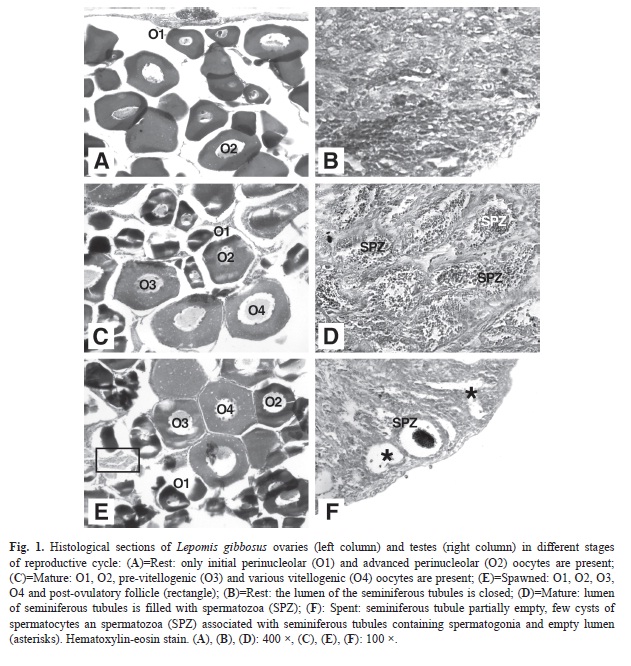
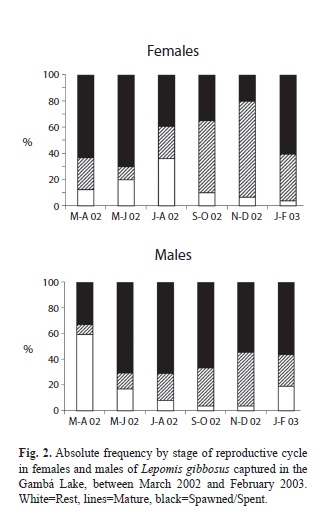
<body><![CDATA[<br> <font size="2"><span style="font-family: verdana;">Minas Gerais is the fourth largest Brazilian state, and has an estimate of&nbsp; 354 native fish species. However, these fish species may be threatened, as this state has the highest rank of fish introductions reported for Brazil and South America. As one from the total of 85 non-native species detected, <span style="font-style: italic;">Lepomis gibbosus</span> was introduced in the 60s to serve both as foragefish and to improve sport fishing. In this study, we evaluated the establishment of <span style="font-style: italic;">L. gibbosus </span>in a shallow lake in the city of Ouro Preto, Doce River basin, state of Minas Gerais, Southeastern Brazil. We collected fish with fishing rods every two months from March 2002-February 2003. Fragments of gonads from a total of 226 females and 226 males were obtained and processed following standard histological techniques; then 5-7&#956;m thickness sections were taken and stained in hematoxylin-eosin. Besides, for each specimen, the biometric measurements included the standard length (SL) and body weight (BW); and the sex ratio was obtained. The reproductive cycle stages were confirmed by the distribution of oocytes and spermatogenic cells. The type of spawning was determined by the frequency distribution of the reproductive cycle stages and ovarian histology. Based on the microscopic characteristics of the gonads, the following stages of the reproductive cycle were determined: one=Rest, two=Mature, three=Spawned for females or Spent for males; males and females in reproduction were found throughout the study period. Post-spawned ovaries containing oocytes in stages one (initial perinucleolar), two (advanced perinucleolar), three (pre-vitellogenic), four (vitellogenic) and post-ovulatory follicles indicated fractionated-type spawning in this species. The smallest breeding male and female measured were 4.6 and 4.9cm standard length, respectively, suggesting stunting. The sex ratio did not vary between males and females along the year and bimonthly, being 1:1. Moreover, <span style="font-style: italic;">L. gibbosus </span>appears to be at stage three of biological invasion: establishment through reproduction. We suggest to deliver information about &#8220;non-native species&#8221; through lectures in schools, colleges/ universities, NGOs, government and environmental agencies in the cities and villages, in order to try to prevent environmental degradation by the introduction of non-native fish such as <span style="font-style: italic;">L. gibbosus </span>in the region. We also recommend high fines for redhanded, and the import ban of non-native fish species to the region. </span></font>    <br> <font size="2"><span style="font-family: verdana;"></span></font><br  style="font-family: verdana;"> <font size="2"><span style="font-family: verdana;"></span></font><font  size="2"><span style="font-family: verdana;"><span  style="font-weight: bold;">Key words:</span> <span  style="font-style: italic;">Lepomis gibbosus</span>, biological invasions, sunfish, reproductive biology, Brazil.</span></font><br  style="font-family: verdana;"> <br style="font-family: verdana;"> <font style="font-weight: bold;" size="3"><span  style="font-family: verdana;">Resumen</span></font><br  style="font-family: verdana;"> <br style="font-family: verdana;"> <font size="2"><span style="font-family: verdana;">Se analiza el establecimiento del pez introducido <span style="font-style: italic;">Lepomis gibbosus</span> en una laguna natural de la ciudad de Ouro Preto, Cuenca&nbsp; del Rio Doce, provincia de Minas Gerais, regi&oacute;n&nbsp; sureste&nbsp; de&nbsp; Brasil.&nbsp; Cada&nbsp; dos&nbsp; meses&nbsp; se&nbsp; realizaron muestreos con anzuelo y l&iacute;nea, entre marzo 2002-febrero 2003 y se capturaron 226 hembras y 226&nbsp; machos.&nbsp; Se encontraron hembras y machos en actividad reproductiva durante todo el&nbsp; muestreo. Ovarios con signos de desove con oocitos de diferentes tallas y fol&iacute;culos post-ovulatorios indicaron la puesta parcial para L. gibbosus. La hembra y macho en reproducci&oacute;n m&aacute;s peque&ntilde;os ten&iacute;an entre 4.6cm y 4.9cm de longitud, que caracteriza el enanismo. La proporci&oacute;n sexual fue 1:1 y no present&oacute; diferencias bimensuales ni anuales. De las cinco fases del proceso de bioinvasi&oacute;n, se confirm&oacute; que <span  style="font-style: italic;">L. gibbosus </span>se encuentra en la fase tres, llamada establecimiento a trav&eacute;s de&nbsp; la reproducci&oacute;n. Se sugiere aclaraci&oacute;n sobre la tem&aacute;tica &#8220;especie for&aacute;nea&#8221; para evitar la degradaci&oacute;n del ambiente con la introducci&oacute;n de peces for&aacute;neos en la regi&oacute;n.</span></font><br  style="font-family: verdana;"> <br style="font-family: verdana; font-weight: bold;"> <font size="2"><span style="font-family: verdana;"><span  style="font-weight: bold;">Palabras clave:</span> <span style="font-style: italic;">Lepomis gibbosus</span>, invasiones biol&oacute;gicas, pez sol, biolog&iacute;a reproductiva, Brasil.</span></font><br style="font-family: verdana;"> <br style="font-family: verdana;"> </div>     <div></div> <hr  style="width: 100%; height: 2px; margin-left: 0px; margin-right: 0px;">     <div style="text-align: justify;"></div>     <div style="text-align: justify;"><font size="2"><span  style="font-family: verdana;">The&nbsp; rate&nbsp; of&nbsp; fish&nbsp; introduction&nbsp; have&nbsp; rapidly&nbsp; increased&nbsp; in&nbsp; South&nbsp; America&nbsp; since&nbsp; the late 80s (Lima <span style="font-style: italic;">et al</span>. 2010). The first period of introductions in Brazil began in the early 20th century, coinciding with the increase of fish farming (Latini <span style="font-style: italic;">et al</span>. 2004). The second period occurred in the middle of the last century, when electric companies in the Southeast invested&nbsp; in&nbsp; induced&nbsp; breeding&nbsp; of&nbsp; fish,&nbsp; often non-native to basins where they were released (Alves&nbsp; <span style="font-style: italic;">et&nbsp; al</span>.&nbsp; 2007). The&nbsp; increasing&nbsp; demand for pond fee-fishing (&#8216;fish-and-pay&#8217;) in most populous regions (Fernandes <span style="font-style: italic;">et al</span>. 2003) and the aquarium trade (Magalh&atilde;es &amp; Jacobi 2008) contributed to a third period of introductions, wich began at the end of the last century and is currently in progress (Vitule&nbsp; 2009).</span></font><br style="font-family: verdana;"> <br style="font-family: verdana;"> <font size="2"><span style="font-family: verdana;">Minas Gerais is the fourth largest Brazilian state, with an area of 586 528Km2&nbsp; embracing 17 rainage basins (Alves <span style="font-style: italic;">et al</span>. 2007), and an estimate of 354 native fish species (Vieira <span style="font-style: italic;">et al</span>. 2009b). However, these fish species may be threatened, since Minas Gerais is at the top of the&nbsp; ranking of fish introductions in Brazil and in South America, with 85 non-native species detected (Magalh&atilde;es 2010).</span></font><br  style="font-family: verdana;"> <br style="font-family: verdana;"> <font size="2"><span style="font-family: verdana;"><span  style="font-style: italic;">Lepomis gibbosus</span> (Linnaeus 1758) is one of the 85 species of non-native fish found in inland waters of the state (is not found anywhere else in Brazil). This species is a centrarchid&nbsp; native&nbsp; to&nbsp; Canada&nbsp; and&nbsp; United&nbsp; States and was introduced in the city of Ouro Preto in the 60s to serve both as prey (&#8216;foragefish&#8217;) to <span  style="font-style: italic;">Micropterus salmoides </span>(Lac&eacute;p&egrave;de 1802) and improve sport fishing in the region (Magalh&atilde;es &amp; Ratton 2005). It is also present in Venezuela and Chile (Welcomme 1988), but there is no data about its biology in these two countries.</span></font><br style="font-family: verdana;"> <br style="font-family: verdana;"> <font size="2"><span style="font-family: verdana;">Despite Minas Gerais has a high number of oviparous, non-native fishes, consistent studies about their reproductive biology are still incipient and restricted to few species, such as <span style="font-style: italic;">Cichla ocellaris </span>(=C. <span style="font-style: italic;">kelberi Kullander </span>&amp; Ferreira 2006) (Magalh&atilde;es <span style="font-style: italic;">et al</span>. 1996, Normando <span style="font-style: italic;">et al</span>. 2009) in the S&atilde;o Francisco River basin, <span style="font-style: italic;">Cichla piquiti</span> Kullander &amp; Ferreira 2006 in the Parana&iacute;ba River Basin (Vieira <span  style="font-style: italic;">et al</span>. 2009a), <span style="font-style: italic;">Plagioscion squamosissimus </span>(Heckel 1840) (Godinho <span style="font-style: italic;">et al</span>. 1997), C. cf. ocellaris (Schneider 1801), <span style="font-style: italic;">Cichla monoculus </span>Spix &amp; Agassiz 1831 in the Grande River basin (Gomiero &amp; Braga 2004), and <span style="font-style: italic;">L. gibbosus </span>in the Doce River basin (Magalh&atilde;es &amp; Ratton 2005).</span></font><br style="font-family: verdana;"> <br style="font-family: verdana;"> <font size="2"><span style="font-family: verdana;">Studies about the reproduction of oviparous fish outside their natural range provide the parameters for understanding their establishment in the invaded ecosystem. Thus, our aims in this paper were: i) to study the reproductive cycle and type of spawning; ii) to determine the minimum and maximum standard length and body weight; iii) to calculate the sex ratio; iv)&nbsp; to&nbsp; evaluate&nbsp; the&nbsp; actual&nbsp; phase&nbsp; of&nbsp; invasion of <span style="font-style: italic;">L. gibbosus </span>in the region; and v) to suggest actions to prevent further fish introductions in the upper Doce River, state of Minas Gerais, Brazil.</span></font><br style="font-family: verdana;"> </div> <br style="font-family: verdana;">     <div style="text-align: justify;"><font style="font-weight: bold;"  size="3"><span style="font-family: verdana;">Materials and methods</span></font><br  style="font-family: verdana;"> <br style="font-family: verdana;"> <font size="2"><span style="font-family: verdana;"><span  style="font-weight: bold;">Study site:</span> The Gamb&aacute; Lake is a permanent, natural lake formed in a rupestrian ferruginous field (&#8216;canga&#8217;), with maximum depth of 3.3m and area of 6 700m2. The native fish fauna of the lake is represented by <span  style="font-style: italic;">Gymnotus carapo</span> Linnaeus 1758, <span style="font-style: italic;">Geophagus brasiliensis </span>(Quoy &amp; Gaimard 1824), <span style="font-style: italic;">Australoheros</span> facetus (Jenyns 1842). Non-native species include <span style="font-style: italic;">Poecilia reticulata</span> Peters 1859, <span style="font-style: italic;">Xiphophorus hellerii</span> Heckel 1848, <span style="font-style: italic;">Tilapia rendalli </span>(Boulenger 1897) and L. gibbosus<span style="font-style: italic;"> </span>(Costa 2003).</span></font><br style="font-family: verdana;"> <br style="font-family: verdana;"> <font size="2"><span style="font-family: verdana;"><span  style="font-weight: bold;">Fish samples</span>: We collected a total of 226 females and 226 males of <span style="font-style: italic;">L. gibbosus </span>every two months, from March 2002-February 2003, using fishing rod and line (fishing gear allowed in the site) in the Gamb&aacute; Lake (20o43&#8217;51.11&#8217;&#8217; S - 43o30&#8217;0.63&#8217;&#8217; W), city of Ouro Preto, state of Minas Gerais, Southeastern Brazil. The region is located in the headwaters of the Doce River (Magalh&atilde;es &amp; Ratton 2005). The fish were sorted by site collection, packed in plastic bags, fixed in 10% formalin, and subsequently transferred to 70% alcohol. Voucher specimen used in this study are deposited under their respective catalogue number (MCP28664) in the Museum of Science and Technology, Pontifical Catholic University of Rio Grande do Sul, Brazil.</span></font><br  style="font-family: verdana;"> <br style="font-family: verdana;"> <font size="2"><span style="font-family: verdana;"><span  style="font-weight: bold;">Histological methods and stages of the reproductive&nbsp; cycle:</span> We&nbsp; also&nbsp; collected&nbsp; fragments of gonads (ovaries and testes) of specimens&nbsp; and&nbsp; fixed&nbsp; them&nbsp; in&nbsp; Bouin&#8217;s&nbsp; fluid&nbsp; for 12hours. Fragments were subjected to routine histological techniques as follows: embedding in paraffin, and staining in hematoxylin-eosin of 5-7&#956;m thickness sections (Vazzoler 1996). Stages of the reproductive cycle were determined based on microscopic characteristics of the gonads. We determined spawning type by analyzing the frequency distribution of stages of the reproductive cycle and ovarian histology (Bazzoli 2003). After determining the stages of the reproductive cycle of L. gibbosus, we calculated the bimonthly absolute and relative frequencies of females and males.</span></font><br style="font-family: verdana;"> <br style="font-family: verdana;"> <font size="2"><span style="font-family: verdana;"><span  style="font-weight: bold;">Standard length, body weight and sex ratio:</span> From each individual the following biometric data were taken in the laboratory: standard length (SL), given in cm and body weight (BW)&nbsp; in&nbsp; g.&nbsp; Besides,&nbsp; we&nbsp; determined&nbsp; the&nbsp; sex ratio from the bimonthly absolute frequency and the total number of males and females of <span  style="font-style: italic;">L. gibbosus </span>using a chi-square (&#967;<sup>2</sup>) test. We considered statistically significant differences&nbsp; when p&lt;0.05. The analysis was performed using the Paleontological Statistics-Past (Hammer <span  style="font-style: italic;">et al</span>. 2009).</span></font><br  style="font-family: verdana;"> </div> <br style="font-family: verdana;">     <div style="text-align: justify;"><font style="font-weight: bold;"  size="3"><span style="font-family: verdana;">Results</span></font><br  style="font-family: verdana;"> <br style="font-family: verdana;"> <font size="2"><span style="font-family: verdana;">Histological methods and stages of the reproductive cycle: Based on the microscopic characteristics of the gonads, the following stages of the reproductive&nbsp; cycle&nbsp; were determined: one=Rest, two=Mature, three=Spawned for females or Spent for males (<a href="/img/revistas/rbt/v60n3/a30i1.jpg">Fig. 1</a>).</span></font>    <br> <br style="font-family: verdana;"> <font size="2"><span style="font-family: verdana;">Reproductive cycle and type of spawning: Males and females in reproduction (stages two and three) were found during all the sampling period (<a  href="/img/revistas/rbt/v60n3/a30i2.jpg">Fig. 2</a>). The high frequency of females in stage two and three was associated with the histologic features of spawned ovaries containing oocytes in stages one (initial perinucleolar), two (advanced perinucleolar), three (pre-vitellogenic), four (vitellogenic) and postovulatory follicles, indicated that the species has a fractionated-type spawning.</span></font>    <br> </div> <font size="2"><span style="font-family: verdana;"></span></font>     <br>     ]]></body>
<body><![CDATA[<div style="text-align: justify;"><font size="2"><span  style="font-family: verdana;">Standard length, body weight and sex ratio: The smallest breeding female we found was at stage three (Spawned), measured 4.6cm SL and&nbsp; weighted&nbsp; 2g.&nbsp; The&nbsp; smallest&nbsp; breeding male we found was at stage two (Mature) and measured 4.9cm with a weight of 2g (<a  href="/img/revistas/rbt/v60n3/a30t1.gif">Table 1</a>).</span></font>    <br> <font size="2"><span style="font-family: verdana;"></span></font><br  style="font-family: verdana;"> <font size="2"><span style="font-family: verdana;">We found no differences in the percentage frequencies between females and males of <span  style="font-style: italic;">L. gibbosus </span>for the whole study period (1:1, chisquare=0.00, p&lt;0.05), except for September- October&nbsp; 2002,&nbsp; where&nbsp; we&nbsp; found&nbsp; more&nbsp; males than females (0.5:1, chi-square=5.12, p&lt;0.05) (<a href="/img/revistas/rbt/v60n3/a30t2.gif">Table 2</a>).</span></font>    <br>     <font size="2"><span style="font-family: verdana;"></span></font><br      style="font-family: verdana;">     <font style="font-weight: bold;" size="3"><span      style="font-family: verdana;">Discussion</span></font><br      style="font-family: verdana;">     <br style="font-family: verdana;">     <font size="2"><span style="font-family: verdana;">We found females and     ]]></body>
<body><![CDATA[males of <span style="font-style: italic;">L.     gibbosus </span>in reproduction activity throughout the study period     in the     Gamb&aacute; Lake. The same trend occurred with <span      style="font-style: italic;">L. gibbosus </span>introduced     into a dam (Cust&oacute;dio&#8217;s Dam) 20km always from 2002     (Magalh&atilde;es &amp; Ratton 2005). The longer reproductive period in     an introduced population of <span style="font-style: italic;">L.     gibbosus </span>out of South America was     recorded in Greece and Spain, where the species&nbsp;     ]]></body>
<body><![CDATA[reproduced&nbsp; during&nbsp; four&nbsp; months&nbsp; of&nbsp; the     Gamb&aacute; Lake,&nbsp; where&nbsp; this&nbsp; species&nbsp;     reproduced year-round&nbsp; during&nbsp; February&nbsp; 2001&nbsp;     to&nbsp; March year in these countries (Neophytou &amp; Giapis 1994,     Vila-Gispert &amp; Moreno-Amich 1998). A prolonged reproductive period     is a biological response of introduced fishes in countries with warm or     mild climate, providing a mechanism for the restablishment of     population structure (Smith &amp; Walker 2004).</span></font><br      style="font-family: verdana;">     <br style="font-family: verdana;">     ]]></body>
<body><![CDATA[<font size="2"><span style="font-family: verdana;">Females having     oocytes at all     developmental stages, with different sizes and asynchronous growth,     along with post-ovulatory follicles, indicate that the species has a     fractionated-type spawning. Fractionated spawning is characteristic     of this species both in his native range (Scott &amp; Crossman 1973),     and in places where it is introduced, such as South America     (Magalh&atilde;es &amp; Ratton 2005), Europe, and Asia (Copp &amp; Fox     2007). Reproductive features of species may influence its probability     of establishment (Latini &amp; Petrere 2004). Species with     ]]></body>
<body><![CDATA[fractionated spawning have higher chance of establishment due to mainly     two reasons: i) decrease competition for spawning site among females     within populations with synchronous reproduction and ii) increased     larval survival, since releasing oocytes in various postures let time     for larvae from each spawning abandon the planktivorous phase and     attain another ecological niche, reducing food competition (Nikolsky     1963).</span></font><br style="font-family: verdana;">     <br style="font-family: verdana;">     <font size="2"><span style="font-family: verdana;">We found breeding     males and females     ]]></body>
<body><![CDATA[of <span style="font-style: italic;">L. gibbosus </span>with less     than 5cm SL and small body weight, which can     indicate stunting. This phenomenon may be due to three reasons in the     Gamb&aacute; Lake: i) intraspecific competition due to overcrowding,     ii) low food availability and iii) increased survival rate due to the     absence of top predators (Roff 1992). This is perhaps the lowest     measurement found in reproductively active, introduced populations of     L. gibbosus. In France, Spain, England, Greece and Romania, the     minimum size reproductive individuals of this species ranged from     5.1cm-9.1cm SL (Copp <span style="font-style: italic;">et al</span>.     ]]></body>
<body><![CDATA[2002). Moreover, the fishing gear used in     this work (rod and line) did not capture immature fish, making it     impossible to determine the size at sexual maturity by the method L50     (Santos 1978). This method estimates the length at which 50% of the     population is mature and 50% is immature. Thus, the standard length at     first&nbsp; sexual&nbsp; maturity&nbsp; was&nbsp; suggested&nbsp; based     on the standard length of the smallest breeding female and male     captured (Bazzoli 2003).</span></font><br style="font-family: verdana;">     <br style="font-family: verdana;">     <font size="2"><span style="font-family: verdana;">As expected, we     ]]></body>
<body><![CDATA[found a sex ratio     of 1:1 for <span style="font-style: italic;">L. gibbosus </span>in     the majority of bimesters and in the whole     study period. The same proportion of females and males was also found     for the species introduced in England (Cucherousset <span      style="font-style: italic;">et al</span>. 2009). That     is advantageous for the species in terms of reproduction, because as     the male build the nest during the breeding season (Klarr <span      style="font-style: italic;">et al</span>. 2004),     there will always be at least one female available to mate, thus     ]]></body>
<body><![CDATA[ensuring the establishment in the site.</span></font><br      style="font-family: verdana;">     <br style="font-family: verdana;">     <font size="2"><span style="font-family: verdana;">According to     Lockwood <span style="font-style: italic;">et al</span>.     (2007), the process of invasion by a non-native species happens in five     stages: i) transportation from their place of origin, ii) arrival of     the species in the new environment, iii) establishing through     reproduction, iv) expansion of its geographic range, v) impact (low or     high), the moment when the receiving biota suffers consequences from     ]]></body>
<body><![CDATA[the introduction. In this study, we confirmed that <span      style="font-style: italic;">L. gibbosus </span>is at     stage three, since it is well adapted in the Gamb&aacute; Lake,     reproducing throughout the study period. This species have found in     this habitat similar conditions to those of their places of origin,     being considered as an established species. Moreover, this shallow     lake has natural very low richness of native species such as <span      style="font-style: italic;">G. carapo</span>,     <span style="font-style: italic;">G. brasiliensis</span> and <span      style="font-style: italic;">A. facetum</span> and this may have been     ]]></body>
<body><![CDATA[facilitating the     establishment process of <span style="font-style: italic;">L. gibbosus</span>.     These results agree with the     statement of Moyle &amp; Light (1996) that the magnitude of the impact     of introduced species in a natural environment can increase according     to the specific characteristics of the environment. Therefore,     systems with few native species, such as headwater regions, tend to     have low environmental resistance to invasion by non-native species     than ecosystems with high species richness.</span></font><br      style="font-family: verdana;">     ]]></body>
<body><![CDATA[<br style="font-family: verdana;">     <font size="2"><span style="font-family: verdana;">We suggest that an     important tool     to prevent further introductions of fish in the Upper Doce River     environments will be the dissemination of scientific information     about &#8220;nonnative species&#8221; through lectures in schools,     colleges/universities, NGOs, government and environmental agencies in     the cities and villages. Besides, to prevent the reproduction and     dissemination of <span style="font-style: italic;">L. gibbosus </span>and     other species, the direction of     ]]></body>
<body><![CDATA[Itacolomi State Park and State Forestry Institute of Minas Gerais (both     located in the city of Ouro Preto) have recommend the selective fishing     only of non-native species. In addition, to popularize the subject     &#8220;non-native species&#8221; mentioned earlier, our specific recommendations     to the authorities are: i) massive clarification to the public about     the National Law 9605/1998 indicating that the release of non-native     species is considered an environmental crime, ii) high value     (&gt;US$5 000.00) fines if any offender is caught introducing nonnative     fish in the region, and iii) to restrict or prohibit the     importation of L. gibbosus, and any other non-native fish species     ]]></body>
<body><![CDATA[considered pest to cities that are located in headwater regions.</span></font><br      style="font-family: verdana;">     <br style="font-family: verdana;">     <br style="font-family: verdana;">     <font style="font-weight: bold;" size="3"><span      style="font-family: verdana;">Acknowledgments</span></font><br      style="font-family: verdana;">     <br style="font-family: verdana;">     <font size="2"><span style="font-family: verdana;">The authors are     grateful to the     ]]></body>
<body><![CDATA[Centro Universit&aacute;rio UNA (Institute of Education, Research and     Extension) for financial support (BIC No. 14-2010/2011), and to Roberto     Reis (Museum of Science and Technology, Pontifical Catholic     University of Rio Grande do Sul) for the species catalogue number.</span></font><br      style="font-family: verdana;">     </div>     <br style="font-family: verdana;">     <div style="text-align: justify;"> </div> <hr  style="width: 100%; height: 2px; margin-left: 0px; margin-right: 0px;">     <div style="text-align: justify;"></div>     <!-- ref --><div style="text-align: justify;"><font style="font-weight: bold;"  size="3"><span style="font-family: verdana;">References</span></font><br  style="font-family: verdana;"> <br style="font-family: verdana;"> <font size="2"><span style="font-family: verdana;">Alves,&nbsp; C.B.M.,&nbsp; F.&nbsp; Vieira, A.L.B.&nbsp; Magalh&atilde;es&nbsp; &amp;&nbsp; M.F.G. Brito.&nbsp; 2007. Impacts of non-native fish&nbsp; species in Minas Gerais, Brazil: present situation and prospects, p.&nbsp; 291-314.&nbsp; <span style="font-style: italic;">In</span>&nbsp; T.M. Bert. Ecological and genetic implications of aquaculture activities. Springer, Dordrecht, The Netherlands.    &nbsp;&nbsp;&nbsp;&nbsp;&nbsp;&nbsp;&nbsp;&nbsp;[&#160;<a href="javascript:void(0);" onclick="javascript: window.open('/scielo.php?script=sci_nlinks&ref=1486024&pid=S0034-7744201200030003000001&lng=','','width=640,height=500,resizable=yes,scrollbars=1,menubar=yes,');">Links</a>&#160;]<!-- end-ref --><!-- ref --></span></font><br  style="font-family: verdana;"> <br style="font-family: verdana;"> <font size="2"><span style="font-family: verdana;">Bazzoli,&nbsp; N. 2003. Par&acirc;metros reprodutivos de&nbsp; peixes de interesse comercial do rio S&atilde;o Francisco na regi&atilde;o de Pirapora, p. 285-300. <span  style="font-style: italic;">In</span> H.P. Godinho &amp; A.L. Godinho (eds.). &Aacute;guas, peixes e pesca no S&atilde;o Francisco das Minas Gerais. Editora PUC Minas Gerais, Belo Horizonte, Minas Gerais, Brasil.    &nbsp;&nbsp;&nbsp;&nbsp;&nbsp;&nbsp;&nbsp;&nbsp;[&#160;<a href="javascript:void(0);" onclick="javascript: window.open('/scielo.php?script=sci_nlinks&ref=1486025&pid=S0034-7744201200030003000002&lng=','','width=640,height=500,resizable=yes,scrollbars=1,menubar=yes,');">Links</a>&#160;]<!-- end-ref --></span></font>    <!-- ref --><br> <font size="2"><span style="font-family: verdana;"></span></font><br  style="font-family: verdana;"> <font size="2"><span style="font-family: verdana;"></span></font><font  size="2"><span style="font-family: verdana;">Copp, G.H., M.G. Fox &amp; V. Kova&acute;c&#711;. 2002. Growth, morphology and life history traits of a cool-water European population of pumpkinseed <span  style="font-style: italic;">Lepomis gibbosus</span>. Arch. Hydrobiol. 155: 585-614.    &nbsp;&nbsp;&nbsp;&nbsp;&nbsp;&nbsp;&nbsp;&nbsp;[&#160;<a href="javascript:void(0);" onclick="javascript: window.open('/scielo.php?script=sci_nlinks&ref=1486027&pid=S0034-7744201200030003000003&lng=','','width=640,height=500,resizable=yes,scrollbars=1,menubar=yes,');">Links</a>&#160;]<!-- end-ref --><!-- ref --></span></font><br style="font-family: verdana;"> <br style="font-family: verdana;"> <font size="2"><span style="font-family: verdana;">Copp,&nbsp; G.H. &amp; M.G. Fox. 2007. Growth and&nbsp; life history traits&nbsp; of&nbsp; introduced&nbsp; pumpkinseed&nbsp; (<span style="font-style: italic;">Lepomis&nbsp; gibbosus</span>)&nbsp; in&nbsp; Europe,&nbsp; and&nbsp; the&nbsp; relevance&nbsp; to&nbsp; invasiveness potential, p. 289-306. <span style="font-style: italic;">In</span> F. Gherardi. Freshwater bioinvaders: profiles, distribution, and threats. Springer, Berlin, Germany.    &nbsp;&nbsp;&nbsp;&nbsp;&nbsp;&nbsp;&nbsp;&nbsp;[&#160;<a href="javascript:void(0);" onclick="javascript: window.open('/scielo.php?script=sci_nlinks&ref=1486028&pid=S0034-7744201200030003000004&lng=','','width=640,height=500,resizable=yes,scrollbars=1,menubar=yes,');">Links</a>&#160;]<!-- end-ref --><!-- ref --></span></font><br style="font-family: verdana;"> <br style="font-family: verdana;"> <font size="2"><span style="font-family: verdana;">Costa,&nbsp; R.C.&nbsp; 2003.&nbsp; Estudo&nbsp; de&nbsp; comunidade&nbsp; de&nbsp; anf&iacute;bios anuros em uma lagoa urbana no munic&iacute;pio de Ouro Preto,&nbsp; MG.&nbsp; Universidade&nbsp; Federal&nbsp; de&nbsp; Ouro&nbsp; Preto, Ouro Preto, Minas Gerais, Brasil.    &nbsp;&nbsp;&nbsp;&nbsp;&nbsp;&nbsp;&nbsp;&nbsp;[&#160;<a href="javascript:void(0);" onclick="javascript: window.open('/scielo.php?script=sci_nlinks&ref=1486029&pid=S0034-7744201200030003000005&lng=','','width=640,height=500,resizable=yes,scrollbars=1,menubar=yes,');">Links</a>&#160;]<!-- end-ref --><!-- ref --></span></font><br style="font-family: verdana;"> <br style="font-family: verdana;"> <font size="2"><span style="font-family: verdana;">Cucherousset,&nbsp; J., G.H. Copp, M.G. Fox, E.&nbsp; Sterud, H.H. van Kleef, H. Verreycken &amp; E. Z&aacute;horsk&aacute;. 2009. Lifehistory traits and potential invasiveness of introduced pumpkinseed <span  style="font-style: italic;">Lepomis gibbosus</span> populations in northwestern Europe. Biol. Inv. 11: 2171-2180.    &nbsp;&nbsp;&nbsp;&nbsp;&nbsp;&nbsp;&nbsp;&nbsp;[&#160;<a href="javascript:void(0);" onclick="javascript: window.open('/scielo.php?script=sci_nlinks&ref=1486030&pid=S0034-7744201200030003000006&lng=','','width=640,height=500,resizable=yes,scrollbars=1,menubar=yes,');">Links</a>&#160;]<!-- end-ref --><!-- ref --></span></font><br  style="font-family: verdana;"> <br style="font-family: verdana;"> <font size="2"><span style="font-family: verdana;">Fernandes, R., L.C. Gomes &amp; A.A. Agostinho. 2003. Pesque-pague: neg&oacute;cio ou fonte de dispers&atilde;o de esp&eacute;cies ex&oacute;ticas? Acta Sci. Biol. Sci. 25: 115-120.    &nbsp;&nbsp;&nbsp;&nbsp;&nbsp;&nbsp;&nbsp;&nbsp;[&#160;<a href="javascript:void(0);" onclick="javascript: window.open('/scielo.php?script=sci_nlinks&ref=1486031&pid=S0034-7744201200030003000007&lng=','','width=640,height=500,resizable=yes,scrollbars=1,menubar=yes,');">Links</a>&#160;]<!-- end-ref --><!-- ref --></span></font><br style="font-family: verdana;"> <br style="font-family: verdana;"> <font size="2"><span style="font-family: verdana;">Godinho,&nbsp; H.P., G.B. Santos &amp; E.C. Assis.&nbsp; 1997. Some aspects of the reproduction&nbsp; of female corvine fish <span style="font-style: italic;">Plagioscion squamosissimus </span>Haeckel, 1840 (Sciaenidae) in a reservoir of southeastern Brazil. Trop. Fresh. Biol. 6: 17-26.    &nbsp;&nbsp;&nbsp;&nbsp;&nbsp;&nbsp;&nbsp;&nbsp;[&#160;<a href="javascript:void(0);" onclick="javascript: window.open('/scielo.php?script=sci_nlinks&ref=1486032&pid=S0034-7744201200030003000008&lng=','','width=640,height=500,resizable=yes,scrollbars=1,menubar=yes,');">Links</a>&#160;]<!-- end-ref --><!-- ref --></span></font><br  style="font-family: verdana;"> <br style="font-family: verdana;"> <font size="2"><span style="font-family: verdana;">Gomiero,&nbsp; L.M. &amp; F.M.S. Braga. 2004.&nbsp; Reproduction of species of the genus&nbsp; <span  style="font-style: italic;">Cichla</span> in a reservoir in southeastern Brazil. Braz. J. Biol. 64: 613-624.    &nbsp;&nbsp;&nbsp;&nbsp;&nbsp;&nbsp;&nbsp;&nbsp;[&#160;<a href="javascript:void(0);" onclick="javascript: window.open('/scielo.php?script=sci_nlinks&ref=1486033&pid=S0034-7744201200030003000009&lng=','','width=640,height=500,resizable=yes,scrollbars=1,menubar=yes,');">Links</a>&#160;]<!-- end-ref --><!-- ref --></span></font><br  style="font-family: verdana;"> <br style="font-family: verdana;"> <font size="2"><span style="font-family: verdana;">Hammer,&nbsp; &Oslash;.,&nbsp; D.A.T.&nbsp; Harper&nbsp; &amp;&nbsp; P.D.&nbsp; Ryan.&nbsp; 2009.&nbsp; Past: paleontological statistics software package for education and data&nbsp; analysis, version 1.12. Palaeontological&nbsp; Association, Aberystwyth, Wales&nbsp; (Downloaded: October 10, 2009, http://folk.uio.no/ohammer/past).    &nbsp;&nbsp;&nbsp;&nbsp;&nbsp;&nbsp;&nbsp;&nbsp;[&#160;<a href="javascript:void(0);" onclick="javascript: window.open('/scielo.php?script=sci_nlinks&ref=1486034&pid=S0034-7744201200030003000010&lng=','','width=640,height=500,resizable=yes,scrollbars=1,menubar=yes,');">Links</a>&#160;]<!-- end-ref --><!-- ref --></span></font><br  style="font-family: verdana;"> <br style="font-family: verdana;"> <font size="2"><span style="font-family: verdana;">Klarr, M., G.H. Copp &amp; R. Horsfield. 2004.&nbsp; Autumnal habitat use of non-native pumpkinseed <span style="font-style: italic;">Lepomis gibbosus</span> and&nbsp; associations with native fish species in small English streams. Fol. Zool. 53: 189-202.    &nbsp;&nbsp;&nbsp;&nbsp;&nbsp;&nbsp;&nbsp;&nbsp;[&#160;<a href="javascript:void(0);" onclick="javascript: window.open('/scielo.php?script=sci_nlinks&ref=1486035&pid=S0034-7744201200030003000011&lng=','','width=640,height=500,resizable=yes,scrollbars=1,menubar=yes,');">Links</a>&#160;]<!-- end-ref --><!-- ref --></span></font><br  style="font-family: verdana;"> <br style="font-family: verdana;"> <font size="2"><span style="font-family: verdana;">Latini, A.O., M. Jr. Petrere. 2004. Reduction&nbsp; of a native fish fauna by alien species: an example from Brazilian freshwater tropical lakes. Fish. Manag. Ecol. 11: 71-79.    &nbsp;&nbsp;&nbsp;&nbsp;&nbsp;&nbsp;&nbsp;&nbsp;[&#160;<a href="javascript:void(0);" onclick="javascript: window.open('/scielo.php?script=sci_nlinks&ref=1486036&pid=S0034-7744201200030003000012&lng=','','width=640,height=500,resizable=yes,scrollbars=1,menubar=yes,');">Links</a>&#160;]<!-- end-ref --><!-- ref --></span></font><br style="font-family: verdana;"> <br style="font-family: verdana;"> <font size="2"><span style="font-family: verdana;">Latini, A.O., D.P. Lima-Jr., H.C. Giacomini,&nbsp; R.O. Latini, D.C.&nbsp; Resende,&nbsp; H.M.V.&nbsp; Esp&iacute;rito-Santo, D.F.&nbsp; Barros </span></font><font size="2"><span  style="font-family: verdana;">&amp;&nbsp; T.L. Pereira. 2004. Alien fishes in&nbsp; lakes of the Doce river basin (Brazil):&nbsp; range, new occurrences and conservation&nbsp; of native communities. Lundiana 5: 135-142.    &nbsp;&nbsp;&nbsp;&nbsp;&nbsp;&nbsp;&nbsp;&nbsp;[&#160;<a href="javascript:void(0);" onclick="javascript: window.open('/scielo.php?script=sci_nlinks&ref=1486037&pid=S0034-7744201200030003000013&lng=','','width=640,height=500,resizable=yes,scrollbars=1,menubar=yes,');">Links</a>&#160;]<!-- end-ref --></span></font>    <!-- ref --><br> <font size="2"><span style="font-family: verdana;"></span></font><br  style="font-family: verdana;"> <font size="2"><span style="font-family: verdana;"></span></font><font  size="2"><span style="font-family: verdana;">Lima, F.P., A.O. Latini &amp; P. de Marco. 2010. How are the lakes? Environmental&nbsp; perception by fishermen and alien fish dispersal in Brazilian tropical lakes. Interciencia 35: 84-91.    &nbsp;&nbsp;&nbsp;&nbsp;&nbsp;&nbsp;&nbsp;&nbsp;[&#160;<a href="javascript:void(0);" onclick="javascript: window.open('/scielo.php?script=sci_nlinks&ref=1486039&pid=S0034-7744201200030003000014&lng=','','width=640,height=500,resizable=yes,scrollbars=1,menubar=yes,');">Links</a>&#160;]<!-- end-ref --><!-- ref --></span></font><br style="font-family: verdana;"> <br style="font-family: verdana;"> <font size="2"><span style="font-family: verdana;">Lockwood,&nbsp; J.L., M.F. Hoopes &amp; M.P.&nbsp; Marchetti. 2007. Invasion Ecology. Blackwell, Malden,&nbsp;&nbsp; Maryland, USA.    &nbsp;&nbsp;&nbsp;&nbsp;&nbsp;&nbsp;&nbsp;&nbsp;[&#160;<a href="javascript:void(0);" onclick="javascript: window.open('/scielo.php?script=sci_nlinks&ref=1486040&pid=S0034-7744201200030003000015&lng=','','width=640,height=500,resizable=yes,scrollbars=1,menubar=yes,');">Links</a>&#160;]<!-- end-ref --><!-- ref --></span></font><br  style="font-family: verdana;"> <br style="font-family: verdana;"> <font size="2"><span style="font-family: verdana;">Magalh&atilde;es,&nbsp; A.L.B., Y.&nbsp; Sato,&nbsp; E.&nbsp; Rizzo,&nbsp; R.M.A.&nbsp; Ferreira &amp;&nbsp; N. Bazzoli. 1996. Ciclo reprodutivo&nbsp; do tucunar&eacute; <span style="font-style: italic;">Cichla ocellaris </span>(Schneider, 1801) na represa de Tr&ecirc;s Marias, MG. Arq. Bras. Med. Vet. Zootec. 48: 85-92.    &nbsp;&nbsp;&nbsp;&nbsp;&nbsp;&nbsp;&nbsp;&nbsp;[&#160;<a href="javascript:void(0);" onclick="javascript: window.open('/scielo.php?script=sci_nlinks&ref=1486041&pid=S0034-7744201200030003000016&lng=','','width=640,height=500,resizable=yes,scrollbars=1,menubar=yes,');">Links</a>&#160;]<!-- end-ref --><!-- ref --></span></font><br  style="font-family: verdana;"> <br style="font-family: verdana;"> <font size="2"><span style="font-family: verdana;">Magalh&atilde;es, A.L.B. &amp; T.F. Ratton. 2005. Reproduction of a South American population of pumpkinseed sunfish <span style="font-style: italic;">Lepomis gibbosus</span> (Linnaeus) (Osteichthyes, Centrarchidae): a comparison with the European and North American populations. Rev. Bras. Zool. 22: 477-483.    &nbsp;&nbsp;&nbsp;&nbsp;&nbsp;&nbsp;&nbsp;&nbsp;[&#160;<a href="javascript:void(0);" onclick="javascript: window.open('/scielo.php?script=sci_nlinks&ref=1486042&pid=S0034-7744201200030003000017&lng=','','width=640,height=500,resizable=yes,scrollbars=1,menubar=yes,');">Links</a>&#160;]<!-- end-ref --><!-- ref --></span></font><br  style="font-family: verdana;"> <br style="font-family: verdana;"> <font size="2"><span style="font-family: verdana;">Magalh&atilde;es, A.L.B. &amp; C.M. Jacobi. 2008.&nbsp; Ornamental exotic fish introduced into Atlantic Forest water bodies, Brazil. Neotrop. Biol. Cons. 3: 73-77.    &nbsp;&nbsp;&nbsp;&nbsp;&nbsp;&nbsp;&nbsp;&nbsp;[&#160;<a href="javascript:void(0);" onclick="javascript: window.open('/scielo.php?script=sci_nlinks&ref=1486043&pid=S0034-7744201200030003000018&lng=','','width=640,height=500,resizable=yes,scrollbars=1,menubar=yes,');">Links</a>&#160;]<!-- end-ref --><!-- ref --></span></font><br  style="font-family: verdana;"> <br style="font-family: verdana;"> <font size="2"><span style="font-family: verdana;">Magalh&atilde;es, A.L.B. 2010. Efeitos da introdu&ccedil;&atilde;o de peixes ornamentais n&atilde;o-nativos em&nbsp; bacias higrogr&aacute;ficas de Minas Gerais. Ph.D. Thesis, Universidade Federal de Minas Gerais, Belo Horizonte, Minas Gerais, Brasil.    &nbsp;&nbsp;&nbsp;&nbsp;&nbsp;&nbsp;&nbsp;&nbsp;[&#160;<a href="javascript:void(0);" onclick="javascript: window.open('/scielo.php?script=sci_nlinks&ref=1486044&pid=S0034-7744201200030003000019&lng=','','width=640,height=500,resizable=yes,scrollbars=1,menubar=yes,');">Links</a>&#160;]<!-- end-ref --><!-- ref --></span></font><br  style="font-family: verdana;"> <br style="font-family: verdana;"> <font size="2"><span style="font-family: verdana;">Moyle, P.B. &amp; T. Light. 1996. Biological invasions of fresh water:&nbsp; empirical&nbsp; rules&nbsp; and&nbsp; assembly&nbsp; theory.&nbsp; Biol. Cons. 78: 149-162.    &nbsp;&nbsp;&nbsp;&nbsp;&nbsp;&nbsp;&nbsp;&nbsp;[&#160;<a href="javascript:void(0);" onclick="javascript: window.open('/scielo.php?script=sci_nlinks&ref=1486045&pid=S0034-7744201200030003000020&lng=','','width=640,height=500,resizable=yes,scrollbars=1,menubar=yes,');">Links</a>&#160;]<!-- end-ref --><!-- ref --></span></font><br  style="font-family: verdana;"> <br style="font-family: verdana;"> <font size="2"><span style="font-family: verdana;">Neophytou, C. &amp; A.J. Giapis. 1994. A study of the biology of&nbsp; pumpkinseed&nbsp; [<span  style="font-style: italic;">Lepomis&nbsp; gibbosus</span>&nbsp; (L.)]&nbsp; in&nbsp; Lake Kerkini (Greece). J. Appl. Ichthyol. 10: 123-133.    &nbsp;&nbsp;&nbsp;&nbsp;&nbsp;&nbsp;&nbsp;&nbsp;[&#160;<a href="javascript:void(0);" onclick="javascript: window.open('/scielo.php?script=sci_nlinks&ref=1486046&pid=S0034-7744201200030003000021&lng=','','width=640,height=500,resizable=yes,scrollbars=1,menubar=yes,');">Links</a>&#160;]<!-- end-ref --><!-- ref --></span></font><br style="font-family: verdana;"> <br style="font-family: verdana;"> <font size="2"><span style="font-family: verdana;">Nikolsky, G.V. 1963. The ecology of fishes.&nbsp; Academic, London, Great Britain.    &nbsp;&nbsp;&nbsp;&nbsp;&nbsp;&nbsp;&nbsp;&nbsp;[&#160;<a href="javascript:void(0);" onclick="javascript: window.open('/scielo.php?script=sci_nlinks&ref=1486047&pid=S0034-7744201200030003000022&lng=','','width=640,height=500,resizable=yes,scrollbars=1,menubar=yes,');">Links</a>&#160;]<!-- end-ref --></span></font>    <br> <font size="2"><span style="font-family: verdana;"></span></font>    <!-- ref --><br> <font size="2"><span style="font-family: verdana;">Normando,&nbsp; F.T., F.P. Arantes, K.K. Luz, R.G. Thom&eacute;, E. Rizzo, Y. Sato &amp; N. Bazzoli. 2009. Reproduction and fecundity of tucunar&eacute;&nbsp; <span style="font-style: italic;">Cichla kelberi</span> (Perciformes: Cichlidae), an exotic species in Tr&ecirc;s Marias reservoir, southeastern Brazil. J. Appl. Ichthyol. 25: 1-7.    &nbsp;&nbsp;&nbsp;&nbsp;&nbsp;&nbsp;&nbsp;&nbsp;[&#160;<a href="javascript:void(0);" onclick="javascript: window.open('/scielo.php?script=sci_nlinks&ref=1486050&pid=S0034-7744201200030003000023&lng=','','width=640,height=500,resizable=yes,scrollbars=1,menubar=yes,');">Links</a>&#160;]<!-- end-ref --><!-- ref --></span></font><br style="font-family: verdana;"> <br style="font-family: verdana;"> <font size="2"><span style="font-family: verdana;">Roff, D.A. 1992. The Evolution of Life Histories: Theory and Analysis.&nbsp; Chapman&nbsp; &amp;&nbsp; Hall,&nbsp; New York,&nbsp; New York, USA.    &nbsp;&nbsp;&nbsp;&nbsp;&nbsp;&nbsp;&nbsp;&nbsp;[&#160;<a href="javascript:void(0);" onclick="javascript: window.open('/scielo.php?script=sci_nlinks&ref=1486051&pid=S0034-7744201200030003000024&lng=','','width=640,height=500,resizable=yes,scrollbars=1,menubar=yes,');">Links</a>&#160;]<!-- end-ref --><!-- ref --></span></font><br  style="font-family: verdana;"> <br style="font-family: verdana;"> <font size="2"><span style="font-family: verdana;">Santos, E.P. 1978. Din&acirc;mica de popula&ccedil;&otilde;es&nbsp; aplicada&nbsp; &agrave; pesca e piscicultura. Hucitec-Edusp, S&atilde;o Paulo, S&atilde;o Paulo, Brasil.    &nbsp;&nbsp;&nbsp;&nbsp;&nbsp;&nbsp;&nbsp;&nbsp;[&#160;<a href="javascript:void(0);" onclick="javascript: window.open('/scielo.php?script=sci_nlinks&ref=1486052&pid=S0034-7744201200030003000025&lng=','','width=640,height=500,resizable=yes,scrollbars=1,menubar=yes,');">Links</a>&#160;]<!-- end-ref --><!-- ref --></span></font><br  style="font-family: verdana;"> <br style="font-family: verdana;"> <font size="2"><span style="font-family: verdana;">Scott,&nbsp; W.B. &amp; E.J. Cromssman. 1973.&nbsp; Freshwater fishes of&nbsp; Canada.&nbsp; Fisheries&nbsp; Research&nbsp; Board&nbsp; of&nbsp; Canada, Ottawa, Ontario, Canada.    &nbsp;&nbsp;&nbsp;&nbsp;&nbsp;&nbsp;&nbsp;&nbsp;[&#160;<a href="javascript:void(0);" onclick="javascript: window.open('/scielo.php?script=sci_nlinks&ref=1486053&pid=S0034-7744201200030003000026&lng=','','width=640,height=500,resizable=yes,scrollbars=1,menubar=yes,');">Links</a>&#160;]<!-- end-ref --></span></font>    ]]></body>
<body><![CDATA[<!-- ref --><br> <font size="2"><span style="font-family: verdana;"></span></font><br  style="font-family: verdana;"> <font size="2"><span style="font-family: verdana;"></span></font><font  size="2"><span style="font-family: verdana;">Smith, B.B. &amp; K.F. Walker. 2004. Spawning dynamics of common carp in the River Murray, South Australia, shown by&nbsp; macroscopic and histological staging of gonads. J. Fish Biol. 64: 336-354.    &nbsp;&nbsp;&nbsp;&nbsp;&nbsp;&nbsp;&nbsp;&nbsp;[&#160;<a href="javascript:void(0);" onclick="javascript: window.open('/scielo.php?script=sci_nlinks&ref=1486055&pid=S0034-7744201200030003000027&lng=','','width=640,height=500,resizable=yes,scrollbars=1,menubar=yes,');">Links</a>&#160;]<!-- end-ref --><!-- ref --></span></font><br  style="font-family: verdana;"> <br style="font-family: verdana;"> <font size="2"><span style="font-family: verdana;">Vazzoler, A.E.A.M. 1996. Biologia da&nbsp;&nbsp; reprodu&ccedil;&atilde;o&nbsp; de peixes tele&oacute;steos: teoria e pr&aacute;tica. Eduem, Maring&aacute;, Paran&aacute;, Brasil.    &nbsp;&nbsp;&nbsp;&nbsp;&nbsp;&nbsp;&nbsp;&nbsp;[&#160;<a href="javascript:void(0);" onclick="javascript: window.open('/scielo.php?script=sci_nlinks&ref=1486056&pid=S0034-7744201200030003000028&lng=','','width=640,height=500,resizable=yes,scrollbars=1,menubar=yes,');">Links</a>&#160;]<!-- end-ref --><!-- ref --></span></font><br style="font-family: verdana;"> <br style="font-family: verdana;"> <font size="2"><span style="font-family: verdana;">Vieira, A.B.C., L.F. Salvador-Jr., R.M.C. Melo, G.B. Santos &amp; N. Bazzoli. 2009a. Reproductive biology of the peacock bass <span style="font-style: italic;">Cichla piquiti</span> (Perciformes: Cichlidae), an exotic species in a Neotropical reservoir. Neotrop. Ichthyol. 7: 745-750.    &nbsp;&nbsp;&nbsp;&nbsp;&nbsp;&nbsp;&nbsp;&nbsp;[&#160;<a href="javascript:void(0);" onclick="javascript: window.open('/scielo.php?script=sci_nlinks&ref=1486057&pid=S0034-7744201200030003000029&lng=','','width=640,height=500,resizable=yes,scrollbars=1,menubar=yes,');">Links</a>&#160;]<!-- end-ref --><!-- ref --></span></font><br style="font-family: verdana;"> <br style="font-family: verdana;"> <font size="2"><span style="font-family: verdana;">Vieira, F., C.B.M. Alves &amp; P.S. Pompeu.&nbsp; 2009b. Peixes, p. 181-219. <span  style="font-style: italic;">In</span> G.M.&nbsp; Drummond, C.S. Greco, M.B. Martins &amp; F. Vieira (eds.). Biota Minas: Diagn&oacute;stico do conhecimento sobre a biodiversidade no estado de Minas Gerais Subs&iacute;dio ao&nbsp; programa Biota Minas. Funda&ccedil;&atilde;o&nbsp;&nbsp; Biodiversitas, Belo Horizonte, Minas Gerais, Brasil.    &nbsp;&nbsp;&nbsp;&nbsp;&nbsp;&nbsp;&nbsp;&nbsp;[&#160;<a href="javascript:void(0);" onclick="javascript: window.open('/scielo.php?script=sci_nlinks&ref=1486058&pid=S0034-7744201200030003000030&lng=','','width=640,height=500,resizable=yes,scrollbars=1,menubar=yes,');">Links</a>&#160;]<!-- end-ref --><!-- ref --></span></font><br style="font-family: verdana;"> <br style="font-family: verdana;"> <font size="2"><span style="font-family: verdana;">Vila-Gispert,&nbsp; A.&nbsp; &amp;&nbsp; R.&nbsp; Moreno-Amich.&nbsp; 1998.&nbsp; Seasonal abundance and depth distribution of Blennius fluviatilis and introduced <span  style="font-style: italic;">Lepomis gibbosus</span>, in Lake Banyoles (Catalonia, Spain). Hydrobiology 386: 95-101.    &nbsp;&nbsp;&nbsp;&nbsp;&nbsp;&nbsp;&nbsp;&nbsp;[&#160;<a href="javascript:void(0);" onclick="javascript: window.open('/scielo.php?script=sci_nlinks&ref=1486059&pid=S0034-7744201200030003000031&lng=','','width=640,height=500,resizable=yes,scrollbars=1,menubar=yes,');">Links</a>&#160;]<!-- end-ref --><!-- ref --></span></font><br style="font-family: verdana;"> <br style="font-family: verdana;"> <font size="2"><span style="font-family: verdana;">Vitule, J.R.S. 2009. Introdu&ccedil;&atilde;o de peixes&nbsp; em&nbsp; ecossistemas continentais&nbsp; brasileiros: revis&atilde;o, coment&aacute;rios e sugest&otilde;es de a&ccedil;&otilde;es contra o inimigo quase invis&iacute;vel. Neotrop. Biol. Cons. 4: 111-122.    &nbsp;&nbsp;&nbsp;&nbsp;&nbsp;&nbsp;&nbsp;&nbsp;[&#160;<a href="javascript:void(0);" onclick="javascript: window.open('/scielo.php?script=sci_nlinks&ref=1486060&pid=S0034-7744201200030003000032&lng=','','width=640,height=500,resizable=yes,scrollbars=1,menubar=yes,');">Links</a>&#160;]<!-- end-ref --><!-- ref --></span></font><br  style="font-family: verdana;"> <br style="font-family: verdana;"> <font size="2"><span style="font-family: verdana;">Welcomme, R.L. 1988. International&nbsp;&nbsp; introductions&nbsp; of inland aquatic species.&nbsp; FAO Fish. Tech. Pap. 294: </span></font><font size="2"><span  style="font-family: verdana;">1-318.    &nbsp;&nbsp;&nbsp;&nbsp;&nbsp;&nbsp;&nbsp;&nbsp;[&#160;<a href="javascript:void(0);" onclick="javascript: window.open('/scielo.php?script=sci_nlinks&ref=1486061&pid=S0034-7744201200030003000033&lng=','','width=640,height=500,resizable=yes,scrollbars=1,menubar=yes,');">Links</a>&#160;]<!-- end-ref --></span></font>    <br> </div> <font size="2"><span style="font-family: verdana;"></span></font>    <br>     ]]></body>
<body><![CDATA[<div style="text-align: justify;"><font size="2"><span  style="font-family: verdana;"><a name="Correspondencia1"></a><a  href="#Correspondencia2">*</a>Correspondencia</span></font>    <br> <font size="2"><span style="font-family: verdana;"></span></font><font  size="2"><span style="font-family: verdana;">Rangel E. Santos: </span></font><font  size="2"><span style="font-family: verdana;">Instituto de Ci&ecirc;ncias Biol&oacute;gicas e da Sa&uacute;de, Centro Universit&aacute;rio UNA, Rua Guajajaras, 175, Centro, CEP 30.180- 100, Belo Horizonte, Minas Gerais, Brasil.&nbsp; </span></font><font  size="2"><span style="font-family: verdana;">rangel_es@msn.com</span></font>    <br> <font size="2"><span style="font-family: verdana;">Tayara P. Silva: </span></font><font size="2"><span style="font-family: verdana;">Instituto de Ci&ecirc;ncias Biol&oacute;gicas e da Sa&uacute;de, Centro Universit&aacute;rio UNA, Rua Guajajaras, 175, Centro, CEP 30.180- 100, Belo Horizonte, Minas Gerais, Brasil.&nbsp; </span></font><font  size="2"><span style="font-family: verdana;">tayaraps@hotmail.com</span></font>    <br> <font size="2"><span style="font-family: verdana;">Igor V. Chehayeb:</span></font><font  size="2"><span style="font-family: verdana;"> Instituto de Ci&ecirc;ncias Biol&oacute;gicas e da Sa&uacute;de, Centro Universit&aacute;rio UNA, Rua Guajajaras, 175, Centro, CEP 30.180- 100, Belo Horizonte, Minas Gerais, Brasil.&nbsp; </span></font><font  size="2"><span style="font-family: verdana;">igorrpg@msn.com</span></font>    <br> <font size="2"><span style="font-family: verdana;">Andr&eacute; L. B. de Magalh&atilde;es: </span></font><font size="2"><span  style="font-family: verdana;">Instituto de Ci&ecirc;ncias Biol&oacute;gicas e da Sa&uacute;de, Centro Universit&aacute;rio UNA, Rua Guajajaras, 175, Centro, CEP 30.180- 100, Belo Horizonte, Minas Gerais, Brasil.&nbsp; </span></font><font  size="2"><span style="font-family: verdana;">andrebiomagalhaes@gmail.com</span></font><br  style="font-family: verdana;"> </div> <font size="2"><span style="font-family: verdana;"></span></font><font  size="2"><span style="font-family: verdana;"><a name="1"></a><a  href="#2">1</a>. Instituto de Ci&ecirc;ncias Biol&oacute;gicas e da Sa&uacute;de, Centro Universit&aacute;rio UNA, Rua Guajajaras, 175, Centro, CEP 30.180- 100, Belo Horizonte, Minas Gerais, Brasil; rangel_es@msn.com, tayaraps@hotmail.com, igorrpg@msn.com, andrebiomagalhaes@gmail.com</span></font><br  style="font-family: verdana;">     <div style="text-align: justify;"> </div> <hr  style="width: 100%; height: 2px; margin-left: 0px; margin-right: 0px;">     <div style="text-align: justify;"></div>     <div style="text-align: center;"><font style="font-weight: bold;"  size="2"><span style="font-family: verdana;">Received 03-VIII-2011.&nbsp;&nbsp; &nbsp;Corrected 20-I-2012.&nbsp;&nbsp; &nbsp;Accepted 22-II-2012.</span></font><br  style="font-family: verdana;"> </div> <font size="2"><span style="font-family: verdana;"></span></font>     <div style="text-align: justify;"></div>     <div style="text-align: justify;"></div>     ]]></body>
<body><![CDATA[ ]]></body><back>
<ref-list>
<ref id="B1">
<nlm-citation citation-type="book">
<person-group person-group-type="author">
<name>
<surname><![CDATA[Alves]]></surname>
<given-names><![CDATA[C.B.M.]]></given-names>
</name>
<name>
<surname><![CDATA[Vieira]]></surname>
<given-names><![CDATA[F.]]></given-names>
</name>
<name>
<surname><![CDATA[Magalhães]]></surname>
<given-names><![CDATA[A.L.B.]]></given-names>
</name>
<name>
<surname><![CDATA[Brito]]></surname>
<given-names><![CDATA[M.F.G.]]></given-names>
</name>
</person-group>
<article-title xml:lang="en"><![CDATA[Impacts of non-native fish species in Minas Gerais, Brazil: present situation and prospects]]></article-title>
<person-group person-group-type="editor">
<name>
<surname><![CDATA[Bert]]></surname>
<given-names><![CDATA[T.M.]]></given-names>
</name>
</person-group>
<source><![CDATA[Ecological and genetic implications of aquaculture activities]]></source>
<year>2007</year>
<page-range>291-314</page-range><publisher-loc><![CDATA[^eDordrecht Dordrecht]]></publisher-loc>
<publisher-name><![CDATA[Springer]]></publisher-name>
</nlm-citation>
</ref>
<ref id="B2">
<nlm-citation citation-type="book">
<person-group person-group-type="author">
<name>
<surname><![CDATA[Bazzoli]]></surname>
<given-names><![CDATA[N.]]></given-names>
</name>
</person-group>
<article-title xml:lang="en"><![CDATA[Parâmetros reprodutivos de peixes de interesse comercial do rio São Francisco na região de Pirapora]]></article-title>
<person-group person-group-type="editor">
<name>
<surname><![CDATA[Godinho]]></surname>
<given-names><![CDATA[H.P.]]></given-names>
</name>
<name>
<surname><![CDATA[Godinho]]></surname>
<given-names><![CDATA[A.L.]]></given-names>
</name>
</person-group>
<source><![CDATA[Águas, peixes e pesca no São Francisco das Minas Gerais]]></source>
<year>2003</year>
<page-range>285-300</page-range><publisher-loc><![CDATA[Belo Horizonte^eMinas Gerais Minas Gerais]]></publisher-loc>
<publisher-name><![CDATA[Editora PUC Minas Gerais]]></publisher-name>
</nlm-citation>
</ref>
<ref id="B3">
<nlm-citation citation-type="journal">
<person-group person-group-type="author">
<name>
<surname><![CDATA[Copp]]></surname>
<given-names><![CDATA[G.H.]]></given-names>
</name>
<name>
<surname><![CDATA[Fox]]></surname>
<given-names><![CDATA[M.G.]]></given-names>
</name>
<name>
<surname><![CDATA[Kova´c&#711;]]></surname>
<given-names><![CDATA[V.]]></given-names>
</name>
</person-group>
<article-title xml:lang="en"><![CDATA[Growth, morphology and life history traits of a cool-water European population of pumpkinseed Lepomis gibbosus.]]></article-title>
<source><![CDATA[Arch. Hydrobiol.]]></source>
<year>2002</year>
<volume>155</volume>
<page-range>585-614</page-range></nlm-citation>
</ref>
<ref id="B4">
<nlm-citation citation-type="book">
<person-group person-group-type="author">
<name>
<surname><![CDATA[Copp]]></surname>
<given-names><![CDATA[G.H.]]></given-names>
</name>
<name>
<surname><![CDATA[Fox]]></surname>
<given-names><![CDATA[M.G.]]></given-names>
</name>
</person-group>
<article-title xml:lang="en"><![CDATA[Growth and life history traits of introduced pumpkinseed (Lepomis gibbosus) in Europe, and the relevance to invasiveness potential]]></article-title>
<person-group person-group-type="editor">
<name>
<surname><![CDATA[Gherardi]]></surname>
<given-names><![CDATA[F.]]></given-names>
</name>
</person-group>
<source><![CDATA[Freshwater bioinvaders: profiles, distribution, and threats]]></source>
<year>2007</year>
<page-range>289-306</page-range><publisher-loc><![CDATA[^eBerlin Berlin]]></publisher-loc>
<publisher-name><![CDATA[Springer]]></publisher-name>
</nlm-citation>
</ref>
<ref id="B5">
<nlm-citation citation-type="book">
<person-group person-group-type="author">
<name>
<surname><![CDATA[Costa]]></surname>
<given-names><![CDATA[R.C.]]></given-names>
</name>
</person-group>
<source><![CDATA[Estudo de comunidade de anfíbios anuros em uma lagoa urbana no município de Ouro Preto, MG]]></source>
<year>2003</year>
<publisher-loc><![CDATA[Ouro Preto^eMinas Gerais Minas Gerais]]></publisher-loc>
<publisher-name><![CDATA[Universidade Federal de Ouro Preto]]></publisher-name>
</nlm-citation>
</ref>
<ref id="B6">
<nlm-citation citation-type="journal">
<person-group person-group-type="author">
<name>
<surname><![CDATA[Cucherousset]]></surname>
<given-names><![CDATA[J.]]></given-names>
</name>
<name>
<surname><![CDATA[Copp]]></surname>
<given-names><![CDATA[G.H.]]></given-names>
</name>
<name>
<surname><![CDATA[Fox]]></surname>
<given-names><![CDATA[M.G]]></given-names>
</name>
<name>
<surname><![CDATA[Sterud]]></surname>
<given-names><![CDATA[E.]]></given-names>
</name>
<name>
<surname><![CDATA[van Kleef]]></surname>
<given-names><![CDATA[H.H.]]></given-names>
</name>
<name>
<surname><![CDATA[Verreycken]]></surname>
<given-names><![CDATA[H.]]></given-names>
</name>
<name>
<surname><![CDATA[Záhorská]]></surname>
<given-names><![CDATA[E.]]></given-names>
</name>
</person-group>
<article-title xml:lang="en"><![CDATA[Lifehistory traits and potential invasiveness of introduced pumpkinseed Lepomis gibbosus populations in northwestern Europe]]></article-title>
<source><![CDATA[Biol. Inv.]]></source>
<year>2009</year>
<volume>11</volume>
<page-range>2171-2180</page-range></nlm-citation>
</ref>
<ref id="B7">
<nlm-citation citation-type="journal">
<person-group person-group-type="author">
<name>
<surname><![CDATA[Fernandes]]></surname>
<given-names><![CDATA[R.]]></given-names>
</name>
<name>
<surname><![CDATA[Gomes]]></surname>
<given-names><![CDATA[L.C.]]></given-names>
</name>
<name>
<surname><![CDATA[Agostinho]]></surname>
<given-names><![CDATA[A.A.]]></given-names>
</name>
</person-group>
<article-title xml:lang="pt"><![CDATA[Pesque-pague: negócio ou fonte de dispersão de espécies exóticas?]]></article-title>
<source><![CDATA[Acta Sci. Biol. Sci.]]></source>
<year>2003</year>
<volume>25</volume>
<page-range>115-120</page-range></nlm-citation>
</ref>
<ref id="B8">
<nlm-citation citation-type="journal">
<person-group person-group-type="author">
<name>
<surname><![CDATA[Godinho]]></surname>
<given-names><![CDATA[H.P.]]></given-names>
</name>
<name>
<surname><![CDATA[Santos]]></surname>
<given-names><![CDATA[G.B.]]></given-names>
</name>
<name>
<surname><![CDATA[Assis]]></surname>
<given-names><![CDATA[E.C.]]></given-names>
</name>
</person-group>
<article-title xml:lang="en"><![CDATA[Some aspects of the reproduction of female corvine fish Plagioscion squamosissimus Haeckel, 1840 (Sciaenidae) in a reservoir of southeastern Brazil.]]></article-title>
<source><![CDATA[Trop. Fresh. Biol.]]></source>
<year>1997</year>
<volume>6</volume>
<page-range>17-26</page-range></nlm-citation>
</ref>
<ref id="B9">
<nlm-citation citation-type="journal">
<person-group person-group-type="author">
<name>
<surname><![CDATA[Gomiero]]></surname>
<given-names><![CDATA[L.M.]]></given-names>
</name>
<name>
<surname><![CDATA[Braga]]></surname>
<given-names><![CDATA[F.M.S.]]></given-names>
</name>
</person-group>
<article-title xml:lang="en"><![CDATA[Reproduction of species of the genus Cichla in a reservoir in southeastern Brazil]]></article-title>
<source><![CDATA[Braz. J. Biol.]]></source>
<year>2004</year>
<volume>64</volume>
<page-range>613-624</page-range></nlm-citation>
</ref>
<ref id="B10">
<nlm-citation citation-type="book">
<person-group person-group-type="author">
<name>
<surname><![CDATA[Hammer]]></surname>
<given-names><![CDATA[Ø.]]></given-names>
</name>
<name>
<surname><![CDATA[Harper]]></surname>
<given-names><![CDATA[D.A.T.]]></given-names>
</name>
<name>
<surname><![CDATA[Ryan]]></surname>
<given-names><![CDATA[P.D.]]></given-names>
</name>
</person-group>
<source><![CDATA[Past: paleontological statistics software package for education and data analysis, version 1.12]]></source>
<year>2009</year>
<publisher-name><![CDATA[Palaeontological AssociationAberystwyth, Wales]]></publisher-name>
</nlm-citation>
</ref>
<ref id="B11">
<nlm-citation citation-type="journal">
<person-group person-group-type="author">
<name>
<surname><![CDATA[Klarr]]></surname>
<given-names><![CDATA[M.]]></given-names>
</name>
<name>
<surname><![CDATA[Copp]]></surname>
<given-names><![CDATA[G.H.]]></given-names>
</name>
<name>
<surname><![CDATA[Horsfield]]></surname>
<given-names><![CDATA[R.]]></given-names>
</name>
</person-group>
<article-title xml:lang="en"><![CDATA[Autumnal habitat use of non-native pumpkinseed Lepomis gibbosus and associations with native fish species in small English streams.]]></article-title>
<source><![CDATA[Fol. Zool.]]></source>
<year>2004</year>
<volume>53</volume>
<page-range>189-202</page-range></nlm-citation>
</ref>
<ref id="B12">
<nlm-citation citation-type="journal">
<person-group person-group-type="author">
<name>
<surname><![CDATA[Latini]]></surname>
<given-names><![CDATA[A.O.]]></given-names>
</name>
<name>
<surname><![CDATA[Jr. Petrere]]></surname>
<given-names><![CDATA[M.]]></given-names>
</name>
</person-group>
<article-title xml:lang="en"><![CDATA[Reduction of a native fish fauna by alien species: an example from Brazilian freshwater tropical lakes]]></article-title>
<source><![CDATA[Fish. Manag. Ecol.]]></source>
<year>2004</year>
<volume>11</volume>
<page-range>71-79</page-range></nlm-citation>
</ref>
<ref id="B13">
<nlm-citation citation-type="">
<person-group person-group-type="author">
<name>
<surname><![CDATA[Latini]]></surname>
<given-names><![CDATA[A.O]]></given-names>
</name>
<name>
<surname><![CDATA[D.P.]]></surname>
<given-names><![CDATA[Lima-Jr]]></given-names>
</name>
<name>
<surname><![CDATA[Giacomini]]></surname>
<given-names><![CDATA[H.C]]></given-names>
</name>
<name>
<surname><![CDATA[Latini]]></surname>
<given-names><![CDATA[R.O]]></given-names>
</name>
<name>
<surname><![CDATA[Resende]]></surname>
<given-names><![CDATA[D.C]]></given-names>
</name>
<name>
<surname><![CDATA[Espírito-Santo]]></surname>
<given-names><![CDATA[H.M.V]]></given-names>
</name>
<name>
<surname><![CDATA[Barros]]></surname>
<given-names><![CDATA[D.F]]></given-names>
</name>
<name>
<surname><![CDATA[Pereira]]></surname>
<given-names><![CDATA[T.L.]]></given-names>
</name>
</person-group>
<article-title xml:lang="en"><![CDATA[Alien fishes in lakes of the Doce river basin (Brazil): range, new occurrences and conservation of native communities]]></article-title>
<source><![CDATA[]]></source>
<year>2004</year>
<volume>5</volume>
<page-range>135-142</page-range></nlm-citation>
</ref>
<ref id="B14">
<nlm-citation citation-type="journal">
<person-group person-group-type="author">
<name>
<surname><![CDATA[Lima]]></surname>
<given-names><![CDATA[F.P.]]></given-names>
</name>
<name>
<surname><![CDATA[Latini]]></surname>
<given-names><![CDATA[A.O.]]></given-names>
</name>
<name>
<surname><![CDATA[de Marco]]></surname>
<given-names><![CDATA[P.]]></given-names>
</name>
</person-group>
<article-title xml:lang="en"><![CDATA[How are the lakes? Environmental perception by fishermen and alien fish dispersal in Brazilian tropical lakes]]></article-title>
<source><![CDATA[Interciencia]]></source>
<year>2010</year>
<volume>35</volume>
<page-range>84-91</page-range></nlm-citation>
</ref>
<ref id="B15">
<nlm-citation citation-type="book">
<person-group person-group-type="author">
<name>
<surname><![CDATA[Lockwood]]></surname>
<given-names><![CDATA[J.L.]]></given-names>
</name>
<name>
<surname><![CDATA[Hoopes]]></surname>
<given-names><![CDATA[M.F.]]></given-names>
</name>
<name>
<surname><![CDATA[Marchetti]]></surname>
<given-names><![CDATA[M.P.]]></given-names>
</name>
</person-group>
<source><![CDATA[Invasion Ecology]]></source>
<year>2007</year>
<publisher-loc><![CDATA[Malden^eMaryland Maryland]]></publisher-loc>
<publisher-name><![CDATA[Blackwell]]></publisher-name>
</nlm-citation>
</ref>
<ref id="B16">
<nlm-citation citation-type="journal">
<person-group person-group-type="author">
<name>
<surname><![CDATA[Magalhães]]></surname>
<given-names><![CDATA[A.L.B.]]></given-names>
</name>
<name>
<surname><![CDATA[Sato]]></surname>
<given-names><![CDATA[Y.]]></given-names>
</name>
<name>
<surname><![CDATA[Rizzo]]></surname>
<given-names><![CDATA[E.]]></given-names>
</name>
<name>
<surname><![CDATA[Ferreira]]></surname>
<given-names><![CDATA[R.M.A.]]></given-names>
</name>
<name>
<surname><![CDATA[Bazzoli]]></surname>
<given-names><![CDATA[N.]]></given-names>
</name>
</person-group>
<article-title xml:lang="pt"><![CDATA[Ciclo reprodutivo do tucunaré Cichla ocellaris (Schneider, 1801) na represa de Três Marias, MG.]]></article-title>
<source><![CDATA[Arq. Bras. Med. Vet. Zootec.]]></source>
<year>1996</year>
<volume>48</volume>
<page-range>85-92</page-range></nlm-citation>
</ref>
<ref id="B17">
<nlm-citation citation-type="journal">
<person-group person-group-type="author">
<name>
<surname><![CDATA[Magalhães]]></surname>
<given-names><![CDATA[A.L.B.]]></given-names>
</name>
<name>
<surname><![CDATA[Ratton]]></surname>
<given-names><![CDATA[T.F.]]></given-names>
</name>
</person-group>
<article-title xml:lang="en"><![CDATA[Reproduction of a South American population of pumpkinseed sunfish Lepomis gibbosus (Linnaeus) (Osteichthyes, Centrarchidae): a comparison with the European and North American populations]]></article-title>
<source><![CDATA[Rev. Bras. Zool.]]></source>
<year>2005</year>
<volume>22</volume>
<page-range>477-483</page-range></nlm-citation>
</ref>
<ref id="B18">
<nlm-citation citation-type="journal">
<person-group person-group-type="author">
<name>
<surname><![CDATA[Magalhães]]></surname>
<given-names><![CDATA[A.L.B.]]></given-names>
</name>
<name>
<surname><![CDATA[Jacobi]]></surname>
<given-names><![CDATA[C.M.]]></given-names>
</name>
</person-group>
<article-title xml:lang="en"><![CDATA[Ornamental exotic fish introduced into Atlantic Forest water bodies, Brazil]]></article-title>
<source><![CDATA[Neotrop. Biol. Cons.]]></source>
<year>2008</year>
<volume>3</volume>
<page-range>73-77</page-range></nlm-citation>
</ref>
<ref id="B19">
<nlm-citation citation-type="">
<person-group person-group-type="author">
<name>
<surname><![CDATA[Magalhães]]></surname>
<given-names><![CDATA[A.L.B.]]></given-names>
</name>
</person-group>
<source><![CDATA[Efeitos da introdução de peixes ornamentais não-nativos em bacias higrográficas de Minas Gerais]]></source>
<year>2010</year>
</nlm-citation>
</ref>
<ref id="B20">
<nlm-citation citation-type="journal">
<person-group person-group-type="author">
<name>
<surname><![CDATA[Moyle]]></surname>
<given-names><![CDATA[P.B.]]></given-names>
</name>
<name>
<surname><![CDATA[Light]]></surname>
<given-names><![CDATA[T.]]></given-names>
</name>
</person-group>
<article-title xml:lang="en"><![CDATA[Biological invasions of fresh water: empirical rules and assembly theory]]></article-title>
<source><![CDATA[Biol. Cons.]]></source>
<year>1996</year>
<volume>78</volume>
<page-range>149-162</page-range></nlm-citation>
</ref>
<ref id="B21">
<nlm-citation citation-type="journal">
<person-group person-group-type="author">
<name>
<surname><![CDATA[Neophytou]]></surname>
<given-names><![CDATA[C.]]></given-names>
</name>
<name>
<surname><![CDATA[Giapis]]></surname>
<given-names><![CDATA[A.J.]]></given-names>
</name>
</person-group>
<article-title xml:lang="en"><![CDATA[A study of the biology of pumpkinseed [Lepomis gibbosus (L.)] in Lake Kerkini (Greece)]]></article-title>
<source><![CDATA[J. Appl. Ichthyol.]]></source>
<year>1994</year>
<volume>10</volume>
<page-range>123-133</page-range></nlm-citation>
</ref>
<ref id="B22">
<nlm-citation citation-type="book">
<person-group person-group-type="author">
<name>
<surname><![CDATA[Nikolsky]]></surname>
<given-names><![CDATA[G.V.]]></given-names>
</name>
</person-group>
<source><![CDATA[The ecology of fishes]]></source>
<year>1963</year>
<publisher-loc><![CDATA[^eLondon London]]></publisher-loc>
<publisher-name><![CDATA[Academic]]></publisher-name>
</nlm-citation>
</ref>
<ref id="B23">
<nlm-citation citation-type="journal">
<person-group person-group-type="author">
<name>
<surname><![CDATA[Normando]]></surname>
<given-names><![CDATA[F.T.]]></given-names>
</name>
<name>
<surname><![CDATA[Arantes]]></surname>
<given-names><![CDATA[F.P.]]></given-names>
</name>
<name>
<surname><![CDATA[Luz]]></surname>
<given-names><![CDATA[K.K.]]></given-names>
</name>
<name>
<surname><![CDATA[Thomé]]></surname>
<given-names><![CDATA[R.G.]]></given-names>
</name>
<name>
<surname><![CDATA[Rizzo]]></surname>
<given-names><![CDATA[E.]]></given-names>
</name>
<name>
<surname><![CDATA[Sato]]></surname>
<given-names><![CDATA[Y.]]></given-names>
</name>
<name>
<surname><![CDATA[Bazzoli]]></surname>
<given-names><![CDATA[N.]]></given-names>
</name>
</person-group>
<article-title xml:lang="en"><![CDATA[Reproduction and fecundity of tucunaré Cichla kelberi (Perciformes: Cichlidae), an exotic species in Três Marias reservoir, southeastern Brazil]]></article-title>
<source><![CDATA[J. Appl. Ichthyol.]]></source>
<year>2009</year>
<volume>25</volume>
<page-range>1-7</page-range></nlm-citation>
</ref>
<ref id="B24">
<nlm-citation citation-type="book">
<person-group person-group-type="author">
<name>
<surname><![CDATA[Roff]]></surname>
<given-names><![CDATA[D.A.]]></given-names>
</name>
</person-group>
<source><![CDATA[The Evolution of Life Histories: Theory and Analysis]]></source>
<year>1992</year>
<publisher-loc><![CDATA[^eNew York^eNew York New YorkNew York]]></publisher-loc>
<publisher-name><![CDATA[Chapman & Hall]]></publisher-name>
</nlm-citation>
</ref>
<ref id="B25">
<nlm-citation citation-type="book">
<person-group person-group-type="author">
<name>
<surname><![CDATA[Santos]]></surname>
<given-names><![CDATA[E.P.]]></given-names>
</name>
</person-group>
<source><![CDATA[Dinâmica de populações aplicada à pesca e piscicultura]]></source>
<year>1978</year>
<publisher-loc><![CDATA[^eSão Paulo^eSão Paulo São PauloSão Paulo]]></publisher-loc>
<publisher-name><![CDATA[Hucitec-Edusp]]></publisher-name>
</nlm-citation>
</ref>
<ref id="B26">
<nlm-citation citation-type="book">
<person-group person-group-type="author">
<name>
<surname><![CDATA[Scott]]></surname>
<given-names><![CDATA[W.B.]]></given-names>
</name>
<name>
<surname><![CDATA[Cromssman]]></surname>
<given-names><![CDATA[E.J.]]></given-names>
</name>
</person-group>
<source><![CDATA[Freshwater fishes of Canada]]></source>
<year>1973</year>
<publisher-loc><![CDATA[Ottawa^eOntario Ontario]]></publisher-loc>
<publisher-name><![CDATA[Fisheries Research Board of Canada]]></publisher-name>
</nlm-citation>
</ref>
<ref id="B27">
<nlm-citation citation-type="journal">
<person-group person-group-type="author">
<name>
<surname><![CDATA[Smith]]></surname>
<given-names><![CDATA[B.B.]]></given-names>
</name>
<name>
<surname><![CDATA[Walker]]></surname>
<given-names><![CDATA[K.F.]]></given-names>
</name>
</person-group>
<article-title xml:lang="en"><![CDATA[Spawning dynamics of common carp in the River Murray, South Australia, shown by macroscopic and histological staging of gonads]]></article-title>
<source><![CDATA[J. Fish Biol.]]></source>
<year>2004</year>
<volume>64</volume>
<page-range>336-354</page-range></nlm-citation>
</ref>
<ref id="B28">
<nlm-citation citation-type="book">
<person-group person-group-type="author">
<name>
<surname><![CDATA[Vazzoler]]></surname>
<given-names><![CDATA[A.E.A.M.]]></given-names>
</name>
</person-group>
<source><![CDATA[Biologia da reprodução de peixes teleósteos: teoria e prática]]></source>
<year>1996</year>
<publisher-loc><![CDATA[Maringá^eParaná Paraná]]></publisher-loc>
<publisher-name><![CDATA[Eduem]]></publisher-name>
</nlm-citation>
</ref>
<ref id="B29">
<nlm-citation citation-type="journal">
<person-group person-group-type="author">
<name>
<surname><![CDATA[Vieira]]></surname>
<given-names><![CDATA[A.B.C.]]></given-names>
</name>
<name>
<surname><![CDATA[Salvador-Jr.]]></surname>
<given-names><![CDATA[L.F.]]></given-names>
</name>
<name>
<surname><![CDATA[Melo]]></surname>
<given-names><![CDATA[R.M.C.]]></given-names>
</name>
<name>
<surname><![CDATA[Santos]]></surname>
<given-names><![CDATA[G.B.]]></given-names>
</name>
<name>
<surname><![CDATA[Bazzoli]]></surname>
<given-names><![CDATA[N.]]></given-names>
</name>
</person-group>
<article-title xml:lang="en"><![CDATA[Reproductive biology of the peacock bass Cichla piquiti (Perciformes: Cichlidae), an exotic species in a Neotropical reservoir]]></article-title>
<source><![CDATA[Neotrop. Ichthyol.]]></source>
<year>2009</year>
<volume>7</volume>
<page-range>745-750</page-range></nlm-citation>
</ref>
<ref id="B30">
<nlm-citation citation-type="book">
<person-group person-group-type="author">
<name>
<surname><![CDATA[Vieira]]></surname>
<given-names><![CDATA[F.]]></given-names>
</name>
<name>
<surname><![CDATA[Alves]]></surname>
<given-names><![CDATA[C.B.M.]]></given-names>
</name>
<name>
<surname><![CDATA[Pompeu]]></surname>
<given-names><![CDATA[P.S.]]></given-names>
</name>
</person-group>
<article-title xml:lang="en"><![CDATA[Peixes]]></article-title>
<person-group person-group-type="editor">
<name>
<surname><![CDATA[Drummond]]></surname>
<given-names><![CDATA[G.M.]]></given-names>
</name>
<name>
<surname><![CDATA[Greco]]></surname>
<given-names><![CDATA[C.S.]]></given-names>
</name>
<name>
<surname><![CDATA[Martins]]></surname>
<given-names><![CDATA[M.B.]]></given-names>
</name>
<name>
<surname><![CDATA[Vieira]]></surname>
<given-names><![CDATA[F.]]></given-names>
</name>
</person-group>
<source><![CDATA[Biota Minas: Diagnóstico do conhecimento sobre a biodiversidade no estado de Minas Gerais Subsídio ao programa Biota Minas]]></source>
<year>2009</year>
<page-range>181-219</page-range><publisher-loc><![CDATA[Belo Horizonte^eMinas Gerais Minas Gerais]]></publisher-loc>
<publisher-name><![CDATA[Fundação Biodiversitas]]></publisher-name>
</nlm-citation>
</ref>
<ref id="B31">
<nlm-citation citation-type="journal">
<person-group person-group-type="author">
<name>
<surname><![CDATA[Vila-Gispert]]></surname>
<given-names><![CDATA[A.]]></given-names>
</name>
<name>
<surname><![CDATA[Moreno-Amich]]></surname>
<given-names><![CDATA[R.]]></given-names>
</name>
</person-group>
<article-title xml:lang="en"><![CDATA[Seasonal abundance and depth distribution of Blennius fluviatilis and introduced Lepomis gibbosus, in Lake Banyoles (Catalonia, Spain).]]></article-title>
<source><![CDATA[Hydrobiology]]></source>
<year>1998</year>
<volume>386</volume>
<page-range>95-101.</page-range></nlm-citation>
</ref>
<ref id="B32">
<nlm-citation citation-type="journal">
<person-group person-group-type="author">
<name>
<surname><![CDATA[Vitule]]></surname>
<given-names><![CDATA[J.R.S.]]></given-names>
</name>
</person-group>
<article-title xml:lang="pt"><![CDATA[Introdução de peixes em ecossistemas continentais brasileiros: revisão, comentários e sugestões de ações contra o inimigo quase invisível]]></article-title>
<source><![CDATA[Neotrop. Biol. Cons.]]></source>
<year>2009</year>
<volume>4</volume>
<page-range>111-122</page-range></nlm-citation>
</ref>
<ref id="B33">
<nlm-citation citation-type="journal">
<person-group person-group-type="author">
<name>
<surname><![CDATA[Welcomme]]></surname>
<given-names><![CDATA[R.L.]]></given-names>
</name>
</person-group>
<article-title xml:lang="en"><![CDATA[International introductions of inland aquatic species]]></article-title>
<source><![CDATA[FAO Fish. Tech. Pap.]]></source>
<year>1988</year>
<volume>294</volume>
<page-range>1-318</page-range></nlm-citation>
</ref>
</ref-list>
</back>
</article>