<?xml version="1.0" encoding="ISO-8859-1"?><article xmlns:mml="http://www.w3.org/1998/Math/MathML" xmlns:xlink="http://www.w3.org/1999/xlink" xmlns:xsi="http://www.w3.org/2001/XMLSchema-instance">
<front>
<journal-meta>
<journal-id>0034-7744</journal-id>
<journal-title><![CDATA[Revista de Biología Tropical]]></journal-title>
<abbrev-journal-title><![CDATA[Rev. biol. trop]]></abbrev-journal-title>
<issn>0034-7744</issn>
<publisher>
<publisher-name><![CDATA[Universidad de Costa Rica]]></publisher-name>
</publisher>
</journal-meta>
<article-meta>
<article-id>S0034-77442012000300027</article-id>
<title-group>
<article-title xml:lang="en"><![CDATA[Heavy metal profile of water, sediment and freshwater cat fish, Chrysichthys nigrodigitatus (Siluriformes: Bagridae), of Cross River, Nigeria]]></article-title>
</title-group>
<contrib-group>
<contrib contrib-type="author">
<name>
<surname><![CDATA[Olatunji Ayotunde]]></surname>
<given-names><![CDATA[Ezekiel]]></given-names>
</name>
<xref ref-type="aff" rid="A01"/>
</contrib>
<contrib contrib-type="author">
<name>
<surname><![CDATA[Obeten Offem]]></surname>
<given-names><![CDATA[Benedict]]></given-names>
</name>
<xref ref-type="aff" rid="A01"/>
</contrib>
<contrib contrib-type="author">
<name>
<surname><![CDATA[Bekeh Ada]]></surname>
<given-names><![CDATA[Fidelis]]></given-names>
</name>
<xref ref-type="aff" rid="A01"/>
</contrib>
</contrib-group>
<aff id="A01">
<institution><![CDATA[,Cross River University of Technology Calabar Faculty of Agriculture and Forestry Department of Fisheries and Aquatic Sciences]]></institution>
<addr-line><![CDATA[ Obubra Cross River State]]></addr-line>
<country>Nigeria</country>
</aff>
<pub-date pub-type="pub">
<day>00</day>
<month>09</month>
<year>2012</year>
</pub-date>
<pub-date pub-type="epub">
<day>00</day>
<month>09</month>
<year>2012</year>
</pub-date>
<volume>60</volume>
<numero>3</numero>
<fpage>1289</fpage>
<lpage>1301</lpage>
<copyright-statement/>
<copyright-year/>
<self-uri xlink:href="http://www.scielo.sa.cr/scielo.php?script=sci_arttext&amp;pid=S0034-77442012000300027&amp;lng=en&amp;nrm=iso"></self-uri><self-uri xlink:href="http://www.scielo.sa.cr/scielo.php?script=sci_abstract&amp;pid=S0034-77442012000300027&amp;lng=en&amp;nrm=iso"></self-uri><self-uri xlink:href="http://www.scielo.sa.cr/scielo.php?script=sci_pdf&amp;pid=S0034-77442012000300027&amp;lng=en&amp;nrm=iso"></self-uri><abstract abstract-type="short" xml:lang="en"><p><![CDATA[Cross River serves as a major source of drinking water, transportation, agricultural activities and fishing in Cross River State, Nigeria. Since there is no formal control of effluents discharged into the river, it is important to monitor the levels of metals contaminants in it, thus assessing its suitability for domestic and agricultural use. In order to determine this, three sampling stations designated as Ikom (Station I), Obubra Ogada (Station II) and Calabar (Station III) were randomly selected to study. For this, ten samples of the freshwater Silver Catfish (Chryshchythys nigrogitatus) (29.4-39.5cm SL, 310-510g), sediment and water were collected from each sampling Station from June 2009-June 2010. The heavy metals profiles of Zn, Cu, Fe, Co, Pb, Cd and Cr, in water, sediments and fish muscle were analyzed by atomic absorption spectrophotometry (AAS). In fish, the heavy metals concentration was found to be Cu>Fe>Zn>Cu>Pb>Cd>Co; the highest mean concentration of Copper (0.297±0.022 &#956;g/g), Cadmium (0.011±0.007&#956;g/g), Iron (0.371±0.489&#956;g/g), Lead (0.008±0.008&#956;g/g), were determined for the fish. In water, the order was found to be Fe>Pb>Zn>Cu>Cr>Cd>Co; the highest mean concentration of Iron (0.009±0.00&#956;g/g), Copper (0.015±0.01 &#956;g/g), Lead (0.0002±0.00&#956;g/g) Cadmium (0.0006±0.001&#956;g/g), Zinc (0.0036±0.003&#956;g/g), were observed in the surface water, respectively. The highest mean concentration of Copper (0.037±0.03&#956;g/g), Iron (0.053±0.04&#956;g/g), Lead (0.0002±0.00&#956;g/g), Cobalt (0.0002±0.00&#956;g/g), Cadmium (0.0006±0.001&#956;g/g) and Zinc (.009±0.0015&#956;g/g) was observed in the bottom water. In sediments, the concentration order found was Zn>Fe>Cu>Pb>Co>Cd; the highest mean concentration of 0.057±0.04&#956;g/g, 0.043±0.03&#956;g/g, 0.0006±0.00&#956;g/g, 0.0002±0.00&#956;g/g, 0.0009±0.00&#956;g/g, 0.099±0.00404&#956;g/g in Iron, Copper, Lead, Cobalt, Cadmium and Zinc were observed in the sediment, respectively; Chromium was not detected in the sediment for the whole sampling area. Most of the heavy metals were below the maximum allowable levels set by the WHO, FEPA and USEPA, except Zinc which mean concentration of 0.099±0.00404&#956;g/g was above the recommended limit of 0.0766&#956;g/g of USEPA in the sediment at Ikom. This implies that the waste assimilation capacity of the river is high, a phenomenon that could be ascribed to dilution, sedimentation and continuous water exchange. This is an indication that an urban and industrial waste discharged into the Cross River has a significant effect on the ecological balance of the river. Thus fish species from the Cross River harvested are safe for human consumption.]]></p></abstract>
<abstract abstract-type="short" xml:lang="es"><p><![CDATA[Cross River funciona como una fuente importante de agua potable, transporte, actividades agrícolas y pesqueras en el Estado Cross River, Nigeria. Dado que no existe un control formal de los efluentes vertidos en el río, es importante monitorear los niveles de metales contaminantes en el mismo, por lo tanto la evaluación de su idoneidad para el uso doméstico y agrícola. Para la determinación de lo anterior, tres estaciones de muestreo designadas como Ikom (Estación I), Obubra Ogada (Estación II) y Calabar (Estación III) fueron seleccionadas al azar para el estudio. Se tomaron diez muestras de &#8220;Bagre de agua dulce de plata&#8221; (Chryshchythys nigrogitatus) de 29.4-39.5cm LE (longitud estándar) y 310-510g de peso, sedimentos y agua fueron recolectadas en cada estación de muestreo de junio 2009 a junio 2010. Los perfiles de metales pesados de Zn, Cu, Fe, Co, Pb, Cd y Cr, en agua, sedimentos y músculos de peces fueron analizados por espectrofotometría de absorción atómica (AAS). En los peces, la concentración de metales pesados que se determinó fue Cu>Fe>Zn>Cu>Pb>Cd>Co, para los peces se determinó una mayor concentración media de cobre (0.297±0.022g/g), cadmio (0.011±0.007&#956;g/g), hierro (0.371±0.489&#956;g/g) y plomo (0.008±0.008&#956;g/g). En el agua, el orden se determinó como sigue: Fe>Pb>Zn>Cu>Cr>Cd>Co, con una mayor concentración promedio de hierro (0.009±0.00&#956;g/g), cobre (0.015±0.01g/g), plomo (0.0002±0.00&#956;g/g), cadmio (0.0006±0.001&#956;g/g) y zinc (0.0036±0.003&#956;g/g), se observaron en la superficie del agua, respectivamente. La mayor concentración promedio de cobre (0.037±0.03&#956;g/g), hierro (0.053±0.04&#956;g/g), plomo (0.0002±0.00&#956;g/g), cobalto (0.0002±0.00&#956;g/g), cadmio (0.0006±0.001g/g) y zinc (0.009±0.0015&#956;g/g) se observó en el agua del fondo. En los sedimentos, el orden de concentración fue: Zn>Fe>Cu>Pb>Co>Cd, la mayor concentración media fue de 0.057±0.04&#956;g/g, 0.043±0.03&#956;g/g, 0.0006±0.00&#956;g/g, 0.0002±0.00&#956;g/g, 0.0009±0.00&#956;g/g y 0.099±0.00404&#956;g/g para hierro, cobre, plomo, cobalto, cadmio y zinc, respectivamente, no se detectó cromo. La mayoría de los metales pesados por debajo de los niveles máximos permisibles establecidos por la OMS, FEPA y USEPA, con excepción de zinc cuya concentración media fue de 0.099±0.00404&#956;g/g estuvo por encima del límite recomendado de 0.0766&#956;g/g de EPA en el sedimento de la Estación I (Ikom). Esto implica que la capacidad de asimilación de residuos del río es alta, un fenómeno que podría atribuirse a la dilución, la sedimentación y el intercambio continuo de agua. Lo cual es una indicación de que efluentes vertidos en el Cross River por zonas urbanas e industriales tienen un efecto significativo en el equilibrio ecológico del río. Así, las especies de peces del Río Cross son seguras para el consumo humano.]]></p></abstract>
<kwd-group>
<kwd lng="en"><![CDATA[Cross River]]></kwd>
<kwd lng="en"><![CDATA[maximum limit]]></kwd>
<kwd lng="en"><![CDATA[fish]]></kwd>
<kwd lng="en"><![CDATA[water]]></kwd>
<kwd lng="en"><![CDATA[sediment]]></kwd>
<kwd lng="en"><![CDATA[heavy metals]]></kwd>
<kwd lng="es"><![CDATA[río Cross]]></kwd>
<kwd lng="es"><![CDATA[límite máximo]]></kwd>
<kwd lng="es"><![CDATA[peces]]></kwd>
<kwd lng="es"><![CDATA[agua]]></kwd>
<kwd lng="es"><![CDATA[sedimentos]]></kwd>
<kwd lng="es"><![CDATA[metales pesados]]></kwd>
</kwd-group>
</article-meta>
</front><body><![CDATA[ <div style="text-align: justify;">     <div style="text-align: justify;">     <div style="text-align: center;"><font style="font-weight: bold;"  size="4"><span style="font-family: verdana;">Heavy metal profile of water, sediment and freshwater cat fish, <span style="font-style: italic;">Chrysichthys nigrodigitatus </span>(Siluriformes: Bagridae), of Cross River, Nigeria</span></font><br  style="font-family: verdana;"> </div> <br style="font-family: verdana;">     <div style="text-align: center;"><font size="2"><span  style="font-family: verdana;">Ezekiel Olatunji Ayotunde<sup><a href="#1">1</a><a name="2"></a>*</sup>, Benedict Obeten Offem<a href="#1"><sup>1</sup></a> &amp; Fidelis Bekeh Ada<a  href="#1"><sup>1</sup></a></span></font><br  style="font-family: verdana;"> </div> <font size="2"><span style="font-family: verdana;">    <br>     <a name="Correspondencia2"></a>*<a href="#Correspondencia1">Direcci&oacute;n     para correspondencia</a><br style="font-family: verdana;">     </span></font><font size="2"></font>     <hr style="width: 100%; height: 2px;"><br style="font-family: verdana;">     <font style="font-weight: bold;" size="3"><span     ]]></body>
<body><![CDATA[ style="font-family: verdana;">Abstract</span></font><br      style="font-family: verdana;">     <font size="2"></font><br style="font-family: verdana;">     <font size="2"><span style="font-family: verdana;">Cross River serves     as a major     source of drinking water, transportation,&nbsp; agricultural activities     and fishing in Cross River State, Nigeria. Since there is no formal     control of effluents discharged into the river, it is important to     monitor the levels of metals contaminants in it, thus assessing its     suitability for domestic and agricultural use. In order to determine     ]]></body>
<body><![CDATA[this, three sampling stations designated as Ikom (Station I), Obubra     Ogada (Station II) and Calabar (Station III) were randomly selected to     study. For this, ten samples of the freshwater Silver Catfish     (Chryshchythys nigrogitatus) (29.4-39.5cm SL, 310-510g), sediment and     water were collected from each sampling Station from June 2009-June     2010. The heavy metals profiles of Zn, Cu, Fe, Co, Pb, Cd and Cr, in     water, sediments and fish muscle were analyzed by atomic absorption     spectrophotometry (AAS). In fish, the heavy metals concentration was     found to be Cu&gt;Fe&gt;Zn&gt;Cu&gt;Pb&gt;Cd&gt;Co; the highest mean     concentration of Copper (0.297&plusmn;0.022 &#956;g/g), Cadmium     ]]></body>
<body><![CDATA[(0.011&plusmn;0.007&#956;g/g), Iron (0.371&plusmn;0.489&#956;g/g), Lead     (0.008&plusmn;0.008&#956;g/g), were determined for the fish. In water, the     order was found to be&nbsp; Fe&gt;Pb&gt;Zn&gt;Cu&gt;Cr&gt;Cd&gt;Co; the     highest mean concentration of Iron (0.009&plusmn;0.00&#956;g/g), Copper     (0.015&plusmn;0.01 &#956;g/g), Lead (0.0002&plusmn;0.00&#956;g/g) Cadmium     (0.0006&plusmn;0.001&#956;g/g),&nbsp; Zinc&nbsp; (0.0036&plusmn;0.003&#956;g/g),     were observed in the surface water, respectively. The&nbsp; highest     mean concentration of Copper (0.037&plusmn;0.03&#956;g/g), Iron     (0.053&plusmn;0.04&#956;g/g), Lead (0.0002&plusmn;0.00&#956;g/g), Cobalt     (0.0002&plusmn;0.00&#956;g/g), Cadmium (0.0006&plusmn;0.001&#956;g/g) and     ]]></body>
<body><![CDATA[Zinc&nbsp; (.009&plusmn;0.0015&#956;g/g) was observed in the bottom water.     In sediments, the concentration order found was     Zn&gt;Fe&gt;Cu&gt;Pb&gt;Co&gt;Cd; the highest mean concentration of     0.057&plusmn;0.04&#956;g/g, 0.043&plusmn;0.03&#956;g/g, 0.0006&plusmn;0.00&#956;g/g,     0.0002&plusmn;0.00&#956;g/g, 0.0009&plusmn;0.00&#956;g/g,     0.099&plusmn;0.00404&#956;g/g in Iron, Copper, Lead, Cobalt, Cadmium and     Zinc were observed&nbsp; in the sediment, respectively; Chromium was     not detected in the sediment for the&nbsp; whole sampling area. Most of     the heavy metals were below the maximum allowable&nbsp; levels set by     the WHO, FEPA and USEPA, except Zinc which mean concentration&nbsp; of     ]]></body>
<body><![CDATA[0.099&plusmn;0.00404&#956;g/g was above the recommended limit of 0.0766&#956;g/g     of USEPA in the sediment at Ikom. This implies that the waste     assimilation capacity of the river is high, a phenomenon that could be     ascribed to dilution, sedimentation and continuous water&nbsp;     exchange. This is an indication that an urban and industrial waste     discharged into the Cross River has a significant effect on the     ecological balance of the river. Thus fish species from the Cross River     harvested are safe for human consumption. </span></font><br      style="font-family: verdana;">     <font size="2"></font><br style="font-family: verdana;">     ]]></body>
<body><![CDATA[<font size="2"><span style="font-family: verdana;"><span      style="font-weight: bold;">Key words:</span> Cross River, maximum     limit, fish, water, sediment, heavy metals.</span></font><br      style="font-family: verdana;">     <font size="2"></font><br style="font-family: verdana;">     <font style="font-weight: bold;" size="3"><span      style="font-family: verdana;">Resumen</span></font><br      style="font-family: verdana;">     <font size="2"></font><br style="font-family: verdana;">     <font size="2"><span style="font-family: verdana;">Cross River funciona     ]]></body>
<body><![CDATA[como una     fuente importante de agua potable, transporte, actividades     agr&iacute;colas y pesqueras en el Estado&nbsp; Cross River, Nigeria.     Dado que no existe un&nbsp; control formal de los efluentes     vertidos&nbsp; en el r&iacute;o, es importante monitorear los niveles     de metales contaminantes en el mismo, por lo tanto la     evaluaci&oacute;n de su idoneidad para el uso dom&eacute;stico y     agr&iacute;cola. Para la determinaci&oacute;n de lo anterior, tres     estaciones de muestreo&nbsp; designadas como Ikom (Estaci&oacute;n I),     Obubra Ogada (Estaci&oacute;n II) y Calabar (Estaci&oacute;n III)&nbsp;     ]]></body>
<body><![CDATA[fueron seleccionadas al azar para el estudio. Se tomaron diez     muestras de &#8220;Bagre de&nbsp; agua dulce de&nbsp; plata&#8221;&nbsp;     (Chryshchythys&nbsp; nigrogitatus)&nbsp; de&nbsp; 29.4-39.5cm LE     (longitud&nbsp; est&aacute;ndar) y 310-510g de peso, sedimentos y&nbsp;     agua&nbsp; fueron&nbsp; recolectadas&nbsp; en&nbsp; cada&nbsp;     estaci&oacute;n&nbsp; de&nbsp; muestreo de junio 2009 a junio     2010.&nbsp; Los perfiles de metales pesados de Zn, Cu,&nbsp; Fe, Co,     Pb, Cd y Cr, en agua, sedimentos y m&uacute;sculos de peces fueron     analizados por espectrofotometr&iacute;a de absorci&oacute;n     at&oacute;mica&nbsp; (AAS). En los peces, la concentraci&oacute;n de     ]]></body>
<body><![CDATA[metales pesados que se determin&oacute; fue     Cu&gt;Fe&gt;Zn&gt;Cu&gt;Pb&gt;Cd&gt;Co, para los peces&nbsp; se&nbsp;     determin&oacute; una mayor concentraci&oacute;n media de cobre     (0.297&plusmn;0.022g/g), cadmio&nbsp;&nbsp;     (0.011&plusmn;0.007&#956;g/g),&nbsp; hierro&nbsp;     (0.371&plusmn;0.489&#956;g/g)&nbsp;&nbsp; y plomo (0.008&plusmn;0.008&#956;g/g).     En el agua, el&nbsp; orden se determin&oacute;&nbsp; como&nbsp;     sigue:&nbsp; Fe&gt;Pb&gt;Zn&gt;Cu&gt;Cr&gt;Cd&gt;Co,&nbsp; con&nbsp;     una mayor concentraci&oacute;n promedio de hierro     (0.009&plusmn;0.00&#956;g/g), cobre&nbsp;     ]]></body>
<body><![CDATA[(0.015&plusmn;0.01g/g),&nbsp;&nbsp; plomo&nbsp;     (0.0002&plusmn;0.00&#956;g/g),&nbsp; cadmio&nbsp;     (0.0006&plusmn;0.001&#956;g/g)&nbsp; y&nbsp; zinc&nbsp;     (0.0036&plusmn;0.003&#956;g/g),&nbsp; se observaron en la superficie del     agua, respectivamente. La mayor concentraci&oacute;n promedio de cobre     (0.037&plusmn;0.03&#956;g/g), hierro&nbsp;&nbsp;     (0.053&plusmn;0.04&#956;g/g),&nbsp;&nbsp;&nbsp; plomo&nbsp;&nbsp;     (0.0002&plusmn;0.00&#956;g/g), cobalto&nbsp;&nbsp;     (0.0002&plusmn;0.00&#956;g/g),&nbsp; cadmio&nbsp;&nbsp;     (0.0006&plusmn;0.001g/g) y&nbsp; zinc&nbsp;     ]]></body>
<body><![CDATA[(0.009&plusmn;0.0015&#956;g/g)&nbsp; se&nbsp; observ&oacute;&nbsp; en&nbsp;     el&nbsp; agua&nbsp; del fondo. En los sedimentos, el orden de     concentraci&oacute;n fue: Zn&gt;Fe&gt;Cu&gt;Pb&gt;Co&gt;Cd,&nbsp;     la&nbsp;&nbsp; mayor&nbsp; concentraci&oacute;n&nbsp; media fue de     0.057&plusmn;0.04&#956;g/g, 0.043&plusmn;0.03&#956;g/g, 0.0006&plusmn;0.00&#956;g/g,     0.0002&plusmn;0.00&#956;g/g,&nbsp; 0.0009&plusmn;0.00&#956;g/g y&nbsp;     0.099&plusmn;0.00404&#956;g/g para hierro, cobre,&nbsp; plomo, cobalto,     cadmio y zinc, respectivamente,&nbsp; no&nbsp; se&nbsp;     detect&oacute;&nbsp; cromo.&nbsp; La&nbsp; mayor&iacute;a&nbsp;     de&nbsp; los metales&nbsp; pesados&nbsp; por&nbsp; debajo&nbsp;&nbsp;     ]]></body>
<body><![CDATA[de&nbsp; los&nbsp; niveles&nbsp; m&aacute;ximos permisibles&nbsp;     establecidos&nbsp; por&nbsp; la&nbsp; OMS,&nbsp; FEPA y&nbsp; USEPA,     con excepci&oacute;n de zinc cuya concentraci&oacute;n&nbsp; media fue     de 0.099&plusmn;0.00404&#956;g/g estuvo por encima del l&iacute;mite     recomendado de 0.0766&#956;g/g de EPA en el sedimento de la     Estaci&oacute;n I (Ikom). Esto implica que la capacidad de     asimilaci&oacute;n de residuos del r&iacute;o es alta, un     fen&oacute;meno que podr&iacute;a atribuirse a la diluci&oacute;n, la     sedimentaci&oacute;n y el intercambio continuo de agua. Lo cual es una     indicaci&oacute;n de que efluentes vertidos en el Cross River por zonas     ]]></body>
<body><![CDATA[urbanas e industriales tienen un efecto significativo en el     equilibrio&nbsp; ecol&oacute;gico del r&iacute;o. As&iacute;, las     especies de peces del R&iacute;o Cross son seguras para el consumo     humano.</span></font><br style="font-family: verdana;">     <font size="2"></font><br style="font-family: verdana;">     <font size="2"><span style="font-family: verdana;"><span      style="font-weight: bold;">Palabras&nbsp; clave:</span> r&iacute;o     Cross, l&iacute;mite m&aacute;ximo,&nbsp; peces, agua, sedimentos,     metales pesados.    <br> <br style="font-family: verdana;"> </span></font><font size="2"></font> <hr style="width: 100%; height: 2px;"><font size="2"><span  style="font-family: verdana;">    ]]></body>
<body><![CDATA[<br>     Water pollution has become a global     problem. Water is essential to all living organisms and in all     aspects of human life. Unfortunately, the availability and quality of     water have been impacted upon by both natural and anthropogenic     sources, leading to poor water quality and productivity of aquatic     ecosystems (FAO 1992). Heavy metals are chemical elements with a     specific gravity that is at least five times the specific gravity of     water. The specific gravity of water is 1 at 4&deg;C (39&deg;F).     Simply stated, specific gravity is a measure of density of a given     ]]></body>
<body><![CDATA[amount of a solid substance when it is compared to an equal amount of     water. Heavy meals are one of the more serious pollutants in our     natural environment due to their toxicity, persistence and     bioaccumulation problems (Tam &amp; Wong 2000).&nbsp; Most heavy metals     have no beneficial functions to the body and can be highly toxic. If     they enter into the body through inhalation, ingestion and skin they     accumulate in the body tissue faster than the body&#8217;s detoxification     pathways can dispose of them (Ekpo <span style="font-style: italic;">et     al</span>. 2008). High concentration     exposure is not necessary to produce a state of toxicity in the body     ]]></body>
<body><![CDATA[tissue and, overtime, can reach toxic concentration at low levels     (Prusty 1994, Khalid <span style="font-style: italic;">et al</span>.     1978). Heavy metals belong to the group of     elements whose hydro-geochemistry cycles have been greatly accelerated     by man. The rapid industrialization, coupled with technological     advances in agriculture, has introduced various pollutants (synthetic     and organic) into the aquatic ecosystems, which serves as the ultimate     sink for most metals (Ogbeibu &amp; Ezeunara 2002). Harvey &amp; Lee     (1982) and Bradley &amp; Morris, (1986) have also reported the     significance of increased metal loadings in aquatic ecosystems     ]]></body>
<body><![CDATA[coincidental with acidification, and concluded that fish population     losses were a consequence of reproduction failures arising from both     acid and metal stresses. Heavy&nbsp; metal&nbsp; toxicity&nbsp;     can&nbsp; result&nbsp; in&nbsp; damaged or reduced mental and central     nervous function, lower energy levels, and damage to blood     composition, lungs, kidneys, liver, and other vital organs. Long-term     exposure may result in slowly progressing physical, muscular, and     neurological degenerative processes that mimic Alzheimer&#8217;s disease,     Parkinson&#8217;s disease, muscular dystrophy, and multiple sclerosis.</span></font><br      style="font-family: verdana;">     ]]></body>
<body><![CDATA[<font size="2"></font><br style="font-family: verdana;">     <font size="2"><span style="font-family: verdana;">Waste water streams     containing     heavy metals are produced by many manufacturing processes and find     their way into the environment (Soon <span style="font-style: italic;">et     al</span>. 1980, Higgings &amp; Dasher     1986, Oguzie 1996, Ogbeibu &amp; Ezeunara 2002). Metals persist in     the environment and become bioconcentrated and bioamplified along the     food chain. This may be responsible for high concentrations of these     metals in predators such as sharks and eagles (Broda 1972, Martins     ]]></body>
<body><![CDATA[&amp; Coughtry 1975). Some research findings have shown that heavy     metals in aquatic environment could accumulate in biota especially     fish as they are the most common aquatic organisms at higher tropic     level (Olaifa <span style="font-style: italic;">et al</span>. 2004).     Bio-accumulation&nbsp; in&nbsp; fish&nbsp;     has&nbsp; been&nbsp; reported by many researchers (Jernelov &amp; Lann     1971, Goldwater 1971, Mathis &amp; Cummings 1973, Chernof &amp; Dooley     1979, Bull <span style="font-style: italic;">et al</span>. 1981, Biney     <span style="font-style: italic;">et al</span>. 1991, Law &amp; Singh     1991). The     ]]></body>
<body><![CDATA[uptake of heavy metals in fish was found to occur through absorption     across the gill surface or through the gut wall tract (Mathis &amp;     Cummings 1973).</span></font><br style="font-family: verdana;">     <font size="2"></font><br style="font-family: verdana;">     <font size="2"><span style="font-family: verdana;">Diffusion     facilitated transport or     absorption in gills and surface mucus are the mechanisms&nbsp;     of&nbsp; uptake&nbsp; from&nbsp; water&nbsp; (Oguzie&nbsp; 1996).     The&nbsp; concentrations&nbsp; of&nbsp; heavy&nbsp; metals&nbsp;     in&nbsp; fish have been reported to depend upon the rate of uptake     ]]></body>
<body><![CDATA[through the gut from food and the rate of excretion (Bull <span      style="font-style: italic;">et al</span>. 1981).     Fish production is an important industry in Nigeria where riverine     settlements are established (Ako &amp; Salihu 2004). Fish is a valuable     and cheap food item and source of protein to man. Concern about     heavy-metal contamination of fish has been motivated largely by adverse     effects on humans, given that consumption of fish is the primary route     of heavy metal exposure (Nsikak <span style="font-style: italic;">et al</span>.     2007). In order to effectively     control and manage water pollution due to heavy metals, it is     ]]></body>
<body><![CDATA[imperative to have a clear understanding of their distribution     pathways, fate and effect on biota (Sabo <span      style="font-style: italic;">et al</span>. 2008).</span></font><br      style="font-family: verdana;">     <font size="2"></font><br style="font-family: verdana;">     <font size="2"><span style="font-family: verdana;">Sediments can be     sensitive     indicators when monitoring contaminants in aquatic environments. The     sediments were polluted with various kinds of hazardous and toxic     substances, including heavy metals. These accumulate in sediments via     ]]></body>
<body><![CDATA[several pathways, including disposal of liquid effluents, terrestrial     runoff and leachate carrying chemicals originating from numerous urban,     industrial and agricultural activities, as well as atmospheric     deposition. Sediments effectively sequester hydrophobic chemical     pollutants entering water bodies such as&nbsp; lakes.&nbsp; Lake&nbsp;     sediments&nbsp; provide&nbsp; a&nbsp; useful archive of information on     changing lacustrine and watershed ecology (Cohen 2003). Core sediments     provide useful information on the changes in the quality of the lake     from a past period. Many researchers had studied the pollution     history of aquatic ecosystem by core sediments (Karbassi <span     ]]></body>
<body><![CDATA[ style="font-style: italic;">et al</span>. 2005,     Lopez &amp; Lluch 2000, Mohamed 2005). Many researchers have used     sediment cores to study the behavior of metals (Bellucci <span      style="font-style: italic;">et al</span>. 2003,     Bertolotto <span style="font-style: italic;">et al</span>. 2003,     Borretzen &amp; Salbu 2002, Lee &amp; Cundy     2001, Weis <span style="font-style: italic;">et al</span>. 2001).</span></font><br      style="font-family: verdana;">     <font size="2"></font><br style="font-family: verdana;">     <font size="2"><span style="font-family: verdana;">Cross River serves     ]]></body>
<body><![CDATA[as a major     source of drinking water and fishing in Cross River State. The river is     also being use for transportation and agricultural activities. Since     there is no formal control of effluents discharged into the river, it     is important to monitor the levels of metals contaminants in the river,     thus assessing its suitability for domestic and agricultural use. This     work is to assess the heavy metal profile in Cross River Water,     Sediment and common fish consumed (Silver Catfish <span      style="font-style: italic;">Chryshchythys     nigrodigitatus</span>) in Cross River State, and compare the results     ]]></body>
<body><![CDATA[with     USEPA, FEPA, WHO water quality criteria and recommend the standard     methods of disposing waste in Cross River State.</span></font><br      style="font-family: verdana;">     <font size="2"></font><br style="font-family: verdana;">     <font style="font-weight: bold;" size="3"><span      style="font-family: verdana;">Materials and methods</span></font><br      style="font-family: verdana;">     <font size="2"></font><br style="font-family: verdana;">     <font size="2"><span style="font-family: verdana;"><span     ]]></body>
<body><![CDATA[ style="font-weight: bold;">Study area:</span> The study site is the     Cross River, a floodplain river located at the South Eastern part of     Nigeria (<a href="/img/revistas/rbt/v60n3/a27i1.jpg">Fig. 1</a>) on     Latitude 4o25&acute; - 7o.00&acute; N, Longitude     7o15&acute; - 9o30&acute; E. It is bounded in the South by the Atlantic     Ocean, East by the Republic of Cameroun, the Nigerian states of Benue     in the North, Ebonyi and Abia in the West and Akwa Ibom in the South     West. Climate of the study area is defined by dry season and wet     season. The wet season (April-October) is characterized by high     precipitation (3050&plusmn;230mm), while the dry season     ]]></body>
<body><![CDATA[(November-March)     is marked by low precipitation (300&plusmn;23mm). Mean annual     temperature ranged&nbsp; from&nbsp; 15.5&nbsp; &plusmn;&nbsp;     7.6&ordm;C&nbsp; (wet&nbsp; season)&nbsp; to 32.6&plusmn;5.4&ordm;C     (dry season). For the purpose of this study three sampling sites were     selected along the length of the river, with one site randomly selected     in each of the following beaches; Ikom Beach (Station I), upriver,     Obubra (Ogada) Beach, middle river (Station II); and Calabar Beach     (Station III), downriver. Upriver was located 3km from the river source     with rocky, gravel and sandy substratum. The shoreline is covered with     ]]></body>
<body><![CDATA[savanna grassland and has wood and paper industries located close to     the source. The middle river was 100km from river source with rocky     substratum and shoreline sparsely shaded by forest and savanna     grassland. Downriver station had a muddy substratum and opens up into     the Cross River estuary, with shoreline thickly shaded with rainforest.</span></font><br      style="font-family: verdana;">     <br style="font-family: verdana;">     <font size="2"><span style="font-family: verdana;"><span      style="font-weight: bold;">Sample collection:</span> Three sample     stations designated stations Ikom (Station I), Obubra (Station II),     ]]></body>
<body><![CDATA[and Calabar (Station III) were selected randomly for the purpose of the     study. Samples of the freshwater Silver Catfish (Chryshchythys     nigrogitatus), sediment and water were collected from the sampling     Stations, from June 2009-June 2010. Ten samples each of water, sediment     and <span style="font-style: italic;">C. nigrodigitatus</span>) were     collected from each of the three sampling     stations every three months. A water sample was collected at 30cm below     the surface and bottom using one liter polythene bottles with screw     caps. Sediment samples was collected using Eckman grab into plastic     bags previously cleaned with detergent and treated with 10%     ]]></body>
<body><![CDATA[nitric&nbsp; acid. Ten&nbsp; specimens&nbsp; of&nbsp; <span      style="font-style: italic;">Chryshchythys     nigrodigitatus</span> (29.4-39.5cm SL, 310-510g) were caught from each     sampling station using three inch beach seine nets, set gill nets,     baited hooks various sizes, and traps set overnight prior to     collection. The specimens were taken in polythene bags and stored in a     deep freezer at -10&deg;C in the laboratory prior to treatment and     analysis where skin, gills and liver were evaluated (Obasohan <span      style="font-style: italic;">et al</span>.     2007).</span></font><br style="font-family: verdana;">     ]]></body>
<body><![CDATA[<font size="2"></font><br style="font-family: verdana;">     <font size="2"><span style="font-family: verdana;"><span      style="font-weight: bold;">Samples treatment and analysis:</span>     Sediment samples were oven dried to constant weight at 105oC. The     samples were grounded using mortar and pestle and sieved through 2mm     mesh size to remove coarse materials. The fish samples were allowed to     defrost and then dried to constant weight in an oven at 105oC. Water     samples were not subjected to any further treatment and were sent     directly for </span></font><font size="2"><span      style="font-family: verdana;">analysis using a     ]]></body>
<body><![CDATA[Buck Scientific     200A model, Atomic Absorption Spectrophotometer (AAS) and the values     obtained expressed in micrograms per gram (&#956;g/g). A quantity 0.2g each     of sediment and fish samples was digested using 0.02M HNO3 and HCl in     the ratio 1:3 (aquaregia) in a fume cupboard at 80oC. Heavy-metals (Cr,     Co, Cu, Zn and Pb), Ca and Mg were detected by atomic absorption     pectrometer (AAS) (GBC-902, Australia) (APHA 1995,&nbsp; APHA 1998).</span></font><br      style="font-family: verdana;">     <font size="2"></font><br style="font-family: verdana;">     <font size="2"><span style="font-family: verdana;">The data obtained     ]]></body>
<body><![CDATA[were collated and     subjected to one-way analysis of variance. The (ANOVA) and Duncan&#8217;s     Multiple Range Test (DMRT) was used to assess whether heavy metal     concentrations varied significantly between stations (Olaifa <span      style="font-style: italic;">et al</span>.     2004, APHA 1998).</span></font><br style="font-family: verdana;">     <font size="2"></font><br style="font-family: verdana;">     <font style="font-weight: bold;" size="3"><span      style="font-family: verdana;">Results</span></font><br      style="font-family: verdana;">     ]]></body>
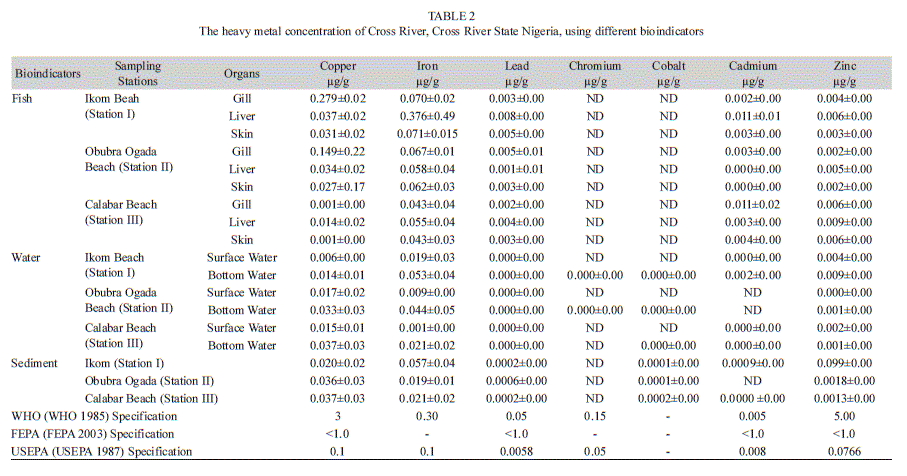
<body><![CDATA[<font size="2"></font><br style="font-family: verdana;">     <font size="2"><span style="font-family: verdana;">The result of the     accumulation of     heavy metals in Catfish <span style="font-style: italic;">Chrysichthys     nigrodigitatus </span>is presented in     <a href="/img/revistas/rbt/v60n3/a27t2.gif">table 2</a>, the highest     concentration of&nbsp; copper&nbsp;     (0.279&plusmn;0.022&nbsp; &#956;g/g)&nbsp; was&nbsp; observed in the gill at     Ikom (Station I) (p&lt;0.05). However, there was a non significant     difference (0.034&plusmn;0.017 and 0.031&plusmn;0.024 &#956;g/g) between     ]]></body>
<body><![CDATA[liver and skin at Ikom (Station I) and Obubra (Station II),     respectively. The minimum concentration of Copper     (0.001&plusmn;0.001&#956;g/g) was found in the fish gills and skin from     Calabar (Station&nbsp; III).&nbsp; The&nbsp; highest&nbsp;     concentration&nbsp; of Iron&nbsp; (0.376&plusmn;0.49&#956;g/g)&nbsp;     was&nbsp; observed&nbsp; in&nbsp; the liver at Ikom (Station I)     (p&lt;0.05). However, there was a significant difference     (0.067&plusmn;0.006 and 0.043&plusmn;0.034&#956;g/g) between gill and skin     of&nbsp; fish&nbsp; from&nbsp; Obubra&nbsp; (Station&nbsp; II)&nbsp;     and&nbsp; Calabar (Station III), respectively. The minimum     ]]></body>
<body><![CDATA[concentration&nbsp; of&nbsp; Iron&nbsp; (0.043&plusmn;0.039&#956;g/g and     0.043&plusmn;0.034&#956;g/g) was found in the gills and skin&nbsp; at&nbsp;     Calabar&nbsp; (Station&nbsp; III)&nbsp; (<a      href="/img/revistas/rbt/v60n3/a27t1.gif">Table&nbsp; 1</a>).&nbsp; The     highest concentration of Lead (0.008&plusmn;0.008 &#956;g/g) was observed in     the liver at Ikom (Station I) (p&lt;0.05), there was a significant     difference (0.005&plusmn;0.009 and 0.003&plusmn;0.002 &#956;g/g) between     gill and skin at Obubra (Station II) and Calabar (Station III),     respectively. The minimum concentration of Lead     (0.001&plusmn;0.001&#956;g/g) was found in the liver at Obubra (Station II).    ]]></body>
<body><![CDATA[<br> <br style="font-family: verdana;"> </span></font><br style="font-family: verdana;"> <font size="2"><span style="font-family: verdana;">The highest concentration of Cadmium (0.011&plusmn;0.007&#956;g/g) was observed in the liver at Ikom (Station I) and Gill at Calabar (Station III) (p&lt;0.05), there was a significant difference (0.004&plusmn;0.004 and 0.003&plusmn;0.005 &#956;g/g) between gill and skin at Obubra (Station II) and Calabar (Station III), respectively. The minimum concentration of Cadmium (0.000&plusmn;0.000&#956;g/g) was&nbsp; found&nbsp; in&nbsp; the&nbsp; liver&nbsp; and&nbsp; skin&nbsp; at&nbsp; Obubra (Station II). The highest concentration of Zinc (0.009&plusmn;0.001&#956;g/g) was observed in the liver&nbsp; at&nbsp; Calabar&nbsp; (Station&nbsp; III)&nbsp; (p&lt;0.05),&nbsp; there was a significant difference (0.004&plusmn;0.004 and 0.003&plusmn;0.002&#956;g/g)&nbsp; between&nbsp; gill&nbsp; and&nbsp; skin&nbsp; at Ikom (Station I) and Obubra (Station II), respectively. The minimum concentration of Zinc (0.002&plusmn;0.002&#956;g/g and 0.002&plusmn;0.002&#956;g/g) was found in the gill and skin at Obubra (Station II). Chromium and Cobalt were not detected in all the stations during the experiment (<a  href="/img/revistas/rbt/v60n3/a27t2.gif">Table 2</a>).</span></font><br  style="font-family: verdana;"> <font size="2"></font><br style="font-family: verdana;"> <font size="2"><span style="font-family: verdana;">The result of the accumulation of heavy metals&nbsp; in&nbsp; water&nbsp; is&nbsp; presented&nbsp; in&nbsp; <a href="/img/revistas/rbt/v60n3/a27t2.gif">table&nbsp; 2</a>&nbsp; and the mean concentrations for Cu, Fe, Pb, Cr, Co, Ca and Zn in surface and bottom water observed different concentrations among the studied stations, but higher concentration values were observed in bottom water samples in all stations, when compared to surface samples. Chromium and Cobalt observed the lowest values for both surface and bottom water, while Iron resulted with the highest concentration value (0.053&plusmn;0.04&#956;g/g and 0.044&plusmn;0.05&#956;g/g) in bottom water samples from Ikom Beach (Station I) and Obubra Ogada Beach (Station II), respectively. These Stations resulted also with the highest heavy metal concentration values for&nbsp; bottom&nbsp; water&nbsp; samples&nbsp; (0.0782&#956;g/g&nbsp; and </span></font><font size="2"><span  style="font-family: verdana;">0.0787&#956;g/g) when compared to Calabar Station with 0.059&#956;g/g. Copper concentrations were highest (0.037&plusmn;0.03 &#956;g/g) in Calabar Beach bottom&nbsp; samples.&nbsp; Besides,&nbsp; Copper&nbsp; and&nbsp; Iron were the most common heavy metals for both surface and bottom water, but also in sediment samples from the evaluated stations.</span></font><br  style="font-family: verdana;"> <font size="2"></font><br style="font-family: verdana;"> <font size="2"><span style="font-family: verdana;">The results of the accumulation of heavy metals in sediments is presented in <a  href="/img/revistas/rbt/v60n3/a27t2.gif">table 2</a>, the mean concentrations of Cu, Fe, Pb, Cr, Co, Ca and Zn observed in different concentrations among the studied stations, but the highest value were observed at Calabar (Station III) and Ikom (Station I) (p&lt;0.05). Copper and Cadmium observed the highest values at Calabar (Station III) and Ikom (Station I) (0.037&plusmn;0.03&#956;g/g and 0.099&plusmn;0.004&#956;g/g, respectively), while Cobalt and Cadmium observed the lowest (0.0001&plusmn;0.00&#956;g/g and 0.0000&plusmn;0.000&#956;g/g) at Obubra (Station II) and Calabar (Station III). Chromium was not detected in all the stations.</span></font><br  style="font-family: verdana;"> <font size="2"></font><br style="font-family: verdana;"> <font style="font-weight: bold;" size="3"><span  style="font-family: verdana;">Discussion    <br>     <br style="font-family: verdana;">     </span></font><font size="2"><span style="font-family: verdana;">Knowledge     of heavy     metal     concentrations in fish is important with respect to nature of     management and human consumption of fish. Generally, heavy metal     concentrations in the tissue of freshwater fish vary considerably among     different studies (Javed &amp; Hayat 1998, Chattopadhyay <span     ]]></body>
<body><![CDATA[ style="font-style: italic;">et al</span>. 2002,     Papagiannis <span style="font-style: italic;">et al</span>. 2004),     possibly due to differences in metal     concentrations and chemical characteristics of water from which fish     were sampled, ecological needs, metabolism and feeding patterns of     fish, and also the season in which studies were carried out. In the     river, fish are often at the top of the food chain and have the     tendency to concentrate heavy metals from water (Mansour &amp; Sidky     2002). Therefore, bioaccumulation of metals in fish can be considered     as an index of metal pollution in the aquatic bodies (Javed &amp;     ]]></body>
<body><![CDATA[Hayat&nbsp; 1998, Tawari-Fufeyin&nbsp; &amp;&nbsp; Ekaye&nbsp; 2007,     Karadede-Akin &amp; Unlu 2007) that could be a useful tool to study the     biological role of metals present at higher concentrations in fish     (Dural <span style="font-style: italic;">et al</span>. 2007, Anim <span      style="font-style: italic;">et al</span>. 2011).</span></font><br      style="font-family: verdana;">     <font size="2"></font><br style="font-family: verdana;">     <font size="2"><span style="font-family: verdana;">In the present     study, the result of     the accumulation of heavy metals in Catfish <span     ]]></body>
<body><![CDATA[ style="font-style: italic;">Chrysichthys     nigrodigitatus </span>showed that the highest concentration&nbsp;     of&nbsp;     copper&nbsp; (0.297&plusmn;0.022&nbsp; &#956;g/g) was observed in the gill     at Ikom (Station I) (p&lt;0.05). However, there was a non significant     difference (0.034&plusmn;0.017 and 0.031&plusmn;0.024&#956;g/g)     between&nbsp; liver&nbsp; and&nbsp; skin&nbsp; at&nbsp; Obubra&nbsp;     (Station II)&nbsp;&nbsp; and&nbsp;&nbsp; Calabar&nbsp;&nbsp;     (Station&nbsp;&nbsp; III),&nbsp;&nbsp; respectively. The minimum     concentration of Copper (0.001&plusmn;0.001&#956;g/g) was found in the gills     ]]></body>
<body><![CDATA[at Calabar (Station III). Gills which are in direct contact with water     accumulated some amount of copper. Bio-accumulation in fish has been     reported by many researchers (Jernelov &amp; Lann 1971, Goldwater 1971,     Mathis &amp; Cummings 1973,&nbsp; Chernof&nbsp; &amp;&nbsp;     Dooley&nbsp; 1979,&nbsp; Bull&nbsp; <span style="font-style: italic;">et&nbsp;     al</span>. 1981, Biney <span style="font-style: italic;">et al</span>.     1991, Law &amp; Singh 1991). The uptake of heavy metals in fish was     found to occur through absorption across the gill surface or through     the gut wall tract (Mathis &amp; Cummings 1973). Diffusion facilitated     transport or absorption in gills and surface mucus are the mechanisms     ]]></body>
<body><![CDATA[of uptake from water (Oguzie 1996).</span></font><br      style="font-family: verdana;">     <font size="2"></font><br style="font-family: verdana;">     <font size="2"><span style="font-family: verdana;">The     concentrations&nbsp; of&nbsp;     heavy&nbsp; metals&nbsp; in fish have been reported to depend upon the     rate of uptake through the gut from food and the rate of excretion     (Bull <span style="font-style: italic;">et al</span>. 1981). The     accumulation of copper in the gills may be due     to adsorption to the gill surfaces and dependent on the availability     ]]></body>
<body><![CDATA[of proteins to which the copper may bind. The low accumulation may be     due to development of some defensive mechanism such as excessive mucous     secretion and clogging of gills. The slow penetration of copper across     the gills may be the reason for low toxicity of this metal to <span      style="font-style: italic;">Clarias     batrachus</span>. Huges &amp; Floss (1978) also found the low     accumulation     of zinc in gills of the rainbow trout.</span></font><br      style="font-family: verdana;">     <font size="2"></font><br style="font-family: verdana;">     ]]></body>
<body><![CDATA[<font size="2"><span style="font-family: verdana;">The highest     concentration of copper     (0.65&plusmn;0.11&#956;g/g) was detected in the liver tissue of <span      style="font-style: italic;">O.     niloticus</span>, while the lowest detected limit     (0.01&plusmn;0.01&#956;g/g) was     found in the bone tissue of <span style="font-style: italic;">O.     niloticus</span>. Liver concentrates higher     levels of copper in all the six species of fishes than the other     organs. Akan <span style="font-style: italic;">et al</span>. (2009)     ]]></body>
<body><![CDATA[recorded high level of copper from lake Chad     in the liver tissues for all the fishes is due to the fact that, the     liver is a target organ for the accumulation of this element. For the     gills samples, it may be due to the fact that freshwater fish&#8217;s gills     might be expected to be the primary route for the&nbsp; uptake&nbsp;     of&nbsp; water&nbsp; borne&nbsp; pollutants,&nbsp; Allen &amp; Wilson     (1991). WHO (1989) reported that copper toxicity in fish is taken up     directly from the water via gills and stored in the liver, the     present&nbsp; study&nbsp; showed&nbsp; the&nbsp; similar&nbsp;     accumulation of copper in the gills and livers. Effects of high     ]]></body>
<body><![CDATA[concentrations of copper in fish are not&nbsp; well&nbsp;     (Woodward&nbsp; <span style="font-style: italic;">et&nbsp; al</span>.&nbsp;     1994).&nbsp; Copper can&nbsp;     combine&nbsp; with&nbsp; other&nbsp; contaminants&nbsp; such as     ammonia, mercury, and zinc to produce an additive&nbsp; toxic&nbsp;     effect&nbsp; on&nbsp; fish&nbsp; (Herbert&nbsp; <span      style="font-style: italic;">et&nbsp; al</span>. 1964,     Rompala <span style="font-style: italic;">et al</span>. 1984). </span></font><br      style="font-family: verdana;">     <font size="2"></font><br style="font-family: verdana;">     ]]></body>
<body><![CDATA[<font size="2"><span style="font-family: verdana;">The higher levels of     trace elements     such as lead and chromium in liver relative to other tissues may be     attributed to the affinity or strong coordination of metallothionein     protein with these elements (Ikem <span style="font-style: italic;">et     al</span>. 2003). According to Allen-Gill     &amp; Martynov (1995), low levels of copper and zinc in fish muscles     appear to be due to low levels of binding proteins in the muscles.     Canli &amp; Kalay (1998) determined the concentrations of cadmium and     chromium in the gills, liver and muscles of <span     ]]></body>
<body><![CDATA[ style="font-style: italic;">Cyprinus carpio, Barbus     capito and Chondrostoma</span> <span style="font-style: italic;">regium</span>     caught at five stations on the Seyhan     river system. Liver and gill tissues showed higher metal concentrations     than muscles tissue. Thus, heavy metals when discharged into the river     enter the food chain and accumulate in the fish body as determined     during this investigation. Similar&nbsp; work&nbsp; was&nbsp;     carried&nbsp; out&nbsp; by&nbsp; Wegwu <span      style="font-style: italic;">et al</span>. (2006), they worked on     the assessment of Heavy-Metal Profile of the New Calabar River and its     ]]></body>
<body><![CDATA[impact on juvenile <span style="font-style: italic;">Clarias     gariepinus </span>and find out that the results     indicate that trace metals (except for Zn), even at very low     concentrations, negatively affect fish hatch and fry rearing, implying     that aquatic milieus contaminated by trace metals are not suitable as     nursery grounds for fish cultures.</span></font><br      style="font-family: verdana;">     <font size="2"></font><br style="font-family: verdana;">     <font size="2"><span style="font-family: verdana;">The highest     concentration of iron (0.371&plusmn;0.489&#956;g/g) was observed in     ]]></body>
<body><![CDATA[the liver at Ikom (Station I) (p&lt;0.05). However, there was a     significant difference (0.067&plusmn;0.006 and 0.043&plusmn;0.034&#956;g/g)     between gill and skin at Obubra (Station II) and Calabar (Station III),     respectively. The minimum concentration of Iron (0.043&plusmn;0.039     &#956;g/g and 0.043&plusmn;0.034 &#956;gg1) was found in the gills and skin at     Calabar (Station III) (<a href="/img/revistas/rbt/v60n3/a27t1.gif">Table     1</a>). Fish liver exhibited highest tendency     to accumulate both the metals. The accumulation of both cadmium and     chromium were the minimum in fish gills. Dural <span      style="font-style: italic;">et al</span>. (2007) and Ploetz     ]]></body>
<body><![CDATA[<span style="font-style: italic;">et al</span>. (2007) reported highest     levels of cadmium, lead, copper,&nbsp;     zinc&nbsp; and&nbsp; iron&nbsp; in&nbsp; the&nbsp; liver&nbsp;     and&nbsp; gills&nbsp; of fish species viz. <span      style="font-style: italic;">Sparus aurata</span>, <span      style="font-style: italic;">Dicentrachus     labrax</span>, <span style="font-style: italic;">Mugil cephalus</span>     and <span style="font-style: italic;">Scomberomorus cavalla</span>.     Yilmaz <span style="font-style: italic;">et al</span>. (2007)     reported that in <span style="font-style: italic;">Leuciscus cephalus</span>     ]]></body>
<body><![CDATA[and <span style="font-style: italic;">Lepornis gibbosus</span>,     cadmium,     cobalt and copper accumulations in the liver and gills were maximum,     while these accumulations were least in the fish muscle. Accumulation     in the liver can be the result of detoxicating mechanisms and may     originate from metal in the food (Karadede &amp; Unlu 1998,     Shoham-Frider <span style="font-style: italic;">et al</span>. 2002).     However, the liver is the preferred organ     for metal accumulation as could be deduced from the present study.</span></font><br      style="font-family: verdana;">     ]]></body>
<body><![CDATA[<font size="2"></font><br style="font-family: verdana;">     <font size="2"><span style="font-family: verdana;">The highest     concentration of Lead     (0.008&plusmn;0.008&#956;g/g) was observed in the liver at&nbsp; Ikom&nbsp;     (Station&nbsp; I)&nbsp; (p&lt;0.05),&nbsp; there&nbsp; was&nbsp; a     significant difference (0.005&plusmn;0.009 and 0.003&plusmn;0.002&#956;g/g)     between gill and skin at Obubra (Station II) and Calabar (Station III),     respectively. The minimum concentration of Lead     (0.001&plusmn;0.001&#956;g/g) was found in the liver at Obubra (Station I).     Lead accumulates significantly in the bone, liver, stomach, gills and     ]]></body>
<body><![CDATA[kidney tissue of <span style="font-style: italic;">T. zilli</span>, <span      style="font-style: italic;">C. anguillaris</span>, <span      style="font-style: italic;">Protoptenus</span>, O. niloticus,     <span style="font-style: italic;">E. niloticus</span> and <span      style="font-style: italic;">S. budgetti</span>. The highest levels of     lead     (0.32&plusmn;0.12&#956;g /g) were observed in the liver tissue of <span      style="font-style: italic;">T. zilli</span>,     while the lowest limit (0.01&plusmn;0.0.01Mg/g) was detected in the     bones of C. anguillaris and S. budgetti. The concentrations of lead     ]]></body>
<body><![CDATA[were higher in the following order liver&gt;gills&gt;stomach&gt;     kidney&gt;bone. Similar findings were reported by Buhler <span      style="font-style: italic;">et al</span>. (1977).</span></font><br      style="font-family: verdana;">     <font size="2"></font><br style="font-family: verdana;">     <font size="2"><span style="font-family: verdana;">Those highest     concentrations were     in gills, kidney and spleen in rainbow trout. (Oladimeji &amp; Offem     1989), noticed in <span style="font-style: italic;">O. niloticus</span>,     that the gills consistently accumulated     ]]></body>
<body><![CDATA[higher amount of lead as lead nitrate. Lead is highly toxic to aquatic     organisms, especially fish (Rompala <span style="font-style: italic;">et     al</span>. 1984). The biological     effects of sublethal concentrations of lead include delayed embryonic     development, suppressed reproduction, and inhibition of growth,     increased mucous formation, neurological problems, enzyme inhalation     and kidney dysfunction (Rompala <span style="font-style: italic;">et al</span>.     1984, Leland &amp; Kuwabara     1985). The levels of lead in liver, gills, stomach, kidney and bone     tissue of <span style="font-style: italic;">T. zilli</span>, <span     ]]></body>
<body><![CDATA[ style="font-style: italic;">C. anguillaris</span>, Protoptenus, <span      style="font-style: italic;">O. niloticus</span>, E.     niloticus and S. budgetti were below the 0.5&#956;g g-1 limits (Walsh <span      style="font-style: italic;">et al</span>.     1977).</span></font><br style="font-family: verdana;">     <font size="2"></font><br style="font-family: verdana;">     <font size="2"><span style="font-family: verdana;">The highest     concentration of     Cadmium (0.011&plusmn;0.007&#956;g/g) was observed in the liver at Ikom     (Station I) (p&lt;0.05), there was a significant difference     ]]></body>
<body><![CDATA[(0.004&plusmn;0.004 and 0.003&plusmn;0.005&#956;g/g) between gill and skin     at Obubra (Station II) and Calabar (Station III), respectively. The     minimum concentration of Cadmium (0.000&plusmn;0.000&#956;g/g) was found in     the liver and skin at Obubra (Station II). Cadmium is a non essential     trace metal that is potentially toxic to most fish and wildlife,     particularly freshwater organisms (Robertson <span      style="font-style: italic;">et al</span>. 1991). The&nbsp;     highest&nbsp; concentrations&nbsp; of&nbsp; (0.03&plusmn;0.01-     0.22&plusmn;0.01&#956;g/g) in liver tissues of the above species were below     the 0.5&#956;g/g threshold considered harmful to fish and predators (Walsh     ]]></body>
<body><![CDATA[<span style="font-style: italic;">et al</span>. 1977). The     cadmium-related contamination of the aquatic habitat     has greatly increased in the last decades, resulting in an increase of     cadmium deposits in tissues of aquatic organisms in all food chain     systems (Giles 1988). It is important to note that cadmium is a highly     toxic element for all mammals and fish. Cadmium levels have     constantly been increasing, and consequently, the research on cadmium     has become quite topical and urgent.</span></font><br      style="font-family: verdana;">     <font size="2"></font><br style="font-family: verdana;">     ]]></body>
<body><![CDATA[<font size="2"><span style="font-family: verdana;">The highest     concentration of Zinc (0.009&plusmn;0.001&#956;g/g) was observed in     the liver at&nbsp; Calabar&nbsp; (Station&nbsp; III)&nbsp;     (p&lt;0.05),&nbsp; there&nbsp; was a&nbsp; significant&nbsp;     difference&nbsp; (0.004&plusmn;0.004&nbsp; and     0.003&plusmn;0.002&#956;g/g)&nbsp; between&nbsp; gill&nbsp; and&nbsp;     skin&nbsp; at Ikom (Station I) and Obubra (Station II), respectively.     The minimum concentration of Zinc (0.002&plusmn;0.002&#956;g/g and     0.002&plusmn;0.002&#956;g/g) was found in the gill and skin at Obubra     (Station II). Zinc was detected in all the fish samples, and the     ]]></body>
<body><![CDATA[highest concentration was observed in the liver tissues followed by the     gills, stomach and kidney. Fish can accumulate zinc from both the     surrounding water and from their diet (Eisher 1993). Although zinc is     an essential element, at high concentrations, it can be toxic to fish,     cause mortality, growth retardation, and reproductive impairment     (Sorenson 1991). Zinc is capable of interacting with other elements and     producing antagonistic, additive, or synergistic effects (Eisher 1993).     Zinc does not appear to present a contaminant hazard to fish in Cross     River. Chromium and Cobalt were not detected in all the fish organs     studied and for all the stations during the experiment. Chromium is     ]]></body>
<body><![CDATA[an essential trace element in humans and some laboratory animals (Lee     &amp; Schultz 1994), but in excess, it could have lethal and sublethal     effects on fish and wildlife (Robertson <span      style="font-style: italic;">et al</span>. 1991).</span></font><br      style="font-family: verdana;">     <font size="2"></font><br style="font-family: verdana;">     <font size="2"><span style="font-family: verdana;">Prasathp &amp;     Khanth (2008)     reported the impact of Tsunami on the Heavy Metal accumulation in     water, sediments and fish at Poompuhar Coast, Southeast Coast of     ]]></body>
<body><![CDATA[India and stated the highest recorded value among heavy metals was Mn     which varied from 489.5&#956;g/g to-506.9&#956;g/g&nbsp; and&nbsp; the&nbsp;     lowest&nbsp; recorded&nbsp; value among heavy metals was Pb which     varied from 0.04&#956;g/g to 0.07&#956;g/g. Except Mn all the other metals (Zn,     Cu, Fe, Co, Pb, Cd and Ni) recorded&nbsp; higher&nbsp;     concentrations&nbsp; after&nbsp; the&nbsp; tsunami. This variation in     metal concentrations is due to the presence of major sources of metal     pollution, intensive human activity and discharge of municipal waste     and industrial effluents. Also, the variation in the metal     concentration is due to the impact of tsunami that caused large scale     ]]></body>
<body><![CDATA[seawater inundation and the receding tidal waves carried into the     sea, debris, anthropogenic wastes, adjacent terrestrial parts including     plastic materials and domestic disposals from the near lands14. In     sediments, the accumulation of heavy metals was found in the order of     Mn&gt;Fe&gt;Cu&gt;Zn&gt;Pb&gt;Co&gt;Cd&gt;Ni. Zn and Cu recorded higher     values whereas Fe and Mn recorded lower values after tsunami. Highest     recorded value among heavy metals was Mn which varied from 771.6&#956;g/g to     851.1&#956;g/g (Prasathp &amp; Khanth 2008).</span></font><br      style="font-family: verdana;">     <font size="2"></font><br style="font-family: verdana;">     ]]></body>
<body><![CDATA[<font size="2"><span style="font-family: verdana;">In sediment, metal     levels differed     significantly (p&lt;0.05) and were highest at Station I, except Cu     which level was highest at Stations II, III. The highest metal levels     in sediment at Station I, is similar to the situation in water and     could also be due to the nearness of&nbsp; Station&nbsp; I&nbsp;     to&nbsp; the&nbsp; drainage&nbsp; discharge&nbsp; point from WEMCO     Company. Sediment metal levels recorded in this study were low, when     compared to the levels for unpolluted inland water sediment (GESAMP     1982). Sediments were considered an important indicator for     ]]></body>
<body><![CDATA[environmental pollution; they act as permanent&nbsp; or&nbsp;     temporary&nbsp; traps&nbsp; for&nbsp; material&nbsp; spread into the     environment (DeGregori <span style="font-style: italic;">et al</span>.     1996). Sediments have frequently been     analyzed to identify sources of trace metal in the aquatic environment     because of the high accumulation rates exhibited (Forstner <span      style="font-style: italic;">et al</span>.     1981). Sediment analysis allows contaminants that are adsorbed by     particulate matter, which escape detection by water analysis, to be     identified. The nonresidual fraction of the sediment is considered to     ]]></body>
<body><![CDATA[be mobile and therefore, is likely to become available&nbsp; to&nbsp;     aquatic&nbsp; organisms&nbsp; (Waldichuk 1985). Concentrations of heavy     metals in sediment usually exceed the levels of the overlying water     by 3 to 5 orders of magnitude. With such concentrations Oguzie (1996),     quoted in Defew <span style="font-style: italic;">et&nbsp; al</span>.&nbsp;     (2004)&nbsp; showed&nbsp; that&nbsp;     the&nbsp; bioavailability of even a minute fraction of the total     sediment metal assumes considerable importance. This is especially     true to burrowing and filter feeding organisms.</span></font><br      style="font-family: verdana;">     ]]></body>
<body><![CDATA[<font size="2"></font><br style="font-family: verdana;">     <font size="2"><span style="font-family: verdana;">Fish&nbsp;     absorb&nbsp;     metals&nbsp; through&nbsp; ingestion of water or contaminated food.     Heavy metals have been shown to undergo bioaccumulation in the tissue     of aquatic organisms. On consumption of fish and other aquatic     organisms these metals become transferred to man. However, it is not     yet known whether the fishes in the River have been severely affected     by heavy metals, based on the results obtained from this study.     Although the results do not explicitly indicate a manifestation of     ]]></body>
<body><![CDATA[toxic effects, the possibility that deleterious effects could manifest     after a long period of consumption of fish caught in Cross River with     trace metal contamination cannot be ruled out. The concentrations of     the heavy metals were observed to be higher in the upstream 2 which may     be a result of improper dumping of refuse and sitting of wood     processing (WEMCO) company near the sampling station 2 at Ikom.</span></font><br      style="font-family: verdana;">     <font size="2"></font><br style="font-family: verdana;">     <font style="font-weight: bold;" size="3"><span      style="font-family: verdana;">Acknowledgments</span></font><br     ]]></body>
<body><![CDATA[ style="font-family: verdana;">     <font size="2"></font><br style="font-family: verdana;">     <font size="2"><span style="font-family: verdana;">Funds and facilities     used for these     studies were provided by Cross River University of Technology 2010     Senate Research Grant Award, under the auspices of the Education Trust     Fund (ETF), Abuja, Nigeria. This support is acknowledged with     gratitude. Sincere thanks&nbsp; go&nbsp; to&nbsp; Emmanuel&nbsp;     Effiom,&nbsp; the&nbsp; laboratory scientists in the Department of     Chemistry, University of Calabar for laboratory assistance.</span></font><br     ]]></body>
<body><![CDATA[ style="font-family: verdana;">     <font size="2"></font>     <hr style="width: 100%; height: 2px;"><br style="font-family: verdana;">     <font style="font-weight: bold;" size="3"><span      style="font-family: verdana;">References</span></font><br      style="font-family: verdana;">     <font size="2"></font><br style="font-family: verdana;">     <font size="2"><span style="font-family: verdana;">Akan, J.C., F.I.     Abdulrahman, O.A.     Sodipo &amp; P.I. Akandu. 2009. Bioaccumulation of some heavy metals of     ]]></body>
<body><![CDATA[six fresh water fishes caught&nbsp; from lake chad in Doron     Buhari,&nbsp; Maiduguri,&nbsp; Bornno&nbsp; State&nbsp; Nigeria.&nbsp;     <!-- ref -->Nig.&nbsp; J. App. Sci. Environ. Manag. 4: 103-114.    &nbsp;&nbsp;&nbsp;&nbsp;&nbsp;&nbsp;&nbsp;&nbsp;[&#160;<a href="javascript:void(0);" onclick="javascript: window.open('/scielo.php?script=sci_nlinks&ref=1481407&pid=S0034-7744201200030002700001&lng=','','width=640,height=500,resizable=yes,scrollbars=1,menubar=yes,');">Links</a>&#160;]<!-- end-ref --><!-- ref --></span></font><br  style="font-family: verdana;"> <font size="2"></font><br style="font-family: verdana;"> <font size="2"><span style="font-family: verdana;">Allen, G.T. &amp; R.M. Wilson. 1991. Metals and organic compounds in fish of the Missouri River: Boyd County, Nebraska to Kansas City, Missouri. US FWS, Manhattan, Kansas, USA.    &nbsp;&nbsp;&nbsp;&nbsp;&nbsp;&nbsp;&nbsp;&nbsp;[&#160;<a href="javascript:void(0);" onclick="javascript: window.open('/scielo.php?script=sci_nlinks&ref=1481408&pid=S0034-7744201200030002700002&lng=','','width=640,height=500,resizable=yes,scrollbars=1,menubar=yes,');">Links</a>&#160;]<!-- end-ref --><!-- ref --></span></font><br style="font-family: verdana;"> <font size="2"></font><br style="font-family: verdana;"> <font size="2"><span style="font-family: verdana;">Allen-Gill,&nbsp; S.M. &amp;. V.G. Martynov. 1995.&nbsp; Heavy metals burdens in nine species of&nbsp; freshwater and anadromous fish from the Pechora River, Northern Russia. Sci. Total Environ. 160-161: 653-659.    &nbsp;&nbsp;&nbsp;&nbsp;&nbsp;&nbsp;&nbsp;&nbsp;[&#160;<a href="javascript:void(0);" onclick="javascript: window.open('/scielo.php?script=sci_nlinks&ref=1481409&pid=S0034-7744201200030002700003&lng=','','width=640,height=500,resizable=yes,scrollbars=1,menubar=yes,');">Links</a>&#160;]<!-- end-ref --><!-- ref --></span></font><br  style="font-family: verdana;"> <font size="2"></font><br style="font-family: verdana;"> <font size="2"><span style="font-family: verdana;">Ako,&nbsp; P.A. &amp; S.O. Salihu. 2004. Studies on&nbsp; Some Major and Trace Metals in Smoked and OvenDried. Fish. J. Appl. Sci. Environ. Mgt. 8: 5-9.    &nbsp;&nbsp;&nbsp;&nbsp;&nbsp;&nbsp;&nbsp;&nbsp;[&#160;<a href="javascript:void(0);" onclick="javascript: window.open('/scielo.php?script=sci_nlinks&ref=1481410&pid=S0034-7744201200030002700004&lng=','','width=640,height=500,resizable=yes,scrollbars=1,menubar=yes,');">Links</a>&#160;]<!-- end-ref --><!-- ref --></span></font><br  style="font-family: verdana;"> <font size="2"></font><br style="font-family: verdana;"> <font size="2"><span style="font-family: verdana;">Anim, A.K., E.K. Ahialey, G.O. Duodu, M. Ackah &amp; N.O. Bentil. 2011. Accumulation Profile of Heavy Metals in&nbsp; Fish&nbsp; Samples&nbsp; from&nbsp; Nsawam, Along&nbsp; the&nbsp; Densu River, Ghana, Res. J. Environ. Earth Sci. 3: 56-60.    &nbsp;&nbsp;&nbsp;&nbsp;&nbsp;&nbsp;&nbsp;&nbsp;[&#160;<a href="javascript:void(0);" onclick="javascript: window.open('/scielo.php?script=sci_nlinks&ref=1481411&pid=S0034-7744201200030002700005&lng=','','width=640,height=500,resizable=yes,scrollbars=1,menubar=yes,');">Links</a>&#160;]<!-- end-ref --><!-- ref --></span></font><br  style="font-family: verdana;"> <font size="2"></font><br style="font-family: verdana;"> <font size="2"><span style="font-family: verdana;">APHA. AWWA. WPCF. 1995. Standard&nbsp; Methods for the Examination of Water and Wastewater. Washington, D.C., USA.    &nbsp;&nbsp;&nbsp;&nbsp;&nbsp;&nbsp;&nbsp;&nbsp;[&#160;<a href="javascript:void(0);" onclick="javascript: window.open('/scielo.php?script=sci_nlinks&ref=1481412&pid=S0034-7744201200030002700006&lng=','','width=640,height=500,resizable=yes,scrollbars=1,menubar=yes,');">Links</a>&#160;]<!-- end-ref --><!-- ref --></span></font><br style="font-family: verdana;"> <font size="2"></font><br style="font-family: verdana;"> <font size="2"><span style="font-family: verdana;">American Public Health Association (APHA). 1998. Standard&nbsp; Methods&nbsp; for&nbsp; the&nbsp; Examination&nbsp; of Water&nbsp; and Wastewater. New York, USA.    &nbsp;&nbsp;&nbsp;&nbsp;&nbsp;&nbsp;&nbsp;&nbsp;[&#160;<a href="javascript:void(0);" onclick="javascript: window.open('/scielo.php?script=sci_nlinks&ref=1481413&pid=S0034-7744201200030002700007&lng=','','width=640,height=500,resizable=yes,scrollbars=1,menubar=yes,');">Links</a>&#160;]<!-- end-ref --><!-- ref --></span></font><br  style="font-family: verdana;"> <font size="2"></font><br style="font-family: verdana;"> <font size="2"><span style="font-family: verdana;">Bellucci, L.G., E.L. Moumni, B. Collavini, F. Frignani &amp; M.S. Albertazzi.&nbsp; 2003.&nbsp; Heavy&nbsp; metals&nbsp; in&nbsp; Morocco Lagoon and river sediments. J. Phys. 107: 139-142.    &nbsp;&nbsp;&nbsp;&nbsp;&nbsp;&nbsp;&nbsp;&nbsp;[&#160;<a href="javascript:void(0);" onclick="javascript: window.open('/scielo.php?script=sci_nlinks&ref=1481414&pid=S0034-7744201200030002700008&lng=','','width=640,height=500,resizable=yes,scrollbars=1,menubar=yes,');">Links</a>&#160;]<!-- end-ref --><!-- ref --></span></font><br style="font-family: verdana;"> <font size="2"></font><br style="font-family: verdana;"> <font size="2"><span style="font-family: verdana;">Bertolotto, R.M., B. Tortarolo, M. Frignani, L.G. Bellucci, S. Albanese &amp; C. Cuneo. 2003. Heavy metals in coastal sediments of the Ligurian sea off Vado Ligure. J. Phys. 107: 159-162.    &nbsp;&nbsp;&nbsp;&nbsp;&nbsp;&nbsp;&nbsp;&nbsp;[&#160;<a href="javascript:void(0);" onclick="javascript: window.open('/scielo.php?script=sci_nlinks&ref=1481415&pid=S0034-7744201200030002700009&lng=','','width=640,height=500,resizable=yes,scrollbars=1,menubar=yes,');">Links</a>&#160;]<!-- end-ref --><!-- ref --></span></font><br style="font-family: verdana;"> <font size="2"></font><br style="font-family: verdana;"> <font size="2"><span style="font-family: verdana;">Borretzen,&nbsp; P. &amp; B. Salbu. 2002. Fixation of&nbsp; Cs&nbsp; to marine&nbsp; sediments&nbsp; estimated&nbsp; by&nbsp; a&nbsp; stochastic&nbsp; modeling approach. J. Environ. Radio. 61: 1-20.    &nbsp;&nbsp;&nbsp;&nbsp;&nbsp;&nbsp;&nbsp;&nbsp;[&#160;<a href="javascript:void(0);" onclick="javascript: window.open('/scielo.php?script=sci_nlinks&ref=1481416&pid=S0034-7744201200030002700010&lng=','','width=640,height=500,resizable=yes,scrollbars=1,menubar=yes,');">Links</a>&#160;]<!-- end-ref --><!-- ref --></span></font><br style="font-family: verdana;"> <font size="2"></font><br style="font-family: verdana;"> <font size="2"><span style="font-family: verdana;">Broda,&nbsp; E. 1972. The uptake of heavy cationic&nbsp; trace ele-ments by microorganisms. Ann. Micro. 22: 93-108.    &nbsp;&nbsp;&nbsp;&nbsp;&nbsp;&nbsp;&nbsp;&nbsp;[&#160;<a href="javascript:void(0);" onclick="javascript: window.open('/scielo.php?script=sci_nlinks&ref=1481417&pid=S0034-7744201200030002700011&lng=','','width=640,height=500,resizable=yes,scrollbars=1,menubar=yes,');">Links</a>&#160;]<!-- end-ref --><!-- ref --></span></font><br style="font-family: verdana;"> <font size="2"></font><br style="font-family: verdana;"> <font size="2"><span style="font-family: verdana;">Biney, C.A., A.T. Amuzu, D. Calamari, N. Kaba, H. Naeve &amp; M.A.H. Saad. 1991. Review of heavy metals in the African Aquatic&nbsp; Environment. Ecotoxicol. Environ. Saf. 8: 134-159.    &nbsp;&nbsp;&nbsp;&nbsp;&nbsp;&nbsp;&nbsp;&nbsp;[&#160;<a href="javascript:void(0);" onclick="javascript: window.open('/scielo.php?script=sci_nlinks&ref=1481418&pid=S0034-7744201200030002700012&lng=','','width=640,height=500,resizable=yes,scrollbars=1,menubar=yes,');">Links</a>&#160;]<!-- end-ref --><!-- ref --></span></font><br style="font-family: verdana;"> <font size="2"></font><br style="font-family: verdana;"> <font size="2"><span style="font-family: verdana;">Buhler, D.R., R.M. Stokes &amp; S.R. Coldwell. 1977. Tissue accumulation&nbsp; and&nbsp; enzymatic&nbsp; effects&nbsp; of&nbsp; hexavalent chromium in Rainbow Trout (<span style="font-style: italic;">Salmo&nbsp; gairdneri</span>). J. Fis. Res. Board Can. 34: 9-18.    &nbsp;&nbsp;&nbsp;&nbsp;&nbsp;&nbsp;&nbsp;&nbsp;[&#160;<a href="javascript:void(0);" onclick="javascript: window.open('/scielo.php?script=sci_nlinks&ref=1481419&pid=S0034-7744201200030002700013&lng=','','width=640,height=500,resizable=yes,scrollbars=1,menubar=yes,');">Links</a>&#160;]<!-- end-ref --><!-- ref --></span></font><br  style="font-family: verdana;"> <font size="2"></font><br style="font-family: verdana;"> <font size="2"><span style="font-family: verdana;">Bull,&nbsp; K.R., A.F. Dearstly &amp; M.H. Inskip.&nbsp; 1981. Growth and&nbsp; mercury&nbsp; content&nbsp; of&nbsp; <span style="font-style: italic;">Rutilus&nbsp;</span> <span style="font-style: italic;">rutilus&nbsp; L.&nbsp; Perch(Perca Fluviallis</span>) and Pike (<span style="font-style: italic;">Esox, Lusius, L.</span>) living in sewage effluents. Environ. Pollut. 25: 229-240.    &nbsp;&nbsp;&nbsp;&nbsp;&nbsp;&nbsp;&nbsp;&nbsp;[&#160;<a href="javascript:void(0);" onclick="javascript: window.open('/scielo.php?script=sci_nlinks&ref=1481420&pid=S0034-7744201200030002700014&lng=','','width=640,height=500,resizable=yes,scrollbars=1,menubar=yes,');">Links</a>&#160;]<!-- end-ref --><!-- ref --></span></font><br  style="font-family: verdana;"> <font size="2"></font><br style="font-family: verdana;"> <font size="2"><span style="font-family: verdana;">Canli, M. &amp; M. Kalay. 1998. Levels of heavy metals (Cd, Pb, Cu, Cr and Ni) in&nbsp; tissue of <span style="font-style: italic;">Cyprinus carpio, Barbus capito</span>&nbsp; and <span style="font-style: italic;">Chondrostoma regium</span> from the Seyhan River, Turkey. Turkish J. Zool. 22: 149-157.    &nbsp;&nbsp;&nbsp;&nbsp;&nbsp;&nbsp;&nbsp;&nbsp;[&#160;<a href="javascript:void(0);" onclick="javascript: window.open('/scielo.php?script=sci_nlinks&ref=1481421&pid=S0034-7744201200030002700015&lng=','','width=640,height=500,resizable=yes,scrollbars=1,menubar=yes,');">Links</a>&#160;]<!-- end-ref --><!-- ref --></span></font><br  style="font-family: verdana;"> <font size="2"></font><br style="font-family: verdana;"> <font size="2"><span style="font-family: verdana;">Chattopadhyay, B., A. Chatterjee &amp; S.K. Mukhopadhyay. 2002. Bioaccumulation of metals in the East Calcutta wetland ecosystem. Aquat.&nbsp; Ecosys. Health Manag. 5: 191-203.    &nbsp;&nbsp;&nbsp;&nbsp;&nbsp;&nbsp;&nbsp;&nbsp;[&#160;<a href="javascript:void(0);" onclick="javascript: window.open('/scielo.php?script=sci_nlinks&ref=1481422&pid=S0034-7744201200030002700016&lng=','','width=640,height=500,resizable=yes,scrollbars=1,menubar=yes,');">Links</a>&#160;]<!-- end-ref --><!-- ref --></span></font><br style="font-family: verdana;"> <font size="2"></font><br style="font-family: verdana;"> <font size="2"><span style="font-family: verdana;">Chernof, B. &amp; J.K. Dooley. 1979. Heavy metals in relation to the biology of Mummichog&nbsp; (<span style="font-style: italic;">Fundulus heteroclitus</span>). J. Fish Biol. 14: 3309-328.    &nbsp;&nbsp;&nbsp;&nbsp;&nbsp;&nbsp;&nbsp;&nbsp;[&#160;<a href="javascript:void(0);" onclick="javascript: window.open('/scielo.php?script=sci_nlinks&ref=1481423&pid=S0034-7744201200030002700017&lng=','','width=640,height=500,resizable=yes,scrollbars=1,menubar=yes,');">Links</a>&#160;]<!-- end-ref --><!-- ref --></span></font><br style="font-family: verdana;"> <font size="2"></font><br style="font-family: verdana;"> <font size="2"><span style="font-family: verdana;">Cohen, A.S. 2003. Paliolimnology. Oxford&nbsp; University, New York, USA.    &nbsp;&nbsp;&nbsp;&nbsp;&nbsp;&nbsp;&nbsp;&nbsp;[&#160;<a href="javascript:void(0);" onclick="javascript: window.open('/scielo.php?script=sci_nlinks&ref=1481424&pid=S0034-7744201200030002700018&lng=','','width=640,height=500,resizable=yes,scrollbars=1,menubar=yes,');">Links</a>&#160;]<!-- end-ref --><!-- ref --></span></font><br  style="font-family: verdana;"> <font size="2"></font><br style="font-family: verdana;"> <font size="2"><span style="font-family: verdana;">DeGregori, I., H. Pinochet, M. Arancibia &amp; A. Vidal. 1996. Grain&nbsp; Size Effects on Trace Metals&nbsp; Distribution in Sediments from Two&nbsp; Coastal Areas of Chile. Bull. Environ. Contam. Toxicol. 57: 163-170.    &nbsp;&nbsp;&nbsp;&nbsp;&nbsp;&nbsp;&nbsp;&nbsp;[&#160;<a href="javascript:void(0);" onclick="javascript: window.open('/scielo.php?script=sci_nlinks&ref=1481425&pid=S0034-7744201200030002700019&lng=','','width=640,height=500,resizable=yes,scrollbars=1,menubar=yes,');">Links</a>&#160;]<!-- end-ref --><!-- ref --></span></font><br  style="font-family: verdana;"> <font size="2"></font><br style="font-family: verdana;"> <font size="2"><span style="font-family: verdana;">Defew, L., J. Mair &amp; H. Guzman. 2004. An&nbsp; assessment of metal contamination in&nbsp; mangrove sediments and leaves from&nbsp; Punta Mala Bay, Pacific Panama. Mar. Pollut. Bull. 50: 547-552.    &nbsp;&nbsp;&nbsp;&nbsp;&nbsp;&nbsp;&nbsp;&nbsp;[&#160;<a href="javascript:void(0);" onclick="javascript: window.open('/scielo.php?script=sci_nlinks&ref=1481426&pid=S0034-7744201200030002700020&lng=','','width=640,height=500,resizable=yes,scrollbars=1,menubar=yes,');">Links</a>&#160;]<!-- end-ref --><!-- ref --></span></font><br  style="font-family: verdana;"> <font size="2"></font><br style="font-family: verdana;"> <font size="2"><span style="font-family: verdana;">Dural, M., M.Z. Goksu &amp; A.A. Ozak. 2007. Investigation of heavy metal levels in economically important fish species captured from the Tuzla Lagoon. Food Chem. 102: 415-421.    &nbsp;&nbsp;&nbsp;&nbsp;&nbsp;&nbsp;&nbsp;&nbsp;[&#160;<a href="javascript:void(0);" onclick="javascript: window.open('/scielo.php?script=sci_nlinks&ref=1481427&pid=S0034-7744201200030002700021&lng=','','width=640,height=500,resizable=yes,scrollbars=1,menubar=yes,');">Links</a>&#160;]<!-- end-ref --><!-- ref --></span></font><br style="font-family: verdana;"> <font size="2"></font><br style="font-family: verdana;"> <font size="2"><span style="font-family: verdana;">Eisher, R. 1993. Zinc hazards to fish, wildlife, and invertebrates: a synoptic review. U.S. Fish Wildllife Service 85: 90.    &nbsp;&nbsp;&nbsp;&nbsp;&nbsp;&nbsp;&nbsp;&nbsp;[&#160;<a href="javascript:void(0);" onclick="javascript: window.open('/scielo.php?script=sci_nlinks&ref=1481428&pid=S0034-7744201200030002700022&lng=','','width=640,height=500,resizable=yes,scrollbars=1,menubar=yes,');">Links</a>&#160;]<!-- end-ref --><!-- ref --></span></font><br style="font-family: verdana;"> <font size="2"></font><br style="font-family: verdana;"> <font size="2"><span style="font-family: verdana;">Ekpo, K.E., I.O. Asia, K.O. Amayo &amp; D.A. Jegede. 2008. Determination&nbsp; of&nbsp; lead,&nbsp; cadmium&nbsp; and&nbsp; mercury&nbsp; in surrounding water and organs of some species of fish from Ikpoba river in Benin city, Nigeria. Int. J. Phy. Sc. 3: 289-292.    &nbsp;&nbsp;&nbsp;&nbsp;&nbsp;&nbsp;&nbsp;&nbsp;[&#160;<a href="javascript:void(0);" onclick="javascript: window.open('/scielo.php?script=sci_nlinks&ref=1481429&pid=S0034-7744201200030002700023&lng=','','width=640,height=500,resizable=yes,scrollbars=1,menubar=yes,');">Links</a>&#160;]<!-- end-ref --><!-- ref --></span></font><br style="font-family: verdana;"> <font size="2"></font><br style="font-family: verdana;"> <font size="2"><span style="font-family: verdana;">Federal&nbsp; Environmental Projection Agency&nbsp; (FEPA). 2003. Guidelines and standards for environmental pollution control in Nigeria. Nigeria.    &nbsp;&nbsp;&nbsp;&nbsp;&nbsp;&nbsp;&nbsp;&nbsp;[&#160;<a href="javascript:void(0);" onclick="javascript: window.open('/scielo.php?script=sci_nlinks&ref=1481430&pid=S0034-7744201200030002700024&lng=','','width=640,height=500,resizable=yes,scrollbars=1,menubar=yes,');">Links</a>&#160;]<!-- end-ref --><!-- ref --></span></font><br  style="font-family: verdana;"> <font size="2"></font><br style="font-family: verdana;"> <font size="2"><span style="font-family: verdana;">Forstner, U. &amp; G.T.W. Wittmann. 1981. Metal pollution in the aquatic environment. Spring, Berlin, Heidelberg, New York, USA.    &nbsp;&nbsp;&nbsp;&nbsp;&nbsp;&nbsp;&nbsp;&nbsp;[&#160;<a href="javascript:void(0);" onclick="javascript: window.open('/scielo.php?script=sci_nlinks&ref=1481431&pid=S0034-7744201200030002700025&lng=','','width=640,height=500,resizable=yes,scrollbars=1,menubar=yes,');">Links</a>&#160;]<!-- end-ref --><!-- ref --></span></font><br  style="font-family: verdana;"> <font size="2"></font><br style="font-family: verdana;"> <font size="2"><span style="font-family: verdana;">Food and Agriculture Organization (FAO). 1992. Report of the third Session of Working Party on Pollution and Fisheries, Accra,&nbsp; Ghana, 25-29th&nbsp;&nbsp; Nov.,&nbsp; 1991.&nbsp; FAO Fisheries Report. 471: 43.    &nbsp;&nbsp;&nbsp;&nbsp;&nbsp;&nbsp;&nbsp;&nbsp;[&#160;<a href="javascript:void(0);" onclick="javascript: window.open('/scielo.php?script=sci_nlinks&ref=1481432&pid=S0034-7744201200030002700026&lng=','','width=640,height=500,resizable=yes,scrollbars=1,menubar=yes,');">Links</a>&#160;]<!-- end-ref --><!-- ref --><br> <br style="font-family: verdana;"> </span></font><font size="2"><span style="font-family: verdana;">Giles, M.A. 1988. Accumulation of Cadmium by Rainbow Trout, <span style="font-style: italic;">Salmo gairdneri</span>,&nbsp; during Extended Exposure. Can. J. Fish. Aquat. Sci. 45: 1045-1053.    &nbsp;&nbsp;&nbsp;&nbsp;&nbsp;&nbsp;&nbsp;&nbsp;[&#160;<a href="javascript:void(0);" onclick="javascript: window.open('/scielo.php?script=sci_nlinks&ref=1481433&pid=S0034-7744201200030002700027&lng=','','width=640,height=500,resizable=yes,scrollbars=1,menubar=yes,');">Links</a>&#160;]<!-- end-ref --><!-- ref --></span></font><br  style="font-family: verdana;"> <font size="2"></font><br style="font-family: verdana;"> <font size="2"><span style="font-family: verdana;">Goldwater, L. 1971. Mercury in the Environment. Sci. Am. 224:15-21.    &nbsp;&nbsp;&nbsp;&nbsp;&nbsp;&nbsp;&nbsp;&nbsp;[&#160;<a href="javascript:void(0);" onclick="javascript: window.open('/scielo.php?script=sci_nlinks&ref=1481434&pid=S0034-7744201200030002700028&lng=','','width=640,height=500,resizable=yes,scrollbars=1,menubar=yes,');">Links</a>&#160;]<!-- end-ref --><!-- ref --></span></font><br  style="font-family: verdana;"> <font size="2"></font><br style="font-family: verdana;"> <font size="2"><span style="font-family: verdana;">Harvey, H.A. &amp; C. Lee. 1982. Historical fisheries changes related&nbsp; to surface water pH changes in&nbsp; Canada, p. 45-55.&nbsp; In Acid&nbsp; Rain/Fisheries, American&nbsp; Fisheries Society, Bethesda, Maryland, USA.    &nbsp;&nbsp;&nbsp;&nbsp;&nbsp;&nbsp;&nbsp;&nbsp;[&#160;<a href="javascript:void(0);" onclick="javascript: window.open('/scielo.php?script=sci_nlinks&ref=1481435&pid=S0034-7744201200030002700029&lng=','','width=640,height=500,resizable=yes,scrollbars=1,menubar=yes,');">Links</a>&#160;]<!-- end-ref --><!-- ref --></span></font><br  style="font-family: verdana;"> <font size="2"></font><br style="font-family: verdana;"> <font size="2"><span style="font-family: verdana;">Herbert, D.M. &amp; J.M. Vandyke. 1964. The toxicity to fish of mixtures of poisons. Ann. Appl. Biol. 53: 415-421.    &nbsp;&nbsp;&nbsp;&nbsp;&nbsp;&nbsp;&nbsp;&nbsp;[&#160;<a href="javascript:void(0);" onclick="javascript: window.open('/scielo.php?script=sci_nlinks&ref=1481436&pid=S0034-7744201200030002700030&lng=','','width=640,height=500,resizable=yes,scrollbars=1,menubar=yes,');">Links</a>&#160;]<!-- end-ref --><!-- ref --></span></font><br style="font-family: verdana;"> <font size="2"></font><br style="font-family: verdana;"> <font size="2"><span style="font-family: verdana;">Higgings,&nbsp; T.E. &amp; D.P. Dasher.1986.&nbsp; Electroplating metal finishing and cyanide wastes. J. Water Pollut. Control 58: 586-589.    &nbsp;&nbsp;&nbsp;&nbsp;&nbsp;&nbsp;&nbsp;&nbsp;[&#160;<a href="javascript:void(0);" onclick="javascript: window.open('/scielo.php?script=sci_nlinks&ref=1481437&pid=S0034-7744201200030002700031&lng=','','width=640,height=500,resizable=yes,scrollbars=1,menubar=yes,');">Links</a>&#160;]<!-- end-ref --><!-- ref --></span></font><br  style="font-family: verdana;"> <font size="2"></font><br style="font-family: verdana;"> <font size="2"><span style="font-family: verdana;">Huges, G. &amp; R. Floss. 1978. Zinc contents of the gills of rainbow trout ( <span  style="font-style: italic;">S. gairdneri </span>) after treatment with zinc solutions under normoxic and hypoxic conditions. J. Fish. Biol. 13: 717-728.    &nbsp;&nbsp;&nbsp;&nbsp;&nbsp;&nbsp;&nbsp;&nbsp;[&#160;<a href="javascript:void(0);" onclick="javascript: window.open('/scielo.php?script=sci_nlinks&ref=1481438&pid=S0034-7744201200030002700032&lng=','','width=640,height=500,resizable=yes,scrollbars=1,menubar=yes,');">Links</a>&#160;]<!-- end-ref --><!-- ref --></span></font><br style="font-family: verdana;"> <font size="2"></font><br style="font-family: verdana;"> <font size="2"><span style="font-family: verdana;">Ikem,&nbsp; A., N.O. Egiebor &amp; K. Nyavor. 2003.&nbsp; Trace elements in water, fish and sediments from Tuskegee lake, Southeastern USA. Water Air Soil. Pollut. 149: 51-75.    &nbsp;&nbsp;&nbsp;&nbsp;&nbsp;&nbsp;&nbsp;&nbsp;[&#160;<a href="javascript:void(0);" onclick="javascript: window.open('/scielo.php?script=sci_nlinks&ref=1481439&pid=S0034-7744201200030002700033&lng=','','width=640,height=500,resizable=yes,scrollbars=1,menubar=yes,');">Links</a>&#160;]<!-- end-ref --><!-- ref --></span></font><br style="font-family: verdana;"> <font size="2"></font><br style="font-family: verdana;"> <font size="2"><span style="font-family: verdana;">Javed,&nbsp; M. &amp; S. Hayat. 1998. Fish as a&nbsp; bioindicator by freshwater&nbsp; contamination&nbsp; by&nbsp; Metal,&nbsp; Pak.&nbsp; J. Agric. Sci. 35: 11-15.    &nbsp;&nbsp;&nbsp;&nbsp;&nbsp;&nbsp;&nbsp;&nbsp;[&#160;<a href="javascript:void(0);" onclick="javascript: window.open('/scielo.php?script=sci_nlinks&ref=1481440&pid=S0034-7744201200030002700034&lng=','','width=640,height=500,resizable=yes,scrollbars=1,menubar=yes,');">Links</a>&#160;]<!-- end-ref --><!-- ref --></span></font><br style="font-family: verdana;"> <font size="2"></font><br style="font-family: verdana;"> <font size="2"><span style="font-family: verdana;">Jernelov, A. &amp; H. Lann. 1971. Mercury&nbsp; accumulation in food chains. Oikos 22: 403-406.    &nbsp;&nbsp;&nbsp;&nbsp;&nbsp;&nbsp;&nbsp;&nbsp;[&#160;<a href="javascript:void(0);" onclick="javascript: window.open('/scielo.php?script=sci_nlinks&ref=1481441&pid=S0034-7744201200030002700035&lng=','','width=640,height=500,resizable=yes,scrollbars=1,menubar=yes,');">Links</a>&#160;]<!-- end-ref --><!-- ref --></span></font><br  style="font-family: verdana;"> <font size="2"></font><br style="font-family: verdana;"> <font size="2"><span style="font-family: verdana;">Joint Group of Experts on the scientific aspects of Marine&nbsp; Pollution&nbsp; (GESAMP).&nbsp; 1982. The&nbsp; health&nbsp; of&nbsp; the oceans. Rep. Stud. GESAMP 15: 108.    &nbsp;&nbsp;&nbsp;&nbsp;&nbsp;&nbsp;&nbsp;&nbsp;[&#160;<a href="javascript:void(0);" onclick="javascript: window.open('/scielo.php?script=sci_nlinks&ref=1481442&pid=S0034-7744201200030002700036&lng=','','width=640,height=500,resizable=yes,scrollbars=1,menubar=yes,');">Links</a>&#160;]<!-- end-ref --><!-- ref --></span></font><br style="font-family: verdana;"> <font size="2"></font><br style="font-family: verdana;"> <font size="2"><span style="font-family: verdana;">Karbassi,&nbsp; A.R.,&nbsp; G.R.&nbsp; Nabi-Bidhendi&nbsp; &amp;&nbsp; I.&nbsp; Bayati.&nbsp; 2005. Environmental&nbsp; geochemistry&nbsp; of&nbsp; heavy&nbsp; metals&nbsp; in&nbsp; a sediment&nbsp; core&nbsp; off&nbsp; Bushehr,&nbsp; Persian&nbsp; Gulf.&nbsp; Iran.&nbsp; J. Environ. Health Sci. Eng. 2: 255-260.    &nbsp;&nbsp;&nbsp;&nbsp;&nbsp;&nbsp;&nbsp;&nbsp;[&#160;<a href="javascript:void(0);" onclick="javascript: window.open('/scielo.php?script=sci_nlinks&ref=1481443&pid=S0034-7744201200030002700037&lng=','','width=640,height=500,resizable=yes,scrollbars=1,menubar=yes,');">Links</a>&#160;]<!-- end-ref --><!-- ref --></span></font><br style="font-family: verdana;"> <font size="2"></font><br style="font-family: verdana;"> <font size="2"><span style="font-family: verdana;">Karadede, H. &amp; E. Unlu. 1998. Investigations of the heavy metal&nbsp; accumulations&nbsp; in&nbsp;&nbsp; Cyprinion&nbsp; macrostomnus (Heckel,&nbsp; 1843)&nbsp; (Cyprindae)&nbsp; from&nbsp; the Atatuk&nbsp; Dam Lake. XIV Turkish Biology Congress. 7: 165-168.    &nbsp;&nbsp;&nbsp;&nbsp;&nbsp;&nbsp;&nbsp;&nbsp;[&#160;<a href="javascript:void(0);" onclick="javascript: window.open('/scielo.php?script=sci_nlinks&ref=1481444&pid=S0034-7744201200030002700038&lng=','','width=640,height=500,resizable=yes,scrollbars=1,menubar=yes,');">Links</a>&#160;]<!-- end-ref --><!-- ref --></span></font><br  style="font-family: verdana;"> <font size="2"></font><br style="font-family: verdana;"> <font size="2"><span style="font-family: verdana;">Karadede-Akin, H. &amp; E. Unlu. 2007. Heavy metal concentrations in water, sediments, fish&nbsp; and some benthic organisms from Tigris river, Turkey. Environ. Monit. Assess. 131: 323-337.    &nbsp;&nbsp;&nbsp;&nbsp;&nbsp;&nbsp;&nbsp;&nbsp;[&#160;<a href="javascript:void(0);" onclick="javascript: window.open('/scielo.php?script=sci_nlinks&ref=1481445&pid=S0034-7744201200030002700039&lng=','','width=640,height=500,resizable=yes,scrollbars=1,menubar=yes,');">Links</a>&#160;]<!-- end-ref --><!-- ref --></span></font><br style="font-family: verdana;"> <font size="2"></font><br style="font-family: verdana;"> <font size="2"><span style="font-family: verdana;">Khalid,&nbsp; R.A.,&nbsp; R.A.&nbsp; Gambrell&nbsp; &amp;&nbsp; W.H.&nbsp;&nbsp; Patrick.&nbsp; 1978. Chemical Transformation of Heavy Metals. In D.C. Adriano &amp; I.L. Bristbin (eds.).&nbsp; US Department of Energy, Doe Symposium Series.    &nbsp;&nbsp;&nbsp;&nbsp;&nbsp;&nbsp;&nbsp;&nbsp;[&#160;<a href="javascript:void(0);" onclick="javascript: window.open('/scielo.php?script=sci_nlinks&ref=1481446&pid=S0034-7744201200030002700040&lng=','','width=640,height=500,resizable=yes,scrollbars=1,menubar=yes,');">Links</a>&#160;]<!-- end-ref --><!-- ref --></span></font><br style="font-family: verdana;"> <font size="2"></font><br style="font-family: verdana;"> <font size="2"><span style="font-family: verdana;">Law, A.T. &amp; A. Singh. 1991. Relationship between heavy metal&nbsp; contents&nbsp; and&nbsp; body&nbsp; weight&nbsp; of&nbsp; fish&nbsp; from&nbsp; the Kelang&nbsp; estuary,&nbsp;&nbsp; Malaysia.&nbsp; Mar.&nbsp; Pollut.&nbsp; Bull.&nbsp; 22: 86-89.    &nbsp;&nbsp;&nbsp;&nbsp;&nbsp;&nbsp;&nbsp;&nbsp;[&#160;<a href="javascript:void(0);" onclick="javascript: window.open('/scielo.php?script=sci_nlinks&ref=1481447&pid=S0034-7744201200030002700041&lng=','','width=640,height=500,resizable=yes,scrollbars=1,menubar=yes,');">Links</a>&#160;]<!-- end-ref --><!-- ref --></span></font><br style="font-family: verdana;"> <font size="2"></font><br style="font-family: verdana;"> <font size="2"><span style="font-family: verdana;">Lee,&nbsp; M.C. &amp; T.W. Schultz. 1994.&nbsp; Contaminants investigation of the&nbsp; Guadalupe and San Antonio rivers of Texas, 1992, U.S. Fish Wild. Serv, Region 2, Contaminants Program, July 1994, Wildlife Enhancement, Corpus Christi Field Office, Campus Box 338, 6300 Ocean Drive, Corpus Christi, Texas 78412.    &nbsp;&nbsp;&nbsp;&nbsp;&nbsp;&nbsp;&nbsp;&nbsp;[&#160;<a href="javascript:void(0);" onclick="javascript: window.open('/scielo.php?script=sci_nlinks&ref=1481448&pid=S0034-7744201200030002700042&lng=','','width=640,height=500,resizable=yes,scrollbars=1,menubar=yes,');">Links</a>&#160;]<!-- end-ref --><!-- ref --></span></font><br  style="font-family: verdana;"> <font size="2"></font><br style="font-family: verdana;"> <font size="2"><span style="font-family: verdana;">Lee, S.V. &amp; A.B. Cundy. 2001. Heavy metal contamination and mixing process s in sediments from the Humber estuary,&nbsp; Eastern England. Est. Coast. Shelf Sci.&nbsp; 53: 619-636.    &nbsp;&nbsp;&nbsp;&nbsp;&nbsp;&nbsp;&nbsp;&nbsp;[&#160;<a href="javascript:void(0);" onclick="javascript: window.open('/scielo.php?script=sci_nlinks&ref=1481449&pid=S0034-7744201200030002700043&lng=','','width=640,height=500,resizable=yes,scrollbars=1,menubar=yes,');">Links</a>&#160;]<!-- end-ref --><!-- ref --></span></font><br style="font-family: verdana;"> <font size="2"></font><br style="font-family: verdana;"> <font size="2"><span style="font-family: verdana;">Leland,&nbsp; H.V.&nbsp; &amp;&nbsp; J.S.&nbsp; Kuwabara.&nbsp; 1985. Trace&nbsp; Metals,&nbsp; p. 374-415 In G.M. Rand &amp; S.R. Petrocelli (eds.). Fundamentals of Aquatic Toxicology. Hemisphere, New York, USA.    &nbsp;&nbsp;&nbsp;&nbsp;&nbsp;&nbsp;&nbsp;&nbsp;[&#160;<a href="javascript:void(0);" onclick="javascript: window.open('/scielo.php?script=sci_nlinks&ref=1481450&pid=S0034-7744201200030002700044&lng=','','width=640,height=500,resizable=yes,scrollbars=1,menubar=yes,');">Links</a>&#160;]<!-- end-ref --><!-- ref --></span></font><br  style="font-family: verdana;"> <font size="2"></font><br style="font-family: verdana;"> <font size="2"><span style="font-family: verdana;">Lopez,&nbsp; P. &amp; X. Lluch. 2000. Sediment&nbsp; geochemistry of a meromictic coastal&nbsp; lagoon, Es Cibollar (Majorca, Spain). Limnetica 18: 15-27.    &nbsp;&nbsp;&nbsp;&nbsp;&nbsp;&nbsp;&nbsp;&nbsp;[&#160;<a href="javascript:void(0);" onclick="javascript: window.open('/scielo.php?script=sci_nlinks&ref=1481451&pid=S0034-7744201200030002700045&lng=','','width=640,height=500,resizable=yes,scrollbars=1,menubar=yes,');">Links</a>&#160;]<!-- end-ref --><!-- ref --></span></font><br  style="font-family: verdana;"> <font size="2"></font><br style="font-family: verdana;"> <font size="2"><span style="font-family: verdana;">Martin,&nbsp; M.H. &amp; P.J. Coughtry. 1975.&nbsp; Preliminary observations on the level&nbsp; of cadmium in a contaminated environment. Chemosphere 4: 155-160.    &nbsp;&nbsp;&nbsp;&nbsp;&nbsp;&nbsp;&nbsp;&nbsp;[&#160;<a href="javascript:void(0);" onclick="javascript: window.open('/scielo.php?script=sci_nlinks&ref=1481452&pid=S0034-7744201200030002700046&lng=','','width=640,height=500,resizable=yes,scrollbars=1,menubar=yes,');">Links</a>&#160;]<!-- end-ref --><!-- ref --></span></font><br  style="font-family: verdana;"> <font size="2"></font><br style="font-family: verdana;"> <font size="2"><span style="font-family: verdana;">Mathis,&nbsp; B.J. &amp; T.F. Cummings. 1973. Selected&nbsp; metals in sediment, water and Biota in the Illinois River. J. Wat. Pollut. Cont. Fed. 45: 1573-1583.    &nbsp;&nbsp;&nbsp;&nbsp;&nbsp;&nbsp;&nbsp;&nbsp;[&#160;<a href="javascript:void(0);" onclick="javascript: window.open('/scielo.php?script=sci_nlinks&ref=1481453&pid=S0034-7744201200030002700047&lng=','','width=640,height=500,resizable=yes,scrollbars=1,menubar=yes,');">Links</a>&#160;]<!-- end-ref --><!-- ref --></span></font><br  style="font-family: verdana;"> <font size="2"></font><br style="font-family: verdana;"> <font size="2"><span style="font-family: verdana;">Mansour, S.A. &amp; M.M. Sidky. 2002.&nbsp; Ecotoxicological studies. 3: Heavy&nbsp; metals&nbsp; contaminating water and fish from Fayoum Governorate, Egypt. Food Chem. 78: 15-22.    &nbsp;&nbsp;&nbsp;&nbsp;&nbsp;&nbsp;&nbsp;&nbsp;[&#160;<a href="javascript:void(0);" onclick="javascript: window.open('/scielo.php?script=sci_nlinks&ref=1481454&pid=S0034-7744201200030002700048&lng=','','width=640,height=500,resizable=yes,scrollbars=1,menubar=yes,');">Links</a>&#160;]<!-- end-ref --><!-- ref --></span></font><br style="font-family: verdana;"> <font size="2"></font><br style="font-family: verdana;"> <font size="2"><span style="font-family: verdana;">Mohamed, A.W. 2005. Geochemistry and&nbsp; sedimentology of core sediments and the influence of human activities, Qusier, Safaga and Hasighada Harbors, Red sea coast, Egypt. Egyptian J. Aquatic Res. 31: 92-103.    &nbsp;&nbsp;&nbsp;&nbsp;&nbsp;&nbsp;&nbsp;&nbsp;[&#160;<a href="javascript:void(0);" onclick="javascript: window.open('/scielo.php?script=sci_nlinks&ref=1481455&pid=S0034-7744201200030002700049&lng=','','width=640,height=500,resizable=yes,scrollbars=1,menubar=yes,');">Links</a>&#160;]<!-- end-ref --><!-- ref --></span></font><br  style="font-family: verdana;"> <font size="2"></font><br style="font-family: verdana;"> <font size="2"><span style="font-family: verdana;">Nsikak, U.B., P.E. Joseph, B.W. Akan &amp; E.B. David. 2007. Mercury accumulation in fishes from tropical aquatic ecosystems in the&nbsp; Niger Delta, Nigeria. Current Science 92: 781-785.    &nbsp;&nbsp;&nbsp;&nbsp;&nbsp;&nbsp;&nbsp;&nbsp;[&#160;<a href="javascript:void(0);" onclick="javascript: window.open('/scielo.php?script=sci_nlinks&ref=1481456&pid=S0034-7744201200030002700050&lng=','','width=640,height=500,resizable=yes,scrollbars=1,menubar=yes,');">Links</a>&#160;]<!-- end-ref --><!-- ref --></span></font><br  style="font-family: verdana;"> <font size="2"></font><br style="font-family: verdana;"> <font size="2"><span style="font-family: verdana;">Papagiannis, I., I. Kagalou, J. Leonardos, D. Petridis &amp; V. Kalfakaou. 2004. Copper and zinc in four freshwater fish species from Lake Pamvotis (Greece). Environ. Int. 30: 357-362.    &nbsp;&nbsp;&nbsp;&nbsp;&nbsp;&nbsp;&nbsp;&nbsp;[&#160;<a href="javascript:void(0);" onclick="javascript: window.open('/scielo.php?script=sci_nlinks&ref=1481457&pid=S0034-7744201200030002700051&lng=','','width=640,height=500,resizable=yes,scrollbars=1,menubar=yes,');">Links</a>&#160;]<!-- end-ref --><!-- ref --></span></font><br style="font-family: verdana;"> <font size="2"></font><br style="font-family: verdana;"> <font size="2"><span style="font-family: verdana;">Prasathp, S.I. &amp; N.I. Khanth. 2008. Impact of Tsunami on the Heavy Metal Accumulation in Water, Sediments and&nbsp; Fish at Poompuhar Coast, Southeast&nbsp; Coast of India. J. Chem. 5: 16-22.    &nbsp;&nbsp;&nbsp;&nbsp;&nbsp;&nbsp;&nbsp;&nbsp;[&#160;<a href="javascript:void(0);" onclick="javascript: window.open('/scielo.php?script=sci_nlinks&ref=1481458&pid=S0034-7744201200030002700052&lng=','','width=640,height=500,resizable=yes,scrollbars=1,menubar=yes,');">Links</a>&#160;]<!-- end-ref --><!-- ref --><br> <br style="font-family: verdana;"> </span></font><font size="2"><span style="font-family: verdana;">Ploetz,&nbsp; D.M., B.E. Fitts &amp; T.M. Rice. 2007.&nbsp; Differential accumulation of heavy&nbsp; metals in muscles and liver of&nbsp; a&nbsp; marine&nbsp; fish (King Mackerel, <span style="font-style: italic;">Scomberomorus cavalla</span>, Cuvier) from the</span></font><font size="2"><span  style="font-family: verdana;"> Northern&nbsp; Gulf of Mexico, USA. Bull.&nbsp; Environ.&nbsp; Contam. Toxicol. 78: 134-137.    &nbsp;&nbsp;&nbsp;&nbsp;&nbsp;&nbsp;&nbsp;&nbsp;[&#160;<a href="javascript:void(0);" onclick="javascript: window.open('/scielo.php?script=sci_nlinks&ref=1481459&pid=S0034-7744201200030002700053&lng=','','width=640,height=500,resizable=yes,scrollbars=1,menubar=yes,');">Links</a>&#160;]<!-- end-ref --><!-- ref --></span></font><br  style="font-family: verdana;"> <font size="2"></font><br style="font-family: verdana;"> <font size="2"><span style="font-family: verdana;">Prusty, A.W. 1994. The use of fish in&nbsp; monitoring water pollution. Tour Biotech. p. 4-7.    &nbsp;&nbsp;&nbsp;&nbsp;&nbsp;&nbsp;&nbsp;&nbsp;[&#160;<a href="javascript:void(0);" onclick="javascript: window.open('/scielo.php?script=sci_nlinks&ref=1481460&pid=S0034-7744201200030002700054&lng=','','width=640,height=500,resizable=yes,scrollbars=1,menubar=yes,');">Links</a>&#160;]<!-- end-ref --><!-- ref --></span></font><br  style="font-family: verdana;"> <font size="2"></font><br style="font-family: verdana;"> <font size="2"><span style="font-family: verdana;">Robertson,&nbsp; S.M.,&nbsp; L.R.&nbsp; Gamble&nbsp; &amp;&nbsp; T.C.&nbsp; Maurer.&nbsp; 1991. Contaminant survey of La Sal Vieja, Willacy County, Texas, 1989. U.S. Fish Wild. Serv., USA.    &nbsp;&nbsp;&nbsp;&nbsp;&nbsp;&nbsp;&nbsp;&nbsp;[&#160;<a href="javascript:void(0);" onclick="javascript: window.open('/scielo.php?script=sci_nlinks&ref=1481461&pid=S0034-7744201200030002700055&lng=','','width=640,height=500,resizable=yes,scrollbars=1,menubar=yes,');">Links</a>&#160;]<!-- end-ref --><!-- ref --></span></font><br style="font-family: verdana;"> <font size="2"></font><br style="font-family: verdana;"> <font size="2"><span style="font-family: verdana;">Rompala,&nbsp; J.M.,&nbsp; F.W.&nbsp; Rutosky&nbsp; &amp;&nbsp; D.J.&nbsp;&nbsp; Putnam.&nbsp; 1984. Concentrations of environmental contaminants from selected&nbsp; waters&nbsp; in&nbsp; Pennsylvania.&nbsp; U.S.&nbsp; Fish&nbsp; Wildl. Serv. Rep., State College, Pennsylvania, USA.    &nbsp;&nbsp;&nbsp;&nbsp;&nbsp;&nbsp;&nbsp;&nbsp;[&#160;<a href="javascript:void(0);" onclick="javascript: window.open('/scielo.php?script=sci_nlinks&ref=1481462&pid=S0034-7744201200030002700056&lng=','','width=640,height=500,resizable=yes,scrollbars=1,menubar=yes,');">Links</a>&#160;]<!-- end-ref --><!-- ref --></span></font><br  style="font-family: verdana;"> <font size="2"></font><br style="font-family: verdana;"> <font size="2"><span style="font-family: verdana;">Obasohan, E.E., J.A.O. Oronsaye &amp; O.I. Eguavoen. 2007. Determination of post-dredging&nbsp;&nbsp; concentrations&nbsp; of selected&nbsp; trace&nbsp; metals&nbsp; in&nbsp; water,&nbsp; sediment&nbsp; and&nbsp; the freshwater mudfish (<span style="font-style: italic;">Clarias gariepinus</span>) from Ikpoba river in Benin City, Edo State, Nigeria. Afr. J. Biotechnol. 6: 470-474.    &nbsp;&nbsp;&nbsp;&nbsp;&nbsp;&nbsp;&nbsp;&nbsp;[&#160;<a href="javascript:void(0);" onclick="javascript: window.open('/scielo.php?script=sci_nlinks&ref=1481463&pid=S0034-7744201200030002700057&lng=','','width=640,height=500,resizable=yes,scrollbars=1,menubar=yes,');">Links</a>&#160;]<!-- end-ref --><!-- ref --></span></font><br  style="font-family: verdana;"> <font size="2"></font><br style="font-family: verdana;"> <font size="2"><span style="font-family: verdana;">Olaifa,&nbsp; F.E., A.K. Olaifa, A.A. Adelaja &amp; A.G.&nbsp; Owolabi. 2004. Heavy Metal contamination of<span style="font-style: italic;"> Clarias gariepinus</span>from <span  style="font-style: italic;">a</span> lake and fish farm in Ibadan, Nigeria. Afr. J. Biomed. Res. 7: 145-148.    &nbsp;&nbsp;&nbsp;&nbsp;&nbsp;&nbsp;&nbsp;&nbsp;[&#160;<a href="javascript:void(0);" onclick="javascript: window.open('/scielo.php?script=sci_nlinks&ref=1481464&pid=S0034-7744201200030002700058&lng=','','width=640,height=500,resizable=yes,scrollbars=1,menubar=yes,');">Links</a>&#160;]<!-- end-ref --><!-- ref --></span></font><br  style="font-family: verdana;"> <font size="2"></font><br style="font-family: verdana;"> <font size="2"><span style="font-family: verdana;">Oladimeji, A.A. &amp; B.O. Offem. 1989. Toxicity of lead to <span style="font-style: italic;">Clarias lazera, Oreochromis&nbsp; niloticus, Chironomus tantans&nbsp; and&nbsp; Benacus</span>&nbsp; sp. Water Air&nbsp; Soil&nbsp; Poll.&nbsp; 44: 191-201.    &nbsp;&nbsp;&nbsp;&nbsp;&nbsp;&nbsp;&nbsp;&nbsp;[&#160;<a href="javascript:void(0);" onclick="javascript: window.open('/scielo.php?script=sci_nlinks&ref=1481465&pid=S0034-7744201200030002700059&lng=','','width=640,height=500,resizable=yes,scrollbars=1,menubar=yes,');">Links</a>&#160;]<!-- end-ref --><!-- ref --></span></font><br  style="font-family: verdana;"> <font size="2"></font><br style="font-family: verdana;"> <font size="2"><span style="font-family: verdana;">Ogbeibu, A.E. &amp; P.U. Ezeunara. 2002. Ecological impact of brewery effluent on&nbsp; Ikpoba river using the fish communities&nbsp; as&nbsp; bio&nbsp; indicators.&nbsp; J.&nbsp; Agua.&nbsp; Res.&nbsp; 17: 35-44.    &nbsp;&nbsp;&nbsp;&nbsp;&nbsp;&nbsp;&nbsp;&nbsp;[&#160;<a href="javascript:void(0);" onclick="javascript: window.open('/scielo.php?script=sci_nlinks&ref=1481466&pid=S0034-7744201200030002700060&lng=','','width=640,height=500,resizable=yes,scrollbars=1,menubar=yes,');">Links</a>&#160;]<!-- end-ref --><!-- ref --></span></font><br  style="font-family: verdana;"> <font size="2"></font><br style="font-family: verdana;"> <font size="2"><span style="font-family: verdana;">Oguzie,&nbsp;&nbsp; F.A.&nbsp; 1996.&nbsp; Heavy&nbsp; metals&nbsp; in&nbsp; fish,&nbsp;&nbsp; water&nbsp; and effluents of the lower Ikpoba&nbsp; river in Benin. Ph.D. Thesis, University of Benin, Benin City, Nigeria.    &nbsp;&nbsp;&nbsp;&nbsp;&nbsp;&nbsp;&nbsp;&nbsp;[&#160;<a href="javascript:void(0);" onclick="javascript: window.open('/scielo.php?script=sci_nlinks&ref=1481467&pid=S0034-7744201200030002700061&lng=','','width=640,height=500,resizable=yes,scrollbars=1,menubar=yes,');">Links</a>&#160;]<!-- end-ref --><!-- ref --></span></font><br  style="font-family: verdana;"> <font size="2"></font><br style="font-family: verdana;"> <font size="2"><span style="font-family: verdana;">Romeo, M., Y. Siau, Z. Sidoumou &amp; M. Gnassia- Barelli. 1999. Heavy metal distribution in different fish species from the Mauritania coast.&nbsp; Sci. Total Environ. 232: 169-175.    &nbsp;&nbsp;&nbsp;&nbsp;&nbsp;&nbsp;&nbsp;&nbsp;[&#160;<a href="javascript:void(0);" onclick="javascript: window.open('/scielo.php?script=sci_nlinks&ref=1481468&pid=S0034-7744201200030002700062&lng=','','width=640,height=500,resizable=yes,scrollbars=1,menubar=yes,');">Links</a>&#160;]<!-- end-ref --><!-- ref --></span></font><br style="font-family: verdana;"> <font size="2"></font><br style="font-family: verdana;"> <font size="2"><span style="font-family: verdana;">Sabo, A., A.J. Nayaya &amp; A.I. Galadima. 2008. Assessment of&nbsp; Some&nbsp; Heavy&nbsp; Metals&nbsp; in&nbsp; Water,&nbsp; Sediment&nbsp; and Freshwater Mudfish (<span  style="font-style: italic;">Clarias gariepinus</span>) from River Gongola in Yamaltu-Deba,&nbsp; Gombe,Nigeria. Int. Jor. P. App. Scs. 2: 6-12.    &nbsp;&nbsp;&nbsp;&nbsp;&nbsp;&nbsp;&nbsp;&nbsp;[&#160;<a href="javascript:void(0);" onclick="javascript: window.open('/scielo.php?script=sci_nlinks&ref=1481469&pid=S0034-7744201200030002700063&lng=','','width=640,height=500,resizable=yes,scrollbars=1,menubar=yes,');">Links</a>&#160;]<!-- end-ref --><!-- ref --></span></font><br  style="font-family: verdana;"> <font size="2"></font><br style="font-family: verdana;"> <font size="2"><span style="font-family: verdana;">Shoham-Frider, E., A. Amiel, M. Roditi-Elasar &amp; N. Kress. 2002. Risso dolphin (<span  style="font-style: italic;">Grampus griseus</span>) stranding on the coast of Isreal (Eastern Mediterranean). Autopsy results&nbsp; and&nbsp; trace metals concentration. Sci. Total Environ. 295: 157-166.    &nbsp;&nbsp;&nbsp;&nbsp;&nbsp;&nbsp;&nbsp;&nbsp;[&#160;<a href="javascript:void(0);" onclick="javascript: window.open('/scielo.php?script=sci_nlinks&ref=1481470&pid=S0034-7744201200030002700064&lng=','','width=640,height=500,resizable=yes,scrollbars=1,menubar=yes,');">Links</a>&#160;]<!-- end-ref --><!-- ref --></span></font><br style="font-family: verdana;"> <font size="2"></font><br style="font-family: verdana;"> <font size="2"><span style="font-family: verdana;">Sorenson, E.M. 1991. Metal Poisoning in Fish. CRC, Boca Raton, Florida, USA.    &nbsp;&nbsp;&nbsp;&nbsp;&nbsp;&nbsp;&nbsp;&nbsp;[&#160;<a href="javascript:void(0);" onclick="javascript: window.open('/scielo.php?script=sci_nlinks&ref=1481471&pid=S0034-7744201200030002700065&lng=','','width=640,height=500,resizable=yes,scrollbars=1,menubar=yes,');">Links</a>&#160;]<!-- end-ref --><!-- ref --></span></font><br  style="font-family: verdana;"> <font size="2"></font><br style="font-family: verdana;"> <font size="2"><span style="font-family: verdana;">Soon, Y.K., T.E. Bates &amp; J.R. Moyer. 1980. Land application of chemically treated sewage sludge III. Effects on soil and&nbsp; plant heavy metal content. J. Environ. Qual. 9: 269-273.    &nbsp;&nbsp;&nbsp;&nbsp;&nbsp;&nbsp;&nbsp;&nbsp;[&#160;<a href="javascript:void(0);" onclick="javascript: window.open('/scielo.php?script=sci_nlinks&ref=1481472&pid=S0034-7744201200030002700066&lng=','','width=640,height=500,resizable=yes,scrollbars=1,menubar=yes,');">Links</a>&#160;]<!-- end-ref --><!-- ref --></span></font><br style="font-family: verdana;"> <font size="2"></font><br style="font-family: verdana;"> <font size="2"><span style="font-family: verdana;">Tam, N.F.Y. &amp; Y.S. Wong. 2000. Spatial variation of heavy metals in surface sediments of Hong Kong mangrove swamps. Environ. Poll. 110: 612-622.    &nbsp;&nbsp;&nbsp;&nbsp;&nbsp;&nbsp;&nbsp;&nbsp;[&#160;<a href="javascript:void(0);" onclick="javascript: window.open('/scielo.php?script=sci_nlinks&ref=1481473&pid=S0034-7744201200030002700067&lng=','','width=640,height=500,resizable=yes,scrollbars=1,menubar=yes,');">Links</a>&#160;]<!-- end-ref --><!-- ref --></span></font><br  style="font-family: verdana;"> <font size="2"></font><br style="font-family: verdana;"> <font size="2"><span style="font-family: verdana;">Tawari-Fufeyin, P. &amp; S.A. Ekaye. 2007. Fish species diversity as indicator of&nbsp; pollution in Ikpoba river, Benin City, Nigeria. Rev. Fish Biol. Fish. 17: 21-30.    &nbsp;&nbsp;&nbsp;&nbsp;&nbsp;&nbsp;&nbsp;&nbsp;[&#160;<a href="javascript:void(0);" onclick="javascript: window.open('/scielo.php?script=sci_nlinks&ref=1481474&pid=S0034-7744201200030002700068&lng=','','width=640,height=500,resizable=yes,scrollbars=1,menubar=yes,');">Links</a>&#160;]<!-- end-ref --><!-- ref --></span></font><br  style="font-family: verdana;"> <font size="2"></font><br style="font-family: verdana;"> <font size="2"><span style="font-family: verdana;">USEPA, 1987. Quality Criteria for Water. EPA Publication 440/5-86-&nbsp; 001. U.S. Gov. Prin. Office,&nbsp; Washington D.C., USA.    &nbsp;&nbsp;&nbsp;&nbsp;&nbsp;&nbsp;&nbsp;&nbsp;[&#160;<a href="javascript:void(0);" onclick="javascript: window.open('/scielo.php?script=sci_nlinks&ref=1481475&pid=S0034-7744201200030002700069&lng=','','width=640,height=500,resizable=yes,scrollbars=1,menubar=yes,');">Links</a>&#160;]<!-- end-ref --><!-- ref --></span></font><br  style="font-family: verdana;"> <font size="2"></font><br style="font-family: verdana;"> <font size="2"><span style="font-family: verdana;">Walsh, D.F., B.L. Berger &amp; J.R. Bean.&nbsp; 1977.&nbsp; Mercury, arsenic, lead, cadmium, and selenium residues in fish. 1971-1973 - National Pesticide Monitoring Program. Pestic. Monit. J. 11: 5-134.    &nbsp;&nbsp;&nbsp;&nbsp;&nbsp;&nbsp;&nbsp;&nbsp;[&#160;<a href="javascript:void(0);" onclick="javascript: window.open('/scielo.php?script=sci_nlinks&ref=1481476&pid=S0034-7744201200030002700070&lng=','','width=640,height=500,resizable=yes,scrollbars=1,menubar=yes,');">Links</a>&#160;]<!-- end-ref --><!-- ref --></span></font><br  style="font-family: verdana;"> <font size="2"></font><br style="font-family: verdana;"> <font size="2"><span style="font-family: verdana;">Waldichuk, M. 1985. Biological availability of&nbsp; metals to marine organisms. Mar. Poll. Bull. 16: 7-11.    &nbsp;&nbsp;&nbsp;&nbsp;&nbsp;&nbsp;&nbsp;&nbsp;[&#160;<a href="javascript:void(0);" onclick="javascript: window.open('/scielo.php?script=sci_nlinks&ref=1481477&pid=S0034-7744201200030002700071&lng=','','width=640,height=500,resizable=yes,scrollbars=1,menubar=yes,');">Links</a>&#160;]<!-- end-ref --><!-- ref --></span></font><br style="font-family: verdana;"> <font size="2"></font><br style="font-family: verdana;"> <font size="2"><span style="font-family: verdana;">Wegwu, M.O. &amp; J.O. Akaninwor. 2006.&nbsp; Assessment of Heavy-Metal Profile of&nbsp; the&nbsp; New Calabar River and Its&nbsp; Impact&nbsp; on Juvenile <span  style="font-style: italic;">Clarias gariepinus</span>. Chem. Biodivers. 3: 79-87.    &nbsp;&nbsp;&nbsp;&nbsp;&nbsp;&nbsp;&nbsp;&nbsp;[&#160;<a href="javascript:void(0);" onclick="javascript: window.open('/scielo.php?script=sci_nlinks&ref=1481478&pid=S0034-7744201200030002700072&lng=','','width=640,height=500,resizable=yes,scrollbars=1,menubar=yes,');">Links</a>&#160;]<!-- end-ref --><!-- ref --></span></font><br  style="font-family: verdana;"> <font size="2"></font><br style="font-family: verdana;"> <font size="2"><span style="font-family: verdana;">Weis, D.A., J.C. Callaway &amp; R.M. Gersberg. 2001. Verti- cal accretion rates and&nbsp; heavy metal chronologies in wetland sediments of the Tijuana Estuary.&nbsp; Estuaries 24: 840-850.    &nbsp;&nbsp;&nbsp;&nbsp;&nbsp;&nbsp;&nbsp;&nbsp;[&#160;<a href="javascript:void(0);" onclick="javascript: window.open('/scielo.php?script=sci_nlinks&ref=1481479&pid=S0034-7744201200030002700073&lng=','','width=640,height=500,resizable=yes,scrollbars=1,menubar=yes,');">Links</a>&#160;]<!-- end-ref --><!-- ref --></span></font><br style="font-family: verdana;"> <font size="2"></font><br style="font-family: verdana;"> <font size="2"><span style="font-family: verdana;">Woodward,&nbsp; D.F.,&nbsp; W.G.A.&nbsp; Brumbaugh,&nbsp; J.&nbsp; Deloney,&nbsp; E.E. Little &amp; C.E. Smith. 1994. Effect of&nbsp; contaminant metals on fish in the Clark Fork River in Montana. T. Am. Fish. Soc. 123: 51-62.    &nbsp;&nbsp;&nbsp;&nbsp;&nbsp;&nbsp;&nbsp;&nbsp;[&#160;<a href="javascript:void(0);" onclick="javascript: window.open('/scielo.php?script=sci_nlinks&ref=1481480&pid=S0034-7744201200030002700074&lng=','','width=640,height=500,resizable=yes,scrollbars=1,menubar=yes,');">Links</a>&#160;]<!-- end-ref --><!-- ref --></span></font><br  style="font-family: verdana;"> <font size="2"></font><br style="font-family: verdana;"> <font size="2"><span style="font-family: verdana;">World Health Organization (WHO). 1985.&nbsp;&nbsp; Guidelines for Drinking Water Quality (ii): Health Criteria and supporting information WHO, Geneva, Switzerland.    &nbsp;&nbsp;&nbsp;&nbsp;&nbsp;&nbsp;&nbsp;&nbsp;[&#160;<a href="javascript:void(0);" onclick="javascript: window.open('/scielo.php?script=sci_nlinks&ref=1481481&pid=S0034-7744201200030002700075&lng=','','width=640,height=500,resizable=yes,scrollbars=1,menubar=yes,');">Links</a>&#160;]<!-- end-ref --><!-- ref --></span></font><br  style="font-family: verdana;"> <font size="2"></font><br style="font-family: verdana;"> <font size="2"><span style="font-family: verdana;">World Health Organization (WHO). 1989. Environmental health criteria 108: Nickel. International programme on chemical safety. World Health Organization.    &nbsp;&nbsp;&nbsp;&nbsp;&nbsp;&nbsp;&nbsp;&nbsp;[&#160;<a href="javascript:void(0);" onclick="javascript: window.open('/scielo.php?script=sci_nlinks&ref=1481482&pid=S0034-7744201200030002700076&lng=','','width=640,height=500,resizable=yes,scrollbars=1,menubar=yes,');">Links</a>&#160;]<!-- end-ref --><!-- ref --></span></font><br  style="font-family: verdana;"> <font size="2"></font><br style="font-family: verdana;"> <font size="2"><span style="font-family: verdana;">Yilmaz, F., N. Ozdemir, A. Demirak &amp; A.L. Tuna. 2007. Heavy metal levels in two fish species&nbsp;<span  style="font-style: italic;"> Leuciscus cephalus</span> and<span style="font-style: italic;"> Lepomis&nbsp; gibbosus</span>. Food Chem. 100: 830-835.    &nbsp;&nbsp;&nbsp;&nbsp;&nbsp;&nbsp;&nbsp;&nbsp;[&#160;<a href="javascript:void(0);" onclick="javascript: window.open('/scielo.php?script=sci_nlinks&ref=1481483&pid=S0034-7744201200030002700077&lng=','','width=640,height=500,resizable=yes,scrollbars=1,menubar=yes,');">Links</a>&#160;]<!-- end-ref --><br>     ]]></body>
<body><![CDATA[<br> <a name="Correspondencia1"></a><a href="#Correspondencia2">*</a>Correspondencia:    <br> </span></font><font size="2"><span style="font-family: verdana;">Ezekiel Olatunji Ayotunde: </span></font><font size="2"><span  style="font-family: verdana;">Department of Fisheries and Aquatic Sciences, Faculty of Agriculture and Forestry.&nbsp; Cross River University of Technology Calabar, PMB 102 Obubra Campus, Obubra Cross River State, Nigeria. </span></font><font size="2"><span  style="font-family: verdana;">eoayotunde@yahoo.co.uk.</span></font>    <br> <font size="2"><span style="font-family: verdana;">Benedict Obeten Offem: </span></font><font size="2"><span  style="font-family: verdana;">Department of Fisheries and Aquatic Sciences, Faculty of Agriculture and Forestry.&nbsp; Cross River University of Technology Calabar, PMB 102 Obubra Campus, Obubra Cross River State, Nigeria. </span></font><font size="2"><span  style="font-family: verdana;">benbeff06@yahoo.com.</span></font>    <br> <font size="2"><span style="font-family: verdana;">Fidelis Bekeh Ada: </span></font><font  size="2"><span style="font-family: verdana;">Department of Fisheries and Aquatic Sciences, Faculty of Agriculture and Forestry.&nbsp; Cross River University of Technology Calabar, PMB 102 Obubra Campus, Obubra Cross River State, Nigeria. </span></font><font size="2"><span  style="font-family: verdana;">fbekeh@yahoo.com.    <br> </span></font><font size="2"><span style="font-family: verdana;"><a  name="1"></a><a href="#2">1</a>.Department of Fisheries and Aquatic Sciences, Faculty of Agriculture and Forestry.&nbsp; Cross River University of Technology Calabar, PMB 102 Obubra Campus, Obubra Cross River State, Nigeria; eoayotunde@yahoo.co.uk, benbeff06@yahoo.com, fbekeh@yahoo.com</span></font><br  style="font-family: verdana;"> <hr style="width: 100%; height: 2px;">     <div style="text-align: center;"><font style="font-weight: bold;"  size="2"><span style="font-family: verdana;">Received 06-VI-2011. Corrected 27-II-2012. Accepted 23-III-20 </span></font><br  style="font-family: verdana;"> </div> <font size="2"><span style="font-family: verdana;"></span></font></div> </div> <font size="2"></font>      ]]></body><back>
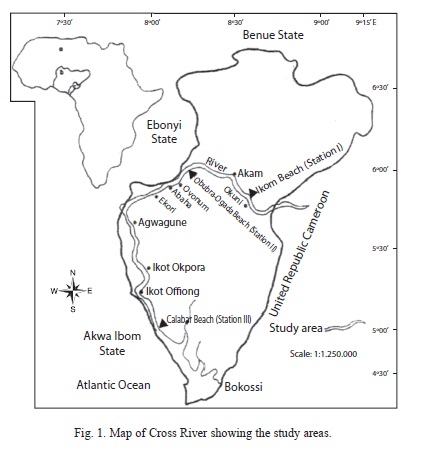
<ref-list>
<ref id="B1">
<nlm-citation citation-type="journal">
<person-group person-group-type="author">
<name>
<surname><![CDATA[Akan]]></surname>
<given-names><![CDATA[J.C]]></given-names>
</name>
<name>
<surname><![CDATA[Abdulrahman]]></surname>
<given-names><![CDATA[F.I]]></given-names>
</name>
<name>
<surname><![CDATA[Sodipo]]></surname>
<given-names><![CDATA[O.A]]></given-names>
</name>
<name>
<surname><![CDATA[Akandu]]></surname>
<given-names><![CDATA[P.I]]></given-names>
</name>
</person-group>
<article-title xml:lang="en"><![CDATA[Bioaccumulation of some heavy metals of six fresh water fishes caught from lake chad in Doron Buhari, Maiduguri, Bornno State Nigeria]]></article-title>
<source><![CDATA[Nig. J. App. Sci. Environ. Manag]]></source>
<year>2009</year>
<volume>4</volume>
<page-range>103-114</page-range></nlm-citation>
</ref>
<ref id="B2">
<nlm-citation citation-type="book">
<person-group person-group-type="author">
<name>
<surname><![CDATA[Allen]]></surname>
<given-names><![CDATA[G.T]]></given-names>
</name>
<name>
<surname><![CDATA[Wilson]]></surname>
<given-names><![CDATA[R.M]]></given-names>
</name>
</person-group>
<source><![CDATA[Metals and organic compounds in fish of the Missouri River: Boyd County, Nebraska to Kansas City, Missouri]]></source>
<year>1991</year>
<publisher-loc><![CDATA[Manhattan^eKansas Kansas]]></publisher-loc>
<publisher-name><![CDATA[US FWS]]></publisher-name>
</nlm-citation>
</ref>
<ref id="B3">
<nlm-citation citation-type="journal">
<person-group person-group-type="author">
<name>
<surname><![CDATA[Allen-Gill]]></surname>
<given-names><![CDATA[S.M]]></given-names>
</name>
<name>
<surname><![CDATA[Martynov]]></surname>
<given-names><![CDATA[V.G]]></given-names>
</name>
</person-group>
<article-title xml:lang="en"><![CDATA[Heavy metals burdens in nine species of freshwater and anadromous fish from the Pechora River, Northern Russia]]></article-title>
<source><![CDATA[Sci. Total Environ]]></source>
<year>1995</year>
<volume>160-161</volume>
<page-range>653-659</page-range></nlm-citation>
</ref>
<ref id="B4">
<nlm-citation citation-type="journal">
<person-group person-group-type="author">
<name>
<surname><![CDATA[Ako]]></surname>
<given-names><![CDATA[P.A]]></given-names>
</name>
<name>
<surname><![CDATA[Salihu]]></surname>
<given-names><![CDATA[S.O]]></given-names>
</name>
</person-group>
<article-title xml:lang="en"><![CDATA[Studies on Some Major and Trace Metals in Smoked and OvenDried]]></article-title>
<source><![CDATA[Fish. J. Appl. Sci. Environ. Mgt]]></source>
<year>2004</year>
<volume>8</volume>
<page-range>5-9</page-range></nlm-citation>
</ref>
<ref id="B5">
<nlm-citation citation-type="journal">
<person-group person-group-type="author">
<name>
<surname><![CDATA[Anim]]></surname>
<given-names><![CDATA[A.K]]></given-names>
</name>
<name>
<surname><![CDATA[Ahialey]]></surname>
<given-names><![CDATA[E.K]]></given-names>
</name>
<name>
<surname><![CDATA[Duodu]]></surname>
<given-names><![CDATA[G.O]]></given-names>
</name>
<name>
<surname><![CDATA[Ackah]]></surname>
<given-names><![CDATA[M]]></given-names>
</name>
<name>
<surname><![CDATA[Bentil]]></surname>
<given-names><![CDATA[N.O]]></given-names>
</name>
</person-group>
<article-title xml:lang="en"><![CDATA[Accumulation Profile of Heavy Metals in Fish Samples from Nsawam, Along the Densu River, Ghana, Res]]></article-title>
<source><![CDATA[J. Environ. Earth Sci]]></source>
<year>2011</year>
<volume>3</volume>
<page-range>56-60</page-range></nlm-citation>
</ref>
<ref id="B6">
<nlm-citation citation-type="">
<collab>APHA</collab>
<collab>AWWA</collab>
<source><![CDATA[Standard Methods for the Examination of Water and Wastewater]]></source>
<year>1995</year>
<publisher-loc><![CDATA[Washington, D.C ]]></publisher-loc>
</nlm-citation>
</ref>
<ref id="B7">
<nlm-citation citation-type="">
<collab>American Public Health Association (APHA)</collab>
<source><![CDATA[Standard Methods for the Examination of Water and Wastewater]]></source>
<year>1998</year>
<publisher-loc><![CDATA[^eNew York New York]]></publisher-loc>
</nlm-citation>
</ref>
<ref id="B8">
<nlm-citation citation-type="journal">
<person-group person-group-type="author">
<name>
<surname><![CDATA[Bellucci]]></surname>
<given-names><![CDATA[L.G]]></given-names>
</name>
<name>
<surname><![CDATA[Moumni]]></surname>
<given-names><![CDATA[E.L]]></given-names>
</name>
<name>
<surname><![CDATA[Collavini]]></surname>
<given-names><![CDATA[B]]></given-names>
</name>
<name>
<surname><![CDATA[Frignani]]></surname>
<given-names><![CDATA[F]]></given-names>
</name>
<name>
<surname><![CDATA[Albertazzi]]></surname>
<given-names><![CDATA[M.S]]></given-names>
</name>
</person-group>
<article-title xml:lang="en"><![CDATA[Heavy metals in Morocco Lagoon and river sediments]]></article-title>
<source><![CDATA[J. Phys]]></source>
<year>2003</year>
<volume>107</volume>
<page-range>139-142</page-range></nlm-citation>
</ref>
<ref id="B9">
<nlm-citation citation-type="journal">
<person-group person-group-type="author">
<name>
<surname><![CDATA[Bertolotto]]></surname>
<given-names><![CDATA[R.M]]></given-names>
</name>
<name>
<surname><![CDATA[Tortarolo]]></surname>
<given-names><![CDATA[B]]></given-names>
</name>
<name>
<surname><![CDATA[Frignani]]></surname>
<given-names><![CDATA[M]]></given-names>
</name>
<name>
<surname><![CDATA[Bellucci]]></surname>
<given-names><![CDATA[L.G]]></given-names>
</name>
<name>
<surname><![CDATA[Albanese]]></surname>
<given-names><![CDATA[S]]></given-names>
</name>
<name>
<surname><![CDATA[Cuneo]]></surname>
<given-names><![CDATA[C]]></given-names>
</name>
</person-group>
<article-title xml:lang="en"><![CDATA[Heavy metals in coastal sediments of the Ligurian sea off Vado Ligure]]></article-title>
<source><![CDATA[J. Phys]]></source>
<year>2003</year>
<volume>107</volume>
<page-range>159-162</page-range></nlm-citation>
</ref>
<ref id="B10">
<nlm-citation citation-type="journal">
<person-group person-group-type="author">
<name>
<surname><![CDATA[Borretzen]]></surname>
<given-names><![CDATA[P]]></given-names>
</name>
<name>
<surname><![CDATA[Salbu]]></surname>
<given-names><![CDATA[B]]></given-names>
</name>
</person-group>
<article-title xml:lang="en"><![CDATA[Fixation of Cs to marine sediments estimated by a stochastic modeling approach]]></article-title>
<source><![CDATA[J. Environ. Radio]]></source>
<year>2002</year>
<volume>61</volume>
<page-range>1-20</page-range></nlm-citation>
</ref>
<ref id="B11">
<nlm-citation citation-type="journal">
<person-group person-group-type="author">
<name>
<surname><![CDATA[Broda]]></surname>
<given-names><![CDATA[E]]></given-names>
</name>
</person-group>
<article-title xml:lang="en"><![CDATA[The uptake of heavy cationic trace ele-ments by microorganisms]]></article-title>
<source><![CDATA[Ann. Micro]]></source>
<year>1972</year>
<volume>22</volume>
<page-range>93-108</page-range></nlm-citation>
</ref>
<ref id="B12">
<nlm-citation citation-type="journal">
<person-group person-group-type="author">
<name>
<surname><![CDATA[Biney]]></surname>
<given-names><![CDATA[C.A]]></given-names>
</name>
<name>
<surname><![CDATA[Amuzu]]></surname>
<given-names><![CDATA[A.T]]></given-names>
</name>
<name>
<surname><![CDATA[Calamari]]></surname>
<given-names><![CDATA[D]]></given-names>
</name>
<name>
<surname><![CDATA[Kaba]]></surname>
<given-names><![CDATA[N]]></given-names>
</name>
<name>
<surname><![CDATA[Naeve]]></surname>
<given-names><![CDATA[H]]></given-names>
</name>
<name>
<surname><![CDATA[Saad]]></surname>
<given-names><![CDATA[M.A.H]]></given-names>
</name>
</person-group>
<article-title xml:lang="en"><![CDATA[Review of heavy metals in the African Aquatic Environment]]></article-title>
<source><![CDATA[Ecotoxicol. Environ. Saf]]></source>
<year>1991</year>
<volume>8</volume>
<page-range>134-159</page-range></nlm-citation>
</ref>
<ref id="B13">
<nlm-citation citation-type="journal">
<person-group person-group-type="author">
<name>
<surname><![CDATA[Buhler]]></surname>
<given-names><![CDATA[D.R]]></given-names>
</name>
<name>
<surname><![CDATA[Stokes]]></surname>
<given-names><![CDATA[R.M]]></given-names>
</name>
<name>
<surname><![CDATA[Coldwell]]></surname>
<given-names><![CDATA[S.R]]></given-names>
</name>
</person-group>
<article-title xml:lang="en"><![CDATA[Tissue accumulation and enzymatic effects of hexavalent chromium in Rainbow Trout (Salmo gairdneri)]]></article-title>
<source><![CDATA[J. Fis. Res. Board Can]]></source>
<year>1977</year>
<volume>34</volume>
<page-range>9-18</page-range></nlm-citation>
</ref>
<ref id="B14">
<nlm-citation citation-type="journal">
<person-group person-group-type="author">
<name>
<surname><![CDATA[Bull]]></surname>
<given-names><![CDATA[K.R]]></given-names>
</name>
<name>
<surname><![CDATA[Dearstly]]></surname>
<given-names><![CDATA[A.F]]></given-names>
</name>
<name>
<surname><![CDATA[Inskip]]></surname>
<given-names><![CDATA[M.H]]></given-names>
</name>
</person-group>
<article-title xml:lang="en"><![CDATA[Growth and mercury content of Rutilus rutilus L. Perch(Perca Fluviallis) and Pike (Esox, Lusius, L.) living in sewage effluents]]></article-title>
<source><![CDATA[Environ. Pollut]]></source>
<year>1981</year>
<volume>25</volume>
<page-range>229-240</page-range></nlm-citation>
</ref>
<ref id="B15">
<nlm-citation citation-type="journal">
<person-group person-group-type="author">
<name>
<surname><![CDATA[Canli]]></surname>
<given-names><![CDATA[M]]></given-names>
</name>
<name>
<surname><![CDATA[Kalay]]></surname>
<given-names><![CDATA[M]]></given-names>
</name>
</person-group>
<article-title xml:lang="en"><![CDATA[Levels of heavy metals (Cd, Pb, Cu, Cr and Ni) in tissue of Cyprinus carpio, Barbus capito and Chondrostoma regium from the Seyhan River, Turkey]]></article-title>
<source><![CDATA[Turkish J. Zool]]></source>
<year>1998</year>
<volume>22</volume>
<page-range>149-157</page-range></nlm-citation>
</ref>
<ref id="B16">
<nlm-citation citation-type="journal">
<person-group person-group-type="author">
<name>
<surname><![CDATA[Chattopadhyay]]></surname>
<given-names><![CDATA[B]]></given-names>
</name>
<name>
<surname><![CDATA[Chatterjee]]></surname>
<given-names><![CDATA[A]]></given-names>
</name>
<name>
<surname><![CDATA[Mukhopadhyay]]></surname>
<given-names><![CDATA[S.K]]></given-names>
</name>
</person-group>
<article-title xml:lang="en"><![CDATA[Bioaccumulation of metals in the East Calcutta wetland ecosystem]]></article-title>
<source><![CDATA[Aquat. Ecosys. Health Manag]]></source>
<year>2002</year>
<volume>5</volume>
<page-range>191-203</page-range></nlm-citation>
</ref>
<ref id="B17">
<nlm-citation citation-type="journal">
<person-group person-group-type="author">
<name>
<surname><![CDATA[Chernof]]></surname>
<given-names><![CDATA[B]]></given-names>
</name>
<name>
<surname><![CDATA[Dooley]]></surname>
<given-names><![CDATA[J.K]]></given-names>
</name>
</person-group>
<article-title xml:lang="en"><![CDATA[Heavy metals in relation to the biology of Mummichog (Fundulus heteroclitus)]]></article-title>
<source><![CDATA[J. Fish Biol]]></source>
<year>1979</year>
<volume>14</volume>
<page-range>3309-328</page-range></nlm-citation>
</ref>
<ref id="B18">
<nlm-citation citation-type="book">
<person-group person-group-type="author">
<name>
<surname><![CDATA[Cohen]]></surname>
<given-names><![CDATA[A.S]]></given-names>
</name>
</person-group>
<source><![CDATA[Paliolimnology]]></source>
<year>2003</year>
<publisher-loc><![CDATA[^eNew York New York]]></publisher-loc>
<publisher-name><![CDATA[Oxford University]]></publisher-name>
</nlm-citation>
</ref>
<ref id="B19">
<nlm-citation citation-type="journal">
<person-group person-group-type="author">
<name>
<surname><![CDATA[DeGregori]]></surname>
<given-names><![CDATA[I]]></given-names>
</name>
<name>
<surname><![CDATA[Pinochet]]></surname>
<given-names><![CDATA[H]]></given-names>
</name>
<name>
<surname><![CDATA[Arancibia]]></surname>
<given-names><![CDATA[M]]></given-names>
</name>
<name>
<surname><![CDATA[Vidal]]></surname>
<given-names><![CDATA[A]]></given-names>
</name>
</person-group>
<article-title xml:lang="en"><![CDATA[Grain Size Effects on Trace Metals Distribution in Sediments from Two Coastal Areas of Chile]]></article-title>
<source><![CDATA[Bull. Environ. Contam. Toxicol]]></source>
<year>1996</year>
<volume>57</volume>
<page-range>163-170</page-range></nlm-citation>
</ref>
<ref id="B20">
<nlm-citation citation-type="journal">
<person-group person-group-type="author">
<name>
<surname><![CDATA[Defew]]></surname>
<given-names><![CDATA[L]]></given-names>
</name>
<name>
<surname><![CDATA[Mair]]></surname>
<given-names><![CDATA[J]]></given-names>
</name>
<name>
<surname><![CDATA[Guzman]]></surname>
<given-names><![CDATA[H]]></given-names>
</name>
</person-group>
<article-title xml:lang="en"><![CDATA[An assessment of metal contamination in mangrove sediments and leaves from Punta Mala Bay, Pacific Panama]]></article-title>
<source><![CDATA[Mar. Pollut. Bull]]></source>
<year>2004</year>
<volume>50</volume>
<page-range>547-552</page-range></nlm-citation>
</ref>
<ref id="B21">
<nlm-citation citation-type="journal">
<person-group person-group-type="author">
<name>
<surname><![CDATA[Dural]]></surname>
<given-names><![CDATA[M]]></given-names>
</name>
<name>
<surname><![CDATA[Goksu]]></surname>
<given-names><![CDATA[M.Z]]></given-names>
</name>
<name>
<surname><![CDATA[Ozak]]></surname>
<given-names><![CDATA[A.A]]></given-names>
</name>
</person-group>
<article-title xml:lang="en"><![CDATA[Investigation of heavy metal levels in economically important fish species captured from the Tuzla Lagoon]]></article-title>
<source><![CDATA[Food Chem]]></source>
<year>2007</year>
<volume>102</volume>
<page-range>415-421</page-range></nlm-citation>
</ref>
<ref id="B22">
<nlm-citation citation-type="journal">
<person-group person-group-type="author">
<name>
<surname><![CDATA[Eisher]]></surname>
<given-names><![CDATA[R]]></given-names>
</name>
</person-group>
<article-title xml:lang="en"><![CDATA[Zinc hazards to fish, wildlife, and invertebrates: a synoptic review]]></article-title>
<source><![CDATA[U.S. Fish Wildllife Service]]></source>
<year>1993</year>
<volume>85</volume>
<page-range>90</page-range></nlm-citation>
</ref>
<ref id="B23">
<nlm-citation citation-type="journal">
<person-group person-group-type="author">
<name>
<surname><![CDATA[Ekpo]]></surname>
<given-names><![CDATA[K.E]]></given-names>
</name>
<name>
<surname><![CDATA[Asia]]></surname>
<given-names><![CDATA[I.O]]></given-names>
</name>
<name>
<surname><![CDATA[Amayo]]></surname>
<given-names><![CDATA[K.O]]></given-names>
</name>
<name>
<surname><![CDATA[Jegede]]></surname>
<given-names><![CDATA[D.A]]></given-names>
</name>
</person-group>
<article-title xml:lang="en"><![CDATA[Determination of lead, cadmium and mercury in surrounding water and organs of some species of fish from Ikpoba river in Benin city, Nigeria]]></article-title>
<source><![CDATA[Int. J. Phy. Sc]]></source>
<year>2008</year>
<volume>3</volume>
<page-range>289-292</page-range></nlm-citation>
</ref>
<ref id="B24">
<nlm-citation citation-type="">
<collab>Federal Environmental Projection Agency (FEPA)</collab>
<source><![CDATA[Guidelines and standards for environmental pollution control in Nigeria]]></source>
<year>2003</year>
</nlm-citation>
</ref>
<ref id="B25">
<nlm-citation citation-type="book">
<person-group person-group-type="author">
<name>
<surname><![CDATA[Forstner]]></surname>
<given-names><![CDATA[U]]></given-names>
</name>
<name>
<surname><![CDATA[Wittmann]]></surname>
<given-names><![CDATA[G.T.W]]></given-names>
</name>
</person-group>
<source><![CDATA[Metal pollution in the aquatic environment]]></source>
<year>1981</year>
<publisher-loc><![CDATA[Berlin^eNew YorkHeidelberg New York]]></publisher-loc>
<publisher-name><![CDATA[Spring]]></publisher-name>
</nlm-citation>
</ref>
<ref id="B26">
<nlm-citation citation-type="journal">
<collab>Food and Agriculture Organization (FAO)</collab>
<source><![CDATA[FAO Fisheries ReportReport of the third Session of Working Party on Pollution and Fisheries]]></source>
<year>1992</year>
<volume>471</volume>
<page-range>43</page-range><publisher-loc><![CDATA[^eAccra Accra]]></publisher-loc>
</nlm-citation>
</ref>
<ref id="B27">
<nlm-citation citation-type="journal">
<person-group person-group-type="author">
<name>
<surname><![CDATA[Giles]]></surname>
<given-names><![CDATA[M.A]]></given-names>
</name>
</person-group>
<article-title xml:lang="en"><![CDATA[Accumulation of Cadmium by Rainbow Trout, Salmo gairdneri, during Extended Exposure]]></article-title>
<source><![CDATA[Can. J. Fish. Aquat. Sci]]></source>
<year>1988</year>
<volume>45</volume>
<page-range>1045-1053</page-range></nlm-citation>
</ref>
<ref id="B28">
<nlm-citation citation-type="journal">
<person-group person-group-type="author">
<name>
<surname><![CDATA[Goldwater]]></surname>
<given-names><![CDATA[L]]></given-names>
</name>
</person-group>
<article-title xml:lang="en"><![CDATA[Mercury in the Environment]]></article-title>
<source><![CDATA[Sci. Am]]></source>
<year>1971</year>
<volume>224</volume>
<page-range>15-21</page-range></nlm-citation>
</ref>
<ref id="B29">
<nlm-citation citation-type="">
<person-group person-group-type="author">
<name>
<surname><![CDATA[Harvey]]></surname>
<given-names><![CDATA[H.A]]></given-names>
</name>
<name>
<surname><![CDATA[Lee]]></surname>
<given-names><![CDATA[C]]></given-names>
</name>
</person-group>
<article-title xml:lang="en"><![CDATA[Historical fisheries changes related to surface water pH changes in Canada]]></article-title>
<collab>In Acid Rain/Fisheries</collab>
<source><![CDATA[American Fisheries Society]]></source>
<year>1982</year>
<page-range>p. 45-55</page-range><publisher-loc><![CDATA[Bethesda^eMaryland Maryland]]></publisher-loc>
</nlm-citation>
</ref>
<ref id="B30">
<nlm-citation citation-type="journal">
<person-group person-group-type="author">
<name>
<surname><![CDATA[Herbert]]></surname>
<given-names><![CDATA[D.M]]></given-names>
</name>
<name>
<surname><![CDATA[Vandyke]]></surname>
<given-names><![CDATA[J.M]]></given-names>
</name>
</person-group>
<article-title xml:lang="en"><![CDATA[The toxicity to fish of mixtures of poisons]]></article-title>
<source><![CDATA[Ann. Appl. Biol]]></source>
<year>1964</year>
<volume>53</volume>
<page-range>415-421</page-range></nlm-citation>
</ref>
<ref id="B31">
<nlm-citation citation-type="journal">
<person-group person-group-type="author">
<name>
<surname><![CDATA[Higgings]]></surname>
<given-names><![CDATA[T.E]]></given-names>
</name>
<name>
<surname><![CDATA[Dasher]]></surname>
<given-names><![CDATA[D.P]]></given-names>
</name>
</person-group>
<source><![CDATA[J. Water Pollut. Control]]></source>
<year>1986</year>
<volume>58</volume>
<page-range>586-589</page-range></nlm-citation>
</ref>
<ref id="B32">
<nlm-citation citation-type="journal">
<person-group person-group-type="author">
<name>
<surname><![CDATA[Huges]]></surname>
<given-names><![CDATA[G]]></given-names>
</name>
<name>
<surname><![CDATA[Floss]]></surname>
<given-names><![CDATA[R]]></given-names>
</name>
</person-group>
<article-title xml:lang="en"><![CDATA[Zinc contents of the gills of rainbow trout ( S. gairdneri ) after treatment with zinc solutions under normoxic and hypoxic conditions]]></article-title>
<source><![CDATA[J. Fish. Biol]]></source>
<year>1978</year>
<volume>13</volume>
<page-range>717-728</page-range></nlm-citation>
</ref>
<ref id="B33">
<nlm-citation citation-type="journal">
<person-group person-group-type="author">
<name>
<surname><![CDATA[Ikem]]></surname>
<given-names><![CDATA[A]]></given-names>
</name>
<name>
<surname><![CDATA[Egiebor]]></surname>
<given-names><![CDATA[N.O]]></given-names>
</name>
<name>
<surname><![CDATA[Nyavor]]></surname>
<given-names><![CDATA[K]]></given-names>
</name>
</person-group>
<article-title xml:lang="en"><![CDATA[Trace elements in water, fish and sediments from Tuskegee lake, Southeastern USA]]></article-title>
<source><![CDATA[Water Air Soil. Pollut]]></source>
<year>2003</year>
<volume>149</volume>
<page-range>51-75</page-range></nlm-citation>
</ref>
<ref id="B34">
<nlm-citation citation-type="journal">
<person-group person-group-type="author">
<name>
<surname><![CDATA[Javed]]></surname>
<given-names><![CDATA[M]]></given-names>
</name>
<name>
<surname><![CDATA[Hayat]]></surname>
<given-names><![CDATA[S]]></given-names>
</name>
</person-group>
<article-title xml:lang="en"><![CDATA[Fish as a bioindicator by freshwater contamination by Metal, Pak]]></article-title>
<source><![CDATA[J. Agric. Sci]]></source>
<year>1998</year>
<volume>35</volume>
<page-range>11-15</page-range></nlm-citation>
</ref>
<ref id="B35">
<nlm-citation citation-type="journal">
<person-group person-group-type="author">
<name>
<surname><![CDATA[Jernelov]]></surname>
<given-names><![CDATA[A]]></given-names>
</name>
<name>
<surname><![CDATA[Lann]]></surname>
<given-names><![CDATA[H]]></given-names>
</name>
</person-group>
<article-title xml:lang="en"><![CDATA[Mercury accumulation in food chains]]></article-title>
<source><![CDATA[Oikos]]></source>
<year>1971</year>
<volume>22</volume>
<page-range>403-406</page-range></nlm-citation>
</ref>
<ref id="B36">
<nlm-citation citation-type="journal">
<collab>Joint Group of Experts on the scientific aspects of Marine Pollution (GESAMP)</collab>
<article-title xml:lang="en"><![CDATA[The health of the oceans]]></article-title>
<source><![CDATA[Rep. Stud. GESAMP]]></source>
<year>1982</year>
<volume>15</volume>
<page-range>108</page-range></nlm-citation>
</ref>
<ref id="B37">
<nlm-citation citation-type="journal">
<person-group person-group-type="author">
<name>
<surname><![CDATA[Karbassi]]></surname>
<given-names><![CDATA[A.R]]></given-names>
</name>
<name>
<surname><![CDATA[Nabi-Bidhendi]]></surname>
<given-names><![CDATA[G.R]]></given-names>
</name>
<name>
<surname><![CDATA[Bayati]]></surname>
<given-names><![CDATA[I]]></given-names>
</name>
</person-group>
<article-title xml:lang="en"><![CDATA[Environmental geochemistry of heavy metals in a sediment core off Bushehr, Persian Gulf]]></article-title>
<source><![CDATA[Iran. J. Environ. Health Sci. Eng]]></source>
<year>2005</year>
<volume>2</volume>
<page-range>255-260</page-range></nlm-citation>
</ref>
<ref id="B38">
<nlm-citation citation-type="journal">
<person-group person-group-type="author">
<name>
<surname><![CDATA[Karadede]]></surname>
<given-names><![CDATA[H]]></given-names>
</name>
<name>
<surname><![CDATA[Unlu]]></surname>
<given-names><![CDATA[E]]></given-names>
</name>
</person-group>
<article-title xml:lang="en"><![CDATA[Investigations of the heavy metal accumulations in Cyprinion macrostomnus (Heckel, 1843) (Cyprindae) from the Atatuk Dam Lake]]></article-title>
<source><![CDATA[XIV Turkish Biology Congress]]></source>
<year>1998</year>
<volume>7</volume>
<page-range>165-168</page-range></nlm-citation>
</ref>
<ref id="B39">
<nlm-citation citation-type="journal">
<person-group person-group-type="author">
<name>
<surname><![CDATA[Karadede-Akin]]></surname>
<given-names><![CDATA[H]]></given-names>
</name>
<name>
<surname><![CDATA[Unlu]]></surname>
<given-names><![CDATA[E]]></given-names>
</name>
</person-group>
<article-title xml:lang="en"><![CDATA[Heavy metal concentrations in water, sediments, fish and some benthic organisms from Tigris river, Turkey]]></article-title>
<source><![CDATA[Environ. Monit. Assess]]></source>
<year>2007</year>
<volume>131</volume>
<page-range>323-337</page-range></nlm-citation>
</ref>
<ref id="B40">
<nlm-citation citation-type="book">
<person-group person-group-type="author">
<name>
<surname><![CDATA[Khalid]]></surname>
<given-names><![CDATA[R.A]]></given-names>
</name>
<name>
<surname><![CDATA[Gambrell]]></surname>
<given-names><![CDATA[R.A]]></given-names>
</name>
<name>
<surname><![CDATA[Patrick]]></surname>
<given-names><![CDATA[W.H]]></given-names>
</name>
</person-group>
<article-title xml:lang="en"><![CDATA[Chemical Transformation of Heavy Metals]]></article-title>
<person-group person-group-type="editor">
<name>
<surname><![CDATA[Adriano]]></surname>
<given-names><![CDATA[D.C]]></given-names>
</name>
<name>
<surname><![CDATA[Bristbin]]></surname>
<given-names><![CDATA[I.L]]></given-names>
</name>
</person-group>
<source><![CDATA[]]></source>
<year>1978</year>
<publisher-name><![CDATA[US Department of Energy]]></publisher-name>
</nlm-citation>
</ref>
<ref id="B41">
<nlm-citation citation-type="journal">
<person-group person-group-type="author">
<name>
<surname><![CDATA[Law]]></surname>
<given-names><![CDATA[A.T]]></given-names>
</name>
<name>
<surname><![CDATA[Singh]]></surname>
<given-names><![CDATA[A]]></given-names>
</name>
</person-group>
<article-title xml:lang="en"><![CDATA[Relationship between heavy metal contents and body weight of fish from the Kelang estuary, Malaysia]]></article-title>
<source><![CDATA[Mar. Pollut. Bull]]></source>
<year>1991</year>
<volume>22</volume>
<page-range>86-89</page-range></nlm-citation>
</ref>
<ref id="B42">
<nlm-citation citation-type="">
<person-group person-group-type="author">
<name>
<surname><![CDATA[Lee]]></surname>
<given-names><![CDATA[M.C]]></given-names>
</name>
<name>
<surname><![CDATA[Schultz]]></surname>
<given-names><![CDATA[T.W]]></given-names>
</name>
</person-group>
<source><![CDATA[Contaminants investigation of the Guadalupe and San Antonio rivers of Texas, 1992, U.S]]></source>
<year>1994</year>
<publisher-loc><![CDATA[Corpus Christi^eTexas Texas]]></publisher-loc>
</nlm-citation>
</ref>
<ref id="B43">
<nlm-citation citation-type="journal">
<person-group person-group-type="author">
<name>
<surname><![CDATA[Lee]]></surname>
<given-names><![CDATA[S.V]]></given-names>
</name>
<name>
<surname><![CDATA[Cundy]]></surname>
<given-names><![CDATA[A.B]]></given-names>
</name>
</person-group>
<article-title xml:lang="en"><![CDATA[Heavy metal contamination and mixing process s in sediments from the Humber estuary, Eastern England]]></article-title>
<source><![CDATA[Est. Coast. Shelf Sci]]></source>
<year>2001</year>
<volume>53</volume>
<page-range>619-636</page-range></nlm-citation>
</ref>
<ref id="B44">
<nlm-citation citation-type="book">
<person-group person-group-type="author">
<name>
<surname><![CDATA[Leland]]></surname>
<given-names><![CDATA[H.V]]></given-names>
</name>
<name>
<surname><![CDATA[Kuwabara]]></surname>
<given-names><![CDATA[J.S]]></given-names>
</name>
</person-group>
<article-title xml:lang="en"><![CDATA[Trace Metals]]></article-title>
<person-group person-group-type="editor">
<name>
<surname><![CDATA[Rand]]></surname>
<given-names><![CDATA[G.M]]></given-names>
</name>
<name>
<surname><![CDATA[Petrocelli]]></surname>
<given-names><![CDATA[S.R]]></given-names>
</name>
</person-group>
<source><![CDATA[Fundamentals of Aquatic Toxicology]]></source>
<year>1985</year>
<page-range>p. 374-415</page-range><publisher-loc><![CDATA[^eNew York New York]]></publisher-loc>
<publisher-name><![CDATA[Hemisphere]]></publisher-name>
</nlm-citation>
</ref>
<ref id="B45">
<nlm-citation citation-type="journal">
<person-group person-group-type="author">
<name>
<surname><![CDATA[Lopez]]></surname>
<given-names><![CDATA[P]]></given-names>
</name>
<name>
<surname><![CDATA[Lluch]]></surname>
<given-names><![CDATA[X]]></given-names>
</name>
</person-group>
<article-title xml:lang="en"><![CDATA[Sediment geochemistry of a meromictic coastal lagoon, Es Cibollar (Majorca, Spain)]]></article-title>
<source><![CDATA[Limnetica]]></source>
<year>2000</year>
<volume>18</volume>
<page-range>15-27</page-range></nlm-citation>
</ref>
<ref id="B46">
<nlm-citation citation-type="journal">
<person-group person-group-type="author">
<name>
<surname><![CDATA[Martin]]></surname>
<given-names><![CDATA[M.H]]></given-names>
</name>
<name>
<surname><![CDATA[Coughtry]]></surname>
<given-names><![CDATA[P.J]]></given-names>
</name>
</person-group>
<article-title xml:lang="en"><![CDATA[Preliminary observations on the level of cadmium in a contaminated environment]]></article-title>
<source><![CDATA[Chemosphere]]></source>
<year>1975</year>
<volume>4</volume>
<page-range>155-160</page-range></nlm-citation>
</ref>
<ref id="B47">
<nlm-citation citation-type="journal">
<person-group person-group-type="author">
<name>
<surname><![CDATA[Mathis]]></surname>
<given-names><![CDATA[B.J]]></given-names>
</name>
<name>
<surname><![CDATA[Cummings]]></surname>
<given-names><![CDATA[T.F]]></given-names>
</name>
</person-group>
<article-title xml:lang="en"><![CDATA[Selected metals in sediment, water and Biota in the Illinois River]]></article-title>
<source><![CDATA[J. Wat. Pollut. Cont. Fed]]></source>
<year>1973</year>
<volume>45</volume>
<page-range>1573-1583</page-range></nlm-citation>
</ref>
<ref id="B48">
<nlm-citation citation-type="journal">
<person-group person-group-type="author">
<name>
<surname><![CDATA[Mansour]]></surname>
<given-names><![CDATA[S.A]]></given-names>
</name>
<name>
<surname><![CDATA[Sidky]]></surname>
<given-names><![CDATA[M.M]]></given-names>
</name>
</person-group>
<article-title xml:lang="en"><![CDATA[Ecotoxicological studies. 3: Heavy metals contaminating water and fish from Fayoum Governorate, Egypt]]></article-title>
<source><![CDATA[Food Chem]]></source>
<year>2002</year>
<volume>78</volume>
<page-range>15-22</page-range></nlm-citation>
</ref>
<ref id="B49">
<nlm-citation citation-type="journal">
<person-group person-group-type="author">
<name>
<surname><![CDATA[Mohamed]]></surname>
<given-names><![CDATA[A.W]]></given-names>
</name>
</person-group>
<article-title xml:lang="en"><![CDATA[Geochemistry and sedimentology of core sediments and the influence of human activities, Qusier, Safaga and Hasighada Harbors, Red sea coast, Egypt]]></article-title>
<source><![CDATA[Egyptian J. Aquatic Res]]></source>
<year>2005</year>
<volume>31</volume>
<page-range>92-103</page-range></nlm-citation>
</ref>
<ref id="B50">
<nlm-citation citation-type="journal">
<person-group person-group-type="author">
<name>
<surname><![CDATA[Nsikak]]></surname>
<given-names><![CDATA[U.B]]></given-names>
</name>
<name>
<surname><![CDATA[Joseph]]></surname>
<given-names><![CDATA[P.E]]></given-names>
</name>
<name>
<surname><![CDATA[Akan]]></surname>
<given-names><![CDATA[B.W]]></given-names>
</name>
<name>
<surname><![CDATA[David]]></surname>
<given-names><![CDATA[E.B]]></given-names>
</name>
</person-group>
<article-title xml:lang="en"><![CDATA[Mercury accumulation in fishes from tropical aquatic ecosystems in the Niger Delta, Nigeria]]></article-title>
<source><![CDATA[Current Science]]></source>
<year>2007</year>
<volume>92</volume>
<page-range>781-785</page-range></nlm-citation>
</ref>
<ref id="B51">
<nlm-citation citation-type="journal">
<person-group person-group-type="author">
<name>
<surname><![CDATA[Papagiannis]]></surname>
<given-names><![CDATA[I]]></given-names>
</name>
<name>
<surname><![CDATA[Kagalou]]></surname>
<given-names><![CDATA[I]]></given-names>
</name>
<name>
<surname><![CDATA[Leonardos]]></surname>
<given-names><![CDATA[J]]></given-names>
</name>
<name>
<surname><![CDATA[Petridis]]></surname>
<given-names><![CDATA[D]]></given-names>
</name>
<name>
<surname><![CDATA[Kalfakaou]]></surname>
<given-names><![CDATA[V]]></given-names>
</name>
</person-group>
<article-title xml:lang="en"><![CDATA[Copper and zinc in four freshwater fish species from Lake Pamvotis (Greece)]]></article-title>
<source><![CDATA[Environ. Int]]></source>
<year>2004</year>
<volume>30</volume>
<page-range>357-362</page-range></nlm-citation>
</ref>
<ref id="B52">
<nlm-citation citation-type="journal">
<person-group person-group-type="author">
<name>
<surname><![CDATA[Prasathp]]></surname>
<given-names><![CDATA[S.I]]></given-names>
</name>
<name>
<surname><![CDATA[Khanth]]></surname>
<given-names><![CDATA[N.I]]></given-names>
</name>
</person-group>
<article-title xml:lang="en"><![CDATA[Impact of Tsunami on the Heavy Metal Accumulation in Water, Sediments and Fish at Poompuhar Coast, Southeast Coast of India]]></article-title>
<source><![CDATA[J. Chem]]></source>
<year>2008</year>
<volume>5</volume>
<page-range>16-22</page-range></nlm-citation>
</ref>
<ref id="B53">
<nlm-citation citation-type="journal">
<person-group person-group-type="author">
<name>
<surname><![CDATA[Ploetz]]></surname>
<given-names><![CDATA[D.M]]></given-names>
</name>
<name>
<surname><![CDATA[Fitts]]></surname>
<given-names><![CDATA[B.E]]></given-names>
</name>
<name>
<surname><![CDATA[Rice]]></surname>
<given-names><![CDATA[T.M]]></given-names>
</name>
</person-group>
<article-title xml:lang="en"><![CDATA[Differential accumulation of heavy metals in muscles and liver of a marine fish (King Mackerel, Scomberomorus cavalla, Cuvier) from the Northern Gulf of Mexico, USA]]></article-title>
<source><![CDATA[Bull. Environ. Contam. Toxicol]]></source>
<year>2007</year>
<volume>78</volume>
<page-range>134-137</page-range></nlm-citation>
</ref>
<ref id="B54">
<nlm-citation citation-type="journal">
<person-group person-group-type="author">
<name>
<surname><![CDATA[Prusty]]></surname>
<given-names><![CDATA[A.W]]></given-names>
</name>
</person-group>
<article-title xml:lang="en"><![CDATA[The use of fish in monitoring water pollution]]></article-title>
<source><![CDATA[Tour Biotech]]></source>
<year>1994</year>
<page-range>p. 4-7</page-range></nlm-citation>
</ref>
<ref id="B55">
<nlm-citation citation-type="book">
<person-group person-group-type="author">
<name>
<surname><![CDATA[Robertson]]></surname>
<given-names><![CDATA[S.M]]></given-names>
</name>
<name>
<surname><![CDATA[Gamble]]></surname>
<given-names><![CDATA[L.R]]></given-names>
</name>
<name>
<surname><![CDATA[Maurer]]></surname>
<given-names><![CDATA[T.C]]></given-names>
</name>
</person-group>
<source><![CDATA[Contaminant survey of La Sal Vieja, Willacy County, Texas, 1989]]></source>
<year>1991</year>
<publisher-name><![CDATA[U.S. Fish Wild. Serv]]></publisher-name>
</nlm-citation>
</ref>
<ref id="B56">
<nlm-citation citation-type="book">
<person-group person-group-type="author">
<name>
<surname><![CDATA[Rompala]]></surname>
<given-names><![CDATA[J.M]]></given-names>
</name>
<name>
<surname><![CDATA[Rutosky]]></surname>
<given-names><![CDATA[F.W]]></given-names>
</name>
<name>
<surname><![CDATA[Putnam]]></surname>
<given-names><![CDATA[D.J]]></given-names>
</name>
</person-group>
<source><![CDATA[Concentrations of environmental contaminants from selected waters in Pennsylvania]]></source>
<year>1984</year>
<publisher-loc><![CDATA[^ePennsylvania Pennsylvania]]></publisher-loc>
<publisher-name><![CDATA[U.S. Fish Wildl. Serv. RepState College]]></publisher-name>
</nlm-citation>
</ref>
<ref id="B57">
<nlm-citation citation-type="journal">
<person-group person-group-type="author">
<name>
<surname><![CDATA[Obasohan]]></surname>
<given-names><![CDATA[E.E]]></given-names>
</name>
<name>
<surname><![CDATA[Oronsaye]]></surname>
<given-names><![CDATA[J.A.O]]></given-names>
</name>
<name>
<surname><![CDATA[Eguavoen]]></surname>
<given-names><![CDATA[O.I]]></given-names>
</name>
</person-group>
<article-title xml:lang="en"><![CDATA[Determination of post-dredging concentrations of selected trace metals in water, sediment and the freshwater mudfish (Clarias gariepinus) from Ikpoba river in Benin City, Edo State, Nigeria]]></article-title>
<source><![CDATA[Afr. J. Biotechnol]]></source>
<year>2007</year>
<volume>6</volume>
<page-range>470-474</page-range></nlm-citation>
</ref>
<ref id="B58">
<nlm-citation citation-type="journal">
<person-group person-group-type="author">
<name>
<surname><![CDATA[Olaifa]]></surname>
<given-names><![CDATA[F.E]]></given-names>
</name>
<name>
<surname><![CDATA[Olaifa]]></surname>
<given-names><![CDATA[A.K]]></given-names>
</name>
<name>
<surname><![CDATA[Adelaja]]></surname>
<given-names><![CDATA[A.A]]></given-names>
</name>
<name>
<surname><![CDATA[Owolabi]]></surname>
<given-names><![CDATA[A.G]]></given-names>
</name>
</person-group>
<article-title xml:lang="en"><![CDATA[Heavy Metal contamination of Clarias gariepinusfrom a lake and fish farm in Ibadan, Nigeria]]></article-title>
<source><![CDATA[Afr. J. Biomed. Res]]></source>
<year>2004</year>
<volume>7</volume>
<page-range>145-148</page-range></nlm-citation>
</ref>
<ref id="B59">
<nlm-citation citation-type="journal">
<person-group person-group-type="author">
<name>
<surname><![CDATA[Oladimeji]]></surname>
<given-names><![CDATA[A.A]]></given-names>
</name>
<name>
<surname><![CDATA[Offem]]></surname>
<given-names><![CDATA[B.O]]></given-names>
</name>
</person-group>
<article-title xml:lang="en"><![CDATA[Toxicity of lead to Clarias lazera, Oreochromis niloticus, Chironomus tantans and Benacus sp]]></article-title>
<source><![CDATA[Water Air Soil Poll]]></source>
<year>1989</year>
<volume>44</volume>
<page-range>191-201</page-range></nlm-citation>
</ref>
<ref id="B60">
<nlm-citation citation-type="journal">
<person-group person-group-type="author">
<name>
<surname><![CDATA[Ogbeibu]]></surname>
<given-names><![CDATA[A.E]]></given-names>
</name>
<name>
<surname><![CDATA[Ezeunara]]></surname>
<given-names><![CDATA[P.U]]></given-names>
</name>
</person-group>
<article-title xml:lang="en"><![CDATA[Ecological impact of brewery effluent on Ikpoba river using the fish communities as bio indicators]]></article-title>
<source><![CDATA[J. Agua. Res]]></source>
<year>2002</year>
<volume>17</volume>
<page-range>35-44</page-range></nlm-citation>
</ref>
<ref id="B61">
<nlm-citation citation-type="">
<person-group person-group-type="author">
<name>
<surname><![CDATA[Oguzie]]></surname>
<given-names><![CDATA[F.A]]></given-names>
</name>
</person-group>
<source><![CDATA[Heavy metals in fish, water and effluents of the lower Ikpoba river in Benin]]></source>
<year>1996</year>
</nlm-citation>
</ref>
<ref id="B62">
<nlm-citation citation-type="journal">
<person-group person-group-type="author">
<name>
<surname><![CDATA[Romeo]]></surname>
<given-names><![CDATA[M]]></given-names>
</name>
<name>
<surname><![CDATA[Siau]]></surname>
<given-names><![CDATA[Y]]></given-names>
</name>
<name>
<surname><![CDATA[Sidoumou]]></surname>
<given-names><![CDATA[Z]]></given-names>
</name>
<name>
<surname><![CDATA[Gnassia- Barelli]]></surname>
<given-names><![CDATA[M]]></given-names>
</name>
</person-group>
<article-title xml:lang="en"><![CDATA[Heavy metal distribution in different fish species from the Mauritania coast]]></article-title>
<source><![CDATA[Sci. Total Environ]]></source>
<year>1999</year>
<volume>232</volume>
<page-range>169-175</page-range></nlm-citation>
</ref>
<ref id="B63">
<nlm-citation citation-type="journal">
<person-group person-group-type="author">
<name>
<surname><![CDATA[Sabo]]></surname>
<given-names><![CDATA[A]]></given-names>
</name>
<name>
<surname><![CDATA[Nayaya]]></surname>
<given-names><![CDATA[A.J]]></given-names>
</name>
<name>
<surname><![CDATA[Galadima]]></surname>
<given-names><![CDATA[A.I]]></given-names>
</name>
</person-group>
<article-title xml:lang="en"><![CDATA[Assessment of Some Heavy Metals in Water, Sediment and Freshwater Mudfish (Clarias gariepinus) from River Gongola in Yamaltu-Deba, Gombe,Nigeria]]></article-title>
<source><![CDATA[Int. Jor. P. App. Scs]]></source>
<year>2008</year>
<volume>2</volume>
<page-range>6-12</page-range></nlm-citation>
</ref>
<ref id="B64">
<nlm-citation citation-type="journal">
<person-group person-group-type="author">
<name>
<surname><![CDATA[Shoham-Frider]]></surname>
<given-names><![CDATA[E]]></given-names>
</name>
<name>
<surname><![CDATA[Amiel]]></surname>
<given-names><![CDATA[A]]></given-names>
</name>
<name>
<surname><![CDATA[Roditi-Elasar]]></surname>
<given-names><![CDATA[M]]></given-names>
</name>
<name>
<surname><![CDATA[Kress]]></surname>
<given-names><![CDATA[N]]></given-names>
</name>
</person-group>
<article-title xml:lang="en"><![CDATA[dolphin (Grampus griseus) stranding on the coast of Isreal (Eastern Mediterranean): Autopsy results and trace metals concentration]]></article-title>
<source><![CDATA[Sci. Total Environ]]></source>
<year>2002</year>
<volume>295</volume>
<page-range>157-166</page-range></nlm-citation>
</ref>
<ref id="B65">
<nlm-citation citation-type="book">
<person-group person-group-type="author">
<name>
<surname><![CDATA[Sorenson]]></surname>
<given-names><![CDATA[E.M]]></given-names>
</name>
</person-group>
<source><![CDATA[Metal Poisoning in Fish]]></source>
<year>1991</year>
<publisher-loc><![CDATA[Boca Raton^eFlorida Florida]]></publisher-loc>
<publisher-name><![CDATA[CRC]]></publisher-name>
</nlm-citation>
</ref>
<ref id="B66">
<nlm-citation citation-type="">
<person-group person-group-type="author">
<name>
<surname><![CDATA[Soon]]></surname>
<given-names><![CDATA[Y.K]]></given-names>
</name>
<name>
<surname><![CDATA[Bates]]></surname>
<given-names><![CDATA[T.E]]></given-names>
</name>
<name>
<surname><![CDATA[Moyer]]></surname>
<given-names><![CDATA[J.R]]></given-names>
</name>
</person-group>
<article-title xml:lang="en"><![CDATA[Land application of chemically treated sewage sludge III: Effects on soil and plant heavy metal content]]></article-title>
<source><![CDATA[]]></source>
<year>1980</year>
<volume>9</volume>
<page-range>269-273</page-range></nlm-citation>
</ref>
<ref id="B67">
<nlm-citation citation-type="journal">
<person-group person-group-type="author">
<name>
<surname><![CDATA[Tam]]></surname>
<given-names><![CDATA[N.F.Y]]></given-names>
</name>
<name>
<surname><![CDATA[Wong]]></surname>
<given-names><![CDATA[Y.S]]></given-names>
</name>
</person-group>
<article-title xml:lang="en"><![CDATA[Spatial variation of heavy metals in surface sediments of Hong Kong mangrove swamps]]></article-title>
<source><![CDATA[Environ. Poll]]></source>
<year>2000</year>
<volume>110</volume>
<page-range>612-622</page-range></nlm-citation>
</ref>
<ref id="B68">
<nlm-citation citation-type="journal">
<person-group person-group-type="author">
<name>
<surname><![CDATA[Tawari-Fufeyin]]></surname>
<given-names><![CDATA[P]]></given-names>
</name>
<name>
<surname><![CDATA[Ekaye]]></surname>
<given-names><![CDATA[S.A]]></given-names>
</name>
</person-group>
<article-title xml:lang="en"><![CDATA[Fish species diversity as indicator of pollution in Ikpoba river, Benin City, Nigeria]]></article-title>
<source><![CDATA[Rev. Fish Biol. Fish]]></source>
<year>2007</year>
<volume>17</volume>
<page-range>21-30</page-range></nlm-citation>
</ref>
<ref id="B69">
<nlm-citation citation-type="book">
<collab>USEPA</collab>
<source><![CDATA[Quality Criteria for Water: EPA Publication 440/5-86- 001]]></source>
<year>1987</year>
<publisher-loc><![CDATA[Washington D.C^eUSA USA]]></publisher-loc>
<publisher-name><![CDATA[U.S. Gov. Prin. Office]]></publisher-name>
</nlm-citation>
</ref>
<ref id="B70">
<nlm-citation citation-type="journal">
<person-group person-group-type="author">
<name>
<surname><![CDATA[Walsh]]></surname>
<given-names><![CDATA[D.F]]></given-names>
</name>
<name>
<surname><![CDATA[Berger]]></surname>
<given-names><![CDATA[B.L]]></given-names>
</name>
<name>
<surname><![CDATA[Bean]]></surname>
<given-names><![CDATA[J.R]]></given-names>
</name>
</person-group>
<article-title xml:lang="en"><![CDATA[Mercury, arsenic, lead, cadmium, and selenium residues in fish: 1971-1973 - National Pesticide Monitoring Program]]></article-title>
<source><![CDATA[Pestic. Monit. J]]></source>
<year>1977</year>
<volume>11</volume>
<page-range>5-134</page-range></nlm-citation>
</ref>
<ref id="B71">
<nlm-citation citation-type="journal">
<person-group person-group-type="author">
<name>
<surname><![CDATA[Waldichuk]]></surname>
<given-names><![CDATA[M]]></given-names>
</name>
</person-group>
<article-title xml:lang="en"><![CDATA[Biological availability of metals to marine organisms]]></article-title>
<source><![CDATA[Mar. Poll. Bull]]></source>
<year>1985</year>
<volume>16</volume>
<page-range>7-11</page-range></nlm-citation>
</ref>
<ref id="B72">
<nlm-citation citation-type="journal">
<person-group person-group-type="author">
<name>
<surname><![CDATA[Wegwu]]></surname>
<given-names><![CDATA[M.O]]></given-names>
</name>
<name>
<surname><![CDATA[Akaninwor]]></surname>
<given-names><![CDATA[J.O]]></given-names>
</name>
</person-group>
<article-title xml:lang="en"><![CDATA[Assessment of Heavy-Metal Profile of the New Calabar River and Its Impact on Juvenile Clarias gariepinus]]></article-title>
<source><![CDATA[Chem. Biodivers]]></source>
<year>2006</year>
<volume>3</volume>
<page-range>79-87</page-range></nlm-citation>
</ref>
<ref id="B73">
<nlm-citation citation-type="journal">
<person-group person-group-type="author">
<name>
<surname><![CDATA[Weis]]></surname>
<given-names><![CDATA[D.A]]></given-names>
</name>
<name>
<surname><![CDATA[Callaway]]></surname>
<given-names><![CDATA[J.C]]></given-names>
</name>
<name>
<surname><![CDATA[Gersberg]]></surname>
<given-names><![CDATA[R.M]]></given-names>
</name>
</person-group>
<article-title xml:lang="en"><![CDATA[Vertical accretion rates and heavy metal chronologies in wetland sediments of the Tijuana Estuary]]></article-title>
<source><![CDATA[Estuaries]]></source>
<year>2001</year>
<volume>24</volume>
<page-range>840-850</page-range></nlm-citation>
</ref>
<ref id="B74">
<nlm-citation citation-type="journal">
<person-group person-group-type="author">
<name>
<surname><![CDATA[Woodward]]></surname>
<given-names><![CDATA[D.F]]></given-names>
</name>
<name>
<surname><![CDATA[Brumbaugh]]></surname>
<given-names><![CDATA[W.G.A]]></given-names>
</name>
<name>
<surname><![CDATA[Deloney]]></surname>
<given-names><![CDATA[J]]></given-names>
</name>
<name>
<surname><![CDATA[Little]]></surname>
<given-names><![CDATA[E.E]]></given-names>
</name>
<name>
<surname><![CDATA[Smith]]></surname>
<given-names><![CDATA[C.E]]></given-names>
</name>
</person-group>
<article-title xml:lang="en"><![CDATA[Effect of contaminant metals on fish in the Clark Fork River in Montana]]></article-title>
<source><![CDATA[T. Am. Fish. Soc]]></source>
<year>1994</year>
<volume>123</volume>
<page-range>51-62.</page-range></nlm-citation>
</ref>
<ref id="B75">
<nlm-citation citation-type="">
<collab>World Health Organization (WHO)</collab>
<source><![CDATA[Guidelines for Drinking Water Quality (ii): Health Criteria and supporting information WHO]]></source>
<year>1985</year>
<publisher-loc><![CDATA[Geneva ]]></publisher-loc>
</nlm-citation>
</ref>
<ref id="B76">
<nlm-citation citation-type="book">
<collab>World Health Organization (WHO)</collab>
<source><![CDATA[Environmental health criteria 108: Nickel. International programme on chemical safety]]></source>
<year>1989</year>
<publisher-name><![CDATA[World Health Organization]]></publisher-name>
</nlm-citation>
</ref>
<ref id="B77">
<nlm-citation citation-type="journal">
<person-group person-group-type="author">
<name>
<surname><![CDATA[Yilmaz]]></surname>
<given-names><![CDATA[F]]></given-names>
</name>
<name>
<surname><![CDATA[Ozdemir]]></surname>
<given-names><![CDATA[N]]></given-names>
</name>
<name>
<surname><![CDATA[Demirak]]></surname>
<given-names><![CDATA[A]]></given-names>
</name>
<name>
<surname><![CDATA[Tuna]]></surname>
<given-names><![CDATA[A.L]]></given-names>
</name>
</person-group>
<article-title xml:lang="en"><![CDATA[Heavy metal levels in two fish species Leuciscus cephalus and Lepomis gibbosus]]></article-title>
<source><![CDATA[Food Chem]]></source>
<year>2007</year>
<volume>100</volume>
<page-range>830-835</page-range></nlm-citation>
</ref>
</ref-list>
</back>
</article>