<?xml version="1.0" encoding="ISO-8859-1"?><article xmlns:mml="http://www.w3.org/1998/Math/MathML" xmlns:xlink="http://www.w3.org/1999/xlink" xmlns:xsi="http://www.w3.org/2001/XMLSchema-instance">
<front>
<journal-meta>
<journal-id>0034-7744</journal-id>
<journal-title><![CDATA[Revista de Biología Tropical]]></journal-title>
<abbrev-journal-title><![CDATA[Rev. biol. trop]]></abbrev-journal-title>
<issn>0034-7744</issn>
<publisher>
<publisher-name><![CDATA[Universidad de Costa Rica]]></publisher-name>
</publisher>
</journal-meta>
<article-meta>
<article-id>S0034-77442012000300024</article-id>
<title-group>
<article-title xml:lang="es"><![CDATA[Morfometría geométrica alar para la identificación de Chrysomya albiceps y C. megacephala (Diptera: Calliphoridae) de Venezuela]]></article-title>
<article-title xml:lang="en"><![CDATA[Geometric wing morphometrics for Chrysomya albiceps and C. megacephala identification (Diptera: Calliphoridae) from Venezuela]]></article-title>
</title-group>
<contrib-group>
<contrib contrib-type="author">
<name>
<surname><![CDATA[Vásquez]]></surname>
<given-names><![CDATA[Marianela]]></given-names>
</name>
<xref ref-type="aff" rid="A01"/>
</contrib>
<contrib contrib-type="author">
<name>
<surname><![CDATA[Liria]]></surname>
<given-names><![CDATA[Jonathan]]></given-names>
</name>
<xref ref-type="aff" rid="A02"/>
</contrib>
</contrib-group>
<aff id="A01">
<institution><![CDATA[,Universidad Simón Bolívar División de Ciencias Biológicas Departamento de Estudios Ambientales]]></institution>
<addr-line><![CDATA[ ]]></addr-line>
<country>Venezuela</country>
</aff>
<aff id="A02">
<institution><![CDATA[,Universidad de Carabobo Facultad Experimental de Ciencias y Tecnología Departamento de Biología]]></institution>
<addr-line><![CDATA[ ]]></addr-line>
<country>Venezuela</country>
</aff>
<pub-date pub-type="pub">
<day>00</day>
<month>09</month>
<year>2012</year>
</pub-date>
<pub-date pub-type="epub">
<day>00</day>
<month>09</month>
<year>2012</year>
</pub-date>
<volume>60</volume>
<numero>3</numero>
<fpage>1249</fpage>
<lpage>1258</lpage>
<copyright-statement/>
<copyright-year/>
<self-uri xlink:href="http://www.scielo.sa.cr/scielo.php?script=sci_arttext&amp;pid=S0034-77442012000300024&amp;lng=en&amp;nrm=iso"></self-uri><self-uri xlink:href="http://www.scielo.sa.cr/scielo.php?script=sci_abstract&amp;pid=S0034-77442012000300024&amp;lng=en&amp;nrm=iso"></self-uri><self-uri xlink:href="http://www.scielo.sa.cr/scielo.php?script=sci_pdf&amp;pid=S0034-77442012000300024&amp;lng=en&amp;nrm=iso"></self-uri><abstract abstract-type="short" xml:lang="en"><p><![CDATA[Calliphoridae is one of the families with the greatest number of species with forensic importance, which immature stages feed and develop on decaying material. in Venezuela, there are few studies on this taxon reporting the dominance of Chrysomya over other carrion flies. The goal of this study was to analyze the variations on wing morphometrics, to support the identification of two forensic flies. For this we photographed a total of 168 wings from C. albiceps (n=111) and C. megacephala (n=57). Landmark coordinate (x, y) configurations were registered and aligned by Generalized Procrustes Analysis. Principal Component Analysis and shape significance test based on Procrustes distance were implemented. Statistical analysis of variance found significant differences in wing isometric size (Kruskal-Wallis). The PCA showed the separation between species, and shape test showed significant differences (F Goodall´s). The main differences between both species were localized on subcosta rupture, join of R2+3 with wing border, join of dm-cu, and join of Cu with bm-cu, suggesting that wing morphometrics is a suitable tool in the discrimination of blowfly species.]]></p></abstract>
<abstract abstract-type="short" xml:lang="es"><p><![CDATA[Calliphoridae es una de las familias con el mayor número de especies de importancia forense, donde sus fases inmaduras se alimentan y desarrollan sobre material en descomposición. En Venezuela, son pocos los estudios en este taxon, sin embargo se ha reportado la dominancia del género Chrysomya sobre los otros dípteros. El objetivo fue analizar la variación morfométrica en la arquitectura alar, como herramienta de apoyo a la identificación de dípteros de importancia forense. Se fotografiaron 168 alas de C. albiceps (n=111) y C. megacephala (n=57) y se registraron configuraciones de coordenadas (x, y), se alinearon mediante Análisis Generalizado de Procrustes. Se efectuaron Análisis de Componentes Principales y comparaciones pareadas entre distancia parcial de Procrustes. El análisis estadístico de varianza encontró diferencias en el tamaño isométrico del ala (Kruskal-Wallis). El ACP mostró la separación de ambas especies, y la prueba de configuraciones determinó diferencias significativas (F Goodall). Las principales diferencias entre ambas especies se encontraron en: ruptura de la subcosta, unión de R2+3 con el borde del ala, unión dm-cu, y unión de Cu con dm-cu, lo que confirma que la morfometría alar es una herramienta idónea en la discriminación de especies de Calliphoridae.]]></p></abstract>
<kwd-group>
<kwd lng="en"><![CDATA[landmarks]]></kwd>
<kwd lng="en"><![CDATA[procrustes]]></kwd>
<kwd lng="en"><![CDATA[forensic entomology]]></kwd>
<kwd lng="en"><![CDATA[Chrysomyinae]]></kwd>
<kwd lng="es"><![CDATA[puntos anatómicos de referencia]]></kwd>
<kwd lng="es"><![CDATA[procrustes]]></kwd>
<kwd lng="es"><![CDATA[entomología forense]]></kwd>
<kwd lng="es"><![CDATA[Chrysomyinae]]></kwd>
</kwd-group>
</article-meta>
</front><body><![CDATA[ <div style="text-align: justify;">     <div style="text-align: justify;">     <div style="text-align: center;"><font style="font-weight: bold;"  size="4"><span style="font-family: verdana;">Morfometr&iacute;a geom&eacute;trica alar para la identificaci&oacute;n de <span  style="font-style: italic;">Chrysomya albiceps</span> y <span style="font-style: italic;">C. megacephala</span> (Diptera: Calliphoridae) de Venezuela</span></font><br  style="font-family: verdana;"> </div> <br style="font-family: verdana;">     <div style="text-align: center;"><font size="2"><span  style="font-family: verdana;">Marianela V&aacute;squez<sup><a href="#1">1</a><a name="3"></a>*</sup>&nbsp; &amp; Jonathan Liria<sup><a href="#2">2</a><a name="4"></a>*</sup></span></font><br  style="font-family: verdana;"> </div> <font size="2"><span style="font-family: verdana;"></span></font><font  size="2"><span style="font-family: verdana;">    <br> <a name="Correspondencia2"></a>*<a href="#Correspondencia1">Direcci&oacute;n para correspondencia</a></span></font><br style="font-family: verdana;"> <font size="2"></font> <hr style="width: 100%; height: 2px;"><br style="font-family: verdana;"> <font style="font-weight: bold;" size="3"><span  style="font-family: verdana;">Abstract</span></font>    <br>     <font size="2"><span style="font-family: verdana;">Geometric wing     morphometrics for <span style="font-style: italic;">Chrysomya albiceps</span>     and <span style="font-style: italic;">C.&nbsp; megacephala</span>     identification (Diptera: Calliphoridae) from Venezuela. Calliphoridae     ]]></body>
<body><![CDATA[is one of the families with the greatest number of species with     forensic importance, which immature stages feed and develop on decaying     material. in Venezuela, there are few studies on this taxon reporting     the dominance of <span style="font-style: italic;">Chrysomya</span>     over other carrion flies. The goal of this     study was to analyze the variations on wing morphometrics, to support     the identification of two forensic flies. For this we photographed a     total of 168 wings from <span style="font-style: italic;">C. albiceps</span>     (n=111) and <span style="font-style: italic;">C. megacephala</span>     (n=57).     ]]></body>
<body><![CDATA[Landmark coordinate (x, y)&nbsp; configurations were registered and     aligned by Generalized Procrustes Analysis. Principal Component     Analysis and shape significance test based on Procrustes&nbsp; distance     were implemented. Statistical analysis of variance found significant     differences in wing isometric size (Kruskal-Wallis). The PCA showed the     separation between species, and shape test showed significant     differences (F Goodall&acute;s). The main differences between both     species were localized on subcosta rupture, join of R2+3&nbsp;&nbsp;     with&nbsp; wing border, join of dm-cu, and join of Cu with bm-cu,     suggesting that wing morphometrics is a suitable tool in the     ]]></body>
<body><![CDATA[discrimination of blowfly species. </span></font><br      style="font-family: verdana;">     <font size="2"></font><br style="font-family: verdana;">     <font size="2"><span style="font-family: verdana;"><span      style="font-weight: bold;">Key words:</span> landmarks, procrustes,     forensic entomology, Chrysomyinae.</span></font><br      style="font-family: verdana;">     <font size="2"></font><br style="font-family: verdana;">     <font style="font-weight: bold;" size="3"><span      style="font-family: verdana;">Resumen</span></font><br     ]]></body>
<body><![CDATA[ style="font-family: verdana;">     <font size="2"></font><br style="font-family: verdana;">     <font size="2"><span style="font-family: verdana;">Calliphoridae&nbsp;     es una de las     familias con&nbsp; el&nbsp; mayor n&uacute;mero&nbsp; de&nbsp;     especies&nbsp; de&nbsp; importancia&nbsp; forense,&nbsp; donde&nbsp;     sus fases inmaduras se alimentan y desarrollan sobre material en     descomposici&oacute;n. En Venezuela, son pocos los estudios en este     taxon, sin embargo se ha reportado la dominancia del g&eacute;nero     <span style="font-style: italic;">Chrysomya</span> sobre los otros     ]]></body>
<body><![CDATA[d&iacute;pteros. El objetivo fue analizar la     variaci&oacute;n&nbsp; morfom&eacute;trica en la arquitectura alar,     como&nbsp; herramienta de apoyo a la identificaci&oacute;n de     d&iacute;pteros de importancia forense. Se fotografiaron 168 alas de <span      style="font-style: italic;">C.     albiceps</span> (n=111) y <span style="font-style: italic;">C.     megacephala</span> (n=57) y se registraron     configuraciones de coordenadas (x, y), se alinearon mediante     An&aacute;lisis Generalizado de Procrustes. Se efectuaron     An&aacute;lisis de Componentes Principales y comparaciones pareadas     ]]></body>
<body><![CDATA[entre distancia parcial de Procrustes. El an&aacute;lisis     estad&iacute;stico de varianza encontr&oacute; diferencias en el     tama&ntilde;o isom&eacute;trico del ala (Kruskal-Wallis). El ACP     mostr&oacute; la sepa<span style="font-style: italic;"></span>raci&oacute;n     de ambas especies, y la prueba de     configuraciones determin&oacute; diferencias significativas (F     Goodall). Las principales diferencias entre ambas especies se     encontraron en: ruptura de la subcosta, uni&oacute;n de     R2+3&nbsp;&nbsp; con el borde del ala,&nbsp; uni&oacute;n dm-cu, y     uni&oacute;n de Cu con dm-cu, lo que confirma que&nbsp; la     ]]></body>
<body><![CDATA[morfometr&iacute;a alar es una herramienta&nbsp; id&oacute;nea en la     discriminaci&oacute;n de especies de Calliphoridae.</span></font><br      style="font-family: verdana;">     <font size="2"></font><br style="font-family: verdana;">     <font size="2"><span style="font-family: verdana;"><span      style="font-weight: bold;">Palabras clave:</span> puntos     anat&oacute;micos de referencia, procrustes, entomolog&iacute;a     forense, Chrysomyinae.</span></font><br style="font-family: verdana;">     <font size="2"></font>     <hr style="width: 100%; height: 2px;"><br style="font-family: verdana;">     ]]></body>
<body><![CDATA[<font size="2"><span style="font-family: verdana;">Los insectos     necr&oacute;fagos,     entre ellos Diptera y Coleoptera, se alimentan de tejido en     putrefacci&oacute;n y forman sucesiones ecol&oacute;gicas asociadas con     cuerpos en descomposici&oacute;n. Estos grupos constituyen la     categor&iacute;a m&aacute;s importante para el establecimiento del     <span style="font-style: italic;">Intervalo Post Mortem (IPM)</span>,     tiempo transcurrido desde el momento del     deceso hasta el instante que se encuentra el cad&aacute;ver (Cova 1974,     Smith 1986, Queiroz <span style="font-style: italic;">et al</span>.     ]]></body>
<body><![CDATA[1997, Maga&ntilde;a 2001, Liria 2006). Los     insectos son atra&iacute;dos al cad&aacute;ver por</span></font><br      style="font-family: verdana;">     <font size="2"><span style="font-family: verdana;">los gases     desprendidos durante el     proceso de degradaci&oacute;n de gl&uacute;cidos, l&iacute;pidos, entre     otros, generando amon&iacute;aco (NH3) &aacute;cido sulf&uacute;rico     (SH2), nitr&oacute;geno (N2) y anh&iacute;drido carb&oacute;nico (CO2)     (Byrd &amp; Castner 2001). Con ello, los diferentes estados de     descomposici&oacute;n de un cad&aacute;ver atraen selectivamente a     ]]></body>
<body><![CDATA[grupos de insectos. Generalmente, las moscas son las primeras en     colonizar manteniendo una sucesi&oacute;n, que var&iacute;a solo en la     composici&oacute;n de especies (Byrd &amp; Castner 2001,     Calder&oacute;n-Arguedas <span style="font-style: italic;">et al</span>.     2005). Basados en este principio, la     entomolog&iacute;a forense es la disciplina que estudia a insectos y     otros artr&oacute;podos asociados a cad&aacute;veres, como     herramienta de la medicina legal para datar y estimar las causas y     lugar de una muerte (Smith 1986, Maldonado 2002).&nbsp; De esta manera,     el reconocimiento de las especies vinculadas a la escena del crimen,     ]]></body>
<body><![CDATA[proveen pruebas criminal&iacute;sticas como: ubicaci&oacute;n     geogr&aacute;fica del suceso&nbsp; e&nbsp; IPM;&nbsp; las&nbsp;     cuales&nbsp; pueden&nbsp; establecer la autor&iacute;a, m&eacute;todo     utilizado, lugar y fecha de muerte (Smith 1986).</span></font><br      style="font-family: verdana;">     <font size="2"></font><br style="font-family: verdana;">     <font size="2"><span style="font-family: verdana;">La estimaci&oacute;n     del IPM a     partir de datos entomol&oacute;gicos, se realiza mediante: 1) estudios     de sucesi&oacute;n (patrones de colonizaci&oacute;n y extinci&oacute;n     ]]></body>
<body><![CDATA[de especies, no temporales, direccionales y continuos     presentes en el cad&aacute;ver), 2) comparando el desarrollo con     tablas de crecimiento de la especie encontrada a una temperatura y     humedad relativa espec&iacute;ficas (Smith 1986, Von Zuben &amp; Godoy     2001, Maldonado 2002). Es decir, el asiento para la     determinaci&oacute;n del IPM, es la identificaci&oacute;n de especies,     de los insectos encontrados en la escena del crimen.</span></font><br      style="font-family: verdana;">     <font size="2"></font><br style="font-family: verdana;">     <font size="2"><span style="font-family: verdana;">Calliphoridae, es     ]]></body>
<body><![CDATA[una de las     familias con el mayor n&uacute;mero de especies de importancia forense     (Queiroz <span style="font-style: italic;">et al</span>. 1997). En     Venezuela, se ha reportado la dominancia del     g&eacute;nero <span style="font-style: italic;">Chrysomya</span> sobre     los otros d&iacute;pteros. Particularmente especies como <span      style="font-style: italic;">C. albiceps</span> (Wiedemann 1819) y <span      style="font-style: italic;">C. megacephala</span>     (Fabricius 1794), las cuales&nbsp; colonizan&nbsp; durante&nbsp;     los&nbsp; primeros&nbsp; d&iacute;as de&nbsp;     ]]></body>
<body><![CDATA[descomposici&oacute;n&nbsp; (Mav&aacute;rez-Cardozo&nbsp; <span      style="font-style: italic;">et&nbsp;     al</span>.2005, Liria 2006, Maga&ntilde;a <span      style="font-style: italic;">et al</span>. 2006). En esta familia,     existen escenarios donde se presenta dificultad para la     identificaci&oacute;n, restringiendo la determinaci&oacute;n de la     especie a solo uno o muy pocos caracteres morfol&oacute;gicos, que en     ocasiones pueden ser ambiguos (Queiroz <span      style="font-style: italic;">et al</span>. 1997). Por otro lado, la     identificaci&oacute;n puede ser crucial en el an&aacute;lisis, porque     ]]></body>
<body><![CDATA[especies estrechamente relacionadas crecen en proporciones de tiempo     diferentes: a una temperatura de 19&ordm;C, el crecimiento de una     especie puede tener un promedio de 47 d&iacute;as, mientras que otra     especie del mismo g&eacute;nero, a la misma temperatura puede tener un     promedio de 84 d&iacute;as (Wells &amp; Williams 2005). Por     consiguiente, la irresoluci&oacute;n taxon&oacute;mica puede llevar a     una incertidumbre en la estimaci&oacute;n del IPM.</span></font><br      style="font-family: verdana;">     <font size="2"></font><br style="font-family: verdana;">     <font size="2"><span style="font-family: verdana;">Adicionalmente,     ]]></body>
<body><![CDATA[a&uacute;n cuando     la entomolog&iacute;a forense es una ciencia utilizada en Estados     Unidos, Espa&ntilde;a y en pa&iacute;ses de Am&eacute;rica Latina     como Brasil, Argentina y recientemente Colombia, en Venezuela el     estudio de la entomolog&iacute;a forense no ha recibido una     atenci&oacute;n sistem&aacute;tica por los profesionales del     &aacute;rea entomol&oacute;gica o por expertos forenses. Como     consecuencia, el cient&iacute;fico criminalista se enfrenta a la escena     de     un crimen con poca formaci&oacute;n en morfolog&iacute;a de insectos y     ]]></body>
<body><![CDATA[taxonom&iacute;a de grupos, por lo que, su aporte en la labor de     establecer la data de la muerte por datos entomol&oacute;gicos se     dificulta. Por lo anterior, se intenta explorar y optimizar una nueva     herramienta que permita de una manera r&aacute;pida, f&aacute;cil y     eficiente, la identificaci&oacute;n de especies, y que proporcione     pruebas criminol&oacute;gicas a la investigaci&oacute;n en el tiempo     requerido.</span></font><br style="font-family: verdana;">     <font size="2"></font><br style="font-family: verdana;">     <font size="2"><span style="font-family: verdana;">Actualmente, los     m&eacute;todos de     ]]></body>
<body><![CDATA[identificaci&oacute;n no s&oacute;lo deben ser r&aacute;pidos sino     tambi&eacute;n de bajo costo. En este sentido, la morfometr&iacute;a     geom&eacute;trica, es una herramienta matem&aacute;tica con fundamentos     biol&oacute;gicos (Bookstein 1991), que permite&nbsp; descomponer&nbsp;     la&nbsp; variaci&oacute;n&nbsp; resultante de la fisiolog&iacute;a de     los individuos de aquellas m&aacute;s estables propias de la     poblaci&oacute;n, producto del componente gen&eacute;tico. Permite     identificar individuos a partir de la conformaci&oacute;n de     estructuras espec&iacute;ficas, en especies estrechamente&nbsp;     relacionadas&nbsp; (Dujardin&nbsp; 2000),&nbsp; basado en     ]]></body>
<body><![CDATA[m&eacute;todos de descripci&oacute;n y an&aacute;lisis     estad&iacute;sticos de la variaci&oacute;n de la forma en estructuras     particulares en y entre individuos (Rohlf &amp; Marcus&nbsp;     1993).&nbsp; Esta&nbsp; t&eacute;cnica&nbsp; se&nbsp; ha&nbsp;     utilizado en diversas clases de organismos vegetales y animales     (vertebrados e invertebrados), y particularmente en insectos de     importancia m&eacute;dica, como triat&oacute;minos (Triatominae),     fleb&oacute;tomos (Phlebotominae) y mosquitos (Culicidae). Ha sido     empleada en estudios de estructura poblacional (De La Riva <span      style="font-style: italic;">et al</span>.     ]]></body>
<body><![CDATA[2001, Belen <span style="font-style: italic;">et al</span>.     2004,&nbsp; Schachter-Broide&nbsp; <span style="font-style: italic;">et&nbsp;     al</span>.&nbsp; 2004,&nbsp; Dvorak <span style="font-style: italic;">et     al</span>. 2006, Soto-Vivas <span style="font-style: italic;">et al</span>.     2007),     identificaci&oacute;n de especies (Mat&iacute;as <span      style="font-style: italic;">et al</span>. 2001,     Villegas <span style="font-style: italic;">et al</span>. 2002, Calle <span      style="font-style: italic;">et al</span>. 2008), para detectar     diferencias     ]]></body>
<body><![CDATA[entre parentales de campo y descendientes de laboratorio (Jaramillo     &amp; Wolff 2002), as&iacute; como en estudios filogen&eacute;ticos     (Soto-Vivas <span style="font-style: italic;">et al</span>. 2011).</span></font><br      style="font-family: verdana;">     <font size="2"></font><br style="font-family: verdana;">     <font size="2"><span style="font-family: verdana;">Este trabajo     pretende comprobar la     aplicabilidad de la morfometr&iacute;a geom&eacute;trica en el     an&aacute;lisis&nbsp; del&nbsp; tama&ntilde;o&nbsp; y&nbsp;     configuraci&oacute;n&nbsp; del&nbsp; ala en dos especies de <span     ]]></body>
<body><![CDATA[ style="font-style: italic;">Chrysomya</span>,     con el fin de proporcionar al campo de la criminal&iacute;stica una     nueva herramienta que permita discriminar e identificar moscas de     importancia forense.</span></font><br style="font-family: verdana;">     <font size="2"></font><br style="font-family: verdana;">     <font style="font-weight: bold;" size="3"><span      style="font-family: verdana;">Materiales y m&eacute;todos</span></font><br      style="font-family: verdana;">     <font size="2"></font><br style="font-family: verdana;">     <font size="2"><span style="font-family: verdana;"><span     ]]></body>
<body><![CDATA[ style="font-weight: bold;">Adquisici&oacute;n de datos:</span> Se     realizaron muestreos sobre cad&aacute;veres de ratas <span      style="font-style: italic;">SpragueDawley</span> y     cebo de bofe bovino (Coraz&oacute;n, h&iacute;gado, p&aacute;ncreas),     en el Campus B&aacute;rbula de la Universidad de Carabobo, estado     Carabobo, Venezuela (10&ordm;18&#8217;15&#8217;&#8217; N - 68&ordm;02&#8217;41&#8217;&#8217; W). Las     moscas&nbsp; fueron&nbsp; obtenidas&nbsp; durante&nbsp; el&nbsp; primer     d&iacute;a de descomposici&oacute;n de las ratas y cebos. Los     calif&oacute;ridos se identificaron siguiendo las claves&nbsp;     taxon&oacute;micas&nbsp; de:&nbsp; Ribeiro&nbsp; &amp;&nbsp; Carvalho     ]]></body>
<body><![CDATA[1998,&nbsp; Carvalho&nbsp; &amp;&nbsp; Ribeiro&nbsp; 2000,&nbsp;     Whitworth 2006 y Amat 2009. Un total de 168 alas: 111 de <span      style="font-style: italic;">C. albiceps</span> y     57 de <span style="font-style: italic;">C. megacephala</span>, se     disectaron y montaron en l&aacute;minas, luego     se fotografiaron, digitalizaron, y se ubicaron ocho puntos     anat&oacute;micos de referencia en la nervadura de las venas del ala     (PAR1-PAR8), los cuales corresponden con el     tipo I <span style="font-style: italic;">sensu</span> Bookstein     (1991), siguiendo la     ]]></body>
<body><![CDATA[nomenclatura de McAlpine (1987), ruptura de la subcosta (PAR1),     uni&oacute;n de R1 con el borde del ala (PAR2), uni&oacute;n de R2+3     con el borde del ala (PAR3), uni&oacute;n de R4+5 con el borde del ala     (PAR4), uni&oacute;n de M con el borde del ala (PAR5), uni&oacute;n     dm-cu (PAR6), uni&oacute;n de Cu con dm-cu (PAR7) y uni&oacute;n de     M&nbsp; con&nbsp; bm-cu&nbsp; (PAR8).&nbsp; La&nbsp;     configuraci&oacute;n&nbsp; de los ocho pares de coordenadas x y de cada     ala (<a href="/img/revistas/rbt/v60n3/a24i1.jpg">Fig. 1</a>) se     captur&oacute; mediante la ayuda del programa tpsDig     (Rohlf 2006).    ]]></body>
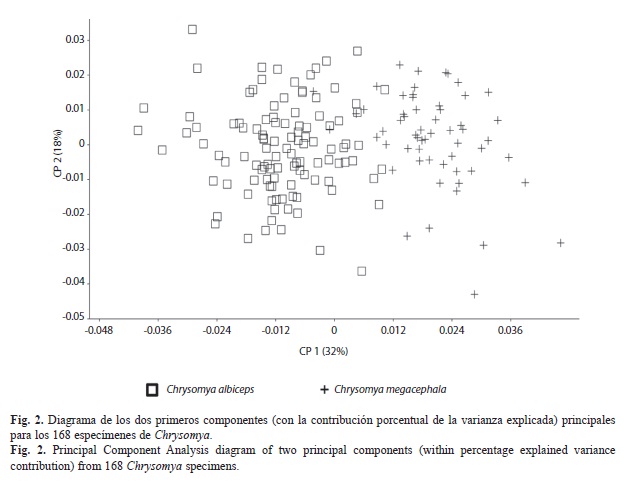
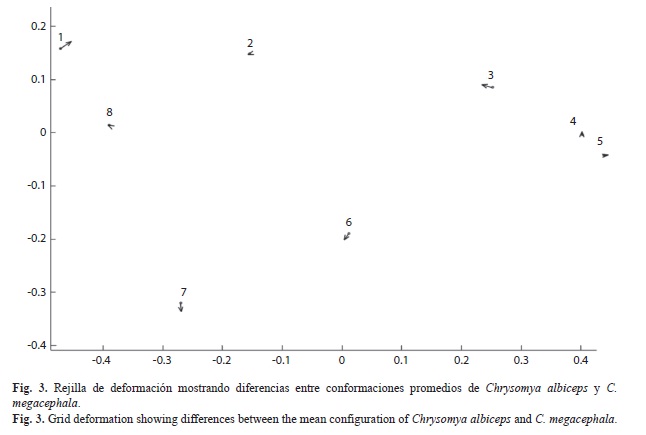
<body><![CDATA[<br> </span></font><br style="font-family: verdana;"> <font size="2"><span style="font-family: verdana;"><span  style="font-weight: bold;">An&aacute;lisis de morfometr&iacute;a geom&eacute;trica:</span> A partir de la matriz de 168 configuraciones de coordenadas geom&eacute;tricas de los ocho puntos (PAR1-PAR8), se realiz&oacute; el An&aacute;lisis Generalizado de Procrustes, con el programa CoordGen (Sheets 2005a) para una superimposici&oacute;n Procrustes y luego extraer una matriz con las variables de conformaci&oacute;n (<span style="font-style: italic;">Partial warps</span>=Pw) y tama&ntilde;o centroide (CS). Esta matriz de Pw se us&oacute; para un An&aacute;lisis de Componentes Principales (ACP) con el programa PCAGen (Sheets 2005b), mediante el cual se exploraron los principales ejes de variaci&oacute;n morfol&oacute;gica en el espacio tangente, para observar las tendencias de variaci&oacute;n entre y dentro de las muestras. Luego se evalu&oacute; la significancia entre las diferencias de configuraciones con el programa TwoGroup (Sheets 2005c) mediante la prueba de Goodall. El estad&iacute;stico F est&aacute; basado en el cociente de las distancias de Procrustes al cuadrado entre las medias de cada grupo, y la suma de&nbsp; las&nbsp; distancias&nbsp; de&nbsp; Procrustes&nbsp; al&nbsp; cuadrado entre cada esp&eacute;cimen y la media de su grupo. Sin embargo, esta prueba asume distribuci&oacute;n de la variaci&oacute;n alrededor de la media, por lo cual, se utiliz&oacute; el m&eacute;todo de Bootstrap para realizar 900 permutaciones a los datos y posterior c&aacute;lculo del estad&iacute;stico (Bookstein 1997, Zelditch <span  style="font-style: italic;">et&nbsp; al</span>.&nbsp; 2004).&nbsp; Las&nbsp; diferencias&nbsp; en&nbsp; los&nbsp; valores de CS entre las especies fueron analizadas en PAST (Hammer &amp; Harper 2011) mediante la prueba de Kruskal-Wallis (p&lt;0.05) con correcci&oacute;n de Bonferroni.</span></font><br  style="font-family: verdana;"> <font size="2"></font><br style="font-family: verdana;"> <font style="font-weight: bold;" size="3"><span  style="font-family: verdana;">Resultados</span></font><br  style="font-family: verdana;"> <font size="2"></font><br style="font-family: verdana;"> <font size="2"><span style="font-family: verdana;">Los an&aacute;lisis de morfometr&iacute;a geom&eacute;trica se presentan a continuaci&oacute;n.</span></font><br  style="font-family: verdana;"> <font size="2"></font><br style="font-family: verdana;"> <font size="2"><span style="font-family: verdana;"><span  style="font-weight: bold;">Tama&ntilde;o isom&eacute;trico: </span>Se encontraron diferencias significativas (Kruskal-Wallis: &#967;2=6.748, p&lt;0.05) en el tama&ntilde;o isom&eacute;trico del ala, en donde <span  style="font-style: italic;">C. albiceps</span> presenta mayor talla (3.137mm&plusmn;0.490) respecto a <span  style="font-style: italic;">C. megacephala</span> (2.971mm&plusmn;0.409).</span></font><br  style="font-family: verdana;"> <font size="2"></font><br style="font-family: verdana;"> <font size="2"><span style="font-family: verdana;"><span  style="font-weight: bold;">Diferencias de conformaci&oacute;n alar: </span>Se presentan los resultados del ACP y la comparaci&oacute;n&nbsp; pareada&nbsp; entre&nbsp; las&nbsp; configuraciones&nbsp; de las especies. El diagrama de los dos primeros componentes principales (<a href="/img/revistas/rbt/v60n3/a24i2.jpg">Fig. 2</a>) muestra la separaci&oacute;n entre <span style="font-style: italic;">C. albiceps</span> y <span  style="font-style: italic;">C. megacephala</span>; estas diferencias fueron significativas (F=50.17, gl1=12, gl2=1992, p&lt;0.001) y distancia parcial de Procrustes 0.0311. La funci&oacute;n de interpolaci&oacute;n de placas delgadas (<span style="font-style: italic;">thin plate</span> <span  style="font-style: italic;">spline</span>=TPS),&nbsp; permiti&oacute;&nbsp; inferir&nbsp; las&nbsp; diferencias en conformaci&oacute;n como deformaciones de los ocho puntos en una rejilla, calculada entre las configuraciones&nbsp; promedios&nbsp; de&nbsp; ambas&nbsp; especies en el ACP (<a href="/img/revistas/rbt/v60n3/a24i3.jpg">Fig. 3</a>). Las diferencias m&aacute;s importantes se presentan en los PAR1, PAR3, PAR6 y PAR7. En <span style="font-style: italic;">C. albiceps</span> en el PAR1 ocurre desplazamiento hacia arriba en el sentido diagonal a la derecha, el PAR3 se mueve en sentido diagonal hacia el PAR2, mientras que el PAR6 se acerca en sentido diagonal hacia el PAR7, y a su vez se desplaza verticalmente. Por otra parte en <span style="font-style: italic;">C. megacephala</span>, el PAR1 se desplaza hacia abajo en sentido diagonal a la izquierda, el PAR3 se acerca diagonalmente a la derecha hacia el PAR4, el PAR6 se desplaza hacia arriba en sentido diagonal al PAR3, y el PAR7 presenta desplazamiento vertical.</span></font>     <br>     <br style="font-family: verdana;">     <font style="font-weight: bold;" size="3"><span      style="font-family: verdana;">Discusi&oacute;n</span></font><br      style="font-family: verdana;">     <font size="2"></font><br style="font-family: verdana;">     <font size="2"><span style="font-family: verdana;"><span      style="font-weight: bold;">Tama&ntilde;o isom&eacute;trico:     </span>Los resultados de las variaciones de tama&ntilde;o del ala entre     ]]></body>
<body><![CDATA[<span style="font-style: italic;">C.     albiceps</span> y <span style="font-style: italic;">C. megacephala</span>,     estimada a trav&eacute;s del tama&ntilde;o     isom&eacute;trico, revelan diferencias significativas entre ambos     t&aacute;xones. Brown (1979), realiz&oacute; uno de los primeros     estudios morfom&eacute;tricos del ala&nbsp; en&nbsp; especies&nbsp;     de&nbsp; Muscidae,&nbsp; Sarcophagidae y Calliphoridae. A&uacute;n     cuando su investigaci&oacute;n utiliz&oacute; caracteres como distancia     entre las venas r-m, m-cu, M, R2+3 y Sc, entre otras, la     separaci&oacute;n de los t&aacute;xones se realiz&oacute; mediante el     ]]></body>
<body><![CDATA[tama&ntilde;o del ala.</span></font><br style="font-family: verdana;">     <font size="2"></font><br style="font-family: verdana;">     <font size="2"><span style="font-family: verdana;">Por otro lado,     Lom&ocirc;naco &amp;     Germanos (2001) determinaron en <span style="font-style: italic;">Musca     domestica</span> (Linnaeus) el     tama&ntilde;o del ala y su relaci&oacute;n con el tiempo de desarrollo     larval y las densidades larvarias.&nbsp; Encontrando&nbsp; que&nbsp;     tales&nbsp; variaciones son causadas por asimetr&iacute;as fluctuantes     (que denotan&nbsp; peque&ntilde;as&nbsp; desviaciones&nbsp; de&nbsp;     ]]></body>
<body><![CDATA[la&nbsp; simetr&iacute;a perfecta de cualquier car&aacute;cter de     organismos&nbsp; con&nbsp; simetr&iacute;a&nbsp; bilateral),&nbsp;     y&nbsp; que&nbsp; dichas fluctuaciones fueron inducidas por la     competencia&nbsp; por&nbsp; el&nbsp; alimento. Asimismo,&nbsp; indican     que     los niveles de variaciones en la asimetr&iacute;a fluctuante pueden ser     indicativos de stress o de la plasticidad fenot&iacute;pica de la     especie, que estar&iacute;an promoviendo la sobrevivencia de un     n&uacute;mero mayor de individuos.</span></font><br      style="font-family: verdana;">     ]]></body>
<body><![CDATA[<font size="2"></font><br style="font-family: verdana;">     <font size="2"><span style="font-family: verdana;">Estos resultados     fueron confirmados     por Reigada&nbsp; &amp;&nbsp; Godoy&nbsp; (2005),&nbsp; que&nbsp;     relacionaron el tama&ntilde;o de alas y tibias en <span      style="font-style: italic;">C. megacephala</span> con su     fecundidad estacional. Los autores determinan correlaciones negativas y     significativas entre la temperatura mensual y los tama&ntilde;os de     ambas estructuras. De esta forma, el menor tama&ntilde;o se presenta en     los meses c&aacute;lidos, cuando hay mayor abundancia de individuos     ]]></body>
<body><![CDATA[(aumenta la competencia), por otro lado, durante los meses fr&iacute;os     se evidencian el mayor tama&ntilde;o de las estructuras y a su vez la     menor abundancia de individuos. Pero cabe destacar, que esto puede no     cumplirse para todas las especies, puesto que, Gi&atilde;o &amp; Godoy     (2006) en estudios similares para <span style="font-style: italic;">Lucilia     eximia</span> (Wiedemann),     encuentran que no existe correlaci&oacute;n entre la temperatura y los     tama&ntilde;os de ala y tibia, y concluyen, que esto puede ser debido a     la estabilidad en la abundancia de dicha especie durante el a&ntilde;o.</span></font><br      style="font-family: verdana;">     ]]></body>
<body><![CDATA[<font size="2"></font><br style="font-family: verdana;">     <font size="2"><span style="font-family: verdana;">En nuestra     investigaci&oacute;n,     las diferencias del&nbsp; tama&ntilde;o&nbsp; alar,&nbsp; donde&nbsp;     <span style="font-style: italic;">C.&nbsp; albiceps</span>&nbsp;     presenta mayor talla respecto a <span style="font-style: italic;">C.     megacephala</span>, posiblemente se asocien a factores como la densidad     larval, tipo de sustrato donde se criaron, variables ambientales como     temperatura y humedad y competencia intraespec&iacute;fica.     Adem&aacute;s,&nbsp; estudios&nbsp; sobre&nbsp; din&aacute;mica&nbsp;     ]]></body>
<body><![CDATA[poblacional, dispersi&oacute;n y depredaci&oacute;n en     Calliphoridae,&nbsp; se&ntilde;alan&nbsp; la&nbsp; gran&nbsp;     capacidad&nbsp;     competitiva de <span style="font-style: italic;">C. albiceps</span>,     con respecto a especies como <span style="font-style: italic;">C.     putoria</span>     (Wiedemann), <span style="font-style: italic;">C. megacephala</span> y     <span style="font-style: italic;">Cochliomya macellaria</span>     (Fabricius);     as&iacute; como, la depredaci&oacute;n de <span     ]]></body>
<body><![CDATA[ style="font-style: italic;">C. albiceps</span> sobre durante la fase     de dispersi&oacute;n larvaria (Godoy&nbsp;     et.&nbsp; al.&nbsp; 2001,&nbsp; Von&nbsp; Zuben&nbsp; &amp;&nbsp; Godoy     2001, Bartholo de Andrade <span style="font-style: italic;">C.     macellariaet al</span>. 2002, Faria <span style="font-style: italic;">et     al</span>. 2004, Gomes <span style="font-style: italic;">et al</span>.     2006). Debido a esto, las diferencias de talla encontradas entre <span      style="font-style: italic;">C.     albiceps</span> y <span style="font-style: italic;">C. megacephala</span>     podr&iacute;an asociarse con aspectos     ]]></body>
<body><![CDATA[relacionados a colonizaci&oacute;n de sustrato y competencia entre     ambas especies.</span></font><br style="font-family: verdana;">     <font size="2"></font><br style="font-family: verdana;">     <font size="2"><span style="font-family: verdana;">Diferencias de     conformaci&oacute;n     alar y uso de la morfometr&iacute;a geom&eacute;trica para la     identificaci&oacute;n de especies: La funci&oacute;n de placas delgadas     TPS     permiti&oacute; evidenciar las diferencias de conformaci&oacute;n, en     la configuraci&oacute;n de ambas especies. Tradicionalmente, en la     ]]></body>
<body><![CDATA[clasificaci&oacute;n taxon&oacute;mica de las especies de Calliphoridae     y otras familias de cal&iacute;pterados, los caracteres utilizados son     la quetotaxia del t&oacute;rax, presencia de setas en la superficie     posterodorsal de la secci&oacute;n basal de la vena radial y la     inflexi&oacute;n de la vena medial (Shewell 1987, Ribeiro &amp;     Carvalho 1998, Carvalho &amp; Ribeiro 2000, Whitworth 2006, Amat 2009).     La visualizaci&oacute;n de estos caracteres requiere de conocimiento     detallado de morfolog&iacute;a de insectos y taxonom&iacute;a     del grupo. Por otro lado, algunas de estas setas podr&iacute;an     desprenderse durante la manipulaci&oacute;n o recolecta de los     ]]></body>
<body><![CDATA[espec&iacute;menes, y en algunos casos la interpretaci&oacute;n de     estos caracteres puede ser ambigua. Debido a esto, la     configuraci&oacute;n de la venaci&oacute;n alar podr&iacute;a     considerarse como una herramienta adicional en la taxonom&iacute;a de     estos     t&aacute;xones. Concretamente los puntos anat&oacute;micos de     referencia son: ruptura de la subcosta (PAR1), uni&oacute;n de     R2+3&nbsp;&nbsp; con el borde del ala (PAR3), uni&oacute;n dm-cu     (PAR6), y uni&oacute;n de Cu con dm-cu (PAR7).</span></font><br      style="font-family: verdana;">     ]]></body>
<body><![CDATA[<font size="2"></font><br style="font-family: verdana;">     <font size="2"><span style="font-family: verdana;">Los estudios de     variaci&oacute;n en     la morfolog&iacute;a del ala de d&iacute;pteros han demostrado que     factores como: clima, temperatura, fotoperiodo a lo largo de un     gradiente latitudinal y competencia larval durante el desarrollo,     influyen en el tama&ntilde;o y conformaci&oacute;n del ala (Aytekin     <span style="font-style: italic;">et al</span>. 2007, Bubliy <span      style="font-style: italic;">et al</span>. 2007, Jirakanjanakit <span      style="font-style: italic;">et al</span>. 2007, Loh <span     ]]></body>
<body><![CDATA[ style="font-style: italic;">et al</span>.     2008). En otros casos, las diferencias en la conformaci&oacute;n     podr&iacute;an ser consecuencia de interacciones m&aacute;s complejas,     que contenienen as&iacute; informaci&oacute;n que permitir&iacute;a     postular hip&oacute;tesis filogen&eacute;ticas (Soto-Vivas <span      style="font-style: italic;">et al</span>.     2011). </span></font><br style="font-family: verdana;">     <font size="2"></font><br style="font-family: verdana;">     <font size="2"><span style="font-family: verdana;">Por ello, los     resultados de     ]]></body>
<body><![CDATA[distintos estudios sugieren que la morfometr&iacute;a     geom&eacute;trica es particularmente apropiada para el an&aacute;lisis     fenot&iacute;pico de variaci&oacute;n de la forma (Klingenberg&nbsp;     &amp;&nbsp; Zaklan&nbsp; 2000).&nbsp; Esta&nbsp; herramienta     permite&nbsp; descomponer&nbsp; la&nbsp; variaci&oacute;n&nbsp;     resultante de la fisiolog&iacute;a de los individuos (variaci&oacute;n     de tama&ntilde;o) de aquellas m&aacute;s estables propias de la     poblaci&oacute;n, producto del componente gen&eacute;tico     (variaci&oacute;n de la forma) (Dujardin 2000). La morfometr&iacute;a     geom&eacute;trica ha demostrado su utilidad para resolver problemas     ]]></body>
<body><![CDATA[taxon&oacute;micos en insectos de importancia m&eacute;dica (Matias <span      style="font-style: italic;">et     al</span>. 2001, Villegas <span style="font-style: italic;">et al</span>.     2002, Calle <span style="font-style: italic;">et al</span>. 2008),     mediante la     discriminaci&oacute;n a partir de la configuraci&oacute;n alar, de     los integrantes de una especie en particular de otros que no lo son.</span></font><br      style="font-family: verdana;">     <font size="2"></font><br style="font-family: verdana;">     <font size="2"><span style="font-family: verdana;">Calle <span     ]]></body>
<body><![CDATA[ style="font-style: italic;">et al</span>. (2008) lograron     distinguir las hembras de 11 especies del subg&eacute;nero <span      style="font-style: italic;">Nyssorhynchus</span> de <span      style="font-style: italic;">Anopheles</span> presentes en Colombia     mediante el uso de la     informaci&oacute;n contenida en la conformaci&oacute;n del ala. Estos     resultados permiten proponer la utilizaci&oacute;n de los puntos     anat&oacute;micos seleccionados como apoyo en la taxonom&iacute;a de     este grupo Recientemente, Lyra <span style="font-style: italic;">et al</span>.     (2010) sugieren que la     ]]></body>
<body><![CDATA[morfometr&iacute;a alar representa un m&eacute;todo sencillo y fiable     para la identificaci&oacute;n de <span style="font-style: italic;">C.     hominivorax</span> (Coquerel) y <span style="font-style: italic;">C.     macellaria</span>.</span></font><br style="font-family: verdana;">     <font size="2"></font><br style="font-family: verdana;">     <font size="2"><span style="font-family: verdana;">Los resultados     descritos en este     trabajo, demuestran que la morfometr&iacute;a geom&eacute;trica del ala     es una herramienta id&oacute;nea en la discriminaci&oacute;n&nbsp;     de&nbsp; especies&nbsp; de&nbsp; Calliphoridae,&nbsp; siendo un     ]]></body>
<body><![CDATA[m&eacute;todo de f&aacute;cil aplicaci&oacute;n y con validaci&oacute;n     estad&iacute;stica. En este sentido, resulta interesante que utilizando     ocho puntos anat&oacute;micos en el ala, a diferencia de los 16     empleados por Lyra (2010), se logren diferenciar las especies de     <span style="font-style: italic;">Chrysomya</span>. Sin embargo,     a&uacute;n es necesario realizar     an&aacute;lisis adicionales que incluyan otras especies de los     g&eacute;neros <span style="font-style: italic;">Lucilia</span>, <span      style="font-style: italic;">Paralucilia</span>, <span      style="font-style: italic;">Cochliomya</span>, entre otras, con el     ]]></body>
<body><![CDATA[fin de evaluar la relevancia de los puntos anat&oacute;micos     seleccionados.&nbsp; Por&nbsp; otro&nbsp; lado,&nbsp; esta&nbsp;     investigaci&oacute;n abre camino en estudios de especies similares como     <span style="font-style: italic;">C. albiceps</span> y <span      style="font-style: italic;">C. rufifacies</span> (Macquart), en las     cuales, la     diferenciaci&oacute;n se realiza por la presencia de una seta     proepimeral y 2-4 setas proespisternales en <span      style="font-style: italic;">C. rufifacies</span> y sin seta     proepimeral y 4-6 setas proespisternales en <span     ]]></body>
<body><![CDATA[ style="font-style: italic;">C. albiceps</span> (Amat 2009).</span></font><br      style="font-family: verdana;">     <font size="2"></font><br style="font-family: verdana;">     <font style="font-weight: bold;" size="3"><span      style="font-family: verdana;">Agradecimientos</span></font><br      style="font-family: verdana;">     <font size="2"></font><br style="font-family: verdana;">     <font size="2"><span style="font-family: verdana;">Deseamos expresar     nuestro     agradecimiento a todas las personas que facilitaron su apoyo en la     ]]></body>
<body><![CDATA[realizaci&oacute;n de este trabajo. Darjaniva Molina de     Fern&aacute;ndez, Ana Soto-Vivas e Gianna Martiradona, del instituto     de Altos Estudios en&nbsp; Salud&nbsp; P&uacute;blica&nbsp; &#8220;Dr.     Arnoldo&nbsp; Gabaldon&#8221;&nbsp; MppSalud. Al&nbsp; Departamento&nbsp;     de&nbsp; Biolog&iacute;a&nbsp; de la Universidad de Carabobo y FONACYT&#8211;     MppCyT, Programa Misi&oacute;n Ciencias, por el apoyo y financiamiento     de los estudios doctorales (MV). A los &aacute;rbitros     an&oacute;nimos por los valiosos comentarios y sugerencias en mejora de     la versi&oacute;n final del presente trabajo.</span></font><br      style="font-family: verdana;">     ]]></body>
<body><![CDATA[<font size="2"></font><br style="font-family: verdana;">     <font size="2"></font>     <hr style="width: 100%; height: 2px;"><br style="font-family: verdana;">     <font style="font-weight: bold;" size="3"><span      style="font-family: verdana;">Referencias</span></font><br      style="font-family: verdana;">     <font size="2"></font><br style="font-family: verdana;">     <font size="2"><span style="font-family: verdana;">Amat, E. 2009.     Contribuci&oacute;n     al conocimiento de las Chrysomyinae y Toxotarsinae (Diptera:     ]]></body>
<body><![CDATA[Calliphoridae) de Colombia. </span></font><font size="2"><span     <!-- ref --> style="font-family: verdana;">Rev. Mex. Biodiv. 80: 693-708.    &nbsp;&nbsp;&nbsp;&nbsp;&nbsp;&nbsp;&nbsp;&nbsp;[&#160;<a href="javascript:void(0);" onclick="javascript: window.open('/scielo.php?script=sci_nlinks&ref=1474813&pid=S0034-7744201200030002400001&lng=','','width=640,height=500,resizable=yes,scrollbars=1,menubar=yes,');">Links</a>&#160;]<!-- end-ref --><!-- ref --></span></font><br  style="font-family: verdana;"> <font size="2"></font><br style="font-family: verdana;"> <font size="2"><span style="font-family: verdana;">Aytekin,&nbsp; M.,&nbsp; B. Alten,&nbsp; S.S.&nbsp; Caglar, Y.&nbsp; Ozbel,&nbsp; S.&nbsp; Kaynas, F.M. Simsek, O.E.&nbsp; Kasap &amp; A. Belen. 2007.</span></font><font  size="2"><span style="font-family: verdana;"> Phenotypic&nbsp;&nbsp; variation&nbsp; among&nbsp; local&nbsp;&nbsp; populations&nbsp; of phlebotomine&nbsp; sandflies&nbsp;&nbsp; (Diptera:&nbsp; Psychodidae)&nbsp; in southern Turkey. J. Vector. Ecol. 32: 226-234.    &nbsp;&nbsp;&nbsp;&nbsp;&nbsp;&nbsp;&nbsp;&nbsp;[&#160;<a href="javascript:void(0);" onclick="javascript: window.open('/scielo.php?script=sci_nlinks&ref=1474814&pid=S0034-7744201200030002400002&lng=','','width=640,height=500,resizable=yes,scrollbars=1,menubar=yes,');">Links</a>&#160;]<!-- end-ref --><!-- ref --></span></font><br  style="font-family: verdana;"> <font size="2"></font><br style="font-family: verdana;"> <font size="2"><span style="font-family: verdana;">Bartholo&nbsp;&nbsp; de&nbsp; Andrade,&nbsp; J.F.A.&nbsp; Rocha,&nbsp; P.&nbsp;&nbsp; Rodrigues,&nbsp; G. Souza-Rosa,&nbsp; L. Faria, C.J. Von Zuben, M&nbsp; Rossi &amp; W.A. Godoy. 2002. Larval dispersal and predation in experimental populations of <span style="font-style: italic;">Chrysomya albiceps</span> and <span style="font-style: italic;">Chrysomya</span> <span style="font-style: italic;">megacephala</span> (Diptera:&nbsp; Calliphoridae). Mem. inst. Oswaldo Cruz 97:1137-1140.    &nbsp;&nbsp;&nbsp;&nbsp;&nbsp;&nbsp;&nbsp;&nbsp;[&#160;<a href="javascript:void(0);" onclick="javascript: window.open('/scielo.php?script=sci_nlinks&ref=1474815&pid=S0034-7744201200030002400003&lng=','','width=640,height=500,resizable=yes,scrollbars=1,menubar=yes,');">Links</a>&#160;]<!-- end-ref --><!-- ref --></span></font><br style="font-family: verdana;"> <font size="2"></font><br style="font-family: verdana;"> <font size="2"><span style="font-family: verdana;">Belen,&nbsp; A.,&nbsp; B. Alten&nbsp; &amp; A.M. Aytekin.&nbsp; 2004.&nbsp; Altitudinal variation in morphometric and molecular characteristics of <span  style="font-style: italic;">Phlebotomus papatasi</span> populations. Med. Vet. Entomol. 18: 343-350.    &nbsp;&nbsp;&nbsp;&nbsp;&nbsp;&nbsp;&nbsp;&nbsp;[&#160;<a href="javascript:void(0);" onclick="javascript: window.open('/scielo.php?script=sci_nlinks&ref=1474816&pid=S0034-7744201200030002400004&lng=','','width=640,height=500,resizable=yes,scrollbars=1,menubar=yes,');">Links</a>&#160;]<!-- end-ref --><!-- ref --></span></font><br  style="font-family: verdana;"> <font size="2"></font><br style="font-family: verdana;"> <font size="2"><span style="font-family: verdana;">Bookstein,&nbsp; F.L. 1991. Morphometric tools for&nbsp; landmark data: Geometry and Biology. Cambridge, EEUU.    &nbsp;&nbsp;&nbsp;&nbsp;&nbsp;&nbsp;&nbsp;&nbsp;[&#160;<a href="javascript:void(0);" onclick="javascript: window.open('/scielo.php?script=sci_nlinks&ref=1474817&pid=S0034-7744201200030002400005&lng=','','width=640,height=500,resizable=yes,scrollbars=1,menubar=yes,');">Links</a>&#160;]<!-- end-ref --><!-- ref --></span></font><br style="font-family: verdana;"> <font size="2"></font><br style="font-family: verdana;"> <font size="2"><span style="font-family: verdana;">Bookstein, F.L. 1997. Landmark methods for forms without landmarks:&nbsp; localizing&nbsp; group&nbsp; differences&nbsp; in&nbsp; outline shape. Med. image Anal. 1: 225-243.    &nbsp;&nbsp;&nbsp;&nbsp;&nbsp;&nbsp;&nbsp;&nbsp;[&#160;<a href="javascript:void(0);" onclick="javascript: window.open('/scielo.php?script=sci_nlinks&ref=1474818&pid=S0034-7744201200030002400006&lng=','','width=640,height=500,resizable=yes,scrollbars=1,menubar=yes,');">Links</a>&#160;]<!-- end-ref --><!-- ref --></span></font><br  style="font-family: verdana;"> <font size="2"></font><br style="font-family: verdana;"> <font size="2"><span style="font-family: verdana;">Brown, K.R. 1979. Comparative Wing Morphometrics of some Calyptrate Diptera. J. Aust. entomol. Soc. 18: 289-303.    &nbsp;&nbsp;&nbsp;&nbsp;&nbsp;&nbsp;&nbsp;&nbsp;[&#160;<a href="javascript:void(0);" onclick="javascript: window.open('/scielo.php?script=sci_nlinks&ref=1474819&pid=S0034-7744201200030002400007&lng=','','width=640,height=500,resizable=yes,scrollbars=1,menubar=yes,');">Links</a>&#160;]<!-- end-ref --><!-- ref --></span></font><br style="font-family: verdana;"> <font size="2"></font><br style="font-family: verdana;"> <font size="2"><span style="font-family: verdana;">Bubliy,&nbsp; O.A.,&nbsp; K.S.&nbsp; Tcheslavskaia,&nbsp; A.M.&nbsp; Kulikov,&nbsp; O.E. Lazebny&nbsp;&nbsp; &amp;&nbsp; V.G.&nbsp; Mitrofanov.&nbsp; 2007.&nbsp; Variation&nbsp; of wing shape in the&nbsp; <span  style="font-style: italic;">Drosophila virilis</span> species group (Diptera: Drosophilidae). J. Zool.&nbsp; Systemat.&nbsp; Evol. Res. 46: 38-47.    &nbsp;&nbsp;&nbsp;&nbsp;&nbsp;&nbsp;&nbsp;&nbsp;[&#160;<a href="javascript:void(0);" onclick="javascript: window.open('/scielo.php?script=sci_nlinks&ref=1474820&pid=S0034-7744201200030002400008&lng=','','width=640,height=500,resizable=yes,scrollbars=1,menubar=yes,');">Links</a>&#160;]<!-- end-ref --><!-- ref --></span></font><br  style="font-family: verdana;"> <font size="2"></font><br style="font-family: verdana;"> <font size="2"><span style="font-family: verdana;">Byrd,&nbsp; J.H. &amp; J.L. Castner. 2001. Forensic&nbsp; Entomology: The Utility of Arthropods&nbsp; in&nbsp; Legal investigations. CRC, EEUU.    &nbsp;&nbsp;&nbsp;&nbsp;&nbsp;&nbsp;&nbsp;&nbsp;[&#160;<a href="javascript:void(0);" onclick="javascript: window.open('/scielo.php?script=sci_nlinks&ref=1474821&pid=S0034-7744201200030002400009&lng=','','width=640,height=500,resizable=yes,scrollbars=1,menubar=yes,');">Links</a>&#160;]<!-- end-ref --><!-- ref --></span></font><br  style="font-family: verdana;"> <font size="2"></font><br style="font-family: verdana;"> <font size="2"><span style="font-family: verdana;">Calder&oacute;n-Arguedas, O., A. Troyo &amp; M.E.&nbsp; Solano. 2005. Sucesi&oacute;n de larvas de muscoideos durante la degradaci&oacute;n cadav&eacute;rica en un bosque premontano h&uacute;medo tropical. Biomedica 16: 79-85.    &nbsp;&nbsp;&nbsp;&nbsp;&nbsp;&nbsp;&nbsp;&nbsp;[&#160;<a href="javascript:void(0);" onclick="javascript: window.open('/scielo.php?script=sci_nlinks&ref=1474822&pid=S0034-7744201200030002400010&lng=','','width=640,height=500,resizable=yes,scrollbars=1,menubar=yes,');">Links</a>&#160;]<!-- end-ref --><!-- ref --></span></font><br  style="font-family: verdana;"> <font size="2"></font><br style="font-family: verdana;"> <font size="2"><span style="font-family: verdana;">Calle, D.A., M. Qui&ntilde;&oacute;nez, H. Erazo &amp; N. Jaramillo. 2008. Discriminaci&oacute;n por morfometr&iacute;a geom&eacute;trica de once especies de <span style="font-style: italic;">Anopheles</span> (<span  style="font-style: italic;">Nyssorhynchus</span>) presentes en Colombia. Biomedica 28: 371-385.    &nbsp;&nbsp;&nbsp;&nbsp;&nbsp;&nbsp;&nbsp;&nbsp;[&#160;<a href="javascript:void(0);" onclick="javascript: window.open('/scielo.php?script=sci_nlinks&ref=1474823&pid=S0034-7744201200030002400011&lng=','','width=640,height=500,resizable=yes,scrollbars=1,menubar=yes,');">Links</a>&#160;]<!-- end-ref --><!-- ref --></span></font><br style="font-family: verdana;"> <font size="2"></font><br style="font-family: verdana;"> <font size="2"><span style="font-family: verdana;">Carvalho, C.J.B. &amp; P.B. Ribeiro. 2000. Chave de identifica&ccedil;&atilde;o das especies de Calliphoridae (Diptera) do Sul do Brasil. Rev. Bras. Parasitol. Vet. 9: 169-173.    &nbsp;&nbsp;&nbsp;&nbsp;&nbsp;&nbsp;&nbsp;&nbsp;[&#160;<a href="javascript:void(0);" onclick="javascript: window.open('/scielo.php?script=sci_nlinks&ref=1474824&pid=S0034-7744201200030002400012&lng=','','width=640,height=500,resizable=yes,scrollbars=1,menubar=yes,');">Links</a>&#160;]<!-- end-ref --><!-- ref --></span></font><br style="font-family: verdana;"> <font size="2"></font><br style="font-family: verdana;"> <font size="2"><span style="font-family: verdana;">Cova,&nbsp; G.P. 1974. Princ&iacute;pios Generales de&nbsp; Entomolog&iacute;a. Fundaci&oacute;n Venezolana para la salud y la educaci&oacute;n, Caracas, Venezuela.    &nbsp;&nbsp;&nbsp;&nbsp;&nbsp;&nbsp;&nbsp;&nbsp;[&#160;<a href="javascript:void(0);" onclick="javascript: window.open('/scielo.php?script=sci_nlinks&ref=1474825&pid=S0034-7744201200030002400013&lng=','','width=640,height=500,resizable=yes,scrollbars=1,menubar=yes,');">Links</a>&#160;]<!-- end-ref --><!-- ref --></span></font><br style="font-family: verdana;"> <font size="2"></font><br style="font-family: verdana;"> <font size="2"><span style="font-family: verdana;">De La Riva, J., F. Le Pont, V. Ali, A. Matias, S. Mollinedo &amp; J.P. Dujardin. 2001. Wing Geometry as a tool for studying&nbsp; the&nbsp; <span style="font-style: italic;">Lutzomyia&nbsp; longipalpis</span>&nbsp; (Diptera:&nbsp; Psychodidae). Mem. inst. Oswaldo Cruz 96: 1089-1094.    &nbsp;&nbsp;&nbsp;&nbsp;&nbsp;&nbsp;&nbsp;&nbsp;[&#160;<a href="javascript:void(0);" onclick="javascript: window.open('/scielo.php?script=sci_nlinks&ref=1474826&pid=S0034-7744201200030002400014&lng=','','width=640,height=500,resizable=yes,scrollbars=1,menubar=yes,');">Links</a>&#160;]<!-- end-ref --><!-- ref --></span></font><br  style="font-family: verdana;"> <font size="2"></font><br style="font-family: verdana;"> <font size="2"><span style="font-family: verdana;">Dujardin,&nbsp; J.P. 2000. introducci&oacute;n&nbsp; a la&nbsp; Morfometr&iacute;a, con &eacute;nfasis en Triatominae y Phlebotominae. iRD, UMR CNRS-iRD&nbsp; 9226. (Disponible en:<a href="http://www.mpl.%20ird.fr/morphometrics/"> </a>http://www.mpl.ird.fr/morphometrics/).    &nbsp;&nbsp;&nbsp;&nbsp;&nbsp;&nbsp;&nbsp;&nbsp;[&#160;<a href="javascript:void(0);" onclick="javascript: window.open('/scielo.php?script=sci_nlinks&ref=1474827&pid=S0034-7744201200030002400015&lng=','','width=640,height=500,resizable=yes,scrollbars=1,menubar=yes,');">Links</a>&#160;]<!-- end-ref --><!-- ref --></span></font><br  style="font-family: verdana;"> <font size="2"></font><br style="font-family: verdana;"> <font size="2"><span style="font-family: verdana;">Dvorak,&nbsp; V.,&nbsp; A.M.&nbsp; Aytekin,&nbsp; B.&nbsp; Alten,&nbsp; S.&nbsp; Skarupova,&nbsp; J. Votypka &amp; P. Volf. 2006. A comparison of the intraspecific&nbsp; variability&nbsp; of&nbsp; <span style="font-style: italic;">Phlebotomus&nbsp; sergenti</span>&nbsp; Parrot, 1917 (Diptera: Psychodidae). J. Vector.&nbsp; Ecol.&nbsp; 31: 229-238.    &nbsp;&nbsp;&nbsp;&nbsp;&nbsp;&nbsp;&nbsp;&nbsp;[&#160;<a href="javascript:void(0);" onclick="javascript: window.open('/scielo.php?script=sci_nlinks&ref=1474828&pid=S0034-7744201200030002400016&lng=','','width=640,height=500,resizable=yes,scrollbars=1,menubar=yes,');">Links</a>&#160;]<!-- end-ref --><!-- ref --></span></font><br  style="font-family: verdana;"> <font size="2"></font><br style="font-family: verdana;"> <font size="2"><span style="font-family: verdana;">Faria, L.D.B., W.A.C. Godoy &amp; L.A. Trinca. 2004. Dynamics of handling time and&nbsp; functional response by larvae&nbsp; of&nbsp; <span style="font-style: italic;">Chrysomya albiceps</span> (Diptera: Calliphoridae) on different prey species. J.&nbsp; Appl.&nbsp; Entomol. 128: 432-436.    &nbsp;&nbsp;&nbsp;&nbsp;&nbsp;&nbsp;&nbsp;&nbsp;[&#160;<a href="javascript:void(0);" onclick="javascript: window.open('/scielo.php?script=sci_nlinks&ref=1474829&pid=S0034-7744201200030002400017&lng=','','width=640,height=500,resizable=yes,scrollbars=1,menubar=yes,');">Links</a>&#160;]<!-- end-ref --><!-- ref --></span></font><br style="font-family: verdana;"> <font size="2"></font><br style="font-family: verdana;"> <font size="2"><span style="font-family: verdana;">Godoy, W.A.C., F.J. Von Zuben, J. Von Zuben &amp; S.F. Reis. 2001. Spatio-temporal dynamics and transition from asymptotic&nbsp; equilibrium&nbsp; to&nbsp; bounded&nbsp; oscillations&nbsp; in <span style="font-style: italic;">Chrysomya&nbsp; albiceps</span> (Diptera, Calliphoridae). Mem. inst. Oswaldo. Cruz. 96: 627-34.    &nbsp;&nbsp;&nbsp;&nbsp;&nbsp;&nbsp;&nbsp;&nbsp;[&#160;<a href="javascript:void(0);" onclick="javascript: window.open('/scielo.php?script=sci_nlinks&ref=1474830&pid=S0034-7744201200030002400018&lng=','','width=640,height=500,resizable=yes,scrollbars=1,menubar=yes,');">Links</a>&#160;]<!-- end-ref --><!-- ref --></span></font><br  style="font-family: verdana;"> <font size="2"></font><br style="font-family: verdana;"> <font size="2"><span style="font-family: verdana;">Gomes,&nbsp; L., G. Gomes, O.H. Gutierrez, S.M.&nbsp; Rog&eacute;rio &amp; C.J. Von Zuben. 2006.&nbsp; influence of photoperiod on body weight&nbsp; and depth of burrowing in larvae of <span style="font-style: italic;">Chrysomya</span> <span  style="font-style: italic;">megacephala</span> (Fabricius) (Diptera, Calliphoridae) and implications for forensic entomology. Rev. Bras. Entomol. 50: 76-79.    &nbsp;&nbsp;&nbsp;&nbsp;&nbsp;&nbsp;&nbsp;&nbsp;[&#160;<a href="javascript:void(0);" onclick="javascript: window.open('/scielo.php?script=sci_nlinks&ref=1474831&pid=S0034-7744201200030002400019&lng=','','width=640,height=500,resizable=yes,scrollbars=1,menubar=yes,');">Links</a>&#160;]<!-- end-ref --><!-- ref --></span></font><br  style="font-family: verdana;"> <font size="2"></font><br style="font-family: verdana;"> <font size="2"><span style="font-family: verdana;">Gi&atilde;o, J. &amp; W. Godoy. 2006. Seasonal population dynamics in <span style="font-style: italic;">Lucilia eximia</span> (Wiedemann) (Diptera: Calliphoridae). Neotrop. Entomol. 35: 753-756.    &nbsp;&nbsp;&nbsp;&nbsp;&nbsp;&nbsp;&nbsp;&nbsp;[&#160;<a href="javascript:void(0);" onclick="javascript: window.open('/scielo.php?script=sci_nlinks&ref=1474832&pid=S0034-7744201200030002400020&lng=','','width=640,height=500,resizable=yes,scrollbars=1,menubar=yes,');">Links</a>&#160;]<!-- end-ref --><!-- ref --></span></font><br  style="font-family: verdana;"> <font size="2"></font><br style="font-family: verdana;"> <font size="2"><span style="font-family: verdana;">Hammer, &Oslash;. &amp; D.A.T. Harper. 2011. PAST: Palaeontological Statistics, versi&oacute;n&nbsp; 2.10. (Disponible en: http://folk.uio.no/ohammer/past).    &nbsp;&nbsp;&nbsp;&nbsp;&nbsp;&nbsp;&nbsp;&nbsp;[&#160;<a href="javascript:void(0);" onclick="javascript: window.open('/scielo.php?script=sci_nlinks&ref=1474833&pid=S0034-7744201200030002400021&lng=','','width=640,height=500,resizable=yes,scrollbars=1,menubar=yes,');">Links</a>&#160;]<!-- end-ref --><!-- ref --></span></font><br  style="font-family: verdana;"> <font size="2"></font><br style="font-family: verdana;"> <font size="2"><span style="font-family: verdana;">Jaramillo, N.D. &amp; C.M. Wolff. 2002. Geometric Morphometric differences between&nbsp;<span  style="font-style: italic;"> Panstrongylus geniculatus</span> from field&nbsp; and laboratory. Mem. inst.&nbsp; Oswaldo Cruz 97: 667-673.    &nbsp;&nbsp;&nbsp;&nbsp;&nbsp;&nbsp;&nbsp;&nbsp;[&#160;<a href="javascript:void(0);" onclick="javascript: window.open('/scielo.php?script=sci_nlinks&ref=1474834&pid=S0034-7744201200030002400022&lng=','','width=640,height=500,resizable=yes,scrollbars=1,menubar=yes,');">Links</a>&#160;]<!-- end-ref --><!-- ref --></span></font><br style="font-family: verdana;"> <font size="2"></font><br style="font-family: verdana;"> <font size="2"><span style="font-family: verdana;">Jirakanjanakit, N., S. Leemingsawat, S.&nbsp; Thongrungkiat, C.&nbsp; Apiwathnasorn,&nbsp; S.&nbsp; Singhaniyom,&nbsp; C.&nbsp; Bellec&nbsp; &amp; J.P.&nbsp; Dujardin.&nbsp; 2007. In&#64258;uence of larval&nbsp; density or food variation on the geometry of the wing of <span  style="font-style: italic;">Aedes</span> (<span  style="font-style: italic;">Stegomyia</span>)&nbsp;&nbsp; aegypti.&nbsp; Trop.&nbsp; Med.&nbsp; int.&nbsp; Health&nbsp; 12: 1354-1360.    &nbsp;&nbsp;&nbsp;&nbsp;&nbsp;&nbsp;&nbsp;&nbsp;[&#160;<a href="javascript:void(0);" onclick="javascript: window.open('/scielo.php?script=sci_nlinks&ref=1474835&pid=S0034-7744201200030002400023&lng=','','width=640,height=500,resizable=yes,scrollbars=1,menubar=yes,');">Links</a>&#160;]<!-- end-ref --><!-- ref --></span></font><br style="font-family: verdana;"> <font size="2"></font><br style="font-family: verdana;"> <font size="2"><span style="font-family: verdana;">Klingenberg, C.P. &amp; S.D. Zaklan. 2000.&nbsp; Morphological integration between developmental compartments in the <span style="font-style: italic;">Drosophila</span> wing. Evolution 54: 1273-1285.    &nbsp;&nbsp;&nbsp;&nbsp;&nbsp;&nbsp;&nbsp;&nbsp;[&#160;<a href="javascript:void(0);" onclick="javascript: window.open('/scielo.php?script=sci_nlinks&ref=1474836&pid=S0034-7744201200030002400024&lng=','','width=640,height=500,resizable=yes,scrollbars=1,menubar=yes,');">Links</a>&#160;]<!-- end-ref --><!-- ref --></span></font><br  style="font-family: verdana;"> <font size="2"></font><br style="font-family: verdana;"> <font size="2"><span style="font-family: verdana;">Liria, J. 2006. insectos de importancia forense en cad&aacute;veres de ratas, Carabobo &#8211; Venezuela. Rev. Peru. Med. Exp. Salud P&uacute;blica 23: 33-38.    &nbsp;&nbsp;&nbsp;&nbsp;&nbsp;&nbsp;&nbsp;&nbsp;[&#160;<a href="javascript:void(0);" onclick="javascript: window.open('/scielo.php?script=sci_nlinks&ref=1474837&pid=S0034-7744201200030002400025&lng=','','width=640,height=500,resizable=yes,scrollbars=1,menubar=yes,');">Links</a>&#160;]<!-- end-ref --><!-- ref --></span></font><br  style="font-family: verdana;"> <font size="2"></font><br style="font-family: verdana;"> <font size="2"><span style="font-family: verdana;">Loh, R., J.R. David, V. Debat &amp; B.C. Bitner-Math&eacute;. 2008. Adaptation to different climates results in&nbsp; divergent phenotypic plasticity of wing&nbsp; size and shape in an invasive drosophilid. J. Genet. 87: 209-217.    &nbsp;&nbsp;&nbsp;&nbsp;&nbsp;&nbsp;&nbsp;&nbsp;[&#160;<a href="javascript:void(0);" onclick="javascript: window.open('/scielo.php?script=sci_nlinks&ref=1474838&pid=S0034-7744201200030002400026&lng=','','width=640,height=500,resizable=yes,scrollbars=1,menubar=yes,');">Links</a>&#160;]<!-- end-ref --><!-- ref --></span></font><br  style="font-family: verdana;"> <font size="2"></font><br style="font-family: verdana;"> <font size="2"><span style="font-family: verdana;">Lom&ocirc;naco, C. &amp; E. Germanos. 2001. Varia&ccedil;&otilde;es fenot&iacute;picas em&nbsp; <span style="font-style: italic;">Musca&nbsp; domestica</span>&nbsp; L.&nbsp; (Diptera:&nbsp; Muscidae)&nbsp; em resposta &agrave; competi&ccedil;&atilde;o larval por alimento. Neotrop. Entomol. 30: 223-231.    &nbsp;&nbsp;&nbsp;&nbsp;&nbsp;&nbsp;&nbsp;&nbsp;[&#160;<a href="javascript:void(0);" onclick="javascript: window.open('/scielo.php?script=sci_nlinks&ref=1474839&pid=S0034-7744201200030002400027&lng=','','width=640,height=500,resizable=yes,scrollbars=1,menubar=yes,');">Links</a>&#160;]<!-- end-ref --><!-- ref --></span></font><br  style="font-family: verdana;"> <font size="2"></font><br style="font-family: verdana;"> <font size="2"><span style="font-family: verdana;">Lyra, M.L., L.M. Hatadani, A.M.L. De Azeredo-Espin &amp; L.B. Klaczko. 2010.&nbsp; Wing morphometry as a tool for correct&nbsp; identification of primary and secondary New World screwworm fly. Bull. Entomol. Res. 100: 19-26.    &nbsp;&nbsp;&nbsp;&nbsp;&nbsp;&nbsp;&nbsp;&nbsp;[&#160;<a href="javascript:void(0);" onclick="javascript: window.open('/scielo.php?script=sci_nlinks&ref=1474840&pid=S0034-7744201200030002400028&lng=','','width=640,height=500,resizable=yes,scrollbars=1,menubar=yes,');">Links</a>&#160;]<!-- end-ref --><!-- ref --></span></font><br  style="font-family: verdana;"> <font size="2"></font><br style="font-family: verdana;"> <font size="2"><span style="font-family: verdana;">Maga&ntilde;a, C. 2001. La entomolog&iacute;a forense y su aplicaci&oacute;n a la medicina legal. Data de&nbsp; la muerte. Bol. Soc. Entomol. Aragonesa 28: 49-57.    &nbsp;&nbsp;&nbsp;&nbsp;&nbsp;&nbsp;&nbsp;&nbsp;[&#160;<a href="javascript:void(0);" onclick="javascript: window.open('/scielo.php?script=sci_nlinks&ref=1474841&pid=S0034-7744201200030002400029&lng=','','width=640,height=500,resizable=yes,scrollbars=1,menubar=yes,');">Links</a>&#160;]<!-- end-ref --><!-- ref --></span></font><br  style="font-family: verdana;"> <font size="2"></font><br style="font-family: verdana;"> <font size="2"><span style="font-family: verdana;">Maga&ntilde;a, C. <span  style="font-style: italic;">et al</span>. 2006. Estudio preliminar de la fauna de insectos asociada a cad&aacute;veres en Maracay, Venezuela. Entomotropica 21: 53-59.    &nbsp;&nbsp;&nbsp;&nbsp;&nbsp;&nbsp;&nbsp;&nbsp;[&#160;<a href="javascript:void(0);" onclick="javascript: window.open('/scielo.php?script=sci_nlinks&ref=1474842&pid=S0034-7744201200030002400030&lng=','','width=640,height=500,resizable=yes,scrollbars=1,menubar=yes,');">Links</a>&#160;]<!-- end-ref --><!-- ref --></span></font><br  style="font-family: verdana;"> <font size="2"></font><br style="font-family: verdana;"> <font size="2"><span style="font-family: verdana;">McAlpine, J.F. 1987. Morphology and&nbsp; Terminology&nbsp; &#8211; Adults, p. 9-63. <span  style="font-style: italic;">In</span> J.F. McAlpine, B.V. Peterson, G.E. Shewell, H.J. Teskey, J.R. Vockeroth &amp; D.M. Wood (eds.). Manual of Neartic Diptera. Research Branch Agriculture Canada, Otawa, Canada.    &nbsp;&nbsp;&nbsp;&nbsp;&nbsp;&nbsp;&nbsp;&nbsp;[&#160;<a href="javascript:void(0);" onclick="javascript: window.open('/scielo.php?script=sci_nlinks&ref=1474843&pid=S0034-7744201200030002400031&lng=','','width=640,height=500,resizable=yes,scrollbars=1,menubar=yes,');">Links</a>&#160;]<!-- end-ref --><!-- ref --></span></font><br style="font-family: verdana;"> <font size="2"></font><br style="font-family: verdana;"> <font size="2"><span style="font-family: verdana;">Maldonado, M.A. 2002. Entomolog&iacute;a forense: Definici&oacute;n, generalidades y fauna relevante. Buenos Aires: Entomolog&iacute;a Forense en Argentina. (Disponible en: www.entomologiaforense.unq.edu.ar/intro_es_htm).    &nbsp;&nbsp;&nbsp;&nbsp;&nbsp;&nbsp;&nbsp;&nbsp;[&#160;<a href="javascript:void(0);" onclick="javascript: window.open('/scielo.php?script=sci_nlinks&ref=1474844&pid=S0034-7744201200030002400032&lng=','','width=640,height=500,resizable=yes,scrollbars=1,menubar=yes,');">Links</a>&#160;]<!-- end-ref --><!-- ref --></span></font><br  style="font-family: verdana;"> <font size="2"></font><br style="font-family: verdana;"> <font size="2"><span style="font-family: verdana;">Mat&iacute;as, A., J.X. De La Riva, M. Torrez &amp; J.P.&nbsp; Dujardin. 2001. Rhodnius robustus in Bolivia identified by its Wings. Mem. inst. Oswaldo. Cruz 96: 947-950.    &nbsp;&nbsp;&nbsp;&nbsp;&nbsp;&nbsp;&nbsp;&nbsp;[&#160;<a href="javascript:void(0);" onclick="javascript: window.open('/scielo.php?script=sci_nlinks&ref=1474845&pid=S0034-7744201200030002400033&lng=','','width=640,height=500,resizable=yes,scrollbars=1,menubar=yes,');">Links</a>&#160;]<!-- end-ref --><!-- ref --></span></font><br  style="font-family: verdana;"> <font size="2"></font><br style="font-family: verdana;"> <font size="2"><span style="font-family: verdana;">Mav&aacute;rez-Cardozo,&nbsp;&nbsp; M.G.,&nbsp; A.i.&nbsp; Espina&nbsp; de&nbsp;&nbsp; Fereira,&nbsp;&nbsp; F.A. Barrios-Ferrer &amp; J.L. Fereira-Paz. 2005. La entomolog&iacute;a forense y el neotr&oacute;pico.&nbsp; Cuad. Med. Forense&nbsp; 11: 23-33.    &nbsp;&nbsp;&nbsp;&nbsp;&nbsp;&nbsp;&nbsp;&nbsp;[&#160;<a href="javascript:void(0);" onclick="javascript: window.open('/scielo.php?script=sci_nlinks&ref=1474846&pid=S0034-7744201200030002400034&lng=','','width=640,height=500,resizable=yes,scrollbars=1,menubar=yes,');">Links</a>&#160;]<!-- end-ref --><!-- ref --></span></font><br style="font-family: verdana;"> <font size="2"></font><br style="font-family: verdana;"> <font size="2"><span style="font-family: verdana;">Queiroz,&nbsp; M.M.C., R.P. Mello &amp; M.M. Lima.&nbsp; 1997. Morphological aspects of the larval instars of <span style="font-style: italic;">Chrysomya albiceps</span> (Diptera, Calliphoridae). Mem. inst. Oswaldo Cruz 92: 187-196.    &nbsp;&nbsp;&nbsp;&nbsp;&nbsp;&nbsp;&nbsp;&nbsp;[&#160;<a href="javascript:void(0);" onclick="javascript: window.open('/scielo.php?script=sci_nlinks&ref=1474847&pid=S0034-7744201200030002400035&lng=','','width=640,height=500,resizable=yes,scrollbars=1,menubar=yes,');">Links</a>&#160;]<!-- end-ref --><!-- ref --></span></font><br style="font-family: verdana;"> <font size="2"></font><br style="font-family: verdana;"> <font size="2"><span style="font-family: verdana;">Reigada,&nbsp; C. &amp; W.A.C. Godoy. 2005. Seasonal&nbsp; fecundity and body size in <span  style="font-style: italic;">Chrysomya&nbsp; megacephala</span> (Fabricius)&nbsp; (Diptera:&nbsp;&nbsp; Calliphoridae).&nbsp; Neotrop.&nbsp; Entomol. 34: 163-168.    &nbsp;&nbsp;&nbsp;&nbsp;&nbsp;&nbsp;&nbsp;&nbsp;[&#160;<a href="javascript:void(0);" onclick="javascript: window.open('/scielo.php?script=sci_nlinks&ref=1474848&pid=S0034-7744201200030002400036&lng=','','width=640,height=500,resizable=yes,scrollbars=1,menubar=yes,');">Links</a>&#160;]<!-- end-ref --><!-- ref --></span></font><br  style="font-family: verdana;"> <font size="2"></font><br style="font-family: verdana;"> <font size="2"><span style="font-family: verdana;">Ribeiro,&nbsp; P.B. &amp; C.J.B. Carvalho. 1998.&nbsp; Pictorial key to Calliphoridae&nbsp; genera&nbsp; (Diptera)&nbsp; in&nbsp; southern&nbsp; Brazil. Rev. Bras. Parasitol. Vet. 7: 130-140.    &nbsp;&nbsp;&nbsp;&nbsp;&nbsp;&nbsp;&nbsp;&nbsp;[&#160;<a href="javascript:void(0);" onclick="javascript: window.open('/scielo.php?script=sci_nlinks&ref=1474849&pid=S0034-7744201200030002400037&lng=','','width=640,height=500,resizable=yes,scrollbars=1,menubar=yes,');">Links</a>&#160;]<!-- end-ref --><!-- ref --></span></font><br style="font-family: verdana;"> <font size="2"></font><br style="font-family: verdana;"> <font size="2"><span style="font-family: verdana;">Rohlf, F.J. &amp; L. Marcus. 1993. A Revolution in Morphometrics. Trends Ecol. Evol. 8: 129-132.    &nbsp;&nbsp;&nbsp;&nbsp;&nbsp;&nbsp;&nbsp;&nbsp;[&#160;<a href="javascript:void(0);" onclick="javascript: window.open('/scielo.php?script=sci_nlinks&ref=1474850&pid=S0034-7744201200030002400038&lng=','','width=640,height=500,resizable=yes,scrollbars=1,menubar=yes,');">Links</a>&#160;]<!-- end-ref --><!-- ref --></span></font><br  style="font-family: verdana;"> <font size="2"></font><br style="font-family: verdana;"> <font size="2"><span style="font-family: verdana;">Rohlf,&nbsp; F.J.&nbsp; 2006. TpsDig,&nbsp; program&nbsp; for&nbsp; Digitizing&nbsp; landmarks&nbsp; and&nbsp; outline&nbsp; for&nbsp;&nbsp; Geometric&nbsp; morphometric analyses,&nbsp; Version&nbsp; 2.04.&nbsp; Departamento&nbsp; de&nbsp; Ecologia y Evoluci&oacute;n, Estado Universitario de Nueva York en Stony&nbsp; Brook. (Disponible en:&nbsp; http://life.bio.sunysb.edu/morph/index.html).    &nbsp;&nbsp;&nbsp;&nbsp;&nbsp;&nbsp;&nbsp;&nbsp;[&#160;<a href="javascript:void(0);" onclick="javascript: window.open('/scielo.php?script=sci_nlinks&ref=1474851&pid=S0034-7744201200030002400039&lng=','','width=640,height=500,resizable=yes,scrollbars=1,menubar=yes,');">Links</a>&#160;]<!-- end-ref --><!-- ref --></span></font><br  style="font-family: verdana;"> <br style="font-family: verdana;"> <font size="2"><span style="font-family: verdana;">Schachter-Broide, J., J.P. Dujardin, U. Kitron &amp; R. Gurtler. 2004. Spatial structuring of&nbsp; <span style="font-style: italic;">Triatoma infestans</span> (Hemiptera, Reduviidae) populations from Northwestern Argentina using wing geometric Morphometry. J. Med. Entomol. 41: 643-649.    &nbsp;&nbsp;&nbsp;&nbsp;&nbsp;&nbsp;&nbsp;&nbsp;[&#160;<a href="javascript:void(0);" onclick="javascript: window.open('/scielo.php?script=sci_nlinks&ref=1474852&pid=S0034-7744201200030002400040&lng=','','width=640,height=500,resizable=yes,scrollbars=1,menubar=yes,');">Links</a>&#160;]<!-- end-ref --><!-- ref --></span></font><br style="font-family: verdana;"> <br style="font-family: verdana;"> <font size="2"><span style="font-family: verdana;">Sheets,&nbsp; H.D. 2005a. CoordGen6, Coordinate&nbsp; Generation program for calculating shape coordinates. (Disponible en:&nbsp; http://www3.canisius.edu/~sheets/morphsoft.html).    &nbsp;&nbsp;&nbsp;&nbsp;&nbsp;&nbsp;&nbsp;&nbsp;[&#160;<a href="javascript:void(0);" onclick="javascript: window.open('/scielo.php?script=sci_nlinks&ref=1474853&pid=S0034-7744201200030002400041&lng=','','width=640,height=500,resizable=yes,scrollbars=1,menubar=yes,');">Links</a>&#160;]<!-- end-ref --><!-- ref --></span></font><br  style="font-family: verdana;"> <br style="font-family: verdana;"> <font size="2"><span style="font-family: verdana;">Sheets, H.D. 2005b. CVAGen6, Canonical Variates Analysis program for the analysis of shape, based on partial warp&nbsp; scores. (Disponible en: http://www3.canisius.edu/~sheets/morphsoft.html).    &nbsp;&nbsp;&nbsp;&nbsp;&nbsp;&nbsp;&nbsp;&nbsp;[&#160;<a href="javascript:void(0);" onclick="javascript: window.open('/scielo.php?script=sci_nlinks&ref=1474854&pid=S0034-7744201200030002400042&lng=','','width=640,height=500,resizable=yes,scrollbars=1,menubar=yes,');">Links</a>&#160;]<!-- end-ref --><!-- ref --></span></font><br  style="font-family: verdana;"> <br style="font-family: verdana;"> <font size="2"><span style="font-family: verdana;">Sheets,&nbsp; H.D. 2005c. TwoGroup, program for&nbsp; testing significant&nbsp; differences&nbsp; in&nbsp; shape&nbsp; between&nbsp; two&nbsp; groups. (Disponible&nbsp; en:&nbsp;&nbsp; http://www3.canisius.edu/~sheets/morphsoft.html).    &nbsp;&nbsp;&nbsp;&nbsp;&nbsp;&nbsp;&nbsp;&nbsp;[&#160;<a href="javascript:void(0);" onclick="javascript: window.open('/scielo.php?script=sci_nlinks&ref=1474855&pid=S0034-7744201200030002400043&lng=','','width=640,height=500,resizable=yes,scrollbars=1,menubar=yes,');">Links</a>&#160;]<!-- end-ref --><!-- ref --></span></font><br  style="font-family: verdana;"> <font size="2"></font><br style="font-family: verdana;"> <font size="2"><span style="font-family: verdana;">Shewell,&nbsp; G.E. 1987. Calliphoridae, p.&nbsp; 675-1332.&nbsp; In J.F. McAlpine,&nbsp; B.V.&nbsp; Peterson,&nbsp; G.E.&nbsp; Shewell,&nbsp; H.J. Teskey, J.R. Vockeroth &amp; D.M.&nbsp; Wood (eds.). Manual of Nearctic&nbsp; Diptera.&nbsp; Research Branche Agriculture Canada, Otawa, Canada.    &nbsp;&nbsp;&nbsp;&nbsp;&nbsp;&nbsp;&nbsp;&nbsp;[&#160;<a href="javascript:void(0);" onclick="javascript: window.open('/scielo.php?script=sci_nlinks&ref=1474856&pid=S0034-7744201200030002400044&lng=','','width=640,height=500,resizable=yes,scrollbars=1,menubar=yes,');">Links</a>&#160;]<!-- end-ref --><!-- ref --></span></font><br  style="font-family: verdana;"> <font size="2"></font><br style="font-family: verdana;"> <font size="2"><span style="font-family: verdana;">Smith, K.G. 1986. A manual of forensic entomology. The Trustees of the British Museum (Natural History) and Cornell University, Nueva York, EEUU.    &nbsp;&nbsp;&nbsp;&nbsp;&nbsp;&nbsp;&nbsp;&nbsp;[&#160;<a href="javascript:void(0);" onclick="javascript: window.open('/scielo.php?script=sci_nlinks&ref=1474857&pid=S0034-7744201200030002400045&lng=','','width=640,height=500,resizable=yes,scrollbars=1,menubar=yes,');">Links</a>&#160;]<!-- end-ref --><!-- ref --></span></font><br  style="font-family: verdana;"> <font size="2"></font><br style="font-family: verdana;"> <font size="2"><span style="font-family: verdana;">Soto-Vivas, A., C. Rodr&iacute;guez, R. Bonfante &amp;&nbsp; E. Aldana. 2007. Morfometr&iacute;a geom&eacute;trica de <span  style="font-style: italic;">Triatoma maculata</span> (Erichson, 1848) de ambientes&nbsp; dom&eacute;stico y peridom&eacute;stico, estado&nbsp; Lara, Venezuela. Bol. Mal. Salud. Amb. 47: 231-235.    &nbsp;&nbsp;&nbsp;&nbsp;&nbsp;&nbsp;&nbsp;&nbsp;[&#160;<a href="javascript:void(0);" onclick="javascript: window.open('/scielo.php?script=sci_nlinks&ref=1474858&pid=S0034-7744201200030002400046&lng=','','width=640,height=500,resizable=yes,scrollbars=1,menubar=yes,');">Links</a>&#160;]<!-- end-ref --><!-- ref --></span></font><br  style="font-family: verdana;"> <font size="2"></font><br style="font-family: verdana;"> <font size="2"><span style="font-family: verdana;">Soto-Vivas, A., J. Liria &amp; E. De Luna. 2011 Morfometr&iacute;a geom&eacute;trica&nbsp; y&nbsp; filogenia&nbsp; en&nbsp;&nbsp; Rhodniini&nbsp; (Hemiptera, Reduviidae)&nbsp;&nbsp; de&nbsp; Venezuela.&nbsp; Acta&nbsp; Zool.&nbsp;&nbsp; Mex.&nbsp; 27: 87-102.    &nbsp;&nbsp;&nbsp;&nbsp;&nbsp;&nbsp;&nbsp;&nbsp;[&#160;<a href="javascript:void(0);" onclick="javascript: window.open('/scielo.php?script=sci_nlinks&ref=1474859&pid=S0034-7744201200030002400047&lng=','','width=640,height=500,resizable=yes,scrollbars=1,menubar=yes,');">Links</a>&#160;]<!-- end-ref --><!-- ref --></span></font><br  style="font-family: verdana;"> <font size="2"></font><br style="font-family: verdana;"> <font size="2"><span style="font-family: verdana;">Villegas, J., M.D. Feliciangeli &amp; J.P. Dujardin. 2002. Wing shape divergence between&nbsp; <span  style="font-style: italic;">Rhodnius prolixus </span>from Cojedes&nbsp; (Venezuela)&nbsp; and&nbsp; <span  style="font-style: italic;">Rhodnius&nbsp; robustus&nbsp;</span> from M&eacute;rida (Venezuela). infect. Genet. Evol. 2: 121-128.    &nbsp;&nbsp;&nbsp;&nbsp;&nbsp;&nbsp;&nbsp;&nbsp;[&#160;<a href="javascript:void(0);" onclick="javascript: window.open('/scielo.php?script=sci_nlinks&ref=1474860&pid=S0034-7744201200030002400048&lng=','','width=640,height=500,resizable=yes,scrollbars=1,menubar=yes,');">Links</a>&#160;]<!-- end-ref --><!-- ref --></span></font><br style="font-family: verdana;"> <font size="2"></font><br style="font-family: verdana;"> <font size="2"><span style="font-family: verdana;">Von Zuben, C.J. &amp; W.A.C. Godoy. 2001. Larval competition for patchy resources in <span  style="font-style: italic;">Chrysomya megacephala</span> (Dipt., Calliphoridae): implications of the spatial distribution of immatures. J. Appl. Entomol. 125: 537-541.    &nbsp;&nbsp;&nbsp;&nbsp;&nbsp;&nbsp;&nbsp;&nbsp;[&#160;<a href="javascript:void(0);" onclick="javascript: window.open('/scielo.php?script=sci_nlinks&ref=1474861&pid=S0034-7744201200030002400049&lng=','','width=640,height=500,resizable=yes,scrollbars=1,menubar=yes,');">Links</a>&#160;]<!-- end-ref --><!-- ref --></span></font><br  style="font-family: verdana;"> <font size="2"></font><br style="font-family: verdana;"> <font size="2"><span style="font-family: verdana;">Wells, J.D. &amp; D.W. Williams. 2005. Validation of a DNAbased&nbsp; method&nbsp; identifiying&nbsp;&nbsp; Chrisominae&nbsp; (Diptera: Calliphoridae)&nbsp; used in a death investigation. int. J. Legal Med. 19:1-8.    &nbsp;&nbsp;&nbsp;&nbsp;&nbsp;&nbsp;&nbsp;&nbsp;[&#160;<a href="javascript:void(0);" onclick="javascript: window.open('/scielo.php?script=sci_nlinks&ref=1474862&pid=S0034-7744201200030002400050&lng=','','width=640,height=500,resizable=yes,scrollbars=1,menubar=yes,');">Links</a>&#160;]<!-- end-ref --><!-- ref --></span></font><br style="font-family: verdana;"> <font size="2"></font><br style="font-family: verdana;"> <font size="2"><span style="font-family: verdana;">Whitworth,&nbsp; T. 2006. Keys to the genera and&nbsp; species of blow flies (Diptera: Calliphoridae) of America North of Mexico. Proc. Entomol. Soc. Wash. 108: 689-725.    &nbsp;&nbsp;&nbsp;&nbsp;&nbsp;&nbsp;&nbsp;&nbsp;[&#160;<a href="javascript:void(0);" onclick="javascript: window.open('/scielo.php?script=sci_nlinks&ref=1474863&pid=S0034-7744201200030002400051&lng=','','width=640,height=500,resizable=yes,scrollbars=1,menubar=yes,');">Links</a>&#160;]<!-- end-ref --><!-- ref --></span></font><br  style="font-family: verdana;"> <font size="2"></font><br style="font-family: verdana;"> <font size="2"><span style="font-family: verdana;">Zelditch,&nbsp; M, D.L. Swiderski, H.D. Sheets &amp;&nbsp; W.L. Fink. 2004.&nbsp; Geometric&nbsp; morphometrics&nbsp; for&nbsp; biologists:&nbsp; A primer. Elsevier, Boston, EEUU.    &nbsp;&nbsp;&nbsp;&nbsp;&nbsp;&nbsp;&nbsp;&nbsp;[&#160;<a href="javascript:void(0);" onclick="javascript: window.open('/scielo.php?script=sci_nlinks&ref=1474864&pid=S0034-7744201200030002400052&lng=','','width=640,height=500,resizable=yes,scrollbars=1,menubar=yes,');">Links</a>&#160;]<!-- end-ref --><br>     <br> <a name="Correspondencia1"></a><a href="#Correspondencia2">*</a>Correspondencia:    <br> </span></font><font size="2"><span style="font-family: verdana;">Marianela V&aacute;squez: </span></font><font size="2"><span  style="font-family: verdana;">Departamento de Estudios Ambientales, Divisi&oacute;n de Ciencias Biol&oacute;gicas, Universidad&nbsp; Sim&oacute;n Bol&iacute;var, Caracas, Distrito Capital. C&oacute;digo Postal 1080, Venezuela. marianela.vasquez@gmail.com</span></font>    <br> <font size="2"><span style="font-family: verdana;">Jonathan Liria: </span></font><font  size="2"><span style="font-family: verdana;">Departamento de Biolog&iacute;a, Facultad Experimental de Ciencias y Tecnolog&iacute;a, Universidad&nbsp; de Carabobo. Valencia, estado Carabobo. C&oacute;digo Postal 2005, Venezuela. jonathan.liria@gmail.com</span></font><font  size="2"><span style="font-family: verdana;">&nbsp; </span></font>    <br> <font size="2"><span style="font-family: verdana;"><a name="1"></a><a  href="#3">1</a>. Departamento de Estudios Ambientales, Divisi&oacute;n de Ciencias Biol&oacute;gicas, Universidad&nbsp; Sim&oacute;n Bol&iacute;var, Caracas, Distrito Capital. C&oacute;digo Postal 1080, Venezuela; marianela.vasquez@gmail.com</span></font><br  style="font-family: verdana;"> <font size="2"><span style="font-family: verdana;"><a name="2"></a><a  href="#4">2</a>. Departamento de Biolog&iacute;a, Facultad Experimental de Ciencias y Tecnolog&iacute;a, Universidad&nbsp; de Carabobo. Valencia, estado Carabobo. C&oacute;digo Postal 2005, Venezuela; jonathan.liria@gmail.com</span></font>    <br> <hr style="width: 100%; height: 2px;">     <div style="text-align: center;"><font style="font-weight: bold;"  size="2"><span style="font-family: verdana;">Recibido 20-Viii-2011.&nbsp;&nbsp; &nbsp; Corregido 06-ii-2012.&nbsp;&nbsp; &nbsp;Aceptado 07-iii-2012.</span></font><font  style="font-weight: bold;" size="2"><span style="font-family: verdana;"></span></font><br  style="font-family: verdana;"> </div> </div> </div>     ]]></body>
<body><![CDATA[ ]]></body><back>
<ref-list>
<ref id="B1">
<nlm-citation citation-type="journal">
<person-group person-group-type="author">
<name>
<surname><![CDATA[Amat]]></surname>
<given-names><![CDATA[E.]]></given-names>
</name>
</person-group>
<article-title xml:lang="es"><![CDATA[Contribución al conocimiento de las Chrysomyinae y Toxotarsinae (Diptera: Calliphoridae) de Colombia.]]></article-title>
<source><![CDATA[Rev. Mex. Biodiv.]]></source>
<year>2009</year>
<volume>80</volume>
<page-range>693-708</page-range></nlm-citation>
</ref>
<ref id="B2">
<nlm-citation citation-type="journal">
<person-group person-group-type="author">
<name>
<surname><![CDATA[Aytekin]]></surname>
<given-names><![CDATA[M]]></given-names>
</name>
<name>
<surname><![CDATA[Alten]]></surname>
<given-names><![CDATA[B]]></given-names>
</name>
<name>
<surname><![CDATA[Caglar]]></surname>
<given-names><![CDATA[S.S]]></given-names>
</name>
<name>
<surname><![CDATA[Ozbel]]></surname>
<given-names><![CDATA[Y]]></given-names>
</name>
<name>
<surname><![CDATA[Kaynas]]></surname>
<given-names><![CDATA[S]]></given-names>
</name>
<name>
<surname><![CDATA[Simsek]]></surname>
<given-names><![CDATA[F.M]]></given-names>
</name>
<name>
<surname><![CDATA[Kasap]]></surname>
<given-names><![CDATA[O.E]]></given-names>
</name>
<name>
<surname><![CDATA[Belen]]></surname>
<given-names><![CDATA[A]]></given-names>
</name>
</person-group>
<article-title xml:lang="en"><![CDATA[Phenotypic variation among local populations of phlebotomine sandflies (Diptera: Psychodidae) in southern Turkey.]]></article-title>
<source><![CDATA[J. Vector. Ecol.]]></source>
<year>2007</year>
<volume>32</volume>
<page-range>226-234</page-range></nlm-citation>
</ref>
<ref id="B3">
<nlm-citation citation-type="journal">
<person-group person-group-type="author">
<name>
<surname><![CDATA[Bartholo de Andrade]]></surname>
<given-names><![CDATA[J.F.A.]]></given-names>
</name>
<name>
<surname><![CDATA[Rocha]]></surname>
<given-names><![CDATA[P.]]></given-names>
</name>
<name>
<surname><![CDATA[Rodrigues]]></surname>
<given-names><![CDATA[G.]]></given-names>
</name>
<name>
<surname><![CDATA[Souza-Rosa]]></surname>
<given-names><![CDATA[L.]]></given-names>
</name>
<name>
<surname><![CDATA[Faria]]></surname>
<given-names><![CDATA[C.J.]]></given-names>
</name>
<name>
<surname><![CDATA[Von Zuben]]></surname>
<given-names><![CDATA[M Rossi]]></given-names>
</name>
<name>
<surname><![CDATA[Godoy]]></surname>
<given-names><![CDATA[W.A.]]></given-names>
</name>
</person-group>
<article-title xml:lang="en"><![CDATA[Larval dispersal and predation in experimental populations of Chrysomya albiceps and Chrysomya megacephala (Diptera: Calliphoridae).]]></article-title>
<source><![CDATA[Mem. inst. Oswaldo Cruz]]></source>
<year>2002</year>
<volume>97</volume>
<page-range>1137-1140</page-range></nlm-citation>
</ref>
<ref id="B4">
<nlm-citation citation-type="journal">
<person-group person-group-type="author">
<name>
<surname><![CDATA[Belen]]></surname>
<given-names><![CDATA[A.]]></given-names>
</name>
<name>
<surname><![CDATA[Alten]]></surname>
<given-names><![CDATA[B.]]></given-names>
</name>
<name>
<surname><![CDATA[Aytekin]]></surname>
<given-names><![CDATA[A.M.]]></given-names>
</name>
</person-group>
<article-title xml:lang="en"><![CDATA[Altitudinal variation in morphometric and molecular characteristics of Phlebotomus papatasi populations.]]></article-title>
<source><![CDATA[Med. Vet. Entomol.]]></source>
<year>2004</year>
<volume>18</volume>
<page-range>343-350</page-range></nlm-citation>
</ref>
<ref id="B5">
<nlm-citation citation-type="">
<person-group person-group-type="author">
<name>
<surname><![CDATA[Bookstein]]></surname>
<given-names><![CDATA[F.L.]]></given-names>
</name>
</person-group>
<source><![CDATA[Morphometric tools for landmark data: Geometry and Biology]]></source>
<year>1991</year>
<publisher-loc><![CDATA[^eCambridge Cambridge]]></publisher-loc>
</nlm-citation>
</ref>
<ref id="B6">
<nlm-citation citation-type="journal">
<person-group person-group-type="author">
<name>
<surname><![CDATA[Bookstein]]></surname>
<given-names><![CDATA[F.L.]]></given-names>
</name>
</person-group>
<article-title xml:lang="en"><![CDATA[Landmark methods for forms without landmarks: localizing group differences in outline shape]]></article-title>
<source><![CDATA[Med. image Anal.]]></source>
<year>1997</year>
<volume>1</volume>
<page-range>225-243</page-range></nlm-citation>
</ref>
<ref id="B7">
<nlm-citation citation-type="journal">
<person-group person-group-type="author">
<name>
<surname><![CDATA[Brown]]></surname>
<given-names><![CDATA[K.R.]]></given-names>
</name>
</person-group>
<article-title xml:lang="en"><![CDATA[Comparative Wing Morphometrics of some Calyptrate Diptera.]]></article-title>
<source><![CDATA[J. Aust. entomol. Soc.]]></source>
<year>1979</year>
<volume>18</volume>
<page-range>289-303</page-range></nlm-citation>
</ref>
<ref id="B8">
<nlm-citation citation-type="journal">
<person-group person-group-type="author">
<name>
<surname><![CDATA[Bubliy]]></surname>
<given-names><![CDATA[O.A.]]></given-names>
</name>
<name>
<surname><![CDATA[Tcheslavskaia]]></surname>
<given-names><![CDATA[K.S.]]></given-names>
</name>
<name>
<surname><![CDATA[Kulikov]]></surname>
<given-names><![CDATA[A.M.]]></given-names>
</name>
<name>
<surname><![CDATA[Lazebny]]></surname>
<given-names><![CDATA[O.E.]]></given-names>
</name>
<name>
<surname><![CDATA[Mitrofanov]]></surname>
<given-names><![CDATA[V.G.]]></given-names>
</name>
</person-group>
<article-title xml:lang="en"><![CDATA[Variation of wing shape in the Drosophila virilis species group (Diptera: Drosophilidae).]]></article-title>
<source><![CDATA[J. Zool. Systemat. Evol. Res.]]></source>
<year>2007</year>
<volume>46</volume>
<page-range>38-47</page-range></nlm-citation>
</ref>
<ref id="B9">
<nlm-citation citation-type="book">
<person-group person-group-type="author">
<name>
<surname><![CDATA[Byrd]]></surname>
<given-names><![CDATA[J.H.]]></given-names>
</name>
<name>
<surname><![CDATA[Castner]]></surname>
<given-names><![CDATA[J.L.]]></given-names>
</name>
</person-group>
<source><![CDATA[Forensic Entomology: The Utility of Arthropods in Legal investigations]]></source>
<year>2001</year>
<publisher-name><![CDATA[CRC]]></publisher-name>
</nlm-citation>
</ref>
<ref id="B10">
<nlm-citation citation-type="journal">
<person-group person-group-type="author">
<name>
<surname><![CDATA[Calderón-Arguedas]]></surname>
<given-names><![CDATA[O.]]></given-names>
</name>
<name>
<surname><![CDATA[Troyo]]></surname>
<given-names><![CDATA[A.]]></given-names>
</name>
<name>
<surname><![CDATA[Solano]]></surname>
<given-names><![CDATA[M.E.]]></given-names>
</name>
</person-group>
<article-title xml:lang="es"><![CDATA[Sucesión de larvas de muscoideos durante la degradación cadavérica en un bosque premontano húmedo tropical.]]></article-title>
<source><![CDATA[Biomedica]]></source>
<year>2005</year>
<volume>16</volume>
<page-range>79-85</page-range></nlm-citation>
</ref>
<ref id="B11">
<nlm-citation citation-type="journal">
<person-group person-group-type="author">
<name>
<surname><![CDATA[Calle]]></surname>
<given-names><![CDATA[D.A.]]></given-names>
</name>
<name>
<surname><![CDATA[Quiñónez]]></surname>
<given-names><![CDATA[M.]]></given-names>
</name>
<name>
<surname><![CDATA[Erazo]]></surname>
<given-names><![CDATA[H.]]></given-names>
</name>
<name>
<surname><![CDATA[Jaramillo]]></surname>
<given-names><![CDATA[N.]]></given-names>
</name>
</person-group>
<article-title xml:lang="es"><![CDATA[Discriminación por morfometría geométrica de once especies de Anopheles (Nyssorhynchus) presentes en Colombia.]]></article-title>
<source><![CDATA[Biomedica]]></source>
<year>2008</year>
<volume>28</volume>
<page-range>371-385</page-range></nlm-citation>
</ref>
<ref id="B12">
<nlm-citation citation-type="journal">
<person-group person-group-type="author">
<name>
<surname><![CDATA[Carvalho]]></surname>
<given-names><![CDATA[C.J.B.]]></given-names>
</name>
<name>
<surname><![CDATA[Ribeiro]]></surname>
<given-names><![CDATA[P.B.]]></given-names>
</name>
</person-group>
<article-title xml:lang="pt"><![CDATA[Chave de identificação das especies de Calliphoridae (Diptera) do Sul do Brasil]]></article-title>
<source><![CDATA[Rev. Bras. Parasitol. Vet.]]></source>
<year>2000</year>
<volume>9</volume>
<page-range>169-173</page-range></nlm-citation>
</ref>
<ref id="B13">
<nlm-citation citation-type="book">
<person-group person-group-type="author">
<name>
<surname><![CDATA[Cova]]></surname>
<given-names><![CDATA[G.P.]]></given-names>
</name>
</person-group>
<source><![CDATA[Princípios Generales de Entomología]]></source>
<year>1974</year>
<publisher-loc><![CDATA[^eCaracas Caracas]]></publisher-loc>
<publisher-name><![CDATA[Fundación Venezolana para la salud y la educación]]></publisher-name>
</nlm-citation>
</ref>
<ref id="B14">
<nlm-citation citation-type="journal">
<person-group person-group-type="author">
<name>
<surname><![CDATA[De La Riva]]></surname>
<given-names><![CDATA[J.]]></given-names>
</name>
<name>
<surname><![CDATA[Le Pont]]></surname>
<given-names><![CDATA[F.]]></given-names>
</name>
<name>
<surname><![CDATA[Ali]]></surname>
<given-names><![CDATA[V.]]></given-names>
</name>
<name>
<surname><![CDATA[Matias]]></surname>
<given-names><![CDATA[A.]]></given-names>
</name>
<name>
<surname><![CDATA[Mollinedo]]></surname>
<given-names><![CDATA[S.]]></given-names>
</name>
<name>
<surname><![CDATA[Dujardin]]></surname>
<given-names><![CDATA[J.P.]]></given-names>
</name>
</person-group>
<article-title xml:lang="en"><![CDATA[Wing Geometry as a tool for studying the Lutzomyia longipalpis (Diptera: Psychodidae)]]></article-title>
<source><![CDATA[Mem. inst. Oswaldo Cruz]]></source>
<year>2001</year>
<volume>96</volume>
<page-range>1089-1094</page-range></nlm-citation>
</ref>
<ref id="B15">
<nlm-citation citation-type="book">
<person-group person-group-type="author">
<name>
<surname><![CDATA[Dujardin]]></surname>
<given-names><![CDATA[J.P.]]></given-names>
</name>
</person-group>
<source><![CDATA[Introducción a la Morfometría, con énfasis en Triatominae y Phlebotominae]]></source>
<year>2000</year>
<publisher-name><![CDATA[iRD, UMR CNRS-iRD 9226]]></publisher-name>
</nlm-citation>
</ref>
<ref id="B16">
<nlm-citation citation-type="journal">
<person-group person-group-type="author">
<name>
<surname><![CDATA[Dvorak]]></surname>
<given-names><![CDATA[V.]]></given-names>
</name>
<name>
<surname><![CDATA[Aytekin]]></surname>
<given-names><![CDATA[A.M.]]></given-names>
</name>
<name>
<surname><![CDATA[Alten]]></surname>
<given-names><![CDATA[B.]]></given-names>
</name>
<name>
<surname><![CDATA[Skarupova]]></surname>
<given-names><![CDATA[S.]]></given-names>
</name>
<name>
<surname><![CDATA[Votypka]]></surname>
<given-names><![CDATA[J.]]></given-names>
</name>
<name>
<surname><![CDATA[Volf]]></surname>
<given-names><![CDATA[P.]]></given-names>
</name>
</person-group>
<article-title xml:lang="en"><![CDATA[A comparison of the intraspecific variability of Phlebotomus sergenti Parrot, 1917 (Diptera: Psychodidae).]]></article-title>
<source><![CDATA[J. Vector. Ecol.]]></source>
<year>2006</year>
<volume>31</volume>
<page-range>229-238</page-range></nlm-citation>
</ref>
<ref id="B17">
<nlm-citation citation-type="journal">
<person-group person-group-type="author">
<name>
<surname><![CDATA[Faria]]></surname>
<given-names><![CDATA[L.D.B.]]></given-names>
</name>
<name>
<surname><![CDATA[Godoy]]></surname>
<given-names><![CDATA[W.A.C.]]></given-names>
</name>
<name>
<surname><![CDATA[Trinca]]></surname>
<given-names><![CDATA[L.A.]]></given-names>
</name>
</person-group>
<article-title xml:lang="en"><![CDATA[Dynamics of handling time and functional response by larvae of Chrysomya albiceps (Diptera: Calliphoridae) on different prey species.]]></article-title>
<source><![CDATA[J. Appl. Entomol.]]></source>
<year>2004</year>
<volume>128</volume>
<page-range>432-436</page-range></nlm-citation>
</ref>
<ref id="B18">
<nlm-citation citation-type="journal">
<person-group person-group-type="author">
<name>
<surname><![CDATA[Godoy]]></surname>
<given-names><![CDATA[W.A.C.]]></given-names>
</name>
<name>
<surname><![CDATA[Von Zuben]]></surname>
<given-names><![CDATA[F.J.]]></given-names>
</name>
<name>
<surname><![CDATA[Von Zuben]]></surname>
<given-names><![CDATA[J.]]></given-names>
</name>
<name>
<surname><![CDATA[Reis]]></surname>
<given-names><![CDATA[S.F.]]></given-names>
</name>
</person-group>
<article-title xml:lang="en"><![CDATA[Spatio-temporal dynamics and transition from asymptotic equilibrium to bounded oscillations in Chrysomya albiceps (Diptera, Calliphoridae).]]></article-title>
<source><![CDATA[Mem. inst. Oswaldo. Cruz.]]></source>
<year>2001</year>
<volume>96</volume>
<page-range>627-34</page-range></nlm-citation>
</ref>
<ref id="B19">
<nlm-citation citation-type="journal">
<person-group person-group-type="author">
<name>
<surname><![CDATA[Gomes]]></surname>
<given-names><![CDATA[L.]]></given-names>
</name>
<name>
<surname><![CDATA[Gomes]]></surname>
<given-names><![CDATA[G.]]></given-names>
</name>
<name>
<surname><![CDATA[Gutierrez]]></surname>
<given-names><![CDATA[O.H.]]></given-names>
</name>
<name>
<surname><![CDATA[Rogério]]></surname>
<given-names><![CDATA[S.M.]]></given-names>
</name>
<name>
<surname><![CDATA[Von Zuben]]></surname>
<given-names><![CDATA[C.J.]]></given-names>
</name>
</person-group>
<article-title xml:lang="en"><![CDATA[Influence of photoperiod on body weight and depth of burrowing in larvae of Chrysomya megacephala (Fabricius) (Diptera, Calliphoridae) and implications for forensic entomology.]]></article-title>
<source><![CDATA[Rev. Bras. Entomol]]></source>
<year>2006</year>
<volume>50</volume>
<page-range>76-79</page-range></nlm-citation>
</ref>
<ref id="B20">
<nlm-citation citation-type="journal">
<person-group person-group-type="author">
<name>
<surname><![CDATA[Gião]]></surname>
<given-names><![CDATA[J.]]></given-names>
</name>
<name>
<surname><![CDATA[Godoy]]></surname>
<given-names><![CDATA[W.]]></given-names>
</name>
</person-group>
<article-title xml:lang="en"><![CDATA[Seasonal population dynamics in Lucilia eximia (Wiedemann) (Diptera: Calliphoridae).]]></article-title>
<source><![CDATA[Neotrop. Entomol]]></source>
<year>2006</year>
<volume>35</volume>
<page-range>753-756</page-range></nlm-citation>
</ref>
<ref id="B21">
<nlm-citation citation-type="">
<person-group person-group-type="author">
<name>
<surname><![CDATA[Hammer]]></surname>
<given-names><![CDATA[Ø.]]></given-names>
</name>
<name>
<surname><![CDATA[Harper]]></surname>
<given-names><![CDATA[D.A.T.]]></given-names>
</name>
</person-group>
<source><![CDATA[PAST: Palaeontological Statistics, versión 2.10.]]></source>
<year>2011</year>
</nlm-citation>
</ref>
<ref id="B22">
<nlm-citation citation-type="journal">
<person-group person-group-type="author">
<name>
<surname><![CDATA[Jaramillo]]></surname>
<given-names><![CDATA[N.D.]]></given-names>
</name>
<name>
<surname><![CDATA[Wolff]]></surname>
<given-names><![CDATA[C.M.]]></given-names>
</name>
</person-group>
<article-title xml:lang="en"><![CDATA[Geometric Morphometric differences between Panstrongylus geniculatus from field and laboratory]]></article-title>
<source><![CDATA[Mem. inst. Oswaldo Cruz]]></source>
<year>2002</year>
<volume>97</volume>
<page-range>667-673</page-range></nlm-citation>
</ref>
<ref id="B23">
<nlm-citation citation-type="journal">
<person-group person-group-type="author">
<name>
<surname><![CDATA[Jirakanjanakit]]></surname>
<given-names><![CDATA[N.]]></given-names>
</name>
<name>
<surname><![CDATA[Leemingsawat]]></surname>
<given-names><![CDATA[S.]]></given-names>
</name>
<name>
<surname><![CDATA[Thongrungkiat]]></surname>
<given-names><![CDATA[S.]]></given-names>
</name>
<name>
<surname><![CDATA[Apiwathnasorn]]></surname>
<given-names><![CDATA[C.]]></given-names>
</name>
<name>
<surname><![CDATA[Singhaniyom]]></surname>
<given-names><![CDATA[S.]]></given-names>
</name>
<name>
<surname><![CDATA[Bellec]]></surname>
<given-names><![CDATA[C.]]></given-names>
</name>
<name>
<surname><![CDATA[Dujardin]]></surname>
<given-names><![CDATA[J.P.]]></given-names>
</name>
</person-group>
<article-title xml:lang="en"><![CDATA[In&#64258;uence of larval density or food variation on the geometry of the wing of Aedes (Stegomyia) aegypti.]]></article-title>
<source><![CDATA[Trop. Med. int. Health]]></source>
<year>2007</year>
<volume>12</volume>
<page-range>1354-1360</page-range></nlm-citation>
</ref>
<ref id="B24">
<nlm-citation citation-type="journal">
<person-group person-group-type="author">
<name>
<surname><![CDATA[Klingenberg]]></surname>
<given-names><![CDATA[C.P.]]></given-names>
</name>
<name>
<surname><![CDATA[Zaklan]]></surname>
<given-names><![CDATA[S.D.]]></given-names>
</name>
</person-group>
<article-title xml:lang="en"><![CDATA[Morphological integration between developmental compartments in the Drosophila wing]]></article-title>
<source><![CDATA[Evolution]]></source>
<year>2000</year>
<volume>54</volume>
<page-range>1273-1285</page-range></nlm-citation>
</ref>
<ref id="B25">
<nlm-citation citation-type="journal">
<person-group person-group-type="author">
<name>
<surname><![CDATA[Liria]]></surname>
<given-names><![CDATA[J.]]></given-names>
</name>
</person-group>
<article-title xml:lang="es"><![CDATA[Insectos de importancia forense en cadáveres de ratas, Carabobo - Venezuela.]]></article-title>
<source><![CDATA[Rev. Peru. Med. Exp. Salud Pública]]></source>
<year>2006</year>
<volume>23</volume>
<page-range>33-38</page-range></nlm-citation>
</ref>
<ref id="B26">
<nlm-citation citation-type="journal">
<person-group person-group-type="author">
<name>
<surname><![CDATA[Loh]]></surname>
<given-names><![CDATA[R.]]></given-names>
</name>
<name>
<surname><![CDATA[David]]></surname>
<given-names><![CDATA[J.R.]]></given-names>
</name>
<name>
<surname><![CDATA[Debat]]></surname>
<given-names><![CDATA[V.]]></given-names>
</name>
<name>
<surname><![CDATA[Bitner-Mathé]]></surname>
<given-names><![CDATA[B.C.]]></given-names>
</name>
</person-group>
<article-title xml:lang="en"><![CDATA[Adaptation to different climates results in divergent phenotypic plasticity of wing size and shape in an invasive drosophilid.]]></article-title>
<source><![CDATA[J. Genet.]]></source>
<year>2008</year>
<volume>87</volume>
<page-range>209-217</page-range></nlm-citation>
</ref>
<ref id="B27">
<nlm-citation citation-type="journal">
<person-group person-group-type="author">
<name>
<surname><![CDATA[Lomônaco]]></surname>
<given-names><![CDATA[C.]]></given-names>
</name>
<name>
<surname><![CDATA[Germanos]]></surname>
<given-names><![CDATA[E.]]></given-names>
</name>
</person-group>
<article-title xml:lang="pt"><![CDATA[Variações fenotípicas em Musca domestica L. (Diptera: Muscidae) em resposta à competição larval por alimento]]></article-title>
<source><![CDATA[Neotrop. Entomol.]]></source>
<year>2001</year>
<volume>30</volume>
<page-range>223-231</page-range></nlm-citation>
</ref>
<ref id="B28">
<nlm-citation citation-type="journal">
<person-group person-group-type="author">
<name>
<surname><![CDATA[Lyra]]></surname>
<given-names><![CDATA[M.L.]]></given-names>
</name>
<name>
<surname><![CDATA[Hatadani]]></surname>
<given-names><![CDATA[L.M.]]></given-names>
</name>
<name>
<surname><![CDATA[De Azeredo-Espin]]></surname>
<given-names><![CDATA[A.M.L.]]></given-names>
</name>
<name>
<surname><![CDATA[Klaczko]]></surname>
<given-names><![CDATA[L.B.]]></given-names>
</name>
</person-group>
<article-title xml:lang="en"><![CDATA[Wing morphometry as a tool for correct identification of primary and secondary New World screwworm fly.]]></article-title>
<source><![CDATA[Bull. Entomol. Res.]]></source>
<year>2010</year>
<volume>100</volume>
<page-range>19-26</page-range></nlm-citation>
</ref>
<ref id="B29">
<nlm-citation citation-type="journal">
<person-group person-group-type="author">
<name>
<surname><![CDATA[Magaña]]></surname>
<given-names><![CDATA[C.]]></given-names>
</name>
</person-group>
<article-title xml:lang="es"><![CDATA[La entomología forense y su aplicación a la medicina legal. Data de la muerte]]></article-title>
<source><![CDATA[Bol. Soc. Entomol. Aragonesa]]></source>
<year>2001</year>
<volume>28</volume>
<page-range>49-57</page-range></nlm-citation>
</ref>
<ref id="B30">
<nlm-citation citation-type="journal">
<person-group person-group-type="author">
<name>
<surname><![CDATA[Magaña]]></surname>
<given-names><![CDATA[C.]]></given-names>
</name>
</person-group>
<article-title xml:lang="es"><![CDATA[Estudio preliminar de la fauna de insectos asociada a cadáveres en Maracay, Venezuela.]]></article-title>
<source><![CDATA[Entomotropica]]></source>
<year>2006</year>
<volume>21</volume>
<page-range>53-59</page-range></nlm-citation>
</ref>
<ref id="B31">
<nlm-citation citation-type="">
<person-group person-group-type="author">
<name>
<surname><![CDATA[McAlpine]]></surname>
<given-names><![CDATA[J.F.]]></given-names>
</name>
</person-group>
<article-title xml:lang="en"><![CDATA[Morphology and Terminology - Adults]]></article-title>
<person-group person-group-type="editor">
<name>
<surname><![CDATA[McAlpine]]></surname>
<given-names><![CDATA[J.F.]]></given-names>
</name>
<name>
<surname><![CDATA[Peterson]]></surname>
<given-names><![CDATA[B.V.]]></given-names>
</name>
<name>
<surname><![CDATA[Shewell]]></surname>
<given-names><![CDATA[G.E.]]></given-names>
</name>
<name>
<surname><![CDATA[Teskey]]></surname>
<given-names><![CDATA[H.J.]]></given-names>
</name>
<name>
<surname><![CDATA[Vockeroth]]></surname>
<given-names><![CDATA[J.R.]]></given-names>
</name>
<name>
<surname><![CDATA[Wood]]></surname>
<given-names><![CDATA[D.M.]]></given-names>
</name>
</person-group>
<source><![CDATA[]]></source>
<year>1987</year>
<page-range>9-63</page-range></nlm-citation>
</ref>
<ref id="B32">
<nlm-citation citation-type="book">
<person-group person-group-type="author">
<name>
<surname><![CDATA[Maldonado]]></surname>
<given-names><![CDATA[M.A.]]></given-names>
</name>
</person-group>
<source><![CDATA[Entomología forense: Definición, generalidades y fauna relevante]]></source>
<year>2002</year>
<publisher-loc><![CDATA[^eBuenos Aires Buenos Aires]]></publisher-loc>
<publisher-name><![CDATA[Entomología Forense en Argentina]]></publisher-name>
</nlm-citation>
</ref>
<ref id="B33">
<nlm-citation citation-type="journal">
<person-group person-group-type="author">
<name>
<surname><![CDATA[Matías]]></surname>
<given-names><![CDATA[A.]]></given-names>
</name>
<name>
<surname><![CDATA[De La Riva]]></surname>
<given-names><![CDATA[J.X.]]></given-names>
</name>
<name>
<surname><![CDATA[Torrez]]></surname>
<given-names><![CDATA[M.]]></given-names>
</name>
<name>
<surname><![CDATA[Dujardin]]></surname>
<given-names><![CDATA[J.P.]]></given-names>
</name>
</person-group>
<article-title xml:lang="en"><![CDATA[Rhodnius robustus in Bolivia identified by its Wings]]></article-title>
<source><![CDATA[Mem. inst. Oswaldo. Cruz]]></source>
<year>2001</year>
<volume>96</volume>
<page-range>947-950</page-range></nlm-citation>
</ref>
<ref id="B34">
<nlm-citation citation-type="journal">
<person-group person-group-type="author">
<name>
<surname><![CDATA[Mavárez-Cardozo]]></surname>
<given-names><![CDATA[M.G.]]></given-names>
</name>
<name>
<surname><![CDATA[Espina de Fereira]]></surname>
<given-names><![CDATA[A.I.]]></given-names>
</name>
<name>
<surname><![CDATA[Barrios-Ferrer]]></surname>
<given-names><![CDATA[F.A.]]></given-names>
</name>
<name>
<surname><![CDATA[Fereira-Paz]]></surname>
<given-names><![CDATA[J.L.]]></given-names>
</name>
</person-group>
<article-title xml:lang="es"><![CDATA[La entomología forense y el neotrópico]]></article-title>
<source><![CDATA[Cuad. Med. Forense]]></source>
<year>2005</year>
<volume>11</volume>
<page-range>23-33</page-range></nlm-citation>
</ref>
<ref id="B35">
<nlm-citation citation-type="journal">
<person-group person-group-type="author">
<name>
<surname><![CDATA[Queiroz]]></surname>
<given-names><![CDATA[M.M.C.]]></given-names>
</name>
<name>
<surname><![CDATA[Mello]]></surname>
<given-names><![CDATA[R.P.]]></given-names>
</name>
<name>
<surname><![CDATA[Lima]]></surname>
<given-names><![CDATA[M.M.]]></given-names>
</name>
</person-group>
<article-title xml:lang="en"><![CDATA[Morphological aspects of the larval instars of Chrysomya albiceps (Diptera, Calliphoridae).]]></article-title>
<source><![CDATA[Mem. inst. Oswaldo Cruz]]></source>
<year>1997</year>
<volume>92</volume>
<page-range>187-196</page-range></nlm-citation>
</ref>
<ref id="B36">
<nlm-citation citation-type="journal">
<person-group person-group-type="author">
<name>
<surname><![CDATA[Reigada]]></surname>
<given-names><![CDATA[C.]]></given-names>
</name>
<name>
<surname><![CDATA[Godoy]]></surname>
<given-names><![CDATA[W.A.C.]]></given-names>
</name>
</person-group>
<article-title xml:lang="en"><![CDATA[Seasonal fecundity and body size in Chrysomya megacephala (Fabricius) (Diptera: Calliphoridae).]]></article-title>
<source><![CDATA[Neotrop. Entomol]]></source>
<year>2005</year>
<volume>34</volume>
<page-range>163-168</page-range></nlm-citation>
</ref>
<ref id="B37">
<nlm-citation citation-type="journal">
<person-group person-group-type="author">
<name>
<surname><![CDATA[Ribeiro]]></surname>
<given-names><![CDATA[P.B.]]></given-names>
</name>
<name>
<surname><![CDATA[Carvalho]]></surname>
<given-names><![CDATA[C.J.B.]]></given-names>
</name>
</person-group>
<article-title xml:lang="en"><![CDATA[Pictorial key to Calliphoridae genera (Diptera) in southern Brazil.]]></article-title>
<source><![CDATA[Rev. Bras. Parasitol. Vet.]]></source>
<year>1998</year>
<volume>7</volume>
<page-range>130-140</page-range></nlm-citation>
</ref>
<ref id="B38">
<nlm-citation citation-type="journal">
<person-group person-group-type="author">
<name>
<surname><![CDATA[Rohlf]]></surname>
<given-names><![CDATA[F.J.]]></given-names>
</name>
<name>
<surname><![CDATA[Marcus]]></surname>
<given-names><![CDATA[L.]]></given-names>
</name>
</person-group>
<article-title xml:lang="en"><![CDATA[A Revolution in Morphometrics.]]></article-title>
<source><![CDATA[Trends Ecol. Evol.]]></source>
<year>1993</year>
<volume>8</volume>
<page-range>129-132</page-range></nlm-citation>
</ref>
<ref id="B39">
<nlm-citation citation-type="book">
<person-group person-group-type="author">
<name>
<surname><![CDATA[Rohlf]]></surname>
<given-names><![CDATA[F.J.]]></given-names>
</name>
</person-group>
<source><![CDATA[TpsDig, program for Digitizing landmarks and outline for Geometric morphometric analyses, Version 2.04.]]></source>
<year>2006</year>
<publisher-name><![CDATA[Departamento de Ecologia y Evolución, Estado Universitario de Nueva York en Stony Brook]]></publisher-name>
</nlm-citation>
</ref>
<ref id="B40">
<nlm-citation citation-type="journal">
<person-group person-group-type="author">
<name>
<surname><![CDATA[Schachter-Broide]]></surname>
<given-names><![CDATA[J.]]></given-names>
</name>
<name>
<surname><![CDATA[Dujardin]]></surname>
<given-names><![CDATA[J.P.]]></given-names>
</name>
<name>
<surname><![CDATA[Kitron]]></surname>
<given-names><![CDATA[U.]]></given-names>
</name>
<name>
<surname><![CDATA[Gurtler]]></surname>
<given-names><![CDATA[R.]]></given-names>
</name>
</person-group>
<article-title xml:lang="en"><![CDATA[Spatial structuring of Triatoma infestans (Hemiptera, Reduviidae) populations from Northwestern Argentina using wing geometric Morphometry.]]></article-title>
<source><![CDATA[J. Med. Entomol.]]></source>
<year>2004</year>
<volume>41</volume>
<page-range>643-649</page-range></nlm-citation>
</ref>
<ref id="B41">
<nlm-citation citation-type="">
<person-group person-group-type="author">
<name>
<surname><![CDATA[Sheets]]></surname>
<given-names><![CDATA[H.D.]]></given-names>
</name>
</person-group>
<source><![CDATA[CoordGen6, Coordinate Generation program for calculating shape coordinates.]]></source>
<year>2005</year>
</nlm-citation>
</ref>
<ref id="B42">
<nlm-citation citation-type="">
<person-group person-group-type="author">
<name>
<surname><![CDATA[Sheets]]></surname>
<given-names><![CDATA[H.D.]]></given-names>
</name>
</person-group>
<source><![CDATA[CVAGen6, Canonical Variates Analysis program for the analysis of shape, based on partial warp scores.]]></source>
<year>2005</year>
</nlm-citation>
</ref>
<ref id="B43">
<nlm-citation citation-type="">
<person-group person-group-type="author">
<name>
<surname><![CDATA[Sheets]]></surname>
<given-names><![CDATA[H.D.]]></given-names>
</name>
</person-group>
<source><![CDATA[TwoGroup, program for testing significant differences in shape between two groups.]]></source>
<year>2005</year>
</nlm-citation>
</ref>
<ref id="B44">
<nlm-citation citation-type="book">
<person-group person-group-type="author">
<name>
<surname><![CDATA[Shewell]]></surname>
<given-names><![CDATA[G.E.]]></given-names>
</name>
</person-group>
<article-title xml:lang="en"><![CDATA[Calliphoridae]]></article-title>
<person-group person-group-type="editor">
<name>
<surname><![CDATA[McAlpine]]></surname>
<given-names><![CDATA[J.F.]]></given-names>
</name>
<name>
<surname><![CDATA[Peterson]]></surname>
<given-names><![CDATA[B.V.]]></given-names>
</name>
<name>
<surname><![CDATA[Shewell]]></surname>
<given-names><![CDATA[G.E.]]></given-names>
</name>
<name>
<surname><![CDATA[Teskey]]></surname>
<given-names><![CDATA[H.J.]]></given-names>
</name>
<name>
<surname><![CDATA[Vockeroth]]></surname>
<given-names><![CDATA[J.R.]]></given-names>
</name>
<name>
<surname><![CDATA[Wood]]></surname>
<given-names><![CDATA[D.M.]]></given-names>
</name>
</person-group>
<source><![CDATA[Manual of Nearctic Diptera]]></source>
<year>1987</year>
<page-range>675-1332</page-range><publisher-loc><![CDATA[^eOtawa Otawa]]></publisher-loc>
<publisher-name><![CDATA[Research Branche Agriculture Canada]]></publisher-name>
</nlm-citation>
</ref>
<ref id="B45">
<nlm-citation citation-type="book">
<person-group person-group-type="author">
<name>
<surname><![CDATA[Smith]]></surname>
<given-names><![CDATA[K.G.]]></given-names>
</name>
</person-group>
<source><![CDATA[A manual of forensic entomology]]></source>
<year>1986</year>
<publisher-loc><![CDATA[^eNueva York Nueva York]]></publisher-loc>
<publisher-name><![CDATA[The Trustees of the British Museum (Natural History) and Cornell University]]></publisher-name>
</nlm-citation>
</ref>
<ref id="B46">
<nlm-citation citation-type="journal">
<person-group person-group-type="author">
<name>
<surname><![CDATA[Soto-Vivas]]></surname>
<given-names><![CDATA[A.]]></given-names>
</name>
<name>
<surname><![CDATA[Rodríguez]]></surname>
<given-names><![CDATA[C.]]></given-names>
</name>
<name>
<surname><![CDATA[Bonfante]]></surname>
<given-names><![CDATA[R.]]></given-names>
</name>
<name>
<surname><![CDATA[Aldana]]></surname>
<given-names><![CDATA[E.]]></given-names>
</name>
</person-group>
<source><![CDATA[Bol. Mal. Salud. Amb.]]></source>
<year>2007</year>
<volume>47</volume>
<page-range>231-235</page-range></nlm-citation>
</ref>
<ref id="B47">
<nlm-citation citation-type="journal">
<person-group person-group-type="author">
<name>
<surname><![CDATA[Soto-Vivas]]></surname>
<given-names><![CDATA[A.]]></given-names>
</name>
<name>
<surname><![CDATA[Liria]]></surname>
<given-names><![CDATA[J.]]></given-names>
</name>
<name>
<surname><![CDATA[De Luna]]></surname>
<given-names><![CDATA[E.]]></given-names>
</name>
</person-group>
<article-title xml:lang="es"><![CDATA[Morfometría geométrica y filogenia en Rhodniini (Hemiptera, Reduviidae) de Venezuela.]]></article-title>
<source><![CDATA[Acta Zool. Mex.]]></source>
<year>2011</year>
<volume>27</volume>
<page-range>87-102</page-range></nlm-citation>
</ref>
<ref id="B48">
<nlm-citation citation-type="journal">
<person-group person-group-type="author">
<name>
<surname><![CDATA[Villegas]]></surname>
<given-names><![CDATA[J.]]></given-names>
</name>
<name>
<surname><![CDATA[Feliciangeli]]></surname>
<given-names><![CDATA[M.D.]]></given-names>
</name>
<name>
<surname><![CDATA[Dujardin]]></surname>
<given-names><![CDATA[J.P.]]></given-names>
</name>
</person-group>
<article-title xml:lang="en"><![CDATA[Wing shape divergence between Rhodnius prolixus from Cojedes (Venezuela) and Rhodnius robustus from Mérida (Venezuela).]]></article-title>
<source><![CDATA[Infect. Genet. Evol.]]></source>
<year>2002</year>
<volume>2</volume>
<page-range>121-128</page-range></nlm-citation>
</ref>
<ref id="B49">
<nlm-citation citation-type="journal">
<person-group person-group-type="author">
<name>
<surname><![CDATA[Von Zuben]]></surname>
<given-names><![CDATA[C.J.]]></given-names>
</name>
<name>
<surname><![CDATA[Godoy]]></surname>
<given-names><![CDATA[W.A.C.]]></given-names>
</name>
</person-group>
<article-title xml:lang="en"><![CDATA[Larval competition for patchy resources in Chrysomya megacephala (Dipt., Calliphoridae): implications of the spatial distribution of immatures]]></article-title>
<source><![CDATA[J. Appl. Entomol.]]></source>
<year>2001</year>
<volume>125</volume>
<page-range>537-541</page-range></nlm-citation>
</ref>
<ref id="B50">
<nlm-citation citation-type="journal">
<person-group person-group-type="author">
<name>
<surname><![CDATA[Wells]]></surname>
<given-names><![CDATA[J.D.]]></given-names>
</name>
<name>
<surname><![CDATA[Williams]]></surname>
<given-names><![CDATA[D.W.]]></given-names>
</name>
</person-group>
<article-title xml:lang="en"><![CDATA[Validation of a DNAbased method identifiying Chrisominae (Diptera: Calliphoridae) used in a death investigation.]]></article-title>
<source><![CDATA[Int. J. Legal Med.]]></source>
<year>2005</year>
<volume>19</volume>
<page-range>1-8</page-range></nlm-citation>
</ref>
<ref id="B51">
<nlm-citation citation-type="journal">
<person-group person-group-type="author">
<name>
<surname><![CDATA[Whitworth]]></surname>
<given-names><![CDATA[T.]]></given-names>
</name>
</person-group>
<article-title xml:lang="en"><![CDATA[Keys to the genera and species of blow flies (Diptera: Calliphoridae) of America North of Mexico.]]></article-title>
<source><![CDATA[Proc. Entomol. Soc. Wash.]]></source>
<year>2006</year>
<volume>108</volume>
<page-range>689-725</page-range></nlm-citation>
</ref>
<ref id="B52">
<nlm-citation citation-type="book">
<person-group person-group-type="author">
<name>
<surname><![CDATA[Zelditch]]></surname>
<given-names><![CDATA[M]]></given-names>
</name>
<name>
<surname><![CDATA[Swiderski]]></surname>
<given-names><![CDATA[D.L.]]></given-names>
</name>
<name>
<surname><![CDATA[Sheets]]></surname>
<given-names><![CDATA[H.D.]]></given-names>
</name>
<name>
<surname><![CDATA[Fink]]></surname>
<given-names><![CDATA[W.L.]]></given-names>
</name>
</person-group>
<source><![CDATA[Geometric morphometrics for biologists: A primer]]></source>
<year>2004</year>
<publisher-loc><![CDATA[^eBoston Boston]]></publisher-loc>
<publisher-name><![CDATA[Elsevier]]></publisher-name>
</nlm-citation>
</ref>
</ref-list>
</back>
</article>