<?xml version="1.0" encoding="ISO-8859-1"?><article xmlns:mml="http://www.w3.org/1998/Math/MathML" xmlns:xlink="http://www.w3.org/1999/xlink" xmlns:xsi="http://www.w3.org/2001/XMLSchema-instance">
<front>
<journal-meta>
<journal-id>0034-7744</journal-id>
<journal-title><![CDATA[Revista de Biología Tropical]]></journal-title>
<abbrev-journal-title><![CDATA[Rev. biol. trop]]></abbrev-journal-title>
<issn>0034-7744</issn>
<publisher>
<publisher-name><![CDATA[Universidad de Costa Rica]]></publisher-name>
</publisher>
</journal-meta>
<article-meta>
<article-id>S0034-77442012000300019</article-id>
<title-group>
<article-title xml:lang="en"><![CDATA[Defense response of susceptible and resistant Biomphalaria alexandrina snails against Schistosoma mansoni infection]]></article-title>
</title-group>
<contrib-group>
<contrib contrib-type="author">
<name>
<surname><![CDATA[Abou-El-Naga]]></surname>
<given-names><![CDATA[Iman F.]]></given-names>
</name>
<xref ref-type="aff" rid="A01"/>
</contrib>
<contrib contrib-type="author">
<name>
<surname><![CDATA[Radwan]]></surname>
<given-names><![CDATA[Eman H.]]></given-names>
</name>
<xref ref-type="aff" rid="A02"/>
</contrib>
</contrib-group>
<aff id="A01">
<institution><![CDATA[,Alexandria University Faculty of Medicine Medical Parasitology Department]]></institution>
<addr-line><![CDATA[ ]]></addr-line>
<country>Egypt</country>
</aff>
<aff id="A02">
<institution><![CDATA[,Damnhour University Faculty of Science Zoology Department]]></institution>
<addr-line><![CDATA[ ]]></addr-line>
<country>Egypt</country>
</aff>
<pub-date pub-type="pub">
<day>00</day>
<month>09</month>
<year>2012</year>
</pub-date>
<pub-date pub-type="epub">
<day>00</day>
<month>09</month>
<year>2012</year>
</pub-date>
<volume>60</volume>
<numero>3</numero>
<fpage>1195</fpage>
<lpage>1204</lpage>
<copyright-statement/>
<copyright-year/>
<self-uri xlink:href="http://www.scielo.sa.cr/scielo.php?script=sci_arttext&amp;pid=S0034-77442012000300019&amp;lng=en&amp;nrm=iso"></self-uri><self-uri xlink:href="http://www.scielo.sa.cr/scielo.php?script=sci_abstract&amp;pid=S0034-77442012000300019&amp;lng=en&amp;nrm=iso"></self-uri><self-uri xlink:href="http://www.scielo.sa.cr/scielo.php?script=sci_pdf&amp;pid=S0034-77442012000300019&amp;lng=en&amp;nrm=iso"></self-uri><abstract abstract-type="short" xml:lang="en"><p><![CDATA[In Egypt, Biomphalaria alexandrina is the intermediate host for Schistosoma mansoni. The fates of Schistosoma miracidia in the snails varies between different species of Biomphalaria. The internal defense system is one of the factors that influence the susceptibility pattern of the snails. The interaction between Biomphalaria snails and S. mansoni needs to be identified for each species, and even between the members of the same species with different degrees of susceptibility. In the present study, the first generation of susceptible and resistant parents of B. alexandrina was examined histologically at the 30th day post exposure. The study includes the characterization of the immune response, as expressed by tissue reactions, of susceptible and resistant B. alexandrina snails against S. mansoni. It was also designed to determine the impact of the resistance increase in parent snails, on the mechanisms of interaction of their offspring against infection. The results showed that the infection rate of the offspring from the susceptible parents was 92%. No susceptible offspring was produced from the resistant parents. When the parents were of equal number of susceptible and resistant snails, they gave an offspring with an infection rate of 20%. Susceptible snails that had susceptible parents showed a higher degree of susceptibility than those that had both susceptible and resistant parents. A common feature of the resistant snails was the absence of any viable parasites. The tissue reactions of the resistant snails having only resistant parents occurred at the site of miracidial penetration. In resistant snails for which susceptible ones were included in their parents, the reactions occurred in the deep tissues. These results characterized the immune response of B. alexandrina snails against Schistosoma infection which was found to occur by two different mechanisms. One type of defense occurs in highly resistant snails, and employs direct miracidial destruction soon after parasite penetration. The other type occurs in less resistant snails where a delayed resistance development occurs after the dissemination of the sporocysts in the snail tissues. It seems that B. alexandrina snails respond more or less similar to B. glabrata. The results also proved that the immune response of the internal defense system increased with increasing the number of the inherited resistant genes.]]></p></abstract>
<abstract abstract-type="short" xml:lang="es"><p><![CDATA[En Egipto, Biomphalaria alexandrina es el huésped intermediario de Schistosoma mansoni. La supervivencia de los miracidios de Schistosoma en los caracoles varía entre las especies de Biomphalaria. El sistema de defensa interno es uno de los factores que influyen en el patrón de susceptibilidad de los caracoles. La interacción entre los caracoles Biomphalaria y S. mansoni requiere ser identificada para cada especie e incluso, entre los miembros de la misma especie con diferente grado de susceptibilidad. En el presente estudio, la primera generación de padres susceptibles y resistentes de B. alejandrina fue examinada histológicamente al día 30, después de la exposición. El trabajo fue realizado tanto para caracterizar la respuesta inmune, según las reacciones de los tejidos, de los caracoles susceptibles y resistentes de B. alejandrina contra S. mansoni. También, el estudio se diseñó para determinar el impacto en el aumento de la resistencia en los caracoles padres, en los mecanismos de interacción de sus crías contra la infección. Los resultados mostraron que la tasa de infección para las crías, de padres susceptibles, fue del 92%. No se originaron crías susceptibles de los padres resistentes. Cuando los padres incluían un número igual de caracoles susceptibles y resistentes, dieron como resultado crías con una tasa de infección del 20%. Los caracoles susceptibles que tuvieron padres susceptibles mostraron un mayor grado de susceptibilidad que los que tenían tanto padres sensibles como resistentes. Una característica común de los caracoles resistentes fue la ausencia de parásitos viables. Las reacciones en los tejidos de los caracoles resistentes de sólo padres resistentes ocurrió en el sitio de penetración del miracidio. En los caracoles resistentes, para los que variedades susceptibles fueron incluídas entre sus padres, las reacciones se produjeron en tejidos profundos. Los resultados caracterizaron la respuesta inmune de los caracoles B. alexandrina contra la infección por Schistosoma, que ocurre por dos mecanismos diferentes. El primer tipo de defensa la cual se produce en los caracoles con alta resistencia, utiliza la destrucción directa del miracidio poco después de la penetración de los parásitos. El segundo tipo se produce en los caracoles menos resistentes, en el cual se después de la difusión de los esporocistos en los tejidos del caracol. Parece que los caracoles B. alexandrina responden de una manera más o menos similar a B. glabrata. Los resultados también demostraron que la respuesta inmune del sistema de defensa interna aumentó cuando en el número de genes de resistencia heredados es mayor.]]></p></abstract>
<kwd-group>
<kwd lng="en"><![CDATA[Biomphalaria alexandrina]]></kwd>
<kwd lng="en"><![CDATA[Schistosoma mansoni]]></kwd>
<kwd lng="en"><![CDATA[susceptible]]></kwd>
<kwd lng="en"><![CDATA[resistant]]></kwd>
<kwd lng="en"><![CDATA[immune response]]></kwd>
<kwd lng="en"><![CDATA[hemocyte]]></kwd>
<kwd lng="en"><![CDATA[histopathology]]></kwd>
<kwd lng="es"><![CDATA[Biomphalaria alexandrina]]></kwd>
<kwd lng="es"><![CDATA[Schistosoma mansoni]]></kwd>
<kwd lng="es"><![CDATA[susceptibilidad]]></kwd>
<kwd lng="es"><![CDATA[resistencia]]></kwd>
<kwd lng="es"><![CDATA[respuesta inmune]]></kwd>
<kwd lng="es"><![CDATA[hemocitos]]></kwd>
<kwd lng="es"><![CDATA[histopatología]]></kwd>
</kwd-group>
</article-meta>
</front><body><![CDATA[ <div style="text-align: justify;">     <div style="text-align: justify;">     <div style="text-align: center;"><font style="font-weight: bold;"  size="4"><span style="font-family: verdana;">Defense response of susceptible and resistant </span></font><font size="4"><span  style="font-family: verdana;"><span style="font-style: italic;">Biomphalaria alexandrina</span></span></font><font style="font-weight: bold;"  size="4"><span style="font-family: verdana;"> snails against </span></font><font  size="4"><span style="font-family: verdana;"><span  style="font-style: italic;">Schistosoma mansoni</span></span></font><font  style="font-weight: bold;" size="4"><span style="font-family: verdana;"> infection</span></font><br style="font-family: verdana;"> </div> <br style="font-family: verdana;">     <div style="text-align: center;"><font size="2"><span  style="font-family: verdana;">Iman F. Abou-El-Naga<sup><a href="#1">1</a><a  name="3"></a>*</sup> &amp; Eman H. Radwan<sup><a href="#2">2</a><a name="4"></a>*</sup></span></font><br  style="font-family: verdana;"> </div> <font size="2"><span style="font-family: verdana;"></span></font>    <br>     <font size="2"><span style="font-family: verdana;"><a      name="Correspondencia2"></a>*<a href="#Correspondencia1">Direcci&oacute;n     para correspondencia</a></span></font><br style="font-family: verdana;">     <font size="2"></font>     <hr style="width: 100%; height: 2px;"><br style="font-family: verdana;">     ]]></body>
<body><![CDATA[<font style="font-weight: bold;" size="3"><span      style="font-family: verdana;">Abstract</span></font><br      style="font-family: verdana;">     <font size="2"></font><br style="font-family: verdana;">     <font size="2"><span style="font-family: verdana;">In Egypt, <span      style="font-style: italic;">Biomphalaria alexandrina</span>     is the intermediate host for <span style="font-style: italic;">Schistosoma     mansoni</span>. The fates of     <span style="font-style: italic;">Schistosoma</span> miracidia in the     snails varies between different species of     ]]></body>
<body><![CDATA[<span style="font-style: italic;">Biomphalaria</span>. The internal     defense system is one of the factors that     influence the susceptibility pattern of the snails. The interaction     between <span style="font-style: italic;">Biomphalaria</span> snails     and <span style="font-style: italic;">S. mansoni</span> needs to be     identified for     each species, and even between the members of the same species with     different degrees of susceptibility. In the present study, the first     generation of susceptible and resistant parents of <span      style="font-style: italic;">B. alexandrina</span> was     ]]></body>
<body><![CDATA[examined histologically at the 30th day post exposure. The study     includes the characterization of the immune response, as expressed by     tissue reactions, of susceptible and resistant <span      style="font-style: italic;">B. alexandrina</span> snails     against <span style="font-style: italic;">S. mansoni</span>. It was     also designed to determine the impact of the     resistance increase in parent snails, on the mechanisms of interaction     of their offspring against infection. The results showed that the     infection rate of the offspring from the susceptible parents was 92%.     No susceptible offspring was produced from the resistant parents. When     ]]></body>
<body><![CDATA[the parents were of equal number of susceptible and resistant snails,     they gave an offspring with an infection rate of 20%. Susceptible     snails that had susceptible parents showed a higher degree of     susceptibility than those that had both susceptible and resistant     parents.</span></font><br style="font-family: verdana;">     <font size="2"><span style="font-family: verdana;">A common feature of     the resistant     snails was the absence of any viable parasites. The tissue reactions of     the resistant snails having only resistant parents occurred at the site     of miracidial penetration. In resistant snails for which susceptible     ]]></body>
<body><![CDATA[ones were included in their parents, the reactions occurred in the deep     tissues. These results characterized the immune response of <span      style="font-style: italic;">B.     alexandrina</span> snails against <span style="font-style: italic;">Schistosoma</span>     infection which was found to     occur by two different mechanisms. One type of defense occurs in highly     resistant snails, and employs direct miracidial destruction soon after     parasite penetration. The other type occurs in less resistant snails     where a delayed resistance development occurs after the dissemination     of the sporocysts in the snail tissues. It seems that <span     ]]></body>
<body><![CDATA[ style="font-style: italic;">B. alexandrina</span>     snails respond more or less similar to <span      style="font-style: italic;">B. glabrata</span>. The results also     proved that the immune response of the internal defense system     increased with increasing the number of the inherited resistant genes. </span></font><br      style="font-family: verdana;">     <font size="2"></font><br style="font-family: verdana;">     <font size="2"><span style="font-family: verdana;"><span      style="font-weight: bold;">Key words:</span> <span      style="font-style: italic;">Biomphalaria     ]]></body>
<body><![CDATA[alexandrina</span>, <span style="font-style: italic;">Schistosoma     mansoni</span>, susceptible, resistant, immune     response, hemocyte, histopathology.</span></font><br      style="font-family: verdana;">     <font size="2"></font><br style="font-family: verdana;">     <font style="font-weight: bold;" size="3"><span      style="font-family: verdana;">Resumen</span></font><br      style="font-family: verdana;">     <font size="2"></font><br style="font-family: verdana;">     <font size="2"><span style="font-family: verdana;">En Egipto, <span     ]]></body>
<body><![CDATA[ style="font-style: italic;">Biomphalaria alexandrina</span>     es el hu&eacute;sped intermediario de <span style="font-style: italic;">Schistosoma     mansoni</span>. La     supervivencia de los miracidios de <span style="font-style: italic;">Schistosoma</span>     en los caracoles     var&iacute;a entre las especies de <span style="font-style: italic;">Biomphalaria</span>.     El sistema de defensa     interno es uno de los factores que influyen en el patr&oacute;n de     susceptibilidad de los caracoles. La interacci&oacute;n entre los     caracoles <span style="font-style: italic;">Biomphalaria</span> y <span     ]]></body>
<body><![CDATA[ style="font-style: italic;">S. mansoni</span> requiere ser     identificada para cada     especie e incluso, entre los miembros de la misma especie con diferente     grado de susceptibilidad. </span></font><br      style="font-family: verdana;">     <font size="2"><span style="font-family: verdana;">En el presente     estudio, la primera     generaci&oacute;n de padres susceptibles y resistentes de <span      style="font-style: italic;">B.     alejandrina </span>fue examinada histol&oacute;gicamente al d&iacute;a     ]]></body>
<body><![CDATA[30,     despu&eacute;s de la exposici&oacute;n. El trabajo fue realizado tanto     para caracterizar la respuesta inmune, seg&uacute;n las reacciones de     los tejidos, de los caracoles susceptibles y resistentes de <span      style="font-style: italic;">B.     alejandrina</span> contra <span style="font-style: italic;">S. mansoni</span>.     Tambi&eacute;n, el estudio se     dise&ntilde;&oacute; para determinar el impacto en el aumento de la     resistencia en los caracoles padres, en los mecanismos de     interacci&oacute;n de sus cr&iacute;as contra la infecci&oacute;n. Los     ]]></body>
<body><![CDATA[resultados mostraron que la tasa de infecci&oacute;n para las     cr&iacute;as, de padres susceptibles, fue del 92%. No se originaron     cr&iacute;as susceptibles de los padres resistentes. Cuando los padres     inclu&iacute;an un n&uacute;mero igual de caracoles susceptibles y     resistentes, dieron como resultado cr&iacute;as con una tasa de     infecci&oacute;n del 20%. Los caracoles susceptibles que tuvieron     padres susceptibles mostraron un mayor grado de susceptibilidad que los     que ten&iacute;an tanto padres sensibles como resistentes. Una     caracter&iacute;stica com&uacute;n de los caracoles resistentes fue la     ausencia de par&aacute;sitos viables. Las reacciones en los tejidos de     ]]></body>
<body><![CDATA[los caracoles resistentes de s&oacute;lo padres resistentes     ocurri&oacute; en el sitio de penetraci&oacute;n del miracidio. En los     caracoles resistentes, para los que variedades susceptibles fueron     inclu&iacute;das entre sus padres, las reacciones se produjeron en     tejidos profundos.</span></font><br style="font-family: verdana;">     <font size="2"><span style="font-family: verdana;">Los resultados     caracterizaron la     respuesta inmune de los caracoles <span style="font-style: italic;">B.     alexandrina</span> contra la     infecci&oacute;n por <span style="font-style: italic;">Schistosoma</span>,     ]]></body>
<body><![CDATA[que ocurre por dos mecanismos     diferentes. El primer tipo de defensa la cual se produce en los     caracoles con alta resistencia, utiliza la destrucci&oacute;n directa     del miracidio poco despu&eacute;s de la penetraci&oacute;n de los     par&aacute;sitos. El segundo tipo se produce en los caracoles menos     resistentes, en el cual se despu&eacute;s de la difusi&oacute;n de los     esporocistos en los tejidos del caracol. Parece que los caracoles <span      style="font-style: italic;">B.     alexandrina</span> responden de una manera m&aacute;s o menos similar a     <span style="font-style: italic;">B.     ]]></body>
<body><![CDATA[glabrata</span>. Los resultados tambi&eacute;n demostraron que la     respuesta     inmune del sistema de defensa interna aument&oacute; cuando en el     n&uacute;mero de genes de resistencia heredados es mayor.</span></font><br      style="font-family: verdana;">     <font size="2"></font><br style="font-family: verdana;">     <font size="2"><span style="font-family: verdana;"><span      style="font-weight: bold;">Palabras clave:</span> <span      style="font-style: italic;">Biomphalaria     alexandrina</span>, <span style="font-style: italic;">Schistosoma     ]]></body>
<body><![CDATA[mansoni</span>, susceptibilidad, resistencia,     respuesta inmune, hemocitos, histopatolog&iacute;a.</span></font><br      style="font-family: verdana;">     <font size="2"></font><br style="font-family: verdana;">     <font size="2"></font>     <hr style="width: 100%; height: 2px;"><br style="font-family: verdana;">     <font size="2"><span style="font-family: verdana;"><span      style="font-style: italic;">Biomphalaria alexandrina</span> is the     common aquatic snails that serve as an intermediate host for     <span style="font-style: italic;">Schistosoma mansoni</span> in Egypt.     ]]></body>
<body><![CDATA[The fates of&nbsp; <span style="font-style: italic;">Schistosoma</span>     miracidia     that penetrate different species of <span style="font-style: italic;">Biomphalaria</span>     vary from destruction     within hours to productive infections that yield human-infective     cercariae several weeks later. To understand the mechanisms used by the     resistant snails to destroy the parasites, or those used by the     parasites to ensure their survival in their suitable hosts, one must     comprehend the internal defense&nbsp; mechanisms that are available to     the host (Bayne 2009). The internal defense system (IDS) is one of the     ]]></body>
<body><![CDATA[factors that influence the susceptibility pattern of the snails. This     system is stimulated by the excretory/secretory products of the     penetrating miracidia (Zahoor <span style="font-style: italic;">et al</span>.     2010). Its main action is     mediatedby the phagocytic hemocytes in cooperation with humoral     components (Negr&atilde;o-Corr&ecirc;a <span      style="font-style: italic;">et al</span>. 2007). The interaction     between <span style="font-style: italic;">S. mansoni</span> and the     IDS of the snail suggests that the     hemocytes&nbsp; could be the main effecter element in the destruction     ]]></body>
<body><![CDATA[of the parasite. The hemocytes are&nbsp; directly involved in the death     of some encapsulated parasites (Van der Knaap &amp; Loker 1990) or in     the production of soluble factors which could be cytotoxic (Connors <span      style="font-style: italic;">et     al</span>. 1995). However, the parasite can escape the IDS by two     mechanisms,     molecular mimicry and antigenic masking. In the molecular mimicry, the     parasite expresses glycoprotein epitopes on its surface that mimic host     molecules, while the antigenic masking is the absorption and     incorporation of the snail agglutinins and hemolymph soluble components     ]]></body>
<body><![CDATA[to the parasite surface (Thompson 2001).</span></font><br      style="font-family: verdana;">     <font size="2"></font><br style="font-family: verdana;">     <font size="2"><span style="font-family: verdana;">Understanding the     host-parasite     interactions represents a major challenge in biology and may help in     finding a novel control method against <span      style="font-style: italic;">Schistosoma</span> in different snail     species. Differences in the immune responses were represented by     different species of <span style="font-style: italic;">Biomphalaria</span>&nbsp;     ]]></body>
<body><![CDATA[against&nbsp; <span style="font-style: italic;">Schistosoma</span>     infection and even between members of the same species with different     degrees of susceptibility (de Souza <span style="font-style: italic;">et     al</span>. 1997, Borges <span style="font-style: italic;">et al</span>.     1998).     So, the mechanisms involved in these interactions need to be specified     for each species.</span></font><br style="font-family: verdana;">     <font size="2"></font><br style="font-family: verdana;">     <font size="2"><span style="font-family: verdana;">The outcome of the     interplay     ]]></body>
<body><![CDATA[between <span style="font-style: italic;">Biomphalaria</span> snail     defense system and the invading <span style="font-style: italic;">Schistosoma</span>     parasite is determined by the level of concordance of the genetically     determined characters (Basch 1976). Classical genetics showed,     unsurprisingly, that the genotypes of both partners determine the     outcome of each infection (Basch 1976, Abou El Naga <span      style="font-style: italic;">et al</span>. 2010). The     present work was designed to determine the impact of increasing the     resistance of <span style="font-style: italic;">B. alexandrina</span>     parent snails on the mechanisms of     ]]></body>
<body><![CDATA[interaction and the tissue reactions of their offspring against <span      style="font-style: italic;">S.     mansoni</span> infection. This will help with the characterization of     the     immune response of <span style="font-style: italic;">B. alexandrina</span>     species against <span style="font-style: italic;">S. mansoni</span>     infection.</span></font><br style="font-family: verdana;">     <font size="2"></font><br style="font-family: verdana;">     <font style="font-weight: bold;" size="3"><span      style="font-family: verdana;">Material and Methods</span></font><br     ]]></body>
<body><![CDATA[ style="font-family: verdana;">     <font size="2"></font><br style="font-family: verdana;">     <font size="2"><span style="font-family: verdana;">The <span      style="font-style: italic;">S. mansoni</span> cycle was propagated     at the laboratory of the Parasitology department, Faculty of Medicine,     Alexandria University, between <span style="font-style: italic;">B.     alexandrina</span> snails and Swiss strain     albino mice. Initially, the snails were collected from the water     channels at Alexandria Governorate, and the miracidia of <span      style="font-style: italic;">S. mansoni</span>     ]]></body>
<body><![CDATA[were obtained from eggs in the feces of untreated children from the     same area.</span></font><br style="font-family: verdana;">     <font size="2"></font><br style="font-family: verdana;">     <font size="2"><span style="font-family: verdana;">The miracidia were     collected from     <span style="font-style: italic;">S. mansoni</span> eggs obtained from     the liver of infected mice, seven-eight     weeks post infection (El-Gindy <span style="font-style: italic;">et al</span>.     1985). The eggs were exposed to     direct sunlight for approximately 30min to stimulate miracidial     ]]></body>
<body><![CDATA[hatching. </span></font><br style="font-family: verdana;">     <font size="2"></font><br style="font-family: verdana;">     <font size="2"><span style="font-family: verdana;">A total of 200     juvenile snails at     the age of two months, and the size of 3-4mm in diameter were     challenged by exposure of each snail to ten active miracidia for 4-5hr,     at day light and at room temperature (Henning &amp; Youssef 1976).     Groups of 25 snails were transferred to separate containers, each     contained 2.5L of dechlorinated tap water (DTW). They were kept in the     darkness at 26&ordm;C for about four weeks. Fresh lettuce leaves were     ]]></body>
<body><![CDATA[supplied as food every couple of days and the dead snails were     regularly removed (Smithers &amp; Terry 1965).</span></font><br      style="font-family: verdana;">     <font size="2"></font><br style="font-family: verdana;">     <font size="2"><span style="font-family: verdana;">The live exposed     snails were     examined microscopically every week for the presence of the larval     stages of <span style="font-style: italic;">S. mansoni</span> during     four weeks. 30 days post infection; the     snails were checked individually for the cercarial shedding (McClelland     ]]></body>
<body><![CDATA[1965). The snails that shed cercariae were considered susceptible,     while those that failed to shed cercariae were examined alive under the     microscope for detection of any delay in larval migration. In absence     of any delay, these snails were considered resistant.</span></font><br      style="font-family: verdana;">     <font size="2"></font><br style="font-family: verdana;">     <font size="2"><span style="font-family: verdana;">To obtain the first     generation     (F1), 45 susceptible and 45 resistant snails were crossed in different     proportions, to get the three experimental groups, as follows: Group I:     ]]></body>
<body><![CDATA[30 susceptible snails, Group II: 30 resistant snails, and Group III: 15     susceptible and 15 resistant snails. The snails of group I and II were     reared together, each group in a separate aquarium.</span></font><br      style="font-family: verdana;">     <font size="2"><span style="font-family: verdana;">Those of group III     were reared in     beakers; each containing one susceptible and one resistant snail. Each     aquarium and beaker contained DTW and pieces of foam that served as the     substratum for the egg deposition. To avoid fertilized eggs before the     beginning of the experiment, we discarded egg batches from each of the     ]]></body>
<body><![CDATA[three groups during the first four weeks. After the fourth week, the     newly deposited batches of each group were regularly collected using a     scalpel, transferred to a separate container containing DTW and     inspected daily until hatching. Baby snails were reared for one month     until they became juveniles, and were fed boiled lettuce leaves during     one month. White chalk pieces were added as a source of calcium for the     growth of the snail shell (Dettman <span style="font-style: italic;">et     al</span>. 1989).</span></font><br style="font-family: verdana;">     <font size="2"></font><br style="font-family: verdana;">     <font size="2"><span style="font-family: verdana;">A total of 100 F1     ]]></body>
<body><![CDATA[juvenile snails     were used from each experimental group excluding the dead snails during     the experiment. Three uninfected snails from each group were used as a     control and the remaining snails were exposed to ten <span      style="font-style: italic;">S. mansoni</span>     miracidia. This study included the end of the experiment from each     group. Susceptibility/resistance was determined as mentioned before.</span></font><br      style="font-family: verdana;">     <font size="2"></font><br style="font-family: verdana;">     <font size="2"><span style="font-family: verdana;"><span     ]]></body>
<body><![CDATA[ style="font-weight: bold;">Light microscopic study:</span> Five     susceptible and five resistant snails form each group, if present,     together with the three uninfected snails were subjected to     histological examination. They were relaxed with methanol crystals     (approximately 2x10⁻⁴M), separately crushed between two microscope     slides, and then the broken shell was pulled away from the body. The     columellar muscle was separated from the shell, and the snail was     extracted intact. The snails were fixed in Bouin&#8217;s fixative for at     least 24hr and then placed in gradually increasing concentrations of     ethanol. Hematoxyline and Eosin stained 5&#956;m sections that were examined     ]]></body>
<body><![CDATA[microscopically. The grading of the diffuse cellular infiltration and     the granuloma formation were carried out by two independent observers.</span></font><br      style="font-family: verdana;">     <font size="2"></font><br style="font-family: verdana;">     <font size="2"><span style="font-family: verdana;"><span      style="font-weight: bold;">Ethical approval:</span> All animal     studies presented here have been approved by the local government based     on national regulations for animal experimentation.</span></font><br      style="font-family: verdana;">     <font size="2"></font><br style="font-family: verdana;">     ]]></body>
<body><![CDATA[<font style="font-weight: bold;" size="3"><span      style="font-family: verdana;">Results</span></font><br      style="font-family: verdana;">     <font size="2"></font><br style="font-family: verdana;">     <font size="2"><span style="font-family: verdana;">All the snails that     showed larval     developmental stages of <span style="font-style: italic;">S. mansoni</span>     during the microscopic inspection     shed cercariae at the 30th day post exposure. No delay in the larval     migration was observed. <a href="/img/revistas/rbt/v60n3/a19t1.gif">Table     ]]></body>
<body><![CDATA[1</a> shows the infection rate of the first     generation (F1) of the different studied groups infected with ten <span      style="font-style: italic;">S.     mansoni</span> miracidia. The infection rate of the offspring from the     susceptible parents was 92%. No susceptible offspring was produced from     the resistant parents. When the parents originated on equal numbers of     susceptible and resistant snails, they gave an offspring with an     infection rate of 20%.</span></font><br style="font-family: verdana;">     <font size="2"></font><br style="font-family: verdana;">     <font size="2"><span style="font-family: verdana;">Histopathological     ]]></body>
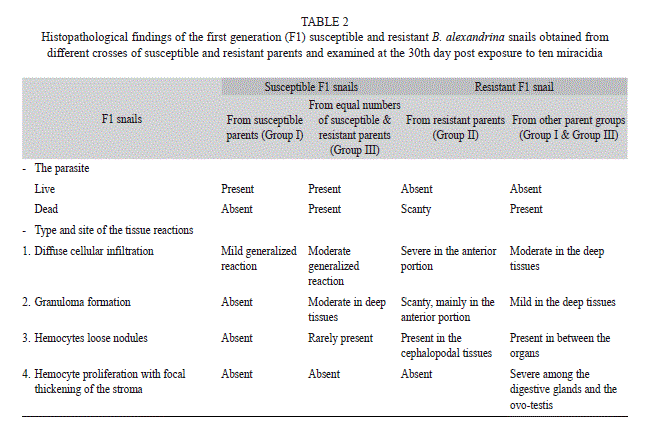
<body><![CDATA[findings of the     infected F1 offspring shedding cercariae at the 30th day post exposure     (<a href="/img/revistas/rbt/v60n3/a19t2.gif">Table 2</a>): The infected     susceptible F1 generation that had susceptible     parent snails (Group I) showed a high degree of susceptibility. Large     numbers of live parasites were present with normal development (<a      href="/img/revistas/rbt/v60n3/a19i1.jpg">Fig.     1</a>). The parasites were widely spread in different organs specially     the     digestive glands and ovotestis. No cellular reaction was present around     ]]></body>
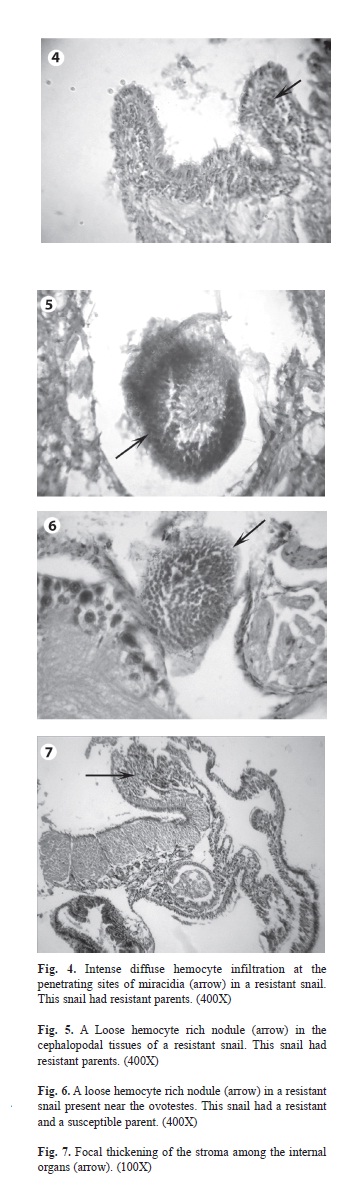
<body><![CDATA[the parasite. Mild generalized diffuse cellular infiltration was     present in the tissues and in between the organs. </span></font><br      style="font-family: verdana;">     <div style="text-align: center;"><br style="font-family: verdana;"> </div> <font size="2"><span style="font-family: verdana;">Susceptible offspring from susceptible and resistant parents (group III) showed parasites in different organs. A large number of them were able to complete their development although some dead ones were present surrounded by cellular infiltration. Moderate generalized diffuse cellular infiltration was present in the tissues and in between the organs. Sometimes granulomata were formed around the remnant of the parasites. These granulomata were spherical to oval in sections and appear in two forms in H&amp;E stained slides. The first consisted of hemocytes and fibers encircling the dead parasite while the other form consisted of layers of flattened hemocytes and fibers encircling the dead parasite and surrounded by layers of unflattened hemocytes (<a  href="/img/revistas/rbt/v60n3/a19i1.jpg">Fig. 2, 3</a>). </span></font><br  style="font-family: verdana;"> <font size="2"></font><br style="font-family: verdana;"> <font size="2"><span style="font-family: verdana;">Histopathological findings of the infected F1 offspring failed to shed cercariae at the 30th day post exposure (<a href="/img/revistas/rbt/v60n3/a19t2.gif">Table 2</a>): A common feature of these snails was the absence of viable only (Group II) contained very few numbers of dead parasites and granulomata. These snails showed an intense diffuse hemocytic reaction at the penetrating sites of miracidia (<a  href="/img/revistas/rbt/v60n3/a19i4.jpg">Fig. 4</a>). Loose hemocyte rich nodules were detected in the cephalopodal tissues (<a  href="/img/revistas/rbt/v60n3/a19i4.jpg">Fig. 5</a>).</span></font>    <br> <font size="2"><span style="font-family: verdana;">    <br>     Dead parasites were     present in the     resistant infected F1 snails that had parents from the other groups     (Group I and Group III). The most common type of the dead parasites     ]]></body>
<body><![CDATA[appeared as round eosinophilic masses surrounded by several layers of     flattened hemocytes. The&nbsp; tissue reaction was in the form of     moderate diffuse cellular infiltration in between the organs. The two     types of granulomata with the same structure described before     surrounding the dead parasites were present in between the organs.     Loose hemocyte rich nodules were present in between the organs (<a      href="/img/revistas/rbt/v60n3/a19i4.jpg">Fig. 6</a>).</span></font><br      style="font-family: verdana;">     <font size="2"></font><br style="font-family: verdana;">     <font size="2"><span style="font-family: verdana;">Hemocyte     ]]></body>
<body><![CDATA[proliferation with focal     thickening of the stroma was present among the digestive glands, the     albumin glands and the ovo-testis (<a      href="/img/revistas/rbt/v60n3/a19i4.jpg">Fig. 7</a>). The control non     infected     snails from different groups showed normal histology.</span></font><br      style="font-family: verdana;">     <font size="2"></font><br style="font-family: verdana;">     <font style="font-weight: bold;" size="3"><span      style="font-family: verdana;">Discussion</span></font><br     ]]></body>
<body><![CDATA[ style="font-family: verdana;">     <font size="2"></font><br style="font-family: verdana;">     <font size="2"><span style="font-family: verdana;">The present work is     a comparative     histopathological study verifying the tissue reactions of <span      style="font-style: italic;">B.     alexandrina</span> snails with different degrees of resistance against     the     development of <span style="font-style: italic;">S. mansoni</span>.     The studied snails were the offspring of     ]]></body>
<body><![CDATA[resistant and susceptible parents crossed in different proportions.</span></font><br      style="font-family: verdana;">     <font size="2"></font><br style="font-family: verdana;">     <font size="2"><span style="font-family: verdana;">The number of the     susceptible and     the resistant F1 progeny in <a href="/img/revistas/rbt/v60n3/a19t1.gif">table     1</a> showed that in <span style="font-style: italic;">B. alexandrina</span>,     the     susceptibility/resistance to <span style="font-style: italic;">S.     mansoni</span> is inherited as shown in     ]]></body>
<body><![CDATA[different <span style="font-style: italic;">Biomphalaria</span>     species (Lewis <span style="font-style: italic;">et al</span>. 2003,     Rosa <span style="font-style: italic;">et al</span> 2005,     Abou El Naga <span style="font-style: italic;">et al</span>. 2010) </span></font><br      style="font-family: verdana;">     <font size="2"></font><br style="font-family: verdana;">     <font size="2"><span style="font-family: verdana;">In this study,     histopathological     examination of the&nbsp; susceptible offspring having only susceptible     parents showed a normal development of the parasites with wide spread     ]]></body>
<body><![CDATA[of cercariae in the different organs. There were neither dead parasites     nor cellular reactions around the living ones. It seems that there is a     tolerance in the snail tissue to the presence, growth and     multiplication of the larval stages of the parasite (Newton 1952).     However, some degree of the host tissue reactions was exhibited by the     susceptible offspring having an equal number of susceptible and     resistant parents. </span></font><font size="2"><span      style="font-family: verdana;">This was presented by the cellular     infiltration surrounding the living parasites, and by the formation of     the granuloma around some dead parasites. In spite of the presence of     ]]></body>
<body><![CDATA[these host reactions, the susceptible <span style="font-style: italic;">B.     alexandrina</span> snails and those     of other species were not able to clear the infection (de Souza <span      style="font-style: italic;">et al</span>.     1997, El-Assal <span style="font-style: italic;">et al</span>. 2001,     Soomro <span style="font-style: italic;">et al</span>. 2005).     Parasitological     studies of different <span style="font-style: italic;">Biomphalaria</span>     species showed that within the same     species a smaller number of cercariae was shed from the susceptible     ]]></body>
<body><![CDATA[offspring, having a proportion of resistant snails as parents, than     those having susceptible parents only (Rosa <span      style="font-style: italic;">et al</span> 2005, Abou El Naga <span      style="font-style: italic;">et     al</span>. 2010). These parasitological results could be explained by     the     previous immune reactions in the snail tissues.</span></font><br      style="font-family: verdana;">     <font size="2"></font><br style="font-family: verdana;">     <font size="2"><span style="font-family: verdana;">Our results also     ]]></body>
<body><![CDATA[showed a     generalized hemocytic infiltration in the susceptible snails at the     30th days post exposure. This period represents the early phase of     massive colonization of the snail tissue by the cercariae; the very     pathogenic mobile larvae that are capable of directly ingesting the     host tissues. The the migrating cercariae which themselves may be     protected by masking the snail antigens may be responsible for this     reaction (Van der Knaap &amp; Loker 1990). At that time, it was     hypothesized that the tissue reactions eliminate the waste products     resulting from the parasites, and participate in the healing of the     ]]></body>
<body><![CDATA[injured tissues (Vasquez &amp; Sullivan 2001). By this time the     hemocytes have been exposed for a long time to &#8220;non-self&#8221; and &#8220;changed     self&#8221; (damage tissue caused by escaping cercariae) resulting in a     higher state of responsiveness of the hemocytes (Bayne 1990, Cooper <span      style="font-style: italic;">et     al</span>. 1994).</span></font><br style="font-family: verdana;">     <font size="2"></font><br style="font-family: verdana;">     <font size="2"><span style="font-family: verdana;">The resistant snails     showed many     forms of&nbsp; tissue reactions against the parasite, including diffuse     ]]></body>
<body><![CDATA[cellular infiltration with phagocytosis, granuloma formation, hemocyte     rich nodules and focal thickening of the stroma. Phagocytosis was     evident by the absence of viable parasites and the presence of remnants     of dead forms. As the number of dead parasites was scanty in the     resistant snails having only resistant parents, this implied that a     more vigorous phagocytosis had occurred. Loker <span      style="font-style: italic;">et al</span>. (1986) found that     parasite-amebocyte contact occurred and led to phagocytosis and by 48hr     only scattered remnants of sporocysts remained.</span></font><br      style="font-family: verdana;">     ]]></body>
<body><![CDATA[<font size="2"></font><br style="font-family: verdana;">     <font size="2"><span style="font-family: verdana;">The two types of     granulomata formed     in the present study around the dead parasites were described by Lie     &amp; Heyneman (1976) as type 1 and type 2 granulomata. Basch (1975)     attributed this variability to the individual difference in both the     host and the parasite. Both types of granulomata appeared in the     routinely stained slides as a mixture of hemocytes and fibers. In     snails, the participation of the extracellular tissue in the     granulomatous lesions is controversial (Yoshino 1976, Krupa <span     ]]></body>
<body><![CDATA[ style="font-style: italic;">et al</span>.     1977). Borges &amp; Andrade (2003) found that the hemocytes in the     granuloma had expanded cytoplasmic processes that gave the appearance     under light microscope as containing fibers.</span></font><br      style="font-family: verdana;">     <font size="2"></font><br style="font-family: verdana;">     <font size="2"><span style="font-family: verdana;">The hemocyte rich     nodules are     another form of tissue reactions detected in the present study, mainly     in the resistant snails and occasionally in the susceptible ones. They     ]]></body>
<body><![CDATA[were found in the anterior portion of the snails and in between the     organs. These nodules were also present in the strongly resistant <span      style="font-style: italic;">B.     glabrata</span> and <span style="font-style: italic;">B. tenagophila</span>     (Godoy <span style="font-style: italic;">et al</span>. 1997, Borges <span      style="font-style: italic;">et al</span>. 1998,     Negr&atilde;o-Corr&ecirc;a <span style="font-style: italic;">et al</span>.     2007). After doing experiments with     different snail crosses, Lewis <span style="font-style: italic;">et al</span>.     (2001) suggested that a single     ]]></body>
<body><![CDATA[gene controlled this reaction. They expected that certain hemocyte     functions are under genetic control, independent of their response to     schistosomiasis. </span></font><br style="font-family: verdana;">     <font size="2"></font><br style="font-family: verdana;">     <font size="2"><span style="font-family: verdana;">By observing the     tissue reactions     of <span style="font-style: italic;">B.&nbsp; alexandrina</span>     snails in this study, we can suggest that the     immune responses occurred by two different mechanisms. One type of     defense employs direct miracidial destruction soon after penetration of     ]]></body>
<body><![CDATA[the parasite. This type occurred in the resistant offspring having only     resistant parents. In these snails, the intense hemocytic infiltration     and the hemocyte rich nodules were present at the site of the     penetration of the miracidia. These reactions may lead to direct     miracidial destruction soon after their penetration. In <span      style="font-style: italic;">B. tenagophila</span>     Taim strain, a diffuse and focal hemocytic infiltration were observed     in the cephalopodal tissue of the infected highly resistant snails and     were found to be associated with rapid parasite destruction after     penetration (Negr&atilde;o-Corr&ecirc;a <span     ]]></body>
<body><![CDATA[ style="font-style: italic;">et al</span>. 2007).</span></font><br      style="font-family: verdana;">     <font size="2"></font><br style="font-family: verdana;">     <font size="2"><span style="font-family: verdana;">The other type of     the immune     reactions occurred in the resistant snails in which their parents     included susceptible snails. Their histopathological examination showed     that the diffuse cellular infiltration, the hemocyte rich nodules and     the focal thickening of the stroma were present in the deep tissues.     Godoy <span style="font-style: italic;">et al</span>. </span></font><font     ]]></body>
<body><![CDATA[ size="2"><span style="font-family: verdana;">(1997) and Borges <span      style="font-style: italic;">et al</span>. (1998)     considered these reactions as a delayed development of resistance that     occurred after dissemination of sporocysts in the snail tissues. They     considered this type of delayed developed resistance represents an     alternative kind of host defense mechanism against <span      style="font-style: italic;">S. mansoni</span>     miracidia. It occurs in spite of the evidence suggesting that <span      style="font-style: italic;">S.     mansoni</span> sporocysts can sometimes develop their ability, in a     ]]></body>
<body><![CDATA[better     way, to interfere with the defense mechanism of the snail as they grow     older (Lie <span style="font-style: italic;">et al</span>. 1980).</span></font><br      style="font-family: verdana;">     <font size="2"></font><br style="font-family: verdana;">     <font size="2"><span style="font-family: verdana;">It was found that     when <span style="font-style: italic;">B.     tenagophila</span> and <span style="font-style: italic;">B. straminea</span>     were exposed to <span style="font-style: italic;">S. mansoni</span>     they utilized     ]]></body>
<body><![CDATA[the first mechanism of resistance described before. This is because of     their strong resistance and their efficient defense system that     destroys miracidia once they have penetrated (de Souza <span      style="font-style: italic;">et al</span>. 1997,     Grassi <span style="font-style: italic;">et al</span>.&nbsp; 2001,     Negr&atilde;o-Corr&ecirc;a <span style="font-style: italic;">et al</span>.     2007). On     the other hand, <span style="font-style: italic;">B. glabrata</span>     which is more susceptible to <span style="font-style: italic;">S.     mansoni</span>     ]]></body>
<body><![CDATA[than the other two snail species used the second mechanism of defense     (de Souza <span style="font-style: italic;">et al</span>. 1997).     However, when <span style="font-style: italic;">B. glabrata</span> was     challenged by an     incompatible strain of <span style="font-style: italic;">S. mansoni</span>,     the parasites were immediately     recognized and killed, mainly by the strong phagocytic activity of the     cells (Lie <span style="font-style: italic;">et al</span>. 1980, Roger     <span style="font-style: italic;">et al</span>. 2008).</span></font><br      style="font-family: verdana;">     ]]></body>
<body><![CDATA[<font size="2"></font><br style="font-family: verdana;">     <font size="2"><span style="font-family: verdana;">Our results     characterized the     immune response, as expressed by the tissue reactions, of susceptible     and resistant <span style="font-style: italic;">B. alexandrina</span>     snails against the exposure to <span style="font-style: italic;">S.     mansoni</span>.     It seems that <span style="font-style: italic;">B. alexandrina</span>     snails respond more or less similar to <span      style="font-style: italic;">B.     ]]></body>
<body><![CDATA[glabrata</span>. Moreover, the present work is designed to determine     the     impact of increasing the resistance of the parent snails     on the mechanisms of interaction of their offspring against <span      style="font-style: italic;">B. alexandrina S. mansoni</span>     exposure. The results proved that the immune response of the IDS     increased with increasing the number of the inherited resistant genes.</span></font><br      style="font-family: verdana;">     <font size="2"></font><br style="font-family: verdana;">     <font style="font-weight: bold;" size="3"><span     ]]></body>
<body><![CDATA[ style="font-family: verdana;">Acknowledgments</span></font><br      style="font-family: verdana;">     <font size="2"><span style="font-family: verdana;">Thanks to Samia     Ibrahim, for her     technical assistance in the snail rearing.</span></font><br      style="font-family: verdana;">     <font size="2"></font>     <hr style="width: 100%; height: 2px;"><br style="font-family: verdana;">     <font style="font-weight: bold;" size="3"><span      style="font-family: verdana;">References</span></font><br     ]]></body>
<body><![CDATA[ style="font-family: verdana;">     <font size="2"></font><br style="font-family: verdana;">     <font size="2"><span style="font-family: verdana;">Abou El Naga, I.F.,     M.M. Eissa,     S.F. Mossallam &amp; S.I. Abd El-Halim. 2010. Inheritance of     <span style="font-style: italic;">Schistosoma mansoni</span> infection     incompatibility in <span style="font-style: italic;">Biomphalaria     <!-- ref -->alexandrina</span> snails. Mem. Inst. Oswaldo Cruz 105: 149-154.    &nbsp;&nbsp;&nbsp;&nbsp;&nbsp;&nbsp;&nbsp;&nbsp;[&#160;<a href="javascript:void(0);" onclick="javascript: window.open('/scielo.php?script=sci_nlinks&ref=1474070&pid=S0034-7744201200030001900001&lng=','','width=640,height=500,resizable=yes,scrollbars=1,menubar=yes,');">Links</a>&#160;]<!-- end-ref --><!-- ref --> </span></font><br  style="font-family: verdana;"> <font size="2"></font><br style="font-family: verdana;"> <font size="2"><span style="font-family: verdana;">Basch, P.F. 1975. An interpretation of snail-trematode infection rates: specificity based on concordance of compatible phenotypes. Int. J. Parasitol. 5: 449-452.    &nbsp;&nbsp;&nbsp;&nbsp;&nbsp;&nbsp;&nbsp;&nbsp;[&#160;<a href="javascript:void(0);" onclick="javascript: window.open('/scielo.php?script=sci_nlinks&ref=1474071&pid=S0034-7744201200030001900002&lng=','','width=640,height=500,resizable=yes,scrollbars=1,menubar=yes,');">Links</a>&#160;]<!-- end-ref --><!-- ref --></span></font><br  style="font-family: verdana;"> <font size="2"></font><br style="font-family: verdana;"> <font size="2"><span style="font-family: verdana;">Basch, P.F. 1976. Intermediate host specificity in <span style="font-style: italic;">Schistosoma mansoni</span>. Exp. Parasitol. 39: 150-169.    &nbsp;&nbsp;&nbsp;&nbsp;&nbsp;&nbsp;&nbsp;&nbsp;[&#160;<a href="javascript:void(0);" onclick="javascript: window.open('/scielo.php?script=sci_nlinks&ref=1474072&pid=S0034-7744201200030001900003&lng=','','width=640,height=500,resizable=yes,scrollbars=1,menubar=yes,');">Links</a>&#160;]<!-- end-ref --><!-- ref --></span></font><br  style="font-family: verdana;"> <font size="2"></font><br style="font-family: verdana;"> <font size="2"><span style="font-family: verdana;">Bayne, C.J. 1990. Phagocytosis and non-self recognition in invertebrates. BioScience 40: 723-731.    &nbsp;&nbsp;&nbsp;&nbsp;&nbsp;&nbsp;&nbsp;&nbsp;[&#160;<a href="javascript:void(0);" onclick="javascript: window.open('/scielo.php?script=sci_nlinks&ref=1474073&pid=S0034-7744201200030001900004&lng=','','width=640,height=500,resizable=yes,scrollbars=1,menubar=yes,');">Links</a>&#160;]<!-- end-ref --><!-- ref --></span></font><br  style="font-family: verdana;"> <font size="2"></font><br style="font-family: verdana;"> <font size="2"><span style="font-family: verdana;">Bayne, C.J. 2009. Successful parasitism of vector snail <span style="font-style: italic;">Biomphalaria</span> <span style="font-style: italic;">glabrata</span> by the human blood fluke (trematode) <span style="font-style: italic;">Schistosoma mansoni</span>: A 2009 assessment. Mol. Biochem. Parasitol. 165: 8-18.    &nbsp;&nbsp;&nbsp;&nbsp;&nbsp;&nbsp;&nbsp;&nbsp;[&#160;<a href="javascript:void(0);" onclick="javascript: window.open('/scielo.php?script=sci_nlinks&ref=1474074&pid=S0034-7744201200030001900005&lng=','','width=640,height=500,resizable=yes,scrollbars=1,menubar=yes,');">Links</a>&#160;]<!-- end-ref --><!-- ref --></span></font><br style="font-family: verdana;"> <font size="2"></font><br style="font-family: verdana;"> <font size="2"><span style="font-family: verdana;">Borges, C.M. &amp; Z.A. Andrade. 2003. Extra-cellular matrix changes in <span  style="font-style: italic;">Schistosoma mansoni</span>-infected <span style="font-style: italic;">Biomphalaria glabrata</span>. Mem. Inst. Oswaldo Cruz 98: 135-139.    &nbsp;&nbsp;&nbsp;&nbsp;&nbsp;&nbsp;&nbsp;&nbsp;[&#160;<a href="javascript:void(0);" onclick="javascript: window.open('/scielo.php?script=sci_nlinks&ref=1474075&pid=S0034-7744201200030001900006&lng=','','width=640,height=500,resizable=yes,scrollbars=1,menubar=yes,');">Links</a>&#160;]<!-- end-ref --><!-- ref --></span></font><br  style="font-family: verdana;"> <font size="2"></font><br style="font-family: verdana;"> <font size="2"><span style="font-family: verdana;">Borges, C.M., C.P. de Souza &amp; Z.A. Andrade. 1998. Histopathologic features associated with susceptibility and resistance of <span style="font-style: italic;">Biomphalaria</span> snails to infection with <span style="font-style: italic;">Schistosoma mansoni</span>. Mem. Inst. Oswaldo Cruz 93: 117-121.    &nbsp;&nbsp;&nbsp;&nbsp;&nbsp;&nbsp;&nbsp;&nbsp;[&#160;<a href="javascript:void(0);" onclick="javascript: window.open('/scielo.php?script=sci_nlinks&ref=1474076&pid=S0034-7744201200030001900007&lng=','','width=640,height=500,resizable=yes,scrollbars=1,menubar=yes,');">Links</a>&#160;]<!-- end-ref --><!-- ref --></span></font><br  style="font-family: verdana;"> <font size="2"></font><br style="font-family: verdana;"> <font size="2"><span style="font-family: verdana;">Connors, V.A., I. de Buron &amp; W.O. Granath Jr. 1995. <span style="font-style: italic;">Schistosoma mansoni</span>: interleukin-1 increases phagocytosis and superoxide production by hemocytes and decreases output of cercariae in schistosome-susceptible <span  style="font-style: italic;">Biomphalaria glabrata</span>. Exp. Parasitol. 80: 139-148.    &nbsp;&nbsp;&nbsp;&nbsp;&nbsp;&nbsp;&nbsp;&nbsp;[&#160;<a href="javascript:void(0);" onclick="javascript: window.open('/scielo.php?script=sci_nlinks&ref=1474077&pid=S0034-7744201200030001900008&lng=','','width=640,height=500,resizable=yes,scrollbars=1,menubar=yes,');">Links</a>&#160;]<!-- end-ref --><!-- ref --> </span></font><br  style="font-family: verdana;"> <font size="2"></font><br style="font-family: verdana;"> <font size="2"><span style="font-family: verdana;">Cooper, L., C. Richards, F. Lewis &amp; D. Minchella. 1994. <span style="font-style: italic;">Schistosoma mansoni</span>: relation between low fecundity and reduced susceptibility to parasite infection in the snail, <span style="font-style: italic;">Biomphalaria</span> <span  style="font-style: italic;">glabrata. </span>Exp. Parasitol. 79: 21-28.    &nbsp;&nbsp;&nbsp;&nbsp;&nbsp;&nbsp;&nbsp;&nbsp;[&#160;<a href="javascript:void(0);" onclick="javascript: window.open('/scielo.php?script=sci_nlinks&ref=1474078&pid=S0034-7744201200030001900009&lng=','','width=640,height=500,resizable=yes,scrollbars=1,menubar=yes,');">Links</a>&#160;]<!-- end-ref --><!-- ref --></span></font><br  style="font-family: verdana;"> <font size="2"></font><br style="font-family: verdana;"> <font size="2"><span style="font-family: verdana;">de Souza, C.P., C.C. Borges, A.G. Santana &amp; Z.A. Andrade. 1997. Comparative histopathology of <span style="font-style: italic;">Biomphalaria glabrata</span>, <span  style="font-style: italic;">B. tenagophila</span> and <span style="font-style: italic;">B. straminea</span> with </span></font><font size="2"><span style="font-family: verdana;">variable degrees of resistance to <span style="font-style: italic;">Schistosoma mansoni</span> miracidia. Mem. Inst. Oswaldo Cruz 92: 517-522.    &nbsp;&nbsp;&nbsp;&nbsp;&nbsp;&nbsp;&nbsp;&nbsp;[&#160;<a href="javascript:void(0);" onclick="javascript: window.open('/scielo.php?script=sci_nlinks&ref=1474079&pid=S0034-7744201200030001900010&lng=','','width=640,height=500,resizable=yes,scrollbars=1,menubar=yes,');">Links</a>&#160;]<!-- end-ref --><!-- ref --></span></font><br  style="font-family: verdana;"> <font size="2"></font><br style="font-family: verdana;"> <font size="2"><span style="font-family: verdana;">Dettman, C.D., S.B. Higgins-Opitz &amp; A. Saikoolal. 1989. Enhanced efficacy of paddling method for <span style="font-style: italic;">schistosoma</span> infection of rodents by a four-step pre-soaking procedure. Parasitol. Res. 76: 183-184.    &nbsp;&nbsp;&nbsp;&nbsp;&nbsp;&nbsp;&nbsp;&nbsp;[&#160;<a href="javascript:void(0);" onclick="javascript: window.open('/scielo.php?script=sci_nlinks&ref=1474080&pid=S0034-7744201200030001900011&lng=','','width=640,height=500,resizable=yes,scrollbars=1,menubar=yes,');">Links</a>&#160;]<!-- end-ref --><!-- ref --></span></font><br  style="font-family: verdana;"> <font size="2"></font><br style="font-family: verdana;"> <font size="2"><span style="font-family: verdana;">El-Assal, F.M., N.M. Shoukry, M.H. Abdalla &amp; A.H. Saad. 2001. Cellular response to <span  style="font-style: italic;">Schistosoma mansoni</span> infection in <span style="font-style: italic;">Biomphalaria alexandrina</span> strains selected for susceptibility and resistance. J. Egypt Soc. Parasitol. 31: 915-938.    &nbsp;&nbsp;&nbsp;&nbsp;&nbsp;&nbsp;&nbsp;&nbsp;[&#160;<a href="javascript:void(0);" onclick="javascript: window.open('/scielo.php?script=sci_nlinks&ref=1474081&pid=S0034-7744201200030001900012&lng=','','width=640,height=500,resizable=yes,scrollbars=1,menubar=yes,');">Links</a>&#160;]<!-- end-ref --><!-- ref --> </span></font><br  style="font-family: verdana;"> <font size="2"></font><br style="font-family: verdana;"> <font size="2"><span style="font-family: verdana;">El-Gindy, M.S., M.S. Arafa, M.K. Makled, M.M. Ismail, M.M. Elridi, M.M. Atia &amp; R.L. el-Gamal. 1985. Effect of some factors upon the susceptibility of <span  style="font-style: italic;">Biomphalaria alexandrina</span> to infection with <span style="font-style: italic;">Schistosoma mansoni</span>. J. Egypt Soc. Parasitol. 15: 231-235.    &nbsp;&nbsp;&nbsp;&nbsp;&nbsp;&nbsp;&nbsp;&nbsp;[&#160;<a href="javascript:void(0);" onclick="javascript: window.open('/scielo.php?script=sci_nlinks&ref=1474082&pid=S0034-7744201200030001900013&lng=','','width=640,height=500,resizable=yes,scrollbars=1,menubar=yes,');">Links</a>&#160;]<!-- end-ref --><!-- ref --></span></font><br style="font-family: verdana;"> <font size="2"></font><br style="font-family: verdana;"> <font size="2"><span style="font-family: verdana;">Godoy, A., C.P. de Souza, C.T. Guimar&atilde;es &amp; Z.A. Andrade. 1997. Unusual histological findings in<span style="font-style: italic;"> Biomphalaria glabrata </span>with high degree of resistance to <span style="font-style: italic;">Schistosoma </span></span></font><font  size="2"><span style="font-family: verdana;"><span  style="font-style: italic;">mansoni</span> miracidia. Mem. Inst. Oswaldo Cruz 92: 121-122.    &nbsp;&nbsp;&nbsp;&nbsp;&nbsp;&nbsp;&nbsp;&nbsp;[&#160;<a href="javascript:void(0);" onclick="javascript: window.open('/scielo.php?script=sci_nlinks&ref=1474083&pid=S0034-7744201200030001900014&lng=','','width=640,height=500,resizable=yes,scrollbars=1,menubar=yes,');">Links</a>&#160;]<!-- end-ref --><!-- ref --> </span></font><br  style="font-family: verdana;"> <font size="2"></font><br style="font-family: verdana;"> <font size="2"><span style="font-family: verdana;">Grassi, L., M. Torres Jord&aacute;, Z. Andrade &amp; S.M. Gonz&aacute;lez- -Cappa. 2001. Short report: <span style="font-style: italic;">Schistosoma mansoni</span> miracidia are killed by the defense system of an Argentine strain of <span style="font-style: italic;">Biomphalaria straminea</span>. Am. J. Trop. Med. Hyg. 65: 290-292.    &nbsp;&nbsp;&nbsp;&nbsp;&nbsp;&nbsp;&nbsp;&nbsp;[&#160;<a href="javascript:void(0);" onclick="javascript: window.open('/scielo.php?script=sci_nlinks&ref=1474084&pid=S0034-7744201200030001900015&lng=','','width=640,height=500,resizable=yes,scrollbars=1,menubar=yes,');">Links</a>&#160;]<!-- end-ref --><!-- ref --></span></font><br style="font-family: verdana;"> <font size="2"></font><br style="font-family: verdana;"> <font size="2"><span style="font-family: verdana;">Henning, J. &amp; G. Youssef. 1976. Influence of diet on breeding and infectivity in mass cultivation of <span style="font-style: italic;">Biomphalaria glabrata</span>. Egypt J. Bilharz. 3: 45-55.    &nbsp;&nbsp;&nbsp;&nbsp;&nbsp;&nbsp;&nbsp;&nbsp;[&#160;<a href="javascript:void(0);" onclick="javascript: window.open('/scielo.php?script=sci_nlinks&ref=1474085&pid=S0034-7744201200030001900016&lng=','','width=640,height=500,resizable=yes,scrollbars=1,menubar=yes,');">Links</a>&#160;]<!-- end-ref --><!-- ref --></span></font><br style="font-family: verdana;"> <font size="2"></font><br style="font-family: verdana;"> <font size="2"><span style="font-family: verdana;">Krupa, P.L., L.M. Lewis &amp; P. Del Vecchio. 1977. <span style="font-style: italic;">Schistosoma</span> haematobium in <span style="font-style: italic;">Bulinus guernei</span>: electron microscopy of hemocyte-sporocyst Interactions. J. Invertebr. Pathol. 30: 35-45.    &nbsp;&nbsp;&nbsp;&nbsp;&nbsp;&nbsp;&nbsp;&nbsp;[&#160;<a href="javascript:void(0);" onclick="javascript: window.open('/scielo.php?script=sci_nlinks&ref=1474086&pid=S0034-7744201200030001900017&lng=','','width=640,height=500,resizable=yes,scrollbars=1,menubar=yes,');">Links</a>&#160;]<!-- end-ref --><!-- ref --></span></font><br style="font-family: verdana;"> <font size="2"></font><br style="font-family: verdana;"> <font size="2"><span style="font-family: verdana;">Lewis, F.A., C.N. Patterson &amp; C. Grzywacz. 2003. Parasite- susceptibility phenotypes of F1<span  style="font-style: italic;"> Biomphalaria glabrata </span>progeny derived from interbreeding <span style="font-style: italic;">Schistosoma mansoni</span>-resistant and -susceptible snails. Parasitol. Res. 89: 98-101.    &nbsp;&nbsp;&nbsp;&nbsp;&nbsp;&nbsp;&nbsp;&nbsp;[&#160;<a href="javascript:void(0);" onclick="javascript: window.open('/scielo.php?script=sci_nlinks&ref=1474087&pid=S0034-7744201200030001900018&lng=','','width=640,height=500,resizable=yes,scrollbars=1,menubar=yes,');">Links</a>&#160;]<!-- end-ref --><!-- ref --></span></font><br style="font-family: verdana;"> <font size="2"></font><br style="font-family: verdana;"> <font size="2"><span style="font-family: verdana;">Lewis, F.A., C.N. Patterson, M. Knight &amp; C.S. Richards. 2001. The relationship between <span  style="font-style: italic;">Schistosoma mansoni</span> and <span style="font-style: italic;">Biomphalaria glabrata</span>: genetic and molecular approaches. Parasitology 123: 169-179.    &nbsp;&nbsp;&nbsp;&nbsp;&nbsp;&nbsp;&nbsp;&nbsp;[&#160;<a href="javascript:void(0);" onclick="javascript: window.open('/scielo.php?script=sci_nlinks&ref=1474088&pid=S0034-7744201200030001900019&lng=','','width=640,height=500,resizable=yes,scrollbars=1,menubar=yes,');">Links</a>&#160;]<!-- end-ref --><!-- ref --></span></font><br  style="font-family: verdana;"> <font size="2"></font><br style="font-family: verdana;"> <font size="2"><span style="font-family: verdana;">Lie, K.J. &amp; D. Heyneman. 1976. Studies on resistance in snails. 3. Tissue reactions to <span  style="font-style: italic;">Echinostoma lindoense</span> sporocysts in sensitized and resensitized <span  style="font-style: italic;">Biomphalaria </span></span></font><font  size="2"><span style="font-family: verdana;"><span  style="font-style: italic;">glabrata</span>. J. Parasitol. 2: 51-58.    &nbsp;&nbsp;&nbsp;&nbsp;&nbsp;&nbsp;&nbsp;&nbsp;[&#160;<a href="javascript:void(0);" onclick="javascript: window.open('/scielo.php?script=sci_nlinks&ref=1474089&pid=S0034-7744201200030001900020&lng=','','width=640,height=500,resizable=yes,scrollbars=1,menubar=yes,');">Links</a>&#160;]<!-- end-ref --><!-- ref --></span></font><br style="font-family: verdana;"> <font size="2"></font><br style="font-family: verdana;"> <font size="2"><span style="font-family: verdana;">Lie, K.J., K.H. Jeong &amp; D. Heyneman. 1980. Tissue reaction induced by <span  style="font-style: italic;">Schistosoma mansoni</span> in <span style="font-style: italic;">Biomphalaria glabrata</span>. Ann. Trop. Med. Parasitol. 78: 157-166.    &nbsp;&nbsp;&nbsp;&nbsp;&nbsp;&nbsp;&nbsp;&nbsp;[&#160;<a href="javascript:void(0);" onclick="javascript: window.open('/scielo.php?script=sci_nlinks&ref=1474090&pid=S0034-7744201200030001900021&lng=','','width=640,height=500,resizable=yes,scrollbars=1,menubar=yes,');">Links</a>&#160;]<!-- end-ref --><!-- ref --></span></font><br  style="font-family: verdana;"> <font size="2"></font><br style="font-family: verdana;"> <font size="2"><span style="font-family: verdana;">Loker, E.S., C.J. Bayne &amp; M.A. Yui. 1986. <span style="font-style: italic;">Echinostoma paraensei</span>: hemocytes of<span style="font-style: italic;"> Biomphalaria glabrata </span>as targets of <span style="font-style: italic;">Echinostoma</span> mediate interference with host snails resistance to <span style="font-style: italic;">Schistosoma mansoni</span>. Exp. Parasitol. 62: 149-154.    &nbsp;&nbsp;&nbsp;&nbsp;&nbsp;&nbsp;&nbsp;&nbsp;[&#160;<a href="javascript:void(0);" onclick="javascript: window.open('/scielo.php?script=sci_nlinks&ref=1474091&pid=S0034-7744201200030001900022&lng=','','width=640,height=500,resizable=yes,scrollbars=1,menubar=yes,');">Links</a>&#160;]<!-- end-ref --><!-- ref --></span></font><br style="font-family: verdana;"> <font size="2"></font><br style="font-family: verdana;"> <font size="2"><span style="font-family: verdana;">McClelland, W.J. 1965. The production of cercariae by <span style="font-style: italic;">Schistosoma mansoni</span> and <span style="font-style: italic;">Schistosoma</span> <span style="font-style: italic;">haematobium</span> and methods for estimating the numbers of cercariae </span></font><font size="2"><span  style="font-family: verdana;">in suspension. Bull. World Health Organ 3: 270-276.    &nbsp;&nbsp;&nbsp;&nbsp;&nbsp;&nbsp;&nbsp;&nbsp;[&#160;<a href="javascript:void(0);" onclick="javascript: window.open('/scielo.php?script=sci_nlinks&ref=1474092&pid=S0034-7744201200030001900023&lng=','','width=640,height=500,resizable=yes,scrollbars=1,menubar=yes,');">Links</a>&#160;]<!-- end-ref --><!-- ref --></span></font><br style="font-family: verdana;"> <font size="2"></font><br style="font-family: verdana;"> <font size="2"><span style="font-family: verdana;">Negr&atilde;o-Corr&ecirc;a, D., C.A.J. Pereira, F.M. Rosa, R.L. Martins- Souza, Z.A. Andrade &amp; P.M.Z. Coelho. 2007. Molluscan response to parasite: <span  style="font-style: italic;">Biomphalaria</span> and <span style="font-style: italic;">Schistosoma mansoni</span> interaction. J. Invert. Survival 4: 101-111.    &nbsp;&nbsp;&nbsp;&nbsp;&nbsp;&nbsp;&nbsp;&nbsp;[&#160;<a href="javascript:void(0);" onclick="javascript: window.open('/scielo.php?script=sci_nlinks&ref=1474093&pid=S0034-7744201200030001900024&lng=','','width=640,height=500,resizable=yes,scrollbars=1,menubar=yes,');">Links</a>&#160;]<!-- end-ref --><!-- ref --></span></font><br  style="font-family: verdana;"> <font size="2"></font><br style="font-family: verdana;"> <font size="2"><span style="font-family: verdana;">Newton, W.L. 1952. The comparative tissue reaction of two strains of <span style="font-style: italic;">Australorbis glabratus</span> to infection with <span style="font-style: italic;">Schistosoma mansoni</span>. J. Parasitol. 38: 362-366.    &nbsp;&nbsp;&nbsp;&nbsp;&nbsp;&nbsp;&nbsp;&nbsp;[&#160;<a href="javascript:void(0);" onclick="javascript: window.open('/scielo.php?script=sci_nlinks&ref=1474094&pid=S0034-7744201200030001900025&lng=','','width=640,height=500,resizable=yes,scrollbars=1,menubar=yes,');">Links</a>&#160;]<!-- end-ref --><!-- ref --></span></font><br style="font-family: verdana;"> <font size="2"></font><br style="font-family: verdana;"> <font size="2"><span style="font-family: verdana;"> Roger, E., G. Mitta, Y. Mon&eacute;, A. Bouchut, A. Rognon, C. Grunau, J. Boissier, A. Th&eacute;ron &amp; B.E. Gourbal. 2008. Molecular determinants of compatibility polymorphism in the <span style="font-style: italic;">Biomphalaria glabrata</span>/<span style="font-style: italic;">Schistosoma mansoni</span> model: New candidates identified by a global comparative proteomics approach. Mol. Biochem. Parasitol. 157: 205-216.    &nbsp;&nbsp;&nbsp;&nbsp;&nbsp;&nbsp;&nbsp;&nbsp;[&#160;<a href="javascript:void(0);" onclick="javascript: window.open('/scielo.php?script=sci_nlinks&ref=1474095&pid=S0034-7744201200030001900026&lng=','','width=640,height=500,resizable=yes,scrollbars=1,menubar=yes,');">Links</a>&#160;]<!-- end-ref --><!-- ref --></span></font><br  style="font-family: verdana;"> <font size="2"></font><br style="font-family: verdana;"> <font size="2"><span style="font-family: verdana;">Rosa, F.M., A.L. Godard, V. Azevedo &amp; P.M. Coelho. 2005. <span style="font-style: italic;">Biomphalaria</span> <span style="font-style: italic;">tenagophila</span>: dominant character of the resistance to <span style="font-style: italic;">Schistosoma mansoni</span> in descendants of crossbreedings between resistant (Taim, RS) and susceptible (Joinville, SC) strains. Mem. Inst. Oswaldo Cruz 100: 19-23.    &nbsp;&nbsp;&nbsp;&nbsp;&nbsp;&nbsp;&nbsp;&nbsp;[&#160;<a href="javascript:void(0);" onclick="javascript: window.open('/scielo.php?script=sci_nlinks&ref=1474096&pid=S0034-7744201200030001900027&lng=','','width=640,height=500,resizable=yes,scrollbars=1,menubar=yes,');">Links</a>&#160;]<!-- end-ref --><!-- ref --> </span></font><br  style="font-family: verdana;"> <font size="2"></font><br style="font-family: verdana;"> <font size="2"><span style="font-family: verdana;">Smithers, S.R. &amp; R.J. Terry. 1965. The infection of laboratory hosts with cercariae of <span  style="font-style: italic;">Schistosoma mansoni</span> and the recovery of the adult worms. Parasitology 55: 695-700.    &nbsp;&nbsp;&nbsp;&nbsp;&nbsp;&nbsp;&nbsp;&nbsp;[&#160;<a href="javascript:void(0);" onclick="javascript: window.open('/scielo.php?script=sci_nlinks&ref=1474097&pid=S0034-7744201200030001900028&lng=','','width=640,height=500,resizable=yes,scrollbars=1,menubar=yes,');">Links</a>&#160;]<!-- end-ref --><!-- ref --></span></font><br style="font-family: verdana;"> <font size="2"></font><br style="font-family: verdana;"> <font size="2"><span style="font-family: verdana;">Soomro, N.M., A.G. Arijo, T.A. Qureshi, N.W. Runham &amp; M.J. Doenhoff. 2005. Pathology of Schistosome infection on host tissue during developmental stages </span></font><font  size="2"><span style="font-family: verdana;">of parasite in vector snails. Int. J. Agri. Biol. 7: 133-141.    &nbsp;&nbsp;&nbsp;&nbsp;&nbsp;&nbsp;&nbsp;&nbsp;[&#160;<a href="javascript:void(0);" onclick="javascript: window.open('/scielo.php?script=sci_nlinks&ref=1474098&pid=S0034-7744201200030001900029&lng=','','width=640,height=500,resizable=yes,scrollbars=1,menubar=yes,');">Links</a>&#160;]<!-- end-ref --><!-- ref --></span></font><br  style="font-family: verdana;"> <font size="2"></font><br style="font-family: verdana;"> <font size="2"><span style="font-family: verdana;">Thompson, R.C. 2001. Molecular mimicry in schistosomes. Trends Parasitol. 17: 168.    &nbsp;&nbsp;&nbsp;&nbsp;&nbsp;&nbsp;&nbsp;&nbsp;[&#160;<a href="javascript:void(0);" onclick="javascript: window.open('/scielo.php?script=sci_nlinks&ref=1474099&pid=S0034-7744201200030001900030&lng=','','width=640,height=500,resizable=yes,scrollbars=1,menubar=yes,');">Links</a>&#160;]<!-- end-ref --><!-- ref --></span></font><br  style="font-family: verdana;"> <font size="2"></font><br style="font-family: verdana;"> <font size="2"><span style="font-family: verdana;">Van der Knaap, W.P. &amp; E.S. Loker. 1990. Immune mechanisms in trematode-snail interactions. Parasitol. Today 6: 175-182.    &nbsp;&nbsp;&nbsp;&nbsp;&nbsp;&nbsp;&nbsp;&nbsp;[&#160;<a href="javascript:void(0);" onclick="javascript: window.open('/scielo.php?script=sci_nlinks&ref=1474100&pid=S0034-7744201200030001900031&lng=','','width=640,height=500,resizable=yes,scrollbars=1,menubar=yes,');">Links</a>&#160;]<!-- end-ref --><!-- ref --></span></font><br  style="font-family: verdana;"> <font size="2"></font><br style="font-family: verdana;"> <font size="2"><span style="font-family: verdana;">Vasquez, R.E. &amp; J.T. Sullivan. 2001. Effect of miracidial dose on adoptively transferred resistance to <span style="font-style: italic;">Schistosoma mansoni</span> in the snail intermediate host, <span style="font-style: italic;">Biomphalaria glabrata</span>. J. Parasitol. 87: 460-462.    &nbsp;&nbsp;&nbsp;&nbsp;&nbsp;&nbsp;&nbsp;&nbsp;[&#160;<a href="javascript:void(0);" onclick="javascript: window.open('/scielo.php?script=sci_nlinks&ref=1474101&pid=S0034-7744201200030001900032&lng=','','width=640,height=500,resizable=yes,scrollbars=1,menubar=yes,');">Links</a>&#160;]<!-- end-ref --><!-- ref --> </span></font><br  style="font-family: verdana;"> <font size="2"></font><br style="font-family: verdana;"> <font size="2"><span style="font-family: verdana;">Yoshino, T.P. 1976. Encapsulation response of the marine prosobranch <span style="font-style: italic;">Cerithidea californica</span> to natural infections of <span style="font-style: italic;">Renicola buchanani </span>sporocysts (Trematoda: <span style="font-style: italic;">Renicolidae</span>). Int. J. Parasitol. 6: 423-431.    &nbsp;&nbsp;&nbsp;&nbsp;&nbsp;&nbsp;&nbsp;&nbsp;[&#160;<a href="javascript:void(0);" onclick="javascript: window.open('/scielo.php?script=sci_nlinks&ref=1474102&pid=S0034-7744201200030001900033&lng=','','width=640,height=500,resizable=yes,scrollbars=1,menubar=yes,');">Links</a>&#160;]<!-- end-ref --><!-- ref --></span></font><br  style="font-family: verdana;"> <font size="2"></font><br style="font-family: verdana;"> <font size="2"><span style="font-family: verdana;">Zahoor, Z., A.J. Davies, R.S. Kirk, D. Rollinson &amp; A.J. Walker. 2010. Larval excretory-secretory products from the parasite <span style="font-style: italic;">Schistosoma mansoni</span> modulate HSP70 protein expression in defence cells of its snail host, <span  style="font-style: italic;">Biomphalaria glabrata</span>. Cell Stress Chaperones 15: 639-650.    &nbsp;&nbsp;&nbsp;&nbsp;&nbsp;&nbsp;&nbsp;&nbsp;[&#160;<a href="javascript:void(0);" onclick="javascript: window.open('/scielo.php?script=sci_nlinks&ref=1474103&pid=S0034-7744201200030001900034&lng=','','width=640,height=500,resizable=yes,scrollbars=1,menubar=yes,');">Links</a>&#160;]<!-- end-ref --><br>     <br> <a name="Correspondencia1"></a><a href="#Correspondencia2">*</a>Correspondencia:    <br> </span></font><font size="2"><span style="font-family: verdana;">Iman F. Abou-El-Naga: </span></font><font size="2"><span  style="font-family: verdana;">Medical Parasitology Department, Faculty of Medicine, Alexandria University, Egypt. imanabouelnaga@hotmail.com</span></font>    <br> <font size="2"><span style="font-family: verdana;">Eman H. Radwan: </span></font><font size="2"><span  style="font-family: verdana;"></span></font><font size="2"><span  style="font-family: verdana;">Zoology Department, Faculty of Science, Damnhour University, Egypt. dr_emanhashem@yahoo.com    <br> </span></font><font size="2"><span style="font-family: verdana;"><a  name="1"></a><a href="#3">1</a>. Medical Parasitology Department, Faculty of Medicine, Alexandria University, Egypt; imanabouelnaga@hotmail.com</span></font><br  style="font-family: verdana;"> <font size="2"><span style="font-family: verdana;"><a name="2"></a><a  href="#4">2</a>. Zoology Department, Faculty of Science, Damnhour University, Egypt; dr_emanhashem@yahoo.com</span></font><br  style="font-family: verdana;"> <hr style="width: 100%; height: 2px;">     <div style="text-align: center;"><font style="font-weight: bold;"  size="2"><span style="font-family: verdana;">Received 18-VIII-2011. Corrected 08-I-2012. Accepted 07-II-2012.</span></font><br  style="font-family: verdana;"> </div> </div> </div> <font size="2"></font>      ]]></body><back>
<ref-list>
<ref id="B1">
<nlm-citation citation-type="journal">
<person-group person-group-type="author">
<name>
<surname><![CDATA[Abou El Naga]]></surname>
<given-names><![CDATA[I.F.]]></given-names>
</name>
<name>
<surname><![CDATA[Eissa]]></surname>
<given-names><![CDATA[M.M.]]></given-names>
</name>
<name>
<surname><![CDATA[Mossallam]]></surname>
<given-names><![CDATA[S.F.]]></given-names>
</name>
<name>
<surname><![CDATA[Abd El-Halim]]></surname>
<given-names><![CDATA[S.I.]]></given-names>
</name>
</person-group>
<article-title xml:lang="en"><![CDATA[Inheritance of Schistosoma mansoni infection incompatibility in Biomphalaria alexandrina snails]]></article-title>
<source><![CDATA[Mem. Inst. Oswaldo Cruz]]></source>
<year>2010</year>
<volume>105</volume>
<page-range>149-154</page-range></nlm-citation>
</ref>
<ref id="B2">
<nlm-citation citation-type="journal">
<person-group person-group-type="author">
<name>
<surname><![CDATA[Basch]]></surname>
<given-names><![CDATA[P.F.]]></given-names>
</name>
</person-group>
<article-title xml:lang="en"><![CDATA[An interpretation of snail-trematode infection rates: specificity based on concordance of compatible phenotypes]]></article-title>
<source><![CDATA[Int. J. Parasitol.]]></source>
<year>1975</year>
<volume>5</volume>
<page-range>449-452</page-range></nlm-citation>
</ref>
<ref id="B3">
<nlm-citation citation-type="journal">
<person-group person-group-type="author">
<name>
<surname><![CDATA[Basch]]></surname>
<given-names><![CDATA[P.F.]]></given-names>
</name>
</person-group>
<article-title xml:lang="en"><![CDATA[Intermediate host specificity in Schistosoma mansoni]]></article-title>
<source><![CDATA[Exp. Parasitol.]]></source>
<year>1976</year>
<volume>39</volume>
<page-range>150-169</page-range></nlm-citation>
</ref>
<ref id="B4">
<nlm-citation citation-type="journal">
<person-group person-group-type="author">
<name>
<surname><![CDATA[Bayne]]></surname>
<given-names><![CDATA[C.J.]]></given-names>
</name>
</person-group>
<article-title xml:lang="en"><![CDATA[Phagocytosis and non-self recognition in invertebrates]]></article-title>
<source><![CDATA[BioScience]]></source>
<year>1990</year>
<volume>40</volume>
<page-range>723-731</page-range></nlm-citation>
</ref>
<ref id="B5">
<nlm-citation citation-type="journal">
<person-group person-group-type="author">
<name>
<surname><![CDATA[Bayne]]></surname>
<given-names><![CDATA[C.J.]]></given-names>
</name>
</person-group>
<article-title xml:lang="en"><![CDATA[Successful parasitism of vector snail Biomphalaria glabrata by the human blood fluke (trematode) Schistosoma mansoni: A 2009 assessment]]></article-title>
<source><![CDATA[Mol. Biochem. Parasitol.]]></source>
<year>2009</year>
<volume>165</volume>
<page-range>8-18</page-range></nlm-citation>
</ref>
<ref id="B6">
<nlm-citation citation-type="journal">
<person-group person-group-type="author">
<name>
<surname><![CDATA[Borges]]></surname>
<given-names><![CDATA[C.M.]]></given-names>
</name>
<name>
<surname><![CDATA[Andrade]]></surname>
<given-names><![CDATA[Z.A.]]></given-names>
</name>
</person-group>
<article-title xml:lang="en"><![CDATA[Extra-cellular matrix changes in Schistosoma mansoni-infected Biomphalaria glabrata]]></article-title>
<source><![CDATA[Mem. Inst. Oswaldo Cruz]]></source>
<year>2003</year>
<volume>98</volume>
<page-range>135-139</page-range></nlm-citation>
</ref>
<ref id="B7">
<nlm-citation citation-type="journal">
<person-group person-group-type="author">
<name>
<surname><![CDATA[Borges]]></surname>
<given-names><![CDATA[C.M.]]></given-names>
</name>
<name>
<surname><![CDATA[de Souza]]></surname>
<given-names><![CDATA[C.P.]]></given-names>
</name>
<name>
<surname><![CDATA[Andrade]]></surname>
<given-names><![CDATA[Z.A.]]></given-names>
</name>
</person-group>
<article-title xml:lang="en"><![CDATA[Histopathologic features associated with susceptibility and resistance of Biomphalaria snails to infection with Schistosoma mansoni.]]></article-title>
<source><![CDATA[Mem. Inst. Oswaldo Cruz]]></source>
<year>1998</year>
<volume>93</volume>
<page-range>117-121</page-range></nlm-citation>
</ref>
<ref id="B8">
<nlm-citation citation-type="journal">
<person-group person-group-type="author">
<name>
<surname><![CDATA[Connors]]></surname>
<given-names><![CDATA[V.A.]]></given-names>
</name>
<name>
<surname><![CDATA[de Buron]]></surname>
<given-names><![CDATA[I.]]></given-names>
</name>
<name>
<surname><![CDATA[Granath Jr.]]></surname>
<given-names><![CDATA[W.O.]]></given-names>
</name>
</person-group>
<article-title xml:lang="en"><![CDATA[Schistosoma mansoni: interleukin-1 increases phagocytosis and superoxide production by hemocytes and decreases output of cercariae in schistosome- -susceptible Biomphalaria glabrata]]></article-title>
<source><![CDATA[Exp. Parasitol.]]></source>
<year>1995</year>
<volume>80</volume>
<page-range>139-148</page-range></nlm-citation>
</ref>
<ref id="B9">
<nlm-citation citation-type="journal">
<person-group person-group-type="author">
<name>
<surname><![CDATA[Cooper]]></surname>
<given-names><![CDATA[L.]]></given-names>
</name>
<name>
<surname><![CDATA[Richards]]></surname>
<given-names><![CDATA[C.]]></given-names>
</name>
<name>
<surname><![CDATA[Lewis]]></surname>
<given-names><![CDATA[F.]]></given-names>
</name>
<name>
<surname><![CDATA[Minchella]]></surname>
<given-names><![CDATA[D.]]></given-names>
</name>
</person-group>
<article-title xml:lang="en"><![CDATA[Schistosoma mansoni: relation between low fecundity and reduced susceptibility to parasite infection in the snail, Biomphalaria glabrata.]]></article-title>
<source><![CDATA[Exp. Parasitol.]]></source>
<year>1994</year>
<volume>79</volume>
<page-range>21-28</page-range></nlm-citation>
</ref>
<ref id="B10">
<nlm-citation citation-type="journal">
<person-group person-group-type="author">
<name>
<surname><![CDATA[de Souza]]></surname>
<given-names><![CDATA[C.P.]]></given-names>
</name>
<name>
<surname><![CDATA[Borges]]></surname>
<given-names><![CDATA[C.C.]]></given-names>
</name>
<name>
<surname><![CDATA[Santana]]></surname>
<given-names><![CDATA[A.G.]]></given-names>
</name>
<name>
<surname><![CDATA[Andrade]]></surname>
<given-names><![CDATA[Z.A.]]></given-names>
</name>
</person-group>
<article-title xml:lang="en"><![CDATA[Comparative histopathology of Biomphalaria glabrata, B. tenagophila and B. straminea with variable degrees of resistance to Schistosoma mansoni miracidia]]></article-title>
<source><![CDATA[Mem. Inst. Oswaldo Cruz]]></source>
<year>1997</year>
<volume>92</volume>
<page-range>517-522</page-range></nlm-citation>
</ref>
<ref id="B11">
<nlm-citation citation-type="journal">
<person-group person-group-type="author">
<name>
<surname><![CDATA[Dettman]]></surname>
<given-names><![CDATA[C.D.]]></given-names>
</name>
<name>
<surname><![CDATA[Higgins-Opitz]]></surname>
<given-names><![CDATA[S.B.]]></given-names>
</name>
<name>
<surname><![CDATA[Saikoolal]]></surname>
<given-names><![CDATA[A.]]></given-names>
</name>
</person-group>
<article-title xml:lang="en"><![CDATA[Enhanced efficacy of paddling method for schistosoma infection of rodents by a four-step pre-soaking procedure]]></article-title>
<source><![CDATA[Parasitol. Res.]]></source>
<year>1989</year>
<volume>76</volume>
<page-range>183-184</page-range></nlm-citation>
</ref>
<ref id="B12">
<nlm-citation citation-type="journal">
<person-group person-group-type="author">
<name>
<surname><![CDATA[El-Assal]]></surname>
<given-names><![CDATA[F.M.]]></given-names>
</name>
<name>
<surname><![CDATA[Shoukry]]></surname>
<given-names><![CDATA[N.M.]]></given-names>
</name>
<name>
<surname><![CDATA[Abdalla]]></surname>
<given-names><![CDATA[M.H.]]></given-names>
</name>
<name>
<surname><![CDATA[Saad]]></surname>
<given-names><![CDATA[A.H.]]></given-names>
</name>
</person-group>
<article-title xml:lang="en"><![CDATA[Cellular response to Schistosoma mansoni infection in Biomphalaria alexandrina strains selected for susceptibility and resistance]]></article-title>
<source><![CDATA[J. Egypt Soc. Parasitol.]]></source>
<year>2001</year>
<volume>31</volume>
<page-range>915-938</page-range></nlm-citation>
</ref>
<ref id="B13">
<nlm-citation citation-type="journal">
<person-group person-group-type="author">
<name>
<surname><![CDATA[El-Gindy]]></surname>
<given-names><![CDATA[M.S.]]></given-names>
</name>
<name>
<surname><![CDATA[Arafa]]></surname>
<given-names><![CDATA[M.S.]]></given-names>
</name>
<name>
<surname><![CDATA[Makled]]></surname>
<given-names><![CDATA[M.K.]]></given-names>
</name>
<name>
<surname><![CDATA[Ismail]]></surname>
<given-names><![CDATA[M.M.]]></given-names>
</name>
<name>
<surname><![CDATA[Elridi]]></surname>
<given-names><![CDATA[M.M.]]></given-names>
</name>
<name>
<surname><![CDATA[Atia]]></surname>
<given-names><![CDATA[M.M.]]></given-names>
</name>
<name>
<surname><![CDATA[el-Gamal]]></surname>
<given-names><![CDATA[R.L.]]></given-names>
</name>
</person-group>
<article-title xml:lang="en"><![CDATA[Effect of some factors upon the susceptibility of Biomphalaria alexandrina to infection with Schistosoma mansoni]]></article-title>
<source><![CDATA[J. Egypt Soc. Parasitol.]]></source>
<year>1985</year>
<volume>15</volume>
<page-range>231-235</page-range></nlm-citation>
</ref>
<ref id="B14">
<nlm-citation citation-type="journal">
<person-group person-group-type="author">
<name>
<surname><![CDATA[Godoy]]></surname>
<given-names><![CDATA[A.]]></given-names>
</name>
<name>
<surname><![CDATA[de Souza]]></surname>
<given-names><![CDATA[C.P.]]></given-names>
</name>
<name>
<surname><![CDATA[Guimarães]]></surname>
<given-names><![CDATA[C.T.]]></given-names>
</name>
<name>
<surname><![CDATA[Andrade]]></surname>
<given-names><![CDATA[Z.A.]]></given-names>
</name>
</person-group>
<article-title xml:lang="en"><![CDATA[Unusual histological findings in Biomphalaria glabrata with high degree of resistance to Schistosoma mansoni miracidia]]></article-title>
<source><![CDATA[Mem. Inst. Oswaldo Cruz]]></source>
<year>1997</year>
<volume>92</volume>
<page-range>121-122</page-range></nlm-citation>
</ref>
<ref id="B15">
<nlm-citation citation-type="journal">
<person-group person-group-type="author">
<name>
<surname><![CDATA[Grassi]]></surname>
<given-names><![CDATA[L.]]></given-names>
</name>
<name>
<surname><![CDATA[Torres Jordá]]></surname>
<given-names><![CDATA[M.]]></given-names>
</name>
<name>
<surname><![CDATA[Andrade]]></surname>
<given-names><![CDATA[Z.]]></given-names>
</name>
<name>
<surname><![CDATA[González- -Cappa]]></surname>
<given-names><![CDATA[S.M.]]></given-names>
</name>
</person-group>
<article-title xml:lang="en"><![CDATA[Short report: Schistosoma mansoni miracidia are killed by the defense system of an Argentine strain of Biomphalaria straminea.]]></article-title>
<source><![CDATA[Am. J. Trop. Med. Hyg.]]></source>
<year>2001</year>
<volume>65</volume>
<page-range>290-292</page-range></nlm-citation>
</ref>
<ref id="B16">
<nlm-citation citation-type="journal">
<person-group person-group-type="author">
<name>
<surname><![CDATA[Henning]]></surname>
<given-names><![CDATA[J.]]></given-names>
</name>
<name>
<surname><![CDATA[Youssef]]></surname>
<given-names><![CDATA[G.]]></given-names>
</name>
</person-group>
<article-title xml:lang="en"><![CDATA[Influence of diet on breeding and infectivity in mass cultivation of Biomphalaria glabrata]]></article-title>
<source><![CDATA[Egypt J. Bilharz.]]></source>
<year>1976</year>
<volume>3</volume>
<page-range>45-55</page-range></nlm-citation>
</ref>
<ref id="B17">
<nlm-citation citation-type="journal">
<person-group person-group-type="author">
<name>
<surname><![CDATA[Krupa]]></surname>
<given-names><![CDATA[P.L.]]></given-names>
</name>
<name>
<surname><![CDATA[Lewis]]></surname>
<given-names><![CDATA[L.M.]]></given-names>
</name>
<name>
<surname><![CDATA[Del Vecchio]]></surname>
<given-names><![CDATA[P.]]></given-names>
</name>
</person-group>
<article-title xml:lang="en"><![CDATA[Schistosoma haematobium in Bulinus guernei: electron microscopy of hemocyte-sporocyst Interactions]]></article-title>
<source><![CDATA[J. Invertebr. Pathol.]]></source>
<year>1977</year>
<volume>30</volume>
<page-range>35-45</page-range></nlm-citation>
</ref>
<ref id="B18">
<nlm-citation citation-type="journal">
<person-group person-group-type="author">
<name>
<surname><![CDATA[Lewis]]></surname>
<given-names><![CDATA[F.A.]]></given-names>
</name>
<name>
<surname><![CDATA[Patterson]]></surname>
<given-names><![CDATA[C.N.]]></given-names>
</name>
<name>
<surname><![CDATA[Grzywacz]]></surname>
<given-names><![CDATA[C.]]></given-names>
</name>
</person-group>
<article-title xml:lang="en"><![CDATA[Parasite- susceptibility phenotypes of F1 Biomphalaria glabrata progeny derived from interbreeding Schistosoma mansoni-resistant and -susceptible snails]]></article-title>
<source><![CDATA[Parasitol. Res.]]></source>
<year>2003</year>
<volume>89</volume>
<page-range>98-101</page-range></nlm-citation>
</ref>
<ref id="B19">
<nlm-citation citation-type="journal">
<person-group person-group-type="author">
<name>
<surname><![CDATA[Lewis]]></surname>
<given-names><![CDATA[F.A.]]></given-names>
</name>
<name>
<surname><![CDATA[Patterson]]></surname>
<given-names><![CDATA[C.N.]]></given-names>
</name>
<name>
<surname><![CDATA[Knight]]></surname>
<given-names><![CDATA[M.]]></given-names>
</name>
<name>
<surname><![CDATA[Richards]]></surname>
<given-names><![CDATA[C.S.]]></given-names>
</name>
</person-group>
<article-title xml:lang="en"><![CDATA[The relationship between Schistosoma mansoni and Biomphalaria glabrata: genetic and molecular approaches]]></article-title>
<source><![CDATA[Parasitology]]></source>
<year>2001</year>
<volume>123</volume>
<page-range>169-179</page-range></nlm-citation>
</ref>
<ref id="B20">
<nlm-citation citation-type="journal">
<person-group person-group-type="author">
<name>
<surname><![CDATA[Lie]]></surname>
<given-names><![CDATA[K.J.]]></given-names>
</name>
<name>
<surname><![CDATA[Heyneman]]></surname>
<given-names><![CDATA[D.]]></given-names>
</name>
</person-group>
<article-title xml:lang="en"><![CDATA[Studies on resistance in snails. 3. Tissue reactions to Echinostoma lindoense sporocysts in sensitized and resensitized Biomphalaria glabrata]]></article-title>
<source><![CDATA[J. Parasitol.]]></source>
<year>1976</year>
<volume>2</volume>
<page-range>51-58</page-range></nlm-citation>
</ref>
<ref id="B21">
<nlm-citation citation-type="journal">
<person-group person-group-type="author">
<name>
<surname><![CDATA[Lie]]></surname>
<given-names><![CDATA[K.J.]]></given-names>
</name>
<name>
<surname><![CDATA[Jeong]]></surname>
<given-names><![CDATA[K.H.]]></given-names>
</name>
<name>
<surname><![CDATA[Heyneman]]></surname>
<given-names><![CDATA[D.]]></given-names>
</name>
</person-group>
<article-title xml:lang="en"><![CDATA[Tissue reaction induced by Schistosoma mansoni in Biomphalaria glabrata]]></article-title>
<source><![CDATA[Ann. Trop. Med. Parasitol.]]></source>
<year>1980</year>
<volume>78</volume>
<page-range>157-166</page-range></nlm-citation>
</ref>
<ref id="B22">
<nlm-citation citation-type="journal">
<person-group person-group-type="author">
<name>
<surname><![CDATA[Loker]]></surname>
<given-names><![CDATA[E.S.]]></given-names>
</name>
<name>
<surname><![CDATA[Bayne]]></surname>
<given-names><![CDATA[C.J.]]></given-names>
</name>
<name>
<surname><![CDATA[Yui]]></surname>
<given-names><![CDATA[M.A.]]></given-names>
</name>
</person-group>
<article-title xml:lang="en"><![CDATA[Echinostoma paraensei: hemocytes of Biomphalaria glabrata as targets of Echinostoma mediate interference with host snails resistance to Schistosoma mansoni.]]></article-title>
<source><![CDATA[Exp. Parasitol.]]></source>
<year>1986</year>
<volume>62</volume>
<page-range>149-154</page-range></nlm-citation>
</ref>
<ref id="B23">
<nlm-citation citation-type="journal">
<person-group person-group-type="author">
<name>
<surname><![CDATA[McClelland]]></surname>
<given-names><![CDATA[W.J.]]></given-names>
</name>
</person-group>
<article-title xml:lang="en"><![CDATA[The production of cercariae by Schistosoma mansoni and Schistosoma haematobium and methods for estimating the numbers of cercariae in suspension]]></article-title>
<source><![CDATA[Bull. World Health Organ]]></source>
<year>1965</year>
<volume>3</volume>
<page-range>270-276</page-range></nlm-citation>
</ref>
<ref id="B24">
<nlm-citation citation-type="journal">
<person-group person-group-type="author">
<name>
<surname><![CDATA[Negrão-Corrêa]]></surname>
<given-names><![CDATA[D.]]></given-names>
</name>
<name>
<surname><![CDATA[Pereira]]></surname>
<given-names><![CDATA[C.A.J.]]></given-names>
</name>
<name>
<surname><![CDATA[Rosa]]></surname>
<given-names><![CDATA[F.M.]]></given-names>
</name>
<name>
<surname><![CDATA[Martins- Souza]]></surname>
<given-names><![CDATA[R.L.]]></given-names>
</name>
<name>
<surname><![CDATA[Andrade]]></surname>
<given-names><![CDATA[Z.A.]]></given-names>
</name>
<name>
<surname><![CDATA[Coelho]]></surname>
<given-names><![CDATA[P.M.Z.]]></given-names>
</name>
</person-group>
<article-title xml:lang="en"><![CDATA[Molluscan response to parasite: Biomphalaria and Schistosoma mansoni interaction.]]></article-title>
<source><![CDATA[J. Invert. Survival]]></source>
<year>2007</year>
<volume>4</volume>
<page-range>101-111</page-range></nlm-citation>
</ref>
<ref id="B25">
<nlm-citation citation-type="journal">
<person-group person-group-type="author">
<name>
<surname><![CDATA[Newton]]></surname>
<given-names><![CDATA[W.L.]]></given-names>
</name>
</person-group>
<article-title xml:lang="en"><![CDATA[The comparative tissue reaction of two strains of Australorbis glabratus to infection with Schistosoma mansoni]]></article-title>
<source><![CDATA[J. Parasitol.]]></source>
<year>1952</year>
<volume>38</volume>
<page-range>362-366</page-range></nlm-citation>
</ref>
<ref id="B26">
<nlm-citation citation-type="journal">
<person-group person-group-type="author">
<name>
<surname><![CDATA[Roger]]></surname>
<given-names><![CDATA[E.]]></given-names>
</name>
<name>
<surname><![CDATA[Mitta]]></surname>
<given-names><![CDATA[G.]]></given-names>
</name>
<name>
<surname><![CDATA[Moné]]></surname>
<given-names><![CDATA[Y.]]></given-names>
</name>
<name>
<surname><![CDATA[Bouchut]]></surname>
<given-names><![CDATA[A.]]></given-names>
</name>
<name>
<surname><![CDATA[Rognon]]></surname>
<given-names><![CDATA[A.]]></given-names>
</name>
<name>
<surname><![CDATA[Grunau]]></surname>
<given-names><![CDATA[C.]]></given-names>
</name>
<name>
<surname><![CDATA[Boissier]]></surname>
<given-names><![CDATA[J.]]></given-names>
</name>
<name>
<surname><![CDATA[Théron]]></surname>
<given-names><![CDATA[A.]]></given-names>
</name>
<name>
<surname><![CDATA[Gourbal]]></surname>
<given-names><![CDATA[B.E.]]></given-names>
</name>
</person-group>
<article-title xml:lang="en"><![CDATA[Molecular determinants of compatibility polymorphism in the Biomphalaria glabrata/Schistosoma mansoni model: New candidates identified by a global comparative proteomics approach]]></article-title>
<source><![CDATA[Mol. Biochem. Parasitol.]]></source>
<year>2008</year>
<volume>157</volume>
<page-range>205-216</page-range></nlm-citation>
</ref>
<ref id="B27">
<nlm-citation citation-type="journal">
<person-group person-group-type="author">
<name>
<surname><![CDATA[Rosa]]></surname>
<given-names><![CDATA[F.M.]]></given-names>
</name>
<name>
<surname><![CDATA[Godard]]></surname>
<given-names><![CDATA[A.L.]]></given-names>
</name>
<name>
<surname><![CDATA[Azevedo]]></surname>
<given-names><![CDATA[V.]]></given-names>
</name>
<name>
<surname><![CDATA[Coelho]]></surname>
<given-names><![CDATA[P.M.]]></given-names>
</name>
</person-group>
<article-title xml:lang="en"><![CDATA[Biomphalaria tenagophila: dominant character of the resistance to Schistosoma mansoni in descendants of crossbreedings between resistant (Taim, RS) and susceptible (Joinville, SC) strains]]></article-title>
<source><![CDATA[Mem. Inst. Oswaldo Cruz]]></source>
<year>2005</year>
<volume>100</volume>
<page-range>19-23</page-range></nlm-citation>
</ref>
<ref id="B28">
<nlm-citation citation-type="journal">
<person-group person-group-type="author">
<name>
<surname><![CDATA[Smithers]]></surname>
<given-names><![CDATA[S.R.]]></given-names>
</name>
<name>
<surname><![CDATA[Terry]]></surname>
<given-names><![CDATA[R.J.]]></given-names>
</name>
</person-group>
<article-title xml:lang="en"><![CDATA[The infection of laboratory hosts with cercariae of Schistosoma mansoni and the recovery of the adult worms]]></article-title>
<source><![CDATA[Parasitology]]></source>
<year>1965</year>
<volume>55</volume>
<page-range>695-700</page-range></nlm-citation>
</ref>
<ref id="B29">
<nlm-citation citation-type="journal">
<person-group person-group-type="author">
<name>
<surname><![CDATA[Soomro]]></surname>
<given-names><![CDATA[N.M.]]></given-names>
</name>
<name>
<surname><![CDATA[Arijo]]></surname>
<given-names><![CDATA[A.G.]]></given-names>
</name>
<name>
<surname><![CDATA[Qureshi]]></surname>
<given-names><![CDATA[T.A.]]></given-names>
</name>
<name>
<surname><![CDATA[Runham]]></surname>
<given-names><![CDATA[N.W.]]></given-names>
</name>
<name>
<surname><![CDATA[Doenhoff]]></surname>
<given-names><![CDATA[M.J.]]></given-names>
</name>
</person-group>
<article-title xml:lang="en"><![CDATA[Pathology of Schistosome infection on host tissue during developmental stages of parasite in vector snails.]]></article-title>
<source><![CDATA[Int. J. Agri. Biol.]]></source>
<year>2005</year>
<volume>7</volume>
<page-range>133-141</page-range></nlm-citation>
</ref>
<ref id="B30">
<nlm-citation citation-type="journal">
<person-group person-group-type="author">
<name>
<surname><![CDATA[Thompson]]></surname>
<given-names><![CDATA[R.C.]]></given-names>
</name>
</person-group>
<article-title xml:lang="en"><![CDATA[Molecular mimicry in schistosomes]]></article-title>
<source><![CDATA[Trends Parasitol.]]></source>
<year>2001</year>
<volume>17</volume>
<page-range>168</page-range></nlm-citation>
</ref>
<ref id="B31">
<nlm-citation citation-type="journal">
<person-group person-group-type="author">
<name>
<surname><![CDATA[Van der Knaap]]></surname>
<given-names><![CDATA[W.P.]]></given-names>
</name>
<name>
<surname><![CDATA[Loker]]></surname>
<given-names><![CDATA[E.S.]]></given-names>
</name>
</person-group>
<article-title xml:lang="en"><![CDATA[Immune mechanisms in trematode-snail interactions]]></article-title>
<source><![CDATA[Parasitol. Today]]></source>
<year>1990</year>
<volume>6</volume>
<page-range>175-182</page-range></nlm-citation>
</ref>
<ref id="B32">
<nlm-citation citation-type="journal">
<person-group person-group-type="author">
<name>
<surname><![CDATA[Vasquez]]></surname>
<given-names><![CDATA[R.E.]]></given-names>
</name>
<name>
<surname><![CDATA[Sullivan]]></surname>
<given-names><![CDATA[J.T.]]></given-names>
</name>
</person-group>
<article-title xml:lang="en"><![CDATA[Effect of miracidial dose on adoptively transferred resistance to Schistosoma mansoni in the snail intermediate host, Biomphalaria glabrata]]></article-title>
<source><![CDATA[J. Parasitol.]]></source>
<year>2001</year>
<volume>87</volume>
<page-range>460-462</page-range></nlm-citation>
</ref>
<ref id="B33">
<nlm-citation citation-type="journal">
<person-group person-group-type="author">
<name>
<surname><![CDATA[Yoshino]]></surname>
<given-names><![CDATA[T.P.]]></given-names>
</name>
</person-group>
<article-title xml:lang="en"><![CDATA[Encapsulation response of the marine prosobranch Cerithidea californica to natural infections of Renicola buchanani sporocysts (Trematoda: Renicolidae).]]></article-title>
<source><![CDATA[Int. J. Parasitol.]]></source>
<year>1976</year>
<volume>6</volume>
<page-range>423-431</page-range></nlm-citation>
</ref>
<ref id="B34">
<nlm-citation citation-type="journal">
<person-group person-group-type="author">
<name>
<surname><![CDATA[Zahoor]]></surname>
<given-names><![CDATA[Z.]]></given-names>
</name>
<name>
<surname><![CDATA[Davies]]></surname>
<given-names><![CDATA[A.J.]]></given-names>
</name>
<name>
<surname><![CDATA[Kirk]]></surname>
<given-names><![CDATA[R.S.]]></given-names>
</name>
<name>
<surname><![CDATA[Rollinson]]></surname>
<given-names><![CDATA[D.]]></given-names>
</name>
<name>
<surname><![CDATA[Walker]]></surname>
<given-names><![CDATA[A.J.]]></given-names>
</name>
</person-group>
<article-title xml:lang="en"><![CDATA[Larval excretory-secretory products from the parasite Schistosoma mansoni modulate HSP70 protein expression in defence cells of its snail host, Biomphalaria glabrata.]]></article-title>
<source><![CDATA[Cell Stress Chaperones]]></source>
<year>2010</year>
<volume>15</volume>
<page-range>639-650</page-range></nlm-citation>
</ref>
</ref-list>
</back>
</article>