<?xml version="1.0" encoding="ISO-8859-1"?><article xmlns:mml="http://www.w3.org/1998/Math/MathML" xmlns:xlink="http://www.w3.org/1999/xlink" xmlns:xsi="http://www.w3.org/2001/XMLSchema-instance">
<front>
<journal-meta>
<journal-id>0034-7744</journal-id>
<journal-title><![CDATA[Revista de Biología Tropical]]></journal-title>
<abbrev-journal-title><![CDATA[Rev. biol. trop]]></abbrev-journal-title>
<issn>0034-7744</issn>
<publisher>
<publisher-name><![CDATA[Universidad de Costa Rica]]></publisher-name>
</publisher>
</journal-meta>
<article-meta>
<article-id>S0034-77442012000300018</article-id>
<title-group>
<article-title xml:lang="en"><![CDATA[A new species of Urocopitid land snail from Haiti and a discussion of the genus Autocoptis (Gastropoda: Urocoptidae)]]></article-title>
</title-group>
<contrib-group>
<contrib contrib-type="author">
<name>
<surname><![CDATA[Thompson]]></surname>
<given-names><![CDATA[Fred G.]]></given-names>
</name>
<xref ref-type="aff" rid="A01"/>
</contrib>
</contrib-group>
<aff id="A01">
<institution><![CDATA[,University of Florida Florida Museum of Natural History ]]></institution>
<addr-line><![CDATA[ Florida]]></addr-line>
<country>USA</country>
</aff>
<pub-date pub-type="pub">
<day>00</day>
<month>09</month>
<year>2012</year>
</pub-date>
<pub-date pub-type="epub">
<day>00</day>
<month>09</month>
<year>2012</year>
</pub-date>
<volume>60</volume>
<numero>3</numero>
<fpage>1187</fpage>
<lpage>1193</lpage>
<copyright-statement/>
<copyright-year/>
<self-uri xlink:href="http://www.scielo.sa.cr/scielo.php?script=sci_arttext&amp;pid=S0034-77442012000300018&amp;lng=en&amp;nrm=iso"></self-uri><self-uri xlink:href="http://www.scielo.sa.cr/scielo.php?script=sci_abstract&amp;pid=S0034-77442012000300018&amp;lng=en&amp;nrm=iso"></self-uri><self-uri xlink:href="http://www.scielo.sa.cr/scielo.php?script=sci_pdf&amp;pid=S0034-77442012000300018&amp;lng=en&amp;nrm=iso"></self-uri><abstract abstract-type="short" xml:lang="en"><p><![CDATA[Autocoptis paulsoni n. sp. is described from Haiti. it is characterized by its large size, its cylindricaltapered shape, its fine costate sculpture on the teleoconch, a distinct but weak circum basal keel and its abbreviate conical juvenile shell. it is most similar to Autocoptis gruneri (Dunker 1844), which is redescribed, and its distribution is reviewed. The taxonomic status of the genus Autocoptis Pilsbry 1902 and its subgenus Urocoptola Clench, 1 935 are reviewed. The genus is endemic to Hispaniola and satellite islands.]]></p></abstract>
<abstract abstract-type="short" xml:lang="es"><p><![CDATA[Para Haití se describe Autocoptis paulsoni n. sp. Esta especie se caracteriza por su gran tamaño, su forma cilíndrica-cónica, teleoconcha en forma de costillas, una clara pero débil quilla circumbasal y concha juvenil cónica y abreviada. Es muy similar a Autocoptis gruneri (Dunker, 1844), que se describe de nuevo y su distribución se revisa. También se presenta el estado taxonómico del género Autocoptis y del subgénero Urocoptola. El género es endémico de La Española y las islas satélites.]]></p></abstract>
<kwd-group>
<kwd lng="en"><![CDATA[Gastropoda]]></kwd>
<kwd lng="en"><![CDATA[Urocoptidae]]></kwd>
<kwd lng="en"><![CDATA[Autocoptis]]></kwd>
<kwd lng="en"><![CDATA[Urocoptola]]></kwd>
<kwd lng="en"><![CDATA[land snail]]></kwd>
<kwd lng="en"><![CDATA[Hispaniola]]></kwd>
<kwd lng="en"><![CDATA[Haiti]]></kwd>
<kwd lng="es"><![CDATA[Gastropoda]]></kwd>
<kwd lng="es"><![CDATA[Urocoptidae]]></kwd>
<kwd lng="es"><![CDATA[Autocoptis]]></kwd>
<kwd lng="es"><![CDATA[Urocoptola]]></kwd>
<kwd lng="es"><![CDATA[caracol terrestre]]></kwd>
<kwd lng="es"><![CDATA[La Española]]></kwd>
<kwd lng="es"><![CDATA[Haití]]></kwd>
</kwd-group>
</article-meta>
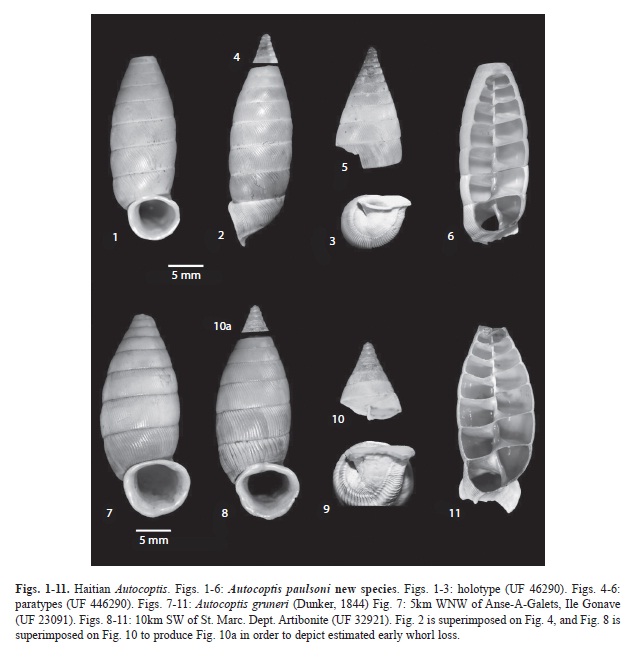
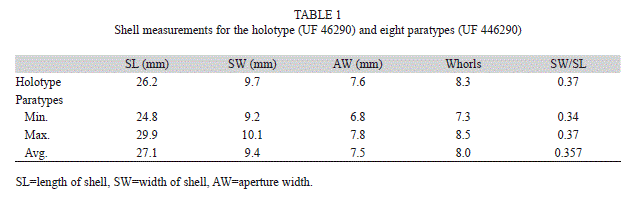
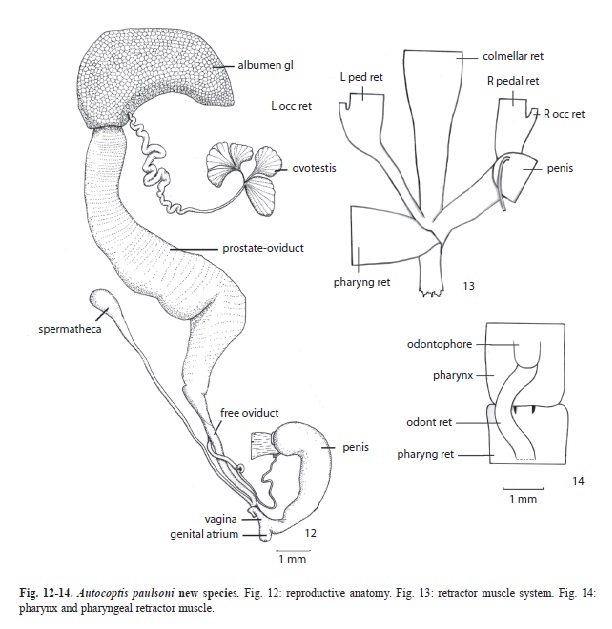
</front><body><![CDATA[ <div style="text-align: justify;">     <div style="text-align: justify;">     <div style="text-align: center;"><font style="font-weight: bold;"  size="4"><span style="font-family: verdana;">A new species of Urocopitid land snail from Haiti and a discussion of the genus <span  style="font-style: italic;">Autocoptis</span> (Gastropoda: Urocoptidae)</span></font><br style="font-family: verdana;"> </div> <font size="2"></font><br style="font-family: verdana;"> <font size="2"><span style="font-family: verdana;">    <br> </span></font>     <div style="text-align: center;"><font size="2"><span  style="font-family: verdana;">Fred G. Thompson<sup><a href="#1">1</a><a  name="2"></a>*</sup></span></font><br style="font-family: verdana;"> </div> <font size="2"><span style="font-family: verdana;">    <br> <a name="Correspondenicia2"></a>*<a href="#Correspondencia1">Direcci&oacute;n para correspondencia</a><br style="font-family: verdana;"> </span></font><font size="2"></font> <hr style="width: 100%; height: 2px;"><br style="font-family: verdana;"> <font style="font-weight: bold;" size="3"><span  style="font-family: verdana;">Abstract</span></font><br  style="font-family: verdana;"> <font size="2"></font><br style="font-family: verdana;"> <font size="2"><span style="font-family: verdana;"><span  style="font-style: italic;">Autocoptis paulsoni</span> n. sp. is described from Haiti. it is characterized by its large size, its cylindricaltapered shape, its fine costate sculpture on the teleoconch, a distinct but weak circum basal keel and its abbreviate conical juvenile shell. it is most similar to <span  style="font-style: italic;">Autocoptis gruneri</span> (Dunker 1844), which is redescribed, and its distribution is reviewed. The taxonomic status of the genus <span style="font-style: italic;">Autocoptis Pilsbry </span>1902 and its subgenus <span style="font-style: italic;">Urocoptola</span> Clench, 1 935 are reviewed. The genus is endemic to Hispaniola and satellite islands. </span></font><br  style="font-family: verdana;"> <font size="2"></font><br style="font-family: verdana;"> <font size="2"><span style="font-family: verdana;"><span  style="font-weight: bold;">Key words:</span> Gastropoda, Urocoptidae, <span style="font-style: italic;">Autocoptis</span>, <span  style="font-style: italic;">Urocoptola</span>, land snail, Hispaniola, Haiti.</span></font><br style="font-family: verdana;"> <font size="2"></font><br style="font-family: verdana;"> <font size="2"></font><br style="font-family: verdana;"> <font style="font-weight: bold;" size="3"><span  style="font-family: verdana;">Resumen</span></font><br  style="font-family: verdana;"> <font size="2"></font><br style="font-family: verdana;"> <font size="2"><span style="font-family: verdana;">Para&nbsp; Hait&iacute;&nbsp; se&nbsp; describe&nbsp; <span style="font-style: italic;">Autocoptis&nbsp; paulsoni</span>&nbsp; n.&nbsp; sp. Esta especie se caracteriza por su gran tama&ntilde;o, su forma cil&iacute;ndrica-c&oacute;nica, teleoconcha en forma de&nbsp; costillas, una clara pero d&eacute;bil quilla circumbasal y concha juvenil c&oacute;nica y abreviada. Es muy similar a <span  style="font-style: italic;">Autocoptis gruneri</span> (Dunker, 1844), que se describe de nuevo y su distribuci&oacute;n se revisa. Tambi&eacute;n se presenta el estado taxon&oacute;mico del g&eacute;nero <span style="font-style: italic;">Autocoptis</span> y del subg&eacute;nero <span style="font-style: italic;">Urocoptola</span>. El g&eacute;nero es end&eacute;mico de La Espa&ntilde;ola y las islas sat&eacute;lites.</span></font><br style="font-family: verdana;"> <font size="2"></font><br style="font-family: verdana;"> <font size="2"><span style="font-family: verdana;"><span  style="font-weight: bold;">Palabras&nbsp; clave:</span>&nbsp; Gastropoda,&nbsp; Urocoptidae,&nbsp;&nbsp; <span  style="font-style: italic;">Autocoptis</span>, <span  style="font-style: italic;">Urocoptola</span>, caracol terrestre, La Espa&ntilde;ola, Hait&iacute;.    <br> <br style="font-family: verdana;"> </span></font><font size="2"></font> <hr style="width: 100%; height: 2px;"><br style="font-family: verdana;"> <font size="2"><span style="font-family: verdana;">The Urocoptidae of Hispaniola remain poorly&nbsp; known.&nbsp; Most&nbsp; species&nbsp; have&nbsp; received little notice in the literature since their original descriptions, except for repeated citations of previous information. <span style="font-style: italic;">Autocoptis</span> Pilsbry (1903) is one such genus. it occurs exclusively on Hispaniola and satellite islands. Clench (1966) proposed the subgenus <span style="font-style: italic;">Urocoptola</span> for those species of <span style="font-style: italic;">Autocoptis</span> that do not have a crenulated suture as opposed to other species of <span  style="font-style: italic;">Autocoptis</span>, in which the suture is crenulated by the upper ends of the costate sculpture.</span></font><br  style="font-family: verdana;"> <font size="2"></font><br style="font-family: verdana;"> <font size="2"><span style="font-family: verdana;">Pilsbry&nbsp; (1903)&nbsp; monographed&nbsp; <span style="font-style: italic;">Autocoptis</span> when he named the genus. Later, Pilsbry (1933), and Pilsbry (1938) described four additional&nbsp; species, and Pilsbry &amp; Olsson&nbsp; (1954) described a Miocene species that was questionably referred to <span style="font-style: italic;">Autocoptis</span>. Bartsch (1932) described a new species from the off-shore Beata island. Clench (1935) described three new species and two new subspecies, and established the subgenus <span style="font-style: italic;">Urocoptola</span>. Later, Clench (1966) described three additional species of <span style="font-style: italic;">Urocoptola</span>. Thompson &amp; Franz (1976) described three new species of <span style="font-style: italic;">Autocoptis</span>. Richardson 1991, without discussion, treated <span style="font-style: italic;">Urocoptola</span> as a synonym of the Jamaican genus <span style="font-style: italic;">Urocoptis</span>.</span></font><br  style="font-family: verdana;"> <font size="2"></font><br style="font-family: verdana;"> <font size="2"><span style="font-family: verdana;">Twenty-six species, 9 subspecies and 3 species of uncertain status currently are placed in the genus <span style="font-style: italic;">Autocoptis</span> (Appendix 1). </span></font><br  style="font-family: verdana;"> <font size="2"></font><br style="font-family: verdana;"> <font size="2"><span style="font-family: verdana;">In&nbsp; 1962 Dennis R. Paulson visited Haiti for the purpose of collecting natural history specimens, including mollusks. Paulson gave the molluscan specimens to the author. Among several novelties that he found is a new species&nbsp; of&nbsp; <span style="font-style: italic;">Autocoptis</span>. At&nbsp; the&nbsp; time&nbsp; I prepared a&nbsp; description&nbsp; of&nbsp; the&nbsp; new&nbsp; species,&nbsp; completion of a manuscript was postponed because of other priorities.</span></font><br  style="font-family: verdana;"> <font size="2"></font><br style="font-family: verdana;"> <font size="2"><span style="font-family: verdana;">I described the new <span  style="font-style: italic;">Autocoptis</span> to complement recent investigations of urocoptoid families from Mexico and Central America (Thompson 1968, Thompson 1976, Thompson &amp; Correa 1991, Thompson in press). i am pleased to name the new species after its discoverer, Dennis R. Paulson.</span></font><br  style="font-family: verdana;"> <font size="2"></font><br style="font-family: verdana;"> <font style="font-weight: bold;" size="3"><span  style="font-family: verdana;">Material and methods</span></font><br  style="font-family: verdana;"> <font size="2"></font><br style="font-family: verdana;"> <font size="2"><span style="font-family: verdana;">This&nbsp; study&nbsp; is&nbsp; based&nbsp; on&nbsp; 31&nbsp; dry&nbsp; specimens and two preserved specimens of the new species. Live specimens were preserved in the field in 75% ethanol. Dissections were made in 75% ethanol. Shell measurements are given in mm and are standard for elongate-cylindrical shells. The length of the shell is measured from the tip of the apical plug to the base of the peristome. The width is the width of the spire perpendicular to the shell length but does not include the peristome. The columella is viewed by filing open the shell to expose internal structure. Anatomical drawings were made with the aid of a Bausch &amp; Lomb dissecting microscope and a camera lucida.</span></font><br  style="font-family: verdana;"> <font size="2"></font><br style="font-family: verdana;"> <font style="font-weight: bold;" size="3"><span  style="font-family: verdana;">Results</span></font><br  style="font-family: verdana;"> <font size="2"></font><br style="font-family: verdana;"> <font size="2"></font>     <div style="text-align: center;"><font size="2"><span  style="font-family: verdana;"><span  style="font-style: italic; font-weight: bold;">Autocoptis (Urocoptola) paulsoni</span><span style="font-weight: bold;"> new species </span><a href="/img/revistas/rbt/v60n3/a18i1.jpg">Figs. 1-6</a></span></font><br style="font-family: verdana;"> </div> <br style="font-family: verdana;"> <font size="2"><span style="font-family: verdana;"><span  style="font-weight: bold;">Diagnosis:</span> A species related to <span style="font-style: italic;">Autocoptis</span> (<span  style="font-style: italic;">Urocoptola</span>) <span  style="font-style: italic;">gruneri</span> (Dunker 1863), because of size, its sculpture, coloration, and a circumumbilical keel on the base of the last whorl. it is distinguished from <span style="font-style: italic;">A. gruneri </span>by its cylindrical-tapered shape, by its narrower juvenile shell, by having a lusterless white shell with more numerous fine, flat, thread-riblets, by having a weaker umbilical keel, and by the following measurements; standard length, 24.8-2; standard&nbsp; width,&nbsp; 9.2-10.3mm;&nbsp; aperture&nbsp; width, 6.8-7.8mm; 7.3-8.5 whorls retained in decollated adult shells.</span></font><br style="font-family: verdana;"> <font size="2"></font><br style="font-family: verdana;"> <font size="2"><span style="font-family: verdana;"><span  style="font-weight: bold;">Shell </span>(<a  href="/img/revistas/rbt/v60n3/a18i1.jpg">Figs. 1-6</a>): Mature shells are lusterless white, are up to nearly 30mm in standard length, are moderately stout, being 0.34-0.37 times as wide as long, and are decollated with 7.3-8.5&nbsp; whorls&nbsp; remaining&nbsp; below&nbsp; the&nbsp; apical plug (vestiges of earlier whorls in the holotype and paratypes were removed to expose the plug).&nbsp; The&nbsp; shape&nbsp; is&nbsp; cylindrical-tapered&nbsp; with the tapered portion of the upper spire consisting of 4-6 whorls which regularly increase in size. The first whorl at the point of decollation is 4.5-5.0mm wide. initially the juvenile shell is weakly concave or straight sided in outline (<a href="/img/revistas/rbt/v60n3/a18i1.jpg">Fig. 5</a>). The whorls nearly uniformly increase in size. The rate of growth of the juvenile shell indicates&nbsp; that&nbsp; 5-7,&nbsp; but&nbsp; usually&nbsp; 6&nbsp; whorls&nbsp; are lost above the point of decollation at the apical plug (<a  href="/img/revistas/rbt/v60n3/a18i1.jpg">Fig. 4</a>). The apical plug is elongate and laterally flattened as a tongue-like extension upward along the columella. The external color is dull-white. The base of the last whorl is tinged reddish due to the internal coloration. The peristome is white, fading into the rustcolored aperture deeper in. The septum of the first&nbsp; remaining&nbsp; whorl&nbsp; is&nbsp; pinkish.&nbsp; Below&nbsp; the first septum the interior of the whorls are white down to the penultimate whorl. internally the last whorl is tinged pink to dull red due to one band that begins along the suture, and another band that begins on the columella. The bands spread to color the columella and the last whorl internally dark rust-colored or red. The first 1.75&nbsp; whorls&nbsp; of&nbsp; the&nbsp; protoconch&nbsp; are&nbsp; smooth, after which very fine riblets develop into distinct uniform riblets by the end of 2.5 whorls. The teleoconch whorls are slightly convex and shiny and are crossed by obsolescent, oblique, flat, thread-riblets. The penultimate whorl has 57-85&nbsp; riblets.&nbsp; On&nbsp; the&nbsp; cylindric&nbsp; part&nbsp; of&nbsp; the shell the riblets increase in width on successive whorls where they are flat and close, and the interspaces are indicated only by incised grooves. The riblets become more pronounced on the periphery and base of the last whorl, and again become very fine in the umbilical chink. The suture is slightly impressed and is not crenulated by the upper ends of the riblets on the last whorl or two. The base of the last whorl has a poorly developed circum-umbilical keel (<a href="/img/revistas/rbt/v60n3/a18i1.jpg">Fig. 3</a>). The umbilicus is imperforate. The aperture is circular in shape. it is prosocline at an angle of about 22-25&ordm; to the shell axis (<a href="/img/revistas/rbt/v60n3/a18i1.jpg">Fig. 2</a>), so that in a frontal view it appears wider than high (<a href="/img/revistas/rbt/v60n3/a18i1.jpg">Fig. 1</a>). The peristome is nearly uniformly reflected along the columellar, basal and palatal margins of the aperture, and is attached to the preceding whorl across the parietal wall. </span></font><br  style="font-family: verdana;"> <font size="2"><span style="font-family: verdana;">The columella is solid, straight and slender, but increases in diameter in the last three whorls, and is off-set in the last whorl (<a href="/img/revistas/rbt/v60n3/a18i1.jpg">Fig. 6</a>). A low, medium-placed columellar lamella is present in the last two whorls, but it does not enter into the aperture.    <br> <br style="font-family: verdana;"> </span></font><font size="2"><span style="font-family: verdana;">Measurements of the holotype (UF 46290) and eight paratypes (UF 446290) are presented in <a  href="/img/revistas/rbt/v60n3/a18t1.gif">table 1</a>.</span></font><br  style="font-family: verdana;"> <font size="2"></font><br style="font-family: verdana;"> <font size="2"><span style="font-family: verdana;"><span  style="font-weight: bold;">Anatomy</span> (<a  href="/img/revistas/rbt/v60n3/a18i12.jpg">Figs. 12-14</a>): The sole is unipartite. The margin is bordered by a row of high&nbsp; pilaster-like&nbsp; folds.&nbsp; The&nbsp; dorsal&nbsp; surface of the foot is pebbled. The posterior-dorsal margin is rounded.</span></font><br  style="font-family: verdana;"> <font size="2"></font><br style="font-family: verdana;"> <font size="2"><span style="font-family: verdana;">The salivary glands (not figured) are about&nbsp; 5mm long, elongate-ovate in shape and are loosely connected above the esophagus. The salivary ducts are long and slender.</span></font><br  style="font-family: verdana;"> <font size="2"></font><br style="font-family: verdana;"> <font size="2"><span style="font-family: verdana;"><span  style="font-weight: bold;">Retractor muscle system</span> (<a  href="/img/revistas/rbt/v60n3/a18i12.jpg">Figs. 13, 14</a>): The columellar retractor muscle (<a  href="/img/revistas/rbt/v60n3/a18i12.jpg">Fig. 13</a>) is large&nbsp; and&nbsp; stout,&nbsp; and&nbsp; attaches&nbsp; to&nbsp; the&nbsp; columella at about two whorls into the shell. The retractor&nbsp; muscle&nbsp; gives&nbsp; rise&nbsp; to&nbsp; three&nbsp; branches&nbsp; from&nbsp; about&nbsp; the&nbsp; same&nbsp; point,&nbsp; the&nbsp; dorsally located pharyngeal retractor and the two laterally placed pedal retractors. The pharyngeal retractor divides into three short branches that insert&nbsp; at&nbsp; the&nbsp; apex&nbsp; of&nbsp; the&nbsp; pharynx&nbsp; (<a href="/img/revistas/rbt/v60n3/a18i12.jpg">Fig.&nbsp; 14</a>). An&nbsp; elongate&nbsp; muscle&nbsp; slip&nbsp; originates&nbsp; on&nbsp; the dorsal surface of the pharyngeal retractor and inserts at the end of the odontophore sac. The right pedal retractor passes through the genital <span  style="font-style: italic;">atrium</span>, attaches at its midpoint to the apex of the penis and continues forward to the foot. The right ocular retractor originates on the outer margin&nbsp; of&nbsp; the&nbsp; right&nbsp; pedal&nbsp; retractor. The&nbsp; left ocular retractor originates on the outer margin of the left pedal retractor.</span></font><br style="font-family: verdana;"> <font size="2"></font><br style="font-family: verdana;"> <font size="2"><span style="font-family: verdana;"><span  style="font-weight: bold;">Reproductive system</span> (<a  href="/img/revistas/rbt/v60n3/a18i12.jpg">Fig. 12</a>): The genital&nbsp; atrium&nbsp; is&nbsp; short,&nbsp; about&nbsp; 0.6mm&nbsp; long.&nbsp; The penis is large and club-shaped, 7.5mm long. A slip of muscular tissue connects the apex of the penis to the vagina. The penis bears a large internal fold. An epiphallus is absent. The vas deferens is simple, extending from the apex of the penis as a narrow duct, and increases in size near the prostate where it is imbedded at the base of the oviduct. The albumen gland is large, reniform in shape and is 9mm long. The ovotestis consists of three lobes; each lobe consists of about 10-20 elongate digitiform lobules. The hermaphroditic duct is about 11mm long, slender and simple near the ovotestis, and becomes thicker and convoluted midway to the albumen gland where it enters near the junction with the prostate-oviduct. The prostate-oviduct is long, simple and tapering at the lower end. The free oviduct is 7mm long, slender and tapered. The spermathecal duct lacks an appendix, is about 11mm long, slender, and enters the free oviduct shortly above the atrium to form a short vagina.</span></font><br  style="font-family: verdana;"> <font size="2"></font><br style="font-family: verdana;"> <font size="2"><span style="font-family: verdana;"><span  style="font-weight: bold;">Type locality</span>: Haiti, Dept. de l&#8217;Oest, 3km Southeast of Trou Forban, (18.92&ordm; N - 72.63&ordm; W), ca. 700m alt. Holotype UF 46290; collected by Dennis R. Paulson; August 14, 1962. Paratypes: UF 446290 (20 adults), UF 446789 (10 juveniles); same data as the holotype.</span></font><br  style="font-family: verdana;"> <font size="2"></font><br style="font-family: verdana;"> <font size="2"><span style="font-family: verdana;"><span  style="font-weight: bold;">Distribution</span>: Haiti; known only from the type locality.</span></font><br style="font-family: verdana;"> <font size="2"></font><br style="font-family: verdana;"> <font size="2"></font>     <div style="text-align: center; font-weight: bold;"><font size="2"><span  style="font-family: verdana;">A diagnosis of <span  style="font-style: italic;">Autocoptis gruneri</span> is given for comparison with <span style="font-style: italic;">Autocoptis paulsoni</span>.</span></font><br style="font-family: verdana;"> </div> <font style="font-weight: bold;" size="2"></font><br  style="font-family: verdana; font-weight: bold;"> <font style="font-weight: bold;" size="2"></font><font  style="font-weight: bold;" size="2"> </font><font style="font-weight: bold;" size="2"></font>     ]]></body>
<body><![CDATA[<div style="text-align: center;"><font size="2"><span  style="font-family: verdana;"><span  style="font-style: italic; font-weight: bold;">Autocoptis</span><span  style="font-weight: bold;"> (</span><span style="font-style: italic; font-weight: bold;">Urocoptola</span><span  style="font-weight: bold;">)</span><span  style="font-style: italic; font-weight: bold;"> gruneri</span><span  style="font-weight: bold;"> (Dunker 1844)</span> </span></font><a  href="/img/revistas/rbt/v60n3/a18i1.jpg"><font size="2"><span  style="font-family: verdana;">Figs. 7-11</span></font></a><br  style="font-family: verdana;">     <br>     </div>     <font size="2"></font><br      style="font-family: verdana; font-style: italic;">     <font size="2"><span style="font-family: verdana;"><span      style="font-style: italic;">Cylindrella gruneri</span> Dunker 1844,in,     Philippi 1842-1845; Abbildungen und Beschreibungen neuer oder wennig     gekannter Conchylien unter Mith&uuml;lfe mehrer deutscher     Conchyliologen, no. 1: 185; pl. 1, fig. 20- Pfeiffer 1848;     ]]></body>
<body><![CDATA[Monographia heliorum viventium 2: 370.- Crosse 1891; Journal de     Conchyliologie 29: 135.</span></font><br style="font-family: verdana;">     <font size="2"></font><br style="font-family: verdana;">     <font size="2"><span style="font-family: verdana;"><span      style="font-style: italic;">Urocoptis</span> (<span      style="font-style: italic;">Autocoptis</span>) <span      style="font-style: italic;">gruneri</span>     (Dunker). Pilsbry 1903; Manual of Conchology, 15: 157; pl. 39, Figs.     16-19.</span></font><br style="font-family: verdana;">     <font size="2"></font><br style="font-family: verdana;">     ]]></body>
<body><![CDATA[<font size="2"><span style="font-family: verdana;"><span      style="font-style: italic;">Urocoptis</span> (<span      style="font-style: italic;">Urocoptola</span>) <span      style="font-style: italic;">gruneri</span>     (Dunker). Clench 1935; Proc. Bost. Soc. Nat. Hist., 41: 3.</span></font><br      style="font-family: verdana;">     <font size="2"></font><br style="font-family: verdana;">     <font size="2"><span style="font-family: verdana;"><span      style="font-weight: bold;">Diagnosis</span> (<a      href="/img/revistas/rbt/v60n3/a18i1.jpg">Figs. 7-11</a>): This is a     ]]></body>
<body><![CDATA[large robust species with a conical-ovate shell.&nbsp; it is about     27-30mm long, and is about 0.37-0.42 times as wide as long. Adults     retain about 7-8 whorls. The suture is moderately impressed. The rate     of growth of juvenile shells indicates that about six whorls are lost     above the point of decollation (<a      href="/img/revistas/rbt/v60n3/a18i1.jpg">Fig. 10a</a>). The shell     bears a large,     wide aperture surrounded by a wide, thick,&nbsp; reflected&nbsp;     peristome&nbsp; that&nbsp; may&nbsp; be&nbsp; free from (<a      href="/img/revistas/rbt/v60n3/a18i1.jpg">Fig. 7</a>) or     ]]></body>
<body><![CDATA[narrowly attached to (<a href="/img/revistas/rbt/v60n3/a18i1.jpg">Fig. 8</a>)     the preceding whorl. The upper whorls are     broadly conical and slightly concave in outline. The protoconch     consists of two smooth whorls. The teleoconch bears fine, low, closely     spaced thread-ribs which become stronger on the lower whorls. The base     of the last whorl bears a strong circum-basal crest which is crossed by     strong, well &#8211;defined ribs (<a href="/img/revistas/rbt/v60n3/a18i1.jpg">Fig.     9</a>). The umbilicus is imperforate.     The shell is grayish-white with the last one or two whorls livid     colored. The interior of the aperture and the last two whorls are dark     ]]></body>
<body><![CDATA[rust-colored. The slender columella increases in diameter to the last     whorl (<a href="/img/revistas/rbt/v60n3/a18i1.jpg">Fig. 11</a>). it is     solid and is slightly twisted in each whorl. in     the last whorls the columella is off-set. in the last two whorls it     bears a low, medium-placed, rounded lamella that ends in the last     half-whorl behind the aperture.</span></font><br      style="font-family: verdana;">     <font size="2"></font><br style="font-family: verdana;">     <font size="2"><span style="font-family: verdana;">There appears to be     no significant     ]]></body>
<body><![CDATA[difference between populations from ile Gonave and from the mainland     near St. Marc.</span></font><br style="font-family: verdana;">     <font size="2"></font><br style="font-family: verdana;">     <font size="2"><span style="font-family: verdana;"><span      style="font-weight: bold;">Type locality</span>: Haiti,     Port-au-Prince. The type locality is questionable. it has not been     reported&nbsp; from&nbsp; near&nbsp; Port-au-Prince&nbsp; since&nbsp;     it was described in 1844. it has not been found near there during     extensive searches by John B. Henderson in 1900, by Dennis R. Paulson     in 1962, nor by the author in 1979, 1980 or 1984. Henderson (1901) did     ]]></body>
<body><![CDATA[not include a list of species he found near Port-au-Prince, but his     urocoptid material from his collection was reported by Pilsbry (1903).</span></font><br      style="font-family: verdana;">     <font size="2"></font><br style="font-family: verdana;">     <font size="2"><span style="font-family: verdana;"><span      style="font-weight: bold;">Distribution</span>: This species is     common on the Southeast side of ile Gonave, and on the Haitian mainland     near St. Marc at elevations of up to 350m. Early records for ile Gonave     and St. Mark are given by Pilsbry (1903).</span></font><br      style="font-family: verdana;">     ]]></body>
<body><![CDATA[<font size="2"></font><br style="font-family: verdana;">     <font size="2"><span style="font-family: verdana;">Specimens examined.     HAITI,<span style="font-style: italic;"> Ile     Gonave</span>: (UF&nbsp; 50979.&nbsp; 5&nbsp; spec.,&nbsp; UF&nbsp;     179190.&nbsp; 7&nbsp; spec.); Anse-A-Galets&nbsp; (UF&nbsp;     179187.&nbsp; 58&nbsp; spec.,&nbsp; UF 179188. 69 spec., UF 280107 1     spec.); Trou </span></font><font size="2"><span      style="font-family: verdana;">Zombie,     Anse-A-Galets (UF 290098. 6     spec.); 2km&nbsp; SE&nbsp; of&nbsp; Anse-A-Gelets,&nbsp; 300m&nbsp;     ]]></body>
<body><![CDATA[alt.&nbsp; (UF </span></font><font size="2"><span      style="font-family: verdana;">23078. 23 spec.); 3km SSW of     Anse-A-Galets, 200m alt. (UF 23116. 2 spec.). 2 spec.; 5km </span></font><font      size="2"><span style="font-family: verdana;">WNW of Anse-A-Galets     (UF 23091. 7     spec.); 4km S of Anse-A-Galets (UF 23120. 2 spec.); Anse-A-Galets (UF     290098. 6 spec.); 3km S Etroits, 100m alt. (UF 179186. 48 spec.). Grand     Source, 340m alt. (UF 179189. 1 spec.); <span      style="font-style: italic;">Dept. Artibonite</span>: St. Marc (UF     179191. 10 spec.); 5km NNE of St. Marc (UF 33087. 8 spec.); 10km&nbsp;     ]]></body>
<body><![CDATA[ESE&nbsp; St.&nbsp; Marc&nbsp; (UF&nbsp; 32721.&nbsp; 21&nbsp; spec.);     7km SW of St. Marc (UF 32954. 24 spec., UF 32955. 18 spec.); 7km WSW     St. Marc, Amaniy-Les Bains (UF 32665. 22 spec., UF 32666,. 19 spec.,     UF 32667. 8 spec.).</span></font><br style="font-family: verdana;">     <font size="2"></font><br style="font-family: verdana;">     <font style="font-weight: bold;" size="3"><span      style="font-family: verdana;">Discussion</span></font><br      style="font-family: verdana;">     <font size="2"></font><br style="font-family: verdana;">     <font size="2"><span style="font-family: verdana;"><span     ]]></body>
<body><![CDATA[ style="font-style: italic;">Autocoptis</span>&nbsp;&nbsp;     (<span style="font-style: italic;">Urocoptola</span>)&nbsp;&nbsp;<span      style="font-style: italic;"> paulsoni</span>&nbsp;&nbsp; n. sp. (<a      href="/img/revistas/rbt/v60n3/a18i1.jpg">Figs.     1-6</a>) is     most similar to <span style="font-style: italic;">Autocoptis</span> (<span      style="font-style: italic;">Urocoptola</span>) <span      style="font-style: italic;">gruneri</span> (Dunker, 1844), the     type species of <span style="font-style: italic;">Urocoptola</span>.     it is placed in the subgenus because the     ]]></body>
<body><![CDATA[axial sculpture does not crenulate the suture, unlike typical     <span style="font-style: italic;">Autocoptis</span>, which has a     strongly crenulated suture. <span style="font-style: italic;">Autocoptis</span>     <span style="font-style: italic;">paulsoni</span> is similar to <span      style="font-style: italic;">A. gruneri </span>in size, sculpture,     color and by     having a prominent circum-umbilical crest.</span></font><br      style="font-family: verdana;">     <font size="2"></font><br style="font-family: verdana;">     <font size="2"><span style="font-family: verdana;"><span     ]]></body>
<body><![CDATA[ style="font-style: italic;">Autocoptis paulsoni</span> differs from <span      style="font-style: italic;">A.     gruneri </span>by the following combination of characters. The shell     is     cylindrical-conical in shape. it is narrower and not as robust. The     juvenile shell is narrower. The sculpture on the teleoconch is     weaker, and the suture between the whorls is weaker. The basal crest on     the last whorl is weaker, and is crossed by finer, more closely spaced     ribs. The aperture is proportionally smaller. The&nbsp;     peristome&nbsp; is&nbsp; adnate&nbsp; across the parietal wall.</span></font><br     ]]></body>
<body><![CDATA[ style="font-family: verdana;">     <font size="2"></font><br style="font-family: verdana;">     <font size="2"><span style="font-family: verdana;"><span      style="font-style: italic;">Autocoptis gruneri</span> has a robust,     conicalovate shell with tumid lower whorls. The juvenile shell is     more broadly conical. The teleoconch sculpture is stronger and the     suture is more deeply impressed. The prominent basal crest is crossed     by stronger, more widely spaced ribs. The aperture is proportionally     larger. The peristome is thicker and is adnate to or free from the     previous whorl (the attachment of the peristome to the previous whorl     ]]></body>
<body><![CDATA[is&nbsp; individually&nbsp; variable,&nbsp; unlike other species of     <span style="font-style: italic;">Autocoptis</span>).</span></font><br      style="font-family: verdana;">     <font size="2"></font><br style="font-family: verdana;">     <font size="2"><span style="font-family: verdana;">Anatomical&nbsp;&nbsp;     comparisons&nbsp;&nbsp; are&nbsp;&nbsp; limited to four recently     described species from the Dominican Republic. The penis retractor     muscle is attached to the mid-point of the right pedal retractor, as it     does in <span style="font-style: italic;">Autocoptis eburate</span>     Thompson &amp; Franz 1976, <span style="font-style: italic;">A     ]]></body>
<body><![CDATA[argiphrix</span>     Thompson &amp; Franz 1976, <span style="font-style: italic;">A. stibe</span>     Thompson &amp; Franz 1976,&nbsp;     <span style="font-style: italic;">Allocoptis&nbsp; nebrius</span>&nbsp;     Thompson&nbsp; &amp;&nbsp; Fanz 1976 and     in Jamaican Urocoptinae (Paul 1983). The spermathecal duct lacks an     appendix, as in all species of Urocoptidae (Pilsbry 1902, Paul 1980).</span></font><br      style="font-family: verdana;">     <font size="2"></font><br style="font-family: verdana;">     <font size="2"><span style="font-family: verdana;">The genus <span     ]]></body>
<body><![CDATA[ style="font-style: italic;">Autocoptis</span> is     characterized as follows. The shell is cylindrical and rather large, up     to about 30mm long. The columella is straight, but may be moderately     twisted in the last whorl or two. in the penultimate and last whorl a     columellar lamella may be present which may extend downward to the     throat of&nbsp; the&nbsp; aperture.&nbsp; The&nbsp; shell&nbsp;     is&nbsp; decollated&nbsp; in adults. About six juvenile whorls are lost     above the point of decollation. Normally the adult shell retains     fragmented portions of the earlier whorls. Usually, the apical plug is     concealed behind fragments of earlier whorls. The juvenile shell is     ]]></body>
<body><![CDATA[broadly conical and relatively short compared to other genera. The     first two or three protoconch whorls are smooth. The following whorls     are sculptured with prosocline riblets. The teleoconch is costate or     smooth. The suture may be crenulated or smooth. The central tooth of     the radula is relatively broad and is almost as wide as the lateral     teeth.</span></font><br style="font-family: verdana;">     <font size="2"></font><br style="font-family: verdana;">     <font size="2"><span style="font-family: verdana;">The&nbsp; genus <span      style="font-style: italic;">Autocoptis</span>&nbsp;     differs&nbsp; from&nbsp; <span style="font-style: italic;">Urocoptis</span>,     ]]></body>
<body><![CDATA[a Jamaican genus, by     characteristics of the juvenile shell and the radula. in <span      style="font-style: italic;">Autocoptis</span> the     juvenile sell is abbreviated and broadly conical, and the central tooth     is about as wide as the lateral teeth (Pilsbry 1902, Thompson </span></font><font      size="2"><span style="font-family: verdana;">&amp;&nbsp; Franz&nbsp;     1976).&nbsp; in&nbsp; <span style="font-style: italic;">Urocoptis</span>&nbsp;     the&nbsp; juvenile shell is     attenuated and slender, and the central tooth is narrow, being about     half a wide as the lateral teeth.</span></font><br     ]]></body>
<body><![CDATA[ style="font-family: verdana;">     <font size="2"></font><br style="font-family: verdana;">     <font size="2"><span style="font-family: verdana;">The available data,     scant as it may     be, support recognition of <span style="font-style: italic;">Autocoptis</span>     as a genus distinct from     <span style="font-style: italic;">Urocoptis</span>, and of <span      style="font-style: italic;">Urocoptola</span> as a subgenus distinct     from typical     <span style="font-style: italic;">Autocoptis</span>.</span></font><br     ]]></body>
<body><![CDATA[ style="font-family: verdana;">     <font size="2"></font><br style="font-family: verdana;">     <font style="font-weight: bold;" size="3"><span      style="font-family: verdana;">Acknowledgments</span></font><br      style="font-family: verdana;">     <font size="2"></font><br style="font-family: verdana;">     <font size="2"><span style="font-family: verdana;">For assistance in     the field     relating to this study i thank Ronald i. Crombie (formerly USNM),&nbsp;     Roger W.&nbsp; Portell&nbsp; (Florida&nbsp; Museum of Natural History)     ]]></body>
<body><![CDATA[and Dennis R. Paulson (Seattle Washington).</span></font><br      style="font-family: verdana;">     <font size="2"></font>     <hr style="width: 100%; height: 2px;"><br style="font-family: verdana;">     <font style="font-weight: bold;" size="3"><span      style="font-family: verdana;">References</span></font><br      style="font-family: verdana;">     <font size="2"></font><br style="font-family: verdana;">     <font size="2"><span style="font-family: verdana;">Bartsch, P. 1932. A     newly     ]]></body>
<body><![CDATA[<!-- ref -->discovered West indian Mollusk faunula. Proc. U. S. Nat. Mus. 70: 1-13.    &nbsp;&nbsp;&nbsp;&nbsp;&nbsp;&nbsp;&nbsp;&nbsp;[&#160;<a href="javascript:void(0);" onclick="javascript: window.open('/scielo.php?script=sci_nlinks&ref=1475537&pid=S0034-7744201200030001800001&lng=','','width=640,height=500,resizable=yes,scrollbars=1,menubar=yes,');">Links</a>&#160;]<!-- end-ref --><!-- ref --></span></font><br  style="font-family: verdana;"> <font size="2"></font><br style="font-family: verdana;"> <font size="2"><span style="font-family: verdana;">Clench, W.J. 1935. Some new Urocoptidae from Hispaniola. Proc. Bost. Soc. Nat. Hist. 41: 1-12.    &nbsp;&nbsp;&nbsp;&nbsp;&nbsp;&nbsp;&nbsp;&nbsp;[&#160;<a href="javascript:void(0);" onclick="javascript: window.open('/scielo.php?script=sci_nlinks&ref=1475538&pid=S0034-7744201200030001800002&lng=','','width=640,height=500,resizable=yes,scrollbars=1,menubar=yes,');">Links</a>&#160;]<!-- end-ref --><!-- ref --></span></font><br  style="font-family: verdana;"> <font size="2"></font><br style="font-family: verdana;"> <font size="2"><span style="font-family: verdana;">Clench, W.J. 1966. Notes and descriptions of new Urocoptidae from Cuba and Hispaniola (Mollusca: Pulmonata). Breviora 245: 1-14.    &nbsp;&nbsp;&nbsp;&nbsp;&nbsp;&nbsp;&nbsp;&nbsp;[&#160;<a href="javascript:void(0);" onclick="javascript: window.open('/scielo.php?script=sci_nlinks&ref=1475539&pid=S0034-7744201200030001800003&lng=','','width=640,height=500,resizable=yes,scrollbars=1,menubar=yes,');">Links</a>&#160;]<!-- end-ref --><!-- ref --></span></font><br  style="font-family: verdana;"> <font size="2"></font><br style="font-family: verdana;"> <font size="2"><span style="font-family: verdana;">Henderson,&nbsp; J.B. 1901. Collecting in Haiti.&nbsp; Nautilus 15: 13-16.    &nbsp;&nbsp;&nbsp;&nbsp;&nbsp;&nbsp;&nbsp;&nbsp;[&#160;<a href="javascript:void(0);" onclick="javascript: window.open('/scielo.php?script=sci_nlinks&ref=1475540&pid=S0034-7744201200030001800004&lng=','','width=640,height=500,resizable=yes,scrollbars=1,menubar=yes,');">Links</a>&#160;]<!-- end-ref --><!-- ref --></span></font><br  style="font-family: verdana;"> <font size="2"></font><br style="font-family: verdana;"> <font size="2"><span style="font-family: verdana;">Paul, C.R.C. 1983. The comparative anatomy and systematics of Jamaican Urocoptidae (Mollusca: Pulmonata). Jour. Linn. Soc. 78: 1-28.    &nbsp;&nbsp;&nbsp;&nbsp;&nbsp;&nbsp;&nbsp;&nbsp;[&#160;<a href="javascript:void(0);" onclick="javascript: window.open('/scielo.php?script=sci_nlinks&ref=1475541&pid=S0034-7744201200030001800005&lng=','','width=640,height=500,resizable=yes,scrollbars=1,menubar=yes,');">Links</a>&#160;]<!-- end-ref --><!-- ref --></span></font><br  style="font-family: verdana;"> <font size="2"></font><br style="font-family: verdana;"> <font size="2"><span style="font-family: verdana;">Pilsbry, H.A.1902. Manual of Conchology.&nbsp; Academy of Natural Sciences of Philadelphia, Philadelphia, Pennsylvania, USA.    &nbsp;&nbsp;&nbsp;&nbsp;&nbsp;&nbsp;&nbsp;&nbsp;[&#160;<a href="javascript:void(0);" onclick="javascript: window.open('/scielo.php?script=sci_nlinks&ref=1475542&pid=S0034-7744201200030001800006&lng=','','width=640,height=500,resizable=yes,scrollbars=1,menubar=yes,');">Links</a>&#160;]<!-- end-ref --><!-- ref --></span></font><br  style="font-family: verdana;"> <font size="2"></font><br style="font-family: verdana;"> <font size="2"><span style="font-family: verdana;">Pilsbry, H.A. 1903. Manual of Conchology.&nbsp; Philadelphia Academy of Natural Sciences of Philadelphia, Philadelphia, Pennsylvania, USA.    &nbsp;&nbsp;&nbsp;&nbsp;&nbsp;&nbsp;&nbsp;&nbsp;[&#160;<a href="javascript:void(0);" onclick="javascript: window.open('/scielo.php?script=sci_nlinks&ref=1475543&pid=S0034-7744201200030001800007&lng=','','width=640,height=500,resizable=yes,scrollbars=1,menubar=yes,');">Links</a>&#160;]<!-- end-ref --><!-- ref --></span></font><br  style="font-family: verdana;"> <font size="2"></font><br style="font-family: verdana;"> <font size="2"><span style="font-family: verdana;">Pilsbry, H.A. 1933. Santo Domingo land mollusks collected by Daniel C. Pease,&nbsp; 1932 and by A.A. Olsson, 1916. Proc. Acad. Nat. Sci. Phila. 85: 121-162.    &nbsp;&nbsp;&nbsp;&nbsp;&nbsp;&nbsp;&nbsp;&nbsp;[&#160;<a href="javascript:void(0);" onclick="javascript: window.open('/scielo.php?script=sci_nlinks&ref=1475544&pid=S0034-7744201200030001800008&lng=','','width=640,height=500,resizable=yes,scrollbars=1,menubar=yes,');">Links</a>&#160;]<!-- end-ref --><!-- ref --></span></font><br  style="font-family: verdana;"> <font size="2"></font><br style="font-family: verdana;"> <font size="2"><span style="font-family: verdana;">Pilsbry, H.A. 1938. New species of <span style="font-style: italic;">Urocoptis</span> and Euglandina. Nautilus 52: 15-16.    &nbsp;&nbsp;&nbsp;&nbsp;&nbsp;&nbsp;&nbsp;&nbsp;[&#160;<a href="javascript:void(0);" onclick="javascript: window.open('/scielo.php?script=sci_nlinks&ref=1475545&pid=S0034-7744201200030001800009&lng=','','width=640,height=500,resizable=yes,scrollbars=1,menubar=yes,');">Links</a>&#160;]<!-- end-ref --><!-- ref --></span></font><br style="font-family: verdana;"> <font size="2"></font><br style="font-family: verdana;"> <font size="2"><span style="font-family: verdana;">Pilsbry, H.A. &amp; A.A. Olsson. 1954. Miocene land shell fossils from the Dominican Republic. Not. Nat. 266: 1-4.    &nbsp;&nbsp;&nbsp;&nbsp;&nbsp;&nbsp;&nbsp;&nbsp;[&#160;<a href="javascript:void(0);" onclick="javascript: window.open('/scielo.php?script=sci_nlinks&ref=1475546&pid=S0034-7744201200030001800010&lng=','','width=640,height=500,resizable=yes,scrollbars=1,menubar=yes,');">Links</a>&#160;]<!-- end-ref --><!-- ref --></span></font><br style="font-family: verdana;"> <font size="2"></font><br style="font-family: verdana;"> <font size="2"><span style="font-family: verdana;">Richardson,&nbsp; C.L. 1991. Urocoptidae: Catalog of&nbsp; species. Tryonia 22: 1-245.    &nbsp;&nbsp;&nbsp;&nbsp;&nbsp;&nbsp;&nbsp;&nbsp;[&#160;<a href="javascript:void(0);" onclick="javascript: window.open('/scielo.php?script=sci_nlinks&ref=1475547&pid=S0034-7744201200030001800011&lng=','','width=640,height=500,resizable=yes,scrollbars=1,menubar=yes,');">Links</a>&#160;]<!-- end-ref --><!-- ref --></span></font><br  style="font-family: verdana;"> <font size="2"></font><br style="font-family: verdana;"> <font size="2"><span style="font-family: verdana;">Thompson,&nbsp; F.G. 1968. Some Mexican land&nbsp; snails of the family Urocoptidae. Bull. Fla. St. Mus. 12: 125-183.    &nbsp;&nbsp;&nbsp;&nbsp;&nbsp;&nbsp;&nbsp;&nbsp;[&#160;<a href="javascript:void(0);" onclick="javascript: window.open('/scielo.php?script=sci_nlinks&ref=1475548&pid=S0034-7744201200030001800012&lng=','','width=640,height=500,resizable=yes,scrollbars=1,menubar=yes,');">Links</a>&#160;]<!-- end-ref --><!-- ref --></span></font><br style="font-family: verdana;"> <font size="2"></font><br style="font-family: verdana;"> <font size="2"><span style="font-family: verdana;">Thompson,&nbsp; F.G.&nbsp; 1976. The&nbsp; genus&nbsp; <span style="font-style: italic;">Epirobia</span>&nbsp; in&nbsp; Chiapas, Mexico. Nautilus 90: 41-46.    &nbsp;&nbsp;&nbsp;&nbsp;&nbsp;&nbsp;&nbsp;&nbsp;[&#160;<a href="javascript:void(0);" onclick="javascript: window.open('/scielo.php?script=sci_nlinks&ref=1475549&pid=S0034-7744201200030001800013&lng=','','width=640,height=500,resizable=yes,scrollbars=1,menubar=yes,');">Links</a>&#160;]<!-- end-ref --><!-- ref --></span></font><br style="font-family: verdana;"> <font size="2"></font><br style="font-family: verdana;"> <font size="2"><span style="font-family: verdana;">Thompson, F.G. &amp; A. Correa. 1991. Mexican land snails of the genus <span  style="font-style: italic;">Hendersoniella</span>.&nbsp; Bull. Fla. Mus. Nat. Hist. 36: 1-23.    &nbsp;&nbsp;&nbsp;&nbsp;&nbsp;&nbsp;&nbsp;&nbsp;[&#160;<a href="javascript:void(0);" onclick="javascript: window.open('/scielo.php?script=sci_nlinks&ref=1475550&pid=S0034-7744201200030001800014&lng=','','width=640,height=500,resizable=yes,scrollbars=1,menubar=yes,');">Links</a>&#160;]<!-- end-ref --><!-- ref --></span></font><br style="font-family: verdana;"> <font size="2"></font><br style="font-family: verdana;"> <font size="2"><span style="font-family: verdana;">Thompson,&nbsp; F.G. &amp; R. Franz. 1976. Some&nbsp; urocoptid land snails from Hispaniola. Rev. Biol. Trop. 24: 7-33.    &nbsp;&nbsp;&nbsp;&nbsp;&nbsp;&nbsp;&nbsp;&nbsp;[&#160;<a href="javascript:void(0);" onclick="javascript: window.open('/scielo.php?script=sci_nlinks&ref=1475551&pid=S0034-7744201200030001800015&lng=','','width=640,height=500,resizable=yes,scrollbars=1,menubar=yes,');">Links</a>&#160;]<!-- end-ref --><br>     <br> <a name="Correspondencia1"></a><a href="#Correspondenicia2">*</a>Correspondencia:</span></font><font  size="2"><span style="font-family: verdana;">    <br> Fred G. Thompson: </span></font><font size="2"><span  style="font-family: verdana;">Florida Museum of Natural History, University of Florida, Gainesville, Florida USA 32611. fgt@flmnh.ufl.edu    <br> </span></font><font size="2"><span style="font-family: verdana;"><a  name="1"></a><a href="#2">1</a>. Florida Museum of Natural History, University of Florida, Gainesville, Florida USA 32611; fgt@flmnh.ufl.edu</span></font><br  style="font-family: verdana;"> <hr style="width: 100%; height: 2px;">     <div style="text-align: center;"><font size="2"><span  style="font-family: verdana;"><span style="font-weight: bold;">Received 11-vii-2011.&nbsp;&nbsp; &nbsp; Corrected 04-i-2012.&nbsp;&nbsp; &nbsp;Accepted 03-ii-2012</span>.</span></font><br  style="font-family: verdana;"> </div> </div> </div> <font size="2"></font>     ]]></body>
<body><![CDATA[ ]]></body><back>
<ref-list>
<ref id="B1">
<nlm-citation citation-type="journal">
<person-group person-group-type="author">
<name>
<surname><![CDATA[Bartsch]]></surname>
<given-names><![CDATA[P.]]></given-names>
</name>
</person-group>
<article-title xml:lang="en"><![CDATA[A newly discovered West indian Mollusk faunula]]></article-title>
<source><![CDATA[Proc. U. S. Nat. Mus.]]></source>
<year>1932</year>
<volume>70</volume>
<page-range>1-13</page-range></nlm-citation>
</ref>
<ref id="B2">
<nlm-citation citation-type="journal">
<person-group person-group-type="author">
<name>
<surname><![CDATA[Clench]]></surname>
<given-names><![CDATA[W.J.]]></given-names>
</name>
</person-group>
<article-title xml:lang="en"><![CDATA[Some new Urocoptidae from Hispaniola]]></article-title>
<source><![CDATA[Proc. Bost. Soc. Nat. Hist.]]></source>
<year>1935</year>
<volume>41</volume>
<page-range>1-12</page-range></nlm-citation>
</ref>
<ref id="B3">
<nlm-citation citation-type="journal">
<person-group person-group-type="author">
<name>
<surname><![CDATA[Clench]]></surname>
<given-names><![CDATA[W.J.]]></given-names>
</name>
</person-group>
<article-title xml:lang="en"><![CDATA[Notes and descriptions of new Urocoptidae from Cuba and Hispaniola (Mollusca: Pulmonata)]]></article-title>
<source><![CDATA[Breviora]]></source>
<year>1966</year>
<volume>245</volume>
<page-range>1-14</page-range></nlm-citation>
</ref>
<ref id="B4">
<nlm-citation citation-type="journal">
<person-group person-group-type="author">
<name>
<surname><![CDATA[Henderson]]></surname>
<given-names><![CDATA[J.B.]]></given-names>
</name>
</person-group>
<article-title xml:lang="en"><![CDATA[Collecting in Haiti]]></article-title>
<source><![CDATA[Nautilus]]></source>
<year>1901</year>
<volume>15</volume>
<page-range>13-16</page-range></nlm-citation>
</ref>
<ref id="B5">
<nlm-citation citation-type="journal">
<person-group person-group-type="author">
<name>
<surname><![CDATA[Paul]]></surname>
<given-names><![CDATA[C.R.C.]]></given-names>
</name>
</person-group>
<article-title xml:lang="en"><![CDATA[The comparative anatomy and systematics of Jamaican Urocoptidae (Mollusca: Pulmonata)]]></article-title>
<source><![CDATA[Jour. Linn. Soc.]]></source>
<year>1983</year>
<volume>78</volume>
<page-range>1-28</page-range></nlm-citation>
</ref>
<ref id="B6">
<nlm-citation citation-type="book">
<person-group person-group-type="author">
<name>
<surname><![CDATA[Pilsbry]]></surname>
<given-names><![CDATA[H.A.]]></given-names>
</name>
</person-group>
<source><![CDATA[Manual of Conchology]]></source>
<year>1902</year>
<publisher-loc><![CDATA[Philadelphia^ePennsylvania Pennsylvania]]></publisher-loc>
<publisher-name><![CDATA[Academy of Natural Sciences of Philadelphia]]></publisher-name>
</nlm-citation>
</ref>
<ref id="B7">
<nlm-citation citation-type="book">
<person-group person-group-type="author">
<name>
<surname><![CDATA[Pilsbry]]></surname>
<given-names><![CDATA[H.A.]]></given-names>
</name>
</person-group>
<source><![CDATA[Manual of Conchology]]></source>
<year>1903</year>
<publisher-loc><![CDATA[Philadelphia^ePennsylvania Pennsylvania]]></publisher-loc>
<publisher-name><![CDATA[Philadelphia Academy of Natural Sciences of Philadelphia]]></publisher-name>
</nlm-citation>
</ref>
<ref id="B8">
<nlm-citation citation-type="journal">
<person-group person-group-type="author">
<name>
<surname><![CDATA[Pilsbry]]></surname>
<given-names><![CDATA[H.A.]]></given-names>
</name>
</person-group>
<article-title xml:lang="en"><![CDATA[Santo Domingo land mollusks collected by Daniel C. Pease, 1932 and by A.A. Olsson, 1916.]]></article-title>
<source><![CDATA[Proc. Acad. Nat. Sci. Phila.]]></source>
<year>1933</year>
<volume>85</volume>
<page-range>121-162</page-range></nlm-citation>
</ref>
<ref id="B9">
<nlm-citation citation-type="journal">
<person-group person-group-type="author">
<name>
<surname><![CDATA[Pilsbry]]></surname>
<given-names><![CDATA[H.A.]]></given-names>
</name>
</person-group>
<article-title xml:lang="en"><![CDATA[New species of Urocoptis and Euglandina]]></article-title>
<source><![CDATA[Nautilus]]></source>
<year>1938</year>
<volume>52</volume>
<page-range>15-16</page-range></nlm-citation>
</ref>
<ref id="B10">
<nlm-citation citation-type="journal">
<person-group person-group-type="author">
<name>
<surname><![CDATA[Pilsbry]]></surname>
<given-names><![CDATA[H.A.]]></given-names>
</name>
<name>
<surname><![CDATA[Olsson]]></surname>
<given-names><![CDATA[A.A.]]></given-names>
</name>
</person-group>
<article-title xml:lang="en"><![CDATA[Miocene land shell fossils from the Dominican Republic]]></article-title>
<source><![CDATA[Not. Nat.]]></source>
<year>1954</year>
<volume>266</volume>
<page-range>1-4</page-range></nlm-citation>
</ref>
<ref id="B11">
<nlm-citation citation-type="journal">
<person-group person-group-type="author">
<name>
<surname><![CDATA[Richardson]]></surname>
<given-names><![CDATA[C.L.]]></given-names>
</name>
</person-group>
<article-title xml:lang="en"><![CDATA[Urocoptidae: Catalog of species]]></article-title>
<source><![CDATA[Tryonia]]></source>
<year>1991</year>
<volume>22</volume>
<page-range>1-245</page-range></nlm-citation>
</ref>
<ref id="B12">
<nlm-citation citation-type="journal">
<person-group person-group-type="author">
<name>
<surname><![CDATA[Thompson]]></surname>
<given-names><![CDATA[F.G.]]></given-names>
</name>
</person-group>
<article-title xml:lang="en"><![CDATA[Some Mexican land snails of the family Urocoptidae]]></article-title>
<source><![CDATA[Bull. Fla. St. Mus.]]></source>
<year>1968</year>
<volume>12</volume>
<page-range>125-183</page-range></nlm-citation>
</ref>
<ref id="B13">
<nlm-citation citation-type="journal">
<person-group person-group-type="author">
<name>
<surname><![CDATA[Thompson]]></surname>
<given-names><![CDATA[F.G.]]></given-names>
</name>
</person-group>
<article-title xml:lang="en"><![CDATA[The genus Epirobia in Chiapas, Mexico]]></article-title>
<source><![CDATA[Nautilus]]></source>
<year>1976</year>
<volume>90</volume>
<page-range>41-46</page-range></nlm-citation>
</ref>
<ref id="B14">
<nlm-citation citation-type="journal">
<person-group person-group-type="author">
<name>
<surname><![CDATA[Thompson]]></surname>
<given-names><![CDATA[F.G.]]></given-names>
</name>
<name>
<surname><![CDATA[Correa]]></surname>
<given-names><![CDATA[A.]]></given-names>
</name>
</person-group>
<article-title xml:lang="en"><![CDATA[Mexican land snails of the genus Hendersoniella]]></article-title>
<source><![CDATA[Bull. Fla. Mus. Nat. Hist.]]></source>
<year>1991</year>
<volume>36</volume>
<page-range>1-23</page-range></nlm-citation>
</ref>
<ref id="B15">
<nlm-citation citation-type="journal">
<person-group person-group-type="author">
<name>
<surname><![CDATA[Thompson]]></surname>
<given-names><![CDATA[F.G.]]></given-names>
</name>
<name>
<surname><![CDATA[Franz]]></surname>
<given-names><![CDATA[R.]]></given-names>
</name>
</person-group>
<article-title xml:lang="en"><![CDATA[Some urocoptid land snails from Hispaniola]]></article-title>
<source><![CDATA[Rev. Biol. Trop.]]></source>
<year>1976</year>
<volume>24</volume>
<page-range>7-33</page-range></nlm-citation>
</ref>
</ref-list>
</back>
</article>