<?xml version="1.0" encoding="ISO-8859-1"?><article xmlns:mml="http://www.w3.org/1998/Math/MathML" xmlns:xlink="http://www.w3.org/1999/xlink" xmlns:xsi="http://www.w3.org/2001/XMLSchema-instance">
<front>
<journal-meta>
<journal-id>0034-7744</journal-id>
<journal-title><![CDATA[Revista de Biología Tropical]]></journal-title>
<abbrev-journal-title><![CDATA[Rev. biol. trop]]></abbrev-journal-title>
<issn>0034-7744</issn>
<publisher>
<publisher-name><![CDATA[Universidad de Costa Rica]]></publisher-name>
</publisher>
</journal-meta>
<article-meta>
<article-id>S0034-77442012000300016</article-id>
<title-group>
<article-title xml:lang="en"><![CDATA[Faunistic analysis of the caridean shrimps inhabiting seagrasses along the NW coast of the Gulf of Mexico and Caribbean Sea]]></article-title>
</title-group>
<contrib-group>
<contrib contrib-type="author">
<name>
<surname><![CDATA[Barba Macías]]></surname>
<given-names><![CDATA[Everardo]]></given-names>
</name>
<xref ref-type="aff" rid="A01"/>
</contrib>
</contrib-group>
<aff id="A01">
<institution><![CDATA[,, Depto. de Aprovechamiento y Manejo de Recursos Acuáticos  ]]></institution>
<addr-line><![CDATA[Villahermosa Tabasco]]></addr-line>
<country>Mexico</country>
</aff>
<pub-date pub-type="pub">
<day>00</day>
<month>09</month>
<year>2012</year>
</pub-date>
<pub-date pub-type="epub">
<day>00</day>
<month>09</month>
<year>2012</year>
</pub-date>
<volume>60</volume>
<numero>3</numero>
<fpage>1161</fpage>
<lpage>1175</lpage>
<copyright-statement/>
<copyright-year/>
<self-uri xlink:href="http://www.scielo.sa.cr/scielo.php?script=sci_arttext&amp;pid=S0034-77442012000300016&amp;lng=en&amp;nrm=iso"></self-uri><self-uri xlink:href="http://www.scielo.sa.cr/scielo.php?script=sci_abstract&amp;pid=S0034-77442012000300016&amp;lng=en&amp;nrm=iso"></self-uri><self-uri xlink:href="http://www.scielo.sa.cr/scielo.php?script=sci_pdf&amp;pid=S0034-77442012000300016&amp;lng=en&amp;nrm=iso"></self-uri><abstract abstract-type="short" xml:lang="en"><p><![CDATA[Seagrass meadows are highly productive and ecologically important habitats in estuaries and coastal lagoons, and contain a variety of faunal communities, from which the caridean shrimps are a dominant component. The purpose of this work was to analyze the environmental parameters of water and sediments, with the biological components in seagrass epifaunal communities, from the Western Gulf of Mexico and the Caribbean Sea. For this, density and diversity of caridean shrimps were analyzed and correlated with environmental parameters and seagrass biomass, and zoogeographic affinities were determined. The spatial distribution of caridean shrimps was recorded for 12 localities with Halodule wrightii and Thalassia testudinum monospecific seagrass meadows. A total of 72 158 individuals of 16 taxa were collected. Among results, the Hippolytidae resulted the most abundant group (92.3%) with eight species, and was followed by Palaemonidae with 7.6% of the abundance and seven species, and the Alpheidae with only one genus. From the total of collected carideans, a 37.3% was found in H. wrightii and 62.7% in T. testudinum. The dominant species were Hippolyte zostericola (12.39ind./m2), Tozeuma carolinense (9.5ind./m2), Thor dobkini (4.84ind./m2) and Palaemonetes vulgaris (4.87ind./m2). The zoogeographic distribution of the carideans presented two groups: species of the Virginian-Carolinean province representing its Southern limit (43.75%) and species of the Brazilian-Caribbean province representing its Northern limit (56.25%). The species H. zostericola, T. carolinense, P. vulgaris, P. pugio and P. intermedius are widely distributed along the Western Atlantic coast. This study has base line information for seagrass habitats, the community of epifaunal carideans and their ecological affinities, previous to the oil spill in the Gulf of Mexico.]]></p></abstract>
<abstract abstract-type="short" xml:lang="es"><p><![CDATA[Las praderas de pastos marinos son hábitats altamente productivos y ecológicamente importantes a lo largo de las costas y estuarios, en estas se encuentra una gran variedad de comunidades faunísticas, donde los camarones carideos son un componente dominante por su densidad. Los parámetros ambientales del agua y sedimento y los componentes biológicos de biomasa de pastos marinos y comunidad epifaunística fueron recolectados a lo largo del occidente del Golfo de México y Mar Caribe. La densidady diversidad de los camarones carideos fueron analizadas y correlacionadas con los parámetros ambientales y biomasa de pastos, también se determinaron las afinidades zoogeográficas de las especies. La distribución espacial de los camarones carideos fue registrada en 12 localidades con praderas monoespecíficas de los pastos Halodule wrightii y Thalassia testudinum. Un total de 72 158 individuos pertenecientes a 16 taxa fueron recolectados. La familia Hippolytidae incluyó a ocho especies y representó el 92.3% de la abundancia, la familia Palaemonidae comprendió a siete especies y el 7.6%, y la familia Alpheidae estuvo representada por un solo género. Del total de carideos recolectados, el 37.3% se capturó en H. wrightii y el 62.7% en T. testudinum. Las especies dominantes fueron Hippolyte zostericola (12.39ind./m2), Tozeuma carolinense (9.5ind./m2), Thor dobkini (4.84ind./m2) y Palaemonetes vulgaris (4.87ind./m2). La composición zoogeográfica de los carideos estudiados estuvo representada por dos grupos: el primero constituido por especies afín a la provincia Virginiana- Carolineana en su límite más sureño (43.75%), y el segundo por especies de la provincia Brasileña-Caribeña con su límite más norteño (56.25%). Las especies H. zostericola, T. carolinense, P. vulgaris, P. pugio y P. intermedius tienen una amplia distribución a lo largo de la costa noreste Atlántica. Este estudio constituye la línea base de información sobre los hábitats de pastos marinos, la comunidad de camarones carideos epifaunales y sus afinidades ecológicas de recolectas previas al derrame de petróleo en el noreste del Golfo de México.]]></p></abstract>
<kwd-group>
<kwd lng="en"><![CDATA[caridean shrimp]]></kwd>
<kwd lng="en"><![CDATA[Western Atlantic coast]]></kwd>
<kwd lng="en"><![CDATA[tropical]]></kwd>
<kwd lng="en"><![CDATA[seagrass meadows]]></kwd>
<kwd lng="en"><![CDATA[baseline]]></kwd>
<kwd lng="es"><![CDATA[camarones carideos]]></kwd>
<kwd lng="es"><![CDATA[costa noreste Atlántica]]></kwd>
<kwd lng="es"><![CDATA[tropical]]></kwd>
<kwd lng="es"><![CDATA[praderas de pastos marinos]]></kwd>
<kwd lng="es"><![CDATA[estudio base]]></kwd>
</kwd-group>
</article-meta>
</front><body><![CDATA[ <div style="text-align: justify;">     <div style="text-align: justify;">     <div style="text-align: center;"><font style="font-weight: bold;"  size="4"><span style="font-family: verdana;">Faunistic analysis of the caridean shrimps inhabiting seagrasses along the NW coast of the Gulf of Mexico and Caribbean Sea</span></font><br style="font-family: verdana;"> </div> <br style="font-family: verdana;">     <div style="text-align: center;"><font size="2"><span  style="font-family: verdana;">Everardo Barba Mac&iacute;as<sup><a href="#1">1</a><a name="2"></a>*</sup></span></font><br  style="font-family: verdana;"> <font size="2"><span style="font-family: verdana;"></span></font></div> <font size="2"><span style="font-family: verdana;"></span></font><font  size="2"><span style="font-family: verdana;">     <br>     <a name="Correspondencia2"></a>*<a href="#Correspondencia1">Direcci&oacute;n     para correspondencia</a></span></font><br style="font-family: verdana;">     <hr style="width: 100%; height: 2px;"><font style="font-weight: bold;"      size="3"><span style="font-family: verdana;">Abstract</span></font><br      style="font-family: verdana;">     ]]></body>
<body><![CDATA[<font size="2"></font><br style="font-family: verdana;">     <font size="2"><span style="font-family: verdana;">Seagrass meadows are     highly     productive and ecologically important habitats in estuaries and coastal     lagoons, and contain a variety of faunal communities, from which the     caridean shrimps are a dominant component. The purpose of this work was     to analyze the environmental parameters of water and sediments, with     the biological components in seagrass epifaunal communities, from the     Western Gulf of Mexico and the Caribbean Sea. For this, density and     diversity of caridean shrimps were analyzed and correlated with     ]]></body>
<body><![CDATA[environmental&nbsp; parameters and seagrass biomass, and zoogeographic     affinities were determined. The spatial distribution of caridean     shrimps was recorded for 12 localities with <span      style="font-style: italic;">Halodule wrightii</span> and     <span style="font-style: italic;">Thalassia testudinum</span>     monospecific seagrass meadows. A total of 72 158     individuals of 16 taxa were collected. Among results, the Hippolytidae     resulted the most abundant group (92.3%) with eight species, and was     followed by Palaemonidae with 7.6% of the abundance and seven species,     and the Alpheidae with only one genus. From the total of collected     ]]></body>
<body><![CDATA[carideans, a 37.3% was found in <span style="font-style: italic;">H.     wrightii</span> and 62.7% in <span style="font-style: italic;">T.     testudinum</span>.     The dominant species were <span style="font-style: italic;">Hippolyte     zostericola</span> (12.39ind./m2), <span style="font-style: italic;">Tozeuma     carolinense</span> (9.5ind./m2), <span style="font-style: italic;">Thor     dobkini</span> (4.84ind./m2) and <span style="font-style: italic;">Palaemonetes     vulgaris</span> (4.87ind./m2). The zoogeographic distribution of the     carideans     presented two groups: species of the Virginian-Carolinean province     ]]></body>
<body><![CDATA[representing its Southern limit (43.75%) and species of the     Brazilian-Caribbean province representing its Northern limit (56.25%).     The species <span style="font-style: italic;">H. zostericola</span>, <span      style="font-style: italic;">T. carolinense</span>, <span      style="font-style: italic;">P. vulgaris</span>, <span      style="font-style: italic;">P. pugio</span> and     <span style="font-style: italic;">P. intermedius</span> are widely     distributed along the Western Atlantic coast.     This study has base line information for seagrass habitats, the     community of epifaunal carideans and their ecological affinities,     ]]></body>
<body><![CDATA[previous to the oil spill in the Gulf of Mexico. </span></font><br      style="font-family: verdana;">     <font size="2"></font><br style="font-family: verdana;">     <font size="2"><span style="font-family: verdana;"><span      style="font-weight: bold;">Key words:</span> caridean shrimp, Western     Atlantic coast, tropical, seagrass meadows, baseline.</span></font><br      style="font-family: verdana;">     <font size="2"></font><br style="font-family: verdana;">     <font style="font-weight: bold;" size="3"><span      style="font-family: verdana;">Resumen</span></font><br     ]]></body>
<body><![CDATA[ style="font-family: verdana;">     <font size="2"></font><br style="font-family: verdana;">     <font size="2"><span style="font-family: verdana;">Las praderas de     pastos marinos son     h&aacute;bitats altamente productivos y ecol&oacute;gicamente     importantes a lo largo de las costas y estuarios, en estas se encuentra     una gran variedad de comunidades faun&iacute;sticas, donde los     camarones carideos son un componente dominante por su densidad. Los     par&aacute;metros ambientales del agua y sedimento y los componentes     biol&oacute;gicos de biomasa de pastos marinos y comunidad     ]]></body>
<body><![CDATA[epifaun&iacute;stica fueron recolectados a lo largo del occidente del     Golfo de M&eacute;xico y Mar Caribe. La densidady diversidad de los     camarones carideos fueron analizadas y correlacionadas con los     par&aacute;metros ambientales y biomasa de pastos, tambi&eacute;n se     determinaron las afinidades zoogeogr&aacute;ficas de las especies. La     distribuci&oacute;n espacial de los camarones carideos fue registrada     en 12 localidades con praderas monoespec&iacute;ficas de los pastos     <span style="font-style: italic;">Halodule wrightii</span> y <span      style="font-style: italic;">Thalassia testudinum</span>. Un total de     72 158 individuos     ]]></body>
<body><![CDATA[pertenecientes a 16 taxa fueron recolectados. La familia Hippolytidae     incluy&oacute; a ocho especies y represent&oacute; el 92.3% de la     abundancia, la familia Palaemonidae comprendi&oacute; a siete especies     y el 7.6%, y la familia Alpheidae estuvo representada por un solo     g&eacute;nero. Del total de carideos recolectados, el 37.3% se     captur&oacute; en <span style="font-style: italic;">H. wrightii</span>     y el 62.7% en <span style="font-style: italic;">T. testudinum</span>.     Las especies     dominantes fueron <span style="font-style: italic;">Hippolyte     zostericola</span> (12.39ind./m2), <span style="font-style: italic;">Tozeuma     ]]></body>
<body><![CDATA[carolinense</span> (9.5ind./m2), <span style="font-style: italic;">Thor     dobkini</span> (4.84ind./m2) y <span style="font-style: italic;">Palaemonetes     vulgaris</span> (4.87ind./m2). La composici&oacute;n     zoogeogr&aacute;fica de     los carideos estudiados estuvo representada por dos grupos: el primero     constituido por especies af&iacute;n a la provincia Virginiana-     Carolineana en su l&iacute;mite m&aacute;s sure&ntilde;o (43.75%), y el     segundo por especies de la provincia Brasile&ntilde;a-Caribe&ntilde;a     con su l&iacute;mite m&aacute;s norte&ntilde;o (56.25%). Las especies     <span style="font-style: italic;">H. zostericola</span>, <span     ]]></body>
<body><![CDATA[ style="font-style: italic;">T. carolinense</span>, <span      style="font-style: italic;">P. vulgaris</span>, <span      style="font-style: italic;">P. pugio</span> y <span      style="font-style: italic;">P. intermedius</span>     tienen una amplia distribuci&oacute;n a lo largo de la costa noreste     Atl&aacute;ntica.</span></font><br style="font-family: verdana;">     <font size="2"><span style="font-family: verdana;">Este estudio     constituye la     l&iacute;nea base de informaci&oacute;n sobre los h&aacute;bitats de     pastos marinos, la comunidad de camarones carideos epifaunales y sus     ]]></body>
<body><![CDATA[afinidades ecol&oacute;gicas de recolectas previas al derrame de     petr&oacute;leo en el noreste del Golfo de M&eacute;xico.</span></font><br      style="font-family: verdana;">     <font size="2"></font><br style="font-family: verdana;">     <font size="2"><span style="font-family: verdana;"><span      style="font-weight: bold;">Palabras clave</span>: camarones carideos,     costa noreste Atl&aacute;ntica, tropical, praderas de pastos marinos,     estudio base.</span></font><br style="font-family: verdana;">     <br style="font-family: verdana;">     <hr style="width: 100%; height: 2px;"><font size="2"><span     ]]></body>
<body><![CDATA[ style="font-family: verdana;">The salinity     gradient, habitat     complexity and heterogeneity are among the most important ecological     factors that regulate the distribution of estuarine fauna (McLusky     1989, Gilmore 1995, S&aacute;nchez <span style="font-style: italic;">et     al</span>. 1996, Barba 1999, Sheridan     &amp; Minello 2003), and interactions such as predation, competition     and food and space availability determine the presence or absence of     species (Bulger <span style="font-style: italic;">et al</span>. 1993).     Estuarine decapod crustaceans,     ]]></body>
<body><![CDATA[particularly the infraorder Caridea, are a numerically important     component of the communities of invertebratesassociated with submerged     aquatic vegetation (SAV) (Bauer 1985, S&aacute;nchez <span      style="font-style: italic;">et al</span>. 1996,     Sheridan&nbsp; &amp; Minello 2003, Barba <span      style="font-style: italic;">et al</span>. 2005). Several studies     have indicated the importance of crustaceans as a primary food source     for fish (Greening &amp; Livingston 1982, Llans&oacute; <span      style="font-style: italic;">et al</span>. 1998),     as mesoherbivores controlling&nbsp; periphytic algae (Kitting 1984,     ]]></body>
<body><![CDATA[Jernakoff 1996, Barba <span style="font-style: italic;">et al</span>.     2000), in reducing seagrass mortality as a     vehicle of energy transference from epiphytes through caridean biomass     to upper trophic levels (Llans&oacute; <span      style="font-style: italic;">et al</span>. 1998, Mazzella <span      style="font-style: italic;">et al</span>.     1992), in recycling nutrients through the fecal pellets of resident     populations (Meyer <span style="font-style: italic;">et al</span>.     1983) and as migratory populations (Thayer <span      style="font-style: italic;">et     ]]></body>
<body><![CDATA[al</span>. 1984).</span></font><br style="font-family: verdana;">     <font size="2"></font><br style="font-family: verdana;">     <font size="2"><span style="font-family: verdana;">The distribution     patterns of the     caridean shrimp in the large estuarine systems of the Mexican Gulf of     Mexico, including Laguna Madre and Laguna de T&eacute;rminos, are     related to the environmental heterogeneity that is determined mainly by     the salinity and type of habitat, with 80% of the abundance and more     than 55% of the species richness collected in habitats with SAV     substrates (Barba <span style="font-style: italic;">et al</span>.     ]]></body>
<body><![CDATA[2005). The Gulf of Mexico and Caribbean Sea     have extensive areas with SAV substrates, where the most abundant     species are: <span style="font-style: italic;">Thalassia testudinum</span>     Banks &amp; Sol. ex K.D. Koenig,     <span style="font-style: italic;">Syringodium filiforme</span>     K&uuml;tz and <span style="font-style: italic;">Halodule wrightii</span>     Aschers (de la     Lanza &amp; Tovilla 1986, S&aacute;nchez <span      style="font-style: italic;">et al</span>. 1996). <span      style="font-style: italic;">Halophila     ]]></body>
<body><![CDATA[engelmani</span> Aschers and <span style="font-style: italic;">H.     decipiens</span> Ostenfel (van Tussenbroek 1995) are     also present in the Caribbean Sea. These SAV areas present a complex     spatial arrangement, compared with bare substrates that do not provide     food and protection against predation (Heck &amp; Orth 1980, Vose &amp;     Bell 1994, Llans&oacute; <span style="font-style: italic;">et al</span>.     1998).</span></font><br style="font-family: verdana;">     <font size="2"></font><br style="font-family: verdana;">     <font size="2"><span style="font-family: verdana;">&nbsp;The possible     impacts of     ]]></body>
<body><![CDATA[diverse origins on the benthic communities of these areas, particularly     the last oil spill in the Northern Gulf of Mexico, have not been     evaluated. The purpose of this study is to describe the composition,     density and diversity of caridean shrimp in coastal and estuarine SAV     substrates along a spatial gradient in the Gulf of Mexico and Caribbean     Sea, as baseline study of anthropogenic disturbances such as oil spill     effects on benthic communities. </span></font><br      style="font-family: verdana;">     <font size="2"></font><br style="font-family: verdana;">     <font style="font-weight: bold;" size="3"><span     ]]></body>
<body><![CDATA[ style="font-family: verdana;">Materials and methods</span></font><br      style="font-family: verdana;">     <font size="2"></font><br style="font-family: verdana;">     <font size="2"><span style="font-family: verdana;"><span      style="font-weight: bold;">Environmental characterization and     clustering:</span> 12 localities were selected for sampling in coastal     and     estuarine seagrass meadows in the Gulf of Mexico and Caribbean Sea:     Laguna Madre (LM), Laguna de Tamiahua (Lt), Isla verde (IV), Isla de     Enmedio (IE), Laguna de T&eacute;rminos (LT), R&iacute;o     ]]></body>
<body><![CDATA[Champot&oacute;n (RCh), Tenabo (TE), Isla Arena (IA), Celest&uacute;n     (CEL), Chelem (CHE), R&iacute;a Lagartos (RL) and Akumal (AK) (<a      href="/img/revistas/rbt/v60n3/a16i1.jpg">Fig. 1</a>).     Water parameters of temperature, salinity and depth were registered in     each locality. Sediment size was analyzed following Folk (1974)     technique; sediments were dried in oven at 40&ordm;C during 48hr and     sieved to 0.25mm mesh, according to Gaudette <span      style="font-style: italic;">et al</span>. (1974) to determine     organic carbon content, from duplicated samples and two blanks. Sand     was quantified as total fraction.    ]]></body>
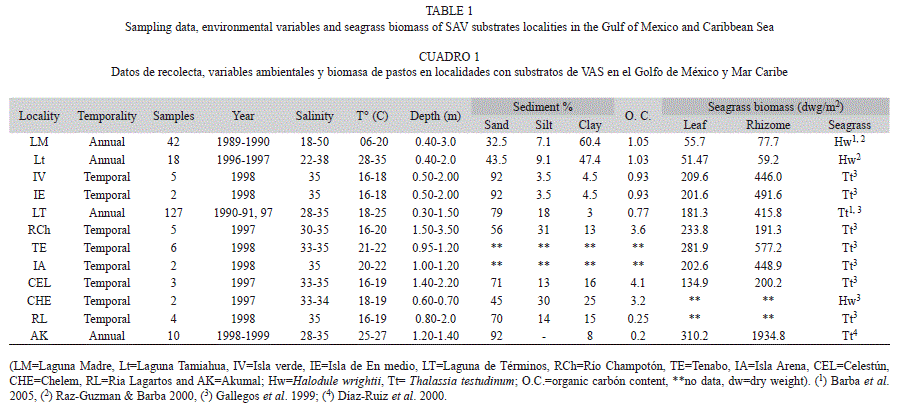
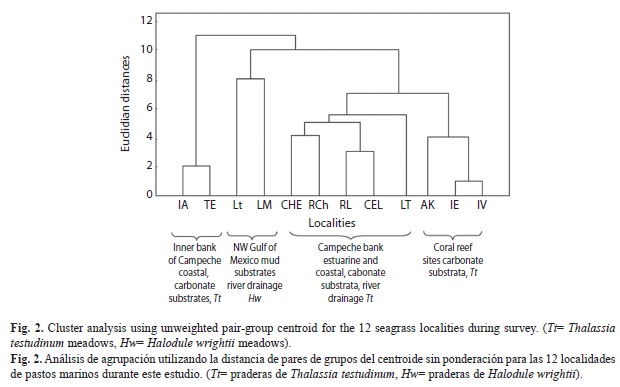
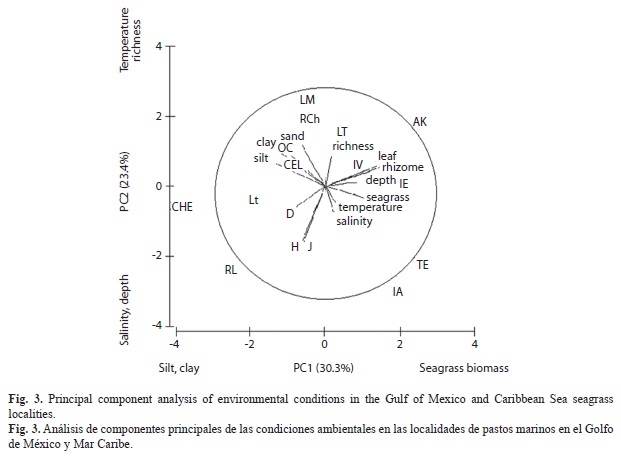
<body><![CDATA[<br> </span></font><font size="2"><span style="font-family: verdana;">    <br> Sampling years during 1996-1997 and 1998 were occasional and those from Laguna Madre, Laguna&nbsp; Tamiahua, Laguna de T&eacute;rminos and in the Caribbean were conducted annually. The environmental parameters of water temperature and salinity, habitat type, percentage of gravel, sand, mud and organic carbon content, together with the species, were used to define affinities and to group species and localities in a cluster analysis using unweighted pairgroup centroid (UPGW) and Euclidian distances (STATISTICA 2000).</span></font><br  style="font-family: verdana; font-weight: bold;"> <font style="font-weight: bold;" size="2"></font><br  style="font-family: verdana; font-weight: bold;"> <font size="2"><span style="font-family: verdana;"><span  style="font-weight: bold;">Seagrass biomass:</span> Submerged aquatic vegetation (SAV) and sediments were sampled with a metallic core of 20.5cm of diameter and 20cm of length (sampling area 0.03m2). Seagrasses were separated into leaves, rhizomes and roots, and oven dried at 105&deg;C for 12hr to determine biomass as dry weight (Fourqurean <span style="font-style: italic;">et al</span>. 2001).</span></font><br  style="font-family: verdana;"> <font size="2"></font><br style="font-family: verdana;"> <font size="2"><span style="font-family: verdana;"><span  style="font-weight: bold;">Faunistic composition and density:</span> Caridean shrimp were collected with a Colman-Seagrove net (sampling area 38.5m2) (Eleftheriou &amp; Holme 1985) in Laguna de T&eacute;rminos, and with a beam trawl net (sampling area 50m2)&nbsp; (Renfro 1962) in the other localities. Sampling was carried out during daylight in monospecific <span style="font-style: italic;">Halodule wrigthii</span> and <span style="font-style: italic;">Thalassia testudinum</span> meadows. The selectivity of these two sampling nets has been found to be similar (&Aacute;lvarez <span style="font-style: italic;">et al</span>. 1996), and comparing samples from a quantitative viewpoint is considered valid. Caridean shrimp species were identified following the taxonomic criteria of Holthuis (1952), Chace (1972) and Williams (1984), and arranged following De Grave <span  style="font-style: italic;">et al</span>. (2009) criteria. Density was determined as number of individuals per m2. </span></font><br style="font-family: verdana;"> <font size="2"></font><br style="font-family: verdana;"> <font size="2"><span style="font-family: verdana;">The density of each species was transformed to ln (x+1), the dominance of the caridean shrimp was determined considering the density (ind./m2) and frequency of eachspecies, using the non-parametric association of Olmstead-Tukey (Sokal &amp; Rohlf 1981). Ordinations were conducted using principal component analysis (PCA) to explore spatial variability of carideans shrimps in localities (PRIMER 6 &amp; ERMANOVA).</span></font><br  style="font-family: verdana;"> <font size="2"></font><br style="font-family: verdana;"> <font size="2"><span style="font-family: verdana;"><span  style="font-weight: bold;">Diversity:</span> Species richness and diversity were determined by computing the species richness index (<span  style="font-style: italic;">D</span>), the Shannon diversity index (<span style="font-style: italic;">H</span>) and the evenness index (<span style="font-style: italic;">E</span>) were used to describe community (Krebs 1989, Ram&iacute;rez 1999, McCune &amp; Grace 2002). The values obtained for these indices in the different samples were automatically significant, and no statistical analysis was required (Magurran 1988). </span></font><br  style="font-family: verdana;"> <font size="2"></font><br style="font-family: verdana;"> <font size="2"><span style="font-family: verdana;"><span  style="font-weight: bold;">Zoogeographic affinity:</span> Zoogeographic distributions were arranged in agreement with the American Zoogeographic provinces proposed by Boschi (2000) for decapod crustaceans.</span></font><br style="font-family: verdana;"> <font size="2"></font><br style="font-family: verdana;"> <font style="font-weight: bold;" size="3"><span  style="font-family: verdana;">Results </span></font><br  style="font-family: verdana;"> <font size="2"></font><br style="font-family: verdana;"> <font size="2"><span style="font-family: verdana;"><span  style="font-weight: bold;">Environmental characterization and clustering:</span> Four groups of localities were determined using salinity, temperature, depth, sediment composition, organic carbon content and seagrass biomass data. The first group included LM and Lt, with a high salinity, a marked variation in temperature, a high content of fine sediments and organic carbon and intermediate values of <span  style="font-style: italic;">H. wrightii</span> biomass. The second group included CHE, RCH, RL, CEL and LT, all located in the transitional region of terrigenous-carbonate substrates, in euhaline environments, with high temperature, 40-80% of sand, a high content of organic carbon and intermediate to high values of <span  style="font-style: italic;">T. testudinum</span> biomass. The third group IA and TE, corresponded with euhaline conditions, high temperature values, and a high <span  style="font-style: italic;">T. testudinum</span> biomass. The fourth group corresponded to the euhaline coral reef sites of AK, IE and IV with 90% sand, carbonate substrate, a low organic content and a high <span style="font-style: italic;">T. testudinum</span> biomass (<a href="/img/revistas/rbt/v60n3/a16t1.gif">Table 1</a>, <a  href="/img/revistas/rbt/v60n3/a16i2.jpg">Fig. 2</a>).     <br>     </span></font><br style="font-family: verdana;">     <font size="2"><span style="font-family: verdana;">Principal component     analysis     indicated that the first three axes explained 73.1% of the cumulative     spatial variability in this study (<a      href="/img/revistas/rbt/v60n3/a16i3.jpg">Fig. 3</a>), and accounted     for 30.3,     ]]></body>
<body><![CDATA[23.4 and 19.4% of variability, respectively. From the correlations     (<a href="/img/revistas/rbt/v60n3/a16t2.gif">Table 2</a>), it is     concluded that the component axes representing     environmental variables were explained by multivariate space determined     by axes 1 and 2 (<a href="/img/revistas/rbt/v60n3/a16i3.jpg">Fig. 3</a>),     because axis 1 was five times, and axes 2     three times more strongly correlated with the environmental and     biological variables. The first principal component was strongly and     negatively correlated with lime and clay, sites with solid substrates     and&nbsp; trongly and positively correlated with seagrass biomass (leaf     ]]></body>
<body><![CDATA[and rhizome). This group included sites LM, Ak, RCh, IV, IE, LT, TE and     IA. The second principal component was strongly correlated with     diversity indexes of carideans, grouping sites CEL, CHE, Lt and RL     (<a href="/img/revistas/rbt/v60n3/a16i3.jpg">Fig. 3</a>). </span></font><br      style="font-family: verdana;">     <font size="2"></font><br style="font-family: verdana;">     <font size="2"><span style="font-family: verdana;"><span      style="font-weight: bold;">Seagrass biomass:</span> Monospecific     meadows of <span style="font-style: italic;">H. wrightii</span>     dominated in the LM and Lt systems, in     ]]></body>
<body><![CDATA[subtropical eu-hypersaline conditions and terrigenous sediments.     Thegreatest values of leaf (55.73g/m2) and rhizome (77.67g/m2) biomass     were recorded for LM. The other sites were characterized by <span      style="font-style: italic;">T.     testudinum</span>, with maximum leaf and rhizome biomass values     recorded for     AK (310.2 and 1 934.8g/m2) and the minimum values for CEL (134.9 and     200.2g/m2) (<a href="/img/revistas/rbt/v60n3/a16t1.gif">Table 1</a>).</span></font><br      style="font-family: verdana;">     <font size="2"></font><br style="font-family: verdana;">     ]]></body>
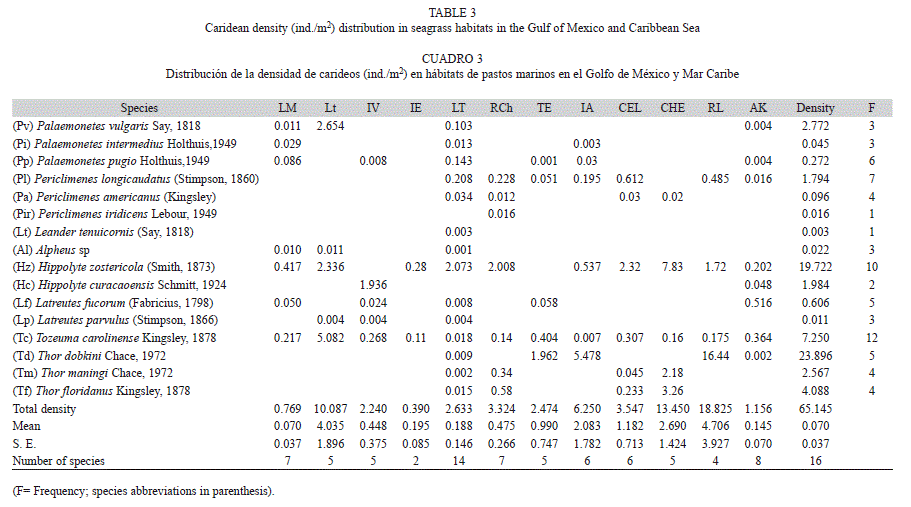
<body><![CDATA[<font size="2"><span style="font-family: verdana;"><span      style="font-weight: bold;">Faunistic composition and density</span>:     A total of 72 158 individuals belonging to 16 taxa of caridean shrimps     were collected from 12 localities in the Gulf of Mexico and Caribbean     Sea: 8 species of the Hippolytidae, 7 species of Palaemonidae and 1     species of Alpheidae (<a href="/img/revistas/rbt/v60n3/a16t3.gif">Table     3</a>). A total of 37.3% of the global caridean     density occurred in the <span style="font-style: italic;">H. wrightii</span>     habitat in LM, Lt and CHE, and     62.7% in the <span style="font-style: italic;">T. testudinum</span>     ]]></body>
<body><![CDATA[habitat in the other sampling sites (<a      href="/img/revistas/rbt/v60n3/a16t3.gif">Table     3</a>).</span></font><br style="font-family: verdana;">     <font size="2"></font><br style="font-family: verdana;">     <font size="2"><span style="font-family: verdana;">&nbsp;The 92.3% of     the total     density was represented by the Hippolytidae family, and was followed by     Palaemonidae (7.6%). The greatest total densities were recorded for the     hippolytids <span style="font-style: italic;">H. zostericola</span>     (12.39ind./m2), <span style="font-style: italic;">T. carolinense</span>     ]]></body>
<body><![CDATA[(9.5ind./m2),     <span style="font-style: italic;">T. dobkini</span> (4.84ind./m2) and     thepalaemonid grass shrimp <span style="font-style: italic;">Palaemonetes     vulgaris</span> (4.87ind./m2) (<a      href="/img/revistas/rbt/v60n3/a16t3.gif">Table 3</a>). </span></font><br      style="font-family: verdana;">     <font size="2"></font><br style="font-family: verdana;">     <font size="2"><span style="font-family: verdana;">On the spatial     scale, the highest     density values were recorded for RL (18.82ind./ m2), CHE (13.45ind./m2)     ]]></body>
<body><![CDATA[and Lt (10ind./m2), and corresponded to the collection of <span      style="font-style: italic;">Thor dobkini</span>,     <span style="font-style: italic;">Hippolyte zostericola </span>and <span      style="font-style: italic;">Tozeuma carolinense</span>, respectively.     The lowest     density values were recorded for IE and LM with 0.39 and 0.48ind./m2,     respectively (<a href="/img/revistas/rbt/v60n3/a16t3.gif">Table 3</a>).     </span></font><br style="font-family: verdana;">     <font size="2"></font><br style="font-family: verdana;">     <font size="2"><span style="font-family: verdana;">The dominant species     ]]></body>
<body><![CDATA[<span style="font-style: italic;">H. zostericola</span>     represented more than 50% of the total density per sampling site in LM,     IE, LT, RCh, CEL and CHE, whereas <span style="font-style: italic;">T.     carolinense</span> in Lt and <span style="font-style: italic;">T.     dobkini</span>     in TE, IA and RL represented 80%. <span style="font-style: italic;">Tozeuma     carolinense</span> was collected in     the 12 sampling sites, <span style="font-style: italic;">H. zostericola</span>     in ten sites (except Isla Verde     and Tenabo),&nbsp; ericlimenes longicaudatus in seven, <span     ]]></body>
<body><![CDATA[ style="font-style: italic;">Palaemonetes     pugio</span> in six, <span style="font-style: italic;">Periclimenes     iridiscens</span> and <span style="font-style: italic;">Leander     tenuicornis</span> only in     CHA and LT, and <span style="font-style: italic;">Hippolyte     cura&#962;aoensis</span> in the IV and AK reef habitats     (<a href="/img/revistas/rbt/v60n3/a16t3.gif">Table 3</a>).&nbsp; The     dominant species according to abundance were: <span      style="font-style: italic;">T.     carolinense</span>, <span style="font-style: italic;">H. zostericola</span>,     ]]></body>
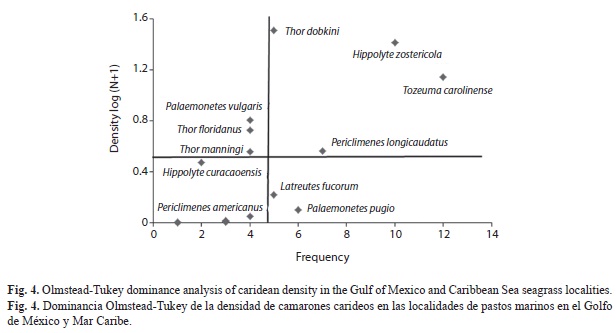
<body><![CDATA[<span style="font-style: italic;">T. dobkini</span> and <span      style="font-style: italic;">P. longicaudatus</span>, the     frequent species were <span style="font-style: italic;">Latreutes     fucorum</span> and <span style="font-style: italic;">P. pugio</span>,     and the abundant     species were: <span style="font-style: italic;">P. vulgaris</span>, <span      style="font-style: italic;">T. floridanus</span> and <span      style="font-style: italic;">T. maningi</span> (<a      href="/img/revistas/rbt/v60n3/a16i4.jpg">Fig. 4</a>). </span></font><br      style="font-family: verdana;">     ]]></body>
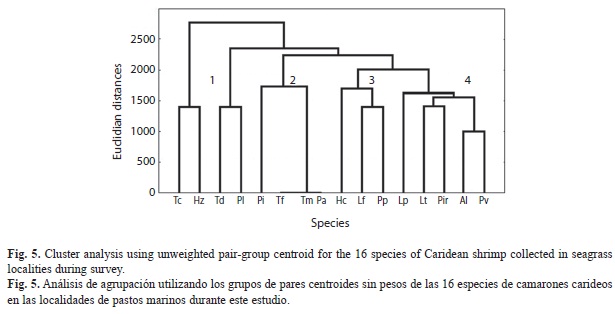
<body><![CDATA[<font size="2"></font><br style="font-family: verdana;">     <font size="2"><span style="font-family: verdana;"><span      style="font-weight: bold;">Based on the     distribution of the     density data, four groups were formed:</span> 1) <span      style="font-style: italic;">T. carolinense</span> and <span      style="font-style: italic;">H.     zostericola</span>, the dominant species associated with poly-euhaline     conditions throughout the spatial range; 2) <span      style="font-style: italic;">T. dobkini</span> and <span     ]]></body>
<body><![CDATA[ style="font-style: italic;">P.     longicaudatus</span>, dominant species recorded from LT southward; 3)     <span style="font-style: italic;">Palaemonetes intemedius</span>, <span      style="font-style: italic;">T. floridanus</span> and <span      style="font-style: italic;">T. maningi</span>, abundant species     with an intermediate distribution; 4) the frequent and rare species     (<a href="/img/revistas/rbt/v60n3/a16i5.jpg">Fig. 5</a>).</span></font><br      style="font-family: verdana;">     <font size="2"></font><br style="font-family: verdana;">     <font size="2"><span style="font-family: verdana;"><span     ]]></body>
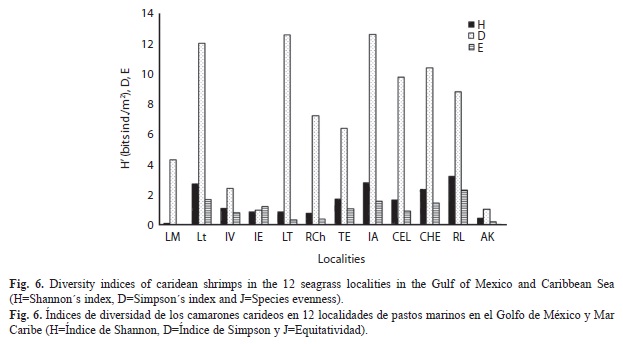
<body><![CDATA[ style="font-weight: bold;">Diversity:</span> The     maximum number of     species per site was 14 in LT and the minimum was two species in IE.     The maximum Simpson index values were those of IV, IA and RL (5-6     species). The greatest Simpson indices indicate that a community is     dominated by one or two species. These were <span      style="font-style: italic;">H. curacaoensis</span> in IV and     <span style="font-style: italic;">T. dobkini</span> in IA and RL, where     they represented more than 85% of the     total abundance (<a href="/img/revistas/rbt/v60n3/a16i6.jpg">Fig. 6</a>).</span></font><br     ]]></body>
<body><![CDATA[ style="font-family: verdana;">     <font size="2"></font><br style="font-family: verdana;">     <font size="2"><span style="font-family: verdana;">The hannon-Weinner     index considers     the richness and distribution of abundance of each species. The     greatest values were recorded for LM, RCh and AK, together with the     greatest richness. Evenness measures the abundance of the dominant     species. The greatest values were those of IE, and the lowest were     those of IVand IA, where the most abundant species were: <span      style="font-style: italic;">H.     ]]></body>
<body><![CDATA[curacaoensis</span> and <span style="font-style: italic;">T. dobkini</span>     (<a href="/img/revistas/rbt/v60n3/a16i6.jpg">Fig. 6</a>).</span></font><br      style="font-family: verdana;">     <font size="2"></font><br style="font-family: verdana;">     <font size="2"><span style="font-family: verdana;"><span      style="font-weight: bold;">Zoogeographic     affinity:</span> The     zoogeographic distribution of the caridean shrimp presents an affinity     with the Virginian (6.5%), Carolinean (75%), Texan (81.2%), Caribbean     (56%) and Brazilian (12.5%) provinces. &nbsp;</span></font><br     ]]></body>
<body><![CDATA[ style="font-family: verdana;">     <font size="2"></font><br style="font-family: verdana;">     <font style="font-weight: bold;" size="3"><span      style="font-family: verdana;">Discussion</span></font><br      style="font-family: verdana;">     <font size="2"><span style="font-family: verdana;">The seven species of     Palaemonidae     and eight species of Hippolytidae collected during this study, account     the 70% of palemonids&nbsp; recorded for the Caribbean coast     (Rom&aacute;n-Mart&iacute;nez 2010) and 57.1% of hippolytids recorded     ]]></body>
<body><![CDATA[by Markham <span style="font-style: italic;">et al</span>. (1990) in     the Caribbean coast. The low representation     of the Alpheidae family was thought to be due to sampling exclusion.     They are known for their infaunal burrowing habits (Bauer 1985). This     low representation from using selective sampling gear and sampling in     monospecific SAV areas, thus excluding other habitats such as coral and     rocky substrates, <span style="font-style: italic;">Sargassum</span>     mats, sandy and muddy bare substrates,     calcareous algae and anemones (Rom&aacute;n- Mart&iacute;nez 2010). </span></font><br      style="font-family: verdana;">     ]]></body>
<body><![CDATA[<font size="2"></font><br style="font-family: verdana;">     <font size="2"><span style="font-family: verdana;">Most of the     carideans were widely     distributed and associated with SAV substrates, where the conditions of     salinity, temperature, type of habitat and predation regulate the     abundance and diversity of the group (Barba <span      style="font-style: italic;">et al</span>. 2005). Briggs (1974)     argued that the widespread distribution of many species is mainly     associated with temperature, which controls distribution in the ocean.     This study area is under the influence of subtropical and tropical     ]]></body>
<body><![CDATA[water masses, which explains the convergence of different types of     fauna. </span></font><br style="font-family: verdana;">     <font size="2"></font><br style="font-family: verdana;">     <font size="2"><span style="font-family: verdana;">The dominant species     <span style="font-style: italic;">Tozeuma     carolinense</span> is distributed in SAV in subtropical and tropical     euhaline     waters and, in the case of <span style="font-style: italic;">Hippolyte     zostericola</span>, it is absent in     Laguna de Alvarado&nbsp; in response to its low tolerance to mesohaline     ]]></body>
<body><![CDATA[waters (S&aacute;nchez <span style="font-style: italic;">et al</span>.     1996). These are numerically dominant     epifaunal species associated with SAV throughout the Western Atlantic,     both in temperate (<span style="font-style: italic;">Zostera</span> and     Halodule) and tropical (<span style="font-style: italic;">Thalassia,</span>     Halodule and <span style="font-style: italic;">Syringodium</span>)     seagrass beds, as well as in drift macroalgae     (Dugan 1982, Greening &amp; Livingston 1982, Livingston 1984,     S&aacute;nchez <span style="font-style: italic;">et al</span>. 1996).     The distribution of the arrow shrimp spans     ]]></body>
<body><![CDATA[from Massachusetts to Cura&#962;ao, including Yucat&aacute;n and Panama     (Chace 1972, Rom&aacute;n-Contreras &amp; Mart&iacute;nez-May&eacute;n     2009). It is abundant in Halodule beds in Lower Laguna Madre, Texas     (Sheridan &amp; Minello 2003), and in this study it was abundant in LM     and Lt in Halodule meadows. The hippolytids <span      style="font-style: italic;">L. fucorum</span> and <span      style="font-style: italic;">L. parvulus</span>     are distributed in euhaline waters, and are associated with <span      style="font-style: italic;">T.     testudinum</span> and red macroalgae. Both species have an     ]]></body>
<body><![CDATA[amphi-Atlantic     tropical distribution and are nocturnal (Bauer 1985). They occur in     tropical marine ecosystemsin Puerto Rico and Panama, and have been     recorded in low numbers in temperate estuaries (Greening &amp;     Livingston 1982). Another hippolytid, <span style="font-style: italic;">T.     dobkini</span>, was collected from     SAV and red macroalgae in the NC-NE subsystem of Laguna de     T&eacute;rminos in poly-euhaline waters. It is distributed widely in     subtropical-tropical regions from North Carolina to Yucat&aacute;n     (Williams 1984, Rom&aacute;n-Contreras &amp;     ]]></body>
<body><![CDATA[Mart&iacute;nez-May&eacute;n 2009). <span style="font-style: italic;">Latreutes     fucorum</span>, <span style="font-style: italic;">L. parvulus</span>     and     <span style="font-style: italic;">T. dobkini</span> were collected with     low density values. Both are nocturnal     species, that hide from predators among macroalgae during the day     (Greening &amp; Livingston 1982, Bauer 1985). &nbsp;</span></font><br      style="font-family: verdana;">     <font size="2"></font><br style="font-family: verdana;">     <font size="2"><span style="font-family: verdana;">Species of     ]]></body>
<body><![CDATA[<span style="font-style: italic;">Palaemonetes</span>, inhabit a     variety of substrates including <span style="font-style: italic;">Zostera</span>,     Halodule, <span style="font-style: italic;">Thalassia</span>,     <span style="font-style: italic;">Syringodium</span> and macroalgae,     and have a wide distribution that responds     to their ample physiological tolerance to salinity and temperature     conditions and spans from the Northern Atlantic latitudes of     Massachusetts and North Carolina to Yucat&aacute;n, and from Bermuda to     Trinidad and Cura&#962;ao (Chace 1972, Dugan 1982, Lewis 1984, Livingston     1984, Zupo &amp; Nelson 1999, Sheridan &amp; Minello 2003,     ]]></body>
<body><![CDATA[Rom&aacute;n-Contreras &amp; Mart&iacute;nez-May&eacute;n 2010). They     are also found along the Pacific&nbsp; coast of Colombia (Wicksten     1989). In contrast, their abundance decreases and the dominance of <span      style="font-style: italic;">P.     pugio</span> is favoured in Laguna de Alvarado, Veracruz, attributed to     the     oligomesohaline conditions (S&aacute;nchez <span      style="font-style: italic;">et al</span>. 1996, Barba 1999,     Barba <span style="font-style: italic;">et al</span>. 2005).</span></font><br      style="font-family: verdana;">     ]]></body>
<body><![CDATA[<font size="2"></font><br style="font-family: verdana;">     <font size="2"><span style="font-family: verdana;"><span      style="font-style: italic;">Palaemonetes pugio</span>     is the most     studied caridean of the Western Atlantic where it is commonly found in     SAV, smooth cordgrass <span style="font-style: italic;">Spartina     alterniflora</span> Loisel, soft substrates,     logs and among mangrove roots (Posey &amp; Hines 1991, Everett &amp;     Ruiz 1993, Cross &amp; Stiven 1999). The three dagger-blade grass     shrimp species of the genus <span style="font-style: italic;">Palaemonetes</span>     ]]></body>
<body><![CDATA[were placed by Barba <span style="font-style: italic;">et al</span>.     (2005) in the &#8220;widely distributed&#8221; and &#8220;not-associated with the     habitat&#8221; distribution pattern. Of these three species, the brackish     grass shrimp <span style="font-style: italic;">P. intermedius</span>     and the grass shrimp <span style="font-style: italic;">P. pugio</span>     are the more     tolerant/resistant species to low salinities (Knwolton &amp; Williams     1970). <span style="font-style: italic;">Palaemonetes pugio</span> is     most commonly foundin 10-20ppm, while the     marsh grass shrimp <span style="font-style: italic;">P. vulgaris</span>     ]]></body>
<body><![CDATA[is common in the higher salinities of     15-40ppm (Williams 1984) and does not survive in less than 15ppm     (Nagabhushanam 1961).&nbsp; </span></font><br      style="font-family: verdana;">     <font size="2"><span style="font-family: verdana;">The coexistence of     <span style="font-style: italic;">P. pugio</span> and <span      style="font-style: italic;">P.     vulgaris</span> in intermediate salinities responds to predator-prey     interactions, competition or differences in behaviour, rather than to     differences in physiological tolerance (Thorp &amp; Hoss 1975). When     ]]></body>
<body><![CDATA[both species coincide in oyster beds, <span style="font-style: italic;">P.     vulgaris</span> displaces <span style="font-style: italic;">P. pugio</span>     as     a result of competition for shell substrates that supply refuge against     fish predation and for food from the continual tidal influx of detritus     (Thorp 1976). Consequently, when both species are exposed to fish     predation, <span style="font-style: italic;">P. pugio</span> suffers a     greater mortality in spite of being more     resistant to low salinities, poor flushing, a high organic content and     anoxic conditions (Williams 1984). <span style="font-style: italic;">Palaemonetes     ]]></body>
<body><![CDATA[intermedius</span> is     distributed from Massachusetts to Texas (Holthuis 1952, Sheridan &amp;     Minello 2003) and South to Quintana Roo (Chace 1972). The three     palaemonid species are widely distributed with an affinity for the     Virginian-Carolinean province, as well as a more Southern distribution     range along the Yucat&aacute;n Peninsula into the Caribbean province     (Holthuis 1952, Williams 1984, Rom&aacute;n-Contreras &amp;     Mart&iacute;nez-May&eacute;n 2010).</span></font><br      style="font-family: verdana;">     <font size="2"></font><br style="font-family: verdana;">     ]]></body>
<body><![CDATA[<font size="2"><span style="font-family: verdana;"><span      style="font-style: italic;">Periclimenes     longicaudatus</span> and <span style="font-style: italic;">P.     americanus</span> are tropical euhaline species. They were collected in     poly-euhaline waters and were associated with <span      style="font-style: italic;">T. testudinum</span>, <span      style="font-style: italic;">H.     wrightii</span>, <span style="font-style: italic;">S. filiforme</span>,     macroalgae and carbonate substrates in the     NC-NE subsystem of Laguna de T&eacute;rminos (S&aacute;nchez &amp;     ]]></body>
<body><![CDATA[Raz-Guzman, 1997, Barba <span style="font-style: italic;">et al</span>.     2005). These two species are distributed     from North Carolina to Southwestern Florida, and from the West Indies     to S&atilde;o Paulo, Brazil (Williams 1984, Rom&aacute;n-Contreras     &amp; Mart&iacute;nez-May&eacute;n 2010).</span></font><br      style="font-family: verdana;">     <font size="2"></font><br style="font-family: verdana;">     <font size="2"><span style="font-family: verdana;">Although, the     structural elements     of seagrass ecosystems have been reasonably well described, the basic     ]]></body>
<body><![CDATA[functional relationships of the component species remain only partly     understood (Livingston 1984). Seagrasses and their associated epiphytes     form a habitat and provide an organic matter matrix for diverse     assemblages of organisms (Heck &amp; Orth 1980). Caridean shrimp are     numerically dominantcomponents in vegetated substrates (Dugan 1982,     Greening &amp; Livingston 1982, S&aacute;nchez <span      style="font-style: italic;">et al</span>. 1996, Barba     1999), and are important links between primary production and the     higher trophic levels (Llans&oacute; <span style="font-style: italic;">et     al</span>. 1998, Barba <span style="font-style: italic;">et al</span>.     ]]></body>
<body><![CDATA[2000).     The grass shrimp <span style="font-style: italic;">H. zostericola</span>,     <span style="font-style: italic;">T. carolinense</span> and <span      style="font-style: italic;">P. pugio</span> are among     the most abundant species in SAV habitats, and are also prey of fish     associated with these habitats (Llans&oacute; <span      style="font-style: italic;">et al</span>. 1998, Cross &amp;     Stiven 1999). </span></font><br style="font-family: verdana;">     <font size="2"></font><br style="font-family: verdana;">     <font size="2"><span style="font-family: verdana;">Seagrasses, in     ]]></body>
<body><![CDATA[general terms,     appear to be relatively tolerant to many anthropogenic chemicals.     Several species have been shown to be less sensitive to chemicals than     other species of marine flora, corals and macroinvertebrates. In     addition, some seagrasses bioaccumulate chemicals at lower     concentrations (Lewis &amp; Devereux 2009). Damage to seagrass     communities from oil exposure includes acute mortality resulting from     physical impacts and chemical toxicity; indirect mortality as the     result of light loss, death of food sources, or the destruction or     removal of habitat; destruction of sensitive juvenile fishes and     ]]></body>
<body><![CDATA[invertebrates; and accumulation of potentially carcinogenic or     mutagenic substances in the food chain (Zieman <span      style="font-style: italic;">et al</span>. 1984). Fauna and     flora associated with seagrasses are also affected by oil. Infauna,     nearly completely killed by oil exposure, gradually returned to     abundances above prespill levels. However, only species with high     reproductive potential or planktonic stages recovered quickly. The     effects of oil on tropical fish have not been extensively studied     (Peters <span style="font-style: italic;">et al</span>. 1997). </span></font><br      style="font-family: verdana;">     ]]></body>
<body><![CDATA[<font size="2"></font><br style="font-family: verdana;">     <font size="2"><span style="font-family: verdana;">Other human impacts     are associated     with increase of nutrients producing bad effects on the structure and     functions of the seagrass ecosystem, as eutrophication leads directly     to a large reproduction of plankton and epiphytic algae on seagrasses,     thus reducing light flux of water body and dissolved oxygen contents     due to decomposition of the algae. Increased sediment loads can smother     seagrasses, change the redox potential of rhizome-penetrated sediments,     or cause increased water column turbidity, robbing seagrasses of the     ]]></body>
<body><![CDATA[high levels of incident light required for metabolic functions. Such     high light requirements mean seagrassesare affected by even minor     increases in turbidity, which is now recognized as the predominant     threat to seagrass communities (Lewis &amp; Devereux 2009). </span></font><br      style="font-family: verdana;">     <font size="2"></font><br style="font-family: verdana;">     <font size="2"><span style="font-family: verdana;">The results obtained     in this study     show that caridean shrimps are resident and representative fauna of SAV     substrates, and the salinity, temperature and type of habitat regulate     ]]></body>
<body><![CDATA[the dominance of the species. Understanding the distribution and     ecological affinities of the caridean shrimp as dominant epifaunal     components in SAV substrates requires research on the trophic     contribution and energy transfer of these communities, as well as on     the impact of environmental phenomena such as the recent oil spill in     the Northern Gulf of Mexico and also by human impacts as tourism     activities, nutrient upload, increased of sediment load and turbidity     as threats for seagrass habitats in the area. This study contributes     with baseline information on the benthic communities and distributional     patterns of caridean shrimps in seagrass habitats in the Gulf of Mexico     ]]></body>
<body><![CDATA[and Caribbean Sea.</span></font><br style="font-family: verdana;">     <font size="2"></font><br style="font-family: verdana;">     <font style="font-weight: bold;" size="3"><span      style="font-family: verdana;">Acknowledgments</span></font><br      style="font-family: verdana;">     <font size="2"><span style="font-family: verdana;">Thanks are extended     for the     information obtained through the projects &#8220;Regional Evaluation of     Seagrass Production in the Mexican Atlantic Coasts&#8221;,     CONACyT-Universidad Aut&oacute;noma Metropolitana-Unidad Iztapalapa,     ]]></body>
<body><![CDATA[Margarita E. Gallegos Mart&iacute;nez, and &#8220;Ecological and Biological     Evaluation of Dominant Ichthyofaunistic Resources in Coral Reefs of     Quintana Roo&#8221;, Universidad Aut&oacute;noma Metropolitana- Unidad     Iztapalapa, Silvia D&iacute;az-Ruiz. </span></font><br      style="font-family: verdana;">     <br style="font-family: verdana;">     <hr style="width: 100%; height: 2px;"><font style="font-weight: bold;"      size="3"><span style="font-family: verdana;">    <!-- ref --><br> Referencias</span></font><br style="font-family: verdana;"> <font size="2"><span style="font-family: verdana;">&Aacute;lvarez, F., A.J. S&aacute;nchez &amp; L.A. Soto. 1996. Comparison of two nets as samplers of estuarine macrofauna in a tropical meadow. Rev. Inv. Mar. 17: 17-27.    &nbsp;&nbsp;&nbsp;&nbsp;&nbsp;&nbsp;&nbsp;&nbsp;[&#160;<a href="javascript:void(0);" onclick="javascript: window.open('/scielo.php?script=sci_nlinks&ref=1472276&pid=S0034-7744201200030001600001&lng=','','width=640,height=500,resizable=yes,scrollbars=1,menubar=yes,');">Links</a>&#160;]<!-- end-ref --><!-- ref --></span></font><br style="font-family: verdana;"> <font size="2"></font><br style="font-family: verdana;"> <font size="2"><span style="font-family: verdana;">Barba, E. 1999. Variaci&oacute;n de la densidad y la biomasa de peces juveniles y dec&aacute;podos epib&eacute;nticos de la regi&oacute;n central de Laguna Madre, Tamaulipas. Hidrobiol&oacute;gica 9: 101-114.    &nbsp;&nbsp;&nbsp;&nbsp;&nbsp;&nbsp;&nbsp;&nbsp;[&#160;<a href="javascript:void(0);" onclick="javascript: window.open('/scielo.php?script=sci_nlinks&ref=1472277&pid=S0034-7744201200030001600002&lng=','','width=640,height=500,resizable=yes,scrollbars=1,menubar=yes,');">Links</a>&#160;]<!-- end-ref --><!-- ref --></span></font><br  style="font-family: verdana;"> <font size="2"></font><br style="font-family: verdana;"> <font size="2"><span style="font-family: verdana;">Barba, E., A. Raz-Guzman &amp; A.J. S&aacute;nchez. 2005. Distribution patterns of estuarine caridean shrimps in the southwestern Gulf of Mexico. Crustaceana 78: 709-726.    &nbsp;&nbsp;&nbsp;&nbsp;&nbsp;&nbsp;&nbsp;&nbsp;[&#160;<a href="javascript:void(0);" onclick="javascript: window.open('/scielo.php?script=sci_nlinks&ref=1472278&pid=S0034-7744201200030001600003&lng=','','width=640,height=500,resizable=yes,scrollbars=1,menubar=yes,');">Links</a>&#160;]<!-- end-ref --><!-- ref --></span></font><br  style="font-family: verdana;"> <font size="2"></font><br style="font-family: verdana;"> <font size="2"><span style="font-family: verdana;">Barba, E., A.J. S&aacute;nchez, A. Raz-Guzman &amp; M.E. Gallegos. 2000. Dieta natural y tasa de forrajeo del carideo <span style="font-style: italic;">Hippolyte zostericola</span> Smith sobre ep&iacute;fitas de <span style="font-style: italic;">Thalassia testudinum</span> Banks et Solander ex K&ouml;nig. Hidrobiol&oacute;gica 10: 139-146.    &nbsp;&nbsp;&nbsp;&nbsp;&nbsp;&nbsp;&nbsp;&nbsp;[&#160;<a href="javascript:void(0);" onclick="javascript: window.open('/scielo.php?script=sci_nlinks&ref=1472279&pid=S0034-7744201200030001600004&lng=','','width=640,height=500,resizable=yes,scrollbars=1,menubar=yes,');">Links</a>&#160;]<!-- end-ref --><!-- ref --></span></font><br  style="font-family: verdana;"> <font size="2"></font><br style="font-family: verdana;"> <font size="2"><span style="font-family: verdana;">Bauer, R.T. 1985. Diel and seasonal variation in species composition and abundance of caridean shrimps(Crustacea, Decapoda) from seagrass meadows on the north coast of Puerto Rico. Bull. Mar. Sci. 36: 150-162.    &nbsp;&nbsp;&nbsp;&nbsp;&nbsp;&nbsp;&nbsp;&nbsp;[&#160;<a href="javascript:void(0);" onclick="javascript: window.open('/scielo.php?script=sci_nlinks&ref=1472280&pid=S0034-7744201200030001600005&lng=','','width=640,height=500,resizable=yes,scrollbars=1,menubar=yes,');">Links</a>&#160;]<!-- end-ref --><!-- ref --></span></font><br  style="font-family: verdana;"> <font size="2"></font><br style="font-family: verdana;"> <font size="2"><span style="font-family: verdana;">Boschi, E.E. 2000. Species of decapod crustaceans and their distribution in the American marine zoogeographic provinces. Rev. Inv. Des. Pesquero 13: 7-136.    &nbsp;&nbsp;&nbsp;&nbsp;&nbsp;&nbsp;&nbsp;&nbsp;[&#160;<a href="javascript:void(0);" onclick="javascript: window.open('/scielo.php?script=sci_nlinks&ref=1472281&pid=S0034-7744201200030001600006&lng=','','width=640,height=500,resizable=yes,scrollbars=1,menubar=yes,');">Links</a>&#160;]<!-- end-ref --><!-- ref --></span></font><br  style="font-family: verdana;"> <font size="2"></font><br style="font-family: verdana;"> <font size="2"><span style="font-family: verdana;">Briggs, J.C. 1974. Marine zoogeography. McGraw-Hill, New York, USA.    &nbsp;&nbsp;&nbsp;&nbsp;&nbsp;&nbsp;&nbsp;&nbsp;[&#160;<a href="javascript:void(0);" onclick="javascript: window.open('/scielo.php?script=sci_nlinks&ref=1472282&pid=S0034-7744201200030001600007&lng=','','width=640,height=500,resizable=yes,scrollbars=1,menubar=yes,');">Links</a>&#160;]<!-- end-ref --><!-- ref --></span></font><br  style="font-family: verdana;"> <font size="2"></font><br style="font-family: verdana;"> <font size="2"><span style="font-family: verdana;">Bulger, A.J., B.P. Hayden, M.E. Monaco, D.M. Nelson &amp; M.G. McCormick-Ray. 1993. Biologically-based estuarine salinity zones derived from a multivariate analysis. Estuaries 16: 311-322.    &nbsp;&nbsp;&nbsp;&nbsp;&nbsp;&nbsp;&nbsp;&nbsp;[&#160;<a href="javascript:void(0);" onclick="javascript: window.open('/scielo.php?script=sci_nlinks&ref=1472283&pid=S0034-7744201200030001600008&lng=','','width=640,height=500,resizable=yes,scrollbars=1,menubar=yes,');">Links</a>&#160;]<!-- end-ref --><!-- ref --> </span></font><br style="font-family: verdana;"> <font size="2"></font><br style="font-family: verdana;"> <font size="2"><span style="font-family: verdana;">Chace, F.A., Jr. 1972. The shrimps of the Smithsonian- Bredin Caribbean Expeditions with a summary of the West Indian shallow-water species (Crustacea: Decapoda: Natantia). Smith. Contrib. Zool. 98: 1-179.    &nbsp;&nbsp;&nbsp;&nbsp;&nbsp;&nbsp;&nbsp;&nbsp;[&#160;<a href="javascript:void(0);" onclick="javascript: window.open('/scielo.php?script=sci_nlinks&ref=1472284&pid=S0034-7744201200030001600009&lng=','','width=640,height=500,resizable=yes,scrollbars=1,menubar=yes,');">Links</a>&#160;]<!-- end-ref --><!-- ref --> </span></font><br  style="font-family: verdana;"> <font size="2"></font><br style="font-family: verdana;"> <font size="2"><span style="font-family: verdana;">Cross, R.E. &amp; A.E. Stiven. 1999. Size-dependent interactions in salt marsh fish (Fundulus heteroclitus Linnaeus) and shrimp (<span style="font-style: italic;">Palaemonetes pugio</span> Holthuis). J. Exp. Mar. Biol. Ecol. 242: 179-199.    &nbsp;&nbsp;&nbsp;&nbsp;&nbsp;&nbsp;&nbsp;&nbsp;[&#160;<a href="javascript:void(0);" onclick="javascript: window.open('/scielo.php?script=sci_nlinks&ref=1472285&pid=S0034-7744201200030001600010&lng=','','width=640,height=500,resizable=yes,scrollbars=1,menubar=yes,');">Links</a>&#160;]<!-- end-ref --><!-- ref --> </span></font><br  style="font-family: verdana;"> <font size="2"></font><br style="font-family: verdana;"> <font size="2"><span style="font-family: verdana;">D&iacute;az-Ruiz, S. 2000. Evaluaci&oacute;n Ecol&oacute;gica y Biol&oacute;gica de los Recursos Ictiofaun&iacute;sticos Dominantes en Arrecifes Coralinos de Quintana Roo. Segunda Etapa. Informe final.    &nbsp;&nbsp;&nbsp;&nbsp;&nbsp;&nbsp;&nbsp;&nbsp;[&#160;<a href="javascript:void(0);" onclick="javascript: window.open('/scielo.php?script=sci_nlinks&ref=1472286&pid=S0034-7744201200030001600011&lng=','','width=640,height=500,resizable=yes,scrollbars=1,menubar=yes,');">Links</a>&#160;]<!-- end-ref --><!-- ref --> </span></font><br  style="font-family: verdana;"> <font size="2"></font><br style="font-family: verdana;"> <font size="2"><span style="font-family: verdana;">de la Lanza, G. &amp; C. Tovilla. 1986. Una revisi&oacute;n sobre la taxonom&iacute;a y distribuci&oacute;n de los pastos marinos. Univ. Cienc. 3: 17-38.    &nbsp;&nbsp;&nbsp;&nbsp;&nbsp;&nbsp;&nbsp;&nbsp;[&#160;<a href="javascript:void(0);" onclick="javascript: window.open('/scielo.php?script=sci_nlinks&ref=1472287&pid=S0034-7744201200030001600012&lng=','','width=640,height=500,resizable=yes,scrollbars=1,menubar=yes,');">Links</a>&#160;]<!-- end-ref --><!-- ref --></span></font><br  style="font-family: verdana;"> <font size="2"></font><br style="font-family: verdana;"> <font size="2"><span style="font-family: verdana;">De Grave, S., N.D. Pentcheff, S.T. Ahyong, T.Y. Chan, K.A. Crandall, P.C. Dworschak, D.L. Felder, R.M. Feldmann, C.H.J.M. Fransen, L.Y.D. Goulding, R. Lemaitre, M.E.Y. Low, J.W. Martin, P.Ng.K. Lin, C.E. Schweitzer, S.H. Tan, D. Tshudy &amp; R. Wetzer, 2009. A classification of living and fossil genera of decapod crustaceans. The Raffles Bull. Zool. Suppl. 21: 1-109.    &nbsp;&nbsp;&nbsp;&nbsp;&nbsp;&nbsp;&nbsp;&nbsp;[&#160;<a href="javascript:void(0);" onclick="javascript: window.open('/scielo.php?script=sci_nlinks&ref=1472288&pid=S0034-7744201200030001600013&lng=','','width=640,height=500,resizable=yes,scrollbars=1,menubar=yes,');">Links</a>&#160;]<!-- end-ref --><!-- ref --></span></font><br  style="font-family: verdana;"> <font size="2"></font><br style="font-family: verdana;"> <font size="2"><span style="font-family: verdana;">Dugan, P.J. 1982. Seasonal and geographic distribution of seven decapod crustaceans in Apalachee Bay, Florida. Contrib. Mar. Sci. 26: 65-79.    &nbsp;&nbsp;&nbsp;&nbsp;&nbsp;&nbsp;&nbsp;&nbsp;[&#160;<a href="javascript:void(0);" onclick="javascript: window.open('/scielo.php?script=sci_nlinks&ref=1472289&pid=S0034-7744201200030001600014&lng=','','width=640,height=500,resizable=yes,scrollbars=1,menubar=yes,');">Links</a>&#160;]<!-- end-ref --><!-- ref --></span></font><br  style="font-family: verdana;"> <font size="2"></font><br style="font-family: verdana;"> <font size="2"><span style="font-family: verdana;">Eleftheriou, A. &amp; N.A. Holme. 1985. Macrofaunal Techniques, p. 1-349. <span  style="font-style: italic;">In</span> N.A. Holme &amp; A.D. McIntyre (eds.). Methods for the study of marine benthos. Blackwell Scientific Publications, Oxford, United Kingdom.    &nbsp;&nbsp;&nbsp;&nbsp;&nbsp;&nbsp;&nbsp;&nbsp;[&#160;<a href="javascript:void(0);" onclick="javascript: window.open('/scielo.php?script=sci_nlinks&ref=1472290&pid=S0034-7744201200030001600015&lng=','','width=640,height=500,resizable=yes,scrollbars=1,menubar=yes,');">Links</a>&#160;]<!-- end-ref --><!-- ref --> </span></font><br  style="font-family: verdana;"> <font size="2"></font><br style="font-family: verdana;"> <font size="2"><span style="font-family: verdana;">Everett, R.A. &amp; G.M. Ruiz. 1993. Coarse woody debris as refuge from predation in aquatic communities: an experimental test. Oecolog&iacute;a 93: 475-486.    &nbsp;&nbsp;&nbsp;&nbsp;&nbsp;&nbsp;&nbsp;&nbsp;[&#160;<a href="javascript:void(0);" onclick="javascript: window.open('/scielo.php?script=sci_nlinks&ref=1472291&pid=S0034-7744201200030001600016&lng=','','width=640,height=500,resizable=yes,scrollbars=1,menubar=yes,');">Links</a>&#160;]<!-- end-ref --><!-- ref --> </span></font><br  style="font-family: verdana;"> <font size="2"></font><br style="font-family: verdana;"> <font size="2"><span style="font-family: verdana;">Fourqurean, J.W., A. Willsie, C.D. Rose &amp; L.M. Rutten. 2001. Spatial and temporal pattern in seagrass community composition and productivity in south Florida. Mar. Biol. 138: 341-354.    &nbsp;&nbsp;&nbsp;&nbsp;&nbsp;&nbsp;&nbsp;&nbsp;[&#160;<a href="javascript:void(0);" onclick="javascript: window.open('/scielo.php?script=sci_nlinks&ref=1472292&pid=S0034-7744201200030001600017&lng=','','width=640,height=500,resizable=yes,scrollbars=1,menubar=yes,');">Links</a>&#160;]<!-- end-ref --><!-- ref --></span></font><br style="font-family: verdana;"> <font size="2"></font><br style="font-family: verdana;"> <font size="2"><span style="font-family: verdana;">Gallegos-Mart&iacute;nez, M. 1999. Evaluaci&oacute;n regional de la producci&oacute;n de pastos marinos de las costas del Atl&aacute;ntico Mexicano. Proyecto de CONACyT-UAMI 1997- 1998. Informe final.    &nbsp;&nbsp;&nbsp;&nbsp;&nbsp;&nbsp;&nbsp;&nbsp;[&#160;<a href="javascript:void(0);" onclick="javascript: window.open('/scielo.php?script=sci_nlinks&ref=1472293&pid=S0034-7744201200030001600018&lng=','','width=640,height=500,resizable=yes,scrollbars=1,menubar=yes,');">Links</a>&#160;]<!-- end-ref --><!-- ref --> </span></font><br  style="font-family: verdana;"> <font size="2"></font><br style="font-family: verdana;"> <font size="2"><span style="font-family: verdana;">Gilmore, G.R. 1995. Environmental and biogeographic factors influencing ichthyofaunal diversity: Indian River Lagoon. Bull. Mar. Sci. 57: 153-170.    &nbsp;&nbsp;&nbsp;&nbsp;&nbsp;&nbsp;&nbsp;&nbsp;[&#160;<a href="javascript:void(0);" onclick="javascript: window.open('/scielo.php?script=sci_nlinks&ref=1472294&pid=S0034-7744201200030001600019&lng=','','width=640,height=500,resizable=yes,scrollbars=1,menubar=yes,');">Links</a>&#160;]<!-- end-ref --><!-- ref --></span></font><br  style="font-family: verdana;"> <font size="2"></font><br style="font-family: verdana;"> <font size="2"><span style="font-family: verdana;">Greening, H.S. &amp; R.J. Livingston. 1982. Diel variation in the structure of seagrass-associated epibenthic macroinvertebrate communities. Mar. Ecol. Progr. Ser. 7: 147-156.    &nbsp;&nbsp;&nbsp;&nbsp;&nbsp;&nbsp;&nbsp;&nbsp;[&#160;<a href="javascript:void(0);" onclick="javascript: window.open('/scielo.php?script=sci_nlinks&ref=1472295&pid=S0034-7744201200030001600020&lng=','','width=640,height=500,resizable=yes,scrollbars=1,menubar=yes,');">Links</a>&#160;]<!-- end-ref --><!-- ref --></span></font><br  style="font-family: verdana;"> <font size="2"></font><br style="font-family: verdana;"> <font size="2"><span style="font-family: verdana;">Heck, K.L. &amp; R.J. Orth. 1980. Structural components of eelgrass (<span style="font-style: italic;">Zostera</span> marina) meadows in the lower Chesapeake Bay-Decapod Crustacea. Estuaries 3: 289-290.    &nbsp;&nbsp;&nbsp;&nbsp;&nbsp;&nbsp;&nbsp;&nbsp;[&#160;<a href="javascript:void(0);" onclick="javascript: window.open('/scielo.php?script=sci_nlinks&ref=1472296&pid=S0034-7744201200030001600021&lng=','','width=640,height=500,resizable=yes,scrollbars=1,menubar=yes,');">Links</a>&#160;]<!-- end-ref --><!-- ref --></span></font><br  style="font-family: verdana;"> <font size="2"></font><br style="font-family: verdana;"> <font size="2"><span style="font-family: verdana;">Holthuis, L.B. 1952. The subfamily Palaemonidae. Part II. A general revision of the Palaemonidae (Crustacea, Decapoda, Natantia) of the Americas. Occ. Papers, Allan Hancock Foundation 12: 1-396.    &nbsp;&nbsp;&nbsp;&nbsp;&nbsp;&nbsp;&nbsp;&nbsp;[&#160;<a href="javascript:void(0);" onclick="javascript: window.open('/scielo.php?script=sci_nlinks&ref=1472297&pid=S0034-7744201200030001600022&lng=','','width=640,height=500,resizable=yes,scrollbars=1,menubar=yes,');">Links</a>&#160;]<!-- end-ref --><!-- ref --></span></font><br  style="font-family: verdana;"> <font size="2"></font><br style="font-family: verdana;"> <font size="2"><span style="font-family: verdana;">Jernakoff, P., A. Brearlely &amp; J. Nielsen. 1996. Factors affecting grazer-epiphyte interactions in temperate seagrass meadows. Oceanogr. Mar. Biol. Annu. Rev. 34: 109-162.    &nbsp;&nbsp;&nbsp;&nbsp;&nbsp;&nbsp;&nbsp;&nbsp;[&#160;<a href="javascript:void(0);" onclick="javascript: window.open('/scielo.php?script=sci_nlinks&ref=1472298&pid=S0034-7744201200030001600023&lng=','','width=640,height=500,resizable=yes,scrollbars=1,menubar=yes,');">Links</a>&#160;]<!-- end-ref --><!-- ref --> </span></font><br style="font-family: verdana;"> <font size="2"></font><br style="font-family: verdana;"> <font size="2"><span style="font-family: verdana;">Karplus, I. 1987. The association between gobid fishes and burrowing alpheid shrimps. Oceanogr. Mar. Biol. Annu. Rev. 25: 507-562.    &nbsp;&nbsp;&nbsp;&nbsp;&nbsp;&nbsp;&nbsp;&nbsp;[&#160;<a href="javascript:void(0);" onclick="javascript: window.open('/scielo.php?script=sci_nlinks&ref=1472299&pid=S0034-7744201200030001600024&lng=','','width=640,height=500,resizable=yes,scrollbars=1,menubar=yes,');">Links</a>&#160;]<!-- end-ref --><!-- ref --></span></font><br  style="font-family: verdana;"> <font size="2"></font><br style="font-family: verdana;"> <font size="2"><span style="font-family: verdana;">King, S.P. &amp; P. Sheridan. 2006. Nekton of new seagrass habitats colonizing a subsided salt marsh in Galveston Bay, Texas. Estuaries 29: 286 -296.    &nbsp;&nbsp;&nbsp;&nbsp;&nbsp;&nbsp;&nbsp;&nbsp;[&#160;<a href="javascript:void(0);" onclick="javascript: window.open('/scielo.php?script=sci_nlinks&ref=1472300&pid=S0034-7744201200030001600025&lng=','','width=640,height=500,resizable=yes,scrollbars=1,menubar=yes,');">Links</a>&#160;]<!-- end-ref --><!-- ref --></span></font><br  style="font-family: verdana;"> <font size="2"></font><br style="font-family: verdana;"> <font size="2"><span style="font-family: verdana;">Kitting, C.L. 1984. Selectivity by dense populations of small invertebrates foraging among seagrass blade surfaces. Estuaries 7: 276-288.    &nbsp;&nbsp;&nbsp;&nbsp;&nbsp;&nbsp;&nbsp;&nbsp;[&#160;<a href="javascript:void(0);" onclick="javascript: window.open('/scielo.php?script=sci_nlinks&ref=1472301&pid=S0034-7744201200030001600026&lng=','','width=640,height=500,resizable=yes,scrollbars=1,menubar=yes,');">Links</a>&#160;]<!-- end-ref --><!-- ref --></span></font><br  style="font-family: verdana;"> <font size="2"></font><br style="font-family: verdana;"> <font size="2"><span style="font-family: verdana;">Kitting, C.L., B. Fry &amp; M.D. Morgan. 1984. Detection of inconspicuous epiphytic algae supporting food webs in seagrass meadows. Oecologia 62: 145-149.    &nbsp;&nbsp;&nbsp;&nbsp;&nbsp;&nbsp;&nbsp;&nbsp;[&#160;<a href="javascript:void(0);" onclick="javascript: window.open('/scielo.php?script=sci_nlinks&ref=1472302&pid=S0034-7744201200030001600027&lng=','','width=640,height=500,resizable=yes,scrollbars=1,menubar=yes,');">Links</a>&#160;]<!-- end-ref --><!-- ref --></span></font><br  style="font-family: verdana;"> <font size="2"></font><br style="font-family: verdana;"> <font size="2"><span style="font-family: verdana;">Knolton, R.E. &amp; A.B. Williams. 1970. The life history of <span style="font-style: italic;">Palaemonetes vulgaris</span> (Say) and <span style="font-style: italic;">P. pugio</span> Holthuis in coastal North Carolina. Jour. Elisha Mitchell Sci. Soc. 86: 185.    &nbsp;&nbsp;&nbsp;&nbsp;&nbsp;&nbsp;&nbsp;&nbsp;[&#160;<a href="javascript:void(0);" onclick="javascript: window.open('/scielo.php?script=sci_nlinks&ref=1472303&pid=S0034-7744201200030001600028&lng=','','width=640,height=500,resizable=yes,scrollbars=1,menubar=yes,');">Links</a>&#160;]<!-- end-ref --><!-- ref --> </span></font><br style="font-family: verdana;"> <font size="2"><span style="font-family: verdana;">&nbsp;</span></font><br  style="font-family: verdana;"> <font size="2"><span style="font-family: verdana;">Krebs, C.J. 1989. Ecological methodology. Harper Collins, New York, USA.    &nbsp;&nbsp;&nbsp;&nbsp;&nbsp;&nbsp;&nbsp;&nbsp;[&#160;<a href="javascript:void(0);" onclick="javascript: window.open('/scielo.php?script=sci_nlinks&ref=1472304&pid=S0034-7744201200030001600029&lng=','','width=640,height=500,resizable=yes,scrollbars=1,menubar=yes,');">Links</a>&#160;]<!-- end-ref --><!-- ref --> </span></font><br  style="font-family: verdana;"> <font size="2"></font><br style="font-family: verdana;"> <font size="2"><span style="font-family: verdana;">Lewis, F.G. III. 1984.&nbsp; Distribution of macrobenthic crustaceans associated with <span  style="font-style: italic;">Thalassia</span>, <span style="font-style: italic;">Halodule</span> and bare sand substrata. Mar. Ecol. Progr. Ser. 19: 101-113.    &nbsp;&nbsp;&nbsp;&nbsp;&nbsp;&nbsp;&nbsp;&nbsp;[&#160;<a href="javascript:void(0);" onclick="javascript: window.open('/scielo.php?script=sci_nlinks&ref=1472305&pid=S0034-7744201200030001600030&lng=','','width=640,height=500,resizable=yes,scrollbars=1,menubar=yes,');">Links</a>&#160;]<!-- end-ref --><!-- ref --><br> <br style="font-family: verdana;"> </span></font><font size="2"><span style="font-family: verdana;">Lewis, M.A. &amp; R. Devereux. 2009. Nonnutrient anthropogenic chemicals in seagrass ecosystems: fate and effects. Environ. Toxicol. Chem. 28: 644-661.    &nbsp;&nbsp;&nbsp;&nbsp;&nbsp;&nbsp;&nbsp;&nbsp;[&#160;<a href="javascript:void(0);" onclick="javascript: window.open('/scielo.php?script=sci_nlinks&ref=1472306&pid=S0034-7744201200030001600031&lng=','','width=640,height=500,resizable=yes,scrollbars=1,menubar=yes,');">Links</a>&#160;]<!-- end-ref --><!-- ref --></span></font><br  style="font-family: verdana;"> <font size="2"></font><br style="font-family: verdana;"> <font size="2"><span style="font-family: verdana;">Livingston, R.J. 1984. The relationship of physical factors and biological response in coastal seagrass meadows. Estuaries 7: 377-390.    &nbsp;&nbsp;&nbsp;&nbsp;&nbsp;&nbsp;&nbsp;&nbsp;[&#160;<a href="javascript:void(0);" onclick="javascript: window.open('/scielo.php?script=sci_nlinks&ref=1472307&pid=S0034-7744201200030001600032&lng=','','width=640,height=500,resizable=yes,scrollbars=1,menubar=yes,');">Links</a>&#160;]<!-- end-ref --><!-- ref --></span></font><br  style="font-family: verdana;"> <font size="2"></font><br style="font-family: verdana;"> <font size="2"><span style="font-family: verdana;">Llanso R.J., S.S. Bell &amp; F.E. Vose. 1998. Food habits of red drum and spotted seatrout in a restored mangrove Impoundment. Estuaries 21: 294-306.    &nbsp;&nbsp;&nbsp;&nbsp;&nbsp;&nbsp;&nbsp;&nbsp;[&#160;<a href="javascript:void(0);" onclick="javascript: window.open('/scielo.php?script=sci_nlinks&ref=1472308&pid=S0034-7744201200030001600033&lng=','','width=640,height=500,resizable=yes,scrollbars=1,menubar=yes,');">Links</a>&#160;]<!-- end-ref --><!-- ref --> </span></font><br  style="font-family: verdana;"> <font size="2"></font><br style="font-family: verdana;"> <font size="2"><span style="font-family: verdana;">Magurran, A. E.1988. Ecological diversity and its measurement. Croom Helm, London, United Kingdom.    &nbsp;&nbsp;&nbsp;&nbsp;&nbsp;&nbsp;&nbsp;&nbsp;[&#160;<a href="javascript:void(0);" onclick="javascript: window.open('/scielo.php?script=sci_nlinks&ref=1472309&pid=S0034-7744201200030001600034&lng=','','width=640,height=500,resizable=yes,scrollbars=1,menubar=yes,');">Links</a>&#160;]<!-- end-ref --><!-- ref --> </span></font><br  style="font-family: verdana;"> <font size="2"></font><br style="font-family: verdana;"> <font size="2"><span style="font-family: verdana;">Markham, J.C., F.E. Donath, J.L. Villalobos &amp; A.C. D&iacute;az. 1990. Notes on the shallow-water marine Crustacea of the Caribbean coast of Quintana Roo, Mexico. Anal. Inst. Biol. Univ. Nac. Aut&oacute;n. M&eacute;x., Ser. Zool. 61: 405-446.    &nbsp;&nbsp;&nbsp;&nbsp;&nbsp;&nbsp;&nbsp;&nbsp;[&#160;<a href="javascript:void(0);" onclick="javascript: window.open('/scielo.php?script=sci_nlinks&ref=1472310&pid=S0034-7744201200030001600035&lng=','','width=640,height=500,resizable=yes,scrollbars=1,menubar=yes,');">Links</a>&#160;]<!-- end-ref --><!-- ref --> </span></font><br style="font-family: verdana;"> <font size="2"></font><br style="font-family: verdana;"> <font size="2"><span style="font-family: verdana;">Mazzella, L. &amp; G.F. Russo. 1989. Grazing effect of two <span style="font-style: italic;">Gibbula</span> species (Mollusca, Archaeogastropoda) on the epiphytic community of <span  style="font-style: italic;">Posidonia</span> <span  style="font-style: italic;">oceanic</span> leaves. Aq. Bot. 35: 357-373.    &nbsp;&nbsp;&nbsp;&nbsp;&nbsp;&nbsp;&nbsp;&nbsp;[&#160;<a href="javascript:void(0);" onclick="javascript: window.open('/scielo.php?script=sci_nlinks&ref=1472311&pid=S0034-7744201200030001600036&lng=','','width=640,height=500,resizable=yes,scrollbars=1,menubar=yes,');">Links</a>&#160;]<!-- end-ref --><!-- ref --> </span></font><br  style="font-family: verdana;"> <font size="2"></font><br style="font-family: verdana;"> <font size="2"><span style="font-family: verdana;">McCune, B. &amp; J.B. Grace. 2002. Analysis of ecological communities. MjM Software Design. Oregon, USA.    &nbsp;&nbsp;&nbsp;&nbsp;&nbsp;&nbsp;&nbsp;&nbsp;[&#160;<a href="javascript:void(0);" onclick="javascript: window.open('/scielo.php?script=sci_nlinks&ref=1472312&pid=S0034-7744201200030001600037&lng=','','width=640,height=500,resizable=yes,scrollbars=1,menubar=yes,');">Links</a>&#160;]<!-- end-ref --><!-- ref --></span></font><br  style="font-family: verdana;"> <font size="2"></font><br style="font-family: verdana;"> <font size="2"><span style="font-family: verdana;">McLusky, S.D. 1989. The Estuarine Ecosystem. Chapman &amp; Hall, Glasgow, Ireland.    &nbsp;&nbsp;&nbsp;&nbsp;&nbsp;&nbsp;&nbsp;&nbsp;[&#160;<a href="javascript:void(0);" onclick="javascript: window.open('/scielo.php?script=sci_nlinks&ref=1472313&pid=S0034-7744201200030001600038&lng=','','width=640,height=500,resizable=yes,scrollbars=1,menubar=yes,');">Links</a>&#160;]<!-- end-ref --><!-- ref --> </span></font><br  style="font-family: verdana;"> <font size="2"></font><br style="font-family: verdana;"> <font size="2"><span style="font-family: verdana;">Meyer, J.L., E.T. Schultz &amp; G.S. Helfam. 1983. Fish schools: An asset to corals. Science 220: 1047-1049.    &nbsp;&nbsp;&nbsp;&nbsp;&nbsp;&nbsp;&nbsp;&nbsp;[&#160;<a href="javascript:void(0);" onclick="javascript: window.open('/scielo.php?script=sci_nlinks&ref=1472314&pid=S0034-7744201200030001600039&lng=','','width=640,height=500,resizable=yes,scrollbars=1,menubar=yes,');">Links</a>&#160;]<!-- end-ref --><!-- ref --> </span></font><br style="font-family: verdana;"> <font size="2"></font><br style="font-family: verdana;"> <font size="2"><span style="font-family: verdana;">Nagabhushanam, R., 1961. Tolerance of the prawn <span style="font-style: italic;">Palaemonetes vulgaris</span> (Say) to waters of low salinity. Sci. Cul. 27: 1-43.    &nbsp;&nbsp;&nbsp;&nbsp;&nbsp;&nbsp;&nbsp;&nbsp;[&#160;<a href="javascript:void(0);" onclick="javascript: window.open('/scielo.php?script=sci_nlinks&ref=1472315&pid=S0034-7744201200030001600040&lng=','','width=640,height=500,resizable=yes,scrollbars=1,menubar=yes,');">Links</a>&#160;]<!-- end-ref --><!-- ref --></span></font><br style="font-family: verdana;"> <font size="2"></font><br style="font-family: verdana;"> <font size="2"><span style="font-family: verdana;">Peters, E.C., N.J. Gassman, J.C. Firman, R.H. Richmond &amp; E.A. Power. 1997. Ecotoxicology of tropical marine ecosystems. Environ. Tox. Chem. 16: 12-40.    &nbsp;&nbsp;&nbsp;&nbsp;&nbsp;&nbsp;&nbsp;&nbsp;[&#160;<a href="javascript:void(0);" onclick="javascript: window.open('/scielo.php?script=sci_nlinks&ref=1472316&pid=S0034-7744201200030001600041&lng=','','width=640,height=500,resizable=yes,scrollbars=1,menubar=yes,');">Links</a>&#160;]<!-- end-ref --><!-- ref --> </span></font><br  style="font-family: verdana;"> <font size="2"></font><br style="font-family: verdana;"> <font size="2"><span style="font-family: verdana;">Pielou, E.C. 1984. The interpretation of ecological data: a primer on classification and ordination. John Wiley &amp; Sons, New York, USA.    &nbsp;&nbsp;&nbsp;&nbsp;&nbsp;&nbsp;&nbsp;&nbsp;[&#160;<a href="javascript:void(0);" onclick="javascript: window.open('/scielo.php?script=sci_nlinks&ref=1472317&pid=S0034-7744201200030001600042&lng=','','width=640,height=500,resizable=yes,scrollbars=1,menubar=yes,');">Links</a>&#160;]<!-- end-ref --><!-- ref --> </span></font><br  style="font-family: verdana;"> <font size="2"></font><br style="font-family: verdana;"> <font size="2"><span style="font-family: verdana;">Posey, M.H. &amp; A.H. Hines. 1991. Complex predator-prey interactions within an estuarine benthic community. Ecology 72: 2155-2169.    &nbsp;&nbsp;&nbsp;&nbsp;&nbsp;&nbsp;&nbsp;&nbsp;[&#160;<a href="javascript:void(0);" onclick="javascript: window.open('/scielo.php?script=sci_nlinks&ref=1472318&pid=S0034-7744201200030001600043&lng=','','width=640,height=500,resizable=yes,scrollbars=1,menubar=yes,');">Links</a>&#160;]<!-- end-ref --><!-- ref --></span></font><br  style="font-family: verdana;"> <font size="2"></font><br style="font-family: verdana;"> <font size="2"><span style="font-family: verdana;">PRIMER &#8211;E Ltd. 2008. PRIMER 6 &amp; PERMANOVA + versi&oacute;n 1.01. Multivariate statistics for ecologists. United Kingdom.    &nbsp;&nbsp;&nbsp;&nbsp;&nbsp;&nbsp;&nbsp;&nbsp;[&#160;<a href="javascript:void(0);" onclick="javascript: window.open('/scielo.php?script=sci_nlinks&ref=1472319&pid=S0034-7744201200030001600044&lng=','','width=640,height=500,resizable=yes,scrollbars=1,menubar=yes,');">Links</a>&#160;]<!-- end-ref --><!-- ref --></span></font><br  style="font-family: verdana;"> <font size="2"></font><br style="font-family: verdana;"> <font size="2"><span style="font-family: verdana;">Renfro, W.C. 1962. Small beam net for sampling postlarval shrimp. Galveston Biological Lab. U. S. Fish. Wildl. Serv. Circ. 161: 86-67.    &nbsp;&nbsp;&nbsp;&nbsp;&nbsp;&nbsp;&nbsp;&nbsp;[&#160;<a href="javascript:void(0);" onclick="javascript: window.open('/scielo.php?script=sci_nlinks&ref=1472320&pid=S0034-7744201200030001600045&lng=','','width=640,height=500,resizable=yes,scrollbars=1,menubar=yes,');">Links</a>&#160;]<!-- end-ref --><!-- ref --> </span></font><br  style="font-family: verdana;"> <font size="2"></font><br style="font-family: verdana;"> <font size="2"><span style="font-family: verdana;">Ram&iacute;rez, A. 1999. Ecolog&iacute;a Aplicada. Dise&ntilde;o y an&aacute;lisis estad&iacute;stico. Fundaci&oacute;n Universitaria Jorge Tadeo Lozano, Bogot&aacute;, Colombia.    &nbsp;&nbsp;&nbsp;&nbsp;&nbsp;&nbsp;&nbsp;&nbsp;[&#160;<a href="javascript:void(0);" onclick="javascript: window.open('/scielo.php?script=sci_nlinks&ref=1472321&pid=S0034-7744201200030001600046&lng=','','width=640,height=500,resizable=yes,scrollbars=1,menubar=yes,');">Links</a>&#160;]<!-- end-ref --><!-- ref --> </span></font><br  style="font-family: verdana;"> <font size="2"></font><br style="font-family: verdana;"> <font size="2"><span style="font-family: verdana;">Raz-Guzman, A. &amp; E. Barba. 2000. Seagrass biomass, distribution and associated macrofauna in southwestern Gulf of Mexico coastal lagoons. Biol. Mar. Medit. 7: 271-274.    &nbsp;&nbsp;&nbsp;&nbsp;&nbsp;&nbsp;&nbsp;&nbsp;[&#160;<a href="javascript:void(0);" onclick="javascript: window.open('/scielo.php?script=sci_nlinks&ref=1472322&pid=S0034-7744201200030001600047&lng=','','width=640,height=500,resizable=yes,scrollbars=1,menubar=yes,');">Links</a>&#160;]<!-- end-ref --><!-- ref --></span></font><br style="font-family: verdana;"> <font size="2"></font><br style="font-family: verdana;"> <font size="2"><span style="font-family: verdana;">Rom&aacute;n-Contreras, R. 1988. Caracter&iacute;sticas ecol&oacute;gicas de los crust&aacute;ceos dec&aacute;podos de la Laguna de T&eacute;rminos. <span  style="font-style: italic;">In</span> A. Y&aacute;&ntilde;ez-Arancibia &amp; J.W. Day (eds.). Ecolog&iacute;a de los ecosistemas costeros del sur del Golfo de M&eacute;xico: la regi&oacute;n de la Laguna de T&eacute;rminos. Instituto de Ciencias del Mar y Limnolog&iacute;a, UNAM and Coastal Ecology Institute, Editorial Universitaria, D.F. M&eacute;xico.    &nbsp;&nbsp;&nbsp;&nbsp;&nbsp;&nbsp;&nbsp;&nbsp;[&#160;<a href="javascript:void(0);" onclick="javascript: window.open('/scielo.php?script=sci_nlinks&ref=1472323&pid=S0034-7744201200030001600048&lng=','','width=640,height=500,resizable=yes,scrollbars=1,menubar=yes,');">Links</a>&#160;]<!-- end-ref --><!-- ref --></span></font><br  style="font-family: verdana;"> <font size="2"></font><br style="font-family: verdana;"> <font size="2"><span style="font-family: verdana;">Rom&aacute;n-Contreras, R. &amp; M. Mart&iacute;nez-May&eacute;n. 2009. Shallow water hippolytids from the Mexican Caribbean. Hidrobiol&oacute;gica 19: 119-128.    &nbsp;&nbsp;&nbsp;&nbsp;&nbsp;&nbsp;&nbsp;&nbsp;[&#160;<a href="javascript:void(0);" onclick="javascript: window.open('/scielo.php?script=sci_nlinks&ref=1472324&pid=S0034-7744201200030001600049&lng=','','width=640,height=500,resizable=yes,scrollbars=1,menubar=yes,');">Links</a>&#160;]<!-- end-ref --><!-- ref --></span></font><br  style="font-family: verdana;"> <font size="2"></font><br style="font-family: verdana;"> <font size="2"><span style="font-family: verdana;">Rom&aacute;n-Contreras, R. &amp; M. Mart&iacute;nez-May&eacute;n. 2010. Palaemonidae (Crustacea: Decapoda: Caridea) from the shallow waters of Quintana Roo, Mexican Caribbean coast. Rev. Mex. Bio. 81: 43-51.    &nbsp;&nbsp;&nbsp;&nbsp;&nbsp;&nbsp;&nbsp;&nbsp;[&#160;<a href="javascript:void(0);" onclick="javascript: window.open('/scielo.php?script=sci_nlinks&ref=1472325&pid=S0034-7744201200030001600050&lng=','','width=640,height=500,resizable=yes,scrollbars=1,menubar=yes,');">Links</a>&#160;]<!-- end-ref --><!-- ref --> </span></font><br  style="font-family: verdana;"> <font size="2"></font><br style="font-family: verdana;"> <font size="2"><span style="font-family: verdana;">S&aacute;nchez, A.J., A. Raz-Guzman &amp; E. Barba. 1996. Habitat value of seagrasses for decapods in tropical coastal lagoons of the southwestern Gulf of Mexico: an overview. <span style="font-style: italic;">In</span> J. Kuo, R.C. Phillips, D.I. Walker &amp; H. Kirkman (eds.). Seagrass Biology, Proceedings of an International Seagrass Workshop. Rottnest Island, Western Australia.    &nbsp;&nbsp;&nbsp;&nbsp;&nbsp;&nbsp;&nbsp;&nbsp;[&#160;<a href="javascript:void(0);" onclick="javascript: window.open('/scielo.php?script=sci_nlinks&ref=1472326&pid=S0034-7744201200030001600051&lng=','','width=640,height=500,resizable=yes,scrollbars=1,menubar=yes,');">Links</a>&#160;]<!-- end-ref --><!-- ref --></span></font><br  style="font-family: verdana;"> <font size="2"></font><br style="font-family: verdana;"> <font size="2"><span style="font-family: verdana;">S&aacute;nchez, A.J. &amp; A. Raz-Guzman. 1997. Distribution patterns of tropical estuarine brachyuran crabs in the Gulf of Mexico. J. Crust. Biol. 17: 609-620.    &nbsp;&nbsp;&nbsp;&nbsp;&nbsp;&nbsp;&nbsp;&nbsp;[&#160;<a href="javascript:void(0);" onclick="javascript: window.open('/scielo.php?script=sci_nlinks&ref=1472327&pid=S0034-7744201200030001600052&lng=','','width=640,height=500,resizable=yes,scrollbars=1,menubar=yes,');">Links</a>&#160;]<!-- end-ref --><!-- ref --></span></font><br  style="font-family: verdana;"> <font size="2"></font><br style="font-family: verdana;"> <font size="2"><span style="font-family: verdana;">Sheridan, P.F. &amp; T.J. Minello. 2003. Nekton use of different habitat types in seagrass beds of lower Laguna Madre, Texas. Bull. Mar. Sci. 72: 37-61.    &nbsp;&nbsp;&nbsp;&nbsp;&nbsp;&nbsp;&nbsp;&nbsp;[&#160;<a href="javascript:void(0);" onclick="javascript: window.open('/scielo.php?script=sci_nlinks&ref=1472328&pid=S0034-7744201200030001600053&lng=','','width=640,height=500,resizable=yes,scrollbars=1,menubar=yes,');">Links</a>&#160;]<!-- end-ref --><!-- ref --> </span></font><br  style="font-family: verdana;"> <font size="2"></font><br style="font-family: verdana;"> <font size="2"><span style="font-family: verdana;">Sokal, R.R. &amp; F.J. Rohlf. 1981. Biometry. The principles and practice of statistics in biological research. W.H. Freeman and Co., San Francisco, California, USA.    &nbsp;&nbsp;&nbsp;&nbsp;&nbsp;&nbsp;&nbsp;&nbsp;[&#160;<a href="javascript:void(0);" onclick="javascript: window.open('/scielo.php?script=sci_nlinks&ref=1472329&pid=S0034-7744201200030001600054&lng=','','width=640,height=500,resizable=yes,scrollbars=1,menubar=yes,');">Links</a>&#160;]<!-- end-ref --><br>     <!-- ref --><br> STATSOFT. 2004. STATISTICA. Data analysis software system. Version 7. Tulsa, Oklahoma, USA.    &nbsp;&nbsp;&nbsp;&nbsp;&nbsp;&nbsp;&nbsp;&nbsp;[&#160;<a href="javascript:void(0);" onclick="javascript: window.open('/scielo.php?script=sci_nlinks&ref=1472331&pid=S0034-7744201200030001600055&lng=','','width=640,height=500,resizable=yes,scrollbars=1,menubar=yes,');">Links</a>&#160;]<!-- end-ref --><!-- ref --></span></font><br style="font-family: verdana;"> <font size="2"></font><br style="font-family: verdana;"> <font size="2"><span style="font-family: verdana;">Thayer, G.W., K.A. Bjorndall, J.C. Ogden, S.L. Williams &amp; J.C. Zieman. 1984. Role of larger herbivores in seagrass communities. Estuaries 7: 351-376.    &nbsp;&nbsp;&nbsp;&nbsp;&nbsp;&nbsp;&nbsp;&nbsp;[&#160;<a href="javascript:void(0);" onclick="javascript: window.open('/scielo.php?script=sci_nlinks&ref=1472332&pid=S0034-7744201200030001600056&lng=','','width=640,height=500,resizable=yes,scrollbars=1,menubar=yes,');">Links</a>&#160;]<!-- end-ref --><!-- ref --></span></font><br  style="font-family: verdana;"> <font size="2"></font><br style="font-family: verdana;"> <font size="2"><span style="font-family: verdana;">Thorp, J.H. &amp; D.E. Hoss. 1975. Effects of salinity and cyclic temperature on survival of two sympatric species of grass shrimp (<span style="font-style: italic;">Palaemonetes</span>), and their relationship to natural distributions. J. Exp. Mar. Biol. Ecol. 18: 19-28.    &nbsp;&nbsp;&nbsp;&nbsp;&nbsp;&nbsp;&nbsp;&nbsp;[&#160;<a href="javascript:void(0);" onclick="javascript: window.open('/scielo.php?script=sci_nlinks&ref=1472333&pid=S0034-7744201200030001600057&lng=','','width=640,height=500,resizable=yes,scrollbars=1,menubar=yes,');">Links</a>&#160;]<!-- end-ref --><!-- ref --> </span></font><br  style="font-family: verdana;"> <font size="2"></font><br style="font-family: verdana;"> <font size="2"><span style="font-family: verdana;">Thorp, J.H. 1976. Interference competition as a mechanism of coexistence between two sympatric species of the grass shrimp <span style="font-style: italic;">Palaemonetes</span> (Decapoda: <span style="font-style: italic;">Palaemonidae</span>). J. Exp. Mar. Biol. Ecol. 25: 19-35.    &nbsp;&nbsp;&nbsp;&nbsp;&nbsp;&nbsp;&nbsp;&nbsp;[&#160;<a href="javascript:void(0);" onclick="javascript: window.open('/scielo.php?script=sci_nlinks&ref=1472334&pid=S0034-7744201200030001600058&lng=','','width=640,height=500,resizable=yes,scrollbars=1,menubar=yes,');">Links</a>&#160;]<!-- end-ref --><!-- ref --></span></font><br style="font-family: verdana;"> <font size="2"></font><br style="font-family: verdana;"> <font size="2"><span style="font-family: verdana;">van Tussenbroek, B. 1995. <span style="font-style: italic;">Thalassia testudinum</span> leaf&nbsp; dynamics in a Mexican Caribbean reef lagoon. Mar. Biol. 122: 33-40.    &nbsp;&nbsp;&nbsp;&nbsp;&nbsp;&nbsp;&nbsp;&nbsp;[&#160;<a href="javascript:void(0);" onclick="javascript: window.open('/scielo.php?script=sci_nlinks&ref=1472335&pid=S0034-7744201200030001600059&lng=','','width=640,height=500,resizable=yes,scrollbars=1,menubar=yes,');">Links</a>&#160;]<!-- end-ref --><!-- ref --></span></font><br style="font-family: verdana;"> <font size="2"></font><br style="font-family: verdana;"> <font size="2"><span style="font-family: verdana;">Vos&eacute;, E.E. &amp; S.S. Bell. 1994. Resident fishes and macrobenthos in mangrove-rimmed habitats: Evaluation of habitat restoration by hydrologic modification. Estuaries 17: 585-596.    &nbsp;&nbsp;&nbsp;&nbsp;&nbsp;&nbsp;&nbsp;&nbsp;[&#160;<a href="javascript:void(0);" onclick="javascript: window.open('/scielo.php?script=sci_nlinks&ref=1472336&pid=S0034-7744201200030001600060&lng=','','width=640,height=500,resizable=yes,scrollbars=1,menubar=yes,');">Links</a>&#160;]<!-- end-ref --><!-- ref --> </span></font><br style="font-family: verdana;"> <font size="2"></font><br style="font-family: verdana;"> <font size="2"><span style="font-family: verdana;">Wicksten, M.K. 1989. <span style="font-style: italic;">Hippolyte zostericola</span> (Crustacea: Decapoda) in the eastern Pacific. Proc. Biol. Soc. Wash. 102: 644-645.    &nbsp;&nbsp;&nbsp;&nbsp;&nbsp;&nbsp;&nbsp;&nbsp;[&#160;<a href="javascript:void(0);" onclick="javascript: window.open('/scielo.php?script=sci_nlinks&ref=1472337&pid=S0034-7744201200030001600061&lng=','','width=640,height=500,resizable=yes,scrollbars=1,menubar=yes,');">Links</a>&#160;]<!-- end-ref --><!-- ref --> </span></font><br  style="font-family: verdana;"> <font size="2"></font><br style="font-family: verdana;"> <font size="2"><span style="font-family: verdana;">Williams, B.A. 1984. Shrimps, lobsters and crabs of the Atlantic coast of the eastern United States, Maine to Florida. Smithsonian Institution, Washington, D.C., USA.    &nbsp;&nbsp;&nbsp;&nbsp;&nbsp;&nbsp;&nbsp;&nbsp;[&#160;<a href="javascript:void(0);" onclick="javascript: window.open('/scielo.php?script=sci_nlinks&ref=1472338&pid=S0034-7744201200030001600062&lng=','','width=640,height=500,resizable=yes,scrollbars=1,menubar=yes,');">Links</a>&#160;]<!-- end-ref --><!-- ref --> </span></font><br  style="font-family: verdana;"> <font size="2"></font><br style="font-family: verdana;"> <font size="2"><span style="font-family: verdana;">Zieman, J.C., R. Orth, R.C. Phillips, G. Thayer &amp; A. Thorhaug. 1984. The effects of oil on seagrass ecosystems.&nbsp; <span style="font-style: italic;">In</span> J. Cairns &amp; A.L. Buikema (eds.). Restoration of habitats impacted by oil spills. Butterworth, Boston, Massachusetts, USA.    &nbsp;&nbsp;&nbsp;&nbsp;&nbsp;&nbsp;&nbsp;&nbsp;[&#160;<a href="javascript:void(0);" onclick="javascript: window.open('/scielo.php?script=sci_nlinks&ref=1472339&pid=S0034-7744201200030001600063&lng=','','width=640,height=500,resizable=yes,scrollbars=1,menubar=yes,');">Links</a>&#160;]<!-- end-ref --><!-- ref --> </span></font><br style="font-family: verdana;"> <font size="2"></font><br style="font-family: verdana;"> <font size="2"><span style="font-family: verdana;">Zupo, V. &amp; W.G. Nelson. 1999. Factors influencing the association patterns of <span  style="font-style: italic;">Hippolyte zostericola</span> and <span style="font-style: italic;">Palaemonetes intermedius </span>(Decapoda: Natantia) with seagrasses of the Indian River Lagoon, Florida. Mar. Biol. 134: 181-190.    &nbsp;&nbsp;&nbsp;&nbsp;&nbsp;&nbsp;&nbsp;&nbsp;[&#160;<a href="javascript:void(0);" onclick="javascript: window.open('/scielo.php?script=sci_nlinks&ref=1472340&pid=S0034-7744201200030001600064&lng=','','width=640,height=500,resizable=yes,scrollbars=1,menubar=yes,');">Links</a>&#160;]<!-- end-ref --><br>     <br> <a name="Correspondencia1"></a><a href="#Correspondencia2">*</a>Correspondencia:</span></font>    <br> <font size="2"><span style="font-family: verdana;">Everardo Barba Mac&iacute;as: </span></font><font size="2"><span  style="font-family: verdana;">El Colegio de la Frontera Sur, Unidad Villahermosa, Depto. de Aprovechamiento y Manejo de Recursos Acu&aacute;ticos. Carretera Villahermosa-Reforma km. 15.5, Rancher&iacute;a Guineo 2&ordf; secci&oacute;n C.P. 86280 Villahermosa, Tabasco, Mexico. ebarba@ecosur.mx    <br> </span></font><font size="2"><span style="font-family: verdana;"><a  name="1"></a><a href="#2">1</a>. El Colegio de la Frontera Sur, Unidad Villahermosa, Depto. de Aprovechamiento y Manejo de Recursos Acu&aacute;ticos. Carretera Villahermosa-Reforma km. 15.5, Rancher&iacute;a Guineo 2&ordf; secci&oacute;n C.P. 86280 Villahermosa, Tabasco, Mexico; ebarba@ecosur.mx</span></font><br  style="font-family: verdana;"> <hr style="width: 100%; height: 2px;">     <div style="text-align: center;"><font style="font-weight: bold;"  size="2"><span style="font-family: verdana;">Received 10-VI-2011. Corrected 12-XII-2011. Accepted 01-II-2012.</span></font>    <br> </div> </div> </div> <font size="2"></font>      ]]></body><back>
<ref-list>
<ref id="B1">
<nlm-citation citation-type="journal">
<person-group person-group-type="author">
<name>
<surname><![CDATA[Álvarez]]></surname>
<given-names><![CDATA[F]]></given-names>
</name>
<name>
<surname><![CDATA[Sánchez]]></surname>
<given-names><![CDATA[A.J]]></given-names>
</name>
<name>
<surname><![CDATA[Soto]]></surname>
<given-names><![CDATA[L.A]]></given-names>
</name>
</person-group>
<article-title xml:lang="en"><![CDATA[Comparison of two nets as samplers of estuarine macrofauna in a tropical meadow]]></article-title>
<source><![CDATA[Rev. Inv. Mar]]></source>
<year>1996</year>
<volume>17</volume>
<page-range>17-27</page-range></nlm-citation>
</ref>
<ref id="B2">
<nlm-citation citation-type="journal">
<person-group person-group-type="author">
<name>
<surname><![CDATA[Barba]]></surname>
<given-names><![CDATA[E]]></given-names>
</name>
</person-group>
<article-title xml:lang="en"><![CDATA[Variación de la densidad y la biomasa de peces juveniles y decápodos epibénticos de la región central de Laguna Madre, Tamaulipas]]></article-title>
<source><![CDATA[Hidrobiológica]]></source>
<year>1999</year>
<volume>9</volume>
<page-range>101-114</page-range></nlm-citation>
</ref>
<ref id="B3">
<nlm-citation citation-type="journal">
<person-group person-group-type="author">
<name>
<surname><![CDATA[Barba]]></surname>
<given-names><![CDATA[E]]></given-names>
</name>
<name>
<surname><![CDATA[Raz-Guzman]]></surname>
<given-names><![CDATA[A]]></given-names>
</name>
<name>
<surname><![CDATA[Sánchez]]></surname>
<given-names><![CDATA[A.J]]></given-names>
</name>
</person-group>
<article-title xml:lang="en"><![CDATA[Distribution patterns of estuarine caridean shrimps in the southwestern Gulf of Mexico]]></article-title>
<source><![CDATA[Crustaceana]]></source>
<year>2005</year>
<volume>78</volume>
<page-range>709-726</page-range></nlm-citation>
</ref>
<ref id="B4">
<nlm-citation citation-type="journal">
<person-group person-group-type="author">
<name>
<surname><![CDATA[Barba]]></surname>
<given-names><![CDATA[E]]></given-names>
</name>
<name>
<surname><![CDATA[Sánchez]]></surname>
<given-names><![CDATA[A.J]]></given-names>
</name>
<name>
<surname><![CDATA[Raz-Guzman]]></surname>
<given-names><![CDATA[A]]></given-names>
</name>
<name>
<surname><![CDATA[Gallegos]]></surname>
<given-names><![CDATA[M.E]]></given-names>
</name>
</person-group>
<article-title xml:lang="es"><![CDATA[Dieta natural y tasa de forrajeo del carideo Hippolyte zostericola Smith sobre epífitas de Thalassia testudinum Banks et Solander ex König]]></article-title>
<source><![CDATA[Hidrobiológica]]></source>
<year>2000</year>
<volume>10</volume>
<page-range>139-146</page-range></nlm-citation>
</ref>
<ref id="B5">
<nlm-citation citation-type="journal">
<person-group person-group-type="author">
<name>
<surname><![CDATA[Bauer]]></surname>
<given-names><![CDATA[R.T]]></given-names>
</name>
</person-group>
<article-title xml:lang="en"><![CDATA[Diel and seasonal variation in species composition and abundance of caridean shrimps(Crustacea, Decapoda) from seagrass meadows on the north coast of Puerto Rico]]></article-title>
<source><![CDATA[Bull. Mar. Sci]]></source>
<year>1985</year>
<volume>36</volume>
<page-range>150-162</page-range></nlm-citation>
</ref>
<ref id="B6">
<nlm-citation citation-type="journal">
<person-group person-group-type="author">
<name>
<surname><![CDATA[Boschi]]></surname>
<given-names><![CDATA[E.E]]></given-names>
</name>
</person-group>
<article-title xml:lang="en"><![CDATA[Species of decapod crustaceans and their distribution in the American marine zoogeographic provinces]]></article-title>
<source><![CDATA[Rev. Inv. Des. Pesquero]]></source>
<year>2000</year>
<volume>13</volume>
<page-range>7-136</page-range></nlm-citation>
</ref>
<ref id="B7">
<nlm-citation citation-type="book">
<person-group person-group-type="author">
<name>
<surname><![CDATA[Briggs]]></surname>
<given-names><![CDATA[J.C]]></given-names>
</name>
</person-group>
<source><![CDATA[Marine zoogeography]]></source>
<year>1974</year>
<publisher-loc><![CDATA[New York ]]></publisher-loc>
<publisher-name><![CDATA[McGraw-Hill]]></publisher-name>
</nlm-citation>
</ref>
<ref id="B8">
<nlm-citation citation-type="journal">
<person-group person-group-type="author">
<name>
<surname><![CDATA[Bulger]]></surname>
<given-names><![CDATA[A.J]]></given-names>
</name>
<name>
<surname><![CDATA[Hayden]]></surname>
<given-names><![CDATA[B.P]]></given-names>
</name>
<name>
<surname><![CDATA[Monaco]]></surname>
<given-names><![CDATA[M.E]]></given-names>
</name>
<name>
<surname><![CDATA[Nelson]]></surname>
<given-names><![CDATA[D.M]]></given-names>
</name>
<name>
<surname><![CDATA[McCormick-Ray]]></surname>
<given-names><![CDATA[M.G]]></given-names>
</name>
</person-group>
<article-title xml:lang="en"><![CDATA[Biologically-based estuarine salinity zones derived from a multivariate analysis]]></article-title>
<source><![CDATA[Estuaries]]></source>
<year>1993</year>
<volume>16</volume>
<page-range>311-322</page-range></nlm-citation>
</ref>
<ref id="B9">
<nlm-citation citation-type="journal">
<person-group person-group-type="author">
<name>
<surname><![CDATA[Chace]]></surname>
<given-names><![CDATA[F.A., Jr]]></given-names>
</name>
</person-group>
<article-title xml:lang="en"><![CDATA[The shrimps of the Smithsonian- Bredin Caribbean Expeditions with a summary of the West Indian shallow-water species (Crustacea: Decapoda: Natantia)]]></article-title>
<source><![CDATA[Smith. Contrib. Zool]]></source>
<year>1972</year>
<volume>98</volume>
<page-range>1-179</page-range></nlm-citation>
</ref>
<ref id="B10">
<nlm-citation citation-type="journal">
<person-group person-group-type="author">
<name>
<surname><![CDATA[Cross]]></surname>
<given-names><![CDATA[R.E]]></given-names>
</name>
<name>
<surname><![CDATA[Stiven]]></surname>
<given-names><![CDATA[A.E]]></given-names>
</name>
</person-group>
<article-title xml:lang="en"><![CDATA[Size-dependent interactions in salt marsh fish (Fundulus heteroclitus Linnaeus) and shrimp (Palaemonetes pugio Holthuis)]]></article-title>
<source><![CDATA[J. Exp. Mar. Biol. Ecol]]></source>
<year>1999</year>
<volume>242</volume>
<page-range>179-199</page-range></nlm-citation>
</ref>
<ref id="B11">
<nlm-citation citation-type="">
<person-group person-group-type="author">
<name>
<surname><![CDATA[Díaz-Ruiz]]></surname>
<given-names><![CDATA[S]]></given-names>
</name>
</person-group>
<source><![CDATA[Evaluación Ecológica y Biológica de los Recursos Ictiofaunísticos Dominantes en Arrecifes Coralinos de Quintana Roo: Segunda Etapa]]></source>
<year>2000</year>
</nlm-citation>
</ref>
<ref id="B12">
<nlm-citation citation-type="journal">
<person-group person-group-type="author">
<name>
<surname><![CDATA[de la Lanza]]></surname>
<given-names><![CDATA[G]]></given-names>
</name>
<name>
<surname><![CDATA[Tovilla]]></surname>
<given-names><![CDATA[C]]></given-names>
</name>
</person-group>
<article-title xml:lang="es"><![CDATA[Una revisión sobre la taxonomía y distribución de los pastos marinos]]></article-title>
<source><![CDATA[Univ. Cienc]]></source>
<year>1986</year>
<volume>3</volume>
<page-range>17-38</page-range></nlm-citation>
</ref>
<ref id="B13">
<nlm-citation citation-type="journal">
<person-group person-group-type="author">
<name>
<surname><![CDATA[Grave]]></surname>
<given-names><![CDATA[S]]></given-names>
</name>
<name>
<surname><![CDATA[Pentcheff]]></surname>
<given-names><![CDATA[N.D]]></given-names>
</name>
<name>
<surname><![CDATA[Ahyong]]></surname>
<given-names><![CDATA[S.T]]></given-names>
</name>
<name>
<surname><![CDATA[Chan]]></surname>
<given-names><![CDATA[T.Y]]></given-names>
</name>
<name>
<surname><![CDATA[Crandall]]></surname>
<given-names><![CDATA[K.A]]></given-names>
</name>
<name>
<surname><![CDATA[Dworschak]]></surname>
<given-names><![CDATA[P.C]]></given-names>
</name>
<name>
<surname><![CDATA[Felder]]></surname>
<given-names><![CDATA[D.L]]></given-names>
</name>
<name>
<surname><![CDATA[Feldmann]]></surname>
<given-names><![CDATA[R.M]]></given-names>
</name>
<name>
<surname><![CDATA[Fransen]]></surname>
<given-names><![CDATA[C.H.J.M]]></given-names>
</name>
<name>
<surname><![CDATA[Goulding]]></surname>
<given-names><![CDATA[L.Y.D]]></given-names>
</name>
<name>
<surname><![CDATA[Lemaitre]]></surname>
<given-names><![CDATA[R]]></given-names>
</name>
<name>
<surname><![CDATA[Low]]></surname>
<given-names><![CDATA[M.E.Y]]></given-names>
</name>
<name>
<surname><![CDATA[Martin]]></surname>
<given-names><![CDATA[J.W]]></given-names>
</name>
<name>
<surname><![CDATA[Lin]]></surname>
<given-names><![CDATA[P.Ng.K]]></given-names>
</name>
<name>
<surname><![CDATA[Schweitzer]]></surname>
<given-names><![CDATA[C.E]]></given-names>
</name>
<name>
<surname><![CDATA[Tan]]></surname>
<given-names><![CDATA[S.H]]></given-names>
</name>
<name>
<surname><![CDATA[Tshudy]]></surname>
<given-names><![CDATA[D]]></given-names>
</name>
<name>
<surname><![CDATA[Wetzer]]></surname>
<given-names><![CDATA[R]]></given-names>
</name>
</person-group>
<article-title xml:lang="en"><![CDATA[A classification of living and fossil genera of decapod crustaceans]]></article-title>
<source><![CDATA[The Raffles Bull. Zool. Suppl]]></source>
<year>2009</year>
<volume>21</volume>
<page-range>1-109</page-range></nlm-citation>
</ref>
<ref id="B14">
<nlm-citation citation-type="journal">
<person-group person-group-type="author">
<name>
<surname><![CDATA[Dugan]]></surname>
<given-names><![CDATA[P.J]]></given-names>
</name>
</person-group>
<article-title xml:lang="en"><![CDATA[Seasonal and geographic distribution of seven decapod crustaceans in Apalachee Bay, Florida]]></article-title>
<source><![CDATA[Contrib. Mar. Sci]]></source>
<year>1982</year>
<volume>26</volume>
<page-range>65-79</page-range></nlm-citation>
</ref>
<ref id="B15">
<nlm-citation citation-type="book">
<person-group person-group-type="author">
<name>
<surname><![CDATA[Eleftheriou]]></surname>
<given-names><![CDATA[A]]></given-names>
</name>
<name>
<surname><![CDATA[Holme]]></surname>
<given-names><![CDATA[N.A]]></given-names>
</name>
</person-group>
<article-title xml:lang="en"><![CDATA[Macrofaunal Techniques]]></article-title>
<person-group person-group-type="editor">
<name>
<surname><![CDATA[Holme]]></surname>
<given-names><![CDATA[N.A]]></given-names>
</name>
<name>
<surname><![CDATA[McIntyre]]></surname>
<given-names><![CDATA[A.D]]></given-names>
</name>
</person-group>
<source><![CDATA[Methods for the study of marine benthos]]></source>
<year>1985</year>
<page-range>p. 1-349</page-range><publisher-loc><![CDATA[Oxford ]]></publisher-loc>
<publisher-name><![CDATA[Blackwell Scientific Publications]]></publisher-name>
</nlm-citation>
</ref>
<ref id="B16">
<nlm-citation citation-type="journal">
<person-group person-group-type="author">
<name>
<surname><![CDATA[Everett]]></surname>
<given-names><![CDATA[R.A]]></given-names>
</name>
<name>
<surname><![CDATA[Ruiz]]></surname>
<given-names><![CDATA[G.M]]></given-names>
</name>
</person-group>
<article-title xml:lang="en"><![CDATA[Coarse woody debris as refuge from predation in aquatic communities: an experimental test]]></article-title>
<source><![CDATA[Oecología]]></source>
<year>1993</year>
<volume>93</volume>
<page-range>475-486</page-range></nlm-citation>
</ref>
<ref id="B17">
<nlm-citation citation-type="journal">
<person-group person-group-type="author">
<name>
<surname><![CDATA[Fourqurean]]></surname>
<given-names><![CDATA[J.W]]></given-names>
</name>
<name>
<surname><![CDATA[Willsie]]></surname>
<given-names><![CDATA[A]]></given-names>
</name>
<name>
<surname><![CDATA[Rose]]></surname>
<given-names><![CDATA[C.D]]></given-names>
</name>
<name>
<surname><![CDATA[Rutten]]></surname>
<given-names><![CDATA[L.M]]></given-names>
</name>
</person-group>
<article-title xml:lang="en"><![CDATA[Spatial and temporal pattern in seagrass community composition and productivity in south Florida]]></article-title>
<source><![CDATA[Mar. Biol]]></source>
<year>2001</year>
<volume>138</volume>
<page-range>341-354</page-range></nlm-citation>
</ref>
<ref id="B18">
<nlm-citation citation-type="book">
<person-group person-group-type="author">
<name>
<surname><![CDATA[Gallegos-Martínez]]></surname>
<given-names><![CDATA[M]]></given-names>
</name>
</person-group>
<source><![CDATA[Evaluación regional de la producción de pastos marinos de las costas del Atlántico Mexicano]]></source>
<year>1999</year>
<publisher-name><![CDATA[Proyecto de CONACyT-UAMI 1997- 1998]]></publisher-name>
</nlm-citation>
</ref>
<ref id="B19">
<nlm-citation citation-type="journal">
<person-group person-group-type="author">
<name>
<surname><![CDATA[Gilmore]]></surname>
<given-names><![CDATA[G.R]]></given-names>
</name>
</person-group>
<article-title xml:lang="en"><![CDATA[Environmental and biogeographic factors influencing ichthyofaunal diversity: Indian River Lagoon]]></article-title>
<source><![CDATA[Bull. Mar. Sci]]></source>
<year>1995</year>
<volume>57</volume>
<page-range>153-170</page-range></nlm-citation>
</ref>
<ref id="B20">
<nlm-citation citation-type="journal">
<person-group person-group-type="author">
<name>
<surname><![CDATA[Greening]]></surname>
<given-names><![CDATA[H.S]]></given-names>
</name>
<name>
<surname><![CDATA[Livingston]]></surname>
<given-names><![CDATA[R.J]]></given-names>
</name>
</person-group>
<article-title xml:lang="en"><![CDATA[Diel variation in the structure of seagrass-associated epibenthic macroinvertebrate communities]]></article-title>
<source><![CDATA[Mar. Ecol. Progr. Ser]]></source>
<year>1982</year>
<volume>7</volume>
<page-range>147-156</page-range></nlm-citation>
</ref>
<ref id="B21">
<nlm-citation citation-type="journal">
<person-group person-group-type="author">
<name>
<surname><![CDATA[Heck]]></surname>
<given-names><![CDATA[K.L]]></given-names>
</name>
<name>
<surname><![CDATA[Orth]]></surname>
<given-names><![CDATA[R.J]]></given-names>
</name>
</person-group>
<article-title xml:lang="en"><![CDATA[Structural components of eelgrass (Zostera marina) meadows in the lower Chesapeake Bay-Decapod Crustacea]]></article-title>
<source><![CDATA[Estuaries]]></source>
<year>1980</year>
<volume>3</volume>
<page-range>289-290</page-range></nlm-citation>
</ref>
<ref id="B22">
<nlm-citation citation-type="journal">
<person-group person-group-type="author">
<name>
<surname><![CDATA[Holthuis]]></surname>
<given-names><![CDATA[L.B]]></given-names>
</name>
</person-group>
<article-title xml:lang="en"><![CDATA[The subfamily Palaemonidae: Part II. A general revision of the Palaemonidae (Crustacea, Decapoda, Natantia) of the Americas]]></article-title>
<source><![CDATA[Occ. Papers, Allan Hancock Foundation]]></source>
<year>1952</year>
<volume>12</volume>
<page-range>1-396</page-range></nlm-citation>
</ref>
<ref id="B23">
<nlm-citation citation-type="journal">
<person-group person-group-type="author">
<name>
<surname><![CDATA[Jernakoff]]></surname>
<given-names><![CDATA[P]]></given-names>
</name>
<name>
<surname><![CDATA[Brearlely]]></surname>
<given-names><![CDATA[A]]></given-names>
</name>
<name>
<surname><![CDATA[Nielsen]]></surname>
<given-names><![CDATA[J]]></given-names>
</name>
</person-group>
<article-title xml:lang="en"><![CDATA[Factors affecting grazer-epiphyte interactions in temperate seagrass meadows]]></article-title>
<source><![CDATA[Oceanogr Mar. Biol. Annu. Rev]]></source>
<year>1996</year>
<volume>34</volume>
<page-range>109-162</page-range></nlm-citation>
</ref>
<ref id="B24">
<nlm-citation citation-type="journal">
<person-group person-group-type="author">
<name>
<surname><![CDATA[Karplus]]></surname>
<given-names><![CDATA[I]]></given-names>
</name>
</person-group>
<article-title xml:lang="en"><![CDATA[The association between gobid fishes and burrowing alpheid shrimps]]></article-title>
<source><![CDATA[Oceanogr. Mar. Biol. Annu. Rev]]></source>
<year>1987</year>
<volume>25</volume>
<page-range>507-562</page-range></nlm-citation>
</ref>
<ref id="B25">
<nlm-citation citation-type="journal">
<person-group person-group-type="author">
<name>
<surname><![CDATA[King]]></surname>
<given-names><![CDATA[S.P]]></given-names>
</name>
<name>
<surname><![CDATA[Sheridan]]></surname>
<given-names><![CDATA[P]]></given-names>
</name>
</person-group>
<article-title xml:lang="en"><![CDATA[Nekton of new seagrass habitats colonizing a subsided salt marsh in Galveston Bay, Texas]]></article-title>
<source><![CDATA[Estuaries]]></source>
<year>2006</year>
<volume>29</volume>
<page-range>286 -296</page-range></nlm-citation>
</ref>
<ref id="B26">
<nlm-citation citation-type="journal">
<person-group person-group-type="author">
<name>
<surname><![CDATA[Kitting]]></surname>
<given-names><![CDATA[C.L]]></given-names>
</name>
</person-group>
<article-title xml:lang="en"><![CDATA[Selectivity by dense populations of small invertebrates foraging among seagrass blade surfaces]]></article-title>
<source><![CDATA[Estuaries]]></source>
<year>1984</year>
<volume>7</volume>
<page-range>276-288</page-range></nlm-citation>
</ref>
<ref id="B27">
<nlm-citation citation-type="journal">
<person-group person-group-type="author">
<name>
<surname><![CDATA[Kitting]]></surname>
<given-names><![CDATA[C.L]]></given-names>
</name>
<name>
<surname><![CDATA[Fry]]></surname>
<given-names><![CDATA[B]]></given-names>
</name>
<name>
<surname><![CDATA[Morgan]]></surname>
<given-names><![CDATA[M.D]]></given-names>
</name>
</person-group>
<article-title xml:lang="en"><![CDATA[Detection of inconspicuous epiphytic algae supporting food webs in seagrass meadows]]></article-title>
<source><![CDATA[Oecologia]]></source>
<year>1984</year>
<volume>62</volume>
<page-range>145-149</page-range></nlm-citation>
</ref>
<ref id="B28">
<nlm-citation citation-type="journal">
<person-group person-group-type="author">
<name>
<surname><![CDATA[Knolton]]></surname>
<given-names><![CDATA[R.E]]></given-names>
</name>
<name>
<surname><![CDATA[Williams]]></surname>
<given-names><![CDATA[A.B]]></given-names>
</name>
</person-group>
<article-title xml:lang="en"><![CDATA[The life history of Palaemonetes vulgaris (Say) and P. pugio Holthuis in coastal North Carolina]]></article-title>
<source><![CDATA[Jour. Elisha Mitchell Sci. Soc]]></source>
<year>1970</year>
<volume>86</volume>
</nlm-citation>
</ref>
<ref id="B29">
<nlm-citation citation-type="book">
<person-group person-group-type="author">
<name>
<surname><![CDATA[Krebs]]></surname>
<given-names><![CDATA[C.J]]></given-names>
</name>
</person-group>
<source><![CDATA[Ecological methodology]]></source>
<year>1989</year>
<publisher-loc><![CDATA[New York ]]></publisher-loc>
<publisher-name><![CDATA[Harper Collins]]></publisher-name>
</nlm-citation>
</ref>
<ref id="B30">
<nlm-citation citation-type="journal">
<person-group person-group-type="author">
<name>
<surname><![CDATA[Lewis]]></surname>
<given-names><![CDATA[F.G. III]]></given-names>
</name>
</person-group>
<article-title xml:lang="en"><![CDATA[Distribution of mac robenthic crustaceans associated with Thalassia, Halodule and bare sand substrata]]></article-title>
<source><![CDATA[Mar. Ecol. Progr. Ser]]></source>
<year>1984</year>
<volume>19</volume>
<page-range>101-113</page-range></nlm-citation>
</ref>
<ref id="B31">
<nlm-citation citation-type="journal">
<person-group person-group-type="author">
<name>
<surname><![CDATA[Lewis]]></surname>
<given-names><![CDATA[M.A]]></given-names>
</name>
<name>
<surname><![CDATA[Devereux]]></surname>
<given-names><![CDATA[R]]></given-names>
</name>
</person-group>
<article-title xml:lang="en"><![CDATA[Nonnutrient anthropogenic chemicals in seagrass ecosystems: fate and effects]]></article-title>
<source><![CDATA[Environ. Toxicol. Chem]]></source>
<year>2009</year>
<volume>28</volume>
<page-range>644-661</page-range></nlm-citation>
</ref>
<ref id="B32">
<nlm-citation citation-type="journal">
<person-group person-group-type="author">
<name>
<surname><![CDATA[Livingston]]></surname>
<given-names><![CDATA[R.J]]></given-names>
</name>
</person-group>
<article-title xml:lang="en"><![CDATA[The relationship of physical factors and biological response in coastal seagrass meadows]]></article-title>
<source><![CDATA[Estuaries]]></source>
<year>1984</year>
<volume>7</volume>
<page-range>377-390</page-range></nlm-citation>
</ref>
<ref id="B33">
<nlm-citation citation-type="journal">
<person-group person-group-type="author">
<name>
<surname><![CDATA[Llanso]]></surname>
<given-names><![CDATA[R.J]]></given-names>
</name>
<name>
<surname><![CDATA[Bell]]></surname>
<given-names><![CDATA[S.S]]></given-names>
</name>
<name>
<surname><![CDATA[Vose]]></surname>
<given-names><![CDATA[F.E]]></given-names>
</name>
</person-group>
<article-title xml:lang="en"><![CDATA[Food habits of red drum and spotted seatrout in a restored mangrove Impoundment]]></article-title>
<source><![CDATA[Estuaries]]></source>
<year>1998</year>
<volume>21</volume>
<page-range>294-306</page-range></nlm-citation>
</ref>
<ref id="B34">
<nlm-citation citation-type="book">
<person-group person-group-type="author">
<name>
<surname><![CDATA[Magurran]]></surname>
<given-names><![CDATA[A. E]]></given-names>
</name>
</person-group>
<source><![CDATA[Ecological diversity and its measurement]]></source>
<year>1988</year>
<publisher-loc><![CDATA[^eLondon London]]></publisher-loc>
<publisher-name><![CDATA[Croom Helm]]></publisher-name>
</nlm-citation>
</ref>
<ref id="B35">
<nlm-citation citation-type="journal">
<person-group person-group-type="author">
<name>
<surname><![CDATA[Markham]]></surname>
<given-names><![CDATA[J.C]]></given-names>
</name>
<name>
<surname><![CDATA[Donath]]></surname>
<given-names><![CDATA[F.E]]></given-names>
</name>
<name>
<surname><![CDATA[Villalobos]]></surname>
<given-names><![CDATA[J.L]]></given-names>
</name>
<name>
<surname><![CDATA[Díaz]]></surname>
<given-names><![CDATA[A.C]]></given-names>
</name>
</person-group>
<article-title xml:lang="en"><![CDATA[Notes on the shallow-water marine Crustacea of the Caribbean coast of Quintana Roo, Mexico]]></article-title>
<source><![CDATA[Anal. Inst. Biol. Univ. Nac. Autón. Méx., Ser. Zool]]></source>
<year>1990</year>
<volume>61</volume>
<page-range>405-446</page-range></nlm-citation>
</ref>
<ref id="B36">
<nlm-citation citation-type="journal">
<person-group person-group-type="author">
<name>
<surname><![CDATA[Mazzella]]></surname>
<given-names><![CDATA[L]]></given-names>
</name>
<name>
<surname><![CDATA[Russo]]></surname>
<given-names><![CDATA[G.F]]></given-names>
</name>
</person-group>
<article-title xml:lang="en"><![CDATA[Grazing effect of two Gibbula species (Mollusca, Archaeogastropoda) on the epiphytic community of Posidonia oceanic leaves]]></article-title>
<source><![CDATA[Aq. Bot]]></source>
<year>1989</year>
<volume>35</volume>
<page-range>357-373</page-range></nlm-citation>
</ref>
<ref id="B37">
<nlm-citation citation-type="book">
<person-group person-group-type="author">
<name>
<surname><![CDATA[McCune]]></surname>
<given-names><![CDATA[B]]></given-names>
</name>
<name>
<surname><![CDATA[Grace]]></surname>
<given-names><![CDATA[J.B]]></given-names>
</name>
</person-group>
<source><![CDATA[Analysis of ecological communities]]></source>
<year>2002</year>
<publisher-loc><![CDATA[^eOregon Oregon]]></publisher-loc>
<publisher-name><![CDATA[MjM Software Design]]></publisher-name>
</nlm-citation>
</ref>
<ref id="B38">
<nlm-citation citation-type="book">
<person-group person-group-type="author">
<name>
<surname><![CDATA[McLusky]]></surname>
<given-names><![CDATA[S.D]]></given-names>
</name>
</person-group>
<source><![CDATA[The Estuarine Ecosystem]]></source>
<year>1989</year>
<publisher-loc><![CDATA[Glasgow ]]></publisher-loc>
<publisher-name><![CDATA[Chapman & Hall]]></publisher-name>
</nlm-citation>
</ref>
<ref id="B39">
<nlm-citation citation-type="journal">
<person-group person-group-type="author">
<name>
<surname><![CDATA[Meyer]]></surname>
<given-names><![CDATA[J.L]]></given-names>
</name>
<name>
<surname><![CDATA[Schultz]]></surname>
<given-names><![CDATA[E.T]]></given-names>
</name>
<name>
<surname><![CDATA[Helfam]]></surname>
<given-names><![CDATA[G.S]]></given-names>
</name>
</person-group>
<article-title xml:lang="en"><![CDATA[Fish schools: An asset to corals]]></article-title>
<source><![CDATA[Science]]></source>
<year>1983</year>
<volume>220</volume>
<page-range>1047-1049</page-range></nlm-citation>
</ref>
<ref id="B40">
<nlm-citation citation-type="journal">
<person-group person-group-type="author">
<name>
<surname><![CDATA[Nagabhushanam]]></surname>
<given-names><![CDATA[R]]></given-names>
</name>
</person-group>
<article-title xml:lang="en"><![CDATA[Tolerance of the prawn Palaemonetes vulgaris (Say) to waters of low salinity]]></article-title>
<source><![CDATA[Sci. Cul]]></source>
<year>1961</year>
<volume>27</volume>
<page-range>1-43</page-range></nlm-citation>
</ref>
<ref id="B41">
<nlm-citation citation-type="journal">
<person-group person-group-type="author">
<name>
<surname><![CDATA[Peters]]></surname>
<given-names><![CDATA[E.C]]></given-names>
</name>
<name>
<surname><![CDATA[Gassman]]></surname>
<given-names><![CDATA[N.J]]></given-names>
</name>
<name>
<surname><![CDATA[Firman]]></surname>
<given-names><![CDATA[J.C]]></given-names>
</name>
<name>
<surname><![CDATA[Richmond]]></surname>
<given-names><![CDATA[R.H]]></given-names>
</name>
<name>
<surname><![CDATA[Power]]></surname>
<given-names><![CDATA[E.A]]></given-names>
</name>
</person-group>
<article-title xml:lang="en"><![CDATA[Ecotoxicology of tropical marine ecosystems]]></article-title>
<source><![CDATA[Environ. Tox. Chem]]></source>
<year>1997</year>
<volume>16</volume>
<page-range>12-40</page-range></nlm-citation>
</ref>
<ref id="B42">
<nlm-citation citation-type="book">
<person-group person-group-type="author">
<name>
<surname><![CDATA[Pielou]]></surname>
<given-names><![CDATA[E.C]]></given-names>
</name>
</person-group>
<source><![CDATA[The interpretation of ecological data: a primer on classification and ordination]]></source>
<year>1984</year>
<publisher-loc><![CDATA[New York ]]></publisher-loc>
<publisher-name><![CDATA[John Wiley & Sons]]></publisher-name>
</nlm-citation>
</ref>
<ref id="B43">
<nlm-citation citation-type="journal">
<person-group person-group-type="author">
<name>
<surname><![CDATA[Posey]]></surname>
<given-names><![CDATA[M.H]]></given-names>
</name>
<name>
<surname><![CDATA[Hines]]></surname>
<given-names><![CDATA[A.H]]></given-names>
</name>
</person-group>
<article-title xml:lang="en"><![CDATA[Complex predator-prey interactions within an estuarine benthic community]]></article-title>
<source><![CDATA[Ecology]]></source>
<year>1991</year>
<volume>72</volume>
<page-range>2155-2169</page-range></nlm-citation>
</ref>
<ref id="B44">
<nlm-citation citation-type="">
<collab>PRIMER -E Ltd</collab>
<source><![CDATA[PRIMER 6 & PERMANOVA + versión 1.01: Multivariate statistics for ecologists]]></source>
<year>2008</year>
</nlm-citation>
</ref>
<ref id="B45">
<nlm-citation citation-type="journal">
<person-group person-group-type="author">
<name>
<surname><![CDATA[Renfro]]></surname>
<given-names><![CDATA[W.C]]></given-names>
</name>
</person-group>
<article-title xml:lang="en"><![CDATA[Small beam net for sampling postlarval shrimp]]></article-title>
<source><![CDATA[Galveston Biological Lab. U. S. Fish. Wildl. Serv. Circ]]></source>
<year>1962</year>
<volume>161</volume>
<page-range>86-67</page-range></nlm-citation>
</ref>
<ref id="B46">
<nlm-citation citation-type="book">
<person-group person-group-type="author">
<name>
<surname><![CDATA[Ramírez]]></surname>
<given-names><![CDATA[A]]></given-names>
</name>
</person-group>
<source><![CDATA[Ecología Aplicada. Diseño y análisis estadístico]]></source>
<year>1999</year>
<publisher-loc><![CDATA[^eBogotá Bogotá]]></publisher-loc>
<publisher-name><![CDATA[Fundación Universitaria Jorge Tadeo Lozano]]></publisher-name>
</nlm-citation>
</ref>
<ref id="B47">
<nlm-citation citation-type="journal">
<person-group person-group-type="author">
<name>
<surname><![CDATA[Raz-Guzman]]></surname>
<given-names><![CDATA[A]]></given-names>
</name>
<name>
<surname><![CDATA[Barba]]></surname>
<given-names><![CDATA[E]]></given-names>
</name>
</person-group>
<article-title xml:lang="en"><![CDATA[Seagrass biomass, distribution and associated macrofauna in southwestern Gulf of Mexico coastal lagoons]]></article-title>
<source><![CDATA[Biol. Mar. Medit]]></source>
<year>2000</year>
<volume>7</volume>
<page-range>271-274</page-range></nlm-citation>
</ref>
<ref id="B48">
<nlm-citation citation-type="book">
<person-group person-group-type="author">
<name>
<surname><![CDATA[Román-Contreras]]></surname>
<given-names><![CDATA[R]]></given-names>
</name>
</person-group>
<article-title xml:lang="es"><![CDATA[Características ecológicas de los crustáceos decápodos de la Laguna de Términos]]></article-title>
<person-group person-group-type="editor">
<name>
<surname><![CDATA[Yáñez-Arancibia]]></surname>
<given-names><![CDATA[A]]></given-names>
</name>
<name>
<surname><![CDATA[Day]]></surname>
<given-names><![CDATA[J.W]]></given-names>
</name>
</person-group>
<source><![CDATA[Ecología de los ecosistemas costeros del sur del Golfo de México: la región de la Laguna de Términos]]></source>
<year>1988</year>
<publisher-name><![CDATA[Instituto de Ciencias del Mar y LimnologíaUNAM and Coastal Ecology InstituteEditorial Universitaria]]></publisher-name>
</nlm-citation>
</ref>
<ref id="B49">
<nlm-citation citation-type="journal">
<person-group person-group-type="author">
<name>
<surname><![CDATA[Román-Contreras]]></surname>
<given-names><![CDATA[R]]></given-names>
</name>
<name>
<surname><![CDATA[Martínez-Mayén]]></surname>
<given-names><![CDATA[M]]></given-names>
</name>
</person-group>
<article-title xml:lang="en"><![CDATA[Shallow water hippolytids from the Mexican Caribbean]]></article-title>
<source><![CDATA[Hidrobiológica]]></source>
<year>2009</year>
<volume>19</volume>
<page-range>119-128</page-range></nlm-citation>
</ref>
<ref id="B50">
<nlm-citation citation-type="journal">
<person-group person-group-type="author">
<name>
<surname><![CDATA[Román-Contreras]]></surname>
<given-names><![CDATA[R]]></given-names>
</name>
<name>
<surname><![CDATA[Martínez-Mayén]]></surname>
<given-names><![CDATA[M]]></given-names>
</name>
</person-group>
<article-title xml:lang="en"><![CDATA[Palaemonidae (Crustacea: Decapoda: Caridea) from the shallow waters of Quintana Roo, Mexican Caribbean coast]]></article-title>
<source><![CDATA[Rev. Mex. Bio]]></source>
<year>2010</year>
<volume>81</volume>
<page-range>43-51</page-range></nlm-citation>
</ref>
<ref id="B51">
<nlm-citation citation-type="">
<person-group person-group-type="author">
<name>
<surname><![CDATA[Sánchez]]></surname>
<given-names><![CDATA[A.J]]></given-names>
</name>
<name>
<surname><![CDATA[Raz-Guzman]]></surname>
<given-names><![CDATA[A]]></given-names>
</name>
<name>
<surname><![CDATA[Barba]]></surname>
<given-names><![CDATA[E]]></given-names>
</name>
</person-group>
<article-title xml:lang="en"><![CDATA[Habitat value of seagrasses for decapods in tropical coastal lagoons of the southwestern Gulf of Mexico: an overview]]></article-title>
<person-group person-group-type="editor">
<name>
<surname><![CDATA[Kuo]]></surname>
<given-names><![CDATA[J]]></given-names>
</name>
<name>
<surname><![CDATA[Phillips]]></surname>
<given-names><![CDATA[R.C]]></given-names>
</name>
<name>
<surname><![CDATA[Walker]]></surname>
<given-names><![CDATA[D.I]]></given-names>
</name>
<name>
<surname><![CDATA[Kirkman]]></surname>
<given-names><![CDATA[H]]></given-names>
</name>
</person-group>
<source><![CDATA[Seagrass Biology, Proceedings of an International Seagrass Workshop]]></source>
<year>1996</year>
<publisher-loc><![CDATA[^eRottnest Island^eWestern Australia Rottnest IslandWestern Australia]]></publisher-loc>
</nlm-citation>
</ref>
<ref id="B52">
<nlm-citation citation-type="journal">
<person-group person-group-type="author">
<name>
<surname><![CDATA[Sánchez]]></surname>
<given-names><![CDATA[A.J]]></given-names>
</name>
<name>
<surname><![CDATA[Raz-Guzman]]></surname>
<given-names><![CDATA[A]]></given-names>
</name>
</person-group>
<article-title xml:lang="en"><![CDATA[Distribution patterns of tropical estuarine brachyuran crabs in the Gulf of Mexico]]></article-title>
<source><![CDATA[J. Crust. Biol]]></source>
<year>1997</year>
<volume>17</volume>
<page-range>609-620</page-range></nlm-citation>
</ref>
<ref id="B53">
<nlm-citation citation-type="journal">
<person-group person-group-type="author">
<name>
<surname><![CDATA[Sheridan]]></surname>
<given-names><![CDATA[P.F]]></given-names>
</name>
<name>
<surname><![CDATA[Minello]]></surname>
<given-names><![CDATA[T.J]]></given-names>
</name>
</person-group>
<article-title xml:lang="en"><![CDATA[Nekton use of different habitat types in seagrass beds of lower Laguna Madre, Texas]]></article-title>
<source><![CDATA[Bull. Mar. Sci.]]></source>
<year>2003</year>
<volume>72</volume>
<page-range>37-61</page-range></nlm-citation>
</ref>
<ref id="B54">
<nlm-citation citation-type="book">
<person-group person-group-type="author">
<name>
<surname><![CDATA[Sokal]]></surname>
<given-names><![CDATA[R.R]]></given-names>
</name>
<name>
<surname><![CDATA[Rohlf]]></surname>
<given-names><![CDATA[F.J]]></given-names>
</name>
</person-group>
<source><![CDATA[Biometry: The principles and practice of statistics in biological research]]></source>
<year>1981</year>
<publisher-loc><![CDATA[California ]]></publisher-loc>
<publisher-name><![CDATA[W.H. Freeman and Co., San Francisco]]></publisher-name>
</nlm-citation>
</ref>
<ref id="B55">
<nlm-citation citation-type="">
<collab>STATSOFT</collab>
<source><![CDATA[STATISTICA: Data analysis software system. Version 7]]></source>
<year>2004</year>
<publisher-loc><![CDATA[Tulsa^eOklahoma Oklahoma]]></publisher-loc>
</nlm-citation>
</ref>
<ref id="B56">
<nlm-citation citation-type="journal">
<person-group person-group-type="author">
<name>
<surname><![CDATA[Thayer]]></surname>
<given-names><![CDATA[G.W]]></given-names>
</name>
<name>
<surname><![CDATA[Bjorndall]]></surname>
<given-names><![CDATA[K.A]]></given-names>
</name>
<name>
<surname><![CDATA[Ogden]]></surname>
<given-names><![CDATA[J.C]]></given-names>
</name>
<name>
<surname><![CDATA[Williams]]></surname>
<given-names><![CDATA[S.L]]></given-names>
</name>
<name>
<surname><![CDATA[Zieman]]></surname>
<given-names><![CDATA[J.C]]></given-names>
</name>
</person-group>
<article-title xml:lang="en"><![CDATA[Role of larger herbivores in seagrass communities]]></article-title>
<source><![CDATA[Estuaries]]></source>
<year>1984</year>
<volume>7</volume>
<page-range>351-376</page-range></nlm-citation>
</ref>
<ref id="B57">
<nlm-citation citation-type="journal">
<person-group person-group-type="author">
<name>
<surname><![CDATA[Thorp]]></surname>
<given-names><![CDATA[J.H]]></given-names>
</name>
<name>
<surname><![CDATA[Hoss]]></surname>
<given-names><![CDATA[D.E]]></given-names>
</name>
</person-group>
<article-title xml:lang="en"><![CDATA[Effects of salinity and cyclic temperature on survival of two sympatric species of grass shrimp (Palaemonetes), and their relationship to natural distributions]]></article-title>
<source><![CDATA[J. Exp. Mar. Biol. Ecol]]></source>
<year>1975</year>
<volume>18</volume>
<page-range>19-28</page-range></nlm-citation>
</ref>
<ref id="B58">
<nlm-citation citation-type="journal">
<person-group person-group-type="author">
<name>
<surname><![CDATA[Thorp]]></surname>
<given-names><![CDATA[J.H]]></given-names>
</name>
</person-group>
<article-title xml:lang="en"><![CDATA[Interference competition as a mechanism of coexistence between two sympatric species of the grass shrimp Palaemonetes (Decapoda: Palaemonidae)]]></article-title>
<source><![CDATA[J. Exp. Mar. Biol. Ecol]]></source>
<year>1976</year>
<volume>25</volume>
<page-range>19-35</page-range></nlm-citation>
</ref>
<ref id="B59">
<nlm-citation citation-type="journal">
<person-group person-group-type="author">
<name>
<surname><![CDATA[van Tussenbroek]]></surname>
<given-names><![CDATA[B]]></given-names>
</name>
</person-group>
<article-title xml:lang="en"><![CDATA[Thalassia testudinum leaf dynamics in a Mexican Caribbean reef lagoon]]></article-title>
<source><![CDATA[Mar. Biol]]></source>
<year>1995</year>
<volume>122</volume>
<page-range>33-40</page-range></nlm-citation>
</ref>
<ref id="B60">
<nlm-citation citation-type="journal">
<person-group person-group-type="author">
<name>
<surname><![CDATA[Vosé]]></surname>
<given-names><![CDATA[E.E]]></given-names>
</name>
<name>
<surname><![CDATA[Bell]]></surname>
<given-names><![CDATA[S.S]]></given-names>
</name>
</person-group>
<article-title xml:lang="en"><![CDATA[Resident fishes and macrobenthos in mangrove-rimmed habitats: Evaluation of habitat restoration by hydrologic modification]]></article-title>
<source><![CDATA[Estuaries]]></source>
<year>1994</year>
<volume>17</volume>
<page-range>585-596</page-range></nlm-citation>
</ref>
<ref id="B61">
<nlm-citation citation-type="journal">
<person-group person-group-type="author">
<name>
<surname><![CDATA[Wicksten]]></surname>
<given-names><![CDATA[M.K]]></given-names>
</name>
</person-group>
<article-title xml:lang="en"><![CDATA[Hippolyte zostericola (Crustacea: Decapoda) in the eastern Pacific]]></article-title>
<source><![CDATA[Proc. Biol. Soc. Wash]]></source>
<year>1989</year>
<volume>102</volume>
<page-range>644-645</page-range></nlm-citation>
</ref>
<ref id="B62">
<nlm-citation citation-type="book">
<person-group person-group-type="author">
<name>
<surname><![CDATA[Williams]]></surname>
<given-names><![CDATA[B.A]]></given-names>
</name>
</person-group>
<source><![CDATA[Shrimps, lobsters and crabs of the Atlantic coast of the eastern United States, Maine to Florida]]></source>
<year>1984</year>
<publisher-loc><![CDATA[^eWashington, D.C Washington, D.C]]></publisher-loc>
<publisher-name><![CDATA[Smithsonian Institution]]></publisher-name>
</nlm-citation>
</ref>
<ref id="B63">
<nlm-citation citation-type="book">
<person-group person-group-type="author">
<name>
<surname><![CDATA[Zieman]]></surname>
<given-names><![CDATA[J.C]]></given-names>
</name>
<name>
<surname><![CDATA[Orth]]></surname>
<given-names><![CDATA[R]]></given-names>
</name>
<name>
<surname><![CDATA[Phillips]]></surname>
<given-names><![CDATA[R.C]]></given-names>
</name>
<name>
<surname><![CDATA[Thayer]]></surname>
<given-names><![CDATA[G]]></given-names>
</name>
<name>
<surname><![CDATA[Thorhaug]]></surname>
<given-names><![CDATA[A]]></given-names>
</name>
</person-group>
<article-title xml:lang="en"><![CDATA[The effects of oil on seagrass ecosystems]]></article-title>
<person-group person-group-type="editor">
<name>
<surname><![CDATA[Cairns]]></surname>
<given-names><![CDATA[J]]></given-names>
</name>
<name>
<surname><![CDATA[Buikema]]></surname>
<given-names><![CDATA[A.L]]></given-names>
</name>
</person-group>
<source><![CDATA[Restoration of habitats impacted by oil spills]]></source>
<year>1984</year>
<publisher-loc><![CDATA[Boston^eMassachusetts Massachusetts]]></publisher-loc>
<publisher-name><![CDATA[Butterworth]]></publisher-name>
</nlm-citation>
</ref>
<ref id="B64">
<nlm-citation citation-type="journal">
<person-group person-group-type="author">
<name>
<surname><![CDATA[Zupo]]></surname>
<given-names><![CDATA[V]]></given-names>
</name>
<name>
<surname><![CDATA[Nelson]]></surname>
<given-names><![CDATA[W.G]]></given-names>
</name>
</person-group>
<article-title xml:lang="en"><![CDATA[Factors influencing the association patterns of Hippolyte zostericola and Palaemonetes intermedius (Decapoda: Natantia) with seagrasses of the Indian River Lagoon, Florida]]></article-title>
<source><![CDATA[Mar. Biol]]></source>
<year>1999</year>
<volume>134</volume>
<page-range>181-190</page-range></nlm-citation>
</ref>
</ref-list>
</back>
</article>