<?xml version="1.0" encoding="ISO-8859-1"?><article xmlns:mml="http://www.w3.org/1998/Math/MathML" xmlns:xlink="http://www.w3.org/1999/xlink" xmlns:xsi="http://www.w3.org/2001/XMLSchema-instance">
<front>
<journal-meta>
<journal-id>0034-7744</journal-id>
<journal-title><![CDATA[Revista de Biología Tropical]]></journal-title>
<abbrev-journal-title><![CDATA[Rev. biol. trop]]></abbrev-journal-title>
<issn>0034-7744</issn>
<publisher>
<publisher-name><![CDATA[Universidad de Costa Rica]]></publisher-name>
</publisher>
</journal-meta>
<article-meta>
<article-id>S0034-77442012000300014</article-id>
<title-group>
<article-title xml:lang="en"><![CDATA[Aerial organ anatomy of Smilax syphilitica (Smilacaceae)]]></article-title>
</title-group>
<contrib-group>
<contrib contrib-type="author">
<name>
<surname><![CDATA[Silva]]></surname>
<given-names><![CDATA[João Marcelo]]></given-names>
</name>
<xref ref-type="aff" rid="A01"/>
</contrib>
<contrib contrib-type="author">
<name>
<surname><![CDATA[Potsch Andreata]]></surname>
<given-names><![CDATA[Regina Helena]]></given-names>
</name>
<xref ref-type="aff" rid="A02"/>
</contrib>
<contrib contrib-type="author">
<name>
<surname><![CDATA[Appezzato-da-Glória]]></surname>
<given-names><![CDATA[Beatriz]]></given-names>
</name>
<xref ref-type="aff" rid="A01"/>
</contrib>
</contrib-group>
<aff id="A01">
<institution><![CDATA[,Universidade de São Paulo Escola Superior de Agricultura &#8216;Luiz de Queiroz Departmento de Ciências Biológicas]]></institution>
<addr-line><![CDATA[Piracicaba SP]]></addr-line>
<country>Brazil</country>
</aff>
<aff id="A02">
<institution><![CDATA[,Universidade Santa Úrsula Instituto de Ciências Biológicas e Ambientais ]]></institution>
<addr-line><![CDATA[ Rio de Janeiro]]></addr-line>
</aff>
<pub-date pub-type="pub">
<day>00</day>
<month>09</month>
<year>2012</year>
</pub-date>
<pub-date pub-type="epub">
<day>00</day>
<month>09</month>
<year>2012</year>
</pub-date>
<volume>60</volume>
<numero>3</numero>
<fpage>1137</fpage>
<lpage>1148</lpage>
<copyright-statement/>
<copyright-year/>
<self-uri xlink:href="http://www.scielo.sa.cr/scielo.php?script=sci_arttext&amp;pid=S0034-77442012000300014&amp;lng=en&amp;nrm=iso"></self-uri><self-uri xlink:href="http://www.scielo.sa.cr/scielo.php?script=sci_abstract&amp;pid=S0034-77442012000300014&amp;lng=en&amp;nrm=iso"></self-uri><self-uri xlink:href="http://www.scielo.sa.cr/scielo.php?script=sci_pdf&amp;pid=S0034-77442012000300014&amp;lng=en&amp;nrm=iso"></self-uri><abstract abstract-type="short" xml:lang="en"><p><![CDATA[Smilax L. in Brazil is represented by 32 taxa and it is a taxonomically difficult genus because the plants are dioecious and show wide phenotypic variation. The analysis and use of leaf anatomy characters is recognized as a frequently successful taxonomic method to distinguish between individual taxon, when floral material is absent or minute differences in flowers and foliage exist such as in Smilax. The aim of this study was to characterize the anatomical features of the aerial organs in Smilax syphilitica collected from the Atlantic Rainforest, in Santa Teresa-ES and the Smilax aff. syphilitica from the Amazon Rainforest, in Manaus, Brazil. For this, a total of three samples of Smilax were collected per site. Sample leaves and stems were fixed with FAA 50, embedded in historesin, sectioned on a rotary microtome, stained and mounted in synthetic resin. Additionally, histochemical tests were performed and cuticle ornamentation was analyzed with standard scanning electron microscopy. S. syphilitica and S. aff. syphilitica differed in cuticle ornamentation, epidermal cell arrangement and wall thickness, stomata type and orientation, calcium oxalate crystal type, and position of stem thorns. Leaf blades of S. syphilitica from the Amazon Rainforest have a network of rounded ridges on both sides, while in S. aff. syphilitica, these ridges are parallel and the spaces between them are filled with numerous membranous platelets. Viewed from the front, the epidermal cells of S. syphilitica have sinuous walls (even more pronounced in samples from the Amazon); while in S. aff. syphilitica, these cells are also sinuous but elongated in the cross-section of the blade and arranged in parallel. Stomata of S. syphilitica are paracytic, whereas in S. aff. syphilitica, are both paracytic and anisocytic, and their polar axes are directed towards the mid-vein. Calcium oxalate crystals in S. syphilitica are prisms, whereas in S. aff. syphilitica, crystal sand. Thorns occur in nodes and internodes in S. syphilitica but only in internodes in S. aff. syphilitica. These features have proven to be of diagnostic value and may support a separation into two species, but future studies are needed to confirm that S. aff. syphilitica is indeed a new taxon.]]></p></abstract>
<abstract abstract-type="short" xml:lang="es"><p><![CDATA[Smilax L. en Brasil está representado por 32 táxones y es un género difícil en lo que respecta a su taxonomía porque las plantas son diocas y presentan mucha variación fenotípica. El análisis y uso de los caracteres anatómicos de la hoja es reconocido frecuentemente como un exitoso método taxonómico para distinguir entre los táxones individuales cuando las flores están ausentes o hay diminutas diferencias. El objetivo de este estudio fue caracterizar los rasgos anatómicos de los órganos aéreos en Smilax syphilitica recolectados en el Bosque Atlántico en Santa Teresa- ES y de Smilax aff. syphilitica del Amazonas, Manaus, Brasil. Un total de tres muestras fueron recolectadas por sitio. Las muestras fueron fijadas en FAA 50, sumergidas en historesina, seccionadas en un micrótomo rotatorio, teñidas y montadas en resina sintética. Se hicieron pruebas histoquímicas y la ornamentación de la cutícula fue analizada con microscopía electrónica de barrido estándar. S. syphilitica y difirieron en la ornamentación de la cutícula, la disposición de células epidérmicas y el grosor de la pared, tipo y orientación de estomas, tipo de cristal de oxalato de calcio y la posición de las espinas del tallo. Estas características han probado ser de valor diagnóstico y pueden apoyar la separación de dos especies, pero se necesitan futuros estudios para confirmar que S. S. aff. syphiliticaaff. syphilitica es un nuevo taxon.]]></p></abstract>
<kwd-group>
<kwd lng="en"><![CDATA[aerial stems]]></kwd>
<kwd lng="en"><![CDATA[crystals]]></kwd>
<kwd lng="en"><![CDATA[cuticle]]></kwd>
<kwd lng="en"><![CDATA[leaves]]></kwd>
<kwd lng="en"><![CDATA[greenbrier]]></kwd>
<kwd lng="en"><![CDATA[Smilacaceae]]></kwd>
<kwd lng="es"><![CDATA[tallos aéreos]]></kwd>
<kwd lng="es"><![CDATA[cristales]]></kwd>
<kwd lng="es"><![CDATA[cutículas]]></kwd>
<kwd lng="es"><![CDATA[hojas]]></kwd>
<kwd lng="es"><![CDATA[Smilacaceae]]></kwd>
</kwd-group>
</article-meta>
</front><body><![CDATA[ <div style="text-align: justify;">     <div style="text-align: justify;">     <div style="text-align: center;"><font style="font-weight: bold;"  size="4"><span style="font-family: verdana;">Aerial organ anatomy of </span></font><font  style="font-style: italic;" size="4"><span  style="font-family: verdana;">Smilax syphilitica</span></font><font style="font-weight: bold;" size="4"><span  style="font-family: verdana;"> (Smilacaceae)</span></font><br  style="font-family: verdana;"> </div> <br style="font-family: verdana;">     <div style="text-align: center;"><font size="2"><span  style="font-family: verdana;">Jo&atilde;o Marcelo Silva<sup><a href="#1">1</a><a name="3"></a>*</sup>, Regina Helena Potsch Andreata<sup><a href="#2">2</a><a name="4"></a>*</sup> &amp; Beatriz Appezzato-da-Gl&oacute;ria<a href="#1"><sup>1</sup></a></span></font><br  style="font-family: verdana;"> </div> <font size="2"><span style="font-family: verdana;">     <br>     <a name="Correspondencia2"></a>*<a href="#Correspondencia1">Direcci&oacute;n     para correspondencia</a><br style="font-family: verdana;">     </span></font>     <hr style="width: 100%; height: 2px;"><br style="font-family: verdana;">     <font style="font-weight: bold;" size="3"><span     ]]></body>
<body><![CDATA[ style="font-family: verdana;">Abstract</span></font><br      style="font-family: verdana;">     <br style="font-family: verdana;">     <font size="2"><span style="font-family: verdana;"><span      style="font-style: italic;">Smilax</span> L. in Brazil is represented     by 32 taxa and it is a taxonomically difficult genus because the plants     are dioecious and show wide phenotypic variation. The analysis and use     of leaf anatomy characters is recognized as a frequently successful     taxonomic method to distinguish between individual taxon, when floral     material is absent or minute differences in flowers and foliage exist     ]]></body>
<body><![CDATA[such as in <span style="font-style: italic;">Smilax</span>. The aim of     this study was to characterize the     anatomical features of the aerial organs in <span      style="font-style: italic;">Smilax syphilitica</span>     collected from the Atlantic Rainforest, in Santa Teresa-ES and the     <span style="font-style: italic;">Smilax</span> <span      style="font-style: italic;">aff. syphilitica</span> from the Amazon     Rainforest, in Manaus, Brazil.     For this, a total of three samples of <span style="font-style: italic;">Smilax</span>     were collected per site.     ]]></body>
<body><![CDATA[Sample leaves and stems were fixed with FAA 50, embedded in historesin,     sectioned on a rotary microtome, stained and mounted in synthetic     resin. Additionally, histochemical tests were performed and cuticle     ornamentation was analyzed with standard scanning electron microscopy.     <span style="font-style: italic;">S. syphilitica</span> and <span      style="font-style: italic;">S. aff. syphilitica</span> differed in     cuticle     ornamentation, epidermal cell arrangement and wall thickness, stomata     type and orientation, calcium oxalate crystal type, and position of     stem thorns. Leaf blades of <span style="font-style: italic;">S.     ]]></body>
<body><![CDATA[syphilitica</span> from the Amazon Rainforest     have a network of rounded ridges on both sides, while in <span      style="font-style: italic;">S. aff.     syphilitica</span>, these ridges are parallel and the spaces between     them are     filled with numerous membranous platelets. Viewed from the front, the     epidermal cells of <span style="font-style: italic;">S. syphilitica</span>     have sinuous walls (even more     pronounced in samples from the Amazon); while in <span      style="font-style: italic;">S. aff. syphilitica</span>,     ]]></body>
<body><![CDATA[these cells are also sinuous but elongated in the cross-section of the     blade and arranged in parallel. Stomata of <span      style="font-style: italic;">S. syphilitica</span> are     paracytic, whereas in <span style="font-style: italic;">S. aff.     syphilitica</span>, are both paracytic and     anisocytic, and their polar axes are directed towards the mid-vein.     Calcium oxalate crystals in <span style="font-style: italic;">S.     syphilitica</span> are prisms, whereas in <span      style="font-style: italic;">S.     aff. syphilitica</span>, crystal sand. Thorns occur in nodes and     ]]></body>
<body><![CDATA[internodes in     <span style="font-style: italic;">S. syphilitica</span> but only in     internodes in <span style="font-style: italic;">S. aff. syphilitica</span>.     These     features have proven to be of diagnostic value and may support a     separation into two species, but future studies are needed to confirm     that <span style="font-style: italic;">S. aff. syphilitica</span> is     indeed a new taxon. </span></font><br style="font-family: verdana;">     <br style="font-family: verdana;">     <font size="2"><span style="font-family: verdana;"><span     ]]></body>
<body><![CDATA[ style="font-weight: bold;">Key words:</span> aerial stems, crystals,     cuticle, leaves, greenbrier, Smilacaceae.</span></font><br      style="font-family: verdana;">     <br style="font-family: verdana;">     <font style="font-weight: bold;" size="3"><span      style="font-family: verdana;">Resumen</span></font><br      style="font-family: verdana;">     <br style="font-family: verdana;">     <font size="2"><span style="font-family: verdana;"><span      style="font-style: italic;">Smilax</span> L. en Brasil est&aacute;     ]]></body>
<body><![CDATA[representado por 32 t&aacute;xones y es un g&eacute;nero dif&iacute;cil     en lo que respecta a su taxonom&iacute;a porque las plantas son diocas     y presentan mucha variaci&oacute;n </span></font><font size="2"><span      style="font-family: verdana;">fenot&iacute;pica. El     an&aacute;lisis y uso de los caracteres anat&oacute;micos de la hoja es     reconocido frecuentemente como un exitoso m&eacute;todo     taxon&oacute;mico para distinguir entre los t&aacute;xones individuales     cuando las flores est&aacute;n ausentes o hay diminutas diferencias. El     objetivo de este estudio fue caracterizar los rasgos anat&oacute;micos     de los &oacute;rganos a&eacute;reos en <span     ]]></body>
<body><![CDATA[ style="font-style: italic;">Smilax syphilitica</span> recolectados     en el Bosque Atl&aacute;ntico en Santa Teresa- ES y de <span      style="font-style: italic;">Smilax</span> <span      style="font-style: italic;">aff.     syphilitica</span> del Amazonas, Manaus, Brasil. Un total de tres     muestras     fueron recolectadas por sitio. Las muestras fueron fijadas en FAA 50,     sumergidas en historesina, seccionadas en un micr&oacute;tomo     rotatorio, te&ntilde;idas y montadas en resina sint&eacute;tica. Se     hicieron pruebas histoqu&iacute;micas y la ornamentaci&oacute;n de la     ]]></body>
<body><![CDATA[cut&iacute;cula fue analizada con microscop&iacute;a electr&oacute;nica     de barrido est&aacute;ndar. <span style="font-style: italic;">S.     syphilitica</span> y difirieron en la ornamentaci&oacute;n de la     cut&iacute;cula, la     disposici&oacute;n de c&eacute;lulas epid&eacute;rmicas y el grosor de     la pared, tipo y orientaci&oacute;n de estomas, tipo de cristal de     oxalato de calcio y la posici&oacute;n de las espinas del tallo. Estas     caracter&iacute;sticas han probado ser de valor diagn&oacute;stico y     pueden apoyar la separaci&oacute;n de dos especies, pero se necesitan     futuros estudios para confirmar que S. <span     ]]></body>
<body><![CDATA[ style="font-style: italic;">S. aff. syphiliticaaff. syphilitica</span>     es un nuevo     taxon. </span></font><br style="font-family: verdana;">     <br style="font-family: verdana;">     <font size="2"><span style="font-family: verdana;"><span      style="font-weight: bold;">Palabras clave: </span>tallos     a&eacute;reos, cristales, cut&iacute;culas, hojas, Smilacaceae.</span></font><br      style="font-family: verdana;">     <hr style="width: 100%; height: 2px;"><br style="font-family: verdana;">     <font size="2"><span style="font-family: verdana;">The genus <span     ]]></body>
<body><![CDATA[ style="font-style: italic;">Smilax</span> L. (Smilacaceae     Vent) contains the largest number of species within the Smilacaceae     family, of which 32 species occur in Brazil (Andreata 1997, 2009).</span></font><br      style="font-family: verdana;">     <font size="2"><span style="font-family: verdana;">The medicinal     importance of this     genus has been globally recognized since antiquity, and extracts from     its leaves and roots are used to treat diseases such as syphilis, gout,     rheumatism, skin disorders, asthma, toothaches, wounds, and eye pain     (Vandercolme 1947). In Brazil, medicinal use of the <span     ]]></body>
<body><![CDATA[ style="font-style: italic;">Smilax</span> species     popularly known as &#8220;sarsaparilla&#8221; dates back to the 16th century     (Medeiros <span style="font-style: italic;">et al</span>. 2007). </span></font><br      style="font-family: verdana;">     <font size="2"><span style="font-family: verdana;">Sarsaparilla is     often misidentified     due to morphological similarities among <span      style="font-style: italic;">Smilax</span> species (Lorenzi &amp;     Matos 2002). Similarly, Martins &amp; Appezzato-da-Gl&oacute;ria (2006)     showed that the descriptive features listed in the Brazilian     ]]></body>
<body><![CDATA[Pharmacopoeia of 1929 are insufficient to differentiate the species.</span></font><br      style="font-family: verdana;">     <br style="font-family: verdana;">     <font size="2"><span style="font-family: verdana;">Andreata (1997)     recognized 100     bynonyms for 60 <span style="font-style: italic;">Smilax</span> L.     species. The confusion of <span style="font-style: italic;">Smilax</span>     species with     some of the <span style="font-style: italic;">Herreria</span> ones     (Lorenzi &amp; Matos 2002) reinforces the     ]]></body>
<body><![CDATA[need for a conclusive taxonomic revision, as pointed out by Koyama     (1960), Andreata (1980), and Guaglianone &amp; Gattuso (1991).</span></font><br      style="font-family: verdana;">     <br style="font-family: verdana;">     <font size="2"><span style="font-family: verdana;">According to Moore <span      style="font-style: italic;">et al</span>. (2010),     identification of <span style="font-style: italic;">Smilax</span>     species from Thailand by floral features is     complicated because the plants have similar flowers; the same problem     occurs for Brazilian species (Andreata 1997). Anatomical studies in     ]]></body>
<body><![CDATA[this group are important, since there are many external feature     variations within populations and in the same individual of <span      style="font-style: italic;">Smilax</span> as     verified by Mandarin-de-Lacerda <span style="font-style: italic;">et al</span>.     (1992) and Andreata (1997) in <span style="font-style: italic;">S.     rufescens </span>Grisebach and <span style="font-style: italic;">S.     japecanga</span> Grisebach respectively, among     other species.</span></font><br style="font-family: verdana;">     <br style="font-family: verdana;">     <font size="2"><span style="font-family: verdana;">Caponetti &amp;     ]]></body>
<body><![CDATA[Quimby (1956)     studied leaf, stem, and root anatomy and found differences between the     epidermal and hypodermal cells in the following five species: <span      style="font-style: italic;">S.     auriculata</span>, <span style="font-style: italic;">S. hispida</span>,     <span style="font-style: italic;">S. glauca</span>, <span      style="font-style: italic;">S. bona-nox</span>, and <span      style="font-style: italic;">S. herbacea</span>.     Guaglianone &amp; Gattuso (1991) proposed a comparative framework for     distinguishing between four Argentine species of the genus (<span     ]]></body>
<body><![CDATA[ style="font-style: italic;">S.     fluminensis</span>, <span style="font-style: italic;">S. cognata</span>,     <span style="font-style: italic;">S. pilcomayensis</span>, <span      style="font-style: italic;">S. assumptionis</span> and <span      style="font-style: italic;">S.     campestris</span>) on the basis of mesophyll tissue, parenchyma cells,     stomata     location, venation patterns, vascular bundles, and leaf blade edges.     Marquete &amp; Pontes (1994) compared the anatomy of <span      style="font-style: italic;">S. spicata</span>, <span     ]]></body>
<body><![CDATA[ style="font-style: italic;">S.     rufescens</span>, and <span style="font-style: italic;">S. fluminensis</span>     and observed a difference only in the     leaves; <span style="font-style: italic;">S. fluminensis</span> has     leaves that are amphistomatic, and the other     two species have leaves that are hypostomatic. </span></font><br      style="font-family: verdana;">     <font size="2"><span style="font-family: verdana;">Moore <span      style="font-style: italic;">et al</span>. (2008) identified the     species <span style="font-style: italic;">S. petiolatumidus</span>     ]]></body>
<body><![CDATA[from Thailand based only on epicuticular leaf     architecture. Finally, Palhares <span style="font-style: italic;">et al</span>.     (2009) distinguished <span style="font-style: italic;">S. goyazana</span>     from other species of the genus based on the stomata; mesophyll;     sclerenchyma sheaths shared by mid-vein vascular bundles; the     occurrence of idioblasts and raphides; and the presence of starch and     tannin in the leaf blade. </span></font><br      style="font-family: verdana;">     <br style="font-family: verdana;">     <font size="2"><span style="font-family: verdana;">The current study     ]]></body>
<body><![CDATA[presents     anatomical characteristics of the aerial system in <span      style="font-style: italic;">Smilax syphilitica</span>     Humboldt &amp; Bonpland ex Willdenow and <span      style="font-style: italic;">S. aff. syphilitica</span> Humboldt     &amp; Bonpland ex Willdenow. The first species is found in seven     Brazilian states, and its extracts are used in the treatment of     syphilis, menstrual cramps, and as an abortifacient (Andreata 1997).     <span style="font-style: italic;">Smilax</span> <span      style="font-style: italic;">aff. syphilitica</span> has not been     ]]></body>
<body><![CDATA[described until now. Our objective     was to increase the diagnostic value of plant features to support     correct identification.</span></font><br style="font-family: verdana;">     <br style="font-family: verdana;">     <font style="font-weight: bold;" size="3"><span      style="font-family: verdana;">Materials and methods</span></font><br      style="font-family: verdana;">     <br style="font-family: verdana;">     <font size="2"><span style="font-family: verdana;">We analyzed three     individual <span style="font-style: italic;">Smilax     ]]></body>
<body><![CDATA[syphilitica</span> Humboldt &amp; Bonpland ex Willdenow collected from     the     Atlantic Rainforest in Santa Teresa-ES and the Amazon Rainforest in     Manaus, Brazil. The three samples of <span style="font-style: italic;">Smilax</span>     <span style="font-style: italic;">aff. syphilitica</span> Humboldt     &amp; Bonpland ex Willdenow were collected exclusively from the Amazon     Rainforest in Manaus, Brazil. In this study we chose to identify the     material as <span style="font-style: italic;">S. aff. syphilitica</span>     until future studies, morphological and     anatomical, let clarify the true identity of the taxon. Sampling from     ]]></body>
<body><![CDATA[the Atlantic Rainforest occurred at Santa Teresa-ES (19&deg;56&#8217;21.0&#8221; S     - 0&deg;35&#8217;55.2&#8221; W) in March 2009. Sampling from the Amazon Rainforest     occurred at the Adolpho Ducke Forest Reserve in the municipality of     Manaus-AM (03&deg;00&#8217;00&#8221; - 03&deg;08&#8217;00&#8221; S - 59&deg;52&#8217;40&#8221; - 5958&#8217;00&#8221;     W) in January 2010. The collected material was identified by Dr. Regina     Helena Potsch Andreata, an expert on the genus <span      style="font-style: italic;">Smilax</span> in Brazil, and     specimens were incorporated into the ESA herbarium under the numbers     107665 (<span style="font-style: italic;">S. syphilitica</span>-Atlantic     Rainforest), 112606 (<span style="font-style: italic;">S.     ]]></body>
<body><![CDATA[syphilitica</span>-Amazon Rainforest), and 111412 (<span      style="font-style: italic;">S. aff. syphilitica</span>- Amazon     Rainforest).</span></font><br style="font-family: verdana;">     <br style="font-family: verdana;">     <font size="2"><span style="font-family: verdana;">The leaf blades were     cut at the     mid-vein, main vein, interveinal area and at the leaf edge. The stems     were analyzed at the third internode (from the apex), the internode     closest to the ground, and the underground internode.</span></font><br      style="font-family: verdana;">     ]]></body>
<body><![CDATA[<br style="font-family: verdana;">     <font size="2"><span style="font-family: verdana;">For the anatomical     study, aerial     systems of three adult plants were fixed in FAA 50 (one part     formaldehyde: one part glacial acetic acid: 18 parts 50% ethanol, v/v)     for 48h (Johansen 1940), dehydrated in a graded ethylic series and     infiltrated in glycol methacrylate resin (Leica     Historesin-LeicaTM-Wetzlar, Germany).</span></font><br      style="font-family: verdana;">     <font size="2"><span style="font-family: verdana;">Serial sections     ]]></body>
<body><![CDATA[(5-7&#956;m thick) were     performed on a rotary microtome and stained with toluidine blue (Sakai     1973), astra blue and basic fuchsin (Roeser 1972). The chemical nature     of the cellular content was determined using the following     histochemical tests: Ferric trichloride solution for phenolic compounds     (Johansen 1940), Lugol&#8217;s iodine solution to identify starch (Berlyn     &amp; Miksche 1976), Methylene blue to identify pectins (Johansen 1940)     and Aniline blue black to identify the total protein (Fisher 1968). For     analysis of Calcofluor White MR2 for cellulose (Hughes &amp; McCully     1975) the microscope was equipped for epiillumination with an HBO 50     ]]></body>
<body><![CDATA[mercury lamp and a Leica&reg; D filter, providing excitation (Bandpass     filter 355-425nm) and suppression (Long-pass filter 470nm).</span></font><br      style="font-family: verdana;">     <br style="font-family: verdana;">     <font size="2"><span style="font-family: verdana;">The tissue     dissociation technique     was used for analysis of epidermal and lignified mesophyll cells. This     technique involves treating the leaf with chromic and nitric acids both     at a concentration of 5%, applying dye, and mounting the blade with     glycerin (Johansen 1940).</span></font><br style="font-family: verdana;">     ]]></body>
<body><![CDATA[<br style="font-family: verdana;">     <font size="2"><span style="font-family: verdana;">For SEM analyses,     leaf blades were     fixed in Karnovsky (Karnovsky 1965) for 24h, dehydrated in a graded     acetone series and critical point-dried with CO<sub>2</sub> (Horridge     &amp; Tamm     1969). Samples were attached to aluminium stubs and coated with gold     (30-40nm). Then, the samples were examined under a LEO VP 435 scanning     electron microscope at 20kV. The ornamental patterns of epicuticular     wax were identified following the classification of Metcalfe &amp;     ]]></body>
<body><![CDATA[Chalk (1979) and Barthlott <span style="font-style: italic;">et al</span>.     (1998).</span></font><br style="font-family: verdana;">     <br style="font-family: verdana;">     <font size="2"><span style="font-family: verdana;">The images were     digitally captured     with a Leica DMLB microscope (Leica<sup>TM</sup>-Wetzlar, </span></font><font      size="2"><span style="font-family: verdana;">Germany) by using a video     camera     plugged to a computer utilizing the IM50 (Leica<sup>TM</sup>-Wetzlar,     Germany)     ]]></body>
<body><![CDATA[software for image analysis.</span></font><br      style="font-family: verdana;">     <br style="font-family: verdana;">     <font style="font-weight: bold;" size="3"><span      style="font-family: verdana;">Results</span></font><br      style="font-family: verdana;">     <br style="font-family: verdana;">     <font size="2"><span style="font-family: verdana;">Leaf blades of <span      style="font-style: italic;">Smilax syphilitica</span>     and <span style="font-style: italic;">S. aff. syphilitica</span> are     ]]></body>
<body><![CDATA[leathery, lanceolate- shaped, </span></font><font size="2"><span      style="font-family: verdana;">apex apiculate, obtuse at the base,     and fully margined. The venation is acrodromous, with three principle     and two inconspicuous veins.</span></font><br      style="font-family: verdana;">     <br style="font-family: verdana;">     <font size="2"><span style="font-family: verdana;">The leaf is complete     and features a     blade and petiole with a pair of tendrils and a sheath. </span></font><br      style="font-family: verdana;">     ]]></body>
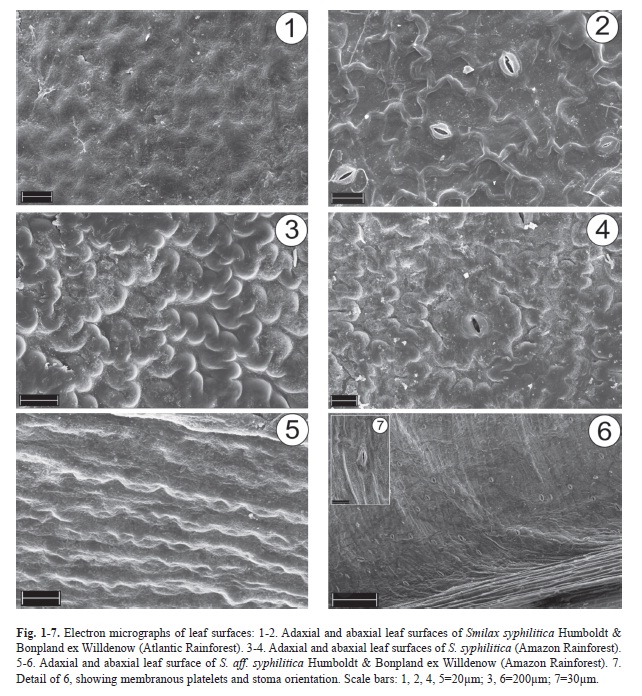
<body><![CDATA[<br style="font-family: verdana;">     <font size="2"><span style="font-family: verdana;">Epicuticular wax     structure varies     with leaf surface and species (<a      href="/img/revistas/rbt/v60n3/a14i1.jpg">Fig. 1</a>-<a      href="/img/revistas/rbt/v60n3/a14i1.jpg">7</a>). On the adaxial side,     leaves     of <span style="font-style: italic;">S. syphilitica</span> from the     Atlantic Rainforest have granules and     platelets (<a href="/img/revistas/rbt/v60n3/a14i1.jpg">Fig. 1</a>),     ]]></body>
<body><![CDATA[whereas on the abaxial surface, there is a     reticulum with rounded ridges (<a      href="/img/revistas/rbt/v60n3/a14i1.jpg">Fig. 2</a>). Leaf blades of <span      style="font-style: italic;">S. syphilitica</span>     from the Amazon Rainforest have a network of rounded ridges on both     sides (<a href="/img/revistas/rbt/v60n3/a14i1.jpg">Fig. 3</a>-<a      href="/img/revistas/rbt/v60n3/a14i1.jpg">4</a>), and in <span      style="font-style: italic;">S. aff.     syphilitica</span>, these ridges are parallel     and the spaces between them are filled with numerous membranous     ]]></body>
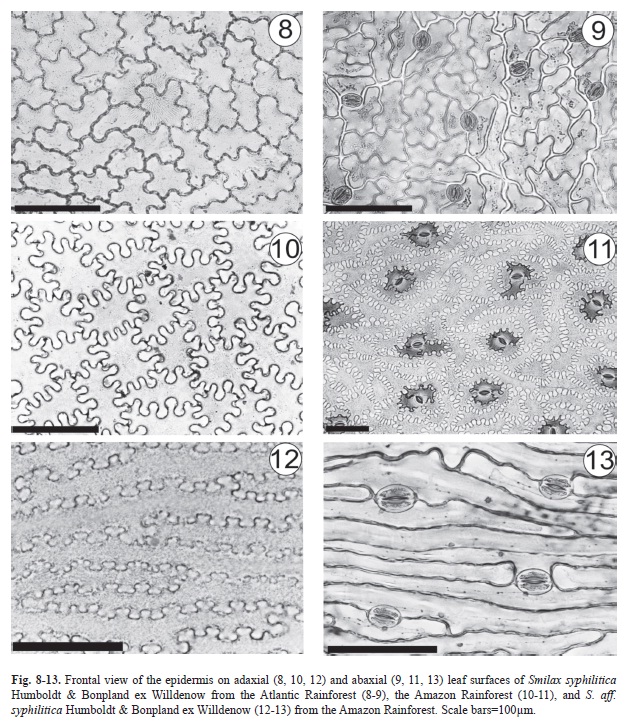
<body><![CDATA[platelets (<a href="/img/revistas/rbt/v60n3/a14i1.jpg">Fig. 5</a>-<a      href="/img/revistas/rbt/v60n3/a14i1.jpg">7</a>).<br      style="font-family: verdana;">     </span></font><br style="font-family: verdana;">     <font size="2"><span style="font-family: verdana;">In <span      style="font-style: italic;">Smilax syphilitica</span>, the leaves     are hypostomatic with randomly oriented stomata at the same level as     the adjacent cells (<a href="/img/revistas/rbt/v60n3/a14i8.jpg">Fig. 8</a>-<a      href="/img/revistas/rbt/v60n3/a14i8.jpg">11</a>); the polar axes are     directed towards the     ]]></body>
<body><![CDATA[mid-vein in <span style="font-style: italic;">S. aff. syphilitica</span>     (<a href="/img/revistas/rbt/v60n3/a14i8.jpg">Fig. 6</a>). However,     stomata of <span style="font-style: italic;">S.     syphilitica</span> are paracytic (<a      href="/img/revistas/rbt/v60n3/a14i8.jpg">Fig. 9</a>, <a      href="/img/revistas/rbt/v60n3/a14i8.jpg">11</a>), whereas in <span      style="font-style: italic;">S. aff. syphilitica</span>,     the stomata are both are paracytic and anisocytic (<a      href="/img/revistas/rbt/v60n3/a14i8.jpg">Fig. 13</a>). In all of     the samples, a uniseriate epidermis covered by a thick cuticle, which     ]]></body>
<body><![CDATA[forms flanges. Viewed from the front, the epidermal cells of <span      style="font-style: italic;">S.     syphilitica</span> have sinuous walls (<a      href="/img/revistas/rbt/v60n3/a14i8.jpg">Fig. 8</a>-<a      href="/img/revistas/rbt/v60n3/a14i8.jpg">9</a>) that are even more     pronounced     in samples from the Amazon (<a href="/img/revistas/rbt/v60n3/a14i8.jpg">Fig.     10</a>-<a href="/img/revistas/rbt/v60n3/a14i8.jpg">11</a>). In <span      style="font-style: italic;">S. aff. syphilitica</span>, these     cells are also sinuous but elongated in the cross-section of the blade     ]]></body>
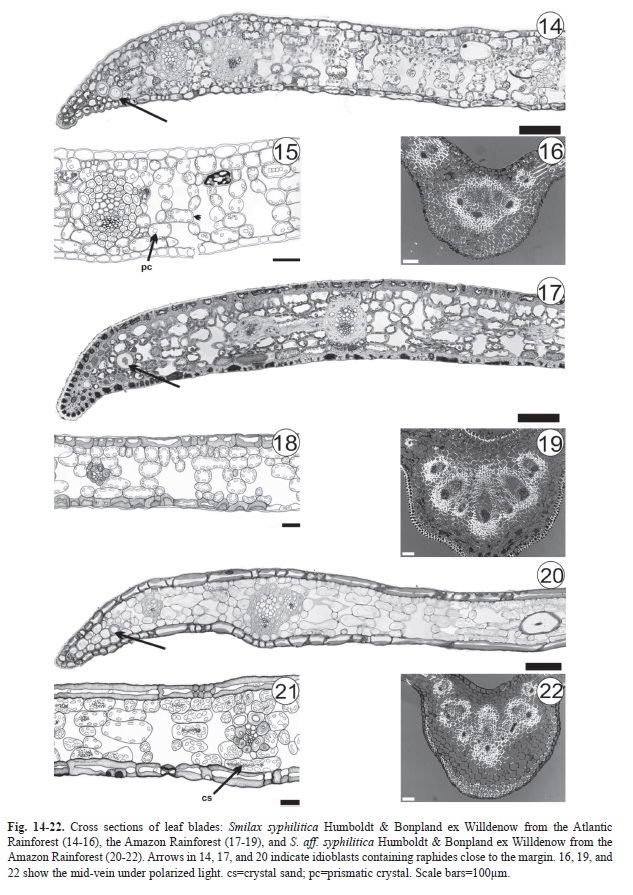
<body><![CDATA[and arranged in parallel (<a href="/img/revistas/rbt/v60n3/a14i8.jpg">Fig.     12</a>-<a href="/img/revistas/rbt/v60n3/a14i8.jpg">13</a>).<br      style="font-family: verdana;">     </span></font><br style="font-family: verdana;">     <font size="2"><span style="font-family: verdana;">Epidermal cell walls     are thickened     in the inner periclinal and anticlinal walls, as seen in </span></font><font      size="2"><span style="font-family: verdana;">the cross-sections     of <span style="font-style: italic;">S.     syphilitica</span> leaves from the Amazon (<a     ]]></body>
<body><![CDATA[ href="/img/revistas/rbt/v60n3/a14i14.jpg">Fig. 17</a>-<a      href="/img/revistas/rbt/v60n3/a14i14.jpg">18</a>). In <span      style="font-style: italic;">S. aff.     syphilitica</span>, this thickening occurs in all epidermal cell walls     (<a href="/img/revistas/rbt/v60n3/a14i14.jpg">Fig.     20</a>-<a href="/img/revistas/rbt/v60n3/a14i14.jpg">21</a>). Staining     with methylene blue and Calcofluor White MR2 has shown     that the thickened wall is composed of pectin and cellulose.<br      style="font-family: verdana;">     </span></font><br style="font-family: verdana;">     ]]></body>
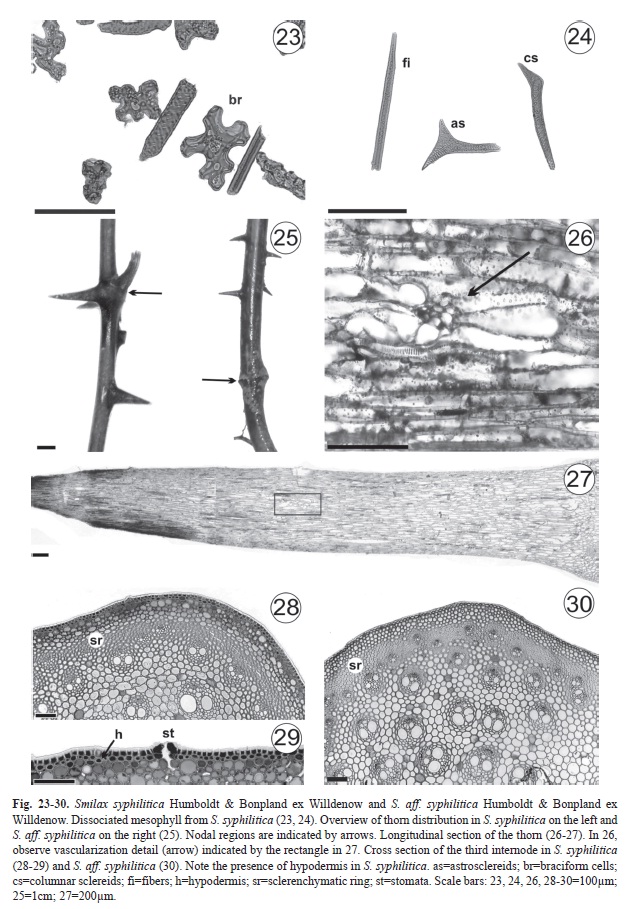
<body><![CDATA[<font size="2"><span style="font-family: verdana;">In all of the     samples, the     mesophyll is homogeneous (<a href="/img/revistas/rbt/v60n3/a14i14.jpg">Fig.     14</a>-<a href="/img/revistas/rbt/v60n3/a14i14.jpg">15</a>, <a      href="/img/revistas/rbt/v60n3/a14i14.jpg">17</a>-<a      href="/img/revistas/rbt/v60n3/a14i14.jpg">18</a>, <a      href="/img/revistas/rbt/v60n3/a14i14.jpg">20</a>-<a      href="/img/revistas/rbt/v60n3/a14i14.jpg">21</a>) and consists of     five-seven layers of braciform cells (<a      href="/img/revistas/rbt/v60n3/a14i23.jpg">Fig. 23</a>). Idioblasts     ]]></body>
<body><![CDATA[containing     raphides along the leaf margin region are common (<a      href="/img/revistas/rbt/v60n3/a14i14.jpg">Fig. 14</a>, <a      href="/img/revistas/rbt/v60n3/a14i14.jpg">17</a>, <a      href="/img/revistas/rbt/v60n3/a14i14.jpg">20</a>).     Calcium oxalate crystals in <span style="font-style: italic;">S.     syphilitica</span> are prisms (<a      href="/img/revistas/rbt/v60n3/a14i14.jpg">Fig. 15</a>),     whereas in <span style="font-style: italic;">S. aff. syphilitica</span>,     they are crystal sand (<a href="/img/revistas/rbt/v60n3/a14i14.jpg">Fig.     ]]></body>
<body><![CDATA[21</a>).</span></font><br style="font-family: verdana;">     <font size="2"><span style="font-family: verdana;">Fibers, columnar     sclereids, and     astrosclereids, the latter of which is not observed in <span      style="font-style: italic;">S. aff.     syphilitica</span>, are the types of lignified cells that were found     (<a href="/img/revistas/rbt/v60n3/a14i23.jpg">Fig.     24</a>). In <span style="font-style: italic;">S. syphilitica</span>     from     the Atlantic Rainforest, the parenchyma     ]]></body>
<body><![CDATA[cells have a conspicuous thickening of the cell wall (<a      href="/img/revistas/rbt/v60n3/a14i14.jpg">Fig. 15</a>) not     observed in other samples (<a href="/img/revistas/rbt/v60n3/a14i14.jpg">Fig.     18</a>, <a href="/img/revistas/rbt/v60n3/a14i14.jpg">21</a>).</span></font><br      style="font-family: verdana;">     <br style="font-family: verdana;">     <font size="2"><span style="font-family: verdana;">The mid-vein region     has between     threeeight collateral vascular bundles (<a      href="/img/revistas/rbt/v60n3/a14i14.jpg">Fig. 16</a>, </span></font><font     ]]></body>
<body><![CDATA[ size="2"><span style="font-family: verdana;"><a      href="/img/revistas/rbt/v60n3/a14i14.jpg">19</a>, <a      href="/img/revistas/rbt/v60n3/a14i14.jpg">22</a>), and sclerenchyma     sheaths     sharedby mid-vein vascular bundles were observed </span></font><font      size="2"><span style="font-family: verdana;">only in <span      style="font-style: italic;">S. syphilitica</span> from the     Atlantic Rainforest (<a href="/img/revistas/rbt/v60n3/a14i14.jpg">Fig.     16</a>).</span></font><br style="font-family: verdana;">     <font size="2"><span style="font-family: verdana;">Phenolic, protein,     ]]></body>
<body><![CDATA[and starch grain     content (the latter two are only observed in the midvein) are present     only in leaf blade cells of <span style="font-style: italic;">S.     syphilitica</span> from both sources.</span></font><br      style="font-family: verdana;">     <br style="font-family: verdana;">     <font size="2"><span style="font-family: verdana;">Thorns (<a      href="/img/revistas/rbt/v60n3/a14i23.jpg">Fig. 25</a>-<a      href="/img/revistas/rbt/v60n3/a14i23.jpg">27</a>)     occur in nodes     ]]></body>
<body><![CDATA[and internodes of <span style="font-style: italic;">S. syphilitica</span>     but only in the internodes of <span style="font-style: italic;">S.     aff.     syphilitica</span>.</span></font><br style="font-family: verdana;">     <br style="font-family: verdana;">     <font size="2"><span style="font-family: verdana;">In the three     internode regions that     were analyzed, the epidermis is uniseriate with stomata and covered by     a thick cuticle. In <span style="font-style: italic;">S. syphilitica</span>,     the epidermis has cells with     ]]></body>
<body><![CDATA[phenolic and protein content. We observed that the hypodermis, which     underlies the epidermis (<a href="/img/revistas/rbt/v60n3/a14i23.jpg">Fig.     28-</a><a href="/img/revistas/rbt/v60n3/a14i23.jpg">29</a>), has     different degrees of     lignifications and many protein and phenolic idioblasts. This tissue     was not observed in plants that attach themselves to tree trunks; this     characteristic is typical of vines, but only in those that remain small     shrubs. In the third internode of <span style="font-style: italic;">Smilax     syphilitica</span> and <span style="font-style: italic;">S. aff.     syphilitica</span>, there are between three-five chlorenchyma layers     ]]></body>
<body><![CDATA[and a     continuous sclerenchymatic ring enveloping the vascular cylinder (<a      href="/img/revistas/rbt/v60n3/a14i23.jpg">Fig.     28</a>, <a href="/img/revistas/rbt/v60n3/a14i23.jpg">30</a>).</span></font><br      style="font-family: verdana;">     <br style="font-family: verdana;">     <font size="2"><span style="font-family: verdana;">In the cortex of <span      style="font-style: italic;">S. syphilitica</span>,     phenolic and protein idioblasts are common, and spherical and     polyhedral starch grains are observed exclusively in the central     ]]></body>
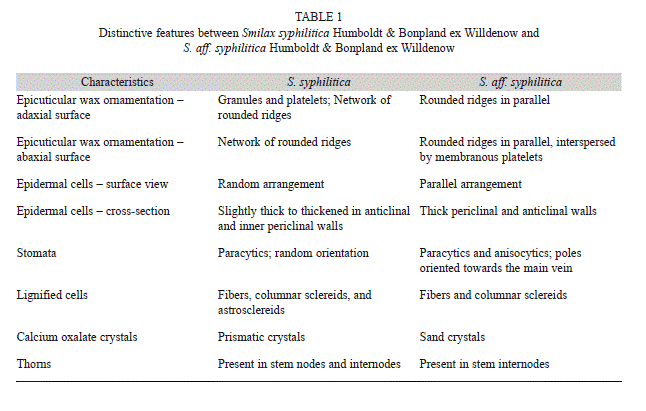
<body><![CDATA[parenchyma. Idioblasts containing raphides are restricted to the cortex     in <span style="font-style: italic;">S. syphilitica</span> and <span      style="font-style: italic;">S. aff. syphilitica</span>. <a      href="/img/revistas/rbt/v60n3/a14t1.gif">Table 1</a>     summarizes the     distinguishing features between them.</span></font><br      style="font-family: verdana;">     <br style="font-family: verdana;">     <font style="font-weight: bold;" size="3"><span      style="font-family: verdana;">Discussion</span></font><br     ]]></body>
<body><![CDATA[ style="font-family: verdana;">     <br style="font-family: verdana;">     <font size="2"><span style="font-family: verdana;">First, it is     noteworthy that very     few individuals of the species examined could be located in the field.     The reasons behind this distribution are uncertain, although as stated     by Lacy (2000), a small population of scattered individuals is more     vulnerable to extinction.</span></font><br style="font-family: verdana;">     <br style="font-family: verdana;">     <font size="2"><span style="font-family: verdana;">Leaf morphology did     ]]></body>
<body><![CDATA[not vary     between <span style="font-style: italic;">S. syphilitica</span> and <span      style="font-style: italic;">S. aff. syphilitica</span> or between     sampling     areas. Although there are differences in the length and width of the     leaf blades, the shape and venation patterns are the same.Guaglianone     &amp; Gattuso (1991) observed differences in leaf shape in <span      style="font-style: italic;">S.     campestris</span> Grisebach and recognized that this character is     subject to     ]]></body>
<body><![CDATA[phenotypic variation among species according to its distribution.</span></font><br      style="font-family: verdana;">     <br style="font-family: verdana;">     <font size="2"><span style="font-family: verdana;">According to Jenks     &amp; Ashworth     (1999), variations in the deposition patterns of epicuticular wax may     be attributable to different stressors at various stages of plant     development. However, Moore <span style="font-style: italic;">et al</span>.     (2008) only used these patterns to     taxonomically differentiate the species for the first time (according     ]]></body>
<body><![CDATA[to the authors). The ornamental patterns of epicuticular wax should not     be used as the sole taxonomic tool for distinguishing species of     <span style="font-style: italic;">Smilax</span>; in <span      style="font-style: italic;">S. syphilitica</span> and <span      style="font-style: italic;">S. aff. syphilitica</span>, there are     variations     between individuals of <span style="font-style: italic;">S. syphilitica</span>     from the Atlantic and Amazon     Rainforests. However, the patterns observed in <span      style="font-style: italic;">S. syphilitica</span> and <span     ]]></body>
<body><![CDATA[ style="font-style: italic;">S.     aff. syphilitica</span> differ from those described in <span      style="font-style: italic;">S. spicata</span> Vell., <span      style="font-style: italic;">S.     rufescens </span>Griseb., <span style="font-style: italic;">S.     fluminensis</span> Steudel (Marquete &amp; Pontes 1994),     and <span style="font-style: italic;">S. polyantha</span> (Martins     &amp; Appezzato-da-Gl&oacute;ria 2006). </span></font><br      style="font-family: verdana;">     <br style="font-family: verdana;">     ]]></body>
<body><![CDATA[<font size="2"><span style="font-family: verdana;">Laakso <span      style="font-style: italic;">et al</span>. (2000) found an     increase in secondary wall thickness of <span      style="font-style: italic;">Pinus</span> L. leaf epidermis that     had been subjected to high UVB radiation. Wall thickness is dependent     on variations in gene regulation (Ca&ntilde;o-Delgado <span      style="font-style: italic;">et al</span>. 2000, Kim     <span style="font-style: italic;">et al</span>. 2002), thickness, and     composition, which involve differentiation     and communication between neighboring cells (Roberts 2001). This     ]]></body>
<body><![CDATA[becomes clearer when examining the DNA of <span      style="font-style: italic;">Arabidopsis thaliana</span> (L.)     Heynh, in which approximately 1 000 genes are involved in cell wall     formation (Roberts 2001). Therefore, this mechanism appears to be more     related to genomic characteristics of the <span      style="font-style: italic;">S. syphilitica</span> and <span      style="font-style: italic;">S. aff.     syphilitica</span> specimens we analyzed rather than to environmental     influences, suggesting that cell wall formation may consequently be of     taxonomic value.</span></font><br style="font-family: verdana;">     ]]></body>
<body><![CDATA[<br style="font-family: verdana;">     <font size="2"><span style="font-family: verdana;">Analysis of     epidermal cell walls in     surface views has been a widely used method of characterizing species     of the genus <span style="font-style: italic;">Smilax</span> L.     (Guaglianone &amp; Gattuso 1991, Marquete &amp;     Pontes 1994, Guimar&atilde;es <span style="font-style: italic;">et al</span>.     2010), and we also considered that     these cell walls have taxonomic value; both <span      style="font-style: italic;">S. syphilitica</span> and have sinuous     ]]></body>
<body><![CDATA[walls but only in S. <span style="font-style: italic;">S. aff.     Syphiliticaaff. Syphilitica</span> they are     elongated in the cross-section of the blade and arranged in parallel.     According to Haberlandt (1928) the cell wall sinuosity of the epidermis     increases contact among adjacent cells, and may help to maintain leaf     structure under mechanical stress. Variation in the degree of sinuosity     in epidermal cell walls observed in <span style="font-style: italic;">S.     syphilitica</span> is related to stress     during leaf differentiation (Avery 1933), the cuticle hardening process     (Watson 1942), and variations in environmental conditions (Watson 1942,     ]]></body>
<body><![CDATA[Omosun <span style="font-style: italic;">et al</span>. 2008). </span></font><br      style="font-family: verdana;">     <br style="font-family: verdana;">     <font size="2"><span style="font-family: verdana;">Classification of     stomata and     mesophyll has also been used for distinguishing species of <span      style="font-style: italic;">Smilax</span>     (Guaglianone &amp; Gattuso 1991, Marquete &amp; Pontes 1994, Andreata     1997, Martins &amp; Appezzato-da-Gl&oacute;ria 2006, Palhares <span      style="font-style: italic;">et al</span>.     ]]></body>
<body><![CDATA[2009, Guimar&atilde;es <span style="font-style: italic;">et al</span>.     2010). Thus, leaves of <span style="font-style: italic;">S. syphilitica</span>     and     <span style="font-style: italic;">S. aff. syphilitica</span> can also     be differentiated by this criterion. Among     other criteria, Moore <span style="font-style: italic;">et al</span>.     (2010) used the orientation of the     stomatal poles to differentiate six species (<span      style="font-style: italic;">S. verruculosa</span>, <span      style="font-style: italic;">S.     ]]></body>
<body><![CDATA[megacarpa</span>, <span style="font-style: italic;">S. bracteata</span>,     <span style="font-style: italic;">S. pottingeri</span>, <span      style="font-style: italic;">S. micro-china</span>, and <span      style="font-style: italic;">S.     corbularia</span>). This analysis of stomatal poles also enhanced our     ability     to distinguish between <span style="font-style: italic;">S. syphilitica</span>     and <span style="font-style: italic;">S. aff. syphilitica</span>.</span></font><br      style="font-family: verdana;">     <br style="font-family: verdana;">     ]]></body>
<body><![CDATA[<font size="2"><span style="font-family: verdana;">The presence of     idioblasts with     raphides on the leaf blade margins of <span style="font-style: italic;">S.     syphilitica</span> and </span></font><font size="2"><span      style="font-family: verdana;"><span style="font-style: italic;">S.     aff. syphilitica</span> is common for     the genus (Yates &amp; Duncan 1970, Guaglianone &amp; Gattuso 1991,     Marquete &amp; Pontes 1994, Martins &amp; Appezzato-da-Gl&oacute;ria     2006). The prismatic and sand crystals observed throughout the     mesophyll of <span style="font-style: italic;">S. syphilitica</span>     ]]></body>
<body><![CDATA[and <span style="font-style: italic;">S. aff. syphilitica</span>,     respectively, are     tiny structures that together with the styloids, raphides, and druse     crystals make up the five main forms of calcium oxalate crystals     (Metcalfe &amp; Chalk 1950). Prychid &amp; Rudall (1999) noted in a     review that the absence, presence, and shape of calcium oxalate     crystals are &#8220;useful taxonomic features&#8221; in monocotyledon     classification. Crystal morphology can vary between different plant     organs and tissues, whereas within the same species, this feature     remains constant (Franceschi &amp; Nakata 2005). Differences in crystal     ]]></body>
<body><![CDATA[type were observed between <span style="font-style: italic;">S.     syphilitica</span> and <span style="font-style: italic;">S. aff.     syphilitica</span>. </span></font><br style="font-family: verdana;">     <br style="font-family: verdana;">     <font size="2"><span style="font-family: verdana;">The analysis of     mesophyll type,     lignified cell type, vascular bundle type, and sclerenchyma sheaths     shared along the mid-vein are commonly used for identifying species of     the genus (Yates &amp; Duncan 1970, Guaglianone &amp; Gattuso 1991,     Marquete &amp; Pontes 1994, Gattuso 1995, Martins &amp;     ]]></body>
<body><![CDATA[Appezzato-da-Gl&oacute;ria 2006, Guimar&atilde;es <span      style="font-style: italic;">et al</span>. 2010) and can     also be used to differentiate <span style="font-style: italic;">S.     syphilitica</span> and <span style="font-style: italic;">S. aff.     syphilitica</span>.</span></font><br style="font-family: verdana;">     <br style="font-family: verdana;">     <font size="2"><span style="font-family: verdana;">The presence of     hypodermis in the     stem of <span style="font-style: italic;">S. syphilitica</span> from     the Atlantic Rainforest can be explained by     ]]></body>
<body><![CDATA[the habitats in which individuals were collected; in other words,     hypodermis was absent in epiphytes but present in shrubs. This is     because in individuals from the Amazon Rainforest (all shrubs), the     hypodermis is similar to <span style="font-style: italic;">Lycopordiella     cernua</span> (L.) Pic. Serm     (Lycopodiaceae), a vine that keeps this tissue until it reaches a     height of approximately one meter and needs mechanical support from     adjacent plants to develop an epiphytic habit (Rowe <span      style="font-style: italic;">et al</span>. 2004). The     presence of hypodermis is considered useful for differentiating between     ]]></body>
<body><![CDATA[species of Indian palm (Arecaceae) (Mathew &amp; Bhat 2008). Similarly,     paleobotany studies use this tissue for taxonomic distinction between     extinct vine species (Li &amp; Taylor 1998, Dunn <span      style="font-style: italic;">et al</span>. 2003). Here,     the presence or absence of hypodermis as it relates to species,     environment of origin, habit, and stem portion is a major caveat     regarding use of this character to differentiate between groups.</span></font><br      style="font-family: verdana;">     <br style="font-family: verdana;">     <font size="2"><span style="font-family: verdana;">Based on anatomical     ]]></body>
<body><![CDATA[differences     between S. syphilitica and <span style="font-style: italic;">S. aff.     syphilitica</span> we suggest further     morphological studies in all <span style="font-style: italic;">Smilax</span>     species occurring in the Amazon     region in order to verify if <span style="font-style: italic;">S. aff.     syphilitica</span> is in fact a new taxon.</span></font><br      style="font-family: verdana;">     <br style="font-family: verdana;">     <font style="font-weight: bold;" size="3"><span     ]]></body>
<body><![CDATA[ style="font-family: verdana;">Acknowledgments</span></font><br      style="font-family: verdana;">     <br style="font-family: verdana;">     <font size="2"><span style="font-family: verdana;">We thank to     S&atilde;o Paulo     Research Foundation&#8211; FAPESP-BIOTA Program (Project Proc. n&ordm;     05/54984-5 and Proc. n&ordm; 05/58964-9), for the financial support of     this research and CNPq (National Council for Scientific and     Technological Development) for research grants (Proc. n&ordm;     302776/2010-9 and 304147/2009-5). We also thank Marli Kasue Misaki     ]]></body>
<body><![CDATA[Soares for technical laboratory support.    <br> <br style="font-family: verdana;"> </span></font> <hr style="width: 100%; height: 2px;"><br style="font-family: verdana;"> <font style="font-weight: bold;" size="3">    <!-- ref --><br> <span style="font-family: verdana;">References</span></font><br  style="font-family: verdana;"> <font size="2"><span style="font-family: verdana;">Andreata, R.H.P. 1980. <span style="font-style: italic;">Smilax</span> Linnaeus (Smilacaceae). Ensaio para uma revis&atilde;o das esp&eacute;cies brasileiras. Arq. Jard. Bot. Rio de Janeiro 24: 179-301.    &nbsp;&nbsp;&nbsp;&nbsp;&nbsp;&nbsp;&nbsp;&nbsp;[&#160;<a href="javascript:void(0);" onclick="javascript: window.open('/scielo.php?script=sci_nlinks&ref=1475969&pid=S0034-7744201200030001400001&lng=','','width=640,height=500,resizable=yes,scrollbars=1,menubar=yes,');">Links</a>&#160;]<!-- end-ref --><!-- ref --></span></font><br  style="font-family: verdana;"> <br style="font-family: verdana;"> <font size="2"><span style="font-family: verdana;">Andreata, R.H.P. 1997. Revis&atilde;o das esp&eacute;cies brasileiras do g&ecirc;nero <span  style="font-style: italic;">Smilax</span> Linnaeus (Smilacaceae). Pesqui. Bot. 47: 7-244.    &nbsp;&nbsp;&nbsp;&nbsp;&nbsp;&nbsp;&nbsp;&nbsp;[&#160;<a href="javascript:void(0);" onclick="javascript: window.open('/scielo.php?script=sci_nlinks&ref=1475970&pid=S0034-7744201200030001400002&lng=','','width=640,height=500,resizable=yes,scrollbars=1,menubar=yes,');">Links</a>&#160;]<!-- end-ref --><!-- ref --></span></font><br  style="font-family: verdana;"> <br style="font-family: verdana;"> <font size="2"><span style="font-family: verdana;">Andreata, R.H.P. 2009. A new species of <span style="font-style: italic;">Smilax</span> and a key to all species of Minas Gerais, Brazil. Syst. Bot. 34: 28-31.    &nbsp;&nbsp;&nbsp;&nbsp;&nbsp;&nbsp;&nbsp;&nbsp;[&#160;<a href="javascript:void(0);" onclick="javascript: window.open('/scielo.php?script=sci_nlinks&ref=1475971&pid=S0034-7744201200030001400003&lng=','','width=640,height=500,resizable=yes,scrollbars=1,menubar=yes,');">Links</a>&#160;]<!-- end-ref --><!-- ref --></span></font><br style="font-family: verdana;"> <br style="font-family: verdana;"> <font size="2"><span style="font-family: verdana;">Avery, G.S. 1933. Structure and development of the tobacco leaf. Am. J. Bot. 20: 565-592.    &nbsp;&nbsp;&nbsp;&nbsp;&nbsp;&nbsp;&nbsp;&nbsp;[&#160;<a href="javascript:void(0);" onclick="javascript: window.open('/scielo.php?script=sci_nlinks&ref=1475972&pid=S0034-7744201200030001400004&lng=','','width=640,height=500,resizable=yes,scrollbars=1,menubar=yes,');">Links</a>&#160;]<!-- end-ref --><!-- ref --></span></font><br  style="font-family: verdana;"> <br style="font-family: verdana;"> <font size="2"><span style="font-family: verdana;">Barthlott, W., C. Neinhuis, D. Cutler, F. Ditsch, I. Meusel, I. Theisen &amp; H. Wilhelmi. 1998. Classification and terminology of plant epicuticular waxes. Bot. J. Linn. Soc. 126: 237-260.    &nbsp;&nbsp;&nbsp;&nbsp;&nbsp;&nbsp;&nbsp;&nbsp;[&#160;<a href="javascript:void(0);" onclick="javascript: window.open('/scielo.php?script=sci_nlinks&ref=1475973&pid=S0034-7744201200030001400005&lng=','','width=640,height=500,resizable=yes,scrollbars=1,menubar=yes,');">Links</a>&#160;]<!-- end-ref --><!-- ref --></span></font><br style="font-family: verdana;"> <br style="font-family: verdana;"> <font size="2"><span style="font-family: verdana;">Berlyn, G.P. &amp; J.P. Miksche. 1976. Botanical microtechnique and cytochemistry. Iwoa State University, Ames, Iwoa.    &nbsp;&nbsp;&nbsp;&nbsp;&nbsp;&nbsp;&nbsp;&nbsp;[&#160;<a href="javascript:void(0);" onclick="javascript: window.open('/scielo.php?script=sci_nlinks&ref=1475974&pid=S0034-7744201200030001400006&lng=','','width=640,height=500,resizable=yes,scrollbars=1,menubar=yes,');">Links</a>&#160;]<!-- end-ref --><!-- ref --></span></font><br style="font-family: verdana;"> <br style="font-family: verdana;"> <font size="2"><span style="font-family: verdana;">Ca&ntilde;o-Delgado, A.I., K. Metzlaff &amp; M.W. Bevan. 2000. The eli1 mutation reveals a link between cell expansion and secondary cell wall formation in <span  style="font-style: italic;">Arabidopsis thaliana</span>. Development 127: 3395-3405.    &nbsp;&nbsp;&nbsp;&nbsp;&nbsp;&nbsp;&nbsp;&nbsp;[&#160;<a href="javascript:void(0);" onclick="javascript: window.open('/scielo.php?script=sci_nlinks&ref=1475975&pid=S0034-7744201200030001400007&lng=','','width=640,height=500,resizable=yes,scrollbars=1,menubar=yes,');">Links</a>&#160;]<!-- end-ref --><!-- ref --></span></font><br  style="font-family: verdana;"> <br style="font-family: verdana;"> <font size="2"><span style="font-family: verdana;">Caponetti, J.D. &amp; M.W. Quimby. 1956. The comparative anatomy of certain species of <span  style="font-style: italic;">Smilax</span>. J. Am. Pharm. Assoc. 45: 691-696.    &nbsp;&nbsp;&nbsp;&nbsp;&nbsp;&nbsp;&nbsp;&nbsp;[&#160;<a href="javascript:void(0);" onclick="javascript: window.open('/scielo.php?script=sci_nlinks&ref=1475976&pid=S0034-7744201200030001400008&lng=','','width=640,height=500,resizable=yes,scrollbars=1,menubar=yes,');">Links</a>&#160;]<!-- end-ref --><!-- ref --></span></font><br  style="font-family: verdana;"> <br style="font-family: verdana;"> <font size="2"><span style="font-family: verdana;">Dunn, M.T., M. Krings, G. Mapes, G.W. Rothwell, R.H. Mapes &amp; S. Keqin. 2003. <span  style="font-style: italic;">Medullosa steinii</span> sp. nov., a seed fern vine from the Upper Mississippian. Rev. Palaeobot. Palyno. 124: 307-324.    &nbsp;&nbsp;&nbsp;&nbsp;&nbsp;&nbsp;&nbsp;&nbsp;[&#160;<a href="javascript:void(0);" onclick="javascript: window.open('/scielo.php?script=sci_nlinks&ref=1475977&pid=S0034-7744201200030001400009&lng=','','width=640,height=500,resizable=yes,scrollbars=1,menubar=yes,');">Links</a>&#160;]<!-- end-ref --><!-- ref --></span></font><br style="font-family: verdana;"> <br style="font-family: verdana;"> <font size="2"><span style="font-family: verdana;">Fisher, D.B. 1968. Protein staining of ribonned epon sections for light microscopy. Histochem. Cell Biol. 16: 92-96.    &nbsp;&nbsp;&nbsp;&nbsp;&nbsp;&nbsp;&nbsp;&nbsp;[&#160;<a href="javascript:void(0);" onclick="javascript: window.open('/scielo.php?script=sci_nlinks&ref=1475978&pid=S0034-7744201200030001400010&lng=','','width=640,height=500,resizable=yes,scrollbars=1,menubar=yes,');">Links</a>&#160;]<!-- end-ref --><!-- ref --></span></font><br style="font-family: verdana;"> <br style="font-family: verdana;"> <font size="2"><span style="font-family: verdana;">Franceschi, V.R. &amp; P.A. Nakata. 2005. Calcium oxalate in plants: formation and function. Annu. Rev. Plant. Biol. 56: 41-71.    &nbsp;&nbsp;&nbsp;&nbsp;&nbsp;&nbsp;&nbsp;&nbsp;[&#160;<a href="javascript:void(0);" onclick="javascript: window.open('/scielo.php?script=sci_nlinks&ref=1475979&pid=S0034-7744201200030001400011&lng=','','width=640,height=500,resizable=yes,scrollbars=1,menubar=yes,');">Links</a>&#160;]<!-- end-ref --><!-- ref --></span></font><br style="font-family: verdana;"> <br style="font-family: verdana;"> <font size="2"><span style="font-family: verdana;">Gattuso, S. 1995. Exomorfologia y anatomia de <span style="font-style: italic;">Smilax</span> <span  style="font-style: italic;">campestris </span>Griseb. (Smilacaceae). Acta Farm. Bonaerense 14: 181-190.    &nbsp;&nbsp;&nbsp;&nbsp;&nbsp;&nbsp;&nbsp;&nbsp;[&#160;<a href="javascript:void(0);" onclick="javascript: window.open('/scielo.php?script=sci_nlinks&ref=1475980&pid=S0034-7744201200030001400012&lng=','','width=640,height=500,resizable=yes,scrollbars=1,menubar=yes,');">Links</a>&#160;]<!-- end-ref --><!-- ref --></span></font><br style="font-family: verdana;"> <br style="font-family: verdana;"> <font size="2"><span style="font-family: verdana;">Guaglianone, E.S. &amp; S. Gattuso. 1991. Estudios taxon&oacute;micos sobre el genero <span  style="font-style: italic;">Smilax</span> (Smilacaceae) I. Bol. Soc. Argent. Bot. 27: 105-129.    &nbsp;&nbsp;&nbsp;&nbsp;&nbsp;&nbsp;&nbsp;&nbsp;[&#160;<a href="javascript:void(0);" onclick="javascript: window.open('/scielo.php?script=sci_nlinks&ref=1475981&pid=S0034-7744201200030001400013&lng=','','width=640,height=500,resizable=yes,scrollbars=1,menubar=yes,');">Links</a>&#160;]<!-- end-ref --><!-- ref --></span></font><br  style="font-family: verdana;"> <br style="font-family: verdana;"> <font size="2"><span style="font-family: verdana;">Guimar&atilde;es, A.R., C.G. Costa &amp; R.H.P. Andreata. 2010. Morfoanatomia do sistema subterr&acirc;neo de <span style="font-style: italic;">Smilax</span> <span  style="font-style: italic;">subsessiliflora</span> (Smilacaceae). Rodrigu&eacute;sia 62: 181-194.    &nbsp;&nbsp;&nbsp;&nbsp;&nbsp;&nbsp;&nbsp;&nbsp;[&#160;<a href="javascript:void(0);" onclick="javascript: window.open('/scielo.php?script=sci_nlinks&ref=1475982&pid=S0034-7744201200030001400014&lng=','','width=640,height=500,resizable=yes,scrollbars=1,menubar=yes,');">Links</a>&#160;]<!-- end-ref --><!-- ref --></span></font><br  style="font-family: verdana;"> <br style="font-family: verdana;"> <font size="2"><span style="font-family: verdana;">Haberlandt, G. 1928. Physiological plant anatomy. MacMillan Company, London, United Kingdom.    &nbsp;&nbsp;&nbsp;&nbsp;&nbsp;&nbsp;&nbsp;&nbsp;[&#160;<a href="javascript:void(0);" onclick="javascript: window.open('/scielo.php?script=sci_nlinks&ref=1475983&pid=S0034-7744201200030001400015&lng=','','width=640,height=500,resizable=yes,scrollbars=1,menubar=yes,');">Links</a>&#160;]<!-- end-ref --><!-- ref --> </span></font><br  style="font-family: verdana;"> <br style="font-family: verdana;"> <font size="2"><span style="font-family: verdana;">Horridge, G.A. &amp; S.L. Tamm. 1969. Critical point drying for scanning electron microscopy study of ciliary motion. Science 163: 817-818.    &nbsp;&nbsp;&nbsp;&nbsp;&nbsp;&nbsp;&nbsp;&nbsp;[&#160;<a href="javascript:void(0);" onclick="javascript: window.open('/scielo.php?script=sci_nlinks&ref=1475984&pid=S0034-7744201200030001400016&lng=','','width=640,height=500,resizable=yes,scrollbars=1,menubar=yes,');">Links</a>&#160;]<!-- end-ref --><!-- ref --></span></font><br  style="font-family: verdana;"> <br style="font-family: verdana;"> <font size="2"><span style="font-family: verdana;">Hughes, J. &amp; M.E. McCully. 1975. The use of an optical brightener in the study of plant structure. Stain Technol. 50: 319-452.    &nbsp;&nbsp;&nbsp;&nbsp;&nbsp;&nbsp;&nbsp;&nbsp;[&#160;<a href="javascript:void(0);" onclick="javascript: window.open('/scielo.php?script=sci_nlinks&ref=1475985&pid=S0034-7744201200030001400017&lng=','','width=640,height=500,resizable=yes,scrollbars=1,menubar=yes,');">Links</a>&#160;]<!-- end-ref --><!-- ref --></span></font><br  style="font-family: verdana;"> <br style="font-family: verdana;"> <font size="2"><span style="font-family: verdana;">Jenks, M.A. &amp; E.N. Ashworth. 1999. Plant epicuticular waxes: function, production, and genetics, p. 1-68. <span style="font-style: italic;">In </span>J. Janick (ed.). Horticultural reviews. John Wiley &amp; Sons, New York, USA.    &nbsp;&nbsp;&nbsp;&nbsp;&nbsp;&nbsp;&nbsp;&nbsp;[&#160;<a href="javascript:void(0);" onclick="javascript: window.open('/scielo.php?script=sci_nlinks&ref=1475986&pid=S0034-7744201200030001400018&lng=','','width=640,height=500,resizable=yes,scrollbars=1,menubar=yes,');">Links</a>&#160;]<!-- end-ref --><!-- ref --></span></font><br style="font-family: verdana;"> <br style="font-family: verdana;"> <font size="2"><span style="font-family: verdana;">Johansen, D.A. 1940. Plant microtechnique. McGraw-Hill, New York, EEUU.    &nbsp;&nbsp;&nbsp;&nbsp;&nbsp;&nbsp;&nbsp;&nbsp;[&#160;<a href="javascript:void(0);" onclick="javascript: window.open('/scielo.php?script=sci_nlinks&ref=1475987&pid=S0034-7744201200030001400019&lng=','','width=640,height=500,resizable=yes,scrollbars=1,menubar=yes,');">Links</a>&#160;]<!-- end-ref --><!-- ref --></span></font><br  style="font-family: verdana;"> <br style="font-family: verdana;"> <font size="2"><span style="font-family: verdana;">Karnovsky, M.J. 1965. A formaldehyde-glutaraldehyde fixative of high osmolality for use in electron microscopy. J. Cell Biol. 27: 137-138.    &nbsp;&nbsp;&nbsp;&nbsp;&nbsp;&nbsp;&nbsp;&nbsp;[&#160;<a href="javascript:void(0);" onclick="javascript: window.open('/scielo.php?script=sci_nlinks&ref=1475988&pid=S0034-7744201200030001400020&lng=','','width=640,height=500,resizable=yes,scrollbars=1,menubar=yes,');">Links</a>&#160;]<!-- end-ref --><!-- ref --></span></font><br  style="font-family: verdana;"> <br style="font-family: verdana;"> <font size="2"><span style="font-family: verdana;">Kim, G., K. Shoda, T. Tsuge, K. Cho, H. Uchimia, R. Yokoyama, K. Nishitani &amp; H. Tsukaya. 2002. The <span style="font-style: italic;">ANGUSTIFOLIA </span>gene of Arabidopsis, a plant <span style="font-style: italic;">CtBP </span>gene, regulates leaf-cell expansion, the arrangement of cortical microtubules in leaf cells and expression of a gene involved in cell-wall formation. EMBO J. 21: 1267-1279.    &nbsp;&nbsp;&nbsp;&nbsp;&nbsp;&nbsp;&nbsp;&nbsp;[&#160;<a href="javascript:void(0);" onclick="javascript: window.open('/scielo.php?script=sci_nlinks&ref=1475989&pid=S0034-7744201200030001400021&lng=','','width=640,height=500,resizable=yes,scrollbars=1,menubar=yes,');">Links</a>&#160;]<!-- end-ref --><!-- ref --></span></font><br style="font-family: verdana;"> <br style="font-family: verdana;"> <font size="2"><span style="font-family: verdana;">Koyama, T. 1960. Materials toward a monograph of the genus <span style="font-style: italic;">Smilax</span>. Quart. J. Taiwan Mus. 13: 1-61.    &nbsp;&nbsp;&nbsp;&nbsp;&nbsp;&nbsp;&nbsp;&nbsp;[&#160;<a href="javascript:void(0);" onclick="javascript: window.open('/scielo.php?script=sci_nlinks&ref=1475990&pid=S0034-7744201200030001400022&lng=','','width=640,height=500,resizable=yes,scrollbars=1,menubar=yes,');">Links</a>&#160;]<!-- end-ref --><!-- ref --></span></font><br  style="font-family: verdana;"> <br style="font-family: verdana;"> <font size="2"><span style="font-family: verdana;">Laakso, K., J.H. Sullivan &amp; S. Huttunen. 2000. The effects of UV-B radiation on epidermal anatomy in loblolly pine (<span style="font-style: italic;">Pinus</span> taeda L.) and Scots pine (<span style="font-style: italic;">Pinus</span> <span  style="font-style: italic;">sylvestris</span> </span></font><font  size="2"><span style="font-family: verdana;">L.). Plant Cell Environ. 23: 461-472.    &nbsp;&nbsp;&nbsp;&nbsp;&nbsp;&nbsp;&nbsp;&nbsp;[&#160;<a href="javascript:void(0);" onclick="javascript: window.open('/scielo.php?script=sci_nlinks&ref=1475991&pid=S0034-7744201200030001400023&lng=','','width=640,height=500,resizable=yes,scrollbars=1,menubar=yes,');">Links</a>&#160;]<!-- end-ref --><!-- ref --></span></font><br style="font-family: verdana;"> <br style="font-family: verdana;"> <font size="2"><span style="font-family: verdana;">Lacy, R.C. 2000. Considering threats to the viability of small populations. Ecol. Bull. 48: 39-51.    &nbsp;&nbsp;&nbsp;&nbsp;&nbsp;&nbsp;&nbsp;&nbsp;[&#160;<a href="javascript:void(0);" onclick="javascript: window.open('/scielo.php?script=sci_nlinks&ref=1475992&pid=S0034-7744201200030001400024&lng=','','width=640,height=500,resizable=yes,scrollbars=1,menubar=yes,');">Links</a>&#160;]<!-- end-ref --><!-- ref --></span></font><br  style="font-family: verdana;"> <br style="font-family: verdana;"> <font size="2"><span style="font-family: verdana;">Li, H. &amp; D.W. Taylor. 1998. <span style="font-style: italic;">Aculeovinea yunguiensis</span> gen. <span  style="font-style: italic;">et </span>sp. nov. (Gigantopteridales), a new tax&oacute;n of Gigantopterid stem from the upper permian of Guizhou Province, China. Int. J. Plant Sci. 159: 1023-1033.    &nbsp;&nbsp;&nbsp;&nbsp;&nbsp;&nbsp;&nbsp;&nbsp;[&#160;<a href="javascript:void(0);" onclick="javascript: window.open('/scielo.php?script=sci_nlinks&ref=1475993&pid=S0034-7744201200030001400025&lng=','','width=640,height=500,resizable=yes,scrollbars=1,menubar=yes,');">Links</a>&#160;]<!-- end-ref --><!-- ref --></span></font><br  style="font-family: verdana;"> <br style="font-family: verdana;"> <font size="2"><span style="font-family: verdana;">Lorenzi, H. &amp; J.A. Matos. 2002. Plantas medicinais no Brasil: nativas e ex&oacute;ticas cultivadas. Instituto Plantarum, Nova Odessa, S&atilde;o Paulo, Brazil.    &nbsp;&nbsp;&nbsp;&nbsp;&nbsp;&nbsp;&nbsp;&nbsp;[&#160;<a href="javascript:void(0);" onclick="javascript: window.open('/scielo.php?script=sci_nlinks&ref=1475994&pid=S0034-7744201200030001400026&lng=','','width=640,height=500,resizable=yes,scrollbars=1,menubar=yes,');">Links</a>&#160;]<!-- end-ref --><!-- ref --></span></font><br  style="font-family: verdana;"> <br style="font-family: verdana;"> <font size="2"><span style="font-family: verdana;">Mandarim-de-Lacerda, A.F., R.H.P. Andreata &amp; P.R. Peres-Neto. 1992. Ensaio metodol&oacute;gico de avalia&ccedil;&atilde;o biom&eacute;trica em folhas adultas de <span  style="font-style: italic;">Smilax</span> <span style="font-style: italic;">rufescens</span> (Smilacaceae). Pesqui. Bot. 43: 199-221.    &nbsp;&nbsp;&nbsp;&nbsp;&nbsp;&nbsp;&nbsp;&nbsp;[&#160;<a href="javascript:void(0);" onclick="javascript: window.open('/scielo.php?script=sci_nlinks&ref=1475995&pid=S0034-7744201200030001400027&lng=','','width=640,height=500,resizable=yes,scrollbars=1,menubar=yes,');">Links</a>&#160;]<!-- end-ref --><!-- ref --></span></font><br style="font-family: verdana;"> <br style="font-family: verdana;"> <font size="2"><span style="font-family: verdana;">Marquete, O. &amp; R.G. Pontes. 1994. Estudo anat&oacute;mico foliar comparativo de <span  style="font-style: italic;">Smilax spicata</span> Vell., <span style="font-style: italic;">Smilax</span> <span  style="font-style: italic;">rufescens</span> Griseb. e <span  style="font-style: italic;">Smilax</span> <span  style="font-style: italic;">fluminensis</span> Steudel. Rev. Bras. Biol. 54: 413-426.    &nbsp;&nbsp;&nbsp;&nbsp;&nbsp;&nbsp;&nbsp;&nbsp;[&#160;<a href="javascript:void(0);" onclick="javascript: window.open('/scielo.php?script=sci_nlinks&ref=1475996&pid=S0034-7744201200030001400028&lng=','','width=640,height=500,resizable=yes,scrollbars=1,menubar=yes,');">Links</a>&#160;]<!-- end-ref --><!-- ref --></span></font><br style="font-family: verdana;"> <br style="font-family: verdana;"> <font size="2"><span style="font-family: verdana;">Martins, A.R. &amp; B. Appezzato-da-Gl&oacute;ria. 2006. Morfoanatomia dos &oacute;rg&atilde;os vegetativos de <span style="font-style: italic;">Smilax</span> <span style="font-style: italic;">polyantha</span> Griseb. (Smilacaceae). Rev. Bras. Bot. 29: 555-567.    &nbsp;&nbsp;&nbsp;&nbsp;&nbsp;&nbsp;&nbsp;&nbsp;[&#160;<a href="javascript:void(0);" onclick="javascript: window.open('/scielo.php?script=sci_nlinks&ref=1475997&pid=S0034-7744201200030001400029&lng=','','width=640,height=500,resizable=yes,scrollbars=1,menubar=yes,');">Links</a>&#160;]<!-- end-ref --><!-- ref --></span></font><br  style="font-family: verdana;"> <br style="font-family: verdana;"> <font size="2"><span style="font-family: verdana;">Mathew, A. &amp; K.M. Bhat. 2008. Anatomical diversity of Indian rattan palms (Calamoideae) in relation to biogeography and systematic. Bot. J. Linn. Soc. 125: 71-86.    &nbsp;&nbsp;&nbsp;&nbsp;&nbsp;&nbsp;&nbsp;&nbsp;[&#160;<a href="javascript:void(0);" onclick="javascript: window.open('/scielo.php?script=sci_nlinks&ref=1475998&pid=S0034-7744201200030001400030&lng=','','width=640,height=500,resizable=yes,scrollbars=1,menubar=yes,');">Links</a>&#160;]<!-- end-ref --><!-- ref --></span></font><br  style="font-family: verdana;"> <br style="font-family: verdana;"> <font size="2"><span style="font-family: verdana;">Metcalfe, C.R. &amp; L. Chalk. 1950. Anatomy of the dicotyledons. Clarendon, Oxford, United Kingdom.    &nbsp;&nbsp;&nbsp;&nbsp;&nbsp;&nbsp;&nbsp;&nbsp;[&#160;<a href="javascript:void(0);" onclick="javascript: window.open('/scielo.php?script=sci_nlinks&ref=1475999&pid=S0034-7744201200030001400031&lng=','','width=640,height=500,resizable=yes,scrollbars=1,menubar=yes,');">Links</a>&#160;]<!-- end-ref --><!-- ref --></span></font><br  style="font-family: verdana;"> <br style="font-family: verdana;"> <font size="2"><span style="font-family: verdana;">Metcalfe, C.R. &amp; L. Chalk. 1979. Anatomy of the dicotyledons. Clarendon, Oxford, United Kingdom.    &nbsp;&nbsp;&nbsp;&nbsp;&nbsp;&nbsp;&nbsp;&nbsp;[&#160;<a href="javascript:void(0);" onclick="javascript: window.open('/scielo.php?script=sci_nlinks&ref=1476000&pid=S0034-7744201200030001400032&lng=','','width=640,height=500,resizable=yes,scrollbars=1,menubar=yes,');">Links</a>&#160;]<!-- end-ref --><!-- ref --></span></font><br  style="font-family: verdana;"> <br style="font-family: verdana;"> <font size="2"><span style="font-family: verdana;">Medeiros, M.F.T., L. Senna-Valle &amp; R.H.P. Andreata. 2007. Hist&oacute;rico e o uso da &#8220;salsaparrilha&#8221; (<span style="font-style: italic;">Smilax</span> spp.) pelos botic&aacute;rios no Mosteiro de S&atilde;o Bento. Rev. Bras. Bioci. 5: 27-29.    &nbsp;&nbsp;&nbsp;&nbsp;&nbsp;&nbsp;&nbsp;&nbsp;[&#160;<a href="javascript:void(0);" onclick="javascript: window.open('/scielo.php?script=sci_nlinks&ref=1476001&pid=S0034-7744201200030001400033&lng=','','width=640,height=500,resizable=yes,scrollbars=1,menubar=yes,');">Links</a>&#160;]<!-- end-ref --><!-- ref --></span></font><br  style="font-family: verdana;"> <br style="font-family: verdana;"> <font size="2"><span style="font-family: verdana;">Moore, B.R., N.A. Narkkong, T. Moore &amp; P. Lutat. 2008. Epicuticular leaf architecture confirms a new <span style="font-style: italic;">Smilax</span> species (Smilacaceae) from northeast Thailand. Sci. Asia 34: 103-106.    &nbsp;&nbsp;&nbsp;&nbsp;&nbsp;&nbsp;&nbsp;&nbsp;[&#160;<a href="javascript:void(0);" onclick="javascript: window.open('/scielo.php?script=sci_nlinks&ref=1476002&pid=S0034-7744201200030001400034&lng=','','width=640,height=500,resizable=yes,scrollbars=1,menubar=yes,');">Links</a>&#160;]<!-- end-ref --><!-- ref --></span></font><br style="font-family: verdana;"> <br style="font-family: verdana;"> <font size="2"><span style="font-family: verdana;">Moore, B.R., T. Moore &amp; N.A. Narkkong. 2010. A preliminary systematic analysis of leaf epidermal characters for six <span style="font-style: italic;">Smilax</span> species in Thailand. Sci. Asia 36: 175-179.    &nbsp;&nbsp;&nbsp;&nbsp;&nbsp;&nbsp;&nbsp;&nbsp;[&#160;<a href="javascript:void(0);" onclick="javascript: window.open('/scielo.php?script=sci_nlinks&ref=1476003&pid=S0034-7744201200030001400035&lng=','','width=640,height=500,resizable=yes,scrollbars=1,menubar=yes,');">Links</a>&#160;]<!-- end-ref --><!-- ref --></span></font><br  style="font-family: verdana;"> <br style="font-family: verdana;"> <font size="2"><span style="font-family: verdana;">Omosun, G., A.A. Markson &amp; O. Mbanasor. 2008. Growth and anatomy of<span style="font-style: italic;"> Amaranthus hybridus</span> affected by different crude oil concentrations. Am. Eurasian J. Sci. Res. 3: 70-74.    &nbsp;&nbsp;&nbsp;&nbsp;&nbsp;&nbsp;&nbsp;&nbsp;[&#160;<a href="javascript:void(0);" onclick="javascript: window.open('/scielo.php?script=sci_nlinks&ref=1476004&pid=S0034-7744201200030001400036&lng=','','width=640,height=500,resizable=yes,scrollbars=1,menubar=yes,');">Links</a>&#160;]<!-- end-ref --><!-- ref --></span></font><br  style="font-family: verdana;"> <br style="font-family: verdana;"> <font size="2"><span style="font-family: verdana;">Palhares, D., C.E.S. Silveira, L.B.P. Zaidan &amp; L.A.R. Pereira. 2009. Leaf anatomy of <span  style="font-style: italic;">Smilax</span> <span style="font-style: italic;">goyazana </span>(Smilacaceae). Acta Bot. Hung. 51: 115-127.    &nbsp;&nbsp;&nbsp;&nbsp;&nbsp;&nbsp;&nbsp;&nbsp;[&#160;<a href="javascript:void(0);" onclick="javascript: window.open('/scielo.php?script=sci_nlinks&ref=1476005&pid=S0034-7744201200030001400037&lng=','','width=640,height=500,resizable=yes,scrollbars=1,menubar=yes,');">Links</a>&#160;]<!-- end-ref --><!-- ref --></span></font><br style="font-family: verdana;"> <br style="font-family: verdana;"> <font size="2"><span style="font-family: verdana;">Prychid, C.J. &amp; P.J. Rudall. 1999. Calcium oxalate crystals in monocotyledons: a review of their structure and systematic. Ann. Bot. 84: 725-739.    &nbsp;&nbsp;&nbsp;&nbsp;&nbsp;&nbsp;&nbsp;&nbsp;[&#160;<a href="javascript:void(0);" onclick="javascript: window.open('/scielo.php?script=sci_nlinks&ref=1476006&pid=S0034-7744201200030001400038&lng=','','width=640,height=500,resizable=yes,scrollbars=1,menubar=yes,');">Links</a>&#160;]<!-- end-ref --><!-- ref --></span></font><br  style="font-family: verdana;"> <br style="font-family: verdana;"> <font size="2"><span style="font-family: verdana;">Roberts, K. 2001. How the cell wall acquired a cellular context. Plant Physiol. 125: 127-130.    &nbsp;&nbsp;&nbsp;&nbsp;&nbsp;&nbsp;&nbsp;&nbsp;[&#160;<a href="javascript:void(0);" onclick="javascript: window.open('/scielo.php?script=sci_nlinks&ref=1476007&pid=S0034-7744201200030001400039&lng=','','width=640,height=500,resizable=yes,scrollbars=1,menubar=yes,');">Links</a>&#160;]<!-- end-ref --><!-- ref --></span></font><br  style="font-family: verdana;"> <br style="font-family: verdana;"> <font size="2"><span style="font-family: verdana;">Roeser, K.R. 1972. Die nadel der schwarzkiefer-massenprodukt und kunstwerk der natur. Mikrokosmos 61: 33-36.    &nbsp;&nbsp;&nbsp;&nbsp;&nbsp;&nbsp;&nbsp;&nbsp;[&#160;<a href="javascript:void(0);" onclick="javascript: window.open('/scielo.php?script=sci_nlinks&ref=1476008&pid=S0034-7744201200030001400040&lng=','','width=640,height=500,resizable=yes,scrollbars=1,menubar=yes,');">Links</a>&#160;]<!-- end-ref --><!-- ref --></span></font><br style="font-family: verdana;"> <br style="font-family: verdana;"> <font size="2"><span style="font-family: verdana;">Rowe, N., S. Isnard &amp; T. Speck. 2004. Diversity of mechanical architecture of climbing plants: evolutionary perspective. J. Plant Growth Regul. 23: 108-128.    &nbsp;&nbsp;&nbsp;&nbsp;&nbsp;&nbsp;&nbsp;&nbsp;[&#160;<a href="javascript:void(0);" onclick="javascript: window.open('/scielo.php?script=sci_nlinks&ref=1476009&pid=S0034-7744201200030001400041&lng=','','width=640,height=500,resizable=yes,scrollbars=1,menubar=yes,');">Links</a>&#160;]<!-- end-ref --><!-- ref --></span></font><br  style="font-family: verdana;"> <br style="font-family: verdana;"> <font size="2"><span style="font-family: verdana;">Sakai, W.S. 1973. Simple method for differential staining of paraffin embedded plant material using toluidine blue. Stain Technol. 48: 247-248.    &nbsp;&nbsp;&nbsp;&nbsp;&nbsp;&nbsp;&nbsp;&nbsp;[&#160;<a href="javascript:void(0);" onclick="javascript: window.open('/scielo.php?script=sci_nlinks&ref=1476010&pid=S0034-7744201200030001400042&lng=','','width=640,height=500,resizable=yes,scrollbars=1,menubar=yes,');">Links</a>&#160;]<!-- end-ref --><!-- ref --></span></font><br  style="font-family: verdana;"> <br style="font-family: verdana;"> <font size="2"><span style="font-family: verdana;">Watson, R.W. 1942. The effect of cuticular hardening on the form of epidermal cells. New Phytol. 41: 223-229.    &nbsp;&nbsp;&nbsp;&nbsp;&nbsp;&nbsp;&nbsp;&nbsp;[&#160;<a href="javascript:void(0);" onclick="javascript: window.open('/scielo.php?script=sci_nlinks&ref=1476011&pid=S0034-7744201200030001400043&lng=','','width=640,height=500,resizable=yes,scrollbars=1,menubar=yes,');">Links</a>&#160;]<!-- end-ref --><!-- ref --></span></font><br style="font-family: verdana;"> <br style="font-family: verdana;"> <font size="2"><span style="font-family: verdana;">Vandercolme, E. 1947. Hist&oacute;ria bot&acirc;nica e terap&ecirc;utica das salsaparrilhas. Rev. Flora Med. 7: 316-524.    &nbsp;&nbsp;&nbsp;&nbsp;&nbsp;&nbsp;&nbsp;&nbsp;[&#160;<a href="javascript:void(0);" onclick="javascript: window.open('/scielo.php?script=sci_nlinks&ref=1476012&pid=S0034-7744201200030001400044&lng=','','width=640,height=500,resizable=yes,scrollbars=1,menubar=yes,');">Links</a>&#160;]<!-- end-ref --><!-- ref --></span></font><br  style="font-family: verdana;"> <br style="font-family: verdana;"> <font size="2"><span style="font-family: verdana;">Yates, I.E. &amp; W.H. Duncan. 1970. Comparative studies of <span style="font-style: italic;">Smilax</span>, section <span style="font-style: italic;">Smilax</span>, of the southeastern United States. Rhodora 72: 289-312.    &nbsp;&nbsp;&nbsp;&nbsp;&nbsp;&nbsp;&nbsp;&nbsp;[&#160;<a href="javascript:void(0);" onclick="javascript: window.open('/scielo.php?script=sci_nlinks&ref=1476013&pid=S0034-7744201200030001400045&lng=','','width=640,height=500,resizable=yes,scrollbars=1,menubar=yes,');">Links</a>&#160;]<!-- end-ref --><br>     <br> <a name="Correspondencia1"></a><a href="#Correspondencia2">*</a>Correspondencia:    <br> </span></font><font size="2"><span style="font-family: verdana;">Jo&atilde;o Marcelo Silva: </span></font><font size="2"><span  style="font-family: verdana;"> Departmento de Ci&ecirc;ncias Biol&oacute;gicas, Escola Superior de Agricultura &#8216;Luiz de Queiroz&#8217;, Universidade de S&atilde;o Paulo, 13418-900, Piracicaba, SP, Brazil.<a  href="mailto:joaomarcsilva@yahoo.com.br"> </a>joaomarcsilva@yahoo.com.br</span></font>    ]]></body>
<body><![CDATA[<br> <font size="2"><span style="font-family: verdana;">Regina Helena Potsch Andreata: </span></font><font size="2"><span  style="font-family: verdana;">Instituto de Ci&ecirc;ncias Biol&oacute;gicas e Ambientais, Universidade Santa &Uacute;rsula, 22610-020, Rio de Janeiro; regina.andreata@gmail.com</span></font>    <br> <font size="2"><span style="font-family: verdana;">Beatriz Appezzato-da-Gl&oacute;ria: </span></font><font size="2"><span  style="font-family: verdana;"> Departmento de Ci&ecirc;ncias Biol&oacute;gicas, Escola Superior de Agricultura &#8216;Luiz de Queiroz&#8217;, Universidade de S&atilde;o Paulo, 13418-900, Piracicaba, SP, Brazil. </span></font><font  size="2"><span style="font-family: verdana;">bagloria@usp.br    <br> </span></font><font size="2"><span style="font-family: verdana;"><a  name="1"></a><a href="#3">1</a>. Departmento de Ci&ecirc;ncias Biol&oacute;gicas, Escola Superior de Agricultura &#8216;Luiz de Queiroz&#8217;, Universidade de S&atilde;o Paulo, 13418-900, Piracicaba, SP, Brazil; joaomarcsilva@yahoo.com.br, bagloria@usp.br</span></font><br style="font-family: verdana;"> <font size="2"><span style="font-family: verdana;"><a name="2"></a><a  href="#4">2</a>. Instituto de Ci&ecirc;ncias Biol&oacute;gicas e Ambientais, Universidade Santa &Uacute;rsula, 22610-020, Rio de Janeiro; regina.andreata@gmail.com</span></font><font  size="2"><span style="font-family: verdana;"></span></font><font  size="2"><span style="font-family: verdana;"></span></font>    <br> <hr style="width: 100%; height: 2px;">     <div style="text-align: center;"><font style="font-weight: bold;"  size="2"><span style="font-family: verdana;">Received 18-VIII-2011. Corrected 08-II-2012. Accepted 08-III-2012.</span></font><br  style="font-family: verdana;"> </div> </div> </div>      ]]></body><back>
<ref-list>
<ref id="B1">
<nlm-citation citation-type="journal">
<person-group person-group-type="author">
<name>
<surname><![CDATA[Andreata]]></surname>
<given-names><![CDATA[R.H.P.]]></given-names>
</name>
</person-group>
<article-title xml:lang="pt"><![CDATA[Smilax Linnaeus (Smilacaceae): Ensaio para uma revisão das espécies brasileiras]]></article-title>
<source><![CDATA[Arq. Jard. Bot. Rio de Janeiro]]></source>
<year>1980</year>
<volume>24</volume>
<page-range>179-301</page-range></nlm-citation>
</ref>
<ref id="B2">
<nlm-citation citation-type="journal">
<person-group person-group-type="author">
<name>
<surname><![CDATA[Andreata]]></surname>
<given-names><![CDATA[R.H.P.]]></given-names>
</name>
</person-group>
<article-title xml:lang="pt"><![CDATA[Revisão das espécies brasileiras do gênero Smilax Linnaeus (Smilacaceae).]]></article-title>
<source><![CDATA[Pesqui. Bot.]]></source>
<year>1997</year>
<volume>47</volume>
<page-range>7-244</page-range></nlm-citation>
</ref>
<ref id="B3">
<nlm-citation citation-type="journal">
<person-group person-group-type="author">
<name>
<surname><![CDATA[Andreata]]></surname>
<given-names><![CDATA[R.H.P.]]></given-names>
</name>
</person-group>
<article-title xml:lang="en"><![CDATA[A new species of Smilax and a key to all species of Minas Gerais, Brazil]]></article-title>
<source><![CDATA[Syst. Bot.]]></source>
<year>2009</year>
<volume>34</volume>
<page-range>28-31</page-range></nlm-citation>
</ref>
<ref id="B4">
<nlm-citation citation-type="journal">
<person-group person-group-type="author">
<name>
<surname><![CDATA[Avery]]></surname>
<given-names><![CDATA[G.S.]]></given-names>
</name>
</person-group>
<article-title xml:lang="en"><![CDATA[Structure and development of the tobacco leaf]]></article-title>
<source><![CDATA[Am. J. Bot.]]></source>
<year>1933</year>
<volume>20</volume>
<page-range>565-592</page-range></nlm-citation>
</ref>
<ref id="B5">
<nlm-citation citation-type="journal">
<person-group person-group-type="author">
<name>
<surname><![CDATA[Barthlott]]></surname>
<given-names><![CDATA[W.]]></given-names>
</name>
<name>
<surname><![CDATA[Neinhuis]]></surname>
<given-names><![CDATA[C.]]></given-names>
</name>
<name>
<surname><![CDATA[Cutler]]></surname>
<given-names><![CDATA[D.]]></given-names>
</name>
<name>
<surname><![CDATA[Ditsch]]></surname>
<given-names><![CDATA[F.]]></given-names>
</name>
<name>
<surname><![CDATA[Meusel]]></surname>
<given-names><![CDATA[I.]]></given-names>
</name>
<name>
<surname><![CDATA[Theisen]]></surname>
<given-names><![CDATA[I.]]></given-names>
</name>
<name>
<surname><![CDATA[Wilhelmi]]></surname>
<given-names><![CDATA[H.]]></given-names>
</name>
</person-group>
<article-title xml:lang="en"><![CDATA[Classification and terminology of plant epicuticular waxes.]]></article-title>
<source><![CDATA[Bot. J. Linn. Soc.]]></source>
<year>1998</year>
<volume>126</volume>
<page-range>237-260</page-range></nlm-citation>
</ref>
<ref id="B6">
<nlm-citation citation-type="book">
<person-group person-group-type="author">
<name>
<surname><![CDATA[Berlyn]]></surname>
<given-names><![CDATA[G.P.]]></given-names>
</name>
<name>
<surname><![CDATA[Miksche]]></surname>
<given-names><![CDATA[J.P.]]></given-names>
</name>
</person-group>
<source><![CDATA[Botanical microtechnique and cytochemistry]]></source>
<year>1976</year>
<publisher-loc><![CDATA[Ames^eIwoa Iwoa]]></publisher-loc>
<publisher-name><![CDATA[Iwoa State University]]></publisher-name>
</nlm-citation>
</ref>
<ref id="B7">
<nlm-citation citation-type="journal">
<person-group person-group-type="author">
<name>
<surname><![CDATA[Caño-Delgado]]></surname>
<given-names><![CDATA[A.I.]]></given-names>
</name>
<name>
<surname><![CDATA[Metzlaff]]></surname>
<given-names><![CDATA[K.]]></given-names>
</name>
<name>
<surname><![CDATA[Bevan]]></surname>
<given-names><![CDATA[M.W.]]></given-names>
</name>
</person-group>
<article-title xml:lang="en"><![CDATA[The eli1 mutation reveals a link between cell expansion and secondary cell wall formation in Arabidopsis thaliana]]></article-title>
<source><![CDATA[Development]]></source>
<year>2000</year>
<volume>127</volume>
<page-range>3395-3405</page-range></nlm-citation>
</ref>
<ref id="B8">
<nlm-citation citation-type="journal">
<person-group person-group-type="author">
<name>
<surname><![CDATA[Caponetti]]></surname>
<given-names><![CDATA[J.D.]]></given-names>
</name>
<name>
<surname><![CDATA[Quimby]]></surname>
<given-names><![CDATA[M.W.]]></given-names>
</name>
</person-group>
<article-title xml:lang="en"><![CDATA[The comparative anatomy of certain species of Smilax]]></article-title>
<source><![CDATA[J. Am. Pharm. Assoc.]]></source>
<year>1956</year>
<volume>45</volume>
<page-range>691-696</page-range></nlm-citation>
</ref>
<ref id="B9">
<nlm-citation citation-type="journal">
<person-group person-group-type="author">
<name>
<surname><![CDATA[Dunn]]></surname>
<given-names><![CDATA[M.T.]]></given-names>
</name>
<name>
<surname><![CDATA[Krings]]></surname>
<given-names><![CDATA[M.]]></given-names>
</name>
<name>
<surname><![CDATA[Mapes]]></surname>
<given-names><![CDATA[G.]]></given-names>
</name>
<name>
<surname><![CDATA[Rothwell]]></surname>
<given-names><![CDATA[G.W.]]></given-names>
</name>
<name>
<surname><![CDATA[Mapes]]></surname>
<given-names><![CDATA[R.H.]]></given-names>
</name>
<name>
<surname><![CDATA[Keqin]]></surname>
<given-names><![CDATA[S.]]></given-names>
</name>
</person-group>
<article-title xml:lang="en"><![CDATA[Medullosa steinii sp. nov., a seed fern vine from the Upper Mississippian]]></article-title>
<source><![CDATA[Rev. Palaeobot. Palyno.]]></source>
<year>2003</year>
<volume>124</volume>
<page-range>307-324</page-range></nlm-citation>
</ref>
<ref id="B10">
<nlm-citation citation-type="journal">
<person-group person-group-type="author">
<name>
<surname><![CDATA[Fisher]]></surname>
<given-names><![CDATA[D.B.]]></given-names>
</name>
</person-group>
<article-title xml:lang="en"><![CDATA[Protein staining of ribonned epon sections for light microscopy]]></article-title>
<source><![CDATA[Histochem. Cell Biol.]]></source>
<year>1968</year>
<volume>16</volume>
<page-range>92-96</page-range></nlm-citation>
</ref>
<ref id="B11">
<nlm-citation citation-type="journal">
<person-group person-group-type="author">
<name>
<surname><![CDATA[Franceschi]]></surname>
<given-names><![CDATA[V.R.]]></given-names>
</name>
<name>
<surname><![CDATA[Nakata]]></surname>
<given-names><![CDATA[P.A.]]></given-names>
</name>
</person-group>
<article-title xml:lang="en"><![CDATA[Calcium oxalate in plants: formation and function]]></article-title>
<source><![CDATA[Annu. Rev. Plant. Biol.]]></source>
<year>2005</year>
<volume>56</volume>
<page-range>41-71</page-range></nlm-citation>
</ref>
<ref id="B12">
<nlm-citation citation-type="journal">
<person-group person-group-type="author">
<name>
<surname><![CDATA[Gattuso]]></surname>
<given-names><![CDATA[S.]]></given-names>
</name>
</person-group>
<article-title xml:lang="en"><![CDATA[Exomorfologia y anatomia de Smilax campestris Griseb. (Smilacaceae).]]></article-title>
<source><![CDATA[Acta Farm. Bonaerense]]></source>
<year>1995</year>
<volume>14</volume>
<page-range>181-190</page-range></nlm-citation>
</ref>
<ref id="B13">
<nlm-citation citation-type="journal">
<person-group person-group-type="author">
<name>
<surname><![CDATA[Guaglianone]]></surname>
<given-names><![CDATA[E.S.]]></given-names>
</name>
<name>
<surname><![CDATA[Gattuso]]></surname>
<given-names><![CDATA[S.]]></given-names>
</name>
</person-group>
<article-title xml:lang="es"><![CDATA[Estudios taxonómicos sobre el genero Smilax (Smilacaceae) I]]></article-title>
<source><![CDATA[Bol. Soc. Argent. Bot.]]></source>
<year>1991</year>
<volume>27</volume>
<page-range>105-129</page-range></nlm-citation>
</ref>
<ref id="B14">
<nlm-citation citation-type="journal">
<person-group person-group-type="author">
<name>
<surname><![CDATA[Guimarães]]></surname>
<given-names><![CDATA[A.R.]]></given-names>
</name>
<name>
<surname><![CDATA[Costa]]></surname>
<given-names><![CDATA[C.G.]]></given-names>
</name>
<name>
<surname><![CDATA[Andreata]]></surname>
<given-names><![CDATA[R.H.P.]]></given-names>
</name>
</person-group>
<article-title xml:lang="pt"><![CDATA[Morfoanatomia do sistema subterrâneo de Smilax subsessiliflora (Smilacaceae)]]></article-title>
<source><![CDATA[Rodriguésia]]></source>
<year>2010</year>
<volume>62</volume>
<page-range>181-194</page-range></nlm-citation>
</ref>
<ref id="B15">
<nlm-citation citation-type="book">
<person-group person-group-type="author">
<name>
<surname><![CDATA[Haberlandt]]></surname>
<given-names><![CDATA[G.]]></given-names>
</name>
</person-group>
<source><![CDATA[Physiological plant anatomy]]></source>
<year>1928</year>
<publisher-loc><![CDATA[^eLondon London]]></publisher-loc>
<publisher-name><![CDATA[MacMillan Company]]></publisher-name>
</nlm-citation>
</ref>
<ref id="B16">
<nlm-citation citation-type="journal">
<person-group person-group-type="author">
<name>
<surname><![CDATA[Horridge]]></surname>
<given-names><![CDATA[G.A.]]></given-names>
</name>
<name>
<surname><![CDATA[Tamm]]></surname>
<given-names><![CDATA[S.L.]]></given-names>
</name>
</person-group>
<article-title xml:lang="en"><![CDATA[Critical point drying for scanning electron microscopy study of ciliary motion]]></article-title>
<source><![CDATA[Science]]></source>
<year>1969</year>
<volume>163</volume>
<page-range>817-818</page-range></nlm-citation>
</ref>
<ref id="B17">
<nlm-citation citation-type="journal">
<person-group person-group-type="author">
<name>
<surname><![CDATA[Hughes]]></surname>
<given-names><![CDATA[J.]]></given-names>
</name>
<name>
<surname><![CDATA[McCully]]></surname>
<given-names><![CDATA[M.E.]]></given-names>
</name>
</person-group>
<article-title xml:lang="en"><![CDATA[The use of an optical brightener in the study of plant structure]]></article-title>
<source><![CDATA[Stain Technol.]]></source>
<year>1975</year>
<volume>50</volume>
<page-range>319-452</page-range></nlm-citation>
</ref>
<ref id="B18">
<nlm-citation citation-type="book">
<person-group person-group-type="author">
<name>
<surname><![CDATA[Jenks]]></surname>
<given-names><![CDATA[M.A.]]></given-names>
</name>
<name>
<surname><![CDATA[Ashworth]]></surname>
<given-names><![CDATA[E.N.]]></given-names>
</name>
</person-group>
<article-title xml:lang="en"><![CDATA[Plant epicuticular waxes: function, production, and genetics]]></article-title>
<person-group person-group-type="editor">
<name>
<surname><![CDATA[Janick]]></surname>
<given-names><![CDATA[J.]]></given-names>
</name>
</person-group>
<source><![CDATA[Horticultural reviews]]></source>
<year>1999</year>
<page-range>1-68</page-range><publisher-loc><![CDATA[^eNew York New York]]></publisher-loc>
<publisher-name><![CDATA[John Wiley & Sons]]></publisher-name>
</nlm-citation>
</ref>
<ref id="B19">
<nlm-citation citation-type="book">
<person-group person-group-type="author">
<name>
<surname><![CDATA[Johansen]]></surname>
<given-names><![CDATA[D.A.]]></given-names>
</name>
</person-group>
<source><![CDATA[Plant microtechnique]]></source>
<year>1940</year>
<publisher-loc><![CDATA[^eNew York^eEEUU New YorkEEUU]]></publisher-loc>
<publisher-name><![CDATA[McGraw-Hill]]></publisher-name>
</nlm-citation>
</ref>
<ref id="B20">
<nlm-citation citation-type="journal">
<person-group person-group-type="author">
<name>
<surname><![CDATA[Karnovsky]]></surname>
<given-names><![CDATA[M.J.]]></given-names>
</name>
</person-group>
<article-title xml:lang="en"><![CDATA[A formaldehyde-glutaraldehyde fixative of high osmolality for use in electron microscopy]]></article-title>
<source><![CDATA[J. Cell Biol.]]></source>
<year>1965</year>
<volume>27</volume>
<page-range>137-138</page-range></nlm-citation>
</ref>
<ref id="B21">
<nlm-citation citation-type="journal">
<person-group person-group-type="author">
<name>
<surname><![CDATA[Kim]]></surname>
<given-names><![CDATA[G.]]></given-names>
</name>
<name>
<surname><![CDATA[Shoda]]></surname>
<given-names><![CDATA[K.]]></given-names>
</name>
<name>
<surname><![CDATA[Tsuge]]></surname>
<given-names><![CDATA[T.]]></given-names>
</name>
<name>
<surname><![CDATA[Cho]]></surname>
<given-names><![CDATA[K.]]></given-names>
</name>
<name>
<surname><![CDATA[Uchimia]]></surname>
<given-names><![CDATA[H.]]></given-names>
</name>
<name>
<surname><![CDATA[Yokoyama]]></surname>
<given-names><![CDATA[R.]]></given-names>
</name>
<name>
<surname><![CDATA[Nishitani]]></surname>
<given-names><![CDATA[K.]]></given-names>
</name>
<name>
<surname><![CDATA[Tsukaya]]></surname>
<given-names><![CDATA[H.]]></given-names>
</name>
</person-group>
<article-title xml:lang="en"><![CDATA[The ANGUSTIFOLIA gene of Arabidopsis, a plant CtBP gene, regulates leaf-cell expansion, the arrangement of cortical microtubules in leaf cells and expression of a gene involved in cell-wall formation.]]></article-title>
<source><![CDATA[EMBO J.]]></source>
<year>2002</year>
<volume>21</volume>
<page-range>1267-1279</page-range></nlm-citation>
</ref>
<ref id="B22">
<nlm-citation citation-type="journal">
<person-group person-group-type="author">
<name>
<surname><![CDATA[Koyama]]></surname>
<given-names><![CDATA[T.]]></given-names>
</name>
</person-group>
<article-title xml:lang="en"><![CDATA[Materials toward a monograph of the genus Smilax]]></article-title>
<source><![CDATA[Quart. J. Taiwan Mus.]]></source>
<year>1960</year>
<volume>13</volume>
<page-range>1-61</page-range></nlm-citation>
</ref>
<ref id="B23">
<nlm-citation citation-type="journal">
<person-group person-group-type="author">
<name>
<surname><![CDATA[Laakso]]></surname>
<given-names><![CDATA[K.]]></given-names>
</name>
<name>
<surname><![CDATA[Sullivan]]></surname>
<given-names><![CDATA[J.H.]]></given-names>
</name>
<name>
<surname><![CDATA[Huttunen]]></surname>
<given-names><![CDATA[S.]]></given-names>
</name>
</person-group>
<article-title xml:lang="en"><![CDATA[The effects of UV-B radiation on epidermal anatomy in loblolly pine (Pinus taeda L.) and Scots pine (Pinus sylvestris L.).]]></article-title>
<source><![CDATA[Plant Cell Environ.]]></source>
<year>2000</year>
<volume>23</volume>
<page-range>461-472</page-range></nlm-citation>
</ref>
<ref id="B24">
<nlm-citation citation-type="journal">
<person-group person-group-type="author">
<name>
<surname><![CDATA[Lacy]]></surname>
<given-names><![CDATA[R.C.]]></given-names>
</name>
</person-group>
<article-title xml:lang="en"><![CDATA[Considering threats to the viability of small populations]]></article-title>
<source><![CDATA[Ecol. Bull.]]></source>
<year>2000</year>
<volume>48</volume>
<page-range>39-51</page-range></nlm-citation>
</ref>
<ref id="B25">
<nlm-citation citation-type="journal">
<person-group person-group-type="author">
<name>
<surname><![CDATA[Li]]></surname>
<given-names><![CDATA[H.]]></given-names>
</name>
<name>
<surname><![CDATA[Taylor]]></surname>
<given-names><![CDATA[D.W.]]></given-names>
</name>
</person-group>
<article-title xml:lang="en"><![CDATA[Aculeovinea yunguiensis gen. et sp. nov. (Gigantopteridales), a new taxón of Gigantopterid stem from the upper permian of Guizhou Province, China.]]></article-title>
<source><![CDATA[Int. J. Plant Sci.]]></source>
<year>1998</year>
<volume>159</volume>
<page-range>1023-1033</page-range></nlm-citation>
</ref>
<ref id="B26">
<nlm-citation citation-type="book">
<person-group person-group-type="author">
<name>
<surname><![CDATA[Lorenzi]]></surname>
<given-names><![CDATA[H.]]></given-names>
</name>
<name>
<surname><![CDATA[Matos]]></surname>
<given-names><![CDATA[J.A.]]></given-names>
</name>
</person-group>
<source><![CDATA[Plantas medicinais no Brasil: nativas e exóticas cultivadas]]></source>
<year>2002</year>
<publisher-loc><![CDATA[Nova Odessa^eSão Paulo São Paulo]]></publisher-loc>
<publisher-name><![CDATA[Instituto Plantarum]]></publisher-name>
</nlm-citation>
</ref>
<ref id="B27">
<nlm-citation citation-type="journal">
<person-group person-group-type="author">
<name>
<surname><![CDATA[Mandarim-de-Lacerda]]></surname>
<given-names><![CDATA[A.F.]]></given-names>
</name>
<name>
<surname><![CDATA[Andreata]]></surname>
<given-names><![CDATA[R.H.P.]]></given-names>
</name>
<name>
<surname><![CDATA[Peres-Neto]]></surname>
<given-names><![CDATA[P.R.]]></given-names>
</name>
</person-group>
<article-title xml:lang="pt"><![CDATA[Ensaio metodológico de avaliação biométrica em folhas adultas de Smilax rufescens (Smilacaceae).]]></article-title>
<source><![CDATA[Pesqui. Bot.]]></source>
<year>1992</year>
<volume>43</volume>
<page-range>199-221</page-range></nlm-citation>
</ref>
<ref id="B28">
<nlm-citation citation-type="journal">
<person-group person-group-type="author">
<name>
<surname><![CDATA[Marquete]]></surname>
<given-names><![CDATA[O.]]></given-names>
</name>
<name>
<surname><![CDATA[Pontes]]></surname>
<given-names><![CDATA[R.G.]]></given-names>
</name>
</person-group>
<article-title xml:lang="pt"><![CDATA[Estudo anatómico foliar comparativo de Smilax spicata Vell., Smilax rufescens Griseb. e Smilax fluminensis Steudel.]]></article-title>
<source><![CDATA[Rev. Bras. Biol.]]></source>
<year>1994</year>
<volume>54</volume>
<page-range>413-426</page-range></nlm-citation>
</ref>
<ref id="B29">
<nlm-citation citation-type="journal">
<person-group person-group-type="author">
<name>
<surname><![CDATA[Martins]]></surname>
<given-names><![CDATA[A.R.]]></given-names>
</name>
<name>
<surname><![CDATA[Appezzato-da-Glória]]></surname>
<given-names><![CDATA[B.]]></given-names>
</name>
</person-group>
<article-title xml:lang="pt"><![CDATA[Morfoanatomia dos órgãos vegetativos de Smilax polyantha Griseb. (Smilacaceae).]]></article-title>
<source><![CDATA[Rev. Bras. Bot.]]></source>
<year>2006</year>
<volume>29</volume>
<page-range>555-567</page-range></nlm-citation>
</ref>
<ref id="B30">
<nlm-citation citation-type="journal">
<person-group person-group-type="author">
<name>
<surname><![CDATA[Mathew]]></surname>
<given-names><![CDATA[A.]]></given-names>
</name>
<name>
<surname><![CDATA[Bhat]]></surname>
<given-names><![CDATA[K.M.]]></given-names>
</name>
</person-group>
<article-title xml:lang="en"><![CDATA[Anatomical diversity of Indian rattan palms (Calamoideae) in relation to biogeography and systematic.]]></article-title>
<source><![CDATA[Bot. J. Linn. Soc.]]></source>
<year>2008</year>
<volume>125</volume>
<page-range>71-86</page-range></nlm-citation>
</ref>
<ref id="B31">
<nlm-citation citation-type="">
<person-group person-group-type="author">
<name>
<surname><![CDATA[Metcalfe]]></surname>
<given-names><![CDATA[C.R.]]></given-names>
</name>
<name>
<surname><![CDATA[Chalk]]></surname>
<given-names><![CDATA[L.]]></given-names>
</name>
</person-group>
<source><![CDATA[Anatomy of the dicotyledons]]></source>
<year>1950</year>
<publisher-loc><![CDATA[Clarendon^eOxford Oxford]]></publisher-loc>
</nlm-citation>
</ref>
<ref id="B32">
<nlm-citation citation-type="">
<person-group person-group-type="author">
<name>
<surname><![CDATA[Metcalfe]]></surname>
<given-names><![CDATA[C.R.]]></given-names>
</name>
<name>
<surname><![CDATA[Chalk]]></surname>
<given-names><![CDATA[L.]]></given-names>
</name>
</person-group>
<source><![CDATA[Anatomy of the dicotyledons]]></source>
<year>1979</year>
<publisher-loc><![CDATA[Clarendon^eOxford Oxford]]></publisher-loc>
</nlm-citation>
</ref>
<ref id="B33">
<nlm-citation citation-type="journal">
<person-group person-group-type="author">
<name>
<surname><![CDATA[Medeiros]]></surname>
<given-names><![CDATA[M.F.T.]]></given-names>
</name>
<name>
<surname><![CDATA[Senna-Valle]]></surname>
<given-names><![CDATA[L.]]></given-names>
</name>
<name>
<surname><![CDATA[Andreata]]></surname>
<given-names><![CDATA[R.H.P.]]></given-names>
</name>
</person-group>
<article-title xml:lang="pt"><![CDATA[Histórico e o uso da &#8220;salsaparrilha&#8221; (Smilax spp.) pelos boticários no Mosteiro de São Bento]]></article-title>
<source><![CDATA[Rev. Bras. Bioci.]]></source>
<year>2007</year>
<volume>5</volume>
<page-range>27-29</page-range></nlm-citation>
</ref>
<ref id="B34">
<nlm-citation citation-type="journal">
<person-group person-group-type="author">
<name>
<surname><![CDATA[Moore]]></surname>
<given-names><![CDATA[B.R.]]></given-names>
</name>
<name>
<surname><![CDATA[Narkkong]]></surname>
<given-names><![CDATA[N.A.]]></given-names>
</name>
<name>
<surname><![CDATA[Moore]]></surname>
<given-names><![CDATA[T.]]></given-names>
</name>
<name>
<surname><![CDATA[Lutat]]></surname>
<given-names><![CDATA[P.]]></given-names>
</name>
</person-group>
<article-title xml:lang="en"><![CDATA[Epicuticular leaf architecture confirms a new Smilax species (Smilacaceae) from northeast Thailand]]></article-title>
<source><![CDATA[Sci. Asia]]></source>
<year>2008</year>
<volume>34</volume>
<page-range>103-106</page-range></nlm-citation>
</ref>
<ref id="B35">
<nlm-citation citation-type="journal">
<person-group person-group-type="author">
<name>
<surname><![CDATA[Moore]]></surname>
<given-names><![CDATA[B.R.]]></given-names>
</name>
<name>
<surname><![CDATA[Moore]]></surname>
<given-names><![CDATA[T.]]></given-names>
</name>
<name>
<surname><![CDATA[Narkkong]]></surname>
<given-names><![CDATA[N.A.]]></given-names>
</name>
</person-group>
<article-title xml:lang="en"><![CDATA[A preliminary systematic analysis of leaf epidermal characters for six Smilax species in Thailand.]]></article-title>
<source><![CDATA[Sci. Asia]]></source>
<year>2010</year>
<volume>36</volume>
<page-range>175-179</page-range></nlm-citation>
</ref>
<ref id="B36">
<nlm-citation citation-type="journal">
<person-group person-group-type="author">
<name>
<surname><![CDATA[Omosun]]></surname>
<given-names><![CDATA[G.]]></given-names>
</name>
<name>
<surname><![CDATA[Markson]]></surname>
<given-names><![CDATA[A.A.]]></given-names>
</name>
<name>
<surname><![CDATA[Mbanasor]]></surname>
<given-names><![CDATA[O.]]></given-names>
</name>
</person-group>
<article-title xml:lang="en"><![CDATA[Growth and anatomy of Amaranthus hybridus affected by different crude oil concentrations.]]></article-title>
<source><![CDATA[Am. Eurasian J. Sci. Res.]]></source>
<year>2008</year>
<volume>3</volume>
<page-range>70-74</page-range></nlm-citation>
</ref>
<ref id="B37">
<nlm-citation citation-type="journal">
<person-group person-group-type="author">
<name>
<surname><![CDATA[Palhares]]></surname>
<given-names><![CDATA[D.]]></given-names>
</name>
<name>
<surname><![CDATA[Silveira]]></surname>
<given-names><![CDATA[C.E.S.]]></given-names>
</name>
<name>
<surname><![CDATA[Zaidan]]></surname>
<given-names><![CDATA[L.B.P.]]></given-names>
</name>
<name>
<surname><![CDATA[Pereira]]></surname>
<given-names><![CDATA[L.A.R.]]></given-names>
</name>
</person-group>
<article-title xml:lang="en"><![CDATA[Leaf anatomy of Smilax goyazana (Smilacaceae).]]></article-title>
<source><![CDATA[Acta Bot. Hung.]]></source>
<year>2009</year>
<volume>51</volume>
<page-range>115-127</page-range></nlm-citation>
</ref>
<ref id="B38">
<nlm-citation citation-type="journal">
<person-group person-group-type="author">
<name>
<surname><![CDATA[Prychid]]></surname>
<given-names><![CDATA[C.J.]]></given-names>
</name>
<name>
<surname><![CDATA[Rudall]]></surname>
<given-names><![CDATA[P.J.]]></given-names>
</name>
</person-group>
<article-title xml:lang="en"><![CDATA[Calcium oxalate crystals in monocotyledons: a review of their structure and systematic]]></article-title>
<source><![CDATA[Ann. Bot.]]></source>
<year>1999</year>
<volume>84</volume>
<page-range>725-739</page-range></nlm-citation>
</ref>
<ref id="B39">
<nlm-citation citation-type="journal">
<person-group person-group-type="author">
<name>
<surname><![CDATA[Roberts]]></surname>
<given-names><![CDATA[K.]]></given-names>
</name>
</person-group>
<article-title xml:lang="en"><![CDATA[How the cell wall acquired a cellular context]]></article-title>
<source><![CDATA[Plant Physiol.]]></source>
<year>2001</year>
<volume>125</volume>
<page-range>127-130</page-range></nlm-citation>
</ref>
<ref id="B40">
<nlm-citation citation-type="journal">
<person-group person-group-type="author">
<name>
<surname><![CDATA[Roeser]]></surname>
<given-names><![CDATA[K.R.]]></given-names>
</name>
</person-group>
<article-title xml:lang="de"><![CDATA[Die nadel der schwarzkiefer-massenprodukt und kunstwerk der natur]]></article-title>
<source><![CDATA[Mikrokosmos]]></source>
<year>1972</year>
<volume>61</volume>
<page-range>33-36</page-range></nlm-citation>
</ref>
<ref id="B41">
<nlm-citation citation-type="journal">
<person-group person-group-type="author">
<name>
<surname><![CDATA[Rowe]]></surname>
<given-names><![CDATA[N.]]></given-names>
</name>
<name>
<surname><![CDATA[Isnard]]></surname>
<given-names><![CDATA[S.]]></given-names>
</name>
<name>
<surname><![CDATA[Speck]]></surname>
<given-names><![CDATA[T.]]></given-names>
</name>
</person-group>
<article-title xml:lang="en"><![CDATA[Diversity of mechanical architecture of climbing plants: evolutionary perspective]]></article-title>
<source><![CDATA[J. Plant Growth Regul.]]></source>
<year>2004</year>
<volume>23</volume>
<page-range>108-128</page-range></nlm-citation>
</ref>
<ref id="B42">
<nlm-citation citation-type="journal">
<person-group person-group-type="author">
<name>
<surname><![CDATA[Sakai]]></surname>
<given-names><![CDATA[W.S.]]></given-names>
</name>
</person-group>
<article-title xml:lang="en"><![CDATA[Simple method for differential staining of paraffin embedded plant material using toluidine blue.]]></article-title>
<source><![CDATA[Stain Technol.]]></source>
<year>1973</year>
<volume>48</volume>
<page-range>247-248</page-range></nlm-citation>
</ref>
<ref id="B43">
<nlm-citation citation-type="journal">
<person-group person-group-type="author">
<name>
<surname><![CDATA[Watson]]></surname>
<given-names><![CDATA[R.W.]]></given-names>
</name>
</person-group>
<article-title xml:lang="en"><![CDATA[The effect of cuticular hardening on the form of epidermal cells.]]></article-title>
<source><![CDATA[New Phytol.]]></source>
<year>1942</year>
<volume>41</volume>
<page-range>223-229</page-range></nlm-citation>
</ref>
<ref id="B44">
<nlm-citation citation-type="journal">
<person-group person-group-type="author">
<name>
<surname><![CDATA[Vandercolme]]></surname>
<given-names><![CDATA[E.]]></given-names>
</name>
</person-group>
<article-title xml:lang="pt"><![CDATA[História botânica e terapêutica das salsaparrilhas]]></article-title>
<source><![CDATA[Rev. Flora Med.]]></source>
<year>1947</year>
<volume>7</volume>
<page-range>316-524</page-range></nlm-citation>
</ref>
<ref id="B45">
<nlm-citation citation-type="journal">
<person-group person-group-type="author">
<name>
<surname><![CDATA[Yates]]></surname>
<given-names><![CDATA[I.E.]]></given-names>
</name>
<name>
<surname><![CDATA[Duncan]]></surname>
<given-names><![CDATA[W.H.]]></given-names>
</name>
</person-group>
<article-title xml:lang="en"><![CDATA[Comparative studies of Smilax, section Smilax, of the southeastern United States]]></article-title>
<source><![CDATA[Rhodora]]></source>
<year>1970</year>
<volume>72</volume>
<page-range>289-312</page-range></nlm-citation>
</ref>
</ref-list>
</back>
</article>