<?xml version="1.0" encoding="ISO-8859-1"?><article xmlns:mml="http://www.w3.org/1998/Math/MathML" xmlns:xlink="http://www.w3.org/1999/xlink" xmlns:xsi="http://www.w3.org/2001/XMLSchema-instance">
<front>
<journal-meta>
<journal-id>0034-7744</journal-id>
<journal-title><![CDATA[Revista de Biología Tropical]]></journal-title>
<abbrev-journal-title><![CDATA[Rev. biol. trop]]></abbrev-journal-title>
<issn>0034-7744</issn>
<publisher>
<publisher-name><![CDATA[Universidad de Costa Rica]]></publisher-name>
</publisher>
</journal-meta>
<article-meta>
<article-id>S0034-77442012000300011</article-id>
<title-group>
<article-title xml:lang="en"><![CDATA[Chemical and genetic diversity among some wild stands of Calligonum polygonoides (Polygonaceae) from the Thar Desert of Rajasthan]]></article-title>
</title-group>
<contrib-group>
<contrib contrib-type="author">
<name>
<surname><![CDATA[K. Vyas]]></surname>
<given-names><![CDATA[Govind]]></given-names>
</name>
<xref ref-type="aff" rid="A01"/>
</contrib>
<contrib contrib-type="author">
<name>
<surname><![CDATA[Kumar]]></surname>
<given-names><![CDATA[Vinod]]></given-names>
</name>
<xref ref-type="aff" rid="A02"/>
</contrib>
<contrib contrib-type="author">
<name>
<surname><![CDATA[Sharma]]></surname>
<given-names><![CDATA[R.]]></given-names>
</name>
<xref ref-type="aff" rid="A01"/>
</contrib>
<contrib contrib-type="author">
<name>
<surname><![CDATA[Sharma]]></surname>
<given-names><![CDATA[R.A.]]></given-names>
</name>
<xref ref-type="aff" rid="A03"/>
</contrib>
<contrib contrib-type="author">
<name>
<surname><![CDATA[Sharma]]></surname>
<given-names><![CDATA[S.]]></given-names>
</name>
<xref ref-type="aff" rid="A04"/>
</contrib>
<contrib contrib-type="author">
<name>
<surname><![CDATA[Singh]]></surname>
<given-names><![CDATA[J.P.]]></given-names>
</name>
<xref ref-type="aff" rid="A05"/>
</contrib>
<contrib contrib-type="author">
<name>
<surname><![CDATA[Kumar]]></surname>
<given-names><![CDATA[Sushil]]></given-names>
</name>
<xref ref-type="aff" rid="A06"/>
</contrib>
</contrib-group>
<aff id="A01">
<institution><![CDATA[,SK Rajasthan Agricultural University Plant Biotechnology Centre ]]></institution>
<addr-line><![CDATA[ ]]></addr-line>
<country>India</country>
</aff>
<aff id="A02">
<institution><![CDATA[,Agriculture Research Station, SK Rajasthan Agricultural University Seed Technology Research ]]></institution>
<addr-line><![CDATA[ ]]></addr-line>
<country>India</country>
</aff>
<aff id="A03">
<institution><![CDATA[,University of Rajasthan Department of Botany ]]></institution>
<addr-line><![CDATA[ ]]></addr-line>
<country>Jaipur</country>
</aff>
<aff id="A04">
<institution><![CDATA[,Department of Home Science  ]]></institution>
<addr-line><![CDATA[ ]]></addr-line>
<country>India</country>
</aff>
<aff id="A05">
<institution><![CDATA[,Central Arid Zone Research Institute  ]]></institution>
<addr-line><![CDATA[ ]]></addr-line>
<country>India</country>
</aff>
<aff id="A06">
<institution><![CDATA[,Indian Agricultural Research Institute NRC on Plant Biotechnology ]]></institution>
<addr-line><![CDATA[ ]]></addr-line>
</aff>
<aff id="A07">
<institution><![CDATA[,University of Rajasthan Department of Botany ]]></institution>
<addr-line><![CDATA[ Jaipur]]></addr-line>
<country>India</country>
</aff>
<pub-date pub-type="pub">
<day>00</day>
<month>09</month>
<year>2012</year>
</pub-date>
<pub-date pub-type="epub">
<day>00</day>
<month>09</month>
<year>2012</year>
</pub-date>
<volume>60</volume>
<numero>3</numero>
<fpage>1097</fpage>
<lpage>1108</lpage>
<copyright-statement/>
<copyright-year/>
<self-uri xlink:href="http://www.scielo.sa.cr/scielo.php?script=sci_arttext&amp;pid=S0034-77442012000300011&amp;lng=en&amp;nrm=iso"></self-uri><self-uri xlink:href="http://www.scielo.sa.cr/scielo.php?script=sci_abstract&amp;pid=S0034-77442012000300011&amp;lng=en&amp;nrm=iso"></self-uri><self-uri xlink:href="http://www.scielo.sa.cr/scielo.php?script=sci_pdf&amp;pid=S0034-77442012000300011&amp;lng=en&amp;nrm=iso"></self-uri><abstract abstract-type="short" xml:lang="en"><p><![CDATA[The arid Western Rajasthan, where the Thar Desert of India is immersed, is mostly covered by sand dunes, a common landscape. The region has confronted with fragilities of natural resources, low, erratic and ill-distributed rainfall, and is covered up with many perennial hardy shrubs. Calligonum polygonoides, the most common perennial shrub, is widely present in some localities of this Thar Desert. In this study, we evaluated the diversity present among 54 wild Calligonum polygonoides plants, sampled from eight different locations within the Thar Desert. Our methods included chemical/nutritional characteristics and random amplified polymorphic DNA (RAPD). Both chemical and molecular methods produced wider range of diversity, however, RAPD detected comparatively more diversity. A total of 163 band positions were produced by ten RAPD primers, of which 147 were found polymorphic with 90.18% polymorphism. RAPD-based Jaccard&#8217;s similarity coefficients ranged from 0.43-0.89. The analysis of various chemical and mineral constituents revealed that phog is an excellent source of calcium, potassium and phosphorous while relatively poor in zinc. Among minerals, average potassium content was found maximum (2 430mg/100g) with 0.14 CV. Zinc was observed comparably less in quantity while highest variable with CV 0.73. The chemical-based Manhattan dissimilarity coefficient values ranged from 0.01-0.22 with an average of 0.12. The comparison of the clusters obtained based on the chemical and mineral parameters with those of the RAPD data showed that the groups formed in both cases showed different patterns of relationships among the samples. Broader range of diversity might be due to the out breeding behavior of C. polygonoides and indicates the good adaptability of the plants in the region studied. However, low diversity observed in the Bikaner province is alarming and suggests that anthropogenic activities leading to heavy population disturbances can affect the genetic composition of the species in a considerable way.]]></p></abstract>
<abstract abstract-type="short" xml:lang="es"><p><![CDATA[El árido Rajastán occidental, en donde está inmerso el desierto de Thar en la India, está cubierto principalmente por dunas de arena, un paisaje común. La región ha enfrentado la fragilidad de los recursos naturales, las lluvias escasas, irregulares y mala distribución, y está cubierta con muchos arbustos resistentes perennes. Calligonum polygonoides, el arbusto perenne más común, se encuentra ampliamente en algunas localidades del desierto de Thar. En este estudio, se evaluó la diversidad presente entre 54 plantas silvestres de Calligonum polygonoides, de ocho localidades diferentes del desierto de Thar. Nuestros métodos incluyen características químicas/nutricionales y ADN polimórfico amplificado (RAPD) al azar. Ambos métodos químicos y moleculares producen un amplio rango de la diversidad, sin embargo, RAPD detectó comparativamente mayor diversidad. Un total de 163 posiciones de la banda fueron producidos por diez cebadores RAPD, de los cuales 147 se encontraron polimórficos con un 90.18% de polimorfismo. El coeficiente de RAPD basado en la similitud de Jaccard varió desde 0.43 hasta 0.89. El análisis de varios constituyentes químicos y minerales reveló que Calligonum polygonoides es una excelente fuente de calcio, potasio y fósforo mientras que es relativamente pobre en zinc. Entre los minerales, el contenido de potasio promedio se encontró como máximo (2 430mg/100g), con 0.14 CV. El zinc se observó comparativamente menor en cantidad, pero presentó la mayor variabilidad con CV 0.73. El valor del coefficente de disimilitud de Manhattan varió en un rango de 0.01 hasta 0.22 con un promedio de 0.12. La comparación de los grupos obtenidos según los parámetros químicos y minerales con las de los datos de RAPD mostró que los grupos formados en ambos casos mostraron patrones diferentes de relaciones entre las muestras. Una gama más amplia de la diversidad podría ser debido al comportamiento reproductivo C polygonoides e indica la buena adaptabilidad de las plantas en la región estudiada. Sin embargo, la baja diversidad observada en la provincia de Bikaner es alarmante, y sugiere que las actividades antropogénicas que conducen a disturbios excesivos en la población pueden afectar la composición genética de la especie de una manera considerable]]></p></abstract>
<kwd-group>
<kwd lng="en"><![CDATA[chemical diversity]]></kwd>
<kwd lng="en"><![CDATA[RAPD]]></kwd>
<kwd lng="en"><![CDATA[nutritional parameters]]></kwd>
<kwd lng="en"><![CDATA[Calligonum polygonoides]]></kwd>
<kwd lng="es"><![CDATA[diversidad química]]></kwd>
<kwd lng="es"><![CDATA[RAPD]]></kwd>
<kwd lng="es"><![CDATA[parámetros nutricionales]]></kwd>
<kwd lng="es"><![CDATA[Calligonum polygonoides]]></kwd>
</kwd-group>
</article-meta>
</front><body><![CDATA[ <div style="text-align: justify;">     <div style="text-align: justify;">     <div style="text-align: center;"><font style="font-weight: bold;"  size="4"><span style="font-family: verdana;">Chemical and genetic diversity among some wild stands of </span></font><font size="4"><span  style="font-family: verdana;"><span style="font-style: italic;">Calligonum polygonoides</span> </span></font><font style="font-weight: bold;"  size="4"><span style="font-family: verdana;">(Polygonaceae) from the Thar Desert of Rajasthan</span></font><br  style="font-family: verdana;"> </div> <br style="font-family: verdana;">     <div style="text-align: center;"><font size="2"><span  style="font-family: verdana;">Govind K. Vyas<sup><a href="#1">1</a><a  name="8"></a>*,<a href="#7">7</a><a name="14"></a>*</sup>, Vinod Kumar<sup><a href="#2">2</a><a name="9"></a>*</sup>, R. Sharma<a href="#1"><sup>1</sup></a>, R.A. Sharma<sup><a href="#3">3</a><a  name="10"></a>*</sup>, S. Sharma<sup><a href="#4">4</a><a name="11"></a>*</sup>, J.P. Singh<sup><a href="#5">5</a><a name="12"></a>*</sup> &amp; Sushil Kumar<sup><a href="#6">6</a><a name="13"></a>*</sup></span></font><br  style="font-family: verdana;"> </div> <font size="2"><span style="font-family: verdana;">    <br> <a name="Correspondencia2"></a>*<a href="#Correspondencia1">Direcci&oacute;n para correspondencia</a></span></font><br style="font-family: verdana;"> <font size="2"></font> <hr style="width: 100%; height: 2px;"><br style="font-family: verdana;"> <font style="font-weight: bold;" size="3"><span  style="font-family: verdana;">Abstract</span></font><br  style="font-family: verdana;"> <font size="2"></font><br style="font-family: verdana;"> <font size="2"><span style="font-family: verdana;">The arid Western Rajasthan, where the Thar Desert of India is immersed, is mostly covered by sand dunes, a common landscape. The region has confronted with fragilities of natural resources, low, erratic and ill-distributed rainfall, and is covered up with many perennial hardy shrubs. <span  style="font-style: italic;">Calligonum polygonoides</span>, the most common perennial shrub, is widely present in some localities of this Thar Desert. In this study, we evaluated the diversity present among 54 wild <span style="font-style: italic;">Calligonum polygonoides </span>plants, sampled from eight different locations within the Thar Desert. Our methods included chemical/nutritional characteristics and random amplified polymorphic DNA (RAPD). Both chemical and molecular methods produced wider range of diversity, however, RAPD detected comparatively more diversity. A total of 163 band positions were produced by ten RAPD primers, of which 147 were found polymorphic with 90.18% polymorphism. RAPD-based Jaccard&#8217;s similarity coefficients ranged from 0.43-0.89. The analysis of various chemical and mineral constituents revealed that phog is an excellent source of calcium, potassium and phosphorous while relatively poor in zinc. Among minerals, average potassium content was found maximum (2 430mg/100g) with 0.14 CV. Zinc was observed comparably less in quantity while highest variable with CV 0.73. The chemical-based Manhattan dissimilarity coefficient values ranged from 0.01-0.22 with an average of 0.12. The comparison of the clusters obtained based on the chemical and mineral parameters with those of the RAPD data showed that the groups formed in both cases showed different patterns of relationships among the samples. Broader range of diversity might be due to the out breeding behavior of <span style="font-style: italic;">C. polygonoides</span> and indicates the good adaptability of the plants in the region studied. However, low diversity observed in the Bikaner province is alarming and suggests that anthropogenic activities leading to heavy population disturbances can affect the genetic composition of the species in a considerable way.</span></font><br  style="font-family: verdana;"> <font size="2"></font><br style="font-family: verdana;"> <font size="2"><span style="font-family: verdana;"><span  style="font-weight: bold;">Key words:</span> chemical diversity, RAPD, nutritional parameters, <span style="font-style: italic;">Calligonum polygonoides</span>.</span></font><br style="font-family: verdana;"> <font size="2"></font><br style="font-family: verdana;"> <font style="font-weight: bold;" size="3"><span  style="font-family: verdana;">Resumen</span></font><br  style="font-family: verdana;"> <font size="2"></font><br style="font-family: verdana;"> <font size="2"><span style="font-family: verdana;">El &aacute;rido Rajast&aacute;n occidental, en donde est&aacute; inmerso el desierto de Thar en la India, est&aacute; cubierto principalmente por dunas de arena, un paisaje com&uacute;n. La regi&oacute;n ha enfrentado la fragilidad de los recursos naturales, las lluvias escasas, irregulares y mala distribuci&oacute;n, y est&aacute; cubierta con muchos arbustos resistentes perennes. <span style="font-style: italic;">Calligonum polygonoides</span>, el arbusto perenne m&aacute;s com&uacute;n, se encuentra ampliamente en algunas localidades del desierto de Thar. En este estudio, se evalu&oacute; la diversidad presente entre 54 plantas silvestres de <span  style="font-style: italic;">Calligonum polygonoides</span>, de ocho localidades diferentes del desierto de Thar. Nuestros m&eacute;todos incluyen caracter&iacute;sticas qu&iacute;micas/nutricionales y ADN polim&oacute;rfico amplificado (RAPD) al azar. Ambos m&eacute;todos qu&iacute;micos y moleculares producen un amplio rango de la diversidad, sin embargo, RAPD detect&oacute; comparativamente mayor diversidad. Un total de 163 posiciones de la banda fueron producidos por diez cebadores RAPD, de los cuales 147 se encontraron polim&oacute;rficos con un 90.18% de polimorfismo. El coeficiente de RAPD basado en la similitud de Jaccard vari&oacute; desde 0.43 hasta 0.89. El an&aacute;lisis de varios constituyentes qu&iacute;micos y minerales revel&oacute; que <span  style="font-style: italic;">Calligonum polygonoides </span>es una excelente fuente de calcio, potasio y f&oacute;sforo mientras que es relativamente pobre en zinc. Entre los minerales, el contenido de potasio promedio se encontr&oacute; como m&aacute;ximo (2 430mg/100g), con 0.14 CV. El zinc se observ&oacute; comparativamente menor en cantidad, pero present&oacute; la mayor variabilidad con CV 0.73. El valor del coefficente de disimilitud de Manhattan vari&oacute; en un rango de 0.01 hasta 0.22 con un promedio de 0.12. La comparaci&oacute;n de los grupos obtenidos seg&uacute;n los par&aacute;metros qu&iacute;micos y minerales con las de los datos de RAPD mostr&oacute; que los grupos formados en ambos casos mostraron patrones diferentes de relaciones entre las muestras. Una gama m&aacute;s amplia de la diversidad podr&iacute;a ser debido al comportamiento reproductivo C polygonoides e indica la buena adaptabilidad de las plantas en la regi&oacute;n estudiada. Sin embargo, la baja diversidad observada en la provincia de Bikaner es alarmante, y sugiere que las actividades antropog&eacute;nicas que conducen a disturbios excesivos en la poblaci&oacute;n pueden afectar la composici&oacute;n gen&eacute;tica de la especie de una manera considerable.</span></font><br style="font-family: verdana;"> <font size="2"></font><br style="font-family: verdana;"> <font size="2"><span style="font-family: verdana;"><span  style="font-weight: bold;">Palabras clave:</span> diversidad qu&iacute;mica, RAPD, par&aacute;metros nutricionales, <span  style="font-style: italic;">Calligonum polygonoides</span>.    <br>     <br style="font-family: verdana;">     </span></font><font size="2"></font>     <hr style="width: 100%; height: 2px;"><br style="font-family: verdana;">     <font size="2"><span style="font-family: verdana;">Phog (<span     ]]></body>
<body><![CDATA[ style="font-style: italic;">Calligonum polygonoides </span>L.),     a xeric under-utilized shrub of Polygonaceae, dominantly found in arid     and semi-arid region of Thar Desert and offer green advantage to desert     in extreme adverse climatic conditions. The <span      style="font-style: italic;">Calligonum</span> genus includes     more than 80 species with xeromorphic shrubby characteristics     distributed throughout Southern Europe, North Africa and Western and     Central Asia as its main biodiversity center (Brandbyge 1993). Of the     80 species of this genus, only <span style="font-style: italic;">C.     polygonoides</span> L. occurs in Indian arid     ]]></body>
<body><![CDATA[zone. Historically, it was the dominant woody shrub of sand dune and     sandy plain of the Indian desert (Khan 1997). It is a slow growing,     branching shrub, 1-2m in height with very deep penetrating roots,     rarely growing up to 7m. Stems are modified into phylloclades and     leaves are reduced, few or none, linear sublet; flowers are light pink,     sweet-scented in axillary fascicles; nuts are oblong, densely clothed     with reddish brown bristles (Pullaiah 2006). Being leafless, it is     perfectly adapted to harsh conditions of Thar Desert (Rajpurohit <span      style="font-style: italic;">et al</span>.     1979). It has a massive network of underground root which works as     ]]></body>
<body><![CDATA[effective &#8216;sand binder&#8217; and thus preventing erosion and stabilizing     sand dunes. It grows well in absence of any type of vegetation and     dominant biomass producer of the sandy areas of the desert (Singh &amp;     Shankarnarayan 1986).</span></font><br style="font-family: verdana;">     <font size="2"></font><br style="font-family: verdana;">     <font size="2"><span style="font-family: verdana;"><span      style="font-style: italic;">C. polygonoides</span> has emerged one of     the economically beneficial plants during last few years of continuous     drought conditions in Western Rajasthan. The thick branching stem and     roots are used as fuel for industries while buds are picked in food     ]]></body>
<body><![CDATA[scarce during famines in arid regions. Flower buds are effective in     treating sunstroke (Singh <span style="font-style: italic;">et al</span>.     1996) and the aqueous paste of plant     acts as an antidote against the heavy doses of opium and also against     poisonous effects of certain harmful plants (Singh <span      style="font-style: italic;">et al</span>. 1996). The     decoction of roots mixed with catechu is used as gargle for sour gums.     It is consumed in dried form especially with curd based preparation     (Goyal &amp; Sharma 2008) and the only sources of food for desert     animals in extreme drought conditions. Flower and small succulent     ]]></body>
<body><![CDATA[fruits are eaten with buttermilk and salt in Western Rajasthan. During     the hot season, the bushes are covered with the fragrant pinkish and     protein rich flowers which after falling are swept up by the country     people and eaten cooked.</span></font><br style="font-family: verdana;">     <font size="2"></font><br style="font-family: verdana;">     <font size="2"><span style="font-family: verdana;">The plant has been     quoted in Red     Data Book of IUCN as endangered plant species due to its large scale     exploitation (Singh 2004). Phog (<span style="font-style: italic;">C.     polygonoides</span>) and khejri (<span style="font-style: italic;">Prosopis     ]]></body>
<body><![CDATA[cineraria</span>) from Thar Desert of Rajasthan, are the most popular     fuel due     to less smoke and good burning quality. These species are, therefore,     over-exploited. A study published by CAZRI, Highlights of Research     (2002) in sample villages of Bikaner district revealed an average fuel     wood consumption of 15kg/day/family. The removal of <span      style="font-style: italic;">Calligonum</span> species     from sandy terrain for growing dryland cash crops, e.g. <span      style="font-style: italic;">Arachis hypogea</span>     is also a major threat to this species, which needs protection and     ]]></body>
<body><![CDATA[propagation (Singh 2004). Increasing trend of well irrigation in some     parts of desert is another reason of its eradication to prepare the     soil for cultivation. Consequent upon over exploitation, wild stands of     phog have reduced dramatically and there is a strong need for     conservation of ecosystems for economic well being of people.</span></font><br      style="font-family: verdana;">     <font size="2"></font><br style="font-family: verdana;">     <font size="2"><span style="font-family: verdana;">The plant has not     yet drawn the     attention for its systematic study and no efforts have been made except     ]]></body>
<body><![CDATA[a cytological study by Valovich &amp; Soskov (1973), who proposed 2n=54     as somatic chromosome number. However, some initial efforts have been     made towards diversity analysis in <span style="font-style: italic;">C.     polygonoides</span> using isozyme (Tao     &amp; Ren 2004) and random amplification of polymorphic DNA (RAPD) (Ren     <span style="font-style: italic;">et al</span>. 2002, Bewal <span      style="font-style: italic;">et al</span>. 2009). In order to develop a     systematic     strategy for collection of representative sample covering large part of     the variability and re-establish them in the area needs information     ]]></body>
<body><![CDATA[regarding existing diversity for nutritional parameters as well as at     molecular level. In present investigation, attempts have therefore been     made to assess diversity at molecular and chemical level in <span      style="font-style: italic;">C.     polygonoides</span>. For genetic diversity estimation, RAPD was     selected due     to the unavailability of specific markers, e.g. simple sequence repeat     markers (SSRs) for the species under study. Moreover, RAPD is simple     and most widely used to analyze diversity and genetic structure of wild     plant species (Xu <span style="font-style: italic;">et al</span>.     ]]></body>
<body><![CDATA[2003, Zhang <span style="font-style: italic;">et al</span>. 2005, Vyas     <span style="font-style: italic;">et al</span>. 2009,     Bewal <span style="font-style: italic;">et al</span>. 2009).</span></font><br      style="font-family: verdana;">     <font size="2"></font><br style="font-family: verdana;">     <font style="font-weight: bold;" size="3"><span      style="font-family: verdana;">Materials and methods</span></font><br      style="font-family: verdana;">     <font size="2"></font><br style="font-family: verdana;">     <font size="2"><span style="font-family: verdana;"><span     ]]></body>
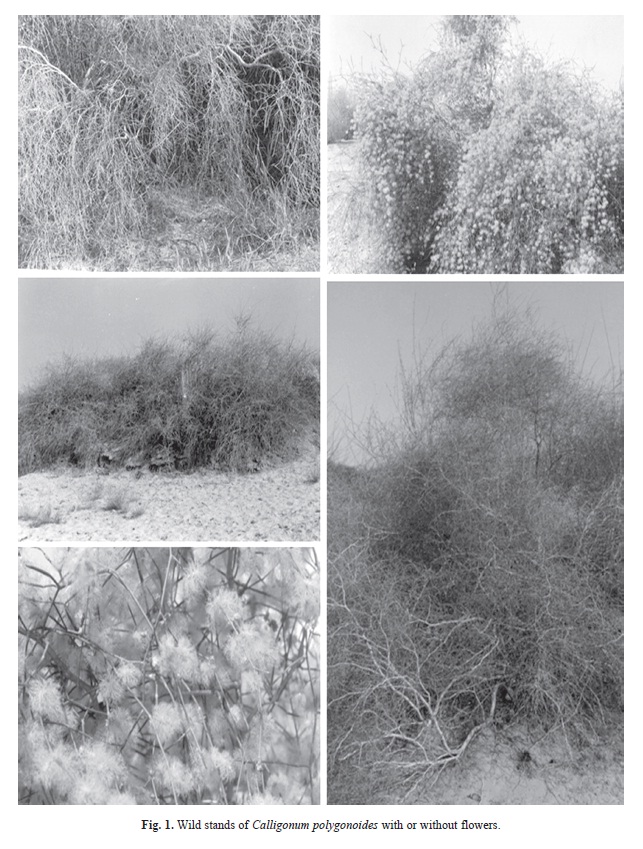
<body><![CDATA[ style="font-weight: bold;">Study species and site:</span> <span      style="font-style: italic;">Calligonum     polygonoides </span>L., a dominant species of Thar Desert of Rajasthan     was     selected for the study (<a href="/img/revistas/rbt/v60n3/a11i1.jpg">Fig.     1</a>). This desert forms the Eastern     extremity of the great arid and semi-arid belt of the world. It is one     of the smallest deserts of the world but exhibits a wide variety of     habitats and a high biodiversity, due to the juxtaposition of     Palaearctic, Oriental and Saharan elements (Blanford 1901, Prakash     ]]></body>
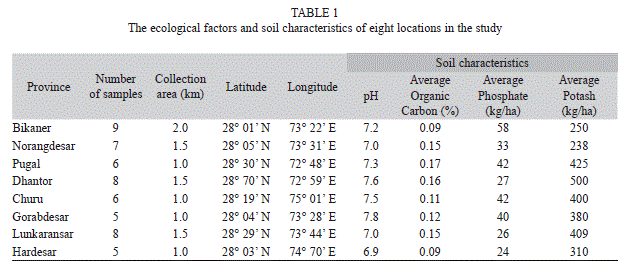
<body><![CDATA[1963). In this study, 54 <span style="font-style: italic;">C.     polygonoides</span> plant samples were collected     from eight locations of Thar Desert of Rajasthan. Most of the locations     are located around 100km area from Bikaner except Churu zone of the     study which was sampled from 165km apart of the Bikaner region. The     ecological factors and soil characteristics for the collection sites     are presented in <a href="/img/revistas/rbt/v60n3/a11t1.gif">table 1</a>.     The plants were tagged and their tender     sprouts were collected in ice for DNA isolation while for chemical     analysis, immature buds from two year old plants were collected.    ]]></body>
<body><![CDATA[<br>     </span></font><br style="font-family: verdana;">     <font size="2"><span style="font-family: verdana;"><span      style="font-weight: bold;">RAPD analysis:</span> Genomic DNA was     isolated from tender twigs of each plant using the method of Doyle     &amp; Doyle (1990). After purification, DNA was quantified using Nano     Drop spectrophotometer (ND-1000, Version 3.1.1, USA) and finally     diluted to 25ng/&#956;L for PCR analysis. A total of 10 RAPD primers of OPD     and OPH series obtained from &#8216;OPERON TECHNOLOGIES&#8217; (Inc. Alameda,     California) were used for analysis. The PCR reactions were performed in     ]]></body>
<body><![CDATA[a 25&#956;L reaction mixture containing 1X assay buffer (100mM Tris pH 9.0,     500mM KCl, 15mM MgCl2 and 0.1% gelatin), one unit of Taq DNA     polymerase, 200&#956;M of each dNTPs (Bangalore Genei Pvt. Ltd., India),     0.2&#956;M primers and 50ng of template DNA. The PCR reactions were carried     out in DNA thermal cycler (Model-CGI-96, Corbett Research, Australia)     using the PCR profile: initial extended step of denaturation at     94&deg;C for 4min followed by 44 cycles of denaturation at 94&deg;C for     1min, primer annealing at 37&deg;C for 1min and elongation at 72&deg;C     for 2min followed by a final step of extension at 72&deg;C for 4min.     The RAPD-PCR products were fractionated on 1.5% agarose loaded with     ]]></body>
<body><![CDATA[EcoRI/HindIII digest &#955; DNA, containing 0.5&#956;g/&#956;L ethidium bromide. Gels     were electrophoresed until the indicator dye reached 10cm from the well     at 55mA. After separation gels were documented using Biovis Image Plus     software (Expert Vision Pvt. Ltd. Mumbai).</span></font><br      style="font-family: verdana;">     <font size="2"></font><br style="font-family: verdana;">     <font size="2"><span style="font-family: verdana;"><span      style="font-weight: bold;">Analysis of chemical parameters:</span>     The following chemical parameters i.e. moisture, crude protein,     proline, total carbohydrate, starch, soluble sugar, crude fat, crude     ]]></body>
<body><![CDATA[fiber, neutral detergent fiber (NDF), hemicellulose, cellulose and     lignin were studied. The mineral composition of phog buds was studied     for phosphorous, magnesium, iron, zinc, potassium and calcium. The     moisture content, proline and soluble sugar/starch were estimated using     the procedures given in/by ICMR (1983), Bates <span      style="font-style: italic;">et al</span>. (1973), Dubois <span      style="font-style: italic;">et     al</span>. (1951), respectively. Fat content, crude fiber, crude     protein,     total carbohydrate, calcium, potassium, phosphorous, and dietary fiber     ]]></body>
<body><![CDATA[(hemicellulose, cellulose and lignin) were determined according to AOAC     (1995). Magnesium, iron and zinc were analyzed by using Atomic     Absorption Spectrophotometer (Model: GBC-932 AA).</span></font><br      style="font-family: verdana;">     <font size="2"></font><br style="font-family: verdana;">     <font size="2"><span style="font-family: verdana;">The RAPD bands were     scored as     binary matrix for the presence (1) or absence (0). All calculations     were done using computer program NTSYSpc v. 2.02 (Rohlf 1998).     Similarity matrix was constructed using the Jaccard&#8217;s coefficients and     ]]></body>
<body><![CDATA[subjected to Unweighted Pair-Group Method with Arithmetic Averages     (UPGMA) analysis, to generate dendrogram. In case of chemical     parameters, Manhattan distance coefficients were used to generate     dissimilarity matrix which was subjected to UPGMA analysis to generate     dendrogram after the standardization of observations. The matrices     derived from RAPD and chemical data were correlated using MxComp module     of NTSYSpc. In both dendrograms, average coefficient was used as     cut-off value to define clusters. The discriminatory power (Dj) of RAPD     primers was analyzed using the standard statistical package of Tessier     <span style="font-style: italic;">et al</span>. (1999). Polymorphism     ]]></body>
<body><![CDATA[information content (PIC) was also     calculated according to Anderson <span style="font-style: italic;">et     al</span>. (1993). Arithmetic mean,     standard deviation and coefficient of variation (CV) were calculated     for each trait using standard formula given in Chandel (1997).</span></font><br      style="font-family: verdana;">     <font size="2"></font><br style="font-family: verdana;">     <font style="font-weight: bold;" size="3"><span      style="font-family: verdana;">Results</span></font><br      style="font-family: verdana;">     ]]></body>
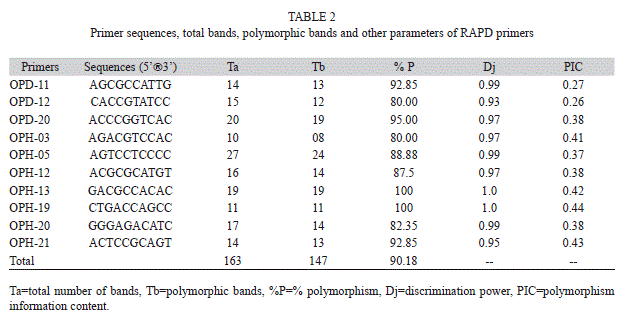
<body><![CDATA[<font size="2"></font><br style="font-family: verdana;">     <font size="2"><span style="font-family: verdana;"><span      style="font-weight: bold;">RAPD analysis:</span> A total 163 (16.3     bands per primer) RAPD markers were generated by 10 primers for 54     individual samples of <span style="font-style: italic;">C. polygonoides</span>.     Out of 163 RAPD markers, 147     were recorded as polymorphic with 90.18% polymorphism. Maximum number     of polymorphic bands (66.26%) were recorded in samples collected from     Dhantor region, while minimum (37.42%) from Bikaner region. Most of the     scorable band positions ranged from 300bp-4000bp. Primer efficiency was     ]]></body>
<body><![CDATA[calculated using polymorphism information content (PIC) (Anderson <span      style="font-style: italic;">et     al</span>. 1993) and discrimination power (Dj). The average PIC values     for     RAPD primers ranged from 0.26 (OPD-12) - 0.44 (OPH-19). Discriminatory     power (Dj) for all the RAPD primers ranged from 0.93-1.0. The RAPD     primer, OPH-13 and OPH-19 found maximum polymorphic (100%) and     discriminatory (1.0) compared to other RAPD primers (<a      href="/img/revistas/rbt/v60n3/a11t2.gif">Table 2</a>).     RAPD-based Jaccard&#8217;s similarity coefficients ranged from 0.43-0.89 with     ]]></body>
<body><![CDATA[a mean genetic similarity of 0.49. UPGMA based dendrogram clustered all     the phog samples into seven groups (<a      href="/img/revistas/rbt/v60n3/a11i2.jpg">Fig. 2A</a>). Average     similarity     coefficient (0.49) was used as cut-off value to classify the     dendrogram. Most of the samples from Bikaner and Norangdesar regions     were clustered into uppermost group of the dendrogram. However, samples     of Bikaner province were sub-grouped with high similarity. Most of the     clustering was found independent of the geographical region.<br      style="font-family: verdana;">     ]]></body>
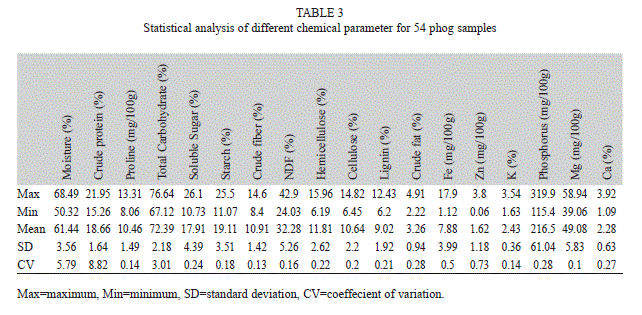
<body><![CDATA[</span></font><br style="font-family: verdana;">     <font size="2"><span style="font-family: verdana;"><span      style="font-weight: bold;">Chemical analysis:</span> All the chemical     parameters with minimum, maximum, mean and CV values are presented in     <a href="/img/revistas/rbt/v60n3/a11t3.gif">table 3</a>. All the     minerals were observed in the following order of     decreasing quantity i.e. K&gt;Ca&gt;P&gt;Mg&gt;Fe&gt;Zn. Average     potassium content was found highest (2 430mg/100g DW) in <span      style="font-style: italic;">C.     polygonoides</span> budswith 0.14 CV. Highest content variation (CV     ]]></body>
<body><![CDATA[0.73) was     observed for Zn followed by Fe (CV 0.50), while it was observed     mninimum (CV 0.10) for magnesium content. The samplesof Dhantor and     Hardesar province were found comparatively rich in Zn content with     average values, 2 252mg/100g (DW) and 2 592mg/100g (DW), respectively.     Phog buds were also found rich in calcium content with highest (3     920mg/100g DW) and lowest (1 090mg/100g DW) quantities (<a      href="/img/revistas/rbt/v60n3/a11t3.gif">Table 3</a>).</span></font><br      style="font-family: verdana;">     <font size="2"></font><br style="font-family: verdana;">     ]]></body>
<body><![CDATA[<font size="2"><span style="font-family: verdana;">The moisture content     varied from     50.32-68.49 % with mean value 61.44&plusmn;3.56%. The crude fiber was     found to     be 10.91</span></font><font size="2"><span style="font-family: verdana;">&plusmn;</span></font><font      size="2"><span style="font-family: verdana;">3.51%. The total     carbohydrate was main constituent of the     buds, ranged between 67.12-76.64%, averaged 72.39</span></font><font      size="2"><span style="font-family: verdana;">&plusmn;</span></font><font      size="2"><span style="font-family: verdana;">2.18%. The NDF ranged     ]]></body>
<body><![CDATA[from 24.03-42.90 with mean value 32.28</span></font><font size="2"><span      style="font-family: verdana;">&plusmn;</span></font><font size="2"><span      style="font-family: verdana;">5.26%. Starch and soluble sugar     were present in approximately same quantity with mean value 19.11</span></font><font      size="2"><span style="font-family: verdana;">&plusmn;</span></font><font      size="2"><span style="font-family: verdana;">3.51%     and 17.91</span></font><font size="2"><span      style="font-family: verdana;">&plusmn;</span></font><font size="2"><span      style="font-family: verdana;">4.39% respectively. The hemicellulose,     cellulose and lignin     ]]></body>
<body><![CDATA[were present with the mean value of 11.81</span></font><font size="2"><span      style="font-family: verdana;">&plusmn;</span></font><font size="2"><span      style="font-family: verdana;">2.62%, 10.64+</span></font><font size="2"><span      style="font-family: verdana;">&plusmn;</span></font><font size="2"><span      style="font-family: verdana;">2.2% and     9.02</span></font><font size="2"><span style="font-family: verdana;">&plusmn;</span></font><font      size="2"><span style="font-family: verdana;">1.92%, respectively.</span></font><br      style="font-family: verdana;">     <font size="2"></font><br style="font-family: verdana;">     <font size="2"><span style="font-family: verdana;">The crude fat in     ]]></body>
<body><![CDATA[phog buds ranged     from 2.22-4.9% with a mean value of 3.35</span></font><font size="2"><span      style="font-family: verdana;">&plusmn;</span></font><font size="2"><span      style="font-family: verdana;">0.94%. The mean quantity of     free proline was observed 8.06</span></font><font size="2"><span      style="font-family: verdana;">&plusmn;</span></font><font size="2"><span      style="font-family: verdana;">1.49mg/100g. Crude proteins ranged from     15.26-21.95% with the mean value 18.66</span></font><font size="2"><span      style="font-family: verdana;">&plusmn;</span></font><font size="2"><span      style="font-family: verdana;">1.64%. Most of the chemical     ]]></body>
<body><![CDATA[parameters were negatively correlated to each other, however,     structural components like NDF, hemicelluloses, cellulose, lignin,     crude fiber found positively correlated to each other. Significant     positive correlations (&gt;0.5) were reported between cellulose and     lignin (0.56), calcium and potassium (0.51), NDF and lignin (0.70), NDF     and hemi cellulose (0.77), and NDF and cellulose (0.49).</span></font><br      style="font-family: verdana;">     <font size="2"></font><br style="font-family: verdana;">     <font size="2"><span style="font-family: verdana;">Chemical parameters     based diversity     ]]></body>
<body><![CDATA[analysis: The Manhattan dissimilarity coefficients ranged from     0.01-0.22 with an average of 0.12. Average dissimilarity coeffic ient     within region ranged from 0.13 (within Dhantor) to 0.17 (within     Norangdesar). Mean chemical dissimilarity was found minimum (0.08)     among samples of Bikaner region followed by Churu and Lunkaransar     (0.09) regions, however, it was found maximum (0.16) in samples of     Norangdesar region followed by Gorabdesar (0.15) region. The     UPGMA-based dendrogram has clearly put all the samples in three major     groups at average similarity coefficient (0.12) as cut-off value. Group     I was clustered with 21 samples at 0.10 dissimilarity coefficient while     ]]></body>
<body><![CDATA[group II clumped with 28 samples at 0.08 coefficient value. Group III     contained only five phog samples with maximum dissimilarity (<a      href="/img/revistas/rbt/v60n3/a11i3.jpg">Fig. 2B</a>).     The first group comprised all the samples from province of Bikaner     while most of the samples from province of Churu were aggregated in     group II. The remaining samples distributed throughout the dendrogram.     Norangdesar and Gorabdesar samples were distributed randomly in the     chemical-based dendrogram due to high dissimilarity coefficient.</span></font><br      style="font-family: verdana;">     <font size="2"></font><br style="font-family: verdana;">     ]]></body>
<body><![CDATA[<font style="font-weight: bold;" size="3"><span      style="font-family: verdana;">Discussion</span></font><br      style="font-family: verdana;">     <font size="2"></font><br style="font-family: verdana;">     <font size="2"><span style="font-family: verdana;">In present study, an     effort was     made to find out current ecological behavior of <span      style="font-style: italic;">C. polygonoides</span> species     in Thar Desert of Rajasthan, by analyzing its chemical/nutritional and     genetic diversity. Using RAPD analysis a very great range of diversity     ]]></body>
<body><![CDATA[was obtained among 54 wild <span style="font-style: italic;">C.     polygonoides</span> samples of eight different     provinces of Rajasthan. In the study, 10 RAPD primers produced a very     good range of discriminatory power and PIC values. All the RAPD primers     used were found informative as the Dj value ranged from 0.93-1.0. A     very high range of discriminatory power indicates that all the RAPD     primers generated distinct patterns for all the phog samples with great     diversity. A low mean genetic similarity (0.49) among <span      style="font-style: italic;">C. polygonoides</span>     samples reflects diverse gene pool, able to withstand in harsh     ]]></body>
<body><![CDATA[environmental conditions.</span></font><br style="font-family: verdana;">     <font size="2"></font><br style="font-family: verdana;">     <font size="2"><span style="font-family: verdana;">At nutritional     level, <span style="font-style: italic;">C.     polygonoides</span> is an excellent source of calcium, potassium and     phosphorous while relatively poor in zinc. Nutritionally all the <span      style="font-style: italic;">C.     polygonoides</span> samples were found rich in nutritional compounds.     Plants     with sufficient minerals are found to be more drought resistant (Bouis     ]]></body>
<body><![CDATA[1996) and this factor might be supportive in phog against drought. The     moisture content of <span style="font-style: italic;">C. polygonoides</span>     plants was detected less     (50.32-61.44%) in comparison to <span style="font-style: italic;">Capparis     deciduas</span> (74.2-84.6%), another     wild plant from the same province (Vyas <span      style="font-style: italic;">et al</span>. 2009). The low moisture     content indicates adaptability and hardiness of <span      style="font-style: italic;">C. polygonoides</span> plant     in adverse conditions of the desert area and ability to survive in     ]]></body>
<body><![CDATA[desert without water supply for years.</span></font><br      style="font-family: verdana;">     <font size="2"></font><br style="font-family: verdana;">     <font size="2"><span style="font-family: verdana;">The crude fiber,     crude protein and     total carbohydrate were found comparable with other plant species such     as legumes (Olaofe <span style="font-style: italic;">et al</span>.     1994), ker (Vyas <span style="font-style: italic;">et al</span>. 2009)     and     specifically with <span style="font-style: italic;">C. polygonoides</span>     ]]></body>
<body><![CDATA[(Singh <span style="font-style: italic;">et al</span>. 2005). There is     evidence that crude fiber has a number of beneficial effects related to     its indigestibility in the small intestine (Aremu <span      style="font-style: italic;">et al</span>. 2006). The     mean proline content was found maximum in samples of Lunkaransar     province followed by Churu province. The NDF contributed maximum to the     total carbohydrate and hemicellulose, cellulose and lignin contributed     to NDF in decreasing order with the mean value of 11.81</span></font><font      size="2"><span style="font-family: verdana;">&plusmn;</span></font><font      size="2"><span style="font-family: verdana;">2.01%,     ]]></body>
<body><![CDATA[10.64</span></font><font size="2"><span style="font-family: verdana;">&plusmn;</span></font><font      size="2"><span style="font-family: verdana;">1.76% and 9.02</span></font><font      size="2"><span style="font-family: verdana;">&plusmn;</span></font><font      size="2"><span style="font-family: verdana;">1.47%, respectively which     was corollary to the     contents reported in other plant species by Agarwal &amp; Chauhan     (1988), Vyas <span style="font-style: italic;">et al</span>. (2009).     The co-similarity of chemical parameters in     same as well different desert plant species might provide hardiness and     adaptability to these plants in xeric conditions.</span></font><br     ]]></body>
<body><![CDATA[ style="font-family: verdana;">     <font size="2"></font><br style="font-family: verdana;">     <font size="2"><span style="font-family: verdana;">Comparative     statements of chemical     and RAPD-based diversity: In RAPD analysis, high level of     genetic     diversity was found among <span style="font-style: italic;">C.     polygonoides</span> samples, where near 90.18%     RAPD markers were polymorphic. However, the RAPD patterns were not     found systematic in respect to classification of samples accords to     ]]></body>
<body><![CDATA[regions which leads to an uncharacterized diversity in dendrogram.     DNA-based diversity was found high in comparison to chemicalbased     diversity. However, within region diversity was lesser in most of the     cases compared to between region diversity in both of RAPD and chemical     parameters. But, wherever between regions diversity was comparable or     less to within region diversity the places were mostly closely     associated and represented same gene pool. All the <span      style="font-style: italic;">C. polygonoides</span>     samples were clustered into seven groups on the basis of Jaccard&#8217;s     coefficient. The RAPD-based dendrogram generated poor groups because     ]]></body>
<body><![CDATA[within group similarity was comparable to between group similarities.     The present study revealed a very low correlation (r0.01) between     chemicaland RAPD-based matrices, indicates that the two methods were     different and highly variable. Therefore, RAPD-based data are not     useful for estimating the chemical characteristics of <span      style="font-style: italic;">C. polygonoides</span>     samples. Krofta <span style="font-style: italic;">et al</span>.     (1998), Patzak <span style="font-style: italic;">et al</span>. (2010)     also found     difference between molecular and chemical data of wild hops (<span     ]]></body>
<body><![CDATA[ style="font-style: italic;">Humulus     lupulus</span>). High similarity in chemical parameters proposes least     variable expression of the genes for these chemical parameters in     extreme drought conditions.</span></font><br      style="font-family: verdana;">     <font size="2"></font><br style="font-family: verdana;">     <font size="2"><span style="font-family: verdana;">Low level of     diversity generated by     chemical parameters compared to RAPD suggesting better efficiency of     the RAPD profiles for diversity analysis that account unexpressed DNA     ]]></body>
<body><![CDATA[sequences as well genes contributing structurally and functionally and     not confounded by environmental factors (Henry 1997). A low averaged     genetic similarity (0.49) in case of RAPD, indicating wide adaptability     of the <span style="font-style: italic;">C. polygonoides</span> in the     studied region. The evolution of wild <span style="font-style: italic;">C.     polygonoides</span> samples in distinct climatic zones demonstrates     significant levels of variations in response to the selection pressure     in their native environment (Singh <span style="font-style: italic;">et     al</span>. 1996). It is therefore not     surprising to find significant levels of polymorphism among 54 <span     ]]></body>
<body><![CDATA[ style="font-style: italic;">C.     polygonoides</span> samples as revealed by RAPD markers and chemical     parameters. High level of genetic diversity and no structure of     RAPD-based dendrogram accords to locations were found comparable with     previous study of Bewal <span style="font-style: italic;">et al</span>.     (2009). Diversification of <span style="font-style: italic;">C.     polygonoides</span> samples from same region into different clusters     indicating frequent seed dispersal or other way of propagation from     long distances as high velocity winds are characteristics of these     regions. Samples from Bikaner region showed highest average genetic     ]]></body>
<body><![CDATA[similarity (0.75) on the basis of Jaccard&#8217;s coefficient while average     minimum genetic similarity (0.50) was observed in the samples of     Gorabdesar region. The low diversity in the samples from Bikaner     province might be due to the anthropogenic activities leading to heavy     population disturbances which can affect the genetic composition of the     species considerably. Anthropogenic activities therefore appear to be     potential threats for the loss of genetic information particularly in     spatially isolated small populations.</span></font><br      style="font-family: verdana;">     <font size="2"></font><br style="font-family: verdana;">     ]]></body>
<body><![CDATA[<font size="2"><span style="font-family: verdana;">The <span      style="font-style: italic;">C. polygonoides</span> cross     pollinates (anemophily) (Raju <span style="font-style: italic;">et al</span>.     2001) which might lead to high     variations at chemical as well as molecular levels, not with standing     the fact that the populations of the species under study are located at     tens to hundreds of kilometers of distance. Predominantly obligate out     breeding behavior of <span style="font-style: italic;">C. polygonoides</span>     beside certain non-comprehensible     reasons prompted these accessions to spread and occupy specific     ]]></body>
<body><![CDATA[geographical niches thereby enhancing their adaptational capabilities     vis-&agrave;-vis native climatic conditions. Nevertheless the present     study is a first attempt to define the existing natural genetic     diversity based on chemical parameters and genomic level, among the     populations of <span style="font-style: italic;">C. polygonoides</span>,     collected from different locations of     Thar Desert of Rajasthan (India).</span></font><br      style="font-family: verdana;">     <font size="2"></font><br style="font-family: verdana;">     <font size="2"><span style="font-family: verdana;">Despite having such     ]]></body>
<body><![CDATA[a great level     of biodiversity characterized by RAPD and chemical parameters, <span      style="font-style: italic;">C.     polygonoides</span> is included in Red Data Book of IUCN under near     extinct     plant category. Very low rain fall, high wind velocity, erosion of     deserts, exploitation of shrubs for fuel purposes and consecutive     grazing of plants by desert animals are some reasons might influence     its proper growth and development. Plants have tremendous ability of     growth and reproduction in adverse conditions of deserts but low and     ]]></body>
<body><![CDATA[low rainfall since a few years is alarming for its survival and special     attention is needed to preserve the biodiversity and its     rehabilitation. The characterized chemical parameters indicating high     nutritional value of wild stands of <span style="font-style: italic;">C.     polygonoides</span>, making it an     important local forage plant. Samples from Norangdesar, Pugal and Churu     were found very rich in phosphorus content while samples from the     province of Bikaner were found rich in iron content. Nutritionally rich     <span style="font-style: italic;">C. polygonoides</span> plants might     be added to fortify nutritionally     ]]></body>
<body><![CDATA[deficient foods of desert areas.</span></font><br      style="font-family: verdana;">     <font size="2"></font><br style="font-family: verdana;">     <font size="2"><span style="font-family: verdana;">A study on genetic     diversity of <span style="font-style: italic;">C.     polygonoides</span> in the Thar Desert is prerequisite to reveal the     ecological and genetic consequences and to preserve the biodiversity,     while an analysis for chemical parameters would help in selection of     plants with higher nutritional values. Moreover, the combined     information will reflect applicability of molecular markers in     ]]></body>
<body><![CDATA[assessing diversity at chemical level. The results of nutritional and     DNA polymorphism could provide information regarding genetic background     and distribution of diversity of <span style="font-style: italic;">C.     polygonoides</span> and further help to     plan an effective conservation strategy for the species.</span></font><br      style="font-family: verdana;">     <font size="2"></font><br style="font-family: verdana;">     <font style="font-weight: bold;" size="3"><span      style="font-family: verdana;">Acknowledgment</span></font><br      style="font-family: verdana;">     ]]></body>
<body><![CDATA[<font size="2"></font><br style="font-family: verdana;">     <font size="2"><span style="font-family: verdana;">We are thankful to     Department of     Biotechnology, Government of India for providing the funds for this     work under the project &#8216;&#8216;Characterization of underutilized species of     Thar Desert&#8217;&#8217;.</span></font><br style="font-family: verdana;">     <font size="2"></font>     <hr style="width: 100%; height: 2px;"><br style="font-family: verdana;">     <font style="font-weight: bold;" size="3"><span      style="font-family: verdana;">References</span></font><br     ]]></body>
<body><![CDATA[ style="font-family: verdana;">     <font size="2"></font><br style="font-family: verdana;">     <font size="2"><span style="font-family: verdana;">Agarwal, V. &amp;     B.M. Chauhan.     1988. A study on composition and hypolipidemic effect of dietary fiber     <!-- ref -->from some plant foods. Plant Foods Hum. Nutr. 38: 189-197.    &nbsp;&nbsp;&nbsp;&nbsp;&nbsp;&nbsp;&nbsp;&nbsp;[&#160;<a href="javascript:void(0);" onclick="javascript: window.open('/scielo.php?script=sci_nlinks&ref=1470771&pid=S0034-7744201200030001100001&lng=','','width=640,height=500,resizable=yes,scrollbars=1,menubar=yes,');">Links</a>&#160;]<!-- end-ref --><!-- ref --></span></font><br  style="font-family: verdana;"> <font size="2"></font><br style="font-family: verdana;"> <font size="2"><span style="font-family: verdana;">Anderson, J.A., G.A.Churchill, J.E. Autrique, S.D. Tanksley &amp; M.E. Sorrells. 1993. Optimizing parental selection for genetic linkage maps. Genome 36: 181-186.    &nbsp;&nbsp;&nbsp;&nbsp;&nbsp;&nbsp;&nbsp;&nbsp;[&#160;<a href="javascript:void(0);" onclick="javascript: window.open('/scielo.php?script=sci_nlinks&ref=1470772&pid=S0034-7744201200030001100002&lng=','','width=640,height=500,resizable=yes,scrollbars=1,menubar=yes,');">Links</a>&#160;]<!-- end-ref --><!-- ref --></span></font><br  style="font-family: verdana;"> <font size="2"></font><br style="font-family: verdana;"> <font size="2"><span style="font-family: verdana;">AOAC, 1995. Official methods of analysis of the association of official analytical chemists, Washington D.C., USA.    &nbsp;&nbsp;&nbsp;&nbsp;&nbsp;&nbsp;&nbsp;&nbsp;[&#160;<a href="javascript:void(0);" onclick="javascript: window.open('/scielo.php?script=sci_nlinks&ref=1470773&pid=S0034-7744201200030001100003&lng=','','width=640,height=500,resizable=yes,scrollbars=1,menubar=yes,');">Links</a>&#160;]<!-- end-ref --><!-- ref --></span></font><br style="font-family: verdana;"> <font size="2"></font><br style="font-family: verdana;"> <font size="2"><span style="font-family: verdana;">Aremu, M.O., A. Olonisakin, B.O. Atolaye &amp; C.F. Ogbu. 2006. Some nutritional and functional studies of prosopis Africana. Electron J. Env. Agric. Food Chem. 5: 1640-1648.    &nbsp;&nbsp;&nbsp;&nbsp;&nbsp;&nbsp;&nbsp;&nbsp;[&#160;<a href="javascript:void(0);" onclick="javascript: window.open('/scielo.php?script=sci_nlinks&ref=1470774&pid=S0034-7744201200030001100004&lng=','','width=640,height=500,resizable=yes,scrollbars=1,menubar=yes,');">Links</a>&#160;]<!-- end-ref --><!-- ref --></span></font><br  style="font-family: verdana;"> <font size="2"></font><br style="font-family: verdana;"> <font size="2"><span style="font-family: verdana;">Bates, L.S., R.P. Waldren &amp; I.D. Teare. 1973. Rapid determination of free proline for water-stress studies. Plant Soil 39: 205-207.    &nbsp;&nbsp;&nbsp;&nbsp;&nbsp;&nbsp;&nbsp;&nbsp;[&#160;<a href="javascript:void(0);" onclick="javascript: window.open('/scielo.php?script=sci_nlinks&ref=1470775&pid=S0034-7744201200030001100005&lng=','','width=640,height=500,resizable=yes,scrollbars=1,menubar=yes,');">Links</a>&#160;]<!-- end-ref --><!-- ref --></span></font><br  style="font-family: verdana;"> <font size="2"></font><br style="font-family: verdana;"> <font size="2"><span style="font-family: verdana;">Bewal, S., <span  style="font-style: italic;">S.K. Sharma</span>, <span  style="font-style: italic;">A. Parida</span>, <span style="font-style: italic;">S. Shivam</span>, <span  style="font-style: italic;">S.R. Rao</span> &amp; <span  style="font-style: italic;">A. Kumar</span>. <span  style="font-style: italic;">2009. Utilization of RAPD marker to analyze natural genetic variation in Calligonum polygonoides L.-A key stone species of Thar Desert. Int. J. Integr. Biol. 5: 148.    &nbsp;&nbsp;&nbsp;&nbsp;&nbsp;&nbsp;&nbsp;&nbsp;[&#160;<a href="javascript:void(0);" onclick="javascript: window.open('/scielo.php?script=sci_nlinks&ref=1470776&pid=S0034-7744201200030001100006&lng=','','width=640,height=500,resizable=yes,scrollbars=1,menubar=yes,');">Links</a>&#160;]<!-- end-ref --><!-- ref --></span></span></font><br  style="font-family: verdana;"> <font size="2"></font><br style="font-family: verdana;"> <font size="2"><span style="font-family: verdana;">Blanford, W.T. 1901. The distribution of vertebrate animals in India. Philos. Trans. R. Soc. Lond. 194: 335-436.    &nbsp;&nbsp;&nbsp;&nbsp;&nbsp;&nbsp;&nbsp;&nbsp;[&#160;<a href="javascript:void(0);" onclick="javascript: window.open('/scielo.php?script=sci_nlinks&ref=1470777&pid=S0034-7744201200030001100007&lng=','','width=640,height=500,resizable=yes,scrollbars=1,menubar=yes,');">Links</a>&#160;]<!-- end-ref --><!-- ref --></span></font><br style="font-family: verdana;"> <font size="2"></font><br style="font-family: verdana;"> <font size="2"><span style="font-family: verdana;">Bouis, H. 1996. Enrichment of food staples through plant breeding: A new strategy for fighting micronutrient malnutrition. Nutr. Rev. 54: 131-137.    &nbsp;&nbsp;&nbsp;&nbsp;&nbsp;&nbsp;&nbsp;&nbsp;[&#160;<a href="javascript:void(0);" onclick="javascript: window.open('/scielo.php?script=sci_nlinks&ref=1470778&pid=S0034-7744201200030001100008&lng=','','width=640,height=500,resizable=yes,scrollbars=1,menubar=yes,');">Links</a>&#160;]<!-- end-ref --><!-- ref --></span></font><br  style="font-family: verdana;"> <font size="2"></font><br style="font-family: verdana;"> <font size="2"><span style="font-family: verdana;">Brandbyge, J. 1993. Polygonaceae. In K. Kubitzki, J.C. Rohwer &amp; V. Bittrich (eds.). The families and genera of vascular plants, Springer-Verlag, Berlin.    &nbsp;&nbsp;&nbsp;&nbsp;&nbsp;&nbsp;&nbsp;&nbsp;[&#160;<a href="javascript:void(0);" onclick="javascript: window.open('/scielo.php?script=sci_nlinks&ref=1470779&pid=S0034-7744201200030001100009&lng=','','width=640,height=500,resizable=yes,scrollbars=1,menubar=yes,');">Links</a>&#160;]<!-- end-ref --><!-- ref --></span></font><br  style="font-family: verdana;"> <font size="2"></font><br style="font-family: verdana;"> <font size="2"><span style="font-family: verdana;">CAZRI, 2002. Highlights of Research: Integrated natural resources appraisal, environmental monitoring and desertification.    &nbsp;&nbsp;&nbsp;&nbsp;&nbsp;&nbsp;&nbsp;&nbsp;[&#160;<a href="javascript:void(0);" onclick="javascript: window.open('/scielo.php?script=sci_nlinks&ref=1470780&pid=S0034-7744201200030001100010&lng=','','width=640,height=500,resizable=yes,scrollbars=1,menubar=yes,');">Links</a>&#160;]<!-- end-ref --><!-- ref --></span></font><br  style="font-family: verdana;"> <font size="2"></font><br style="font-family: verdana;"> <font size="2"><span style="font-family: verdana;">Chandel, S.R.S. 1997. A handbook of Agricultural Statistics. Achal Prakashan Mandir, Pandu Nagar, Kanpur.    &nbsp;&nbsp;&nbsp;&nbsp;&nbsp;&nbsp;&nbsp;&nbsp;[&#160;<a href="javascript:void(0);" onclick="javascript: window.open('/scielo.php?script=sci_nlinks&ref=1470781&pid=S0034-7744201200030001100011&lng=','','width=640,height=500,resizable=yes,scrollbars=1,menubar=yes,');">Links</a>&#160;]<!-- end-ref --><!-- ref --></span></font><br  style="font-family: verdana;"> <font size="2"></font><br style="font-family: verdana;"> <font size="2"><span style="font-family: verdana;">Doyle, J.J. &amp; J.L. Doyle. 1990. A rapid total DNA isolation procedure for fresh plant tissue. Focus 12: 13-15.    &nbsp;&nbsp;&nbsp;&nbsp;&nbsp;&nbsp;&nbsp;&nbsp;[&#160;<a href="javascript:void(0);" onclick="javascript: window.open('/scielo.php?script=sci_nlinks&ref=1470782&pid=S0034-7744201200030001100012&lng=','','width=640,height=500,resizable=yes,scrollbars=1,menubar=yes,');">Links</a>&#160;]<!-- end-ref --><!-- ref --></span></font><br style="font-family: verdana;"> <font size="2"></font><br style="font-family: verdana;"> <font size="2"><span style="font-family: verdana;">Dubois, M., K. Gilles, J.K. Hamilton, P.A. Robers &amp; F. Smith. 1951. A colorimetric method for the determination of sugars. Nature 168: 167.    &nbsp;&nbsp;&nbsp;&nbsp;&nbsp;&nbsp;&nbsp;&nbsp;[&#160;<a href="javascript:void(0);" onclick="javascript: window.open('/scielo.php?script=sci_nlinks&ref=1470783&pid=S0034-7744201200030001100013&lng=','','width=640,height=500,resizable=yes,scrollbars=1,menubar=yes,');">Links</a>&#160;]<!-- end-ref --><!-- ref --></span></font><br  style="font-family: verdana;"> <font size="2"></font><br style="font-family: verdana;"> <font size="2"><span style="font-family: verdana;">Goyal, M. &amp; S.K. Sharma. 2008. Traditional wisdom and value addition prospects of arid foods of Desert region of North West India. Indian J. Trad. Knwl. 8: 581-585.    &nbsp;&nbsp;&nbsp;&nbsp;&nbsp;&nbsp;&nbsp;&nbsp;[&#160;<a href="javascript:void(0);" onclick="javascript: window.open('/scielo.php?script=sci_nlinks&ref=1470784&pid=S0034-7744201200030001100014&lng=','','width=640,height=500,resizable=yes,scrollbars=1,menubar=yes,');">Links</a>&#160;]<!-- end-ref --><!-- ref --></span></font><br  style="font-family: verdana;"> <font size="2"></font><br style="font-family: verdana;"> <font size="2"><span style="font-family: verdana;">Henry, R.J. 1997. Molecular methods to protect plant breeder&#8217;s rights. In: Practical and applied molecular biology, handbook. Chapman and Hall, London, England.    &nbsp;&nbsp;&nbsp;&nbsp;&nbsp;&nbsp;&nbsp;&nbsp;[&#160;<a href="javascript:void(0);" onclick="javascript: window.open('/scielo.php?script=sci_nlinks&ref=1470785&pid=S0034-7744201200030001100015&lng=','','width=640,height=500,resizable=yes,scrollbars=1,menubar=yes,');">Links</a>&#160;]<!-- end-ref --><!-- ref --></span></font><br  style="font-family: verdana;"> <font size="2"></font><br style="font-family: verdana;"> <font size="2"><span style="font-family: verdana;">ICMR. 1983. Manual of Laboratory Techniques. NIN, Hyderabad, India.    &nbsp;&nbsp;&nbsp;&nbsp;&nbsp;&nbsp;&nbsp;&nbsp;[&#160;<a href="javascript:void(0);" onclick="javascript: window.open('/scielo.php?script=sci_nlinks&ref=1470786&pid=S0034-7744201200030001100016&lng=','','width=640,height=500,resizable=yes,scrollbars=1,menubar=yes,');">Links</a>&#160;]<!-- end-ref --><!-- ref --></span></font><br  style="font-family: verdana;"> <font size="2"></font><br style="font-family: verdana;"> <font size="2"><span style="font-family: verdana;">Khan, T.I. 1997. Conservation of biodiversity in Western India. The Environmentalist 17: 283-287.    &nbsp;&nbsp;&nbsp;&nbsp;&nbsp;&nbsp;&nbsp;&nbsp;[&#160;<a href="javascript:void(0);" onclick="javascript: window.open('/scielo.php?script=sci_nlinks&ref=1470787&pid=S0034-7744201200030001100017&lng=','','width=640,height=500,resizable=yes,scrollbars=1,menubar=yes,');">Links</a>&#160;]<!-- end-ref --><!-- ref --></span></font><br  style="font-family: verdana;"> <font size="2"></font><br style="font-family: verdana;"> <font size="2"><span style="font-family: verdana;">Krofta, K., V. Nesvadba &amp; J. Patzak. 1998. Utilization of wild hops testation for extension of genetic sources for breeding. Rostl. Vyroba 44: 313-320.    &nbsp;&nbsp;&nbsp;&nbsp;&nbsp;&nbsp;&nbsp;&nbsp;[&#160;<a href="javascript:void(0);" onclick="javascript: window.open('/scielo.php?script=sci_nlinks&ref=1470788&pid=S0034-7744201200030001100018&lng=','','width=640,height=500,resizable=yes,scrollbars=1,menubar=yes,');">Links</a>&#160;]<!-- end-ref --><!-- ref --></span></font><br  style="font-family: verdana;"> <font size="2"></font><br style="font-family: verdana;"> <font size="2"><span style="font-family: verdana;">Olaofe, O., F.O. Adeyemi &amp; G.O. Adediran. 1994. Amino acid and mineral compositions and functional properties of some oilseeds. J. Agric. Food Chem. 42: 878-881.    &nbsp;&nbsp;&nbsp;&nbsp;&nbsp;&nbsp;&nbsp;&nbsp;[&#160;<a href="javascript:void(0);" onclick="javascript: window.open('/scielo.php?script=sci_nlinks&ref=1470789&pid=S0034-7744201200030001100019&lng=','','width=640,height=500,resizable=yes,scrollbars=1,menubar=yes,');">Links</a>&#160;]<!-- end-ref --><!-- ref --></span></font><br  style="font-family: verdana;"> <font size="2"></font><br style="font-family: verdana;"> <font size="2"><span style="font-family: verdana;">Patzak, J., V. Nesvadba, A. Henychova &amp; K. Krofta. 2010. Assessment of the genetic diversity of wild hops (<span style="font-style: italic;">Humulus lupulus</span> L.) in Europe using chemical and molecular analyes. Biochem. Syst. Ecol. 38: 136-145.    &nbsp;&nbsp;&nbsp;&nbsp;&nbsp;&nbsp;&nbsp;&nbsp;[&#160;<a href="javascript:void(0);" onclick="javascript: window.open('/scielo.php?script=sci_nlinks&ref=1470790&pid=S0034-7744201200030001100020&lng=','','width=640,height=500,resizable=yes,scrollbars=1,menubar=yes,');">Links</a>&#160;]<!-- end-ref --><!-- ref --></span></font><br  style="font-family: verdana;"> <font size="2"></font><br style="font-family: verdana;"> <font size="2"><span style="font-family: verdana;">Prakash, I. 1963. Zoo-geography and evolution of the mammalian fauna of Rajasthan desert. Mammalia 35: 384-423.    &nbsp;&nbsp;&nbsp;&nbsp;&nbsp;&nbsp;&nbsp;&nbsp;[&#160;<a href="javascript:void(0);" onclick="javascript: window.open('/scielo.php?script=sci_nlinks&ref=1470791&pid=S0034-7744201200030001100021&lng=','','width=640,height=500,resizable=yes,scrollbars=1,menubar=yes,');">Links</a>&#160;]<!-- end-ref --><!-- ref --></span></font><br style="font-family: verdana;"> <font size="2"></font><br style="font-family: verdana;"> <font size="2"><span style="font-family: verdana;">Pullaiah, T. 2006. Encyclopedia of World Medicinal Plants. Vol. I. Regency Publications, New Delhi, India.    &nbsp;&nbsp;&nbsp;&nbsp;&nbsp;&nbsp;&nbsp;&nbsp;[&#160;<a href="javascript:void(0);" onclick="javascript: window.open('/scielo.php?script=sci_nlinks&ref=1470792&pid=S0034-7744201200030001100022&lng=','','width=640,height=500,resizable=yes,scrollbars=1,menubar=yes,');">Links</a>&#160;]<!-- end-ref --><!-- ref --></span></font><br  style="font-family: verdana;"> <font size="2"></font><br style="font-family: verdana;"> <font size="2"><span style="font-family: verdana;">Rajpurohit, K.S., A.K. Charan &amp; D.N. Sen. 1979. Microdistribution of plants in an abandoned salt pit at Pachpadra salt basin. Ann Arid Zone 18: 122-126.    &nbsp;&nbsp;&nbsp;&nbsp;&nbsp;&nbsp;&nbsp;&nbsp;[&#160;<a href="javascript:void(0);" onclick="javascript: window.open('/scielo.php?script=sci_nlinks&ref=1470793&pid=S0034-7744201200030001100023&lng=','','width=640,height=500,resizable=yes,scrollbars=1,menubar=yes,');">Links</a>&#160;]<!-- end-ref --><!-- ref --></span></font><br  style="font-family: verdana;"> <font size="2"></font><br style="font-family: verdana;"> <font size="2"><span style="font-family: verdana;">Raju, A.J.S., V.K. Raju, P. Victor &amp; S.A. Naidu. 2001. Floral ecology, breeding systemand pollination in <span style="font-style: italic;">Antigonon leptopus</span> L. (Polygonaceae). Plant Spec. Biol. 16: 159-164.    &nbsp;&nbsp;&nbsp;&nbsp;&nbsp;&nbsp;&nbsp;&nbsp;[&#160;<a href="javascript:void(0);" onclick="javascript: window.open('/scielo.php?script=sci_nlinks&ref=1470794&pid=S0034-7744201200030001100024&lng=','','width=640,height=500,resizable=yes,scrollbars=1,menubar=yes,');">Links</a>&#160;]<!-- end-ref --><!-- ref --></span></font><br  style="font-family: verdana;"> <font size="2"></font><br style="font-family: verdana;"> <font size="2"><span style="font-family: verdana;">Ren, J., L. Tao &amp; X.M. Liu. 2002. RAPD study on interspecies relationships in <span  style="font-style: italic;">Calligonum</span>. Acta. Bot. Bor. Occid. Sin. 22: 338-343.    &nbsp;&nbsp;&nbsp;&nbsp;&nbsp;&nbsp;&nbsp;&nbsp;[&#160;<a href="javascript:void(0);" onclick="javascript: window.open('/scielo.php?script=sci_nlinks&ref=1470795&pid=S0034-7744201200030001100025&lng=','','width=640,height=500,resizable=yes,scrollbars=1,menubar=yes,');">Links</a>&#160;]<!-- end-ref --><!-- ref --></span></font><br  style="font-family: verdana;"> <font size="2"></font><br style="font-family: verdana;"> <font size="2"><span style="font-family: verdana;">Rohlf, F.J. 1998. NTSYS-pc Numerical taxonomy and multivariate analysis system. Version 2.02e. EXETER Software, Setauket, USA.    &nbsp;&nbsp;&nbsp;&nbsp;&nbsp;&nbsp;&nbsp;&nbsp;[&#160;<a href="javascript:void(0);" onclick="javascript: window.open('/scielo.php?script=sci_nlinks&ref=1470796&pid=S0034-7744201200030001100026&lng=','','width=640,height=500,resizable=yes,scrollbars=1,menubar=yes,');">Links</a>&#160;]<!-- end-ref --><!-- ref --></span></font><br  style="font-family: verdana;"> <font size="2"></font><br style="font-family: verdana;"> <font size="2"><span style="font-family: verdana;">Singh, A.K. 2004. Endangered economic species of Indian desert. Gen. Res. Crop Evol. 51: 371-380.    &nbsp;&nbsp;&nbsp;&nbsp;&nbsp;&nbsp;&nbsp;&nbsp;[&#160;<a href="javascript:void(0);" onclick="javascript: window.open('/scielo.php?script=sci_nlinks&ref=1470797&pid=S0034-7744201200030001100027&lng=','','width=640,height=500,resizable=yes,scrollbars=1,menubar=yes,');">Links</a>&#160;]<!-- end-ref --><!-- ref --></span></font><br  style="font-family: verdana;"> <font size="2"></font><br style="font-family: verdana;"> <font size="2"><span style="font-family: verdana;">Singh, J.P., B.C. Mondal &amp; R.K. Beniwal. 2005. Phog (<span style="font-style: italic;">Calligonum polygonoides </span>L.): Under- exploited shrub with food potential in Western Rajasthan, p. 25. In National Seminar on Commercialization of Horticulture in Non-Traditional Areas. 5-6 February, 2005. Central Institute for Arid Horticulture, Bikaner, India.    &nbsp;&nbsp;&nbsp;&nbsp;&nbsp;&nbsp;&nbsp;&nbsp;[&#160;<a href="javascript:void(0);" onclick="javascript: window.open('/scielo.php?script=sci_nlinks&ref=1470798&pid=S0034-7744201200030001100028&lng=','','width=640,height=500,resizable=yes,scrollbars=1,menubar=yes,');">Links</a>&#160;]<!-- end-ref --><!-- ref --> </span></font><br style="font-family: verdana;"> <font size="2"></font><br style="font-family: verdana;"> <font size="2"><span style="font-family: verdana;">Singh, S. &amp; K.A. Shankarnarayan. 1986. Morphology and management of sand dune in the great Indian desert. Curr. Pract. Geochemical Eng. 3: 23-47.    &nbsp;&nbsp;&nbsp;&nbsp;&nbsp;&nbsp;&nbsp;&nbsp;[&#160;<a href="javascript:void(0);" onclick="javascript: window.open('/scielo.php?script=sci_nlinks&ref=1470799&pid=S0034-7744201200030001100029&lng=','','width=640,height=500,resizable=yes,scrollbars=1,menubar=yes,');">Links</a>&#160;]<!-- end-ref --><!-- ref --></span></font><br  style="font-family: verdana;"> <font size="2"></font><br style="font-family: verdana;"> <font size="2"><span style="font-family: verdana;">Singh, U.R., A.M. Wadhwani &amp; B.M. Johri. 1996. Dictionary of Economic plants in India. ICAR New Delhi, India.    &nbsp;&nbsp;&nbsp;&nbsp;&nbsp;&nbsp;&nbsp;&nbsp;[&#160;<a href="javascript:void(0);" onclick="javascript: window.open('/scielo.php?script=sci_nlinks&ref=1470800&pid=S0034-7744201200030001100030&lng=','','width=640,height=500,resizable=yes,scrollbars=1,menubar=yes,');">Links</a>&#160;]<!-- end-ref --><!-- ref --></span></font><br style="font-family: verdana;"> <font size="2"></font><br style="font-family: verdana;"> <font size="2"><span style="font-family: verdana;">Tao, L. &amp; J. Ren. 2004. Study on relationship and cluster of <span style="font-style: italic;">Calligonum</span> by isozyme electrophoresis analysis. Acta Bot. Bor. Occid. Sin. 24: 1708-1713.    &nbsp;&nbsp;&nbsp;&nbsp;&nbsp;&nbsp;&nbsp;&nbsp;[&#160;<a href="javascript:void(0);" onclick="javascript: window.open('/scielo.php?script=sci_nlinks&ref=1470801&pid=S0034-7744201200030001100031&lng=','','width=640,height=500,resizable=yes,scrollbars=1,menubar=yes,');">Links</a>&#160;]<!-- end-ref --><!-- ref --></span></font><br  style="font-family: verdana;"> <font size="2"></font><br style="font-family: verdana;"> <font size="2"><span style="font-family: verdana;">Tessier, C., J. David, P. This, J.M. Boursiqot &amp; A. Charrier. 1999. Optimization of the choice of molecular markers for varietal identification in <span  style="font-style: italic;">Vitis vinifera</span> L. Theor. Appl. Genet. 98: 171-177.    &nbsp;&nbsp;&nbsp;&nbsp;&nbsp;&nbsp;&nbsp;&nbsp;[&#160;<a href="javascript:void(0);" onclick="javascript: window.open('/scielo.php?script=sci_nlinks&ref=1470802&pid=S0034-7744201200030001100032&lng=','','width=640,height=500,resizable=yes,scrollbars=1,menubar=yes,');">Links</a>&#160;]<!-- end-ref --><!-- ref --></span></font><br  style="font-family: verdana;"> <font size="2"></font><br style="font-family: verdana;"> <font size="2"><span style="font-family: verdana;">Valovich, E.M. &amp; Y.D. Soskov. 1973. The chromosome number of species of the genus <span  style="font-style: italic;">Calligonum</span> L. Bot. Zhurn. 58: 554-561.    &nbsp;&nbsp;&nbsp;&nbsp;&nbsp;&nbsp;&nbsp;&nbsp;[&#160;<a href="javascript:void(0);" onclick="javascript: window.open('/scielo.php?script=sci_nlinks&ref=1470803&pid=S0034-7744201200030001100033&lng=','','width=640,height=500,resizable=yes,scrollbars=1,menubar=yes,');">Links</a>&#160;]<!-- end-ref --><!-- ref --></span></font><br style="font-family: verdana;"> <font size="2"></font><br style="font-family: verdana;"> <font size="2"><span style="font-family: verdana;">Vyas, G.K., R. Sharma, V. Kumar, T.B. Sharma &amp; V. Khandelwal. 2009. Diversity analysis of <span  style="font-style: italic;">Capparis deciduas</span> (Forssk.) Edgew. Using biochemical and molecular parameters. Genet. Resour. Crop. Evol. 56: 905-911.    &nbsp;&nbsp;&nbsp;&nbsp;&nbsp;&nbsp;&nbsp;&nbsp;[&#160;<a href="javascript:void(0);" onclick="javascript: window.open('/scielo.php?script=sci_nlinks&ref=1470804&pid=S0034-7744201200030001100034&lng=','','width=640,height=500,resizable=yes,scrollbars=1,menubar=yes,');">Links</a>&#160;]<!-- end-ref --><!-- ref --></span></font><br  style="font-family: verdana;"> <font size="2"></font><br style="font-family: verdana;"> <font size="2"><span style="font-family: verdana;">Xu, L., Y.L. Wang, L.J. Zhang, M. Yue, F.X. Gu, X.L. Pan &amp; G.F. Zhao. 2003. Genetic structure of Reaumuria soongorica population in Fukang Desert, Xinjiang and its relationship with ecological factors. Acta Bot. Sin. 45: 787-794.    &nbsp;&nbsp;&nbsp;&nbsp;&nbsp;&nbsp;&nbsp;&nbsp;[&#160;<a href="javascript:void(0);" onclick="javascript: window.open('/scielo.php?script=sci_nlinks&ref=1470805&pid=S0034-7744201200030001100035&lng=','','width=640,height=500,resizable=yes,scrollbars=1,menubar=yes,');">Links</a>&#160;]<!-- end-ref --><!-- ref --></span></font><br  style="font-family: verdana;"> <font size="2"></font><br style="font-family: verdana;"> <font size="2"><span style="font-family: verdana;">Zhang, Z.Y., Y.Y. Chen &amp; D.Z. Li. 2005. Detection of low genetic variation in a critically endangered Chinese pine, <span style="font-style: italic;">Pinus squamata</span>, using RAPD and ISSR markers. Biochem. Genet. 43: 239-49.    &nbsp;&nbsp;&nbsp;&nbsp;&nbsp;&nbsp;&nbsp;&nbsp;[&#160;<a href="javascript:void(0);" onclick="javascript: window.open('/scielo.php?script=sci_nlinks&ref=1470806&pid=S0034-7744201200030001100036&lng=','','width=640,height=500,resizable=yes,scrollbars=1,menubar=yes,');">Links</a>&#160;]<!-- end-ref --></span></font><font size="2"><span  style="font-family: verdana;"></span></font>    <br>     <br> <span style="font-family: verdana;"><a name="Correspondencia1"></a><a  href="#Correspondencia2">*</a></span><font  style="font-family: verdana;" size="-1">Correspondencia:</font>    <br> <font size="2"><span style="font-family: verdana;">Govind K. Vyas: </span></font><font  size="2"><span style="font-family: verdana;">Plant Biotechnology Centre, SK Rajasthan Agricultural University, Bikaner 334006, India/ </span></font><font  size="2"><span style="font-family: verdana;">Author presently working in Department of Botany, University of Rajasthan, Jaipur, India. </span></font><font  size="2"><span style="font-family: verdana;">govindvyas111@yahoo.co.in. </span></font>    <br> <font size="2"><span style="font-family: verdana;">Vinod Kumar: </span></font><font  size="2"><span style="font-family: verdana;">Seed Technology Research, Agriculture Research Station, SK Rajasthan Agricultural University, Durgapura, Jaipur 302018, India. veenu_yadav2003@rediffmail.com</span></font>    <br> <font size="2"><span style="font-family: verdana;">R. Sharma: </span></font><font size="2"><span  style="font-family: verdana;">Plant Biotechnology Centre, SK Rajasthan Agricultural University, Bikaner 334006, India/ </span></font><font  size="2"><span style="font-family: verdana;">Author presently working in Department of Botany, University of Rajasthan, Jaipur, India. </span></font><font  size="2"><span style="font-family: verdana;"></span></font>    <br> <font size="2"><span style="font-family: verdana;">R.A. Sharma: </span></font><font  size="2"><span style="font-family: verdana;">Department of Botany, University of Rajasthan, Jaipur. sharma_ra2007@rediffmail.com</span></font>    <br> <font size="2"><span style="font-family: verdana;">S. Sharma: </span></font><font  size="2"><span style="font-family: verdana;"> Department of Home Science, CBRG Govt. PG Girls College, Sriganganagar, Rajasthan, India. ravtarrau@yahoo.com</span></font><font size="2"><span  style="font-family: verdana;">    <br> J.P. Singh: </span></font><font size="2"><span  style="font-family: verdana;">Central Arid Zone Research Institute, Regional Station, Bikaner, Rajasthan, India; singh_jpbkn@yahoo.com</span></font>    ]]></body>
<body><![CDATA[<br> <font size="2"><span style="font-family: verdana;">Sushil Kumar: </span></font><font  size="2"><span style="font-family: verdana;">NRC on Plant Biotechnology, Indian Agricultural Research Institute, New Delhi-110 012; sushil254386@yahoo.com    <br> </span></font><font size="2"><span style="font-family: verdana;"><a  name="1"></a><a href="#8">1</a>. Plant Biotechnology Centre, SK Rajasthan Agricultural University, Bikaner 334006, India; govindvyas111@yahoo.co.in</span></font><br style="font-family: verdana;"> <font size="2"><span style="font-family: verdana;"><a name="2"></a><a  href="#9">2</a>. Seed Technology Research, Agriculture Research Station, SK Rajasthan Agricultural University, Durgapura, Jaipur 302018, India; veenu_yadav2003@rediffmail.com</span></font><br  style="font-family: verdana;"> <font size="2"><span style="font-family: verdana;"><a name="3"></a><a  href="#10">3</a>. Department of Botany, University of Rajasthan, Jaipur; sharma_ra2007@rediffmail.com</span></font><br  style="font-family: verdana;"> <font size="2"><span style="font-family: verdana;"><a name="4"></a><a  href="#11">4</a>. Department of Home Science, CBRG Govt. PG Girls College, Sriganganagar, Rajasthan, India; ravtarrau@yahoo.com</span></font><br style="font-family: verdana;"> <font size="2"><span style="font-family: verdana;"><a name="5"></a><a  href="#12">5</a>. Central Arid Zone Research Institute, Regional Station, Bikaner, Rajasthan, India; singh_jpbkn@yahoo.com</span></font><br style="font-family: verdana;"> <font size="2"><span style="font-family: verdana;"><a name="6"></a><a  href="#13">6</a>. NRC on Plant Biotechnology, Indian Agricultural Research Institute, New Delhi-110 012; sushil254386@yahoo.com</span></font><br style="font-family: verdana;"> <font size="2"><span style="font-family: verdana;"><a name="7"></a><a  href="#14">7</a>. Author presently working in Department of Botany, University of Rajasthan, Jaipur, India</span></font>    <br> <font size="2"></font> <hr style="width: 100%; height: 2px;"><font style="font-weight: bold;"  size="2"></font>     <div style="text-align: center;"><font style="font-weight: bold;"  size="2"><span style="font-family: verdana;">Received 11-X-2011. Corrected 27-II-2012. Accepted 26-III-2012.</span></font><br  style="font-family: verdana;"> </div> </div> </div> <font size="2"></font>      ]]></body><back>
<ref-list>
<ref id="B1">
<nlm-citation citation-type="journal">
<person-group person-group-type="author">
<name>
<surname><![CDATA[Agarwal]]></surname>
<given-names><![CDATA[V.]]></given-names>
</name>
<name>
<surname><![CDATA[Chauhan]]></surname>
<given-names><![CDATA[B.M.]]></given-names>
</name>
</person-group>
<article-title xml:lang="en"><![CDATA[A study on composition and hypolipidemic effect of dietary fiber from some plant foods]]></article-title>
<source><![CDATA[Plant Foods Hum. Nutr.]]></source>
<year>1988</year>
<volume>38</volume>
<page-range>189-197</page-range></nlm-citation>
</ref>
<ref id="B2">
<nlm-citation citation-type="journal">
<person-group person-group-type="author">
<name>
<surname><![CDATA[Anderson]]></surname>
<given-names><![CDATA[J.A.]]></given-names>
</name>
<name>
<surname><![CDATA[Churchill]]></surname>
<given-names><![CDATA[G.A.]]></given-names>
</name>
<name>
<surname><![CDATA[Autrique]]></surname>
<given-names><![CDATA[J.E.]]></given-names>
</name>
<name>
<surname><![CDATA[Tanksley]]></surname>
<given-names><![CDATA[S.D.]]></given-names>
</name>
<name>
<surname><![CDATA[Sorrells]]></surname>
<given-names><![CDATA[M.E.]]></given-names>
</name>
</person-group>
<article-title xml:lang="en"><![CDATA[Optimizing parental selection for genetic linkage maps]]></article-title>
<source><![CDATA[Genome]]></source>
<year>1993</year>
<volume>36</volume>
<page-range>181-186</page-range></nlm-citation>
</ref>
<ref id="B3">
<nlm-citation citation-type="">
<collab>AOAC</collab>
<source><![CDATA[Official methods of analysis of the association of official analytical chemists]]></source>
<year>1995</year>
<publisher-loc><![CDATA[^eWashington D.C. Washington D.C.]]></publisher-loc>
</nlm-citation>
</ref>
<ref id="B4">
<nlm-citation citation-type="journal">
<person-group person-group-type="author">
<name>
<surname><![CDATA[Aremu]]></surname>
<given-names><![CDATA[M.O.]]></given-names>
</name>
<name>
<surname><![CDATA[Olonisakin]]></surname>
<given-names><![CDATA[A.]]></given-names>
</name>
<name>
<surname><![CDATA[Atolaye]]></surname>
<given-names><![CDATA[B.O.]]></given-names>
</name>
<name>
<surname><![CDATA[Ogbu]]></surname>
<given-names><![CDATA[C.F.]]></given-names>
</name>
</person-group>
<article-title xml:lang="en"><![CDATA[Some nutritional and functional studies of prosopis Africana.]]></article-title>
<source><![CDATA[Electron J. Env. Agric. Food Chem.]]></source>
<year>2006</year>
<volume>5</volume>
<page-range>1640-1648</page-range></nlm-citation>
</ref>
<ref id="B5">
<nlm-citation citation-type="journal">
<person-group person-group-type="author">
<name>
<surname><![CDATA[Bates]]></surname>
<given-names><![CDATA[L.S.]]></given-names>
</name>
<name>
<surname><![CDATA[Waldren]]></surname>
<given-names><![CDATA[R.P.]]></given-names>
</name>
<name>
<surname><![CDATA[Teare]]></surname>
<given-names><![CDATA[I.D.]]></given-names>
</name>
</person-group>
<article-title xml:lang="en"><![CDATA[Rapid determination of free proline for water-stress studies]]></article-title>
<source><![CDATA[Plant Soil]]></source>
<year>1973</year>
<volume>39</volume>
<page-range>205-207</page-range></nlm-citation>
</ref>
<ref id="B6">
<nlm-citation citation-type="journal">
<person-group person-group-type="author">
<name>
<surname><![CDATA[Bewal]]></surname>
<given-names><![CDATA[S.]]></given-names>
</name>
<name>
<surname><![CDATA[Sharma]]></surname>
<given-names><![CDATA[S.K.]]></given-names>
</name>
<name>
<surname><![CDATA[Parida]]></surname>
<given-names><![CDATA[A.]]></given-names>
</name>
<name>
<surname><![CDATA[Shivam]]></surname>
<given-names><![CDATA[S.]]></given-names>
</name>
<name>
<surname><![CDATA[Rao]]></surname>
<given-names><![CDATA[S.R.]]></given-names>
</name>
<name>
<surname><![CDATA[Kumar]]></surname>
<given-names><![CDATA[A.]]></given-names>
</name>
</person-group>
<article-title xml:lang="en"><![CDATA[Utilization of RAPD marker to analyze natural genetic variation in Calligonum polygonoides L.-A key stone species of Thar Desert.]]></article-title>
<source><![CDATA[Int. J. Integr. Biol.]]></source>
<year>2009</year>
<volume>5</volume>
<page-range>148</page-range></nlm-citation>
</ref>
<ref id="B7">
<nlm-citation citation-type="journal">
<person-group person-group-type="author">
<name>
<surname><![CDATA[Blanford]]></surname>
<given-names><![CDATA[W.T.]]></given-names>
</name>
</person-group>
<article-title xml:lang="en"><![CDATA[The distribution of vertebrate animals in India]]></article-title>
<source><![CDATA[Philos. Trans. R. Soc. Lond.]]></source>
<year>1901</year>
<volume>194</volume>
<page-range>335-436</page-range></nlm-citation>
</ref>
<ref id="B8">
<nlm-citation citation-type="journal">
<person-group person-group-type="author">
<name>
<surname><![CDATA[Bouis]]></surname>
<given-names><![CDATA[H.]]></given-names>
</name>
</person-group>
<article-title xml:lang="en"><![CDATA[Enrichment of food staples through plant breeding: A new strategy for fighting micronutrient malnutrition.]]></article-title>
<source><![CDATA[Nutr. Rev.]]></source>
<year>1996</year>
<volume>54</volume>
<page-range>131-137</page-range></nlm-citation>
</ref>
<ref id="B9">
<nlm-citation citation-type="book">
<person-group person-group-type="author">
<name>
<surname><![CDATA[Brandbyge]]></surname>
<given-names><![CDATA[J.]]></given-names>
</name>
</person-group>
<article-title xml:lang="en"><![CDATA[Polygonaceae]]></article-title>
<person-group person-group-type="editor">
<name>
<surname><![CDATA[Kubitzki]]></surname>
<given-names><![CDATA[K.]]></given-names>
</name>
<name>
<surname><![CDATA[Rohwer]]></surname>
<given-names><![CDATA[J.C.]]></given-names>
</name>
<name>
<surname><![CDATA[Bittrich]]></surname>
<given-names><![CDATA[V.]]></given-names>
</name>
</person-group>
<source><![CDATA[The families and genera of vascular plants]]></source>
<year>1993</year>
<publisher-loc><![CDATA[^eBerlin Berlin]]></publisher-loc>
<publisher-name><![CDATA[Springer-Verlag]]></publisher-name>
</nlm-citation>
</ref>
<ref id="B10">
<nlm-citation citation-type="">
<collab>CAZRI</collab>
<source><![CDATA[Highlights of Research: Integrated natural resources appraisal, environmental monitoring and desertification.]]></source>
<year>2002</year>
</nlm-citation>
</ref>
<ref id="B11">
<nlm-citation citation-type="book">
<person-group person-group-type="author">
<name>
<surname><![CDATA[Chandel]]></surname>
<given-names><![CDATA[S.R.S.]]></given-names>
</name>
</person-group>
<source><![CDATA[A handbook of Agricultural Statistics]]></source>
<year>1997</year>
<publisher-loc><![CDATA[^ePandu Nagar Pandu Nagar]]></publisher-loc>
<publisher-name><![CDATA[Achal Prakashan Mandir]]></publisher-name>
</nlm-citation>
</ref>
<ref id="B12">
<nlm-citation citation-type="journal">
<person-group person-group-type="author">
<name>
<surname><![CDATA[Doyle]]></surname>
<given-names><![CDATA[J.J.]]></given-names>
</name>
<name>
<surname><![CDATA[Doyle]]></surname>
<given-names><![CDATA[J.L.]]></given-names>
</name>
</person-group>
<article-title xml:lang="en"><![CDATA[A rapid total DNA isolation procedure for fresh plant tissue]]></article-title>
<source><![CDATA[Focus]]></source>
<year>1990</year>
<volume>12</volume>
<page-range>13-15</page-range></nlm-citation>
</ref>
<ref id="B13">
<nlm-citation citation-type="journal">
<person-group person-group-type="author">
<name>
<surname><![CDATA[Dubois]]></surname>
<given-names><![CDATA[M.]]></given-names>
</name>
<name>
<surname><![CDATA[Gilles]]></surname>
<given-names><![CDATA[K.]]></given-names>
</name>
<name>
<surname><![CDATA[Hamilton]]></surname>
<given-names><![CDATA[J.K.]]></given-names>
</name>
<name>
<surname><![CDATA[Robers]]></surname>
<given-names><![CDATA[P.A.]]></given-names>
</name>
<name>
<surname><![CDATA[Smith]]></surname>
<given-names><![CDATA[F.]]></given-names>
</name>
</person-group>
<article-title xml:lang="en"><![CDATA[A colorimetric method for the determination of sugars]]></article-title>
<source><![CDATA[Nature]]></source>
<year>1951</year>
<volume>168</volume>
<page-range>167</page-range></nlm-citation>
</ref>
<ref id="B14">
<nlm-citation citation-type="journal">
<person-group person-group-type="author">
<name>
<surname><![CDATA[Goyal]]></surname>
<given-names><![CDATA[M.]]></given-names>
</name>
<name>
<surname><![CDATA[Sharma]]></surname>
<given-names><![CDATA[S.K.]]></given-names>
</name>
</person-group>
<article-title xml:lang="en"><![CDATA[Traditional wisdom and value addition prospects of arid foods of Desert region of North West India.]]></article-title>
<source><![CDATA[Indian J. Trad. Knwl.]]></source>
<year>2008</year>
<volume>8</volume>
<page-range>581-585.</page-range></nlm-citation>
</ref>
<ref id="B15">
<nlm-citation citation-type="book">
<person-group person-group-type="author">
<name>
<surname><![CDATA[Henry]]></surname>
<given-names><![CDATA[R.J.]]></given-names>
</name>
</person-group>
<source><![CDATA[Molecular methods to protect plant breeder&#8217;s rights: Practical and applied molecular biology, handbook]]></source>
<year>1997</year>
<publisher-loc><![CDATA[^eLondon London]]></publisher-loc>
<publisher-name><![CDATA[Chapman and Hall]]></publisher-name>
</nlm-citation>
</ref>
<ref id="B16">
<nlm-citation citation-type="book">
<collab>ICMR</collab>
<source><![CDATA[Manual of Laboratory Techniques]]></source>
<year>1983</year>
<publisher-loc><![CDATA[^eHyderabad Hyderabad]]></publisher-loc>
<publisher-name><![CDATA[NIN]]></publisher-name>
</nlm-citation>
</ref>
<ref id="B17">
<nlm-citation citation-type="journal">
<person-group person-group-type="author">
<name>
<surname><![CDATA[Khan]]></surname>
<given-names><![CDATA[T.I.]]></given-names>
</name>
</person-group>
<source><![CDATA[The EnvironmentalistConservation of biodiversity in Western India]]></source>
<year>1997</year>
<volume>17</volume>
<page-range>283-287</page-range></nlm-citation>
</ref>
<ref id="B18">
<nlm-citation citation-type="journal">
<person-group person-group-type="author">
<name>
<surname><![CDATA[Krofta]]></surname>
<given-names><![CDATA[K.]]></given-names>
</name>
<name>
<surname><![CDATA[Nesvadba]]></surname>
<given-names><![CDATA[V.]]></given-names>
</name>
<name>
<surname><![CDATA[Patzak]]></surname>
<given-names><![CDATA[J.]]></given-names>
</name>
</person-group>
<article-title xml:lang="en"><![CDATA[Utilization of wild hops testation for extension of genetic sources for breeding]]></article-title>
<source><![CDATA[Rostl. Vyroba]]></source>
<year>1998</year>
<volume>44</volume>
<page-range>-320</page-range></nlm-citation>
</ref>
<ref id="B19">
<nlm-citation citation-type="journal">
<person-group person-group-type="author">
<name>
<surname><![CDATA[Olaofe]]></surname>
<given-names><![CDATA[O.]]></given-names>
</name>
<name>
<surname><![CDATA[Adeyemi]]></surname>
<given-names><![CDATA[F.O.]]></given-names>
</name>
<name>
<surname><![CDATA[Adediran]]></surname>
<given-names><![CDATA[G.O.]]></given-names>
</name>
</person-group>
<article-title xml:lang="en"><![CDATA[Amino acid and mineral compositions and functional properties of some oilseeds]]></article-title>
<source><![CDATA[J. Agric. Food Chem.]]></source>
<year>1994</year>
<volume>42</volume>
<page-range>878-881</page-range></nlm-citation>
</ref>
<ref id="B20">
<nlm-citation citation-type="journal">
<person-group person-group-type="author">
<name>
<surname><![CDATA[Patzak]]></surname>
<given-names><![CDATA[J.]]></given-names>
</name>
<name>
<surname><![CDATA[Nesvadba]]></surname>
<given-names><![CDATA[V.]]></given-names>
</name>
<name>
<surname><![CDATA[Henychova]]></surname>
<given-names><![CDATA[A.]]></given-names>
</name>
<name>
<surname><![CDATA[Krofta]]></surname>
<given-names><![CDATA[K.]]></given-names>
</name>
</person-group>
<article-title xml:lang="en"><![CDATA[Assessment of the genetic diversity of wild hops (Humulus lupulus L.) in Europe using chemical and molecular analyes]]></article-title>
<source><![CDATA[Biochem. Syst. Ecol.]]></source>
<year>2010</year>
<volume>38</volume>
<page-range>136-145</page-range></nlm-citation>
</ref>
<ref id="B21">
<nlm-citation citation-type="journal">
<person-group person-group-type="author">
<name>
<surname><![CDATA[Prakash]]></surname>
<given-names><![CDATA[I.]]></given-names>
</name>
</person-group>
<article-title xml:lang="en"><![CDATA[Zoo-geography and evolution of the mammalian fauna of Rajasthan desert.]]></article-title>
<source><![CDATA[Mammalia]]></source>
<year>1963</year>
<volume>35</volume>
<page-range>384-423</page-range></nlm-citation>
</ref>
<ref id="B22">
<nlm-citation citation-type="book">
<person-group person-group-type="author">
<name>
<surname><![CDATA[Pullaiah]]></surname>
<given-names><![CDATA[T.]]></given-names>
</name>
</person-group>
<source><![CDATA[Encyclopedia of World Medicinal Plants]]></source>
<year>2006</year>
<volume>I.</volume>
<publisher-loc><![CDATA[^eNew Delhi New Delhi]]></publisher-loc>
<publisher-name><![CDATA[Regency Publications]]></publisher-name>
</nlm-citation>
</ref>
<ref id="B23">
<nlm-citation citation-type="journal">
<person-group person-group-type="author">
<name>
<surname><![CDATA[Rajpurohit]]></surname>
<given-names><![CDATA[K.S.]]></given-names>
</name>
<name>
<surname><![CDATA[Charan]]></surname>
<given-names><![CDATA[A.K.]]></given-names>
</name>
<name>
<surname><![CDATA[Sen]]></surname>
<given-names><![CDATA[D.N.]]></given-names>
</name>
</person-group>
<article-title xml:lang="en"><![CDATA[Microdistribution of plants in an abandoned salt pit at Pachpadra salt basin]]></article-title>
<source><![CDATA[Ann Arid Zone]]></source>
<year>1979</year>
<volume>18</volume>
<page-range>122-126</page-range></nlm-citation>
</ref>
<ref id="B24">
<nlm-citation citation-type="journal">
<person-group person-group-type="author">
<name>
<surname><![CDATA[Raju]]></surname>
<given-names><![CDATA[A.J.S.]]></given-names>
</name>
<name>
<surname><![CDATA[Raju]]></surname>
<given-names><![CDATA[V.K.]]></given-names>
</name>
<name>
<surname><![CDATA[Victor]]></surname>
<given-names><![CDATA[P.]]></given-names>
</name>
<name>
<surname><![CDATA[Naidu]]></surname>
<given-names><![CDATA[S.A.]]></given-names>
</name>
</person-group>
<article-title xml:lang="en"><![CDATA[Floral ecology, breeding systemand pollination in Antigonon leptopus L. (Polygonaceae).]]></article-title>
<source><![CDATA[Plant Spec. Biol.]]></source>
<year>2001</year>
<volume>16</volume>
<page-range>159-164</page-range></nlm-citation>
</ref>
<ref id="B25">
<nlm-citation citation-type="journal">
<person-group person-group-type="author">
<name>
<surname><![CDATA[Ren]]></surname>
<given-names><![CDATA[J.]]></given-names>
</name>
<name>
<surname><![CDATA[Tao]]></surname>
<given-names><![CDATA[L.]]></given-names>
</name>
<name>
<surname><![CDATA[Liu]]></surname>
<given-names><![CDATA[X.M.]]></given-names>
</name>
</person-group>
<article-title xml:lang="en"><![CDATA[RAPD study on interspecies relationships in Calligonum]]></article-title>
<source><![CDATA[Acta. Bot. Bor. Occid. Sin.]]></source>
<year>2002</year>
<volume>22</volume>
<page-range>338-343</page-range></nlm-citation>
</ref>
<ref id="B26">
<nlm-citation citation-type="book">
<person-group person-group-type="author">
<name>
<surname><![CDATA[Rohlf]]></surname>
<given-names><![CDATA[F.J.]]></given-names>
</name>
</person-group>
<source><![CDATA[NTSYS-pc Numerical taxonomy and multivariate analysis system: Version 2.02e]]></source>
<year>1998</year>
<publisher-loc><![CDATA[^eSetauket Setauket]]></publisher-loc>
<publisher-name><![CDATA[EXETER Software]]></publisher-name>
</nlm-citation>
</ref>
<ref id="B27">
<nlm-citation citation-type="journal">
<person-group person-group-type="author">
<name>
<surname><![CDATA[Singh]]></surname>
<given-names><![CDATA[A.K.]]></given-names>
</name>
</person-group>
<article-title xml:lang="en"><![CDATA[Endangered economic species of Indian desert]]></article-title>
<source><![CDATA[Gen. Res. Crop Evol.]]></source>
<year>2004</year>
<volume>51</volume>
<page-range>371-380</page-range></nlm-citation>
</ref>
<ref id="B28">
<nlm-citation citation-type="confpro">
<person-group person-group-type="author">
<name>
<surname><![CDATA[Singh]]></surname>
<given-names><![CDATA[J.P.]]></given-names>
</name>
<name>
<surname><![CDATA[Mondal]]></surname>
<given-names><![CDATA[B.C.]]></given-names>
</name>
<name>
<surname><![CDATA[Beniwal]]></surname>
<given-names><![CDATA[R.K.]]></given-names>
</name>
</person-group>
<source><![CDATA[Phog (Calligonum polygonoides L.): Under- exploited shrub with food potential in Western Rajasthan]]></source>
<year>2005</year>
<conf-name><![CDATA[ National Seminar on Commercialization of Horticulture in Non-Traditional Areas]]></conf-name>
<conf-date>5-6 February, 2005</conf-date>
<conf-loc>Bikaner Bikaner</conf-loc>
<page-range>25</page-range></nlm-citation>
</ref>
<ref id="B29">
<nlm-citation citation-type="journal">
<person-group person-group-type="author">
<name>
<surname><![CDATA[Singh]]></surname>
<given-names><![CDATA[S.]]></given-names>
</name>
<name>
<surname><![CDATA[Shankarnarayan]]></surname>
<given-names><![CDATA[K.A.]]></given-names>
</name>
</person-group>
<article-title xml:lang="en"><![CDATA[Morphology and management of sand dune in the great Indian desert]]></article-title>
<source><![CDATA[Curr. Pract. Geochemical Eng.]]></source>
<year>1986</year>
<volume>3</volume>
<page-range>23-47</page-range></nlm-citation>
</ref>
<ref id="B30">
<nlm-citation citation-type="book">
<person-group person-group-type="author">
<name>
<surname><![CDATA[Singh]]></surname>
<given-names><![CDATA[U.R.]]></given-names>
</name>
<name>
<surname><![CDATA[Wadhwani]]></surname>
<given-names><![CDATA[A.M.]]></given-names>
</name>
<name>
<surname><![CDATA[Johri]]></surname>
<given-names><![CDATA[B.M.]]></given-names>
</name>
</person-group>
<source><![CDATA[Dictionary of Economic plants in India]]></source>
<year>1996</year>
<publisher-loc><![CDATA[^eNew Delhi New Delhi]]></publisher-loc>
<publisher-name><![CDATA[ICAR]]></publisher-name>
</nlm-citation>
</ref>
<ref id="B31">
<nlm-citation citation-type="journal">
<person-group person-group-type="author">
<name>
<surname><![CDATA[Tao]]></surname>
<given-names><![CDATA[L.]]></given-names>
</name>
<name>
<surname><![CDATA[Ren]]></surname>
<given-names><![CDATA[J.]]></given-names>
</name>
</person-group>
<article-title xml:lang="en"><![CDATA[on relationship and cluster of Calligonum by isozyme electrophoresis analysis]]></article-title>
<source><![CDATA[Acta Bot. Bor. Occid. Sin.]]></source>
<year>2004</year>
<volume>24</volume>
<page-range>1708-1713</page-range></nlm-citation>
</ref>
<ref id="B32">
<nlm-citation citation-type="journal">
<person-group person-group-type="author">
<name>
<surname><![CDATA[Tessier]]></surname>
<given-names><![CDATA[C.]]></given-names>
</name>
<name>
<surname><![CDATA[David]]></surname>
<given-names><![CDATA[J.]]></given-names>
</name>
<name>
<surname><![CDATA[This]]></surname>
<given-names><![CDATA[P.]]></given-names>
</name>
<name>
<surname><![CDATA[Boursiqot]]></surname>
<given-names><![CDATA[J.M.]]></given-names>
</name>
<name>
<surname><![CDATA[Charrier]]></surname>
<given-names><![CDATA[A.]]></given-names>
</name>
</person-group>
<article-title xml:lang="en"><![CDATA[Optimization of the choice of molecular markers for varietal identification in Vitis vinifera L.]]></article-title>
<source><![CDATA[Theor. Appl. Genet.]]></source>
<year>1999</year>
<volume>98</volume>
<page-range>171-177</page-range></nlm-citation>
</ref>
<ref id="B33">
<nlm-citation citation-type="journal">
<person-group person-group-type="author">
<name>
<surname><![CDATA[Valovich]]></surname>
<given-names><![CDATA[E.M.]]></given-names>
</name>
<name>
<surname><![CDATA[Soskov]]></surname>
<given-names><![CDATA[Y.D.]]></given-names>
</name>
</person-group>
<article-title xml:lang="en"><![CDATA[The chromosome number of species of the genus Calligonum L.]]></article-title>
<source><![CDATA[Bot. Zhurn]]></source>
<year>1973</year>
<volume>58</volume>
<page-range>554-561</page-range></nlm-citation>
</ref>
<ref id="B34">
<nlm-citation citation-type="journal">
<person-group person-group-type="author">
<name>
<surname><![CDATA[Vyas]]></surname>
<given-names><![CDATA[G.K.]]></given-names>
</name>
<name>
<surname><![CDATA[Sharma]]></surname>
<given-names><![CDATA[R.]]></given-names>
</name>
<name>
<surname><![CDATA[Kumar]]></surname>
<given-names><![CDATA[V.]]></given-names>
</name>
<name>
<surname><![CDATA[Sharma]]></surname>
<given-names><![CDATA[T.B.]]></given-names>
</name>
<name>
<surname><![CDATA[Khandelwal]]></surname>
<given-names><![CDATA[V.]]></given-names>
</name>
</person-group>
<article-title xml:lang="en"><![CDATA[Diversity analysis of Capparis deciduas (Forssk.) Edgew. Using biochemical and molecular parameters.]]></article-title>
<source><![CDATA[Genet. Resour. Crop. Evol.]]></source>
<year>2009</year>
<volume>56</volume>
<page-range>905-911</page-range></nlm-citation>
</ref>
<ref id="B35">
<nlm-citation citation-type="journal">
<person-group person-group-type="author">
<name>
<surname><![CDATA[Xu]]></surname>
<given-names><![CDATA[L.]]></given-names>
</name>
<name>
<surname><![CDATA[Wang]]></surname>
<given-names><![CDATA[Y.L.]]></given-names>
</name>
<name>
<surname><![CDATA[Zhang]]></surname>
<given-names><![CDATA[L.J.]]></given-names>
</name>
<name>
<surname><![CDATA[Yue]]></surname>
<given-names><![CDATA[M.]]></given-names>
</name>
<name>
<surname><![CDATA[Gu]]></surname>
<given-names><![CDATA[F.X.]]></given-names>
</name>
<name>
<surname><![CDATA[Pan]]></surname>
<given-names><![CDATA[X.L.]]></given-names>
</name>
<name>
<surname><![CDATA[Zhao]]></surname>
<given-names><![CDATA[G.F.]]></given-names>
</name>
</person-group>
<article-title xml:lang="en"><![CDATA[Genetic structure of Reaumuria soongorica population in Fukang Desert, Xinjiang and its relationship with ecological factors.]]></article-title>
<source><![CDATA[Acta Bot. Sin.]]></source>
<year>2003</year>
<volume>45</volume>
<page-range>787-794</page-range></nlm-citation>
</ref>
<ref id="B36">
<nlm-citation citation-type="journal">
<person-group person-group-type="author">
<name>
<surname><![CDATA[Zhang]]></surname>
<given-names><![CDATA[Z.Y.]]></given-names>
</name>
<name>
<surname><![CDATA[Chen]]></surname>
<given-names><![CDATA[Y.Y.]]></given-names>
</name>
<name>
<surname><![CDATA[Li]]></surname>
<given-names><![CDATA[D.Z.]]></given-names>
</name>
</person-group>
<article-title xml:lang="en"><![CDATA[Detection of low genetic variation in a critically endangered Chinese pine, Pinus squamata, using RAPD and ISSR markers.]]></article-title>
<source><![CDATA[Biochem. Genet.]]></source>
<year>2005</year>
<volume>43</volume>
<page-range>239-49</page-range></nlm-citation>
</ref>
</ref-list>
</back>
</article>