<?xml version="1.0" encoding="ISO-8859-1"?><article xmlns:mml="http://www.w3.org/1998/Math/MathML" xmlns:xlink="http://www.w3.org/1999/xlink" xmlns:xsi="http://www.w3.org/2001/XMLSchema-instance">
<front>
<journal-meta>
<journal-id>0034-7744</journal-id>
<journal-title><![CDATA[Revista de Biología Tropical]]></journal-title>
<abbrev-journal-title><![CDATA[Rev. biol. trop]]></abbrev-journal-title>
<issn>0034-7744</issn>
<publisher>
<publisher-name><![CDATA[Universidad de Costa Rica]]></publisher-name>
</publisher>
</journal-meta>
<article-meta>
<article-id>S0034-77442012000300010</article-id>
<title-group>
<article-title xml:lang="es"><![CDATA[Relaciones entre los hongos filamentosos y solubilizadores de fosfatos con algunas variables edáficas y el manejo de cafetales]]></article-title>
<article-title xml:lang="en"><![CDATA[Filamentous and phosphate solubilizing fungi relationships with some edaphic parameters and coffee plantations management]]></article-title>
</title-group>
<contrib-group>
<contrib contrib-type="author">
<name>
<surname><![CDATA[Hernando Posada]]></surname>
<given-names><![CDATA[Raúl]]></given-names>
</name>
<xref ref-type="aff" rid="A01"/>
</contrib>
<contrib contrib-type="author">
<name>
<surname><![CDATA[Sánchez de Prager]]></surname>
<given-names><![CDATA[Marina]]></given-names>
</name>
<xref ref-type="aff" rid="A02"/>
</contrib>
<contrib contrib-type="author">
<name>
<surname><![CDATA[Sieverding]]></surname>
<given-names><![CDATA[Ewald]]></given-names>
</name>
<xref ref-type="aff" rid="A03"/>
</contrib>
<contrib contrib-type="author">
<name>
<surname><![CDATA[Aguilar Dorantes]]></surname>
<given-names><![CDATA[Karla]]></given-names>
</name>
<xref ref-type="aff" rid="A01"/>
</contrib>
<contrib contrib-type="author">
<name>
<surname><![CDATA[Heredia-Abarca]]></surname>
<given-names><![CDATA[Gabriela Patricia]]></given-names>
</name>
<xref ref-type="aff" rid="A01"/>
</contrib>
</contrib-group>
<aff id="A01">
<institution><![CDATA[,Instituto de Ecología  ]]></institution>
<addr-line><![CDATA[ Veracruz]]></addr-line>
<country>México</country>
</aff>
<aff id="A02">
<institution><![CDATA[,Universidad Nacional de Colombia  ]]></institution>
<addr-line><![CDATA[Palmira Valle del Cauca]]></addr-line>
<country>Colombia</country>
</aff>
<aff id="A03">
<institution><![CDATA[,University of Hohenheim Institute of Plant Production and Agroecology in the Tropics and Subtropics ]]></institution>
<addr-line><![CDATA[ Stuttgart Hohenheim]]></addr-line>
<country>Germany</country>
</aff>
<pub-date pub-type="pub">
<day>00</day>
<month>09</month>
<year>2012</year>
</pub-date>
<pub-date pub-type="epub">
<day>00</day>
<month>09</month>
<year>2012</year>
</pub-date>
<volume>60</volume>
<numero>3</numero>
<fpage>1075</fpage>
<lpage>1096</lpage>
<copyright-statement/>
<copyright-year/>
<self-uri xlink:href="http://www.scielo.sa.cr/scielo.php?script=sci_arttext&amp;pid=S0034-77442012000300010&amp;lng=en&amp;nrm=iso"></self-uri><self-uri xlink:href="http://www.scielo.sa.cr/scielo.php?script=sci_abstract&amp;pid=S0034-77442012000300010&amp;lng=en&amp;nrm=iso"></self-uri><self-uri xlink:href="http://www.scielo.sa.cr/scielo.php?script=sci_pdf&amp;pid=S0034-77442012000300010&amp;lng=en&amp;nrm=iso"></self-uri><abstract abstract-type="short" xml:lang="en"><p><![CDATA[Soil properties and the environment have multiple outcomes on fungal communities. Although, the interaction effects between management intensity, pH, available phosphorus, organic carbon, soil texture and different fractions of water stable macro-aggregates on the communities of microscopic filamentous fungi (MFF), iron phosphate solubilizing fungi (PSF-Fe), and iron and calcium phosphate solubilizing fungi (PSF-(Fe+Ca)), have been previously evaluated in field conditions, this has never been performed in terms of their combined effects, neither with phosphate solubilizing fungi. To assess this, we collected 40 composite soil samples from eight Mexican and Colombian coffee plantations, with different management intensities and physico-chemical edaphic parameters, during 2008-2009. We isolated different communities of MFF, PSFFe and PSF-(Fe+Ca), by wet sieving and soil particles culture in Potato-Dextrose-Agar from soil samples, and we classified isolates in terms of their phosphate solubilizing ability. Following the principal component analysis results, we decided to analyze fungal communities and abiotic factors interactions for each country separately. Structural Equation Models revealed that organic carbon was positively associated to MFF richness and number of isolates (&#955;>0.58), but its relationship with PSF-Fe and PSF-(Fe+Ca) were variable; while the available phosphorus, pH and water stable macro-aggregate fractions did not show a clear pattern. Management intensity was negatively related to PSF-Fe (&#955;&#8804;-0.21) morphotype richness and the number of isolates in Colombian coffee plantations. We found that the relationships of clay and organic carbon content, and available phosphorus and soil pH, with the species richness and number of isolates of MFF, PSF-Fe and PSF-(Fe+Ca) were highly variable; this made impossible to generalize the responses between saprotrophic fungal groups and geographic zones. The management intensity was not related to species richness and number of isolates of MFF in any coffee areas, while for PSF the relationship could not be defined. The different water stable macro-aggregates fractions did not show a defined pattern in relation to the species richness and the number of isolates of saprophytic and phosphate solubilizing fungi (PSF). This study highlights the need to take into account edaphic and geographic context in order to reach a better understanding of the intensity management effects on MFF and PSF function in agroecosystems.]]></p></abstract>
<abstract abstract-type="short" xml:lang="es"><p><![CDATA[El suelo y sus propiedades tienen múltiples relaciones con las comunidades fúngicas. El efecto conjunto de la intensidad de manejo y las variables edáficas, incluida la estabilidad de agregados sobre las comunidades de hongos microscópicos filamentosos (HMF), solubilizadores de fosfato de hierro (HSP-Fe) y solubilizadores tanto de fosfato de hierro como de calcio (HSP-(Fe+Ca)) no han sido evaluadas en campo. A partir de 40 muestras edáficas de ocho plantaciones de café de Colombia y México, con diferentes intensidades de manejo (IMPC) y con diferencias en sus variables edáficas, se aislaron y evaluaron las comunidades de HMF, HSP-Fe y HSP-(Fe+Ca) durante 2008-2009. Empleando modelos basados en ecuaciones estructurales se encontró que el carbono orgánico se relacionó positivamente con la riqueza y abundancia de HMF (&#955;>0.58) y fue variable en su relación con HSP-Fe y HSP-(Fe+Ca). Las relaciones del fósforo disponible, pH y las fracciones de macro-agregados fueron altamente variables. El IMPC se relacionó negativamente con HSP-Fe (&#955;&#8804;-0.21) en cafetales colombianos. Se discuten las interacciones para cada conjunto de variables (químicas, estabilidad de macro-agregados y de manejo de plantación) y se explican las relaciones resultantes. Las relaciones de cada variable son inseparables del contexto edáfico y geográfico, los cuales imprimen marcadas diferencias.]]></p></abstract>
<kwd-group>
<kwd lng="en"><![CDATA[tricalcium phosphate]]></kwd>
<kwd lng="en"><![CDATA[iron phosphate]]></kwd>
<kwd lng="en"><![CDATA[water-stable aggregates]]></kwd>
<kwd lng="en"><![CDATA[soil]]></kwd>
<kwd lng="en"><![CDATA[fungal richness]]></kwd>
<kwd lng="en"><![CDATA[fungal abundance]]></kwd>
<kwd lng="en"><![CDATA[structural equation models]]></kwd>
<kwd lng="es"><![CDATA[trifosfato de calcio]]></kwd>
<kwd lng="es"><![CDATA[fosfato de hierro]]></kwd>
<kwd lng="es"><![CDATA[agregados estables al agua]]></kwd>
<kwd lng="es"><![CDATA[suelo]]></kwd>
<kwd lng="es"><![CDATA[riqueza fúngica]]></kwd>
<kwd lng="es"><![CDATA[abundancia fúngica]]></kwd>
<kwd lng="es"><![CDATA[modelos basados en ecuaciones estructurales]]></kwd>
</kwd-group>
</article-meta>
</front><body><![CDATA[ <div style="text-align: justify;">     <div style="text-align: justify;">     <div style="text-align: center;"><font style="font-weight: bold;"  size="4"><span style="font-family: verdana;">Relaciones entre los hongos filamentosos y solubilizadores de fosfatos con algunas variables ed&aacute;ficas y el manejo de cafetales</span></font><br  style="font-family: verdana;"> </div> <br style="font-family: verdana;">     <div style="text-align: center;"><font size="2"><span  style="font-family: verdana;">Ra&uacute;l Hernando Posada<sup><a href="#1">1</a><a name="4"></a>*</sup>, Marina S&aacute;nchez de Prager<sup><a href="#2">2</a><a name="5"></a>*</sup>, Ewald Sieverding<sup><a href="#3">3</a><a name="6"></a>*</sup>, Karla Aguilar Dorantes<a href="#1"><sup>1</sup></a> &amp; Gabriela Patricia Heredia-Abarca<a href="#1"><sup>1</sup></a></span></font><br  style="font-family: verdana;"> </div> <font size="2"><span style="font-family: verdana;">    <br>     <a name="Correspondencia2"></a>*<a href="#Correspondencia1">Direcci&oacute;n     para correspondencia</a><br style="font-family: verdana;">     </span></font><font size="2"></font>     <hr style="width: 100%; height: 2px;"><font style="font-weight: bold;"      size="3"><span style="font-family: verdana;">Abstract</span></font><br     ]]></body>
<body><![CDATA[ style="font-family: verdana;">     <font size="2"></font><br style="font-family: verdana;">     <font size="2"><span style="font-family: verdana;"><span      style="font-weight: bold;"></span>Soil     properties     and the environment have multiple outcomes on fungal communities.     Although, the interaction effects between management intensity, pH,     available phosphorus, organic carbon, soil texture and different     fractions of water stable macro-aggregates on the communities of     microscopic filamentous fungi (MFF), iron phosphate solubilizing fungi     ]]></body>
<body><![CDATA[(PSF-Fe), and iron and calcium phosphate solubilizing fungi     (PSF-(Fe+Ca)), have been previously evaluated in field conditions, this     has never been performed in terms of their combined effects, neither     with phosphate solubilizing fungi. To assess this, we collected 40     composite soil samples from eight Mexican and Colombian coffee     plantations, with different management intensities and physico-chemical     edaphic parameters, during 2008-2009. We isolated different communities     of MFF, PSFFe and PSF-(Fe+Ca), by wet sieving and soil particles     culture in Potato-Dextrose-Agar from soil samples, and we classified     isolates in terms of their phosphate solubilizing ability. Following     ]]></body>
<body><![CDATA[the principal component analysis results, we decided to analyze fungal     communities and abiotic factors interactions for each country     separately. Structural Equation Models revealed that organic carbon was     positively associated to MFF richness and number of isolates     (&#955;&gt;0.58), but its relationship with PSF-Fe and PSF-(Fe+Ca) were     variable; while the available phosphorus, pH and water stable     macro-aggregate fractions did not show a clear pattern. Management     intensity was negatively related to PSF-Fe (&#955;&#8804;-0.21) morphotype     richness and the number of isolates in Colombian coffee plantations. We     found that the relationships of clay and organic carbon content, and     ]]></body>
<body><![CDATA[available phosphorus and soil pH, with the species richness and number     of isolates of MFF, PSF-Fe and PSF-(Fe+Ca) were highly variable; this     made impossible to generalize the responses between saprotrophic fungal     groups and geographic zones. The management intensity was not related     to species richness and number of isolates of MFF in any coffee areas,     while for PSF the relationship could not be defined. The different     water stable macro-aggregates fractions did not show a defined pattern     in relation to the species richness and the number of isolates of     saprophytic and phosphate solubilizing fungi (PSF). This study     highlights the need to take into account edaphic and geographic context     ]]></body>
<body><![CDATA[in order to reach a better understanding of the intensity management     effects on MFF and PSF function in agroecosystems. </span></font><br      style="font-family: verdana;">     <font size="2"></font><br style="font-family: verdana;">     <font size="2"><span style="font-family: verdana;"><span      style="font-weight: bold;">Key words:</span> tricalcium phosphate,     iron phosphate, water-stable     aggregates, soil, fungal richness, fungal abundance,structural equation     models.</span></font><br style="font-family: verdana;">     <font size="2"></font><br style="font-family: verdana;">     ]]></body>
<body><![CDATA[<font style="font-weight: bold;" size="3"><span      style="font-family: verdana;">Resumen</span></font><br      style="font-family: verdana;">     <font size="2"></font><br style="font-family: verdana;">     <font size="2"><span style="font-family: verdana;">El suelo y sus     propiedades tienen     m&uacute;ltiples relaciones con las     comunidades f&uacute;ngicas. El efecto conjunto de la intensidad de     manejo y las variables ed&aacute;ficas, incluida la estabilidad de     agregados sobre las comunidades de hongos microsc&oacute;picos     ]]></body>
<body><![CDATA[filamentosos (HMF), solubilizadores de fosfato de hierro (HSP-Fe) y     solubilizadores tanto de fosfato de hierro como de calcio (HSP-(Fe+Ca))     no han sido evaluadas en campo. A partir de 40 muestras ed&aacute;ficas     de ocho plantaciones de caf&eacute; de Colombia y M&eacute;xico, con     diferentes intensidades de manejo (IMPC) y con diferencias en sus     variables ed&aacute;ficas, se aislaron y evaluaron las comunidades de     HMF, HSP-Fe y HSP-(Fe+Ca) durante 2008-2009. Empleando modelos basados     en ecuaciones estructurales se encontr&oacute; que el carbono     org&aacute;nico se relacion&oacute; positivamente con la riqueza y     abundancia de HMF (&#955;&gt;0.58) y fue variable en su relaci&oacute;n con     ]]></body>
<body><![CDATA[HSP-Fe y HSP-(Fe+Ca). Las relaciones del f&oacute;sforo disponible, pH     y las fracciones de macro-agregados fueron altamente variables. El IMPC     se relacion&oacute; negativamente con HSP-Fe (&#955;&#8804;-0.21) en cafetales     colombianos. Se discuten las interacciones para cada conjunto de     variables (qu&iacute;micas, estabilidad de macro-agregados y de manejo     de plantaci&oacute;n) y se explican las     relaciones resultantes. Las relaciones de cada variable son     inseparables del contexto ed&aacute;fico y geogr&aacute;fico, los     cuales imprimen marcadas diferencias.</span></font><br      style="font-family: verdana;">     ]]></body>
<body><![CDATA[<font size="2"></font><br style="font-family: verdana;">     <font size="2"><span style="font-family: verdana;"><span      style="font-weight: bold;">Palabras clave:</span> trifosfato de     calcio, fosfato de hierro, agregados     estables al agua, suelo, riqueza f&uacute;ngica, abundancia     f&uacute;ngica, modelos basados en ecuaciones estructurales.</span></font><br      style="font-family: verdana;">     <font size="2"></font>     <hr style="width: 100%; height: 2px;"><br style="font-family: verdana;">     <font size="2"><span style="font-family: verdana;">El caf&eacute; (<span     ]]></body>
<body><![CDATA[ style="font-style: italic;">Coffea arabica</span> L.)     es cultivado en m&aacute;s de 70     pa&iacute;ses (Bhattacharya &amp; Bagyaraj 2002) y es uno de los     productos de m&aacute;s intenso comercio del mundo moderno; representa     una importante fuente de ingresos para diversos pa&iacute;ses en     &Aacute;frica, Asia y Latinoam&eacute;rica, generando directa e     indirectamente millones de empleos (Andrade <span      style="font-style: italic;">et al</span>. 2009). Seg&uacute;n     la Organizaci&oacute;n Internacional del Caf&eacute; (ICO 2011),     Colombia y M&eacute;xico se encuentran actualmente entre los 10 mayores     ]]></body>
<body><![CDATA[productores de caf&eacute; del mundo.</span></font><br      style="font-family: verdana;">     <font size="2"></font><br style="font-family: verdana;">     <font size="2"><span style="font-family: verdana;">Las zonas     productoras de     caf&eacute; en estos dos pa&iacute;ses se     encuentran mayoritariamente en suelos de origen volc&aacute;nico, en     los cuales el bosque ha sido reemplazado por plantaciones cafetaleras.     El origen volc&aacute;nico del suelo implica la presencia de     f&oacute;sforo, pero este se encuentra entre un 54-90% inmovilizado por     ]]></body>
<body><![CDATA[el aluminio y hierro no cristalinos, lo cual repercute en una escasa     disponibilidad de este nutriente, constituyendo un serio limitante para     el crecimiento de las plantas naturales y los cultivos (Geissert &amp;     Iba&ntilde;ez 2008, Codazzi 2009). La escasa movilidad y alta     retenci&oacute;n ed&aacute;fica de este nutriente, acompa&ntilde;ados     de la condici&oacute;n &aacute;cida de la mayor&iacute;a de los suelos     han llevado al uso de diferentes estrategias para abastecer las     demandas del cultivo, principalmente mediante el suministro de     enmiendas org&aacute;nicas y/o qu&iacute;micas (Arcila <span      style="font-style: italic;">et al</span>. 2007,     ]]></body>
<body><![CDATA[Hern&aacute;ndez-Mart&iacute;nez 2008) y la aplicaci&oacute;n de hongos     que forman micorriza arbuscular (Rodr&iacute;guez 2001, Cardoso &amp;     Kuyper 2006, Herrera-Peraza <span style="font-style: italic;">et al</span>.     2011), pero en este cultivo no se ha     implementado el uso de hongos solubilizadores de fosfatos.</span></font><br      style="font-family: verdana;">     <font size="2"></font><br style="font-family: verdana;">     <font size="2"><span style="font-family: verdana;">La mayor&iacute;a de     los hongos del     suelo est&aacute;n conformados por     ]]></body>
<body><![CDATA[microsc&oacute;picos filamentos hifales o micelio y se les denomina     hongos microsc&oacute;picos filamentosos (HMF), y por su capacidad     saprof&iacute;tica tambi&eacute;n son conocidos como micromicetos     saprobios filamentosos. Participan en el equilibrio ed&aacute;fico     mediante la descomposici&oacute;n de los residuos vegetales y animales,     el ciclaje de nutrientes y la descontaminaci&oacute;n de suelos, entre     otros procesos (Dighton 2003). Dentro de este grupo de hongos es     com&uacute;n encontrar hongos solubilizadores de fosfatos (HSP), que     mediante acci&oacute;n enzim&aacute;tica espec&iacute;fica liberan los     fosfatos capturados en la fracci&oacute;n mineral y lo hacen disponible     ]]></body>
<body><![CDATA[para las plantas. Debido a la abundante presencia de los HMF en todos     los sistemas naturales y agr&iacute;colas, se esperar&iacute;a la     presencia de HSP en los sistemas cafetaleros, sin embargo hasta la     fecha no hay reportes de su presencia.</span></font><br      style="font-family: verdana;">     <font size="2"></font><br style="font-family: verdana;">     <font size="2"><span style="font-family: verdana;">El suelo     adem&aacute;s de proveer     nutrientes a los microorganismos,     constituye el ambiente qu&iacute;mico y f&iacute;sico donde se asocian     ]]></body>
<body><![CDATA[con el entorno. Existe evidencia de la influencia positiva de la     materia org&aacute;nica en el crecimiento y la riqueza de especies     f&uacute;ngicas (Dix &amp; Webster 1995, Girvan <span      style="font-style: italic;">et al</span>. 2004); la     materia org&aacute;nica tambi&eacute;n ha mostrado una relaci&oacute;n     negativa con la abundancia de hongos solubilizadores de fosfatos     (Narsian &amp; Patel 2009), y a&uacute;n se desconoce su     relaci&oacute;n con la riqueza de especies.</span></font><br      style="font-family: verdana;">     <font size="2"></font><br style="font-family: verdana;">     ]]></body>
<body><![CDATA[<font size="2"><span style="font-family: verdana;">En general el     crecimiento     f&uacute;ngico es favorecido por las     condiciones &aacute;cidas del suelo (Griffin 1996), y en particular los     HSP han mostrado en condiciones <span style="font-style: italic;">in     vitro</span> (Narsian &amp; Patel 2009,     Aciego &amp; Brookes 2009, Wu <span style="font-style: italic;">et al</span>.     2009) que crecen en condiciones     &aacute;cidas y adem&aacute;s utilizan la acidificaci&oacute;n como     mecanismo para hacer disponible el f&oacute;sforo; por lo tanto,     ]]></body>
<body><![CDATA[reducciones de pH deber&iacute;an ser favorables para su abundancia en     condiciones de campo. Por su parte, el f&oacute;sforo disponible (P)     suele ser limitante del crecimiento en sistemas ed&aacute;ficos     &aacute;cidos, debido a su inmovilizaci&oacute;n mineral con el hierro     y aluminio contenidos en la fracci&oacute;n arcillosa (Hinsinger 2001);     la presencia de P permite el crecimiento f&uacute;ngico indiferenciado,     pero en condiciones de escasez de P, los HSP deber&iacute;an ser     privilegiadamente favorecidos sobre otros     hongos saprobios debido a su capacidad solubilizadora de f&oacute;sforo     a partir de diferentes fuentes inorg&aacute;nicas (Lauber <span     ]]></body>
<body><![CDATA[ style="font-style: italic;">et al</span>. 2008,     Narsian &amp; Patel 2009). Adicionalmente, ni para el pH ni para el P,     existen estudios en donde se muestre su relaci&oacute;n con la riqueza     de especies f&uacute;ngicas.</span></font><br      style="font-family: verdana;">     <font size="2"></font><br style="font-family: verdana;">     <font size="2"><span style="font-family: verdana;">La actividad     f&uacute;ngica     predomina en los macro-agregados de suelo     (&#8805;0.25mm de di&aacute;metro), donde contribuye a su     ]]></body>
<body><![CDATA[estabilizaci&oacute;n, mientras la presencia bacteriana predomina en     los micro-agregados (Ashman <span style="font-style: italic;">et al</span>.     2003, Six <span style="font-style: italic;">et al</span>. 2004). En     cuanto a     la agregaci&oacute;n del suelo, se conoce que la ausencia de arado     conduce al incremento en la agregaci&oacute;n del suelo por la     reducci&oacute;n de la descomposici&oacute;n de la materia     org&aacute;nica contenida en los macro-agregados (Bossuyt <span      style="font-style: italic;">et al</span>. 2002),     y que los macro-agregados de mayor tama&ntilde;o est&aacute;n     ]]></body>
<body><![CDATA[correlacionados positivamente con la riqueza y diversidad de especies     f&uacute;ngicas (Wang <span style="font-style: italic;">et al</span>.     2010); a pesar de eso, se desconoce la     relaci&oacute;n de las diferentes fracciones estables y la textura del     suelo con la riqueza de especies y la abundancia de aislamientos de     grupos f&uacute;ngicos espec&iacute;ficos.</span></font><br      style="font-family: verdana;">     <font size="2"></font><br style="font-family: verdana;">     <font size="2"><span style="font-family: verdana;">El interior de los     microporos     ]]></body>
<body><![CDATA[(0.2-2.5&#956;m, Tisdall 1994) es poco     accesible a las hifas f&uacute;ngicas (3-8&#956;m di&aacute;metro), motivo     por el cual los hongos habitan preferencialmente los espacios entre los     agregados y el interior de los macroporos (&gt;2.5&#956;m di&aacute;metro)     predominantes en los macro-agregados (Six <span      style="font-style: italic;">et al</span>. 2004). Los HSP son     indistinguibles del resto de HMF en el grosor de sus hifas, por lo     tanto los HMF y los HSP pueden ocupar todas las fracciones de     macro-agregados. Por otra parte una extensa red hifal se asocia con una     mayor estabilidad de los agregados (Oades &amp; Waters 1991, Six <span     ]]></body>
<body><![CDATA[ style="font-style: italic;">et al</span>.     2004) y por lo tanto con la presencia de macro-agregados de mayor     tama&ntilde;o, motivo por el cual a pesar de la presencia     f&uacute;ngica en las diferentes fracciones, una mayor abundancia puede     estar asociada con las fracciones de macro-agregados de mayor     tama&ntilde;o.</span></font><br style="font-family: verdana;">     <font size="2"><span style="font-family: verdana;">Diversos trabajos     con especies     vegetales de ciclo corto confirman la     influencia negativa del manejo agron&oacute;mico sobre las comunidades     ]]></body>
<body><![CDATA[y la actividad de la microbiota ed&aacute;fica, incluidos los HMF y HSP     (Girvan <span style="font-style: italic;">et al</span>. 2004, Oliveira     <span style="font-style: italic;">et al</span>. 2009, Suzuki <span      style="font-style: italic;">et al</span>. 2009). En el     caso del caf&eacute;, como otros cultivos de car&aacute;cter     permanente, carece de arado y las condiciones ed&aacute;ficas son el     resultado de varios a&ntilde;os de permanente manejo; por este motivo     los diferentes grupos f&uacute;ngicos podr&iacute;an haberse adaptado a     las caracter&iacute;sticas ed&aacute;ficas y por lo tanto su riqueza y     abundancia pueden ser menos influenciables por el manejo     ]]></body>
<body><![CDATA[agron&oacute;mico.</span></font><br style="font-family: verdana;">     <font size="2"></font><br style="font-family: verdana;">     <font size="2"><span style="font-family: verdana;">Todo el conjunto de     inc&oacute;gnitas asociadas a las posibles     relaciones de las variables ed&aacute;ficas (carbono org&aacute;nico,     pH, P, agregados estables al agua y la proporci&oacute;n de arena, limo     y arcilla), y la intensidad de manejo con la riqueza de especies y la     abundancia de comunidades de HSP-(Fe+Ca), como subgrupo de los HSP-Fe y     &eacute;stos a su vez como parte de los HMF, en sistemas     agr&iacute;colas de car&aacute;cter permanente y sin arado, hace     ]]></body>
<body><![CDATA[interesante al sistema cafetalero para su estudio.</span></font><br      style="font-family: verdana;">     <font size="2"></font><br style="font-family: verdana;">     <font size="2"><span style="font-family: verdana;">Con el objetivo de     relacionar la     riqueza de especies (S) y el     n&uacute;mero de aislamientos (Nai) de HMF, de HSP-Fe y HSP-(Fe+Ca),     con las diferentes fracciones de macro-agregados estables, con las     variables f&iacute;sico-qu&iacute;micas ed&aacute;ficas (pH,     f&oacute;sforo disponible, carbono org&aacute;nico y la     ]]></body>
<body><![CDATA[proporci&oacute;n de arena, limo y arcilla) y con la intensidad de     manejo de los cafetales; se realizaron an&aacute;lisis de     regresi&oacute;n m&uacute;ltiple a partir de datos obtenidos del     muestreo ed&aacute;fico de ocho agroecosistemas cafetaleros localizados     en Colombia y M&eacute;xico. Postulamos las siguientes hip&oacute;tesis:</span></font><br      style="font-family: verdana;">     <font size="2"></font><br style="font-family: verdana;">     <font size="2"><span style="font-family: verdana;">a)&nbsp;&nbsp;     &nbsp;El carbono     org&aacute;nico estar&aacute;     ]]></body>
<body><![CDATA[relacionado de forma positiva con la S y el Nai de los tres grupos     f&uacute;ngicos estudiados, debido al suministro de carbono, necesario     para el crecimiento f&uacute;ngico.</span></font><br      style="font-family: verdana;">     <font size="2"><span style="font-family: verdana;">b)&nbsp;&nbsp;     &nbsp;El pH     estar&aacute; m&aacute;s asociado con la S y     el Nai de ambos grupos de HSP en comparaci&oacute;n con la S y el Nai     de los HMF.</span></font><br style="font-family: verdana;">     <font size="2"><span style="font-family: verdana;">c)&nbsp;&nbsp;     ]]></body>
<body><![CDATA[&nbsp;Por su     capacidad para solubilizar fosfatos de     fuentes minerales, la S y el Nai de los HSP estar&aacute;n menos     relacionados con los contenidos ed&aacute;ficos de P disponible en     comparaci&oacute;n a los HMF.</span></font><br      style="font-family: verdana;">     <font size="2"><span style="font-family: verdana;">d)&nbsp;&nbsp;     &nbsp;La S y el Nai     de HMF, HSP-Fe y HSP-(Fe+Ca), se     relacionar&aacute;n positivamente con las fracciones de agregados     ]]></body>
<body><![CDATA[estables de mayor tama&ntilde;o.</span></font><br      style="font-family: verdana;">     <font size="2"><span style="font-family: verdana;">e)&nbsp;&nbsp;     &nbsp;La S y el Nai     de los diferentes grupos     f&uacute;ngicos estudiados estar&aacute; asociada negativamente con la     intensidad de manejo de las plantaciones de caf&eacute; (IMPC).</span></font><br      style="font-family: verdana;">     <font size="2"></font><br style="font-family: verdana;">     <font style="font-weight: bold;" size="3"><span     ]]></body>
<body><![CDATA[ style="font-family: verdana;">Materiales y m&eacute;todos</span></font><br      style="font-family: verdana;">     <font size="2"></font><br style="font-family: verdana;">     <font size="2"><span style="font-family: verdana;"><span      style="font-weight: bold;">Sitios de muestreo:</span> Este estudio se     realiz&oacute; a partir de muestras     ed&aacute;ficas tomadas en ocho plantaciones de dos zonas productoras     de caf&eacute; en Colombia y M&eacute;xico. En Colombia las     plantaciones seleccionadas fueron: Roma (C-Ro), Rosita (C-Ra),     Eucalipto (C-Eu) y Bellavista (C-Be), localizadas en el municipio de     ]]></body>
<body><![CDATA[Apia - Risaralda, con intervalo de latitud entre 5&deg;7&#8217;55.04&#8217;&#8217; N -     5&deg;5&#8217;38.55&#8217;&#8217; N y longitud 75&deg;59&#8217;41.41&#8217;&#8217; W - 75&deg;57&#8217;41.32&#8217;&#8217; W     y altitud de aproximadamente 1 600m.s.n.m. En M&eacute;xico las     plantaciones estudiadas fueron: Herradura (M-He), Onza (M-On),     Nestl&eacute; (M-Ne) y Palomar (M-Pa), localizadas la primera en el     municipio de Xalapa, la segunda y tercera en Coatepec y Palomar en     Teocelo en el estado de Veracruz, con intervalo de latitud entre     19&deg;30&#8217;52.44&#8217;&#8217; N - 19&deg;22&#8217;53.62&#8217;&#8217; N y longitud 96&deg;59&#8217;20.04&#8217;&#8217;     W - 96&deg;56&#8217;3.12&#8217;&#8217; W y altitud aproximada de 1 200m.s.n.m.</span></font><br      style="font-family: verdana;">     ]]></body>
<body><![CDATA[<font size="2"></font><br style="font-family: verdana;">     <font size="2"><span style="font-family: verdana;">Para las zonas     cafetaleras de ambos     pa&iacute;ses los suelos estudiados     son andisoles: <span style="font-style: italic;">Typic dystrandept</span>     para Colombia y <span style="font-style: italic;">Andic Hapludalf</span>     para     M&eacute;xico, cuyo origen volc&aacute;nico hace que presenten una     moderada retenci&oacute;n de agua, buen drenaje, baja capacidad de     intercambio cati&oacute;nico (CIC), pobre saturaci&oacute;n de bases y     ]]></body>
<body><![CDATA[generalmente f&oacute;sforo disponible bajo (Geissert &amp;     Ib&aacute;&ntilde;ez 2008, Codazzi 2009).</span></font><br      style="font-family: verdana;">     <font size="2"></font><br style="font-family: verdana;">     <font size="2"><span style="font-family: verdana;">En la regi&oacute;n     de estudio en     Colombia se presentan dos periodos de     lluvias, marzo-mayo y septiembre-noviembre, y dos periodos secos,     diciembre-febrero y junio-agosto (Guzm&aacute;n &amp; Jaramillo 1989).     En M&eacute;xico el periodo seco comprende desde febrero hasta junio, y     ]]></body>
<body><![CDATA[el de lluvias de junio a octubre; adicionalmente, hay presencia de un     fen&oacute;meno repetitivo de corta duraci&oacute;n denominado &#8220;nortes&#8221;     entre octubre y febrero, caracterizado por vientos fuertes con     temperaturas inferiores al promedio mensual de los meses de invierno.     Adem&aacute;s de los periodos de lluvias y secas, presenta estaciones     clim&aacute;ticas bien definidas (Montiel &amp; Robledo 1998).</span></font><br      style="font-family: verdana;">     <font size="2"></font><br style="font-family: verdana;">     <font size="2"><span style="font-family: verdana;">En la     selecci&oacute;n de las     ]]></body>
<body><![CDATA[plantaciones se busc&oacute; diferencias     contrastantes en el manejo, desde qu&iacute;mico hasta org&aacute;nico     y para cuantificar la intensidad de manejo, se emple&oacute; un     &iacute;ndice espec&iacute;fico para cafetales denominado     &#8220;&Iacute;ndice de Manejo de Plantaciones de Caf&eacute; o IMPC&#8221;     (Hern&aacute;ndez-Mart&iacute;nez 2008). El IMPC se calcul&oacute; a     partir de encuestas a los agricultores, donde se obtuvo la     informaci&oacute;n de los productos, frecuencia de aplicaci&oacute;n y     pr&aacute;cticas de manejo usadas para la fertilizaci&oacute;n y para     el control de plagas y malezas en un periodo anual; sin embargo, el     ]]></body>
<body><![CDATA[IMPC no considera las cantidades y concentraciones de los productos     aplicados, ni toma en cuenta informaci&oacute;n espec&iacute;fica como     los ingredientes activos, las formulaciones o los tiempos de     aplicaci&oacute;n de los productos antes de la evaluaci&oacute;n.</span></font><br      style="font-family: verdana;">     <font size="2"></font><br style="font-family: verdana;">     <font size="2"><span style="font-family: verdana;">Cada pr&aacute;ctica     agron&oacute;mica fue categorizada como     alternativa o convencional, resultando en seis categor&iacute;as:     fertilizaci&oacute;n alternativa (FA) o convencional (FC), manejo de     ]]></body>
<body><![CDATA[malezas alternativo (MA) o convencional (MC), manejo de plagas     alternativo (PA) o convencional (PC). Producto de esta     categorizaci&oacute;n se calcul&oacute; el IMPC como sigue: IMPC=     [(FA*1)+(FC*1.25)]+[(MA*1.5)+(MC*1.75)]+[(PA*1.5)+(PC*1.75)]. De esta     forma se pudo caracterizar cada una de las plantaciones por su     intensidad de manejo (<a href="/img/revistas/rbt/v60n3/a10t1.gif">Cuadro     1</a>). Los datos de las plantaciones     Nestl&eacute;, Onza y Palomar en M&eacute;xico fueron producto de las     evaluaciones de Hern&aacute;ndez-Martinez <span      style="font-style: italic;">et al</span>. (2009), la     ]]></body>
<body><![CDATA[informaci&oacute;n de las dem&aacute;s plantaciones fue producto de     este trabajo. Finalmente, los valores de IMPC se estandarizaron a     valores entre &#8220;cero&#8221; y &#8220;uno&#8221;, donde uno &#8220;1&#8221; correspondi&oacute; a mayor     intensidad de manejo y/o manejo agr&iacute;cola convencional, sometido     a insumos de s&iacute;ntesis industrial, y la calificaci&oacute;n     cercana a &#8220;cero&#8221; signific&oacute; menor intensidad de manejo y/o un     manejo alternativo, cercano a lo org&aacute;nico.    <br>     </span></font><br style="font-family: verdana;">     <font size="2"><span style="font-family: verdana;"><span     ]]></body>
<body><![CDATA[ style="font-weight: bold;">Toma de muestras:</span> Todas las     muestras se tomaron en el periodo seco, la     precipitaci&oacute;n en los sitios de estudio en los cinco d&iacute;as     previos al muestreo alcanz&oacute; 12.3mm en Colombia (diciembre de     2008) y 6.9mm en M&eacute;xico (abril de 2008). Las plantas de cada     plantaci&oacute;n se seleccionaron con la misma altura y cobertura y     los sitios de muestreo ten&iacute;an similar inclinaci&oacute;n     topogr&aacute;fica, de tal manera que el desarrollo de las plantas y     las condiciones de crecimiento en cada plantaci&oacute;n fueron     similares. En cada finca se tomaron cinco plantas seleccionadas al azar     ]]></body>
<body><![CDATA[y con una distancia m&iacute;nima de cuatro metros entre ellas, bajo el     dosel de cada una de las plantas se tomaron tres muestras de suelo     equidistantes a 20cm del tallo y, entre 5-10cm de profundidad. Las     muestras se almacenaron en refrigeraci&oacute;n para su posterior     an&aacute;lisis. Antes de ser procesadas se agitaron, mezclaron y     homogenizaron en una muestra compuesta por planta, lo que representa 20     muestras por regi&oacute;n geogr&aacute;fica.</span></font><br      style="font-family: verdana;">     <font size="2"></font><br style="font-family: verdana;">     <font size="2"><span style="font-family: verdana;"><span     ]]></body>
<body><![CDATA[ style="font-weight: bold;">Variables f&iacute;sicas y     qu&iacute;micas del suelo:</span> Se analizaron: el     pH (1:1) en agua por medio de potenci&oacute;metro, el f&oacute;sforo     disponible por el m&eacute;todo de Bray II (Fixen &amp; Grove 1990) y     los contenidos de arena, limo y arcilla por medio de la     determinaci&oacute;n de la textura por el m&eacute;todo     hidrom&eacute;trico de Bouyoucos (Bouyoucos 1962). La     determinaci&oacute;n del contenido de carbono org&aacute;nico del suelo     (CO), se realiz&oacute; siguiendo el procedimiento descrito en Manns <span      style="font-style: italic;">et     ]]></body>
<body><![CDATA[al</span>. (2007) de p&eacute;rdida por ignici&oacute;n, el cual es     equivalente en materia org&aacute;nica (MO) a: MO=CO*1.724.</span></font><br      style="font-family: verdana;">     <font size="2"></font><br style="font-family: verdana;">     <font size="2"><span style="font-family: verdana;">La estabilidad de     los agregados de     suelo se valor&oacute; siguiendo el     m&eacute;todo de Yoder (1936), modificado y empleado por el Centro     Internacional de Agricultura Tropical (CIAT), Colombia, 2009. El     m&eacute;todo consisti&oacute; en tamizar el suelo con mallas de 4.8 y     ]]></body>
<body><![CDATA[2.36mm de apertura, posteriormente 20 a 25g del suelo remanente sobre     el tamiz de 2.36mm se secaron al aire durante 24hr;     simult&aacute;neamente una submuestra de 10g se sec&oacute; a 105oC     durante 24hr para determinar el peso seco inicial (PS1). El suelo     secado al aire fue colocado en la cima de una serie de tamices (2,     0.84, 0.5 y 0.25mm de apertura de malla), y fue cuidadosamente     depositado en un recipiente con agua, de tal manera que el suelo del     tamiz superior estuviera marginalmente en contacto con agua para     pre-humedecimiento por capilaridad, a temperatura ambiente por 10min     antes del tamizaje. La separaci&oacute;n de los agregados, se     ]]></body>
<body><![CDATA[realiz&oacute; por agitaci&oacute;n vertical con continuo ascenso y     descenso de los tamices de una distancia de aproximadamente 3.5cm, a     raz&oacute;n de 30 oscilaciones por minuto por 30min. A     continuaci&oacute;n los agregados estables de cada tamiz se secaron por     separado a 105oC y se obtuvo el peso seco (PS2). El peso del material     grueso de los agregados (PS3), se determin&oacute; en cada     fracci&oacute;n por remoci&oacute;n de la materia org&aacute;nica     mediante aplicaci&oacute;n de hexametafosfato de sodio (50g/L) por     20min. Finalizado este tiempo a cada fracci&oacute;n se le     realiz&oacute; tamizaje h&uacute;medo sobre la malla de donde fue     ]]></body>
<body><![CDATA[obtenida y el remanente sobre el tamiz fue secado a 105oC durante 24hr.</span></font><br      style="font-family: verdana;">     <font size="2"></font><br style="font-family: verdana;">     <font size="2"><span style="font-family: verdana;">Con los datos     obtenidos, se hizo la     correcci&oacute;n del peso del     material grueso y humedad de las muestras para cada fracci&oacute;n. El     porcentaje de Agregados Estables en Agua (AEA) fue definido en cinco     categor&iacute;as, donde el sub&iacute;ndice de cada AEA corresponde al     di&aacute;metro promedio entre las dos aperturas de malla: AEA<sub>3.4</sub>     ]]></body>
<body><![CDATA[(4.8-2mm), AEA<sub>1.4</sub> (2-0.84mm), AEA<sub>0.7</sub>     (0.84-0.5mm), AEA<sub>0.4</sub> (0.5-0.25mm),     AEA<sub>0.1</sub> (0.25-0mm). Los AEA se calcularon como la     relaci&oacute;n entre     los pesos obtenidos previamente: AEA<sub><span      style="font-style: italic;">(x)</span> </sub>= (PS<sub>2</sub> - PS<sub>3</sub>     / PS<sub>1</sub> - PS<sub>3</sub>) * 100     (M&aacute;rquez <span style="font-style: italic;">et al</span>. 2004,     Daraghmeh <span style="font-style: italic;">et al</span>. 2009, Su <span      style="font-style: italic;">et al</span>. 2009). En     ]]></body>
<body><![CDATA[el presente trabajo s&oacute;lo se analiz&oacute; el efecto de las     fracciones superiores a 0.5mm (AEA<sub>3.4</sub>, AEA<sub>1.4</sub> y     AEA<sub>0.7</sub>) debido a que en     ellas se desarrolla la mayor actividad f&uacute;ngica y donde hay mayor     disponibilidad de ox&iacute;geno (Ashman <span      style="font-style: italic;">et al</span>. 2003, Six <span      style="font-style: italic;">et al</span>. 2004,     Six <span style="font-style: italic;">et al</span>. 2006).</span></font><br      style="font-family: verdana;">     <font size="2"></font><br style="font-family: verdana;">     ]]></body>
<body><![CDATA[<font size="2"><span style="font-family: verdana;"><span      style="font-weight: bold;">Obtenci&oacute;n de aislamientos     f&uacute;ngicos:</span> Se emple&oacute; el     m&eacute;todo de filtrado de part&iacute;culas mediante tamizado     h&uacute;medo descrito en Bills <span style="font-style: italic;">et al</span>.     (2004) hasta obtener     gr&aacute;nulos de suelo con micelio vivo adherido, sin esporas o     prop&aacute;gulos libres. Los gr&aacute;nulos se secaron a temperatura     ambiente y sembraron en diez cajas con Papa-Dextrosa-Agar (PDA) de     preparaci&oacute;n comercial (BIOXON, 39g/l), incluyendo una mezcla de     ]]></body>
<body><![CDATA[antibi&oacute;ticos para evitar bacterias y hongos de r&aacute;pido     crecimiento (Cloranfenicol-0.1g/L, Gentamicina-50mg/L,     Rifampicina-50mg/L y Tetraciclina-50mg/L). Cinco gr&aacute;nulos fueron     sembrados por caja de Petri, para un total de 50 gr&aacute;nulos por     sitio y 250 gr&aacute;nulos por plantaci&oacute;n. A partir de los     cuatro d&iacute;as de incubaci&oacute;n a temperatura ambiente     (22&plusmn;4&ordm;C) y durante diez d&iacute;as, se extrajeron todas     las colonias que emerg&iacute;an de las part&iacute;culas de suelo, y     se sembraron en tubos con PDA inclinado y sin antibi&oacute;ticos. En     los casos donde dos o m&aacute;s colonias crecieron, fueron realizados     ]]></body>
<body><![CDATA[sub-cultivos hasta obtener cultivos puros, los cuales se agruparon en     morfoespecies por similitud en caracteres como color, apariencia y     forma de las colonias. La S fue considerada como el n&uacute;mero de     morfoespecies aisladas y, el Nai fue cuantificado como el n&uacute;mero     de colonias emergentes en el medio PDA.</span></font><br      style="font-family: verdana;">     <font size="2"></font><br style="font-family: verdana;">     <font size="2"><span style="font-family: verdana;"><span      style="font-weight: bold;">Pruebas de solubilizaci&oacute;n:</span>     Los cultivos puros fueron mantenidos     ]]></body>
<body><![CDATA[en PDA inclinado sin antibi&oacute;ticos en refrigeraci&oacute;n     (3&plusmn;1&ordm;C) y siete d&iacute;as antes de las pruebas fueron     resembrados en cajas Petri con el mismo medio e incubados a temperatura     ambiente (22&plusmn;4&ordm;C). Cada uno de los aislamientos obtenidos     se someti&oacute; a una prueba de solubilizaci&oacute;n de fosfato de     hierro (FePO<sub>4</sub>.H<sub>2</sub>O, PFe) empleando el medio de     Sundara &amp; Sinha     (1963) consistente en: (NH<sub>4</sub>)<sub>2</sub>SO<sub>4</sub>,     0.5g; KCl, 0.2g; MgSO<sub>4</sub>.7H<sub>2</sub>O, 0.3g;     MnSO<sub>4</sub>.H<sub>2</sub>O, 0.004g; FeSO<sub>4</sub>.7H<sub>2</sub>O,     ]]></body>
<body><![CDATA[0.002g; NaCl, 0.2g; D-Glucosa, 10g;     extracto de levadura, 0.5g; cloranfenicol, 0.1g; agar, 18g; agua, 0.9L     + soluci&oacute;n de fosfato (goma ar&aacute;biga, 0.5g; FePO<sub>4</sub>.H<sub>2</sub>O     o     Ca<sub>3</sub>(PO<sub>4</sub>)<sub>2</sub>, 0.5g; agua, 0.1L). El pH     del medio se ajust&oacute; a 6.8     con una soluci&oacute;n de NaOH 1M. El medio se esteriliz&oacute; en     autoclave durante 15min a 22psi y 121&ordm;C. A los aislamientos que     presentaron actividad solubilizadora de PFe, tambi&eacute;n se les     realiz&oacute; la misma prueba de solubilizaci&oacute;n empleando     ]]></body>
<body><![CDATA[fosfato tric&aacute;lcico (PCa) como fuente de P.</span></font><br      style="font-family: verdana;">     <font size="2"></font><br style="font-family: verdana;">     <font size="2"><span style="font-family: verdana;">A partir de los     cultivos puros se     realiz&oacute; la inoculaci&oacute;n     por punci&oacute;n central en cajas Petri, en los medios mencionados     anteriormente. Despu&eacute;s de seis d&iacute;as de incubaci&oacute;n     a 25&ordm;C, se registr&oacute; para el medio con PCa, la     aparici&oacute;n de halos de solubilizaci&oacute;n alrededor de las     ]]></body>
<body><![CDATA[colonias. Para el medio con PFe se evalu&oacute; cuidadosamente por     inspecci&oacute;n al estereoscopio la desaparici&oacute;n de los     gr&aacute;nulos de PFe por debajo y/o alrededor de las colonias, lo     cual fue considerado como resultado positivo de solubilizaci&oacute;n.     Para poner a prueba las hip&oacute;tesis del presente trabajo se     consider&oacute; solamente los resultados positivos o negativos en las     pruebas de solubilizaci&oacute;n de PCa y PFe, los detalles     cuantitativos pueden ser consultados en Posada <span      style="font-style: italic;">et al</span>. (2012). Solamente     los aislamientos que mostraron actividad solubilizadora de PCa y/o PFe     ]]></body>
<body><![CDATA[fueron identificados hasta g&eacute;nero siguiendo las claves de Domsch     <span style="font-style: italic;">et al</span>. (1980); los     aislamientos no identificados debido a la ausencia     de estructuras reproductivas, fueron considerados como &#8220;otros aislados&#8221;.</span></font><br      style="font-family: verdana;">     <font size="2"></font><br style="font-family: verdana;">     <font size="2"><span style="font-family: verdana;">Un an&aacute;lisis     de componentes     principales (ACP) basado en una     matriz de correlaci&oacute;n de 40 puntos por 12 variables     ]]></body>
<body><![CDATA[ed&aacute;ficas y de manejo, fue realizado en b&uacute;squeda de     variables de asociaci&oacute;n que pudieran resumir la variabilidad     obtenida y para observar la presencia de patrones de agrupaci&oacute;n     de los 40 puntos de muestreo evaluados. Todos los c&aacute;lculos se     efectuaron con el programa Statistica 6 (Programa de Stat Soft, Inc.,     Tulsa, OK, EEUU).</span></font><br style="font-family: verdana;">     <font size="2"></font><br style="font-family: verdana;">     <font size="2"><span style="font-family: verdana;">Para relacionar las     variables     ed&aacute;ficas yel manejo de las     ]]></body>
<body><![CDATA[plantaciones de caf&eacute; con la S y el Nai de HMF, HSP-Fe y     HSP-(Fe+Ca), se usaron Modelos basados en Ecuaciones Estructurales     (MEE, Grace &amp; Keeley 2006). El bajo n&uacute;mero de datos para     cada variable (20 por pa&iacute;s), redujo la cantidad de     par&aacute;metros &#8211; varianzas, covarianzas y correlaciones &#8211; que se     pod&iacute;an determinar en los modelos (Arbuckle 2010); por lo tanto,     los efectos de las variables f&iacute;sico-qu&iacute;micas, de     estabilidad de agregados y del manejo de las plantaciones se evaluaron     en modelos separados.</span></font><br style="font-family: verdana;">     <font size="2"></font><br style="font-family: verdana;">     ]]></body>
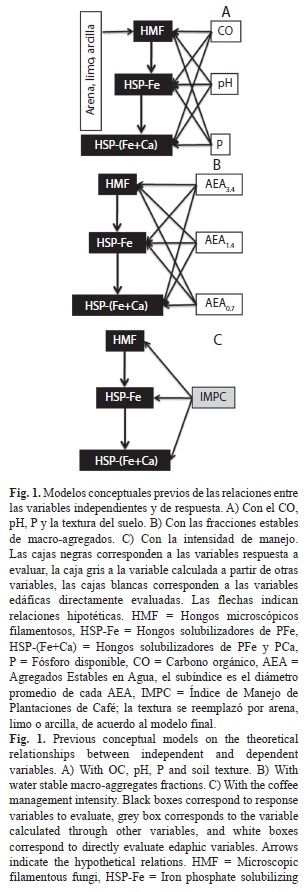
<body><![CDATA[<font size="2"><span style="font-family: verdana;">Se crearon tres     modelos     conceptuales previos (Fig. 1) de las relaciones     hipot&eacute;ticas entre las variables independientes     (f&iacute;sico-qu&iacute;micas, de estabilidad y el manejo     agron&oacute;mico) y la S y el Nai de los grupos f&uacute;ngicos     evaluados como variables respuesta (Bollen 1989, Shipley 2000, McCune     &amp; Grace 2002). En el modelo A (<a      href="/img/revistas/rbt/v60n3/a10i1.jpg">Fig. 1</a>), se     consider&oacute; los     ]]></body>
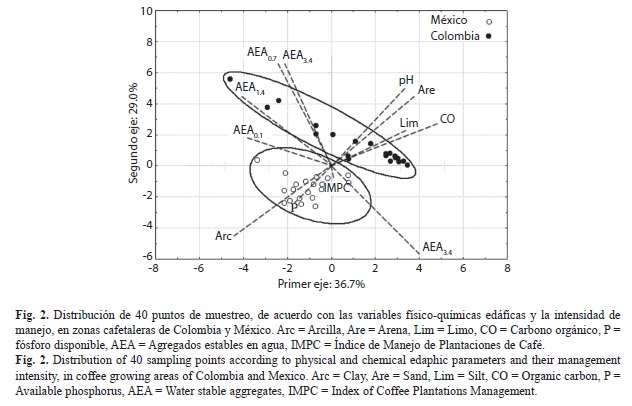
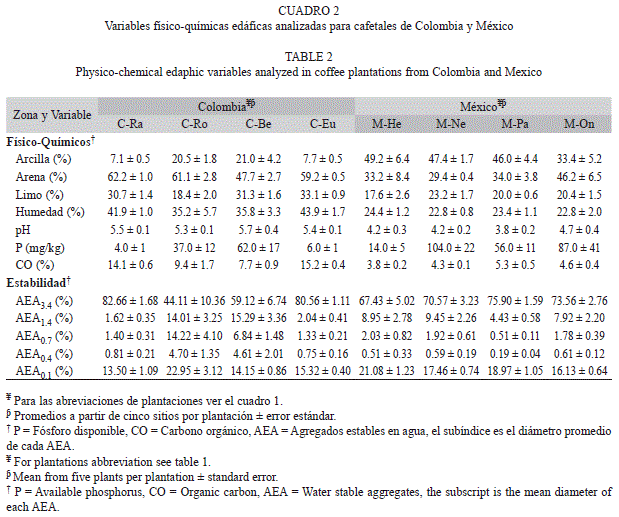
<body><![CDATA[porcentajes de arena, limo y arcilla del suelo como variables que     afectan en cada regi&oacute;n geogr&aacute;fica por igual a todos los     HMF, incluidos los HSP, por lo tanto no se estableci&oacute;     relaci&oacute;n hipot&eacute;tica directa de esta variable con los     HSP-Fe o HSP-(Fe+Ca).    <br> </span></font><br style="font-family: verdana;"> <font size="2"><span style="font-family: verdana;">A partir de los modelos previos se establecieron las relaciones necesarias para reducir el chi cuadrado (&#967;<sup>2</sup>) y obtener un alto valor de P. En este test de &#967;<sup>2</sup>, valores de P bajos indican carencia de ajuste, contrario a muchas pruebas estad&iacute;sticas, altos valores de P son indicadores de un buen ajuste. Las interacciones cuya presencia no contribuy&oacute; o da&ntilde;&oacute; el ajuste del modelo (Cuando los coeficientes de ruta (&#955;) fueron &#8804;0.05) fueron removidos para conservar las variables necesarias y mantener el poder estad&iacute;stico. Basados en las interacciones resultantes, se realiz&oacute; una b&uacute;squeda heur&iacute;stica entre los subgrupos de interacciones que generaran posibles variaciones del modelo, buscando una &oacute;ptima combinaci&oacute;n de simplicidad y ajuste. El modelo de mejor ajuste se seleccion&oacute; siguiendo la m&aacute;xima P y m&iacute;nima c/df (discrepancia/grados de libertad) como medidas determinantes; de no existir coincidencia se seleccion&oacute; el modelo con c/df m&aacute;s cercano a 1 (Byrne 1989, Arbuckle 2010).</span></font><br  style="font-family: verdana;"> <font size="2"></font><br style="font-family: verdana;"> <font size="2"><span style="font-family: verdana;">Las relaciones del carbono org&aacute;nico, el pH y el f&oacute;sforo disponible con la S y el Nai de los grupos f&uacute;ngicos estudiados, fueron representadas como coeficientes estandarizados (estandarizados por la desviaci&oacute;n est&aacute;ndar de las variables), son una medida de la fuerza de la relaci&oacute;n causal y matem&aacute;ticamente son iguales a los coeficientes de regresi&oacute;n parcial o coeficientes de correlaci&oacute;n (Antoninka <span style="font-style: italic;">et al</span>. 2009). Los valores de r<sup>2</sup> representan la proporci&oacute;n de la varianza explicada por cada conjunto de variables vinculadas a los HMF, HSP-Fe o HSP-(Fe+Ca).</span></font><br  style="font-family: verdana;"> <font size="2"></font><br style="font-family: verdana;"> <font size="2"><span style="font-family: verdana;">Los Modelos basados en Ecuaciones Estructurales (MEE) son una herramienta id&oacute;nea para estos prop&oacute;sitos, porque permiten el an&aacute;lisis de los efectos de las variables entrelazadas sobre las variables respuesta y tambi&eacute;n facilitan el examen de las interacciones entre las variables respuesta. Los MEE derivan de una s&iacute;ntesis de an&aacute;lisis de relaciones y an&aacute;lisis de factores, usualmente con un test de bondad de ajuste basado en m&aacute;xima verosimilitud (Antoninka <span  style="font-style: italic;">et al</span>. 2009). Por medio de la comparaci&oacute;n de la covarianza de la estructura de datos que est&aacute; impl&iacute;cita en el modelo, con la estructura de covarianza actualizada con los datos, se prob&oacute; si el modelo se ajustaba a los datos (Grace &amp; Pugesek 1998). Los coeficientes de la relaci&oacute;n indirecta fueron matem&aacute;ticamente obtenidos usando las reglas de relaciones por medio de la cuantificaci&oacute;n de los efectos de todas las rutas indirectas a las variables de inter&eacute;s (Grace 2006); de esta manera, los efectos totales fueron calculados por la suma de los efectos directos e indirectos. Todos los an&aacute;lisis fueron realizados usando el programa AMOS 18 (Programa de SPSS-2010).</span></font><br style="font-family: verdana;"> <font size="2"></font><br style="font-family: verdana;"> <font style="font-weight: bold;" size="3"><span  style="font-family: verdana;">Resultados</span></font><br  style="font-family: verdana;"> <font size="2"></font><br style="font-family: verdana;"> <font size="2"><span style="font-family: verdana;">En general la variaci&oacute;n entre puntos de muestreo fue mayor en cafetales colombianos que en mexicanos (<a  href="/img/revistas/rbt/v60n3/a10i2.jpg">Fig. 2</a>). Al agrupar los puntos de muestreo por plantaciones (promedio de cinco puntos de muestreo &plusmn; error est&aacute;ndar) se observ&oacute; que el contenido de arcilla y el AEA<sub>0.1</sub> fueron mayores en M&eacute;xico, mientras la arena, pH, CO, AEA<sub>0.7</sub>, y AEA<sub>0.4</sub> fueron m&aacute;s altos en Colombia (<a href="/img/revistas/rbt/v60n3/a10t2.gif">Cuadro 2</a>). A diferencia del pH; el CO y las fracciones AEA<sub>0.7</sub> y AEA<sub>0.1</sub> fueron m&aacute;s variables entre plantaciones que entre sitios de muestreo en ambos pa&iacute;ses. Los contenidos de arena, limo, arcilla, P y las fracciones AEA<sub>3.4</sub>, AEA<sub>1.4</sub> y AEA<sub>0.4</sub> fueron m&aacute;s variables entre plantaciones que entre puntos de muestreo en Colombia y al contrario en M&eacute;xico. Los contenidos de CO fueron altos a muy altos para suelos volc&aacute;nicos de los cafetales de Colombia y medios a altos para los de M&eacute;xico. El f&oacute;sforo disponible fue de muy bajo a muy alto en cafetales colombianos (Codazzi 1998) y de medios a muy altos para los mexicanos (Portilla 2001).    <br>     </span></font><br style="font-family: verdana;">     <font size="2"><span style="font-family: verdana;"><span      style="font-weight: bold;">HMF y HSP aislados en las zonas     ]]></body>
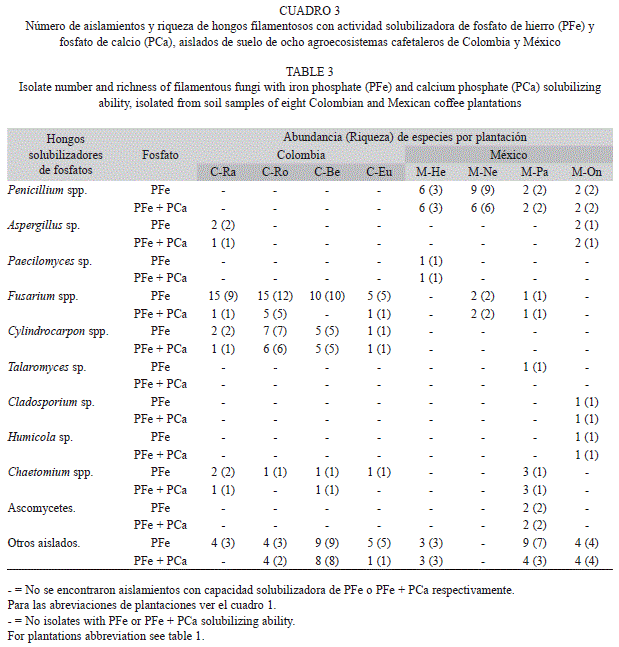
<body><![CDATA[cafetaleras:</span> Se aisl&oacute; un total     de 849 hongos filamentosos (438 para Colombia y 411 para     M&eacute;xico), de &eacute;stos, 137 (89 para Colombia y 48 para     M&eacute;xico) solubilizaron PFe y 76 (36 para Colombia y 40 para     M&eacute;xico) solubilizaron PFe y PCa. Aislamientos de los     g&eacute;neros <span style="font-style: italic;">Chaetomium</span>,<span      style="font-style: italic;">Aspergillus</span> y <span      style="font-style: italic;">Fusarium</span> mostraron     solubilizaci&oacute;n de PFe y PCa en ambas regiones     geogr&aacute;ficas. Entre los aislamientos, <span     ]]></body>
<body><![CDATA[ style="font-style: italic;">Fusarium</span> spp. y     <span style="font-style: italic;">Cylindrocarpon</span> spp. en     Colombia y <span style="font-style: italic;">Penicillium</span> spp.     en M&eacute;xico,     fueron los g&eacute;neros que m&aacute;s contribuyeron a la S y el Nai     de HSPFe y HSP-(Fe+Ca) (<a href="/img/revistas/rbt/v60n3/a10t3.gif">Cuadro     3</a>).</span></font><br style="font-family: verdana;">     <font size="2"></font><br      style="font-family: verdana; font-weight: bold;">     <font size="2"><span style="font-family: verdana;"><span     ]]></body>
<body><![CDATA[ style="font-weight: bold;">Distribuci&oacute;n de los puntos     de muestreo de acuerdo a sus     caracter&iacute;sticas f&iacute;sicoqu&iacute;micas y al IMPC:</span>     Los tres     principales componentes (ejes 1 a 3) explicaron el 77.4% de la varianza     total de los datos. El primer eje explic&oacute; el 36.7% de esta     variabilidad y las variables que m&aacute;s contribuyeron en orden     descendente fueron el carbono org&aacute;nico (CO, 0.41)&gt;arcilla     (-0.37)&gt;AEA<sub>1.4</sub> (-0.35)&gt;AEA<sub>3.4</sub> (0.33)&gt;AEA<sub>0.1</sub>     (-0.33)&gt;arena     ]]></body>
<body><![CDATA[(0.32). Por su parte el segundo eje explic&oacute; el 29.0% de la     variabilidad y las variables que m&aacute;s contribuyeron en orden     descendente fueron AEA<sub>0.7</sub> (0.44)&gt;AEA<sub>0.4</sub>     (0.44)&gt;AEA<sub>3.4</sub>     (-0.38)&gt;pH (0.33). El tercer eje explic&oacute; el 11.7% de la     variabilidad y las variables que m&aacute;s contribuyeron en orden     descendente fueron IMPC (-0.68)&gt;P (-0.58)&gt;AEA<sub>0.1</sub>     (0.31)&gt;CO     (0.15)&gt;pH (-0.14). Solamente el tercer eje fue explicado     mayoritariamente por las variables f&iacute;sico-qu&iacute;micas y la     ]]></body>
<body><![CDATA[intensidad de manejo. Adicionalmente la proyecci&oacute;n cartesiana de     los puntos (<a href="/img/revistas/rbt/v60n3/a10i2.jpg">Fig. 2</a>)     mostr&oacute; dos grupos separados y     correspondientes a los pa&iacute;ses de procedencia de las muestras:     M&eacute;xico con alta influencia de la arcilla y AEA<sub>3.4</sub>,     mientras     Colombia con alta influencia de CO, arena, pH y AEA<sub>3.4</sub>. Por     lo tanto se     decidi&oacute; analizar estos grupos por cada pa&iacute;s.</span></font><br      style="font-family: verdana;">     ]]></body>
<body><![CDATA[<font size="2"></font><br style="font-family: verdana;">     <font size="2"><span style="font-family: verdana;">De las variables     qu&iacute;micas     evaluadas, las que se asociaron con la     S y el Nai de HMF en el caso de Colombia fueron el CO y el pH, este     &uacute;ltimo no se relacion&oacute; directamente con los HSP-Fe ni     HSP-(Fe+Ca); la S y el Nai de HSP-(Fe+Ca) se relacionaron directamente     con el CO y el P y, solo indirectamente con el pH. En el caso de     M&eacute;xico el CO y el P se asociaron directamente con la S y el Nai     de HMF; el Nai de HSP-Fe se relacion&oacute; directamente con el pH y     ]]></body>
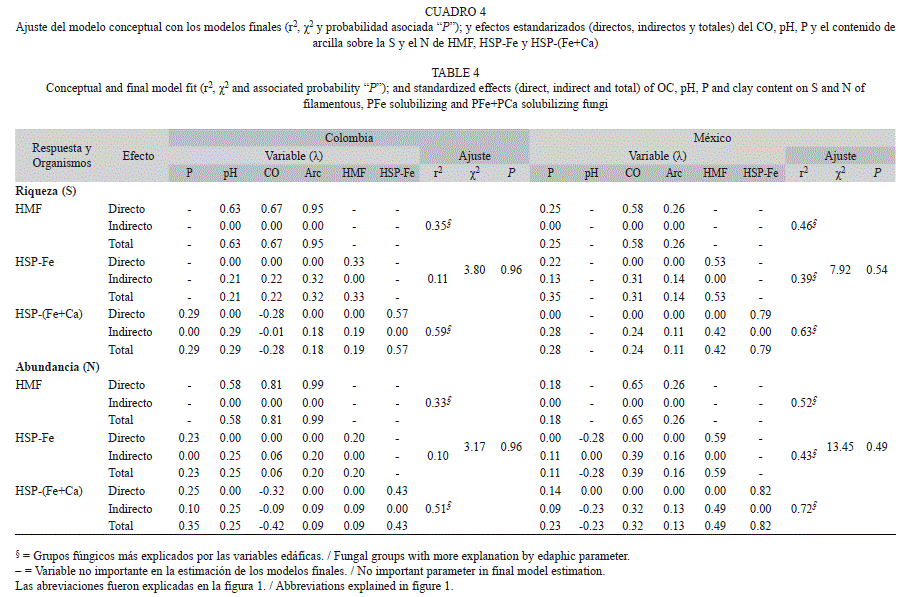
<body><![CDATA[el Nai de HSP-(Fe+Ca) con el P. La S de HSP-Fe se asoci&oacute;     directamente con el P (<a href="/img/revistas/rbt/v60n3/a10t4.gif">Cuadro     4</a>).</span></font><br style="font-family: verdana;">     <font size="2"></font><br style="font-family: verdana;">     <font size="2"><span style="font-family: verdana;">Indistinto de la     ubicaci&oacute;n     geogr&aacute;fica del cafetal, el     f&oacute;sforo disponible (P) mostr&oacute; una relaci&oacute;n     positiva con la S y el Nai de HSP-(Fe+Ca); s&oacute;lo en las     condiciones m&aacute;s &aacute;cidas de los suelos de cafetales     ]]></body>
<body><![CDATA[mexicanos, se asoci&oacute; por igual a todos los grupos     f&uacute;ngicos evaluados (r<sup>2</sup>=0.25-0.35) para la S y (r<sup><sub>2</sub></sup>=0.11-0.23)     para el Nai (<a href="/img/revistas/rbt/v60n3/a10t4.gif">Cuadro 4</a>).     En agroecosistemas cafetaleros colombianos el     pH correlacion&oacute; positivamente con la S y el Nai de los todos los     grupos f&uacute;ngicos evaluados, mientras en los mexicanos solo se     relacion&oacute; y negativamente con el Nai de HSP. El CO se     asoci&oacute; en forma positiva con la S y el Nai de todos los grupos     f&uacute;ngicos, excepto en cafetales colombianos donde la     relaci&oacute;n fue negativa con a los HSP-(Fe+Ca) (<a     ]]></body>
<body><![CDATA[ href="/img/revistas/rbt/v60n3/a10t4.gif">Cuadro 4</a>).</span></font><br      style="font-family: verdana;">     <font size="2"></font><br style="font-family: verdana;">     <font size="2"><span style="font-family: verdana;">La arcilla se     relacion&oacute;     positivamente con la S y el Nai de los     grupos f&uacute;ngicos evaluados, fue menor su asociaci&oacute;n con     los HSP, lo cual se observ&oacute; en la magnitud decreciente de     relaci&oacute;n total (<a href="/img/revistas/rbt/v60n3/a10t4.gif">Cuadro     4</a>). En cafetales colombianos la     ]]></body>
<body><![CDATA[relaci&oacute;n de la arcilla fue mayor (&#955;). En los casos donde el     modelo tuvo mayor poder explicativo (r<sup>2</sup>&gt;0.2), la S y el N     de las     poblaciones de proveniencia (HMF para HSPFe y HSP-Fe para HSP-(Fe+Ca)),     tuvieron una importante contribuci&oacute;n a la explicaci&oacute;n del     modelo (<a href="/img/revistas/rbt/v60n3/a10t4.gif">Cuadro 4</a>).</span></font><br      style="font-family: verdana;">     <font size="2"></font><br style="font-family: verdana;">     <font size="2"><span style="font-family: verdana;"><span      style="font-weight: bold;">Relaciones de los macro-agregados     ]]></body>
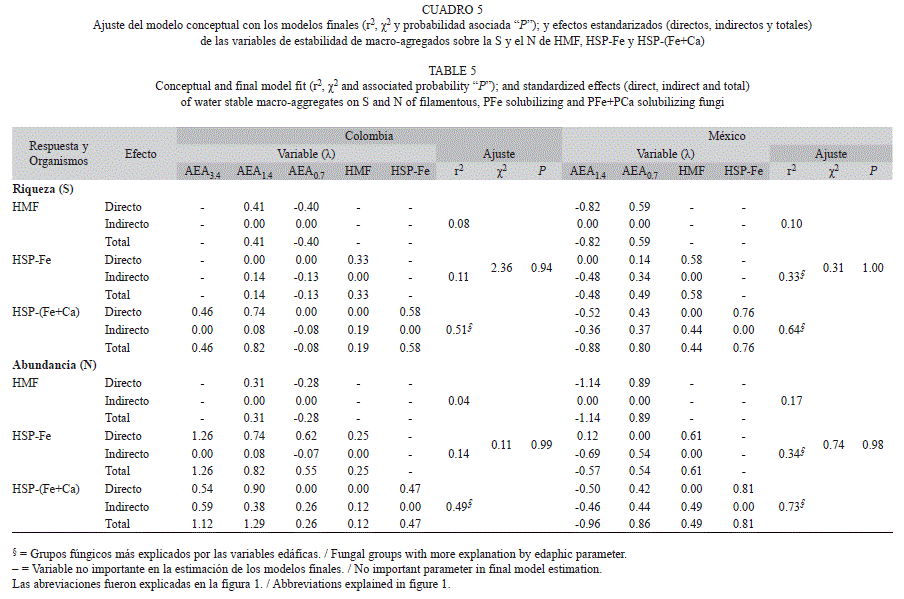
<body><![CDATA[estables: </span>De las variables de     estabilidad de agregados evaluados, en cafetales colombianos las que se     asociaron con la S y el Nai de HMF fueron las fracciones AEA<sub>1.4</sub>     y     AEA<sub>0.7</sub>, las que se relacionaron directamente con la S y el     Nai de     HSP-(Fe+Ca) fueron AEA<sub>3.4</sub> y AEA<sub>0.7</sub>, mientras que     el Nai de HSP-Fe se     asoci&oacute; con las tres fracciones evaluadas. En el caso de los     cafetales mexicanos la fracci&oacute;n AEA<sub>3.4</sub> no se     ]]></body>
<body><![CDATA[relacion&oacute;     con la S y el Nai de los grupos f&uacute;ngicos evaluados, mientras     AEA<sub>1.4</sub> y AEA<sub>0.7</sub> se asociaron directamente con la     S y el Nai de los tres     grupos f&uacute;ngicos evaluados, excepto por AEA<sub>0.7</sub>, el     cual no se     asoci&oacute; directamente con la S de HSP-Fe (<a      href="/img/revistas/rbt/v60n3/a10t5.gif">Cuadro 5</a>).</span></font><br      style="font-family: verdana;">     <font size="2"></font><br style="font-family: verdana;">     ]]></body>
<body><![CDATA[<font size="2"><span style="font-family: verdana;">Los macro-agregados     se asociaron     con la S y el Nai de los HSP-(Fe+Ca)     (r<sup>2</sup>&gt;0.4, &#955;&gt;0.1) en cafetales de ambos pa&iacute;ses, y     con los     HSPFe (r2&gt;0.3, &#955;&gt;0.4) en cafetales mexicanos. En cafetales     colombianos la relaci&oacute;n de los macroagregados fue positiva;     mientras en cafetales mexicanos, la fracci&oacute;n AEA<sub>1.4</sub>     tuvo una     relaci&oacute;n negativa y la fracci&oacute;n AEA<sub>0.7</sub>     ]]></body>
<body><![CDATA[positiva sobre los     HSP (<a href="/img/revistas/rbt/v60n3/a10t5.gif">Cuadro 5</a>). En los     casos donde el modelo tiene mayor poder     explicativo (r<sup>2</sup>&gt;0.2), la S y el Nai de las poblaciones de     proveniencia (HMF para HSP-Fe y HSP-Fe para HSP-(Fe+Ca)) tuvieron una     relaci&oacute;n positiva.</span></font><br style="font-family: verdana;">     <font size="2"></font><br style="font-family: verdana;">     <font size="2"><span style="font-family: verdana;"><span      style="font-weight: bold;">Relaciones de la intensidad de     manejo:</span> Todas las relaciones propuestas     ]]></body>
<body><![CDATA[entre la S y el Nai de HMF, HSP-Fe, HSP-(Fe+Ca) y la intensidad de     manejo en cafetales, se confirmaron en ambas regiones     geogr&aacute;ficas, excepto con los HSP-(Fe+Ca) en condiciones de     cafetales mexicanos. La intensidad de manejo (IMPC), tuvo una     relaci&oacute;n negativa con la S y el Nai de HSP-Fe solo en     condiciones de cafetales colombianos. Los modelos mostraron una fuerte     relaci&oacute;n entre los grupos f&uacute;ngicos estudiados, mientras     la relaci&oacute;n de &eacute;stos con el IMPC fue menor (<a      href="/img/revistas/rbt/v60n3/a10t6.gif">Cuadro 6</a>).</span></font><span      style="font-family: verdana;">    ]]></body>
<body><![CDATA[<br>     <br style="font-family: verdana;">     </span><font style="font-weight: bold;" size="3"><span      style="font-family: verdana;">Discusi&oacute;n</span></font><br      style="font-family: verdana;">     <font size="2"></font><br style="font-family: verdana;">     <font size="2"><span style="font-family: verdana;">Dos sistemas     cafetaleros     ed&aacute;ficamente diferentes: Colombia con     pH (5.3-5.7), P disponible (4-62mg/kg), CO (7.7-15.2%) y arena     ]]></body>
<body><![CDATA[(47.7-62.2%); M&eacute;xico con pH (3.8-4.7), P disponible     (14-104mg/kg), CO (3.8-5.3%), arcilla (33.4-49.2%) y con estaciones     clim&aacute;ticas definidas, ejemplifican cambios en la S y el Nai de     HMF y HSP ante cambios del entorno. Se corrobor&oacute; que en cada     agroecosistema, distintas variables f&iacute;sicas, qu&iacute;micas y     biol&oacute;gicas se relacionaron directa e indirectamente con la     micobiota, lo que hizo poco generalizable la relaci&oacute;n con un     solo factor ed&aacute;fico.</span></font><br      style="font-family: verdana;">     <font size="2"></font><br style="font-family: verdana;">     ]]></body>
<body><![CDATA[<font size="2"><span style="font-family: verdana;">Variables que han     sido registradas     en distintas investigaciones como     determinantes de las poblaciones microbianas, apoyan este trabajo. Por     ejemplo, los contenidos de arena y arcilla (Zhang <span      style="font-style: italic;">et al</span>. 2007), el pH     (B&aring;&aring;th 1996, Aciego &amp; Brookes 2009) y el carbono     org&aacute;nico (Huang <span style="font-style: italic;">et al</span>.     2005, Vaidya <span style="font-style: italic;">et al</span>. 2008),     han mostrado     ]]></body>
<body><![CDATA[una fuerte influencia en las poblaciones microbianas y, en los     cafetales evaluados se encontraron como variables ed&aacute;ficas     relacionadas con las comunidades f&uacute;ngicas analizadas. El hecho     que los grupos formados en el ACP correspondieran a plantaciones     geogr&aacute;ficamente cercanas y que a su vez presentaran ambientes     ed&aacute;ficos diferentes, indic&oacute; la necesidad de discriminar     el an&aacute;lisis de las comunidades de HMF, HSP-Fe y HSP-(Fe+Ca) por     pa&iacute;s.</span></font><br style="font-family: verdana;">     <font size="2"></font><br style="font-family: verdana;">     <font size="2"><span style="font-family: verdana;">El carbono     ]]></body>
<body><![CDATA[org&aacute;nico se     relacion&oacute; positivamente con los     HMF en los cafetales analizados, posiblemente debido a su efecto     estimulante del crecimiento microbiano (Vaidya <span      style="font-style: italic;">et al</span>. 2008) y al     suministro de carbono necesario para el crecimiento. Ambientes     nutricionalmente no limitados por fuentes de carbono como los cafetales     evaluados, permiten el crecimiento de los microorganismos sin     competencia inter o intra-espec&iacute;fica (Bonilla 2004, May &amp;     McLean 2007) por este recurso, hecho que permite la expresi&oacute;n de     ]]></body>
<body><![CDATA[un mayor n&uacute;mero de especies f&uacute;ngicas (S) y posibilita la     presencia de mayores poblaciones funcionalmente activas (Nai).</span></font><br      style="font-family: verdana;">     <font size="2"></font><br style="font-family: verdana;">     <font size="2"><span style="font-family: verdana;">La evaluaci&oacute;n     simult&aacute;nea de diferentes comunidades     f&uacute;ngicas en diversas condiciones ed&aacute;ficas,     permiti&oacute; encontrar similitudes y diferencias en las relaciones     de los HSP-(Fe+Ca). En cafetales colombianos, los HSP-(Fe+Ca) tuvieron     una relaci&oacute;n negativa con el CO, Narsian &amp; Patel (2009)     ]]></body>
<body><![CDATA[tambi&eacute;n reportan una relaci&oacute;n negativa de los HSP con el     CO, explicada por un bajo potencial de los HSP para solubilizar los     complejos fosfatados org&aacute;nicos. En el caso de los cafetales     colombianos, <span style="font-style: italic;">Fusarium</span> spp. y <span      style="font-style: italic;">Cylindrocarpon</span> spp. estuvieron     presentes     en el suelo, son solubilizadores de PCa y pueden aprovechar diversas     fuentes de P (Domsch <span style="font-style: italic;">et al</span>.     1980); es posible que los aislamientos     tuvieran una desventaja competitiva y fueran excluidos por otros     ]]></body>
<body><![CDATA[aislamientos con mayor velocidad de crecimiento, en especial en suelos     con altos contenidos de P disponible proveniente de fuentes     org&aacute;nicas y pH moderadamente &aacute;cido. Esta relaci&oacute;n     fue menos notoria en los suelos de cafetales mexicanos posiblemente     debido a las menores concentraciones de CO, pH m&aacute;s bajo y a que     las bajas temperaturas del invierno hacen m&aacute;s lento el proceso     de descomposici&oacute;n y sucesi&oacute;n (Henriksen &amp; Breland     1999, Pietik&auml;inen <span style="font-style: italic;">et al</span>.     2005).</span></font><br style="font-family: verdana;">     <font size="2"></font><br style="font-family: verdana;">     ]]></body>
<body><![CDATA[<font size="2"><span style="font-family: verdana;">El pH adem&aacute;s     de influir en     la selecci&oacute;n de las especies     f&uacute;ngicas predominantes (Dix &amp; Webster 1995, Hujslova <span      style="font-style: italic;">et al</span>.     2010); junto a la materia org&aacute;nica y las formas de fosfato en el     suelo, se relacion&oacute; de diferente forma con la S y el Nai de los     hongos. La mayor&iacute;a de los cafetales colombianos, incluidos los     analizados, se asientan en suelos con pH&gt;4.9, alta disponibilidad de     materia org&aacute;nica y alto contenido de arena, en ellos el     ]]></body>
<body><![CDATA[f&oacute;sforo predominante proviene del PCa (Fassbender &amp;     Bornemisza 1987) y de la materia org&aacute;nica (Muleta 2007). El pH     ed&aacute;fico se asoci&oacute; positivamente con la S y el Nai de HMF,     mientras las relaciones fueron menos pronunciadas con la S de HSP.     Resultados similares fueron encontrados con hongos saprobios por     Aliasgharzad <span style="font-style: italic;">et al</span>. (2010) en     pasturas con alto contenido de arena y pH     entre 5-8, sin considerar el contenido de P en el suelo. Tambi&eacute;n     con HSP-Ca en suelos b&aacute;sicos, con un pH &oacute;ptimo entre     7.4-8.4 (Narsian &amp; Patel 2009).</span></font><br     ]]></body>
<body><![CDATA[ style="font-family: verdana;">     <font size="2"></font><br style="font-family: verdana;">     <font size="2"><span style="font-family: verdana;">En suelos con     pH&lt;4.9, contenidos     medios de materia org&aacute;nica y     con alto contenido de arcilla como los caracterizados en los cafetales     mexicanos estudiados, predominan los fosfatos de hierro y aluminio     (Hemwall 1957), solamente solubilizables por algunas especies     f&uacute;ngicas. Esto hace que reducciones en el pH puedan favorecer el     Nai de HSP-Fe y HSP-(Fe+Ca).</span></font><br     ]]></body>
<body><![CDATA[ style="font-family: verdana;">     <font size="2"></font><br style="font-family: verdana;">     <font size="2"><span style="font-family: verdana;">Es ampliamente     aceptado que la     disponibilidad de f&oacute;sforo en el     suelo, depende de las fuentes org&aacute;nicas e inorg&aacute;nicas     existentes, producto de la descomposici&oacute;n de la materia     org&aacute;nica (enmienda o natural), la fertilizaci&oacute;n fosfatada     o la solubilizaci&oacute;n biol&oacute;gica a partir de formas     minerales. Todos los microorganismos y las plantas utilizan el     ]]></body>
<body><![CDATA[f&oacute;sforo disponible en el suelo y, en condiciones de alta     disponibilidad &#8211; como los cafetales mexicanos evaluados &#8211; se incrementa     su inmovilizaci&oacute;n biol&oacute;gica a trav&eacute;s del     desarrollo de poblaciones microbianas, incluidas las f&uacute;ngicas     (Rooney &amp; Clipson 2009). Al superarse la limitante de     disponibilidad de f&oacute;sforo, las especies pueden crecer sin     competir por este recurso, permitiendo el incremento de la S     f&uacute;ngica.</span></font><br style="font-family: verdana;">     <font size="2"></font><br style="font-family: verdana;">     <font size="2"><span style="font-family: verdana;">Los suelos de los     ]]></body>
<body><![CDATA[agroecosistemas     cafetaleros colombianos presentaron     contenidos de carbono org&aacute;nico (7.7-15.2%), pH (5.3-5.7) y     contenidos de P disponible (4-62mg/kg), que en algunos casos llegan a     ser deficientes: &lt;5mg/kg (Codazzi 1998, Portilla 2001). Bajo estas     condiciones se espera que la materia org&aacute;nica provea de P a     trav&eacute;s de la mineralizaci&oacute;n y que la fracci&oacute;n     mineral, compleja con iones Ca<sup>2+</sup>, Fe<sup>2+</sup> y Al<sup>2+</sup>     tambi&eacute;n aporte P,     aunque en menor medida, a trav&eacute;s de la solubilizaci&oacute;n     ]]></body>
<body><![CDATA[(Alexander 1978, Fassbender &amp; Bornemisza 1987). Los HSP-Ca pueden     solubilizar permanentemente el PCa contenido en suelos como los     caracterizados, motivo por el cual las poblaciones f&uacute;ngicas que     trabajan sobre esta fracci&oacute;n mineral pueden estar asociadas     positivamente con la presencia de P. Estos resultados ampl&iacute;an y     complementan los alcances del trabajo con HSP-Ca de Narsian &amp; Patel     (2009), ya que ellos encontraron resultados similares, realizando sus     evaluaciones en suelos b&aacute;sicos.</span></font><br      style="font-family: verdana;">     <font size="2"></font><br style="font-family: verdana;">     ]]></body>
<body><![CDATA[<font size="2"><span style="font-family: verdana;">En relaci&oacute;n     con los     agregados estables al agua, aunque los     macro-agregados se encuentran vinculados con todos los grupos     f&uacute;ngicos evaluados, s&oacute;lo se asociaron ampliamente     (r<sup>2</sup>&gt;0.3 y &#955;&gt;0.1) a la S y el Nai de los HSP-Fe y     HSP-(Fe+Ca).     Seg&uacute;n el trabajo de Lupwayi (2001) con suelos limosos y franco     limosos cultivados con cebada, y de Wang <span      style="font-style: italic;">et al</span>. (2010) con comunidades     ]]></body>
<body><![CDATA[f&uacute;ngicas, se esperar&iacute;a una mayor S de micromicetos     saprobios con el aumento de agregados de mayor tama&ntilde;o. En el     presente trabajo al parecer la ausencia de arado, acompa&ntilde;ado de     un alto porcentaje de agregados superiores a 0.84mm en las muestras,     modifica este patr&oacute;n. En las condiciones de los cafetales     colombianos evaluados, los valores de materia org&aacute;nica     adem&aacute;s de asegurar el abastecimiento de P org&aacute;nico,     tambi&eacute;n garantizan la solubilizaci&oacute;n permanente a partir     de PCa. La relaci&oacute;n positiva entre los macro-agregados y los     HSP-(Fe+Ca), puede estar asociada con el Ca<sup>2+</sup> presente en     ]]></body>
<body><![CDATA[todas las     fracciones; ya que el cati&oacute;n Ca<sup>2+</sup> se ha referenciado     como     participante en la estabilidad estructural permanente de los suelos     (Tisdall 1991, Torres <span style="font-style: italic;">et al</span>.     2007). En los cafetales mexicanos, la     relaci&oacute;n de los HSP-Fe y HSP-(Fe+Ca) con los agregados entre     0.8- 2mm fue negativa y con los agregados entre 0.5-0.8mm fue positiva;     este hecho puede estar relacionado con variables no evaluadas,     relacionadas directa o indirectamente con cada una de las fracciones     ]]></body>
<body><![CDATA[como: los tipos de arcilla presentes, los cuales junto con los     contenidos de arcilla pueden regular los contenidos de P (Fontes &amp;     Weed 1996, Hinsinger 2001); las comunidades bacterianas potencialmente     solubilizadoras de fosfatos; la estructura del carbono org&aacute;nico     contenido en los agregados (Six <span style="font-style: italic;">et al</span>.     2001, 2002); la     oxigenaci&oacute;n y porosidad, los cuales pueden afectar las     propiedades f&iacute;sicas y qu&iacute;micas de las diferentes     fracciones de agregados (Schjonning <span style="font-style: italic;">et     al</span>. 2002, Six <span style="font-style: italic;">et al</span>.     ]]></body>
<body><![CDATA[2004).</span></font><br style="font-family: verdana;">     <font size="2"></font><br style="font-family: verdana;">     <font size="2"><span style="font-family: verdana;">Los hongos     filamentosos     solubilizadores de fosfatos aislados: <span style="font-style: italic;">Fusarium</span>     spp., <span style="font-style: italic;">Penicillium</span> spp., <span      style="font-style: italic;">Cylindrocarpon</span> spp. y <span      style="font-style: italic;">Chaetomium </span>spp. se     encuentran ampliamente distribuidos en los suelos del mundo (Domsch <span      style="font-style: italic;">et     ]]></body>
<body><![CDATA[al</span>. 1980), y aunque la presencia de hifas se ha documentado como     elemento temporal importante en la formaci&oacute;n y mantenimiento     estructural del suelo (Tisdall 1991, 1994); los datos del presente     estudio no permitieron hacer afirmaciones espec&iacute;ficas con     respecto a la participaci&oacute;n de los g&eacute;neros y especies     f&uacute;ngicas encontradas en relaci&oacute;n con la agregaci&oacute;n     del suelo. La informaci&oacute;n obtenida en el presente trabajo     permite confirmar las observaciones de Dix &amp; Webster (1995)     respecto a la relaci&oacute;n del pH ed&aacute;fico y el predominio de     g&eacute;neros o especies f&uacute;ngicas as&iacute;: en cafetales     ]]></body>
<body><![CDATA[colombianos con pH&gt;4.9 y la presencia de <span      style="font-style: italic;">Fusarium</span> spp. y     <span style="font-style: italic;">Cylindrocarpon</span> spp., y en     cafetales mexicanos con pH&lt;4.9 y la     presencia de <span style="font-style: italic;">Penicillium</span> spp.</span></font><br      style="font-family: verdana;">     <font size="2"></font><br style="font-family: verdana;">     <font size="2"><span style="font-family: verdana;">Contrario a lo que     otras     investigaciones han se&ntilde;alado (Simmons     ]]></body>
<body><![CDATA[&amp; Coleman 2008, Suzuki <span style="font-style: italic;">et al</span>.     2009, Beauregard <span style="font-style: italic;">et al</span>.     2010),     respecto a la influencia de los sistemas de fertilizaci&oacute;n, tipos     de suelo y sistemas de labranza sobre las comunidades f&uacute;ngicas,     nosotros solo encontramos relaci&oacute;n entre la intensidad de manejo     de los cafetales y la S y el Nai de HSPFe, pero no con la S y el Nai de     HSP-(Fe+Ca) o HMF. Entre las razones que pueden explicar que el IMPC no     contribuyera ampliamente a la S y el Nai f&uacute;ngicos en la presente     investigaci&oacute;n, se encuentran: a) el uso de enmiendas     ]]></body>
<body><![CDATA[org&aacute;nicas solas (Girvan <span style="font-style: italic;">et al</span>.     2004, Vaidya <span style="font-style: italic;">et al</span>. 2008) o     en     combinaciones espec&iacute;ficas con enmiendas de s&iacute;ntesis     industrial (He <span style="font-style: italic;">et al</span>. 2007,     Wenhui <span style="font-style: italic;">et al</span>. 2010), son     pr&aacute;cticas     que han mostrado efecto positivo sobre las comunidades microbianas,     pero en la estimaci&oacute;n del IMPC no se incluye la     informaci&oacute;n de productos espec&iacute;ficos, dosis ni tiempo de     ]]></body>
<body><![CDATA[aplicaci&oacute;n. b) el car&aacute;cter aditivo del IMPC no diferencia     enmiendas de s&iacute;ntesis industrial u org&aacute;nica en el     resultado final (Hern&aacute;ndez-Mart&iacute;nez <span      style="font-style: italic;">et al</span>. 2009), de tal     manera que valores cercanos de IMPC pueden corresponder tanto a manejo     convencional como alternativo. c) el control de plagas (PC y PA) no     siempre va dirigido al suelo y principalmente las pr&aacute;cticas     asociadas al suelo son las que afectan directamente a las comunidades     ed&aacute;ficas de HMF (Beauregard <span style="font-style: italic;">et     al</span>. 2010, Wang <span style="font-style: italic;">et al</span>.     ]]></body>
<body><![CDATA[2010) y, d)     las condiciones ed&aacute;ficas bajo los primeros 5cm de un suelo sin     arado, donde fueron tomadas las muestras, suponen condiciones     m&aacute;s estables que en la parte superior del mismo, por lo tanto un     menorefecto de la actividad agr&iacute;cola superficial.</span></font><br      style="font-family: verdana;">     <font size="2"></font><br style="font-family: verdana;">     <font size="2"><span style="font-family: verdana;">Los resultados     mencionados son la     base para continuar con esta     ]]></body>
<body><![CDATA[l&iacute;nea de investigaci&oacute;n ya que el empleo de HSF en suelos     &aacute;cidos como los cafetales estudiados, es una mejor opci&oacute;n     que el uso de bacterias, por su afinidad para desarrollarse bajo     condiciones de acidez en contraposici&oacute;n a las bacterias que     prefieren ambientes alcalinos. Queda por investigar en detalle si los     cambios en la S de los grupos f&uacute;ngicos estudiados (HMF, HSP-Fe y     HSP- (Fe+Ca)) son importantes para la productividad del cultivo de     caf&eacute; a nivel regional. As&iacute; mismo, se requiere de la     evaluaci&oacute;n de las interacciones entre aislamientos de HSP y de     hongos de micorriza arbuscular (HMA), las cuales en algunas     ]]></body>
<body><![CDATA[investigaciones han mostrado una respuesta sin&eacute;rgica,     promoviendo el crecimiento de las plantas gracias al mejor     aprovechamiento del P (Osorio &amp; Habte 2001, Zhang <span      style="font-style: italic;">et al</span>. 2011). No     obstante, en otros trabajos no se han encontrado respuestas positivas     (Cabello <span style="font-style: italic;">et al</span>. 2005), lo que     muestra la importancia de continuar con     investigaciones b&aacute;sicas que profundicen en forma integral con     los factores bi&oacute;ticos y abi&oacute;ticos involucrados con la     diferentes comunidades f&uacute;ngicas del suelo.</span></font><br     ]]></body>
<body><![CDATA[ style="font-family: verdana;">     <font size="2"></font><br style="font-family: verdana;">     <font size="2"><span style="font-family: verdana;">Las relaciones     obtenidas entre las     variables ed&aacute;ficas y la     intensidad de manejo con los grupos f&uacute;ngicos evaluados deben ser     evaluadas tambi&eacute;n en &eacute;poca de lluvias para confirmar su     permanencia y estabilidad. Las relaciones pueden cambiar radicalmente     en cuanto la humedad propicia el crecimiento f&uacute;ngico (aumentando     el n&uacute;mero de aislamientos) en comparaci&oacute;n a la     ]]></body>
<body><![CDATA[&eacute;poca de secas, hecho que tambi&eacute;n puede propiciar la     expresi&oacute;n de un mayor n&uacute;mero de especies f&uacute;ngicas,     afectando las relaciones ed&aacute;ficas con la S.</span></font><br      style="font-family: verdana;">     <font size="2"></font><br style="font-family: verdana;">     <font size="2"><span style="font-family: verdana;">Las relaciones del     carbono     org&aacute;nico, el f&oacute;sforo     disponible y el pH con la S y el Nai de los grupos f&uacute;ngicos     estudiados fueron altamente variables, lo cual impide realizar     ]]></body>
<body><![CDATA[cualquier tipo de generalizaciones de asociaci&oacute;n, bien sea al     evaluar grupos f&uacute;ngicos funcionalmente diferentes o regiones     geogr&aacute;ficas.</span></font><br style="font-family: verdana;">     <font size="2"></font><br style="font-family: verdana;">     <font size="2"><span style="font-family: verdana;">La intensidad del     manejo     agr&iacute;cola no afect&oacute; ni la S ni el     Nai de los HMF en ninguna de las regiones cafetaleras estudiadas; para     los HSP no se encontraron patrones en la relaci&oacute;n entre la     intensidad de manejo de los cafetales, la S y el Nai de HSP.</span></font><br     ]]></body>
<body><![CDATA[ style="font-family: verdana;">     <font size="2"></font><br style="font-family: verdana;">     <font size="2"><span style="font-family: verdana;">En los     agroecosistemas cafetaleros     evaluados, las diferentes fracciones     de macroagregados no muestran un patr&oacute;n definido en     relaci&oacute;n con la S ni con el Nai de HMF y HSP.</span></font><br      style="font-family: verdana;">     <font size="2"></font><br style="font-family: verdana;">     <font size="2"><span style="font-family: verdana;">El efecto de todos y     ]]></body>
<body><![CDATA[cada uno de     las variables ed&aacute;ficas sobre la     micobiota no puede ser explicado alejado de su contexto, lo que hace     indispensable que se tenga en cuenta las particularidades de las     propiedades ed&aacute;ficas en cada zona.</span></font><br      style="font-family: verdana;">     <font size="2"></font><br style="font-family: verdana;">     <font style="font-weight: bold;" size="3"><span      style="font-family: verdana;">Agradecimientos</span></font><br      style="font-family: verdana;">     ]]></body>
<body><![CDATA[<font size="2"></font><br style="font-family: verdana;">     <font size="2"><span style="font-family: verdana;">Los autores expresan     sus     agradecimientos a Nubia Rodr&iacute;guez     Vargas, Fernando Ramos Naranjo y Felipe Vergara por su     colaboraci&oacute;n en actividades de laboratorio en Colombia.     Agradecemos a la empresa Qu&iacute;mica Barquim S.A. por la     donaci&oacute;n del fosfato de hierro. Asimismo agradecemos a la OEA y     al CONACyT por el apoyo econ&oacute;mico que soportaron la beca de     sostenimiento del primer autor y al Instituto de Ecolog&iacute;a A.C.     ]]></body>
<body><![CDATA[por su apoyo log&iacute;stico y econ&oacute;mico. Un especial     agradecimiento a los lectores an&oacute;nimos, por sus aportes en el     mejoramiento del documento.</span></font><br      style="font-family: verdana;">     <font size="2"></font>     <hr style="width: 100%; height: 2px;"><br style="font-family: verdana;">     <font style="font-weight: bold;" size="3"><span      style="font-family: verdana;">Referencias</span></font><br      style="font-family: verdana;">     <font size="2"></font><br style="font-family: verdana;">     ]]></body>
<body><![CDATA[<font size="2"><span style="font-family: verdana;">Aciego, J.C. &amp;     P.C. Brookes.     2009. Substrate inputs and pH as     factors controlling microbial biomass, activity and community structure     <!-- ref -->in an arable soil. Soil Biol. Biochem. 41: 1396-1405.    &nbsp;&nbsp;&nbsp;&nbsp;&nbsp;&nbsp;&nbsp;&nbsp;[&#160;<a href="javascript:void(0);" onclick="javascript: window.open('/scielo.php?script=sci_nlinks&ref=1480781&pid=S0034-7744201200030001000001&lng=','','width=640,height=500,resizable=yes,scrollbars=1,menubar=yes,');">Links</a>&#160;]<!-- end-ref --><!-- ref --></span></font><br  style="font-family: verdana;"> <font size="2"></font><br style="font-family: verdana;"> <font size="2"><span style="font-family: verdana;">Alexander, M. 1978. Introduction to soil microbiology. Wiley, New York, EEUU.    &nbsp;&nbsp;&nbsp;&nbsp;&nbsp;&nbsp;&nbsp;&nbsp;[&#160;<a href="javascript:void(0);" onclick="javascript: window.open('/scielo.php?script=sci_nlinks&ref=1480782&pid=S0034-7744201200030001000002&lng=','','width=640,height=500,resizable=yes,scrollbars=1,menubar=yes,');">Links</a>&#160;]<!-- end-ref --><!-- ref --></span></font><br style="font-family: verdana;"> <font size="2"></font><br style="font-family: verdana;"> <font size="2"><span style="font-family: verdana;">Aliasgharzad, N., L.M. Martensson &amp; P.A. Olsson. 2010. Acidification of a sandy grassland favours bacteria and disfavours fungal saprotrophs as estimated by fatty acid profiling. Soil Biol. Biochem. 42: 1058-1064.    &nbsp;&nbsp;&nbsp;&nbsp;&nbsp;&nbsp;&nbsp;&nbsp;[&#160;<a href="javascript:void(0);" onclick="javascript: window.open('/scielo.php?script=sci_nlinks&ref=1480783&pid=S0034-7744201200030001000003&lng=','','width=640,height=500,resizable=yes,scrollbars=1,menubar=yes,');">Links</a>&#160;]<!-- end-ref --><!-- ref --></span></font><br style="font-family: verdana;"> <font size="2"></font><br style="font-family: verdana;"> <font size="2"><span style="font-family: verdana;">Andrade, S.A.L., P. Mazzafera, M.A. Schiavinato &amp; A.P.D. Silveira. 2009. Arbuscular mycorrhizal association in coffee. J. Agric. Sci. 147: 105-115.    &nbsp;&nbsp;&nbsp;&nbsp;&nbsp;&nbsp;&nbsp;&nbsp;[&#160;<a href="javascript:void(0);" onclick="javascript: window.open('/scielo.php?script=sci_nlinks&ref=1480784&pid=S0034-7744201200030001000004&lng=','','width=640,height=500,resizable=yes,scrollbars=1,menubar=yes,');">Links</a>&#160;]<!-- end-ref --><!-- ref --></span></font><br style="font-family: verdana;"> <font size="2"></font><br style="font-family: verdana;"> <font size="2"><span style="font-family: verdana;">Antoninka, A., J.E. Wolf, M. Bowker, A.T. Classen &amp; N.C. Johnson. 2009. Linking above- and belowground responses to global change at community and ecosystem scales. Glob. Chang. Biol. 15: 914-929.    &nbsp;&nbsp;&nbsp;&nbsp;&nbsp;&nbsp;&nbsp;&nbsp;[&#160;<a href="javascript:void(0);" onclick="javascript: window.open('/scielo.php?script=sci_nlinks&ref=1480785&pid=S0034-7744201200030001000005&lng=','','width=640,height=500,resizable=yes,scrollbars=1,menubar=yes,');">Links</a>&#160;]<!-- end-ref --><!-- ref --></span></font><br  style="font-family: verdana;"> <font size="2"></font><br style="font-family: verdana;"> <font size="2"><span style="font-family: verdana;">Arbuckle, J.L. 2010. Amos 18 User&#8217;s Guide. SPSS, Chicago, EEUU.    &nbsp;&nbsp;&nbsp;&nbsp;&nbsp;&nbsp;&nbsp;&nbsp;[&#160;<a href="javascript:void(0);" onclick="javascript: window.open('/scielo.php?script=sci_nlinks&ref=1480786&pid=S0034-7744201200030001000006&lng=','','width=640,height=500,resizable=yes,scrollbars=1,menubar=yes,');">Links</a>&#160;]<!-- end-ref --><!-- ref --></span></font><br  style="font-family: verdana;"> <font size="2"></font><br style="font-family: verdana;"> <font size="2"><span style="font-family: verdana;">Arcila, P.J., F.P. Farf&aacute;n, A.B. Moreno, L.F. Salazar &amp; E. Hincapie. 2007. Sistemas de producci&oacute;n de caf&eacute; en Colombia. Cenicaf&eacute; y Federaci&oacute;n Nacional de Cafeteros de Colombia, Chinchin&aacute;, Colombia.    &nbsp;&nbsp;&nbsp;&nbsp;&nbsp;&nbsp;&nbsp;&nbsp;[&#160;<a href="javascript:void(0);" onclick="javascript: window.open('/scielo.php?script=sci_nlinks&ref=1480787&pid=S0034-7744201200030001000007&lng=','','width=640,height=500,resizable=yes,scrollbars=1,menubar=yes,');">Links</a>&#160;]<!-- end-ref --><!-- ref --></span></font><br  style="font-family: verdana;"> <font size="2"></font><br style="font-family: verdana;"> <font size="2"><span style="font-family: verdana;">Ashman, M., P.D. Hallett &amp; P.C. Brookes. 2003. Are the links between soil aggregate size class, soil organic matter and respiration rate artifacts of the fractionationprocedure? Soil Biol. Biochem. 35: 435-444.    &nbsp;&nbsp;&nbsp;&nbsp;&nbsp;&nbsp;&nbsp;&nbsp;[&#160;<a href="javascript:void(0);" onclick="javascript: window.open('/scielo.php?script=sci_nlinks&ref=1480788&pid=S0034-7744201200030001000008&lng=','','width=640,height=500,resizable=yes,scrollbars=1,menubar=yes,');">Links</a>&#160;]<!-- end-ref --><!-- ref --></span></font><br style="font-family: verdana;"> <font size="2"></font><br style="font-family: verdana;"> <font size="2"><span style="font-family: verdana;">B&aring;&aring;th, E. 1996. Adaptation of soil bacterial communities to prevailing pH in different soils. FEMS Microbiol. Ecol. 19: 227-237.    &nbsp;&nbsp;&nbsp;&nbsp;&nbsp;&nbsp;&nbsp;&nbsp;[&#160;<a href="javascript:void(0);" onclick="javascript: window.open('/scielo.php?script=sci_nlinks&ref=1480789&pid=S0034-7744201200030001000009&lng=','','width=640,height=500,resizable=yes,scrollbars=1,menubar=yes,');">Links</a>&#160;]<!-- end-ref --><!-- ref --></span></font><br  style="font-family: verdana;"> <font size="2"></font><br style="font-family: verdana;"> <font size="2"><span style="font-family: verdana;">Beauregard, M.S., C. Hamel, A. Nayyar &amp; M. St-Arnaud. 2010. Long-term phosphorus fertilization impacts soil fungal and bacterial diversity but not AM fungal community in Alfalfa. Microb. Ecol. 59: 379-389.    &nbsp;&nbsp;&nbsp;&nbsp;&nbsp;&nbsp;&nbsp;&nbsp;[&#160;<a href="javascript:void(0);" onclick="javascript: window.open('/scielo.php?script=sci_nlinks&ref=1480790&pid=S0034-7744201200030001000010&lng=','','width=640,height=500,resizable=yes,scrollbars=1,menubar=yes,');">Links</a>&#160;]<!-- end-ref --><!-- ref --></span></font><br style="font-family: verdana;"> <font size="2"></font><br style="font-family: verdana;"> <font size="2"><span style="font-family: verdana;">Bhattacharya, S. &amp; D.J. Babyaraj. 2002. Effectiveness of arbuscular mycorrhizal fungal isolates on arabica coffee (<span  style="font-style: italic;">Coffea arabica</span> L.). Biol. Agric. Hortic. 20: 125-131.    &nbsp;&nbsp;&nbsp;&nbsp;&nbsp;&nbsp;&nbsp;&nbsp;[&#160;<a href="javascript:void(0);" onclick="javascript: window.open('/scielo.php?script=sci_nlinks&ref=1480791&pid=S0034-7744201200030001000011&lng=','','width=640,height=500,resizable=yes,scrollbars=1,menubar=yes,');">Links</a>&#160;]<!-- end-ref --><!-- ref --></span></font><br  style="font-family: verdana;"> <font size="2"></font><br style="font-family: verdana;"> <font size="2"><span style="font-family: verdana;">Bills, G.F., M. Christensen, M. Powell &amp; G. Thorn. 2004. Saprobic soil fungi, p. 271-302. <span style="font-style: italic;">In</span> G.M. Mueller, M.S. Foster &amp; G.F (eds.). Bills. Biodiversity of fungi: Inventory and monitoring methods. Elsevier, California, EEUU.    &nbsp;&nbsp;&nbsp;&nbsp;&nbsp;&nbsp;&nbsp;&nbsp;[&#160;<a href="javascript:void(0);" onclick="javascript: window.open('/scielo.php?script=sci_nlinks&ref=1480792&pid=S0034-7744201200030001000012&lng=','','width=640,height=500,resizable=yes,scrollbars=1,menubar=yes,');">Links</a>&#160;]<!-- end-ref --><!-- ref --></span></font><br  style="font-family: verdana;"> <font size="2"></font><br style="font-family: verdana;"> <font size="2"><span style="font-family: verdana;">Bollen, K.A. 1989. Structural equations with latent variables. Wiley, New York, EEUU.    &nbsp;&nbsp;&nbsp;&nbsp;&nbsp;&nbsp;&nbsp;&nbsp;[&#160;<a href="javascript:void(0);" onclick="javascript: window.open('/scielo.php?script=sci_nlinks&ref=1480793&pid=S0034-7744201200030001000013&lng=','','width=640,height=500,resizable=yes,scrollbars=1,menubar=yes,');">Links</a>&#160;]<!-- end-ref --><!-- ref --></span></font><br style="font-family: verdana;"> <font size="2"></font><br style="font-family: verdana;"> <font size="2"><span style="font-family: verdana;">Bonilla, M.A. 2004. Ecolog&iacute;a de poblaciones. Notas de clase. Universidad Nacional de Colombia, UNIBIBLOS, Bogot&aacute;, Colombia.    &nbsp;&nbsp;&nbsp;&nbsp;&nbsp;&nbsp;&nbsp;&nbsp;[&#160;<a href="javascript:void(0);" onclick="javascript: window.open('/scielo.php?script=sci_nlinks&ref=1480794&pid=S0034-7744201200030001000014&lng=','','width=640,height=500,resizable=yes,scrollbars=1,menubar=yes,');">Links</a>&#160;]<!-- end-ref --><!-- ref --></span></font><br  style="font-family: verdana;"> <font size="2"></font><br style="font-family: verdana;"> <font size="2"><span style="font-family: verdana;">Bossuyt, H., J. Six &amp; P.F. Hendrix. 2002. Aggregate-protected carbon in no-tillage and conventional tillage agroecosystems using carbon-14 labeled plant residue. Soil Sci. Soc. Am. J. 66: 1965-1973.    &nbsp;&nbsp;&nbsp;&nbsp;&nbsp;&nbsp;&nbsp;&nbsp;[&#160;<a href="javascript:void(0);" onclick="javascript: window.open('/scielo.php?script=sci_nlinks&ref=1480795&pid=S0034-7744201200030001000015&lng=','','width=640,height=500,resizable=yes,scrollbars=1,menubar=yes,');">Links</a>&#160;]<!-- end-ref --><!-- ref --></span></font><br  style="font-family: verdana;"> <font size="2"></font><br style="font-family: verdana;"> <font size="2"><span style="font-family: verdana;">Bouyoucos, G.J. 1962. Hydrometer method improved for making particle size analyses of soils. Agron. J. 54: 464-465.    &nbsp;&nbsp;&nbsp;&nbsp;&nbsp;&nbsp;&nbsp;&nbsp;[&#160;<a href="javascript:void(0);" onclick="javascript: window.open('/scielo.php?script=sci_nlinks&ref=1480796&pid=S0034-7744201200030001000016&lng=','','width=640,height=500,resizable=yes,scrollbars=1,menubar=yes,');">Links</a>&#160;]<!-- end-ref --><!-- ref --></span></font><br  style="font-family: verdana;"> <font size="2"></font><br style="font-family: verdana;"> <font size="2"><span style="font-family: verdana;">Byrne, B.M. 1989. A primer of LISREL: Basic applications and programming for confirmatory factor analytic models. Springer-Verlag, New York, EEUU.    &nbsp;&nbsp;&nbsp;&nbsp;&nbsp;&nbsp;&nbsp;&nbsp;[&#160;<a href="javascript:void(0);" onclick="javascript: window.open('/scielo.php?script=sci_nlinks&ref=1480797&pid=S0034-7744201200030001000017&lng=','','width=640,height=500,resizable=yes,scrollbars=1,menubar=yes,');">Links</a>&#160;]<!-- end-ref --><!-- ref --></span></font><br style="font-family: verdana;"> <font size="2"></font><br style="font-family: verdana;"> <font size="2"><span style="font-family: verdana;">Cabello, M., G. Irrazabal, A.M. Bucsinszky, M. Saparrat &amp; S. Schlamuk. 2005. Effect of an arbuscular mycorrhizal fungus, <span  style="font-style: italic;">Glomus mosseae</span>, and a rockphosphate-solubilizing fungus, <span  style="font-style: italic;">Penicillium</span> <span  style="font-style: italic;">thomii</span>, on <span style="font-style: italic;">Mentha piperita</span> growth in a soilless medium. J. Basic Microbiol. 45: 182-189.    &nbsp;&nbsp;&nbsp;&nbsp;&nbsp;&nbsp;&nbsp;&nbsp;[&#160;<a href="javascript:void(0);" onclick="javascript: window.open('/scielo.php?script=sci_nlinks&ref=1480798&pid=S0034-7744201200030001000018&lng=','','width=640,height=500,resizable=yes,scrollbars=1,menubar=yes,');">Links</a>&#160;]<!-- end-ref --><!-- ref --></span></font><br style="font-family: verdana;"> <font size="2"></font><br style="font-family: verdana;"> <font size="2"><span style="font-family: verdana;">Cardoso, I.M. &amp; T.W. Kuyper. 2006. Mycorrhizas and tropical soil fertility. Agric. Ecosyst. Environ. 116: 72-84.    &nbsp;&nbsp;&nbsp;&nbsp;&nbsp;&nbsp;&nbsp;&nbsp;[&#160;<a href="javascript:void(0);" onclick="javascript: window.open('/scielo.php?script=sci_nlinks&ref=1480799&pid=S0034-7744201200030001000019&lng=','','width=640,height=500,resizable=yes,scrollbars=1,menubar=yes,');">Links</a>&#160;]<!-- end-ref --><!-- ref --></span></font><br  style="font-family: verdana;"> <font size="2"></font><br style="font-family: verdana;"> <font size="2"><span style="font-family: verdana;">Codazzi, A. 1998. Consideraciones generales para interpretar an&aacute;lisis de suelos. Instituto Geogr&aacute;fico Agust&iacute;n Codazzi, Bogot&aacute;, Colombia.    &nbsp;&nbsp;&nbsp;&nbsp;&nbsp;&nbsp;&nbsp;&nbsp;[&#160;<a href="javascript:void(0);" onclick="javascript: window.open('/scielo.php?script=sci_nlinks&ref=1480800&pid=S0034-7744201200030001000020&lng=','','width=640,height=500,resizable=yes,scrollbars=1,menubar=yes,');">Links</a>&#160;]<!-- end-ref --><!-- ref --></span></font><br  style="font-family: verdana;"> <font size="2"></font><br style="font-family: verdana;"> <font size="2"><span style="font-family: verdana;">Codazzi, A. 2009. Estudio general de suelos y zonificaci&oacute;n de tierras. Departamento de Risaralda. Instituto Geogr&aacute;fico Agust&iacute;n Codazzi, Bogot&aacute;, Colombia.    &nbsp;&nbsp;&nbsp;&nbsp;&nbsp;&nbsp;&nbsp;&nbsp;[&#160;<a href="javascript:void(0);" onclick="javascript: window.open('/scielo.php?script=sci_nlinks&ref=1480801&pid=S0034-7744201200030001000021&lng=','','width=640,height=500,resizable=yes,scrollbars=1,menubar=yes,');">Links</a>&#160;]<!-- end-ref --><!-- ref --></span></font><br  style="font-family: verdana;"> <font size="2"></font><br style="font-family: verdana;"> <font size="2"><span style="font-family: verdana;">Daraghmeh, O.A., J.R. Jensen &amp; C.T. Petersen. 2009. Soil structure stability under conventional and reduced tillage in a sandy loam. Geoderma 150: 64-71.    &nbsp;&nbsp;&nbsp;&nbsp;&nbsp;&nbsp;&nbsp;&nbsp;[&#160;<a href="javascript:void(0);" onclick="javascript: window.open('/scielo.php?script=sci_nlinks&ref=1480802&pid=S0034-7744201200030001000022&lng=','','width=640,height=500,resizable=yes,scrollbars=1,menubar=yes,');">Links</a>&#160;]<!-- end-ref --><!-- ref --></span></font><br style="font-family: verdana;"> <font size="2"></font><br style="font-family: verdana;"> <font size="2"><span style="font-family: verdana;">Dighton, J. 2003. Fungi in Ecosystem Processes. Marcel Dekker, New York, EEUU.    &nbsp;&nbsp;&nbsp;&nbsp;&nbsp;&nbsp;&nbsp;&nbsp;[&#160;<a href="javascript:void(0);" onclick="javascript: window.open('/scielo.php?script=sci_nlinks&ref=1480803&pid=S0034-7744201200030001000023&lng=','','width=640,height=500,resizable=yes,scrollbars=1,menubar=yes,');">Links</a>&#160;]<!-- end-ref --><!-- ref --></span></font><br style="font-family: verdana;"> <font size="2"></font><br style="font-family: verdana;"> <font size="2"><span style="font-family: verdana;">Dix, N.J. &amp; J. Webster. 1995. Fungal Ecology. Chapman and Hall, Londres, Inglaterra.    &nbsp;&nbsp;&nbsp;&nbsp;&nbsp;&nbsp;&nbsp;&nbsp;[&#160;<a href="javascript:void(0);" onclick="javascript: window.open('/scielo.php?script=sci_nlinks&ref=1480804&pid=S0034-7744201200030001000024&lng=','','width=640,height=500,resizable=yes,scrollbars=1,menubar=yes,');">Links</a>&#160;]<!-- end-ref --><!-- ref --></span></font><br style="font-family: verdana;"> <font size="2"></font><br style="font-family: verdana;"> <font size="2"><span style="font-family: verdana;">Domsch, K.H., W. Gams &amp; T.H. Anderson. 1980. Compendium of soil fungi. Academic, San Francisco, EEUU.    &nbsp;&nbsp;&nbsp;&nbsp;&nbsp;&nbsp;&nbsp;&nbsp;[&#160;<a href="javascript:void(0);" onclick="javascript: window.open('/scielo.php?script=sci_nlinks&ref=1480805&pid=S0034-7744201200030001000025&lng=','','width=640,height=500,resizable=yes,scrollbars=1,menubar=yes,');">Links</a>&#160;]<!-- end-ref --><!-- ref --></span></font><br  style="font-family: verdana;"> <font size="2"></font><br style="font-family: verdana;"> <font size="2"><span style="font-family: verdana;">Fassbender, H.W. &amp; E. Bornemisza. 1987. Qu&iacute;mica de suelos con &eacute;nfasis en Am&eacute;rica Latina. Instituto Iberoamericano de Cooperaci&oacute;n para la Agricultura, San Jos&eacute;, Costa Rica.    &nbsp;&nbsp;&nbsp;&nbsp;&nbsp;&nbsp;&nbsp;&nbsp;[&#160;<a href="javascript:void(0);" onclick="javascript: window.open('/scielo.php?script=sci_nlinks&ref=1480806&pid=S0034-7744201200030001000026&lng=','','width=640,height=500,resizable=yes,scrollbars=1,menubar=yes,');">Links</a>&#160;]<!-- end-ref --><!-- ref --></span></font><br  style="font-family: verdana;"> <font size="2"></font><br style="font-family: verdana;"> <font size="2"><span style="font-family: verdana;">Fixen, P.E. &amp; J.H. Grove. 1990. Soil testing and plantanalysis, p. 141-180. <span style="font-style: italic;">In</span> R.L. Westerman (ed.). Testing soils for phosphorus. Soil Science Society America Book Number 3, Madison, Wisconsin, EEUU.    &nbsp;&nbsp;&nbsp;&nbsp;&nbsp;&nbsp;&nbsp;&nbsp;[&#160;<a href="javascript:void(0);" onclick="javascript: window.open('/scielo.php?script=sci_nlinks&ref=1480807&pid=S0034-7744201200030001000027&lng=','','width=640,height=500,resizable=yes,scrollbars=1,menubar=yes,');">Links</a>&#160;]<!-- end-ref --><!-- ref --></span></font><br  style="font-family: verdana;"> <font size="2"></font><br style="font-family: verdana;"> <font size="2"><span style="font-family: verdana;">Fontes, M.P.F. &amp; S.B. Weed. 1996. Phosphate adsorption by clays from brazilian oxisols: relationships with specific surface area and mineralogy. Geoderma 72: 37-51.    &nbsp;&nbsp;&nbsp;&nbsp;&nbsp;&nbsp;&nbsp;&nbsp;[&#160;<a href="javascript:void(0);" onclick="javascript: window.open('/scielo.php?script=sci_nlinks&ref=1480808&pid=S0034-7744201200030001000028&lng=','','width=640,height=500,resizable=yes,scrollbars=1,menubar=yes,');">Links</a>&#160;]<!-- end-ref --><!-- ref --></span></font><br  style="font-family: verdana;"> <font size="2"></font><br style="font-family: verdana;"> <font size="2"><span style="font-family: verdana;">Geissert, D. &amp; A. Ib&aacute;&ntilde;ez. 2008. Calidad y ambiente f&iacute;sicoqu&iacute;mico de los suelos, p. 213-222. In R. Manson, V. Hern&aacute;ndez-Ortiz, S. Gallina &amp; K. Mehltreter (eds.). Agroecosistemas Cafetaleros de Veracruz: Biodiversidad, manejo y conservaci&oacute;n. Instituto de Ecolog&iacute;a A.C., Xalapa, M&eacute;xico.    &nbsp;&nbsp;&nbsp;&nbsp;&nbsp;&nbsp;&nbsp;&nbsp;[&#160;<a href="javascript:void(0);" onclick="javascript: window.open('/scielo.php?script=sci_nlinks&ref=1480809&pid=S0034-7744201200030001000029&lng=','','width=640,height=500,resizable=yes,scrollbars=1,menubar=yes,');">Links</a>&#160;]<!-- end-ref --><!-- ref --></span></font><br style="font-family: verdana;"> <font size="2"></font><br style="font-family: verdana;"> <font size="2"><span style="font-family: verdana;">Girvan, M.S., J. Bullimore, A.S. Ball, J.N. Pretty &amp; A.M. Osborn. 2004. Responses of active bacterial and fungal communities in soils under winter wheat to different fertilizer and pesticide regimens. Appl. Env. Microbiol. 70: 2692-2701.    &nbsp;&nbsp;&nbsp;&nbsp;&nbsp;&nbsp;&nbsp;&nbsp;[&#160;<a href="javascript:void(0);" onclick="javascript: window.open('/scielo.php?script=sci_nlinks&ref=1480810&pid=S0034-7744201200030001000030&lng=','','width=640,height=500,resizable=yes,scrollbars=1,menubar=yes,');">Links</a>&#160;]<!-- end-ref --><!-- ref --></span></font><br  style="font-family: verdana;"> <font size="2"></font><br style="font-family: verdana;"> <font size="2"><span style="font-family: verdana;">Grace, J.B. &amp; B.H. Pugesek. 1998. On the use of path analysis and related procedures for the investigation of ecological problem. Am. Nat. 152: 151-159.    &nbsp;&nbsp;&nbsp;&nbsp;&nbsp;&nbsp;&nbsp;&nbsp;[&#160;<a href="javascript:void(0);" onclick="javascript: window.open('/scielo.php?script=sci_nlinks&ref=1480811&pid=S0034-7744201200030001000031&lng=','','width=640,height=500,resizable=yes,scrollbars=1,menubar=yes,');">Links</a>&#160;]<!-- end-ref --><!-- ref --></span></font><br style="font-family: verdana;"> <font size="2"></font><br style="font-family: verdana;"> <font size="2"><span style="font-family: verdana;">Grace, J.B. 2006. Structural equation modeling and natural systems. Universidad de Cambridge, New York,&nbsp; EEUU.    &nbsp;&nbsp;&nbsp;&nbsp;&nbsp;&nbsp;&nbsp;&nbsp;[&#160;<a href="javascript:void(0);" onclick="javascript: window.open('/scielo.php?script=sci_nlinks&ref=1480812&pid=S0034-7744201200030001000032&lng=','','width=640,height=500,resizable=yes,scrollbars=1,menubar=yes,');">Links</a>&#160;]<!-- end-ref --><!-- ref --></span></font><br  style="font-family: verdana;"> <font size="2"></font><br style="font-family: verdana;"> <font size="2"><span style="font-family: verdana;">Grace, J.B. &amp; J.E. Keeley. 2006. A structural equation model analysis of postfire plant diversity in California Shrublands. Ecol. Appl. 16: 503-514.    &nbsp;&nbsp;&nbsp;&nbsp;&nbsp;&nbsp;&nbsp;&nbsp;[&#160;<a href="javascript:void(0);" onclick="javascript: window.open('/scielo.php?script=sci_nlinks&ref=1480813&pid=S0034-7744201200030001000033&lng=','','width=640,height=500,resizable=yes,scrollbars=1,menubar=yes,');">Links</a>&#160;]<!-- end-ref --><!-- ref --></span></font><br style="font-family: verdana;"> <font size="2"></font><br style="font-family: verdana;"> <font size="2"><span style="font-family: verdana;">Griffin, D.H. 1996. Fungal physiology. Wiley, New York, EEUU.    &nbsp;&nbsp;&nbsp;&nbsp;&nbsp;&nbsp;&nbsp;&nbsp;[&#160;<a href="javascript:void(0);" onclick="javascript: window.open('/scielo.php?script=sci_nlinks&ref=1480814&pid=S0034-7744201200030001000034&lng=','','width=640,height=500,resizable=yes,scrollbars=1,menubar=yes,');">Links</a>&#160;]<!-- end-ref --><!-- ref --></span></font><br  style="font-family: verdana;"> <font size="2"></font><br style="font-family: verdana;"> <font size="2"><span style="font-family: verdana;">Guzm&aacute;n, O. &amp; A. Jaramillo. 1989. Estudio clim&aacute;tico de Risaralda y Quind&iacute;o. Bol. T&eacute;c. Cenicaf&eacute; 15: 1-64.    &nbsp;&nbsp;&nbsp;&nbsp;&nbsp;&nbsp;&nbsp;&nbsp;[&#160;<a href="javascript:void(0);" onclick="javascript: window.open('/scielo.php?script=sci_nlinks&ref=1480815&pid=S0034-7744201200030001000035&lng=','','width=640,height=500,resizable=yes,scrollbars=1,menubar=yes,');">Links</a>&#160;]<!-- end-ref --><!-- ref --></span></font><br  style="font-family: verdana;"> <font size="2"></font><br style="font-family: verdana;"> <font size="2"><span style="font-family: verdana;">He, J.Z., J.P. Shen, L.M. Zhang, Y.G. Zhu, Y.M. Zheng, M.G. Xu &amp; H. Di. 2007. Quantitative analyses of the abundance and composition of ammonia-oxidizing bacteria and ammonia-oxidizing archaea of a Chinese upland red soil under long-term fertilization practices. Environ. Microbiol. 9: 2364-2374.    &nbsp;&nbsp;&nbsp;&nbsp;&nbsp;&nbsp;&nbsp;&nbsp;[&#160;<a href="javascript:void(0);" onclick="javascript: window.open('/scielo.php?script=sci_nlinks&ref=1480816&pid=S0034-7744201200030001000036&lng=','','width=640,height=500,resizable=yes,scrollbars=1,menubar=yes,');">Links</a>&#160;]<!-- end-ref --><!-- ref --></span></font><br style="font-family: verdana;"> <font size="2"></font><br style="font-family: verdana;"> <font size="2"><span style="font-family: verdana;">Hemwall, J.B. 1957. The fixation of phosphorus by soils, p. 95-113. In A.G. Norman (ed.). Advances in Agronomy IX. Academic, New York, EEUU.    &nbsp;&nbsp;&nbsp;&nbsp;&nbsp;&nbsp;&nbsp;&nbsp;[&#160;<a href="javascript:void(0);" onclick="javascript: window.open('/scielo.php?script=sci_nlinks&ref=1480817&pid=S0034-7744201200030001000037&lng=','','width=640,height=500,resizable=yes,scrollbars=1,menubar=yes,');">Links</a>&#160;]<!-- end-ref --><!-- ref --></span></font><br  style="font-family: verdana;"> <font size="2"></font><br style="font-family: verdana;"> <font size="2"><span style="font-family: verdana;">Henriksen, T.M. &amp; T.A. Breland. 1999. Decomposition of crop residues in the field: evaluation of a simulation model developed from microcosm studies. Soil Biol. Biochem. 31: 1423-1434.    &nbsp;&nbsp;&nbsp;&nbsp;&nbsp;&nbsp;&nbsp;&nbsp;[&#160;<a href="javascript:void(0);" onclick="javascript: window.open('/scielo.php?script=sci_nlinks&ref=1480818&pid=S0034-7744201200030001000038&lng=','','width=640,height=500,resizable=yes,scrollbars=1,menubar=yes,');">Links</a>&#160;]<!-- end-ref --><!-- ref --></span></font><br  style="font-family: verdana;"> <font size="2"></font><br style="font-family: verdana;"> <font size="2"><span style="font-family: verdana;">Hern&aacute;ndez-Mart&iacute;nez, G. 2008. Clasificaci&oacute;n Agroecol&oacute;gica, p. 15-34. <span style="font-style: italic;">In</span> R.H. Manson, V. Hern&aacute;ndez-Ortiz, S. Gallina &amp; K. Mehltreter (eds.). Agroecosistemas cafetaleros de Veracruz: Biodiversidad, manejo y conservaci&oacute;n. Instituto de Ecolog&iacute;a A.C., Xalapa, M&eacute;xico.    &nbsp;&nbsp;&nbsp;&nbsp;&nbsp;&nbsp;&nbsp;&nbsp;[&#160;<a href="javascript:void(0);" onclick="javascript: window.open('/scielo.php?script=sci_nlinks&ref=1480819&pid=S0034-7744201200030001000039&lng=','','width=640,height=500,resizable=yes,scrollbars=1,menubar=yes,');">Links</a>&#160;]<!-- end-ref --><!-- ref --></span></font><br style="font-family: verdana;"> <font size="2"></font><br style="font-family: verdana;"> <font size="2"><span style="font-family: verdana;">Hern&aacute;ndez-Mart&iacute;nez, G., R.H. Manson &amp; A. Contreras. 2009. Quantitative classification of coffee agroecosystems spanning a range of production intensities in central Veracruz, M&eacute;xico. Agric. Ecosyst. Environ. 134: 89-98.    &nbsp;&nbsp;&nbsp;&nbsp;&nbsp;&nbsp;&nbsp;&nbsp;[&#160;<a href="javascript:void(0);" onclick="javascript: window.open('/scielo.php?script=sci_nlinks&ref=1480820&pid=S0034-7744201200030001000040&lng=','','width=640,height=500,resizable=yes,scrollbars=1,menubar=yes,');">Links</a>&#160;]<!-- end-ref --><!-- ref --></span></font><br  style="font-family: verdana;"> <font size="2"></font><br style="font-family: verdana;"> <font size="2"><span style="font-family: verdana;">Herrera-Peraza, R.A., C. Hamel, F. Fern&aacute;ndez, R.L. Ferrer &amp; E. Furrazola. 2011. Soil-strain compatibility: the key to effective use of arbuscular mycorrhizal inoculants? Mycorrhiza 21: 183-93.    &nbsp;&nbsp;&nbsp;&nbsp;&nbsp;&nbsp;&nbsp;&nbsp;[&#160;<a href="javascript:void(0);" onclick="javascript: window.open('/scielo.php?script=sci_nlinks&ref=1480821&pid=S0034-7744201200030001000041&lng=','','width=640,height=500,resizable=yes,scrollbars=1,menubar=yes,');">Links</a>&#160;]<!-- end-ref --><!-- ref --></span></font><br  style="font-family: verdana;"> <font size="2"></font><br style="font-family: verdana;"> <font size="2"><span style="font-family: verdana;">Hinsinger, P. 2001. Bioavailability of soil inorganic P in the rhizosphere as affected by root-induced chemical changes: a review. Plant Soil 237: 173-195.    &nbsp;&nbsp;&nbsp;&nbsp;&nbsp;&nbsp;&nbsp;&nbsp;[&#160;<a href="javascript:void(0);" onclick="javascript: window.open('/scielo.php?script=sci_nlinks&ref=1480822&pid=S0034-7744201200030001000042&lng=','','width=640,height=500,resizable=yes,scrollbars=1,menubar=yes,');">Links</a>&#160;]<!-- end-ref --><!-- ref --></span></font><br style="font-family: verdana;"> <font size="2"></font><br style="font-family: verdana;"> <font size="2"><span style="font-family: verdana;">Huang, P., M. Wang &amp; C. Chiu. 2005. Soil mineral-organic matter-microbe interactions: Impacts on biogeochemical processes and biodiversity in soils. Pedobiology 49: 609-635.    &nbsp;&nbsp;&nbsp;&nbsp;&nbsp;&nbsp;&nbsp;&nbsp;[&#160;<a href="javascript:void(0);" onclick="javascript: window.open('/scielo.php?script=sci_nlinks&ref=1480823&pid=S0034-7744201200030001000043&lng=','','width=640,height=500,resizable=yes,scrollbars=1,menubar=yes,');">Links</a>&#160;]<!-- end-ref --><!-- ref --></span></font><br  style="font-family: verdana;"> <font size="2"></font><br style="font-family: verdana;"> <font size="2"><span style="font-family: verdana;">Hujslova, M., A. Kubatova, M. Chudickova &amp; M. Kolarik. 2010. Diversity of fungal communities in saline and acidic soils in the Soos National Natural Reserve, Czech Republic. Micol. Prog. 9: 1-15.    &nbsp;&nbsp;&nbsp;&nbsp;&nbsp;&nbsp;&nbsp;&nbsp;[&#160;<a href="javascript:void(0);" onclick="javascript: window.open('/scielo.php?script=sci_nlinks&ref=1480824&pid=S0034-7744201200030001000044&lng=','','width=640,height=500,resizable=yes,scrollbars=1,menubar=yes,');">Links</a>&#160;]<!-- end-ref --><!-- ref --></span></font><br  style="font-family: verdana;"> <font size="2"></font><br style="font-family: verdana;"> <font size="2"><span style="font-family: verdana;">ICO. 2011. Total production of exporting countries: crop years commencing 2005 to 2010. International Coffee Organization, Londres, Inglaterra.    &nbsp;&nbsp;&nbsp;&nbsp;&nbsp;&nbsp;&nbsp;&nbsp;[&#160;<a href="javascript:void(0);" onclick="javascript: window.open('/scielo.php?script=sci_nlinks&ref=1480825&pid=S0034-7744201200030001000045&lng=','','width=640,height=500,resizable=yes,scrollbars=1,menubar=yes,');">Links</a>&#160;]<!-- end-ref --><!-- ref --></span></font><br style="font-family: verdana;"> <font size="2"></font><br style="font-family: verdana;"> <font size="2"><span style="font-family: verdana;">Lauber, C.L., M.S. Strickland, M.A. Bradford &amp; N. Fierer. 2008. The influence of soil properties on the structure of bacterial and fungal communities across land-use types. Soil Biol. Biochem. 40: 2407-2415.    &nbsp;&nbsp;&nbsp;&nbsp;&nbsp;&nbsp;&nbsp;&nbsp;[&#160;<a href="javascript:void(0);" onclick="javascript: window.open('/scielo.php?script=sci_nlinks&ref=1480826&pid=S0034-7744201200030001000046&lng=','','width=640,height=500,resizable=yes,scrollbars=1,menubar=yes,');">Links</a>&#160;]<!-- end-ref --><!-- ref --></span></font><br  style="font-family: verdana;"> <font size="2"></font><br style="font-family: verdana;"> <font size="2"><span style="font-family: verdana;">Lupwayi, N. 2001. Bacterial diversity in water-stableaggregates of soils under conventional and zero tillage management. Appl. Soil Ecol. 16: 251-261.    &nbsp;&nbsp;&nbsp;&nbsp;&nbsp;&nbsp;&nbsp;&nbsp;[&#160;<a href="javascript:void(0);" onclick="javascript: window.open('/scielo.php?script=sci_nlinks&ref=1480827&pid=S0034-7744201200030001000047&lng=','','width=640,height=500,resizable=yes,scrollbars=1,menubar=yes,');">Links</a>&#160;]<!-- end-ref --><!-- ref --></span></font><br style="font-family: verdana;"> <font size="2"></font><br style="font-family: verdana;"> <font size="2"><span style="font-family: verdana;">Manns, H.R., C.D. Maxwell &amp; R.J.N. Emery. 2007. The effect of ground cover or initial organic carbon on soil fungi, aggregation, moisture and organic carbon in one season with oat (<span  style="font-style: italic;">Avena sativa</span>) plots. Soil Tillage Res. 96: 83-94.    &nbsp;&nbsp;&nbsp;&nbsp;&nbsp;&nbsp;&nbsp;&nbsp;[&#160;<a href="javascript:void(0);" onclick="javascript: window.open('/scielo.php?script=sci_nlinks&ref=1480828&pid=S0034-7744201200030001000048&lng=','','width=640,height=500,resizable=yes,scrollbars=1,menubar=yes,');">Links</a>&#160;]<!-- end-ref --><!-- ref --></span></font><br  style="font-family: verdana;"> <font size="2"></font><br style="font-family: verdana;"> <font size="2"><span style="font-family: verdana;">May, R. &amp; A. McLean. 2007. Theoretical ecology: principles and applications. Oxford University, New York, EEUU.    &nbsp;&nbsp;&nbsp;&nbsp;&nbsp;&nbsp;&nbsp;&nbsp;[&#160;<a href="javascript:void(0);" onclick="javascript: window.open('/scielo.php?script=sci_nlinks&ref=1480829&pid=S0034-7744201200030001000049&lng=','','width=640,height=500,resizable=yes,scrollbars=1,menubar=yes,');">Links</a>&#160;]<!-- end-ref --><!-- ref --></span></font><br  style="font-family: verdana;"> <font size="2"></font><br style="font-family: verdana;"> <font size="2"><span style="font-family: verdana;">McCune, B. &amp; J.B. Grace. 2002. Analysis of Ecological Communities. MjM Software Design, Gleneden, EEUU.    &nbsp;&nbsp;&nbsp;&nbsp;&nbsp;&nbsp;&nbsp;&nbsp;[&#160;<a href="javascript:void(0);" onclick="javascript: window.open('/scielo.php?script=sci_nlinks&ref=1480830&pid=S0034-7744201200030001000050&lng=','','width=640,height=500,resizable=yes,scrollbars=1,menubar=yes,');">Links</a>&#160;]<!-- end-ref --><!-- ref --></span></font><br  style="font-family: verdana;"> <font size="2"></font><br style="font-family: verdana;"> <font size="2"><span style="font-family: verdana;">Montiel, R.B. &amp; M.J.D. Robledo. 1998. Caracterizaci&oacute;n, descripci&oacute;n y evaluaci&oacute;n de especies frutales en el banco gen&eacute;tico del CRUO. Universidad Veracruzana, C&oacute;rdoba, Veracruz, M&eacute;xico.    &nbsp;&nbsp;&nbsp;&nbsp;&nbsp;&nbsp;&nbsp;&nbsp;[&#160;<a href="javascript:void(0);" onclick="javascript: window.open('/scielo.php?script=sci_nlinks&ref=1480831&pid=S0034-7744201200030001000051&lng=','','width=640,height=500,resizable=yes,scrollbars=1,menubar=yes,');">Links</a>&#160;]<!-- end-ref --><!-- ref --></span></font><br style="font-family: verdana;"> <font size="2"></font><br style="font-family: verdana;"> <font size="2"><span style="font-family: verdana;">Muleta, D. 2007. Microbial Inputs in coffee (<span style="font-style: italic;">Coffea Arabica</span> L .) Production Systems, Southwestern Ethiopia. Production. Tesis de Doctorado, Universidad Sueca de Ciencias Agr&iacute;colas, Upsala, Suecia.    &nbsp;&nbsp;&nbsp;&nbsp;&nbsp;&nbsp;&nbsp;&nbsp;[&#160;<a href="javascript:void(0);" onclick="javascript: window.open('/scielo.php?script=sci_nlinks&ref=1480832&pid=S0034-7744201200030001000052&lng=','','width=640,height=500,resizable=yes,scrollbars=1,menubar=yes,');">Links</a>&#160;]<!-- end-ref --><!-- ref --></span></font><br style="font-family: verdana;"> <font size="2"></font><br style="font-family: verdana;"> <font size="2"><span style="font-family: verdana;">M&aacute;rquez, C.O., V.J. Garc&iacute;a, C.A. Cambardella, R.C. Schultz &amp; T.M. Isenhart. 2004. Aggregate size stability distribution and soil stability. Soil Sci. Soc. Am. J. 68: 725-735.    &nbsp;&nbsp;&nbsp;&nbsp;&nbsp;&nbsp;&nbsp;&nbsp;[&#160;<a href="javascript:void(0);" onclick="javascript: window.open('/scielo.php?script=sci_nlinks&ref=1480833&pid=S0034-7744201200030001000053&lng=','','width=640,height=500,resizable=yes,scrollbars=1,menubar=yes,');">Links</a>&#160;]<!-- end-ref --><!-- ref --></span></font><br  style="font-family: verdana;"> <font size="2"></font><br style="font-family: verdana;"> <font size="2"><span style="font-family: verdana;">Narsian, V.T. &amp; H.H. Patel. 2009. Relationship of physicochemical properties of rhizosphere soils with native population of mineral phosphate solubilizing fungi. Indian J. Microbiol. 49: 60-67.    &nbsp;&nbsp;&nbsp;&nbsp;&nbsp;&nbsp;&nbsp;&nbsp;[&#160;<a href="javascript:void(0);" onclick="javascript: window.open('/scielo.php?script=sci_nlinks&ref=1480834&pid=S0034-7744201200030001000054&lng=','','width=640,height=500,resizable=yes,scrollbars=1,menubar=yes,');">Links</a>&#160;]<!-- end-ref --><!-- ref --></span></font><br  style="font-family: verdana;"> <font size="2"></font><br style="font-family: verdana;"> <font size="2"><span style="font-family: verdana;">Oades, J.M. &amp; A.G. Waters. 1991. Aggregate hierarchy in soils. Aust. J. Soil Res. 29: 815-828.    &nbsp;&nbsp;&nbsp;&nbsp;&nbsp;&nbsp;&nbsp;&nbsp;[&#160;<a href="javascript:void(0);" onclick="javascript: window.open('/scielo.php?script=sci_nlinks&ref=1480835&pid=S0034-7744201200030001000055&lng=','','width=640,height=500,resizable=yes,scrollbars=1,menubar=yes,');">Links</a>&#160;]<!-- end-ref --><!-- ref --></span></font><br  style="font-family: verdana;"> <font size="2"></font><br style="font-family: verdana;"> <font size="2"><span style="font-family: verdana;">Oliveira, C.A., V.M.C. Alves, I.E. Marriel, E.A. Gomes, M.R. Scotti, N.P. Carneiro, C.T. Guimar&atilde;es, R.E. Schaffert &amp; N.M.H. S&aacute;. 2009. Phosphate solubilizing microorganisms isolated from rhizosphere of maize cultivated in an oxisol of the Brazilian Cerrado Biome. Soil Biol. Biochem. 41: 1782-1787.    &nbsp;&nbsp;&nbsp;&nbsp;&nbsp;&nbsp;&nbsp;&nbsp;[&#160;<a href="javascript:void(0);" onclick="javascript: window.open('/scielo.php?script=sci_nlinks&ref=1480836&pid=S0034-7744201200030001000056&lng=','','width=640,height=500,resizable=yes,scrollbars=1,menubar=yes,');">Links</a>&#160;]<!-- end-ref --><!-- ref --></span></font><br  style="font-family: verdana;"> <font size="2"></font><br style="font-family: verdana;"> <font size="2"><span style="font-family: verdana;">Osorio, N.W. &amp; M. Habte. 2001. Synergistic influence of an arbuscular mycorrhizal fungus and a P solubilizing fungus on growth and P uptake of <span style="font-style: italic;">Leucaena leucocephala</span> in an Oxisol. Arid Land Res. Manag. 15: 263-274.    &nbsp;&nbsp;&nbsp;&nbsp;&nbsp;&nbsp;&nbsp;&nbsp;[&#160;<a href="javascript:void(0);" onclick="javascript: window.open('/scielo.php?script=sci_nlinks&ref=1480837&pid=S0034-7744201200030001000057&lng=','','width=640,height=500,resizable=yes,scrollbars=1,menubar=yes,');">Links</a>&#160;]<!-- end-ref --><!-- ref --></span></font><br style="font-family: verdana;"> <font size="2"></font><br style="font-family: verdana;"> <font size="2"><span style="font-family: verdana;">Pietik&auml;inen, J., M. Pettersson &amp; E. B&aring;&aring;th. 2005. Comparison of temperature effects on soil respiration and bacterial and fungal growth rates. FEMS Microbiol. Ecol. 52: 49-58.    &nbsp;&nbsp;&nbsp;&nbsp;&nbsp;&nbsp;&nbsp;&nbsp;[&#160;<a href="javascript:void(0);" onclick="javascript: window.open('/scielo.php?script=sci_nlinks&ref=1480838&pid=S0034-7744201200030001000058&lng=','','width=640,height=500,resizable=yes,scrollbars=1,menubar=yes,');">Links</a>&#160;]<!-- end-ref --><!-- ref --></span></font><br  style="font-family: verdana;"> <font size="2"></font><br style="font-family: verdana;"> <font size="2"><span style="font-family: verdana;">Portilla, N. 2001. Cuadernillo de procedimientos anal&iacute;ticos de suelos. Departamento de investigaci&oacute;n y diagn&oacute;stico regional. Laboratorio de suelos, aguas y plantas. Texcoco, M&eacute;xico.    &nbsp;&nbsp;&nbsp;&nbsp;&nbsp;&nbsp;&nbsp;&nbsp;[&#160;<a href="javascript:void(0);" onclick="javascript: window.open('/scielo.php?script=sci_nlinks&ref=1480839&pid=S0034-7744201200030001000059&lng=','','width=640,height=500,resizable=yes,scrollbars=1,menubar=yes,');">Links</a>&#160;]<!-- end-ref --><!-- ref --></span></font><br style="font-family: verdana;"> <font size="2"></font><br style="font-family: verdana;"> <font size="2"><span style="font-family: verdana;">Posada, R.H., G. Heredia-Abarca, E. Sieverding &amp; M. S&aacute;nchez de Prager. 2012. Solubilization of iron and calcium phosphates by soil fungi isolated from coffee plantations. Arch. Agron. Soil Sci. (in press). DOI: 10.1080/03650340.2011.610030.    &nbsp;&nbsp;&nbsp;&nbsp;&nbsp;&nbsp;&nbsp;&nbsp;[&#160;<a href="javascript:void(0);" onclick="javascript: window.open('/scielo.php?script=sci_nlinks&ref=1480840&pid=S0034-7744201200030001000060&lng=','','width=640,height=500,resizable=yes,scrollbars=1,menubar=yes,');">Links</a>&#160;]<!-- end-ref --><!-- ref --></span></font><br  style="font-family: verdana;"> <font size="2"></font><br style="font-family: verdana;"> <font size="2"><span style="font-family: verdana;">Rodr&iacute;guez, J.L. 2001. Efecto del biofertilizante Mycoral&reg; (micorriza arbuscular) en el desarrollo del caf&eacute; (<span  style="font-style: italic;">Coffea arabica</span> L), en vivero de Zamorano, Honduras. Tesis de Licenciatura, Universidad de Zamorano, Tegucigalpa, Honduras.    &nbsp;&nbsp;&nbsp;&nbsp;&nbsp;&nbsp;&nbsp;&nbsp;[&#160;<a href="javascript:void(0);" onclick="javascript: window.open('/scielo.php?script=sci_nlinks&ref=1480841&pid=S0034-7744201200030001000061&lng=','','width=640,height=500,resizable=yes,scrollbars=1,menubar=yes,');">Links</a>&#160;]<!-- end-ref --><!-- ref --></span></font><br  style="font-family: verdana;"> <font size="2"></font><br style="font-family: verdana;"> <font size="2"><span style="font-family: verdana;">Rooney, D.C. &amp; N.J.W. Clipson. 2009. Phosphate addition and plant species alters microbial community structure in acidic upland grassland soil. Microb. Ecol. 57: 4-13.    &nbsp;&nbsp;&nbsp;&nbsp;&nbsp;&nbsp;&nbsp;&nbsp;[&#160;<a href="javascript:void(0);" onclick="javascript: window.open('/scielo.php?script=sci_nlinks&ref=1480842&pid=S0034-7744201200030001000062&lng=','','width=640,height=500,resizable=yes,scrollbars=1,menubar=yes,');">Links</a>&#160;]<!-- end-ref --><!-- ref --></span></font><br  style="font-family: verdana;"> <font size="2"></font><br style="font-family: verdana;"> <font size="2"><span style="font-family: verdana;">Schjonning, P., L.J. Munkholm, P. Moldrup &amp; O.H. Jacobsen. 2002. Modeling soil pore characteristics from measurements of air exchange: the long-term effects of fertilization and crop rotation. Eur. J. Soil Sci. 53: 331-339.    &nbsp;&nbsp;&nbsp;&nbsp;&nbsp;&nbsp;&nbsp;&nbsp;[&#160;<a href="javascript:void(0);" onclick="javascript: window.open('/scielo.php?script=sci_nlinks&ref=1480843&pid=S0034-7744201200030001000063&lng=','','width=640,height=500,resizable=yes,scrollbars=1,menubar=yes,');">Links</a>&#160;]<!-- end-ref --><!-- ref --></span></font><br style="font-family: verdana;"> <font size="2"></font><br style="font-family: verdana;"> <font size="2"><span style="font-family: verdana;">Shipley, B. 2000. Cause and correlation in biology: A user&#8217;s guide to path analysis, structural equations and causal inference. Cambridge University, Londres, Inglaterra.    &nbsp;&nbsp;&nbsp;&nbsp;&nbsp;&nbsp;&nbsp;&nbsp;[&#160;<a href="javascript:void(0);" onclick="javascript: window.open('/scielo.php?script=sci_nlinks&ref=1480844&pid=S0034-7744201200030001000064&lng=','','width=640,height=500,resizable=yes,scrollbars=1,menubar=yes,');">Links</a>&#160;]<!-- end-ref --><!-- ref --></span></font><br  style="font-family: verdana;"> <font size="2"></font><br style="font-family: verdana;"> <font size="2"><span style="font-family: verdana;">Simmons, B. &amp; D.C. Coleman. 2008. Microbial community response to transition from conventional to conservation tillage in cotton fields. Appl. Soil Ecol. 40: 518-528.    &nbsp;&nbsp;&nbsp;&nbsp;&nbsp;&nbsp;&nbsp;&nbsp;[&#160;<a href="javascript:void(0);" onclick="javascript: window.open('/scielo.php?script=sci_nlinks&ref=1480845&pid=S0034-7744201200030001000065&lng=','','width=640,height=500,resizable=yes,scrollbars=1,menubar=yes,');">Links</a>&#160;]<!-- end-ref --><!-- ref --></span></font><br  style="font-family: verdana;"> <font size="2"></font><br style="font-family: verdana;"> <font size="2"><span style="font-family: verdana;">Six, J., G. Guggenberger, K. Paustian, L. Haumaier, E.T. Elliot &amp; W. Zech. 2001. Sources and composition of soil organic matter fractions between and within soil aggregates. Eur. J. Soil Sci. 52: 607-618.    &nbsp;&nbsp;&nbsp;&nbsp;&nbsp;&nbsp;&nbsp;&nbsp;[&#160;<a href="javascript:void(0);" onclick="javascript: window.open('/scielo.php?script=sci_nlinks&ref=1480846&pid=S0034-7744201200030001000066&lng=','','width=640,height=500,resizable=yes,scrollbars=1,menubar=yes,');">Links</a>&#160;]<!-- end-ref --><!-- ref --></span></font><br  style="font-family: verdana;"> <font size="2"></font><br style="font-family: verdana;"> <font size="2"><span style="font-family: verdana;">Six, J., R.T. Conant, E.A. Paul &amp; K. Paustian. 2002. Stabilization mechanisms of soil organic matter: Implications for C-saturation of soils. Plant Soil 241: 155-176.    &nbsp;&nbsp;&nbsp;&nbsp;&nbsp;&nbsp;&nbsp;&nbsp;[&#160;<a href="javascript:void(0);" onclick="javascript: window.open('/scielo.php?script=sci_nlinks&ref=1480847&pid=S0034-7744201200030001000067&lng=','','width=640,height=500,resizable=yes,scrollbars=1,menubar=yes,');">Links</a>&#160;]<!-- end-ref --><!-- ref --></span></font><br  style="font-family: verdana;"> <font size="2"></font><br style="font-family: verdana;"> <font size="2"><span style="font-family: verdana;">Six, J., H. Bossuyt, S. Degryze &amp; K. Denef. 2004. A history of research on the link between (micro) aggregates, soil biota, and soil organic matter dynamics. Soil Tillage Res. 79: 7-31.    &nbsp;&nbsp;&nbsp;&nbsp;&nbsp;&nbsp;&nbsp;&nbsp;[&#160;<a href="javascript:void(0);" onclick="javascript: window.open('/scielo.php?script=sci_nlinks&ref=1480848&pid=S0034-7744201200030001000068&lng=','','width=640,height=500,resizable=yes,scrollbars=1,menubar=yes,');">Links</a>&#160;]<!-- end-ref --><!-- ref --></span></font><br  style="font-family: verdana;"> <font size="2"></font><br style="font-family: verdana;"> <font size="2"><span style="font-family: verdana;">Six, J., S.D. Frey, R.K. Thiet &amp; K.M. Batten. 2006. Bacterial and fungal contributions to carbon sequestration in agroecosystems. Soil Sci. Soc. Am. J. 70: 555-569.    &nbsp;&nbsp;&nbsp;&nbsp;&nbsp;&nbsp;&nbsp;&nbsp;[&#160;<a href="javascript:void(0);" onclick="javascript: window.open('/scielo.php?script=sci_nlinks&ref=1480849&pid=S0034-7744201200030001000069&lng=','','width=640,height=500,resizable=yes,scrollbars=1,menubar=yes,');">Links</a>&#160;]<!-- end-ref --><!-- ref --></span></font><br  style="font-family: verdana;"> <font size="2"></font><br style="font-family: verdana;"> <font size="2"><span style="font-family: verdana;">Su, Y.Z., W.J. Liu, R. Yang &amp; X.X. Chang. 2009. Changes in soil aggregate, carbon, and nitrogen storages following the conversion of cropland to alfalfa forage land in the marginal oasis of Northwest China. Environ. Manag. 43: 1061-1070.    &nbsp;&nbsp;&nbsp;&nbsp;&nbsp;&nbsp;&nbsp;&nbsp;[&#160;<a href="javascript:void(0);" onclick="javascript: window.open('/scielo.php?script=sci_nlinks&ref=1480850&pid=S0034-7744201200030001000070&lng=','','width=640,height=500,resizable=yes,scrollbars=1,menubar=yes,');">Links</a>&#160;]<!-- end-ref --><!-- ref --></span></font><br  style="font-family: verdana;"> <font size="2"></font><br style="font-family: verdana;"> <font size="2"><span style="font-family: verdana;">Sundara, R. &amp; M. Sinha. 1963. Organisms phosphate solubilizers in soil. Indian J. Agric. Sci. 33: 272-278.    &nbsp;&nbsp;&nbsp;&nbsp;&nbsp;&nbsp;&nbsp;&nbsp;[&#160;<a href="javascript:void(0);" onclick="javascript: window.open('/scielo.php?script=sci_nlinks&ref=1480851&pid=S0034-7744201200030001000071&lng=','','width=640,height=500,resizable=yes,scrollbars=1,menubar=yes,');">Links</a>&#160;]<!-- end-ref --><!-- ref --></span></font><br  style="font-family: verdana;"> <font size="2"></font><br style="font-family: verdana;"> <font size="2"><span style="font-family: verdana;">Suzuki, C., K. Nagaoka, A. Shimada &amp; M. Takenaka. 2009. Bacterial communities are more dependent on soil type than fertilizer type, but the reverse is true for fungal communities. Soil Sci. Plant Nutr. 55: 80-90.    &nbsp;&nbsp;&nbsp;&nbsp;&nbsp;&nbsp;&nbsp;&nbsp;[&#160;<a href="javascript:void(0);" onclick="javascript: window.open('/scielo.php?script=sci_nlinks&ref=1480852&pid=S0034-7744201200030001000072&lng=','','width=640,height=500,resizable=yes,scrollbars=1,menubar=yes,');">Links</a>&#160;]<!-- end-ref --><!-- ref --></span></font><br style="font-family: verdana;"> <font size="2"></font><br style="font-family: verdana;"> <font size="2"><span style="font-family: verdana;">Tisdall, J.M. 1991. Fungal hyphae and structural stability of soil. Aust. J. Soil Res. 29: 72-743.    &nbsp;&nbsp;&nbsp;&nbsp;&nbsp;&nbsp;&nbsp;&nbsp;[&#160;<a href="javascript:void(0);" onclick="javascript: window.open('/scielo.php?script=sci_nlinks&ref=1480853&pid=S0034-7744201200030001000073&lng=','','width=640,height=500,resizable=yes,scrollbars=1,menubar=yes,');">Links</a>&#160;]<!-- end-ref --><!-- ref --></span></font><br  style="font-family: verdana;"> <font size="2"></font><br style="font-family: verdana;"> <font size="2"><span style="font-family: verdana;">Tisdall, J.M. 1994. Possible role of soil microorganisms in aggregation in soils. Plant Soil 159: 115-121.    &nbsp;&nbsp;&nbsp;&nbsp;&nbsp;&nbsp;&nbsp;&nbsp;[&#160;<a href="javascript:void(0);" onclick="javascript: window.open('/scielo.php?script=sci_nlinks&ref=1480854&pid=S0034-7744201200030001000074&lng=','','width=640,height=500,resizable=yes,scrollbars=1,menubar=yes,');">Links</a>&#160;]<!-- end-ref --><!-- ref --></span></font><br  style="font-family: verdana;"> <font size="2"></font><br style="font-family: verdana;"> <font size="2"><span style="font-family: verdana;">Torres, R., E. Barrios &amp; M. S&aacute;nchez de Prager. 2007. El papel del micelio externo de HMA asociado a barbechos mejorados en suelos degradados de pescador - Cauca, p. 251-261. <span  style="font-style: italic;">In</span> M. S&aacute;nchez de Prager (ed.). Las endomicorrizas: Expresi&oacute;n bioed&aacute;fica de importancia en el tr&oacute;pico. Universidad Nacional de Colombia, Palmira, Colombia.    &nbsp;&nbsp;&nbsp;&nbsp;&nbsp;&nbsp;&nbsp;&nbsp;[&#160;<a href="javascript:void(0);" onclick="javascript: window.open('/scielo.php?script=sci_nlinks&ref=1480855&pid=S0034-7744201200030001000075&lng=','','width=640,height=500,resizable=yes,scrollbars=1,menubar=yes,');">Links</a>&#160;]<!-- end-ref --><!-- ref --></span></font><br style="font-family: verdana;"> <font size="2"></font><br style="font-family: verdana;"> <font size="2"><span style="font-family: verdana;">Vaidya, G.S., K. Shrestha, B.R. Khadge, N.C. Johnson &amp; H. Wallander. 2008. Organic matter stimulates bacteria and arbuscular mycorrhizal fungi in <span style="font-style: italic;">Bauhinia purpurea</span> and <span style="font-style: italic;">Leucaena diversifolia</span> plantations on eroded slopes in Nepal. Restor. Ecol. 16: 79-87.    &nbsp;&nbsp;&nbsp;&nbsp;&nbsp;&nbsp;&nbsp;&nbsp;[&#160;<a href="javascript:void(0);" onclick="javascript: window.open('/scielo.php?script=sci_nlinks&ref=1480856&pid=S0034-7744201200030001000076&lng=','','width=640,height=500,resizable=yes,scrollbars=1,menubar=yes,');">Links</a>&#160;]<!-- end-ref --><!-- ref --></span></font><br  style="font-family: verdana;"> <font size="2"></font><br style="font-family: verdana;"> <font size="2"><span style="font-family: verdana;">Wang, Y., J. Xu, J. Shen, Y. Luo, S. Scheu &amp; X. Ke. 2010. Tillage, residue burning and crop rotation alter soil fungal community and water-stable aggregation in arable fields. Soil Tillage Res. 107: 71-79.    &nbsp;&nbsp;&nbsp;&nbsp;&nbsp;&nbsp;&nbsp;&nbsp;[&#160;<a href="javascript:void(0);" onclick="javascript: window.open('/scielo.php?script=sci_nlinks&ref=1480857&pid=S0034-7744201200030001000077&lng=','','width=640,height=500,resizable=yes,scrollbars=1,menubar=yes,');">Links</a>&#160;]<!-- end-ref --><!-- ref --></span></font><br  style="font-family: verdana;"> <font size="2"></font><br style="font-family: verdana;"> <font size="2"><span style="font-family: verdana;">Wenhui, Z., T. Gu, W. Wang, B. Zhang, X. Lin, Q. Huang &amp; W. Shen. 2010. The effects of mineral fertilizer and organic manure on soil microbial community and diversity. Plant Soil 326: 511-522.    &nbsp;&nbsp;&nbsp;&nbsp;&nbsp;&nbsp;&nbsp;&nbsp;[&#160;<a href="javascript:void(0);" onclick="javascript: window.open('/scielo.php?script=sci_nlinks&ref=1480858&pid=S0034-7744201200030001000078&lng=','','width=640,height=500,resizable=yes,scrollbars=1,menubar=yes,');">Links</a>&#160;]<!-- end-ref --><!-- ref --></span></font><br  style="font-family: verdana;"> <font size="2"></font><br style="font-family: verdana;"> <font size="2"><span style="font-family: verdana;">Wu, Y., B. Ma, L. Zhou, H. Wang, J. Xu, S. Kemmitt &amp; P.C. Brookes. 2009. Changes in the soil microbial community structure with latitude in eastern China, based on phospholipid fatty acid analysis. Appl. Soil Ecol. 43: 234-240.    &nbsp;&nbsp;&nbsp;&nbsp;&nbsp;&nbsp;&nbsp;&nbsp;[&#160;<a href="javascript:void(0);" onclick="javascript: window.open('/scielo.php?script=sci_nlinks&ref=1480859&pid=S0034-7744201200030001000079&lng=','','width=640,height=500,resizable=yes,scrollbars=1,menubar=yes,');">Links</a>&#160;]<!-- end-ref --><!-- ref --></span></font><br style="font-family: verdana;"> <font size="2"></font><br style="font-family: verdana;"> <font size="2"><span style="font-family: verdana;">Yoder, R.E. 1936. A direct method of aggregate analysis and study of physical nature of erosion losses. J. Am. Soc. Agron. 28: 337-351.    &nbsp;&nbsp;&nbsp;&nbsp;&nbsp;&nbsp;&nbsp;&nbsp;[&#160;<a href="javascript:void(0);" onclick="javascript: window.open('/scielo.php?script=sci_nlinks&ref=1480860&pid=S0034-7744201200030001000080&lng=','','width=640,height=500,resizable=yes,scrollbars=1,menubar=yes,');">Links</a>&#160;]<!-- end-ref --><!-- ref --></span></font><br  style="font-family: verdana;"> <font size="2"></font><br style="font-family: verdana;"> <font size="2"><span style="font-family: verdana;">Zhang, P., J. Zheng, G. Pan, X. Zhang, L. Li &amp; T. Rolf. 2007. Changes in microbial community structure and function within particle size fractions of a paddy previous termsoil under different long-term fertilization treatments from the Tai Lake region, China. Colloid. Surf. B: Biointerfaces 58: 264-270.    &nbsp;&nbsp;&nbsp;&nbsp;&nbsp;&nbsp;&nbsp;&nbsp;[&#160;<a href="javascript:void(0);" onclick="javascript: window.open('/scielo.php?script=sci_nlinks&ref=1480861&pid=S0034-7744201200030001000081&lng=','','width=640,height=500,resizable=yes,scrollbars=1,menubar=yes,');">Links</a>&#160;]<!-- end-ref --><!-- ref --></span></font><br  style="font-family: verdana;"> <font size="2"></font><br style="font-family: verdana;"> <font size="2"><span style="font-family: verdana;">Zhang, H., X. Wu, G. Li &amp; P. Qin. 2011. Interactions between arbuscular mycorrhizal fungi and phosphatesolubilizing fungus (<span style="font-style: italic;">Mortierella</span> sp.) and their effects on <span style="font-style: italic;">Kostelelzkya virginica</span> growth and enzyme activities of rhizosphere and bulk soils at different salinities. Biol. Fert. Soils 47: 543-554.    &nbsp;&nbsp;&nbsp;&nbsp;&nbsp;&nbsp;&nbsp;&nbsp;[&#160;<a href="javascript:void(0);" onclick="javascript: window.open('/scielo.php?script=sci_nlinks&ref=1480862&pid=S0034-7744201200030001000082&lng=','','width=640,height=500,resizable=yes,scrollbars=1,menubar=yes,');">Links</a>&#160;]<!-- end-ref --><br>     <br> <a name="Correspondencia1"></a><a href="#Correspondencia2">*</a>Correspondencia:    <br> </span></font><font size="2"><span style="font-family: verdana;">Ra&uacute;l Hernando Posada: </span></font><font size="2"><span  style="font-family: verdana;">Instituto de Ecolog&iacute;a, A. C. Carretera antigua a Coatepec 351, El Haya, Xalapa 91070, Veracruz, M&eacute;xico. </span></font><font  size="2"><span style="font-family: verdana;">raulposada@hotmail.com.</span></font>    <br> <font size="2"><span style="font-family: verdana;">Marina S&aacute;nchez de Prager: </span></font><font size="2"><span  style="font-family: verdana;">Universidad Nacional de Colombia, sede Palmira. Carrera 32 # 12 - 00 Chapinero, V&iacute;a Candelaria, Palmira, Valle del Cauca, Colombia. msanchezpr@unal.edu.co.</span></font>    ]]></body>
<body><![CDATA[<br> <font size="2"><span style="font-family: verdana;">Ewald Sieverding: </span></font><font size="2"><span  style="font-family: verdana;">University of Hohenheim, Institute of Plant Production and Agroecology in the Tropics and Subtropics, Garbenstr. 13, Stuttgart Hohenheim, Germany. sieverdinge@aol.com.</span></font>    <br> <font size="2"><span style="font-family: verdana;">Karla Aguilar Dorantes: </span></font><font size="2"><span  style="font-family: verdana;"></span></font><font size="2"><span  style="font-family: verdana;">Instituto de Ecolog&iacute;a, A. C. Carretera antigua a Coatepec 351, El Haya, Xalapa 91070, Veracruz, M&eacute;xico. </span></font><font  size="2"><span style="font-family: verdana;">karlachic@gmail.com. </span></font>    <br> <font size="2"><span style="font-family: verdana;">Gabriela Patricia Heredia-Abarca: </span></font><font size="2"><span  style="font-family: verdana;">Instituto de Ecolog&iacute;a, A. C. Carretera antigua a Coatepec 351, El Haya, Xalapa 91070, Veracruz, M&eacute;xico. </span></font><font  size="2"><span style="font-family: verdana;">gabriela.heredia@inecol.edu.mx.    <br> </span></font><font size="2"><span style="font-family: verdana;"><a  name="1"></a><a href="#4">1</a>. Instituto de Ecolog&iacute;a, A. C. Carretera antigua a Coatepec 351, El Haya, Xalapa 91070, Veracruz, M&eacute;xico; </span></font><font  size="2"><span style="font-family: verdana;">raulposada@hotmail.com, karlachic@gmail.com, gabriela.heredia@inecol.edu.mx.</span></font><br  style="font-family: verdana;"> <font size="2"><span style="font-family: verdana;"><a name="2"></a><a  href="#5">2</a>. Universidad Nacional de Colombia, sede Palmira. Carrera 32 # 12 - 00 Chapinero, V&iacute;a Candelaria, Palmira, Valle del Cauca, Colombia; msanchezpr@unal.edu.co.</span></font><br style="font-family: verdana;"> <font size="2"><span style="font-family: verdana;"><a name="3"></a><a  href="#6">3</a>. University of Hohenheim, Institute of Plant Production and Agroecology in the Tropics and Subtropics, Garbenstr. 13, Stuttgart Hohenheim, Germany; sieverdinge@aol.com.</span></font><br  style="font-family: verdana;"> <font size="2"></font> <hr style="width: 100%; height: 2px;">     <div style="text-align: center;"><font style="font-weight: bold;"  size="2"><span style="font-family: verdana;">Recibido 26-VII-2011. Corregido 30-II-2012. Aceptado 30-III-2012.</span></font><br  style="font-family: verdana;"> </div> </div> </div> <font size="2"></font>      ]]></body><back>
<ref-list>
<ref id="B1">
<nlm-citation citation-type="journal">
<person-group person-group-type="author">
<name>
<surname><![CDATA[Aciego]]></surname>
<given-names><![CDATA[J.C]]></given-names>
</name>
<name>
<surname><![CDATA[Brookes]]></surname>
<given-names><![CDATA[P.C]]></given-names>
</name>
</person-group>
<article-title xml:lang="en"><![CDATA[Substrate inputs and pH as factors controlling microbial biomass, activity and community structure in an arable soil]]></article-title>
<source><![CDATA[Soil Biol. Biochem]]></source>
<year>2009</year>
<volume>41</volume>
<page-range>1396-1405</page-range></nlm-citation>
</ref>
<ref id="B2">
<nlm-citation citation-type="book">
<person-group person-group-type="author">
<name>
<surname><![CDATA[Alexander]]></surname>
<given-names><![CDATA[M]]></given-names>
</name>
</person-group>
<source><![CDATA[Introduction to soil microbiology]]></source>
<year>1978</year>
<publisher-loc><![CDATA[^eNew York New York]]></publisher-loc>
<publisher-name><![CDATA[Wiley]]></publisher-name>
</nlm-citation>
</ref>
<ref id="B3">
<nlm-citation citation-type="journal">
<person-group person-group-type="author">
<name>
<surname><![CDATA[Aliasgharzad]]></surname>
<given-names><![CDATA[N]]></given-names>
</name>
<name>
<surname><![CDATA[Martensson]]></surname>
<given-names><![CDATA[L.M]]></given-names>
</name>
<name>
<surname><![CDATA[Olsson]]></surname>
<given-names><![CDATA[P.A]]></given-names>
</name>
</person-group>
<article-title xml:lang="en"><![CDATA[Acidification of a sandy grassland favours bacteria and disfavours fungal saprotrophs as estimated by fatty acid profiling]]></article-title>
<source><![CDATA[Soil Biol. Biochem]]></source>
<year>2010</year>
<volume>42</volume>
<page-range>1058-1064</page-range></nlm-citation>
</ref>
<ref id="B4">
<nlm-citation citation-type="journal">
<person-group person-group-type="author">
<name>
<surname><![CDATA[Andrade]]></surname>
<given-names><![CDATA[S.A.L]]></given-names>
</name>
<name>
<surname><![CDATA[Mazzafera]]></surname>
<given-names><![CDATA[P]]></given-names>
</name>
<name>
<surname><![CDATA[Schiavinato]]></surname>
<given-names><![CDATA[M.A]]></given-names>
</name>
<name>
<surname><![CDATA[Silveira]]></surname>
<given-names><![CDATA[A.P.D]]></given-names>
</name>
</person-group>
<article-title xml:lang="en"><![CDATA[Arbuscular mycorrhizal association in coffee]]></article-title>
<source><![CDATA[J. Agric. Sci]]></source>
<year>2009</year>
<volume>147</volume>
<page-range>105-115</page-range></nlm-citation>
</ref>
<ref id="B5">
<nlm-citation citation-type="journal">
<person-group person-group-type="author">
<name>
<surname><![CDATA[Antoninka]]></surname>
<given-names><![CDATA[A]]></given-names>
</name>
<name>
<surname><![CDATA[Wolf]]></surname>
<given-names><![CDATA[J.E]]></given-names>
</name>
<name>
<surname><![CDATA[Bowker]]></surname>
<given-names><![CDATA[M]]></given-names>
</name>
<name>
<surname><![CDATA[Classen]]></surname>
<given-names><![CDATA[A.T]]></given-names>
</name>
<name>
<surname><![CDATA[Johnson]]></surname>
<given-names><![CDATA[N.C]]></given-names>
</name>
</person-group>
<article-title xml:lang="en"><![CDATA[Linking above- and belowground responses to global change at community and ecosystem scales]]></article-title>
<source><![CDATA[Glob. Chang. Biol]]></source>
<year>2009</year>
<volume>15</volume>
<page-range>914-929</page-range></nlm-citation>
</ref>
<ref id="B6">
<nlm-citation citation-type="book">
<person-group person-group-type="author">
<name>
<surname><![CDATA[Arbuckle]]></surname>
<given-names><![CDATA[J.L]]></given-names>
</name>
</person-group>
<source><![CDATA[Amos 18 User&#8217;s Guide]]></source>
<year>2010</year>
<publisher-loc><![CDATA[Chicago ]]></publisher-loc>
<publisher-name><![CDATA[SPSS]]></publisher-name>
</nlm-citation>
</ref>
<ref id="B7">
<nlm-citation citation-type="book">
<person-group person-group-type="author">
<name>
<surname><![CDATA[Arcila]]></surname>
<given-names><![CDATA[P.J]]></given-names>
</name>
<name>
<surname><![CDATA[Farfán]]></surname>
<given-names><![CDATA[F.P]]></given-names>
</name>
<name>
<surname><![CDATA[Moreno]]></surname>
<given-names><![CDATA[A.B]]></given-names>
</name>
<name>
<surname><![CDATA[Salazar]]></surname>
<given-names><![CDATA[L.F]]></given-names>
</name>
<name>
<surname><![CDATA[Hincapie]]></surname>
<given-names><![CDATA[E]]></given-names>
</name>
</person-group>
<source><![CDATA[Sistemas de producción de café en Colombia]]></source>
<year>2007</year>
<publisher-loc><![CDATA[Chinchiná ]]></publisher-loc>
<publisher-name><![CDATA[Cenicafé y Federación Nacional de Cafeteros de Colombia]]></publisher-name>
</nlm-citation>
</ref>
<ref id="B8">
<nlm-citation citation-type="journal">
<person-group person-group-type="author">
<name>
<surname><![CDATA[Ashman]]></surname>
<given-names><![CDATA[M]]></given-names>
</name>
<name>
<surname><![CDATA[Hallett]]></surname>
<given-names><![CDATA[P.D]]></given-names>
</name>
<name>
<surname><![CDATA[Brookes]]></surname>
<given-names><![CDATA[P.C.]]></given-names>
</name>
</person-group>
<article-title xml:lang="en"><![CDATA[Are the links between soil aggregate size class, soil organic matter and respiration rate artifacts of the fractionationprocedure?]]></article-title>
<source><![CDATA[Soil Biol. Biochem]]></source>
<year>2003</year>
<volume>35</volume>
<page-range>435-444</page-range></nlm-citation>
</ref>
<ref id="B9">
<nlm-citation citation-type="journal">
<person-group person-group-type="author">
<name>
<surname><![CDATA[Bååth]]></surname>
<given-names><![CDATA[E]]></given-names>
</name>
</person-group>
<article-title xml:lang="en"><![CDATA[Adaptation of soil bacterial communities to prevailing pH in different soils]]></article-title>
<source><![CDATA[FEMS Microbiol. Ecol]]></source>
<year>1996</year>
<volume>19</volume>
<page-range>227-237</page-range></nlm-citation>
</ref>
<ref id="B10">
<nlm-citation citation-type="journal">
<person-group person-group-type="author">
<name>
<surname><![CDATA[Beauregard]]></surname>
<given-names><![CDATA[M.S]]></given-names>
</name>
<name>
<surname><![CDATA[Hamel]]></surname>
<given-names><![CDATA[C]]></given-names>
</name>
<name>
<surname><![CDATA[Nayyar]]></surname>
<given-names><![CDATA[A]]></given-names>
</name>
<name>
<surname><![CDATA[St-Arnaud]]></surname>
<given-names><![CDATA[M]]></given-names>
</name>
</person-group>
<article-title xml:lang="en"><![CDATA[Long-term phosphorus fertilization impacts soil fungal and bacterial diversity but not AM fungal community in Alfalfa]]></article-title>
<source><![CDATA[Microb. Ecol]]></source>
<year>2010</year>
<volume>59</volume>
<page-range>379-389</page-range></nlm-citation>
</ref>
<ref id="B11">
<nlm-citation citation-type="journal">
<person-group person-group-type="author">
<name>
<surname><![CDATA[Bhattacharya]]></surname>
<given-names><![CDATA[S]]></given-names>
</name>
<name>
<surname><![CDATA[Babyaraj]]></surname>
<given-names><![CDATA[D.J]]></given-names>
</name>
</person-group>
<article-title xml:lang="en"><![CDATA[Effectiveness of arbuscular mycorrhizal fungal isolates on arabica coffee (Coffea arabica L.)]]></article-title>
<source><![CDATA[Biol. Agric. Hortic]]></source>
<year>2002</year>
<volume>20</volume>
<page-range>125-131</page-range></nlm-citation>
</ref>
<ref id="B12">
<nlm-citation citation-type="book">
<person-group person-group-type="author">
<name>
<surname><![CDATA[Bills]]></surname>
<given-names><![CDATA[G.F]]></given-names>
</name>
<name>
<surname><![CDATA[Christensen]]></surname>
<given-names><![CDATA[M]]></given-names>
</name>
<name>
<surname><![CDATA[Powell]]></surname>
<given-names><![CDATA[M]]></given-names>
</name>
<name>
<surname><![CDATA[Thorn]]></surname>
<given-names><![CDATA[G]]></given-names>
</name>
</person-group>
<article-title xml:lang="en"><![CDATA[Saprobic soil fungi]]></article-title>
<person-group person-group-type="editor">
<name>
<surname><![CDATA[Mueller]]></surname>
<given-names><![CDATA[G.M]]></given-names>
</name>
<name>
<surname><![CDATA[Foster]]></surname>
<given-names><![CDATA[M.S]]></given-names>
</name>
</person-group>
<source><![CDATA[Biodiversity of fungi: Inventory and monitoring methods]]></source>
<year>2004</year>
<page-range>p. 271-302</page-range><publisher-loc><![CDATA[^eCalifornia California]]></publisher-loc>
<publisher-name><![CDATA[Elsevier]]></publisher-name>
</nlm-citation>
</ref>
<ref id="B13">
<nlm-citation citation-type="book">
<person-group person-group-type="author">
<name>
<surname><![CDATA[Bollen]]></surname>
<given-names><![CDATA[K.A]]></given-names>
</name>
</person-group>
<source><![CDATA[Structural equations with latent variables]]></source>
<year>1989</year>
<publisher-loc><![CDATA[New York ]]></publisher-loc>
<publisher-name><![CDATA[Wiley]]></publisher-name>
</nlm-citation>
</ref>
<ref id="B14">
<nlm-citation citation-type="book">
<person-group person-group-type="author">
<name>
<surname><![CDATA[Bonilla]]></surname>
<given-names><![CDATA[M.A]]></given-names>
</name>
</person-group>
<source><![CDATA[Ecología de poblaciones]]></source>
<year>2004</year>
<publisher-loc><![CDATA[^eBogotá Bogotá]]></publisher-loc>
<publisher-name><![CDATA[Universidad Nacional de ColombiaUNIBIBLOS]]></publisher-name>
</nlm-citation>
</ref>
<ref id="B15">
<nlm-citation citation-type="journal">
<person-group person-group-type="author">
<name>
<surname><![CDATA[Bossuyt]]></surname>
<given-names><![CDATA[H]]></given-names>
</name>
<name>
<surname><![CDATA[Six]]></surname>
<given-names><![CDATA[J]]></given-names>
</name>
<name>
<surname><![CDATA[Hendrix]]></surname>
<given-names><![CDATA[P.F]]></given-names>
</name>
</person-group>
<article-title xml:lang="en"><![CDATA[Aggregate-protected carbon in no-tillage and conventional tillage agroecosystems using carbon-14 labeled plant residue]]></article-title>
<source><![CDATA[Soil Sci. Soc. Am. J]]></source>
<year>2002</year>
<volume>66</volume>
<page-range>1965-1973</page-range></nlm-citation>
</ref>
<ref id="B16">
<nlm-citation citation-type="journal">
<person-group person-group-type="author">
<name>
<surname><![CDATA[Bouyoucos]]></surname>
<given-names><![CDATA[G.J]]></given-names>
</name>
</person-group>
<article-title xml:lang="en"><![CDATA[Hydrometer method improved for making particle size analyses of soils]]></article-title>
<source><![CDATA[Agron. J]]></source>
<year>1962</year>
<volume>54</volume>
<page-range>464-465</page-range></nlm-citation>
</ref>
<ref id="B17">
<nlm-citation citation-type="book">
<person-group person-group-type="author">
<name>
<surname><![CDATA[Byrne]]></surname>
<given-names><![CDATA[B.M]]></given-names>
</name>
</person-group>
<source><![CDATA[A primer of LISREL: Basic applications and programming for confirmatory factor analytic models]]></source>
<year>1989</year>
<publisher-loc><![CDATA[New York ]]></publisher-loc>
<publisher-name><![CDATA[Springer-Verlag]]></publisher-name>
</nlm-citation>
</ref>
<ref id="B18">
<nlm-citation citation-type="journal">
<person-group person-group-type="author">
<name>
<surname><![CDATA[Cabello]]></surname>
<given-names><![CDATA[M]]></given-names>
</name>
<name>
<surname><![CDATA[Irrazabal]]></surname>
<given-names><![CDATA[G]]></given-names>
</name>
<name>
<surname><![CDATA[Bucsinszky]]></surname>
<given-names><![CDATA[A.M]]></given-names>
</name>
<name>
<surname><![CDATA[Saparrat]]></surname>
<given-names><![CDATA[M]]></given-names>
</name>
<name>
<surname><![CDATA[Schlamuk]]></surname>
<given-names><![CDATA[S]]></given-names>
</name>
</person-group>
<article-title xml:lang="en"><![CDATA[Effect of an arbuscular mycorrhizal fungus, Glomus mosseae, and a rockphosphate-solubilizing fungus, Penicillium thomii, on Mentha piperita growth in a soilless medium]]></article-title>
<source><![CDATA[J. Basic Microbiol]]></source>
<year>2005</year>
<volume>45</volume>
<page-range>182-189</page-range></nlm-citation>
</ref>
<ref id="B19">
<nlm-citation citation-type="journal">
<person-group person-group-type="author">
<name>
<surname><![CDATA[Cardoso]]></surname>
<given-names><![CDATA[I.M]]></given-names>
</name>
<name>
<surname><![CDATA[Kuyper]]></surname>
<given-names><![CDATA[T.W]]></given-names>
</name>
</person-group>
<article-title xml:lang="en"><![CDATA[Mycorrhizas and tropical soil fertility]]></article-title>
<source><![CDATA[Agric. Ecosyst. Environ]]></source>
<year>2006</year>
<volume>116</volume>
<page-range>72-84</page-range></nlm-citation>
</ref>
<ref id="B20">
<nlm-citation citation-type="book">
<person-group person-group-type="author">
<name>
<surname><![CDATA[Codazzi]]></surname>
<given-names><![CDATA[A]]></given-names>
</name>
</person-group>
<source><![CDATA[Consideraciones generales para interpretar análisis de suelos]]></source>
<year>1998</year>
<publisher-loc><![CDATA[^eBogotá Bogotá]]></publisher-loc>
<publisher-name><![CDATA[Instituto Geográfico Agustín Codazzi]]></publisher-name>
</nlm-citation>
</ref>
<ref id="B21">
<nlm-citation citation-type="book">
<person-group person-group-type="author">
<name>
<surname><![CDATA[Codazzi]]></surname>
<given-names><![CDATA[A]]></given-names>
</name>
</person-group>
<source><![CDATA[Estudio general de suelos y zonificación de tierras]]></source>
<year>2009</year>
<publisher-loc><![CDATA[^eBogotá Bogotá]]></publisher-loc>
<publisher-name><![CDATA[Departamento de RisaraldaInstituto Geográfico Agustín Codazzi]]></publisher-name>
</nlm-citation>
</ref>
<ref id="B22">
<nlm-citation citation-type="journal">
<person-group person-group-type="author">
<name>
<surname><![CDATA[Daraghmeh]]></surname>
<given-names><![CDATA[O.A]]></given-names>
</name>
<name>
<surname><![CDATA[Jensen]]></surname>
<given-names><![CDATA[J.R.]]></given-names>
</name>
<name>
<surname><![CDATA[Petersen]]></surname>
<given-names><![CDATA[C.T]]></given-names>
</name>
</person-group>
<article-title xml:lang="en"><![CDATA[Soil structure stability under conventional and reduced tillage in a sandy loam]]></article-title>
<source><![CDATA[Geoderma]]></source>
<year>2009</year>
<volume>150</volume>
<page-range>64-71</page-range></nlm-citation>
</ref>
<ref id="B23">
<nlm-citation citation-type="book">
<person-group person-group-type="author">
<name>
<surname><![CDATA[Dighton]]></surname>
<given-names><![CDATA[J]]></given-names>
</name>
</person-group>
<source><![CDATA[Fungi in Ecosystem Processes]]></source>
<year>2003</year>
<publisher-loc><![CDATA[New York ]]></publisher-loc>
<publisher-name><![CDATA[Marcel Dekker]]></publisher-name>
</nlm-citation>
</ref>
<ref id="B24">
<nlm-citation citation-type="book">
<person-group person-group-type="author">
<name>
<surname><![CDATA[Dix]]></surname>
<given-names><![CDATA[N.J]]></given-names>
</name>
<name>
<surname><![CDATA[Webster]]></surname>
<given-names><![CDATA[J]]></given-names>
</name>
</person-group>
<source><![CDATA[Fungal Ecology]]></source>
<year>1995</year>
<publisher-loc><![CDATA[^eLondres Londres]]></publisher-loc>
<publisher-name><![CDATA[Chapman and Hall]]></publisher-name>
</nlm-citation>
</ref>
<ref id="B25">
<nlm-citation citation-type="book">
<person-group person-group-type="author">
<name>
<surname><![CDATA[Domsch]]></surname>
<given-names><![CDATA[K.H]]></given-names>
</name>
<name>
<surname><![CDATA[Gams]]></surname>
<given-names><![CDATA[W]]></given-names>
</name>
<name>
<surname><![CDATA[Anderson]]></surname>
<given-names><![CDATA[T.H]]></given-names>
</name>
</person-group>
<source><![CDATA[Compendium of soil fungi]]></source>
<year>1980</year>
<publisher-loc><![CDATA[San Francisco ]]></publisher-loc>
<publisher-name><![CDATA[Academic]]></publisher-name>
</nlm-citation>
</ref>
<ref id="B26">
<nlm-citation citation-type="book">
<person-group person-group-type="author">
<name>
<surname><![CDATA[Fassbender]]></surname>
<given-names><![CDATA[H.W]]></given-names>
</name>
<name>
<surname><![CDATA[Bornemisza]]></surname>
<given-names><![CDATA[E]]></given-names>
</name>
</person-group>
<source><![CDATA[Química de suelos con énfasis en América Latina]]></source>
<year>1987</year>
<publisher-loc><![CDATA[^eSan José San José]]></publisher-loc>
<publisher-name><![CDATA[Instituto Iberoamericano de Cooperación para la Agricultura]]></publisher-name>
</nlm-citation>
</ref>
<ref id="B27">
<nlm-citation citation-type="book">
<person-group person-group-type="author">
<name>
<surname><![CDATA[Fixen]]></surname>
<given-names><![CDATA[P.E]]></given-names>
</name>
<name>
<surname><![CDATA[Grove]]></surname>
<given-names><![CDATA[J.H]]></given-names>
</name>
</person-group>
<article-title xml:lang="en"><![CDATA[Soil testing and plantanalysis]]></article-title>
<person-group person-group-type="editor">
<name>
<surname><![CDATA[Westerman]]></surname>
<given-names><![CDATA[R.L]]></given-names>
</name>
</person-group>
<source><![CDATA[Testing soils for phosphorus]]></source>
<year>1990</year>
<page-range>p. 141-180</page-range><publisher-loc><![CDATA[^eWisconsin Wisconsin]]></publisher-loc>
<publisher-name><![CDATA[Madison]]></publisher-name>
</nlm-citation>
</ref>
<ref id="B28">
<nlm-citation citation-type="journal">
<person-group person-group-type="author">
<name>
<surname><![CDATA[Fontes]]></surname>
<given-names><![CDATA[M.P.F]]></given-names>
</name>
<name>
<surname><![CDATA[Weed]]></surname>
<given-names><![CDATA[S.B]]></given-names>
</name>
</person-group>
<article-title xml:lang="en"><![CDATA[Phosphate adsorption by clays from brazilian oxisols: relationships with specific surface area and mineralogy]]></article-title>
<source><![CDATA[Geoderma]]></source>
<year>1996</year>
<volume>72</volume>
<page-range>37-51</page-range></nlm-citation>
</ref>
<ref id="B29">
<nlm-citation citation-type="book">
<person-group person-group-type="author">
<name>
<surname><![CDATA[Geissert]]></surname>
<given-names><![CDATA[D]]></given-names>
</name>
<name>
<surname><![CDATA[Ibáñez]]></surname>
<given-names><![CDATA[A]]></given-names>
</name>
</person-group>
<article-title xml:lang="es"><![CDATA[Calidad y ambiente físicoquímico de los suelos]]></article-title>
<person-group person-group-type="editor">
<name>
<surname><![CDATA[Manson]]></surname>
<given-names><![CDATA[R]]></given-names>
</name>
<name>
<surname><![CDATA[Hernández-Ortiz]]></surname>
<given-names><![CDATA[V]]></given-names>
</name>
<name>
<surname><![CDATA[Gallina]]></surname>
<given-names><![CDATA[S]]></given-names>
</name>
<name>
<surname><![CDATA[Mehltreter]]></surname>
<given-names><![CDATA[K]]></given-names>
</name>
</person-group>
<source><![CDATA[Agroecosistemas Cafetaleros de Veracruz: Biodiversidad, manejo y conservación]]></source>
<year>2008</year>
<page-range>p. 213-222</page-range><publisher-loc><![CDATA[Xalapa ]]></publisher-loc>
<publisher-name><![CDATA[Instituto de Ecología A.C]]></publisher-name>
</nlm-citation>
</ref>
<ref id="B30">
<nlm-citation citation-type="journal">
<person-group person-group-type="author">
<name>
<surname><![CDATA[Girvan]]></surname>
<given-names><![CDATA[M.S]]></given-names>
</name>
<name>
<surname><![CDATA[Bullimore]]></surname>
<given-names><![CDATA[J]]></given-names>
</name>
<name>
<surname><![CDATA[Ball]]></surname>
<given-names><![CDATA[A.S]]></given-names>
</name>
<name>
<surname><![CDATA[Pretty]]></surname>
<given-names><![CDATA[J.N]]></given-names>
</name>
<name>
<surname><![CDATA[Osborn]]></surname>
<given-names><![CDATA[A.M]]></given-names>
</name>
</person-group>
<article-title xml:lang="en"><![CDATA[Responses of active bacterial and fungal communities in soils under winter wheat to different fertilizer and pesticide regimens]]></article-title>
<source><![CDATA[Appl. Env. Microbiol]]></source>
<year>2004</year>
<volume>70</volume>
<page-range>2692-2701</page-range></nlm-citation>
</ref>
<ref id="B31">
<nlm-citation citation-type="journal">
<person-group person-group-type="author">
<name>
<surname><![CDATA[Grace]]></surname>
<given-names><![CDATA[J.B]]></given-names>
</name>
<name>
<surname><![CDATA[Pugesek]]></surname>
<given-names><![CDATA[B.H]]></given-names>
</name>
</person-group>
<article-title xml:lang="en"><![CDATA[On the use of path analysis and related procedures for the investigation of ecological problem]]></article-title>
<source><![CDATA[Am. Nat.]]></source>
<year>1998</year>
<volume>152</volume>
<page-range>151-159</page-range></nlm-citation>
</ref>
<ref id="B32">
<nlm-citation citation-type="book">
<person-group person-group-type="author">
<name>
<surname><![CDATA[Grace]]></surname>
<given-names><![CDATA[J.B]]></given-names>
</name>
</person-group>
<source><![CDATA[Structural equation modeling and natural systems]]></source>
<year>2006</year>
<publisher-loc><![CDATA[New York ]]></publisher-loc>
<publisher-name><![CDATA[Universidad de Cambridge]]></publisher-name>
</nlm-citation>
</ref>
<ref id="B33">
<nlm-citation citation-type="journal">
<person-group person-group-type="author">
<name>
<surname><![CDATA[Grace]]></surname>
<given-names><![CDATA[J.B]]></given-names>
</name>
<name>
<surname><![CDATA[Keeley]]></surname>
<given-names><![CDATA[J.E]]></given-names>
</name>
</person-group>
<article-title xml:lang="en"><![CDATA[A structural equation model analysis of postfire plant diversity in California Shrublands]]></article-title>
<source><![CDATA[Ecol. Appl]]></source>
<year>2006</year>
<volume>16</volume>
<page-range>503-514</page-range></nlm-citation>
</ref>
<ref id="B34">
<nlm-citation citation-type="book">
<person-group person-group-type="author">
<name>
<surname><![CDATA[Griffin]]></surname>
<given-names><![CDATA[D.H]]></given-names>
</name>
</person-group>
<source><![CDATA[Fungal physiology]]></source>
<year>1996</year>
<publisher-loc><![CDATA[New York ]]></publisher-loc>
<publisher-name><![CDATA[Wiley]]></publisher-name>
</nlm-citation>
</ref>
<ref id="B35">
<nlm-citation citation-type="journal">
<person-group person-group-type="author">
<name>
<surname><![CDATA[Guzmán]]></surname>
<given-names><![CDATA[O]]></given-names>
</name>
<name>
<surname><![CDATA[Jaramillo]]></surname>
<given-names><![CDATA[A]]></given-names>
</name>
</person-group>
<article-title xml:lang="en"><![CDATA[Estudio climático de Risaralda y Quindío]]></article-title>
<source><![CDATA[Bol. Téc. Cenicafé]]></source>
<year>1989</year>
<volume>15</volume>
<page-range>1-64</page-range></nlm-citation>
</ref>
<ref id="B36">
<nlm-citation citation-type="journal">
<person-group person-group-type="author">
<name>
<surname><![CDATA[He]]></surname>
<given-names><![CDATA[J.Z]]></given-names>
</name>
<name>
<surname><![CDATA[Shen]]></surname>
<given-names><![CDATA[J.P]]></given-names>
</name>
<name>
<surname><![CDATA[Zhang]]></surname>
<given-names><![CDATA[L.M]]></given-names>
</name>
<name>
<surname><![CDATA[Zhu]]></surname>
<given-names><![CDATA[Y.G]]></given-names>
</name>
<name>
<surname><![CDATA[Zheng]]></surname>
<given-names><![CDATA[Y.M]]></given-names>
</name>
<name>
<surname><![CDATA[Xu]]></surname>
<given-names><![CDATA[M.G]]></given-names>
</name>
<name>
<surname><![CDATA[Di]]></surname>
<given-names><![CDATA[H]]></given-names>
</name>
</person-group>
<article-title xml:lang="en"><![CDATA[Quantitative analyses of the abundance and composition of ammonia-oxidizing bacteria and ammonia-oxidizing archaea of a Chinese upland red soil under long-term fertilization practices]]></article-title>
<source><![CDATA[Environ. Microbiol]]></source>
<year>2007</year>
<volume>9</volume>
<page-range>2364-2374</page-range></nlm-citation>
</ref>
<ref id="B37">
<nlm-citation citation-type="book">
<person-group person-group-type="author">
<name>
<surname><![CDATA[Hemwall]]></surname>
<given-names><![CDATA[J.B]]></given-names>
</name>
</person-group>
<article-title xml:lang="en"><![CDATA[The fixation of phosphorus by soils]]></article-title>
<person-group person-group-type="editor">
<name>
<surname><![CDATA[Norman]]></surname>
<given-names><![CDATA[A.G]]></given-names>
</name>
</person-group>
<source><![CDATA[]]></source>
<year>1957</year>
<page-range>p. 95-113</page-range><publisher-loc><![CDATA[New York ]]></publisher-loc>
<publisher-name><![CDATA[Advances in Agronomy IXAcademic]]></publisher-name>
</nlm-citation>
</ref>
<ref id="B38">
<nlm-citation citation-type="journal">
<person-group person-group-type="author">
<name>
<surname><![CDATA[Henriksen]]></surname>
<given-names><![CDATA[T.M]]></given-names>
</name>
<name>
<surname><![CDATA[Breland]]></surname>
<given-names><![CDATA[T.A]]></given-names>
</name>
</person-group>
<article-title xml:lang="en"><![CDATA[Decomposition of crop residues in the field: evaluation of a simulation model developed from microcosm studies]]></article-title>
<source><![CDATA[Soil Biol. Biochem]]></source>
<year>1999</year>
<volume>31</volume>
<page-range>1423-1434</page-range></nlm-citation>
</ref>
<ref id="B39">
<nlm-citation citation-type="book">
<person-group person-group-type="author">
<name>
<surname><![CDATA[Hernández-Martínez]]></surname>
<given-names><![CDATA[G]]></given-names>
</name>
</person-group>
<article-title xml:lang="es"><![CDATA[Clasificación Agroecológica]]></article-title>
<person-group person-group-type="editor">
<name>
<surname><![CDATA[Manson]]></surname>
<given-names><![CDATA[R.H]]></given-names>
</name>
<name>
<surname><![CDATA[Hernández-Ortiz]]></surname>
<given-names><![CDATA[V]]></given-names>
</name>
<name>
<surname><![CDATA[Gallina]]></surname>
<given-names><![CDATA[S]]></given-names>
</name>
<name>
<surname><![CDATA[Mehltreter]]></surname>
<given-names><![CDATA[K]]></given-names>
</name>
</person-group>
<source><![CDATA[Agroecosistemas cafetaleros de Veracruz: Biodiversidad, manejo y conservación]]></source>
<year>2008</year>
<page-range>p. 15-34</page-range><publisher-loc><![CDATA[Xalapa ]]></publisher-loc>
<publisher-name><![CDATA[Instituto de Ecología A.C]]></publisher-name>
</nlm-citation>
</ref>
<ref id="B40">
<nlm-citation citation-type="journal">
<person-group person-group-type="author">
<name>
<surname><![CDATA[Hernández-Martínez]]></surname>
<given-names><![CDATA[G]]></given-names>
</name>
<name>
<surname><![CDATA[Manson]]></surname>
<given-names><![CDATA[R.H]]></given-names>
</name>
<name>
<surname><![CDATA[Contreras]]></surname>
<given-names><![CDATA[A]]></given-names>
</name>
</person-group>
<article-title xml:lang="en"><![CDATA[Quantitative classification of coffee agroecosystems spanning a range of production intensities in central Veracruz, México]]></article-title>
<source><![CDATA[Agric. Ecosyst. Environ]]></source>
<year>2009</year>
<volume>134</volume>
<page-range>89-98</page-range></nlm-citation>
</ref>
<ref id="B41">
<nlm-citation citation-type="journal">
<person-group person-group-type="author">
<name>
<surname><![CDATA[Herrera-Peraza]]></surname>
<given-names><![CDATA[R.A]]></given-names>
</name>
<name>
<surname><![CDATA[Hamel]]></surname>
<given-names><![CDATA[C]]></given-names>
</name>
<name>
<surname><![CDATA[Fernández]]></surname>
<given-names><![CDATA[F]]></given-names>
</name>
<name>
<surname><![CDATA[Ferrer]]></surname>
<given-names><![CDATA[R.L]]></given-names>
</name>
<name>
<surname><![CDATA[Furrazola]]></surname>
<given-names><![CDATA[E]]></given-names>
</name>
</person-group>
<article-title xml:lang="en"><![CDATA[Soil-strain compatibility: the key to effective use of arbuscular mycorrhizal inoculants?]]></article-title>
<source><![CDATA[Mycorrhiza]]></source>
<year>2011</year>
<volume>21</volume>
<page-range>183-93</page-range></nlm-citation>
</ref>
<ref id="B42">
<nlm-citation citation-type="journal">
<person-group person-group-type="author">
<name>
<surname><![CDATA[Hinsinger]]></surname>
<given-names><![CDATA[P]]></given-names>
</name>
</person-group>
<article-title xml:lang="en"><![CDATA[Bioavailability of soil inorganic P in the rhizosphere as affected by root-induced chemical changes: a review]]></article-title>
<source><![CDATA[Plant Soil]]></source>
<year>2001</year>
<volume>237</volume>
<page-range>173-195</page-range></nlm-citation>
</ref>
<ref id="B43">
<nlm-citation citation-type="journal">
<person-group person-group-type="author">
<name>
<surname><![CDATA[Huang]]></surname>
<given-names><![CDATA[P]]></given-names>
</name>
<name>
<surname><![CDATA[Wang]]></surname>
<given-names><![CDATA[M]]></given-names>
</name>
<name>
<surname><![CDATA[Chiu]]></surname>
<given-names><![CDATA[C]]></given-names>
</name>
</person-group>
<article-title xml:lang="en"><![CDATA[Soil mineral-organic matter-microbe interactions: Impacts on biogeochemical processes and biodiversity in soils]]></article-title>
<source><![CDATA[Pedobiology]]></source>
<year>2005</year>
<volume>49</volume>
<page-range>609-635</page-range></nlm-citation>
</ref>
<ref id="B44">
<nlm-citation citation-type="journal">
<person-group person-group-type="author">
<name>
<surname><![CDATA[Hujslova]]></surname>
<given-names><![CDATA[M]]></given-names>
</name>
<name>
<surname><![CDATA[Kubatova]]></surname>
<given-names><![CDATA[A]]></given-names>
</name>
<name>
<surname><![CDATA[Chudickova]]></surname>
<given-names><![CDATA[M]]></given-names>
</name>
<name>
<surname><![CDATA[Kolarik]]></surname>
<given-names><![CDATA[M]]></given-names>
</name>
</person-group>
<article-title xml:lang="en"><![CDATA[Diversity of fungal communities in saline and acidic soils in the Soos National Natural Reserve, Czech Republic]]></article-title>
<source><![CDATA[Micol. Prog]]></source>
<year>2010</year>
<volume>9</volume>
<page-range>1-15</page-range></nlm-citation>
</ref>
<ref id="B45">
<nlm-citation citation-type="book">
<collab>ICO</collab>
<source><![CDATA[Total production of exporting countries: crop years commencing 2005 to 2010]]></source>
<year>2011</year>
<publisher-loc><![CDATA[^eLondres Londres]]></publisher-loc>
<publisher-name><![CDATA[International Coffee Organization]]></publisher-name>
</nlm-citation>
</ref>
<ref id="B46">
<nlm-citation citation-type="journal">
<person-group person-group-type="author">
<name>
<surname><![CDATA[Lauber]]></surname>
<given-names><![CDATA[C.L]]></given-names>
</name>
<name>
<surname><![CDATA[Strickland]]></surname>
<given-names><![CDATA[M.S]]></given-names>
</name>
<name>
<surname><![CDATA[Bradford]]></surname>
<given-names><![CDATA[M.A]]></given-names>
</name>
<name>
<surname><![CDATA[Fierer]]></surname>
<given-names><![CDATA[N]]></given-names>
</name>
</person-group>
<article-title xml:lang="en"><![CDATA[The influence of soil properties on the structure of bacterial and fungal communities across land-use types]]></article-title>
<source><![CDATA[Soil Biol. Biochem]]></source>
<year>2008</year>
<volume>40</volume>
<page-range>2407-2415</page-range></nlm-citation>
</ref>
<ref id="B47">
<nlm-citation citation-type="journal">
<person-group person-group-type="author">
<name>
<surname><![CDATA[Lupwayi]]></surname>
<given-names><![CDATA[N]]></given-names>
</name>
</person-group>
<article-title xml:lang="en"><![CDATA[Bacterial diversity in water-stableaggregates of soils under conventional and zero tillage managem]]></article-title>
<source><![CDATA[Appl. Soil Ecol]]></source>
<year>2001</year>
<volume>16</volume>
<page-range>251-261</page-range></nlm-citation>
</ref>
<ref id="B48">
<nlm-citation citation-type="journal">
<person-group person-group-type="author">
<name>
<surname><![CDATA[Manns]]></surname>
<given-names><![CDATA[H.R]]></given-names>
</name>
<name>
<surname><![CDATA[Maxwell]]></surname>
<given-names><![CDATA[C.D]]></given-names>
</name>
<name>
<surname><![CDATA[Emery]]></surname>
<given-names><![CDATA[R.J.N]]></given-names>
</name>
</person-group>
<article-title xml:lang="en"><![CDATA[The effect of ground cover or initial organic carbon on soil fungi, aggregation, moisture and organic carbon in one season with oat (Avena sativa) plots]]></article-title>
<source><![CDATA[Soil Tillage Res]]></source>
<year>2007</year>
<volume>96</volume>
<page-range>83-94</page-range></nlm-citation>
</ref>
<ref id="B49">
<nlm-citation citation-type="book">
<person-group person-group-type="author">
<name>
<surname><![CDATA[May]]></surname>
<given-names><![CDATA[R]]></given-names>
</name>
<name>
<surname><![CDATA[McLean]]></surname>
<given-names><![CDATA[A]]></given-names>
</name>
</person-group>
<source><![CDATA[Theoretical ecology: principles and applications]]></source>
<year>2007</year>
<publisher-loc><![CDATA[New York ]]></publisher-loc>
<publisher-name><![CDATA[Oxford University]]></publisher-name>
</nlm-citation>
</ref>
<ref id="B50">
<nlm-citation citation-type="book">
<person-group person-group-type="author">
<name>
<surname><![CDATA[McCune]]></surname>
<given-names><![CDATA[B]]></given-names>
</name>
<name>
<surname><![CDATA[Grace]]></surname>
<given-names><![CDATA[J.B]]></given-names>
</name>
</person-group>
<source><![CDATA[Analysis of Ecological Communities]]></source>
<year>2002</year>
<publisher-loc><![CDATA[Gleneden ]]></publisher-loc>
<publisher-name><![CDATA[MjM Software Design]]></publisher-name>
</nlm-citation>
</ref>
<ref id="B51">
<nlm-citation citation-type="book">
<person-group person-group-type="author">
<name>
<surname><![CDATA[Montiel]]></surname>
<given-names><![CDATA[R.B]]></given-names>
</name>
<name>
<surname><![CDATA[Robledo]]></surname>
<given-names><![CDATA[M.J.D]]></given-names>
</name>
</person-group>
<source><![CDATA[Caracterización, descripción y evaluación de especies frutales en el banco genético del CRUO]]></source>
<year>1998</year>
<publisher-loc><![CDATA[Veracruz ]]></publisher-loc>
<publisher-name><![CDATA[Universidad Veracruzana]]></publisher-name>
</nlm-citation>
</ref>
<ref id="B52">
<nlm-citation citation-type="">
<person-group person-group-type="author">
<name>
<surname><![CDATA[Muleta]]></surname>
<given-names><![CDATA[D]]></given-names>
</name>
</person-group>
<source><![CDATA[Microbial Inputs in coffee (Coffea Arabica L .) Production Systems, Southwestern Ethiopia]]></source>
<year>2007</year>
</nlm-citation>
</ref>
<ref id="B53">
<nlm-citation citation-type="journal">
<person-group person-group-type="author">
<name>
<surname><![CDATA[Márquez]]></surname>
<given-names><![CDATA[C.O]]></given-names>
</name>
<name>
<surname><![CDATA[García]]></surname>
<given-names><![CDATA[V.J]]></given-names>
</name>
<name>
<surname><![CDATA[Cambardella]]></surname>
<given-names><![CDATA[C.A]]></given-names>
</name>
<name>
<surname><![CDATA[Schultz]]></surname>
<given-names><![CDATA[R.C]]></given-names>
</name>
<name>
<surname><![CDATA[Isenhart]]></surname>
<given-names><![CDATA[T.M]]></given-names>
</name>
</person-group>
<article-title xml:lang="en"><![CDATA[Aggregate size stability distribution and soil stability]]></article-title>
<source><![CDATA[Soil Sci. Soc. Am. J]]></source>
<year>2004</year>
<volume>68</volume>
<page-range>725-735</page-range></nlm-citation>
</ref>
<ref id="B54">
<nlm-citation citation-type="journal">
<person-group person-group-type="author">
<name>
<surname><![CDATA[Narsian]]></surname>
<given-names><![CDATA[V.T]]></given-names>
</name>
<name>
<surname><![CDATA[Patel]]></surname>
<given-names><![CDATA[H.H]]></given-names>
</name>
</person-group>
<article-title xml:lang="en"><![CDATA[Relationship of physicochemical properties of rhizosphere soils with native population of mineral phosphate solubilizing fungi]]></article-title>
<source><![CDATA[Indian J. Microbiol]]></source>
<year>2009</year>
<volume>49</volume>
<page-range>60-67</page-range></nlm-citation>
</ref>
<ref id="B55">
<nlm-citation citation-type="journal">
<person-group person-group-type="author">
<name>
<surname><![CDATA[Oades]]></surname>
<given-names><![CDATA[J.M]]></given-names>
</name>
<name>
<surname><![CDATA[Waters]]></surname>
<given-names><![CDATA[A.G]]></given-names>
</name>
</person-group>
<article-title xml:lang="en"><![CDATA[Aggregate hierarchy in soils]]></article-title>
<source><![CDATA[Aust. J. Soil Res]]></source>
<year>1991</year>
<volume>29</volume>
<page-range>815-828</page-range></nlm-citation>
</ref>
<ref id="B56">
<nlm-citation citation-type="journal">
<person-group person-group-type="author">
<name>
<surname><![CDATA[Oliveira]]></surname>
<given-names><![CDATA[C.A]]></given-names>
</name>
<name>
<surname><![CDATA[Alves]]></surname>
<given-names><![CDATA[V.M.C]]></given-names>
</name>
<name>
<surname><![CDATA[Marriel]]></surname>
<given-names><![CDATA[I.E]]></given-names>
</name>
<name>
<surname><![CDATA[Gomes]]></surname>
<given-names><![CDATA[E.A]]></given-names>
</name>
<name>
<surname><![CDATA[Scotti]]></surname>
<given-names><![CDATA[M.R]]></given-names>
</name>
<name>
<surname><![CDATA[Carneiro]]></surname>
<given-names><![CDATA[N.P]]></given-names>
</name>
<name>
<surname><![CDATA[Guimarães]]></surname>
<given-names><![CDATA[C.T]]></given-names>
</name>
<name>
<surname><![CDATA[Schaffert]]></surname>
<given-names><![CDATA[R.E]]></given-names>
</name>
<name>
<surname><![CDATA[Sá]]></surname>
<given-names><![CDATA[N.M.H]]></given-names>
</name>
</person-group>
<article-title xml:lang="en"><![CDATA[Phosphate solubilizing microorganisms isolated from rhizosphere of maize cultivated in an oxisol of the Brazilian Cerrado Biome]]></article-title>
<source><![CDATA[Soil Biol Biochem]]></source>
<year>2009</year>
<volume>41</volume>
<page-range>1782-1787</page-range></nlm-citation>
</ref>
<ref id="B57">
<nlm-citation citation-type="journal">
<person-group person-group-type="author">
<name>
<surname><![CDATA[Osorio]]></surname>
<given-names><![CDATA[N.W]]></given-names>
</name>
<name>
<surname><![CDATA[Habte]]></surname>
<given-names><![CDATA[M]]></given-names>
</name>
</person-group>
<article-title xml:lang="en"><![CDATA[Synergistic influence of an arbuscular mycorrhizal fungus and a P solubilizing fungus on growth and P uptake of Leucaena leucocephala in an Oxisol]]></article-title>
<source><![CDATA[Arid Land Res. Manag]]></source>
<year>2001</year>
<volume>15</volume>
<page-range>263-274</page-range></nlm-citation>
</ref>
<ref id="B58">
<nlm-citation citation-type="journal">
<person-group person-group-type="author">
<name>
<surname><![CDATA[Pietikäinen]]></surname>
<given-names><![CDATA[J]]></given-names>
</name>
<name>
<surname><![CDATA[Pettersson]]></surname>
<given-names><![CDATA[M]]></given-names>
</name>
<name>
<surname><![CDATA[Bååth]]></surname>
<given-names><![CDATA[E]]></given-names>
</name>
</person-group>
<article-title xml:lang="en"><![CDATA[Comparison of temperature effects on soil respiration and bacterial and fungal growth rates]]></article-title>
<source><![CDATA[FEMS Microbiol. Ecol]]></source>
<year>2005</year>
<volume>52</volume>
<page-range>49-58</page-range></nlm-citation>
</ref>
<ref id="B59">
<nlm-citation citation-type="book">
<person-group person-group-type="author">
<name>
<surname><![CDATA[Portilla]]></surname>
<given-names><![CDATA[N]]></given-names>
</name>
</person-group>
<source><![CDATA[Cuadernillo de procedimientos analíticos de suelos]]></source>
<year>2001</year>
<publisher-loc><![CDATA[Texcoco ]]></publisher-loc>
<publisher-name><![CDATA[Departamento de investigación y diagnóstico regionalLaboratorio de suelos, aguas y plantas]]></publisher-name>
</nlm-citation>
</ref>
<ref id="B60">
<nlm-citation citation-type="journal">
<person-group person-group-type="author">
<name>
<surname><![CDATA[Posada]]></surname>
<given-names><![CDATA[R.H]]></given-names>
</name>
<name>
<surname><![CDATA[Heredia-Abarca]]></surname>
<given-names><![CDATA[G]]></given-names>
</name>
<name>
<surname><![CDATA[Sieverding]]></surname>
<given-names><![CDATA[E]]></given-names>
</name>
<name>
<surname><![CDATA[Sánchez de Prager]]></surname>
<given-names><![CDATA[M]]></given-names>
</name>
</person-group>
<article-title xml:lang="en"><![CDATA[Solubilization of iron and calcium phosphates by soil fungi isolated from coffee plantations]]></article-title>
<source><![CDATA[Arch. Agron. Soil Sci (in press)]]></source>
<year>2012</year>
</nlm-citation>
</ref>
<ref id="B61">
<nlm-citation citation-type="">
<person-group person-group-type="author">
<name>
<surname><![CDATA[Rodríguez]]></surname>
<given-names><![CDATA[J.L]]></given-names>
</name>
</person-group>
<source><![CDATA[Efecto del biofertilizante Mycoral® (micorriza arbuscular) en el desarrollo del café (Coffea arabica L), en vivero de Zamorano, Honduras]]></source>
<year>2001</year>
</nlm-citation>
</ref>
<ref id="B62">
<nlm-citation citation-type="journal">
<person-group person-group-type="author">
<name>
<surname><![CDATA[Rooney]]></surname>
<given-names><![CDATA[D.C]]></given-names>
</name>
<name>
<surname><![CDATA[Clipson]]></surname>
<given-names><![CDATA[N.J.W]]></given-names>
</name>
</person-group>
<article-title xml:lang="en"><![CDATA[Phosphate addition and plant species alters microbial community structure in acidic upland grassland soil]]></article-title>
<source><![CDATA[Microb. Ecol]]></source>
<year>2009</year>
<volume>57</volume>
<page-range>4-13</page-range></nlm-citation>
</ref>
<ref id="B63">
<nlm-citation citation-type="journal">
<person-group person-group-type="author">
<name>
<surname><![CDATA[Schjonning]]></surname>
<given-names><![CDATA[P]]></given-names>
</name>
<name>
<surname><![CDATA[Munkholm]]></surname>
<given-names><![CDATA[L.J]]></given-names>
</name>
<name>
<surname><![CDATA[Moldrup]]></surname>
<given-names><![CDATA[P]]></given-names>
</name>
<name>
<surname><![CDATA[Jacobsen]]></surname>
<given-names><![CDATA[O.H]]></given-names>
</name>
</person-group>
<article-title xml:lang="en"><![CDATA[Modeling soil pore characteristics from measurements of air exchange: the long-term effects of fertilization and crop rotation]]></article-title>
<source><![CDATA[Eur. J. Soil Sci]]></source>
<year>2002</year>
<volume>53</volume>
<page-range>331-339</page-range></nlm-citation>
</ref>
<ref id="B64">
<nlm-citation citation-type="book">
<person-group person-group-type="author">
<name>
<surname><![CDATA[Shipley]]></surname>
<given-names><![CDATA[B]]></given-names>
</name>
</person-group>
<source><![CDATA[Cause and correlation in biology: A user&#8217;s guide to path analysis, structural equations and causal inference]]></source>
<year>2000</year>
<publisher-loc><![CDATA[^eLondres Londres]]></publisher-loc>
<publisher-name><![CDATA[Cambridge University]]></publisher-name>
</nlm-citation>
</ref>
<ref id="B65">
<nlm-citation citation-type="journal">
<person-group person-group-type="author">
<name>
<surname><![CDATA[Simmons]]></surname>
<given-names><![CDATA[B]]></given-names>
</name>
<name>
<surname><![CDATA[Coleman]]></surname>
<given-names><![CDATA[D.C]]></given-names>
</name>
</person-group>
<article-title xml:lang="en"><![CDATA[Microbial community response to transition from conventional to conservation tillage in cotton fields]]></article-title>
<source><![CDATA[Appl. Soil Ecol]]></source>
<year>2008</year>
<volume>40</volume>
<page-range>518-528</page-range></nlm-citation>
</ref>
<ref id="B66">
<nlm-citation citation-type="journal">
<person-group person-group-type="author">
<name>
<surname><![CDATA[Six]]></surname>
<given-names><![CDATA[J]]></given-names>
</name>
<name>
<surname><![CDATA[Guggenberger]]></surname>
<given-names><![CDATA[G]]></given-names>
</name>
<name>
<surname><![CDATA[Paustian]]></surname>
<given-names><![CDATA[K]]></given-names>
</name>
<name>
<surname><![CDATA[Haumaier]]></surname>
<given-names><![CDATA[L]]></given-names>
</name>
<name>
<surname><![CDATA[Elliot]]></surname>
<given-names><![CDATA[E.T]]></given-names>
</name>
<name>
<surname><![CDATA[Zech]]></surname>
<given-names><![CDATA[W]]></given-names>
</name>
</person-group>
<article-title xml:lang="en"><![CDATA[Sources and composition of soil organic matter fractions between and within soil aggregates]]></article-title>
<source><![CDATA[Eur. J. Soil Sci]]></source>
<year>2001</year>
<volume>52</volume>
<page-range>607-618</page-range></nlm-citation>
</ref>
<ref id="B67">
<nlm-citation citation-type="journal">
<person-group person-group-type="author">
<name>
<surname><![CDATA[Six]]></surname>
<given-names><![CDATA[J]]></given-names>
</name>
<name>
<surname><![CDATA[Conant]]></surname>
<given-names><![CDATA[R.T]]></given-names>
</name>
<name>
<surname><![CDATA[Paul]]></surname>
<given-names><![CDATA[E.A]]></given-names>
</name>
<name>
<surname><![CDATA[Paustian]]></surname>
<given-names><![CDATA[K]]></given-names>
</name>
</person-group>
<article-title xml:lang="en"><![CDATA[Stabilization mechanisms of soil organic matter: Implications for C-saturation of soils]]></article-title>
<source><![CDATA[Plant Soil]]></source>
<year>2002</year>
<volume>241</volume>
<page-range>155-176</page-range></nlm-citation>
</ref>
<ref id="B68">
<nlm-citation citation-type="journal">
<person-group person-group-type="author">
<name>
<surname><![CDATA[Six]]></surname>
<given-names><![CDATA[J]]></given-names>
</name>
<name>
<surname><![CDATA[Bossuyt]]></surname>
<given-names><![CDATA[H]]></given-names>
</name>
<name>
<surname><![CDATA[Degryze]]></surname>
<given-names><![CDATA[S]]></given-names>
</name>
<name>
<surname><![CDATA[Denef]]></surname>
<given-names><![CDATA[K]]></given-names>
</name>
</person-group>
<article-title xml:lang="en"><![CDATA[A history of research on the link between (micro) aggregates, soil biota, and soil organic matter dynamics]]></article-title>
<source><![CDATA[Soil Tillage Res]]></source>
<year>2004</year>
<volume>79</volume>
<page-range>7-31</page-range></nlm-citation>
</ref>
<ref id="B69">
<nlm-citation citation-type="journal">
<person-group person-group-type="author">
<name>
<surname><![CDATA[Six]]></surname>
<given-names><![CDATA[J]]></given-names>
</name>
<name>
<surname><![CDATA[Frey]]></surname>
<given-names><![CDATA[S.D]]></given-names>
</name>
<name>
<surname><![CDATA[Thiet]]></surname>
<given-names><![CDATA[R.K]]></given-names>
</name>
<name>
<surname><![CDATA[Batten]]></surname>
<given-names><![CDATA[K.M]]></given-names>
</name>
</person-group>
<article-title xml:lang="en"><![CDATA[Bacterial and fungal contributions to carbon sequestration in agroecosystems]]></article-title>
<source><![CDATA[Soil Sci. Soc. Am. J]]></source>
<year>2006</year>
<volume>70</volume>
<page-range>555-569</page-range></nlm-citation>
</ref>
<ref id="B70">
<nlm-citation citation-type="journal">
<person-group person-group-type="author">
<name>
<surname><![CDATA[Su]]></surname>
<given-names><![CDATA[Y.Z]]></given-names>
</name>
<name>
<surname><![CDATA[Liu]]></surname>
<given-names><![CDATA[W.J]]></given-names>
</name>
<name>
<surname><![CDATA[Yang]]></surname>
<given-names><![CDATA[R]]></given-names>
</name>
<name>
<surname><![CDATA[Chang]]></surname>
<given-names><![CDATA[X.X]]></given-names>
</name>
</person-group>
<article-title xml:lang="en"><![CDATA[Changes in soil aggregate, carbon, and nitrogen storages following the conversion of cropland to alfalfa forage land in the marginal oasis of Northwest China]]></article-title>
<source><![CDATA[Environ. Manag]]></source>
<year>2009</year>
<volume>43</volume>
<page-range>1061-1070</page-range></nlm-citation>
</ref>
<ref id="B71">
<nlm-citation citation-type="journal">
<person-group person-group-type="author">
<name>
<surname><![CDATA[Sundara]]></surname>
<given-names><![CDATA[R]]></given-names>
</name>
<name>
<surname><![CDATA[Sinha]]></surname>
<given-names><![CDATA[M]]></given-names>
</name>
</person-group>
<article-title xml:lang="en"><![CDATA[Organisms phosphate solubilizers in soil]]></article-title>
<source><![CDATA[Indian J. Agric. Sci]]></source>
<year>1963</year>
<volume>33</volume>
<page-range>272-278</page-range></nlm-citation>
</ref>
<ref id="B72">
<nlm-citation citation-type="journal">
<person-group person-group-type="author">
<name>
<surname><![CDATA[Suzuki]]></surname>
<given-names><![CDATA[C]]></given-names>
</name>
<name>
<surname><![CDATA[Nagaoka]]></surname>
<given-names><![CDATA[K]]></given-names>
</name>
<name>
<surname><![CDATA[Shimada]]></surname>
<given-names><![CDATA[A]]></given-names>
</name>
<name>
<surname><![CDATA[Takenaka]]></surname>
<given-names><![CDATA[M]]></given-names>
</name>
</person-group>
<article-title xml:lang="en"><![CDATA[Bacterial communities are more dependent on soil type than fertilizer type, but the reverse is true for fungal communities]]></article-title>
<source><![CDATA[Soil Sci. Plant Nutr]]></source>
<year>2009</year>
<volume>55</volume>
<page-range>80-90</page-range></nlm-citation>
</ref>
<ref id="B73">
<nlm-citation citation-type="journal">
<person-group person-group-type="author">
<name>
<surname><![CDATA[Tisdall]]></surname>
<given-names><![CDATA[J.M]]></given-names>
</name>
</person-group>
<article-title xml:lang="en"><![CDATA[Fungal hyphae and structural stability of soil]]></article-title>
<source><![CDATA[Aust. J. Soil Res]]></source>
<year>1991</year>
<volume>29</volume>
<page-range>72-743</page-range></nlm-citation>
</ref>
<ref id="B74">
<nlm-citation citation-type="journal">
<person-group person-group-type="author">
<name>
<surname><![CDATA[Tisdall]]></surname>
<given-names><![CDATA[J.M]]></given-names>
</name>
</person-group>
<article-title xml:lang="en"><![CDATA[Possible role of soil microorganisms in aggregation in soils]]></article-title>
<source><![CDATA[Plant Soil]]></source>
<year>1994</year>
<volume>159</volume>
<page-range>115-121</page-range></nlm-citation>
</ref>
<ref id="B75">
<nlm-citation citation-type="book">
<person-group person-group-type="author">
<name>
<surname><![CDATA[Torres]]></surname>
<given-names><![CDATA[R]]></given-names>
</name>
<name>
<surname><![CDATA[Barrios]]></surname>
<given-names><![CDATA[E]]></given-names>
</name>
<name>
<surname><![CDATA[Sánchez de Prager]]></surname>
<given-names><![CDATA[M]]></given-names>
</name>
</person-group>
<article-title xml:lang="es"><![CDATA[El papel del micelio externo de HMA asociado a barbechos mejorados en suelos degradados de pescador - Cauca]]></article-title>
<person-group person-group-type="editor">
<name>
<surname><![CDATA[Sánchez de Prager]]></surname>
<given-names><![CDATA[M]]></given-names>
</name>
</person-group>
<source><![CDATA[Las endomicorrizas: Expresión bioedáfica de importancia en el trópico]]></source>
<year>2007</year>
<page-range>p. 251-261</page-range><publisher-loc><![CDATA[Palmira ]]></publisher-loc>
<publisher-name><![CDATA[Universidad Nacional de Colombia]]></publisher-name>
</nlm-citation>
</ref>
<ref id="B76">
<nlm-citation citation-type="journal">
<person-group person-group-type="author">
<name>
<surname><![CDATA[Vaidya]]></surname>
<given-names><![CDATA[G.S]]></given-names>
</name>
<name>
<surname><![CDATA[Shrestha]]></surname>
<given-names><![CDATA[K]]></given-names>
</name>
<name>
<surname><![CDATA[Khadge]]></surname>
<given-names><![CDATA[B.R]]></given-names>
</name>
<name>
<surname><![CDATA[Johnson]]></surname>
<given-names><![CDATA[N.C]]></given-names>
</name>
<name>
<surname><![CDATA[Wallander]]></surname>
<given-names><![CDATA[H]]></given-names>
</name>
</person-group>
<article-title xml:lang="en"><![CDATA[Organic matter stimulates bacteria and arbuscular mycorrhizal fungi in Bauhinia purpurea and Leucaena diversifolia plantations on eroded slopes in Nepal]]></article-title>
<source><![CDATA[Restor. Ecol]]></source>
<year>2008</year>
<volume>16</volume>
<page-range>79-87</page-range></nlm-citation>
</ref>
<ref id="B77">
<nlm-citation citation-type="journal">
<person-group person-group-type="author">
<name>
<surname><![CDATA[Wang]]></surname>
<given-names><![CDATA[Y]]></given-names>
</name>
<name>
<surname><![CDATA[Xu]]></surname>
<given-names><![CDATA[J]]></given-names>
</name>
<name>
<surname><![CDATA[Shen]]></surname>
<given-names><![CDATA[J]]></given-names>
</name>
<name>
<surname><![CDATA[Luo]]></surname>
<given-names><![CDATA[Y]]></given-names>
</name>
<name>
<surname><![CDATA[Scheu]]></surname>
<given-names><![CDATA[S]]></given-names>
</name>
<name>
<surname><![CDATA[Ke]]></surname>
<given-names><![CDATA[X]]></given-names>
</name>
</person-group>
<article-title xml:lang="en"><![CDATA[Tillage, residue burning and crop rotation alter soil fungal community and water-stable aggregation in arable fields]]></article-title>
<source><![CDATA[Soil Tillage Res]]></source>
<year>2010</year>
<volume>107</volume>
<page-range>71-79</page-range></nlm-citation>
</ref>
<ref id="B78">
<nlm-citation citation-type="journal">
<person-group person-group-type="author">
<name>
<surname><![CDATA[Wenhui]]></surname>
<given-names><![CDATA[Z]]></given-names>
</name>
<name>
<surname><![CDATA[Gu]]></surname>
<given-names><![CDATA[T]]></given-names>
</name>
<name>
<surname><![CDATA[Wang]]></surname>
<given-names><![CDATA[W]]></given-names>
</name>
<name>
<surname><![CDATA[Zhang]]></surname>
<given-names><![CDATA[B]]></given-names>
</name>
<name>
<surname><![CDATA[Lin]]></surname>
<given-names><![CDATA[X]]></given-names>
</name>
<name>
<surname><![CDATA[Huang]]></surname>
<given-names><![CDATA[Q]]></given-names>
</name>
<name>
<surname><![CDATA[Shen]]></surname>
<given-names><![CDATA[W]]></given-names>
</name>
</person-group>
<article-title xml:lang="en"><![CDATA[The effects of mineral fertilizer and organic manure on soil microbial community and diversity]]></article-title>
<source><![CDATA[Plant Soil]]></source>
<year>2010</year>
<volume>326</volume>
<page-range>511-522</page-range></nlm-citation>
</ref>
<ref id="B79">
<nlm-citation citation-type="journal">
<person-group person-group-type="author">
<name>
<surname><![CDATA[Wu]]></surname>
<given-names><![CDATA[Y]]></given-names>
</name>
<name>
<surname><![CDATA[Ma]]></surname>
<given-names><![CDATA[B]]></given-names>
</name>
<name>
<surname><![CDATA[Zhou]]></surname>
<given-names><![CDATA[L]]></given-names>
</name>
<name>
<surname><![CDATA[Wang]]></surname>
<given-names><![CDATA[H]]></given-names>
</name>
<name>
<surname><![CDATA[Xu]]></surname>
<given-names><![CDATA[J]]></given-names>
</name>
<name>
<surname><![CDATA[Kemmitt]]></surname>
<given-names><![CDATA[S]]></given-names>
</name>
<name>
<surname><![CDATA[Brookes]]></surname>
<given-names><![CDATA[P.C]]></given-names>
</name>
</person-group>
<article-title xml:lang="en"><![CDATA[Changes in the soil microbial community structure with latitude in eastern China, based on phospholipid fatty acid analysis]]></article-title>
<source><![CDATA[Appl. Soil Ecol]]></source>
<year>2009</year>
<volume>43</volume>
<page-range>234-240</page-range></nlm-citation>
</ref>
<ref id="B80">
<nlm-citation citation-type="journal">
<person-group person-group-type="author">
<name>
<surname><![CDATA[Yoder]]></surname>
<given-names><![CDATA[R.E]]></given-names>
</name>
</person-group>
<article-title xml:lang="en"><![CDATA[A direct method of aggregate analysis and study of physical nature of erosion losses]]></article-title>
<source><![CDATA[J. Am. Soc. Agron]]></source>
<year>1936</year>
<volume>28</volume>
<page-range>337-351</page-range></nlm-citation>
</ref>
<ref id="B81">
<nlm-citation citation-type="journal">
<person-group person-group-type="author">
<name>
<surname><![CDATA[Zhang]]></surname>
<given-names><![CDATA[P]]></given-names>
</name>
<name>
<surname><![CDATA[Zheng]]></surname>
<given-names><![CDATA[J]]></given-names>
</name>
<name>
<surname><![CDATA[Pan]]></surname>
<given-names><![CDATA[G]]></given-names>
</name>
<name>
<surname><![CDATA[Zhang]]></surname>
<given-names><![CDATA[X]]></given-names>
</name>
<name>
<surname><![CDATA[Li]]></surname>
<given-names><![CDATA[L]]></given-names>
</name>
<name>
<surname><![CDATA[Rolf]]></surname>
<given-names><![CDATA[T]]></given-names>
</name>
</person-group>
<article-title xml:lang="en"><![CDATA[Changes in microbial community structure and function within particle size fractions of a paddy previous termsoil under different long-term fertilization treatments from the Tai Lake region, China]]></article-title>
<source><![CDATA[Colloid. Surf. B: Biointerfaces]]></source>
<year>2007</year>
<volume>58</volume>
<page-range>264-270</page-range></nlm-citation>
</ref>
<ref id="B82">
<nlm-citation citation-type="journal">
<person-group person-group-type="author">
<name>
<surname><![CDATA[Zhang]]></surname>
<given-names><![CDATA[H]]></given-names>
</name>
<name>
<surname><![CDATA[Wu]]></surname>
<given-names><![CDATA[X]]></given-names>
</name>
<name>
<surname><![CDATA[Li]]></surname>
<given-names><![CDATA[G]]></given-names>
</name>
<name>
<surname><![CDATA[Qin]]></surname>
<given-names><![CDATA[P]]></given-names>
</name>
</person-group>
<article-title xml:lang="en"><![CDATA[Interactions between arbuscular mycorrhizal fungi and phosphatesolubilizing fungus (Mortierella sp.) and their effects on Kostelelzkya virginica growth and enzyme activities of rhizosphere and bulk soils at different salinities]]></article-title>
<source><![CDATA[Biol. Fert. Soils]]></source>
<year>2011</year>
<volume>47</volume>
<page-range>543-554</page-range></nlm-citation>
</ref>
</ref-list>
</back>
</article>