<?xml version="1.0" encoding="ISO-8859-1"?><article xmlns:mml="http://www.w3.org/1998/Math/MathML" xmlns:xlink="http://www.w3.org/1999/xlink" xmlns:xsi="http://www.w3.org/2001/XMLSchema-instance">
<front>
<journal-meta>
<journal-id>0034-7744</journal-id>
<journal-title><![CDATA[Revista de Biología Tropical]]></journal-title>
<abbrev-journal-title><![CDATA[Rev. biol. trop]]></abbrev-journal-title>
<issn>0034-7744</issn>
<publisher>
<publisher-name><![CDATA[Universidad de Costa Rica]]></publisher-name>
</publisher>
</journal-meta>
<article-meta>
<article-id>S0034-77442012000300009</article-id>
<title-group>
<article-title xml:lang="en"><![CDATA[Differential effects of land use on ant and herbivore insect communities associated with Caryocar brasiliense (Caryocaraceae)]]></article-title>
</title-group>
<contrib-group>
<contrib contrib-type="author">
<name>
<surname><![CDATA[S. Neves]]></surname>
<given-names><![CDATA[Frederico]]></given-names>
</name>
<xref ref-type="aff" rid="A01"/>
</contrib>
<contrib contrib-type="author">
<name>
<surname><![CDATA[F. Braga]]></surname>
<given-names><![CDATA[Rodrigo]]></given-names>
</name>
<xref ref-type="aff" rid="A01"/>
</contrib>
<contrib contrib-type="author">
<name>
<surname><![CDATA[S. Araújo]]></surname>
<given-names><![CDATA[Lucimar]]></given-names>
</name>
<xref ref-type="aff" rid="A01"/>
</contrib>
<contrib contrib-type="author">
<name>
<surname><![CDATA[I. Campos]]></surname>
<given-names><![CDATA[Ricardo]]></given-names>
</name>
<xref ref-type="aff" rid="A03"/>
</contrib>
<contrib contrib-type="author">
<name>
<surname><![CDATA[Fagundes]]></surname>
<given-names><![CDATA[Marcílio]]></given-names>
</name>
<xref ref-type="aff" rid="A01"/>
</contrib>
</contrib-group>
<aff id="A01">
<institution><![CDATA[,Universidade Estadual de Montes Claros Departamento de Biologia Geral Laboratório de Biologia da Conservação]]></institution>
<addr-line><![CDATA[Montes claros MG]]></addr-line>
<country>Brasil</country>
</aff>
<aff id="A02">
<institution><![CDATA[,Universidade Federal de Minas Gerais Departamento de Biologia Geral Laboratório de Ecologia de Insetos]]></institution>
<addr-line><![CDATA[Belo Horizonte MG]]></addr-line>
<country>Brasil</country>
</aff>
<aff id="A03">
<institution><![CDATA[,Universidade Federal de Viçosa Laboratório de Ecologia de Formigas ]]></institution>
<addr-line><![CDATA[Viçosa MG]]></addr-line>
<country>Brasil</country>
</aff>
<pub-date pub-type="pub">
<day>00</day>
<month>09</month>
<year>2012</year>
</pub-date>
<pub-date pub-type="epub">
<day>00</day>
<month>09</month>
<year>2012</year>
</pub-date>
<volume>60</volume>
<numero>3</numero>
<fpage>1065</fpage>
<lpage>1073</lpage>
<copyright-statement/>
<copyright-year/>
<self-uri xlink:href="http://www.scielo.sa.cr/scielo.php?script=sci_arttext&amp;pid=S0034-77442012000300009&amp;lng=en&amp;nrm=iso"></self-uri><self-uri xlink:href="http://www.scielo.sa.cr/scielo.php?script=sci_abstract&amp;pid=S0034-77442012000300009&amp;lng=en&amp;nrm=iso"></self-uri><self-uri xlink:href="http://www.scielo.sa.cr/scielo.php?script=sci_pdf&amp;pid=S0034-77442012000300009&amp;lng=en&amp;nrm=iso"></self-uri><abstract abstract-type="short" xml:lang="en"><p><![CDATA[Simplification of natural habitats leads to a modification of the community associated with a host plant. Pequi trees (Caryocar brasiliense) are common to find in central Brazil, especially in the middle of monocultures, such as soy, corn, pasturelands or Eucalyptus plantations. On this scenario we hypothesized that habitat modification differentially affects the diversity of ants and herbivore insects associated with this species. The aim of the work was to test if C. brasiliense trees located in human modified habitats, support a lower species richness and abundance of ants, and a greater species richness and abundance of insect herbivores, compared to preserved cerrado habitats. The study was conducted in a Cerrado area located in Northern Minas Gerais State, Brazil. Ants and herbivore insects were collected monthly during 2005 using beating technique. The results showed that ant species richness was higher in pequi trees located in preserved Cerrado, followed by trees in pastureland and Eucalyptus plantation, respectively. The ant abundance was lower in the Eucalyptus plantation but no difference in ant abundance was observed between trees in pastureland and the preserved Cerrado. Moreover, herbivore insects exhibited lower number of species and individuals in trees located in the preserved Cerrado than in the pastureland and Eucalyptus plantation. We concluded that habitats simplified by human activities may result in diversity loss and may change species interactions.]]></p></abstract>
<abstract abstract-type="short" xml:lang="es"><p><![CDATA[La simplificación de los hábitats naturales conduce a una modificación de la comunidad asociada con una planta huésped. En la región central de Brasil es muy común encontrar árboles aislados de &#8220;pequi&#8221; (Caryocar brasiliense) en medio de monocultivos de soya, maíz, pastos o plantaciones de eucalipto. Bajo este escenario, nosotros predecimos que la modificación del hábitat afecta diferencialmente la diversidad de hormigas y herbívoros asociados a árboles de &#8220;pequi&#8221;. El objetivo de este artículo fue determinar que árboles de &#8220;pequi&#8221; localizados en hábitats modificados por actividades humanas (i.e. pastizales y plantaciones de Eucalyptus), soportan una menor abundancia y riqueza de especies de hormigas. Por el contrario, se espera una mayor abundancia y riqueza de especies de herbívoros en hábitats modificados. Este estudio fue realizado en un área de Cerrado (sabana brasileña) localizado en el Norte del estado de Minas Gerais, Brasil. Las hormigas y los herbívoros fueron muestreados usando técnicas de golpe. La riqueza de especies de hormigas fue mayor en árboles de &#8220;pequi&#8221; localizados en áreas preservadas de Cerrado, seguida por árboles de pastizales y finalmente por árboles de plantaciones de Eucalyptus. La abundancia de hormigas fue menor en plantaciones de Eucalyptus, pero no hubo diferencias en la abundancia de hormigas entre árboles de pastizales y áreas preservadas de cerrado. Por otra parte, el número de especies de insectos herbívoros fue menor en árboles de áreas preservadas de Cerrado que en pastizales y plantaciones de Eucalyptus. Concluimos que las actividades humanas reducen la complejidad del hábitat resultando en la pérdida de la diversidad de insectos y procesos ecológicos.]]></p></abstract>
<kwd-group>
<kwd lng="en"><![CDATA[environmental complexity]]></kwd>
<kwd lng="en"><![CDATA[habitat management]]></kwd>
<kwd lng="en"><![CDATA[insect diversity]]></kwd>
<kwd lng="en"><![CDATA[pequi trees]]></kwd>
<kwd lng="en"><![CDATA[tri-trophic interactions]]></kwd>
<kwd lng="es"><![CDATA[complejidad ambiental]]></kwd>
<kwd lng="es"><![CDATA[manejo de hábitat]]></kwd>
<kwd lng="es"><![CDATA[diversidad de insectos]]></kwd>
<kwd lng="es"><![CDATA[árboles de &#8220;pequi&#8221;]]></kwd>
<kwd lng="es"><![CDATA[interacciones tri-tróficas]]></kwd>
</kwd-group>
</article-meta>
</front><body><![CDATA[ <div style="text-align: justify;">     <div style="text-align: justify;">     <div style="text-align: center;"><font style="font-weight: bold;"  size="4"><span style="font-family: verdana;">Differential effects of land use on ant and herbivore insect communities associated with </span></font><font  style="font-style: italic;" size="4"><span  style="font-family: verdana;">Caryocar brasiliense</span></font><font style="font-weight: bold;" size="4"><span  style="font-family: verdana;"> (Caryocaraceae)</span></font><br  style="font-family: verdana;"> </div> <br style="font-family: verdana;">     <div style="text-align: center;"><font size="2"><span  style="font-family: verdana;">Frederico S. Neves<sup><a href="#1">1</a><a  name="4"></a>*</sup>,<sup><a href="#2">2</a><a name="5"></a>*</sup>, Rodrigo F. Braga<a href="#1"><sup>1</sup></a>, Lucimar S. Ara&uacute;jo<a href="#1"><sup>1</sup></a>, Ricardo I. Campos<sup><a href="#3">3</a><a name="6"></a>* </sup></span></font><font  size="2"><span style="font-family: verdana;">&amp; Marc&iacute;lio Fagundes<a href="#1"><sup>1</sup></a></span></font><br  style="font-family: verdana;"> </div> <font size="2"><span style="font-family: verdana;"></span></font><br  style="font-family: verdana;"> <font size="2"><span style="font-family: verdana;"><a  name="Correspondencia2"></a>*<a href="#Correspondencia1">Direcci&oacute;n para correspondencia</a><br style="font-family: verdana;"> </span></font><font size="2"></font> <hr style="width: 100%; height: 2px;"><br style="font-family: verdana;"> <font style="font-weight: bold;" size="3"><span  style="font-family: verdana;">Abstract</span></font><br  style="font-family: verdana;"> <font size="2"></font><br style="font-family: verdana;"> <font size="2"><span style="font-family: verdana;">Simplification of natural habitats leads to a modification of the community associated with a host plant. Pequi trees (<span style="font-style: italic;">Caryocar brasiliense</span>) are common to find in central Brazil, especially in the middle of monocultures, such as soy, corn, pasturelands or <span style="font-style: italic;">Eucalyptus</span> plantations. On this scenario we hypothesized that habitat modification differentially affects the diversity of ants and herbivore insects associated with this species. The aim of the work was to test if <span style="font-style: italic;">C. brasiliense</span> trees located in human modified habitats, support a lower species richness and abundance of ants, and a greater species richness and abundance of insect herbivores, compared to preserved cerrado habitats. The study was conducted in a Cerrado area located in Northern Minas Gerais State, Brazil. Ants and herbivore insects were collected monthly during 2005 using beating technique. The results showed that ant species richness was higher in pequi trees located in preserved Cerrado, followed by trees in pastureland and <span style="font-style: italic;">Eucalyptus</span> plantation, respectively. The ant abundance was lower in the <span style="font-style: italic;">Eucalyptus</span> plantation but no difference in ant abundance was observed between trees in pastureland and the preserved Cerrado. Moreover, herbivore insects exhibited lower number of species and individuals in trees located in the preserved Cerrado than in the pastureland and <span style="font-style: italic;">Eucalyptus</span> plantation. We concluded that habitats simplified by human activities may result in diversity loss and may change species interactions. </span></font><br  style="font-family: verdana;"> <font size="2"></font><br style="font-family: verdana;"> <font size="2"><span style="font-family: verdana;"><span  style="font-weight: bold;">Key words:</span> environmental complexity, habitat management, insect diversity, pequi trees, tri-trophic interactions.</span></font><br style="font-family: verdana;"> <font size="2"></font><br style="font-family: verdana;"> <font style="font-weight: bold;" size="3"><span  style="font-family: verdana;">Resumen</span></font><br  style="font-family: verdana;"> <font size="2"></font><br style="font-family: verdana;"> <font size="2"><span style="font-family: verdana;">La simplificaci&oacute;n de los h&aacute;bitats naturales conduce a una modificaci&oacute;n de la comunidad asociada con una planta hu&eacute;sped. En la regi&oacute;n central de Brasil es muy com&uacute;n encontrar &aacute;rboles aislados de &#8220;pequi&#8221; (<span style="font-style: italic;">Caryocar brasiliense</span>) en medio de monocultivos de soya, ma&iacute;z, pastos o plantaciones de eucalipto. Bajo este escenario, nosotros predecimos que la modificaci&oacute;n del h&aacute;bitat afecta diferencialmente la diversidad de hormigas y herb&iacute;voros asociados a &aacute;rboles de &#8220;pequi&#8221;. El objetivo de este art&iacute;culo fue determinar que &aacute;rboles de &#8220;pequi&#8221; localizados en h&aacute;bitats modificados por actividades humanas (i.e. pastizales y plantaciones de <span style="font-style: italic;">Eucalyptus</span>), soportan una menor abundancia y riqueza de especies de hormigas. Por el contrario, se espera una mayor abundancia y riqueza de especies de herb&iacute;voros en h&aacute;bitats modificados. Este estudio fue realizado en un &aacute;rea de Cerrado (sabana brasile&ntilde;a) localizado en el Norte del estado de Minas Gerais, Brasil. Las hormigas y los herb&iacute;voros fueron muestreados usando t&eacute;cnicas de golpe. La riqueza de especies de hormigas fue mayor en &aacute;rboles de &#8220;pequi&#8221; localizados en &aacute;reas preservadas de Cerrado, seguida por &aacute;rboles de pastizales y finalmente por &aacute;rboles de plantaciones de <span style="font-style: italic;">Eucalyptus</span>. La abundancia de hormigas fue menor en plantaciones de <span style="font-style: italic;">Eucalyptus</span>, pero no hubo diferencias en la abundancia de hormigas entre &aacute;rboles de pastizales y &aacute;reas preservadas de cerrado. Por otra parte, el n&uacute;mero de especies de insectos herb&iacute;voros fue menor en &aacute;rboles de &aacute;reas preservadas de Cerrado que en pastizales y plantaciones de <span  style="font-style: italic;">Eucalyptus</span>. Concluimos que las actividades humanas reducen la complejidad del h&aacute;bitat resultando en la p&eacute;rdida de la diversidad de insectos y procesos ecol&oacute;gicos.</span></font><br  style="font-family: verdana;"> <font size="2"></font><br style="font-family: verdana;"> <font size="2"><span style="font-family: verdana;"><span  style="font-weight: bold;">Palabras clave:</span> complejidad ambiental, manejo de h&aacute;bitat, diversidad de insectos, &aacute;rboles de &#8220;pequi&#8221;, interacciones tri-tr&oacute;ficas.    <br>     <br style="font-family: verdana;">     </span></font><font size="2"></font>     <hr style="width: 100%; height: 2px;"><br style="font-family: verdana;">     <font size="2"><span style="font-family: verdana;">Understanding     natural patterns of     ]]></body>
<body><![CDATA[species distribution and mechanisms, which determine these patterns,     constitute the basic information for biodiversity conservation (Basset     et al. 2003, Samways 2007). In Brazil, studies that describe the     patterns of species richness and distribution have primarily focused on     the Amazon and Atlantic Forests (Myers et al. 2000). However, studies     of this nature in the Brazilian cerrado (savanna) deserve special     attention because it is considered a conservation priority biome (Silva     &amp; Bates 2002). In fact, the cerrado represent around 1.5 to 2.0     million km2 (approximately 20% of the country&#8217;s surface) and less than     50% of cerrado&#8217;s original area remains preserved, mainly because of     ]]></body>
<body><![CDATA[agricultural expansion in central Brazil (Klink &amp; Machado 2005).</span></font><br      style="font-family: verdana;">     <font size="2"></font><br style="font-family: verdana;">     <font size="2"><span style="font-family: verdana;"><span      style="font-style: italic;">Caryocar brasiliense</span> Camb.     (Caryocaraceae) is a typical tree of the Brazilian Cerrado and it can     be found from the Southern of Par&aacute; State, along the edge of the     Amazon region, until the South of Paran&aacute; State and also in     Paraguay (Gribel &amp; Hay 1993). The extraction of pequi fruits is     considered an important economic activity in different regions of     ]]></body>
<body><![CDATA[Brazil, since these fruits are used in preparation of dishes,     condiments, oils and sweetened beverages (Almeida &amp; Silva 1994).     During the summer, in Northern Minas Gerais State, the pequi fruit     collection engages approximately 50% of the population in rural areas,     representing 54.7% of the annual income of these people (Fagundes et     al. 2007).</span></font><br style="font-family: verdana;">     <font size="2"></font><br style="font-family: verdana;">     <font size="2"><span style="font-family: verdana;">The pequi tree is     legally protected     in Minas Gerais State (Law 10,883 of 02-20-1992), but their natural     ]]></body>
<body><![CDATA[habitat has been constantly altered by different human land uses such     as cattle-raising pasturelands and agroforestry systems. Thus these     trees are commonly found isolated in these structurally simpler     habitats (Fernandes et al. 2004). However, the pequi phenology change     among different habitats (Fagundes et al. 2007) and recently, several     herbivorous insects have been observed causing damage to the trees     located in pasture (M.F. personal observation). In this system, ants     are an important component controlling insect herbivores. In fact,     extrafloral nectarines located on the pequi leaves serve as attractors     to several ant species which can decrease herbivore abundance (Oliveira     ]]></body>
<body><![CDATA[1997).</span></font><br style="font-family: verdana;">     <font size="2"></font><br style="font-family: verdana;">     <font size="2"><span style="font-family: verdana;">Besides the direct     negative effect     of ants on herbivores, habitat structure can modify ant diversity,     causing an indirect effect on herbivores (Hoffmann &amp; Andersen 2003,     Lassau &amp; Hochuli 2004, Rosumek et al. 2009). Few studies have     focused on insect diversity in human modified habitats, including both,     <span style="font-style: italic;">Eucalyptus</span> forests and     agricultural systems (Szinicz et al. 2005,     ]]></body>
<body><![CDATA[Tylianakis et al. 2007). In studies about moth species from forest     fragments and from different surrounding agricultural habitats, the     species richness decreased with increasing distance to the forest     fragments. It was also found that the majority of moth species     frequently moved between forest and agricultural habitats (Ricketts et     al. 2001). Thus, habitat simplification around the pequi trees could     decrease ant diversity and, consequently, decreases the pressure of     this predator on the insect herbivore fauna associated with the same     tree. Based on that, the aim of the present study was to test the     hypothesis that pequi trees located in human modified habitats, which     ]]></body>
<body><![CDATA[are structurally simpler, support a lower species richness and     abundance of ants, and a greater species richness and abundance of     insect herbivores, compared to more complex preserved cerrado habitats.</span></font><br      style="font-family: verdana;">     <font size="2"></font><br style="font-family: verdana;">     <font style="font-weight: bold;" size="3"><span      style="font-family: verdana;">Materials and methods</span></font><br      style="font-family: verdana;">     <font size="2"></font><br style="font-family: verdana;">     <font size="2"><span style="font-family: verdana;"><span     ]]></body>
<body><![CDATA[ style="font-weight: bold;">Study area:</span> The study was conducted     in the Cerrado biome, in Morro Alto (16&deg;53&#8217;17&#8221; S - 44&deg;00&#8217;06&#8217;&#8217;     W), a district that belongs to Montes Claros municipality, Northern of     Minas Gerais State (Brazil). The climate of the region is considered as     tropical semi-arid (Peel et al. 2007), characterized by the existence     of a severe dry season during the winter. The average temperature is     21&deg;C and the annual rainfall is approximately 1 100mm, concentrated     from November to January. To test the hypothesis, three adjacent     habitats (500m), with similar soil characteristics and density of pequi     trees, were chosen in the study area. Two habitats have been modified     ]]></body>
<body><![CDATA[by human activities: cattle grazing pastureland and <span      style="font-style: italic;">Eucalyptus</span>     plantation; and one preserved area (Cerrado strictu sensu physiognomy).     In each habitat 15 trees of similar sizes (5-8m heights and diameter at     breast height above 5cm) were marked in order to characterize the     herbivore insects, and ant richness and abundance.</span></font><br      style="font-family: verdana;">     <font size="2"></font><br style="font-family: verdana;">     <font size="2"><span style="font-family: verdana;"><span      style="font-weight: bold;">Sampling of ants and herbivore     ]]></body>
<body><![CDATA[insects:</span> The effects of human impact on insect fauna associated     with     pequi trees were evaluated monthly throughout 2005. Ants and herbivore     insects were sampled (08:00-11:00am) using the beating technique (Neves     et al. 2010): for each selected plant, a branch was chosen at random     (selected branches in small and large trees had approximately the same     amount of leaves), and the branch was hit ten times with a beating     stick in order to dislodge the associated arthropods on to a tray     placed beneath. The insects collected were taken to the laboratory and     sorted to the lowest taxonomic level possible, and deposited at the     ]]></body>
<body><![CDATA[Laborat&oacute;rio de Biologia da Conserva&ccedil;&atilde;o,     Universidade Estadual de Montes Claros (Unimontes).</span></font><br      style="font-family: verdana;">     <font size="2"></font><br style="font-family: verdana;">     <font size="2"><span style="font-family: verdana;">A generalized linear     model was used     to verify the habitat effect on ant and insect herbivore richness and     abundance. The mean number of species or individuals per tree over the     12 months of sampling was used as response variables in order to remove     the temporal pseudoreplication. The habitats (preserved Cerrado,     ]]></body>
<body><![CDATA[pastureland and <span style="font-style: italic;">Eucalyptus</span>     plantation) were used as explanatory     variables. The minimal model was constructed from the junction of     qualitative factors (habitat), which were statistically different from     the full model (analysis of contrast) (Crawley 2007). Next, a residual     analysis was conducted to check data adequacy for the assumed     probability distribution (Crawley 2007). All analysis was performed     using the statistical program R (R Development Core Team 2010).</span></font><br      style="font-family: verdana;">     <font size="2"></font><br style="font-family: verdana;">     ]]></body>
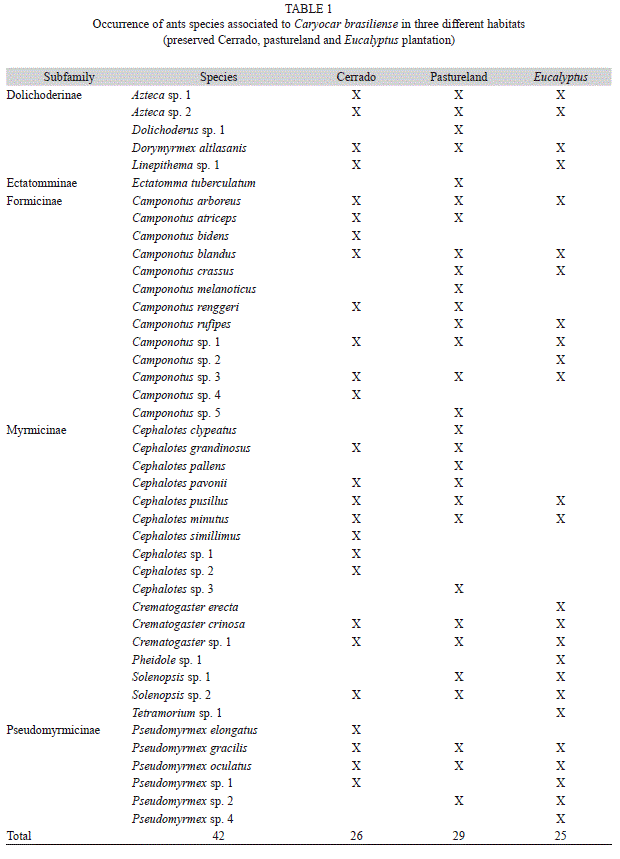
<body><![CDATA[<font style="font-weight: bold;" size="3"><span      style="font-family: verdana;">Results</span></font><br      style="font-family: verdana;">     <font size="2"></font><br style="font-family: verdana;">     <font size="2"><span style="font-family: verdana;">A total of 2 827     ants belonging to     42 species, 12 genera and four subfamilies were collected from <span      style="font-style: italic;">C.     brasiliense</span> trees (<a href="/img/revistas/rbt/v60n3/a09t1.gif">Table     1</a>). The two richest ant genera were <span     ]]></body>
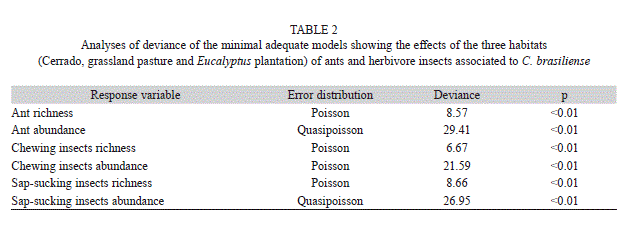
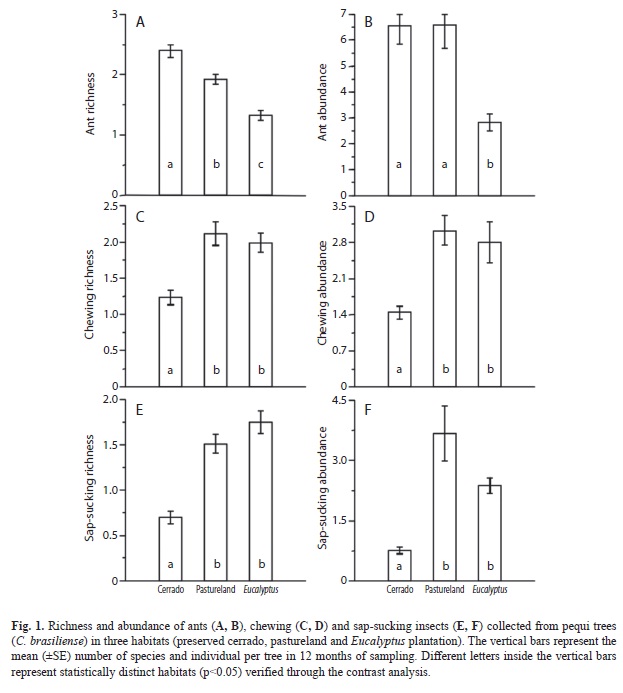
<body><![CDATA[ style="font-style: italic;">Camponotus</span>     and <span style="font-style: italic;">Cephalotes</span>, with 13 and     10 species, respectively. The ant species     richness associated with pequi trees varied among habitats (<a      href="/img/revistas/rbt/v60n3/a09t2.gif">Table 2</a>).     The preserved Cerrado trees had a higher ant richness (p&lt;0.05),     followed by those in pastureland and <span style="font-style: italic;">Eucalyptus</span>     plantation (<a href="/img/revistas/rbt/v60n3/a09i1.jpg">Fig. 1A</a>).     Higher ant abundance was found in trees of the preserved Cerrado and     pastureland, with no significant difference between them. While trees     ]]></body>
<body><![CDATA[from the <span style="font-style: italic;">Eucalyptus</span>     plantation observed the lowest ant abundance (<a      href="/img/revistas/rbt/v60n3/a09i1.jpg">Fig.     1B</a>).    <br>     <br style="font-family: verdana;">     </span></font><font size="2"><span style="font-family: verdana;">The     herbivore     insects sampled on <span style="font-style: italic;">C.     brasiliense</span> trees were composed by 1 666 individuals (877     ]]></body>
<body><![CDATA[chewing and     789 sap-sucking). All chewing herbivores belonged to the order     Coleoptera (14 families). The families Curculionidae (50 morphospecies     and 306 individuals) and Chrysomelidae (24 morphospecies and 262     individuals) resulted with the highest richness and abundance (<a      href="/img/revistas/rbt/v60n3/a09t3.gif">Table     3</a>). The richness and abundance of chewing insects associated with     these     trees differed significantly among habitats (<a      href="/img/revistas/rbt/v60n3/a09t2.gif">Table 2</a>): these were     ]]></body>
<body><![CDATA[lower     in pequi trees located in the preserved area (p&lt;0.05) than those     from either pastureland or <span style="font-style: italic;">Eucalyptus</span>     plantation (<a href="/img/revistas/rbt/v60n3/a09i1.jpg">Fig. 1C, D</a>).<br      style="font-family: verdana;">     </span></font><br style="font-family: verdana;">     <font size="2"><span style="font-family: verdana;">The guild of     sap-sucking insects     sampled was grouped into 15 Hemiptera families. Aetalionidae (234     individuals) and Cicadellidae (21 morphospecies) were the most abundant     ]]></body>
<body><![CDATA[and rich sap-sucking families (<a      href="/img/revistas/rbt/v60n3/a09t3.gif">Table 3</a>). Sap-sucking     insects showed the     same pattern observed for chewing insects, with the richness and     abundance being lower in pequi trees from the preserved Cerrado     (p&lt;0.05) than those from pastureland and <span      style="font-style: italic;">Eucalyptus</span> plantation     (<a href="/img/revistas/rbt/v60n3/a09t2.gif">Table 2</a>, <a      href="/img/revistas/rbt/v60n3/a09i1.jpg">Fig. 1 E, F</a>).</span></font><br      style="font-family: verdana;">     ]]></body>
<body><![CDATA[<font size="2"></font><br style="font-family: verdana;">     <font style="font-weight: bold;" size="3"><span      style="font-family: verdana;">Discussion</span></font><br      style="font-family: verdana;">     <font size="2"></font><br style="font-family: verdana;">     <font size="2"><span style="font-family: verdana;">Many studies have     shown a positive     relationship between diversity of terrestrial arthropods and habitat     heterogeneity (Lassau &amp; Hochuli 2004, Sperber et al. 2004).     Positive relations between ant diversity and habitat heterogeneity can     ]]></body>
<body><![CDATA[be found in different Brazilian biomes, e.g: Amazon (Vasconcelos et al.     2000, Cerrado: Ribas et al. 2003), Pantanal (Ribas &amp; Schoereder     2007) and Atlantic Subtropical forest (Silva et al. 2007). In our     study, the ant richness was greater in trees located in preserved     cerrado, which has more complex vegetation than trees found in a     grassland pasture or <span style="font-style: italic;">Eucalyptus</span>     plantation. This result indicates that     variations in habitats due human activity negatively affected the ant     fauna associated with pequi trees. Thus, the removal of native     vegetation to establish <span style="font-style: italic;">Eucalyptus</span>     ]]></body>
<body><![CDATA[plantation or pastureland may have     caused the habitat simplification and, indirectly, a decrease on ant     richness, probably due to a decrease in resource availability (e.g.     food and nesting sites) in simplified habitats. This pattern supports     the hypothesis that ant diversity is positively related to vegetation     structural complexity due the classical niche diversification     hypothesis.</span></font><br style="font-family: verdana;">     <font size="2"></font><br style="font-family: verdana;">     <font size="2"><span style="font-family: verdana;">We found that ant     richness and     ]]></body>
<body><![CDATA[abundance were smaller in <span style="font-style: italic;">Eucalyptus</span>     plantation than pasturelands. On     the other hand, we did not find differences in ant abundance between     preserved Cerrado and pasturelands. Probably this result may be     influenced by two main factors. First, structural complexity of the     preserved Cerrado seems to be much more similar to pastureland than     <span style="font-style: italic;">Eucalyptus</span> plantation. Second,     disturbance intensity due human     activities is certainty bigger and more frequent in <span      style="font-style: italic;">Eucalyptus</span>     ]]></body>
<body><![CDATA[plantation than in pastureland, which could decrease ant species     richness and abundance in <span style="font-style: italic;">Eucalyptus</span>     area. This is the first study that     shows the negative effect of pastureland and <span      style="font-style: italic;">Eucalyptus</span> plantation on     ant richness.</span></font><br style="font-family: verdana;">     <font size="2"></font><br style="font-family: verdana;">     <font size="2"><span style="font-family: verdana;">In contrast, pequi     trees located in     preserved Cerrado had lower richness and abundance of insect herbivores     ]]></body>
<body><![CDATA[than those in pastureland or <span style="font-style: italic;">Eucalyptus</span>     plantation. A similar result     was found for herbivores from distinct feeding guilds between managed     and conserved areas (Speight et al. 2003). Moreover, some studies     indicate that insect herbivore&#8217;s natural enemies are more effective in     pristine areas (Altieri &amp; Letourneau 1982). Normally, predators and     parasitoid insects species show high diversity in forest than herbivore     insects, that can be pest in agricultural areas (Szinicz et al. 2005).     Predators and parasites have a stronger negative effects on herbivores     associated with <span style="font-style: italic;">Caryocar brasiliense</span>     ]]></body>
<body><![CDATA[in Cerrado area. In this way, the     decrease in ant diversity on <span style="font-style: italic;">Eucalyptus</span>     plantation and pastureland had     positively affected the insect herbivore richness and abundance in     these habitats. In contrast, tropical agroecosystems in Ecuador had a     higher ratio of parasitoid to host species and increased parasitism     rates (Tylianakis et al. 2007). In fact, many studies have reported     high predation pressure by ants on arthropods (Heil &amp; McKey 2003)     while others showed that ant presence could reduce the herbivore     insects abundance on their host plants (Oliveira 1997, Fagundes et al.     ]]></body>
<body><![CDATA[2005, Rosumek et al. 2009, Neves et al. 2011).</span></font><br      style="font-family: verdana;">     <font size="2"></font><br style="font-family: verdana;">     <font size="2"><span style="font-family: verdana;">In addition to ants     effects     (Top-down effects), herbivore insects performance is also affected by     host plant quality (Bottom-up effects) (Coley et al. 1985, Coley &amp;     Barone 1996). The resource availability hypothesis (Coley et al. 1985)     predicts that plants with readily available light but low nutrient     availability have elevated rates of carbon fixation and low investment     ]]></body>
<body><![CDATA[in chemical defenses. In this study, isolated pequi trees in modified     habitats should provide a high density of herbivores for the lack of     chemical defense. Some authors have argued that higher selection     pressure imposed by herbivores had resulted in plants evolving stronger     chemical resistance to leaf herbivory in these environments (Coley     &amp; Barone 1996, Dirzo &amp; Boege 2008).</span></font><br      style="font-family: verdana;">     <font size="2"></font><br style="font-family: verdana;">     <font size="2"><span style="font-family: verdana;">The present study     shows that the     ]]></body>
<body><![CDATA[number of ant species on pequi trees decreases with habitat     simplification. On the other hand, insect herbivore richness and     abundance follows a reverse trend. From conservation point of view we     could point out that natural habitat preservation in Cerrado could only     benefit ants and at the same time the land use modification could     benefit insect herbivore biodiversity. However this conclusion is wrong     and must be carefully discussed. In fact, recent studies showed that     some herbivore insects species have shown eruptive populations on trees     located in disturbed habitats, affecting productivity and often plant     survival (Fernandes et al. 2004, Fagundes et al. 2007). Moreover,     ]]></body>
<body><![CDATA[networks structure can be altered by environmental change and these     alterations may have important ecosystem level consequences (Tylianakis     et al. 2010). At this point is important to empathize the danger of use     just a unique species in conservation programs, forgetting the role of     species interaction to community organization and maintenance in space     and time (Fagundes et al. 2005).</span></font><br      style="font-family: verdana;">     <font size="2"></font><br style="font-family: verdana;">     <font size="2"><span style="font-family: verdana;">We suggest a     decrease in the     ]]></body>
<body><![CDATA[transformation of natural habitats in pastureland and <span      style="font-style: italic;">Eucalyptus</span>     plantations, and in this way the ant top-down effects on herbivore     insects. The natural habitat preservation of the Brazilian Cerrado is     very important for biodiversity conservation and ecosystem optimum     function. Experimental studies on tri-trophic interaction and food webs     could be essential to elucidate the patterns of insect distribution and     the effect of habitat modification on insect biodiversity and     ecological processes.</span></font><br style="font-family: verdana;">     <font size="2"></font><br style="font-family: verdana;">     ]]></body>
<body><![CDATA[<font style="font-weight: bold;" size="3"><span      style="font-family: verdana;">Acknowledgments</span></font><br      style="font-family: verdana;">     <font size="2"></font><br style="font-family: verdana;">     <font size="2"><span style="font-family: verdana;">We thanks Ronaldo     Reis     J&uacute;nior and Patr&iacute;cia de Abreu Moreira for insightful     comments on earlier drafts of the manuscript and two other anonymous     referees who made valuable contributions to this paper. Financial     support by the Fapemig (the Minas Gerais Research Foundation) and CNPq     ]]></body>
<body><![CDATA[(the National Research Council of Brazil).</span></font><br      style="font-family: verdana;">     <font size="2"></font>     <hr style="width: 100%; height: 2px;"><br style="font-family: verdana;">     <font style="font-weight: bold;" size="3"><span      style="font-family: verdana;">References</span></font><br      style="font-family: verdana;">     <font size="2"></font><br style="font-family: verdana;">     <font size="2"><span style="font-family: verdana;">Almeida, S.P. &amp;     J.A. Silva.     ]]></body>
<body><![CDATA[1994. Piqui e Buriti: importancia alimentar a popula&ccedil;&atilde;o     <!-- ref -->dos cerrados. Embrapa-CPAC, Planaltina, Brasil.    &nbsp;&nbsp;&nbsp;&nbsp;&nbsp;&nbsp;&nbsp;&nbsp;[&#160;<a href="javascript:void(0);" onclick="javascript: window.open('/scielo.php?script=sci_nlinks&ref=1471792&pid=S0034-7744201200030000900001&lng=','','width=640,height=500,resizable=yes,scrollbars=1,menubar=yes,');">Links</a>&#160;]<!-- end-ref --><!-- ref --></span></font><br  style="font-family: verdana;"> <font size="2"></font><br style="font-family: verdana;"> <font size="2"><span style="font-family: verdana;">Altieri, M.A. &amp; D.K. Letourneau. 1982. Vegetation management and biological control in agroecosystems. Crop Prot. 1: 405-430.    &nbsp;&nbsp;&nbsp;&nbsp;&nbsp;&nbsp;&nbsp;&nbsp;[&#160;<a href="javascript:void(0);" onclick="javascript: window.open('/scielo.php?script=sci_nlinks&ref=1471793&pid=S0034-7744201200030000900002&lng=','','width=640,height=500,resizable=yes,scrollbars=1,menubar=yes,');">Links</a>&#160;]<!-- end-ref --><!-- ref --></span></font><br  style="font-family: verdana;"> <font size="2"></font><br style="font-family: verdana;"> <font size="2"><span style="font-family: verdana;">Basset, Y., V. Novotny, S.E. Miller &amp; R.L. Kitching. 2003. Arthropods of tropical forests-spatio-temporal dynamics and resource use in the canopy. Cambridge University, Cambridge, United Kingdom.    &nbsp;&nbsp;&nbsp;&nbsp;&nbsp;&nbsp;&nbsp;&nbsp;[&#160;<a href="javascript:void(0);" onclick="javascript: window.open('/scielo.php?script=sci_nlinks&ref=1471794&pid=S0034-7744201200030000900003&lng=','','width=640,height=500,resizable=yes,scrollbars=1,menubar=yes,');">Links</a>&#160;]<!-- end-ref --><!-- ref --></span></font><br  style="font-family: verdana;"> <font size="2"></font><br style="font-family: verdana;"> <font size="2"><span style="font-family: verdana;">Coley, P.D., J.P. Bryant &amp; F.S. Chapin III. 1985. Resource availability and plant antiherbivore defense. Science 230: 895-899.    &nbsp;&nbsp;&nbsp;&nbsp;&nbsp;&nbsp;&nbsp;&nbsp;[&#160;<a href="javascript:void(0);" onclick="javascript: window.open('/scielo.php?script=sci_nlinks&ref=1471795&pid=S0034-7744201200030000900004&lng=','','width=640,height=500,resizable=yes,scrollbars=1,menubar=yes,');">Links</a>&#160;]<!-- end-ref --><!-- ref --></span></font><br  style="font-family: verdana;"> <font size="2"></font><br style="font-family: verdana;"> <font size="2"><span style="font-family: verdana;">Coley, P.D. &amp; J.A. Barone. 1996. Herbivory and plant defenses in tropical forests. Annu. Rev. Ecol. Syst. 27: 305-335.    &nbsp;&nbsp;&nbsp;&nbsp;&nbsp;&nbsp;&nbsp;&nbsp;[&#160;<a href="javascript:void(0);" onclick="javascript: window.open('/scielo.php?script=sci_nlinks&ref=1471796&pid=S0034-7744201200030000900005&lng=','','width=640,height=500,resizable=yes,scrollbars=1,menubar=yes,');">Links</a>&#160;]<!-- end-ref --><!-- ref --></span></font><br style="font-family: verdana;"> <font size="2"></font><br style="font-family: verdana;"> <font size="2"><span style="font-family: verdana;">Crawley, M.J. 2007. Statistical computing-an introduction to data analysis using s-plus. John Wiley &amp; Sons, London, United Kingdom.    &nbsp;&nbsp;&nbsp;&nbsp;&nbsp;&nbsp;&nbsp;&nbsp;[&#160;<a href="javascript:void(0);" onclick="javascript: window.open('/scielo.php?script=sci_nlinks&ref=1471797&pid=S0034-7744201200030000900006&lng=','','width=640,height=500,resizable=yes,scrollbars=1,menubar=yes,');">Links</a>&#160;]<!-- end-ref --><!-- ref --></span></font><br  style="font-family: verdana;"> <font size="2"></font><br style="font-family: verdana;"> <font size="2"><span style="font-family: verdana;">Dirzo, R. &amp; K. Boege. 2008. Patterns of herbivory and defense in tropical dry and rain forests, p. 63-78. <span style="font-style: italic;">In</span> W. Carson &amp; S.A. Schnitzer (eds.). Tropical forest community ecology. Blackwell Science, West Sussex, United Kingdom.    &nbsp;&nbsp;&nbsp;&nbsp;&nbsp;&nbsp;&nbsp;&nbsp;[&#160;<a href="javascript:void(0);" onclick="javascript: window.open('/scielo.php?script=sci_nlinks&ref=1471798&pid=S0034-7744201200030000900007&lng=','','width=640,height=500,resizable=yes,scrollbars=1,menubar=yes,');">Links</a>&#160;]<!-- end-ref --><!-- ref --></span></font><br  style="font-family: verdana;"> <font size="2"></font><br style="font-family: verdana;"> <font size="2"><span style="font-family: verdana;">Fagundes, M., F.S. Neves &amp; G.W. Fernandes. 2005. Direct and indirect interactions involving ants, insect herbivores, parasitoids, and the host plant Baccharis dracunculifolia (Asteraceae). Ecol. Entomol. 30: 28-35.    &nbsp;&nbsp;&nbsp;&nbsp;&nbsp;&nbsp;&nbsp;&nbsp;[&#160;<a href="javascript:void(0);" onclick="javascript: window.open('/scielo.php?script=sci_nlinks&ref=1471799&pid=S0034-7744201200030000900008&lng=','','width=640,height=500,resizable=yes,scrollbars=1,menubar=yes,');">Links</a>&#160;]<!-- end-ref --><!-- ref --></span></font><br  style="font-family: verdana;"> <font size="2"></font><br style="font-family: verdana;"> <font size="2"><span style="font-family: verdana;">Fagundes, M., L.S. Araujo &amp; Y.R.F. Nunes. 2007. Efeito do est&aacute;gio sucessional do habitat na fenologia do pequizeiro (<span style="font-style: italic;">Caryocar brasiliense</span>: Caryocaraceae). Rev. Bras. Bioc. 5: 144-146.    &nbsp;&nbsp;&nbsp;&nbsp;&nbsp;&nbsp;&nbsp;&nbsp;[&#160;<a href="javascript:void(0);" onclick="javascript: window.open('/scielo.php?script=sci_nlinks&ref=1471800&pid=S0034-7744201200030000900009&lng=','','width=640,height=500,resizable=yes,scrollbars=1,menubar=yes,');">Links</a>&#160;]<!-- end-ref --><!-- ref --></span></font><br style="font-family: verdana;"> <font size="2"></font><br style="font-family: verdana;"> <font size="2"><span style="font-family: verdana;">Fernandes, L.C., M. Fagundes, G.A. Santos &amp; G.M. Silva. 2004. Abund&acirc;ncia de insetos herb&iacute;voros asociados ao pequizeiro (<span  style="font-style: italic;">Caryocar brasiliense</span> Cambess.). Rev. &Aacute;rvore 28: 919-924.    &nbsp;&nbsp;&nbsp;&nbsp;&nbsp;&nbsp;&nbsp;&nbsp;[&#160;<a href="javascript:void(0);" onclick="javascript: window.open('/scielo.php?script=sci_nlinks&ref=1471801&pid=S0034-7744201200030000900010&lng=','','width=640,height=500,resizable=yes,scrollbars=1,menubar=yes,');">Links</a>&#160;]<!-- end-ref --><!-- ref --></span></font><br  style="font-family: verdana;"> <font size="2"></font><br style="font-family: verdana;"> <font size="2"><span style="font-family: verdana;">Gribel, R. &amp; J.D. Hay. 1993. Pollination ecology of <span style="font-style: italic;">Caryocar brasiliense</span> (Caryocaraceae) in central Brazil Cerrado. J. Trop. Ecol. 9: 199-211.    &nbsp;&nbsp;&nbsp;&nbsp;&nbsp;&nbsp;&nbsp;&nbsp;[&#160;<a href="javascript:void(0);" onclick="javascript: window.open('/scielo.php?script=sci_nlinks&ref=1471802&pid=S0034-7744201200030000900011&lng=','','width=640,height=500,resizable=yes,scrollbars=1,menubar=yes,');">Links</a>&#160;]<!-- end-ref --><!-- ref --></span></font><br  style="font-family: verdana;"> <font size="2"></font><br style="font-family: verdana;"> <font size="2"><span style="font-family: verdana;">Heil, M. &amp; D. McKey. 2003. Protective ant-plant interactions as model systems in ecological and evolutionary research. Annu. Rev. Ecol. Syst. 34: 425-453.    &nbsp;&nbsp;&nbsp;&nbsp;&nbsp;&nbsp;&nbsp;&nbsp;[&#160;<a href="javascript:void(0);" onclick="javascript: window.open('/scielo.php?script=sci_nlinks&ref=1471803&pid=S0034-7744201200030000900012&lng=','','width=640,height=500,resizable=yes,scrollbars=1,menubar=yes,');">Links</a>&#160;]<!-- end-ref --><!-- ref --></span></font><br  style="font-family: verdana;"> <font size="2"></font><br style="font-family: verdana;"> <font size="2"><span style="font-family: verdana;">Hoffmann, B.D. &amp; A.N. Andersen. 2003. Responses of ants to disturbance in Australia, with particular reference to functional groups. Austral Ecol. 28: 444-464.    &nbsp;&nbsp;&nbsp;&nbsp;&nbsp;&nbsp;&nbsp;&nbsp;[&#160;<a href="javascript:void(0);" onclick="javascript: window.open('/scielo.php?script=sci_nlinks&ref=1471804&pid=S0034-7744201200030000900013&lng=','','width=640,height=500,resizable=yes,scrollbars=1,menubar=yes,');">Links</a>&#160;]<!-- end-ref --><!-- ref --></span></font><br  style="font-family: verdana;"> <font size="2"></font><br style="font-family: verdana;"> <font size="2"><span style="font-family: verdana;">Klink, C.A. &amp; R.B. Machado. 2005. Conservation of the Brazilian Cerrado. Conserv. Biol. 19: 707-713.    &nbsp;&nbsp;&nbsp;&nbsp;&nbsp;&nbsp;&nbsp;&nbsp;[&#160;<a href="javascript:void(0);" onclick="javascript: window.open('/scielo.php?script=sci_nlinks&ref=1471805&pid=S0034-7744201200030000900014&lng=','','width=640,height=500,resizable=yes,scrollbars=1,menubar=yes,');">Links</a>&#160;]<!-- end-ref --><!-- ref --></span></font><br  style="font-family: verdana;"> <font size="2"></font><br style="font-family: verdana;"> <font size="2"><span style="font-family: verdana;">Lassau, S.A. &amp; D.F. Hochuli. 2004. Effects of habitat complexity on ant assemblages. Ecography 27: 157-164.    &nbsp;&nbsp;&nbsp;&nbsp;&nbsp;&nbsp;&nbsp;&nbsp;[&#160;<a href="javascript:void(0);" onclick="javascript: window.open('/scielo.php?script=sci_nlinks&ref=1471806&pid=S0034-7744201200030000900015&lng=','','width=640,height=500,resizable=yes,scrollbars=1,menubar=yes,');">Links</a>&#160;]<!-- end-ref --><!-- ref --></span></font><br style="font-family: verdana;"> <font size="2"><span style="font-family: verdana;">&nbsp;</span></font><br  style="font-family: verdana;"> <font size="2"><span style="font-family: verdana;">Myers, N., R.A. Mittermeier, C.G. Mittermeier, G.A.B. Fonseca &amp; J. Kent. 2000. Biodiversity hotspots for conservation priorities. Nature 403: 853-858.    &nbsp;&nbsp;&nbsp;&nbsp;&nbsp;&nbsp;&nbsp;&nbsp;[&#160;<a href="javascript:void(0);" onclick="javascript: window.open('/scielo.php?script=sci_nlinks&ref=1471807&pid=S0034-7744201200030000900016&lng=','','width=640,height=500,resizable=yes,scrollbars=1,menubar=yes,');">Links</a>&#160;]<!-- end-ref --><!-- ref --></span></font><br  style="font-family: verdana;"> <font size="2"></font><br style="font-family: verdana;"> <font size="2"><span style="font-family: verdana;">Neves, F.S., L.S. Ara&uacute;jo, M.M. Esp&iacute;rito-Santo, M. Fagundes, G.W. Fernandes, G.A. Sanchez-Azofeifa &amp; M. Quesada. 2010. Canopy herbivory and insect herbivore diversity in a dry forest-savana transition in Brazil. Biotropica 42: 112-118.    &nbsp;&nbsp;&nbsp;&nbsp;&nbsp;&nbsp;&nbsp;&nbsp;[&#160;<a href="javascript:void(0);" onclick="javascript: window.open('/scielo.php?script=sci_nlinks&ref=1471808&pid=S0034-7744201200030000900017&lng=','','width=640,height=500,resizable=yes,scrollbars=1,menubar=yes,');">Links</a>&#160;]<!-- end-ref --><!-- ref --></span></font><br style="font-family: verdana;"> <font size="2"></font><br style="font-family: verdana;"> <font size="2"><span style="font-family: verdana;">Neves, F.S., M. Fagundes, C.F. Sperber &amp; G.W. Wilson. 2011. Tri-trophic level interactions affect host plant development and abundance of insect herbivores. Arthropod-Plant Interac. 5: 351-357.    &nbsp;&nbsp;&nbsp;&nbsp;&nbsp;&nbsp;&nbsp;&nbsp;[&#160;<a href="javascript:void(0);" onclick="javascript: window.open('/scielo.php?script=sci_nlinks&ref=1471809&pid=S0034-7744201200030000900018&lng=','','width=640,height=500,resizable=yes,scrollbars=1,menubar=yes,');">Links</a>&#160;]<!-- end-ref --><!-- ref --></span></font><br  style="font-family: verdana;"> <font size="2"></font><br style="font-family: verdana;"> <font size="2"><span style="font-family: verdana;">Oliveira, P.S. 1997. The ecological function of extrafloral nectaries: herbivore deterrence by visiting ants and reproductive output in <span style="font-style: italic;">Caryocar brasiliense</span> (Caryocaraceae). Funct. Ecol 11: 323-330.    &nbsp;&nbsp;&nbsp;&nbsp;&nbsp;&nbsp;&nbsp;&nbsp;[&#160;<a href="javascript:void(0);" onclick="javascript: window.open('/scielo.php?script=sci_nlinks&ref=1471810&pid=S0034-7744201200030000900019&lng=','','width=640,height=500,resizable=yes,scrollbars=1,menubar=yes,');">Links</a>&#160;]<!-- end-ref --><!-- ref --></span></font><br style="font-family: verdana;"> <font size="2"></font><br style="font-family: verdana;"> <font size="2"><span style="font-family: verdana;">Peel, M.C., B.L. Finlayson &amp; T.A. McMahon. 2007. Updated world map of the Koeppen-Geiger climate classification. Hydrol. and Earth Syst. Sciences. 11: 1633-1644.    &nbsp;&nbsp;&nbsp;&nbsp;&nbsp;&nbsp;&nbsp;&nbsp;[&#160;<a href="javascript:void(0);" onclick="javascript: window.open('/scielo.php?script=sci_nlinks&ref=1471811&pid=S0034-7744201200030000900020&lng=','','width=640,height=500,resizable=yes,scrollbars=1,menubar=yes,');">Links</a>&#160;]<!-- end-ref --><!-- ref --></span></font><br  style="font-family: verdana;"> <font size="2"></font><br style="font-family: verdana;"> <font size="2"><span style="font-family: verdana;">R Development Core Team, 2010. R: a language and environment for statistical computing. R Foundation for Statistical Computing, Vienna, Austria.    &nbsp;&nbsp;&nbsp;&nbsp;&nbsp;&nbsp;&nbsp;&nbsp;[&#160;<a href="javascript:void(0);" onclick="javascript: window.open('/scielo.php?script=sci_nlinks&ref=1471812&pid=S0034-7744201200030000900021&lng=','','width=640,height=500,resizable=yes,scrollbars=1,menubar=yes,');">Links</a>&#160;]<!-- end-ref --><!-- ref --></span></font><br  style="font-family: verdana;"> <font size="2"></font><br style="font-family: verdana;"> <font size="2"><span style="font-family: verdana;">Ribas, C.R., J.H. Schoereder, M. Pic &amp; S.M. Soares. 2003. Tree heterogeneity, resource availability, and larger scale processes regulating arboreal ant species richness. Austral Ecol. 28: 305-314.    &nbsp;&nbsp;&nbsp;&nbsp;&nbsp;&nbsp;&nbsp;&nbsp;[&#160;<a href="javascript:void(0);" onclick="javascript: window.open('/scielo.php?script=sci_nlinks&ref=1471813&pid=S0034-7744201200030000900022&lng=','','width=640,height=500,resizable=yes,scrollbars=1,menubar=yes,');">Links</a>&#160;]<!-- end-ref --><!-- ref --></span></font><br  style="font-family: verdana;"> <font size="2"></font><br style="font-family: verdana;"> <font size="2"><span style="font-family: verdana;">Ribas, C.R. &amp; J.H. Schoereder. 2007. Ant communities, environmental characteristics and their implications for conservation in the Brazilian Pantanal. Biodivers. Conserv. 16: 1511-1520.    &nbsp;&nbsp;&nbsp;&nbsp;&nbsp;&nbsp;&nbsp;&nbsp;[&#160;<a href="javascript:void(0);" onclick="javascript: window.open('/scielo.php?script=sci_nlinks&ref=1471814&pid=S0034-7744201200030000900023&lng=','','width=640,height=500,resizable=yes,scrollbars=1,menubar=yes,');">Links</a>&#160;]<!-- end-ref --><!-- ref --></span></font><br style="font-family: verdana;"> <font size="2"></font><br style="font-family: verdana;"> <font size="2"><span style="font-family: verdana;">Ricketts, T.H., G. Daily, P.R. Ehrlich &amp; J.P. Fay. 2001. Countryside biogeography of moths in a fragmented landscape: biodiversity in native and agricultural habitats. Conserv. Biol. 15: 378-388.    &nbsp;&nbsp;&nbsp;&nbsp;&nbsp;&nbsp;&nbsp;&nbsp;[&#160;<a href="javascript:void(0);" onclick="javascript: window.open('/scielo.php?script=sci_nlinks&ref=1471815&pid=S0034-7744201200030000900024&lng=','','width=640,height=500,resizable=yes,scrollbars=1,menubar=yes,');">Links</a>&#160;]<!-- end-ref --><!-- ref --></span></font><br  style="font-family: verdana;"> <font size="2"></font><br style="font-family: verdana;"> <font size="2"><span style="font-family: verdana;">Rosumek, F.B., F.A.O. Silveira, F.S. Neves, N.P.U. Barbosa, L. Diniz, Y. Oki, F. Pezzini, G.W. Fernandes &amp; T. Cornelissen. 2009. Ants on plants: a meta-analysis of the role of ants as plant biotic defenses. Oecologia 160: 537-549.    &nbsp;&nbsp;&nbsp;&nbsp;&nbsp;&nbsp;&nbsp;&nbsp;[&#160;<a href="javascript:void(0);" onclick="javascript: window.open('/scielo.php?script=sci_nlinks&ref=1471816&pid=S0034-7744201200030000900025&lng=','','width=640,height=500,resizable=yes,scrollbars=1,menubar=yes,');">Links</a>&#160;]<!-- end-ref --><!-- ref --></span></font><br  style="font-family: verdana;"> <font size="2"></font><br style="font-family: verdana;"> <font size="2"><span style="font-family: verdana;">Samways, M.J. 2007. Insect Conservation: A synthetic management approach. Annu. Rev. Entomol. 52: 465-487.    &nbsp;&nbsp;&nbsp;&nbsp;&nbsp;&nbsp;&nbsp;&nbsp;[&#160;<a href="javascript:void(0);" onclick="javascript: window.open('/scielo.php?script=sci_nlinks&ref=1471817&pid=S0034-7744201200030000900026&lng=','','width=640,height=500,resizable=yes,scrollbars=1,menubar=yes,');">Links</a>&#160;]<!-- end-ref --><!-- ref --></span></font><br style="font-family: verdana;"> <font size="2"></font><br style="font-family: verdana;"> <font size="2"><span style="font-family: verdana;">Silva, J.M.C. &amp; J.M. Bates. 2002. Biogeographic patterns and conservation in the south American Cerrado: a tropical savanna hotspot. Bioscience 52: 225-233.    &nbsp;&nbsp;&nbsp;&nbsp;&nbsp;&nbsp;&nbsp;&nbsp;[&#160;<a href="javascript:void(0);" onclick="javascript: window.open('/scielo.php?script=sci_nlinks&ref=1471818&pid=S0034-7744201200030000900027&lng=','','width=640,height=500,resizable=yes,scrollbars=1,menubar=yes,');">Links</a>&#160;]<!-- end-ref --><!-- ref --></span></font><br  style="font-family: verdana;"> <font size="2"></font><br style="font-family: verdana;"> <font size="2"><span style="font-family: verdana;">Silva, R.R., R.S.M. Feitosa &amp; F. Eberhardt. 2007. Reduced ant diversity along a habitat regeneration gradient in the southern Brazilian Atlantic Forest. For. Ecol. Manag. 240: 61-69.    &nbsp;&nbsp;&nbsp;&nbsp;&nbsp;&nbsp;&nbsp;&nbsp;[&#160;<a href="javascript:void(0);" onclick="javascript: window.open('/scielo.php?script=sci_nlinks&ref=1471819&pid=S0034-7744201200030000900028&lng=','','width=640,height=500,resizable=yes,scrollbars=1,menubar=yes,');">Links</a>&#160;]<!-- end-ref --><!-- ref --></span></font><br style="font-family: verdana;"> <font size="2"></font><br style="font-family: verdana;"> <font size="2"><span style="font-family: verdana;">Speight, M.R., J. Intacha, C.Y. Khen &amp; A.Y.C. Chung. 2003. Influences of forest management on insects, p. 380-393. <span style="font-style: italic;">In</span> Y. Basset, V. Novotny, S. Miller &amp; R. Kitching. (eds.). Arthropods of tropical forests: spatiotemporal dynamics and resource use in the canopy. Cambridge University, Cambridge, Unied Kingdom.    &nbsp;&nbsp;&nbsp;&nbsp;&nbsp;&nbsp;&nbsp;&nbsp;[&#160;<a href="javascript:void(0);" onclick="javascript: window.open('/scielo.php?script=sci_nlinks&ref=1471820&pid=S0034-7744201200030000900029&lng=','','width=640,height=500,resizable=yes,scrollbars=1,menubar=yes,');">Links</a>&#160;]<!-- end-ref --><!-- ref --></span></font><br style="font-family: verdana;"> <font size="2"></font><br style="font-family: verdana;"> <font size="2"><span style="font-family: verdana;">Sperber, C.F., K. Nakayama, M.J. Valverde &amp; F.S. Neves. 2004. Tree species richness and density affect parasitoid diversity in cacao agroforestry. Basic Appl. Ecol. 5: 241-251.    &nbsp;&nbsp;&nbsp;&nbsp;&nbsp;&nbsp;&nbsp;&nbsp;[&#160;<a href="javascript:void(0);" onclick="javascript: window.open('/scielo.php?script=sci_nlinks&ref=1471821&pid=S0034-7744201200030000900030&lng=','','width=640,height=500,resizable=yes,scrollbars=1,menubar=yes,');">Links</a>&#160;]<!-- end-ref --><!-- ref --></span></font><br style="font-family: verdana;"> <font size="2"></font><br style="font-family: verdana;"> <font size="2"><span style="font-family: verdana;">Szinicz, G., K. Martin &amp; J. Sauerborn. 2005. Abundance of selected insect species in natural and agricultural habitats of a tropical upland (Leyte, Philippines). Agric. Ecos. Env. 111: 104-110.    &nbsp;&nbsp;&nbsp;&nbsp;&nbsp;&nbsp;&nbsp;&nbsp;[&#160;<a href="javascript:void(0);" onclick="javascript: window.open('/scielo.php?script=sci_nlinks&ref=1471822&pid=S0034-7744201200030000900031&lng=','','width=640,height=500,resizable=yes,scrollbars=1,menubar=yes,');">Links</a>&#160;]<!-- end-ref --><!-- ref --></span></font><br style="font-family: verdana;"> <font size="2"></font><br style="font-family: verdana;"> <font size="2"><span style="font-family: verdana;">Tylianakis, J.M., T. Tscharntke &amp; O.T. Lewis. 2007. Habitat modification alters the structure of tropical hostparasitoid food webs. Nature 455: 202-205.    &nbsp;&nbsp;&nbsp;&nbsp;&nbsp;&nbsp;&nbsp;&nbsp;[&#160;<a href="javascript:void(0);" onclick="javascript: window.open('/scielo.php?script=sci_nlinks&ref=1471823&pid=S0034-7744201200030000900032&lng=','','width=640,height=500,resizable=yes,scrollbars=1,menubar=yes,');">Links</a>&#160;]<!-- end-ref --><!-- ref --></span></font><br  style="font-family: verdana;"> <font size="2"></font><br style="font-family: verdana;"> <font size="2"><span style="font-family: verdana;">Tylianakis, J.M., E. Lalibert&eacute;, A. Nielsen &amp; J. Bascompte. 2010. Conservation of species interaction networks. Biol. Conserv. 143: 2270-2279.    &nbsp;&nbsp;&nbsp;&nbsp;&nbsp;&nbsp;&nbsp;&nbsp;[&#160;<a href="javascript:void(0);" onclick="javascript: window.open('/scielo.php?script=sci_nlinks&ref=1471824&pid=S0034-7744201200030000900033&lng=','','width=640,height=500,resizable=yes,scrollbars=1,menubar=yes,');">Links</a>&#160;]<!-- end-ref --><!-- ref --></span></font><br  style="font-family: verdana;"> <font size="2"></font><br style="font-family: verdana;"> <font size="2"><span style="font-family: verdana;">Vasconcelos, H.L., J.M.S. Vilhena &amp; G.J.A. Caliri. 2000. Responses of ants to selective logging of a central Amazonian forest. J. Appl. Ecol. 37: 508-514.    &nbsp;&nbsp;&nbsp;&nbsp;&nbsp;&nbsp;&nbsp;&nbsp;[&#160;<a href="javascript:void(0);" onclick="javascript: window.open('/scielo.php?script=sci_nlinks&ref=1471825&pid=S0034-7744201200030000900034&lng=','','width=640,height=500,resizable=yes,scrollbars=1,menubar=yes,');">Links</a>&#160;]<!-- end-ref --><br>     <br> <a name="Correspondencia1"></a><a href="#Correspondencia2">*</a>Correspondencia:    <br> </span></font><font size="2"><span style="font-family: verdana;">Frederico S. Neves: </span></font><font size="2"><span  style="font-family: verdana;">Laborat&oacute;rio de Biologia da Conserva&ccedil;&atilde;o, Departamento de Biologia Geral, Universidade Estadual de Montes Claros, Montes claros, MG, Brasil/ </span></font><font  size="2"><span style="font-family: verdana;"> Laborat&oacute;rio de Ecologia de Insetos, Departamento de Biologia Geral, Universidade Federal de Minas Gerais, Belo Horizonte, MG, Brasil. fred.neves@gmail.com.</span></font>    <br> <font size="2"><span style="font-family: verdana;">Rodrigo F. Braga: </span></font><font size="2"><span style="font-family: verdana;">Laborat&oacute;rio de Biologia da Conserva&ccedil;&atilde;o, Departamento de Biologia Geral, Universidade Estadual de Montes Claros, Montes claros, MG, Brasil. </span></font><font  size="2"><span style="font-family: verdana;">rodrigo.fagundes@yahoo.com.br.</span></font>    <br> <font size="2"><span style="font-family: verdana;">Lucimar S. Ara&uacute;jo: </span></font><font size="2"><span  style="font-family: verdana;"></span></font><font size="2"><span  style="font-family: verdana;">Laborat&oacute;rio de Biologia da Conserva&ccedil;&atilde;o, Departamento de Biologia Geral, Universidade Estadual de Montes Claros, Montes claros, MG, Brasil. </span></font><font  size="2"><span style="font-family: verdana;">lucimar.araujo@gmail.com.</span></font>    ]]></body>
<body><![CDATA[<br> <font size="2"><span style="font-family: verdana;">Ricardo I. Campos: </span></font><font  size="2"><span style="font-family: verdana;">Laborat&oacute;rio de Ecologia de Formigas,Universidade Federal de Vi&ccedil;osa, 36570-000, Vi&ccedil;osa, MG, Brasil. ricardoicampos@gmail.com</span></font><br  style="font-family: verdana;"> <font size="2"> <span style="font-family: verdana;">Marc&iacute;lio Fagundes: </span></font><font  size="2"><span style="font-family: verdana;"> </span></font><font  size="2"><span style="font-family: verdana;">Laborat&oacute;rio de Biologia da Conserva&ccedil;&atilde;o, Departamento de Biologia Geral, Universidade Estadual de Montes Claros, Montes claros, MG, Brasil. </span></font><font  size="2"><span style="font-family: verdana;">marcilio.fagundes@unimontes.br.    <br> </span></font><font size="2"><span style="font-family: verdana;"><a  name="1"></a><a href="#4">1</a>. Laborat&oacute;rio de Biologia da Conserva&ccedil;&atilde;o, Departamento de Biologia Geral, Universidade Estadual de Montes Claros, Montes claros, MG, Brasil; rodrigo.fagundes@yahoo.com.br, lucimar.araujo@gmail.com, marcilio.fagundes@unimontes.br</span></font><br  style="font-family: verdana;"> <font size="2"><span style="font-family: verdana;"><a name="2"></a><a  href="#5">2</a>. Laborat&oacute;rio de Ecologia de Insetos, Departamento de Biologia Geral, Universidade Federal de Minas Gerais, Belo Horizonte, MG, Brasil; fred.neves@gmail.com</span></font><br  style="font-family: verdana;"> <font size="2"><span style="font-family: verdana;"><a name="3"></a><a  href="#6">3</a>. Laborat&oacute;rio de Ecologia de Formigas,Universidade Federal de Vi&ccedil;osa, 36570-000, Vi&ccedil;osa, MG, Brasil; ricardoicampos@gmail.com</span></font><br style="font-family: verdana;"> <font size="2"></font> <hr style="width: 100%; height: 2px;">     <div style="text-align: center;"><font style="font-weight: bold;"  size="2"><span style="font-family: verdana;">Received 03-VIII-2011. Corrected 08-II-2012. Accepted 09-III-2012.</span></font><br  style="font-family: verdana;"> </div> </div> </div> <font size="2"></font>      ]]></body><back>
<ref-list>
<ref id="B1">
<nlm-citation citation-type="book">
<person-group person-group-type="author">
<name>
<surname><![CDATA[Almeida]]></surname>
<given-names><![CDATA[S.P]]></given-names>
</name>
<name>
<surname><![CDATA[Silva]]></surname>
<given-names><![CDATA[J.A]]></given-names>
</name>
</person-group>
<source><![CDATA[Piqui e Buriti: importancia alimentar a população dos cerrados]]></source>
<year>1994</year>
<publisher-loc><![CDATA[Planaltina ]]></publisher-loc>
<publisher-name><![CDATA[Embrapa-CPAC]]></publisher-name>
</nlm-citation>
</ref>
<ref id="B2">
<nlm-citation citation-type="journal">
<person-group person-group-type="author">
<name>
<surname><![CDATA[Altieri]]></surname>
<given-names><![CDATA[M.A]]></given-names>
</name>
<name>
<surname><![CDATA[Letourneau]]></surname>
<given-names><![CDATA[D.K]]></given-names>
</name>
</person-group>
<article-title xml:lang="en"><![CDATA[Vegetation management and biological control in agroecosystems]]></article-title>
<source><![CDATA[Crop Prot]]></source>
<year>1982</year>
<volume>1</volume>
<page-range>405-430</page-range></nlm-citation>
</ref>
<ref id="B3">
<nlm-citation citation-type="book">
<person-group person-group-type="author">
<name>
<surname><![CDATA[Basset]]></surname>
<given-names><![CDATA[Y]]></given-names>
</name>
<name>
<surname><![CDATA[Novotny]]></surname>
<given-names><![CDATA[V]]></given-names>
</name>
<name>
<surname><![CDATA[Miller]]></surname>
<given-names><![CDATA[S.E]]></given-names>
</name>
<name>
<surname><![CDATA[Kitching]]></surname>
<given-names><![CDATA[R.L]]></given-names>
</name>
</person-group>
<source><![CDATA[Arthropods of tropical forests-spatio-temporal dynamics and resource use in the canopy]]></source>
<year>2003</year>
<publisher-loc><![CDATA[Cambridge^eUnited Kingdom United Kingdom]]></publisher-loc>
<publisher-name><![CDATA[Cambridge University]]></publisher-name>
</nlm-citation>
</ref>
<ref id="B4">
<nlm-citation citation-type="journal">
<person-group person-group-type="author">
<name>
<surname><![CDATA[Coley]]></surname>
<given-names><![CDATA[P.D]]></given-names>
</name>
<name>
<surname><![CDATA[Bryant]]></surname>
<given-names><![CDATA[J.P]]></given-names>
</name>
<name>
<surname><![CDATA[Chapin III]]></surname>
<given-names><![CDATA[F.S]]></given-names>
</name>
</person-group>
<article-title xml:lang="en"><![CDATA[Resource availability and plant antiherbivore defense]]></article-title>
<source><![CDATA[Science]]></source>
<year>1985</year>
<volume>230</volume><volume>895-899</volume>
</nlm-citation>
</ref>
<ref id="B5">
<nlm-citation citation-type="journal">
<person-group person-group-type="author">
<name>
<surname><![CDATA[Coley]]></surname>
<given-names><![CDATA[P.D]]></given-names>
</name>
<name>
<surname><![CDATA[Barone]]></surname>
<given-names><![CDATA[J.A]]></given-names>
</name>
</person-group>
<article-title xml:lang="en"><![CDATA[Herbivory and plant defenses in tropical forests]]></article-title>
<source><![CDATA[Annu. Rev. Ecol. Syst]]></source>
<year>1996</year>
<volume>27</volume>
<page-range>305-335</page-range></nlm-citation>
</ref>
<ref id="B6">
<nlm-citation citation-type="book">
<person-group person-group-type="author">
<name>
<surname><![CDATA[Crawley]]></surname>
<given-names><![CDATA[M.J]]></given-names>
</name>
</person-group>
<source><![CDATA[Statistical computing-an introduction to data analysis using s-plus]]></source>
<year>2007</year>
<publisher-loc><![CDATA[^eLondon London]]></publisher-loc>
<publisher-name><![CDATA[John Wiley & Sons]]></publisher-name>
</nlm-citation>
</ref>
<ref id="B7">
<nlm-citation citation-type="book">
<person-group person-group-type="author">
<name>
<surname><![CDATA[Dirzo]]></surname>
<given-names><![CDATA[R]]></given-names>
</name>
<name>
<surname><![CDATA[Boege]]></surname>
<given-names><![CDATA[K]]></given-names>
</name>
</person-group>
<article-title xml:lang="en"><![CDATA[Patterns of herbivory and defense in tropical dry and rain forests]]></article-title>
<person-group person-group-type="editor">
<name>
<surname><![CDATA[Carson]]></surname>
<given-names><![CDATA[W]]></given-names>
</name>
<name>
<surname><![CDATA[Schnitzer]]></surname>
<given-names><![CDATA[S.A]]></given-names>
</name>
</person-group>
<source><![CDATA[Tropical forest community ecology]]></source>
<year>2008</year>
<page-range>p. 63-78</page-range><publisher-loc><![CDATA[^eWest Sussex West Sussex]]></publisher-loc>
<publisher-name><![CDATA[Blackwell Science]]></publisher-name>
</nlm-citation>
</ref>
<ref id="B8">
<nlm-citation citation-type="journal">
<person-group person-group-type="author">
<name>
<surname><![CDATA[Fagundes]]></surname>
<given-names><![CDATA[M]]></given-names>
</name>
<name>
<surname><![CDATA[Neves]]></surname>
<given-names><![CDATA[F.S]]></given-names>
</name>
<name>
<surname><![CDATA[Fernandes]]></surname>
<given-names><![CDATA[G.W]]></given-names>
</name>
</person-group>
<article-title xml:lang="en"><![CDATA[Direct and indirect interactions involving ants, insect herbivores, parasitoids, and the host plant Baccharis dracunculifolia (Asteraceae)]]></article-title>
<source><![CDATA[Ecol. Entomol]]></source>
<year>2005</year>
<volume>30</volume>
<page-range>28-35</page-range></nlm-citation>
</ref>
<ref id="B9">
<nlm-citation citation-type="journal">
<person-group person-group-type="author">
<name>
<surname><![CDATA[Fagundes]]></surname>
<given-names><![CDATA[M]]></given-names>
</name>
<name>
<surname><![CDATA[Araujo]]></surname>
<given-names><![CDATA[L.S]]></given-names>
</name>
<name>
<surname><![CDATA[Nunes]]></surname>
<given-names><![CDATA[Y.R.F]]></given-names>
</name>
</person-group>
<article-title xml:lang="pt"><![CDATA[Efeito do estágio sucessional do habitat na fenologia do pequizeiro (Caryocar brasiliense: Caryocaraceae)]]></article-title>
<source><![CDATA[Rev. Bras. Bioc]]></source>
<year>2007</year>
<volume>5</volume>
<page-range>144-146</page-range></nlm-citation>
</ref>
<ref id="B10">
<nlm-citation citation-type="journal">
<person-group person-group-type="author">
<name>
<surname><![CDATA[Fernandes]]></surname>
<given-names><![CDATA[L.C]]></given-names>
</name>
<name>
<surname><![CDATA[Fagundes]]></surname>
<given-names><![CDATA[M]]></given-names>
</name>
<name>
<surname><![CDATA[Santos]]></surname>
<given-names><![CDATA[G.A]]></given-names>
</name>
<name>
<surname><![CDATA[Silva]]></surname>
<given-names><![CDATA[G.M]]></given-names>
</name>
</person-group>
<article-title xml:lang="pt"><![CDATA[Abundância de insetos herbívoros asociados ao pequizeiro (Caryocar brasiliense Cambess.)]]></article-title>
<source><![CDATA[Rev. Árvore]]></source>
<year>2004</year>
<volume>28</volume>
<page-range>919-924</page-range></nlm-citation>
</ref>
<ref id="B11">
<nlm-citation citation-type="journal">
<person-group person-group-type="author">
<name>
<surname><![CDATA[Gribel]]></surname>
<given-names><![CDATA[R]]></given-names>
</name>
<name>
<surname><![CDATA[Hay]]></surname>
<given-names><![CDATA[J.D]]></given-names>
</name>
</person-group>
<article-title xml:lang="en"><![CDATA[Pollination ecology of Caryocar brasiliense (Caryocaraceae) in central Brazil Cerrado]]></article-title>
<source><![CDATA[J. Trop. Ecol]]></source>
<year>1993</year>
<volume>9</volume>
<page-range>199-211</page-range></nlm-citation>
</ref>
<ref id="B12">
<nlm-citation citation-type="journal">
<person-group person-group-type="author">
<name>
<surname><![CDATA[Heil]]></surname>
<given-names><![CDATA[M]]></given-names>
</name>
<name>
<surname><![CDATA[McKey]]></surname>
<given-names><![CDATA[D]]></given-names>
</name>
</person-group>
<article-title xml:lang="en"><![CDATA[Protective ant-plant interactions as model systems in ecological and evolutionary research]]></article-title>
<source><![CDATA[Annu. Rev. Ecol. Syst]]></source>
<year>2003</year>
<volume>34</volume>
<page-range>425-453</page-range></nlm-citation>
</ref>
<ref id="B13">
<nlm-citation citation-type="journal">
<person-group person-group-type="author">
<name>
<surname><![CDATA[Hoffmann]]></surname>
<given-names><![CDATA[B.D]]></given-names>
</name>
<name>
<surname><![CDATA[Andersen]]></surname>
<given-names><![CDATA[A.N]]></given-names>
</name>
</person-group>
<article-title xml:lang="en"><![CDATA[Responses of ants to disturbance in Australia, with particular reference to functional groups]]></article-title>
<source><![CDATA[Austral Ecol]]></source>
<year>2003</year>
<volume>28</volume>
<page-range>444-464</page-range></nlm-citation>
</ref>
<ref id="B14">
<nlm-citation citation-type="journal">
<person-group person-group-type="author">
<name>
<surname><![CDATA[Klink]]></surname>
<given-names><![CDATA[C.A]]></given-names>
</name>
<name>
<surname><![CDATA[Machado]]></surname>
<given-names><![CDATA[R.B]]></given-names>
</name>
</person-group>
<article-title xml:lang="en"><![CDATA[Conservation of the Brazilian Cerrado]]></article-title>
<source><![CDATA[Conserv. Biol]]></source>
<year>2005</year>
<volume>19</volume>
<page-range>707-713</page-range></nlm-citation>
</ref>
<ref id="B15">
<nlm-citation citation-type="journal">
<person-group person-group-type="author">
<name>
<surname><![CDATA[Lassau]]></surname>
<given-names><![CDATA[S.A]]></given-names>
</name>
<name>
<surname><![CDATA[Hochuli]]></surname>
<given-names><![CDATA[D.F]]></given-names>
</name>
</person-group>
<article-title xml:lang="en"><![CDATA[Effects of habitat complexity on ant assemblages]]></article-title>
<source><![CDATA[Ecography]]></source>
<year>2004</year>
<volume>27</volume>
<page-range>157-164</page-range></nlm-citation>
</ref>
<ref id="B16">
<nlm-citation citation-type="journal">
<person-group person-group-type="author">
<name>
<surname><![CDATA[Myers]]></surname>
<given-names><![CDATA[N]]></given-names>
</name>
<name>
<surname><![CDATA[Mittermeier]]></surname>
<given-names><![CDATA[R.A]]></given-names>
</name>
<name>
<surname><![CDATA[Mittermeier]]></surname>
<given-names><![CDATA[C.G]]></given-names>
</name>
<name>
<surname><![CDATA[Fonseca]]></surname>
<given-names><![CDATA[G.A.B]]></given-names>
</name>
<name>
<surname><![CDATA[Kent]]></surname>
<given-names><![CDATA[J]]></given-names>
</name>
</person-group>
<article-title xml:lang="en"><![CDATA[Biodiversity hotspots for conservation priorities]]></article-title>
<source><![CDATA[Nature]]></source>
<year>2000</year>
<volume>403</volume>
<page-range>853-858</page-range></nlm-citation>
</ref>
<ref id="B17">
<nlm-citation citation-type="journal">
<person-group person-group-type="author">
<name>
<surname><![CDATA[Neves]]></surname>
<given-names><![CDATA[F.S]]></given-names>
</name>
<name>
<surname><![CDATA[Araújo]]></surname>
<given-names><![CDATA[L.S.]]></given-names>
</name>
<name>
<surname><![CDATA[Espírito-Santo]]></surname>
<given-names><![CDATA[M.M]]></given-names>
</name>
<name>
<surname><![CDATA[Fagundes]]></surname>
<given-names><![CDATA[M]]></given-names>
</name>
<name>
<surname><![CDATA[Fernandes]]></surname>
<given-names><![CDATA[G.W]]></given-names>
</name>
<name>
<surname><![CDATA[Sanchez-Azofeifa]]></surname>
<given-names><![CDATA[G.A]]></given-names>
</name>
<name>
<surname><![CDATA[Quesada]]></surname>
<given-names><![CDATA[M]]></given-names>
</name>
</person-group>
<article-title xml:lang="en"><![CDATA[Canopy herbivory and insect herbivore diversity in a dry forest-savana transition in Brazil]]></article-title>
<source><![CDATA[Biotropica]]></source>
<year>2010</year>
<volume>42</volume>
<page-range>112-118</page-range></nlm-citation>
</ref>
<ref id="B18">
<nlm-citation citation-type="journal">
<person-group person-group-type="author">
<name>
<surname><![CDATA[Neves]]></surname>
<given-names><![CDATA[F.S]]></given-names>
</name>
<name>
<surname><![CDATA[Fagundes]]></surname>
<given-names><![CDATA[M]]></given-names>
</name>
<name>
<surname><![CDATA[Sperber]]></surname>
<given-names><![CDATA[C.F]]></given-names>
</name>
<name>
<surname><![CDATA[Wilson]]></surname>
<given-names><![CDATA[G.W]]></given-names>
</name>
</person-group>
<article-title xml:lang="en"><![CDATA[Tri-trophic level interactions affect host plant development and abundance of insect herbivores]]></article-title>
<source><![CDATA[Arthropod-Plant Interac]]></source>
<year>2011</year>
<volume>5</volume>
<page-range>351-357</page-range></nlm-citation>
</ref>
<ref id="B19">
<nlm-citation citation-type="journal">
<person-group person-group-type="author">
<name>
<surname><![CDATA[Oliveira]]></surname>
<given-names><![CDATA[P.S]]></given-names>
</name>
</person-group>
<article-title xml:lang="en"><![CDATA[The ecological function of extrafloral nectaries: herbivore deterrence by visiting ants and reproductive output in Caryocar brasiliense (Caryocaraceae)]]></article-title>
<source><![CDATA[Funct. Ecol]]></source>
<year>1997</year>
<volume>11</volume>
<page-range>323-330</page-range></nlm-citation>
</ref>
<ref id="B20">
<nlm-citation citation-type="journal">
<person-group person-group-type="author">
<name>
<surname><![CDATA[Peel]]></surname>
<given-names><![CDATA[M.C]]></given-names>
</name>
<name>
<surname><![CDATA[Finlayson]]></surname>
<given-names><![CDATA[B.L]]></given-names>
</name>
<name>
<surname><![CDATA[McMahon]]></surname>
<given-names><![CDATA[T.A]]></given-names>
</name>
</person-group>
<article-title xml:lang="en"><![CDATA[Updated world map of the Koeppen-Geiger climate classification]]></article-title>
<source><![CDATA[Hydrol. and Earth Syst. Sciences]]></source>
<year>2007</year>
<volume>11</volume>
<page-range>1633-1644</page-range></nlm-citation>
</ref>
<ref id="B21">
<nlm-citation citation-type="book">
<collab>R Development Core Team</collab>
<source><![CDATA[R: a language and environment for statistical computing]]></source>
<year>2010</year>
<publisher-loc><![CDATA[^eVienna Vienna]]></publisher-loc>
<publisher-name><![CDATA[R Foundation for Statistical Computing]]></publisher-name>
</nlm-citation>
</ref>
<ref id="B22">
<nlm-citation citation-type="journal">
<person-group person-group-type="author">
<name>
<surname><![CDATA[Ribas]]></surname>
<given-names><![CDATA[C.R]]></given-names>
</name>
<name>
<surname><![CDATA[Schoereder]]></surname>
<given-names><![CDATA[J.H]]></given-names>
</name>
<name>
<surname><![CDATA[Pic]]></surname>
<given-names><![CDATA[M]]></given-names>
</name>
<name>
<surname><![CDATA[Soares]]></surname>
<given-names><![CDATA[S.M]]></given-names>
</name>
</person-group>
<article-title xml:lang="en"><![CDATA[Tree heterogeneity, resource availability, and larger scale processes regulating arboreal ant species richness]]></article-title>
<source><![CDATA[Austral Ecol]]></source>
<year>2003</year>
<volume>28</volume>
<page-range>305-314</page-range></nlm-citation>
</ref>
<ref id="B23">
<nlm-citation citation-type="journal">
<person-group person-group-type="author">
<name>
<surname><![CDATA[Ribas]]></surname>
<given-names><![CDATA[C.R]]></given-names>
</name>
<name>
<surname><![CDATA[Schoereder]]></surname>
<given-names><![CDATA[J.H]]></given-names>
</name>
</person-group>
<article-title xml:lang="en"><![CDATA[Ant communities, environmental characteristics and their implications for conservation in the Brazilian Pantanal]]></article-title>
<source><![CDATA[Biodivers. Conserv]]></source>
<year>2007</year>
<volume>16</volume>
<page-range>1511-1520</page-range></nlm-citation>
</ref>
<ref id="B24">
<nlm-citation citation-type="journal">
<person-group person-group-type="author">
<name>
<surname><![CDATA[Ricketts]]></surname>
<given-names><![CDATA[T.H]]></given-names>
</name>
<name>
<surname><![CDATA[Daily]]></surname>
<given-names><![CDATA[G]]></given-names>
</name>
<name>
<surname><![CDATA[Ehrlich]]></surname>
<given-names><![CDATA[P.R]]></given-names>
</name>
<name>
<surname><![CDATA[Fay]]></surname>
<given-names><![CDATA[J.P]]></given-names>
</name>
</person-group>
<article-title xml:lang="en"><![CDATA[Countryside biogeography of moths in a fragmented landscape: biodiversity in native and agricultural habitats]]></article-title>
<source><![CDATA[Conserv. Biol]]></source>
<year>2001</year>
<volume>15</volume>
<page-range>378-388</page-range></nlm-citation>
</ref>
<ref id="B25">
<nlm-citation citation-type="journal">
<person-group person-group-type="author">
<name>
<surname><![CDATA[Rosumek]]></surname>
<given-names><![CDATA[F.B]]></given-names>
</name>
<name>
<surname><![CDATA[Silveira]]></surname>
</name>
<name>
<surname><![CDATA[Neves]]></surname>
<given-names><![CDATA[F.S]]></given-names>
</name>
<name>
<surname><![CDATA[Barbosa]]></surname>
<given-names><![CDATA[N.P.U]]></given-names>
</name>
<name>
<surname><![CDATA[Diniz]]></surname>
<given-names><![CDATA[L]]></given-names>
</name>
<name>
<surname><![CDATA[Oki]]></surname>
<given-names><![CDATA[Y]]></given-names>
</name>
<name>
<surname><![CDATA[Pezzini]]></surname>
<given-names><![CDATA[F]]></given-names>
</name>
<name>
<surname><![CDATA[Fernandes]]></surname>
<given-names><![CDATA[G.W]]></given-names>
</name>
<name>
<surname><![CDATA[Cornelissen]]></surname>
<given-names><![CDATA[T]]></given-names>
</name>
</person-group>
<article-title xml:lang="en"><![CDATA[Ants on plants: a meta-analysis of the role of ants as plant biotic defenses]]></article-title>
<source><![CDATA[Oecologia]]></source>
<year>2009</year>
<volume>160</volume>
<page-range>537-549</page-range></nlm-citation>
</ref>
<ref id="B26">
<nlm-citation citation-type="journal">
<person-group person-group-type="author">
<name>
<surname><![CDATA[Samways]]></surname>
<given-names><![CDATA[M.J]]></given-names>
</name>
</person-group>
<article-title xml:lang="en"><![CDATA[Insect Conservation: A synthetic management approach]]></article-title>
<source><![CDATA[Annu. Rev. Entomol]]></source>
<year>2007</year>
<volume>52</volume>
<page-range>465-487</page-range></nlm-citation>
</ref>
<ref id="B27">
<nlm-citation citation-type="journal">
<person-group person-group-type="author">
<name>
<surname><![CDATA[Silva]]></surname>
<given-names><![CDATA[J.M.C]]></given-names>
</name>
<name>
<surname><![CDATA[Bates]]></surname>
<given-names><![CDATA[J.M]]></given-names>
</name>
</person-group>
<article-title xml:lang="en"><![CDATA[Biogeographic patterns and conservation in the south American Cerrado: a tropical savanna hotspot]]></article-title>
<source><![CDATA[Bioscience]]></source>
<year>2002</year>
<volume>52</volume>
<page-range>225-233</page-range></nlm-citation>
</ref>
<ref id="B28">
<nlm-citation citation-type="journal">
<person-group person-group-type="author">
<name>
<surname><![CDATA[Silva]]></surname>
<given-names><![CDATA[R.R]]></given-names>
</name>
<name>
<surname><![CDATA[Feitosa]]></surname>
<given-names><![CDATA[R.S.M]]></given-names>
</name>
<name>
<surname><![CDATA[Eberhardt]]></surname>
<given-names><![CDATA[F]]></given-names>
</name>
</person-group>
<article-title xml:lang="en"><![CDATA[Reduced ant diversity along a habitat regeneration gradient in the southern Brazilian Atlantic Forest]]></article-title>
<source><![CDATA[For. Ecol. Manag]]></source>
<year>2007</year>
<volume>240</volume>
<page-range>61-69</page-range></nlm-citation>
</ref>
<ref id="B29">
<nlm-citation citation-type="book">
<person-group person-group-type="author">
<name>
<surname><![CDATA[Speight]]></surname>
<given-names><![CDATA[M.R]]></given-names>
</name>
<name>
<surname><![CDATA[Intacha]]></surname>
<given-names><![CDATA[J]]></given-names>
</name>
<name>
<surname><![CDATA[Khen]]></surname>
<given-names><![CDATA[C.Y]]></given-names>
</name>
<name>
<surname><![CDATA[Chung]]></surname>
<given-names><![CDATA[A.Y.C]]></given-names>
</name>
</person-group>
<article-title xml:lang="en"><![CDATA[Influences of forest management on insects]]></article-title>
<person-group person-group-type="editor">
<name>
<surname><![CDATA[Basset]]></surname>
<given-names><![CDATA[Y]]></given-names>
</name>
<name>
<surname><![CDATA[Novotny]]></surname>
<given-names><![CDATA[V]]></given-names>
</name>
<name>
<surname><![CDATA[Miller]]></surname>
<given-names><![CDATA[S]]></given-names>
</name>
<name>
<surname><![CDATA[Kitching]]></surname>
<given-names><![CDATA[R]]></given-names>
</name>
</person-group>
<source><![CDATA[Arthropods of tropical forests: spatiotemporal dynamics and resource use in the canopy]]></source>
<year>2003</year>
<page-range>p. 380-393</page-range><publisher-loc><![CDATA[Cambridge^eUnied Kingdom Unied Kingdom]]></publisher-loc>
<publisher-name><![CDATA[Cambridge University]]></publisher-name>
</nlm-citation>
</ref>
<ref id="B30">
<nlm-citation citation-type="journal">
<person-group person-group-type="author">
<name>
<surname><![CDATA[Sperber]]></surname>
<given-names><![CDATA[C.F]]></given-names>
</name>
<name>
<surname><![CDATA[Nakayama]]></surname>
<given-names><![CDATA[K]]></given-names>
</name>
<name>
<surname><![CDATA[Valverde]]></surname>
<given-names><![CDATA[M.J]]></given-names>
</name>
<name>
<surname><![CDATA[Neves]]></surname>
<given-names><![CDATA[F.S]]></given-names>
</name>
</person-group>
<article-title xml:lang="en"><![CDATA[Tree species richness and density affect parasitoid diversity in cacao agroforestry]]></article-title>
<source><![CDATA[Basic Appl. Ecol]]></source>
<year>2004</year>
<volume>5</volume>
<page-range>241-251</page-range></nlm-citation>
</ref>
<ref id="B31">
<nlm-citation citation-type="journal">
<person-group person-group-type="author">
<name>
<surname><![CDATA[Szinicz]]></surname>
<given-names><![CDATA[G]]></given-names>
</name>
<name>
<surname><![CDATA[Martin]]></surname>
<given-names><![CDATA[K]]></given-names>
</name>
<name>
<surname><![CDATA[Sauerborn]]></surname>
<given-names><![CDATA[J]]></given-names>
</name>
</person-group>
<article-title xml:lang="en"><![CDATA[Abundance of selected insect species in natural and agricultural habitats of a tropical upland (Leyte, Philippines).]]></article-title>
<source><![CDATA[Agric. Ecos. Env]]></source>
<year>2005</year>
<volume>111</volume>
<page-range>104-110</page-range></nlm-citation>
</ref>
<ref id="B32">
<nlm-citation citation-type="journal">
<person-group person-group-type="author">
<name>
<surname><![CDATA[Tylianakis]]></surname>
<given-names><![CDATA[J.M]]></given-names>
</name>
<name>
<surname><![CDATA[Tscharntke]]></surname>
<given-names><![CDATA[T]]></given-names>
</name>
<name>
<surname><![CDATA[Lewis]]></surname>
<given-names><![CDATA[O.T]]></given-names>
</name>
</person-group>
<article-title xml:lang="en"><![CDATA[Habitat modification alters the structure of tropical hostparasitoid food webs]]></article-title>
<source><![CDATA[Nature]]></source>
<year>2007</year>
<volume>455</volume>
<page-range>202-205</page-range></nlm-citation>
</ref>
<ref id="B33">
<nlm-citation citation-type="journal">
<person-group person-group-type="author">
<name>
<surname><![CDATA[Tylianakis]]></surname>
<given-names><![CDATA[J.M]]></given-names>
</name>
<name>
<surname><![CDATA[Laliberté]]></surname>
<given-names><![CDATA[E]]></given-names>
</name>
<name>
<surname><![CDATA[Nielsen]]></surname>
<given-names><![CDATA[A]]></given-names>
</name>
<name>
<surname><![CDATA[Bascompte]]></surname>
<given-names><![CDATA[J]]></given-names>
</name>
</person-group>
<article-title xml:lang="en"><![CDATA[Conservation of species interaction networks]]></article-title>
<source><![CDATA[Biol. Conserv]]></source>
<year>2010</year>
<volume>143</volume>
<page-range>2270-2279</page-range></nlm-citation>
</ref>
<ref id="B34">
<nlm-citation citation-type="journal">
<person-group person-group-type="author">
<name>
<surname><![CDATA[Vasconcelos]]></surname>
<given-names><![CDATA[H.L]]></given-names>
</name>
<name>
<surname><![CDATA[Vilhena]]></surname>
<given-names><![CDATA[J.M.S]]></given-names>
</name>
<name>
<surname><![CDATA[Caliri]]></surname>
<given-names><![CDATA[G.J.A]]></given-names>
</name>
</person-group>
<article-title xml:lang="en"><![CDATA[Responses of ants to selective logging of a central Amazonian forest]]></article-title>
<source><![CDATA[J. Appl. Ecol.]]></source>
<year>2000</year>
<volume>37</volume>
<page-range>508-514</page-range></nlm-citation>
</ref>
</ref-list>
</back>
</article>