<?xml version="1.0" encoding="ISO-8859-1"?><article xmlns:mml="http://www.w3.org/1998/Math/MathML" xmlns:xlink="http://www.w3.org/1999/xlink" xmlns:xsi="http://www.w3.org/2001/XMLSchema-instance">
<front>
<journal-meta>
<journal-id>0034-7744</journal-id>
<journal-title><![CDATA[Revista de Biología Tropical]]></journal-title>
<abbrev-journal-title><![CDATA[Rev. biol. trop]]></abbrev-journal-title>
<issn>0034-7744</issn>
<publisher>
<publisher-name><![CDATA[Universidad de Costa Rica]]></publisher-name>
</publisher>
</journal-meta>
<article-meta>
<article-id>S0034-77442012000300008</article-id>
<title-group>
<article-title xml:lang="es"><![CDATA[Efecto de la asociación alga-bacteria Bostrychia calliptera (Rhodomelaceae) en el porcentaje de remoción de cromo en laboratorio]]></article-title>
<article-title xml:lang="en"><![CDATA[The effect of chromium removal by Algae-bacteria Bostrychia calliptera (Rhodomelaceae) consortia under laboratory conditions]]></article-title>
</title-group>
<contrib-group>
<contrib contrib-type="author">
<name>
<surname><![CDATA[Rengifo-Gallego]]></surname>
<given-names><![CDATA[Ana Lucía]]></given-names>
</name>
<xref ref-type="aff" rid="A01"/>
</contrib>
<contrib contrib-type="author">
<name>
<surname><![CDATA[Peña-Salamanca]]></surname>
<given-names><![CDATA[Enrique]]></given-names>
</name>
<xref ref-type="aff" rid="A01"/>
</contrib>
<contrib contrib-type="author">
<name>
<surname><![CDATA[Benitez-Campo]]></surname>
<given-names><![CDATA[Neyla]]></given-names>
</name>
<xref ref-type="aff" rid="A02"/>
</contrib>
</contrib-group>
<aff id="A01">
<institution><![CDATA[,Universidad del Valle Facultad de Ciencias Naturales y Exactas Grupo de Biología Vegetal Aplicada]]></institution>
<addr-line><![CDATA[ Cali]]></addr-line>
<country>Colombia</country>
</aff>
<aff id="A02">
<institution><![CDATA[,Universidad del Valle Facultad de Ciencias Naturales y Exactas Grupo de Microbiología y Biotecnología Ambiental]]></institution>
<addr-line><![CDATA[ Cali]]></addr-line>
<country>Colombia</country>
</aff>
<pub-date pub-type="pub">
<day>00</day>
<month>09</month>
<year>2012</year>
</pub-date>
<pub-date pub-type="epub">
<day>00</day>
<month>09</month>
<year>2012</year>
</pub-date>
<volume>60</volume>
<numero>3</numero>
<fpage>1055</fpage>
<lpage>1064</lpage>
<copyright-statement/>
<copyright-year/>
<self-uri xlink:href="http://www.scielo.sa.cr/scielo.php?script=sci_arttext&amp;pid=S0034-77442012000300008&amp;lng=en&amp;nrm=iso"></self-uri><self-uri xlink:href="http://www.scielo.sa.cr/scielo.php?script=sci_abstract&amp;pid=S0034-77442012000300008&amp;lng=en&amp;nrm=iso"></self-uri><self-uri xlink:href="http://www.scielo.sa.cr/scielo.php?script=sci_pdf&amp;pid=S0034-77442012000300008&amp;lng=en&amp;nrm=iso"></self-uri><abstract abstract-type="short" xml:lang="en"><p><![CDATA[Water pollution is one of the most important environmental problems worldwide. Recently, biotechnology studies have oriented efforts to study algae-bacterium consortia with the aim to understand the mechanisms to find a possible solution in environmental sciences. This study determined the percentage of chromium removal by the alga-bacterium association exposed to a set of different chromium concentrations under controlled in vitro conditions. Wild plants of Bostrychia calliptera associated with bacterial populations were collected from Dagua River, Pacific coast of Colombia, and were monitored in the laboratory. The trial was conducted with synthetic seawater in bioreactors at two chromium levels: 5 and 10mg/L, and four different experimental treatments: i) algae-bacteria (AB), ii) algae with antibiotic (AA), iii) algal surface sediment, Natural Bacterial Consortium (CBN), and iv) the control without algae or bacteria. The experimental design followed a model of two factors (chromium concentration x combination types) with repeated measures using one factor. The microbial population behavior and the chromium concentration percentage were monitored by using atomic absorption spectroscopy (AAS). According to the data, Algae-bacteria (AB) treatment was the most efficient combination at 10mg/L (87%), whereas the bacterial consortia (CBN) was the most efficient at 5mg/L (62.85%). The results showed significant differences of chromium uptake between algae-bacteria (AB) and natural bacterial consortia (CBN), meaning the importance of those treatments in the chromium removal from coastal waters.]]></p></abstract>
<abstract abstract-type="short" xml:lang="es"><p><![CDATA[Para determinar el porcentaje de remoción de cromo en la asociación alga-bacteria, se tomaron ejemplares del alga Bostrychia calliptera de pneumatóforos de Avicennia germinans y Rizophora mangle, en la desembocadura del Río Dagua, Pacífico colombiano. El ensayo se realizó in vitro en agua marina sintética a dos concentraciones de cromo 5 y 10mg/L, empleando biorreactores con cuatro tratamientos; i) material Alga-Bacteria (AB), ii) material algal con antibiótico Alga-antibiótico (AA), iii) consorcio bacteriano natural (CBN) y iv) control sin presencia de B. calliptera ni bacteria. Se monitoreó el comportamiento de poblaciones bacterianas y el porcentaje de disminución de cromo mediante AAS (Espectroscopía de absorción atómica). Se obtuvo diferencias significativas entre los tratamientos Alga-bacteria (AB) y el consorcio bacteriano natural (CBN), siendo Alga-bacteria más eficiente a 10mg/L (87%). El consorcio bacteriano natural CBN obtuvo mayor porcentaje de remoción a bajas concentraciones de cromo a 5ppm (62.85%). Los resultados mostraron una interacción positiva entre las bacterias asociadas (CBN) a la superficie del alga roja B. calliptera en su proceso acumulativo de cromo.]]></p></abstract>
<kwd-group>
<kwd lng="en"><![CDATA[Bostrychia calliptera]]></kwd>
<kwd lng="en"><![CDATA[chromium-reducing bacteria]]></kwd>
<kwd lng="en"><![CDATA[biotransformation]]></kwd>
<kwd lng="en"><![CDATA[water pollution]]></kwd>
<kwd lng="en"><![CDATA[chromium contamination]]></kwd>
<kwd lng="es"><![CDATA[cromo]]></kwd>
<kwd lng="es"><![CDATA[Bostrychia calliptera]]></kwd>
<kwd lng="es"><![CDATA[bacterias reductoras de cromo]]></kwd>
<kwd lng="es"><![CDATA[biotransformación de metales pesados]]></kwd>
<kwd lng="es"><![CDATA[contaminación por cromo]]></kwd>
</kwd-group>
</article-meta>
</front><body><![CDATA[ <div style="text-align: justify;">     <div style="text-align: justify;">     <div style="text-align: center;"><font style="font-weight: bold;"  size="4"><span style="font-family: verdana;">Efecto de la asociaci&oacute;n alga-bacteria <span style="font-style: italic;">Bostrychia calliptera</span> (Rhodomelaceae) en el porcentaje de remoci&oacute;n de cromo en laboratorio</span></font><br  style="font-family: verdana;"> </div> <br style="font-family: verdana;">     <div style="text-align: center;"><font size="2"><span  style="font-family: verdana;">Ana Luc&iacute;a Rengifo-Gallego<sup><a href="#1">1</a><a name="3"></a>*</sup>, Enrique Pe&ntilde;a-Salamanca<a href="#1"><sup>1</sup></a> &amp; Neyla Benitez-Campo<sup><a href="#2">2</a><a name="4"></a>*</sup></span></font><br  style="font-family: verdana;"> </div> <font size="2"><span style="font-family: verdana;">    <br>     <a name="Correspondencia2"></a>*<a href="#Correspondencia1">Direcci&oacute;n     para correspondencia</a><br style="font-family: verdana;">     </span></font><font size="2"></font>     <hr style="width: 100%; height: 2px;"><br style="font-family: verdana;">     <font style="font-weight: bold;" size="3"><span     ]]></body>
<body><![CDATA[ style="font-family: verdana;">Abstract</span></font><br      style="font-family: verdana;">     <font size="2"></font><br style="font-family: verdana;">     <font size="2"><span style="font-family: verdana;">Water pollution is     one of the most important     environmental problems worldwide. Recently, biotechnology studies have     oriented efforts to study algae-bacterium consortia with the aim to     understand the mechanisms to find a possible solution in environmental     sciences. This study determined the percentage of chromium removal by     the alga-bacterium association exposed to a set of different chromium     ]]></body>
<body><![CDATA[concentrations under controlled <span style="font-style: italic;">in     vitro</span> conditions. Wild plants of     <span style="font-style: italic;">Bostrychia calliptera</span>     associated with bacterial populations were     collected from Dagua River, Pacific coast of Colombia, and were     monitored in the laboratory. The trial was conducted with synthetic     seawater in bioreactors at two chromium levels: 5 and 10mg/L, and four     different experimental treatments: i) algae-bacteria (AB), ii) algae     with antibiotic (AA), iii) algal surface sediment, Natural Bacterial     Consortium (CBN), and iv) the control without algae or bacteria. The     ]]></body>
<body><![CDATA[experimental design followed a model of two factors (chromium     concentration x combination types) with repeated measures using one     factor. The microbial population behavior and the chromium     concentration percentage were monitored by using atomic absorption     spectroscopy (AAS). According to the data, Algae-bacteria (AB)     treatment was the most efficient combination at 10mg/L (87%), whereas     the bacterial consortia (CBN) was the most efficient at 5mg/L (62.85%).     The results showed significant differences of chromium uptake between     algae-bacteria (AB) and natural bacterial consortia (CBN), meaning the     importance of those treatments in the chromium removal from coastal     ]]></body>
<body><![CDATA[waters. </span></font><br style="font-family: verdana;">     <font size="2"></font><br style="font-family: verdana;">     <font size="2"><span style="font-family: verdana;"><span      style="font-weight: bold;">Key words:</span> <span      style="font-style: italic;">Bostrychia calliptera</span>,     chromium-reducing bacteria, biotransformation, water pollution,     chromium contamination.</span></font><br style="font-family: verdana;">     <font size="2"></font><br style="font-family: verdana;">     <font style="font-weight: bold;" size="3"><span      style="font-family: verdana;">Resumen</span></font><br     ]]></body>
<body><![CDATA[ style="font-family: verdana;">     <font size="2"></font><br style="font-family: verdana;">     <font size="2"><span style="font-family: verdana;">Para determinar el     porcentaje de     remoci&oacute;n de cromo en la asociaci&oacute;n alga-bacteria, se     tomaron ejemplares del alga <span style="font-style: italic;">Bostrychia     calliptera</span> de     pneumat&oacute;foros de <span style="font-style: italic;">Avicennia     germinans</span> y Rizophora mangle, en la     desembocadura del R&iacute;o Dagua, Pac&iacute;fico colombiano. El     ]]></body>
<body><![CDATA[ensayo se realiz&oacute; <span style="font-style: italic;">in vitro</span>     en agua marina sint&eacute;tica a dos     concentraciones de cromo 5 y 10mg/L, empleando biorreactores con cuatro     tratamientos; i) material Alga-Bacteria (AB), ii) material algal con     antibi&oacute;tico Alga-antibi&oacute;tico (AA), iii) consorcio     bacteriano natural (CBN) y iv) control sin presencia de <span      style="font-style: italic;">B. </span></span></font><font size="2"><span      style="font-family: verdana;"><span style="font-style: italic;">calliptera</span>     ni bacteria. Se     monitore&oacute; el comportamiento de poblaciones bacterianas y el     ]]></body>
<body><![CDATA[porcentaje de disminuci&oacute;n de cromo mediante AAS     (Espectroscop&iacute;a de absorci&oacute;n at&oacute;mica). Se obtuvo     diferencias significativas entre los tratamientos Alga-bacteria (AB) y     el consorcio bacteriano natural (CBN), siendo Alga-bacteria m&aacute;s     eficiente a 10mg/L (87%). El consorcio bacteriano natural CBN obtuvo     mayor porcentaje de remoci&oacute;n a bajas concentraciones de cromo a     5ppm (62.85%). Los resultados mostraron una interacci&oacute;n positiva     entre las bacterias asociadas (CBN) a la superficie del alga roja <span      style="font-style: italic;">B.     calliptera</span> en su proceso acumulativo de cromo.</span></font><br     ]]></body>
<body><![CDATA[ style="font-family: verdana;">     <font size="2"></font><br style="font-family: verdana;">     <font size="2"><span style="font-family: verdana;"><span      style="font-weight: bold;">Palabras clave:</span> cromo, <span      style="font-style: italic;">Bostrychia     calliptera</span>, bacterias reductoras de cromo,     biotransformaci&oacute;n de     metales pesados, contaminaci&oacute;n por cromo.</span></font><br      style="font-family: verdana;">     <font size="2"></font>     ]]></body>
<body><![CDATA[<hr style="width: 100%; height: 2px;"><br style="font-family: verdana;">     <font size="2"><span style="font-family: verdana;">La     contaminaci&oacute;n de las     aguas por metales pesados constituye actualmente un grave problema     ambiental en los ecosistemas acu&aacute;ticos continentales y marinos.     Particularmente, en la Bah&iacute;a de Buenaventura (Pac&iacute;fico     colombiano), se han registrado niveles de contaminaci&oacute;n por     metales pesados como el caso del cromo (Garay et al. 2001, Garay et al.     2004), a concentraciones entre 0.0078mg/L y 25.9mg/L para agua y     sedimentos, respectivamente (Calero &amp; Casanova 1997). Seg&uacute;n     ]]></body>
<body><![CDATA[Garay (2004), su concentraci&oacute;n va en aumento, donde se han     encontrado valores de 2.1 a 5.1mg/L para sedimentos, sobrepasando los     2mg/L reportados como ambientalmente tolerables. Esto como consecuencia     al verter de forma directa aguas residuales al mar, y a la influencia     del puerto industrial como fuente de contaminaci&oacute;n (Acuario et     al. 1998, Garay et al. 2001, Garay 2004).</span></font><br      style="font-family: verdana;">     <font size="2"></font><br style="font-family: verdana;">     <font size="2"><span style="font-family: verdana;">Se ha demostrado que     el cromo, es     ]]></body>
<body><![CDATA[poco biodisponible en condiciones naturales, sin embargo, se ha     registrado su bioacumulaci&oacute;n por el alga roja <span      style="font-style: italic;">B. calliptera</span>     (Montagne 1842) en su estado de oxidaci&oacute;n Cr (III) (Mostaert et     al. 1996, Pe&ntilde;a et al. 2008). Actualmente, se desconoce la     presencia de mecanismos biol&oacute;gicos, tales como, la     interacci&oacute;n alga-bacteria que permitan la incorporaci&oacute;n     de este metal al protoplasma del alga. Sin embargo, diversos autores     (Wang et al. 1989, Cervantes 1991, Lovley &amp; Phillips 1994, Nejidat     et al. 2005, Liao et al. 2007, Kidd et al. 2008) reportan la existencia     ]]></body>
<body><![CDATA[de diferentes g&eacute;neros bacterianos capaces de realizar cambios en     el estado de oxidaci&oacute;n del cromo que podr&iacute;an generar     esta&nbsp; situaci&oacute;n (Wang et al. 1989, Cervantes 1991, Lovley     &amp; Phillips 1994). En Colombia, son pocos los estudios que     involucran el papel de la biota microbiana en la bioacumulaci&oacute;n     de metales pesados. Recientemente, se ha reportado la din&aacute;mica     de la acumulaci&oacute;n del cromo en el alga roja <span      style="font-style: italic;">B. calliptera</span> y la     participaci&oacute;n de los consorcios bacterianos en los procesos de     asimilaci&oacute;n y detoxificaci&oacute;n de metales en el alga     ]]></body>
<body><![CDATA[(Pe&ntilde;a et al. 2008, Pe&ntilde;a et al. 2011).</span></font><br      style="font-family: verdana;">     <font size="2"></font><br style="font-family: verdana;">     <font size="2"><span style="font-family: verdana;">El objetivo de esta     investigaci&oacute;n fue determinar la participaci&oacute;n de las     poblaciones bacterianas asociadas a <span style="font-style: italic;">B.     calliptera</span> en su proceso de     acumulaci&oacute;n de cromo y evaluar el porcentaje de remoci&oacute;n     del metal a dos concentraciones, 5 y 10mg/L, en condiciones de     laboratorio.</span></font><br style="font-family: verdana;">     ]]></body>
<body><![CDATA[<font size="2"></font><br style="font-family: verdana;">     <font style="font-weight: bold;" size="3"><span      style="font-family: verdana;">Materiales y m&eacute;todos</span></font><br      style="font-family: verdana;">     <font size="2"></font><br style="font-family: verdana;">     <font size="2"><span style="font-family: verdana;"><span      style="font-weight: bold;">&Aacute;rea de estudio:</span> Se     realizaron muestreos, entre enero y julio 2009 en la desembocadura del     R&iacute;o Dagua, frente a la Bah&iacute;a de Buenaventura, en el     Departamento del Valle del Cauca (3&deg;51&#8217;39.3&#8217;&#8217; - 3&deg;51&#8217;50&#8217;&#8217; N y     ]]></body>
<body><![CDATA[77&deg;03&#8217;56.7&#8217;&#8217; - 77&deg;04&#8217;07.9&#8217;&#8217; W). Este manglar, plano lodoso,     pertenece al estuario poco profundo de la Bah&iacute;a de Buenaventura     (3&deg;54&#8217; N - 77&deg;05&#8217; W), localizada en la costa Pac&iacute;fica de     Colombia. Esta cuenta con un &aacute;rea de 70km<sup>2</sup>, con un     canal central     de 16km, un ancho promedio de 4km y una profundidad promedio de 10m. La     boca de la bah&iacute;a se conecta directamente con el oc&eacute;ano     Pac&iacute;fico y posee un promedio de precipitaci&oacute;n anual de 4     700mm, con un r&eacute;gimen mareal semidiurno y un &aacute;mbito     promedio de 3.2m. El manglar se encuentra rodeado por una extensa     ]]></body>
<body><![CDATA[franja de manglares de ribera, especialmente en la parte sur de la     bah&iacute;a (Pe&ntilde;a-Salamanca 2008).</span></font><br      style="font-family: verdana;">     <font size="2"></font><br style="font-family: verdana;">     <font size="2"><span style="font-family: verdana;">Se recolectaron     muestras de la     biomasa del alga adherida a las ra&iacute;ces y neumat&oacute;foros de     <span style="font-style: italic;">Avicennia germinans</span> (Linnaeus     1764) y <span style="font-style: italic;">Rhizophora mangle</span>     (Linnaeus     ]]></body>
<body><![CDATA[1753), empleando un cuadrante de 25&times;25cm, siguiendo los     protocolos de asepsia y bioseguridad para muestras de origen     microbiol&oacute;gico (ICONTEC 1994, Eaton et al. 2005). El material     vegetal fue recolectado en bolsas con cierre herm&eacute;tico     Ziploc<sup>&reg;</sup> y refrigerado inmediatamente a 5&deg;C, con     hielo seco en     una nevera port&aacute;til. Las muestras fueron transportadas en un     lapso m&aacute;ximo de cinco horas a los laboratorios de la Universidad     del Valle en la ciudad de Cali, Colombia. Se determinaron las     concentraciones de cromo mediante espectroscop&iacute;a     ]]></body>
<body><![CDATA[(espectrofot&oacute;metro Perkin Elmer Aanalisust 100) de     absorci&oacute;n at&oacute;mica (ASS).</span></font><br      style="font-family: verdana;">     <font size="2"></font><br style="font-family: verdana;">     <font size="2"><span style="font-family: verdana;"><span      style="font-weight: bold;">Organismo de estudio:</span> El alga roja     <span style="font-style: italic;">Bostrychia calliptera</span>     (Rhodomelaceae) se caracteriza por talos de hasta     7cm de largo, de color p&uacute;rpura a pardo muy ramificado formando     cojinetes, con ejes principales corticados y ramitas de crecimiento     ]]></body>
<body><![CDATA[limitado, parcialmente corticadas. Sus valores de cobertura son     relativamente altos en varios lugares tales como Bah&iacute;a     M&aacute;laga, Bah&iacute;a de Buenaventura y la Ensenada de Tumaco     (costa Pac&iacute;fica colombiana), sitios donde se han reportado     niveles de mercurio, cobre y plomo que sobrepasan los niveles normales     considerados para aguas marinas (Pe&ntilde;a et al 2003). La abundancia     y amplia distribuci&oacute;n de esta especie hacen que tenga una     posible utilidad como organismo bioacumulador de metales. De esta alga     hay informaci&oacute;n reportada acerca de su composici&oacute;n     qu&iacute;mica la cual ser&iacute;a &uacute;til desde el punto de vista     ]]></body>
<body><![CDATA[cient&iacute;fico y pr&aacute;ctico, pues contribuye a dilucidar e     interpretar el aporte de las comunidades b&eacute;nticas vegetales al     funcionamiento de los ecosistemas regionales y ofrece     informaci&oacute;n de gran ayuda en la planificaci&oacute;n y potencial     utilizaci&oacute;n del recurso (Lenis et al 2007). Estudios     ecofisiol&oacute;gicos en estas algas ep&iacute;fitas del manglar, han     demostrado su amplio &aacute;mbito de tolerancia a fluctuaciones en     factores como la salinidad, irradiancia y desecaci&oacute;n, debido a     los ciclos de emersi&oacute;n-inmersi&oacute;n generados por la marea,     al igual que a los niveles de contaminaci&oacute;n por metales     ]]></body>
<body><![CDATA[(Pe&ntilde;a et al. 1999, Ospina-Alvarez et al. 2006,     Pe&ntilde;a-Salamanca 2008).</span></font><br      style="font-family: verdana;">     <font size="2"></font><br style="font-family: verdana;">     <font size="2"><span style="font-family: verdana;"><span      style="font-style: italic;">B. calliptera</span> es la especie     dominante en la biomasa algal del estero, con 32% de la biomasa total,     seguida por otras especies del complejo &#8220;Bostrichetum&#8221;, presentando     diferencias significativas dependiendo de los periodos     clim&aacute;ticos presentes en el &aacute;rea de estudio (periodo     ]]></body>
<body><![CDATA[lluvioso y seco). Bas&aacute;ndose en la distribuci&oacute;n vertical     de la biomasa en la ra&iacute;z de los espec&iacute;menes     arb&oacute;reos examinados, se detectaron tres zonas (superior, media y     baja), encontrando una zona superior estrecha dominada por <span      style="font-style: italic;">B.     calliptera</span>, y una participaci&oacute;n compartida en la zona     media con     poblaciones mezcladas Pe&ntilde;a-Salamanca (2008). El nivel de     inundaci&oacute;n mareal y la distribuci&oacute;n vertical en la     ra&iacute;z parecen ser los factores de mayor influencia en las     ]]></body>
<body><![CDATA[variaciones de la biomasa algal encontradas.</span></font><br      style="font-family: verdana;">     <font size="2"></font><br style="font-family: verdana;">     <font size="2"><span style="font-family: verdana;">Los bosques de     manglar son uno de     los ecosistemas m&aacute;s importantes en el Pac&iacute;fico     colombiano, dominando las zonas costeras (Pe&ntilde;a 1998). La     comunidad de algas ep&iacute;fitas est&aacute; dominada principalmente     por algas rojas, entre estas el g&eacute;nero <span      style="font-style: italic;">Bostrychia</span>. Su     ]]></body>
<body><![CDATA[importancia ecol&oacute;gica recae en su importante aporte de carbono     org&aacute;nico al ecosistema, al ser uno de los ambientes m&aacute;s     productivos de la tierra (Pe&ntilde;a-Salamanca 2008).</span></font><br      style="font-family: verdana;">     <font size="2"></font><br style="font-family: verdana;">     <font size="2"><span style="font-family: verdana;">Estudios desde su     fisiolog&iacute;a     bioacumulativa, han encontrado que <span style="font-style: italic;">B.     calliptera</span> posee capacidad de     acumulaci&oacute;n de metales pesados como el cromo, objeto de este     ]]></body>
<body><![CDATA[estudio. Sin embargo, se desconoce la naturaleza de la     interacci&oacute;n entre el metal y el proceso de acumulaci&oacute;n     del alga a partir del cambio en su estado de oxidaci&oacute;n, lo que     permite justificar la evaluaci&oacute;n del proceso de remoci&oacute;n     del metal, a partir de la exploraci&oacute;n del proceso en     interacci&oacute;n con microbios tales como las bacterias marinas     asociadas a su superficie (Rengifo 2010).</span></font><br      style="font-family: verdana;">     <font size="2"></font><br      style="font-family: verdana; font-weight: bold;">     ]]></body>
<body><![CDATA[<font size="2"><span style="font-family: verdana;"><span      style="font-weight: bold;">Evaluaci&oacute;n del porcentaje de     remoci&oacute;n de cromo en la asociaci&oacute;n alga-bacteria (</span><span      style="font-style: italic; font-weight: bold;">B.     calliptera</span><span style="font-weight: bold;">) a dos     concentraciones del metal:</span> Se utiliz&oacute; el medio     de cultivo Provasoli modificado o ES (Andersen 2005) a 5 y 10mg/L de     K<sub>2</sub>Cr<sub>2</sub>O<sub>7</sub> (Dicromato de Potasio),     esterilizado por filtraci&oacute;n     mediante una membrana de 0.25&#956;m de porosidad, y se distribuy&oacute; en     ]]></body>
<body><![CDATA[porciones de 190mL por erlenmeyer (Rengifo 2010). Las condiciones     experimentales fueron las siguientes: Para la primera condici&oacute;n     denominada Alga-Bacteria (AB), se tomaron 2g del alga en su estado     natural, sin ning&uacute;n tratamiento y se colocaron en erlenmeyers     previamente preparados con el medio de cultivo descrito a las dos     concentraciones de cromo. Para la segunda condici&oacute;n se tomaron     2g del alga, pero se les adicion&oacute; antibi&oacute;tico     (ciprofloxacina<sup>&reg;</sup> 2mg/mL, con aplicaci&oacute;n cada tres     d&iacute;as, seg&uacute;n Rengifo 2010), se le denomin&oacute;     Alga-Antibi&oacute;tico (AA); la tercera condici&oacute;n     ]]></body>
<body><![CDATA[correspondi&oacute; a un raspado de la biopel&iacute;cula presente en     la superficie del alga, denominada Consorcio Bacteriano Natural (CBN) y     la cuarta condici&oacute;n fue el medio de cultivo sin inocular, o     control de degradaci&oacute;n qu&iacute;mica; con dos r&eacute;plicas     cada una. A todos los biorreactores se les adicion&oacute; cuatro gotas     de di&oacute;xido de germanio (GeO<sub>2</sub>) por litro de agua de     mar     sint&eacute;tica (West &amp; Calumpong 1988), con el fin de evitar la     proliferaci&oacute;n de diatomeas (Andersen 2005) y se someti&oacute; a     bombeo continuo de aire por medio de aireadores de flujo.</span></font><br     ]]></body>
<body><![CDATA[ style="font-family: verdana;">     <font size="2"></font><br style="font-family: verdana;">     <font size="2"><span style="font-family: verdana;">El experimento se     desarroll&oacute;     en un periodo de siete d&iacute;as, con muestreos los d&iacute;as uno,     tres y siete (que fueron determinados con ensayos preliminares),     registrando el valor de pH, contenido bacteriano y concentraci&oacute;n     de cromo total, mediante ASS. Se sostuvo un fotoperiodo 12h de luz/12h     de oscuridad en un cuarto con caracter&iacute;sticas ambientales a 70%     de humedad relativa y una temperatura de 30&deg;C. Para el     ]]></body>
<body><![CDATA[&uacute;ltimo an&aacute;lisis se extrajo 1mL de medio por biorreactor y     se filtr&oacute; con una membrana de 0.25&#956;m previamente enjuagada con     HNO<sub>3</sub> (1%), el filtrado se almacen&oacute; en frascos de     vidrio     anteriormente enjuagados con una soluci&oacute;n de HNO<sub>3</sub>     (10%), se     diluy&oacute; a 10mL y se acidific&oacute; con HNO<sub>3</sub>     concentrado hasta     obtener un pH menor a dos. Las muestras fueron almacenadas a 4&deg;C,     para su posterior lectura mediante espectroscop&iacute;a de     ]]></body>
<body><![CDATA[absorci&oacute;n at&oacute;mica con horno de grafito, empleando un     espectrofot&oacute;metro Perkin Elmer Aanalisust 100.</span></font><br      style="font-family: verdana;">     <font size="2"></font><br      style="font-family: verdana; font-weight: bold;">     <font size="2"><span style="font-family: verdana;"><span      style="font-weight: bold;">An&aacute;lisis     microbiol&oacute;gico:</span> Los recuentos bacterianos se realizaron a     las     muestras de los sistemas AB y CBN, mediante la t&eacute;cnica de     ]]></body>
<body><![CDATA[recuento est&aacute;ndar en placa (ICONTEC 1994, Eaton et al. 2005). En     el caso del material vegetal (sistema AB) se extrajeron 0.2g de cada     biorreactor, que fue macerado y diluido en agua destilada     est&eacute;ril. Posteriormente, se sembr&oacute; en profundidad 1mL de     las diluciones 10<sup><sub>-2</sub></sup> a 10<sup>-4 </sup>en el     medio m&iacute;nimo Agar-agar-K<sub>2</sub>Cr<sub>2</sub>O<sub>7</sub>     a las dos concentraciones de cromo y con dos repeticiones. Las cajas de     petri fueron incubadas a 28&deg;C por siete d&iacute;as (Rengifo 2010).     Para CBN, el material extra&iacute;do (1mL) fue diluido seg&uacute;n     elprocedimiento descrito para el material vegetal. Estos procedimientos     ]]></body>
<body><![CDATA[se llevaron a cabo en el laboratorio de Microbiolog&iacute;a Industrial     y Ambiental del Departamento de Biolog&iacute;a de la Universidad del     Valle.</span></font><br style="font-family: verdana;">     <font size="2"></font><br      style="font-family: verdana; font-weight: bold;">     <font size="2"><span style="font-family: verdana;"><span      style="font-weight: bold;">Caracterizaci&oacute;n     bioqu&iacute;mica:</span> Para ambas muestras se realiz&oacute;     aislamiento de     colonias hasta obtener cultivos ax&eacute;nicos. Se someti&oacute; a     ]]></body>
<body><![CDATA[caracterizaci&oacute;n morfol&oacute;gica (macro y     microsc&oacute;pica), tinci&oacute;n Gram, tinci&oacute;n de     c&aacute;psula y prueba de oxidasa para las cepas Gram negativas. La     caracterizaci&oacute;n bioqu&iacute;mica de las cepas aisladas se     realiz&oacute; mediante el kit EnteroPluri-Test (LIOFILCHEM     Bacteriology Products) por un periodo de trece d&iacute;as (ICONTEC     1994), pero no fue posible llegar una identificaci&oacute;n m&aacute;s     fina.</span></font><br style="font-family: verdana;">     <font size="2"></font><br style="font-family: verdana;">     <font size="2"><span style="font-family: verdana;">El dise&ntilde;o     ]]></body>
<body><![CDATA[experimental     correspondi&oacute; a un modelo de dos factores (Concentraci&oacute;n     de cromo vs. Tipo de combinaci&oacute;n), con medidas repetidas en un     factor (Concentraci&oacute;n de cromo) y dos r&eacute;plicas. Se     corri&oacute; en el programa STATITISCA v7 (Statsoft 2004), mediante     una ANOVApr, para este efecto se corrieron pruebas de normalidad de     Kolmogorov-Smirnov, homogeneidad de Levene y esfericidad de Mauncly-,     pruebas post Hoc (Tukey), par&aacute;metros descriptivos y     an&aacute;lisis gr&aacute;fico resultante de los datos para las     repeticiones.</span></font><br style="font-family: verdana;">     ]]></body>
<body><![CDATA[<font size="2"></font><br style="font-family: verdana;">     <font style="font-weight: bold;" size="3"><span      style="font-family: verdana;">Resultados</span></font><br      style="font-family: verdana;">     <font size="2"></font><br      style="font-family: verdana; font-weight: bold;">     <font size="2"><span style="font-family: verdana;"><span      style="font-weight: bold;">Remoci&oacute;n de cromo:</span> Los     resultados mostraron que el mayor porcentaje de remoci&oacute;n de     cromo se registr&oacute; a 10mg/L (<a     ]]></body>
<body><![CDATA[ href="/img/revistas/rbt/v60n3/a08i1.jpg">Fig. 1</a>), en el     tratamiento     Alga-Bacteria (AB) con un porcentaje global de remoci&oacute;n del 87%,     seguido por el consorcio bacteriano natural (CBN) con un valor de     68.5%. En el an&aacute;lisis de Tukey (p=0.5), la asociaci&oacute;n AB     present&oacute; mejor rendimiento que el alga tratada con     antibi&oacute;tico (AA), y que el consorcio bacteriano (CBN) separados,     a dicha concentraci&oacute;n. Mientras que a 5mg/L, se observ&oacute;     la mayor eficiencia, 62.85% en el consorcio bacteriano, (CBN, p=0.004),     seguido por AB con un 61.18% (p=0.007693) y finalmente AA con una     ]]></body>
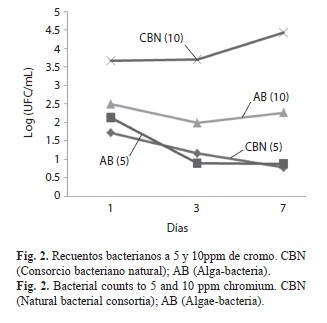
<body><![CDATA[eficiencia de 52.87% (p=0.013473). Igualmente, se observ&oacute; que     las diferencias en la remoci&oacute;n fueron dependientes de la     concentraci&oacute;n de cromo total y del tipo de combinaci&oacute;n     (AA, AB, CBN y control: p=0.035) (<a      href="/img/revistas/rbt/v60n3/a08i1.jpg">Fig. 1</a>). Sin embargo, no     se     detect&oacute; interacci&oacute;n significativa entre ellos.    <br> </span></font><br style="font-family: verdana; font-weight: bold;"> <font size="2"><span style="font-family: verdana;"><span  style="font-weight: bold;">Crecimiento bacteriano:</span> Los resultados mostraron que el crecimiento bacteriano registr&oacute; mayores valores a la concentraci&oacute;n de 10mg/L y el menor crecimiento a concentraciones de 5mg/L. El consorcio bacteriano natural &#8211; aislado&#8211; registr&oacute; el mayor crecimiento (<a  href="/img/revistas/rbt/v60n3/a08i2.jpg">Fig. 2</a>).    <br>     </span></font><br style="font-family: verdana;">     ]]></body>
<body><![CDATA[<font size="2"><span style="font-family: verdana;">De acuerdo con los     resultados, se     observ&oacute; que existe una correlaci&oacute;n entre el tipo de     asociaci&oacute;n y su eficiencia en la remoci&oacute;n del cromo. El     tratamiento alga-bacteria (AB), mostr&oacute; mayor eficiencia de     remoci&oacute;n a la mayor concentraci&oacute;n (10mg/L), mientras que     el consorcio bacteriano natural (CBN) present&oacute; mayor eficiencia     a 5mg/L (p=0.008). El an&aacute;lisis de varianza mostr&oacute; que     hubo diferencias significativas entre las concentraciones de cromo     (p=0.037) y entre los tratamientos (p=0.008).</span></font><br     ]]></body>
<body><![CDATA[ style="font-family: verdana;">     <font size="2"></font><br style="font-family: verdana;">     <font size="2"><span style="font-family: verdana;"><span      style="font-weight: bold;">Caracter&iacute;sticas     morfol&oacute;gicas y bioqu&iacute;micas de las cepas aisladas: </span>Los     resultados registraron tres cepas bacterianas, dos Gram negativas y una     Gram positiva de forma bacilar, sin c&aacute;psula ni espora, con     producci&oacute;n de H<sub>2</sub>S y fermentaci&oacute;n positiva para     az&uacute;cares, a excepci&oacute;n de la glucosa, ninguna     mostr&oacute; fluorescencia ante la luz ultravioleta, y mostraron una     ]]></body>
<body><![CDATA[tolerancia importante a la sal en el rango de 17 a 21% y con excelente     crecimiento a pH neutro (<a href="/img/revistas/rbt/v60n3/a08t1.gif">Cuadro     1</a>).<br style="font-family: verdana;">     </span></font><br style="font-family: verdana;">     <font style="font-weight: bold;" size="3"><span      style="font-family: verdana;">Discusi&oacute;n</span></font><br      style="font-family: verdana;">     <font size="2"></font><br style="font-family: verdana;">     <font size="2"><span style="font-family: verdana;">Los resultados     permitieron observar     ]]></body>
<body><![CDATA[una mayor eficiencia de la combinaci&oacute;n Alga-Bacteria, respecto a     la de Alga-antibi&oacute;tico. Esto sugiere que las bacterias asociadas     a la superficie de <span style="font-style: italic;">B. calliptera</span>     poseen participaci&oacute;n en el     proceso bioacumulativo del alga, dado que el porcentaje de     reducci&oacute;n de cromo es mayor en la combinaci&oacute;n     Alga-bacteria (87% a 10mg/L) que en los sistemas libres de bacteria     (Algaantibi&oacute;tico 65.3% a 10mg/L).</span></font><br      style="font-family: verdana;">     <font size="2"></font><br style="font-family: verdana;">     ]]></body>
<body><![CDATA[<font size="2"><span style="font-family: verdana;">El comportamiento de     la     remoci&oacute;n de cromo en ensayos de laboratorio, fue reportado por     Acosta et al. (2005), quienes se&ntilde;alaron que en el caso de los     hongos <span style="font-style: italic;">Cryptococcus neoformans</span>     (Vuill 1901) y <span style="font-style: italic;">Helminthosporium</span>     sp.     (Raabe et al.1981), el porcentaje de remoci&oacute;n del metal en su     estado hexavalente no depende de la concentraci&oacute;n total en el     medio sino de una capacidad innata de la especie. Se sugiere por lo     ]]></body>
<body><![CDATA[tanto, que el alga <span style="font-style: italic;">B. calliptera</span>     como el Consorcio Bacteriano Natural     poseen una limitada capacidad de absorci&oacute;n de hasta 4.5mg/Len     medio l&iacute;quido para 168h. Estudios realizados con <span      style="font-style: italic;">B. calliptera</span>,     han encontrado &aacute;mbitos de acumulaci&oacute;n para cobre de 2.2 a     3.7mg/L, mercurio hasta 0.9mg/L y plomo hasta 1.3mg/L (Duque et al.     2005). En contraste a Ospina &amp; Pe&ntilde;a (2003) quienes     observaron valores de acumulaci&oacute;n en la misma especie que     oscilan entre 8.333 y 29.048mg/L para cobre, 0.050 y 0.198 para     ]]></body>
<body><![CDATA[mercurio y 1.095 y 8.548mg/L para plomo. Ambos casos sugieren la     importancia del alga roja <span style="font-style: italic;">B.     calliptera</span> como un bioindicador de     contaminaci&oacute;n ambiental al presentar el comportamiento de     bioacumulador de los metales pesados examinados. Adicionalmente y en     relaci&oacute;n a los valores de adsorci&oacute;n del alga y el     Consorcio Bacteriano Natural, se considera que es posible, la     existencia de una interacci&oacute;n positiva entre el consorcio     bacteriano encontrado en la superficie de <span      style="font-style: italic;">B. calliptera</span> y el proceso de     ]]></body>
<body><![CDATA[transformaci&oacute;n de cromo observado por varios autores, tales     como: Arias &amp; Tebo 2003, Cervantes 1991, Kwak et al. 2003 y Paul     2004.</span></font><br style="font-family: verdana;">     <font size="2"></font><br style="font-family: verdana;">     <font size="2"><span style="font-family: verdana;">El Consorcio     bacteriano natural     (CBN), present&oacute; mayor eficiencia en comparaci&oacute;n a la     combinaci&oacute;n Alga-bacteria a la concentraci&oacute;n menor     (5mg/L). Sin embargo, a una concentraci&oacute;n superior (10mg/L) el     sistema Algabacteria presenta mayor eficiencia que CBN, lo que permite     ]]></body>
<body><![CDATA[identificar la importancia de la presencia bacteriana sobre la     superficie del alga, al compararlos con los niveles de     transformaci&oacute;n que presenta el alga y el consorcio bacteriano     aislado. Los resultados coinciden con lo planteado por Cervantes     (1991), Arias &amp; Tebo (2003) y Kwak et al. (2003), los cuales han     demostrado la capacidad de ciertas bacterias de reducir cromo (VI) a     cromo (III) e igualmente de bio-adsorberlo (Rabbania et al. 2005,     Cabrera et al. 2007). Los experimentos en este estudio, permiten     confirmar ambas condiciones, ya que supone que para el sistema     Alga-bacteria, las bacterias (o CBN) pueden funcionar como mediadoras     ]]></body>
<body><![CDATA[en el proceso reductor, al cambiar el estado de oxidaci&oacute;n del Cr     (VI) a Cr (III), facilitando la bio-adsorci&oacute;n por parte del alga     (Acosta et al. 2005). Adicionalmente, la combinaci&oacute;n consorcio     bacteriano natural (CBN) demostr&oacute; ser capaz de bio-adsorber     cromo, confirmando las observaciones aportadas por Lee et al. (2006).     Zhu et al. (2008) igualmente reportan la reducci&oacute;n de cromo por     parte de diversos grupos bacterianos, como es el caso del consorcio     bacteriano chino SRB III (Shen &amp; Wang 1993), generando una posible     explicaci&oacute;n a los fen&oacute;menos de transformaci&oacute;n que     present&oacute; el consorcio examinado, sustent&aacute;ndolos en     ]]></body>
<body><![CDATA[funci&oacute;n al co-metabolismo con azufre.</span></font><br      style="font-family: verdana;">     <font size="2"></font><br style="font-family: verdana;">     <font size="2"><span style="font-family: verdana;">De acuerdo con los     resultados     obtenidos por Fude et al. (1994), existen al menos dos posibles rutas     para la inmovilizaci&oacute;n de Cr. La primera involucra a <span      style="font-style: italic;">Pseudomonas     ambigua</span> G-1 (Suzuki 1992), mecanismo descartado ya que las cepas     empleadas resultaron ser oxidasa negativas, y la segunda     ]]></body>
<body><![CDATA[explicaci&oacute;n, de aplicaci&oacute;n necesaria, sugiere que las     bacterias son productoras de H<sub>2</sub>S (Arias &amp; Tebo 2003), y     que este     act&uacute;a como agente reductor para el Cr (VI). Esto ha sido     observado en ambientes marinos (Smillie et al. 1981) y es consistente     con las bacterias de origen marino extra&iacute;das en este estudio. En     este caso, el H<sub>2</sub>S se re-oxida al ser producido por las     bacterias y el     potencial redox del mismo no baja hasta que la mayor&iacute;a o la     totalidad del Cr (VI) se reduce. Fude et al. (1994) indicaron este     ]]></body>
<body><![CDATA[posible mecanismo para el consorcio SRB III, por cuanto la     mayor&iacute;a de las bacterias que forman dicho complejo son     productoras de H<sub>2</sub>S, similares a las observaciones     comprobadas para los     consorcios bacterianos analizados en este trabajo.</span></font><br      style="font-family: verdana;">     <font size="2"></font><br style="font-family: verdana;">     <font size="2"><span style="font-family: verdana;">Las variaciones     observadas en las     concentraciones de cromo a lo largo del experimento, podr&iacute;an     ]]></body>
<body><![CDATA[corresponder a lo que Puzon et al. (2008) denominaron como parte del     r&eacute;gimen continuo o de ciclaje del metal en su medio natural;     mediante la producci&oacute;n de Cr (III) soluble en el sobrenadante,     lo que ecol&oacute;gicamente corresponder&iacute;a al cromo     biodisponible y asimilable por dem&aacute;s algas, plantas, bacterias     y/o organismos circundantes (Shen &amp; Wang 1993, Campos et al. 1995,     McLean &amp; Beveridge 2001, Bencheikh-Latmani et al. 2007, Megharaj et     al. 2003, VanEngelen et al. 2008). Igualmente, la formaci&oacute;n de     complejos &oacute;rgano-Cr (III) en la reducci&oacute;n     enzim&aacute;tica de Cr (VI) se&ntilde;aladas por Puzon et al. (2008) y     ]]></body>
<body><![CDATA[Kwak et al. (2003), en donde el Cr (III) est&aacute; ligado a la forma     oxidada de los reductores, tales como NAD+ se&ntilde;alar&iacute;an el     siguiente paso de asimilaci&oacute;n bacteriana del contaminante.</span></font><br      style="font-family: verdana;">     <font size="2"></font><br style="font-family: verdana;">     <font size="2"><span style="font-family: verdana;">En este trabajo se     se&ntilde;ala     por primera vez la presencia del consorcio alga-bacteria y su papel en     el porcentaje de remoci&oacute;n del cromo en aguas costeras,     reiterando la importancia de la presencia bacteriana en la     ]]></body>
<body><![CDATA[remoci&oacute;n del metal en su estado de oxidaci&oacute;n (VI) en     aguas marinas costeras con alg&uacute;n grado de contaminaci&oacute;n     por metales. Las perspectivas de este estudio est&aacute;n orientadas a     ampliar las observaciones sobre los mecanismos biol&oacute;gicos que     emplea el alga <span style="font-style: italic;">B. calliptera</span>     y la identificaci&oacute;n de sus     bacterias asociadas en los procesos de biorremediaci&oacute;n de aguas     marinas con presencia de cromo. Igualmente, generar aplicaciones de     car&aacute;cter ecol&oacute;gico para solucionar problem&aacute;ticas     de contaminaci&oacute;n presentes en cuerpos de agua, a trav&eacute;s     ]]></body>
<body><![CDATA[de biopel&iacute;culas, filtros, o celdas que aporten procesos     descontaminantes con efectos adicionales que permitan desarrollo en     poblaciones aisladas o de baja influencia tecnol&oacute;gica.</span></font><br      style="font-family: verdana;">     <font size="2"></font><br style="font-family: verdana;">     <font style="font-weight: bold;" size="3"><span      style="font-family: verdana;">Agradecimientos</span></font><br      style="font-family: verdana;">     <font size="2"></font><br style="font-family: verdana;">     <font size="2"><span style="font-family: verdana;">El presente estudio     ]]></body>
<body><![CDATA[se     realiz&oacute; en el marco del proyecto de convocatoria interna de la     Universidad del Valle # CI 57748 de 2007 &#8220;Efectos de la     concentraci&oacute;n de metales pesados sobre la biolog&iacute;a     reproductiva y caracter&iacute;sticas ultraestructurales en algas rojas     y sus implicaciones en biorremediaci&oacute;n&#8221;. Los autores agradecen     al personal del laboratorio de microbiolog&iacute;a industrial y     ambiental del departamento de Biolog&iacute;a y del laboratorio de     an&aacute;lisis industrial del departamento de Qu&iacute;mica, por su     apoyo en el an&aacute;lisis y tratamiento de las muestras. Al personal     ]]></body>
<body><![CDATA[de la secci&oacute;n de bot&aacute;nica de la Universidad del Valle,     Colombia, por su apoyo en el desarrollo del proyecto.</span></font><br      style="font-family: verdana;">     <font size="2"></font>     <hr style="width: 100%; height: 2px;"><br style="font-family: verdana;">     <font style="font-weight: bold;" size="3"><span      style="font-family: verdana;">Referencias</span></font><br      style="font-family: verdana;">     <font size="2"></font><br style="font-family: verdana;">     <font size="2"><span style="font-family: verdana;">Acosta, M., G.     ]]></body>
<body><![CDATA[Moctezuma-Z&aacute;rate, C. Guti&eacute;rrez &amp; X. Rodr&iacute;guez.     2005. Bioadsorci&oacute;n de Cromo (VI) en Soluci&oacute;n Acuosa por     la Biomasa Celular de <span style="font-style: italic;">Cryptococcus     neoformans</span> y <span style="font-style: italic;">Helminthosporium</span>     sp.     <!-- ref -->Inf. tecnol. 16: 11-15.    &nbsp;&nbsp;&nbsp;&nbsp;&nbsp;&nbsp;&nbsp;&nbsp;[&#160;<a href="javascript:void(0);" onclick="javascript: window.open('/scielo.php?script=sci_nlinks&ref=1471332&pid=S0034-7744201200030000800001&lng=','','width=640,height=500,resizable=yes,scrollbars=1,menubar=yes,');">Links</a>&#160;]<!-- end-ref --><!-- ref --></span></font><br style="font-family: verdana;"> <font size="2"></font><br style="font-family: verdana;"> <font size="2"><span style="font-family: verdana;">Acuario, G., A. Rossin, P.F. Teixeira &amp; F. Zepeda. 1998. Diagn&oacute;stico de la situaci&oacute;n del manejo de residuos s&oacute;lidos municipales en Am&eacute;rica Latina y el Caribe. Organizaci&oacute;n Panamericana de la Salud. Organizaci&oacute;n Mundial de la Salud. Banco Interamericano de Desarrollo y la Organizaci&oacute;n Panamericana de la Salud. Serie ambiental 18. OPS. Am&eacute;rica Latina.    &nbsp;&nbsp;&nbsp;&nbsp;&nbsp;&nbsp;&nbsp;&nbsp;[&#160;<a href="javascript:void(0);" onclick="javascript: window.open('/scielo.php?script=sci_nlinks&ref=1471333&pid=S0034-7744201200030000800002&lng=','','width=640,height=500,resizable=yes,scrollbars=1,menubar=yes,');">Links</a>&#160;]<!-- end-ref --><!-- ref --></span></font><br  style="font-family: verdana;"> <font size="2"></font><br style="font-family: verdana;"> <font size="2"><span style="font-family: verdana;">Andersen, R.A. (ed.) 2005. Algal Culturing Techniques: A Book for All Phycologists. Elsevier, West Boothbay Harbor, EEUU.    &nbsp;&nbsp;&nbsp;&nbsp;&nbsp;&nbsp;&nbsp;&nbsp;[&#160;<a href="javascript:void(0);" onclick="javascript: window.open('/scielo.php?script=sci_nlinks&ref=1471334&pid=S0034-7744201200030000800003&lng=','','width=640,height=500,resizable=yes,scrollbars=1,menubar=yes,');">Links</a>&#160;]<!-- end-ref --><!-- ref --></span></font><br style="font-family: verdana;"> <font size="2"></font><br style="font-family: verdana;"> <font size="2"><span style="font-family: verdana;">Arias, Y &amp; B. Tebo. 2003. Cr (VI) Reduction by Sulfidogenic and Nonsulfidogenic Microbial Consortia. Appl. Microbiol. 69: 1847-1853.    &nbsp;&nbsp;&nbsp;&nbsp;&nbsp;&nbsp;&nbsp;&nbsp;[&#160;<a href="javascript:void(0);" onclick="javascript: window.open('/scielo.php?script=sci_nlinks&ref=1471335&pid=S0034-7744201200030000800004&lng=','','width=640,height=500,resizable=yes,scrollbars=1,menubar=yes,');">Links</a>&#160;]<!-- end-ref --><!-- ref --></span></font><br  style="font-family: verdana;"> <font size="2"></font><br style="font-family: verdana;"> <font size="2"><span style="font-family: verdana;">Assfalg, M., I. Bertini, M. Bruschi, C. Michel &amp; P. Turano. 2002. The metal reductase activity of some multiheme cytochromes c: NMR structural characterization of the reduction of chromium (VI) to chromium (III) by cytochrome c7. PNAS 99: 9750-9754.    &nbsp;&nbsp;&nbsp;&nbsp;&nbsp;&nbsp;&nbsp;&nbsp;[&#160;<a href="javascript:void(0);" onclick="javascript: window.open('/scielo.php?script=sci_nlinks&ref=1471336&pid=S0034-7744201200030000800005&lng=','','width=640,height=500,resizable=yes,scrollbars=1,menubar=yes,');">Links</a>&#160;]<!-- end-ref --><!-- ref --></span></font><br style="font-family: verdana;"> <font size="2"></font><br style="font-family: verdana;"> <font size="2"><span style="font-family: verdana;">Bencheikh-latmani, R., S. Middleton-william, L. Haucke, C. Criddle, L. Wu, L. Zhou &amp; B. Tebo. 2005. Global Transcriptional Profiling of Shewanella oneidensis MR-1 during Cr (VI) and U (VI) Reduction. Appl. Microbiol. 71: 7453-7460.    &nbsp;&nbsp;&nbsp;&nbsp;&nbsp;&nbsp;&nbsp;&nbsp;[&#160;<a href="javascript:void(0);" onclick="javascript: window.open('/scielo.php?script=sci_nlinks&ref=1471337&pid=S0034-7744201200030000800006&lng=','','width=640,height=500,resizable=yes,scrollbars=1,menubar=yes,');">Links</a>&#160;]<!-- end-ref --><!-- ref --></span></font><br  style="font-family: verdana;"> <font size="2"></font><br style="font-family: verdana;"> <font size="2"><span style="font-family: verdana;">Buerge, I. &amp; S. Hug. 1999. Influence of Mineral Surfaces on Chromium(VI) Reduction by Iron(II). Environ. Sci. Technol. 33: 4285-4291.    &nbsp;&nbsp;&nbsp;&nbsp;&nbsp;&nbsp;&nbsp;&nbsp;[&#160;<a href="javascript:void(0);" onclick="javascript: window.open('/scielo.php?script=sci_nlinks&ref=1471338&pid=S0034-7744201200030000800007&lng=','','width=640,height=500,resizable=yes,scrollbars=1,menubar=yes,');">Links</a>&#160;]<!-- end-ref --><!-- ref --></span></font><br  style="font-family: verdana;"> <font size="2"></font><br style="font-family: verdana;"> <font size="2"><span style="font-family: verdana;">Cabrera, G., M. Viera, J. G&oacute;mez, D. Cantero &amp; E. Donati. 2007. Bacterial removal of chromium (VI) and (III) in a continuous system. Biodegradation 18: 505-513.    &nbsp;&nbsp;&nbsp;&nbsp;&nbsp;&nbsp;&nbsp;&nbsp;[&#160;<a href="javascript:void(0);" onclick="javascript: window.open('/scielo.php?script=sci_nlinks&ref=1471339&pid=S0034-7744201200030000800008&lng=','','width=640,height=500,resizable=yes,scrollbars=1,menubar=yes,');">Links</a>&#160;]<!-- end-ref --><!-- ref --></span></font><br style="font-family: verdana;"> <font size="2"></font><br style="font-family: verdana;"> <font size="2"><span style="font-family: verdana;">Campos, J., M. Martinez-Pacheco &amp; C. Cervantes. 1995. Hexavalent-chromium reduction by a chromateresistant Bacillus sp. strain. Antonie Leeuwenhoek 68: 203-208.    &nbsp;&nbsp;&nbsp;&nbsp;&nbsp;&nbsp;&nbsp;&nbsp;[&#160;<a href="javascript:void(0);" onclick="javascript: window.open('/scielo.php?script=sci_nlinks&ref=1471340&pid=S0034-7744201200030000800009&lng=','','width=640,height=500,resizable=yes,scrollbars=1,menubar=yes,');">Links</a>&#160;]<!-- end-ref --><!-- ref --></span></font><br  style="font-family: verdana;"> <font size="2"></font><br style="font-family: verdana;"> <font size="2"><span style="font-family: verdana;">Cervantes, C. 1991. Bacterial interactions with chromate. Antonie Leeuwenhoek 59:229-233.    &nbsp;&nbsp;&nbsp;&nbsp;&nbsp;&nbsp;&nbsp;&nbsp;[&#160;<a href="javascript:void(0);" onclick="javascript: window.open('/scielo.php?script=sci_nlinks&ref=1471341&pid=S0034-7744201200030000800010&lng=','','width=640,height=500,resizable=yes,scrollbars=1,menubar=yes,');">Links</a>&#160;]<!-- end-ref --><!-- ref --></span></font><br  style="font-family: verdana;"> <font size="2"></font><br style="font-family: verdana;"> <font size="2"><span style="font-family: verdana;">Duque, Y, E. Pe&ntilde;a, J. Cantera &amp; R. Benitez. 2003. Macroalgas acumulando metales pesados en la Bah&iacute;a de Buenaventura - Pacifico Colombiano. Programa y res&uacute;menes congreso Latinoamericano de Ciencias del Mar COLACMAR. Colombia.    &nbsp;&nbsp;&nbsp;&nbsp;&nbsp;&nbsp;&nbsp;&nbsp;[&#160;<a href="javascript:void(0);" onclick="javascript: window.open('/scielo.php?script=sci_nlinks&ref=1471342&pid=S0034-7744201200030000800011&lng=','','width=640,height=500,resizable=yes,scrollbars=1,menubar=yes,');">Links</a>&#160;]<!-- end-ref --><!-- ref --></span></font><br style="font-family: verdana;"> <font size="2"></font><br style="font-family: verdana;"> <font size="2"><span style="font-family: verdana;">Eaton, A., L. Clesceri., E. Rice &amp; A. Greenberg. 2005. Standard methods for the examination of water and wastewater. AWWA, Nueva York, EEUU.    &nbsp;&nbsp;&nbsp;&nbsp;&nbsp;&nbsp;&nbsp;&nbsp;[&#160;<a href="javascript:void(0);" onclick="javascript: window.open('/scielo.php?script=sci_nlinks&ref=1471343&pid=S0034-7744201200030000800012&lng=','','width=640,height=500,resizable=yes,scrollbars=1,menubar=yes,');">Links</a>&#160;]<!-- end-ref --><!-- ref --></span></font><br  style="font-family: verdana;"> <font size="2"></font><br style="font-family: verdana;"> <font size="2"><span style="font-family: verdana;">Fude, L., B. Harris, M. Urrutia &amp; T. Beveridge. 1994. American Society for Microbiology Reduction of Cr (VI) by a Consortium of Sulfate-Reducing Bacteria (SRB III). Appl. Microbiol. 60: 1525-1531.    &nbsp;&nbsp;&nbsp;&nbsp;&nbsp;&nbsp;&nbsp;&nbsp;[&#160;<a href="javascript:void(0);" onclick="javascript: window.open('/scielo.php?script=sci_nlinks&ref=1471344&pid=S0034-7744201200030000800013&lng=','','width=640,height=500,resizable=yes,scrollbars=1,menubar=yes,');">Links</a>&#160;]<!-- end-ref --><!-- ref --></span></font><br  style="font-family: verdana;"> <font size="2"></font><br style="font-family: verdana;"> <font size="2"><span style="font-family: verdana;">Garay, J., B. Mar&iacute;n &amp; A. V&eacute;lez. 2001. Contaminaci&oacute;n marino-costera en Colombia. Informe del Estado de los Ambientes Marinos y Costeros en Colombia. Santa Martha, Instituto de Investigaciones Marinas y Costeras Jos&eacute; Benito Vives de Andr&eacute;is - INVEMAR, San Andr&eacute;s, Colombia.    &nbsp;&nbsp;&nbsp;&nbsp;&nbsp;&nbsp;&nbsp;&nbsp;[&#160;<a href="javascript:void(0);" onclick="javascript: window.open('/scielo.php?script=sci_nlinks&ref=1471345&pid=S0034-7744201200030000800014&lng=','','width=640,height=500,resizable=yes,scrollbars=1,menubar=yes,');">Links</a>&#160;]<!-- end-ref --><!-- ref --></span></font><br style="font-family: verdana;"> <font size="2"></font><br style="font-family: verdana;"> <font size="2"><span style="font-family: verdana;">Garay, J. 2004. Programa Nacional de Investigaci&oacute;n, Evaluaci&oacute;n, Prevenci&oacute;n, Reducci&oacute;n y Control de Fuentes Terrestres y Marinas de Contaminaci&oacute;n al Mar PNICM. Instituto de Investigaciones Marinas y Costeras Jos&eacute; Benito Vives de Andr&eacute;is - INVEMAR, San Andr&eacute;s, Colombia.    &nbsp;&nbsp;&nbsp;&nbsp;&nbsp;&nbsp;&nbsp;&nbsp;[&#160;<a href="javascript:void(0);" onclick="javascript: window.open('/scielo.php?script=sci_nlinks&ref=1471346&pid=S0034-7744201200030000800015&lng=','','width=640,height=500,resizable=yes,scrollbars=1,menubar=yes,');">Links</a>&#160;]<!-- end-ref --><!-- ref --></span></font><br style="font-family: verdana;"> <font size="2"></font><br style="font-family: verdana;"> <font size="2"><span style="font-family: verdana;">Hadbock, B. &amp; C. Jones. 1997. Bacterial Respiration. Bacteriological review 41: 47-99.    &nbsp;&nbsp;&nbsp;&nbsp;&nbsp;&nbsp;&nbsp;&nbsp;[&#160;<a href="javascript:void(0);" onclick="javascript: window.open('/scielo.php?script=sci_nlinks&ref=1471347&pid=S0034-7744201200030000800016&lng=','','width=640,height=500,resizable=yes,scrollbars=1,menubar=yes,');">Links</a>&#160;]<!-- end-ref --><!-- ref --></span></font><br  style="font-family: verdana;"> <font size="2"></font><br style="font-family: verdana;"> <font size="2"><span style="font-family: verdana;">Icontec.1994. Norma t&eacute;cnica colombiana NTC 4092. Microbiolog&iacute;a de alimentos y de alimentos para animales. Reglas generales para el an&aacute;lisis microbiol&oacute;gico. Instituto Colombiano de normas t&eacute;cnicas y certificaci&oacute;n - ICONTEC, Santaf&eacute; de Bogot&aacute;    &nbsp;&nbsp;&nbsp;&nbsp;&nbsp;&nbsp;&nbsp;&nbsp;[&#160;<a href="javascript:void(0);" onclick="javascript: window.open('/scielo.php?script=sci_nlinks&ref=1471348&pid=S0034-7744201200030000800017&lng=','','width=640,height=500,resizable=yes,scrollbars=1,menubar=yes,');">Links</a>&#160;]<!-- end-ref --><!-- ref -->.</span></font><br  style="font-family: verdana;"> <font size="2"></font><br style="font-family: verdana;"> <font size="2"><span style="font-family: verdana;">Kwak, Y., D. Lee &amp; H. Kim. 2003. Vibrio harveyi Nitroreductase Is Also a Chromate Reductase. Appl. Microbiol. 69: 4390-4395.    &nbsp;&nbsp;&nbsp;&nbsp;&nbsp;&nbsp;&nbsp;&nbsp;[&#160;<a href="javascript:void(0);" onclick="javascript: window.open('/scielo.php?script=sci_nlinks&ref=1471349&pid=S0034-7744201200030000800018&lng=','','width=640,height=500,resizable=yes,scrollbars=1,menubar=yes,');">Links</a>&#160;]<!-- end-ref --><!-- ref --></span></font><br style="font-family: verdana;"> <font size="2"></font><br style="font-family: verdana;"> <font size="2"><span style="font-family: verdana;">Kidd, P., A. Prieto-fern&aacute;ndez, C. Monterroso &amp; M.J. Acea. 2008. Rhizosphere microbial community and hexachlorocyclohexane degradative potential in contrasting plant species. Plant Soil 302: 233-247.    &nbsp;&nbsp;&nbsp;&nbsp;&nbsp;&nbsp;&nbsp;&nbsp;[&#160;<a href="javascript:void(0);" onclick="javascript: window.open('/scielo.php?script=sci_nlinks&ref=1471350&pid=S0034-7744201200030000800019&lng=','','width=640,height=500,resizable=yes,scrollbars=1,menubar=yes,');">Links</a>&#160;]<!-- end-ref --><!-- ref --></span></font><br  style="font-family: verdana;"> <font size="2"></font><br style="font-family: verdana;"> <font size="2"><span style="font-family: verdana;">Lee, S., J. Lee, J. Lee &amp; H. Chon. 2006. Effects of indigenous bacteria on Cr (VI) reduction in Cr-contaminated sediment with industrial wastes. J. Geochem. Explor. 88: 41-44.    &nbsp;&nbsp;&nbsp;&nbsp;&nbsp;&nbsp;&nbsp;&nbsp;[&#160;<a href="javascript:void(0);" onclick="javascript: window.open('/scielo.php?script=sci_nlinks&ref=1471351&pid=S0034-7744201200030000800020&lng=','','width=640,height=500,resizable=yes,scrollbars=1,menubar=yes,');">Links</a>&#160;]<!-- end-ref --><!-- ref --></span></font><br style="font-family: verdana;"> <font size="2"></font><br style="font-family: verdana;"> <font size="2"><span style="font-family: verdana;">Lenis, L., E. Pe&ntilde;a-Salamanca &amp; D. Chito-Trujillo. 2007. Extracci&oacute;n, Separaci&oacute;n y Elucidaci&oacute;n estructural de dos metabolitos secundarios de alga marina <span style="font-style: italic;">Bostrychia</span> <span  style="font-style: italic;">callipetera</span>. Scientia et Technica. 13: 97-102.    &nbsp;&nbsp;&nbsp;&nbsp;&nbsp;&nbsp;&nbsp;&nbsp;[&#160;<a href="javascript:void(0);" onclick="javascript: window.open('/scielo.php?script=sci_nlinks&ref=1471352&pid=S0034-7744201200030000800021&lng=','','width=640,height=500,resizable=yes,scrollbars=1,menubar=yes,');">Links</a>&#160;]<!-- end-ref --><!-- ref --></span></font><br style="font-family: verdana;"> <font size="2"></font><br style="font-family: verdana;"> <font size="2"><span style="font-family: verdana;">Lovley, D.W. 1991. Dissimilatory Fe (III) and Mn (IV) reduction. Microbiol. Rev. 55:259-287.    &nbsp;&nbsp;&nbsp;&nbsp;&nbsp;&nbsp;&nbsp;&nbsp;[&#160;<a href="javascript:void(0);" onclick="javascript: window.open('/scielo.php?script=sci_nlinks&ref=1471353&pid=S0034-7744201200030000800022&lng=','','width=640,height=500,resizable=yes,scrollbars=1,menubar=yes,');">Links</a>&#160;]<!-- end-ref --><!-- ref --></span></font><br  style="font-family: verdana;"> <font size="2"></font><br style="font-family: verdana;"> <font size="2"><span style="font-family: verdana;">Lovley, D. &amp; E. Phillips. 1994. Reduction of Chromate by <span style="font-style: italic;">Desulfovibrio vulgaris</span> and Its C3 Cytochrome. Appl. Microbiol. 60: 726-728.    &nbsp;&nbsp;&nbsp;&nbsp;&nbsp;&nbsp;&nbsp;&nbsp;[&#160;<a href="javascript:void(0);" onclick="javascript: window.open('/scielo.php?script=sci_nlinks&ref=1471354&pid=S0034-7744201200030000800023&lng=','','width=640,height=500,resizable=yes,scrollbars=1,menubar=yes,');">Links</a>&#160;]<!-- end-ref --><!-- ref --></span></font><br  style="font-family: verdana;"> <font size="2"></font><br style="font-family: verdana;"> <font size="2"><span style="font-family: verdana;">Mclean, J. &amp; T. Beveridge. 2001. Chromate Reduction by a Pseudomonad Isolated from a Site Contaminated with Chromated Copper Arsenate. Appl. Microbiol. 67: 1076-1084.    &nbsp;&nbsp;&nbsp;&nbsp;&nbsp;&nbsp;&nbsp;&nbsp;[&#160;<a href="javascript:void(0);" onclick="javascript: window.open('/scielo.php?script=sci_nlinks&ref=1471355&pid=S0034-7744201200030000800024&lng=','','width=640,height=500,resizable=yes,scrollbars=1,menubar=yes,');">Links</a>&#160;]<!-- end-ref --><!-- ref --></span></font><br style="font-family: verdana;"> <font size="2"></font><br style="font-family: verdana;"> <font size="2"><span style="font-family: verdana;">Megharaj, M., S. Avudainayagam &amp; R. Naidu. 2003. Toxicity of Hexavalent Chromium and Its Reduction by Bacteria Isolated from Soil Contaminated withTannery Waste. Curr. Microbiol. 47: 51-54.    &nbsp;&nbsp;&nbsp;&nbsp;&nbsp;&nbsp;&nbsp;&nbsp;[&#160;<a href="javascript:void(0);" onclick="javascript: window.open('/scielo.php?script=sci_nlinks&ref=1471356&pid=S0034-7744201200030000800025&lng=','','width=640,height=500,resizable=yes,scrollbars=1,menubar=yes,');">Links</a>&#160;]<!-- end-ref --><!-- ref --></span></font><br style="font-family: verdana;"> <font size="2"></font><br style="font-family: verdana;"> <font size="2"><span style="font-family: verdana;">Mostaert, A., D. Orlovich &amp; R. King. 1996. Ion Compartmentation in the Red Alga <span  style="font-style: italic;">Caloglossa leprieurii</span> in Response to Salinity Changes: Freeze-Substitution and X-ray Microanalysis. New Phytol. 132: 513-519.    &nbsp;&nbsp;&nbsp;&nbsp;&nbsp;&nbsp;&nbsp;&nbsp;[&#160;<a href="javascript:void(0);" onclick="javascript: window.open('/scielo.php?script=sci_nlinks&ref=1471357&pid=S0034-7744201200030000800026&lng=','','width=640,height=500,resizable=yes,scrollbars=1,menubar=yes,');">Links</a>&#160;]<!-- end-ref --><!-- ref --></span></font><br  style="font-family: verdana;"> <font size="2"></font><br style="font-family: verdana;"> <font size="2"><span style="font-family: verdana;">Nejidat, A., I. Saadi &amp; Z. Ronen. 2005. Degradation of 2,4,6-tribromophenol by bacterial cells attached to chalk collected from a contaminated aquifer. J. Ind. Microbiol. Biotechnol. 32: 502-513.    &nbsp;&nbsp;&nbsp;&nbsp;&nbsp;&nbsp;&nbsp;&nbsp;[&#160;<a href="javascript:void(0);" onclick="javascript: window.open('/scielo.php?script=sci_nlinks&ref=1471358&pid=S0034-7744201200030000800027&lng=','','width=640,height=500,resizable=yes,scrollbars=1,menubar=yes,');">Links</a>&#160;]<!-- end-ref --><!-- ref --></span></font><br  style="font-family: verdana;"> <font size="2"></font><br style="font-family: verdana;"> <font size="2"><span style="font-family: verdana;">Paul, A. 2004. Aerobic chromate reduction by chromiumresistant bacteria isolated from serpentine soil Arundhati Pal. Microbiol. Res. 159:347-354.    &nbsp;&nbsp;&nbsp;&nbsp;&nbsp;&nbsp;&nbsp;&nbsp;[&#160;<a href="javascript:void(0);" onclick="javascript: window.open('/scielo.php?script=sci_nlinks&ref=1471359&pid=S0034-7744201200030000800028&lng=','','width=640,height=500,resizable=yes,scrollbars=1,menubar=yes,');">Links</a>&#160;]<!-- end-ref --><!-- ref --></span></font><br  style="font-family: verdana;"> <font size="2"></font><br style="font-family: verdana;"> <font size="2"><span style="font-family: verdana;">Ospina-Alvarez, N., E. Pe&ntilde;a-Salamanca &amp; R. Benitez. 2003. Uso de algas b&eacute;nticas con indicadores de contaminaci&oacute;n por metales pesados en la Bah&iacute;a de Buenaventura &#8211; Pacifico Colombiano. Conferencia Internacional Usos m&uacute;ltiples del Agua: Para la Vida y el Desarrollo Sostenible. Instituto Cinara, Universidad del Valle, Colombia.    &nbsp;&nbsp;&nbsp;&nbsp;&nbsp;&nbsp;&nbsp;&nbsp;[&#160;<a href="javascript:void(0);" onclick="javascript: window.open('/scielo.php?script=sci_nlinks&ref=1471360&pid=S0034-7744201200030000800029&lng=','','width=640,height=500,resizable=yes,scrollbars=1,menubar=yes,');">Links</a>&#160;]<!-- end-ref --><!-- ref --></span></font><br style="font-family: verdana;"> <font size="2"></font><br style="font-family: verdana;"> <font size="2"><span style="font-family: verdana;">Ospina-Alvarez, N., E. Pe&ntilde;a-Salamanca &amp; R. Benitez. 2006. Efecto de la salinidad en la capacidad de bioacumulaci&oacute;n de plomo en el alga verde <span style="font-style: italic;">Rhizoclonium riparium</span> (Roth) Harvey (Chlorophyceae, Cladophorales). Actual Biol. 28: 17-25.    &nbsp;&nbsp;&nbsp;&nbsp;&nbsp;&nbsp;&nbsp;&nbsp;[&#160;<a href="javascript:void(0);" onclick="javascript: window.open('/scielo.php?script=sci_nlinks&ref=1471361&pid=S0034-7744201200030000800030&lng=','','width=640,height=500,resizable=yes,scrollbars=1,menubar=yes,');">Links</a>&#160;]<!-- end-ref --><!-- ref --></span></font><br style="font-family: verdana;"> <font size="2"></font><br style="font-family: verdana;"> <font size="2"><span style="font-family: verdana;">Pe&ntilde;a, E.J. 1998. Physiological ecology of mangrove associated macroalgae in a tropical estuary. Ph.D. Thesis, University of South Carolina, EEUU.    &nbsp;&nbsp;&nbsp;&nbsp;&nbsp;&nbsp;&nbsp;&nbsp;[&#160;<a href="javascript:void(0);" onclick="javascript: window.open('/scielo.php?script=sci_nlinks&ref=1471362&pid=S0034-7744201200030000800031&lng=','','width=640,height=500,resizable=yes,scrollbars=1,menubar=yes,');">Links</a>&#160;]<!-- end-ref --><!-- ref --></span></font><br  style="font-family: verdana;"> <font size="2"></font><br style="font-family: verdana;"> <font size="2"><span style="font-family: verdana;">Pe&ntilde;a, E.J., R. Zingmark &amp; C. Nietch. 1999. Comparative photosynthesis of two species of intertidal epiphytic macroalgae on mangrove roots during submersion and emersion. J. Phycol. 35: 1206-1214.    &nbsp;&nbsp;&nbsp;&nbsp;&nbsp;&nbsp;&nbsp;&nbsp;[&#160;<a href="javascript:void(0);" onclick="javascript: window.open('/scielo.php?script=sci_nlinks&ref=1471363&pid=S0034-7744201200030000800032&lng=','','width=640,height=500,resizable=yes,scrollbars=1,menubar=yes,');">Links</a>&#160;]<!-- end-ref --><!-- ref --></span></font><br  style="font-family: verdana;"> <font size="2"></font><br style="font-family: verdana;"> <font size="2"><span style="font-family: verdana;">Pe&ntilde;a-Salamanca, E., Lozano-Duque &amp; R. Benitez. 2003. Din&aacute;mica de la Bioacumulaci&oacute;n de Metales Pesadosen dos Especies de Algas en la Bah&iacute;a de Buenaventura, Pacifico Colombiano. Universidad del Valle. Departamento de Biolog&iacute;a. Universidad del Cauca. Departamento de Qu&iacute;mica. Cali, Colombia.    &nbsp;&nbsp;&nbsp;&nbsp;&nbsp;&nbsp;&nbsp;&nbsp;[&#160;<a href="javascript:void(0);" onclick="javascript: window.open('/scielo.php?script=sci_nlinks&ref=1471364&pid=S0034-7744201200030000800033&lng=','','width=640,height=500,resizable=yes,scrollbars=1,menubar=yes,');">Links</a>&#160;]<!-- end-ref --><!-- ref --></span></font><br  style="font-family: verdana;"> <font size="2"></font><br style="font-family: verdana;"> <font size="2"><span style="font-family: verdana;">Pe&ntilde;a-Salamanca, E. 2008. Din&aacute;mica espacial y temporal de la biomasa algal asociada a las ra&iacute;ces de mangle en la bah&iacute;a de Buenaventura, Costa pac&iacute;fica de Colombia. Bol. Invemar 37: 55-70.    &nbsp;&nbsp;&nbsp;&nbsp;&nbsp;&nbsp;&nbsp;&nbsp;[&#160;<a href="javascript:void(0);" onclick="javascript: window.open('/scielo.php?script=sci_nlinks&ref=1471365&pid=S0034-7744201200030000800034&lng=','','width=640,height=500,resizable=yes,scrollbars=1,menubar=yes,');">Links</a>&#160;]<!-- end-ref --><!-- ref --></span></font><br  style="font-family: verdana;"> <font size="2"></font><br style="font-family: verdana;"> <font size="2"><span style="font-family: verdana;">Pe&ntilde;a-Salamanca, E., A. Rengifo-Gallego &amp; N. Benitez-Campo. 2011. Detoxification mechanisms of heavy metals by algal-bacteria consortia, p. 441-453. In K. Se-Kwon (ed.). Handbook of Marine Macroalgae: Biotechnology and Applied Phycology. JohnWiley &amp; Sons, EEUU.    &nbsp;&nbsp;&nbsp;&nbsp;&nbsp;&nbsp;&nbsp;&nbsp;[&#160;<a href="javascript:void(0);" onclick="javascript: window.open('/scielo.php?script=sci_nlinks&ref=1471366&pid=S0034-7744201200030000800035&lng=','','width=640,height=500,resizable=yes,scrollbars=1,menubar=yes,');">Links</a>&#160;]<!-- end-ref --><!-- ref --></span></font><br  style="font-family: verdana;"> <font size="2"></font><br style="font-family: verdana;"> <font size="2"><span style="font-family: verdana;">Puzon, G.J., J.N. Petersen, A.G. Roberts, D.M. Kramer &amp; L. Xun. 2002. A bacterial flavin reductase system reduces chromate to a soluble chromium (III)-NAD+ complex (2002). Biochem. Biophys. Res. Commun. 294: 76-81.    &nbsp;&nbsp;&nbsp;&nbsp;&nbsp;&nbsp;&nbsp;&nbsp;[&#160;<a href="javascript:void(0);" onclick="javascript: window.open('/scielo.php?script=sci_nlinks&ref=1471367&pid=S0034-7744201200030000800036&lng=','','width=640,height=500,resizable=yes,scrollbars=1,menubar=yes,');">Links</a>&#160;]<!-- end-ref --><!-- ref --></span></font><br  style="font-family: verdana;"> <font size="2"></font><br style="font-family: verdana;"> <font size="2"><span style="font-family: verdana;">Rabbania, M., H. Ghafouriana, S. Sadeghib &amp; Y. Nazerib. 2005. Biosorption of chromium (III) by new bacterial strain (NRC-BT-2). Int. Congr. Ser. 1276: 268-269.    &nbsp;&nbsp;&nbsp;&nbsp;&nbsp;&nbsp;&nbsp;&nbsp;[&#160;<a href="javascript:void(0);" onclick="javascript: window.open('/scielo.php?script=sci_nlinks&ref=1471368&pid=S0034-7744201200030000800037&lng=','','width=640,height=500,resizable=yes,scrollbars=1,menubar=yes,');">Links</a>&#160;]<!-- end-ref --><!-- ref --></span></font><br  style="font-family: verdana;"> <font size="2"></font><br style="font-family: verdana;"> <font size="2"><span style="font-family: verdana;">Rengifo, A. 2010. Caracterizaci&oacute;n bacteriana y evaluaci&oacute;n del efecto de la asociaci&oacute;n alga-bacteria (alga roja <span  style="font-style: italic;">Bostrychia calliptera</span> Rhodomelaceae) en el porcentaje de remoci&oacute;n de cromo. Tesis de pregrado, Universidad del Valle, Cali, Colombia.    &nbsp;&nbsp;&nbsp;&nbsp;&nbsp;&nbsp;&nbsp;&nbsp;[&#160;<a href="javascript:void(0);" onclick="javascript: window.open('/scielo.php?script=sci_nlinks&ref=1471369&pid=S0034-7744201200030000800038&lng=','','width=640,height=500,resizable=yes,scrollbars=1,menubar=yes,');">Links</a>&#160;]<!-- end-ref --><!-- ref --></span></font><br  style="font-family: verdana;"> <font size="2"></font><br style="font-family: verdana;"> <font size="2"><span style="font-family: verdana;">Shen, H. &amp; Y. Wang. 1993. Characterization of Enzymatic Reduction of Hexavalent Chromium by Escherichia coli ATCC 33456. Appl. Microbiol. 59: 3771-3777.    &nbsp;&nbsp;&nbsp;&nbsp;&nbsp;&nbsp;&nbsp;&nbsp;[&#160;<a href="javascript:void(0);" onclick="javascript: window.open('/scielo.php?script=sci_nlinks&ref=1471370&pid=S0034-7744201200030000800039&lng=','','width=640,height=500,resizable=yes,scrollbars=1,menubar=yes,');">Links</a>&#160;]<!-- end-ref --><!-- ref --></span></font><br  style="font-family: verdana;"> <font size="2"></font><br style="font-family: verdana;"> <font size="2"><span style="font-family: verdana;">Smillie, R.H., K. Hunter &amp; M. Loutit. 1981. Reduction of Chromium (VI) by Bacterially Produced Hydrogen Sulphide in a Marine Environment. Water Res. 15: 1351-1354.    &nbsp;&nbsp;&nbsp;&nbsp;&nbsp;&nbsp;&nbsp;&nbsp;[&#160;<a href="javascript:void(0);" onclick="javascript: window.open('/scielo.php?script=sci_nlinks&ref=1471371&pid=S0034-7744201200030000800040&lng=','','width=640,height=500,resizable=yes,scrollbars=1,menubar=yes,');">Links</a>&#160;]<!-- end-ref --><!-- ref --></span></font><br  style="font-family: verdana;"> <font size="2"></font><br style="font-family: verdana;"> <font size="2"><span style="font-family: verdana;">Vanengelen, M., B. Peyton, M. Mormile &amp; M. Pinkart. 2008. Fe (III), Cr (VI), and Fe (III) mediated Cr (VI) reduction in alkaline media using a Halomonas isolate from Soap Lake, Washington. Biodegradation 19:841-850.    &nbsp;&nbsp;&nbsp;&nbsp;&nbsp;&nbsp;&nbsp;&nbsp;[&#160;<a href="javascript:void(0);" onclick="javascript: window.open('/scielo.php?script=sci_nlinks&ref=1471372&pid=S0034-7744201200030000800041&lng=','','width=640,height=500,resizable=yes,scrollbars=1,menubar=yes,');">Links</a>&#160;]<!-- end-ref --><!-- ref --></span></font><br  style="font-family: verdana;"> <font size="2"></font><br style="font-family: verdana;"> <font size="2"><span style="font-family: verdana;">Wang, P., T. Mori, K. Komori, M. Sasatsu, K. Toda &amp; H. Ohtake. 1989. Isolation and Characterization of an Enterobacter cloacae Strain That Reduces Hexavalent Chromium under Anaerobic Conditions. Appl. Microbiol. 55: 1665-1669.    &nbsp;&nbsp;&nbsp;&nbsp;&nbsp;&nbsp;&nbsp;&nbsp;[&#160;<a href="javascript:void(0);" onclick="javascript: window.open('/scielo.php?script=sci_nlinks&ref=1471373&pid=S0034-7744201200030000800042&lng=','','width=640,height=500,resizable=yes,scrollbars=1,menubar=yes,');">Links</a>&#160;]<!-- end-ref --><!-- ref --></span></font><br  style="font-family: verdana;"> <font size="2"></font><br style="font-family: verdana;"> <font size="2"><span style="font-family: verdana;">West, J.A. &amp; H.P. Calumpong. 1988. Mixed-phase reproduction of <span style="font-style: italic;">Bostrychia</span> (Ceramiales: Rhodophyta) in cultura. I. B. tenella (Lamouroux) J. Agardh. Jpn. J. Phycol. 36: 292-310.    &nbsp;&nbsp;&nbsp;&nbsp;&nbsp;&nbsp;&nbsp;&nbsp;[&#160;<a href="javascript:void(0);" onclick="javascript: window.open('/scielo.php?script=sci_nlinks&ref=1471374&pid=S0034-7744201200030000800043&lng=','','width=640,height=500,resizable=yes,scrollbars=1,menubar=yes,');">Links</a>&#160;]<!-- end-ref --><!-- ref --></span></font><br style="font-family: verdana;"> <font size="2"></font><br style="font-family: verdana;"> <font size="2"><span style="font-family: verdana;">Zhu, W., L. Chai, Z. Yang &amp; Z. Ma. 2008. Reduction of high concentrations of chromate by Leucobacter sp. CRB1 isolated from Changsha, China. World J. Microbiol. Biotechnol. 24: 991-996.    &nbsp;&nbsp;&nbsp;&nbsp;&nbsp;&nbsp;&nbsp;&nbsp;[&#160;<a href="javascript:void(0);" onclick="javascript: window.open('/scielo.php?script=sci_nlinks&ref=1471375&pid=S0034-7744201200030000800044&lng=','','width=640,height=500,resizable=yes,scrollbars=1,menubar=yes,');">Links</a>&#160;]<!-- end-ref --><br>     ]]></body>
<body><![CDATA[<br> <a name="Correspondencia1"></a><a href="#Correspondencia2">*</a>Correspondencia:    <br> </span></font><font size="2"><span style="font-family: verdana;">Ana Luc&iacute;a Rengifo-Gallego: </span></font><font size="2"><span  style="font-family: verdana;">Grupo de Biolog&iacute;a Vegetal Aplicada. Facultad de Ciencias Naturales y Exactas. Universidad del Valle. Calle 13 N&deg;100-00 Cali, Colombia. anarengifog@gmail.com</span></font>    <br> <font size="2"><span style="font-family: verdana;">Enrique Pe&ntilde;a-Salamanca: </span></font><font size="2"><span  style="font-family: verdana;">Grupo de Biolog&iacute;a Vegetal Aplicada. Facultad de Ciencias Naturales y Exactas. Universidad del Valle. Calle 13 N&deg;100-00 Cali, Colombia. </span></font><font  size="2"><span style="font-family: verdana;">enrique.pena@correounivalle.edu.co</span></font>    <br> <font size="2"><span style="font-family: verdana;">Neyla Benitez-Campo: </span></font><font size="2"><span style="font-family: verdana;">Grupo de Microbiolog&iacute;a y Biotecnolog&iacute;a Ambiental. Facultad de Ciencias Naturales y Exactas. Universidad del Valle. Calle 13 N&deg; 100-00 Cali, Colombia. neyla.benitez@correounivalle.edu.co    <br> </span></font><font size="2"><span style="font-family: verdana;"><a  name="1"></a><a href="#3">1</a>. Grupo de Biolog&iacute;a Vegetal Aplicada. Facultad de Ciencias Naturales y Exactas. Universidad del Valle. Calle 13 N&deg;100-00 Cali, Colombia; anarengifog@gmail.com, enrique.pena@correounivalle.edu.co</span></font><br  style="font-family: verdana;"> <font size="2"><span style="font-family: verdana;"><a name="2"></a><a  href="#4">2</a>. Grupo de Microbiolog&iacute;a y Biotecnolog&iacute;a Ambiental. Facultad de Ciencias Naturales y Exactas. Universidad del Valle. Calle 13 N&deg; 100-00 Cali, Colombia; neyla.benitez@correounivalle.edu.co</span></font><font size="2"><span  style="font-family: verdana;"></span></font><font size="2"><span  style="font-family: verdana;"></span></font><br  style="font-family: verdana;"> <font size="2"></font> <hr style="width: 100%; height: 2px;">     <div style="text-align: center;"><font style="font-weight: bold;"  size="2"><span style="font-family: verdana;">Recibido 02-VI-2011. Corregido 09-III-2012. Aceptado 12-IV-2012.</span></font><br  style="font-family: verdana;"> </div> </div> </div> <font size="2"></font>      ]]></body><back>
<ref-list>
<ref id="B1">
<nlm-citation citation-type="journal">
<person-group person-group-type="author">
<name>
<surname><![CDATA[Acosta]]></surname>
<given-names><![CDATA[M]]></given-names>
</name>
<name>
<surname><![CDATA[Moctezuma-Zárate]]></surname>
<given-names><![CDATA[G]]></given-names>
</name>
<name>
<surname><![CDATA[Gutiérrez]]></surname>
<given-names><![CDATA[C]]></given-names>
</name>
<name>
<surname><![CDATA[Rodríguez]]></surname>
<given-names><![CDATA[X]]></given-names>
</name>
</person-group>
<article-title xml:lang="es"><![CDATA[Bioadsorción de Cromo (VI) en Solución Acuosa por la Biomasa Celular de Cryptococcus neoformans y Helminthosporium sp]]></article-title>
<source><![CDATA[Inf. tecnol]]></source>
<year>2005</year>
<volume>16</volume>
<page-range>11-15</page-range></nlm-citation>
</ref>
<ref id="B2">
<nlm-citation citation-type="book">
<person-group person-group-type="author">
<name>
<surname><![CDATA[Acuario]]></surname>
<given-names><![CDATA[G]]></given-names>
</name>
<name>
<surname><![CDATA[Rossin]]></surname>
<given-names><![CDATA[A]]></given-names>
</name>
<name>
<surname><![CDATA[Teixeira]]></surname>
<given-names><![CDATA[P.F]]></given-names>
</name>
<name>
<surname><![CDATA[Zepeda]]></surname>
<given-names><![CDATA[F]]></given-names>
</name>
</person-group>
<source><![CDATA[Diagnóstico de la situación del manejo de residuos sólidos municipales en América Latina y el Caribe]]></source>
<year>1998</year>
<volume>18</volume>
<publisher-name><![CDATA[Organización Panamericana de la SaludOrganización Mundial de la SaludBanco Interamericano de Desarrollo y la Organización Panamericana de la SaludOPS]]></publisher-name>
</nlm-citation>
</ref>
<ref id="B3">
<nlm-citation citation-type="book">
<person-group person-group-type="author">
<name>
<surname><![CDATA[Andersen]]></surname>
<given-names><![CDATA[R.A]]></given-names>
</name>
</person-group>
<source><![CDATA[Algal Culturing Techniques: A Book for All Phycologists]]></source>
<year>2005</year>
<publisher-loc><![CDATA[West Boothbay Harbor ]]></publisher-loc>
<publisher-name><![CDATA[Elsevier]]></publisher-name>
</nlm-citation>
</ref>
<ref id="B4">
<nlm-citation citation-type="journal">
<person-group person-group-type="author">
<name>
<surname><![CDATA[Arias]]></surname>
<given-names><![CDATA[Y]]></given-names>
</name>
<name>
<surname><![CDATA[Tebo]]></surname>
<given-names><![CDATA[B]]></given-names>
</name>
</person-group>
<article-title xml:lang="en"><![CDATA[Cr (VI) Reduction by Sulfidogenic and Nonsulfidogenic Microbial Consortia]]></article-title>
<source><![CDATA[Appl. Microbiol]]></source>
<year>2003</year>
<volume>69</volume>
<page-range>1847-1853</page-range></nlm-citation>
</ref>
<ref id="B5">
<nlm-citation citation-type="journal">
<person-group person-group-type="author">
<name>
<surname><![CDATA[Assfalg]]></surname>
<given-names><![CDATA[M]]></given-names>
</name>
<name>
<surname><![CDATA[Bertini]]></surname>
<given-names><![CDATA[I]]></given-names>
</name>
<name>
<surname><![CDATA[Bruschi]]></surname>
<given-names><![CDATA[M]]></given-names>
</name>
</person-group>
<source><![CDATA[PNAS]]></source>
<year></year>
<volume>99</volume>
<page-range>9750-9754</page-range></nlm-citation>
</ref>
<ref id="B6">
<nlm-citation citation-type="journal">
<person-group person-group-type="author">
<name>
<surname><![CDATA[Bencheikh-latmani]]></surname>
<given-names><![CDATA[R]]></given-names>
</name>
<name>
<surname><![CDATA[Middleton-william]]></surname>
<given-names><![CDATA[S]]></given-names>
</name>
<name>
<surname><![CDATA[Haucke]]></surname>
<given-names><![CDATA[L]]></given-names>
</name>
<name>
<surname><![CDATA[Criddle]]></surname>
<given-names><![CDATA[C]]></given-names>
</name>
<name>
<surname><![CDATA[Wu]]></surname>
<given-names><![CDATA[L]]></given-names>
</name>
<name>
<surname><![CDATA[Zhou]]></surname>
<given-names><![CDATA[L]]></given-names>
</name>
<name>
<surname><![CDATA[Tebo]]></surname>
<given-names><![CDATA[B]]></given-names>
</name>
</person-group>
<article-title xml:lang="en"><![CDATA[Global Transcriptional Profiling of Shewanella oneidensis MR-1 during Cr (VI) and U (VI) Reduction]]></article-title>
<source><![CDATA[Appl. Microbiol]]></source>
<year>2005</year>
<volume>71</volume>
<page-range>7453-7460</page-range></nlm-citation>
</ref>
<ref id="B7">
<nlm-citation citation-type="journal">
<person-group person-group-type="author">
<name>
<surname><![CDATA[Buerge]]></surname>
<given-names><![CDATA[I]]></given-names>
</name>
<name>
<surname><![CDATA[Hug]]></surname>
<given-names><![CDATA[S]]></given-names>
</name>
</person-group>
<article-title xml:lang="en"><![CDATA[Influence of Mineral Surfaces on Chromium(VI) Reduction by Iron(II)]]></article-title>
<source><![CDATA[Environ. Sci. Technol]]></source>
<year>1999</year>
<volume>33</volume>
<page-range>4285-4291</page-range></nlm-citation>
</ref>
<ref id="B8">
<nlm-citation citation-type="journal">
<person-group person-group-type="author">
<name>
<surname><![CDATA[Cabrera]]></surname>
<given-names><![CDATA[G]]></given-names>
</name>
<name>
<surname><![CDATA[Viera]]></surname>
<given-names><![CDATA[M]]></given-names>
</name>
<name>
<surname><![CDATA[Gómez]]></surname>
<given-names><![CDATA[J]]></given-names>
</name>
<name>
<surname><![CDATA[Cantero]]></surname>
<given-names><![CDATA[D]]></given-names>
</name>
<name>
<surname><![CDATA[Donati]]></surname>
<given-names><![CDATA[E]]></given-names>
</name>
</person-group>
<article-title xml:lang="en"><![CDATA[Bacterial removal of chromium (VI) and (III) in a continuous system]]></article-title>
<source><![CDATA[Biodegradation]]></source>
<year>2007</year>
<volume>18</volume>
<page-range>505-513</page-range></nlm-citation>
</ref>
<ref id="B9">
<nlm-citation citation-type="journal">
<person-group person-group-type="author">
<name>
<surname><![CDATA[Campos]]></surname>
<given-names><![CDATA[J]]></given-names>
</name>
<name>
<surname><![CDATA[Martinez-Pacheco]]></surname>
<given-names><![CDATA[M]]></given-names>
</name>
<name>
<surname><![CDATA[Cervantes]]></surname>
<given-names><![CDATA[C]]></given-names>
</name>
</person-group>
<article-title xml:lang="en"><![CDATA[Hexavalent-chromium reduction by a chromateresistant Bacillus sp. strain]]></article-title>
<source><![CDATA[Antonie Leeuwenhoek]]></source>
<year>1995</year>
<volume>68</volume>
<page-range>203-208</page-range></nlm-citation>
</ref>
<ref id="B10">
<nlm-citation citation-type="journal">
<person-group person-group-type="author">
<name>
<surname><![CDATA[Cervantes]]></surname>
<given-names><![CDATA[C]]></given-names>
</name>
</person-group>
<article-title xml:lang="en"><![CDATA[Bacterial interactions with chromate]]></article-title>
<source><![CDATA[Antonie Leeuwenhoek]]></source>
<year>1991</year>
<volume>59</volume>
<page-range>229-233</page-range></nlm-citation>
</ref>
<ref id="B11">
<nlm-citation citation-type="confpro">
<person-group person-group-type="author">
<name>
<surname><![CDATA[Duque]]></surname>
<given-names><![CDATA[Y]]></given-names>
</name>
<name>
<surname><![CDATA[Peña]]></surname>
<given-names><![CDATA[E]]></given-names>
</name>
<name>
<surname><![CDATA[Cantera]]></surname>
<given-names><![CDATA[J]]></given-names>
</name>
<name>
<surname><![CDATA[Benitez]]></surname>
<given-names><![CDATA[R]]></given-names>
</name>
</person-group>
<source><![CDATA[Macroalgas acumulando metales pesados en la Bahía de Buenaventura - Pacifico Colombiano]]></source>
<year>2003</year>
<conf-name><![CDATA[ Programa y resúmenes congreso Latinoamericano de Ciencias del Mar COLACMAR]]></conf-name>
<conf-loc> </conf-loc>
</nlm-citation>
</ref>
<ref id="B12">
<nlm-citation citation-type="book">
<person-group person-group-type="author">
<name>
<surname><![CDATA[Eaton]]></surname>
<given-names><![CDATA[A]]></given-names>
</name>
<name>
<surname><![CDATA[Clesceri]]></surname>
<given-names><![CDATA[L]]></given-names>
</name>
<name>
<surname><![CDATA[Rice]]></surname>
<given-names><![CDATA[E]]></given-names>
</name>
<name>
<surname><![CDATA[Greenberg]]></surname>
<given-names><![CDATA[A]]></given-names>
</name>
</person-group>
<source><![CDATA[Standard methods for the examination of water and wastewater]]></source>
<year>2005</year>
<publisher-loc><![CDATA[Nueva York ]]></publisher-loc>
<publisher-name><![CDATA[AWWA]]></publisher-name>
</nlm-citation>
</ref>
<ref id="B13">
<nlm-citation citation-type="journal">
<person-group person-group-type="author">
<name>
<surname><![CDATA[Fude]]></surname>
<given-names><![CDATA[L]]></given-names>
</name>
<name>
<surname><![CDATA[Harris]]></surname>
<given-names><![CDATA[B]]></given-names>
</name>
<name>
<surname><![CDATA[Urrutia]]></surname>
<given-names><![CDATA[M]]></given-names>
</name>
<name>
<surname><![CDATA[Beveridge]]></surname>
<given-names><![CDATA[T]]></given-names>
</name>
</person-group>
<article-title xml:lang="en"><![CDATA[American Society for Microbiology Reduction of Cr (VI) by a Consortium of Sulfate-Reducing Bacteria (SRB III)]]></article-title>
<source><![CDATA[Appl. Microbiol]]></source>
<year>1994</year>
<volume>60</volume>
<page-range>1525-1531</page-range></nlm-citation>
</ref>
<ref id="B14">
<nlm-citation citation-type="book">
<person-group person-group-type="author">
<name>
<surname><![CDATA[Garay]]></surname>
<given-names><![CDATA[J]]></given-names>
</name>
<name>
<surname><![CDATA[Marín]]></surname>
<given-names><![CDATA[B]]></given-names>
</name>
<name>
<surname><![CDATA[Vélez]]></surname>
<given-names><![CDATA[A]]></given-names>
</name>
</person-group>
<source><![CDATA[Contaminación marino-costera en Colombia]]></source>
<year>2001</year>
<publisher-loc><![CDATA[Santa Martha^eSan Andrés San Andrés]]></publisher-loc>
<publisher-name><![CDATA[Instituto de Investigaciones Marinas y Costeras José Benito Vives de Andréis - INVEMAR]]></publisher-name>
</nlm-citation>
</ref>
<ref id="B15">
<nlm-citation citation-type="book">
<person-group person-group-type="author">
<name>
<surname><![CDATA[Garay]]></surname>
<given-names><![CDATA[J]]></given-names>
</name>
</person-group>
<source><![CDATA[Programa Nacional de Investigación, Evaluación, Prevención, Reducción y Control de Fuentes Terrestres y Marinas de Contaminación al Mar PNICM]]></source>
<year>2004</year>
<publisher-loc><![CDATA[^eSan Andrés San Andrés]]></publisher-loc>
<publisher-name><![CDATA[Instituto de Investigaciones Marinas y Costeras José Benito Vives de Andréis - INVEMAR]]></publisher-name>
</nlm-citation>
</ref>
<ref id="B16">
<nlm-citation citation-type="journal">
<person-group person-group-type="author">
<name>
<surname><![CDATA[Hadbock]]></surname>
<given-names><![CDATA[B]]></given-names>
</name>
<name>
<surname><![CDATA[Jones]]></surname>
<given-names><![CDATA[C]]></given-names>
</name>
</person-group>
<article-title xml:lang="en"><![CDATA[Bacterial Respiration]]></article-title>
<source><![CDATA[Bacteriological review]]></source>
<year>1997</year>
<volume>41</volume>
<page-range>47-99</page-range></nlm-citation>
</ref>
<ref id="B17">
<nlm-citation citation-type="book">
<collab>Icontec</collab>
<source><![CDATA[Norma técnica colombiana NTC 4092: Microbiología de alimentos y de alimentos para animales]]></source>
<year>1994</year>
<publisher-loc><![CDATA[Santafé de Bogotá ]]></publisher-loc>
<publisher-name><![CDATA[Instituto Colombiano de normas técnicas y certificación - ICONTEC]]></publisher-name>
</nlm-citation>
</ref>
<ref id="B18">
<nlm-citation citation-type="journal">
<person-group person-group-type="author">
<name>
<surname><![CDATA[Kwak]]></surname>
<given-names><![CDATA[Y]]></given-names>
</name>
<name>
<surname><![CDATA[Lee]]></surname>
<given-names><![CDATA[D]]></given-names>
</name>
<name>
<surname><![CDATA[Kim]]></surname>
<given-names><![CDATA[H]]></given-names>
</name>
</person-group>
<article-title xml:lang="en"><![CDATA[Vibrio harveyi Nitroreductase Is Also a Chromate Reductase]]></article-title>
<source><![CDATA[Appl. Microbiol]]></source>
<year>2003</year>
<volume>69</volume>
<page-range>4390-4395</page-range></nlm-citation>
</ref>
<ref id="B19">
<nlm-citation citation-type="journal">
<person-group person-group-type="author">
<name>
<surname><![CDATA[Kidd]]></surname>
<given-names><![CDATA[P]]></given-names>
</name>
<name>
<surname><![CDATA[Prieto-fernández]]></surname>
<given-names><![CDATA[A]]></given-names>
</name>
<name>
<surname><![CDATA[Monterroso]]></surname>
<given-names><![CDATA[C]]></given-names>
</name>
<name>
<surname><![CDATA[Acea]]></surname>
<given-names><![CDATA[M.J]]></given-names>
</name>
</person-group>
<article-title xml:lang="en"><![CDATA[Rhizosphere microbial community and hexachlorocyclohexane degradative potential in contrasting plant species]]></article-title>
<source><![CDATA[Plant Soil]]></source>
<year>2008</year>
<volume>302</volume>
<page-range>233-247</page-range></nlm-citation>
</ref>
<ref id="B20">
<nlm-citation citation-type="journal">
<person-group person-group-type="author">
<name>
<surname><![CDATA[Lee]]></surname>
<given-names><![CDATA[S]]></given-names>
</name>
<name>
<surname><![CDATA[Lee]]></surname>
<given-names><![CDATA[J]]></given-names>
</name>
<name>
<surname><![CDATA[Lee]]></surname>
<given-names><![CDATA[J]]></given-names>
</name>
<name>
<surname><![CDATA[Chon]]></surname>
<given-names><![CDATA[H]]></given-names>
</name>
</person-group>
<article-title xml:lang="en"><![CDATA[Effects of indigenous bacteria on Cr (VI) reduction in Cr-contaminated sediment with industrial wastes]]></article-title>
<source><![CDATA[J. Geochem. Explor]]></source>
<year>2006</year>
<volume>88</volume>
<page-range>41-44</page-range></nlm-citation>
</ref>
<ref id="B21">
<nlm-citation citation-type="journal">
<person-group person-group-type="author">
<name>
<surname><![CDATA[Lenis]]></surname>
<given-names><![CDATA[L]]></given-names>
</name>
<name>
<surname><![CDATA[Peña-Salamanca]]></surname>
<given-names><![CDATA[E]]></given-names>
</name>
<name>
<surname><![CDATA[Chito-Trujillo]]></surname>
<given-names><![CDATA[D]]></given-names>
</name>
</person-group>
<article-title xml:lang="es"><![CDATA[Extracción, Separación y Elucidación estructural de dos metabolitos secundarios de alga marina Bostrychia callipetera]]></article-title>
<source><![CDATA[Scientia et Technica]]></source>
<year>2007</year>
<volume>13</volume>
<page-range>97-102</page-range></nlm-citation>
</ref>
<ref id="B22">
<nlm-citation citation-type="journal">
<person-group person-group-type="author">
<name>
<surname><![CDATA[Lovley]]></surname>
<given-names><![CDATA[D.W]]></given-names>
</name>
</person-group>
<article-title xml:lang="en"><![CDATA[Dissimilatory Fe (III) and Mn (IV) reduction]]></article-title>
<source><![CDATA[Microbiol. Rev]]></source>
<year>1991</year>
<volume>55</volume>
<page-range>259-287</page-range></nlm-citation>
</ref>
<ref id="B23">
<nlm-citation citation-type="journal">
<person-group person-group-type="author">
<name>
<surname><![CDATA[Lovley]]></surname>
<given-names><![CDATA[D]]></given-names>
</name>
<name>
<surname><![CDATA[Phillips]]></surname>
<given-names><![CDATA[E]]></given-names>
</name>
</person-group>
<article-title xml:lang="en"><![CDATA[Reduction of Chromate by Desulfovibrio vulgaris and Its C3 Cytochrome]]></article-title>
<source><![CDATA[Appl. Microbiol]]></source>
<year>1994</year>
<volume>60</volume>
<page-range>726-728</page-range></nlm-citation>
</ref>
<ref id="B24">
<nlm-citation citation-type="journal">
<person-group person-group-type="author">
<name>
<surname><![CDATA[Mclean]]></surname>
<given-names><![CDATA[J]]></given-names>
</name>
<name>
<surname><![CDATA[Beveridge]]></surname>
<given-names><![CDATA[T]]></given-names>
</name>
</person-group>
<article-title xml:lang="en"><![CDATA[Chromate Reduction by a Pseudomonad Isolated from a Site Contaminated with Chromated Copper Arsenate]]></article-title>
<source><![CDATA[Appl. Microbiol]]></source>
<year>2001</year>
<volume>67</volume>
<page-range>1076-1084.</page-range></nlm-citation>
</ref>
<ref id="B25">
<nlm-citation citation-type="journal">
<person-group person-group-type="author">
<name>
<surname><![CDATA[Megharaj]]></surname>
<given-names><![CDATA[M]]></given-names>
</name>
<name>
<surname><![CDATA[Avudainayagam]]></surname>
<given-names><![CDATA[S]]></given-names>
</name>
<name>
<surname><![CDATA[Naidu]]></surname>
<given-names><![CDATA[R]]></given-names>
</name>
</person-group>
<article-title xml:lang="en"><![CDATA[Toxicity of Hexavalent Chromium and Its Reduction by Bacteria Isolated from Soil Contaminated withTannery Waste]]></article-title>
<source><![CDATA[Curr. Microbiol]]></source>
<year>2003</year>
<volume>47</volume>
<page-range>51-54.</page-range></nlm-citation>
</ref>
<ref id="B26">
<nlm-citation citation-type="journal">
<person-group person-group-type="author">
<name>
<surname><![CDATA[Mostaert]]></surname>
<given-names><![CDATA[A]]></given-names>
</name>
<name>
<surname><![CDATA[Orlovich]]></surname>
<given-names><![CDATA[D]]></given-names>
</name>
<name>
<surname><![CDATA[King]]></surname>
<given-names><![CDATA[R]]></given-names>
</name>
</person-group>
<article-title xml:lang="en"><![CDATA[Ion Compartmentation in the Red Alga Caloglossa leprieurii in Response to Salinity Changes: Freeze-Substitution and X-ray Microanalysis]]></article-title>
<source><![CDATA[New Phytol]]></source>
<year>1996</year>
<volume>132</volume>
<page-range>513-519</page-range></nlm-citation>
</ref>
<ref id="B27">
<nlm-citation citation-type="journal">
<person-group person-group-type="author">
<name>
<surname><![CDATA[Nejidat]]></surname>
<given-names><![CDATA[A]]></given-names>
</name>
<name>
<surname><![CDATA[Saadi]]></surname>
<given-names><![CDATA[I]]></given-names>
</name>
<name>
<surname><![CDATA[Ronen]]></surname>
<given-names><![CDATA[Z]]></given-names>
</name>
</person-group>
<article-title xml:lang="en"><![CDATA[Degradation of 2,4,6-tribromophenol by bacterial cells attached to chalk collected from a contaminated aquifer]]></article-title>
<source><![CDATA[J. Ind. Microbiol. Biotechnol]]></source>
<year>2005</year>
<volume>32</volume>
<page-range>502-513</page-range></nlm-citation>
</ref>
<ref id="B28">
<nlm-citation citation-type="journal">
<person-group person-group-type="author">
<name>
<surname><![CDATA[Paul]]></surname>
<given-names><![CDATA[A]]></given-names>
</name>
</person-group>
<article-title xml:lang="en"><![CDATA[Aerobic chromate reduction by chromiumresistant bacteria isolated from serpentine soil Arundhati Pal]]></article-title>
<source><![CDATA[Microbiol. Res]]></source>
<year>2004</year>
<volume>159</volume>
<page-range>347-354</page-range></nlm-citation>
</ref>
<ref id="B29">
<nlm-citation citation-type="confpro">
<person-group person-group-type="author">
<name>
<surname><![CDATA[Ospina-Alvarez]]></surname>
<given-names><![CDATA[N]]></given-names>
</name>
<name>
<surname><![CDATA[Peña-Salamanca]]></surname>
<given-names><![CDATA[E]]></given-names>
</name>
<name>
<surname><![CDATA[Benitez]]></surname>
<given-names><![CDATA[R]]></given-names>
</name>
</person-group>
<source><![CDATA[Uso de algas bénticas con indicadores de contaminación por metales pesados en la Bahía de Buenaventura - Pacifico Colombiano]]></source>
<year>2003</year>
<conf-name><![CDATA[ Conferencia Internacional Usos múltiples del Agua: Para la Vida y el Desarrollo Sostenible]]></conf-name>
<conf-loc> </conf-loc>
</nlm-citation>
</ref>
<ref id="B30">
<nlm-citation citation-type="journal">
<person-group person-group-type="author">
<name>
<surname><![CDATA[Ospina-Alvarez]]></surname>
<given-names><![CDATA[N]]></given-names>
</name>
<name>
<surname><![CDATA[Peña-Salamanca]]></surname>
<given-names><![CDATA[E]]></given-names>
</name>
<name>
<surname><![CDATA[Benitez]]></surname>
<given-names><![CDATA[R]]></given-names>
</name>
</person-group>
<article-title xml:lang="es"><![CDATA[Efecto de la salinidad en la capacidad de bioacumulación de plomo en el alga verde Rhizoclonium riparium (Roth) Harvey (Chlorophyceae, Cladophorales)]]></article-title>
<source><![CDATA[Actual Biol]]></source>
<year>2006</year>
<volume>28</volume>
<page-range>17-25</page-range></nlm-citation>
</ref>
<ref id="B31">
<nlm-citation citation-type="">
<person-group person-group-type="author">
<name>
<surname><![CDATA[Peña]]></surname>
<given-names><![CDATA[E.J]]></given-names>
</name>
</person-group>
<source><![CDATA[Physiological ecology of mangrove associated macroalgae in a tropical estuary]]></source>
<year>1998</year>
</nlm-citation>
</ref>
<ref id="B32">
<nlm-citation citation-type="journal">
<person-group person-group-type="author">
<name>
<surname><![CDATA[Peña]]></surname>
<given-names><![CDATA[E.J]]></given-names>
</name>
<name>
<surname><![CDATA[Zingmark]]></surname>
<given-names><![CDATA[R]]></given-names>
</name>
<name>
<surname><![CDATA[Nietch]]></surname>
<given-names><![CDATA[C]]></given-names>
</name>
</person-group>
<article-title xml:lang="en"><![CDATA[Comparative photosynthesis of two species of intertidal epiphytic macroalgae on mangrove roots during submersion and emersion]]></article-title>
<source><![CDATA[J. Phycol]]></source>
<year>1999</year>
<volume>35</volume>
<page-range>1206-1214</page-range></nlm-citation>
</ref>
<ref id="B33">
<nlm-citation citation-type="book">
<person-group person-group-type="author">
<name>
<surname><![CDATA[Peña-Salamanca]]></surname>
<given-names><![CDATA[E]]></given-names>
</name>
<name>
<surname><![CDATA[Benitez]]></surname>
<given-names><![CDATA[R]]></given-names>
</name>
</person-group>
<source><![CDATA[Dinámica de la Bioacumulación de Metales Pesadosen dos Especies de Algas en la Bahía de Buenaventura, Pacifico Colombiano]]></source>
<year>2003</year>
<publisher-loc><![CDATA[^eCali Cali]]></publisher-loc>
<publisher-name><![CDATA[Universidad del Valle. Departamento de BiologíaUniversidad del Cauca. Departamento de Química]]></publisher-name>
</nlm-citation>
</ref>
<ref id="B34">
<nlm-citation citation-type="journal">
<person-group person-group-type="author">
<name>
<surname><![CDATA[Peña-Salamanca]]></surname>
<given-names><![CDATA[E]]></given-names>
</name>
</person-group>
<article-title xml:lang="es"><![CDATA[Dinámica espacial y temporal de la biomasa algal asociada a las raíces de mangle en la bahía de Buenaventura, Costa pacífica de Colombia]]></article-title>
<source><![CDATA[Bol. Invemar]]></source>
<year>2008</year>
<volume>37</volume>
<page-range>55-70</page-range></nlm-citation>
</ref>
<ref id="B35">
<nlm-citation citation-type="book">
<person-group person-group-type="author">
<name>
<surname><![CDATA[Peña-Salamanca]]></surname>
<given-names><![CDATA[E]]></given-names>
</name>
<name>
<surname><![CDATA[Rengifo-Gallego]]></surname>
<given-names><![CDATA[A]]></given-names>
</name>
<name>
<surname><![CDATA[Benitez-Campo]]></surname>
<given-names><![CDATA[N]]></given-names>
</name>
</person-group>
<article-title xml:lang="en"><![CDATA[Detoxification mechanisms of heavy metals by algal-bacteria consortia]]></article-title>
<person-group person-group-type="editor">
<name>
<surname><![CDATA[Se-Kwon]]></surname>
<given-names><![CDATA[K]]></given-names>
</name>
</person-group>
<source><![CDATA[Handbook of Marine Macroalgae: Biotechnology and Applied Phycology]]></source>
<year>2011</year>
<page-range>p. 441-453</page-range><publisher-name><![CDATA[JohnWiley & Sons]]></publisher-name>
</nlm-citation>
</ref>
<ref id="B36">
<nlm-citation citation-type="journal">
<person-group person-group-type="author">
<name>
<surname><![CDATA[Puzon]]></surname>
<given-names><![CDATA[G.J]]></given-names>
</name>
<name>
<surname><![CDATA[Petersen]]></surname>
<given-names><![CDATA[J.N]]></given-names>
</name>
<name>
<surname><![CDATA[Roberts]]></surname>
<given-names><![CDATA[A.G]]></given-names>
</name>
<name>
<surname><![CDATA[Kramer]]></surname>
<given-names><![CDATA[D.M]]></given-names>
</name>
<name>
<surname><![CDATA[Xun]]></surname>
<given-names><![CDATA[L]]></given-names>
</name>
</person-group>
<article-title xml:lang="en"><![CDATA[A bacterial flavin reductase system reduces chromate to a soluble chromium (III)-NAD+ complex (2002)]]></article-title>
<source><![CDATA[Biochem. Biophys. Res. Commun]]></source>
<year>2002</year>
<volume>294</volume>
<page-range>76-81</page-range></nlm-citation>
</ref>
<ref id="B37">
<nlm-citation citation-type="journal">
<person-group person-group-type="author">
<name>
<surname><![CDATA[Rabbania]]></surname>
<given-names><![CDATA[M]]></given-names>
</name>
<name>
<surname><![CDATA[Ghafouriana]]></surname>
<given-names><![CDATA[H]]></given-names>
</name>
<name>
<surname><![CDATA[Sadeghib]]></surname>
<given-names><![CDATA[S]]></given-names>
</name>
<name>
<surname><![CDATA[Nazerib]]></surname>
<given-names><![CDATA[Y]]></given-names>
</name>
</person-group>
<article-title xml:lang="en"><![CDATA[Biosorption of chromium (III) by new bacterial strain (NRC-BT-2)]]></article-title>
<source><![CDATA[Int. Congr. Ser]]></source>
<year>2005</year>
<volume>1276</volume>
<page-range>268-269</page-range></nlm-citation>
</ref>
<ref id="B38">
<nlm-citation citation-type="">
<person-group person-group-type="author">
<name>
<surname><![CDATA[Rengifo]]></surname>
<given-names><![CDATA[A]]></given-names>
</name>
</person-group>
<source><![CDATA[Caracterización bacteriana y evaluación del efecto de la asociación alga-bacteria (alga roja Bostrychia calliptera Rhodomelaceae) en el porcentaje de remoción de cromo]]></source>
<year>2010</year>
</nlm-citation>
</ref>
<ref id="B39">
<nlm-citation citation-type="journal">
<person-group person-group-type="author">
<name>
<surname><![CDATA[Shen]]></surname>
<given-names><![CDATA[H]]></given-names>
</name>
<name>
<surname><![CDATA[Wang]]></surname>
<given-names><![CDATA[Y]]></given-names>
</name>
</person-group>
<article-title xml:lang="en"><![CDATA[Characterization of Enzymatic Reduction of Hexavalent Chromium by Escherichia coli ATCC 33456]]></article-title>
<source><![CDATA[Appl. Microbiol]]></source>
<year>1993</year>
<volume>59</volume>
<page-range>3771-3777</page-range></nlm-citation>
</ref>
<ref id="B40">
<nlm-citation citation-type="journal">
<person-group person-group-type="author">
<name>
<surname><![CDATA[Smillie]]></surname>
<given-names><![CDATA[R.H]]></given-names>
</name>
<name>
<surname><![CDATA[Hunter]]></surname>
<given-names><![CDATA[K]]></given-names>
</name>
<name>
<surname><![CDATA[Loutit]]></surname>
<given-names><![CDATA[M]]></given-names>
</name>
</person-group>
<article-title xml:lang="en"><![CDATA[Reduction of Chromium (VI) by Bacterially Produced Hydrogen Sulphide in a Marine Environment]]></article-title>
<source><![CDATA[Water Res]]></source>
<year>1981</year>
<volume>15</volume>
<page-range>1351-1354</page-range></nlm-citation>
</ref>
<ref id="B41">
<nlm-citation citation-type="journal">
<person-group person-group-type="author">
<name>
<surname><![CDATA[Vanengelen]]></surname>
<given-names><![CDATA[M]]></given-names>
</name>
<name>
<surname><![CDATA[Peyton]]></surname>
<given-names><![CDATA[B]]></given-names>
</name>
<name>
<surname><![CDATA[Mormile]]></surname>
<given-names><![CDATA[M]]></given-names>
</name>
<name>
<surname><![CDATA[Pinkart]]></surname>
<given-names><![CDATA[M]]></given-names>
</name>
</person-group>
<article-title xml:lang="en"><![CDATA[Fe (III), Cr (VI), and Fe (III) mediated Cr (VI) reduction in alkaline media using a Halomonas isolate from Soap Lake, Washington]]></article-title>
<source><![CDATA[Biodegradation]]></source>
<year>2008</year>
<volume>19</volume>
<page-range>841-850</page-range></nlm-citation>
</ref>
<ref id="B42">
<nlm-citation citation-type="journal">
<person-group person-group-type="author">
<name>
<surname><![CDATA[Wang]]></surname>
<given-names><![CDATA[P]]></given-names>
</name>
<name>
<surname><![CDATA[Mori]]></surname>
<given-names><![CDATA[T]]></given-names>
</name>
<name>
<surname><![CDATA[Komori]]></surname>
<given-names><![CDATA[K]]></given-names>
</name>
<name>
<surname><![CDATA[Sasatsu]]></surname>
<given-names><![CDATA[M]]></given-names>
</name>
<name>
<surname><![CDATA[Toda]]></surname>
<given-names><![CDATA[K]]></given-names>
</name>
<name>
<surname><![CDATA[Ohtake]]></surname>
<given-names><![CDATA[H]]></given-names>
</name>
</person-group>
<article-title xml:lang="en"><![CDATA[Isolation and Characterization of an Enterobacter cloacae Strain That Reduces Hexavalent Chromium under Anaerobic Conditions]]></article-title>
<source><![CDATA[Appl. Microbiol]]></source>
<year>1989</year>
<volume>55</volume>
<page-range>1665-1669</page-range></nlm-citation>
</ref>
<ref id="B43">
<nlm-citation citation-type="journal">
<person-group person-group-type="author">
<name>
<surname><![CDATA[West]]></surname>
<given-names><![CDATA[J.A]]></given-names>
</name>
<name>
<surname><![CDATA[Calumpong]]></surname>
<given-names><![CDATA[H.P]]></given-names>
</name>
</person-group>
<article-title xml:lang="en"><![CDATA[Mixed-phase reproduction of Bostrychia (Ceramiales: Rhodophyta) in cultura. I. B. tenella (Lamouroux) J. Agardh]]></article-title>
<source><![CDATA[Jpn. J. Phycol]]></source>
<year>1988</year>
<volume>36</volume>
<page-range>292-310</page-range></nlm-citation>
</ref>
<ref id="B44">
<nlm-citation citation-type="journal">
<person-group person-group-type="author">
<name>
<surname><![CDATA[Zhu]]></surname>
<given-names><![CDATA[W]]></given-names>
</name>
<name>
<surname><![CDATA[Chai]]></surname>
<given-names><![CDATA[L]]></given-names>
</name>
<name>
<surname><![CDATA[Yang]]></surname>
<given-names><![CDATA[Z]]></given-names>
</name>
<name>
<surname><![CDATA[Ma]]></surname>
<given-names><![CDATA[Z]]></given-names>
</name>
</person-group>
<article-title xml:lang="en"><![CDATA[Reduction of high concentrations of chromate by Leucobacter sp. CRB1 isolated from Changsha, China]]></article-title>
<source><![CDATA[World J. Microbiol. Biotechnol]]></source>
<year>2008</year>
<volume>24</volume>
<page-range>991-996</page-range></nlm-citation>
</ref>
</ref-list>
</back>
</article>