<?xml version="1.0" encoding="ISO-8859-1"?><article xmlns:mml="http://www.w3.org/1998/Math/MathML" xmlns:xlink="http://www.w3.org/1999/xlink" xmlns:xsi="http://www.w3.org/2001/XMLSchema-instance">
<front>
<journal-meta>
<journal-id>0034-7744</journal-id>
<journal-title><![CDATA[Revista de Biología Tropical]]></journal-title>
<abbrev-journal-title><![CDATA[Rev. biol. trop]]></abbrev-journal-title>
<issn>0034-7744</issn>
<publisher>
<publisher-name><![CDATA[Universidad de Costa Rica]]></publisher-name>
</publisher>
</journal-meta>
<article-meta>
<article-id>S0034-77442012000300007</article-id>
<title-group>
<article-title xml:lang="en"><![CDATA[Dynamics of leaf litter humidity, depth and quantity: two restoration strategies failed to mimic ground microhabitat conditions of a low montane and premontane forest in Costa Rica]]></article-title>
</title-group>
<contrib-group>
<contrib contrib-type="author">
<name>
<surname><![CDATA[Barrientos]]></surname>
<given-names><![CDATA[Zaidett]]></given-names>
</name>
<xref ref-type="aff" rid="A01"/>
</contrib>
</contrib-group>
<aff id="A01">
<institution><![CDATA[,UNED Laboratorio de Ecología Urbana ]]></institution>
<addr-line><![CDATA[ San José]]></addr-line>
<country>Costa Rica</country>
</aff>
<pub-date pub-type="pub">
<day>00</day>
<month>09</month>
<year>2012</year>
</pub-date>
<pub-date pub-type="epub">
<day>00</day>
<month>09</month>
<year>2012</year>
</pub-date>
<volume>60</volume>
<numero>3</numero>
<fpage>1041</fpage>
<lpage>1053</lpage>
<copyright-statement/>
<copyright-year/>
<self-uri xlink:href="http://www.scielo.sa.cr/scielo.php?script=sci_arttext&amp;pid=S0034-77442012000300007&amp;lng=en&amp;nrm=iso"></self-uri><self-uri xlink:href="http://www.scielo.sa.cr/scielo.php?script=sci_abstract&amp;pid=S0034-77442012000300007&amp;lng=en&amp;nrm=iso"></self-uri><self-uri xlink:href="http://www.scielo.sa.cr/scielo.php?script=sci_pdf&amp;pid=S0034-77442012000300007&amp;lng=en&amp;nrm=iso"></self-uri><abstract abstract-type="short" xml:lang="en"><p><![CDATA[Little is known about how restoration strategies affect aspects like leaf litter&#8217;s quantity, depth and humidity. I analyzed leaf litter&#8217;s quantity, depth and humidity yearly patterns in a primary tropical lower montane wet forest and two restored areas: a 15 year old secondary forest (unassisted restoration) and a 40 year old Cupressus lusitanica plantation (natural understory). The three habitats are located in the Río Macho Forest Reserve, Costa Rica. Twenty litter samples were taken every three months (April 2009-April 2010) in each habitat; humidity was measured in 439g samples (average), depth and quantity were measured in five points inside 50x50cm plots. None of the restoration strategies reproduced the primary forest leaf litter humidity, depth and quantity yearly patterns. Primary forest leaf litter humidity was higher and more stable (x=73.2), followed by secondary forest (x=63.3) and cypress plantation (x=52.9) (Kruskall-Wallis=77.93, n=232, p=0.00). In the primary (Kruskal-Wallis=31.63, n=78, p<0.001) and secondary (Kruskal-Wallis=11.79, n=75, p=0.008) forest litter accumulation was higher during April due to strong winds. In the primary forest (Kruskal-wallis=21.83, n=78, p<0.001) and the cypress plantation (Kruskal-wallis=39.99, n=80, p<0.001) leaf litter depth was shallow in October because heavy rains compacted it. Depth patterns were different from quantity patterns and described the leaf litter&#8217;s structure in different ecosystems though the year.]]></p></abstract>
<abstract abstract-type="short" xml:lang="es"><p><![CDATA[Poco se sabe acerca de cómo las estrategias de restauración afectan aspectos como la cantidad, profundidad y humedad de la hojarasca. Se analizaron estas variables en un bosque tropical húmedo montano bajo, considerado bosque primario y dos áreas restauradas: un bosque secundario de 15 años (restauración natural) y una plantación de Cupressus lusitanica de 40 años con sotobosque restaurado naturalmente. Los sitios estudiados se ubican en la reserva forestal Río Macho, Costa Rica. Los muestreos se realizaron cada tres meses (abril 2009-abril 2010). En cada ocasión se escogieron al azar 20 cuadrículas de 50x50cm de las que se recogió 439g en promedio de hojarasca para medir la humedad por diferencia entre peso seco y húmedo. En cada cuadrícula se midió la profundidad y cantidad de hojarasca haciendo un promedio de cinco puntos. La cantidad se midió con el número de hojas ensartadas en un picahielos. La profundidad se midió con una regla metálica. Ninguna de las técnicas de restauración reproduce los patrones anuales del bosque primario en cuanto a la humedad, profundidad y cantidad de hojarasca. La humedad de la hojarasca del bosque primario es mas alta y estable ( =73.2), seguida por el bosque secundario ( =63.3) y el cipresal ( =52.9) (Kruskall-Wallis=77.93, n=232, p=0.00). La cantidad de hojarasca acumulada en el bosque primario (Kruskal-Wallis=31.63, n=78, p<0.001) y el secundario (Kruskal-Wallis=11.79, n=75 p=0.008) es mayor en abril debido a los fuertes vientos. La profundidad de la hojarasca del bosque primario (Kruskal-wallis=21.83, n=78, p<0.001) y en el cipresal (Kruskal-wallis=39.99, n=80, p<0.001) es menor durante octubre debido a que los fuertes aguaceros la compactan. Los patrones de cantidad y profundidad de la hojarasca presentan diferencias, que describen la estructura de la hojarasca en diferentes ecosistemas a lo largo del año.]]></p></abstract>
<kwd-group>
<kwd lng="en"><![CDATA[restoration strategies evaluation]]></kwd>
<kwd lng="en"><![CDATA[leaf litter humidity]]></kwd>
<kwd lng="en"><![CDATA[leaf litter quantity]]></kwd>
<kwd lng="en"><![CDATA[leaf litter depth]]></kwd>
<kwd lng="en"><![CDATA[leaf litterstructural complexity]]></kwd>
<kwd lng="es"><![CDATA[evaluación de estrategias de restauración]]></kwd>
<kwd lng="es"><![CDATA[humedad de hojarasca]]></kwd>
<kwd lng="es"><![CDATA[cantidad de hojarasca]]></kwd>
<kwd lng="es"><![CDATA[profundidad de hojarasca]]></kwd>
<kwd lng="es"><![CDATA[complejidad estructural de hojarasca]]></kwd>
</kwd-group>
</article-meta>
</front><body><![CDATA[ <div style="text-align: justify;">     <div style="text-align: justify;">     <div style="text-align: center;"><font style="font-weight: bold;"  size="4"><span style="font-family: verdana;">Dynamics of leaf litter humidity, depth and quantity: two restoration strategies failed to mimic ground microhabitat conditions of a low montane and premontane forest in Costa Rica</span></font><br style="font-family: verdana;"> </div> <br style="font-family: verdana;">     <div style="text-align: center;"><font size="2"><span  style="font-family: verdana;">Zaidett Barrientos<sup><a href="#1">1</a><a  name="2"></a>*</sup></span></font><br style="font-family: verdana;"> </div> <font size="2"><span style="font-family: verdana;">     <br>     <a name="Correspondencia2"></a>*<a href="#Correspondencia1">Direcci&oacute;n     para correspondencia</a><br style="font-family: verdana;">     </span></font><font size="2"></font>     <hr style="width: 100%; height: 2px;"><br style="font-family: verdana;">     <font style="font-weight: bold;" size="3"><span     ]]></body>
<body><![CDATA[ style="font-family: verdana;">Abstract</span></font><br      style="font-family: verdana;">     <font size="2"></font><br style="font-family: verdana;">     <font size="2"><span style="font-family: verdana;">Little is known     about how     restoration strategies affect aspects like leaf litter&#8217;s quantity,     depth and humidity. I analyzed leaf litter&#8217;s quantity, depth and     humidity yearly patterns in a primary tropical lower montane wet forest     and two restored areas: a 15 year old secondary forest (unassisted     restoration) and a 40 year old <span style="font-style: italic;">Cupressus     ]]></body>
<body><![CDATA[lusitanica</span> plantation (natural     understory). The three habitats are located in the R&iacute;o Macho     Forest Reserve, Costa Rica. Twenty litter samples were taken every     three months (April 2009-April 2010) in each habitat; humidity was     measured in 439g samples (average), depth and quantity were measured in     five points inside 50x50cm plots. None of the restoration strategies     reproduced the primary forest leaf litter humidity, depth and quantity     yearly patterns. Primary forest leaf litter humidity was higher and     more stable (x=73.2), followed by secondary forest (x=63.3) and cypress     plantation (x=52.9) (Kruskall-Wallis=77.93, n=232, p=0.00). In the     ]]></body>
<body><![CDATA[primary (Kruskal-Wallis=31.63, n=78, p&lt;0.001) and secondary     (Kruskal-Wallis=11.79, n=75, p=0.008) forest litter accumulation was     higher during April due to strong winds. In the primary forest     (Kruskal-wallis=21.83, n=78, p&lt;0.001) and the cypress plantation     (Kruskal-wallis=39.99, n=80, p&lt;0.001) leaf litter depth was shallow     in October because heavy rains compacted it. Depth patterns were     different from quantity patterns and described </span></font><font      size="2"><span style="font-family: verdana;">the leaf litter&#8217;s     structure in     different ecosystems though the year. </span></font><br     ]]></body>
<body><![CDATA[ style="font-family: verdana;">     <font size="2"></font><br style="font-family: verdana;">     <font size="2"><span style="font-family: verdana;"><span      style="font-weight: bold;">Key words:</span> restoration strategies     evaluation, leaf litter humidity, leaf litter quantity, leaf litter     depth, leaf litterstructural complexity.</span></font><br      style="font-family: verdana;">     <font size="2"></font><br style="font-family: verdana;">     <font style="font-weight: bold;" size="3"><span      style="font-family: verdana;">Resumen</span></font><br     ]]></body>
<body><![CDATA[ style="font-family: verdana;">     <font size="2"></font><br style="font-family: verdana;">     <font size="2"><span style="font-family: verdana;">Poco se sabe acerca     de c&oacute;mo     las estrategias de restauraci&oacute;n afectan aspectos como la     cantidad, profundidad y humedad de la hojarasca. Se analizaron estas     variables en un bosque tropical h&uacute;medo montano bajo, considerado     bosque primario y dos &aacute;reas restauradas: un bosque secundario de     15 a&ntilde;os (restauraci&oacute;n natural) y una plantaci&oacute;n de     <span style="font-style: italic;">Cupressus lusitanica</span> de 40     ]]></body>
<body><![CDATA[a&ntilde;os con sotobosque restaurado     naturalmente. Los sitios estudiados se ubican en la reserva forestal     R&iacute;o Macho, Costa Rica. Los muestreos se realizaron cada tres     meses (abril 2009-abril 2010). En cada ocasi&oacute;n se escogieron al     azar 20 cuadr&iacute;culas de 50x50cm de las que se recogi&oacute; 439g     en promedio de hojarasca para medir la humedad por diferencia entre     peso seco y h&uacute;medo. En cada cuadr&iacute;cula se midi&oacute; la     profundidad y cantidad de hojarasca haciendo un promedio de cinco     puntos. La cantidad se midi&oacute; con el n&uacute;mero de hojas     ensartadas en un picahielos. La profundidad se midi&oacute; con una     ]]></body>
<body><![CDATA[regla met&aacute;lica. Ninguna de las t&eacute;cnicas de     restauraci&oacute;n reproduce los patrones anuales del bosque primario     en cuanto a la humedad, profundidad y cantidad de hojarasca. La humedad     de la hojarasca del bosque primario es mas alta y estable ( =73.2),     seguida por el bosque secundario ( =63.3) y el cipresal ( =52.9)     (Kruskall-Wallis=77.93, n=232, p=0.00). La cantidad de hojarasca     acumulada en el bosque primario (Kruskal-Wallis=31.63, n=78,     p&lt;0.001) y el secundario (Kruskal-Wallis=11.79, n=75 p=0.008) es     mayor en abril debido a los fuertes vientos. La profundidad de la     hojarasca del bosque primario (Kruskal-wallis=21.83, n=78, p&lt;0.001)     ]]></body>
<body><![CDATA[y en el cipresal (Kruskal-wallis=39.99, n=80, p&lt;0.001) es menor     durante octubre debido a que los fuertes aguaceros la compactan. Los     patrones de cantidad y profundidad de la hojarasca presentan     diferencias, que describen la estructura de la hojarasca en diferentes     ecosistemas a lo largo del a&ntilde;o.</span></font><br      style="font-family: verdana;">     <font size="2"></font><br style="font-family: verdana;">     <font size="2"><span style="font-family: verdana;"><span      style="font-weight: bold;">Palabras clave:</span> evaluaci&oacute;n     de estrategias de restauraci&oacute;n, humedad de hojarasca, cantidad     ]]></body>
<body><![CDATA[de hojarasca, profundidad de hojarasca, complejidad estructural de     hojarasca.</span></font><br style="font-family: verdana;">     <font size="2"></font>     <hr style="width: 100%; height: 2px;"><br style="font-family: verdana;">     <font size="2"><span style="font-family: verdana;">Tropical forests     have undergone     extensive deforestation throughout the world (Geist &amp; Lambin 2002,     Quesada <span style="font-style: italic;">et al</span>. 2009, FAO     2010), increasing the need to develop     scientific restoration efforts. The selected restoration strategy will     ]]></body>
<body><![CDATA[impact soil quality, biodiversity, aquifer recharge and forest     environmental services. However, the effects of restoration strategies     on different ecosystem components are not well known and the importance     of deterministic and stochastic factors needs more discussion (Chadzon     2008).</span></font><br style="font-family: verdana;">     <font size="2"></font><br style="font-family: verdana;">     <font size="2"><span style="font-family: verdana;">In Costa Rica all     restoration     strategies leave understory to natural ecological succession (or     &#8220;unassisted restoration&#8221;), but the canopy establishment follows three     ]]></body>
<body><![CDATA[major types: natural ecological succession (&#8220;do nothing restoration&#8221;),     native plant species plantation, and introduced plant species     plantation (like Cuppresus lusitanica) (Cusack &amp; Montagnini 2004,     Jim&eacute;nez 2005, Murillo 2005, Bonilla <span      style="font-style: italic;">et al</span>. 2008, Sampaio <span      style="font-style: italic;">et al</span>.     2008, Quesada <span style="font-style: italic;">et al</span>. 2009,     Barrientos &amp; Monge 2010, Cole <span style="font-style: italic;">et     al</span>.     2010, Castellanos-Barliza &amp; Le&oacute;n 2011). More complex     ]]></body>
<body><![CDATA[restoration options like direct transfer of intact habitat islands or     seed addition (Watts <span style="font-style: italic;">et al</span>.     2008) are not common in Costa Rica.</span></font><br      style="font-family: verdana;">     <font size="2"></font><br style="font-family: verdana;">     <font size="2"><span style="font-family: verdana;">Restoration strategy     selection in     Costa Rica is a consequence of political and economic national     strategies (Jim&eacute;nez 2005, Murillo 2005). Nevertheless, the     application of a restoration strategy should take into account     ]]></body>
<body><![CDATA[technical assessments (De Camino 2005), or management plans that     include all the complex elements of an ecological restoration     program&nbsp; (Windhager 1999, Fern&aacute;ndez 2006, Clewell &amp;     Aronson 2008).</span></font><br style="font-family: verdana;">     <font size="2"></font><br style="font-family: verdana;">     <font size="2"><span style="font-family: verdana;">Selection of a     restoration strategy     impacts micro and macro-scale elements, such as soil temperature,     litter quality, soil respiration rates, nitrogen availability,     microbial biomass, faunal community composition, among others, that     ]]></body>
<body><![CDATA[would influence the functioning of the restored forest or ecosystem     (Ayres <span style="font-style: italic;">et al</span>. 2009a).     Therefore, technical analysis of restoration     strategies require multi-disciplinary and ecosystem level studies.     However, to achieve such knowledge it is important to understand the     dynamics of several phenomena: understory composition; forest     temperature and moisture; litter production, structure, humidity, and     decomposition rates; soil erosion, plant dispersion, etc. In Costa Rica     the study of these phenomena was started by L.A. Fournier in the 20<sup>th</sup>     century (Fournier &amp; Camacho de Castro 1973, Fournier &amp; Herrera     ]]></body>
<body><![CDATA[de Fournier 1978).</span></font><br style="font-family: verdana;">     <font size="2"></font><br style="font-family: verdana;">     <font size="2"><span style="font-family: verdana;">One of the basic     components of a     tropical forest is the litter that accumulates on the ground, it     constitutes an essential part of nutrient cycling (Wardle 2002,     &Aacute;lvarez-S&aacute;nchez &amp; Harmon 2003, Ayres <span      style="font-style: italic;">et al</span>. 2009a,     Castellanos-Barliza &amp; Le&oacute;n 2011). The vegetation that is     chosen in a restoration program will define temperature and soil     ]]></body>
<body><![CDATA[humidity, mainly due to canopy density, stratus structure, sunlight     that can reach understory and soil, leaf litter production and     decomposition rate, and tree falling rate, among others (Mosquera <span      style="font-style: italic;">et     al</span>. 2007). It also defines: soil physical and chemical     properties     (Ayres <span style="font-style: italic;">et al</span>. 2009a);     understory plant species composition; litter     composition coming from the canopy and understory; leaf litter     nutrients, production and decaying rate (Mosquera <span     ]]></body>
<body><![CDATA[ style="font-style: italic;">et al</span>. 2007,     Scherer-Lorenzen <span style="font-style: italic;">et al</span>. 2007,     H&auml;ttenschwiler <span style="font-style: italic;">et al</span>.     2008, Vivanco     &amp; Austin 2008); organism diversity (Vasconcelos 1999,     Naranjo-Garc&iacute;a 2003, Doblas 2007, S&aacute;nchez <span      style="font-style: italic;">et al</span>. 2007,     Bonilla <span style="font-style: italic;">et al</span>. 2008,     Castro-D&iacute;ez <span style="font-style: italic;">et al</span>.     2008, Ayres <span style="font-style: italic;">et al</span>.     ]]></body>
<body><![CDATA[2009c); and forest regeneration and recovery rates and patterns     (Letcher &amp; Chadzon 2009). It has been shown, that the replacement     of native by exotic species affects the litter production rate,     nitrogen content and nutrient release during decomposition (Bonilla <span      style="font-style: italic;">et     al</span>. 2008, Castro-D&iacute;ez <span style="font-style: italic;">et     al</span>. 2008).</span></font><br style="font-family: verdana;">     <font size="2"></font><br style="font-family: verdana;">     <font size="2"><span style="font-family: verdana;">Many studies have     been performed on     ]]></body>
<body><![CDATA[leaf litter production (Bonilla <span style="font-style: italic;">et al</span>.     2008), decomposition rates     (&Aacute;lvarez-S&aacute;nchez &amp; Harmon 2003, Castro-D&iacute;ez <span      style="font-style: italic;">et     al</span>. 2008, Ayres <span style="font-style: italic;">et al</span>.     2009b, c), nutrient release (Ayres <span style="font-style: italic;">et     al</span>. 2009a,     Castellanos-Barliza &amp; Le&oacute;n 2011) and on litter organism     diversity and its impact on decomposition rates (Fournier &amp; Herrera     de Fournier 1978, Barrientos 2000, Palacios-Vargas <span     ]]></body>
<body><![CDATA[ style="font-style: italic;">et al</span>. 2007, Ayres     <span style="font-style: italic;">et al</span>. 2009a). Despite the     large number of species that inhabit the     leaf litter, few studies have been done on its structural properties,     dynamics and relation with organisms.</span></font><br      style="font-family: verdana;">     <font size="2"></font><br style="font-family: verdana;">     <font size="2"><span style="font-family: verdana;">A high diversity of     angiosperms is     characteristic of tropical forests and allows the establishment of a     ]]></body>
<body><![CDATA[structurally complex and diverse leaf litter layer, even if there is an     accumulation of leaves belonging to the nearest plant, a phenomenon     known as &#8220;home field&#8221; (Gholz <span style="font-style: italic;">et al</span>.     2000, Ayres <span style="font-style: italic;">et al</span>. 2009a,     Ayres <span style="font-style: italic;">et     al</span>. 2009b). To my knowledge, no leaf litter structural     complexity     hypotheses or indexes have been built. Future ecologic work on this     matter should consider plant species diversity, litter quantity,     vertical space covered (depth), accumulation and decomposition rate,     ]]></body>
<body><![CDATA[hyphal density (as hypha may be attaching litter layers) and diversity     of type texture and shape of material added to the litter.</span></font><br      style="font-family: verdana;">     <font size="2"></font><br style="font-family: verdana;">     <font size="2"><span style="font-family: verdana;">A more complex     litter layer has     more species and organisms, probably because it provides more area to     hide from predators, feed and lay eggs (Barrientos 2000, Sabo <span      style="font-style: italic;">et al</span>.     2005, Palacios-Vargas <span style="font-style: italic;">et al</span>.     ]]></body>
<body><![CDATA[2007, Sabu <span style="font-style: italic;">et al</span>. 2008). In     addition, the     amount of litter defines the amount and rate of the interactions in the     different trophic levels (Sabo <span style="font-style: italic;">et al</span>.     2005). But contrary to what could     be expected, Ayres <span style="font-style: italic;">et al</span>.     (2009c) found that litter decomposes more     rapidly near the plant that produces it. This is probably the result of     specialization by decomposers.</span></font><br      style="font-family: verdana;">     ]]></body>
<body><![CDATA[<font size="2"></font><br style="font-family: verdana;">     <font size="2"><span style="font-family: verdana;">Litter also retains     soil humidity     longer than bare soil (Anderson 1990), allowing water to percolate     instead of rapidly evaporating. Litter makes forest humidity more     stable by keeping water (D&iacute;az-Fern&aacute;ndez <span      style="font-style: italic;">et al</span>. 2006, Ruiz     <span style="font-style: italic;">et al</span>. 2009), and prevents     rain&#8217;s direct impact on the soil, reducing     erosion (Di Stefano &amp; Fournier 2005).</span></font><br     ]]></body>
<body><![CDATA[ style="font-family: verdana;">     <font size="2"></font><br style="font-family: verdana;">     <font size="2"><span style="font-family: verdana;">Rainfall and litter     humidity are     key factors in a complex interplay of processes. There is a negative     relationship between litterfall and rainfall (Mosquera <span      style="font-style: italic;">et al</span>. 2007),     witch at least in some tropical forests can be attributed to the     presence of deciduous plants (Fournier &amp; Camacho de Castro 1973).     However, rainfall is crucial for litter decay (Cornejo <span     ]]></body>
<body><![CDATA[ style="font-style: italic;">et al</span>. 1994,     Castellanos-Barliza &amp; Le&oacute;n 2011) and correlates with     microbial biomass (Schimel <span style="font-style: italic;">et al</span>.     1999) and abundance of other     organisms (Bonilla <span style="font-style: italic;">et al</span>.     2008). Litter humidity affects the community     living under, in and on the litter, because in many cases species     migrate vertically in order to achieve optimal environmental conditions     (Barrientos 2000, Naranjo-Garc&iacute;a 2003, Doblas 2007). Another     important finding is that extreme drought and occasional rewetting     ]]></body>
<body><![CDATA[cause water stress, which significantly reduces biomass and microbial     biodiversity and causes changes in the structure of the decomposers     community (Schimel <span style="font-style: italic;">et al</span>.     1999).</span></font><br style="font-family: verdana;">     <font size="2"></font><br style="font-family: verdana;">     <font size="2"><span style="font-family: verdana;">Litter humidity is     affected by     rainfall, litter composition and canopy cover, as well as by type,     thickness and permeability of the soil (&Aacute;lvarez-S&aacute;nchez     &amp; Harmon 2003, D&iacute;az Fern&aacute;ndez <span     ]]></body>
<body><![CDATA[ style="font-style: italic;">et al</span>. 2006, Sampaio <span      style="font-style: italic;">et     al</span>. 2008). All these factors are modified with deforestation and     establishment of a different flora community (Vasconcelos &amp;     Laurance 2005, Bonilla <span style="font-style: italic;">et al</span>.     2008); therefore, any restoration process     should consider these factors. However, litter humidity has been     studied almost exclusively in relation to forest fires in temperate     regions and lowland tropical dry forests (Odiwe &amp; Muoghalu 2003,     Dezzeo &amp; Chac&oacute;n 2006, Ruiz <span style="font-style: italic;">et     ]]></body>
<body><![CDATA[al</span>. 2009).</span></font><br style="font-family: verdana;">     <font size="2"></font><br style="font-family: verdana;">     <font size="2"><span style="font-family: verdana;">The effect of     different restoration     strategies on humidity, structure, temperature, species composition and     nutrient release of forest litter has not been analysed. This study     analysed three variables that are important to understand leaf litter     complexity and general patterns that affect biodiversity in the forests     (leaf litter humidity, depth and quantity) in a primary forest, a     secondary forest and a plantation.</span></font><br     ]]></body>
<body><![CDATA[ style="font-family: verdana;">     <font size="2"></font><br style="font-family: verdana;">     <font style="font-weight: bold;" size="3"><span      style="font-family: verdana;">Materials and methods</span></font><br      style="font-family: verdana;">     <font size="2"></font><br style="font-family: verdana;">     <font size="2"><span style="font-family: verdana;">Research area: The     study was     carried out in Orosi Valley, Costa Rica, at Reserva Forestal R&iacute;o     Macho. This reserve limits with the Tapant&iacute;-Macizo Cerro de la     ]]></body>
<body><![CDATA[Muerte National Park, which has more than 58 000ha of primary forest.     The dry season goes from December through April, whereas the rainy     season runs from May through November.</span></font><br      style="font-family: verdana;">     <font size="2"></font><br style="font-family: verdana;">     <font size="2"><span style="font-family: verdana;">Three habitats were     selected: a     primary forest (or &#8220;old growth forest&#8221; according to Clark (1996)) near     the &#8220;El llano&#8221; water dam (9&deg;45&#8217;56.07&#8221; N - 83</span></font><font      size="2"><span style="font-family: verdana;">&deg;</span></font><font     ]]></body>
<body><![CDATA[ size="2"><span style="font-family: verdana;">51&#8217;47.11&#8221; W, 1     640msm), in a tropical lower montane wet forest area with ultisol     humult soil; a secondary forest (or &#8220;young secondary forest&#8221; according     to Clark (1996)) left to natural succession for about 15 years     (9</span></font><font size="2"><span style="font-family: verdana;">&deg;</span></font><font      size="2"><span style="font-family: verdana;">45&#8217;29.52&#8221; N - 83</span></font><font      size="2"><span style="font-family: verdana;">&deg;</span></font><font      size="2"><span style="font-family: verdana;">51&#8217;23.27&#8221; W, 1 684 msm),     in a tropical     lower montane wet forest area with ultisol humult soil, and a <span     ]]></body>
<body><![CDATA[ style="font-style: italic;">Cupressus     lusitanica</span> plantation that has been without management for     nearly 40     years and therefore has a poorly developed understory dominated by     hardwood leaves species (9</span></font><font size="2"><span      style="font-family: verdana;">&deg;</span></font><font size="2"><span      style="font-family: verdana;">47&#8217;52&#8221; N - 83</span></font><font size="2"><span      style="font-family: verdana;">&deg;</span></font><font size="2"><span      style="font-family: verdana;">51&#8217;51&#8221; W, 1 309msm).     The <span style="font-style: italic;">C. lusitanica</span> plantation     ]]></body>
<body><![CDATA[belongs to a tropical humid premontane     forest area and the soil is inceptison dystrandept. The three places     have similar slopes, all of over 40</span></font><font size="2"><span      style="font-family: verdana;">&deg;</span></font><font size="2"><span      style="font-family: verdana;">.</span></font><br      style="font-family: verdana;">     <font size="2"></font><br style="font-family: verdana;">     <font size="2"><span style="font-family: verdana;"><span      style="font-weight: bold;">Sampling: </span>Samples     were collected     ]]></body>
<body><![CDATA[every three months in each habitat: January 2010, April 2009, July and     October 2009. Due to logistic problems the cypress plantation was     sampled in April 2010 instead of April 2009.</span></font><br      style="font-family: verdana;">     <font size="2"></font><br style="font-family: verdana;">     <font size="2"><span style="font-family: verdana;">In each sampling     date a 200m     randomly selected transect was set at least 10m away from any trail to     avoid border effect and away of tree gaps to avoid the effect of direct     sun evaporation on litter (Camargo &amp; Kapos 1995). Along each line,     ]]></body>
<body><![CDATA[20 sampling plots (50x50cm) were chosen with a digital random number     generator. Samples were collected between 9:00am and 2:00pm, to     standardize the daily humidity fluctuation (Ruiz <span      style="font-style: italic;">et al</span>. 2009) and also     because this is the time of the day with less rain and where     re-humidification by atmospheric water vapour is less important (Pyne     <span style="font-style: italic;">et al</span>.1996, Dirks <span      style="font-style: italic;">et al</span>. 2010).</span></font><br      style="font-family: verdana;">     <font size="2"></font><br style="font-family: verdana;">     ]]></body>
<body><![CDATA[<font size="2"><span style="font-family: verdana;">One leaf litter     sample (mean 439g,     SD=188, min=89, max=1 470) was collected in each 50x50cm plot. In each     plot all litter was collected including small branches less than 5mm in     diameter, fragmented litter and humus (representing successive decaying     stages), only bare soil, living plants, stones and branches bigger than     5mm in diameter were left. Litter samples were kept in a plant oven     (60oC) for several days until constant dry weight was reached to apply     the formula: Humidity percentage=(wet weight&#8211;dry weight)/wet weight*100.</span></font><br      style="font-family: verdana;">     ]]></body>
<body><![CDATA[<font size="2"></font><br style="font-family: verdana;">     <font size="2"><span style="font-family: verdana;">Litter depth was     measured in each     plot with a standard millimetric ruler in five independent places of a     50x50cm subplot. Average leaf-litter depth for each plot was     calculated. Litter quantity was assessed by the number of hardwood     leaves that could be threaded with an ice pick (10cm long, 3.5mm     diameter) (five samples were taken for each plot) in a 50x50cm subplot.     Cypresses needles were not considered in this methodology as they do     not form layers. Leaf layers were analysed because they are useful     ]]></body>
<body><![CDATA[structural elements for litter tropical dwellers (Naranjo-Garc&iacute;a     2003, Doblas 2007, Palacios-Vargas <span style="font-style: italic;">et     al</span>. 2007, Eaton <span style="font-style: italic;">et al</span>.     2011).</span></font><br style="font-family: verdana;">     <font size="2"></font><br style="font-family: verdana;">     <font size="2"><span style="font-family: verdana;">All statistical     analyses where     performed with Statgraphics Centurion XV. Leaf-litter humidity     comparisons were made between habitats and between sampling dates     (Kruskal-Wallis ANOVA). Litter abundance and depth were analyzed in     ]]></body>
<body><![CDATA[relation to each other (Spearman correlation), and to humidity, habitat     and sampling date (Kruskal-Wallis ANOVA).</span></font><br      style="font-family: verdana;">     <font size="2"></font><br style="font-family: verdana;">     <font style="font-weight: bold;" size="3"><span      style="font-family: verdana;">Results</span></font><br      style="font-family: verdana;">     <font size="2"></font><br style="font-family: verdana;">     <font size="2"><span style="font-family: verdana;">Leaf litter humidity     comparison     ]]></body>
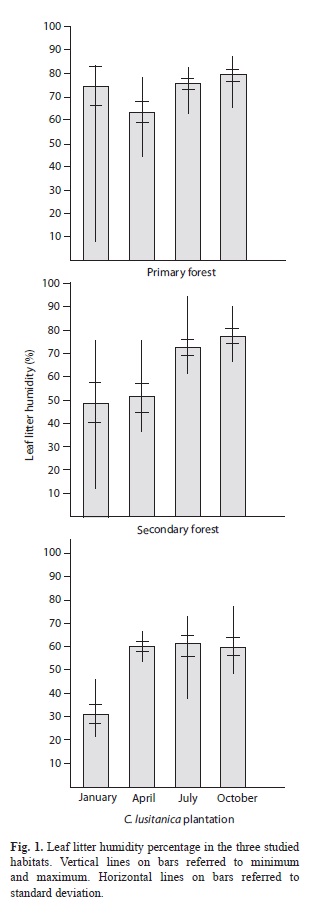
<body><![CDATA[between habitats</span></font><br style="font-family: verdana;">     <font size="2"></font><br style="font-family: verdana;">     <font size="2"><span style="font-family: verdana;">Primary forest had     the wettest     litter (x=73.2, n=77, SD=11.6, min=8, max=87), followed by the     secondary forest (x=63.3, n=75, SD=16.8, min=12, max=94) and cypress     plantation (x=52.9, n=80, SD=14.6, min=21.3, max=77.6)     (Kruskall-Wallis=77.93, n=232, p=0.00).</span></font><br      style="font-family: verdana;">     <font size="2"></font><br style="font-family: verdana;">     ]]></body>
<body><![CDATA[<font size="2"><span style="font-family: verdana;">Leaf litter humidity     according to     season</span></font><br style="font-family: verdana;">     <font size="2"></font><br style="font-family: verdana;">     <font size="2"><span style="font-family: verdana;">Dry season: During     January the     driest place was the plantation (x=31.1%) followed by the secondary     forest (x=48.9%) and the primary forest (x=74.7%)     (Kruskall-Wallis=35.75, n=59, p&lt;0.001) (<a      href="/img/revistas/rbt/v60n3/a07i1.jpg">Fig.1</a>). During the April     ]]></body>
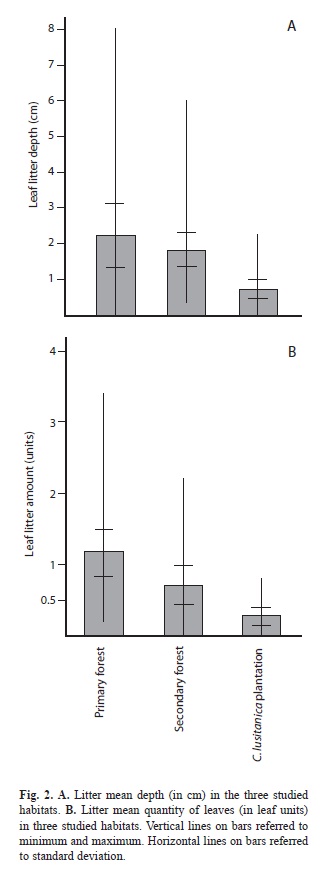
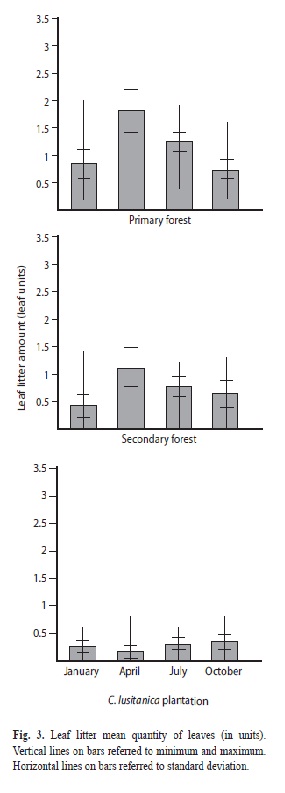
<body><![CDATA[samplings the litter humidity was similar in the primary forest and the     cypress plantation, but the secondary forest was dryer     (Kruskall-Wallis=12.99, n=55, p=0.0015) (<a      href="/img/revistas/rbt/v60n3/a07i1.jpg">Fig. 1</a>).</span></font><br      style="font-family: verdana;">     <div style="text-align: center;"><br style="font-family: verdana;"> </div> <font size="2"><span style="font-family: verdana;">Wet season: During the July and October samplings the cypress plantation was drier (July x=60.6%, October x=59.9) than the other two habitats (primary forest: July&nbsp;&nbsp; =75.6%, October =79.4%) (secondary forest: July =72.6%, October =77.6%) (July, Kruskall-Wallis=31.68, n=60, p&lt;0.001) (October, Kruskall-Wallis=35.31, n=58, p&lt;0.001) (<a  href="/img/revistas/rbt/v60n3/a07i1.jpg">Fig. 1</a>).</span></font><br  style="font-family: verdana;"> <font size="2"></font><br style="font-family: verdana;"> <font size="2"><span style="font-family: verdana;">Leaf litter humidity yearly pattern according to habitat</span></font><br style="font-family: verdana;"> <font size="2"></font><br style="font-family: verdana;"> <font size="2"><span style="font-family: verdana;">Primary forest: Litter was drier during the April sampling (Kruskall-Wallis=33.28, n=77, p&lt;0.001), but the difference between the driest and the wettest sampling was of only 15.8% (x max=79.4%, x min=63.6%) (x max=meanmaximum, x min=mean minimum) (<a href="/img/revistas/rbt/v60n3/a07i1.jpg">Fig. 1</a>).</span></font><br  style="font-family: verdana;"> <font size="2"></font><br style="font-family: verdana;"> <font size="2"><span style="font-family: verdana;">Secondary forest: Litter humidity pattern shows a longer period of low litter humidity than in the primary forest and the C. lussitanica plantation. In this habitat the litter was dryer during the January and April samplings (Kruskall-Wallis=49.16, n=75, p&lt;0.001), and the difference between the driest and the wettest sampling was of 28.7% (x max=77.6%, x min=48.9%) (<a href="/img/revistas/rbt/v60n3/a07i1.jpg">Fig. 1</a>).</span></font><br  style="font-family: verdana;"> <font size="2"></font><br style="font-family: verdana;"> <font size="2"><span style="font-family: verdana;"><span  style="font-style: italic;">Cupressus lusitanica</span> plantation: Litter was driest during the January sampling (Kruskall-Wallis=44.1617, n=80, p&lt;0.001) and the difference between the driest and the wettest sampling was 29.5% (x max=60.6%, x min=31.1%) (<a  href="/img/revistas/rbt/v60n3/a07i1.jpg">Fig.1</a>). The wettest sampling mean (60.6%) in this habitat was even drier than the driest sampling mean in the primary forest (63.6%).</span></font><br  style="font-family: verdana;"> <font size="2"></font><br style="font-family: verdana;"> <font size="2"><span style="font-family: verdana;">Leaf litter depth and quantity in the three studied habitats in a year</span></font><br  style="font-family: verdana;"> <font size="2"></font><br style="font-family: verdana;"> <font size="2"><span style="font-family: verdana;">Thicker litter layer and greater quantity of leaves were associated with greater levels of litter humidity (Litter quantity, Spearman correlation r=0.3, n=232, p=0.000) (r=correlation, n=sample size), (Litter depth, Spearman correlation r=0.27, n=232, p=0.000). The litter depth (Kruskall-Wallis=78.95, n=233, p=0.0) (<a href="/img/revistas/rbt/v60n3/a07i2.jpg">Fig. 2A</a>) and quantity (Kruskall-Wallis=92.47, n=233, p=0.0) (<a href="/img/revistas/rbt/v60n3/a07i2.jpg">Fig. 2B</a>) were higher in the primary forest followed by the secondary forest and the cypress plantation.</span></font><br  style="font-family: verdana;"> <br style="font-family: verdana;"> <font size="2"><span style="font-family: verdana;">Leaf litter depth and quantity yearly patterns according to habitat</span></font><br  style="font-family: verdana;"> <font size="2"></font><br style="font-family: verdana;"> <font size="2"><span style="font-family: verdana;">Litter quantity pattern in primary (Kruskal-Wallis=31.63, n=78, p&lt;0.001) (<a  href="/img/revistas/rbt/v60n3/a07i3.jpg">Fig. 3</a>) and secondary forest (Kruskal-Wallis=11.79, n=75 p=0.008) (<a  href="/img/revistas/rbt/v60n3/a07i3.jpg">Fig. 3</a>) show that leaf is more abundant in April and decreases until January. A completely different pattern was found in the cypress plantation where October is the sampling with more leaf abundance while April had the fewest (Kruskal-Wallis=7.77, n=80, p=0.0509, marginally significant).    <br>     <br>     </span></font>     <font size="2"><span style="font-family: verdana;">Litter depth in     ]]></body>
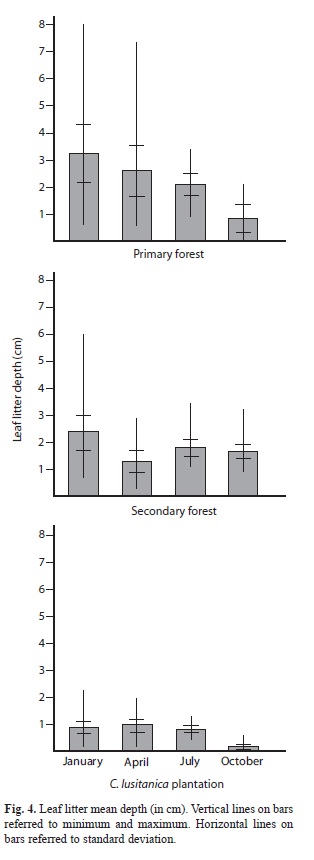
<body><![CDATA[primary forest     (Kruskal-Wallis=21.83, n=78, p&lt;0.001) (<a      href="/img/revistas/rbt/v60n3/a07i4.jpg">Fig. 4</a>) and <span      style="font-style: italic;">C. lusitanica</span>     plantation (Kruskal-Wallis=39.99, n=80, p&lt;0.001) (<a      href="/img/revistas/rbt/v60n3/a07i4.jpg">Fig. 4</a>) had their     lowest value during the October sampling, while in the secondary forest     all the samples had about the same litter depth values, just slightly     lower during April (Kruskal-Wallis=10.68, n=75, p=0.014) (<a      href="/img/revistas/rbt/v60n3/a07i4.jpg">Fig. 4</a>).</span></font><br     ]]></body>
<body><![CDATA[ style="font-family: verdana;">     <br style="font-family: verdana;">     <font style="font-weight: bold;" size="3"><span      style="font-family: verdana;">Discussion</span></font><br      style="font-family: verdana;">     <font size="2"></font><br style="font-family: verdana;">     <font size="2"><span style="font-family: verdana;">The findings in this     research show     that leaf litter humidity in primary forest is higher and more stable     around the year than in these restoration habitats. Wind, evaporation,     ]]></body>
<body><![CDATA[solar radiation and UV-B radiation, soil`s capacity to keep humidity,     drainage and temperature are some factors that affect litter humidity     (Ruiz <span style="font-style: italic;">et al</span>. 2009, Dirks <span      style="font-style: italic;">et al</span>. 2010, Smith <span      style="font-style: italic;">et al</span>. 2010). In this case,     probably the taller and more abundant canopy and understory     dicotiledonean foliage cover of the primary forest (personal     observation) help keeping the litter`s humidity higher and more stable     the year around. The structure (quantity and depth) and species     composition of the litter may also help keeping high humidity levels     ]]></body>
<body><![CDATA[(&Aacute;lvarez-S&aacute;nchez &amp; Harmon 2003).</span></font><br      style="font-family: verdana;">     <font size="2"></font><br style="font-family: verdana;">     <font size="2"><span style="font-family: verdana;">The <span      style="font-style: italic;">C. lusitanica</span> plantation`s     litter humidity is lower than in the primary and secondary forest     almost the year around. The only exception is in April when the     secondary forest is the driest. Nevertheless, the highest litter&#8217;s     humidity in the cypress plantation was 60.6% which is lower than the     driest sampling mean in the primary forest (63.6%). This can be     ]]></body>
<body><![CDATA[attributed to lower values of litter quantity and depth (Ruiz <span      style="font-style: italic;">et al</span>.     2009), litter decomposition stage (cypress secondary compounds may     delay decomposition rates) (Ruiz <span style="font-style: italic;">et     al</span>. 2009), litter composition     (mainly cypress needles), a poorly developed understory (personal     observation), a more regular canopy structure and a more homogenous     foliage cover (Rodriguez &amp; Cordero, unpublished data).</span></font><br      style="font-family: verdana;">     <font size="2"></font><br style="font-family: verdana;">     ]]></body>
<body><![CDATA[<font size="2"><span style="font-family: verdana;">Secondary forest&#8217;s     and cypress     plantation&#8217;s litter gain and lose more humidity than the primary     forest&#8217;s litter, but during the rainy season, the secondary forest can     be almost as humid as the primary forest. The only study known to me     that compares angiosperm and gymnosperm litter humidity was made by     D&iacute;az-Fern&aacute;ndez <span style="font-style: italic;">et al</span>.     (2006). This study shows that both     kinds are able to keep the same humidity, the only exception are     grasses, which are able to keep twice as much. Therefore, the wider     ]]></body>
<body><![CDATA[humidity range of these habitats may be a result of the lower amount of     litter, shallower litter and less developed canopy in the secondary     forest, and less developed understory in the cypress plantation     (personal observation). This allows the sun to increase litter&#8217;s     temperature and evaporation rate. In the secondary forest, another     possible explanation is the abundant grass of the secondary forest,     because grass is able to keep more moisture     (D&iacute;az-Fern&aacute;ndez <span style="font-style: italic;">et al</span>.     2006). The grass abundance in the     secondary forest may be a result of occasional cattle activity in the     ]]></body>
<body><![CDATA[area. In future studies the wind speed should also be considered.</span></font><br      style="font-family: verdana;">     <font size="2"></font><br style="font-family: verdana;">     <font size="2"><span style="font-family: verdana;">It is interesting     that litter     quantity and litter depth have the same general pattern: primary forest     has the highest values, followed by the secondary forest; the cypress     plantation has the smallest litter quantity and the shallower litter.     Nevertheless, the patterns around the year in the three habitats are     different.</span></font><br style="font-family: verdana;">     ]]></body>
<body><![CDATA[<font size="2"></font><br style="font-family: verdana;">     <font size="2"><span style="font-family: verdana;">In the primary and     secondary forest     litter quantity had its highest values during the April samplings. This     pattern matches the inverse relation between litter productivity and     rainfall found by other researchers (Di Stefano &amp; Fournier 2005,     Mosquera <span style="font-style: italic;">et al</span>. 2007,     S&aacute;nchez <span style="font-style: italic;">et al</span>. 2007).     The three studied     habitats are within tropical lower montane wet forest and tropical     ]]></body>
<body><![CDATA[humid premontane forest areas (now altered by human activity),     therefore, some deciduous trees occur. Nevertheless, most are evergreen     species, and hence these results cannot be attributed only to the leaf     fall found in tropical dry forest (Fournier &amp; Camacho de Castro     1973). The litter quantity in Rio Macho primary and secondary forest is     probably also a consequence of the strong winds that blow from the     beginning of December-March or April. This may have caused a litter     accumulation in the April sample. After that, litter decomposes slowly     until December when another cycle begins. In addition, it could be that     the low humidity of the dry season reduces the decomposition rate.     ]]></body>
<body><![CDATA[Nevertheless, this last item should be considered carefully as field     studies show contradictions about the relation between litter decaying     rate, temperature, rainfall, ultraviolet-B radiation and     evapotranspiration (Cornejo <span style="font-style: italic;">et al</span>.     1994, Monedero &amp; Gonz&aacute;lez     1995, Aerts 1997, Powers <span style="font-style: italic;">et al</span>.     2009, Smith <span style="font-style: italic;">et al</span>. 2010,     Eaton <span style="font-style: italic;">et al</span>.     2011, Salinas <span style="font-style: italic;">et al</span>. 2011);     experimental studies on this topic are     ]]></body>
<body><![CDATA[needed. This pattern could not be detected in the cypress plantation,     maybe as a result of the absence of hardwood trees.</span></font><br      style="font-family: verdana;">     <font size="2"></font><br style="font-family: verdana;">     <font size="2"><span style="font-family: verdana;">The primary forest     and cypress     plantation showed a litter&#8217;s depth pattern that has the lowest values     in October, while April and January have the highest values. As the     studied areas have steep slopes, it would be reasonable to think that     some litter is flown downhill by heavy rains, but it is not the case     ]]></body>
<body><![CDATA[because the amount of leaves in the litter was similar to January.     September and October are the wettest months of the year in this area     (Herrera 1986, UNESCO 2007). This may produce a compaction effect,     leaving less space between leaves. This effect may also help keeping     high litter moisture during that time of the year, but it also means     that less interleaf space is left for micro and macro organisms.     Besides this, another aspect that may strongly affect biota and     decaying rates is the oxygen concentration. If litter is more compact     and wet it may be also more anaerobic. On the contrary, during January,     although there are less leaves in the litter they are more lose and     ]]></body>
<body><![CDATA[occupy more vertical space. In the secondary forest the lowest litter     depth values were obtained in April; further studies are needed to     understand this pattern.</span></font><br style="font-family: verdana;">     <font size="2"></font><br style="font-family: verdana;">     <font size="2"><span style="font-family: verdana;">Litter depth     patterns found in this     study are different to litter quantity patterns, because describe     different aspects of the litter&#8217;s structure and they should not be     considered equivalents.</span></font><br style="font-family: verdana;">     <font size="2"></font><br style="font-family: verdana;">     ]]></body>
<body><![CDATA[<font size="2"><span style="font-family: verdana;">It is reasonable to     expect that     less litter humidity correlated with less litter quantity and depth,     but as shown in this research the relation between them is much more     complex. Therefore litter humidity, depth and quantity must be analyzed     in relation with understory and canopy foliage cover and composition,     and with soil features. In fact litter humidity presents a continuum     with soil and understory, therefore many litter dwellers migrate     between these strata to achieve better humidity conditions     (Naranjo-Garc&iacute;a 2003, Doblas 2007, Ayres <span     ]]></body>
<body><![CDATA[ style="font-style: italic;">et al</span>. 2009a).     Complementary research is being conducted on terrestrial molluscs in     these plots, showing that their abundance and size distribution is     strongly correlated with these factors (Barrientos, unpublished data).     It would also be interesting to analyse regeneration patterns in     relation to litter humidity and structure.</span></font><br      style="font-family: verdana;">     <font size="2"></font><br style="font-family: verdana;">     <font size="2"><span style="font-family: verdana;">The selection of a     given     ]]></body>
<body><![CDATA[restoration strategy affects ecosystem features like the litter     humidity and structure, that, in return, will determine the     biodiversity that can get established in it. Here it is shown that     natural succession and reforestation with cypress present litter     humidity, depth and quantity patterns that do not resemble conditions     in a primary forest floor. Future studies should also analyze if     plantations with native species where the understory is left to natural     succession, produce patterns of litter humidity, quantity and depth     more similar to primary forest. Other aspect not considered in this     study is the effect of fragment sizes on these variables (Didham 1998).</span></font><br     ]]></body>
<body><![CDATA[ style="font-family: verdana;">     <font size="2"></font><br style="font-family: verdana;">     <font style="font-weight: bold;" size="3"><span      style="font-family: verdana;">Acknowledgment</span></font><br      style="font-family: verdana;">     <font size="2"></font><br style="font-family: verdana;">     <font size="2"><span style="font-family: verdana;">Andr&eacute;s Monge,     Danyi Prieto     and FabianAraya gave field assistance and Junior P&eacute;rez helped     with literature search. I am especially grateful to Esteban     ]]></body>
<body><![CDATA[Acu&ntilde;a, Ligia Bermudez, Gabriela P&eacute;rez and Maribel     Z&uacute;&ntilde;iga for field and technical assistance. Juli&aacute;n     Monge-N&aacute;jera, Roberto Cordero, Edna Naranjo and five anonymous     reviewers helped improving this paper. This paper was partially     financied by the project &#8220;FEES-CONARE An&aacute;lisis     ecosist&eacute;mico para la evaluaci&oacute;n de la restauraci&oacute;n     forestal y sus implicaciones en el secuestro de carbono en un bosque     nublado&#8221; and by the UNED&#8217;s Research Vicepresidency. Special     acknowledgment to Katya Calder&oacute;n for her administrative support.     This paper is part of the Ph.D. requirements of the Doctorado en     ]]></body>
<body><![CDATA[Ciencias Naturales para el Desarrollo at the Instituto     Tecnol&oacute;gico de Costa Rica (ITCR), Universidad Nacional (UNA) and     Universidad Estatal a Distancia (UNED).</span></font><br      style="font-family: verdana;">     <font size="2"></font>     <hr style="width: 100%; height: 2px;"><br style="font-family: verdana;">     <font style="font-weight: bold;" size="3"><span      style="font-family: verdana;">References</span></font><br      style="font-family: verdana;">     <font size="2"></font><br style="font-family: verdana;">     ]]></body>
<body><![CDATA[<font size="2"><span style="font-family: verdana;">Aerts, R. 1997.     Climate, leaf     litter chemistry and leaf litter decomposition in terrestrial     <!-- ref -->ecosystems: a triangular relationship. Oikos 79: 439-449.    &nbsp;&nbsp;&nbsp;&nbsp;&nbsp;&nbsp;&nbsp;&nbsp;[&#160;<a href="javascript:void(0);" onclick="javascript: window.open('/scielo.php?script=sci_nlinks&ref=1462050&pid=S0034-7744201200030000700001&lng=','','width=640,height=500,resizable=yes,scrollbars=1,menubar=yes,');">Links</a>&#160;]<!-- end-ref --><!-- ref --></span></font><br  style="font-family: verdana;"> <font size="2"></font><br style="font-family: verdana;"> <font size="2"><span style="font-family: verdana;">&Aacute;lvarez-S&aacute;nchez, J. &amp; M.E. Harmon. 2003. Descomposici&oacute;n de hojarasca: hojas y madera, p. 108-122. <span style="font-style: italic;">In</span> J. &Aacute;lvarez-S&aacute;nchez &amp; E. Naranjo-Garc&iacute;a (eds.). Ecolog&iacute;a del suelo en la selva tropical h&uacute;meda de M&eacute;xico. Instituto de Ecolog&iacute;a, A.C., Instituto de Biolog&iacute;a y Facultad de Ciencias, UNAM, Xalapa, M&eacute;xico.    &nbsp;&nbsp;&nbsp;&nbsp;&nbsp;&nbsp;&nbsp;&nbsp;[&#160;<a href="javascript:void(0);" onclick="javascript: window.open('/scielo.php?script=sci_nlinks&ref=1462051&pid=S0034-7744201200030000700002&lng=','','width=640,height=500,resizable=yes,scrollbars=1,menubar=yes,');">Links</a>&#160;]<!-- end-ref --><!-- ref --></span></font><br style="font-family: verdana;"> <font size="2"></font><br style="font-family: verdana;"> <font size="2"><span style="font-family: verdana;">Anderson, H.E. 1990. Moisture diffusivity and response time in fine forest fuels. Can. J. For. Res. 20: 315-325.    &nbsp;&nbsp;&nbsp;&nbsp;&nbsp;&nbsp;&nbsp;&nbsp;[&#160;<a href="javascript:void(0);" onclick="javascript: window.open('/scielo.php?script=sci_nlinks&ref=1462052&pid=S0034-7744201200030000700003&lng=','','width=640,height=500,resizable=yes,scrollbars=1,menubar=yes,');">Links</a>&#160;]<!-- end-ref --><!-- ref --></span></font><br style="font-family: verdana;"> <font size="2"></font><br style="font-family: verdana;"> <font size="2"><span style="font-family: verdana;">Ayres, E., H. Steltzer, S. Berg, M.D. Wallenstein, B.L. Simmons &amp; D.H. Wall. 2009a. Tree species traits influence soil physical, chemical, and biological properties in high elevation forests. Plos One 4: 1-11 (tambi&eacute;n disponible en l&iacute;nea: http://www.plosone.org/article/info%3Adoi%2F10.1371%2Fjournal.pone.0005964).    &nbsp;&nbsp;&nbsp;&nbsp;&nbsp;&nbsp;&nbsp;&nbsp;[&#160;<a href="javascript:void(0);" onclick="javascript: window.open('/scielo.php?script=sci_nlinks&ref=1462053&pid=S0034-7744201200030000700004&lng=','','width=640,height=500,resizable=yes,scrollbars=1,menubar=yes,');">Links</a>&#160;]<!-- end-ref --><!-- ref --></span></font><br  style="font-family: verdana;"> <font size="2"></font><br style="font-family: verdana;"> <font size="2"><span style="font-family: verdana;">Ayres, E., H. Steltzer, B.L. Simmons, R.T. Simpson, J.M. Steinweg, M.D. Wallenstein, N. Mellor, W.J. Parton, J.C. Moore &amp; D.H. Wall. 2009b. Homefield advantage accelerates leaf litter decomposition in forests. Soil Biol. Biochem. 41: 606-610 (tambi&eacute;n disponible en l&iacute;nea: http://warnercnr.colostate.edu/~edayres/Pubs/2009%20Ayres%20et%20al%20Soil%20Biol%20Biochem.pdf).    &nbsp;&nbsp;&nbsp;&nbsp;&nbsp;&nbsp;&nbsp;&nbsp;[&#160;<a href="javascript:void(0);" onclick="javascript: window.open('/scielo.php?script=sci_nlinks&ref=1462054&pid=S0034-7744201200030000700005&lng=','','width=640,height=500,resizable=yes,scrollbars=1,menubar=yes,');">Links</a>&#160;]<!-- end-ref --><!-- ref --></span></font><br  style="font-family: verdana;"> <font size="2"></font><br style="font-family: verdana;"> <font size="2"><span style="font-family: verdana;">Ayres, E., H. Steltzer, S. Berg &amp; D.H Wall. 2009c. Soil biota accelerate decomposition in high-elevation forests by specializing in the breakdown of litter produced by the plant species above them. J. Ecol. 97: 901-912 (tambi&eacute;n disponible en l&iacute;nea: http://warnercnr.colostate.edu/~edayres/Pubs/2009%20Ayres%20et%20al%20J%20Ecol.pdf).    &nbsp;&nbsp;&nbsp;&nbsp;&nbsp;&nbsp;&nbsp;&nbsp;[&#160;<a href="javascript:void(0);" onclick="javascript: window.open('/scielo.php?script=sci_nlinks&ref=1462055&pid=S0034-7744201200030000700006&lng=','','width=640,height=500,resizable=yes,scrollbars=1,menubar=yes,');">Links</a>&#160;]<!-- end-ref --><!-- ref --></span></font><br  style="font-family: verdana;"> <font size="2"></font><br style="font-family: verdana;"> <font size="2"><span style="font-family: verdana;">Barrientos, Z. &amp; J. Monge-N&aacute;jera. 2010. Restauraci&oacute;n ecol&oacute;gica en la meseta central de Costa Rica. Biocenosis 23: 20-25 (tambi&eacute;n disponible en l&iacute;nea: http://web.uned.ac.cr/biocenosis/images/stories/Vol232/05-barrientos-restauracion.pdf).    &nbsp;&nbsp;&nbsp;&nbsp;&nbsp;&nbsp;&nbsp;&nbsp;[&#160;<a href="javascript:void(0);" onclick="javascript: window.open('/scielo.php?script=sci_nlinks&ref=1462056&pid=S0034-7744201200030000700007&lng=','','width=640,height=500,resizable=yes,scrollbars=1,menubar=yes,');">Links</a>&#160;]<!-- end-ref --><!-- ref --></span></font><br  style="font-family: verdana;"> <font size="2"></font><br style="font-family: verdana;"> <font size="2"><span style="font-family: verdana;">Barrientos, Z. 2000. Population dynamics and spatial distribution of the terrestrial snail <span  style="font-style: italic;">Ovachlamys fulgens</span> (Stylommatophora: Helicarionidae) in a tropical environment. Rev. Biol. Trop. 48: 71-87 (tambi&eacute;n disponible en l&iacute;nea: http://www.scielo.sa.cr/scielo.php ? script=sci_arttext &amp; pid=S0034-77442000000100009 &amp; lng=es &amp; nrm=iso &amp; tlng=en).    &nbsp;&nbsp;&nbsp;&nbsp;&nbsp;&nbsp;&nbsp;&nbsp;[&#160;<a href="javascript:void(0);" onclick="javascript: window.open('/scielo.php?script=sci_nlinks&ref=1462057&pid=S0034-7744201200030000700008&lng=','','width=640,height=500,resizable=yes,scrollbars=1,menubar=yes,');">Links</a>&#160;]<!-- end-ref --><!-- ref --></span></font><br  style="font-family: verdana;"> <font size="2"></font><br style="font-family: verdana;"> <font size="2"><span style="font-family: verdana;">Bonilla, R., B. Roncall, J. Jimeno &amp; T. Garc&iacute;a. 2008. Producci&oacute;n y descomposici&oacute;n de la hojarasca en bosques nativos y de <span  style="font-style: italic;">Leucaena</span> sp., en Codazzi, Cesar. Revista Corpoica &#8211; Ciencia y Tecnolog&iacute;a Agropecuaria 9: 5-11 (tambi&eacute;n disponible en l&iacute;nea: http://www.corpoica.gov.co/SitioWeb/Archivos/Revista/Produccinydescomposicindelahojarasca.pdf).    &nbsp;&nbsp;&nbsp;&nbsp;&nbsp;&nbsp;&nbsp;&nbsp;[&#160;<a href="javascript:void(0);" onclick="javascript: window.open('/scielo.php?script=sci_nlinks&ref=1462058&pid=S0034-7744201200030000700009&lng=','','width=640,height=500,resizable=yes,scrollbars=1,menubar=yes,');">Links</a>&#160;]<!-- end-ref --><!-- ref --></span></font><br  style="font-family: verdana;"> <font size="2"></font><br style="font-family: verdana;"> <font size="2"><span style="font-family: verdana;">Camargo, J.L.C. &amp; V. Kapos. 1995. Complex edge effects on soil moisture and microclimate in central Amazonian forest. J. Trop. Ecol. 11: 205-221.    &nbsp;&nbsp;&nbsp;&nbsp;&nbsp;&nbsp;&nbsp;&nbsp;[&#160;<a href="javascript:void(0);" onclick="javascript: window.open('/scielo.php?script=sci_nlinks&ref=1462059&pid=S0034-7744201200030000700010&lng=','','width=640,height=500,resizable=yes,scrollbars=1,menubar=yes,');">Links</a>&#160;]<!-- end-ref --><!-- ref --></span></font><br  style="font-family: verdana;"> <font size="2"></font><br style="font-family: verdana;"> <font size="2"><span style="font-family: verdana;">Castellanos-Barliza, J. &amp; J.D. Le&oacute;n. 2011. Descomposici&oacute;n de hojarasca y liberaci&oacute;n de nutrientes en plantaciones de <span  style="font-style: italic;">Acacia mangium</span> (Mimosaceae) establecidas en suelos degradados de Colombia. Rev. Biol. Trop. 59: 113-128.    &nbsp;&nbsp;&nbsp;&nbsp;&nbsp;&nbsp;&nbsp;&nbsp;[&#160;<a href="javascript:void(0);" onclick="javascript: window.open('/scielo.php?script=sci_nlinks&ref=1462060&pid=S0034-7744201200030000700011&lng=','','width=640,height=500,resizable=yes,scrollbars=1,menubar=yes,');">Links</a>&#160;]<!-- end-ref --><!-- ref --></span></font><br style="font-family: verdana;"> <font size="2"></font><br style="font-family: verdana;"> <font size="2"><span style="font-family: verdana;">Castro-D&iacute;ez, P., N. Gonz&aacute;lez &amp; A. Fern&aacute;ndez. 2008. Los &aacute;rboles ex&oacute;ticos invasores alteran la tasa de descomposici&oacute;n de la hojarasca. Cuad. Soc. Esp. Cienc. For. 25: 99-104.    &nbsp;&nbsp;&nbsp;&nbsp;&nbsp;&nbsp;&nbsp;&nbsp;[&#160;<a href="javascript:void(0);" onclick="javascript: window.open('/scielo.php?script=sci_nlinks&ref=1462061&pid=S0034-7744201200030000700012&lng=','','width=640,height=500,resizable=yes,scrollbars=1,menubar=yes,');">Links</a>&#160;]<!-- end-ref --><!-- ref --></span></font><br  style="font-family: verdana;"> <font size="2"></font><br style="font-family: verdana;"> <font size="2"><span style="font-family: verdana;">Chadzon, R.L. 2008. Chance and determinisms in tropical forest sucession, p. 384-408. <span  style="font-style: italic;">In</span> W.P. Carson &amp; S.A. Schinitzer (eds.). Tropical forest community ecology. Wiley-Blackwell, Oxford (tambi&eacute;n disponible en l&iacute;nea: http://books.google.es/books ? hl=es &amp; lr= &amp; id=GqJrYsYlw-kC &amp; oi=fnd &amp; pg=PA384 &amp; dq=Chance+and+determinism+in+tropical+forest+succession &amp; ots=N7v5zb8fEQ &amp; sig=qYDHlTS7ywX0E2Eqx9kAjRf09a8#v=onepage &amp; q=Chance%20and%20determinism%20in%20tropical%20forest%20succession&amp;f=false).    &nbsp;&nbsp;&nbsp;&nbsp;&nbsp;&nbsp;&nbsp;&nbsp;[&#160;<a href="javascript:void(0);" onclick="javascript: window.open('/scielo.php?script=sci_nlinks&ref=1462062&pid=S0034-7744201200030000700013&lng=','','width=640,height=500,resizable=yes,scrollbars=1,menubar=yes,');">Links</a>&#160;]<!-- end-ref --><!-- ref --></span></font><br  style="font-family: verdana;"> <font size="2"></font><br style="font-family: verdana;"> <font size="2"><span style="font-family: verdana;">Clark, D.B. 1996. Abolishing virginity. J. Trop. Ecol. 12: 735-739 (tambi&eacute;n disponible en linea: http://www.fsl.orst.edu/Oldgrowthworkshop/download/Clarke_Abolishing_Virginity.pdf).    &nbsp;&nbsp;&nbsp;&nbsp;&nbsp;&nbsp;&nbsp;&nbsp;[&#160;<a href="javascript:void(0);" onclick="javascript: window.open('/scielo.php?script=sci_nlinks&ref=1462063&pid=S0034-7744201200030000700014&lng=','','width=640,height=500,resizable=yes,scrollbars=1,menubar=yes,');">Links</a>&#160;]<!-- end-ref --><!-- ref --></span></font><br  style="font-family: verdana;"> <font size="2"></font><br style="font-family: verdana;"> <font size="2"><span style="font-family: verdana;">Clewell, A. &amp; J. Aronson. 2008. Ecological restoration: principles, values, and structure of an emerging profession. Island, Washington, D.C., USA.    &nbsp;&nbsp;&nbsp;&nbsp;&nbsp;&nbsp;&nbsp;&nbsp;[&#160;<a href="javascript:void(0);" onclick="javascript: window.open('/scielo.php?script=sci_nlinks&ref=1462064&pid=S0034-7744201200030000700015&lng=','','width=640,height=500,resizable=yes,scrollbars=1,menubar=yes,');">Links</a>&#160;]<!-- end-ref --><!-- ref --></span></font><br  style="font-family: verdana;"> <font size="2"></font><br style="font-family: verdana;"> <font size="2"><span style="font-family: verdana;">Cole, R.J., K.D. Holl &amp; R.A. Zahawi. 2010. Seed rain under tree islands planted to restore degraded lands in a tropical agricultural landscape. Ecol. Appl. 20: 1255-1269.    &nbsp;&nbsp;&nbsp;&nbsp;&nbsp;&nbsp;&nbsp;&nbsp;[&#160;<a href="javascript:void(0);" onclick="javascript: window.open('/scielo.php?script=sci_nlinks&ref=1462065&pid=S0034-7744201200030000700016&lng=','','width=640,height=500,resizable=yes,scrollbars=1,menubar=yes,');">Links</a>&#160;]<!-- end-ref --><!-- ref --></span></font><br  style="font-family: verdana;"> <font size="2"></font><br style="font-family: verdana;"> <font size="2"><span style="font-family: verdana;">Cornejo, F.J., A. Varela &amp; S.J. Wright. 1994 Tropical forest litter decomposition under seasonal drought: nutrient release, fungi and bacteria. Oikos 70: 183-190.    &nbsp;&nbsp;&nbsp;&nbsp;&nbsp;&nbsp;&nbsp;&nbsp;[&#160;<a href="javascript:void(0);" onclick="javascript: window.open('/scielo.php?script=sci_nlinks&ref=1462066&pid=S0034-7744201200030000700017&lng=','','width=640,height=500,resizable=yes,scrollbars=1,menubar=yes,');">Links</a>&#160;]<!-- end-ref --><!-- ref --></span></font><br  style="font-family: verdana;"> <font size="2"></font><br style="font-family: verdana;"> <font size="2"><span style="font-family: verdana;">Cusack, D. &amp; F. Montagnini. 2004. The role of native species plantations in recovery of understory wood diversity in degraded pasturelands of Costa Rica. For. Ecol. Manage. 188: 1-15.    &nbsp;&nbsp;&nbsp;&nbsp;&nbsp;&nbsp;&nbsp;&nbsp;[&#160;<a href="javascript:void(0);" onclick="javascript: window.open('/scielo.php?script=sci_nlinks&ref=1462067&pid=S0034-7744201200030000700018&lng=','','width=640,height=500,resizable=yes,scrollbars=1,menubar=yes,');">Links</a>&#160;]<!-- end-ref --><!-- ref --></span></font><br style="font-family: verdana;"> <font size="2"></font><br style="font-family: verdana;"> <font size="2"><span style="font-family: verdana;">De Camino, R. 2005. &iquest;Especies nativas o ex&oacute;ticas? Ese es el dilema. Ambientico 141: 7-8 (tambi&eacute;n disponible en l&iacute;nea: http://www.ambientico.una.ac.cr/141.pdf).    &nbsp;&nbsp;&nbsp;&nbsp;&nbsp;&nbsp;&nbsp;&nbsp;[&#160;<a href="javascript:void(0);" onclick="javascript: window.open('/scielo.php?script=sci_nlinks&ref=1462068&pid=S0034-7744201200030000700019&lng=','','width=640,height=500,resizable=yes,scrollbars=1,menubar=yes,');">Links</a>&#160;]<!-- end-ref --><!-- ref --></span></font><br  style="font-family: verdana;"> <font size="2"></font><br style="font-family: verdana;"> <font size="2"><span style="font-family: verdana;">Dezzeo, N. &amp; N. Chac&oacute;n. 2006. Litterfall and nutrient input in undisturbed and adjacent fire disturbed forests of the Gran Sabana, Southern Venezuela. Interciencia 31: 894-899.    &nbsp;&nbsp;&nbsp;&nbsp;&nbsp;&nbsp;&nbsp;&nbsp;[&#160;<a href="javascript:void(0);" onclick="javascript: window.open('/scielo.php?script=sci_nlinks&ref=1462069&pid=S0034-7744201200030000700020&lng=','','width=640,height=500,resizable=yes,scrollbars=1,menubar=yes,');">Links</a>&#160;]<!-- end-ref --><!-- ref --></span></font><br style="font-family: verdana;"> <font size="2"></font><br style="font-family: verdana;"> <font size="2"><span style="font-family: verdana;">Di Stefano, J.F. &amp; L.A. Fournier. 2005. Ca&iacute;da de hojarasca y tasas de descomposici&oacute;n de las hojas de <span style="font-style: italic;">Vochysia guatemalesis</span> en una plantaci&oacute;n de 10 a&ntilde;os, Tabarcia de Mora, Costa Rica. Agron. Costarr. 29: 9-16 (tambi&eacute;n disponible en l&iacute;nea: http://www.mag.go.cr/rev_agr/v29n01_009.pdf).    &nbsp;&nbsp;&nbsp;&nbsp;&nbsp;&nbsp;&nbsp;&nbsp;[&#160;<a href="javascript:void(0);" onclick="javascript: window.open('/scielo.php?script=sci_nlinks&ref=1462070&pid=S0034-7744201200030000700021&lng=','','width=640,height=500,resizable=yes,scrollbars=1,menubar=yes,');">Links</a>&#160;]<!-- end-ref --><!-- ref --></span></font><br  style="font-family: verdana;"> <font size="2"></font><br style="font-family: verdana;"> <font size="2"><span style="font-family: verdana;">D&iacute;az-Fern&aacute;ndez, E., A.F. G&oacute;mez Tagle Rojas, Y. Ch&aacute;vez Huerta, H. Zepeda Castro &amp; A. G&oacute;mez Tagle Ch&aacute;vez. 2006. An&aacute;lisis comparativo sobre la interceptaci&oacute;n pluvial entre hojarasca de pino, encino y pastizal utilizando un simulador de lluvia en la cuenca hidrogr&aacute;fica de Cointzio, Michoac&aacute;n. V Congreso Internacional &amp; XI Nacional de Ciencias Ambientales, Morelos, M&eacute;xico.    &nbsp;&nbsp;&nbsp;&nbsp;&nbsp;&nbsp;&nbsp;&nbsp;[&#160;<a href="javascript:void(0);" onclick="javascript: window.open('/scielo.php?script=sci_nlinks&ref=1462071&pid=S0034-7744201200030000700022&lng=','','width=640,height=500,resizable=yes,scrollbars=1,menubar=yes,');">Links</a>&#160;]<!-- end-ref --><!-- ref --></span></font><br style="font-family: verdana;"> <font size="2"></font><br style="font-family: verdana;"> <font size="2"><span style="font-family: verdana;">Didham, R.K. 1998. Altered leaf-litter decomposition rates in tropical forest fragments. Oecologia 116: 397-406.    &nbsp;&nbsp;&nbsp;&nbsp;&nbsp;&nbsp;&nbsp;&nbsp;[&#160;<a href="javascript:void(0);" onclick="javascript: window.open('/scielo.php?script=sci_nlinks&ref=1462072&pid=S0034-7744201200030000700023&lng=','','width=640,height=500,resizable=yes,scrollbars=1,menubar=yes,');">Links</a>&#160;]<!-- end-ref --><!-- ref --></span></font><br style="font-family: verdana;"> <font size="2"></font><br style="font-family: verdana;"> <font size="2"><span style="font-family: verdana;">Dirks, I., Y. Navon, D. Kanas, R. Dumbur &amp; J.M. Gr&uuml;nzweig. 2010. Atmospheric water vapor as driver of litter decomposition in Mediterranean shrub land and grassland during rainless seasons. Glob. Change Biol. 16: 2799-2812.    &nbsp;&nbsp;&nbsp;&nbsp;&nbsp;&nbsp;&nbsp;&nbsp;[&#160;<a href="javascript:void(0);" onclick="javascript: window.open('/scielo.php?script=sci_nlinks&ref=1462073&pid=S0034-7744201200030000700024&lng=','','width=640,height=500,resizable=yes,scrollbars=1,menubar=yes,');">Links</a>&#160;]<!-- end-ref --><!-- ref --></span></font><br  style="font-family: verdana;"> <font size="2"></font><br style="font-family: verdana;"> <font size="2"><span style="font-family: verdana;">Doblas, E. 2007. Ecolog&iacute;a de los macroinvertebrados ed&aacute;ficos en un ecosistema &aacute;rido mediterr&aacute;neo. Tesis de Doctorado, Universidad de Granada, Espa&ntilde;a. (Consultado: 26 setiembre 2011, http://digibug.ugr.es/bitstream/10481/1537/1/16713187.pdf).    &nbsp;&nbsp;&nbsp;&nbsp;&nbsp;&nbsp;&nbsp;&nbsp;[&#160;<a href="javascript:void(0);" onclick="javascript: window.open('/scielo.php?script=sci_nlinks&ref=1462074&pid=S0034-7744201200030000700025&lng=','','width=640,height=500,resizable=yes,scrollbars=1,menubar=yes,');">Links</a>&#160;]<!-- end-ref --><!-- ref --></span></font><br  style="font-family: verdana;"> <font size="2"></font><br style="font-family: verdana;"> <font size="2"><span style="font-family: verdana;">Eaton, W.D., S. Mcdonald, M. Roed, M. Vandecar, L. Karen, J.B. Hauge &amp; D. Barry. 2011. A comparison of nutrient dynamics and microbial community characteristics across seasons and soil types in two different old growth forests in Costa Rica. Trop. Ecol. 52: 35-48.    &nbsp;&nbsp;&nbsp;&nbsp;&nbsp;&nbsp;&nbsp;&nbsp;[&#160;<a href="javascript:void(0);" onclick="javascript: window.open('/scielo.php?script=sci_nlinks&ref=1462075&pid=S0034-7744201200030000700026&lng=','','width=640,height=500,resizable=yes,scrollbars=1,menubar=yes,');">Links</a>&#160;]<!-- end-ref --><!-- ref --></span></font><br  style="font-family: verdana;"> <font size="2"></font><br style="font-family: verdana;"> <font size="2"><span style="font-family: verdana;">FAO. 2010. Evaluaci&oacute;n de los recursos forestales mundiales. 2010. FAO, Roma, Italia. (Consultado: 23 setiembre 2011, http://www.fao.org/docrep/013/i1757s/i1757s.pdf).    &nbsp;&nbsp;&nbsp;&nbsp;&nbsp;&nbsp;&nbsp;&nbsp;[&#160;<a href="javascript:void(0);" onclick="javascript: window.open('/scielo.php?script=sci_nlinks&ref=1462076&pid=S0034-7744201200030000700027&lng=','','width=640,height=500,resizable=yes,scrollbars=1,menubar=yes,');">Links</a>&#160;]<!-- end-ref --><!-- ref --></span></font><br  style="font-family: verdana;"> <font size="2"></font><br style="font-family: verdana;"> <font size="2"><span style="font-family: verdana;">Fern&aacute;ndez, A. 2006. Restauraci&oacute;n ecol&oacute;gica. (Consultado: 25 mayo 2010, http://www.consumer.es/web/es/medio_ambiente/urbano/2006/05/05/151595.php).    &nbsp;&nbsp;&nbsp;&nbsp;&nbsp;&nbsp;&nbsp;&nbsp;[&#160;<a href="javascript:void(0);" onclick="javascript: window.open('/scielo.php?script=sci_nlinks&ref=1462077&pid=S0034-7744201200030000700028&lng=','','width=640,height=500,resizable=yes,scrollbars=1,menubar=yes,');">Links</a>&#160;]<!-- end-ref --><!-- ref --></span></font><br  style="font-family: verdana;"> <font size="2"></font><br style="font-family: verdana;"> <font size="2"><span style="font-family: verdana;">Fournier, L.A. &amp; M.E. Herrera de Fournier. 1978. Cambios de la microflora del suelo en varias etapas de la sucesi&oacute;n en Ciudad Col&oacute;n, Costa Rica. Rev. Biol. Trop. 26: 103-112.    &nbsp;&nbsp;&nbsp;&nbsp;&nbsp;&nbsp;&nbsp;&nbsp;[&#160;<a href="javascript:void(0);" onclick="javascript: window.open('/scielo.php?script=sci_nlinks&ref=1462078&pid=S0034-7744201200030000700029&lng=','','width=640,height=500,resizable=yes,scrollbars=1,menubar=yes,');">Links</a>&#160;]<!-- end-ref --><!-- ref --></span></font><br style="font-family: verdana;"> <font size="2"></font><br style="font-family: verdana;"> <font size="2"><span style="font-family: verdana;">Fournier, L.A. &amp; L. Camacho de Castro. 1973. Producci&oacute;n y descomposici&oacute;n del mantillo en un bosque secundario h&uacute;medo de premontano. Rev. Biol. Trop. 21: 59-67.    &nbsp;&nbsp;&nbsp;&nbsp;&nbsp;&nbsp;&nbsp;&nbsp;[&#160;<a href="javascript:void(0);" onclick="javascript: window.open('/scielo.php?script=sci_nlinks&ref=1462079&pid=S0034-7744201200030000700030&lng=','','width=640,height=500,resizable=yes,scrollbars=1,menubar=yes,');">Links</a>&#160;]<!-- end-ref --><!-- ref --></span></font><br style="font-family: verdana;"> <font size="2"></font><br style="font-family: verdana;"> <font size="2"><span style="font-family: verdana;">Geist, H.J. &amp; E.F. Lambin. 2002. Proximate causes and underlying driving forces of tropical deforestation. BioScience 52: 143-150 (tambi&eacute;n disponible en l&iacute;nea: http://www.puce.edu.ec/zoologia/vertebrados/personal/sburneo/cursos/EcologiaII/Bibliografia/2-5%20Deforestacion%20tropical.pdf).    &nbsp;&nbsp;&nbsp;&nbsp;&nbsp;&nbsp;&nbsp;&nbsp;[&#160;<a href="javascript:void(0);" onclick="javascript: window.open('/scielo.php?script=sci_nlinks&ref=1462080&pid=S0034-7744201200030000700031&lng=','','width=640,height=500,resizable=yes,scrollbars=1,menubar=yes,');">Links</a>&#160;]<!-- end-ref --><!-- ref --></span></font><br  style="font-family: verdana;"> <font size="2"></font><br style="font-family: verdana;"> <font size="2"><span style="font-family: verdana;">Gholz, H.L., D.A. Wedin, S.M. Smitherma, M.E. Harmon &amp; W.J. Parton. 2000. Long term dynamics of pine and hardwood litter in contrasting environments: toward a global model of decomposition. Glob. Change Biol. 6: 751-765.    &nbsp;&nbsp;&nbsp;&nbsp;&nbsp;&nbsp;&nbsp;&nbsp;[&#160;<a href="javascript:void(0);" onclick="javascript: window.open('/scielo.php?script=sci_nlinks&ref=1462081&pid=S0034-7744201200030000700032&lng=','','width=640,height=500,resizable=yes,scrollbars=1,menubar=yes,');">Links</a>&#160;]<!-- end-ref --><!-- ref --></span></font><br  style="font-family: verdana;"> <font size="2"></font><br style="font-family: verdana;"> <font size="2"><span style="font-family: verdana;">H&auml;ttenschwiler, S., B. Aeschlimann, M.M. Couteaux, J. Roy &amp; D. Bonal. 2008. High variation in foliage and leaf litter chemistry among 45 tree species of a neotropical rainforest community. New Phytol. 179: 165-175.    &nbsp;&nbsp;&nbsp;&nbsp;&nbsp;&nbsp;&nbsp;&nbsp;[&#160;<a href="javascript:void(0);" onclick="javascript: window.open('/scielo.php?script=sci_nlinks&ref=1462082&pid=S0034-7744201200030000700033&lng=','','width=640,height=500,resizable=yes,scrollbars=1,menubar=yes,');">Links</a>&#160;]<!-- end-ref --><!-- ref --></span></font><br  style="font-family: verdana;"> <font size="2"></font><br style="font-family: verdana;"> <font size="2"><span style="font-family: verdana;">Herrera, W. 1986. Vegetaci&oacute;n y clima de Costa Rica. EUNED, San Jos&eacute;, Costa Rica.    &nbsp;&nbsp;&nbsp;&nbsp;&nbsp;&nbsp;&nbsp;&nbsp;[&#160;<a href="javascript:void(0);" onclick="javascript: window.open('/scielo.php?script=sci_nlinks&ref=1462083&pid=S0034-7744201200030000700034&lng=','','width=640,height=500,resizable=yes,scrollbars=1,menubar=yes,');">Links</a>&#160;]<!-- end-ref --><!-- ref --></span></font><br  style="font-family: verdana;"> <font size="2"></font><br style="font-family: verdana;"> <font size="2"><span style="font-family: verdana;">Jim&eacute;nez, Q. 2005. Cultivo de &aacute;rboles en Costa Rica: &iexcl;nativos y ex&oacute;ticos! Ambientico 141: 9-11 (tambi&eacute;ndisponible en l&iacute;nea: http://www.ambientico.una.ac.cr/141.pdf).    &nbsp;&nbsp;&nbsp;&nbsp;&nbsp;&nbsp;&nbsp;&nbsp;[&#160;<a href="javascript:void(0);" onclick="javascript: window.open('/scielo.php?script=sci_nlinks&ref=1462084&pid=S0034-7744201200030000700035&lng=','','width=640,height=500,resizable=yes,scrollbars=1,menubar=yes,');">Links</a>&#160;]<!-- end-ref --><!-- ref --></span></font><br  style="font-family: verdana;"> <font size="2"></font><br style="font-family: verdana;"> <font size="2"><span style="font-family: verdana;">Letcher, S. &amp; R. Chadzon. 2009. Rapid recovery of biomass, species richness, and species composition in a forest chronosequence in northeastern Costa Rica. Biotropica 41: 608-617.    &nbsp;&nbsp;&nbsp;&nbsp;&nbsp;&nbsp;&nbsp;&nbsp;[&#160;<a href="javascript:void(0);" onclick="javascript: window.open('/scielo.php?script=sci_nlinks&ref=1462085&pid=S0034-7744201200030000700036&lng=','','width=640,height=500,resizable=yes,scrollbars=1,menubar=yes,');">Links</a>&#160;]<!-- end-ref --><!-- ref --></span></font><br style="font-family: verdana;"> <font size="2"></font><br style="font-family: verdana;"> <font size="2"><span style="font-family: verdana;">Monedero, C. &amp; V. Gonz&aacute;lez. 1995. Producci&oacute;n de hojarasca y descomposici&oacute;n en una selva nublada del ramal interior de la cordillera de la costa, Venezuela. Ecotropicos 8: 1-14 (tambi&eacute;n disponible en l&iacute;nea: http://ecotropicos.saber.ula.ve/db/ecotropicos/edocs/vol8_n1-2/articulo1.pdf).    &nbsp;&nbsp;&nbsp;&nbsp;&nbsp;&nbsp;&nbsp;&nbsp;[&#160;<a href="javascript:void(0);" onclick="javascript: window.open('/scielo.php?script=sci_nlinks&ref=1462086&pid=S0034-7744201200030000700037&lng=','','width=640,height=500,resizable=yes,scrollbars=1,menubar=yes,');">Links</a>&#160;]<!-- end-ref --><!-- ref --></span></font><br  style="font-family: verdana;"> <font size="2"></font><br style="font-family: verdana;"> <font size="2"><span style="font-family: verdana;">Mosquera, H., Y. Ramos &amp; D. Abad&iacute;a. 2007. Cuantificaci&oacute;n de la ca&iacute;da de hojarasca como medida de la productividad primaria neta en un bosque pluvial tropical en Salero, Choc&oacute;, Colombia. Revista Institucional Universidad Tecnol&oacute;gica del Choc&oacute; 26: 28-41.    &nbsp;&nbsp;&nbsp;&nbsp;&nbsp;&nbsp;&nbsp;&nbsp;[&#160;<a href="javascript:void(0);" onclick="javascript: window.open('/scielo.php?script=sci_nlinks&ref=1462087&pid=S0034-7744201200030000700038&lng=','','width=640,height=500,resizable=yes,scrollbars=1,menubar=yes,');">Links</a>&#160;]<!-- end-ref --><!-- ref --></span></font><br  style="font-family: verdana;"> <font size="2"></font><br style="font-family: verdana;"> <font size="2"><span style="font-family: verdana;">Murillo, O. 2005. Desmitificaci&oacute;n del debate entre especies ex&oacute;ticas y nativas. Ambientico 141: 4-6 (tambi&eacute;n disponible en l&iacute;nea: http://www.una.ac.cr/ambi/Ambien-Tico/141.pdf#page=9).    &nbsp;&nbsp;&nbsp;&nbsp;&nbsp;&nbsp;&nbsp;&nbsp;[&#160;<a href="javascript:void(0);" onclick="javascript: window.open('/scielo.php?script=sci_nlinks&ref=1462088&pid=S0034-7744201200030000700039&lng=','','width=640,height=500,resizable=yes,scrollbars=1,menubar=yes,');">Links</a>&#160;]<!-- end-ref --><!-- ref --></span></font><br  style="font-family: verdana;"> <font size="2"></font><br style="font-family: verdana;"> <font size="2"><span style="font-family: verdana;">Naranjo-Garc&iacute;a, E. 2003. Malacofauna de la hojarasca, p. 141-161. <span  style="font-style: italic;">In</span> J. &Aacute;lvarez-S&aacute;nchez &amp; E. Naranjo-Garc&iacute;a (eds.). Ecolog&iacute;a del suelo en la selva tropical h&uacute;meda de M&eacute;xico. Instituto de Ecolog&iacute;a, A.C., Instituto de Biolog&iacute;a y Facultad de Ciencias, UNAM, Xalapa, M&eacute;xico.    &nbsp;&nbsp;&nbsp;&nbsp;&nbsp;&nbsp;&nbsp;&nbsp;[&#160;<a href="javascript:void(0);" onclick="javascript: window.open('/scielo.php?script=sci_nlinks&ref=1462089&pid=S0034-7744201200030000700040&lng=','','width=640,height=500,resizable=yes,scrollbars=1,menubar=yes,');">Links</a>&#160;]<!-- end-ref --><!-- ref --></span></font><br  style="font-family: verdana;"> <font size="2"></font><br style="font-family: verdana;"> <font size="2"><span style="font-family: verdana;">Odiwe, A.I. &amp; J.I. Muoghalu. 2003. Litterfall dynamics and forest floor litter as influenced by fire in a secondary lowland rain forest in Nigeria. Trop. Ecol. 44:243-251.    &nbsp;&nbsp;&nbsp;&nbsp;&nbsp;&nbsp;&nbsp;&nbsp;[&#160;<a href="javascript:void(0);" onclick="javascript: window.open('/scielo.php?script=sci_nlinks&ref=1462090&pid=S0034-7744201200030000700041&lng=','','width=640,height=500,resizable=yes,scrollbars=1,menubar=yes,');">Links</a>&#160;]<!-- end-ref --><!-- ref --></span></font><br  style="font-family: verdana;"> <font size="2"></font><br style="font-family: verdana;"> <font size="2"><span style="font-family: verdana;">Palacios-Vargas, J.G., G. Casta&ntilde;o-Meneses, J.A. G&oacute;mez-Anaya, A. Mart&iacute;nez-Yrizar, B.E. Mej&iacute;a-Recamier &amp; J. Mart&iacute;nez-S&aacute;nchez. 2007. Litter and soil arthropods diversity and density in a tropical dry forest ecosystem in Western Mexico. Biodivers. Conserv. 16: 3703-3717 (tambi&eacute;n disponible en l&iacute;nea: http://www.springerlink.com/content/vwwv752468337uj7/).    &nbsp;&nbsp;&nbsp;&nbsp;&nbsp;&nbsp;&nbsp;&nbsp;[&#160;<a href="javascript:void(0);" onclick="javascript: window.open('/scielo.php?script=sci_nlinks&ref=1462091&pid=S0034-7744201200030000700042&lng=','','width=640,height=500,resizable=yes,scrollbars=1,menubar=yes,');">Links</a>&#160;]<!-- end-ref --><!-- ref --></span></font><br  style="font-family: verdana;"> <font size="2"></font><br style="font-family: verdana;"> <font size="2"><span style="font-family: verdana;">Powers, J.S., R.A. Montgomery, E.C. Adair, F.Q. Brearley, S.J. DeWalt, C.T. Castanho, J. Chave, E. Deinert, J.U. Ganzhorn, M.E. Gilbert, J.A. Gonz&aacute;lez-Iturbe, S. Bunyavejchewin, H.R. Grau, K.E. Harms, A. Hiremath, S. Iriarte-Vivar, E. Manzane, A.A. de Oliveira, L. Poorter, J-B. Ramanamanjato, C. Salk, A. Varela, G.D. Weiblen &amp; M.T. Lerdau. 2009. Decomposition in tropical forests: a pan-tropical study of the effects of litter type, litter placement and mesofaunal exclusion across a precipitation gradient. J. Ecol. 97: 801-811.    &nbsp;&nbsp;&nbsp;&nbsp;&nbsp;&nbsp;&nbsp;&nbsp;[&#160;<a href="javascript:void(0);" onclick="javascript: window.open('/scielo.php?script=sci_nlinks&ref=1462092&pid=S0034-7744201200030000700043&lng=','','width=640,height=500,resizable=yes,scrollbars=1,menubar=yes,');">Links</a>&#160;]<!-- end-ref --><!-- ref --></span></font><br  style="font-family: verdana;"> <font size="2"></font><br style="font-family: verdana;"> <font size="2"><span style="font-family: verdana;">Pyne, S.J., P.L. Andrews &amp; R.D. Laven. 1996. Introduction to wildland fire. John Wiley &amp; Sons, New York, USA. (Consultado: 4 abril 2011, http://books.google.es/books ? hl=es &amp; lr= &amp; id=yT6bzpUyFIwC &amp; oi=fnd &amp; pg=PR20 &amp; dq=Introduction+to+wildland+fire &amp; ots=AgeQVU9NTv &amp; sig=WzXwUEhBUZy0FNhLhWNT9UNdmcs#v=onepage &amp; q &amp; f=false).    &nbsp;&nbsp;&nbsp;&nbsp;&nbsp;&nbsp;&nbsp;&nbsp;[&#160;<a href="javascript:void(0);" onclick="javascript: window.open('/scielo.php?script=sci_nlinks&ref=1462093&pid=S0034-7744201200030000700044&lng=','','width=640,height=500,resizable=yes,scrollbars=1,menubar=yes,');">Links</a>&#160;]<!-- end-ref --><!-- ref --></span></font><br style="font-family: verdana;"> <font size="2"></font><br style="font-family: verdana;"> <font size="2"><span style="font-family: verdana;">Quesada, M., G.A. Sanchez-Azofeifa, M. Alvarez-Anorve, K.E. Stoner, L. Avila-Cabadilla, J. Calvo-Alvarado, A. Castillo, M.M. Espirito-Santo, M. Fagundes, G.W. Fernandes, J. Gamon, M. Lopezaraiza-Mikel, D. Lawrence, P. Morellato, J. Powers, F.S. Neves, V. Rosas-Guerrero, R. Sayago &amp; G. Sanchez-Montoya. 2009. Succession and management of tropical dry forests in the Americas: Review and new perspectives. For. Ecol. Manage. 258: 1014-1024.    &nbsp;&nbsp;&nbsp;&nbsp;&nbsp;&nbsp;&nbsp;&nbsp;[&#160;<a href="javascript:void(0);" onclick="javascript: window.open('/scielo.php?script=sci_nlinks&ref=1462094&pid=S0034-7744201200030000700045&lng=','','width=640,height=500,resizable=yes,scrollbars=1,menubar=yes,');">Links</a>&#160;]<!-- end-ref --><!-- ref --></span></font><br  style="font-family: verdana;"> <font size="2"></font><br style="font-family: verdana;"> <font size="2"><span style="font-family: verdana;">Ruiz, A.D., J.A. Vega &amp; J.G. &Aacute;lvarez. 2009. Modelizaci&oacute;n de la variabilidad horaria de los contenidos de humedad en hojarasca de <span  style="font-style: italic;">Eucalyptus globulus</span>. Invest. Agrar: Sist. Recur. For. 18: 247-263.    &nbsp;&nbsp;&nbsp;&nbsp;&nbsp;&nbsp;&nbsp;&nbsp;[&#160;<a href="javascript:void(0);" onclick="javascript: window.open('/scielo.php?script=sci_nlinks&ref=1462095&pid=S0034-7744201200030000700046&lng=','','width=640,height=500,resizable=yes,scrollbars=1,menubar=yes,');">Links</a>&#160;]<!-- end-ref --><!-- ref --></span></font><br  style="font-family: verdana;"> <font size="2"></font><br style="font-family: verdana;"> <font size="2"><span style="font-family: verdana;">Sabo, J.L., C.U. Soykan &amp; A. Keller. 2005. Functional roles of leaf litter detritus in terrestrial food webs, p. 211- 223. In P.C. Ruiters, V. Wolters &amp; J.C. Moore (eds.).Dynamic food webs: Multispecies assemblages, ecosystem development, and environmental change. Academic, Massachusetts, USA (tambi&eacute;n disponible en l&iacute;nea: http://www.public.asu.edu/~jlsabo/pubs/Sabo_et_al_IN_PRESS_Litter_Chapter.pdf).    &nbsp;&nbsp;&nbsp;&nbsp;&nbsp;&nbsp;&nbsp;&nbsp;[&#160;<a href="javascript:void(0);" onclick="javascript: window.open('/scielo.php?script=sci_nlinks&ref=1462096&pid=S0034-7744201200030000700047&lng=','','width=640,height=500,resizable=yes,scrollbars=1,menubar=yes,');">Links</a>&#160;]<!-- end-ref --><!-- ref --></span></font><br  style="font-family: verdana;"> <font size="2"></font><br style="font-family: verdana;"> <font size="2"><span style="font-family: verdana;">Sabu, T.K., P.J. Vineesh &amp; K.V. Vinod. 2008. Diversity of forest litter-inhabiting ants along elevations in the Wayanad region of the Western Ghats. J. Insect Sci. 8: 1-14 (tambi&eacute;n disponible en l&iacute;nea: http://www.insectscience.org/8.69/i1536-2442-8-69.pdf).    &nbsp;&nbsp;&nbsp;&nbsp;&nbsp;&nbsp;&nbsp;&nbsp;[&#160;<a href="javascript:void(0);" onclick="javascript: window.open('/scielo.php?script=sci_nlinks&ref=1462097&pid=S0034-7744201200030000700048&lng=','','width=640,height=500,resizable=yes,scrollbars=1,menubar=yes,');">Links</a>&#160;]<!-- end-ref --><!-- ref --></span></font><br  style="font-family: verdana;"> <font size="2"></font><br style="font-family: verdana;"> <font size="2"><span style="font-family: verdana;">Salinas, N., Y. Malhi, P. Meir, M. Silman, R. Roman Cuesta, J. Huaman, D. Salinas, V. Huaman, A. Gibaja, M. Mamani &amp; F. Farfan. 2011. The sensitivity of tropical leaf litter decomposition to temperature: results from a large-scale leaf translocation experiment along an elevation gradient in Peruvian forests. New Phytol. 189: 967-977 (tambi&eacute;n disponible en l&iacute;nea: http://onlinelibrary.wiley.com/doi/10.1111/j.1469-8137.2010.03521.x/pdf).    &nbsp;&nbsp;&nbsp;&nbsp;&nbsp;&nbsp;&nbsp;&nbsp;[&#160;<a href="javascript:void(0);" onclick="javascript: window.open('/scielo.php?script=sci_nlinks&ref=1462098&pid=S0034-7744201200030000700049&lng=','','width=640,height=500,resizable=yes,scrollbars=1,menubar=yes,');">Links</a>&#160;]<!-- end-ref --><!-- ref --></span></font><br  style="font-family: verdana;"> <font size="2"></font><br style="font-family: verdana;"> <font size="2"><span style="font-family: verdana;">Sampaio, A., P. Rodr&iacute;guez-Gonz&aacute;lez, S. Varandas, R.M. Cortes &amp; M.T. Ferreira. 2008. Leaf litter decomposition in western Iberian forested wetlands: lentic versus lotic response. Limnetica 27: 93-106.    &nbsp;&nbsp;&nbsp;&nbsp;&nbsp;&nbsp;&nbsp;&nbsp;[&#160;<a href="javascript:void(0);" onclick="javascript: window.open('/scielo.php?script=sci_nlinks&ref=1462099&pid=S0034-7744201200030000700050&lng=','','width=640,height=500,resizable=yes,scrollbars=1,menubar=yes,');">Links</a>&#160;]<!-- end-ref --><!-- ref --></span></font><br  style="font-family: verdana;"> <font size="2"></font><br style="font-family: verdana;"> <font size="2"><span style="font-family: verdana;">S&aacute;nchez, S., G. Crespo &amp; M. Hern&aacute;ndez. 2007. Acumulaci&oacute;n de hojarasca en un pastizal de <span style="font-style: italic;">Panicum</span> <span  style="font-style: italic;">m&aacute;ximum</span> y en un sistema silvopastoril de <span style="font-style: italic;">Panicum maximum</span> y <span  style="font-style: italic;">Leucaena leucocephala</span>. Pastos y Forrajes 30: 357-371 (tambi&eacute;n disponible en l&iacute;nea: http://scielo.sld.cu/pdf/pyf/v30n3/pyf06307.pdf).    &nbsp;&nbsp;&nbsp;&nbsp;&nbsp;&nbsp;&nbsp;&nbsp;[&#160;<a href="javascript:void(0);" onclick="javascript: window.open('/scielo.php?script=sci_nlinks&ref=1462100&pid=S0034-7744201200030000700051&lng=','','width=640,height=500,resizable=yes,scrollbars=1,menubar=yes,');">Links</a>&#160;]<!-- end-ref --><!-- ref --></span></font><br  style="font-family: verdana;"> <font size="2"></font><br style="font-family: verdana;"> <font size="2"><span style="font-family: verdana;">Scherer-Lorenzen, M., J.L. Bonilla &amp; C. Potvin. 2007. Tree species richness affects litter production and decomposition rates in a tropical biodiversity experiment. Oikos 116: 2108-2124.    &nbsp;&nbsp;&nbsp;&nbsp;&nbsp;&nbsp;&nbsp;&nbsp;[&#160;<a href="javascript:void(0);" onclick="javascript: window.open('/scielo.php?script=sci_nlinks&ref=1462101&pid=S0034-7744201200030000700052&lng=','','width=640,height=500,resizable=yes,scrollbars=1,menubar=yes,');">Links</a>&#160;]<!-- end-ref --><!-- ref --></span></font><br style="font-family: verdana;"> <font size="2"></font><br style="font-family: verdana;"> <font size="2"><span style="font-family: verdana;">Schimel, J.P., J.M. Gulledge, J.S. Clein-Curley, J.E. Lindstrom &amp; J.F. Braddock. 1999. Moisture effects on microbial activity and community structure in decomposing birch litter in the Alaskan taiga. Soil Biol. Biochem. 31: 831-838 (tambi&eacute;n disponible en l&iacute;nea: http://www.lter.uaf.edu/dev2009/pdf/584_schimel_gulledge_1999.pdf).    &nbsp;&nbsp;&nbsp;&nbsp;&nbsp;&nbsp;&nbsp;&nbsp;[&#160;<a href="javascript:void(0);" onclick="javascript: window.open('/scielo.php?script=sci_nlinks&ref=1462102&pid=S0034-7744201200030000700053&lng=','','width=640,height=500,resizable=yes,scrollbars=1,menubar=yes,');">Links</a>&#160;]<!-- end-ref --><!-- ref --></span></font><br  style="font-family: verdana;"> <font size="2"></font><br style="font-family: verdana;"> <font size="2"><span style="font-family: verdana;">Smith, W.K., W. Gao, H. Steltzer, M.D. Wallenstein &amp; R. Tree. 2010. Moisture availability influences the effect of ultraviolet-B radiation on leaf litter decomposition. Glob. Change Biol. 16: 484-495.    &nbsp;&nbsp;&nbsp;&nbsp;&nbsp;&nbsp;&nbsp;&nbsp;[&#160;<a href="javascript:void(0);" onclick="javascript: window.open('/scielo.php?script=sci_nlinks&ref=1462103&pid=S0034-7744201200030000700054&lng=','','width=640,height=500,resizable=yes,scrollbars=1,menubar=yes,');">Links</a>&#160;]<!-- end-ref --><!-- ref --></span></font><br  style="font-family: verdana;"> <font size="2"></font><br style="font-family: verdana;"> <font size="2"><span style="font-family: verdana;">UNESCO. 2007. Balance h&iacute;drico superficial de Costa Rica: Periodo 1070-2002. Documentos t&eacute;cnicos del PHI-LAC, No. 10. Ed. Programa hidrol&oacute;gico internacional (PHI) de la Oficina Regional de la Ciencia para Am&eacute;rica Latina y el Caribe de la Organizaci&oacute;n de las Naciones Unidas para la Educaci&oacute;n, la Ciencia y la Cultura (UNESCO), Montevideo, Uruguay.    &nbsp;&nbsp;&nbsp;&nbsp;&nbsp;&nbsp;&nbsp;&nbsp;[&#160;<a href="javascript:void(0);" onclick="javascript: window.open('/scielo.php?script=sci_nlinks&ref=1462104&pid=S0034-7744201200030000700055&lng=','','width=640,height=500,resizable=yes,scrollbars=1,menubar=yes,');">Links</a>&#160;]<!-- end-ref --><!-- ref --></span></font><br  style="font-family: verdana;"> <font size="2"></font><br style="font-family: verdana;"> <font size="2"><span style="font-family: verdana;">Vasconcelos, H.L. 1999. Effects of forest disturbance on the structure of ground-foraging ant communities in central Amazonia. Biodivers. Conserv. 8: 409-420 (tambi&eacute;n disponible en l&iacute;nea: http://www.springerlink.com/content/p231p37106021848/).    &nbsp;&nbsp;&nbsp;&nbsp;&nbsp;&nbsp;&nbsp;&nbsp;[&#160;<a href="javascript:void(0);" onclick="javascript: window.open('/scielo.php?script=sci_nlinks&ref=1462105&pid=S0034-7744201200030000700056&lng=','','width=640,height=500,resizable=yes,scrollbars=1,menubar=yes,');">Links</a>&#160;]<!-- end-ref --><!-- ref --></span></font><br  style="font-family: verdana;"> <font size="2"></font><br style="font-family: verdana;"> <font size="2"><span style="font-family: verdana;">Vasconcelos, H.L. &amp; W.F. Laurence. 2005. Influence of habitat, litter type, and soil invertebrates on leaf-litter decomposition in a fragmented Amazonian landscape. Oecologia 144: 456-462.    &nbsp;&nbsp;&nbsp;&nbsp;&nbsp;&nbsp;&nbsp;&nbsp;[&#160;<a href="javascript:void(0);" onclick="javascript: window.open('/scielo.php?script=sci_nlinks&ref=1462106&pid=S0034-7744201200030000700057&lng=','','width=640,height=500,resizable=yes,scrollbars=1,menubar=yes,');">Links</a>&#160;]<!-- end-ref --><!-- ref --></span></font><br  style="font-family: verdana;"> <font size="2"></font><br style="font-family: verdana;"> <font size="2"><span style="font-family: verdana;">Vivanco, L. &amp; A.T. Austin. 2008. Tree species identity alters forest litterdecomposition through long-term plant and soil interactions in Patagonia, Argentina. J. Ecol. 96: 727-736.    &nbsp;&nbsp;&nbsp;&nbsp;&nbsp;&nbsp;&nbsp;&nbsp;[&#160;<a href="javascript:void(0);" onclick="javascript: window.open('/scielo.php?script=sci_nlinks&ref=1462107&pid=S0034-7744201200030000700058&lng=','','width=640,height=500,resizable=yes,scrollbars=1,menubar=yes,');">Links</a>&#160;]<!-- end-ref --><!-- ref --></span></font><br style="font-family: verdana;"> <font size="2"></font><br style="font-family: verdana;"> <font size="2"><span style="font-family: verdana;">Wardle, D.A. 2002. Communities and ecosystems: linking the aboveground and belowground components. Princeton University, New Jersey, USA.    &nbsp;&nbsp;&nbsp;&nbsp;&nbsp;&nbsp;&nbsp;&nbsp;[&#160;<a href="javascript:void(0);" onclick="javascript: window.open('/scielo.php?script=sci_nlinks&ref=1462108&pid=S0034-7744201200030000700059&lng=','','width=640,height=500,resizable=yes,scrollbars=1,menubar=yes,');">Links</a>&#160;]<!-- end-ref --><!-- ref --></span></font><br  style="font-family: verdana;"> <font size="2"></font><br style="font-family: verdana;"> <font size="2"><span style="font-family: verdana;">Watts, C.H., M. Vojvodic-Vukovic, G.C. Arnold &amp; R.K. Didham. 2008. A comparison of restoration techniques to accelerate recovery of litter decomposition and microbial activity in an experimental peat bog restoration trial. Wetlands Ecol. Manage. 16: 199-217.    &nbsp;&nbsp;&nbsp;&nbsp;&nbsp;&nbsp;&nbsp;&nbsp;[&#160;<a href="javascript:void(0);" onclick="javascript: window.open('/scielo.php?script=sci_nlinks&ref=1462109&pid=S0034-7744201200030000700060&lng=','','width=640,height=500,resizable=yes,scrollbars=1,menubar=yes,');">Links</a>&#160;]<!-- end-ref --><!-- ref --></span></font><br style="font-family: verdana;"> <font size="2"></font><br style="font-family: verdana;"> <font size="2"><span style="font-family: verdana;">Windhager, S. 1999. Restauraci&oacute;n ecol&oacute;gica y evolutiva. Ciencia al d&iacute;a internacional 2: 1-9. (Consultado: 26 Marzo 2011, http://www.ciencia.cl/CienciaAlDia/volumen2/numero4/articulos/v2n4a7v1.PDF).    &nbsp;&nbsp;&nbsp;&nbsp;&nbsp;&nbsp;&nbsp;&nbsp;[&#160;<a href="javascript:void(0);" onclick="javascript: window.open('/scielo.php?script=sci_nlinks&ref=1462110&pid=S0034-7744201200030000700061&lng=','','width=640,height=500,resizable=yes,scrollbars=1,menubar=yes,');">Links</a>&#160;]<!-- end-ref --><br>     <br> <a name="Correspondencia1"></a><a href="#Correspondencia2">*</a>Correspondencia:    <br> </span></font><font size="2"><span style="font-family: verdana;">Zaidett Barrientos:</span></font><font size="2"><span  style="font-family: verdana;"> Laboratorio de Ecolog&iacute;a Urbana, UNED, 2050 San Jos&eacute;, Costa Rica. zbarrientos@uned.ac.cr    <br> </span></font><font size="2"><span style="font-family: verdana;"><a  name="1"></a><a href="#2">1</a>. Laboratorio de Ecolog&iacute;a Urbana, UNED, 2050 San Jos&eacute;, Costa Rica; zbarrientos@uned.ac.cr</span></font><br  style="font-family: verdana;"> <hr style="width: 100%; height: 2px;">     <div style="text-align: center;"><font style="font-weight: bold;"  size="2"><span style="font-family: verdana;">Received 02-VI-2011. Corrected 14-I-2012. Accepted 17-II-2012.</span></font><br  style="font-family: verdana;"> </div> </div> </div> <font size="2"></font>      ]]></body><back>
<ref-list>
<ref id="B1">
<nlm-citation citation-type="journal">
<person-group person-group-type="author">
<name>
<surname><![CDATA[Aerts]]></surname>
<given-names><![CDATA[R]]></given-names>
</name>
</person-group>
<article-title xml:lang="en"><![CDATA[Climate, leaf litter chemistry and leaf litter decomposition in terrestrial ecosystems: a triangular relationship]]></article-title>
<source><![CDATA[Oikos]]></source>
<year>1997</year>
<volume>79</volume>
<page-range>439-449</page-range></nlm-citation>
</ref>
<ref id="B2">
<nlm-citation citation-type="book">
<person-group person-group-type="author">
<name>
<surname><![CDATA[Álvarez-Sánchez]]></surname>
<given-names><![CDATA[J]]></given-names>
</name>
<name>
<surname><![CDATA[Harmon]]></surname>
<given-names><![CDATA[M.E]]></given-names>
</name>
</person-group>
<article-title xml:lang="es"><![CDATA[Descomposición de hojarasca: hojas y madera]]></article-title>
<person-group person-group-type="editor">
<name>
<surname><![CDATA[Álvarez-Sánchez]]></surname>
<given-names><![CDATA[J]]></given-names>
</name>
<name>
<surname><![CDATA[Naranjo-García]]></surname>
<given-names><![CDATA[E]]></given-names>
</name>
</person-group>
<source><![CDATA[Ecología del suelo en la selva tropical húmeda de México]]></source>
<year>2003</year>
<page-range>p. 108-122</page-range><publisher-loc><![CDATA[Xalapa ]]></publisher-loc>
<publisher-name><![CDATA[UNAM]]></publisher-name>
</nlm-citation>
</ref>
<ref id="B3">
<nlm-citation citation-type="journal">
<person-group person-group-type="author">
<name>
<surname><![CDATA[Anderson]]></surname>
<given-names><![CDATA[H.E]]></given-names>
</name>
</person-group>
<article-title xml:lang="en"><![CDATA[Moisture diffusivity and response time in fine forest fuels]]></article-title>
<source><![CDATA[Can. J. For. Res]]></source>
<year>1990</year>
<volume>20</volume>
<page-range>315-325</page-range></nlm-citation>
</ref>
<ref id="B4">
<nlm-citation citation-type="journal">
<person-group person-group-type="author">
<name>
<surname><![CDATA[Ayres]]></surname>
<given-names><![CDATA[E]]></given-names>
</name>
<name>
<surname><![CDATA[Steltzer]]></surname>
<given-names><![CDATA[H]]></given-names>
</name>
<name>
<surname><![CDATA[Berg]]></surname>
<given-names><![CDATA[S]]></given-names>
</name>
<name>
<surname><![CDATA[Wallenstein]]></surname>
<given-names><![CDATA[M.D]]></given-names>
</name>
<name>
<surname><![CDATA[Simmons]]></surname>
<given-names><![CDATA[B.L]]></given-names>
</name>
<name>
<surname><![CDATA[Wall]]></surname>
<given-names><![CDATA[D.H]]></given-names>
</name>
</person-group>
<article-title xml:lang="en"><![CDATA[Tree species traits influence soil physical, chemical, and biological properties in high elevation forests]]></article-title>
<source><![CDATA[Plos One]]></source>
<year>2009</year>
<volume>4</volume>
<page-range>1-11</page-range></nlm-citation>
</ref>
<ref id="B5">
<nlm-citation citation-type="journal">
<person-group person-group-type="author">
<name>
<surname><![CDATA[Ayres]]></surname>
<given-names><![CDATA[E]]></given-names>
</name>
<name>
<surname><![CDATA[Steltzer]]></surname>
<given-names><![CDATA[H]]></given-names>
</name>
<name>
<surname><![CDATA[Simmons]]></surname>
<given-names><![CDATA[B.L]]></given-names>
</name>
<name>
<surname><![CDATA[Simpson]]></surname>
<given-names><![CDATA[R.T]]></given-names>
</name>
<name>
<surname><![CDATA[Steinweg]]></surname>
<given-names><![CDATA[J.M]]></given-names>
</name>
<name>
<surname><![CDATA[Wallenstein]]></surname>
<given-names><![CDATA[M.D]]></given-names>
</name>
<name>
<surname><![CDATA[Mellor]]></surname>
<given-names><![CDATA[N]]></given-names>
</name>
<name>
<surname><![CDATA[Parton]]></surname>
<given-names><![CDATA[W.J]]></given-names>
</name>
<name>
<surname><![CDATA[Moore]]></surname>
<given-names><![CDATA[J.C]]></given-names>
</name>
<name>
<surname><![CDATA[Wall]]></surname>
<given-names><![CDATA[D.H]]></given-names>
</name>
</person-group>
<article-title xml:lang="en"><![CDATA[Homefield advantage accelerates leaf litter decomposition in forests]]></article-title>
<source><![CDATA[Soil Biol. Biochem]]></source>
<year>2009</year>
<volume>41</volume>
<page-range>606-610</page-range></nlm-citation>
</ref>
<ref id="B6">
<nlm-citation citation-type="journal">
<person-group person-group-type="author">
<name>
<surname><![CDATA[Ayres]]></surname>
<given-names><![CDATA[E]]></given-names>
</name>
<name>
<surname><![CDATA[Steltzer]]></surname>
<given-names><![CDATA[H]]></given-names>
</name>
<name>
<surname><![CDATA[Berg]]></surname>
<given-names><![CDATA[S]]></given-names>
</name>
<name>
<surname><![CDATA[Wall]]></surname>
<given-names><![CDATA[D.H]]></given-names>
</name>
</person-group>
<article-title xml:lang="en"><![CDATA[Soil biota accelerate decomposition in high-elevation forests by specializing in the breakdown of litter produced by the plant species above them]]></article-title>
<source><![CDATA[J. Ecol]]></source>
<year>2009</year>
<volume>97</volume>
<page-range>901-912</page-range></nlm-citation>
</ref>
<ref id="B7">
<nlm-citation citation-type="journal">
<person-group person-group-type="author">
<name>
<surname><![CDATA[Barrientos]]></surname>
<given-names><![CDATA[Z]]></given-names>
</name>
<name>
<surname><![CDATA[Monge-Nájera]]></surname>
<given-names><![CDATA[J]]></given-names>
</name>
</person-group>
<article-title xml:lang="es"><![CDATA[Restauración ecológica en la meseta central de Costa Rica]]></article-title>
<source><![CDATA[Biocenosis]]></source>
<year>2010</year>
<volume>23</volume>
<page-range>20-25</page-range></nlm-citation>
</ref>
<ref id="B8">
<nlm-citation citation-type="journal">
<person-group person-group-type="author">
<name>
<surname><![CDATA[Barrientos]]></surname>
<given-names><![CDATA[Z]]></given-names>
</name>
</person-group>
<article-title xml:lang="en"><![CDATA[Population dynamics and spatial distribution of the terrestrial snail Ovachlamys fulgens (Stylommatophora: Helicarionidae) in a tropical environment]]></article-title>
<source><![CDATA[Rev. Biol. Trop]]></source>
<year>2000</year>
<volume>48</volume>
<page-range>71-87</page-range></nlm-citation>
</ref>
<ref id="B9">
<nlm-citation citation-type="journal">
<person-group person-group-type="author">
<name>
<surname><![CDATA[Bonilla]]></surname>
<given-names><![CDATA[R]]></given-names>
</name>
<name>
<surname><![CDATA[Roncall]]></surname>
<given-names><![CDATA[B]]></given-names>
</name>
<name>
<surname><![CDATA[Jimeno]]></surname>
<given-names><![CDATA[J]]></given-names>
</name>
<name>
<surname><![CDATA[García]]></surname>
<given-names><![CDATA[T]]></given-names>
</name>
</person-group>
<article-title xml:lang="es"><![CDATA[Producción y descomposición de la hojarasca en bosques nativos y de Leucaena sp., en Codazzi, Cesar]]></article-title>
<source><![CDATA[Revista Corpoica - Ciencia y Tecnología Agropecuaria]]></source>
<year>2008</year>
<volume>9</volume>
<page-range>5-11</page-range></nlm-citation>
</ref>
<ref id="B10">
<nlm-citation citation-type="journal">
<person-group person-group-type="author">
<name>
<surname><![CDATA[Camargo]]></surname>
<given-names><![CDATA[J.L.C]]></given-names>
</name>
<name>
<surname><![CDATA[Kapos]]></surname>
<given-names><![CDATA[V]]></given-names>
</name>
</person-group>
<article-title xml:lang="en"><![CDATA[Complex edge effects on soil moisture and microclimate in central Amazonian forest]]></article-title>
<source><![CDATA[J. Trop. Ecol]]></source>
<year>1995</year>
<volume>11</volume>
<page-range>205-221</page-range></nlm-citation>
</ref>
<ref id="B11">
<nlm-citation citation-type="journal">
<person-group person-group-type="author">
<name>
<surname><![CDATA[Castellanos-Barliza]]></surname>
<given-names><![CDATA[J]]></given-names>
</name>
<name>
<surname><![CDATA[León]]></surname>
</name>
</person-group>
<article-title xml:lang="es"><![CDATA[Descomposición de hojarasca y liberación de nutrientes en plantaciones de Acacia mangium (Mimosaceae) establecidas en suelos degradados de Colombia]]></article-title>
<source><![CDATA[Rev. Biol. Trop.]]></source>
<year>2011</year>
<volume>59</volume>
<page-range>113-128</page-range></nlm-citation>
</ref>
<ref id="B12">
<nlm-citation citation-type="journal">
<person-group person-group-type="author">
<name>
<surname><![CDATA[Castro-Díez]]></surname>
<given-names><![CDATA[P]]></given-names>
</name>
<name>
<surname><![CDATA[González]]></surname>
<given-names><![CDATA[N]]></given-names>
</name>
<name>
<surname><![CDATA[Fernández]]></surname>
<given-names><![CDATA[A]]></given-names>
</name>
</person-group>
<article-title xml:lang="es"><![CDATA[Los árboles exóticos invasores alteran la tasa de descomposición de la hojarasca]]></article-title>
<source><![CDATA[Cuad. Soc. Esp. Cienc. For]]></source>
<year>2008</year>
<volume>25</volume>
<page-range>99-104</page-range></nlm-citation>
</ref>
<ref id="B13">
<nlm-citation citation-type="book">
<person-group person-group-type="author">
<name>
<surname><![CDATA[Chadzon]]></surname>
<given-names><![CDATA[R.L]]></given-names>
</name>
</person-group>
<article-title xml:lang="en"><![CDATA[Chance and determinisms in tropical forest sucession]]></article-title>
<person-group person-group-type="editor">
<name>
<surname><![CDATA[Carson]]></surname>
<given-names><![CDATA[W.P]]></given-names>
</name>
<name>
<surname><![CDATA[Schinitzer]]></surname>
<given-names><![CDATA[S.A]]></given-names>
</name>
</person-group>
<source><![CDATA[Tropical forest community ecology]]></source>
<year>2008</year>
<page-range>p. 384-408</page-range><publisher-loc><![CDATA[Oxford ]]></publisher-loc>
<publisher-name><![CDATA[Wiley-Blackwell]]></publisher-name>
</nlm-citation>
</ref>
<ref id="B14">
<nlm-citation citation-type="journal">
<person-group person-group-type="author">
<name>
<surname><![CDATA[Clark]]></surname>
<given-names><![CDATA[D.B]]></given-names>
</name>
</person-group>
<article-title xml:lang="en"><![CDATA[Abolishing virginity]]></article-title>
<source><![CDATA[J. Trop. Ecol]]></source>
<year>1996</year>
<volume>12</volume>
<page-range>735-739</page-range></nlm-citation>
</ref>
<ref id="B15">
<nlm-citation citation-type="">
<person-group person-group-type="author">
<name>
<surname><![CDATA[Clewell]]></surname>
<given-names><![CDATA[A]]></given-names>
</name>
<name>
<surname><![CDATA[Aronson]]></surname>
<given-names><![CDATA[J]]></given-names>
</name>
</person-group>
<source><![CDATA[Ecological restoration: principles, values, and structure of an emerging profession]]></source>
<year>2008</year>
<publisher-loc><![CDATA[Island^eWashington, D.C Washington, D.C]]></publisher-loc>
</nlm-citation>
</ref>
<ref id="B16">
<nlm-citation citation-type="journal">
<person-group person-group-type="author">
<name>
<surname><![CDATA[Cole]]></surname>
<given-names><![CDATA[R.J]]></given-names>
</name>
<name>
<surname><![CDATA[Holl]]></surname>
<given-names><![CDATA[K.D]]></given-names>
</name>
<name>
<surname><![CDATA[Zahawi]]></surname>
<given-names><![CDATA[R.A]]></given-names>
</name>
</person-group>
<article-title xml:lang="en"><![CDATA[Seed rain under tree islands planted to restore degraded lands in a tropical agricultural landscape]]></article-title>
<source><![CDATA[Ecol. Appl]]></source>
<year>2010</year>
<volume>20</volume>
<page-range>1255-1269</page-range></nlm-citation>
</ref>
<ref id="B17">
<nlm-citation citation-type="journal">
<person-group person-group-type="author">
<name>
<surname><![CDATA[Cornejo]]></surname>
<given-names><![CDATA[F.J]]></given-names>
</name>
<name>
<surname><![CDATA[Varela]]></surname>
<given-names><![CDATA[A]]></given-names>
</name>
<name>
<surname><![CDATA[Wright]]></surname>
<given-names><![CDATA[S.J]]></given-names>
</name>
</person-group>
<article-title xml:lang="en"><![CDATA[Tropical forest litter decomposition under seasonal drought: nutrient release, fungi and bacteria]]></article-title>
<source><![CDATA[Oikos]]></source>
<year>1994</year>
<volume>70</volume>
<page-range>183-190</page-range></nlm-citation>
</ref>
<ref id="B18">
<nlm-citation citation-type="journal">
<person-group person-group-type="author">
<name>
<surname><![CDATA[Cusack]]></surname>
<given-names><![CDATA[D]]></given-names>
</name>
<name>
<surname><![CDATA[Montagnini]]></surname>
<given-names><![CDATA[F]]></given-names>
</name>
</person-group>
<article-title xml:lang="en"><![CDATA[The role of native species plantations in recovery of understory wood diversity in degraded pasturelands of Costa Rica]]></article-title>
<source><![CDATA[For. Ecol. Manage]]></source>
<year>2004</year>
<volume>188</volume>
<page-range>1-15</page-range></nlm-citation>
</ref>
<ref id="B19">
<nlm-citation citation-type="journal">
<person-group person-group-type="author">
<name>
<surname><![CDATA[De Camino]]></surname>
<given-names><![CDATA[R]]></given-names>
</name>
</person-group>
<article-title xml:lang="es"><![CDATA[¿Especies nativas o exóticas? Ese es el dilema]]></article-title>
<source><![CDATA[Ambientico]]></source>
<year>2005</year>
<volume>141</volume>
<page-range>7-8</page-range></nlm-citation>
</ref>
<ref id="B20">
<nlm-citation citation-type="journal">
<person-group person-group-type="author">
<name>
<surname><![CDATA[Dezzeo]]></surname>
<given-names><![CDATA[N]]></given-names>
</name>
<name>
<surname><![CDATA[Chacón]]></surname>
<given-names><![CDATA[N]]></given-names>
</name>
</person-group>
<article-title xml:lang="en"><![CDATA[Litterfall and nutrient input in undisturbed and adjacent fire disturbed forests of the Gran Sabana, Southern Venezuela]]></article-title>
<source><![CDATA[Interciencia]]></source>
<year>2006</year>
<volume>31</volume>
<page-range>894-899</page-range></nlm-citation>
</ref>
<ref id="B21">
<nlm-citation citation-type="journal">
<person-group person-group-type="author">
<name>
<surname><![CDATA[Di Stefano]]></surname>
<given-names><![CDATA[J.F]]></given-names>
</name>
<name>
<surname><![CDATA[Fournier]]></surname>
<given-names><![CDATA[L.A]]></given-names>
</name>
</person-group>
<article-title xml:lang="es"><![CDATA[Caída de hojarasca y tasas de descomposición de las hojas de Vochysia guatemalesis en una plantación de 10 años, Tabarcia de Mora, Costa Rica]]></article-title>
<source><![CDATA[Agron. Costarr]]></source>
<year>2005</year>
<volume>29</volume>
<page-range>9-16</page-range></nlm-citation>
</ref>
<ref id="B22">
<nlm-citation citation-type="confpro">
<person-group person-group-type="author">
<name>
<surname><![CDATA[Díaz-Fernández]]></surname>
<given-names><![CDATA[E]]></given-names>
</name>
<name>
<surname><![CDATA[Gómez Tagle Rojas]]></surname>
<given-names><![CDATA[A.F]]></given-names>
</name>
<name>
<surname><![CDATA[Chávez Huerta]]></surname>
<given-names><![CDATA[Y]]></given-names>
</name>
<name>
<surname><![CDATA[Zepeda Castro]]></surname>
<given-names><![CDATA[H]]></given-names>
</name>
<name>
<surname><![CDATA[Gómez Tagle Chávez]]></surname>
<given-names><![CDATA[A]]></given-names>
</name>
</person-group>
<source><![CDATA[Análisis comparativo sobre la interceptación pluvial entre hojarasca de pino, encino y pastizal utilizando un simulador de lluvia en la cuenca hidrográfica de Cointzio, Michoacán]]></source>
<year>2006</year>
<conf-name><![CDATA[V Congreso Internacional & XI Nacional de Ciencias Ambientales]]></conf-name>
<conf-loc>Morelos Morelos</conf-loc>
</nlm-citation>
</ref>
<ref id="B23">
<nlm-citation citation-type="journal">
<person-group person-group-type="author">
<name>
<surname><![CDATA[Didham]]></surname>
<given-names><![CDATA[R.K]]></given-names>
</name>
</person-group>
<article-title xml:lang="en"><![CDATA[Altered leaf-litter decomposition rates in tropical forest fragments]]></article-title>
<source><![CDATA[Oecologia]]></source>
<year>1998</year>
<volume>116</volume>
<page-range>397-406</page-range></nlm-citation>
</ref>
<ref id="B24">
<nlm-citation citation-type="journal">
<person-group person-group-type="author">
<name>
<surname><![CDATA[Dirks]]></surname>
<given-names><![CDATA[I]]></given-names>
</name>
<name>
<surname><![CDATA[Navon]]></surname>
<given-names><![CDATA[Y]]></given-names>
</name>
<name>
<surname><![CDATA[Kanas]]></surname>
<given-names><![CDATA[D]]></given-names>
</name>
<name>
<surname><![CDATA[Dumbur]]></surname>
<given-names><![CDATA[R]]></given-names>
</name>
<name>
<surname><![CDATA[Grünzweig]]></surname>
<given-names><![CDATA[J.M]]></given-names>
</name>
</person-group>
<article-title xml:lang="en"><![CDATA[Atmospheric water vapor as driver of litter decomposition in Mediterranean shrub land and grassland during rainless seasons]]></article-title>
<source><![CDATA[Glob. Change Biol]]></source>
<year>2010</year>
<volume>16</volume>
<page-range>2799-2812</page-range></nlm-citation>
</ref>
<ref id="B25">
<nlm-citation citation-type="">
<person-group person-group-type="author">
<name>
<surname><![CDATA[Doblas]]></surname>
<given-names><![CDATA[E]]></given-names>
</name>
</person-group>
<source><![CDATA[Ecología de los macroinvertebrados edáficos en un ecosistema árido mediterráneo]]></source>
<year>2007</year>
</nlm-citation>
</ref>
<ref id="B26">
<nlm-citation citation-type="journal">
<person-group person-group-type="author">
<name>
<surname><![CDATA[Eaton]]></surname>
<given-names><![CDATA[W.D]]></given-names>
</name>
<name>
<surname><![CDATA[Mcdonald]]></surname>
<given-names><![CDATA[S]]></given-names>
</name>
<name>
<surname><![CDATA[Roed]]></surname>
<given-names><![CDATA[M]]></given-names>
</name>
<name>
<surname><![CDATA[Vandecar]]></surname>
<given-names><![CDATA[M]]></given-names>
</name>
<name>
<surname><![CDATA[Karen]]></surname>
<given-names><![CDATA[L]]></given-names>
</name>
<name>
<surname><![CDATA[Hauge]]></surname>
<given-names><![CDATA[J.B]]></given-names>
</name>
<name>
<surname><![CDATA[Barry]]></surname>
<given-names><![CDATA[D]]></given-names>
</name>
</person-group>
<article-title xml:lang="en"><![CDATA[A comparison of nutrient dynamics and microbial community characteristics across seasons and soil types in two different old growth forests in Costa Rica]]></article-title>
<source><![CDATA[Trop. Ecol]]></source>
<year>2011</year>
<volume>52</volume>
<page-range>35-48</page-range></nlm-citation>
</ref>
<ref id="B27">
<nlm-citation citation-type="book">
<collab>FAO</collab>
<source><![CDATA[Evaluación de los recursos forestales mundiales. 2010]]></source>
<year>2010</year>
<publisher-loc><![CDATA[^eRoma Roma]]></publisher-loc>
<publisher-name><![CDATA[FAO]]></publisher-name>
</nlm-citation>
</ref>
<ref id="B28">
<nlm-citation citation-type="">
<person-group person-group-type="author">
<name>
<surname><![CDATA[Fernández]]></surname>
<given-names><![CDATA[A]]></given-names>
</name>
</person-group>
<source><![CDATA[Restauración ecológica]]></source>
<year>2006</year>
</nlm-citation>
</ref>
<ref id="B29">
<nlm-citation citation-type="journal">
<person-group person-group-type="author">
<name>
<surname><![CDATA[Fournier]]></surname>
<given-names><![CDATA[L.A]]></given-names>
</name>
<name>
<surname><![CDATA[Herrera de Fournier]]></surname>
<given-names><![CDATA[M.E]]></given-names>
</name>
</person-group>
<article-title xml:lang="es"><![CDATA[Cambios de la microflora del suelo en varias etapas de la sucesión en Ciudad Colón, Costa Rica]]></article-title>
<source><![CDATA[Rev. Biol. Trop]]></source>
<year>1978</year>
<volume>26</volume>
<page-range>103-112</page-range></nlm-citation>
</ref>
<ref id="B30">
<nlm-citation citation-type="journal">
<person-group person-group-type="author">
<name>
<surname><![CDATA[Fournier]]></surname>
<given-names><![CDATA[L.A]]></given-names>
</name>
<name>
<surname><![CDATA[Camacho de Castro]]></surname>
<given-names><![CDATA[L]]></given-names>
</name>
</person-group>
<article-title xml:lang="es"><![CDATA[Producción y descomposición del mantillo en un bosque secundario húmedo de premontano]]></article-title>
<source><![CDATA[Rev. Biol. Trop]]></source>
<year>1973</year>
<volume>21</volume>
<page-range>59-67</page-range></nlm-citation>
</ref>
<ref id="B31">
<nlm-citation citation-type="journal">
<person-group person-group-type="author">
<name>
<surname><![CDATA[Geist]]></surname>
<given-names><![CDATA[H.J]]></given-names>
</name>
<name>
<surname><![CDATA[Lambin]]></surname>
<given-names><![CDATA[E.F]]></given-names>
</name>
</person-group>
<article-title xml:lang="en"><![CDATA[Proximate causes and underlying driving forces of tropical deforestation]]></article-title>
<source><![CDATA[BioScience]]></source>
<year>2002</year>
<volume>52</volume>
<page-range>143-150</page-range></nlm-citation>
</ref>
<ref id="B32">
<nlm-citation citation-type="journal">
<person-group person-group-type="author">
<name>
<surname><![CDATA[Gholz]]></surname>
<given-names><![CDATA[H.L]]></given-names>
</name>
<name>
<surname><![CDATA[Wedin]]></surname>
<given-names><![CDATA[D.A]]></given-names>
</name>
<name>
<surname><![CDATA[Smitherma]]></surname>
<given-names><![CDATA[S.M]]></given-names>
</name>
<name>
<surname><![CDATA[Harmon]]></surname>
<given-names><![CDATA[M.E]]></given-names>
</name>
<name>
<surname><![CDATA[Parton]]></surname>
<given-names><![CDATA[W.J]]></given-names>
</name>
</person-group>
<article-title xml:lang="en"><![CDATA[Long term dynamics of pine and hardwood litter in contrasting environments: toward a global model of decomposition]]></article-title>
<source><![CDATA[Glob. Change Biol]]></source>
<year>2000</year>
<volume>6</volume>
<page-range>751-765</page-range></nlm-citation>
</ref>
<ref id="B33">
<nlm-citation citation-type="journal">
<person-group person-group-type="author">
<name>
<surname><![CDATA[Hättenschwiler]]></surname>
<given-names><![CDATA[S]]></given-names>
</name>
<name>
<surname><![CDATA[Aeschlimann]]></surname>
<given-names><![CDATA[B]]></given-names>
</name>
<name>
<surname><![CDATA[Couteaux]]></surname>
<given-names><![CDATA[M.M.]]></given-names>
</name>
<name>
<surname><![CDATA[Roy]]></surname>
<given-names><![CDATA[J]]></given-names>
</name>
<name>
<surname><![CDATA[Bonal]]></surname>
<given-names><![CDATA[D]]></given-names>
</name>
</person-group>
<article-title xml:lang="en"><![CDATA[High variation in foliage and leaf litter chemistry among 45 tree species of a neotropical rainforest community]]></article-title>
<source><![CDATA[New Phytol]]></source>
<year>2008</year>
<volume>179</volume>
<page-range>165-175</page-range></nlm-citation>
</ref>
<ref id="B34">
<nlm-citation citation-type="book">
<person-group person-group-type="author">
<name>
<surname><![CDATA[Herrera]]></surname>
<given-names><![CDATA[W]]></given-names>
</name>
</person-group>
<source><![CDATA[Vegetación y clima de Costa Rica]]></source>
<year>1986</year>
<publisher-loc><![CDATA[San José ]]></publisher-loc>
<publisher-name><![CDATA[EUNED]]></publisher-name>
</nlm-citation>
</ref>
<ref id="B35">
<nlm-citation citation-type="journal">
<person-group person-group-type="author">
<name>
<surname><![CDATA[Jiménez]]></surname>
<given-names><![CDATA[Q]]></given-names>
</name>
</person-group>
<article-title xml:lang="es"><![CDATA[Cultivo de árboles en Costa Rica: ¡nativos y exóticos!]]></article-title>
<source><![CDATA[Ambientico]]></source>
<year>2005</year>
<volume>141</volume>
<page-range>9-11</page-range></nlm-citation>
</ref>
<ref id="B36">
<nlm-citation citation-type="journal">
<person-group person-group-type="author">
<name>
<surname><![CDATA[Letcher]]></surname>
<given-names><![CDATA[S]]></given-names>
</name>
<name>
<surname><![CDATA[Chadzon]]></surname>
<given-names><![CDATA[R]]></given-names>
</name>
</person-group>
<article-title xml:lang="en"><![CDATA[Rapid recovery of biomass, species richness, and species composition in a forest chronosequence in northeastern Costa Rica]]></article-title>
<source><![CDATA[Biotropica]]></source>
<year>2009</year>
<volume>41</volume>
<page-range>608-617</page-range></nlm-citation>
</ref>
<ref id="B37">
<nlm-citation citation-type="journal">
<person-group person-group-type="author">
<name>
<surname><![CDATA[Monedero]]></surname>
<given-names><![CDATA[C]]></given-names>
</name>
<name>
<surname><![CDATA[González]]></surname>
<given-names><![CDATA[V]]></given-names>
</name>
</person-group>
<article-title xml:lang="es"><![CDATA[Producción de hojarasca y descomposición en una selva nublada del ramal interior de la cordillera de la costa, Venezuela]]></article-title>
<source><![CDATA[Ecotropicos]]></source>
<year>1995</year>
<volume>8</volume>
<page-range>1-14</page-range></nlm-citation>
</ref>
<ref id="B38">
<nlm-citation citation-type="journal">
<person-group person-group-type="author">
<name>
<surname><![CDATA[Mosquera]]></surname>
<given-names><![CDATA[H]]></given-names>
</name>
<name>
<surname><![CDATA[Ramos]]></surname>
<given-names><![CDATA[Y]]></given-names>
</name>
<name>
<surname><![CDATA[Abadía]]></surname>
<given-names><![CDATA[D]]></given-names>
</name>
</person-group>
<article-title xml:lang="es"><![CDATA[Cuantificación de la caída de hojarasca como medida de la productividad primaria neta en un bosque pluvial tropical en Salero, Chocó, Colombia]]></article-title>
<source><![CDATA[Revista Institucional Universidad Tecnológica del Chocó]]></source>
<year>2007</year>
<volume>26</volume>
<page-range>28-41</page-range></nlm-citation>
</ref>
<ref id="B39">
<nlm-citation citation-type="journal">
<person-group person-group-type="author">
<name>
<surname><![CDATA[Murillo]]></surname>
<given-names><![CDATA[O]]></given-names>
</name>
</person-group>
<article-title xml:lang="es"><![CDATA[Desmitificación del debate entre especies exóticas y nativas]]></article-title>
<source><![CDATA[Ambientico]]></source>
<year>2005</year>
<volume>141</volume>
<page-range>4-6</page-range></nlm-citation>
</ref>
<ref id="B40">
<nlm-citation citation-type="book">
<person-group person-group-type="author">
<name>
<surname><![CDATA[Naranjo-García]]></surname>
<given-names><![CDATA[E]]></given-names>
</name>
</person-group>
<article-title xml:lang="es"><![CDATA[Malacofauna de la hojarasca]]></article-title>
<person-group person-group-type="editor">
<name>
<surname><![CDATA[Álvarez-Sánchez]]></surname>
<given-names><![CDATA[J]]></given-names>
</name>
<name>
<surname><![CDATA[Naranjo-García]]></surname>
<given-names><![CDATA[E]]></given-names>
</name>
</person-group>
<source><![CDATA[Ecología del suelo en la selva tropical húmeda de México]]></source>
<year>2003</year>
<page-range>p. 141-161</page-range><publisher-loc><![CDATA[Xalapa ]]></publisher-loc>
<publisher-name><![CDATA[Instituto de Ecología, A.C., Instituto de Biología y Facultad de Ciencias, UNAM]]></publisher-name>
</nlm-citation>
</ref>
<ref id="B41">
<nlm-citation citation-type="journal">
<person-group person-group-type="author">
<name>
<surname><![CDATA[Odiwe]]></surname>
<given-names><![CDATA[A.I]]></given-names>
</name>
<name>
<surname><![CDATA[Muoghalu]]></surname>
<given-names><![CDATA[J.I]]></given-names>
</name>
</person-group>
<article-title xml:lang="en"><![CDATA[Litterfall dynamics and forest floor litter as influenced by fire in a secondary lowland rain forest in Nigeria]]></article-title>
<source><![CDATA[Trop. Ecol]]></source>
<year>2003</year>
<volume>44</volume>
<page-range>243-251</page-range></nlm-citation>
</ref>
<ref id="B42">
<nlm-citation citation-type="journal">
<person-group person-group-type="author">
<name>
<surname><![CDATA[Palacios-Vargas]]></surname>
<given-names><![CDATA[J.G]]></given-names>
</name>
<name>
<surname><![CDATA[Castaño-Meneses]]></surname>
<given-names><![CDATA[G]]></given-names>
</name>
<name>
<surname><![CDATA[Gómez-Anaya]]></surname>
<given-names><![CDATA[J.A]]></given-names>
</name>
<name>
<surname><![CDATA[Martínez-Yrizar]]></surname>
<given-names><![CDATA[A]]></given-names>
</name>
<name>
<surname><![CDATA[Mejía-Recamier]]></surname>
<given-names><![CDATA[B.E]]></given-names>
</name>
<name>
<surname><![CDATA[Martínez-Sánchez]]></surname>
<given-names><![CDATA[J]]></given-names>
</name>
</person-group>
<article-title xml:lang="en"><![CDATA[Litter and soil arthropods diversity and density in a tropical dry forest ecosystem in Western Mexico]]></article-title>
<source><![CDATA[Biodivers. Conserv]]></source>
<year>2007</year>
<volume>16</volume>
<page-range>3703-3717</page-range></nlm-citation>
</ref>
<ref id="B43">
<nlm-citation citation-type="journal">
<person-group person-group-type="author">
<name>
<surname><![CDATA[Powers]]></surname>
<given-names><![CDATA[J.S]]></given-names>
</name>
<name>
<surname><![CDATA[Montgomery]]></surname>
<given-names><![CDATA[R.A]]></given-names>
</name>
<name>
<surname><![CDATA[Adair]]></surname>
<given-names><![CDATA[E.C]]></given-names>
</name>
<name>
<surname><![CDATA[Brearley]]></surname>
<given-names><![CDATA[F.Q]]></given-names>
</name>
<name>
<surname><![CDATA[DeWalt]]></surname>
<given-names><![CDATA[S.J]]></given-names>
</name>
<name>
<surname><![CDATA[Castanho]]></surname>
<given-names><![CDATA[C.T]]></given-names>
</name>
<name>
<surname><![CDATA[Chave]]></surname>
<given-names><![CDATA[J]]></given-names>
</name>
<name>
<surname><![CDATA[Deinert]]></surname>
<given-names><![CDATA[E]]></given-names>
</name>
<name>
<surname><![CDATA[Ganzhorn]]></surname>
<given-names><![CDATA[J.U]]></given-names>
</name>
<name>
<surname><![CDATA[Gilbert]]></surname>
<given-names><![CDATA[M.E]]></given-names>
</name>
<name>
<surname><![CDATA[González-Iturbe]]></surname>
<given-names><![CDATA[J.A]]></given-names>
</name>
<name>
<surname><![CDATA[Bunyavejchewin]]></surname>
<given-names><![CDATA[S]]></given-names>
</name>
<name>
<surname><![CDATA[Grau]]></surname>
<given-names><![CDATA[H.R]]></given-names>
</name>
<name>
<surname><![CDATA[Harms]]></surname>
<given-names><![CDATA[K.E]]></given-names>
</name>
<name>
<surname><![CDATA[Hiremath]]></surname>
<given-names><![CDATA[A]]></given-names>
</name>
<name>
<surname><![CDATA[Iriarte-Vivar]]></surname>
<given-names><![CDATA[S]]></given-names>
</name>
<name>
<surname><![CDATA[Manzane]]></surname>
<given-names><![CDATA[E]]></given-names>
</name>
<name>
<surname><![CDATA[de Oliveira]]></surname>
<given-names><![CDATA[A.A]]></given-names>
</name>
<name>
<surname><![CDATA[Poorter]]></surname>
<given-names><![CDATA[L]]></given-names>
</name>
<name>
<surname><![CDATA[Ramanamanjato]]></surname>
<given-names><![CDATA[J-B]]></given-names>
</name>
<name>
<surname><![CDATA[Salk]]></surname>
<given-names><![CDATA[C]]></given-names>
</name>
<name>
<surname><![CDATA[Varela]]></surname>
<given-names><![CDATA[A.]]></given-names>
</name>
<name>
<surname><![CDATA[Weiblen]]></surname>
<given-names><![CDATA[G.D]]></given-names>
</name>
<name>
<surname><![CDATA[Lerdau]]></surname>
<given-names><![CDATA[M.T]]></given-names>
</name>
</person-group>
<article-title xml:lang="en"><![CDATA[Decomposition in tropical forests: a pan-tropical study of the effects of litter type, litter placement and mesofaunal exclusion across a precipitation gradient]]></article-title>
<source><![CDATA[J. Ecol]]></source>
<year>2009</year>
<volume>97</volume>
<page-range>801-811</page-range></nlm-citation>
</ref>
<ref id="B44">
<nlm-citation citation-type="book">
<person-group person-group-type="author">
<name>
<surname><![CDATA[Pyne]]></surname>
<given-names><![CDATA[S.J]]></given-names>
</name>
<name>
<surname><![CDATA[Andrews]]></surname>
<given-names><![CDATA[P.L]]></given-names>
</name>
<name>
<surname><![CDATA[Laven]]></surname>
<given-names><![CDATA[R.D]]></given-names>
</name>
</person-group>
<source><![CDATA[Introduction to wildland fire]]></source>
<year>1996</year>
<publisher-loc><![CDATA[New York ]]></publisher-loc>
<publisher-name><![CDATA[John Wiley & Sons]]></publisher-name>
</nlm-citation>
</ref>
<ref id="B45">
<nlm-citation citation-type="journal">
<person-group person-group-type="author">
<name>
<surname><![CDATA[Quesada]]></surname>
<given-names><![CDATA[M]]></given-names>
</name>
<name>
<surname><![CDATA[Sanchez-Azofeifa]]></surname>
<given-names><![CDATA[G.A]]></given-names>
</name>
<name>
<surname><![CDATA[Alvarez-Anorve]]></surname>
<given-names><![CDATA[M]]></given-names>
</name>
<name>
<surname><![CDATA[Stoner]]></surname>
<given-names><![CDATA[K.E]]></given-names>
</name>
<name>
<surname><![CDATA[Avila-Cabadilla]]></surname>
<given-names><![CDATA[L]]></given-names>
</name>
<name>
<surname><![CDATA[Calvo-Alvarado]]></surname>
<given-names><![CDATA[J]]></given-names>
</name>
<name>
<surname><![CDATA[Castillo]]></surname>
<given-names><![CDATA[A]]></given-names>
</name>
<name>
<surname><![CDATA[Espirito-Santo]]></surname>
<given-names><![CDATA[M.M]]></given-names>
</name>
<name>
<surname><![CDATA[Fagundes]]></surname>
<given-names><![CDATA[M]]></given-names>
</name>
<name>
<surname><![CDATA[Fernandes]]></surname>
<given-names><![CDATA[G.W]]></given-names>
</name>
<name>
<surname><![CDATA[Gamon]]></surname>
<given-names><![CDATA[J]]></given-names>
</name>
<name>
<surname><![CDATA[Lopezaraiza-Mikel]]></surname>
<given-names><![CDATA[M]]></given-names>
</name>
<name>
<surname><![CDATA[Lawrence]]></surname>
<given-names><![CDATA[D]]></given-names>
</name>
<name>
<surname><![CDATA[Morellato]]></surname>
<given-names><![CDATA[P]]></given-names>
</name>
<name>
<surname><![CDATA[Powers]]></surname>
<given-names><![CDATA[J]]></given-names>
</name>
<name>
<surname><![CDATA[Neves]]></surname>
<given-names><![CDATA[F.S]]></given-names>
</name>
<name>
<surname><![CDATA[Rosas-Guerrero]]></surname>
<given-names><![CDATA[V]]></given-names>
</name>
<name>
<surname><![CDATA[Sayago]]></surname>
<given-names><![CDATA[R]]></given-names>
</name>
<name>
<surname><![CDATA[Sanchez-Montoya]]></surname>
<given-names><![CDATA[G]]></given-names>
</name>
</person-group>
<article-title xml:lang="en"><![CDATA[Succession and management of tropical dry forests in the Americas: Review and new perspectives]]></article-title>
<source><![CDATA[For. Ecol. Manage]]></source>
<year>2009</year>
<volume>258</volume>
<page-range>1014-1024</page-range></nlm-citation>
</ref>
<ref id="B46">
<nlm-citation citation-type="journal">
<person-group person-group-type="author">
<name>
<surname><![CDATA[Ruiz]]></surname>
<given-names><![CDATA[A.D]]></given-names>
</name>
<name>
<surname><![CDATA[Vega]]></surname>
<given-names><![CDATA[J.A]]></given-names>
</name>
<name>
<surname><![CDATA[Álvarez]]></surname>
<given-names><![CDATA[J.G]]></given-names>
</name>
</person-group>
<article-title xml:lang="es"><![CDATA[Modelización de la variabilidad horaria de los contenidos de humedad en hojarasca de Eucalyptus globulus]]></article-title>
<source><![CDATA[Invest. Agrar: Sist. Recur. For]]></source>
<year>2009</year>
<volume>18</volume>
<page-range>247-263</page-range></nlm-citation>
</ref>
<ref id="B47">
<nlm-citation citation-type="book">
<person-group person-group-type="author">
<name>
<surname><![CDATA[Sabo]]></surname>
<given-names><![CDATA[J.L]]></given-names>
</name>
<name>
<surname><![CDATA[Soykan]]></surname>
<given-names><![CDATA[C.U]]></given-names>
</name>
<name>
<surname><![CDATA[Keller]]></surname>
<given-names><![CDATA[A]]></given-names>
</name>
</person-group>
<article-title xml:lang="en"><![CDATA[Functional roles of leaf litter detritus in terrestrial food webs]]></article-title>
<person-group person-group-type="editor">
<name>
<surname><![CDATA[Ruiters]]></surname>
<given-names><![CDATA[P.C]]></given-names>
</name>
<name>
<surname><![CDATA[Wolters]]></surname>
<given-names><![CDATA[V]]></given-names>
</name>
<name>
<surname><![CDATA[Moore]]></surname>
<given-names><![CDATA[J.C]]></given-names>
</name>
</person-group>
<source><![CDATA[Dynamic food webs: Multispecies assemblages, ecosystem development, and environmental change]]></source>
<year>2005</year>
<page-range>p. 211- 223</page-range><publisher-loc><![CDATA[^eMassachusetts Massachusetts]]></publisher-loc>
<publisher-name><![CDATA[Academic]]></publisher-name>
</nlm-citation>
</ref>
<ref id="B48">
<nlm-citation citation-type="journal">
<person-group person-group-type="author">
<name>
<surname><![CDATA[Sabu]]></surname>
<given-names><![CDATA[T.K]]></given-names>
</name>
<name>
<surname><![CDATA[Vineesh]]></surname>
<given-names><![CDATA[P.J]]></given-names>
</name>
<name>
<surname><![CDATA[Vinod]]></surname>
<given-names><![CDATA[K.V]]></given-names>
</name>
</person-group>
<article-title xml:lang="en"><![CDATA[Diversity of forest litter-inhabiting ants along elevations in the Wayanad region of the Western Ghats]]></article-title>
<source><![CDATA[J. Insect Sci]]></source>
<year>2008</year>
<volume>8</volume>
<page-range>1-14</page-range></nlm-citation>
</ref>
<ref id="B49">
<nlm-citation citation-type="journal">
<person-group person-group-type="author">
<name>
<surname><![CDATA[Salinas]]></surname>
<given-names><![CDATA[N]]></given-names>
</name>
<name>
<surname><![CDATA[Malhi]]></surname>
<given-names><![CDATA[Y]]></given-names>
</name>
<name>
<surname><![CDATA[Meir]]></surname>
<given-names><![CDATA[P]]></given-names>
</name>
<name>
<surname><![CDATA[Silman]]></surname>
<given-names><![CDATA[M]]></given-names>
</name>
<name>
<surname><![CDATA[Roman Cuesta]]></surname>
<given-names><![CDATA[R]]></given-names>
</name>
<name>
<surname><![CDATA[Huaman]]></surname>
<given-names><![CDATA[J]]></given-names>
</name>
<name>
<surname><![CDATA[Salinas]]></surname>
<given-names><![CDATA[D]]></given-names>
</name>
<name>
<surname><![CDATA[Huaman]]></surname>
<given-names><![CDATA[V]]></given-names>
</name>
<name>
<surname><![CDATA[Gibaja]]></surname>
<given-names><![CDATA[A]]></given-names>
</name>
<name>
<surname><![CDATA[Mamani]]></surname>
<given-names><![CDATA[M]]></given-names>
</name>
<name>
<surname><![CDATA[Farfan]]></surname>
<given-names><![CDATA[F]]></given-names>
</name>
</person-group>
<article-title xml:lang="en"><![CDATA[The sensitivity of tropical leaf litter decomposition to temperature: results from a large-scale leaf translocation experiment along an elevation gradient in Peruvian forests]]></article-title>
<source><![CDATA[New Phytol]]></source>
<year>2011</year>
<volume>189</volume>
<page-range>967-977</page-range></nlm-citation>
</ref>
<ref id="B50">
<nlm-citation citation-type="journal">
<person-group person-group-type="author">
<name>
<surname><![CDATA[Sampaio]]></surname>
<given-names><![CDATA[A]]></given-names>
</name>
<name>
<surname><![CDATA[Rodríguez-González]]></surname>
<given-names><![CDATA[P]]></given-names>
</name>
<name>
<surname><![CDATA[Varandas]]></surname>
<given-names><![CDATA[S]]></given-names>
</name>
<name>
<surname><![CDATA[Cortes]]></surname>
<given-names><![CDATA[R.M]]></given-names>
</name>
<name>
<surname><![CDATA[Ferreira]]></surname>
<given-names><![CDATA[M.T]]></given-names>
</name>
</person-group>
<article-title xml:lang="en"><![CDATA[Leaf litter decomposition in western Iberian forested wetlands: lentic versus lotic response]]></article-title>
<source><![CDATA[Limnetica]]></source>
<year>2008</year>
<volume>27</volume>
<page-range>93-106</page-range></nlm-citation>
</ref>
<ref id="B51">
<nlm-citation citation-type="journal">
<person-group person-group-type="author">
<name>
<surname><![CDATA[Sánchez]]></surname>
<given-names><![CDATA[S]]></given-names>
</name>
<name>
<surname><![CDATA[Crespo]]></surname>
<given-names><![CDATA[G]]></given-names>
</name>
<name>
<surname><![CDATA[Hernández]]></surname>
<given-names><![CDATA[M]]></given-names>
</name>
</person-group>
<article-title xml:lang="es"><![CDATA[Acumulación de hojarasca en un pastizal de Panicum máximum y en un sistema silvopastoril de Panicum maximum y Leucaena leucocepha]]></article-title>
<source><![CDATA[Pastos y Forrajes]]></source>
<year>2007</year>
<volume>30</volume>
<page-range>357-371</page-range></nlm-citation>
</ref>
<ref id="B52">
<nlm-citation citation-type="journal">
<person-group person-group-type="author">
<name>
<surname><![CDATA[Scherer-Lorenzen]]></surname>
<given-names><![CDATA[M]]></given-names>
</name>
<name>
<surname><![CDATA[Bonilla]]></surname>
<given-names><![CDATA[J.L]]></given-names>
</name>
<name>
<surname><![CDATA[Potvin]]></surname>
<given-names><![CDATA[C]]></given-names>
</name>
</person-group>
<article-title xml:lang="en"><![CDATA[Tree species richness affects litter production and decomposition rates in a tropical biodiversity experiment]]></article-title>
<source><![CDATA[Oikos]]></source>
<year>2007</year>
<volume>116</volume>
<page-range>2108-2124</page-range></nlm-citation>
</ref>
<ref id="B53">
<nlm-citation citation-type="journal">
<person-group person-group-type="author">
<name>
<surname><![CDATA[Schimel]]></surname>
<given-names><![CDATA[J.P]]></given-names>
</name>
<name>
<surname><![CDATA[Gulledge]]></surname>
<given-names><![CDATA[J.M]]></given-names>
</name>
<name>
<surname><![CDATA[Clein-Curley]]></surname>
<given-names><![CDATA[J.S]]></given-names>
</name>
<name>
<surname><![CDATA[Lindstrom]]></surname>
<given-names><![CDATA[J.E]]></given-names>
</name>
<name>
<surname><![CDATA[Braddock]]></surname>
<given-names><![CDATA[J.F]]></given-names>
</name>
</person-group>
<article-title xml:lang="en"><![CDATA[Moisture effects on microbial activity and community structure in decomposing birch litter in the Alaskan taiga]]></article-title>
<source><![CDATA[Soil Biol. Biochem]]></source>
<year>1999</year>
<volume>31</volume>
<page-range>831-838</page-range></nlm-citation>
</ref>
<ref id="B54">
<nlm-citation citation-type="journal">
<person-group person-group-type="author">
<name>
<surname><![CDATA[Smith]]></surname>
<given-names><![CDATA[W.K]]></given-names>
</name>
<name>
<surname><![CDATA[Gao]]></surname>
<given-names><![CDATA[W]]></given-names>
</name>
<name>
<surname><![CDATA[Steltzer]]></surname>
<given-names><![CDATA[H]]></given-names>
</name>
<name>
<surname><![CDATA[Wallenstein]]></surname>
<given-names><![CDATA[M.D]]></given-names>
</name>
<name>
<surname><![CDATA[Tree]]></surname>
<given-names><![CDATA[R]]></given-names>
</name>
</person-group>
<article-title xml:lang="en"><![CDATA[Moisture availability influences the effect of ultraviolet-B radiation on leaf litter decomposition]]></article-title>
<source><![CDATA[Glob. Change Biol]]></source>
<year>2010</year>
<volume>16</volume>
<page-range>484-495</page-range></nlm-citation>
</ref>
<ref id="B55">
<nlm-citation citation-type="book">
<collab>UNESCO</collab>
<source><![CDATA[Balance hídrico superficial de Costa Rica: Periodo 1070-2002]]></source>
<year>2007</year>
<volume>10</volume>
<publisher-loc><![CDATA[^eMontevideo Montevideo]]></publisher-loc>
<publisher-name><![CDATA[Ed. Programa hidrológico internacional (PHI) de la Oficina Regional de la Ciencia para América Latina y el Caribe de la Organización de las Naciones Unidas para la Educación, la Ciencia y la CulturaUNESCO]]></publisher-name>
</nlm-citation>
</ref>
<ref id="B56">
<nlm-citation citation-type="journal">
<person-group person-group-type="author">
<name>
<surname><![CDATA[Vasconcelos]]></surname>
<given-names><![CDATA[H.L]]></given-names>
</name>
</person-group>
<article-title xml:lang="en"><![CDATA[Effects of forest disturbance on the structure of ground-foraging ant communities in central Amazonia]]></article-title>
<source><![CDATA[Biodivers. Conserv]]></source>
<year>1999</year>
<volume>8</volume>
<page-range>409-420</page-range></nlm-citation>
</ref>
<ref id="B57">
<nlm-citation citation-type="journal">
<person-group person-group-type="author">
<name>
<surname><![CDATA[Vasconcelos]]></surname>
<given-names><![CDATA[H.L]]></given-names>
</name>
<name>
<surname><![CDATA[Laurence]]></surname>
<given-names><![CDATA[W.F]]></given-names>
</name>
</person-group>
<article-title xml:lang="en"><![CDATA[Influence of habitat, litter type, and soil invertebrates on leaf-litter decomposition in a fragmented Amazonian landscape]]></article-title>
<source><![CDATA[Oecologia]]></source>
<year>2005</year>
<volume>144</volume>
<page-range>456-462</page-range></nlm-citation>
</ref>
<ref id="B58">
<nlm-citation citation-type="journal">
<person-group person-group-type="author">
<name>
<surname><![CDATA[Vivanco]]></surname>
<given-names><![CDATA[L]]></given-names>
</name>
<name>
<surname><![CDATA[Austin]]></surname>
<given-names><![CDATA[A.T]]></given-names>
</name>
</person-group>
<article-title xml:lang="en"><![CDATA[Tree species identity alters forest litterdecomposition through long-term plant and soil interactions in Patagonia, Argentina]]></article-title>
<source><![CDATA[J. Ecol]]></source>
<year>2008</year>
<volume>96</volume>
<page-range>727-736</page-range></nlm-citation>
</ref>
<ref id="B59">
<nlm-citation citation-type="book">
<person-group person-group-type="author">
<name>
<surname><![CDATA[Wardle]]></surname>
<given-names><![CDATA[D.A]]></given-names>
</name>
</person-group>
<source><![CDATA[Communities and ecosystems: linking the aboveground and belowground components]]></source>
<year>2002</year>
<publisher-loc><![CDATA[^eNew Jersey New Jersey]]></publisher-loc>
<publisher-name><![CDATA[Princeton University]]></publisher-name>
</nlm-citation>
</ref>
<ref id="B60">
<nlm-citation citation-type="journal">
<person-group person-group-type="author">
<name>
<surname><![CDATA[Watts]]></surname>
<given-names><![CDATA[C.H]]></given-names>
</name>
<name>
<surname><![CDATA[Vojvodic-Vukovic]]></surname>
<given-names><![CDATA[M]]></given-names>
</name>
<name>
<surname><![CDATA[Arnold]]></surname>
<given-names><![CDATA[G.C]]></given-names>
</name>
<name>
<surname><![CDATA[Didham]]></surname>
<given-names><![CDATA[R.K]]></given-names>
</name>
</person-group>
<article-title xml:lang="en"><![CDATA[A comparison of restoration techniques to accelerate recovery of litter decomposition and microbial activity in an experimental peat bog restoration trial]]></article-title>
<source><![CDATA[Wetlands Ecol. Manage]]></source>
<year>2008</year>
<volume>16</volume>
<page-range>199-217</page-range></nlm-citation>
</ref>
<ref id="B61">
<nlm-citation citation-type="journal">
<person-group person-group-type="author">
<name>
<surname><![CDATA[Windhager]]></surname>
<given-names><![CDATA[S]]></given-names>
</name>
</person-group>
<article-title xml:lang="es"><![CDATA[Restauración ecológica y evolutiva]]></article-title>
<source><![CDATA[Ciencia al día internacional]]></source>
<year>1999</year>
<volume>2</volume>
<page-range>1-9</page-range></nlm-citation>
</ref>
</ref-list>
</back>
</article>