<?xml version="1.0" encoding="ISO-8859-1"?><article xmlns:mml="http://www.w3.org/1998/Math/MathML" xmlns:xlink="http://www.w3.org/1999/xlink" xmlns:xsi="http://www.w3.org/2001/XMLSchema-instance">
<front>
<journal-meta>
<journal-id>0034-7744</journal-id>
<journal-title><![CDATA[Revista de Biología Tropical]]></journal-title>
<abbrev-journal-title><![CDATA[Rev. biol. trop]]></abbrev-journal-title>
<issn>0034-7744</issn>
<publisher>
<publisher-name><![CDATA[Universidad de Costa Rica]]></publisher-name>
</publisher>
</journal-meta>
<article-meta>
<article-id>S0034-77442012000300006</article-id>
<title-group>
<article-title xml:lang="en"><![CDATA[Who is who in the understory: the contribution of resident and transitory groups of species to plant richness in forest assemblages]]></article-title>
</title-group>
<contrib-group>
<contrib contrib-type="author">
<name>
<surname><![CDATA[Gomes-Westphalen]]></surname>
<given-names><![CDATA[JulianaSilva]]></given-names>
</name>
<xref ref-type="aff" rid="A01"/>
</contrib>
<contrib contrib-type="author">
<name>
<surname><![CDATA[Borges Lins-e-Silva]]></surname>
<given-names><![CDATA[Ana Carolina]]></given-names>
</name>
<xref ref-type="aff" rid="A02"/>
</contrib>
<contrib contrib-type="author">
<name>
<surname><![CDATA[Soares de Araújo]]></surname>
<given-names><![CDATA[Francisca]]></given-names>
</name>
<xref ref-type="aff" rid="A01"/>
</contrib>
</contrib-group>
<aff id="A01">
<institution><![CDATA[,Universidade Federal do Ceará Programa de Pós-Graduação em Ecologia e Recursos Naturais ]]></institution>
<addr-line><![CDATA[ ]]></addr-line>
<country>Brasil</country>
</aff>
<aff id="A02">
<institution><![CDATA[,Universidade Federal Rural de Pernambuco Departamento de Biologia Área de Ecologia]]></institution>
<addr-line><![CDATA[ ]]></addr-line>
<country>Brasil</country>
</aff>
<pub-date pub-type="pub">
<day>00</day>
<month>09</month>
<year>2012</year>
</pub-date>
<pub-date pub-type="epub">
<day>00</day>
<month>09</month>
<year>2012</year>
</pub-date>
<volume>60</volume>
<numero>3</numero>
<fpage>1025</fpage>
<lpage>1040</lpage>
<copyright-statement/>
<copyright-year/>
<self-uri xlink:href="http://www.scielo.sa.cr/scielo.php?script=sci_arttext&amp;pid=S0034-77442012000300006&amp;lng=en&amp;nrm=iso"></self-uri><self-uri xlink:href="http://www.scielo.sa.cr/scielo.php?script=sci_abstract&amp;pid=S0034-77442012000300006&amp;lng=en&amp;nrm=iso"></self-uri><self-uri xlink:href="http://www.scielo.sa.cr/scielo.php?script=sci_pdf&amp;pid=S0034-77442012000300006&amp;lng=en&amp;nrm=iso"></self-uri><abstract abstract-type="short" xml:lang="en"><p><![CDATA[The forest understory is made up of resident and transitory species and can be much richer than the canopy. With the purpose to describe the contribution of these groups to the woody understory, five Atlantic Forest fragments were selected and studied in Northeastern Brazil. In order to analyze the understory&#8217;s structure, the sample included woody individuals with circumference at breast height (CBH) smaller than 15cm and circumference at ground level (CGL) greater than 3cm, regardless of height. The recorded species were quantified and classified into functional stratification categories (resident and transitory), and the floristic similarity between the understory and the tree stratum was calculated. Species&#8217; importance in the understory was analyzed by height and total natural regeneration classes based on a regeneration index. The understory was richer in species (median=63.8, SD=21.72, n=5 fragments) than the tree stratum (43.8, 18.14, 5), and the similarity between these components was relatively high (median=0.54, SD=0.09). The results also showed that the studied understory in the forest fragments was mainly composed by transitory species (median=67.01%, SD=3.76), that were well distributed among height classes and had the highest densities, which may favor their future presence in the canopy&#8217;s structure and composition. The typical understory species were grouped into two strata: the lower understory, made up of species that generally do not reach more than 4m in height (mostly species from families Piperaceae, Rubiaceae and Melastomataceae); and the upper understory, with intermediate heights between the lower understory and the canopy, but with average heights that were not higher than 10m (mainly of species from families Anonnaceae, Clusiaceae and Myrtaceae). These families&#8217; richness was commonly used as an indicator of the vegetation&#8217;s successional stage; however, such results must be seen with caution as they show that these families co-occurred and were highly important in different strata. Studying the understory is fundamental because it represents a floristically rich stratum with a unique structure, which promotes the natural regeneration of the tree stratum.]]></p></abstract>
<abstract abstract-type="short" xml:lang="es"><p><![CDATA[El sotobosque forestal está compuesto por especies residentes y transitorias. Con el objetivo de describir la contribución de esos grupos en el sotobosque leñoso, cinco fragmentos de Bosque Atlántico fueron seleccionados en el nordeste de Brasil. El muestreo incluyó individuos con circunferencia a la altura del pecho (CPA)<15cm y con circunferencia a la altura del suelo (CAS)&#8805;3cm. Las especies fueron cuantificadas y clasificadas en residentes o transitorias y la similitud florística entre el sotobosque y el dosel fue calculada. El sotobosque se mostró más rico en especies (mediana=63.8, DS=21.72, n=5 fragmentos) que el dosel (43.8, 18.14, 5) y la similitud entre esos componentes fue relativamente alta (0.54, 0.09). El sotobosque está compuesto principalmente de especies transitorias (mediana=67.01%, DS=3.76) las cuales están bien distribuidas entre las clases de altura y presentan las mayoresdensidades. Las especies residentes fueron agrupadas en dos estratos: el sotobosque bajo (<4m de altura, la mayoría Piperaceae, Rubiaceae y Melastomataceae); y el sotobosque superior (altura media <10m, principalmente Anonnaceae, Clusiaceae y Myrtaceae). El estudio del sotobosque es fundamental porque es un estrato florísticamente rico con un estructura única, lo cual promueve la regeneración natural del estrato arbóreo.]]></p></abstract>
<kwd-group>
<kwd lng="en"><![CDATA[height classes]]></kwd>
<kwd lng="en"><![CDATA[floristic composition]]></kwd>
<kwd lng="en"><![CDATA[density]]></kwd>
<kwd lng="en"><![CDATA[natural regeneration]]></kwd>
<kwd lng="en"><![CDATA[richness]]></kwd>
<kwd lng="en"><![CDATA[functional groups]]></kwd>
<kwd lng="es"><![CDATA[clases de altura]]></kwd>
<kwd lng="es"><![CDATA[composición florística]]></kwd>
<kwd lng="es"><![CDATA[densidad]]></kwd>
<kwd lng="es"><![CDATA[regeneración natural]]></kwd>
<kwd lng="es"><![CDATA[riqueza de especies]]></kwd>
<kwd lng="es"><![CDATA[Bosque Atlántico]]></kwd>
<kwd lng="es"><![CDATA[grupo funcional]]></kwd>
</kwd-group>
</article-meta>
</front><body><![CDATA[ <div style="text-align: justify;">     <div style="text-align: justify;">     <div style="text-align: center;"><font style="font-weight: bold;"  size="4"><span style="font-family: verdana;">Who is who in the understory: the contribution of resident and transitory groups of species to plant richness in forest assemblages</span></font><br  style="font-family: verdana;"> </div> <br style="font-family: verdana;">     <div style="text-align: center;"><font size="2"><span  style="font-family: verdana;">Juliana Silva Gomes-Westphalen<sup><a href="#1">1</a><a name="3"></a>*</sup>, Ana Carolina Borges Lins-e-Silva<sup><a href="#2">2</a><a name="4"></a>*</sup> &amp; Francisca Soares de Ara&uacute;jo<a href="#1"><sup>1</sup></a></span></font><br  style="font-family: verdana;"> </div> <font size="2"><span style="font-family: verdana;">    <br>     <a name="Correspondencia2"></a>*<a href="#Correspondencia1">Direcci&oacute;n     para correspondencia</a></span></font><font size="2"><span      style="font-family: verdana;"></span></font><br      style="font-family: verdana;">     <font size="2"></font>     ]]></body>
<body><![CDATA[<hr style="width: 100%; height: 2px;"><br style="font-family: verdana;">     <font style="font-weight: bold;" size="3"><span      style="font-family: verdana;">Abstract</span></font><br      style="font-family: verdana;">     <font size="2"></font><br style="font-family: verdana;">     <font size="2"><span style="font-family: verdana;">The forest     understory is made up of     resident and transitory species and can be much richer than the canopy.     With the purpose to describe the contribution of these groups to the     woody understory, five Atlantic Forest fragments were selected and     ]]></body>
<body><![CDATA[studied in Northeastern Brazil. In order to analyze the understory&#8217;s     structure, the sample included woody individuals with circumference at     breast height (CBH) smaller than 15cm and circumference at ground level     (CGL) greater than 3cm, regardless of height. The recorded species were     quantified and classified into functional stratification categories     (resident and transitory), and the floristic similarity between the     understory and the tree stratum was calculated. Species&#8217; importance in     the understory was analyzed by height and total natural regeneration     classes based on a regeneration index. The understory was richer in     species (median=63.8, SD=21.72, n=5 fragments) than the tree stratum     ]]></body>
<body><![CDATA[(43.8, 18.14, 5), and the similarity between these components was     relatively high (median=0.54, SD=0.09). The results also showed that     the studied understory in the forest fragments was mainly composed by     transitory species (median=67.01%, SD=3.76), that were well distributed     among height classes and had the highest densities, which may favor     their future presence in the canopy&#8217;s structure and composition. The     typical understory species were grouped into two strata: the lower     understory, made up of species that generally do not reach more than 4m     in height (mostly species from families Piperaceae, Rubiaceae and     Melastomataceae); and the upper understory, with intermediate heights     ]]></body>
<body><![CDATA[between the lower understory and the canopy, but with average heights     that were not higher than 10m (mainly of species from families     Anonnaceae, Clusiaceae and Myrtaceae). These families&#8217; richness was     commonly used as an indicator of the vegetation&#8217;s successional stage;     however, such results must be seen with caution as they show that these     families co-occurred and were highly important in different strata.     Studying the understory is fundamental because it represents a     floristically rich stratum with a unique structure, which promotes the     natural regeneration of the tree stratum. </span></font><br      style="font-family: verdana;">     ]]></body>
<body><![CDATA[<font size="2"></font><br style="font-family: verdana;">     <font size="2"><span style="font-family: verdana;"><span      style="font-weight: bold;">Key words:</span> height classes,     floristic composition, density, natural regeneration, richness,     functional groups.</span></font><br style="font-family: verdana;">     <font size="2"></font><br style="font-family: verdana;">     <font size="2"></font><br style="font-family: verdana;">     <font style="font-weight: bold;" size="3"><span      style="font-family: verdana;">Resumen</span></font><br      style="font-family: verdana;">     ]]></body>
<body><![CDATA[<font size="2"></font><br style="font-family: verdana;">     <font size="2"><span style="font-family: verdana;">El sotobosque     forestal est&aacute;     compuesto por especies residentes y transitorias. Con el objetivo de     describir la contribuci&oacute;n de esos grupos en el sotobosque     le&ntilde;oso, cinco fragmentos de Bosque Atl&aacute;ntico fueron     seleccionados en el nordeste de Brasil. El muestreo incluy&oacute;     individuos con circunferencia a la altura del pecho (CPA)&lt;15cm y con     circunferencia a la altura del suelo (CAS)&#8805;3cm. Las especies fueron     cuantificadas y clasificadas en residentes o transitorias y la     ]]></body>
<body><![CDATA[similitud flor&iacute;stica entre el sotobosque y el dosel fue     calculada. El sotobosque se mostr&oacute; m&aacute;s rico en especies     (mediana=63.8, DS=21.72, n=5 fragmentos) que el dosel (43.8, 18.14, 5)     y la similitud entre esos componentes fue relativamente alta (0.54,     0.09). El sotobosque est&aacute; compuesto principalmente de especies     transitorias (mediana=67.01%, DS=3.76) las cuales est&aacute;n bien     distribuidas entre las clases de altura y presentan las     mayoresdensidades. Las especies residentes fueron agrupadas en dos     estratos: el sotobosque bajo (&lt;4m de altura, la mayor&iacute;a     Piperaceae, Rubiaceae y Melastomataceae); y el sotobosque superior     ]]></body>
<body><![CDATA[(altura media &lt;10m, principalmente Anonnaceae, Clusiaceae y     Myrtaceae). El estudio del sotobosque es fundamental porque es un     estrato flor&iacute;sticamente rico con un estructura &uacute;nica, lo     cual promueve la regeneraci&oacute;n natural del estrato arb&oacute;reo.</span></font><br      style="font-family: verdana;">     <font size="2"></font><br style="font-family: verdana;">     <font size="2"><span style="font-family: verdana;"><span      style="font-weight: bold;">Palabras clave: </span>clases de altura,     composici&oacute;n flor&iacute;stica, densidad, regeneraci&oacute;n     natural, riqueza de especies, Bosque Atl&aacute;ntico, grupo funcional.</span></font><br     ]]></body>
<body><![CDATA[ style="font-family: verdana;">     <font size="2"></font>     <hr style="width: 100%; height: 2px;"><br style="font-family: verdana;">     <font size="2"><span style="font-family: verdana;">Several life forms     coexist in the     forest understory, which contributes to high species richness (Gentry     &amp; Dodson 1987, Schnitzer &amp; Carson 2000). There are two main     approaches to view the regeneration dynamics of this stratum: either as     a physiognomic component defined by a maximum height or diameter,     including young trees, seedlings, saplings, and shrubs, regardless of     ]]></body>
<body><![CDATA[their potential to occupy the forest vertically (for example, Campos     &amp; Landgraf 2001, Lima-Filho <span style="font-style: italic;">et al</span>.     2002, Rayol <span style="font-style: italic;">et al</span>. 2006,     Silva     <span style="font-style: italic;">et al</span>. 2007, Marangon <span      style="font-style: italic;">et al</span>. 2008, Gomes <span      style="font-style: italic;">et al</span>. 2009, L&uuml; <span      style="font-style: italic;">et al</span>.     2010, Sansevero <span style="font-style: italic;">et al</span>. 2011);     or as functional groups of plants that     ]]></body>
<body><![CDATA[occupy the lowest level of the forest and might include resident or     transitory species (Tabarelli &amp; Mantovani 1999, Harms <span      style="font-style: italic;">et al</span>. 2004,     Ara&uacute;jo <span style="font-style: italic;">et al</span>. 2006,     Santos <span style="font-style: italic;">et al</span>. 2008, Aquino     &amp; Barbosa     2009, Onofre <span style="font-style: italic;">et al</span>. 2010).</span></font><br      style="font-family: verdana;">     <font size="2"></font><br style="font-family: verdana;">     <font size="2"><span style="font-family: verdana;">The resident group     ]]></body>
<body><![CDATA[of species,     which may be called the typical understory, is made up of herbaceous     and sprawling species, as well as shrubs and small trees that remain in     this stratum throughout their life cycle. Conversely, the transitory     group - also called the natural regeneration group - includes species     that have the potential to grow and reach the forest canopy, such as     trees and vines (Gilliam <span style="font-style: italic;">et al</span>.     1994, 1995). The transitory group is     generally made up of tree individuals with dendrometric values lower     than those defined for the tree stratum (normally diameter at breast     ]]></body>
<body><![CDATA[height, DBH&gt;5cm) (Finol 1971). Since these two groups concurrently     occur (Gilliam <span style="font-style: italic;">et al</span>. 1995),     the understory&#8217;s composition may include     much more species than the canopy (Galeano <span      style="font-style: italic;">et al</span>. 1998, L&uuml; <span      style="font-style: italic;">et al</span>.     2010). Future canopy composition, in turn, is dependent on the density     of transitory species in the understory, as well as on the recruitment     of these species from the lower to the highest height classes (Clark     &amp; Clark 1992, Volpato 1994, Kobe 1999). Species that occur in all     ]]></body>
<body><![CDATA[of the height classes have greatest survival chances, as natural     mortality is greater in the lower height classes (Volpato 1994, Felfili     <span style="font-style: italic;">et al</span>. 2000), caused by     physical damage, leaf litter, vertebrates     (Scariot 2000, Ickes <span style="font-style: italic;">et al</span>.     2001, Santos &amp; V&aacute;lio 2002) or by     biological damage such as predation and parasitism (Cadenasso &amp;     Picket 2000).</span></font><br style="font-family: verdana;">     <font size="2"></font><br style="font-family: verdana;">     <font size="2"><span style="font-family: verdana;">The physiognomic and     ]]></body>
<body><![CDATA[functional     analyses, when added to the analysis of the understory&#8217;s vertical     structure, help understanding the forest&#8217;s future development and     composition (Gama <span style="font-style: italic;">et al</span>.     2003) and allow us to: better estimate the     richness and state of conservation (Richards 1996), diagnose the     dynamics of natural forest fragments (Finol 1971), measure responses to     soil and climatic variations and to environmental stress (Harms <span      style="font-style: italic;">et al</span>.     2004), plan management actions, forestry practices and vegetation     ]]></body>
<body><![CDATA[restoration activities (Emborg 1998, Mattei &amp; Longhi 2001, Gama <span      style="font-style: italic;">et     al</span>. 2003, Silva <span style="font-style: italic;">et al</span>.     2007, Sansevero <span style="font-style: italic;">et al</span>. 2011).</span></font><br      style="font-family: verdana;">     <font size="2"></font><br style="font-family: verdana;">     <font size="2"><span style="font-family: verdana;">In a mature tropical     forest, the     floristic composition of the canopy and understory is expected to be     distinct from each other (Jardim &amp; Hosokawa 1986) due to the low     ]]></body>
<body><![CDATA[height of herbs and shrubs, which contributes to an increase of     richness in the understory, and also to the dynamics of tree species in     different successional groups. As shown by Nascimento (2010) in a     12-year secondary area, regenerated after clearcutting, the similarity     between woody species in the canopy and in the understory was of 76%     and diminished to 48% with successional maturity, in 20-year secondary     forests. For a more mature stage, Alves &amp; Metzger (2006) recorded     30% similarity in a secondary 80-year forest. Such low similarity in     intermediate regeneration stages is due to the concentration of     secondary species in the understory and pioneer species in the canopy,     ]]></body>
<body><![CDATA[since the pioneer species grow faster than the secondary species until     they reach maturity (V&aacute;lio 2003, Bohlman &amp; O&#8217;Brien 2006).     Similarity may start increasing again during a more advanced     successional stage, as the secondary species that once occupied the     regeneration stratum become part of the tree stratum. This pattern was     found by Silva <span style="font-style: italic;">et al</span>. (2008)     who recorded an increase in the similarity     between the canopy and the understory from a more disturbed area (0.45;     edge) to a more conserved one (0.59; forest interior) in a 300ha mature     Atlantic forest fragment.</span></font><br style="font-family: verdana;">     ]]></body>
<body><![CDATA[<font size="2"></font><br style="font-family: verdana;">     <font size="2"><span style="font-family: verdana;">In fragmented     landscapes, analyzing     the understory&#8217;s structure and identifying its functional components     has been crucial to diagnose the effects of disturbances (Martins &amp;     Rodrigues 2002, Ceccon <span style="font-style: italic;">et al</span>.     2006), fragmentation and edge effects     (Benitez-Malvido 1998, Laurance <span style="font-style: italic;">et al</span>.     2007, Bouroncle &amp; Finegan     2011). In the Brazilian Atlantic Forest, where most areas have been     ]]></body>
<body><![CDATA[substituted for cultivated land, it is estimated that only 11.6% of the     original cover remains (Ribeiro <span style="font-style: italic;">et al</span>.     2009). Yet, despite its status     as a world conservation hotspot (Mittermeier <span      style="font-style: italic;">et al</span>. 2005), and the fact     that many plants spend all or a considerable part of their lives in the     understory (Harms <span style="font-style: italic;">et al</span>.     2004), few studies have analyzed the     understory vertical structure (e.g. Silva <span      style="font-style: italic;">et al</span>. 2007, Marangon <span     ]]></body>
<body><![CDATA[ style="font-style: italic;">et al</span>.     2008), described who is who in this stratum regarding plant habit     (Souza <span style="font-style: italic;">et al</span>. 2009) or     successional category (Tabarelli &amp; Mantovani     1999, Aquino &amp; Barbosa 2009,Onofre <span      style="font-style: italic;">et al</span>. 2010, Sansevero <span      style="font-style: italic;">et al</span>.     2011) or compared understory composition and structure among forests     (Gomes <span style="font-style: italic;">et al</span>. 2009).</span></font><br      style="font-family: verdana;">     ]]></body>
<body><![CDATA[<font size="2"></font><br style="font-family: verdana;">     <font size="2"><span style="font-family: verdana;">Only 4.6% of the     original     vegetation remains in the extreme North of the Atlantic Forest&#8217;s     distribution area (Lima 1998), in the form of small, irregular     fragments, most less than 500ha in size (Trindade <span      style="font-style: italic;">et al</span>. 2008). Such     forests are located mainly at the bottom of deep valleys - areas where     small springs and watercourses can be found - and have closed canopies.     They are, thus, riparian forests (Naiman <span     ]]></body>
<body><![CDATA[ style="font-style: italic;">et al</span>. 2005) made up of     assemblages that border watercourses in areas where the interfluvial     vegetation is also forest (Metzger <span style="font-style: italic;">et     al</span>. 1997). In addition to the     typically riparian species, species from the upper forests can also be     found in these habitats, since the riparian vegetation serves as an     important source of diaspores for forest remnants&#8217; natural regeneration     and recolonization processes (Triquet <span style="font-style: italic;">et     al</span>. 1990).</span></font><br style="font-family: verdana;">     <font size="2"></font><br style="font-family: verdana;">     ]]></body>
<body><![CDATA[<font size="2"><span style="font-family: verdana;">With the purpose of     describing the     physiognomic and functional structure of the understory in Atlantic     Forest fragments, five differently sized remnants were selected from a     highly fragmented landscape. The study had five goals: 1) to uncover     species richness and composition; 2) to discover how many and which     canopy species are found in the understory; 3) to functionally classify     species as resident or transitory; 4) to investigate the existence of a     pattern in the understory&#8217;s structure among the different fragments;     and 5) to discover the present and potential regenerative capacity of     ]]></body>
<body><![CDATA[the remnants studied.</span></font><br style="font-family: verdana;">     <font size="2"></font><br style="font-family: verdana;">     <font style="font-weight: bold;" size="3"><span      style="font-family: verdana;">Material and methods</span></font><br      style="font-family: verdana;">     <font size="2"></font><br style="font-family: verdana;">     <font size="2"><span style="font-family: verdana;">Study area: Five     fragments were     studied, all from the extreme North of the state of Pernambuco,     Northeastern Brazil (07&ordm;41&#8217;05&#8221; - 07&ordm;54&#8217;17&#8221; S and     ]]></body>
<body><![CDATA[34&ordm;54&#8217;17&#8221; - 35&ordm;05&#8217;07&#8221; W), at 20-50m in elevation, within     properties of the S&atilde;o Jos&eacute; sugarcane     plantation/processing plant. For the purposes of this study, the     fragments were named: F1 (Piedade Forest, 305.78ha), F2 (Macacos     Forest, 356.22ha), F3 (Zambana Forest, 387.85ha), F4 (Vespas Forest,     13.80ha), and F5 (Pezinho Forest, 29.89ha). The S&atilde;o Jos&eacute;     plant covers approximately 240km2; the landscape is dominated by     sugarcane monoculture. The remnant forest vegetation (24% of the total     area) is inserted within the Atlantic Forest domain called Dense     Ombrophilous Lowland Forest (IBGE 1992) and covers 65.7km2 of this     ]]></body>
<body><![CDATA[landscape, divided among 106 fragments (Trindade <span      style="font-style: italic;">et al</span>. 2008).     Following K&ouml;ppen&#8217;s classification, climate is of type As&#8217;     (tropical wet), with an average precipitation of 1 689mm and rain     concentrated from April-August; the average temperature is 25.1&ordm;C     (data from the S&atilde;o Jos&eacute; sugarcane processing plant for     the period 1998-2006). The fragments are located on the Barreiras     geological formation, which dates back to the Plio-Pleistocene and     consists of unconsolidated sandy-clay sediments of continental origin.     The terrain is made up of flattened tableland cut by deep, narrow     ]]></body>
<body><![CDATA[valleys with sides that slope at 30% declivity or higher (CPRH 2003).     The studied remnants house watercourses between one and three meters     wide that are part of the Botafogo River water basin, which allows them     to be classified as riparian forest (sensu Naiman <span      style="font-style: italic;">et al</span>. 2005).</span></font><br      style="font-family: verdana;">     <font size="2"></font><br style="font-family: verdana;">     <font size="2"><span style="font-family: verdana;">Composition and     structure data     sampling: In order to analyze the understory, 20 non-contiguous 5x5m     ]]></body>
<body><![CDATA[parcels were installed in each fragment, at the apex of larger 10x10     plots that had already been used for a study on trees available from     Lins-e-Silva (2010), as part of the databank of the Fragments Project.     The parcels were arranged to guarantee that both forest edge and     interior environments be sampled (as well as both sides of the     watercourse), at a minimum distance of 5m between the units. </span></font><br      style="font-family: verdana;">     <font size="2"></font><br style="font-family: verdana;">     <font size="2"><span style="font-family: verdana;">To sample to tree     stratum, we     ]]></body>
<body><![CDATA[included all of the trees with CBH (circumference at breast height)     greater or equal to 15cm. In the understory, we included the woody     individuals with CBH lesser than 15cm and circumference at ground level     (CGL) greater than 3cm, regardless of height. All of the individuals     included in the tree stratum or understory had their CBH or CGL taken     with a measuring tape and their height estimated with the aid of an 8m     graduated ruler. Additionally, a fertile or sterile sample of each     species&#8217; branches was collected. Fieldwork was undertaken from     2007-2009. The data (CGL, CBH, height, botanical family and species)     was organized into a database using the Mata Nativa 2 software (Souza     ]]></body>
<body><![CDATA[<span style="font-style: italic;">et al</span>. 2006).</span></font><br      style="font-family: verdana;">     <font size="2"></font><br style="font-family: verdana;">     <font size="2"><span style="font-family: verdana;">The botanical     material collected     was added to the Herbarium Geraldo Mariz (UFP) of the Federal     University of Pernambuco/Usina S&atilde;o Jos&eacute; Collection. When     possible, samples were identified up to the species level with the aid     of specific literature, comparison with material from the UFP, PEUFR     and IPA herbaria that had been previously identified by specialists.     ]]></body>
<body><![CDATA[When necessary, the material was sent to specialists for identification     and/or confirmation. All of the species collected were listed     alphabetically according to family; the APG III (2009) classification     system was used. Species names were updated regarding synonymies based     on the Missouri Botanical Garden website (Tropicos 2010); author names     and/or abbreviations followed the International Plant Names Index (IPNI     2010).</span></font><br style="font-family: verdana;">     <font size="2"></font><br style="font-family: verdana;">     <font size="2"><span style="font-family: verdana;">Analysis of data     structure and     ]]></body>
<body><![CDATA[composition: The woody flora of the studied understory was classified     into functional stratification categories: 1) transitory species (TR),     represented by young individuals of the trees that make up the forest&#8217;s     canopy; and 2) typical understory species, i.e., resident species such     as shrubs and small trees that develop under the canopy. The typical     understory species were also divided into: a) lower understory (LU),     which included species that make up the lowest forest stratum and do     not surpass 5m in height, on average; and b) upper understory (UU),     which included sciophilous species that are part of the intermediate     stratum and do not reach the canopy. </span></font><br     ]]></body>
<body><![CDATA[ style="font-family: verdana;">     <font size="2"></font><br style="font-family: verdana;">     <font size="2"><span style="font-family: verdana;">The subdivision of     typical species     into the low understory and upper understory categories was based on     the works of Vilela <span style="font-style: italic;">et al</span>.     (1995), Oliveira &amp; Amaral (2005), Gomes     <span style="font-style: italic;">et al</span>. (2009), Souza <span      style="font-style: italic;">et al</span>. (2009) and Onofre <span      style="font-style: italic;">et al</span>. (2010). Upper     ]]></body>
<body><![CDATA[limit was fixed at 10m based on the average height of the maximum     heights of each species recorded in 370 plots studied by the Fragments     Project, undergoing at S&atilde;o Jos&eacute; Sugarcane Property since     2003. The number and percentage of species in each functional     stratification category (SC) was determined for each fragment. As     density varied amongst samples, richness of canopy and understory     strata where estimated through rarefaction (100 permutations) using the     software EstimateS 8.2 (Cowel 2009), for the minimal density value     recorded in each stratum (160 trees; 531 understory plants). Observed     and estimated values were then compared using T test. Homogeneity of     ]]></body>
<body><![CDATA[species and individuals distribution was compared among the SCs using     the G Test, and the floristic similarity between the understory and the     tree stratum was calculated using S&oslash;rensen&#8217;s similarity index,     with the purpose of defining which species recorded in the understory     have regeneration potential for the overlying tree stratum. For test     descriptions, see Magurran (2004).</span></font><br      style="font-family: verdana;">     <font size="2"></font><br style="font-family: verdana;">     <font size="2"><span style="font-family: verdana;">Studies on natural     regeneration     ]]></body>
<body><![CDATA[usually stratify vegetation into height classes. In this study we     adjusted the classification applied by Oliveira-Filho <span      style="font-style: italic;">et al</span>. (1994) and     Marangon <span style="font-style: italic;">et al</span>. (2008).     Marangon <span style="font-style: italic;">et al</span>. (2008) used     the minimum 1m     height limit and justified that individuals with such a height have     better morphological characteristics and, thus, allow for a more     reliable identification. In this study, we also included plants that     were less than 1m tall, as Oliveira-Filho <span     ]]></body>
<body><![CDATA[ style="font-style: italic;">et al</span>. (1994) have stated     that this makes it possible to sample more individuals. Individuals     were grouped into the following height classes: class 1-height&lt;1m;     class 2-height&#8805;1m and &lt;2m; class 3-height&#8805;2m and &lt;3m; and class     4-height &#8805;3m with CBH less than 15cm.</span></font><br      style="font-family: verdana;">     <font size="2"></font><br style="font-family: verdana;">     <font size="2"><span style="font-family: verdana;">Species importance     in the     understory was analyzed based on the Natural Regeneration Index by     ]]></body>
<body><![CDATA[height class and Total Natural Regeneration, suggested by Finol (1971)     and modified by Volpato (1994). The natural regeneration index includes     parameters related to horizontal and vertical structure (density,     frequency and distribution of individuals by height class). Over the     last years the natural regeneration index has been used with the     purpose of carrying out more complete diagnoses on the dynamics and     development of forest succession. For example, Armesto &amp;     Mart&iacute;nez (1978) used the index by Finol for describing     Mediterranean vegetation in Chile, whereas Silva <span      style="font-style: italic;">et al</span>. (2007),     ]]></body>
<body><![CDATA[Marangon <span style="font-style: italic;">et al</span>. (2008) and     Santos et al. (2008) used Volpato&#8217;s modified     version for describing natural regeneration in Brazilian forests. This     latter incorporates a more detailed analysis per height class when     calculating the index, which considers the relative density of the     species in each class.</span></font><br style="font-family: verdana;">     <font size="2"></font><br style="font-family: verdana;">     <font size="2"><span style="font-family: verdana;">In order to     calculate the Natural     Regeneration Index, absolute and relative density and frequency     ]]></body>
<body><![CDATA[parameters were estimated by height class for each species of each     fragment. The natural regeneration estimate by height class (NRC) was     made based on these parameters, according to Volpato&#8217;s (1994) equation:     NRC<sub>ij</sub>=(RD<sub>ij</sub>+RF<sub>ij</sub>)/2 where NRC<sub>ij</sub>     is the natural regeneration estimate of     the i<sup>th</sup> species of the j<sup><sub>th</sub></sup> plant size     class, as a percentage, RD<sub>ij</sub> is     the relative density for the i<sup>th</sup> species of the j<sup>th</sup>     natural     regeneration size class, RF<sub>ij</sub> is the relative frequency for     ]]></body>
<body><![CDATA[the i<sup>th</sup>     species of the j<sup>th</sup> natural regeneration size class, i is the     1, 2, 3...     p<sup>th</sup> species sampled, and j is the 1, 2, 3, and 4 classes.</span></font><br      style="font-family: verdana;">     <font size="2"></font><br style="font-family: verdana;">     <font size="2"><span style="font-family: verdana;">The next step was to     calculate the     Total Natural Regeneration estimate (TNR) for each species by adding     the natural regeneration indexes of each class according to the formula     ]]></body>
<body><![CDATA[by Volpato (1994): TNR<sub>i</sub>=&#931;NRC<sub>ij</sub>, where TNR<sub>i</sub>     is the total natural     regeneration estimate of the i<sup>th</sup> species, NRC<sub>ij</sub>     is the natural     regeneration estimate of the i<sup>th</sup> species of the j<sup>th</sup>     plant size class, i     is the 1, 2, 3... p<sup>th</sup> species sampled, and j is the 1, 2, 3     and 4     classes.</span></font><br style="font-family: verdana;">     <font size="2"></font><br style="font-family: verdana;">     ]]></body>
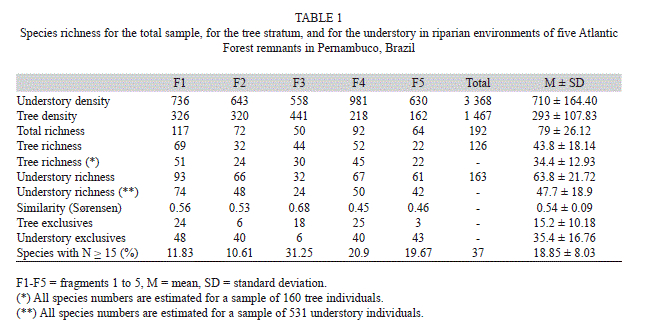
<body><![CDATA[<font style="font-weight: bold;" size="3"><span      style="font-family: verdana;">Results</span></font><br      style="font-family: verdana;">     <font size="2"></font><br style="font-family: verdana;">     <font size="2"><span style="font-family: verdana;">Species richness and     composition: A     total of 163 species distributed among 44 families were sampled from     the understory of the five fragments analyzed (fragment median=63.8     species, SD=21.72, n=5), varying from 32 species in F3 to 93 species in     F1 (<a href="/img/revistas/rbt/v60n3/a06t1.gif">Table 1</a>). One     ]]></body>
<body><![CDATA[hundred twenty-six species of 44 families were     sampled from the tree stratum. The number of species in this stratum     varied from 32 in F2 to 69 in F1 (43.8, 18.14, 6). When richness was     estimated using rarefaction, mean richness calculated values were     34.4&plusmn;12.93 (median&plusmn;SD) from the canopy and     47.69&plusmn;18.09 from the understory, not significantly different     from observed values in both strata. All of the fragments except F3     were richer, although not significantly, in the understory. An average     of 35% (SD=16.76) of the species occurred exclusively in the     understory, while 15.2% (10.18) of the species only occurred within the     ]]></body>
<body><![CDATA[tree stratum of the riparian forests. Of the total, 75.4% of the     species found in the tree stratum were present in the understory. The     similarity between the tree and understory strata averaged 0.54 (0.09)     (<a href="/img/revistas/rbt/v60n3/a06t1.gif">Table 1</a>). Fragment F3     had the highest similarity (0.68), while     fragments F4 and F5 were the least similar (0.46 and 0.45,     respectively).</span></font><br style="font-family: verdana;">     <font size="2"></font><br style="font-family: verdana;">     <font size="2"><span style="font-family: verdana;">Families Myrtaceae     (17 species/227     ]]></body>
<body><![CDATA[individuals), Melastomataceae (13/327), Rubiaceae (10/247),     Fabaceae-Mimosoideae (10/234), Annonaceae (9/461) and Clusiaceae     (7/266) had the highest species richness and added up to 40.50% of the     understory&#8217;s total species. The lower understory was made up mainly of     species from families Rubiaceae and Melastomataceae, which totalled     52.17% of the species and 24.35% of individuals in this category, while     species from families Annonaceae, Clusiaceae and Myrtaceae predominated     in the upper understory (66.66% of the species and 56.95% of     individuals).</span></font><br style="font-family: verdana;">     <font size="2"></font><br style="font-family: verdana;">     ]]></body>
<body><![CDATA[<font size="2"><span style="font-family: verdana;">In addition to the     families cited     above, despite its lower richness, the family Lecythidaceae (3     species/447 individuals) was high in density. <span      style="font-style: italic;">Anaxagorea dolichocarpa</span>     Sprague &amp; Sandwith (Annonaceae), <span style="font-style: italic;">Eschweilera     ovata</span> (Cambess.)     Miers. (Lecythidaceae) and <span style="font-style: italic;">Symphonia     globulifera</span> L.f. (Clusiaceae)     stood out due to the number of individuals (24.10% of the total) and     ]]></body>
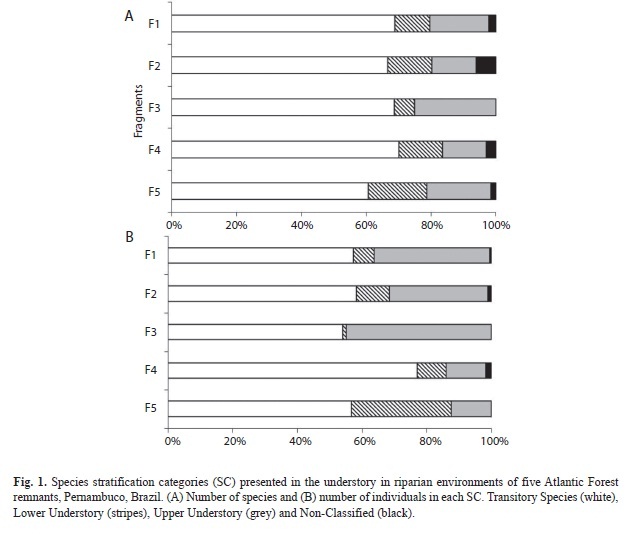
<body><![CDATA[for being among the ten species with the highest natural regeneration     indexes (TNR) in three of the five remnants studied.</span></font><br      style="font-family: verdana;">     <font size="2"></font><br style="font-family: verdana;">     <font size="2"><span style="font-family: verdana;">Species     classification into     stratification categories: The percentage of transitory species was     greater than that of typical understory species (<a      href="/img/revistas/rbt/v60n3/a06i1.jpg">Fig. 1A</a>). An average     of 67.01% (SD=3.76) transitory species were recorded, while lower and     ]]></body>
<body><![CDATA[upper understory species added up to 12.42% (4.33) and 18% (4.79) of     the total species sampled, respectively. Between fragments, differences     in species distribution into stratification categories were only     detected for F3, which was different from fragments F2 (G=14.63,     p&lt;0.05), F4 (G=10.37, p&lt;0.05) and F5 (G=9.38, p&lt;0.05) because     it had the smallest percentage of lower understory species (6.25%) and     the greatest percentage of upper understory species (25%).<br      style="font-family: verdana;">     </span></font><br style="font-family: verdana;">     <font size="2"><span style="font-family: verdana;">Transitory species     ]]></body>
<body><![CDATA[averaged 60.73%     (9.26) of the understory sampled individuals (<a      href="/img/revistas/rbt/v60n3/a06i1.jpg">Fig. 1B</a>). Conversely, the     lower and upper understory species represented 11.52% (11.33) and     27.06% (14.50) of the individuals, respectively. Fragment F5 differed     from the others because it had a greater percentage of individuals in     the lower understory (30.79%) and a smaller percentage of individuals     in the upper understory (12.22%) in relation to fragments F1 (G=29.30,     p&lt;0.05), F2 (G=19.50, p&lt;0.05) and F3 (G=54.82, p&lt;0.05).     Fragment F4 was different due to its higher percentage transitory     ]]></body>
<body><![CDATA[species (76.06%) in comparison to the other fragments. In this remnant,     the upper understory had the lowest value (12.23%) and was different     from fragments F1 (G=16.10, p&lt;0.05), F2 (G=10.74, p&lt;0.05) and F3     (G=33.13, p&lt;0.05). Significant differences were also found between     fragments F2 and F3 (G=13.06, p&lt;0.05), which showed opposite trends     in relation to the percentage of resident species: F3&#8217;s lower     understory had a smaller percentage (1.08%), while the percentage of     upper understory was larger (44.80%).</span></font><br      style="font-family: verdana;">     <font size="2"></font><br style="font-family: verdana;">     ]]></body>
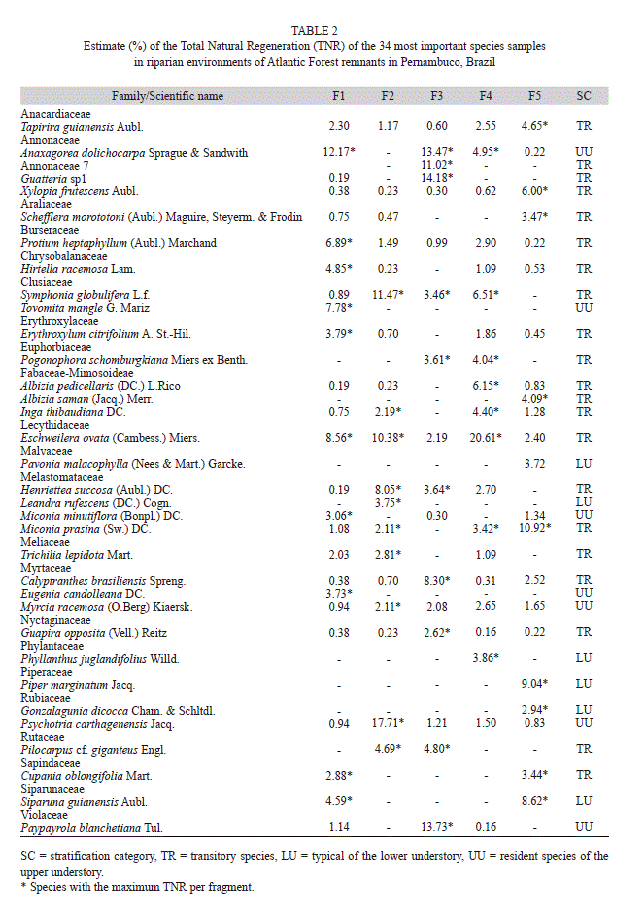
<body><![CDATA[<font size="2"><span style="font-family: verdana;">Among the 163     species recorded in     the five fragments&#8217; understory, looking at the 10 with highest     regeneration indexes (TNR) in each fragment, 34 species are listed     (<a href="/img/revistas/rbt/v60n3/a06t2.gif">Table 2</a>). These     species include the most important in at least one     fragment, in which they added up to 10.75-31.25% of the total natural     regeneration. Transitory species were the majority, with 21 recorded     species (61.76%), while the lower and upper understory had six (17.65%)     and seven species (20.59%), respectively.</span></font><br     ]]></body>
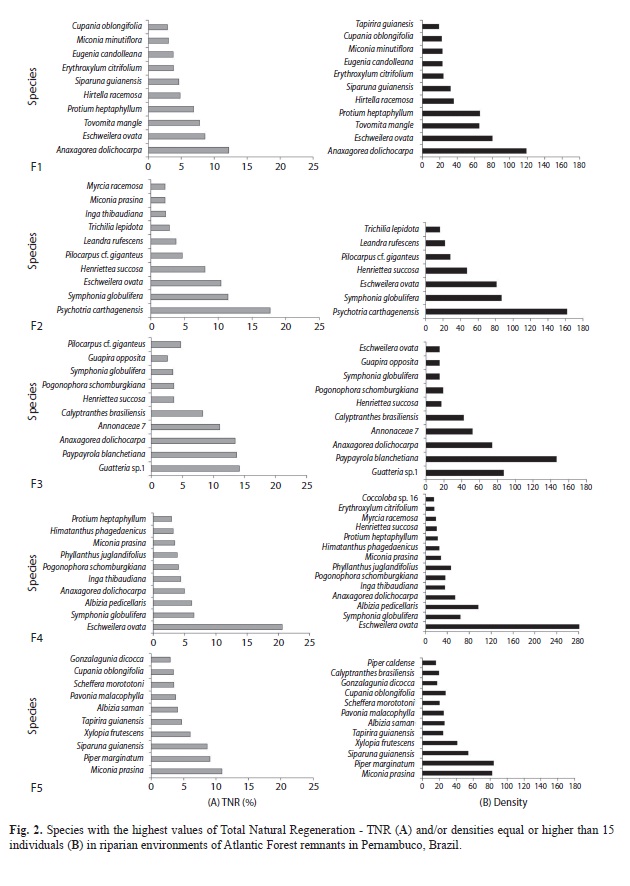
<body><![CDATA[ style="font-family: verdana;">     <font size="2"></font><br style="font-family: verdana;">     <font size="2"><span style="font-family: verdana;">Regenerative     capacity and vertical     structure of the understory: Most species with high total natural     regeneration indices (TNR) were also well distributed among height     classes and had the highest densities (<a      href="/img/revistas/rbt/v60n3/a06i2.jpg">Fig. 2</a>). Only 37 species     - less     than 21% of the total richness - had densities equal to or higher than     ]]></body>
<body><![CDATA[15 individuals in the total sample (<a      href="/img/revistas/rbt/v60n3/a06t1.gif">Table 1</a>); the highest     percentage     was recorded for F3, which stood out for housing 31.25% of the species     with 15 or more individuals. Species such as <span      style="font-style: italic;">Inga thibaudiana</span> DC.,     <span style="font-style: italic;">Myrcia racemosa</span> (O. Berg)     Kiaersk., <span style="font-style: italic;">Miconia prasina</span>     (Sw.) DC. (F2) and     <span style="font-style: italic;">Pilocarpus</span> cf. <span     ]]></body>
<body><![CDATA[ style="font-style: italic;">giganteus</span> Engl. (F3) all had less     than 15 individuals     each. Nevertheless, they were among those with the highest TNR, as they     were recorded in all of the height classes (the exceptions were <span      style="font-style: italic;">M.     prasina</span> and <span style="font-style: italic;">P</span>. cf. <span      style="font-style: italic;">giganteus</span>, which were found in     three classes, yet     had high relative frequencies in relation to the others). <span      style="font-style: italic;">Tapirira     ]]></body>
<body><![CDATA[guianensis</span> Aubl. (F1), <span style="font-style: italic;">E.     ovata</span> (F3), <span style="font-style: italic;">Henriettea succosa</span>     (Aubl.) DC.,     <span style="font-style: italic;">M. racemosa</span>, <span      style="font-style: italic;">Erythroxylum citrifolium</span> A.     St.-Hil.,<span style="font-style: italic;">Coccoloba</span> sp16 (F4),     <span style="font-style: italic;">Calyptranthes</span> <span      style="font-style: italic;">brasiliensis</span> Spreng. and <span      style="font-style: italic;">Piper caldense</span> C.DC. (F5),     although not being among the species with the highest regeneration,     ]]></body>
<body><![CDATA[represent the regeneration potential of the fragment in which they     occur, as they stand out in number of individuals. These species had     low relative frequency and - with the exception of <span      style="font-style: italic;">T. guianensis</span> and <span      style="font-style: italic;">M.     racemosa</span> - were absent from one of the height classes.    <br>     <br style="font-family: verdana;">     </span></font><font size="2"><span style="font-family: verdana;">The     percentages of     ]]></body>
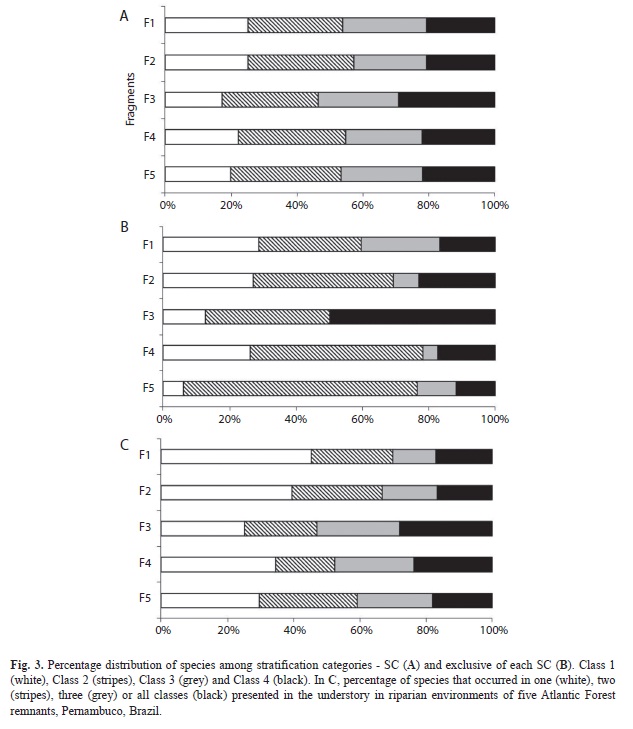
<body><![CDATA[species with     densities of 15 or more individuals had the following distribution     among functional stratification categories (SC): 23 transitory species     (62.16%); six lower understory species (16.22%), and seven upper     understory species (18.92%). Species&#8217; distribution between the     different height classes was similar among the fragments. The second     regeneration class encompassed the largest number of species (<a      href="/img/revistas/rbt/v60n3/a06i3.jpg">Fig. 3A</a>).     The transitory species were the best represented in all of the classes,     followed by those from the upper and lower understory (<a     ]]></body>
<body><![CDATA[ href="/img/revistas/rbt/v60n3/a06i4.jpg">Fig. 4</a>). The     average number of typical lower and upper understory species was     similar for classes 1 and 2.<br style="font-family: verdana;">     </span></font><br style="font-family: verdana;">     <font size="2"><span style="font-family: verdana;">In all of the forest     remnants, the     species that occurred in only one class were concentrated in the second     height class (except for F3, where most occurred solely in class 4)     (<a href="/img/revistas/rbt/v60n3/a06i3.jpg">Fig. 3B</a>). The     distribution of transitory and typical understory     ]]></body>
<body><![CDATA[species exclusively in one height class revealed that these species do     not generally occur in classes 3 (2-3m height) and 4 (height &gt;3m and     CBH&lt;15cm).<br style="font-family: verdana;">     </span></font><br style="font-family: verdana;">     <font size="2"><span style="font-family: verdana;">Few species occurred     in all of the     height classes - percentages of such species varied from 16.67% in F2     to 28.13% in F3 (<a href="/img/revistas/rbt/v60n3/a06i3.jpg">Fig. 3C</a>).     Most species only occurred in one class,     with percentages varying from 25% in F3 to 45.16% in F1. Transitory     ]]></body>
<body><![CDATA[species obtained the greatest averages in all of the situations, while     the average number of species in the lower and upper understory varied     from 1-3.</span></font><br style="font-family: verdana;">     <font size="2"></font><br style="font-family: verdana;">     <font style="font-weight: bold;" size="3"><span      style="font-family: verdana;">Discussion</span></font><br      style="font-family: verdana;">     <font size="2"></font><br style="font-family: verdana;">     <font size="2"><span style="font-family: verdana;">Species richness and     composition:     ]]></body>
<body><![CDATA[In this study, the understory generally contributed to an enhancement     on plant richness in the forest fragments. This confirms the pattern     that is normally recorded in the literature on tropical forests (Gentry     &amp; Dodson 1987, Galeano <span style="font-style: italic;">et al</span>.     1998, Schnitzer &amp; Carson 2000,     L&uuml; <span style="font-style: italic;">et al</span>. 2010), as the     lower stratum encompasses transitory and     resident species. In these forests, the understory flora may represent     50% or more of the total species (Schnitzer &amp; Carson 2000) and     augment the list of tree species up to 30% (Lins-e-Silva 2010).</span></font><br     ]]></body>
<body><![CDATA[ style="font-family: verdana;">     <font size="2"></font><br style="font-family: verdana;">     <font size="2"><span style="font-family: verdana;">According to Jardim     &amp; Hosokawa     (1986), the floristic composition of tropical forests is very different     for the upper stratum and understory. Nevertheless, the 54% average     similarity among the understory and tree stratum of the different     fragments studied here was higher than what is commonly found in the     literature (Alves &amp; Metzger 2006). It is important to point out     that the herbaceous understory was not sampled and the upper understory     ]]></body>
<body><![CDATA[was included, which may have contributed to the high similarity found     between the canopy and understory. The high richness found by this     study for the understory, associated with an intermediate similarity     between the understory and the canopy, may also indicate the absence of     large scale disturbances in the past (Bohlman &amp; O&#8217;Brien 2006),     since even higher similarities are expected in early secondary areas     (Nascimento 2010).</span></font><br style="font-family: verdana;">     <font size="2"></font><br style="font-family: verdana;">     <font size="2"><span style="font-family: verdana;">With the exception     of Family     ]]></body>
<body><![CDATA[Clusiaceae, the high richness and abundance of individuals recorded for     families such as Rubiaceae, Melastomataceae, Annonaceae, and Myrtaceae     seems to be a standard for flora understory in more humid forests     (Schorn &amp; Galv&atilde;o 2006, Gomes <span      style="font-style: italic;">et al</span>. 2009, Onofre <span      style="font-style: italic;">et al</span>.     2010, L&uuml; <span style="font-style: italic;">et al</span>.2010), as     well as in seasonal forests and savannah     (Vilela <span style="font-style: italic;">et al</span>. 1995,     Cardoso-Leite <span style="font-style: italic;">et al</span>. 2004,     ]]></body>
<body><![CDATA[Oliveira &amp; Felfili     2005). Although these families&#8217; richness in the understory is commonly     used as an indicator of succession stage, our results show that these     families co-occur and are highly important in distinct strata. Thus, in     studies with less inclusive size criteria, the family Myrtaceae (which     has a higher richness of shade tolerant species) (Tabarelli &amp;     Mantovani 1999) is indicative of more mature successional stages. When     individuals of the smaller height classes are sampled, Melastomataceae     and Rubiaceae are cited as representative of pioneer species (Tabarelli     &amp; Mantovani 1999), i.e., of forests in an initial successional     ]]></body>
<body><![CDATA[stage. Thus, in a more detailed analysis of forest strata, the richness     or abundance of these families do not seem to be good indicators of     Atlantic Forest successional stages; but yet dependent on the sampling     criteria used and on complex characteristics of species&#8217; life history     (Clark &amp; Clark 1992).</span></font><br style="font-family: verdana;">     <font size="2"></font><br style="font-family: verdana;">     <font size="2"><span style="font-family: verdana;">Species     classification into     stratification categories: In a manner similar to that already recorded     by other authors (Vilela <span style="font-style: italic;">et al</span>.     ]]></body>
<body><![CDATA[1995, Salles &amp; Schiavini 2007,     Gomes <span style="font-style: italic;">et al</span>. 2009), the     understory of the studied fragments is also     composed primarily by species of the canopy which are passing through     the lower strata. Due to the different methodologies used for sampling     this stratum, widely varied percentages for tree species have been     recorded in the understory- ranging, for example, from 54.54% (Vilela     <span style="font-style: italic;">et al</span>. 1995) to 89.18% (Gomes <span      style="font-style: italic;">et al</span>. 2009). Despite this     variation, all     ]]></body>
<body><![CDATA[studies show that the understory is an important transitional     environment that serves as an ecological filter for the species that     will be part of the canopy, i.e. an environment that selectively     determines which individuals and species may survive under its     conditions (George &amp; Bazzaz 1999, Harms <span      style="font-style: italic;">et al</span>. 2004).</span></font><br      style="font-family: verdana;">     <font size="2"></font><br style="font-family: verdana;">     <font size="2"><span style="font-family: verdana;">Few species were     abundant and most     ]]></body>
<body><![CDATA[had low density values; this pattern is expected both for the     understory (L&uuml; <span style="font-style: italic;">et al</span>.     2010) and for the tree stratum (Richards     1996). These species, classified as rare or locally rare, generally     occur in abundance percentages above 25% (Nappo <span      style="font-style: italic;">et al</span>. 2004, Oliveira     &amp; Amaral 2005); differently from abundant species, these are more     likely to be substituted by others as the forest develops, either for     natural reasons or due to disturbances in the area (Campos &amp;     Landgraf 2001).</span></font><br style="font-family: verdana;">     ]]></body>
<body><![CDATA[<font size="2"></font><br style="font-family: verdana;">     <font size="2"><span style="font-family: verdana;">Regenerative     capacity and vertical     structure of the understory: Regarding species&#8217; vertical distribution,     most were between 1-2m high, similar to what was found by Silva <span      style="font-style: italic;">et al</span>.     (2007) and Marangon <span style="font-style: italic;">et al</span>.     (2008). The species that were found in all     height classes - despite their lower occurrence percentages - must have     their growth accompanied and their successional characteristics     ]]></body>
<body><![CDATA[observed because these are the species with the greatest potential to     establish themselves and assure their presence in the forest&#8217;s     structure and composition (Clark &amp; Clark 1992, Kobe 1999, Silva <span      style="font-style: italic;">et     al</span>.2007). The exceptions are the species that &#8211; due to     particular     characteristics - are resident and never surpass the lower stratum     (Finol 1971).</span></font><br style="font-family: verdana;">     <font size="2"></font><br style="font-family: verdana;">     <font size="2"><span style="font-family: verdana;">Species that scored     ]]></body>
<body><![CDATA[high in     relative density and were well distributed vertically also had the     highest regeneration rates, as other authors had already recorded     (Volpato 1994, Silva <span style="font-style: italic;">et al</span>.     2007, Marangon <span style="font-style: italic;">et al</span>. 2008),     with few     exceptions. Some species remained among those with high TNR, despite     low relative density, because of their homogeneous vertical     distribution and higher relative frequency in relation to the others.     Nevertheless, some species did not have a high regeneration rate     ]]></body>
<body><![CDATA[despite their high relative density, which is due to their low relative     frequency and absence from at least one height class. In fact, since     the TNR index is based upon three species descriptors, it showed to be     adequate for ranking understory species according to their importance     in the plant assemblage. Furthermore, the species ranking based on the     index maintained the same balance between transitory and understory     typical species, thus allowing an appropriate interpretation of the     data for understanding the contribution of each group to the richness     of this stratum.</span></font><br style="font-family: verdana;">     <font size="2"></font><br style="font-family: verdana;">     ]]></body>
<body><![CDATA[<font size="2"><span style="font-family: verdana;">The results of this     study     reinforced the idea that the understory of forest fragments is made up     mainly of transitory species that are well distributed among the height     classes and have higher densities, which favors their future presence     in the structure and composition of the canopy. Typical understory     species, however, occur in two strata: the lower understory (which     includes the species that don&#8217;t generally surpass four meters, such as     those from families Piperaceae, Rubiaceae and Melastomataceae) and the     upper understory (intermediate between the low understory and the     ]]></body>
<body><![CDATA[canopy and made up of species from families Anonnaceae, Clusiaceae and     Myrtaceae, which do not surpass an average of ten meters in height).     Our findings support the importance of studying the understory&#8217;s     vegetation because it is floristically rich, structurally unique, and     promotes the natural regeneration of both the lower and tree strata and     the recovery from natural or anthropic disturbances. The fundamental     aspects of understory assemblages must be prioritized in order to     correctly understand the role of transitory and resident species in     this stratum.</span></font><br style="font-family: verdana;">     <font size="2"></font><br style="font-family: verdana;">     ]]></body>
<body><![CDATA[<font style="font-weight: bold;" size="3"><span      style="font-family: verdana;">Acknowledgments</span></font><br      style="font-family: verdana;">     <font size="2"></font><br style="font-family: verdana;">     <font size="2"><span style="font-family: verdana;">This study is part     of the Fragments     Project/Phase II - &#8220;Sustainability of Atlantic Forest Remnants in     Pernambuco and their Implications for Local Conservation and     Development&#8221;, a Brazil-Germany scientific collaboration program     (&#8220;Science and Technology for the Atlantic Forest&#8221;) financed by CNPq     ]]></body>
<body><![CDATA[(590039/2006-7) and BMBF (01 LB 0203 A1) with the support of the     S&atilde;o Jos&eacute; S.A. Sugarcane Mill/ Cavalcanti Petrib&uacute;     Group. The authors thank the support received from the teams of the     UFRPE Plant Ecology and Phytosociology Laboratory and the UFPE Plant     Morphotaxonomy Laboratory, the Cear&aacute; Foundation for Scientific     and Technological Development (FUNCAP) and the Brazilian National     Council for Scientific Development (CNPq) for the research scholarship     provided to the first author. We also thank Lenilson Santos and Marcos     Chagas for their indispensable aid in the field.</span></font><br      style="font-family: verdana;">     ]]></body>
<body><![CDATA[<font size="2"></font>     <hr style="width: 100%; height: 2px;"><br style="font-family: verdana;">     <font style="font-weight: bold;" size="3"><span      style="font-family: verdana;">References</span></font><br      style="font-family: verdana;">     <font size="2"></font><br style="font-family: verdana;">     <font size="2"><span style="font-family: verdana;">Alves, L.F. &amp;     J.P. Metzger.     2006. A regenera&ccedil;&atilde;o florestal em &aacute;reas de floresta     secund&aacute;ria na Reserva Florestal do Morro Grande, Cotia, SP.     ]]></body>
<body><![CDATA[<!-- ref -->Biota Neotrop. 6: 1-10.    &nbsp;&nbsp;&nbsp;&nbsp;&nbsp;&nbsp;&nbsp;&nbsp;[&#160;<a href="javascript:void(0);" onclick="javascript: window.open('/scielo.php?script=sci_nlinks&ref=1456971&pid=S0034-7744201200030000600001&lng=','','width=640,height=500,resizable=yes,scrollbars=1,menubar=yes,');">Links</a>&#160;]<!-- end-ref --><!-- ref --></span></font><br style="font-family: verdana;"> <font size="2"></font><br style="font-family: verdana;"> <font size="2"><span style="font-family: verdana;">APG III. 2009. Angiosperm Phylogeny Group (APG III). An update of the Angiosperm Phylogeny Group classification for the orders and families of flowering plants: APG III. Bot. J. Linn. Soc. 161: 105-121.    &nbsp;&nbsp;&nbsp;&nbsp;&nbsp;&nbsp;&nbsp;&nbsp;[&#160;<a href="javascript:void(0);" onclick="javascript: window.open('/scielo.php?script=sci_nlinks&ref=1456972&pid=S0034-7744201200030000600002&lng=','','width=640,height=500,resizable=yes,scrollbars=1,menubar=yes,');">Links</a>&#160;]<!-- end-ref --><!-- ref --></span></font><br  style="font-family: verdana;"> <font size="2"></font><br style="font-family: verdana;"> <font size="2"><span style="font-family: verdana;">Aquino, C. &amp; L.M. Barbosa. 2009. Classes sucessionais e s&iacute;ndromes de dispers&atilde;o de esp&eacute;cies arb&oacute;reas e arbustivas existentes em vegeta&ccedil;&atilde;o ciliar remanescente (Conchal, SP), como subs&iacute;dio para avaliar o potencial do fragmento como fonte de prop&aacute;gulos para enriquecimento de &aacute;reas revegetadas no rio Mogi-gua&ccedil;u, SP. Rev. &Aacute;rvore 33: 349-358.    &nbsp;&nbsp;&nbsp;&nbsp;&nbsp;&nbsp;&nbsp;&nbsp;[&#160;<a href="javascript:void(0);" onclick="javascript: window.open('/scielo.php?script=sci_nlinks&ref=1456973&pid=S0034-7744201200030000600003&lng=','','width=640,height=500,resizable=yes,scrollbars=1,menubar=yes,');">Links</a>&#160;]<!-- end-ref --><!-- ref --></span></font><br  style="font-family: verdana;"> <font size="2"></font><br style="font-family: verdana;"> <font size="2"><span style="font-family: verdana;">Ara&uacute;jo, F.S., S.V. Martins, J.A.A. Meira-Neto, J.L. Lani &amp; I.E. Pires. 2006. Estrutura da vegeta&ccedil;&atilde;o arbustivo-arb&oacute;rea colonizadora de uma &aacute;rea degradada p&oacute;s-minera&ccedil;&atilde;o de caulim, em Br&aacute;s Pires, MG. Rev. &Aacute;rvore 30: 107-116.    &nbsp;&nbsp;&nbsp;&nbsp;&nbsp;&nbsp;&nbsp;&nbsp;[&#160;<a href="javascript:void(0);" onclick="javascript: window.open('/scielo.php?script=sci_nlinks&ref=1456974&pid=S0034-7744201200030000600004&lng=','','width=640,height=500,resizable=yes,scrollbars=1,menubar=yes,');">Links</a>&#160;]<!-- end-ref --><!-- ref --></span></font><br  style="font-family: verdana;"> <font size="2"></font><br style="font-family: verdana;"> <font size="2"><span style="font-family: verdana;">Armesto, J.J. &amp; J.A. Mart&iacute;nez. 1978. Relations between vegetation structure and slope aspect in the Mediterranean region of Chile. J. Ecol. 66: 881-889.    &nbsp;&nbsp;&nbsp;&nbsp;&nbsp;&nbsp;&nbsp;&nbsp;[&#160;<a href="javascript:void(0);" onclick="javascript: window.open('/scielo.php?script=sci_nlinks&ref=1456975&pid=S0034-7744201200030000600005&lng=','','width=640,height=500,resizable=yes,scrollbars=1,menubar=yes,');">Links</a>&#160;]<!-- end-ref --><!-- ref --></span></font><br  style="font-family: verdana;"> <font size="2"></font><br style="font-family: verdana;"> <font size="2"><span style="font-family: verdana;">Benitez-Malvido, J. 1998. Impact of forest fragmentation on seedling abundance in a tropical rain forest. Conserv. Biol. 12: 380-389.    &nbsp;&nbsp;&nbsp;&nbsp;&nbsp;&nbsp;&nbsp;&nbsp;[&#160;<a href="javascript:void(0);" onclick="javascript: window.open('/scielo.php?script=sci_nlinks&ref=1456976&pid=S0034-7744201200030000600006&lng=','','width=640,height=500,resizable=yes,scrollbars=1,menubar=yes,');">Links</a>&#160;]<!-- end-ref --><!-- ref --></span></font><br  style="font-family: verdana;"> <font size="2"></font><br style="font-family: verdana;"> <font size="2"><span style="font-family: verdana;">Bohlman, S. &amp; S. O&#8217;Brien. 2006. Allometry, adult stature and regeneration requirement of 65 tree species on Barro Colorado Island, Panama. J. Trop. Ecol. 22: 123-136.    &nbsp;&nbsp;&nbsp;&nbsp;&nbsp;&nbsp;&nbsp;&nbsp;[&#160;<a href="javascript:void(0);" onclick="javascript: window.open('/scielo.php?script=sci_nlinks&ref=1456977&pid=S0034-7744201200030000600007&lng=','','width=640,height=500,resizable=yes,scrollbars=1,menubar=yes,');">Links</a>&#160;]<!-- end-ref --><!-- ref --></span></font><br  style="font-family: verdana;"> <font size="2"></font><br style="font-family: verdana;"> <font size="2"><span style="font-family: verdana;">Bouroncle, C. &amp; B. Finegan. 2011. Tree Regeneration and Understory Woody Plants Show Diverse Responses to Forest-Pasture Edges in Costa Rica. Biotropica 43: 562-571.    &nbsp;&nbsp;&nbsp;&nbsp;&nbsp;&nbsp;&nbsp;&nbsp;[&#160;<a href="javascript:void(0);" onclick="javascript: window.open('/scielo.php?script=sci_nlinks&ref=1456978&pid=S0034-7744201200030000600008&lng=','','width=640,height=500,resizable=yes,scrollbars=1,menubar=yes,');">Links</a>&#160;]<!-- end-ref --><!-- ref --></span></font><br  style="font-family: verdana;"> <font size="2"></font><br style="font-family: verdana;"> <font size="2"><span style="font-family: verdana;">Cadenasso, M.L. &amp; S.T.A. Pickett. 2000. Linking forest edge structure to edge function: mediation of herbivore damage. J. Ecol. 88: 31-44.    &nbsp;&nbsp;&nbsp;&nbsp;&nbsp;&nbsp;&nbsp;&nbsp;[&#160;<a href="javascript:void(0);" onclick="javascript: window.open('/scielo.php?script=sci_nlinks&ref=1456979&pid=S0034-7744201200030000600009&lng=','','width=640,height=500,resizable=yes,scrollbars=1,menubar=yes,');">Links</a>&#160;]<!-- end-ref --><!-- ref --></span></font><br  style="font-family: verdana;"> <font size="2"></font><br style="font-family: verdana;"> <font size="2"><span style="font-family: verdana;">Campos, J.C. &amp; P.R.C. Landgraf. 2001. An&aacute;lise da regenera&ccedil;&atilde;o natural de esp&eacute;cies florestais em matas ciliares de acordo com a dist&acirc;ncia da margem do lago. Ci. Fl. 11: 143-151.    &nbsp;&nbsp;&nbsp;&nbsp;&nbsp;&nbsp;&nbsp;&nbsp;[&#160;<a href="javascript:void(0);" onclick="javascript: window.open('/scielo.php?script=sci_nlinks&ref=1456980&pid=S0034-7744201200030000600010&lng=','','width=640,height=500,resizable=yes,scrollbars=1,menubar=yes,');">Links</a>&#160;]<!-- end-ref --><!-- ref --></span></font><br  style="font-family: verdana;"> <font size="2"></font><br style="font-family: verdana;"> <font size="2"><span style="font-family: verdana;">Cardoso-Leite, E., T.B. Covre, R.G. Ometto, D.C. Cavalcanti &amp; M.I. Pagani. 2004. Fitossociologia e caracteriza&ccedil;&atilde;o sucessional de um fragmento de mata ciliar, em Rio Claro/SP, como subs&iacute;dio &agrave; recupera&ccedil;&atilde;o da &aacute;rea. Rev. Inst. Flor. 16: 31-41.    &nbsp;&nbsp;&nbsp;&nbsp;&nbsp;&nbsp;&nbsp;&nbsp;[&#160;<a href="javascript:void(0);" onclick="javascript: window.open('/scielo.php?script=sci_nlinks&ref=1456981&pid=S0034-7744201200030000600011&lng=','','width=640,height=500,resizable=yes,scrollbars=1,menubar=yes,');">Links</a>&#160;]<!-- end-ref --><!-- ref --></span></font><br  style="font-family: verdana;"> <font size="2"></font><br style="font-family: verdana;"> <font size="2"><span style="font-family: verdana;">Ceccon, E., P. Huante &amp; E. Rinc&oacute;n. 2006. Abiotic factors influencing tropical dry forests regeneration. Braz. Arch. Biol. Techn. 49: 305-312.    &nbsp;&nbsp;&nbsp;&nbsp;&nbsp;&nbsp;&nbsp;&nbsp;[&#160;<a href="javascript:void(0);" onclick="javascript: window.open('/scielo.php?script=sci_nlinks&ref=1456982&pid=S0034-7744201200030000600012&lng=','','width=640,height=500,resizable=yes,scrollbars=1,menubar=yes,');">Links</a>&#160;]<!-- end-ref --><!-- ref --></span></font><br  style="font-family: verdana;"> <font size="2"></font><br style="font-family: verdana;"> <font size="2"><span style="font-family: verdana;">Clark, D.A. &amp; D.B. Clark. 1992. Life history diversity of canopy and emergent trees in a neotropical rain forest. Ecol. Monogr. 62: 315-344.    &nbsp;&nbsp;&nbsp;&nbsp;&nbsp;&nbsp;&nbsp;&nbsp;[&#160;<a href="javascript:void(0);" onclick="javascript: window.open('/scielo.php?script=sci_nlinks&ref=1456983&pid=S0034-7744201200030000600013&lng=','','width=640,height=500,resizable=yes,scrollbars=1,menubar=yes,');">Links</a>&#160;]<!-- end-ref --><!-- ref --></span></font><br  style="font-family: verdana;"> <font size="2"></font><br style="font-family: verdana;"> <font size="2"><span style="font-family: verdana;">Cowel, R.K. 2009. EstimateS 8.2: Statistical estimator of species richness and shared species from samples. Department of Ecology &amp; Evolutionary Biology, University of Connecticut, Storrs, USA. (Downloaded: 20 October 2011, http://viceroy.eeb.uconn.edu/estimates).    &nbsp;&nbsp;&nbsp;&nbsp;&nbsp;&nbsp;&nbsp;&nbsp;[&#160;<a href="javascript:void(0);" onclick="javascript: window.open('/scielo.php?script=sci_nlinks&ref=1456984&pid=S0034-7744201200030000600014&lng=','','width=640,height=500,resizable=yes,scrollbars=1,menubar=yes,');">Links</a>&#160;]<!-- end-ref --><!-- ref --></span></font><br  style="font-family: verdana;"> <font size="2"></font><br style="font-family: verdana;"> <font size="2"><span style="font-family: verdana;">CPRH. 2003. Diagn&oacute;stico s&oacute;cio-ambiental do Litoral Norte de Pernambuco. CPRH, Recife, Pernambuco, Brasil.    &nbsp;&nbsp;&nbsp;&nbsp;&nbsp;&nbsp;&nbsp;&nbsp;[&#160;<a href="javascript:void(0);" onclick="javascript: window.open('/scielo.php?script=sci_nlinks&ref=1456985&pid=S0034-7744201200030000600015&lng=','','width=640,height=500,resizable=yes,scrollbars=1,menubar=yes,');">Links</a>&#160;]<!-- end-ref --><!-- ref --></span></font><br style="font-family: verdana;"> <font size="2"></font><br style="font-family: verdana;"> <font size="2"><span style="font-family: verdana;">Emborg, J. 1998. Understorey light conditions and regeneration with respect to the structural dynamics of a near-natural temperate deciduous forest in Denmark. Forest Ecol. Manage. 106: 83-95.    &nbsp;&nbsp;&nbsp;&nbsp;&nbsp;&nbsp;&nbsp;&nbsp;[&#160;<a href="javascript:void(0);" onclick="javascript: window.open('/scielo.php?script=sci_nlinks&ref=1456986&pid=S0034-7744201200030000600016&lng=','','width=640,height=500,resizable=yes,scrollbars=1,menubar=yes,');">Links</a>&#160;]<!-- end-ref --><!-- ref --></span></font><br style="font-family: verdana;"> <font size="2"></font><br style="font-family: verdana;"> <font size="2"><span style="font-family: verdana;">Felfili, J.M, J.F. Ribeiro, C.W. Fagg &amp; J.W.B. Machado. 2000. Recupera&ccedil;&atilde;o de Matas de Galeria. EMPRAPA Cerrados: S&eacute;rie T&eacute;cnica 21: 1-45.    &nbsp;&nbsp;&nbsp;&nbsp;&nbsp;&nbsp;&nbsp;&nbsp;[&#160;<a href="javascript:void(0);" onclick="javascript: window.open('/scielo.php?script=sci_nlinks&ref=1456987&pid=S0034-7744201200030000600017&lng=','','width=640,height=500,resizable=yes,scrollbars=1,menubar=yes,');">Links</a>&#160;]<!-- end-ref --><!-- ref --></span></font><br  style="font-family: verdana;"> <font size="2"></font><br style="font-family: verdana;"> <font size="2"><span style="font-family: verdana;">Finol, H.U. 1971. Nuevos parametros a considerarse en el analisis structural de las selvas virgenes tropicales. Rev. Forest. Venez. 14: 29-42.    &nbsp;&nbsp;&nbsp;&nbsp;&nbsp;&nbsp;&nbsp;&nbsp;[&#160;<a href="javascript:void(0);" onclick="javascript: window.open('/scielo.php?script=sci_nlinks&ref=1456988&pid=S0034-7744201200030000600018&lng=','','width=640,height=500,resizable=yes,scrollbars=1,menubar=yes,');">Links</a>&#160;]<!-- end-ref --><!-- ref --></span></font><br  style="font-family: verdana;"> <font size="2"></font><br style="font-family: verdana;"> <font size="2"><span style="font-family: verdana;">Galeano, G., S. Su&aacute;rez &amp; H. Balslev. 1998. Vascular plant species count in a wet forest in the Choc&oacute; area on the Pacific Coast of Colombia. Biodivers. Conserv. 7: 1563-1575.    &nbsp;&nbsp;&nbsp;&nbsp;&nbsp;&nbsp;&nbsp;&nbsp;[&#160;<a href="javascript:void(0);" onclick="javascript: window.open('/scielo.php?script=sci_nlinks&ref=1456989&pid=S0034-7744201200030000600019&lng=','','width=640,height=500,resizable=yes,scrollbars=1,menubar=yes,');">Links</a>&#160;]<!-- end-ref --><!-- ref --></span></font><br style="font-family: verdana;"> <font size="2"></font><br style="font-family: verdana;"> <font size="2"><span style="font-family: verdana;">Gama, J.R.V., S.A. Botelho, M.M. Bentes-Gama &amp; J.R.S. Scolforo. 2003. Estrutura e potencial futuro de utiliza&ccedil;&atilde;o da regenera&ccedil;&atilde;o natural de floresta de v&aacute;rzea alta no munic&iacute;pio de Afu&aacute;, Estado do Par&aacute;. Ci. Fl. 13: 71-82.    &nbsp;&nbsp;&nbsp;&nbsp;&nbsp;&nbsp;&nbsp;&nbsp;[&#160;<a href="javascript:void(0);" onclick="javascript: window.open('/scielo.php?script=sci_nlinks&ref=1456990&pid=S0034-7744201200030000600020&lng=','','width=640,height=500,resizable=yes,scrollbars=1,menubar=yes,');">Links</a>&#160;]<!-- end-ref --><!-- ref --></span></font><br  style="font-family: verdana;"> <font size="2"></font><br style="font-family: verdana;"> <font size="2"><span style="font-family: verdana;">Gentry, A.H. &amp; C. Dodson. 1987. Contribuition of nontrees to species richness of a tropical rain forest. Biotropica 19: 149-156.    &nbsp;&nbsp;&nbsp;&nbsp;&nbsp;&nbsp;&nbsp;&nbsp;[&#160;<a href="javascript:void(0);" onclick="javascript: window.open('/scielo.php?script=sci_nlinks&ref=1456991&pid=S0034-7744201200030000600021&lng=','','width=640,height=500,resizable=yes,scrollbars=1,menubar=yes,');">Links</a>&#160;]<!-- end-ref --><!-- ref --></span></font><br  style="font-family: verdana;"> <font size="2"></font><br style="font-family: verdana;"> <font size="2"><span style="font-family: verdana;">George, L.O. &amp; F.A. Bazzaz. 1999. The fern understory as an ecological filter: emergence and establishment of canopy-tree seedlings. Ecology 80: 833-845.    &nbsp;&nbsp;&nbsp;&nbsp;&nbsp;&nbsp;&nbsp;&nbsp;[&#160;<a href="javascript:void(0);" onclick="javascript: window.open('/scielo.php?script=sci_nlinks&ref=1456992&pid=S0034-7744201200030000600022&lng=','','width=640,height=500,resizable=yes,scrollbars=1,menubar=yes,');">Links</a>&#160;]<!-- end-ref --><!-- ref --></span></font><br  style="font-family: verdana;"> <font size="2"></font><br style="font-family: verdana;"> <font size="2"><span style="font-family: verdana;">Gilliam, F.S., N.L. Turril &amp; M.B. Adams. 1995. Herbaceous-layer and overstory species in clear-cut and mature central Appalachian hardwood forests. Ecol. Appl. 5: 947-955.    &nbsp;&nbsp;&nbsp;&nbsp;&nbsp;&nbsp;&nbsp;&nbsp;[&#160;<a href="javascript:void(0);" onclick="javascript: window.open('/scielo.php?script=sci_nlinks&ref=1456993&pid=S0034-7744201200030000600023&lng=','','width=640,height=500,resizable=yes,scrollbars=1,menubar=yes,');">Links</a>&#160;]<!-- end-ref --><!-- ref --></span></font><br  style="font-family: verdana;"> <font size="2"></font><br style="font-family: verdana;"> <font size="2"><span style="font-family: verdana;">Gilliam, F.S., N.L. Turrill, S.D. Aulick, D.K. Evans &amp; M.B. Adams. 1994. Herbaceous layer and soil response to experimental acidification in a central Appalachian hard- wood forest. J. Environ. Qual. 23: 835- 844.    &nbsp;&nbsp;&nbsp;&nbsp;&nbsp;&nbsp;&nbsp;&nbsp;[&#160;<a href="javascript:void(0);" onclick="javascript: window.open('/scielo.php?script=sci_nlinks&ref=1456994&pid=S0034-7744201200030000600024&lng=','','width=640,height=500,resizable=yes,scrollbars=1,menubar=yes,');">Links</a>&#160;]<!-- end-ref --><!-- ref --></span></font><br  style="font-family: verdana;"> <font size="2"></font><br style="font-family: verdana;"> <font size="2"><span style="font-family: verdana;">Gomes, J.S., A.C.B. Lins-e-Silva, M.J.N. Rodal &amp; H.C.H. Silva. 2009. Estrutura do sub-bosque lenhoso em ambientes de borda e interior de dois fragmentos de floresta atl&acirc;ntica em Igarassu, Pernambuco, Brasil. Rodrigu&eacute;sia 60: 295-310.    &nbsp;&nbsp;&nbsp;&nbsp;&nbsp;&nbsp;&nbsp;&nbsp;[&#160;<a href="javascript:void(0);" onclick="javascript: window.open('/scielo.php?script=sci_nlinks&ref=1456995&pid=S0034-7744201200030000600025&lng=','','width=640,height=500,resizable=yes,scrollbars=1,menubar=yes,');">Links</a>&#160;]<!-- end-ref --><!-- ref --></span></font><br style="font-family: verdana;"> <font size="2"></font><br style="font-family: verdana;"> <font size="2"><span style="font-family: verdana;">Harms, K.E., J.S. Powers &amp; R.A. Montgomery. 2004. Variation in small sapling density, understory cover, and resource availability in four Neotropical Forests. Biotropica 36: 40-51.    &nbsp;&nbsp;&nbsp;&nbsp;&nbsp;&nbsp;&nbsp;&nbsp;[&#160;<a href="javascript:void(0);" onclick="javascript: window.open('/scielo.php?script=sci_nlinks&ref=1456996&pid=S0034-7744201200030000600026&lng=','','width=640,height=500,resizable=yes,scrollbars=1,menubar=yes,');">Links</a>&#160;]<!-- end-ref --><!-- ref --></span></font><br style="font-family: verdana;"> <font size="2"></font><br style="font-family: verdana;"> <font size="2"><span style="font-family: verdana;">IBGE. 1992. Manual T&eacute;cnico da vegeta&ccedil;&atilde;o Brasileira.IBGE (Manuais T&eacute;cnicos em Geoci&ecirc;ncias), Rio de Janeiro, Rio de Janeiro, Brasil.    &nbsp;&nbsp;&nbsp;&nbsp;&nbsp;&nbsp;&nbsp;&nbsp;[&#160;<a href="javascript:void(0);" onclick="javascript: window.open('/scielo.php?script=sci_nlinks&ref=1456997&pid=S0034-7744201200030000600027&lng=','','width=640,height=500,resizable=yes,scrollbars=1,menubar=yes,');">Links</a>&#160;]<!-- end-ref --><!-- ref --></span></font><br  style="font-family: verdana;"> <font size="2"></font><br style="font-family: verdana;"> <font size="2"><span style="font-family: verdana;">Ickes, K., S.J. Dewalt &amp; S. Appanah. 2001. Effects of native pigs (Sus scrofa) on woody understory vegetation in a Malasian lowland rain forest. J. Trop. Ecol. 17: 191-206.    &nbsp;&nbsp;&nbsp;&nbsp;&nbsp;&nbsp;&nbsp;&nbsp;[&#160;<a href="javascript:void(0);" onclick="javascript: window.open('/scielo.php?script=sci_nlinks&ref=1456998&pid=S0034-7744201200030000600028&lng=','','width=640,height=500,resizable=yes,scrollbars=1,menubar=yes,');">Links</a>&#160;]<!-- end-ref --><!-- ref --></span></font><br style="font-family: verdana;"> <font size="2"></font><br style="font-family: verdana;"> <font size="2"><span style="font-family: verdana;">Jardim, F.C.S. &amp; R.T. Hosokawa. 1986. Estrutura da floresta equatorial &uacute;mida da esta&ccedil;&atilde;o experimental de silvicultura tropical do INPA. Acta Amaz. 16: 411-508.    &nbsp;&nbsp;&nbsp;&nbsp;&nbsp;&nbsp;&nbsp;&nbsp;[&#160;<a href="javascript:void(0);" onclick="javascript: window.open('/scielo.php?script=sci_nlinks&ref=1456999&pid=S0034-7744201200030000600029&lng=','','width=640,height=500,resizable=yes,scrollbars=1,menubar=yes,');">Links</a>&#160;]<!-- end-ref --><!-- ref --></span></font><br style="font-family: verdana;"> <font size="2"></font><br style="font-family: verdana;"> <font size="2"><span style="font-family: verdana;">Kobe, R.K. 1999. Light gradient partioning among tropical tree species through differential seedling mortality and growth. Ecology 80: 187-201.    &nbsp;&nbsp;&nbsp;&nbsp;&nbsp;&nbsp;&nbsp;&nbsp;[&#160;<a href="javascript:void(0);" onclick="javascript: window.open('/scielo.php?script=sci_nlinks&ref=1457000&pid=S0034-7744201200030000600030&lng=','','width=640,height=500,resizable=yes,scrollbars=1,menubar=yes,');">Links</a>&#160;]<!-- end-ref --><!-- ref --></span></font><br  style="font-family: verdana;"> <font size="2"></font><br style="font-family: verdana;"> <font size="2"><span style="font-family: verdana;">Laurance, W.F., H.E.M. Nascimento, S.G. Laurance, A. Andrade, R.M. Ewers, K.E. Harms, R.C.C. Luiz&atilde;o &amp; J.E. Ribeiro. 2007. Habitat Fragmentation, Variable Edge Effects, and the Landscape-Divergence Hypothesis. PLoS ONE 2 : 1-8.    &nbsp;&nbsp;&nbsp;&nbsp;&nbsp;&nbsp;&nbsp;&nbsp;[&#160;<a href="javascript:void(0);" onclick="javascript: window.open('/scielo.php?script=sci_nlinks&ref=1457001&pid=S0034-7744201200030000600031&lng=','','width=640,height=500,resizable=yes,scrollbars=1,menubar=yes,');">Links</a>&#160;]<!-- end-ref --><!-- ref --></span></font><br  style="font-family: verdana;"> <font size="2"></font><br style="font-family: verdana;"> <font size="2"><span style="font-family: verdana;">Lima, M.L.F.C. 1998. A reserva da biosfera da Mata Atl&acirc;ntica em Pernambuco- situa&ccedil;&atilde;o atual, a&ccedil;&otilde;es e perspectivas. Caderno 12, Gr&aacute;fica do Instituto Florestal, S&atilde;o Paulo, S&atilde;o Paulo, Brasil.    &nbsp;&nbsp;&nbsp;&nbsp;&nbsp;&nbsp;&nbsp;&nbsp;[&#160;<a href="javascript:void(0);" onclick="javascript: window.open('/scielo.php?script=sci_nlinks&ref=1457002&pid=S0034-7744201200030000600032&lng=','','width=640,height=500,resizable=yes,scrollbars=1,menubar=yes,');">Links</a>&#160;]<!-- end-ref --><!-- ref --></span></font><br  style="font-family: verdana;"> <font size="2"></font><br style="font-family: verdana;"> <font size="2"><span style="font-family: verdana;">Lima-Filho, D.A., J. Revilla, L.S. Coelho, J.F. Ramos, J.L. Santos &amp; J.G. Oliveira. 2002. Regenera&ccedil;&atilde;o natural de tr&ecirc;s hectares de Floresta Ombr&oacute;fila Densa de Terra Firme na regi&atilde;o do rio Urucu-AM, Brasil. Acta Amaz. 32: 555-569.    &nbsp;&nbsp;&nbsp;&nbsp;&nbsp;&nbsp;&nbsp;&nbsp;[&#160;<a href="javascript:void(0);" onclick="javascript: window.open('/scielo.php?script=sci_nlinks&ref=1457003&pid=S0034-7744201200030000600033&lng=','','width=640,height=500,resizable=yes,scrollbars=1,menubar=yes,');">Links</a>&#160;]<!-- end-ref --><!-- ref --></span></font><br  style="font-family: verdana;"> <font size="2"></font><br style="font-family: verdana;"> <font size="2"><span style="font-family: verdana;">Lins-e-Silva, A.C.B. 2010. Influ&ecirc;ncia da &aacute;rea e da heterogeneidade de habitats na diversidade vegetal em fragmentos de floresta atl&acirc;ntica. Ph.D. Thesis, Universidade Federal do Rio de Janeiro, Rio de Janeiro, Brasil.    &nbsp;&nbsp;&nbsp;&nbsp;&nbsp;&nbsp;&nbsp;&nbsp;[&#160;<a href="javascript:void(0);" onclick="javascript: window.open('/scielo.php?script=sci_nlinks&ref=1457004&pid=S0034-7744201200030000600034&lng=','','width=640,height=500,resizable=yes,scrollbars=1,menubar=yes,');">Links</a>&#160;]<!-- end-ref --><!-- ref --></span></font><br  style="font-family: verdana;"> <font size="2"></font><br style="font-family: verdana;"> <font size="2"><span style="font-family: verdana;">L&uuml;, X.T., J.X. Yin &amp; J.W. Tang. 2010. Diversity and composition of understory vegetation in the tropical seasonal rain forest of Xishuangbanna, SW China. Rev. Biol. Trop. 59: 455-463.    &nbsp;&nbsp;&nbsp;&nbsp;&nbsp;&nbsp;&nbsp;&nbsp;[&#160;<a href="javascript:void(0);" onclick="javascript: window.open('/scielo.php?script=sci_nlinks&ref=1457005&pid=S0034-7744201200030000600035&lng=','','width=640,height=500,resizable=yes,scrollbars=1,menubar=yes,');">Links</a>&#160;]<!-- end-ref --><!-- ref --></span></font><br style="font-family: verdana;"> <font size="2"></font><br style="font-family: verdana;"> <font size="2"><span style="font-family: verdana;">Magurran, A.E., 2004. Measuring Biological Diversity. Blackwell Science, Oxford, England.    &nbsp;&nbsp;&nbsp;&nbsp;&nbsp;&nbsp;&nbsp;&nbsp;[&#160;<a href="javascript:void(0);" onclick="javascript: window.open('/scielo.php?script=sci_nlinks&ref=1457006&pid=S0034-7744201200030000600036&lng=','','width=640,height=500,resizable=yes,scrollbars=1,menubar=yes,');">Links</a>&#160;]<!-- end-ref --><!-- ref --></span></font><br  style="font-family: verdana;"> <font size="2"></font><br style="font-family: verdana;"> <font size="2"><span style="font-family: verdana;">Marangon, L.C., J.J. Soares, A.L.P. Feliciano &amp; C.F. Brand&atilde;o. 2008. Regenera&ccedil;&atilde;o natural em um fragmento de floresta estacional semidecidual em Vi&ccedil;osa, Minas Gerais. Rev. &Aacute;rvore 32: 183-191.    &nbsp;&nbsp;&nbsp;&nbsp;&nbsp;&nbsp;&nbsp;&nbsp;[&#160;<a href="javascript:void(0);" onclick="javascript: window.open('/scielo.php?script=sci_nlinks&ref=1457007&pid=S0034-7744201200030000600037&lng=','','width=640,height=500,resizable=yes,scrollbars=1,menubar=yes,');">Links</a>&#160;]<!-- end-ref --><!-- ref --></span></font><br  style="font-family: verdana;"> <font size="2"></font><br style="font-family: verdana;"> <font size="2"><span style="font-family: verdana;">Martins, S.V. &amp; R.R. Rodrigues. 2002. Gap-phase regeneration in a semideciduous mesophytic forest, Southeastern Brazil. Plant Ecol. 163: 51-62.    &nbsp;&nbsp;&nbsp;&nbsp;&nbsp;&nbsp;&nbsp;&nbsp;[&#160;<a href="javascript:void(0);" onclick="javascript: window.open('/scielo.php?script=sci_nlinks&ref=1457008&pid=S0034-7744201200030000600038&lng=','','width=640,height=500,resizable=yes,scrollbars=1,menubar=yes,');">Links</a>&#160;]<!-- end-ref --><!-- ref --></span></font><br  style="font-family: verdana;"> <font size="2"></font><br style="font-family: verdana;"> <font size="2"><span style="font-family: verdana;">Mattei, V.L. &amp; S.J. Longhi. 2001. Avalia&ccedil;&atilde;o da regenera&ccedil;&atilde;o natural de Eucalyptus paniculata Smith. Ci. Fl. 11: 55-65.    &nbsp;&nbsp;&nbsp;&nbsp;&nbsp;&nbsp;&nbsp;&nbsp;[&#160;<a href="javascript:void(0);" onclick="javascript: window.open('/scielo.php?script=sci_nlinks&ref=1457009&pid=S0034-7744201200030000600039&lng=','','width=640,height=500,resizable=yes,scrollbars=1,menubar=yes,');">Links</a>&#160;]<!-- end-ref --><!-- ref --></span></font><br  style="font-family: verdana;"> <font size="2"></font><br style="font-family: verdana;"> <font size="2"><span style="font-family: verdana;">Metzger, J.P., L.C. Bernacci &amp; R. Goldenberg. 1997. Pattern of tree species diversity in riparian forest fragments of different widths (SE Brazil). Plant Ecol. 133: 135-152.    &nbsp;&nbsp;&nbsp;&nbsp;&nbsp;&nbsp;&nbsp;&nbsp;[&#160;<a href="javascript:void(0);" onclick="javascript: window.open('/scielo.php?script=sci_nlinks&ref=1457010&pid=S0034-7744201200030000600040&lng=','','width=640,height=500,resizable=yes,scrollbars=1,menubar=yes,');">Links</a>&#160;]<!-- end-ref --><!-- ref --></span></font><br style="font-family: verdana;"> <font size="2"></font><br style="font-family: verdana;"> <font size="2"><span style="font-family: verdana;">Mittermeier, R.A., P.R. Gil, M. Hoffman, J. Pilgrim, T. Brooks, C.G. Mittermeier, J. Lamoreux &amp; G.A.B. Fonseca. 2005. Hotspots Revisited - Earth&#8217;s Biologically Richest and Most Endangered Terrestrial Ecoregions. Chicago, Chicago, Illinois, USA.    &nbsp;&nbsp;&nbsp;&nbsp;&nbsp;&nbsp;&nbsp;&nbsp;[&#160;<a href="javascript:void(0);" onclick="javascript: window.open('/scielo.php?script=sci_nlinks&ref=1457011&pid=S0034-7744201200030000600041&lng=','','width=640,height=500,resizable=yes,scrollbars=1,menubar=yes,');">Links</a>&#160;]<!-- end-ref --><!-- ref --></span></font><br style="font-family: verdana;"> <font size="2"></font><br style="font-family: verdana;"> <font size="2"><span style="font-family: verdana;">Naiman, R.J., H. D&eacute;camps &amp; M.E. McClain. 2005. Riparia: ecology, conservation, and management of streamside communities. Elsevier, San Diego, California, USA.    &nbsp;&nbsp;&nbsp;&nbsp;&nbsp;&nbsp;&nbsp;&nbsp;[&#160;<a href="javascript:void(0);" onclick="javascript: window.open('/scielo.php?script=sci_nlinks&ref=1457012&pid=S0034-7744201200030000600042&lng=','','width=640,height=500,resizable=yes,scrollbars=1,menubar=yes,');">Links</a>&#160;]<!-- end-ref --><!-- ref --></span></font><br style="font-family: verdana;"> <font size="2"></font><br style="font-family: verdana;"> <font size="2"><span style="font-family: verdana;">Nappo, M.E., J.J. Griffith, S.V. Martins, P. Marco-J&uacute;nior, A.L. Souza &amp; A.T. Oliveira-Filho. 2004. Din&acirc;mica da estrutura fitossociol&oacute;gica da regenera&ccedil;&atilde;o natural de esp&eacute;cies arb&oacute;reas e arbustivas no sub-bosque de povoamento de Mimosa scabrella Bentham, em &aacute;rea minerada, em Po&ccedil;os de Caldas, MG. Rev. &Aacute;rvore 28: 811-829.    &nbsp;&nbsp;&nbsp;&nbsp;&nbsp;&nbsp;&nbsp;&nbsp;[&#160;<a href="javascript:void(0);" onclick="javascript: window.open('/scielo.php?script=sci_nlinks&ref=1457013&pid=S0034-7744201200030000600043&lng=','','width=640,height=500,resizable=yes,scrollbars=1,menubar=yes,');">Links</a>&#160;]<!-- end-ref --><!-- ref --></span></font><br style="font-family: verdana;"> <font size="2"></font><br style="font-family: verdana;"> <font size="2"><span style="font-family: verdana;">Nascimento, L.M. 2010. Sucess&atilde;o secund&aacute;ria em &aacute;rea de Mata Atl&acirc;ntica de Pernambuco: mudan&ccedil;as flor&iacute;sticas e estruturais. Ph.D. Thesis, Universidade Federal Rural de Pernambuco, Pernambuco, Brasil.    &nbsp;&nbsp;&nbsp;&nbsp;&nbsp;&nbsp;&nbsp;&nbsp;[&#160;<a href="javascript:void(0);" onclick="javascript: window.open('/scielo.php?script=sci_nlinks&ref=1457014&pid=S0034-7744201200030000600044&lng=','','width=640,height=500,resizable=yes,scrollbars=1,menubar=yes,');">Links</a>&#160;]<!-- end-ref --><!-- ref --></span></font><br style="font-family: verdana;"> <font size="2"></font><br style="font-family: verdana;"> <font size="2"><span style="font-family: verdana;">Oliveira, A.N. &amp; I.L. Amaral. 2005. Aspectos flor&iacute;sticos, fitossociol&oacute;gicos e ecol&oacute;gicos de um sub-bosque de terra firme na Amaz&ocirc;nia Central, Amazonas, Brasil. Acta Amaz. 35: 1-16.    &nbsp;&nbsp;&nbsp;&nbsp;&nbsp;&nbsp;&nbsp;&nbsp;[&#160;<a href="javascript:void(0);" onclick="javascript: window.open('/scielo.php?script=sci_nlinks&ref=1457015&pid=S0034-7744201200030000600045&lng=','','width=640,height=500,resizable=yes,scrollbars=1,menubar=yes,');">Links</a>&#160;]<!-- end-ref --><!-- ref --></span></font><br  style="font-family: verdana;"> <font size="2"></font><br style="font-family: verdana;"> <font size="2"><span style="font-family: verdana;">Oliveira, E.C.L. &amp; J.M. Felfili. 2005. Estrutura e din&aacute;mica da regenera&ccedil;&atilde;o natural de uma mata de galeria no Distrito Federal, Brasil. Acta Bot. Bras. 19: 801-811.    &nbsp;&nbsp;&nbsp;&nbsp;&nbsp;&nbsp;&nbsp;&nbsp;[&#160;<a href="javascript:void(0);" onclick="javascript: window.open('/scielo.php?script=sci_nlinks&ref=1457016&pid=S0034-7744201200030000600046&lng=','','width=640,height=500,resizable=yes,scrollbars=1,menubar=yes,');">Links</a>&#160;]<!-- end-ref --><!-- ref --></span></font><br style="font-family: verdana;"> <font size="2"></font><br style="font-family: verdana;"> <font size="2"><span style="font-family: verdana;">Oliveira-Filho, A.T., R.J. Almeida, J.M. Mello &amp; M.L. Gavilanes. 1994. Estrutura fitossociol&oacute;gicas e vari&aacute;veis ambientais em um trecho de mata ciliar do c&oacute;rrego dos Vilas Boas, Reserva Biol&oacute;gica do Po&ccedil;o Bonito, Lavras (MG). Rev. Bras. Bot. 17: 67-85.    &nbsp;&nbsp;&nbsp;&nbsp;&nbsp;&nbsp;&nbsp;&nbsp;[&#160;<a href="javascript:void(0);" onclick="javascript: window.open('/scielo.php?script=sci_nlinks&ref=1457017&pid=S0034-7744201200030000600047&lng=','','width=640,height=500,resizable=yes,scrollbars=1,menubar=yes,');">Links</a>&#160;]<!-- end-ref --><!-- ref --></span></font><br  style="font-family: verdana;"> <font size="2"></font><br style="font-family: verdana;"> <font size="2"><span style="font-family: verdana;">Onofre, F.F., V.L. Engel &amp; H. Cassola. 2010. Regenera&ccedil;&atilde;o natural de esp&eacute;cies da mata atl&acirc;ntica em sub-bosque de Eucalyptus saligna Smith. em uma antiga unidade de produ&ccedil;&atilde;o florestal no Parque das Neblinas, Bertioga, SP. Sci. For. 38: 39-52.    &nbsp;&nbsp;&nbsp;&nbsp;&nbsp;&nbsp;&nbsp;&nbsp;[&#160;<a href="javascript:void(0);" onclick="javascript: window.open('/scielo.php?script=sci_nlinks&ref=1457018&pid=S0034-7744201200030000600048&lng=','','width=640,height=500,resizable=yes,scrollbars=1,menubar=yes,');">Links</a>&#160;]<!-- end-ref --><!-- ref --></span></font><br  style="font-family: verdana;"> <font size="2"></font><br style="font-family: verdana;"> <font size="2"><span style="font-family: verdana;">Rayol, P.B., M.F.F. Silva &amp; F.O. Alvino. 2006. Din&acirc;mica da regenera&ccedil;&atilde;o natural de florestas secund&aacute;rias no munic&iacute;pio de Capit&atilde;o Po&ccedil;o, Para, Brasil. Amaz&ocirc;nia: Ci&ecirc;ncia e Desenvolvimento 2: 93-109.    &nbsp;&nbsp;&nbsp;&nbsp;&nbsp;&nbsp;&nbsp;&nbsp;[&#160;<a href="javascript:void(0);" onclick="javascript: window.open('/scielo.php?script=sci_nlinks&ref=1457019&pid=S0034-7744201200030000600049&lng=','','width=640,height=500,resizable=yes,scrollbars=1,menubar=yes,');">Links</a>&#160;]<!-- end-ref --><!-- ref --></span></font><br  style="font-family: verdana;"> <font size="2"></font><br style="font-family: verdana;"> <font size="2"><span style="font-family: verdana;">Ribeiro, M.C., J.P. Metzger, A.C. Martensen, F.J. Ponzoni &amp; M.M. Hirota. 2009. The Brazilian Atlantic Forest: How much is left, and how is the remaining forest distributed? Implications for conservation. Biol. Conserv. 142: 1141-1153.    &nbsp;&nbsp;&nbsp;&nbsp;&nbsp;&nbsp;&nbsp;&nbsp;[&#160;<a href="javascript:void(0);" onclick="javascript: window.open('/scielo.php?script=sci_nlinks&ref=1457020&pid=S0034-7744201200030000600050&lng=','','width=640,height=500,resizable=yes,scrollbars=1,menubar=yes,');">Links</a>&#160;]<!-- end-ref --><!-- ref --></span></font><br  style="font-family: verdana;"> <font size="2"></font><br style="font-family: verdana;"> <font size="2"><span style="font-family: verdana;">Richards, P.W. 1996. The tropical rain Forest: an ecological study. Cambridge, Cambridge, England.    &nbsp;&nbsp;&nbsp;&nbsp;&nbsp;&nbsp;&nbsp;&nbsp;[&#160;<a href="javascript:void(0);" onclick="javascript: window.open('/scielo.php?script=sci_nlinks&ref=1457021&pid=S0034-7744201200030000600051&lng=','','width=640,height=500,resizable=yes,scrollbars=1,menubar=yes,');">Links</a>&#160;]<!-- end-ref --><!-- ref --></span></font><br  style="font-family: verdana;"> <font size="2"></font><br style="font-family: verdana;"> <font size="2"><span style="font-family: verdana;">Salles, J.C. &amp; I. Schiavini. 2007. Estrutra e composi&ccedil;&atilde;o do estrato de regenera&ccedil;&atilde;o em um fragmento florestal urbano: implica&ccedil;&otilde;es para a din&acirc;mica e a conserva&ccedil;&atilde;o da comunidade arb&oacute;rea. Acta Bot. Bras. 21: 223-233.    &nbsp;&nbsp;&nbsp;&nbsp;&nbsp;&nbsp;&nbsp;&nbsp;[&#160;<a href="javascript:void(0);" onclick="javascript: window.open('/scielo.php?script=sci_nlinks&ref=1457022&pid=S0034-7744201200030000600052&lng=','','width=640,height=500,resizable=yes,scrollbars=1,menubar=yes,');">Links</a>&#160;]<!-- end-ref --><!-- ref --></span></font><br style="font-family: verdana;"> <font size="2"></font><br style="font-family: verdana;"> <font size="2"><span style="font-family: verdana;">Sansevero, J.B.B., P.V. Prieto, L.F.D. Moraes &amp; P.J. Rodrigues. 2011. Natural Regeneration in Plantations of Native Trees in Lowland Brazilian Atlantic Forest: Community Structure, Diversity, and Dispersal Syndromes. Restor. Ecol. 19: 379-389.    &nbsp;&nbsp;&nbsp;&nbsp;&nbsp;&nbsp;&nbsp;&nbsp;[&#160;<a href="javascript:void(0);" onclick="javascript: window.open('/scielo.php?script=sci_nlinks&ref=1457023&pid=S0034-7744201200030000600053&lng=','','width=640,height=500,resizable=yes,scrollbars=1,menubar=yes,');">Links</a>&#160;]<!-- end-ref --><!-- ref --></span></font><br style="font-family: verdana;"> <font size="2"></font><br style="font-family: verdana;"> <font size="2"><span style="font-family: verdana;">Santos, R., V. Citadini-Zanette, L.S. Leal-Filho &amp; W.T.Hennies. 2008. Spontaneous Vegetation on Overburden Piles in the Coal Basin of Santa Catarina, Brazil. Restor. Ecol. 16: 444-452.    &nbsp;&nbsp;&nbsp;&nbsp;&nbsp;&nbsp;&nbsp;&nbsp;[&#160;<a href="javascript:void(0);" onclick="javascript: window.open('/scielo.php?script=sci_nlinks&ref=1457024&pid=S0034-7744201200030000600054&lng=','','width=640,height=500,resizable=yes,scrollbars=1,menubar=yes,');">Links</a>&#160;]<!-- end-ref --><!-- ref --></span></font><br style="font-family: verdana;"> <font size="2"></font><br style="font-family: verdana;"> <font size="2"><span style="font-family: verdana;">Santos, S.L. &amp; I.F.M. V&aacute;lio. 2002. Litter accumulation and its effects on seedling recruitment in a Southeast Brazilian Tropical Forest. Rev. Bras. Bot. 25: 89-92.    &nbsp;&nbsp;&nbsp;&nbsp;&nbsp;&nbsp;&nbsp;&nbsp;[&#160;<a href="javascript:void(0);" onclick="javascript: window.open('/scielo.php?script=sci_nlinks&ref=1457025&pid=S0034-7744201200030000600055&lng=','','width=640,height=500,resizable=yes,scrollbars=1,menubar=yes,');">Links</a>&#160;]<!-- end-ref --><!-- ref --> </span></font><br style="font-family: verdana;"> <font size="2"></font><br style="font-family: verdana;"> <font size="2"><span style="font-family: verdana;">Scariot, A. 2000. Seedling mortality by litterfall in Amazonian forest fragments. Biotropica 32: 662-669.    &nbsp;&nbsp;&nbsp;&nbsp;&nbsp;&nbsp;&nbsp;&nbsp;[&#160;<a href="javascript:void(0);" onclick="javascript: window.open('/scielo.php?script=sci_nlinks&ref=1457026&pid=S0034-7744201200030000600056&lng=','','width=640,height=500,resizable=yes,scrollbars=1,menubar=yes,');">Links</a>&#160;]<!-- end-ref --><!-- ref --></span></font><br style="font-family: verdana;"> <font size="2"></font><br style="font-family: verdana;"> <font size="2"><span style="font-family: verdana;">Schnitzer, S.A. &amp; W.P. Carson. 2000. Have we forgotten the forest because of the trees? Trends Ecol. Evol. 15: 375-376.    &nbsp;&nbsp;&nbsp;&nbsp;&nbsp;&nbsp;&nbsp;&nbsp;[&#160;<a href="javascript:void(0);" onclick="javascript: window.open('/scielo.php?script=sci_nlinks&ref=1457027&pid=S0034-7744201200030000600057&lng=','','width=640,height=500,resizable=yes,scrollbars=1,menubar=yes,');">Links</a>&#160;]<!-- end-ref --><!-- ref --></span></font><br style="font-family: verdana;"> <font size="2"></font><br style="font-family: verdana;"> <font size="2"><span style="font-family: verdana;">Schorn, L.A. &amp; F. Galv&atilde;o. 2006. Din&acirc;mica da regenera&ccedil;&atilde;o natural em tr&ecirc;s est&aacute;gios sucessionais de uma floresta ombr&oacute;fila densa em Blumenau, SC. Floresta 36: 59-74.    &nbsp;&nbsp;&nbsp;&nbsp;&nbsp;&nbsp;&nbsp;&nbsp;[&#160;<a href="javascript:void(0);" onclick="javascript: window.open('/scielo.php?script=sci_nlinks&ref=1457028&pid=S0034-7744201200030000600058&lng=','','width=640,height=500,resizable=yes,scrollbars=1,menubar=yes,');">Links</a>&#160;]<!-- end-ref --><!-- ref --></span></font><br  style="font-family: verdana;"> <font size="2"></font><br style="font-family: verdana;"> <font size="2"><span style="font-family: verdana;">Silva, H.C.H., A.C.B. Lins-e-Silva, J.S. Gomes &amp; M.J.N. Rodal. 2008. The effects of internal and external edges on vegetation physiognomy and structure in a remnant of atlantic lowland rainforest in Brazil. Biorem. Biodiv. Bioavail. 2: 47-55.    &nbsp;&nbsp;&nbsp;&nbsp;&nbsp;&nbsp;&nbsp;&nbsp;[&#160;<a href="javascript:void(0);" onclick="javascript: window.open('/scielo.php?script=sci_nlinks&ref=1457029&pid=S0034-7744201200030000600059&lng=','','width=640,height=500,resizable=yes,scrollbars=1,menubar=yes,');">Links</a>&#160;]<!-- end-ref --><!-- ref --></span></font><br style="font-family: verdana;"> <font size="2"></font><br style="font-family: verdana;"> <font size="2"><span style="font-family: verdana;">Silva, W.C., L.C. Marangon, L.C. Ferreira, A.L.P. Feliciano &amp; R.F. Costa-J&uacute;nior. 2007. Estudo da regenera&ccedil;&atilde;o natural de esp&eacute;cies arb&oacute;reas em fragmento de floresta ombr&oacute;fila densa, Mata das Galinhas, no munic&iacute;pio de Catende, Zona da mata sul de Pernambuco. Ci. Fl. 17: 321-331.    &nbsp;&nbsp;&nbsp;&nbsp;&nbsp;&nbsp;&nbsp;&nbsp;[&#160;<a href="javascript:void(0);" onclick="javascript: window.open('/scielo.php?script=sci_nlinks&ref=1457030&pid=S0034-7744201200030000600060&lng=','','width=640,height=500,resizable=yes,scrollbars=1,menubar=yes,');">Links</a>&#160;]<!-- end-ref --><!-- ref --></span></font><br style="font-family: verdana;"> <font size="2"></font><br style="font-family: verdana;"> <font size="2"><span style="font-family: verdana;">Souza, A.C.R., E.B. Almeida Jr. &amp; C.S. Zickel. 2009. Riqueza de esp&eacute;cies de sub-bosque em um fragmento florestal urbano, Pernambuco, Brasil. Biotemas 22: 57-66.    &nbsp;&nbsp;&nbsp;&nbsp;&nbsp;&nbsp;&nbsp;&nbsp;[&#160;<a href="javascript:void(0);" onclick="javascript: window.open('/scielo.php?script=sci_nlinks&ref=1457031&pid=S0034-7744201200030000600061&lng=','','width=640,height=500,resizable=yes,scrollbars=1,menubar=yes,');">Links</a>&#160;]<!-- end-ref --><!-- ref --></span></font><br  style="font-family: verdana;"> <font size="2"></font><br style="font-family: verdana;"> <font size="2"><span style="font-family: verdana;">Souza, A.L., G.F. Silva, J.F. Chichorro &amp; R.L. Caraciolo. 2006. Mata Nativa 2: Manual do usu&aacute;rio. Cientec, Vi&ccedil;osa, Minas Gerais, Brasil.    &nbsp;&nbsp;&nbsp;&nbsp;&nbsp;&nbsp;&nbsp;&nbsp;[&#160;<a href="javascript:void(0);" onclick="javascript: window.open('/scielo.php?script=sci_nlinks&ref=1457032&pid=S0034-7744201200030000600062&lng=','','width=640,height=500,resizable=yes,scrollbars=1,menubar=yes,');">Links</a>&#160;]<!-- end-ref --><!-- ref --></span></font><br  style="font-family: verdana;"> <font size="2"></font><br style="font-family: verdana;"> <font size="2"><span style="font-family: verdana;">Tabarelli, M. &amp; W. Mantovani. 1999. A regenera&ccedil;&atilde;o de uma Floresta Tropical Montana ap&oacute;s corte e queima (S&atilde;o Paulo-Brasil). Rev. Bras. Biol. 59: 239-250.    &nbsp;&nbsp;&nbsp;&nbsp;&nbsp;&nbsp;&nbsp;&nbsp;[&#160;<a href="javascript:void(0);" onclick="javascript: window.open('/scielo.php?script=sci_nlinks&ref=1457033&pid=S0034-7744201200030000600063&lng=','','width=640,height=500,resizable=yes,scrollbars=1,menubar=yes,');">Links</a>&#160;]<!-- end-ref --><!-- ref --></span></font><br style="font-family: verdana;"> <font size="2"></font><br style="font-family: verdana;"> <font size="2"><span style="font-family: verdana;">The Internacional Plant Names Index. 2010. (Downloaded: 10 January 2011, http://www.ipni.org.    &nbsp;&nbsp;&nbsp;&nbsp;&nbsp;&nbsp;&nbsp;&nbsp;[&#160;<a href="javascript:void(0);" onclick="javascript: window.open('/scielo.php?script=sci_nlinks&ref=1457034&pid=S0034-7744201200030000600064&lng=','','width=640,height=500,resizable=yes,scrollbars=1,menubar=yes,');">Links</a>&#160;]<!-- end-ref --><!-- ref -->).</span></font><br  style="font-family: verdana;"> <br style="font-family: verdana;"> <font size="2"><span style="font-family: verdana;">Trindade, M., A.C.B. Lins-e-Silva, H.P. Silva, S.B. Figueira &amp; M. Schessl. 2008. Fragmentation of the Atlantic Rainforest in the northern coastal region of Pernambuco, Brazil: recent changes and implications for conservation. Biorem. Biodiv. Bioavail. 2: 5-13.    &nbsp;&nbsp;&nbsp;&nbsp;&nbsp;&nbsp;&nbsp;&nbsp;[&#160;<a href="javascript:void(0);" onclick="javascript: window.open('/scielo.php?script=sci_nlinks&ref=1457035&pid=S0034-7744201200030000600065&lng=','','width=640,height=500,resizable=yes,scrollbars=1,menubar=yes,');">Links</a>&#160;]<!-- end-ref --><!-- ref --></span></font><br  style="font-family: verdana;"> <br style="font-family: verdana;"> <font size="2"><span style="font-family: verdana;">Triquet, A.M., G.A. Mcpeek &amp; W.C. Mccomb. 1990. Songbird diversity in clear cuts with or without a Riparian Buffer Strip. J. Soil Water Conserv. 45: 500-503.    &nbsp;&nbsp;&nbsp;&nbsp;&nbsp;&nbsp;&nbsp;&nbsp;[&#160;<a href="javascript:void(0);" onclick="javascript: window.open('/scielo.php?script=sci_nlinks&ref=1457036&pid=S0034-7744201200030000600066&lng=','','width=640,height=500,resizable=yes,scrollbars=1,menubar=yes,');">Links</a>&#160;]<!-- end-ref --><!-- ref --></span></font><br  style="font-family: verdana;"> <br style="font-family: verdana;"> <font size="2"><span style="font-family: verdana;">Tropicos. 2010. Missouri Botanical Garden, Missouri, USA. (Downloaded: 10 January 2011, http://www.tropicos.org).    &nbsp;&nbsp;&nbsp;&nbsp;&nbsp;&nbsp;&nbsp;&nbsp;[&#160;<a href="javascript:void(0);" onclick="javascript: window.open('/scielo.php?script=sci_nlinks&ref=1457037&pid=S0034-7744201200030000600067&lng=','','width=640,height=500,resizable=yes,scrollbars=1,menubar=yes,');">Links</a>&#160;]<!-- end-ref --><!-- ref --></span></font><br style="font-family: verdana;"> <font size="2"></font><br style="font-family: verdana;"> <font size="2"><span style="font-family: verdana;">V&aacute;lio, I.F.M. 2003. Seedling Growth of Understorey Species of a Southeast Brazilian Tropical Forest. Braz. Arch. Biol. Techn. 46: 697-703.    &nbsp;&nbsp;&nbsp;&nbsp;&nbsp;&nbsp;&nbsp;&nbsp;[&#160;<a href="javascript:void(0);" onclick="javascript: window.open('/scielo.php?script=sci_nlinks&ref=1457038&pid=S0034-7744201200030000600068&lng=','','width=640,height=500,resizable=yes,scrollbars=1,menubar=yes,');">Links</a>&#160;]<!-- end-ref --><!-- ref --></span></font><br  style="font-family: verdana;"> <font size="2"></font><br style="font-family: verdana;"> <font size="2"><span style="font-family: verdana;">Vilela, E.A., A.T. Oliveira-Filho, D.A. Carvalho &amp; M.L. Gavillanes. 1995. Flora arbustivo-arb&oacute;rea de um fragmento de mata ciliar no Alto Rio Grande, Itutinga, Minas Gerais. Acta Bot. Bras. 9: 87-100.    &nbsp;&nbsp;&nbsp;&nbsp;&nbsp;&nbsp;&nbsp;&nbsp;[&#160;<a href="javascript:void(0);" onclick="javascript: window.open('/scielo.php?script=sci_nlinks&ref=1457039&pid=S0034-7744201200030000600069&lng=','','width=640,height=500,resizable=yes,scrollbars=1,menubar=yes,');">Links</a>&#160;]<!-- end-ref --><!-- ref --></span></font><br  style="font-family: verdana;"> <font size="2"></font><br style="font-family: verdana;"> <font size="2"><span style="font-family: verdana;">Volpato, M.M.L. 1994. Regenera&ccedil;&atilde;o natural em uma floresta secund&aacute;ria no dom&iacute;nio de Mata Atl&acirc;ntica: uma an&aacute;lise fitossociol&oacute;gica. Master Thesis, Universidade Federal de Vi&ccedil;osa, Minas Gerais, Brasil.    &nbsp;&nbsp;&nbsp;&nbsp;&nbsp;&nbsp;&nbsp;&nbsp;[&#160;<a href="javascript:void(0);" onclick="javascript: window.open('/scielo.php?script=sci_nlinks&ref=1457040&pid=S0034-7744201200030000600070&lng=','','width=640,height=500,resizable=yes,scrollbars=1,menubar=yes,');">Links</a>&#160;]<!-- end-ref --><br>     <br> <a name="Correspondencia1"></a><a href="#Correspondencia2">*</a>Correspondencia:    <br> </span></font><font size="2"><span style="font-family: verdana;">Juliana Silva Gomes-Westphalen:</span></font><font size="2"><span  style="font-family: verdana;">Universidade Federal do Cear&aacute;, Campus do Pici, Programa de P&oacute;s-Gradua&ccedil;&atilde;o em Ecologia e Recursos Naturais, Bloco 906, 60455-760, Fortaleza, CE, Brasil. juli.ufrpe@gmail.com,</span></font>    <br> <font size="2"><span style="font-family: verdana;">Ana Carolina Borges Lins-e-Silva: </span></font><font size="2"><span  style="font-family: verdana;">Universidade Federal Rural de Pernambuco, Departamento de Biologia, &Aacute;rea de Ecologia, 52171-900, Recife, PE, Brasil. anacarol@db.ufrpe.br</span></font>    <br> <font size="2"><span style="font-family: verdana;">Francisca Soares de Ara&uacute;jo: </span></font><font size="2"><span  style="font-family: verdana;">Universidade Federal do Cear&aacute;, Campus do Pici, Programa de P&oacute;s-Gradua&ccedil;&atilde;o em Ecologia e Recursos Naturais, Bloco 906, 60455-760, Fortaleza, CE, Brasil. </span></font><font  size="2"><span style="font-family: verdana;">tchesca@ufc.br</span></font>    <br> <font size="2"><span style="font-family: verdana;"><a name="1"></a><a  href="#3">1</a>. Universidade Federal do Cear&aacute;, Campus do Pici, Programa de P&oacute;s-Gradua&ccedil;&atilde;o em Ecologia e Recursos Naturais, Bloco 906, 60455-760, Fortaleza, CE, Brasil; juli.ufrpe@gmail.com, tchesca@ufc.br</span></font><br style="font-family: verdana;"> <font size="2"><span style="font-family: verdana;"><a name="2"></a><a  href="#4">2</a>. Universidade Federal Rural de Pernambuco, Departamento de Biologia, &Aacute;rea de Ecologia, 52171-900, Recife, PE, Brasil; anacarol@db.ufrpe.br</span></font><font  size="2"><span style="font-family: verdana;"></span></font><font  size="2"><span style="font-family: verdana;"></span></font><br  style="font-family: verdana;"> <font size="2"></font> <hr style="width: 100%; height: 2px;">     <div style="text-align: center;"><font size="2"></font><font  style="font-weight: bold;" size="2"><span style="font-family: verdana;">Received 11-VIII-2011. Corrected 06-II-2012. Accepted 05-III-2012.</span></font><br  style="font-family: verdana;"> </div> </div> </div> <font size="2"></font>      ]]></body><back>
<ref-list>
<ref id="B1">
<nlm-citation citation-type="journal">
<person-group person-group-type="author">
<name>
<surname><![CDATA[Alves]]></surname>
<given-names><![CDATA[L.F]]></given-names>
</name>
<name>
<surname><![CDATA[Metzger]]></surname>
<given-names><![CDATA[J.P]]></given-names>
</name>
</person-group>
<article-title xml:lang="en"><![CDATA[A regeneração florestal em áreas de floresta secundária na Reserva Florestal do Morro Grande, Cotia, SP]]></article-title>
<source><![CDATA[Biota Neotrop]]></source>
<year>2006</year>
<volume>6</volume>
<page-range>1-10</page-range></nlm-citation>
</ref>
<ref id="B2">
<nlm-citation citation-type="journal">
<collab>APG III</collab>
<article-title xml:lang="en"><![CDATA[An update of the Angiosperm Phylogeny Group classification for the orders and families of flowering plants: APG III]]></article-title>
<source><![CDATA[Bot. J. Linn. Soc]]></source>
<year>2009</year>
<volume>161</volume>
<page-range>105-121</page-range></nlm-citation>
</ref>
<ref id="B3">
<nlm-citation citation-type="journal">
<person-group person-group-type="author">
<name>
<surname><![CDATA[Aquino]]></surname>
<given-names><![CDATA[C]]></given-names>
</name>
<name>
<surname><![CDATA[Barbosa]]></surname>
<given-names><![CDATA[L.M]]></given-names>
</name>
</person-group>
<article-title xml:lang="en"><![CDATA[Classes sucessionais e síndromes de dispersão de espécies arbóreas e arbustivas existentes em vegetação ciliar remanescente (Conchal, SP), como subsídio para avaliar o potencial do fragmento como fonte de propágulos para enriquecimento de áreas revegetadas no rio Mogi-guaçu, SP]]></article-title>
<source><![CDATA[Rev. Árvore]]></source>
<year>2009</year>
<volume>33</volume>
<page-range>349-358</page-range></nlm-citation>
</ref>
<ref id="B4">
<nlm-citation citation-type="journal">
<person-group person-group-type="author">
<name>
<surname><![CDATA[Araújo]]></surname>
<given-names><![CDATA[F.S]]></given-names>
</name>
<name>
<surname><![CDATA[Martins]]></surname>
<given-names><![CDATA[S.V]]></given-names>
</name>
<name>
<surname><![CDATA[Meira-Neto]]></surname>
<given-names><![CDATA[J.A.A]]></given-names>
</name>
<name>
<surname><![CDATA[Lani]]></surname>
<given-names><![CDATA[J.L]]></given-names>
</name>
<name>
<surname><![CDATA[Pires]]></surname>
<given-names><![CDATA[I.E]]></given-names>
</name>
</person-group>
<article-title xml:lang="en"><![CDATA[Estrutura da vegetação arbustivo-arbórea colonizadora de uma área degradada pós-mineração de caulim, em Brás Pires, MG]]></article-title>
<source><![CDATA[Rev. Árvore]]></source>
<year>2006</year>
<volume>30</volume>
<page-range>107-116</page-range></nlm-citation>
</ref>
<ref id="B5">
<nlm-citation citation-type="journal">
<person-group person-group-type="author">
<name>
<surname><![CDATA[Armesto]]></surname>
<given-names><![CDATA[J.J]]></given-names>
</name>
<name>
<surname><![CDATA[Martínez]]></surname>
<given-names><![CDATA[J.A]]></given-names>
</name>
</person-group>
<article-title xml:lang="en"><![CDATA[Relations between vegetation structure and slope aspect in the Mediterranean region of Chile]]></article-title>
<source><![CDATA[J. Ecol]]></source>
<year>1978</year>
<volume>66</volume>
<page-range>881-889</page-range></nlm-citation>
</ref>
<ref id="B6">
<nlm-citation citation-type="journal">
<person-group person-group-type="author">
<name>
<surname><![CDATA[Benitez-Malvido]]></surname>
<given-names><![CDATA[J]]></given-names>
</name>
</person-group>
<article-title xml:lang="en"><![CDATA[Impact of forest fragmentation on seedling abundance in a tropical rain forest]]></article-title>
<source><![CDATA[Conserv. Biol]]></source>
<year>1998</year>
<volume>12</volume>
<page-range>380-389</page-range></nlm-citation>
</ref>
<ref id="B7">
<nlm-citation citation-type="journal">
<person-group person-group-type="author">
<name>
<surname><![CDATA[Bohlman]]></surname>
<given-names><![CDATA[S]]></given-names>
</name>
<name>
<surname><![CDATA[O&#8217;Brien]]></surname>
<given-names><![CDATA[S]]></given-names>
</name>
</person-group>
<article-title xml:lang="en"><![CDATA[Allometry, adult stature and regeneration requirement of 65 tree species on Barro Colorado Island, Panama]]></article-title>
<source><![CDATA[J. Trop. Ecol]]></source>
<year>2006</year>
<volume>22</volume>
<page-range>123-136</page-range></nlm-citation>
</ref>
<ref id="B8">
<nlm-citation citation-type="journal">
<person-group person-group-type="author">
<name>
<surname><![CDATA[Bouroncle]]></surname>
<given-names><![CDATA[C]]></given-names>
</name>
<name>
<surname><![CDATA[Finegan]]></surname>
<given-names><![CDATA[B]]></given-names>
</name>
</person-group>
<article-title xml:lang="en"><![CDATA[Tree Regeneration and Understory Woody Plants Show Diverse Responses to Forest-Pasture Edges in Costa Rica]]></article-title>
<source><![CDATA[Biotropica]]></source>
<year>2011</year>
<volume>43</volume>
<page-range>562-571</page-range></nlm-citation>
</ref>
<ref id="B9">
<nlm-citation citation-type="journal">
<person-group person-group-type="author">
<name>
<surname><![CDATA[Cadenasso]]></surname>
<given-names><![CDATA[M.L]]></given-names>
</name>
<name>
<surname><![CDATA[Pickett]]></surname>
<given-names><![CDATA[S.T.A]]></given-names>
</name>
</person-group>
<article-title xml:lang="en"><![CDATA[Linking forest edge structure to edge function: mediation of herbivore damage]]></article-title>
<source><![CDATA[J. Ecol]]></source>
<year>2000</year>
<volume>88</volume>
<page-range>31-44</page-range></nlm-citation>
</ref>
<ref id="B10">
<nlm-citation citation-type="journal">
<person-group person-group-type="author">
<name>
<surname><![CDATA[Campos]]></surname>
<given-names><![CDATA[J.C]]></given-names>
</name>
<name>
<surname><![CDATA[Landgraf]]></surname>
<given-names><![CDATA[P.R.C]]></given-names>
</name>
</person-group>
<article-title xml:lang="en"><![CDATA[Análise da regeneração natural de espécies florestais em matas ciliares de acordo com a distância da margem do lago]]></article-title>
<source><![CDATA[Ci. Fl]]></source>
<year>2001</year>
<volume>11</volume>
<page-range>143-151</page-range></nlm-citation>
</ref>
<ref id="B11">
<nlm-citation citation-type="journal">
<person-group person-group-type="author">
<name>
<surname><![CDATA[Cardoso-Leite]]></surname>
<given-names><![CDATA[E]]></given-names>
</name>
<name>
<surname><![CDATA[Covre]]></surname>
<given-names><![CDATA[T.B]]></given-names>
</name>
<name>
<surname><![CDATA[Ometto]]></surname>
<given-names><![CDATA[R.G]]></given-names>
</name>
<name>
<surname><![CDATA[Cavalcanti]]></surname>
<given-names><![CDATA[D.C]]></given-names>
</name>
<name>
<surname><![CDATA[Pagani]]></surname>
<given-names><![CDATA[M.I]]></given-names>
</name>
</person-group>
<article-title xml:lang="en"><![CDATA[Fitossociologia e caracterização sucessional de um fragmento de mata ciliar, em Rio Claro/SP, como subsídio à recuperação da área]]></article-title>
<source><![CDATA[Rev. Inst. Flor]]></source>
<year>2004</year>
<volume>16</volume>
<page-range>31-41</page-range></nlm-citation>
</ref>
<ref id="B12">
<nlm-citation citation-type="journal">
<person-group person-group-type="author">
<name>
<surname><![CDATA[Ceccon]]></surname>
<given-names><![CDATA[E]]></given-names>
</name>
<name>
<surname><![CDATA[Huante]]></surname>
<given-names><![CDATA[P]]></given-names>
</name>
<name>
<surname><![CDATA[Rincón]]></surname>
<given-names><![CDATA[E]]></given-names>
</name>
</person-group>
<article-title xml:lang="en"><![CDATA[Abiotic factors influencing tropical dry forests regeneration]]></article-title>
<source><![CDATA[Braz. Arch. Biol. Techn]]></source>
<year>2006</year>
<volume>49</volume>
<page-range>305-312</page-range></nlm-citation>
</ref>
<ref id="B13">
<nlm-citation citation-type="journal">
<person-group person-group-type="author">
<name>
<surname><![CDATA[Clark]]></surname>
<given-names><![CDATA[D.A]]></given-names>
</name>
<name>
<surname><![CDATA[Clark]]></surname>
<given-names><![CDATA[D.B]]></given-names>
</name>
</person-group>
<article-title xml:lang="en"><![CDATA[Life history diversity of canopy and emergent trees in a neotropical rain forest]]></article-title>
<source><![CDATA[Ecol. Monogr]]></source>
<year>1992</year>
<volume>62</volume>
<page-range>315-344</page-range></nlm-citation>
</ref>
<ref id="B14">
<nlm-citation citation-type="book">
<person-group person-group-type="author">
<name>
<surname><![CDATA[Cowel]]></surname>
<given-names><![CDATA[R.K]]></given-names>
</name>
</person-group>
<source><![CDATA[EstimateS 8.2: Statistical estimator of species richness and shared species from samples]]></source>
<year>2009</year>
<publisher-loc><![CDATA[Storrs ]]></publisher-loc>
<publisher-name><![CDATA[Department of Ecology & Evolutionary BiologyUniversity of Connecticut]]></publisher-name>
</nlm-citation>
</ref>
<ref id="B15">
<nlm-citation citation-type="book">
<collab>CPRH</collab>
<source><![CDATA[Diagnóstico sócio-ambiental do Litoral Norte de Pernambuco]]></source>
<year>2003</year>
<publisher-loc><![CDATA[^eRecife^ePernambuco RecifePernambuco]]></publisher-loc>
<publisher-name><![CDATA[CPRH]]></publisher-name>
</nlm-citation>
</ref>
<ref id="B16">
<nlm-citation citation-type="journal">
<person-group person-group-type="author">
<name>
<surname><![CDATA[Emborg]]></surname>
<given-names><![CDATA[J]]></given-names>
</name>
</person-group>
<article-title xml:lang="en"><![CDATA[Understorey light conditions and regeneration with respect to the structural dynamics of a near-natural temperate deciduous forest in Denmark]]></article-title>
<source><![CDATA[Forest Ecol. Manage]]></source>
<year>1998</year>
<volume>106</volume>
<page-range>83-95</page-range></nlm-citation>
</ref>
<ref id="B17">
<nlm-citation citation-type="journal">
<person-group person-group-type="author">
<name>
<surname><![CDATA[Felfili]]></surname>
<given-names><![CDATA[J.M]]></given-names>
</name>
<name>
<surname><![CDATA[Ribeiro]]></surname>
<given-names><![CDATA[J.F]]></given-names>
</name>
<name>
<surname><![CDATA[Fagg]]></surname>
<given-names><![CDATA[C.W]]></given-names>
</name>
<name>
<surname><![CDATA[Machado]]></surname>
<given-names><![CDATA[J.W.B]]></given-names>
</name>
</person-group>
<article-title xml:lang="pt"><![CDATA[Recuperação de Matas de Galeria]]></article-title>
<source><![CDATA[EMPRAPA Cerrados]]></source>
<year>2000</year>
<volume>21</volume>
<page-range>1-45</page-range></nlm-citation>
</ref>
<ref id="B18">
<nlm-citation citation-type="journal">
<person-group person-group-type="author">
<name>
<surname><![CDATA[Finol]]></surname>
<given-names><![CDATA[H.U]]></given-names>
</name>
</person-group>
<article-title xml:lang="es"><![CDATA[Nuevos parametros a considerarse en el analisis structural de las selvas virgenes tropicales]]></article-title>
<source><![CDATA[Rev. Forest. Venez]]></source>
<year>1971</year>
<volume>14</volume>
<page-range>29-42</page-range></nlm-citation>
</ref>
<ref id="B19">
<nlm-citation citation-type="journal">
<person-group person-group-type="author">
<name>
<surname><![CDATA[Galeano]]></surname>
<given-names><![CDATA[G]]></given-names>
</name>
<name>
<surname><![CDATA[Suárez]]></surname>
<given-names><![CDATA[S]]></given-names>
</name>
<name>
<surname><![CDATA[Balslev]]></surname>
<given-names><![CDATA[H]]></given-names>
</name>
</person-group>
<article-title xml:lang="en"><![CDATA[Vascular plant species count in a wet forest in the Chocó area on the Pacific Coast of Colombia]]></article-title>
<source><![CDATA[Biodivers. Conserv]]></source>
<year>1998</year>
<volume>7</volume>
<page-range>1563-1575</page-range></nlm-citation>
</ref>
<ref id="B20">
<nlm-citation citation-type="journal">
<person-group person-group-type="author">
<name>
<surname><![CDATA[Gama]]></surname>
<given-names><![CDATA[J.R.V]]></given-names>
</name>
<name>
<surname><![CDATA[Botelho]]></surname>
<given-names><![CDATA[S.A]]></given-names>
</name>
<name>
<surname><![CDATA[Bentes-Gama]]></surname>
<given-names><![CDATA[M.M]]></given-names>
</name>
<name>
<surname><![CDATA[Scolforo]]></surname>
<given-names><![CDATA[J.R.S]]></given-names>
</name>
</person-group>
<article-title xml:lang="pt"><![CDATA[Estrutura e potencial futuro de utilização da regeneração natural de floresta de várzea alta no município de Afuá, Estado do Pará]]></article-title>
<source><![CDATA[Ci. Fl]]></source>
<year>2003</year>
<volume>13</volume>
<page-range>71-82</page-range></nlm-citation>
</ref>
<ref id="B21">
<nlm-citation citation-type="journal">
<person-group person-group-type="author">
<name>
<surname><![CDATA[Gentry]]></surname>
<given-names><![CDATA[A.H]]></given-names>
</name>
<name>
<surname><![CDATA[Dodson]]></surname>
<given-names><![CDATA[C]]></given-names>
</name>
</person-group>
<article-title xml:lang="en"><![CDATA[Contribuition of nontrees to species richness of a tropical rain forest]]></article-title>
<source><![CDATA[Biotropica]]></source>
<year>1987</year>
<volume>19</volume>
<page-range>149-156</page-range></nlm-citation>
</ref>
<ref id="B22">
<nlm-citation citation-type="journal">
<person-group person-group-type="author">
<name>
<surname><![CDATA[George]]></surname>
<given-names><![CDATA[L.O]]></given-names>
</name>
<name>
<surname><![CDATA[Bazzaz]]></surname>
<given-names><![CDATA[F.A]]></given-names>
</name>
</person-group>
<article-title xml:lang="en"><![CDATA[The fern understory as an ecological filter: emergence and establishment of canopy-tree seedlings]]></article-title>
<source><![CDATA[Ecology]]></source>
<year>1999</year>
<volume>80</volume>
<page-range>833-845</page-range></nlm-citation>
</ref>
<ref id="B23">
<nlm-citation citation-type="journal">
<person-group person-group-type="author">
<name>
<surname><![CDATA[Gilliam]]></surname>
<given-names><![CDATA[F.S]]></given-names>
</name>
<name>
<surname><![CDATA[Turril]]></surname>
<given-names><![CDATA[N.L]]></given-names>
</name>
<name>
<surname><![CDATA[Adams]]></surname>
<given-names><![CDATA[M.B]]></given-names>
</name>
</person-group>
<article-title xml:lang="en"><![CDATA[Herbaceous-layer and overstory species in clear-cut and mature central Appalachian hardwood forests]]></article-title>
<source><![CDATA[Ecol. Appl]]></source>
<year>1995</year>
<volume>5</volume>
<page-range>947-955</page-range></nlm-citation>
</ref>
<ref id="B24">
<nlm-citation citation-type="journal">
<person-group person-group-type="author">
<name>
<surname><![CDATA[Gilliam]]></surname>
<given-names><![CDATA[F.S]]></given-names>
</name>
<name>
<surname><![CDATA[Turrill]]></surname>
<given-names><![CDATA[N.L]]></given-names>
</name>
<name>
<surname><![CDATA[Aulick]]></surname>
<given-names><![CDATA[S.D]]></given-names>
</name>
<name>
<surname><![CDATA[Evans]]></surname>
<given-names><![CDATA[D.K]]></given-names>
</name>
<name>
<surname><![CDATA[Adams]]></surname>
<given-names><![CDATA[M.B]]></given-names>
</name>
</person-group>
<article-title xml:lang="en"><![CDATA[Herbaceous layer and soil response to experimental acidification in a central Appalachian hard- wood forest]]></article-title>
<source><![CDATA[J. Environ. Qual]]></source>
<year>1994</year>
<volume>23</volume>
<page-range>835- 844</page-range></nlm-citation>
</ref>
<ref id="B25">
<nlm-citation citation-type="journal">
<person-group person-group-type="author">
<name>
<surname><![CDATA[Gomes]]></surname>
<given-names><![CDATA[J.S]]></given-names>
</name>
<name>
<surname><![CDATA[Lins-e-Silva]]></surname>
<given-names><![CDATA[A.C.B]]></given-names>
</name>
<name>
<surname><![CDATA[Rodal]]></surname>
<given-names><![CDATA[M.J.N]]></given-names>
</name>
<name>
<surname><![CDATA[Silva]]></surname>
<given-names><![CDATA[H.C.H]]></given-names>
</name>
</person-group>
<article-title xml:lang="pt"><![CDATA[Estrutura do sub-bosque lenhoso em ambientes de borda e interior de dois fragmentos de floresta atlântica em Igarassu, Pernambuco, Brasil]]></article-title>
<source><![CDATA[Rodriguésia]]></source>
<year>2009</year>
<volume>60</volume>
<page-range>295-310</page-range></nlm-citation>
</ref>
<ref id="B26">
<nlm-citation citation-type="journal">
<person-group person-group-type="author">
<name>
<surname><![CDATA[Harms]]></surname>
<given-names><![CDATA[K.E]]></given-names>
</name>
<name>
<surname><![CDATA[Powers]]></surname>
<given-names><![CDATA[J.S]]></given-names>
</name>
<name>
<surname><![CDATA[Montgomery]]></surname>
<given-names><![CDATA[R.A]]></given-names>
</name>
</person-group>
<article-title xml:lang="en"><![CDATA[Variation in small sapling density, understory cover, and resource availability in four Neotropical Forests]]></article-title>
<source><![CDATA[Biotropica]]></source>
<year>2004</year>
<volume>36</volume>
<page-range>40-51</page-range></nlm-citation>
</ref>
<ref id="B27">
<nlm-citation citation-type="book">
<collab>IBGE</collab>
<source><![CDATA[Manual Técnico da vegetação Brasileira]]></source>
<year>1992</year>
<publisher-loc><![CDATA[^eRio de Janeiro Rio de Janeiro]]></publisher-loc>
<publisher-name><![CDATA[IBGE (Manuais Técnicos em Geociências),]]></publisher-name>
</nlm-citation>
</ref>
<ref id="B28">
<nlm-citation citation-type="journal">
<person-group person-group-type="author">
<name>
<surname><![CDATA[Ickes]]></surname>
<given-names><![CDATA[K]]></given-names>
</name>
<name>
<surname><![CDATA[Dewalt]]></surname>
<given-names><![CDATA[S.J]]></given-names>
</name>
<name>
<surname><![CDATA[Appanah]]></surname>
<given-names><![CDATA[S]]></given-names>
</name>
</person-group>
<article-title xml:lang="en"><![CDATA[Effects of native pigs (Sus scrofa) on woody understory vegetation in a Malasian lowland rain forest]]></article-title>
<source><![CDATA[J. Trop. Ecol]]></source>
<year>2001</year>
<volume>17</volume>
<page-range>191-206</page-range></nlm-citation>
</ref>
<ref id="B29">
<nlm-citation citation-type="journal">
<person-group person-group-type="author">
<name>
<surname><![CDATA[Jardim]]></surname>
<given-names><![CDATA[F.C.S]]></given-names>
</name>
<name>
<surname><![CDATA[Hosokawa]]></surname>
<given-names><![CDATA[R.T]]></given-names>
</name>
</person-group>
<article-title xml:lang="pt"><![CDATA[Estrutura da floresta equatorial úmida da estação experimental de silvicultura tropical do INPA]]></article-title>
<source><![CDATA[Acta Amaz]]></source>
<year>1986</year>
<volume>16</volume>
<page-range>411-508</page-range></nlm-citation>
</ref>
<ref id="B30">
<nlm-citation citation-type="journal">
<person-group person-group-type="author">
<name>
<surname><![CDATA[Kobe]]></surname>
<given-names><![CDATA[R.K]]></given-names>
</name>
</person-group>
<article-title xml:lang="en"><![CDATA[Light gradient partioning among tropical tree species through differential seedling mortality and growth]]></article-title>
<source><![CDATA[Ecology]]></source>
<year>1999</year>
<volume>80</volume>
<page-range>187-201</page-range></nlm-citation>
</ref>
<ref id="B31">
<nlm-citation citation-type="journal">
<person-group person-group-type="author">
<name>
<surname><![CDATA[Laurance]]></surname>
<given-names><![CDATA[W.F]]></given-names>
</name>
<name>
<surname><![CDATA[Nascimento]]></surname>
<given-names><![CDATA[H.E.M]]></given-names>
</name>
<name>
<surname><![CDATA[Laurance]]></surname>
<given-names><![CDATA[S.G]]></given-names>
</name>
<name>
<surname><![CDATA[Andrade]]></surname>
<given-names><![CDATA[A]]></given-names>
</name>
<name>
<surname><![CDATA[Ewers]]></surname>
<given-names><![CDATA[R.M]]></given-names>
</name>
<name>
<surname><![CDATA[Harms]]></surname>
<given-names><![CDATA[K.E]]></given-names>
</name>
<name>
<surname><![CDATA[Luizão]]></surname>
<given-names><![CDATA[R.C.C]]></given-names>
</name>
<name>
<surname><![CDATA[Ribeiro]]></surname>
<given-names><![CDATA[J.E]]></given-names>
</name>
</person-group>
<article-title xml:lang="en"><![CDATA[Habitat Fragmentation, Variable Edge Effects, and the Landscape-Divergence Hypothesis]]></article-title>
<source><![CDATA[PLoS ONE]]></source>
<year>2007</year>
<volume>2</volume>
<page-range>1-8</page-range></nlm-citation>
</ref>
<ref id="B32">
<nlm-citation citation-type="book">
<person-group person-group-type="author">
<name>
<surname><![CDATA[Lima]]></surname>
<given-names><![CDATA[M.L.F.C]]></given-names>
</name>
</person-group>
<source><![CDATA[A reserva da biosfera da Mata Atlântica em Pernambuco- situação atual, ações e perspectivas]]></source>
<year>1998</year>
<publisher-loc><![CDATA[^eSão Paulo São Paulo]]></publisher-loc>
<publisher-name><![CDATA[Gráfica do Instituto Florestal]]></publisher-name>
</nlm-citation>
</ref>
<ref id="B33">
<nlm-citation citation-type="journal">
<person-group person-group-type="author">
<name>
<surname><![CDATA[Lima-Filho]]></surname>
<given-names><![CDATA[D.A]]></given-names>
</name>
<name>
<surname><![CDATA[Revilla]]></surname>
<given-names><![CDATA[J]]></given-names>
</name>
<name>
<surname><![CDATA[Coelho]]></surname>
<given-names><![CDATA[L.S]]></given-names>
</name>
<name>
<surname><![CDATA[Ramos]]></surname>
<given-names><![CDATA[J.F]]></given-names>
</name>
<name>
<surname><![CDATA[Santos]]></surname>
<given-names><![CDATA[J.L]]></given-names>
</name>
<name>
<surname><![CDATA[Oliveira]]></surname>
<given-names><![CDATA[J.G]]></given-names>
</name>
</person-group>
<article-title xml:lang="pt"><![CDATA[Regeneração natural de três hectares de Floresta Ombrófila Densa de Terra Firme na região do rio Urucu-AM, Brasil]]></article-title>
<source><![CDATA[Acta Amaz]]></source>
<year>2002</year>
<volume>32</volume>
<page-range>555-569</page-range></nlm-citation>
</ref>
<ref id="B34">
<nlm-citation citation-type="">
<person-group person-group-type="author">
<name>
<surname><![CDATA[Lins-e-Silva]]></surname>
<given-names><![CDATA[A.C.B]]></given-names>
</name>
</person-group>
<source><![CDATA[Influência da área e da heterogeneidade de habitats na diversidade vegetal em fragmentos de floresta atlântica]]></source>
<year>2010</year>
</nlm-citation>
</ref>
<ref id="B35">
<nlm-citation citation-type="journal">
<person-group person-group-type="author">
<name>
<surname><![CDATA[Lü]]></surname>
<given-names><![CDATA[X.T]]></given-names>
</name>
<name>
<surname><![CDATA[Yin]]></surname>
<given-names><![CDATA[J.X]]></given-names>
</name>
<name>
<surname><![CDATA[Tang]]></surname>
<given-names><![CDATA[J.W]]></given-names>
</name>
</person-group>
<article-title xml:lang="en"><![CDATA[Diversity and composition of understory vegetation in the tropical seasonal rain forest of Xishuangbanna, SW China]]></article-title>
<source><![CDATA[Rev. Biol. Trop]]></source>
<year>2010</year>
<volume>59</volume>
<page-range>455-463</page-range></nlm-citation>
</ref>
<ref id="B36">
<nlm-citation citation-type="book">
<person-group person-group-type="author">
<name>
<surname><![CDATA[Magurran]]></surname>
<given-names><![CDATA[A.E]]></given-names>
</name>
</person-group>
<source><![CDATA[Measuring Biological Diversity]]></source>
<year>2004</year>
<publisher-loc><![CDATA[Oxford ]]></publisher-loc>
<publisher-name><![CDATA[Blackwell Science]]></publisher-name>
</nlm-citation>
</ref>
<ref id="B37">
<nlm-citation citation-type="journal">
<person-group person-group-type="author">
<name>
<surname><![CDATA[Marangon]]></surname>
<given-names><![CDATA[L.C]]></given-names>
</name>
<name>
<surname><![CDATA[Soares]]></surname>
<given-names><![CDATA[J.J]]></given-names>
</name>
<name>
<surname><![CDATA[Feliciano]]></surname>
<given-names><![CDATA[A.L.P]]></given-names>
</name>
<name>
<surname><![CDATA[Brandão]]></surname>
<given-names><![CDATA[C.F]]></given-names>
</name>
</person-group>
<article-title xml:lang="pt"><![CDATA[Regeneração natural em um fragmento de floresta estacional semidecidual em Viçosa, Minas Gerais]]></article-title>
<source><![CDATA[Rev. Árvore]]></source>
<year>2008</year>
<volume>32</volume>
<page-range>183-191</page-range></nlm-citation>
</ref>
<ref id="B38">
<nlm-citation citation-type="journal">
<person-group person-group-type="author">
<name>
<surname><![CDATA[Martins]]></surname>
<given-names><![CDATA[S.V]]></given-names>
</name>
<name>
<surname><![CDATA[Rodrigues]]></surname>
<given-names><![CDATA[R.R]]></given-names>
</name>
</person-group>
<article-title xml:lang="en"><![CDATA[Gap-phase regeneration in a semideciduous mesophytic forest, Southeastern Brazil]]></article-title>
<source><![CDATA[Plant Ecol]]></source>
<year>2002</year>
<volume>163</volume>
<page-range>51-62</page-range></nlm-citation>
</ref>
<ref id="B39">
<nlm-citation citation-type="journal">
<person-group person-group-type="author">
<name>
<surname><![CDATA[Mattei]]></surname>
<given-names><![CDATA[V.L]]></given-names>
</name>
<name>
<surname><![CDATA[Longhi]]></surname>
<given-names><![CDATA[S.J]]></given-names>
</name>
</person-group>
<article-title xml:lang="pt"><![CDATA[Avaliação da regeneração natural de Eucalyptus paniculata Smith]]></article-title>
<source><![CDATA[Ci. Fl.]]></source>
<year>2001</year>
<volume>11</volume>
<page-range>55-65</page-range></nlm-citation>
</ref>
<ref id="B40">
<nlm-citation citation-type="journal">
<person-group person-group-type="author">
<name>
<surname><![CDATA[Metzger]]></surname>
<given-names><![CDATA[J.P]]></given-names>
</name>
<name>
<surname><![CDATA[Bernacci]]></surname>
<given-names><![CDATA[L.C]]></given-names>
</name>
<name>
<surname><![CDATA[Goldenberg]]></surname>
<given-names><![CDATA[R]]></given-names>
</name>
</person-group>
<article-title xml:lang="en"><![CDATA[Pattern of tree species diversity in riparian forest fragments of different widths (SE Brazil)]]></article-title>
<source><![CDATA[Plant Ecol]]></source>
<year>1997</year>
<volume>133</volume>
<page-range>135-152</page-range></nlm-citation>
</ref>
<ref id="B41">
<nlm-citation citation-type="">
<person-group person-group-type="author">
<name>
<surname><![CDATA[Mittermeier]]></surname>
<given-names><![CDATA[R.A]]></given-names>
</name>
<name>
<surname><![CDATA[Gil]]></surname>
<given-names><![CDATA[P.R]]></given-names>
</name>
<name>
<surname><![CDATA[Hoffman]]></surname>
<given-names><![CDATA[M]]></given-names>
</name>
<name>
<surname><![CDATA[Pilgrim]]></surname>
<given-names><![CDATA[J]]></given-names>
</name>
<name>
<surname><![CDATA[Brooks]]></surname>
<given-names><![CDATA[T]]></given-names>
</name>
<name>
<surname><![CDATA[Mittermeier]]></surname>
<given-names><![CDATA[C.G]]></given-names>
</name>
<name>
<surname><![CDATA[Lamoreux]]></surname>
<given-names><![CDATA[J]]></given-names>
</name>
<name>
<surname><![CDATA[Fonseca]]></surname>
<given-names><![CDATA[G.A.B]]></given-names>
</name>
</person-group>
<source><![CDATA[Hotspots Revisited - Earth&#8217;s Biologically Richest and Most Endangered Terrestrial Ecoregions]]></source>
<year>2005</year>
</nlm-citation>
</ref>
<ref id="B42">
<nlm-citation citation-type="book">
<person-group person-group-type="author">
<name>
<surname><![CDATA[Naiman]]></surname>
<given-names><![CDATA[R.J]]></given-names>
</name>
<name>
<surname><![CDATA[Décamps]]></surname>
<given-names><![CDATA[H]]></given-names>
</name>
<name>
<surname><![CDATA[McClain]]></surname>
<given-names><![CDATA[M.E]]></given-names>
</name>
</person-group>
<source><![CDATA[Riparia: ecology, conservation, and management of streamside communities]]></source>
<year>2005</year>
<publisher-loc><![CDATA[San Diego^eCalifornia California]]></publisher-loc>
<publisher-name><![CDATA[Elsevier]]></publisher-name>
</nlm-citation>
</ref>
<ref id="B43">
<nlm-citation citation-type="journal">
<person-group person-group-type="author">
<name>
<surname><![CDATA[Nappo]]></surname>
<given-names><![CDATA[M.E]]></given-names>
</name>
<name>
<surname><![CDATA[Griffith]]></surname>
<given-names><![CDATA[J.J]]></given-names>
</name>
<name>
<surname><![CDATA[Martins]]></surname>
<given-names><![CDATA[S.V]]></given-names>
</name>
<name>
<surname><![CDATA[Marco-Júnior]]></surname>
<given-names><![CDATA[P]]></given-names>
</name>
<name>
<surname><![CDATA[Souza]]></surname>
<given-names><![CDATA[A.L]]></given-names>
</name>
<name>
<surname><![CDATA[Oliveira-Filho]]></surname>
<given-names><![CDATA[A.T]]></given-names>
</name>
</person-group>
<article-title xml:lang="pt"><![CDATA[Dinâmica da estrutura fitossociológica da regeneração natural de espécies arbóreas e arbustivas no sub-bosque de povoamento de Mimosa scabrella Bentham, em área minerada, em Poços de Caldas, MG]]></article-title>
<source><![CDATA[Rev. Árvore]]></source>
<year>2004</year>
<volume>28</volume>
<page-range>811-829</page-range></nlm-citation>
</ref>
<ref id="B44">
<nlm-citation citation-type="">
<person-group person-group-type="author">
<name>
<surname><![CDATA[Nascimento]]></surname>
<given-names><![CDATA[L.M]]></given-names>
</name>
</person-group>
<source><![CDATA[Sucessão secundária em área de Mata Atlântica de Pernambuco: mudanças florísticas e estruturais]]></source>
<year>2010</year>
</nlm-citation>
</ref>
<ref id="B45">
<nlm-citation citation-type="journal">
<person-group person-group-type="author">
<name>
<surname><![CDATA[Oliveira]]></surname>
<given-names><![CDATA[A.N]]></given-names>
</name>
<name>
<surname><![CDATA[Amaral]]></surname>
<given-names><![CDATA[I.L]]></given-names>
</name>
</person-group>
<article-title xml:lang="es"><![CDATA[Aspectos florísticos, fitossociológicos e ecológicos de um sub-bosque de terra firme na Amazônia Central, Amazonas, Brasil]]></article-title>
<source><![CDATA[Acta Amaz]]></source>
<year>2005</year>
<volume>35</volume>
<page-range>1-16</page-range></nlm-citation>
</ref>
<ref id="B46">
<nlm-citation citation-type="journal">
<person-group person-group-type="author">
<name>
<surname><![CDATA[Oliveira]]></surname>
<given-names><![CDATA[E.C.L]]></given-names>
</name>
<name>
<surname><![CDATA[Felfili]]></surname>
<given-names><![CDATA[J.M]]></given-names>
</name>
</person-group>
<article-title xml:lang="pt"><![CDATA[Estrutura e dinámica da regeneração natural de uma mata de galeria no Distrito Federal, Brasil]]></article-title>
<source><![CDATA[Acta Bot. Bras]]></source>
<year>2005</year>
<volume>19</volume>
<page-range>801-811</page-range></nlm-citation>
</ref>
<ref id="B47">
<nlm-citation citation-type="journal">
<person-group person-group-type="author">
<name>
<surname><![CDATA[Oliveira-Filho]]></surname>
<given-names><![CDATA[A.T]]></given-names>
</name>
<name>
<surname><![CDATA[Almeida]]></surname>
<given-names><![CDATA[R.J]]></given-names>
</name>
<name>
<surname><![CDATA[Mello]]></surname>
<given-names><![CDATA[J.M]]></given-names>
</name>
<name>
<surname><![CDATA[Gavilanes]]></surname>
<given-names><![CDATA[M.L]]></given-names>
</name>
</person-group>
<article-title xml:lang="pt"><![CDATA[Estrutura fitossociológicas e variáveis ambientais em um trecho de mata ciliar do córrego dos Vilas Boas, Reserva Biológica do Poço Bonito, Lavras (MG).]]></article-title>
<source><![CDATA[Rev. Bras. Bot.]]></source>
<year>1994</year>
<volume>17</volume>
<page-range>67-85</page-range></nlm-citation>
</ref>
<ref id="B48">
<nlm-citation citation-type="journal">
<person-group person-group-type="author">
<name>
<surname><![CDATA[Onofre]]></surname>
<given-names><![CDATA[F.F]]></given-names>
</name>
<name>
<surname><![CDATA[Engel]]></surname>
<given-names><![CDATA[V.L]]></given-names>
</name>
<name>
<surname><![CDATA[Cassola]]></surname>
<given-names><![CDATA[H]]></given-names>
</name>
</person-group>
<article-title xml:lang="pt"><![CDATA[Regeneração natural de espécies da mata atlântica em sub-bosque de Eucalyptus saligna Smith. em uma antiga unidade de produção florestal no Parque das Neblinas, Bertioga, SP]]></article-title>
<source><![CDATA[Sci. For]]></source>
<year>2010</year>
<volume>38</volume>
<page-range>39-52</page-range></nlm-citation>
</ref>
<ref id="B49">
<nlm-citation citation-type="journal">
<person-group person-group-type="author">
<name>
<surname><![CDATA[Rayol]]></surname>
<given-names><![CDATA[P.B]]></given-names>
</name>
<name>
<surname><![CDATA[Silva]]></surname>
<given-names><![CDATA[M.F.F]]></given-names>
</name>
<name>
<surname><![CDATA[Alvino]]></surname>
<given-names><![CDATA[F.O]]></given-names>
</name>
</person-group>
<article-title xml:lang="pt"><![CDATA[Dinâmica da regeneração natural de florestas secundárias no município de Capitão Poço, Para, Brasil]]></article-title>
<source><![CDATA[Amazônia: Ciência e Desenvolvimento]]></source>
<year>2006</year>
<volume>2</volume>
<page-range>93-109</page-range></nlm-citation>
</ref>
<ref id="B50">
<nlm-citation citation-type="journal">
<person-group person-group-type="author">
<name>
<surname><![CDATA[Ribeiro]]></surname>
<given-names><![CDATA[M.C]]></given-names>
</name>
<name>
<surname><![CDATA[Metzger]]></surname>
<given-names><![CDATA[J.P]]></given-names>
</name>
<name>
<surname><![CDATA[Martensen]]></surname>
<given-names><![CDATA[A.C]]></given-names>
</name>
<name>
<surname><![CDATA[Ponzoni]]></surname>
<given-names><![CDATA[F.J]]></given-names>
</name>
<name>
<surname><![CDATA[Hirota]]></surname>
<given-names><![CDATA[M.M]]></given-names>
</name>
</person-group>
<article-title xml:lang="en"><![CDATA[The Brazilian Atlantic Forest: How much is left, and how is the remaining forest distributed? Implications for conservation]]></article-title>
<source><![CDATA[Biol. Conserv]]></source>
<year>2009</year>
<volume>142</volume>
<page-range>1141-1153</page-range></nlm-citation>
</ref>
<ref id="B51">
<nlm-citation citation-type="">
<person-group person-group-type="author">
<name>
<surname><![CDATA[Richards]]></surname>
<given-names><![CDATA[P.W]]></given-names>
</name>
</person-group>
<source><![CDATA[The tropical rain Forest: an ecological study]]></source>
<year>1996</year>
</nlm-citation>
</ref>
<ref id="B52">
<nlm-citation citation-type="journal">
<person-group person-group-type="author">
<name>
<surname><![CDATA[Salles]]></surname>
<given-names><![CDATA[J.C]]></given-names>
</name>
<name>
<surname><![CDATA[Schiavini]]></surname>
<given-names><![CDATA[I]]></given-names>
</name>
</person-group>
<article-title xml:lang="pt"><![CDATA[Estrutra e composição do estrato de regeneração em um fragmento florestal urbano: implicações para a dinâmica e a conservação da comunidade arbórea]]></article-title>
<source><![CDATA[Acta Bot. Bras]]></source>
<year>2007</year>
<volume>21</volume>
<page-range>223-233</page-range></nlm-citation>
</ref>
<ref id="B53">
<nlm-citation citation-type="journal">
<person-group person-group-type="author">
<name>
<surname><![CDATA[Sansevero]]></surname>
<given-names><![CDATA[J.B.B]]></given-names>
</name>
<name>
<surname><![CDATA[Prieto]]></surname>
<given-names><![CDATA[P.V]]></given-names>
</name>
<name>
<surname><![CDATA[Moraes]]></surname>
<given-names><![CDATA[L.F.D]]></given-names>
</name>
<name>
<surname><![CDATA[Rodrigues]]></surname>
<given-names><![CDATA[P.J]]></given-names>
</name>
</person-group>
<article-title xml:lang="en"><![CDATA[Natural Regeneration in Plantations of Native Trees in Lowland Brazilian Atlantic Forest: Community Structure, Diversity, and Dispersal Syndromes]]></article-title>
<source><![CDATA[Restor. Ecol]]></source>
<year>2011</year>
<volume>19</volume>
<page-range>379-389</page-range></nlm-citation>
</ref>
<ref id="B54">
<nlm-citation citation-type="journal">
<person-group person-group-type="author">
<name>
<surname><![CDATA[Santos]]></surname>
<given-names><![CDATA[R]]></given-names>
</name>
<name>
<surname><![CDATA[Citadini-Zanette]]></surname>
<given-names><![CDATA[V]]></given-names>
</name>
<name>
<surname><![CDATA[Leal-Filho]]></surname>
<given-names><![CDATA[L.S]]></given-names>
</name>
<name>
<surname><![CDATA[Hennies]]></surname>
<given-names><![CDATA[W.T]]></given-names>
</name>
</person-group>
<article-title xml:lang="en"><![CDATA[Spontaneous Vegetation on Overburden Piles in the Coal Basin of Santa Catarina, Brazil]]></article-title>
<source><![CDATA[Restor. Ecol]]></source>
<year>2008</year>
<volume>16</volume>
<page-range>444-452</page-range></nlm-citation>
</ref>
<ref id="B55">
<nlm-citation citation-type="journal">
<person-group person-group-type="author">
<name>
<surname><![CDATA[Santos]]></surname>
<given-names><![CDATA[S.L]]></given-names>
</name>
<name>
<surname><![CDATA[Válio]]></surname>
<given-names><![CDATA[I.F.M]]></given-names>
</name>
</person-group>
<article-title xml:lang="en"><![CDATA[Litter accumulation and its effects on seedling recruitment in a Southeast Brazilian Tropical Forest]]></article-title>
<source><![CDATA[Rev. Bras. Bot]]></source>
<year>2002</year>
<volume>25</volume>
<page-range>89-92</page-range></nlm-citation>
</ref>
<ref id="B56">
<nlm-citation citation-type="journal">
<person-group person-group-type="author">
<name>
<surname><![CDATA[Scariot]]></surname>
<given-names><![CDATA[A]]></given-names>
</name>
</person-group>
<article-title xml:lang="en"><![CDATA[Seedling mortality by litterfall in Amazonian forest fragments]]></article-title>
<source><![CDATA[Biotropica]]></source>
<year>2000</year>
<volume>32</volume>
<page-range>662-669</page-range></nlm-citation>
</ref>
<ref id="B57">
<nlm-citation citation-type="journal">
<person-group person-group-type="author">
<name>
<surname><![CDATA[Schnitzer]]></surname>
<given-names><![CDATA[S.A]]></given-names>
</name>
<name>
<surname><![CDATA[Carson]]></surname>
<given-names><![CDATA[W.P]]></given-names>
</name>
</person-group>
<article-title xml:lang="en"><![CDATA[Have we forgotten the forest because of the trees?]]></article-title>
<source><![CDATA[Trends Ecol. Evol]]></source>
<year>2000</year>
<volume>15</volume>
<page-range>375-376</page-range></nlm-citation>
</ref>
<ref id="B58">
<nlm-citation citation-type="journal">
<person-group person-group-type="author">
<name>
<surname><![CDATA[Schorn]]></surname>
<given-names><![CDATA[L.A]]></given-names>
</name>
<name>
<surname><![CDATA[Galvão]]></surname>
<given-names><![CDATA[F]]></given-names>
</name>
</person-group>
<article-title xml:lang="en"><![CDATA[Dinâmica da regeneração natural em três estágios sucessionais de uma floresta ombrófila densa em Blumenau, SC]]></article-title>
<source><![CDATA[Floresta]]></source>
<year>2006</year>
<volume>36</volume>
<page-range>59-74</page-range></nlm-citation>
</ref>
<ref id="B59">
<nlm-citation citation-type="journal">
<person-group person-group-type="author">
<name>
<surname><![CDATA[Silva]]></surname>
<given-names><![CDATA[H.C.H]]></given-names>
</name>
<name>
<surname><![CDATA[Lins-e-Silva]]></surname>
<given-names><![CDATA[A.C.B]]></given-names>
</name>
<name>
<surname><![CDATA[Gomes]]></surname>
<given-names><![CDATA[J.S]]></given-names>
</name>
<name>
<surname><![CDATA[Rodal]]></surname>
<given-names><![CDATA[M.J.N]]></given-names>
</name>
</person-group>
<article-title xml:lang="en"><![CDATA[The effects of internal and external edges on vegetation physiognomy and structure in a remnant of atlantic lowland rainforest in Brazil]]></article-title>
<source><![CDATA[Biorem. Biodiv. Bioavail]]></source>
<year>2008</year>
<volume>2</volume>
<page-range>47-55</page-range></nlm-citation>
</ref>
<ref id="B60">
<nlm-citation citation-type="journal">
<person-group person-group-type="author">
<name>
<surname><![CDATA[Silva]]></surname>
<given-names><![CDATA[W.C]]></given-names>
</name>
<name>
<surname><![CDATA[Marangon]]></surname>
<given-names><![CDATA[L.C]]></given-names>
</name>
<name>
<surname><![CDATA[Ferreira]]></surname>
<given-names><![CDATA[L.C]]></given-names>
</name>
<name>
<surname><![CDATA[Feliciano]]></surname>
<given-names><![CDATA[A.L.P]]></given-names>
</name>
<name>
<surname><![CDATA[Costa-Júnior]]></surname>
<given-names><![CDATA[R.F]]></given-names>
</name>
</person-group>
<article-title xml:lang="pt"><![CDATA[Estudo da regeneração natural de espécies arbóreas em fragmento de floresta ombrófila densa, Mata das Galinhas, no município de Catende, Zona da mata sul de Pernambuco]]></article-title>
<source><![CDATA[Ci. Fl]]></source>
<year>2007</year>
<volume>17</volume>
<page-range>321-331</page-range></nlm-citation>
</ref>
<ref id="B61">
<nlm-citation citation-type="journal">
<person-group person-group-type="author">
<name>
<surname><![CDATA[Souza]]></surname>
<given-names><![CDATA[A.C.R]]></given-names>
</name>
<name>
<surname><![CDATA[Almeida Jr]]></surname>
<given-names><![CDATA[E.B]]></given-names>
</name>
<name>
<surname><![CDATA[Zickel]]></surname>
<given-names><![CDATA[C.S]]></given-names>
</name>
</person-group>
<article-title xml:lang="pt"><![CDATA[Riqueza de espécies de sub-bosque em um fragmento florestal urbano, Pernambuco, Brasil]]></article-title>
<source><![CDATA[Biotemas]]></source>
<year>2009</year>
<volume>22</volume>
<page-range>57-66</page-range></nlm-citation>
</ref>
<ref id="B62">
<nlm-citation citation-type="book">
<person-group person-group-type="author">
<name>
<surname><![CDATA[Souza]]></surname>
<given-names><![CDATA[A.L]]></given-names>
</name>
<name>
<surname><![CDATA[Silva]]></surname>
<given-names><![CDATA[G.F]]></given-names>
</name>
<name>
<surname><![CDATA[Chichorro]]></surname>
<given-names><![CDATA[J.F]]></given-names>
</name>
<name>
<surname><![CDATA[Caraciolo]]></surname>
<given-names><![CDATA[R.L]]></given-names>
</name>
</person-group>
<source><![CDATA[Mata Nativa 2: Manual do usuário]]></source>
<year>2006</year>
<publisher-loc><![CDATA[Viçosa^eMinas Gerais Minas Gerais]]></publisher-loc>
<publisher-name><![CDATA[Cientec]]></publisher-name>
</nlm-citation>
</ref>
<ref id="B63">
<nlm-citation citation-type="journal">
<person-group person-group-type="author">
<name>
<surname><![CDATA[Tabarelli]]></surname>
<given-names><![CDATA[M]]></given-names>
</name>
<name>
<surname><![CDATA[Mantovani]]></surname>
<given-names><![CDATA[W]]></given-names>
</name>
</person-group>
<article-title xml:lang="pt"><![CDATA[A regeneração de uma Floresta Tropical Montana após corte e queima (São Paulo-Brasil)]]></article-title>
<source><![CDATA[Rev. Bras. Biol]]></source>
<year>1999</year>
<volume>59</volume>
<page-range>239-250</page-range></nlm-citation>
</ref>
<ref id="B64">
<nlm-citation citation-type="">
<collab>The Internacional Plant Names Index</collab>
<source><![CDATA[]]></source>
<year>2010</year>
</nlm-citation>
</ref>
<ref id="B65">
<nlm-citation citation-type="journal">
<person-group person-group-type="author">
<name>
<surname><![CDATA[Trindade]]></surname>
<given-names><![CDATA[M]]></given-names>
</name>
<name>
<surname><![CDATA[Lins-e-Silva]]></surname>
<given-names><![CDATA[A.C.B]]></given-names>
</name>
<name>
<surname><![CDATA[Silva]]></surname>
<given-names><![CDATA[H.P]]></given-names>
</name>
<name>
<surname><![CDATA[Figueira]]></surname>
<given-names><![CDATA[S.B]]></given-names>
</name>
<name>
<surname><![CDATA[Schessl]]></surname>
<given-names><![CDATA[M]]></given-names>
</name>
</person-group>
<article-title xml:lang="en"><![CDATA[Fragmentation of the Atlantic Rainforest in the northern coastal region of Pernambuco, Brazil: recent changes and implications for conservation]]></article-title>
<source><![CDATA[Biorem. Biodiv. Bioavail]]></source>
<year>2008</year>
<volume>2</volume>
<page-range>5-13</page-range></nlm-citation>
</ref>
<ref id="B66">
<nlm-citation citation-type="journal">
<person-group person-group-type="author">
<name>
<surname><![CDATA[Triquet]]></surname>
<given-names><![CDATA[A.M]]></given-names>
</name>
<name>
<surname><![CDATA[Mcpeek]]></surname>
<given-names><![CDATA[G.A]]></given-names>
</name>
<name>
<surname><![CDATA[Mccomb]]></surname>
<given-names><![CDATA[W.C]]></given-names>
</name>
</person-group>
<article-title xml:lang="en"><![CDATA[Songbird diversity in clear cuts with or without a Riparian Buffer Strip]]></article-title>
<source><![CDATA[J. Soil Water Conserv]]></source>
<year>1990</year>
<volume>45</volume>
<page-range>500-503</page-range></nlm-citation>
</ref>
<ref id="B67">
<nlm-citation citation-type="">
<collab>Tropicos</collab>
<source><![CDATA[]]></source>
<year>2010</year>
</nlm-citation>
</ref>
<ref id="B68">
<nlm-citation citation-type="journal">
<person-group person-group-type="author">
<name>
<surname><![CDATA[Válio]]></surname>
<given-names><![CDATA[I.F.M]]></given-names>
</name>
</person-group>
<article-title xml:lang="en"><![CDATA[Seedling Growth of Understorey Species of a Southeast Brazilian Tropical Forest]]></article-title>
<source><![CDATA[Braz. Arch. Biol. Techn]]></source>
<year>2003</year>
<volume>46</volume>
<page-range>697-703</page-range></nlm-citation>
</ref>
<ref id="B69">
<nlm-citation citation-type="journal">
<person-group person-group-type="author">
<name>
<surname><![CDATA[Vilela]]></surname>
<given-names><![CDATA[E.A]]></given-names>
</name>
<name>
<surname><![CDATA[Oliveira-Filho]]></surname>
<given-names><![CDATA[A.T]]></given-names>
</name>
<name>
<surname><![CDATA[Carvalho]]></surname>
<given-names><![CDATA[D.A]]></given-names>
</name>
<name>
<surname><![CDATA[Gavillanes]]></surname>
<given-names><![CDATA[M.L]]></given-names>
</name>
</person-group>
<article-title xml:lang="pt"><![CDATA[Flora arbustivo-arbórea de um fragmento de mata ciliar no Alto Rio Grande, Itutinga, Minas Gerais]]></article-title>
<source><![CDATA[Acta Bot. Bras]]></source>
<year>1995</year>
<volume>9</volume>
<page-range>87-100</page-range></nlm-citation>
</ref>
<ref id="B70">
<nlm-citation citation-type="">
<person-group person-group-type="author">
<name>
<surname><![CDATA[Volpato]]></surname>
<given-names><![CDATA[M.M.L]]></given-names>
</name>
</person-group>
<source><![CDATA[Regeneração natural em uma floresta secundária no domínio de Mata Atlântica: uma análise fitossociológica]]></source>
<year>1994</year>
</nlm-citation>
</ref>
</ref-list>
</back>
</article>