<?xml version="1.0" encoding="ISO-8859-1"?><article xmlns:mml="http://www.w3.org/1998/Math/MathML" xmlns:xlink="http://www.w3.org/1999/xlink" xmlns:xsi="http://www.w3.org/2001/XMLSchema-instance">
<front>
<journal-meta>
<journal-id>0034-7744</journal-id>
<journal-title><![CDATA[Revista de Biología Tropical]]></journal-title>
<abbrev-journal-title><![CDATA[Rev. biol. trop]]></abbrev-journal-title>
<issn>0034-7744</issn>
<publisher>
<publisher-name><![CDATA[Universidad de Costa Rica]]></publisher-name>
</publisher>
</journal-meta>
<article-meta>
<article-id>S0034-77442012000300004</article-id>
<title-group>
<article-title xml:lang="en"><![CDATA[The relationship between physical and biological habitat conditions and hermatypic coral recruits abundance within insular reefs (Colombian Caribbean)]]></article-title>
</title-group>
<contrib-group>
<contrib contrib-type="author">
<name>
<surname><![CDATA[Bernal-Sotelo]]></surname>
<given-names><![CDATA[Katherine]]></given-names>
</name>
</contrib>
<contrib contrib-type="author">
<name>
<surname><![CDATA[Acosta]]></surname>
<given-names><![CDATA[Alberto]]></given-names>
</name>
</contrib>
</contrib-group>
<aff id="A01">
<institution><![CDATA[,Universidad Javeriana Departamento de Biología ]]></institution>
<addr-line><![CDATA[ Bogotá]]></addr-line>
<country>Colombia</country>
</aff>
<pub-date pub-type="pub">
<day>00</day>
<month>09</month>
<year>2012</year>
</pub-date>
<pub-date pub-type="epub">
<day>00</day>
<month>09</month>
<year>2012</year>
</pub-date>
<volume>60</volume>
<numero>3</numero>
<fpage>995</fpage>
<lpage>1014</lpage>
<copyright-statement/>
<copyright-year/>
<self-uri xlink:href="http://www.scielo.sa.cr/scielo.php?script=sci_arttext&amp;pid=S0034-77442012000300004&amp;lng=en&amp;nrm=iso"></self-uri><self-uri xlink:href="http://www.scielo.sa.cr/scielo.php?script=sci_abstract&amp;pid=S0034-77442012000300004&amp;lng=en&amp;nrm=iso"></self-uri><self-uri xlink:href="http://www.scielo.sa.cr/scielo.php?script=sci_pdf&amp;pid=S0034-77442012000300004&amp;lng=en&amp;nrm=iso"></self-uri><abstract abstract-type="short" xml:lang="en"><p><![CDATA[Little evidence exists on the dependence between the presence and abundance of juvenile hermatypic corals and the conditions of their habitats, despite that juveniles contribute with the understanding of the community structure and its reproductive success. To assess this, the abundance of nine species of juvenile corals was correlated with eight macro-habitat (location of the reef on shelf, depth) and micro-habitat (type and inclination of the substrate, exposure to light, texture and amount of sediment accumulated on bottom, potential growth area for juveniles) conditions. Sampling was conducted in four insular coral reefs in the Colombian Caribbean: two oceanic and two continental reefs (influenced by large rivers), covering a total of 600m2 and the distribution of corals on a vertical gradient. Contingency tables and coefficients (magnitude) and multiple correspondence analyses were used to evaluate the dependency ratios for each species. The results showed that Agaricia tenuifolia displayed the most robust pattern of dependence (two high and two moderate), significant for juveniles present at a high frequency in continental reefs, devoid of potential area for juvenile growth (surrounded by macroalgae), and covering horizontal substrates exposed to light. The juveniles were associated with a habitat of moderate to high bottom accumulation of extremely fine sediment. Porites astreoides presented four moderate dependencies; ocean reefs between 2-16m depths, a high frequency of juveniles on horizontal substrates, exposed to light, non-sedimented and occupied by competitors. Siderastrea siderea displayed three moderate dependences for juveniles in cryptic zones, inclined substrate and devoid of competitors. A. lamarcki, Leptoseris cucullata and A. agaricites presented two moderate dependences; these species share high abundance of juveniles in habitats with no sediment, exposed to light and occupied by competitors (except A. agaricites). The P. porites, Favia fragum and Montastraea cavernosa species had a moderate dependence with high incidence of juveniles in ocean reefs and microhabitats exposed to light. For the nine species, results indicate that the presence (colonization), abundance and survival of juveniles, depend on certain species-specific particularities of the habitat. However, the juveniles show high tolerance and plasticity to a range of habitat variables, given their independence and low dependence observed in over 50% of the variables assessed.]]></p></abstract>
<abstract abstract-type="short" xml:lang="es"><p><![CDATA[Existe poca evidencia sobre la dependencia entre la abundancia de juveniles de corales hermatípicos y las condiciones del hábitat. La abundancia de corales juveniles se relacionó con condiciones del hábitat a macro (ubicación del arrecife, profundidad) y microescala (tipo e inclinación del sustrato, exposición a luz, textura y cantidad de sedimento, área de crecimiento potenial de juveniles). El muestreo se realizó en cuatro arrecifes insulares del Caribe colombiano. La dependencia se evaluó usando tablas y coeficientes de contingencia y análisis de correspondencias múltiples. Agaricia tenuifolia mostró las dependencias más robustas, siendo significativas para juveniles presentes frecuentemente en arrecifes continentales, sustrato horizontal expuesto a luz, con competidores. Los juveniles se asociaron con moderado a alto sedimento muy fino acumulado en el fondo. Porites astreoides presentó cuatro dependencias; alta frecuencia en sustrato expuesto a luz, horizontal, sin sedimento, con competidores y en arrecifes oceánicos entre 2-16m. Siderastrea siderea exhibió tres dependencias, para juveniles en lugares crípticos, sustrato inclinado y sin competidores. A. lamarcki, Leptoseris cucullata, A. agaricites, P. porites, Favia fragum y Montastraea cavernosa mostraron el menor número de dependencias, compartiendo alta frecuencia en hábitats sin sedimento, expuestos a luz, con competidores y en arrecifes oceánicos. Los resultados sugieren que la abundancia y sobrevivencia de juveniles dependen de ciertas particularidades especie-específicas del hábitat; sin embargo, los juveniles presentan tolerancia a una amplia gama de variables del hábitat.]]></p></abstract>
<kwd-group>
<kwd lng="en"><![CDATA[recruitment]]></kwd>
<kwd lng="en"><![CDATA[coral recruits]]></kwd>
<kwd lng="en"><![CDATA[habitat]]></kwd>
<kwd lng="en"><![CDATA[insular reefs]]></kwd>
<kwd lng="en"><![CDATA[Caribbean]]></kwd>
<kwd lng="en"><![CDATA[Colombia]]></kwd>
<kwd lng="en"><![CDATA[Agaricia]]></kwd>
<kwd lng="en"><![CDATA[Porites]]></kwd>
<kwd lng="en"><![CDATA[Siderastrea]]></kwd>
<kwd lng="en"><![CDATA[Leptoseris]]></kwd>
<kwd lng="en"><![CDATA[Favia]]></kwd>
<kwd lng="en"><![CDATA[Montastraea]]></kwd>
<kwd lng="es"><![CDATA[reclutamiento]]></kwd>
<kwd lng="es"><![CDATA[corales juveniles]]></kwd>
<kwd lng="es"><![CDATA[hábitat]]></kwd>
<kwd lng="es"><![CDATA[arrecifes insulares]]></kwd>
<kwd lng="es"><![CDATA[Caribe]]></kwd>
<kwd lng="es"><![CDATA[Colombia]]></kwd>
<kwd lng="es"><![CDATA[Agaricia]]></kwd>
<kwd lng="es"><![CDATA[Porites]]></kwd>
<kwd lng="es"><![CDATA[Siderastrea]]></kwd>
<kwd lng="es"><![CDATA[Leptoseris]]></kwd>
<kwd lng="es"><![CDATA[Favia]]></kwd>
<kwd lng="es"><![CDATA[Montastraea]]></kwd>
</kwd-group>
</article-meta>
</front><body><![CDATA[ <div style="text-align: justify;">     <div style="text-align: justify;">     <div style="text-align: center;"><font style="font-weight: bold;"  size="4"><span style="font-family: verdana;">The relationship between physical and biological habitat conditions and hermatypic coral recruits abundance within insular reefs (Colombian Caribbean)</span></font><br  style="font-family: verdana;"> </div> <br style="font-family: verdana;">     <div style="text-align: center;"><font size="2"><span  style="font-family: verdana;">Katherine Bernal-Sotelo<sup><a href="#1">1</a><a name="2"></a>*</sup> &amp; Alberto Acosta<sup>1</sup></span></font><br  style="font-family: verdana;"> </div> <font size="2"><span style="font-family: verdana;"></span></font><font  size="2"><span style="font-family: verdana;">    <br>     <a name="Correspondencia2"></a>*<a href="#Correspondencia1">Direcci&oacute;n     para correspondencia</a><br style="font-family: verdana;">     </span></font><font size="2"></font>     <hr style="width: 100%; height: 2px;"><br style="font-family: verdana;">     <font size="3"></font><font style="font-weight: bold;" size="3"><span     ]]></body>
<body><![CDATA[ style="font-family: verdana;">Abstract</span></font><br      style="font-family: verdana;">     <font size="2"></font><br style="font-family: verdana;">     <font size="2"><span style="font-family: verdana;">Little evidence     exists on the     dependence between the presence and abundance of juvenile hermatypic     corals and the conditions of their habitats, despite that juveniles     contribute with the understanding of the community structure and its     reproductive success. To assess this, the abundance of nine species of     juvenile corals was correlated with eight macro-habitat (location of     ]]></body>
<body><![CDATA[the reef on shelf, depth) and micro-habitat (type and inclination of     the substrate, exposure to light, texture and amount of sediment     accumulated on bottom, potential growth area for juveniles) conditions.     Sampling was conducted in four insular coral reefs in the Colombian     Caribbean: two oceanic and two continental reefs (influenced by large     rivers), covering a total of 600m2 and the distribution of corals on a     vertical gradient. Contingency tables and coefficients (magnitude) and     multiple correspondence analyses were used to evaluate the dependency     ratios for each species. The results showed that <span      style="font-style: italic;">Agaricia tenuifolia</span>     ]]></body>
<body><![CDATA[displayed the most robust pattern of dependence (two high and two     moderate), significant for juveniles present at a high frequency in     continental reefs, devoid of potential area for juvenile growth     (surrounded by macroalgae), and covering horizontal substrates exposed     to light. The juveniles were associated with a habitat of moderate to     high bottom accumulation of extremely fine sediment. <span      style="font-style: italic;">Porites astreoides</span>     presented four moderate dependencies; ocean reefs between 2-16m depths,     a high frequency of juveniles on horizontal substrates, exposed to     light, non-sedimented and occupied by competitors. <span     ]]></body>
<body><![CDATA[ style="font-style: italic;">Siderastrea siderea</span>     displayed three moderate dependences for juveniles in cryptic zones,     inclined substrate and devoid of competitors. <span      style="font-style: italic;">A. lamarcki</span>, <span      style="font-style: italic;">Leptoseris     cucullata</span> and <span style="font-style: italic;">A. agaricites</span>     presented two moderate dependences; these     species share high abundance of juveniles in habitats with no sediment,     exposed to light and occupied by competitors (except <span      style="font-style: italic;">A. agaricites</span>).     ]]></body>
<body><![CDATA[The <span style="font-style: italic;">P. porites</span>, <span      style="font-style: italic;">Favia fragum</span> and <span      style="font-style: italic;">Montastraea cavernosa</span> species had a     moderate dependence with high incidence of juveniles in ocean reefs and     microhabitats exposed to light. For the nine species, results indicate     that the presence (colonization), abundance and survival of juveniles,     depend on certain species-specific particularities of the habitat.     However, the juveniles show high tolerance and plasticity to a range of     habitat variables, given their independence and low dependence observed     in over 50% of the variables assessed. </span></font><br     ]]></body>
<body><![CDATA[ style="font-family: verdana;">     <font size="2"></font><br style="font-family: verdana;">     <font size="2"><span style="font-family: verdana;"><span      style="font-weight: bold;">Key words:</span> recruitment, coral     recruits, habitat, insular reefs, Caribbean, Colombia, <span      style="font-style: italic;">Agaricia</span>,     <span style="font-style: italic;">Porites</span>, <span      style="font-style: italic;">Siderastrea</span>, <span      style="font-style: italic;">Leptoseris</span>, <span      style="font-style: italic;">Favia</span>, <span     ]]></body>
<body><![CDATA[ style="font-style: italic;">Montastraea</span>.</span></font><br      style="font-family: verdana;">     <font size="2"></font><br style="font-family: verdana;">     <font style="font-weight: bold;" size="3"><span      style="font-family: verdana;">Resumen</span></font><br      style="font-family: verdana;">     <font size="2"></font><br style="font-family: verdana;">     <font size="2"><span style="font-family: verdana;">Existe poca     evidencia sobre la     dependencia entre la abundancia de juveniles de corales     ]]></body>
<body><![CDATA[hermat&iacute;picos y las condiciones del h&aacute;bitat. La abundancia     de corales juveniles se relacion&oacute; con condiciones del     h&aacute;bitat a macro (ubicaci&oacute;n del arrecife, profundidad) y     microescala (tipo e inclinaci&oacute;n del sustrato, exposici&oacute;n     a luz, textura y cantidad de sedimento, &aacute;rea de crecimiento     potenial de juveniles). El muestreo se realiz&oacute; en cuatro     arrecifes insulares del Caribe colombiano. La dependencia se     evalu&oacute; usando tablas y coeficientes de contingencia y     an&aacute;lisis de correspondencias m&uacute;ltiples. <span      style="font-style: italic;">Agaricia     ]]></body>
<body><![CDATA[tenuifolia</span> mostr&oacute; las dependencias m&aacute;s robustas,     siendo     significativas para juveniles presentes frecuentemente en arrecifes     continentales, sustrato horizontal expuesto a luz, con competidores.     Los juveniles se asociaron con moderado a alto sedimento muy fino     acumulado en el fondo. <span style="font-style: italic;">Porites     astreoides</span> present&oacute; cuatro     dependencias; alta frecuencia en sustrato expuesto a luz, horizontal,     sin sedimento, con competidores y en arrecifes oce&aacute;nicos entre     2-16m. <span style="font-style: italic;">Siderastrea siderea</span>     ]]></body>
<body><![CDATA[exhibi&oacute; tres dependencias, para     juveniles en lugares cr&iacute;pticos, sustrato inclinado y sin     competidores. <span style="font-style: italic;">A. lamarcki</span>, <span      style="font-style: italic;">Leptoseris cucullata</span>, <span      style="font-style: italic;">A. agaricites</span>, <span      style="font-style: italic;">P.     porites</span>, <span style="font-style: italic;">Favia fragum</span>     y <span style="font-style: italic;">Montastraea cavernosa</span>     mostraron el menor     n&uacute;mero de dependencias, compartiendo alta frecuencia en     ]]></body>
<body><![CDATA[h&aacute;bitats sin sedimento, expuestos a luz, con competidores y en     arrecifes oce&aacute;nicos. Los resultados sugieren que la abundancia y     sobrevivencia de juveniles dependen de ciertas particularidades     especie-espec&iacute;ficas del h&aacute;bitat; sin embargo, los     juveniles presentan tolerancia a una amplia gama de variables del     h&aacute;bitat.</span></font><br style="font-family: verdana;">     <font size="2"></font><br style="font-family: verdana;">     <font size="2"><span style="font-family: verdana;"><span      style="font-weight: bold;">Palabras clave:</span> reclutamiento,     corales juveniles, h&aacute;bitat, arrecifes insulares, Caribe,     ]]></body>
<body><![CDATA[Colombia, <span style="font-style: italic;">Agaricia</span>, <span      style="font-style: italic;">Porites</span>, <span      style="font-style: italic;">Siderastrea</span>, <span      style="font-style: italic;">Leptoseris</span>, <span      style="font-style: italic;">Favia</span>,     <span style="font-style: italic;">Montastraea</span>.</span></font><br      style="font-family: verdana;">     <font size="2"></font>     <hr style="width: 100%; height: 2px;"><br style="font-family: verdana;">     <font size="2"><span style="font-family: verdana;">Hermatypic coral     ]]></body>
<body><![CDATA[recruitment,     defined as the introduction of new individuals to a population, occurs     when a larva settles, undergoes metamorphosis (formation of the calcium     carbonate skeleton) and endures a length of time (Sale <span      style="font-style: italic;">et al</span>. 2010).     The ecological and evolutionary significance is that recruitment is a     key process within the reef&#8217;s successional cycle, since it determines     the structure of the coral community, the renewal and continuity of     local populations, favoring an increase of genetic variability, which     in turn implies an adaptive advantage to climate change (Porter &amp;     ]]></body>
<body><![CDATA[Tougas 2001).</span></font><br style="font-family: verdana;">     <font size="2"></font><br style="font-family: verdana;">     <font size="2"><span style="font-family: verdana;">Recruitment     measurable <span style="font-style: italic;">in situ</span> by     the presence of juveniles between 4mm and 2-4cm (depending on species)     is considered the result of the synergy of several processes: partial     and total mortality, that results in the quantity or coverage of     reproductive adults, the total number of gametes and larvae released     through sexual reproduction (reproductive output), the dispersal and     survival of larvae in the water column, larval macro and micro habitat     ]]></body>
<body><![CDATA[selection behavior for attachment before loss of competitiveness,     larval attachment according to the extent, quality and availability of     the most advantageous substrate (Baird <span      style="font-style: italic;">et al</span>. 2003, Sale <span      style="font-style: italic;">et al</span>. 2010).     The process of metamorphosis to form polyps, asexual reproduction for     juvenile growth, resistance to the physical environment conditions     (Baird <span style="font-style: italic;">et al</span>. 2003), and     competition for resources such as substrate     and light (McCook <span style="font-style: italic;">et al</span>.     ]]></body>
<body><![CDATA[2001, Fabricius 2005) also partake in this     synergy. When these processes are favorable it is reflected in the     presence, abundance and distribution of juveniles in a particular     habitat; this success is mediated by species life history, and the     pressure of local natural selection caused by abiotic and biotic     factors (Hughes &amp; Jackson 1985).</span></font><br      style="font-family: verdana;">     <font size="2"></font><br style="font-family: verdana;">     <font size="2"><span style="font-family: verdana;">There are several     possible     ]]></body>
<body><![CDATA[explanations for the spatial distribution of juveniles of a particular     coral species (Mundy &amp; Babcock 1998, 2000, Dornelas <span      style="font-style: italic;">et al</span>. 2006):     1- settlement and thus recruitment is an entirely random spatial     process (not larval selection), in which the physical and biological     habitat do not determine the pattern of recruitment (independent); 2-     larvae of each species settle on preferential reef habitats according     to their resource requirements, and habitat factors do not affect the     distribution of recruits; 3- larvae select suitable settlement habitat,     and habitat factors cause post-settlement mortality to produce the     ]]></body>
<body><![CDATA[recruitment pattern; 4- distribution and abundance are independent of     larval behavior but dependent on selective factors in the environment.</span></font><br      style="font-family: verdana;">     <font size="2"></font><br style="font-family: verdana;">     <font size="2"><span style="font-family: verdana;">Vermeij <span      style="font-style: italic;">et al</span>. (2006) have reported     that in the case of environments providing conditions of high stress     (drastic changes in salinity, sedimentation, light and competition)     larvae do not present specific habitat selection; therefore, settlement     becomes opportunistic and random. Contrastingly, coral larvae when     ]]></body>
<body><![CDATA[under favorable macro-habitat conditions (no pollution), and having     different micro-habitat options, is more active in its selection,     creating a pattern of settlement and recruitment that varies by species     (Harrington <span style="font-style: italic;">et al</span>. 2004).     There is no consensus on which of these     hypotheses correctly explain the distribution and abundance of juvenile     corals in a reef; it is a complex process, where multiple habitat     variables interact, at different temporal and spatial scales, with     larval settlement behavior. What is evident is that the fitness of any     adult coral depends on the conditions of the habitat where the juvenile     ]]></body>
<body><![CDATA[lived and developed.</span></font><br style="font-family: verdana;">     <font size="2"></font><br style="font-family: verdana;">     <font size="2"><span style="font-family: verdana;">Globally, we know     that there are     key factors of macro and micro-habitat that affect the survival of     juvenile coral. At a macro-scale, for example, are the type and     geographic location of the reef, depth and the degree of environmental     degradation (Richmond 1997). At micro-scale are the availability and     complexity of the substrate (Ruiz-Z&aacute;rate <span      style="font-style: italic;">et al</span>. 2000), the type     ]]></body>
<body><![CDATA[and amount of accumulated sediment and the competition for resources     with other sessile organisms (McCook <span style="font-style: italic;">et     al</span>. 2001).</span></font><br style="font-family: verdana;">     <font size="2"></font><br style="font-family: verdana;">     <font size="2"><span style="font-family: verdana;">At micro-scale, the     characteristics     of the settlement substrate, is one of the factors that determine     habitat preference and the pattern of juvenile survival     (Ruiz-Z&aacute;rate <span style="font-style: italic;">et al</span>.     2000, Sale <span style="font-style: italic;">et al</span>. 2010). The     ]]></body>
<body><![CDATA[differential     location of larvae on the substrate, is related to site selection, the     irregularity and substrate availability, resistance to sedimentation,     depth and variation of light intensity (Ruiz-Z&aacute;rate <span      style="font-style: italic;">et al</span>. 2000,     Baird <span style="font-style: italic;">et al</span>. 2003). There is     evidence that suggests that most larvae     prefer roughened substrates, such as rocks and dead coral, as they     offer countless micro-spaces with binding potential (Smith 1997);     however, larvae species such as the <span style="font-style: italic;">Manicina     ]]></body>
<body><![CDATA[aerolata</span> prefer attachment     onto encrusting red algae because they facilitate settlement,     metamorphosis and survival in conditions of high sedimentation     (Ruiz-Z&aacute;rate <span style="font-style: italic;">et al</span>.     2000).</span></font><br style="font-family: verdana;">     <font size="2"></font><br style="font-family: verdana;">     <font size="2"><span style="font-family: verdana;">Factors such as     vulnerability to     foraging (sea urchins, fish) and the ability to compete with macroalgae     and other sessile organisms for space are involved in juvenile     ]]></body>
<body><![CDATA[survival, after settlement takes place (Ruiz-Z&aacute;rate <span      style="font-style: italic;">et al</span>. 2000,     McCook <span style="font-style: italic;">et al</span>. 2001). It has     been shown that some algae not only compete     for space and light with adult corals, but also with juveniles     (overgrowth and suffocating), especially under conditions of nutrient     enrichment, high sedimentation and low herbivores density (Birrell <span      style="font-style: italic;">et     al</span>. 2008, Elmhirst <span style="font-style: italic;">et al</span>.     2009).</span></font><br style="font-family: verdana;">     ]]></body>
<body><![CDATA[<font size="2"></font><br style="font-family: verdana;">     <font size="2"><span style="font-family: verdana;">The type and amount     of sediment     accumulated in the microhabitat is considered as the most significant     factor determining larval and juvenile survival worldwide (Edmunds <span      style="font-style: italic;">et     al</span>. 2004, Fabricius 2005). The proximity to river mouths causes     an     increase in the amount of particulate organic and inorganic matter     entering the reef, causing nutrification, turbidity and sedimentation.     ]]></body>
<body><![CDATA[This favors the proliferation of macroalgae (Fabricius 2005), the     reduction of available surfaces for coral settlement (Edmunds <span      style="font-style: italic;">et al</span>.     2004, Hughes <span style="font-style: italic;">et al</span>. 2007); a     decrease of the larvae&#8217;s sensory ability     to select microhabitat, and a decline in the rate of juvenile survival     and diversity (Gardner <span style="font-style: italic;">et al</span>.     2003). The negative effects of sediment     runoff entering the reef have been reported by</span></font><br      style="font-family: verdana;">     ]]></body>
<body><![CDATA[<font size="2"><span style="font-family: verdana;">Fabricius (2005) in     even the early     reproductive stages (gametogenesis, fertilization and embryogenesis) as     well as the late stages (larval survival, settlement, metamorphosis,     juvenile growth and survival).</span></font><br      style="font-family: verdana;">     <font size="2"></font><br style="font-family: verdana;">     <font size="2"><span style="font-family: verdana;">An increase in reef     regime     alterations since the early seventies has caused a modification in the     ]]></body>
<body><![CDATA[settlement habitats and the survival of juveniles in the Caribbean     (Gardner <span style="font-style: italic;">et al</span>. 2003).     Juvenile coral communities are enduring a     &#8220;community shift&#8221; (Aronso <span style="font-style: italic;">et al</span>.     2004, Hughes <span style="font-style: italic;">et al</span>. 2007),     caused by     the dominance of brooding species such as the <span      style="font-style: italic;">Agaricia</span> spp. and <span      style="font-style: italic;">Porites</span>     spp., which replaced spawning species, such as <span     ]]></body>
<body><![CDATA[ style="font-style: italic;">Montastraea annularis</span>     and <span style="font-style: italic;">Siderastrea siderea</span>     (Porter &amp; Tougas 2001, Green <span style="font-style: italic;">et     al</span>. 2008).</span></font><br style="font-family: verdana;">     <font size="2"></font><br style="font-family: verdana;">     <font size="2"><span style="font-family: verdana;">Although it is clear     that the     habitat factors mentioned above are important for both adult and     juvenile corals, the differential effects of each factor in the     post-settlement survival by species that determine the frequency,     ]]></body>
<body><![CDATA[density, juvenile survival and fitness of the species have not been     thoroughly examined (Mundy &amp; Babcoock 2000, Victor 2008, Birrell <span      style="font-style: italic;">et     al</span>. 2008). Consequently, it is unknown whether the recruitment     and     survival of coral species in the Caribbean, in fact, depends on certain     physical and biological habitat factors or if it is entirely random     (Mundy &amp; Babcoock 2000). Investigating the consequences (juveniles     of the same species present in the same macro or     micro-habitat=frequency) could help to infer the causal agents that are     ]]></body>
<body><![CDATA[affecting the larval settlement (selective or not) and/or the selective     factors of the environment (present or not).</span></font><br      style="font-family: verdana;">     <font size="2"></font><br style="font-family: verdana;">     <font size="2"><span style="font-family: verdana;">The contribution of     this study is     to demonstrate whether the frequency of juvenile hermatypic corals     depends on certain physical factors of the habitat on a macro-scale     (location of the reef on the shelf and depth) and on a micro-scale     (type and angle of the substrate, exposure to light, texture and amount     ]]></body>
<body><![CDATA[of sediment accumulated around the juveniles) and micro-biological     factors of the micro-habitat (competition for potential juvenile     development space). The results will be a key tool to define habitat     variables that favor or limit the survival of nine dominant coral     species in the Colombian Caribbean. This information is vital for the     conservation, rehabilitation (translocation and transplantation of     juveniles, larval supply) and protection of reef habitats.</span></font><br      style="font-family: verdana;">     <font size="2"></font><br style="font-family: verdana;">     <font style="font-weight: bold;" size="3"><span     ]]></body>
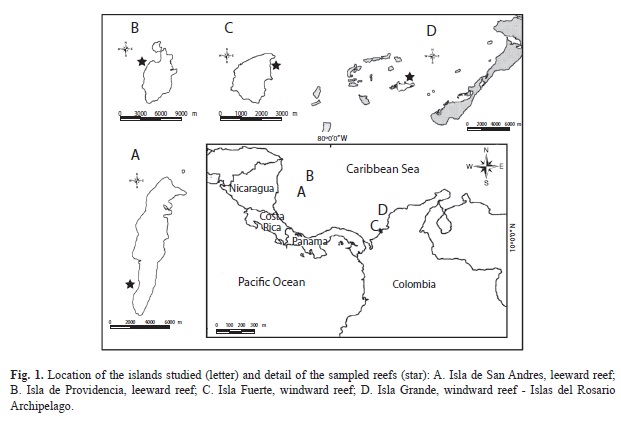
<body><![CDATA[ style="font-family: verdana;">Materials and methods</span></font><br      style="font-family: verdana;">     <font size="2"></font><br style="font-family: verdana;">     <font size="2"><span style="font-family: verdana;"><span      style="font-weight: bold;">Study area: </span>The study was conducted     in four insular reefs in the Colombian Caribbean </span></font><font      size="2"><span style="font-family: verdana;">(<a      href="/img/revistas/rbt/v60n3/a04i1.jpg">Fig. 1</a>), two on the     continental     shelf (Isla Fuerte and Isla Grande) subject to different levels of     ]]></body>
<body><![CDATA[disturbance caused by freshwater input from large rivers, and two on     the ocean platform (San Andres and Providencia).    <br>     </span></font><br style="font-family: verdana;">     <font size="2"><span style="font-family: verdana;"><span      style="font-weight: bold;">Continental shelf reefs:</span> Isla     Grande is part of the Islas del Rosario archipelago, located Southwest     of Cartagena in the Parque Nacional Natural Corales del Rosario and San     Bernardo. It is influenced by the Magdalena River (average flow=7     149.53m<sup>3</sup>/s, Garay 2001), which flows into the Canal del     ]]></body>
<body><![CDATA[Dique with an     average flow of 455.32m<sup>3</sup>/s (Garay 2001) and is the main     affluent of the     archipelago. The profile of the windward terraces (10&ordm;10&#8217;21&#8217;&#8217; N -     75&ordm;42&#8217;36&#8217;&#8217; W) is characterized by a reef crest less than 10m wide     and a slope with coral cover up to 25m. The reefs feature a     predominance of <span style="font-style: italic;">M. annularis</span>,     <span style="font-style: italic;">Agaricia tenuifolia</span> and <span      style="font-style: italic;">Porites     astreoides</span>, along with deteriorated coral patches of <span     ]]></body>
<body><![CDATA[ style="font-style: italic;">Acropora palmata</span>     and extensive coverage of macroalgae such as <span      style="font-style: italic;">Dictyota</span> spp. and <span      style="font-style: italic;">Halimeda</span>     spp. (Alvarado <span style="font-style: italic;">et al</span>. 1989).</span></font><br      style="font-family: verdana;">     <font size="2"></font><br style="font-family: verdana;">     <font size="2"><span style="font-family: verdana;">Isla Fuerte is part     of the Bajo     Bushnell and Bajo Burbujas reef complex (D&iacute;az <span     ]]></body>
<body><![CDATA[ style="font-style: italic;">et al</span>. 1996); it     is influenced by the following rivers: the Sin&uacute; (average     flow=290.8m<sup>3</sup>/s, Garay 2001), the Atrato (average flow=2     366.13m<sup>3</sup>/s,     Garay 2001) and the Magdalena (7 149.53m<sup>3</sup>/s, Garay 2001).     The windward     zone (9&ordm;23&#8217;15.6&#8217;&#8217; N - 76&ordm;10&#8217;10.1&#8217;&#8217; W) has a terrace formed by     a fringing reef up to a depth of 20m, followed by a sandy bottom, with     a coral zonation typical of the Caribbean (D&iacute;az <span      style="font-style: italic;">et al</span>. 2000),     ]]></body>
<body><![CDATA[with high algal growth (<span style="font-style: italic;">Dictyota</span>     spp.) and the accumulation of     extremely fine sediment (siltclay). The annual loss rate by species or     genus in continental reefs, caused by sedimentation and pollution has     been estimated at 0.4-2.2% (Acosta &amp; Mart&iacute;nez 2006).</span></font><br      style="font-family: verdana;">     <font size="2"></font><br style="font-family: verdana;">     <font size="2"><span style="font-family: verdana;"><span      style="font-weight: bold;">Ocean platform reefs:</span> Sampling was     conducted west of San Andres and Providencia, at coordinates     ]]></body>
<body><![CDATA[12&ordm;30&#8217;01&#8217;&#8217; N - 81&ordm;45&#8217;56&#8217;&#8217; W and 13&ordm;23&#8217;54.6&#8217;&#8217; N -     81&ordm;23&#8217;57&#8217;&#8217; W, respectively. The best coral formations in San     Andres are found on the leeward terraces (fringing reef). The shallow     terrace features a calcareous pavement with areas exposed or covered     with algae, corals, octocorals and scattered sponges. The submerged     terrace is a sandy plain where at a depth of 12m we find a coral carpet     of <span style="font-style: italic;">Dendrogyra cylindrus</span>, <span      style="font-style: italic;">Diploria labyrinthiformis</span>, <span      style="font-style: italic;">D. strigosa</span>,     <span style="font-style: italic;">Colpophyllia natans</span> and <span     ]]></body>
<body><![CDATA[ style="font-style: italic;">Montastraea</span> (D&iacute;az <span      style="font-style: italic;">et al</span>. 1995). The     latter terrace ends abruptly at 20-22m with an inclined coral covered     slope and sediment to 30-35m (D&iacute;az <span      style="font-style: italic;">et al</span>. 1995, Acosta &amp;     Mart&iacute;nez 2006).</span></font><br style="font-family: verdana;">     <font size="2"></font><br style="font-family: verdana;">     <font size="2"><span style="font-family: verdana;">Leeward in     Providence has a broad     lagoon terrace covered with sediment and sea grass areas. The shallow     ]]></body>
<body><![CDATA[zone is strewn with skeletons of <span style="font-style: italic;">Acropora     palmata</span>, <span style="font-style: italic;">Millepora     complanata</span>, zoanthids, and fleshy and coralline algae. The     fore-reef     terrace (12-15m) has an assortment of corals, predominantly of the     Diploria spp., <span style="font-style: italic;">M. annularis</span>, <span      style="font-style: italic;">Dichocoenia stokesi</span>, <span      style="font-style: italic;">P. astreoides</span>     species, as well as octocorals, while in deeper waters, the coverage of     <span style="font-style: italic;">Montastraea cavernosa</span>, <span     ]]></body>
<body><![CDATA[ style="font-style: italic;">M. annularis</span>, <span      style="font-style: italic;">D. labyrinthiformis</span> and <span      style="font-style: italic;">C. natans</span>     increases, as well as the presence of sponges and octocorals     (D&iacute;az <span style="font-style: italic;">et al</span>. 2000).     Coral coverage on the slope decreases     rapidly (Acosta &amp; Mart&iacute;nez 2006).</span></font><br      style="font-family: verdana;">     <font size="2"></font><br style="font-family: verdana;">     <font size="2"><span style="font-family: verdana;"><span     ]]></body>
<body><![CDATA[ style="font-weight: bold;">Sampling:</span> A line was traced from     the deepest point (maximum 30m), where the reef ends or the sandy     bottom begins, to the coast, in areas of the most thriving coral reefs     (richness, coral coverage). Perpendicular to this line and at     increasing depths of 2m, 12 quadrants of 1m<sup>2</sup> were measured,     six on each     side of the line and 1m from each other (following Vidal <span      style="font-style: italic;">et al</span>. 2005);     this procedure was repeated along the entire length of the reef depth     gradient. The transects were grouped by depth in four categories     ]]></body>
<body><![CDATA[(Acosta <span style="font-style: italic;">et al</span>. 2011): 1-     Shallow (2, 4, 6 and 8m), 2- Medium (10, 12,     14 and 16m), 3- Deep (18, 20, 22 and 24m) and 4- Very deep (<span      style="text-decoration: underline;">&gt;</span>26m),     the latter only found in oceanic reefs, totaling 600m<sup>2</sup>     sampled.     Juveniles were defined as colonies of less than 4cm in diameter for     large species (diameter<span style="text-decoration: underline;">&gt;</span>15cm)     such as <span style="font-style: italic;">Montastraea</span> spp.,     Diploria     ]]></body>
<body><![CDATA[spp. and <span style="font-style: italic;">S. siderea</span>l (Bak     &amp; Engel 1979, Richmond &amp; Hunter 1990,     Due&ntilde;as <span style="font-style: italic;">et al</span>. 2010);     and 2cm in diameter for small species     (diameter&lt;15cm), such as <span style="font-style: italic;">P.     astreoides</span> and <span style="font-style: italic;">Favia fragum</span>.     Taxonomic     identification was done according to the Due&ntilde;as <span      style="font-style: italic;">et al</span>. (2010)     guide.</span></font><br style="font-family: verdana;">     ]]></body>
<body><![CDATA[<font size="2"></font><br style="font-family: verdana;">     <font size="2"><span style="font-family: verdana;">As the number of     species and     juveniles per quadrant was recorded, the physical and biological     characteristics of the habitat in which each one of the juveniles was     found were described as follows: 1- Location of the reef on the     platform; 2- Range of depth; 3- Type of substrate colonized by the     juvenile; 4- Substrate inclination on which the juvenile was found; 5-     Juvenile&#8217;s exposure to light; 6- Texture of the sediment accumulated on     the substrate around the juvenile; 7- Amount of accumulated sediment on     ]]></body>
<body><![CDATA[the bottom, around the juvenile; 8- Potential space around the juvenile     for growth. See <a href="/img/revistas/rbt/v60n3/a04t1.gif">table 1</a>     for further details on classification and     measurement criteria for each variable.</span></font><span      style="font-family: verdana;">    <br>     <br style="font-family: verdana;">     </span><font size="2"><span style="font-family: verdana;">The 3 000     juveniles     and 45 species     ]]></body>
<body><![CDATA[presenting recruitment were used to conduct an exploratory analysis of     the absolute frequencies of all juveniles in the four coral reefs; the     aim was to identify the most common species that had a sampling error     less than or equal to 10%, and 95% confidence, using the formula of     Pita (1996): E=(Z<span style="font-style: italic;">&#945;</span><sup>2</sup>)(pq)/n,     where Z<span style="font-style: italic;">&#945;</span>=1.96 at 95%     confidence,     p=percentage of the community expected to be sampled (75%), q=1-p,     n=sample size (total number of individuals per species). These species     were <span style="font-style: italic;">Agaricia</span> agaricites, <span     ]]></body>
<body><![CDATA[ style="font-style: italic;">Leptoseris cucullata</span>, <span      style="font-style: italic;">P. astreoides</span>, <span      style="font-style: italic;">S.     siderea</span>, <span style="font-style: italic;">F. fragum</span>, <span      style="font-style: italic;">Scolymia</span> spp., <span      style="font-style: italic;">A. lamarcki</span>, <span      style="font-style: italic;">M. cavernosa</span>, <span      style="font-style: italic;">A.     fragilis</span>, <span style="font-style: italic;">P. porites</span>, <span      style="font-style: italic;">S. radians</span> and <span     ]]></body>
<body><![CDATA[ style="font-style: italic;">A. tenuifolia</span>. These 12 species     were used to analyze the pattern of dependencies between juveniles and     the characteristics of their habitat, by employing the chi-square (X<sup>2</sup>)     test for contingency tables (CT). The Yates continuity correction was     used on 2x2 CT. When at maximum 20% of the table cells had an expected     frequency under five, we applied Fisher&#8217;s exact test. However, the     proper application of the X<sup>2</sup> test to <span      style="font-style: italic;">Scolymia</span> spp., <span      style="font-style: italic;">A. fragilis </span>and <span      style="font-style: italic;">S.     ]]></body>
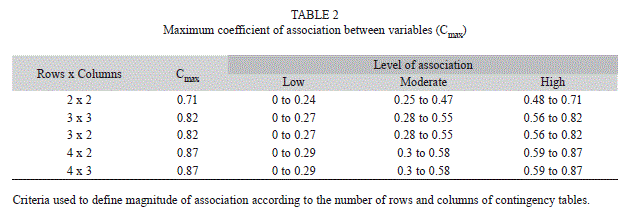
<body><![CDATA[radians</span> was impossible, as more than 20% of the cells in the     contingency tables continuously resulted in frequencies equal to zero;     consequently, they were excluded from the analysis. For the nine     remaining species, in cases where H<sub>0</sub> was rejected     (independence of     variables), we calculated the contingency coefficient (C) to determine     the extent of dependence. This&nbsp; coefficient ranged between zero     and a maximum value of association (C<sub>maximum</sub>) which     corresponds to the     number of categories of the variables that were evaluated. Values     ]]></body>
<body><![CDATA[closer to zero were considered of low association between the variables     and those that came closest to its C<sub>maximum</sub> as a high     association     (<a href="/img/revistas/rbt/v60n3/a04t2.gif">Table 2</a>). Not all     combinations of variables were tested; when crossing     certain categories of independent variables in the CT some had     frequencies of zero and expected frequencies under five, this precluded     the application of the test. Subsequently, a multiple correspondence     analysis (MCA) was used to reduce variable information to two     dimensions on a Cartesian plane (D&iacute;az 2002), graphically     ]]></body>
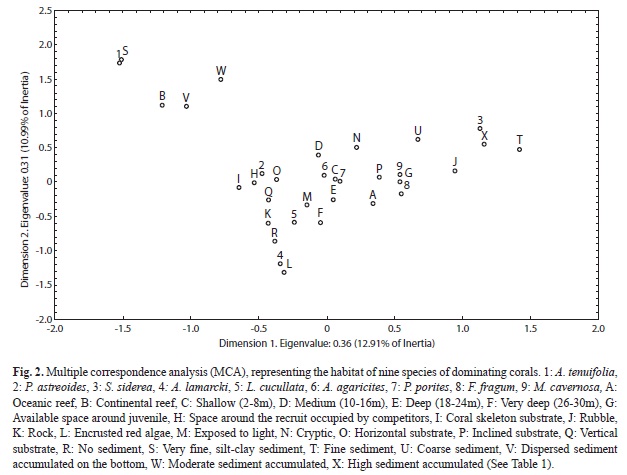
<body><![CDATA[representing the association of the variables with the species.</span></font><br      style="font-family: verdana;">     <font size="2"></font><br style="font-family: verdana;">     <font style="font-weight: bold;" size="3"><span      style="font-family: verdana;">Results</span></font><br      style="font-family: verdana;">     <font size="2"></font><br style="font-family: verdana;">     <font size="2"><span style="font-family: verdana;">The X<sup>2</sup>     test (p&lt;0.05) and the MCA     (<a href="/img/revistas/rbt/v60n3/a04i2.jpg">Fig. 2</a>) evidenced the     ]]></body>
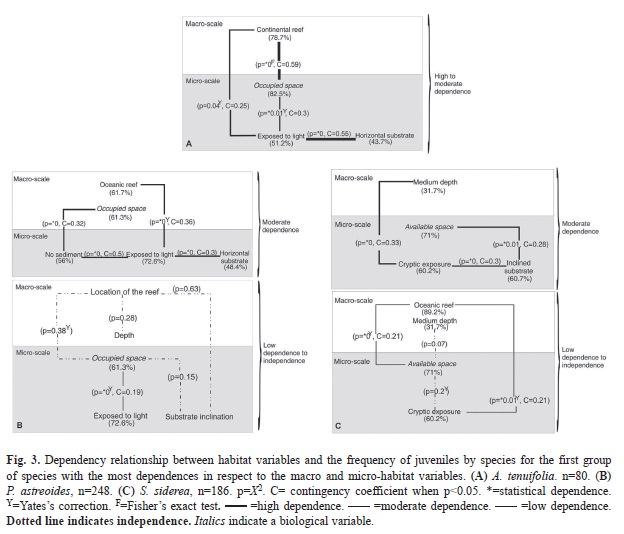
<body><![CDATA[most robust pattern of dependency in juveniles     of <span style="font-style: italic;">A. tenuifolia</span>. Only this     species showed a significantly high     dependence (CT 2x2, C=0.59; <a href="/img/revistas/rbt/v60n3/a04i3.jpg">Fig.     3A</a>), between the frequency of     juveniles and habitats located in continental reefs and juveniles     surrounded by competitors (78.7% continental reefs and 82.5% with     macroalgae and corals). High dependence was also found among juveniles     on substrates exposed to light and those on horizontal substrates (CT     3x2, C=0.55; <a href="/img/revistas/rbt/v60n3/a04i3.jpg">Fig. 3A</a>).     ]]></body>
<body><![CDATA[Additionally, moderate dependence was found,     between juveniles in continental reefs, and juveniles found on     substrates exposed to light, and in turn, of those located on     substrates exposed to light with those sharing space with other     competitors (CT 2x2, C=0.25-0.3; <a      href="/img/revistas/rbt/v60n3/a04i3.jpg">Fig. 3A</a>). Graphically,     the MCA     illustrates how <span style="font-style: italic;">A. tenuifolia</span>     settled apart from other species, beside     the habitat with moderate to high silt-clay sediment in continental     ]]></body>
<body><![CDATA[reefs (10- 16m). It is the only species to have 75.2% of its juveniles     under these conditions (<a href="/img/revistas/rbt/v60n3/a04t3.gif">Table     3</a>).</span></font><br style="font-family: verdana;">     <font size="2"></font><br style="font-family: verdana;">     <font size="2"><span style="font-family: verdana;">The frequency of     juvenile <span style="font-style: italic;">P.     astreoides</span>, moderately depended (CT 2x2, 3x2 y 4x2, C=0.3-0.5;     <a href="/img/revistas/rbt/v60n3/a04i3.jpg">Fig.     3B</a>), on oceanic reefs (61.7%) with substrates exposed to light     (72.6%),     ]]></body>
<body><![CDATA[the latter with horizontal substrates (48.4 %) and non accumulated     sediment (56%); in the same way, habitats with non accumulated     sediment, but with competitors around the juveniles. The dependence on     substrates exposed to light and substrates without accumulated sediment     presented the highest value for the species (C=0.5).</span></font><br      style="font-family: verdana;">     <font size="2"></font><br style="font-family: verdana;">     <font size="2"><span style="font-family: verdana;">It was also     established that the     frequency of juvenile <span style="font-style: italic;">S. siderea</span>     ]]></body>
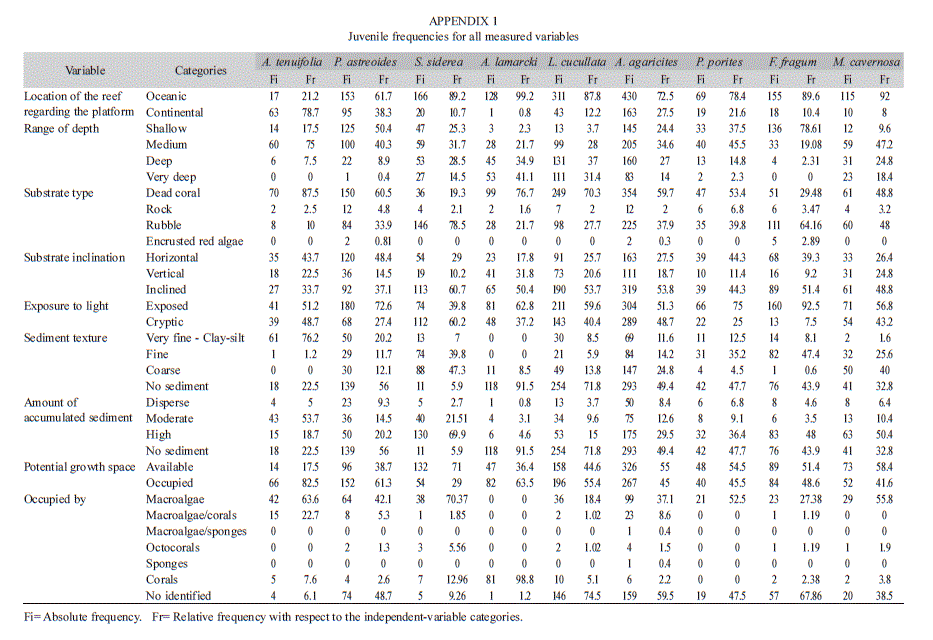
<body><![CDATA[on cryptic substratum (60.2%) depended     on its location at a depth of 10-16m (31.7%), on an inclined substrate     (60.7%), as well as juveniles on an inclined substrate devoid of     competitors (71%); all of these moderate dependences (CT 3x2 and 4x2,     C=0.28-0.33; <a href="/img/revistas/rbt/v60n3/a04i3.jpg">Fig. 3C</a>).     Graphically (by the MCA) it was established that     the higher frequency of juveniles of the species was on rubble-type     substrates (78.5%), cryptic (60.2%), of coarse and fine sediment (47.3%     and 39.8% respectively), accumulated in amounts greater than 1cm     (69.9%). See <a href="/img/revistas/rbt/v60n3/a04a1.gif">Appendix 1</a>     ]]></body>
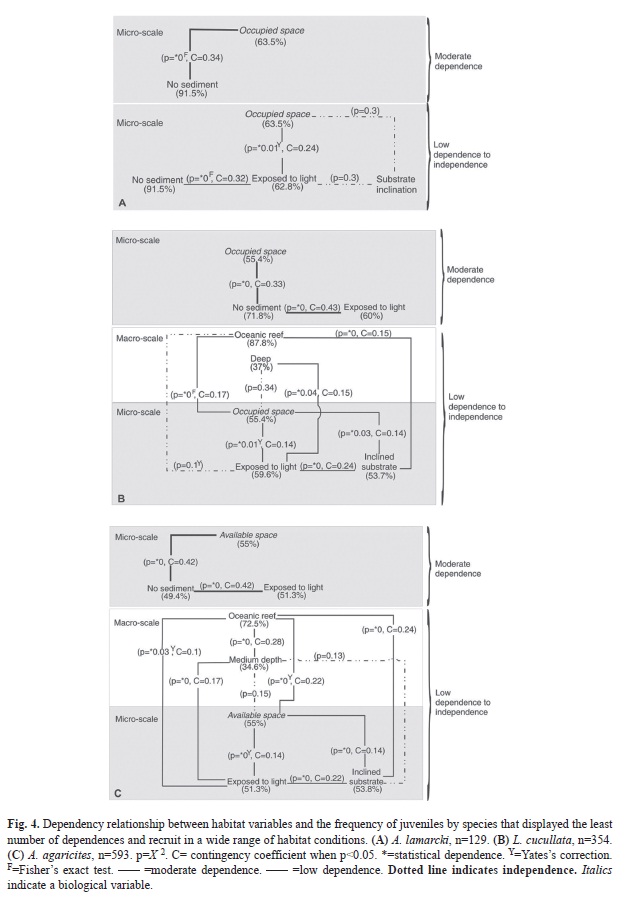
<body><![CDATA[for further details on species frequencies for     all measured variables.</span></font><br style="font-family: verdana;">     <font size="2"></font><br style="font-family: verdana;">     <font size="2"><span style="font-family: verdana;">The highest     frequency of <span style="font-style: italic;">A.     lamarcki</span> juveniles depended on substrates occupied by     competitors     (63.5%), with no sediment accumulated (91.5%) on substrate exposed to     light (62.8%). The magnitude of the dependence between variables ranged     from low to moderate (CT 2x2 and 4x2; C=0.24-0.34; <a     ]]></body>
<body><![CDATA[ href="/img/revistas/rbt/v60n3/a04i4.jpg">Fig. 4A</a>).     Graphically it was confirmed that the factor closest to <span      style="font-style: italic;">A. lamarcki</span> and     which determined the frequency of its juveniles, was the absence of     sediment on the substrate since, through the MCA, the species was     located apart from the other species. However, statistical independence     (X<sup>2</sup>, p&gt;0.05) was proved between light exposure and     inclination of     the substrate, and between the inclination of the substrate and space     for growth around the juveniles (<a     ]]></body>
<body><![CDATA[ href="/img/revistas/rbt/v60n3/a04i4.jpg">Fig.4A</a>). Abundance was     lowest in     continental reefs (0.8%) and at depths under 10m (2.3%).</span></font><br      style="font-family: verdana;">     <font size="2"></font><br style="font-family: verdana;">     <font size="2"><span style="font-family: verdana;">Like <span      style="font-style: italic;">P. astreoides</span>, juveniles of <span      style="font-style: italic;">L.     cucullata</span> and <span style="font-style: italic;">A. agaricites</span>     showed that despite being in a variety of     ]]></body>
<body><![CDATA[habitat conditions, as shown in the figures representing dependencies     between variables (<a href="/img/revistas/rbt/v60n3/a04i4.jpg">Fig. 4B</a>     and <a href="/img/revistas/rbt/v60n3/a04i4.jpg">4C</a>) and the MCA&#8217;s     two-dimensional plane,     the strongest dependence (moderate) was presented by juveniles in     substrate devoid of accumulated sediment and substrate exposed to     light; with 71.8% and 59.6% of <span style="font-style: italic;">L.     cucullata</span> juveniles under these     conditions (CT 4x2, C=0.43; <a href="/img/revistas/rbt/v60n3/a04i4.jpg">Fig.     4B</a>). Additionally, moderate dependence     ]]></body>
<body><![CDATA[was proven (CT 4x2, C=0.33; <a href="/img/revistas/rbt/v60n3/a04i4.jpg">Fig.     4B</a>) for <span style="font-style: italic;">L. cucullata</span>     between the     frequency of juveniles on non-sedimented substrates (71.8%) and     substrates occupied by competitors (55.4%). <span      style="font-style: italic;">A. agaricites</span> also showed     moderate dependence (CT 4x2, C=0.42; <a      href="/img/revistas/rbt/v60n3/a04i4.jpg">Fig. 4C</a>) between     non-sedimented     substrates (49.4%) and light availability (51.3%), and those without     ]]></body>
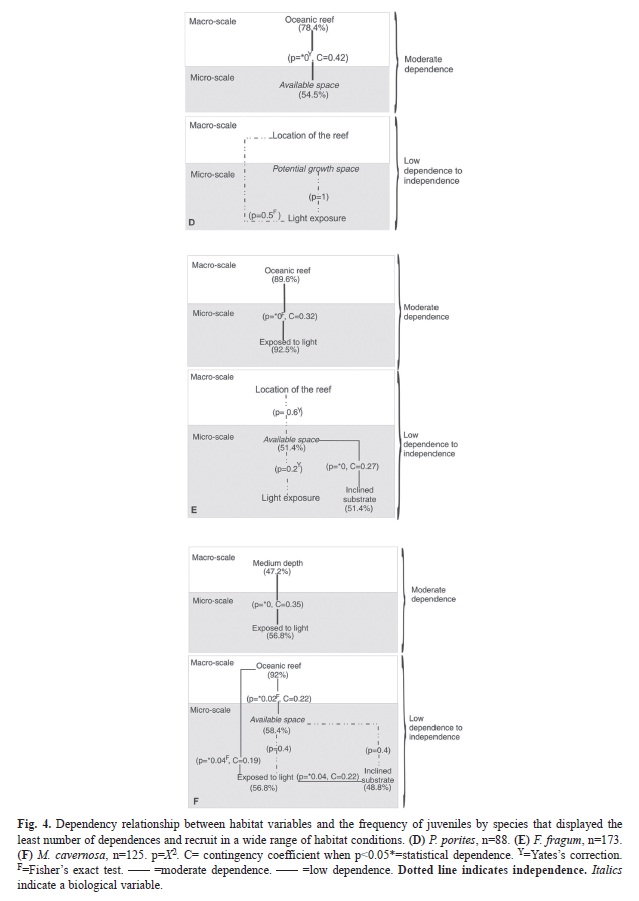
<body><![CDATA[sediment and no competitors (55%).</span></font><br      style="font-family: verdana;">     <font size="2"></font><br style="font-family: verdana;">     <font size="2"><span style="font-family: verdana;">The juveniles of <span      style="font-style: italic;">P. porites</span> showed     dependence on oceanic environments (78.4%) and microhabitats without     interaction or the presence of other sessile organisms (54.5%), of     moderate dependence (CT 2x2; C=0.42; <a      href="/img/revistas/rbt/v60n3/a04i5.jpg">Fig. 4D</a>). Independence     between its     ]]></body>
<body><![CDATA[location in the reef and light exposure (X<sup>2</sup>, p&gt;0.05) was     proven for     this species.</span></font><br style="font-family: verdana;">     <font size="2"></font><br style="font-family: verdana;">     <font size="2"><span style="font-family: verdana;">As for <span      style="font-style: italic;">F. fragum</span>, we found that the     abundance of juveniles depended on ocean reefs (89.6%) and substrates     exposed to light (92.5%) of moderate intensity (CT 2x2; C=0.32; <a      href="/img/revistas/rbt/v60n3/a04i5.jpg">Fig.     4E</a>). The species was abundant at depths under 16m and on rubble,     ]]></body>
<body><![CDATA[but     lower in habitats with coarse sediment (<a      href="/img/revistas/rbt/v60n3/a04a1.gif">Appendix 1</a>). However,     statistical independence was confirmed between the location of the reef     and the potential space available for juvenile growth, and the latter     with light exposure (X<sup>2</sup>, p&gt;0.05).</span></font><br      style="font-family: verdana;">     <font size="2"></font><br style="font-family: verdana;">     <font size="2"><span style="font-family: verdana;">The juveniles of<span      style="font-style: italic;"> M. cavernosa     ]]></body>
<body><![CDATA[</span>showed moderate dependence (CT 4x2; C=0.35; <a      href="/img/revistas/rbt/v60n3/a04i5.jpg">Fig. 4F</a>) on     substrates     exposed to light (56.8%), at depths of 10-16m (47.2%). In addition, the     independence between light exposure and the potential space to grow was     established, and the latter with substrate inclination (X<sup>2</sup>,     p&gt;0.05).</span></font><br style="font-family: verdana;">     <font size="2"></font><br style="font-family: verdana;">     <font size="2"><span style="font-family: verdana;">While juveniles of     species such as     ]]></body>
<body><![CDATA[A. tenuifolia and <span style="font-style: italic;">S. siderea</span>,     were most abundant in environments with     accumulated sediment, the strongest relationships (higher frequency of     juveniles) for <span style="font-style: italic;">A. lamarcki</span>, <span      style="font-style: italic;">P. astreoides</span>, <span      style="font-style: italic;">L. cucullata</span> and <span      style="font-style: italic;">A.     agaricites</span> juveniles, were present in micro-habitats exposed to     light     and without sediment accumulation around juveniles; this evidenced that     ]]></body>
<body><![CDATA[the frequency of juveniles of some species increased in environments of     low accumulated sediment.</span></font><br style="font-family: verdana;">     <font size="2"></font><br style="font-family: verdana;">     <font size="2"><span style="font-family: verdana;"><span      style="font-style: italic;">L. cucullata</span>, <span      style="font-style: italic;">A. agaricites</span>, <span      style="font-style: italic;">P.     porites</span>, F. fragum and <span style="font-style: italic;">M.     cavernosa</span> were grouped within the MCA plane,     amid many categories of the different physical and biological variables     ]]></body>
<body><![CDATA[of the habitat and the dependences tested were mostly of low magnitude     (none of these species showed high dependence). Homogeneous frequencies     between the different categories of each factor confirm that juveniles     of these species can be effectively found under diverse habitat     conditions (tolerant).</span></font><br style="font-family: verdana;">     <font size="2"></font><br style="font-family: verdana;">     <font style="font-weight: bold;" size="3"><span      style="font-family: verdana;">Discussion</span></font><br      style="font-family: verdana;">     <font size="2"></font><br style="font-family: verdana;">     ]]></body>
<body><![CDATA[<font size="2"><span style="font-family: verdana;">These results     suggest that the     frequency, abundance and survival of juvenile hermatypic corals in     insular reefs of the Colombian Caribbean are affected by physical and     biological features of their environment and that they depend on     certain peculiarities of the habitat, which are species-specific.     According to the characteristics of relationships and the number of     dependences of moderate to high magnitude, the following two groups of     species were recognized: 1- species with the highest number of     dependences (3-4) with regard to the macro and micro-habitat variables     ]]></body>
<body><![CDATA[(<span style="font-style: italic;">A. tenuifolia</span>, <span      style="font-style: italic;">P. astreoides</span> and <span      style="font-style: italic;">S. siderea</span>) and species that     displayed the least number of dependences (1-2) and recruit in a wide     range of habitat conditions (<span style="font-style: italic;">A.     lamarcki</span>,<span style="font-style: italic;"> L. cucullata</span>,     <span style="font-style: italic;">A. agaricites</span>,     <span style="font-style: italic;">P. porites</span>, <span      style="font-style: italic;">F</span>. <span      style="font-style: italic;">fragum</span> and <span     ]]></body>
<body><![CDATA[ style="font-style: italic;">M. cavernosa</span>).</span></font><br      style="font-family: verdana;">     <font size="2"></font><br style="font-family: verdana;">     <font size="2"><span style="font-family: verdana;">The mechanism that     describes the     dependence of juveniles on certain habitat categories and variables     could be simply explained as the balance between larval input where the     larvae perform or not a selection within the spectrum of habitat     conditions and provide a new individual to the population, and the     output to the system generated by the differential mortality of     ]]></body>
<body><![CDATA[juveniles (natural selection), where ultimately, one of the habitat     categories evaluated is favored (disproportionate number of juveniles).     Following are two scenarios where this would happen: 1. The combination     of high habitat selection by the larva, that is, it requires a specific     resource or habitat condition (population&#8217;s habitat preference), and     low post-settlement differential mortality in that specific habitat     where juveniles frequently occur (Mundy &amp; Babcock 1998,     Ruiz-Z&aacute;rate <span style="font-style: italic;">et al</span>.     2000, Harrington <span style="font-style: italic;">et al</span>.     2004), 2. No larval     ]]></body>
<body><![CDATA[selection, random or similar colonization in all habitat categories     evaluated (Mundy &amp; Babcock 2000, Vermeij <span      style="font-style: italic;">et al</span>. 2006) and strong     selection pressure in all but one of the habitat categories, which     would explain the dependence identified. In turn, larval substrate     selection depends on habitat characteristics (quality, quantity and     resource availability) and conditions of the environment, which have     not been quantified for any species, in the reefs assessed. Meanwhile,     the number of larvae reaching a system depends on population size,     number of reproductive individuals, reproductive effort (Alvarado &amp;     ]]></body>
<body><![CDATA[Acosta 2009); strategy and mode of sexual reproduction of each species     (Miller &amp; Barimo 2001), and type of larva and dispersion rate vs.     self-seeding (Sale <span style="font-style: italic;">et al</span>.     2010). Also, the natural selection that     occurs in larval stages, affects the settlement and metamorphosis     (Mundy &amp; Babcock 2000, Baird <span style="font-style: italic;">et     al</span>. 2003) and later post-settlement     (Vermeij <span style="font-style: italic;">et al</span>. 2006, Victor     2008). The complexity of the variables     involved and the lack of understanding regarding the early life stages     ]]></body>
<body><![CDATA[of the species make discussion on the findings difficult.</span></font><br      style="font-family: verdana;">     <font size="2"></font><br style="font-family: verdana;">     <font size="2"><span style="font-family: verdana;">The independence     between habitat     variables and the abundance of juveniles could be explained by the     combination of the following: 1. Absence of larval selection or     opportunistic behavior at the time of settlement (Vermeij <span      style="font-style: italic;">et al</span>. 2006),     concurrently with low natural selection of juveniles within the     ]]></body>
<body><![CDATA[categories of the variable; 2. High preference for one habitat category     (Mundy &amp; Babcock 1998, 2000) and natural selection directed on that     category presenting most frequency of juveniles, which would generate     an equilibrium in frequency among the categories of the variable     compared, and therefore, independence. The results reflect the     adaptation and high tolerance of juvenile coral to numerous habitat     factors, which allows for their survival (Baird <span      style="font-style: italic;">et al</span>. 2003) in a     system with high spatial heterogeneity and where resources and     conditions are distributed in patches or follow a gradient.</span></font><br     ]]></body>
<body><![CDATA[ style="font-family: verdana;">     <font size="2"></font><br style="font-family: verdana;">     <font size="2"><span style="font-family: verdana;">Some of the traits     most relevant to     the higher survival rate of coral species are: high phenotypic     plasticity, which confers them tolerance to various conditions of the     environment (Miller &amp; Barimo 2001, Green <span      style="font-style: italic;">et al</span>. 2008) and     resistance to changes in habitat conditions (Lirman &amp; Manzello     2009), efficiency in the removal of accumulated sediment (mostly by     ]]></body>
<body><![CDATA[massive or foliar growth, Huitric &amp; McField 2001), a high energy     investment to protect and reduce possible inter-specific competition     for potential growth space (Green <span style="font-style: italic;">et     al</span>. 2008); rapid colonization of     empty substrates as a result of a high investment in sexual     reproduction and periodic release of planulae resistant to limiting     resources (Smith 1997, Kramer 2003). These strategies are likely to     provide them predominance as an adult and even as a youth in many     regions of the world (Smith 1997). The graphic association (on the MCA)     of species of the second group with various habitat factors confirms     ]]></body>
<body><![CDATA[the almost homogeneous distribution and frequency of juveniles under     different conditions of the environment and its evidence of tolerance.</span></font><br      style="font-family: verdana;">     <font size="2"></font><br style="font-family: verdana;">     <font size="2"><span style="font-family: verdana;">The robust pattern     of high and     moderate dependences displayed by <span style="font-style: italic;">A.     tenuifolia</span> could be accounted by     their life history traits and their ability to withstand extreme     conditions. Its vertical growth could provide an advantage by     ]]></body>
<body><![CDATA[minimizing the effects of continental sediment and capturing sufficient     light in areas presenting algal growth (Aronso <span      style="font-style: italic;">et al</span>. 2004).</span></font><br      style="font-family: verdana;">     <font size="2"></font><br style="font-family: verdana;">     <font size="2"><span style="font-family: verdana;">The combination of     turbidity, high     sedimentation rate and increased nutrient concentrations, typical of     continental reefs in this region (Aronso <span      style="font-style: italic;">et al</span>. 2004, Gardner <span     ]]></body>
<body><![CDATA[ style="font-style: italic;">et al</span>.     2003, Acosta &amp; Mart&iacute;nez 2006) especially of Isla Fuerte,     favors the proliferation of macroalgae and decreases substrate     availability for coral recruitment. Because it is a brooder and has a     high level of reproductive effort and tolerance to adverse mediums,<span      style="font-style: italic;"> A.     tenuifolia</span> has been able to rapidly colonize empty substrates     and     increase their recruitment (Hughes &amp; Jackson 1985). As a result,     the presence of <span style="font-style: italic;">A. tenuifolia</span>     ]]></body>
<body><![CDATA[juveniles and adults has been favored by     conditions that predominate in Caribbean reefs, where it is the most     abundant and has replaced <span style="font-style: italic;">Porites</span>     sp. in recent decades (Aronso <span style="font-style: italic;">et al</span>.     2004). The low number of <span style="font-style: italic;">A.     tenuifolia</span> juveniles in ocean reefs, where     there is adequate numbers of adult reproductive individuals and where     sedimentation is lower, may suggest that the species is a better     competitor in stressful conditions, such as in areas with high     silt-clay sediment (Miller &amp; Barimo 2001), or that this ocean reef     ]]></body>
<body><![CDATA[habitat type was not available at the time of larval selection and     settlement (Edmunds 2004).</span></font><br      style="font-family: verdana;">     <font size="2"></font><br style="font-family: verdana;">     <font size="2"><span style="font-family: verdana;"><span      style="font-style: italic;">P. astreoides</span>&#8217; light requirements     are consistent with the high frequency of juveniles in horizontal     locations, exposed to light, in clear water ocean reefs and recruitment     at shallow depths (Vidal <span style="font-style: italic;">et al</span>.     2005). Cofforth (1985) and Miller <span style="font-style: italic;">et     ]]></body>
<body><![CDATA[al</span>. (2000) assert that <span style="font-style: italic;">P.     astreoides</span> invest high levels of energy in     protection and competition, producing mucus and presenting a gregarious     behavior, which reduces possible cases of inter-specific competition     and aggression by algae, giving them a higher rate of survival (Green     <span style="font-style: italic;">et al</span>. 2008). This strategy     and the colonization of substrates devoid     of sediment accumulation or with strong hydrodynamics, produces a lower     energy expenditure for cleaning, energy that it can invest in     competition with macroalgae such as<span style="font-style: italic;">     ]]></body>
<body><![CDATA[Lobophora</span> sp. and sp.,     which occupy 12-15% of the substrate (Alvarado &amp; Acosta 2009).     Although Miller &amp; Barimo (2001) and Green <span      style="font-style: italic;">Halimedaet al</span>. (2008) state that     <span style="font-style: italic;">P. astreoides</span> is tolerant to     different physical and biological     habitats, juveniles appear to show specificity to habitat factors.</span></font><br      style="font-family: verdana;">     <font size="2"></font><br style="font-family: verdana;">     <font size="2"><span style="font-family: verdana;">The favorable     ]]></body>
<body><![CDATA[relationship of <span style="font-style: italic;">S.     siderea</span>l juveniles and cryptic locations, inclined substrates     and the     lack of competitors could reveal the strategy employed by the larvae to     colonize crevices, clefts and holes. This occurs when the larvae are     faced with limitations of settlement substrate (e.g. due to high algal     cover). This type of environment is abundant in ocean reefs at depths     between 10-16m, where the reef has higher rugosity and presents a 3D     structure. The amount of coarse and fine sediment accumulated in holes     (greater than 1cm) presents a disadvantage for juveniles in this type     ]]></body>
<body><![CDATA[of habitat as it may causes larvae to settle and recruit on inclined     sections, precisely where the highest frequency of juveniles was     observed. Smith (1997) proposes that <span style="font-style: italic;">S.     siderea</span> boasts a resistance to     sedimentation, which probably gives it an advantage to settle in holes     or rubble, as shown in the MCA in this study. Another disadvantage     caused by the crevices is the reduction of direct light necessary for     juvenile growth, which in turn is advantageous since it repels     macroalgae and prevents the expenditure of energy on competition.     Barrios (2000) stresses the high sensitivity of <span     ]]></body>
<body><![CDATA[ style="font-style: italic;">S. siderea</span> juvenile to     the aggression of other sessile organisms. However, although it has     been proposed that <span style="font-style: italic;">S. siderea</span>     is an indicator species for pollution and     sedimentation (Guzm&aacute;n &amp; Jim&eacute;nez 1992), juveniles were     scarce in continental environments where these factors are present,     this may be due to low roughness and 3D structure of the system to     recruit, a small number of adults and hence low reproductive effort of     this spawner species, as Alvarado &amp; Acosta (2009) found with lower     number of gamets for <span style="font-style: italic;">M. annularis</span>     ]]></body>
<body><![CDATA[in Isla Grande, Colombian Caribbean,     or due to lower larval survival in the water column by factors such as     low salinity.</span></font><br style="font-family: verdana;">     <font size="2"></font><br style="font-family: verdana;">     <font size="2"><span style="font-family: verdana;">For its part, the     dependence of     juvenile <span style="font-style: italic;">A. lamarcki</span>, <span      style="font-style: italic;">L. cucullata</span> and <span      style="font-style: italic;">A. agaricites</span> on a     non-sedimented bottom, exposed to light and ocean reef habitats,     ]]></body>
<body><![CDATA[reveals that recruitment and survival is lower in degraded areas     (Hughes 1985), influenced by rivers. These species may secure the     energy investment made by the larva during settlement, by locating     itself specifically in areas sheltered from sediment (Hughes &amp;     Tanner 2000). Despite the slow colonization of new areas by <span      style="font-style: italic;">A. lamarcki</span>     larvae, this species has high survival rate (Hughes 1988), higher than     even <span style="font-style: italic;">A. agaricites</span> and <span      style="font-style: italic;">L. cucullata</span>, the dominant species     of juveniles     ]]></body>
<body><![CDATA[in this study (593 and 354 juveniles, respectively) and in most     Caribbean reefs (Hughes 1988, Kramer 2003). This potentially allows the     species to maintain stable populations in areas with low sedimentation     rate in the Colombian Caribbean, in areas like reef terraces presenting     high hydrodynamic or a high gradient slope. The horizontal form in     which these species grow explains their dependence on habitats exposed     to light and for <span style="font-style: italic;">A. lamarcki</span>,     the monopolization of substrate indeep     oceanic reefs the interaction with corals of the same species. Among     all the species, <span style="font-style: italic;">A. agaricites</span>     ]]></body>
<body><![CDATA[is the most proficient at recruitment;     it colonizes different microhabitats at depths ranging from 2-30m and     can endure a broad spectrum of conditions in the environment (Vidal <span      style="font-style: italic;">et     al</span>. 2005), in agreement with Chiappone &amp; Sullivan (1996) and     the     study by Edmunds (2000) in Florida and St. John &#8211; Virgin Islands,     respectively.</span></font><br style="font-family: verdana;">     <font size="2"></font><br style="font-family: verdana;">     <font size="2"><span style="font-family: verdana;">Juvenile <span     ]]></body>
<body><![CDATA[ style="font-style: italic;">P. porites</span>, F. fragum and     M. cavernosa had a dependence on ocean reefs, a microhabitat exposed to     light and unoccupied by competitors. The susceptibility of <span      style="font-style: italic;">P. porites</span>     to competition with macroalgae may explain its requirement to colonize     spaces without competitors and with direct light. River &amp; Edmunds     (2001) assert that the growth rate of <span style="font-style: italic;">P.     porites</span> decreases up to 80%     when surrounded by macroalgae. Contrary to Lewis (1974), who found that     most larvae colonize cryptic sites, displaying a gregarious behavior by     ]]></body>
<body><![CDATA[juveniles and adults, the presence of F. fragum juveniles was detected     on coral rubble, in shallow terraces exposed to light and unoccupied by     competitors. In turn, juveniles of M. cavernosa were associated with     environments presenting high sediment load (60.8%). Their massive shape     makes it more resistant to wave action and more efficient in the     removal of sediments (Huitric &amp; McField 2001, Mart&iacute;nez &amp;     Acosta 2005). Its relatively low recruitment rate (Smith 1997) is     offset by an increase in its inter and intra-specific aggression     (Hughes &amp; Jackson 1985); this allows it to compete for potential     growth-space. These survival strategies provide it dominance in many     ]]></body>
<body><![CDATA[regions, as an adult (Martinez &amp; Acosta 2005) and even as a     juvenile.</span></font><br style="font-family: verdana;">     <font size="2"></font><br style="font-family: verdana;">     <font size="2"><span style="font-family: verdana;">Although the     variables assessed     here are those considered as critical to the recruitment of hermatypic     corals in Caribbean reefs, exploring and evaluating other biotic     (foraging) and abiotic factors of the habitat is essential, given the     dependence of the species on specific factors. Moreover, the diverse     causes of the observed patterns of dependency and the synergy between     ]]></body>
<body><![CDATA[larval selection behavior and natural selection factors should also be     investigated. This study presents an examination of the entire juvenile     coral community; however, more detailed studies by species are     necessary, particularly those that are rare, vulnerable and spawners     with low fertility/fecundity rates and growth. In order to find     possible dependences and associations not detected in this study and     apply statistical independence analyses to other species, it is     recommended a minimum sampling size of 100-150 juveniles/species.</span></font><br      style="font-family: verdana;">     <font size="2"></font><br style="font-family: verdana;">     ]]></body>
<body><![CDATA[<font size="2"><span style="font-family: verdana;">The density of     juveniles found is     not considered sufficient to replace the dying adults in the reefs     studied; this makes juvenile richness and density very low when     compared to that of adult corals (Acosta <span      style="font-style: italic;">et al</span>. 2011). As the fitness     of coral species decreases because of recruitment failure, so does the     resilience of the reef, its recovery and populations&#8217; viability (Sale     <span style="font-style: italic;">et al</span>. 2010). Seven of the     most active species in recruitment were     ]]></body>
<body><![CDATA[brooders, with the exception of M. cavernosa and <span      style="font-style: italic;">S. siderea</span>, which as     Carlon (2002) proposes, may be an indication of a potential change in     dominance of the coral assemblage from building species for shortlived     brooding species (juvenile <span style="font-style: italic;">A.     agaricites</span>, <span style="font-style: italic;">L. cucullata</span>     and <span style="font-style: italic;">P.     astreoides</span>). The low recruitment and the poor recovery of     populations     in the system also facilitate a community shift in continental reefs     ]]></body>
<body><![CDATA[(algae for corals), as is the case in shallow areas of Isla Grande     (Alvarado &amp; Acosta 2009, Acosta <span style="font-style: italic;">et     al</span>. 2011).</span></font><br style="font-family: verdana;">     <font size="2"></font><br style="font-family: verdana;">     <font size="2"><span style="font-family: verdana;">The reality of     Caribbean reefs is     the great decline caused by anthropic disturbance and inland waters     that increase the direct input of sediment and nutrients. This     according to Alvarado &amp; Acosta (2009) creates stress, population     mortality, reduction in colony size, low number of breeding     ]]></body>
<body><![CDATA[individuals, low reproductive output, lower quality and limited     availability of habitat for larval selection (Montenegro &amp; Acosta     2008, 2010), random settlement (Mundy &amp; Babcock 2000, Vermeij <span      style="font-style: italic;">et     al</span>. 2006), recruitment in sub-optimal locations and     postsettlement     mortality (Fabricius 2005, Vermeij <span style="font-style: italic;">et     al</span>. 2006, Victor 2008) and     consequently, low recruitment (Acosta <span style="font-style: italic;">et     al</span>. 2011). To achieve     ]]></body>
<body><![CDATA[successful coral recruitment, the favorable or ideal environment would     occur in oceanic islands or areas not exposed to the effect of rivers,     with good visibility, availability of dead coral for settlement, in a     wide range of depths to set up the assembly of coral, inclined     microhabitats that receive plenty of direct light, with not accumulated     sediment and with low numbers of macroalgae or competitors. These     habitat requirements should be considered by the decision makers in     conservation efforts.</span></font><br style="font-family: verdana;">     <font size="2"></font><br style="font-family: verdana;">     <font size="2"><span style="font-family: verdana;">In conclusion, the     ]]></body>
<body><![CDATA[presence,     abundance and survival of juveniles depend on certain features of the     habitat, which are species-specific. However, the juveniles of six     species, mostly brooders, display specificity to one or two factors and     high tolerance to a wide range of variables of the habitat evaluated.     Most juveniles recruit on dead coral (except <span      style="font-style: italic;">S. siderea</span>l and F. fragum     on rubble), on inclined areas, exposed to direct light (except <span      style="font-style: italic;">S.     siderea</span> and species of the Agaricia genus, cryptic), where F.     ]]></body>
<body><![CDATA[fragum     and the <span style="font-style: italic;">Porites</span> genus are     highly dependent on light (abundant in     shallow and medium zones). This indicates the importance of clear water     with low turbidity (low concentration of dissolved and particulate     organic matter). Few species used rocky or encrusted red algae     substrates; this reflects their low number and availability. Similarly,     juveniles seem to prefer substrates where sediment does not accumulate,     particularly <span style="font-style: italic;">A. lamarcki</span> and <span      style="font-style: italic;">L. cucullata</span>, in contrast to what     ]]></body>
<body><![CDATA[was     observed for <span style="font-style: italic;">S. siderea</span>, A.     tenuifolia and M. cavernosa that tolerate     high sediment loads. Juveniles recruit and survive on substrates     occupied, primarily by macroalgae; this is evident for A. tenuifolia     and in a lesser degree for <span style="font-style: italic;">A.     lamarcki</span> and <span style="font-style: italic;">P. astreoides</span>,     while <span style="font-style: italic;">S.     siderea</span> displays the lowest number of interactions. Most species     use a     ]]></body>
<body><![CDATA[wide range of depths (two or three categories), or specific ranges     depending on their requirements and life history; juveniles of A.     tenuifolia are favored, specifically between 10-16m and F. fragum     between 2-8m. All species recruit disproportionately, in higher numbers     in oceanic reefs except for A. tenuifolia, which prefers continental     reefs, indicating that oceanic islands offer the best conditions for     recruitment.</span></font><br style="font-family: verdana;">     <font size="2"></font><br style="font-family: verdana;">     <font style="font-weight: bold;" size="3"><span      style="font-family: verdana;">Acknowledgments</span></font><br     ]]></body>
<body><![CDATA[ style="font-family: verdana;">     <font size="2"></font><br style="font-family: verdana;">     <font size="2"><span style="font-family: verdana;">To the Academic     Vice-rectory of the     Pontificia Universidad Javeriana that financed this project (0417;     4803), to Flavia C&aacute;rdenas, M&oacute;nica Sep&uacute;lveda,     Claudia Villamil and Andr&eacute;s Vidal for the field work that     yielded the data used in this study, as well as to Margarita     Ordo&ntilde;ez and Miguel Pinz&oacute;n for their statistical advice.     To Gypsy Espanol for the translation into the English version.     ]]></body>
<body><![CDATA[(Traducciones T&eacute;cnicas T y T; www.traduccionestyt.com).</span></font><br      style="font-family: verdana;">     <hr style="width: 100%; height: 2px;"><br style="font-family: verdana;">     <font style="font-weight: bold;" size="3"><span      style="font-family: verdana;">References</span></font><br      style="font-family: verdana;">     <br style="font-family: verdana;">     <font size="2"><span style="font-family: verdana;">Acosta, A. &amp; S.     Mart&iacute;nez. 2006. Continental and oceanic coral reefs in the     Colombian Caribbean after a decade of degradation. Proc. 10th Int.     ]]></body>
<body><![CDATA[<!-- ref -->Coral Reef Symp. 2: 1926-1930.    &nbsp;&nbsp;&nbsp;&nbsp;&nbsp;&nbsp;&nbsp;&nbsp;[&#160;<a href="javascript:void(0);" onclick="javascript: window.open('/scielo.php?script=sci_nlinks&ref=1461366&pid=S0034-7744201200030000400001&lng=','','width=640,height=500,resizable=yes,scrollbars=1,menubar=yes,');">Links</a>&#160;]<!-- end-ref --><!-- ref --></span></font><br  style="font-family: verdana;"> <br style="font-family: verdana;"> <font size="2"><span style="font-family: verdana;">Acosta, A., L.F. Due&ntilde;as &amp; V Pizarro. 2011. Review on hard coral recruitment (Cnidaria: Scleractinia) in Colombia. Univ. Sci. 16: 200-218. (tambi&eacute;n disponible en l&iacute;nea: www.javeriana.edu.co/universitas_scientiarum/articulos/online.html).    &nbsp;&nbsp;&nbsp;&nbsp;&nbsp;&nbsp;&nbsp;&nbsp;[&#160;<a href="javascript:void(0);" onclick="javascript: window.open('/scielo.php?script=sci_nlinks&ref=1461367&pid=S0034-7744201200030000400002&lng=','','width=640,height=500,resizable=yes,scrollbars=1,menubar=yes,');">Links</a>&#160;]<!-- end-ref --><!-- ref --></span></font><br  style="font-family: verdana;"> <font size="2"></font><br style="font-family: verdana;"> <font size="2"><span style="font-family: verdana;">Alvarado, E., G. Pinilla, T. Le&oacute;n &amp; A. Cortes. 1989. Plan de Manejo - Parque Nacional Corales del Rosario. Inderena, Universidad Jorge Tadeo Lozano, Bogot&aacute;, Colombia.    &nbsp;&nbsp;&nbsp;&nbsp;&nbsp;&nbsp;&nbsp;&nbsp;[&#160;<a href="javascript:void(0);" onclick="javascript: window.open('/scielo.php?script=sci_nlinks&ref=1461368&pid=S0034-7744201200030000400003&lng=','','width=640,height=500,resizable=yes,scrollbars=1,menubar=yes,');">Links</a>&#160;]<!-- end-ref --><!-- ref --></span></font><br style="font-family: verdana;"> <font size="2"></font><br style="font-family: verdana;"> <font size="2"><span style="font-family: verdana;">Alvarado, E. &amp; A. Acosta. 2009. Fertilidad y fecundidad de <span style="font-style: italic;">Montastraea annularis</span> en un arrecife degradado. Bol. Invest. Mar. Cost. 38: 91-108.    &nbsp;&nbsp;&nbsp;&nbsp;&nbsp;&nbsp;&nbsp;&nbsp;[&#160;<a href="javascript:void(0);" onclick="javascript: window.open('/scielo.php?script=sci_nlinks&ref=1461369&pid=S0034-7744201200030000400004&lng=','','width=640,height=500,resizable=yes,scrollbars=1,menubar=yes,');">Links</a>&#160;]<!-- end-ref --><!-- ref --></span></font><br  style="font-family: verdana;"> <font size="2"></font><br style="font-family: verdana;"> <font size="2"><span style="font-family: verdana;">Aronso, R.B., I.G. Macintyre, C.M. Wapnick &amp; M.W. O&#8217;Neill. 2004. Phase shifts alternative states and the unprecedented convergence of two reef systems. Ecology 85: 1876-1891.    &nbsp;&nbsp;&nbsp;&nbsp;&nbsp;&nbsp;&nbsp;&nbsp;[&#160;<a href="javascript:void(0);" onclick="javascript: window.open('/scielo.php?script=sci_nlinks&ref=1461370&pid=S0034-7744201200030000400005&lng=','','width=640,height=500,resizable=yes,scrollbars=1,menubar=yes,');">Links</a>&#160;]<!-- end-ref --><!-- ref --></span></font><br style="font-family: verdana;"> <font size="2"></font><br style="font-family: verdana;"> <font size="2"><span style="font-family: verdana;">Baird, A.H., R.C. Babcock &amp; C.P. Mundy. 2003. Habitat selection by larvae influences the depth distribution of six common coral species. Mar. Ecol. Progr. 252: 289-293.    &nbsp;&nbsp;&nbsp;&nbsp;&nbsp;&nbsp;&nbsp;&nbsp;[&#160;<a href="javascript:void(0);" onclick="javascript: window.open('/scielo.php?script=sci_nlinks&ref=1461371&pid=S0034-7744201200030000400006&lng=','','width=640,height=500,resizable=yes,scrollbars=1,menubar=yes,');">Links</a>&#160;]<!-- end-ref --><!-- ref --></span></font><br style="font-family: verdana;"> <font size="2"></font><br style="font-family: verdana;"> <font size="2"><span style="font-family: verdana;">Bak, R.P. &amp; M.S. Engel. 1979. Distribution, abundance and survival or juvenile hermatypic corals (Scleractinia) and the importance of life history strategies in the parent coral community. Mar. Biol. 54: 341-352.    &nbsp;&nbsp;&nbsp;&nbsp;&nbsp;&nbsp;&nbsp;&nbsp;[&#160;<a href="javascript:void(0);" onclick="javascript: window.open('/scielo.php?script=sci_nlinks&ref=1461372&pid=S0034-7744201200030000400007&lng=','','width=640,height=500,resizable=yes,scrollbars=1,menubar=yes,');">Links</a>&#160;]<!-- end-ref --><!-- ref --></span></font><br  style="font-family: verdana;"> <font size="2"></font><br style="font-family: verdana;"> <font size="2"><span style="font-family: verdana;">Barrios, L.M. 2000. Evaluaci&oacute;n de las principales condiciones de deterioro de los corales p&eacute;treos en el Caribe colombiano. Tesis de Posgrado en Biolog&iacute;a &#8211; L&iacute;nea Biolog&iacute;a Marina, INVEMAR, Universidad Nacional de Colombia, Santa Marta, Colombia.    &nbsp;&nbsp;&nbsp;&nbsp;&nbsp;&nbsp;&nbsp;&nbsp;[&#160;<a href="javascript:void(0);" onclick="javascript: window.open('/scielo.php?script=sci_nlinks&ref=1461373&pid=S0034-7744201200030000400008&lng=','','width=640,height=500,resizable=yes,scrollbars=1,menubar=yes,');">Links</a>&#160;]<!-- end-ref --><!-- ref --></span></font><br  style="font-family: verdana;"> <font size="2"></font><br style="font-family: verdana;"> <font size="2"><span style="font-family: verdana;">Birrell, C.L., L.J. McCook, B.L. Willis &amp; G.A. D&iacute;az-Pulido. 2008. Effects of benthic algae on the replenishment of corals and the implications for the resilience of coral reefs. Oceanogr. Mar. Biol. 46: 25-63.    &nbsp;&nbsp;&nbsp;&nbsp;&nbsp;&nbsp;&nbsp;&nbsp;[&#160;<a href="javascript:void(0);" onclick="javascript: window.open('/scielo.php?script=sci_nlinks&ref=1461374&pid=S0034-7744201200030000400009&lng=','','width=640,height=500,resizable=yes,scrollbars=1,menubar=yes,');">Links</a>&#160;]<!-- end-ref --><!-- ref --></span></font><br  style="font-family: verdana;"> <font size="2"></font><br style="font-family: verdana;"> <font size="2"><span style="font-family: verdana;">Carlon, D.B. 2002. Production and supply of larvae as determinants of zonation in a brooding tropical coral. J. Exp. Mar. Biol. Ecol. 268: 33-46.    &nbsp;&nbsp;&nbsp;&nbsp;&nbsp;&nbsp;&nbsp;&nbsp;[&#160;<a href="javascript:void(0);" onclick="javascript: window.open('/scielo.php?script=sci_nlinks&ref=1461375&pid=S0034-7744201200030000400010&lng=','','width=640,height=500,resizable=yes,scrollbars=1,menubar=yes,');">Links</a>&#160;]<!-- end-ref --><!-- ref --></span></font><br  style="font-family: verdana;"> <font size="2"></font><br style="font-family: verdana;"> <font size="2"><span style="font-family: verdana;">Chiappone, M. &amp; K.M. Sullivan. 1996. Distribution, abundance and species composition of juvenile scleractinian corals in the Florida reef tract. Bull. Mar. Sci. 58: 555-569.    &nbsp;&nbsp;&nbsp;&nbsp;&nbsp;&nbsp;&nbsp;&nbsp;[&#160;<a href="javascript:void(0);" onclick="javascript: window.open('/scielo.php?script=sci_nlinks&ref=1461376&pid=S0034-7744201200030000400011&lng=','','width=640,height=500,resizable=yes,scrollbars=1,menubar=yes,');">Links</a>&#160;]<!-- end-ref --><!-- ref --></span></font><br style="font-family: verdana;"> <font size="2"></font><br style="font-family: verdana;"> <font size="2"><span style="font-family: verdana;">Cofforth, M.A. 1985. Mucous sheet formation on poritiid corals: effects of altered salinity and sedimentation. Proc. 5th Int. Coral Reef Symp. 4: 165-170.    &nbsp;&nbsp;&nbsp;&nbsp;&nbsp;&nbsp;&nbsp;&nbsp;[&#160;<a href="javascript:void(0);" onclick="javascript: window.open('/scielo.php?script=sci_nlinks&ref=1461377&pid=S0034-7744201200030000400012&lng=','','width=640,height=500,resizable=yes,scrollbars=1,menubar=yes,');">Links</a>&#160;]<!-- end-ref --><!-- ref --></span></font><br  style="font-family: verdana;"> <font size="2"></font><br style="font-family: verdana;"> <font size="2"><span style="font-family: verdana;">D&iacute;az, J.M., J. Garz&oacute;n-Ferreira &amp; S. Zea. 1995. Los arrecifes coralinos de la Isla de San Andr&eacute;s, Colombia: estado actual y perspectivas para su conservaci&oacute;n. Acad. Col. Cienc. Exact. F&iacute;s. Nat., Colecci&oacute;n Jorge &Aacute;lvarez Lleras 7, Bogot&aacute;, Colombia.    &nbsp;&nbsp;&nbsp;&nbsp;&nbsp;&nbsp;&nbsp;&nbsp;[&#160;<a href="javascript:void(0);" onclick="javascript: window.open('/scielo.php?script=sci_nlinks&ref=1461378&pid=S0034-7744201200030000400013&lng=','','width=640,height=500,resizable=yes,scrollbars=1,menubar=yes,');">Links</a>&#160;]<!-- end-ref --><!-- ref --></span></font><br  style="font-family: verdana;"> <font size="2"></font><br style="font-family: verdana;"> <font size="2"><span style="font-family: verdana;">D&iacute;az, J.M., J.A. S&aacute;nchez &amp; G. D&iacute;az-Pulido. 1996. Geomorfolog&iacute;a y formaciones arrecifales recientes de Isla Fuerte y Bajo Bushnell, Plataforma continental del Caribe colombiano. Bol. Invest. Mar. Cost. 25: 87-105.    &nbsp;&nbsp;&nbsp;&nbsp;&nbsp;&nbsp;&nbsp;&nbsp;[&#160;<a href="javascript:void(0);" onclick="javascript: window.open('/scielo.php?script=sci_nlinks&ref=1461379&pid=S0034-7744201200030000400014&lng=','','width=640,height=500,resizable=yes,scrollbars=1,menubar=yes,');">Links</a>&#160;]<!-- end-ref --><!-- ref --></span></font><br style="font-family: verdana;"> <font size="2"></font><br style="font-family: verdana;"> <font size="2"><span style="font-family: verdana;">D&iacute;az, J.M., L.M. Barrios, M.H. Cendales, J. Garz&oacute;n-Ferreira, J. Geister, M. L&oacute;pez-Victoria, G.H. Ospina, F. Parra-Velandia, J. Pinz&oacute;n, B. Vargas-&Aacute;ngel, F.A. Zapata &amp; S. Zea. 2000. &Aacute;reas Coralinas de Colombia. INVEMAR, Ser. Pub. Esp. 5, Santa Marta, Colombia.    &nbsp;&nbsp;&nbsp;&nbsp;&nbsp;&nbsp;&nbsp;&nbsp;[&#160;<a href="javascript:void(0);" onclick="javascript: window.open('/scielo.php?script=sci_nlinks&ref=1461380&pid=S0034-7744201200030000400015&lng=','','width=640,height=500,resizable=yes,scrollbars=1,menubar=yes,');">Links</a>&#160;]<!-- end-ref --><!-- ref --></span></font><br style="font-family: verdana;"> <font size="2"></font><br style="font-family: verdana;"> <font size="2"><span style="font-family: verdana;">D&iacute;az, L.G. 2002. Estad&iacute;stica multivariada: inferencias y m&eacute;todos. Universidad Nacional de Colombia, Panamericana, Bogot&aacute;, Colombia.    &nbsp;&nbsp;&nbsp;&nbsp;&nbsp;&nbsp;&nbsp;&nbsp;[&#160;<a href="javascript:void(0);" onclick="javascript: window.open('/scielo.php?script=sci_nlinks&ref=1461381&pid=S0034-7744201200030000400016&lng=','','width=640,height=500,resizable=yes,scrollbars=1,menubar=yes,');">Links</a>&#160;]<!-- end-ref --><!-- ref --></span></font><br  style="font-family: verdana;"> <font size="2"></font><br style="font-family: verdana;"> <font size="2"><span style="font-family: verdana;">Dornelas, M., S.R. Connolly &amp; T.P. Hughes. 2006. Coral reef diversity refutes the neutral theory of biodiversity. Nature 440: 80-82.    &nbsp;&nbsp;&nbsp;&nbsp;&nbsp;&nbsp;&nbsp;&nbsp;[&#160;<a href="javascript:void(0);" onclick="javascript: window.open('/scielo.php?script=sci_nlinks&ref=1461382&pid=S0034-7744201200030000400017&lng=','','width=640,height=500,resizable=yes,scrollbars=1,menubar=yes,');">Links</a>&#160;]<!-- end-ref --><!-- ref --></span></font><br  style="font-family: verdana;"> <font size="2"></font><br style="font-family: verdana;"> <font size="2"><span style="font-family: verdana;">Due&ntilde;as, L.F., J. Montenegro, A. Acosta, F. C&aacute;rdenas, M. Sep&uacute;lveda, A. Vidal &amp; C. Villamil. 2010. Guide to Scleractinian coral recruits from the Caribbean. Pontificia Universidad Javeriana, INVEMAR Serie de Documentos Generales No. 42, XPRESS, Bogot&aacute;, Colombia.    &nbsp;&nbsp;&nbsp;&nbsp;&nbsp;&nbsp;&nbsp;&nbsp;[&#160;<a href="javascript:void(0);" onclick="javascript: window.open('/scielo.php?script=sci_nlinks&ref=1461383&pid=S0034-7744201200030000400018&lng=','','width=640,height=500,resizable=yes,scrollbars=1,menubar=yes,');">Links</a>&#160;]<!-- end-ref --><!-- ref --></span></font><br  style="font-family: verdana;"> <font size="2"></font><br style="font-family: verdana;"> <font size="2"><span style="font-family: verdana;">Edmunds, P.J. 2000. Patterns in the distribution of juvenile corals and coral reef community structure in St. John, US Virgin Islands. Mar. Ecol. Prog. Ser. 202: 113-124.    &nbsp;&nbsp;&nbsp;&nbsp;&nbsp;&nbsp;&nbsp;&nbsp;[&#160;<a href="javascript:void(0);" onclick="javascript: window.open('/scielo.php?script=sci_nlinks&ref=1461384&pid=S0034-7744201200030000400019&lng=','','width=640,height=500,resizable=yes,scrollbars=1,menubar=yes,');">Links</a>&#160;]<!-- end-ref --><!-- ref --></span></font><br  style="font-family: verdana;"> <font size="2"></font><br style="font-family: verdana;"> <font size="2"><span style="font-family: verdana;">Edmunds, P.J. 2004. Juvenile coral population dynamics track rising seawater temperature on a Caribbean reef. Mar. Ecol. Prog. Ser. 269: 111-119.    &nbsp;&nbsp;&nbsp;&nbsp;&nbsp;&nbsp;&nbsp;&nbsp;[&#160;<a href="javascript:void(0);" onclick="javascript: window.open('/scielo.php?script=sci_nlinks&ref=1461385&pid=S0034-7744201200030000400020&lng=','','width=640,height=500,resizable=yes,scrollbars=1,menubar=yes,');">Links</a>&#160;]<!-- end-ref --><!-- ref --></span></font><br  style="font-family: verdana;"> <font size="2"></font><br style="font-family: verdana;"> <font size="2"><span style="font-family: verdana;">Edmunds, P.J., J.F. Bruno &amp; D.B. Carlon. 2004. Effects of depth and microhabitat on growth and survivorship of juvenile corals in the Florida Keys. Mar. Ecol. Progr. 278: 115-124.    &nbsp;&nbsp;&nbsp;&nbsp;&nbsp;&nbsp;&nbsp;&nbsp;[&#160;<a href="javascript:void(0);" onclick="javascript: window.open('/scielo.php?script=sci_nlinks&ref=1461386&pid=S0034-7744201200030000400021&lng=','','width=640,height=500,resizable=yes,scrollbars=1,menubar=yes,');">Links</a>&#160;]<!-- end-ref --><!-- ref --></span></font><br style="font-family: verdana;"> <font size="2"></font><br style="font-family: verdana;"> <font size="2"><span style="font-family: verdana;">Elmhirst, T., S.R. Connolly &amp; T.P. Hughes. 2009. Connectivity, regime shifts and the resilience of coral reefs. Coral Reefs 28: 949-957.    &nbsp;&nbsp;&nbsp;&nbsp;&nbsp;&nbsp;&nbsp;&nbsp;[&#160;<a href="javascript:void(0);" onclick="javascript: window.open('/scielo.php?script=sci_nlinks&ref=1461387&pid=S0034-7744201200030000400022&lng=','','width=640,height=500,resizable=yes,scrollbars=1,menubar=yes,');">Links</a>&#160;]<!-- end-ref --><!-- ref --></span></font><br  style="font-family: verdana;"> <font size="2"></font><br style="font-family: verdana;"> <font size="2"><span style="font-family: verdana;">Fabricius, K.E. 2005. Effects of terrestrial runoff on the ecology of corals and coral reefs: review and synthesis. Mar. Pollut. Bull. 50: 125-146.    &nbsp;&nbsp;&nbsp;&nbsp;&nbsp;&nbsp;&nbsp;&nbsp;[&#160;<a href="javascript:void(0);" onclick="javascript: window.open('/scielo.php?script=sci_nlinks&ref=1461388&pid=S0034-7744201200030000400023&lng=','','width=640,height=500,resizable=yes,scrollbars=1,menubar=yes,');">Links</a>&#160;]<!-- end-ref --><!-- ref --><br> <br style="font-family: verdana;"> </span></font><font size="2"><span style="font-family: verdana;">Garay, J. 2001. Calidad ambiental marina en Colombia a&ntilde;o 2000, p. 97-114. <span  style="font-style: italic;">In</span> INVEMAR (eds.). Informe del estado de los ambientes marinos y costeros en Colombia: 2000. Ser. Doc. Gral. 7, Santa Marta, Colombia.    &nbsp;&nbsp;&nbsp;&nbsp;&nbsp;&nbsp;&nbsp;&nbsp;[&#160;<a href="javascript:void(0);" onclick="javascript: window.open('/scielo.php?script=sci_nlinks&ref=1461389&pid=S0034-7744201200030000400024&lng=','','width=640,height=500,resizable=yes,scrollbars=1,menubar=yes,');">Links</a>&#160;]<!-- end-ref --><!-- ref --></span></font><br  style="font-family: verdana;"> <font size="2"></font><br style="font-family: verdana;"> <font size="2"><span style="font-family: verdana;">Gardner, T.A., I.M. Cote, F.A. Gill, A. Grant &amp; A.R. Watkinson. 2003. Long-term region-wide declines in Caribbean corals. Science 301: 958-960.    &nbsp;&nbsp;&nbsp;&nbsp;&nbsp;&nbsp;&nbsp;&nbsp;[&#160;<a href="javascript:void(0);" onclick="javascript: window.open('/scielo.php?script=sci_nlinks&ref=1461390&pid=S0034-7744201200030000400025&lng=','','width=640,height=500,resizable=yes,scrollbars=1,menubar=yes,');">Links</a>&#160;]<!-- end-ref --><!-- ref --></span></font><br  style="font-family: verdana;"> <font size="2"></font><br style="font-family: verdana;"> <font size="2"><span style="font-family: verdana;">Garz&oacute;n-Ferreira, J., M.C. Reyes-Nivia &amp; A. Rodr&iacute;guez-Ram&iacute;rez. 2002. Manual de m&eacute;todos del SIMAC - Sistema Nacional de monitoreo de Arrecifes Coralinos en Colombia. INVEMAR, Ministerio del Medio Ambiente, Santa Marta, Colombia.    &nbsp;&nbsp;&nbsp;&nbsp;&nbsp;&nbsp;&nbsp;&nbsp;[&#160;<a href="javascript:void(0);" onclick="javascript: window.open('/scielo.php?script=sci_nlinks&ref=1461391&pid=S0034-7744201200030000400026&lng=','','width=640,height=500,resizable=yes,scrollbars=1,menubar=yes,');">Links</a>&#160;]<!-- end-ref --><!-- ref --></span></font><br style="font-family: verdana;"> <font size="2"></font><br style="font-family: verdana;"> <font size="2"><span style="font-family: verdana;">Green, D.H., P.J. Edmunds &amp; R.C. Carpenter. 2008. Increasing relative abundance of <span  style="font-style: italic;">Porites astreoides</span> on Caribbean reefs mediated by an overall decline in coral cover. Mar. Ecol. Progr. 359: 1-10.    &nbsp;&nbsp;&nbsp;&nbsp;&nbsp;&nbsp;&nbsp;&nbsp;[&#160;<a href="javascript:void(0);" onclick="javascript: window.open('/scielo.php?script=sci_nlinks&ref=1461392&pid=S0034-7744201200030000400027&lng=','','width=640,height=500,resizable=yes,scrollbars=1,menubar=yes,');">Links</a>&#160;]<!-- end-ref --><!-- ref --></span></font><br  style="font-family: verdana;"> <font size="2"></font><br style="font-family: verdana;"> <font size="2"><span style="font-family: verdana;">Guzm&aacute;n, H.M. &amp; C.E. Jim&eacute;nez. 1992. Contamination or coral reefs by heavy metals along the Caribbean coast of Central America (Costa Rica and Panam&aacute;). Mar. Pollut. Bull. 24: 554-561.    &nbsp;&nbsp;&nbsp;&nbsp;&nbsp;&nbsp;&nbsp;&nbsp;[&#160;<a href="javascript:void(0);" onclick="javascript: window.open('/scielo.php?script=sci_nlinks&ref=1461393&pid=S0034-7744201200030000400028&lng=','','width=640,height=500,resizable=yes,scrollbars=1,menubar=yes,');">Links</a>&#160;]<!-- end-ref --><!-- ref --></span></font><br  style="font-family: verdana;"> <font size="2"></font><br style="font-family: verdana;"> <font size="2"><span style="font-family: verdana;">Harrington, L., K. Fabricius, G. De&#8217;ath &amp; A. Negri. 2004. Recognition and selection of settlement substrata determine post-settlement survival in corals. Ecology 85: 3428-3437.    &nbsp;&nbsp;&nbsp;&nbsp;&nbsp;&nbsp;&nbsp;&nbsp;[&#160;<a href="javascript:void(0);" onclick="javascript: window.open('/scielo.php?script=sci_nlinks&ref=1461394&pid=S0034-7744201200030000400029&lng=','','width=640,height=500,resizable=yes,scrollbars=1,menubar=yes,');">Links</a>&#160;]<!-- end-ref --><!-- ref --></span></font><br style="font-family: verdana;"> <font size="2"></font><br style="font-family: verdana;"> <font size="2"><span style="font-family: verdana;">Hughes, T.P. 1985. Life histories and population dynamics of early successional corals. Proc. 5th Int. Coral Reef Symp. 4: 101-106.    &nbsp;&nbsp;&nbsp;&nbsp;&nbsp;&nbsp;&nbsp;&nbsp;[&#160;<a href="javascript:void(0);" onclick="javascript: window.open('/scielo.php?script=sci_nlinks&ref=1461395&pid=S0034-7744201200030000400030&lng=','','width=640,height=500,resizable=yes,scrollbars=1,menubar=yes,');">Links</a>&#160;]<!-- end-ref --><!-- ref --></span></font><br  style="font-family: verdana;"> <font size="2"></font><br style="font-family: verdana;"> <font size="2"><span style="font-family: verdana;">Hughes, T.P. 1988. Long-term dynamics of coral populations: contrasting reproductive modes. Proc. 6th Int. Coral Reef Symp. 2: 721-725.    &nbsp;&nbsp;&nbsp;&nbsp;&nbsp;&nbsp;&nbsp;&nbsp;[&#160;<a href="javascript:void(0);" onclick="javascript: window.open('/scielo.php?script=sci_nlinks&ref=1461396&pid=S0034-7744201200030000400031&lng=','','width=640,height=500,resizable=yes,scrollbars=1,menubar=yes,');">Links</a>&#160;]<!-- end-ref --><!-- ref --></span></font><br  style="font-family: verdana;"> <font size="2"></font><br style="font-family: verdana;"> <font size="2"><span style="font-family: verdana;">Hughes, T.P. &amp; J.B.C. Jackson. 1985. Population dynamics and life histories of foliaceous corals. Ecol. Monogr. 55: 141-166.    &nbsp;&nbsp;&nbsp;&nbsp;&nbsp;&nbsp;&nbsp;&nbsp;[&#160;<a href="javascript:void(0);" onclick="javascript: window.open('/scielo.php?script=sci_nlinks&ref=1461397&pid=S0034-7744201200030000400032&lng=','','width=640,height=500,resizable=yes,scrollbars=1,menubar=yes,');">Links</a>&#160;]<!-- end-ref --><!-- ref --></span></font><br  style="font-family: verdana;"> <font size="2"></font><br style="font-family: verdana;"> <font size="2"><span style="font-family: verdana;">Hughes, T.P. &amp; J.E. Tanner. 2000. Recruitment failure, life histories and long term decline of Caribbean corals. Ecology 81: 2250-2263.    &nbsp;&nbsp;&nbsp;&nbsp;&nbsp;&nbsp;&nbsp;&nbsp;[&#160;<a href="javascript:void(0);" onclick="javascript: window.open('/scielo.php?script=sci_nlinks&ref=1461398&pid=S0034-7744201200030000400033&lng=','','width=640,height=500,resizable=yes,scrollbars=1,menubar=yes,');">Links</a>&#160;]<!-- end-ref --><!-- ref --></span></font><br  style="font-family: verdana;"> <font size="2"></font><br style="font-family: verdana;"> <font size="2"><span style="font-family: verdana;">Hughes, T.P., M.J. Rodriguez, D.R. Bellwood, D. Ceccarelli, O. Hoegh-Guldberg, L. McCook, N. Moltschaniwskyj, M.S. Pratchett, R.S. Steneck &amp; B. Willis. 2007. Phase shifts, herbivory and the resilience of coral reefs to climate change. Curr. Biol. 17: 360-365.    &nbsp;&nbsp;&nbsp;&nbsp;&nbsp;&nbsp;&nbsp;&nbsp;[&#160;<a href="javascript:void(0);" onclick="javascript: window.open('/scielo.php?script=sci_nlinks&ref=1461399&pid=S0034-7744201200030000400034&lng=','','width=640,height=500,resizable=yes,scrollbars=1,menubar=yes,');">Links</a>&#160;]<!-- end-ref --><!-- ref --></span></font><br  style="font-family: verdana;"> <font size="2"></font><br style="font-family: verdana;"> <font size="2"><span style="font-family: verdana;">Huitric, M. &amp; M. McField. 2001. Effects of multiple disturbances on hard coral recruits in Glovers Reef Atolls lagoon, Belize. Beijer Discussion Paper 138: 1-20.    &nbsp;&nbsp;&nbsp;&nbsp;&nbsp;&nbsp;&nbsp;&nbsp;[&#160;<a href="javascript:void(0);" onclick="javascript: window.open('/scielo.php?script=sci_nlinks&ref=1461400&pid=S0034-7744201200030000400035&lng=','','width=640,height=500,resizable=yes,scrollbars=1,menubar=yes,');">Links</a>&#160;]<!-- end-ref --><!-- ref --></span></font><br  style="font-family: verdana;"> <font size="2"></font><br style="font-family: verdana;"> <font size="2"><span style="font-family: verdana;">Kramer, P.A. 2003. Synthesis of coral reef health indicators for the Western Atlantic: results of the AGRRA program (1997-2000). Atoll. Res. Bull. 496: 1-57.    &nbsp;&nbsp;&nbsp;&nbsp;&nbsp;&nbsp;&nbsp;&nbsp;[&#160;<a href="javascript:void(0);" onclick="javascript: window.open('/scielo.php?script=sci_nlinks&ref=1461401&pid=S0034-7744201200030000400036&lng=','','width=640,height=500,resizable=yes,scrollbars=1,menubar=yes,');">Links</a>&#160;]<!-- end-ref --><!-- ref --></span></font><br  style="font-family: verdana;"> <font size="2"></font><br style="font-family: verdana;"> <font size="2"><span style="font-family: verdana;">Lewis, J.B. 1974. The settlement behavior of planulae larvae of the hermatypic coral <span  style="font-style: italic;">Favia fragum</span> (Esper). J. Exp. Mar. Biol. Ecol. 15: 165-172.    &nbsp;&nbsp;&nbsp;&nbsp;&nbsp;&nbsp;&nbsp;&nbsp;[&#160;<a href="javascript:void(0);" onclick="javascript: window.open('/scielo.php?script=sci_nlinks&ref=1461402&pid=S0034-7744201200030000400037&lng=','','width=640,height=500,resizable=yes,scrollbars=1,menubar=yes,');">Links</a>&#160;]<!-- end-ref --><!-- ref --></span></font><br  style="font-family: verdana;"> <font size="2"></font><br style="font-family: verdana;"> <font size="2"><span style="font-family: verdana;">Lirman, D. &amp; D. Manzello. 2009. Patterns of resistance and resilience of the stress-tolerant coral <span style="font-style: italic;">Siderastrea</span> <span  style="font-style: italic;">radians</span> (Pallas) to sub-optimal salinity and sediment burial. J. Exp. Mar. Biol. Ecol. 369: 72-77.    &nbsp;&nbsp;&nbsp;&nbsp;&nbsp;&nbsp;&nbsp;&nbsp;[&#160;<a href="javascript:void(0);" onclick="javascript: window.open('/scielo.php?script=sci_nlinks&ref=1461403&pid=S0034-7744201200030000400038&lng=','','width=640,height=500,resizable=yes,scrollbars=1,menubar=yes,');">Links</a>&#160;]<!-- end-ref --><!-- ref --></span></font><br  style="font-family: verdana;"> <font size="2"></font><br style="font-family: verdana;"> <font size="2"><span style="font-family: verdana;">Mart&iacute;nez, S. &amp; A. Acosta. 2005. Cambio temporal en la estructura de la comunidad coralina del &aacute;rea de Santa Marta - Parque nacional Natural Tayrona (Caribe Colombiano). Bol. Invest. Mar. Cost. 34: 161-191.    &nbsp;&nbsp;&nbsp;&nbsp;&nbsp;&nbsp;&nbsp;&nbsp;[&#160;<a href="javascript:void(0);" onclick="javascript: window.open('/scielo.php?script=sci_nlinks&ref=1461404&pid=S0034-7744201200030000400039&lng=','','width=640,height=500,resizable=yes,scrollbars=1,menubar=yes,');">Links</a>&#160;]<!-- end-ref --><!-- ref --></span></font><br  style="font-family: verdana;"> <font size="2"></font><br style="font-family: verdana;"> <font size="2"><span style="font-family: verdana;">McCook, L.J., J. Jompa &amp; G. D&iacute;az-Pulido. 2001. Competition between corals and algae on coral reefs: a review of evidence and mechanisms. Coral Reefs 19: 400-417.    &nbsp;&nbsp;&nbsp;&nbsp;&nbsp;&nbsp;&nbsp;&nbsp;[&#160;<a href="javascript:void(0);" onclick="javascript: window.open('/scielo.php?script=sci_nlinks&ref=1461405&pid=S0034-7744201200030000400040&lng=','','width=640,height=500,resizable=yes,scrollbars=1,menubar=yes,');">Links</a>&#160;]<!-- end-ref --><!-- ref --></span></font><br  style="font-family: verdana;"> <font size="2"></font><br style="font-family: verdana;"> <font size="2"><span style="font-family: verdana;">Miller, M.W. &amp; J. Barimo. 2001. Assessment of juvenile coral populations at two reef restoration sites in the Florida Keys National Marine Sanctuary: indicators of success? Bull. Mar. Sci. 69: 395-405.    &nbsp;&nbsp;&nbsp;&nbsp;&nbsp;&nbsp;&nbsp;&nbsp;[&#160;<a href="javascript:void(0);" onclick="javascript: window.open('/scielo.php?script=sci_nlinks&ref=1461406&pid=S0034-7744201200030000400041&lng=','','width=640,height=500,resizable=yes,scrollbars=1,menubar=yes,');">Links</a>&#160;]<!-- end-ref --><!-- ref --></span></font><br  style="font-family: verdana;"> <font size="2"></font><br style="font-family: verdana;"> <font size="2"><span style="font-family: verdana;">Miller, M.W., E. Weil &amp; A.M. Szmant. 2000. Coral recruitment and juvenile mortality as structuring factors for reef benthic communities in Biscayne National Park, USA. Coral Reefs 19: 115-123.    &nbsp;&nbsp;&nbsp;&nbsp;&nbsp;&nbsp;&nbsp;&nbsp;[&#160;<a href="javascript:void(0);" onclick="javascript: window.open('/scielo.php?script=sci_nlinks&ref=1461407&pid=S0034-7744201200030000400042&lng=','','width=640,height=500,resizable=yes,scrollbars=1,menubar=yes,');">Links</a>&#160;]<!-- end-ref --><!-- ref --></span></font><br style="font-family: verdana;"> <font size="2"></font><br style="font-family: verdana;"> <font size="2"><span style="font-family: verdana;">Montenegro, J. &amp; A. Acosta. 2008. Havistat 2008 V.1.0. &copy;Programa para inferir uso y preferencia de h&aacute;bitat. Unesis, Departamento de Biolog&iacute;a, Facultad de Ciencias, Pontificia Universidad Javeriana, Bogot&aacute;, Colombia.    &nbsp;&nbsp;&nbsp;&nbsp;&nbsp;&nbsp;&nbsp;&nbsp;[&#160;<a href="javascript:void(0);" onclick="javascript: window.open('/scielo.php?script=sci_nlinks&ref=1461408&pid=S0034-7744201200030000400043&lng=','','width=640,height=500,resizable=yes,scrollbars=1,menubar=yes,');">Links</a>&#160;]<!-- end-ref --><!-- ref --></span></font><br style="font-family: verdana;"> <font size="2"></font><br style="font-family: verdana;"> <font size="2"><span style="font-family: verdana;">Montenegro, J. &amp; A. Acosta. 2010. Habitat preference of Zoantharia genera depends on host sponge morphology. Universitas Scientiarum 15: 110-121.    &nbsp;&nbsp;&nbsp;&nbsp;&nbsp;&nbsp;&nbsp;&nbsp;[&#160;<a href="javascript:void(0);" onclick="javascript: window.open('/scielo.php?script=sci_nlinks&ref=1461409&pid=S0034-7744201200030000400044&lng=','','width=640,height=500,resizable=yes,scrollbars=1,menubar=yes,');">Links</a>&#160;]<!-- end-ref --><!-- ref --></span></font><br  style="font-family: verdana;"> <font size="2"></font><br style="font-family: verdana;"> <font size="2"><span style="font-family: verdana;">Mundy, C.N &amp; R.C. Babcock. 1998. Role of light intensity and spectral quality in coral settlement: implications for depth-dependent settlement? J. Exp. Mar. Biol. Ecol. 223: 235-255.    &nbsp;&nbsp;&nbsp;&nbsp;&nbsp;&nbsp;&nbsp;&nbsp;[&#160;<a href="javascript:void(0);" onclick="javascript: window.open('/scielo.php?script=sci_nlinks&ref=1461410&pid=S0034-7744201200030000400045&lng=','','width=640,height=500,resizable=yes,scrollbars=1,menubar=yes,');">Links</a>&#160;]<!-- end-ref --><!-- ref --></span></font><br style="font-family: verdana;"> <font size="2"></font><br style="font-family: verdana;"> <font size="2"><span style="font-family: verdana;">Mundy, C.N &amp; R.C. Babcock. 2000. Are vertical distribution patterns of scleractinian corals maintained by pre- or post-settlement processes? a case study of three contrasting species. Mar. Ecol. Progr. 198: 109-119.    &nbsp;&nbsp;&nbsp;&nbsp;&nbsp;&nbsp;&nbsp;&nbsp;[&#160;<a href="javascript:void(0);" onclick="javascript: window.open('/scielo.php?script=sci_nlinks&ref=1461411&pid=S0034-7744201200030000400046&lng=','','width=640,height=500,resizable=yes,scrollbars=1,menubar=yes,');">Links</a>&#160;]<!-- end-ref --><!-- ref --></span></font><br  style="font-family: verdana;"> <font size="2"></font><br style="font-family: verdana;"> <font size="2"><span style="font-family: verdana;">Pita, S. 1996. Determinaci&oacute;n del tama&ntilde;o muestral. Cad. Aten. Primaria 3: 138-141.    &nbsp;&nbsp;&nbsp;&nbsp;&nbsp;&nbsp;&nbsp;&nbsp;[&#160;<a href="javascript:void(0);" onclick="javascript: window.open('/scielo.php?script=sci_nlinks&ref=1461412&pid=S0034-7744201200030000400047&lng=','','width=640,height=500,resizable=yes,scrollbars=1,menubar=yes,');">Links</a>&#160;]<!-- end-ref --><!-- ref --></span></font><br  style="font-family: verdana;"> <font size="2"></font><br style="font-family: verdana;"> <font size="2"><span style="font-family: verdana;">Porter, J.W. &amp; J.I. Tougas. 2001. Reef ecosystem: threats to their biodiversity, p. 73-95. In S.A. Levin (ed.). Encyclopedia of Biodiversity. Academic, San Diego, USA.    &nbsp;&nbsp;&nbsp;&nbsp;&nbsp;&nbsp;&nbsp;&nbsp;[&#160;<a href="javascript:void(0);" onclick="javascript: window.open('/scielo.php?script=sci_nlinks&ref=1461413&pid=S0034-7744201200030000400048&lng=','','width=640,height=500,resizable=yes,scrollbars=1,menubar=yes,');">Links</a>&#160;]<!-- end-ref --><!-- ref --></span></font><br  style="font-family: verdana;"> <font size="2"></font><br style="font-family: verdana;"> <font size="2"><span style="font-family: verdana;">Richmond, R.H. 1997. Reproduction and recruitment in corals: critical links in the persistence of reefs, p. 175- 197. <span style="font-style: italic;">In</span> C. Birkeland (ed.). Life and death of Coral Reefs. Chapman &amp; Hall, New York, USA.    &nbsp;&nbsp;&nbsp;&nbsp;&nbsp;&nbsp;&nbsp;&nbsp;[&#160;<a href="javascript:void(0);" onclick="javascript: window.open('/scielo.php?script=sci_nlinks&ref=1461414&pid=S0034-7744201200030000400049&lng=','','width=640,height=500,resizable=yes,scrollbars=1,menubar=yes,');">Links</a>&#160;]<!-- end-ref --><!-- ref --></span></font><br  style="font-family: verdana;"> <font size="2"></font><br style="font-family: verdana;"> <font size="2"><span style="font-family: verdana;">Richmond, R.H. &amp; C.L. Hunter. 1990. Reproduction and recruitment of corals: comparison among the Caribbean, the Tropical Pacific, and the Red sea. Mar. Ecol. Progr. 60: 185-203.    &nbsp;&nbsp;&nbsp;&nbsp;&nbsp;&nbsp;&nbsp;&nbsp;[&#160;<a href="javascript:void(0);" onclick="javascript: window.open('/scielo.php?script=sci_nlinks&ref=1461415&pid=S0034-7744201200030000400050&lng=','','width=640,height=500,resizable=yes,scrollbars=1,menubar=yes,');">Links</a>&#160;]<!-- end-ref --><!-- ref --></span></font><br style="font-family: verdana;"> <font size="2"></font><br style="font-family: verdana;"> <font size="2"><span style="font-family: verdana;">River, G.F. &amp; P.J. Edmunds. 2001. Mechanisms of interactions between macroalgae and scleractinian on a coral reef in Jamaica. J. Exp. Mar. Biol. Ecol. 261: 159-172.    &nbsp;&nbsp;&nbsp;&nbsp;&nbsp;&nbsp;&nbsp;&nbsp;[&#160;<a href="javascript:void(0);" onclick="javascript: window.open('/scielo.php?script=sci_nlinks&ref=1461416&pid=S0034-7744201200030000400051&lng=','','width=640,height=500,resizable=yes,scrollbars=1,menubar=yes,');">Links</a>&#160;]<!-- end-ref --><!-- ref --></span></font><br  style="font-family: verdana;"> <font size="2"></font><br style="font-family: verdana;"> <font size="2"><span style="font-family: verdana;">Ruiz-Z&aacute;rate, M.A., J. Espinoza-Avalos, J.P. Carricart-Ganivet &amp; D. Fragososo. 2000. Relationships between <span style="font-style: italic;">Manicina areolata</span> (Cnidaria: Scleractinia), <span style="font-style: italic;">Thalassia testudinum</span> (Anthophyta) and <span style="font-style: italic;">Neogoniolithon</span> sp. (Rhodophyta). Mar. Ecol. Progr. 206: 135-146.    &nbsp;&nbsp;&nbsp;&nbsp;&nbsp;&nbsp;&nbsp;&nbsp;[&#160;<a href="javascript:void(0);" onclick="javascript: window.open('/scielo.php?script=sci_nlinks&ref=1461417&pid=S0034-7744201200030000400052&lng=','','width=640,height=500,resizable=yes,scrollbars=1,menubar=yes,');">Links</a>&#160;]<!-- end-ref --><!-- ref --></span></font><br  style="font-family: verdana;"> <font size="2"></font><br style="font-family: verdana;"> <font size="2"><span style="font-family: verdana;">Sale, P.F., H. Van Lavieren, M.C.A. Lagman, J. Atema, M. Butler, C. Fauvelot, J.D. Hogan, G.P. Jones, K.C. Lindeman, C.B. Paris, R. Steneck &amp; H.L. Stewart. 2010. Preserving Reef Connectivity: A Handbook for Marine Protected Area Managers. Connectivity Working Group, Coral Reef Targeted Research &amp; Capacity Building for Management Program, UNUINWEH, Melbourne, Australia.    &nbsp;&nbsp;&nbsp;&nbsp;&nbsp;&nbsp;&nbsp;&nbsp;[&#160;<a href="javascript:void(0);" onclick="javascript: window.open('/scielo.php?script=sci_nlinks&ref=1461418&pid=S0034-7744201200030000400053&lng=','','width=640,height=500,resizable=yes,scrollbars=1,menubar=yes,');">Links</a>&#160;]<!-- end-ref --><!-- ref --></span></font><br  style="font-family: verdana;"> <font size="2"></font><br style="font-family: verdana;"> <font size="2"><span style="font-family: verdana;">Smith, S.R. 1997. Patterns of coral settlement, recruitment and juvenile mortality with depth at Conch Ref., Florida. Proc. 8th Int. Coral Reef Symp. 2: 1197-1202.    &nbsp;&nbsp;&nbsp;&nbsp;&nbsp;&nbsp;&nbsp;&nbsp;[&#160;<a href="javascript:void(0);" onclick="javascript: window.open('/scielo.php?script=sci_nlinks&ref=1461419&pid=S0034-7744201200030000400054&lng=','','width=640,height=500,resizable=yes,scrollbars=1,menubar=yes,');">Links</a>&#160;]<!-- end-ref --><!-- ref --></span></font><br  style="font-family: verdana;"> <font size="2"></font><br style="font-family: verdana;"> <font size="2"><span style="font-family: verdana;">Vermeij, M.J.A., N.D. Fogarty &amp; M.W. Miller. 2006. Pelagic conditions affect larval behavior, survival, and settlement patterns in the Caribbean coral <span  style="font-style: italic;">Montastraea</span> <span  style="font-style: italic;">faveolata</span>. Mar. Ecol. Progr. 310: 119-128.    &nbsp;&nbsp;&nbsp;&nbsp;&nbsp;&nbsp;&nbsp;&nbsp;[&#160;<a href="javascript:void(0);" onclick="javascript: window.open('/scielo.php?script=sci_nlinks&ref=1461420&pid=S0034-7744201200030000400055&lng=','','width=640,height=500,resizable=yes,scrollbars=1,menubar=yes,');">Links</a>&#160;]<!-- end-ref --><!-- ref --></span></font><br  style="font-family: verdana;"> <font size="2"></font><br style="font-family: verdana;"> <font size="2"><span style="font-family: verdana;">Victor, S. 2008. Stability of reef framework and post settlement mortality as the structuring factor for recovery of Malakal Bay Reef, Palau, Micronesia: 25 years after a severe COTS outbreak. Estuar. Coast. Shelf Sci. 77: 175-180.    &nbsp;&nbsp;&nbsp;&nbsp;&nbsp;&nbsp;&nbsp;&nbsp;[&#160;<a href="javascript:void(0);" onclick="javascript: window.open('/scielo.php?script=sci_nlinks&ref=1461421&pid=S0034-7744201200030000400056&lng=','','width=640,height=500,resizable=yes,scrollbars=1,menubar=yes,');">Links</a>&#160;]<!-- end-ref --><!-- ref --></span></font><br  style="font-family: verdana;"> <font size="2"></font><br style="font-family: verdana;"> <font size="2"><span style="font-family: verdana;">Vidal, A., A. Acosta &amp; C. Villamil. 2005. Composici&oacute;n y densidad de corales juveniles en dos arrecifes profundosde San Andr&eacute;s Isla, Caribe colombiano. Bol. Invest. Mar. Cost. 34: 211-225.    &nbsp;&nbsp;&nbsp;&nbsp;&nbsp;&nbsp;&nbsp;&nbsp;[&#160;<a href="javascript:void(0);" onclick="javascript: window.open('/scielo.php?script=sci_nlinks&ref=1461422&pid=S0034-7744201200030000400057&lng=','','width=640,height=500,resizable=yes,scrollbars=1,menubar=yes,');">Links</a>&#160;]<!-- end-ref --><br>     <br> <a name="Correspondencia1"></a><a href="#Correspondencia2">*</a>Correspondencia:    <br> </span></font><font size="2"><span style="font-family: verdana;">Katherine Bernal-Sotelo: </span></font><font size="2"><span  style="font-family: verdana;">Unidad de Ecolog&iacute;a y Sistem&aacute;tica, Departamento de Biolog&iacute;a, Pontificia Universidad Javeriana, Bogot&aacute;, Colombia. </span></font><font  size="2"><span style="font-family: verdana;">johanna.bernal@javeriana.edu.co</span></font>    ]]></body>
<body><![CDATA[<br> <font size="2"><span style="font-family: verdana;">Alberto Acosta: </span></font><font  size="2"><span style="font-family: verdana;">Unidad de Ecolog&iacute;a y Sistem&aacute;tica, Departamento de Biolog&iacute;a, Pontificia Universidad Javeriana, Bogot&aacute;, Colombia. </span></font><font  size="2"><span style="font-family: verdana;">laacosta@javeriana.edu.co</span></font>    <br> <font size="2"><span style="font-family: verdana;"><a name="1"></a><a  href="#2">1</a>. Unidad de Ecolog&iacute;a y Sistem&aacute;tica, Departamento de Biolog&iacute;a, Pontificia Universidad Javeriana, Bogot&aacute;, Colombia; </span></font><font  size="2"><span style="font-family: verdana;">johanna.bernal@javeriana.edu.co, laacosta@javeriana.edu.com</span></font><font size="2"><span  style="font-family: verdana;"></span></font><br  style="font-family: verdana;"> <font size="2"></font> <hr style="width: 100%; height: 2px;">     <div style="text-align: center;"><font style="font-weight: bold;"  size="2"><span style="font-family: verdana;">Received 11-VII-2011. Corrected 20-II-2012. Accepted 19-III-2012.</span></font><br  style="font-family: verdana;"> </div> </div> </div> <font size="2"></font>      ]]></body><back>
<ref-list>
<ref id="B1">
<nlm-citation citation-type="confpro">
<person-group person-group-type="author">
<name>
<surname><![CDATA[Acosta]]></surname>
<given-names><![CDATA[A]]></given-names>
</name>
<name>
<surname><![CDATA[Martínez]]></surname>
<given-names><![CDATA[S]]></given-names>
</name>
</person-group>
<source><![CDATA[Continental and oceanic coral reefs in the Colombian Caribbean after a decade of degradation]]></source>
<year>2006</year>
<volume>2</volume>
<conf-name><![CDATA[ Proc. 10th Int. Coral Reef Symp]]></conf-name>
<conf-loc> </conf-loc>
<page-range>1926-1930</page-range></nlm-citation>
</ref>
<ref id="B2">
<nlm-citation citation-type="journal">
<person-group person-group-type="author">
<name>
<surname><![CDATA[Acosta]]></surname>
<given-names><![CDATA[A]]></given-names>
</name>
<name>
<surname><![CDATA[Dueñas]]></surname>
<given-names><![CDATA[L.F]]></given-names>
</name>
<name>
<surname><![CDATA[Pizarro]]></surname>
<given-names><![CDATA[V]]></given-names>
</name>
</person-group>
<article-title xml:lang="en"><![CDATA[Review on hard coral recruitment (Cnidaria: Scleractinia) in Colombia]]></article-title>
<source><![CDATA[Univ. Sci]]></source>
<year>2011</year>
<volume>16</volume>
<page-range>200-218</page-range></nlm-citation>
</ref>
<ref id="B3">
<nlm-citation citation-type="book">
<person-group person-group-type="author">
<name>
<surname><![CDATA[Alvarado]]></surname>
<given-names><![CDATA[E]]></given-names>
</name>
<name>
<surname><![CDATA[Pinilla]]></surname>
<given-names><![CDATA[G]]></given-names>
</name>
<name>
<surname><![CDATA[León]]></surname>
<given-names><![CDATA[T]]></given-names>
</name>
<name>
<surname><![CDATA[Cortes]]></surname>
<given-names><![CDATA[A]]></given-names>
</name>
</person-group>
<source><![CDATA[Plan de Manejo: Parque Nacional Corales del Rosario]]></source>
<year>1989</year>
<publisher-loc><![CDATA[^eBogotá Bogotá]]></publisher-loc>
<publisher-name><![CDATA[InderenaUniversidad Jorge Tadeo Lozano]]></publisher-name>
</nlm-citation>
</ref>
<ref id="B4">
<nlm-citation citation-type="journal">
<person-group person-group-type="author">
<name>
<surname><![CDATA[Alvarado]]></surname>
<given-names><![CDATA[E]]></given-names>
</name>
<name>
<surname><![CDATA[Acosta]]></surname>
<given-names><![CDATA[A]]></given-names>
</name>
</person-group>
<article-title xml:lang="es"><![CDATA[Fertilidad y fecundidad de Montastraea annularis en un arrecife degradado]]></article-title>
<source><![CDATA[Bol. Invest. Mar. Cost]]></source>
<year>2009</year>
<volume>38</volume>
<page-range>91-108</page-range></nlm-citation>
</ref>
<ref id="B5">
<nlm-citation citation-type="journal">
<person-group person-group-type="author">
<name>
<surname><![CDATA[Aronso]]></surname>
<given-names><![CDATA[R.B]]></given-names>
</name>
<name>
<surname><![CDATA[Macintyre]]></surname>
<given-names><![CDATA[I.G]]></given-names>
</name>
<name>
<surname><![CDATA[Wapnick]]></surname>
<given-names><![CDATA[C.M]]></given-names>
</name>
<name>
<surname><![CDATA[O&#8217;Neill]]></surname>
<given-names><![CDATA[M.W]]></given-names>
</name>
</person-group>
<article-title xml:lang="en"><![CDATA[Phase shifts alternative states and the unprecedented convergence of two reef systems]]></article-title>
<source><![CDATA[Ecology]]></source>
<year>2004</year>
<volume>85</volume>
<page-range>1876-1891</page-range></nlm-citation>
</ref>
<ref id="B6">
<nlm-citation citation-type="journal">
<person-group person-group-type="author">
<name>
<surname><![CDATA[Baird]]></surname>
<given-names><![CDATA[A.H]]></given-names>
</name>
<name>
<surname><![CDATA[Babcock]]></surname>
<given-names><![CDATA[R.C]]></given-names>
</name>
<name>
<surname><![CDATA[Mundy]]></surname>
<given-names><![CDATA[C.P]]></given-names>
</name>
</person-group>
<article-title xml:lang="en"><![CDATA[Habitat selection by larvae influences the depth distribution of six common coral species]]></article-title>
<source><![CDATA[Mar. Ecol. Progr]]></source>
<year>2003</year>
<volume>252</volume>
<page-range>289-293</page-range></nlm-citation>
</ref>
<ref id="B7">
<nlm-citation citation-type="journal">
<person-group person-group-type="author">
<name>
<surname><![CDATA[Bak]]></surname>
<given-names><![CDATA[R.P]]></given-names>
</name>
<name>
<surname><![CDATA[Engel]]></surname>
<given-names><![CDATA[M.S]]></given-names>
</name>
</person-group>
<article-title xml:lang="en"><![CDATA[Distribution, abundance and survival or juvenile hermatypic corals (Scleractinia) and the importance of life history strategies in the parent coral community]]></article-title>
<source><![CDATA[Mar. Biol]]></source>
<year>1979</year>
<volume>54</volume>
<page-range>341-352</page-range></nlm-citation>
</ref>
<ref id="B8">
<nlm-citation citation-type="">
<person-group person-group-type="author">
<name>
<surname><![CDATA[Barrios]]></surname>
<given-names><![CDATA[L.M]]></given-names>
</name>
</person-group>
<source><![CDATA[Evaluación de las principales condiciones de deterioro de los corales pétreos en el Caribe colombiano]]></source>
<year>2000</year>
</nlm-citation>
</ref>
<ref id="B9">
<nlm-citation citation-type="journal">
<person-group person-group-type="author">
<name>
<surname><![CDATA[Birrell]]></surname>
<given-names><![CDATA[C.L]]></given-names>
</name>
<name>
<surname><![CDATA[McCook]]></surname>
<given-names><![CDATA[L.J]]></given-names>
</name>
<name>
<surname><![CDATA[Willis]]></surname>
<given-names><![CDATA[B.L]]></given-names>
</name>
<name>
<surname><![CDATA[Díaz-Pulido]]></surname>
<given-names><![CDATA[G.A]]></given-names>
</name>
</person-group>
<article-title xml:lang="en"><![CDATA[Effects of benthic algae on the replenishment of corals and the implications for the resilience of coral reefs]]></article-title>
<source><![CDATA[Oceanogr. Mar. Biol]]></source>
<year>2008</year>
<volume>46</volume>
<page-range>25-63</page-range></nlm-citation>
</ref>
<ref id="B10">
<nlm-citation citation-type="journal">
<person-group person-group-type="author">
<name>
<surname><![CDATA[Carlon]]></surname>
<given-names><![CDATA[D.B]]></given-names>
</name>
</person-group>
<article-title xml:lang="en"><![CDATA[Production and supply of larvae as determinants of zonation in a brooding tropical coral]]></article-title>
<source><![CDATA[J. Exp. Mar. Biol. Ecol]]></source>
<year>2002</year>
<volume>268</volume>
<page-range>33-46</page-range></nlm-citation>
</ref>
<ref id="B11">
<nlm-citation citation-type="journal">
<person-group person-group-type="author">
<name>
<surname><![CDATA[Chiappone]]></surname>
<given-names><![CDATA[M]]></given-names>
</name>
<name>
<surname><![CDATA[Sullivan]]></surname>
<given-names><![CDATA[K.M]]></given-names>
</name>
</person-group>
<article-title xml:lang="en"><![CDATA[Distribution, abundance and species composition of juvenile scleractinian corals in the Florida reef tract]]></article-title>
<source><![CDATA[Bull. Mar. Sci]]></source>
<year>1996</year>
<volume>58</volume>
<page-range>555-569</page-range></nlm-citation>
</ref>
<ref id="B12">
<nlm-citation citation-type="confpro">
<person-group person-group-type="author">
<name>
<surname><![CDATA[Cofforth]]></surname>
<given-names><![CDATA[M.A]]></given-names>
</name>
</person-group>
<source><![CDATA[Mucous sheet formation on poritiid corals: effects of altered salinity and sedimentation]]></source>
<year>1985</year>
<volume>4</volume>
<conf-name><![CDATA[ Proc. 5th Int. Coral Reef Symp]]></conf-name>
<conf-loc> </conf-loc>
<page-range>165-170</page-range></nlm-citation>
</ref>
<ref id="B13">
<nlm-citation citation-type="book">
<person-group person-group-type="author">
<name>
<surname><![CDATA[Díaz]]></surname>
<given-names><![CDATA[J.M]]></given-names>
</name>
<name>
<surname><![CDATA[Garzón-Ferreira]]></surname>
<given-names><![CDATA[J]]></given-names>
</name>
<name>
<surname><![CDATA[Zea]]></surname>
<given-names><![CDATA[S]]></given-names>
</name>
</person-group>
<source><![CDATA[Los arrecifes coralinos de la Isla de San Andrés, Colombia: estado actual y perspectivas para su conservación]]></source>
<year>1995</year>
<volume>7</volume>
<publisher-loc><![CDATA[^eBogotá Bogotá]]></publisher-loc>
<publisher-name><![CDATA[Acad. Col. Cienc. Exact. Fís. Nat]]></publisher-name>
</nlm-citation>
</ref>
<ref id="B14">
<nlm-citation citation-type="journal">
<person-group person-group-type="author">
<name>
<surname><![CDATA[Díaz]]></surname>
<given-names><![CDATA[J.M]]></given-names>
</name>
<name>
<surname><![CDATA[Sánchez]]></surname>
<given-names><![CDATA[J.A]]></given-names>
</name>
<name>
<surname><![CDATA[Díaz-Pulido]]></surname>
<given-names><![CDATA[G]]></given-names>
</name>
</person-group>
<article-title xml:lang="es"><![CDATA[Geomorfología y formaciones arrecifales recientes de Isla Fuerte y Bajo Bushnell, Plataforma continental del Caribe colombiano]]></article-title>
<source><![CDATA[Bol. Invest. Mar. Cost]]></source>
<year>1996</year>
<volume>25</volume>
<page-range>87-105</page-range></nlm-citation>
</ref>
<ref id="B15">
<nlm-citation citation-type="book">
<person-group person-group-type="author">
<name>
<surname><![CDATA[Díaz]]></surname>
<given-names><![CDATA[J.M]]></given-names>
</name>
<name>
<surname><![CDATA[Barrios]]></surname>
<given-names><![CDATA[L.M]]></given-names>
</name>
<name>
<surname><![CDATA[Cendales]]></surname>
<given-names><![CDATA[M.H]]></given-names>
</name>
<name>
<surname><![CDATA[Garzón-Ferreira]]></surname>
<given-names><![CDATA[J]]></given-names>
</name>
<name>
<surname><![CDATA[Geister]]></surname>
<given-names><![CDATA[J]]></given-names>
</name>
<name>
<surname><![CDATA[López-Victoria]]></surname>
<given-names><![CDATA[M]]></given-names>
</name>
<name>
<surname><![CDATA[Ospina]]></surname>
<given-names><![CDATA[G.H]]></given-names>
</name>
<name>
<surname><![CDATA[Parra-Velandia]]></surname>
<given-names><![CDATA[F]]></given-names>
</name>
<name>
<surname><![CDATA[Pinzón]]></surname>
<given-names><![CDATA[J]]></given-names>
</name>
<name>
<surname><![CDATA[Vargas-Ángel]]></surname>
<given-names><![CDATA[B]]></given-names>
</name>
<name>
<surname><![CDATA[Zapata]]></surname>
<given-names><![CDATA[F.A]]></given-names>
</name>
<name>
<surname><![CDATA[Zea]]></surname>
<given-names><![CDATA[S]]></given-names>
</name>
</person-group>
<source><![CDATA[Áreas Coralinas de Colombia]]></source>
<year>2000</year>
<volume>5</volume>
<publisher-loc><![CDATA[Santa Marta ]]></publisher-loc>
<publisher-name><![CDATA[INVEMAR]]></publisher-name>
</nlm-citation>
</ref>
<ref id="B16">
<nlm-citation citation-type="book">
<person-group person-group-type="author">
<name>
<surname><![CDATA[Díaz]]></surname>
<given-names><![CDATA[L.G]]></given-names>
</name>
</person-group>
<source><![CDATA[Estadística multivariada: inferencias y métodos]]></source>
<year>2002</year>
<publisher-loc><![CDATA[^eBogotá Bogotá]]></publisher-loc>
<publisher-name><![CDATA[Universidad Nacional de ColombiaPanamericana]]></publisher-name>
</nlm-citation>
</ref>
<ref id="B17">
<nlm-citation citation-type="journal">
<person-group person-group-type="author">
<name>
<surname><![CDATA[Dornelas]]></surname>
<given-names><![CDATA[M]]></given-names>
</name>
<name>
<surname><![CDATA[Connolly]]></surname>
<given-names><![CDATA[S.R]]></given-names>
</name>
<name>
<surname><![CDATA[Hughes]]></surname>
<given-names><![CDATA[T.P]]></given-names>
</name>
</person-group>
<article-title xml:lang="en"><![CDATA[Coral reef diversity refutes the neutral theory of biodiversity]]></article-title>
<source><![CDATA[Nature]]></source>
<year>2006</year>
<volume>440</volume>
<page-range>80-82</page-range></nlm-citation>
</ref>
<ref id="B18">
<nlm-citation citation-type="book">
<person-group person-group-type="author">
<name>
<surname><![CDATA[Dueñas]]></surname>
<given-names><![CDATA[L.F]]></given-names>
</name>
<name>
<surname><![CDATA[Montenegro]]></surname>
<given-names><![CDATA[J]]></given-names>
</name>
<name>
<surname><![CDATA[Acosta]]></surname>
<given-names><![CDATA[A]]></given-names>
</name>
<name>
<surname><![CDATA[Cárdenas]]></surname>
<given-names><![CDATA[F]]></given-names>
</name>
<name>
<surname><![CDATA[Sepúlveda]]></surname>
<given-names><![CDATA[M]]></given-names>
</name>
<name>
<surname><![CDATA[Vidal]]></surname>
<given-names><![CDATA[A]]></given-names>
</name>
<name>
<surname><![CDATA[Villamil]]></surname>
<given-names><![CDATA[C]]></given-names>
</name>
</person-group>
<source><![CDATA[Guide to Scleractinian coral recruits from the Caribbean]]></source>
<year>2010</year>
<volume>42</volume>
<publisher-loc><![CDATA[^eBogotá Bogotá]]></publisher-loc>
<publisher-name><![CDATA[XPRESS]]></publisher-name>
</nlm-citation>
</ref>
<ref id="B19">
<nlm-citation citation-type="journal">
<person-group person-group-type="author">
<name>
<surname><![CDATA[Edmunds]]></surname>
<given-names><![CDATA[P.J]]></given-names>
</name>
</person-group>
<article-title xml:lang="en"><![CDATA[Patterns in the distribution of juvenile corals and coral reef community structure in St. John, US Virgin Islands]]></article-title>
<source><![CDATA[Mar. Ecol. Prog. Ser]]></source>
<year>2000</year>
<volume>202</volume>
<page-range>113-124</page-range></nlm-citation>
</ref>
<ref id="B20">
<nlm-citation citation-type="journal">
<person-group person-group-type="author">
<name>
<surname><![CDATA[Edmunds]]></surname>
<given-names><![CDATA[P.J]]></given-names>
</name>
</person-group>
<article-title xml:lang="en"><![CDATA[Juvenile coral population dynamics track rising seawater temperature on a Caribbean reef]]></article-title>
<source><![CDATA[Mar. Ecol. Prog. Ser]]></source>
<year>2004</year>
<volume>269</volume>
<page-range>111-119</page-range></nlm-citation>
</ref>
<ref id="B21">
<nlm-citation citation-type="journal">
<person-group person-group-type="author">
<name>
<surname><![CDATA[Edmunds]]></surname>
<given-names><![CDATA[P.J]]></given-names>
</name>
<name>
<surname><![CDATA[Bruno]]></surname>
<given-names><![CDATA[J.F]]></given-names>
</name>
<name>
<surname><![CDATA[Carlon]]></surname>
<given-names><![CDATA[D.B]]></given-names>
</name>
</person-group>
<article-title xml:lang="en"><![CDATA[Effects of depth and microhabitat on growth and survivorship of juvenile corals in the Florida Keys]]></article-title>
<source><![CDATA[Mar. Ecol. Progr]]></source>
<year>2004</year>
<volume>278</volume>
<page-range>115-124</page-range></nlm-citation>
</ref>
<ref id="B22">
<nlm-citation citation-type="journal">
<person-group person-group-type="author">
<name>
<surname><![CDATA[Elmhirst]]></surname>
<given-names><![CDATA[T]]></given-names>
</name>
<name>
<surname><![CDATA[Connolly]]></surname>
<given-names><![CDATA[S.R]]></given-names>
</name>
<name>
<surname><![CDATA[Hughes]]></surname>
<given-names><![CDATA[T.P]]></given-names>
</name>
</person-group>
<article-title xml:lang="en"><![CDATA[Connectivity, regime shifts and the resilience of coral reefs]]></article-title>
<source><![CDATA[Coral Reefs]]></source>
<year>2009</year>
<volume>28</volume>
<page-range>949-957</page-range></nlm-citation>
</ref>
<ref id="B23">
<nlm-citation citation-type="journal">
<person-group person-group-type="author">
<name>
<surname><![CDATA[Fabricius]]></surname>
<given-names><![CDATA[K.E]]></given-names>
</name>
</person-group>
<article-title xml:lang="en"><![CDATA[Effects of terrestrial runoff on the ecology of corals and coral reefs: review and synthesis]]></article-title>
<source><![CDATA[Mar. Pollut. Bull]]></source>
<year>2005</year>
<volume>50</volume>
<page-range>125-146</page-range></nlm-citation>
</ref>
<ref id="B24">
<nlm-citation citation-type="">
<person-group person-group-type="author">
<name>
<surname><![CDATA[Garay]]></surname>
<given-names><![CDATA[J.]]></given-names>
</name>
</person-group>
<collab>INVEMAR</collab>
<source><![CDATA[Calidad ambiental marina en Colombia año 2000]]></source>
<year>2001</year>
<page-range>97-114</page-range><publisher-loc><![CDATA[Santa Marta ]]></publisher-loc>
</nlm-citation>
</ref>
<ref id="B25">
<nlm-citation citation-type="journal">
<person-group person-group-type="author">
<name>
<surname><![CDATA[Gardner]]></surname>
<given-names><![CDATA[T.A]]></given-names>
</name>
<name>
<surname><![CDATA[Cote]]></surname>
<given-names><![CDATA[I.M]]></given-names>
</name>
<name>
<surname><![CDATA[Gill]]></surname>
<given-names><![CDATA[F.A]]></given-names>
</name>
<name>
<surname><![CDATA[Grant]]></surname>
<given-names><![CDATA[A]]></given-names>
</name>
<name>
<surname><![CDATA[Watkinson]]></surname>
<given-names><![CDATA[A.R]]></given-names>
</name>
</person-group>
<article-title xml:lang="en"><![CDATA[Long-term region-wide declines in Caribbean corals]]></article-title>
<source><![CDATA[Science]]></source>
<year>2003</year>
<volume>301</volume>
<page-range>958-960</page-range></nlm-citation>
</ref>
<ref id="B26">
<nlm-citation citation-type="book">
<person-group person-group-type="author">
<name>
<surname><![CDATA[Garzón-Ferreira]]></surname>
<given-names><![CDATA[J]]></given-names>
</name>
<name>
<surname><![CDATA[Reyes-Nivia]]></surname>
<given-names><![CDATA[M.C]]></given-names>
</name>
<name>
<surname><![CDATA[-Ramírez]]></surname>
<given-names><![CDATA[A]]></given-names>
</name>
</person-group>
<source><![CDATA[]]></source>
<year>2002</year>
<publisher-loc><![CDATA[Santa Marta ]]></publisher-loc>
<publisher-name><![CDATA[INVEMARMinisterio del Medio Ambiente]]></publisher-name>
</nlm-citation>
</ref>
<ref id="B27">
<nlm-citation citation-type="journal">
<person-group person-group-type="author">
<name>
<surname><![CDATA[Green]]></surname>
<given-names><![CDATA[D.H]]></given-names>
</name>
<name>
<surname><![CDATA[Edmunds]]></surname>
<given-names><![CDATA[P.J]]></given-names>
</name>
<name>
<surname><![CDATA[Carpenter]]></surname>
<given-names><![CDATA[R.C]]></given-names>
</name>
</person-group>
<article-title xml:lang="en"><![CDATA[Increasing relative abundance of Porites astreoides on Caribbean reefs mediated by an overall decline in coral cover]]></article-title>
<source><![CDATA[Mar. Ecol. Progr]]></source>
<year>2008</year>
<volume>359</volume>
<page-range>1-10</page-range></nlm-citation>
</ref>
<ref id="B28">
<nlm-citation citation-type="journal">
<person-group person-group-type="author">
<name>
<surname><![CDATA[Guzmán]]></surname>
<given-names><![CDATA[H.M]]></given-names>
</name>
<name>
<surname><![CDATA[Jiménez]]></surname>
<given-names><![CDATA[C.E]]></given-names>
</name>
</person-group>
<article-title xml:lang="en"><![CDATA[Contamination or coral reefs by heavy metals along the Caribbean coast of Central America (Costa Rica and Panamá)]]></article-title>
<source><![CDATA[Mar. Pollut. Bull]]></source>
<year>1992</year>
<volume>24</volume>
<page-range>554-561</page-range></nlm-citation>
</ref>
<ref id="B29">
<nlm-citation citation-type="journal">
<person-group person-group-type="author">
<name>
<surname><![CDATA[Harrington]]></surname>
<given-names><![CDATA[L]]></given-names>
</name>
<name>
<surname><![CDATA[Fabricius]]></surname>
<given-names><![CDATA[K]]></given-names>
</name>
<name>
<surname><![CDATA[De&#8217;ath]]></surname>
<given-names><![CDATA[G]]></given-names>
</name>
<name>
<surname><![CDATA[Negri]]></surname>
<given-names><![CDATA[A]]></given-names>
</name>
</person-group>
<article-title xml:lang="en"><![CDATA[Recognition and selection of settlement substrata determine post-settlement survival in corals]]></article-title>
<source><![CDATA[Ecology]]></source>
<year>2004</year>
<volume>85</volume>
<page-range>3428-3437</page-range></nlm-citation>
</ref>
<ref id="B30">
<nlm-citation citation-type="confpro">
<person-group person-group-type="author">
<name>
<surname><![CDATA[Hughes]]></surname>
<given-names><![CDATA[T.P]]></given-names>
</name>
</person-group>
<source><![CDATA[Life histories and population dynamics of early successional corals]]></source>
<year>1985</year>
<volume>4</volume>
<conf-name><![CDATA[ Proc. 5th Int. Coral Reef Symp]]></conf-name>
<conf-loc> </conf-loc>
<page-range>101-106</page-range></nlm-citation>
</ref>
<ref id="B31">
<nlm-citation citation-type="confpro">
<person-group person-group-type="author">
<name>
<surname><![CDATA[Hughes]]></surname>
<given-names><![CDATA[T.P]]></given-names>
</name>
</person-group>
<source><![CDATA[Long-term dynamics of coral populations: contrasting reproductive modes]]></source>
<year>1988</year>
<conf-name><![CDATA[ Proc. 6th Int. Coral Reef Symp]]></conf-name>
<conf-loc> </conf-loc>
</nlm-citation>
</ref>
<ref id="B32">
<nlm-citation citation-type="journal">
<person-group person-group-type="author">
<name>
<surname><![CDATA[Hughes]]></surname>
<given-names><![CDATA[T.P]]></given-names>
</name>
<name>
<surname><![CDATA[Jackson]]></surname>
<given-names><![CDATA[J.B.C]]></given-names>
</name>
</person-group>
<article-title xml:lang="en"><![CDATA[Population dynamics and life histories of foliaceous corals]]></article-title>
<source><![CDATA[Ecol. Monogr]]></source>
<year>1985</year>
<volume>55</volume>
<page-range>141-166</page-range></nlm-citation>
</ref>
<ref id="B33">
<nlm-citation citation-type="journal">
<person-group person-group-type="author">
<name>
<surname><![CDATA[Hughes]]></surname>
<given-names><![CDATA[T.P]]></given-names>
</name>
<name>
<surname><![CDATA[Tanner]]></surname>
<given-names><![CDATA[J.E]]></given-names>
</name>
</person-group>
<article-title xml:lang="en"><![CDATA[Recruitment failure, life histories and long term decline of Caribbean corals]]></article-title>
<source><![CDATA[Ecology]]></source>
<year>2000</year>
<volume>81</volume>
<page-range>2250-2263</page-range></nlm-citation>
</ref>
<ref id="B34">
<nlm-citation citation-type="journal">
<person-group person-group-type="author">
<name>
<surname><![CDATA[Hughes]]></surname>
<given-names><![CDATA[T.P]]></given-names>
</name>
<name>
<surname><![CDATA[Rodriguez]]></surname>
<given-names><![CDATA[M.J]]></given-names>
</name>
<name>
<surname><![CDATA[Bellwood]]></surname>
<given-names><![CDATA[D.R]]></given-names>
</name>
<name>
<surname><![CDATA[Ceccarelli]]></surname>
<given-names><![CDATA[D]]></given-names>
</name>
<name>
<surname><![CDATA[Hoegh-Guldberg]]></surname>
<given-names><![CDATA[O]]></given-names>
</name>
<name>
<surname><![CDATA[McCook]]></surname>
<given-names><![CDATA[L]]></given-names>
</name>
<name>
<surname><![CDATA[Moltschaniwskyj]]></surname>
<given-names><![CDATA[N]]></given-names>
</name>
<name>
<surname><![CDATA[Pratchett]]></surname>
<given-names><![CDATA[M.S]]></given-names>
</name>
<name>
<surname><![CDATA[Steneck]]></surname>
<given-names><![CDATA[R.S]]></given-names>
</name>
<name>
<surname><![CDATA[Willis]]></surname>
<given-names><![CDATA[B]]></given-names>
</name>
</person-group>
<article-title xml:lang="en"><![CDATA[Phase shifts, herbivory and the resilience of coral reefs to climate change]]></article-title>
<source><![CDATA[Curr. Biol]]></source>
<year>2007</year>
<volume>17</volume>
<page-range>360-365</page-range></nlm-citation>
</ref>
<ref id="B35">
<nlm-citation citation-type="">
<person-group person-group-type="author">
<name>
<surname><![CDATA[Huitric]]></surname>
<given-names><![CDATA[M]]></given-names>
</name>
<name>
<surname><![CDATA[McField]]></surname>
<given-names><![CDATA[M]]></given-names>
</name>
</person-group>
<source><![CDATA[Effects of multiple disturbances on hard coral recruits in Glovers Reef Atolls lagoon, Belize]]></source>
<year>2001</year>
<volume>138</volume>
<page-range>1-20</page-range></nlm-citation>
</ref>
<ref id="B36">
<nlm-citation citation-type="journal">
<person-group person-group-type="author">
<name>
<surname><![CDATA[Kramer]]></surname>
<given-names><![CDATA[P.A]]></given-names>
</name>
</person-group>
<article-title xml:lang="en"><![CDATA[Synthesis of coral reef health indicators for the Western Atlantic: results of the AGRRA program (1997-2000)]]></article-title>
<source><![CDATA[Atoll. Res. Bull]]></source>
<year>2003</year>
<volume>496</volume>
<page-range>1-57</page-range></nlm-citation>
</ref>
<ref id="B37">
<nlm-citation citation-type="journal">
<person-group person-group-type="author">
<name>
<surname><![CDATA[Lewis]]></surname>
<given-names><![CDATA[J.B]]></given-names>
</name>
</person-group>
<article-title xml:lang="en"><![CDATA[The settlement behavior of planulae larvae of the hermatypic coral Favia fragum (Esper)]]></article-title>
<source><![CDATA[J. Exp. Mar. Biol. Ecol]]></source>
<year>1974</year>
<volume>15</volume>
<page-range>165-172</page-range></nlm-citation>
</ref>
<ref id="B38">
<nlm-citation citation-type="journal">
<person-group person-group-type="author">
<name>
<surname><![CDATA[Lirman]]></surname>
<given-names><![CDATA[D]]></given-names>
</name>
<name>
<surname><![CDATA[Manzello]]></surname>
<given-names><![CDATA[D]]></given-names>
</name>
</person-group>
<article-title xml:lang="en"><![CDATA[Patterns of resistance and resilience of the stress-tolerant coral Siderastrea radians (Pallas) to sub-optimal salinity and sediment burial]]></article-title>
<source><![CDATA[J. Exp. Mar. Biol. Ecol]]></source>
<year>2009</year>
<volume>369</volume>
<page-range>72-77</page-range></nlm-citation>
</ref>
<ref id="B39">
<nlm-citation citation-type="journal">
<person-group person-group-type="author">
<name>
<surname><![CDATA[Martínez]]></surname>
<given-names><![CDATA[S]]></given-names>
</name>
<name>
<surname><![CDATA[Acosta]]></surname>
<given-names><![CDATA[A]]></given-names>
</name>
</person-group>
<article-title xml:lang="es"><![CDATA[Cambio temporal en la estructura de la comunidad coralina del área de Santa Marta - Parque nacional Natural Tayrona (Caribe Colombiano)]]></article-title>
<source><![CDATA[Bol. Invest. Mar. Cost]]></source>
<year>2005</year>
<volume>34</volume>
<page-range>161-191</page-range></nlm-citation>
</ref>
<ref id="B40">
<nlm-citation citation-type="journal">
<person-group person-group-type="author">
<name>
<surname><![CDATA[McCook]]></surname>
<given-names><![CDATA[L.J]]></given-names>
</name>
<name>
<surname><![CDATA[Jompa]]></surname>
<given-names><![CDATA[J]]></given-names>
</name>
<name>
<surname><![CDATA[Díaz-Pulido]]></surname>
<given-names><![CDATA[G]]></given-names>
</name>
</person-group>
<article-title xml:lang="en"><![CDATA[Competition between corals and algae on coral reefs: a review of evidence and mechanisms]]></article-title>
<source><![CDATA[Coral Reefs]]></source>
<year>2001</year>
<volume>19</volume>
<page-range>400-417</page-range></nlm-citation>
</ref>
<ref id="B41">
<nlm-citation citation-type="journal">
<person-group person-group-type="author">
<name>
<surname><![CDATA[Miller]]></surname>
<given-names><![CDATA[M.W]]></given-names>
</name>
<name>
<surname><![CDATA[Barimo]]></surname>
<given-names><![CDATA[J]]></given-names>
</name>
</person-group>
<article-title xml:lang="en"><![CDATA[Assessment of juvenile coral populations at two reef restoration sites in the Florida Keys National Marine Sanctuary: indicators of success?]]></article-title>
<source><![CDATA[Bull. Mar. Sci]]></source>
<year>2001</year>
<volume>69</volume>
<page-range>395-405</page-range></nlm-citation>
</ref>
<ref id="B42">
<nlm-citation citation-type="journal">
<person-group person-group-type="author">
<name>
<surname><![CDATA[Miller]]></surname>
<given-names><![CDATA[M.W]]></given-names>
</name>
<name>
<surname><![CDATA[Weil]]></surname>
<given-names><![CDATA[E]]></given-names>
</name>
<name>
<surname><![CDATA[Szmant]]></surname>
<given-names><![CDATA[A.M]]></given-names>
</name>
</person-group>
<article-title xml:lang="en"><![CDATA[Coral recruitment and juvenile mortality as structuring factors for reef benthic communities in Biscayne National Park, USA]]></article-title>
<source><![CDATA[Coral Reefs]]></source>
<year>2000</year>
<volume>19</volume>
<page-range>115-123</page-range></nlm-citation>
</ref>
<ref id="B43">
<nlm-citation citation-type="book">
<person-group person-group-type="author">
<name>
<surname><![CDATA[Montenegro]]></surname>
<given-names><![CDATA[J]]></given-names>
</name>
<name>
<surname><![CDATA[Acosta]]></surname>
<given-names><![CDATA[A]]></given-names>
</name>
</person-group>
<source><![CDATA[Havistat 2008 V.1.0: ©Programa para inferir uso y preferencia de hábitat]]></source>
<year>2008</year>
<publisher-loc><![CDATA[Javeriana^eBogotá Bogotá]]></publisher-loc>
<publisher-name><![CDATA[Unesis]]></publisher-name>
</nlm-citation>
</ref>
<ref id="B44">
<nlm-citation citation-type="journal">
<person-group person-group-type="author">
<name>
<surname><![CDATA[Montenegro]]></surname>
<given-names><![CDATA[J]]></given-names>
</name>
<name>
<surname><![CDATA[Acosta]]></surname>
<given-names><![CDATA[A]]></given-names>
</name>
</person-group>
<article-title xml:lang="en"><![CDATA[Habitat preference of Zoantharia genera depends on host sponge morphology]]></article-title>
<source><![CDATA[Universitas Scientiarum]]></source>
<year>2010</year>
<volume>15</volume>
<page-range>110-121</page-range></nlm-citation>
</ref>
<ref id="B45">
<nlm-citation citation-type="journal">
<person-group person-group-type="author">
<name>
<surname><![CDATA[Mundy]]></surname>
<given-names><![CDATA[C.N]]></given-names>
</name>
<name>
<surname><![CDATA[Babcock]]></surname>
<given-names><![CDATA[R.C]]></given-names>
</name>
</person-group>
<article-title xml:lang="en"><![CDATA[Role of light intensity and spectral quality in coral settlement: implications for depth-dependent settlement?]]></article-title>
<source><![CDATA[J. Exp. Mar. Biol. Ecol]]></source>
<year>1998</year>
<volume>223</volume>
<page-range>235-255</page-range></nlm-citation>
</ref>
<ref id="B46">
<nlm-citation citation-type="journal">
<person-group person-group-type="author">
<name>
<surname><![CDATA[Mundy]]></surname>
<given-names><![CDATA[C.N]]></given-names>
</name>
<name>
<surname><![CDATA[Babcock]]></surname>
<given-names><![CDATA[R.C]]></given-names>
</name>
</person-group>
<article-title xml:lang="en"><![CDATA[Are vertical distribution patterns of scleractinian corals maintained by pre- or post-settlement processes? a case study of three contrasting species]]></article-title>
<source><![CDATA[Mar. Ecol. Progr]]></source>
<year>2000</year>
<volume>198</volume>
<page-range>109-119</page-range></nlm-citation>
</ref>
<ref id="B47">
<nlm-citation citation-type="journal">
<person-group person-group-type="author">
<name>
<surname><![CDATA[Pita]]></surname>
<given-names><![CDATA[S]]></given-names>
</name>
</person-group>
<article-title xml:lang="es"><![CDATA[Determinación del tamaño muestral]]></article-title>
<source><![CDATA[Cad. Aten. Primaria]]></source>
<year>1996</year>
<volume>3</volume>
<page-range>138-141</page-range></nlm-citation>
</ref>
<ref id="B48">
<nlm-citation citation-type="">
<person-group person-group-type="author">
<name>
<surname><![CDATA[Porter]]></surname>
<given-names><![CDATA[J.W]]></given-names>
</name>
<name>
<surname><![CDATA[Tougas]]></surname>
<given-names><![CDATA[J.I]]></given-names>
</name>
</person-group>
<article-title xml:lang="en"><![CDATA[Reef ecosystem: threats to their biodiversity]]></article-title>
<person-group person-group-type="editor">
<name>
<surname><![CDATA[Levin]]></surname>
<given-names><![CDATA[S.A]]></given-names>
</name>
</person-group>
<source><![CDATA[Encyclopedia of Biodiversity]]></source>
<year>2001</year>
<page-range>p. 73-95</page-range></nlm-citation>
</ref>
<ref id="B49">
<nlm-citation citation-type="book">
<person-group person-group-type="author">
<name>
<surname><![CDATA[Richmond]]></surname>
<given-names><![CDATA[R.H]]></given-names>
</name>
</person-group>
<article-title xml:lang="en"><![CDATA[Reproduction and recruitment in corals: critical links in the persistence of reefs]]></article-title>
<person-group person-group-type="editor">
<name>
<surname><![CDATA[Birkeland]]></surname>
<given-names><![CDATA[C]]></given-names>
</name>
</person-group>
<source><![CDATA[Life and death of Coral Reefs]]></source>
<year>1997</year>
<page-range>p. 175- 197</page-range><publisher-loc><![CDATA[New York ]]></publisher-loc>
<publisher-name><![CDATA[Chapman & Hall]]></publisher-name>
</nlm-citation>
</ref>
<ref id="B50">
<nlm-citation citation-type="journal">
<person-group person-group-type="author">
<name>
<surname><![CDATA[Richmond]]></surname>
<given-names><![CDATA[R.H]]></given-names>
</name>
<name>
<surname><![CDATA[Hunter]]></surname>
<given-names><![CDATA[C.L]]></given-names>
</name>
</person-group>
<article-title xml:lang="en"><![CDATA[Reproduction and recruitment of corals: comparison among the Caribbean, the Tropical Pacific, and the Red sea]]></article-title>
<source><![CDATA[Mar. Ecol. Progr]]></source>
<year>1990</year>
<volume>60</volume>
<page-range>185-203</page-range></nlm-citation>
</ref>
<ref id="B51">
<nlm-citation citation-type="journal">
<person-group person-group-type="author">
<name>
<surname><![CDATA[River]]></surname>
<given-names><![CDATA[G.F]]></given-names>
</name>
<name>
<surname><![CDATA[Edmunds]]></surname>
<given-names><![CDATA[P.J]]></given-names>
</name>
</person-group>
<article-title xml:lang="en"><![CDATA[Mechanisms of interactions between macroalgae and scleractinian on a coral reef in Jamaica]]></article-title>
<source><![CDATA[J. Exp. Mar. Biol. Ecol]]></source>
<year>2001</year>
<volume>261</volume>
<page-range>159-172</page-range></nlm-citation>
</ref>
<ref id="B52">
<nlm-citation citation-type="journal">
<person-group person-group-type="author">
<name>
<surname><![CDATA[Ruiz-Zárate]]></surname>
<given-names><![CDATA[M.A]]></given-names>
</name>
<name>
<surname><![CDATA[Espinoza-Avalos]]></surname>
<given-names><![CDATA[J]]></given-names>
</name>
<name>
<surname><![CDATA[Carricart-Ganivet]]></surname>
<given-names><![CDATA[J.P]]></given-names>
</name>
<name>
<surname><![CDATA[Fragososo]]></surname>
<given-names><![CDATA[D]]></given-names>
</name>
</person-group>
<article-title xml:lang="en"><![CDATA[Relationships between Manicina areolata (Cnidaria: Scleractinia), Thalassia testudinum (Anthophyta) and Neogoniolithon sp. (Rhodophyta)]]></article-title>
<source><![CDATA[Mar. Ecol. Progr]]></source>
<year>2000</year>
<volume>206</volume>
<page-range>135-146</page-range></nlm-citation>
</ref>
<ref id="B53">
<nlm-citation citation-type="">
<person-group person-group-type="author">
<name>
<surname><![CDATA[Sale]]></surname>
<given-names><![CDATA[P.F]]></given-names>
</name>
<name>
<surname><![CDATA[Van Lavieren]]></surname>
<given-names><![CDATA[H]]></given-names>
</name>
<name>
<surname><![CDATA[Lagman]]></surname>
<given-names><![CDATA[M.C.A]]></given-names>
</name>
<name>
<surname><![CDATA[Atema]]></surname>
<given-names><![CDATA[J]]></given-names>
</name>
<name>
<surname><![CDATA[Butler]]></surname>
<given-names><![CDATA[M]]></given-names>
</name>
<name>
<surname><![CDATA[Fauvelot]]></surname>
<given-names><![CDATA[C]]></given-names>
</name>
<name>
<surname><![CDATA[Hogan]]></surname>
<given-names><![CDATA[J.D]]></given-names>
</name>
<name>
<surname><![CDATA[Jones]]></surname>
<given-names><![CDATA[G.P]]></given-names>
</name>
<name>
<surname><![CDATA[Lindeman]]></surname>
<given-names><![CDATA[K.C]]></given-names>
</name>
<name>
<surname><![CDATA[Paris]]></surname>
<given-names><![CDATA[C.B]]></given-names>
</name>
<name>
<surname><![CDATA[Steneck]]></surname>
<given-names><![CDATA[R]]></given-names>
</name>
<name>
<surname><![CDATA[Stewart]]></surname>
<given-names><![CDATA[H.L]]></given-names>
</name>
</person-group>
<source><![CDATA[Preserving Reef Connectivity: A Handbook for Marine Protected Area Managers]]></source>
<year>2010</year>
</nlm-citation>
</ref>
<ref id="B54">
<nlm-citation citation-type="confpro">
<person-group person-group-type="author">
<name>
<surname><![CDATA[Smith]]></surname>
<given-names><![CDATA[S.R]]></given-names>
</name>
</person-group>
<source><![CDATA[Patterns of coral settlement, recruitment and juvenile mortality with depth at Conch Ref., Florida]]></source>
<year>1997</year>
<volume>2</volume>
<conf-name><![CDATA[ Proc. 8th Int. Coral Reef Symp]]></conf-name>
<conf-loc> </conf-loc>
<page-range>1197-1202</page-range></nlm-citation>
</ref>
<ref id="B55">
<nlm-citation citation-type="journal">
<person-group person-group-type="author">
<name>
<surname><![CDATA[Vermeij]]></surname>
<given-names><![CDATA[M.J.A]]></given-names>
</name>
<name>
<surname><![CDATA[Fogarty]]></surname>
<given-names><![CDATA[N.D]]></given-names>
</name>
<name>
<surname><![CDATA[Miller]]></surname>
<given-names><![CDATA[M.W]]></given-names>
</name>
</person-group>
<article-title xml:lang="en"><![CDATA[Pelagic conditions affect larval behavior, survival, and settlement patterns in the Caribbean coral Montastraea faveolata]]></article-title>
<source><![CDATA[Mar. Ecol. Progr]]></source>
<year>2006</year>
<volume>310</volume>
<page-range>119-128</page-range></nlm-citation>
</ref>
<ref id="B56">
<nlm-citation citation-type="journal">
<person-group person-group-type="author">
<name>
<surname><![CDATA[Victor]]></surname>
<given-names><![CDATA[S]]></given-names>
</name>
</person-group>
<article-title xml:lang="en"><![CDATA[Stability of reef framework and post settlement mortality as the structuring factor for recovery of Malakal Bay Reef, Palau, Micronesia: 25 years after a severe COTS outbreak]]></article-title>
<source><![CDATA[Estuar. Coast. Shelf Sci]]></source>
<year>2008</year>
<volume>77</volume>
<page-range>175-180</page-range></nlm-citation>
</ref>
<ref id="B57">
<nlm-citation citation-type="journal">
<person-group person-group-type="author">
<name>
<surname><![CDATA[Vidal]]></surname>
<given-names><![CDATA[A]]></given-names>
</name>
<name>
<surname><![CDATA[Acosta]]></surname>
<given-names><![CDATA[A]]></given-names>
</name>
<name>
<surname><![CDATA[Villamil]]></surname>
<given-names><![CDATA[C]]></given-names>
</name>
</person-group>
<article-title xml:lang="es"><![CDATA[Composición y densidad de corales juveniles en dos arrecifes profundosde San Andrés Isla, Caribe colombiano]]></article-title>
<source><![CDATA[Bol. Invest. Mar. Cost]]></source>
<year>2005</year>
<volume>34</volume>
<page-range>211-225</page-range></nlm-citation>
</ref>
</ref-list>
</back>
</article>