<?xml version="1.0" encoding="ISO-8859-1"?><article xmlns:mml="http://www.w3.org/1998/Math/MathML" xmlns:xlink="http://www.w3.org/1999/xlink" xmlns:xsi="http://www.w3.org/2001/XMLSchema-instance">
<front>
<journal-meta>
<journal-id>0034-7744</journal-id>
<journal-title><![CDATA[Revista de Biología Tropical]]></journal-title>
<abbrev-journal-title><![CDATA[Rev. biol. trop]]></abbrev-journal-title>
<issn>0034-7744</issn>
<publisher>
<publisher-name><![CDATA[Universidad de Costa Rica]]></publisher-name>
</publisher>
</journal-meta>
<article-meta>
<article-id>S0034-77442012000300002</article-id>
<title-group>
<article-title xml:lang="en"><![CDATA[Limnology in El Dorado: some surprising aspects of the regulation of phytoplankton productive capacity in a high-altitude Andean lake (Laguna de Guatavita, Colombia)]]></article-title>
</title-group>
<contrib-group>
<contrib contrib-type="author">
<name>
<surname><![CDATA[Donato]]></surname>
<given-names><![CDATA[Jhon]]></given-names>
</name>
</contrib>
<contrib contrib-type="author">
<name>
<surname><![CDATA[Jimenez]]></surname>
<given-names><![CDATA[Paola]]></given-names>
</name>
</contrib>
<contrib contrib-type="author">
<name>
<surname><![CDATA[Reynolds]]></surname>
<given-names><![CDATA[Colin]]></given-names>
</name>
</contrib>
</contrib-group>
<aff id="A01">
<institution><![CDATA[,Universidad Nacional de Colombia Departamento de Biología ]]></institution>
<addr-line><![CDATA[ Bogotá]]></addr-line>
<country>Colombia</country>
</aff>
<aff id="A02">
<institution><![CDATA[,Universidad Nacional de Colombia Departamento de Biología ]]></institution>
<addr-line><![CDATA[ Bogotá]]></addr-line>
<country>Colombia</country>
</aff>
<aff id="A03">
<institution><![CDATA[,CEH Lancaster Library Avenue ]]></institution>
<addr-line><![CDATA[Lancaster UK ]]></addr-line>
</aff>
<pub-date pub-type="pub">
<day>00</day>
<month>09</month>
<year>2012</year>
</pub-date>
<pub-date pub-type="epub">
<day>00</day>
<month>09</month>
<year>2012</year>
</pub-date>
<volume>60</volume>
<numero>3</numero>
<fpage>967</fpage>
<lpage>980</lpage>
<copyright-statement/>
<copyright-year/>
<self-uri xlink:href="http://www.scielo.sa.cr/scielo.php?script=sci_arttext&amp;pid=S0034-77442012000300002&amp;lng=en&amp;nrm=iso"></self-uri><self-uri xlink:href="http://www.scielo.sa.cr/scielo.php?script=sci_abstract&amp;pid=S0034-77442012000300002&amp;lng=en&amp;nrm=iso"></self-uri><self-uri xlink:href="http://www.scielo.sa.cr/scielo.php?script=sci_pdf&amp;pid=S0034-77442012000300002&amp;lng=en&amp;nrm=iso"></self-uri><abstract abstract-type="short" xml:lang="en"><p><![CDATA[High-altitude mountain lakes remain understudied, mostly because of their relative inaccessibility. Laguna de Guatavita, a small, equatorial, high-altitude crater lake in the Eastern Range of the Colombian Andes, was once of high cultural importance to pre-Columban inhabitants, the original location of the legendary El Dorado. We investigated the factors regulating the primary production in Laguna de Guatavita (4°58&#8217;50&#8221; N - 73°46&#8217;43&#8221; W, alt. 2 935m.a.s.l., area: 0.11km², maximum depth: 30m), during a series of three intensive field campaigns, which were conducted over a year-long period in 2003-2004. In each, standard profiles of temperature, oxygen concentration and light intensity were determined on each of 16-18 consecutive days. Samples were collected and analysed for chlorophyll and for biologically-significant solutes in GF/F-filtered water (NH4+, NO3- , NO2-; soluble reactive phosphorus). Primary production was also determined, by oxygen generation, on each day of the campaign. Our results showed that the productive potential of the lake was typically modest (campaign averages of 45-90mg C/m².h) but that many of the regulating factors were not those anticipated intuitively. The lake is demonstrably meromictic, reminiscent of karstic dolines in higher latitudes, its stratification being maintained by solute- concentration gradients. Light penetration is poor, attributable to the turbidity owing to fine calcite and other particulates in suspension. Net primary production in the mixolimnion of Laguna de Guavita is sensitive to day-to-day variations in solar irradiance at the surface. However, deficiencies in nutrient availability, especially nitrogen, also constrain the capacity of the lake to support a phytoplankton. We deduced that Laguna de Guatavita is something of a limnological enigma, atypical of the common anticipation of a &#8220;mountain lake&#8221;. While doubtlessly not unique, comparable descriptions of similar sites elsewhere are sufficiently rare to justify the presentation of the data from Laguna de Guatavita that our studies have revealed so far.]]></p></abstract>
<abstract abstract-type="short" xml:lang="es"><p><![CDATA[Los factores que regulan la producción primaria en un lago remoto, pequeño, ecuatorial y de elevada altitud en la región Oriental de los Andes Colombianos (4°58&#8217;50&#8221; N - 73°46&#8217;43&#8221; W, altura 2 935m.s.n.m., área 0.11km² y profundidad máxima 30m), que también tuvo importancia cultural para los indígenas precolombinos y los orígenes de la leyenda de El Dorado, fueron investigados. La relativa lejanía del lugar requirió una serie de tres campañas intensivas de estudio, en un periodo de un año (2003-2004). Durante cada campaña se realizaron perfiles temperatura, concentración de oxígeno e intensidad de luz. Se recolectaron muestras para medir la concentración de clorofila y de solutos de significado biológico en agua filtrada GF/F. Cada día de la campaña se llevaron a cabo mediciones de la producción primaria, como se indica por la producción de oxígeno. Estas demostraron que el potencial productivo es particularmente modesto (promedio de campañas de 45-90mgC/m².h, pero casi todos los aspectos de su regulación fueron sorprendentes y contrarios al sentido común. El lago es meromíctico, reminiscencia de dolinas kársticas de latitudes más altas y la estratificación se mantiene por los solutos. La penetración de luz es pobre, atribuible a la alta turbidez debida a la calcita fina y a otras partículas en suspensión. La producción primaria neta del mixolimnion de la Laguna de Guatavita es sensible a las variaciones del día a día de la radiación superficial. Deficiencias en la disponibilidad de nutrientes, sobre todo, del nitrógeno, también limitaron la capacidad productiva del fitoplancton. La laguna de Guatavita es una especie de enigma limnológico: aunque sin duda, no es el único, las descripciones de sitios similares en otras partes son lo suficientemente raras para justificar la presentación de los datos revelados hasta hoy en nuestro estudio.]]></p></abstract>
<kwd-group>
<kwd lng="en"><![CDATA[chlorophyll a]]></kwd>
<kwd lng="en"><![CDATA[photosynthetic rate]]></kwd>
<kwd lng="en"><![CDATA[stratification]]></kwd>
<kwd lng="en"><![CDATA[meromictic structure]]></kwd>
<kwd lng="en"><![CDATA[sacred lakes.]]></kwd>
<kwd lng="es"><![CDATA[clorofila a]]></kwd>
<kwd lng="es"><![CDATA[tasa fotosintética]]></kwd>
<kwd lng="es"><![CDATA[estratificación]]></kwd>
<kwd lng="es"><![CDATA[estructura meromíctica]]></kwd>
<kwd lng="es"><![CDATA[lagos sagrados]]></kwd>
</kwd-group>
</article-meta>
</front><body><![CDATA[ <div style="text-align: justify;">     <div style="text-align: justify;">     <div style="text-align: center;"><font style="font-weight: bold;"  size="4"><span style="font-family: verdana;">Limnology in El Dorado: some surprising aspects of the regulation of phytoplankton productive capacity in a high-altitude Andean lake (Laguna de Guatavita, Colombia)</span></font><br  style="font-family: verdana;"> </div> <br style="font-family: verdana;">     <div style="text-align: center;"><font size="2"><span  style="font-family: verdana;">Jhon Donato<sup><a href="#1">1</a><a  name="4"></a>*</sup>, Paola Jimenez<sup><a href="#2">2</a><a name="5"></a>*</sup> &amp; Colin Reynolds<sup><a href="#3">3</a><a name="6"></a>*</sup></span></font><br  style="font-family: verdana;"> </div> <font size="2"><span style="font-family: verdana;">    <br>     <a name="Correspondencia2"></a>*<a href="#Correspondencia1">Direcci&oacute;n     para correspondencia</a></span></font><br style="font-family: verdana;">     <hr style="width: 100%; height: 2px;"><font style="font-weight: bold;"      size="3"><span style="font-family: verdana;">Abstract</span></font><br      style="font-family: verdana;">     ]]></body>
<body><![CDATA[<font size="2"></font><br style="font-family: verdana;">     <font size="2"><span style="font-family: verdana;">High-altitude     mountain lakes remain     understudied, mostly because of their relative inaccessibility. Laguna     de Guatavita, a small, equatorial, high-altitude crater lake in the     Eastern Range of the Colombian Andes, was once of high cultural     importance to pre-Columban inhabitants, the original location of the     legendary El Dorado. We investigated the factors regulating the primary     production in Laguna de Guatavita (4&deg;58&#8217;50&#8221; N - 73&deg;46&#8217;43&#8221; W,     alt. 2 935m.a.s.l., area: 0.11km<sup>2</sup>, maximum depth: 30m),     ]]></body>
<body><![CDATA[during a series     of three intensive field campaigns, which were conducted over a     year-long period in 2003-2004. In each, standard profiles of     temperature, oxygen concentration and light intensity were determined     on each of 16-18 consecutive days. Samples were collected and analysed     for chlorophyll and for biologically-significant solutes in     GF/F-filtered water (NH<sub>4</sub><sup>+</sup>, NO<sub>3</sub><sup>- </sup>,     NO<sub>2</sub><sup>-</sup>; soluble reactive     phosphorus). Primary production was also determined, by oxygen     generation, on each day of the campaign. Our results showed that the     ]]></body>
<body><![CDATA[productive potential of the lake was typically modest (campaign     averages of 45-90mg C/m<sup>2</sup>.h) but that many of the regulating     factors     were not those anticipated intuitively. The lake is demonstrably     meromictic, reminiscent of karstic dolines in higher latitudes, its     stratification being maintained by solute- concentration gradients.     Light penetration is poor, attributable to the turbidity owing to fine     calcite and other particulates in suspension. Net primary production in     the mixolimnion of Laguna de Guavita is sensitive to day-to-day     variations in solar irradiance at the surface. However, deficiencies in     ]]></body>
<body><![CDATA[nutrient availability, especially nitrogen, also constrain the capacity     of the lake to support a phytoplankton. We deduced that Laguna de     Guatavita is something of a limnological enigma, atypical of the common     anticipation of a &#8220;mountain lake&#8221;. While doubtlessly not unique,     comparable descriptions of similar sites elsewhere are sufficiently     rare to justify the presentation of the data from Laguna de Guatavita     that our studies have revealed so far. </span></font><br      style="font-family: verdana;">     <font size="2"></font><br style="font-family: verdana;">     <font size="2"><span style="font-family: verdana;"><span     ]]></body>
<body><![CDATA[ style="font-weight: bold;">Key words:</span> chlorophyll a,     photosynthetic rate, stratification, meromictic structure, sacred     lakes. </span></font><br style="font-family: verdana;">     <font size="2"></font><br style="font-family: verdana;">     <font style="font-weight: bold;" size="3"><span      style="font-family: verdana;">Resumen</span></font><br      style="font-family: verdana;">     <font size="2"></font><br style="font-family: verdana;">     <font size="2"><span style="font-family: verdana;">Los factores que     regulan la     ]]></body>
<body><![CDATA[producci&oacute;n primaria en un lago remoto, peque&ntilde;o,     ecuatorial y de elevada altitud en la regi&oacute;n Oriental de los     Andes Colombianos (4&deg;58&#8217;50&#8221; </span></font><font size="2"><span      style="font-family: verdana;">N - 73&deg;46&#8217;43&#8221; W,     altura 2     935m.s.n.m., &aacute;rea 0.11km<sup>2</sup> y profundidad m&aacute;xima     30m), que     tambi&eacute;n tuvo importancia cultural para los ind&iacute;genas     precolombinos y los or&iacute;genes de la leyenda de El Dorado, fueron     investigados. La relativa lejan&iacute;a del lugar requiri&oacute; una     ]]></body>
<body><![CDATA[serie de tres campa&ntilde;as intensivas de estudio, en un periodo de     un a&ntilde;o (2003-2004). Durante cada campa&ntilde;a se realizaron     perfiles temperatura, concentraci&oacute;n de ox&iacute;geno e     intensidad de luz. Se recolectaron muestras para medir la     concentraci&oacute;n de clorofila y de solutos de significado     biol&oacute;gico en agua filtrada GF/F. Cada d&iacute;a de la     campa&ntilde;a se llevaron a cabo mediciones de la producci&oacute;n     primaria, como se indica por la producci&oacute;n de ox&iacute;geno.     Estas demostraron que el potencial productivo es particularmente     modesto (promedio de campa&ntilde;as de 45-90mgC/m<sup>2</sup>.h, pero     ]]></body>
<body><![CDATA[casi todos     los aspectos de su regulaci&oacute;n fueron sorprendentes y contrarios     al sentido com&uacute;n. El lago es merom&iacute;ctico, reminiscencia     de dolinas k&aacute;rsticas de latitudes m&aacute;s altas y la     estratificaci&oacute;n se mantiene por los solutos. La     penetraci&oacute;n de luz es pobre, atribuible a la alta turbidez     debida a la calcita fina y a otras part&iacute;culas en     suspensi&oacute;n. La producci&oacute;n primaria neta del mixolimnion     de la Laguna de Guatavita es sensible a las variaciones del d&iacute;a     a d&iacute;a de la radiaci&oacute;n superficial. Deficiencias en la     ]]></body>
<body><![CDATA[disponibilidad de nutrientes, sobre todo, del nitr&oacute;geno,     tambi&eacute;n limitaron la capacidad productiva del fitoplancton. La     laguna de Guatavita es una especie de enigma limnol&oacute;gico: aunque     sin duda, no es el &uacute;nico, las descripciones de sitios similares     en otras partes son lo suficientemente raras para justificar la     presentaci&oacute;n de los datos revelados hasta hoy en nuestro estudio.</span></font><br      style="font-family: verdana;">     <font size="2"></font><br style="font-family: verdana;">     <font size="2"><span style="font-family: verdana;"><span      style="font-weight: bold;">Palabras clave:</span> clorofila <span     ]]></body>
<body><![CDATA[ style="font-style: italic;">a</span>, tasa     fotosint&eacute;tica, estratificaci&oacute;n, estructura     merom&iacute;ctica, lagos sagrados.</span></font><br      style="font-family: verdana;">     <br style="font-family: verdana;">     <hr style="width: 100%; height: 2px;"><font size="2"><span      style="font-family: verdana;">High-altitude     mountain lakes remain     relatively under-researched, mostly because of their remoteness and     relative inaccessibility render them logistically difficult locations     ]]></body>
<body><![CDATA[for sustained research programmes. The popular assumption that they are     usually highly transparent, oligotrophic and nutrient-poor has been     scarcely challenged. When mountain lakes are simultaneously located at     low latitudes, small annual fluctuations in day length and potentially     narrow ranges of annual temperature variation seem likely to generate     only modest seasonal effects on phytoplankton production, at least when     compared to the cyclic, seasonal variability detected among temperate     lakes (Lewis 1996). On the other hand, as at all other latitudes,     short-term variability in insolation, in hydrological exchanges, in     wind induced vertical mixing and in their various impacts on the     ]]></body>
<body><![CDATA[underwater availability of light and nutrients, in the intensity of     planktivores activity, is as potentially pervasive in influencing     phytoplankton dynamics and periodicity (Talling 1969, Lewis 1996,     Hubble &amp; Harper 2001). Nevertheless, lakes situated in mountainous     regions may well be subject to fluctuating local microclimates and     weather conditions, introducing extremes of cloud and precipitation,     including snow, that leave habitats as vulnerable to short-term     variability in irradiance, nocturnal cooling, mixed depth and light     availability, as they do in the trophogenic layers of lakes at higher     latitudes.</span></font><br style="font-family: verdana;">     ]]></body>
<body><![CDATA[<font size="2"></font><br style="font-family: verdana;">     <font size="2"><span style="font-family: verdana;">Whereas the     photosynthetic     responses of phytoplankton to short-term variations in light intensity     are now well documented (Marra 1978, Yoder &amp; Bishop 1985, Kroon <span      style="font-style: italic;">et     al</span>. 1992, Mallin &amp; Paerl 1992), longer-term adaptive     adjustments     &#8211;in swimming behaviour, pigmentation, and growth rates&#8211; eventually     affecting changes in species composition - are still being resolved     ]]></body>
<body><![CDATA[(Reynolds 2006). The case for investigating phytoplankton assemblages,     in the context of a wide range of well-characterized habitat     conditions, remains strong. The desire to include information on the     environmental conditions and dynamic responses of phytoplankton in     high-altitude, low-latitude lakes requires no further justification.     The choice of suitable locations in the high mountains of the Andean     Cordillera and close to the equator seems, retrospectively,     self-selecting: there are numerous small lakes, of various origin     (orogenic, volcanic and glacial), located in the Cundinamarca and     Boyac&aacute; departments of Colombia, and not excessively distant from     ]]></body>
<body><![CDATA[the National University in Bogot&aacute;, that offer <span      style="font-style: italic;">prima-facie</span> sites     for investigation of the influences of low latitude and high altitude     on fundamental hydrobiological processes. Even in this particular     region, there are inevitable logistic difficulties in organizing and     sustaining relevant systematic field studies. In the end, the results     of an earlier survey of one of these lakes (Zapata 2001, Rivera <span      style="font-style: italic;">et al</span>.     2005, Donato 2010) were decisive in selecting Laguna Guatavita as the     site for the present study.</span></font><br     ]]></body>
<body><![CDATA[ style="font-family: verdana;">     <font size="2"></font><br style="font-family: verdana;">     <font size="2"><span style="font-family: verdana;">The first purpose of     this paper is     to convey the results of this investigation. It was necessarily     undertaken in a series of intense 16-18 day field campaigns that were     designed to obviate a large number of distant sampling expeditions.     However, as we shall demonstrate, almost every aspect of the limnology     of Laguna de Guatavita was substantially outside our expectations. Our     findings showed that the environmental factors that substantially     ]]></body>
<body><![CDATA[control the biological productivity of the lake were sufficiently     counterintuitive to persuade us to share our observations with a wider     audience of limnologists.</span></font><br style="font-family: verdana;">     <font size="2"></font><br style="font-family: verdana;">     <font size="2"><span style="font-family: verdana;">It is relevant to     mention that     there was another factor influencing our selection of Laguna de     Guatavita as a study site and it has less to do with limnology and     rather more to its significance in the long history of the     pre-Columbian settlement of the central Andes by indigenous people. At     ]]></body>
<body><![CDATA[least one tribe of Indians, the Muiscas, flourished here until the 16th     Century. They belonged to the Chibcha linguistic family that settled     mainly in the basins of the former Pleistocene lakes, between     Bogot&aacute; and Tunja (Reichel-Dolmatoff 1997). Indeed, lakes figured     importantly in Muiscan culture: life and death were regarded as     transitions between terrestrial activity and aquatic dormancy. The     various high-altitude lagoons were treated as sacred places, dedicated     to the gods and where they were worshiped and were paid tributes in the     form of figurines, fashioned from wood, cotton, stone and, especially,     gold, called &#8220;tunjos&#8221;, and emeralds. The famous legend of El Dorado     ]]></body>
<body><![CDATA[originated from the Muiscan practice of anointing new chiefs with     turpentine and gold dust, from forehead to feet, so that they resembled     a shaft of radiant light. The new chief became purified by bathing in     the limpid waters of the Guatavita lagoon, from which activity, he drew     the strength and wisdom necessary to govern his people with due justice     (Perdomo 1989). It was the ablutions that became of interest to the     post-Columban conquistadores.</span></font><br      style="font-family: verdana;">     <font size="2"></font><br style="font-family: verdana;">     <font style="font-weight: bold;" size="3"><span     ]]></body>
<body><![CDATA[ style="font-family: verdana;">Materials and methods</span></font><br      style="font-family: verdana;">     <font size="2"></font><br style="font-family: verdana;">     <font size="2"><span style="font-family: verdana;">Laguna de Guatavita     is one of a     series of heterogeneous lakes located in the Eastern Range of the     Colombian Andes, supposed to have been formed towards the end of the     Pleistocene glaciation, 10 000-12 000 years before present (Psenner     &amp; Catalan 1994). The lakes vary in their morphometry, hydrology,     chemical composition and stratification, as well as the nature and     ]]></body>
<body><![CDATA[abundance of the phytoplankton they support (Donato 2010). Laguna de     Guatavita (4&deg;58&#8217;50&#8221; N - 73&deg;46&#8217;43&#8221; W) is a small, roughly     elliptical (437&times;325m) lake, believed to be a karstic collapse     crater (Rivera <span style="font-style: italic;">et al</span>. 2005).     Its area (0.114km<sup>2</sup>) and current altitude     of its surface (2 935m.a.s.l) are regulated by an artificial channel,     which was cut in the year 1 580 as part of an attempt (largely     successful) to recover Muiscan treasures from the lake and which     dropped the water level by about 20m. The maximum depth of the present     lake is 30m (mean depth: 13.1m, relative depth: 7.9%) and it has a     ]]></body>
<body><![CDATA[capacity of 1.45&times;106m<sup>3</sup>. It has a small, wooded     topographic     catchment (area: 0.67km<sup>2</sup>). Rivera <span      style="font-style: italic;">et al</span>. (2005) also revealed the     presence of a steep chemical gradient in the lake, separating the upper     and lower water masses and confining photosynthetic production to the     insolated part of the water column (Zapata 2001); carbon fixation rates     in the order 24-165mgC/m<sup>2</sup>.d were consistent with those said     to typify     oligo productive lakes.</span></font><br style="font-family: verdana;">     ]]></body>
<body><![CDATA[<font size="2"></font><br style="font-family: verdana;">     <font size="2"><span style="font-family: verdana;">Our field studies     were necessarily     carried out in a series of three intensive campaigns, as the relative     remoteness of Laguna de Guatavita from Bogot&aacute; made frequent,     routine visits quite impractical. The campaigns, each lasting 16-18     days, were initiated during April 2003, August 2003 and April 2004. On     each day of each campaign, net primary production (NPP) was estimated     from the change in oxygen concentration in isolates of plankton exposed     in light- and darkened- bottles, suspended <span     ]]></body>
<body><![CDATA[ style="font-style: italic;">in situ</span> in the water column     (basically the method of Gaarder &amp; Gran (1927), as later modified     by Vollenweider (1974). All oxygen concentration measurements were     determined titrometrically by the standard Winkler method. Exposures     commenced between 10.00-11.00 on each occasion and were run for 4-6     hours, i.e., until 14.00-16.00.</span></font><br      style="font-family: verdana;">     <font size="2"></font><br style="font-family: verdana;">     <font size="2"><span style="font-family: verdana;">Vertical profiles of     dissolved     ]]></body>
<body><![CDATA[oxygen concentration, temperature, conductivity and light at the     deepest point of the lake were also constructed each day. Temperature     and dissolved oxygen were measured using a YSI Model 57 probe (Yellow     Springs, Ohio, USA); a separate, YSI Model 33 probe was used to measure     conductivity. Light intensity was routinely measured using a digital     light meter (FB70427, Fisher Scientific, Leicestershire, UK) that     integrates the intensity (areal flux density) of photosynthetically -     active radiation (<span style="font-style: italic;">PAR</span>,     400-700nm: Wetzel &amp; Likens 2001). Profiles     of light intensity were also measured every 15min throughout each     ]]></body>
<body><![CDATA[experimental NPP determination. Mean irradiances were calculated from     integrated <span style="font-style: italic;">PAR</span> readings,     using the Microcall Origin 3.5 program; from     mean irradiance measurements at each depth (I<sub>z</sub>) and     supposing     conformity to the typical exponential series I<sub>z</sub>=I<sub>o</sub>     e<sup>-kz</sup> (where I<sub>0</sub> is     the intensity of light immediately beneath the water surface); the     coefficient of vertical light extinction k<sub>z</sub>=(ln I<sub>z</sub>-     ln I<sub>0</sub>)/z was solved     ]]></body>
<body><![CDATA[on each occasion. The depth of the optical disappearance of a Secchi     disk was also noted on each occasion.</span></font><br      style="font-family: verdana;">     <font size="2"></font><br style="font-family: verdana;">     <font size="2"><span style="font-family: verdana;">Water samples were     collected in the     field for immediate measurement of nutrient and chlorophyll-a content.     The concentrations of combined inorganic nitrogen (NH<sub>4</sub><sup>+</sup>,     NO<sub>3</sub><sup>-</sup> , NO<sub>2</sub><sup>-</sup>) were     determined separately, following standard APHA (1998) methods.     ]]></body>
<body><![CDATA[Soluble reactive phosphorus (SRP) was measured in GF/Ffiltered samples,     using molybdenum-blue method (details also in APHA 1998).</span></font><br      style="font-family: verdana;">     <font size="2"></font><br style="font-family: verdana;">     <font size="2"><span style="font-family: verdana;">Chlorophyll-a     concentrations were     determined in samples collected at selected depths (0.1, 2, 4 and 8m).     Hot extracts in 90% acetone were cooled and read in a Hewlett-Packard     model 8453E; the formula of Jeffrey &amp; Humphrey (1975),<span      style="font-style: italic;"> in</span> APHA     ]]></body>
<body><![CDATA[1998) was applied to determine the concentration of chlorophyll-a in     the original sample. Biomass-specific rates of net photosynthetic     production were calculated as the quotient of NPP measurements     (assuming molecular equivalence of carbon fixed and oxygen generated,     in mgC/m<sup>3</sup>.h) and the corresponding chlorophyll concentration     (mgchla/m<sup>3</sup>).</span></font><br style="font-family: verdana;">     <font size="2"></font><br style="font-family: verdana;">     <font size="2"><span style="font-family: verdana;">The program     Winsurfer 6.0 (Goleen     Software 1995) was used to generate the graphical representations of     ]]></body>
<body><![CDATA[vertical gradients in environmental factors and in NPP. Depth-specific     physical, chemical and biological variables were first normalized (as     ln(X+1), square-root, cosine or arcsine equivalents) before plotting.     The Shapiro-Will Test of normality was applied. The coefficients of     variation (CV) were calculated to determine the strength of daily and     vertical differences. Pearson correlation coefficients were used to     establish relationships among the variables. For the spatial and     temporal variables that were not normalized by transformation,     non-parametric Kruskal-Wallis tests were applied. Spearman rank     correlations were applied to define relations among the variables,     ]]></body>
<body><![CDATA[using the Statistic 2000 program.</span></font><br      style="font-family: verdana;">     <font size="2"></font><br style="font-family: verdana;">     <font style="font-weight: bold;" size="3"><span      style="font-family: verdana;">Results</span></font><br      style="font-family: verdana;">     <font size="2"></font><br style="font-family: verdana;">     <font size="2"><span style="font-family: verdana;">Stratification: The     vertical     distribution of oxygen isotherms and temperature through the period of     ]]></body>
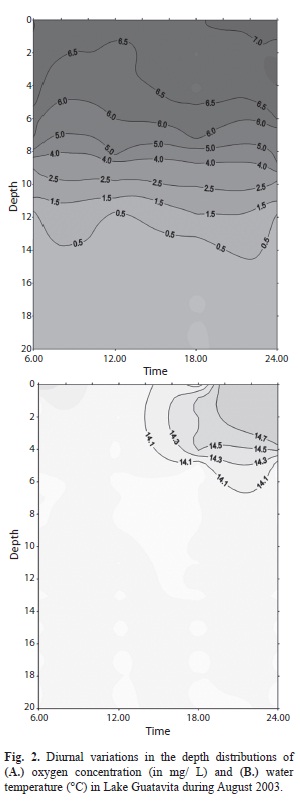
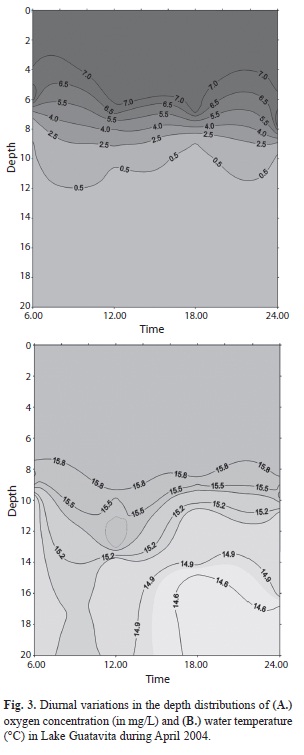
<body><![CDATA[each 16-18-day campaigns (April 2003, August 2003, April 2004) are     shown in figures 1-3, respectively. It is     clear that, to various     extents, the distribution of oxygen isopleths (Figs. <a      href="/img/revistas/rbt/v60n3/a02i1.jpg">1A</a>, <a      href="/img/revistas/rbt/v60n3/a02i2.jpg">2A</a>, <a      href="/img/revistas/rbt/v60n3/a02i3.jpg">3A</a>)     reveals an ongoing stratification lake stably stratified throughout the     year, with the 2mg/L isopleth consistently located at a depth close to     10m below the surface. At the same time, the corresponding distribution     ]]></body>
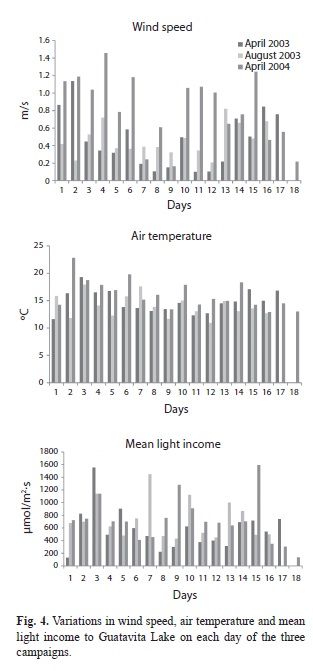
<body><![CDATA[of isotherms (Figs. <a href="/img/revistas/rbt/v60n3/a02i1.jpg">1B</a>,     <a href="/img/revistas/rbt/v60n3/a02i2.jpg">2B</a>, <a      href="/img/revistas/rbt/v60n3/a02i3.jpg">3B</a>) is only     sometimes well matched to the     oxygen. Moreover, the temperature differences between the superficial     layers and the deep water, perhaps as little as 0.5<sup>o</sup>C, do     seem unlikely     to be solely responsible for maintaining the evidently strong     stratification. In <a href="/img/revistas/rbt/v60n3/a02i4.jpg">figure 4</a>,     we summarize the daily information related     ]]></body>
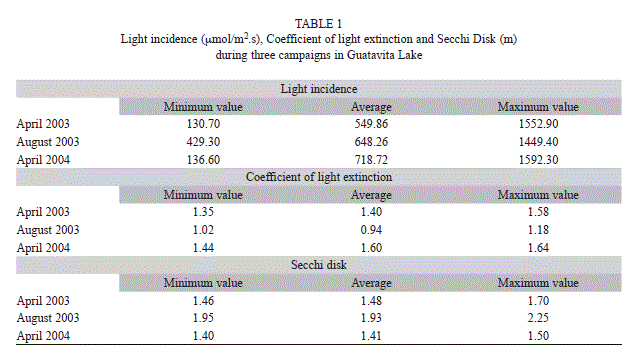
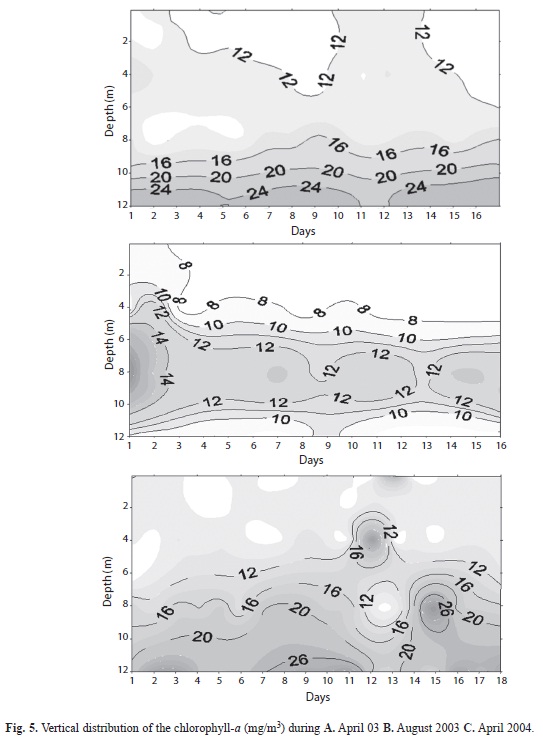
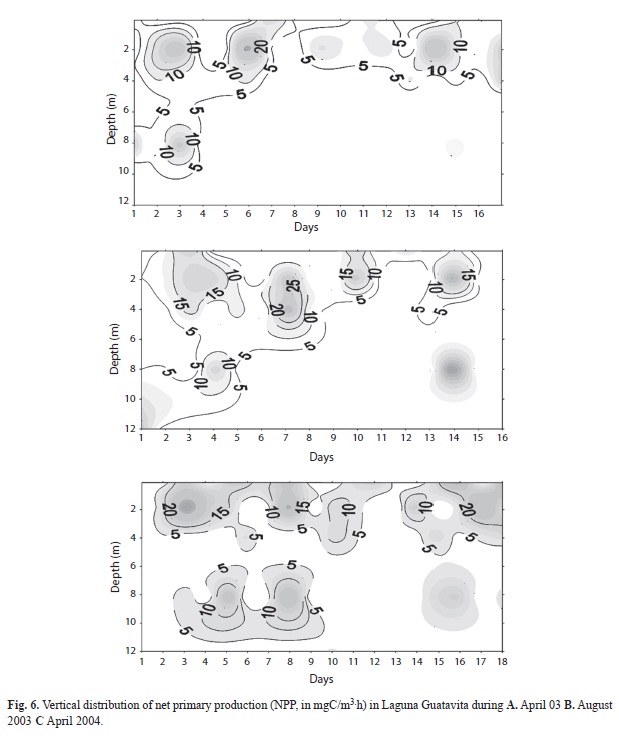
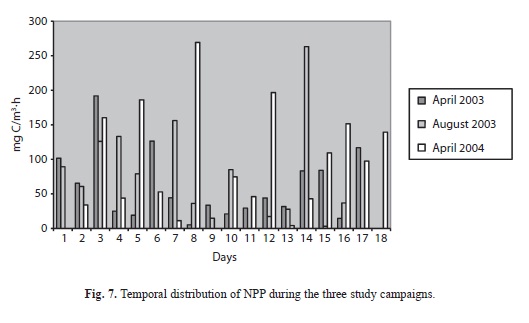
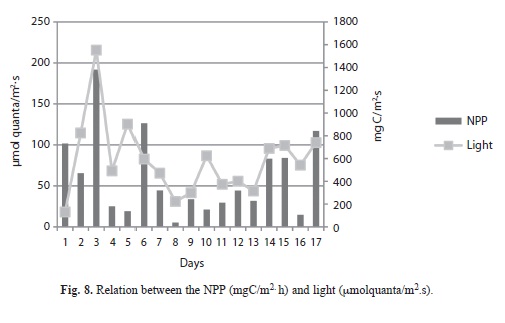
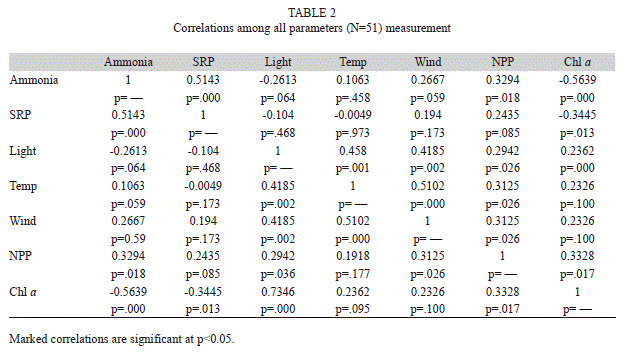
<body><![CDATA[to the average air temperature, light income and wind stress on the     lake surface. We noted that in no case do the day-to-day variations in     any of these components have any disruptive impact on the stability of     the observed differentiation of the water column.    <br>     <br> </span></font> <font size="2"><span style="font-family: verdana;"> In contrast, the vertical gradient of specific electrical conductance was pronounced and recurrent throughout the sampling campaigns, separating the remarkably solute-dilute waters (~10&#956;S/cm) of the upper part of the water column (&#8804;11m depth) from deeper waters of &#8805;70&#956;S/cm at depths of &gt;20m. We deduce the observed density stratification in the Guatavita Lake and its apparent year-long persistence is a quasi-permanent feature. Without further evidence to the contrary, it is reasonable to regard the lake as being conventionally meromictic. We may thus justify reference henceforth to the upper mixolimnion and lower monimolimnion of Laguna de Guatavita.</span></font><br style="font-family: verdana;"> <font size="2"></font><br style="font-family: verdana;"> <font size="2"><span style="font-family: verdana;">Physico-chemical factors of biological relevance: Light income to the lake was found to be variable from day to day (<a href="/img/revistas/rbt/v60n3/a02t1.gif">Table 1</a>). However, there is no evidence of significant seasonality in the light incomes recorded (fluctuations in duration and maximum intensity are not expected at this latitude!): the variations likely owe principally to day-to-day differences in the extent and duration of cloud cover. On the other hand, gradients of underwater light penetration have been found to be typically steep, with coefficients of extinction consistently falling between 1.0/m (in August 2003) and reaching values of 1.48/m in April, 2003 and 1.6/m in April, 2004 (<a href="/img/revistas/rbt/v60n3/a02t1.gif">Table 1</a>). The implied levels of turbidity, largely attributable to suspended fine particles of clay and calcite, seem to be a persistent feature of the underwater light climate. Using conventional approximations (from Reynolds 2006), the depth of the euphotic zone (wherein net photosynthesis is supportable) is estimated rarely to have exceeded 3.5-4.5m; the Secchi disk measurements recorded during the three campaigns (<a href="/img/revistas/rbt/v60n3/a02t1.gif">Table 1</a>) point to a similar extrapolation.</span></font><br  style="font-family: verdana;"> <font size="2"></font><br style="font-family: verdana;"> <font size="2"><span style="font-family: verdana;">Investigations of nutrient availability failed to detect nitrate in any of the samples for all campaigns, while nitrite was found only once (April, 2004). Inorganic combined nitrogen was represented by ammonium concentrations between 3.17-5.55 &#956;MN/L. Average values of SRP were measured in April up to a maximum of 0.95&#956;MP/L in April 2003; in April 2004, values &#8804;0.54 &#956;MP/L were observed. The modest concentrations of both nitrogen and phosphorus are not atypical of oligotrophic lakes; we deduce that availability of nitrogen is more likely than that of phosphorus to regulate phytoplankton production and the biomass supportive capacity of Laguna Guatavita.</span></font><br style="font-family: verdana;"> <font size="2"></font><br style="font-family: verdana;"> <font size="2"><span style="font-family: verdana;">Distribution of chlorophyll and biomass:Isopleths of chlorophyll-<span style="font-style: italic;">a</span> concentration in the vertical direction during each of the three campaigns are respectively illustrated in <a href="/img/revistas/rbt/v60n3/a02i5.jpg">figures 5 A</a>, <a href="/img/revistas/rbt/v60n3/a02i5.jpg">B</a>, <a  href="/img/revistas/rbt/v60n3/a02i5.jpg">C</a>. Concentrations in the upper mixolimnion were generally lower than 12mg chla/m3 but, to a greater or lesser extent, were steeply graded to maxima of 20-28mg chla/m<sup>3</sup> located in the pycnocline region. In each case, the main photosynthetic algae comprised mainly Cryptophytes, whose dominance of the phytoplankton of Laguna de Guatavita had been noted previously by Orjuela (2004). To the extent that the chlorophyll is healthy and functional, the algae are required to be substantially photoadapted to be capable of sustaining net photosynthesis at depths where residual light levels are usually less than &lt;10mM/m.    <br> </span></font>     <div style="text-align: center;"><font size="2"><span  style="font-family: verdana;"></span></font><br  style="font-family: verdana;"> </div>     <div style="text-align: justify;"><font size="2"><span  style="font-family: verdana;">Primary production: Measured rates of net primary production (NPP) varied considerably from day-to-day (<a href="/img/revistas/rbt/v60n3/a02i6.jpg">Figs. 6. A</a>, <a  href="/img/revistas/rbt/v60n3/a02i6.jpg">B</a>, <a  href="/img/revistas/rbt/v60n3/a02i6.jpg">C</a>) but campaign-to-campaign differences in daily areal integrals (<a href="/img/revistas/rbt/v60n3/a02i7.jpg">Fig. 7</a>) were not significant (p=0.59, n=51). Solutions to the campaign averages expressed per unit of lake area ranged from 45.4-89.96mgC/m.h. However, daily variations in the areal integrals were evidently related to the surface irradiance, as represented by the data for the first campaign (<a href="/img/revistas/rbt/v60n3/a02i8.jpg">Fig. 8</a>). However, the matrix of correlations shown in <a href="/img/revistas/rbt/v60n3/a02t2.gif">table 2</a>, relating NPP to variations in the physical (surface light income, wind speed, temperature), chemical (ammonium, soluble reactive phosphorus concentrations) and biological (chlorophyll concentrations), suggest that, in addition to the amount of chlorophyll present, temperature, windspeed and ammonia concentration are of greater significance (p&lt;0.05) in influencing primary production in Laguna de Guatavita.    <br> </span></font>     ]]></body>
<body><![CDATA[<div style="text-align: center;"><font size="2"><span  style="font-family: verdana;"></span></font><br  style="font-family: verdana;"> </div> </div> <font size="2"><span style="font-family: verdana;">Day-to-day variations in dachlorophyll-specific photosynthetic rates in the mixolimnion of the lake were observed in all three campaigns (with maxima occasionally as high as 4.0mg Cmg/Chla.h,<a href="/img/revistas/rbt/v60n3/a02i9.jpg"> figures 9 A</a>, <a href="/img/revistas/rbt/v60n3/a02i9.jpg">B</a>, <a  href="/img/revistas/rbt/v60n3/a02i9.jpg">C</a>). Despite the presence of high concentrations of chlorophyll at depths &gt;8m, the chlorophyll-specific rates of photosynthesis there were small.    <br> </span></font>     <div style="text-align: center;"><font size="2"><span      style="font-family: verdana;"></span></font><br      style="font-family: verdana;">     </div>     <br style="font-family: verdana;">     <font style="font-weight: bold;" size="3"><span      style="font-family: verdana;">Discussion</span></font><br      style="font-family: verdana;">     ]]></body>
<body><![CDATA[<font size="2"></font><br style="font-family: verdana;">     <font size="2"><span style="font-family: verdana;">The investigations     presented here     confirm several features of Laguna Guatavita that are not at all     typical of those generally expected in high mountain lakes: low     nutrient availability (especially of phosphorus), high clarity and     supportive of only low plankton biomass, with low rates of recruitment     by growth. Whereas the maximum chlorophyll-specific rates of     photosynthesis observed, in the order of 3-4mgC mg/chla.h, are fairly     typical (Table 3 of Reynolds 2006), their occurrence is constrained in     ]]></body>
<body><![CDATA[vertical distribution and is evidently very sensitive to day-to-day     fluctuations in surface irradiance. Plainly, slower rates of     chlorophyll-specific production by rather greater concentrations of     chlorophyll located at depths between 8-10m contribute to the higher     absolute rates of photosynthetic production found.</span></font><br      style="font-family: verdana;">     <font size="2"></font><br style="font-family: verdana;">     <font size="2"><span style="font-family: verdana;">These features of     the primary     production in Laguna Guatavita are directly related to the curious     ]]></body>
<body><![CDATA[structural properties of the limnology. Despite the indications     detected in previous field studies, the present confirmation of a     stable, meromictic water column coupled with a severe restriction of     light penetration through a turbid mixolimnion, simultaneously more     deficient in nitrogen than phosphorus, reveals an unusual and     strikingly unexpected environment. Of course, similar conditions have     been described before: our findings are strongly reminiscent of those     of the Laguna de la Cruz, a karstic doline, near Cuenca, in Spain (as     described by Vicente &amp; Miracle 1988). For instance, the     solute-supported meromixis and the tendency to precipitate carbonate,     ]]></body>
<body><![CDATA[even the dominance of cryptophytes in the stable part of the water     column, and are similar to the features now recognized in Laguna de     Guatavita. On the other hand, our knowledge of the extent of local     carbonate deposits is insufficient to enable us to draw large-scale     regional comparisons between the Andean and Spanish localities. Other     locations of carbonate-bearing sedimentary deposits in the Andes are     known in Northern Cordillera (Rios <span style="font-style: italic;">et     al</span>. 2008). Also known is the     presence of small, stablystratified, likely meromictic, high-altitude     lakes in Colombia, having distinctive metalimnetic layers dominated by     ]]></body>
<body><![CDATA[purple sulphur bacteria (Nu&ntilde;ez-Cardona <span      style="font-style: italic;">et al</span>. 2008).</span></font><br      style="font-family: verdana;">     <font size="2"></font><br style="font-family: verdana;">     <font size="2"><span style="font-family: verdana;">The relatively high     turbidity is     related to the precipitation of calcium carbonate. It is unclear how     much of this material is dependent upon current rates of precipitation,     as opposed to delayed sedimentation and frequent re-suspension. In     either case, the truncation of downwelling light is nevertheless a     ]]></body>
<body><![CDATA[persistent component regulating the environmental conditions     experienced and accommodated by photosynthetic organisms in Laguna     Guatavita. With relatively little variation in the daily light income     being attributable to seasonal variation in day length, it is     interesting to detect that the rates of community photosynthesis are so     relatively sensitive to day-to-day variations in surface irradiance.     Again, this may be an unusual feature among high-altitude lakes.</span></font><br      style="font-family: verdana;">     <font size="2"></font><br style="font-family: verdana;">     <font size="2"><span style="font-family: verdana;">Deficiencies in     ]]></body>
<body><![CDATA[nutrient supply are     commonly encountered in high-altitude lakes having small, infertile     hydrological catchments, and Laguna de Guatavita seems unexceptional in     this context. The meromictic stratification and the substantially     hypoxic condition of the monimolimnion surely benefit ammonification,     leading to relatively high values of ammonia and phosphates in deep     water. The N:P ratios in the upper waters nevertheless point to a     likely, ongoing limiting role of nitrogen on the productive and     biomass-supportive capacities in the lake. Although this might not be     considered general among high-altitude lakes, it does agree with the     ]]></body>
<body><![CDATA[findings of many other Andean lakes of Peru-Bolivia (Vincent <span      style="font-style: italic;">et al</span>.     1984), Colombia (Donato <span style="font-style: italic;">et al</span>.     1996, Donato 2010) and Argentina     (Carignan <span style="font-style: italic;">et al</span>. 1998, Diaz <span      style="font-style: italic;">et al</span>. 2007).</span></font><br      style="font-family: verdana;">     <font size="2"></font><br style="font-family: verdana;">     <font size="2"><span style="font-family: verdana;">The infrequency of     disturbance of     ]]></body>
<body><![CDATA[the stratification in meromictic lakes often allows the prolongation of     limnetic conditions allowing the maturation of processes selecting for     localized, low-diversity dominant assemblages of phytoplankton.     Culmination of such series in, variously, filamentous,     buoyancy-regulating Cyanobacteia or even by gas-vacuolate purple and     green sulphur bacteria (Chromotiaceae, Chlorobiaceae), is recognized at     all latitudes where the opportunities arise (Reynolds 1992).     Alternatively (and possibly where the physical stratification is less     stable), Cryptophyte species may fulfill this role, where they are able     to adjust vertical position more readily than buoyancy-regulating     ]]></body>
<body><![CDATA[organisms and to balance changes in light reception through     photo-adaptive adjustment.</span></font><br      style="font-family: verdana;">     <font size="2"></font><br style="font-family: verdana;">     <font size="2"><span style="font-family: verdana;">To conclude, we     recognize that     primary production in this oligotrophic high-altitude tropical lake, is     regulated first by its meromictic structure. The stability is     determined chemically, as a consequence of its situation in karstic     formations and not primarily as a result of the regional climate.     ]]></body>
<body><![CDATA[However, day-to-day variability in net primary production in the     mixolimnion of Laguna de Guatavita is consequential on local factors     affecting light income and availability. Deficiencies in nutrient     availability, especially, of nitrogen, also constrain the phytoplankton     supportive capacity. Despite the significance of the lake in the     traditions of the Muiscan people, we have no evidence that the supply     of gold or other precious minerals plays any significant part in the     ecology of Laguna de Guatavita!</span></font><br      style="font-family: verdana;">     <br style="font-family: verdana;">     ]]></body>
<body><![CDATA[<font style="font-weight: bold;" size="3"><span      style="font-family: verdana;">Acknowledgments</span></font><br      style="font-family: verdana;">     <font size="2"></font><br style="font-family: verdana;">     <font size="2"><span style="font-family: verdana;">The authors thank     Colciencias,     Corporaci&oacute;n Aut&oacute;noma Regional de los Valles de     Ubat&eacute; y Cundinamarca, CAR, Pontificia Universidad Javeriana and     Universidad Nacional de Colombia for their support given during the     time of this study.</span></font><br style="font-family: verdana;">     ]]></body>
<body><![CDATA[<br style="font-family: verdana;">     <hr style="width: 100%; height: 2px;"><font style="font-weight: bold;"      size="3"><span style="font-family: verdana;">References</span></font><br      style="font-family: verdana;">     <font size="2"></font><br style="font-family: verdana;">     <font size="2"><span style="font-family: verdana;">American Public     Health Association     (APHA) 1998. Standard methods for the examination of water and     <!-- ref -->wastewater. American Public Health Association, Washington D.C., USA.    &nbsp;&nbsp;&nbsp;&nbsp;&nbsp;&nbsp;&nbsp;&nbsp;[&#160;<a href="javascript:void(0);" onclick="javascript: window.open('/scielo.php?script=sci_nlinks&ref=1462342&pid=S0034-7744201200030000200001&lng=','','width=640,height=500,resizable=yes,scrollbars=1,menubar=yes,');">Links</a>&#160;]<!-- end-ref --><!-- ref --></span></font><br  style="font-family: verdana;"> <font size="2"></font><br style="font-family: verdana;"> <font size="2"><span style="font-family: verdana;">Carignan, R., A.M. Blais &amp; C. Vis. 1998. Measurement of primary production and community respiration in oligotrophic lakes using the Winkler method. Can. J. <span  style="font-style: italic;">Fish. Aquat. Sci</span>. 55: 1078-1084.    &nbsp;&nbsp;&nbsp;&nbsp;&nbsp;&nbsp;&nbsp;&nbsp;[&#160;<a href="javascript:void(0);" onclick="javascript: window.open('/scielo.php?script=sci_nlinks&ref=1462343&pid=S0034-7744201200030000200002&lng=','','width=640,height=500,resizable=yes,scrollbars=1,menubar=yes,');">Links</a>&#160;]<!-- end-ref --><!-- ref --></span></font><br  style="font-family: verdana;"> <font size="2"></font><br style="font-family: verdana;"> <font size="2"><span style="font-family: verdana;">Diaz, M., F. Pedrozo, C. Reynolds &amp; P. Temporetti. 2007. Chemical composition and the nitrogen-regulated trophic state of Patagonian lakes. Limnologica 37: 17-24.    &nbsp;&nbsp;&nbsp;&nbsp;&nbsp;&nbsp;&nbsp;&nbsp;[&#160;<a href="javascript:void(0);" onclick="javascript: window.open('/scielo.php?script=sci_nlinks&ref=1462344&pid=S0034-7744201200030000200003&lng=','','width=640,height=500,resizable=yes,scrollbars=1,menubar=yes,');">Links</a>&#160;]<!-- end-ref --><!-- ref --></span></font><br style="font-family: verdana;"> <font size="2"></font><br style="font-family: verdana;"> <font size="2"><span style="font-family: verdana;">Donato, J., L. Gonz&aacute;lez &amp; C. Rodr&iacute;guez. 1996. Ecolog&iacute;a de dos sistemas acu&aacute;ticos de p&aacute;ramo. Academia Colombiana de Ciencias Exactas F&iacute;sicas y Naturales, Bogot&aacute;, Colombia.    &nbsp;&nbsp;&nbsp;&nbsp;&nbsp;&nbsp;&nbsp;&nbsp;[&#160;<a href="javascript:void(0);" onclick="javascript: window.open('/scielo.php?script=sci_nlinks&ref=1462345&pid=S0034-7744201200030000200004&lng=','','width=640,height=500,resizable=yes,scrollbars=1,menubar=yes,');">Links</a>&#160;]<!-- end-ref --><!-- ref --></span></font><br  style="font-family: verdana;"> <font size="2"></font><br style="font-family: verdana;"> <font size="2"><span style="font-family: verdana;">Donato, J. 2010. Phytoplankton of Andean Lakes in Northern South America (Colombia). Diatom Monograph, Koenigstein, Germany.    &nbsp;&nbsp;&nbsp;&nbsp;&nbsp;&nbsp;&nbsp;&nbsp;[&#160;<a href="javascript:void(0);" onclick="javascript: window.open('/scielo.php?script=sci_nlinks&ref=1462346&pid=S0034-7744201200030000200005&lng=','','width=640,height=500,resizable=yes,scrollbars=1,menubar=yes,');">Links</a>&#160;]<!-- end-ref --><!-- ref --></span></font><br style="font-family: verdana;"> <font size="2"></font><br style="font-family: verdana;"> <font size="2"><span style="font-family: verdana;">Gaarder, T. &amp; H.H. Gran. 1927. Investigations of the production of plankton in the Oslo Fjord. Rapp. Cons. Explor. Mer. 40: 1-48.    &nbsp;&nbsp;&nbsp;&nbsp;&nbsp;&nbsp;&nbsp;&nbsp;[&#160;<a href="javascript:void(0);" onclick="javascript: window.open('/scielo.php?script=sci_nlinks&ref=1462347&pid=S0034-7744201200030000200006&lng=','','width=640,height=500,resizable=yes,scrollbars=1,menubar=yes,');">Links</a>&#160;]<!-- end-ref --><!-- ref --></span></font><br  style="font-family: verdana;"> <font size="2"></font><br style="font-family: verdana;"> <font size="2"><span style="font-family: verdana;">Hubble, D. &amp; D. Harper. 2001. Impact of light regimen and self shading by algal cells on primary productivity in the water column of a shallow tropical lake (Lake Naivasha. Kenya). Lakes Reserv. Manage. 6: 2-143.    &nbsp;&nbsp;&nbsp;&nbsp;&nbsp;&nbsp;&nbsp;&nbsp;[&#160;<a href="javascript:void(0);" onclick="javascript: window.open('/scielo.php?script=sci_nlinks&ref=1462348&pid=S0034-7744201200030000200007&lng=','','width=640,height=500,resizable=yes,scrollbars=1,menubar=yes,');">Links</a>&#160;]<!-- end-ref --><!-- ref --></span></font><br  style="font-family: verdana;"> <font size="2"></font><br style="font-family: verdana;"> <font size="2"><span style="font-family: verdana;">Jeffrey, S.W. &amp; G.F. Humphrey. 1975. New spectrophotometric equations for determining chlorophylls a, b, c1 and c2 in higher plants, algae and natural phytoplankton. Biochem. Physiol. Pfl. 167: 191-194.    &nbsp;&nbsp;&nbsp;&nbsp;&nbsp;&nbsp;&nbsp;&nbsp;[&#160;<a href="javascript:void(0);" onclick="javascript: window.open('/scielo.php?script=sci_nlinks&ref=1462349&pid=S0034-7744201200030000200008&lng=','','width=640,height=500,resizable=yes,scrollbars=1,menubar=yes,');">Links</a>&#160;]<!-- end-ref --><!-- ref --></span></font><br  style="font-family: verdana;"> <font size="2"></font><br style="font-family: verdana;"> <font size="2"><span style="font-family: verdana;">Kroon, B.M.A., M. Latasa, B.W. Ibelings &amp; L.R. Mur. 1992. The effect of dynamic light regimes on Chlorella. I. Pigments and cross section. Hydrobiologia 238: 71-78.    &nbsp;&nbsp;&nbsp;&nbsp;&nbsp;&nbsp;&nbsp;&nbsp;[&#160;<a href="javascript:void(0);" onclick="javascript: window.open('/scielo.php?script=sci_nlinks&ref=1462350&pid=S0034-7744201200030000200009&lng=','','width=640,height=500,resizable=yes,scrollbars=1,menubar=yes,');">Links</a>&#160;]<!-- end-ref --><!-- ref --></span></font><br  style="font-family: verdana;"> <font size="2"></font><br style="font-family: verdana;"> <font size="2"><span style="font-family: verdana;">Lewis, W.M. 1996. Tropical lakes: how latitude makes a difference, p. 43-64. <span  style="font-style: italic;">In</span> F. Schiemer &amp; K.T. Boland (eds.). Perspectives in Tropical Limnology. SPB, The Hague, Holland.    &nbsp;&nbsp;&nbsp;&nbsp;&nbsp;&nbsp;&nbsp;&nbsp;[&#160;<a href="javascript:void(0);" onclick="javascript: window.open('/scielo.php?script=sci_nlinks&ref=1462351&pid=S0034-7744201200030000200010&lng=','','width=640,height=500,resizable=yes,scrollbars=1,menubar=yes,');">Links</a>&#160;]<!-- end-ref --><!-- ref --></span></font><br style="font-family: verdana;"> <font size="2"></font><br style="font-family: verdana;"> <font size="2"><span style="font-family: verdana;">Mallin, M.A. &amp; H.W. Paerl. 1992. Effects of variable irradiance on phytoplankton productivity in Shallow estuaries. Limnol. Oceanogr. 37: 54-62.    &nbsp;&nbsp;&nbsp;&nbsp;&nbsp;&nbsp;&nbsp;&nbsp;[&#160;<a href="javascript:void(0);" onclick="javascript: window.open('/scielo.php?script=sci_nlinks&ref=1462352&pid=S0034-7744201200030000200011&lng=','','width=640,height=500,resizable=yes,scrollbars=1,menubar=yes,');">Links</a>&#160;]<!-- end-ref --><!-- ref --></span></font><br  style="font-family: verdana;"> <font size="2"></font><br style="font-family: verdana;"> <font size="2"><span style="font-family: verdana;">Marra, J. 1978. Phytoplankton photosynthetic response to vertical movement in mixed layer. Mar. Biol. 46: 203-208.    &nbsp;&nbsp;&nbsp;&nbsp;&nbsp;&nbsp;&nbsp;&nbsp;[&#160;<a href="javascript:void(0);" onclick="javascript: window.open('/scielo.php?script=sci_nlinks&ref=1462353&pid=S0034-7744201200030000200012&lng=','','width=640,height=500,resizable=yes,scrollbars=1,menubar=yes,');">Links</a>&#160;]<!-- end-ref --><!-- ref --></span></font><br style="font-family: verdana;"> <font size="2"></font><br style="font-family: verdana;"> <font size="2"><span style="font-family: verdana;">Nu&ntilde;ez-Cardona, M.T., J. Donato-Rondon, C.S. Reynolds &amp; J. Mas. 2008. A purple sulfur bacterium from a high-altitude lake in the Colombian Andes. J. Biol. Res. Thessalon. 9: 17-24.    &nbsp;&nbsp;&nbsp;&nbsp;&nbsp;&nbsp;&nbsp;&nbsp;[&#160;<a href="javascript:void(0);" onclick="javascript: window.open('/scielo.php?script=sci_nlinks&ref=1462354&pid=S0034-7744201200030000200013&lng=','','width=640,height=500,resizable=yes,scrollbars=1,menubar=yes,');">Links</a>&#160;]<!-- end-ref --><!-- ref --></span></font><br style="font-family: verdana;"> <font size="2"></font><br style="font-family: verdana;"> <font size="2"><span style="font-family: verdana;">Orjuela, R. 2004. Relaciones entre diversidad y producci&oacute;n primaria fitoplanct&oacute;nica en el lago de Guatavita. Tesis Pregrado Ecolog&iacute;a, Pontificia Universidad Javeriana, Bogot&aacute;, Colombia.    &nbsp;&nbsp;&nbsp;&nbsp;&nbsp;&nbsp;&nbsp;&nbsp;[&#160;<a href="javascript:void(0);" onclick="javascript: window.open('/scielo.php?script=sci_nlinks&ref=1462355&pid=S0034-7744201200030000200014&lng=','','width=640,height=500,resizable=yes,scrollbars=1,menubar=yes,');">Links</a>&#160;]<!-- end-ref --><!-- ref --></span></font><br  style="font-family: verdana;"> <font size="2"></font><br style="font-family: verdana;"> <font size="2"><span style="font-family: verdana;">Perdomo, L. 1989. Manual de Arqueolog&iacute;a colombiana. Carlos Valencia, Bogot&aacute;, Colombia.    &nbsp;&nbsp;&nbsp;&nbsp;&nbsp;&nbsp;&nbsp;&nbsp;[&#160;<a href="javascript:void(0);" onclick="javascript: window.open('/scielo.php?script=sci_nlinks&ref=1462356&pid=S0034-7744201200030000200015&lng=','','width=640,height=500,resizable=yes,scrollbars=1,menubar=yes,');">Links</a>&#160;]<!-- end-ref --><!-- ref --></span></font><br  style="font-family: verdana;"> <font size="2"></font><br style="font-family: verdana;"> <font size="2"><span style="font-family: verdana;">Psenner, R. &amp; J. Catalan. 1994. Chemical composition of lakes in crystalline basins: a combination of atmospheric deposition geologic backgrounds, biological activity and human action, p. 255-314. <span style="font-style: italic;">In</span> R. Margalef (ed.). Limnology now: a paradigm of planetary problems. Elsevier, Amsterdam, Holland.    &nbsp;&nbsp;&nbsp;&nbsp;&nbsp;&nbsp;&nbsp;&nbsp;[&#160;<a href="javascript:void(0);" onclick="javascript: window.open('/scielo.php?script=sci_nlinks&ref=1462357&pid=S0034-7744201200030000200016&lng=','','width=640,height=500,resizable=yes,scrollbars=1,menubar=yes,');">Links</a>&#160;]<!-- end-ref --><!-- ref --></span></font><br  style="font-family: verdana;"> <font size="2"></font><br style="font-family: verdana;"> <font size="2"><span style="font-family: verdana;">Reichel-Dolmatoff, G. 1997. Arqueolog&iacute;a de Colombia. Imprenta Nacional de Colombia, Bogot&aacute;, Colombia.    &nbsp;&nbsp;&nbsp;&nbsp;&nbsp;&nbsp;&nbsp;&nbsp;[&#160;<a href="javascript:void(0);" onclick="javascript: window.open('/scielo.php?script=sci_nlinks&ref=1462358&pid=S0034-7744201200030000200017&lng=','','width=640,height=500,resizable=yes,scrollbars=1,menubar=yes,');">Links</a>&#160;]<!-- end-ref --><!-- ref --></span></font><br style="font-family: verdana;"> <font size="2"></font><br style="font-family: verdana;"> <font size="2"><span style="font-family: verdana;">Reynolds, C.S. 1992. Dynamics, selection and composition of phytoplankton in relation to vertical structure in lakes. Arch. Hydrobiol. Beih. Ergebn. Limnol. 35: 13-31.    &nbsp;&nbsp;&nbsp;&nbsp;&nbsp;&nbsp;&nbsp;&nbsp;[&#160;<a href="javascript:void(0);" onclick="javascript: window.open('/scielo.php?script=sci_nlinks&ref=1462359&pid=S0034-7744201200030000200018&lng=','','width=640,height=500,resizable=yes,scrollbars=1,menubar=yes,');">Links</a>&#160;]<!-- end-ref --><!-- ref --></span></font><br  style="font-family: verdana;"> <font size="2"></font><br style="font-family: verdana;"> <font size="2"><span style="font-family: verdana;">Reynolds, C.S. 2006. Ecology of phytoplankton. Cambridge, Cambridge, England.    &nbsp;&nbsp;&nbsp;&nbsp;&nbsp;&nbsp;&nbsp;&nbsp;[&#160;<a href="javascript:void(0);" onclick="javascript: window.open('/scielo.php?script=sci_nlinks&ref=1462360&pid=S0034-7744201200030000200019&lng=','','width=640,height=500,resizable=yes,scrollbars=1,menubar=yes,');">Links</a>&#160;]<!-- end-ref --><!-- ref --></span></font><br  style="font-family: verdana;"> <font size="2"></font><br style="font-family: verdana;"> <font size="2"><span style="font-family: verdana;">R&iacute;os, C.A., O.M. Castellanos, S.I. G&oacute;mez &amp; G.A. &Aacute;vila. 2008. Petrogenesis of the metacarbonate and related rocks of the Silgar&aacute; formation, Central Santander Massif, Colombian Andes: An overview of a &#8220;reaction calcic exoscarn&#8221;. Earth Sci. Res. J. 12: 72-106.    &nbsp;&nbsp;&nbsp;&nbsp;&nbsp;&nbsp;&nbsp;&nbsp;[&#160;<a href="javascript:void(0);" onclick="javascript: window.open('/scielo.php?script=sci_nlinks&ref=1462361&pid=S0034-7744201200030000200020&lng=','','width=640,height=500,resizable=yes,scrollbars=1,menubar=yes,');">Links</a>&#160;]<!-- end-ref --><!-- ref --></span></font><br  style="font-family: verdana;"> <font size="2"></font><br style="font-family: verdana;"> <font size="2"><span style="font-family: verdana;">Rivera, C., D. Solano, A. Zapata &amp; J. Donato. 2005. Phytoplankton diversity in a tropical high mountain lake. Verh. Int. Ver. Theor. Angew. <span  style="font-style: italic;">Limnol</span>. 29: 418-421.    &nbsp;&nbsp;&nbsp;&nbsp;&nbsp;&nbsp;&nbsp;&nbsp;[&#160;<a href="javascript:void(0);" onclick="javascript: window.open('/scielo.php?script=sci_nlinks&ref=1462362&pid=S0034-7744201200030000200021&lng=','','width=640,height=500,resizable=yes,scrollbars=1,menubar=yes,');">Links</a>&#160;]<!-- end-ref --><!-- ref --></span></font><br  style="font-family: verdana;"> <font size="2"></font><br style="font-family: verdana;"> <font size="2"><span style="font-family: verdana;">Talling, J.F. 1969. The incidence of vertical mixing, and some biological and chemical consequences in tropical Afircan lakes. Verh. Int. Ver. Theor. <span  style="font-style: italic;">Angew. Limnol</span>. 17: 998-1012.    &nbsp;&nbsp;&nbsp;&nbsp;&nbsp;&nbsp;&nbsp;&nbsp;[&#160;<a href="javascript:void(0);" onclick="javascript: window.open('/scielo.php?script=sci_nlinks&ref=1462363&pid=S0034-7744201200030000200022&lng=','','width=640,height=500,resizable=yes,scrollbars=1,menubar=yes,');">Links</a>&#160;]<!-- end-ref --><!-- ref --></span></font><br style="font-family: verdana;"> <font size="2"></font><br style="font-family: verdana;"> <font size="2"><span style="font-family: verdana;">Vicente, E. &amp; M.R. Miracle. 1988. Physicochemical and microbial stratification in a mermictic karstic lake of Spain. Verh. Int. Ver. Theor. <span  style="font-style: italic;">Angew. Limnol</span>. 23: 522-529.    &nbsp;&nbsp;&nbsp;&nbsp;&nbsp;&nbsp;&nbsp;&nbsp;[&#160;<a href="javascript:void(0);" onclick="javascript: window.open('/scielo.php?script=sci_nlinks&ref=1462364&pid=S0034-7744201200030000200023&lng=','','width=640,height=500,resizable=yes,scrollbars=1,menubar=yes,');">Links</a>&#160;]<!-- end-ref --><!-- ref --></span></font><br style="font-family: verdana;"> <font size="2"></font><br style="font-family: verdana;"> <font size="2"><span style="font-family: verdana;">Vincent, W., W. Wurtsbaugh, C. Vincent &amp; P. Richerson. 1984. Seasonal dynamics of nutrient limitation in a tropical high-altitude lake (Lake Titicaca, Peru-Bolivia): Application of physiological bioassays. Limnol. Oceanogr. 29: 540-552.    &nbsp;&nbsp;&nbsp;&nbsp;&nbsp;&nbsp;&nbsp;&nbsp;[&#160;<a href="javascript:void(0);" onclick="javascript: window.open('/scielo.php?script=sci_nlinks&ref=1462365&pid=S0034-7744201200030000200024&lng=','','width=640,height=500,resizable=yes,scrollbars=1,menubar=yes,');">Links</a>&#160;]<!-- end-ref --><!-- ref --></span></font><br style="font-family: verdana;"> <font size="2"></font><br style="font-family: verdana;"> <font size="2"><span style="font-family: verdana;">Vollenweider, R.A. 1974. A manual of methods for measuring primary production in aquatic environments. Blackwell, London, England.    &nbsp;&nbsp;&nbsp;&nbsp;&nbsp;&nbsp;&nbsp;&nbsp;[&#160;<a href="javascript:void(0);" onclick="javascript: window.open('/scielo.php?script=sci_nlinks&ref=1462366&pid=S0034-7744201200030000200025&lng=','','width=640,height=500,resizable=yes,scrollbars=1,menubar=yes,');">Links</a>&#160;]<!-- end-ref --><!-- ref --></span></font><br  style="font-family: verdana;"> <font size="2"></font><br style="font-family: verdana;"> <font size="2"><span style="font-family: verdana;">Wetzel, R. 2001. Limnology. Lake and river ecosystems. Academic, San Diego, California, USA.    &nbsp;&nbsp;&nbsp;&nbsp;&nbsp;&nbsp;&nbsp;&nbsp;[&#160;<a href="javascript:void(0);" onclick="javascript: window.open('/scielo.php?script=sci_nlinks&ref=1462367&pid=S0034-7744201200030000200026&lng=','','width=640,height=500,resizable=yes,scrollbars=1,menubar=yes,');">Links</a>&#160;]<!-- end-ref --><!-- ref --></span></font><br  style="font-family: verdana;"> <font size="2"></font><br style="font-family: verdana;"> <font size="2"><span style="font-family: verdana;">Wetzel, R &amp; G.E. Likens. 2000. Limnological Analyses. Springer-Verlag, New York, USA.    &nbsp;&nbsp;&nbsp;&nbsp;&nbsp;&nbsp;&nbsp;&nbsp;[&#160;<a href="javascript:void(0);" onclick="javascript: window.open('/scielo.php?script=sci_nlinks&ref=1462368&pid=S0034-7744201200030000200027&lng=','','width=640,height=500,resizable=yes,scrollbars=1,menubar=yes,');">Links</a>&#160;]<!-- end-ref --><!-- ref --></span></font><br  style="font-family: verdana;"> <font size="2"></font><br style="font-family: verdana;"> <font size="2"><span style="font-family: verdana;">Yoder, J.A. &amp; S.S. Bishop. 1985. Effects of mixing - induced irradiance fluctuations on photosynthesis of natural assemblages of coastal phytoplankton. Mar. Biol. 90: 87-93.    &nbsp;&nbsp;&nbsp;&nbsp;&nbsp;&nbsp;&nbsp;&nbsp;[&#160;<a href="javascript:void(0);" onclick="javascript: window.open('/scielo.php?script=sci_nlinks&ref=1462369&pid=S0034-7744201200030000200028&lng=','','width=640,height=500,resizable=yes,scrollbars=1,menubar=yes,');">Links</a>&#160;]<!-- end-ref --><!-- ref --></span></font><br style="font-family: verdana;"> <font size="2"></font><br style="font-family: verdana;"> <font size="2"><span style="font-family: verdana;">Zapata, A. 2001. Variaciones diarias y mensuales de la productividad primaria en un lago andino (Laguna de Guatavita. Cundinamarca). Tesis Maestr&iacute;a, Pontificia Universidad Javeriana, Bogot&aacute;, Colombia.    &nbsp;&nbsp;&nbsp;&nbsp;&nbsp;&nbsp;&nbsp;&nbsp;[&#160;<a href="javascript:void(0);" onclick="javascript: window.open('/scielo.php?script=sci_nlinks&ref=1462370&pid=S0034-7744201200030000200029&lng=','','width=640,height=500,resizable=yes,scrollbars=1,menubar=yes,');">Links</a>&#160;]<!-- end-ref --><br>     <br> <a name="Correspondencia1"></a><a href="#Correspondencia2">*</a>Correspondencia:    <br> </span></font><font size="2"><span style="font-family: verdana;">Jhon Donato: </span></font><font size="2"><span  style="font-family: verdana;">Departamento de Biolog&iacute;a, Universidad Nacional de Colombia, Av (Cra.) 30 No. 45-03, Bogot&aacute;, Colombia. jcdonator@unal.edu.co.</span></font>    ]]></body>
<body><![CDATA[<br> <font size="2"><span style="font-family: verdana;">Paola Jimenez: </span></font><font size="2"><span  style="font-family: verdana;">Departamento de Biolog&iacute;a, Universidad Nacional de Colombia, Av (Cra.) 30 No. 45-03, Bogot&aacute;, Colombia. paolajimenezmedina@yahoo.com.ar</span></font>    <br> <font size="2"><span style="font-family: verdana;">Colin Reynolds: </span></font><font  size="2"><span style="font-family: verdana;">CEH Lancaster, Library Avenue, Bailrigg, GB-LA1 4AP Lancaster UK. csr@ceh.ac.uk</span></font><font  size="2"><span style="font-family: verdana;"></span></font>     <br> <font size="2"><span style="font-family: verdana;"><a name="1"></a><a  href="#4">1</a>. Departamento de Biolog&iacute;a, Universidad Nacional de Colombia, Av (Cra.) 30 No. 45-03, Bogot&aacute;, Colombia; jcdonator@unal.edu.co</span></font><br  style="font-family: verdana;"> <font size="2"><span style="font-family: verdana;"><a name="2"></a><a  href="#5">2</a>. Departamento de Biolog&iacute;a, Universidad Nacional de Colombia, Av (Cra.) 30 No. 45-03, Bogot&aacute;, Colombia; paolajimenezmedina@yahoo.com.ar</span></font><br  style="font-family: verdana;"> <font size="2"><span style="font-family: verdana;"><a name="3"></a><a  href="#6">3</a>. CEH Lancaster, Library Avenue, Bailrigg, GB-LA1 4AP Lancaster UK; csr@ceh.ac.uk</span></font><br  style="font-family: verdana;"> <hr style="width: 100%; height: 2px;">     <div style="text-align: center;"><font style="font-weight: bold;"  size="2"><span style="font-family: verdana;">Received 29-VII-2011. Corrected 30-I-2012. Accepted 29-II-2012.</span></font><br  style="font-family: verdana;"> </div> </div> </div> <font size="2"></font>      ]]></body><back>
<ref-list>
<ref id="B1">
<nlm-citation citation-type="book">
<collab>American Public Health Association (APHA)</collab>
<source><![CDATA[Standard methods for the examination of water and wastewater]]></source>
<year>1998</year>
<publisher-loc><![CDATA[^eWashington D.C Washington D.C]]></publisher-loc>
<publisher-name><![CDATA[American Public Health Association]]></publisher-name>
</nlm-citation>
</ref>
<ref id="B2">
<nlm-citation citation-type="journal">
<person-group person-group-type="author">
<name>
<surname><![CDATA[Carignan]]></surname>
<given-names><![CDATA[R]]></given-names>
</name>
<name>
<surname><![CDATA[Blais]]></surname>
<given-names><![CDATA[A.M]]></given-names>
</name>
<name>
<surname><![CDATA[Vis]]></surname>
<given-names><![CDATA[C]]></given-names>
</name>
</person-group>
<article-title xml:lang="en"><![CDATA[Measurement of primary production and community respiration in oligotrophic lakes using the Winkler method]]></article-title>
<source><![CDATA[Can. J. Fish. Aquat. Sci]]></source>
<year>1998</year>
<volume>55</volume>
<page-range>1078-1084</page-range></nlm-citation>
</ref>
<ref id="B3">
<nlm-citation citation-type="journal">
<person-group person-group-type="author">
<name>
<surname><![CDATA[Diaz]]></surname>
<given-names><![CDATA[M]]></given-names>
</name>
<name>
<surname><![CDATA[Pedrozo]]></surname>
<given-names><![CDATA[F]]></given-names>
</name>
<name>
<surname><![CDATA[Reynolds]]></surname>
<given-names><![CDATA[C]]></given-names>
</name>
<name>
<surname><![CDATA[Temporetti]]></surname>
<given-names><![CDATA[P]]></given-names>
</name>
</person-group>
<article-title xml:lang="en"><![CDATA[Chemical composition and the nitrogen-regulated trophic state of Patagonian lakes]]></article-title>
<source><![CDATA[Limnologica]]></source>
<year>2007</year>
<volume>37</volume>
<page-range>17-24</page-range></nlm-citation>
</ref>
<ref id="B4">
<nlm-citation citation-type="book">
<person-group person-group-type="author">
<name>
<surname><![CDATA[Donato]]></surname>
<given-names><![CDATA[J]]></given-names>
</name>
<name>
<surname><![CDATA[González]]></surname>
<given-names><![CDATA[L]]></given-names>
</name>
<name>
<surname><![CDATA[Rodríguez]]></surname>
<given-names><![CDATA[C]]></given-names>
</name>
</person-group>
<source><![CDATA[Ecología de dos sistemas acuáticos de páramo]]></source>
<year>1996</year>
<publisher-loc><![CDATA[^eBogotá Bogotá]]></publisher-loc>
<publisher-name><![CDATA[Academia Colombiana de Ciencias Exactas Físicas y Naturales]]></publisher-name>
</nlm-citation>
</ref>
<ref id="B5">
<nlm-citation citation-type="book">
<person-group person-group-type="author">
<name>
<surname><![CDATA[Donato]]></surname>
<given-names><![CDATA[J]]></given-names>
</name>
</person-group>
<source><![CDATA[Phytoplankton of Andean Lakes in Northern South America (Colombia)]]></source>
<year>2010</year>
<publisher-loc><![CDATA[Koenigstein ]]></publisher-loc>
<publisher-name><![CDATA[Diatom Monograph]]></publisher-name>
</nlm-citation>
</ref>
<ref id="B6">
<nlm-citation citation-type="journal">
<person-group person-group-type="author">
<name>
<surname><![CDATA[Gaarder]]></surname>
<given-names><![CDATA[T]]></given-names>
</name>
<name>
<surname><![CDATA[Gran]]></surname>
<given-names><![CDATA[H.H]]></given-names>
</name>
</person-group>
<article-title xml:lang="en"><![CDATA[Investigations of the production of plankton in the Oslo Fjord]]></article-title>
<source><![CDATA[Rapp. Cons. Explor. Mer.]]></source>
<year>1927</year>
<volume>40</volume>
<page-range>1-48</page-range></nlm-citation>
</ref>
<ref id="B7">
<nlm-citation citation-type="journal">
<person-group person-group-type="author">
<name>
<surname><![CDATA[Hubble]]></surname>
<given-names><![CDATA[D]]></given-names>
</name>
<name>
<surname><![CDATA[Harper]]></surname>
<given-names><![CDATA[D]]></given-names>
</name>
</person-group>
<article-title xml:lang="en"><![CDATA[Impact of light regimen and self shading by algal cells on primary productivity in the water column of a shallow tropical lake (Lake Naivasha. Kenya)]]></article-title>
<source><![CDATA[Lakes Reserv. Manage.]]></source>
<year>2001</year>
<volume>6</volume>
<page-range>2-143</page-range></nlm-citation>
</ref>
<ref id="B8">
<nlm-citation citation-type="journal">
<person-group person-group-type="author">
<name>
<surname><![CDATA[Jeffrey]]></surname>
<given-names><![CDATA[S.W]]></given-names>
</name>
<name>
<surname><![CDATA[Humphrey]]></surname>
<given-names><![CDATA[G.F]]></given-names>
</name>
</person-group>
<article-title xml:lang="en"><![CDATA[New spectrophotometric equations for determining chlorophylls a, b, c1 and c2 in higher plants, algae and natural phytoplankton]]></article-title>
<source><![CDATA[Biochem. Physiol. Pfl.]]></source>
<year>1975</year>
<volume>167</volume>
<page-range>191-194</page-range></nlm-citation>
</ref>
<ref id="B9">
<nlm-citation citation-type="journal">
<person-group person-group-type="author">
<name>
<surname><![CDATA[Kroon]]></surname>
<given-names><![CDATA[B.M.A]]></given-names>
</name>
<name>
<surname><![CDATA[Latasa]]></surname>
<given-names><![CDATA[M]]></given-names>
</name>
<name>
<surname><![CDATA[Ibelings]]></surname>
<given-names><![CDATA[B.W]]></given-names>
</name>
<name>
<surname><![CDATA[Mur]]></surname>
<given-names><![CDATA[L.R]]></given-names>
</name>
</person-group>
<source><![CDATA[Hydrobiologia]]></source>
<year>1992</year>
<volume>238</volume>
<page-range>71-78</page-range></nlm-citation>
</ref>
<ref id="B10">
<nlm-citation citation-type="book">
<person-group person-group-type="author">
<name>
<surname><![CDATA[Lewis]]></surname>
<given-names><![CDATA[W.M]]></given-names>
</name>
</person-group>
<article-title xml:lang="en"><![CDATA[Tropical lakes: how latitude makes a difference]]></article-title>
<person-group person-group-type="editor">
<name>
<surname><![CDATA[Schiemer]]></surname>
<given-names><![CDATA[F]]></given-names>
</name>
<name>
<surname><![CDATA[Boland]]></surname>
<given-names><![CDATA[K.T]]></given-names>
</name>
</person-group>
<source><![CDATA[Perspectives in Tropical Limnology]]></source>
<year>1996</year>
<page-range>p. 43-64</page-range><publisher-loc><![CDATA[The Hague ]]></publisher-loc>
<publisher-name><![CDATA[SPB]]></publisher-name>
</nlm-citation>
</ref>
<ref id="B11">
<nlm-citation citation-type="journal">
<person-group person-group-type="author">
<name>
<surname><![CDATA[Mallin]]></surname>
<given-names><![CDATA[M.A]]></given-names>
</name>
<name>
<surname><![CDATA[Paerl]]></surname>
<given-names><![CDATA[H.W]]></given-names>
</name>
</person-group>
<article-title xml:lang="en"><![CDATA[Effects of variable irradiance on phytoplankton productivity in Shallow estuaries]]></article-title>
<source><![CDATA[Limnol. Oceanogr]]></source>
<year>1992</year>
<volume>37</volume>
<page-range>54-62</page-range></nlm-citation>
</ref>
<ref id="B12">
<nlm-citation citation-type="journal">
<person-group person-group-type="author">
<name>
<surname><![CDATA[Marra]]></surname>
<given-names><![CDATA[J]]></given-names>
</name>
</person-group>
<article-title xml:lang="en"><![CDATA[Phytoplankton photosynthetic response to vertical movement in mixed layer]]></article-title>
<source><![CDATA[Mar. Biol]]></source>
<year>1978</year>
<volume>46</volume>
<page-range>203-208</page-range></nlm-citation>
</ref>
<ref id="B13">
<nlm-citation citation-type="journal">
<person-group person-group-type="author">
<name>
<surname><![CDATA[Nuñez-Cardona]]></surname>
<given-names><![CDATA[M.T]]></given-names>
</name>
<name>
<surname><![CDATA[Donato-Rondon]]></surname>
<given-names><![CDATA[J]]></given-names>
</name>
<name>
<surname><![CDATA[Reynolds]]></surname>
</name>
<name>
<surname><![CDATA[Mas]]></surname>
<given-names><![CDATA[J]]></given-names>
</name>
</person-group>
<article-title xml:lang="en"><![CDATA[A purple sulfur bacterium from a high-altitude lake in the Colombian Andes]]></article-title>
<source><![CDATA[J. Biol. Res. Thessalon]]></source>
<year>2008</year>
<volume>9</volume>
<page-range>17-24</page-range></nlm-citation>
</ref>
<ref id="B14">
<nlm-citation citation-type="">
<person-group person-group-type="author">
<name>
<surname><![CDATA[Orjuela]]></surname>
<given-names><![CDATA[R]]></given-names>
</name>
</person-group>
<source><![CDATA[Relaciones entre diversidad y producción primaria fitoplanctónica en el lago de Guatavita]]></source>
<year>2004</year>
</nlm-citation>
</ref>
<ref id="B15">
<nlm-citation citation-type="book">
<person-group person-group-type="author">
<name>
<surname><![CDATA[Perdomo]]></surname>
<given-names><![CDATA[L]]></given-names>
</name>
</person-group>
<source><![CDATA[Manual de Arqueología colombiana]]></source>
<year>1989</year>
<publisher-loc><![CDATA[^eBogotá Bogotá]]></publisher-loc>
<publisher-name><![CDATA[Carlos Valencia]]></publisher-name>
</nlm-citation>
</ref>
<ref id="B16">
<nlm-citation citation-type="book">
<person-group person-group-type="author">
<name>
<surname><![CDATA[Psenner]]></surname>
<given-names><![CDATA[R]]></given-names>
</name>
<name>
<surname><![CDATA[Catalan]]></surname>
<given-names><![CDATA[J]]></given-names>
</name>
</person-group>
<article-title xml:lang="en"><![CDATA[Chemical composition of lakes in crystalline basins: a combination of atmospheric deposition geologic backgrounds, biological activity and human action]]></article-title>
<person-group person-group-type="editor">
<name>
<surname><![CDATA[Margalef]]></surname>
<given-names><![CDATA[R]]></given-names>
</name>
</person-group>
<source><![CDATA[Limnology now: a paradigm of planetary problems]]></source>
<year>1994</year>
<page-range>p. 255-314</page-range><publisher-loc><![CDATA[^eAmsterdam Amsterdam]]></publisher-loc>
<publisher-name><![CDATA[Elsevier]]></publisher-name>
</nlm-citation>
</ref>
<ref id="B17">
<nlm-citation citation-type="book">
<person-group person-group-type="author">
<name>
<surname><![CDATA[Reichel-Dolmatoff]]></surname>
<given-names><![CDATA[G]]></given-names>
</name>
</person-group>
<source><![CDATA[Arqueología de Colombia]]></source>
<year>1997</year>
<publisher-loc><![CDATA[^eBogotá Bogotá]]></publisher-loc>
<publisher-name><![CDATA[Imprenta Nacional de Colombia]]></publisher-name>
</nlm-citation>
</ref>
<ref id="B18">
<nlm-citation citation-type="journal">
<person-group person-group-type="author">
<name>
<surname><![CDATA[Reynolds]]></surname>
<given-names><![CDATA[C.S]]></given-names>
</name>
</person-group>
<article-title xml:lang="en"><![CDATA[Dynamics, selection and composition of phytoplankton in relation to vertical structure in lakes]]></article-title>
<source><![CDATA[Arch. Hydrobiol. Beih. Ergebn. Limnol]]></source>
<year>1992</year>
<volume>35</volume>
<page-range>13-31</page-range></nlm-citation>
</ref>
<ref id="B19">
<nlm-citation citation-type="">
<person-group person-group-type="author">
<name>
<surname><![CDATA[Reynolds]]></surname>
<given-names><![CDATA[C.S]]></given-names>
</name>
</person-group>
<source><![CDATA[Ecology of phytoplankton]]></source>
<year>2006</year>
</nlm-citation>
</ref>
<ref id="B20">
<nlm-citation citation-type="journal">
<person-group person-group-type="author">
<name>
<surname><![CDATA[Ríos]]></surname>
<given-names><![CDATA[C.A]]></given-names>
</name>
<name>
<surname><![CDATA[Castellanos]]></surname>
<given-names><![CDATA[O.M]]></given-names>
</name>
<name>
<surname><![CDATA[Gómez]]></surname>
<given-names><![CDATA[S.I]]></given-names>
</name>
<name>
<surname><![CDATA[Ávila]]></surname>
<given-names><![CDATA[G.A]]></given-names>
</name>
</person-group>
<article-title xml:lang="en"><![CDATA[Petrogenesis of the metacarbonate and related rocks of the Silgará formation, Central Santander Massif, Colombian Andes: An overview of a &#8220;reaction calcic exoscarn&#8221;]]></article-title>
<source><![CDATA[Earth Sci. Res. J.]]></source>
<year>2008</year>
<volume>12</volume>
<page-range>72-106</page-range></nlm-citation>
</ref>
<ref id="B21">
<nlm-citation citation-type="journal">
<person-group person-group-type="author">
<name>
<surname><![CDATA[Rivera]]></surname>
<given-names><![CDATA[C]]></given-names>
</name>
<name>
<surname><![CDATA[Solano]]></surname>
<given-names><![CDATA[D]]></given-names>
</name>
<name>
<surname><![CDATA[Zapata]]></surname>
<given-names><![CDATA[A]]></given-names>
</name>
<name>
<surname><![CDATA[Donato]]></surname>
<given-names><![CDATA[J]]></given-names>
</name>
</person-group>
<article-title xml:lang="en"><![CDATA[Phytoplankton diversity in a tropical high mountain lake]]></article-title>
<source><![CDATA[Verh. Int. Ver. Theor. Angew. Limnol.]]></source>
<year>2005</year>
<volume>29</volume>
<page-range>418-421</page-range></nlm-citation>
</ref>
<ref id="B22">
<nlm-citation citation-type="journal">
<person-group person-group-type="author">
<name>
<surname><![CDATA[Talling]]></surname>
<given-names><![CDATA[J.F]]></given-names>
</name>
</person-group>
<source><![CDATA[Verh. Int. Ver. Theor. Angew. Limnol]]></source>
<year></year>
<volume>17</volume>
<page-range>998-1012</page-range></nlm-citation>
</ref>
<ref id="B23">
<nlm-citation citation-type="journal">
<person-group person-group-type="author">
<name>
<surname><![CDATA[Vicente]]></surname>
<given-names><![CDATA[E]]></given-names>
</name>
<name>
<surname><![CDATA[Miracle]]></surname>
<given-names><![CDATA[M.R]]></given-names>
</name>
</person-group>
<article-title xml:lang="en"><![CDATA[Physicochemical and microbial stratification in a mermictic karstic lake of Spain]]></article-title>
<source><![CDATA[Verh. Int. Ver. Theor. Angew. Limnol.]]></source>
<year>1988</year>
<volume>23</volume>
<page-range>522-529</page-range></nlm-citation>
</ref>
<ref id="B24">
<nlm-citation citation-type="journal">
<person-group person-group-type="author">
<name>
<surname><![CDATA[Vincent]]></surname>
<given-names><![CDATA[W]]></given-names>
</name>
<name>
<surname><![CDATA[Wurtsbaugh]]></surname>
<given-names><![CDATA[W]]></given-names>
</name>
<name>
<surname><![CDATA[Vincent]]></surname>
<given-names><![CDATA[C]]></given-names>
</name>
<name>
<surname><![CDATA[Richerson]]></surname>
<given-names><![CDATA[P]]></given-names>
</name>
</person-group>
<article-title xml:lang="en"><![CDATA[Seasonal dynamics of nutrient limitation in a tropical high-altitude lake (Lake Titicaca, Peru-Bolivia): Application of physiological bioassays]]></article-title>
<source><![CDATA[Limnol. Oceanogr]]></source>
<year>1984</year>
<volume>29</volume>
<page-range>540-552</page-range></nlm-citation>
</ref>
<ref id="B25">
<nlm-citation citation-type="book">
<person-group person-group-type="author">
<name>
<surname><![CDATA[Vollenweider]]></surname>
<given-names><![CDATA[R.A]]></given-names>
</name>
</person-group>
<source><![CDATA[A manual of methods for measuring primary production in aquatic environments]]></source>
<year>1974</year>
<publisher-loc><![CDATA[^eLondon London]]></publisher-loc>
<publisher-name><![CDATA[Blackwell]]></publisher-name>
</nlm-citation>
</ref>
<ref id="B26">
<nlm-citation citation-type="book">
<person-group person-group-type="author">
<name>
<surname><![CDATA[Wetzel]]></surname>
<given-names><![CDATA[R]]></given-names>
</name>
</person-group>
<source><![CDATA[]]></source>
<year>2001</year>
<publisher-loc><![CDATA[San Diego^eCalifornia California]]></publisher-loc>
<publisher-name><![CDATA[Limnology. Lake and river ecosystems. Academic]]></publisher-name>
</nlm-citation>
</ref>
<ref id="B27">
<nlm-citation citation-type="book">
<person-group person-group-type="author">
<name>
<surname><![CDATA[Wetzel]]></surname>
<given-names><![CDATA[R]]></given-names>
</name>
<name>
<surname><![CDATA[Likens]]></surname>
<given-names><![CDATA[G.E]]></given-names>
</name>
</person-group>
<source><![CDATA[Limnological Analyses]]></source>
<year>2000</year>
<publisher-loc><![CDATA[New York ]]></publisher-loc>
<publisher-name><![CDATA[Springer-Verlag]]></publisher-name>
</nlm-citation>
</ref>
<ref id="B28">
<nlm-citation citation-type="journal">
<person-group person-group-type="author">
<name>
<surname><![CDATA[Yoder]]></surname>
<given-names><![CDATA[J.A]]></given-names>
</name>
<name>
<surname><![CDATA[Bishop]]></surname>
<given-names><![CDATA[S.S]]></given-names>
</name>
</person-group>
<article-title xml:lang="en"><![CDATA[Effects of mixing - induced irradiance fluctuations on photosynthesis of natural assemblages of coastal phytoplankton]]></article-title>
<source><![CDATA[Mar. Biol]]></source>
<year>1985</year>
<volume>90</volume>
<page-range>87-93</page-range></nlm-citation>
</ref>
<ref id="B29">
<nlm-citation citation-type="">
<person-group person-group-type="author">
<name>
<surname><![CDATA[Zapata]]></surname>
<given-names><![CDATA[A]]></given-names>
</name>
</person-group>
<source><![CDATA[Variaciones diarias y mensuales de la productividad primaria en un lago andino (Laguna de Guatavita. Cundinamarca)]]></source>
<year>2001</year>
</nlm-citation>
</ref>
</ref-list>
</back>
</article>