<?xml version="1.0" encoding="ISO-8859-1"?><article xmlns:mml="http://www.w3.org/1998/Math/MathML" xmlns:xlink="http://www.w3.org/1999/xlink" xmlns:xsi="http://www.w3.org/2001/XMLSchema-instance">
<front>
<journal-meta>
<journal-id>0034-7744</journal-id>
<journal-title><![CDATA[Revista de Biología Tropical]]></journal-title>
<abbrev-journal-title><![CDATA[Rev. biol. trop]]></abbrev-journal-title>
<issn>0034-7744</issn>
<publisher>
<publisher-name><![CDATA[Universidad de Costa Rica]]></publisher-name>
</publisher>
</journal-meta>
<article-meta>
<article-id>S0034-77442012000300001</article-id>
<title-group>
<article-title xml:lang="en"><![CDATA[Demography of zooplankton (Anuraeopsis fissa, Brachionus rubens and Moina macrocopa) fed Chlorella vulgaris and Scenedesmus acutus cultured on different media]]></article-title>
</title-group>
<contrib-group>
<contrib contrib-type="author">
<name>
<surname><![CDATA[Morales-Ventura]]></surname>
<given-names><![CDATA[Jesús]]></given-names>
</name>
<xref ref-type="aff" rid="A01"/>
</contrib>
<contrib contrib-type="author">
<name>
<surname><![CDATA[Nandini]]></surname>
<given-names><![CDATA[S.]]></given-names>
</name>
<xref ref-type="aff" rid="A03"/>
</contrib>
<contrib contrib-type="author">
<name>
<surname><![CDATA[Sarma]]></surname>
<given-names><![CDATA[S.S.S]]></given-names>
</name>
<xref ref-type="aff" rid="A03"/>
</contrib>
<contrib contrib-type="author">
<name>
<surname><![CDATA[Castellanos-Páez]]></surname>
<given-names><![CDATA[Maria Elena]]></given-names>
</name>
<xref ref-type="aff" rid="A02"/>
</contrib>
</contrib-group>
<aff id="A01">
<institution><![CDATA[,Instituto Nacional de Pesca Dirección General Adjunta de Investigación en Acuacultura ]]></institution>
<addr-line><![CDATA[ Ciudad de México]]></addr-line>
<country>México</country>
</aff>
<aff id="A02">
<institution><![CDATA[,Universidad Autónoma Metropolitana Posgrado División de Ciencias Biológicas y de la Salud ]]></institution>
<addr-line><![CDATA[ México D.F]]></addr-line>
</aff>
<aff id="A03">
<institution><![CDATA[,, Universidad Nacional Autónoma de México, Campus Iztacala División de Investigación y Posgrado Laboratorio de Zoología Acuática]]></institution>
<addr-line><![CDATA[Tlalnepantla Edo. de México]]></addr-line>
<country>México</country>
</aff>
<aff id="A04">
<institution><![CDATA[,, Universidad Autónoma Metropolitana, Campus Xochimilco División de Ciencias, Biológicas y de la Salud Laboratorio de Rotiferología y Biología Molecular de Plancton]]></institution>
<addr-line><![CDATA[ Ciudad de México]]></addr-line>
<country>México</country>
</aff>
<pub-date pub-type="pub">
<day>00</day>
<month>09</month>
<year>2012</year>
</pub-date>
<pub-date pub-type="epub">
<day>00</day>
<month>09</month>
<year>2012</year>
</pub-date>
<volume>60</volume>
<numero>3</numero>
<fpage>955</fpage>
<lpage>965</lpage>
<copyright-statement/>
<copyright-year/>
<self-uri xlink:href="http://www.scielo.sa.cr/scielo.php?script=sci_arttext&amp;pid=S0034-77442012000300001&amp;lng=en&amp;nrm=iso"></self-uri><self-uri xlink:href="http://www.scielo.sa.cr/scielo.php?script=sci_abstract&amp;pid=S0034-77442012000300001&amp;lng=en&amp;nrm=iso"></self-uri><self-uri xlink:href="http://www.scielo.sa.cr/scielo.php?script=sci_pdf&amp;pid=S0034-77442012000300001&amp;lng=en&amp;nrm=iso"></self-uri><abstract abstract-type="short" xml:lang="en"><p><![CDATA[Generally zooplankton growth is often limited by the quality of their algal diet. A cheaper common practice in aquaculture, is to culture algae with fertilizers; however, the demography of zooplankton when fed these algae has not yet been evaluated. We studied the population growth and life table demography of the rotifers Anuraeopsis fissa and Brachionus rubens, and the cladoceran Moina macrocopa. For this, the algae Scenedesmus acutus or Chlorella vulgaris were cultured on defined (Bold&#8217;s basal) medium or the commercial liquid fertilizer (Bayfolan). Experiments were conducted at one algal concentration 1.0x10(6)cells/mL of C. vulgaris or its equivalent dry weight of 0.5x10(6)cells/mL of S. acutus. The population dynamics were tested at 23±1ºC in 100mL transparent jars, each with 50mL of the test medium, with an initial density of 0.5indiv/mL, for a total of 48 test jars (3 zooplankton 2 algal species x 2 culture media x 4 replicates). For the life table experiments with M. macrocopa, we introduced 10 neonates (<24h old) into each test jar containing the specific algal type and concentration. For the rotifer experiments, we set 5mL tubes with one neonate each and 10 replicates for each algal species and culture medium. We found that the average rotifer life span was not influenced by the diet, but for M. macrocopa fed S. acutus cultured in Bold&#8217;s medium, the average lifespan was significantly lower than with the other diets. The gross and net reproductive rates of A. fissa (ranging from 18-36 offspring per female) were significantly higher for C. vulgaris cultured in Bold medium. Regardless of the culture medium, Chlorella resulted in significantly higher gross and net reproductive rates for B. rubens than S. acutus diets. The reproductive rates of M. macrocopa were significantly higher in all the tested diets except when fed with S. acutus in Bold medium. The population increase rate, derived from growth experiments of A. fissa and B. rubens, ranged from 0.1-0.25/d and were significantly higher on C. vulgaris cultured in liquid fertilizer as compared to the other diets. The growth rates of M. macrocopa ranged from 0.1 to 0.38/d, and were highest with diets of C. vulgaris cultured in Bold medium and S. acutus cultured in fertilizer. Thus, regardless of the culture medium used, the growth rates of the evaluated zooplankton species were higher with Chlorella than with Scenedesmus. The peak population density was highest (2 800ind/mL) for A. fissa fed Chlorella that was cultured on liquid fertilizers, while B. rubens and M. macrocopa had peak abundances of 480 and 12ind/mL, respectively under similar conditions.]]></p></abstract>
<abstract abstract-type="short" xml:lang="es"><p><![CDATA[Generalmente el crecimiento del zooplancton está a menudo limitado por la calidad de su dieta de algas. La demografía del zooplancton durante la alimentación con algas no ha sido estudiada, a pesar de que el cultivo de algas con fertilizantes es una práctica económica común en acuacultura. Se analizó la demografía de Anuraeopsis fissa y Brachionus rubens (rotíferos) y Moina macrocopa (cladóceros), alimentados con las algas verdes Scenedesmus acutus o Chlorella vulgaris cultivadas en medio Bold o fertilizante líquido comercial (Bayfolan, de Bayer). En los rotíferos no se observaron diferencias significativas en el promedio de vida, sin embargo, este parámetro en M. macrocopa con S. acutus cultivada en Medio Bold, fue significativamente menor que en otras dietas. Las tasas de reproducción bruta y neta de A. fissa fueron significativamente mayores con C. vulgaris cultivada en medio Bold, que con el fertilizante; estas tasas en B. rubens, independientemente del medio de cultivo, resultaron significativamente mayores con Chlorella que S. acutus. La tasa de reproducción de M. macrocopa fue significativamente mayor en todas, a excepción de S. acutus en Bold. En el crecimiento poblacional con A. fissa y B. rubens la tasa de crecimiento poblacional varió de 0.1 hasta 0.25/d, significativamente mayores en C. vulgaris cultivadas con fertilizante, en comparación con las otras dietas; en M. macrocopa la tasa de crecimiento varió desde 0.1 hasta 0.38/d, las más altas fueron: con C. vulgaris cultivadas en medio Bold y S. acutus cultivadas con fertilizante. Así, en todas las especies, la tasa de crecimiento fue más alta con Chlorella que con Scenedesmus.]]></p></abstract>
<kwd-group>
<kwd lng="en"><![CDATA[Rotifera]]></kwd>
<kwd lng="en"><![CDATA[Cladocera]]></kwd>
<kwd lng="en"><![CDATA[algae]]></kwd>
<kwd lng="en"><![CDATA[fertilizer]]></kwd>
<kwd lng="en"><![CDATA[diet]]></kwd>
<kwd lng="en"><![CDATA[population growth]]></kwd>
<kwd lng="en"><![CDATA[zooplancton]]></kwd>
<kwd lng="es"><![CDATA[Rotífera]]></kwd>
<kwd lng="es"><![CDATA[Cladócera]]></kwd>
<kwd lng="es"><![CDATA[crecimiento poblacional]]></kwd>
<kwd lng="es"><![CDATA[algas]]></kwd>
<kwd lng="es"><![CDATA[dietas]]></kwd>
<kwd lng="es"><![CDATA[fertilizantes]]></kwd>
</kwd-group>
</article-meta>
</front><body><![CDATA[ <div style="text-align: justify;">     <div style="text-align: justify;">     <div style="text-align: center;"><font style="font-weight: bold;"  size="4"><span style="font-family: verdana;">Demography of zooplankton (</span></font><font style="font-style: italic;" size="4"><span  style="font-family: verdana;">Anuraeopsis fissa</span></font><font  style="font-weight: bold;" size="4"><span style="font-family: verdana;">, </span></font><font style="font-style: italic;" size="4"><span  style="font-family: verdana;">Brachionus rubens</span></font><font  style="font-weight: bold;" size="4"><span style="font-family: verdana;"> and </span></font><font style="font-style: italic;" size="4"><span  style="font-family: verdana;">Moina macrocopa</span></font><font  style="font-weight: bold;" size="4"><span style="font-family: verdana;">) fed </span></font><font style="font-style: italic;" size="4"><span  style="font-family: verdana;">Chlorella vulgaris</span></font><font  style="font-weight: bold;" size="4"><span style="font-family: verdana;"> and </span></font><font style="font-style: italic;" size="4"><span  style="font-family: verdana;">Scenedesmus acutus</span></font><font  style="font-weight: bold;" size="4"><span style="font-family: verdana;"> cultured on different media</span></font><br  style="font-family: verdana;"> </div> <br style="font-family: verdana;">     <div style="text-align: center;"><font size="2"><span  style="font-family: verdana;">Jes&uacute;s Morales-Ventura<sup><a href="#1">1</a><a name="5"></a>*</sup>,<sup><a  href="#2">2</a><a name="6"></a>*</sup>, S. Nandini<sup><a href="#3">3</a><a name="7"></a>*</sup>, S.S.S. Sarma<a  href="#3"><sup>3</sup></a> &amp; Maria Elena Castellanos-P&aacute;ez<a href="#2"><sup>2</sup></a>,<sup><a href="#4">4</a><a  name="8"></a>*</sup></span></font><br style="font-family: verdana;"> </div> <br style="font-family: verdana;"> <font size="2"><span style="font-family: verdana;"></span></font><font  size="2"><span style="font-family: verdana;">    <br> <a name="Correspondencia2"></a>*<a href="#Correspondencia1">Direcci&oacute;n para correspondencia</a><br style="font-family: verdana;"> </span></font><font size="2"></font> <hr style="width: 100%; height: 2px;"><br style="font-family: verdana;"> <font size="2"><span style="font-family: verdana;"></span></font><font  style="font-weight: bold;" size="3"><span style="font-family: verdana;">Abstract</span></font><br  style="font-family: verdana;"> <font size="2"></font><br style="font-family: verdana;"> <font size="2"><span style="font-family: verdana;">Generally zooplankton growth is often limited by the quality of their algal diet. A cheaper common practice in aquaculture, is to culture algae with fertilizers; however, the demography of zooplankton when fed these algae has not yet been evaluated. We studied the population growth and life table demography of the rotifers <span style="font-style: italic;">Anuraeopsis fissa</span> and <span style="font-style: italic;">Brachionus rubens</span>, and the cladoceran <span style="font-style: italic;">Moina macrocopa</span>. For this, the algae <span style="font-style: italic;">Scenedesmus acutus</span> or <span style="font-style: italic;">Chlorella vulgaris</span> were cultured on defined (Bold&#8217;s basal) medium or the commercial liquid fertilizer (Bayfolan). Experiments were conducted at one algal concentration 1.0x10<sup>6</sup>cells/mL of <span  style="font-style: italic;">C. vulgaris</span> or its equivalent dry weight of 0.5x10<sup>6</sup>cells/mL of <span  style="font-style: italic;">S. acutus</span>. The population dynamics were tested at 23&plusmn;1&ordm;C in 100mL transparent jars, each with 50mL of the test medium, with an initial density of 0.5indiv/mL, for a total of 48 test jars (3 zooplankton 2 algal species x 2 culture media x 4 replicates). For the life table experiments with <span style="font-style: italic;">M. macrocopa</span>, we introduced 10 neonates (&lt;24h old) into each test jar containing the specific algal type and concentration. For the rotifer experiments, we set 5mL tubes with one neonate each and 10 replicates for each algal species and culture medium. We found that the average rotifer life span was not influenced by the diet, but for <span  style="font-style: italic;">M. macrocopa</span> fed <span style="font-style: italic;">S. acutus</span> cultured in Bold&#8217;s medium, the average lifespan was significantly lower than with the other diets. The gross and net reproductive rates of <span style="font-style: italic;">A. fissa</span> (ranging from 18-36 offspring per female) were significantly higher for <span style="font-style: italic;">C. vulgaris</span> cultured in Bold medium. Regardless of the culture medium, <span  style="font-style: italic;">Chlorella</span> resulted in significantly higher gross and net reproductive rates for <span  style="font-style: italic;">B. rubens</span> than <span style="font-style: italic;">S. acutus</span> diets. The reproductive rates of <span style="font-style: italic;">M. macrocopa</span> were significantly higher in all the tested diets except when fed with <span  style="font-style: italic;">S. acutus</span> in Bold medium. The population increase rate, derived from growth experiments of <span style="font-style: italic;">A. fissa</span> and <span style="font-style: italic;">B. rubens</span>, ranged from 0.1-0.25/d and were significantly higher on <span style="font-style: italic;">C. vulgaris</span> cultured in liquid fertilizer as compared to the other diets. The growth rates of <span  style="font-style: italic;">M. macrocopa</span> ranged from 0.1 to 0.38/d, and were highest with diets of <span style="font-style: italic;">C. vulgaris</span> cultured in Bold medium and <span  style="font-style: italic;">S. acutus</span> cultured in fertilizer. Thus, regardless of the culture medium used, the growth rates of the evaluated zooplankton species were higher with <span  style="font-style: italic;">Chlorella</span> than with <span style="font-style: italic;">Scenedesmus</span>. The peak population density was highest (2 800ind/mL) for <span style="font-style: italic;">A. fissa</span> fed <span  style="font-style: italic;">Chlorella</span> that was cultured on liquid fertilizers, while <span style="font-style: italic;">B. rubens</span> and <span  style="font-style: italic;">M. macrocopa</span> had peak abundances of 480 and 12ind/mL, respectively under similar conditions. Rev. Biol. Trop. 60 (3): 955-965. Epub 2012 September 01.</span></font><br  style="font-family: verdana;"> <font size="2"></font><br style="font-family: verdana;"> <font size="2"><span style="font-family: verdana;"><span  style="font-weight: bold;">Key words:</span> Rotifera, Cladocera, algae, fertilizer, diet, population growth, zooplancton.    <br>     <br style="font-family: verdana;">     </span></font><font style="font-weight: bold;" size="3"><span      style="font-family: verdana;">Resumen</span></font><br      style="font-family: verdana;">     ]]></body>
<body><![CDATA[<font size="2"></font><br style="font-family: verdana;">     <font size="2"><span style="font-family: verdana;">Generalmente el     crecimiento del     zooplancton est&aacute; a menudo limitado por la calidad de su dieta de     algas. La demograf&iacute;a del zooplancton durante la     alimentaci&oacute;n con algas no ha sido estudiada, a pesar de que el     cultivo de algas con fertilizantes es una pr&aacute;ctica     econ&oacute;mica com&uacute;n en acuacultura. Se analiz&oacute; la     demograf&iacute;a de <span style="font-style: italic;">Anuraeopsis     fissa</span> y <span style="font-style: italic;">Brachionus rubens</span>     ]]></body>
<body><![CDATA[(rot&iacute;feros) y <span style="font-style: italic;">Moina macrocopa</span>     (clad&oacute;ceros), alimentados     con las algas verdes <span style="font-style: italic;">Scenedesmus     acutus</span> o <span style="font-style: italic;">Chlorella vulgaris</span>     cultivadas     en medio Bold o fertilizante l&iacute;quido comercial (Bayfolan, de     Bayer). En los rot&iacute;feros no se observaron diferencias     significativas en el promedio de vida, sin embargo, este     par&aacute;metro en <span style="font-style: italic;">M. macrocopa</span>     con <span style="font-style: italic;">S. acutus</span> cultivada en     ]]></body>
<body><![CDATA[Medio Bold,     fue significativamente menor que en otras dietas. Las tasas de     reproducci&oacute;n bruta y neta de <span style="font-style: italic;">A.     fissa</span> fueron significativamente     mayores con <span style="font-style: italic;">C. vulgaris</span>     cultivada en medio Bold, que con el     fertilizante; estas tasas en <span style="font-style: italic;">B.     rubens</span>, independientemente del medio de     cultivo, resultaron significativamente mayores con <span      style="font-style: italic;">Chlorella</span> que <span     ]]></body>
<body><![CDATA[ style="font-style: italic;">S.     acutus</span>. La tasa de reproducci&oacute;n de <span      style="font-style: italic;">M. macrocopa</span> fue     significativamente mayor en todas, a excepci&oacute;n de <span      style="font-style: italic;">S. acutus</span> en     Bold. En el crecimiento poblacional con <span      style="font-style: italic;">A. fissa</span> y <span      style="font-style: italic;">B. rubens</span> la tasa de     crecimiento poblacional vari&oacute; de 0.1 hasta 0.25/d,     significativamente mayores en <span style="font-style: italic;">C.     ]]></body>
<body><![CDATA[vulgaris</span> cultivadas con fertilizante,     en comparaci&oacute;n con las otras dietas; en <span      style="font-style: italic;">M. macrocopa</span> la tasa de     crecimiento vari&oacute; desde 0.1 hasta 0.38/d, las m&aacute;s altas     fueron: con <span style="font-style: italic;">C. vulgaris</span>     cultivadas en medio Bold y <span style="font-style: italic;">S. acutus</span>     cultivadas     con fertilizante. As&iacute;, en </span></font><font size="2"><span      style="font-family: verdana;">todas las especies,     la tasa de     ]]></body>
<body><![CDATA[crecimiento fue m&aacute;s alta con <span style="font-style: italic;">Chlorella</span>     que con <span style="font-style: italic;">Scenedesmus</span>.</span></font><br      style="font-family: verdana;">     <font size="2"></font><br style="font-family: verdana;">     <font size="2"><span style="font-family: verdana;"><span      style="font-weight: bold;">Palabras clave:</span> Rot&iacute;fera,     Clad&oacute;cera, crecimiento poblacional, algas, dietas, fertilizantes.</span></font><br      style="font-family: verdana;">     <font size="2"></font>     <hr style="width: 100%; height: 2px;"><br style="font-family: verdana;">     ]]></body>
<body><![CDATA[<font size="2"><span style="font-family: verdana;">The production of     adequate amounts     of live food such as zooplankton for fish larvae remains a &#8216;bottleneck&#8217;     in aquaculture. Many reviews had well documented that the zooplankton     requirement declines after the first 4-6 weeks, but during this period,     demand is very high (50 000 rotifers per week per larva: Lubzens <span      style="font-style: italic;">et al</span>.     1989). This way, aquaculture facilities have to establish economical     but large scale cultures of freshwater zooplankton.</span></font><br      style="font-family: verdana;">     ]]></body>
<body><![CDATA[<font size="2"></font><br style="font-family: verdana;">     <font size="2"><span style="font-family: verdana;">The live food     predominantly used in     freshwater aquaculture includes rotifers and cladocerans, this is     because of their adequate body size for the gape of young larvae, high     growth rates and ease of maintenance. The gape size of oviparous fish     can be 10-25% of the total length (&Oslash;stergaard <span      style="font-style: italic;">et al</span>. 2005)     resulting in the need of small sized but nutritive prey. Rotifers are     among the best suited prey during these early stages due to their small     ]]></body>
<body><![CDATA[size (&lt;100&#956;m) and their ability to reach high densities (300ind/mL)     in a short time (&lt;10days) (Sarma 1991).</span></font><br      style="font-family: verdana;">     <font size="2"></font><br style="font-family: verdana;">     <font size="2"><span style="font-family: verdana;">Brachionids,     particularly     <span style="font-style: italic;">Brachionus calyciflorus</span>, <span      style="font-style: italic;">B. rubens</span> and <span      style="font-style: italic;">B. plicatilis</span> (in marine     systems) are most frequently used as live prey for fish. <span     ]]></body>
<body><![CDATA[ style="font-style: italic;">Anuraeopsis     fissa</span> is the smallest brachionid with high growth rates (Sarma <span      style="font-style: italic;">et al</span>.     1996) and therefore could serve as an important first diet for small     fish species of the genus <span style="font-style: italic;">Chirostoma</span>     (although these measure only     20-30cm as adults, they have a high commercial value in Mexico     (Chac&oacute;n-Torres &amp; Rosas-Monge 1995). <span      style="font-style: italic;">Brachionus rubens</span> is     also useful due to its high growth rates (Azuara-Garc&iacute;a <span     ]]></body>
<body><![CDATA[ style="font-style: italic;">et al</span>.     2006) and wide distribution under tropical conditions. Among     cladocerans, <span style="font-style: italic;">Daphnia</span> spp. are     widely used in temperate countries but in     the tropics <span style="font-style: italic;">M. macrocopa</span>     should be preferred, particularly due to its     wide distribution, high maximal densities and growth rates (Sarma <span      style="font-style: italic;">et     al</span>. 2005) and the high preference that fish larvae have for it     (Zaret     ]]></body>
<body><![CDATA[1980).</span></font><br style="font-family: verdana;">     <font size="2"></font><br style="font-family: verdana;">     <font size="2"><span style="font-family: verdana;">The stoichiometric     ratio of     zooplankton is of paramount importance for using live food in     aquaculture. Rotifers contain, as dry weight, 28-63% proteins and 9-28%     lipids (Lubzens &amp; Zmora 2003). Cladocerans, particularly <span      style="font-style: italic;">Moina</span>     contain 59-78% proteins and 12-27% lipids (Watanabe <span      style="font-style: italic;">et al</span>. 1983).     ]]></body>
<body><![CDATA[Physico-chemical parameters regulate, not-only the growth rates of the     plankton but also their nutritional quality. Rotifers, for instance,     have higher lipid content at 10&deg;C than at 25&deg;C (Lubzens <span      style="font-style: italic;">et al</span>.     1995). These factors affect the population growth of zooplankton as     well as the fish larvae. The quality of zooplankton as diet for fish     larvae can be tested using proximal analyses as well as growth     bioassays. Previous studies have indicated that the growth rates of     rotifers are significantly influenced by the quality of the diet.     Growth rates are lower on yeast than on algae-yeast mixed diets     ]]></body>
<body><![CDATA[(Pe&ntilde;a-Aguado <span style="font-style: italic;">et al</span>.     2005). These effects are also evident at the     next trophic level. For instance, <span style="font-style: italic;">B.     rubens</span> cultured on the organic     wastes had higher growth rate than <span style="font-style: italic;">Chlorella</span>-fed     populations; the     nutritional quality of the rotifers cultured on this diet was further     reflect in bioassays conducted with the predatory rotifer <span      style="font-style: italic;">Asplanchna     sieboldi</span>, which had growth rates ranging from 0.05 to 0.08 per     ]]></body>
<body><![CDATA[day on     <span style="font-style: italic;">B. rubens</span> cultured on <span      style="font-style: italic;">C. vulgaris</span> but 0.14 to 0.22 per     day on rotifers     fed organic wastes (Sarma <span style="font-style: italic;">et al</span>.     2003). In an earlier study, Kibria <span style="font-style: italic;">et     al</span>. (1999) showed that the somatic growth of the perch (<span      style="font-style: italic;">Perca     fluviatilis</span>) was higher on <span style="font-style: italic;">Daphnia     carinata</span> cultured in waste water     ]]></body>
<body><![CDATA[than with <span style="font-style: italic;">Moina australiensis</span>     reared on the same medium.</span></font><br      style="font-family: verdana;">     <font size="2"></font><br style="font-family: verdana;">     <font size="2"><span style="font-family: verdana;">Green algae grow     well on commercial     fertilizers (Chaumont 1993). Our preliminary experiments have shown     that the liquid fertilizer of Bayfolan (Bayer product) supports algal     growth comparable to the defined algal media such as Bold&#8217;s basal. This     is important in terms of aquacultural requirements since culturing     ]]></body>
<body><![CDATA[algae with fertilizers would significantly bring down the production     costs (Jana &amp; Webster 2003). Several studies show that both     <span style="font-style: italic;">Scenedesmus</span> and <span      style="font-style: italic;">Chlorella</span> (Flores-Burgos <span      style="font-style: italic;">et al</span>. 2003) can be used for     zooplankton culture. However, few laboratory studies considered growing     algae on commercial liquid fertilizers because of possible nutritional     limitations.</span></font><br style="font-family: verdana;">     <font size="2"></font><br style="font-family: verdana;">     <font size="2"><span style="font-family: verdana;">In this study, we     ]]></body>
<body><![CDATA[compared the     population growth and life table demography of <span      style="font-style: italic;">A. fissa</span>, </span></font><font      size="2"><span style="font-family: verdana;"><span      style="font-style: italic;">B. rubens</span> and <span      style="font-style: italic;">M. macrocopa</span> fed     <span style="font-style: italic;">Chlorella vulgaris</span> or <span      style="font-style: italic;">S. acutus</span>, grown on Bold&acute;s     basal medium or     the commercial liquid fertilizer Bayfolan (Bayer).</span></font><br     ]]></body>
<body><![CDATA[ style="font-family: verdana;">     <font size="2"></font><br style="font-family: verdana;">     <font style="font-weight: bold;" size="3"><span      style="font-family: verdana;">Materials and methods</span></font><br      style="font-family: verdana;">     <font size="2"></font><br style="font-family: verdana;">     <font size="2"><span style="font-family: verdana;"><span      style="font-weight: bold;">Culture assays:</span> <span      style="font-style: italic;">Anuraeopsis fissa</span>     (body length, 70&#956;m) and <span style="font-style: italic;">M. macrocopa</span>     ]]></body>
<body><![CDATA[(1 300&#956;m) were isolated from local     waterbodies in Puebla City, and <span style="font-style: italic;">Brachionus     rubens</span> (120&#956;m) from a small     pond in Tepozotlan town, all in Mexico. All the zooplankton species     were cultured in moderately hard water (EPA medium) and fed a mixture     of <span style="font-style: italic;">S. acutus</span> and <span      style="font-style: italic;">C. vulgaris</span> at 23 &plusmn; 2&deg;C.     The EPA medium was     prepared by dissolving 96mg NaHCO<sub>3</sub>, 60mg CaSO<sub>4</sub>,     60mg MgSO<sub>4</sub> and 4mg KCl     ]]></body>
<body><![CDATA[in one liter of distilled water (Weber 1993). The algae were separately     cultured, from the first day, on Bold&#8217;s basal medium (Borowitzka &amp;     Borowitzka 1988) or in the commercial liquid fertilizer Bayfolan     (Bayer, 0.5mL/L). The fertilizer composition was: N 9.1%, P 6.6%, K     5.0%, S 1 250ppm, B 332ppm, Co17ppm, Zn 664ppm, Cu 332ppm, Mo 42ppm, Ca     207 ppm, Mn 332ppm, Fe 415ppm, Mg 207ppm, Thymine clohydrate 33ppm and     Indolacetic acid 25ppm. The cultures were exposed to continuous     fluorescent illumination (1700 lux) and aeration. Sodium bicarbonate     (NaHCO3 0.25g/L) was added every third day as a source of carbon. The     algae were harvested after 8-10 days, allowed to sediment in a     ]]></body>
<body><![CDATA[refrigerator for 24h, decanted and the density was estimated using a     Neubauer haemocytometer.</span></font><br style="font-family: verdana;">     <font size="2"></font><br style="font-family: verdana;">     <font size="2"><span style="font-family: verdana;"><span      style="font-weight: bold;">Life table studies:</span> All experiments     were conducted at one algal concentration 1.0x10⁶cells/mL of <span      style="font-style: italic;">C.     vulgaris</span> or its equivalent dry weight of 0.5x10<sup>6</sup>cells/mL     of <span style="font-style: italic;">S. acutus</span>     (Mayeli <span style="font-style: italic;">et al</span>. 2004).     ]]></body>
<body><![CDATA[Experiments were carried out at     23&plusmn;1&ordm;C in 100mL transparent jars, each with 50mL of the     respective test medium, algal species and density. For the life table     experiments with <span style="font-style: italic;">M. macrocopa</span>,     we introduced 10 neonates (&lt;24h old)     into each jar containing the specific algal type and concentration. For     the two rotifer species, the experiments were conducted in 5mL tubes     with one neonate each. For these experiments, we set up 10 replicates     for each algal species and culture medium. The number of individuals in     each cohort was counted daily. The neonates and dead individuals of the     ]]></body>
<body><![CDATA[original cohort when present were counted and eliminated. The surviving     individuals of the cohort were transferred to fresh medium containing     appropriate concentration of the algae. Experiments were maintained     until the last adult of each cohort died. </span></font><br      style="font-family: verdana;">     <font size="2"></font><br style="font-family: verdana;">     <font size="2"><span style="font-family: verdana;">Jack-knife method     was used to     derive means and standard errors of the demographic variables of     rotifers (Meyer <span style="font-style: italic;">et al</span>. 1986).     ]]></body>
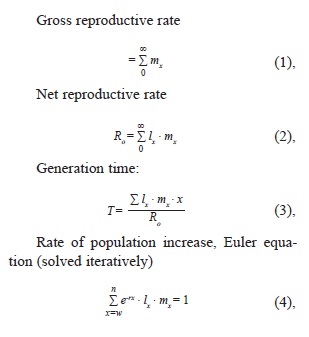
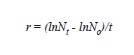
<body><![CDATA[The survivorship and fecundity data were     used to calculate variables such as average lifespan (ALS), gross and     net reproductive rates, generation time (T), and the rate of population     increase per day (r ) using the following equations (Krebs 1985):</span></font><br      style="font-family: verdana;">     <br style="font-family: verdana;">     <div style="text-align: center;"><font size="2"><span  style="font-family: verdana;"></span></font><font size="2"><span  style="font-family: verdana;"></span></font><img alt=""  src="/img/revistas/rbt/v60n3/a01f1.jpg"  style="width: 309px; height: 337px;"><br style="font-family: verdana;"> </div> <br style="font-family: verdana;"> <font size="2"><span style="font-family: verdana;">where, <span  style="font-style: italic;">l</span><sub style="font-style: italic;">x</sub> is the probability of an individual to survive to an age class, m<sub>x</sub> is the age specific fecundity, R<sub>o</sub> is the average number of offspring per female, and r is the population growth rate. </span></font><br  style="font-family: verdana;"> <font size="2"></font><br style="font-family: verdana;"> <font size="2"><span style="font-family: verdana;"><span  style="font-weight: bold;">Population growth experiments:</span> Population growth experiments were conducted under similar conditions mentioned above, in 100mL recipients with 50mL of the test medium with the desired algal concentration.</span></font><br  style="font-family: verdana;"> <font size="2"></font><br style="font-family: verdana;"> <font size="2"><span style="font-family: verdana;">Every jar included 25 individuals of a mixed population of each of the test species. In total there were 48 test jars (three zooplankton taxa x two algal species x two culture media x four replicates). The individuals were counted and transferred to fresh medium with the appropriate algae concentration in a daily basis. The experiments were continued over a three-week period, until the populations began to decline. Population growth rates were calculated using the formula:</span></font><br  style="font-family: verdana;">     <div style="text-align: center;"><img alt=""      src="/img/revistas/rbt/v60n3/a01f2.jpg"      style="width: 134px; height: 55px;"><br style="font-family: verdana;">     ]]></body>
<body><![CDATA[</div>     <font size="2"><span style="font-family: verdana;">where <span      style="font-style: italic;">N</span><sub style="font-style: italic;">o</sub>     is the initial population     density, <span style="font-style: italic;">N</span><sub      style="font-style: italic;">t </sub>is the population density at time     t and t is the time in     days (Krebs 1985).</span></font><br style="font-family: verdana;">     <font size="2"></font><br style="font-family: verdana;">     <font size="2"><span style="font-family: verdana;">Data from demography     ]]></body>
<body><![CDATA[and population     growth experiments were assessed using one way analysis of variance     (ANOVA) (Sokal &amp; Rohlf 2000). Post-hoc (Holm-Sidak test) analysis     was used for multiple comparisons utilizing the software Statistica     ver. 6.</span></font><br style="font-family: verdana;">     <font size="2"></font><br style="font-family: verdana;">     <font style="font-weight: bold;" size="3"><span      style="font-family: verdana;">Results</span></font><br      style="font-family: verdana;">     <font size="2"></font><br style="font-family: verdana;">     ]]></body>
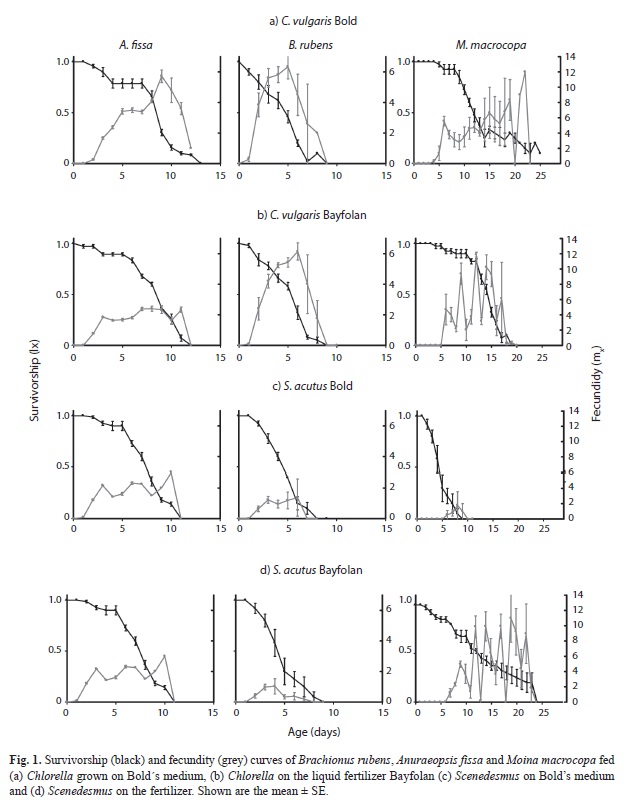
<body><![CDATA[<font size="2"><span style="font-family: verdana;"><span      style="font-weight: bold;">Demography:</span> The survivorship curves     of <span style="font-style: italic;">A. fissa</span> showed a steady     decline in the rate of survival with age,     regardless of the diet (<a href="/img/revistas/rbt/v60n3/a01i1.jpg">Fig.     1</a>). The fecundity was highest on <span style="font-style: italic;">Chlorella</span>     cultured on Bold&#8217;s medium. <span style="font-style: italic;">B. rubens</span>     showed a steep decline in     survivorship (<a href="/img/revistas/rbt/v60n3/a01i1.jpg">Fig. 1</a>)     as compared to <span style="font-style: italic;">A.     ]]></body>
<body><![CDATA[fissa</span>. The fecundity was also     significantly higher with <span style="font-style: italic;">Chlorella</span>     as compared <span style="font-style: italic;">S. acutus</span>. The     survivorship and fecundity of <span style="font-style: italic;">M.     macrocopa</span> (<a href="/img/revistas/rbt/v60n3/a01i1.jpg">Fig. 1</a>)     were higher with     <span style="font-style: italic;">Chlorella</span> cultured in Bold&#8217;s     medium and <span style="font-style: italic;">Scenedesmus</span>     cultured in     Bayfolan. These variables were much lower when fed <span     ]]></body>
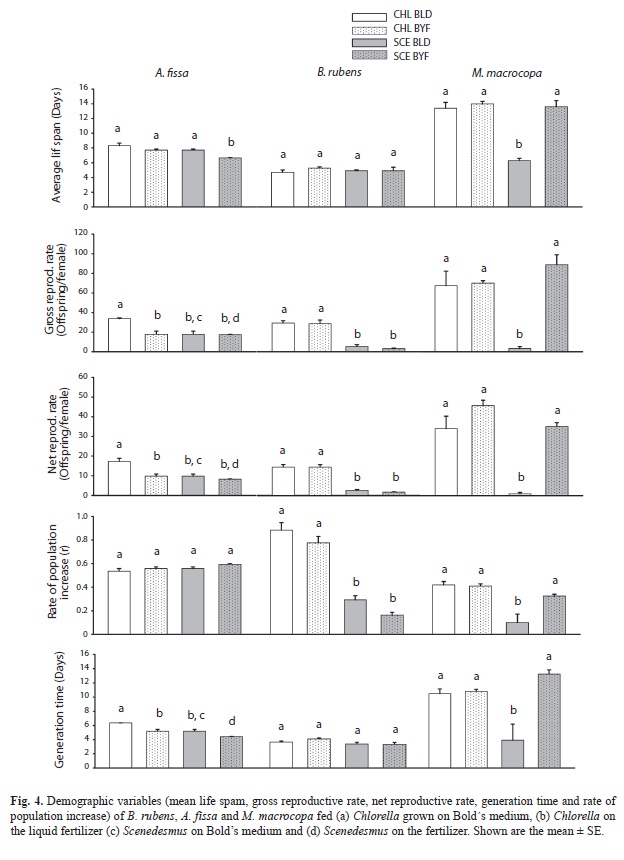
<body><![CDATA[ style="font-style: italic;">Scenedesmus</span> cultured     on Bold&#8217;s medium.</span></font><br style="font-family: verdana;">     <font size="2"></font><br style="font-family: verdana;">     <font size="2"><span style="font-family: verdana;">For the rotifers, no     significant     impact of the tested diets was found on the average lifespan, which was     eight days in the case of <span style="font-style: italic;">A. fissa</span>     and five days in that of <span style="font-style: italic;">B. rubens</span>.     The average lifespan of <span style="font-style: italic;">M. macrocopa</span>     was about 14 days for all the     ]]></body>
<body><![CDATA[tested diets except for <span style="font-style: italic;">S. acutus</span>     cultured on Bold&#8217;s medium for which     was significantly lower (F-test, p&lt;0.05).</span></font><br      style="font-family: verdana;">     <font size="2"></font><br style="font-family: verdana;">     <font size="2"><span style="font-family: verdana;">The gross and net     reproductive     rates of <span style="font-style: italic;">A. fissa</span> ranged from     18-36 offspring per female and were     significantly higher with <span style="font-style: italic;">C. vulgaris</span>     ]]></body>
<body><![CDATA[cultured on Bold&#8217;s medium as     compared to the other diets tested (<a      href="/img/revistas/rbt/v60n3/a01i2.jpg">Fig. 2</a>). Regardless of     the culture     medium, <span style="font-style: italic;">Chlorella</span> resulted in     significantly higher (F-test, p&lt;0.05)     gross and net reproductive rates for <span style="font-style: italic;">B.     rubens</span> when compared to <span style="font-style: italic;">S.     acutus</span> diets. The reproductive rates of <span      style="font-style: italic;">M. macrocopa</span> were significantly     ]]></body>
<body><![CDATA[higher (F-test, p&lt;0.05) on all the test diets except for <span      style="font-style: italic;">S. acutus</span>     on Bold&#8217;s medium. It varied from 30 to 85 offspring per female. The     generation time ranged from 4 to 6 days for rotifers. In <span      style="font-style: italic;">A. fissa</span> it     was significantly longer with <span style="font-style: italic;">C.     vulgaris</span> diet on Bold&#8217;s medium when     compared to all other tested media. For <span      style="font-style: italic;">B. rubens</span>, it was not     significantly influenced by the diet, while in <span     ]]></body>
<body><![CDATA[ style="font-style: italic;">M. macrocopa</span> it was     significantly lower only on <span style="font-style: italic;">S. acutus</span>     cultured in Bold&#8217;s medium. The     population growth rate of <span style="font-style: italic;">A. fissa</span>     ranged from 0.55 to 0.60 with no     significant differences due to diet type. For <span      style="font-style: italic;">B. rubens</span> it was     significantly higher on <span style="font-style: italic;">Chlorella</span>     (0.75-0.85 per day) than on <span style="font-style: italic;">S. acutus</span>     (0.25-0.40 per day). The growth rate of <span     ]]></body>
<body><![CDATA[ style="font-style: italic;">M. macrocopa</span> ranged between     0.2-0.40 per day and was significantly lower (F-test, p&lt;0.05) for <span      style="font-style: italic;">S.     acutus</span> cultured on Bold&#8217;s medium as compared to the other diets.</span></font><br      style="font-family: verdana;">     <br style="font-family: verdana;">     <font size="2"><span style="font-family: verdana;"><span      style="font-weight: bold;">Population growth:</span> The rotifer     species <span style="font-style: italic;">A. fissa</span> and <span      style="font-style: italic;">B. rubens</span> had higher growth rates     ]]></body>
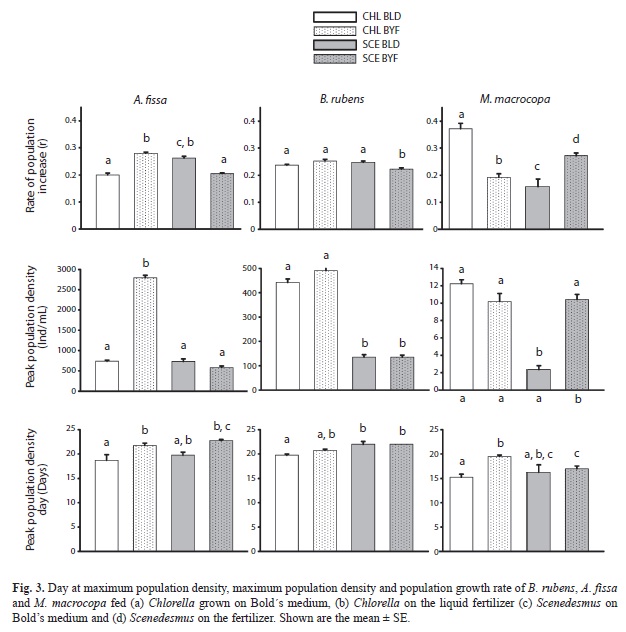
<body><![CDATA[on a diet of <span style="font-style: italic;">C.     vulgaris</span> than on <span style="font-style: italic;">S. acutus</span>     (<a href="/img/revistas/rbt/v60n3/a01i3.jpg">Fig. 3</a>). Regardless of     the culture medium     <span style="font-style: italic;">S. acutus</span> did not support     higher reproductive output. On the other     hand, <span style="font-style: italic;">C. vulgaris</span> cultured on     the fertilizer was a better diet due to     significantly higher growth rates of both the rotifer species as     compared to those observed on diets of <span     ]]></body>
<body><![CDATA[ style="font-style: italic;">C. vulgaris</span> cultured on     Bold&acute;s medium. The cladoceran <span style="font-style: italic;">M.     macrocopa</span> also grew better on a     diet of <span style="font-style: italic;">C. vulgaris</span> than on <span      style="font-style: italic;">S. acutus</span> (<a      href="/img/revistas/rbt/v60n3/a01i3.jpg">Fig. 3</a>). Growth rates     were     higher for <span style="font-style: italic;">C. vulgaris</span>     cultured in Bold&#8217;s medium than for <span style="font-style: italic;">S.     acutus</span>     ]]></body>
<body><![CDATA[cultured on the fertilizer.</span></font><br      style="font-family: verdana;">     <font size="2"></font><br style="font-family: verdana;">     <font size="2"><span style="font-family: verdana;">The population     growth rates of     both, <span style="font-style: italic;">A. fissa</span> and <span      style="font-style: italic;">B. rubens</span>, ranged from 0.1-0.25/d     (<a href="/img/revistas/rbt/v60n3/a01i4.jpg">Fig. 4</a>). These     were significantly higher on <span style="font-style: italic;">C.     vulgaris</span> cultured on fertilizer as     ]]></body>
<body><![CDATA[compared to any of the other diets (p&lt;0.05, F-test, posthoc Tukey&#8217;s     test). The growth rates of <span style="font-style: italic;">M.     macrocopa</span> ranged from 0.1 to 0.38/d, and     were highest on diets of <span style="font-style: italic;">C. vulgaris</span>     cultured on Bold&#8217;s medium and <span style="font-style: italic;">S.     acutus</span> cultured on the fertilizer. Thus, in all the three     zooplankton     species, regardless of the culture medium, the growth rates were     highest on <span style="font-style: italic;">Chlorella</span> than on <span      style="font-style: italic;">Scenedesmus</span>.</span></font><br     ]]></body>
<body><![CDATA[ style="font-family: verdana;">     <font size="2"></font><br style="font-family: verdana;">     <font size="2"><span style="font-family: verdana;">The peak population     density reached     was highest of 2 800indiv/mL in the smallest species tested, <span      style="font-style: italic;">A. fissa</span>.     <span style="font-style: italic;">Brachionus rubens</span> reached a     density of 480indiv/mL while for <span style="font-style: italic;">M.     macrocopa</span> was of 12indiv/mL. The rotifer species attained the     peak     ]]></body>
<body><![CDATA[population density between 18 to 21 days, while <span      style="font-style: italic;">M. macrocopa</span> reached     peak densities between 15 to 18 days. There were no significant     differences in the day at which peak densities were reached in relation     to the diet.</span></font><br style="font-family: verdana;">     <font size="2"></font><br style="font-family: verdana;">     <font style="font-weight: bold;" size="3"><span      style="font-family: verdana;">Discussion</span></font><br      style="font-family: verdana;">     <font size="2"></font><br style="font-family: verdana;">     ]]></body>
<body><![CDATA[<font size="2"><span style="font-family: verdana;">Zooplankton     bioassays are sensitive     enough to test the quality of algal (Nandini <span      style="font-style: italic;">et al</span>. 2010) or seston     (Gulati <span style="font-style: italic;">et al</span>. 2001) diets.     Our study also shows that all the three     species used in this study showed significant differences in the     life-history parameters with relation to, not only the differences     between algal species but also the medium on which each alga was     cultured. We found that, in general <span style="font-style: italic;">C.     ]]></body>
<body><![CDATA[vulgaris</span> was a more suitable     diet than <span style="font-style: italic;">S. acutus</span>. In our     study, the size of <span style="font-style: italic;">C. vulgaris</span>     ranged from     4.5-5.1&#956;m while that of <span style="font-style: italic;">S. acutus</span>     from 8.8 to 8.9&#956;m. Most zooplankton     can easily filter algae in the size range of 5-25&#956;m (Monakov 2003),     therefore the algal size may not have been the reason for poor growth     on <span style="font-style: italic;">S. acutus</span>. This is most     probably due to the fact that the cell wall     ]]></body>
<body><![CDATA[of the former is about 20 nm (Northcote <span      style="font-style: italic;">et al</span>. 1958) while that of     <span style="font-style: italic;">Scenedesmus</span> is 36 nm     (Bisalputra &amp; Weier 1963). This may have     resulted in <span style="font-style: italic;">S. acutus</span> being     more difficult to digest by zooplankton     than <span style="font-style: italic;">C. vulgaris</span>.</span></font><br      style="font-family: verdana;">     <font size="2"></font><br style="font-family: verdana;">     <font size="2"><span style="font-family: verdana;">The quality of algal     ]]></body>
<body><![CDATA[diets depends     significantly on the culture medium as well as physicochemical     parameters such as light and temperature. Fatty acids are more     sensitive to changes in the medium than are proteins (Rai <span      style="font-style: italic;">et al</span>. 1997).     Although it has been suggested that in the face of poor food quality     organisms would increase their intake (Brett 1993, Hessen 1993), this     actually does not occur (Kilham <span style="font-style: italic;">et al</span>.     1997). This is the reason why we     found significant differences in the growth rates of the zooplankton in     ]]></body>
<body><![CDATA[relation to the culture medium of the algae. It was evident that the <span      style="font-style: italic;">S.     acutus</span> cultured on Bold&#8217;s medium resulted in higher growth rates     of <span style="font-style: italic;">M.     macrocopa</span> while <span style="font-style: italic;">Chlorella</span>     cultured on Bayfolan resulted in higher or     similar growth rates of the rotifers as compared to same alga cultured     on Bold&#8217;s medium. This clearly indicates that Bayfolan is adequate for     plankton production for aquaculture practices and would help in     bringing down the costs of algal production significantly.</span></font><br     ]]></body>
<body><![CDATA[ style="font-family: verdana;">     <font size="2"></font><br style="font-family: verdana;">     <font size="2"><span style="font-family: verdana;">That <span      style="font-style: italic;">C. vulgaris</span> cultured on the     commercial fertilizer is adequate for the rotifers is also evident from     the peak densities attained; for <span style="font-style: italic;">A.     fissa</span> this was more than five times     that reached on <span style="font-style: italic;">C. vulgaris</span>     cultured on Bold&#8217;s medium. In the case of     <span style="font-style: italic;">B. rubens</span> significant     ]]></body>
<body><![CDATA[differences were observed only in relation to the     algal species but not with culture medium. This clearly indicates that     culturing algae in commercial fertilizers will yield high densities of     algae of an adequate quality for aquaculture. Several studies indicate     that algae and zooplankton grown in diverse culture media are suitable     food for zooplankton, mollusks and fish (Ahlgren <span      style="font-style: italic;">et al</span>. 1990).</span></font><br      style="font-family: verdana;">     <font size="2"></font><br style="font-family: verdana;">     <font size="2"><span style="font-family: verdana;">Our study reiterates     ]]></body>
<body><![CDATA[the importance     of <span style="font-style: italic;">M. macrocopa</span> as a live     food for aquaculture. This species is known     to have a higher protein content and lower ash content as compared to     Artemia (Watanabe <span style="font-style: italic;">et al</span>.     1983) or <span style="font-style: italic;">Daphnia</span> (Kibria <span      style="font-style: italic;">et al</span>. 1999). It is     one of the few cladoceran genera with much shorter age at first     reproduction and lifespan which in turn result in higher growth rates.     As compared to several cladoceran taxa, <span     ]]></body>
<body><![CDATA[ style="font-style: italic;">Moina</span> frequently has growth     rates values above 0.6 per day (Sarma <span style="font-style: italic;">et     al</span>. 2005). We also found that     regardless of the algal type or culture medium used, the gross     reproductive rate of <span style="font-style: italic;">Moina</span>     were up to 90. This indicates that a     healthy, large scale, <span style="font-style: italic;">Moina</span>     culture would ensure sufficient prey for     the fish larvae. <span style="font-style: italic;">Moina</span> is     also a preferred prey for commercially     ]]></body>
<body><![CDATA[important fish species. For example, from first to third week after     hatching, larval <span style="font-style: italic;">Chirostoma riojai</span>     showed high preference for <span style="font-style: italic;">M.     macrocopa</span> and consume it in large numbers (Morales-Ventura <span      style="font-style: italic;">et al</span>.     2004). It remains to be seen whether an exclusive diet of <span      style="font-style: italic;">M. macrocopa</span>,     as compared to an artificial but balanced diet, improves the     survivorship and growth of larval fish.</span></font><br      style="font-family: verdana;">     ]]></body>
<body><![CDATA[<font size="2"></font><br style="font-family: verdana;">     <font style="font-weight: bold;" size="3"><span      style="font-family: verdana;">Acknowledgments</span></font><br      style="font-family: verdana;">     <font size="2"></font><br style="font-family: verdana;">     <font size="2"><span style="font-family: verdana;">JMV thanks Instituto     Nacional de     Pesca for permission and Posgrado de Divisi&oacute;n de Ciencias     Biol&oacute;gicas y de la Salud (UAM) for partial financial support. SN     and SSSS thank PASPA and PAPIIT-IN221111 (UNAM) for financial     ]]></body>
<body><![CDATA[assistance.</span></font><br style="font-family: verdana;">     <font size="2"></font>     <hr style="width: 100%; height: 2px;"><br style="font-family: verdana;">     <font style="font-weight: bold;" size="3"><span      style="font-family: verdana;">References</span></font><br      style="font-family: verdana;">     <font size="2"></font><br style="font-family: verdana;">     <font size="2"><span style="font-family: verdana;">Ahlgren, G., L.     Lundstedt, M. Brett     &amp; C. Forsberg. 1990. Lipid composition and food quality for some     ]]></body>
<body><![CDATA[freshwater phytoplankton for cladocerans zooplankters. J. Plankton Res.     <!-- ref -->12: 809-818.    &nbsp;&nbsp;&nbsp;&nbsp;&nbsp;&nbsp;&nbsp;&nbsp;[&#160;<a href="javascript:void(0);" onclick="javascript: window.open('/scielo.php?script=sci_nlinks&ref=1453083&pid=S0034-7744201200030000100001&lng=','','width=640,height=500,resizable=yes,scrollbars=1,menubar=yes,');">Links</a>&#160;]<!-- end-ref --><!-- ref --></span></font><br style="font-family: verdana;"> <font size="2"></font><br style="font-family: verdana;"> <font size="2"><span style="font-family: verdana;">Azuara-Garc&iacute;a, R., S.S.S. Sarma &amp; S. Nandini. 2006. The combined effects of zinc and alga on the life table demography of <span style="font-style: italic;">Anuraeopsis fissa</span> and <span style="font-style: italic;">Brachionus rubens</span> (Rotifera). J. Environmental Sci. Hlth. Part A 41: 559-572.    &nbsp;&nbsp;&nbsp;&nbsp;&nbsp;&nbsp;&nbsp;&nbsp;[&#160;<a href="javascript:void(0);" onclick="javascript: window.open('/scielo.php?script=sci_nlinks&ref=1453084&pid=S0034-7744201200030000100002&lng=','','width=640,height=500,resizable=yes,scrollbars=1,menubar=yes,');">Links</a>&#160;]<!-- end-ref --><!-- ref --></span></font><br  style="font-family: verdana;"> <font size="2"></font><br style="font-family: verdana;"> <font size="2"><span style="font-family: verdana;">Bisalputra, T. &amp; T.E. Weier. 1963. The cell wall of <span style="font-style: italic;">Scenedesmus</span> <span style="font-style: italic;">quadricauda</span>. Am. J. Bot. 50: 1011-1019.    &nbsp;&nbsp;&nbsp;&nbsp;&nbsp;&nbsp;&nbsp;&nbsp;[&#160;<a href="javascript:void(0);" onclick="javascript: window.open('/scielo.php?script=sci_nlinks&ref=1453085&pid=S0034-7744201200030000100003&lng=','','width=640,height=500,resizable=yes,scrollbars=1,menubar=yes,');">Links</a>&#160;]<!-- end-ref --><!-- ref --></span></font><br style="font-family: verdana;"> <font size="2"></font><br style="font-family: verdana;"> <font size="2"><span style="font-family: verdana;">Borowitzka, M.A. &amp; L.J. Borowitzka. 1988. <span style="font-style: italic;">Dunaliella</span>, p. 28-59. <span style="font-style: italic;">In</span> M.A. Borowitzka &amp; L.J. Borowitzka (eds.). Microalgal Biotechnology. Cambridge, EEUU.    &nbsp;&nbsp;&nbsp;&nbsp;&nbsp;&nbsp;&nbsp;&nbsp;[&#160;<a href="javascript:void(0);" onclick="javascript: window.open('/scielo.php?script=sci_nlinks&ref=1453086&pid=S0034-7744201200030000100004&lng=','','width=640,height=500,resizable=yes,scrollbars=1,menubar=yes,');">Links</a>&#160;]<!-- end-ref --><!-- ref --></span></font><br  style="font-family: verdana;"> <font size="2"></font><br style="font-family: verdana;"> <font size="2"><span style="font-family: verdana;">Brett, M.T. 1993. Comment on &#8220;Possibility of N or P limitation for planktonic cladocerans: an experimental test&#8221; (Urabe and Watanabe) and &#8220;Nutrient element limitation of zooplankton production&#8221;. Limnol. Oceanogr. 38: 1333-1337.    &nbsp;&nbsp;&nbsp;&nbsp;&nbsp;&nbsp;&nbsp;&nbsp;[&#160;<a href="javascript:void(0);" onclick="javascript: window.open('/scielo.php?script=sci_nlinks&ref=1453087&pid=S0034-7744201200030000100005&lng=','','width=640,height=500,resizable=yes,scrollbars=1,menubar=yes,');">Links</a>&#160;]<!-- end-ref --><!-- ref --></span></font><br  style="font-family: verdana;"> <font size="2"></font><br style="font-family: verdana;"> <font size="2"><span style="font-family: verdana;">Chac&oacute;n-Torres, A. &amp; C. Rosas Monge. 1995. A restoration plan for pez blanco in lake P&aacute;tzcuaro, Mexico. Symposium of the American Fisheries Society 15: 122-126.    &nbsp;&nbsp;&nbsp;&nbsp;&nbsp;&nbsp;&nbsp;&nbsp;[&#160;<a href="javascript:void(0);" onclick="javascript: window.open('/scielo.php?script=sci_nlinks&ref=1453088&pid=S0034-7744201200030000100006&lng=','','width=640,height=500,resizable=yes,scrollbars=1,menubar=yes,');">Links</a>&#160;]<!-- end-ref --><!-- ref --></span></font><br style="font-family: verdana;"> <font size="2"></font><br style="font-family: verdana;"> <font size="2"><span style="font-family: verdana;">Chaumont, D. 1993. Biotechnology of algal biomass production: a review of systems for outdoor mass culture. J. Appl. Phycol. 5: 593-604.    &nbsp;&nbsp;&nbsp;&nbsp;&nbsp;&nbsp;&nbsp;&nbsp;[&#160;<a href="javascript:void(0);" onclick="javascript: window.open('/scielo.php?script=sci_nlinks&ref=1453089&pid=S0034-7744201200030000100007&lng=','','width=640,height=500,resizable=yes,scrollbars=1,menubar=yes,');">Links</a>&#160;]<!-- end-ref --><!-- ref --></span></font><br  style="font-family: verdana;"> <font size="2"></font><br style="font-family: verdana;"> <font size="2"><span style="font-family: verdana;">Flores-Burgos, J., S.S.S. Sarma &amp; S. Nandini. 2003. Population growth of zooplankton (rotifers and cladocerans) fed <span style="font-style: italic;">Chlorella vulgaris</span> and <span style="font-style: italic;">Scenedesmus acutus</span> in different proportions. Acta Hydrochim. Hydrobiol. 31: 240-248.    &nbsp;&nbsp;&nbsp;&nbsp;&nbsp;&nbsp;&nbsp;&nbsp;[&#160;<a href="javascript:void(0);" onclick="javascript: window.open('/scielo.php?script=sci_nlinks&ref=1453090&pid=S0034-7744201200030000100008&lng=','','width=640,height=500,resizable=yes,scrollbars=1,menubar=yes,');">Links</a>&#160;]<!-- end-ref --><!-- ref --></span></font><br  style="font-family: verdana;"> <font size="2"></font><br style="font-family: verdana;"> <font size="2"><span style="font-family: verdana;">Gulati, R.D., M. Bronkhorst &amp; E. van Donk. 2001. Feeding in <span style="font-style: italic;">Daphnia</span> <span style="font-style: italic;">galeata</span> on <span  style="font-style: italic;">Oscillatoria limnetica</span> and detritus derived from it. J. Plankton Res. 23: 705-718.    &nbsp;&nbsp;&nbsp;&nbsp;&nbsp;&nbsp;&nbsp;&nbsp;[&#160;<a href="javascript:void(0);" onclick="javascript: window.open('/scielo.php?script=sci_nlinks&ref=1453091&pid=S0034-7744201200030000100009&lng=','','width=640,height=500,resizable=yes,scrollbars=1,menubar=yes,');">Links</a>&#160;]<!-- end-ref --><!-- ref --></span></font><br  style="font-family: verdana;"> <font size="2"></font><br style="font-family: verdana;"> <font size="2"><span style="font-family: verdana;">Hessen, D.O. 1993. The role of mineral nutrients for zooplankton nutrition: reply to the comment by Brett. Limnol. Oceanogr. 38: 1340-1343.    &nbsp;&nbsp;&nbsp;&nbsp;&nbsp;&nbsp;&nbsp;&nbsp;[&#160;<a href="javascript:void(0);" onclick="javascript: window.open('/scielo.php?script=sci_nlinks&ref=1453092&pid=S0034-7744201200030000100010&lng=','','width=640,height=500,resizable=yes,scrollbars=1,menubar=yes,');">Links</a>&#160;]<!-- end-ref --><!-- ref --></span></font><br  style="font-family: verdana;"> <font size="2"></font><br style="font-family: verdana;"> <font size="2"><span style="font-family: verdana;">Jana, B.B. &amp; C.D. Webster. 2003. Sustainable aquaculture: global perspectives. Haworth, USA.    &nbsp;&nbsp;&nbsp;&nbsp;&nbsp;&nbsp;&nbsp;&nbsp;[&#160;<a href="javascript:void(0);" onclick="javascript: window.open('/scielo.php?script=sci_nlinks&ref=1453093&pid=S0034-7744201200030000100011&lng=','','width=640,height=500,resizable=yes,scrollbars=1,menubar=yes,');">Links</a>&#160;]<!-- end-ref --><!-- ref --></span></font><br  style="font-family: verdana;"> <font size="2"></font><br style="font-family: verdana;"> <font size="2"><span style="font-family: verdana;">Kibria, G., D. Nugegoda, R. Fairclough, P. Lam &amp; A. Bradley. 1999. Utilization of wastewater-grown zooplankton: Nutritional quality of zooplankton and performance of silver perch <span style="font-style: italic;">Bidyanus bidyanus</span> (Mitchell 1838) (Teraponidae) fed on wastewater-grown zooplankton. Aquaculture Nutr. 5: 221-227.    &nbsp;&nbsp;&nbsp;&nbsp;&nbsp;&nbsp;&nbsp;&nbsp;[&#160;<a href="javascript:void(0);" onclick="javascript: window.open('/scielo.php?script=sci_nlinks&ref=1453094&pid=S0034-7744201200030000100012&lng=','','width=640,height=500,resizable=yes,scrollbars=1,menubar=yes,');">Links</a>&#160;]<!-- end-ref --><!-- ref --></span></font><br style="font-family: verdana;"> <font size="2"></font><br style="font-family: verdana;"> <font size="2"><span style="font-family: verdana;">Kilham, S.S., D.A. Kreeger, C.E. Goulden &amp; S. Lynn. 1997. Effects of algal food quality on fecundity and population growth rates of <span style="font-style: italic;">Daphnia</span>. Freshwat. Biol. 38: 639-647.    &nbsp;&nbsp;&nbsp;&nbsp;&nbsp;&nbsp;&nbsp;&nbsp;[&#160;<a href="javascript:void(0);" onclick="javascript: window.open('/scielo.php?script=sci_nlinks&ref=1453095&pid=S0034-7744201200030000100013&lng=','','width=640,height=500,resizable=yes,scrollbars=1,menubar=yes,');">Links</a>&#160;]<!-- end-ref --><!-- ref --></span></font><br  style="font-family: verdana;"> <font size="2"></font><br style="font-family: verdana;"> <font size="2"><span style="font-family: verdana;">Krebs, C.J. 1985. Ecology; the experimental analysis of distribution and abundance. Harper and Row, New York, USA.    &nbsp;&nbsp;&nbsp;&nbsp;&nbsp;&nbsp;&nbsp;&nbsp;[&#160;<a href="javascript:void(0);" onclick="javascript: window.open('/scielo.php?script=sci_nlinks&ref=1453096&pid=S0034-7744201200030000100014&lng=','','width=640,height=500,resizable=yes,scrollbars=1,menubar=yes,');">Links</a>&#160;]<!-- end-ref --><!-- ref --></span></font><br style="font-family: verdana;"> <font size="2"></font><br style="font-family: verdana;"> <font size="2"><span style="font-family: verdana;">Lubzens, E., D. Rankevich, G. Kolodny, O. Gibson, A. Cohen &amp; M. Khayat. 1995. Physiological adaptations in the survival of rotifers (<span  style="font-style: italic;">Brachionus plicatilis</span> O. F. Mueller) at low temperatures. Hydrobiologia 313/314: 175-183.    &nbsp;&nbsp;&nbsp;&nbsp;&nbsp;&nbsp;&nbsp;&nbsp;[&#160;<a href="javascript:void(0);" onclick="javascript: window.open('/scielo.php?script=sci_nlinks&ref=1453097&pid=S0034-7744201200030000100015&lng=','','width=640,height=500,resizable=yes,scrollbars=1,menubar=yes,');">Links</a>&#160;]<!-- end-ref --><!-- ref --></span></font><br  style="font-family: verdana;"> <font size="2"></font><br style="font-family: verdana;"> <font size="2"><span style="font-family: verdana;">Lubzens, E., A. Tandler &amp; G. Minkoff. 1989. Rotifers as food in Aquaculture. Hydrobiologia 186/187: 387-400.    &nbsp;&nbsp;&nbsp;&nbsp;&nbsp;&nbsp;&nbsp;&nbsp;[&#160;<a href="javascript:void(0);" onclick="javascript: window.open('/scielo.php?script=sci_nlinks&ref=1453098&pid=S0034-7744201200030000100016&lng=','','width=640,height=500,resizable=yes,scrollbars=1,menubar=yes,');">Links</a>&#160;]<!-- end-ref --><!-- ref --></span></font><br style="font-family: verdana;"> <font size="2"></font><br style="font-family: verdana;"> <font size="2"><span style="font-family: verdana;">Lubzens, E. &amp; O. Zmora. 2003. Production and nutritional value of rotifers, p. 17-64. <span  style="font-style: italic;">In</span> J.G. Stottrup &amp; L.A. McEvoy (eds.). Live Feeds in Marine Aquaculture. Blackwell, Oxford, United Kingdom.    &nbsp;&nbsp;&nbsp;&nbsp;&nbsp;&nbsp;&nbsp;&nbsp;[&#160;<a href="javascript:void(0);" onclick="javascript: window.open('/scielo.php?script=sci_nlinks&ref=1453099&pid=S0034-7744201200030000100017&lng=','','width=640,height=500,resizable=yes,scrollbars=1,menubar=yes,');">Links</a>&#160;]<!-- end-ref --><!-- ref --></span></font><br  style="font-family: verdana;"> <font size="2"></font><br style="font-family: verdana;"> <font size="2"><span style="font-family: verdana;">Mayeli, S.M., S. Nandini &amp; S.S.S. Sarma. 2004. The efficacy of <span style="font-style: italic;">Scenedesmus</span> morphology as a defense mechanism against grazing by selected species of rotifers and cladocerans. Aquat. Ecol. 38: 515-524.    &nbsp;&nbsp;&nbsp;&nbsp;&nbsp;&nbsp;&nbsp;&nbsp;[&#160;<a href="javascript:void(0);" onclick="javascript: window.open('/scielo.php?script=sci_nlinks&ref=1453100&pid=S0034-7744201200030000100018&lng=','','width=640,height=500,resizable=yes,scrollbars=1,menubar=yes,');">Links</a>&#160;]<!-- end-ref --><!-- ref --></span></font><br  style="font-family: verdana;"> <font size="2"></font><br style="font-family: verdana;"> <font size="2"><span style="font-family: verdana;">Monakov, A.V. 2003. Feeding of Freshwater Invertebrates. Kenobi Productions, Ghent, B&eacute;lgica.    &nbsp;&nbsp;&nbsp;&nbsp;&nbsp;&nbsp;&nbsp;&nbsp;[&#160;<a href="javascript:void(0);" onclick="javascript: window.open('/scielo.php?script=sci_nlinks&ref=1453101&pid=S0034-7744201200030000100019&lng=','','width=640,height=500,resizable=yes,scrollbars=1,menubar=yes,');">Links</a>&#160;]<!-- end-ref --><!-- ref --></span></font><br  style="font-family: verdana;"> <font size="2"></font><br style="font-family: verdana;"> <font size="2"><span style="font-family: verdana;">Morales-Ventura, J., S. Nandini &amp; S.S.S. Sarma. 2004. Functional responses during the early larval stages of the charal fish <span style="font-style: italic;">Chirostoma riojai</span> (Pisces: Atherinidae) fed zooplankton (rotifers and cladocerans). J. Appl. Icthyol. 20: 417-421.    &nbsp;&nbsp;&nbsp;&nbsp;&nbsp;&nbsp;&nbsp;&nbsp;[&#160;<a href="javascript:void(0);" onclick="javascript: window.open('/scielo.php?script=sci_nlinks&ref=1453102&pid=S0034-7744201200030000100020&lng=','','width=640,height=500,resizable=yes,scrollbars=1,menubar=yes,');">Links</a>&#160;]<!-- end-ref --><!-- ref --></span></font><br  style="font-family: verdana;"> <font size="2"></font><br style="font-family: verdana;"> <font size="2"><span style="font-family: verdana;">Meyer, J.S., C.G. Igersoll, L.L. MacDonald &amp; M.S. Boyce.1986. Estimating uncertainty in population growth rates: jackknife vs. bootstrap techniques. Ecology 67: 1156-1166.    &nbsp;&nbsp;&nbsp;&nbsp;&nbsp;&nbsp;&nbsp;&nbsp;[&#160;<a href="javascript:void(0);" onclick="javascript: window.open('/scielo.php?script=sci_nlinks&ref=1453103&pid=S0034-7744201200030000100021&lng=','','width=640,height=500,resizable=yes,scrollbars=1,menubar=yes,');">Links</a>&#160;]<!-- end-ref --><!-- ref --></span></font><br  style="font-family: verdana;"> <font size="2"></font><br style="font-family: verdana;"> <font size="2"><span style="font-family: verdana;">Nandini, S., P. Ram&iacute;rez-Garc&iacute;a &amp; S.S.S. Sarma. 2010. Evaluation of primary and secondary production using waste water as the culture medium. Waste Manag. Res. 28: 928-935.    &nbsp;&nbsp;&nbsp;&nbsp;&nbsp;&nbsp;&nbsp;&nbsp;[&#160;<a href="javascript:void(0);" onclick="javascript: window.open('/scielo.php?script=sci_nlinks&ref=1453104&pid=S0034-7744201200030000100022&lng=','','width=640,height=500,resizable=yes,scrollbars=1,menubar=yes,');">Links</a>&#160;]<!-- end-ref --><!-- ref --></span></font><br  style="font-family: verdana;"> <font size="2"></font><br style="font-family: verdana;"> <font size="2"><span style="font-family: verdana;">Northcote, D.H., K.J. Goulding &amp; W. Horne. 1958. The chemical composition and structure of the cell wall of <span style="font-style: italic;">Chlorella pyrenoidosa</span>. Biochem. J. 70: 390-397.    &nbsp;&nbsp;&nbsp;&nbsp;&nbsp;&nbsp;&nbsp;&nbsp;[&#160;<a href="javascript:void(0);" onclick="javascript: window.open('/scielo.php?script=sci_nlinks&ref=1453105&pid=S0034-7744201200030000100023&lng=','','width=640,height=500,resizable=yes,scrollbars=1,menubar=yes,');">Links</a>&#160;]<!-- end-ref --><!-- ref --></span></font><br style="font-family: verdana;"> <font size="2"></font><br style="font-family: verdana;"> <font size="2"><span style="font-family: verdana;">&Oslash;stergaard, P., P. Munk &amp; V. Janekarn. 2005. Contrasting feeding patterns among species of fish larvae from the tropical Andaman Sea. Mar. Biol. 146: 596-606.    &nbsp;&nbsp;&nbsp;&nbsp;&nbsp;&nbsp;&nbsp;&nbsp;[&#160;<a href="javascript:void(0);" onclick="javascript: window.open('/scielo.php?script=sci_nlinks&ref=1453106&pid=S0034-7744201200030000100024&lng=','','width=640,height=500,resizable=yes,scrollbars=1,menubar=yes,');">Links</a>&#160;]<!-- end-ref --><!-- ref --></span></font><br  style="font-family: verdana;"> <font size="2"></font><br style="font-family: verdana;"> <font size="2"><span style="font-family: verdana;">Pe&ntilde;a-Aguado, F., S. Nandini &amp; S.S.S. Sarma. 2005. Differences in population growth of rotifers and cladocerans raised on algal diets supplemented with yeast. Limnologica 35: 298-303.    &nbsp;&nbsp;&nbsp;&nbsp;&nbsp;&nbsp;&nbsp;&nbsp;[&#160;<a href="javascript:void(0);" onclick="javascript: window.open('/scielo.php?script=sci_nlinks&ref=1453107&pid=S0034-7744201200030000100025&lng=','','width=640,height=500,resizable=yes,scrollbars=1,menubar=yes,');">Links</a>&#160;]<!-- end-ref --><!-- ref --></span></font><br style="font-family: verdana;"> <font size="2"></font><br style="font-family: verdana;"> <font size="2"><span style="font-family: verdana;">Rai, H., M. Arts, B.C. Wainman, N. Dockal &amp; H.J. Krambeck. 1997. Lipid production in natural phytoplankton communities in a small freshwater Baltic lake, Lake Sch&ouml;hsee, Germany. Freshwat. Biol. 38: 581-590.    &nbsp;&nbsp;&nbsp;&nbsp;&nbsp;&nbsp;&nbsp;&nbsp;[&#160;<a href="javascript:void(0);" onclick="javascript: window.open('/scielo.php?script=sci_nlinks&ref=1453108&pid=S0034-7744201200030000100026&lng=','','width=640,height=500,resizable=yes,scrollbars=1,menubar=yes,');">Links</a>&#160;]<!-- end-ref --><!-- ref --></span></font><br  style="font-family: verdana;"> <font size="2"></font><br style="font-family: verdana;"> <font size="2"><span style="font-family: verdana;">Sarma, S.S.S., N. Iyer &amp; H.J. Dumont. 1996. Competitive interactions between herbivorous rotifers: importance of food concentration and initial population density. Hydrobiologia 331: 1-7.    &nbsp;&nbsp;&nbsp;&nbsp;&nbsp;&nbsp;&nbsp;&nbsp;[&#160;<a href="javascript:void(0);" onclick="javascript: window.open('/scielo.php?script=sci_nlinks&ref=1453109&pid=S0034-7744201200030000100027&lng=','','width=640,height=500,resizable=yes,scrollbars=1,menubar=yes,');">Links</a>&#160;]<!-- end-ref --><!-- ref --></span></font><br style="font-family: verdana;"> <font size="2"></font><br style="font-family: verdana;"> <font size="2"><span style="font-family: verdana;">Sarma, S.S.S., S. Nandini &amp; R.D. Gulati. 2005. Life history strategies of cladocerans: comparisons of tropical and temperate taxa. Hydrobiologia 542: 315-333.    &nbsp;&nbsp;&nbsp;&nbsp;&nbsp;&nbsp;&nbsp;&nbsp;[&#160;<a href="javascript:void(0);" onclick="javascript: window.open('/scielo.php?script=sci_nlinks&ref=1453110&pid=S0034-7744201200030000100028&lng=','','width=640,height=500,resizable=yes,scrollbars=1,menubar=yes,');">Links</a>&#160;]<!-- end-ref --><!-- ref --></span></font><br  style="font-family: verdana;"> <font size="2"></font><br style="font-family: verdana;"> <font size="2"><span style="font-family: verdana;">Sarma, S.S.S., H.E. Trujillo-Hern&aacute;ndez &amp; S. Nandini. 2003. Population growth of herbivorous rotifers and their predator (<span  style="font-style: italic;">Asplanchna</span>) on urban wastewaters. Aquat. Ecol. 37: 243-250.    &nbsp;&nbsp;&nbsp;&nbsp;&nbsp;&nbsp;&nbsp;&nbsp;[&#160;<a href="javascript:void(0);" onclick="javascript: window.open('/scielo.php?script=sci_nlinks&ref=1453111&pid=S0034-7744201200030000100029&lng=','','width=640,height=500,resizable=yes,scrollbars=1,menubar=yes,');">Links</a>&#160;]<!-- end-ref --><!-- ref --></span></font><br  style="font-family: verdana;"> <font size="2"></font><br style="font-family: verdana;"> <font size="2"><span style="font-family: verdana;">Sarma, S.S.S. 1991. Rotifers and aquaculture (Review). Environ. Ecol. 9: 414-428.    &nbsp;&nbsp;&nbsp;&nbsp;&nbsp;&nbsp;&nbsp;&nbsp;[&#160;<a href="javascript:void(0);" onclick="javascript: window.open('/scielo.php?script=sci_nlinks&ref=1453112&pid=S0034-7744201200030000100030&lng=','','width=640,height=500,resizable=yes,scrollbars=1,menubar=yes,');">Links</a>&#160;]<!-- end-ref --><!-- ref --></span></font><br  style="font-family: verdana;"> <font size="2"></font><br style="font-family: verdana;"> <font size="2"><span style="font-family: verdana;">Sokal, R.R. &amp; F.J. Rohlf. 2000. Biometry. W.H. Freeman and Company, San Francisco, USA.    &nbsp;&nbsp;&nbsp;&nbsp;&nbsp;&nbsp;&nbsp;&nbsp;[&#160;<a href="javascript:void(0);" onclick="javascript: window.open('/scielo.php?script=sci_nlinks&ref=1453113&pid=S0034-7744201200030000100031&lng=','','width=640,height=500,resizable=yes,scrollbars=1,menubar=yes,');">Links</a>&#160;]<!-- end-ref --><!-- ref --></span></font><br  style="font-family: verdana;"> <font size="2"></font><br style="font-family: verdana;"> <font size="2"><span style="font-family: verdana;">Watanabe, T., C. Kitajima &amp; S. Fujita. 1983. Nutritional values of live organisms used in Japan for mass propagation of fish: A review. Aquaculture 34: 115-143.    &nbsp;&nbsp;&nbsp;&nbsp;&nbsp;&nbsp;&nbsp;&nbsp;[&#160;<a href="javascript:void(0);" onclick="javascript: window.open('/scielo.php?script=sci_nlinks&ref=1453114&pid=S0034-7744201200030000100032&lng=','','width=640,height=500,resizable=yes,scrollbars=1,menubar=yes,');">Links</a>&#160;]<!-- end-ref --><!-- ref --></span></font><br  style="font-family: verdana;"> <font size="2"></font><br style="font-family: verdana;"> <font size="2"><span style="font-family: verdana;">Weber, C.I. 1993. Methods for measuring the acute toxicity of effluents and receiving waters to freshwater and marine organisms. US Environment Protection Agency EPA/600/4-90/027 Washington, D.C., USA.    &nbsp;&nbsp;&nbsp;&nbsp;&nbsp;&nbsp;&nbsp;&nbsp;[&#160;<a href="javascript:void(0);" onclick="javascript: window.open('/scielo.php?script=sci_nlinks&ref=1453115&pid=S0034-7744201200030000100033&lng=','','width=640,height=500,resizable=yes,scrollbars=1,menubar=yes,');">Links</a>&#160;]<!-- end-ref --><!-- ref --></span></font><br  style="font-family: verdana;"> <font size="2"></font><br style="font-family: verdana;"> <font size="2"><span style="font-family: verdana;">Zaret, T.M. 1980. Predation and freshwater communities. Yale University, New Haven, USA.    &nbsp;&nbsp;&nbsp;&nbsp;&nbsp;&nbsp;&nbsp;&nbsp;[&#160;<a href="javascript:void(0);" onclick="javascript: window.open('/scielo.php?script=sci_nlinks&ref=1453116&pid=S0034-7744201200030000100034&lng=','','width=640,height=500,resizable=yes,scrollbars=1,menubar=yes,');">Links</a>&#160;]<!-- end-ref --><br>     <br> <a name="Correspondencia1"></a><a href="#Correspondencia2">*</a>Correspondencia:    <br> </span></font><font size="2"><span style="font-family: verdana;">Jes&uacute;s Morales-Ventura: </span></font><font size="2"><span  style="font-family: verdana;">Direcci&oacute;n General Adjunta de Investigaci&oacute;n en Acuacultura, Instituto Nacional de Pesca, Ciudad de M&eacute;xico, M&eacute;xico/</span></font><font size="2"><span  style="font-family: verdana;">Posgrado Divisi&oacute;n de Ciencias Biol&oacute;gicas y de la Salud, Universidad Aut&oacute;noma Metropolitana, M&eacute;xico D.F. C.P. 04960.</span></font><font  size="2"><span style="font-family: verdana;"> secciondf@yahoo.com.mx</span></font><font  size="2"><span style="font-family: verdana;">    <br> S. Nandini: </span></font><font size="2"><span  style="font-family: verdana;">Laboratorio de Zoolog&iacute;a Acu&aacute;tica, Divisi&oacute;n de Investigaci&oacute;n y Posgrado, Universidad Nacional Aut&oacute;noma de M&eacute;xico, Campus Iztacala, Tlalnepantla, Edo. de M&eacute;xico, M&eacute;xico, C.P. 54090. nandini@unam.mx.</span></font>    <br> <font size="2"><span style="font-family: verdana;">S.S.S. Sarma: </span></font><font  size="2"><span style="font-family: verdana;"></span></font><font  size="2"><span style="font-family: verdana;">Laboratorio de Zoolog&iacute;a Acu&aacute;tica, Divisi&oacute;n de Investigaci&oacute;n y Posgrado, Universidad Nacional Aut&oacute;noma de M&eacute;xico, Campus Iztacala, Tlalnepantla, Edo. de M&eacute;xico, M&eacute;xico, C.P. 54090. </span></font><font  size="2"><span style="font-family: verdana;"> sarma@unam.mx.</span></font>    ]]></body>
<body><![CDATA[<br> <font size="2"><span style="font-family: verdana;">Maria Elena Castellanos-P&aacute;ez: </span></font><font size="2"><span  style="font-family: verdana;">Posgrado Divisi&oacute;n de Ciencias Biol&oacute;gicas y de la Salud, Universidad Aut&oacute;noma Metropolitana, M&eacute;xico D.F. C.P. 04960. </span></font><font  size="2"><span style="font-family: verdana;">Laboratorio de Rotiferolog&iacute;a y Biolog&iacute;a Molecular de Plancton, Divisi&oacute;n de Ciencias, Biol&oacute;gicas y de la Salud, Universidad Aut&oacute;noma Metropolitana, Campus Xochimilco, Calzada del Hueso No. 1100, Villa Quietud, C.P. 04960, Ciudad de M&eacute;xico, M&eacute;xico; spaez@correo.xoc.uam.mx    <br> </span></font><font size="2"><span style="font-family: verdana;">    <br> <a name="1"></a><a href="#5">1</a>. Direcci&oacute;n General Adjunta de Investigaci&oacute;n en Acuacultura, Instituto Nacional de Pesca, Ciudad de M&eacute;xico, M&eacute;xico; secciondf@yahoo.com.mx</span></font><br  style="font-family: verdana;"> <font size="2"><span style="font-family: verdana;"><a name="2"></a><a  href="#6">2</a>. Posgrado Divisi&oacute;n de Ciencias Biol&oacute;gicas y de la Salud, Universidad Aut&oacute;noma Metropolitana, M&eacute;xico D.F. C.P. 04960.</span></font><br  style="font-family: verdana;"> <font size="2"><span style="font-family: verdana;"><a name="3"></a><a  href="#7">3</a>. Laboratorio de Zoolog&iacute;a Acu&aacute;tica, Divisi&oacute;n de Investigaci&oacute;n y Posgrado, Universidad Nacional Aut&oacute;noma de M&eacute;xico, Campus Iztacala, Tlalnepantla, Edo. de M&eacute;xico, M&eacute;xico, C.P. 54090; nandini@unam.mx, sarma@unam.mx</span></font><br  style="font-family: verdana;"> <font size="2"><span style="font-family: verdana;"><a name="4"></a><a  href="#8">4</a>. Laboratorio de Rotiferolog&iacute;a y Biolog&iacute;a Molecular de Plancton, Divisi&oacute;n de Ciencias, Biol&oacute;gicas y de la Salud, Universidad Aut&oacute;noma Metropolitana, Campus Xochimilco, Calzada del Hueso No. 1100, Villa Quietud, C.P. 04960, Ciudad de M&eacute;xico, M&eacute;xico; spaez@correo.xoc.uam.mx</span></font>    <br> <hr style="width: 100%; height: 2px;"><font size="2"><span  style="font-family: verdana;"></span></font><font size="2"><span  style="font-family: verdana;"></span></font><font size="2"><span  style="font-family: verdana;"></span></font><font size="2"><span  style="font-family: verdana;"></span></font>     <div style="text-align: center;"><font style="font-weight: bold;"  size="2"><span style="font-family: verdana;">Received 18-VII-2011. Corrected 12-III-2012. Accepted 13-IV-2012.</span></font><br  style="font-family: verdana;"> </div> </div> </div> <font size="2"></font>      ]]></body><back>
<ref-list>
<ref id="B1">
<nlm-citation citation-type="journal">
<person-group person-group-type="author">
<name>
<surname><![CDATA[Ahlgren]]></surname>
<given-names><![CDATA[G]]></given-names>
</name>
<name>
<surname><![CDATA[Lundstedt]]></surname>
<given-names><![CDATA[L.]]></given-names>
</name>
</person-group>
<article-title xml:lang="en"><![CDATA[Lipid composition and food quality for some freshwater phytoplankton for cladocerans zooplankters]]></article-title>
<source><![CDATA[J. Plankton Res]]></source>
<year>1990</year>
<volume>12</volume>
<page-range>809-818</page-range></nlm-citation>
</ref>
<ref id="B2">
<nlm-citation citation-type="journal">
<person-group person-group-type="author">
<name>
<surname><![CDATA[Azuara-García]]></surname>
<given-names><![CDATA[R]]></given-names>
</name>
<name>
<surname><![CDATA[Sarma]]></surname>
<given-names><![CDATA[S.S.S]]></given-names>
</name>
<name>
<surname><![CDATA[Nandini]]></surname>
<given-names><![CDATA[S]]></given-names>
</name>
</person-group>
<article-title xml:lang="en"><![CDATA[The combined effects of zinc and alga on the life table demography of Anuraeopsis fissa and Brachionus rubens (Rotifera).]]></article-title>
<source><![CDATA[J. Environmental Sci. Hlth]]></source>
<year>2006</year>
<volume>41</volume>
<page-range>559-572</page-range></nlm-citation>
</ref>
<ref id="B3">
<nlm-citation citation-type="journal">
<person-group person-group-type="author">
<name>
<surname><![CDATA[Bisalputra]]></surname>
<given-names><![CDATA[T]]></given-names>
</name>
<name>
<surname><![CDATA[Weier]]></surname>
<given-names><![CDATA[T.E.]]></given-names>
</name>
</person-group>
<article-title xml:lang="en"><![CDATA[The cell wall of Scenedesmus quadricauda]]></article-title>
<source><![CDATA[Am. J. Bot.]]></source>
<year>1963</year>
<volume>50</volume>
<page-range>1011-1019</page-range></nlm-citation>
</ref>
<ref id="B4">
<nlm-citation citation-type="">
<person-group person-group-type="author">
<name>
<surname><![CDATA[Borowitzka]]></surname>
<given-names><![CDATA[M.A]]></given-names>
</name>
<name>
<surname><![CDATA[Borowitzka]]></surname>
<given-names><![CDATA[L.J]]></given-names>
</name>
</person-group>
<article-title xml:lang="en"><![CDATA[Dunaliella]]></article-title>
<person-group person-group-type="editor">
<name>
<surname><![CDATA[Borowitzka]]></surname>
<given-names><![CDATA[M.A.]]></given-names>
</name>
<name>
<surname><![CDATA[Borowitzka]]></surname>
<given-names><![CDATA[L.J.]]></given-names>
</name>
</person-group>
<source><![CDATA[Microalgal Biotechnology]]></source>
<year>1988</year>
<page-range>p. 28-59</page-range><publisher-loc><![CDATA[^eCambridge Cambridge]]></publisher-loc>
</nlm-citation>
</ref>
<ref id="B5">
<nlm-citation citation-type="journal">
<person-group person-group-type="author">
<name>
<surname><![CDATA[Brett]]></surname>
<given-names><![CDATA[M.T]]></given-names>
</name>
</person-group>
<article-title xml:lang="en"><![CDATA[Comment on &#8220;Possibility of N or P limitation for planktonic cladocerans: an experimental test&#8221; (Urabe and Watanabe) and &#8220;Nutrient element limitation of zooplankton production]]></article-title>
<source><![CDATA[Limnol. Oceanogr]]></source>
<year>1993</year>
<volume>38</volume>
<page-range>1333-1337</page-range></nlm-citation>
</ref>
<ref id="B6">
<nlm-citation citation-type="confpro">
<person-group person-group-type="author">
<name>
<surname><![CDATA[Chacón-Torres]]></surname>
<given-names><![CDATA[A]]></given-names>
</name>
<name>
<surname><![CDATA[Rosas Monge]]></surname>
<given-names><![CDATA[C]]></given-names>
</name>
</person-group>
<source><![CDATA[A restoration plan for pez blanco in lake Pátzcuaro, Mexico]]></source>
<year>1995</year>
<conf-name><![CDATA[15 Symposium of the American Fisheries Society]]></conf-name>
<conf-loc> </conf-loc>
<page-range>122-126</page-range></nlm-citation>
</ref>
<ref id="B7">
<nlm-citation citation-type="journal">
<person-group person-group-type="author">
<name>
<surname><![CDATA[Chaumont]]></surname>
<given-names><![CDATA[D]]></given-names>
</name>
</person-group>
<article-title xml:lang="en"><![CDATA[Biotechnology of algal biomass production: a review of systems for outdoor mass culture]]></article-title>
<source><![CDATA[J. Appl. Phycol]]></source>
<year>1993</year>
<volume>5</volume>
<page-range>593-604</page-range></nlm-citation>
</ref>
<ref id="B8">
<nlm-citation citation-type="journal">
<person-group person-group-type="author">
<name>
<surname><![CDATA[Flores-Burgos]]></surname>
<given-names><![CDATA[J]]></given-names>
</name>
<name>
<surname><![CDATA[Sarma]]></surname>
<given-names><![CDATA[S.S.S]]></given-names>
</name>
<name>
<surname><![CDATA[Nandini]]></surname>
<given-names><![CDATA[S]]></given-names>
</name>
</person-group>
<article-title xml:lang="en"><![CDATA[Population growth of zooplankton (rotifers and cladocerans) fed Chlorella vulgaris and Scenedesmus acutus in different proportions]]></article-title>
<source><![CDATA[Acta Hydrochim. Hydrobiol]]></source>
<year>2003</year>
<volume>31</volume>
<page-range>240-248</page-range></nlm-citation>
</ref>
<ref id="B9">
<nlm-citation citation-type="journal">
<person-group person-group-type="author">
<name>
<surname><![CDATA[Gulati]]></surname>
<given-names><![CDATA[R.D]]></given-names>
</name>
<name>
<surname><![CDATA[Bronkhorst]]></surname>
<given-names><![CDATA[M]]></given-names>
</name>
<name>
<surname><![CDATA[van Donk]]></surname>
<given-names><![CDATA[E]]></given-names>
</name>
</person-group>
<article-title xml:lang="en"><![CDATA[Feeding in Daphnia galeata on Oscillatoria limnetica and detritus derived from it]]></article-title>
<source><![CDATA[Plankton Res]]></source>
<year>2001</year>
<volume>23</volume>
<page-range>705-718</page-range></nlm-citation>
</ref>
<ref id="B10">
<nlm-citation citation-type="">
<person-group person-group-type="author">
<name>
<surname><![CDATA[Hessen]]></surname>
<given-names><![CDATA[D.O]]></given-names>
</name>
</person-group>
<article-title xml:lang="en"><![CDATA[The role of mineral nutrients for zooplankton nutrition: reply to the comment by Brett]]></article-title>
<source><![CDATA[]]></source>
<year>1993</year>
<volume>38</volume>
<page-range>1340-1343</page-range></nlm-citation>
</ref>
<ref id="B11">
<nlm-citation citation-type="book">
<person-group person-group-type="author">
<name>
<surname><![CDATA[Jana]]></surname>
<given-names><![CDATA[B.B]]></given-names>
</name>
<name>
<surname><![CDATA[Webster]]></surname>
<given-names><![CDATA[C.D]]></given-names>
</name>
</person-group>
<source><![CDATA[Sustainable aquaculture: global perspectives]]></source>
<year>2003</year>
<publisher-name><![CDATA[Haworth]]></publisher-name>
</nlm-citation>
</ref>
<ref id="B12">
<nlm-citation citation-type="journal">
<person-group person-group-type="author">
<name>
<surname><![CDATA[Kibria]]></surname>
<given-names><![CDATA[G]]></given-names>
</name>
<name>
<surname><![CDATA[Nugegoda]]></surname>
<given-names><![CDATA[D]]></given-names>
</name>
<name>
<surname><![CDATA[Fairclough]]></surname>
<given-names><![CDATA[R]]></given-names>
</name>
<name>
<surname><![CDATA[Lam]]></surname>
<given-names><![CDATA[P]]></given-names>
</name>
<name>
<surname><![CDATA[Bradley]]></surname>
<given-names><![CDATA[A]]></given-names>
</name>
</person-group>
<article-title xml:lang="en"><![CDATA[Utilization of wastewater-grown zooplankton: Nutritional quality of zooplankton and performance of silver perch Bidyanus bidyanus (Mitchell 1838) (Teraponidae) fed on wastewater-grown zooplankton]]></article-title>
<source><![CDATA[Aquaculture Nutr.]]></source>
<year>1999</year>
<volume>5</volume>
<page-range>221-227</page-range></nlm-citation>
</ref>
<ref id="B13">
<nlm-citation citation-type="journal">
<person-group person-group-type="author">
<name>
<surname><![CDATA[Kilham]]></surname>
<given-names><![CDATA[S.S]]></given-names>
</name>
<name>
<surname><![CDATA[Kreeger]]></surname>
<given-names><![CDATA[D.A]]></given-names>
</name>
<name>
<surname><![CDATA[Goulden]]></surname>
<given-names><![CDATA[C.E.]]></given-names>
</name>
<name>
<surname><![CDATA[Lynn]]></surname>
<given-names><![CDATA[S]]></given-names>
</name>
</person-group>
<article-title xml:lang="en"><![CDATA[Effects of algal food quality on fecundity and population growth rates of Daphnia]]></article-title>
<source><![CDATA[Freshwat. Biol]]></source>
<year>1997</year>
<volume>38</volume>
<page-range>639-647</page-range></nlm-citation>
</ref>
<ref id="B14">
<nlm-citation citation-type="book">
<person-group person-group-type="author">
<name>
<surname><![CDATA[Krebs]]></surname>
<given-names><![CDATA[C.J]]></given-names>
</name>
</person-group>
<source><![CDATA[Ecology: the experimental analysis of distribution and abundance]]></source>
<year>1985</year>
<publisher-loc><![CDATA[New York ]]></publisher-loc>
<publisher-name><![CDATA[Harper and Row]]></publisher-name>
</nlm-citation>
</ref>
<ref id="B15">
<nlm-citation citation-type="journal">
<person-group person-group-type="author">
<name>
<surname><![CDATA[Lubzens]]></surname>
<given-names><![CDATA[E]]></given-names>
</name>
<name>
<surname><![CDATA[Rankevich]]></surname>
<given-names><![CDATA[D]]></given-names>
</name>
<name>
<surname><![CDATA[Kolodny]]></surname>
<given-names><![CDATA[G]]></given-names>
</name>
<name>
<surname><![CDATA[Gibson]]></surname>
<given-names><![CDATA[O]]></given-names>
</name>
<name>
<surname><![CDATA[Cohen]]></surname>
<given-names><![CDATA[A]]></given-names>
</name>
<name>
<surname><![CDATA[Khayat]]></surname>
<given-names><![CDATA[M]]></given-names>
</name>
</person-group>
<article-title xml:lang="en"><![CDATA[Physiological adaptations in the survival of rotifers (Brachionus plicatilis O. F. Mueller) at low temperatures.]]></article-title>
<source><![CDATA[Hydrobiologia]]></source>
<year>1995</year>
<volume>313/314</volume>
<page-range>175-183</page-range></nlm-citation>
</ref>
<ref id="B16">
<nlm-citation citation-type="journal">
<person-group person-group-type="author">
<name>
<surname><![CDATA[Lubzens]]></surname>
<given-names><![CDATA[E]]></given-names>
</name>
<name>
<surname><![CDATA[Tandler]]></surname>
<given-names><![CDATA[A]]></given-names>
</name>
<name>
<surname><![CDATA[Minkoff]]></surname>
<given-names><![CDATA[G]]></given-names>
</name>
</person-group>
<article-title xml:lang="en"><![CDATA[Rotifers as food in Aquaculture]]></article-title>
<source><![CDATA[Hydrobiologia]]></source>
<year>1989</year>
<volume>186/187</volume>
<page-range>387-400</page-range></nlm-citation>
</ref>
<ref id="B17">
<nlm-citation citation-type="book">
<person-group person-group-type="author">
<name>
<surname><![CDATA[Lubzens]]></surname>
<given-names><![CDATA[E]]></given-names>
</name>
<name>
<surname><![CDATA[Zmora]]></surname>
<given-names><![CDATA[O]]></given-names>
</name>
</person-group>
<article-title xml:lang="en"><![CDATA[Production and nutritional value of rotifers]]></article-title>
<person-group person-group-type="editor">
<name>
<surname><![CDATA[Stottrup]]></surname>
<given-names><![CDATA[J.G]]></given-names>
</name>
<name>
<surname><![CDATA[McEvoy]]></surname>
<given-names><![CDATA[L.A]]></given-names>
</name>
</person-group>
<source><![CDATA[Live Feeds in Marine Aquaculture]]></source>
<year>2003</year>
<page-range>p. 17-64</page-range><publisher-loc><![CDATA[^eOxford Oxford]]></publisher-loc>
<publisher-name><![CDATA[Blackwell]]></publisher-name>
</nlm-citation>
</ref>
<ref id="B18">
<nlm-citation citation-type="journal">
<person-group person-group-type="author">
<name>
<surname><![CDATA[Mayeli]]></surname>
<given-names><![CDATA[S.M]]></given-names>
</name>
<name>
<surname><![CDATA[Nandini]]></surname>
<given-names><![CDATA[S]]></given-names>
</name>
<name>
<surname><![CDATA[Sarma]]></surname>
<given-names><![CDATA[S.S.S]]></given-names>
</name>
</person-group>
<article-title xml:lang="en"><![CDATA[The efficacy of Scenedesmus morphology as a defense mechanism against grazing by selected species of rotifers and cladocerans]]></article-title>
<source><![CDATA[Aquat. Ecol]]></source>
<year>2004</year>
<volume>38</volume>
<page-range>515-524</page-range></nlm-citation>
</ref>
<ref id="B19">
<nlm-citation citation-type="book">
<person-group person-group-type="author">
<name>
<surname><![CDATA[Monakov]]></surname>
<given-names><![CDATA[A.V]]></given-names>
</name>
</person-group>
<source><![CDATA[Feeding of Freshwater Invertebrates]]></source>
<year>2003</year>
<publisher-loc><![CDATA[Ghent ]]></publisher-loc>
<publisher-name><![CDATA[Kenobi Productions]]></publisher-name>
</nlm-citation>
</ref>
<ref id="B20">
<nlm-citation citation-type="journal">
<person-group person-group-type="author">
<name>
<surname><![CDATA[Morales-Ventura]]></surname>
<given-names><![CDATA[J]]></given-names>
</name>
<name>
<surname><![CDATA[Nandini]]></surname>
<given-names><![CDATA[S]]></given-names>
</name>
<name>
<surname><![CDATA[Sarma]]></surname>
<given-names><![CDATA[S.S.S]]></given-names>
</name>
</person-group>
<article-title xml:lang="en"><![CDATA[Functional responses during the early larval stages of the charal fish Chirostoma riojai (Pisces: Atherinidae) fed zooplankton (rotifers and cladocerans)]]></article-title>
<source><![CDATA[J. Appl. Icthyol.]]></source>
<year>2004</year>
<volume>20</volume>
<page-range>417-421</page-range></nlm-citation>
</ref>
<ref id="B21">
<nlm-citation citation-type="journal">
<person-group person-group-type="author">
<name>
<surname><![CDATA[Meyer]]></surname>
<given-names><![CDATA[J.S]]></given-names>
</name>
<name>
<surname><![CDATA[Igersoll]]></surname>
<given-names><![CDATA[C.G]]></given-names>
</name>
<name>
<surname><![CDATA[MacDonald]]></surname>
<given-names><![CDATA[L.L.]]></given-names>
</name>
<name>
<surname><![CDATA[Boyce]]></surname>
<given-names><![CDATA[M.S]]></given-names>
</name>
</person-group>
<article-title xml:lang="en"><![CDATA[Estimating uncertainty in population growth rates:: jackknife vs. bootstrap techniques]]></article-title>
<source><![CDATA[Ecology]]></source>
<year>1986</year>
<volume>67</volume>
<page-range>1156-1166</page-range></nlm-citation>
</ref>
<ref id="B22">
<nlm-citation citation-type="journal">
<person-group person-group-type="author">
<name>
<surname><![CDATA[Nandini]]></surname>
<given-names><![CDATA[S]]></given-names>
</name>
<name>
<surname><![CDATA[Ramírez-García]]></surname>
<given-names><![CDATA[P]]></given-names>
</name>
<name>
<surname><![CDATA[Sarma]]></surname>
<given-names><![CDATA[S.S.S]]></given-names>
</name>
</person-group>
<article-title xml:lang="en"><![CDATA[Evaluation of primary and secondary production using waste water as the culture medium]]></article-title>
<source><![CDATA[Waste Manag. Res]]></source>
<year>2010</year>
<volume>28</volume>
<page-range>928-935</page-range></nlm-citation>
</ref>
<ref id="B23">
<nlm-citation citation-type="journal">
<person-group person-group-type="author">
<name>
<surname><![CDATA[Northcote]]></surname>
<given-names><![CDATA[D.H]]></given-names>
</name>
<name>
<surname><![CDATA[Goulding]]></surname>
<given-names><![CDATA[K.J]]></given-names>
</name>
<name>
<surname><![CDATA[Horne]]></surname>
<given-names><![CDATA[W]]></given-names>
</name>
</person-group>
<article-title xml:lang="en"><![CDATA[The chemical composition and structure of the cell wall of Chlorella pyrenoidosa]]></article-title>
<source><![CDATA[Biochem. J.]]></source>
<year>1958</year>
<volume>70</volume>
<page-range>390-397</page-range></nlm-citation>
</ref>
<ref id="B24">
<nlm-citation citation-type="journal">
<person-group person-group-type="author">
<name>
<surname><![CDATA[Østergaard]]></surname>
<given-names><![CDATA[P]]></given-names>
</name>
<name>
<surname><![CDATA[Munk]]></surname>
<given-names><![CDATA[P]]></given-names>
</name>
<name>
<surname><![CDATA[Janekarn]]></surname>
<given-names><![CDATA[V]]></given-names>
</name>
</person-group>
<article-title xml:lang="en"><![CDATA[Contrasting feeding patterns among species of fish larvae from the tropical Andaman Sea]]></article-title>
<source><![CDATA[Mar. Biol]]></source>
<year>2005</year>
<volume>146</volume>
<page-range>596-606</page-range></nlm-citation>
</ref>
<ref id="B25">
<nlm-citation citation-type="journal">
<person-group person-group-type="author">
<name>
<surname><![CDATA[Peña-Aguado]]></surname>
<given-names><![CDATA[F]]></given-names>
</name>
<name>
<surname><![CDATA[Nandini]]></surname>
<given-names><![CDATA[S]]></given-names>
</name>
<name>
<surname><![CDATA[Sarma]]></surname>
<given-names><![CDATA[S.S.S.]]></given-names>
</name>
</person-group>
<article-title xml:lang="en"><![CDATA[Differences in population growth of rotifers and cladocerans raised on algal diets supplemented with yeast]]></article-title>
<source><![CDATA[Limnologica]]></source>
<year>2005</year>
<volume>35</volume>
<page-range>298-303</page-range></nlm-citation>
</ref>
<ref id="B26">
<nlm-citation citation-type="journal">
<person-group person-group-type="author">
<name>
<surname><![CDATA[Rai]]></surname>
<given-names><![CDATA[H]]></given-names>
</name>
<name>
<surname><![CDATA[Arts]]></surname>
<given-names><![CDATA[M]]></given-names>
</name>
<name>
<surname><![CDATA[Wainman]]></surname>
<given-names><![CDATA[B.C]]></given-names>
</name>
<name>
<surname><![CDATA[Dockal]]></surname>
<given-names><![CDATA[N]]></given-names>
</name>
<name>
<surname><![CDATA[Krambeck]]></surname>
<given-names><![CDATA[H.J]]></given-names>
</name>
</person-group>
<article-title xml:lang="en"><![CDATA[Lipid production in natural phytoplankton communities in a small freshwater Baltic lake, Lake Schöhsee, Germany]]></article-title>
<source><![CDATA[Freshwat. Biol]]></source>
<year>1997</year>
<volume>38</volume>
<page-range>581-590</page-range></nlm-citation>
</ref>
<ref id="B27">
<nlm-citation citation-type="journal">
<person-group person-group-type="author">
<name>
<surname><![CDATA[Sarma]]></surname>
<given-names><![CDATA[S.S.S]]></given-names>
</name>
<name>
<surname><![CDATA[Iyer]]></surname>
<given-names><![CDATA[N]]></given-names>
</name>
<name>
<surname><![CDATA[Dumont]]></surname>
<given-names><![CDATA[H.J.]]></given-names>
</name>
</person-group>
<article-title xml:lang="en"><![CDATA[Competitive interactions between herbivorous rotifers: importance of food concentration and initial population density]]></article-title>
<source><![CDATA[Hydrobiologia]]></source>
<year>1996</year>
<volume>331</volume>
<page-range>1-7</page-range></nlm-citation>
</ref>
<ref id="B28">
<nlm-citation citation-type="">
<person-group person-group-type="author">
<name>
<surname><![CDATA[Sarma]]></surname>
<given-names><![CDATA[S.S.S]]></given-names>
</name>
<name>
<surname><![CDATA[Nandini]]></surname>
<given-names><![CDATA[S]]></given-names>
</name>
<name>
<surname><![CDATA[Gulati]]></surname>
<given-names><![CDATA[R.D]]></given-names>
</name>
</person-group>
<article-title xml:lang="en"><![CDATA[Life history strategies of cladocerans: comparisons of tropical and temperate taxa.]]></article-title>
<source><![CDATA[]]></source>
<year>2005</year>
<volume>542</volume>
<page-range>315-333</page-range></nlm-citation>
</ref>
<ref id="B29">
<nlm-citation citation-type="journal">
<person-group person-group-type="author">
<name>
<surname><![CDATA[Sarma]]></surname>
<given-names><![CDATA[S.S.S]]></given-names>
</name>
<name>
<surname><![CDATA[Trujillo-Hernández]]></surname>
<given-names><![CDATA[H.E]]></given-names>
</name>
<name>
<surname><![CDATA[Nandini]]></surname>
<given-names><![CDATA[S]]></given-names>
</name>
</person-group>
<source><![CDATA[Aquat. Ecol]]></source>
<year>2003</year>
<volume>37</volume>
<page-range>243-250</page-range></nlm-citation>
</ref>
<ref id="B30">
<nlm-citation citation-type="journal">
<person-group person-group-type="author">
<name>
<surname><![CDATA[Sarma]]></surname>
<given-names><![CDATA[S.S.S]]></given-names>
</name>
</person-group>
<article-title xml:lang="en"><![CDATA[Rotifers and aquaculture (Review)]]></article-title>
<source><![CDATA[Environ. Ecol.]]></source>
<year>1991</year>
<volume>9</volume>
<page-range>414-428</page-range></nlm-citation>
</ref>
<ref id="B31">
<nlm-citation citation-type="book">
<person-group person-group-type="author">
<name>
<surname><![CDATA[Sokal]]></surname>
<given-names><![CDATA[R.R]]></given-names>
</name>
<name>
<surname><![CDATA[Rohlf]]></surname>
<given-names><![CDATA[F.J]]></given-names>
</name>
</person-group>
<source><![CDATA[Biometry]]></source>
<year>2000</year>
<publisher-loc><![CDATA[San Francisco ]]></publisher-loc>
<publisher-name><![CDATA[W.H. Freeman and Company]]></publisher-name>
</nlm-citation>
</ref>
<ref id="B32">
<nlm-citation citation-type="journal">
<person-group person-group-type="author">
<name>
<surname><![CDATA[Watanabe]]></surname>
<given-names><![CDATA[T]]></given-names>
</name>
<name>
<surname><![CDATA[Kitajima]]></surname>
<given-names><![CDATA[C]]></given-names>
</name>
<name>
<surname><![CDATA[Fujita]]></surname>
<given-names><![CDATA[S]]></given-names>
</name>
</person-group>
<article-title xml:lang="en"><![CDATA[Nutritional values of live organisms used in Japan for mass propagation of fish: A review]]></article-title>
<source><![CDATA[Aquaculture]]></source>
<year>1983</year>
<volume>34</volume>
<page-range>115-143</page-range></nlm-citation>
</ref>
<ref id="B33">
<nlm-citation citation-type="book">
<person-group person-group-type="author">
<name>
<surname><![CDATA[Weber]]></surname>
<given-names><![CDATA[C.I]]></given-names>
</name>
</person-group>
<source><![CDATA[Methods for measuring the acute toxicity of effluents and receiving waters to freshwater and marine organisms]]></source>
<year>1993</year>
<publisher-loc><![CDATA[Washington, D.C ]]></publisher-loc>
<publisher-name><![CDATA[US Environment Protection Agency]]></publisher-name>
</nlm-citation>
</ref>
<ref id="B34">
<nlm-citation citation-type="book">
<person-group person-group-type="author">
<name>
<surname><![CDATA[Zaret]]></surname>
<given-names><![CDATA[T.M]]></given-names>
</name>
</person-group>
<source><![CDATA[Predation and freshwater communities]]></source>
<year>1980</year>
<publisher-loc><![CDATA[New Haven ]]></publisher-loc>
<publisher-name><![CDATA[Yale University]]></publisher-name>
</nlm-citation>
</ref>
</ref-list>
</back>
</article>