<?xml version="1.0" encoding="ISO-8859-1"?><article xmlns:mml="http://www.w3.org/1998/Math/MathML" xmlns:xlink="http://www.w3.org/1999/xlink" xmlns:xsi="http://www.w3.org/2001/XMLSchema-instance">
<front>
<journal-meta>
<journal-id>0034-7744</journal-id>
<journal-title><![CDATA[Revista de Biología Tropical]]></journal-title>
<abbrev-journal-title><![CDATA[Rev. biol. trop]]></abbrev-journal-title>
<issn>0034-7744</issn>
<publisher>
<publisher-name><![CDATA[Universidad de Costa Rica]]></publisher-name>
</publisher>
</journal-meta>
<article-meta>
<article-id>S0034-77442012000200033</article-id>
<title-group>
<article-title xml:lang="en"><![CDATA[Ant-diaspore interactions during secondary succession in the Atlantic forest of Brazil]]></article-title>
</title-group>
<contrib-group>
<contrib contrib-type="author">
<name>
<surname><![CDATA[Zwiener]]></surname>
<given-names><![CDATA[Victor P]]></given-names>
</name>
<xref ref-type="aff" rid="A01"/>
</contrib>
<contrib contrib-type="author">
<name>
<surname><![CDATA[Bihn]]></surname>
<given-names><![CDATA[Jochen H]]></given-names>
</name>
<xref ref-type="aff" rid="A03"/>
</contrib>
<contrib contrib-type="author">
<name>
<surname><![CDATA[Marques]]></surname>
<given-names><![CDATA[Márcia C. M]]></given-names>
</name>
<xref ref-type="aff" rid="A02"/>
</contrib>
</contrib-group>
<aff id="A01">
<institution><![CDATA[,Society for Wildlife Research and Environmental Education (SPVS)  ]]></institution>
<addr-line><![CDATA[Curitiba Paraná]]></addr-line>
<country>Brazil</country>
</aff>
<aff id="A02">
<institution><![CDATA[,Universidade Federal do Paraná Setor de Ciências Biológicas Departamento de Botânica]]></institution>
<addr-line><![CDATA[Curitiba Paraná]]></addr-line>
<country>Brazil</country>
</aff>
<aff id="A03">
<institution><![CDATA[,Philipps-Universität Marburg Department of Ecology - Animal Ecology ]]></institution>
<addr-line><![CDATA[Marburg ]]></addr-line>
<country>Germany</country>
</aff>
<pub-date pub-type="pub">
<day>00</day>
<month>06</month>
<year>2012</year>
</pub-date>
<pub-date pub-type="epub">
<day>00</day>
<month>06</month>
<year>2012</year>
</pub-date>
<volume>60</volume>
<numero>2</numero>
<fpage>933</fpage>
<lpage>942</lpage>
<copyright-statement/>
<copyright-year/>
<self-uri xlink:href="http://www.scielo.sa.cr/scielo.php?script=sci_arttext&amp;pid=S0034-77442012000200033&amp;lng=en&amp;nrm=iso"></self-uri><self-uri xlink:href="http://www.scielo.sa.cr/scielo.php?script=sci_abstract&amp;pid=S0034-77442012000200033&amp;lng=en&amp;nrm=iso"></self-uri><self-uri xlink:href="http://www.scielo.sa.cr/scielo.php?script=sci_pdf&amp;pid=S0034-77442012000200033&amp;lng=en&amp;nrm=iso"></self-uri><abstract abstract-type="short" xml:lang="en"><p><![CDATA[Animal-plant interactions are important for the recovery of diversity and processes in secondary forests, which increasingly dominate the tropical landscape. We used a combination of observational and experimental approaches to study the interactions of ants with diaspores across a successional gradient of forests in Southern Brazil, from August 2007 to April 2008. In addition to diaspore removal rates, we assessed the species richness, diversity and behaviour of ants interacting with diaspores, in three replicated sites of four successional stages of forests. We recorded 22 ant species interacting with diaspores (an estimated 15% of the total species pool in the region). Species richness and diversity did not differ among successional stages but the behaviour of ants towards diaspores changed with the age of secondary forests. In old successional stages the removal of entire diaspores was more common than in young successional stages of forests. Concordantly, diaspore removal rates were lowest in the youngest successional stage of secondary forests and increased with the age of forests. These results indicate that ant-diaspore interactions in secondary forests are disturbed and lower removal rates in secondary forests are likely to constrain the recruitment of plant populations during secondary succession. Rev. Biol. Trop. 60 (2): 933-942. Epub 2012 June 01.]]></p></abstract>
<abstract abstract-type="short" xml:lang="es"><p><![CDATA[Las interacciones entre animales y plantas son importantes para la recuperación de la diversidad y los procesos en los bosques secundarios, los cuales cada vez más tienden a dominar el paisaje tropical. Nosotros utilizamos una combinación de métodos experimentales y observaciones para estudiar las interacciones entre hormigas y diásporas a través de un gradiente de sucesión en los bosques del sur de Brasil, entre agosto 2007 y abril 2008. Además de las tasas de eliminación de diásporas, evaluamos la riqueza de especies, la diversidad y el comportamiento de las hormigas que interactúan con las diásporas, con tres repeticiones por sitio de cuatro estadios de sucesión del bosque. Se registraron 22 especies de hormigas que interactúan con diásporas (se estima un 15% del total de especies en la región). La riqueza y diversidad de especies no varió entre las etapas de sucesión, pero el comportamiento de las hormigas hacia las diásporas cambio con la edad de los bosques secundarios. En las etapas sucesionales avanzadas del bosque la eliminación de diásporas fue más común que en las etapas tempranas. En concordancia, las tasas de eliminación de diásporas fueron menores en la etapa más temprana de la sucesión de bosques secundarios y aumenta con la edad de los mismos. Estos resultados indican que las interacciones hormigasdiásporas en los bosques secundarios son alteradas y las menores tasas de extracción en los bosques secundarios es probable que limiten el reclutamiento de las poblaciones de plantas durante la sucesión secundaria.]]></p></abstract>
<kwd-group>
<kwd lng="en"><![CDATA[ant-plant interactions]]></kwd>
<kwd lng="en"><![CDATA[forest recovery]]></kwd>
<kwd lng="en"><![CDATA[seed dispersal]]></kwd>
<kwd lng="en"><![CDATA[seed predation]]></kwd>
<kwd lng="en"><![CDATA[succession]]></kwd>
<kwd lng="en"><![CDATA[tropical secondary forests]]></kwd>
<kwd lng="es"><![CDATA[interacciones planta-hormiga]]></kwd>
<kwd lng="es"><![CDATA[recuperación del bosque]]></kwd>
<kwd lng="es"><![CDATA[dispersión de semillas]]></kwd>
<kwd lng="es"><![CDATA[depredación de semillas]]></kwd>
<kwd lng="es"><![CDATA[sucesión]]></kwd>
<kwd lng="es"><![CDATA[bosques tropicales secundarios]]></kwd>
</kwd-group>
</article-meta>
</front><body><![CDATA[ <div style="text-align: justify;">     <div style="text-align: center;"><font size="4"><span  style="font-family: verdana; font-weight: bold;">Ant-diaspore interactions during secondary succession in the Atlantic forest of Brazil</span></font><br  style="font-family: verdana;"> </div> <font size="2"></font><br style="font-family: verdana;">     <br>     <div style="text-align: center;"><font size="2"><span  style="font-family: verdana;">Victor P. Zwiener<sup><a href="#1">1</a><a  name="4"></a>*,<a href="#2">2</a><a name="5"></a>*</sup>, Jochen H. Bihn<sup><a href="#3">3</a><a name="6"></a>*</sup> &amp; M&aacute;rcia C. M. Marques<a href="#2"><sup>2</sup></a></span></font>    <br> </div> <font size="2"><span style="font-family: verdana;"></span></font><br  style="font-family: verdana;"> <font size="2"><span style="font-family: verdana;"></span><span  style="font-family: verdana;"><a name="Correspondencia2"></a>*<a  href="#Correspondencia1">Direcci&oacute;n para correspondencia:</a></span></font><a href="#Correspondencia1"><br  style="font-family: verdana;"> </a><font size="2"><span style="font-family: verdana;"></span></font></div> <hr  style="width: 100%; height: 2px; margin-left: 0px; margin-right: 0px;">     <div style="text-align: justify;"><font size="3"><span  style="font-family: verdana; font-weight: bold;">Abstract</span></font><br  style="font-family: verdana;"> <font size="2"></font><br style="font-family: verdana;"> <font size="2"><span style="font-family: verdana;">Animal-plant interactions are important for the recovery of diversity and processes in secondary forests, which increasingly dominate the tropical landscape. We used a combination of observational and experimental approaches to study the interactions of ants with diaspores across a successional gradient of forests in Southern Brazil, from August 2007 to April 2008. In addition to diaspore removal rates, we assessed the species richness, diversity and behaviour of ants interacting with diaspores, in three replicated sites of four successional stages of forests. We recorded 22 ant species interacting with diaspores (an estimated 15% of the total species pool in the region). Species richness and diversity did not differ among successional stages but the behaviour of ants towards diaspores changed with the age of secondary forests. In old successional stages the removal of entire diaspores was more common than in young successional stages of forests. Concordantly, diaspore removal rates were lowest in the youngest successional stage of secondary forests and increased with the age of forests. These results indicate that ant-diaspore interactions in secondary forests are disturbed and lower removal rates in secondary forests are likely to constrain the recruitment of plant populations during secondary succession. Rev. Biol. Trop. 60 (2): 933-942. Epub 2012 June 01.</span></font><br  style="font-family: verdana;"> <font size="2"></font><br style="font-family: verdana;"> <font size="2"><span style="font-family: verdana;"><span  style="font-weight: bold;">Key words: </span>ant-plant interactions, forest recovery, seed dispersal, seed predation, succession, tropical secondary forests.</span></font><br style="font-family: verdana;"> <font size="2"></font><br style="font-family: verdana;"> <font size="3"><span style="font-family: verdana; font-weight: bold;">Resumen</span></font><br  style="font-family: verdana;"> <font size="2"></font><br style="font-family: verdana;"> <font size="2"><span style="font-family: verdana;">Las interacciones entre animales y plantas son importantes para la recuperaci&oacute;n de la diversidad y los procesos en los bosques secundarios, los cuales cada vez m&aacute;s tienden a dominar el paisaje tropical. Nosotros utilizamos una combinaci&oacute;n de m&eacute;todos experimentales y observaciones para estudiar las interacciones entre hormigas y di&aacute;sporas a trav&eacute;s de un gradiente de sucesi&oacute;n en los bosques del sur de Brasil, entre agosto 2007 y abril 2008. Adem&aacute;s de las tasas de eliminaci&oacute;n de di&aacute;sporas, evaluamos la riqueza de especies, la diversidad y el comportamiento de las hormigas que interact&uacute;an con las di&aacute;sporas, con tres repeticiones por sitio de cuatro estadios de sucesi&oacute;n del bosque. Se registraron 22 especies de hormigas que interact&uacute;an con di&aacute;sporas (se estima un 15% del total de especies en la regi&oacute;n). La riqueza y diversidad de especies no vario entre las etapas de sucesi&oacute;n, pero el comportamiento de las hormigas hacia las di&aacute;sporas cambio con la edad de los bosques secundarios. En las etapas sucesionales avanzadas del bosque la eliminaci&oacute;n de di&aacute;sporas fue m&aacute;s com&uacute;n que en las etapas tempranas. En concordancia, las tasas de eliminaci&oacute;n de di&aacute;sporas fueron menores en la etapa m&aacute;s temprana de la sucesi&oacute;n de bosques secundarios y aumenta con la edad de los mismos. Estos resultados indican que las interacciones hormigasdi&aacute;sporas en los bosques secundarios son alteradas y las menores tasas de extracci&oacute;n en los bosques secundarios es probable que limiten el reclutamiento de las poblaciones de plantas durante la sucesi&oacute;n secundaria.</span></font><br  style="font-family: verdana;"> <font size="2"></font><br style="font-family: verdana;"> <font size="2"><span style="font-family: verdana;"><span  style="font-weight: bold;">Palabras clave: </span>interacciones planta-hormiga, recuperaci&oacute;n del bosque, dispersi&oacute;n de semillas, depredaci&oacute;n de semillas, sucesi&oacute;n, bosques tropicales secundarios.</span></font><br style="font-family: verdana;"> <font size="2"></font><br style="font-family: verdana;"> <font size="2"><span style="font-family: verdana;"></span></font></div> <hr  style="width: 100%; height: 2px; margin-left: 0px; margin-right: 0px;">     <div style="text-align: justify;"><font size="2"><span      style="font-family: verdana;">Tropical old-growth forests are     vanishing at alarming rates and are converted into pastures and     agricultural lands (Wright 2005, Chazdon <span     ]]></body>
<body><![CDATA[ style="font-style: italic;">et al.</span> 2009). The total area     covered by forests, however, is increasing in tropical countries across     the globe (Wright &amp; Muller-Landau 2006). This situation arises     because of secondary forests, regenerating on former agricultural land     increasingly dominate the tropical landscape (FAO 2007). Animal-plant     interactions are important for the recovery of diversity and ecological     processes in secondary forests (Guariguata &amp; Ostertag 2001, Chazdon     2003). Secondary forests emerging in human-impacted landscapes do not     match the original old-growth forests in species composition (Hobbs <span      style="font-style: italic;">et     ]]></body>
<body><![CDATA[al.</span> 2006). Therefore, it is still uncertain to what extent     secondary     forests will maintain similar processes with respect to new     combinations of species.</span></font><br style="font-family: verdana;">     <font size="2"></font><br style="font-family: verdana;">     <font size="2"><span style="font-family: verdana;">Most plants in     tropical forests     produce diaspores (fruits, seeds) adapted for animal dispersal (Frankie     <span style="font-style: italic;">et al.</span> 1974, Howe &amp;     Smallwood 1982). Both seed dispersal and seed     ]]></body>
<body><![CDATA[predation are important ecological processes during forest regeneration     as they influence the spatial distribution and survival of seedlings,     and ultimately the structure of plant communities (Hulme 1998,     Guariguata &amp; Ostertag 2001, Wang &amp; Smith 2002). The disruption     of these processes may have serious consequences for tropical forest     regeneration. For instance, the extinction of animal dispersers in     secondary forests can lead to arrested succession (Sarmiento 1997, Holl     2000), or even to cascading co-extinctions (Koh <span      style="font-style: italic;">et al.</span> 2004). Thus, a     better understanding of how these ecological processes recover during     ]]></body>
<body><![CDATA[the regeneration of tropical forests is an important step toward     conservation and management of these forests (Guariguata &amp; Ostertag     2001).</span></font><br style="font-family: verdana;">     <font size="2"></font><br style="font-family: verdana;">     <font size="2"><span style="font-family: verdana;">Ants (Hymenoptera:     Formicidae) are     important dispersers and predators of diaspores in tropical forests     (Levey &amp; Byrne 1993, Pizo &amp; Oliveira 2000, Passos &amp;     Oliveira 2003). Ants contribute to the plant reproductive cycle by     transporting fallen diaspores from the forest floor or acting as     ]]></body>
<body><![CDATA[secondary dispersers transporting diaspores from vertebrate feces into     their nests, where they either store them or remove the remaining     fleshy pulp for consumption and afterwards discard the seeds in refuse     piles (Beattie 1985, Kaspari 1993, Vander Wall &amp; Logland 2004,     Rico-Gray &amp; Oliveira 2007). Ants may also remove the fleshy part of     diaspores in situ promoting better conditions for germination and     establishment of seedlings (Ohkawara &amp; Akino 2005). The diversity     of ground foraging ants in secondary forests is often lower than in     old-growth forests (Dunn 2004, Silva <span style="font-style: italic;">et     al.</span> 2007) and we found the same     ]]></body>
<body><![CDATA[diversity pattern of ants for the Atlantic forest in Southern Brazil     (Bihn <span style="font-style: italic;">et al.</span> 2008). The     interactions between ants and     non-myrmecochorous diaspores in tropical forests are mostly not species     specific, i.e. ants interact with diaspores of many plant species and     vice versa (Pizo &amp; Oliveira 2000, Passos &amp; Oliveira 2003).     Thus, the reduced species diversity of ants in secondary forests might     have no consequences for the interactions between ants and diaspores as     long as a minimum subset of species that interact with diaspores is     retained in secondary forests. Instead, the rate of seed removal and     ]]></body>
<body><![CDATA[dispersal by ants might be a function of ant activity and relative     abundance (Gove <span style="font-style: italic;">et al.</span> 2007,     Manzaneda &amp; Rey 2008, Zelikova &amp;     Breed 2008). In the Atlantic forest of Southern Brazil (Bihn <span      style="font-style: italic;">et al.</span>     2008) and in other tropical forests (Armbrecht <span      style="font-style: italic;">et al.</span> 2004, Silva <span      style="font-style: italic;">et     al.</span> 2007), the abundance of ant species increases with     successional age     ]]></body>
<body><![CDATA[of forests. Thus, each diaspore on the ground of mature tropical     forests might have a higher chance of being encountered, removed and     possibly dispersed by ants, than diaspores on the ground of early     successional stages of secondary forests. Therefore, we expected that     diaspore removal rates are highest in old-growth forest and will     increase with increasing age of secondary forests.</span></font><br      style="font-family: verdana;">     <font size="2"></font><br style="font-family: verdana;">     <font size="2"><span style="font-family: verdana;">We used a     combination of     ]]></body>
<body><![CDATA[experimental and observational approaches to study shifts in </span></font><font      size="2"><span style="font-family: verdana;">ant-diaspore interactions     across a     successional gradient in the Atlantic Forest of Southern Brazil.     Exclosure experiments were used to estimate rates of diaspore removal     in secondary forests differing in age since abandonment, and in     old-growth forests. Additionally, we assessed the diversity and     behaviour of ants interacting with diaspores on the forest floor in     different successional stages of forests.</span></font><br      style="font-family: verdana;">     ]]></body>
<body><![CDATA[<font size="2"></font><br style="font-family: verdana;">     <font style="font-weight: bold;" size="3"><span      style="font-family: verdana;">Materials and methods</span></font><br      style="font-family: verdana;">     <font size="2"></font><br style="font-family: verdana;">     <font size="2"><span style="font-family: verdana;"><span      style="font-weight: bold;">Study region and sites:</span> Field     studies were conducted at the Rio Cachoeira Nature Reserve (25o18&#8217;51&#8221; S     - 48o41&#8217;45&#8221; W) in the state of Paran&aacute;, Southern Brazil, from     August 2007-April 2008. The regional climate is classified as humid     ]]></body>
<body><![CDATA[sub-tropical (K&ouml;ppen&#8217;s Cfa). The area receives an annual rainfall     of 2 600mm without a marked dry season, less rain occurs between May     and August. The mean temperature varies between 16.2oC in July and     24.5oC in February (IPARDES 1991). Tropical lowland and submontane     forests originally covered the area, but these suffered intense     exploitation and large portions had been converted to pastures. The     resulting landscape mosaic consisted of recently abandoned pastures,     secondary forests in various stages of succession, and old-growth     forests (Ferretti &amp; Britez 2006).</span></font><br      style="font-family: verdana;">     ]]></body>
<body><![CDATA[<font size="2"></font><br style="font-family: verdana;">     <font size="2"><span style="font-family: verdana;">The experiments were     carried out in     four successional stages: secondary forests of 9-11years, 15-20years,     and 40-55years since abandonment of pastures, and old-growth forests     (<span style="font-style: italic;">sensu</span> Clark 1996). Old-growth     forests had not been logged for at least     100 years. Three study sites were selected for each successional stage.     Land-use history for study sites was established through interviews     with residents and reserve staff corroborated by inspection of high     ]]></body>
<body><![CDATA[resolution, geocoded orthophotos from the years 1952, 1980 and 2002 in     a GIS environment. Replicated sites of a particular successional stage     were separated by an average distance of 4km (range: 1-6km). Study     plots were never situated in one continuous patch of the same     vegetation type, but separated by areas of different successional     stages, pastures, among others (Bihn <span style="font-style: italic;">et     al.</span> 2008 for a map of the     reserve and the location of the study sites within it).</span></font><br      style="font-family: verdana;">     <font size="2"></font><br style="font-family: verdana;">     ]]></body>
<body><![CDATA[<font size="2"><span style="font-family: verdana;"><span      style="font-weight: bold;">Ant-diaspore interactions: </span>To     determine which ants interact with diaspores on the forest floor, as     well as how they interact with diaspores, we made observations at     experimental diaspore depots, mimicking clumps of dispersed diaspores.     In March and April 2008 we established five experimental diaspore     depots, separated by a minimum of 10m, in each study site. Diaspore     depots consisted of 30 diaspores of three tree species (10 diaspores of     each species) placed on a plastic plate (8.5cm diameter) on the forest     floor. Diaspores were collected in the study region from at least three     ]]></body>
<body><![CDATA[different fruiting individuals during their natural dispersal period     and were from the following species: <span style="font-style: italic;">Pera     glabrata </span>(Schott) Baill. ,     <span style="font-style: italic;">Hyeronima alchorneoides</span> M.     Allem&atilde;o and <span style="font-style: italic;">Trema micrantha </span>(L.)     Blume. We used only diaspores collected on the same day in our     experiments because stored diaspores or diaspores that had been     refrigerated could suffer from desiccation and chilling injuries thus     changing some of their characteristics and introducing bias (Theilade     &amp; Petri 2003). The plant species were selected because they were     ]]></body>
<body><![CDATA[fruiting during the study period, were common in the study area and are     known to be attractive to ants (Pizo &amp; Oliveira 2000, Passos &amp;     Oliveira 2003), which we confirmed in preliminary experiments. The     selected species are canopy trees, fruiting from January to April,     their diaspores are primarily dispersed by birds and they have a wide     distribution within the reserve and the Atlantic Forest.<span      style="font-style: italic;"> P. glabrata</span>     fruits consist of a dry unpalatable outer covering that splits when     mature exposing three to four diaspores. The diaspores consist of     brilliant black seeds (3mm diameter, 0.02g fresh weight; Passos &amp;     ]]></body>
<body><![CDATA[Oliveira 2003), which are partially surrounded by a cuplike, red,     fleshy, aril-like endocarp.<span style="font-style: italic;"> H.     alchorneoides </span>has roundish fruits (8mm     diameter, 0.04g fresh weight; Flores 1993) consisting of a reddish     fleshy pulp and one single seed. <span style="font-style: italic;">T.     micrantha</span> fruits are the smallest     fruits used in the experiment (3mm diameter, 0.01g fresh weight;     Silveira <span style="font-style: italic;">et al.</span> 2003). The     fruit consists of a green fleshy pulp that     turns orange when mature and encase a single seed.</span></font><br     ]]></body>
<body><![CDATA[ style="font-family: verdana;">     <font size="2"></font><br style="font-family: verdana;">     <font size="2"><span style="font-family: verdana;">Observations at     diaspore depots     were made between 10:00 and 14:00. Each diaspore depot was checked     after 15, 30, 45, 60, 75 and 90min. The species and the abundance of     ants interacting with diaspores were recorded as well as their     behaviour towards the diaspores. To determine whether the species     richness and the diversity of ants interacting with diaspores increases     during secondary forest succession, we applied a Poisson generalized     ]]></body>
<body><![CDATA[linear model (GLM) with a logarithmic link function in the analysis of     ant species richness among successional stages. In the analysis of the     diversity of ants interacting with diaspores we calculated the     Shannon-Weiner diversity index (H&#8217;) and evenness (E<sub>H</sub>) (Krebs     1989), the     diversity and evenness of ants were tested with a Gaussian generalized     linear model (GLM).</span></font><br style="font-family: verdana;">     <font size="2"></font><br style="font-family: verdana;">     <font size="2"><span style="font-family: verdana;">The behaviour of     ants interacting     ]]></body>
<body><![CDATA[with diaspores was classified as &#8220;seed cleaning&#8221; (one or more ants     removing the fleshy part of diaspores, but the diaspore is not removed)     or &#8220;removal of diaspores&#8221; (one or more ants removing diaspores from the     depot). For each ant species recorded we counted the number of stations     where we observed these ant-diaspore interactions. Then we summed up     the number of behaviour observations for each successional stage.     Because the frequency of observations was low for some combinations of     behaviour and successional stage, we pooled the frequencies of the two     youngest and the two oldest successional stages. To determine whether     the behaviour of ants towards diaspores differed among successional     ]]></body>
<body><![CDATA[stages we compared the rates of the two behaviours with Fisher&#8217;s Exact     test. Voucher specimens of ants were collected, identified to     species/morphospecies and deposited at the Cole&ccedil;&atilde;o     Entomol&oacute;gica Padre Jesus Santiago Moure, Departamento de     Zoologia, Universidade Federal do Paran&aacute;, Brazil (DZUP).</span></font><br      style="font-family: verdana;">     <font size="2"></font><br style="font-family: verdana;">     <font size="2"><span style="font-family: verdana;"><span      style="font-weight: bold;">Diaspore removal experiment:</span> Rates     of diaspore removal by ants in different successional stages were     ]]></body>
<body><![CDATA[measured in an exclusi&oacute;n experiment. At each site we set up 10     sampling stations separated by a minimum of 10m. At each station we     placed one plastic plate (8.5cm in diameter) with 1g of milled Tartary     buckwheat seeds (<span style="font-style: italic;">Fagopyrum tataricum</span>     (L.) Gaertn.). Seed fragments     ranged from 1-4mm in diameter and had a mean dry mass of 12mg&plusmn;1     SE (n=50). We used relatively small seed sizes because the removal of     small diaspores is not constrained by the size of the ant but large     diaspores tend to be removed only by larger ants (Pfeiffer <span      style="font-style: italic;">et al.</span>     ]]></body>
<body><![CDATA[2006). As in many other seed removal experiments worldwide (Thompson <span      style="font-style: italic;">et     al.</span> 1991, Christianini &amp; Galetti 2007) we used diaspores     that are     not native to the study region. Diaspores of native species were not     used due to the large amount of diaspores needed in order to replicate     the experiment across all sites and successional stages and because     native diaspores were not available during two seasons of the year     (summer and winter). In preliminary diaspore removal trials we     confirmed that seed fragments of Tartary buckwheat were attractive to     ]]></body>
<body><![CDATA[ants. Thus, we could assess diaspore removal rates in an unbiased way     across different stages of forest succession and across two seasons.</span></font><br      style="font-family: verdana;">     <font size="2"></font><br style="font-family: verdana;">     <font size="2"><span style="font-family: verdana;">Plates were covered     with a wire     cage (15cm x 15cm x 15cm, 1cm mesh size) to exclude vertebrates but     allowing ants to access the diaspores. Cages were secured to the ground     with wire anchors. We placed a transparent plastic cover over each     plate to prevent the diaspores from being washed away by rain. Sampling     ]]></body>
<body><![CDATA[stations were placed at least 50m from trails, or any other different     habitat (e.g. forest gaps) to reduce edge effects. We placed 1g of     diaspores on each plate, arranged in a pile of ~1cm in diameter. After     48hr diaspores were carefully collected into plastic bags, ovendried     (at 60oC for three days) and reweighted. We used the difference in     weight as a measure of diaspores removed. Diaspore removal trials were     performed in August 2007 (winter) and March 2008 (summer). Sampling     stations were placed at different locations within sites during winter     and summer sampling. To reduce possible variation in diaspore removal     due to weather conditions, we performed experiments in one site of each     ]]></body>
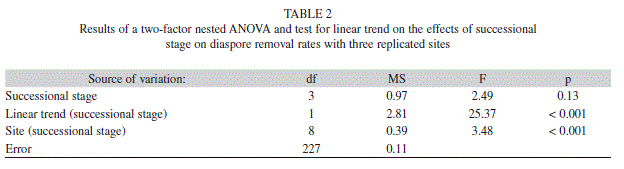
<body><![CDATA[successional stage on the same day. Trials were performed in the     absence of heavy rain.</span></font><br style="font-family: verdana;">     <font size="2"></font><br style="font-family: verdana;">     <font size="2"><span style="font-family: verdana;">Diaspore removal     rates were     analyzed with a two-factor nested ANOVA. The main factor in this     analysis was &#8220;successional stage&#8221; (fixed factor; levels: 9-11yr,     15-20yr, 40-55yr, &gt;100yr) with three &#8220;sites&#8221; (random factor) nested     within each level of the main factor and 20 replicated observations for     each combination of &#8220;successional stage&#8221; and &#8220;site&#8221;. We tested for a     ]]></body>
<body><![CDATA[linear trend in changes of diaspore removal along the successional     gradient employing polynomial contrast coefficients that were coded     according to the age of the successional forest stages. Data on     diaspore removal were log10-transformed prior to analysis to reduce     skewness of the distribution.</span></font><br      style="font-family: verdana;">     <font size="2"></font><br style="font-family: verdana;">     <font style="font-weight: bold;" size="3"><span      style="font-family: verdana;">Results</span></font><br      style="font-family: verdana;">     ]]></body>
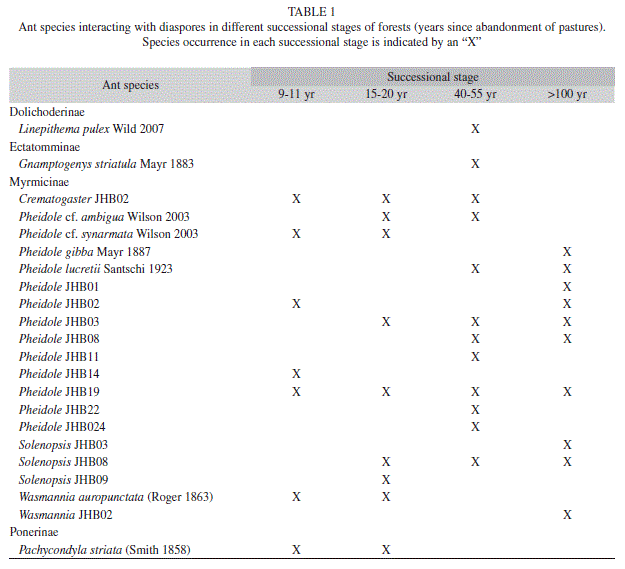
<body><![CDATA[<font size="2"></font><br      style="font-family: verdana; font-weight: bold;">     <font size="2"><span style="font-family: verdana;"><span      style="font-weight: bold;">Ants interacting with diaspores:</span> We     found ants interacting with diaspores at 56 of 60 diaspore depots. Ants     discovered diaspores rapidly and in the majority of cases we observed     interactions within 15min. after exposure of diaspores. We recorded 22     ant species from seven genera and four subfamilies interacting with     diaspores at depots (<a href="/img/revistas/rbt/v60n2/a33t1.gif">Table 1</a>).     Species richness of ants did not differ     ]]></body>
<body><![CDATA[among successional stages (GLM: p=0.32). We recorded 2.7 (&plusmn;1.2     SE) species in study sites of 9-11years old secondary forests, 4.3     (&plusmn;0.9 SE) species in 15-20years secondary forests, 5.7     (&plusmn;1.5 SE) species in 40-55years old secondary forests, and 3.7     (&plusmn;0.9 SE) species in old growth forests (n=3 for each mean).</span></font><br      style="font-family: verdana;">     <font size="2"></font><br style="font-family: verdana;">     <font size="2"><span style="font-family: verdana;">The diversity and     evenness of ants     interacting with diaspores did not differ across the successional     ]]></body>
<body><![CDATA[gradient (GLM: p=0.30 and p=0.19, respectively). In secondary forests     of 9-11yr, H&#8217;=0.74(&plusmn;0.5 SE) and E<sub>H</sub>=0.97(&plusmn;0.02     SE), in     15-20yr secondary forests H&#8217;=1.36 (&plusmn;0.2 SE) and     E<sub>H</sub>=0.95(&plusmn;0.01 SE), in 40-55yr secondary forests     H&#8217;=1.53(&plusmn;0.2 SE) and E<sub>H</sub>=0.93(&plusmn;0.01 SE) and     H&#8217;=1.13(&plusmn;0.3 SE) and E<sub>H</sub>=0.91(&plusmn;0.03 </span></font><font      size="2"><span style="font-family: verdana;">SE) in old growth forests     (n=3 for     each mean).</span></font><br style="font-family: verdana;">     ]]></body>
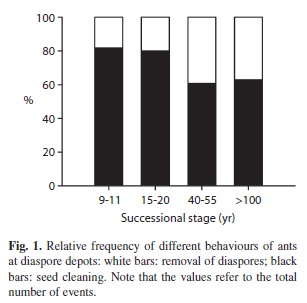
<body><![CDATA[<font size="2"></font><br style="font-family: verdana;">     <font size="2"><span style="font-family: verdana;">In all successional     stages &#8220;seed     cleaning&#8221; was the most frequent behaviour of ants interacting with     diaspores. Nevertheless, the proportion of seed depots where we     observed ants removing diaspores increased from 19% in the youngest     successional stages to 38% in the oldest successional stages (<a      href="#Fig_1">Fig. 1</a>).     This difference in the frequency of ant behaviour towards diaspores was     significant (Fisher&#8217;s Exact test, p=0.049).    ]]></body>
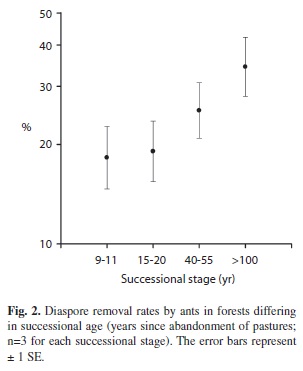
<body><![CDATA[<br>     <br> </span></font>     <div style="text-align: center;"><font size="2"><a name="Fig_1"></a><img  alt="" src="/img/revistas/rbt/v60n2/a33i1.jpg"  style="width: 307px; height: 303px;"><span  style="font-family: verdana;"></span></font><br  style="font-family: verdana;"> <font size="2"><span style="font-family: verdana;"></span></font></div> <br style="font-family: verdana;"> <font size="2"><span style="font-family: verdana;"><span  style="font-weight: bold;">Diaspore removal rates:</span> Diaspore removal rates in the 12 study sites varied from 22%-61% depending on successional stage. In general, removal rates increased with an increase in age of successional stage (<a href="#Fig_2">Fig. 2</a>; <a  href="/img/revistas/rbt/v60n2/a33t2.gif">Table 2</a>). Average diaspore removal rates in old growth forests (45%) were higher than in 40-55yr, 15-20yr and 9-11yr forests (33%; 26% and 25%, respectively). Diaspore removal in old growth forest was 1.8 times higher than in the 9-11yr forest.    <br>     <br> </span></font>     <div style="text-align: center;"><font size="2"><a name="Fig_2"></a><img      alt="" src="/img/revistas/rbt/v60n2/a33i2.jpg"      style="width: 303px; height: 371px;"><span      style="font-family: verdana;"></span></font><br      style="font-family: verdana;">     ]]></body>
<body><![CDATA[<font size="2"><span style="font-family: verdana;"></span></font></div>     <br style="font-family: verdana; font-weight: bold;">     <font style="font-weight: bold;" size="3"><span      style="font-family: verdana;">Discussion</span></font><br      style="font-family: verdana; font-weight: bold;">     <font style="font-weight: bold;" size="2"></font><br      style="font-family: verdana;">     <font size="2"><span style="font-family: verdana;">Animal-diaspore     interactions play     an important role in the dynamics of tropical forests and their     ]]></body>
<body><![CDATA[disruption may have negative consequences for forest regeneration. We     found no changes in the richness of ants interacting with diaspores     along a gradient of forest succession in the Atlantic forest of     Southern Brazil. However, the behaviour of ants interacting with     diaspores changed along the successional gradient, &#8220;diaspore removal&#8221;     was more frequent in older successional stages. Concordantly, diaspore     removal rates, assessed in the removal experiment, were lower in     secondary forests than in old-growth forests. These changes in the     interactions between ants and diaspores are likely to have implications     for the population dynamics of plants in secondary forests and thus the     ]]></body>
<body><![CDATA[conservation and recovery of tropical forests.</span></font><br      style="font-family: verdana;">     <font size="2"></font><br style="font-family: verdana;">     <font size="2"><span style="font-family: verdana;">Species richness and     diversity of     ants interacting with diaspores was similar in all successional stages     of forests. This contrasts to the reduced richness and diversity of the     entire ground foraging ant fauna in secondary forests of the Atlantic     forest in Southern Brazil (Bihn <span style="font-style: italic;">et     al.</span> 2008, 2010). Ant species     ]]></body>
<body><![CDATA[interacting with diaspores accounted for an estimated 15% of the total     species pool in the region (Bihn <span style="font-style: italic;">et     al.</span> 2010). Many ant species we     found interacting with diaspores were relatively common in the study     region (JH Bihn, unpublished results), especially species of <span      style="font-style: italic;">Pheidole     </span>which accounted for the majority of ant-diaspore interactions in     our     and other studies in neotropical forests (Pizo <span      style="font-style: italic;">et al.</span> 1998, Pizo &amp;     ]]></body>
<body><![CDATA[Oliveira 2000, Passos &amp; Oliveira 2003, Fornara &amp; Dalling 2005).     All of the five most common species at diaspore depots, which accounted     together for the majority of the observed ant-diaspore interactions,     were present in at least two successional stages. In addition,     interactions between ants and diaspores are mostly facultative and     often involve ants with omnivorous diets (Pizo &amp; Oliveira 2000,     Passos &amp; Oliveira 2003). Therefore, the habitat specialization of     ants interacting with diaspores seems to be relatively low, which might     indicate that the guild of ant species interacting with diaspores is     rather resistant to habitat disturbance.</span></font><br     ]]></body>
<body><![CDATA[ style="font-family: verdana;">     <font size="2"></font><br style="font-family: verdana;">     <font size="2"><span style="font-family: verdana;">The behaviour of     ants towards     diaspores changed along the gradient of forest succession. In all     stages of forest succession removal of the fleshy part of the diaspore<span      style="font-style: italic;">     </span>in <span style="font-style: italic;">situ</span> was the most     common behaviour but the proportion of diaspores     entirely removed increased from early to late successional stages. Both     ]]></body>
<body><![CDATA[behaviours, seed cleaning and removal of diaspores, have implications     for seed fate and plant establishment. Seed cleaning results in higher     germination rates due to reduced fungal attack (Ohkawara &amp; Akino     2005, Christianini <span style="font-style: italic;">et al.</span>     2007) but seeds remain available for other     guilds of seed predator, e.g. rodents, marsupials and birds. Diaspore     removal often leads to seed predation but a small number of seeds are     left intact and are transported to protected microsites with favourable     conditions for germination (Levey &amp; Byrne 1993, Pizo 2008). Because     we did not track the fate of diaspores we cannot infer about the     ]]></body>
<body><![CDATA[proportion of diaspores that reached favourable microsites for     germination. Levey &amp; Byrne (1993) estimated that up to 39% of     removed seeds are deposited in microsites with favourable conditions     for germination, and Pizo (2008) found 93% of diaspores deposited in     favourable conditions, e.g. inside ant nests. If the proportion of     seeds that reach favourable microsites for germination after seed     removal is similar among successional stages, the increased seed     removal in late successional stages could result in more seeds in     microsites important for the recruitment of plant populations. It seems     worth investigating in further studies, whether changes in the     ]]></body>
<body><![CDATA[behaviour of ants towards diaspores in different successional stages of     forests influence the number of seeds that become established as     seedlings.</span></font><br style="font-family: verdana;">     <font size="2"></font><br style="font-family: verdana;">     <font size="2"><span style="font-family: verdana;">Diaspore removal     rates were lower     in young secondary than in old-growth forests and gradually increased     with the age of secondary forests. Studies on invertebrate diaspore     removal in different successional stages of tropical forests are few     and report contradictory results. Notman &amp; Gorchov (2001) found     ]]></body>
<body><![CDATA[higher removal rates in mature forests but other studies report higher     removal rates in secondary forests than in old-growth forests     (Pe&ntilde;a-Claros &amp; de Boo 2002, Andresen <span      style="font-style: italic;">et al.</span> 2005, Zelikova     &amp; Breed 2008). However, removal rates are not directly comparable     among these investigations because each study uses a different set of     diaspore species in the experiments and it has been demonstrated that     removal rates of diaspores depend on diaspores identity (Notman &amp;     Gorchov 2001, Pizo &amp; Oliveira 2001).</span></font><br      style="font-family: verdana;">     ]]></body>
<body><![CDATA[<font size="2"></font><br style="font-family: verdana;">     <font size="2"><span style="font-family: verdana;">What are the     implications of the     observed changes of the behaviour of ants towards diaspores and the     increased diaspore removal rates during forest regeneration? The most     likely fate of removed diaspore is predation. However, various studies     have documented that ants transport undamaged diaspores to safe and     favourable microsites for germination (Leyey &amp; Byrne 1993, Pizo     2008). Although this outcome of ant-diaspore interactions might be     rare, it might still be important for the recruitment of plant     ]]></body>
<body><![CDATA[populations (Levey &amp; Byrne 1993). This is especially true for the     interactions of ants and non-myrmechochorous diaspores in tropical     forests, which are still largely unexplored (Pizo <span      style="font-style: italic;">et al.</span> 1998, Passos     &amp; Oliveira 2003). Lower removal rates in young secondary forests     could potentially increase sibling competition among seedlings and thus     have negative effects on the recruitment of plant populations, slowing     down the regeneration of these forests. Only careful tracking of     diaspore fate, dispersal distance and germination success can     illuminate the benefits and costs for the recruitment of the involved     ]]></body>
<body><![CDATA[plants. The small diaspores, with which ants typically interact, are     difficult to track in the opaque medium of the leaf litter in tropical     forests but such studies seem worthwhile especially in the context of     forest regeneration.</span></font><br style="font-family: verdana;">     <font size="2"></font><br      style="font-family: verdana; font-weight: bold;">     <font style="font-weight: bold;" size="3"><span      style="font-family: verdana;">Acknowledgments</span></font><br      style="font-family: verdana;">     <font size="2"></font><br style="font-family: verdana;">     ]]></body>
<body><![CDATA[<font size="2"><span style="font-family: verdana;">This study was     financially     supported by Brazilian Research Council (CNPq) (Solobioma Project,     690148/01-1), the German Federal Ministry of Education and Research     (BMBF project number 01LB0201), and the Funda&ccedil;&atilde;o O     Botic&aacute;rio de Prote&ccedil;&atilde;o &agrave; Natureza. We thank     the support of the SPVS for allowing us to work at Cachoeira Nature     Reserve and </span></font><font size="2"><span      style="font-family: verdana;">their staff for field work     assistance. M&aacute;rcia C. M. Marques received a productivity grant     ]]></body>
<body><![CDATA[from CNPq (Process 308597/2008-7).</span></font><br      style="font-family: verdana;">     <font size="2"></font><br      style="font-family: verdana; font-weight: bold;">     <font style="font-weight: bold;" size="3"><span      style="font-family: verdana;"></span></font>     <hr      style="width: 100%; height: 2px; margin-left: 0px; margin-right: 0px;"><font      style="font-weight: bold;" size="3"><span style="font-family: verdana;">References</span></font><br      style="font-family: verdana;">     ]]></body>
<body><![CDATA[<font size="2"></font><br style="font-family: verdana;">     <font size="2"><span style="font-family: verdana;">Andresen E., L.     Pedroza-Espino,     E.B. Allen &amp; D.R. P&eacute;res-Salicrup. 2005. Effects of selective     vegetation thinning on seed removal in secondary forest succession.     <!-- ref -->Biotropica 37: 145-148.    &nbsp;&nbsp;&nbsp;&nbsp;&nbsp;&nbsp;&nbsp;&nbsp;[&#160;<a href="javascript:void(0);" onclick="javascript: window.open('/scielo.php?script=sci_nlinks&ref=1504752&pid=S0034-7744201200020003300001&lng=','','width=640,height=500,resizable=yes,scrollbars=1,menubar=yes,');">Links</a>&#160;]<!-- end-ref --><!-- ref --></span></font><br style="font-family: verdana;"> <font size="2"></font><br style="font-family: verdana;"> <font size="2"><span style="font-family: verdana;">Armbrecht, I., L. Rivera, I. Perfecto. 2004. Reduced diversity and complexity in the leaf-litter ant assemblage of Colombian coffee plantations. Cons. Biol. 19: 897-907.    &nbsp;&nbsp;&nbsp;&nbsp;&nbsp;&nbsp;&nbsp;&nbsp;[&#160;<a href="javascript:void(0);" onclick="javascript: window.open('/scielo.php?script=sci_nlinks&ref=1504753&pid=S0034-7744201200020003300002&lng=','','width=640,height=500,resizable=yes,scrollbars=1,menubar=yes,');">Links</a>&#160;]<!-- end-ref --><!-- ref --></span></font><br  style="font-family: verdana;"> <font size="2"></font><br style="font-family: verdana;"> <font size="2"><span style="font-family: verdana;">Beattie, A.J. 1985. The evolutionary ecology of antplant mutualisms. Cambridge University, Cambridge, United Kingdom.    &nbsp;&nbsp;&nbsp;&nbsp;&nbsp;&nbsp;&nbsp;&nbsp;[&#160;<a href="javascript:void(0);" onclick="javascript: window.open('/scielo.php?script=sci_nlinks&ref=1504754&pid=S0034-7744201200020003300003&lng=','','width=640,height=500,resizable=yes,scrollbars=1,menubar=yes,');">Links</a>&#160;]<!-- end-ref --><!-- ref --></span></font><br  style="font-family: verdana;"> <font size="2"></font><br style="font-family: verdana;"> <font size="2"><span style="font-family: verdana;">Bihn, J.H., M. Verhaag, M. Br&auml;ndle &amp; R. Brandl. 2008. Do secondary forests act as refuges for old growth forest animals? Recovery of ant diversity in the Atlantic forest of Brazil. Biol. Conserv. 141: 733-743.    &nbsp;&nbsp;&nbsp;&nbsp;&nbsp;&nbsp;&nbsp;&nbsp;[&#160;<a href="javascript:void(0);" onclick="javascript: window.open('/scielo.php?script=sci_nlinks&ref=1504755&pid=S0034-7744201200020003300004&lng=','','width=640,height=500,resizable=yes,scrollbars=1,menubar=yes,');">Links</a>&#160;]<!-- end-ref --><!-- ref --></span></font><br  style="font-family: verdana;"> <font size="2"></font><br style="font-family: verdana;"> <font size="2"><span style="font-family: verdana;">Bihn, J.H., G. Gebauer &amp; R. Brandl. 2010. Loss of functional diversity of ant assemblages in secondary tropical forests. Ecology 91: 782-792.    &nbsp;&nbsp;&nbsp;&nbsp;&nbsp;&nbsp;&nbsp;&nbsp;[&#160;<a href="javascript:void(0);" onclick="javascript: window.open('/scielo.php?script=sci_nlinks&ref=1504756&pid=S0034-7744201200020003300005&lng=','','width=640,height=500,resizable=yes,scrollbars=1,menubar=yes,');">Links</a>&#160;]<!-- end-ref --><!-- ref --></span></font><br  style="font-family: verdana;"> <font size="2"></font><br style="font-family: verdana;"> <font size="2"><span style="font-family: verdana;">Chazdon, R.L. 2003. Tropical forest recovery: legacies of human impact and natural disturbances. Perspect. Plant. Ecol. 6: 51-71.    &nbsp;&nbsp;&nbsp;&nbsp;&nbsp;&nbsp;&nbsp;&nbsp;[&#160;<a href="javascript:void(0);" onclick="javascript: window.open('/scielo.php?script=sci_nlinks&ref=1504757&pid=S0034-7744201200020003300006&lng=','','width=640,height=500,resizable=yes,scrollbars=1,menubar=yes,');">Links</a>&#160;]<!-- end-ref --><!-- ref --></span></font><br style="font-family: verdana;"> <font size="2"></font><br style="font-family: verdana;"> <font size="2"><span style="font-family: verdana;">Chazdon, R.L., C.A. Peres, D. Dent, D. Sheil, A.E. Lugo, D. Lamb, N.E. Stork &amp; S.E. Miller. 2009. The potential for species conservation in tropical secondary forests. Conserv. Biol. 23: 1406-1417.    &nbsp;&nbsp;&nbsp;&nbsp;&nbsp;&nbsp;&nbsp;&nbsp;[&#160;<a href="javascript:void(0);" onclick="javascript: window.open('/scielo.php?script=sci_nlinks&ref=1504758&pid=S0034-7744201200020003300007&lng=','','width=640,height=500,resizable=yes,scrollbars=1,menubar=yes,');">Links</a>&#160;]<!-- end-ref --><!-- ref --></span></font><br  style="font-family: verdana;"> <font size="2"></font><br style="font-family: verdana;"> <font size="2"><span style="font-family: verdana;">Christianini, A.V. &amp; M. Galetti. 2007. Spatial variation on pos-dispersal seed removal in an Atlantic Forest: Effect of habitat, location and guilds of seed predators. Acta Oecol. 32: 328-336.    &nbsp;&nbsp;&nbsp;&nbsp;&nbsp;&nbsp;&nbsp;&nbsp;[&#160;<a href="javascript:void(0);" onclick="javascript: window.open('/scielo.php?script=sci_nlinks&ref=1504759&pid=S0034-7744201200020003300008&lng=','','width=640,height=500,resizable=yes,scrollbars=1,menubar=yes,');">Links</a>&#160;]<!-- end-ref --><!-- ref --></span></font><br  style="font-family: verdana;"> <font size="2"></font><br style="font-family: verdana;"> <font size="2"><span style="font-family: verdana;">Christianini, A.V., A.J. Mayhe-Nunes &amp; P.S. Oliveira. 2007. The role of ants in the removal of non-myrmecochorous diaspores and seed germination in a Neotropical savanna. J. Trop. Ecol. 23: 343-351.    &nbsp;&nbsp;&nbsp;&nbsp;&nbsp;&nbsp;&nbsp;&nbsp;[&#160;<a href="javascript:void(0);" onclick="javascript: window.open('/scielo.php?script=sci_nlinks&ref=1504760&pid=S0034-7744201200020003300009&lng=','','width=640,height=500,resizable=yes,scrollbars=1,menubar=yes,');">Links</a>&#160;]<!-- end-ref --><!-- ref --></span></font><br  style="font-family: verdana;"> <font size="2"></font><br style="font-family: verdana;"> <font size="2"><span style="font-family: verdana;">Clark, D.B. 1996. Abolishing virginity. J. Trop. Ecol. 12: 735-739.    &nbsp;&nbsp;&nbsp;&nbsp;&nbsp;&nbsp;&nbsp;&nbsp;[&#160;<a href="javascript:void(0);" onclick="javascript: window.open('/scielo.php?script=sci_nlinks&ref=1504761&pid=S0034-7744201200020003300010&lng=','','width=640,height=500,resizable=yes,scrollbars=1,menubar=yes,');">Links</a>&#160;]<!-- end-ref --><!-- ref --></span></font><br  style="font-family: verdana;"> <font size="2"></font><br style="font-family: verdana;"> <font size="2"><span style="font-family: verdana;">Dunn, R.R. 2004. Recovery of faunal communities during tropical forest regeneration. Conserv. Biol. 18: 302-309.    &nbsp;&nbsp;&nbsp;&nbsp;&nbsp;&nbsp;&nbsp;&nbsp;[&#160;<a href="javascript:void(0);" onclick="javascript: window.open('/scielo.php?script=sci_nlinks&ref=1504762&pid=S0034-7744201200020003300011&lng=','','width=640,height=500,resizable=yes,scrollbars=1,menubar=yes,');">Links</a>&#160;]<!-- end-ref --><!-- ref --></span></font><br style="font-family: verdana;"> <font size="2"></font><br style="font-family: verdana;"> <font size="2"><span style="font-family: verdana;">FAO. 2007. State of the world&#8217;s forests. Food and Agriculture Organization of the United Nations, Rome, Italy.    &nbsp;&nbsp;&nbsp;&nbsp;&nbsp;&nbsp;&nbsp;&nbsp;[&#160;<a href="javascript:void(0);" onclick="javascript: window.open('/scielo.php?script=sci_nlinks&ref=1504763&pid=S0034-7744201200020003300012&lng=','','width=640,height=500,resizable=yes,scrollbars=1,menubar=yes,');">Links</a>&#160;]<!-- end-ref --><!-- ref --></span></font><br style="font-family: verdana;"> <font size="2"></font><br style="font-family: verdana;"> <font size="2"><span style="font-family: verdana;">Ferretti, A.R. &amp; R.M. Britez. 2006. Ecological restoration, carbon sequestration and biodiversity conservation: The experience of the Society for Wildlife Research and Environmental Education (SPVS) in the Atlantic Rain Forest of Southern Brazil. J. Nat. Conserv. 14: 249-259.    &nbsp;&nbsp;&nbsp;&nbsp;&nbsp;&nbsp;&nbsp;&nbsp;[&#160;<a href="javascript:void(0);" onclick="javascript: window.open('/scielo.php?script=sci_nlinks&ref=1504764&pid=S0034-7744201200020003300013&lng=','','width=640,height=500,resizable=yes,scrollbars=1,menubar=yes,');">Links</a>&#160;]<!-- end-ref --><!-- ref --></span></font><br  style="font-family: verdana;"> <font size="2"></font><br style="font-family: verdana;"> <font size="2"><span style="font-family: verdana;">Flores, E. 1993.<span  style="font-style: italic;"> Hyeronima alchornoides</span>, Alem&atilde;o. Seeds and trees of the Neotropics Part II 514-17. Academia Nacional de Ciencias de Costa Rica, Costa Rica.    &nbsp;&nbsp;&nbsp;&nbsp;&nbsp;&nbsp;&nbsp;&nbsp;[&#160;<a href="javascript:void(0);" onclick="javascript: window.open('/scielo.php?script=sci_nlinks&ref=1504765&pid=S0034-7744201200020003300014&lng=','','width=640,height=500,resizable=yes,scrollbars=1,menubar=yes,');">Links</a>&#160;]<!-- end-ref --><!-- ref --></span></font><br  style="font-family: verdana;"> <font size="2"></font><br style="font-family: verdana;"> <font size="2"><span style="font-family: verdana;">Fornara, D.A. &amp; J.W. Dalling. 2005. Post-dispersal removal of seeds of pioneer species from five Panamanian forests. J. Trop. Ecol. 21: 79-84.    &nbsp;&nbsp;&nbsp;&nbsp;&nbsp;&nbsp;&nbsp;&nbsp;[&#160;<a href="javascript:void(0);" onclick="javascript: window.open('/scielo.php?script=sci_nlinks&ref=1504766&pid=S0034-7744201200020003300015&lng=','','width=640,height=500,resizable=yes,scrollbars=1,menubar=yes,');">Links</a>&#160;]<!-- end-ref --><!-- ref --></span></font><br  style="font-family: verdana;"> <font size="2"></font><br style="font-family: verdana;"> <font size="2"><span style="font-family: verdana;">Frankie, G.W., H.G. Baker &amp; P.A. Opler. 1974. Comparative phenological studies of trees in tropical wet and dry forests in the lowlands of Costa Rica. J. Ecol. 62: 881-913.    &nbsp;&nbsp;&nbsp;&nbsp;&nbsp;&nbsp;&nbsp;&nbsp;[&#160;<a href="javascript:void(0);" onclick="javascript: window.open('/scielo.php?script=sci_nlinks&ref=1504767&pid=S0034-7744201200020003300016&lng=','','width=640,height=500,resizable=yes,scrollbars=1,menubar=yes,');">Links</a>&#160;]<!-- end-ref --><!-- ref --></span></font><br  style="font-family: verdana;"> <font size="2"></font><br style="font-family: verdana;"> <font size="2"><span style="font-family: verdana;">Gove, A.D., J.D. Majer &amp; R.R. Dunn. 2007. A keystone ant species promotes seed dispersal in a diffuse mutualism. Oecologia 153: 687-697.    &nbsp;&nbsp;&nbsp;&nbsp;&nbsp;&nbsp;&nbsp;&nbsp;[&#160;<a href="javascript:void(0);" onclick="javascript: window.open('/scielo.php?script=sci_nlinks&ref=1504768&pid=S0034-7744201200020003300017&lng=','','width=640,height=500,resizable=yes,scrollbars=1,menubar=yes,');">Links</a>&#160;]<!-- end-ref --><!-- ref --></span></font><br  style="font-family: verdana;"> <font size="2"></font><br style="font-family: verdana;"> <font size="2"><span style="font-family: verdana;">Guariguata, M.R. &amp; R. Ostertag. 2001. Neotropical secondary forest succession: changes in structural and functional characteristics. For. Ecol. Manage. 148: 185-206.    &nbsp;&nbsp;&nbsp;&nbsp;&nbsp;&nbsp;&nbsp;&nbsp;[&#160;<a href="javascript:void(0);" onclick="javascript: window.open('/scielo.php?script=sci_nlinks&ref=1504769&pid=S0034-7744201200020003300018&lng=','','width=640,height=500,resizable=yes,scrollbars=1,menubar=yes,');">Links</a>&#160;]<!-- end-ref --><!-- ref --></span></font><br  style="font-family: verdana;"> <font size="2"></font><br style="font-family: verdana;"> <font size="2"><span style="font-family: verdana;">Hobbs, R.J., S. Arico, J. Aronson, J.S. Baron, P. Bridgewater, V.A. Cramer, P.R. Epstein, J.J. Ewel, C.A. Klink, A.E. Lugo, D. Norton, D. Ojima, D.M. Richardson, J.B. Sanderson, F. Valladares, M. Vil&agrave;, R. Zamora &amp; M. Zobel. 2006. Novel ecosystems: theoretical and management aspects of the new ecological world order. Global Ecol. Biogeogr. 15: 1-7.    &nbsp;&nbsp;&nbsp;&nbsp;&nbsp;&nbsp;&nbsp;&nbsp;[&#160;<a href="javascript:void(0);" onclick="javascript: window.open('/scielo.php?script=sci_nlinks&ref=1504770&pid=S0034-7744201200020003300019&lng=','','width=640,height=500,resizable=yes,scrollbars=1,menubar=yes,');">Links</a>&#160;]<!-- end-ref --><!-- ref --></span></font><br  style="font-family: verdana;"> <font size="2"></font><br style="font-family: verdana;"> <font size="2"><span style="font-family: verdana;">Holl, K.D., M.E. Loik, E.H.V. Lin &amp; I.A. Samuels. 2000. Tropical Montane forest restoration in Costa Rica: Overcoming barriers to dispersal and establishment. Restor. Ecol. 8: 339-349.    &nbsp;&nbsp;&nbsp;&nbsp;&nbsp;&nbsp;&nbsp;&nbsp;[&#160;<a href="javascript:void(0);" onclick="javascript: window.open('/scielo.php?script=sci_nlinks&ref=1504771&pid=S0034-7744201200020003300020&lng=','','width=640,height=500,resizable=yes,scrollbars=1,menubar=yes,');">Links</a>&#160;]<!-- end-ref --><!-- ref --></span></font><br style="font-family: verdana;"> <font size="2"></font><br style="font-family: verdana;"> <font size="2"><span style="font-family: verdana;">Howe, H.F. &amp; J. Smallwood. 1982. Ecology of seed dispersal. Annu. Rev. Ecol. Syst. 13: 201-228.    &nbsp;&nbsp;&nbsp;&nbsp;&nbsp;&nbsp;&nbsp;&nbsp;[&#160;<a href="javascript:void(0);" onclick="javascript: window.open('/scielo.php?script=sci_nlinks&ref=1504772&pid=S0034-7744201200020003300021&lng=','','width=640,height=500,resizable=yes,scrollbars=1,menubar=yes,');">Links</a>&#160;]<!-- end-ref --><!-- ref --></span></font><br  style="font-family: verdana;"> <font size="2"></font><br style="font-family: verdana;"> <font size="2"><span style="font-family: verdana;">Hulme, P.E. 1998. Post-dispersal seed predation: consequences for plant demography and evolution. Perspect. Plant. Ecol. 1: 32-46.    &nbsp;&nbsp;&nbsp;&nbsp;&nbsp;&nbsp;&nbsp;&nbsp;[&#160;<a href="javascript:void(0);" onclick="javascript: window.open('/scielo.php?script=sci_nlinks&ref=1504773&pid=S0034-7744201200020003300022&lng=','','width=640,height=500,resizable=yes,scrollbars=1,menubar=yes,');">Links</a>&#160;]<!-- end-ref --><!-- ref --></span></font><br  style="font-family: verdana;"> <font size="2"></font><br style="font-family: verdana;"> <font size="2"><span style="font-family: verdana;">IPARDES. 1991. Diagn&oacute;stico f&iacute;sico-ambiental da Serra do Mar: &aacute;rea Sul. IPARDES, Curitiba, Paran&aacute;, Brazil.    &nbsp;&nbsp;&nbsp;&nbsp;&nbsp;&nbsp;&nbsp;&nbsp;[&#160;<a href="javascript:void(0);" onclick="javascript: window.open('/scielo.php?script=sci_nlinks&ref=1504774&pid=S0034-7744201200020003300023&lng=','','width=640,height=500,resizable=yes,scrollbars=1,menubar=yes,');">Links</a>&#160;]<!-- end-ref --><!-- ref --></span></font><br  style="font-family: verdana;"> <font size="2"></font><br style="font-family: verdana;"> <font size="2"><span style="font-family: verdana;">Kaspari, M. 1993. Removal of seeds from neotropical frugivores feces: ants responses to seed number. Oecologia 95: 81-88.    &nbsp;&nbsp;&nbsp;&nbsp;&nbsp;&nbsp;&nbsp;&nbsp;[&#160;<a href="javascript:void(0);" onclick="javascript: window.open('/scielo.php?script=sci_nlinks&ref=1504775&pid=S0034-7744201200020003300024&lng=','','width=640,height=500,resizable=yes,scrollbars=1,menubar=yes,');">Links</a>&#160;]<!-- end-ref --><!-- ref --></span></font><br style="font-family: verdana;"> <font size="2"></font><br style="font-family: verdana;"> <font size="2"><span style="font-family: verdana;">Koh, L.P., R.R. Dunn, N.S. Sodhi, R.K. Colwell, H.C. Proctor &amp; V.S. Smith. 2004. Species coextictions and the biodiversity crisis. Science 305: 1632-1634.    &nbsp;&nbsp;&nbsp;&nbsp;&nbsp;&nbsp;&nbsp;&nbsp;[&#160;<a href="javascript:void(0);" onclick="javascript: window.open('/scielo.php?script=sci_nlinks&ref=1504776&pid=S0034-7744201200020003300025&lng=','','width=640,height=500,resizable=yes,scrollbars=1,menubar=yes,');">Links</a>&#160;]<!-- end-ref --><!-- ref --></span></font><br  style="font-family: verdana;"> <font size="2"></font><br style="font-family: verdana;"> <font size="2"><span style="font-family: verdana;">Krebs, C. 1989. Ecological methodology. Harper Collin, New York, New York, USA.    &nbsp;&nbsp;&nbsp;&nbsp;&nbsp;&nbsp;&nbsp;&nbsp;[&#160;<a href="javascript:void(0);" onclick="javascript: window.open('/scielo.php?script=sci_nlinks&ref=1504777&pid=S0034-7744201200020003300026&lng=','','width=640,height=500,resizable=yes,scrollbars=1,menubar=yes,');">Links</a>&#160;]<!-- end-ref --><!-- ref --></span></font><br  style="font-family: verdana;"> <font size="2"></font><br style="font-family: verdana;"> <font size="2"><span style="font-family: verdana;">Levey, D.J. &amp; M.M. Byrne. 1993. Complex ant-plant interactions: rain-forest ants as secondary dispersers and postdispersal seed predators. Ecology 74: 1802-1812.    &nbsp;&nbsp;&nbsp;&nbsp;&nbsp;&nbsp;&nbsp;&nbsp;[&#160;<a href="javascript:void(0);" onclick="javascript: window.open('/scielo.php?script=sci_nlinks&ref=1504778&pid=S0034-7744201200020003300027&lng=','','width=640,height=500,resizable=yes,scrollbars=1,menubar=yes,');">Links</a>&#160;]<!-- end-ref --><!-- ref --></span></font><br  style="font-family: verdana;"> <font size="2"></font><br style="font-family: verdana;"> <font size="2"><span style="font-family: verdana;">Manzaneda, A.J. &amp; P.J. Rey. 2008. Geographic variation in seed removal of a myrmecochorous herb: Influence of variation in functional guild and species composition of the disperser assemblage through spatial and temporal scales. Ecography 31: 583-597.    &nbsp;&nbsp;&nbsp;&nbsp;&nbsp;&nbsp;&nbsp;&nbsp;[&#160;<a href="javascript:void(0);" onclick="javascript: window.open('/scielo.php?script=sci_nlinks&ref=1504779&pid=S0034-7744201200020003300028&lng=','','width=640,height=500,resizable=yes,scrollbars=1,menubar=yes,');">Links</a>&#160;]<!-- end-ref --><!-- ref --></span></font><br style="font-family: verdana;"> <font size="2"></font><br style="font-family: verdana;"> <font size="2"><span style="font-family: verdana;">Notman, E. &amp; D.L. Gorchov. 2001. Variation in postdispersal seed predation in mature Peruvian lowland tropical forest and fallow agricultural sites. Biotropica 33: 621-636.    &nbsp;&nbsp;&nbsp;&nbsp;&nbsp;&nbsp;&nbsp;&nbsp;[&#160;<a href="javascript:void(0);" onclick="javascript: window.open('/scielo.php?script=sci_nlinks&ref=1504780&pid=S0034-7744201200020003300029&lng=','','width=640,height=500,resizable=yes,scrollbars=1,menubar=yes,');">Links</a>&#160;]<!-- end-ref --><!-- ref --></span></font><br style="font-family: verdana;"> <font size="2"></font><br style="font-family: verdana;"> <font size="2"><span style="font-family: verdana;">Ohkawara, K. &amp; T. Akino. 2005. Seed cleaning behavior by tropical ants and its anti-fungal effect. J. Ethol. 23: 93-98.    &nbsp;&nbsp;&nbsp;&nbsp;&nbsp;&nbsp;&nbsp;&nbsp;[&#160;<a href="javascript:void(0);" onclick="javascript: window.open('/scielo.php?script=sci_nlinks&ref=1504781&pid=S0034-7744201200020003300030&lng=','','width=640,height=500,resizable=yes,scrollbars=1,menubar=yes,');">Links</a>&#160;]<!-- end-ref --><!-- ref --></span></font><br style="font-family: verdana;"> <font size="2"></font><br style="font-family: verdana;"> <font size="2"><span style="font-family: verdana;">Passos, L. &amp; P.S. Oliveira. 2003. Interactions between ants, fruits and seeds in a restinga forest in south-eastern Brazil. J. Trop. Ecol. 19: 261-270.    &nbsp;&nbsp;&nbsp;&nbsp;&nbsp;&nbsp;&nbsp;&nbsp;[&#160;<a href="javascript:void(0);" onclick="javascript: window.open('/scielo.php?script=sci_nlinks&ref=1504782&pid=S0034-7744201200020003300031&lng=','','width=640,height=500,resizable=yes,scrollbars=1,menubar=yes,');">Links</a>&#160;]<!-- end-ref --><!-- ref --></span></font><br  style="font-family: verdana;"> <font size="2"></font><br style="font-family: verdana;"> <font size="2"><span style="font-family: verdana;">Pe&ntilde;a-Claros, M. &amp; H. De Boo. 2002. The effect of forest successional stage on seed removal of tropical rain forest tree species. J. Trop. Ecol. 18: 261-274.    &nbsp;&nbsp;&nbsp;&nbsp;&nbsp;&nbsp;&nbsp;&nbsp;[&#160;<a href="javascript:void(0);" onclick="javascript: window.open('/scielo.php?script=sci_nlinks&ref=1504783&pid=S0034-7744201200020003300032&lng=','','width=640,height=500,resizable=yes,scrollbars=1,menubar=yes,');">Links</a>&#160;]<!-- end-ref --><!-- ref --></span></font><br  style="font-family: verdana;"> <font size="2"></font><br style="font-family: verdana;"> <font size="2"><span style="font-family: verdana;">Pfeiffer, M., J. Nais &amp; K.E. Linsenmair. 2006. Worker size and seed size selection in &#8216;seed&#8217;-collecting ant ensembles (Hymenoptera: Formicidae) in primary rain forests on Borneo. J. Trop. Ecol. 22: 685-693.    &nbsp;&nbsp;&nbsp;&nbsp;&nbsp;&nbsp;&nbsp;&nbsp;[&#160;<a href="javascript:void(0);" onclick="javascript: window.open('/scielo.php?script=sci_nlinks&ref=1504784&pid=S0034-7744201200020003300033&lng=','','width=640,height=500,resizable=yes,scrollbars=1,menubar=yes,');">Links</a>&#160;]<!-- end-ref --><!-- ref --></span></font><br  style="font-family: verdana;"> <font size="2"></font><br style="font-family: verdana;"> <font size="2"><span style="font-family: verdana;">Pizo, M.A., L. Passos &amp; P.S. Oliveira. 1998. Ants and seeds of a nonmyrmecochorous neotropical tree, <span style="font-style: italic;">Cabralea canjerana </span>(Meliaceae), in the Atlantic forest of southeast Brazil. Am. J. Bot. 85: 669-674.    &nbsp;&nbsp;&nbsp;&nbsp;&nbsp;&nbsp;&nbsp;&nbsp;[&#160;<a href="javascript:void(0);" onclick="javascript: window.open('/scielo.php?script=sci_nlinks&ref=1504785&pid=S0034-7744201200020003300034&lng=','','width=640,height=500,resizable=yes,scrollbars=1,menubar=yes,');">Links</a>&#160;]<!-- end-ref --><!-- ref --></span></font><br  style="font-family: verdana;"> <font size="2"></font><br style="font-family: verdana;"> <font size="2"><span style="font-family: verdana;">Pizo, M.A. &amp; P.S. Oliveira. 2000. The use of fruits and seeds by ants in the Atlantic forest of southeast Brazil. Biotropica 32: 851-861.    &nbsp;&nbsp;&nbsp;&nbsp;&nbsp;&nbsp;&nbsp;&nbsp;[&#160;<a href="javascript:void(0);" onclick="javascript: window.open('/scielo.php?script=sci_nlinks&ref=1504786&pid=S0034-7744201200020003300035&lng=','','width=640,height=500,resizable=yes,scrollbars=1,menubar=yes,');">Links</a>&#160;]<!-- end-ref --><!-- ref --></span></font><br  style="font-family: verdana;"> <font size="2"></font><br style="font-family: verdana;"> <font size="2"><span style="font-family: verdana;">Pizo, M.A. &amp; P.S. Oliveira. 2001. Size and lipid content of nonmyrmechorous diaspores: Effects on the interaction with litter-foraging ants in the Atlantic rain forest of Brazil. Plant Ecol. 157: 37-52.    &nbsp;&nbsp;&nbsp;&nbsp;&nbsp;&nbsp;&nbsp;&nbsp;[&#160;<a href="javascript:void(0);" onclick="javascript: window.open('/scielo.php?script=sci_nlinks&ref=1504787&pid=S0034-7744201200020003300036&lng=','','width=640,height=500,resizable=yes,scrollbars=1,menubar=yes,');">Links</a>&#160;]<!-- end-ref --><!-- ref --></span></font><br  style="font-family: verdana;"> <font size="2"></font><br style="font-family: verdana;"> <font size="2"><span style="font-family: verdana;">Pizo, M.A. 2008. The use of seeds by a twig-dwelling ant on the floor of a tropical rain forest. Biotropica 40: 119-121.    &nbsp;&nbsp;&nbsp;&nbsp;&nbsp;&nbsp;&nbsp;&nbsp;[&#160;<a href="javascript:void(0);" onclick="javascript: window.open('/scielo.php?script=sci_nlinks&ref=1504788&pid=S0034-7744201200020003300037&lng=','','width=640,height=500,resizable=yes,scrollbars=1,menubar=yes,');">Links</a>&#160;]<!-- end-ref --><!-- ref --></span></font><br style="font-family: verdana;"> <font size="2"></font><br style="font-family: verdana;"> <font size="2"><span style="font-family: verdana;">Rico-Gray, V. &amp; P.S. Oliveira. 2007. The ecology and evolution of ant-plant interactions. The University of Chicago, Chicago, Illinois, USA.    &nbsp;&nbsp;&nbsp;&nbsp;&nbsp;&nbsp;&nbsp;&nbsp;[&#160;<a href="javascript:void(0);" onclick="javascript: window.open('/scielo.php?script=sci_nlinks&ref=1504789&pid=S0034-7744201200020003300038&lng=','','width=640,height=500,resizable=yes,scrollbars=1,menubar=yes,');">Links</a>&#160;]<!-- end-ref --><!-- ref --></span></font><br  style="font-family: verdana;"> <font size="2"></font><br style="font-family: verdana;"> <font size="2"><span style="font-family: verdana;">Sarmiento, F.O. 1997. Arrested succession in pastures hinders regeneration of Tropandean forests and shreds mountain landscapes. Environ. Conserv. 24: 14-23.    &nbsp;&nbsp;&nbsp;&nbsp;&nbsp;&nbsp;&nbsp;&nbsp;[&#160;<a href="javascript:void(0);" onclick="javascript: window.open('/scielo.php?script=sci_nlinks&ref=1504790&pid=S0034-7744201200020003300039&lng=','','width=640,height=500,resizable=yes,scrollbars=1,menubar=yes,');">Links</a>&#160;]<!-- end-ref --><!-- ref --></span></font><br  style="font-family: verdana;"> <font size="2"></font><br style="font-family: verdana;"> <font size="2"><span style="font-family: verdana;">Silva, R.R., R.S.M. Feitosa &amp; F. Eberhardt. 2007. Reduced ant diversity along a regeneration gradient in the southern Brazilian Atlantic Forest. For. Ecol. Manage. 240: 61-69.    &nbsp;&nbsp;&nbsp;&nbsp;&nbsp;&nbsp;&nbsp;&nbsp;[&#160;<a href="javascript:void(0);" onclick="javascript: window.open('/scielo.php?script=sci_nlinks&ref=1504791&pid=S0034-7744201200020003300040&lng=','','width=640,height=500,resizable=yes,scrollbars=1,menubar=yes,');">Links</a>&#160;]<!-- end-ref --><!-- ref --></span></font><br style="font-family: verdana;"> <font size="2"></font><br style="font-family: verdana;"> <font size="2"><span style="font-family: verdana;">Silveira, K., J.B. Skillman &amp; J.W. Dalling. 2003. Seed germination, seedling growth and habitat partitioning in two morphotypes of the tropical pioneer tree <span  style="font-style: italic;">Trema micrantha </span>in a seasonal forest in Panama. J. Trop. Ecol. 19: 27-34.    &nbsp;&nbsp;&nbsp;&nbsp;&nbsp;&nbsp;&nbsp;&nbsp;[&#160;<a href="javascript:void(0);" onclick="javascript: window.open('/scielo.php?script=sci_nlinks&ref=1504792&pid=S0034-7744201200020003300041&lng=','','width=640,height=500,resizable=yes,scrollbars=1,menubar=yes,');">Links</a>&#160;]<!-- end-ref --><!-- ref --></span></font><br style="font-family: verdana;"> <font size="2"></font><br style="font-family: verdana;"> <font size="2"><span style="font-family: verdana;">Theilade, I. &amp; L. Petri. 2003. Conservation of tropical trees ex situ through storage and use. Guidelines and Technical Notes No. 65. Danida Forest Seed Centre, Humlebaek, Denmark.    &nbsp;&nbsp;&nbsp;&nbsp;&nbsp;&nbsp;&nbsp;&nbsp;[&#160;<a href="javascript:void(0);" onclick="javascript: window.open('/scielo.php?script=sci_nlinks&ref=1504793&pid=S0034-7744201200020003300042&lng=','','width=640,height=500,resizable=yes,scrollbars=1,menubar=yes,');">Links</a>&#160;]<!-- end-ref --><!-- ref --></span></font><br style="font-family: verdana;"> <font size="2"></font><br style="font-family: verdana;"> <font size="2"><span style="font-family: verdana;">Thompson, D.B., J.H. Brown &amp; W.D. Spencer. 1991. Indirect facilitation of granivorous birds by desert rodents: experimental evidence from foraging patterns. Ecology 72: 852-863.    &nbsp;&nbsp;&nbsp;&nbsp;&nbsp;&nbsp;&nbsp;&nbsp;[&#160;<a href="javascript:void(0);" onclick="javascript: window.open('/scielo.php?script=sci_nlinks&ref=1504794&pid=S0034-7744201200020003300043&lng=','','width=640,height=500,resizable=yes,scrollbars=1,menubar=yes,');">Links</a>&#160;]<!-- end-ref --><!-- ref --></span></font><br style="font-family: verdana;"> <font size="2"></font><br style="font-family: verdana;"> <font size="2"><span style="font-family: verdana;">Vander Wall, S.B. &amp; W. Longland. 2004. Diplochory: Are two seed dispersers better than one? Trends Ecol. Evol. 19: 155-161.    &nbsp;&nbsp;&nbsp;&nbsp;&nbsp;&nbsp;&nbsp;&nbsp;[&#160;<a href="javascript:void(0);" onclick="javascript: window.open('/scielo.php?script=sci_nlinks&ref=1504795&pid=S0034-7744201200020003300044&lng=','','width=640,height=500,resizable=yes,scrollbars=1,menubar=yes,');">Links</a>&#160;]<!-- end-ref --><!-- ref --></span></font><br  style="font-family: verdana;"> <font size="2"></font><br style="font-family: verdana;"> <font size="2"><span style="font-family: verdana;">Wang, B.C. &amp; T.B. Smith. 2002. Closing the seed dispersal loop. Trends Ecol. Evol. 17: 379-387.    &nbsp;&nbsp;&nbsp;&nbsp;&nbsp;&nbsp;&nbsp;&nbsp;[&#160;<a href="javascript:void(0);" onclick="javascript: window.open('/scielo.php?script=sci_nlinks&ref=1504796&pid=S0034-7744201200020003300045&lng=','','width=640,height=500,resizable=yes,scrollbars=1,menubar=yes,');">Links</a>&#160;]<!-- end-ref --><!-- ref --> </span></font><br  style="font-family: verdana;"> <font size="2"></font><br style="font-family: verdana;"> <font size="2"><span style="font-family: verdana;">Wright, S.J. 2005. Tropical forests in a changing environment. Trends Ecol. Evol. 20: 553-560.    &nbsp;&nbsp;&nbsp;&nbsp;&nbsp;&nbsp;&nbsp;&nbsp;[&#160;<a href="javascript:void(0);" onclick="javascript: window.open('/scielo.php?script=sci_nlinks&ref=1504797&pid=S0034-7744201200020003300046&lng=','','width=640,height=500,resizable=yes,scrollbars=1,menubar=yes,');">Links</a>&#160;]<!-- end-ref --><!-- ref --> </span></font><br  style="font-family: verdana;"> <font size="2"></font><br style="font-family: verdana;"> <font size="2"><span style="font-family: verdana;">Wright, S.J. &amp; H.C. Muller-Landau. 2006. The future of tropical forest species. Biotropica 38: 287-301.    &nbsp;&nbsp;&nbsp;&nbsp;&nbsp;&nbsp;&nbsp;&nbsp;[&#160;<a href="javascript:void(0);" onclick="javascript: window.open('/scielo.php?script=sci_nlinks&ref=1504798&pid=S0034-7744201200020003300047&lng=','','width=640,height=500,resizable=yes,scrollbars=1,menubar=yes,');">Links</a>&#160;]<!-- end-ref --><!-- ref --></span></font><br style="font-family: verdana;"> <font size="2"></font><br style="font-family: verdana;"> <font size="2"><span style="font-family: verdana;">Zelikova, T.J. &amp; M.D. Breed. 2008. Effects of habitat disturbance on ant community composition and seed dispersal by ants in a tropical dry forest in Costa Rica. J. Trop. Ecol. 24: 309-316.    &nbsp;&nbsp;&nbsp;&nbsp;&nbsp;&nbsp;&nbsp;&nbsp;[&#160;<a href="javascript:void(0);" onclick="javascript: window.open('/scielo.php?script=sci_nlinks&ref=1504799&pid=S0034-7744201200020003300048&lng=','','width=640,height=500,resizable=yes,scrollbars=1,menubar=yes,');">Links</a>&#160;]<!-- end-ref --></span></font>    <br> <font size="2"><span style="font-family: verdana;"></span></font>    <br> <font size="2"><span style="font-family: verdana;"></span></font>    <br> <font size="2"><span style="font-family: verdana;"><a  name="Correspondencia1"></a><a href="#Correspondencia2">*</a>Correspondencia a: </span></font><font size="2"> <span style="font-family: verdana;">Victor P. Zwiener:&nbsp;</span></font><font  size="2"><span style="font-family: verdana;">Society for Wildlife Research and Environmental Education (SPVS). Rua Isaias Bevilacqua, 999, 80430-040, Curitiba, Paran&aacute;, Brazil; <a  href="mailto:vzwiener@gmail.com">vzwiener@gmail.com</a></span></font><br  style="font-family: verdana;"> <font size="2"> <span style="font-family: verdana;">Victor P. Zwiener &amp; </span></font><font  size="2"><span style="font-family: verdana;">M&aacute;rcia C. M. Marques: </span></font><font size="2"><span  style="font-family: verdana;">Universidade Federal do Paran&aacute;, Setor de Ci&ecirc;ncias Biol&oacute;gicas, Departamento de Bot&acirc;nica, Caixa Postal 19.031, 81531-980 Curitiba, Paran&aacute;, Brazil; </span></font><font size="2"><span  style="font-family: verdana;"><a href="mailto:mmarques@ufpr.br">mmarques@ufpr.br</a></span></font><br  style="font-family: verdana;"> <font size="2"><span style="font-family: verdana;">Jochen H. Bihn: </span></font><font size="2"><span style="font-family: verdana;">Department of Ecology - Animal Ecology, Philipps-Universit&auml;t Marburg, Karl-von-Frisch Stra&szlig;e 8, 35032 Marburg, Germany; <a  href="mailto:jochen.bihn@gmail.com">jochen.bihn@gmail.com</a>    <br> </span></font><font size="2"><span style="font-family: verdana;">    <br> <a name="1"></a><a href="#4">1</a>. Society for Wildlife Research and Environmental Education (SPVS). Rua Isaias Bevilacqua, 999, 80430-040, Curitiba, Paran&aacute;, Brazil; </span></font><font  size="2"><span style="font-family: verdana;"><a  href="mailto:vzwiener@gmail.com">vzwiener@gmail.com</a></span></font><br  style="font-family: verdana;"> <font size="2"><span style="font-family: verdana;"><a name="2"></a><a  href="#5">2</a>. Universidade Federal do Paran&aacute;, Setor de Ci&ecirc;ncias Biol&oacute;gicas, Departamento de Bot&acirc;nica, Caixa Postal 19.031, 81531-980 Curitiba, Paran&aacute;, Brazil; <a href="mailto:mmarques@ufpr.br">mmarques@ufpr.br</a></span></font><br  style="font-family: verdana;"> <font size="2"><span style="font-family: verdana;"><a name="3"></a><a  href="#6">3</a>. Department of Ecology - Animal Ecology, Philipps-Universit&auml;t Marburg, Karl-von-Frisch Stra&szlig;e 8, 35032 Marburg, Germany; </span></font><font size="2"><span  style="font-family: verdana;"><a href="mailto:jochen.bihn@gmail.com">jochen.bihn@gmail.com</a></span></font><br  style="font-family: verdana;"> <font size="2"></font>     <div style="text-align: center;"><font size="2"><span  style="font-family: verdana;"></span></font> <hr style="width: 100%; height: 2px;"><font size="2"><span  style="font-family: verdana;">Received 25-IV-2011. Corrected 06-X-2011. Accepted 02-XI-2011.</span></font></div> <font size="2"></font></div>     ]]></body>
<body><![CDATA[ ]]></body><back>
<ref-list>
<ref id="B1">
<nlm-citation citation-type="journal">
<person-group person-group-type="author">
<name>
<surname><![CDATA[Andresen]]></surname>
<given-names><![CDATA[E]]></given-names>
</name>
<name>
<surname><![CDATA[Pedroza-Espino]]></surname>
<given-names><![CDATA[L]]></given-names>
</name>
<name>
<surname><![CDATA[Allen]]></surname>
<given-names><![CDATA[E.B]]></given-names>
</name>
<name>
<surname><![CDATA[Péres-Salicrup]]></surname>
<given-names><![CDATA[D.R]]></given-names>
</name>
</person-group>
<article-title xml:lang="en"><![CDATA[Effects of selective vegetation thinning on seed removal in secondary forest successio]]></article-title>
<source><![CDATA[Biotropica]]></source>
<year>2005</year>
<volume>37</volume>
<page-range>145-148</page-range></nlm-citation>
</ref>
<ref id="B2">
<nlm-citation citation-type="journal">
<person-group person-group-type="author">
<name>
<surname><![CDATA[Armbrecht]]></surname>
<given-names><![CDATA[I]]></given-names>
</name>
<name>
<surname><![CDATA[Rivera]]></surname>
<given-names><![CDATA[L]]></given-names>
</name>
<name>
<surname><![CDATA[Perfecto]]></surname>
<given-names><![CDATA[I]]></given-names>
</name>
</person-group>
<article-title xml:lang="en"><![CDATA[Reduced diversity and complexity in the leaf-litter ant assemblage of Colombian coffee plantations]]></article-title>
<source><![CDATA[Cons. Biol]]></source>
<year>2004</year>
<volume>19</volume>
<page-range>897-907</page-range></nlm-citation>
</ref>
<ref id="B3">
<nlm-citation citation-type="book">
<person-group person-group-type="author">
<name>
<surname><![CDATA[Beattie]]></surname>
<given-names><![CDATA[A.J]]></given-names>
</name>
</person-group>
<source><![CDATA[The evolutionary ecology of antplant mutualisms]]></source>
<year>1985</year>
<publisher-loc><![CDATA[Cambridge ]]></publisher-loc>
<publisher-name><![CDATA[Cambridge University]]></publisher-name>
</nlm-citation>
</ref>
<ref id="B4">
<nlm-citation citation-type="journal">
<person-group person-group-type="author">
<name>
<surname><![CDATA[Bihn]]></surname>
<given-names><![CDATA[J.H]]></given-names>
</name>
<name>
<surname><![CDATA[Verhaag]]></surname>
<given-names><![CDATA[M]]></given-names>
</name>
<name>
<surname><![CDATA[Brändle]]></surname>
<given-names><![CDATA[M]]></given-names>
</name>
<name>
<surname><![CDATA[Brandl]]></surname>
<given-names><![CDATA[R]]></given-names>
</name>
</person-group>
<article-title xml:lang="en"><![CDATA[Do secondary forests act as refuges for old growth forest animals?: Recovery of ant diversity in the Atlantic forest of Brazil]]></article-title>
<source><![CDATA[Biol. Conserv]]></source>
<year>2008</year>
<volume>141</volume>
<page-range>733-743</page-range></nlm-citation>
</ref>
<ref id="B5">
<nlm-citation citation-type="journal">
<person-group person-group-type="author">
<name>
<surname><![CDATA[Bihn]]></surname>
<given-names><![CDATA[J.H]]></given-names>
</name>
<name>
<surname><![CDATA[Gebauer]]></surname>
<given-names><![CDATA[G]]></given-names>
</name>
<name>
<surname><![CDATA[Brandl]]></surname>
<given-names><![CDATA[R]]></given-names>
</name>
</person-group>
<article-title xml:lang="en"><![CDATA[Loss of functional diversity of ant assemblages in secondary tropical forests]]></article-title>
<source><![CDATA[Ecology]]></source>
<year>2010</year>
<volume>91</volume>
<page-range>782-792</page-range></nlm-citation>
</ref>
<ref id="B6">
<nlm-citation citation-type="journal">
<person-group person-group-type="author">
<name>
<surname><![CDATA[Chazdon]]></surname>
<given-names><![CDATA[R.L]]></given-names>
</name>
</person-group>
<article-title xml:lang="en"><![CDATA[Tropical forest recovery: legacies of human impact and natural disturbances]]></article-title>
<source><![CDATA[Perspect. Plant. Ecol]]></source>
<year>2003</year>
<volume>6</volume>
<page-range>51-71</page-range></nlm-citation>
</ref>
<ref id="B7">
<nlm-citation citation-type="journal">
<person-group person-group-type="author">
<name>
<surname><![CDATA[Chazdon]]></surname>
<given-names><![CDATA[R.L]]></given-names>
</name>
<name>
<surname><![CDATA[Peres]]></surname>
<given-names><![CDATA[C.A]]></given-names>
</name>
<name>
<surname><![CDATA[Dent]]></surname>
<given-names><![CDATA[D]]></given-names>
</name>
<name>
<surname><![CDATA[Sheil]]></surname>
<given-names><![CDATA[D]]></given-names>
</name>
<name>
<surname><![CDATA[Lugo]]></surname>
<given-names><![CDATA[A.E]]></given-names>
</name>
<name>
<surname><![CDATA[Lamb]]></surname>
<given-names><![CDATA[D]]></given-names>
</name>
<name>
<surname><![CDATA[Stork]]></surname>
<given-names><![CDATA[N.E]]></given-names>
</name>
<name>
<surname><![CDATA[Miller]]></surname>
<given-names><![CDATA[S.E]]></given-names>
</name>
</person-group>
<article-title xml:lang="en"><![CDATA[The potential for species conservation in tropical secondary forests]]></article-title>
<source><![CDATA[Conserv. Biol]]></source>
<year>2009</year>
<volume>23</volume>
<page-range>1406-1417</page-range></nlm-citation>
</ref>
<ref id="B8">
<nlm-citation citation-type="journal">
<person-group person-group-type="author">
<name>
<surname><![CDATA[Christianini]]></surname>
<given-names><![CDATA[A.]]></given-names>
</name>
<name>
<surname><![CDATA[Galetti]]></surname>
<given-names><![CDATA[M]]></given-names>
</name>
</person-group>
<article-title xml:lang="en"><![CDATA[Spatial variation on pos-dispersal seed removal in an Atlantic Forest: Effect of habitat, location and guilds of seed predators]]></article-title>
<source><![CDATA[Acta Oecol]]></source>
<year>2007</year>
<volume>32</volume>
<page-range>328-336</page-range></nlm-citation>
</ref>
<ref id="B9">
<nlm-citation citation-type="journal">
<person-group person-group-type="author">
<name>
<surname><![CDATA[Christianini]]></surname>
<given-names><![CDATA[A.V]]></given-names>
</name>
<name>
<given-names><![CDATA[A.J]]></given-names>
</name>
<name>
<surname><![CDATA[Oliveira]]></surname>
<given-names><![CDATA[P.S]]></given-names>
</name>
</person-group>
<article-title xml:lang="en"><![CDATA[The role of ants in the removal of non-myrmecochorous diaspores and seed germination in a Neotropical savanna]]></article-title>
<source><![CDATA[J. Trop. Ecol]]></source>
<year>2007</year>
<volume>23</volume>
<page-range>343-351</page-range></nlm-citation>
</ref>
<ref id="B10">
<nlm-citation citation-type="journal">
<person-group person-group-type="author">
<name>
<surname><![CDATA[Clark]]></surname>
<given-names><![CDATA[D.B]]></given-names>
</name>
</person-group>
<article-title xml:lang="en"><![CDATA[Abolishing virginity]]></article-title>
<source><![CDATA[J. Trop. Ecol]]></source>
<year>1996</year>
<volume>12</volume>
<page-range>735-739</page-range></nlm-citation>
</ref>
<ref id="B11">
<nlm-citation citation-type="journal">
<person-group person-group-type="author">
<name>
<surname><![CDATA[Dunn]]></surname>
<given-names><![CDATA[R.R]]></given-names>
</name>
</person-group>
<article-title xml:lang="en"><![CDATA[Recovery of faunal communities during tropical forest regeneration]]></article-title>
<source><![CDATA[Conserv. Biol]]></source>
<year>2004</year>
<volume>18</volume>
<page-range>302-309</page-range></nlm-citation>
</ref>
<ref id="B12">
<nlm-citation citation-type="book">
<collab>FAO</collab>
<source><![CDATA[State of the world’s forests]]></source>
<year>2007</year>
<publisher-loc><![CDATA[Rome ]]></publisher-loc>
<publisher-name><![CDATA[Food and Agriculture Organization of the United Nations]]></publisher-name>
</nlm-citation>
</ref>
<ref id="B13">
<nlm-citation citation-type="journal">
<person-group person-group-type="author">
<name>
<surname><![CDATA[Ferretti]]></surname>
<given-names><![CDATA[A.R]]></given-names>
</name>
<name>
<surname><![CDATA[Britez]]></surname>
<given-names><![CDATA[R.M]]></given-names>
</name>
</person-group>
<article-title xml:lang="en"><![CDATA[Ecological restoration, carbon sequestration and biodiversity conservation: The experience of the Society for Wildlife Research and Environmental Education (SPVS) in the Atlantic Rain Forest of Southern Brazil]]></article-title>
<source><![CDATA[J. Nat. Conserv]]></source>
<year>2006</year>
<volume>14</volume>
<page-range>249-259</page-range></nlm-citation>
</ref>
<ref id="B14">
<nlm-citation citation-type="book">
<person-group person-group-type="author">
<name>
<surname><![CDATA[Flores]]></surname>
<given-names><![CDATA[E]]></given-names>
</name>
</person-group>
<source><![CDATA[Hyeronima alchornoides, Alemão: Seeds and trees of the Neotropics Part II 514-17]]></source>
<year>1993</year>
<publisher-name><![CDATA[Academia Nacional de Ciencias de Costa Rica]]></publisher-name>
</nlm-citation>
</ref>
<ref id="B15">
<nlm-citation citation-type="journal">
<person-group person-group-type="author">
<name>
<surname><![CDATA[Fornara]]></surname>
<given-names><![CDATA[D.A]]></given-names>
</name>
<name>
<surname><![CDATA[Dalling]]></surname>
<given-names><![CDATA[J.W]]></given-names>
</name>
</person-group>
<article-title xml:lang="en"><![CDATA[Post-dispersal removal of seeds of pioneer species from five Panamanian forests]]></article-title>
<source><![CDATA[J. Trop. Ecol]]></source>
<year>2005</year>
<volume>21</volume>
<page-range>79-84</page-range></nlm-citation>
</ref>
<ref id="B16">
<nlm-citation citation-type="journal">
<person-group person-group-type="author">
<name>
<surname><![CDATA[Frankie]]></surname>
<given-names><![CDATA[G.W]]></given-names>
</name>
<name>
<surname><![CDATA[Baker]]></surname>
<given-names><![CDATA[H.G]]></given-names>
</name>
<name>
<surname><![CDATA[Opler]]></surname>
<given-names><![CDATA[P.A]]></given-names>
</name>
</person-group>
<article-title xml:lang="en"><![CDATA[Comparative phenological studies of trees in tropical wet and dry forests in the lowlands of Costa Rica]]></article-title>
<source><![CDATA[J. Ecol]]></source>
<year>1974</year>
<volume>62</volume>
<page-range>881-913</page-range></nlm-citation>
</ref>
<ref id="B17">
<nlm-citation citation-type="journal">
<person-group person-group-type="author">
<name>
<surname><![CDATA[Gove]]></surname>
<given-names><![CDATA[A.D]]></given-names>
</name>
<name>
<surname><![CDATA[Majer]]></surname>
<given-names><![CDATA[J.D]]></given-names>
</name>
<name>
<surname><![CDATA[Dunn]]></surname>
<given-names><![CDATA[R.R]]></given-names>
</name>
</person-group>
<article-title xml:lang="en"><![CDATA[A keystone ant species promotes seed dispersal in a diffuse mutualism]]></article-title>
<source><![CDATA[Oecologia]]></source>
<year>2007</year>
<volume>153</volume>
<page-range>687-697</page-range></nlm-citation>
</ref>
<ref id="B18">
<nlm-citation citation-type="journal">
<person-group person-group-type="author">
<name>
<surname><![CDATA[Guariguata]]></surname>
<given-names><![CDATA[M.R]]></given-names>
</name>
<name>
<surname><![CDATA[Ostertag]]></surname>
<given-names><![CDATA[R]]></given-names>
</name>
</person-group>
<article-title xml:lang="en"><![CDATA[Neotropical secondary forest succession: changes in structural and functional characteristics]]></article-title>
<source><![CDATA[For. Ecol. Manage]]></source>
<year>2001</year>
<volume>148</volume>
<page-range>185-206</page-range></nlm-citation>
</ref>
<ref id="B19">
<nlm-citation citation-type="journal">
<person-group person-group-type="author">
<name>
<surname><![CDATA[Hobbs]]></surname>
<given-names><![CDATA[R.J]]></given-names>
</name>
<name>
<surname><![CDATA[Arico]]></surname>
<given-names><![CDATA[S]]></given-names>
</name>
<name>
<surname><![CDATA[Aronson]]></surname>
<given-names><![CDATA[J]]></given-names>
</name>
<name>
<surname><![CDATA[Baron]]></surname>
<given-names><![CDATA[J.S]]></given-names>
</name>
<name>
<surname><![CDATA[Bridgewater]]></surname>
<given-names><![CDATA[P]]></given-names>
</name>
<name>
<surname><![CDATA[Cramer]]></surname>
<given-names><![CDATA[V.A]]></given-names>
</name>
<name>
<surname><![CDATA[Epstein]]></surname>
<given-names><![CDATA[P.R]]></given-names>
</name>
<name>
<surname><![CDATA[Ewel]]></surname>
<given-names><![CDATA[J.J]]></given-names>
</name>
<name>
<surname><![CDATA[Klink]]></surname>
<given-names><![CDATA[C.A]]></given-names>
</name>
<name>
<surname><![CDATA[Lugo]]></surname>
<given-names><![CDATA[A.E]]></given-names>
</name>
<name>
<surname><![CDATA[Norton]]></surname>
<given-names><![CDATA[D]]></given-names>
</name>
<name>
<surname><![CDATA[Ojima]]></surname>
<given-names><![CDATA[D]]></given-names>
</name>
<name>
<surname><![CDATA[Richardson]]></surname>
<given-names><![CDATA[D.M]]></given-names>
</name>
<name>
<surname><![CDATA[Sanderson]]></surname>
<given-names><![CDATA[J.B]]></given-names>
</name>
<name>
<surname><![CDATA[Valladares]]></surname>
<given-names><![CDATA[F]]></given-names>
</name>
<name>
<surname><![CDATA[Vilà]]></surname>
<given-names><![CDATA[M]]></given-names>
</name>
<name>
<surname><![CDATA[Zamora]]></surname>
<given-names><![CDATA[R]]></given-names>
</name>
<name>
<surname><![CDATA[Zobel]]></surname>
<given-names><![CDATA[M]]></given-names>
</name>
</person-group>
<article-title xml:lang="en"><![CDATA[Novel ecosystems: theoretical and management aspects of the new ecological world order]]></article-title>
<source><![CDATA[Global Ecol. Biogeogr]]></source>
<year>2006</year>
<volume>15</volume>
<page-range>1-7</page-range></nlm-citation>
</ref>
<ref id="B20">
<nlm-citation citation-type="journal">
<person-group person-group-type="author">
<name>
<surname><![CDATA[Holl]]></surname>
</name>
<name>
<surname><![CDATA[Loik]]></surname>
<given-names><![CDATA[M.E]]></given-names>
</name>
<name>
<surname><![CDATA[Lin]]></surname>
<given-names><![CDATA[E.H.V]]></given-names>
</name>
<name>
<surname><![CDATA[Samuels]]></surname>
<given-names><![CDATA[I.A]]></given-names>
</name>
</person-group>
<article-title xml:lang="en"><![CDATA[Tropical Montane forest restoration in Costa Rica: Overcoming barriers to dispersal and establishment]]></article-title>
<source><![CDATA[Restor. Ecol]]></source>
<year>2000</year>
<volume>8</volume>
<page-range>339-349</page-range></nlm-citation>
</ref>
<ref id="B21">
<nlm-citation citation-type="journal">
<person-group person-group-type="author">
<name>
<surname><![CDATA[Howe]]></surname>
<given-names><![CDATA[H.F]]></given-names>
</name>
<name>
<surname><![CDATA[Smallwood]]></surname>
<given-names><![CDATA[J]]></given-names>
</name>
</person-group>
<article-title xml:lang="en"><![CDATA[Ecology of seed dispersal]]></article-title>
<source><![CDATA[Annu. Rev. Ecol. Syst]]></source>
<year>1982</year>
<volume>13</volume>
<page-range>201-228</page-range></nlm-citation>
</ref>
<ref id="B22">
<nlm-citation citation-type="journal">
<person-group person-group-type="author">
<name>
<surname><![CDATA[Hulme]]></surname>
<given-names><![CDATA[P.E]]></given-names>
</name>
</person-group>
<article-title xml:lang="en"><![CDATA[Post-dispersal seed predation: consequences for plant demography and evolution]]></article-title>
<source><![CDATA[Perspect. Plant. Ecol]]></source>
<year>1998</year>
<volume>1</volume>
<page-range>32-46</page-range></nlm-citation>
</ref>
<ref id="B23">
<nlm-citation citation-type="book">
<collab>IPARDES</collab>
<source><![CDATA[Diagnóstico físico-ambiental da Serra do Mar: área Sul]]></source>
<year>1991</year>
<publisher-loc><![CDATA[Curitiba^eParaná Paraná]]></publisher-loc>
<publisher-name><![CDATA[IPARDES]]></publisher-name>
</nlm-citation>
</ref>
<ref id="B24">
<nlm-citation citation-type="journal">
<person-group person-group-type="author">
<name>
<surname><![CDATA[Kaspari]]></surname>
<given-names><![CDATA[M]]></given-names>
</name>
</person-group>
<article-title xml:lang="en"><![CDATA[Removal of seeds from neotropical frugivores feces: ants responses to seed number]]></article-title>
<source><![CDATA[Oecologia]]></source>
<year>1993</year>
<volume>95</volume>
<page-range>81-88</page-range></nlm-citation>
</ref>
<ref id="B25">
<nlm-citation citation-type="journal">
<person-group person-group-type="author">
<name>
<surname><![CDATA[Koh]]></surname>
<given-names><![CDATA[L.P]]></given-names>
</name>
<name>
<surname><![CDATA[Dunn]]></surname>
<given-names><![CDATA[R.R]]></given-names>
</name>
<name>
<surname><![CDATA[Sodhi]]></surname>
<given-names><![CDATA[N.S]]></given-names>
</name>
<name>
<surname><![CDATA[Colwell]]></surname>
<given-names><![CDATA[R.K]]></given-names>
</name>
<name>
<surname><![CDATA[Proctor]]></surname>
<given-names><![CDATA[H.C]]></given-names>
</name>
<name>
<surname><![CDATA[Smith]]></surname>
<given-names><![CDATA[V.S]]></given-names>
</name>
</person-group>
<article-title xml:lang="en"><![CDATA[Species coextictions and the biodiversity crisis]]></article-title>
<source><![CDATA[Science]]></source>
<year>2004</year>
<volume>305</volume>
<page-range>1632-1634</page-range></nlm-citation>
</ref>
<ref id="B26">
<nlm-citation citation-type="book">
<person-group person-group-type="author">
<name>
<surname><![CDATA[Krebs]]></surname>
<given-names><![CDATA[C]]></given-names>
</name>
</person-group>
<source><![CDATA[Ecological methodology]]></source>
<year>1989</year>
<publisher-loc><![CDATA[New York^eNew York New York]]></publisher-loc>
<publisher-name><![CDATA[Harper Collin]]></publisher-name>
</nlm-citation>
</ref>
<ref id="B27">
<nlm-citation citation-type="journal">
<person-group person-group-type="author">
<name>
<surname><![CDATA[Levey]]></surname>
<given-names><![CDATA[D.J]]></given-names>
</name>
<name>
<surname><![CDATA[Byrne]]></surname>
<given-names><![CDATA[M.M]]></given-names>
</name>
</person-group>
<article-title xml:lang="en"><![CDATA[Complex ant-plant interactions: rain-forest ants as secondary dispersers and postdispersal seed predators]]></article-title>
<source><![CDATA[Ecology]]></source>
<year>1993</year>
<volume>74</volume>
<page-range>1802-1812</page-range></nlm-citation>
</ref>
<ref id="B28">
<nlm-citation citation-type="journal">
<person-group person-group-type="author">
<name>
<surname><![CDATA[Manzaneda]]></surname>
<given-names><![CDATA[A.J]]></given-names>
</name>
<name>
<surname><![CDATA[Rey]]></surname>
<given-names><![CDATA[P.J]]></given-names>
</name>
</person-group>
<article-title xml:lang="en"><![CDATA[Geographic variation in seed removal of a myrmecochorous herb: Influence of variation in functional guild and species composition of the disperser assemblage through spatial and temporal scales]]></article-title>
<source><![CDATA[Ecography]]></source>
<year>2008</year>
<volume>31</volume>
<page-range>583-597</page-range></nlm-citation>
</ref>
<ref id="B29">
<nlm-citation citation-type="journal">
<person-group person-group-type="author">
<name>
<surname><![CDATA[Notman]]></surname>
<given-names><![CDATA[E]]></given-names>
</name>
<name>
<surname><![CDATA[Gorchov]]></surname>
<given-names><![CDATA[D.L]]></given-names>
</name>
</person-group>
<article-title xml:lang="en"><![CDATA[Variation in postdispersal seed predation in mature Peruvian lowland tropical forest and fallow agricultural sites]]></article-title>
<source><![CDATA[Biotropica]]></source>
<year>2001</year>
<volume>33</volume>
<page-range>621-636</page-range></nlm-citation>
</ref>
<ref id="B30">
<nlm-citation citation-type="journal">
<person-group person-group-type="author">
<name>
<surname><![CDATA[Ohkawara]]></surname>
<given-names><![CDATA[K]]></given-names>
</name>
<name>
<surname><![CDATA[Akino]]></surname>
<given-names><![CDATA[T]]></given-names>
</name>
</person-group>
<article-title xml:lang="en"><![CDATA[Seed cleaning behavior by tropical ants and its anti-fungal effect]]></article-title>
<source><![CDATA[J. Ethol]]></source>
<year>2005</year>
<volume>23</volume>
<page-range>93-98</page-range></nlm-citation>
</ref>
<ref id="B31">
<nlm-citation citation-type="journal">
<person-group person-group-type="author">
<name>
<surname><![CDATA[Passos]]></surname>
<given-names><![CDATA[L]]></given-names>
</name>
<name>
<surname><![CDATA[Oliveira]]></surname>
<given-names><![CDATA[P.S]]></given-names>
</name>
</person-group>
<article-title xml:lang="en"><![CDATA[Interactions between ants, fruits and seeds in a restinga forest in south-eastern Brazil]]></article-title>
<source><![CDATA[J. Trop. Ecol]]></source>
<year>2003</year>
<volume>19</volume>
<page-range>261-270</page-range></nlm-citation>
</ref>
<ref id="B32">
<nlm-citation citation-type="journal">
<person-group person-group-type="author">
<name>
<surname><![CDATA[Peña-Claros]]></surname>
<given-names><![CDATA[M]]></given-names>
</name>
<name>
<surname><![CDATA[De Boo]]></surname>
<given-names><![CDATA[H]]></given-names>
</name>
</person-group>
<article-title xml:lang="en"><![CDATA[The effect of forest successional stage on seed removal of tropical rain forest tree species]]></article-title>
<source><![CDATA[J. Trop. Ecol]]></source>
<year>2002</year>
<volume>18</volume>
<page-range>261-274</page-range></nlm-citation>
</ref>
<ref id="B33">
<nlm-citation citation-type="journal">
<person-group person-group-type="author">
<name>
<surname><![CDATA[Pfeiffer]]></surname>
<given-names><![CDATA[M]]></given-names>
</name>
<name>
<surname><![CDATA[Nais]]></surname>
<given-names><![CDATA[J]]></given-names>
</name>
<name>
<surname><![CDATA[Linsenmair]]></surname>
<given-names><![CDATA[K.E]]></given-names>
</name>
</person-group>
<article-title xml:lang="en"><![CDATA[Worker size and seed size selection in ‘seed’-collecting ant ensembles (Hymenoptera: Formicidae) in primary rain forests on Borneo]]></article-title>
<source><![CDATA[J. Trop. Ecol]]></source>
<year>2006</year>
<volume>22</volume>
<page-range>685-693</page-range></nlm-citation>
</ref>
<ref id="B34">
<nlm-citation citation-type="journal">
<person-group person-group-type="author">
<name>
<surname><![CDATA[Pizo]]></surname>
<given-names><![CDATA[M.A]]></given-names>
</name>
<name>
<surname><![CDATA[Passos]]></surname>
<given-names><![CDATA[L]]></given-names>
</name>
<name>
<surname><![CDATA[Oliveira]]></surname>
<given-names><![CDATA[P.S]]></given-names>
</name>
</person-group>
<article-title xml:lang="en"><![CDATA[Ants and seeds of a nonmyrmecochorous neotropical tree, Cabralea canjerana (Meliaceae), in the Atlantic forest of southeast Brazil]]></article-title>
<source><![CDATA[Am. J. Bot]]></source>
<year>1998</year>
<volume>85</volume>
<page-range>669-674</page-range></nlm-citation>
</ref>
<ref id="B35">
<nlm-citation citation-type="journal">
<person-group person-group-type="author">
<name>
<surname><![CDATA[Pizo]]></surname>
<given-names><![CDATA[M.A]]></given-names>
</name>
<name>
<surname><![CDATA[Oliveira]]></surname>
<given-names><![CDATA[P.S]]></given-names>
</name>
</person-group>
<article-title xml:lang="en"><![CDATA[The use of fruits and seeds by ants in the Atlantic forest of southeast Brazil]]></article-title>
<source><![CDATA[Biotropica]]></source>
<year>2000</year>
<volume>32</volume>
<page-range>851-861</page-range></nlm-citation>
</ref>
<ref id="B36">
<nlm-citation citation-type="journal">
<person-group person-group-type="author">
<name>
<surname><![CDATA[Pizo]]></surname>
<given-names><![CDATA[M.A]]></given-names>
</name>
<name>
<surname><![CDATA[Oliveira]]></surname>
<given-names><![CDATA[P.S]]></given-names>
</name>
</person-group>
<article-title xml:lang="en"><![CDATA[Size and lipid content of nonmyrmechorous diaspores: Effects on the interaction with litter-foraging ants in the Atlantic rain forest of Brazil]]></article-title>
<source><![CDATA[Plant Ecol]]></source>
<year>2001</year>
<volume>157</volume>
<page-range>37-52</page-range></nlm-citation>
</ref>
<ref id="B37">
<nlm-citation citation-type="journal">
<person-group person-group-type="author">
<name>
<surname><![CDATA[Pizo]]></surname>
<given-names><![CDATA[M.A]]></given-names>
</name>
</person-group>
<article-title xml:lang="en"><![CDATA[The use of seeds by a twig-dwelling ant on the floor of a tropical rain forest]]></article-title>
<source><![CDATA[Biotropica]]></source>
<year>2008</year>
<volume>40</volume>
<page-range>119-121</page-range></nlm-citation>
</ref>
<ref id="B38">
<nlm-citation citation-type="book">
<person-group person-group-type="author">
<name>
<surname><![CDATA[Rico-Gray]]></surname>
<given-names><![CDATA[V]]></given-names>
</name>
<name>
<surname><![CDATA[Oliveira]]></surname>
<given-names><![CDATA[P.S]]></given-names>
</name>
</person-group>
<source><![CDATA[The ecology and evolution of ant-plant interactions]]></source>
<year>2007</year>
<publisher-loc><![CDATA[Chicago^eIllinois Illinois]]></publisher-loc>
<publisher-name><![CDATA[The University of Chicago]]></publisher-name>
</nlm-citation>
</ref>
<ref id="B39">
<nlm-citation citation-type="journal">
<person-group person-group-type="author">
<name>
<surname><![CDATA[Sarmiento]]></surname>
<given-names><![CDATA[F.O]]></given-names>
</name>
</person-group>
<article-title xml:lang="en"><![CDATA[Arrested succession in pastures hinders regeneration of Tropandean forests and shreds mountain landscapes]]></article-title>
<source><![CDATA[Environ. Conserv]]></source>
<year>1997</year>
<volume>24</volume>
<page-range>14-23</page-range></nlm-citation>
</ref>
<ref id="B40">
<nlm-citation citation-type="journal">
<person-group person-group-type="author">
<name>
<surname><![CDATA[Silva]]></surname>
<given-names><![CDATA[R.R]]></given-names>
</name>
<name>
<surname><![CDATA[Feitosa]]></surname>
<given-names><![CDATA[R.S.M]]></given-names>
</name>
<name>
<surname><![CDATA[Eberhardt]]></surname>
<given-names><![CDATA[F]]></given-names>
</name>
</person-group>
<article-title xml:lang="en"><![CDATA[Reduced ant diversity along a regeneration gradient in the southern Brazilian Atlantic Forest]]></article-title>
<source><![CDATA[For. Ecol. Manage]]></source>
<year>2007</year>
<volume>240</volume>
<page-range>61-69</page-range></nlm-citation>
</ref>
<ref id="B41">
<nlm-citation citation-type="journal">
<person-group person-group-type="author">
<name>
<surname><![CDATA[Silveira]]></surname>
<given-names><![CDATA[K]]></given-names>
</name>
<name>
<surname><![CDATA[Skillman]]></surname>
<given-names><![CDATA[J.B]]></given-names>
</name>
<name>
<surname><![CDATA[Dalling]]></surname>
<given-names><![CDATA[J.W]]></given-names>
</name>
</person-group>
<article-title xml:lang="en"><![CDATA[Seed germination, seedling growth and habitat partitioning in two morphotypes of the tropical pioneer tree Trema micrantha in a seasonal forest in Panama]]></article-title>
<source><![CDATA[J. Trop. Ecol]]></source>
<year>2003</year>
<volume>19</volume>
<page-range>27-34</page-range></nlm-citation>
</ref>
<ref id="B42">
<nlm-citation citation-type="book">
<person-group person-group-type="author">
<name>
<surname><![CDATA[Theilade]]></surname>
<given-names><![CDATA[I]]></given-names>
</name>
<name>
<surname><![CDATA[Petri]]></surname>
<given-names><![CDATA[L]]></given-names>
</name>
</person-group>
<source><![CDATA[Conservation of tropical trees ex situ through storage and use]]></source>
<year>2003</year>
<volume>65</volume>
<publisher-loc><![CDATA[Humlebaek ]]></publisher-loc>
<publisher-name><![CDATA[Danida Forest Seed Centre]]></publisher-name>
</nlm-citation>
</ref>
<ref id="B43">
<nlm-citation citation-type="journal">
<person-group person-group-type="author">
<name>
<surname><![CDATA[Thompson]]></surname>
<given-names><![CDATA[D.B]]></given-names>
</name>
<name>
<surname><![CDATA[Brown]]></surname>
<given-names><![CDATA[J.H]]></given-names>
</name>
<name>
<surname><![CDATA[Spencer]]></surname>
<given-names><![CDATA[W.D]]></given-names>
</name>
</person-group>
<article-title xml:lang="en"><![CDATA[Indirect facilitation of granivorous birds by desert rodents: experimental evidence from foraging patterns]]></article-title>
<source><![CDATA[Ecology]]></source>
<year>1991</year>
<volume>72</volume>
<page-range>852-863</page-range></nlm-citation>
</ref>
<ref id="B44">
<nlm-citation citation-type="journal">
<person-group person-group-type="author">
<name>
<surname><![CDATA[Vander Wall]]></surname>
<given-names><![CDATA[S.B]]></given-names>
</name>
<name>
<surname><![CDATA[Longland]]></surname>
<given-names><![CDATA[W]]></given-names>
</name>
</person-group>
<article-title xml:lang="en"><![CDATA[Diplochory: Are two seed dispersers better than one?]]></article-title>
<source><![CDATA[Trends Ecol. Evol]]></source>
<year>2004</year>
<volume>19</volume>
<page-range>155-161</page-range></nlm-citation>
</ref>
<ref id="B45">
<nlm-citation citation-type="journal">
<person-group person-group-type="author">
<name>
<surname><![CDATA[Wang]]></surname>
<given-names><![CDATA[B.C]]></given-names>
</name>
<name>
<surname><![CDATA[Smith]]></surname>
<given-names><![CDATA[T.B]]></given-names>
</name>
</person-group>
<article-title xml:lang="en"><![CDATA[Closing the seed dispersal loop]]></article-title>
<source><![CDATA[Trends Ecol. Evol]]></source>
<year>2002</year>
<volume>17</volume>
<page-range>379-387</page-range></nlm-citation>
</ref>
<ref id="B46">
<nlm-citation citation-type="journal">
<person-group person-group-type="author">
<name>
<surname><![CDATA[Wright]]></surname>
<given-names><![CDATA[S.J]]></given-names>
</name>
</person-group>
<article-title xml:lang="en"><![CDATA[Tropical forests in a changing environment]]></article-title>
<source><![CDATA[Trends Ecol. Evol]]></source>
<year>2005</year>
<volume>20</volume>
<page-range>553-560</page-range></nlm-citation>
</ref>
<ref id="B47">
<nlm-citation citation-type="journal">
<person-group person-group-type="author">
<name>
<surname><![CDATA[Wright]]></surname>
<given-names><![CDATA[S.]]></given-names>
</name>
<name>
<surname><![CDATA[Muller-Landau]]></surname>
<given-names><![CDATA[H.C]]></given-names>
</name>
</person-group>
<article-title xml:lang="en"><![CDATA[The future of tropical forest species]]></article-title>
<source><![CDATA[Biotropica]]></source>
<year>2006</year>
<volume>38</volume>
<page-range>287-301</page-range></nlm-citation>
</ref>
<ref id="B48">
<nlm-citation citation-type="journal">
<person-group person-group-type="author">
<name>
<surname><![CDATA[Zelikova]]></surname>
<given-names><![CDATA[T.J]]></given-names>
</name>
<name>
<surname><![CDATA[Breed]]></surname>
<given-names><![CDATA[M.D]]></given-names>
</name>
</person-group>
<article-title xml:lang="en"><![CDATA[Effects of habitat disturbance on ant community composition and seed dispersal by ants in a tropical dry forest in Costa Rica]]></article-title>
<source><![CDATA[J. Trop. Ecol]]></source>
<year>2008</year>
<volume>24</volume>
<page-range>309-316</page-range></nlm-citation>
</ref>
</ref-list>
</back>
</article>