<?xml version="1.0" encoding="ISO-8859-1"?><article xmlns:mml="http://www.w3.org/1998/Math/MathML" xmlns:xlink="http://www.w3.org/1999/xlink" xmlns:xsi="http://www.w3.org/2001/XMLSchema-instance">
<front>
<journal-meta>
<journal-id>0034-7744</journal-id>
<journal-title><![CDATA[Revista de Biología Tropical]]></journal-title>
<abbrev-journal-title><![CDATA[Rev. biol. trop]]></abbrev-journal-title>
<issn>0034-7744</issn>
<publisher>
<publisher-name><![CDATA[Universidad de Costa Rica]]></publisher-name>
</publisher>
</journal-meta>
<article-meta>
<article-id>S0034-77442012000200031</article-id>
<title-group>
<article-title xml:lang="en"><![CDATA[Diversity and seasonal fluctuation of predominant microbial communities in Bhitarkanika, a tropical mangrove ecosystem in India]]></article-title>
</title-group>
<contrib-group>
<contrib contrib-type="author">
<name>
<surname><![CDATA[Ranjan Mishra]]></surname>
<given-names><![CDATA[Rashmi]]></given-names>
</name>
<xref ref-type="aff" rid="A01"/>
</contrib>
<contrib contrib-type="author">
<name>
<surname><![CDATA[Ranjan Swain]]></surname>
<given-names><![CDATA[Manas]]></given-names>
</name>
<xref ref-type="aff" rid="A02"/>
</contrib>
<contrib contrib-type="author">
<name>
<surname><![CDATA[Kanti Danga]]></surname>
<given-names><![CDATA[Tushar]]></given-names>
</name>
<xref ref-type="aff" rid="A03"/>
</contrib>
<contrib contrib-type="author">
<name>
<surname><![CDATA[Thatoi]]></surname>
<given-names><![CDATA[Hrudayanath]]></given-names>
</name>
<xref ref-type="aff" rid="A02"/>
</contrib>
</contrib-group>
<aff id="A01">
<institution><![CDATA[,, MITS School of Biotechnology Department of Biotechnology ]]></institution>
<addr-line><![CDATA[Odisha ]]></addr-line>
<country>India</country>
</aff>
<aff id="A02">
<institution><![CDATA[,College of Engineering and Technology Department of Biotechnology ]]></institution>
<addr-line><![CDATA[Odisha ]]></addr-line>
<country>India</country>
</aff>
<aff id="A03">
<institution><![CDATA[,Central Rice Research Institute Microbiology Laboratory Division of Crop Production]]></institution>
<addr-line><![CDATA[Odisha ]]></addr-line>
<country>India</country>
</aff>
<pub-date pub-type="pub">
<day>00</day>
<month>06</month>
<year>2012</year>
</pub-date>
<pub-date pub-type="epub">
<day>00</day>
<month>06</month>
<year>2012</year>
</pub-date>
<volume>60</volume>
<numero>2</numero>
<fpage>909</fpage>
<lpage>924</lpage>
<copyright-statement/>
<copyright-year/>
<self-uri xlink:href="http://www.scielo.sa.cr/scielo.php?script=sci_arttext&amp;pid=S0034-77442012000200031&amp;lng=en&amp;nrm=iso"></self-uri><self-uri xlink:href="http://www.scielo.sa.cr/scielo.php?script=sci_abstract&amp;pid=S0034-77442012000200031&amp;lng=en&amp;nrm=iso"></self-uri><self-uri xlink:href="http://www.scielo.sa.cr/scielo.php?script=sci_pdf&amp;pid=S0034-77442012000200031&amp;lng=en&amp;nrm=iso"></self-uri><abstract abstract-type="short" xml:lang="en"><p><![CDATA[Different groups of microorganisms are present in mangrove areas, and they perform complex interactions for nutrient and ecological balances. Since little is known about microbial populations in mangroves, this study analyzed the microbial community structure and function in relation to soil physico-chemical properties in Bhitarkanika, a tropical mangrove ecosystem in India. Spatial and seasonal fluctuations of thirteen important groups of microorganisms were evaluated from the mangrove forest sediments during different seasons, along with soil physico-chemical parameters. The overall microbial load (x10(5)cfu/g soil) in soil declined in the order of heterotrophic, free living N2 fixing, Gram-negative nitrifying, sulphur oxidizing, Gram-positive, spore forming, denitrifying, anaerobic, phosphate solubilizing, cellulose degrading bacteria, fungi and actinomycetes. Populations of the heterotrophic, phosphate solubilizing, sulphur oxidizing bacteria and fungi were more represented in the rainy season, while, Gram-negative, Gram-positive, nitrifying, denitrifying, cellulose decomposing bacteria and actinomycetes in the winter season. The pool size of most of other microbes either declined or maintained throughout the season. Soil nutrients such as N, P, K (Kg/ha) and total C (%) contents were higher in the rainy season and they did not follow any common trend of changes throughout the study period. Soil pH and salinity (mS/cm) varied from 6-8 and 6.4-19.5, respectively, and they normally affected the microbial population dynamics. Determination of bacterial diversity in Bhitarkanika mangrove soil by culture method showed the predominance of bacterial genera such as Bacillus, Pseudomonas, Desulfotomaculum, Desulfovibrio, Desulfomonas, Methylococcus, Vibrio, Micrococcus, Klebsiella and Azotobacter. Principal component analysis (PCA) revealed a correlation among local environmental variables with the sampling locations on the microbial community in the mangrove soil. Rev. Biol. Trop. 60 (2): 909-924. Epub 2012 June 01.]]></p></abstract>
<abstract abstract-type="short" xml:lang="es"><p><![CDATA[En las zonas de manglares están presentes diferentes grupos de microorganismos, los cuales presentan complejas interacciones que afectan los balances ecológicos y de nutrientes. Debido a que se sabe poco sobre las poblaciones microbianas en los manglares, este estudio analiza la estructura y función de la comunidad microbiana según las propiedades físico-químicas del suelo en Bhitarkanika, un ecosistema de manglares tropicales en la India. Se evaluaron las fluctuaciones espaciales y temporales de 13 grupos de microorganismos importantes en el sedimento de los manglares durante diferentes temporadas y parámetros físico-químicos del suelo. La carga microbiana total (x10(5)cfu/g de suelo) en el suelo se redujo en la categoría de las heterotróficas, de las bacterias libres fijadoras de N2, Gram-negativas nitrificantes, oxidativas de azufre, Gram-positivas, formadoras de esporas, desnitrificantes, anaeróbicas, las solubilizadoras de fosfato, bacterias degradadoras de celulosa, hongos y actinomicetos. Las poblaciones de heterótrofos, solubilizadoras de fosfato, oxidativas de azufre y los hongos estuvieron más representadas en la temporada lluviosa, mientras que, las Gram-negativas y Gram-positivas, nitrificantes, desnitrificantes, descomponedoras de celulosa y los actinomicetos, en la temporada de invierno. El tamaño poblacional de otros microorganismos disminuyó o se mantuvo durante toda la temporada. Los nutrientes del suelo, tales como N, P, K (Kg/ha) y el contenido total de C (%) fueron mayores en la temporada de lluvias, y no siguieron ninguna tendencia común de cambio a través del período de estudio. El pH del suelo y la salinidad (mS/cm) variaron de 6-8 y 6.4-19.5, respectivamente, lo que afectó significativamente la dinámica de la población microbiana. La determinación de la diversidad de bacterias en el suelo del manglar Bhitarkanika por el método de cultivo mostró el predominio de los géneros de bacterias como Bacillus, Pseudomonas, Desulfotomaculum, Desulfovibrio, Desulfomonas, Methylococcus, Vibrio, Micrococcus, Klebsiella y Azotobacter. El análisis de componentes principales (ACP) reveló una correlación entre las variables locales del ambiente y los sitios de muestreo en la comunidad microbiana en el suelo del manglar.]]></p></abstract>
<kwd-group>
<kwd lng="en"><![CDATA[mangrove ecosystem]]></kwd>
<kwd lng="en"><![CDATA[microbial population]]></kwd>
<kwd lng="en"><![CDATA[soil nutrient content]]></kwd>
<kwd lng="en"><![CDATA[seasonal variation]]></kwd>
<kwd lng="es"><![CDATA[mangrove ecosystem]]></kwd>
<kwd lng="es"><![CDATA[microbial population]]></kwd>
<kwd lng="es"><![CDATA[soil nutrient content]]></kwd>
<kwd lng="es"><![CDATA[seasonal variation]]></kwd>
</kwd-group>
</article-meta>
</front><body><![CDATA[ <div style="text-align: justify;">     <div style="text-align: justify;">     <div style="text-align: center;"><font style="font-weight: bold;"  size="4"><span style="font-family: verdana;">Diversity and seasonal fluctuation of predominant microbial communities in Bhitarkanika, a tropical mangrove ecosystem in India</span></font><br  style="font-family: verdana; font-weight: bold;"> </div> <br style="font-family: verdana;">     <div style="text-align: center;"><font size="2"><span  style="font-family: verdana;">Rashmi Ranjan Mishra<sup><a href="#1">1</a><a  name="4"></a>*</sup>, Manas Ranjan Swain<sup><a href="#2">2</a><a name="5"></a>*</sup>, Tushar Kanti Dangar<sup><a  href="#3">3</a><a name="6"></a>*</sup> &amp; Hrudayanath Thatoi<a href="#2"><sup>2</sup></a></span></font>    <br> <font size="2"><span style="font-family: verdana;"></span></font></div> <font size="2"><span style="font-family: verdana;"></span></font><font  size="2"><span style="font-family: verdana;"><a  href="mailto:dangartk@rediffmail.com"></a></span></font><font size="2"><span  style="font-family: verdana;">    <br>     <a name="Correspondencia2"></a>*<a href="#Correspondencia1">Direcci&oacute;n     para correspondencia:</a></span></font><br style="font-family: verdana;">     <font size="2"><span style="font-family: verdana;"></span></font>     <hr style="width: 100%; height: 2px;"><font style="font-weight: bold;"     ]]></body>
<body><![CDATA[ size="3"><span style="font-family: verdana;">Abstract</span></font><br      style="font-family: verdana;">     <font size="2"></font><br style="font-family: verdana;">     <font size="2"><span style="font-family: verdana;">Different groups of     microorganisms     are present in mangrove areas, and they perform complex interactions     for nutrient and ecological balances. Since little is known about     microbial populations in mangroves, this study analyzed the microbial     community structure and function in relation to soil physico-chemical     properties in Bhitarkanika, a tropical mangrove ecosystem in India.     ]]></body>
<body><![CDATA[Spatial and seasonal fluctuations of thirteen important groups of     microorganisms were evaluated from the mangrove forest sediments during     different seasons, along with soil physico-chemical parameters. The     overall microbial load (x10<sup>5</sup>cfu/g soil) in soil declined in     the order     of heterotrophic, free living N<sub>2</sub> fixing, Gram-negative     nitrifying,     sulphur oxidizing, Gram-positive, spore forming, denitrifying,     anaerobic, phosphate solubilizing, cellulose degrading bacteria, fungi     and actinomycetes. Populations of the heterotrophic, phosphate     ]]></body>
<body><![CDATA[solubilizing, sulphur oxidizing bacteria and fungi were more     represented in the rainy season, while, Gram-negative, Gram-positive,     nitrifying, denitrifying, cellulose decomposing bacteria and     actinomycetes in the winter season. The pool size of most of other     microbes either declined or maintained throughout the season. Soil     nutrients such as N, P, K (Kg/ha) and total C (%) contents were higher     in the rainy season and they did not follow any common trend of changes     throughout the study period. Soil pH and salinity (mS/cm) varied from     6-8 and 6.4-19.5, respectively, and they normally affected the     microbial population dynamics. Determination of bacterial diversity in     ]]></body>
<body><![CDATA[Bhitarkanika mangrove soil by culture method showed the predominance of     bacterial genera such as <span style="font-style: italic;">Bacillus,     Pseudomonas, Desulfotomaculum,     Desulfovibrio, Desulfomonas, Methylococcus, Vibrio, Micrococcus,     Klebsiella</span> and <span style="font-style: italic;">Azotobacter</span>.     Principal component analysis (PCA) revealed     a correlation among local environmental variables with the sampling     locations on the microbial community in the mangrove soil. Rev. Biol.     Trop. 60 (2): 909-924. Epub 2012 June 01.</span></font><br      style="font-family: verdana;">     ]]></body>
<body><![CDATA[<font size="2"></font><br style="font-family: verdana;">     <font size="2"><span style="font-family: verdana;"><span      style="font-weight: bold;">Key words:</span> mangrove ecosystem,     microbial population, soil nutrient content, seasonal variation. </span></font><br      style="font-family: verdana;">     <font size="2"></font><br style="font-family: verdana;">     <font style="font-weight: bold;" size="3"><span      style="font-family: verdana;">Resumen</span></font><br      style="font-family: verdana;">     <font size="2"></font><br style="font-family: verdana;">     ]]></body>
<body><![CDATA[<font size="2"><span style="font-family: verdana;">En las zonas de     manglares     est&aacute;n presentes diferentes grupos de microorganismos, los cuales     presentan complejas interacciones que afectan los balances     ecol&oacute;gicos y de nutrientes. Debido a que se sabe poco sobre las     poblaciones microbianas en los manglares, este estudio analiza la     estructura y funci&oacute;n de la comunidad microbiana seg&uacute;n las     propiedades f&iacute;sico-qu&iacute;micas del suelo en Bhitarkanika, un     ecosistema de manglares tropicales en la India. Se evaluaron las     fluctuaciones espaciales y temporales de 13 grupos de microorganismos     ]]></body>
<body><![CDATA[importantes en el sedimento de los manglares durante diferentes     temporadas y par&aacute;metros f&iacute;sico-qu&iacute;micos del suelo.     La carga microbiana total (x10<sup>5</sup>cfu/g de suelo) en el suelo     se redujo en     la categor&iacute;a de las heterotr&oacute;ficas, de las bacterias     libres fijadoras de N<sub>2</sub>, Gram-negativas nitrificantes,     oxidativas de     azufre, Gram-positivas, formadoras de esporas, desnitrificantes,     anaer&oacute;bicas, las solubilizadoras de fosfato, bacterias     degradadoras de celulosa, hongos y actinomicetos. Las poblaciones de     ]]></body>
<body><![CDATA[heter&oacute;trofos, solubilizadoras de fosfato, oxidativas de azufre y     los hongos estuvieron m&aacute;s representadas en la temporada     lluviosa, mientras que, las Gram-negativas y Gram-positivas,     nitrificantes, desnitrificantes, descomponedoras de celulosa y los     actinomicetos, en la temporada de invierno. El tama&ntilde;o     poblacional de otros microorganismos disminuy&oacute; o se mantuvo     durante toda la temporada. Los nutrientes del suelo, tales como N, P, K     (Kg/ha) y el contenido total de C (%) fueron mayores en la temporada de     lluvias, y no siguieron ninguna tendencia com&uacute;n de cambio a     trav&eacute;s del per&iacute;odo de estudio. El pH del suelo y la     ]]></body>
<body><![CDATA[salinidad (mS/cm) variaron de 6-8 y 6.4-19.5, respectivamente, lo que     afect&oacute; significativamente la din&aacute;mica de la     poblaci&oacute;n microbiana. La determinaci&oacute;n de la diversidad     de bacterias en el suelo del manglar Bhitarkanika por el m&eacute;todo     de cultivo mostr&oacute; el predominio de los g&eacute;neros de     bacterias como <span style="font-style: italic;">Bacillus,     Pseudomonas, Desulfotomaculum, Desulfovibrio,     Desulfomonas, Methylococcus, Vibrio, Micrococcus, Klebsiella</span> y     <span style="font-style: italic;">Azotobacter</span>. El     an&aacute;lisis de componentes principales (ACP)     ]]></body>
<body><![CDATA[revel&oacute; una correlaci&oacute;n entre las variables locales del     ambiente y los sitios de muestreo en la comunidad microbiana en el     suelo del manglar.</span></font><br style="font-family: verdana;">     <font size="2"></font><br style="font-family: verdana;">     <font size="2"><span style="font-family: verdana;"><span      style="font-weight: bold;">Palabras clave:</span> mangrove ecosystem,     microbial population, soil nutrient content, seasonal variation.</span></font><br      style="font-family: verdana;">     <font size="2"></font><br style="font-family: verdana;">     <font size="2"><span style="font-family: verdana;"></span></font>     ]]></body>
<body><![CDATA[<hr style="width: 100%; height: 2px;"><font size="2"><span      style="font-family: verdana;">Mangroves are typically tropical     and subtropical coastal ecosystems of the inter-tidal zones of river     deltas and backwater areas. They are mostly moderately saline habitats     and are dynamic ecotones between land and sea with fluctuating     temperature, tidal regime and salinity. Mangrove forests dominate     one-quarter of the world&#8217;s tropical coastline. Despite being fragile     and sparsely distributed ecosystems, they are highly productive all     over the world (Thatoi &amp; Biswal 2008). They are primary producers     of organic matter and provide a base for a large and complex food web     ]]></body>
<body><![CDATA[(Zhang <span style="font-style: italic;">et al.</span> 2009). Richness     in carbon and other nutrients support     large number of microbial communities whose activity is responsible for     major nutrient transformations within a mangrove ecosystem (Alongi <span      style="font-style: italic;">et     al.</span> 1993, Holguin <span style="font-style: italic;">et al.</span>     2001). These microorganisms decompose organic     matter by both aerobic and anaerobic processes and produce protein rich     detritus that serves as food for other organisms (Steinke 2000).     Various groups of bacteria like nitrogen fixers, phosphate     ]]></body>
<body><![CDATA[solubilizers, cellulose decomposers, nitrifiers and denitrifiers,     sulphur oxidizers, iron oxidizers and iron reducers are usually present     in mangrove environment (Holguin <span style="font-style: italic;">et     al. </span>2001). Complex interactions     among these microbes maintain the nutritional status and ecological     balance of these mangroves (Holguin <span style="font-style: italic;">et     al.</span> 2006).</span></font><br style="font-family: verdana;">     <font size="2"></font><br style="font-family: verdana;">     <font size="2"><span style="font-family: verdana;">Among different     groups of     ]]></body>
<body><![CDATA[microorganisms, bacteria are known to be important degraders of organic     matter and they control the recycling of essential nutrients in coastal     sediments (Alongi 1994). Bacteria are responsible for most of the     carbon flux in the mangrove sediment and act as carbon sink (Holguin<span      style="font-style: italic;"> et     al. </span>2001), and they are also major participants in the nitrogen     and     phosphorus cycles in the mangroves (Rojas <span      style="font-style: italic;">et al. </span>2001). Sulfate     reducing bacteria i.e. <span style="font-style: italic;">Desulfovibrio,     ]]></body>
<body><![CDATA[Desulfotomaculum, Desulfosarcina,     Desulfococcus</span> spp. among others are the primary decomposers and N<sub>2</sub>     </span></font><font size="2"><span style="font-family: verdana;">fixing     bacteria such as     <span style="font-style: italic;">Azotobacter, Rhizobium</span> spp.     among others, recycle nitrogen in anoxic     mangrove sediments (Chandrika <span style="font-style: italic;">et al.</span>     1990). Furthermore, free living     bacteria, fungi, and yeasts play a significant role in detritus     formation in mangrove ecosystems (Maria &amp; Sridhar 2002). Some     ]]></body>
<body><![CDATA[mangrove forests largely retain detritus within their sediments (i. g.     as degradation or burial), while others lose a major fraction of their     net primary production to adjacent coastal waters mainly through tidal     forcing. Because of the regular tidal flooding and draining in many     mangrove forests, the material exchange with adjacent waters can be     very efficient (Kristensen <span style="font-style: italic;">et al.</span>     2008).</span></font><br style="font-family: verdana;">     <font size="2"></font><br style="font-family: verdana;">     <font size="2"><span style="font-family: verdana;">Factors such as     temperature,     ]]></body>
<body><![CDATA[moisture and seasonality of temperature and moisture act to control     wetland microbial activities, resulting in changes in key     biogeochemical cycles (Gutknecht <span style="font-style: italic;">et     al. </span>2006). Bacterial population in     the mangrove sediment fluctuated depending on temperature, pH, redox     potential and salinity of water and sediments (Holguin<span      style="font-style: italic;"> et al.</span> 2001).     Diversity of microbial communities inhabiting in this unique swampy,     saline, partially anaerobic environment is useful since it provides     information of the microorganisms and their adaptability to such     ]]></body>
<body><![CDATA[habitats (Semenov <span style="font-style: italic;">et al.</span>     1999). Besides their ecological role, microbes     from mangrove ecosystem possess unique capability to tolerate the hyper     saline condition and contain useful enzymes, proteins, antibiotics and     salt tolerant genes of much biotechnological significance (Lageiro <span      style="font-style: italic;">et     al. </span>2007). A more specific description of the bacterial     diversity and     distribution in a mangrove would improve our understanding of bacterial     functionality and microbial interactions found in that ecosystem     ]]></body>
<body><![CDATA[(Kathiresan &amp; Selvam 2006).</span></font> <font size="2"><span      style="font-family: verdana;">Sediment is a pivotal component of     aquatic ecosystems where important transformations and exchange     processes are taking place (Levine <span style="font-style: italic;">et     al. </span>2001). However, the knowledge     of biogeochemical processes in sediments of tropical mangrove forests     is still limited (Kristensen <span style="font-style: italic;">et al.</span>     1998), particularly regarding the     impact of changing nutrient levels. India has a total of 4 827km<sup>2</sup>     mangrove forests, which is 0.1% of the country&#8217;s total geographical     ]]></body>
<body><![CDATA[area and 5% of the world&#8217;s mangrove vegetation (Kathiresan &amp;     Rajendran 2005).</span></font><br style="font-family: verdana;">     <font size="2"></font><br style="font-family: verdana;">     <font size="2"><span style="font-family: verdana;">Bhitarkanika     mangrove of Odisha,     located in the confluence of the Brahmani and Baitarni rivers, is the     second largest mangrove ecosystem in India (next to Sundarbans of West     Bengal). It is considered as one of the top ranking mangrove forests of     the world in terms of its rich biodiversity. These mangrove forests     have high biological species diversity which is rated among one of the     ]]></body>
<body><![CDATA[best in the world (Thatoi <span style="font-style: italic;">et al.</span>     1999). An increasing reduction in     mangrove vegetation is being witnessed due to deforestation and other     developmental activities. Although many studies have been undertaken on     flora and fauna of the mangrove ecosystem (Mishra <span      style="font-style: italic;">et al.</span> 1995, Gupta<span      style="font-style: italic;"> et     al.</span> 2005, Thatoi &amp; Biswal 2008) the microbial diversity     analysis of     this Indian mangrove system has been grossly ignored and the scientific     ]]></body>
<body><![CDATA[basis of the bio-geochemical cycles of the habitat is not yet been     understood. Therefore, the diversity and seasonal fluctuations of     predominant microbial communities of Bhitarkanika was assessed to     understand the prevailing functional diversity of the microbial     processes and the microbial ecology which would help to understand and     develop strategies for sustenance of the ecosystem. It was also     attempted to correlate soil physico-chemical parameters with the     microbial population in the Bhitarkanika mangrove ecosystem.</span></font><br      style="font-family: verdana;">     <font size="2"></font><br style="font-family: verdana;">     ]]></body>
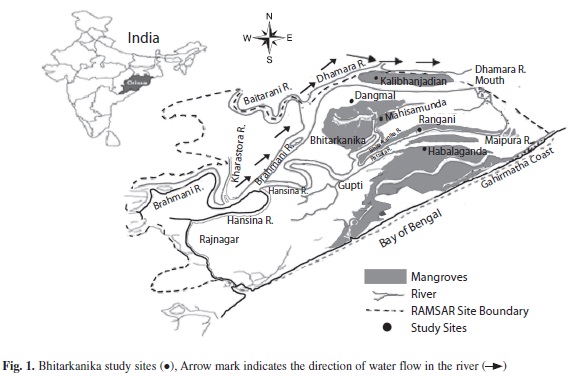
<body><![CDATA[<font style="font-weight: bold;" size="3"><span      style="font-family: verdana;">Materials and methods</span></font><br      style="font-family: verdana;">     <font size="2"></font><br style="font-family: verdana;">     <font size="2"><span style="font-family: verdana;"><span      style="font-weight: bold;">Study site:</span> The microbial studies     of the Bhitarkanika Wildlife Sanctuary (20&deg;30&#8217;&#8217; - 20&deg;50&#8217;&#8217; N     latitude and 86&deg;30&#8217;&#8217; - 87&deg;6&#8217;&#8217; E longitudes) of Odisha, India,     were undertaken at five different locations: Rangani (Site 1),     Mahisamunda (Site 2), Habalaganda (Site 3), Dangamal (Site 4) and     ]]></body>
<body><![CDATA[Kalibhanjadian (Site 5) (<a href="#Fig_1">Fig. 1</a>), and the four     seasons: rainy     (June-July), autumn (October-November), winter (December-January) and     summer (April-May) of 2007-2008.    <br>     <br> </span></font>     <div style="text-align: center;"><font size="2"><a name="Fig_1"></a><img      alt="" src="/img/revistas/rbt/v60n2/a31i1.jpg"      style="width: 570px; height: 377px;"><span      style="font-family: verdana;"></span></font><br     ]]></body>
<body><![CDATA[ style="font-family: verdana;">     <font size="2"><span style="font-family: verdana;"></span></font></div>     <br style="font-family: verdana;">     <font size="2"><span style="font-family: verdana;">For soil     physico-chemical and     microbial analysis, approximately 100g of soil samples were collected     from five arbitrarily selected spots of each of the five locations.     Samples </span></font><font size="2"><span      style="font-family: verdana;">were removed of the 10cm top soil     sediments, and the quintuplicate samples (over one m<sup>2</sup> area)     ]]></body>
<body><![CDATA[were mixed     thoroughly in sterile polythene bags and brought to Microbiology     Laboratory, North Odisha University, Odisha for further analysis.</span></font><br      style="font-family: verdana;">     <font size="2"></font><br style="font-family: verdana;">     <font size="2"><span style="font-family: verdana;">Soil pH and EC were     determined by     suspending 50g soil in 100mL distilled and deionized water and shaken     for one h at 100rpm on a rotary shaker and then centrifuged at 10 000 x     g for 5min. The pH and EC (mS/cm) of the supernatants were recorded     ]]></body>
<body><![CDATA[with a digital pH and conductivity meters (model no 141, 341Systronics     Pvt. Ltd., Ahamadabad, India), respectively. Total nitrogen content of     the soil was determined by the Kjeidahl digestion method. Available     phosphorus content of the soil was determined by flame photometer as     per the procedures of Jackson (1973).&nbsp; For estimation of organic     carbon, the soil samples were collected from 3-4cm depth with the help     of a spatula and transferred to the laboratory soon. The collected     samples were first air-dried and successively oven dried at     60-65&deg;C. Dried samples were ground with a grinder to fine powder     and kept in a sterile polythene zip pack. Laboratory apparatus were     ]]></body>
<body><![CDATA[acid soaked (Chromic acid) before the analysis, and afterwards were     thoroughly rinsed with tap and distilled water, to ensure any traces of     cleaning reagents. Surface sediments were air-dried followed by oven     drying and after homogenization using pestle and mortar; it was passed     through a 2mm mesh screen and stored in polyethylene bags for further     analysis. Organic carbon content of sediment samples were analyzed     following methods of Jackson (1973). </span></font><br      style="font-family: verdana;">     <font size="2"></font><br style="font-family: verdana;">     <font size="2"><span style="font-family: verdana;">One gram of air     ]]></body>
<body><![CDATA[dried soil was     diluted up to 10<sup>-5</sup> in sterilized (autoclaved at 121&deg;C,     15min)     distilled water, 100&#956;L of the suspensions were separately spread plated     on petri plates (n=5) containing different media and incubated at     30&plusmn;0.1&deg;C in an incubator. Heat-treated (60&deg;C, 30min)     soil suspensions were used to enumerate the spore-forming bacteria.     Colony forming units (cfu) of the microbes were counted under a colony     counter. Heterotrophic, Gram-negative and spore-forming bacteria were     enumerated on nutrient agar (NA). Gram-negative bacteria were     ]]></body>
<body><![CDATA[enumerated on NA medium containing sterilized aqueous crystal violet     (0.01g/L) (Pelczar <span style="font-style: italic;">et al. </span>1957).     Nitrifying and denitrifying bacteria     were enumerated on Winogradsky&#8217;s medium (Pelczar <span      style="font-style: italic;">et al.</span> 1957) (g/L:     K<sub>2</sub>HPO<sub>4</sub> 1, NaCl 2, MgSO<sub>4</sub>.7H<sub>2</sub>O     0.5, FeSO<sub>4</sub>.7H<sub>2</sub>O 0.001, CaCl<sub>2</sub>.2H<sub>2</sub>O     0.02,     (NH<sub>4</sub>)<sub>2</sub>SO<sub>4</sub> 1.00, pH 8.5) and incubated     at 30&plusmn;0.10C for     ]]></body>
<body><![CDATA[seven-eight days. Nitrifying bacterial colonies appeared pink when the     petri plates were flooded with sulphanillic acid reagent [equal volume     mixture of sulphanillic acid (8g/Lin 5M acetic acid) and &#945;-naphthyl     amine (5g/Lin 5M acetic acid)]. The asymbiotic nitrogen-fixing bacteria     were cultured on nitrogen-free medium (g/L: mannitol 10, K<sub>2</sub>HPO<sub>4</sub>     0.5,     MgSO<sub>4</sub>.7H<sub>2</sub>O 0.2, NaCl 0.2, MnSO<sub>4</sub>.4H<sub>2</sub>O     0.01, FeCl<sub>3</sub> 0.001, agar 18, pH     7.2) (Pelczar <span style="font-style: italic;">et al.</span> 1957).     Sulfuroxidizing bacteria (brown colonies),     ]]></body>
<body><![CDATA[soil fungi and actinomycetes were counted on <span      style="font-style: italic;">Thiobacillus</span> medium (g/L:     Na<sub>2</sub>S<sub>2</sub>O<sub>3</sub> 0.5, (NH<sub>4</sub>)<sub>2</sub>SO4     0.4, KH<sub>2</sub>PO<sub>4</sub> 4, CaCl<sub>2</sub> 0.25, MgSO<sub>4</sub>.7H2O     0.5, FeSO<sub>4</sub>     0.01, agar 18), mycological agar medium (g/L: peptic digest of soyabean     meal 10, dextrose 40, agar 18, pH 7) and Krainsky&#8217;s medium (Pelczar<span      style="font-style: italic;"> et     al.</span> 1957) (g/L: glucose 10, asparagine 0.5, K<sub>2</sub>HPO<sub>e</sub>     0.5, agar 15, pH 7),     ]]></body>
<body><![CDATA[respectively. The bacterial isolates, those formed halo zones on     insoluble phosphatecontaining medium (g/L: glucose 10, Ca<sub>3</sub>     (PO<sub>4</sub>)<sub>2</sub> 5,     MgSO<sub>4</sub>.7H<sub>2</sub>O 0.25, MgCl<sub>2</sub> 5, Kcl 0.2, (NH<sub>4</sub>)<sub>2</sub>SO<sub>4</sub>     0.1, agar 18) were counted     as phosphate-solubilizing microbes (Nautiyal 1999).     Morpho-physiological and biochemical characters such as shape, size,     Gram staining, indole production oxidase, catalase, urease hydrolysis,     acid from glucose, mannitol, arabinose, xylose, citrate, and propionate     utilization and tyrosine hydrolysis were studied. Besides, assays like     ]]></body>
<body><![CDATA[casein, gelatin, and starch hydrolysis were also checked and the     bacterial isolates were identified as per Bergey&#8217;s Manual of Systematic     Bacteriology (Sneath 1986). Principal Component Analysis (PCA) using     SPSS13 statistical software did ordination of data matrices for     physico-chemical properties of soil and seasonal variation of     population of 13 different groups of bacteria. For evaluation of     analytical results, multivariate statistical methods of correlation     analysis and PCA were applied.</span></font><br      style="font-family: verdana;">     <font size="2"></font><br     ]]></body>
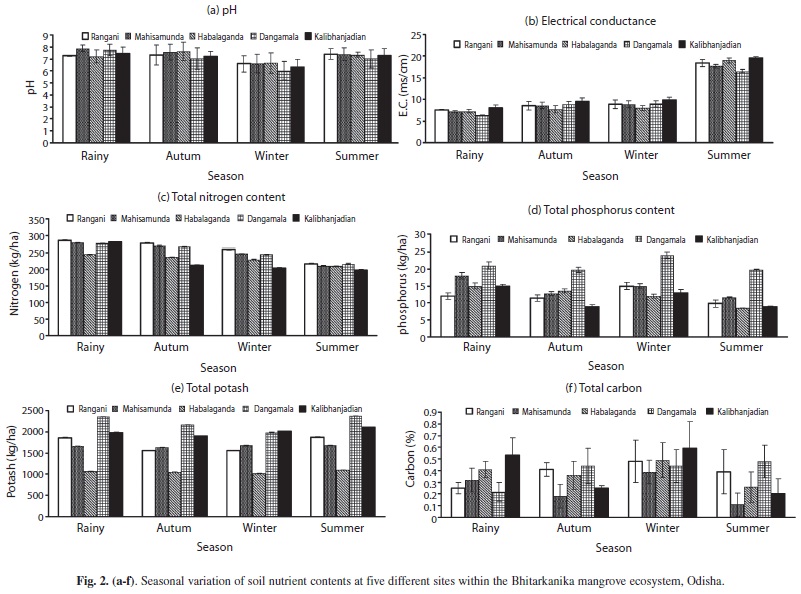
<body><![CDATA[ style="font-family: verdana; font-weight: bold;">     <font style="font-weight: bold;" size="3"><span      style="font-family: verdana;">Results</span></font><br      style="font-family: verdana;">     <font size="2"></font><br style="font-family: verdana;">     <font size="2"><span style="font-family: verdana;">Soil     physico-chemical properties     (pH, EC, N, P, K and C) and 13 groups of microbial populations of five     different sites of Bhitarkanika mangroves of India were studied during     four different seasons. The pH of different sites was limited within a     ]]></body>
<body><![CDATA[narrow range of 6.02-7.89 which was acidic (6.0-6.6) during the winter     but neutral to marginally alkaline in the other seasons (<a      href="/img/revistas/rbt/v60n2/a31i2.jpg">Fig. 2a</a>). Soil     redox potential (E.C) was comparable in different seasons but was     almost double in the summer (<a href="/img/revistas/rbt/v60n2/a31i2.jpg">Fig.     2b</a>). Total N content of the five     sites ranged between 200.6-285.5kg/ha (<a      href="/img/revistas/rbt/v60n2/a31i2.jpg">Fig. 2c</a>) and did not vary     significantly in any given season. However, it gradually declined from     the rainy through the summer season. The P content followed a similar     ]]></body>
<body><![CDATA[trend and varied from 9.0-24.0kg/ha among sites. The P level was     maximum (24.00kg/ha) at site four, and minimum (9.80kg/ha) at site one     (<a href="/img/revistas/rbt/v60n2/a31i2.jpg">Fig. 2d</a>). The K level     varied within the range of 1 053-2 378kg/ha     among sites and was two-five times more in the rainy season (<a      href="/img/revistas/rbt/v60n2/a31i2.jpg">Fig. 2e</a>).     Total carbon (C) content of the sites (0.11-0.59%) did not follow any     common seasonal trend, but was maximum in winter and minimum in autumn     (<a href="/img/revistas/rbt/v60n2/a31i2.jpg">Fig. 2f</a>).</span></font><br      style="font-family: verdana;">     ]]></body>
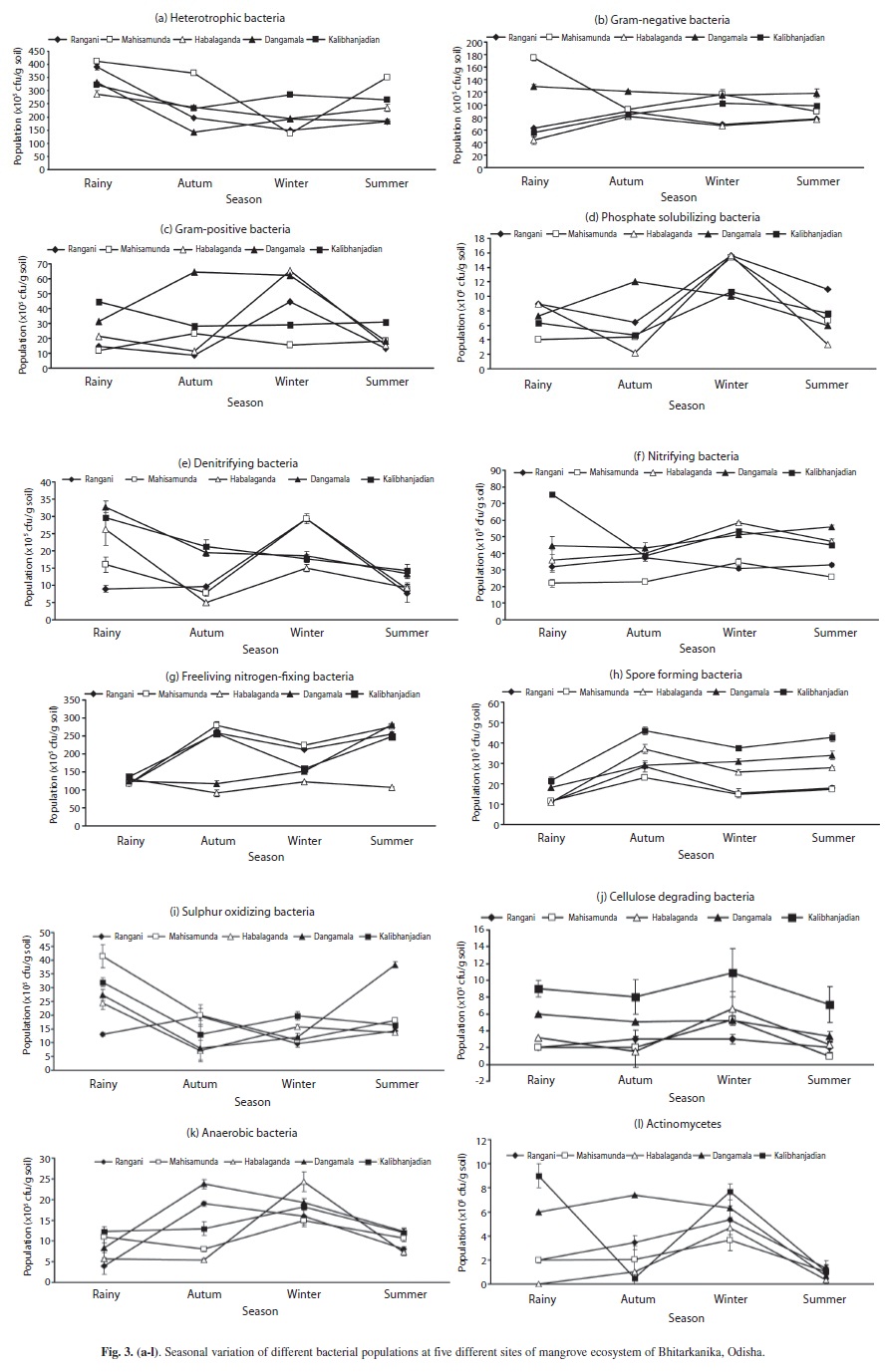
<body><![CDATA[<font size="2"></font><br style="font-family: verdana;">     <font size="2"><span style="font-family: verdana;">Bacterial     populations     (heterotrophic, N<sub>2</sub> fixing, Gram-negative, nitrifying, S     oxidizing,     Gram-positive, spore forming, denitrifying, P solubilizing, anaerobic     and cellulose degrading and actinomycetes did not change coherently     with season or site (<a href="/img/revistas/rbt/v60n2/a31i3.jpg">Figs. 3</a>).     Seasonally the heterotrophic bacterial     population 138-413 (x10<sup>5</sup>cfu/g soil) was more than the other     ]]></body>
<body><![CDATA[microbes     while, during rainy season, it increased by about 1.5-2.5, 2-2.1,     1.5-3, 1.1-1.5 and 1.1-1.4 times at the sites two, one, four, five and     three), respectively (<a href="/img/revistas/rbt/v60n2/a31i3.jpg">Fig.     3a</a>). </span></font><br style="font-family: verdana;">     <font size="2"></font><br style="font-family: verdana;">     <font size="2"><span style="font-family: verdana;">Generally, the     heterotrophic, P     solubilizing and S oxidizing populations were maximum in the rainy     season, when pool size of most of the other microbes either declined or     ]]></body>
<body><![CDATA[maintained (<a href="/img/revistas/rbt/v60n2/a31i3.jpg">Figs. 3a, d, i</a>).     The N<sub>2</sub> fixing bacterial     population was     117-135.7 (x10<sup>5</sup>cfu/g soil) during the rainy season (Fig.     3g). However,     in the same season the spore forming bacterial population was     comparatively less and varied from 11-21.7 (x10<sup>5</sup>cfu/g soil)     (<a href="/img/revistas/rbt/v60n2/a31i3.jpg">Fig. 3h</a>).     Nitrifying bacterial population varied between 22.00-75.66 (x10<sup>5</sup>cfu/g     soil) in different locations throughout the seasons and in the rainy     ]]></body>
<body><![CDATA[season, increased by about two folds at site five, while other sites     maintained the population level (<a      href="/img/revistas/rbt/v60n2/a31i3.jpg">Fig 3f</a>). The denitrifying     bacteria     varied from 10.33-32.00 (x10<sup>5</sup>cfu/g soil) in different     locations through     out the season (<a href="/img/revistas/rbt/v60n2/a31i3.jpg">Fig. 3e</a>).     The different sites harbored     4.00-24.33x10<sup>5</sup>cfu/g soil anaerobic bacteria in different     seasons (Fig.     ]]></body>
<body><![CDATA[3k), which declined from winter through the rainy season in all sites     but increased abruptly at sites one and four (<a      href="/img/revistas/rbt/v60n2/a31i3.jpg">Fig. 3k</a>). Gram-negative     bacteria varied between 44-175x10<sup>5</sup>cfu/g soil in different     sites, which     declined in all sites but more at site two during rainy season (<a      href="/img/revistas/rbt/v60n2/a31i3.jpg">Fig.     3b</a>). However, at site 4 the population was comparable in all     seasons     (<a href="/img/revistas/rbt/v60n2/a31i3.jpg">Fig. 3b</a>).     ]]></body>
<body><![CDATA[Gram-positive bacterial abundance was 4.5- 94.7x10<sup>5</sup>cfu/g     soil in different sites and seasons (<a      href="/img/revistas/rbt/v60n2/a31i3.jpg">Fig. 3c</a>) with a     population peak     during the rainy season only at site 5 (<a      href="/img/revistas/rbt/v60n2/a31i3.jpg">Fig. 3c</a>). At sites 1, 2     and 3     the spore forming bacterial population followed a common trend which     was more 15-37.5x10<sup>5</sup>cfu/g soil in the winter, and declined     by 45-50     ]]></body>
<body><![CDATA[fold in the summer (<a href="/img/revistas/rbt/v60n2/a31i3.jpg">Fig. 3h</a>).     The same trend was followed at site 4,     which increased gradually in the autumn (Fig. 3h). The P solubilizing     bacteria fluctuated between 2.2-15.7 (x10<sup>5</sup>cfu/g soil)     followed the same     trend and pool size in winter, summer and autumn seasons which was     maximum during the rainy season (four-nine cfu/g soil x 105) (<a      href="/img/revistas/rbt/v60n2/a31i3.jpg">Fig. 3d</a>).     The P solubilizing population was two-five times more in sites 2 and 3     respectively, than that of site 1 (x10<sup>5</sup> 6.4-15.7cfu/g soil)     ]]></body>
<body><![CDATA[(<a href="/img/revistas/rbt/v60n2/a31i3.jpg">Fig 3d</a>).     Cellulose degrading bacteria declined from winter through the summer,     except for sites 4 and 5 which increased and decreased alternately     (<a href="/img/revistas/rbt/v60n2/a31i3.jpg">Fig. 3j</a>). The     actinomycetes profile was comparatively very lower     compared to other microorganisms and maintained a same trend which     declined from winter through the rainy season followed by an increase     towards autumn at all sites (<a href="/img/revistas/rbt/v60n2/a31i3.jpg">Fig.     3l</a>). Based on culturable methods, a     number of bacteria were isolated from Bhitarkanika mangrove soil and     ]]></body>
<body><![CDATA[identified phenotypically following standard biochemical tests. The     predominant bacterial genera identified were <span      style="font-style: italic;">Bacillus, Pseudomonas,     Desulfotomaculum, Desulfovibrio, Desulfomonas, Methylococcus, Vibrio,     Micrococcus, Klebsiella</span> and <span style="font-style: italic;">Azotobacter.     </span></span></font><br style="font-family: verdana;">     <font size="2"></font><br style="font-family: verdana;">     <font size="2"><span style="font-family: verdana;">In this study, PCA     was employed to     explore how the changes in the microbial community composition varied     ]]></body>
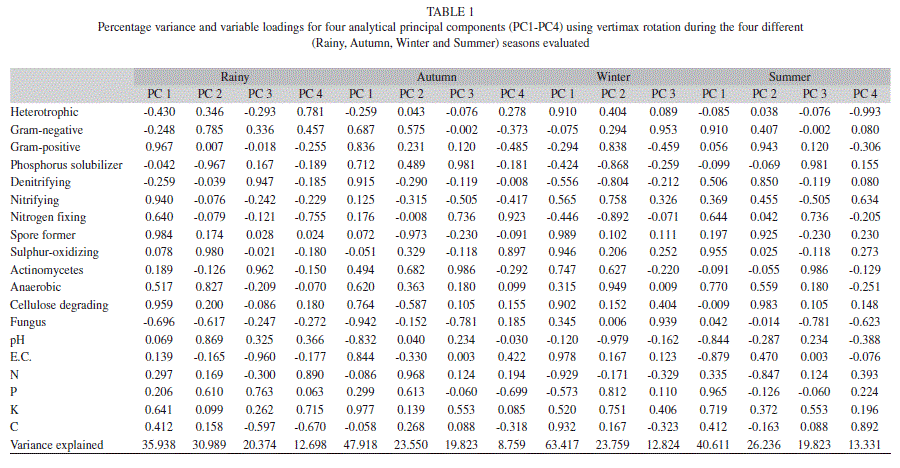
<body><![CDATA[with environmental conditions, which has been proven to be sensitive in     detecting the relationship between bacterial community composition and     environmental parameters. Using PCA, the original variables during     rainy season were reduced to four principal components (PC1-PC4), which     had Eigen values larger than one and retained for rotation (<a      href="/img/revistas/rbt/v60n2/a31i4.jpg">Figs 4a-e</a>).     PC1 accounted for 36%, where PC2, PC3, PC4 accounted for 30%, 20% and     12%, respectively. The combined PC1-PC4 together accounted for 94% of     the total variation (<a href="/img/revistas/rbt/v60n2/a31t1.gif">Table 1</a>).     The total 19 proximate variables loaded     ]]></body>
<body><![CDATA[heavily in four dimensions, while the loading of carbon and nitrifying     microorganisms did not meet the Stevenson&#8217;s guide line (&lt;0.72). To     assist the interpretation of dimensions, the factor pattern was rotated     using vertimax method. Based on the guidelines provided by Stevans     (1992) an attribute is considered to load heavily on a giving component     if the factor loading is greater than 0.72. The analytical variables,     Gram-positive, nitrifying (+)ve, spore forming (+)ve, cellulose     degrading (+)ve were loaded heavily on PC1 indicating the strong     correlation among the variables. The population axis and these     components were responsible for the major microflora load during the     ]]></body>
<body><![CDATA[rainy season. The original variables during autumn season were reduced     to four PC. Then PC1 accounted for 48%, while the combined PC accounted     for 98% of the total variation (<a      href="/img/revistas/rbt/v60n2/a31t1.gif">Table 1</a>). The total 19     proximate     variables loaded heavily in a four dimension while Gram-negative,     actinomycetes, anaerobic, phosphorus bacteria did not meet the     Stevenson&#8217;s guide line. During winter, original variables were reduced     to three PC. The PC1 accounts for 63% and combined PC accounts for 98%     of the total variation (<a href="/img/revistas/rbt/v60n2/a31t1.gif">Table     ]]></body>
<body><![CDATA[1</a>). The original variables were reduced     to four PC during summer season. PC1 accounted for 40% whereas PC2, PC3     and PC4 accounted for 26%, 19% and 13%, respectively (<a      href="/img/revistas/rbt/v60n2/a31t1.gif">Table 1</a>).     Gram-negative bacteria (+) ve, sulphur oxidizing (+)ve, anaerobic     (+)ve, pH (-)ve, E.C. (-)ve, phosphorus (+)ve loaded heavily which     contributed strong relation among the variables.</span></font><br      style="font-family: verdana;">     <font size="2"></font><br style="font-family: verdana;">     <font style="font-weight: bold;" size="3"><span     ]]></body>
<body><![CDATA[ style="font-family: verdana;">Discussion</span></font><br      style="font-family: verdana; font-weight: bold;">     <font style="font-weight: bold;" size="2"></font><br      style="font-family: verdana;">     <font size="2"><span style="font-family: verdana;">Mangrove ecosystem     environmental     parameters affecting the community of soil bacteria have been detailed     over many years (Holguin <span style="font-style: italic;">et al.</span>     2001). In the present study, soil pH     variation of the Bhitarkanika mangrove sediment on different seasons     ]]></body>
<body><![CDATA[agrees the observations of Essien <span style="font-style: italic;">et     al.</span> (2006), who have recorded     acidic pH (6.36) in the rainy season in mangrove sediment of Qua Iboe     Estuary. However, it contradicts with the observations by Gonzalez-     Acosta <span style="font-style: italic;">et al. </span>(2006) who     noted slightly alkaline pH (7.8) in the     Mexican mangrove forest. Nevertheless, conductivity limits     (2.9-17.69mS/cm) of the Bhitarkanika mangrove sediment is in favour of     the observation of Essien <span style="font-style: italic;">et al.</span>     (2006) who have recorded a nearly     ]]></body>
<body><![CDATA[equal value of conductivity from Qua Iboe Estuary. The high levels of     N, P and K (245-285, 12-21 and 663-1075kg/ha, respectively) in the     rainy season are in support of the view of Essien <span      style="font-style: italic;">et al.</span> (2006) that     runoff water may leach the minerals to the mangrove sediment, estuaries     and tidal zones. Unlike other nutrients, carbon level was maximum in     the rainy season, and this is attributed to replenishment by the runoff     water (Martinez <span style="font-style: italic;">et al.</span> 1996).</span></font><br      style="font-family: verdana;">     <font size="2"></font><br style="font-family: verdana;">     ]]></body>
<body><![CDATA[<font size="2"><span style="font-family: verdana;">The non-coordinated     local and     seasonal variation of microbial populations in the mangrove habitat of     the Bhitarkanika system agrees the non-coherent relation of the biotic     and abiotic components of other mangrove ecologies (Martinez <span      style="font-style: italic;">et al.</span>     1996). Despite inherent limitations, viable count of microbial     population was adapted in our study as it would reflect relatively     abundant and functionally dominant microbial communities (Nannipieri et     al. 2003, Das &amp; Dangar 2008). In spite of the higher salinity of     ]]></body>
<body><![CDATA[mangrove soils, denitrifying bacteria (10.712-22.016x10<sup>5</sup>cfu/g     soil) and     asymbiotic N<sub>2</sub> fixing bacteria (125.2-213.6x10<sup>5</sup>cfu/g     soil) were high in     all seasons and sites. Several authors are of the opinion that salinity     is not the determining factor of microbial dynamics in mangroves     (Essien <span style="font-style: italic;">et al. </span>2006). </span></font><font      size="2"><span style="font-family: verdana;">Contrary to inland or     non-tidal     coastal saline soils, average bacterial population in mangrove     ]]></body>
<body><![CDATA[sediments was 1.8-2.1x10<sup>6</sup>cfu/g soils which were comparable     to the     population size (2.2-6.0x10<sup>6</sup>cfu/g soil) of non saline soils     (Das &amp;     Dangar 2008). However, Gonzalez-Acosta <span      style="font-style: italic;">et al.</span> (2006) have recorded more     microbes (109- 1011cfu/mL water) in a Mexican mangrove forest. Sulphate     may act as an electron acceptor during mineralization in saline soils     (Zaharan 1997). Therefore, more sulphur-oxidizing bacteria may     positively affect survival and growth of other microbes in saline     ]]></body>
<body><![CDATA[soils. Relatively more nutrition (N, P, K) in the rainy season would     increase a microbial population. This was reflected, by increase in     heterotrophic, phosphate solubilizing and sulphur oxidizing bacteria     and fungal populations in the Bhitarkanika mangrove soil. Synergistic     effect of the P and N levels would also augment the microbial     population (Rojas <span style="font-style: italic;">et al. </span>2001).     However, relatively lower populations     of P solubilizing, spore forming, Gram-negative microbes in the rainy     season could not be explained from the study. Decline of the     heterotrophic community including N<sub>2</sub> fixing bacteria, in the     ]]></body>
<body><![CDATA[mangroves     might be partially due to an increase in oxygen production during     active growth of autotrophs and predation of the bacteria by the     detritivores (Holguin <span style="font-style: italic;">et al.</span>     1992, Toledo <span style="font-style: italic;">et al.</span> 1995,     Holguin <span style="font-style: italic;">et al.     </span>2001). Decreased microbial diversity in winter months agrees the     propositions that microbial populations were lower in winter and     maximum in the summer (Martinez <span style="font-style: italic;">et     al.</span> 1996). In the soil, higher P     ]]></body>
<body><![CDATA[level would be attributed to relatively more phosphate solubilizing     bacteria whereas, lower nitrifying and denitrifying population would     increase nitrogen levels and reduce the N<sub>2</sub> fixing microbes.     Close     interactions usually exist between nitrogen and phosphorus solubilizing     bacteria in soil ecosystem. It has been reported that interaction of N<sub>2</sub>     fixing bacteria with other bacteria can inhibit or promote their     diazotrophic activity (Drozdowicz &amp; Santos 1987, Isopi <span      style="font-style: italic;">et al.</span>     1995). Similarly, the degradation of cellulose by <span     ]]></body>
<body><![CDATA[ style="font-style: italic;">Cellulomonas</span> sp.,     have provided <span style="font-style: italic;">Azosprillum</span> sp.     with a usable carbon source to obtain     energy for N<sub>2</sub> fixation. Similarly, the synergism between N<sub>2</sub>     fixing     <span style="font-style: italic;">Phyllobacterium</span> sp. and     phosphate solubilizing <span style="font-style: italic;">Bacillus     licheniformis</span>,     both isolated from a semiarid mangrove rhizosphere has been reported by     Rojas <span style="font-style: italic;">et al.</span> (2001).     ]]></body>
<body><![CDATA[Comparatively higher Gram- negative bacteria pool     favored that they would be the sole decomposers. Minimum spore forming     bacteria from heated inoculum but an overall increase in heterotrophs     in the rainy season suggests that more bacteria would continue at     growth phase due to enrichment of nutrition. Similarly, the anaerobic     bacteria decrease in the rainy season as continuous turbulence increase     O<sub>2</sub> level in water. The Gram negative population and higher O<sub>2</sub>     level in     sea water in the rainy season is in conformity with previous reports by     Gonzalez-Acosta <span style="font-style: italic;">et al. </span>(2006).     ]]></body>
<body><![CDATA[Predominantly, clay and fine silt     structure of the Bhitarkanika would enhance (up to two orders)     diversity and density like other mangroves than in the sandy sediments     (Sessitsch <span style="font-style: italic;">et al.</span> 2001).     Furthermore, lower nitrite and nitrate levels     in the Bhitarkanika mangrove sediment are in support of other mangrove     sediments with concomitant decline of nitrifying and denitrifying     bacteria (Holguin <span style="font-style: italic;">et al. </span>1992).</span></font><br      style="font-family: verdana;">     <font size="2"></font><br style="font-family: verdana;">     ]]></body>
<body><![CDATA[<font size="2"><span style="font-family: verdana;">However, microbial     diversity of     Bhitarkanika mangrove ecosystem has not been explored except for the     reports on presence of Gram negative bacteria such as <span      style="font-style: italic;">Pseudomonas,     Desulfotomaculum</span> and <span style="font-style: italic;">Methylococcus</span>     spp. (Mishra <span style="font-style: italic;">et al.</span> 2009). In     regards to its microbial diversity, Bhitarkanika mangrove ecosystem is     largely dominated by <span style="font-style: italic;">Bacillus</span>     and<span style="font-style: italic;"> Pseudomonas</span> which is the     ]]></body>
<body><![CDATA[characteristic of saline soil. Presence or absence of particular     bacterial genera may depend on soil parameters, as observed by     Alexander (1971). Although, there is considerable information how     culturable bacteria respond to environmental variables in mangrove     ecosystems (Takizaaqva <span style="font-style: italic;">et al.</span>     1993, Wang &amp; Hong 2005), little is     known about how these variables influence the structure of actual     bacterial communities in the mangrove sediment.</span></font><br      style="font-family: verdana;">     <font size="2"></font><br style="font-family: verdana;">     ]]></body>
<body><![CDATA[<font size="2"><span style="font-family: verdana;">Previous studies     reported that the     culturable bacteria composition has high similarity between mangrove     soils collected from different mangrove areas (Shome <span      style="font-style: italic;">et al.</span> 1995). The     present study revealed that the bacterial community compositions varied     at different mangrove areas as well as seasons, and were both     positively and negatively correlated with environmental factors.     Environmental pH, E.C. and available phosphorus accounted for a     significant amount of the variability in bacterial community     ]]></body>
<body><![CDATA[composition. This indicates that organic matter content, pH and     available soil phosphorus could influence the bacterial community     structure in mangrove sediments.</span></font><br      style="font-family: verdana;">     <font size="2"></font><br style="font-family: verdana;">     <font size="2"><span style="font-family: verdana;">Microbial dynamics     and nutrition     balance in the sediment of the Bhitarkanika mangrove forest are     interdependent and salinity does not affect microbial functionalities.     There is a prominent seasonal variation among the microbial population     ]]></body>
<body><![CDATA[and the nutrient content. Sediment of Bhitarkanika mangrove forest     harbors higher bacterial communities in comparison to fungi and     actinomycetes exhibiting great genetic diversity. Mangrove soil     supports higher population of free-living N<sub>2</sub>fixers,     nitrifiers,     denitrifiers, phosphate solubilizer, cellulose degraders, and sulphur     oxidizers, responsible for major biogeo-chemical cycles.</span></font><br      style="font-family: verdana;">     <font size="2"></font><br style="font-family: verdana;">     <font style="font-weight: bold;" size="3"><span     ]]></body>
<body><![CDATA[ style="font-family: verdana;">Acknowledments</span></font><br      style="font-family: verdana; font-weight: bold;">     <font style="font-weight: bold;" size="2"></font><br      style="font-family: verdana;">     <font size="2"><span style="font-family: verdana;">The authors are     grateful to the     authorities of North Odisha University and Central Rice </span></font><font      size="2"><span style="font-family: verdana;">Research Institute for     providing     laboratory facilities to carry out the present work. The </span></font><font     ]]></body>
<body><![CDATA[ size="2"><span style="font-family: verdana;">help and cooperation of     staff from     the Forest Department, Mangrove Forest Division, </span></font><font      size="2"><span style="font-family: verdana;">Rajanagar is gratefully     acknowledged.</span></font><br style="font-family: verdana;">     <font size="2"></font><br      style="font-family: verdana; font-weight: bold;">     <font style="font-weight: bold;" size="2"><span      style="font-family: verdana;"></span></font>     <hr style="width: 100%; height: 2px;"><font style="font-weight: bold;"     ]]></body>
<body><![CDATA[ size="3"><span style="font-family: verdana;">References</span></font><br      style="font-family: verdana; font-weight: bold;">     <font style="font-weight: bold;" size="2"></font><br      style="font-family: verdana;">     <font size="2"><span style="font-family: verdana;">Alongi, D.M., P     Christoffersen     &amp; F. Tirendi. 1993. The influence of forest type on     microbial-nutrient relationships in tropical mangrove sediments. J.     <!-- ref -->Exp. Mar. Biol. Ecol. 171: 201-223.    &nbsp;&nbsp;&nbsp;&nbsp;&nbsp;&nbsp;&nbsp;&nbsp;[&#160;<a href="javascript:void(0);" onclick="javascript: window.open('/scielo.php?script=sci_nlinks&ref=1503713&pid=S0034-7744201200020003100001&lng=','','width=640,height=500,resizable=yes,scrollbars=1,menubar=yes,');">Links</a>&#160;]<!-- end-ref --><!-- ref --></span></font><br  style="font-family: verdana;"> <font size="2"></font><br style="font-family: verdana;"> <font size="2"><span style="font-family: verdana;">Alongi, D.M. 1994. The role of bacteria in nutrient recycling in tropical mangrove and other coastal benthic ecosystems. Mar. Ecol. Prog. Ser. 56: 133-144.    &nbsp;&nbsp;&nbsp;&nbsp;&nbsp;&nbsp;&nbsp;&nbsp;[&#160;<a href="javascript:void(0);" onclick="javascript: window.open('/scielo.php?script=sci_nlinks&ref=1503714&pid=S0034-7744201200020003100002&lng=','','width=640,height=500,resizable=yes,scrollbars=1,menubar=yes,');">Links</a>&#160;]<!-- end-ref --><!-- ref --></span></font><br  style="font-family: verdana;"> <font size="2"></font><br style="font-family: verdana;"> <font size="2"><span style="font-family: verdana;">Alexander, M. 1971. Microbial ecology. Wiley, New York, USA.    &nbsp;&nbsp;&nbsp;&nbsp;&nbsp;&nbsp;&nbsp;&nbsp;[&#160;<a href="javascript:void(0);" onclick="javascript: window.open('/scielo.php?script=sci_nlinks&ref=1503715&pid=S0034-7744201200020003100003&lng=','','width=640,height=500,resizable=yes,scrollbars=1,menubar=yes,');">Links</a>&#160;]<!-- end-ref --><!-- ref --></span></font><br  style="font-family: verdana;"> <font size="2"></font><br style="font-family: verdana;"> <font size="2"><span style="font-family: verdana;">Chandrika, V., P.V.R. Nair &amp; L.R. Khambhadkar. 1990. Distribution of phototrophic thionic bacteria in the anaerobic and micro- aerophilic strata of mangrove ecosystem of Cochin. J. Mar. Biol. Ass. India. 32: 77-84.    &nbsp;&nbsp;&nbsp;&nbsp;&nbsp;&nbsp;&nbsp;&nbsp;[&#160;<a href="javascript:void(0);" onclick="javascript: window.open('/scielo.php?script=sci_nlinks&ref=1503716&pid=S0034-7744201200020003100004&lng=','','width=640,height=500,resizable=yes,scrollbars=1,menubar=yes,');">Links</a>&#160;]<!-- end-ref --><!-- ref --></span></font><br  style="font-family: verdana;"> <font size="2"></font><br style="font-family: verdana;"> <font size="2"><span style="font-family: verdana;">Gonzalez-Acosta, B., Y. Bashan, N.Y. Hernandez- Saavedra, F. Ascencio &amp; G. Dela Cruz-Aguero. 2006. Seasonal seawater temperature as the major determinant for populations of culturable bacteria in the sediments of an intact mangrove in an arid region. FEMS. Microbiol. Ecol. 55: 311-321.    &nbsp;&nbsp;&nbsp;&nbsp;&nbsp;&nbsp;&nbsp;&nbsp;[&#160;<a href="javascript:void(0);" onclick="javascript: window.open('/scielo.php?script=sci_nlinks&ref=1503717&pid=S0034-7744201200020003100005&lng=','','width=640,height=500,resizable=yes,scrollbars=1,menubar=yes,');">Links</a>&#160;]<!-- end-ref --><!-- ref --></span></font><br  style="font-family: verdana;"> <font size="2"></font><br style="font-family: verdana;"> <font size="2"><span style="font-family: verdana;">Das, J. &amp; T.K. Dangar. 2008. Microbial population dynamics, especially stress tolerant <span  style="font-style: italic;">Bacillus thuringiensis</span>, in partially anaerobic rice field soils during post-harvest period of the Himalayan, island brackish water and coastal habitats of India. World J. Microbiol. Biotechnol. 24: 1403-1410.    &nbsp;&nbsp;&nbsp;&nbsp;&nbsp;&nbsp;&nbsp;&nbsp;[&#160;<a href="javascript:void(0);" onclick="javascript: window.open('/scielo.php?script=sci_nlinks&ref=1503718&pid=S0034-7744201200020003100006&lng=','','width=640,height=500,resizable=yes,scrollbars=1,menubar=yes,');">Links</a>&#160;]<!-- end-ref --><!-- ref --></span></font><br  style="font-family: verdana;"> <font size="2"></font><br style="font-family: verdana;"> <font size="2"><span style="font-family: verdana;">Drozdowicz, A. &amp; G.M. Ferreira Santos. 1987. Nitrogenase activity in mixed cultures of <span  style="font-style: italic;">Azospirillum</span> with other bacteria. Zent. bl. Microbiol. 142: 487-493.    &nbsp;&nbsp;&nbsp;&nbsp;&nbsp;&nbsp;&nbsp;&nbsp;[&#160;<a href="javascript:void(0);" onclick="javascript: window.open('/scielo.php?script=sci_nlinks&ref=1503719&pid=S0034-7744201200020003100007&lng=','','width=640,height=500,resizable=yes,scrollbars=1,menubar=yes,');">Links</a>&#160;]<!-- end-ref --><!-- ref --></span></font><br  style="font-family: verdana;"> <font size="2"></font><br style="font-family: verdana;"> <font size="2"><span style="font-family: verdana;">Essien, J.P., S.P. Antai &amp; N.U. Benson. 2006. Microbial population dynamics as a function of sediment salinity gradients in the qua lboe estuary mangrove swamp (Nigeria). Res. J. Microbiol. 1: 255-265.    &nbsp;&nbsp;&nbsp;&nbsp;&nbsp;&nbsp;&nbsp;&nbsp;[&#160;<a href="javascript:void(0);" onclick="javascript: window.open('/scielo.php?script=sci_nlinks&ref=1503720&pid=S0034-7744201200020003100008&lng=','','width=640,height=500,resizable=yes,scrollbars=1,menubar=yes,');">Links</a>&#160;]<!-- end-ref --><!-- ref --></span></font><br  style="font-family: verdana;"> <font size="2"></font><br style="font-family: verdana;"> <font size="2"><span style="font-family: verdana;">Gupta, N., S. Das &amp; U.C. Basak. 2007. Useful extracellular activity of bacteria isolated from Bhitrkanika mangrove ecosystem of Odisha coast. Malaysian J. Microbiol. 3: 15-18.    &nbsp;&nbsp;&nbsp;&nbsp;&nbsp;&nbsp;&nbsp;&nbsp;[&#160;<a href="javascript:void(0);" onclick="javascript: window.open('/scielo.php?script=sci_nlinks&ref=1503721&pid=S0034-7744201200020003100009&lng=','','width=640,height=500,resizable=yes,scrollbars=1,menubar=yes,');">Links</a>&#160;]<!-- end-ref --><!-- ref --></span></font><br style="font-family: verdana;"> <font size="2"></font><br style="font-family: verdana;"> <font size="2"><span style="font-family: verdana;">Gutknecht, J.L.M, R.M. Goodman &amp; T.C. Balser. 2006. Linking soil process and microbial ecology in freshwater wetland ecosystems. Plant Soil. 289: 17-34.    &nbsp;&nbsp;&nbsp;&nbsp;&nbsp;&nbsp;&nbsp;&nbsp;[&#160;<a href="javascript:void(0);" onclick="javascript: window.open('/scielo.php?script=sci_nlinks&ref=1503722&pid=S0034-7744201200020003100010&lng=','','width=640,height=500,resizable=yes,scrollbars=1,menubar=yes,');">Links</a>&#160;]<!-- end-ref --><!-- ref --></span></font><br  style="font-family: verdana;"> <font size="2"></font><br style="font-family: verdana;"> <font size="2"><span style="font-family: verdana;">Holguin, G., M.A. Guzman &amp; Y. Bashan. 1992. Two new nitrogen-fixing bacteria from the rhizosphere of mangrove trees: Their isolation, identification and in vitro interactions with rhizosphere<span style="font-style: italic;"> Staphylococcus</span> sp. FEMS. Microbiol. Ecol. 101: 207-216.    &nbsp;&nbsp;&nbsp;&nbsp;&nbsp;&nbsp;&nbsp;&nbsp;[&#160;<a href="javascript:void(0);" onclick="javascript: window.open('/scielo.php?script=sci_nlinks&ref=1503723&pid=S0034-7744201200020003100011&lng=','','width=640,height=500,resizable=yes,scrollbars=1,menubar=yes,');">Links</a>&#160;]<!-- end-ref --><!-- ref --></span></font><br style="font-family: verdana;"> <font size="2"></font><br style="font-family: verdana;"> <font size="2"><span style="font-family: verdana;">Holguin, G., P. Vazquez &amp; Y. Bashan. 2001. The role of sediment microorganisms in the productivity, conservation and rehabitation of mangrove ecosystems: An overview. Biol. Fertil. Soils. 33: 265-278.    &nbsp;&nbsp;&nbsp;&nbsp;&nbsp;&nbsp;&nbsp;&nbsp;[&#160;<a href="javascript:void(0);" onclick="javascript: window.open('/scielo.php?script=sci_nlinks&ref=1503724&pid=S0034-7744201200020003100012&lng=','','width=640,height=500,resizable=yes,scrollbars=1,menubar=yes,');">Links</a>&#160;]<!-- end-ref --><!-- ref --></span></font><br  style="font-family: verdana;"> <font size="2"></font><br style="font-family: verdana;"> <font size="2"><span style="font-family: verdana;">Holguin, G., P.G. Zamorano, L.E. Bashan-De, R. Mendoza, E. Amador &amp; Y. Bashan. 2006. Mangrove health in an arid environment encroached by urban development-a </span></font><font  size="2"><span style="font-family: verdana;">case study. Sci. Total Environ. 363: 260-274.    &nbsp;&nbsp;&nbsp;&nbsp;&nbsp;&nbsp;&nbsp;&nbsp;[&#160;<a href="javascript:void(0);" onclick="javascript: window.open('/scielo.php?script=sci_nlinks&ref=1503725&pid=S0034-7744201200020003100013&lng=','','width=640,height=500,resizable=yes,scrollbars=1,menubar=yes,');">Links</a>&#160;]<!-- end-ref --><!-- ref --></span></font><br style="font-family: verdana;"> <font size="2"></font><br style="font-family: verdana;"> <font size="2"><span style="font-family: verdana;">Isopi, R., P. Fabbri, M. Del Gallo &amp; G. Puppi. 1995. Dual inoculation of <span  style="font-style: italic;">Sorghum bicolor</span> (L.) <span  style="font-style: italic;">Moench</span> ssp. bicolor with vesicular arbuscular mycorrhizas and <span  style="font-style: italic;">Acetobacter diazotrophic</span>. Symbiosis 18: 43-55.    &nbsp;&nbsp;&nbsp;&nbsp;&nbsp;&nbsp;&nbsp;&nbsp;[&#160;<a href="javascript:void(0);" onclick="javascript: window.open('/scielo.php?script=sci_nlinks&ref=1503726&pid=S0034-7744201200020003100014&lng=','','width=640,height=500,resizable=yes,scrollbars=1,menubar=yes,');">Links</a>&#160;]<!-- end-ref --><!-- ref --></span></font><br  style="font-family: verdana;"> <font size="2"></font><br style="font-family: verdana;"> <font size="2"><span style="font-family: verdana;">Jackson, M.L. 1973. Soil Chemical Analysis. Prentice Hall of India Private Limited, New Delhi, India.    &nbsp;&nbsp;&nbsp;&nbsp;&nbsp;&nbsp;&nbsp;&nbsp;[&#160;<a href="javascript:void(0);" onclick="javascript: window.open('/scielo.php?script=sci_nlinks&ref=1503727&pid=S0034-7744201200020003100015&lng=','','width=640,height=500,resizable=yes,scrollbars=1,menubar=yes,');">Links</a>&#160;]<!-- end-ref --><!-- ref --> Kathiresan, K. &amp; M.M. Selvam. 2006. Evaluation of beneficial bacteria from mangrove soil. Bot. Mar. 49: 86-88.    &nbsp;&nbsp;&nbsp;&nbsp;&nbsp;&nbsp;&nbsp;&nbsp;[&#160;<a href="javascript:void(0);" onclick="javascript: window.open('/scielo.php?script=sci_nlinks&ref=1503728&pid=S0034-7744201200020003100016&lng=','','width=640,height=500,resizable=yes,scrollbars=1,menubar=yes,');">Links</a>&#160;]<!-- end-ref --><!-- ref --></span></font><br  style="font-family: verdana;"> <font size="2"></font><br style="font-family: verdana;"> <font size="2"><span style="font-family: verdana;">Kathiresan, K. &amp; N. Rajendran. 2005. Mangrove ecosystem of Indian Ocean region. Indian J. Mar. Sci. 34: 104-113.    &nbsp;&nbsp;&nbsp;&nbsp;&nbsp;&nbsp;&nbsp;&nbsp;[&#160;<a href="javascript:void(0);" onclick="javascript: window.open('/scielo.php?script=sci_nlinks&ref=1503729&pid=S0034-7744201200020003100017&lng=','','width=640,height=500,resizable=yes,scrollbars=1,menubar=yes,');">Links</a>&#160;]<!-- end-ref --><!-- ref --></span></font><br style="font-family: verdana;"> <font size="2"></font><br style="font-family: verdana;"> <font size="2"><span style="font-family: verdana;">Kristensen, E., M.H. Jensen, G.T. Banta, K. Hansen, M. Holmer &amp; M. King. 1998. Transformation and transport of inorganic nitrogen in sediments of a Southeast </span></font><font  size="2"><span style="font-family: verdana;">Asian mangrove forest. Aquat. Microb. Ecol. 15: 165-175.    &nbsp;&nbsp;&nbsp;&nbsp;&nbsp;&nbsp;&nbsp;&nbsp;[&#160;<a href="javascript:void(0);" onclick="javascript: window.open('/scielo.php?script=sci_nlinks&ref=1503730&pid=S0034-7744201200020003100018&lng=','','width=640,height=500,resizable=yes,scrollbars=1,menubar=yes,');">Links</a>&#160;]<!-- end-ref --><!-- ref --></span></font><br  style="font-family: verdana;"> <font size="2"></font><br style="font-family: verdana;"> <font size="2"><span style="font-family: verdana;">Kristensen, E., S. Bouillon, T. Dittmar &amp; C. Marchand. 2008. Organic carbon dynamics in mangrove ecosystems: A review. Aquat. Bot. 2: 201-219.    &nbsp;&nbsp;&nbsp;&nbsp;&nbsp;&nbsp;&nbsp;&nbsp;[&#160;<a href="javascript:void(0);" onclick="javascript: window.open('/scielo.php?script=sci_nlinks&ref=1503731&pid=S0034-7744201200020003100019&lng=','','width=640,height=500,resizable=yes,scrollbars=1,menubar=yes,');">Links</a>&#160;]<!-- end-ref --><!-- ref --></span></font><br  style="font-family: verdana;"> <font size="2"></font><br style="font-family: verdana;"> <font size="2"><span style="font-family: verdana;">Lageiro, M.M., M.J. Moura, A. Reis &amp; M.J.C. Ferreira. 2007. Microbial proteases application in leather industry. J. Biotechnol. 131: 239-240.    &nbsp;&nbsp;&nbsp;&nbsp;&nbsp;&nbsp;&nbsp;&nbsp;[&#160;<a href="javascript:void(0);" onclick="javascript: window.open('/scielo.php?script=sci_nlinks&ref=1503732&pid=S0034-7744201200020003100020&lng=','','width=640,height=500,resizable=yes,scrollbars=1,menubar=yes,');">Links</a>&#160;]<!-- end-ref --><!-- ref --></span></font><br  style="font-family: verdana;"> <font size="2"></font><br style="font-family: verdana;"> <font size="2"><span style="font-family: verdana;">Levin, L.A., D.F. Boesch &amp; A. Covich et al. 2001. The function of marine critical transition zones and importance of sediment biodiversity. Ecosystems 4: 430-451.    &nbsp;&nbsp;&nbsp;&nbsp;&nbsp;&nbsp;&nbsp;&nbsp;[&#160;<a href="javascript:void(0);" onclick="javascript: window.open('/scielo.php?script=sci_nlinks&ref=1503733&pid=S0034-7744201200020003100021&lng=','','width=640,height=500,resizable=yes,scrollbars=1,menubar=yes,');">Links</a>&#160;]<!-- end-ref --><!-- ref --></span></font><br  style="font-family: verdana;"> <font size="2"></font><br style="font-family: verdana;"> <font size="2"><span style="font-family: verdana;">Maria, G.L. &amp; K.R. Sridhar. 2002. Richness and diversity of filamentous fungi on woody litter of mangroves along the west coast of India. Curr. Sci. 83: 1573-1580.    &nbsp;&nbsp;&nbsp;&nbsp;&nbsp;&nbsp;&nbsp;&nbsp;[&#160;<a href="javascript:void(0);" onclick="javascript: window.open('/scielo.php?script=sci_nlinks&ref=1503734&pid=S0034-7744201200020003100022&lng=','','width=640,height=500,resizable=yes,scrollbars=1,menubar=yes,');">Links</a>&#160;]<!-- end-ref --><!-- ref --></span></font><br  style="font-family: verdana;"> <font size="2"></font><br style="font-family: verdana;"> <font size="2"><span style="font-family: verdana;">Martinez, J., D. Smith, G.F. Steward &amp; F. Azam. 1996. Variability in ecto-hydrolytic enzyme activities of pelagic marine bacteria and its significance for substrate processing in the sea. Aqua. Microbial. Ecol. 10: 223-230.    &nbsp;&nbsp;&nbsp;&nbsp;&nbsp;&nbsp;&nbsp;&nbsp;[&#160;<a href="javascript:void(0);" onclick="javascript: window.open('/scielo.php?script=sci_nlinks&ref=1503735&pid=S0034-7744201200020003100023&lng=','','width=640,height=500,resizable=yes,scrollbars=1,menubar=yes,');">Links</a>&#160;]<!-- end-ref --><!-- ref --></span></font><br  style="font-family: verdana;"> <font size="2"></font><br style="font-family: verdana;"> <font size="2"><span style="font-family: verdana;">Mishra, A.K., T.K. Routray &amp; G.C. Satapathy 1995. Ecological study on Soil Microflora of Bhitarkanika Mangroves in relation to Vegetational Patterns, p. 46-51. <span style="font-style: italic;">In </span>R.C. Mohanty (ed.). Environment: Change and Management. Kamla-Raj, Delhi, India.    &nbsp;&nbsp;&nbsp;&nbsp;&nbsp;&nbsp;&nbsp;&nbsp;[&#160;<a href="javascript:void(0);" onclick="javascript: window.open('/scielo.php?script=sci_nlinks&ref=1503736&pid=S0034-7744201200020003100024&lng=','','width=640,height=500,resizable=yes,scrollbars=1,menubar=yes,');">Links</a>&#160;]<!-- end-ref --><!-- ref --></span></font><br style="font-family: verdana;"> <font size="2"></font><br style="font-family: verdana;"> <font size="2"><span style="font-family: verdana;">Mishra, R.R., T.K. Dangar, B. Rath &amp; H.N. Thatoi. 2009. Characterization and evaluation of stress and heavy metal tolerance of some predominant Gram negative halotolerant bacteria form mangrove soils of Bhitarkanika, Odisha. Afr. J. Biotech. 8: 2224-2231.    &nbsp;&nbsp;&nbsp;&nbsp;&nbsp;&nbsp;&nbsp;&nbsp;[&#160;<a href="javascript:void(0);" onclick="javascript: window.open('/scielo.php?script=sci_nlinks&ref=1503737&pid=S0034-7744201200020003100025&lng=','','width=640,height=500,resizable=yes,scrollbars=1,menubar=yes,');">Links</a>&#160;]<!-- end-ref --><!-- ref --></span></font><br style="font-family: verdana;"> <font size="2"></font><br style="font-family: verdana;"> <font size="2"><span style="font-family: verdana;">Nannipieri, P., J. Ascher, M.T. Ceccherini, L. Landi, G. Pietramellara &amp; G. Renella. 2003. Microbial diversity and soil functions. Euro. J. Soil. Sci. 54: 655-670.    &nbsp;&nbsp;&nbsp;&nbsp;&nbsp;&nbsp;&nbsp;&nbsp;[&#160;<a href="javascript:void(0);" onclick="javascript: window.open('/scielo.php?script=sci_nlinks&ref=1503738&pid=S0034-7744201200020003100026&lng=','','width=640,height=500,resizable=yes,scrollbars=1,menubar=yes,');">Links</a>&#160;]<!-- end-ref --><!-- ref --></span></font><br  style="font-family: verdana;"> <font size="2"></font><br style="font-family: verdana;"> <font size="2"><span style="font-family: verdana;">Nautiyal, C.S. 1999. An efficient microbiological growth medium for screening phosphate solubilizing microorganisms. FEMS. Microbial. Let. 70: 265-270.    &nbsp;&nbsp;&nbsp;&nbsp;&nbsp;&nbsp;&nbsp;&nbsp;[&#160;<a href="javascript:void(0);" onclick="javascript: window.open('/scielo.php?script=sci_nlinks&ref=1503739&pid=S0034-7744201200020003100027&lng=','','width=640,height=500,resizable=yes,scrollbars=1,menubar=yes,');">Links</a>&#160;]<!-- end-ref --><!-- ref --></span></font><br  style="font-family: verdana;"> <font size="2"></font><br style="font-family: verdana;"> <font size="2"><span style="font-family: verdana;">Pelczar, M.J., R.C. Bard, G.W. Burnett, H.J. Conn &amp; R.D. Demoss. 1957. Manual of Microbiological Methods. McGraw Hill, New York, USA.    &nbsp;&nbsp;&nbsp;&nbsp;&nbsp;&nbsp;&nbsp;&nbsp;[&#160;<a href="javascript:void(0);" onclick="javascript: window.open('/scielo.php?script=sci_nlinks&ref=1503740&pid=S0034-7744201200020003100028&lng=','','width=640,height=500,resizable=yes,scrollbars=1,menubar=yes,');">Links</a>&#160;]<!-- end-ref --><!-- ref --></span></font><br  style="font-family: verdana;"> <font size="2"></font><br style="font-family: verdana;"> <font size="2"><span style="font-family: verdana;">Rojas, A., G. Holguin, B.R. Glick &amp; Y. Bashan. 2001. Synergism between <span  style="font-style: italic;">Phylobacterium</span> sp. (N<sub>2</sub>-fixer) and <span style="font-style: italic;">Bacillus licheniformis</span> (P-solubilizer), both from a semiarid mangrove rhizosphere. FEMS. Microbiol. Ecol. 35: 181-187.    &nbsp;&nbsp;&nbsp;&nbsp;&nbsp;&nbsp;&nbsp;&nbsp;[&#160;<a href="javascript:void(0);" onclick="javascript: window.open('/scielo.php?script=sci_nlinks&ref=1503741&pid=S0034-7744201200020003100029&lng=','','width=640,height=500,resizable=yes,scrollbars=1,menubar=yes,');">Links</a>&#160;]<!-- end-ref --><!-- ref --></span></font><br  style="font-family: verdana;"> <font size="2"></font><br style="font-family: verdana;"> <font size="2"><span style="font-family: verdana;">Sessitsch, A., A. Weilharter, M.H. Gerzabek, H. Kirchman &amp; E. Kandeler. 2001. Microbial population structures in soil particle size fractions of a long-term fertilizer field experiment. Appl. Environ. Microbiol. 67: 4215-4224.    &nbsp;&nbsp;&nbsp;&nbsp;&nbsp;&nbsp;&nbsp;&nbsp;[&#160;<a href="javascript:void(0);" onclick="javascript: window.open('/scielo.php?script=sci_nlinks&ref=1503742&pid=S0034-7744201200020003100030&lng=','','width=640,height=500,resizable=yes,scrollbars=1,menubar=yes,');">Links</a>&#160;]<!-- end-ref --><!-- ref --></span></font><br  style="font-family: verdana;"> <font size="2"></font><br style="font-family: verdana;"> <font size="2"><span style="font-family: verdana;">Semenov, A.M., A.H. Van Bruggen &amp; V.V. Zelenev. 1999. Moving waves of bacterial populations and total organic carbon along roots of wheat. Microbial Ecol. 37: 116-128.    &nbsp;&nbsp;&nbsp;&nbsp;&nbsp;&nbsp;&nbsp;&nbsp;[&#160;<a href="javascript:void(0);" onclick="javascript: window.open('/scielo.php?script=sci_nlinks&ref=1503743&pid=S0034-7744201200020003100031&lng=','','width=640,height=500,resizable=yes,scrollbars=1,menubar=yes,');">Links</a>&#160;]<!-- end-ref --><!-- ref --></span></font><br  style="font-family: verdana;"> <font size="2"></font><br style="font-family: verdana;"> <font size="2"><span style="font-family: verdana;">Shome, R., B.R. Shome, A.B. Mandal &amp; A.K. Bandopadhyay. 1995. Bacterial flora in mangroves of Andaman- part 1: Isolation, identification and antibiogram studies. Indian J. Mar. Sci. 24: 97-98.    &nbsp;&nbsp;&nbsp;&nbsp;&nbsp;&nbsp;&nbsp;&nbsp;[&#160;<a href="javascript:void(0);" onclick="javascript: window.open('/scielo.php?script=sci_nlinks&ref=1503744&pid=S0034-7744201200020003100032&lng=','','width=640,height=500,resizable=yes,scrollbars=1,menubar=yes,');">Links</a>&#160;]<!-- end-ref --><!-- ref --></span></font><br style="font-family: verdana;"> <font size="2"></font><br style="font-family: verdana;"> <font size="2"><span style="font-family: verdana;">Sneath, P.H.A. 1986. Endospore forming Gram positive rods and Cocci, p. 1104-1140. <span  style="font-style: italic;">In</span> P.H.A. Sneath, N.S. Main, M.E. Sharp &amp; J.G. Holt (eds.). Mannual of Systematic Bacteriology. Halt Bergeys Williums and Wilkins, Baltimore, USA.    &nbsp;&nbsp;&nbsp;&nbsp;&nbsp;&nbsp;&nbsp;&nbsp;[&#160;<a href="javascript:void(0);" onclick="javascript: window.open('/scielo.php?script=sci_nlinks&ref=1503745&pid=S0034-7744201200020003100033&lng=','','width=640,height=500,resizable=yes,scrollbars=1,menubar=yes,');">Links</a>&#160;]<!-- end-ref --><!-- ref --></span></font><br  style="font-family: verdana;"> <font size="2"></font><br style="font-family: verdana;"> <font size="2"><span style="font-family: verdana;">Steinke, T.D. 2000. Mangrove fungi on dead prop roots <span style="font-style: italic;">Rhizophera mucronata </span>at three locations in South Africa. S. Afr. J. Bot. 66: 91-95.    &nbsp;&nbsp;&nbsp;&nbsp;&nbsp;&nbsp;&nbsp;&nbsp;[&#160;<a href="javascript:void(0);" onclick="javascript: window.open('/scielo.php?script=sci_nlinks&ref=1503746&pid=S0034-7744201200020003100034&lng=','','width=640,height=500,resizable=yes,scrollbars=1,menubar=yes,');">Links</a>&#160;]<!-- end-ref --><!-- ref --></span></font><br  style="font-family: verdana;"> <font size="2"></font><br style="font-family: verdana;"> <font size="2"><span style="font-family: verdana;">Takizaqa, M., R.R. Colwell &amp; R.T. Hill. 1993. Isolation and diversity of actinomycetes in the Chesapeake Bay. Appl. Environ. Microbiol. 59: 997-1002.    &nbsp;&nbsp;&nbsp;&nbsp;&nbsp;&nbsp;&nbsp;&nbsp;[&#160;<a href="javascript:void(0);" onclick="javascript: window.open('/scielo.php?script=sci_nlinks&ref=1503747&pid=S0034-7744201200020003100035&lng=','','width=640,height=500,resizable=yes,scrollbars=1,menubar=yes,');">Links</a>&#160;]<!-- end-ref --><!-- ref --></span></font><br  style="font-family: verdana;"> <font size="2"></font><br style="font-family: verdana;"> <font size="2"><span style="font-family: verdana;">Thatoi, H.N. &amp; A.K. Biswal. 2008. Mangroves of Odisha coast: floral diversity and conservation status. Special habitats and threatened plants of India. ENVIS Wild life and protected area. 11: 201-207.    &nbsp;&nbsp;&nbsp;&nbsp;&nbsp;&nbsp;&nbsp;&nbsp;[&#160;<a href="javascript:void(0);" onclick="javascript: window.open('/scielo.php?script=sci_nlinks&ref=1503748&pid=S0034-7744201200020003100036&lng=','','width=640,height=500,resizable=yes,scrollbars=1,menubar=yes,');">Links</a>&#160;]<!-- end-ref --><!-- ref --></span></font><br  style="font-family: verdana;"> <font size="2"></font><br style="font-family: verdana;"> <font size="2"><span style="font-family: verdana;">Thatoi, H.N, A. Ouseph, P.K. Mishra, J.R. Mohanty, L.N. Acharjyo &amp; R.J. Ranjit Daniels. 1999. Mangrove restoration in Odisha, South India: An experiment. Tiger paper 26: 23-26.    &nbsp;&nbsp;&nbsp;&nbsp;&nbsp;&nbsp;&nbsp;&nbsp;[&#160;<a href="javascript:void(0);" onclick="javascript: window.open('/scielo.php?script=sci_nlinks&ref=1503749&pid=S0034-7744201200020003100037&lng=','','width=640,height=500,resizable=yes,scrollbars=1,menubar=yes,');">Links</a>&#160;]<!-- end-ref --><!-- ref --></span></font><br style="font-family: verdana;"> <font size="2"></font><br style="font-family: verdana;"> <font size="2"><span style="font-family: verdana;">Toledo, G., Y. Bashan &amp; A. Soeldner. 1995. Cyanobacteria and black mangroves in Northwest Mexico: Colonization and diurnal and seasonal nitrogen fixation on aerial roots. Can. J. Microbiol. 41: 999-1011.    &nbsp;&nbsp;&nbsp;&nbsp;&nbsp;&nbsp;&nbsp;&nbsp;[&#160;<a href="javascript:void(0);" onclick="javascript: window.open('/scielo.php?script=sci_nlinks&ref=1503750&pid=S0034-7744201200020003100038&lng=','','width=640,height=500,resizable=yes,scrollbars=1,menubar=yes,');">Links</a>&#160;]<!-- end-ref --><!-- ref --></span></font><br  style="font-family: verdana;"> <font size="2"></font><br style="font-family: verdana;"> <font size="2"><span style="font-family: verdana;">Wang, Y. &amp; K. Hong. 2005. Effects of soil factors on microbe distributions in mangrove soil. Chin. J. Trop. Crops. 26: 109-114.    &nbsp;&nbsp;&nbsp;&nbsp;&nbsp;&nbsp;&nbsp;&nbsp;[&#160;<a href="javascript:void(0);" onclick="javascript: window.open('/scielo.php?script=sci_nlinks&ref=1503751&pid=S0034-7744201200020003100039&lng=','','width=640,height=500,resizable=yes,scrollbars=1,menubar=yes,');">Links</a>&#160;]<!-- end-ref --><!-- ref --></span></font><br  style="font-family: verdana;"> <font size="2"></font><br style="font-family: verdana;"> <font size="2"><span style="font-family: verdana;">Zaharan, H.H. 1997. Diversity adaptation and activity of the bacterial flora in saline environments. Biol. Fertil. Soils 25: 211-223.    &nbsp;&nbsp;&nbsp;&nbsp;&nbsp;&nbsp;&nbsp;&nbsp;[&#160;<a href="javascript:void(0);" onclick="javascript: window.open('/scielo.php?script=sci_nlinks&ref=1503752&pid=S0034-7744201200020003100040&lng=','','width=640,height=500,resizable=yes,scrollbars=1,menubar=yes,');">Links</a>&#160;]<!-- end-ref --><!-- ref --></span></font><br  style="font-family: verdana;"> <font size="2"></font><br style="font-family: verdana;"> <font size="2"><span style="font-family: verdana;">Zhang, Y., J. Dong, B. Yang, J. Ling, Y. Wang &amp; S.I. Zhang. 2009. Bacterial community structure of mangrove sediments in relation to environmental variables accessed by 16S rRNA denaturing gradient gel electrophoresis fingerprinting. Scientia Marina 73: 487-498.    &nbsp;&nbsp;&nbsp;&nbsp;&nbsp;&nbsp;&nbsp;&nbsp;[&#160;<a href="javascript:void(0);" onclick="javascript: window.open('/scielo.php?script=sci_nlinks&ref=1503753&pid=S0034-7744201200020003100041&lng=','','width=640,height=500,resizable=yes,scrollbars=1,menubar=yes,');">Links</a>&#160;]<!-- end-ref --><br>     ]]></body>
<body><![CDATA[<br>     <br> <a name="Correspondencia1"></a><a href="#Correspondencia2">*</a>Correspondencia a: </span></font><font size="2"> <span style="font-family: verdana;">Rashmi Ranjan Mishra: </span></font><font  size="2"><span style="font-family: verdana;">Department of Biotechnology, MITS School of Biotechnology, Bhubaneswar 751024, Odisha, India; <a href="mailto:rashmiranjan93@gmail.com">rashmiranjan93@gmail.com</a></span></font><br  style="font-family: verdana;"> <font size="2"><span style="font-family: verdana;">Manas Ranjan Swain &amp; Hrudayanath Thatoi: </span></font><font size="2"><span  style="font-family: verdana;">Department of Biotechnology, College of Engineering and Technology, Bhubaneswar 751003, Odisha, India; </span></font><font size="2"><span style="font-family: verdana;"><a  href="mailto:hn_thatoi@rediffmail.com">hn_thatoi@rediffmail.com</a>, <a  href="mailto:manas.swain@gmail.com">manas.swain@gmail.com</a></span></font><br  style="font-family: verdana;"> <font size="2"><span style="font-family: verdana;">Tushar Kanti Dangar: </span></font><font size="2"><span style="font-family: verdana;">Microbiology Laboratory, Division of Crop Production, Central Rice Research Institute, Cuttack, 753006, Odisha, India; <a href="mailto:dangartk@rediffmail.com">dangartk@rediffmail.com</a></span></font><br  style="font-family: verdana;"> <font size="2"><span style="font-family: verdana;">    <br> <a name="1"></a><a href="#4">1</a>. Department of Biotechnology, MITS School of Biotechnology, Bhubaneswar 751024, Odisha, India; </span></font><font  size="2"><span style="font-family: verdana;"><a  href="mailto:rashmiranjan93@gmail.com">rashmiranjan93@gmail.com</a></span></font><br  style="font-family: verdana;"> <font size="2"><span style="font-family: verdana;"><a name="2"></a><a  href="#5">2</a>. Department of Biotechnology, College of Engineering and Technology, Bhubaneswar 751003, Odisha, India; <a href="mailto:hn_thatoi@rediffmail.com">hn_thatoi@rediffmail.com</a>, <a href="mailto:manas.swain@gmail.com">manas.swain@gmail.com</a></span></font><br  style="font-family: verdana;"> <font size="2"><span style="font-family: verdana;"><a name="3"></a><a  href="#6">3</a>. Microbiology Laboratory, Division of Crop Production, Central Rice Research Institute, Cuttack, 753006, Odisha, India; </span></font><font size="2"><span  style="font-family: verdana;"><a href="mailto:dangartk@rediffmail.com">dangartk@rediffmail.com</a></span></font><br  style="font-family: verdana;"> <font size="2"></font>     <div style="text-align: center;"><font size="2"><span  style="font-family: verdana;"></span></font> <hr style="width: 100%; height: 2px;"><font size="2"><span  style="font-family: verdana;">Received 15-VI-2011. Corrected 20-X-2011. Accepted 28-XI-2011.</span></font><font size="2"></font></div> </div> </div> <font size="2"></font>      ]]></body><back>
<ref-list>
<ref id="B1">
<nlm-citation citation-type="journal">
<person-group person-group-type="author">
<name>
<surname><![CDATA[Alongi]]></surname>
<given-names><![CDATA[D.M]]></given-names>
</name>
<name>
<surname><![CDATA[Christoffersen]]></surname>
<given-names><![CDATA[P]]></given-names>
</name>
<name>
<surname><![CDATA[Tirendi]]></surname>
<given-names><![CDATA[F]]></given-names>
</name>
</person-group>
<article-title xml:lang="en"><![CDATA[The influence of forest type on microbial-nutrient relationships in tropical mangrove sediments]]></article-title>
<source><![CDATA[J. Exp. Mar. Biol. Ecol]]></source>
<year>1993</year>
<volume>171</volume>
<page-range>201-223</page-range></nlm-citation>
</ref>
<ref id="B2">
<nlm-citation citation-type="journal">
<person-group person-group-type="author">
<name>
<surname><![CDATA[Alongi]]></surname>
<given-names><![CDATA[D.M]]></given-names>
</name>
</person-group>
<article-title xml:lang="en"><![CDATA[The role of bacteria in nutrient recycling in tropical mangrove and other coastal benthic ecosystems]]></article-title>
<source><![CDATA[Mar. Ecol. Prog. Ser]]></source>
<year>1994</year>
<volume>56</volume>
<page-range>133-144</page-range></nlm-citation>
</ref>
<ref id="B3">
<nlm-citation citation-type="book">
<person-group person-group-type="author">
<name>
<surname><![CDATA[Alexander]]></surname>
<given-names><![CDATA[M]]></given-names>
</name>
</person-group>
<source><![CDATA[Microbial ecology]]></source>
<year>1971</year>
<publisher-loc><![CDATA[New York ]]></publisher-loc>
<publisher-name><![CDATA[Wiley]]></publisher-name>
</nlm-citation>
</ref>
<ref id="B4">
<nlm-citation citation-type="journal">
<person-group person-group-type="author">
<name>
<surname><![CDATA[Chandrika]]></surname>
<given-names><![CDATA[V]]></given-names>
</name>
<name>
<surname><![CDATA[Nair]]></surname>
<given-names><![CDATA[P.V.R]]></given-names>
</name>
<name>
<surname><![CDATA[Khambhadkar]]></surname>
<given-names><![CDATA[L.R]]></given-names>
</name>
</person-group>
<article-title xml:lang="en"><![CDATA[Distribution of phototrophic thionic bacteria in the anaerobic and micro- aerophilic strata of mangrove ecosystem of Cochin]]></article-title>
<source><![CDATA[J. Mar. Biol. Ass. India]]></source>
<year>1990</year>
<volume>32</volume>
<page-range>77-84</page-range></nlm-citation>
</ref>
<ref id="B5">
<nlm-citation citation-type="journal">
<person-group person-group-type="author">
<name>
<surname><![CDATA[Gonzalez-Acosta]]></surname>
<given-names><![CDATA[B]]></given-names>
</name>
<name>
<surname><![CDATA[Bashan]]></surname>
<given-names><![CDATA[Y]]></given-names>
</name>
<name>
<surname><![CDATA[Hernandez- Saavedra]]></surname>
<given-names><![CDATA[N.Y]]></given-names>
</name>
<name>
<surname><![CDATA[Ascencio]]></surname>
<given-names><![CDATA[F]]></given-names>
</name>
<name>
<surname><![CDATA[Dela Cruz-Aguero]]></surname>
<given-names><![CDATA[G]]></given-names>
</name>
</person-group>
<article-title xml:lang="en"><![CDATA[Seasonal seawater temperature as the major determinant for populations of culturable bacteria in the sediments of an intact mangrove in an arid region]]></article-title>
<source><![CDATA[FEMS. Microbiol. Ecol]]></source>
<year>2006</year>
<volume>55</volume>
<page-range>311-321</page-range></nlm-citation>
</ref>
<ref id="B6">
<nlm-citation citation-type="journal">
<person-group person-group-type="author">
<name>
<surname><![CDATA[Das]]></surname>
<given-names><![CDATA[J]]></given-names>
</name>
<name>
<surname><![CDATA[Dangar]]></surname>
<given-names><![CDATA[T.K]]></given-names>
</name>
</person-group>
<article-title xml:lang="en"><![CDATA[Microbial population dynamics, especially stress tolerant Bacillus thuringiensis, in partially anaerobic rice field soils during post-harvest period of the Himalayan, island brackish water and coastal habitats of India]]></article-title>
<source><![CDATA[World J. Microbiol. Biotechnol]]></source>
<year>2008</year>
<volume>24</volume>
<page-range>1403-1410</page-range></nlm-citation>
</ref>
<ref id="B7">
<nlm-citation citation-type="journal">
<person-group person-group-type="author">
<name>
<surname><![CDATA[Drozdowicz]]></surname>
<given-names><![CDATA[A]]></given-names>
</name>
<name>
<surname><![CDATA[Ferreira Santos]]></surname>
<given-names><![CDATA[G.M]]></given-names>
</name>
</person-group>
<article-title xml:lang="en"><![CDATA[Nitrogenase activity in mixed cultures of Azospirillum with other bacteria]]></article-title>
<source><![CDATA[Zent. bl. Microbiol]]></source>
<year>1987</year>
<volume>142</volume>
<page-range>487-493</page-range></nlm-citation>
</ref>
<ref id="B8">
<nlm-citation citation-type="journal">
<person-group person-group-type="author">
<name>
<surname><![CDATA[Essien]]></surname>
<given-names><![CDATA[J.P]]></given-names>
</name>
<name>
<surname><![CDATA[Antai]]></surname>
<given-names><![CDATA[S.P]]></given-names>
</name>
<name>
<surname><![CDATA[Benson]]></surname>
<given-names><![CDATA[N.U]]></given-names>
</name>
</person-group>
<article-title xml:lang="en"><![CDATA[Microbial population dynamics as a function of sediment salinity gradients in the qua lboe estuary mangrove swamp (Nigeria]]></article-title>
<source><![CDATA[Res. J. Microbiol]]></source>
<year>2006</year>
<volume>1</volume>
<page-range>255-265</page-range></nlm-citation>
</ref>
<ref id="B9">
<nlm-citation citation-type="journal">
<person-group person-group-type="author">
<name>
<surname><![CDATA[Gupta]]></surname>
<given-names><![CDATA[N]]></given-names>
</name>
<name>
<surname><![CDATA[Das]]></surname>
<given-names><![CDATA[S]]></given-names>
</name>
<name>
<surname><![CDATA[Basak]]></surname>
<given-names><![CDATA[U.C]]></given-names>
</name>
</person-group>
<article-title xml:lang="en"><![CDATA[Useful extracellular activity of bacteria isolated from Bhitrkanika mangrove ecosystem of Odisha coast]]></article-title>
<source><![CDATA[Malaysian J. Microbiol]]></source>
<year>2007</year>
<volume>3</volume>
<page-range>15-18</page-range></nlm-citation>
</ref>
<ref id="B10">
<nlm-citation citation-type="journal">
<person-group person-group-type="author">
<name>
<surname><![CDATA[Gutknecht]]></surname>
<given-names><![CDATA[J.L.M]]></given-names>
</name>
<name>
<surname><![CDATA[Goodman]]></surname>
<given-names><![CDATA[R.M]]></given-names>
</name>
<name>
<surname><![CDATA[Balser]]></surname>
<given-names><![CDATA[T.C]]></given-names>
</name>
</person-group>
<article-title xml:lang="en"><![CDATA[Linking soil process and microbial ecology in freshwater wetland ecosystems]]></article-title>
<source><![CDATA[Plant Soil]]></source>
<year>2006</year>
<volume>289</volume>
<page-range>17-34</page-range></nlm-citation>
</ref>
<ref id="B11">
<nlm-citation citation-type="journal">
<person-group person-group-type="author">
<name>
<surname><![CDATA[Holguin]]></surname>
<given-names><![CDATA[G]]></given-names>
</name>
<name>
<surname><![CDATA[Guzman]]></surname>
<given-names><![CDATA[M.A]]></given-names>
</name>
<name>
<surname><![CDATA[Bashan]]></surname>
<given-names><![CDATA[Y]]></given-names>
</name>
</person-group>
<article-title xml:lang="en"><![CDATA[Two new nitrogen-fixing bacteria from the rhizosphere of mangrove trees: Their isolation, identification and in vitro interactions with rhizosphere Staphylococcus sp]]></article-title>
<source><![CDATA[FEMS. Microbiol. Ecol]]></source>
<year>1992</year>
<volume>101</volume>
<page-range>207-216</page-range></nlm-citation>
</ref>
<ref id="B12">
<nlm-citation citation-type="journal">
<person-group person-group-type="author">
<name>
<surname><![CDATA[Holguin]]></surname>
<given-names><![CDATA[G]]></given-names>
</name>
<name>
<surname><![CDATA[Vazquez]]></surname>
<given-names><![CDATA[P]]></given-names>
</name>
<name>
<surname><![CDATA[Bashan]]></surname>
<given-names><![CDATA[Y]]></given-names>
</name>
</person-group>
<article-title xml:lang="en"><![CDATA[The role of sediment microorganisms in the productivity, conservation and rehabitation of mangrove ecosystems: An overview]]></article-title>
<source><![CDATA[Biol. Fertil. Soils]]></source>
<year>2001</year>
<volume>33</volume>
<page-range>265-278</page-range></nlm-citation>
</ref>
<ref id="B13">
<nlm-citation citation-type="journal">
<person-group person-group-type="author">
<name>
<surname><![CDATA[Holguin]]></surname>
<given-names><![CDATA[G]]></given-names>
</name>
<name>
<surname><![CDATA[Zamorano]]></surname>
<given-names><![CDATA[P.G]]></given-names>
</name>
<name>
<surname><![CDATA[Bashan-De]]></surname>
<given-names><![CDATA[L.E]]></given-names>
</name>
<name>
<surname><![CDATA[Mendoza]]></surname>
<given-names><![CDATA[R]]></given-names>
</name>
<name>
<surname><![CDATA[Amador]]></surname>
<given-names><![CDATA[E]]></given-names>
</name>
<name>
<surname><![CDATA[Bashan]]></surname>
<given-names><![CDATA[Y]]></given-names>
</name>
</person-group>
<article-title xml:lang="en"><![CDATA[Mangrove health in an arid environment encroached by urban development-a case study]]></article-title>
<source><![CDATA[Sci. Total Environ]]></source>
<year>2006</year>
<volume>363</volume>
<page-range>260-274</page-range></nlm-citation>
</ref>
<ref id="B14">
<nlm-citation citation-type="journal">
<person-group person-group-type="author">
<name>
<surname><![CDATA[Isopi]]></surname>
<given-names><![CDATA[R]]></given-names>
</name>
<name>
<surname><![CDATA[Fabbri]]></surname>
<given-names><![CDATA[P]]></given-names>
</name>
<name>
<surname><![CDATA[Del Gallo]]></surname>
<given-names><![CDATA[M]]></given-names>
</name>
<name>
<surname><![CDATA[Puppi]]></surname>
<given-names><![CDATA[G]]></given-names>
</name>
</person-group>
<article-title xml:lang="en"><![CDATA[Dual inoculation of Sorghum bicolor (L.) Moench ssp. bicolor with vesicular arbuscular mycorrhizas and Acetobacter diazotrophic]]></article-title>
<source><![CDATA[Symbiosis]]></source>
<year>1995</year>
<volume>18</volume>
<page-range>43-55</page-range></nlm-citation>
</ref>
<ref id="B15">
<nlm-citation citation-type="book">
<person-group person-group-type="author">
<name>
<surname><![CDATA[Jackson]]></surname>
<given-names><![CDATA[M.L]]></given-names>
</name>
</person-group>
<source><![CDATA[Soil Chemical Analysis]]></source>
<year>1973</year>
<publisher-loc><![CDATA[New Delhi ]]></publisher-loc>
<publisher-name><![CDATA[Prentice Hall of India Private Limited]]></publisher-name>
</nlm-citation>
</ref>
<ref id="B16">
<nlm-citation citation-type="journal">
<person-group person-group-type="author">
<name>
<surname><![CDATA[Kathiresan]]></surname>
<given-names><![CDATA[K]]></given-names>
</name>
<name>
<surname><![CDATA[Selvam]]></surname>
<given-names><![CDATA[M.M]]></given-names>
</name>
</person-group>
<article-title xml:lang="en"><![CDATA[Evaluation of beneficial bacteria from mangrove soil]]></article-title>
<source><![CDATA[Bot. Mar]]></source>
<year>2006</year>
<volume>49</volume>
<page-range>86-88</page-range></nlm-citation>
</ref>
<ref id="B17">
<nlm-citation citation-type="journal">
<person-group person-group-type="author">
<name>
<surname><![CDATA[Kathiresan]]></surname>
<given-names><![CDATA[K]]></given-names>
</name>
<name>
<surname><![CDATA[Rajendran]]></surname>
<given-names><![CDATA[N]]></given-names>
</name>
</person-group>
<article-title xml:lang="en"><![CDATA[Mangrove ecosystem of Indian Ocean region]]></article-title>
<source><![CDATA[Indian J. Mar. Sci]]></source>
<year>2005</year>
<volume>34</volume>
<page-range>104-113</page-range></nlm-citation>
</ref>
<ref id="B18">
<nlm-citation citation-type="journal">
<person-group person-group-type="author">
<name>
<surname><![CDATA[Kristensen]]></surname>
<given-names><![CDATA[E]]></given-names>
</name>
<name>
<surname><![CDATA[Jensen]]></surname>
<given-names><![CDATA[M.H]]></given-names>
</name>
<name>
<surname><![CDATA[Banta]]></surname>
<given-names><![CDATA[G.T]]></given-names>
</name>
<name>
<surname><![CDATA[Hansen]]></surname>
<given-names><![CDATA[K]]></given-names>
</name>
<name>
<surname><![CDATA[Holmer]]></surname>
<given-names><![CDATA[M]]></given-names>
</name>
<name>
<surname><![CDATA[King]]></surname>
<given-names><![CDATA[M]]></given-names>
</name>
</person-group>
<article-title xml:lang="en"><![CDATA[Transformation and transport of inorganic nitrogen in sediments of a Southeast Asian mangrove forest]]></article-title>
<source><![CDATA[Aquat. Microb. Ecol]]></source>
<year>1998</year>
<volume>15</volume>
<page-range>165-175</page-range></nlm-citation>
</ref>
<ref id="B19">
<nlm-citation citation-type="journal">
<person-group person-group-type="author">
<name>
<surname><![CDATA[Kristensen]]></surname>
<given-names><![CDATA[E]]></given-names>
</name>
<name>
<surname><![CDATA[Bouillon]]></surname>
<given-names><![CDATA[S]]></given-names>
</name>
<name>
<surname><![CDATA[Dittmar]]></surname>
<given-names><![CDATA[T]]></given-names>
</name>
<name>
<surname><![CDATA[Marchand]]></surname>
<given-names><![CDATA[C]]></given-names>
</name>
</person-group>
<article-title xml:lang="en"><![CDATA[Organic carbon dynamics in mangrove ecosystems: A review]]></article-title>
<source><![CDATA[Aquat. Bot]]></source>
<year>2008</year>
<volume>2</volume>
<page-range>201-219</page-range></nlm-citation>
</ref>
<ref id="B20">
<nlm-citation citation-type="journal">
<person-group person-group-type="author">
<name>
<surname><![CDATA[Lageiro]]></surname>
<given-names><![CDATA[M.M]]></given-names>
</name>
<name>
<surname><![CDATA[Moura]]></surname>
<given-names><![CDATA[M.J]]></given-names>
</name>
<name>
<surname><![CDATA[Reis]]></surname>
<given-names><![CDATA[A]]></given-names>
</name>
<name>
<surname><![CDATA[Ferreira]]></surname>
<given-names><![CDATA[M.J.C]]></given-names>
</name>
</person-group>
<article-title xml:lang="en"><![CDATA[Microbial proteases application in leather industry]]></article-title>
<source><![CDATA[J. Biotechnol]]></source>
<year>2007</year>
<volume>131</volume>
<page-range>239-240</page-range></nlm-citation>
</ref>
<ref id="B21">
<nlm-citation citation-type="journal">
<person-group person-group-type="author">
<name>
<surname><![CDATA[Levin]]></surname>
<given-names><![CDATA[L.A]]></given-names>
</name>
<name>
<surname><![CDATA[Boesch]]></surname>
<given-names><![CDATA[D.F]]></given-names>
</name>
<name>
<surname><![CDATA[Covich]]></surname>
<given-names><![CDATA[A]]></given-names>
</name>
</person-group>
<article-title xml:lang="en"><![CDATA[The function of marine critical transition zones and importance of sediment biodiversity]]></article-title>
<source><![CDATA[Ecosystems]]></source>
<year>2001</year>
<volume>4</volume>
<page-range>430-451</page-range></nlm-citation>
</ref>
<ref id="B22">
<nlm-citation citation-type="journal">
<person-group person-group-type="author">
<name>
<surname><![CDATA[Maria]]></surname>
<given-names><![CDATA[G.]]></given-names>
</name>
<name>
<surname><![CDATA[Sridhar]]></surname>
<given-names><![CDATA[K.R]]></given-names>
</name>
</person-group>
<article-title xml:lang="en"><![CDATA[Richness and diversity of filamentous fungi on woody litter of mangroves along the west coast of India]]></article-title>
<source><![CDATA[Curr. Sci]]></source>
<year>2002</year>
<volume>83</volume>
<page-range>1573-1580</page-range></nlm-citation>
</ref>
<ref id="B23">
<nlm-citation citation-type="journal">
<person-group person-group-type="author">
<name>
<surname><![CDATA[Martinez]]></surname>
<given-names><![CDATA[J]]></given-names>
</name>
<name>
<surname><![CDATA[Smith]]></surname>
<given-names><![CDATA[D]]></given-names>
</name>
<name>
<surname><![CDATA[Steward]]></surname>
<given-names><![CDATA[G.F]]></given-names>
</name>
<name>
<surname><![CDATA[Azam]]></surname>
<given-names><![CDATA[F]]></given-names>
</name>
</person-group>
<article-title xml:lang="en"><![CDATA[Variability in ecto-hydrolytic enzyme activities of pelagic marine bacteria and its significance for substrate processing in the sea]]></article-title>
<source><![CDATA[Aqua. Microbial. Ecol]]></source>
<year>1996</year>
<volume>10</volume>
<page-range>223-230</page-range></nlm-citation>
</ref>
<ref id="B24">
<nlm-citation citation-type="book">
<person-group person-group-type="author">
<name>
<surname><![CDATA[Mishra]]></surname>
<given-names><![CDATA[A.K]]></given-names>
</name>
<name>
<surname><![CDATA[Routray]]></surname>
<given-names><![CDATA[T.K]]></given-names>
</name>
<name>
<surname><![CDATA[Satapathy]]></surname>
<given-names><![CDATA[G.C]]></given-names>
</name>
</person-group>
<article-title xml:lang="en"><![CDATA[Ecological study on Soil Microflora of Bhitarkanika Mangroves in relation to Vegetational Patterns]]></article-title>
<person-group person-group-type="editor">
<name>
<surname><![CDATA[Mohanty]]></surname>
<given-names><![CDATA[R.C]]></given-names>
</name>
</person-group>
<source><![CDATA[Environment: Change and Management]]></source>
<year>1995</year>
<page-range>46-51</page-range><publisher-loc><![CDATA[Delhi ]]></publisher-loc>
<publisher-name><![CDATA[Kamla-Raj]]></publisher-name>
</nlm-citation>
</ref>
<ref id="B25">
<nlm-citation citation-type="journal">
<person-group person-group-type="author">
<name>
<surname><![CDATA[Mishra]]></surname>
<given-names><![CDATA[R.R]]></given-names>
</name>
<name>
<surname><![CDATA[Dangar]]></surname>
<given-names><![CDATA[T.K]]></given-names>
</name>
<name>
<surname><![CDATA[Rath]]></surname>
<given-names><![CDATA[B]]></given-names>
</name>
<name>
<surname><![CDATA[Thatoi]]></surname>
<given-names><![CDATA[H.N]]></given-names>
</name>
</person-group>
<article-title xml:lang="en"><![CDATA[Characterization and evaluation of stress and heavy metal tolerance of some predominant Gram negative halotolerant bacteria form mangrove soils of Bhitarkanika, Odisha]]></article-title>
<source><![CDATA[Afr. J. Biotech]]></source>
<year>2009</year>
<volume>8</volume>
<page-range>2224-2231</page-range></nlm-citation>
</ref>
<ref id="B26">
<nlm-citation citation-type="journal">
<person-group person-group-type="author">
<name>
<surname><![CDATA[Nannipieri]]></surname>
<given-names><![CDATA[P]]></given-names>
</name>
<name>
<surname><![CDATA[Ascher]]></surname>
<given-names><![CDATA[J]]></given-names>
</name>
<name>
<surname><![CDATA[Ceccherini]]></surname>
<given-names><![CDATA[M.T]]></given-names>
</name>
<name>
<surname><![CDATA[Landi]]></surname>
<given-names><![CDATA[L]]></given-names>
</name>
<name>
<surname><![CDATA[Pietramellara]]></surname>
<given-names><![CDATA[G]]></given-names>
</name>
<name>
<surname><![CDATA[Renella]]></surname>
<given-names><![CDATA[G]]></given-names>
</name>
</person-group>
<article-title xml:lang="en"><![CDATA[Microbial diversity and soil functions]]></article-title>
<source><![CDATA[Euro. J. Soil. Sci]]></source>
<year>2003</year>
<volume>54</volume>
<page-range>655-670</page-range></nlm-citation>
</ref>
<ref id="B27">
<nlm-citation citation-type="journal">
<person-group person-group-type="author">
<name>
<surname><![CDATA[Nautiyal]]></surname>
<given-names><![CDATA[C.S]]></given-names>
</name>
</person-group>
<article-title xml:lang="en"><![CDATA[An efficient microbiological growth medium for screening phosphate solubilizing microorganisms]]></article-title>
<source><![CDATA[FEMS. Microbial. Let]]></source>
<year>1999</year>
<volume>70</volume>
<page-range>265-270</page-range></nlm-citation>
</ref>
<ref id="B28">
<nlm-citation citation-type="book">
<person-group person-group-type="author">
<name>
<surname><![CDATA[Pelczar]]></surname>
<given-names><![CDATA[M.J]]></given-names>
</name>
<name>
<surname><![CDATA[Bard]]></surname>
<given-names><![CDATA[R.C]]></given-names>
</name>
<name>
<surname><![CDATA[Burnett]]></surname>
<given-names><![CDATA[G.W]]></given-names>
</name>
<name>
<surname><![CDATA[Conn]]></surname>
<given-names><![CDATA[H.J]]></given-names>
</name>
<name>
<surname><![CDATA[Demoss]]></surname>
<given-names><![CDATA[R.D]]></given-names>
</name>
</person-group>
<source><![CDATA[Manual of Microbiological Methods]]></source>
<year>1957</year>
<publisher-loc><![CDATA[New York ]]></publisher-loc>
<publisher-name><![CDATA[McGraw Hill]]></publisher-name>
</nlm-citation>
</ref>
<ref id="B29">
<nlm-citation citation-type="journal">
<person-group person-group-type="author">
<name>
<surname><![CDATA[Rojas]]></surname>
<given-names><![CDATA[A]]></given-names>
</name>
<name>
<surname><![CDATA[Holguin]]></surname>
<given-names><![CDATA[G]]></given-names>
</name>
<name>
<surname><![CDATA[Glick]]></surname>
<given-names><![CDATA[B.R]]></given-names>
</name>
<name>
<surname><![CDATA[Bashan]]></surname>
<given-names><![CDATA[Y]]></given-names>
</name>
</person-group>
<article-title xml:lang="en"><![CDATA[Synergism between Phylobacterium sp. (N2-fixer) and Bacillus licheniformis (P-solubilizer), both from a semiarid mangrove rhizosphere]]></article-title>
<source><![CDATA[FEMS. Microbiol. Ecol]]></source>
<year>2001</year>
<volume>35</volume>
<page-range>181-187</page-range></nlm-citation>
</ref>
<ref id="B30">
<nlm-citation citation-type="journal">
<person-group person-group-type="author">
<name>
<surname><![CDATA[Sessitsch]]></surname>
<given-names><![CDATA[A]]></given-names>
</name>
<name>
<surname><![CDATA[Weilharter]]></surname>
<given-names><![CDATA[A]]></given-names>
</name>
<name>
<surname><![CDATA[Gerzabek]]></surname>
<given-names><![CDATA[M.H]]></given-names>
</name>
<name>
<surname><![CDATA[Kirchman]]></surname>
<given-names><![CDATA[H]]></given-names>
</name>
<name>
<surname><![CDATA[Kandeler]]></surname>
<given-names><![CDATA[E]]></given-names>
</name>
</person-group>
<article-title xml:lang="en"><![CDATA[Microbial population structures in soil particle size fractions of a long-term fertilizer field experiment]]></article-title>
<source><![CDATA[Appl. Environ. Microbiol]]></source>
<year>2001</year>
<volume>67</volume>
<page-range>4215-4224</page-range></nlm-citation>
</ref>
<ref id="B31">
<nlm-citation citation-type="journal">
<person-group person-group-type="author">
<name>
<surname><![CDATA[Semenov]]></surname>
<given-names><![CDATA[A.M]]></given-names>
</name>
<name>
<surname><![CDATA[Van Bruggen]]></surname>
<given-names><![CDATA[A.H]]></given-names>
</name>
<name>
<surname><![CDATA[Zelenev]]></surname>
<given-names><![CDATA[V.V]]></given-names>
</name>
</person-group>
<article-title xml:lang="en"><![CDATA[Moving waves of bacterial populations and total organic carbon along roots of wheat]]></article-title>
<source><![CDATA[Microbial Ecol]]></source>
<year>1999</year>
<volume>37</volume>
<page-range>116-128</page-range></nlm-citation>
</ref>
<ref id="B32">
<nlm-citation citation-type="journal">
<person-group person-group-type="author">
<name>
<surname><![CDATA[Shome]]></surname>
<given-names><![CDATA[R]]></given-names>
</name>
<name>
<surname><![CDATA[Shome]]></surname>
<given-names><![CDATA[B.R]]></given-names>
</name>
<name>
<surname><![CDATA[Mandal]]></surname>
<given-names><![CDATA[A.B]]></given-names>
</name>
<name>
<surname><![CDATA[Bandopadhyay]]></surname>
<given-names><![CDATA[A.K]]></given-names>
</name>
</person-group>
<article-title xml:lang="en"><![CDATA[Bacterial flora in mangroves of Andaman- part 1: Isolation, identification and antibiogram studies]]></article-title>
<source><![CDATA[Indian J. Mar. Sci]]></source>
<year>1995</year>
<volume>24</volume>
<page-range>97-98</page-range></nlm-citation>
</ref>
<ref id="B33">
<nlm-citation citation-type="book">
<person-group person-group-type="author">
<name>
<surname><![CDATA[Sneath]]></surname>
<given-names><![CDATA[P.H.A]]></given-names>
</name>
</person-group>
<article-title xml:lang="en"><![CDATA[Endospore forming Gram positive rods and Cocci]]></article-title>
<person-group person-group-type="editor">
<name>
<surname><![CDATA[Sneath]]></surname>
<given-names><![CDATA[P.H.A]]></given-names>
</name>
<name>
<surname><![CDATA[Main]]></surname>
<given-names><![CDATA[N.S]]></given-names>
</name>
<name>
<surname><![CDATA[Sharp]]></surname>
<given-names><![CDATA[M.E]]></given-names>
</name>
<name>
<surname><![CDATA[Holt]]></surname>
<given-names><![CDATA[J.G]]></given-names>
</name>
</person-group>
<source><![CDATA[Mannual of Systematic Bacteriology]]></source>
<year>1986</year>
<page-range>1104-1140</page-range><publisher-loc><![CDATA[Baltimore ]]></publisher-loc>
<publisher-name><![CDATA[Halt Bergeys Williums and Wilkins]]></publisher-name>
</nlm-citation>
</ref>
<ref id="B34">
<nlm-citation citation-type="journal">
<person-group person-group-type="author">
<name>
<surname><![CDATA[Steinke]]></surname>
<given-names><![CDATA[T.D]]></given-names>
</name>
</person-group>
<article-title xml:lang="en"><![CDATA[Mangrove fungi on dead prop roots Rhizophera mucronata at three locations in South Africa]]></article-title>
<source><![CDATA[S. Afr. J. Bot]]></source>
<year>2000</year>
<volume>66</volume>
<page-range>91-95</page-range></nlm-citation>
</ref>
<ref id="B35">
<nlm-citation citation-type="journal">
<person-group person-group-type="author">
<name>
<surname><![CDATA[Takizaqa]]></surname>
<given-names><![CDATA[M]]></given-names>
</name>
<name>
<surname><![CDATA[Colwell]]></surname>
<given-names><![CDATA[R.R]]></given-names>
</name>
<name>
<surname><![CDATA[Hill]]></surname>
<given-names><![CDATA[R.T]]></given-names>
</name>
</person-group>
<article-title xml:lang="en"><![CDATA[Isolation and diversity of actinomycetes in the Chesapeake Bay]]></article-title>
<source><![CDATA[Appl. Environ. Microbiol]]></source>
<year>1993</year>
<volume>59</volume>
<page-range>997-1002</page-range></nlm-citation>
</ref>
<ref id="B36">
<nlm-citation citation-type="journal">
<person-group person-group-type="author">
<name>
<surname><![CDATA[Thatoi]]></surname>
<given-names><![CDATA[H.N]]></given-names>
</name>
<name>
<surname><![CDATA[Biswal]]></surname>
<given-names><![CDATA[A.K]]></given-names>
</name>
</person-group>
<article-title xml:lang="en"><![CDATA[Mangroves of Odisha coast: floral diversity and conservation status. Special habitats and threatened plants of India]]></article-title>
<source><![CDATA[ENVIS Wild life and protected area]]></source>
<year>2008</year>
<volume>11</volume>
<page-range>201-207</page-range></nlm-citation>
</ref>
<ref id="B37">
<nlm-citation citation-type="journal">
<person-group person-group-type="author">
<name>
<surname><![CDATA[Thatoi]]></surname>
<given-names><![CDATA[H.N]]></given-names>
</name>
<name>
<surname><![CDATA[Ouseph]]></surname>
<given-names><![CDATA[A]]></given-names>
</name>
<name>
<surname><![CDATA[Mishra]]></surname>
<given-names><![CDATA[P.K]]></given-names>
</name>
<name>
<surname><![CDATA[Mohanty]]></surname>
<given-names><![CDATA[J.R]]></given-names>
</name>
<name>
<surname><![CDATA[Acharjyo]]></surname>
<given-names><![CDATA[L.N]]></given-names>
</name>
<name>
<surname><![CDATA[Ranjit Daniels]]></surname>
<given-names><![CDATA[R.J]]></given-names>
</name>
</person-group>
<article-title xml:lang="en"><![CDATA[Mangrove restoration in Odisha, South India: An experiment]]></article-title>
<source><![CDATA[Tiger paper]]></source>
<year>1999</year>
<volume>26</volume>
<page-range>23-26</page-range></nlm-citation>
</ref>
<ref id="B38">
<nlm-citation citation-type="journal">
<person-group person-group-type="author">
<name>
<surname><![CDATA[Toledo]]></surname>
<given-names><![CDATA[G]]></given-names>
</name>
<name>
<surname><![CDATA[Bashan]]></surname>
<given-names><![CDATA[Y]]></given-names>
</name>
<name>
<surname><![CDATA[Soeldner]]></surname>
<given-names><![CDATA[A]]></given-names>
</name>
</person-group>
<article-title xml:lang="en"><![CDATA[Cyanobacteria and black mangroves in Northwest Mexico: Colonization and diurnal and seasonal nitrogen fixation on aerial roots]]></article-title>
<source><![CDATA[Can. J. Microbiol]]></source>
<year>1995</year>
<volume>41</volume>
<page-range>999-1011</page-range></nlm-citation>
</ref>
<ref id="B39">
<nlm-citation citation-type="journal">
<person-group person-group-type="author">
<name>
<surname><![CDATA[Wang]]></surname>
<given-names><![CDATA[Y]]></given-names>
</name>
<name>
<surname><![CDATA[Hong]]></surname>
<given-names><![CDATA[K]]></given-names>
</name>
</person-group>
<article-title xml:lang="en"><![CDATA[Effects of soil factors on microbe distributions in mangrove soil]]></article-title>
<source><![CDATA[Chin. J. Trop. Crops]]></source>
<year>2005</year>
<volume>26</volume>
<page-range>109-114</page-range></nlm-citation>
</ref>
<ref id="B40">
<nlm-citation citation-type="journal">
<person-group person-group-type="author">
<name>
<surname><![CDATA[Zaharan]]></surname>
<given-names><![CDATA[H.H]]></given-names>
</name>
</person-group>
<article-title xml:lang="en"><![CDATA[Diversity adaptation and activity of the bacterial flora in saline environments]]></article-title>
<source><![CDATA[Biol. Fertil. Soils]]></source>
<year>1997</year>
<volume>25</volume>
<page-range>211-223</page-range></nlm-citation>
</ref>
<ref id="B41">
<nlm-citation citation-type="journal">
<person-group person-group-type="author">
<name>
<surname><![CDATA[Zhang]]></surname>
<given-names><![CDATA[Y]]></given-names>
</name>
<name>
<surname><![CDATA[Dong]]></surname>
<given-names><![CDATA[J]]></given-names>
</name>
<name>
<surname><![CDATA[Yang]]></surname>
<given-names><![CDATA[B]]></given-names>
</name>
<name>
<surname><![CDATA[Ling]]></surname>
<given-names><![CDATA[J]]></given-names>
</name>
<name>
<surname><![CDATA[Wang]]></surname>
<given-names><![CDATA[Y]]></given-names>
</name>
<name>
<surname><![CDATA[Zhang]]></surname>
<given-names><![CDATA[S.I]]></given-names>
</name>
</person-group>
<article-title xml:lang="en"><![CDATA[Bacterial community structure of mangrove sediments in relation to environmental variables accessed by 16S rRNA denaturing gradient gel electrophoresis fingerprinting]]></article-title>
<source><![CDATA[Scientia Marina]]></source>
<year>2009</year>
<volume>73</volume>
<page-range>487-498</page-range></nlm-citation>
</ref>
</ref-list>
</back>
</article>