<?xml version="1.0" encoding="ISO-8859-1"?><article xmlns:mml="http://www.w3.org/1998/Math/MathML" xmlns:xlink="http://www.w3.org/1999/xlink" xmlns:xsi="http://www.w3.org/2001/XMLSchema-instance">
<front>
<journal-meta>
<journal-id>0034-7744</journal-id>
<journal-title><![CDATA[Revista de Biología Tropical]]></journal-title>
<abbrev-journal-title><![CDATA[Rev. biol. trop]]></abbrev-journal-title>
<issn>0034-7744</issn>
<publisher>
<publisher-name><![CDATA[Universidad de Costa Rica]]></publisher-name>
</publisher>
</journal-meta>
<article-meta>
<article-id>S0034-77442012000200028</article-id>
<title-group>
<article-title xml:lang="en"><![CDATA[Factors affecting establishment success of the endangered Caribbean cactus Harrisia portoricensis (Cactaceae)]]></article-title>
</title-group>
<contrib-group>
<contrib contrib-type="author">
<name>
<surname><![CDATA[Rojas-Sandoval]]></surname>
<given-names><![CDATA[Julissa]]></given-names>
</name>
<xref ref-type="aff" rid="A01"/>
<xref ref-type="aff" rid="A02"/>
<xref ref-type="aff" rid="A03"/>
</contrib>
<contrib contrib-type="author">
<name>
<surname><![CDATA[Meléndez-Ackerman]]></surname>
<given-names><![CDATA[Elvia]]></given-names>
</name>
<xref ref-type="aff" rid="A02"/>
<xref ref-type="aff" rid="A03"/>
</contrib>
</contrib-group>
<aff id="A01">
<institution><![CDATA[,University of Puerto Rico Department of Biology ]]></institution>
<addr-line><![CDATA[San Juan Puerto Rico]]></addr-line>
<country>USA</country>
</aff>
<aff id="A02">
<institution><![CDATA[,University of Puerto Rico Center for Applied Tropical Ecology and Conservation ]]></institution>
<addr-line><![CDATA[San Juan Puerto Rico]]></addr-line>
<country>USA</country>
</aff>
<aff id="A03">
<institution><![CDATA[,University of Puerto Rico Institute for Tropical Ecosystems Studies ]]></institution>
<addr-line><![CDATA[San Juan Puerto Rico]]></addr-line>
<country>USA</country>
</aff>
<pub-date pub-type="pub">
<day>00</day>
<month>06</month>
<year>2012</year>
</pub-date>
<pub-date pub-type="epub">
<day>00</day>
<month>06</month>
<year>2012</year>
</pub-date>
<volume>60</volume>
<numero>2</numero>
<fpage>867</fpage>
<lpage>879</lpage>
<copyright-statement/>
<copyright-year/>
<self-uri xlink:href="http://www.scielo.sa.cr/scielo.php?script=sci_arttext&amp;pid=S0034-77442012000200028&amp;lng=en&amp;nrm=iso"></self-uri><self-uri xlink:href="http://www.scielo.sa.cr/scielo.php?script=sci_abstract&amp;pid=S0034-77442012000200028&amp;lng=en&amp;nrm=iso"></self-uri><self-uri xlink:href="http://www.scielo.sa.cr/scielo.php?script=sci_pdf&amp;pid=S0034-77442012000200028&amp;lng=en&amp;nrm=iso"></self-uri><abstract abstract-type="short" xml:lang="en"><p><![CDATA[Early plant stages may be the most vulnerable within the life cycle of plants especially in arid ecosystems. Interference from exotic species may exacerbate this condition. We evaluated germination, seedling survival and growth in the endangered Caribbean cactus Harrisia portoricensis, as a function of sunlight exposure (i.e., growing under open and shaded areas), different shade providers (i.e., growing under two native shrubs and one exotic grass species), two levels of predation (i.e., exclusion and non-exclusion) and variable microenvironmental conditions (i.e., temperature, PAR, humidity). Field experiments demonstrated that suitable conditions for germination and establishment of H. portoricensis seedling are optimal in shaded areas beneath the canopy of established species, but experiments also demonstrated that the identity of the shade provider can have a significant influence on the outcome of these processes. Harrisia portoricensis seedlings had higher probabilities of survival and grew better (i.e., larger diameters) when they were transplanted beneath the canopy of native shrubs, than beneath the exotic grass species, where temperature and solar radiation values were on average much higher than those obtained under the canopies of native shrubs. We also detected that exclusión from potential predators did not increase seedling survival. Our combined results for H. portoricensis suggested that the modification of microenvironmental conditions by the exotic grass may lower the probability of recruitment and establishment of this endangered cactus species. Rev. Biol. Trop. 60 (2): 867-879. Epub 2012 June 01.]]></p></abstract>
<abstract abstract-type="short" xml:lang="es"><p><![CDATA[Las etapas iniciales de las plantas parecen ser las más vulnerables de su ciclo de vida, especialmente en ecosistemas áridos. Interferencias de especies exóticas pueden exacerbar esta condición. Evaluamos la germinación, supervivencia y crecimiento de plántulas del cactus en peligro de extinción Harrisia portoricensis, en función de la exposición a la luz solar, diferentes proveedores de sombra, exclusión de potenciales depredadores y condiciones micro-ambientales variables. Los experimentos demostraron que las condiciones adecuadas para la germinación y el establecimiento de plántulas de H. portoricensis son óptimas en áreas de sombra, bajo el dosel de especies establecidas, pero también demostraron que la identidad de los proveedores de sombra puede tener una influencia significativa sobre los resultados de estos procesos y que la exclusión de depredadores no aumentó la probabilidad de supervivencia de las plántulas. Las plántulas de H. portoricensis tuvieron mayores probabilidades de supervivencia y crecieron mejor cuando fueron transplantadas bajo la sombra de los arbustos nativos que bajo la sombra del pasto exótico, donde la temperatura y la radiación solar fueron en promedio mucho mayores que las obtenidas bajo la sombra de los arbustos nativos. Nuestros resultados sugieren que las modificaciones de las condiciones micro-ambientales por este pasto exótico pueden disminuir la probabilidad de reclutamiento y establecimiento de esta especie en peligro.]]></p></abstract>
<kwd-group>
<kwd lng="en"><![CDATA[columnar cactus]]></kwd>
<kwd lng="en"><![CDATA[Harrisia portoricensis]]></kwd>
<kwd lng="en"><![CDATA[Megathrysus maximus]]></kwd>
<kwd lng="en"><![CDATA[Mona Island]]></kwd>
<kwd lng="en"><![CDATA[nurse plants]]></kwd>
<kwd lng="en"><![CDATA[seed germination]]></kwd>
<kwd lng="en"><![CDATA[seedling survival]]></kwd>
<kwd lng="es"><![CDATA[cactus columnares]]></kwd>
<kwd lng="es"><![CDATA[Harrisia portoricensis]]></kwd>
<kwd lng="es"><![CDATA[Megathrysus maximus]]></kwd>
<kwd lng="es"><![CDATA[Isla de Mona]]></kwd>
<kwd lng="es"><![CDATA[plantas nodriza]]></kwd>
<kwd lng="es"><![CDATA[germinación de semillas]]></kwd>
<kwd lng="es"><![CDATA[supervivencia de plántulas]]></kwd>
</kwd-group>
</article-meta>
</front><body><![CDATA[ <div style="text-align: justify;">     <div style="text-align: center;"><font style="font-weight: bold;"  size="4"><span style="font-family: verdana;">Factors affecting establishment success of the endangered Caribbean cactus </span></font><font  style="font-style: italic;" size="4"><span  style="font-family: verdana;">Harrisia portoricensis</span></font><font  style="font-weight: bold;" size="4"><span style="font-family: verdana;"> (Cactaceae)</span></font><br  style="font-family: verdana; font-weight: bold;"> </div> <br style="font-family: verdana;">     <div style="text-align: center;"><font size="2"><span  style="font-family: verdana;">Julissa Rojas-Sandoval<sup><a href="#1">1</a><a name="4"></a>*,<a href="#2">2</a><a  name="5"></a>*,<a href="#3">3</a><a name="6"></a>*</sup> &amp; Elvia Mel&eacute;ndez-Ackerman<sup><a href="#2">2</a>,<a href="#3">3</a></sup></span></font>    <br> <font size="2"><span style="font-family: verdana;"></span></font></div> <font size="2"><span style="font-family: verdana;"></span></font><font  size="2"><span style="font-family: verdana;"><a  href="mailto:elmend@gmail.com"></a></span></font><font size="2"><span  style="font-family: verdana;">    <br>     <a name="Correspondencia2"></a>*<a href="#Correspondencia1">Direcci&oacute;n     para correspondencia:</a></span></font><br style="font-family: verdana;">     <font size="2"><span style="font-family: verdana;"></span></font>     <hr style="width: 100%; height: 2px;"><font style="font-weight: bold;"      size="3"><span style="font-family: verdana;">Abstract</span></font><br     ]]></body>
<body><![CDATA[ style="font-family: verdana;">     <font size="2"></font><br style="font-family: verdana;">     <font size="2"><span style="font-family: verdana;">Early plant stages     may be the most     vulnerable within the life cycle of plants especially in arid     ecosystems. Interference from exotic species may exacerbate this     condition. We evaluated germination, seedling survival and growth in     the endangered Caribbean cactus<span style="font-style: italic;">     Harrisia portoricensis</span>, as a function     of sunlight exposure (i.e., growing under open and shaded areas),     ]]></body>
<body><![CDATA[different shade providers (i.e., growing under two native shrubs and     one exotic grass species), two levels of predation (i.e., exclusion and     non-exclusion) and variable microenvironmental conditions (i.e.,     temperature, PAR, humidity). Field experiments demonstrated that     suitable conditions for germination and establishment of <span      style="font-style: italic;">H.     portoricensis </span>seedling are optimal in shaded areas beneath the     canopy     of established species, but experiments also demonstrated that the     identity of the shade provider can have a significant influence on the     ]]></body>
<body><![CDATA[outcome of these processes. <span style="font-style: italic;">Harrisia     portoricensis</span> seedlings had higher     probabilities of survival and grew better (i.e., larger diameters) when     they were transplanted beneath the canopy of native shrubs, than     beneath the exotic grass species, where temperature and solar radiation     values were on average much higher than those obtained under the     canopies of native shrubs. We also detected that exclusi&oacute;n from     potential predators did not increase seedling survival. Our combined     results for <span style="font-style: italic;">H. portoricensis</span>     suggested that the modification of     ]]></body>
<body><![CDATA[microenvironmental conditions by the exotic grass may lower the     probability of recruitment and establishment of this endangered cactus     species. Rev. Biol. Trop. 60 (2): 867-879. Epub 2012 June 01.</span></font><br      style="font-family: verdana;">     <font size="2"></font><br style="font-family: verdana;">     <font size="2"><span style="font-family: verdana;"><span      style="font-weight: bold;">Key words:</span> columnar cactus,     <span style="font-style: italic;">Harrisia portoricensis, Megathrysus     maximus</span>, Mona Island, nurse plants,     seed germination, seedling survival.</span></font><br     ]]></body>
<body><![CDATA[ style="font-family: verdana;">     <font size="2"></font><br style="font-family: verdana;">     <font style="font-weight: bold;" size="3"><span      style="font-family: verdana;">Resumen </span></font><br      style="font-family: verdana;">     <font size="2"></font><br style="font-family: verdana;">     <font size="2"><span style="font-family: verdana;">Las etapas iniciales     de las plantas     parecen ser las m&aacute;s vulnerables de su ciclo de vida,     especialmente en ecosistemas &aacute;ridos. Interferencias de especies     ]]></body>
<body><![CDATA[ex&oacute;ticas pueden exacerbar esta condici&oacute;n. Evaluamos la     germinaci&oacute;n, supervivencia y crecimiento de pl&aacute;ntulas del     cactus en peligro de extinci&oacute;n <span style="font-style: italic;">Harrisia     portoricensis</span>, en     funci&oacute;n de la exposici&oacute;n a la luz solar, diferentes     proveedores de sombra, exclusi&oacute;n de potenciales depredadores y     condiciones micro-ambientales variables. Los experimentos demostraron     que las condiciones adecuadas para la germinaci&oacute;n y el     establecimiento de pl&aacute;ntulas de <span      style="font-style: italic;">H. portoricensis</span> son     ]]></body>
<body><![CDATA[&oacute;ptimas en &aacute;reas de sombra, bajo el dosel de especies     establecidas, pero tambi&eacute;n demostraron que la identidad de los     proveedores de sombra puede tener una influencia significativa sobre     los resultados de estos procesos y que la exclusi&oacute;n de     depredadores no aument&oacute; la probabilidad de supervivencia de las     pl&aacute;ntulas. Las pl&aacute;ntulas de <span      style="font-style: italic;">H. portoricensis</span> tuvieron     mayores probabilidades de supervivencia y crecieron mejor cuando fueron     transplantadas bajo la sombra de los arbustos nativos que bajo la     sombra del pasto ex&oacute;tico, donde la temperatura y la     ]]></body>
<body><![CDATA[radiaci&oacute;n solar fueron en promedio mucho mayores que las     obtenidas bajo la sombra de los arbustos nativos. Nuestros resultados     sugieren que las modificaciones de las condiciones micro-ambientales     por este pasto ex&oacute;tico pueden disminuir la probabilidad de     reclutamiento y establecimiento de esta especie en peligro.</span></font><br      style="font-family: verdana;">     <font size="2"></font><br style="font-family: verdana;">     <font size="2"><span style="font-family: verdana;"><span      style="font-weight: bold;">Palabras clave:</span> cactus columnares,     <span style="font-style: italic;">Harrisia portoricensis, Megathrysus     ]]></body>
<body><![CDATA[maximus</span>, Isla de Mona, plantas     nodriza, germinaci&oacute;n de semillas, supervivencia de     pl&aacute;ntulas.</span></font><br style="font-family: verdana;">     <font size="2"></font><br style="font-family: verdana;">     <font size="2"></font><font size="2"><span style="font-family: verdana;"></span></font>     <hr style="width: 100%; height: 2px;"><font size="2"><span      style="font-family: verdana;">Germination, seedling     establishment, and survival of young plants appear to be the most     critical phase in the life cycle of cacti (Bowers 1997, Pimienta &amp;     Del Castillo 2002, Valiente <span style="font-style: italic;">et al. </span>2002,     ]]></body>
<body><![CDATA[God&iacute;nez <span style="font-style: italic;">et al. </span>2003,     Valverde <span style="font-style: italic;">et al. </span>2004). In     arid and semi-arid environments, the combined     effects of temperature, light, and water availability regulate     germination, establishment, and survival of plants. Unpredictable     rainfall, very high temperatures, and high solar radiation in those     environments may influence these processes negatively leading to rare     and sporadic germination and survival of early plant stages (Franco     &amp; Nobel 1989, Nolasco <span style="font-style: italic;">et al. </span>1997,     Fleming &amp; Valiente 2002,     ]]></body>
<body><![CDATA[Nobel &amp; Bobich 2002, De la Barrera &amp; Nobel 2003, Suz&aacute;n     &amp; Sosa 2006). Understanding, how abiotic factors ultimately     influence plant recruitment processes is particularly important to     endangered plant species where population persistence is at risk and     development of plant management strategies is expected.</span></font><br      style="font-family: verdana;">     <font size="2"></font><br style="font-family: verdana;">     <font size="2"><span style="font-family: verdana;">Cacti may be     buffered from the     harsh environmental conditions that characterize arid and semi-arid     ]]></body>
<body><![CDATA[habitats when growing under the foliage of perennial plants     functionally known as &#8220;nurse plants&#8221; (Steenbergh &amp; Lowe 1977,     Pierson &amp; Turner 1998, Sosa &amp; Fleming 2002, God&iacute;nez<span      style="font-style: italic;"> et     al.</span> 2003, Larrea &amp; Soriano 2006). Trees, shrubs, grasses,     agaves     and other cacti may play the role of nurse plants. Evidence     demonstrates that these nurse plants may protect early plant stages     from intense sunlight, reduce soil temperatures, increase soil     moisture, provide a shady microhabitat in which evapotranspiration is     ]]></body>
<body><![CDATA[reduced, and protect seeds and seedlings from predation (Steenbergh     &amp; Lowe 1977, Jordan &amp; Nobel 1981, God&iacute;nez &amp; Valiente     1998, Valiente <span style="font-style: italic;">et al.</span> 1991,     Sosa &amp; Fleming 2002, Valiente <span style="font-style: italic;">et     al.</span>     2002, God&iacute;nez <span style="font-style: italic;">et al.</span>     2005). This phenomenon has been reported in     about 36 cacti species representing different life-forms within the     family (Steenbergh &amp; Lowe 1977, Jordan &amp; Nobel 1981, Valiente     &amp; Ezcurra 1991, Suz&aacute;n <span style="font-style: italic;">et     ]]></body>
<body><![CDATA[al.</span> 1996, Sosa &amp; Fleming 2002,     God&iacute;nez <span style="font-style: italic;">et al.</span> 2003).</span></font><br      style="font-family: verdana;">     <font size="2"></font><br style="font-family: verdana;">     <font size="2"><span style="font-family: verdana;"><span      style="font-style: italic;">Harrisia portoricensis</span> Britton is a     columnar cactus endemic to four Caribbean islands of </span></font><font      size="2"><span style="font-family: verdana;">the Puerto Rican bank. At     present,     this species is extinct on the island of Puerto Rico and is     ]]></body>
<body><![CDATA[geographically restricted to the small islands of Mona, Monito and     Desecheo (US Fish and Wildlife Service 1990, Liogier 1994). <span      style="font-style: italic;">Harrisia     portoricensis</span> is listed as a threatened species under US Federal     Regulation (US Fish and Wildlife Service 1990). This threatened status     has been primarily attributed to habitat loss and vegetation changes     from feral goats and pigs (US Fish and Wildlife Service 1990). The     population on Mona Island is the largest remnant population of <span      style="font-style: italic;">H.     portoricensis</span> to date and is distributed primarily across two     ]]></body>
<body><![CDATA[vegetation types: lowland dry cactus shrubland and lowland dry     limestone shrubland (Martinuzzi <span style="font-style: italic;">et     al.</span> 2008). At these sites, <span style="font-style: italic;">Croton     discolor</span> and <span style="font-style: italic;">Reynosia uncinata</span>     are xerophytic shrubs that dominate the     landscape and are often found spatially associated with <span      style="font-style: italic;">H.     portoricensis</span> (Rojas-Sandoval 2010). One hypothesis is that both     species may serve as nurse plants of <span style="font-style: italic;">H.     portoricensis</span>. The grass     ]]></body>
<body><![CDATA[<span style="font-style: italic;">Megathyrsus maximus</span>, is a     perennial African grass that was introduced     on Mona </span></font><font size="2"><span      style="font-family: verdana;">Island to support prior cattle     activities at this reserve (Cintr&oacute;n &amp; Rogers 1991) and seems     to be spreading into prime <span style="font-style: italic;">H.     portoricensis</span> h&aacute;bitat     (Rojas-Sandoval 2010). Literature suggests that grass invasions may     have important negative effects on native biodiversity because they can     compete effectively with native species (Hughes <span     ]]></body>
<body><![CDATA[ style="font-style: italic;">et al.</span> 1991, D&#8217;Antonio     &amp; Vitousek 1992, Cabin <span style="font-style: italic;">et al. </span>2002,     Levine <span style="font-style: italic;">et al. </span>2003, Seabloom     <span style="font-style: italic;">et     al.</span> 2003). At present, no data exist on whether or not the     presence of     <span style="font-style: italic;">M. maximus</span> has negative     impacts on <span style="font-style: italic;">H. portoricensis</span>     populations. While     <span style="font-style: italic;">M. maximus</span> may compete for     ]]></body>
<body><![CDATA[space and resources, positive effects on     germination and establishment may also result if this species also     functions as a nurse plant. Data on the role of native shrub species     versus that of <span style="font-style: italic;">M. maximus</span> on     germination and establishment in <span style="font-style: italic;">H.     portoricensis</span> is one way to understand the potential     interactions     between this endemic cactus and the exotic grass that is invading its     current habitat.</span></font><br style="font-family: verdana;">     <font size="2"></font><br style="font-family: verdana;">     ]]></body>
<body><![CDATA[<font size="2"><span style="font-family: verdana;">In this study we     evaluated whether     or not germination and seedlings survival of <span      style="font-style: italic;">H. portoricensis </span>was     influenced by micro-environmental variation and by extension whether or     not these processes were influenced by the type of species under which     they were occurring (i.e., exotic grass: <span      style="font-style: italic;">M. maximus </span>or native shrubs:     <span style="font-style: italic;">C. discolor</span> and <span      style="font-style: italic;">R. uncinata</span>). We used this     ]]></body>
<body><![CDATA[information to understand on     how vulnerable are <span style="font-style: italic;">H. portoricensis</span>     populations to the potential     effects of an exotic grass species, how important is the presence of     shade providers for germination and establishment, and how susceptible     are seedlings and young individuals to changes in micro-environmental     factors. We hypothesized that germination, survival and growth of     seedlings would be higher in shaded areas than in open areas as it     occurs in many columnar cacti species. We also hypothesized that     micro-environmental conditions (i.e., temperature, PAR, humidity) would     ]]></body>
<body><![CDATA[be most favorable for <span style="font-style: italic;">H.     portoricensis</span> seedlings beneath the canopies     of native shrubs than beneath the leaf cover of the exotic grass, and     as a result seedling survival and growth would also be higher under     native shrubs. </span></font><br style="font-family: verdana;">     <font size="2"></font><br      style="font-family: verdana; font-weight: bold;">     <font style="font-weight: bold;" size="3"><span      style="font-family: verdana;">Materials and methods</span></font><br      style="font-family: verdana;">     ]]></body>
<body><![CDATA[<font size="2"></font><br      style="font-family: verdana; font-weight: bold;">     <font size="2"><span style="font-family: verdana;"><span      style="font-weight: bold;">Study species:</span> <span      style="font-style: italic;">Harrisia     portoricensis</span> Britton is a slender columnar cactus where     juveniles are     usually unbranched and adults may reach heights of more than 2m and     present an extensive branching pattern (Liogier 1994). The density of     <span style="font-style: italic;">H. portoricensis</span> on Mona     ]]></body>
<body><![CDATA[Island is 0.001plants/m<sup>2</sup> and a population size     est&iacute;mate of 59 857 (SE=1058) with a demographic profile that     included plants in the adult (59%), juvenile (34%) and seedling stages     (7%), indicating that at least some recruitment is occurring at this     locality (Rojas-Sandoval 2010). This species is a night flowering     cactus and plants produce flowers multiple times within a year     (Rojas-Sandoval 2010). Reproductive plants produced large     hermaphroditic flowers (mean length: 21.16&plusmn;0.98cm; mean width:     5.25&plusmn;0.27cm) that open only for one night. Flowers are     nectariferous (mean volumen 0.26&plusmn;0.04mL/night) but visits by     ]]></body>
<body><![CDATA[animals are highly infrequent, and pollination is mainly     wind-facilitated with most of the fruit production resulting from     self-pollination (Rojas-Sandoval &amp; Mel&eacute;ndez-Ackerman 2009,     2011). Fruit production under natural conditions is high (88%     fruit-set) and fruits mature in approximately 56 day. Fruits are     typically ornithochorous with yellow, spineless and fleshy berries with     more than 1 500 small black seeds enclosed in a white pulp     (Rojas-Sandoval &amp; Mel&eacute;ndez-Ackerman 2009). Propagation in <span      style="font-style: italic;">H.     portoricensis</span> is mainly through seeds and spread by vegetative     ]]></body>
<body><![CDATA[growth     has not been detected (Rojas-Sandoval 2010).</span></font><br      style="font-family: verdana;">     <font size="2"></font><br style="font-family: verdana;">     <font size="2"><span style="font-family: verdana;"><span      style="font-weight: bold;">Study site:</span> The study was conducted     at Mona Island Reserve, a semi-arid island located in the Caribbean Sea     between Puerto Rico and Hispaniola (18&deg;05&#8217; N - 67&deg;54&#8217; W). The     island itself is a raised platform of dolomite (magnesium-rich     limestone rock) reaching up to 100m at its highest point (Frank <span     ]]></body>
<body><![CDATA[ style="font-style: italic;">et al.     </span>1998, Cintr&oacute;n 1991), and covering an area of 5 517ha.     Mona has     an annual mean temperature of 25&deg;C, and receives an average annual     rainfall of 810mm (Ewel &amp; Whitmore 1973). The rainy season last     from August to November with peaks in May and October, and the dry     season run from December to April (Murphy &amp; Lugo 1995). During the     time of the experiments (May 2007-May 2009), annual mean rainfall was     986mm with peaks occurring always in May and between September-October.     Mona is characterized by an irregular distribution of plants, exposed     ]]></body>
<body><![CDATA[rocks, crevasses, cracks, and sinkholes with accumulated soil. Water     availability is limited by an excessive w&aacute;ter percolation     through shallow soils and a limestone parent rock (Martinuzzi <span      style="font-style: italic;">et al.</span>     2008). The island&#8217;s vegetation is classified as a subtropical dry     forest. On the island, <span style="font-style: italic;">H.     portoriscensis</span> is most common at two plant     communities: the lowland dry cactus shrubland and the lowland dry     limestone shrubland (Martinuzzi <span style="font-style: italic;">et     al.</span> 2008). The lowland dry cactus     ]]></body>
<body><![CDATA[shrubland is an area where exposed limestone rocks surround small     shrubs and cactus species. The lowland dry limestone shrubland is an     area impacted continuously by strong winds, salt spray and poor soil     accumulation. The shrubs <span style="font-style: italic;">Croton     discolor</span> (Euphorbiaceae) and <span style="font-style: italic;">Reynosia     uncinata</span> (Rhamnaceae) are dominants species of both plant     communities     and frequently can be found in association with <span      style="font-style: italic;">H. portoricensis</span>.     <span style="font-style: italic;">Croton discolor</span> is a short     ]]></body>
<body><![CDATA[semi-deciduous shrub (less than 1.5m) that     only sheds its leaves under extreme drought conditions while <span      style="font-style: italic;">R.     uncinata</span> is a taller (up to 4m) woody evergreen shrub that     gradually     replaces its leaves throughout the year. Approximately a 25% of both     forests have been invaded by the African grass <span      style="font-style: italic;">Megathyrsus maximus</span>     (Rojas-Sandoval 2010).</span></font><br style="font-family: verdana;">     <font size="2"></font><br style="font-family: verdana;">     ]]></body>
<body><![CDATA[<font size="2"><span style="font-family: verdana;"><span      style="font-weight: bold;">Seeds collection:</span> Fifteen mature     fruits of <span style="font-style: italic;">H. portoricensis</span>     were randomly collected from plants growing     in the study site in August 2007. Each fruit was collected from a     different plant and their seeds were extracted and washed with tap and     distilled water to remove the pulp. Seeds were dried using absorbent     paper, pooled and placed in paper bags for storage at room temperature     until required. These seeds were used to perform seedlings survival and     seedlings performance field experiments. In August 2008, we repeated     ]]></body>
<body><![CDATA[the same procedure and collected 15 mature fruits from 15 different     plants to obtain a new pool of seeds that were later used in the     germination experiment.</span></font><br style="font-family: verdana;">     <font size="2"></font><br      style="font-family: verdana; font-weight: bold;">     <font size="2"><span style="font-family: verdana;"><span      style="font-weight: bold;">Seed germination experiment: </span>To     estimate the rate of seed germination under natural and     laboratory conditions, and to identify conditions required for seed     germination, we performed a germination experiment in September 2008     ]]></body>
<body><![CDATA[that included the following treatments: (1) open treatment: seeds were     germinated in open areas receiving direct sunlight at any time during     the day, (2) shade treatment: seeds were germinated in shaded areas     beneath the canopy of <span style="font-style: italic;">Croton discolor</span>,     the most common shrub species in     the study site, and (3) control treatment: seeds were germinated in the     laboratory under controlled conditions of light (15h light: 9h dark),     humidity (90% relative humidity) and temperature (minimum 24&ordm;C:     maximum 30&ordm;C) (Sosa &amp; Fleming 2002). For open and shade     treatments, 100 seeds were sown in the field and placed directly on the     ]]></body>
<body><![CDATA[soil in a 25&times;25cm plot subdivided into 25 grids (four seeds were     placed each 5cm). These plots were located in areas fully exposed to     the sun (open treatment) and in areas fully shaded in which shade was     provided by the surrounding canopy of <span style="font-style: italic;">C.     discolor</span> and seedlings     received no direct sunlight at any time during the day even with     changes in sun direction (shade treatment). Ten replicates were     performed per treatment for a total of 1 000 seeds per treatment. For     the control treatment, 1 000 seeds were sown among ten 12&times;22cm     plastic-trays (100 seeds per trays) filled with non-sterilized soil     ]]></body>
<body><![CDATA[collected from the study site. For all treatments, the proportion of     germinated seeds was recorded for 120 days. The criterion used to     determine seed germination was radical emergence. Differences in seed     germination among treatments were compared using Kruskal-Wallis because     data did not fulfill assumptions to carry out parametric analysis.</span></font><br      style="font-family: verdana;">     <font size="2"></font><br style="font-family: verdana;">     <font size="2"><span style="font-family: verdana;"><span      style="font-weight: bold;">Seedling survival experiment:</span> To     est&iacute;mate the survival and growth of <span     ]]></body>
<body><![CDATA[ style="font-style: italic;">H. portoricensis</span> seedlings     under natural conditions, we designed an experiment that evaluated two     contrasting sunlight exposure conditions, and ruled out the potential     effects of natural predators on the outcomes by performing the     experiments under conditions of exclusion and non-exclusion of     potential predators. Five hundred seeds from 15 different fruits were     sown in November 2007 in plastic nursery traits with multiple cavities     filled with soil collected from the study site. We sowed one seed per     cavity under greenhouse conditions on Mona Island. In February 2008,     one month after seedling emergence, we randomly selected and     ]]></body>
<body><![CDATA[transplanted 80 seedlings to the field. Forty seedlings were     transplanted to 20 different open sites (two seedlings per site) with     direct sunlight at any time during the day, and another 40 seedlings     were transplanted to 20 shaded sites (two seedlings per site) under the     canopy of <span style="font-style: italic;">Croton discolor</span>.     Open and shaded sites were distributed on     Mona Island across an area of approximately 10ha that included the two     vegetation types where <span style="font-style: italic;">H.     portoricensis</span> is most common: lowland dry     cactus shrubland and lowland dry limestone shrubland. At each site,     ]]></body>
<body><![CDATA[half of the seedlings were covered with a cage (7&times;7&times;7cm)     made of 2mm metal screen mesh to exclude potential predators. Once in     the field, seedlings were not watered artificially. The height and     diameter of each seedling at the moment that they were placed on the     field were measured with a caliper. Seedlings were checked for survival     and measured for growth (height and diameter) monthly for one year.     Differences in seedling survivorship at the end of the experiment were     analyzed following the Kaplan-Meier method and statistical differences     among the survival curves of each treatment were tested with Log-Rank     and Wilcoxon tests (Pepe &amp; Fleming 1989, Kleinbaum &amp; Klein     ]]></body>
<body><![CDATA[2005). Seedling growth parameters for each treatment were analyzed     separately because all seedlings transplanted to open sites had died     before the third month.</span></font><br style="font-family: verdana;">     <font size="2"></font><br style="font-family: verdana;">     <font size="2"><span style="font-family: verdana;"><span      style="font-weight: bold;">Seedling performance experiment:</span> To     compare the performance of <span style="font-style: italic;">H.     portoricensis</span>, we used a field experiment     where seedlings were placed beneath the canopies of three shade     provider species: <span style="font-style: italic;">Croton discolor,     ]]></body>
<body><![CDATA[Reynosia uncinata</span> and <span style="font-style: italic;">Megathyrsus     maximus</span>. Ten focal plants were randomly selected in February     2008 for     each shade provider species, and two one-month-old seedlings were     transplanted directly on soil beneath the canopy of each plant.     Following the same methodology that we described in the previous     experiment, seedling survival and growth parameters </span></font><font      size="2"><span style="font-family: verdana;">(height and diameter)     were recorded     monthly from February 2008 until May 2009 (15 months). Differences in     ]]></body>
<body><![CDATA[seedling growth and survivorship at the end of the experiments were     compared among the three shade provider species using one-way ANOVA and     the Kaplan-Meir method respectively. All analyses were performed using     JMP 7.0 (SAS Institute Inc. 2007). We recorded temperature and relative     humidity beneath the focal plants and in nearby open sites with direct     sunlight exposure with HOBO&reg; Prov2 data-loggers. Additionally, in     March 28, 2008 (dry season) and September 30, 2008 (rainy season) at 0     700, 1 300 and 1 700hr we quantified photosynthetic active radiation     (PAR) at the projected shade beneath the canopy of different types of     focal plants using a Ceptometer-AccuPAR LP80 (Decagon Devices, USA).     ]]></body>
<body><![CDATA[Specifically we measured PAR at five plants for each shade provider     species and for each focal plant there was an adjacent open site with     direct sunlight where PAR was recorded as well. The combined     information on temperature, relative humidity and PAR was used to     characterize the &#8216;typical&#8217; microenvironmental conditions beneath each     shade provider species as well as in open sites.</span></font><br      style="font-family: verdana;">     <font size="2"></font><br      style="font-family: verdana; font-weight: bold;">     <font style="font-weight: bold;" size="3"><span     ]]></body>
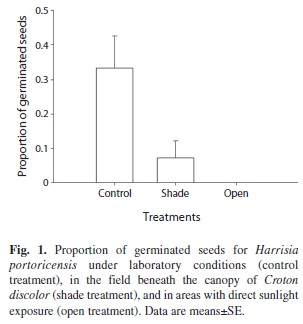
<body><![CDATA[ style="font-family: verdana;">Results</span></font><br      style="font-family: verdana;">     <font size="2"></font><br style="font-family: verdana;">     <font size="2"><span style="font-family: verdana;"><span      style="font-weight: bold;">Seed germination experiment:</span> The     number of seeds germinated after 120 days differed among treatments     (Kruskal-Wallis &#967;<sup>2</sup>=24.34, df=2, p&lt;0.001, <a href="#Fig_1">Fig.     1</a>). The     proportion of     germinated seeds under laboratory conditions was 4.3 times higher than     ]]></body>
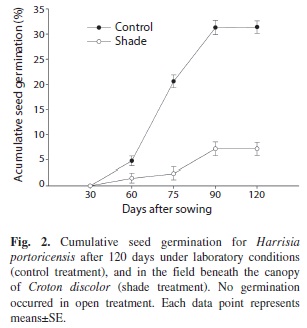
<body><![CDATA[the proportion of germinated seeds placed in field shade treatments in     the field. None of the seeds sown in open sites with direct sunlight     exposure germinated (<a href="#Fig_1">Fig. 1</a>). On average, seeds     began to     germ&iacute;nate 54 days after sowing for both the laboratory and the     field shade treatments (<a href="#Fig_2">Fig. 2</a>). The end of the     experiment obtained the     highest germination percentage under laboratory conditions with 31.4%     of germination. In the shade treatment the percentage of germinated     seeds was much lower and scarcely reached values of 7.2%. Seed     ]]></body>
<body><![CDATA[germination halted for both treatments after 90 days (<a href="#Fig_2">Fig.     2</a>).    <br>     <br> </span></font>     <div style="text-align: center;"><font size="2"><a name="Fig_1"></a><img  alt="" src="/img/revistas/rbt/v60n2/a28i1.jpg"  style="width: 303px; height: 324px;">    <br>     <br> <a name="Fig_2"></a><img alt="" src="/img/revistas/rbt/v60n2/a28i2.jpg"  style="width: 307px; height: 328px;"><span  style="font-family: verdana;"></span></font><br  style="font-family: verdana;"> <font size="2"><span style="font-family: verdana;"></span></font></div> <br style="font-family: verdana;"> <font size="2"><span style="font-family: verdana;"><span  style="font-weight: bold;">Seedling survival experiment: </span>The survival of transplanted seedlings was low and upon completion of the experiment only seven individuals were alive at shaded sites in the field (<a href="/img/revistas/rbt/v60n2/a28t1.gif">Table 1</a>). Analyses of the survivorship curves indicated significant differences among experimental treatments (Log-Rank test: &#967;<sup>2</sup>=34.2, p&lt;0.0001, Wilcoxon test: &#967;<sup>2</sup>=30.4, p&lt;0.0001, <a href="#Fig_3">Fig. 3</a>). All seedlings transplanted to open sites died by the second month and only seedlings that were placed at shaded sites survived after one year in the field. Contrary to our expectations, seedling survival in shaded sites was not higher when seedlings were excluded from potential predators (G test=3.06, df=1, p=0.2, <a href="#Fig_3">Fig. 3</a>). Finally, for the two growth parameters analyzed, surviving seedlings growing under exclusion and non-exclusion conditions did not differ neither in height (t=-0.69, df=5, p=0.52) nor in diameter (t=0.73, df=5, p=0.49) by the end of the experiment (<a href="/img/revistas/rbt/v60n2/a28t1.gif">Table 1</a>).    <br>     <br> </span></font>     <div style="text-align: center;"><font size="2"><a name="Fig_3"></a><img     ]]></body>
<body><![CDATA[ alt="" src="/img/revistas/rbt/v60n2/a28i3.jpg"      style="width: 309px; height: 293px;"><span      style="font-family: verdana;"></span></font><br      style="font-family: verdana;">     <font size="2"><span style="font-family: verdana;"></span></font></div>     <br style="font-family: verdana;">     <font size="2"><span style="font-family: verdana;"><span      style="font-weight: bold;">Seedling performance experiment:</span> In     the field, all three shade provider species had a fraction of surviving     <span style="font-style: italic;">H. portoricensis</span> seedlings     ]]></body>
<body><![CDATA[underneath them 15 months after seedlings     were transplanted. However, analysis of the survivorship curves     indicated significant differences among shade providers (Log-Rank test:     &#967;<sup>2</sup>=31.2, p&lt;0.0001, Wilcoxon test: &#967;<sup>2</sup>=48.2,     p&lt;0.0001, <a href="/img/revistas/rbt/v60n2/a28i4.jpg">Fig. 4</a>).     By     the end of the experiment, a higher percentage of seedlings survived     beneath the canopy of R. uncinata (40%) and <span      style="font-style: italic;">C. discolor</span> (30%) than     beneath the shade of <span style="font-style: italic;">M. maximus</span>     ]]></body>
<body><![CDATA[(15%). For the two growth parameters     analyzed, we detected differences among shade providers in seedling     diameter (F<sub>2,14</sub>=3.21, p=0.04, <a      href="/img/revistas/rbt/v60n2/a28i5.jpg">Fig. 5A</a>) but not in     seedling     height     (F<sub>2,14</sub>=1.87, p=0.17, <a      href="/img/revistas/rbt/v60n2/a28i5.jpg">Fig. 5B</a>). At the end of     the experiment,     the     ]]></body>
<body><![CDATA[average diameters of seedlings growing under <span      style="font-style: italic;">C. discolor</span> and <span      style="font-style: italic;">R.     uncinata</span> were twice the average diameter of seedlings growing     under <span style="font-style: italic;">M.     maximus</span> (<a href="/img/revistas/rbt/v60n2/a28i5.jpg">Fig. 5A</a>).</span></font><br      style="font-family: verdana;">     <font size="2"></font><br style="font-family: verdana;">     <font size="2"><span style="font-family: verdana;">Monthly mean     temperatures were     ]]></body>
<body><![CDATA[significantly higher in open sites than beneath the canopies of the     shade providers (F<sub>3,61</sub>=3.32, p=0.02, <a      href="/img/revistas/rbt/v60n2/a28t2.gif">Table 2</a>), but contrary     to our     expectations did not differ among shade provider species (<a      href="/img/revistas/rbt/v60n2/a28t2.gif">Table 2</a>).     During the experiment, mean temperatures varying from 29.09&ordm;C in     open sites to 27.62&ordm;C under shade providers (<a      href="/img/revistas/rbt/v60n2/a28t2.gif">Table 2</a>). In     contrast, monthly mean maximum temperatures were significantly     ]]></body>
<body><![CDATA[different among shade providers (F<sub>3,61</sub>=4.33, p=0.03, <a      href="/img/revistas/rbt/v60n2/a28t2.gif">Table     2</a>). We found     that m&aacute;ximum temperatures in open areas and beneath <span      style="font-style: italic;">M. maximus</span>     were significantly higher than beneath the canopies of the native     shrubs. Maximum temperatures were beneath the canopy of <span      style="font-style: italic;">M. maximus</span> and     in open areas were 1.4&ordm;C and 3.8&ordm;C respectively, and higher     than under the canopies of native shrubs (<a     ]]></body>
<body><![CDATA[ href="/img/revistas/rbt/v60n2/a28t2.gif">Table 2</a>). We did not find     differences in the percentages of relative humidity recorded beneath     the shade providers and in open sites over the length of the experiment     (F<sub>3,61</sub>=0.07, p=0.92, <a      href="/img/revistas/rbt/v60n2/a28t2.gif">Table 2</a>). As we expected,     PAR values     were     significantly higher in open sites than underneath the shade providers,     but they were also highest beneath <span style="font-style: italic;">M.     maximus</span> foliage than under the     ]]></body>
<body><![CDATA[canopies of <span style="font-style: italic;">C. discolor</span> and <span      style="font-style: italic;">R. uncinata</span> in March and September     (p&lt;0.0001 in all cases, <a href="/img/revistas/rbt/v60n2/a28t2.gif">Table     2</a>). On average PAR values were 2.8     times higher beneath the leaf cover of<span style="font-style: italic;">     M. maximus</span> than beneath the     canopy of the native shrubs (<a href="/img/revistas/rbt/v60n2/a28t2.gif">Table     2</a>).</span></font><br style="font-family: verdana;">     <font size="2"></font><br style="font-family: verdana;">     <font style="font-weight: bold;" size="3"><span     ]]></body>
<body><![CDATA[ style="font-family: verdana;">Discusion</span></font><br      style="font-family: verdana;">     <font size="2"></font><br style="font-family: verdana;">     <font size="2"><span style="font-family: verdana;">We predicted that     germination,     survival and growth of <span style="font-style: italic;">H.     portoricensis</span> seedlings on Mona Island would     be higher in shaded areas than in open areas due to more benign     microclimatic conditions. In general, our results for field and     laboratory experiments support this hypothesis and demonstrate the     ]]></body>
<body><![CDATA[importance of &#8220;shaded&#8221; environments for the early life cycle stages of     this cactus species. Our results also suggest that temperature and     solar radiation are abiotic factors that could influence the occurrence     of recruitments events into the populations of <span      style="font-style: italic;">H. portoricensis.</span>     Studies have shown that shade created by perennial nurse plants can     decrease solar radiation, temperatures, and water evaporation, and as a     result enhance the germination, growth and establishment of young cacti     beneath their canopies (Jordan &amp; Nobel 1981, Valiente &amp; Ezcurra     1991, Valiente <span style="font-style: italic;">et al. </span>1991,     ]]></body>
<body><![CDATA[Nolasco<span style="font-style: italic;"> et al. </span>1997, Leira     &amp; Parra     1999, Sosa &amp; Fleming 2002). For many species of cacti, in addition     to nurse plants, rocks and </span></font><font size="2"><span      style="font-family: verdana;">other surface irregularities such     as holes and cracks may act as potential facilitators of germination     and seedling establishment (God&iacute;nez <span      style="font-style: italic;">et al.</span>, 2003, Mung&iacute;a     &amp; Sosa 2007, Peters <span style="font-style: italic;">et al.</span>     2008). However, for <span style="font-style: italic;">H. portoricensis</span>     ]]></body>
<body><![CDATA[in     the study site we have not observed nurse rock syndrome, but we do not     rule out the existence of this phenomenon.</span></font><br      style="font-family: verdana;">     <font size="2"></font><br style="font-family: verdana;">     <font size="2"><span style="font-family: verdana;">Our combined results     for <span style="font-style: italic;">H.     portoricensis</span> also demonstrated that suitable conditions for     germination and seedling establishment are tied to type of shade     provided by the different species in our study. Although the number of     ]]></body>
<body><![CDATA[seedlings used in the experiments were low, our data showed that <span      style="font-style: italic;">H.     portoricensis</span> seedlings on Mona Island have higher probabilities     of     survival and grew better (i.e., higher diameters) if they were     transplanted beneath the canopies of two native shrubs species <span      style="font-style: italic;">C.     discolor</span> and <span style="font-style: italic;">R. uncinata</span>     than beneath the exotic grass <span style="font-style: italic;">M.     maximus</span>. It     ]]></body>
<body><![CDATA[is likely that these differences are related to differences in     microclimatic conditions under the different shade providers because     both temperature and incident solar radiation were much higher     underneath this exotic grass than underneath the native shrubs. Results     strongly suggest that the exotic grass does not provide the same degree     of environmental shelter that native shrubs do.</span></font><br      style="font-family: verdana;">     <font size="2"></font><br style="font-family: verdana;">     <font size="2"><span style="font-family: verdana;">Seedling survival     and seedling     ]]></body>
<body><![CDATA[growth were higher under the canopy of <span      style="font-style: italic;">C. discolor</span> and <span      style="font-style: italic;">R. uncinata</span>     which in contrast to <span style="font-style: italic;">M. maximus</span>     do not suffer from leaf loss during the     dry season and thus provide a more consistent foliage cover and less     solar radiation underneath their canopies throughout the year     (Rojas-Sandoval 2010). Areas with high solar radiation can lead to high     temperatures, high evapotranspiration and low soil moisture     availability, and as a result lower the probability of survival and     ]]></body>
<body><![CDATA[growth for cactus seedlings (God&iacute;nez &amp; Valiente 1998,     Valiente &amp; Ezcurra 1991, Nolasco <span style="font-style: italic;">et     al. </span>1997, Suz&aacute;n &amp;     Sosa 2006). Another alternative explanation, although not mutually     exclusive, for the observed lower seedling survival and performance     under <span style="font-style: italic;">M. maximus</span> canopies     relative to the native shrub species is that     this grass is indeed a better competitor for water and/or nutrients     than <span style="font-style: italic;">H. portoricensis</span>     seedlings (Williams &amp; Baruch 2000,     ]]></body>
<body><![CDATA[Rojas-Sandoval 2010). When they become invasive, alien grasses have     been shown to influence soil&#8217;s hydrology, rates of mineralization,     litter structure and may compete more efficiently for water and     nutrients than native plant species (Hughes <span      style="font-style: italic;">et al.</span> 1991, D&#8217;Antonio     &amp; Vitousek 1992, Cabin <span style="font-style: italic;">et al. </span>2002,     Levine <span style="font-style: italic;">et al.</span> 2003, Seabloom <span      style="font-style: italic;">et     al.</span> 2003). A recent study reports that regeneration of the     columnar     ]]></body>
<body><![CDATA[cactus species <span style="font-style: italic;">Pachycereus     pectenaboriginum</span> is inhibited at areas     dominated by buffelgrass (<span style="font-style: italic;">Pennisetum     ciliare</span>) in the Sonoran Desert.     For those areas, the authors suggest that interference with buffelgrass     and the extraction of water from the upper soil surface by this grass     may be responsible for the high levels of mortality in this cactus     species (Morales-Romero &amp; Molina-Freaner 2008).</span></font><br      style="font-family: verdana;">     <font size="2"></font><br style="font-family: verdana;">     ]]></body>
<body><![CDATA[<font size="2"><span style="font-family: verdana;">Our results     indicated that the     percentages of seeds germinated and the probabilities of seedling     survival for <span style="font-style: italic;">H. portoricensis</span>     under natural conditions were very low.     For field experiments, seed germination was nil in open areas but even     under the shade only 7.2% seeds germinated. Because temperature and     soil moisture are often inversely related in the field (as temperature     increases soil moisture decreases), one possibility is that in open     areas direct solar radiation warms the soil and reduces soil moisture     ]]></body>
<body><![CDATA[to levels below those required for germination (Valiente &amp; Ezcurra     1991, Laksmi <span style="font-style: italic;">et</span> <span      style="font-style: italic;">al. </span>2003). On Mona Island, soil     temperatures can reach     70&ordm;C in open areas (Rojas-Sandoval 2010), and these elevated     temperatures may also directly inhibit germination </span></font><font      size="2"><span style="font-family: verdana;">or damage seeds placed in     the     field. Nevertheless, experiments that control air temperatures     independent from surface moisture are needed to decide on the     ]]></body>
<body><![CDATA[mechanisms by which temperature influences seed germination on this     species. On the other hand, even under the most optimal conditions,     germination dynamics for <span style="font-style: italic;">H.     portoricensis</span> were noticeably different     than what is reported for other cactus species. Literature on seed     germination shows that for most cactus species, seeds germinate within     a week (Rojas &amp; V&aacute;zquez 2000). For <span      style="font-style: italic;">H. portoricensis</span>, seed     germination, on average, occurred after 54 days. It is possible that     germination may require ample hydration periods as a way to keep     ]]></body>
<body><![CDATA[germination from occurring until environmental conditions are suitable.     Dudrovsky (1996) demonstrated that seeds for five cacti species in the     Sonoran Desert have a hydration memory which can allow them to     tol&eacute;rate dehydration and hydration events and germ&iacute;nate     in accordance with the previous hydration experience. An alternative is     that this species are naturally animal dispersed and may need     scarification to trigger germination. This possibility has not been     shown in columnar cacti like <span style="font-style: italic;">H.     portoricensis</span> but has been shown for     cacti in the subfamily Opuntiodeae, in which germination may take few     ]]></body>
<body><![CDATA[months if seeds do not pass by digestive tract of birds (Rojas &amp;     V&aacute;zquez 2000). Further studies evaluating seed longevity,     dormancy capacity, and the specific conditions (i.e., light,     temperature and scarification) necessary to enhance germination rates     are essential for the management and conservation of this species.</span></font><br      style="font-family: verdana;">     <font size="2"></font><br style="font-family: verdana;">     <font size="2"><span style="font-family: verdana;">Surprisingly, we     found that     predator exclusions did not improve the probability of <span     ]]></body>
<body><![CDATA[ style="font-style: italic;">H. portoricensis</span>     seedling survival but our study only evaluated this possibility at one     point in time. Previous studies comparing predation on seedlings have     indicated that predation intensity may vary depending on environmental     conditions, intensity of the drought, latitude, and predator abundance     (Valiente &amp; Ezcurra 1991, Sosa &amp; Fleming 2002). In addition,     predation intensity on columnar cactus seedlings could also vary     depending upon whether seedlings are located beneath shrubs species or     in open areas (Sosa &amp; Fleming 2002). Temporal studies that look at     potential cactus-predator interactions at times where environmental     ]]></body>
<body><![CDATA[conditions are more benign might be required to determine whether or     not predation can be ruled out completely as a factor limiting the     survivorship and growth of <span style="font-style: italic;">H.     portoricensis</span> at Mona Island.</span></font><br      style="font-family: verdana;">     <font size="2"></font><br style="font-family: verdana;">     <font size="2"><span style="font-family: verdana;">Overall, our data     suggested that     for <span style="font-style: italic;">H. portoricensis</span>,     microenvironmental conditions </span></font><font size="2"><span     ]]></body>
<body><![CDATA[ style="font-family: verdana;">provided by native shrubs species     from the understory may play a primary role in the germination,     establishments, and growth of this cactus species. During the study     period rainfall was above the average annual rainfall value reported     for Mona Island, thus water limitation appears not to be a factor     affecting the establishment and survivorship of <span      style="font-style: italic;">H. portoricensis</span>     seedlings. The presence and expansi&oacute;n of <span      style="font-style: italic;">M. maximus </span>may diminish     the availability of environmental conditions that are optimal (i.e.,     ]]></body>
<body><![CDATA[mild temperatures and low solar radiation) for germination and     establishment in this species (Rojas-Sandoval &amp;     Mel&eacute;ndez-Ackerman in preparation). African grasses are often     fireadapted and are able to thrive under conditions of low water     availability (Williams &amp; Baruch 2000). The observed trends for     temperature increases and the expected reductions in rainfall events     for the Caribbean region as a result of the climate change (Singh 1997,     Neelin <span style="font-style: italic;">et al.</span> 2006) may be     conditions that could facilitate </span></font><font size="2"><span      style="font-family: verdana;">further spread and invasion of <span     ]]></body>
<body><![CDATA[ style="font-style: italic;">M.     maximus.</span> Further spread of this African grass may reduce the     amount of     optimal environments for germination and establishment of <span      style="font-style: italic;">H.     portoricensis</span> and if so present and added vulnerability beyond     those     listed thus far to this native endemic and threaten cactus. From a     management perspective,efforts to&nbsp; protect <span      style="font-style: italic;">H. portoricensis</span> would     ]]></body>
<body><![CDATA[also need to consider increasing in situ management of this exotic     grass and the use of native shrub species as a way to enhance     germination and seedling establishment.</span></font><br      style="font-family: verdana;">     <font size="2"></font><br style="font-family: verdana;">     <font style="font-weight: bold;" size="3"><span      style="font-family: verdana;">Acknowledgments</span></font><br      style="font-family: verdana;">     <font size="2"></font><br style="font-family: verdana;">     <font size="2"><span style="font-family: verdana;">The authors thank     ]]></body>
<body><![CDATA[Jos&eacute;     Fumero-Cab&aacute;n, Ricardo Rodr&iacute;guez and Daniel     Angl&eacute;s-Alc&aacute;zar for support and field assistance. We also     thank Jafet Nassar and TPEE Lab members for helpful comments that     improved this manuscript. This research was funded by NSF-CREST     (HRD-0206200 and HRD 0734826) through the Center for Applied Tropical     Ecology and Conservation (CATEC) of the University of Puerto Rico. The     Department of Natural Resources and Environment of the Commonwealth of     Puerto Rico provided the respective permits.</span></font><br      style="font-family: verdana;">     ]]></body>
<body><![CDATA[<font size="2"></font><br style="font-family: verdana;">     <font size="2"><span style="font-family: verdana;"></span></font>     <hr style="width: 100%; height: 2px;"><font style="font-weight: bold;"      size="3"><span style="font-family: verdana;">References</span></font><br      style="font-family: verdana;">     <font size="2"></font><br style="font-family: verdana;">     <font size="2"><span style="font-family: verdana;">Bowers, J.E. 1997.     Demographic     patterns of <span style="font-style: italic;">Ferocactus cylindraceus</span>     in relation to substrate age and     ]]></body>
<body><![CDATA[<!-- ref -->grazing history. Plant Ecol. 133: 37-48.    &nbsp;&nbsp;&nbsp;&nbsp;&nbsp;&nbsp;&nbsp;&nbsp;[&#160;<a href="javascript:void(0);" onclick="javascript: window.open('/scielo.php?script=sci_nlinks&ref=1503306&pid=S0034-7744201200020002800001&lng=','','width=640,height=500,resizable=yes,scrollbars=1,menubar=yes,');">Links</a>&#160;]<!-- end-ref --><!-- ref --></span></font><br  style="font-family: verdana;"> <font size="2"></font><br style="font-family: verdana;"> <font size="2"><span style="font-family: verdana;">Cabin, R.J., S.G. Weller, D.H. Lorence, S. Cordell, L.J. Hadway, R. Montgomery, D. Goo &amp; A. Urakami. 2002. Effects of light, alien grass, and native species additions on Hawaiian Dry Forest restoration. <span  style="font-style: italic;">Ecol. Appl.</span> 12: 1595-1610.    &nbsp;&nbsp;&nbsp;&nbsp;&nbsp;&nbsp;&nbsp;&nbsp;[&#160;<a href="javascript:void(0);" onclick="javascript: window.open('/scielo.php?script=sci_nlinks&ref=1503307&pid=S0034-7744201200020002800002&lng=','','width=640,height=500,resizable=yes,scrollbars=1,menubar=yes,');">Links</a>&#160;]<!-- end-ref --><!-- ref --></span></font><br  style="font-family: verdana;"> <font size="2"></font><br style="font-family: verdana;"> <font size="2"><span style="font-family: verdana;">Cintr&oacute;n, B. 1991. Introduction to Mona Island. Acta Cient&iacute;fica 5: 6-9.    &nbsp;&nbsp;&nbsp;&nbsp;&nbsp;&nbsp;&nbsp;&nbsp;[&#160;<a href="javascript:void(0);" onclick="javascript: window.open('/scielo.php?script=sci_nlinks&ref=1503308&pid=S0034-7744201200020002800003&lng=','','width=640,height=500,resizable=yes,scrollbars=1,menubar=yes,');">Links</a>&#160;]<!-- end-ref --><!-- ref --></span></font><br  style="font-family: verdana;"> <font size="2"></font><br style="font-family: verdana;"> <font size="2"><span style="font-family: verdana;">Cintr&oacute;n, B. &amp; L. Rogers. 1991. Plant communities of Mona Island. Acta Cient&iacute;fica 5: 10-64.    &nbsp;&nbsp;&nbsp;&nbsp;&nbsp;&nbsp;&nbsp;&nbsp;[&#160;<a href="javascript:void(0);" onclick="javascript: window.open('/scielo.php?script=sci_nlinks&ref=1503309&pid=S0034-7744201200020002800004&lng=','','width=640,height=500,resizable=yes,scrollbars=1,menubar=yes,');">Links</a>&#160;]<!-- end-ref --><!-- ref --></span></font><br  style="font-family: verdana;"> <font size="2"></font><br style="font-family: verdana;"> <font size="2"><span style="font-family: verdana;">D&#8217;Antonio, C.M. &amp; P.M. Vitousek. 1992. Biological invasions by exotic grasses, the grass/fire cycle, and global chance. Ann. Rev. Ecol. Syst. 23: 63-87.    &nbsp;&nbsp;&nbsp;&nbsp;&nbsp;&nbsp;&nbsp;&nbsp;[&#160;<a href="javascript:void(0);" onclick="javascript: window.open('/scielo.php?script=sci_nlinks&ref=1503310&pid=S0034-7744201200020002800005&lng=','','width=640,height=500,resizable=yes,scrollbars=1,menubar=yes,');">Links</a>&#160;]<!-- end-ref --><!-- ref --></span></font><br  style="font-family: verdana;"> <font size="2"></font><br style="font-family: verdana;"> <font size="2"><span style="font-family: verdana;">De la Barrera, E. &amp; P.S. Nobel. 2003. Physiological eology of seed germination for the columnar cactus <span style="font-style: italic;">Stenocereus queretaroensis</span>. J. Arid Environ. 53: 297-306.    &nbsp;&nbsp;&nbsp;&nbsp;&nbsp;&nbsp;&nbsp;&nbsp;[&#160;<a href="javascript:void(0);" onclick="javascript: window.open('/scielo.php?script=sci_nlinks&ref=1503311&pid=S0034-7744201200020002800006&lng=','','width=640,height=500,resizable=yes,scrollbars=1,menubar=yes,');">Links</a>&#160;]<!-- end-ref --><!-- ref --></span></font><br  style="font-family: verdana;"> <font size="2"></font><br style="font-family: verdana;"> <font size="2"><span style="font-family: verdana;">Dubrovsky, J.G. 1996. Seed hydration memory in Sonoran Desert cacti and its ecological implication. Am. J. Bot. 83: 624-632.    &nbsp;&nbsp;&nbsp;&nbsp;&nbsp;&nbsp;&nbsp;&nbsp;[&#160;<a href="javascript:void(0);" onclick="javascript: window.open('/scielo.php?script=sci_nlinks&ref=1503312&pid=S0034-7744201200020002800007&lng=','','width=640,height=500,resizable=yes,scrollbars=1,menubar=yes,');">Links</a>&#160;]<!-- end-ref --><!-- ref --></span></font><br  style="font-family: verdana;"> <font size="2"></font><br style="font-family: verdana;"> <font size="2"><span style="font-family: verdana;">Ewel, J.J. &amp; J.L. Whitmore. 1973. The ecological life zones of Puerto Rico and U.S. Virgin Islands. USDA Forest Service Research Report. ITF-18, R&iacute;o Piedras, Puerto Rico.    &nbsp;&nbsp;&nbsp;&nbsp;&nbsp;&nbsp;&nbsp;&nbsp;[&#160;<a href="javascript:void(0);" onclick="javascript: window.open('/scielo.php?script=sci_nlinks&ref=1503313&pid=S0034-7744201200020002800008&lng=','','width=640,height=500,resizable=yes,scrollbars=1,menubar=yes,');">Links</a>&#160;]<!-- end-ref --><!-- ref --></span></font><br style="font-family: verdana;"> <font size="2"></font><br style="font-family: verdana;"> <font size="2"><span style="font-family: verdana;">Franco, A.C. &amp; P.S. Nobel. 1989. Effect of nurse plants on the microhabitat and growth of cacti. J. Ecol. 77: 870-886.    &nbsp;&nbsp;&nbsp;&nbsp;&nbsp;&nbsp;&nbsp;&nbsp;[&#160;<a href="javascript:void(0);" onclick="javascript: window.open('/scielo.php?script=sci_nlinks&ref=1503314&pid=S0034-7744201200020002800009&lng=','','width=640,height=500,resizable=yes,scrollbars=1,menubar=yes,');">Links</a>&#160;]<!-- end-ref --><!-- ref --></span></font><br style="font-family: verdana;"> <font size="2"></font><br style="font-family: verdana;"> <font size="2"><span style="font-family: verdana;">Frank, E.F., C. Wicks, J. Mylroie, J. Troester, E. Calvin Alexander &amp; J.L. Carew. 1998. Geology of Isla de Mona, Puerto Rico. J. Cave Karst. Stud. 60: 68-72.    &nbsp;&nbsp;&nbsp;&nbsp;&nbsp;&nbsp;&nbsp;&nbsp;[&#160;<a href="javascript:void(0);" onclick="javascript: window.open('/scielo.php?script=sci_nlinks&ref=1503315&pid=S0034-7744201200020002800010&lng=','','width=640,height=500,resizable=yes,scrollbars=1,menubar=yes,');">Links</a>&#160;]<!-- end-ref --><!-- ref --></span></font><br  style="font-family: verdana;"> <font size="2"></font><br style="font-family: verdana;"> <font size="2"><span style="font-family: verdana;">Fleming, T.H. 2002. Pollination biology of four species of Sonoran Desert columnar cacti, p. 207-224. <span style="font-style: italic;">In</span> T.H. Fleming &amp; A. Valiente-Banuet (eds.). Columnar Cacti and their Mutualists. The University of Arizona, Tucson, Arizona, USA.    &nbsp;&nbsp;&nbsp;&nbsp;&nbsp;&nbsp;&nbsp;&nbsp;[&#160;<a href="javascript:void(0);" onclick="javascript: window.open('/scielo.php?script=sci_nlinks&ref=1503316&pid=S0034-7744201200020002800011&lng=','','width=640,height=500,resizable=yes,scrollbars=1,menubar=yes,');">Links</a>&#160;]<!-- end-ref --><!-- ref --></span></font><br  style="font-family: verdana;"> <font size="2"></font><br style="font-family: verdana;"> <font size="2"><span style="font-family: verdana;">God&iacute;nez, H. &amp; A. Valiente. 1998. Germination and early seedling growth of the Tehuacan Valley cacti species: the role of soils and seed ingestion by dispersers on seedling growth. J. Arid Environ. 39: 21-31.    &nbsp;&nbsp;&nbsp;&nbsp;&nbsp;&nbsp;&nbsp;&nbsp;[&#160;<a href="javascript:void(0);" onclick="javascript: window.open('/scielo.php?script=sci_nlinks&ref=1503317&pid=S0034-7744201200020002800012&lng=','','width=640,height=500,resizable=yes,scrollbars=1,menubar=yes,');">Links</a>&#160;]<!-- end-ref --><!-- ref --></span></font><br  style="font-family: verdana;"> <font size="2"></font><br style="font-family: verdana;"> <font size="2"><span style="font-family: verdana;">God&iacute;nez, H., T. Valverde &amp; P. Ortega. 2003. Demographic trends in the Cactaceae. Bot. Rev. 69: 173-203.    &nbsp;&nbsp;&nbsp;&nbsp;&nbsp;&nbsp;&nbsp;&nbsp;[&#160;<a href="javascript:void(0);" onclick="javascript: window.open('/scielo.php?script=sci_nlinks&ref=1503318&pid=S0034-7744201200020002800013&lng=','','width=640,height=500,resizable=yes,scrollbars=1,menubar=yes,');">Links</a>&#160;]<!-- end-ref --><!-- ref --></span></font><br style="font-family: verdana;"> <font size="2"></font><br style="font-family: verdana;"> <font size="2"><span style="font-family: verdana;">God&iacute;nez, H., L. R&iacute;os &amp; F. P&eacute;rez. 2005. Characteristics of seedling establishment of <span style="font-style: italic;">Stenocereus stellatus</span> (Cactaceae) in the Tehuac&aacute;n Valley, Mexico. The Southwest. Nat. 50: 375-407.    &nbsp;&nbsp;&nbsp;&nbsp;&nbsp;&nbsp;&nbsp;&nbsp;[&#160;<a href="javascript:void(0);" onclick="javascript: window.open('/scielo.php?script=sci_nlinks&ref=1503319&pid=S0034-7744201200020002800014&lng=','','width=640,height=500,resizable=yes,scrollbars=1,menubar=yes,');">Links</a>&#160;]<!-- end-ref --><!-- ref --></span></font><br  style="font-family: verdana;"> <font size="2"></font><br style="font-family: verdana;"> <font size="2"><span style="font-family: verdana;">Hughes, F., P.M. Vitousek &amp; T. Tunison. 1991. Alien grass invasion and fire in the seasonal submontane zone of Hawaii. Ecology 72: 743-746.    &nbsp;&nbsp;&nbsp;&nbsp;&nbsp;&nbsp;&nbsp;&nbsp;[&#160;<a href="javascript:void(0);" onclick="javascript: window.open('/scielo.php?script=sci_nlinks&ref=1503320&pid=S0034-7744201200020002800015&lng=','','width=640,height=500,resizable=yes,scrollbars=1,menubar=yes,');">Links</a>&#160;]<!-- end-ref --><!-- ref --></span></font><br  style="font-family: verdana;"> <font size="2"></font><br style="font-family: verdana;"> <font size="2"><span style="font-family: verdana;">Jordan, P.W. &amp; P.S. Nobel. 1981. Seedling establishment of <span style="font-style: italic;">Ferocactus acanthodes</span> in relation to drought. Ecology 62: 901-906.    &nbsp;&nbsp;&nbsp;&nbsp;&nbsp;&nbsp;&nbsp;&nbsp;[&#160;<a href="javascript:void(0);" onclick="javascript: window.open('/scielo.php?script=sci_nlinks&ref=1503321&pid=S0034-7744201200020002800016&lng=','','width=640,height=500,resizable=yes,scrollbars=1,menubar=yes,');">Links</a>&#160;]<!-- end-ref --><!-- ref --></span></font><br  style="font-family: verdana;"> <font size="2"></font><br style="font-family: verdana;"> <font size="2"><span style="font-family: verdana;">Kleinbaum, D.G. &amp; M. Klein. 2005. Survival Analysis: A self-learning text. Springer Science Media, Inc. New York, USA.    &nbsp;&nbsp;&nbsp;&nbsp;&nbsp;&nbsp;&nbsp;&nbsp;[&#160;<a href="javascript:void(0);" onclick="javascript: window.open('/scielo.php?script=sci_nlinks&ref=1503322&pid=S0034-7744201200020002800017&lng=','','width=640,height=500,resizable=yes,scrollbars=1,menubar=yes,');">Links</a>&#160;]<!-- end-ref --><!-- ref --></span></font><br style="font-family: verdana;"> <font size="2"></font><br style="font-family: verdana;"> <font size="2"><span style="font-family: verdana;">Lakshmi, V., T.J. Jackson &amp; D. Zehrfuhs. 2003. Soil moisture-temperature relationship: results from two field experiments. Hydrol. Process. 17: 3041-3057.    &nbsp;&nbsp;&nbsp;&nbsp;&nbsp;&nbsp;&nbsp;&nbsp;[&#160;<a href="javascript:void(0);" onclick="javascript: window.open('/scielo.php?script=sci_nlinks&ref=1503323&pid=S0034-7744201200020002800018&lng=','','width=640,height=500,resizable=yes,scrollbars=1,menubar=yes,');">Links</a>&#160;]<!-- end-ref --><!-- ref --></span></font><br  style="font-family: verdana;"> <font size="2"></font><br style="font-family: verdana;"> <font size="2"><span style="font-family: verdana;">Larrea, D.M. &amp; P.J. Soriano. 2006. Spatial associations, size-distance relationship and population structure of two dominant life forms in a semiarid enclave of the Venezuelan Andes. Plant Ecol. 186: 137-149.    &nbsp;&nbsp;&nbsp;&nbsp;&nbsp;&nbsp;&nbsp;&nbsp;[&#160;<a href="javascript:void(0);" onclick="javascript: window.open('/scielo.php?script=sci_nlinks&ref=1503324&pid=S0034-7744201200020002800019&lng=','','width=640,height=500,resizable=yes,scrollbars=1,menubar=yes,');">Links</a>&#160;]<!-- end-ref --><!-- ref --></span></font><br  style="font-family: verdana;"> <font size="2"></font><br style="font-family: verdana;"> <font size="2"><span style="font-family: verdana;">Leira, J. &amp; V. Parra. 1999. Factors affecting the distribution, abundance and seedling survival of <span style="font-style: italic;">Mammillaria gaumeri</span>, an endemic cactus of coastal Yucat&aacute;n, M&eacute;xico. J. Arid Environ. 41: 421-428.    &nbsp;&nbsp;&nbsp;&nbsp;&nbsp;&nbsp;&nbsp;&nbsp;[&#160;<a href="javascript:void(0);" onclick="javascript: window.open('/scielo.php?script=sci_nlinks&ref=1503325&pid=S0034-7744201200020002800020&lng=','','width=640,height=500,resizable=yes,scrollbars=1,menubar=yes,');">Links</a>&#160;]<!-- end-ref --><!-- ref --></span></font><br  style="font-family: verdana;"> <font size="2"></font><br style="font-family: verdana;"> <font size="2"><span style="font-family: verdana;">Levine, J.L, M. Vil&agrave;, C.M. D&#8217;Antonio, J.S. Dukes, K. Grigulis &amp; S. Lavorel. 2003. Mechanisms underlying the impact of the exotic plant invasions. Proc. R. Soc. Lon. B. 270: 775-781.    &nbsp;&nbsp;&nbsp;&nbsp;&nbsp;&nbsp;&nbsp;&nbsp;[&#160;<a href="javascript:void(0);" onclick="javascript: window.open('/scielo.php?script=sci_nlinks&ref=1503326&pid=S0034-7744201200020002800021&lng=','','width=640,height=500,resizable=yes,scrollbars=1,menubar=yes,');">Links</a>&#160;]<!-- end-ref --><!-- ref --></span></font><br style="font-family: verdana;"> <font size="2"></font><br style="font-family: verdana;"> <font size="2"><span style="font-family: verdana;">Liogier, H.A. 1994. Descriptive flora of Puerto Rico and adjacent islands. Editorial de la Universidad de Puerto Rico, San Juan, Puerto Rico.    &nbsp;&nbsp;&nbsp;&nbsp;&nbsp;&nbsp;&nbsp;&nbsp;[&#160;<a href="javascript:void(0);" onclick="javascript: window.open('/scielo.php?script=sci_nlinks&ref=1503327&pid=S0034-7744201200020002800022&lng=','','width=640,height=500,resizable=yes,scrollbars=1,menubar=yes,');">Links</a>&#160;]<!-- end-ref --><!-- ref --></span></font><br  style="font-family: verdana;"> <font size="2"></font><br style="font-family: verdana;"> <font size="2"><span style="font-family: verdana;">Martinuzzi, S., W.A. Gould, O.M. Ramos, A. Mart&iacute;nez, P. Calle, N. P&eacute;rez-Buitrago &amp; J.J. Fumero-Cab&aacute;n. 2008. Mapping tropical dry forest habitats integrating Landsat NDVI, Ikonos imagery, and topographic information in the Caribbean Island of Mona. Rev. </span></font><font size="2"><span  style="font-family: verdana;">Biol. Trop. 56: 625-639.    &nbsp;&nbsp;&nbsp;&nbsp;&nbsp;&nbsp;&nbsp;&nbsp;[&#160;<a href="javascript:void(0);" onclick="javascript: window.open('/scielo.php?script=sci_nlinks&ref=1503328&pid=S0034-7744201200020002800023&lng=','','width=640,height=500,resizable=yes,scrollbars=1,menubar=yes,');">Links</a>&#160;]<!-- end-ref --><!-- ref --></span></font><br  style="font-family: verdana;"> <font size="2"></font><br style="font-family: verdana;"> <font size="2"><span style="font-family: verdana;">Morales, D. &amp; F. Molina. 2008. Influence of buffelgrass pasture conversion on the regeneration and reproduction of the columnar cactus <span style="font-style: italic;">Pachycereus pectenaboriginum</span>, in the northwestern Mexico. J. Arid Environ. 72: 228-237.    &nbsp;&nbsp;&nbsp;&nbsp;&nbsp;&nbsp;&nbsp;&nbsp;[&#160;<a href="javascript:void(0);" onclick="javascript: window.open('/scielo.php?script=sci_nlinks&ref=1503329&pid=S0034-7744201200020002800024&lng=','','width=640,height=500,resizable=yes,scrollbars=1,menubar=yes,');">Links</a>&#160;]<!-- end-ref --><!-- ref --></span></font><br  style="font-family: verdana;"> <font size="2"></font><br style="font-family: verdana;"> <font size="2"><span style="font-family: verdana;">Mung&iacute;as, M.A. &amp; V.J. Sosa. 2007. Nurse plants vs. nurse objects: effects of woody plants and rocks cavities on the recruitment of the <span  style="font-style: italic;">Pilosocereus leucocephalus </span>columnar cactus. Ann. Bot. 101: 175-185.    &nbsp;&nbsp;&nbsp;&nbsp;&nbsp;&nbsp;&nbsp;&nbsp;[&#160;<a href="javascript:void(0);" onclick="javascript: window.open('/scielo.php?script=sci_nlinks&ref=1503330&pid=S0034-7744201200020002800025&lng=','','width=640,height=500,resizable=yes,scrollbars=1,menubar=yes,');">Links</a>&#160;]<!-- end-ref --><!-- ref --></span></font><br  style="font-family: verdana;"> <font size="2"></font><br style="font-family: verdana;"> <font size="2"><span style="font-family: verdana;">Murphy, P.G. &amp; A.E. Lugo. 1995. Dry forests of Central America and the Caribbean, p. 9-34. In S.H. Bullock, H.A. Mooney &amp; E. Medina (eds.). Seasonally Dry Tropical Forests. Cambridge University, Cambridge, United Kingdom.    &nbsp;&nbsp;&nbsp;&nbsp;&nbsp;&nbsp;&nbsp;&nbsp;[&#160;<a href="javascript:void(0);" onclick="javascript: window.open('/scielo.php?script=sci_nlinks&ref=1503331&pid=S0034-7744201200020002800026&lng=','','width=640,height=500,resizable=yes,scrollbars=1,menubar=yes,');">Links</a>&#160;]<!-- end-ref --><!-- ref --></span></font><br  style="font-family: verdana;"> <font size="2"></font><br style="font-family: verdana;"> <font size="2"><span style="font-family: verdana;">Neeling, J.D., M. M&uuml;nnich, H. Su, J.E. Meyerson &amp; C.E. Holloway. 2006. Tropical drying trends in global warming models and observations. Proc. Natl. Acad. Sci. 103: 6110-6115.    &nbsp;&nbsp;&nbsp;&nbsp;&nbsp;&nbsp;&nbsp;&nbsp;[&#160;<a href="javascript:void(0);" onclick="javascript: window.open('/scielo.php?script=sci_nlinks&ref=1503332&pid=S0034-7744201200020002800027&lng=','','width=640,height=500,resizable=yes,scrollbars=1,menubar=yes,');">Links</a>&#160;]<!-- end-ref --><!-- ref --></span></font><br style="font-family: verdana;"> <font size="2"></font><br style="font-family: verdana;"> <font size="2"><span style="font-family: verdana;">Nobel, P.S. &amp; E.G. Bobich. 2002. Environmental Biology, p. 57-74. In P.S. Nobel (ed.). Cacti: Biology and Uses. University of California, Berkeley, California, USA.    &nbsp;&nbsp;&nbsp;&nbsp;&nbsp;&nbsp;&nbsp;&nbsp;[&#160;<a href="javascript:void(0);" onclick="javascript: window.open('/scielo.php?script=sci_nlinks&ref=1503333&pid=S0034-7744201200020002800028&lng=','','width=640,height=500,resizable=yes,scrollbars=1,menubar=yes,');">Links</a>&#160;]<!-- end-ref --><!-- ref --></span></font><br  style="font-family: verdana;"> <font size="2"></font><br style="font-family: verdana;"> <font size="2"><span style="font-family: verdana;">Nolasco, F., F. Vega-Villasante &amp; A. Diaz. 1997. Seed germination of <span  style="font-style: italic;">Stenocereus thurberi </span>(Cactaceae) under different solar irradiation levels. J. Arid Environ. 36: 123-132.    &nbsp;&nbsp;&nbsp;&nbsp;&nbsp;&nbsp;&nbsp;&nbsp;[&#160;<a href="javascript:void(0);" onclick="javascript: window.open('/scielo.php?script=sci_nlinks&ref=1503334&pid=S0034-7744201200020002800029&lng=','','width=640,height=500,resizable=yes,scrollbars=1,menubar=yes,');">Links</a>&#160;]<!-- end-ref --><!-- ref --></span></font><br style="font-family: verdana;"> <font size="2"></font><br style="font-family: verdana;"> <font size="2"><span style="font-family: verdana;">Pepe, M.S. &amp; T.R. Fleming. 1989. Weighted Kaplan-Meier statistics: A class of distance tests for censored survival data. Biometrics 45: 497-507.    &nbsp;&nbsp;&nbsp;&nbsp;&nbsp;&nbsp;&nbsp;&nbsp;[&#160;<a href="javascript:void(0);" onclick="javascript: window.open('/scielo.php?script=sci_nlinks&ref=1503335&pid=S0034-7744201200020002800030&lng=','','width=640,height=500,resizable=yes,scrollbars=1,menubar=yes,');">Links</a>&#160;]<!-- end-ref --><!-- ref --></span></font><br  style="font-family: verdana;"> <font size="2"></font><br style="font-family: verdana;"> <font size="2"><span style="font-family: verdana;">Peters, E.M., C. Martorell &amp; E. Ezcurra. 2008. Nurse rocks are more important than nurse plants in determining the distribution and establishment of globose cacti (<span style="font-style: italic;">Mammillaria</span>) in the Tehuacan Valley, Mexico. J. Arid Environ. 72: 593-601.    &nbsp;&nbsp;&nbsp;&nbsp;&nbsp;&nbsp;&nbsp;&nbsp;[&#160;<a href="javascript:void(0);" onclick="javascript: window.open('/scielo.php?script=sci_nlinks&ref=1503336&pid=S0034-7744201200020002800031&lng=','','width=640,height=500,resizable=yes,scrollbars=1,menubar=yes,');">Links</a>&#160;]<!-- end-ref --><!-- ref --></span></font><br style="font-family: verdana;"> <font size="2"></font><br style="font-family: verdana;"> <font size="2"><span style="font-family: verdana;">Pierson, E.A. &amp; R.M. Turner. 1998. An 85-years study of saguaro (<span style="font-style: italic;">Carnegiea gigantea</span>) demography. Ecology 79: 2676-2693.    &nbsp;&nbsp;&nbsp;&nbsp;&nbsp;&nbsp;&nbsp;&nbsp;[&#160;<a href="javascript:void(0);" onclick="javascript: window.open('/scielo.php?script=sci_nlinks&ref=1503337&pid=S0034-7744201200020002800032&lng=','','width=640,height=500,resizable=yes,scrollbars=1,menubar=yes,');">Links</a>&#160;]<!-- end-ref --><!-- ref --></span></font><br style="font-family: verdana;"> <font size="2"></font><br style="font-family: verdana;"> <font size="2"><span style="font-family: verdana;">Pimienta-Barrios, E. &amp; R.F. Del Castillo. 2002. Reproductive Biology, p. 75-90. <span  style="font-style: italic;">In</span> P.S. Nobel (ed.). Cacti: Biology and Uses. University of California, Berkeley, California, USA.    &nbsp;&nbsp;&nbsp;&nbsp;&nbsp;&nbsp;&nbsp;&nbsp;[&#160;<a href="javascript:void(0);" onclick="javascript: window.open('/scielo.php?script=sci_nlinks&ref=1503338&pid=S0034-7744201200020002800033&lng=','','width=640,height=500,resizable=yes,scrollbars=1,menubar=yes,');">Links</a>&#160;]<!-- end-ref --><!-- ref --></span></font><br style="font-family: verdana;"> <font size="2"></font><br style="font-family: verdana;"> <font size="2"><span style="font-family: verdana;">Rojas, M. &amp; C.V&aacute;zquez. 2000. Cactus seed germination: a review. J. Arid Environ. 44: 85-104.    &nbsp;&nbsp;&nbsp;&nbsp;&nbsp;&nbsp;&nbsp;&nbsp;[&#160;<a href="javascript:void(0);" onclick="javascript: window.open('/scielo.php?script=sci_nlinks&ref=1503339&pid=S0034-7744201200020002800034&lng=','','width=640,height=500,resizable=yes,scrollbars=1,menubar=yes,');">Links</a>&#160;]<!-- end-ref --><!-- ref --></span></font><br  style="font-family: verdana;"> <font size="2"><span style="font-family: verdana;">&nbsp;</span></font><br  style="font-family: verdana;"> <font size="2"><span style="font-family: verdana;">Rojas-Sandoval, J. 2010. Identification and evaluation of vulnerability factors affecting the Caribbean cactus species<span style="font-style: italic;"> Harrisia portoricensis</span>. Ph.D. Thesis, University of Puerto Rico, San Juan, Puerto Rico.    &nbsp;&nbsp;&nbsp;&nbsp;&nbsp;&nbsp;&nbsp;&nbsp;[&#160;<a href="javascript:void(0);" onclick="javascript: window.open('/scielo.php?script=sci_nlinks&ref=1503340&pid=S0034-7744201200020002800035&lng=','','width=640,height=500,resizable=yes,scrollbars=1,menubar=yes,');">Links</a>&#160;]<!-- end-ref --><!-- ref --></span></font><br  style="font-family: verdana;"> <font size="2"></font><br style="font-family: verdana;"> <font size="2"><span style="font-family: verdana;">Rojas-Sandoval, J. &amp; E. Mel&eacute;ndez-Ackerman. 2009. Pollination biology of <span  style="font-style: italic;">Harrisia portoricensis</span> (Cactaceae), an endangered Caribbean species. Am. J. Bot. 96: 2270-2278.    &nbsp;&nbsp;&nbsp;&nbsp;&nbsp;&nbsp;&nbsp;&nbsp;[&#160;<a href="javascript:void(0);" onclick="javascript: window.open('/scielo.php?script=sci_nlinks&ref=1503341&pid=S0034-7744201200020002800036&lng=','','width=640,height=500,resizable=yes,scrollbars=1,menubar=yes,');">Links</a>&#160;]<!-- end-ref --><!-- ref --></span></font><br style="font-family: verdana;"> <font size="2"></font><br style="font-family: verdana;"> <font size="2"><span style="font-family: verdana;">Rojas-Sandoval, J. &amp; E. Mel&eacute;ndez-Ackerman. 2011. Windfacilitated self-pollination in <span style="font-style: italic;">Harrisia portoricensis</span> (Cactaceae): A mechanism for reproductive assurance. Int. J. Plant Reprod. Biol. 3: 1-5.    &nbsp;&nbsp;&nbsp;&nbsp;&nbsp;&nbsp;&nbsp;&nbsp;[&#160;<a href="javascript:void(0);" onclick="javascript: window.open('/scielo.php?script=sci_nlinks&ref=1503342&pid=S0034-7744201200020002800037&lng=','','width=640,height=500,resizable=yes,scrollbars=1,menubar=yes,');">Links</a>&#160;]<!-- end-ref --><!-- ref --></span></font><br  style="font-family: verdana;"> <font size="2"></font><br style="font-family: verdana;"> <font size="2"><span style="font-family: verdana;">SAS Institute. 2007. JMP user&acute;s guide, version 7.0, SAS Institute, Cary, North Carolina, USA.    &nbsp;&nbsp;&nbsp;&nbsp;&nbsp;&nbsp;&nbsp;&nbsp;[&#160;<a href="javascript:void(0);" onclick="javascript: window.open('/scielo.php?script=sci_nlinks&ref=1503343&pid=S0034-7744201200020002800038&lng=','','width=640,height=500,resizable=yes,scrollbars=1,menubar=yes,');">Links</a>&#160;]<!-- end-ref --><!-- ref --> Singh, B. 1997. Climate changes in the greater and southern Caribbean. Int. J. Climatol. 17: 1093-1114.    &nbsp;&nbsp;&nbsp;&nbsp;&nbsp;&nbsp;&nbsp;&nbsp;[&#160;<a href="javascript:void(0);" onclick="javascript: window.open('/scielo.php?script=sci_nlinks&ref=1503344&pid=S0034-7744201200020002800039&lng=','','width=640,height=500,resizable=yes,scrollbars=1,menubar=yes,');">Links</a>&#160;]<!-- end-ref --><!-- ref --></span></font><br  style="font-family: verdana;"> <font size="2"></font><br style="font-family: verdana;"> <font size="2"><span style="font-family: verdana;">Seabloom, E.W., W.S. Harpole, O.J. Reichman &amp; D. Tilman. 2003. Invasion, competitive dominance, and resource use by exotic and native California grassland species. Proc. Natl. Acad. Sci. 100: 13384-13389.    &nbsp;&nbsp;&nbsp;&nbsp;&nbsp;&nbsp;&nbsp;&nbsp;[&#160;<a href="javascript:void(0);" onclick="javascript: window.open('/scielo.php?script=sci_nlinks&ref=1503345&pid=S0034-7744201200020002800040&lng=','','width=640,height=500,resizable=yes,scrollbars=1,menubar=yes,');">Links</a>&#160;]<!-- end-ref --><!-- ref --></span></font><br  style="font-family: verdana;"> <font size="2"></font><br style="font-family: verdana;"> <font size="2"><span style="font-family: verdana;">Steenbergh, W.F. &amp; C.H. Lowe. 1977. Ecology of the saguaro: II. Reproduction, germination, establishment, growth, and survival of the young plants. National Park Service, Washington DC, USA.    &nbsp;&nbsp;&nbsp;&nbsp;&nbsp;&nbsp;&nbsp;&nbsp;[&#160;<a href="javascript:void(0);" onclick="javascript: window.open('/scielo.php?script=sci_nlinks&ref=1503346&pid=S0034-7744201200020002800041&lng=','','width=640,height=500,resizable=yes,scrollbars=1,menubar=yes,');">Links</a>&#160;]<!-- end-ref --><!-- ref --></span></font><br  style="font-family: verdana;"> <font size="2"></font><br style="font-family: verdana;"> <font size="2"><span style="font-family: verdana;">Suz&aacute;n, H., G.P. Nabhan &amp; D.T. Patten. 1996. The importance of <span style="font-style: italic;">Olneya tesota</span> as a nurse plant in the Sonoran Desert. J. Veg. Sci. 7: 635-644.    &nbsp;&nbsp;&nbsp;&nbsp;&nbsp;&nbsp;&nbsp;&nbsp;[&#160;<a href="javascript:void(0);" onclick="javascript: window.open('/scielo.php?script=sci_nlinks&ref=1503347&pid=S0034-7744201200020002800042&lng=','','width=640,height=500,resizable=yes,scrollbars=1,menubar=yes,');">Links</a>&#160;]<!-- end-ref --><!-- ref --></span></font><br  style="font-family: verdana;"> <font size="2"></font><br style="font-family: verdana;"> <font size="2"><span style="font-family: verdana;">Suz&aacute;n, H. &amp; V.J. Sosa. 2006. Comparative performance of the giant cardon cactus (<span  style="font-style: italic;">Pachycereus pringlei</span>) seedlings under two leguminous nurse plant species. J. Arid Environ. 65: 351-362.    &nbsp;&nbsp;&nbsp;&nbsp;&nbsp;&nbsp;&nbsp;&nbsp;[&#160;<a href="javascript:void(0);" onclick="javascript: window.open('/scielo.php?script=sci_nlinks&ref=1503348&pid=S0034-7744201200020002800043&lng=','','width=640,height=500,resizable=yes,scrollbars=1,menubar=yes,');">Links</a>&#160;]<!-- end-ref --><!-- ref --></span></font><br style="font-family: verdana;"> <font size="2"></font><br style="font-family: verdana;"> <font size="2"><span style="font-family: verdana;">Sosa, V.J. &amp; T.H. Fleming. 2002. Why are columnar cacti associated with nurse plants?, p. 306-323. <span style="font-style: italic;">In</span> T.H. Fleming &amp; A. Valiente-Banuet (eds.). Columnar Cacti and their Mutualists. The University of Arizona, Tucson, Arizona, USA.    &nbsp;&nbsp;&nbsp;&nbsp;&nbsp;&nbsp;&nbsp;&nbsp;[&#160;<a href="javascript:void(0);" onclick="javascript: window.open('/scielo.php?script=sci_nlinks&ref=1503349&pid=S0034-7744201200020002800044&lng=','','width=640,height=500,resizable=yes,scrollbars=1,menubar=yes,');">Links</a>&#160;]<!-- end-ref --><!-- ref --></span></font><br  style="font-family: verdana;"> <font size="2"></font><br style="font-family: verdana;"> <font size="2"><span style="font-family: verdana;">US Fish and Wildlife Service (USFWS). 1990. Endangered and threatened wildlife and plant: Rules and Regulations. US Fish and Wildlife Service Report 50 CRF: 32252-32255. </span></font><font  size="2"><span style="font-family: verdana;">Federal Register, Atlanta, Georgia, USA.    &nbsp;&nbsp;&nbsp;&nbsp;&nbsp;&nbsp;&nbsp;&nbsp;[&#160;<a href="javascript:void(0);" onclick="javascript: window.open('/scielo.php?script=sci_nlinks&ref=1503350&pid=S0034-7744201200020002800045&lng=','','width=640,height=500,resizable=yes,scrollbars=1,menubar=yes,');">Links</a>&#160;]<!-- end-ref --><br>     <!-- ref --><br> Valiente, A., A. Bolongaro, O. Briones, E. Ezcurra, M. Rosas, H. Nu&ntilde;ez, G. Barnard &amp; E. V&aacute;zquez. 1991. Spatial relationship between cacti and nurse shrubs in a semiarid environment in Central Mexico. J. Veg. </span></font><font size="2"><span  style="font-family: verdana;">Sci. 2: 15-20.    &nbsp;&nbsp;&nbsp;&nbsp;&nbsp;&nbsp;&nbsp;&nbsp;[&#160;<a href="javascript:void(0);" onclick="javascript: window.open('/scielo.php?script=sci_nlinks&ref=1503352&pid=S0034-7744201200020002800046&lng=','','width=640,height=500,resizable=yes,scrollbars=1,menubar=yes,');">Links</a>&#160;]<!-- end-ref --><!-- ref --></span></font><br  style="font-family: verdana;"> <font size="2"></font><br style="font-family: verdana;"> <font size="2"><span style="font-family: verdana;">Valiente, A. &amp; E. Ezcurra. 1991. Shade as a cause of the association between the cactus <span style="font-style: italic;">Neobuxbaumia tetetzo</span> and the nurse plant <span style="font-style: italic;">Mimosa luisana</span> in the Tehuac&aacute;n Valley, Mexico. J. Ecol. 79: 961-971.    &nbsp;&nbsp;&nbsp;&nbsp;&nbsp;&nbsp;&nbsp;&nbsp;[&#160;<a href="javascript:void(0);" onclick="javascript: window.open('/scielo.php?script=sci_nlinks&ref=1503353&pid=S0034-7744201200020002800047&lng=','','width=640,height=500,resizable=yes,scrollbars=1,menubar=yes,');">Links</a>&#160;]<!-- end-ref --><!-- ref --></span></font><br  style="font-family: verdana;"> <font size="2"></font><br style="font-family: verdana;"> <font size="2"><span style="font-family: verdana;">Valiente, A., M. Arizmendi, A. Rojas, A. Casas, H. God&iacute;nez, C. Silva &amp; P. D&aacute;vila. 2002. Biotic Interactions and Population Dynamics of Columnar Cacti, p. 225-240. <span style="font-style: italic;">In</span> T.H. Fleming &amp; A. Valiente-Banuet (eds.). Columnar Cacti and their Mutualists. The University of Arizona, Tucson, Arizona, USA.    &nbsp;&nbsp;&nbsp;&nbsp;&nbsp;&nbsp;&nbsp;&nbsp;[&#160;<a href="javascript:void(0);" onclick="javascript: window.open('/scielo.php?script=sci_nlinks&ref=1503354&pid=S0034-7744201200020002800048&lng=','','width=640,height=500,resizable=yes,scrollbars=1,menubar=yes,');">Links</a>&#160;]<!-- end-ref --><!-- ref --></span></font><br style="font-family: verdana;"> <font size="2"></font><br style="font-family: verdana;"> <font size="2"><span style="font-family: verdana;">Valverde, T., S. Quijas, M. L&oacute;pez &amp; S. Castillo. 2004. Population dynamics of <span style="font-style: italic;">Mammillaria magnimamma</span> Haworth (Cactaceae) in a Mexican lava-field. Plant Ecol. 170: 167-184.    &nbsp;&nbsp;&nbsp;&nbsp;&nbsp;&nbsp;&nbsp;&nbsp;[&#160;<a href="javascript:void(0);" onclick="javascript: window.open('/scielo.php?script=sci_nlinks&ref=1503355&pid=S0034-7744201200020002800049&lng=','','width=640,height=500,resizable=yes,scrollbars=1,menubar=yes,');">Links</a>&#160;]<!-- end-ref --><!-- ref --></span></font><br style="font-family: verdana;"> <font size="2"></font><br style="font-family: verdana;"> <font size="2"><span style="font-family: verdana;">Williams, D.G. &amp; Z. Baruch. 2000. African grass invasi&oacute;n in the Americas: ecosystem consequences and the role of ecophysiology. Biol. Invasions 2: 123-140.    &nbsp;&nbsp;&nbsp;&nbsp;&nbsp;&nbsp;&nbsp;&nbsp;[&#160;<a href="javascript:void(0);" onclick="javascript: window.open('/scielo.php?script=sci_nlinks&ref=1503356&pid=S0034-7744201200020002800050&lng=','','width=640,height=500,resizable=yes,scrollbars=1,menubar=yes,');">Links</a>&#160;]<!-- end-ref --><br>     <br>     <br> <a name="Correspondencia1"></a><a href="#Correspondencia2">*</a>Correspondencia a: </span></font><font size="2"> <span style="font-family: verdana;">Julissa Rojas-Sandoval</span></font><font  size="2"><span style="font-family: verdana;">: Department of Biology, University of Puerto Rico, R&iacute;o Piedras Campus, P.O. Box 23360, San Juan, Puerto Rico 00931-3360 USA; </span></font><font size="2"><span  style="font-family: verdana;"><a href="mailto:julirs07@gmail.com">julirs07@gmail.com</a></span></font><br  style="font-family: verdana;"> <font size="2"><span style="font-family: verdana;">Julissa Rojas-Sandoval &amp; Elvia Mel&eacute;ndez-Ackerman: </span></font><font size="2"><span  style="font-family: verdana;">Center for Applied Tropical Ecology and Conservation, University of Puerto Rico, R&iacute;o Piedras Campus, P.O. Box 23341, San Juan, Puerto Rico 00931-3341 USA.</span></font><font  size="2"><span style="font-family: verdana;"> Institute for Tropical Ecosystems Studies, University of Puerto Rico, R&iacute;o Piedras Campus, P.O. Box 21910, San Juan, Puerto Rico 00931-1910 USA; <a href="mailto:elmend@gmail.com">elmend@gmail.com</a>    <br>     <br> </span></font><font size="2"><span style="font-family: verdana;"><a  name="1"></a><a href="#4">1</a>. Department of Biology, University of Puerto Rico, R&iacute;o Piedras Campus, P.O. Box 23360, San Juan, Puerto Rico 00931-3360 USA; <a  href="mailto:julirs07@gmail.com">julirs07@gmail.com</a></span></font><br  style="font-family: verdana;"> <font size="2"><span style="font-family: verdana;"><a name="2"></a><a  href="#5">2</a>. Center for Applied Tropical Ecology and Conservation, University of Puerto Rico, R&iacute;o Piedras Campus, P.O. Box 23341, San Juan, Puerto Rico 00931-3341 USA.</span></font><br  style="font-family: verdana;"> <font size="2"><span style="font-family: verdana;"><a name="3"></a><a  href="#6">3</a>. Institute for Tropical Ecosystems Studies, University of Puerto Rico, R&iacute;o Piedras Campus, P.O. Box 21910, San Juan, Puerto Rico 00931-1910 USA; </span></font><font  size="2"><span style="font-family: verdana;"><a  href="mailto:elmend@gmail.com">elmend@gmail.com</a></span></font><br  style="font-family: verdana;"> <font size="2"></font>     <div style="text-align: center;"><font size="2"><span  style="font-family: verdana;"></span></font> <hr style="width: 100%; height: 2px;"><font size="2"><span  style="font-family: verdana;">Received 27-V-2011. Corrected 20-X-2011. Accepted 23-XI-2011.</span></font></div> <font size="2"></font></div>      ]]></body><back>
<ref-list>
<ref id="B1">
<nlm-citation citation-type="journal">
<person-group person-group-type="author">
<name>
<surname><![CDATA[Bowers]]></surname>
<given-names><![CDATA[J.E]]></given-names>
</name>
</person-group>
<article-title xml:lang="en"><![CDATA[Demographic patterns of Ferocactus cylindraceus in relation to substrate age and grazing history]]></article-title>
<source><![CDATA[Plant Ecol]]></source>
<year>1997</year>
<volume>133</volume>
<page-range>37-48</page-range></nlm-citation>
</ref>
<ref id="B2">
<nlm-citation citation-type="journal">
<person-group person-group-type="author">
<name>
<surname><![CDATA[Cabin]]></surname>
<given-names><![CDATA[R.J]]></given-names>
</name>
<name>
<surname><![CDATA[Weller]]></surname>
<given-names><![CDATA[S.G]]></given-names>
</name>
<name>
<surname><![CDATA[Lorence]]></surname>
<given-names><![CDATA[D.H]]></given-names>
</name>
<name>
<surname><![CDATA[Cordell]]></surname>
<given-names><![CDATA[S]]></given-names>
</name>
<name>
<surname><![CDATA[Hadway]]></surname>
<given-names><![CDATA[L.J]]></given-names>
</name>
<name>
<surname><![CDATA[Montgomery]]></surname>
<given-names><![CDATA[R]]></given-names>
</name>
<name>
<surname><![CDATA[Goo]]></surname>
<given-names><![CDATA[D]]></given-names>
</name>
<name>
<surname><![CDATA[Urakami]]></surname>
<given-names><![CDATA[A]]></given-names>
</name>
</person-group>
<article-title xml:lang="en"><![CDATA[Effects of light, alien grass, and native species additions on Hawaiian Dry Forest restoration]]></article-title>
<source><![CDATA[Ecol. Appl]]></source>
<year>2002</year>
<volume>12</volume>
<page-range>1595-1610</page-range></nlm-citation>
</ref>
<ref id="B3">
<nlm-citation citation-type="journal">
<person-group person-group-type="author">
<name>
<surname><![CDATA[Cintrón]]></surname>
<given-names><![CDATA[B]]></given-names>
</name>
</person-group>
<article-title xml:lang="en"><![CDATA[Introduction to Mona Island]]></article-title>
<source><![CDATA[Acta Científica]]></source>
<year>1991</year>
<volume>5</volume>
<page-range>6-9</page-range></nlm-citation>
</ref>
<ref id="B4">
<nlm-citation citation-type="journal">
<person-group person-group-type="author">
<name>
<surname><![CDATA[Cintrón]]></surname>
<given-names><![CDATA[B]]></given-names>
</name>
<name>
<surname><![CDATA[Rogers]]></surname>
<given-names><![CDATA[L]]></given-names>
</name>
</person-group>
<article-title xml:lang="en"><![CDATA[Plant communities of Mona Island]]></article-title>
<source><![CDATA[Acta Científica]]></source>
<year>1991</year>
<volume>5</volume>
<page-range>10-64</page-range></nlm-citation>
</ref>
<ref id="B5">
<nlm-citation citation-type="journal">
<person-group person-group-type="author">
<name>
<surname><![CDATA[D&#8217;Antonio]]></surname>
<given-names><![CDATA[C.M]]></given-names>
</name>
<name>
<surname><![CDATA[Vitousek]]></surname>
<given-names><![CDATA[P.M]]></given-names>
</name>
</person-group>
<article-title xml:lang="en"><![CDATA[Biological invasions by exotic grasses, the grass/fire cycle, and global chance]]></article-title>
<source><![CDATA[Ann. Rev. Ecol. Syst]]></source>
<year>1992</year>
<volume>23</volume>
<page-range>63-87</page-range></nlm-citation>
</ref>
<ref id="B6">
<nlm-citation citation-type="journal">
<person-group person-group-type="author">
<name>
<surname><![CDATA[De la Barrera]]></surname>
<given-names><![CDATA[E]]></given-names>
</name>
<name>
<surname><![CDATA[Nobel]]></surname>
<given-names><![CDATA[P.S]]></given-names>
</name>
</person-group>
<article-title xml:lang="en"><![CDATA[Physiological eology of seed germination for the columnar cactus Stenocereus queretaroensis]]></article-title>
<source><![CDATA[J. Arid Environ]]></source>
<year>2003</year>
<volume>53</volume>
<page-range>297-306</page-range></nlm-citation>
</ref>
<ref id="B7">
<nlm-citation citation-type="journal">
<person-group person-group-type="author">
<name>
<surname><![CDATA[Dubrovsky]]></surname>
<given-names><![CDATA[J.G]]></given-names>
</name>
</person-group>
<article-title xml:lang="en"><![CDATA[Seed hydration memory in Sonoran Desert cacti and its ecological implication]]></article-title>
<source><![CDATA[Am. J. Bot]]></source>
<year>1996</year>
<volume>83</volume>
<page-range>624-632</page-range></nlm-citation>
</ref>
<ref id="B8">
<nlm-citation citation-type="">
<person-group person-group-type="author">
<name>
<surname><![CDATA[Ewel]]></surname>
<given-names><![CDATA[J.J]]></given-names>
</name>
<name>
<surname><![CDATA[Whitmore]]></surname>
<given-names><![CDATA[J.L]]></given-names>
</name>
</person-group>
<source><![CDATA[The ecological life zones of Puerto Rico and U.S. Virgin Islands]]></source>
<year>1973</year>
<publisher-loc><![CDATA[Río Piedras ]]></publisher-loc>
</nlm-citation>
</ref>
<ref id="B9">
<nlm-citation citation-type="journal">
<person-group person-group-type="author">
<name>
<surname><![CDATA[Franco]]></surname>
<given-names><![CDATA[A.C]]></given-names>
</name>
<name>
<surname><![CDATA[Nobel]]></surname>
<given-names><![CDATA[P.S]]></given-names>
</name>
</person-group>
<article-title xml:lang="en"><![CDATA[Effect of nurse plants on the microhabitat and growth of cacti]]></article-title>
<source><![CDATA[J. Ecol]]></source>
<year>1989</year>
<volume>77</volume>
<page-range>870-886</page-range></nlm-citation>
</ref>
<ref id="B10">
<nlm-citation citation-type="journal">
<person-group person-group-type="author">
<name>
<surname><![CDATA[Frank]]></surname>
<given-names><![CDATA[E.F]]></given-names>
</name>
<name>
<surname><![CDATA[Wicks]]></surname>
<given-names><![CDATA[C]]></given-names>
</name>
<name>
<surname><![CDATA[Mylroie]]></surname>
<given-names><![CDATA[J]]></given-names>
</name>
<name>
<surname><![CDATA[Troester]]></surname>
<given-names><![CDATA[J]]></given-names>
</name>
<name>
<surname><![CDATA[Calvin Alexander]]></surname>
<given-names><![CDATA[E]]></given-names>
</name>
<name>
<surname><![CDATA[Carew]]></surname>
<given-names><![CDATA[J.L]]></given-names>
</name>
</person-group>
<article-title xml:lang="en"><![CDATA[Geology of Isla de Mona, Puerto Rico]]></article-title>
<source><![CDATA[J. Cave Karst. Stud]]></source>
<year>1998</year>
<volume>60</volume>
<page-range>68-72</page-range></nlm-citation>
</ref>
<ref id="B11">
<nlm-citation citation-type="book">
<person-group person-group-type="author">
<name>
<surname><![CDATA[Fleming]]></surname>
<given-names><![CDATA[T.H]]></given-names>
</name>
</person-group>
<article-title xml:lang="en"><![CDATA[Pollination biology of four species of Sonoran Desert columnar cacti]]></article-title>
<person-group person-group-type="editor">
<name>
<surname><![CDATA[Fleming]]></surname>
<given-names><![CDATA[T.H]]></given-names>
</name>
<name>
<surname><![CDATA[Valiente-Banuet]]></surname>
<given-names><![CDATA[A]]></given-names>
</name>
</person-group>
<source><![CDATA[Columnar Cacti and their Mutualists]]></source>
<year>2002</year>
<page-range>207-224</page-range><publisher-loc><![CDATA[Tucson^eArizona Arizona]]></publisher-loc>
<publisher-name><![CDATA[The University of Arizona]]></publisher-name>
</nlm-citation>
</ref>
<ref id="B12">
<nlm-citation citation-type="journal">
<person-group person-group-type="author">
<name>
<surname><![CDATA[Godínez]]></surname>
<given-names><![CDATA[H]]></given-names>
</name>
<name>
<surname><![CDATA[Valiente]]></surname>
<given-names><![CDATA[A]]></given-names>
</name>
</person-group>
<article-title xml:lang="en"><![CDATA[Germination and early seedling growth of the Tehuacan Valley cacti species: the role of soils and seed ingestion by dispersers on seedling growth]]></article-title>
<source><![CDATA[J. Arid Environ]]></source>
<year>1998</year>
<volume>39</volume>
<page-range>21-31</page-range></nlm-citation>
</ref>
<ref id="B13">
<nlm-citation citation-type="journal">
<person-group person-group-type="author">
<name>
<surname><![CDATA[Godínez]]></surname>
<given-names><![CDATA[H]]></given-names>
</name>
<name>
<surname><![CDATA[Valverde]]></surname>
<given-names><![CDATA[T]]></given-names>
</name>
<name>
<surname><![CDATA[Ortega]]></surname>
<given-names><![CDATA[P]]></given-names>
</name>
</person-group>
<article-title xml:lang="en"><![CDATA[Demographic trends in the Cactaceae]]></article-title>
<source><![CDATA[Bot. Rev]]></source>
<year>2003</year>
<volume>69</volume>
<page-range>173-203</page-range></nlm-citation>
</ref>
<ref id="B14">
<nlm-citation citation-type="journal">
<person-group person-group-type="author">
<name>
<surname><![CDATA[Godínez]]></surname>
<given-names><![CDATA[H]]></given-names>
</name>
<name>
<surname><![CDATA[Ríos]]></surname>
<given-names><![CDATA[L]]></given-names>
</name>
<name>
<surname><![CDATA[Pérez]]></surname>
<given-names><![CDATA[F]]></given-names>
</name>
</person-group>
<article-title xml:lang="en"><![CDATA[Characteristics of seedling establishment of Stenocereus stellatus (Cactaceae) in the Tehuacán Valley, Mexico]]></article-title>
<source><![CDATA[The Southwest. Nat]]></source>
<year>2005</year>
<volume>50</volume>
<page-range>375-407</page-range></nlm-citation>
</ref>
<ref id="B15">
<nlm-citation citation-type="journal">
<person-group person-group-type="author">
<name>
<surname><![CDATA[Hughes]]></surname>
<given-names><![CDATA[F]]></given-names>
</name>
<name>
<surname><![CDATA[Vitousek]]></surname>
<given-names><![CDATA[P.M]]></given-names>
</name>
<name>
<surname><![CDATA[Tunison]]></surname>
<given-names><![CDATA[T]]></given-names>
</name>
</person-group>
<article-title xml:lang="en"><![CDATA[Alien grass invasion and fire in the seasonal submontane zone of Hawaii]]></article-title>
<source><![CDATA[Ecology]]></source>
<year>1991</year>
<volume>72</volume>
<page-range>743-746</page-range></nlm-citation>
</ref>
<ref id="B16">
<nlm-citation citation-type="journal">
<person-group person-group-type="author">
<name>
<surname><![CDATA[Jordan]]></surname>
<given-names><![CDATA[P.W]]></given-names>
</name>
<name>
<surname><![CDATA[Nobel]]></surname>
<given-names><![CDATA[P.S]]></given-names>
</name>
</person-group>
<article-title xml:lang="en"><![CDATA[Seedling establishment of Ferocactus acanthodes in relation to drought]]></article-title>
<source><![CDATA[Ecology]]></source>
<year>1981</year>
<volume>62</volume>
<page-range>901-906</page-range></nlm-citation>
</ref>
<ref id="B17">
<nlm-citation citation-type="book">
<person-group person-group-type="author">
<name>
<surname><![CDATA[Kleinbaum]]></surname>
<given-names><![CDATA[D.G]]></given-names>
</name>
<name>
<surname><![CDATA[Klein]]></surname>
<given-names><![CDATA[M]]></given-names>
</name>
</person-group>
<source><![CDATA[Survival Analysis: A self-learning text]]></source>
<year>2005</year>
<publisher-loc><![CDATA[New York ]]></publisher-loc>
<publisher-name><![CDATA[Springer Science Media, Inc]]></publisher-name>
</nlm-citation>
</ref>
<ref id="B18">
<nlm-citation citation-type="journal">
<person-group person-group-type="author">
<name>
<surname><![CDATA[Lakshmi]]></surname>
<given-names><![CDATA[V]]></given-names>
</name>
<name>
<surname><![CDATA[Jackson]]></surname>
<given-names><![CDATA[T.J]]></given-names>
</name>
<name>
<surname><![CDATA[Zehrfuhs]]></surname>
<given-names><![CDATA[D]]></given-names>
</name>
</person-group>
<article-title xml:lang="en"><![CDATA[Soil moisture-temperature relationship: results from two field experiments]]></article-title>
<source><![CDATA[Hydrol. Process]]></source>
<year>2003</year>
<volume>17</volume>
<page-range>3041-3057</page-range></nlm-citation>
</ref>
<ref id="B19">
<nlm-citation citation-type="journal">
<person-group person-group-type="author">
<name>
<surname><![CDATA[Larrea]]></surname>
<given-names><![CDATA[D.M]]></given-names>
</name>
<name>
<surname><![CDATA[Soriano]]></surname>
<given-names><![CDATA[P.J]]></given-names>
</name>
</person-group>
<article-title xml:lang="en"><![CDATA[Spatial associations, size-distance relationship and population structure of two dominant life forms in a semiarid enclave of the Venezuelan Andes]]></article-title>
<source><![CDATA[Plant Ecol]]></source>
<year>2006</year>
<volume>186</volume>
<page-range>137-149</page-range></nlm-citation>
</ref>
<ref id="B20">
<nlm-citation citation-type="journal">
<person-group person-group-type="author">
<name>
<surname><![CDATA[Leira]]></surname>
<given-names><![CDATA[J]]></given-names>
</name>
<name>
<surname><![CDATA[Parra]]></surname>
<given-names><![CDATA[V]]></given-names>
</name>
</person-group>
<article-title xml:lang="en"><![CDATA[Factors affecting the distribution, abundance and seedling survival of Mammillaria gaumeri, an endemic cactus of coastal Yucatán, México]]></article-title>
<source><![CDATA[J. Arid Environ]]></source>
<year>1999</year>
<volume>41</volume>
<page-range>421-428</page-range></nlm-citation>
</ref>
<ref id="B21">
<nlm-citation citation-type="journal">
<person-group person-group-type="author">
<name>
<surname><![CDATA[Levine]]></surname>
<given-names><![CDATA[J.L]]></given-names>
</name>
<name>
<surname><![CDATA[Vilà]]></surname>
<given-names><![CDATA[M]]></given-names>
</name>
<name>
<surname><![CDATA[D&#8217;Antonio]]></surname>
<given-names><![CDATA[C.M]]></given-names>
</name>
<name>
<surname><![CDATA[Dukes]]></surname>
<given-names><![CDATA[J.S]]></given-names>
</name>
<name>
<surname><![CDATA[Grigulis]]></surname>
<given-names><![CDATA[K]]></given-names>
</name>
<name>
<surname><![CDATA[Lavorel]]></surname>
<given-names><![CDATA[S]]></given-names>
</name>
</person-group>
<article-title xml:lang="en"><![CDATA[Mechanisms underlying the impact of the exotic plant invasions]]></article-title>
<source><![CDATA[Proc. R. Soc. Lon. B]]></source>
<year>2003</year>
<volume>270</volume>
<page-range>775-781</page-range></nlm-citation>
</ref>
<ref id="B22">
<nlm-citation citation-type="book">
<person-group person-group-type="author">
<name>
<surname><![CDATA[Liogier]]></surname>
<given-names><![CDATA[H.A]]></given-names>
</name>
</person-group>
<source><![CDATA[Descriptive flora of Puerto Rico and adjacent islands]]></source>
<year>1994</year>
<publisher-loc><![CDATA[San Juan^ePuerto Rico Puerto Rico]]></publisher-loc>
<publisher-name><![CDATA[Editorial de la Universidad de Puerto Rico]]></publisher-name>
</nlm-citation>
</ref>
<ref id="B23">
<nlm-citation citation-type="journal">
<person-group person-group-type="author">
<name>
<surname><![CDATA[Martinuzzi]]></surname>
<given-names><![CDATA[S]]></given-names>
</name>
<name>
<surname><![CDATA[Gould]]></surname>
<given-names><![CDATA[W.A]]></given-names>
</name>
<name>
<surname><![CDATA[Ramos]]></surname>
<given-names><![CDATA[O.M]]></given-names>
</name>
<name>
<surname><![CDATA[Martínez]]></surname>
<given-names><![CDATA[A]]></given-names>
</name>
<name>
<surname><![CDATA[Calle]]></surname>
<given-names><![CDATA[P]]></given-names>
</name>
<name>
<surname><![CDATA[Pérez-Buitrago]]></surname>
<given-names><![CDATA[N]]></given-names>
</name>
<name>
<surname><![CDATA[Fumero-Cabán]]></surname>
<given-names><![CDATA[J.J]]></given-names>
</name>
</person-group>
<article-title xml:lang="en"><![CDATA[Mapping tropical dry forest habitats integrating Landsat NDVI, Ikonos imagery, and topographic information in the Caribbean Island of Mona]]></article-title>
<source><![CDATA[Rev. Biol. Trop]]></source>
<year>2008</year>
<volume>56</volume>
<page-range>625-639</page-range></nlm-citation>
</ref>
<ref id="B24">
<nlm-citation citation-type="journal">
<person-group person-group-type="author">
<name>
<surname><![CDATA[Morales]]></surname>
<given-names><![CDATA[D]]></given-names>
</name>
<name>
<surname><![CDATA[Molina]]></surname>
<given-names><![CDATA[F]]></given-names>
</name>
</person-group>
<article-title xml:lang="en"><![CDATA[Influence of buffelgrass pasture conversion on the regeneration and reproduction of the columnar cactus Pachycereus pectenaboriginum, in the northwestern Mexico]]></article-title>
<source><![CDATA[J. Arid Environ]]></source>
<year>2008</year>
<volume>72</volume>
<page-range>228-237</page-range></nlm-citation>
</ref>
<ref id="B25">
<nlm-citation citation-type="journal">
<person-group person-group-type="author">
<name>
<surname><![CDATA[Mungías]]></surname>
<given-names><![CDATA[M.A]]></given-names>
</name>
<name>
<surname><![CDATA[Sosa]]></surname>
<given-names><![CDATA[V.J]]></given-names>
</name>
</person-group>
<article-title xml:lang="en"><![CDATA[Nurse plants vs. nurse objects: effects of woody plants and rocks cavities on the recruitment of the Pilosocereus leucocephalus columnar cactus]]></article-title>
<source><![CDATA[Ann. Bot]]></source>
<year>2007</year>
<volume>101</volume>
<page-range>175-185</page-range></nlm-citation>
</ref>
<ref id="B26">
<nlm-citation citation-type="book">
<person-group person-group-type="author">
<name>
<surname><![CDATA[Murphy]]></surname>
<given-names><![CDATA[P.G]]></given-names>
</name>
<name>
<surname><![CDATA[Lugo]]></surname>
<given-names><![CDATA[A.E]]></given-names>
</name>
</person-group>
<article-title xml:lang="en"><![CDATA[Dry forests of Central America and the Caribbean]]></article-title>
<person-group person-group-type="editor">
<name>
<surname><![CDATA[Bullock]]></surname>
<given-names><![CDATA[S.H]]></given-names>
</name>
<name>
<surname><![CDATA[Mooney]]></surname>
<given-names><![CDATA[H.A]]></given-names>
</name>
<name>
<surname><![CDATA[Medina]]></surname>
<given-names><![CDATA[E]]></given-names>
</name>
</person-group>
<source><![CDATA[Seasonally Dry Tropical Forests]]></source>
<year>1995</year>
<page-range>9-34</page-range><publisher-loc><![CDATA[Cambridge ]]></publisher-loc>
<publisher-name><![CDATA[Cambridge University]]></publisher-name>
</nlm-citation>
</ref>
<ref id="B27">
<nlm-citation citation-type="journal">
<person-group person-group-type="author">
<name>
<surname><![CDATA[Neeling]]></surname>
<given-names><![CDATA[J.D]]></given-names>
</name>
<name>
<surname><![CDATA[Münnich]]></surname>
<given-names><![CDATA[M]]></given-names>
</name>
<name>
<surname><![CDATA[Su]]></surname>
<given-names><![CDATA[H]]></given-names>
</name>
<name>
<surname><![CDATA[Meyerson]]></surname>
<given-names><![CDATA[J.E]]></given-names>
</name>
<name>
<surname><![CDATA[Holloway]]></surname>
<given-names><![CDATA[C.E]]></given-names>
</name>
</person-group>
<article-title xml:lang="en"><![CDATA[Tropical drying trends in global warming models and observations]]></article-title>
<source><![CDATA[Proc. Natl. Acad. Sci]]></source>
<year>2006</year>
<volume>103</volume>
<page-range>6110-6115</page-range></nlm-citation>
</ref>
<ref id="B28">
<nlm-citation citation-type="book">
<person-group person-group-type="author">
<name>
<surname><![CDATA[Nobel]]></surname>
<given-names><![CDATA[P.S]]></given-names>
</name>
<name>
<surname><![CDATA[Bobich]]></surname>
<given-names><![CDATA[E.G]]></given-names>
</name>
</person-group>
<article-title xml:lang="en"><![CDATA[Environmental Biology]]></article-title>
<person-group person-group-type="editor">
<name>
<surname><![CDATA[Nobel]]></surname>
<given-names><![CDATA[P.S]]></given-names>
</name>
</person-group>
<source><![CDATA[Cacti: Biology and Uses]]></source>
<year>2002</year>
<page-range>57-74</page-range><publisher-loc><![CDATA[Berkeley^eCalifornia California]]></publisher-loc>
<publisher-name><![CDATA[University of California]]></publisher-name>
</nlm-citation>
</ref>
<ref id="B29">
<nlm-citation citation-type="journal">
<person-group person-group-type="author">
<name>
<surname><![CDATA[Nolasco]]></surname>
<given-names><![CDATA[F]]></given-names>
</name>
<name>
<surname><![CDATA[Vega-Villasante]]></surname>
<given-names><![CDATA[F]]></given-names>
</name>
<name>
<surname><![CDATA[Diaz]]></surname>
<given-names><![CDATA[A]]></given-names>
</name>
</person-group>
<article-title xml:lang="en"><![CDATA[Seed germination of Stenocereus thurberi (Cactaceae) under different solar irradiation levels]]></article-title>
<source><![CDATA[J. Arid Environ]]></source>
<year>1997</year>
<volume>36</volume>
<page-range>123-132</page-range></nlm-citation>
</ref>
<ref id="B30">
<nlm-citation citation-type="journal">
<person-group person-group-type="author">
<name>
<surname><![CDATA[Pepe]]></surname>
<given-names><![CDATA[M.]]></given-names>
</name>
<name>
<surname><![CDATA[Fleming]]></surname>
<given-names><![CDATA[T.R]]></given-names>
</name>
</person-group>
<article-title xml:lang="en"><![CDATA[Weighted Kaplan-Meier statistics: A class of distance tests for censored survival data]]></article-title>
<source><![CDATA[Biometrics]]></source>
<year>1989</year>
<volume>45</volume>
<page-range>497-507</page-range></nlm-citation>
</ref>
<ref id="B31">
<nlm-citation citation-type="journal">
<person-group person-group-type="author">
<name>
<surname><![CDATA[Peters]]></surname>
<given-names><![CDATA[E.M]]></given-names>
</name>
<name>
<surname><![CDATA[Martorell]]></surname>
<given-names><![CDATA[C]]></given-names>
</name>
<name>
<surname><![CDATA[Ezcurra]]></surname>
<given-names><![CDATA[E]]></given-names>
</name>
</person-group>
<article-title xml:lang="en"><![CDATA[Nurse rocks are more important than nurse plants in determining the distribution and establishment of globose cacti (Mammillaria) in the Tehuacan Valley, Mexico]]></article-title>
<source><![CDATA[J. Arid Environ]]></source>
<year>2008</year>
<volume>72</volume>
<page-range>593-601</page-range></nlm-citation>
</ref>
<ref id="B32">
<nlm-citation citation-type="journal">
<person-group person-group-type="author">
<name>
<surname><![CDATA[Pierson]]></surname>
<given-names><![CDATA[E.A]]></given-names>
</name>
<name>
<surname><![CDATA[Turner]]></surname>
<given-names><![CDATA[R.M]]></given-names>
</name>
</person-group>
<article-title xml:lang="en"><![CDATA[An 85-years study of saguaro (Carnegiea gigantea) demography]]></article-title>
<source><![CDATA[Ecology]]></source>
<year>1998</year>
<volume>79</volume>
<page-range>2676-2693</page-range></nlm-citation>
</ref>
<ref id="B33">
<nlm-citation citation-type="book">
<person-group person-group-type="author">
<name>
<surname><![CDATA[Pimienta-Barrios]]></surname>
<given-names><![CDATA[E]]></given-names>
</name>
<name>
<surname><![CDATA[Del Castillo]]></surname>
<given-names><![CDATA[R.F]]></given-names>
</name>
</person-group>
<article-title xml:lang="en"><![CDATA[Reproductive Biology]]></article-title>
<person-group person-group-type="editor">
<name>
<surname><![CDATA[Nobel]]></surname>
<given-names><![CDATA[P.S]]></given-names>
</name>
</person-group>
<source><![CDATA[Cacti: Biology and Uses]]></source>
<year>2002</year>
<page-range>75-90</page-range><publisher-loc><![CDATA[Berkeley^eCalifornia California]]></publisher-loc>
<publisher-name><![CDATA[University of California]]></publisher-name>
</nlm-citation>
</ref>
<ref id="B34">
<nlm-citation citation-type="journal">
<person-group person-group-type="author">
<name>
<surname><![CDATA[Rojas]]></surname>
<given-names><![CDATA[M]]></given-names>
</name>
<name>
<surname><![CDATA[Vázquez]]></surname>
<given-names><![CDATA[C]]></given-names>
</name>
</person-group>
<article-title xml:lang="en"><![CDATA[Cactus seed germination: a review]]></article-title>
<source><![CDATA[J. Arid Environ]]></source>
<year>2000</year>
<volume>44</volume>
<page-range>85-104</page-range></nlm-citation>
</ref>
<ref id="B35">
<nlm-citation citation-type="">
<person-group person-group-type="author">
<name>
<surname><![CDATA[Rojas-Sandoval]]></surname>
<given-names><![CDATA[J]]></given-names>
</name>
</person-group>
<source><![CDATA[Identification and evaluation of vulnerability factors affecting the Caribbean cactus species Harrisia portoricensis]]></source>
<year>2010</year>
</nlm-citation>
</ref>
<ref id="B36">
<nlm-citation citation-type="journal">
<person-group person-group-type="author">
<name>
<surname><![CDATA[Rojas-Sandoval]]></surname>
<given-names><![CDATA[J]]></given-names>
</name>
<name>
<surname><![CDATA[Meléndez-Ackerman]]></surname>
<given-names><![CDATA[E]]></given-names>
</name>
</person-group>
<article-title xml:lang="en"><![CDATA[Pollination biology of Harrisia portoricensis (Cactaceae), an endangered Caribbean species]]></article-title>
<source><![CDATA[Am. J. Bot]]></source>
<year>2009</year>
<volume>96</volume>
<page-range>2270-2278</page-range></nlm-citation>
</ref>
<ref id="B37">
<nlm-citation citation-type="journal">
<person-group person-group-type="author">
<name>
<surname><![CDATA[Rojas-Sandoval]]></surname>
<given-names><![CDATA[J]]></given-names>
</name>
<name>
<surname><![CDATA[Meléndez-Ackerman]]></surname>
<given-names><![CDATA[E]]></given-names>
</name>
</person-group>
<article-title xml:lang="en"><![CDATA[Windfacilitated self-pollination in Harrisia portoricensis (Cactaceae): A mechanism for reproductive assurance]]></article-title>
<source><![CDATA[Int. J. Plant Reprod. Biol]]></source>
<year>2011</year>
<volume>3</volume>
<page-range>1-5</page-range></nlm-citation>
</ref>
<ref id="B38">
<nlm-citation citation-type="book">
<collab>SAS Institute</collab>
<source><![CDATA[JMP user´s guide, version 7.0]]></source>
<year>2007</year>
<publisher-loc><![CDATA[Cary^eNorth Carolina North Carolina]]></publisher-loc>
<publisher-name><![CDATA[SAS Institute]]></publisher-name>
</nlm-citation>
</ref>
<ref id="B39">
<nlm-citation citation-type="journal">
<person-group person-group-type="author">
<name>
<surname><![CDATA[Singh]]></surname>
<given-names><![CDATA[B]]></given-names>
</name>
</person-group>
<article-title xml:lang="en"><![CDATA[Climate changes in the greater and southern Caribbean]]></article-title>
<source><![CDATA[Int. J. Climatol]]></source>
<year>1997</year>
<volume>17</volume>
<page-range>1093-1114</page-range></nlm-citation>
</ref>
<ref id="B40">
<nlm-citation citation-type="journal">
<person-group person-group-type="author">
<name>
<surname><![CDATA[Seabloom]]></surname>
<given-names><![CDATA[E.W]]></given-names>
</name>
<name>
<surname><![CDATA[Harpole]]></surname>
<given-names><![CDATA[W.S]]></given-names>
</name>
<name>
<surname><![CDATA[Reichman]]></surname>
<given-names><![CDATA[O.J]]></given-names>
</name>
<name>
<surname><![CDATA[Tilman]]></surname>
<given-names><![CDATA[D]]></given-names>
</name>
</person-group>
<article-title xml:lang="en"><![CDATA[Invasion, competitive dominance, and resource use by exotic and native California grassland species]]></article-title>
<source><![CDATA[Proc. Natl. Acad. Sci]]></source>
<year>2003</year>
<volume>100</volume>
<page-range>13384-13389</page-range></nlm-citation>
</ref>
<ref id="B41">
<nlm-citation citation-type="book">
<person-group person-group-type="author">
<name>
<surname><![CDATA[Steenbergh]]></surname>
<given-names><![CDATA[W.F]]></given-names>
</name>
<name>
<surname><![CDATA[Lowe]]></surname>
<given-names><![CDATA[C.H]]></given-names>
</name>
</person-group>
<source><![CDATA[Ecology of the saguaro: II. Reproduction, germination, establishment, growth, and survival of the young plants]]></source>
<year>1977</year>
<publisher-loc><![CDATA[Washington DC ]]></publisher-loc>
<publisher-name><![CDATA[National Park Service]]></publisher-name>
</nlm-citation>
</ref>
<ref id="B42">
<nlm-citation citation-type="journal">
<person-group person-group-type="author">
<name>
<surname><![CDATA[Suzán]]></surname>
<given-names><![CDATA[H]]></given-names>
</name>
<name>
<surname><![CDATA[Nabhan]]></surname>
<given-names><![CDATA[G.P]]></given-names>
</name>
<name>
<surname><![CDATA[Patten]]></surname>
<given-names><![CDATA[D.T]]></given-names>
</name>
</person-group>
<article-title xml:lang="en"><![CDATA[The importance of Olneya tesota as a nurse plant in the Sonoran Desert]]></article-title>
<source><![CDATA[J. Veg. Sci]]></source>
<year>1996</year>
<volume>7</volume>
<page-range>635-644</page-range></nlm-citation>
</ref>
<ref id="B43">
<nlm-citation citation-type="journal">
<person-group person-group-type="author">
<name>
<surname><![CDATA[Suzán]]></surname>
<given-names><![CDATA[H]]></given-names>
</name>
<name>
<surname><![CDATA[Sosa]]></surname>
<given-names><![CDATA[V.J]]></given-names>
</name>
</person-group>
<article-title xml:lang="en"><![CDATA[Comparative performance of the giant cardon cactus (Pachycereus pringlei) seedlings under two leguminous nurse plant species]]></article-title>
<source><![CDATA[J. Arid Environ]]></source>
<year>2006</year>
<volume>65</volume>
<page-range>351-362</page-range></nlm-citation>
</ref>
<ref id="B44">
<nlm-citation citation-type="book">
<person-group person-group-type="author">
<name>
<surname><![CDATA[Sosa]]></surname>
<given-names><![CDATA[V.J]]></given-names>
</name>
<name>
<surname><![CDATA[Fleming]]></surname>
<given-names><![CDATA[T.H]]></given-names>
</name>
</person-group>
<article-title xml:lang="en"><![CDATA[Why are columnar cacti associated with nurse plants?]]></article-title>
<person-group person-group-type="editor">
<name>
<surname><![CDATA[Fleming]]></surname>
<given-names><![CDATA[T.H]]></given-names>
</name>
<name>
<surname><![CDATA[Valiente-Banuet]]></surname>
<given-names><![CDATA[A]]></given-names>
</name>
</person-group>
<source><![CDATA[Columnar Cacti and their Mutualists]]></source>
<year>2002</year>
<page-range>306-323</page-range><publisher-loc><![CDATA[Tucson^eArizona Arizona]]></publisher-loc>
<publisher-name><![CDATA[The University of Arizona]]></publisher-name>
</nlm-citation>
</ref>
<ref id="B45">
<nlm-citation citation-type="book">
<collab>US Fish and Wildlife Service (USFWS)</collab>
<source><![CDATA[Endangered and threatened wildlife and plant: Rules and Regulations]]></source>
<year>1990</year>
<publisher-loc><![CDATA[Atlanta^eGeorgia Georgia]]></publisher-loc>
<publisher-name><![CDATA[Federal Register]]></publisher-name>
</nlm-citation>
</ref>
<ref id="B46">
<nlm-citation citation-type="journal">
<person-group person-group-type="author">
<name>
<surname><![CDATA[Valiente]]></surname>
<given-names><![CDATA[A]]></given-names>
</name>
<name>
<surname><![CDATA[Bolongaro]]></surname>
<given-names><![CDATA[A]]></given-names>
</name>
<name>
<surname><![CDATA[Briones]]></surname>
<given-names><![CDATA[O]]></given-names>
</name>
<name>
<surname><![CDATA[Ezcurra]]></surname>
<given-names><![CDATA[E]]></given-names>
</name>
<name>
<surname><![CDATA[Rosas]]></surname>
<given-names><![CDATA[M]]></given-names>
</name>
<name>
<surname><![CDATA[Nuñez]]></surname>
<given-names><![CDATA[H]]></given-names>
</name>
<name>
<surname><![CDATA[Barnard]]></surname>
<given-names><![CDATA[G]]></given-names>
</name>
<name>
<surname><![CDATA[Vázquez]]></surname>
<given-names><![CDATA[E]]></given-names>
</name>
</person-group>
<article-title xml:lang="en"><![CDATA[Spatial relationship between cacti and nurse shrubs in a semiarid environment in Central Mexico]]></article-title>
<source><![CDATA[J. Veg. Sci]]></source>
<year>1991</year>
<volume>2</volume>
<page-range>15-20</page-range></nlm-citation>
</ref>
<ref id="B47">
<nlm-citation citation-type="journal">
<person-group person-group-type="author">
<name>
<surname><![CDATA[Valiente]]></surname>
<given-names><![CDATA[A]]></given-names>
</name>
<name>
<surname><![CDATA[Ezcurra]]></surname>
<given-names><![CDATA[E]]></given-names>
</name>
</person-group>
<article-title xml:lang="en"><![CDATA[Shade as a cause of the association between the cactus Neobuxbaumia tetetzo and the nurse plant Mimosa luisana in the Tehuacán Valley, Mexico]]></article-title>
<source><![CDATA[J. Ecol]]></source>
<year>1991</year>
<volume>79</volume>
<page-range>961-971</page-range></nlm-citation>
</ref>
<ref id="B48">
<nlm-citation citation-type="book">
<person-group person-group-type="author">
<name>
<surname><![CDATA[Valiente]]></surname>
<given-names><![CDATA[A]]></given-names>
</name>
<name>
<surname><![CDATA[Arizmendi]]></surname>
<given-names><![CDATA[M]]></given-names>
</name>
<name>
<surname><![CDATA[Rojas]]></surname>
<given-names><![CDATA[A]]></given-names>
</name>
<name>
<surname><![CDATA[Casas]]></surname>
<given-names><![CDATA[A]]></given-names>
</name>
<name>
<surname><![CDATA[Godínez]]></surname>
<given-names><![CDATA[H]]></given-names>
</name>
<name>
<surname><![CDATA[Silva]]></surname>
<given-names><![CDATA[C]]></given-names>
</name>
<name>
<surname><![CDATA[Dávila]]></surname>
<given-names><![CDATA[P]]></given-names>
</name>
</person-group>
<article-title xml:lang="en"><![CDATA[Biotic Interactions and Population Dynamics of Columnar Cacti]]></article-title>
<person-group person-group-type="editor">
<name>
<surname><![CDATA[Fleming]]></surname>
<given-names><![CDATA[T.H]]></given-names>
</name>
<name>
<surname><![CDATA[Valiente-Banuet]]></surname>
<given-names><![CDATA[A]]></given-names>
</name>
</person-group>
<source><![CDATA[Columnar Cacti and their Mutualists]]></source>
<year>2002</year>
<page-range>225-240</page-range><publisher-loc><![CDATA[Tucson^eArizona Arizona]]></publisher-loc>
<publisher-name><![CDATA[The University of Arizona]]></publisher-name>
</nlm-citation>
</ref>
<ref id="B49">
<nlm-citation citation-type="journal">
<person-group person-group-type="author">
<name>
<surname><![CDATA[Valverde]]></surname>
<given-names><![CDATA[T]]></given-names>
</name>
<name>
<surname><![CDATA[Quijas]]></surname>
<given-names><![CDATA[S]]></given-names>
</name>
<name>
<surname><![CDATA[López]]></surname>
<given-names><![CDATA[M]]></given-names>
</name>
<name>
<surname><![CDATA[Castillo]]></surname>
<given-names><![CDATA[S]]></given-names>
</name>
</person-group>
<article-title xml:lang="en"><![CDATA[Population dynamics of Mammillaria magnimamma Haworth (Cactaceae) in a Mexican lava-field]]></article-title>
<source><![CDATA[Plant Ecol]]></source>
<year>2004</year>
<volume>170</volume>
<page-range>167-184</page-range></nlm-citation>
</ref>
<ref id="B50">
<nlm-citation citation-type="journal">
<person-group person-group-type="author">
<name>
<surname><![CDATA[Williams]]></surname>
<given-names><![CDATA[D.G]]></given-names>
</name>
<name>
<surname><![CDATA[Baruch]]></surname>
<given-names><![CDATA[Z]]></given-names>
</name>
</person-group>
<article-title xml:lang="en"><![CDATA[African grass invasión in the Americas: ecosystem consequences and the role of ecophysiology]]></article-title>
<source><![CDATA[Biol. Invasions]]></source>
<year>2000</year>
<volume>2</volume>
<page-range>123-140</page-range></nlm-citation>
</ref>
</ref-list>
</back>
</article>