<?xml version="1.0" encoding="ISO-8859-1"?><article xmlns:mml="http://www.w3.org/1998/Math/MathML" xmlns:xlink="http://www.w3.org/1999/xlink" xmlns:xsi="http://www.w3.org/2001/XMLSchema-instance">
<front>
<journal-meta>
<journal-id>0034-7744</journal-id>
<journal-title><![CDATA[Revista de Biología Tropical]]></journal-title>
<abbrev-journal-title><![CDATA[Rev. biol. trop]]></abbrev-journal-title>
<issn>0034-7744</issn>
<publisher>
<publisher-name><![CDATA[Universidad de Costa Rica]]></publisher-name>
</publisher>
</journal-meta>
<article-meta>
<article-id>S0034-77442012000200025</article-id>
<title-group>
<article-title xml:lang="en"><![CDATA[Pathogenic and enzyme activities of the entomopathogenic fungus Tolypocladium cylindrosporum (Ascomycota: Hypocreales) from Tierra del Fuego, Argentina]]></article-title>
</title-group>
<contrib-group>
<contrib contrib-type="author">
<name>
<surname><![CDATA[Scorsetti]]></surname>
<given-names><![CDATA[Ana C]]></given-names>
</name>
<xref ref-type="aff" rid="A01"/>
</contrib>
<contrib contrib-type="author">
<name>
<surname><![CDATA[Elíades]]></surname>
<given-names><![CDATA[Lorena A]]></given-names>
</name>
<xref ref-type="aff" rid="A01"/>
</contrib>
<contrib contrib-type="author">
<name>
<surname><![CDATA[Stenglein]]></surname>
<given-names><![CDATA[Sebastián A]]></given-names>
</name>
<xref ref-type="aff" rid="A02"/>
</contrib>
<contrib contrib-type="author">
<name>
<surname><![CDATA[Cabello]]></surname>
<given-names><![CDATA[Marta N]]></given-names>
</name>
<xref ref-type="aff" rid="A03"/>
</contrib>
<contrib contrib-type="author">
<name>
<surname><![CDATA[Pelizza]]></surname>
<given-names><![CDATA[Sebastián A]]></given-names>
</name>
<xref ref-type="aff" rid="A04"/>
</contrib>
<contrib contrib-type="author">
<name>
<surname><![CDATA[Saparrat]]></surname>
<given-names><![CDATA[Mario C.N]]></given-names>
</name>
<xref ref-type="aff" rid="A05"/>
<xref ref-type="aff" rid="A06"/>
</contrib>
</contrib-group>
<aff id="A01">
<institution><![CDATA[,Instituto de Botánica Carlos Spegazzini (FCNyM-UNLP)  ]]></institution>
<addr-line><![CDATA[La Plata ]]></addr-line>
<country>Argentina</country>
</aff>
<aff id="A02">
<institution><![CDATA[,UNCPBA Facultad de Agronomía de Azul Cátedra de Microbiología]]></institution>
<addr-line><![CDATA[ ]]></addr-line>
<country>Argentina</country>
</aff>
<aff id="A03">
<institution><![CDATA[,Comisión de Investigaciones Científicas de la provincia de Buenos Aires  ]]></institution>
<addr-line><![CDATA[ ]]></addr-line>
</aff>
<aff id="A04">
<institution><![CDATA[,), CCT-La Plata-CONICET-UNLP Centro de Estudios Parasitológicos y de Vectores (CEPAVE) ]]></institution>
<addr-line><![CDATA[La Plata ]]></addr-line>
<country>Argentina</country>
</aff>
<aff id="A05">
<institution><![CDATA[,Universidad Nacional de La Plata (UNLP)- CCT-La Plata- Consejo Nacional de Investigaciones Científicas y Técnicas (CONICET) Instituto de Fisiología Vegetal (INFIVE) ]]></institution>
<addr-line><![CDATA[La Plata ]]></addr-line>
<country>Argentina</country>
</aff>
<aff id="A06">
<institution><![CDATA[,UNLP Facultad de Ciencias Agrarias y Forestales Cátedra de Microbiología Agrícola]]></institution>
<addr-line><![CDATA[La Plata ]]></addr-line>
<country>Argentina</country>
</aff>
<pub-date pub-type="pub">
<day>00</day>
<month>06</month>
<year>2012</year>
</pub-date>
<pub-date pub-type="epub">
<day>00</day>
<month>06</month>
<year>2012</year>
</pub-date>
<volume>60</volume>
<numero>2</numero>
<fpage>833</fpage>
<lpage>841</lpage>
<copyright-statement/>
<copyright-year/>
<self-uri xlink:href="http://www.scielo.sa.cr/scielo.php?script=sci_arttext&amp;pid=S0034-77442012000200025&amp;lng=en&amp;nrm=iso"></self-uri><self-uri xlink:href="http://www.scielo.sa.cr/scielo.php?script=sci_abstract&amp;pid=S0034-77442012000200025&amp;lng=en&amp;nrm=iso"></self-uri><self-uri xlink:href="http://www.scielo.sa.cr/scielo.php?script=sci_pdf&amp;pid=S0034-77442012000200025&amp;lng=en&amp;nrm=iso"></self-uri><abstract abstract-type="short" xml:lang="en"><p><![CDATA[Tolypocladium cylindrosporum is an entomopathogenic fungi that has been studied as a biological control agent against insects of several orders. The fungus has been isolated from the soil as well as from insects of the orders Coleoptera, Lepidoptera, Diptera and Hymenoptera. In this study, we analyzed the ability of a strain of T. cylindrosporum, isolated from soil samples taken in Tierra del Fuego, Argentina, to produce hydrolytic enzymes, and to study the relationship of those activities to the fungus pathogenicity against pest aphids. We have made the traditional and molecular characterization of this strain of T. cylindrosporum. The expression of hydrolase activity in the fungal strain was estimated at three incubation temperatures (4ºC, 12ºC and 24ºC), on different agar media supplemented with the following specific substrates: chitin azure, Tween ® 20, casein, and urea for chitinase, lipase, protease, and urease activity, respectively. The hydrolytic-enzyme activity was estimated qualitatively according to the presence of a halo of clarification through hydrolase action, besides was expressed semi-quantitatively as the ratio between the hydrolytic-halo and colony diameters. The pathogenicity of the fungus was tested on adults of the aphid Rhopalosiphum padi at three temperatures of incubation (4ºC, 12ºC and 24ºC). The suspension was adjusted to a concentration of 1x10 7 conidia/ml. In pathogenicity assays at seven days post-inoculation, the fungus caused the mortality of adults of Ropalosiphum padi at different temperatures also showed a broad ability to grow on several agar-culture media, supplemented with different carbon sources at the three incubation temperatures tested. Although, the growth was greater with higher incubation temperatures (with maximum levels at 24°C), the fungus reached similar colony diameters after 15 days of incubation on the medium supplemented with Tween® 20 at the lower two incubation temperatures of 4°C or 12°C. In accordance with the results on colony diameters, the fungus revealed an ability to degrade casein, chitin derivatives, Tween® 20, and urea as evidenced by the appearance of a halo around the fungal colony. Because of its origin and temperature tolerance, this Argentine strain has great potential for use as a biocontrol agent for insect pest control in cold and temperate environments. Rev. Biol. Trop. 60 (2): 833-841. Epub 2012 June 01.]]></p></abstract>
<abstract abstract-type="short" xml:lang="es"><p><![CDATA[El hongo entomopatógeno Tolypocladium cylindrosporum ha sido estudiado como un agente de control biológico contra insectos de varios órdenes. Esta especie fue aislada del suelo, así como de insectos de los órdenes Coleoptera, Lepidoptera, Diptera e Hymenoptera. En el presente trabajo hemos analizado la capacidad de una cepa de T. cylindrosporum (LPSC Nº1065) aislada del suelo en Tierra del Fuego, Argentina, para producir enzimas hidrolíticas y determinar la relación de esta actividad con la patogenicidad del hongo para combatir la plaga de los áfidos en diferentes temperaturas (4º, 12º y 24ºC). En los ensayos de patogenicidad, siete días posteriores a la inoculación, se registró mortalidad en los adultos del áfido Ropalosiphum padi a diferentes temperaturas y también se demostró una amplia capacidad de crecer en varios medios de cultivos complementados con diferentes fuentes de carbono bajo las tres temperaturas de incubación ensayadas. Debido a su origen y a la tolerancia que tiene a bajas temperaturas esta cepa, presenta un gran potencial para su uso como agente de control biológico para las plagas de insectos de ambientes fríos y templados.]]></p></abstract>
<kwd-group>
<kwd lng="en"><![CDATA[Biological control]]></kwd>
<kwd lng="en"><![CDATA[chitinolytic activity]]></kwd>
<kwd lng="en"><![CDATA[entomopathogenesis]]></kwd>
<kwd lng="en"><![CDATA[hydrolases]]></kwd>
<kwd lng="en"><![CDATA[soil microorganisms]]></kwd>
<kwd lng="en"><![CDATA[Tolypocladium cylindrosporum]]></kwd>
<kwd lng="es"><![CDATA[control biológico]]></kwd>
<kwd lng="es"><![CDATA[actividad quitinolítica]]></kwd>
<kwd lng="es"><![CDATA[entomopatogénesis]]></kwd>
<kwd lng="es"><![CDATA[hidrolasas]]></kwd>
<kwd lng="es"><![CDATA[microorganismos de suelo]]></kwd>
<kwd lng="es"><![CDATA[Tolypocladium cylindrosporum]]></kwd>
</kwd-group>
</article-meta>
</front><body><![CDATA[ <div style="text-align: justify;">     <div style="text-align: justify;">     <div style="text-align: center;"><font style="font-weight: bold;"  size="4"><span style="font-family: verdana;">Pathogenic and enzyme activities of the entomopathogenic fungus </span></font><font  style="font-style: italic;" size="4"><span  style="font-family: verdana;">Tolypocladium cylindrosporum</span></font><font  style="font-weight: bold;" size="4"><span style="font-family: verdana;"> (Ascomycota: Hypocreales) from Tierra del Fuego, Argentina</span></font><br  style="font-family: verdana;"> </div> <br style="font-family: verdana;">     <div style="text-align: center;"><font size="2"><span  style="font-family: verdana;">Ana C. Scorsetti<sup><a href="#1">1</a><a  name="7"></a>*</sup>, Lorena A. El&iacute;ades<a href="#1"><sup>1</sup></a>, Sebasti&aacute;n A. Stenglein<sup><a href="#2">2</a><a name="8"></a>*</sup>, Marta N. Cabello<sup><a href="#1">1</a>,<a href="#3">3</a><a name="9"></a>*</sup>, Sebasti&aacute;n A. Pelizza<sup><a href="#1">1</a>,<a href="#4">4</a><a  name="10"></a>*</sup> &amp; Mario C.N. Saparrat<sup><a href="#1">1</a>,<a  href="#5">5</a><a name="11"></a>*,<a href="#6">6</a><a name="12"></a>*</sup></span></font>    <br> <font size="2"><span style="font-family: verdana;"></span></font></div> <font size="2"><span style="font-family: verdana;"></span></font><font  size="2"><span style="font-family: verdana;">    <br>     <a name="Correspondencia2"></a>*<a href="#Correspondencia1">Direcci&oacute;n     para correspondencia:</a></span></font><br style="font-family: verdana;">     <font size="2"><span style="font-family: verdana;"></span></font>     <hr style="width: 100%; height: 2px;"><font style="font-weight: bold;"     ]]></body>
<body><![CDATA[ size="3"><span style="font-family: verdana;">Abstract</span></font><br      style="font-family: verdana;">     <br style="font-family: verdana;">     <font size="2"><span style="font-family: verdana;"><span      style="font-style: italic;">Tolypocladium cylindrosporum</span> is an     entomopathogenic fungi that has been studied as a biological control     agent against insects of several orders. The fungus has been isolated     from the soil as well as from insects of the orders Coleoptera,     Lepidoptera, Diptera and Hymenoptera. In this study, we analyzed the     ability of a strain of <span style="font-style: italic;">T.     ]]></body>
<body><![CDATA[cylindrosporum</span>, isolated from soil samples     taken in Tierra del Fuego, Argentina, to produce hydrolytic enzymes,     and to study the relationship of those activities to the fungus     pathogenicity against pest aphids. We have made the traditional and     molecular characterization of this strain of <span      style="font-style: italic;">T. cylindrosporum</span>. The     expression of hydrolase activity in the fungal strain was estimated at     three incubation temperatures (4&ordm;C, 12&ordm;C and 24&ordm;C), on     different agar media supplemented with the following specific     substrates: chitin azure, Tween <sup>&reg;</sup> 20, casein, and urea     ]]></body>
<body><![CDATA[for     chitinase, lipase, protease, and urease activity, respectively. The     hydrolytic-enzyme activity was estimated qualitatively according to the     presence of a halo of clarification through hydrolase action, besides     was expressed semi-quantitatively as the ratio between the     hydrolytic-halo and colony diameters. The pathogenicity of the fungus     was tested on adults of the aphid <span style="font-style: italic;">Rhopalosiphum     padi</span> at three     temperatures of incubation (4&ordm;C, 12&ordm;C and 24&ordm;C). The     suspension was adjusted to a concentration of 1x10 7 conidia/ml. In     ]]></body>
<body><![CDATA[pathogenicity assays at seven days post-inoculation, the fungus caused     the mortality of adults of <span style="font-style: italic;">Ropalosiphum     padi</span> at different temperatures     also showed a broad ability to grow on several agar-culture media,     supplemented with different carbon sources at the three incubation     temperatures tested. Although, the growth was greater with higher     incubation temperatures (with maximum levels at 24&deg;C), the fungus     reached similar colony diameters after 15 days of incubation on the     medium supplemented with Tween<sup>&reg;</sup> 20 at the lower two     incubation     ]]></body>
<body><![CDATA[temperatures of 4&deg;C or 12&deg;C. In accordance with the results on     colony diameters, the fungus revealed an ability to degrade casein,     chitin derivatives, Tween<sup>&reg;</sup> 20, and urea as evidenced by     the     appearance of a halo around the fungal colony. Because of its origin     and temperature tolerance, this Argentine strain has great potential     for use as a biocontrol agent for insect pest control in cold and     temperate environments. Rev. Biol. Trop. 60 (2): 833-841. Epub 2012     June 01.</span></font><br style="font-family: verdana;">     <br style="font-family: verdana;">     ]]></body>
<body><![CDATA[<font size="2"><span style="font-family: verdana;"><span      style="font-weight: bold;">Key words: </span>Biological control,     chitinolytic activity, entomopathogenesis, hydrolases, soil     microorganisms,<span style="font-style: italic;"> Tolypocladium     cylindrosporum.</span></span></font><br style="font-family: verdana;">     <br style="font-family: verdana; font-weight: bold;">     <font style="font-weight: bold;" size="3"><span      style="font-family: verdana;">Resumen</span></font><br      style="font-family: verdana; font-weight: bold;">     <br style="font-family: verdana;">     ]]></body>
<body><![CDATA[<font size="2"><span style="font-family: verdana;">El hongo     entomopat&oacute;geno     <span style="font-style: italic;">Tolypocladium cylindrosporum</span>     ha sido estudiado como un agente de     control biol&oacute;gico contra insectos de varios &oacute;rdenes. Esta     especie fue aislada del suelo, as&iacute; como de insectos de los     &oacute;rdenes Coleoptera, Lepidoptera, Diptera e Hymenoptera. En el     presente trabajo hemos analizado la capacidad de una cepa de <span      style="font-style: italic;">T.     cylindrosporum</span> (LPSC N&ordm;1065) aislada del suelo en Tierra     ]]></body>
<body><![CDATA[del     Fuego, Argentina, para producir enzimas hidrol&iacute;ticas y     determinar la relaci&oacute;n de esta actividad con la patogenicidad     del hongo para combatir la plaga de los &aacute;fidos en diferentes     temperaturas (4&ordm;, 12&ordm; y 24&ordm;C). En los ensayos de     patogenicidad, siete d&iacute;as posteriores a la inoculaci&oacute;n,     se registr&oacute; mortalidad en los adultos del &aacute;fido     <span style="font-style: italic;">Ropalosiphum padi</span> a diferentes     temperaturas y tambi&eacute;n se     demostr&oacute; una amplia capacidad de crecer en varios medios de     ]]></body>
<body><![CDATA[cultivos complementados con diferentes fuentes de carbono bajo las tres     temperaturas de incubaci&oacute;n ensayadas. Debido a su origen y a la     tolerancia que tiene a bajas temperaturas esta cepa, presenta un gran     potencial para su uso como agente de control biol&oacute;gico para las     plagas de insectos de ambientes fr&iacute;os y templados.</span></font><br      style="font-family: verdana;">     <br style="font-family: verdana; font-weight: bold;">     <font size="2"><span style="font-family: verdana;"><span      style="font-weight: bold;">Palabras claves: </span>control     biol&oacute;gico, actividad quitinol&iacute;tica,     ]]></body>
<body><![CDATA[entomopatog&eacute;nesis, hidrolasas, microorganismos de suelo,     <span style="font-style: italic;">Tolypocladium cylindrosporum</span>.</span></font><br      style="font-family: verdana;">     <br style="font-family: verdana;">     <font size="2"><span style="font-family: verdana;"></span></font>     <hr style="width: 100%; height: 2px;"><font size="2"><span      style="font-family: verdana;">Entomopathogenic fungi are widely     distributed over a range of both aquatic and terrestrial habitats, such     as the soils of forests, agricultural fields and pastures (Samson <span      style="font-style: italic;">et     ]]></body>
<body><![CDATA[al.</span> 1988, Chandler <span style="font-style: italic;">et al.</span>     1997, Ali-Shtayeh <span style="font-style: italic;">et al.</span>     2002). </span></font><br style="font-family: verdana;">     <br style="font-family: verdana;">     <font size="2"><span style="font-family: verdana;"><span      style="font-style: italic;">Tolypocladium</span> species exist as     saprotrophs as well as insect pathogens (Bissett 1983). <span      style="font-style: italic;">Tolypocladium     cylindrosporum</span> Gams (Ascomycota: Hypocreales) is an     entomopathogenic     ]]></body>
<body><![CDATA[representative of its genus, that has been studied as a biological     control agent against insects of several orders (Lam <span      style="font-style: italic;">et al. </span>1988). The     fungus has been isolated from the soil as well as from insects of the     orders Coleoptera (Elateridae), Lepidoptera (Noctuidae), Diptera     (Culicidae, Bibionidae, Anthomyiidae) and Hymenoptera (Sericidae,     Formicidae) (Humber &amp; Hansen 2006). In Argentina, this fungal     species was previously isolated from soil in Antarctica and Ushuaia     (L&oacute;pez Lastra <span style="font-style: italic;">et al. </span>1991,     Mart&iacute;nez <span style="font-style: italic;">et al.</span> 2001).     ]]></body>
<body><![CDATA[</span></font><br style="font-family: verdana;">     <br style="font-family: verdana;">     <font size="2"><span style="font-family: verdana;">Different properties     of these fungi     related to their pathogenicity, virulence factors, and capability to     penetrate the insect cuticle have been reported (St Leger 1995). Enzyme     complexes such as those catalyzing lipolysis, proteolysis and     chitinolysis may be involved in that penetrability. Thus, the level of     enzyme activity may also constitute a diagnostic tool for the selection     of an efficient biological control agent.</span></font><br     ]]></body>
<body><![CDATA[ style="font-family: verdana;">     <br style="font-family: verdana;">     <font size="2"><span style="font-family: verdana;">Growth of <span      style="font-style: italic;">Beauveria bassiana,     Metarhizium anisopliae </span>and <span style="font-style: italic;">Tolypocladium</span>     spp. (Ascomycota: Hypocreales)     in the haemolymph of the host larvae is associated with the secretion     of toxins (secondary metabolites) by the pathogen (Mazet <span      style="font-style: italic;">et al. </span>1994,     Clarkson &amp; Charnley 1996, Bandani <span style="font-style: italic;">et     ]]></body>
<body><![CDATA[al.</span> 2000). These secondary     metabolic peptides of entomogenous fungi, such as destruxins and     efrapeptins, are considered to be important virulence determinants     (Huxham <span style="font-style: italic;">et al. </span>1989,     Vilcinskas <span style="font-style: italic;">et al. </span>1997,     Bandani <span style="font-style: italic;">et al.</span> 2000). </span></font><br      style="font-family: verdana;">     <br style="font-family: verdana;">     <font size="2"><span style="font-family: verdana;">Early studies by     Coudron <span style="font-style: italic;">et al.</span>     ]]></body>
<body><![CDATA[(1984) demonstrated that chitinolytic activity in several     entomopathogens was necessary for growth and potentially needed for     penetration. Brandt et al. (1978) proposed that chitinases cause     perforations in the external membranes, thus facilitating entry of     pathogens into the tissues of susceptible insects. </span></font><br      style="font-family: verdana;">     <br style="font-family: verdana;">     <font size="2"><span style="font-family: verdana;">Information on     fungal enzymatic     activities involved in insect penetration would be required for the     ]]></body>
<body><![CDATA[development of an efficient mycotic agent, for insects biological     control. Accordingly, in this study, we have analyzed the ability of a     strain of <span style="font-style: italic;">T. cylindrosporum</span>     isolated from soil taken in Tierra del     Fuego, Argentina, to produce hydrolytic enzymes and the relationship of     those activities to the fungus pathogenicity against pest aphids.</span></font><br      style="font-family: verdana;">     <br style="font-family: verdana;">     <font style="font-weight: bold;" size="3"><span      style="font-family: verdana;">Materials and methods</span></font><br     ]]></body>
<body><![CDATA[ style="font-family: verdana;">     <br style="font-family: verdana;">     <font size="2"><span style="font-family: verdana;"><span      style="font-weight: bold;">Isolation of the fungus: </span>The fungus     was isolated from soil samples collected in Ushuaia, in the Tierra del     Fuego province, Argentina (54&ordm;49&#8217;48&#8221; S - 68&ordm;21&#8217;35&#8221; W),     containing a forest system dominated by <span      style="font-style: italic;">Nothofagus pumilio </span>(Poepp &amp;     Endl.) Krasser. The soil samples were processed according to the     soil-washing method described by Parkinson &amp; Williams (1961), which     ]]></body>
<body><![CDATA[technique selects fungal species present as active mycelial forms. </span></font><br      style="font-family: verdana;">     <br style="font-family: verdana;">     <font size="2"><span style="font-family: verdana;">The fungus was     taxonomically     identified according to Gams (1971) and a specimen deposited at the     Instituto de Bot&aacute;nica Carlos Spegazzini (LPSC, La Plata, Buenos     Aires, Argentina as LPSC 1065.</span></font><br      style="font-family: verdana;">     <br style="font-family: verdana;">     ]]></body>
<body><![CDATA[<font size="2"><span style="font-family: verdana;"><span      style="font-weight: bold;">Characterization of the strain     (LPSC 1065):</span> A monosporic isolate was obtained and inoculated     onto a 2%     (w/v) Malt-extract agar (MEA) with 40 000units/ml Penicillin G     (Merck<sup>&reg;</sup>, Germany) and 80 000units/mL Streptomycin     (Parafarm<sup>&reg;</sup>,     Argentina) at 25&ordm;C in the dark. After 72h of incubation, 10     colonyforming units were removed and transferred to sterile Petri     dishes containing MEA and incubated for 10 days in the dark at     ]]></body>
<body><![CDATA[25&ordm;C. Microscopic and macroscopic descriptions were made from     growing cultures according to the standards used by Gams (1971). </span></font><br      style="font-family: verdana;">     <br style="font-family: verdana;">     <font size="2"><span style="font-family: verdana;">For molecular     identification     genomic DNA was extracted using the CTAB method described by Stenglein     &amp; Balatti (2006). PCR was performed to amplify part of the ITS     region (ITS3:GCATCGATGAGAACGCAGC/ITS4:TCCTCCGCTTATTGATATGC). The     amplification was carried out in a 50&#956;L final volume containing 12-15ng     ]]></body>
<body><![CDATA[of genomic DNA, 10X reaction buffer (2mM Tris-HCl pH 8.0, 10mM KCl,     0.01mM EDTA, 1mM DTT, 50% [v/v] Glycerol, 0.5% [v/v] Tween&reg; 20,     0.5% [v/v] Nonidet&reg;P40), 0.5&#956;M of each primer, 200&#956;M of each dNTP     (Genbiotech S.R.L.), 2.5mM MgCl<sub>2</sub>, and 1.25units of Taq DNA     polymerase     (Genbiotech S.R.L.). DNA amplification was performed in an XP thermal     cycler (Bioer Technology Co) with an initial denaturing step at     95&ordm;C for 2min; followed by 29 cycles at 95&ordm;C for 30s,     50&ordm;C for 35s, and 72&ordm;C for 45s; and a final extension cycle     at 72&ordm;C for 2min. The successful amplification was confirmed by     ]]></body>
<body><![CDATA[gel electrophoresis. PCR product was purified with the aid of a     PureLink PCR purification kit (Invitrogen). DNA sequencing, from both     the sense and antisense ends of the fragment was carried out using Big     Dye Terminator version 3.1 Cycle Sequencing Ready Reaction Kit (Applied     Biosystems, CA) in an Applied Biosystems Sequencer (ABI / Hitachi     Genetic Analyzer 3130). Similarities of the fragments with previously     published sequence data were examined with BLASTn (Altschul <span      style="font-style: italic;">et al.</span>     1990) in the NCBI web page. The sequence generated in this study was     submitted to Gen- Bank (accession HQ822271).</span></font><br     ]]></body>
<body><![CDATA[ style="font-family: verdana;">     <br style="font-family: verdana; font-weight: bold;">     <font size="2"><span style="font-family: verdana;"><span      style="font-weight: bold;">Insect rearing:</span> Bird cherry&#8211;oat     aphids, <span style="font-style: italic;">Rhopalosiphum padi </span>(L.)     (Hemiptera: Aphididae) were cultured     and assayed on wheat, <span style="font-style: italic;">Triticum     aestivum</span> L, in ventilated cages at the     insectary of the Instituto Spegazzini, La Plata, Buenos Aires,     Argentina, at 24&ordm;C and 70% relative humidity with a 16:8-h     ]]></body>
<body><![CDATA[light:dark regime. Aphid-host plants were grown in a     steamed-vermiculite:soil:perlite substrate mix of 1:1:1. The pots were     placed in a greenhouse at 24&plusmn;1&ordm;C, and a photoperiod was     provided by incandescent and cool-white lamps, 400nmol m-2 s-1 with     1-week-old wheat plants for bioassays.</span></font><br      style="font-family: verdana;">     <br style="font-family: verdana;">     <font size="2"><span style="font-family: verdana;"><span      style="font-weight: bold;">Pathogenicity assays:</span> The     pathogenicity of the fungus was tested on <span     ]]></body>
<body><![CDATA[ style="font-style: italic;">R. padi</span> adults. This pest was     chosen, because of their economic importance and cosmopolitan     distribution. <span style="font-style: italic;">T. cylindrosporum </span>LPSC     1065 was cultured on MEA in Petri     dishes and incubated for seven days at 25&ordm;C in the dark. The     conidia were then harvested and placed into test tubes containing 0.01%     (v/v) Tween<sup>&reg;</sup> 80 (sodium polyoxyethylene sorbitan     monooleate;     Merck<sup>&reg;</sup>). The suspension was adjusted to 1x10⁷conidia/ml     after     ]]></body>
<body><![CDATA[counting in a Neubauer hemocytometer. Experimental insects were sprayed     by means of a glass nozzle of 35-cc capacity with 300&#956;L of a conidial     suspension, while controls were sprayed with 300&#956;L of 0.01% (v/v)     Tween<sup>&reg;</sup> 80 alone. The experiment consisted in four     replicates and a     control group, with 20 insects in each. The insects were then arranged     on a wheat leaf placed in a cage (35-mm diameter), with sterilized     moistened filter paper at the bottom to maintain a 95% relative     humidity. Both, the treated and the control insects were incubated at     different temperatures (24&plusmn;1&ordm;C, 12&plusmn;1&ordm;C, and     ]]></body>
<body><![CDATA[4&plusmn;1&ordm;C). The cumulative mortality was recorded daily for     seven days. Dead insects were removed daily and surface-sterilized by     immersion in 70% (v/v) aqueous ethanol for a few seconds followed by a     washing in sterile distilled water, exposure to 0.5% (w/v) sodium     hypochlorite for 1 min, and a final rinsing in distilled water (Lacey     &amp; Brooks 1997). They were next placed in Petri dishes with filter     paper moistened with sterile distilled water and were incubated at     25&ordm;C for 3-5 days to facilitate fungal development. Fungal     infections were verified by light microscopy for all the dead insects,     which specimens were mounted in lactophenol/cotton blue to confirm     ]]></body>
<body><![CDATA[infection. </span></font><br style="font-family: verdana;">     <br style="font-family: verdana;">     <font size="2"><span style="font-family: verdana;">The mortality in the     tests was     corrected for the mortality recorded in the controls, after Abbot     (1925). The median lethal time was estimated according to the     methodology cited by Lecuona &amp; D&iacute;az (2001). The differences     in mortality levels among incubations at the differing temperatures     were recorded on a weekly basis, the cumulative mortality data     evaluated by the analysis of variance (ANOVA), and the mean values     ]]></body>
<body><![CDATA[analyzed by Fisher&#8217;s least-significant-difference multiplerange- test     option (p&lt;0.05), through the use of the Statgraphics software.</span></font><br      style="font-family: verdana;">     <br style="font-family: verdana; font-weight: bold;">     <font size="2"><span style="font-family: verdana;"><span      style="font-weight: bold;">Enzyme activity of the fungal     isolate: </span>The expression of hydrolase activity in the fungal     strain was     estimated on different agar media supplemented with the following     specific substrates: chitin azure, Tween</span></font><sup><font     ]]></body>
<body><![CDATA[ size="2"><span style="font-family: verdana;">&reg;</span></font></sup><font      size="2"><span style="font-family: verdana;"> 20 (polyoxyethylene     sorbitan monolaurate Merck<sup>&reg;</sup>), casein, and urea for     chitinase,     lipase, protease, and urease activity, respectively. </span></font><br      style="font-family: verdana;">     <br style="font-family: verdana;">     <font size="2"><span style="font-family: verdana;">Chitinase activity     was determined     according to Howard <span style="font-style: italic;">et al.</span>     ]]></body>
<body><![CDATA[(2003). For lipolytic activity, an agar     medium after Hankin &amp; Anagnostakis (1975) was used. Casein medium     was prepared according to Koneman &amp; Roberts (1987). Urease activity     was estimated on a saline agar (2%, w/v) medium supplemented with 1%     (w/v) glucose, 2% (w/v) urea, and 0.005% (w/v) bromocresol purple as a     pH indicator (Ghasemi <span style="font-style: italic;">et al.</span>     2004). </span></font><br style="font-family: verdana;">     <br style="font-family: verdana;">     <font size="2"><span style="font-family: verdana;">A 6-mm agar plug     with mycelium from     ]]></body>
<body><![CDATA[cultures grown on MEA was inoculated onto the agar surface of every     plate and incubated at 4&plusmn;1&ordm;C, 12&plusmn;1&ordm;C and     24&plusmn;1&ordm;C for 15 days (Saparrat et al. 2008). Three replicates     were carried out for each hydrolase incubation and for each     temperature, whose results represent the mean values &plusmn; the     standard deviation (SD). Fungal growth was estimated by measuring     colony diameters. The hydrolytic-enzyme activity was estimated     qualitatively according to the presence of a halo of clarification     through hydrolase action and was expressed semiquantitatively as the     ratio between the hydrolytic-halo and colony diameters (Saparrat<span     ]]></body>
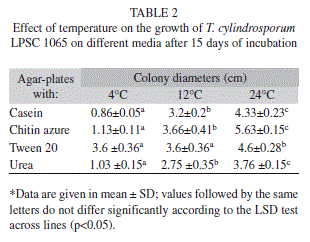
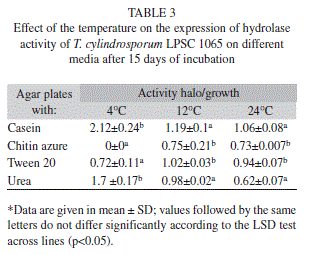
<body><![CDATA[ style="font-style: italic;"> et al.</span>     2008).    <br> <br style="font-family: verdana;"> </span></font><font size="2"><span style="font-family: verdana;">The differences in fungal growth and enzyme activity between treatments were analyzed by the ANOVA and, in turn, the differences between the resulting mean values discriminated by Fisher&#8217;s least-significantdifference multiple-range-test option (p&lt;0.05) through the use of the InfoStat software.</span></font><br style="font-family: verdana;"> <br style="font-family: verdana;"> <font style="font-weight: bold;" size="3"><span  style="font-family: verdana;">Results</span></font><br  style="font-family: verdana;"> <br style="font-family: verdana;"> <font size="2"><span style="font-family: verdana;"><span  style="font-weight: bold;">Characterization of <span  style="font-style: italic;">T. cylindrosporum </span>isolate LPSC 1065:</span> After ten days of incubation on MEA at 25&ordm;C in the dark, <span style="font-style: italic;">T. cylindrosporum</span> colonies in culture attained a diameter of 19.4 x 20.0mm consisting in a symmetrical diameter and regular borders, cottony-flocky surface, white to cream in colour. The reverse of the colony is creamy yellow, smooth, no pigmentation of the medium. Conidiogenous cells phialidic with a swollen base, (3.1) 3.5- 5.7 (6.1)x(1) 1.5-2.5 (2.8)&#956;m. Conidia singly from the tip of the conidiogenous cell, hyaline, smooth, cylindrical of (3) 3.5-4.5 (5.7) x(1.2) 1.5-1.8 (2)&#956;m. The features of this strain agree with the description and illustrations given by Gams 1971. </span></font><br  style="font-family: verdana;"> <br style="font-family: verdana;"> <font size="2"><span style="font-family: verdana;">The amplified product was 344bp in length and the total proportions of nucleotides were 25.58% A, 29.65% C, 26.45% G and 18.31% T. BLAST searches of the sequence (GenBank Accession No. HQ822271) showed 100% of max identity with several sequences of the GenBank (e.g., Accession Nos. AB208110, FJ025179, DQ449656) of <span style="font-style: italic;">T. cylindrosporum</span> (95% query coverage).</span></font><br style="font-family: verdana;"> <br style="font-family: verdana;"> <font size="2"><span style="font-family: verdana;"><span  style="font-weight: bold;">Pathogenicity assays:</span> According to the results obtained from the laboratory pathogenicity assays at seven days post-inoculation, the fungus caused mortality in adults of <span  style="font-style: italic;">R. padi</span> (<a href="#Tabla_1">Table 1</a>), and fungal growth and sporulation of the isolate became manifest on the dead insects. No mortality occurred in the control insects. At seven days post-inoculation, significant differences were observed among the temperatures examined (F=25, 59; df=2; 11; p=0.0002). At 4&deg;C and 12&ordm;C, no median lethal time could be estimated, because the mortality was lower than 50%.    <br>     <br> </span></font>     <div style="text-align: center;"><font size="2"><a name="Tabla_1"></a><img  alt="" src="/img/revistas/rbt/v60n2/a25t1.gif"  style="width: 311px; height: 235px;"><span  style="font-family: verdana;"></span></font><br  style="font-family: verdana;"> <font size="2"><span style="font-family: verdana;"></span></font></div> <br style="font-family: verdana;"> <font size="2"><span style="font-family: verdana;"><span  style="font-weight: bold;">Enzyme activity of the fungus:</span> At the three incubation temperatures tested (<a href="#Tabla_2">Table 2</a>), the fungus showed a broad ability to grow on several agar-based culture media containing different carbon sources which represent, as a model, the components of the insects&#8217; chemical constitution.     <br>     <br> </span></font>     <div style="text-align: center;"><font size="2"><a name="Tabla_2"></a><img  alt="" src="/img/revistas/rbt/v60n2/a25t2.gif"  style="width: 310px; height: 242px;"><span  style="font-family: verdana;"></span></font><br  style="font-family: verdana;"> <font size="2"><span style="font-family: verdana;"></span></font></div> <br style="font-family: verdana;"> <font size="2"><span style="font-family: verdana;">Although the growth was greater at the higher incubation temperatures (with m&aacute;ximum levels at 24&deg;C), the fungus reached similar colony diameters after 15 days of incubation on the m&eacute;dium supplemented with Tween<sup>&reg;</sup> 20 at the lower two incubation temperatures of 4&deg;C or 12&deg;C. </span></font><br  style="font-family: verdana;"> <br style="font-family: verdana;"> <font size="2"><span style="font-family: verdana;">In accordance with the results on colony diameters, the fungus revealed an ability to degrade casein, chitin derivatives, Tween<sup>&reg;</sup>20, and urea as evidenced by the appearance of a halo around the fungal colony. Although, this hydrolytic activity in the fungus was detected in the range of temperatures tested under most conditions, no halo of degradation was seen with chitin azure at 4&deg;C. In contrast, a bigger halo of degradation with casein and urea was observed at 4&deg;C, compared to the sizes of the halos at 12&ordm;C and 24&deg;C (<a href="#Tabla_3">Table 3</a>).    <br>     ]]></body>
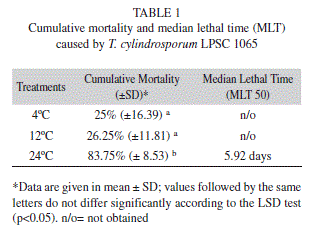
<body><![CDATA[<br> </span></font>     <div style="text-align: center;"><font size="2"><a name="Tabla_3"></a><img  alt="" src="/img/revistas/rbt/v60n2/a25t3.gif"  style="width: 309px; height: 255px;"><span  style="font-family: verdana;"></span></font><br  style="font-family: verdana;"> <font size="2"><span style="font-family: verdana;"></span></font></div> <br style="font-family: verdana;"> <font style="font-weight: bold;" size="3"><span  style="font-family: verdana;">Discussion</span></font><br  style="font-family: verdana;"> <br style="font-family: verdana;"> <font size="2"><span style="font-family: verdana;">In the present investigation we have analyzed the ability of a strain of <span  style="font-style: italic;">T. cylindrosporum</span> (LPSC N&ordm; 1065) isolated from soil from Tierra del Fuego, Argentina to produce hydrolytic enzymes and the relationship of those activities to the fungus pathogenicity against pest aphids <span  style="font-style: italic;">Tolypocladium cylindrosporum</span> has a worldwide distribution and accordingly has been associated with different organic substrates, insect bodies, and the soils of habitats ranging from alpine to temperate to tropical regions. </span></font><br style="font-family: verdana;"> <br style="font-family: verdana;"> <font size="2"><span style="font-family: verdana;">Temperature is one of the conditions that significantly affect growth and survival, thus determining the efficacy of entomopathogenic fungi as biological control agents (Xavier 1998). Most of those fungi, including several strains of <span style="font-style: italic;">T. cylindrosporum</span>, have optimal growth temperatures between 23&ordm;C and 35&ordm;C (Roberts &amp; Campbell 1977, Xavier 1998). Hot and cold temperature conditions are key abiotic environmental influences that may restrict the use of entomopathogenic fungi and molds as agents for the biological control of insects since the host-tolerance limits generally range between 5&deg;C-40&deg;C (Pelizza <span style="font-style: italic;">et al.</span> 2007). Because, the area from where the soil was collected has a sub-Antarctic climate (with temperatures ranging between 0&deg;C-9&deg;C), an annual precipitation of about 500mm, and consequently frequent snow coverage of the soil (Pancotto <span  style="font-style: italic;">et al.</span> 2003), and considering that temperature is a relevant influence on the production, performance, and efficacy of attack of biocontrol agents, we evaluated the pathogenicity of this fungal isolate against aphids, along with its capacity to produce the appropriate hydrolytic enzymes for the attack process, at 4&deg;C, 12&deg;C, and 24&deg;C. <span  style="font-style: italic;">T. cylindrosporum</span> was isolated mainly from Diptera, as well as from soil and insects of the orders Coleoptera, Lepidoptera and Hymenoptera (Humber &amp; Hansen 2006). In this work, we assay pathogenicity on <span  style="font-style: italic;">R. padi </span>because; it is a cosmopolitan species and has economic importance. Thus, we extend the physiological host range of this entomopathogenic fungus. </span></font><br style="font-family: verdana;"> <br style="font-family: verdana;"> <font size="2"><span style="font-family: verdana;">Although, bioassays showed that pathogenicity was higher at 24&ordm;C, mortality still occurred at temperatures of 4&ordm;C and 12&ordm;C. Recently, Pelizza <span  style="font-style: italic;">et al. </span>(2007) have reported similar results, suggesting that the differences observed in the fungus&#8217;s response to temperatura are a result of the variability associated with the adaptation to specific habitats. Fungal-strain selection on the basis of termal requirements may be warranted when choosing a strain for development as an effective microbial control agent for the pests of winter-habitat crops. These considerations suggest that <span style="font-style: italic;">T. cylindrosporum</span> LPSC 1065 has a potential for biologically controlling insect that constitute pests at low temperatures. </span></font><br style="font-family: verdana;"> <br style="font-family: verdana;"> <font size="2"><span style="font-family: verdana;">Loesch <span  style="font-style: italic;">et al.</span> (2010) have recently provided information on the capability of a strain of <span  style="font-style: italic;">B. brongniartii</span>, BIPESCO 2 (CBS 110631), isolated from <span style="font-style: italic;">M. melolontha</span>-infested soil in an alpine area in Austria, to use 120 different carbon compounds at 25&deg;C. Previous data have been reported on the activity of certain specific enzymes produced by this fungal species in relation to the degradation of the insects&#8217; main structural components as well as other organic materials; which hydrolases would constitute putative virulence factors, as specified by several authors for other entomopathogenic fungi (Domsch <span style="font-style: italic;">et al.</span> 1993, St Leger 1995, Xavier 1998, Bandani 2008). </span></font><br  style="font-family: verdana;"> <br style="font-family: verdana;"> <font size="2"><span style="font-family: verdana;">When cultured at 4&deg;C, 12&deg;C and 24&deg;C, our strain LPSC 1065 exhibited extracellular hydrolytic activity on several specific organic model compounds. This result indicates that the fungus has at once proteolytic, lipolytic, chitinolytic and ureolytic activities with the relevant enzymes active at all the temperatures tested. The isolate&#8217;s ability to use several types of organic substrates at different incubation temperatures might be, at least in part, related to the high nutritional versatility of <span  style="font-style: italic;">T. cylindrosporum</span> since the fungus has both a parasitic and a saprobic life cycle within its environment (Bandani 2008). The fungus also demonstrates an adaptative response to the variable conditions associated with terrestrial microhabitats where the fungi customarily present are generally confronted with low levels of competition (Zucconi <span style="font-style: italic;">et al.</span> 1996, Tibbett <span style="font-style: italic;">et al.</span> 1999, Pancotto <span  style="font-style: italic;">et al. </span>2003).    <br> <br style="font-family: verdana;"> </span></font><font size="2"><span style="font-family: verdana;">Extreme environmental conditions such as high or low temperature may modify and, in particular, inhibit fungal growth, enzyme activity and stability as well as general metabolism, because of the temperature dependence of enzymatic activation and catalysis, protein denaturation, and cell-membrane stability- where disruption of the latter necessarily produces changes in permeability that result in the leakage of cell constituents and/or the prevention of nutrient uptake (Rosset &amp; Barlocher 1985, Nagai <span style="font-style: italic;">et al.</span> 1995, Pointing <span  style="font-style: italic;">et al.</span> 1999, Saparrat <span  style="font-style: italic;">et al.</span> 2008). Although, a higher growth was found with increased incubation temperatures in most of the cultures of <span style="font-style: italic;">T. cylindrosporum</span> strain LPSC 1065 on the different media used, an effect generally compatible with enzymic kinetic constants and activation energies, this effect was less pronounced with the medium containing Tween<sup>&reg;</sup> 20. This difference no doubt results from the high ability of this fungus to utilize the fatty esters of polyoxyethylene sorbitan, as reported earlier by Loesch <span  style="font-style: italic;">et al. </span>(2010) for Tween<sup>&reg;</sup> 40 (polyoxyethylene sorbitan monopalmitate), with both compounds constituting wax-like model substances similar to those present in insect cuticles. With respect to the other hydrolase activities, an opposite response was observed for the protease and urease of the isolate, with a higher activities obtaining at lower temperatures; whereas the haloes of chitinolytic and lipolytic activities revealed no differences among the three incubation temperatures tested. Similar to these present observations, the growth at low temperatures of several strains of <span  style="font-style: italic;">Hebeloma</span> (Basidiomycota) was found to result in greater proteolytic activity, allegedly because of an activation of those proteases by decreased temperatures (Tibbett <span  style="font-style: italic;">et al.</span> 1999). That entomopathogenic fungi in general exhibit many attributes that determine their virulence towards their hosts, including an increased activity of degradation enzymes at low temperatures, suggests that this present isolate is, likewise, a psychrotolerant fungus, as a result of the geographical region where the soil was collected from-<span style="font-style: italic;">i.e</span>., the fungal isolation source. Similarly, Zucconi <span style="font-style: italic;">et al.</span> (1996) categorized <span style="font-style: italic;">Geomyces pannorum</span> var. <span style="font-style: italic;">pannorum</span> (Link) Sigler &amp; J.W. Carmich strains as psychrotolerant, because of their ability to hydrolyze starch and produce extracellular chitinase, urease and lipase at temperatures below 25&ordm;C. </span></font><br  style="font-family: verdana;"> <br style="font-family: verdana;"> <font size="2"><span style="font-family: verdana;">An understanding of the effects of temperatura on the growth and sporulation of entomopathogenic fungi, as well as on the activity and stability of their hydrolases, will assist investigations seeking to use psychrotolerant organisms as biological control agents within the stressful environments generated by low temperatures. Such information is essential for the mass production and commercialization of promising organisms. Additional studies aimed at characterizing the hydrolases activity at low temperatures for cold-resistant entomopathogenic fungi are, however, still needed.</span></font><br  style="font-family: verdana;"> <br style="font-family: verdana;"> <font style="font-weight: bold;" size="3"><span  style="font-family: verdana;">Acknowledgments</span></font><br  style="font-family: verdana; font-weight: bold;"> <br style="font-family: verdana;"> <font size="2"><span style="font-family: verdana;">We thank Ver&oacute;nica Pancotto, for supplying the soil source from Tierra del Fuego, Argentina. This study was partially supported by CICPBA, CONICET (PIP 1422) (PIP 0049) and Facultad de Ciencias Naturales y Museo, Universidad Nacional de La Plata, La Plata, Argentina. Donald Haggerty, a retired career investigator and native English speaker, edited the final version of the manuscript.</span></font><br style="font-family: verdana;"> <br style="font-family: verdana;"> <font style="font-weight: bold;" size="2"><span  style="font-family: verdana;"></span></font> <hr style="width: 100%; height: 2px;"><font style="font-weight: bold;"  size="3">    <!-- ref --><br> <span style="font-family: verdana;">References</span></font><br  style="font-family: verdana;"> <br style="font-family: verdana;"> <font size="2"><span style="font-family: verdana;">Abbot, W.S. 1925. A method for computing effectiveness of an insecticide. J. Econ. Entomol. 18: 265-267.    &nbsp;&nbsp;&nbsp;&nbsp;&nbsp;&nbsp;&nbsp;&nbsp;[&#160;<a href="javascript:void(0);" onclick="javascript: window.open('/scielo.php?script=sci_nlinks&ref=1506270&pid=S0034-7744201200020002500001&lng=','','width=640,height=500,resizable=yes,scrollbars=1,menubar=yes,');">Links</a>&#160;]<!-- end-ref --><!-- ref --></span></font><br style="font-family: verdana;"> <br style="font-family: verdana;"> <font size="2"><span style="font-family: verdana;">Ali-Shtayeh, M.S., K.H. Tayseer &amp; R.M. Jamous. 2002. Ecology of dermatophytes and other keratinophilic fungi in swimming pools and polluted and unpolluted streams. Mycopathologia 156: 193-205.    &nbsp;&nbsp;&nbsp;&nbsp;&nbsp;&nbsp;&nbsp;&nbsp;[&#160;<a href="javascript:void(0);" onclick="javascript: window.open('/scielo.php?script=sci_nlinks&ref=1506271&pid=S0034-7744201200020002500002&lng=','','width=640,height=500,resizable=yes,scrollbars=1,menubar=yes,');">Links</a>&#160;]<!-- end-ref --><!-- ref --></span></font><br  style="font-family: verdana;"> <br style="font-family: verdana;"> <font size="2"><span style="font-family: verdana;">Altschul, S.F., W. Gish, W. Miller, E.W. Myers &amp; D.J. Lipman. 1990. Basic local alignment search tool. <span style="font-style: italic;">J. Mol. Biol.</span> 215: 403-410.    &nbsp;&nbsp;&nbsp;&nbsp;&nbsp;&nbsp;&nbsp;&nbsp;[&#160;<a href="javascript:void(0);" onclick="javascript: window.open('/scielo.php?script=sci_nlinks&ref=1506272&pid=S0034-7744201200020002500003&lng=','','width=640,height=500,resizable=yes,scrollbars=1,menubar=yes,');">Links</a>&#160;]<!-- end-ref --><!-- ref --></span></font><br  style="font-family: verdana;"> <br style="font-family: verdana;"> <font size="2"><span style="font-family: verdana;">Bandani, A.R., B.P.S. Khambay, L. Faull, R. Newton, M. Deadman &amp; T.M. Butt. 2000. Production of efrapeptins by <span style="font-style: italic;">Tolypocladium </span>species (Deuteromycotina: Hyphomycetes) and evaluation of their insecticidal and antimicrobial properties. Mycol. Res. 104: 537-544.    &nbsp;&nbsp;&nbsp;&nbsp;&nbsp;&nbsp;&nbsp;&nbsp;[&#160;<a href="javascript:void(0);" onclick="javascript: window.open('/scielo.php?script=sci_nlinks&ref=1506273&pid=S0034-7744201200020002500004&lng=','','width=640,height=500,resizable=yes,scrollbars=1,menubar=yes,');">Links</a>&#160;]<!-- end-ref --><!-- ref --></span></font><br style="font-family: verdana;"> <br style="font-family: verdana;"> <font size="2"><span style="font-family: verdana;">Bandani, A.R. 2008. The effects of entomopathogenic fungus, <span style="font-style: italic;">Tolypocladium cylindrosporum</span> on celular defence system of <span style="font-style: italic;">Galleria mellonella</span>. J. Agric. Sci. Technol. 10: 135-146.    &nbsp;&nbsp;&nbsp;&nbsp;&nbsp;&nbsp;&nbsp;&nbsp;[&#160;<a href="javascript:void(0);" onclick="javascript: window.open('/scielo.php?script=sci_nlinks&ref=1506274&pid=S0034-7744201200020002500005&lng=','','width=640,height=500,resizable=yes,scrollbars=1,menubar=yes,');">Links</a>&#160;]<!-- end-ref --><!-- ref --></span></font><br style="font-family: verdana;"> <br style="font-family: verdana;"> <font size="2"><span style="font-family: verdana;">Bissett, J. 1983. Notes on <span style="font-style: italic;">Tolypocladium</span> and related genera. Can. J. Bot. 61: 1311-1329.    &nbsp;&nbsp;&nbsp;&nbsp;&nbsp;&nbsp;&nbsp;&nbsp;[&#160;<a href="javascript:void(0);" onclick="javascript: window.open('/scielo.php?script=sci_nlinks&ref=1506275&pid=S0034-7744201200020002500006&lng=','','width=640,height=500,resizable=yes,scrollbars=1,menubar=yes,');">Links</a>&#160;]<!-- end-ref --><!-- ref --></span></font><br  style="font-family: verdana;"> <br style="font-family: verdana;"> <font size="2"><span style="font-family: verdana;">Brandt, C.R., M.J. Adang &amp; K.D. Spence. 1978. The peritrophic membrane: ultrastructural analysis and function as a mechanical barrier to microbial infection in <span  style="font-style: italic;">Orgyia pseudotsugata</span>. J. Invertebr. Pathol. 32: 12-24.    &nbsp;&nbsp;&nbsp;&nbsp;&nbsp;&nbsp;&nbsp;&nbsp;[&#160;<a href="javascript:void(0);" onclick="javascript: window.open('/scielo.php?script=sci_nlinks&ref=1506276&pid=S0034-7744201200020002500007&lng=','','width=640,height=500,resizable=yes,scrollbars=1,menubar=yes,');">Links</a>&#160;]<!-- end-ref --><!-- ref --></span></font><br  style="font-family: verdana;"> <br style="font-family: verdana;"> <font size="2"><span style="font-family: verdana;">Chandler, D., D. Hay &amp; A.P. Reid. 1997. Sampling and occurrence of entomopathogenic fungi and nematodes in UK soils. Appl. Soil Ecol. 5: 133-144.    &nbsp;&nbsp;&nbsp;&nbsp;&nbsp;&nbsp;&nbsp;&nbsp;[&#160;<a href="javascript:void(0);" onclick="javascript: window.open('/scielo.php?script=sci_nlinks&ref=1506277&pid=S0034-7744201200020002500008&lng=','','width=640,height=500,resizable=yes,scrollbars=1,menubar=yes,');">Links</a>&#160;]<!-- end-ref --><!-- ref --></span></font><br  style="font-family: verdana;"> <br style="font-family: verdana;"> <font size="2"><span style="font-family: verdana;">Clarkson, J.M. &amp; A.K. Charnley. 1996. New insight into the mechanisms of fungal pathogenesis in insects. Trends Microbiol. 4: 197-203.    &nbsp;&nbsp;&nbsp;&nbsp;&nbsp;&nbsp;&nbsp;&nbsp;[&#160;<a href="javascript:void(0);" onclick="javascript: window.open('/scielo.php?script=sci_nlinks&ref=1506278&pid=S0034-7744201200020002500009&lng=','','width=640,height=500,resizable=yes,scrollbars=1,menubar=yes,');">Links</a>&#160;]<!-- end-ref --><!-- ref --></span></font><br  style="font-family: verdana;"> <br style="font-family: verdana;"> <font size="2"><span style="font-family: verdana;">Coudron, T.A., M.J. Kroha &amp; C.M. Ignoffo. 1984. Levels of chitinolytic activity during development of three entomopathogenic fungi. Comp. Biochem. Phys. B. 79: 339-348.    &nbsp;&nbsp;&nbsp;&nbsp;&nbsp;&nbsp;&nbsp;&nbsp;[&#160;<a href="javascript:void(0);" onclick="javascript: window.open('/scielo.php?script=sci_nlinks&ref=1506279&pid=S0034-7744201200020002500010&lng=','','width=640,height=500,resizable=yes,scrollbars=1,menubar=yes,');">Links</a>&#160;]<!-- end-ref --><!-- ref --></span></font><br  style="font-family: verdana;"> <br style="font-family: verdana;"> <font size="2"><span style="font-family: verdana;">Domsch, K.H., W. Gams &amp; T. Anderson. 1993. Compendium of soil fungi. Verlag, Germany.    &nbsp;&nbsp;&nbsp;&nbsp;&nbsp;&nbsp;&nbsp;&nbsp;[&#160;<a href="javascript:void(0);" onclick="javascript: window.open('/scielo.php?script=sci_nlinks&ref=1506280&pid=S0034-7744201200020002500011&lng=','','width=640,height=500,resizable=yes,scrollbars=1,menubar=yes,');">Links</a>&#160;]<!-- end-ref --><!-- ref --></span></font><br  style="font-family: verdana;"> <br style="font-family: verdana;"> <font size="2"><span style="font-family: verdana;">Gams, W. 1971. Tolypocladium, eine Hyphomycetengattung mit geschwollenen Phialiden. Persoonia 6: 185-191.    &nbsp;&nbsp;&nbsp;&nbsp;&nbsp;&nbsp;&nbsp;&nbsp;[&#160;<a href="javascript:void(0);" onclick="javascript: window.open('/scielo.php?script=sci_nlinks&ref=1506281&pid=S0034-7744201200020002500012&lng=','','width=640,height=500,resizable=yes,scrollbars=1,menubar=yes,');">Links</a>&#160;]<!-- end-ref --><!-- ref --></span></font><br  style="font-family: verdana;"> <br style="font-family: verdana;"> <font size="2"><span style="font-family: verdana;">Ghasemi, M.F., M.R. Bakhtiari, M. Fallahpour, A. Noohi, N. Moazami &amp; Z. Amidi. 2004. Screening of urease production by <span style="font-style: italic;">Aspergillus niger</span> strains. Iran. Biomed. J. 8: 47-50.    &nbsp;&nbsp;&nbsp;&nbsp;&nbsp;&nbsp;&nbsp;&nbsp;[&#160;<a href="javascript:void(0);" onclick="javascript: window.open('/scielo.php?script=sci_nlinks&ref=1506282&pid=S0034-7744201200020002500013&lng=','','width=640,height=500,resizable=yes,scrollbars=1,menubar=yes,');">Links</a>&#160;]<!-- end-ref --><!-- ref --></span></font><br style="font-family: verdana;"> <br style="font-family: verdana;"> <font size="2"><span style="font-family: verdana;">Hankin, L. &amp; S.L. Anagnostakis. 1975. The use of solid media for detection of enzyme production by fungi. Mycologia 67: 597-607.    &nbsp;&nbsp;&nbsp;&nbsp;&nbsp;&nbsp;&nbsp;&nbsp;[&#160;<a href="javascript:void(0);" onclick="javascript: window.open('/scielo.php?script=sci_nlinks&ref=1506283&pid=S0034-7744201200020002500014&lng=','','width=640,height=500,resizable=yes,scrollbars=1,menubar=yes,');">Links</a>&#160;]<!-- end-ref --><!-- ref --></span></font><br  style="font-family: verdana;"> <br style="font-family: verdana;"> <font size="2"><span style="font-family: verdana;">Howard, M.B., N.A. Ekborg, R.M. Weiner &amp; S.W. Hutcheson. 2003. Detection and characterization of chitinases and other chitin-modifying enzymes. J. Ind. Microbiol. Biot. 30: 627-635.    &nbsp;&nbsp;&nbsp;&nbsp;&nbsp;&nbsp;&nbsp;&nbsp;[&#160;<a href="javascript:void(0);" onclick="javascript: window.open('/scielo.php?script=sci_nlinks&ref=1506284&pid=S0034-7744201200020002500015&lng=','','width=640,height=500,resizable=yes,scrollbars=1,menubar=yes,');">Links</a>&#160;]<!-- end-ref --><!-- ref --></span></font><br style="font-family: verdana;"> <br style="font-family: verdana;"> <font size="2"><span style="font-family: verdana;">Humber, R.A. &amp; K.S. Hansen. 2006. ARSEF, USDA-ARS Collection of Entomopathogenic Fungal Culture. (also available online: <a href="http://arsef.fpsnl.cornell.edu">http://arsef.fpsnl.cornell.edu</a>).    &nbsp;&nbsp;&nbsp;&nbsp;&nbsp;&nbsp;&nbsp;&nbsp;[&#160;<a href="javascript:void(0);" onclick="javascript: window.open('/scielo.php?script=sci_nlinks&ref=1506285&pid=S0034-7744201200020002500016&lng=','','width=640,height=500,resizable=yes,scrollbars=1,menubar=yes,');">Links</a>&#160;]<!-- end-ref --><!-- ref --> </span></font><br style="font-family: verdana;"> <br style="font-family: verdana;"> <font size="2"><span style="font-family: verdana;">Huxham, I.M., A.M. Lackie &amp; N.J. McCorkindale. 1989. Inhibitory effects of cyclodepsipeptides, destruxins, from the fungus <span style="font-style: italic;">Metarhizium anisopliae</span>, on cellular </span></font><font size="2"><span  style="font-family: verdana;">immunity in insects. J. Insect Physiol. 35: 97-105.    &nbsp;&nbsp;&nbsp;&nbsp;&nbsp;&nbsp;&nbsp;&nbsp;[&#160;<a href="javascript:void(0);" onclick="javascript: window.open('/scielo.php?script=sci_nlinks&ref=1506286&pid=S0034-7744201200020002500017&lng=','','width=640,height=500,resizable=yes,scrollbars=1,menubar=yes,');">Links</a>&#160;]<!-- end-ref --><!-- ref --></span></font><br style="font-family: verdana;"> <br style="font-family: verdana;"> <font size="2"><span style="font-family: verdana;">Koneman, E. &amp; G. Roberts. 1987. Micolog&iacute;a. Pr&aacute;ctica de laboratorio. Editorial M&eacute;dica Panamericana S.A., Buenos Aires, Argentina.    &nbsp;&nbsp;&nbsp;&nbsp;&nbsp;&nbsp;&nbsp;&nbsp;[&#160;<a href="javascript:void(0);" onclick="javascript: window.open('/scielo.php?script=sci_nlinks&ref=1506287&pid=S0034-7744201200020002500018&lng=','','width=640,height=500,resizable=yes,scrollbars=1,menubar=yes,');">Links</a>&#160;]<!-- end-ref --><!-- ref --></span></font><br  style="font-family: verdana;"> <br style="font-family: verdana;"> <font size="2"><span style="font-family: verdana;">Lacey, L. &amp; W.M. Brooks. 1997. Initial handling and diagnosis of diseased insects, p. 1-12. <span  style="font-style: italic;">In</span> L. Lacey (ed.). Manual of techniques in insect pathology. Academic, San Diego, California.    &nbsp;&nbsp;&nbsp;&nbsp;&nbsp;&nbsp;&nbsp;&nbsp;[&#160;<a href="javascript:void(0);" onclick="javascript: window.open('/scielo.php?script=sci_nlinks&ref=1506288&pid=S0034-7744201200020002500019&lng=','','width=640,height=500,resizable=yes,scrollbars=1,menubar=yes,');">Links</a>&#160;]<!-- end-ref --><!-- ref --></span></font><br style="font-family: verdana;"> <br style="font-family: verdana;"> <font size="2"><span style="font-family: verdana;">Lam, T.N.C., M. Goettel &amp; G.G. Jr Soares. 1988. Host Records for the entomopathogenic Hyphomycete <span style="font-style: italic;">Tolypocladium cylindrosporum</span>. Fla. Entomol. 71: 86-89.    &nbsp;&nbsp;&nbsp;&nbsp;&nbsp;&nbsp;&nbsp;&nbsp;[&#160;<a href="javascript:void(0);" onclick="javascript: window.open('/scielo.php?script=sci_nlinks&ref=1506289&pid=S0034-7744201200020002500020&lng=','','width=640,height=500,resizable=yes,scrollbars=1,menubar=yes,');">Links</a>&#160;]<!-- end-ref --><!-- ref --></span></font><br style="font-family: verdana;"> <br style="font-family: verdana;"> <font size="2"><span style="font-family: verdana;">Lecuona, R.E. &amp; B.M. D&iacute;az. 2001. Susceptibilidad de <span style="font-style: italic;">Spodoptera frugiperda </span>(J.E. Smith) a los hongos entomopat&oacute;genos <span  style="font-style: italic;">Nomuraea rileyi, Metarhizium anisopliae </span>y <span style="font-style: italic;">Beauveria bassiana</span>. Rev. Invest. Agropecu. 30: 25-42.    &nbsp;&nbsp;&nbsp;&nbsp;&nbsp;&nbsp;&nbsp;&nbsp;[&#160;<a href="javascript:void(0);" onclick="javascript: window.open('/scielo.php?script=sci_nlinks&ref=1506290&pid=S0034-7744201200020002500021&lng=','','width=640,height=500,resizable=yes,scrollbars=1,menubar=yes,');">Links</a>&#160;]<!-- end-ref --><!-- ref --></span></font><br  style="font-family: verdana;"> <br style="font-family: verdana;"> <font size="2"><span style="font-family: verdana;">Loesch, A., S. Hutwimmer &amp; H. Strasser. 2010. Carbon utilization pattern as a potential quality control criterion for virulence of <span style="font-style: italic;">Beauveria brongniartii</span>. J. Invertebr. Pathol. 104: 58-65.    &nbsp;&nbsp;&nbsp;&nbsp;&nbsp;&nbsp;&nbsp;&nbsp;[&#160;<a href="javascript:void(0);" onclick="javascript: window.open('/scielo.php?script=sci_nlinks&ref=1506291&pid=S0034-7744201200020002500022&lng=','','width=640,height=500,resizable=yes,scrollbars=1,menubar=yes,');">Links</a>&#160;]<!-- end-ref --><!-- ref --></span></font><br  style="font-family: verdana;"> <br style="font-family: verdana;"> <font size="2"><span style="font-family: verdana;">L&oacute;pez Lastra, C.C., G.R. Reboredo &amp; H. Spinedi. 1991. Primer registro de <span  style="font-style: italic;">Tolypocladium cylindrosporum</span> Gams (Deuteromycotina:Hyphomycetes) para la Ant&aacute;rtida. Consideraciones sobre su patogenicidad sobre larvas de <span style="font-style: italic;">Culex pipiens</span> L. Contrib. Inst. Antart. 392: 11.    &nbsp;&nbsp;&nbsp;&nbsp;&nbsp;&nbsp;&nbsp;&nbsp;[&#160;<a href="javascript:void(0);" onclick="javascript: window.open('/scielo.php?script=sci_nlinks&ref=1506292&pid=S0034-7744201200020002500023&lng=','','width=640,height=500,resizable=yes,scrollbars=1,menubar=yes,');">Links</a>&#160;]<!-- end-ref --><!-- ref --></span></font><br style="font-family: verdana;"> <br style="font-family: verdana;"> <font size="2"><span style="font-family: verdana;">Mart&iacute;nez, A.E., V.M. Chiocchio &amp; A.M. Godeas. 2001. Hyphomycetes celulol&iacute;ticos en suelos de bosques de Nothofagus, Tierra del Fuego. Gayana Bot. 58: 123-132.    &nbsp;&nbsp;&nbsp;&nbsp;&nbsp;&nbsp;&nbsp;&nbsp;[&#160;<a href="javascript:void(0);" onclick="javascript: window.open('/scielo.php?script=sci_nlinks&ref=1506293&pid=S0034-7744201200020002500024&lng=','','width=640,height=500,resizable=yes,scrollbars=1,menubar=yes,');">Links</a>&#160;]<!-- end-ref --><!-- ref --></span></font><br style="font-family: verdana;"> <br style="font-family: verdana;"> <font size="2"><span style="font-family: verdana;">Nagai, K., T. Sakai, R.M. Ratiatmodjo, K. Suzuki, W. Gams &amp; G. Okada. 1995. Studies on the distribution of alkalofphilic and alkali- tolerant soil fungi I. Mycoscience 36: 247-256.    &nbsp;&nbsp;&nbsp;&nbsp;&nbsp;&nbsp;&nbsp;&nbsp;[&#160;<a href="javascript:void(0);" onclick="javascript: window.open('/scielo.php?script=sci_nlinks&ref=1506294&pid=S0034-7744201200020002500025&lng=','','width=640,height=500,resizable=yes,scrollbars=1,menubar=yes,');">Links</a>&#160;]<!-- end-ref --><!-- ref --></span></font><br style="font-family: verdana;"> <br style="font-family: verdana;"> <font size="2"><span style="font-family: verdana;">Mazet, I., S.Y. Hung &amp; D.G. Boucias. 1994. Detection of toxic metabolites in the hemolymph of <span style="font-style: italic;">Beauveria bassiana</span> infected <span  style="font-style: italic;">Spodoptera exigua </span>larvae. Cell. Moll. Life Sci. 50: 142-147.    &nbsp;&nbsp;&nbsp;&nbsp;&nbsp;&nbsp;&nbsp;&nbsp;[&#160;<a href="javascript:void(0);" onclick="javascript: window.open('/scielo.php?script=sci_nlinks&ref=1506295&pid=S0034-7744201200020002500026&lng=','','width=640,height=500,resizable=yes,scrollbars=1,menubar=yes,');">Links</a>&#160;]<!-- end-ref --><!-- ref --></span></font><br style="font-family: verdana;"> <br style="font-family: verdana;"> <font size="2"><span style="font-family: verdana;">Pancotto, V.A., O.E. Sala &amp; M. Cabello. 2003. Solar UV-B decreases decomposition in herbaceous plant litter in Tierra del Fuego, Argentina: Potential role of an altered decomposer community. Glob. Change Biol. 9: 1465-1474.    &nbsp;&nbsp;&nbsp;&nbsp;&nbsp;&nbsp;&nbsp;&nbsp;[&#160;<a href="javascript:void(0);" onclick="javascript: window.open('/scielo.php?script=sci_nlinks&ref=1506296&pid=S0034-7744201200020002500027&lng=','','width=640,height=500,resizable=yes,scrollbars=1,menubar=yes,');">Links</a>&#160;]<!-- end-ref --><!-- ref --></span></font><br  style="font-family: verdana;"> <br style="font-family: verdana;"> <font size="2"><span style="font-family: verdana;">Parkinson, D. &amp; S.T. Williams. 1961. A method for isolating fungi from soil microhabitats. Plant Soil 13: 347-355.    &nbsp;&nbsp;&nbsp;&nbsp;&nbsp;&nbsp;&nbsp;&nbsp;[&#160;<a href="javascript:void(0);" onclick="javascript: window.open('/scielo.php?script=sci_nlinks&ref=1506297&pid=S0034-7744201200020002500028&lng=','','width=640,height=500,resizable=yes,scrollbars=1,menubar=yes,');">Links</a>&#160;]<!-- end-ref --><!-- ref --></span></font><br style="font-family: verdana;"> <br style="font-family: verdana;"> <font size="2"><span style="font-family: verdana;">Pelizza, S.A., C.C. L&oacute;pez Lastra, J.J. Becnel, V. Bisaro &amp; J.J. Garcia. 2007. Effect of temperature, pH, and salinity on the infection of <span  style="font-style: italic;">Leptolegnia chapmanii</span> Seymour (Peronosporomycetes) in mosquito larvae. J. Invertebr. Pathol. 96: 133-137.    &nbsp;&nbsp;&nbsp;&nbsp;&nbsp;&nbsp;&nbsp;&nbsp;[&#160;<a href="javascript:void(0);" onclick="javascript: window.open('/scielo.php?script=sci_nlinks&ref=1506298&pid=S0034-7744201200020002500029&lng=','','width=640,height=500,resizable=yes,scrollbars=1,menubar=yes,');">Links</a>&#160;]<!-- end-ref --><!-- ref --></span></font><br style="font-family: verdana;"> <br style="font-family: verdana;"> <font size="2"><span style="font-family: verdana;">Pointing, S.B., J.A. Buswell, E.B. Gareth Jones &amp; L.L.P. Vrijmoed. 1999. Extracellular cellulolytic enzyme profiles of five lignicolous mangrove fungi. Mycol. Res. 103: 696-700.    &nbsp;&nbsp;&nbsp;&nbsp;&nbsp;&nbsp;&nbsp;&nbsp;[&#160;<a href="javascript:void(0);" onclick="javascript: window.open('/scielo.php?script=sci_nlinks&ref=1506299&pid=S0034-7744201200020002500030&lng=','','width=640,height=500,resizable=yes,scrollbars=1,menubar=yes,');">Links</a>&#160;]<!-- end-ref --><!-- ref --></span></font><br style="font-family: verdana;"> <br style="font-family: verdana;"> <font size="2"><span style="font-family: verdana;">Roberts, D.W. &amp; A.S. Campbell. 1977. Stability of entomopathogenic fungi. Misc. Publ. Entomol. Soc. Am. 10: 19-76.    &nbsp;&nbsp;&nbsp;&nbsp;&nbsp;&nbsp;&nbsp;&nbsp;[&#160;<a href="javascript:void(0);" onclick="javascript: window.open('/scielo.php?script=sci_nlinks&ref=1506300&pid=S0034-7744201200020002500031&lng=','','width=640,height=500,resizable=yes,scrollbars=1,menubar=yes,');">Links</a>&#160;]<!-- end-ref --><!-- ref --></span></font><br style="font-family: verdana;"> <br style="font-family: verdana;"> <font size="2"><span style="font-family: verdana;">Rosset, J. &amp; F. Barlocher. 1985. Aquatic Hyphomycetes: influence of pH, Ca<sup>2+</sup> and HCO-<sub>3</sub> on growth in vitro. T. Brit. Mycol. Soc. 84: 137-145.    &nbsp;&nbsp;&nbsp;&nbsp;&nbsp;&nbsp;&nbsp;&nbsp;[&#160;<a href="javascript:void(0);" onclick="javascript: window.open('/scielo.php?script=sci_nlinks&ref=1506301&pid=S0034-7744201200020002500032&lng=','','width=640,height=500,resizable=yes,scrollbars=1,menubar=yes,');">Links</a>&#160;]<!-- end-ref --><!-- ref --></span></font><br  style="font-family: verdana;"> <br style="font-family: verdana;"> <font size="2"><span style="font-family: verdana;">Samson, R.A., H.C. Evans &amp; P. Latge. 1988. Atlas of entomopathogenic fungi. Springer-Verlag, Berlin, Germany.    &nbsp;&nbsp;&nbsp;&nbsp;&nbsp;&nbsp;&nbsp;&nbsp;[&#160;<a href="javascript:void(0);" onclick="javascript: window.open('/scielo.php?script=sci_nlinks&ref=1506302&pid=S0034-7744201200020002500033&lng=','','width=640,height=500,resizable=yes,scrollbars=1,menubar=yes,');">Links</a>&#160;]<!-- end-ref --><!-- ref --></span></font><br style="font-family: verdana;"> <br style="font-family: verdana;"> <font size="2"><span style="font-family: verdana;">Saparrat, M.C.N., M. Rocca, M.B. Aulicino, A. Arambarri &amp; P. Balatti. 2008. <span  style="font-style: italic;">Celtis tala</span> and<span  style="font-style: italic;"> Scutia buxifolia</span> leaf litter decomposition by selected fungi in relation to their physical and chemical properties and the lignocellulolytic enzyme activity. Eur. J. Soil Biol. 44: 400-407.    &nbsp;&nbsp;&nbsp;&nbsp;&nbsp;&nbsp;&nbsp;&nbsp;[&#160;<a href="javascript:void(0);" onclick="javascript: window.open('/scielo.php?script=sci_nlinks&ref=1506303&pid=S0034-7744201200020002500034&lng=','','width=640,height=500,resizable=yes,scrollbars=1,menubar=yes,');">Links</a>&#160;]<!-- end-ref --><!-- ref --></span></font><br  style="font-family: verdana;"> <br style="font-family: verdana;"> <font size="2"><span style="font-family: verdana;">St Leger, R.J. 1995. The role of cuticle-degrading proteases in fungal pathogenesis of insects. Can. J. Bot. 73: 1119-1125.    &nbsp;&nbsp;&nbsp;&nbsp;&nbsp;&nbsp;&nbsp;&nbsp;[&#160;<a href="javascript:void(0);" onclick="javascript: window.open('/scielo.php?script=sci_nlinks&ref=1506304&pid=S0034-7744201200020002500035&lng=','','width=640,height=500,resizable=yes,scrollbars=1,menubar=yes,');">Links</a>&#160;]<!-- end-ref --><!-- ref --></span></font><br style="font-family: verdana;"> <br style="font-family: verdana;"> <font size="2"><span style="font-family: verdana;">Stenglein, S.A. &amp; P.A. Balatti. 2006. Genetic diversity of <span style="font-style: italic;">Phaeoisariopsis griseola</span> in Argentina as revealed by virulence and molecular markers. Physiol. Mol. Plant P. 68: 158-167.    &nbsp;&nbsp;&nbsp;&nbsp;&nbsp;&nbsp;&nbsp;&nbsp;[&#160;<a href="javascript:void(0);" onclick="javascript: window.open('/scielo.php?script=sci_nlinks&ref=1506305&pid=S0034-7744201200020002500036&lng=','','width=640,height=500,resizable=yes,scrollbars=1,menubar=yes,');">Links</a>&#160;]<!-- end-ref --><!-- ref --></span></font><br style="font-family: verdana;"> <br style="font-family: verdana;"> <font size="2"><span style="font-family: verdana;">Tibbett, M., F.E. Sanders, J.W.G. Cairney &amp; J.R. Leake. 1999. Temperature regulation of extracellular proteases in ectomycorrhizal fungi (Hebeloma spp.) grown in axenic culture. Mycol. Res. 103: 707-714.    &nbsp;&nbsp;&nbsp;&nbsp;&nbsp;&nbsp;&nbsp;&nbsp;[&#160;<a href="javascript:void(0);" onclick="javascript: window.open('/scielo.php?script=sci_nlinks&ref=1506306&pid=S0034-7744201200020002500037&lng=','','width=640,height=500,resizable=yes,scrollbars=1,menubar=yes,');">Links</a>&#160;]<!-- end-ref --><!-- ref --></span></font><br  style="font-family: verdana;"> <br style="font-family: verdana;"> <font size="2"><span style="font-family: verdana;">Vilcinskas, A., V. Matha &amp; P. Gotz. 1997. Inhibition of phagocytic activity of plasmatocyes isolated from <span style="font-style: italic;">Galleria mellonella</span> by entomogenus fungi and their secondary metabolites. J. Insect Physiol. 43: 475-483.    &nbsp;&nbsp;&nbsp;&nbsp;&nbsp;&nbsp;&nbsp;&nbsp;[&#160;<a href="javascript:void(0);" onclick="javascript: window.open('/scielo.php?script=sci_nlinks&ref=1506307&pid=S0034-7744201200020002500038&lng=','','width=640,height=500,resizable=yes,scrollbars=1,menubar=yes,');">Links</a>&#160;]<!-- end-ref --><!-- ref --></span></font><br  style="font-family: verdana;"> <br style="font-family: verdana;"> <font size="2"><span style="font-family: verdana;">Xavier, I.J. 1998. Environmental stress response of the Hyphomycetous Entomopathogenic fungi. Ph.D. Thesis, University of Saskatchewan, Saskatoon, Canada.    &nbsp;&nbsp;&nbsp;&nbsp;&nbsp;&nbsp;&nbsp;&nbsp;[&#160;<a href="javascript:void(0);" onclick="javascript: window.open('/scielo.php?script=sci_nlinks&ref=1506308&pid=S0034-7744201200020002500039&lng=','','width=640,height=500,resizable=yes,scrollbars=1,menubar=yes,');">Links</a>&#160;]<!-- end-ref --><!-- ref --></span></font><br  style="font-family: verdana;"> <br style="font-family: verdana;"> <font size="2"><span style="font-family: verdana;">Zucconi, L., S. Pagano, M. Fenice, L. Selbmann, S. Tosi &amp; S. Onofri. 1996. Growth temperature preferences of fungal strains from Victoria Land, Antarctica. Polar Biol. 16: 53-61    &nbsp;&nbsp;&nbsp;&nbsp;&nbsp;&nbsp;&nbsp;&nbsp;[&#160;<a href="javascript:void(0);" onclick="javascript: window.open('/scielo.php?script=sci_nlinks&ref=1506309&pid=S0034-7744201200020002500040&lng=','','width=640,height=500,resizable=yes,scrollbars=1,menubar=yes,');">Links</a>&#160;]<!-- end-ref --><br>     <br>     <br> <a name="Correspondencia1"></a>*Correspondencia a: </span></font><font  size="2"> <span style="font-family: verdana;">Ana C. Scorsetti, Lorena A. El&iacute;ades, Marta N. Cabello, Sebasti&aacute;n A. Pelizza &amp; Mario C.N. Saparrat: </span></font><font size="2"><span  style="font-family: verdana;">Instituto de Bot&aacute;nica Carlos Spegazzini (FCNyM-UNLP) 53 # 477, (1900), La Plata, Argentina; </span></font><font  size="2"><span style="font-family: verdana;"><a  href="mailto:ascorsetti@conicet.gov.ar">ascorsetti@conicet.gov.ar</a>, <a href="mailto:lorenaeliades@yahoo.com">lorenaeliades@yahoo.com</a></span></font><br  style="font-family: verdana;"> <font size="2"><span style="font-family: verdana;">Sebasti&aacute;n A. Stenglein: </span></font><font size="2"><span  style="font-family: verdana;">Laboratorio de Biolog&iacute;a Funcional y Biotecnolog&iacute;a (BIOLAB)-CEBB-CONICET, C&aacute;tedra de Microbiolog&iacute;a, Facultad de Agronom&iacute;a de Azul, UNCPBA, Rep&uacute;blica de Italia # 780, Azul (7300), Argentina; <a href="mailto:stenglein@faa.unicen.edu.ar">stenglein@faa.unicen.edu.ar</a></span></font><br  style="font-family: verdana;"> <font size="2"><span style="font-family: verdana;">Marta N. Cabello: </span></font><font  size="2"><span style="font-family: verdana;">Comisi&oacute;n de Investigaciones Cient&iacute;ficas de la provincia de Buenos Aires; </span></font><font  size="2"><span style="font-family: verdana;"><a  href="mailto:mcabello@netverk.com.ar">mcabello@netverk.com.ar</a></span></font><br  style="font-family: verdana;"> <font size="2"><span style="font-family: verdana;">Sebasti&aacute;n A. Pelizza: </span></font><font size="2"><span  style="font-family: verdana;">Centro de Estudios Parasitol&oacute;gicos y de Vectores (CEPAVE), CCT-La Plata-CONICET-UNLP, Calle 2 # 584, La Plata (1900), Argentina; <a href="mailto:pelizza@cepave.edu.ar">pelizza@cepave.edu.ar</a></span></font><br  style="font-family: verdana;"> <font size="2"><span style="font-family: verdana;">Mario C.N. Saparrat: </span></font><font size="2"><span style="font-family: verdana;">Instituto de Fisiolog&iacute;a Vegetal (INFIVE), Universidad Nacional de La Plata (UNLP)- CCT-La Plata- Consejo Nacional de Investigaciones Cient&iacute;ficas y T&eacute;cnicas (CONICET), Diag. 113 y 61, CC 327, 1900-La Plata, Argentina; <a href="mailto:masaparrat@yahoo.com.ar">masaparrat@yahoo.com.ar</a></span></font><br  style="font-family: verdana;"> <font size="2"><span style="font-family: verdana;">Mario C.N. Saparrat: </span></font><font size="2"><span style="font-family: verdana;">C&aacute;tedra de Microbiolog&iacute;a Agr&iacute;cola, Facultad de Ciencias Agrarias y Forestales, UNLP, 60 y 119, 1900-La Plata, Argentina.    <br> </span></font><font size="2"><span style="font-family: verdana;"><br  style="font-family: verdana;"> </span></font><font size="2"><span style="font-family: verdana;"><a  name="1"></a><a href="#7">1</a>. Instituto de Bot&aacute;nica Carlos Spegazzini (FCNyM-UNLP) 53 # 477, (1900), La Plata, Argentina; <a href="mailto:ascorsetti@conicet.gov.ar">ascorsetti@conicet.gov.ar</a>, <a href="mailto:lorenaeliades@yahoo.com">lorenaeliades@yahoo.com</a></span></font><br  style="font-family: verdana;"> <font size="2"><span style="font-family: verdana;"><a name="2"></a><a  href="#8">2</a>. Laboratorio de Biolog&iacute;a Funcional y Biotecnolog&iacute;a (BIOLAB)-CEBB-CONICET, C&aacute;tedra de Microbiolog&iacute;a, Facultad de Agronom&iacute;a de Azul, UNCPBA, Rep&uacute;blica de Italia # 780, Azul (7300), Argentina; </span></font><font  size="2"><span style="font-family: verdana;"><a  href="mailto:stenglein@faa.unicen.edu.ar">stenglein@faa.unicen.edu.ar</a></span></font><br  style="font-family: verdana;"> <font size="2"><span style="font-family: verdana;"><a name="3"></a><a  href="#9">3</a>. Comisi&oacute;n de Investigaciones Cient&iacute;ficas de la provincia de Buenos Aires; <a href="mailto:mcabello@netverk.com.ar">mcabello@netverk.com.ar</a></span></font><br  style="font-family: verdana;"> <font size="2"><span style="font-family: verdana;"><a name="4"></a><a  href="#10">4</a>. Centro de Estudios Parasitol&oacute;gicos y de Vectores (CEPAVE), CCT-La Plata-CONICET-UNLP, Calle 2 # 584, La Plata (1900), Argentina; </span></font><font  size="2"><span style="font-family: verdana;"><a  href="mailto:pelizza@cepave.edu.ar">pelizza@cepave.edu.ar</a></span></font><br  style="font-family: verdana;"> <font size="2"><span style="font-family: verdana;"><a name="5"></a><a  href="#11">5</a>. Instituto de Fisiolog&iacute;a Vegetal (INFIVE), Universidad Nacional de La Plata (UNLP)- CCT-La Plata- Consejo Nacional de Investigaciones Cient&iacute;ficas y T&eacute;cnicas (CONICET), Diag. 113 y 61, CC 327, 1900-La Plata, Argentina; <a href="mailto:masaparrat@yahoo.com.ar">masaparrat@yahoo.com.ar</a></span></font><br  style="font-family: verdana;"> <font size="2"><span style="font-family: verdana;"><a name="6"></a><a  href="#12">6</a>. C&aacute;tedra de Microbiolog&iacute;a Agr&iacute;cola, Facultad de Ciencias Agrarias y Forestales, UNLP, 60 y 119, 1900-La Plata, Argentina.</span></font><font  size="2">    <br> <span style="font-family: verdana;"></span></font> <hr style="width: 100%; height: 2px;">     <div style="text-align: center;"><font size="2"><span  style="font-family: verdana;">Received 27-IV-2011. Corrected 20-VIII-2011. Accepted 14-IX-2011.</span></font></div> </div> </div>      ]]></body><back>
<ref-list>
<ref id="B1">
<nlm-citation citation-type="journal">
<person-group person-group-type="author">
<name>
<surname><![CDATA[Abbot]]></surname>
<given-names><![CDATA[W.S]]></given-names>
</name>
</person-group>
<article-title xml:lang="en"><![CDATA[A method for computing effectiveness of an insecticide]]></article-title>
<source><![CDATA[J. Econ. Entomol]]></source>
<year>1925</year>
<volume>18</volume>
<page-range>265-267</page-range></nlm-citation>
</ref>
<ref id="B2">
<nlm-citation citation-type="journal">
<person-group person-group-type="author">
<name>
<surname><![CDATA[Ali-Shtayeh]]></surname>
<given-names><![CDATA[M.S]]></given-names>
</name>
<name>
<surname><![CDATA[Tayseer]]></surname>
<given-names><![CDATA[K.H]]></given-names>
</name>
<name>
<surname><![CDATA[Jamous]]></surname>
<given-names><![CDATA[R.M]]></given-names>
</name>
</person-group>
<article-title xml:lang="en"><![CDATA[Ecology of dermatophytes and other keratinophilic fungi in swimming pools and polluted and unpolluted streams]]></article-title>
<source><![CDATA[Mycopathologia]]></source>
<year>2002</year>
<volume>156</volume>
<page-range>193-205</page-range></nlm-citation>
</ref>
<ref id="B3">
<nlm-citation citation-type="journal">
<person-group person-group-type="author">
<name>
<surname><![CDATA[Altschul]]></surname>
<given-names><![CDATA[S.F]]></given-names>
</name>
<name>
<surname><![CDATA[Gish]]></surname>
<given-names><![CDATA[W]]></given-names>
</name>
<name>
<surname><![CDATA[Miller]]></surname>
<given-names><![CDATA[W]]></given-names>
</name>
<name>
<surname><![CDATA[Myers]]></surname>
<given-names><![CDATA[E.W]]></given-names>
</name>
<name>
<surname><![CDATA[Lipman]]></surname>
<given-names><![CDATA[D.J]]></given-names>
</name>
</person-group>
<article-title xml:lang="en"><![CDATA[Basic local alignment search tool]]></article-title>
<source><![CDATA[J. Mol. Biol]]></source>
<year>1990</year>
<volume>215</volume>
<page-range>403-410</page-range></nlm-citation>
</ref>
<ref id="B4">
<nlm-citation citation-type="journal">
<person-group person-group-type="author">
<name>
<surname><![CDATA[Bandani]]></surname>
<given-names><![CDATA[A.R]]></given-names>
</name>
<name>
<surname><![CDATA[Khambay]]></surname>
<given-names><![CDATA[B.P.S]]></given-names>
</name>
<name>
<surname><![CDATA[Faull]]></surname>
<given-names><![CDATA[L]]></given-names>
</name>
<name>
<surname><![CDATA[Newton]]></surname>
<given-names><![CDATA[R]]></given-names>
</name>
<name>
<surname><![CDATA[Deadman]]></surname>
<given-names><![CDATA[M]]></given-names>
</name>
<name>
<surname><![CDATA[Butt]]></surname>
<given-names><![CDATA[T.M]]></given-names>
</name>
</person-group>
<article-title xml:lang="en"><![CDATA[Production of efrapeptins by Tolypocladium species (Deuteromycotina: Hyphomycetes) and evaluation of their insecticidal and antimicrobial properties]]></article-title>
<source><![CDATA[Mycol. Res]]></source>
<year>2000</year>
<volume>104</volume>
<page-range>537-544</page-range></nlm-citation>
</ref>
<ref id="B5">
<nlm-citation citation-type="journal">
<person-group person-group-type="author">
<name>
<surname><![CDATA[Bandani]]></surname>
<given-names><![CDATA[A.R]]></given-names>
</name>
</person-group>
<article-title xml:lang="en"><![CDATA[The effects of entomopathogenic fungus, Tolypocladium cylindrosporum on celular defence system of Galleria mellonella]]></article-title>
<source><![CDATA[J. Agric. Sci. Technol]]></source>
<year>2008</year>
<volume>10</volume>
<page-range>135-146</page-range></nlm-citation>
</ref>
<ref id="B6">
<nlm-citation citation-type="journal">
<person-group person-group-type="author">
<name>
<surname><![CDATA[Bissett]]></surname>
<given-names><![CDATA[J]]></given-names>
</name>
</person-group>
<article-title xml:lang="en"><![CDATA[Notes on Tolypocladium and related genera]]></article-title>
<source><![CDATA[Can. J. Bot]]></source>
<year>1983</year>
<volume>61</volume>
<page-range>1311-1329</page-range></nlm-citation>
</ref>
<ref id="B7">
<nlm-citation citation-type="journal">
<person-group person-group-type="author">
<name>
<surname><![CDATA[Brandt]]></surname>
<given-names><![CDATA[C.R]]></given-names>
</name>
<name>
<surname><![CDATA[Adang]]></surname>
<given-names><![CDATA[M.J]]></given-names>
</name>
<name>
<surname><![CDATA[Spence]]></surname>
<given-names><![CDATA[K.D]]></given-names>
</name>
</person-group>
<article-title xml:lang="en"><![CDATA[The peritrophic membrane: ultrastructural analysis and function as a mechanical barrier to microbial infection in Orgyia pseudotsugata]]></article-title>
<source><![CDATA[J. Invertebr. Pathol]]></source>
<year>1978</year>
<volume>32</volume>
<page-range>12-24</page-range></nlm-citation>
</ref>
<ref id="B8">
<nlm-citation citation-type="journal">
<person-group person-group-type="author">
<name>
<surname><![CDATA[Chandler]]></surname>
<given-names><![CDATA[D]]></given-names>
</name>
<name>
<surname><![CDATA[Hay]]></surname>
<given-names><![CDATA[D]]></given-names>
</name>
<name>
<surname><![CDATA[Reid]]></surname>
<given-names><![CDATA[A.P]]></given-names>
</name>
</person-group>
<article-title xml:lang="en"><![CDATA[Sampling and occurrence of entomopathogenic fungi and nematodes in UK soils]]></article-title>
<source><![CDATA[Appl. Soil Ecol]]></source>
<year>1997</year>
<volume>5</volume>
<page-range>133-144</page-range></nlm-citation>
</ref>
<ref id="B9">
<nlm-citation citation-type="journal">
<person-group person-group-type="author">
<name>
<surname><![CDATA[Clarkson]]></surname>
<given-names><![CDATA[J.M]]></given-names>
</name>
<name>
<surname><![CDATA[Charnley]]></surname>
<given-names><![CDATA[A.K]]></given-names>
</name>
</person-group>
<article-title xml:lang="en"><![CDATA[New insight into the mechanisms of fungal pathogenesis in insects]]></article-title>
<source><![CDATA[Trends Microbiol]]></source>
<year>1996</year>
<volume>4</volume>
<page-range>197-203</page-range></nlm-citation>
</ref>
<ref id="B10">
<nlm-citation citation-type="journal">
<person-group person-group-type="author">
<name>
<surname><![CDATA[Coudron]]></surname>
<given-names><![CDATA[T.A]]></given-names>
</name>
<name>
<surname><![CDATA[Kroha]]></surname>
<given-names><![CDATA[M.J]]></given-names>
</name>
<name>
<surname><![CDATA[Ignoffo]]></surname>
<given-names><![CDATA[C.M]]></given-names>
</name>
</person-group>
<article-title xml:lang="en"><![CDATA[Levels of chitinolytic activity during development of three entomopathogenic fungi]]></article-title>
<source><![CDATA[Comp. Biochem. Phys. B]]></source>
<year>1984</year>
<volume>79</volume>
<page-range>339-348</page-range></nlm-citation>
</ref>
<ref id="B11">
<nlm-citation citation-type="book">
<person-group person-group-type="author">
<name>
<surname><![CDATA[Domsch]]></surname>
<given-names><![CDATA[K.H]]></given-names>
</name>
<name>
<surname><![CDATA[Gams]]></surname>
<given-names><![CDATA[W]]></given-names>
</name>
<name>
<surname><![CDATA[Anderson]]></surname>
<given-names><![CDATA[T]]></given-names>
</name>
</person-group>
<source><![CDATA[Compendium of soil fungi]]></source>
<year>1993</year>
<publisher-name><![CDATA[Verlag]]></publisher-name>
</nlm-citation>
</ref>
<ref id="B12">
<nlm-citation citation-type="journal">
<person-group person-group-type="author">
<name>
<surname><![CDATA[Gams]]></surname>
<given-names><![CDATA[W]]></given-names>
</name>
</person-group>
<article-title xml:lang="en"><![CDATA[Tolypocladium, eine Hyphomycetengattung mit geschwollenen Phialiden]]></article-title>
<source><![CDATA[Persoonia]]></source>
<year>1971</year>
<volume>6</volume>
<page-range>185-191</page-range></nlm-citation>
</ref>
<ref id="B13">
<nlm-citation citation-type="journal">
<person-group person-group-type="author">
<name>
<surname><![CDATA[Ghasemi]]></surname>
<given-names><![CDATA[M.F]]></given-names>
</name>
<name>
<surname><![CDATA[Bakhtiari]]></surname>
<given-names><![CDATA[M.R]]></given-names>
</name>
<name>
<surname><![CDATA[Fallahpour]]></surname>
<given-names><![CDATA[M]]></given-names>
</name>
<name>
<surname><![CDATA[Noohi]]></surname>
<given-names><![CDATA[A]]></given-names>
</name>
<name>
<surname><![CDATA[Moazami]]></surname>
<given-names><![CDATA[N]]></given-names>
</name>
<name>
<surname><![CDATA[Amidi]]></surname>
<given-names><![CDATA[Z]]></given-names>
</name>
</person-group>
<article-title xml:lang="en"><![CDATA[Screening of urease production by Aspergillus niger strains]]></article-title>
<source><![CDATA[Iran. Biomed. J]]></source>
<year>2004</year>
<volume>8</volume>
<page-range>47-50</page-range></nlm-citation>
</ref>
<ref id="B14">
<nlm-citation citation-type="journal">
<person-group person-group-type="author">
<name>
<surname><![CDATA[Hankin]]></surname>
<given-names><![CDATA[L]]></given-names>
</name>
<name>
<surname><![CDATA[Anagnostakis]]></surname>
<given-names><![CDATA[S.L]]></given-names>
</name>
</person-group>
<article-title xml:lang="en"><![CDATA[The use of solid media for detection of enzyme production by fungi]]></article-title>
<source><![CDATA[Mycologia]]></source>
<year>1975</year>
<volume>67</volume>
<page-range>597-607</page-range></nlm-citation>
</ref>
<ref id="B15">
<nlm-citation citation-type="journal">
<person-group person-group-type="author">
<name>
<surname><![CDATA[Howard]]></surname>
<given-names><![CDATA[M.B]]></given-names>
</name>
<name>
<surname><![CDATA[Ekborg]]></surname>
<given-names><![CDATA[N.A]]></given-names>
</name>
<name>
<surname><![CDATA[Weiner]]></surname>
<given-names><![CDATA[R.M]]></given-names>
</name>
<name>
<surname><![CDATA[Hutcheson]]></surname>
<given-names><![CDATA[S.W]]></given-names>
</name>
</person-group>
<article-title xml:lang="en"><![CDATA[Detection and characterization of chitinases and other chitin-modifying enzymes]]></article-title>
<source><![CDATA[J. Ind. Microbiol. Biot]]></source>
<year>2003</year>
<volume>30</volume>
<page-range>627-635</page-range></nlm-citation>
</ref>
<ref id="B16">
<nlm-citation citation-type="">
<person-group person-group-type="author">
<name>
<surname><![CDATA[Humber]]></surname>
<given-names><![CDATA[R.A]]></given-names>
</name>
<name>
<surname><![CDATA[Hansen]]></surname>
<given-names><![CDATA[K.S]]></given-names>
</name>
</person-group>
<source><![CDATA[ARSEF, USDA-ARS Collection of Entomopathogenic Fungal Culture]]></source>
<year>2006</year>
</nlm-citation>
</ref>
<ref id="B17">
<nlm-citation citation-type="journal">
<person-group person-group-type="author">
<name>
<surname><![CDATA[Huxham]]></surname>
<given-names><![CDATA[I.M]]></given-names>
</name>
<name>
<surname><![CDATA[Lackie]]></surname>
<given-names><![CDATA[A.M]]></given-names>
</name>
<name>
<surname><![CDATA[McCorkindale]]></surname>
<given-names><![CDATA[N.J]]></given-names>
</name>
</person-group>
<article-title xml:lang="en"><![CDATA[Inhibitory effects of cyclodepsipeptides, destruxins, from the fungus Metarhizium anisopliae, on cellular immunity in insects]]></article-title>
<source><![CDATA[J. Insect Physiol]]></source>
<year>1989</year>
<volume>35</volume>
<page-range>97-105</page-range></nlm-citation>
</ref>
<ref id="B18">
<nlm-citation citation-type="book">
<person-group person-group-type="author">
<name>
<surname><![CDATA[Koneman]]></surname>
<given-names><![CDATA[E]]></given-names>
</name>
<name>
<surname><![CDATA[Roberts]]></surname>
<given-names><![CDATA[G]]></given-names>
</name>
</person-group>
<source><![CDATA[Micología: Práctica de laboratorio]]></source>
<year>1987</year>
<publisher-loc><![CDATA[Buenos Aires ]]></publisher-loc>
<publisher-name><![CDATA[Editorial Médica Panamericana S.A]]></publisher-name>
</nlm-citation>
</ref>
<ref id="B19">
<nlm-citation citation-type="book">
<person-group person-group-type="author">
<name>
<surname><![CDATA[Lacey]]></surname>
<given-names><![CDATA[L]]></given-names>
</name>
<name>
<surname><![CDATA[Brooks]]></surname>
<given-names><![CDATA[W.M]]></given-names>
</name>
</person-group>
<article-title xml:lang="en"><![CDATA[Initial handling and diagnosis of diseased insects]]></article-title>
<person-group person-group-type="editor">
<name>
<surname><![CDATA[Lacey]]></surname>
<given-names><![CDATA[L]]></given-names>
</name>
</person-group>
<source><![CDATA[Manual of techniques in insect pathology]]></source>
<year>1997</year>
<page-range>1-12</page-range><publisher-loc><![CDATA[San Diego ]]></publisher-loc>
<publisher-name><![CDATA[Academic]]></publisher-name>
</nlm-citation>
</ref>
<ref id="B20">
<nlm-citation citation-type="journal">
<person-group person-group-type="author">
<name>
<surname><![CDATA[Lam]]></surname>
<given-names><![CDATA[T.N.C]]></given-names>
</name>
<name>
<surname><![CDATA[Goettel]]></surname>
<given-names><![CDATA[M]]></given-names>
</name>
<name>
<surname><![CDATA[Jr Soares]]></surname>
<given-names><![CDATA[G.G]]></given-names>
</name>
</person-group>
<article-title xml:lang="en"><![CDATA[Host Records for the entomopathogenic Hyphomycete Tolypocladium cylindrosporum]]></article-title>
<source><![CDATA[Fla. Entomol]]></source>
<year>1988</year>
<volume>71</volume>
<page-range>86-89</page-range></nlm-citation>
</ref>
<ref id="B21">
<nlm-citation citation-type="journal">
<person-group person-group-type="author">
<name>
<surname><![CDATA[Lecuona]]></surname>
<given-names><![CDATA[R.E]]></given-names>
</name>
<name>
<surname><![CDATA[Díaz]]></surname>
<given-names><![CDATA[B.M]]></given-names>
</name>
</person-group>
<article-title xml:lang="es"><![CDATA[Susceptibilidad de Spodoptera frugiperda (J.E. Smith) a los hongos entomopatógenos Nomuraea rileyi, Metarhizium anisopliae y Beauveria bassiana]]></article-title>
<source><![CDATA[Rev. Invest. Agropecu]]></source>
<year>2001</year>
<volume>30</volume>
<page-range>25-42</page-range></nlm-citation>
</ref>
<ref id="B22">
<nlm-citation citation-type="journal">
<person-group person-group-type="author">
<name>
<surname><![CDATA[Loesch]]></surname>
<given-names><![CDATA[A]]></given-names>
</name>
<name>
<surname><![CDATA[Hutwimmer]]></surname>
<given-names><![CDATA[S]]></given-names>
</name>
<name>
<surname><![CDATA[Strasser]]></surname>
<given-names><![CDATA[H]]></given-names>
</name>
</person-group>
<article-title xml:lang="en"><![CDATA[Carbon utilization pattern as a potential quality control criterion for virulence of Beauveria brongniartii]]></article-title>
<source><![CDATA[J. Invertebr. Pathol]]></source>
<year>2010</year>
<volume>104</volume>
<page-range>58-65</page-range></nlm-citation>
</ref>
<ref id="B23">
<nlm-citation citation-type="journal">
<person-group person-group-type="author">
<name>
<surname><![CDATA[López Lastra]]></surname>
<given-names><![CDATA[C.C]]></given-names>
</name>
<name>
<surname><![CDATA[Reboredo]]></surname>
<given-names><![CDATA[G.R]]></given-names>
</name>
<name>
<surname><![CDATA[Spinedi]]></surname>
<given-names><![CDATA[H]]></given-names>
</name>
</person-group>
<article-title xml:lang="es"><![CDATA[Primer registro de Tolypocladium cylindrosporum Gams (Deuteromycotina:Hyphomycetes) para la Antártida: Consideraciones sobre su patogenicidad sobre larvas de Culex pipiens L]]></article-title>
<source><![CDATA[Contrib. Inst. Antart]]></source>
<year>1991</year>
<volume>392</volume>
<page-range>11</page-range></nlm-citation>
</ref>
<ref id="B24">
<nlm-citation citation-type="journal">
<person-group person-group-type="author">
<name>
<surname><![CDATA[Martínez]]></surname>
<given-names><![CDATA[A.E]]></given-names>
</name>
<name>
<surname><![CDATA[Chiocchio]]></surname>
<given-names><![CDATA[V.M]]></given-names>
</name>
<name>
<surname><![CDATA[Godeas]]></surname>
<given-names><![CDATA[A.M]]></given-names>
</name>
</person-group>
<article-title xml:lang="en"><![CDATA[Hyphomycetes celulolíticos en suelos de bosques de Nothofagus, Tierra del Fuego]]></article-title>
<source><![CDATA[Gayana Bot]]></source>
<year>2001</year>
<volume>58</volume>
<page-range>123-132</page-range></nlm-citation>
</ref>
<ref id="B25">
<nlm-citation citation-type="journal">
<person-group person-group-type="author">
<name>
<surname><![CDATA[Nagai]]></surname>
<given-names><![CDATA[K]]></given-names>
</name>
<name>
<surname><![CDATA[Sakai]]></surname>
<given-names><![CDATA[T]]></given-names>
</name>
<name>
<surname><![CDATA[Ratiatmodjo]]></surname>
<given-names><![CDATA[R.M]]></given-names>
</name>
<name>
<surname><![CDATA[Suzuki]]></surname>
<given-names><![CDATA[K]]></given-names>
</name>
<name>
<surname><![CDATA[Gams]]></surname>
<given-names><![CDATA[W]]></given-names>
</name>
<name>
<surname><![CDATA[Okada]]></surname>
<given-names><![CDATA[G]]></given-names>
</name>
</person-group>
<article-title xml:lang="en"><![CDATA[Studies on the distribution of alkalofphilic and alkali- tolerant soil fungi I]]></article-title>
<source><![CDATA[Mycoscience]]></source>
<year>1995</year>
<volume>36</volume>
<page-range>247-256</page-range></nlm-citation>
</ref>
<ref id="B26">
<nlm-citation citation-type="journal">
<person-group person-group-type="author">
<name>
<surname><![CDATA[Mazet]]></surname>
<given-names><![CDATA[I]]></given-names>
</name>
<name>
<surname><![CDATA[Hung]]></surname>
<given-names><![CDATA[S.Y]]></given-names>
</name>
<name>
<surname><![CDATA[Boucias]]></surname>
<given-names><![CDATA[D.G]]></given-names>
</name>
</person-group>
<article-title xml:lang="en"><![CDATA[Detection of toxic metabolites in the hemolymph of Beauveria bassiana infected Spodoptera exigua larvae]]></article-title>
<source><![CDATA[Cell. Moll. Life Sci]]></source>
<year>1994</year>
<volume>50</volume>
<page-range>142-147</page-range></nlm-citation>
</ref>
<ref id="B27">
<nlm-citation citation-type="journal">
<person-group person-group-type="author">
<name>
<surname><![CDATA[Pancotto]]></surname>
<given-names><![CDATA[V.A]]></given-names>
</name>
<name>
<surname><![CDATA[Sala]]></surname>
<given-names><![CDATA[O.E]]></given-names>
</name>
<name>
<surname><![CDATA[Cabello]]></surname>
<given-names><![CDATA[M]]></given-names>
</name>
</person-group>
<article-title xml:lang="en"><![CDATA[Solar UV-B decreases decomposition in herbaceous plant litter in Tierra del Fuego, Argentina: Potential role of an altered decomposer community]]></article-title>
<source><![CDATA[Glob. Change Biol]]></source>
<year>2003</year>
<volume>9</volume>
<page-range>1465-1474</page-range></nlm-citation>
</ref>
<ref id="B28">
<nlm-citation citation-type="journal">
<person-group person-group-type="author">
<name>
<surname><![CDATA[Parkinson]]></surname>
<given-names><![CDATA[D]]></given-names>
</name>
<name>
<surname><![CDATA[Williams]]></surname>
<given-names><![CDATA[S.T]]></given-names>
</name>
</person-group>
<article-title xml:lang="en"><![CDATA[A method for isolating fungi from soil microhabitats]]></article-title>
<source><![CDATA[Plant Soil]]></source>
<year>1961</year>
<volume>13</volume>
<page-range>347-355</page-range></nlm-citation>
</ref>
<ref id="B29">
<nlm-citation citation-type="journal">
<person-group person-group-type="author">
<name>
<surname><![CDATA[Pelizza]]></surname>
<given-names><![CDATA[S.A]]></given-names>
</name>
<name>
<surname><![CDATA[López Lastra]]></surname>
<given-names><![CDATA[C.C]]></given-names>
</name>
<name>
<surname><![CDATA[Becnel]]></surname>
<given-names><![CDATA[J.J]]></given-names>
</name>
<name>
<surname><![CDATA[Bisaro]]></surname>
<given-names><![CDATA[V]]></given-names>
</name>
<name>
<surname><![CDATA[Garcia]]></surname>
<given-names><![CDATA[J.J]]></given-names>
</name>
</person-group>
<article-title xml:lang="en"><![CDATA[Effect of temperature, pH, and salinity on the infection of Leptolegnia chapmanii Seymour (Peronosporomycetes) in mosquito larvae]]></article-title>
<source><![CDATA[J. Invertebr. Pathol]]></source>
<year>2007</year>
<volume>96</volume>
<page-range>133-137</page-range></nlm-citation>
</ref>
<ref id="B30">
<nlm-citation citation-type="journal">
<person-group person-group-type="author">
<name>
<surname><![CDATA[Pointing]]></surname>
<given-names><![CDATA[S.B]]></given-names>
</name>
<name>
<surname><![CDATA[Buswell]]></surname>
<given-names><![CDATA[J.A]]></given-names>
</name>
<name>
<surname><![CDATA[Gareth Jones]]></surname>
<given-names><![CDATA[E.B]]></given-names>
</name>
<name>
<surname><![CDATA[Vrijmoed]]></surname>
<given-names><![CDATA[L.L.P]]></given-names>
</name>
</person-group>
<article-title xml:lang="en"><![CDATA[Extracellular cellulolytic enzyme profiles of five lignicolous mangrove fungi]]></article-title>
<source><![CDATA[Mycol. Res]]></source>
<year>1999</year>
<volume>103</volume>
<page-range>696-700</page-range></nlm-citation>
</ref>
<ref id="B31">
<nlm-citation citation-type="journal">
<person-group person-group-type="author">
<name>
<surname><![CDATA[Roberts]]></surname>
<given-names><![CDATA[D.W]]></given-names>
</name>
<name>
<surname><![CDATA[Campbell]]></surname>
<given-names><![CDATA[A.S]]></given-names>
</name>
</person-group>
<article-title xml:lang="en"><![CDATA[Stability of entomopathogenic fungi]]></article-title>
<source><![CDATA[Misc. Publ. Entomol. Soc. Am]]></source>
<year>1977</year>
<page-range>19-76</page-range></nlm-citation>
</ref>
<ref id="B32">
<nlm-citation citation-type="journal">
<person-group person-group-type="author">
<name>
<surname><![CDATA[Rosset]]></surname>
<given-names><![CDATA[J]]></given-names>
</name>
<name>
<surname><![CDATA[Barlocher]]></surname>
<given-names><![CDATA[F]]></given-names>
</name>
</person-group>
<article-title xml:lang="en"><![CDATA[Aquatic Hyphomycetes: influence of pH, Ca2+ and HCO-3 on growth in vitro]]></article-title>
<source><![CDATA[T. Brit. Mycol. Soc]]></source>
<year>1985</year>
<volume>84</volume>
<page-range>137-145</page-range></nlm-citation>
</ref>
<ref id="B33">
<nlm-citation citation-type="book">
<person-group person-group-type="author">
<name>
<surname><![CDATA[Samson]]></surname>
<given-names><![CDATA[R.A]]></given-names>
</name>
<name>
<surname><![CDATA[Evans]]></surname>
<given-names><![CDATA[H.C]]></given-names>
</name>
<name>
<surname><![CDATA[Latge]]></surname>
<given-names><![CDATA[P]]></given-names>
</name>
</person-group>
<source><![CDATA[Atlas of entomopathogenic fungi]]></source>
<year>1988</year>
<publisher-loc><![CDATA[Berlin ]]></publisher-loc>
<publisher-name><![CDATA[Springer-Verlag]]></publisher-name>
</nlm-citation>
</ref>
<ref id="B34">
<nlm-citation citation-type="journal">
<person-group person-group-type="author">
<name>
<surname><![CDATA[Saparrat]]></surname>
<given-names><![CDATA[M.C.N]]></given-names>
</name>
<name>
<surname><![CDATA[Rocca]]></surname>
<given-names><![CDATA[M]]></given-names>
</name>
<name>
<surname><![CDATA[Aulicino]]></surname>
<given-names><![CDATA[M.B]]></given-names>
</name>
<name>
<surname><![CDATA[Arambarri]]></surname>
<given-names><![CDATA[A]]></given-names>
</name>
<name>
<surname><![CDATA[Balatti]]></surname>
<given-names><![CDATA[P]]></given-names>
</name>
</person-group>
<article-title xml:lang="en"><![CDATA[Celtis tala and Scutia buxifolia leaf litter decomposition by selected fungi in relation to their physical and chemical properties and the lignocellulolytic enzyme activity]]></article-title>
<source><![CDATA[Eur. J. Soil Biol]]></source>
<year>2008</year>
<volume>44</volume>
<page-range>400-407</page-range></nlm-citation>
</ref>
<ref id="B35">
<nlm-citation citation-type="journal">
<person-group person-group-type="author">
<name>
<surname><![CDATA[St Leger]]></surname>
<given-names><![CDATA[R.J]]></given-names>
</name>
</person-group>
<article-title xml:lang="en"><![CDATA[The role of cuticle-degrading proteases in fungal pathogenesis of insects]]></article-title>
<source><![CDATA[Can. J. Bot.]]></source>
<year>1995</year>
<volume>73</volume>
<page-range>1119-1125</page-range></nlm-citation>
</ref>
<ref id="B36">
<nlm-citation citation-type="journal">
<person-group person-group-type="author">
<name>
<surname><![CDATA[Stenglein]]></surname>
<given-names><![CDATA[S.A]]></given-names>
</name>
<name>
<surname><![CDATA[Balatti]]></surname>
<given-names><![CDATA[P.A]]></given-names>
</name>
</person-group>
<article-title xml:lang="en"><![CDATA[Genetic diversity of Phaeoisariopsis griseola in Argentina as revealed by virulence and molecular markers]]></article-title>
<source><![CDATA[Physiol. Mol. Plant P]]></source>
<year>2006</year>
<volume>68</volume>
<page-range>158-167</page-range></nlm-citation>
</ref>
<ref id="B37">
<nlm-citation citation-type="journal">
<person-group person-group-type="author">
<name>
<surname><![CDATA[Tibbett]]></surname>
<given-names><![CDATA[M]]></given-names>
</name>
<name>
<surname><![CDATA[Sanders]]></surname>
<given-names><![CDATA[F.E]]></given-names>
</name>
<name>
<surname><![CDATA[Cairney]]></surname>
<given-names><![CDATA[J.W.G]]></given-names>
</name>
<name>
<surname><![CDATA[Leake]]></surname>
<given-names><![CDATA[J.R]]></given-names>
</name>
</person-group>
<article-title xml:lang="en"><![CDATA[Temperature regulation of extracellular proteases in ectomycorrhizal fungi (Hebeloma spp.) grown in axenic culture]]></article-title>
<source><![CDATA[Mycol. Res]]></source>
<year>1999</year>
<volume>103</volume>
<page-range>707-714</page-range></nlm-citation>
</ref>
<ref id="B38">
<nlm-citation citation-type="journal">
<person-group person-group-type="author">
<name>
<surname><![CDATA[Vilcinskas]]></surname>
<given-names><![CDATA[A]]></given-names>
</name>
<name>
<surname><![CDATA[Matha]]></surname>
<given-names><![CDATA[V]]></given-names>
</name>
<name>
<surname><![CDATA[Gotz]]></surname>
<given-names><![CDATA[P]]></given-names>
</name>
</person-group>
<article-title xml:lang="en"><![CDATA[Inhibition of phagocytic activity of plasmatocyes isolated from Galleria mellonella by entomogenus fungi and their secondary metabolites]]></article-title>
<source><![CDATA[J. Insect Physiol]]></source>
<year>1997</year>
<volume>43</volume>
<page-range>475-483</page-range></nlm-citation>
</ref>
<ref id="B39">
<nlm-citation citation-type="">
<person-group person-group-type="author">
<name>
<surname><![CDATA[Xavier]]></surname>
<given-names><![CDATA[I.J]]></given-names>
</name>
</person-group>
<source><![CDATA[Environmental stress response of the Hyphomycetous Entomopathogenic fungi]]></source>
<year>1998</year>
</nlm-citation>
</ref>
<ref id="B40">
<nlm-citation citation-type="journal">
<person-group person-group-type="author">
<name>
<surname><![CDATA[Zucconi]]></surname>
<given-names><![CDATA[L]]></given-names>
</name>
<name>
<surname><![CDATA[Pagano]]></surname>
<given-names><![CDATA[S]]></given-names>
</name>
<name>
<surname><![CDATA[Fenice]]></surname>
<given-names><![CDATA[M]]></given-names>
</name>
<name>
<surname><![CDATA[Selbmann]]></surname>
<given-names><![CDATA[L]]></given-names>
</name>
<name>
<surname><![CDATA[Tosi]]></surname>
<given-names><![CDATA[S]]></given-names>
</name>
<name>
<surname><![CDATA[Onofri]]></surname>
</name>
</person-group>
<article-title xml:lang="en"><![CDATA[Growth temperature preferences of fungal strains from Victoria Land, Antarctica]]></article-title>
<source><![CDATA[Polar Biol]]></source>
<year>1996</year>
<volume>16</volume>
<page-range>53-61</page-range></nlm-citation>
</ref>
</ref-list>
</back>
</article>