<?xml version="1.0" encoding="ISO-8859-1"?><article xmlns:mml="http://www.w3.org/1998/Math/MathML" xmlns:xlink="http://www.w3.org/1999/xlink" xmlns:xsi="http://www.w3.org/2001/XMLSchema-instance">
<front>
<journal-meta>
<journal-id>0034-7744</journal-id>
<journal-title><![CDATA[Revista de Biología Tropical]]></journal-title>
<abbrev-journal-title><![CDATA[Rev. biol. trop]]></abbrev-journal-title>
<issn>0034-7744</issn>
<publisher>
<publisher-name><![CDATA[Universidad de Costa Rica]]></publisher-name>
</publisher>
</journal-meta>
<article-meta>
<article-id>S0034-77442012000200019</article-id>
<title-group>
<article-title xml:lang="es"><![CDATA[Actividad reproductiva de Chelonia mydas (Testudines: Cheloniidae) en Isla de Aves, Venezuela (2001-2008)]]></article-title>
<article-title xml:lang="en"><![CDATA[Reproductive activity of Chelonia mydas (Testudines: Cheloniidae) in Isla de Aves, Venezuela (2001-2008)]]></article-title>
</title-group>
<contrib-group>
<contrib contrib-type="author">
<name>
<surname><![CDATA[Vera]]></surname>
<given-names><![CDATA[Vicente]]></given-names>
</name>
<xref ref-type="aff" rid="A01"/>
</contrib>
<contrib contrib-type="author">
<name>
<surname><![CDATA[Buitrago]]></surname>
<given-names><![CDATA[Joaquín]]></given-names>
</name>
<xref ref-type="aff" rid="A02"/>
</contrib>
</contrib-group>
<aff id="A01">
<institution><![CDATA[,Ministerio del Poder Popular para el Ambiente  ]]></institution>
<addr-line><![CDATA[Caracas ]]></addr-line>
<country>Venezuela</country>
</aff>
<aff id="A02">
<institution><![CDATA[,Fundación La Salle de Ciencias Naturales Estación de Investigaciones Marinas de Margarita ]]></institution>
<addr-line><![CDATA[Punta de Piedras Isla de Margarita ]]></addr-line>
<country>Venezuela</country>
</aff>
<pub-date pub-type="pub">
<day>00</day>
<month>06</month>
<year>2012</year>
</pub-date>
<pub-date pub-type="epub">
<day>00</day>
<month>06</month>
<year>2012</year>
</pub-date>
<volume>60</volume>
<numero>2</numero>
<fpage>745</fpage>
<lpage>758</lpage>
<copyright-statement/>
<copyright-year/>
<self-uri xlink:href="http://www.scielo.sa.cr/scielo.php?script=sci_arttext&amp;pid=S0034-77442012000200019&amp;lng=en&amp;nrm=iso"></self-uri><self-uri xlink:href="http://www.scielo.sa.cr/scielo.php?script=sci_abstract&amp;pid=S0034-77442012000200019&amp;lng=en&amp;nrm=iso"></self-uri><self-uri xlink:href="http://www.scielo.sa.cr/scielo.php?script=sci_pdf&amp;pid=S0034-77442012000200019&amp;lng=en&amp;nrm=iso"></self-uri><abstract abstract-type="short" xml:lang="en"><p><![CDATA[The second major nesting-site for green turtles in the Caribbean is Isla de Aves, an island protected as a wildlife refuge since 1972, located at 650km Northeast from La Guaira, Venezuela. In this island, the nesting population monitoring started in 1972 and in a more continuous way after 1978, when a Scientific-Naval Station was established and scientific observations started. Since historical data show that female captures had severely affected population levels in this island before 1978, this study aim to describe recent reproductive activities. For this, during the nesting seasons of 2001-2002 and 2005-2008, nesting females were measured and tagged using metal flipper tags. A total of 458 nights were sampled observing 5 154 female emergences, with a maximum of 53 in a single night. Non-observed emergences were calculated fitting the temporal distribution of observed emergences to a normal curve. Total emergences estimated varied from =637.1±106.6 in 2001 to =2 853±42.5 in 2008 (ANOVA F(6.5df)=60.37, p<0.0001). Internesting interval in the same season was estimated in =10.71±1.32 days. Clutch frequency in a nesting season was calculated as =1.71±1.6 times per female and season. Estimated number of nesting females per year varied from =373±12.5 females in 2001 to =1 669±56.1 females in 2008 (ANOVA F (5.6df)=89.42, p<0.0001); with a positive and significant trend (r=0.842, p=0.036). Results show that nesting females numbers are increasing. We suggest that the protection of the nesting area for more than 30 years, has contributed with this population increase. Rev. Biol. Trp. 60 (2): 745-758. Epub 2012 June 01.]]></p></abstract>
<abstract abstract-type="short" xml:lang="es"><p><![CDATA[Isla de Aves, una isla a 650km de La Guaira, Venezuela, protegida como Refugio de Fauna Silvestre, constituye el segundo sitio de mayor anidación de la tortuga verde (Chelonia mydas) (Linnaeus 1758) en el Caribe. El seguimiento de la población comenzó en 1972 y de manera más continua desde 1978. Los datos históricos indican que la captura de hembras en la isla, afectó severamente la población hasta 1978, cuando fue construida una base científico-naval. Durante las temporadas de anidación entre 2001-2008 con excepción de 2003 y 2004, las hembras fueron marcadas con placas metálicas y medidas. Asimismo, se muestreó durante 458 noches, en donde se observaron 5 154 eventos, con un máximo de 53 por noche. Los posibles eventos no observados fueron calculados ajustando la distribución temporal de eventos observados a una curva normal. El total de eventos estimados varió de =637.1±106.6 en 2001 a =2 853±42.5 en 2008 (ANOVA F(6.5gl)=60.37, p<0.0001). El intervalo entre reanidaciones fue de =10.7±1.32 días. La frecuencia de anidación se calculó en =1.71±1.6 veces por hembra. El número de hembras estimadas varió entre =373±12.5 para 2001 y =1 669±56.1 para 2008 (ANOVA F(5.6gl)=89.42, p<0.0001). La tendencia es significativa (r=0.842, p=0.036). Los resultados indican que el número de hembras que anidan en Isla de Aves ha aumentado, y se sugiere que más de 30 años de protección del área de reproducción está resultando en un creciente número de hembras.]]></p></abstract>
<kwd-group>
<kwd lng="en"><![CDATA[Aves Island]]></kwd>
<kwd lng="en"><![CDATA[green turtle]]></kwd>
<kwd lng="en"><![CDATA[Chelonia mydas]]></kwd>
<kwd lng="en"><![CDATA[nesting females]]></kwd>
<kwd lng="en"><![CDATA[internesting interval]]></kwd>
<kwd lng="en"><![CDATA[clutch frequency]]></kwd>
<kwd lng="en"><![CDATA[population trends]]></kwd>
<kwd lng="es"><![CDATA[Isla de Aves]]></kwd>
<kwd lng="es"><![CDATA[tortuga verde]]></kwd>
<kwd lng="es"><![CDATA[Chelonia mydas]]></kwd>
<kwd lng="es"><![CDATA[hembras anidando]]></kwd>
<kwd lng="es"><![CDATA[intervalo de reanidación]]></kwd>
<kwd lng="es"><![CDATA[frecuencia de reanidación]]></kwd>
<kwd lng="es"><![CDATA[tendencia poblacional]]></kwd>
</kwd-group>
</article-meta>
</front><body><![CDATA[ <div style="text-align: justify;">     <div style="text-align: center;"><font style="font-weight: bold;"  size="4"><span style="font-family: verdana;">Actividad reproductiva de </span></font><font style="font-style: italic;" size="4"><span  style="font-family: verdana;">Chelonia mydas</span></font><font style="font-weight: bold;" size="4"><span  style="font-family: verdana;"> (Testudines: Cheloniidae) en Isla de Aves, Venezuela (2001-2008)</span></font><br  style="font-family: verdana;"> </div> <br style="font-family: verdana;">     <div style="text-align: center;"><font size="2"><span  style="font-family: verdana;">Vicente Vera<sup><a href="#1">1</a><a  name="3"></a>*</sup> &amp; Joaqu&iacute;n Buitrago<sup><a href="#2">2</a><a name="4"></a>*</sup></span></font>    <br> <font size="2"><span style="font-family: verdana;"></span></font></div> <font size="2"><span style="font-family: verdana;"></span></font><font  size="2"><span style="font-family: verdana;">    <br>     <a name="Correspondencia2"></a>*<a href="#Correspondencia1">Direcci&oacute;n     para correspondencia:</a></span></font><br style="font-family: verdana;">     <font style="font-weight: bold;" size="2"><span      style="font-family: verdana;"></span></font>     <hr style="width: 100%; height: 2px;"><font style="font-weight: bold;"     ]]></body>
<body><![CDATA[ size="3"><span style="font-family: verdana;">Abastract</span></font><br      style="font-family: verdana;">     <font size="2"></font><br style="font-family: verdana;">     <font size="2"><span style="font-family: verdana;"><span      style="font-weight: bold;"></span>The second major nesting-site for     green turtles in the Caribbean is     Isla de Aves, an island protected as a wildlife refuge since 1972,     located at 650km Northeast from La Guaira, Venezuela. In this island,     the nesting population monitoring started in 1972 and in a more     continuous way after 1978, when a Scientific-Naval Station was     ]]></body>
<body><![CDATA[established and scientific observations started. Since historical data     show that female captures had severely affected population levels in     this island before 1978, this study aim to describe recent reproductive     activities. For this, during the nesting seasons of 2001-2002 and     2005-2008, nesting females were measured and tagged using metal flipper     tags. A total of 458 nights were sampled observing 5 154 female     emergences, with a maximum of 53 in a single night. Non-observed     emergences were calculated fitting the temporal distribution of     observed emergences to a normal curve. Total emergences estimated     varied from <img alt="" src="/img/revistas/rbt/v60n2/a19f1.jpg"     ]]></body>
<body><![CDATA[ style="width: 15px; height: 19px;">=637.1&plusmn;106.6 in 2001 to </span></font><font      size="2"><span style="font-family: verdana;"><img alt=""      src="/img/revistas/rbt/v60n2/a19f1.jpg"      style="width: 15px; height: 19px;"></span></font><font size="2"><span      style="font-family: verdana;">=2 853&plusmn;42.5 in 2008     (ANOVA F<sub>(6.5df)</sub>=60.37, p&lt;0.0001). Internesting interval     in the same     season was estimated in </span></font><font size="2"><span      style="font-family: verdana;"><img alt=""      src="/img/revistas/rbt/v60n2/a19f1.jpg"     ]]></body>
<body><![CDATA[ style="width: 15px; height: 19px;"></span></font><font size="2"><span      style="font-family: verdana;">=10.71&plusmn;1.32 days. Clutch     frequency in a     nesting season was calculated as </span></font><font size="2"><span      style="font-family: verdana;"><img alt=""      src="/img/revistas/rbt/v60n2/a19f1.jpg"      style="width: 15px; height: 19px;"></span></font><font size="2"><span      style="font-family: verdana;">=1.71&plusmn;1.6 times per female and     season. Estimated number of nesting females per year varied from     </span></font><font size="2"><span style="font-family: verdana;"><img     ]]></body>
<body><![CDATA[ alt="" src="/img/revistas/rbt/v60n2/a19f1.jpg"      style="width: 15px; height: 19px;"></span></font><font size="2"><span      style="font-family: verdana;">=373&plusmn;12.5 females in 2001 to </span></font><font      size="2"><span style="font-family: verdana;"><img alt=""      src="/img/revistas/rbt/v60n2/a19f1.jpg"      style="width: 15px; height: 19px;"></span></font><font size="2"><span      style="font-family: verdana;">=1 669&plusmn;56.1 females in 2008     (ANOVA F <sub>(5.6df)</sub>=89.42, p&lt;0.0001); with a positive and     significant     trend (r=0.842, p=0.036). Results show that nesting females numbers are     ]]></body>
<body><![CDATA[increasing. We suggest that the protection of the nesting area for more     than 30 years, has contributed with this population increase. Rev.     Biol. Trp. 60 (2): 745-758. Epub 2012 June 01.</span></font><br      style="font-family: verdana;">     <font size="2"></font><br style="font-family: verdana;">     <font size="2"><span style="font-family: verdana;"><span      style="font-weight: bold;">Key words:</span> Aves Island, green     turtle, <span style="font-style: italic;">Chelonia mydas,</span>     nesting females, internesting interval, clutch     frequency, population trends.</span></font><br     ]]></body>
<body><![CDATA[ style="font-family: verdana;">     <font size="2"></font><br style="font-family: verdana;">     <font style="font-weight: bold;" size="3"><span      style="font-family: verdana;">Resumen</span></font><br      style="font-family: verdana;">     <font size="2"></font><br style="font-family: verdana;">     <font size="2"><span style="font-family: verdana;">Isla de Aves, una     isla a 650km de     La Guaira, Venezuela, protegida como Refugio de Fauna Silvestre,     constituye el segundo sitio de mayor anidaci&oacute;n de la tortuga     ]]></body>
<body><![CDATA[verde (<span style="font-style: italic;">Chelonia mydas</span>)     (Linnaeus 1758) en el Caribe. El seguimiento de     la poblaci&oacute;n comenz&oacute; en 1972 y de manera m&aacute;s     continua desde 1978. Los datos hist&oacute;ricos indican que la captura     de hembras en la isla, afect&oacute; severamente la poblaci&oacute;n     hasta 1978, cuando fue construida una base cient&iacute;fico-naval.     Durante las temporadas de anidaci&oacute;n entre 2001-2008 con     excepci&oacute;n de 2003 y 2004, las hembras fueron marcadas con placas     met&aacute;licas y medidas. Asimismo, se muestre&oacute; durante 458     noches, en donde se observaron 5 154 eventos, con un m&aacute;ximo de     ]]></body>
<body><![CDATA[53 por noche. Los posibles eventos no observados fueron calculados     ajustando la distribuci&oacute;n temporal de eventos observados a una     curva normal. El total de eventos estimados vari&oacute; de     </span></font><font size="2"><span style="font-family: verdana;"><img      alt="" src="/img/revistas/rbt/v60n2/a19f1.jpg"      style="width: 15px; height: 19px;"></span></font><font size="2"><span      style="font-family: verdana;">=637.1&plusmn;106.6 en 2001 a </span></font><font      size="2"><span style="font-family: verdana;"><img alt=""      src="/img/revistas/rbt/v60n2/a19f1.jpg"      style="width: 15px; height: 19px;"></span></font><font size="2"><span     ]]></body>
<body><![CDATA[ style="font-family: verdana;">=2 853&plusmn;42.5 en 2008 (ANOVA     F<sub>(6.5gl)</sub>=60.37, p&lt;0.0001). El intervalo entre     reanidaciones fue de     </span></font><font size="2"><span style="font-family: verdana;"><img      alt="" src="/img/revistas/rbt/v60n2/a19f1.jpg"      style="width: 15px; height: 19px;"></span></font><font size="2"><span      style="font-family: verdana;">=10.7&plusmn;1.32 d&iacute;as. La     frecuencia de anidaci&oacute;n se     calcul&oacute; en </span></font><font size="2"><span      style="font-family: verdana;"><img alt=""     ]]></body>
<body><![CDATA[ src="/img/revistas/rbt/v60n2/a19f1.jpg"      style="width: 15px; height: 19px;"></span></font><font size="2"><span      style="font-family: verdana;">=1.71&plusmn;1.6 veces por hembra. El     n&uacute;mero     de hembras estimadas vari&oacute; entre </span></font><font size="2"><span      style="font-family: verdana;"><img alt=""      src="/img/revistas/rbt/v60n2/a19f1.jpg"      style="width: 15px; height: 19px;"></span></font><font size="2"><span      style="font-family: verdana;">=373&plusmn;12.5 para 2001 y </span></font><font      size="2"><span style="font-family: verdana;"><img alt=""     ]]></body>
<body><![CDATA[ src="/img/revistas/rbt/v60n2/a19f1.jpg"      style="width: 15px; height: 19px;"></span></font><font size="2"><span      style="font-family: verdana;">=1     669&plusmn;56.1 para 2008 (ANOVA F<sub>(5.6gl)</sub>=89.42,     p&lt;0.0001). La     tendencia es significativa (r=0.842, p=0.036). Los resultados indican     que el n&uacute;mero de hembras que anidan en Isla de Aves ha     aumentado, y se sugiere que m&aacute;s de 30 a&ntilde;os de     protecci&oacute;n del &aacute;rea de reproducci&oacute;n est&aacute;     resultando en un creciente n&uacute;mero de hembras.</span></font><br     ]]></body>
<body><![CDATA[ style="font-family: verdana;">     <font size="2"></font><br style="font-family: verdana;">     <font size="2"><span style="font-family: verdana;"><span      style="font-weight: bold;">Palabras clave:</span> Isla de Aves,     tortuga verde, <span style="font-style: italic;">Chelonia mydas</span>,     hembras anidando, intervalo de     reanidaci&oacute;n, frecuencia de reanidaci&oacute;n, tendencia     poblacional.</span></font><br style="font-family: verdana;">     <font size="2"></font><br style="font-family: verdana;">     <font size="2"><span style="font-family: verdana;"></span></font>     ]]></body>
<body><![CDATA[<hr style="width: 100%; height: 2px;"><font size="2"><span      style="font-family: verdana;">Isla de Aves, su plataforma insular     y el mar territorial correspondiente, fueron decretados como Refugio de     Fauna Silvestre en Agosto de 1972, entre otras razones por la presencia     de una abundante colonia de tortugas verdes.</span></font><br      style="font-family: verdana;">     <font size="2"></font><br style="font-family: verdana;">     <font size="2"><span style="font-family: verdana;">La isla constituye     el &aacute;rea     de anidaci&oacute;n de tortugas marinas m&aacute;s importante de     ]]></body>
<body><![CDATA[Venezuela y a su vez, es el segundo sitio, despu&eacute;s de Tortuguero     (Costa Rica), de mayor anidaci&oacute;n de la tortuga verde (<span      style="font-style: italic;">Chelonia     mydas</span>) en el Caribe (Guada &amp; Sol&eacute; 2000). Isla de Aves     es     considerada una playa &iacute;ndice para evaluaciones poblacionales     mundiales de la especie (Seminoff 2004). <span      style="font-style: italic;">C. mydas</span> es considerada en     peligro (IUCN 2004) y est&aacute; incluida en el Ap&eacute;ndice I del     CITES, (Guada &amp; Buitrago 2008).</span></font><br     ]]></body>
<body><![CDATA[ style="font-family: verdana;">     <font size="2"></font><br style="font-family: verdana;">     <font size="2"><span style="font-family: verdana;">El seguimiento y     marcaje en Isla de     Aves comienza a ejecutarse a trav&eacute;s de instituciones como la     &#8220;Island Resources Foundation&#8221; y &#8220;Fundaci&oacute;n La Salle de Ciencias     Naturales&#8221; (Rainey &amp; Pritchard 1972, Brownell &amp; Guzman 1974,     Brownell 1974, Ralston 1974, Rainey 1977). En 1978 se crea una base     cient&iacute;fico-naval, por lo que la isla y sus aguas inician una     fase de protecci&oacute;n, no solo por la figura de refugio de fauna     ]]></body>
<body><![CDATA[silvestre, sino por la presencia de personal militar. Desde esta fecha     los esfuerzos de seguimiento continuaron de manera m&aacute;s     sistem&aacute;tica por parte de FUDENA (Fundaci&oacute;n para la     Defensa de la Naturaleza) durante casi dos d&eacute;cadas, lo cual lo     sit&uacute;a como uno de los proyectos caribe&ntilde;os con m&aacute;s     larga trayectoria, y por tanto tiene considerables vol&uacute;menes de     informaci&oacute;n (L&aacute;iz 1979, G&oacute;mez 1980, Gremone &amp;     G&oacute;mez 1983, Gonz&aacute;lez &amp; Guada 1989, Sol&eacute; &amp;     Medina 1989, Narciso &amp; Sol&eacute; 1999).</span></font><br      style="font-family: verdana;">     ]]></body>
<body><![CDATA[<font size="2"></font><br style="font-family: verdana;">     <font size="2"><span style="font-family: verdana;">Entre los     a&ntilde;os 1998 y 2000     ocurre una interrupci&oacute;n de las actividades, pero posteriormente     el Ministerio del Ambiente reinicia el seguimiento a trav&eacute;s del     proyecto denominado &#8220;Seguimiento y Conservaci&oacute;n de la     poblaci&oacute;n de tortuga verde en el Refugio de Fauna Silvestre Isla     de Aves&#8221; (Vera 2002, Vera 2003, Vera </span></font><font size="2"><span      style="font-family: verdana;">2004a). Con lo anterior, se dio     cumplimiento a una de las metas del Plan de Acci&oacute;n para la     ]]></body>
<body><![CDATA[recuperaci&oacute;n de las tortugas marinas de Venezuela (Sol&eacute;     1992, Guada &amp; Sol&eacute; 2000).</span></font><br      style="font-family: verdana;">     <font size="2"></font><br style="font-family: verdana;">     <font size="2"><span style="font-family: verdana;">Los retos impuestos     en el     seguimiento de poblaciones de tortugas var&iacute;an directamente con     el tama&ntilde;o de la poblaci&oacute;n. Las tortugas marinas     t&iacute;picamente no desovan cada a&ntilde;o. La variabilidad en el     intervalo de remigraci&oacute;n, al parecer causada por la calidad del     ]]></body>
<body><![CDATA[h&aacute;bitat de alimentaci&oacute;n, complica las estimaciones de     tendencias poblacionales interanuales (Bjorndal <span      style="font-style: italic;">et al. </span>1999).</span></font><br      style="font-family: verdana;">     <font size="2"></font><br style="font-family: verdana;">     <font size="2"><span style="font-family: verdana;">Para grandes     agregaciones de     tortugas marinas, el esfuerzo para registrar meticulosamente todos los     datos de anidaciones y hembras que arriban, es enorme. Sin embargo, la     necesidad de obtener datos confiables para estimar la poblaci&oacute;n     ]]></body>
<body><![CDATA[es la misma (Bjorndal <span style="font-style: italic;">et al.</span>     1999).</span></font><br style="font-family: verdana;">     <font size="2"></font><br style="font-family: verdana;">     <font size="2"><span style="font-family: verdana;">Los estudios en     playas de     anidaci&oacute;n de tortugas marinas, y m&aacute;s en un sitio tan     aislado y remoto como Isla de Aves, implican temporadas de muestreo     muchas veces truncadas y diferentes a lo planeado e ideal, ya sea por     las restricciones econ&oacute;micas o por las log&iacute;sticas     (Gratiot <span style="font-style: italic;">et al. </span>2006). Las     ]]></body>
<body><![CDATA[estimaciones de la poblaci&oacute;n, mas si     tienen como objetivo buscar tendencias interanuales, requieren de     niveles bajos de variabilidad no explicada y muestreos que sean lo     m&aacute;s completos posibles, a fin de incrementar la robustez     estad&iacute;stica de la estimaci&oacute;n (Russo &amp; Girondot     2009a). Los datos obtenidos pueden basarse en muestreos espaciales     (Evans &amp; Hammond 2004), en donde se cubre s&oacute;lo una parte del     &aacute;rea de anidaci&oacute;n, o temporales (Bjorndal <span      style="font-style: italic;">et al.</span> 1999),     cuando se incluye solamente una parte de la temporada de     ]]></body>
<body><![CDATA[anidaci&oacute;n. En el caso de Isla de Aves los muestreos son     temporales dado su peque&ntilde;o tama&ntilde;o y su aislamiento. </span></font><br      style="font-family: verdana;">     <font size="2"></font><br style="font-family: verdana;">     <font size="2"><span style="font-family: verdana;">Cualquier     estimaci&oacute;n, basada     en muestreos, est&aacute; sujeta a errores, generalmente cuanto mayor     sea el esfuerzo, mayor ser&aacute; la precisi&oacute;n de la     estimaci&oacute;n. Asimismo, existe un compromiso natural entre el     esfuerzo de muestreo y la minimizaci&oacute;n del error (Jackson <span     ]]></body>
<body><![CDATA[ style="font-style: italic;">et al.</span>     2008). Como siempre existir&aacute;n, en mayor o menor grado,     vac&iacute;os temporales o espaciales en la informaci&oacute;n     existente y estos vac&iacute;os variar&aacute;n a&ntilde;o con     a&ntilde;o, por esto, es indispensable usar alg&uacute;n sistema para     estimar &eacute;sos datos faltantes. Estos m&eacute;todos destinados a     ajustar las observaciones faltantes suelen usar la l&iacute;nea base     para estimar, con base en una regresi&oacute;n, la cantidad de hembras     que deber&iacute;an observarse en el periodo no muestreado, u otros     arreglos similares (Jackson <span style="font-style: italic;">et al. </span>2008).</span></font><br     ]]></body>
<body><![CDATA[ style="font-family: verdana;">     <font size="2"></font><br style="font-family: verdana;">     <font size="2"><span style="font-family: verdana;">Las estimaciones     sobre el     n&uacute;mero de hembras que han anidado en Isla de Aves en tiempos     hist&oacute;ricos basadas en evaluaciones, a&uacute;n meramente     referenciales, est&aacute;n resumidas en Antczak <span      style="font-style: italic;">et al.</span> (2007).     Seminoff (2004), en su an&aacute;lisis de las tendencias mundiales de     la especie, considera que la poblaci&oacute;n de Isla de Aves, playa     ]]></body>
<body><![CDATA[&iacute;ndice n&uacute;mero 31, disminuy&oacute; entre 1886 y 1994,     pero se muestra estable desde entonces. Otras estimaciones, consideran     que la captura de hembras y el saqueo de nidadas, en Isla de Aves,     afect&oacute; severamente a la poblaci&oacute;n hasta 1978, pero desde     1979 no es apreciable ninguna disminuci&oacute;n (Pe&ntilde;aloza     2000). Sin embargo, a pesar que en el Refugio de Fauna Silvestre Isla     de Aves, se otorga protecci&oacute;n completa a las hembras     reproductoras y los neonatos, en el resto del rango de     distribuci&oacute;n de la especie, sus poblaciones siguen siendo     diezmadas (Sol&eacute; </span></font><font size="2"><span     ]]></body>
<body><![CDATA[ style="font-family: verdana;">1992, Vera 2004b), a&uacute;n     cuando han aumentado los proyectos y esfuerzos de conservaci&oacute;n     en esas zonas. En este trabajo se analizan las temporadas de     anidaci&oacute;n de la tortuga verde en Isla de Aves, entre 2001 y 2008.</span></font><br      style="font-family: verdana;">     <font size="2"></font><br style="font-family: verdana;">     <font style="font-weight: bold;" size="3"><span      style="font-family: verdana;">Materiales y m&eacute;todos</span></font><br      style="font-family: verdana;">     <font size="2"></font><br style="font-family: verdana;">     ]]></body>
<body><![CDATA[<font size="2"><span style="font-family: verdana;"><span      style="font-weight: bold;">&Aacute;rea de estudio:</span> Isla de     Aves es una isla de unos 580m de largo y un ancho variable entre 30 y     120m; se encuentra localizada a unos 650km al noreste del puerto de La     Guaira y a unos 200km de Dominica, en el Caribe oriental (<a      href="/img/revistas/rbt/v60n2/a19i1.jpg">Fig. 1</a>).    <br>     </span></font><font size="2"><span style="font-family: verdana;"></span></font><br      style="font-family: verdana;">     <font size="2"><span style="font-family: verdana;"><span     ]]></body>
<body><![CDATA[ style="font-weight: bold;">Muestreo y marcaje:</span> Durante cada     temporada (2001, 2002, 2005, 2006, 2007 y 2008) generalmente entre los     meses de julio y octubre, se realizaron patrullajes en la playa desde     las 20:00 horas hasta las 03:00 horas, excepto en las oportunidades en     las cuales las condiciones meteorol&oacute;gicas no lo permitieron. Las     temporadas 2003 y 2004 no pudieron estudiarse por labores de     reconstrucci&oacute;n de la base cient&iacute;fico naval.</span></font><br      style="font-family: verdana;">     <font size="2"></font><br style="font-family: verdana;">     <font size="2"><span style="font-family: verdana;">Las tortugas que se     ]]></body>
<body><![CDATA[encontraban     anidando se marcaron en ambas aletas delanteras, entre la segunda o     tercera escama. En las temporadas previas a 2006 solo fueron marcadas     en la aleta delantera izquierda. El marcaje fue efectuado </span></font><font      size="2"><span style="font-family: verdana;">utilizando placas     met&aacute;licas     del tipo Monel e Inconel, y seg&uacute;n el grosor de la aleta del     animal, serial de una o dos letras y el n&uacute;mero con 4 o 5     d&iacute;gitos y la leyenda &#8220;DEPT. ZOOLOGY UF. GAINESVILLE. FL USA&#8221;.     Tambi&eacute;n, se anot&oacute; la fecha, hora y el sector de la isla     ]]></body>
<body><![CDATA[donde anid&oacute; y si el animal presentaba cualquier     caracter&iacute;stica o se&ntilde;al particular. Adem&aacute;s, se     midieron con una cinta m&eacute;trica flexible, la longitud </span></font><font      size="2"><span style="font-family: verdana;">curva del     caparaz&oacute;n y el     ancho curvo del caparaz&oacute;n, de tal manera que se siguieron las     normas indicadas por Bolten (2000).</span></font><br      style="font-family: verdana;">     <font size="2"></font><br style="font-family: verdana;">     <font size="2"><span style="font-family: verdana;"><span     ]]></body>
<body><![CDATA[ style="font-weight: bold;">Estimaci&oacute;n del n&uacute;mero     de eventos:</span> La informaci&oacute;n recabada fue organizada, en     bases de     datos para su an&aacute;lisis y comparada con datos de temporadas     anteriores u otras playas. </span></font><br      style="font-family: verdana;">     <font size="2"></font><br style="font-family: verdana;">     <font size="2"><span style="font-family: verdana;">Dada la variedad de     actividades     realizadas por las tortugas en su breve estad&iacute;a en tierra y los     ]]></body>
<body><![CDATA[m&uacute;ltiples t&eacute;rminos empleados para denominarlas, usamos la     nomenclatura para las diferentes actividades de las tortugas en tierra </span></font><font      size="2"><span style="font-family: verdana;">aceptada por la UICN     (Gerrodette     &amp; Taylor 1999, Schroeder &amp; Murphy 1999, Chac&oacute;n <span      style="font-style: italic;">et al.</span>     2007, Chac&oacute;n <span style="font-style: italic;">et al.</span>     2008). T&iacute;picamente, un evento,     actividad o emergencia es cada ocasi&oacute;n en que una hembra sale a     la playa (Gerrodette </span></font><font size="2"><span     ]]></body>
<body><![CDATA[ style="font-family: verdana;">&amp; Taylor 1999, Schroeder &amp;     Murphy 1999), independientemente de lo que haga al salir. </span></font><br      style="font-family: verdana;">     <font size="2"></font><br style="font-family: verdana;">     <font size="2"><span style="font-family: verdana;">Para estimar el     n&uacute;mero de     eventos que pudieron ocurrir durante los d&iacute;as en que no </span></font><font      size="2"><span style="font-family: verdana;">hubo muestreo existen     varias     estrategias, las m&aacute;s comunes son calcular el n&uacute;mero     ]]></body>
<body><![CDATA[esperado de eventos por hembra durante el periodo parcial de muestreo,     y calcular la probabilidad que una hembra emerja y sea observada     durante el muestreo parcial. Ambas estrategias requieren de una     l&iacute;nea base de varios a&ntilde;os para establecer las     expectativas (Wetherall <span style="font-style: italic;">et al</span>.     1998).</span></font><br style="font-family: verdana;">     <font size="2"></font><br style="font-family: verdana;">     <font size="2"><span style="font-family: verdana;">Otros m&eacute;todos     para obtener     estimados confiables de los datos faltantes y dise&ntilde;ar planes de     ]]></body>
<body><![CDATA[muestreo m&aacute;s eficientes, incluyen el uso de diferentes     mecanismos. Pe&ntilde;aloza (2000), para Isla de Aves, corrigi&oacute;     los periodos sin muestreo de acuerdo con el porcentaje del total anual     de hembras observado en dicha quincena en los a&ntilde;os con muestreo     m&aacute;s completo. Jackson <span style="font-style: italic;">et al. </span>(2008),     usa una regresi&oacute;n     basada en a&ntilde;os de muestreo total, para inferir las fechas no     muestreadas en otros a&ntilde;os. Gremone &amp; G&oacute;mez (1983)     para Isla de Aves utilizan el n&uacute;mero de hembras por d&iacute;a     de muestreo para cada mes. Otros autores, han ajustado las     ]]></body>
<body><![CDATA[distribuciones de actividades de anidaci&oacute;n a diferentes modelos     estad&iacute;sticos de distribuci&oacute;n, en donde incluyen el ajuste     de la distribuci&oacute;n temporal (en d&iacute;as julianos) a una     normal (Wetherall <span style="font-style: italic;">et al.</span>     1998, Kerr <span style="font-style: italic;">et al. </span>1999,     Tro&euml;ng <span style="font-style: italic;">et al.</span>     2004, Gratiot <span style="font-style: italic;">et al. </span>2006,     Rond&oacute;n-Medicci <span style="font-style: italic;">et al. </span>2010).     Algunos     m&eacute;todos no corrigen para las anidaciones antes y despu&eacute;s     ]]></body>
<body><![CDATA[de la temporada de observaciones, por lo que sus estimados de eventos     siempre son subestimaciones (Hilterman &amp; Goverse 2007).</span></font>     <font size="2"><span style="font-family: verdana;">El modelo sinusoidal     de Gratiot <span style="font-style: italic;">et     al.</span> (2006) asume la simetr&iacute;a en la temporada de     anidaci&oacute;n, es decir, la misma tasa de incremento gradual de     anidaci&oacute;n al inicio y la misma de disminuci&oacute;n, al final.     En este caso, calculamos el n&uacute;mero esperado de eventos para cada     mes o fracci&oacute;n de mes no muestreado, con base en los datos     observados de n&uacute;mero de eventos para cada d&iacute;a, de cada     ]]></body>
<body><![CDATA[mes de muestreo. Como durante los a&ntilde;os de estudio nunca hubo     muestreos antes de finales de junio y seg&uacute;n los datos de finales     de la d&eacute;cada del 70 e inicios de los 80 del siglo pasado, en ese     primer semestre se produce el 18% de los eventos (Gremone &amp;     G&oacute;mez 1983), usamos el n&uacute;mero de eventos por d&iacute;a     de observaci&oacute;n, para estimar la cantidad de posibles eventos     durante los meses faltantes. Como no han ocurrido muestreos en     ning&uacute;n a&ntilde;o durante enero y diciembre, salvo cinco     d&iacute;as durante diciembre 1982 (Gremone &amp; G&oacute;mez 1983),     en los que no lleg&oacute; ninguna hembra, asumimos que en esos meses     ]]></body>
<body><![CDATA[no hay anidaci&oacute;n. Igualmente, ajustamos la distribuci&oacute;n     temporal (en d&iacute;as julianos) a una distribuci&oacute;n normal     (Rond&oacute;n-Medicci <span style="font-style: italic;">et al.</span>     2010). </span></font><br style="font-family: verdana;">     <font size="2"></font><br style="font-family: verdana;">     <font size="2"><span style="font-family: verdana;">Estimaci&oacute;n     del n&uacute;mero     de hembras: Las estimaciones del n&uacute;mero de hembras que componen     una poblaci&oacute;n anidadora de tortugas marinas y sus tendencias,     pueden tener dos posibles enfoques; modelar la din&aacute;mica     ]]></body>
<body><![CDATA[poblacional o seguir las tendencias en el n&uacute;mero de animales, o     sus rastros observados (Girondot <span style="font-style: italic;">et     al.</span> 2007). La mayor&iacute;a de los     estudios de playas de anidaci&oacute;n est&aacute;n basados en     cuantificaci&oacute;n de las nidadas, nidos o las huellas y donde hay     trabajo de marcaje, tambi&eacute;n las hembras. Sin embargo, los     muestreos suelen presentar incertidumbres en temporadas y horas y     extensiones cubiertas. Por esto, para estimar el n&uacute;mero de     hembras que anidan (Broderick <span style="font-style: italic;">et al.</span>     2002), los m&eacute;todos     ]]></body>
<body><![CDATA[est&aacute;n basados en la frecuencia de puesta inferida a partir de     los eventos observados. </span></font><br style="font-family: verdana;">     <font size="2"></font><br style="font-family: verdana;">     <font size="2"><span style="font-family: verdana;">Con base en el     n&uacute;mero de     hembras observadas y marcadas, y la proporci&oacute;n de eventos no     observados estimados, calculamos el n&uacute;mero de hembras que     anidaron cada a&ntilde;o. Para estimar el n&uacute;mero de hembras     anidadoras en la poblaci&oacute;n, es necesario conocer la frecuencia     de puesta de las hembras en una misma temporada y el &eacute;xito de     ]]></body>
<body><![CDATA[puesta.</span></font><br style="font-family: verdana;">     <font size="2"></font><br style="font-family: verdana;">     <font size="2"><span style="font-family: verdana;">El n&uacute;mero de     nidadas     inferidas fue estimado en base a los eventos inferidos y al     &eacute;xito de puesta, es decir, cu&aacute;ntos de esos eventos     produjeron un desove. Reanidaci&oacute;n es cuando una hembra sale a     anidar, h&aacute;galo o no, m&aacute;s de una vez en la misma     temporada. La frecuencia de puesta observada (FPO) es el n&uacute;mero     de veces que una misma hembra anid&oacute; en la temporada y el     ]]></body>
<body><![CDATA[intervalo de puesta observada (IPO), es el n&uacute;mero de d&iacute;as     entre una puesta exitosa y el pr&oacute;ximo intento de     anidaci&oacute;n de esa hembra (Alvarado &amp; Murphy 1999). Para     calcular el intervalo de puesta inferido (IPI), cuando el lapso entre     dos anidaciones consecutivas supera ampliamente la moda del intervalo     observada, consideramos que una o m&aacute;s anidaciones intermedias no     fueron reportadas y estimamos los eventos faltantes. En base a estos     intervalos inferidos calculamos la frecuencia de puesta inferida (FPI)     (Broderick<span style="font-style: italic;"> et al.</span> 2003). </span></font><br      style="font-family: verdana;">     ]]></body>
<body><![CDATA[<font size="2"></font><br style="font-family: verdana;">     <font size="2"><span style="font-family: verdana;">Con los datos     corregidos respecto a     los posibles eventos no observados y teniendo estimaciones del     &eacute;xito de puesta, el c&aacute;lculo del n&uacute;mero estimado de     hembras en cada temporada seg&uacute;n la f&oacute;rmula propuesta por     Gerrodette &amp; Taylor (1999) queda simplificada a: </span></font><br      style="font-family: verdana;">     <font size="2"></font><br style="font-family: verdana;">     <font size="2"><span style="font-family: verdana;">N&uacute;mero de     ]]></body>
<body><![CDATA[Hembras=N&uacute;mero de nidadas inferidas/frecuencia de puesta     inferida. </span></font><br style="font-family: verdana;">     <font size="2"></font><br style="font-family: verdana;">     <font size="2"><span style="font-family: verdana;">Con base en las     incertidumbres en     el estimado del n&uacute;mero de eventos, y de la frecuencia de puesta,     calculamos la variabilidad de los estimados, usadas en los     an&aacute;lisis de varianza. </span></font><br      style="font-family: verdana;">     <font size="2"></font><br style="font-family: verdana;">     ]]></body>
<body><![CDATA[<font size="2"><span style="font-family: verdana;">Los an&aacute;lisis     estad&iacute;sticos utilizados incluyeron: t de student, c&aacute;lculo     de probabilidades, correlaciones, regresiones y an&aacute;lisis de     varianza, que se realizaron con el programa Statgraphic plus 5.1<sup>TM</sup>.</span></font><br      style="font-family: verdana;">     <font size="2"></font><br      style="font-family: verdana; font-weight: bold;">     <font style="font-weight: bold;" size="3"><span      style="font-family: verdana;">Resultados</span></font><br      style="font-family: verdana;">     ]]></body>
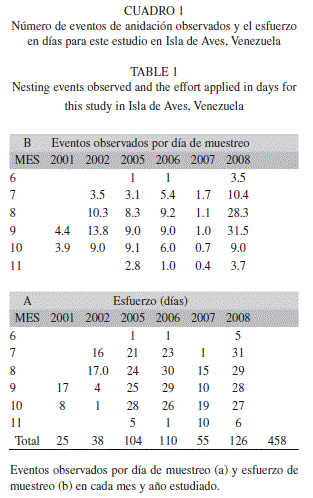
<body><![CDATA[<font size="2"></font><br style="font-family: verdana;">     <font size="2"><span style="font-family: verdana;">Muestreo y marcaje:     Durante los     seis a&ntilde;os de estudio, fueron muestreadas 458 noches, en las     cuales se observ&oacute; un total de 5 154 eventos (</span></font><font      size="2"><span style="font-family: verdana;"><img alt=""      src="file:///img/revistas/rbt/v60n2/a19f1.jpg"      style="width: 15px; height: 19px;"></span></font><font size="2"><span      style="font-family: verdana;">=11.3 eventos por     noche, rango 0 a 53) (<a href="#Cuadro_1">Cuadro 1</a>).    ]]></body>
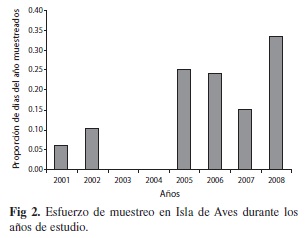
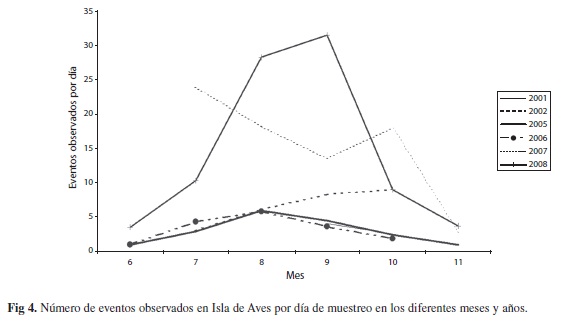
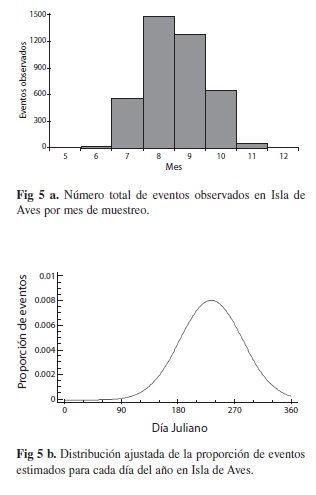
<body><![CDATA[<br>     <br> </span></font>     <div style="text-align: center;"><font size="2"><a name="Cuadro_1"></a><img  alt="" src="/img/revistas/rbt/v60n2/a19t1.gif"  style="width: 313px; height: 498px;"><span  style="font-family: verdana;"></span></font><br  style="font-family: verdana;"> <font size="2"><span style="font-family: verdana;"></span></font></div> <br style="font-family: verdana;"> <font size="2"><span style="font-family: verdana;">Las horas con mayor n&uacute;mero de eventos est&aacute;n comprendidas entre las 21hr de la noche y las 02hr de la madrugada y se registr&oacute; un mayor porcentaje de salidas de animales entre las 22 y 23hr (42%).</span></font><br  style="font-family: verdana;"> <font size="2"></font><br style="font-family: verdana;"> <font size="2"><span style="font-family: verdana;">El esfuerzo de muestreo vari&oacute; entre a&ntilde;os y meses, dadas las m&uacute;ltiples dificultades log&iacute;sticas y climatol&oacute;gicas, pero se trat&oacute; de concentrar en los meses de julio-octubre. </span></font><br  style="font-family: verdana;"> <font size="2"></font><br style="font-family: verdana;"> <font size="2"><span style="font-family: verdana;">El esquema de selecci&oacute;n de fechas a muestrear produjo una cobertura variable del a&ntilde;o (<a  href="#Fig_2">Fig. 2</a>), con un m&aacute;ximo de 35% de los posibles d&iacute;as de anidaci&oacute;n (2008) y un m&iacute;nimo de 7% (2001). Sin embargo, dada la ubicaci&oacute;n de estos d&iacute;as de muestreo en las fechas de m&aacute;s alta ocurrencia de eventos estimados, tanto por el ajuste de distribuci&oacute;n temporal como por el n&uacute;mero de eventos por d&iacute;a de muestreo, la eficacia del esquema temporal de distribuci&oacute;n de esfuerzo de muestreo se estima alcanz&oacute; un m&aacute;ximo de 82% (2008) con un m&iacute;nimo de 16% (2001) (<a  href="/img/revistas/rbt/v60n2/a19i3.jpg">Fig. 3</a>). Estas cifras consideran que durante los d&iacute;as de muestreo todos los eventos fueron reportados, lo cual no necesariamente es cierto, pues produce una subestimaci&oacute;n del n&uacute;mero total de eventos.    <br>     <br> </span></font>     <div style="text-align: center;"><font size="2"><a name="Fig_2"></a><img  alt="" src="/img/revistas/rbt/v60n2/a19i2.jpg"  style="width: 308px; height: 238px;"><span  style="font-family: verdana;"></span></font><br  style="font-family: verdana;"> <font size="2"><span style="font-family: verdana;"></span></font></div> <br style="font-family: verdana; font-weight: bold;"> <font size="2"><span style="font-family: verdana;"><span  style="font-weight: bold;">Distribuci&oacute;n espacial de la anidaci&oacute;n:</span> Las tortugas mostraron en sus salidas a la superficie de Isla de Aves, una preferencia por las zonas norte y sur de la misma. En 2001 los animales tuvieron preferencia por el sector sur. Durante 2002 hubo una preferencia pr&aacute;cticamente igual por el sector norte y el sector sur. El a&ntilde;o 2005, la tendencia fue marcada hacia el sector norte, probablemente por la presencia de nuevas luces externas (instaladas en 2004) en la base cient&iacute;fico-naval. Despu&eacute;s de haber minimizado en alguna medida el efecto de las luces, a trav&eacute;s de protectores rudimentarios, en la temporada 2006, los animales prefirieron el sector sur en m&aacute;s del 50% de los casos. </span></font><br style="font-family: verdana;"> <font size="2"></font><br style="font-family: verdana;"> <font size="2"><span style="font-family: verdana;">Estimaci&oacute;n del n&uacute;mero de eventos: El n&uacute;mero de eventos observados por d&iacute;a de muestreo, vari&oacute; tanto estacionalmente durante los meses del a&ntilde;o como con cada a&ntilde;o (<a href="#Fig_4">Fig. 4</a>). Es notable el claro aumento en n&uacute;mero de eventos durante los a&ntilde;os 2007 y 2008, a&uacute;n cuando los meses de mayor concentraci&oacute;n no coincidieron exactamente.     <br>     <br> </span></font>     <div style="text-align: center;"><font size="2"><a name="Fig_4"></a><img  alt="" src="/img/revistas/rbt/v60n2/a19i4.jpg"  style="width: 561px; height: 321px;"><span  style="font-family: verdana;"></span></font><br  style="font-family: verdana;"> <font size="2"><span style="font-family: verdana;"></span></font></div> <br style="font-family: verdana;"> <font size="2"><span style="font-family: verdana;">Aunque, las hembras de <span style="font-style: italic;">C. mydas</span> pueden anidar en Isla de Aves, en cualquier d&iacute;a del a&ntilde;o, las actividades reproductivas est&aacute;n concentradas en los meses de julio-octubre. Esto, causa una probable subestimaci&oacute;n del n&uacute;mero de hembras, pues el que no haya observaciones no garantiza que no lleguen hembras.</span></font><br  style="font-family: verdana;"> <font size="2"></font><br style="font-family: verdana;"> <font size="2"><span style="font-family: verdana;">La <a href="#Fig_5">figura 5A</a>, muestra el n&uacute;mero de eventos observados para cada mes en los seis a&ntilde;os analizados. Al estimar la proporci&oacute;n de anidaci&oacute;n para cada d&iacute;a del a&ntilde;o, y al ajustar la distribuci&oacute;n temporal a una distribuci&oacute;n normal ( </span></font><font  size="2"><span style="font-family: verdana;"><img alt=""  src="/img/revistas/rbt/v60n2/a19f1.jpg"  style="width: 15px; height: 19px;"></span></font><font size="2"><span  style="font-family: verdana;">=233.4 d&iacute;as, S=49.7 d&iacute;as) resulta la curva observada en la <a href="#Fig_5">figura 5B</a>. Con la informaci&oacute;n de esta distribuci&oacute;n estimamos los posibles eventos no observados. La <a  href="/img/revistas/rbt/v60n2/a19i6.jpg">figura 6</a> muestra el n&uacute;mero total de eventos estimados. Los valores var&iacute;an de </span></font><font size="2"><span style="font-family: verdana;"><img  alt="" src="/img/revistas/rbt/v60n2/a19f1.jpg"  style="width: 15px; height: 19px;"></span></font><font size="2"><span  style="font-family: verdana;">=637.1&plusmn;106.6 eventos en 2001 a </span></font><font  size="2"><span style="font-family: verdana;"><img alt=""  src="/img/revistas/rbt/v60n2/a19f1.jpg"  style="width: 15px; height: 19px;"></span></font><font size="2"><span  style="font-family: verdana;">=2 853&plusmn;42.5 eventos en 2008. Un an&aacute;lisis de varianza, previa comprobaci&oacute;n de la homogeneidad de las varianzas indica diferencia significativa entre el n&uacute;mero de eventos estimados por a&ntilde;o (F<sub>6 y 5gl</sub>=69.74, p&lt;0.0001). Una prueba a posteriori de Tukey HSD indica dos grupos, un grupo de bajo n&uacute;mero de eventos que incluye los a&ntilde;os 2001, 2002, 2005, 2006 y dos a&ntilde;os de alto n&uacute;mero de eventos estimados 2007 y 2008. La tendencia, muestra una relaci&oacute;n exponencial significativa (r=0.842, p=0.036).     <br>     ]]></body>
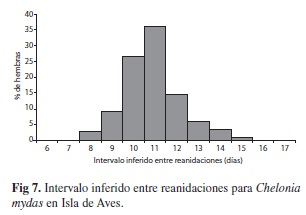
<body><![CDATA[<br> </span></font>     <div style="text-align: center;"><font size="2"><a name="Fig_5"></a><img  alt="" src="/img/revistas/rbt/v60n2/a19i5.jpg"  style="width: 316px; height: 495px;"><span  style="font-family: verdana;"></span></font><br  style="font-family: verdana;"> <font size="2"><span style="font-family: verdana;"></span></font></div> <br style="font-family: verdana;"> <font size="2"><span style="font-family: verdana;">Intervalo de reanidaci&oacute;n: Para Isla de Aves entre 2001-2008 el intervalo de reanidaci&oacute;n inferido medio, para las 1 150 hembras observadas reanidando en la misma temporada, fue de </span></font><font size="2"><span  style="font-family: verdana;"><img alt=""  src="/img/revistas/rbt/v60n2/a19f1.jpg"  style="width: 15px; height: 19px;"></span></font><font size="2"><span  style="font-family: verdana;">=10.71&plusmn;1.32 d&iacute;as (<a  href="#Fig_7">Fig. 7</a>). El intervalo entre anidaciones sucesivas es dif&iacute;cil de estimar sin contar con un muestreo de saturaci&oacute;n, es decir con la seguridad que todas las hembras que regresan son contabilizadas, lo cual es muy dif&iacute;cil en lugares como Isla de Aves, donde las condiciones meteorol&oacute;gicas o circunstancias log&iacute;sticas pueden interrumpir o dificultar las actividades.    <br>     <br> </span></font>     <div style="text-align: center;"><font size="2"><a name="Fig_7"></a><img  alt="" src="/img/revistas/rbt/v60n2/a19i7.jpg"  style="width: 306px; height: 215px;"><span  style="font-family: verdana;"></span></font><br  style="font-family: verdana;"> <font size="2"><span style="font-family: verdana;"></span></font></div> <br style="font-family: verdana;"> <font size="2"><span style="font-family: verdana;"><span  style="font-weight: bold;">Frecuencia de reanidaci&oacute;n:</span> En base a los 5 154 eventos observados, la frecuencia de puesta observada fue de </span></font><font size="2"><span  style="font-family: verdana;"><img alt=""  src="/img/revistas/rbt/v60n2/a19f1.jpg"  style="width: 15px; height: 19px;"></span></font><font size="2"><span  style="font-family: verdana;">=1.35&plusmn;0.75 veces y la inferida </span></font><font  size="2"><span style="font-family: verdana;"><img alt=""  src="/img/revistas/rbt/v60n2/a19f1.jpg"  style="width: 15px; height: 19px;"></span></font><font size="2"><span  style="font-family: verdana;">=1.71&plusmn;1.6 veces.</span></font><font size="2"><span style="font-family: verdana;">    <br>     <br>     Un 77.7% de las hembras marcadas     solo fueron observadas una vez en la misma temporada. En otras especies     de tortugas marinas, como <span style="font-style: italic;">Dermochelys     ]]></body>
<body><![CDATA[coriacea</span>, esto se ha atribuido a     que pueden anidar en otras playas de la regi&oacute;n pero para Isla de     Aves esto parece poco probable ya que solo hay reportes de una     anidaci&oacute;n en otro lugar distinto, de una hembra marcada en Isla     de Aves y lo m&aacute;s l&oacute;gico es asumir que hay reanidaciones     no reportadas.</span></font><br style="font-family: verdana;">     <font size="2"></font><br style="font-family: verdana;">     <font size="2"><span style="font-family: verdana;">El 13% de las     hembras permanecieron     en la zona m&aacute;s de dos meses entre la primera y la &uacute;ltima     ]]></body>
<body><![CDATA[anidaci&oacute;n observada, a pesar que en tres de los seis a&ntilde;os     analizados el muestreo fue inferior a 60 d&iacute;as.</span></font><br      style="font-family: verdana;">     <font size="2"></font><br style="font-family: verdana;">     <font size="2"><span style="font-family: verdana;">Estimaci&oacute;n     del n&uacute;mero     de hembras: El &eacute;xito de puesta, de una muestra de 393 eventos     observados entre julio-septiembre de 2007 fue de </span></font><font      size="2"><span style="font-family: verdana;"><img alt=""      src="/img/revistas/rbt/v60n2/a19f1.jpg"     ]]></body>
<body><![CDATA[ style="width: 15px; height: 19px;"></span></font><font size="2"><span      style="font-family: verdana;">=0.944 al aplicar la     formula de Gerrodette &amp; Taylor (1999) a los eventos estimados por     a&ntilde;o, corregidos por el &eacute;xito de puesta, resultan valores     entre </span></font><font size="2"><span style="font-family: verdana;"><img      alt="" src="/img/revistas/rbt/v60n2/a19f1.jpg"      style="width: 15px; height: 19px;"></span></font><font size="2"><span      style="font-family: verdana;">=373&plusmn;12.5 hembras para 2001 y </span></font><font      size="2"><span style="font-family: verdana;"><img alt=""      src="/img/revistas/rbt/v60n2/a19f1.jpg"     ]]></body>
<body><![CDATA[ style="width: 15px; height: 19px;"></span></font><font size="2"><span      style="font-family: verdana;">=1 669&plusmn;56.1 hembras     para 2008. La <a href="/img/revistas/rbt/v60n2/a19i8.jpg">Fig. 8</a>     muestra las estimaciones medias y las desviaciones     est&aacute;ndar, las incertidumbres se propagan entre la debida al     n&uacute;mero de nidadas por a&ntilde;o y la de la frecuencia de     anidaci&oacute;n (Lindberg 2000), por lo que son mayores que las     debidas a cualquiera de las estimaciones independientes. El     an&aacute;lisis de varianza, previa comprobaci&oacute;n de la     homogeneidad de las varianzas, indica diferencia significativa entre el     ]]></body>
<body><![CDATA[n&uacute;mero de hembras por a&ntilde;o (F<sub>5.6gl</sub>=167.61,     p&lt;0.0001).     El an&aacute;lisis <span style="font-style: italic;">a posteriori</span>     de Tukey HSD indica tres grupos de     a&ntilde;os de acuerdo con el n&uacute;mero de hembras que anidan, un     a&ntilde;o de baja anidaci&oacute;n 2001, un grupo de a&ntilde;os de     &#8220;media anidaci&oacute;n&#8221; entre 2002-2006 y un grupo de alta     anidaci&oacute;n en 2007 y 2008. La tendencia ascendente es exponencial     significativa (r=0.940, p=0.0052).</span></font><br      style="font-family: verdana;">     ]]></body>
<body><![CDATA[<font size="2"></font><br style="font-family: verdana;">     <font style="font-weight: bold;" size="3"><span      style="font-family: verdana;">Discusi&oacute;n</span></font><br      style="font-family: verdana;">     <font size="2"></font><br style="font-family: verdana;">     <font size="2"><span style="font-family: verdana;">Russo &amp; Girondot     (2009b),     postulan que la mejor estrategia para muestrear con recursos limitados     y lograr la mejor precisi&oacute;n de estimados de abundancia     interanual, es una noche cada diez noches durante los dos meses pico de     ]]></body>
<body><![CDATA[anidaci&oacute;n, pero ocho de cada diez noches durante el inicio y el     final de la temporada de desove. Este postulado es opuesto a lo que     tradicionalmente ocurre, concentrar los escasos recursos en los meses     picos de anidaci&oacute;n. La eficacia del esquema temporal de     distribuci&oacute;n del esfuerzo de muestreo, estimamos alcanz&oacute;     un m&aacute;ximo de 82% (2008) con un m&iacute;nimo de 16% (2001). En     un sitio de tan dif&iacute;cil log&iacute;stica como Isla de Aves, el     esfuerzo de 2008 o 2006 con 110 y 126 d&iacute;as de muestreo en las     &eacute;pocas </span></font><font size="2"><span      style="font-family: verdana;">pico es considerado &oacute;ptimo     ]]></body>
<body><![CDATA[pues maximiza resultados y minimiza costos.</span></font><br      style="font-family: verdana;">     <font size="2"></font><br style="font-family: verdana;">     <font size="2"><span style="font-family: verdana;">Los resultados de     distribuci&oacute;n espacial y las horas de mayor anidaci&oacute;n     coinciden con los resultados obtenidos por otros investigadores en Isla     de Aves durante las d&eacute;cadas de los 70 y 80 del siglo pasado     (Gremone &amp; G&oacute;mez 1983, Sol&eacute; &amp; Medina 1989,     Witherington 1992, Narciso &amp; Sol&eacute; 1999).</span></font><br      style="font-family: verdana;">     ]]></body>
<body><![CDATA[<font size="2"></font><br style="font-family: verdana;">     <font size="2"><span style="font-family: verdana;">La alta variabilidad     interanual del     esfuerzo reproductivo de las tortugas verdes, ha sido considerado como     producto de la variabilidad en la disponibilidad y calidad del alimento     y sabemos que en<span style="font-style: italic;"> C. mydas</span>,     dado su car&aacute;cter de herb&iacute;voro,     esta diferencia es m&aacute;xima (Broderick <span      style="font-style: italic;">et al.</span> 2001). Esto hace,     por un lado, que ocurran intercalados, a&ntilde;os de alto y bajo     ]]></body>
<body><![CDATA[n&uacute;mero de eventos reproductivos con otros de menor, lo que     ratifica la necesidad de una serie de tiempo prolongada para lograr     evidenciar tendencias. </span></font><br style="font-family: verdana;">     <font size="2"></font><br style="font-family: verdana;">     <font size="2"><span style="font-family: verdana;">El c&aacute;lculo     del n&uacute;mero     esperado de eventos para cada mes o fracci&oacute;n de mes no     muestreado, que fue efectuado con base en los datos observados de     n&uacute;mero de eventos para cada d&iacute;a, de cada mes de muestreo     y se ajust&oacute; la distribuci&oacute;n temporal a una     ]]></body>
<body><![CDATA[distribuci&oacute;n normal (Rond&oacute;n-Medicci <span      style="font-style: italic;">et al.</span> 2010) con     resultados satisfactorios. Otros modelos, como el modelo sinusoidal de     Gratiot <span style="font-style: italic;">et al.</span> (2006), y el     ajuste a una distribuci&oacute;n normal     usado por Rond&oacute;n-Medicci <span style="font-style: italic;">et     al.</span> (2010), asumen el     car&aacute;cter asint&oacute;tico de la distribuci&oacute;n temporal y     la simetr&iacute;a en la temporada de anidaci&oacute;n, es decir, la     misma tasa de incremento gradual de anidaci&oacute;n, al inicio y la     ]]></body>
<body><![CDATA[misma de disminuci&oacute;n, al final.</span></font><br      style="font-family: verdana;">     <font size="2"></font><br style="font-family: verdana;">     <font size="2"><span style="font-family: verdana;">Los intervalos entre     sucesivas     anidaciones en una misma temporada, var&iacute;an considerablemente     entre localidades y parecen ser propios de cada poblaci&oacute;n dentro     de una misma especie e incluso, donde hay variabilidad estacional en     las condiciones ambientales, a lo largo de una misma temporada. El     intervalo entre&nbsp; anidaci&oacute;n observado por Gremone &amp;     ]]></body>
<body><![CDATA[G&oacute;mez (1983) fue de 16.97&plusmn;9.82 d&iacute;as y de 14.6     d&iacute;as, y se corrigieron para aquellas que anidaron m&aacute;s de     una vez. En otros estudios, tanto Sol&eacute; &amp; Medina (1989), como     Pe&ntilde;aloza (2000), obtuvieron una moda de 11 d&iacute;as. </span></font><br      style="font-family: verdana;">     <font size="2"></font><br style="font-family: verdana;">     <font size="2"><span style="font-family: verdana;">Para la tortuga     verde en     Tortuguero, Costa Rica, Carr <span style="font-style: italic;">et al.</span>     (1978) encontraron 12.1     ]]></body>
<body><![CDATA[d&iacute;as. En Surinam, Schulz, (1975) report&oacute; 13.4 d&iacute;as     y para Ascensi&oacute;n entre 14.5 d&iacute;as (Carr 1975) y 13.9     d&iacute;as (Mortimer &amp; Carr 1987). Hirth (1980) en su resumen de     la biolog&iacute;a reproductiva de las tortugas marinas reporta, para     la tortuga verde en 21 localidades del mundo, valores medios entre un     m&aacute;ximo de 14.5 d&iacute;as en Ascensi&oacute;n (Carr &amp; Hirth     1962) y en Heron Island (Bustard 1972) y un m&iacute;nimo de 9.6     d&iacute;as para Yemen del Sur (Hirth &amp; Carr 1970). Sato <span      style="font-style: italic;">et al.</span>     (1998) consideran que el intervalo entre anidaciones consecutivas     ]]></body>
<body><![CDATA[constituye el periodo de maduraci&oacute;n de los huevos en el     oviducto, de tal manera que est&aacute; correlacionado negativamente     con la temperatura corporal y por lo tanto con la temperatura del agua.     Resultados similares han sido encontrados en el Mediterr&aacute;neo y     en Isla Ascensi&oacute;n (Hays <span style="font-style: italic;">et     al. </span>2002) y en Taiw&aacute;n, en dos     playas con diferentes condiciones ambientales vari&oacute; de 13.7     d&iacute;as en la m&aacute;s oce&aacute;nica a 10.6 d&iacute;as en la     m&aacute;s protegida y c&aacute;lida (Cheng <span      style="font-style: italic;">et al. </span>2008).</span></font><br     ]]></body>
<body><![CDATA[ style="font-family: verdana;">     <font size="2"></font><br style="font-family: verdana;">     <font size="2"><span style="font-family: verdana;">El n&uacute;mero de     nidadas por     hembra de <span style="font-style: italic;">C. mydas </span>en una     temporada es muy variable. </span></font><font size="2"><span      style="font-family: verdana;">Para Isla de Aves, Pe&ntilde;aloza     (2000) estima una media de 3.16&plusmn;2.16 nidadas/hembra y     Sol&eacute; &amp; Medina (1989) 2.6&plusmn;1.48 veces. Hirth (1997)     reporta para 23 colonias anidadoras distribuidas en todo el mundo,     ]]></body>
<body><![CDATA[medias entre 1.8 nidos por temporada para Hawai, (Balazs 1980) y 5.5     nidos para Heron Island, Australia (Limpus 1980), con rangos para la     mayor&iacute;a de las localidades entre uno y nueve nidos por     temporada. La alta variabilidad en el n&uacute;mero de nidos por     temporada para <span style="font-style: italic;">C. mydas</span>, es     atribuida a la variabilidad interanual y     entre las distintas &aacute;reas de forrajeo usadas, de la cantidad y     calidad del alimento disponible y las condiciones ambientales     (Broderick et al. 2001). Asimismo, encontramos que varias hembras     salieron a anidar en la isla hasta por m&aacute;s de 90 d&iacute;as. Ya     ]]></body>
<body><![CDATA[Gremone &amp; G&oacute;mez (1983) hab&iacute;an reportado hembras     durante 85 d&iacute;as.</span></font><br style="font-family: verdana;">     <font size="2"></font><br style="font-family: verdana;">     <font size="2"><span style="font-family: verdana;">El n&uacute;mero de     hembras que se     encuentran anidando es el m&aacute;s usual de los indicadores de     tendencias poblacionales. Sin embargo, Russo &amp; Girondot (2009b)     afirman que una tendencia baja (&plusmn;0.01) es imposible de demostrar     con una potencia (1-&szlig;, la capacidad de detectar una     hip&oacute;tesis     ]]></body>
<body><![CDATA[nula falsa) de 0.95. Para detectar una variaci&oacute;n de &plusmn;0.1     en el tama&ntilde;o de la poblaci&oacute;n, con esa misma potencia el     coeficiente de variaci&oacute;n interanual deber&iacute;a ser menor a     0.2, pero a&uacute;n con este requerimiento, la potencia para especies     con grandes variaciones interanuales, como la tortuga verde, es baja. </span></font><br      style="font-family: verdana;">     <font size="2"></font><br style="font-family: verdana;">     <font size="2"><span style="font-family: verdana;">Las estimaciones     previas del     n&uacute;mero de hembras anidando en Isla de Aves var&iacute;an mucho,     ]]></body>
<body><![CDATA[tanto en que fue estimado (hembras o nidadas), el lapso de la     observaci&oacute;n (diario, semanal, mensual o anual) y la potencia de     los c&aacute;lculos. Parece clara una tendencia a disminuir a partir de     las 150 a 200 hembras por noche observadas en 1948 (Pinchon 1967). De     acuerdo a esto, en tan solo 30 a&ntilde;os, de 1948 hasta 1978 cuando     fue creada la base cient&iacute;fico naval y se detuvo el saqueo de     nidadas y el sacrificio de hembras en Isla de Aves, la poblaci&oacute;n     disminuy&oacute; a cerca de la cuarta parte. Otras observaciones     mencionan 100 hembras por mes en 1973 (Ralston 1974). En los     a&ntilde;os siguientes las estimaciones se&ntilde;alaban de 300-500     ]]></body>
<body><![CDATA[hembras por temporada (Pritchard &amp; Trebbau 1984), n&uacute;mero     similar para 2006 (Guada &amp; Buitrago 2008), o entre 500-700 hembras     para 2004 (Vera 2004b). Pe&ntilde;aloza (2000), al modelar el     comportamiento de la poblaci&oacute;n durante los 19 a&ntilde;os     muestreados por FUDENA, estima el tama&ntilde;o de la poblaci&oacute;n     de hembras reproductivas de<span style="font-style: italic;"> C. mydas</span>     en Isla de Aves entre 347-1 439     hembras, con una tasa intr&iacute;nseca de crecimiento de la     poblaci&oacute;n de r=0.0099. Lo que significar&iacute;a que aunque     aparentemente la poblaci&oacute;n de tortuga verde de Isla de Aves     ]]></body>
<body><![CDATA[estaba aumentando, tardar&iacute;a aproximadamente 150 a&ntilde;os para     alcanzar los valores de la abundancia hist&oacute;rica.</span></font><br      style="font-family: verdana;">     <font size="2"></font><br style="font-family: verdana;">     <font size="2"><span style="font-family: verdana;">Los resultados     presentados     aqu&iacute; indican que el n&uacute;mero de hembras que anida en Isla     de Aves se ha incrementado. En 2007 y en 2008 se alcanzaron     n&uacute;meros estimados, entre 1 500-1 800 hembras anuales. Lo     m&aacute;s cerca a los niveles de hace 60 o m&aacute;s a&ntilde;os. En     ]]></body>
<body><![CDATA[otros lugares de anidaci&oacute;n de la misma especie, como Tortuguero,     Costa Rica, esto se ha interpretado como resultado del esfuerzo de     conservaci&oacute;n (Tro&euml;ng &amp; Rankin 2005). En Tortuguero se     observan tendencias positivas desde hace 25 a&ntilde;os con incrementos     del 94% por a&ntilde;o (Atkinson<span style="font-style: italic;"> et     al.</span> 2010). Es posible que     m&aacute;s de 30 a&ntilde;os de protecci&oacute;n del &aacute;rea de     reproducci&oacute;n y la presencia de m&aacute;s proyectos de     conservaci&oacute;n en sus &aacute;reas de distribuci&oacute;n,     est&eacute; resultando en un creciente n&uacute;mero de hembras y la     ]]></body>
<body><![CDATA[poblaci&oacute;n anidadora est&aacute; aumentando.</span></font><br      style="font-family: verdana;">     <font size="2"></font><br style="font-family: verdana;">     <font size="2"><span style="font-family: verdana;">Las incertidumbres     en las     estimaciones del n&uacute;mero de hembras en una poblaci&oacute;n con     un ciclo reproductivo tan complejo como el de la tortuga verde, son muy     grandes y requieren de la mayor precisi&oacute;n posible en la toma de     datos. En un sitio tan dif&iacute;cil log&iacute;sticamente como Isla     de Aves, esto requiere de un gran esfuerzo que debe ser apoyado con los     ]]></body>
<body><![CDATA[recursos apropiados y oportunos.</span></font><br      style="font-family: verdana;">     <font size="2"></font><br style="font-family: verdana;">     <font style="font-weight: bold;" size="3"><span      style="font-family: verdana;">Agradecimientos</span></font><br      style="font-family: verdana;">     <font size="2"></font><br style="font-family: verdana;">     <font size="2"><span style="font-family: verdana;">Los autores     agradecen a &#8220;The Archie     Carr Center for Sea Turtle Research&#8221; por haber proporcionado las marcas     ]]></body>
<body><![CDATA[met&aacute;licas y los instrumentos para el marcaje de las tortugas,     as&iacute; como a los diferentes funcionarios del Ministerio del     Ambiente y los voluntarios que participaron en el trabajo de     seguimiento. Adem&aacute;s, resulta pertinente reconocer el apoyo     log&iacute;stico brindado por la Armada de Venezuela durante las     distintas temporadas de anidaci&oacute;n. Contribuci&oacute;n 410 de la     Estaci&oacute;n de Investigaciones Marinas de Margarita.     Fundaci&oacute;n la Salle de Ciencias Naturales.</span></font><br      style="font-family: verdana;">     <font size="2"></font><br style="font-family: verdana;">     ]]></body>
<body><![CDATA[<font style="font-weight: bold;" size="2"><span      style="font-family: verdana;"></span></font>     <hr style="width: 100%; height: 2px;"><font style="font-weight: bold;"      size="3"><span style="font-family: verdana;">Referencias</span></font><br      style="font-family: verdana;">     <font size="2"></font><br style="font-family: verdana;">     <font size="2"><span style="font-family: verdana;">Alvarado, J. &amp;     T.M. Murphy.     1999. Nesting Periodicity and Internesting Behavior, p. 115-118. <span      style="font-style: italic;">In</span>     ]]></body>
<body><![CDATA[K.L. Eckert, K.A. Bjorndal, F.A. Abreu-Grobois &amp; M. Donnelly     (eds.). Research and Management Techniques for the Conservation of Sea     <!-- ref -->Turtles. Marine Turtle Specialist Group. IUCN/SSC, Washington D.C., USA.    &nbsp;&nbsp;&nbsp;&nbsp;&nbsp;&nbsp;&nbsp;&nbsp;[&#160;<a href="javascript:void(0);" onclick="javascript: window.open('/scielo.php?script=sci_nlinks&ref=1497434&pid=S0034-7744201200020001900001&lng=','','width=640,height=500,resizable=yes,scrollbars=1,menubar=yes,');">Links</a>&#160;]<!-- end-ref --><!-- ref --></span></font><br  style="font-family: verdana;"> <font size="2"></font><br style="font-family: verdana;"> <font size="2"><span style="font-family: verdana;">Antczak, A., J. Buitrago, M. Mackowiak de Antczak &amp; H.J. Guada. 2007. A Contribution to the History of Marine Turtles Exploitation in Venezuela. 59th Gulf Caribb. Fish. Inst: 63-73.    &nbsp;&nbsp;&nbsp;&nbsp;&nbsp;&nbsp;&nbsp;&nbsp;[&#160;<a href="javascript:void(0);" onclick="javascript: window.open('/scielo.php?script=sci_nlinks&ref=1497435&pid=S0034-7744201200020001900002&lng=','','width=640,height=500,resizable=yes,scrollbars=1,menubar=yes,');">Links</a>&#160;]<!-- end-ref --><!-- ref --></span></font><br style="font-family: verdana;"> <font size="2"></font><br style="font-family: verdana;"> <font size="2"><span style="font-family: verdana;">Atkinson, C., L. Berrondo Ramos &amp; E. Harrison. 2010. Report on the 2009 Green Turtle program at Tortuguero Costa Rica. Submitted to Caribbean Conservation </span></font><font  size="2"><span style="font-family: verdana;">Corporation and Ministry of the Environment Energy and Telecommunications, Costa Rica.    &nbsp;&nbsp;&nbsp;&nbsp;&nbsp;&nbsp;&nbsp;&nbsp;[&#160;<a href="javascript:void(0);" onclick="javascript: window.open('/scielo.php?script=sci_nlinks&ref=1497436&pid=S0034-7744201200020001900003&lng=','','width=640,height=500,resizable=yes,scrollbars=1,menubar=yes,');">Links</a>&#160;]<!-- end-ref --><!-- ref --></span></font><br  style="font-family: verdana;"> <font size="2"></font><br style="font-family: verdana;"> <font size="2"><span style="font-family: verdana;">Balazs, G.H. 1980. Synopsis of biological data on the green turtle in the Hawaiian Islands. NOAA Tech. Memo. NMFS, Honolulu, Hawai.    &nbsp;&nbsp;&nbsp;&nbsp;&nbsp;&nbsp;&nbsp;&nbsp;[&#160;<a href="javascript:void(0);" onclick="javascript: window.open('/scielo.php?script=sci_nlinks&ref=1497437&pid=S0034-7744201200020001900004&lng=','','width=640,height=500,resizable=yes,scrollbars=1,menubar=yes,');">Links</a>&#160;]<!-- end-ref --><!-- ref --></span></font><br  style="font-family: verdana;"> <font size="2"></font><br style="font-family: verdana;"> <font size="2"><span style="font-family: verdana;">Bjorndal, K.A., J.A. Wetherall, A.B. Bolten &amp; J.A. Mortimer. 1999. Twenty-six years of green turtle nesting at Tortuguero, Costa Rica: an encouraging trend. Conser. Bio. 13: 126-134.    &nbsp;&nbsp;&nbsp;&nbsp;&nbsp;&nbsp;&nbsp;&nbsp;[&#160;<a href="javascript:void(0);" onclick="javascript: window.open('/scielo.php?script=sci_nlinks&ref=1497438&pid=S0034-7744201200020001900005&lng=','','width=640,height=500,resizable=yes,scrollbars=1,menubar=yes,');">Links</a>&#160;]<!-- end-ref --><!-- ref --></span></font><br style="font-family: verdana;"> <font size="2"></font><br style="font-family: verdana;"> <font size="2"><span style="font-family: verdana;">Bolten, A. 2000. T&eacute;cnicas Para la Medici&oacute;n de Tortugas Marinas, p. 126-131. <span  style="font-style: italic;">In </span>K.L. Eckert, K.A. Bjorndal, F.A. Abreu- Grobois &amp; M. Donnelly (eds.). T&eacute;cnicas de Investigaci&oacute;n y Manejo para la Conservaci&oacute;n de las Tortugas Marinas. Grupo Especialista en Tortugas marinas UICN/CSE, Washington D.C., USA.    &nbsp;&nbsp;&nbsp;&nbsp;&nbsp;&nbsp;&nbsp;&nbsp;[&#160;<a href="javascript:void(0);" onclick="javascript: window.open('/scielo.php?script=sci_nlinks&ref=1497439&pid=S0034-7744201200020001900006&lng=','','width=640,height=500,resizable=yes,scrollbars=1,menubar=yes,');">Links</a>&#160;]<!-- end-ref --><!-- ref --></span></font><br  style="font-family: verdana;"> <font size="2"></font><br style="font-family: verdana;"> <font size="2"><span style="font-family: verdana;">Broderick, A.C., B.J Odley &amp; G.C. Hays. 2001. Trophic status drives interannual variability in nesting numbers of marine turtles. Proc. Royal Soc. London. Series B-Bio. Sci 268, no. 1475: 1481-1487.    &nbsp;&nbsp;&nbsp;&nbsp;&nbsp;&nbsp;&nbsp;&nbsp;[&#160;<a href="javascript:void(0);" onclick="javascript: window.open('/scielo.php?script=sci_nlinks&ref=1497440&pid=S0034-7744201200020001900007&lng=','','width=640,height=500,resizable=yes,scrollbars=1,menubar=yes,');">Links</a>&#160;]<!-- end-ref --><!-- ref --></span></font><br  style="font-family: verdana;"> <font size="2"></font><br style="font-family: verdana;"> <font size="2"><span style="font-family: verdana;">Broderick, A., F. Glen, B.J. Godley &amp; G.C. Hays. 2002. Estimating the number of green and loggerhead turtles nesting annually in the Mediterranean. Oryx 36: 227-236.    &nbsp;&nbsp;&nbsp;&nbsp;&nbsp;&nbsp;&nbsp;&nbsp;[&#160;<a href="javascript:void(0);" onclick="javascript: window.open('/scielo.php?script=sci_nlinks&ref=1497441&pid=S0034-7744201200020001900008&lng=','','width=640,height=500,resizable=yes,scrollbars=1,menubar=yes,');">Links</a>&#160;]<!-- end-ref --><!-- ref --></span></font><br  style="font-family: verdana;"> <font size="2"></font><br style="font-family: verdana;"> <font size="2"><span style="font-family: verdana;">Broderick, A., F. Glen, B.J. Godley &amp; G.C. Hays. 2003. Variation in reproductive output of marine turtles. J. Exp. Mar. Bio. Eco. 288: 95-109.    &nbsp;&nbsp;&nbsp;&nbsp;&nbsp;&nbsp;&nbsp;&nbsp;[&#160;<a href="javascript:void(0);" onclick="javascript: window.open('/scielo.php?script=sci_nlinks&ref=1497442&pid=S0034-7744201200020001900009&lng=','','width=640,height=500,resizable=yes,scrollbars=1,menubar=yes,');">Links</a>&#160;]<!-- end-ref --><!-- ref --></span></font><br  style="font-family: verdana;"> <font size="2"></font><br style="font-family: verdana;"> <font size="2"><span style="font-family: verdana;">Brownell, W. 1974. Las Tortugas Marinas de Venezuela. Natura 53: 35-39.    &nbsp;&nbsp;&nbsp;&nbsp;&nbsp;&nbsp;&nbsp;&nbsp;[&#160;<a href="javascript:void(0);" onclick="javascript: window.open('/scielo.php?script=sci_nlinks&ref=1497443&pid=S0034-7744201200020001900010&lng=','','width=640,height=500,resizable=yes,scrollbars=1,menubar=yes,');">Links</a>&#160;]<!-- end-ref --><!-- ref --></span></font><br  style="font-family: verdana;"> <font size="2"></font><br style="font-family: verdana;"> <font size="2"><span style="font-family: verdana;">Brownell, W. &amp; C. Guzm&aacute;n. 1974. Ecolog&iacute;a de la Isla de Aves con especial referencia a los peces. Mem. Soc. Cien. Nat. la Salle 34: 91-168.    &nbsp;&nbsp;&nbsp;&nbsp;&nbsp;&nbsp;&nbsp;&nbsp;[&#160;<a href="javascript:void(0);" onclick="javascript: window.open('/scielo.php?script=sci_nlinks&ref=1497444&pid=S0034-7744201200020001900011&lng=','','width=640,height=500,resizable=yes,scrollbars=1,menubar=yes,');">Links</a>&#160;]<!-- end-ref --><!-- ref --></span></font><br  style="font-family: verdana;"> <font size="2"></font><br style="font-family: verdana;"> <font size="2"><span style="font-family: verdana;">Bustard, H.R. 1972. Sea turtles: Their natural history and conservation. W. Collins &amp; Sons, London, United Kingdom.    &nbsp;&nbsp;&nbsp;&nbsp;&nbsp;&nbsp;&nbsp;&nbsp;[&#160;<a href="javascript:void(0);" onclick="javascript: window.open('/scielo.php?script=sci_nlinks&ref=1497445&pid=S0034-7744201200020001900012&lng=','','width=640,height=500,resizable=yes,scrollbars=1,menubar=yes,');">Links</a>&#160;]<!-- end-ref --><!-- ref --></span></font><br style="font-family: verdana;"> <font size="2"></font><br style="font-family: verdana;"> <font size="2"><span style="font-family: verdana;">Carr, A. 1975. The Ascension Island Green Turtle Colony. Copeia 1975: 547-555.    &nbsp;&nbsp;&nbsp;&nbsp;&nbsp;&nbsp;&nbsp;&nbsp;[&#160;<a href="javascript:void(0);" onclick="javascript: window.open('/scielo.php?script=sci_nlinks&ref=1497446&pid=S0034-7744201200020001900013&lng=','','width=640,height=500,resizable=yes,scrollbars=1,menubar=yes,');">Links</a>&#160;]<!-- end-ref --><!-- ref --></span></font><br  style="font-family: verdana;"> <font size="2"></font><br style="font-family: verdana;"> <font size="2"><span style="font-family: verdana;">Carr, A. &amp; H. Hirth. 1962. The ecology and migrations of sea turtles, 5. Comparative features of isolated green turtle colonies. Am Mus Novi 2091: 1-42.    &nbsp;&nbsp;&nbsp;&nbsp;&nbsp;&nbsp;&nbsp;&nbsp;[&#160;<a href="javascript:void(0);" onclick="javascript: window.open('/scielo.php?script=sci_nlinks&ref=1497447&pid=S0034-7744201200020001900014&lng=','','width=640,height=500,resizable=yes,scrollbars=1,menubar=yes,');">Links</a>&#160;]<!-- end-ref --><!-- ref --></span></font><br  style="font-family: verdana;"> <font size="2"></font><br style="font-family: verdana;"> <font size="2"><span style="font-family: verdana;">Carr, A., M.H. Carr &amp; A.B. Meylan. 1978. The ecology and migrations of sea turtles, 7. The west Caribbean green turtle colony. Bull. Am. Mus. Nat. Hist. 162: 1-46.    &nbsp;&nbsp;&nbsp;&nbsp;&nbsp;&nbsp;&nbsp;&nbsp;[&#160;<a href="javascript:void(0);" onclick="javascript: window.open('/scielo.php?script=sci_nlinks&ref=1497448&pid=S0034-7744201200020001900015&lng=','','width=640,height=500,resizable=yes,scrollbars=1,menubar=yes,');">Links</a>&#160;]<!-- end-ref --><!-- ref --></span></font><br  style="font-family: verdana;"> <font size="2"></font><br style="font-family: verdana;"> <font size="2"><span style="font-family: verdana;">Chac&oacute;n, D., C.J. S&aacute;nchez &amp; J. Ash. 2007. Manual para el Manejo y la Conservaci&oacute;n de las Tortugas Marinas en Costa Rica, con &Eacute;nfasis en la Operaci&oacute;n de Proyectos en Playas y Viveros. Sistema Nacional de &Aacute;reas de Conservaci&oacute;n (SINAC), Ministerio de Ambiente y Energ&iacute;a (MINAE), San Jos&eacute;, Costa Rica.    &nbsp;&nbsp;&nbsp;&nbsp;&nbsp;&nbsp;&nbsp;&nbsp;[&#160;<a href="javascript:void(0);" onclick="javascript: window.open('/scielo.php?script=sci_nlinks&ref=1497449&pid=S0034-7744201200020001900016&lng=','','width=640,height=500,resizable=yes,scrollbars=1,menubar=yes,');">Links</a>&#160;]<!-- end-ref --><!-- ref --></span></font><br style="font-family: verdana;"> <font size="2"></font><br style="font-family: verdana;"> <font size="2"><span style="font-family: verdana;">Chac&oacute;n, D., B. Dick, E. Harrison, L. Sarti &amp; M. Solano. 2008. Manual sobre T&eacute;cnicas de Manejo y Conservaci&oacute;n de las Tortugas Marinas en Playas de Anidaci&oacute;n de Centroam&eacute;rica. Secretar&iacute;a Pro Tempore de la Convenci&oacute;n Interamericana para la Protecci&oacute;n y Conservaci&oacute;n de las Tortugas Marinas (CIT), San Jos&eacute;, Costa Rica.    &nbsp;&nbsp;&nbsp;&nbsp;&nbsp;&nbsp;&nbsp;&nbsp;[&#160;<a href="javascript:void(0);" onclick="javascript: window.open('/scielo.php?script=sci_nlinks&ref=1497450&pid=S0034-7744201200020001900017&lng=','','width=640,height=500,resizable=yes,scrollbars=1,menubar=yes,');">Links</a>&#160;]<!-- end-ref --><!-- ref --></span></font><br style="font-family: verdana;"> <font size="2"></font><br style="font-family: verdana;"> <font size="2"><span style="font-family: verdana;">Cheng, I.J., P.H. Dutton, C.L. Chen, H.C. Chen, Y.H. Chen &amp; J.W. Shea. 2008. Comparison of the genetics and nesting ecology of two green turtle rookeries. J. Zoo 276: 375-384.    &nbsp;&nbsp;&nbsp;&nbsp;&nbsp;&nbsp;&nbsp;&nbsp;[&#160;<a href="javascript:void(0);" onclick="javascript: window.open('/scielo.php?script=sci_nlinks&ref=1497451&pid=S0034-7744201200020001900018&lng=','','width=640,height=500,resizable=yes,scrollbars=1,menubar=yes,');">Links</a>&#160;]<!-- end-ref --><!-- ref --></span></font><br style="font-family: verdana;"> <font size="2"></font><br style="font-family: verdana;"> <font size="2"><span style="font-family: verdana;">Evans, P.G.H. &amp; P.S. Hammond. 2004. Monitoring cetaceans in European waters. Mam. Rev. 34: 131-156.    &nbsp;&nbsp;&nbsp;&nbsp;&nbsp;&nbsp;&nbsp;&nbsp;[&#160;<a href="javascript:void(0);" onclick="javascript: window.open('/scielo.php?script=sci_nlinks&ref=1497452&pid=S0034-7744201200020001900019&lng=','','width=640,height=500,resizable=yes,scrollbars=1,menubar=yes,');">Links</a>&#160;]<!-- end-ref --><!-- ref --></span></font><br  style="font-family: verdana;"> <font size="2"></font><br style="font-family: verdana;"> <font size="2"><span style="font-family: verdana;">Gerrodette, T. &amp; B.L. Taylor. 1999. Estimating population size, p. 67-71. <span  style="font-style: italic;">In</span> K.L. Eckert, K.A. Bjorndal, F.A. Abreu-Grobois &amp; M. Donnelly (eds.). Research and </span></font><font  size="2"><span style="font-family: verdana;">Management Techniques for the Conservation of Sea Turtles. Publication N&ordm; 4. Marine Turtle Specialist Group. IUCN/SSC, Washington D.C., USA.    &nbsp;&nbsp;&nbsp;&nbsp;&nbsp;&nbsp;&nbsp;&nbsp;[&#160;<a href="javascript:void(0);" onclick="javascript: window.open('/scielo.php?script=sci_nlinks&ref=1497453&pid=S0034-7744201200020001900020&lng=','','width=640,height=500,resizable=yes,scrollbars=1,menubar=yes,');">Links</a>&#160;]<!-- end-ref --><!-- ref --></span></font><br  style="font-family: verdana;"> <font size="2"></font><br style="font-family: verdana;"> <font size="2"><span style="font-family: verdana;">Girondot, M., M.H. Godfrey, L. Ponge &amp; P. Rivalan. 2007. Modeling Approaches to Quantify leatherback nesting trends in French Guiana and Suriname. Chel. Cons. Bio. 6: 37-46.    &nbsp;&nbsp;&nbsp;&nbsp;&nbsp;&nbsp;&nbsp;&nbsp;[&#160;<a href="javascript:void(0);" onclick="javascript: window.open('/scielo.php?script=sci_nlinks&ref=1497454&pid=S0034-7744201200020001900021&lng=','','width=640,height=500,resizable=yes,scrollbars=1,menubar=yes,');">Links</a>&#160;]<!-- end-ref --><!-- ref --></span></font><br style="font-family: verdana;"> <font size="2"></font><br style="font-family: verdana;"> <font size="2"><span style="font-family: verdana;">G&oacute;mez, J.L. 1980. Conservaci&oacute;n del ecosistema de Isla de Aves con especial &eacute;nfasis en el control y marcaje de la tortuga verde (<span  style="font-style: italic;">Chelonia mydas</span>) y de las aves residentes y migratorias. Informe final del proyecto No. 43, FUDENA, Caracas, Venezuela.    &nbsp;&nbsp;&nbsp;&nbsp;&nbsp;&nbsp;&nbsp;&nbsp;[&#160;<a href="javascript:void(0);" onclick="javascript: window.open('/scielo.php?script=sci_nlinks&ref=1497455&pid=S0034-7744201200020001900022&lng=','','width=640,height=500,resizable=yes,scrollbars=1,menubar=yes,');">Links</a>&#160;]<!-- end-ref --><!-- ref --><br> <br style="font-family: verdana;"> </span></font><font size="2"><span style="font-family: verdana;">Gonz&aacute;lez, L.A. &amp; H.J. Guada. 1989. Algunos aspectos sobre la biolog&iacute;a de la tortuga verde <span style="font-style: italic;">Chelonia mydas</span> (Linnaeus), 1766 en especial la que anida en Isla de Aves. Venezuela Bol. Soc. Ven. Cien. Nat. 43: 213-226.    &nbsp;&nbsp;&nbsp;&nbsp;&nbsp;&nbsp;&nbsp;&nbsp;[&#160;<a href="javascript:void(0);" onclick="javascript: window.open('/scielo.php?script=sci_nlinks&ref=1497456&pid=S0034-7744201200020001900023&lng=','','width=640,height=500,resizable=yes,scrollbars=1,menubar=yes,');">Links</a>&#160;]<!-- end-ref --><!-- ref --></span></font><br  style="font-family: verdana;"> <font size="2"></font><br style="font-family: verdana;"> <font size="2"><span style="font-family: verdana;">Gratiot, N., J. Gratiot, L. Kelle &amp; B. De Thoisy. 2006. Estimation of the nesting season of marine turtles from incomplete data: statistical adjustment of a sinusoidal function. Ani. Cons. 9: 95-102.    &nbsp;&nbsp;&nbsp;&nbsp;&nbsp;&nbsp;&nbsp;&nbsp;[&#160;<a href="javascript:void(0);" onclick="javascript: window.open('/scielo.php?script=sci_nlinks&ref=1497457&pid=S0034-7744201200020001900024&lng=','','width=640,height=500,resizable=yes,scrollbars=1,menubar=yes,');">Links</a>&#160;]<!-- end-ref --><!-- ref --></span></font><br  style="font-family: verdana;"> <font size="2"></font><br style="font-family: verdana;"> <font size="2"><span style="font-family: verdana;">Gremone, C. &amp; J.L. G&oacute;mez. 1983. Isla de Aves como &aacute;rea de desove de la tortuga verde (<span style="font-style: italic;">Chelonia mydas</span>). Fudena, Caracas, Venezuela.    &nbsp;&nbsp;&nbsp;&nbsp;&nbsp;&nbsp;&nbsp;&nbsp;[&#160;<a href="javascript:void(0);" onclick="javascript: window.open('/scielo.php?script=sci_nlinks&ref=1497458&pid=S0034-7744201200020001900025&lng=','','width=640,height=500,resizable=yes,scrollbars=1,menubar=yes,');">Links</a>&#160;]<!-- end-ref --><!-- ref --></span></font><br  style="font-family: verdana;"> <font size="2"></font><br style="font-family: verdana;"> <font size="2"><span style="font-family: verdana;">Guada, H.J. &amp; G. Sol&eacute;. 2000. Plan de Acci&oacute;n para la Recuperaci&oacute;n de las Tortugas Marinas de Venezuela. A. Su&aacute;rez (ed.). Informe T&eacute;cnico del PAC No. 39. UNEP </span></font><font size="2"><span  style="font-family: verdana;">Carib. Envir Pro., Kingston, Jamaica.    &nbsp;&nbsp;&nbsp;&nbsp;&nbsp;&nbsp;&nbsp;&nbsp;[&#160;<a href="javascript:void(0);" onclick="javascript: window.open('/scielo.php?script=sci_nlinks&ref=1497459&pid=S0034-7744201200020001900026&lng=','','width=640,height=500,resizable=yes,scrollbars=1,menubar=yes,');">Links</a>&#160;]<!-- end-ref --><!-- ref --></span></font><br style="font-family: verdana;"> <font size="2"></font><br style="font-family: verdana;"> <font size="2"><span style="font-family: verdana;">Guada, H.J. &amp; J. Buitrago. 2008. Tortuga verde, p.169. <span style="font-style: italic;">In</span> J.P. Rodr&iacute;guez &amp; F. Rojas-Su&aacute;rez (eds.). Libro Rojo de la Fauna Venezolana. Provita y Shell Venezuela, </span></font><font size="2"><span  style="font-family: verdana;">S.A., Caracas, Venezuela.    &nbsp;&nbsp;&nbsp;&nbsp;&nbsp;&nbsp;&nbsp;&nbsp;[&#160;<a href="javascript:void(0);" onclick="javascript: window.open('/scielo.php?script=sci_nlinks&ref=1497460&pid=S0034-7744201200020001900027&lng=','','width=640,height=500,resizable=yes,scrollbars=1,menubar=yes,');">Links</a>&#160;]<!-- end-ref --><!-- ref --></span></font><br  style="font-family: verdana;"> <font size="2"></font><br style="font-family: verdana;"> <font size="2"><span style="font-family: verdana;">Hays, G.C., A.C. Broderick, F. Glen, B.J. Godley, J.D.R. Houghton &amp; J.D. Metcalfe. 2002. Water temperature and internesting intervals for loggerhead (<span  style="font-style: italic;">Caretta </span></span></font><font  size="2"><span style="font-family: verdana;"><span  style="font-style: italic;">caretta</span>) and green (<span  style="font-style: italic;">Chelonia mydas)</span> sea turtles. J. Ther. Bio. 27: 429-432.    &nbsp;&nbsp;&nbsp;&nbsp;&nbsp;&nbsp;&nbsp;&nbsp;[&#160;<a href="javascript:void(0);" onclick="javascript: window.open('/scielo.php?script=sci_nlinks&ref=1497461&pid=S0034-7744201200020001900028&lng=','','width=640,height=500,resizable=yes,scrollbars=1,menubar=yes,');">Links</a>&#160;]<!-- end-ref --><!-- ref --></span></font><br  style="font-family: verdana;"> <font size="2"></font><br style="font-family: verdana;"> <font size="2"><span style="font-family: verdana;">Hilterman, M. &amp; E. Goverse. 2007. Nesting and nest success of the leatherback turtle (<span  style="font-style: italic;">Dermochelys coriacea</span>) in Suriname, 1999-2005. Chel. Cons. Bio. 6: 87-100.    &nbsp;&nbsp;&nbsp;&nbsp;&nbsp;&nbsp;&nbsp;&nbsp;[&#160;<a href="javascript:void(0);" onclick="javascript: window.open('/scielo.php?script=sci_nlinks&ref=1497462&pid=S0034-7744201200020001900029&lng=','','width=640,height=500,resizable=yes,scrollbars=1,menubar=yes,');">Links</a>&#160;]<!-- end-ref --><!-- ref --></span></font><br  style="font-family: verdana;"> <font size="2"></font><br style="font-family: verdana;"> <font size="2"><span style="font-family: verdana;">Hirth, H.F. 1980. Some aspects of the nesting behavior and reproductive biology of sea turtles. Amer. Zool. 20: 507-523.    &nbsp;&nbsp;&nbsp;&nbsp;&nbsp;&nbsp;&nbsp;&nbsp;[&#160;<a href="javascript:void(0);" onclick="javascript: window.open('/scielo.php?script=sci_nlinks&ref=1497463&pid=S0034-7744201200020001900030&lng=','','width=640,height=500,resizable=yes,scrollbars=1,menubar=yes,');">Links</a>&#160;]<!-- end-ref --><!-- ref --></span></font><br style="font-family: verdana;"> <font size="2"></font><br style="font-family: verdana;"> <font size="2"><span style="font-family: verdana;">Hirth, H.F. 1997. Synopsis of the biological data on the green turtle <span style="font-style: italic;">Chelonia mydas</span> (Linnaeus 1758). FWS Bio. Rep. 97 Tech Report p.126.    &nbsp;&nbsp;&nbsp;&nbsp;&nbsp;&nbsp;&nbsp;&nbsp;[&#160;<a href="javascript:void(0);" onclick="javascript: window.open('/scielo.php?script=sci_nlinks&ref=1497464&pid=S0034-7744201200020001900031&lng=','','width=640,height=500,resizable=yes,scrollbars=1,menubar=yes,');">Links</a>&#160;]<!-- end-ref --><!-- ref --></span></font><br  style="font-family: verdana;"> <font size="2"></font><br style="font-family: verdana;"> <font size="2"><span style="font-family: verdana;">Hirth, H.F. &amp; A. Carr. 1970. The green turtle in the Gulf of Aden and the Seychelles Islands. Verb. Konin. Nederl. Akad. Weten., Afd. Natuur. Tweede Reeks 58: 1-44.    &nbsp;&nbsp;&nbsp;&nbsp;&nbsp;&nbsp;&nbsp;&nbsp;[&#160;<a href="javascript:void(0);" onclick="javascript: window.open('/scielo.php?script=sci_nlinks&ref=1497465&pid=S0034-7744201200020001900032&lng=','','width=640,height=500,resizable=yes,scrollbars=1,menubar=yes,');">Links</a>&#160;]<!-- end-ref --><!-- ref --></span></font><br  style="font-family: verdana;"> <font size="2"></font><br style="font-family: verdana;"> <font size="2"><span style="font-family: verdana;">IUCN. 2004. IUCN red list of threatened species. 2004. (Consultado: 25 de julio de 2010, <a href="http://www.redlist.org">http://www.redlist.org</a>).    &nbsp;&nbsp;&nbsp;&nbsp;&nbsp;&nbsp;&nbsp;&nbsp;[&#160;<a href="javascript:void(0);" onclick="javascript: window.open('/scielo.php?script=sci_nlinks&ref=1497466&pid=S0034-7744201200020001900033&lng=','','width=640,height=500,resizable=yes,scrollbars=1,menubar=yes,');">Links</a>&#160;]<!-- end-ref --><!-- ref --></span></font><br  style="font-family: verdana;"> <font size="2"></font><br style="font-family: verdana;"> <font size="2"><span style="font-family: verdana;">Jackson, A.L., A.C. Broderick, W.J. Fullerb, F. Glen, G.D. Ruxtond &amp; B. Godley. 2008. Sampling design and its effect on population monitoring: How much </span></font><font  size="2"><span style="font-family: verdana;">monitoring do turtles really need? Bio. Cons. 141: 2932-2941.    &nbsp;&nbsp;&nbsp;&nbsp;&nbsp;&nbsp;&nbsp;&nbsp;[&#160;<a href="javascript:void(0);" onclick="javascript: window.open('/scielo.php?script=sci_nlinks&ref=1497467&pid=S0034-7744201200020001900034&lng=','','width=640,height=500,resizable=yes,scrollbars=1,menubar=yes,');">Links</a>&#160;]<!-- end-ref --><!-- ref --></span></font><br  style="font-family: verdana;"> <font size="2"></font><br style="font-family: verdana;"> <font size="2"><span style="font-family: verdana;">Kerr, R., J.L. Richardson &amp; T.H. Richardson. 1999. Estimating the annual size of hawksbill (<span style="font-style: italic;">Eretmochelys imbricata</span>) nesting populations from mark-recapture </span></font><font size="2"><span  style="font-family: verdana;">studies: the use of long-term data to provide statistics for optimizing survey effort. Che. Cons. Bio. 3: 251-256.    &nbsp;&nbsp;&nbsp;&nbsp;&nbsp;&nbsp;&nbsp;&nbsp;[&#160;<a href="javascript:void(0);" onclick="javascript: window.open('/scielo.php?script=sci_nlinks&ref=1497468&pid=S0034-7744201200020001900035&lng=','','width=640,height=500,resizable=yes,scrollbars=1,menubar=yes,');">Links</a>&#160;]<!-- end-ref --><!-- ref --></span></font><br style="font-family: verdana;"> <font size="2"></font><br style="font-family: verdana;"> <font size="2"><span style="font-family: verdana;">L&aacute;iz, J. 1979. Conservaci&oacute;n del ecosistema &#8220;Isla de Aves&#8221; con especial &eacute;nfasis en el control y marcaje de la tortuga verde (<span  style="font-style: italic;">Chelonia mydas</span>) y de las aves residentes y migratorias. FUDENA.    &nbsp;&nbsp;&nbsp;&nbsp;&nbsp;&nbsp;&nbsp;&nbsp;[&#160;<a href="javascript:void(0);" onclick="javascript: window.open('/scielo.php?script=sci_nlinks&ref=1497469&pid=S0034-7744201200020001900036&lng=','','width=640,height=500,resizable=yes,scrollbars=1,menubar=yes,');">Links</a>&#160;]<!-- end-ref --><!-- ref --></span></font><br  style="font-family: verdana;"> <font size="2"></font><br style="font-family: verdana;"> <font size="2"><span style="font-family: verdana;">Limpus, C.J. 1980. The green turtle, <span style="font-style: italic;">Chelonia mydas</span> (L) in eastern Australia. Management of turtle resources. James Cook University of North Queensland, </span></font><font  size="2"><span style="font-family: verdana;">Research Monograph 1: 5-22.    &nbsp;&nbsp;&nbsp;&nbsp;&nbsp;&nbsp;&nbsp;&nbsp;[&#160;<a href="javascript:void(0);" onclick="javascript: window.open('/scielo.php?script=sci_nlinks&ref=1497470&pid=S0034-7744201200020001900037&lng=','','width=640,height=500,resizable=yes,scrollbars=1,menubar=yes,');">Links</a>&#160;]<!-- end-ref --><!-- ref --></span></font><br style="font-family: verdana;"> <font size="2"></font><br style="font-family: verdana;"> <font size="2"><span style="font-family: verdana;">Lindberg, V. 2000. Uncertainties and Error Propagation. (Consultado: 4 de agosto de 2010, <a href="http://www.rit.edu/cos/uphysics/uncertainties/">http://www.rit.edu/cos/uphysics/uncertainties/</a>).    &nbsp;&nbsp;&nbsp;&nbsp;&nbsp;&nbsp;&nbsp;&nbsp;[&#160;<a href="javascript:void(0);" onclick="javascript: window.open('/scielo.php?script=sci_nlinks&ref=1497471&pid=S0034-7744201200020001900038&lng=','','width=640,height=500,resizable=yes,scrollbars=1,menubar=yes,');">Links</a>&#160;]<!-- end-ref --><!-- ref --><br> <br style="font-family: verdana;"> </span></font><font size="2"><span style="font-family: verdana;">Mortimer, J.A. &amp; A. Carr. 1987. Reproduction and Migrations of the Ascension Island Green Turtle <span style="font-style: italic;">Chelonia mydas.</span> Copeia 1: 103-113.    &nbsp;&nbsp;&nbsp;&nbsp;&nbsp;&nbsp;&nbsp;&nbsp;[&#160;<a href="javascript:void(0);" onclick="javascript: window.open('/scielo.php?script=sci_nlinks&ref=1497472&pid=S0034-7744201200020001900039&lng=','','width=640,height=500,resizable=yes,scrollbars=1,menubar=yes,');">Links</a>&#160;]<!-- end-ref --><!-- ref --></span></font><br style="font-family: verdana;"> <font size="2"></font><br style="font-family: verdana;"> <font size="2"><span style="font-family: verdana;">Narciso, S. &amp; G. Sol&eacute;. 1999. Seguimiento a la poblaci&oacute;n reproductora de la Tortuga Verde <span style="font-style: italic;">Chelonia mydas</span> en el refugio de fauna silvestre Isla de Aves en el lapso </span></font><font size="2"><span  style="font-family: verdana;">comprendido 1979-1997. Acta Cient. Ven. 233.    &nbsp;&nbsp;&nbsp;&nbsp;&nbsp;&nbsp;&nbsp;&nbsp;[&#160;<a href="javascript:void(0);" onclick="javascript: window.open('/scielo.php?script=sci_nlinks&ref=1497473&pid=S0034-7744201200020001900040&lng=','','width=640,height=500,resizable=yes,scrollbars=1,menubar=yes,');">Links</a>&#160;]<!-- end-ref --><!-- ref --></span></font><br style="font-family: verdana;"> <font size="2"></font><br style="font-family: verdana;"> <font size="2"><span style="font-family: verdana;">Pe&ntilde;aloza, C. 2000. Demograf&iacute;a y viabilidad de la poblaci&oacute;n de tortuga verde, <span style="font-style: italic;">Chelonia mydas</span>, en Isla de Aves. Tesis Licenciatura, Universidad Sim&oacute;n Bol&iacute;var, Sartenejas, Venezuela.    &nbsp;&nbsp;&nbsp;&nbsp;&nbsp;&nbsp;&nbsp;&nbsp;[&#160;<a href="javascript:void(0);" onclick="javascript: window.open('/scielo.php?script=sci_nlinks&ref=1497474&pid=S0034-7744201200020001900041&lng=','','width=640,height=500,resizable=yes,scrollbars=1,menubar=yes,');">Links</a>&#160;]<!-- end-ref --><!-- ref --></span></font><br  style="font-family: verdana;"> <font size="2"></font><br style="font-family: verdana;"> <font size="2"><span style="font-family: verdana;">Pinchon, P. 1967. The green turtle and hawksbill (Reptilia: Cheloniidae) world status, exploitation and trade, p. 125-129. <span style="font-style: italic;">In </span>B. Groombridge &amp; R. Luxmoore 1989 </span></font><font size="2"><span  style="font-family: verdana;">(eds.). Secretariat of the Convention on International Trade in Endangered Species of Wild Fauna and Flora, Lausanne, Switzerland.    &nbsp;&nbsp;&nbsp;&nbsp;&nbsp;&nbsp;&nbsp;&nbsp;[&#160;<a href="javascript:void(0);" onclick="javascript: window.open('/scielo.php?script=sci_nlinks&ref=1497475&pid=S0034-7744201200020001900042&lng=','','width=640,height=500,resizable=yes,scrollbars=1,menubar=yes,');">Links</a>&#160;]<!-- end-ref --><!-- ref --></span></font><br  style="font-family: verdana;"> <font size="2"></font><br style="font-family: verdana;"> <font size="2"><span style="font-family: verdana;">Pritchard, P.C.H. &amp; P. Trebbau. 1984. The Turtles of Venezuela. Contributions to Herpetology, Number 2. Society for the Study of Amphibians and Reptiles. Ann Arbor, Michigan, USA.    &nbsp;&nbsp;&nbsp;&nbsp;&nbsp;&nbsp;&nbsp;&nbsp;[&#160;<a href="javascript:void(0);" onclick="javascript: window.open('/scielo.php?script=sci_nlinks&ref=1497476&pid=S0034-7744201200020001900043&lng=','','width=640,height=500,resizable=yes,scrollbars=1,menubar=yes,');">Links</a>&#160;]<!-- end-ref --><!-- ref --></span></font><br style="font-family: verdana;"> <font size="2"></font><br style="font-family: verdana;"> <font size="2"><span style="font-family: verdana;">Rainey, W.E. 1977. Tagging at Aves Island, Venezuela. Mar. Turt. News 2: 6-7.    &nbsp;&nbsp;&nbsp;&nbsp;&nbsp;&nbsp;&nbsp;&nbsp;[&#160;<a href="javascript:void(0);" onclick="javascript: window.open('/scielo.php?script=sci_nlinks&ref=1497477&pid=S0034-7744201200020001900044&lng=','','width=640,height=500,resizable=yes,scrollbars=1,menubar=yes,');">Links</a>&#160;]<!-- end-ref --><!-- ref --></span></font><br  style="font-family: verdana;"> <font size="2"></font><br style="font-family: verdana;"> <font size="2"><span style="font-family: verdana;">Rainey, W.E &amp; P.C.H. Pritchard. 1972. Distribution and management of Caribbean sea turtles. Virgin Islands Ecological Research Station, Caribbean Research </span></font><font  size="2"><span style="font-family: verdana;">Institute, College of Virgin Islands, St. Thomas. Contribution No. 105.    &nbsp;&nbsp;&nbsp;&nbsp;&nbsp;&nbsp;&nbsp;&nbsp;[&#160;<a href="javascript:void(0);" onclick="javascript: window.open('/scielo.php?script=sci_nlinks&ref=1497478&pid=S0034-7744201200020001900045&lng=','','width=640,height=500,resizable=yes,scrollbars=1,menubar=yes,');">Links</a>&#160;]<!-- end-ref --><br>     <!-- ref --><br> Ralston, C. 1974. Un mes en Isla de Aves. Natura 53: 29-33.    &nbsp;&nbsp;&nbsp;&nbsp;&nbsp;&nbsp;&nbsp;&nbsp;[&#160;<a href="javascript:void(0);" onclick="javascript: window.open('/scielo.php?script=sci_nlinks&ref=1497480&pid=S0034-7744201200020001900046&lng=','','width=640,height=500,resizable=yes,scrollbars=1,menubar=yes,');">Links</a>&#160;]<!-- end-ref --><!-- ref --></span></font><br  style="font-family: verdana;"> <font size="2"></font><br style="font-family: verdana;"> <font size="2"><span style="font-family: verdana;">Rond&oacute;n-M&eacute;dici, M., J. Buitrago &amp; H.J. Guada 2010. Biolog&iacute;a reproductiva de la tortuga card&oacute;n (<span style="font-style: italic;">Dermochelys coriacea</span>) en playas de la Pen&iacute;nsula de Paria, </span></font><font size="2"><span  style="font-family: verdana;">Venezuela, durante las temporadas de anidaci&oacute;n 2000-2006. Interciencia 35: 263-270.    &nbsp;&nbsp;&nbsp;&nbsp;&nbsp;&nbsp;&nbsp;&nbsp;[&#160;<a href="javascript:void(0);" onclick="javascript: window.open('/scielo.php?script=sci_nlinks&ref=1497481&pid=S0034-7744201200020001900047&lng=','','width=640,height=500,resizable=yes,scrollbars=1,menubar=yes,');">Links</a>&#160;]<!-- end-ref --><!-- ref --></span></font><br  style="font-family: verdana;"> <font size="2"></font><br style="font-family: verdana;"> <font size="2"><span style="font-family: verdana;">Russo, M. &amp; M. Girondot. 2009a. How long to monitor marine turtle populations to conclude for a trend? Ecol. Sys. Evol. Final report. Par&iacute;s. Francia.    &nbsp;&nbsp;&nbsp;&nbsp;&nbsp;&nbsp;&nbsp;&nbsp;[&#160;<a href="javascript:void(0);" onclick="javascript: window.open('/scielo.php?script=sci_nlinks&ref=1497482&pid=S0034-7744201200020001900048&lng=','','width=640,height=500,resizable=yes,scrollbars=1,menubar=yes,');">Links</a>&#160;]<!-- end-ref --><!-- ref --></span></font><br  style="font-family: verdana;"> <font size="2"></font><br style="font-family: verdana;"> <font size="2"><span style="font-family: verdana;">Russo, M. &amp; M. Girondot. 2009b. How many night counts to get a defined level of intraannual coefficient of variation for nest counts? Ecol. Sys. Evol. Final report. Paris. Francia.    &nbsp;&nbsp;&nbsp;&nbsp;&nbsp;&nbsp;&nbsp;&nbsp;[&#160;<a href="javascript:void(0);" onclick="javascript: window.open('/scielo.php?script=sci_nlinks&ref=1497483&pid=S0034-7744201200020001900049&lng=','','width=640,height=500,resizable=yes,scrollbars=1,menubar=yes,');">Links</a>&#160;]<!-- end-ref --><!-- ref --></span></font><br style="font-family: verdana;"> <font size="2"></font><br style="font-family: verdana;"> <font size="2"><span style="font-family: verdana;">Sato, K., Y. Matsuzawa, H. Tanaka, T. Bando, S. Minamikawa, W. Sakamoto &amp; Y. Naito. 1998. Internesting intervals for loggerhead turtles, <span style="font-style: italic;">Caretta caretta</span>, and </span></font><font size="2"><span  style="font-family: verdana;">green turtles, <span  style="font-style: italic;">Chelonia mydas</span>, are affected by temperatura Can. J. Zool. Rev. Can. Zool. 76: 1651-1662.    &nbsp;&nbsp;&nbsp;&nbsp;&nbsp;&nbsp;&nbsp;&nbsp;[&#160;<a href="javascript:void(0);" onclick="javascript: window.open('/scielo.php?script=sci_nlinks&ref=1497484&pid=S0034-7744201200020001900050&lng=','','width=640,height=500,resizable=yes,scrollbars=1,menubar=yes,');">Links</a>&#160;]<!-- end-ref --><!-- ref --></span></font><br  style="font-family: verdana;"> <font size="2"></font><br style="font-family: verdana;"> <font size="2"><span style="font-family: verdana;">Seminoff, J. 2004. Marine Turtle Specialist Group Review 2004 Global Status Assessment Green turtle (<span style="font-style: italic;">Chelonia mydas</span>). Marine Turtle Specialist Group. The </span></font><font size="2"><span  style="font-family: verdana;">World Conservation Union (IUCN). Species Survival Comisi&oacute;n. Red List Programme. Washington, USA.    &nbsp;&nbsp;&nbsp;&nbsp;&nbsp;&nbsp;&nbsp;&nbsp;[&#160;<a href="javascript:void(0);" onclick="javascript: window.open('/scielo.php?script=sci_nlinks&ref=1497485&pid=S0034-7744201200020001900051&lng=','','width=640,height=500,resizable=yes,scrollbars=1,menubar=yes,');">Links</a>&#160;]<!-- end-ref --><!-- ref --></span></font><br  style="font-family: verdana;"> <font size="2"></font><br style="font-family: verdana;"> <font size="2"><span style="font-family: verdana;">Schroeder, B. &amp; S. Murphy. 1999 Population surveys on nesting beaches, p. 45-55. <span  style="font-style: italic;">In</span> K.L. Eckert, K.A. Bjorndal, F.A. Abreu-Grobois &amp; M. Donnelly (eds.). Research and Management Techniques for the Conservation of Sea Turtles. Marine Turtle Specialist Group. IUCN/SSC. Washington D.C. USA.    &nbsp;&nbsp;&nbsp;&nbsp;&nbsp;&nbsp;&nbsp;&nbsp;[&#160;<a href="javascript:void(0);" onclick="javascript: window.open('/scielo.php?script=sci_nlinks&ref=1497486&pid=S0034-7744201200020001900052&lng=','','width=640,height=500,resizable=yes,scrollbars=1,menubar=yes,');">Links</a>&#160;]<!-- end-ref --><!-- ref --></span></font><br  style="font-family: verdana;"> <font size="2"></font><br style="font-family: verdana;"> <font size="2"><span style="font-family: verdana;">Schulz, J.P. 1975. Sea turtles nesting in Suriname. Neder. Corn. Int. Natuur. Med. No. 23, STINASU, Verh. No. 3.    &nbsp;&nbsp;&nbsp;&nbsp;&nbsp;&nbsp;&nbsp;&nbsp;[&#160;<a href="javascript:void(0);" onclick="javascript: window.open('/scielo.php?script=sci_nlinks&ref=1497487&pid=S0034-7744201200020001900053&lng=','','width=640,height=500,resizable=yes,scrollbars=1,menubar=yes,');">Links</a>&#160;]<!-- end-ref --><!-- ref --></span></font><br style="font-family: verdana;"> <font size="2"></font><br style="font-family: verdana;"> <font size="2"><span style="font-family: verdana;">Sol&eacute;, G. 1992. Isla de Aves, un refugio para la tortuga verde. Profauna 2: 19-20.    &nbsp;&nbsp;&nbsp;&nbsp;&nbsp;&nbsp;&nbsp;&nbsp;[&#160;<a href="javascript:void(0);" onclick="javascript: window.open('/scielo.php?script=sci_nlinks&ref=1497488&pid=S0034-7744201200020001900054&lng=','','width=640,height=500,resizable=yes,scrollbars=1,menubar=yes,');">Links</a>&#160;]<!-- end-ref --><!-- ref --></span></font><br  style="font-family: verdana;"> <font size="2"></font><br style="font-family: verdana;"> <font size="2"><span style="font-family: verdana;">Sol&eacute;, G. &amp; G. Medina. 1989. The Green turtles of Aves Island: 171-173 <span  style="font-style: italic;">In.</span> S.A. Eckert, K.L. Eckert &amp; T.H. Richardson (Compilers). Proceedings of the Ninth Annual Workshop on Sea Turtle Conservation and Biology. NOAA Technical Memorandum </span></font><font size="2"><span  style="font-family: verdana;">NMFS-SEFC-232.    &nbsp;&nbsp;&nbsp;&nbsp;&nbsp;&nbsp;&nbsp;&nbsp;[&#160;<a href="javascript:void(0);" onclick="javascript: window.open('/scielo.php?script=sci_nlinks&ref=1497489&pid=S0034-7744201200020001900055&lng=','','width=640,height=500,resizable=yes,scrollbars=1,menubar=yes,');">Links</a>&#160;]<!-- end-ref --><!-- ref --></span></font><br  style="font-family: verdana;"> <font size="2"></font><br style="font-family: verdana;"> <font size="2"><span style="font-family: verdana;">Tro&euml;ng, S., D. Chac&oacute;n &amp; B. Dick. 2004. Possible decline in leatherback turtle <span  style="font-style: italic;">Dermochelys coriacea </span>nesting along the coast of Caribbean Central America. Oryx </span></font><font size="2"><span style="font-family: verdana;">38: 395-403.    &nbsp;&nbsp;&nbsp;&nbsp;&nbsp;&nbsp;&nbsp;&nbsp;[&#160;<a href="javascript:void(0);" onclick="javascript: window.open('/scielo.php?script=sci_nlinks&ref=1497490&pid=S0034-7744201200020001900056&lng=','','width=640,height=500,resizable=yes,scrollbars=1,menubar=yes,');">Links</a>&#160;]<!-- end-ref --><!-- ref --></span></font><br style="font-family: verdana;"> <font size="2"></font><br style="font-family: verdana;"> <font size="2"><span style="font-family: verdana;">Tro&euml;ng, S. &amp; E. Rankin. 2005. Long-term conservation efforts contribute to positive green turtle <span style="font-style: italic;">Chelonia mydas </span>nesting trend at Tortuguero, Costa Rica. Biol. Conserv. 121: 111-116.    &nbsp;&nbsp;&nbsp;&nbsp;&nbsp;&nbsp;&nbsp;&nbsp;[&#160;<a href="javascript:void(0);" onclick="javascript: window.open('/scielo.php?script=sci_nlinks&ref=1497491&pid=S0034-7744201200020001900057&lng=','','width=640,height=500,resizable=yes,scrollbars=1,menubar=yes,');">Links</a>&#160;]<!-- end-ref --><!-- ref --></span></font><br style="font-family: verdana;"> <font size="2"></font><br style="font-family: verdana;"> <font size="2"><span style="font-family: verdana;">Vera, V. 2002. Restarting the green turtle (<span style="font-style: italic;">Chelonia mydas</span>) tagging and conservation project in Aves Island Wildlife Refuge. Venezuela. 22 Annual Symposium on Sea Turtle Biology and Conservation. Miami, Florida, USA.    &nbsp;&nbsp;&nbsp;&nbsp;&nbsp;&nbsp;&nbsp;&nbsp;[&#160;<a href="javascript:void(0);" onclick="javascript: window.open('/scielo.php?script=sci_nlinks&ref=1497492&pid=S0034-7744201200020001900058&lng=','','width=640,height=500,resizable=yes,scrollbars=1,menubar=yes,');">Links</a>&#160;]<!-- end-ref --><!-- ref --></span></font><br  style="font-family: verdana;"> <font size="2"></font><br style="font-family: verdana;"> <font size="2"><span style="font-family: verdana;">Vera, V. 2003. Aves Island Wildlife Refuge, Venezuela. Results 2002 peak nesting season. 23 Annual Symposium on Sea Turtle Biology and Conservation, Kuala </span></font><font  size="2"><span style="font-family: verdana;">Lumpur, Malasia.    &nbsp;&nbsp;&nbsp;&nbsp;&nbsp;&nbsp;&nbsp;&nbsp;[&#160;<a href="javascript:void(0);" onclick="javascript: window.open('/scielo.php?script=sci_nlinks&ref=1497493&pid=S0034-7744201200020001900059&lng=','','width=640,height=500,resizable=yes,scrollbars=1,menubar=yes,');">Links</a>&#160;]<!-- end-ref --><!-- ref --> </span></font><br  style="font-family: verdana;"> <font size="2"></font><br style="font-family: verdana;"> <font size="2"><span style="font-family: verdana;">Vera, V. 2004a. Updating migratory movements of the green turtle (<span style="font-style: italic;">Chelonia mydas</span>) population from Aves Island Wildlife Refuge, Venezuela. 24 Annual Symposium on Sea Turtle Biology and Conservation, San Jos&eacute;, Costa Rica.    &nbsp;&nbsp;&nbsp;&nbsp;&nbsp;&nbsp;&nbsp;&nbsp;[&#160;<a href="javascript:void(0);" onclick="javascript: window.open('/scielo.php?script=sci_nlinks&ref=1497494&pid=S0034-7744201200020001900060&lng=','','width=640,height=500,resizable=yes,scrollbars=1,menubar=yes,');">Links</a>&#160;]<!-- end-ref --><!-- ref --></span></font><br  style="font-family: verdana;"> <font size="2"></font><br style="font-family: verdana;"> <font size="2"><span style="font-family: verdana;">Vera, V. 2004b. Proyecto de seguimiento y conservaci&oacute;n de a poblaci&oacute;n de tortuga verde (<span style="font-style: italic;">Chelonia mydas</span>) en el Refugio de Fauna Silvestre Isla de Aves (Dependencia </span></font><font size="2"><span  style="font-family: verdana;">Federales) 55-61. <span  style="font-style: italic;">In </span>R. Babarro, A. Sanz &amp; B. Mora (eds.). Tortugas marinas en Venezuela. Acciones para su conservaci&oacute;n. Oficina Nacional de Diversidad Biol&oacute;gica, Fondo Editorial Fundambiente, Caracas, Venezuela.    &nbsp;&nbsp;&nbsp;&nbsp;&nbsp;&nbsp;&nbsp;&nbsp;[&#160;<a href="javascript:void(0);" onclick="javascript: window.open('/scielo.php?script=sci_nlinks&ref=1497495&pid=S0034-7744201200020001900061&lng=','','width=640,height=500,resizable=yes,scrollbars=1,menubar=yes,');">Links</a>&#160;]<!-- end-ref --><!-- ref --></span></font><br  style="font-family: verdana;"> <font size="2"></font><br style="font-family: verdana;"> <font size="2"><span style="font-family: verdana;">Wetherall, J.A., G.H. Balazs &amp; M.Y.Y. Yong. 1998. Statistical Methods for Green Turtle Nesting Surveys in the Hawaiian Islands, 295-297. <span style="font-style: italic;">In </span>S.P. Epperly &amp; J. Braun (Compilers). Proceedings 17th Annual Sea Turtle Symposium, 4-8 March 1997, Orlando, Florida, USA.    &nbsp;&nbsp;&nbsp;&nbsp;&nbsp;&nbsp;&nbsp;&nbsp;[&#160;<a href="javascript:void(0);" onclick="javascript: window.open('/scielo.php?script=sci_nlinks&ref=1497496&pid=S0034-7744201200020001900062&lng=','','width=640,height=500,resizable=yes,scrollbars=1,menubar=yes,');">Links</a>&#160;]<!-- end-ref --><!-- ref --></span></font><br  style="font-family: verdana;"> <font size="2"></font><br style="font-family: verdana;"> <font size="2"><span style="font-family: verdana;">Witherington, B.E. 1992. Behavioral responses of nesting sea turtles to artificial lighting. Herpetologica 48: 31-39.    &nbsp;&nbsp;&nbsp;&nbsp;&nbsp;&nbsp;&nbsp;&nbsp;[&#160;<a href="javascript:void(0);" onclick="javascript: window.open('/scielo.php?script=sci_nlinks&ref=1497497&pid=S0034-7744201200020001900063&lng=','','width=640,height=500,resizable=yes,scrollbars=1,menubar=yes,');">Links</a>&#160;]<!-- end-ref --><br>     <br>     <br> <a name="Correspondencia1"></a><a href="#Correspondencia2">*</a>Correspondencia a: </span></font><font size="2"> <span style="font-family: verdana;">Vicente Vera:&nbsp;</span></font><font  size="2"><span style="font-family: verdana;">Ministerio del Poder Popular para el Ambiente. CSB. Torre Sur. Piso 9. El Silencio. Caracas. Venezuela; </span></font><font size="2"><span  style="font-family: verdana;"><a href="mailto:v.vicente1@gmail.com">v.vicente1@gmail.com</a></span></font><br  style="font-family: verdana;"> <font size="2"><span style="font-family: verdana;">Joaqu&iacute;n Buitrago: </span></font><font size="2"><span  style="font-family: verdana;">Estaci&oacute;n de Investigaciones Marinas de Margarita. Fundaci&oacute;n La Salle de Ciencias Naturales. Final Calle Col&oacute;n. Punta de Piedras Isla de Margarita. Venezuela; <a href="mailto:jbuitrago@edimar.org">jbuitrago@edimar.org</a>    <br>     ]]></body>
<body><![CDATA[<br> </span></font><font size="2"><span style="font-family: verdana;"><a  name="1"></a><a href="#3">1</a>. Ministerio del Poder Popular para el Ambiente. CSB. Torre Sur. Piso 9. El Silencio. Caracas. Venezuela; <a href="mailto:v.vicente1@gmail.com">v.vicente1@gmail.com</a></span></font><br  style="font-family: verdana;"> <font size="2"><span style="font-family: verdana;"><a name="2"></a><a  href="#4">2</a>. Estaci&oacute;n de Investigaciones Marinas de Margarita. Fundaci&oacute;n La Salle de Ciencias Naturales. Final Calle Col&oacute;n. Punta de Piedras Isla de Margarita. Venezuela; </span></font><font size="2"><span  style="font-family: verdana;"><a href="mailto:jbuitrago@edimar.org">jbuitrago@edimar.org</a></span></font><br  style="font-family: verdana;"> <font size="2"></font>     <div style="text-align: center;"><font size="2"><span  style="font-family: verdana;"></span></font> <hr style="width: 100%; height: 2px;"><font size="2"><span  style="font-family: verdana;">Recibido 03-V-2011. Corregido 13-X-2011. Aceptado 17-XI-2011.</span></font></div> <font size="2"></font></div>      ]]></body><back>
<ref-list>
<ref id="B1">
<nlm-citation citation-type="book">
<person-group person-group-type="author">
<name>
<surname><![CDATA[Alvarado]]></surname>
<given-names><![CDATA[J]]></given-names>
</name>
<name>
<surname><![CDATA[Murphy]]></surname>
<given-names><![CDATA[T.M]]></given-names>
</name>
</person-group>
<article-title xml:lang="en"><![CDATA[Nesting Periodicity and Internesting Behavior]]></article-title>
<person-group person-group-type="editor">
<name>
<surname><![CDATA[Eckert]]></surname>
<given-names><![CDATA[K.L]]></given-names>
</name>
<name>
<surname><![CDATA[Bjorndal]]></surname>
<given-names><![CDATA[K.A]]></given-names>
</name>
<name>
<surname><![CDATA[Abreu-Grobois]]></surname>
<given-names><![CDATA[F.A]]></given-names>
</name>
<name>
<surname><![CDATA[Donnelly]]></surname>
<given-names><![CDATA[M]]></given-names>
</name>
</person-group>
<source><![CDATA[Research and Management Techniques for the Conservation of Sea Turtles]]></source>
<year>1999</year>
<page-range>115-118</page-range><publisher-loc><![CDATA[Washington D.C ]]></publisher-loc>
<publisher-name><![CDATA[Marine Turtle Specialist GroupIUCN/SSC]]></publisher-name>
</nlm-citation>
</ref>
<ref id="B2">
<nlm-citation citation-type="journal">
<person-group person-group-type="author">
<name>
<surname><![CDATA[Antczak]]></surname>
<given-names><![CDATA[A]]></given-names>
</name>
<name>
<surname><![CDATA[Buitrago]]></surname>
<given-names><![CDATA[J]]></given-names>
</name>
<name>
<surname><![CDATA[Mackowiak de Antczak]]></surname>
<given-names><![CDATA[M]]></given-names>
</name>
<name>
<surname><![CDATA[Guada]]></surname>
<given-names><![CDATA[H.J]]></given-names>
</name>
</person-group>
<article-title xml:lang="en"><![CDATA[A Contribution to the History of Marine Turtles Exploitation in Venezuela]]></article-title>
<source><![CDATA[59th Gulf Caribb. Fish. Inst]]></source>
<year>2007</year>
<page-range>63-73</page-range></nlm-citation>
</ref>
<ref id="B3">
<nlm-citation citation-type="book">
<person-group person-group-type="author">
<name>
<surname><![CDATA[Atkinson]]></surname>
<given-names><![CDATA[C]]></given-names>
</name>
<name>
<surname><![CDATA[Berrondo Ramos]]></surname>
<given-names><![CDATA[L]]></given-names>
</name>
<name>
<surname><![CDATA[Harrison]]></surname>
<given-names><![CDATA[E]]></given-names>
</name>
</person-group>
<source><![CDATA[Report on the 2009 Green Turtle program at Tortuguero Costa Rica]]></source>
<year>2010</year>
<publisher-name><![CDATA[Submitted to Caribbean Conservation Corporation and Ministry of the Environment Energy and Telecommunications]]></publisher-name>
</nlm-citation>
</ref>
<ref id="B4">
<nlm-citation citation-type="book">
<person-group person-group-type="author">
<name>
<surname><![CDATA[Balazs]]></surname>
<given-names><![CDATA[G.H]]></given-names>
</name>
</person-group>
<source><![CDATA[Synopsis of biological data on the green turtle in the Hawaiian Islands]]></source>
<year>1980</year>
<publisher-loc><![CDATA[Honolulu ]]></publisher-loc>
<publisher-name><![CDATA[NOAA Tech. Memo. NMFS]]></publisher-name>
</nlm-citation>
</ref>
<ref id="B5">
<nlm-citation citation-type="journal">
<person-group person-group-type="author">
<name>
<surname><![CDATA[Bjorndal]]></surname>
<given-names><![CDATA[K.A]]></given-names>
</name>
<name>
<surname><![CDATA[Wetherall]]></surname>
<given-names><![CDATA[J.A]]></given-names>
</name>
<name>
<surname><![CDATA[Bolten]]></surname>
<given-names><![CDATA[A.B]]></given-names>
</name>
<name>
<surname><![CDATA[Mortimer]]></surname>
<given-names><![CDATA[J.A]]></given-names>
</name>
</person-group>
<article-title xml:lang="en"><![CDATA[Twenty-six years of green turtle nesting at Tortuguero, Costa Rica: an encouraging trend]]></article-title>
<source><![CDATA[Conser. Bio]]></source>
<year>1999</year>
<volume>13</volume>
<page-range>126-134</page-range></nlm-citation>
</ref>
<ref id="B6">
<nlm-citation citation-type="book">
<person-group person-group-type="author">
<name>
<surname><![CDATA[Bolten]]></surname>
<given-names><![CDATA[A]]></given-names>
</name>
</person-group>
<article-title xml:lang="es"><![CDATA[Técnicas Para la Medición de Tortugas Marinas]]></article-title>
<person-group person-group-type="editor">
<name>
<surname><![CDATA[Eckert]]></surname>
<given-names><![CDATA[K.L]]></given-names>
</name>
<name>
<surname><![CDATA[Bjorndal]]></surname>
<given-names><![CDATA[K.A]]></given-names>
</name>
<name>
<surname><![CDATA[Abreu- Grobois]]></surname>
<given-names><![CDATA[F.A]]></given-names>
</name>
<name>
<surname><![CDATA[Donnelly]]></surname>
<given-names><![CDATA[M]]></given-names>
</name>
</person-group>
<source><![CDATA[Técnicas de Investigación y Manejo para la Conservación de las Tortugas Marinas]]></source>
<year>2000</year>
<page-range>126-131</page-range><publisher-loc><![CDATA[Washington D.C ]]></publisher-loc>
<publisher-name><![CDATA[Grupo Especialista en Tortugas marinas UICN/CSE]]></publisher-name>
</nlm-citation>
</ref>
<ref id="B7">
<nlm-citation citation-type="journal">
<person-group person-group-type="author">
<name>
<surname><![CDATA[Broderick]]></surname>
<given-names><![CDATA[A.C]]></given-names>
</name>
<name>
<surname><![CDATA[Odley]]></surname>
<given-names><![CDATA[B.J]]></given-names>
</name>
<name>
<surname><![CDATA[Hays]]></surname>
<given-names><![CDATA[G.C]]></given-names>
</name>
</person-group>
<article-title xml:lang="en"><![CDATA[Trophic status drives interannual variability in nesting numbers of marine turtles]]></article-title>
<source><![CDATA[Proc. Royal Soc. London. Series B-Bio. Sci]]></source>
<year>2001</year>
<volume>268</volume>
<numero>1475</numero>
<issue>1475</issue>
<page-range>1481-1487</page-range></nlm-citation>
</ref>
<ref id="B8">
<nlm-citation citation-type="journal">
<person-group person-group-type="author">
<name>
<surname><![CDATA[Broderick]]></surname>
<given-names><![CDATA[A]]></given-names>
</name>
<name>
<surname><![CDATA[Glen]]></surname>
<given-names><![CDATA[F]]></given-names>
</name>
<name>
<surname><![CDATA[Godley]]></surname>
<given-names><![CDATA[B.J]]></given-names>
</name>
<name>
<surname><![CDATA[Hays]]></surname>
<given-names><![CDATA[G.C]]></given-names>
</name>
</person-group>
<article-title xml:lang="en"><![CDATA[Estimating the number of green and loggerhead turtles nesting annually in the Mediterranean]]></article-title>
<source><![CDATA[Oryx]]></source>
<year>2002</year>
<volume>36</volume>
<page-range>227-236</page-range></nlm-citation>
</ref>
<ref id="B9">
<nlm-citation citation-type="journal">
<person-group person-group-type="author">
<name>
<surname><![CDATA[Broderick]]></surname>
<given-names><![CDATA[A]]></given-names>
</name>
<name>
<surname><![CDATA[Glen]]></surname>
<given-names><![CDATA[F]]></given-names>
</name>
<name>
<surname><![CDATA[Godley]]></surname>
<given-names><![CDATA[B.J]]></given-names>
</name>
<name>
<surname><![CDATA[Hays]]></surname>
<given-names><![CDATA[G.C]]></given-names>
</name>
</person-group>
<article-title xml:lang="en"><![CDATA[Variation in reproductive output of marine turtles]]></article-title>
<source><![CDATA[J. Exp. Mar. Bio. Eco]]></source>
<year>2003</year>
<volume>288</volume>
<page-range>95-109</page-range></nlm-citation>
</ref>
<ref id="B10">
<nlm-citation citation-type="journal">
<person-group person-group-type="author">
<name>
<surname><![CDATA[Brownell]]></surname>
<given-names><![CDATA[W]]></given-names>
</name>
</person-group>
<article-title xml:lang="es"><![CDATA[Las Tortugas Marinas de Venezuela]]></article-title>
<source><![CDATA[Natura]]></source>
<year>1974</year>
<volume>53</volume>
<page-range>35-39</page-range></nlm-citation>
</ref>
<ref id="B11">
<nlm-citation citation-type="journal">
<person-group person-group-type="author">
<name>
<surname><![CDATA[Brownell]]></surname>
<given-names><![CDATA[W]]></given-names>
</name>
<name>
<surname><![CDATA[Guzmán]]></surname>
<given-names><![CDATA[C]]></given-names>
</name>
</person-group>
<article-title xml:lang="es"><![CDATA[Ecología de la Isla de Aves con especial referencia a los peces]]></article-title>
<source><![CDATA[Mem. Soc. Cien. Nat. la Salle]]></source>
<year>1974</year>
<volume>34</volume>
<page-range>91-168</page-range></nlm-citation>
</ref>
<ref id="B12">
<nlm-citation citation-type="book">
<person-group person-group-type="author">
<name>
<surname><![CDATA[Bustard]]></surname>
<given-names><![CDATA[H.R]]></given-names>
</name>
</person-group>
<source><![CDATA[Sea turtles: Their natural history and conservation]]></source>
<year>1972</year>
<publisher-loc><![CDATA[London ]]></publisher-loc>
<publisher-name><![CDATA[W. Collins & Sons]]></publisher-name>
</nlm-citation>
</ref>
<ref id="B13">
<nlm-citation citation-type="journal">
<person-group person-group-type="author">
<name>
<surname><![CDATA[Carr]]></surname>
<given-names><![CDATA[A]]></given-names>
</name>
</person-group>
<article-title xml:lang="en"><![CDATA[The Ascension Island Green Turtle Colony]]></article-title>
<source><![CDATA[Copeia]]></source>
<year>1975</year>
<volume>1975</volume>
<page-range>547-555</page-range></nlm-citation>
</ref>
<ref id="B14">
<nlm-citation citation-type="journal">
<person-group person-group-type="author">
<name>
<surname><![CDATA[Carr]]></surname>
<given-names><![CDATA[A]]></given-names>
</name>
<name>
<surname><![CDATA[Hirth]]></surname>
<given-names><![CDATA[H]]></given-names>
</name>
</person-group>
<article-title xml:lang="en"><![CDATA[The ecology and migrations of sea turtles, 5: Comparative features of isolated green turtle colonies]]></article-title>
<source><![CDATA[Am Mus Novi]]></source>
<year>1962</year>
<volume>2091</volume>
<page-range>1-42</page-range></nlm-citation>
</ref>
<ref id="B15">
<nlm-citation citation-type="journal">
<person-group person-group-type="author">
<name>
<surname><![CDATA[Carr]]></surname>
<given-names><![CDATA[A]]></given-names>
</name>
<name>
<surname><![CDATA[Carr]]></surname>
<given-names><![CDATA[M.H]]></given-names>
</name>
<name>
<surname><![CDATA[Meylan]]></surname>
<given-names><![CDATA[A.B]]></given-names>
</name>
</person-group>
<article-title xml:lang="en"><![CDATA[The ecology and migrations of sea turtles, 7: The west Caribbean green turtle colony]]></article-title>
<source><![CDATA[Bull. Am. Mus. Nat. Hist]]></source>
<year>1978</year>
<volume>162</volume>
<page-range>1-46</page-range></nlm-citation>
</ref>
<ref id="B16">
<nlm-citation citation-type="book">
<person-group person-group-type="author">
<name>
<surname><![CDATA[Chacón]]></surname>
<given-names><![CDATA[D]]></given-names>
</name>
<name>
<surname><![CDATA[Sánchez]]></surname>
<given-names><![CDATA[C.J]]></given-names>
</name>
<name>
<surname><![CDATA[Ash]]></surname>
<given-names><![CDATA[J]]></given-names>
</name>
</person-group>
<source><![CDATA[Manual para el Manejo y la Conservación de las Tortugas Marinas en Costa Rica, con Énfasis en la Operación de Proyectos en Playas y Viveros]]></source>
<year>2007</year>
<publisher-loc><![CDATA[San José ]]></publisher-loc>
<publisher-name><![CDATA[Sistema Nacional de Áreas de Conservación (SINAC)Ministerio de Ambiente y Energía (MINAE)]]></publisher-name>
</nlm-citation>
</ref>
<ref id="B17">
<nlm-citation citation-type="book">
<person-group person-group-type="author">
<name>
<surname><![CDATA[Chacón]]></surname>
<given-names><![CDATA[D]]></given-names>
</name>
<name>
<surname><![CDATA[Dick]]></surname>
<given-names><![CDATA[B]]></given-names>
</name>
<name>
<surname><![CDATA[Harrison]]></surname>
<given-names><![CDATA[E]]></given-names>
</name>
<name>
<surname><![CDATA[Sarti]]></surname>
<given-names><![CDATA[L]]></given-names>
</name>
<name>
<surname><![CDATA[Solano]]></surname>
<given-names><![CDATA[M]]></given-names>
</name>
</person-group>
<source><![CDATA[Manual sobre Técnicas de Manejo y Conservación de las Tortugas Marinas en Playas de Anidación de Centroamérica]]></source>
<year>2008</year>
<publisher-loc><![CDATA[San José ]]></publisher-loc>
<publisher-name><![CDATA[Secretaría Pro Tempore de la Convención Interamericana para la Protección y Conservación de las Tortugas Marinas (CIT)]]></publisher-name>
</nlm-citation>
</ref>
<ref id="B18">
<nlm-citation citation-type="journal">
<person-group person-group-type="author">
<name>
<surname><![CDATA[Cheng]]></surname>
<given-names><![CDATA[I.J]]></given-names>
</name>
<name>
<surname><![CDATA[Dutton]]></surname>
<given-names><![CDATA[P.H]]></given-names>
</name>
<name>
<surname><![CDATA[Chen]]></surname>
<given-names><![CDATA[C.L]]></given-names>
</name>
<name>
<surname><![CDATA[Chen]]></surname>
<given-names><![CDATA[H.C]]></given-names>
</name>
<name>
<surname><![CDATA[Chen]]></surname>
<given-names><![CDATA[Y.H]]></given-names>
</name>
<name>
<surname><![CDATA[Shea]]></surname>
<given-names><![CDATA[J.W]]></given-names>
</name>
</person-group>
<article-title xml:lang="en"><![CDATA[Comparison of the genetics and nesting ecology of two green turtle rookeries]]></article-title>
<source><![CDATA[J. Zoo]]></source>
<year>2008</year>
<volume>276</volume>
<page-range>375-384</page-range></nlm-citation>
</ref>
<ref id="B19">
<nlm-citation citation-type="journal">
<person-group person-group-type="author">
<name>
<surname><![CDATA[Evans]]></surname>
<given-names><![CDATA[P.G.H]]></given-names>
</name>
<name>
<surname><![CDATA[Hammond]]></surname>
<given-names><![CDATA[P.S]]></given-names>
</name>
</person-group>
<article-title xml:lang="en"><![CDATA[Monitoring cetaceans in European waters]]></article-title>
<source><![CDATA[Mam. Rev]]></source>
<year>2004</year>
<volume>34</volume>
<page-range>131-156</page-range></nlm-citation>
</ref>
<ref id="B20">
<nlm-citation citation-type="book">
<person-group person-group-type="author">
<name>
<surname><![CDATA[Gerrodette]]></surname>
<given-names><![CDATA[T]]></given-names>
</name>
<name>
<surname><![CDATA[Taylor]]></surname>
<given-names><![CDATA[B.L]]></given-names>
</name>
</person-group>
<article-title xml:lang="en"><![CDATA[Estimating population size]]></article-title>
<source><![CDATA[Research and Management Techniques for the Conservation of Sea Turtles]]></source>
<year>1999</year>
<page-range>67-71</page-range><publisher-loc><![CDATA[Washington D.C ]]></publisher-loc>
<publisher-name><![CDATA[Marine Turtle Specialist GroupIUCN/SSC]]></publisher-name>
</nlm-citation>
</ref>
<ref id="B21">
<nlm-citation citation-type="journal">
<person-group person-group-type="author">
<name>
<surname><![CDATA[Girondot]]></surname>
<given-names><![CDATA[M]]></given-names>
</name>
<name>
<surname><![CDATA[Godfrey]]></surname>
<given-names><![CDATA[M.H]]></given-names>
</name>
<name>
<surname><![CDATA[Ponge]]></surname>
<given-names><![CDATA[L]]></given-names>
</name>
<name>
<surname><![CDATA[Rivalan]]></surname>
<given-names><![CDATA[P]]></given-names>
</name>
</person-group>
<article-title xml:lang="en"><![CDATA[Modeling Approaches to Quantify leatherback nesting trends in French Guiana and Suriname]]></article-title>
<source><![CDATA[Chel. Cons. Bio]]></source>
<year>2007</year>
<volume>6</volume>
<page-range>37-46</page-range></nlm-citation>
</ref>
<ref id="B22">
<nlm-citation citation-type="book">
<person-group person-group-type="author">
<name>
<surname><![CDATA[Gómez]]></surname>
<given-names><![CDATA[J.L]]></given-names>
</name>
</person-group>
<source><![CDATA[Conservación del ecosistema de Isla de Aves con especial énfasis en el control y marcaje de la tortuga verde (Chelonia mydas) y de las aves residentes y migratorias]]></source>
<year>1980</year>
<publisher-loc><![CDATA[Caracas ]]></publisher-loc>
<publisher-name><![CDATA[FUDENA]]></publisher-name>
</nlm-citation>
</ref>
<ref id="B23">
<nlm-citation citation-type="journal">
<person-group person-group-type="author">
<name>
<surname><![CDATA[González]]></surname>
<given-names><![CDATA[L.]]></given-names>
</name>
<name>
<surname><![CDATA[Guada]]></surname>
<given-names><![CDATA[H.J]]></given-names>
</name>
</person-group>
<article-title xml:lang="es"><![CDATA[Algunos aspectos sobre la biología de la tortuga verde Chelonia mydas (Linnaeus), 1766 en especial la que anida en Isla de Aves]]></article-title>
<source><![CDATA[Venezuela Bol. Soc. Ven. Cien. Nat]]></source>
<year>1989</year>
<volume>43</volume>
<page-range>213-226</page-range></nlm-citation>
</ref>
<ref id="B24">
<nlm-citation citation-type="journal">
<person-group person-group-type="author">
<name>
<surname><![CDATA[Gratiot]]></surname>
<given-names><![CDATA[N]]></given-names>
</name>
<name>
<surname><![CDATA[Gratiot]]></surname>
<given-names><![CDATA[J]]></given-names>
</name>
<name>
<surname><![CDATA[Kelle]]></surname>
<given-names><![CDATA[L]]></given-names>
</name>
<name>
<surname><![CDATA[De Thoisy]]></surname>
<given-names><![CDATA[B]]></given-names>
</name>
</person-group>
<article-title xml:lang="en"><![CDATA[Estimation of the nesting season of marine turtles from incomplete data: statistical adjustment of a sinusoidal function]]></article-title>
<source><![CDATA[Ani. Cons]]></source>
<year>2006</year>
<volume>9</volume>
<page-range>95-102</page-range></nlm-citation>
</ref>
<ref id="B25">
<nlm-citation citation-type="book">
<person-group person-group-type="author">
<name>
<surname><![CDATA[Gremone]]></surname>
<given-names><![CDATA[C]]></given-names>
</name>
<name>
<surname><![CDATA[Gómez]]></surname>
<given-names><![CDATA[J.L]]></given-names>
</name>
</person-group>
<source><![CDATA[Isla de Aves como área de desove de la tortuga verde (Chelonia mydas)]]></source>
<year>1983</year>
<publisher-loc><![CDATA[Caracas ]]></publisher-loc>
<publisher-name><![CDATA[Fudena]]></publisher-name>
</nlm-citation>
</ref>
<ref id="B26">
<nlm-citation citation-type="book">
<person-group person-group-type="author">
<name>
<surname><![CDATA[Guada]]></surname>
<given-names><![CDATA[H.J]]></given-names>
</name>
<name>
<surname><![CDATA[Solé]]></surname>
<given-names><![CDATA[G]]></given-names>
</name>
</person-group>
<article-title xml:lang="es"><![CDATA[Plan de Acción para la Recuperación de las Tortugas Marinas de Venezuela]]></article-title>
<person-group person-group-type="editor">
<name>
<surname><![CDATA[Suárez]]></surname>
<given-names><![CDATA[A]]></given-names>
</name>
</person-group>
<source><![CDATA[Informe Técnico del PAC]]></source>
<year>2000</year>
<volume>39</volume>
<publisher-loc><![CDATA[Kingston ]]></publisher-loc>
<publisher-name><![CDATA[UNEP Carib. Envir Pro]]></publisher-name>
</nlm-citation>
</ref>
<ref id="B27">
<nlm-citation citation-type="book">
<person-group person-group-type="author">
<name>
<surname><![CDATA[Guada]]></surname>
<given-names><![CDATA[H.J]]></given-names>
</name>
<name>
<surname><![CDATA[Buitrago]]></surname>
<given-names><![CDATA[J]]></given-names>
</name>
</person-group>
<article-title xml:lang="es"><![CDATA[Tortuga verde]]></article-title>
<person-group person-group-type="editor">
<name>
<surname><![CDATA[Rodríguez]]></surname>
<given-names><![CDATA[J.P]]></given-names>
</name>
<name>
<surname><![CDATA[Rojas-Suárez]]></surname>
<given-names><![CDATA[F]]></given-names>
</name>
</person-group>
<source><![CDATA[Libro Rojo de la Fauna Venezolana]]></source>
<year>2008</year>
<page-range>169</page-range><publisher-loc><![CDATA[Caracas ]]></publisher-loc>
<publisher-name><![CDATA[Provita y Shell Venezuela, S.A]]></publisher-name>
</nlm-citation>
</ref>
<ref id="B28">
<nlm-citation citation-type="journal">
<person-group person-group-type="author">
<name>
<surname><![CDATA[Hays]]></surname>
<given-names><![CDATA[G.C]]></given-names>
</name>
<name>
<surname><![CDATA[Broderick]]></surname>
<given-names><![CDATA[A.C]]></given-names>
</name>
<name>
<surname><![CDATA[Glen]]></surname>
<given-names><![CDATA[F]]></given-names>
</name>
<name>
<surname><![CDATA[Godley]]></surname>
<given-names><![CDATA[B.J]]></given-names>
</name>
<name>
<surname><![CDATA[Houghton]]></surname>
<given-names><![CDATA[J.D.R]]></given-names>
</name>
<name>
<surname><![CDATA[Metcalfe]]></surname>
<given-names><![CDATA[J.D]]></given-names>
</name>
</person-group>
<article-title xml:lang="en"><![CDATA[Water temperature and internesting intervals for loggerhead (Caretta caretta) and green (Chelonia mydas) sea turtles]]></article-title>
<source><![CDATA[J. Ther. Bio]]></source>
<year>2002</year>
<volume>27</volume>
<page-range>429-432</page-range></nlm-citation>
</ref>
<ref id="B29">
<nlm-citation citation-type="journal">
<person-group person-group-type="author">
<name>
<surname><![CDATA[Hilterman]]></surname>
<given-names><![CDATA[M]]></given-names>
</name>
<name>
<surname><![CDATA[Goverse]]></surname>
<given-names><![CDATA[E]]></given-names>
</name>
</person-group>
<article-title xml:lang="en"><![CDATA[Nesting and nest success of the leatherback turtle (Dermochelys coriacea) in Suriname, 1999-2005]]></article-title>
<source><![CDATA[Chel. Cons. Bio]]></source>
<year>2007</year>
<volume>6</volume>
<page-range>87-100</page-range></nlm-citation>
</ref>
<ref id="B30">
<nlm-citation citation-type="journal">
<person-group person-group-type="author">
<name>
<surname><![CDATA[Hirth]]></surname>
<given-names><![CDATA[H.F]]></given-names>
</name>
</person-group>
<article-title xml:lang="en"><![CDATA[Some aspects of the nesting behavior and reproductive biology of sea turtles]]></article-title>
<source><![CDATA[Amer. Zool]]></source>
<year>1980</year>
<volume>20</volume>
<page-range>507-523</page-range></nlm-citation>
</ref>
<ref id="B31">
<nlm-citation citation-type="">
<person-group person-group-type="author">
<name>
<surname><![CDATA[Hirth]]></surname>
<given-names><![CDATA[H.F]]></given-names>
</name>
</person-group>
<source><![CDATA[Synopsis of the biological data on the green turtle Chelonia mydas (Linnaeus 1758)]]></source>
<year>1997</year>
</nlm-citation>
</ref>
<ref id="B32">
<nlm-citation citation-type="journal">
<person-group person-group-type="author">
<name>
<surname><![CDATA[Hirth]]></surname>
<given-names><![CDATA[H.F]]></given-names>
</name>
<name>
<surname><![CDATA[Carr]]></surname>
<given-names><![CDATA[A]]></given-names>
</name>
</person-group>
<article-title xml:lang="en"><![CDATA[The green turtle in the Gulf of Aden and the Seychelles Islands]]></article-title>
<source><![CDATA[Verb. Konin. Nederl. Akad. Weten., Afd. Natuur. Tweede Reeks]]></source>
<year>1970</year>
<volume>58</volume>
<page-range>1-44</page-range></nlm-citation>
</ref>
<ref id="B33">
<nlm-citation citation-type="">
<collab>IUCN</collab>
<source><![CDATA[IUCN red list of threatened species: 2004]]></source>
<year>2004</year>
</nlm-citation>
</ref>
<ref id="B34">
<nlm-citation citation-type="journal">
<person-group person-group-type="author">
<name>
<surname><![CDATA[Jackson]]></surname>
<given-names><![CDATA[A.L]]></given-names>
</name>
<name>
<surname><![CDATA[Broderick]]></surname>
<given-names><![CDATA[A.C]]></given-names>
</name>
<name>
<surname><![CDATA[Fullerb]]></surname>
<given-names><![CDATA[W.J]]></given-names>
</name>
<name>
<surname><![CDATA[Glen]]></surname>
<given-names><![CDATA[F]]></given-names>
</name>
<name>
<surname><![CDATA[Ruxtond]]></surname>
<given-names><![CDATA[G.D]]></given-names>
</name>
<name>
<surname><![CDATA[Godley]]></surname>
<given-names><![CDATA[B]]></given-names>
</name>
</person-group>
<article-title xml:lang="en"><![CDATA[Sampling design and its effect on population monitoring: How much monitoring do turtles really need?]]></article-title>
<source><![CDATA[Bio. Cons]]></source>
<year>2008</year>
<volume>141</volume>
<page-range>2932-2941</page-range></nlm-citation>
</ref>
<ref id="B35">
<nlm-citation citation-type="journal">
<person-group person-group-type="author">
<name>
<surname><![CDATA[Kerr]]></surname>
<given-names><![CDATA[R]]></given-names>
</name>
<name>
<surname><![CDATA[Richardson]]></surname>
<given-names><![CDATA[J.L]]></given-names>
</name>
<name>
<surname><![CDATA[Richardson]]></surname>
<given-names><![CDATA[T.H]]></given-names>
</name>
</person-group>
<article-title xml:lang="en"><![CDATA[Estimating the annual size of hawksbill (Eretmochelys imbricata) nesting populations from mark-recapture studies: the use of long-term data to provide statistics for optimizing survey effort]]></article-title>
<source><![CDATA[Che. Cons. Bio]]></source>
<year>1999</year>
<volume>3</volume>
<page-range>251-256</page-range></nlm-citation>
</ref>
<ref id="B36">
<nlm-citation citation-type="book">
<person-group person-group-type="author">
<name>
<surname><![CDATA[Láiz]]></surname>
<given-names><![CDATA[J]]></given-names>
</name>
</person-group>
<source><![CDATA[Conservación del ecosistema &#8220;Isla de Aves&#8221; con especial énfasis en el control y marcaje de la tortuga verde (Chelonia mydas) y de las aves residentes y migratorias]]></source>
<year>1979</year>
<publisher-name><![CDATA[FUDENA]]></publisher-name>
</nlm-citation>
</ref>
<ref id="B37">
<nlm-citation citation-type="journal">
<person-group person-group-type="author">
<name>
<surname><![CDATA[Limpus]]></surname>
<given-names><![CDATA[C.]]></given-names>
</name>
</person-group>
<article-title xml:lang="en"><![CDATA[The green turtle, Chelonia mydas (L) in eastern Australia: Management of turtle resources]]></article-title>
<source><![CDATA[James Cook University of North Queensland, Research Monograph]]></source>
<year>1980</year>
<volume>1</volume>
<page-range>5-22</page-range></nlm-citation>
</ref>
<ref id="B38">
<nlm-citation citation-type="">
<person-group person-group-type="author">
<name>
<surname><![CDATA[Lindberg]]></surname>
<given-names><![CDATA[V]]></given-names>
</name>
</person-group>
<source><![CDATA[Uncertainties and Error Propagation]]></source>
<year>2000</year>
</nlm-citation>
</ref>
<ref id="B39">
<nlm-citation citation-type="journal">
<person-group person-group-type="author">
<name>
<surname><![CDATA[Mortimer]]></surname>
<given-names><![CDATA[J.A]]></given-names>
</name>
<name>
<surname><![CDATA[Carr]]></surname>
<given-names><![CDATA[A]]></given-names>
</name>
</person-group>
<article-title xml:lang="en"><![CDATA[Reproduction and Migrations of the Ascension Island Green Turtle Chelonia mydas]]></article-title>
<source><![CDATA[Copeia]]></source>
<year>1987</year>
<volume>1</volume>
<page-range>103-113.</page-range></nlm-citation>
</ref>
<ref id="B40">
<nlm-citation citation-type="journal">
<person-group person-group-type="author">
<name>
<surname><![CDATA[Narciso]]></surname>
<given-names><![CDATA[S]]></given-names>
</name>
<name>
<surname><![CDATA[Solé]]></surname>
<given-names><![CDATA[G]]></given-names>
</name>
</person-group>
<article-title xml:lang="ens"><![CDATA[Seguimiento a la población reproductora de la Tortuga Verde Chelonia mydas en el refugio de fauna silvestre Isla de Aves en el lapso comprendido 1979-1997]]></article-title>
<source><![CDATA[Acta Cient. Ven]]></source>
<year>1999</year>
<volume>233</volume>
</nlm-citation>
</ref>
<ref id="B41">
<nlm-citation citation-type="">
<person-group person-group-type="author">
<name>
<surname><![CDATA[Peñaloza]]></surname>
<given-names><![CDATA[C]]></given-names>
</name>
</person-group>
<source><![CDATA[Demografía y viabilidad de la población de tortuga verde, Chelonia mydas, en Isla de Aves.]]></source>
<year>2000</year>
</nlm-citation>
</ref>
<ref id="B42">
<nlm-citation citation-type="book">
<person-group person-group-type="author">
<name>
<surname><![CDATA[Pinchon]]></surname>
<given-names><![CDATA[P]]></given-names>
</name>
</person-group>
<article-title xml:lang="en"><![CDATA[The green turtle and hawksbill (Reptilia: Cheloniidae) world status, exploitation and trade]]></article-title>
<person-group person-group-type="editor">
<name>
<surname><![CDATA[Groombridge]]></surname>
<given-names><![CDATA[B]]></given-names>
</name>
<name>
<surname><![CDATA[Luxmoore]]></surname>
<given-names><![CDATA[R]]></given-names>
</name>
</person-group>
<source><![CDATA[]]></source>
<year>1967</year>
<month>19</month>
<day>89</day>
<page-range>125-129</page-range><publisher-loc><![CDATA[Lausanne ]]></publisher-loc>
<publisher-name><![CDATA[Secretariat of the Convention on International Trade in Endangered Species of Wild Fauna and Flora]]></publisher-name>
</nlm-citation>
</ref>
<ref id="B43">
<nlm-citation citation-type="book">
<person-group person-group-type="author">
<name>
<surname><![CDATA[Pritchard]]></surname>
<given-names><![CDATA[P.C.H]]></given-names>
</name>
<name>
<surname><![CDATA[Trebbau]]></surname>
<given-names><![CDATA[P]]></given-names>
</name>
</person-group>
<source><![CDATA[The Turtles of Venezuela: Contributions to Herpetology, Number 2]]></source>
<year>1984</year>
<publisher-loc><![CDATA[Ann Arbor^eMichigan Michigan]]></publisher-loc>
<publisher-name><![CDATA[Society for the Study of Amphibians and Reptiles]]></publisher-name>
</nlm-citation>
</ref>
<ref id="B44">
<nlm-citation citation-type="journal">
<person-group person-group-type="author">
<name>
<surname><![CDATA[Rainey]]></surname>
<given-names><![CDATA[W.E]]></given-names>
</name>
</person-group>
<article-title xml:lang="en"><![CDATA[Tagging at Aves Island, Venezuela]]></article-title>
<source><![CDATA[Mar. Turt. News]]></source>
<year>1977</year>
<volume>2</volume>
<page-range>6-7</page-range></nlm-citation>
</ref>
<ref id="B45">
<nlm-citation citation-type="book">
<person-group person-group-type="author">
<name>
<surname><![CDATA[Rainey]]></surname>
<given-names><![CDATA[W.E]]></given-names>
</name>
<name>
<surname><![CDATA[Pritchard]]></surname>
<given-names><![CDATA[P.C.H]]></given-names>
</name>
</person-group>
<source><![CDATA[Distribution and management of Caribbean sea turtles]]></source>
<year>1972</year>
<volume>105</volume>
<publisher-name><![CDATA[Virgin Islands Ecological Research Station, Caribbean Research Institute, College of Virgin Islands]]></publisher-name>
</nlm-citation>
</ref>
<ref id="B46">
<nlm-citation citation-type="journal">
<person-group person-group-type="author">
<name>
<surname><![CDATA[Ralston]]></surname>
<given-names><![CDATA[C]]></given-names>
</name>
</person-group>
<article-title xml:lang="es"><![CDATA[Un mes en Isla de Aves]]></article-title>
<source><![CDATA[Natura]]></source>
<year>1974</year>
<volume>53</volume>
<page-range>29-33</page-range></nlm-citation>
</ref>
<ref id="B47">
<nlm-citation citation-type="journal">
<person-group person-group-type="author">
<name>
<surname><![CDATA[Rondón-Médici]]></surname>
<given-names><![CDATA[M]]></given-names>
</name>
<name>
<surname><![CDATA[Buitrago]]></surname>
<given-names><![CDATA[J]]></given-names>
</name>
<name>
<surname><![CDATA[Guada]]></surname>
<given-names><![CDATA[H.J]]></given-names>
</name>
</person-group>
<article-title xml:lang="es"><![CDATA[Biología reproductiva de la tortuga cardón (Dermochelys coriacea) en playas de la Península de Paria, Venezuela, durante las temporadas de anidación 2000-2006]]></article-title>
<source><![CDATA[Interciencia]]></source>
<year>2010</year>
<volume>35</volume>
<page-range>263-270</page-range></nlm-citation>
</ref>
<ref id="B48">
<nlm-citation citation-type="">
<person-group person-group-type="author">
<name>
<surname><![CDATA[Russo]]></surname>
<given-names><![CDATA[M]]></given-names>
</name>
<name>
<surname><![CDATA[Girondot]]></surname>
<given-names><![CDATA[M]]></given-names>
</name>
</person-group>
<source><![CDATA[How long to monitor marine turtle populations to conclude for a trend?: Ecol. Sys. Evol. Final report]]></source>
<year>2009</year>
<publisher-loc><![CDATA[París ]]></publisher-loc>
</nlm-citation>
</ref>
<ref id="B49">
<nlm-citation citation-type="">
<person-group person-group-type="author">
<name>
<surname><![CDATA[Russo]]></surname>
<given-names><![CDATA[M]]></given-names>
</name>
<name>
<surname><![CDATA[Girondot]]></surname>
<given-names><![CDATA[M]]></given-names>
</name>
</person-group>
<source><![CDATA[How many night counts to get a defined level of intraannual coefficient of variation for nest counts?: Ecol. Sys. Evol. Final report]]></source>
<year>2009</year>
<publisher-loc><![CDATA[Paris ]]></publisher-loc>
</nlm-citation>
</ref>
<ref id="B50">
<nlm-citation citation-type="journal">
<person-group person-group-type="author">
<name>
<surname><![CDATA[Sato]]></surname>
<given-names><![CDATA[K]]></given-names>
</name>
<name>
<surname><![CDATA[Matsuzawa]]></surname>
<given-names><![CDATA[Y]]></given-names>
</name>
<name>
<surname><![CDATA[Tanaka]]></surname>
<given-names><![CDATA[H]]></given-names>
</name>
<name>
<surname><![CDATA[Bando]]></surname>
<given-names><![CDATA[T]]></given-names>
</name>
<name>
<surname><![CDATA[Minamikawa]]></surname>
<given-names><![CDATA[S]]></given-names>
</name>
<name>
<surname><![CDATA[Sakamoto]]></surname>
<given-names><![CDATA[W]]></given-names>
</name>
<name>
<surname><![CDATA[Naito]]></surname>
<given-names><![CDATA[Y]]></given-names>
</name>
</person-group>
<article-title xml:lang="en"><![CDATA[Internesting intervals for loggerhead turtles, Caretta caretta, and green turtles, Chelonia mydas, are affected by temperatura Can]]></article-title>
<source><![CDATA[J. Zool. Rev. Can. Zool]]></source>
<year>1998</year>
<volume>76</volume>
<page-range>1651-1662</page-range></nlm-citation>
</ref>
<ref id="B51">
<nlm-citation citation-type="book">
<person-group person-group-type="author">
<name>
<surname><![CDATA[Seminoff]]></surname>
<given-names><![CDATA[J]]></given-names>
</name>
</person-group>
<source><![CDATA[Marine Turtle Specialist Group Review 2004 Global Status Assessment Green turtle (Chelonia mydas)]]></source>
<year>2004</year>
<publisher-loc><![CDATA[Washington ]]></publisher-loc>
<publisher-name><![CDATA[Marine Turtle Specialist GroupThe World Conservation Union (IUCN)Species Survival ComisiónRed List Programme]]></publisher-name>
</nlm-citation>
</ref>
<ref id="B52">
<nlm-citation citation-type="book">
<person-group person-group-type="author">
<name>
<surname><![CDATA[Schroeder]]></surname>
<given-names><![CDATA[B]]></given-names>
</name>
<name>
<surname><![CDATA[Murphy]]></surname>
<given-names><![CDATA[S]]></given-names>
</name>
</person-group>
<article-title xml:lang="en"><![CDATA[Population surveys on nesting beaches]]></article-title>
<person-group person-group-type="editor">
<name>
<surname><![CDATA[Eckert]]></surname>
<given-names><![CDATA[K.L]]></given-names>
</name>
<name>
<surname><![CDATA[Bjorndal]]></surname>
<given-names><![CDATA[K.A]]></given-names>
</name>
<name>
<surname><![CDATA[Abreu-Grobois]]></surname>
<given-names><![CDATA[F.A]]></given-names>
</name>
<name>
<surname><![CDATA[Donnelly]]></surname>
<given-names><![CDATA[M]]></given-names>
</name>
</person-group>
<source><![CDATA[Research and Management Techniques for the Conservation of Sea Turtles]]></source>
<year>1999</year>
<page-range>45-55</page-range><publisher-loc><![CDATA[Washington D.C ]]></publisher-loc>
<publisher-name><![CDATA[Marine Turtle Specialist GroupIUCN/SSC]]></publisher-name>
</nlm-citation>
</ref>
<ref id="B53">
<nlm-citation citation-type="book">
<person-group person-group-type="author">
<name>
<surname><![CDATA[Schulz]]></surname>
<given-names><![CDATA[J.P]]></given-names>
</name>
</person-group>
<source><![CDATA[Sea turtles nesting in Suriname]]></source>
<year>1975</year>
<volume>23</volume>
<publisher-name><![CDATA[STINASU]]></publisher-name>
</nlm-citation>
</ref>
<ref id="B54">
<nlm-citation citation-type="journal">
<person-group person-group-type="author">
<name>
<surname><![CDATA[Solé]]></surname>
<given-names><![CDATA[G]]></given-names>
</name>
</person-group>
<article-title xml:lang="es"><![CDATA[Isla de Aves, un refugio para la tortuga verde]]></article-title>
<source><![CDATA[Profauna]]></source>
<year>1992</year>
<volume>2</volume>
<page-range>19-20</page-range></nlm-citation>
</ref>
<ref id="B55">
<nlm-citation citation-type="">
<person-group person-group-type="author">
<name>
<surname><![CDATA[Solé]]></surname>
<given-names><![CDATA[G]]></given-names>
</name>
<name>
<surname><![CDATA[Medina]]></surname>
<given-names><![CDATA[G]]></given-names>
</name>
</person-group>
<article-title xml:lang="en"><![CDATA[The Green turtles of Aves Island: 171-173]]></article-title>
<person-group person-group-type="editor">
<name>
<surname><![CDATA[Eckert]]></surname>
<given-names><![CDATA[S.A]]></given-names>
</name>
<name>
<surname><![CDATA[Eckert]]></surname>
<given-names><![CDATA[K.L]]></given-names>
</name>
<name>
<surname><![CDATA[Richardson]]></surname>
<given-names><![CDATA[T.H]]></given-names>
</name>
</person-group>
<source><![CDATA[Proceedings of the Ninth Annual Workshop on Sea Turtle Conservation and Biology]]></source>
<year>1989</year>
</nlm-citation>
</ref>
<ref id="B56">
<nlm-citation citation-type="journal">
<person-group person-group-type="author">
<name>
<surname><![CDATA[Troëng]]></surname>
<given-names><![CDATA[S]]></given-names>
</name>
<name>
<surname><![CDATA[Chacón]]></surname>
<given-names><![CDATA[D]]></given-names>
</name>
<name>
<surname><![CDATA[Dick]]></surname>
<given-names><![CDATA[B]]></given-names>
</name>
</person-group>
<article-title xml:lang="en"><![CDATA[Possible decline in leatherback turtle Dermochelys coriacea nesting along the coast of Caribbean Central America]]></article-title>
<source><![CDATA[Oryx]]></source>
<year>2004</year>
<volume>38</volume>
<page-range>395-403</page-range></nlm-citation>
</ref>
<ref id="B57">
<nlm-citation citation-type="journal">
<person-group person-group-type="author">
<name>
<surname><![CDATA[Troëng]]></surname>
<given-names><![CDATA[S]]></given-names>
</name>
<name>
<surname><![CDATA[Rankin]]></surname>
<given-names><![CDATA[E]]></given-names>
</name>
</person-group>
<article-title xml:lang="en"><![CDATA[Long-term conservation efforts contribute to positive green turtle Chelonia mydas nesting trend at Tortuguero, Costa Rica]]></article-title>
<source><![CDATA[Biol. Conserv]]></source>
<year>2005</year>
<volume>121</volume>
<page-range>111-116.</page-range></nlm-citation>
</ref>
<ref id="B58">
<nlm-citation citation-type="confpro">
<person-group person-group-type="author">
<name>
<surname><![CDATA[Vera]]></surname>
<given-names><![CDATA[V]]></given-names>
</name>
</person-group>
<source><![CDATA[Restarting the green turtle (Chelonia mydas) tagging and conservation project in Aves Island Wildlife Refuge: Venezuela]]></source>
<year>2002</year>
<conf-name><![CDATA[22 Annual Symposium on Sea Turtle Biology and Conservation]]></conf-name>
<conf-loc>Miami Florida</conf-loc>
</nlm-citation>
</ref>
<ref id="B59">
<nlm-citation citation-type="confpro">
<person-group person-group-type="author">
<name>
<surname><![CDATA[Vera]]></surname>
<given-names><![CDATA[V]]></given-names>
</name>
</person-group>
<source><![CDATA[Aves Island Wildlife Refuge, Venezuela: Results 2002 peak nesting season]]></source>
<year>2003</year>
<conf-name><![CDATA[23 Annual Symposium on Sea Turtle Biology and Conservation]]></conf-name>
<conf-loc>Kuala Lumpur </conf-loc>
</nlm-citation>
</ref>
<ref id="B60">
<nlm-citation citation-type="confpro">
<person-group person-group-type="author">
<name>
<surname><![CDATA[Vera]]></surname>
<given-names><![CDATA[V]]></given-names>
</name>
</person-group>
<source><![CDATA[Updating migratory movements of the green turtle (Chelonia mydas) population from Aves Island Wildlife Refuge, Venezuela]]></source>
<year>2004</year>
<conf-name><![CDATA[24 Annual Symposium on Sea Turtle Biology and Conservation]]></conf-name>
<conf-loc>San José </conf-loc>
</nlm-citation>
</ref>
<ref id="B61">
<nlm-citation citation-type="book">
<person-group person-group-type="author">
<name>
<surname><![CDATA[Vera]]></surname>
<given-names><![CDATA[V]]></given-names>
</name>
<name>
<surname><![CDATA[Babarro]]></surname>
<given-names><![CDATA[R]]></given-names>
</name>
<name>
<surname><![CDATA[Sanz]]></surname>
<given-names><![CDATA[A]]></given-names>
</name>
<name>
<surname><![CDATA[Mora]]></surname>
<given-names><![CDATA[B]]></given-names>
</name>
</person-group>
<source><![CDATA[Proyecto de seguimiento y conservación de a población de tortuga verde (Chelonia mydas) en el Refugio de Fauna Silvestre Isla de Aves (Dependencia Federales) 55-61]]></source>
<year>2004</year>
<publisher-loc><![CDATA[Caracas ]]></publisher-loc>
<publisher-name><![CDATA[Oficina Nacional de Diversidad Biológica, Fondo Editorial Fundambiente]]></publisher-name>
</nlm-citation>
</ref>
<ref id="B62">
<nlm-citation citation-type="confpro">
<person-group person-group-type="author">
<name>
<surname><![CDATA[Wetherall]]></surname>
<given-names><![CDATA[J.A]]></given-names>
</name>
<name>
<surname><![CDATA[Balazs]]></surname>
<given-names><![CDATA[G.H]]></given-names>
</name>
<name>
<surname><![CDATA[Yong]]></surname>
<given-names><![CDATA[M.Y.Y]]></given-names>
</name>
</person-group>
<article-title xml:lang="en"><![CDATA[Statistical Methods for Green Turtle Nesting Surveys in the Hawaiian Islands]]></article-title>
<person-group person-group-type="editor">
<name>
<surname><![CDATA[Epperly]]></surname>
<given-names><![CDATA[S.P]]></given-names>
</name>
<name>
<surname><![CDATA[Braun]]></surname>
<given-names><![CDATA[J]]></given-names>
</name>
</person-group>
<source><![CDATA[]]></source>
<year>1998</year>
<conf-name><![CDATA[17th Annual Sea Turtle Symposium]]></conf-name>
<conf-date>4-8 March 1997</conf-date>
<conf-loc>Orlando Florida</conf-loc>
<page-range>295-297</page-range></nlm-citation>
</ref>
<ref id="B63">
<nlm-citation citation-type="journal">
<person-group person-group-type="author">
<name>
<surname><![CDATA[Witherington]]></surname>
<given-names><![CDATA[B.E]]></given-names>
</name>
</person-group>
<article-title xml:lang="en"><![CDATA[Behavioral responses of nesting sea turtles to artificial lighting]]></article-title>
<source><![CDATA[Herpetologica]]></source>
<year>1992</year>
<volume>48</volume>
<page-range>31-39</page-range></nlm-citation>
</ref>
</ref-list>
</back>
</article>