<?xml version="1.0" encoding="ISO-8859-1"?><article xmlns:mml="http://www.w3.org/1998/Math/MathML" xmlns:xlink="http://www.w3.org/1999/xlink" xmlns:xsi="http://www.w3.org/2001/XMLSchema-instance">
<front>
<journal-meta>
<journal-id>0034-7744</journal-id>
<journal-title><![CDATA[Revista de Biología Tropical]]></journal-title>
<abbrev-journal-title><![CDATA[Rev. biol. trop]]></abbrev-journal-title>
<issn>0034-7744</issn>
<publisher>
<publisher-name><![CDATA[Universidad de Costa Rica]]></publisher-name>
</publisher>
</journal-meta>
<article-meta>
<article-id>S0034-77442012000200018</article-id>
<title-group>
<article-title xml:lang="en"><![CDATA[Diel use of a saltwater creek by white-tip reef sharks Triaenodon obesus (Carcharhiniformes: Carcharhinidae) in Academy Bay, Galapagos Islands]]></article-title>
</title-group>
<contrib-group>
<contrib contrib-type="author">
<name>
<surname><![CDATA[Peñaherrera]]></surname>
<given-names><![CDATA[César]]></given-names>
</name>
<xref ref-type="aff" rid="A01"/>
</contrib>
<contrib contrib-type="author">
<name>
<surname><![CDATA[Hearn]]></surname>
<given-names><![CDATA[Alex R]]></given-names>
</name>
<xref ref-type="aff" rid="A02"/>
</contrib>
<contrib contrib-type="author">
<name>
<surname><![CDATA[Kuhn]]></surname>
<given-names><![CDATA[Angela]]></given-names>
</name>
<xref ref-type="aff" rid="A03"/>
</contrib>
</contrib-group>
<aff id="A01">
<institution><![CDATA[,Charles Darwin Foundation Marine and Coastal Science Department ]]></institution>
<addr-line><![CDATA[Puerto Ayora Galapagos]]></addr-line>
<country>Ecuador</country>
</aff>
<aff id="A02">
<institution><![CDATA[,University of California  ]]></institution>
<addr-line><![CDATA[Davis CA]]></addr-line>
<country>USA</country>
</aff>
<aff id="A03">
<institution><![CDATA[,Dalhousie University  ]]></institution>
<addr-line><![CDATA[ ]]></addr-line>
<country>Canada</country>
</aff>
<pub-date pub-type="pub">
<day>00</day>
<month>06</month>
<year>2012</year>
</pub-date>
<pub-date pub-type="epub">
<day>00</day>
<month>06</month>
<year>2012</year>
</pub-date>
<volume>60</volume>
<numero>2</numero>
<fpage>735</fpage>
<lpage>743</lpage>
<copyright-statement/>
<copyright-year/>
<self-uri xlink:href="http://www.scielo.sa.cr/scielo.php?script=sci_arttext&amp;pid=S0034-77442012000200018&amp;lng=en&amp;nrm=iso"></self-uri><self-uri xlink:href="http://www.scielo.sa.cr/scielo.php?script=sci_abstract&amp;pid=S0034-77442012000200018&amp;lng=en&amp;nrm=iso"></self-uri><self-uri xlink:href="http://www.scielo.sa.cr/scielo.php?script=sci_pdf&amp;pid=S0034-77442012000200018&amp;lng=en&amp;nrm=iso"></self-uri><abstract abstract-type="short" xml:lang="en"><p><![CDATA[White-tip reef sharks are common inhabitants of the shallow waters surrounding the Galapagos Islands, where several known aggregation sites have become touristic attractions. With the aim to describe site fidelity and residency patterns of the white-tip reef sharks in a saltwater creek, we used the ultrasonic telemetry method. The study was undertaken in a saltwater channel South of Academy Bay, Santa Cruz Island, from May 2008-September 2009. A total of nine transmitters were attached to sharks and ultrasonic receivers were deployed at the inner and outside areas of the creek. From the total of fitted sharks, four lost their transmitters. The results obtained with the remaining sharks showed an elevated use of the inner area of the channel during the day, with more use of the external area during the night. However, none of the sharks were detected at the site every day, suggesting that they may have a number of preferred sites within their home range. More studies are needed to detail the home range and habitat use of this species, and to guide its protection level in the AcademyBay area. Rev. Biol. Trop. 60 (2): 735-743. Epub 2012 June 01.]]></p></abstract>
<abstract abstract-type="short" xml:lang="es"><p><![CDATA[Los tiburones punta blanca de arrecife son habitantes comunes de las aguas que rodean las Islas Galápagos, por lo que muchos de sus sitios de agregación se han convertido en atractivos turísticos. Con el objetivo de describir la fidelidad del sitio y los patrones de residencia de nueve tiburones desde mayo 2008-septiembre 2009, se utilizó telemetría ultrasónica en un canal de agua salada en el sur de Bahía Academia, Isla Santa Cruz. A pesar de que cuatro tiburones perdieron sus transmisores, los restantes tiburones monitoreados mostraron un uso elevado del interior del canal durante el día y del exterior durante la noche. Sin embargo, ninguno de los tiburones fue detectado en el sitio diariamente, lo cual sugiere que deben tener un número mayor de sitios preferidos dentro de su área de vida.]]></p></abstract>
<kwd-group>
<kwd lng="en"><![CDATA[Galapagos]]></kwd>
<kwd lng="en"><![CDATA[residency]]></kwd>
<kwd lng="en"><![CDATA[sharks]]></kwd>
<kwd lng="en"><![CDATA[site fidelity]]></kwd>
<kwd lng="en"><![CDATA[ultrasonic telemetry]]></kwd>
<kwd lng="en"><![CDATA[Triaenodon obesus]]></kwd>
<kwd lng="es"><![CDATA[fidelidad de sitio]]></kwd>
<kwd lng="es"><![CDATA[Galápagos]]></kwd>
<kwd lng="es"><![CDATA[telemetría ultrasónica]]></kwd>
<kwd lng="es"><![CDATA[tiburones]]></kwd>
<kwd lng="es"><![CDATA[Triaenodon obesus]]></kwd>
</kwd-group>
</article-meta>
</front><body><![CDATA[ <div style="text-align: justify;">     <div style="text-align: center;"><font style="font-weight: bold;"  size="4"><span style="font-family: verdana;">Diel use of a saltwater creek by white-tip reef sharks </span></font><font size="4"><span  style="font-family: verdana;"><span style="font-style: italic;">Triaenodon obesus</span></span></font><font style="font-weight: bold;" size="4"><span  style="font-family: verdana;"> (Carcharhiniformes: Carcharhinidae) in Academy Bay, Galapagos Islands</span></font><br  style="font-family: verdana;"> </div> <br style="font-family: verdana;">     <div style="text-align: center;"><font size="2"><span  style="font-family: verdana;">C&eacute;sar Pe&ntilde;aherrera<sup><a href="#1">1</a><a name="4"></a>*</sup>, Alex R. Hearn<sup><a href="#1">1</a>,<a href="#2">2</a><a name="5"></a>*</sup> &amp; Angela Kuhn<sup><a href="#1">1</a>,<a href="#3">3</a><a name="6"></a>*</sup></span></font><br  style="font-family: verdana;"> </div> <font size="2"><span style="font-family: verdana;"><a  href="mailto:angela.kuhn@dal.ca"></a>    <br>     <a name="Correspondencia2"></a>*<a href="#Correspondencia1">Direcci&oacute;n     para correspondencia:</a></span></font><br style="font-family: verdana;">     <font style="font-weight: bold;" size="2"><span      style="font-family: verdana;"></span></font>     <hr style="width: 100%; height: 2px;"><font style="font-weight: bold;"      size="3"><span style="font-family: verdana;">Abstract</span></font><br     ]]></body>
<body><![CDATA[ style="font-family: verdana;">     <font size="2"></font><br style="font-family: verdana;">     <font size="2"><span style="font-family: verdana;">White-tip reef     sharks are common     inhabitants of the shallow waters surrounding the Galapagos Islands,     where several known aggregation sites have become touristic     attractions. With the aim to describe site fidelity and residency     patterns of the white-tip reef sharks in a saltwater creek, we used the     ultrasonic telemetry method. The study was undertaken in a saltwater     channel South of Academy Bay, Santa Cruz Island, from May     ]]></body>
<body><![CDATA[2008-September 2009. A total of nine transmitters were attached to     sharks and ultrasonic receivers were deployed at the inner and outside     areas of the creek. From the total of fitted sharks, four lost their     transmitters. The results obtained with the remaining sharks showed an     elevated use of the inner area of the channel during the day, with more     use of the external area during the night. However, none of the sharks     were detected at the site every day, suggesting that they may have a     number of preferred sites within their home range. More studies are     needed to detail the home range and habitat use of this species, and to     guide its protection level in the AcademyBay area. Rev. Biol. Trop. 60     ]]></body>
<body><![CDATA[(2): 735-743. Epub 2012 June 01.</span></font><br      style="font-family: verdana;">     <font size="2"></font><br style="font-family: verdana;">     <font size="2"><span style="font-family: verdana;"><span      style="font-weight: bold;">Key words: </span>Galapagos, residency,     sharks, site fidelity, ultrasonic telemetry,<span      style="font-style: italic;"> Triaenodon obesus.</span></span></font><br      style="font-family: verdana;">     <font size="2"></font><br style="font-family: verdana;">     <font style="font-weight: bold;" size="3"><span     ]]></body>
<body><![CDATA[ style="font-family: verdana;">Resumen</span></font><br      style="font-family: verdana;">     <font size="2"></font><br style="font-family: verdana;">     <font size="2"><span style="font-family: verdana;">Los tiburones punta     blanca de     arrecife son habitantes comunes de las aguas que rodean las Islas     Gal&aacute;pagos, por lo que muchos de sus sitios de agregaci&oacute;n     se han convertido en atractivos tur&iacute;sticos. Con el objetivo de     describir la fidelidad del sitio y los patrones de residencia de nueve     tiburones desde mayo 2008-septiembre 2009, se utiliz&oacute;     ]]></body>
<body><![CDATA[telemetr&iacute;a ultras&oacute;nica en un canal de agua salada en el     sur de Bah&iacute;a Academia, Isla Santa Cruz. A pesar de que cuatro     tiburones perdieron sus transmisores, los restantes tiburones     monitoreados mostraron un uso elevado del interior del canal durante el     d&iacute;a y del exterior durante la noche. Sin embargo, ninguno de los     tiburones fue detectado en el sitio diariamente, lo cual sugiere que     deben tener un n&uacute;mero mayor de sitios preferidos dentro de su     &aacute;rea de vida.</span></font><br style="font-family: verdana;">     <font size="2"></font><br style="font-family: verdana;">     <font size="2"><span style="font-family: verdana;"><span     ]]></body>
<body><![CDATA[ style="font-weight: bold;">Palabras claves:</span> fidelidad de     sitio, Gal&aacute;pagos, telemetr&iacute;a ultras&oacute;nica,     tiburones, <span style="font-style: italic;">Triaenodon obesus</span>.</span></font><br      style="font-family: verdana;">     <font size="2"></font><br style="font-family: verdana;">     <font size="2"><span style="font-family: verdana;"></span></font>     <hr style="width: 100%; height: 2px;"><font size="2"><span      style="font-family: verdana;">Understanding animal movements is a     key factor for the development of spatial management tools in multi-use     marine reserves. Zonation schemes within these reserves should take     ]]></body>
<body><![CDATA[into account not only human interests (fishing, tourism, shipping), but     should also incorporate key habitats or areas heavily utilized by     species of interest. The Galapagos Marine Reserve (GMR), created in     1998, covers an area of approximately 138 000km<sup>2</sup> (Heylings<span      style="font-style: italic;"> et al.     </span>2002), and includes a wide range of habitats, from the open     ocean to     shallow coastal reefs around each of its 13 major islands and over 100     islets (Snell <span style="font-style: italic;">et al.</span> 1996).     Industrial fishing is banned within the     ]]></body>
<body><![CDATA[GMR, while small scale commercial fishing is limited to a local fishing     sector of approximately 1 000 fishers who mainly operate in the shallow     coastal waters (Hearn 2008). However, the main users of the GMR are     tourists, of which over 140 000 visit the islands each year (Epler     2007). A provisional coastal zonation scheme set up in 2002 was based     mostly on a negotiation between fishers, who were interested in     utilizing as much of the available fishing habitat as possible, the     tourism industry, who wanted sites of interest to be designated No-Take     Zones, and science and conservation groups which, due to a lack of     information on marine organisms, recommended certain sites to be     ]]></body>
<body><![CDATA[restricted to research and conservation activities, often based on the     presence of turtle nests or sea lion colonies (Heylings <span      style="font-style: italic;">et al. </span>2002).     However, little was known at the time about the spatial dynamics of     fully marine organisms, and these were largely overlooked during the     design of the zonation scheme.</span></font><br      style="font-family: verdana;">     <font size="2"></font><br style="font-family: verdana;">     <font size="2"><span style="font-family: verdana;">Among the key     species of concern in     ]]></body>
<body><![CDATA[the GMR are sharks, although fully protected within GMR waters, many of     the species present around the islands are migratory and thus     vulnerable to fishing gear in unprotected waters. Additionally, sharks     within the marine reserve are targeted illegally for their fins by     local and external fishers (Reyes &amp; Murillo 2007). Studies are     currently underway to define site fidelity, home ranges and migratory     patterns of several shark species in the GMR (Hearn <span      style="font-style: italic;">et al.</span> 2010,     Ketchum <span style="font-style: italic;">et al. </span>2009), with a     view to providing a technical basis for     ]]></body>
<body><![CDATA[proposed changes to the zonation scheme, among other objectives. One of     the most common sharks in the GMR is the whitetip reef shark,     <span style="font-style: italic;">Triaenodon obesus</span>, which is     found in shallow coastal waters (Grove     &amp; Lavenberg 1997).</span></font><br style="font-family: verdana;">     <font size="2"></font><br style="font-family: verdana;">     <font size="2"><span style="font-family: verdana;">Whitetips are mostly     nocturnal     feeders, spending daylight hours resting in caves or on rocky and coral     reefs (Randall 1977, Whitney <span style="font-style: italic;">et al. </span>2007),     ]]></body>
<body><![CDATA[several of which have become     heavily used tourist attractions due to their presence. This study     focuses on one of these sites, Punta Estrada Channel, which is located     at the mouth of Academy Bay, Santa Cruz Island. The goal of the study     was to determine whether individual sharks utilized this site over     periods of several months, and whether their presence at the site could     be attributed to predictable cycles such as the time of day or the     tides.</span></font><br style="font-family: verdana;">     <font size="2"></font><br style="font-family: verdana;">     <font style="font-weight: bold;" size="3"><span     ]]></body>
<body><![CDATA[ style="font-family: verdana;">Materials and methods</span></font><br      style="font-family: verdana;">     <font size="2"></font><br style="font-family: verdana;">     <font size="2"><span style="font-family: verdana;"><span      style="font-weight: bold;">Study site:</span> Punta Estrada channel     is a 140m long salt water creek with a width of 20m at its mouth,     tapering to 10m at its inner end. It is located in the South of Academy     Bay, Santa Cruz Island, Galapagos (<a      href="/img/revistas/rbt/v60n2/a18i1.jpg">Fig. 1</a>). The average     depth is around     ]]></body>
<body><![CDATA[2.5m from the mid-channel to the inside. Its bottom is mainly volcanic     rock at the entrance, but sandy and pebbly on the inside surrounded by     mangrove roots.</span></font><br style="font-family: verdana;">     <font size="2"></font><br style="font-family: verdana;">     <font size="2"><span style="font-family: verdana;"><span      style="font-weight: bold;">Ultrasonic tagging and detection     range: </span>Nine white-tip reef sharks were fitted with ultrasonic     transmitters (Vemco Ltd, V16-5H-A69-1303 delay range 60-180 sec)     between May and October 2008 (<a      href="/img/revistas/rbt/v60n2/a18t1.jpg">Table 1</a>). These were     ]]></body>
<body><![CDATA[attached by free     divers using pole spears to drive the tags into the muscle behind the     dorsal fin. Tagging protocols were approved by the Animal Ethics     Committee from the University of California Davis (IACUC Protocol     #16022). </span></font><font size="2"><span      style="font-family: verdana;">Ultrasonic receivers (Vemco Ltd.,     VR-02 and VR-02W) were deployed at two sites in Punta Estrada channel,     one at the inner end of the channel (<span style="font-style: italic;">S1</span>)     and the other 60m outside its     mouth (<span style="font-style: italic;">S2</span>) (<a     ]]></body>
<body><![CDATA[ href="/img/revistas/rbt/v60n2/a18i1.jpg">Fig. 1</a>). The     receiver at S1 was attached directly to a     concrete base of 10kg, with the hydrophone facing upwards; while for     <span style="font-style: italic;">S2</span>, the receiver was fixed     with the hydrophone facing upwards 1.5m from     the seabed on a 3m rope mooring with a square concrete base (25kg) and     a subsurface buoy.</span></font><br style="font-family: verdana;">     <font size="2"></font><br style="font-family: verdana;">     <font size="2"><span style="font-family: verdana;">The maximum range of     signal     ]]></body>
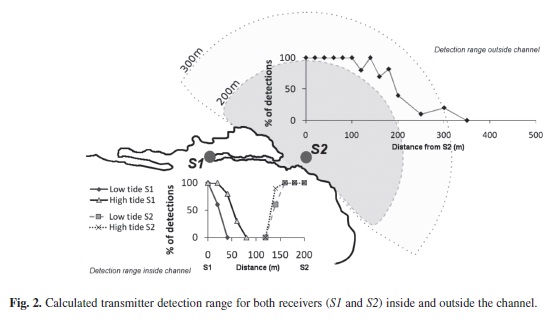
<body><![CDATA[detection of both ultrasonic receivers was determined using a range     test transmitter provided by Vemco Ltd. (V16-5H-A69-1303, ten seconds     signal delay). Inside the channel, the transmitter was lowered from a     kayak to a depth of 1.5m at 20m intervals from <span      style="font-style: italic;">S1-S2</span>, 200m away. This     process was repeated during high tide and low tide, and the detections     from both receivers were compared for signal overlap. To test the     detection range outside the channel, the range test transmitter was     lowered from a dinghy to a depth of 3m at intervals of 20m from     receiver <span style="font-style: italic;">S2</span>. In both tests,     ]]></body>
<body><![CDATA[an omni-directional hydrophone was used to     record ten positive signal emissions from the transmitter at every     interval. By comparing the data from each receiver with the known pulse     emissions at each distance, an average range of 30m was obtained with a     minimum of 50% of pulse detections at site S1. No pulses were detected     at distances greater than 80m (<a href="#Fig_2">Fig. 2</a>). We found     that the tidal state     affected signal transmission by +/- 40m by reducing the detection range     from 80m at high tide to 40m at low tide (<a href="#Fig_2">Fig. 2</a>).    <br>     ]]></body>
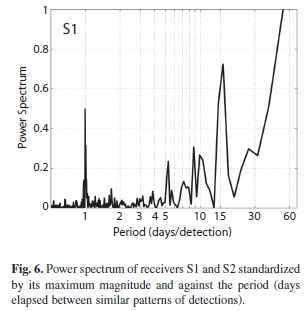
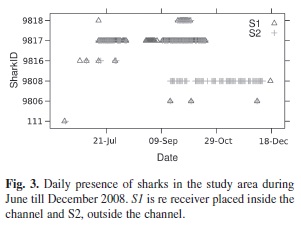
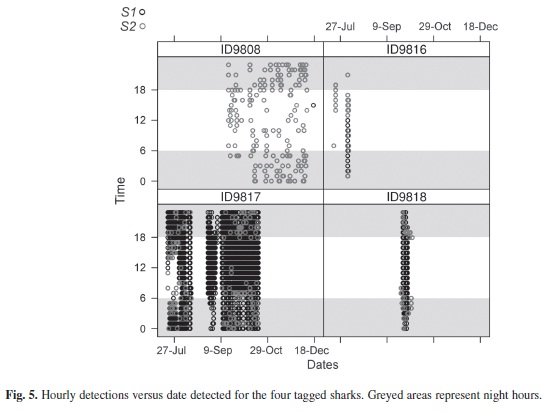
<body><![CDATA[<br> </span></font>     <div style="text-align: center;"><font size="2"><a name="Fig_2"></a><img  alt="" src="/img/revistas/rbt/v60n2/a18i2.jpg"  style="width: 550px; height: 320px;"><span  style="font-family: verdana;"></span></font><br  style="font-family: verdana;"> <font size="2"><span style="font-family: verdana;"></span></font></div> <br style="font-family: verdana;"> <font size="2"><span style="font-family: verdana;">There was no overlap in signal detection between S1 and S2. Swell and breaking waves in the channel entrance acted as a signal blocker between both receivers. The maximum detection range for S2 outside the channel was 300m, with 50% of the signals detected at 190m.</span></font><br style="font-family: verdana;"> <font size="2"></font><br style="font-family: verdana;"> <font size="2"><span style="font-family: verdana;">Data downloaded from the receivers were used to assess the residency and diel pattern of white-tip reef sharks, within the study area. The presence of all individuals was analyzed on a daily basis, taking any detection during one and plotting all data for comparative use over time of the study site by sharks. Data from lost tags was filtered when detections by a receiver remained constant until the end of the study. From these tags, we found that the longest interval between detections was 10 minutes. Any shark with a detection interval longer than that was cataloged as absent from the study site.</span></font><br style="font-family: verdana;"> <font size="2"></font><br style="font-family: verdana;"> <font size="2"><span style="font-family: verdana;">Shark presence during day and night was examined by grouping the frequency of detections by hour and by plotting the time of detection against the dates detected. Hourly detections were transformed to percentages to allow comparisons. A <span style="font-style: italic;">X&sup2;</span> goodness-of-fit test was then used to compared the observed data against an even distribution (i.e. assuming an equal number of detections in each hour), following Heupel <span  style="font-style: italic;">et al. </span>(2006). Significant differences indicated that individuals were more frequently detected at particular times of the day.</span></font><br  style="font-family: verdana;"> <font size="2"></font><br style="font-family: verdana;"> <font size="2"><span style="font-family: verdana;">Fourier analyses were performed to identify temporal patterns in the use of the study area. The routine used was the Fast Fourier Transformation (FFT), which decomposes time series data into component frequencies, and searches for cyclical patterns of the data (Meyer <span style="font-style: italic;">et al. </span>2007, Papastamatiou <span style="font-style: italic;">et al. </span>2009). Patterns can be distinguished as peaks in the power spectrum graphs. We ran the algorithm to identify peaks for: a) total detections of each shark at both receivers; b) total detections of all sharks by receiver; and c) total detections at both receivers. Data were pre-processed by grouping the number of detections every five minutes for each day, which is half the longest interval detection recorded. FFT results are shown as periodograms, presented with the power spectrum standardized by its m&aacute;ximum magnitude and against the period, i.e. days elapsed between similar patterns of detections, in logarithmic scale.</span></font><br  style="font-family: verdana;"> <font size="2"></font><br style="font-family: verdana;"> <font size="2"><span style="font-family: verdana;">Punta Estrada channel is very shallow in its inner area, so tidal variation effect on shark presence was examined during the study period. Tidal heights for Academy Bay were extracted from the published records of the Ecuadorian Navy (INOCAR 2008) and calculated at 8cm intervals (S.D.=&plusmn;0.02). Acoustic data were matched by dates and hours to the corresponding tidal height and then grouped in 50cm bins. The number of detections in each bin was summed across all days that sharks were monitored and then compared using a <span style="font-style: italic;">X&sup2;</span> goodness-of-fit test to the frequency of all tidal heights during the same period every sharks was monitored.</span></font><br  style="font-family: verdana;"> <font size="2"></font><br style="font-family: verdana;"> <font style="font-weight: bold;" size="3"><span  style="font-family: verdana;">Results</span></font><br  style="font-family: verdana;"> <font size="2"></font><br style="font-family: verdana;"> <font size="2"><span style="font-family: verdana;">Acoustic monitoring of the presence of tagged whitetip reef sharks within Punta Estrada Channel revealed that individuals were present for variable periods between the months of May to December 2008. Although sharks are regularly seen in the area, there was no synchronization in shark movements in and outside the channel. The maximum record of a tagged individual present was four months, while the minimum was two days. Only two sharks continuously used the area for periods of three months, one showing high levels of residence inside the channel, but the other remaining almost exclusively outside the channel.</span></font><br  style="font-family: verdana;"> <font size="2"></font><br style="font-family: verdana;"> <font size="2"><span style="font-family: verdana;">The total length (TL) of the tagged sharks ranged from 130-170cm (<a  href="/img/revistas/rbt/v60n2/a18t1.jpg">Table 1</a>). Six of the nine tagged sharks were detected during the period from June-December 2008. All of these sharks were detected both inside and outside the channel. Their visits to the study area varied from two to seventy five days, with the longest continuous residency of 40 days (of shark 9 817), but no shark was present for the entire period of time that receivers were deployed. Sharks did not show any synchronized pattern in their movements as a group, though at least three sharks were found at the same time in the study area (<a href="#Fig_3">Fig. 3</a>). Shark 9 808 remained outside the channel almost all the time.     <br>     <br> </span></font>     <div style="text-align: center;"><font size="2"><a name="Fig_3"></a><img  alt="" src="/img/revistas/rbt/v60n2/a18i3.jpg"  style="width: 301px; height: 226px;"><span  style="font-family: verdana;"></span></font><br  style="font-family: verdana;"> <font size="2"><span style="font-family: verdana;"></span></font></div> <br style="font-family: verdana;"> <font size="2"><span style="font-family: verdana;">Examination of shark detections based on time of day showed significant differences between individual sharks and between sites (<a href="/img/revistas/rbt/v60n2/a18t2.gif">Table 2</a>). For S1, sharks 9 817 and 9 818 did not show preference for any particular time of the day, while the presence of sharks 9 808 and 9 816 were skewed towards night and morning times (<a href="/img/revistas/rbt/v60n2/a18i4.jpg">Fig. 4</a>). In the case of receiver S2, the presence of sharks 9 816, 9 817 and 9 818 was significantly greater during dawn and sunset hours. The detections records of Time versus Date confirmed the greater presence of sharks 9 817 and 9 818 at receiver S1, with frequent detections at receiver S2 mainly during night hours (<a  href="#Fig_5">Fig. 5</a>). This situation was not appreciable for shark 9 808, which remained almost exclusively at receiver S2. The significant difference obtained from the <span style="font-style: italic;">X&sup2;</span> goodness-of-fit test for shark 9 816 is accounted to be a product of the reduced data available.    <br>     <br> </span></font>     <div style="text-align: center;"><font size="2"><a name="Fig_5"></a><img  alt="" src="/img/revistas/rbt/v60n2/a18i5.jpg"  style="width: 549px; height: 412px;"><span  style="font-family: verdana;"></span></font><br  style="font-family: verdana;"> <font size="2"><span style="font-family: verdana;"></span></font></div> <br style="font-family: verdana;"> <font size="2"><span style="font-family: verdana;">Results from FFT analysis confirmed diel cyclic visits from sharks to receiver S1, but also a periodicity of 15 days (Fig. 6). Receiver S2 describes an erratic signature with the strongest periodicity marked at 28 days; however, no clear pattern could be inferred from this FFT analysis as the peak might represent data noise. The spectrum for total detections in both receivers (not shown) was mostly dominated by the pattern of S1, given the higher number of detections. Fourier analysis of each individual was affected by the length of the series of detections. Individuals 9 816 and 9 818 exhibited maximum power at four days while 9 808 and 9 817, with longer records, exhibited a well-marked visitation period of 24 hours. Nevertheless, all individuals presented a spectral peak at 23-25 hours of at least 38% of the maximum magnitude. Other periods of interest were marked at 5-8 days and 13-24 days.     <br>     <br> </span></font>     ]]></body>
<body><![CDATA[<div style="text-align: center;"><font size="2"><a name="Fig_6"></a><img      alt="" src="/img/revistas/rbt/v60n2/a18i6.jpg"      style="width: 307px; height: 311px;"><span      style="font-family: verdana;"></span></font><br      style="font-family: verdana;">     <font size="2"><span style="font-family: verdana;"></span></font></div>     <br style="font-family: verdana;">     <font size="2"><span style="font-family: verdana;">There was a     significant effect of     tides on shark detections at S1 (<a     ]]></body>
<body><![CDATA[ href="/img/revistas/rbt/v60n2/a18t3.gif">Table 3</a>). In particular,     there were     increased detections of individuals 9 816 and 9 818 when the tide was     higher than 1m, although this difference may be due in part to the     greater detection range of the receiver during high tides. No     tidal-related pattern to shark presence at S2 was observed.</span></font><br      style="font-family: verdana;">     <font size="2"></font><br      style="font-family: verdana; font-weight: bold;">     <font style="font-weight: bold;" size="3"><span     ]]></body>
<body><![CDATA[ style="font-family: verdana;">Discussion </span></font><br      style="font-family: verdana;">     <font size="2"></font><br style="font-family: verdana;">     <font size="2"><span style="font-family: verdana;">Based on the     frequency of hourly     detections, no clear pattern was observed in the receiver located     inside the channel (<span style="font-style: italic;">S1</span>).     However, the observed detections in the outer     receiver clearly showed an increase in activity during sunset, night     and dawn hours. This is consistent with the activity patterns of     ]]></body>
<body><![CDATA[captive white-tip reef sharks recorded by Whitney <span      style="font-style: italic;">et al. </span>(2007) and     other shark species (Nelson &amp; Johnson 1980, McKibben &amp; Nelson     1986, Klimley 1993, Garla <span style="font-style: italic;">et al.</span>     2006). Differences in frequency     patterns in both receivers may be produced by the long hours sharks     remain continuously present inside the channel, thus departure and     arrival times were better captured by the outer receiver.</span></font><br      style="font-family: verdana;">     <font size="2"></font><br style="font-family: verdana;">     ]]></body>
<body><![CDATA[<font size="2"><span style="font-family: verdana;">Diel patterns were     better described     by the FFT analysis of the receiver S1, clearly showing marked diel     behavior of sharks using the inner channel of Punta Estrada. Diel     pattern of habitat use is very common in a wide variety of sharks     (Yeiser <span style="font-style: italic;">et al.</span> 2008,     Papasmatioy <span style="font-style: italic;">et al. </span>2009,     Hearn <span style="font-style: italic;">et al.</span> 2010, Clarke     <span style="font-style: italic;">et al.</span> 2011) and coral reef     fish species (Holland 1996, Meyer &amp;     ]]></body>
<body><![CDATA[Honebrink 2005, Meyer <span style="font-style: italic;">et al. </span>2007,     Payne <span style="font-style: italic;">et al.</span> 2010) and are     more     related to nocturnal foraging behavior.</span></font><br      style="font-family: verdana;">     <font size="2"></font><br style="font-family: verdana;">     <font size="2"><span style="font-family: verdana;">The rhythmic 15-day     period is     thought to be a response of whitetips to the natural variability in the     quality of the resting site and food availability, as has been     ]]></body>
<body><![CDATA[documented for other sharks and rays species by Matern <span      style="font-style: italic;">et al. </span>(2000),     Heupel &amp; Simpfendorfer (2002) and Lowe (2002). These factors might     trigger long absences from the study site; probably in seek of other     feeding and/or resting grounds. This behavior has been reported for     this species in other areas of the Pacific Ocean by Nelson (1974) and     Randall (1977).</span></font><br style="font-family: verdana;">     <font size="2"></font><br style="font-family: verdana;">     <font size="2"><span style="font-family: verdana;">Rhythmic movement of     tagged animals     ]]></body>
<body><![CDATA[away from a receiver array is known strongly influenced by     environmental factors such as wind speed, biological noise and current     speeds (Heupel <span style="font-style: italic;">et al. </span>2006,     Simpfendorfer <span style="font-style: italic;">et al.</span> 2008,     Payne <span style="font-style: italic;">et al.</span>     2010). Nevertheless, the observed frequency detection of lost tags     showed no cyclic patterns in comparison to tagged sharks. As observed     during range tests, environmental noise acted as signal blocker at the     channel entrance, with no effect on detection frequency of tags by     receivers. Low tidal heights were observed to decrease the number of     ]]></body>
<body><![CDATA[detections in low tide probably due to the reduced w&aacute;ter column     height.</span></font><br style="font-family: verdana;">     <font size="2"></font><br style="font-family: verdana;">     <font size="2"><span style="font-family: verdana;">Although, this data     is not     conclusive for showing the tendency of whitetips to possess home area     as reported by Nelson (1974) and Randall (1977), it does show that the     tagged sharks remained in and around the vicinity of Punta Estrada for     extended periods. Whitetips population tend to be genetically isolated     (Robbins 2006) due to their restricted home range (Nelson 1974), which     ]]></body>
<body><![CDATA[convert this species in highly vulnerable to the detriment of its     h&aacute;bitat quality. A expansion of this project should be focused     on the home range and habitat use of whitetips and overlay this with     the present zoning scheme to detect the level of protection this     species has in the area of Academy Bay.</span></font><br      style="font-family: verdana;">     <font size="2"></font><br style="font-family: verdana;">     <font style="font-weight: bold;" size="3"><span      style="font-family: verdana;">Acknowledgments</span></font><br      style="font-family: verdana;">     ]]></body>
<body><![CDATA[<font size="2"></font><br style="font-family: verdana;">     <font size="2"><span style="font-family: verdana;">The authors are     greatly indebted to     the Daniel Gaydon Tribute Fund of the Galapagos Conservation Trust. Dan     was a keen photographer who was passionate about white-tip reef sharks     and the marine life of Galapagos Islands. The present work is part of     the Shark Research Project run by the Charles Darwin Foundation,     Galapagos National Park and the University of California-Davis. The     authors acknowledge the time spent by Julio Delgado, Mariana Vera,     Natalia Tirado, Jerson Moreno, David Acu&ntilde;a, Roberto     ]]></body>
<body><![CDATA[P&eacute;polas, Anna Schuhbauer, Gabriel Vasquez, Eduardo Espinoza,     Jorge Baque, Yanella Tutiv&eacute;n, Janai Y&eacute;pez and Mateo     Delgado during field trips. This publication is contribution number 2     044 of the Charles Darwin Foundation for the Galapagos Islands.</span></font><br      style="font-family: verdana;">     <font size="2"></font><br style="font-family: verdana;">     <font style="font-weight: bold;" size="2"><span      style="font-family: verdana;"></span></font>     <hr style="width: 100%; height: 2px;"><font style="font-weight: bold;"      size="3"><span style="font-family: verdana;">References</span></font><br     ]]></body>
<body><![CDATA[ style="font-family: verdana;">     <font size="2"></font><br style="font-family: verdana;">     <font size="2"><span style="font-family: verdana;">Clarke, C., J.S.E.     Lea &amp; R.F.G.     Ormond. 2011. Reef-use and residency patterns of a baited population of     silky sharks, <span style="font-style: italic;">Carcharhinus     falciformis</span>, in the Red Sea. Mar. Freshw.     <!-- ref -->Res. 62: 668-675.    &nbsp;&nbsp;&nbsp;&nbsp;&nbsp;&nbsp;&nbsp;&nbsp;[&#160;<a href="javascript:void(0);" onclick="javascript: window.open('/scielo.php?script=sci_nlinks&ref=1496583&pid=S0034-7744201200020001800001&lng=','','width=640,height=500,resizable=yes,scrollbars=1,menubar=yes,');">Links</a>&#160;]<!-- end-ref --><!-- ref --></span></font><br style="font-family: verdana;"> <font size="2"></font><br style="font-family: verdana;"> <font size="2"><span style="font-family: verdana;">Epler, B. 2007. Tourism, the economy, population growth and conservation in Galapagos. Report to the Charles Darwin Foundation.    &nbsp;&nbsp;&nbsp;&nbsp;&nbsp;&nbsp;&nbsp;&nbsp;[&#160;<a href="javascript:void(0);" onclick="javascript: window.open('/scielo.php?script=sci_nlinks&ref=1496584&pid=S0034-7744201200020001800002&lng=','','width=640,height=500,resizable=yes,scrollbars=1,menubar=yes,');">Links</a>&#160;]<!-- end-ref --><!-- ref --></span></font><br  style="font-family: verdana;"> <font size="2"></font><br style="font-family: verdana;"> <font size="2"><span style="font-family: verdana;">Garla, R.C., D.D. Chapman, B.M. Wetherbee &amp; M. Shivji. 2006. Movement patterns of young Caribbean reef sharks, <span style="font-style: italic;">Carcharhinus perezi</span>, at Fernando de Noronha Archipelago, Brazil: the potential of marine protected areas for conservation of a nursery ground. Mar. Biol. 149: 189-199.    &nbsp;&nbsp;&nbsp;&nbsp;&nbsp;&nbsp;&nbsp;&nbsp;[&#160;<a href="javascript:void(0);" onclick="javascript: window.open('/scielo.php?script=sci_nlinks&ref=1496585&pid=S0034-7744201200020001800003&lng=','','width=640,height=500,resizable=yes,scrollbars=1,menubar=yes,');">Links</a>&#160;]<!-- end-ref --><!-- ref --></span></font><br  style="font-family: verdana;"> <font size="2"></font><br style="font-family: verdana;"> <font size="2"><span style="font-family: verdana;">Grove, J.S. &amp; R.J. Lavenberg. 1997. The fishes of Gal&aacute;pagos Islands. Stanford University, California, USA.    &nbsp;&nbsp;&nbsp;&nbsp;&nbsp;&nbsp;&nbsp;&nbsp;[&#160;<a href="javascript:void(0);" onclick="javascript: window.open('/scielo.php?script=sci_nlinks&ref=1496586&pid=S0034-7744201200020001800004&lng=','','width=640,height=500,resizable=yes,scrollbars=1,menubar=yes,');">Links</a>&#160;]<!-- end-ref --><br>     <!-- ref --><br> Heylings, P., R. Bensted-Smith &amp; M. Altamirano. 2002. Zonificaci&oacute;n e historia de la reserva marina de Gal&aacute;pagos, p 10-21. <span style="font-style: italic;">In</span> E. Danulat &amp; G.J. Edgar (eds.). Reserva Marina de Gal&aacute;pagos. L&iacute;nea Base de la Biodiversidad. Fundaci&oacute;n Charles Darwin y Servicio Parque Nacional de Gal&aacute;pagos, Santa Cruz,</span></font><br  style="font-family: verdana;"> <font size="2"><span style="font-family: verdana;">Gal&aacute;pagos, Ecuador.    &nbsp;&nbsp;&nbsp;&nbsp;&nbsp;&nbsp;&nbsp;&nbsp;[&#160;<a href="javascript:void(0);" onclick="javascript: window.open('/scielo.php?script=sci_nlinks&ref=1496588&pid=S0034-7744201200020001800005&lng=','','width=640,height=500,resizable=yes,scrollbars=1,menubar=yes,');">Links</a>&#160;]<!-- end-ref --><!-- ref --></span></font><br style="font-family: verdana;"> <font size="2"></font><br style="font-family: verdana;"> <font size="2"><span style="font-family: verdana;">Hearn, A. 2008. The rocky path to sustainable fisheries and conservation in the Galap&aacute;gos Marine Reserve. Ocean Coast. Manag. 51: 567-574.    &nbsp;&nbsp;&nbsp;&nbsp;&nbsp;&nbsp;&nbsp;&nbsp;[&#160;<a href="javascript:void(0);" onclick="javascript: window.open('/scielo.php?script=sci_nlinks&ref=1496589&pid=S0034-7744201200020001800006&lng=','','width=640,height=500,resizable=yes,scrollbars=1,menubar=yes,');">Links</a>&#160;]<!-- end-ref --><!-- ref --></span></font><br  style="font-family: verdana;"> <font size="2"></font><br style="font-family: verdana;"> <font size="2"><span style="font-family: verdana;">Hearn, A.R., J.T. Ketchum, A.P. Klimley, E. Espinoza &amp; C. Pe&ntilde;aherrera. 2010. Hot-sports within hotspots? Hammehead shark movements around Wolf Island, Galapagos Marine Reserve. Mar. Biol. 157: 1899-1915.    &nbsp;&nbsp;&nbsp;&nbsp;&nbsp;&nbsp;&nbsp;&nbsp;[&#160;<a href="javascript:void(0);" onclick="javascript: window.open('/scielo.php?script=sci_nlinks&ref=1496590&pid=S0034-7744201200020001800007&lng=','','width=640,height=500,resizable=yes,scrollbars=1,menubar=yes,');">Links</a>&#160;]<!-- end-ref --><!-- ref --></span></font><br  style="font-family: verdana;"> <font size="2"></font><br style="font-family: verdana;"> <font size="2"><span style="font-family: verdana;">Heupel, M.R. &amp; C.A. Simpfendorfer. 2002. Estimation of survival and mortality of juvenile blacktip sharks, <span style="font-style: italic;">Carcharhinus limbatus</span>, within a nursery area based on telemetry data. Can J. Fish. Aquat. Sci. 59: 624-632.    &nbsp;&nbsp;&nbsp;&nbsp;&nbsp;&nbsp;&nbsp;&nbsp;[&#160;<a href="javascript:void(0);" onclick="javascript: window.open('/scielo.php?script=sci_nlinks&ref=1496591&pid=S0034-7744201200020001800008&lng=','','width=640,height=500,resizable=yes,scrollbars=1,menubar=yes,');">Links</a>&#160;]<!-- end-ref --><!-- ref --></span></font><br  style="font-family: verdana;"> <font size="2"></font><br style="font-family: verdana;"> <font size="2"><span style="font-family: verdana;">Heupel, M.R., C.A. Simpfendorfer, A.B. Collins &amp; J.P. Tyminski. 2006. Residency and movement patterns of bonnethead sharks, <span style="font-style: italic;">Sphyrna tiburo</span>, in a large Florida Estuary. Environ. Biol. Fish. 76: 47-67.    &nbsp;&nbsp;&nbsp;&nbsp;&nbsp;&nbsp;&nbsp;&nbsp;[&#160;<a href="javascript:void(0);" onclick="javascript: window.open('/scielo.php?script=sci_nlinks&ref=1496592&pid=S0034-7744201200020001800009&lng=','','width=640,height=500,resizable=yes,scrollbars=1,menubar=yes,');">Links</a>&#160;]<!-- end-ref --><!-- ref --></span></font><br  style="font-family: verdana;"> <font size="2"></font><br style="font-family: verdana;"> <font size="2"><span style="font-family: verdana;">Holland, K.N., C.G. Lowe &amp; B.M. Wetherbee. 1996. Movements and dispersal patterns of blue trevally (<span style="font-style: italic;">Caranx melampygus</span>) in a fisheries conservation zone. Fish. Res. 25: 279-292.    &nbsp;&nbsp;&nbsp;&nbsp;&nbsp;&nbsp;&nbsp;&nbsp;[&#160;<a href="javascript:void(0);" onclick="javascript: window.open('/scielo.php?script=sci_nlinks&ref=1496593&pid=S0034-7744201200020001800010&lng=','','width=640,height=500,resizable=yes,scrollbars=1,menubar=yes,');">Links</a>&#160;]<!-- end-ref --><!-- ref --></span></font><br style="font-family: verdana;"> <font size="2"></font><br style="font-family: verdana;"> <font size="2"><span style="font-family: verdana;">INOCAR. 2008. Tabla de Mareas y datos astron&oacute;micos del sol y de la luna 2008. Armada del Ecuador. Instituto Oceanogr&aacute;fico de la Armada, Departamento de Hidrograf&iacute;a. Guayaquil, Ecuador.    &nbsp;&nbsp;&nbsp;&nbsp;&nbsp;&nbsp;&nbsp;&nbsp;[&#160;<a href="javascript:void(0);" onclick="javascript: window.open('/scielo.php?script=sci_nlinks&ref=1496594&pid=S0034-7744201200020001800011&lng=','','width=640,height=500,resizable=yes,scrollbars=1,menubar=yes,');">Links</a>&#160;]<!-- end-ref --><!-- ref --></span></font><br  style="font-family: verdana;"> <font size="2"></font><br style="font-family: verdana;"> <font size="2"><span style="font-family: verdana;">Ketchum, J.T., A. Hearn, G. Shillinger, E. Espinoza, C. Pe&ntilde;aherrera &amp; A.P. Klimley. 2009. Shark movements and the design of protected pelagic environments within and beyond the Galapagos Marine Reserve. <span  style="font-style: italic;">In</span> M. Wolff &amp; M. Gardener (eds.). Proceedings of the Galapagos Science Symposium 2009. Charles Darwin Foundation. Galapagos, Ecuador.    &nbsp;&nbsp;&nbsp;&nbsp;&nbsp;&nbsp;&nbsp;&nbsp;[&#160;<a href="javascript:void(0);" onclick="javascript: window.open('/scielo.php?script=sci_nlinks&ref=1496595&pid=S0034-7744201200020001800012&lng=','','width=640,height=500,resizable=yes,scrollbars=1,menubar=yes,');">Links</a>&#160;]<!-- end-ref --><!-- ref --></span></font><br  style="font-family: verdana;"> <font size="2"></font><br style="font-family: verdana;"> <font size="2"><span style="font-family: verdana;">Klimley, A.P. 1993. Highly directional swimming by scalloped hammerhead sharks, <span  style="font-style: italic;">Sphyrna lewini</span>, and subsurface irradiance temperature, bathymetry, and geomagnetic field. Mar. Biol. 117: 1-22.    &nbsp;&nbsp;&nbsp;&nbsp;&nbsp;&nbsp;&nbsp;&nbsp;[&#160;<a href="javascript:void(0);" onclick="javascript: window.open('/scielo.php?script=sci_nlinks&ref=1496596&pid=S0034-7744201200020001800013&lng=','','width=640,height=500,resizable=yes,scrollbars=1,menubar=yes,');">Links</a>&#160;]<!-- end-ref --><!-- ref --></span></font><br  style="font-family: verdana;"> <font size="2"></font><br style="font-family: verdana;"> <font size="2"><span style="font-family: verdana;">Lowe, C.G. 2002. Bioenergetics of free-ranging juvenile scalloped hammerhead sharks (Sphyrna lewini) In Kane&#8217;ohe Bay, O&#8217;ahu, HI. J. Exp. Mar. Biol. Ecol. 278: 141-156.    &nbsp;&nbsp;&nbsp;&nbsp;&nbsp;&nbsp;&nbsp;&nbsp;[&#160;<a href="javascript:void(0);" onclick="javascript: window.open('/scielo.php?script=sci_nlinks&ref=1496597&pid=S0034-7744201200020001800014&lng=','','width=640,height=500,resizable=yes,scrollbars=1,menubar=yes,');">Links</a>&#160;]<!-- end-ref --><!-- ref --><br> <br style="font-family: verdana;"> </span></font><font size="2"><span style="font-family: verdana;">Matern, S.A., J.J. Cech Jr. &amp; T.E. Hopkins. 2000. Diel movements of bat rays, <span  style="font-style: italic;">Myliobatis cailfornica</span>, in Tomales Bay, California: evidence for behavioral thermoregulation. Environ. Biol. Fish. 58: 173-l82.    &nbsp;&nbsp;&nbsp;&nbsp;&nbsp;&nbsp;&nbsp;&nbsp;[&#160;<a href="javascript:void(0);" onclick="javascript: window.open('/scielo.php?script=sci_nlinks&ref=1496598&pid=S0034-7744201200020001800015&lng=','','width=640,height=500,resizable=yes,scrollbars=1,menubar=yes,');">Links</a>&#160;]<!-- end-ref --><!-- ref --></span></font><br  style="font-family: verdana;"> <font size="2"></font><br style="font-family: verdana;"> <font size="2"><span style="font-family: verdana;">Meyer, C.G. &amp; R. Honebrink. 2005. Retention of surgically implanted transmitters by bluefin trevally (<span style="font-style: italic;">Caranx melampygus</span>). Implications for long-term movement studies. Trans. Am. Fish. Soc. 134: 602-606.    &nbsp;&nbsp;&nbsp;&nbsp;&nbsp;&nbsp;&nbsp;&nbsp;[&#160;<a href="javascript:void(0);" onclick="javascript: window.open('/scielo.php?script=sci_nlinks&ref=1496599&pid=S0034-7744201200020001800016&lng=','','width=640,height=500,resizable=yes,scrollbars=1,menubar=yes,');">Links</a>&#160;]<!-- end-ref --><!-- ref --></span></font><br  style="font-family: verdana;"> <font size="2"></font><br style="font-family: verdana;"> <font size="2"><span style="font-family: verdana;">Meyer, C.G., K.N. Holland &amp; Y.P Papastamatiou. 2007. Seasonal and diel movements of giant trevally <span style="font-style: italic;">Caranx ignobilis</span> at remote Hawaiian atolls: implications for the design of Marine Protected Areas. Mar. Ecol. Prog. Ser. 333: 13-25.    &nbsp;&nbsp;&nbsp;&nbsp;&nbsp;&nbsp;&nbsp;&nbsp;[&#160;<a href="javascript:void(0);" onclick="javascript: window.open('/scielo.php?script=sci_nlinks&ref=1496600&pid=S0034-7744201200020001800017&lng=','','width=640,height=500,resizable=yes,scrollbars=1,menubar=yes,');">Links</a>&#160;]<!-- end-ref --><!-- ref --></span></font><br  style="font-family: verdana;"> <font size="2"></font><br style="font-family: verdana;"> <font size="2"><span style="font-family: verdana;">McKibben, J.N. &amp; D.R. Nelson. 1986. Patterns of movement and grouping of gray reef sharks, <span style="font-style: italic;">Carcharhinus amblyrhynchos</span>, at Enewetak, Marshall Islands. Bull. Mar. Sci. 38: 89-110.    &nbsp;&nbsp;&nbsp;&nbsp;&nbsp;&nbsp;&nbsp;&nbsp;[&#160;<a href="javascript:void(0);" onclick="javascript: window.open('/scielo.php?script=sci_nlinks&ref=1496601&pid=S0034-7744201200020001800018&lng=','','width=640,height=500,resizable=yes,scrollbars=1,menubar=yes,');">Links</a>&#160;]<!-- end-ref --><!-- ref --></span></font><br style="font-family: verdana;"> <font size="2"></font><br style="font-family: verdana;"> <font size="2"><span style="font-family: verdana;">Nelson, D.R. 1974. Ultrasonic telemetry of shark behavior. Naval Res. Rev. 1-21.    &nbsp;&nbsp;&nbsp;&nbsp;&nbsp;&nbsp;&nbsp;&nbsp;[&#160;<a href="javascript:void(0);" onclick="javascript: window.open('/scielo.php?script=sci_nlinks&ref=1496602&pid=S0034-7744201200020001800019&lng=','','width=640,height=500,resizable=yes,scrollbars=1,menubar=yes,');">Links</a>&#160;]<!-- end-ref --><br>     <!-- ref --><br> Nelson, D.R. &amp; R.H. Johnson. 1980. Behavior of the reef sharks of Rangiroa, French Polynesia. National Geographic Society Res. Rep. 12: 479-499.    &nbsp;&nbsp;&nbsp;&nbsp;&nbsp;&nbsp;&nbsp;&nbsp;[&#160;<a href="javascript:void(0);" onclick="javascript: window.open('/scielo.php?script=sci_nlinks&ref=1496604&pid=S0034-7744201200020001800020&lng=','','width=640,height=500,resizable=yes,scrollbars=1,menubar=yes,');">Links</a>&#160;]<!-- end-ref --><!-- ref --></span></font><br  style="font-family: verdana;"> <font size="2"></font><br style="font-family: verdana;"> <font size="2"><span style="font-family: verdana;">Papastamatiou, Y.P., C.G. Lowe, J.E. Caselle &amp; A.M. Friedlander. 2009. Scale-dependent effects of h&aacute;bitat on movements and path structure of reef sharks at a predator-dominated atoll. Ecology 90: 996-1008.    &nbsp;&nbsp;&nbsp;&nbsp;&nbsp;&nbsp;&nbsp;&nbsp;[&#160;<a href="javascript:void(0);" onclick="javascript: window.open('/scielo.php?script=sci_nlinks&ref=1496605&pid=S0034-7744201200020001800021&lng=','','width=640,height=500,resizable=yes,scrollbars=1,menubar=yes,');">Links</a>&#160;]<!-- end-ref --><!-- ref --></span></font><br  style="font-family: verdana;"> <font size="2"></font><br style="font-family: verdana;"> <font size="2"><span style="font-family: verdana;">Payne, L.N., B.M. Gillanders, D.M. Webber &amp; J. Semmens. 2010. Interpreting diel activity patterns from acoustic telemetry: the need for controls. Mar. Ecol. Prog. Ser. 419: 295-301.    &nbsp;&nbsp;&nbsp;&nbsp;&nbsp;&nbsp;&nbsp;&nbsp;[&#160;<a href="javascript:void(0);" onclick="javascript: window.open('/scielo.php?script=sci_nlinks&ref=1496606&pid=S0034-7744201200020001800022&lng=','','width=640,height=500,resizable=yes,scrollbars=1,menubar=yes,');">Links</a>&#160;]<!-- end-ref --><!-- ref --></span></font><br style="font-family: verdana;"> <font size="2"></font><br style="font-family: verdana;"> <font size="2"><span style="font-family: verdana;">Randall, J.E. 1977. Contribution to the biology of the white-tip reef sharks (<span  style="font-style: italic;">Triaenodon obesus</span>). Pacific Sci. 31: 143-164.    &nbsp;&nbsp;&nbsp;&nbsp;&nbsp;&nbsp;&nbsp;&nbsp;[&#160;<a href="javascript:void(0);" onclick="javascript: window.open('/scielo.php?script=sci_nlinks&ref=1496607&pid=S0034-7744201200020001800023&lng=','','width=640,height=500,resizable=yes,scrollbars=1,menubar=yes,');">Links</a>&#160;]<!-- end-ref --><!-- ref --></span></font><br style="font-family: verdana;"> <font size="2"></font><br style="font-family: verdana;"> <font size="2"><span style="font-family: verdana;">Reyes, H. &amp; J. Murillo. 2007. Esfuerzos para el control de la pesca il&iacute;cita en la Reserva Marina. Reporte Gal&aacute;pagos 2002-6, Fundaci&oacute;n Charles Darwin/INGALA/ Parque Nacional Gal&aacute;pagos.    &nbsp;&nbsp;&nbsp;&nbsp;&nbsp;&nbsp;&nbsp;&nbsp;[&#160;<a href="javascript:void(0);" onclick="javascript: window.open('/scielo.php?script=sci_nlinks&ref=1496608&pid=S0034-7744201200020001800024&lng=','','width=640,height=500,resizable=yes,scrollbars=1,menubar=yes,');">Links</a>&#160;]<!-- end-ref --><!-- ref --></span></font><br  style="font-family: verdana;"> <font size="2"></font><br style="font-family: verdana;"> <font size="2"><span style="font-family: verdana;">Robbins, W.D. 2006. Abundance, demography and population structure of the grey reef shark (<span style="font-style: italic;">Carcharhinus amblyrhinchos</span>) and the white-tip reef shark (<span style="font-style: italic;">Triaenodon obesus</span>) (Fam. Carcharhinidae). Ph.D. Thesis, James Cook University, Townsville, Australia.    &nbsp;&nbsp;&nbsp;&nbsp;&nbsp;&nbsp;&nbsp;&nbsp;[&#160;<a href="javascript:void(0);" onclick="javascript: window.open('/scielo.php?script=sci_nlinks&ref=1496609&pid=S0034-7744201200020001800025&lng=','','width=640,height=500,resizable=yes,scrollbars=1,menubar=yes,');">Links</a>&#160;]<!-- end-ref --><!-- ref --></span></font><br style="font-family: verdana;"> <font size="2"></font><br style="font-family: verdana;"> <font size="2"><span style="font-family: verdana;">Simpfendorfer, C.A., M.R. Heupel &amp; A.B. Collins. 2008. Variation in the performance of acoustic receivers and its implication for positioning algorithms in a riverine setting. Can J. Fish. Aquat. Sci. 65: 482-492.    &nbsp;&nbsp;&nbsp;&nbsp;&nbsp;&nbsp;&nbsp;&nbsp;[&#160;<a href="javascript:void(0);" onclick="javascript: window.open('/scielo.php?script=sci_nlinks&ref=1496610&pid=S0034-7744201200020001800026&lng=','','width=640,height=500,resizable=yes,scrollbars=1,menubar=yes,');">Links</a>&#160;]<!-- end-ref --><!-- ref --></span></font><br  style="font-family: verdana;"> <font size="2"></font><br style="font-family: verdana;"> <font size="2"><span style="font-family: verdana;">Snell, H.M., P.A. Stone &amp; H.L. Snell. 1996. A Summary of the geographical characteristics of the Gal&aacute;pagos Islands. J. Biogeo. 23: 619-624.    &nbsp;&nbsp;&nbsp;&nbsp;&nbsp;&nbsp;&nbsp;&nbsp;[&#160;<a href="javascript:void(0);" onclick="javascript: window.open('/scielo.php?script=sci_nlinks&ref=1496611&pid=S0034-7744201200020001800027&lng=','','width=640,height=500,resizable=yes,scrollbars=1,menubar=yes,');">Links</a>&#160;]<!-- end-ref --><!-- ref --></span></font><br  style="font-family: verdana;"> <font size="2"></font><br style="font-family: verdana;"> <font size="2"><span style="font-family: verdana;">Whitney, N.M., Y.N. Papastamatiou, K.N. Holland &amp; C.G. Lowe. 2007. Use of an acceleration data logger to measure diel activity patterns in captive white-tip reef shark, <span style="font-style: italic;">Triaenodon obesus</span>. Aquat. Living Resour. DOI: 10.1051/alr:2008006.    &nbsp;&nbsp;&nbsp;&nbsp;&nbsp;&nbsp;&nbsp;&nbsp;[&#160;<a href="javascript:void(0);" onclick="javascript: window.open('/scielo.php?script=sci_nlinks&ref=1496612&pid=S0034-7744201200020001800028&lng=','','width=640,height=500,resizable=yes,scrollbars=1,menubar=yes,');">Links</a>&#160;]<!-- end-ref --><!-- ref --> Yeiser, B.G., M.R. Heupel &amp; C.A. Simpfendorfer. 2008.</span></font><br  style="font-family: verdana;"> <font size="2"></font><br style="font-family: verdana;"> <font size="2"><span style="font-family: verdana;">Occurrence, home range and movement patterns of juvenile bull (<span style="font-style: italic;">Carcharhinus leucas</span>) and lemon (<span style="font-style: italic;">Negaprion brevirostris</span>) sharks within a Florida estuary. Mar. Freshw. Res. 59: 489-501.    &nbsp;&nbsp;&nbsp;&nbsp;&nbsp;&nbsp;&nbsp;&nbsp;[&#160;<a href="javascript:void(0);" onclick="javascript: window.open('/scielo.php?script=sci_nlinks&ref=1496613&pid=S0034-7744201200020001800029&lng=','','width=640,height=500,resizable=yes,scrollbars=1,menubar=yes,');">Links</a>&#160;]<!-- end-ref --><br>     <br>     ]]></body>
<body><![CDATA[<br> <a name="Correspondencia1"></a><a href="#Correspondencia2">*</a>Correspondencia a:</span></font><font size="2"> <span style="font-family: verdana;">C&eacute;sar Pe&ntilde;aherrera, Alex R. Hearn &amp; Angela Kuhn: </span></font><font size="2"><span  style="font-family: verdana;">Marine and Coastal Science Department, Charles Darwin Foundation, Charles Darwin Av., Puerto Ayora, Galapagos, Ecuador; </span></font><font size="2"><span  style="font-family: verdana;"><a  href="mailto:cesar.penaherrera@fcdarwin.org.ec">cesar.penaherrera@fcdarwin.org.ec</a></span></font><br  style="font-family: verdana;"> <font size="2"><span style="font-family: verdana;">Alex R. Hearn: </span></font><font  size="2"><span style="font-family: verdana;">University of California, Davis, 1 Shields Av., Davis, CA 95616 USA; <a  href="mailto:arhearn@ucdavis.edu">arhearn@ucdavis.edu</a></span></font><br  style="font-family: verdana;"> <font size="2"><span style="font-family: verdana;">Angela Kuhn: </span></font><font  size="2"><span style="font-family: verdana;">Dalhousie University, Halifax, NS b3H 4J1, Canada; </span></font><font size="2"><span  style="font-family: verdana;"><a href="mailto:angela.kuhn@dal.ca">angela.kuhn@dal.ca</a></span></font><br  style="font-family: verdana;"> <font size="2"><span style="font-family: verdana;">    <br> <a name="1"></a><a href="#4">1</a>. Marine and Coastal Science Department, Charles Darwin Foundation, Charles Darwin Av., Puerto Ayora, Galapagos, Ecuador; <a  href="mailto:cesar.penaherrera@fcdarwin.org.ec">cesar.penaherrera@fcdarwin.org.ec</a></span></font><br  style="font-family: verdana;"> <font size="2"><span style="font-family: verdana;"><a name="2"></a><a  href="#5">2</a>. University of California, Davis, 1 Shields Av., Davis, CA 95616 USA; </span></font><font size="2"><span  style="font-family: verdana;"><a href="mailto:arhearn@ucdavis.edu">arhearn@ucdavis.edu</a></span></font><br  style="font-family: verdana;"> <font size="2"><span style="font-family: verdana;"><a name="3"></a><a  href="#6">3</a>. Dalhousie University, Halifax, NS b3H 4J1, Canada; <a href="mailto:angela.kuhn@dal.ca">angela.kuhn@dal.ca</a></span></font><br  style="font-family: verdana;"> <font size="2"><span style="font-family: verdana;"></span></font> <hr style="width: 100%; height: 2px;">     <div style="text-align: center;"><font size="2"><span  style="font-family: verdana;">Received 29-III-2011. Corrected 20-XI-2011. Accepted 16-I-2012.</span></font></div> <font size="2"></font></div>      ]]></body><back>
<ref-list>
<ref id="B1">
<nlm-citation citation-type="journal">
<person-group person-group-type="author">
<name>
<surname><![CDATA[Clarke]]></surname>
<given-names><![CDATA[C]]></given-names>
</name>
<name>
<surname><![CDATA[Lea]]></surname>
<given-names><![CDATA[J.S.E]]></given-names>
</name>
<name>
<surname><![CDATA[Ormond]]></surname>
<given-names><![CDATA[R.F.G]]></given-names>
</name>
</person-group>
<article-title xml:lang="en"><![CDATA[Reef-use and residency patterns of a baited population of silky sharks, Carcharhinus falciformis, in the Red Sea]]></article-title>
<source><![CDATA[Mar. Freshw. Res]]></source>
<year>2011</year>
<volume>62</volume>
<page-range>668-675</page-range></nlm-citation>
</ref>
<ref id="B2">
<nlm-citation citation-type="">
<person-group person-group-type="author">
<name>
<surname><![CDATA[Epler]]></surname>
<given-names><![CDATA[B]]></given-names>
</name>
</person-group>
<source><![CDATA[Tourism, the economy, population growth and conservation in Galapagos: Report to the Charles Darwin Foundation]]></source>
<year>2007</year>
</nlm-citation>
</ref>
<ref id="B3">
<nlm-citation citation-type="journal">
<person-group person-group-type="author">
<name>
<surname><![CDATA[Garla]]></surname>
<given-names><![CDATA[R.C]]></given-names>
</name>
<name>
<surname><![CDATA[Chapman]]></surname>
<given-names><![CDATA[D.D]]></given-names>
</name>
<name>
<surname><![CDATA[Wetherbee]]></surname>
<given-names><![CDATA[B.M]]></given-names>
</name>
<name>
<surname><![CDATA[Shivji]]></surname>
<given-names><![CDATA[M]]></given-names>
</name>
</person-group>
<article-title xml:lang="en"><![CDATA[Movement patterns of young Caribbean reef sharks, Carcharhinus perezi, at Fernando de Noronha Archipelago, Brazil: the potential of marine protected areas for conservation of a nursery ground]]></article-title>
<source><![CDATA[Mar. Biol]]></source>
<year>2006</year>
<volume>149</volume>
<page-range>189-199</page-range></nlm-citation>
</ref>
<ref id="B4">
<nlm-citation citation-type="book">
<person-group person-group-type="author">
<name>
<surname><![CDATA[Grove]]></surname>
<given-names><![CDATA[J.S]]></given-names>
</name>
<name>
<surname><![CDATA[Lavenberg]]></surname>
<given-names><![CDATA[R.J]]></given-names>
</name>
</person-group>
<source><![CDATA[The fishes of Galápagos Islands]]></source>
<year>1997</year>
<publisher-loc><![CDATA[California ]]></publisher-loc>
<publisher-name><![CDATA[Stanford University]]></publisher-name>
</nlm-citation>
</ref>
<ref id="B5">
<nlm-citation citation-type="book">
<person-group person-group-type="author">
<name>
<surname><![CDATA[Heylings]]></surname>
<given-names><![CDATA[P]]></given-names>
</name>
<name>
<surname><![CDATA[Bensted-Smith]]></surname>
<given-names><![CDATA[R]]></given-names>
</name>
<name>
<surname><![CDATA[Altamirano]]></surname>
<given-names><![CDATA[M]]></given-names>
</name>
</person-group>
<article-title xml:lang="es"><![CDATA[Zonificación e historia de la reserva marina de Galápagos]]></article-title>
<person-group person-group-type="editor">
<name>
<surname><![CDATA[Danulat]]></surname>
<given-names><![CDATA[E]]></given-names>
</name>
<name>
<surname><![CDATA[Edgar]]></surname>
<given-names><![CDATA[G.J]]></given-names>
</name>
</person-group>
<source><![CDATA[Reserva Marina de Galápagos: Línea Base de la Biodiversidad]]></source>
<year>2002</year>
<page-range>10-21</page-range><publisher-loc><![CDATA[Santa Cruz^eGalápagos Galápagos]]></publisher-loc>
<publisher-name><![CDATA[Fundación Charles Darwin y Servicio Parque Nacional de Galápagos]]></publisher-name>
</nlm-citation>
</ref>
<ref id="B6">
<nlm-citation citation-type="journal">
<person-group person-group-type="author">
<name>
<surname><![CDATA[Hearn]]></surname>
<given-names><![CDATA[A]]></given-names>
</name>
</person-group>
<article-title xml:lang="en"><![CDATA[The rocky path to sustainable fisheries and conservation in the Galapágos Marine Reserve]]></article-title>
<source><![CDATA[Ocean Coast. Manag]]></source>
<year>2008</year>
<volume>51</volume>
<page-range>567-574.</page-range></nlm-citation>
</ref>
<ref id="B7">
<nlm-citation citation-type="journal">
<person-group person-group-type="author">
<name>
<surname><![CDATA[Hearn]]></surname>
<given-names><![CDATA[A.R]]></given-names>
</name>
<name>
<surname><![CDATA[Ketchum]]></surname>
<given-names><![CDATA[J.T]]></given-names>
</name>
<name>
<surname><![CDATA[Klimley]]></surname>
<given-names><![CDATA[A.P]]></given-names>
</name>
<name>
<surname><![CDATA[Espinoza]]></surname>
<given-names><![CDATA[E]]></given-names>
</name>
<name>
<surname><![CDATA[Peñaherrera]]></surname>
<given-names><![CDATA[C]]></given-names>
</name>
</person-group>
<article-title xml:lang="en"><![CDATA[Hot-sports within hotspots?: Hammehead shark movements around Wolf Island, Galapagos Marine Reserve]]></article-title>
<source><![CDATA[Mar. Biol]]></source>
<year>2010</year>
<volume>157</volume>
<page-range>1899-1915</page-range></nlm-citation>
</ref>
<ref id="B8">
<nlm-citation citation-type="journal">
<person-group person-group-type="author">
<name>
<surname><![CDATA[Heupel]]></surname>
<given-names><![CDATA[M.R]]></given-names>
</name>
<name>
<surname><![CDATA[Simpfendorfer]]></surname>
<given-names><![CDATA[C.A]]></given-names>
</name>
</person-group>
<article-title xml:lang="en"><![CDATA[Estimation of survival and mortality of juvenile blacktip sharks, Carcharhinus limbatus, within a nursery area based on telemetry data]]></article-title>
<source><![CDATA[Can J. Fish. Aquat. Sci]]></source>
<year>2002</year>
<volume>59</volume>
<page-range>624-632</page-range></nlm-citation>
</ref>
<ref id="B9">
<nlm-citation citation-type="journal">
<person-group person-group-type="author">
<name>
<surname><![CDATA[Heupel]]></surname>
<given-names><![CDATA[M.R]]></given-names>
</name>
<name>
<surname><![CDATA[Simpfendorfer]]></surname>
<given-names><![CDATA[C.A]]></given-names>
</name>
<name>
<surname><![CDATA[Collins]]></surname>
<given-names><![CDATA[A.B]]></given-names>
</name>
<name>
<surname><![CDATA[Tyminski]]></surname>
<given-names><![CDATA[J.P]]></given-names>
</name>
</person-group>
<article-title xml:lang="en"><![CDATA[Residency and movement patterns of bonnethead sharks, Sphyrna tiburo, in a large Florida Estuary]]></article-title>
<source><![CDATA[Environ. Biol. Fish]]></source>
<year>2006</year>
<volume>76</volume>
<page-range>47-67</page-range></nlm-citation>
</ref>
<ref id="B10">
<nlm-citation citation-type="journal">
<person-group person-group-type="author">
<name>
<surname><![CDATA[Holland]]></surname>
<given-names><![CDATA[K.N]]></given-names>
</name>
<name>
<surname><![CDATA[Lowe]]></surname>
<given-names><![CDATA[C.G]]></given-names>
</name>
<name>
<surname><![CDATA[Wetherbee]]></surname>
<given-names><![CDATA[B.M]]></given-names>
</name>
</person-group>
<article-title xml:lang="en"><![CDATA[Movements and dispersal patterns of blue trevally (Caranx melampygus) in a fisheries conservation zone]]></article-title>
<source><![CDATA[Fish. Res]]></source>
<year>1996</year>
<volume>25</volume>
<page-range>279-292</page-range></nlm-citation>
</ref>
<ref id="B11">
<nlm-citation citation-type="book">
<collab>INOCAR</collab>
<source><![CDATA[Tabla de Mareas y datos astronómicos del sol y de la luna 2008]]></source>
<year>2008</year>
<publisher-loc><![CDATA[Guayaquil ]]></publisher-loc>
<publisher-name><![CDATA[Armada del EcuadorInstituto Oceanográfico de la Armada, Departamento de Hidrografía]]></publisher-name>
</nlm-citation>
</ref>
<ref id="B12">
<nlm-citation citation-type="book">
<person-group person-group-type="author">
<name>
<surname><![CDATA[Ketchum]]></surname>
<given-names><![CDATA[J.]]></given-names>
</name>
<name>
<surname><![CDATA[Hearn]]></surname>
<given-names><![CDATA[A]]></given-names>
</name>
<name>
<surname><![CDATA[Shillinger]]></surname>
<given-names><![CDATA[G]]></given-names>
</name>
<name>
<surname><![CDATA[Espinoza]]></surname>
<given-names><![CDATA[E]]></given-names>
</name>
<name>
<surname><![CDATA[Peñaherrera]]></surname>
<given-names><![CDATA[C]]></given-names>
</name>
<name>
<surname><![CDATA[Klimley]]></surname>
<given-names><![CDATA[A.P]]></given-names>
</name>
</person-group>
<article-title xml:lang="en"><![CDATA[Shark movements and the design of protected pelagic environments within and beyond the Galapagos Marine Reserve]]></article-title>
<person-group person-group-type="editor">
<name>
<surname><![CDATA[Wolff]]></surname>
<given-names><![CDATA[M]]></given-names>
</name>
<name>
<surname><![CDATA[Gardener]]></surname>
<given-names><![CDATA[M]]></given-names>
</name>
</person-group>
<source><![CDATA[Proceedings of the Galapagos Science Symposium 2009]]></source>
<year>2009</year>
<publisher-loc><![CDATA[Galapagos ]]></publisher-loc>
<publisher-name><![CDATA[Charles Darwin Foundation]]></publisher-name>
</nlm-citation>
</ref>
<ref id="B13">
<nlm-citation citation-type="journal">
<person-group person-group-type="author">
<name>
<surname><![CDATA[Klimley]]></surname>
<given-names><![CDATA[A.P]]></given-names>
</name>
</person-group>
<article-title xml:lang="en"><![CDATA[Highly directional swimming by scalloped hammerhead sharks, Sphyrna lewini, and subsurface irradiance temperature, bathymetry, and geomagnetic field]]></article-title>
<source><![CDATA[Mar. Biol]]></source>
<year>1993</year>
<volume>117</volume>
<page-range>1-22</page-range></nlm-citation>
</ref>
<ref id="B14">
<nlm-citation citation-type="journal">
<person-group person-group-type="author">
<name>
<surname><![CDATA[Lowe]]></surname>
<given-names><![CDATA[C.G]]></given-names>
</name>
</person-group>
<article-title xml:lang="en"><![CDATA[Bioenergetics of free-ranging juvenile scalloped hammerhead sharks (Sphyrna lewini) In Kane&#8217;ohe Bay, O&#8217;ahu, HI]]></article-title>
<source><![CDATA[J. Exp. Mar. Biol. Ecol]]></source>
<year>2002</year>
<volume>278</volume>
<page-range>141-156</page-range></nlm-citation>
</ref>
<ref id="B15">
<nlm-citation citation-type="journal">
<person-group person-group-type="author">
<name>
<surname><![CDATA[Matern]]></surname>
<given-names><![CDATA[S.A]]></given-names>
</name>
<name>
<surname><![CDATA[Cech Jr]]></surname>
<given-names><![CDATA[J.J]]></given-names>
</name>
<name>
<surname><![CDATA[Hopkins]]></surname>
<given-names><![CDATA[T.E]]></given-names>
</name>
</person-group>
<article-title xml:lang="en"><![CDATA[Diel movements of bat rays, Myliobatis cailfornica, in Tomales Bay, California: evidence for behavioral thermoregulation]]></article-title>
<source><![CDATA[Environ. Biol. Fish]]></source>
<year>2000</year>
<volume>58</volume>
<page-range>173-l82</page-range></nlm-citation>
</ref>
<ref id="B16">
<nlm-citation citation-type="journal">
<person-group person-group-type="author">
<name>
<surname><![CDATA[Meyer]]></surname>
<given-names><![CDATA[C.G]]></given-names>
</name>
<name>
<surname><![CDATA[Honebrink]]></surname>
<given-names><![CDATA[R]]></given-names>
</name>
</person-group>
<article-title xml:lang="en"><![CDATA[Retention of surgically implanted transmitters by bluefin trevally (Caranx melampygus): Implications for long-term movement studies]]></article-title>
<source><![CDATA[Trans. Am. Fish. Soc]]></source>
<year>2005</year>
<volume>134</volume>
<page-range>602-606</page-range></nlm-citation>
</ref>
<ref id="B17">
<nlm-citation citation-type="journal">
<person-group person-group-type="author">
<name>
<surname><![CDATA[Meyer]]></surname>
<given-names><![CDATA[C.G]]></given-names>
</name>
<name>
<surname><![CDATA[Holland]]></surname>
<given-names><![CDATA[K.N]]></given-names>
</name>
<name>
<surname><![CDATA[Papastamatiou]]></surname>
<given-names><![CDATA[Y.P]]></given-names>
</name>
</person-group>
<article-title xml:lang="en"><![CDATA[Seasonal and diel movements of giant trevally Caranx ignobilis at remote Hawaiian atolls: implications for the design of Marine Protected Areas]]></article-title>
<source><![CDATA[Mar. Ecol. Prog. Ser]]></source>
<year>2007</year>
<volume>333</volume>
<page-range>13-25</page-range></nlm-citation>
</ref>
<ref id="B18">
<nlm-citation citation-type="journal">
<person-group person-group-type="author">
<name>
<surname><![CDATA[McKibben]]></surname>
<given-names><![CDATA[J.N]]></given-names>
</name>
<name>
<surname><![CDATA[Nelson]]></surname>
<given-names><![CDATA[D.R]]></given-names>
</name>
</person-group>
<article-title xml:lang="en"><![CDATA[Patterns of movement and grouping of gray reef sharks, Carcharhinus amblyrhynchos, at Enewetak, Marshall Islands]]></article-title>
<source><![CDATA[Bull. Mar. Sci]]></source>
<year>1986</year>
<volume>38</volume>
<page-range>89-110</page-range></nlm-citation>
</ref>
<ref id="B19">
<nlm-citation citation-type="journal">
<person-group person-group-type="author">
<name>
<surname><![CDATA[Nelson]]></surname>
<given-names><![CDATA[D.R]]></given-names>
</name>
</person-group>
<article-title xml:lang="en"><![CDATA[Ultrasonic telemetry of shark behavior]]></article-title>
<source><![CDATA[Naval Res. Rev]]></source>
<year>1974</year>
<page-range>1-21</page-range></nlm-citation>
</ref>
<ref id="B20">
<nlm-citation citation-type="journal">
<person-group person-group-type="author">
<name>
<surname><![CDATA[Nelson]]></surname>
<given-names><![CDATA[D.R]]></given-names>
</name>
<name>
<surname><![CDATA[Johnson]]></surname>
<given-names><![CDATA[R.H]]></given-names>
</name>
</person-group>
<article-title xml:lang="en"><![CDATA[Behavior of the reef sharks of Rangiroa, French Polynesia]]></article-title>
<source><![CDATA[National Geographic Society Res. Rep]]></source>
<year>1980</year>
<volume>12</volume>
<page-range>479-499</page-range></nlm-citation>
</ref>
<ref id="B21">
<nlm-citation citation-type="journal">
<person-group person-group-type="author">
<name>
<surname><![CDATA[Papastamatiou]]></surname>
<given-names><![CDATA[Y.P]]></given-names>
</name>
<name>
<surname><![CDATA[Lowe]]></surname>
<given-names><![CDATA[C.G]]></given-names>
</name>
<name>
<surname><![CDATA[Caselle]]></surname>
<given-names><![CDATA[J.E]]></given-names>
</name>
<name>
<surname><![CDATA[Friedlander]]></surname>
<given-names><![CDATA[A.M]]></given-names>
</name>
</person-group>
<article-title xml:lang="en"><![CDATA[Scale-dependent effects of hábitat on movements and path structure of reef sharks at a predator-dominated atoll]]></article-title>
<source><![CDATA[Ecology]]></source>
<year>2009</year>
<volume>90</volume>
<page-range>996-1008</page-range></nlm-citation>
</ref>
<ref id="B22">
<nlm-citation citation-type="journal">
<person-group person-group-type="author">
<name>
<surname><![CDATA[Payne]]></surname>
<given-names><![CDATA[L.N]]></given-names>
</name>
<name>
<surname><![CDATA[Gillanders]]></surname>
<given-names><![CDATA[B.M]]></given-names>
</name>
<name>
<surname><![CDATA[Webber]]></surname>
<given-names><![CDATA[D.M]]></given-names>
</name>
<name>
<surname><![CDATA[Semmens]]></surname>
<given-names><![CDATA[J]]></given-names>
</name>
</person-group>
<article-title xml:lang="en"><![CDATA[Interpreting diel activity patterns from acoustic telemetry: the need for controls]]></article-title>
<source><![CDATA[Mar. Ecol. Prog. Ser]]></source>
<year>2010</year>
<volume>419</volume>
<page-range>295-301</page-range></nlm-citation>
</ref>
<ref id="B23">
<nlm-citation citation-type="journal">
<person-group person-group-type="author">
<name>
<surname><![CDATA[Randall]]></surname>
<given-names><![CDATA[J.E]]></given-names>
</name>
</person-group>
<article-title xml:lang="en"><![CDATA[Contribution to the biology of the white-tip reef sharks (Triaenodon obesus)]]></article-title>
<source><![CDATA[Pacific Sci]]></source>
<year>1977</year>
<volume>31</volume>
<page-range>143-164</page-range></nlm-citation>
</ref>
<ref id="B24">
<nlm-citation citation-type="book">
<person-group person-group-type="author">
<name>
<surname><![CDATA[Reyes]]></surname>
<given-names><![CDATA[H]]></given-names>
</name>
<name>
<surname><![CDATA[Murillo]]></surname>
<given-names><![CDATA[J]]></given-names>
</name>
</person-group>
<source><![CDATA[Esfuerzos para el control de la pesca ilícita en la Reserva Marina]]></source>
<year>2007</year>
<publisher-name><![CDATA[Fundación Charles Darwin/INGALA/ Parque Nacional Galápagos]]></publisher-name>
</nlm-citation>
</ref>
<ref id="B25">
<nlm-citation citation-type="">
<person-group person-group-type="author">
<name>
<surname><![CDATA[Robbins]]></surname>
<given-names><![CDATA[W.D]]></given-names>
</name>
</person-group>
<source><![CDATA[Abundance, demography and population structure of the grey reef shark (Carcharhinus amblyrhinchos) and the white-tip reef shark (Triaenodon obesus) (Fam. Carcharhinidae).]]></source>
<year>2006</year>
</nlm-citation>
</ref>
<ref id="B26">
<nlm-citation citation-type="journal">
<person-group person-group-type="author">
<name>
<surname><![CDATA[Simpfendorfer]]></surname>
<given-names><![CDATA[C.A]]></given-names>
</name>
<name>
<surname><![CDATA[Heupel]]></surname>
<given-names><![CDATA[M.R]]></given-names>
</name>
<name>
<surname><![CDATA[Collins]]></surname>
<given-names><![CDATA[A.B]]></given-names>
</name>
</person-group>
<article-title xml:lang="en"><![CDATA[Variation in the performance of acoustic receivers and its implication for positioning algorithms in a riverine setting]]></article-title>
<source><![CDATA[Can J. Fish. Aquat. Sci]]></source>
<year>2008</year>
<volume>65</volume>
<page-range>482-492</page-range></nlm-citation>
</ref>
<ref id="B27">
<nlm-citation citation-type="journal">
<person-group person-group-type="author">
<name>
<surname><![CDATA[Snell]]></surname>
<given-names><![CDATA[H.M]]></given-names>
</name>
<name>
<surname><![CDATA[Stone]]></surname>
<given-names><![CDATA[P.A]]></given-names>
</name>
<name>
<surname><![CDATA[Snell]]></surname>
<given-names><![CDATA[H.L]]></given-names>
</name>
</person-group>
<article-title xml:lang="en"><![CDATA[A Summary of the geographical characteristics of the Galápagos Islands]]></article-title>
<source><![CDATA[J. Biogeo]]></source>
<year>1996</year>
<volume>23</volume>
<page-range>619-624</page-range></nlm-citation>
</ref>
<ref id="B28">
<nlm-citation citation-type="">
<person-group person-group-type="author">
<name>
<surname><![CDATA[Whitney]]></surname>
<given-names><![CDATA[N.M]]></given-names>
</name>
<name>
<surname><![CDATA[Papastamatiou]]></surname>
<given-names><![CDATA[Y.N]]></given-names>
</name>
<name>
<surname><![CDATA[Holland]]></surname>
<given-names><![CDATA[K.N]]></given-names>
</name>
<name>
<surname><![CDATA[Lowe]]></surname>
<given-names><![CDATA[C.G]]></given-names>
</name>
</person-group>
<source><![CDATA[Use of an acceleration data logger to measure diel activity patterns in captive white-tip reef shark, Triaenodon obesus: Aquat. Living Resour]]></source>
<year>2007</year>
</nlm-citation>
</ref>
<ref id="B29">
<nlm-citation citation-type="journal">
<person-group person-group-type="author">
<name>
<surname><![CDATA[Yeiser]]></surname>
<given-names><![CDATA[B.G]]></given-names>
</name>
<name>
<surname><![CDATA[Heupel]]></surname>
<given-names><![CDATA[M.R]]></given-names>
</name>
<name>
<surname><![CDATA[Simpfendorfer]]></surname>
<given-names><![CDATA[C.A]]></given-names>
</name>
</person-group>
<article-title xml:lang="en"><![CDATA[Occurrence, home range and movement patterns of juvenile bull (Carcharhinus leucas) and lemon (Negaprion brevirostris) sharks within a Florida estuary]]></article-title>
<source><![CDATA[Mar. Freshw. Res]]></source>
<year>2008</year>
<volume>59</volume>
<page-range>489-501</page-range></nlm-citation>
</ref>
</ref-list>
</back>
</article>