<?xml version="1.0" encoding="ISO-8859-1"?><article xmlns:mml="http://www.w3.org/1998/Math/MathML" xmlns:xlink="http://www.w3.org/1999/xlink" xmlns:xsi="http://www.w3.org/2001/XMLSchema-instance">
<front>
<journal-meta>
<journal-id>0034-7744</journal-id>
<journal-title><![CDATA[Revista de Biología Tropical]]></journal-title>
<abbrev-journal-title><![CDATA[Rev. biol. trop]]></abbrev-journal-title>
<issn>0034-7744</issn>
<publisher>
<publisher-name><![CDATA[Universidad de Costa Rica]]></publisher-name>
</publisher>
</journal-meta>
<article-meta>
<article-id>S0034-77442012000200017</article-id>
<title-group>
<article-title xml:lang="en"><![CDATA[Reproduction, food dynamics and exploitation level of Oreochromis niloticus (Perciformes: Cichlidae) from artisanal fisheries in Barra Bonita Reservoir, Brazil]]></article-title>
</title-group>
<contrib-group>
<contrib contrib-type="author">
<name>
<surname><![CDATA[Costa Novaes]]></surname>
<given-names><![CDATA[José Luis]]></given-names>
</name>
<xref ref-type="aff" rid="A01"/>
</contrib>
<contrib contrib-type="author">
<name>
<surname><![CDATA[Carvalho]]></surname>
<given-names><![CDATA[Edmir Daniel]]></given-names>
</name>
<xref ref-type="aff" rid="A02"/>
</contrib>
</contrib-group>
<aff id="A01">
<institution><![CDATA[,Universidade Federal Rural do Semiárido Departamento de Ciências Animais ]]></institution>
<addr-line><![CDATA[Costa e Silva, Mossoró Rio Grande do Norte]]></addr-line>
<country>Brazil</country>
</aff>
<aff id="A02">
<institution><![CDATA[,Universidade Estadual Paulista Departamento de Morfologia ]]></institution>
<addr-line><![CDATA[Botucatu São Paulo]]></addr-line>
<country>Brazil</country>
</aff>
<pub-date pub-type="pub">
<day>00</day>
<month>06</month>
<year>2012</year>
</pub-date>
<pub-date pub-type="epub">
<day>00</day>
<month>06</month>
<year>2012</year>
</pub-date>
<volume>60</volume>
<numero>2</numero>
<fpage>721</fpage>
<lpage>734</lpage>
<copyright-statement/>
<copyright-year/>
<self-uri xlink:href="http://www.scielo.sa.cr/scielo.php?script=sci_arttext&amp;pid=S0034-77442012000200017&amp;lng=en&amp;nrm=iso"></self-uri><self-uri xlink:href="http://www.scielo.sa.cr/scielo.php?script=sci_abstract&amp;pid=S0034-77442012000200017&amp;lng=en&amp;nrm=iso"></self-uri><self-uri xlink:href="http://www.scielo.sa.cr/scielo.php?script=sci_pdf&amp;pid=S0034-77442012000200017&amp;lng=en&amp;nrm=iso"></self-uri><abstract abstract-type="short" xml:lang="en"><p><![CDATA[Nile tilapia (Oreochromis niloticus), which is exotic to South America, is the most common species caught in artisanal fisheries at the Barra Bonita Reservoir, Southeastern Brazil. This species is of great socioeconomic importance for the region and keeps active a population of about 500 fishers. In the present study we assess reproduction, food dynamics and level of exploitation of O. niloticus, caught by artisanal fisheries in the Barra Bonita Reservoir. Specimens were collected monthly, from July 2004-June 2005, and a total of 1 715 specimens were analyzed. Each specimen was examined to obtain biological and biometric data: standard length (cm), total weight (g), reproductive data (sex and stage of maturation), and stomach contents (empty, partly full, and full). We also estimated the sex ratio (by macroscopic observation of gonads), reproductive period (by ovarian development and seasonal average of gonadosomatic index in females), and feeding habits (by stomach contents). The possible relationship between abiotic factors and the reproductive period was statistically verified using Spearman&#8217;s Rank Correlation. The FiSAT (ELEFAN I) package was used to assess growth parameters, mortality rates and to infer exploitation rate from standard length frequencies. The O. niloticus population had a sex ratio of 1.3:1 (M:F). Results indicated that ripe females were captured throughout the year, with a higher frequency during the winter-2004 (with a frequency of 59%, at a mean temperature of 20.5°C), and in spring-2004 (with a frequency of 60.5% at a mean temperature of 21.18°C). The GSI mean values obtained by season were: winter-2004: 1.71; spring-2004: 1.72; summer-2005: 0.80, and autumn-2005: 1.19. The Spearman correlation indicated positive values with respect to pH, dissolved oxygen, electric conductivity, transparency and chlorophyll a, and negative values with respect to temperature, accumulated rainfall and altimetric benchmark. The main food items were phytoplankton and periphytic algae, observed in 99.6% of the analyzed stomachs. The estimated growth and mortality parameters were: L&#8734;=33.60cm, k=0.63/year, longevity= 4.76years, Z=2.81/ year, M=1.20/year and F=1.61/year. The weight-length relationship was Ln Wt=-2.8532+2.8835 Ln Lp. The estimated yield per recruit values were as follows: E=0.570, Emax=0.776, E0.1=0.604 and E0.5=0.349. These results indicate that a well established population of O. niloticus is present at Barra Bonita Reservoir; with an active reproduction throughout the year, more intense during winter and spring, and that O. niloticus is a phytoplanktophagus species. There were no indications that this species is being overfished, we therefore recommend that, due to its exotic condition, no restrictions need to be taken on its fishing activities. Rev. Biol. Trop. 60 (2): 721-734. Epub 2012 June 01.]]></p></abstract>
<abstract abstract-type="short" xml:lang="es"><p><![CDATA[La exótica tilapia del Nilo (Oreochromis niloticus) es la especie mayormente capturada en la pesquería artesanal del embalse de Barra Bonita, sudeste de Brasil, de gran importancia socioeconómica para la región y para una población de unos 500 pescadores. El estudio analizo: la reproducción, la dinámica alimentaria y la explotación de O. niloticus, la cual fue capturada en la pesquería del embalse de Barra Bonita. Asimismo, se tomaron muestras mensuales y se analizo un total de 1 715 animales desde julio-2004 a junio-2005. De cada espécimen, se obtuvieron los siguientes datos biológicos y biométricos: longitud estándar (cm), peso total (g), datos reproductivos (sexo y estadio de maduración), contenido estomacal (vacio, parcialmente lleno y lleno). Estos datos fueron utilizados para estimar la proporción de sexo (a través de la observación macroscópica de las gónadas), el periodo reproductivo (a través de la distribución de la frecuencia de los estadios macroscópicos del desarrollo de los ovarios), y la media de la proporción del índice gonadosomático IGS de hembras, así como los hábitos alimentarios (a través de la observación del contenido estomacal). Para verificar las posibles relaciones entre los factores abióticos y el periodo reproductivo fue aplicada la correlación de Spearman. El software FiSAT (ELEFAN I) fue utilizado para evaluar los parámetros de crecimiento, tasa de mortalidad e inferir el grado de explotación, en donde se usaron los datos de frecuencia de longitud estándar. La población de O. niloticus presento una proporción de sexo 1.3:1 (M:H). Los resultados indicaron que hembras fueron muestreadas durante todo el ano, pero ha sido más frecuente en el invierno-2004-59.0% (temperatura media=20.05°C) y primavera-2004-60.5% (temperatura media=21.18°C). Los valores medios del IGS fueron: invierno-2004=1.71, primavera- 2004=1.72, verano-2005=0.80 y otoño-2005=1.19. La correlación de Spearman fue positiva para pH, oxigeno disuelto, conductividad eléctrica, transparencia y clorofila a, y negativo para temperatura, pluviosidad acumulada y variación del nivel del agua en el embalse. Los principales ítems de alimentación fueron fitoplancton y algas perifiticas observadas en 99.6% de los estómagos analizados. Los parámetros estimados del crecimiento y mortalidad fueron los siguientes: L&#8734;=33.60cm, k=0.63/año, longevidad= 4.76 años, Z= 2.81/año, M=1.20/año y F=1.61año. La relación peso-longitud fue Ln Wt=-2.8532+2.8835 Ln Lp. Los valores de producción por reclutamiento estimado fueron=0.570, Emax=0.776, E0.1=0.604 y E0.5=0.349. Estos resultados indican que la población de O. niloticus está bien establecida en el embalse de Barra Bonita. Además, su reproducción ocurre durante todo el ano, pero es más intensa en el invierno y primavera; su dieta tiene como base el fitoplancton. Los resultados indican que no está ocurriendo sobrepesca de O. niloticus, por tanto, recomendamos que, debido a su naturaleza exótica, no se tomen restricciones a la hora de su pesca.]]></p></abstract>
<kwd-group>
<kwd lng="en"><![CDATA[Tietê river]]></kwd>
<kwd lng="en"><![CDATA[exotic species]]></kwd>
<kwd lng="en"><![CDATA[Nile tilap]]></kwd>
<kwd lng="en"><![CDATA[Oreochromis niloticus]]></kwd>
<kwd lng="en"><![CDATA[fisheries]]></kwd>
<kwd lng="en"><![CDATA[stock]]></kwd>
<kwd lng="es"><![CDATA[Rio Tietê]]></kwd>
<kwd lng="es"><![CDATA[especie exótica]]></kwd>
<kwd lng="es"><![CDATA[tilapia del Nilo]]></kwd>
<kwd lng="es"><![CDATA[Oreochromis niloticus]]></kwd>
<kwd lng="es"><![CDATA[poblaciones de peces]]></kwd>
</kwd-group>
</article-meta>
</front><body><![CDATA[ <div style="text-align: justify;">     <div style="text-align: center;"><font style="font-weight: bold;"  size="4"><span style="font-family: verdana;">Reproduction, food dynamics and exploitation level of </span></font><font style="font-style: italic;"  size="4"><span style="font-family: verdana;">Oreochromis niloticus</span></font><font  style="font-weight: bold;" size="4"><span style="font-family: verdana;"> (Perciformes: Cichlidae) from artisanal fisheries in Barra Bonita Reservoir, Brazil</span></font><br  style="font-family: verdana;"> </div> <br style="font-family: verdana;">     <div style="text-align: center;"><font size="2"><span  style="font-family: verdana;">Jose Luis Costa Novaes<sup><a href="#1">1</a><a name="3"></a>*</sup> &amp; Edmir Daniel Carvalho<sup><a href="#2">2</a><a name="4"></a>*</sup></span></font><br  style="font-family: verdana;"> </div> <font size="2"><span style="font-family: verdana;"></span></font><font  size="2"><span style="font-family: verdana;">    <br>     <a name="Correspondencia2"></a>*<a href="#Correspondencia1">Direcci&oacute;n     para correspondencia:</a></span></font><br style="font-family: verdana;">     <font style="font-weight: bold;" size="2"><span      style="font-family: verdana;"></span></font>     <hr style="width: 100%; height: 2px;"><font style="font-weight: bold;"      size="3"><span style="font-family: verdana;">Abstract</span></font><br     ]]></body>
<body><![CDATA[ style="font-family: verdana;">     <br style="font-family: verdana;">     <font size="2"><span style="font-family: verdana;">Nile tilapia (<span      style="font-style: italic;">Oreochromis     niloticus</span>), which is exotic to South America, is the most common     species caught in artisanal fisheries at the Barra Bonita Reservoir,     Southeastern Brazil. This species is of great socioeconomic importance     for the region and keeps active a population of about 500 fishers. In     the present study we assess reproduction, food dynamics and level of     exploitation of <span style="font-style: italic;">O. niloticus</span>,     ]]></body>
<body><![CDATA[caught by artisanal fisheries in the     Barra Bonita Reservoir. Specimens were collected monthly, from July     2004-June 2005, and a total of 1 715 specimens were analyzed. Each     specimen was examined to obtain biological and biometric data: standard     length (cm), total weight (g), reproductive data (sex and stage of     maturation), and stomach contents (empty, partly full, and full). We     also estimated the sex ratio (by macroscopic observation of gonads),     reproductive period (by ovarian development and seasonal average of     gonadosomatic index in females), and feeding habits (by stomach     contents). The possible relationship between abiotic factors and the     ]]></body>
<body><![CDATA[reproductive period was statistically verified using Spearman&#8217;s Rank     Correlation. The FiSAT (ELEFAN I) package was used to assess growth     parameters, mortality rates and to infer exploitation rate from     standard length frequencies. The <span style="font-style: italic;">O.     niloticus</span> population had a sex     ratio of 1.3:1 (M:F). Results indicated that ripe females were captured     throughout the year, with a higher frequency during the winter-2004     (with a frequency of 59%, at a mean temperature of 20.5&deg;C), and in     spring-2004 (with a frequency of 60.5% at a mean temperature of     21.18&deg;C). The GSI mean values obtained by season were: winter-2004:     ]]></body>
<body><![CDATA[1.71; spring-2004: 1.72; summer-2005: 0.80, and autumn-2005: 1.19. The     Spearman correlation indicated positive values with respect to pH,     dissolved oxygen, electric conductivity, transparency and chlorophyll     a, and negative values with respect to temperature, accumulated     rainfall and altimetric benchmark. The main food items were     phytoplankton and periphytic algae, observed in 99.6% of the analyzed     stomachs. The estimated growth and mortality parameters were:     L&#8734;=33.60cm, k=0.63/year, longevity= 4.76years, Z=2.81/ year,     M=1.20/year and F=1.61/year. The weight-length relationship was Ln     Wt=&#8211;2.8532+2.8835 Ln Lp. The estimated yield per recruit values were as     ]]></body>
<body><![CDATA[follows: E=0.570, E<sub>max</sub>=0.776, E<sub>0.1</sub>=0.604 and E<sub>0.5</sub>=0.349.     These results     indicate that a well established population of <span      style="font-style: italic;">O. niloticus</span> is present     at Barra Bonita Reservoir; with an active reproduction throughout the     year, more intense during winter and spring, and that <span      style="font-style: italic;">O. niloticus</span> is a     phytoplanktophagus species. There were no indications that this species     is being overfished, we therefore recommend that, due to its exotic     condition, no restrictions need to be taken on its fishing activities.     ]]></body>
<body><![CDATA[Rev. Biol. Trop. 60 (2): 721-734. Epub 2012 June 01.</span></font><br      style="font-family: verdana;">     <br style="font-family: verdana;">     <font size="2"><span style="font-family: verdana;"><span      style="font-weight: bold;">Key words: </span>Tiet</span></font><font      size="2"><span style="font-family: verdana;">&ecirc;</span></font><font      size="2"><span style="font-family: verdana;"> river, exotic     species, Nile tilapia, <span style="font-style: italic;">Oreochromis     niloticus</span>, fisheries, stock.</span></font><br      style="font-family: verdana;">     ]]></body>
<body><![CDATA[<br style="font-family: verdana;">     <font style="font-weight: bold;" size="3"><span      style="font-family: verdana;">Resumen</span></font><br      style="font-family: verdana;">     <br style="font-family: verdana;">     <font size="2"><span style="font-family: verdana;">La exotica tilapia     del Nilo     (<span style="font-style: italic;">Oreochromis niloticus</span>) es la     especie mayormente capturada en la     pesqueria artesanal del embalse de Barra Bonita, sudeste de Brasil, de     ]]></body>
<body><![CDATA[gran importancia socioeconomica para la region y para una poblacion de     unos 500 pescadores. El estudio analizo: la reproduccion, la dinamica     alimentaria y la explotaci&oacute;n de <span      style="font-style: italic;">O. niloticus</span>, la cual fue     capturada en la pesqueria del embalse de Barra Bonita. Asimismo, se     tomaron muestras mensuales y se analizo un total de 1 715 animales     desde julio-2004 a junio-2005. De cada especimen, se obtuvieron los     siguientes datos biologicos y biometricos: longitud estandar (cm), peso     total (g), datos reproductivos (sexo y estadio de maduracion),     contenido estomacal (vacio, parcialmente lleno y lleno). Estos datos     ]]></body>
<body><![CDATA[fueron utilizados para estimar la proporcion de sexo (a traves de la     observaci&oacute;n macroscopica de las gonadas), el periodo     reproductivo (a traves de la distribucion de la frecuencia de los     estadios macroscopicos del desarrollo de los ovarios), y la media de la     proporcion del indice gonadosomatico IGS de hembras, asi como los     habitos alimentarios (a traves de la observacion del contenido     estomacal). Para verificar las posibles relaciones entre los factores     abioticos y el periodo reproductivo fue aplicada la correlacion de     Spearman. El software FiSAT (ELEFAN I) fue utilizado para evaluar los     parametros de crecimiento, tasa de mortalidad e inferir el grado de     ]]></body>
<body><![CDATA[explotacion, en donde se usaron los datos de frecuencia de longitud     estandar. La poblacion de <span style="font-style: italic;">O.     niloticus</span> presento una proporcion de sexo     1.3:1 (M:H). Los resultados indicaron que hembras fueron muestreadas     durante todo el ano, pero ha sido mas frecuente en el     invierno-2004-59.0% (temperatura media=20.05&deg;C) y     primavera-2004-60.5% (temperatura media=21.18&deg;C). Los valores     medios del IGS fueron: invierno-2004=1.71, primavera- 2004=1.72,     verano-2005=0.80 y oto&ntilde;o-2005=1.19. La correlaci&oacute;n de     Spearman fue     ]]></body>
<body><![CDATA[positiva para pH, oxigeno disuelto, conductividad electrica,     transparencia y clorofila a, y negativo para temperatura, pluviosidad     acumulada y variacion del nivel del agua en el embalse. Los principales     items de alimentaci&oacute;n fueron fitoplancton y algas perifiticas     observadas en 99.6% de los est&oacute;magos analizados. Los     par&aacute;metros     estimados del crecimiento y mortalidad&nbsp; fueron los siguientes:     L&#8734;=33.60cm, k=0.63/a&ntilde;o, longevidad= 4.76 a&ntilde;os, Z=     2.81/a&ntilde;o, M=1.20/a&ntilde;o     y F=1.61a&ntilde;o. La relaci&oacute;n peso-longitud fue Ln     ]]></body>
<body><![CDATA[Wt=-2.8532+2.8835 Ln Lp.     Los valores de produccion por reclutamiento estimado fueron=0.570,     E<sub>max</sub>=0.776, E<sub>0.1</sub>=0.604 y E<sub>0.5</sub>=0.349.     Estos resultados indican que la     poblacion de <span style="font-style: italic;">O. niloticus</span>     esta bien establecida en el embalse de Barra     Bonita. Ademas, su reproduccion ocurre durante todo el ano, pero es mas     intensa en el invierno y primavera; su dieta tiene como base el     fitoplancton. Los resultados indican que no esta ocurriendo sobrepesca     de <span style="font-style: italic;">O. niloticus</span>, por tanto,     ]]></body>
<body><![CDATA[recomendamos que, debido a su naturaleza     exotica, no se tomen restricciones a la hora de su pesca.</span></font><br      style="font-family: verdana;">     <br style="font-family: verdana;">     <font size="2"><span style="font-family: verdana;"><span      style="font-weight: bold;">Palabras clave:</span> Rio Tiet&ecirc;,     especie     exotica, tilapia del Nilo, <span style="font-style: italic;">Oreochromis     niloticus</span>, poblaciones de peces.</span></font><br      style="font-family: verdana;">     ]]></body>
<body><![CDATA[<br style="font-family: verdana;">     <font size="2"><span style="font-family: verdana;"></span></font>     <hr style="width: 100%; height: 2px;"><font size="2"><span      style="font-family: verdana;"><span style="font-style: italic;">Oreochromis     niloticus</span> (Linnaeus     1758) (Nile tilapia), with a known ability to adjust to various     environmental conditions and its high potential for aquaculture, can     now be found in many reservoirs in almost all continents (McCrary <span      style="font-style: italic;">et     al.</span> 2007). In Brazil, <span style="font-style: italic;">O.     ]]></body>
<body><![CDATA[niloticus</span> was first introduced in the 1930s to     increase fish production in the Northeastern dams (Lovshin et al.     1976), and into the upper Paran&aacute; River in the 1950s, also with     the     purpose of increasing fish production (Carvalho <span      style="font-style: italic;">et al.</span> 2005). In the     1970s, following legal requirements, the Energetic Company of S&#7845;o Paulo     (Companhia Energetica de S</span></font><font size="2"><span      style="font-family: verdana;">&#7845;</span></font><font size="2"><span      style="font-family: verdana;">o Paulo-CESP) began a fish stocking     ]]></body>
<body><![CDATA[program     in the reservoirs under its grant, introducing a number of tilapia     species, including <span style="font-style: italic;">O. niloticus</span>     and other exotic species, into ten     reservoirs of the Tiet&ecirc;, Paranapanema, and Grande Rivers (CESP     1998).</span></font><br style="font-family: verdana;">     <br style="font-family: verdana;">     <font size="2"><span style="font-family: verdana;"><span      style="font-style: italic;">Oreochromis niloticus </span>is now well     established in a number of Brazilian reservoirs that are of prime     ]]></body>
<body><![CDATA[importance to artisanal fisheries: dams in the Northeast (Paiva <span      style="font-style: italic;">et al.</span>     1994), at the Billings Reservoir (Minte-Vera &amp; Petrere Jr. 2000),     in Pampulha Lagoon (Alvares <span style="font-style: italic;">et al.</span>     2000), Parano&aacute; Lake (Walter &amp;     Petrere Jr. 2007) and in the Barra Bonita Reservoir (Petesse <span      style="font-style: italic;">et al.</span>     2007). <span style="font-style: italic;">Oreochromis niloticus</span>     is the most important species of the     artisanal fisheries in the Barra Bonita Reservoir, producing a yield     ]]></body>
<body><![CDATA[estimated at 15tons per day. This supports the livelihoods of about 500     fishers and has great socioeconomic relevance for the region (Novaes     2008). It is thus important to understand the biology of this species     and to evaluate its stock in the reservoir. The elimination of <span      style="font-style: italic;">O.     niloticus</span> from the reservoir would be extremely difficult, if     not     impossible. Results from this study may, however, assist in the     management and control the species in order to ameliorate environmental     impacts. </span></font><br style="font-family: verdana;">     ]]></body>
<body><![CDATA[<br style="font-family: verdana;">     <font size="2"><span style="font-family: verdana;">The objective of     this paper was to     characterize the population dynamics of <span      style="font-style: italic;">O. niloticus</span> in the Barra     Bonita Reservoir. The artisanal fishery landings, and the population     reproduction (reproductive period and sex ratio), feeding, and growth     were studied. Besides, parameters associated with mortality (total     mortality, natural mortality, and fishing mortality) were analyzed and     the current status of the stock was assessed, using Beverton &amp;     ]]></body>
<body><![CDATA[Holt&#8217;s model of analysis of yield per recruit.</span></font><br      style="font-family: verdana;">     <br style="font-family: verdana;">     <font style="font-weight: bold;" size="3"><span      style="font-family: verdana;">Materials and methods</span></font><br      style="font-family: verdana;">     <br style="font-family: verdana;">     <font size="2"><span style="font-family: verdana;"><span      style="font-weight: bold;">Data collection:</span> Sampling was     conducted at the Barra Bonita Reservoir (22&deg;31&#8217;10&#8217;&#8217; S     ]]></body>
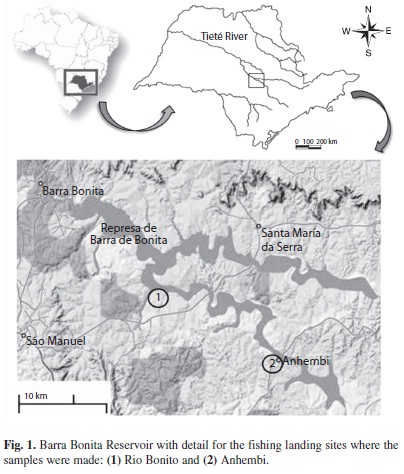
<body><![CDATA[-48&deg;32&#8217;03&#8217;&#8217; W),     for which the Tiet&ecirc; and Piracicaba Rivers are the main     tributaries     (<a href="#Fig_1">Fig. 1</a>). Due to ongoing releases of high volumes     of untreated domestic     sewage, the reservoir is currently considered as hypertrophic     (Stra&#353;kraba &amp; Tundisi 2000). Monthly samples were collected from     July 2004 to June 2005 at two fish landing sites: in Rio Bonito     (22&deg;40&#8217;52.1&#8217;&#8217; S- 48&deg;18&#8217;16.2 W) and in Anhembi (22&deg;47&#8217;10&#8217;&#8217;S-     48&deg;07&#8217;27&#8217;&#8217;) (<a href="#Fig_1">Fig. 1</a>). After the arrival of     ]]></body>
<body><![CDATA[fishers, a total of 20kg     (about 80 individuals) of <span style="font-style: italic;">O.     niloticus</span> caught in lacustrine environment     was randomly chosen for analysis and included in a box for     transportation. For each specimen, total weight (g), standard length     (cm), sex, and maturation status (according to the scale described in     Helfman et al. 2007) were recorded. Besides, full stomachs were fixed     in 5% formaldehyde for later analysis of stomach contents. A total of 1     715 specimens were analyzed. Data was grouped by to analyze     reproduction and feeding by season: winter-2004 (July, August,     ]]></body>
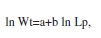
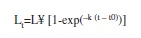
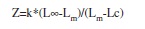
<body><![CDATA[September); spring-2004 (October, November, December); summer-2005     (January, February, March), and autumn-2005 (April, May, June).    <br>     <br> </span></font>     <div style="text-align: center;"><font size="2"><a name="Fig_1"></a><img  alt="" src="/img/revistas/rbt/v60n2/a17i1.jpg"  style="width: 404px; height: 474px;"><span  style="font-family: verdana;"></span></font><br  style="font-family: verdana;"> <font size="2"><span style="font-family: verdana;"></span></font></div> <br style="font-family: verdana;"> <font size="2"><span style="font-family: verdana;"><span  style="font-weight: bold;">Reproductive dynamics:</span> The sex ratio and the sex frequency determined (N=1 687, immature specimens) were obtained by macroscopic observation of gonads. For the reproductive biology analysis only females (N=744) were used, because they are better indicators of the reproductive period (Wootton 1995). The reproductive period was evaluated using the following techniques: distribution and frequency of macroscopic stages (&#8216;immature&#8217;, &#8216;mature&#8217;, &#8216;ripe&#8217;, &#8216;spent&#8217; and &#8216;at rest&#8217;) of the ovarian development, and seasonal average of the gonadosomatic index in females (GSI=the gonad weight, expressed as a percentage of body weight).</span></font><br  style="font-family: verdana;"> <br style="font-family: verdana;"> <font size="2"><span style="font-family: verdana;"><span  style="font-weight: bold;">Physicochemical parameters: </span>These were considered to determine possible influences of the environmental and/or limnological variables on the reproduction dynamics of this species. Limnological variables and water samples were obtained at a distance of approximately 50m from the river bank. A water quality analyzer (Horiba model U22) was used to measure<span  style="font-style: italic;"> in situ </span>the following parameters: pH, water temperature, dissolved oxygen, and electrical conductivity. Water transparency was also determined with a Secchi disk. Additionally, water samples (of about 500mL) were collected in appropriate bottles for total alkalinity and chlorophyll <span  style="font-style: italic;">a</span> (Chl <span  style="font-style: italic;">a</span>) content determination. In the laboratory, total alkalinity was estimated by titration with 0.1 N H<sub>2</sub>SO<sub>4</sub>, and Chl <span  style="font-style: italic;">a</span>; was determined using Millipore AP20 membranes and cold acetone (90%) extraction (see Nogueira <span style="font-style: italic;">et al.</span> 1999). Information about the monthly accumulated rainfall and the reservoir&#8217;s water level benchmark were obtained from the concessionaire of Barra Bonita Hydroelectric Plant (AES Tiet&ecirc; S/A). Results from the limnological and environmental monitoring programme were correlated with the GSI of females (N=744).</span></font><br  style="font-family: verdana;"> <br style="font-family: verdana;"> <font size="2"><span style="font-family: verdana;"><span  style="font-weight: bold;">Feeding:</span> The contents of 180 stomachs were analyzed using the Neubauer chamber, according to Tavares &amp; Rocha (2001). To quantify food items we followed the method of frequency of occurrence by Hyslop (1980). The classification of microscopic algae followed Round&#8217;s system, using the classification key described in Bicudo &amp; Menezes (2006). Algae were identified to the Division taxonomic level. </span></font><br  style="font-family: verdana;"> <br style="font-family: verdana; font-weight: bold;"> <font size="2"><span style="font-family: verdana;"><span  style="font-weight: bold;">Length-weight relationship:</span> For this and the following analysis, all available specimens (N=1 715) were used. The length-weight relationship was calculated with the next mathematical expression, after a logarithmic transformation of the data:     <br>     <br> </span></font>     <div style="text-align: center;"><font size="2"><span  style="font-family: verdana;"><img alt=""  src="/img/revistas/rbt/v60n2/a17f1.jpg"  style="width: 101px; height: 38px;"></span></font>    <br> <font size="2"><span style="font-family: verdana;"></span></font></div> <font size="2"><span style="font-family: verdana;"><br  style="font-family: verdana;"> </span></font><font size="2"><span style="font-family: verdana;">where Wt=total weight, Lp=standard length, a=a constant and b=inclination of slope.</span></font><br  style="font-family: verdana;"> <br style="font-family: verdana;"> <font size="2"><span style="font-family: verdana;"><span  style="font-weight: bold;">Growth parameters and mortality estimates:</span> Based on monthly distributions of standard length frequency, the following growth parameters were obtained: L&yen;=asymptotic standard length (cm), and k=growth coefficient (year). These parameters were evaluated using the ELEFAN I routine within the computer program FiSAT II (Gayanilo <span style="font-style: italic;">et al. </span>2005), which is based on the von Bertalanffy equation:     <br>     ]]></body>
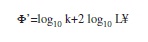
<body><![CDATA[<br> </span></font>     <div style="text-align: center;"><font size="2"><span  style="font-family: verdana;"><img alt=""  src="/img/revistas/rbt/v60n2/a17f2.jpg"  style="width: 141px; height: 38px;"></span></font>    <br> <font size="2"><span style="font-family: verdana;"></span></font></div> <font size="2"><span style="font-family: verdana;"><br  style="font-family: verdana;"> </span></font><font size="2"><span style="font-family: verdana;">where Lt =length in age t, L&yen;=asymptotic standard length, k=growth coefficient and t<sub>0</sub>=fish length at birth.</span></font><br style="font-family: verdana;"> <br style="font-family: verdana;"> <font size="2"><span style="font-family: verdana;">The index of growth performance (&#934;&#8217;) was quantified using the model proposed by Pauly &amp; Munro (1984):     <br>     <br> </span></font>     <div style="text-align: center;"><font size="2"><span  style="font-family: verdana;"><img alt=""  src="/img/revistas/rbt/v60n2/a17f3.jpg"  style="width: 148px; height: 42px;"></span></font>    <br> <font size="2"><span style="font-family: verdana;"></span></font></div> <font size="2"><span style="font-family: verdana;"><br  style="font-family: verdana;"> </span></font><font size="2"><span style="font-family: verdana;">where k is a growth constant per year and L&yen; is the asymptotic length in cm.</span></font><br  style="font-family: verdana;"> <br style="font-family: verdana;"> <font size="2"><span style="font-family: verdana;">The longevity potential was estimated according to the equation of Pauly (1980): T<sub>max</sub>=3/K. The length-age structure was evaluated using the von Bertalanffy equation (described above). We used the parameters L&#8734; and K calculated in this paper, and replaced t with ages ranging from 0-5 years. The parameter t<sub>0</sub> was considered as zero, because it is not biologically significant (Sparre &amp; Venema 1997). </span></font><br  style="font-family: verdana;"> <br style="font-family: verdana;"> <font size="2"><span style="font-family: verdana;">The natural mortality rate was evaluated using Pauly&#8217;s (1980) empirical model:     <br>     <br> </span></font>     <div style="text-align: center;"><font size="2"><span  style="font-family: verdana;"><img alt=""  src="/img/revistas/rbt/v60n2/a17f4.jpg"  style="width: 276px; height: 44px;"></span></font>    ]]></body>
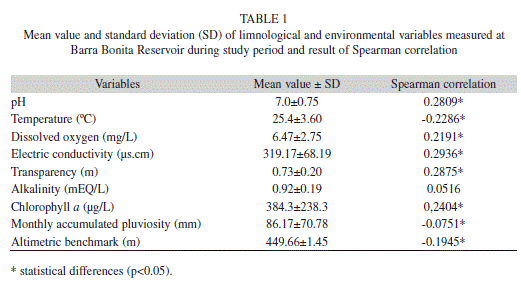
<body><![CDATA[<br> <font size="2"><span style="font-family: verdana;"></span></font></div> <font size="2"><span style="font-family: verdana;"><br  style="font-family: verdana;"> </span></font><font size="2"><span style="font-family: verdana;">where L</span></font><font  size="2"><span style="font-family: verdana;">&yen;</span></font><font  size="2"><span style="font-family: verdana;"> and k are the growth parameters obtained from the von Bertalanffy equation and T=mean water temperature (&deg;C), which was 24.6&deg;C.</span></font><br  style="font-family: verdana;"> <br style="font-family: verdana;"> <font size="2"><span style="font-family: verdana;">Total mortality rate (Z) was estimated using Beverton and Holt&#8217;s model:     <br>     <br> </span></font>     <div style="text-align: center;"><font size="2"><span  style="font-family: verdana;"><img alt=""  src="/img/revistas/rbt/v60n2/a17f5.jpg"  style="width: 145px; height: 29px;"></span></font>    <br> <font size="2"><span style="font-family: verdana;"></span></font></div> <font size="2"><span style="font-family: verdana;"><br  style="font-family: verdana;"> </span></font><font size="2"><span style="font-family: verdana;">where Lc=mean length at first capture, and L<sub>m</sub>=mean length starting from Lc. </span></font><br  style="font-family: verdana;"> <br style="font-family: verdana;"> <font size="2"><span style="font-family: verdana;">For the purpose of this study, Lc was taken as 15.0cm and L</span></font><font size="2"><span  style="font-family: verdana;"><sub>m</sub></span></font><font size="2"><span  style="font-family: verdana;"> was 18.7cm. The mortality rate due to fishing (F) was calculated as the difference between the total mortality rate (Z) and the natural mortality rate (M) (i.e., F=Z-M).</span></font><br  style="font-family: verdana;"> <br style="font-family: verdana;"> <font size="2"><span style="font-family: verdana;"><span  style="font-weight: bold;">Relative yield per recruit (Y&#8217;/R) and relative biomass per recruit (B&#8217;/R): </span>Y&#8217;/R was calculated using Beverton &amp; Holt&#8217;s method, modified by Pauly &amp; Soriano (1986), and the Knife Edges option of the program FiSAT II (Gayanilo <span  style="font-style: italic;">et al.</span> 2005), according to the following model:     <br>     <br> </span></font>     <div style="text-align: center;"><font size="2"><span  style="font-family: verdana;"><img alt=""  src="/img/revistas/rbt/v60n2/a17f6.jpg"  style="width: 272px; height: 30px;"></span></font>    <br> <font size="2"><span style="font-family: verdana;"></span></font></div> <font size="2"><span style="font-family: verdana;"><br  style="font-family: verdana;"> </span></font><font size="2"><span style="font-family: verdana;">where m=(1-E)/(M/k)=k/Z, U=1-(Lc/L</span></font><sub><font size="2"><span  style="font-family: verdana;">&yen;</span></font></sub><font size="2"><span  style="font-family: verdana;">) and E=F/Z (exploitation rate).</span></font><br  style="font-family: verdana;"> <br style="font-family: verdana;"> <font size="2"><span style="font-family: verdana;">We also calculated E<sub>max</sub> (exploitation rate of maximum sustainable yield), E<sub>0.1</sub> (exploitation rate at which the marginal increment of Y&#8217;/R is 10% of its virgin stock) and E<sub>0.5</sub> (exploitation rate that will result in a 50% reduction of the non-exploited biomass). The relative biomass per recruit (B&#8217;/R) was estimated as B&#8217;/R=(Y&#8217;/R)/F. For these estimates we used the routine ELEFAN I in the program FiSAT II (Gaynilo <span  style="font-style: italic;">et al. </span>2005).</span></font><br  style="font-family: verdana;"> <br style="font-family: verdana;"> <font size="2"><span style="font-family: verdana;">The x<sup>2</sup> test was used to evaluate if the male to female ratio of the population was 1:1. Before applying parametric tests, the data were transformed (ln) and their normality and homogeneity were analyzed using Kolmogorov-Smirnov&#8217;s and Bartlett&#8217;s tests, respectively. A one-way ANOVA was applied to test the null hypothesis of equal GSI values for different periods of the year and Tukey test was used to detect statistical differences. The t-test was applied to test whether the value of b of the length-weight relationship was equal to zero and whether <span  style="font-style: italic;">b</span>=3 (the condition of isometric growth). Because the data for the abiotic factors did not meet the assumption of variance normality and homogeneity, Spearman&#8217;s non-parametric correlation test was applied to examine possible relationships between abiotic factors and reproductive period, through values of GSI. For all statistical analyses p&lt;0.05.</span></font><br  style="font-family: verdana;"> <br style="font-family: verdana;"> <font style="font-weight: bold;" size="3"><span  style="font-family: verdana;">Results</span></font><br  style="font-family: verdana;"> <br style="font-family: verdana;"> <font size="2"><span style="font-family: verdana;">Reproductive dynamics: Males comprised 56.1% (n=946) and females 43.9% (n=741) of the catches, with a sex ratio (M:F) of 1.3:1 (x<sup>2</sup>=24.911, d.f.=1, p&lt;0.000). Seasonally, females predominated in winter-2004, comprising 251 (61.5%) and males 157 (38.5%) of the total; M:F=0.6:1, x<sup>2</sup>=21.657, d.f.=1, </span></font><font  size="2"><span style="font-family: verdana;">p&lt;0.0000. Nevertheless, males predominated in the other seasons. In spring-2004 males comprised 246 (62.6%) and females 147 (37.4%) with M:F=1.7:1, x<sup>2</sup>=24.939, d.f.=1 and p&lt; 0.0000. In summer-2005, males represented 316 (69.5%) and females 139 (30.5%), M:F=2.3:1, x<sup>2</sup>=68.855, d.f.=1 and p &lt;0.0000. In autumn-2005, males were 227 (52.7%) and females 204 (47.3%), M:F=1.1:1, x=1.227, d.f.=1 and p&lt;0.2893. </span></font><br  style="font-family: verdana;"> <br style="font-family: verdana;"> <font size="2"><span style="font-family: verdana;">The distribution frequency of gonadal stages indicated that ripe females were present throughout the year, but relative frequencies of females were higher in the winter-2004 (N=148, 59.0%) and in spring-2004 (N=89, 60.5%) (<a  href="/img/revistas/rbt/v60n2/a17i2.jpg">Fig. 2a</a>). Average values of GSI were as follows: winter-2004: 1.71, spring-2004: 1.72, summer-2005: 0.80 and autumn-2005: 1.19. The ANOVA showed statistical differences between GSI values among seasons (F<sub>(3:733)</sub>=30.754, p&lt;0.0000) (<a  href="/img/revistas/rbt/v60n2/a17i2.jpg">Fig. 2b</a>). </span></font><br  style="font-family: verdana;"> <br style="font-family: verdana;"> <font size="2"><span style="font-family: verdana;">Physicochemical parameters: Spearman correlation analysis indicated that average values of GSI were positively related to pH, dissolved oxygen, conductivity, water transparency and Chl <span style="font-style: italic;">a</span>; and negatively correlated to temperature, precipitation, and water level benchmark altimetry (<a href="#Tabla_1">Table 1</a>). When w&aacute;ter level was plotted against GSI, it was observed that GSI values presented a response to the hydrologic cycle at Barra Bonita Reservoir, with a two month delay for both increases and decreases of values (<a href="/img/revistas/rbt/v60n2/a17i3.jpg">Fig. 3</a>).    <br>     ]]></body>
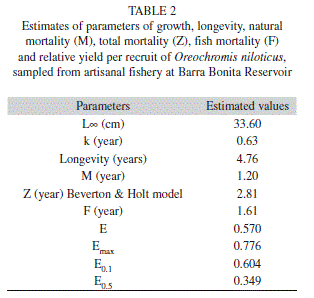
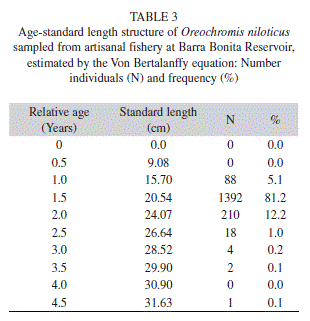
<body><![CDATA[<br> </span></font>     <div style="text-align: center;"><font size="2"><a name="Tabla_1"></a><img  alt="" src="/img/revistas/rbt/v60n2/a17t1.gif"  style="width: 521px; height: 288px;"><span  style="font-family: verdana;"></span></font><br  style="font-family: verdana;"> <font size="2"><span style="font-family: verdana;"></span></font></div> <br style="font-family: verdana;"> <font size="2"><span style="font-family: verdana;">Feeding: Dietary items found in the stomachs of <span style="font-style: italic;">O. niloticus</span> consisted almost exclusively of phytoplankton and periphytic algae (99.6%) with a low presence of zooplankton (0.4%). The algae group Crysophyta was predominant in winter-2004 (64.9%) and moderately high in spring-2004 (39.1%). The Cyanophyta, particularly the filamentous types, predominated in summer-2005 (41.3%) and autumn-2005 (62.9%) (<a href="/img/revistas/rbt/v60n2/a17i4.jpg">Fig. 4</a>). A large amount of sediment was present in fish stomachs, suggesting that <span style="font-style: italic;">O. niloticus</span> may search for food along the bottom of the reservoir.</span></font><br  style="font-family: verdana;"> <br style="font-family: verdana;"> <font size="2"><span style="font-family: verdana;"><span  style="font-weight: bold;">Length-weight relationship:</span> The standard length of O. niloticus varied from 11.0cm-31.2cm (Lp<sub>maen</sub>=18.3cm, SD=2.1), but most of the specimens were between 17.0cm-17.9cm. The length-weight relationship can be described by the formula: ln Wt=-2.8532+2.8835 ln Lp, where R<sup>2</sup>=0.8941. The <span  style="font-style: italic;">t</span>-test indicated a value of <span style="font-style: italic;">b</span> that differed from zero (<span style="font-style: italic;">t</span><sub>(1:1713)</sub> =119.28, p=0.00) and three (the condition of isometric growth) (<span  style="font-style: italic;">t</span><sub> (1:1713)</sub>=75.76, p=0.00), thus indicating negative allometric growth.</span></font><br style="font-family: verdana;"> <br style="font-family: verdana; font-weight: bold;"> <font size="2"><span style="font-family: verdana;"><span  style="font-weight: bold;">Parameters of growth and mortality estimates:</span> Growth parameters were as </span></font><font  size="2"><span style="font-family: verdana;">follows: L&#8734;=33.60cm, k=0.63/year (<a href="#Tabla_2">Table 2</a>). The length growth equation was as follows: L<sub>t</sub>=33.60[1exp(<sup>0.63 (t&#8211;t0)</sup>)]. The length growth curve suggested the presence of two welldefined cohorts (<a  href="/img/revistas/rbt/v60n2/a17i5.jpg">Fig. 5</a>). The index of growth performance was estimated to be &#934;&#8217;=2.85 (<a href="#Tabla_2">Table 2</a>).    <br>     <br> </span></font>     <div style="text-align: center;"><font size="2"><a name="Tabla_2"></a><img  alt="" src="/img/revistas/rbt/v60n2/a17t2.gif"  style="width: 314px; height: 298px;"><span  style="font-family: verdana;"></span></font><br  style="font-family: verdana;"> <font size="2"><span style="font-family: verdana;"></span></font></div> <br style="font-family: verdana;"> <font size="2"><span style="font-family: verdana;">Longevity potential was estimated to be <span style="font-style: italic;">t<sub>max</sub></span>=4.76 years (<a href="#Tabla_2">Table 2</a>). The length-age structure analysis indicated that most <span style="font-style: italic;">O. niloticus </span>caught in this fishery were 1-2 years old (98.5%), of which 81.2% were about 1.5 years old (<a href="#Tabla_3">Table 3</a>).    <br>     <br> </span></font>     <div style="text-align: center;"><font size="2"><a name="Tabla_3"></a><img  alt="" src="/img/revistas/rbt/v60n2/a17t3.gif"  style="width: 310px; height: 321px;"><span  style="font-family: verdana;"></span></font><br  style="font-family: verdana;"> <font size="2"><span style="font-family: verdana;"></span></font></div> <br style="font-family: verdana;"> <font size="2"><span style="font-family: verdana;">The values for instantaneous total mortality rate (Z), natural mortality rate (M) and </span></font><font  size="2"><span style="font-family: verdana;">fishing mortality rate (F) were estimated to be 2.81/year, 1.20/year and 1.61/year, respectively (<a  href="#Tabla_2">Table 2</a>). Mortality due to fishing was more important than the other causes of mortality (F&gt;M). <a href="/img/revistas/rbt/v60n2/a17t4.gif">Table 4</a> provides a comparison, based on parameters for growth and mortality, between this study and other studies in <span style="font-style: italic;">O. niloticus</span>.    <br>     <br>     ]]></body>
<body><![CDATA[</span></font><font size="2"><span style="font-family: verdana;"><span      style="font-weight: bold;">Relative yield per recruit (Y&#8217;/R)     and relative biomass per recruit (B&#8217;/R): </span>The values of E     (0.570) and     E<sub>max</sub> (0.776) (<a href="#Tabla_2">Table 2</a>) indicate that     overfishing of <span style="font-style: italic;">O. niloticus</span>     is not     occurring in the Barra Bonita Reservoir (i.e., E &lt;E<sub>max</sub>).     It was,     however, noted that the value of E exceeded the value of E<sub>0.5</sub>     ]]></body>
<body><![CDATA[(0.349)     and was </span></font><font size="2"><span      style="font-family: verdana;">very close to E<sub>0.1</sub> (0.604)     (<a href="#Tabla_2">Table     2</a>).</span></font><br style="font-family: verdana;">     <br style="font-family: verdana;">     <font style="font-weight: bold;" size="3"><span      style="font-family: verdana;">Discussion</span></font><br      style="font-family: verdana;">     <br style="font-family: verdana;">     ]]></body>
<body><![CDATA[<font size="2"><span style="font-family: verdana;"><span      style="font-weight: bold;">Reproductive dynamics: </span>The sex     ratio of most fish species in the wild tends to be </span></font><font      size="2"><span style="font-family: verdana;">1:1, but deviations can     occur and     seasonal variations are common (Helfman<span style="font-style: italic;">     et al.</span> 2007). The sex ratio is     influenced by several factors, including mortality, longevity&nbsp; and     growth rate; these in turn lead to differences in the catch rate (King     &amp; Etim 2004). Differences in sex ratio for tilapia species have     ]]></body>
<body><![CDATA[been verified in introduced populations such as <span      style="font-style: italic;">O. niloticus</span> in Mexico     (Pe&ntilde;a-Mendoza <span style="font-style: italic;">et al.</span>     2005) and in Lake Victoria, Kenya (Njiru <span      style="font-style: italic;">et al.     </span>2006) and in natural populations, such as <span      style="font-style: italic;">Tilapia mariae</span> in Nigeria     (King &amp; Etim 2004) and <span style="font-style: italic;">O.     esculentus</span> in Lake Victoria and Lake     Kyoga (Nagayi-Yawe <span style="font-style: italic;">et al. </span>2006).     ]]></body>
<body><![CDATA[Two possible reasons may account for     the sex ratio observed in our study. Firstly, it may relate to the     reproductive strategies of the population and to differences in the     dispersal of males and females after completion of the reproductive     process. Lowe-McConnell (1987) reported that males make nests in     shallow water during the reproductive process. Females release the eggs     immediately after spawning (the eggs are usually fertilized in their     mouth) and remain in the beds, or move to safer places for incubation     and protection of the spawn. The males are, however, more likely to be     caught because they disperse when searching for food. This hypothesis     ]]></body>
<body><![CDATA[might explain the differences in sex ratio of <span      style="font-style: italic;">O. niloticus</span> in Lake     Victoria (Njiru <span style="font-style: italic;">et al.</span> 2006)     and in the </span></font><font size="2"><span      style="font-family: verdana;">Emiliano Zapata Reservoir in Mexico     (Pe&ntilde;a-Mendoza<span style="font-style: italic;"> et al. </span>2005).     Secondly, differential growth rates in     males and females (Wootton 1995, King &amp; Etim 2004), with higher     rates being found in males, may mean that males are more susceptible     than females to capture by fishing gears (10cm mesh with opposite     ]]></body>
<body><![CDATA[knots). We performed exploratory data analysis, which did not reveal     significant differences in the growth rates of<span      style="font-style: italic;"> O. niloticus </span>males and     females, in the Barra Bonita Reservoir. Thus, the differences in the     sex ratio observed in this study are likely to relate more to     reproductive behavior than to growth rates.</span></font><br      style="font-family: verdana;">     <br style="font-family: verdana;">     <font size="2"><span style="font-family: verdana;">An analysis of     average values of     ]]></body>
<body><![CDATA[GSI and the frequency distribution of maturation stages indicated that     <span style="font-style: italic;">O. niloticus</span> reproduced     throughout the year in the Barra Bonita     Reservoir, with reproduction peaks in winter and spring. A long     reproductive period for this species was reported in other ecosystems     in which it was introduced, although reproductive peaks varied among     localities (Cala &amp; Bernal 1997, Barbieri <span      style="font-style: italic;">et al.</span> 2000a, Duponchelle     <span style="font-style: italic;">et al.</span> 2000, Gomez-Marquez <span      style="font-style: italic;">et al.</span> 2003, Peterson <span     ]]></body>
<body><![CDATA[ style="font-style: italic;">et al.</span> 2004, Pena-Mendonza <span      style="font-style: italic;">et al.</span> 2005, Njiru <span      style="font-style: italic;">et al.</span> 2006, Komolafe &amp; Arawono     2007, Kwarfo-Apegyah &amp; Ofori-Danson 2010).</span></font><br      style="font-family: verdana;">     <br style="font-family: verdana; font-weight: bold;">     <font size="2"><span style="font-family: verdana;"><span      style="font-weight: bold;">Physicochemical parameters:</span>     Exogenous factors sometimes influence endogenous reproductive     processes. Some of these, such as temperature, water flow, water level,     ]]></body>
<body><![CDATA[and precipitation, can serve as triggers for tropical fish reproduction     (Lowe-McConnell 1987, Wootton 1995). In reservoirs in the Ivory Coast     (Duponchelle <span style="font-style: italic;">et al.</span> 2000) and     Ghana (Kwarfo-Apegyah &amp; Ofori-Danson     2010), the reproductive period of <span style="font-style: italic;">O.     niloticus</span> is associated with high     temperature, precipitation, water level, and higher photoperiod during     summer. In the rivers of the state of Mississippi in the USA, the     reproductive peak occurs in spring, when the temperature is over     22&deg;C (Peterson <span style="font-style: italic;">et al.</span>     ]]></body>
<body><![CDATA[2004). In the Guarapiranga Reservoir     (Brazil), greater reproductive activity is associated with the rainy     season and higher temperatures in summer (Barbieri <span      style="font-style: italic;">et al.</span> 2000a). Our     results did not identify a positive relationship between average values     of GSI in females and the water level, we believe that this variable is     one of the main triggers of the increase in reproductive activity of <span      style="font-style: italic;">O.     niloticus</span> in the Barra Bonita Reservoir during winter and     spring.     ]]></body>
<body><![CDATA[Because, of its position, the Barra Bonita Reservoir controls water     levels in other reservoirs of the cascade system, resulting in a     reversal of water flow regime compared to that found in natural     environments, i.e. the lowest water levels in the reservoir occur     between September and December. The water level of the reservoir began     to rise in January 2005 and reached m&aacute;ximum capacity from June     to July, 2005. The values of GSI were a response to this hydrologic     cycle, with a two-month delay in the case of both increasing and     decreasing values.</span></font><br style="font-family: verdana;">     <br style="font-family: verdana;">     ]]></body>
<body><![CDATA[<font size="2"><span style="font-family: verdana;"><span      style="font-weight: bold;">Feeding:</span> Our analyses revealed that     <span style="font-style: italic;">O. niloticus </span>in the Barra     Bonita Reservoir is phytoplanktophagus, which     is in agreement with results from African (Bwanika <span      style="font-style: italic;">et al.</span> 2004, Njiru     <span style="font-style: italic;">et al. </span>2004) and Asian     reservoirs and lakes (Weliange &amp; Amarasinghe     2003). The presence of large quantities of sediment in the stomach     contents suggests, however, that <span style="font-style: italic;">O.     ]]></body>
<body><![CDATA[niloticus</span> may also be taking food     from the bottom of the reservoir, where accumulated organic matter is     available, often in large quantities (Hahn &amp; Fugi, 2007, Vidotto     &amp; Carvalho 2009). Thus in addition to phytoplankton and periphytic     algae, bacteria, protozoa and fungi from the sediment may also be a     source of food for <span style="font-style: italic;">O. niloticus.</span>     </span></font><br style="font-family: verdana;">     <br style="font-family: verdana;">     <font size="2"><span style="font-family: verdana;">Dietary analysis     indicated seasonal     ]]></body>
<body><![CDATA[differences in diet, with a predominance of chrysophytes during winter     and spring-2004 and cyanophytes in summer and autumn-2005. Seasonality     in diet is a result of variation in the availability of food in the     environment. These variations can occur for many reasons, including     life cycle changes of prey, changes in the predators preying on the     food item, and changes in the foraging habitat (Wootton 1995). In Sri     Lankan reservoirs, the diet of <span style="font-style: italic;">O.     niloticus</span> varied from phytoplankton     to zooplankton to detritus, depending on the availability of these     items in the environment (Weliange &amp; Amarasinghe 2003). In Lake     ]]></body>
<body><![CDATA[Victoria, phytoplankton and zooplankton, insects, vegetation, and fish     were also part of the diet of this species (Njiru <span      style="font-style: italic;">et al. </span>2004). The     phytoplankton community in the Barra Bonita Reservoir consisted mainly     of chrysophytes, cyanophytes, and chlorophytes and the availability of     these algal groups varied seasonally (Matsumura-Tundisi &amp; Tundisi     2005). Although <span style="font-style: italic;">O. niloticus</span>     feeds mostly on phytoplankton throughout     the year, it is also well adapted to seasonal variations in the     availability of various food items. Thus, we infered that the     ]]></body>
<body><![CDATA[population of <span style="font-style: italic;">O. niloticus </span>was     able to survive on food resources     available at Barra Bonita Reservoir along the year.</span></font><br      style="font-family: verdana;">     <br style="font-family: verdana;">     <font size="2"><span style="font-family: verdana;"><span      style="font-weight: bold;">Length-weight relationship:</span> Samples     caught in the fishery were mainly adult and they had probably already     reproduced at least once; few young individuals were caught. The <span      style="font-style: italic;">O.     ]]></body>
<body><![CDATA[niloticus</span> fishery does not focus on Young fish. Accordingly,     fishery     pressure does not yet seem to be a threat to the stock. On the other     hand, fishery pressure on larger individuals may result in genetic     degradation in the population. The removal of larger individuals favors     the survival of smaller individuals and those that grow more slowly.     This changes the genetic variability of the population, because it     eliminates genes that promote rapid growth (Conover &amp; Munch 2002).     Furthermore, older and larger females tend to spawn earlier and lay     more eggs. Larvae from these eggs grow three times faster, and are more     ]]></body>
<body><![CDATA[resistant to periods of low food availability, than those born from     young females (Berkeley <span style="font-style: italic;">et al.</span>     2004). Thus the conservation of larger     individuals, which are currently the target of the fishery due to     fisheries legislation, is crucial for the maintenance of fish stocks.</span></font><br      style="font-family: verdana;">     <br style="font-family: verdana;">     <font size="2"><span style="font-family: verdana;">The <span      style="font-style: italic;">b</span> value of <span      style="font-style: italic;">O. niloticus</span>     ]]></body>
<body><![CDATA[(2.8838) was statistically different from three. This is an indicative     of negative allometric growth (i.e. the species exhibited faster gains     in lengthgrowth than in weight). In contrast, Njiru <span      style="font-style: italic;">et al. </span>(2006)     reported positive allometric growth in this species in Lake Victoria,     and in the Betania Reservoir in Colombia (Cala &amp; Bernal 1997), and     the Guarapiranga Reservoir in Brazil (Barbieri <span      style="font-style: italic;">et al.</span> 2000b), isometric     growths were reported. Values of <span style="font-style: italic;">b</span>     often oscillate between 2.5 and 3.5,     ]]></body>
<body><![CDATA[depending on the species.&nbsp; Natural intraspecific variation, in     terms of sex and age and the influence of season, type and availability     of food and reproductive period, has been observed (Laleye 2006). For     these reasons research workers need to be cautious when interpreting     the meaning of <span style="font-style: italic;">b</span>, because     temporal variations in the value may occur     naturally. Santos <span style="font-style: italic;">et al.</span>     (2004) studied <span style="font-style: italic;">Geophagus brasiliensis</span>     (a     Brazilian cichlid) in reservoirs and concluded that stress caused by     ]]></body>
<body><![CDATA[variations in the reservoir level, may have contributed to the negative     allometric growth observed for this species. Water level fluctuations     in the Barra Bonita Reservoir were estimated at about five meter. The     hypothesis that stress, induced by variation in the fluctuation of the     reservoir&#8217;s water level, affected <span style="font-style: italic;">O.     niloticus</span> growth is thus feasible.     This could be due to more energy being allocated to reproduction than     to growth, causing a decrease in the weight of individuals.</span></font><br      style="font-family: verdana;">     <br style="font-family: verdana; font-weight: bold;">     ]]></body>
<body><![CDATA[<font size="2"><span style="font-family: verdana;"><span      style="font-weight: bold;">Parameters of growth and mortality     estimates:</span> Growth parameters for <span      style="font-style: italic;">O. niloticus</span>, estimated using     FiSAT,     were biologically feasible, because the growth performance rate     (&#934;&#8217;=2.85) was within the range estimated for other cichlid populations     (Moreau et al. 1986, De Silva et al. 1988, Amarasinghe &amp; De Silva     1992, Amarasinghe 2002, King &amp; Etim 2004). The growth parameters     estimated for the species (L&#8734;=33.6cm, k=0.63/year and longevity 4.7     ]]></body>
<body><![CDATA[years) indicated rapid growth. According to some authors     (Lowe-McConnell 1987, Winemiller 1989) species at a low trophic level,     such as <span style="font-style: italic;">O. niloticus</span>, tend to     have rapid growth, short longevity, and     early sexual maturation, that applies to the present results. When we     compared the growth parameters (L&#8734; and k) and the mortality rates (Z, M     and F) estimated for <span style="font-style: italic;">O. niloticus</span>     in our study, with those estimated in     other studies, several differences were apparent. Various endogenous     and exogenous factors influence fish growth (Helfman <span     ]]></body>
<body><![CDATA[ style="font-style: italic;">et al.</span> 2007) and     these may be responsible for the observed differences. The level of     fishing effort is a variable that clearly affects growth and mortality     rates (Sparre &amp; Venema 1997). This factor was identified as the     cause of differences (in terms of growth and mortality rates) between     species of <span style="font-style: italic;">Oreochromis</span> in two     Asian lakes (Amarasinghe 2002). It is     likely that high fishing efforts (Maruyama <span      style="font-style: italic;">et al.</span> 2009) will affect the     growth and mortality rates of <span style="font-style: italic;">O.     ]]></body>
<body><![CDATA[niloticus</span> in the Barra Bonita     Reservoir.    <br> <br style="font-family: verdana;"> </span></font><font size="2"><span style="font-family: verdana;"><span  style="font-weight: bold;">Relative yield per recruit (Y&#8217;/R) and relative biomass per recruit (B&#8217;/R):</span> The value of Y/R&#8217; in our study indicates that stock is not being over-fished. The observations that E is greater than E<sub>0,5</sub>, that E is very close to E<sub>0,1</sub>, and that F is greater than M, all suggest that the current fishing effort is very close to the maximum sustainable level. The artisanal fishing effort in the Barra Bonita Reservoir currently includes a contingent of about 500 fishers and 200 boats (Maruyama et al. 2009), which represents the maximum effort for the artisanal fisheries in this reservoir. It is necessary to take appropriate management steps so that the artisanal fishery does not decline in the reservoir.</span></font><br  style="font-family: verdana;"> <br style="font-family: verdana;"> <font size="2"><span style="font-family: verdana;">Based on present results, we came to a number of conclusions: (i) <span style="font-style: italic;">O. niloticus</span> is well established in the studied areas of the reservoir; (ii) The long reproductive period (more intense in winter and spring) and the phytoplankton feeding habit characterized in this study agree with results from other studies on <span  style="font-style: italic;">O. niloticus;</span> (iii) The fish stock is not currently over-fished, but the level of exploitation by the artisanal fisheries is close to the maximum sustainable level. Since <span style="font-style: italic;">O. niloticus</span> is exotic to the Barra Bonita Reservoir, conservation measures to protect this species, such as temporary prohibition of fishing, prohibition of fishing gear, controls of fish size caught and control of fishing effort, are not recommended for this locality.</span></font><br  style="font-family: verdana;"> <br style="font-family: verdana;"> <font style="font-weight: bold;" size="3"><span  style="font-family: verdana;">Acknowledgments</span></font><span  style="font-family: verdana;">    <br> <br style="font-family: verdana;"> </span><font size="2"><span style="font-family: verdana;">We wish to thank the fishers at Barra Bonita Reservoir; the entire team of the Laboratory for Fish Ecology of UNESP-Botucatu; and the Coordenacao de Aperfeicoamento de Pessoal de Nivel Superior (CAPES) for a grant.</span></font><br  style="font-family: verdana;"> <br style="font-family: verdana;"> <font style="font-weight: bold;" size="2"><span  style="font-family: verdana;"></span></font> <hr style="width: 100%; height: 2px;"><font style="font-weight: bold;"  size="3">    <!-- ref --><br> <span style="font-family: verdana;">References</span></font><br  style="font-family: verdana;"> <br style="font-family: verdana;"> <font size="2"><span style="font-family: verdana;">Alvares, E.S.S., M.A.S. Canelas, R.G. Costa, L.G. Dias, H.N. Ribeiro-Mendes &amp; R.M. Pinto-Coelho. 2000. A pesca na represa da Pampulha, p. 375-382. <span  style="font-style: italic;">In</span> Anais do V Simposio de Ecossistemas Brasileiros: Conservacao Vol. 3. Belo Horizonte, Minas Gerais, Brasil.    &nbsp;&nbsp;&nbsp;&nbsp;&nbsp;&nbsp;&nbsp;&nbsp;[&#160;<a href="javascript:void(0);" onclick="javascript: window.open('/scielo.php?script=sci_nlinks&ref=1500971&pid=S0034-7744201200020001700001&lng=','','width=640,height=500,resizable=yes,scrollbars=1,menubar=yes,');">Links</a>&#160;]<!-- end-ref --><!-- ref --></span></font><br  style="font-family: verdana;"> <br style="font-family: verdana;"> <font size="2"><span style="font-family: verdana;">Amarasinghe, U.S. &amp; S.S. De Silva. 1992. Population dynamics of <span style="font-style: italic;">Oreochromis mossambicus</span> and <span style="font-style: italic;">O. niloticus</span> (Cichlidae) in two reservoirs in Sri Lanka. Asian Fish. Sci. 5: 37-61.    &nbsp;&nbsp;&nbsp;&nbsp;&nbsp;&nbsp;&nbsp;&nbsp;[&#160;<a href="javascript:void(0);" onclick="javascript: window.open('/scielo.php?script=sci_nlinks&ref=1500972&pid=S0034-7744201200020001700002&lng=','','width=640,height=500,resizable=yes,scrollbars=1,menubar=yes,');">Links</a>&#160;]<!-- end-ref --><!-- ref --></span></font><br style="font-family: verdana;"> <br style="font-family: verdana;"> <font size="2"><span style="font-family: verdana;">Amarasinghe, U.S. 2002. The fishery and population dynamics of <span style="font-style: italic;">Oreochromis mossambicus</span> and <span style="font-style: italic;">Oreochromis niloticus</span> (Oesteichthyes, Cichlidae) in a shallow irrigation in Sri Lanka. Asian Fish. Sci. 15: 7-20.    &nbsp;&nbsp;&nbsp;&nbsp;&nbsp;&nbsp;&nbsp;&nbsp;[&#160;<a href="javascript:void(0);" onclick="javascript: window.open('/scielo.php?script=sci_nlinks&ref=1500973&pid=S0034-7744201200020001700003&lng=','','width=640,height=500,resizable=yes,scrollbars=1,menubar=yes,');">Links</a>&#160;]<!-- end-ref --><!-- ref --></span></font><br  style="font-family: verdana;"> <br style="font-family: verdana;"> <font size="2"><span style="font-family: verdana;">Barbieri, G., A.R. Teixeira Filho, E.C. Campos, H. Vermulm Jr. &amp; M.T.D. Giamas. 2000a. Biologia populacional da tilapia, <span style="font-style: italic;">Oreochromis niloticus</span>, represa de Gurapiranga, Sao Paulo&#8211;II. Dinamica da reproducao. B. Inst. Pesca 26: 9-13.    &nbsp;&nbsp;&nbsp;&nbsp;&nbsp;&nbsp;&nbsp;&nbsp;[&#160;<a href="javascript:void(0);" onclick="javascript: window.open('/scielo.php?script=sci_nlinks&ref=1500974&pid=S0034-7744201200020001700004&lng=','','width=640,height=500,resizable=yes,scrollbars=1,menubar=yes,');">Links</a>&#160;]<!-- end-ref --><!-- ref --></span></font><br  style="font-family: verdana;"> <br style="font-family: verdana;"> <font size="2"><span style="font-family: verdana;">Barbieri, G., A.R. Teixeira Filho, E.C. Campos, H. Vermulm Jr. &amp; M.T.D. Giamas. 2000b. Biologia populacional da tilapia, <span style="font-style: italic;">Oreochromis niloticus</span>, represa de Gurapiranga, Sao Paulo&#8211;I. Estrutura populacional, idade e crescimento. B. Inst. Pesca 26: 1-7.    &nbsp;&nbsp;&nbsp;&nbsp;&nbsp;&nbsp;&nbsp;&nbsp;[&#160;<a href="javascript:void(0);" onclick="javascript: window.open('/scielo.php?script=sci_nlinks&ref=1500975&pid=S0034-7744201200020001700005&lng=','','width=640,height=500,resizable=yes,scrollbars=1,menubar=yes,');">Links</a>&#160;]<!-- end-ref --><!-- ref --></span></font><br style="font-family: verdana;"> <br style="font-family: verdana;"> <font size="2"><span style="font-family: verdana;">Berkeley, S.A., C. Chapman &amp; S.M. Soagard. 2004. Maternal age as a determinant of larval growth and survival in a marine fish, <span style="font-style: italic;">Sabastes melanops</span>. Ecology 85: 1258-1264.    &nbsp;&nbsp;&nbsp;&nbsp;&nbsp;&nbsp;&nbsp;&nbsp;[&#160;<a href="javascript:void(0);" onclick="javascript: window.open('/scielo.php?script=sci_nlinks&ref=1500976&pid=S0034-7744201200020001700006&lng=','','width=640,height=500,resizable=yes,scrollbars=1,menubar=yes,');">Links</a>&#160;]<!-- end-ref --><!-- ref --></span></font><br  style="font-family: verdana;"> <br style="font-family: verdana;"> <font size="2"><span style="font-family: verdana;">Bicudo, C.E. de M. &amp; M. Menezes. 2006. G&ecirc;neros de algas de &aacute;gua continental do Brasil. Chave para identifica&ccedil;&atilde;o e descri&ccedil;&otilde;es. RiMA, S&atilde;o Carlos, S&atilde;o Paulo, Brasil.    &nbsp;&nbsp;&nbsp;&nbsp;&nbsp;&nbsp;&nbsp;&nbsp;[&#160;<a href="javascript:void(0);" onclick="javascript: window.open('/scielo.php?script=sci_nlinks&ref=1500977&pid=S0034-7744201200020001700007&lng=','','width=640,height=500,resizable=yes,scrollbars=1,menubar=yes,');">Links</a>&#160;]<!-- end-ref --><!-- ref --></span></font><br  style="font-family: verdana;"> <br style="font-family: verdana;"> <font size="2"><span style="font-family: verdana;">Bwanika, G.N., B. Makanga, Y. Kizito, L.J. Chapman &amp; J. Balirwa. 2004. Observations on the biology of Nile tilapia, <span style="font-style: italic;">Oreochromis niloticus</span> L., in two Ugandan crater lakes. Afr. J. Ecol. 42: 93-111.    &nbsp;&nbsp;&nbsp;&nbsp;&nbsp;&nbsp;&nbsp;&nbsp;[&#160;<a href="javascript:void(0);" onclick="javascript: window.open('/scielo.php?script=sci_nlinks&ref=1500978&pid=S0034-7744201200020001700008&lng=','','width=640,height=500,resizable=yes,scrollbars=1,menubar=yes,');">Links</a>&#160;]<!-- end-ref --><!-- ref --></span></font><br  style="font-family: verdana;"> <br style="font-family: verdana;"> <font size="2"><span style="font-family: verdana;">Cala, P. &amp; G. Bernal. 1997. Ecologia y adaptaciones de la tilapia nilotica (<span  style="font-style: italic;">Oreochromis niloticus</span>) en ambientes naturales&#8211;Caso embalse de Betania y cienaga de chilloa, sistema del rio Magdalena, Colombia. Dahlia 2: 3-29.    &nbsp;&nbsp;&nbsp;&nbsp;&nbsp;&nbsp;&nbsp;&nbsp;[&#160;<a href="javascript:void(0);" onclick="javascript: window.open('/scielo.php?script=sci_nlinks&ref=1500979&pid=S0034-7744201200020001700009&lng=','','width=640,height=500,resizable=yes,scrollbars=1,menubar=yes,');">Links</a>&#160;]<!-- end-ref --><!-- ref --></span></font><br  style="font-family: verdana;"> <br style="font-family: verdana;"> <font size="2"><span style="font-family: verdana;">Carvalho, E.D., S.G de C. Britto &amp; M.L Orsi. 2005. O panorama das introdu&ccedil;&otilde;es de peixes na bacia hidrografica do rio Paranapanema, Alto Paran&aacute;, Brasil, p. 253-274. <span style="font-style: italic;">In</span> O. Rocha, E.L.G. Esp&iacute;ndola, N. Fenerich-Verani, J.R. Verani &amp; A.C. Reitzler (eds.). Especies invasoras em &aacute;guas doces&#8211;estudo de caso e propostas de manejo. Editora da Universidade </span></font><font  size="2"><span style="font-family: verdana;">S&atilde;</span></font><font  size="2"><span style="font-family: verdana;">o Carlos, </span></font><font  size="2"><span style="font-family: verdana;">S&atilde;</span></font><font  size="2"><span style="font-family: verdana;">o Carlos, </span></font><font  size="2"><span style="font-family: verdana;">S&atilde;</span></font><font  size="2"><span style="font-family: verdana;">o Paulo, Brasil.    &nbsp;&nbsp;&nbsp;&nbsp;&nbsp;&nbsp;&nbsp;&nbsp;[&#160;<a href="javascript:void(0);" onclick="javascript: window.open('/scielo.php?script=sci_nlinks&ref=1500980&pid=S0034-7744201200020001700010&lng=','','width=640,height=500,resizable=yes,scrollbars=1,menubar=yes,');">Links</a>&#160;]<!-- end-ref --><!-- ref --></span></font><br  style="font-family: verdana;"> <br style="font-family: verdana;"> <font size="2"><span style="font-family: verdana;">CESP 1998. Conserva&ccedil;&atilde;o e manejo nos reservatorios: limnologia, ictiologia e pesca. Serie Divulga&ccedil;&atilde;o e Informa&ccedil;&atilde;o, 220. Companhia Eletrica de </span></font><font  size="2"><span style="font-family: verdana;">S&atilde;</span></font><font  size="2"><span style="font-family: verdana;"></span></font><font  size="2"><span style="font-family: verdana;"></span></font><font  size="2"><span style="font-family: verdana;">o Paulo, Departamento de Estudos e Planejamento Ambiental. </span></font><font size="2"><span  style="font-family: verdana;">S&atilde;</span></font><font size="2"><span  style="font-family: verdana;"></span></font><font size="2"><span  style="font-family: verdana;">o Paulo, </span></font><font size="2"><span  style="font-family: verdana;">S&atilde;</span></font><font size="2"><span  style="font-family: verdana;"></span></font><font size="2"><span  style="font-family: verdana;">o Paulo, Brasil.    &nbsp;&nbsp;&nbsp;&nbsp;&nbsp;&nbsp;&nbsp;&nbsp;[&#160;<a href="javascript:void(0);" onclick="javascript: window.open('/scielo.php?script=sci_nlinks&ref=1500981&pid=S0034-7744201200020001700011&lng=','','width=640,height=500,resizable=yes,scrollbars=1,menubar=yes,');">Links</a>&#160;]<!-- end-ref --><!-- ref --></span></font><br  style="font-family: verdana;"> <br style="font-family: verdana;"> <font size="2"><span style="font-family: verdana;">Conover, D.O. &amp; S. Munch. 2002: Sustaining fisheries yields over evolutionary time scales. Science 297: 94-96.    &nbsp;&nbsp;&nbsp;&nbsp;&nbsp;&nbsp;&nbsp;&nbsp;[&#160;<a href="javascript:void(0);" onclick="javascript: window.open('/scielo.php?script=sci_nlinks&ref=1500982&pid=S0034-7744201200020001700012&lng=','','width=640,height=500,resizable=yes,scrollbars=1,menubar=yes,');">Links</a>&#160;]<!-- end-ref --><!-- ref --></span></font><br style="font-family: verdana;"> <br style="font-family: verdana;"> <font size="2"><span style="font-family: verdana;">De Silva, S.S., J. Moreau &amp; K.A.D.W. Senaratne 1988. Growth of <span style="font-style: italic;">Oreochromis mossambicus</span> (Pisces, Cichlidae) as evidence of its adaptability to Sri Lankan reservoirs. Asian Fish. Sci. 1: 47-156.    &nbsp;&nbsp;&nbsp;&nbsp;&nbsp;&nbsp;&nbsp;&nbsp;[&#160;<a href="javascript:void(0);" onclick="javascript: window.open('/scielo.php?script=sci_nlinks&ref=1500983&pid=S0034-7744201200020001700013&lng=','','width=640,height=500,resizable=yes,scrollbars=1,menubar=yes,');">Links</a>&#160;]<!-- end-ref --><!-- ref --></span></font><br  style="font-family: verdana;"> <br style="font-family: verdana;"> <font size="2"><span style="font-family: verdana;">Duponchelle, F., P. Cecchi, D. Corbin, J. Nunez &amp; M. Legendre. 2000. Variations in fecundity and eggs size of female Nile tilapia, <span style="font-style: italic;">Oreochromis niloticus</span>, from man-made lakes of Cote d&#8217;Ivoire. Environ. Biol. Fish. 57: 155-170.    &nbsp;&nbsp;&nbsp;&nbsp;&nbsp;&nbsp;&nbsp;&nbsp;[&#160;<a href="javascript:void(0);" onclick="javascript: window.open('/scielo.php?script=sci_nlinks&ref=1500984&pid=S0034-7744201200020001700014&lng=','','width=640,height=500,resizable=yes,scrollbars=1,menubar=yes,');">Links</a>&#160;]<!-- end-ref --><!-- ref --></span></font><br  style="font-family: verdana;"> <br style="font-family: verdana;"> <font size="2"><span style="font-family: verdana;">Gayanilo, F.C. Jr., P. Sparre &amp; D. Pauly, D. 2005. FAOICLARM stock assessment tools II (FiSAT II). Revised version. User&#8217;s guide. FAO Computerized Information Serie (Fisheries). No 8, FAO, Roma, Italia.    &nbsp;&nbsp;&nbsp;&nbsp;&nbsp;&nbsp;&nbsp;&nbsp;[&#160;<a href="javascript:void(0);" onclick="javascript: window.open('/scielo.php?script=sci_nlinks&ref=1500985&pid=S0034-7744201200020001700015&lng=','','width=640,height=500,resizable=yes,scrollbars=1,menubar=yes,');">Links</a>&#160;]<!-- end-ref --></span></font>    ]]></body>
<body><![CDATA[<!-- ref --><br> <br style="font-family: verdana;"> <br style="font-family: verdana;"> <font size="2"><span style="font-family: verdana;">Gomez-Marquez, J.L., B. Pe&ntilde;a-Mendoza, I.H. Salgado-Urgate ; M. Guzman-Arroyo. 2003. Reproductive aspects of <span style="font-style: italic;">Oreochromis niloticus</span> (Perciformes: Cichlidae) at Coatetelco lake, Morelos, Mexico. Rev. Biol. Trop. 51: 221-228.    &nbsp;&nbsp;&nbsp;&nbsp;&nbsp;&nbsp;&nbsp;&nbsp;[&#160;<a href="javascript:void(0);" onclick="javascript: window.open('/scielo.php?script=sci_nlinks&ref=1500987&pid=S0034-7744201200020001700016&lng=','','width=640,height=500,resizable=yes,scrollbars=1,menubar=yes,');">Links</a>&#160;]<!-- end-ref --><!-- ref --></span></font><br  style="font-family: verdana;"> <br style="font-family: verdana;"> <font size="2"><span style="font-family: verdana;">Hahn, N.S. &amp; R. Fugi. 2007. Alimenta&ccedil;&atilde;o de peixes em reservat&oacute;rios brasileiros: altera&ccedil;&otilde;es e conseq&uuml;&ecirc;ncias nos est&aacute;gios iniciais de coloniza&ccedil;&atilde;o. Oecolg. Bras. 11: 469-480.    &nbsp;&nbsp;&nbsp;&nbsp;&nbsp;&nbsp;&nbsp;&nbsp;[&#160;<a href="javascript:void(0);" onclick="javascript: window.open('/scielo.php?script=sci_nlinks&ref=1500988&pid=S0034-7744201200020001700017&lng=','','width=640,height=500,resizable=yes,scrollbars=1,menubar=yes,');">Links</a>&#160;]<!-- end-ref --><!-- ref --></span></font><br style="font-family: verdana;"> <br style="font-family: verdana;"> <font size="2"><span style="font-family: verdana;">Helfman, G.S., B.B. Collette, D.E. Facey &amp; B.W. Bowen. 2007. The diversity of fish: Biology, Evolution and Ecology. Wiley-Blackwell, Oxford, England.    &nbsp;&nbsp;&nbsp;&nbsp;&nbsp;&nbsp;&nbsp;&nbsp;[&#160;<a href="javascript:void(0);" onclick="javascript: window.open('/scielo.php?script=sci_nlinks&ref=1500989&pid=S0034-7744201200020001700018&lng=','','width=640,height=500,resizable=yes,scrollbars=1,menubar=yes,');">Links</a>&#160;]<!-- end-ref --><!-- ref --></span></font><br  style="font-family: verdana;"> <br style="font-family: verdana;"> <font size="2"><span style="font-family: verdana;">Hyslop, E.J. 1980. Stomach Contents Analysis &#8211; a Review of Methods and their Application. J. Fish. Biol. 17: 411-429.    &nbsp;&nbsp;&nbsp;&nbsp;&nbsp;&nbsp;&nbsp;&nbsp;[&#160;<a href="javascript:void(0);" onclick="javascript: window.open('/scielo.php?script=sci_nlinks&ref=1500990&pid=S0034-7744201200020001700019&lng=','','width=640,height=500,resizable=yes,scrollbars=1,menubar=yes,');">Links</a>&#160;]<!-- end-ref --><!-- ref --></span></font><br style="font-family: verdana;"> <br style="font-family: verdana;"> <font size="2"><span style="font-family: verdana;">King, R.P. &amp; L. Etim. 2004. Reproduction, growth, mortality and yield of <span  style="font-style: italic;">Tilapia mariae</span> Boulenger 1899 (Cichlidae) in a Nigerian rainforest wetland stream. J. Appl. Ichthyol. 20: 502-510.    &nbsp;&nbsp;&nbsp;&nbsp;&nbsp;&nbsp;&nbsp;&nbsp;[&#160;<a href="javascript:void(0);" onclick="javascript: window.open('/scielo.php?script=sci_nlinks&ref=1500991&pid=S0034-7744201200020001700020&lng=','','width=640,height=500,resizable=yes,scrollbars=1,menubar=yes,');">Links</a>&#160;]<!-- end-ref --><!-- ref --></span></font><br style="font-family: verdana;"> <br style="font-family: verdana;"> <font size="2"><span style="font-family: verdana;">Komolafe, O.O. &amp; G.A.O. Arawono. 2007. Reproductive strategy of <span  style="font-style: italic;">Oreochromis niloticus</span> (Pisces: Cichlidade) in Opa Reservoir, Ile-Ife, Nigeria. Rev. Biol. Trop. 55: 595-602.    &nbsp;&nbsp;&nbsp;&nbsp;&nbsp;&nbsp;&nbsp;&nbsp;[&#160;<a href="javascript:void(0);" onclick="javascript: window.open('/scielo.php?script=sci_nlinks&ref=1500992&pid=S0034-7744201200020001700021&lng=','','width=640,height=500,resizable=yes,scrollbars=1,menubar=yes,');">Links</a>&#160;]<!-- end-ref --><!-- ref --></span></font><br style="font-family: verdana;"> <br style="font-family: verdana;"> <font size="2"><span style="font-family: verdana;">Kwarfo-Apegyah, K., P.K. Ofori-Danson &amp; F.K.E. Nunoo. 2008. Exploitation rates and management implications for the fisheries of Bontanga Reservoir in the Northern region of Ghana. W. Afr. J. Appl. Ecol. 14: 1-7.    &nbsp;&nbsp;&nbsp;&nbsp;&nbsp;&nbsp;&nbsp;&nbsp;[&#160;<a href="javascript:void(0);" onclick="javascript: window.open('/scielo.php?script=sci_nlinks&ref=1500993&pid=S0034-7744201200020001700022&lng=','','width=640,height=500,resizable=yes,scrollbars=1,menubar=yes,');">Links</a>&#160;]<!-- end-ref --><!-- ref --></span></font><br  style="font-family: verdana;"> <br style="font-family: verdana;"> <font size="2"><span style="font-family: verdana;">Kwarfo-Apegyah, K. &amp; P.K. Ofori-Danson. 2010. Spawning and recruitment patterns of major fish species in Bontanga Reservoir, Ghana, West Africa. Lake Reserv. Manage. 15: 1-14.    &nbsp;&nbsp;&nbsp;&nbsp;&nbsp;&nbsp;&nbsp;&nbsp;[&#160;<a href="javascript:void(0);" onclick="javascript: window.open('/scielo.php?script=sci_nlinks&ref=1500994&pid=S0034-7744201200020001700023&lng=','','width=640,height=500,resizable=yes,scrollbars=1,menubar=yes,');">Links</a>&#160;]<!-- end-ref --><!-- ref --></span></font><br style="font-family: verdana;"> <br style="font-family: verdana;"> <font size="2"><span style="font-family: verdana;">Laleye, P.A. 2006. Length-weight and length-length relationships of fish from the Oueme River in Benin (West Africa). J. Appl. Ichthyol. 22: 502-510.    &nbsp;&nbsp;&nbsp;&nbsp;&nbsp;&nbsp;&nbsp;&nbsp;[&#160;<a href="javascript:void(0);" onclick="javascript: window.open('/scielo.php?script=sci_nlinks&ref=1500995&pid=S0034-7744201200020001700024&lng=','','width=640,height=500,resizable=yes,scrollbars=1,menubar=yes,');">Links</a>&#160;]<!-- end-ref --><!-- ref --></span></font><br  style="font-family: verdana;"> <br style="font-family: verdana;"> <font size="2"><span style="font-family: verdana;">Lovshin, L., J.T. Peixoto &amp; E.A. Vasconcelos. 1976. Considera&ccedil;&otilde;es ecol&oacute;gicas e econ&ocirc;micas sobre<span style="font-style: italic;"> Til&aacute;pia</span> sp. no Nordeste do Brasil, p. 227-237. <span  style="font-style: italic;">In</span> J.I. Vargas, C.G.C. Loureiro &amp; R.M. de Andrade (eds.). Anais do I encontro nacional sobre limnologia, piscicultura e pesca continental. Fundacao Joao Pinheiro, Centro de Recursos Naturais. Belo Horizonte, Brasil.    &nbsp;&nbsp;&nbsp;&nbsp;&nbsp;&nbsp;&nbsp;&nbsp;[&#160;<a href="javascript:void(0);" onclick="javascript: window.open('/scielo.php?script=sci_nlinks&ref=1500996&pid=S0034-7744201200020001700025&lng=','','width=640,height=500,resizable=yes,scrollbars=1,menubar=yes,');">Links</a>&#160;]<!-- end-ref --><!-- ref --></span></font><br  style="font-family: verdana;"> <br style="font-family: verdana;"> <font size="2"><span style="font-family: verdana;">Lowe-McConnell, R.H. 1987. Ecological studies in tropical fish communities. Cambridge University, Cambridge, England.    &nbsp;&nbsp;&nbsp;&nbsp;&nbsp;&nbsp;&nbsp;&nbsp;[&#160;<a href="javascript:void(0);" onclick="javascript: window.open('/scielo.php?script=sci_nlinks&ref=1500997&pid=S0034-7744201200020001700026&lng=','','width=640,height=500,resizable=yes,scrollbars=1,menubar=yes,');">Links</a>&#160;]<!-- end-ref --><!-- ref --></span></font><br style="font-family: verdana;"> <br style="font-family: verdana;"> <font size="2"><span style="font-family: verdana;">Maruyama, L.S., P.M.G. Castro &amp; P. Paiva. 2009. Pesca artesanal no medio e baixo Tiet&ecirc;, S&atilde;o Paulo, Brasil: aspectos estruturais e socioeconomicos. B. Inst. Pesca 35: 61-81.    &nbsp;&nbsp;&nbsp;&nbsp;&nbsp;&nbsp;&nbsp;&nbsp;[&#160;<a href="javascript:void(0);" onclick="javascript: window.open('/scielo.php?script=sci_nlinks&ref=1500998&pid=S0034-7744201200020001700027&lng=','','width=640,height=500,resizable=yes,scrollbars=1,menubar=yes,');">Links</a>&#160;]<!-- end-ref --><!-- ref --></span></font><br style="font-family: verdana;"> <br style="font-family: verdana;"> <font size="2"><span style="font-family: verdana;">Matsumura-Tundisi, T. &amp; J.G. Tundisi. 2005. Plankton richness in a eutrophic reservoir (Barra Bonita, reservoir, SP, Brazil). Hydrobiologia 542: 367-378.    &nbsp;&nbsp;&nbsp;&nbsp;&nbsp;&nbsp;&nbsp;&nbsp;[&#160;<a href="javascript:void(0);" onclick="javascript: window.open('/scielo.php?script=sci_nlinks&ref=1500999&pid=S0034-7744201200020001700028&lng=','','width=640,height=500,resizable=yes,scrollbars=1,menubar=yes,');">Links</a>&#160;]<!-- end-ref --><!-- ref --></span></font><br  style="font-family: verdana;"> <br style="font-family: verdana;"> <font size="2"><span style="font-family: verdana;">McCrary, J.K., B.R. Murphy, J.R. Stauffer Jr. &amp; S.S. Hendrix. 2007. Tilapia (Teleostei: Cichlidae) status in Nicaraguan natural waters. Environ. Biol. Fish. 78: 78-107.    &nbsp;&nbsp;&nbsp;&nbsp;&nbsp;&nbsp;&nbsp;&nbsp;[&#160;<a href="javascript:void(0);" onclick="javascript: window.open('/scielo.php?script=sci_nlinks&ref=1501000&pid=S0034-7744201200020001700029&lng=','','width=640,height=500,resizable=yes,scrollbars=1,menubar=yes,');">Links</a>&#160;]<!-- end-ref --><!-- ref --></span></font><br  style="font-family: verdana;"> <br style="font-family: verdana;"> <font size="2"><span style="font-family: verdana;">Minte-Vera, C.V. &amp; M. Petrere Jr. 2000. Artisanal fisheries in urban reservoirs: a case study from Brazil (Billings Reservoir, S&atilde;o Paulo metropolitan region). Fish. Manag. Ecol. 7: 537-549.    &nbsp;&nbsp;&nbsp;&nbsp;&nbsp;&nbsp;&nbsp;&nbsp;[&#160;<a href="javascript:void(0);" onclick="javascript: window.open('/scielo.php?script=sci_nlinks&ref=1501001&pid=S0034-7744201200020001700030&lng=','','width=640,height=500,resizable=yes,scrollbars=1,menubar=yes,');">Links</a>&#160;]<!-- end-ref --><!-- ref --></span></font><br style="font-family: verdana;"> <br style="font-family: verdana;"> <font size="2"><span style="font-family: verdana;">Moreau, J., C. Bamboni &amp; D. Pauly. 1986. Indices of overall growth performance of 100 tilapia (Cichlidae) population, p. 201-206. <span style="font-style: italic;">In</span> J.L. Maclean, L.B. Dizon &amp; L.V. Hosillo (eds.). The First Asian Fisheries Forum. Asian Fisheries Society, Manila, Philippines.    &nbsp;&nbsp;&nbsp;&nbsp;&nbsp;&nbsp;&nbsp;&nbsp;[&#160;<a href="javascript:void(0);" onclick="javascript: window.open('/scielo.php?script=sci_nlinks&ref=1501002&pid=S0034-7744201200020001700031&lng=','','width=640,height=500,resizable=yes,scrollbars=1,menubar=yes,');">Links</a>&#160;]<!-- end-ref --><br>     <!-- ref --><br> Nagayi-Yawe, K.J., R. Ogutu-Ohwayo, Y.S. Kizito &amp; J.S. Balirwa 2006. Population characteristics of <span style="font-style: italic;">Oreochromis esculentus</span> in the Victoria and Kyoga lake basins. Implications for conservation and improvement of the stocks. Afr. J. Ecol. 44: 423-430.    &nbsp;&nbsp;&nbsp;&nbsp;&nbsp;&nbsp;&nbsp;&nbsp;[&#160;<a href="javascript:void(0);" onclick="javascript: window.open('/scielo.php?script=sci_nlinks&ref=1501004&pid=S0034-7744201200020001700032&lng=','','width=640,height=500,resizable=yes,scrollbars=1,menubar=yes,');">Links</a>&#160;]<!-- end-ref --><!-- ref --></span></font><br style="font-family: verdana;"> <br style="font-family: verdana;"> <font size="2"><span style="font-family: verdana;">Njiru, M., J.B. Okeyo-Owuor, M. Muchiri &amp; I.G. Cowx. 2004. Shifts in the food of Nile tilapia, Oreochromis niloticus (L.) in Lake Victoria, Kenya. Afr. J. Ecol. 42: 163-170.    &nbsp;&nbsp;&nbsp;&nbsp;&nbsp;&nbsp;&nbsp;&nbsp;[&#160;<a href="javascript:void(0);" onclick="javascript: window.open('/scielo.php?script=sci_nlinks&ref=1501005&pid=S0034-7744201200020001700033&lng=','','width=640,height=500,resizable=yes,scrollbars=1,menubar=yes,');">Links</a>&#160;]<!-- end-ref --><!-- ref --></span></font><br style="font-family: verdana;"> <br style="font-family: verdana;"> <font size="2"><span style="font-family: verdana;">Njiru, M., J.E. Ojuok, J.B. Okeyo-Owuor, M. Muchiri, M.J. Ntiba &amp; I.G. Cowx. 2006. Some biological aspects and life history strategies of Nile tilapia <span style="font-style: italic;">Oreochromis niloticus</span> (L.) in Lake Victoria, Kenya. Afr. J. Ecol. 44: 30-37.    &nbsp;&nbsp;&nbsp;&nbsp;&nbsp;&nbsp;&nbsp;&nbsp;[&#160;<a href="javascript:void(0);" onclick="javascript: window.open('/scielo.php?script=sci_nlinks&ref=1501006&pid=S0034-7744201200020001700034&lng=','','width=640,height=500,resizable=yes,scrollbars=1,menubar=yes,');">Links</a>&#160;]<!-- end-ref --><!-- ref --></span></font><br style="font-family: verdana;"> <br style="font-family: verdana;"> <font size="2"><span style="font-family: verdana;">Nogueira, M.G., R. Henry &amp; F.E. Maricatto. 1999. Spatial and temporal heterogeneity in the Jurumirim reservoir, S&atilde;o Paulo, Brazil. Lake Reserv. Manage. 4: 107-120.    &nbsp;&nbsp;&nbsp;&nbsp;&nbsp;&nbsp;&nbsp;&nbsp;[&#160;<a href="javascript:void(0);" onclick="javascript: window.open('/scielo.php?script=sci_nlinks&ref=1501007&pid=S0034-7744201200020001700035&lng=','','width=640,height=500,resizable=yes,scrollbars=1,menubar=yes,');">Links</a>&#160;]<!-- end-ref --><!-- ref --></span></font><br  style="font-family: verdana;"> <br style="font-family: verdana;"> <font size="2"><span style="font-family: verdana;">Novaes, J.L.C. 2008. Estudo comparativo da pesca artesanal em dois grandes reservatorios do alto Paran&aacute;: Barra Bonita (rio Tiet&ecirc;) e Jurumirim (rio Paranapanema). Ph.D. Thesis, Instituto de Bioci&ecirc;ncias, Universidade Estadual Paulista, Botucatu, Sao Paulo, Brasil.    &nbsp;&nbsp;&nbsp;&nbsp;&nbsp;&nbsp;&nbsp;&nbsp;[&#160;<a href="javascript:void(0);" onclick="javascript: window.open('/scielo.php?script=sci_nlinks&ref=1501008&pid=S0034-7744201200020001700036&lng=','','width=640,height=500,resizable=yes,scrollbars=1,menubar=yes,');">Links</a>&#160;]<!-- end-ref --><!-- ref --></span></font><br  style="font-family: verdana;"> <br style="font-family: verdana;"> <font size="2"><span style="font-family: verdana;">Ofori-Danson, P.K. &amp; K. Kwarfo-Apegyah. 2008. An assessment of the Cichlid fishery of Bontanga Reservoir, Northern Ghana. W. Afr. J. Appl. Ecol. 14: 8-17.    &nbsp;&nbsp;&nbsp;&nbsp;&nbsp;&nbsp;&nbsp;&nbsp;[&#160;<a href="javascript:void(0);" onclick="javascript: window.open('/scielo.php?script=sci_nlinks&ref=1501009&pid=S0034-7744201200020001700037&lng=','','width=640,height=500,resizable=yes,scrollbars=1,menubar=yes,');">Links</a>&#160;]<!-- end-ref --><!-- ref --></span></font><br  style="font-family: verdana;"> <br style="font-family: verdana;"> <font size="2"><span style="font-family: verdana;">Paiva, M.P., M. Petrere Jr., A.J. Petenate &amp; F.H. Nepomuceno. 1994. Relationship between the number of predatory of species and fish yield in large North-eastern Brazilian reservoirs, p. 120-129. <span style="font-style: italic;">In </span>I.G. Cowx (ed.). Rehabiliation of Freshwater Fisheries. Fishing News Books, London, England.    &nbsp;&nbsp;&nbsp;&nbsp;&nbsp;&nbsp;&nbsp;&nbsp;[&#160;<a href="javascript:void(0);" onclick="javascript: window.open('/scielo.php?script=sci_nlinks&ref=1501010&pid=S0034-7744201200020001700038&lng=','','width=640,height=500,resizable=yes,scrollbars=1,menubar=yes,');">Links</a>&#160;]<!-- end-ref --><!-- ref --></span></font><br  style="font-family: verdana;"> <br style="font-family: verdana;"> <font size="2"><span style="font-family: verdana;">Pauly, D. 1980. On the interrelationships between natural mortality, growth parameters and mean environmental temperature in 175 stocks. J. Cons. Int. Expl. Mer. 39: 175-192.    &nbsp;&nbsp;&nbsp;&nbsp;&nbsp;&nbsp;&nbsp;&nbsp;[&#160;<a href="javascript:void(0);" onclick="javascript: window.open('/scielo.php?script=sci_nlinks&ref=1501011&pid=S0034-7744201200020001700039&lng=','','width=640,height=500,resizable=yes,scrollbars=1,menubar=yes,');">Links</a>&#160;]<!-- end-ref --><!-- ref --></span></font><br style="font-family: verdana;"> <br style="font-family: verdana;"> <font size="2"><span style="font-family: verdana;">Pauly, D. &amp; J.L. Munro. 1984. Once more on the comparison of growth in fish and invertebrates. Fishbyte 2: 21.    &nbsp;&nbsp;&nbsp;&nbsp;&nbsp;&nbsp;&nbsp;&nbsp;[&#160;<a href="javascript:void(0);" onclick="javascript: window.open('/scielo.php?script=sci_nlinks&ref=1501012&pid=S0034-7744201200020001700040&lng=','','width=640,height=500,resizable=yes,scrollbars=1,menubar=yes,');">Links</a>&#160;]<!-- end-ref --><!-- ref --></span></font><br style="font-family: verdana;"> <br style="font-family: verdana;"> <font size="2"><span style="font-family: verdana;">Pauly, D. &amp; M.L. Soriano. 1986. Some pratical extensions to Beverton and Holt&#8217;s relative yield-per-recruit model, p. 491-496. <span style="font-style: italic;">In</span> J.L. Maclean, L.B. Dizon &amp; L.V. Hosillo (eds.). The First Asian Fisheries Forum. Asian Fisheries Society, Manila, Philippines.    &nbsp;&nbsp;&nbsp;&nbsp;&nbsp;&nbsp;&nbsp;&nbsp;[&#160;<a href="javascript:void(0);" onclick="javascript: window.open('/scielo.php?script=sci_nlinks&ref=1501013&pid=S0034-7744201200020001700041&lng=','','width=640,height=500,resizable=yes,scrollbars=1,menubar=yes,');">Links</a>&#160;]<!-- end-ref --><br>     <!-- ref --><br> Pe&ntilde;a-Mendoza, B., J.L. Gomez-Marquez, I.H. Salgado-Ugarte &amp; D. Ramirez-Noguera. 2005. Reproductive biology of <span style="font-style: italic;">Oreochromis niloticus </span>(Perciformes: Cichlidae) at Emiliano Zapata dam, Morelos, Mexico. Rev. Biol. Trop. 53: 515-522.    &nbsp;&nbsp;&nbsp;&nbsp;&nbsp;&nbsp;&nbsp;&nbsp;[&#160;<a href="javascript:void(0);" onclick="javascript: window.open('/scielo.php?script=sci_nlinks&ref=1501015&pid=S0034-7744201200020001700042&lng=','','width=640,height=500,resizable=yes,scrollbars=1,menubar=yes,');">Links</a>&#160;]<!-- end-ref --><!-- ref --></span></font><br  style="font-family: verdana;"> <br style="font-family: verdana;"> <font size="2"><span style="font-family: verdana;">Peterson, M.S., W.T. Slack, N.J. Brown-Peterson &amp; J.L. McDonald. 2004. Reproductive in nonnative environments: Establishment of Nile tilapia, <span  style="font-style: italic;">Oreochromis </span></span></font><font  size="2"><span style="font-family: verdana;"><span  style="font-style: italic;">niloticus</span>, in Coastal Mississippi watersheds. Copeia 4: 842-849.    &nbsp;&nbsp;&nbsp;&nbsp;&nbsp;&nbsp;&nbsp;&nbsp;[&#160;<a href="javascript:void(0);" onclick="javascript: window.open('/scielo.php?script=sci_nlinks&ref=1501016&pid=S0034-7744201200020001700043&lng=','','width=640,height=500,resizable=yes,scrollbars=1,menubar=yes,');">Links</a>&#160;]<!-- end-ref --><!-- ref --></span></font><br  style="font-family: verdana;"> <br style="font-family: verdana;"> <font size="2"><span style="font-family: verdana;">Petesse, M.L., M. Petrere Jr. &amp; R.J. Spigolon. 2007. The hydraulic management of the Barra Bonita Reservoir (SP, Brazil) as a factor influencing the temporal secession of its fish community. Braz. J. Biol. 67: 433-445.    &nbsp;&nbsp;&nbsp;&nbsp;&nbsp;&nbsp;&nbsp;&nbsp;[&#160;<a href="javascript:void(0);" onclick="javascript: window.open('/scielo.php?script=sci_nlinks&ref=1501017&pid=S0034-7744201200020001700044&lng=','','width=640,height=500,resizable=yes,scrollbars=1,menubar=yes,');">Links</a>&#160;]<!-- end-ref --><!-- ref --></span></font><br  style="font-family: verdana;"> <br style="font-family: verdana;"> <font size="2"><span style="font-family: verdana;">Santos, A.F.G.N., L.N. Santos &amp; F.G. Araujo. 2004. Water level influences on body condition of <span style="font-style: italic;">Geophagus brasiliensis</span> (Perciformes: Cichlidae) in a Brazilian oligotrophic reservoir. Neotrop. Ichthyol. 2: 151-156.    &nbsp;&nbsp;&nbsp;&nbsp;&nbsp;&nbsp;&nbsp;&nbsp;[&#160;<a href="javascript:void(0);" onclick="javascript: window.open('/scielo.php?script=sci_nlinks&ref=1501018&pid=S0034-7744201200020001700045&lng=','','width=640,height=500,resizable=yes,scrollbars=1,menubar=yes,');">Links</a>&#160;]<!-- end-ref --><!-- ref --></span></font><br  style="font-family: verdana;"> <br style="font-family: verdana;"> <font size="2"><span style="font-family: verdana;">Sparre, P. &amp; S.C. Venema. 1997. Introduction to tropical fish stock assessment - Parte 1: Manual. FAO Fisheries Technical Paper 1: Roma, Italia.    &nbsp;&nbsp;&nbsp;&nbsp;&nbsp;&nbsp;&nbsp;&nbsp;[&#160;<a href="javascript:void(0);" onclick="javascript: window.open('/scielo.php?script=sci_nlinks&ref=1501019&pid=S0034-7744201200020001700046&lng=','','width=640,height=500,resizable=yes,scrollbars=1,menubar=yes,');">Links</a>&#160;]<!-- end-ref --><!-- ref --></span></font><br  style="font-family: verdana;"> <br style="font-family: verdana;"> <font size="2"><span style="font-family: verdana;">Stra&#353;kraba, M. &amp; J.G. Tundisi. 2000. Diretrizes para o gerenciamento de lagos: Gerenciamento da qualidade da &aacute;gua de represas. Serie Gerenciamento da qualidade da &aacute;gua de represas. Instituto Internacional de Ecologia, S&atilde;o Carlos, S&atilde;o Paulo, Brasil.    &nbsp;&nbsp;&nbsp;&nbsp;&nbsp;&nbsp;&nbsp;&nbsp;[&#160;<a href="javascript:void(0);" onclick="javascript: window.open('/scielo.php?script=sci_nlinks&ref=1501020&pid=S0034-7744201200020001700047&lng=','','width=640,height=500,resizable=yes,scrollbars=1,menubar=yes,');">Links</a>&#160;]<!-- end-ref --><!-- ref --></span></font><br style="font-family: verdana;"> <br style="font-family: verdana;"> <font size="2"><span style="font-family: verdana;">Tavares, L.H.S. &amp; O. Rocha. 2001. Produ&ccedil;&atilde;o de pl&acirc;ncton (fitopl&acirc;ncton e zoopl&acirc;ncton) para a alimenta&ccedil;&atilde;o de organismos aqu&aacute;ticos. RiMa, S&atilde;o Carlos, S&atilde;o Paulo, Brasil.    &nbsp;&nbsp;&nbsp;&nbsp;&nbsp;&nbsp;&nbsp;&nbsp;[&#160;<a href="javascript:void(0);" onclick="javascript: window.open('/scielo.php?script=sci_nlinks&ref=1501021&pid=S0034-7744201200020001700048&lng=','','width=640,height=500,resizable=yes,scrollbars=1,menubar=yes,');">Links</a>&#160;]<!-- end-ref --><!-- ref --></span></font><br style="font-family: verdana;"> <br style="font-family: verdana;"> <font size="2"><span style="font-family: verdana;">Vidotto-Magnoni, A.P. &amp; E.D. Carvalho. 2009. Aquatic insects as the main food resource of fish the community in a Neotropical reservoir. Neotrop. Ichthyol. 7: 701-709.    &nbsp;&nbsp;&nbsp;&nbsp;&nbsp;&nbsp;&nbsp;&nbsp;[&#160;<a href="javascript:void(0);" onclick="javascript: window.open('/scielo.php?script=sci_nlinks&ref=1501022&pid=S0034-7744201200020001700049&lng=','','width=640,height=500,resizable=yes,scrollbars=1,menubar=yes,');">Links</a>&#160;]<!-- end-ref --><!-- ref --></span></font><br  style="font-family: verdana;"> <br style="font-family: verdana;"> <font size="2"><span style="font-family: verdana;">Walter, T. &amp; M. Petrere Jr. 2007. The small-scale urban reservoir fisheries of Lago Paranoa, Brasilia, DF, Brazil. Braz. J. Biol. 67: 9-21.    &nbsp;&nbsp;&nbsp;&nbsp;&nbsp;&nbsp;&nbsp;&nbsp;[&#160;<a href="javascript:void(0);" onclick="javascript: window.open('/scielo.php?script=sci_nlinks&ref=1501023&pid=S0034-7744201200020001700050&lng=','','width=640,height=500,resizable=yes,scrollbars=1,menubar=yes,');">Links</a>&#160;]<!-- end-ref --><!-- ref --></span></font><br  style="font-family: verdana;"> <br style="font-family: verdana;"> <font size="2"><span style="font-family: verdana;">Weliange, W.S. &amp; U.S. Amarasinghe. 2003. Seasonality in dietary shifts in size-structured freshwater fish assemblages in three reservoirs of Sri Lanka. Environ. Biol. Fishes 68: 269-282.    &nbsp;&nbsp;&nbsp;&nbsp;&nbsp;&nbsp;&nbsp;&nbsp;[&#160;<a href="javascript:void(0);" onclick="javascript: window.open('/scielo.php?script=sci_nlinks&ref=1501024&pid=S0034-7744201200020001700051&lng=','','width=640,height=500,resizable=yes,scrollbars=1,menubar=yes,');">Links</a>&#160;]<!-- end-ref --><!-- ref --></span></font><br style="font-family: verdana;"> <br style="font-family: verdana;"> <font size="2"><span style="font-family: verdana;">Winemiller, K.O. 1989. Patterns of variation in life history among South American fishes in seasonal environmental. Oecologia 81: 225-241.    &nbsp;&nbsp;&nbsp;&nbsp;&nbsp;&nbsp;&nbsp;&nbsp;[&#160;<a href="javascript:void(0);" onclick="javascript: window.open('/scielo.php?script=sci_nlinks&ref=1501025&pid=S0034-7744201200020001700052&lng=','','width=640,height=500,resizable=yes,scrollbars=1,menubar=yes,');">Links</a>&#160;]<!-- end-ref --><!-- ref --></span></font><br  style="font-family: verdana;"> <br style="font-family: verdana;"> <font size="2"><span style="font-family: verdana;">Wootton, R.J. 1995. Ecology of teleost fishes. Chapman &amp; Hall, London, England.    &nbsp;&nbsp;&nbsp;&nbsp;&nbsp;&nbsp;&nbsp;&nbsp;[&#160;<a href="javascript:void(0);" onclick="javascript: window.open('/scielo.php?script=sci_nlinks&ref=1501026&pid=S0034-7744201200020001700053&lng=','','width=640,height=500,resizable=yes,scrollbars=1,menubar=yes,');">Links</a>&#160;]<!-- end-ref --><br>     <br>     <br> <a name="Correspondencia1"></a><a href="#Correspondencia2">*</a>Correspondencia a: </span></font><font size="2"> <span style="font-family: verdana;">Jose Luis Costa Novaes: </span></font><font  size="2"><span style="font-family: verdana;">Universidade Federal Rural do Semi&aacute;rido, Departamento de Ci&ecirc;ncias Animais, BR 110, km 47, s/n, Costa e Silva, Mossor&oacute;, Rio Grande do Norte, Brazil; <a href="mailto:novaes@ufersa.edu.br">novaes@ufersa.edu.br</a></span></font><br  style="font-family: verdana;"> <font size="2"><span style="font-family: verdana;">Edmir Daniel Carvalho: </span></font><font size="2"><span  style="font-family: verdana;">Universidade Estadual Paulista, Departamento de Morfologia, Distrito de Rubi&atilde;o Jr. s/n, Botucatu, S&atilde;o Paulo, Brazil; </span></font><font size="2"><span  style="font-family: verdana;"><a href="mailto:carvalho@ibb.unesp.br">carvalho@ibb.unesp.br</a>    <br>     <br> </span></font><font size="2"><span style="font-family: verdana;"><a  name="1"></a><a href="#3">1</a>. Universidade Federal Rural do Semi&aacute;rido, Departamento de Ci&ecirc;ncias Animais, BR 110, km 47, s/n, Costa e Silva, Mossor&oacute;, Rio Grande do Norte, Brazil; <a href="mailto:novaes@ufersa.edu.br">novaes@ufersa.edu.br</a>    <br> <a name="2"></a><a href="#4">2</a>. Universidade Estadual Paulista, Departamento de Morfologia, Distrito de Rubi&atilde;o Jr. s/n, Botucatu, S&atilde;o Paulo, Brazil; <a href="mailto:carvalho@ibb.unesp.br">carvalho@ibb.unesp.br</a></span></font><font  size="2"><span style="font-family: verdana;"><br  style="font-family: verdana;"> </span></font><font size="2"><span style="font-family: verdana;"></span></font> <hr style="width: 100%; height: 2px;">     <div style="text-align: center;"><font size="2"><span  style="font-family: verdana;">Received 03-V-2011. Corrected 15-XII-2011. Accepted 24-I-2012.</span></font></div> </div>      ]]></body><back>
<ref-list>
<ref id="B1">
<nlm-citation citation-type="">
<person-group person-group-type="author">
<name>
<surname><![CDATA[Alvares]]></surname>
<given-names><![CDATA[E.S.S]]></given-names>
</name>
<name>
<surname><![CDATA[Canelas]]></surname>
<given-names><![CDATA[M.A.S]]></given-names>
</name>
<name>
<surname><![CDATA[Costa]]></surname>
<given-names><![CDATA[R.G]]></given-names>
</name>
<name>
<surname><![CDATA[Dias]]></surname>
<given-names><![CDATA[L.G]]></given-names>
</name>
<name>
<surname><![CDATA[Ribeiro-Mendes]]></surname>
<given-names><![CDATA[H.N]]></given-names>
</name>
<name>
<surname><![CDATA[Pinto-Coelho]]></surname>
<given-names><![CDATA[R.M]]></given-names>
</name>
</person-group>
<source><![CDATA[A pesca na represa da Pampulha]]></source>
<year>2000</year>
<volume>3</volume>
<page-range>375-382</page-range><publisher-loc><![CDATA[Belo Horizonte, Minas Gerais ]]></publisher-loc>
</nlm-citation>
</ref>
<ref id="B2">
<nlm-citation citation-type="journal">
<person-group person-group-type="author">
<name>
<surname><![CDATA[Amarasinghe]]></surname>
<given-names><![CDATA[U.S]]></given-names>
</name>
<name>
<surname><![CDATA[De Silva]]></surname>
<given-names><![CDATA[S.S]]></given-names>
</name>
</person-group>
<article-title xml:lang="en"><![CDATA[Population dynamics of Oreochromis mossambicus and O. niloticus (Cichlidae) in two reservoirs in Sri Lanka]]></article-title>
<source><![CDATA[Asian Fish. Sci]]></source>
<year>1992</year>
<volume>5</volume>
<page-range>37-61</page-range></nlm-citation>
</ref>
<ref id="B3">
<nlm-citation citation-type="journal">
<person-group person-group-type="author">
<name>
<surname><![CDATA[Amarasinghe]]></surname>
<given-names><![CDATA[U.S]]></given-names>
</name>
</person-group>
<article-title xml:lang="en"><![CDATA[The fishery and population dynamics of Oreochromis mossambicus and Oreochromis niloticus (Oesteichthyes, Cichlidae) in a shallow irrigation in Sri Lanka]]></article-title>
<source><![CDATA[Asian Fish. Sci]]></source>
<year>2002</year>
<volume>15</volume>
<page-range>7-20</page-range></nlm-citation>
</ref>
<ref id="B4">
<nlm-citation citation-type="journal">
<person-group person-group-type="author">
<name>
<surname><![CDATA[Barbieri]]></surname>
<given-names><![CDATA[G]]></given-names>
</name>
<name>
<surname><![CDATA[Teixeira Filho]]></surname>
<given-names><![CDATA[A.R]]></given-names>
</name>
<name>
<surname><![CDATA[Campos]]></surname>
<given-names><![CDATA[E.C]]></given-names>
</name>
<name>
<surname><![CDATA[Vermulm Jr]]></surname>
<given-names><![CDATA[H]]></given-names>
</name>
<name>
<surname><![CDATA[Giamas]]></surname>
<given-names><![CDATA[M.T.D]]></given-names>
</name>
</person-group>
<article-title xml:lang="pt"><![CDATA[Biologia populacional da tilapia, Oreochromis niloticus, represa de Gurapiranga, Sao Paulo-II: Dinamica da reproducao]]></article-title>
<source><![CDATA[B. Inst. Pesca]]></source>
<year>2000</year>
<volume>26</volume>
<page-range>9-13</page-range></nlm-citation>
</ref>
<ref id="B5">
<nlm-citation citation-type="journal">
<person-group person-group-type="author">
<name>
<surname><![CDATA[Barbieri]]></surname>
<given-names><![CDATA[G]]></given-names>
</name>
<name>
<surname><![CDATA[Teixeira Filho]]></surname>
<given-names><![CDATA[A.R]]></given-names>
</name>
<name>
<surname><![CDATA[Campos]]></surname>
<given-names><![CDATA[E.C]]></given-names>
</name>
<name>
<surname><![CDATA[Vermulm Jr]]></surname>
<given-names><![CDATA[H]]></given-names>
</name>
<name>
<surname><![CDATA[Giamas]]></surname>
<given-names><![CDATA[M.T.D]]></given-names>
</name>
</person-group>
<article-title xml:lang="pt"><![CDATA[Biologia populacional da tilapia, Oreochromis niloticus, represa de Gurapiranga, Sao Paulo-I: Estrutura populacional, idade e crescimento]]></article-title>
<source><![CDATA[B. Inst. Pesca]]></source>
<year>2000</year>
<volume>26</volume>
<page-range>1-7</page-range></nlm-citation>
</ref>
<ref id="B6">
<nlm-citation citation-type="journal">
<person-group person-group-type="author">
<name>
<surname><![CDATA[Berkeley]]></surname>
<given-names><![CDATA[S.A]]></given-names>
</name>
<name>
<surname><![CDATA[Chapman]]></surname>
<given-names><![CDATA[C]]></given-names>
</name>
<name>
<surname><![CDATA[Soagard]]></surname>
<given-names><![CDATA[S.M]]></given-names>
</name>
</person-group>
<article-title xml:lang="en"><![CDATA[Maternal age as a determinant of larval growth and survival in a marine fish, Sabastes melanops]]></article-title>
<source><![CDATA[Ecology]]></source>
<year>2004</year>
<volume>85</volume>
<page-range>1258-1264</page-range></nlm-citation>
</ref>
<ref id="B7">
<nlm-citation citation-type="book">
<person-group person-group-type="author">
<name>
<surname><![CDATA[Bicudo]]></surname>
<given-names><![CDATA[C.E. de M]]></given-names>
</name>
<name>
<surname><![CDATA[Menezes]]></surname>
<given-names><![CDATA[M]]></given-names>
</name>
</person-group>
<source><![CDATA[Gêneros de algas de água continental do Brasil: Chave para identificação e descrições]]></source>
<year>2006</year>
<publisher-loc><![CDATA[São Carlos^eSão Paulo São Paulo]]></publisher-loc>
<publisher-name><![CDATA[RiMA]]></publisher-name>
</nlm-citation>
</ref>
<ref id="B8">
<nlm-citation citation-type="journal">
<person-group person-group-type="author">
<name>
<surname><![CDATA[Bwanika]]></surname>
<given-names><![CDATA[G.N]]></given-names>
</name>
<name>
<surname><![CDATA[Makanga]]></surname>
<given-names><![CDATA[B]]></given-names>
</name>
<name>
<surname><![CDATA[Kizito]]></surname>
<given-names><![CDATA[Y]]></given-names>
</name>
<name>
<surname><![CDATA[Chapman]]></surname>
<given-names><![CDATA[L.J]]></given-names>
</name>
<name>
<surname><![CDATA[Balirwa]]></surname>
<given-names><![CDATA[J]]></given-names>
</name>
</person-group>
<article-title xml:lang="en"><![CDATA[Observations on the biology of Nile tilapia, Oreochromis niloticus L., in two Ugandan crater lakes]]></article-title>
<source><![CDATA[Afr. J. Ecol]]></source>
<year>2004</year>
<volume>42</volume>
<page-range>93-111</page-range></nlm-citation>
</ref>
<ref id="B9">
<nlm-citation citation-type="">
<person-group person-group-type="author">
<name>
<surname><![CDATA[Cala]]></surname>
<given-names><![CDATA[P]]></given-names>
</name>
<name>
<surname><![CDATA[Bernal]]></surname>
<given-names><![CDATA[G]]></given-names>
</name>
</person-group>
<article-title xml:lang="es"><![CDATA[Ecologia y adaptaciones de la tilapia nilotica (Oreochromis niloticus) en ambientes naturales-Caso embalse de Betania y cienaga de chilloa, sistema del rio Magdalena, Colombia]]></article-title>
<source><![CDATA[]]></source>
<year>1997</year>
<volume>2</volume>
<page-range>3-29</page-range></nlm-citation>
</ref>
<ref id="B10">
<nlm-citation citation-type="book">
<person-group person-group-type="author">
<name>
<surname><![CDATA[Carvalho]]></surname>
<given-names><![CDATA[E.D]]></given-names>
</name>
<name>
<surname><![CDATA[de C. Britto]]></surname>
<given-names><![CDATA[S.G]]></given-names>
</name>
<name>
<surname><![CDATA[Orsi]]></surname>
<given-names><![CDATA[M.L]]></given-names>
</name>
</person-group>
<article-title xml:lang="pt"><![CDATA[O panorama das introduções de peixes na bacia hidrografica do rio Paranapanema, Alto Paraná, Brasil]]></article-title>
<person-group person-group-type="editor">
<name>
<surname><![CDATA[Rocha]]></surname>
<given-names><![CDATA[O]]></given-names>
</name>
<name>
<surname><![CDATA[Espíndola]]></surname>
<given-names><![CDATA[E.L.G]]></given-names>
</name>
<name>
<surname><![CDATA[Fenerich-Verani]]></surname>
<given-names><![CDATA[N]]></given-names>
</name>
<name>
<surname><![CDATA[Verani]]></surname>
<given-names><![CDATA[J.R]]></given-names>
</name>
<name>
<surname><![CDATA[Reitzler]]></surname>
<given-names><![CDATA[A.C]]></given-names>
</name>
</person-group>
<source><![CDATA[Especies invasoras em águas doces-estudo de caso e propostas de manejo]]></source>
<year>2005</year>
<page-range>253-274</page-range><publisher-loc><![CDATA[São Carlos^eSão Paulo São Paulo]]></publisher-loc>
<publisher-name><![CDATA[Editora da Universidade São Carlos]]></publisher-name>
</nlm-citation>
</ref>
<ref id="B11">
<nlm-citation citation-type="book">
<collab>CESP</collab>
<source><![CDATA[Conservação e manejo nos reservatorios: limnologia, ictiologia e pesca]]></source>
<year>1998</year>
<volume>220</volume>
<publisher-loc><![CDATA[São Paulo^eSão Paulo São Paulo]]></publisher-loc>
<publisher-name><![CDATA[Companhia Eletrica de São Paulo, Departamento de Estudos e Planejamento Ambiental]]></publisher-name>
</nlm-citation>
</ref>
<ref id="B12">
<nlm-citation citation-type="journal">
<person-group person-group-type="author">
<name>
<surname><![CDATA[Conover]]></surname>
<given-names><![CDATA[D.O]]></given-names>
</name>
<name>
<surname><![CDATA[Munch]]></surname>
<given-names><![CDATA[S]]></given-names>
</name>
</person-group>
<article-title xml:lang="en"><![CDATA[Sustaining fisheries yields over evolutionary time scales]]></article-title>
<source><![CDATA[Science]]></source>
<year>2002</year>
<volume>297</volume>
<page-range>94-96</page-range></nlm-citation>
</ref>
<ref id="B13">
<nlm-citation citation-type="journal">
<person-group person-group-type="author">
<name>
<surname><![CDATA[De Silva]]></surname>
<given-names><![CDATA[S.S]]></given-names>
</name>
<name>
<surname><![CDATA[Moreau]]></surname>
<given-names><![CDATA[J]]></given-names>
</name>
<name>
<surname><![CDATA[Senaratne]]></surname>
<given-names><![CDATA[K.A.D.W]]></given-names>
</name>
</person-group>
<article-title xml:lang="en"><![CDATA[Growth of Oreochromis mossambicus (Pisces, Cichlidae) as evidence of its adaptability to Sri Lankan reservoirs]]></article-title>
<source><![CDATA[Asian Fish. Sci]]></source>
<year>1988</year>
<volume>1</volume>
<page-range>47-156</page-range></nlm-citation>
</ref>
<ref id="B14">
<nlm-citation citation-type="journal">
<person-group person-group-type="author">
<name>
<surname><![CDATA[Duponchelle]]></surname>
<given-names><![CDATA[F., P]]></given-names>
</name>
<name>
<surname><![CDATA[Cecchi]]></surname>
<given-names><![CDATA[D]]></given-names>
</name>
<name>
<surname><![CDATA[Corbin]]></surname>
<given-names><![CDATA[J]]></given-names>
</name>
<name>
<surname><![CDATA[Nunez]]></surname>
</name>
<name>
<surname><![CDATA[Legendre]]></surname>
<given-names><![CDATA[M]]></given-names>
</name>
</person-group>
<article-title xml:lang="en"><![CDATA[Variations in fecundity and eggs size of female Nile tilapia, Oreochromis niloticus, from man-made lakes of Cote d&#8217;Ivoire]]></article-title>
<source><![CDATA[Environ. Biol. Fish]]></source>
<year>2000</year>
<volume>57</volume>
<page-range>155-170</page-range></nlm-citation>
</ref>
<ref id="B15">
<nlm-citation citation-type="book">
<person-group person-group-type="author">
<name>
<surname><![CDATA[Gayanilo]]></surname>
<given-names><![CDATA[F.C. Jr]]></given-names>
</name>
<name>
<surname><![CDATA[Sparre]]></surname>
<given-names><![CDATA[P]]></given-names>
</name>
<name>
<surname><![CDATA[D. Pauly]]></surname>
<given-names><![CDATA[D]]></given-names>
</name>
</person-group>
<source><![CDATA[FAOICLARM stock assessment tools II (FiSAT II): Revised version. User&#8217;s guide]]></source>
<year>2005</year>
<volume>8</volume>
<publisher-loc><![CDATA[Roma ]]></publisher-loc>
<publisher-name><![CDATA[FAO]]></publisher-name>
</nlm-citation>
</ref>
<ref id="B16">
<nlm-citation citation-type="journal">
<person-group person-group-type="author">
<name>
<surname><![CDATA[Gomez-Marquez]]></surname>
<given-names><![CDATA[J.L.]]></given-names>
</name>
<name>
<surname><![CDATA[Peña-Mendoza]]></surname>
<given-names><![CDATA[B.]]></given-names>
</name>
<name>
<surname><![CDATA[Salgado-Urgate]]></surname>
<given-names><![CDATA[I.H.]]></given-names>
</name>
<name>
<surname><![CDATA[Guzman-Arroyo]]></surname>
<given-names><![CDATA[M.]]></given-names>
</name>
</person-group>
<article-title xml:lang="en"><![CDATA[Reproductive aspects of Oreochromis niloticus (Perciformes: Cichlidae) at Coatetelco lake, Morelos, Mexico]]></article-title>
<source><![CDATA[Rev. Biol. Trop.]]></source>
<year>2003</year>
<volume>51</volume>
<page-range>221-228</page-range></nlm-citation>
</ref>
<ref id="B17">
<nlm-citation citation-type="journal">
<person-group person-group-type="author">
<name>
<surname><![CDATA[Hahn]]></surname>
<given-names><![CDATA[N.S]]></given-names>
</name>
<name>
<surname><![CDATA[Fugi]]></surname>
<given-names><![CDATA[R]]></given-names>
</name>
</person-group>
<article-title xml:lang="pt"><![CDATA[Alimentação de peixes em reservatórios brasileiros: alterações e conseqüências nos estágios iniciais de colonização]]></article-title>
<source><![CDATA[Oecolg. Bras]]></source>
<year>2007</year>
<volume>11</volume>
<page-range>469-480</page-range></nlm-citation>
</ref>
<ref id="B18">
<nlm-citation citation-type="book">
<person-group person-group-type="author">
<name>
<surname><![CDATA[Helfman]]></surname>
<given-names><![CDATA[G.S]]></given-names>
</name>
<name>
<surname><![CDATA[Collette]]></surname>
<given-names><![CDATA[B.B]]></given-names>
</name>
<name>
<surname><![CDATA[Facey]]></surname>
<given-names><![CDATA[D.E]]></given-names>
</name>
<name>
<surname><![CDATA[Bowen]]></surname>
<given-names><![CDATA[B.W]]></given-names>
</name>
</person-group>
<source><![CDATA[The diversity of fish: Biology, Evolution and Ecology]]></source>
<year>2007</year>
<publisher-loc><![CDATA[Oxford ]]></publisher-loc>
<publisher-name><![CDATA[Wiley-Blackwell]]></publisher-name>
</nlm-citation>
</ref>
<ref id="B19">
<nlm-citation citation-type="journal">
<person-group person-group-type="author">
<name>
<surname><![CDATA[Hyslop]]></surname>
<given-names><![CDATA[E.J]]></given-names>
</name>
</person-group>
<article-title xml:lang="en"><![CDATA[Stomach Contents Analysis - a Review of Methods and their Application]]></article-title>
<source><![CDATA[J. Fish. Biol]]></source>
<year>1980</year>
<volume>17</volume>
<page-range>411-429</page-range></nlm-citation>
</ref>
<ref id="B20">
<nlm-citation citation-type="journal">
<person-group person-group-type="author">
<name>
<surname><![CDATA[King]]></surname>
<given-names><![CDATA[R.P]]></given-names>
</name>
<name>
<surname><![CDATA[Etim]]></surname>
<given-names><![CDATA[L]]></given-names>
</name>
</person-group>
<article-title xml:lang="en"><![CDATA[Reproduction, growth, mortality and yield of Tilapia mariae Boulenger 1899 (Cichlidae) in a Nigerian rainforest wetland stream]]></article-title>
<source><![CDATA[J. Appl. Ichthyol]]></source>
<year>2004</year>
<volume>20</volume>
<page-range>502-510</page-range></nlm-citation>
</ref>
<ref id="B21">
<nlm-citation citation-type="journal">
<person-group person-group-type="author">
<name>
<surname><![CDATA[Komolafe]]></surname>
<given-names><![CDATA[O.O]]></given-names>
</name>
<name>
<surname><![CDATA[Arawono]]></surname>
<given-names><![CDATA[G.A.O]]></given-names>
</name>
</person-group>
<article-title xml:lang="en"><![CDATA[Reproductive strategy of Oreochromis niloticus (Pisces: Cichlidade) in Opa Reservoir, Ile-Ife, Nigeria]]></article-title>
<source><![CDATA[Rev. Biol. Trop]]></source>
<year>2007</year>
<volume>55</volume>
<page-range>595-602</page-range></nlm-citation>
</ref>
<ref id="B22">
<nlm-citation citation-type="journal">
<person-group person-group-type="author">
<name>
<surname><![CDATA[Kwarfo-Apegyah]]></surname>
<given-names><![CDATA[K]]></given-names>
</name>
<name>
<surname><![CDATA[Ofori-Danson]]></surname>
<given-names><![CDATA[P.K]]></given-names>
</name>
<name>
<surname><![CDATA[Nunoo]]></surname>
<given-names><![CDATA[F.K.E]]></given-names>
</name>
</person-group>
<article-title xml:lang="en"><![CDATA[Exploitation rates and management implications for the fisheries of Bontanga Reservoir in the Northern region of Ghana]]></article-title>
<source><![CDATA[W. Afr. J. Appl. Ecol]]></source>
<year>2008</year>
<volume>14</volume>
<page-range>1-7</page-range></nlm-citation>
</ref>
<ref id="B23">
<nlm-citation citation-type="journal">
<person-group person-group-type="author">
<name>
<surname><![CDATA[Kwarfo-Apegyah]]></surname>
<given-names><![CDATA[K]]></given-names>
</name>
<name>
<surname><![CDATA[Ofori-Danson]]></surname>
<given-names><![CDATA[P.K]]></given-names>
</name>
</person-group>
<article-title xml:lang="en"><![CDATA[Spawning and recruitment patterns of major fish species in Bontanga Reservoir, Ghana, West Africa]]></article-title>
<source><![CDATA[Lake Reserv. Manage]]></source>
<year>2010</year>
<volume>15</volume>
<page-range>1-14</page-range></nlm-citation>
</ref>
<ref id="B24">
<nlm-citation citation-type="journal">
<person-group person-group-type="author">
<name>
<surname><![CDATA[Laleye]]></surname>
<given-names><![CDATA[P.A]]></given-names>
</name>
</person-group>
<article-title xml:lang="en"><![CDATA[Length-weight and length-length relationships of fish from the Oueme River in Benin (West Africa)]]></article-title>
<source><![CDATA[J. Appl. Ichthyol]]></source>
<year>2006</year>
<volume>22</volume>
<page-range>502-510</page-range></nlm-citation>
</ref>
<ref id="B25">
<nlm-citation citation-type="book">
<person-group person-group-type="author">
<name>
<surname><![CDATA[Lovshin]]></surname>
<given-names><![CDATA[L]]></given-names>
</name>
<name>
<surname><![CDATA[Peixoto]]></surname>
<given-names><![CDATA[J.T]]></given-names>
</name>
<name>
<surname><![CDATA[Vasconcelos]]></surname>
<given-names><![CDATA[E.A]]></given-names>
</name>
</person-group>
<article-title xml:lang="pt"><![CDATA[Considerações ecológicas e econômicas sobre Tilápia sp. no Nordeste do Brasil]]></article-title>
<person-group person-group-type="editor">
<name>
<surname><![CDATA[Vargas]]></surname>
<given-names><![CDATA[J.I]]></given-names>
</name>
<name>
<surname><![CDATA[Loureiro]]></surname>
<given-names><![CDATA[C.G.C]]></given-names>
</name>
<name>
<surname><![CDATA[de Andrade]]></surname>
<given-names><![CDATA[R.M]]></given-names>
</name>
</person-group>
<source><![CDATA[Anais do I encontro nacional sobre limnologia, piscicultura e pesca continental]]></source>
<year>1976</year>
<page-range>227-237</page-range><publisher-loc><![CDATA[Belo Horizonte ]]></publisher-loc>
<publisher-name><![CDATA[Fundacao Joao PinheiroCentro de Recursos Naturais]]></publisher-name>
</nlm-citation>
</ref>
<ref id="B26">
<nlm-citation citation-type="book">
<person-group person-group-type="author">
<name>
<surname><![CDATA[Lowe-McConnell]]></surname>
<given-names><![CDATA[R.H]]></given-names>
</name>
</person-group>
<source><![CDATA[Ecological studies in tropical fish communities]]></source>
<year>1987</year>
<publisher-loc><![CDATA[Cambridge ]]></publisher-loc>
<publisher-name><![CDATA[Cambridge University]]></publisher-name>
</nlm-citation>
</ref>
<ref id="B27">
<nlm-citation citation-type="journal">
<person-group person-group-type="author">
<name>
<surname><![CDATA[Maruyama]]></surname>
<given-names><![CDATA[L.S]]></given-names>
</name>
<name>
<surname><![CDATA[Castro]]></surname>
<given-names><![CDATA[P.M.G]]></given-names>
</name>
<name>
<surname><![CDATA[Paiva]]></surname>
<given-names><![CDATA[P]]></given-names>
</name>
</person-group>
<article-title xml:lang="pt"><![CDATA[Pesca artesanal no medio e baixo Tietê, São Paulo, Brasil: aspectos estruturais e socioeconomicos]]></article-title>
<source><![CDATA[B. Inst. Pesca]]></source>
<year>2009</year>
<volume>35</volume>
<page-range>61-81</page-range></nlm-citation>
</ref>
<ref id="B28">
<nlm-citation citation-type="journal">
<person-group person-group-type="author">
<name>
<surname><![CDATA[Matsumura-Tundisi]]></surname>
<given-names><![CDATA[T]]></given-names>
</name>
<name>
<surname><![CDATA[Tundisi]]></surname>
<given-names><![CDATA[J.G]]></given-names>
</name>
</person-group>
<article-title xml:lang="en"><![CDATA[Plankton richness in a eutrophic reservoir (Barra Bonita, reservoir, SP, Brazil)]]></article-title>
<source><![CDATA[Hydrobiologia]]></source>
<year>2005</year>
<volume>542</volume>
<page-range>367-378</page-range></nlm-citation>
</ref>
<ref id="B29">
<nlm-citation citation-type="journal">
<person-group person-group-type="author">
<name>
<surname><![CDATA[McCrary]]></surname>
<given-names><![CDATA[J.K]]></given-names>
</name>
<name>
<surname><![CDATA[Murphy]]></surname>
<given-names><![CDATA[B.R]]></given-names>
</name>
<name>
<surname><![CDATA[Stauffer Jr]]></surname>
<given-names><![CDATA[J.R]]></given-names>
</name>
<name>
<surname><![CDATA[Hendrix]]></surname>
<given-names><![CDATA[S.S]]></given-names>
</name>
</person-group>
<article-title xml:lang="en"><![CDATA[Tilapia (Teleostei: Cichlidae) status in Nicaraguan natural waters]]></article-title>
<source><![CDATA[Environ. Biol. Fish]]></source>
<year>2007</year>
<volume>78</volume>
<page-range>78-107</page-range></nlm-citation>
</ref>
<ref id="B30">
<nlm-citation citation-type="journal">
<person-group person-group-type="author">
<name>
<surname><![CDATA[Minte-Vera]]></surname>
<given-names><![CDATA[C.V]]></given-names>
</name>
<name>
<surname><![CDATA[Petrere Jr]]></surname>
<given-names><![CDATA[M]]></given-names>
</name>
</person-group>
<article-title xml:lang="en"><![CDATA[Artisanal fisheries in urban reservoirs: a case study from Brazil (Billings Reservoir, São Paulo metropolitan region)]]></article-title>
<source><![CDATA[Fish. Manag. Ecol]]></source>
<year>2000</year>
<volume>7</volume>
<page-range>537-549</page-range></nlm-citation>
</ref>
<ref id="B31">
<nlm-citation citation-type="book">
<person-group person-group-type="author">
<name>
<surname><![CDATA[Moreau]]></surname>
<given-names><![CDATA[J]]></given-names>
</name>
<name>
<surname><![CDATA[Bamboni]]></surname>
<given-names><![CDATA[C]]></given-names>
</name>
<name>
<surname><![CDATA[Pauly]]></surname>
<given-names><![CDATA[D]]></given-names>
</name>
</person-group>
<article-title xml:lang="en"><![CDATA[Indices of overall growth performance of 100 tilapia (Cichlidae) population]]></article-title>
<person-group person-group-type="editor">
<name>
<surname><![CDATA[Maclean]]></surname>
<given-names><![CDATA[J.L]]></given-names>
</name>
<name>
<surname><![CDATA[Dizon]]></surname>
<given-names><![CDATA[L.B]]></given-names>
</name>
<name>
<surname><![CDATA[Hosillo]]></surname>
<given-names><![CDATA[L.V]]></given-names>
</name>
</person-group>
<source><![CDATA[The First Asian Fisheries Forum]]></source>
<year>1986</year>
<page-range>201-206</page-range><publisher-loc><![CDATA[Manila ]]></publisher-loc>
<publisher-name><![CDATA[Asian Fisheries Society]]></publisher-name>
</nlm-citation>
</ref>
<ref id="B32">
<nlm-citation citation-type="journal">
<person-group person-group-type="author">
<name>
<surname><![CDATA[Nagayi-Yawe]]></surname>
<given-names><![CDATA[K.J]]></given-names>
</name>
<name>
<surname><![CDATA[Ogutu-Ohwayo]]></surname>
<given-names><![CDATA[R]]></given-names>
</name>
<name>
<surname><![CDATA[Kizito]]></surname>
<given-names><![CDATA[Y.S]]></given-names>
</name>
<name>
<surname><![CDATA[Balirwa]]></surname>
<given-names><![CDATA[J.S]]></given-names>
</name>
</person-group>
<article-title xml:lang="en"><![CDATA[Population characteristics of Oreochromis esculentus in the Victoria and Kyoga lake basins: Implications for conservation and improvement of the stocks]]></article-title>
<source><![CDATA[Afr. J. Ecol]]></source>
<year>2006</year>
<volume>44</volume>
<page-range>423-430</page-range></nlm-citation>
</ref>
<ref id="B33">
<nlm-citation citation-type="journal">
<person-group person-group-type="author">
<name>
<surname><![CDATA[Njiru]]></surname>
<given-names><![CDATA[M]]></given-names>
</name>
<name>
<surname><![CDATA[Okeyo-Owuor]]></surname>
<given-names><![CDATA[J.B]]></given-names>
</name>
<name>
<surname><![CDATA[Muchiri]]></surname>
<given-names><![CDATA[M]]></given-names>
</name>
<name>
<surname><![CDATA[Cowx]]></surname>
<given-names><![CDATA[I.G]]></given-names>
</name>
</person-group>
<article-title xml:lang="en"><![CDATA[Shifts in the food of Nile tilapia, Oreochromis niloticus (L.) in Lake Victoria, Kenya]]></article-title>
<source><![CDATA[Afr. J. Ecol]]></source>
<year>2004</year>
<volume>42</volume>
<page-range>163-170</page-range></nlm-citation>
</ref>
<ref id="B34">
<nlm-citation citation-type="journal">
<person-group person-group-type="author">
<name>
<surname><![CDATA[Njiru]]></surname>
<given-names><![CDATA[M]]></given-names>
</name>
<name>
<surname><![CDATA[Ojuok]]></surname>
<given-names><![CDATA[J.E]]></given-names>
</name>
<name>
<surname><![CDATA[Okeyo-Owuor]]></surname>
<given-names><![CDATA[J.B]]></given-names>
</name>
<name>
<surname><![CDATA[Muchiri]]></surname>
<given-names><![CDATA[M]]></given-names>
</name>
<name>
<surname><![CDATA[Ntiba]]></surname>
<given-names><![CDATA[M.J]]></given-names>
</name>
<name>
<surname><![CDATA[Cowx]]></surname>
<given-names><![CDATA[I.G]]></given-names>
</name>
</person-group>
<article-title xml:lang="en"><![CDATA[Some biological aspects and life history strategies of Nile tilapia Oreochromis niloticus (L.) in Lake Victoria, Kenya]]></article-title>
<source><![CDATA[Afr. J. Ecol]]></source>
<year>2006</year>
<volume>44</volume>
<page-range>30-37</page-range></nlm-citation>
</ref>
<ref id="B35">
<nlm-citation citation-type="journal">
<person-group person-group-type="author">
<name>
<surname><![CDATA[Nogueira]]></surname>
<given-names><![CDATA[M.G]]></given-names>
</name>
<name>
<surname><![CDATA[Henry]]></surname>
<given-names><![CDATA[R]]></given-names>
</name>
<name>
<surname><![CDATA[Maricatto]]></surname>
<given-names><![CDATA[F.E]]></given-names>
</name>
</person-group>
<article-title xml:lang="en"><![CDATA[Spatial and temporal heterogeneity in the Jurumirim reservoir, São Paulo, Brazil]]></article-title>
<source><![CDATA[Lake Reserv. Manage]]></source>
<year>1999</year>
<volume>4</volume>
<page-range>107-120</page-range></nlm-citation>
</ref>
<ref id="B36">
<nlm-citation citation-type="">
<person-group person-group-type="author">
<name>
<surname><![CDATA[Novaes]]></surname>
<given-names><![CDATA[J.L.C]]></given-names>
</name>
</person-group>
<source><![CDATA[Estudo comparativo da pesca artesanal em dois grandes reservatorios do alto Paraná: Barra Bonita (rio Tietê) e Jurumirim (rio Paranapanema).]]></source>
<year>2008</year>
</nlm-citation>
</ref>
<ref id="B37">
<nlm-citation citation-type="journal">
<person-group person-group-type="author">
<name>
<surname><![CDATA[Ofori-Danson]]></surname>
<given-names><![CDATA[P.K]]></given-names>
</name>
<name>
<surname><![CDATA[Kwarfo-Apegyah]]></surname>
<given-names><![CDATA[K]]></given-names>
</name>
</person-group>
<article-title xml:lang="en"><![CDATA[An assessment of the Cichlid fishery of Bontanga Reservoir, Northern Ghana]]></article-title>
<source><![CDATA[W. Afr. J. Appl. Ecol]]></source>
<year>2008</year>
<volume>14</volume>
<page-range>8-17</page-range></nlm-citation>
</ref>
<ref id="B38">
<nlm-citation citation-type="book">
<person-group person-group-type="author">
<name>
<surname><![CDATA[Paiva]]></surname>
<given-names><![CDATA[M.P]]></given-names>
</name>
<name>
<surname><![CDATA[Petrere Jr]]></surname>
<given-names><![CDATA[M]]></given-names>
</name>
<name>
<surname><![CDATA[Petenate]]></surname>
<given-names><![CDATA[A.J]]></given-names>
</name>
<name>
<surname><![CDATA[Nepomuceno]]></surname>
<given-names><![CDATA[F.H]]></given-names>
</name>
</person-group>
<article-title xml:lang="en"><![CDATA[Relationship between the number of predatory of species and fish yield in large North-eastern Brazilian reservoirs]]></article-title>
<person-group person-group-type="editor">
<name>
<surname><![CDATA[Cowx]]></surname>
<given-names><![CDATA[I.G]]></given-names>
</name>
</person-group>
<source><![CDATA[Rehabiliation of Freshwater Fisheries]]></source>
<year>1994</year>
<page-range>120-129</page-range><publisher-loc><![CDATA[London ]]></publisher-loc>
<publisher-name><![CDATA[Fishing News Books]]></publisher-name>
</nlm-citation>
</ref>
<ref id="B39">
<nlm-citation citation-type="journal">
<person-group person-group-type="author">
<name>
<surname><![CDATA[Pauly]]></surname>
<given-names><![CDATA[D]]></given-names>
</name>
</person-group>
<article-title xml:lang="en"><![CDATA[On the interrelationships between natural mortality, growth parameters and mean environmental temperature in 175 stocks]]></article-title>
<source><![CDATA[J. Cons. Int. Expl. Mer]]></source>
<year>1980</year>
<volume>39</volume>
<page-range>175-192</page-range></nlm-citation>
</ref>
<ref id="B40">
<nlm-citation citation-type="journal">
<person-group person-group-type="author">
<name>
<surname><![CDATA[Pauly]]></surname>
<given-names><![CDATA[D]]></given-names>
</name>
<name>
<surname><![CDATA[Munro]]></surname>
<given-names><![CDATA[J.L]]></given-names>
</name>
</person-group>
<article-title xml:lang="en"><![CDATA[Once more on the comparison of growth in fish and invertebrates]]></article-title>
<source><![CDATA[Fishbyte]]></source>
<year>1984</year>
<volume>2</volume>
<page-range>21</page-range></nlm-citation>
</ref>
<ref id="B41">
<nlm-citation citation-type="book">
<person-group person-group-type="author">
<name>
<surname><![CDATA[Pauly]]></surname>
<given-names><![CDATA[D]]></given-names>
</name>
<name>
<surname><![CDATA[Soriano]]></surname>
<given-names><![CDATA[M.L]]></given-names>
</name>
</person-group>
<article-title xml:lang="en"><![CDATA[Some pratical extensions to Beverton and Holt&#8217;s relative yield-per-recruit model]]></article-title>
<person-group person-group-type="editor">
<name>
<surname><![CDATA[Maclean]]></surname>
<given-names><![CDATA[J.L]]></given-names>
</name>
<name>
<surname><![CDATA[Dizon]]></surname>
<given-names><![CDATA[L.B]]></given-names>
</name>
<name>
<surname><![CDATA[Hosillo]]></surname>
<given-names><![CDATA[L.V]]></given-names>
</name>
</person-group>
<source><![CDATA[The First Asian Fisheries Forum]]></source>
<year>1986</year>
<page-range>491-496</page-range><publisher-loc><![CDATA[Manila ]]></publisher-loc>
<publisher-name><![CDATA[Asian Fisheries Society]]></publisher-name>
</nlm-citation>
</ref>
<ref id="B42">
<nlm-citation citation-type="journal">
<person-group person-group-type="author">
<name>
<surname><![CDATA[Peña-Mendoza]]></surname>
<given-names><![CDATA[B]]></given-names>
</name>
<name>
<surname><![CDATA[Gomez-Marquez]]></surname>
<given-names><![CDATA[J.L]]></given-names>
</name>
<name>
<surname><![CDATA[Salgado-Ugarte]]></surname>
<given-names><![CDATA[I.H]]></given-names>
</name>
<name>
<surname><![CDATA[Ramirez-Noguera]]></surname>
<given-names><![CDATA[D]]></given-names>
</name>
</person-group>
<article-title xml:lang="en"><![CDATA[Reproductive biology of Oreochromis niloticus (Perciformes: Cichlidae) at Emiliano Zapata dam, Morelos, Mexico]]></article-title>
<source><![CDATA[Rev. Biol. Trop]]></source>
<year>2005</year>
<volume>53</volume>
<page-range>515-522</page-range></nlm-citation>
</ref>
<ref id="B43">
<nlm-citation citation-type="journal">
<person-group person-group-type="author">
<name>
<surname><![CDATA[Peterson]]></surname>
<given-names><![CDATA[M.S]]></given-names>
</name>
<name>
<surname><![CDATA[Slack]]></surname>
<given-names><![CDATA[W.T]]></given-names>
</name>
<name>
<surname><![CDATA[Brown-Peterson]]></surname>
<given-names><![CDATA[N.J]]></given-names>
</name>
<name>
<surname><![CDATA[McDonald]]></surname>
<given-names><![CDATA[J.L]]></given-names>
</name>
</person-group>
<article-title xml:lang="en"><![CDATA[Reproductive in nonnative environments: Establishment of Nile tilapia, Oreochromis niloticus, in Coastal Mississippi watersheds]]></article-title>
<source><![CDATA[Copeia]]></source>
<year>2004</year>
<volume>4</volume>
<page-range>842-849</page-range></nlm-citation>
</ref>
<ref id="B44">
<nlm-citation citation-type="journal">
<person-group person-group-type="author">
<name>
<surname><![CDATA[Petesse]]></surname>
<given-names><![CDATA[M.L]]></given-names>
</name>
<name>
<surname><![CDATA[Petrere Jr]]></surname>
<given-names><![CDATA[M]]></given-names>
</name>
<name>
<surname><![CDATA[Spigolon]]></surname>
<given-names><![CDATA[R.J]]></given-names>
</name>
</person-group>
<article-title xml:lang="en"><![CDATA[The hydraulic management of the Barra Bonita Reservoir (SP, Brazil) as a factor influencing the temporal secession of its fish community]]></article-title>
<source><![CDATA[Braz. J. Biol]]></source>
<year>2007</year>
<volume>67</volume>
<page-range>433-445</page-range></nlm-citation>
</ref>
<ref id="B45">
<nlm-citation citation-type="journal">
<person-group person-group-type="author">
<name>
<surname><![CDATA[Santos]]></surname>
<given-names><![CDATA[A.F.G.N]]></given-names>
</name>
<name>
<surname><![CDATA[Santos]]></surname>
<given-names><![CDATA[L.N]]></given-names>
</name>
<name>
<surname><![CDATA[Araujo]]></surname>
<given-names><![CDATA[F.G]]></given-names>
</name>
</person-group>
<article-title xml:lang="en"><![CDATA[Water level influences on body condition of Geophagus brasiliensis (Perciformes: Cichlidae) in a Brazilian oligotrophic reservoir]]></article-title>
<source><![CDATA[Neotrop. Ichthyol]]></source>
<year>2004</year>
<volume>2</volume>
<page-range>151-156</page-range></nlm-citation>
</ref>
<ref id="B46">
<nlm-citation citation-type="">
<person-group person-group-type="author">
<name>
<surname><![CDATA[Sparre]]></surname>
<given-names><![CDATA[P]]></given-names>
</name>
<name>
<surname><![CDATA[Venema]]></surname>
<given-names><![CDATA[S.C]]></given-names>
</name>
</person-group>
<source><![CDATA[Introduction to tropical fish stock assessment - Parte 1: Manual]]></source>
<year>1997</year>
<volume>1</volume>
<publisher-loc><![CDATA[Roma ]]></publisher-loc>
</nlm-citation>
</ref>
<ref id="B47">
<nlm-citation citation-type="book">
<person-group person-group-type="author">
<name>
<surname><![CDATA[Stra&#353;kraba]]></surname>
<given-names><![CDATA[M]]></given-names>
</name>
<name>
<surname><![CDATA[Tundisi]]></surname>
<given-names><![CDATA[J.G]]></given-names>
</name>
</person-group>
<source><![CDATA[Diretrizes para o gerenciamento de lagos: Gerenciamento da qualidade da água de represas. Serie Gerenciamento da qualidade da água de represas]]></source>
<year>2000</year>
<publisher-loc><![CDATA[São Carlos^eSão Paulo São Paulo]]></publisher-loc>
<publisher-name><![CDATA[Instituto Internacional de Ecologia]]></publisher-name>
</nlm-citation>
</ref>
<ref id="B48">
<nlm-citation citation-type="book">
<person-group person-group-type="author">
<name>
<surname><![CDATA[Tavares]]></surname>
<given-names><![CDATA[L.H.S]]></given-names>
</name>
<name>
<surname><![CDATA[Rocha]]></surname>
<given-names><![CDATA[O]]></given-names>
</name>
</person-group>
<source><![CDATA[Produção de plâncton (fitoplâncton e zooplâncton) para a alimentação de organismos aquáticos]]></source>
<year>2001</year>
<publisher-loc><![CDATA[São Carlos^eSão Paulo São Paulo]]></publisher-loc>
<publisher-name><![CDATA[RiMa]]></publisher-name>
</nlm-citation>
</ref>
<ref id="B49">
<nlm-citation citation-type="journal">
<person-group person-group-type="author">
<name>
<surname><![CDATA[Vidotto-Magnoni]]></surname>
<given-names><![CDATA[A.P]]></given-names>
</name>
<name>
<surname><![CDATA[Carvalho]]></surname>
<given-names><![CDATA[E.D]]></given-names>
</name>
</person-group>
<article-title xml:lang="en"><![CDATA[Aquatic insects as the main food resource of fish the community in a Neotropical reservoir]]></article-title>
<source><![CDATA[Neotrop. Ichthyol]]></source>
<year>2009</year>
<volume>7</volume>
<page-range>701-709</page-range></nlm-citation>
</ref>
<ref id="B50">
<nlm-citation citation-type="journal">
<person-group person-group-type="author">
<name>
<surname><![CDATA[Walter]]></surname>
<given-names><![CDATA[T]]></given-names>
</name>
<name>
<surname><![CDATA[Petrere Jr]]></surname>
<given-names><![CDATA[M]]></given-names>
</name>
</person-group>
<article-title xml:lang="en"><![CDATA[The small-scale urban reservoir fisheries of Lago Paranoa, Brasilia, DF, Brazil]]></article-title>
<source><![CDATA[Braz. J. Biol]]></source>
<year>2007</year>
<volume>67</volume>
<page-range>9-21</page-range></nlm-citation>
</ref>
<ref id="B51">
<nlm-citation citation-type="journal">
<person-group person-group-type="author">
<name>
<surname><![CDATA[Weliange]]></surname>
<given-names><![CDATA[W.]]></given-names>
</name>
<name>
<surname><![CDATA[Amarasinghe]]></surname>
<given-names><![CDATA[U.S]]></given-names>
</name>
</person-group>
<article-title xml:lang="en"><![CDATA[Seasonality in dietary shifts in size-structured freshwater fish assemblages in three reservoirs of Sri Lanka]]></article-title>
<source><![CDATA[Environ. Biol. Fishes]]></source>
<year>2003</year>
<volume>68</volume>
<page-range>269-282</page-range></nlm-citation>
</ref>
<ref id="B52">
<nlm-citation citation-type="journal">
<person-group person-group-type="author">
<name>
<surname><![CDATA[Winemiller]]></surname>
<given-names><![CDATA[K.O]]></given-names>
</name>
</person-group>
<article-title xml:lang="en"><![CDATA[Patterns of variation in life history among South American fishes in seasonal environmental]]></article-title>
<source><![CDATA[Oecologia]]></source>
<year>1989</year>
<volume>81</volume>
<page-range>225-241</page-range></nlm-citation>
</ref>
<ref id="B53">
<nlm-citation citation-type="book">
<person-group person-group-type="author">
<name>
<surname><![CDATA[Wootton]]></surname>
<given-names><![CDATA[R.J]]></given-names>
</name>
</person-group>
<source><![CDATA[Ecology of teleost fishes]]></source>
<year>1995</year>
<publisher-loc><![CDATA[London ]]></publisher-loc>
<publisher-name><![CDATA[Chapman & Hall]]></publisher-name>
</nlm-citation>
</ref>
</ref-list>
</back>
</article>