<?xml version="1.0" encoding="ISO-8859-1"?><article xmlns:mml="http://www.w3.org/1998/Math/MathML" xmlns:xlink="http://www.w3.org/1999/xlink" xmlns:xsi="http://www.w3.org/2001/XMLSchema-instance">
<front>
<journal-meta>
<journal-id>0034-7744</journal-id>
<journal-title><![CDATA[Revista de Biología Tropical]]></journal-title>
<abbrev-journal-title><![CDATA[Rev. biol. trop]]></abbrev-journal-title>
<issn>0034-7744</issn>
<publisher>
<publisher-name><![CDATA[Universidad de Costa Rica]]></publisher-name>
</publisher>
</journal-meta>
<article-meta>
<article-id>S0034-77442012000200015</article-id>
<title-group>
<article-title xml:lang="en"><![CDATA[Impoundment effects in the population of Auchenipterus osteomystax (Siluriformes: Auchenipteridae): a Neotropical reservoir case]]></article-title>
</title-group>
<contrib-group>
<contrib contrib-type="author">
<name>
<surname><![CDATA[Barili]]></surname>
<given-names><![CDATA[Elcio]]></given-names>
</name>
<xref ref-type="aff" rid="A01"/>
</contrib>
<contrib contrib-type="author">
<name>
<surname><![CDATA[Fugi]]></surname>
<given-names><![CDATA[Rosemara]]></given-names>
</name>
<xref ref-type="aff" rid="A02"/>
</contrib>
<contrib contrib-type="author">
<name>
<surname><![CDATA[Novakowski]]></surname>
<given-names><![CDATA[Gisele Caroline]]></given-names>
</name>
<xref ref-type="aff" rid="A02"/>
</contrib>
<contrib contrib-type="author">
<name>
<surname><![CDATA[Agostinho]]></surname>
<given-names><![CDATA[Angelo Antonio]]></given-names>
</name>
<xref ref-type="aff" rid="A01"/>
</contrib>
</contrib-group>
<aff id="A01">
<institution><![CDATA[,Universidade Estadual de Maringá Programa de Pos-Graduacao em Biologia Comparada ]]></institution>
<addr-line><![CDATA[Maringá PR]]></addr-line>
<country>Brasil</country>
</aff>
<aff id="A02">
<institution><![CDATA[,Universidade Estadual de Maringá Programa de Pos-Núcleo de Pesquisas em Limnologia, Ictiologia e Aqüicultura ]]></institution>
<addr-line><![CDATA[Maringá PR]]></addr-line>
<country>Brasil</country>
</aff>
<pub-date pub-type="pub">
<day>00</day>
<month>06</month>
<year>2012</year>
</pub-date>
<pub-date pub-type="epub">
<day>00</day>
<month>06</month>
<year>2012</year>
</pub-date>
<volume>60</volume>
<numero>2</numero>
<fpage>699</fpage>
<lpage>708</lpage>
<copyright-statement/>
<copyright-year/>
<self-uri xlink:href="http://www.scielo.sa.cr/scielo.php?script=sci_arttext&amp;pid=S0034-77442012000200015&amp;lng=en&amp;nrm=iso"></self-uri><self-uri xlink:href="http://www.scielo.sa.cr/scielo.php?script=sci_abstract&amp;pid=S0034-77442012000200015&amp;lng=en&amp;nrm=iso"></self-uri><self-uri xlink:href="http://www.scielo.sa.cr/scielo.php?script=sci_pdf&amp;pid=S0034-77442012000200015&amp;lng=en&amp;nrm=iso"></self-uri><abstract abstract-type="short" xml:lang="en"><p><![CDATA[New impoundments provide opportunities to check whether species that present enough feeding flexibility in natural conditions may take advantage of this situation and, without reproductive restriction, can occupy the most conspicuous habitat in a large reservoir (open areas) and present higher success in the colonization of the new environment. We examined variations in the abundance and feeding of A. osteomystax in two environments, one natural (Sinha Mariana floodplain lake) and one dammed (Manso Reservoir), during two periods: the first year after the filling phase and three years later. Our goal was to evaluate the occupation of the new hábitat (Manso Reservoir), by this species, as well as to test the hypothesis that in the reservoir, unlike the natural environment, there are remarkable changes in diet between the periods. Fish were sampled monthly in the floodplain lake and in the reservoir during two annual periods using gillnets. To evaluate the differences in abundance of A. osteomystax we employed the Kruskal -Wallis test, and the diet analysis was carried out using frequency of occurrence and volumetric methods. Temporal differences in the diet were tested by Kruskal-Wallis test using the scores from a detrended correspondence analysis. A. osteomystax was significantly more abundant in the floodplain lake, where the captures were higher than in the reservoir in almost all months analyzed, and significant variations in abundance between the two periods were not recorded in either the reservoir or the floodplain lake. The diet variation between the two periods, which had a time lag of three years between them, was much less pronounced in the natural environment, where the resource availability is essentially regulated by seasonality. Thus, our hypothesis was accepted; that is, the interannual variations in the diet of A. osteomystax are more relevant in an artificial environment than in a natural one. Rev. Biol. Trop. 60 (2): 699-708. Epub 2012 June 01.]]></p></abstract>
<abstract abstract-type="short" xml:lang="es"><p><![CDATA[Los embalses nuevos ofrecen la oportunidad de comprobar si especies que presentan suficiente flexibilidad en la alimentación en condiciones naturales pueden aprovechar esta situación y, sin restricciones de reproducción, ocupar la mayor parte del hábitat visible en un gran embalse (espacios abiertos), además, presentar un alto éxito en la colonización del nuevo entorno. Asimismo, examinamos variaciones en la abundancia y alimentación de A. osteomystax, en dos ambientes, uno natural (Sinha Mariana floodplain lake) y otro alterado (Embalse Manso), durante dos periodos: el primer ano después de la fase de llenado y tres años más tarde. Nuestro objetivo fue evaluar la ocupación del nuevo hábitat (Embalse Manso) por esta especie, así como probar la hipótesis de que en el embalse, a diferencia del ambiente natural, se producen cambios notables en la dieta entre los periodos. Los peces fueron muestreados mensualmente en el lago de la planicie de inundación y en el embalse durante dos periodos anuales con redes de enmalle. Para evaluar las diferencias en la abundancia de A. osteomystax empleamos la prueba de Kruskal-Wallis, y el análisis de la dieta se llevo a cabo con el uso de la frecuencia de ocurrencia y métodos volumétricos. Las diferencias temporales en la dieta fueron probadas con Kruskal-Wallis, se usaron los resultados a partir de un análisis de correspondencia sin tendencia. A. osteomystax fue significativamente más abundante en el lago de la llanura de inundación, donde las capturas fueron más altas, que en el embalse en casi todos los meses analizados, y no se registraron variaciones significativas en la abundancia entre los dos periodos tanto en el embalse como en el lago de inundación. La variación en la dieta entre los dos periodos, en los cuales habia un desfase de tres anos entre ellos, fue mucho menos pronunciada en el entorno natural, donde la disponibilidad de recursos es esencialmente regulada por la estacionalidad. Por lo tanto, nuestra hipótesis fue aceptada, es decir, las variaciones interanuales en la dieta de A. osteomystax son más relevantes en un ambiente artificial que en uno natural.]]></p></abstract>
<kwd-group>
<kwd lng="en"><![CDATA[pantanal]]></kwd>
<kwd lng="en"><![CDATA[floodplain lake]]></kwd>
<kwd lng="en"><![CDATA[feeding changes]]></kwd>
<kwd lng="en"><![CDATA[insectivores]]></kwd>
<kwd lng="es"><![CDATA[pantanal]]></kwd>
<kwd lng="es"><![CDATA[llanura de inundación]]></kwd>
<kwd lng="es"><![CDATA[cambios en la alimentación]]></kwd>
<kwd lng="es"><![CDATA[insectívoros]]></kwd>
</kwd-group>
</article-meta>
</front><body><![CDATA[ <div style="text-align: justify;">     <div style="text-align: justify;">     <div style="text-align: center;"><font style="font-weight: bold;"  size="4"><span style="font-family: verdana;">Impoundment effects in the population of </span></font><font style="font-style: italic;" size="4"><span  style="font-family: verdana;">Auchenipterus osteomystax</span></font><font  style="font-weight: bold;" size="4"><span style="font-family: verdana;"> (Siluriformes: Auchenipteridae): a Neotropical reservoir case</span></font><br  style="font-family: verdana;"> </div> <br style="font-family: verdana;">     <div style="text-align: center;"><font size="2"><span  style="font-family: verdana;">Elcio Barili<sup><a href="#1">1</a><a  name="3"></a>*</sup>, Rosemara Fugi<sup><a href="#2">2</a><a name="4"></a>*</sup>, Gisele Caroline Novakowski<a href="#2"><sup>2</sup></a> &amp; Angelo Antonio Agostinho<sup><a href="#1">1</a>,<a href="#2">2</a></sup></span></font><br  style="font-family: verdana;"> </div> <font size="2"><span style="font-family: verdana;">    <br>     <a name="Correspondencia2"></a>*<a href="#Correspondencia1">Direcci&oacute;n     para correspondencia:</a></span></font><br      style="font-family: verdana; font-weight: bold;">     <font style="font-weight: bold;" size="2"><span      style="font-family: verdana;"></span></font>     ]]></body>
<body><![CDATA[<hr style="width: 100%; height: 2px;"><font style="font-weight: bold;"      size="3"><span style="font-family: verdana;">Abstract </span></font><br      style="font-family: verdana;">     <font size="2"></font><br style="font-family: verdana;">     <font size="2"><span style="font-family: verdana;">New impoundments     provide     opportunities to check whether species that present enough feeding     flexibility in natural conditions may take advantage of this situation     and, without reproductive restriction, can occupy the most conspicuous     habitat in a large reservoir (open areas) and present higher success in     ]]></body>
<body><![CDATA[the colonization of the new environment. We examined variations in the     abundance and feeding of <span style="font-style: italic;">A.     osteomystax</span> in two environments, one     natural (Sinh&aacute; Mariana floodplain lake) and one dammed (Manso     Reservoir), during two periods: the first year after the filling phase     and three years later. Our goal was to evaluate the occupation of the     new h&aacute;bitat (Manso Reservoir), by this species, as well as to     test the hypothesis that in the reservoir, unlike the natural     environment, there are remarkable changes in diet between the periods.     Fish were sampled monthly in the floodplain lake and in the reservoir     ]]></body>
<body><![CDATA[during two annual periods using gillnets. To evaluate the differences     in abundance of <span style="font-style: italic;">A. osteomystax</span>     we employed the Kruskal -Wallis test,     and the diet analysis was carried out using frequency of occurrence and     volumetric methods. Temporal differences in the diet were tested by     Kruskal-Wallis test using the scores from a detrended correspondence     analysis. <span style="font-style: italic;">A. osteomystax</span> was     significantly more abundant in the     floodplain lake, where the captures were higher than in the reservoir     in almost all months analyzed, and significant variations in abundance     ]]></body>
<body><![CDATA[between the two periods were not recorded in either the reservoir or     the floodplain lake. The diet variation between the two periods, which     had a time lag of three years between them, was much less pronounced in     the natural environment, where the resource availability is essentially     regulated by seasonality. Thus, our hypothesis was accepted; that is,     the interannual variations in the diet of <span      style="font-style: italic;">A. osteomystax</span> are more     relevant in an artificial environment than in a natural one. Rev. Biol.     Trop. 60 (2): 699-708. Epub 2012 June 01.</span></font><br      style="font-family: verdana;">     ]]></body>
<body><![CDATA[<font size="2"></font><br style="font-family: verdana;">     <font size="2"><span style="font-family: verdana;"><span      style="font-weight: bold;">Key words:</span> pantanal, floodplain     lake, feeding changes, insectivores.</span></font><br      style="font-family: verdana;">     <font size="2"></font><br      style="font-family: verdana; font-weight: bold;">     <font style="font-weight: bold;" size="3"><span      style="font-family: verdana;">Resumen</span></font><br      style="font-family: verdana;">     ]]></body>
<body><![CDATA[<font size="2"></font><br style="font-family: verdana;">     <font size="2"><span style="font-family: verdana;">Los embalses nuevos     ofrecen la     oportunidad de comprobar si especies que presentan suficiente     flexibilidad en la alimentacion en condiciones naturales pueden     aprovechar esta situacion y, sin restricciones de reproduccion, ocupar     la mayor parte del habitat visible en un gran embalse (espacios     abiertos), ademas, presentar un alto exito en la colonizacion del nuevo     entorno. Asimismo, examinamos variaciones en la abundancia y     alimentacion de <span style="font-style: italic;">A. osteomystax</span>,     ]]></body>
<body><![CDATA[en dos ambientes, uno natural (Sinha     Mariana floodplain lake) y otro alterado (Embalse Manso), durante dos     periodos: el primer ano despues de la fase de llenado y tres anos mas     tarde. Nuestro objetivo fue evaluar la ocupaci&oacute;n del nuevo     habitat (Embalse Manso) por esta especie, asi como probar la hipotesis     de que en el embalse, a diferencia del ambiente natural, se producen     cambios notables en la dieta entre los periodos. Los peces fueron     muestreados mensualmente en el lago de la planicie de inundaci&oacute;n     y en el embalse durante dos periodos anuales con redes de enmalle. Para     evaluar las diferencias en la abundancia de <span     ]]></body>
<body><![CDATA[ style="font-style: italic;">A. osteomystax </span>empleamos la     prueba de Kruskal-Wallis, y el analisis de la dieta se llevo a cabo con     el uso de la frecuencia de ocurrencia y metodos volumetricos. Las     diferencias temporales en la dieta fueron probadas con Kruskal-Wallis,     se usaron los resultados a partir de un an&aacute;lisis de     correspondencia sin tendencia. <span style="font-style: italic;">A.     osteomystax </span>fue significativamente     mas abundante en el lago de la llanura de inundacion, donde las     capturas fueron mas altas, que en el embalse en casi todos los meses     analizados, y no se registraron variaciones significativas en la     ]]></body>
<body><![CDATA[abundancia entre los dos periodos tanto en el embalse como en el lago     de inundacion. La variacion en la dieta entre los dos periodos, en los     cuales habia un desfase de tres anos entre ellos, fue mucho menos&nbsp;     pronunciada en el entorno natural, donde la disponibilidad de recursos     es esencialmente regulada por la estacionalidad. Por lo tanto, nuestra     hipotesis fue aceptada, es decir, las variaciones interanuales en la     dieta de <span style="font-style: italic;">A. osteomystax</span> son     mas relevantes en un ambiente artificial     que en uno natural.</span></font><br style="font-family: verdana;">     <font size="2"></font><br     ]]></body>
<body><![CDATA[ style="font-family: verdana; font-weight: bold;">     <font size="2"><span style="font-family: verdana;"><span      style="font-weight: bold;">Palabras clave: </span>pantanal, llanura     de inundacion, cambios en la alimentacion, insectivoros.</span></font><br      style="font-family: verdana;">     <font size="2"></font><br style="font-family: verdana;">     <font size="2"></font><font size="2"><span style="font-family: verdana;"></span></font>     <hr style="width: 100%; height: 2px;"><font size="2"><span      style="font-family: verdana;">Success in the colonization of new     reservoirs by fish has been explained by morphological and behavioral     ]]></body>
<body><![CDATA[pre-adaptations associated with the new habitat uses, diet, and     reproduction (Fernando &amp; Holcik 1991, Rodriguez-Ruiz 1998,     Agostinho <span style="font-style: italic;">et al.</span> 2008). The     scarcity of pre-adapted species occupying     the open areas in Neotropical reservoirs, which is certainly related to     the absence of large lakes in the main river basins of South America,     can explain the distribution of fish in such an environment, as they     are concentrated essentially in marginal areas (floodplain lakes     species), and fluvial zones (rheophilic and migratory species). In     general, this success is assessed by comparisons between pre- and     ]]></body>
<body><![CDATA[post-impoundment (Benedito-Cecilio <span style="font-style: italic;">et     al. </span>1997, Marques<span style="font-style: italic;"> et al.</span>     2009).</span></font><br style="font-family: verdana;">     <font size="2"></font><br style="font-family: verdana;">     <font size="2"><span style="font-family: verdana;">The catfish <span      style="font-style: italic;">Auchenipterus     osteomystax</span> (Miranda Ribeiro, 1918) belongs to the restricted     group of     Neotropical species with morphological pre-adaptations that enable them     to occupy the pelagic areas of reservoirs (body shape, orientation of     ]]></body>
<body><![CDATA[mouth and eyes; Agostinho <span style="font-style: italic;">et al.</span>     1999). Abundance of the genus     <span style="font-style: italic;">Auchenipterus</span> in reservoirs     during the first years has been reported     (Ferreira 1984a, Benedito-Cecilio <span style="font-style: italic;">et     al. </span>1997, Marques <span style="font-style: italic;">et al.</span>     2009).     Internal fertilization is a characteristic associated with its success     in the occupation of impounded environments (Agostinho <span      style="font-style: italic;">et al.</span> 2008),     ]]></body>
<body><![CDATA[besides its ability to incorporate, opportunistically, zooplankton in     the diet (Mol <span style="font-style: italic;">et al.</span> 2007).     However, its abundance can be severely     reduced after the heterotrophic period (Mol <span      style="font-style: italic;">et al. </span>2007), suggesting     that food availability is a key factor in this success.</span></font><br      style="font-family: verdana;">     <font size="2"></font><br style="font-family: verdana;">     <font size="2"><span style="font-family: verdana;">Nevertheless, for a     suitable     ]]></body>
<body><![CDATA[understanding of the factors involved in this success we need to know     the habitat and diet requirements in relation to the available     resources in these environments. Reports about remarkable changes     (temporal and spatial) in the diet of Neotropical fish have been     frequently found in the literature (Araujo-Lima <span      style="font-style: italic;">et al. </span>1995, Albrecht     &amp; Caramaschi 2003, Hahn et al. 2004), and they are related to the     variations in the availability of food resources (Luz-Agostinho <span      style="font-style: italic;">et al.</span>     2006). These variations in natural aquatic systems are principally     ]]></body>
<body><![CDATA[associated with the seasonality of hydrometeorological conditions (Kalk     <span style="font-style: italic;">et al. </span>1979); consequently,     the diet of fish in these environments is     also highly seasonal (Welcomme 1979, Hahn <span      style="font-style: italic;">et al. </span>2004). In natural     environments, these changes are more or less predictable and gradual,     allowing species to make better use of the resource thanks to their     adaptations (Hahn &amp; Fugi 2008). On the other hand, the formation of     a reservoir changes the physical, chemical, and biological composition     of the river, with several environmental effects (Mol <span     ]]></body>
<body><![CDATA[ style="font-style: italic;">et al.</span> 2007,     Agostinho <span style="font-style: italic;">et al. </span>2008),     modifying or decreasing the seasonality to     which the biota is adapted. Furthermore, the food availability changes     on a plurianual scale in a reservoir as a consequence of alterations in     nutrient concentrations (longitudinal and transversal stratification     and exportation), productivity, biotic interaction, and dam operation.     Thus, the formation of an impoundment provides excellent opportunity to     test whether species that present enough feeding flexibility in natural     conditions may take advantage of this situation and, without     ]]></body>
<body><![CDATA[reproductive restriction, can occupy the most conspicuous habitat in a     large reservoir (open areas) and present higher success in the     colonization of the new environment.</span></font><br      style="font-family: verdana;">     <font size="2"></font><br style="font-family: verdana;">     <font size="2"><span style="font-family: verdana;">In the present     study, we examined     the variations in abundance and feeding of <span      style="font-style: italic;">A. osteomystax</span> in two     distinct environments: natural (Sinha Mariana floodplain lake) and     ]]></body>
<body><![CDATA[dammed (Manso Reservoir), during two periods: the first year after the     filling phase (Period I) and three years later (Period II). We intend     to evaluate, through the variation in abundance, the occupation by this     species of a new h&aacute;bitat formed by the Manso Reservoir as well     as to test the hypothesis that in the reservoir, unlike the natural     environment, there are remarkable changes in diet between the periods.     This hypothesis is based upon the fact that reservoirs present great     temporal changes in the communities and resources during the     colonization (Agostinho <span style="font-style: italic;">et al.</span>     1999).</span></font><br style="font-family: verdana;">     ]]></body>
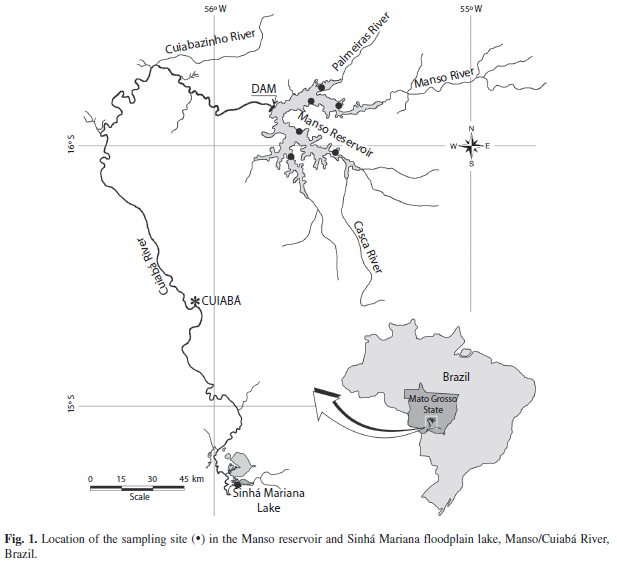
<body><![CDATA[<font size="2"></font><br style="font-family: verdana;">     <font style="font-weight: bold;" size="3"><span      style="font-family: verdana;">Material and methods</span></font><br      style="font-family: verdana;">     <font size="2"></font><br style="font-family: verdana;">     <font size="2"><span style="font-family: verdana;">The study area is     located in the     watershed of Manso/Cuiaba River, Brazil, encompassing two lentic     environments, an artificial one, Manso Reservoir (located in Manso     River), and a natural one, the Sinha Mariana floodplain lake, situated     ]]></body>
<body><![CDATA[in the complex area of lakes and wetlands of the Pantanal of Mato     Grosso (<a href="/img/revistas/rbt/v60n2/a15i1.jpg">Fig. 1</a>). The     Manso Reservoir (14&deg;32&#8217;-15&deg;40&#8217; S and     54&deg;40&#8217;-55&deg;55&#8217;     W) was created in November 1999 by flooding an area of 427km<sup>2</sup>.&nbsp;     About 80km downstream from the dam, the Manso River joins Cuiabazinho     River, forming the Cuiaba River, which flows to lower regions, with a     large catchment draining into the Pantanal of Mato Grosso, where the     Sinha Mariana floodplain lake (area=11.2km<sup>2</sup>) is located     (<a href="/img/revistas/rbt/v60n2/a15i1.jpg">Fig. 1</a>).</span></font><br     ]]></body>
<body><![CDATA[ style="font-family: verdana;">     <font size="2"></font><br style="font-family: verdana;">     <font size="2"><span style="font-family: verdana;">Fish were sampled     monthly in the     reservoir and in the lake floodplain during two annual periods: Period     I between March 2000 and February 2001 (the first year after the     filling phase), and Period II between March 2003 and February 2004     (three years later). Fishes were sampled by a set of gillnets 10m long     with different mesh sizes (12 nets; 2.4, 3, 4, 5, 6, 7, 8, 9, 10, 12,     14 and 16cm opposite knots). Nets were set simultaneously in open     ]]></body>
<body><![CDATA[areas, littoral areas, and at the bottom of the reservoir and in open     and littoral areas of the lake during 24hr, and fish were removed in     the morning (0800h), in the evening (1600h), and at night (2200h).     Immediately after the capture, the fish were identified and measured     and the stomachs were removed. The stomachs with food (n=295) were     preserved in 4% formaldehyde for diet analysis. Voucher specimens were     deposited at the Museum of the Universidade Estadual de Maringa, Parana     State, Nup. 928.</span></font><br style="font-family: verdana;">     <font size="2"></font><br style="font-family: verdana;">     <font size="2"><span style="font-family: verdana;">The abundance of <span     ]]></body>
<body><![CDATA[ style="font-style: italic;">A. osteomystax</span> was     expressed as the number of individuals captured by 1 000m<sup>2</sup>     of gillnet     during 24hr (CPUE). In order to evaluate spatial (reservoir and     floodplain lake) and temporal (Periods I and II) differences in the     abundance, we employed the Kruskal-Wallis nonparametric test (Zar     1996), since the assumptions of normality and homogeneity were not     reached. The evaluation of the <span style="font-style: italic;">A.     osteomystax</span> abundance at the surface     (open areas), margin (littoral areas), and bottom was performed only     ]]></body>
<body><![CDATA[for the reservoir, where the samplings were accomplished in the three     habitats. The differences in captures were tested using the     Kruskal-Wallis test, and when significant differences were detected,     the <span style="font-style: italic;">a posteriori </span>test     (multiple comparisons of mean ranks for all     groups) was used. The significance level adopted was p&lt;0.05.</span></font><br      style="font-family: verdana;">     <font size="2"></font><br style="font-family: verdana;">     <font size="2"><span style="font-family: verdana;">Stomach contents     were examined, and     ]]></body>
<body><![CDATA[to express the results on diet, volumetric (obtained by water     displacement in graduated cylinders) and occurrence frequency methods     (Hyslop 1980) were used, combined in the Alimentary Index (IAi)     proposed by Kawakami &amp; Vazzoler (1980) and described by the     equation: IAi=(F<sub style="font-style: italic;">i</sub>*V<sub      style="font-style: italic;">i</sub>/&#931; F<sub style="font-style: italic;">i</sub>*V<sub      style="font-style: italic;">i</sub>)*100, where: <span      style="font-style: italic;">i</span>=1, 2, ..., n food items;     F<span style="font-style: italic;">i</span>=frequency of occurrence (%)     of the item <span style="font-style: italic;">i</span>, and V<span     ]]></body>
<body><![CDATA[ style="font-style: italic;">i</span>=percentage of     volume of the item <span style="font-style: italic;">i</span>.</span></font><br      style="font-family: verdana;">     <font size="2"></font><br style="font-family: verdana;">     <font size="2"><span style="font-family: verdana;">With the aim of     evaluating temporal     differences in diet, we tested the scores of two detrended     correspondence analyses carried out individually for the reservoir and     floodplain lake (DCA-Hill &amp; Gauch 1980). The matrix used in this     ordination was based on the relative frequencies of the volume of food     ]]></body>
<body><![CDATA[items. The scores from the DCA did not reach the assumptions of     normality and homogeneity, and thus the diet differences were tested     using the Kruskal-Wallis nonparametric test. The first axis of the DCAs     was the only one retained for analysis, whose eigenvalues (0.65 to     reservoir and 0.54 to floodplain lake) were greater than 0.20-Matthews     1998).</span></font><br style="font-family: verdana;">     <font size="2"></font><br style="font-family: verdana;">     <font style="font-weight: bold;" size="3"><span      style="font-family: verdana;">Results</span></font><br      style="font-family: verdana;">     ]]></body>
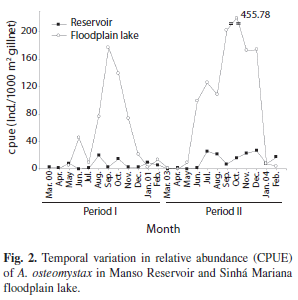
<body><![CDATA[<font size="2"></font><br style="font-family: verdana;">     <font size="2"><span style="font-family: verdana;"><span      style="font-style: italic;">Auchenipterus osteomystax</span> was     significantly more abundant (H=5.97, p=0.014) in the floodplain lake,     where the captures were higher than in the reservoir in almost all     analyzed months (<a href="#Fig_2">Fig. 2</a>). We did not record     significant variations in     abundance between the two periods (I and II) in either the reservoir     (H=1.6147, p=0.2038) or the floodplain lake (H=1.143, p=0.285).     Nevertheless, a strong seasonal trend was observed in the floodplain     ]]></body>
<body><![CDATA[lake, where <span style="font-style: italic;">A. osteomystax </span>was     more abundant in September and October     in the two periods.     <br>     <br> </span></font>     <div style="text-align: center;"><font size="2"><a name="Fig_2"></a><img  alt="" src="/img/revistas/rbt/v60n2/a15i2.jpg"  style="width: 298px; height: 300px;"><span  style="font-family: verdana;"></span></font><br  style="font-family: verdana;"> <font size="2"><span style="font-family: verdana;"></span></font></div> <br style="font-family: verdana;"> <font size="2"><span style="font-family: verdana;">Significant differences in the abundance of <span style="font-style: italic;">A. osteomystax</span> were observed between the habitats within the reservoir during both Period I and Period II (H=13.73, p=0.001 and H=15.827, p=0.0004, respectively) (<a href="#Fig_3">Fig. 3</a>). The abundance was significantly higher at the surface in both periods (Period I: S and B p=0.0039; S and M p=0.0046; Period II: S and M p=0.0004; S and B p=0.0005), while the abundance of <span style="font-style: italic;">A. osteomystax</span> was not different between the margin and the bottom in either period (Period I: p=0.9973; Period II: p=0.9839).     <br>     <br> </span></font>     <div style="text-align: center;"><font size="2"><span      style="font-family: verdana;"><a name="Fig_3"></a><img alt=""     ]]></body>
<body><![CDATA[ src="/img/revistas/rbt/v60n2/a15i3.jpg"      style="width: 299px; height: 295px;"></span></font><br      style="font-family: verdana;">     <font size="2"><span style="font-family: verdana;"></span></font></div>     <br style="font-family: verdana;">     <font size="2"><span style="font-family: verdana;">The diet of <span      style="font-style: italic;">A. osteomystax</span> was     basically compounded by insects during the two study periods in both     locations. Meantime, when considering inferior taxonomic levels, the     similarity between the periods was observed only for the population     ]]></body>
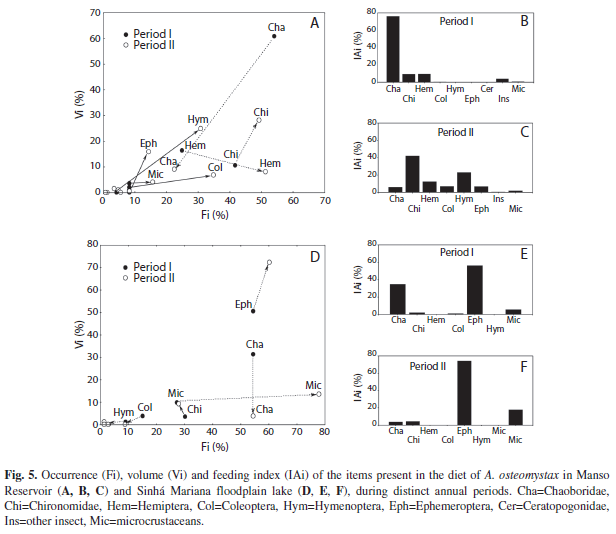
<body><![CDATA[from the floodplain lake. In relation to the population from the     reservoir, besides the remarkable variation between the periods, the     diet was also different from those in the natural environment (<a      href="/img/revistas/rbt/v60n2/a15i4.jpg">Fig. 4</a>).</span></font><br      style="font-family: verdana;">     <font size="2"></font><br style="font-family: verdana;">     <font size="2"><span style="font-family: verdana;">The differences in     the diet between     the periods were significant in the reservoir (H=37.48, p=0.0001).     During Period I, Chaoboridae larvae was the dominant food (IAi=76.1%),     ]]></body>
<body><![CDATA[and in Period II, Chironomidae pupae, Hymenoptera, and Hemiptera were     the most consumed &iacute;tems (IAi=42%, 23%, 12.4%, respectively)     (<a href="/img/revistas/rbt/v60n2/a15i5.jpg">Fig. 5A, B, C</a>). In     Period II, Coleoptera and Chaoboridae were consumed     in small amounts, but presented relevant occurrence in the diet (<a      href="/img/revistas/rbt/v60n2/a15i5.jpg">Fig.     5A</a>). In the floodplain lake, we did not register a significant     difference in the diet of <span style="font-style: italic;">A.     osteomystax</span> between Periods I and II     (H=0.513; p=0.4738), and Ephemeroptera was predominant in both     ]]></body>
<body><![CDATA[(IAi=56.2 and 74.2%, respectively) (<a      href="/img/revistas/rbt/v60n2/a15i5.jpg">Fig. 5E, F</a>). Besides     Ephemeroptera,     the Chaoboridae larvae were an important food in Period I, totaling     34.8% of the diet, whereas Chironomidae pupae and microcrustaceans were     important only in relation to the occurrence (30.3% and 27.3%,     respectively) (<a href="/img/revistas/rbt/v60n2/a15i5.jpg">Fig. 5D</a>).     Regarding Period II, there was a decrease in     the consumption of Chaoboridae larvae (IAi=3.6%) and an increase in the     consumption of microcrustaceans (IAi=17.8%) (<a     ]]></body>
<body><![CDATA[ href="/img/revistas/rbt/v60n2/a15i5.jpg">Fig. 5F</a>). Chaoboridae     larvae presented a lower quantitative participation in the diet during     Period II; however, these organisms were an important food, occurring     in 54.4% of the stomachs (<a href="/img/revistas/rbt/v60n2/a15i5.jpg">Fig.     5D</a>).</span></font><br style="font-family: verdana;">     <font size="2"></font><br style="font-family: verdana;">     <font style="font-weight: bold;" size="3"><span      style="font-family: verdana;">Discussion</span></font><br      style="font-family: verdana;">     <font size="2"></font><br style="font-family: verdana;">     ]]></body>
<body><![CDATA[<font size="2"><span style="font-family: verdana;">The experimental     fishing carried     out in Manso Reservoir reveals that the density of <span      style="font-style: italic;">A. osteomystax</span> was     low compared to the natural lentic environment (floodplain lake), with     secondary importance in the reservoir (1.3% and 7.2% of the captures,     respectively; A.A. Agostinho, unpublished). The preference of <span      style="font-style: italic;">A.     osteomystax</span> for lentic habitats and its success in the     colonization of     ]]></body>
<body><![CDATA[reservoirs has been reported frequently in the literature. In the     Itaipu and Rosana reservoirs, which are also in the Prata River basin,     this species was one of the most abundant in the first years after the     impoundment (Agostinho &amp; Zalewski 1995, Benedito-Cecilio <span      style="font-style: italic;">et al.</span>     1997, Agostinho <span style="font-style: italic;">et al.</span> 1999),     exceeding its density in natural     environments. This same result was observed for a congeneric species     (<span style="font-style: italic;">A. nuchalis</span>) in the     reservoirs of Curua-Una (Ferreira 1984a) and     ]]></body>
<body><![CDATA[Peixe-Angical (Marques<span style="font-style: italic;"> et al.</span>     2009). The colonization of a reservoir by     the pre-existing ichthyofauna depends on both the pre-adaptations to     the new environment (Fernando &amp; Holcik 1991, Agostinho <span      style="font-style: italic;">et al.</span> 1999)     and the number of individuals of each population in the environment     that will be impounded (Agostinho <span style="font-style: italic;">et     al.</span> 2008). Thus, despite the     absence of data on the abundance of <span style="font-style: italic;">A.     osteomystax</span> in the previous     ]]></body>
<body><![CDATA[period, the result of low capture in the first months of the reservoir     formation suggests that this species was not&nbsp; abundant in the     dammed region. Although seasonality in the abundance of this species     was evident in both locations, it was more pronounced in the floodplain     lake, with high capture during the months of low water and beginning of     flooding.&nbsp; The remarkable reduction in the water level during the     drought and the displacement that this species performs towards more     lotic environments in the tributaries for reproduction     (Benedito-Cecilio &amp; Agostinho 2000) may explain this seasonality.     Indeed, this species spawns between November and April in lotic areas     ]]></body>
<body><![CDATA[of Manso River basin (H.I. Suzuki, unpublished), period that coincides     with that of Tocantins River (Medeiros<span style="font-style: italic;">     et al</span>. 2009).</span></font><br style="font-family: verdana;">     <font size="2"></font><br style="font-family: verdana;">     <font size="2"><span style="font-family: verdana;">Many of the fish     species from     Neotropical reservoirs occupy the margins of these environments     (Araujo-Lima <span style="font-style: italic;">et al.</span> 1995,     Agostinho <span style="font-style: italic;">et al.</span> 1999, Mol <span      style="font-style: italic;">et al. </span>2007),     ]]></body>
<body><![CDATA[while the open areas are less occupied, mainly due to the absence of     species pre-adapted to lacustrine conditions (Agostinho <span      style="font-style: italic;">et al.</span> 1999).     Nevertheless, <span style="font-style: italic;">A. osteomystax</span>,     which has morphological adaptations to     displacement and feeding in pelagic regions (Freire &amp; Agostinho     2000), principally occupied the reservoir surface. Furthermore, <span      style="font-style: italic;">A.     osteomystax</span> is not considered an obligatory zooplanktivorous     species     ]]></body>
<body><![CDATA[since it feeds primarily on insects (mainly Ephemeroptera; Hahn <span      style="font-style: italic;">et al.</span>     1998), but it may be considered as facultative zooplanktivorous, that     is, able to use the zooplankton that suddenly becomes abundant in newly     formed reservoirs (Strictar-Pereira <span style="font-style: italic;">et     al. </span>2010). Therefore, the     predominance of the species in open areas of Manso Reservoir might have     been favored by the ability to consume zooplanktonic organisms. A     similar indication is given by the higher abundance of this species in     surface water in the reservoir transition zone (Ferreira 1984a,     ]]></body>
<body><![CDATA[Benedito-Cecilio <span style="font-style: italic;">et al.</span>     1997), where the primary productivity and the     zooplankton density are higher due to the balance between the light     penetration and nutrient concentration (Kimmel <span      style="font-style: italic;">et al. </span>1990, Marzolf     1990).</span></font><br style="font-family: verdana;">     <font size="2"></font><br style="font-family: verdana;">     <font size="2"><span style="font-family: verdana;">The success of     zooplanktivorous     species in new impoundments has been described (Ferreira 1984b,     ]]></body>
<body><![CDATA[Agostinho <span style="font-style: italic;">et al. </span>1992,     Cassemiro <span style="font-style: italic;">et al. </span>2003).     Although a slight     increase in the occurrence of microcrustaceans was observed in the diet     of <span style="font-style: italic;">A. osteomystax</span> during the     second period in Manso Reservoir, this     species may not be classified as typically zooplanktivorous, nor did it     present the expected increase in abundance after the formation of Manso     Reservoir. Mol <span style="font-style: italic;">et al. </span>(2007)     reported that the congeneric species<span style="font-style: italic;">     ]]></body>
<body><![CDATA[A.     nuchalis</span>, which was abundant soon after the formation of     Brokopondo     Reservoir, was not present during the samplings accomplished 40 years     later.</span></font><br style="font-family: verdana;">     <font size="2"></font><br style="font-family: verdana;">     <font size="2"><span style="font-family: verdana;">The diet of <span      style="font-style: italic;">A. osteomystax</span> was     predominantly compounded by insects independently of the location and     period. Meanwhile, we verified differences in the composition and     ]]></body>
<body><![CDATA[abundance of insects consumed by this species, with a higher relevance     of aquatic forms in the natural environment (floodplain lake). The main     change in the diet observed in the Manso Reservoir three years after     its formation was a decrease in the consumption of Chaoboridae.     Although this reduction was partially compensated by an increase in the     consumption of other aquatic organisms (Chironomidae, Ephemeroptera,     and microcrustaceans), the terrestrial organisms Hemiptera,     Hymenoptera, and Coleoptera presented more important increases,     especially in occurrence. On the other hand, in the population at the     floodplain lake, where the variations were less pronounced, the     ]]></body>
<body><![CDATA[decrease in Chaoboridae was accompanied by a reduction in the values     for terrestrial insects and increase in aquatic forms such as     Ephemeroptera and microcrustaceans. The predominance of allochthonous     resources, especially terrestrial insects, in the diet of <span      style="font-style: italic;">Auchenipterus     species</span> has been discussed for other reservoirs (Merona <span      style="font-style: italic;">et al.</span> 2001,     2003), rivers (Tejerina-Garro &amp; Merona 2010), and v&aacute;rzea     lakes of the Amazon (Merona &amp; Rankin-de-Merona 2004). However, the     predominance of aquatic forms of insects in the diets of the same     ]]></body>
<body><![CDATA[species of <span style="font-style: italic;">Auchenipterus</span> is     reported for the Itaipu reservoir (Hahn <span      style="font-style: italic;">et     al. </span>1998) and lakes of the Upper Parana River floodplain (Hahn <span      style="font-style: italic;">et al.</span>     2004).</span></font><br style="font-family: verdana;">     <font size="2"></font><br style="font-family: verdana;">     <font size="2"><span style="font-family: verdana;">The intense     proliferation of     zooplankton that characterizes new reservoirs (Rocha <span     ]]></body>
<body><![CDATA[ style="font-style: italic;">et al.</span> 1999,     Bonecker <span style="font-style: italic;">et al. </span>2001) was     not directly exploited by <span style="font-style: italic;">A.     osteomystax</span>.     Nevertheless, the initial diet of Chaoboridae larvae is based on     flagellate protozoans and, during final stages, on microcrustaceans     (Arcifa 2000). These larvae may belong to plankton or benthos depending     on the time of day and instar (Arcifa 2000, Bezerra-Neto &amp;     Pinto-Coelho 2002). The fact that the final instars develop nocturnal     migrations to the surface, coinciding with the location and time of     ]]></body>
<body><![CDATA[higher activity of <span style="font-style: italic;">A. osteomystax</span>     (A.A. Agostinho, unpublished), makes     the Chaoboridae a dominant prey in the diet. Research performed in the     Curua-Una Reservoir, six years after its formation, indicates that     where the congeneric species <span style="font-style: italic;">A.     nuchalis</span> was more abundant, the diet     was clearly dominated by Chaoboridae or microcrustaceans (Ferreira     1984b). </span></font><br style="font-family: verdana;">     <font size="2"></font><br style="font-family: verdana;">     <font size="2"><span style="font-family: verdana;">Pupae of     ]]></body>
<body><![CDATA[Chironomidae together with     terrestrial insects compounded the basis of the diet of <span      style="font-style: italic;">A. osteomystax</span>     three years after the formation of the reservoir. The Chironomidae     larvae are among the principal benthic organisms (Higuti &amp;     Takeda&nbsp; 2002, Callisto <span style="font-style: italic;">et al.</span>     2002) and in the present study their     pupae must have been consumed at the surface during the period when     these insects, whose adults are terrestrial, are emerging and may be     found at the surface. Besides that, the consumption of Hymenoptera by     ]]></body>
<body><![CDATA[fish is frequent (Goulding <span style="font-style: italic;">et al. </span>1988);     these terrestrial organisms     fall into the water and are mostly consumed by fish that feed at the     surface.&nbsp; In this way, although the diet was changing between     periods, <span style="font-style: italic;">A. osteomystax</span>     continued to consume food available at the     surface of the water column, evidencing that this layer was the     foraging location in the second period too.</span></font><br      style="font-family: verdana;">     <font size="2"></font><br style="font-family: verdana;">     ]]></body>
<body><![CDATA[<font size="2"><span style="font-family: verdana;">In contrast to what     was observed in     the reservoir, at the floodplain lake the diet of <span      style="font-style: italic;">A. osteomystax</span> did     not present significant temporal differences, and Ephemeroptera was the     most consumed item during both periods. The high consumption of     Ephemeroptera subimagos indicates that, as occurred in the reservoir,     <span style="font-style: italic;">A. osteomystax</span> feeds at the     surface, since at this stage of development     these insects emerge at the surface and become available for capture.     ]]></body>
<body><![CDATA[In lakes of the Upper Parana River floodplain, the diet of this species     was also composed of Ephemeroptera consumed at the surface (Hahn <span      style="font-style: italic;">et al.</span>     2004), as recorded for <span style="font-style: italic;">A. nuchalis</span>     in the Curua-Una River upstream of     the reservoir with the same name (Ferreira 1984b). Meanwhile, in the     impounded environment of Itaipu, Ephemeroptera was also the main food     item of this species (Hahn <span style="font-style: italic;">et al.</span>     1998).</span></font><br style="font-family: verdana;">     <font size="2"></font><br style="font-family: verdana;">     ]]></body>
<body><![CDATA[<font size="2"><span style="font-family: verdana;">Therefore, we     conclude that the     reservoir occupation by Auchenipteridae fish presents variable chance     of success, with the most successful occupation being in the     superficial layer of the water column in the transition zones of these     environments, where the zooplankton density is higher. The seasonality     observed in </span></font><font size="2"><span      style="font-family: verdana;">the abundance and the temporal     coincidence with reproductive events suggests that the species show     active displacements towards waters with higher turbulence. The diet is     ]]></body>
<body><![CDATA[based on aquatic forms of insects that come to the surface to emerge     (Chaoboridae, Diptera, and Ephemeroptera) or terrestrial forms that     fall on the surface (Hymenoptera, Hemiptera, and Coleoptera). The     variation in diet between the two periods, which had a time lag of     three years between them, was much less pronounced in the natural     environment (floodplain lake), where the resource availability is     essentially regulated by the seasonality. The heterotrophic features of     the processes during the first years of the reservoir, due to the     flooding of biomass, and the unnatural fluctuations of the w&aacute;ter     level must abort successional processes that lead to biota adjustments,     ]]></body>
<body><![CDATA[causing the variation in trends in food availability for fish to be     random. Thus, our hypothesis was accepted; that is, the interannual     variations in the diet of <span style="font-style: italic;">A.     osteomystax </span>are more relevant in an     artificial environment than in a natural one.</span></font><br      style="font-family: verdana;">     <font size="2"></font><br style="font-family: verdana;">     <font style="font-weight: bold;" size="3"><span      style="font-family: verdana;">Acknowledgments</span></font><br      style="font-family: verdana;">     ]]></body>
<body><![CDATA[<font size="2"></font><br style="font-family: verdana;">     <font size="2"><span style="font-family: verdana;">We express our     appreciation to     Nupelia (Nucleo de Pesquisas em Limnologia, Ictiologia e Aquicultura)     and Furnas Centrais Eletricas for their financial support and     infrastructure, and to the Brazilian Council of Research (CNPq) for     providing a grant. We thank Sidinei Magela Thomaz for correcting the     English and for helpful comments on the manuscript.</span></font><br      style="font-family: verdana;">     <font size="2"></font><br style="font-family: verdana;">     ]]></body>
<body><![CDATA[<font size="2"></font><font style="font-weight: bold;" size="2"><span      style="font-family: verdana;"></span></font>     <hr style="width: 100%; height: 2px;"><font style="font-weight: bold;"      size="3"><span style="font-family: verdana;">References</span></font><br      style="font-family: verdana;">     <font size="2"></font><br style="font-family: verdana;">     <font size="2"><span style="font-family: verdana;">Agostinho, A.A.     &amp; M. Zalewski.     1995. The dependence of fish community structure and dynamics on     floodplain and riparian ecotone zone in Parana River, Brazil.     ]]></body>
<body><![CDATA[<!-- ref -->Hydrobiologia 303: 141-148.    &nbsp;&nbsp;&nbsp;&nbsp;&nbsp;&nbsp;&nbsp;&nbsp;[&#160;<a href="javascript:void(0);" onclick="javascript: window.open('/scielo.php?script=sci_nlinks&ref=1495666&pid=S0034-7744201200020001500001&lng=','','width=640,height=500,resizable=yes,scrollbars=1,menubar=yes,');">Links</a>&#160;]<!-- end-ref --><!-- ref --></span></font><br  style="font-family: verdana;"> <font size="2"></font><br style="font-family: verdana;"> <font size="2"><span style="font-family: verdana;">Agostinho, A.A., H.F. Julio-Junior &amp; J.R. Borghetti. 1992. Consideracoes sobre os impactos dos represamentos na ictiofauna e medidas para sua atenuacao. Um estudo de caso: reservatorio de Itaipu. Rev. Unimar 14: 89-107.    &nbsp;&nbsp;&nbsp;&nbsp;&nbsp;&nbsp;&nbsp;&nbsp;[&#160;<a href="javascript:void(0);" onclick="javascript: window.open('/scielo.php?script=sci_nlinks&ref=1495667&pid=S0034-7744201200020001500002&lng=','','width=640,height=500,resizable=yes,scrollbars=1,menubar=yes,');">Links</a>&#160;]<!-- end-ref --><!-- ref --></span></font><br  style="font-family: verdana;"> <font size="2"></font><br style="font-family: verdana;"> <font size="2"><span style="font-family: verdana;">Agostinho, A.A., L.E. Miranda, L.M. Bini, L.C. Gomes, S.M. Thomaz &amp; H.I. Suzuki. 1999. Patterns of colonization in Neotropical reservoirs, and prognoses on aging, p. 227-265. <span style="font-style: italic;">In</span> J.G. Tundisi &amp; M.S. Straskraba (eds.). Theoretical reservoir ecology and its applications. IIE, Sao Carlos, Sao Paulo, Brazil.    &nbsp;&nbsp;&nbsp;&nbsp;&nbsp;&nbsp;&nbsp;&nbsp;[&#160;<a href="javascript:void(0);" onclick="javascript: window.open('/scielo.php?script=sci_nlinks&ref=1495668&pid=S0034-7744201200020001500003&lng=','','width=640,height=500,resizable=yes,scrollbars=1,menubar=yes,');">Links</a>&#160;]<!-- end-ref --><!-- ref --></span></font><br style="font-family: verdana;"> <font size="2"></font><br style="font-family: verdana;"> <font size="2"><span style="font-family: verdana;">Agostinho, A.A., F.M. Pelicice &amp; L.C. Gomes. 2008. Dams and the fish fauna of the Neotropical region: impacts and management related to diversity and fisheries. </span></font><font  size="2"><span style="font-family: verdana;">Braz. J. Biol. 68: 1119-1132.    &nbsp;&nbsp;&nbsp;&nbsp;&nbsp;&nbsp;&nbsp;&nbsp;[&#160;<a href="javascript:void(0);" onclick="javascript: window.open('/scielo.php?script=sci_nlinks&ref=1495669&pid=S0034-7744201200020001500004&lng=','','width=640,height=500,resizable=yes,scrollbars=1,menubar=yes,');">Links</a>&#160;]<!-- end-ref --><!-- ref --></span></font><br style="font-family: verdana;"> <font size="2"></font><br style="font-family: verdana;"> <font size="2"><span style="font-family: verdana;">Albrecht, M.P. &amp; E.P. Caramaschi. 2003. Feeding ecology of <span style="font-style: italic;">Leporinus friderici </span>(Teleostei; Anostomidae) in the upper Tocantins River, Central Brazil, before and after installation of a hydroelectric plant. Stud. Neotrop. Fauna Environ. 38: 33-40.    &nbsp;&nbsp;&nbsp;&nbsp;&nbsp;&nbsp;&nbsp;&nbsp;[&#160;<a href="javascript:void(0);" onclick="javascript: window.open('/scielo.php?script=sci_nlinks&ref=1495670&pid=S0034-7744201200020001500005&lng=','','width=640,height=500,resizable=yes,scrollbars=1,menubar=yes,');">Links</a>&#160;]<!-- end-ref --><!-- ref --><br> <br style="font-family: verdana;"> </span></font><font size="2"><span style="font-family: verdana;">Araujo-Lima, C.A.R.M., A.A. Agostinho &amp; N.N. Fabre. 1995. Trophic aspects of fish communities in Brazilian Rivers and reservoirs, p. 105-136. <span  style="font-style: italic;">In</span> J.G.Tundisi, C.M.E. Bicudo &amp; T. Matsumura-Tundisi (eds.). Limnology in Brazil. ABC/SBL, Rio de Janeiro, Rio de Janeiro, Brazil.    &nbsp;&nbsp;&nbsp;&nbsp;&nbsp;&nbsp;&nbsp;&nbsp;[&#160;<a href="javascript:void(0);" onclick="javascript: window.open('/scielo.php?script=sci_nlinks&ref=1495671&pid=S0034-7744201200020001500006&lng=','','width=640,height=500,resizable=yes,scrollbars=1,menubar=yes,');">Links</a>&#160;]<!-- end-ref --><!-- ref --></span></font><br  style="font-family: verdana;"> <font size="2"></font><br style="font-family: verdana;"> <font size="2"><span style="font-family: verdana;">Arcifa, M.S. 2000. Feeding habits of Chaoboridae larvae in a tropical Brazilian reservoir. Rev. Bras. Biol. 60: 591-597.    &nbsp;&nbsp;&nbsp;&nbsp;&nbsp;&nbsp;&nbsp;&nbsp;[&#160;<a href="javascript:void(0);" onclick="javascript: window.open('/scielo.php?script=sci_nlinks&ref=1495672&pid=S0034-7744201200020001500007&lng=','','width=640,height=500,resizable=yes,scrollbars=1,menubar=yes,');">Links</a>&#160;]<!-- end-ref --><!-- ref --></span></font><br style="font-family: verdana;"> <font size="2"></font><br style="font-family: verdana;"> <font size="2"><span style="font-family: verdana;">Benedito-Cecilio, E. &amp; A.A. Agostinho. 2000. Distribution, abundance and use of different environments by dominant ichthyofauna in the influence area of the Itaipu Reservoir. Acta Sci. Biol. Sci. 22: 429-437.    &nbsp;&nbsp;&nbsp;&nbsp;&nbsp;&nbsp;&nbsp;&nbsp;[&#160;<a href="javascript:void(0);" onclick="javascript: window.open('/scielo.php?script=sci_nlinks&ref=1495673&pid=S0034-7744201200020001500008&lng=','','width=640,height=500,resizable=yes,scrollbars=1,menubar=yes,');">Links</a>&#160;]<!-- end-ref --><!-- ref --></span></font><br  style="font-family: verdana;"> <font size="2"></font><br style="font-family: verdana;"> <font size="2"><span style="font-family: verdana;">Benedito-Cecilio, E., A.A. Agostinho, H.F. Julio Jr &amp; C.S. Pavanelli. 1997. Colonizacao ictiofaunistica do reservatorio de Itaipu e areas adjacentes. Rev. Bras. Zool. 14: 1-14.    &nbsp;&nbsp;&nbsp;&nbsp;&nbsp;&nbsp;&nbsp;&nbsp;[&#160;<a href="javascript:void(0);" onclick="javascript: window.open('/scielo.php?script=sci_nlinks&ref=1495674&pid=S0034-7744201200020001500009&lng=','','width=640,height=500,resizable=yes,scrollbars=1,menubar=yes,');">Links</a>&#160;]<!-- end-ref --><!-- ref --></span></font><br style="font-family: verdana;"> <font size="2"></font><br style="font-family: verdana;"> <font size="2"><span style="font-family: verdana;">Bezerra-Neto, J.F.B. &amp; R.M. Pinto-Coelho. 2002. Migracao vertical das larvas de <span  style="font-style: italic;">Chaoborus brasiliensis </span>(Diptera: Chaoboridae) em um reservatorio tropical: lagoa do Nado, Belo Horizonte, Estado de Minas Gerais. Acta Scientiarum 24: 329-336.    &nbsp;&nbsp;&nbsp;&nbsp;&nbsp;&nbsp;&nbsp;&nbsp;[&#160;<a href="javascript:void(0);" onclick="javascript: window.open('/scielo.php?script=sci_nlinks&ref=1495675&pid=S0034-7744201200020001500010&lng=','','width=640,height=500,resizable=yes,scrollbars=1,menubar=yes,');">Links</a>&#160;]<!-- end-ref --><!-- ref --></span></font><br style="font-family: verdana;"> <font size="2"></font><br style="font-family: verdana;"> <font size="2"><span style="font-family: verdana;">Bonecker, C.C., F.A. Lansac-Toha, L.F.M. Velho &amp; D.C. Rossa. 2001. The temporal distribution pattern of copepods in Corumba Reservoir, State of Goias, Brazil, p. 375-384. <span style="font-style: italic;">In</span> R.M. Lopes, J.W. Reid &amp; C.E.F. Rocha (eds.). Copepoda: developments in ecology, biology and systematics. Kluwer, London, England.    &nbsp;&nbsp;&nbsp;&nbsp;&nbsp;&nbsp;&nbsp;&nbsp;[&#160;<a href="javascript:void(0);" onclick="javascript: window.open('/scielo.php?script=sci_nlinks&ref=1495676&pid=S0034-7744201200020001500011&lng=','','width=640,height=500,resizable=yes,scrollbars=1,menubar=yes,');">Links</a>&#160;]<!-- end-ref --><!-- ref --></span></font><br style="font-family: verdana;"> <font size="2"></font><br style="font-family: verdana;"> <font size="2"><span style="font-family: verdana;">Callisto, M., V. Vono, F.A.R. Barbosa &amp; S.M. Santeiro. 2002. Chironomidae as a food resource for <span style="font-style: italic;">Leporinus amblyrhynchus</span> (Teleostei: Characiformes) and <span style="font-style: italic;">Pimelodus maculatus</span> (Teleostei: Siluriformes) in a Brazilian reservoir. Lundiana 3: 67-73.    &nbsp;&nbsp;&nbsp;&nbsp;&nbsp;&nbsp;&nbsp;&nbsp;[&#160;<a href="javascript:void(0);" onclick="javascript: window.open('/scielo.php?script=sci_nlinks&ref=1495677&pid=S0034-7744201200020001500012&lng=','','width=640,height=500,resizable=yes,scrollbars=1,menubar=yes,');">Links</a>&#160;]<!-- end-ref --><!-- ref --></span></font><br style="font-family: verdana;"> <font size="2"></font><br style="font-family: verdana;"> <font size="2"><span style="font-family: verdana;">Cassemiro, F.A., N.S. Hahn &amp; T.F.L.V.B. Rangel. 2003. Diet and trophic morphology of the silverside, <span style="font-style: italic;">Odontesthes bonariensis</span>, of the Salto Caxias Reservoir, Rio Iguacu, Parana, Brazil. Neotrop. Ichthyol. 2: 127-131.    &nbsp;&nbsp;&nbsp;&nbsp;&nbsp;&nbsp;&nbsp;&nbsp;[&#160;<a href="javascript:void(0);" onclick="javascript: window.open('/scielo.php?script=sci_nlinks&ref=1495678&pid=S0034-7744201200020001500013&lng=','','width=640,height=500,resizable=yes,scrollbars=1,menubar=yes,');">Links</a>&#160;]<!-- end-ref --><!-- ref --></span></font><br  style="font-family: verdana;"> <font size="2"></font><br style="font-family: verdana;"> <font size="2"><span style="font-family: verdana;">Fernando, C.H. &amp; J. Holcik. 1991. Fish in reservoirs. Int. Rev. Gesamten Hydrobiol. 76: 149-167.    &nbsp;&nbsp;&nbsp;&nbsp;&nbsp;&nbsp;&nbsp;&nbsp;[&#160;<a href="javascript:void(0);" onclick="javascript: window.open('/scielo.php?script=sci_nlinks&ref=1495679&pid=S0034-7744201200020001500014&lng=','','width=640,height=500,resizable=yes,scrollbars=1,menubar=yes,');">Links</a>&#160;]<!-- end-ref --><!-- ref --></span></font><br  style="font-family: verdana;"> <font size="2"></font><br style="font-family: verdana;"> <font size="2"><span style="font-family: verdana;">Ferreira, E.J. 1984a. A ictiofauna da represa hidreletrica de Curua-Una, Santarem, Para. I- Lista e distribuicao das especies. Amazoniana 8: 351-363.    &nbsp;&nbsp;&nbsp;&nbsp;&nbsp;&nbsp;&nbsp;&nbsp;[&#160;<a href="javascript:void(0);" onclick="javascript: window.open('/scielo.php?script=sci_nlinks&ref=1495680&pid=S0034-7744201200020001500015&lng=','','width=640,height=500,resizable=yes,scrollbars=1,menubar=yes,');">Links</a>&#160;]<!-- end-ref --><!-- ref --></span></font><br  style="font-family: verdana;"> <font size="2"></font><br style="font-family: verdana;"> <font size="2"><span style="font-family: verdana;">Ferreira, E.J. 1984b. A ictiofauna da represa hidreletrica de Curua-Una, Santarem, Para. II- Alimentacao e habitos alimentares. Amazoniana 9: 1-16.    &nbsp;&nbsp;&nbsp;&nbsp;&nbsp;&nbsp;&nbsp;&nbsp;[&#160;<a href="javascript:void(0);" onclick="javascript: window.open('/scielo.php?script=sci_nlinks&ref=1495681&pid=S0034-7744201200020001500016&lng=','','width=640,height=500,resizable=yes,scrollbars=1,menubar=yes,');">Links</a>&#160;]<!-- end-ref --><!-- ref --></span></font><br  style="font-family: verdana;"> <font size="2"></font><br style="font-family: verdana;"> <font size="2"><span style="font-family: verdana;">Freire, A.G. &amp; A.A. Agostinho. 2000. Distribuicao espaco temporal de 8 especies dominantes da ictiofauna da bacia do alto rio Parana. Acta Limnol. Bras. 12: 105-120.    &nbsp;&nbsp;&nbsp;&nbsp;&nbsp;&nbsp;&nbsp;&nbsp;[&#160;<a href="javascript:void(0);" onclick="javascript: window.open('/scielo.php?script=sci_nlinks&ref=1495682&pid=S0034-7744201200020001500017&lng=','','width=640,height=500,resizable=yes,scrollbars=1,menubar=yes,');">Links</a>&#160;]<!-- end-ref --><!-- ref --></span></font><br  style="font-family: verdana;"> <font size="2"></font><br style="font-family: verdana;"> <font size="2"><span style="font-family: verdana;">Goulding, M., M.L. Carvalho &amp; E.G. Ferreira. 1988. Rio Negro, rich life in poor water: Amazonian diversity and food chain ecology as seen through fish communities. SPB, The Hague, Netherlands.    &nbsp;&nbsp;&nbsp;&nbsp;&nbsp;&nbsp;&nbsp;&nbsp;[&#160;<a href="javascript:void(0);" onclick="javascript: window.open('/scielo.php?script=sci_nlinks&ref=1495683&pid=S0034-7744201200020001500018&lng=','','width=640,height=500,resizable=yes,scrollbars=1,menubar=yes,');">Links</a>&#160;]<!-- end-ref --><!-- ref --></span></font><br style="font-family: verdana;"> <font size="2"></font><br style="font-family: verdana;"> <font size="2"><span style="font-family: verdana;">Hahn, N.S. &amp; R. Fugi. 2008. Environmental changes, h&aacute;bitat modifications and feeding ecology of freshwater fish, p. 35-65. <span style="font-style: italic;">In</span> J.E.P. Cyrino, D.P. Bureau &amp; B.G. </span></font><font size="2"><span  style="font-family: verdana;">Kapoor (eds.). Feeding and digestive functions of fishes. Science, New Hampshire, USA.    &nbsp;&nbsp;&nbsp;&nbsp;&nbsp;&nbsp;&nbsp;&nbsp;[&#160;<a href="javascript:void(0);" onclick="javascript: window.open('/scielo.php?script=sci_nlinks&ref=1495684&pid=S0034-7744201200020001500019&lng=','','width=640,height=500,resizable=yes,scrollbars=1,menubar=yes,');">Links</a>&#160;]<!-- end-ref --><!-- ref --></span></font><br  style="font-family: verdana;"> <font size="2"></font><br style="font-family: verdana;"> <font size="2"><span style="font-family: verdana;">Hahn, N.S., A.A. Agostinho, L.C. Gomes &amp; L.M. Bini. 1998. Estrutura trofica da ictiofauna do reservatorio de Itaipu (Parana-Brasil) nos primeiros anos de sua formacao. Interciencia 23: 299-305.    &nbsp;&nbsp;&nbsp;&nbsp;&nbsp;&nbsp;&nbsp;&nbsp;[&#160;<a href="javascript:void(0);" onclick="javascript: window.open('/scielo.php?script=sci_nlinks&ref=1495685&pid=S0034-7744201200020001500020&lng=','','width=640,height=500,resizable=yes,scrollbars=1,menubar=yes,');">Links</a>&#160;]<!-- end-ref --><!-- ref --></span></font><br  style="font-family: verdana;"> <font size="2"></font><br style="font-family: verdana;"> <font size="2"><span style="font-family: verdana;">Hahn, N.S., R. Fugi &amp; I.F. Andrian. 2004. Trophic ecology of the fish assemblages, p. 247-259. <span  style="font-style: italic;">In</span> S.M. Thomaz, A.A. Agostinho &amp; N.S. Hahn (eds.). The upper Parana </span></font><font  size="2"><span style="font-family: verdana;">River and its floodplain physical aspects, ecology and conservation. Backhuys, Leiden, Netherlands.    &nbsp;&nbsp;&nbsp;&nbsp;&nbsp;&nbsp;&nbsp;&nbsp;[&#160;<a href="javascript:void(0);" onclick="javascript: window.open('/scielo.php?script=sci_nlinks&ref=1495686&pid=S0034-7744201200020001500021&lng=','','width=640,height=500,resizable=yes,scrollbars=1,menubar=yes,');">Links</a>&#160;]<!-- end-ref --><!-- ref --></span></font><br  style="font-family: verdana;"> <font size="2"></font><br style="font-family: verdana;"> <font size="2"><span style="font-family: verdana;">Higuti, J. &amp; A.M. Takeda. 2002. Spatial and temporal variations and densities of Chironomidae larvae (Diptera) in two lagoons and two tributaries of the upper </span></font><font  size="2"><span style="font-family: verdana;">Parana River floodplain, Brazil. Rev. Bras. Biol. 62: 807-818.    &nbsp;&nbsp;&nbsp;&nbsp;&nbsp;&nbsp;&nbsp;&nbsp;[&#160;<a href="javascript:void(0);" onclick="javascript: window.open('/scielo.php?script=sci_nlinks&ref=1495687&pid=S0034-7744201200020001500022&lng=','','width=640,height=500,resizable=yes,scrollbars=1,menubar=yes,');">Links</a>&#160;]<!-- end-ref --><!-- ref --></span></font><br  style="font-family: verdana;"> <font size="2"></font><br style="font-family: verdana;"> <font size="2"><span style="font-family: verdana;">Hill, M.O. &amp; H.G. Gauch. 1980. Detrended correspondence analysis: an improved ordination technique. Vegetatio 42: 47-58.    &nbsp;&nbsp;&nbsp;&nbsp;&nbsp;&nbsp;&nbsp;&nbsp;[&#160;<a href="javascript:void(0);" onclick="javascript: window.open('/scielo.php?script=sci_nlinks&ref=1495688&pid=S0034-7744201200020001500023&lng=','','width=640,height=500,resizable=yes,scrollbars=1,menubar=yes,');">Links</a>&#160;]<!-- end-ref --><!-- ref --></span></font><br style="font-family: verdana;"> <font size="2"></font><br style="font-family: verdana;"> <font size="2"><span style="font-family: verdana;">Hyslop, E.J. 1980. Stomach contents analysis review of methods and their applications. J. Fish Biol. 17: 411-429.    &nbsp;&nbsp;&nbsp;&nbsp;&nbsp;&nbsp;&nbsp;&nbsp;[&#160;<a href="javascript:void(0);" onclick="javascript: window.open('/scielo.php?script=sci_nlinks&ref=1495689&pid=S0034-7744201200020001500024&lng=','','width=640,height=500,resizable=yes,scrollbars=1,menubar=yes,');">Links</a>&#160;]<!-- end-ref --><!-- ref --></span></font><br style="font-family: verdana;"> <font size="2"></font><br style="font-family: verdana;"> <font size="2"><span style="font-family: verdana;">Kalk, M., A.J. MacLachlan &amp; C. Howard-Willians. 1979. Lake Chilwa: studies of change in a tropical ecosystem. Dr. W. Junk, The Hague, Netherlands.    &nbsp;&nbsp;&nbsp;&nbsp;&nbsp;&nbsp;&nbsp;&nbsp;[&#160;<a href="javascript:void(0);" onclick="javascript: window.open('/scielo.php?script=sci_nlinks&ref=1495690&pid=S0034-7744201200020001500025&lng=','','width=640,height=500,resizable=yes,scrollbars=1,menubar=yes,');">Links</a>&#160;]<!-- end-ref --><!-- ref --></span></font><br  style="font-family: verdana;"> <font size="2"></font><br style="font-family: verdana;"> <font size="2"><span style="font-family: verdana;">Kawakami, E. &amp; G. Vazzoler. 1980. Metodo grafico e estimativa de indice alimentar no estudo de alimentacao de peixes. Bol. Inst. Oceanogr. 29: 205-207.    &nbsp;&nbsp;&nbsp;&nbsp;&nbsp;&nbsp;&nbsp;&nbsp;[&#160;<a href="javascript:void(0);" onclick="javascript: window.open('/scielo.php?script=sci_nlinks&ref=1495691&pid=S0034-7744201200020001500026&lng=','','width=640,height=500,resizable=yes,scrollbars=1,menubar=yes,');">Links</a>&#160;]<!-- end-ref --><!-- ref --></span></font><br  style="font-family: verdana;"> <font size="2"></font><br style="font-family: verdana;"> <font size="2"><span style="font-family: verdana;">Kimmel, B.L., O.T. Lind &amp; L.J. Paulson. 1990. Reservoir primary production, p. 133-194. <span  style="font-style: italic;">In</span> K.W. Thorton, B.L. Kimmel &amp; F.E. Payne (eds.). Reservoir Limnology: ecological perspectives. Wiley, New York, New York, USA.    &nbsp;&nbsp;&nbsp;&nbsp;&nbsp;&nbsp;&nbsp;&nbsp;[&#160;<a href="javascript:void(0);" onclick="javascript: window.open('/scielo.php?script=sci_nlinks&ref=1495692&pid=S0034-7744201200020001500027&lng=','','width=640,height=500,resizable=yes,scrollbars=1,menubar=yes,');">Links</a>&#160;]<!-- end-ref --><!-- ref --></span></font><br  style="font-family: verdana;"> <font size="2"></font><br style="font-family: verdana;"> <font size="2"><span style="font-family: verdana;">Luz-Agostinho, K.D.G., L.M. Bini, R. Fugi, A.A. Agostinho &amp; H.F. Julio Jr. 2006. Food spectrum and trophic structure of the ichthyofauna of Corumb&aacute; reservoir, Paran&aacute; River Basin, Brazil. Neotrop. Ichthyol. 4: 61-68.    &nbsp;&nbsp;&nbsp;&nbsp;&nbsp;&nbsp;&nbsp;&nbsp;[&#160;<a href="javascript:void(0);" onclick="javascript: window.open('/scielo.php?script=sci_nlinks&ref=1495693&pid=S0034-7744201200020001500028&lng=','','width=640,height=500,resizable=yes,scrollbars=1,menubar=yes,');">Links</a>&#160;]<!-- end-ref --><!-- ref --></span></font><br  style="font-family: verdana;"> <font size="2"></font><br style="font-family: verdana;"> <font size="2"><span style="font-family: verdana;">Marques, E.E., R.M. Silva &amp; D.S. Silva. 2009. Varia&ccedil;&#333;es espaciais na estrutura das popula</span></font><font  size="2"><span style="font-family: verdana;">&ccedil;</span></font><font  size="2"><span style="font-family: verdana;">&#333;</span></font><font  size="2"><span style="font-family: verdana;">es de peixes antes e apos a forma</span></font><font size="2"><span  style="font-family: verdana;">&ccedil;</span></font><font size="2"><span  style="font-family: verdana;">&#257;</span></font><font size="2"><span  style="font-family: verdana;">o do reservatorio da UHE Peixe Angical, p. 51-57. <span style="font-style: italic;">In</span> C.S. Agostinho, F.M. Pelicice &amp; E.E. Marques (eds.). Reservat&oacute;rio de Peixe Angical: bases ecol&oacute;gicas para o manejo da ictiofauna. Rima, </span></font><font size="2"><span  style="font-family: verdana;">S&#257;o Carlos, S</span></font><font size="2"><span  style="font-family: verdana;">&#257;</span></font><font size="2"><span  style="font-family: verdana;">o Paulo, Brasil.    &nbsp;&nbsp;&nbsp;&nbsp;&nbsp;&nbsp;&nbsp;&nbsp;[&#160;<a href="javascript:void(0);" onclick="javascript: window.open('/scielo.php?script=sci_nlinks&ref=1495694&pid=S0034-7744201200020001500029&lng=','','width=640,height=500,resizable=yes,scrollbars=1,menubar=yes,');">Links</a>&#160;]<!-- end-ref --><!-- ref --></span></font><br  style="font-family: verdana;"> <font size="2"></font><br style="font-family: verdana;"> <font size="2"><span style="font-family: verdana;">Marzolf, G.R. 1990. Reservoirs as environments for zooplankton, p. 195-208. <span  style="font-style: italic;">In</span> K.W. Thorton, B.L. Kimmel &amp; F.E. Payne (eds.). Reservoir limnology: ecological perspectives. Wiley, New York, New York, USA.    &nbsp;&nbsp;&nbsp;&nbsp;&nbsp;&nbsp;&nbsp;&nbsp;[&#160;<a href="javascript:void(0);" onclick="javascript: window.open('/scielo.php?script=sci_nlinks&ref=1495695&pid=S0034-7744201200020001500030&lng=','','width=640,height=500,resizable=yes,scrollbars=1,menubar=yes,');">Links</a>&#160;]<!-- end-ref --><!-- ref --></span></font><br  style="font-family: verdana;"> <font size="2"></font><br style="font-family: verdana;"> <font size="2"><span style="font-family: verdana;">Matthews, W.J. 1998. Patterns in freshwater fish ecology. Chapman &amp; Hall, New York, New York, USA.    &nbsp;&nbsp;&nbsp;&nbsp;&nbsp;&nbsp;&nbsp;&nbsp;[&#160;<a href="javascript:void(0);" onclick="javascript: window.open('/scielo.php?script=sci_nlinks&ref=1495696&pid=S0034-7744201200020001500031&lng=','','width=640,height=500,resizable=yes,scrollbars=1,menubar=yes,');">Links</a>&#160;]<!-- end-ref --><!-- ref --></span></font><br  style="font-family: verdana;"> <font size="2"></font><br style="font-family: verdana;"> <font size="2"><span style="font-family: verdana;">Medeiros, E.R., A.L. Neuberger &amp; C.S. Agostinho. 2009. Varia</span></font><font size="2"><span  style="font-family: verdana;">&ccedil;&#333;</span></font><font size="2"><span  style="font-family: verdana;">es sazonais na atividade reprodutiva de peixes na &aacute;rea de influ&ecirc;ncia do reservatorio de Peixe Angical, p. 59-68.<span style="font-style: italic;"> In</span> C.S. Agostinho, F.M. Pelicice &amp; E.E. Marques (eds.). Reservat&oacute;rio de Peixe Angical: bases ecol&oacute;gicas para o manejo da ictiofauna. Rima, </span></font><font size="2"><span  style="font-family: verdana;">S&#257;o</span></font><font size="2"><span  style="font-family: verdana;"> Carlos, </span></font><font size="2"><span  style="font-family: verdana;">S&#257;o</span></font><font size="2"><span  style="font-family: verdana;"> Paulo, Brasil.    &nbsp;&nbsp;&nbsp;&nbsp;&nbsp;&nbsp;&nbsp;&nbsp;[&#160;<a href="javascript:void(0);" onclick="javascript: window.open('/scielo.php?script=sci_nlinks&ref=1495697&pid=S0034-7744201200020001500032&lng=','','width=640,height=500,resizable=yes,scrollbars=1,menubar=yes,');">Links</a>&#160;]<!-- end-ref --><!-- ref --></span></font><br  style="font-family: verdana;"> <font size="2"></font><br style="font-family: verdana;"> <font size="2"><span style="font-family: verdana;">M&eacute;rona, B. &amp; J. Rankin-de-M&eacute;rona. 2004. Food resource partitioning in a fish community of the central Amazon floodplain. Neotrop. Ichthyol. 2: 75-84.    &nbsp;&nbsp;&nbsp;&nbsp;&nbsp;&nbsp;&nbsp;&nbsp;[&#160;<a href="javascript:void(0);" onclick="javascript: window.open('/scielo.php?script=sci_nlinks&ref=1495698&pid=S0034-7744201200020001500033&lng=','','width=640,height=500,resizable=yes,scrollbars=1,menubar=yes,');">Links</a>&#160;]<!-- end-ref --><!-- ref --></span></font><br  style="font-family: verdana;"> <font size="2"></font><br style="font-family: verdana;"> <font size="2"><span style="font-family: verdana;">M&eacute;rona, B., G.M. Santos &amp; R.G. Almeida. 2001. Short term effects of Tucuru&iacute; Dam (Amazonia, Brazil) on the trophic organization of fish communities. Environ. Biol. Fishes 60: 375-392.    &nbsp;&nbsp;&nbsp;&nbsp;&nbsp;&nbsp;&nbsp;&nbsp;[&#160;<a href="javascript:void(0);" onclick="javascript: window.open('/scielo.php?script=sci_nlinks&ref=1495699&pid=S0034-7744201200020001500034&lng=','','width=640,height=500,resizable=yes,scrollbars=1,menubar=yes,');">Links</a>&#160;]<!-- end-ref --><!-- ref --></span></font><br style="font-family: verdana;"> <font size="2"></font><br style="font-family: verdana;"> <font size="2"><span style="font-family: verdana;">M&eacute;rona, B., R. Vigouroux &amp; V. Horeau. 2003. Changes in food resources and their utilization by fish assemblages in a large tropical reservoir in South America Petit- Saut Dam, French Guiana. Acta Oecol. 24: 147-156.    &nbsp;&nbsp;&nbsp;&nbsp;&nbsp;&nbsp;&nbsp;&nbsp;[&#160;<a href="javascript:void(0);" onclick="javascript: window.open('/scielo.php?script=sci_nlinks&ref=1495700&pid=S0034-7744201200020001500035&lng=','','width=640,height=500,resizable=yes,scrollbars=1,menubar=yes,');">Links</a>&#160;]<!-- end-ref --><!-- ref --></span></font><br  style="font-family: verdana;"> <font size="2"></font><br style="font-family: verdana;"> <font size="2"><span style="font-family: verdana;">Mol, J.H., B. M&eacute;rona, P.E. Ouboter &amp; S. Sahdew. 2007. The fish fauna of Brokopondo Reservoir, Suriname, during 40 years of impoundment. Neotrop. Ichthyol. 5: 351-368.    &nbsp;&nbsp;&nbsp;&nbsp;&nbsp;&nbsp;&nbsp;&nbsp;[&#160;<a href="javascript:void(0);" onclick="javascript: window.open('/scielo.php?script=sci_nlinks&ref=1495701&pid=S0034-7744201200020001500036&lng=','','width=640,height=500,resizable=yes,scrollbars=1,menubar=yes,');">Links</a>&#160;]<!-- end-ref --><!-- ref --></span></font><br  style="font-family: verdana;"> <font size="2"></font><br style="font-family: verdana;"> <font size="2"><span style="font-family: verdana;">Rocha, O., T. Matsumura-Tundisi, E.L.G. Esp&iacute;ndola, K.F. Roche &amp; A.C. Rietzler. 1999. Ecological theory applied to reservoir zooplankton, p. 457-476. <span  style="font-style: italic;">In</span> J.G. Tundisi &amp; M.S. Straskraba (eds.). Theoretical reservoir ecology and its applications. IIE, Sao Carlos, Sao Paulo, Brazil.    &nbsp;&nbsp;&nbsp;&nbsp;&nbsp;&nbsp;&nbsp;&nbsp;[&#160;<a href="javascript:void(0);" onclick="javascript: window.open('/scielo.php?script=sci_nlinks&ref=1495702&pid=S0034-7744201200020001500037&lng=','','width=640,height=500,resizable=yes,scrollbars=1,menubar=yes,');">Links</a>&#160;]<!-- end-ref --><!-- ref --></span></font><br  style="font-family: verdana;"> <font size="2"></font><br style="font-family: verdana;"> <font size="2"><span style="font-family: verdana;">Rodriguez-Ruiz, A. 1998. Fish species composition before and after construction of a reservoir on the Guadalete River (SW Spain). Arch. Hydrobiol. 142: 353-369.    &nbsp;&nbsp;&nbsp;&nbsp;&nbsp;&nbsp;&nbsp;&nbsp;[&#160;<a href="javascript:void(0);" onclick="javascript: window.open('/scielo.php?script=sci_nlinks&ref=1495703&pid=S0034-7744201200020001500038&lng=','','width=640,height=500,resizable=yes,scrollbars=1,menubar=yes,');">Links</a>&#160;]<!-- end-ref --><!-- ref --></span></font><br  style="font-family: verdana;"> <font size="2"></font><br style="font-family: verdana;"> <font size="2"><span style="font-family: verdana;">Strictar-Pereira, L., A.A. Agostinho &amp; L.C. Gomes. 2010. Cage culture with tilapia induces alteration in the diet of natural fish populations: the case of <span style="font-style: italic;">Auchenipterus osteomystax</span>. Braz. J. Biol. 70: 1021-1030.    &nbsp;&nbsp;&nbsp;&nbsp;&nbsp;&nbsp;&nbsp;&nbsp;[&#160;<a href="javascript:void(0);" onclick="javascript: window.open('/scielo.php?script=sci_nlinks&ref=1495704&pid=S0034-7744201200020001500039&lng=','','width=640,height=500,resizable=yes,scrollbars=1,menubar=yes,');">Links</a>&#160;]<!-- end-ref --><!-- ref --></span></font><br  style="font-family: verdana;"> <font size="2"></font><br style="font-family: verdana;"> <font size="2"><span style="font-family: verdana;">Tejerina-Garro, F.L. &amp; B. M&eacute;rona. 2010. Flow seasonality and fish assemblage in a tropical river, French Guiana, South America. Neotrop. ichthyol. 8: 145-154.    &nbsp;&nbsp;&nbsp;&nbsp;&nbsp;&nbsp;&nbsp;&nbsp;[&#160;<a href="javascript:void(0);" onclick="javascript: window.open('/scielo.php?script=sci_nlinks&ref=1495705&pid=S0034-7744201200020001500040&lng=','','width=640,height=500,resizable=yes,scrollbars=1,menubar=yes,');">Links</a>&#160;]<!-- end-ref --><!-- ref --></span></font><br  style="font-family: verdana;"> <font size="2"></font><br style="font-family: verdana;"> <font size="2"><span style="font-family: verdana;">Welcomme, R.L. 1979. Fisheries ecology of floodplain Rivers. Longman, London, England.    &nbsp;&nbsp;&nbsp;&nbsp;&nbsp;&nbsp;&nbsp;&nbsp;[&#160;<a href="javascript:void(0);" onclick="javascript: window.open('/scielo.php?script=sci_nlinks&ref=1495706&pid=S0034-7744201200020001500041&lng=','','width=640,height=500,resizable=yes,scrollbars=1,menubar=yes,');">Links</a>&#160;]<!-- end-ref --><!-- ref --></span></font><br  style="font-family: verdana;"> <font size="2"></font><br style="font-family: verdana;"> <font size="2"><span style="font-family: verdana;">Zar, J.H. 1996. Biostatistical Analysis. Prentice Hall, New Jersey, USA.    &nbsp;&nbsp;&nbsp;&nbsp;&nbsp;&nbsp;&nbsp;&nbsp;[&#160;<a href="javascript:void(0);" onclick="javascript: window.open('/scielo.php?script=sci_nlinks&ref=1495707&pid=S0034-7744201200020001500042&lng=','','width=640,height=500,resizable=yes,scrollbars=1,menubar=yes,');">Links</a>&#160;]<!-- end-ref --><br>     <br>     <br> <a name="Correspondencia1"></a><a href="#Correspondencia2">*</a>Correspondencia a: </span></font><font size="2"> <span style="font-family: verdana;">Elcio Barili &amp; Angelo Antonio Agostinho: </span></font><font size="2"><span  style="font-family: verdana;">Programa de Pos-Graduacao em Biologia Comparada, Universidade Estadual de Maringa. Av. Colombo 5790, Cep 87020-900, Maringa, PR, Brasil; <a  href="mailto:elciobarili@yahoo.com.br">elciobarili@yahoo.com.br</a></span></font><br  style="font-family: verdana;"> <font size="2"><span style="font-family: verdana;">Rosemara Fugi, Gisele Caroline Novakowski &amp; Angelo Antonio Agostinho: </span></font><font  size="2"><span style="font-family: verdana;">Nucleo de Pesquisas em Limnologia, Ictiologia e Aquicultura. Universidade Estadual de Maringa. Av. Colombo, 5790, Cep 87020-900, Maringa, PR, Brasil; </span></font><font  size="2"><span style="font-family: verdana;"><a  href="mailto:rosemarafugi@gmail.com">rosemarafugi@gmail.com</a>, <a  href="mailto:gcnovakowski@yahoo.com.br">gcnovakowski@yahoo.com.br</a>, <a href="mailto:agostinhoaa@gmail.com">agostinhoaa@gmail.com</a>    <br>     <br> </span></font><font size="2"><span style="font-family: verdana;"><a  name="1"></a><a href="#3">1</a>. Programa de Pos-Graduacao em Biologia Comparada, Universidade Estadual de Maringa. Av. Colombo 5790, Cep 87020-900, Maringa, PR, Brasil; <a  href="mailto:elciobarili@yahoo.com.br">elciobarili@yahoo.com.br</a></span></font><br  style="font-family: verdana;"> <font size="2"><span style="font-family: verdana;"><a name="2"></a><a  href="#4">2</a>. Nucleo de Pesquisas em Limnologia, Ictiologia e Aq&uuml;icultura. Universidade Estadual de Maringa. Av. Colombo, 5790, Cep 87020-900, Maringa, PR, Brasil; <a href="mailto:rosemarafugi@gmail.com">rosemarafugi@gmail.com</a>, <a  href="mailto:gcnovakowski@yahoo.com.br">gcnovakowski@yahoo.com.br</a>, <a href="mailto:agostinhoaa@gmail.com">agostinhoaa@gmail.com</a></span></font><font  size="2"><span style="font-family: verdana;">    <br> </span></font>     <div style="text-align: center;"> <hr style="width: 100%; height: 2px;"><font size="2"><span  style="font-family: verdana;">Received 02-VI-2011. Corrected 11-IX-2011. Accepted 13-X-2011.</span></font><font size="2"></font><br  style="font-family: verdana;"> </div> </div> </div> <font size="2"></font>      ]]></body><back>
<ref-list>
<ref id="B1">
<nlm-citation citation-type="journal">
<person-group person-group-type="author">
<name>
<surname><![CDATA[Agostinho]]></surname>
<given-names><![CDATA[A.A]]></given-names>
</name>
<name>
<surname><![CDATA[Zalewski]]></surname>
<given-names><![CDATA[M]]></given-names>
</name>
</person-group>
<article-title xml:lang="en"><![CDATA[The dependence of fish community structure and dynamics on floodplain and riparian ecotone zone in Parana River , Brazil]]></article-title>
<source><![CDATA[Hydrobiologia]]></source>
<year>1995</year>
<volume>303</volume>
<page-range>141-148</page-range></nlm-citation>
</ref>
<ref id="B2">
<nlm-citation citation-type="journal">
<person-group person-group-type="author">
<name>
<surname><![CDATA[Agostinho]]></surname>
<given-names><![CDATA[A.A]]></given-names>
</name>
<name>
<surname><![CDATA[Julio-Junior]]></surname>
<given-names><![CDATA[H.F]]></given-names>
</name>
<name>
<surname><![CDATA[Borghetti]]></surname>
<given-names><![CDATA[J.R]]></given-names>
</name>
</person-group>
<article-title xml:lang="pt"><![CDATA[Consideracoes sobre os impactos dos represamentos na ictiofauna e medidas para sua atenuacao: Um estudo de caso: reservatorio de Itaipu]]></article-title>
<source><![CDATA[Rev. Unimar]]></source>
<year>1992</year>
<volume>14</volume>
<page-range>89-107</page-range></nlm-citation>
</ref>
<ref id="B3">
<nlm-citation citation-type="book">
<person-group person-group-type="author">
<name>
<surname><![CDATA[Agostinho]]></surname>
<given-names><![CDATA[A.A]]></given-names>
</name>
<name>
<surname><![CDATA[Miranda]]></surname>
<given-names><![CDATA[L.E]]></given-names>
</name>
<name>
<surname><![CDATA[Bini]]></surname>
<given-names><![CDATA[L.M]]></given-names>
</name>
<name>
<surname><![CDATA[Gomes]]></surname>
<given-names><![CDATA[L.C]]></given-names>
</name>
<name>
<surname><![CDATA[Thomaz]]></surname>
<given-names><![CDATA[S.M]]></given-names>
</name>
<name>
<surname><![CDATA[Suzuki]]></surname>
<given-names><![CDATA[H.I]]></given-names>
</name>
</person-group>
<article-title xml:lang="en"><![CDATA[Patterns of colonization in Neotropical reservoirs, and prognoses on aging]]></article-title>
<person-group person-group-type="editor">
<name>
<surname><![CDATA[Tundisi]]></surname>
<given-names><![CDATA[J.G]]></given-names>
</name>
<name>
<surname><![CDATA[Straskraba]]></surname>
<given-names><![CDATA[M.S]]></given-names>
</name>
</person-group>
<source><![CDATA[Theoretical reservoir ecology and its applications]]></source>
<year>1999</year>
<page-range>227-265</page-range><publisher-loc><![CDATA[Sao Carlos^eSao Paulo Sao Paulo]]></publisher-loc>
<publisher-name><![CDATA[IIE]]></publisher-name>
</nlm-citation>
</ref>
<ref id="B4">
<nlm-citation citation-type="journal">
<person-group person-group-type="author">
<name>
<surname><![CDATA[Agostinho]]></surname>
<given-names><![CDATA[A.A]]></given-names>
</name>
<name>
<surname><![CDATA[Pelicice]]></surname>
<given-names><![CDATA[F.M]]></given-names>
</name>
<name>
<surname><![CDATA[Gomes]]></surname>
<given-names><![CDATA[L.C]]></given-names>
</name>
</person-group>
<article-title xml:lang="en"><![CDATA[Dams and the fish fauna of the Neotropical region: impacts and management related to diversity and fisheries]]></article-title>
<source><![CDATA[Braz. J. Biol]]></source>
<year>2008</year>
<volume>68</volume>
<page-range>1119-1132</page-range></nlm-citation>
</ref>
<ref id="B5">
<nlm-citation citation-type="journal">
<person-group person-group-type="author">
<name>
<surname><![CDATA[Albrecht]]></surname>
<given-names><![CDATA[M.P]]></given-names>
</name>
<name>
<surname><![CDATA[Caramaschi]]></surname>
<given-names><![CDATA[E.P]]></given-names>
</name>
</person-group>
<article-title xml:lang="en"><![CDATA[Feeding ecology of Leporinus friderici (Teleostei; Anostomidae) in the upper Tocantins River, Central Brazil, before and after installation of a hydroelectric plant]]></article-title>
<source><![CDATA[Stud. Neotrop. Fauna Environ]]></source>
<year>2003</year>
<volume>38</volume>
<page-range>33-40</page-range></nlm-citation>
</ref>
<ref id="B6">
<nlm-citation citation-type="book">
<person-group person-group-type="author">
<name>
<surname><![CDATA[Araujo-Lima]]></surname>
<given-names><![CDATA[C.A.R.M]]></given-names>
</name>
<name>
<surname><![CDATA[Agostinho]]></surname>
<given-names><![CDATA[A.A]]></given-names>
</name>
<name>
<surname><![CDATA[Fabre]]></surname>
<given-names><![CDATA[N.N]]></given-names>
</name>
</person-group>
<article-title xml:lang="en"><![CDATA[Trophic aspects of fish communities in Brazilian Rivers and reservoirs]]></article-title>
<person-group person-group-type="editor">
<name>
<surname><![CDATA[Tundisi]]></surname>
<given-names><![CDATA[J.G]]></given-names>
</name>
<name>
<surname><![CDATA[Bicudo]]></surname>
<given-names><![CDATA[C.M.E]]></given-names>
</name>
<name>
<surname><![CDATA[Matsumura-Tundisi]]></surname>
<given-names><![CDATA[T]]></given-names>
</name>
</person-group>
<source><![CDATA[Limnology in Brazil]]></source>
<year>1995</year>
<page-range>105-136</page-range><publisher-loc><![CDATA[Rio de Janeiro^eRio de Janeiro Rio de Janeiro]]></publisher-loc>
<publisher-name><![CDATA[ABC/SBL]]></publisher-name>
</nlm-citation>
</ref>
<ref id="B7">
<nlm-citation citation-type="journal">
<person-group person-group-type="author">
<name>
<surname><![CDATA[Arcifa]]></surname>
<given-names><![CDATA[M.S]]></given-names>
</name>
</person-group>
<article-title xml:lang="en"><![CDATA[Feeding habits of Chaoboridae larvae in a tropical Brazilian reservoir]]></article-title>
<source><![CDATA[Rev. Bras. Biol]]></source>
<year>2000</year>
<volume>60</volume>
<page-range>591-597</page-range></nlm-citation>
</ref>
<ref id="B8">
<nlm-citation citation-type="journal">
<person-group person-group-type="author">
<name>
<surname><![CDATA[Benedito-Cecilio]]></surname>
<given-names><![CDATA[E]]></given-names>
</name>
<name>
<surname><![CDATA[Agostinho]]></surname>
<given-names><![CDATA[A.A]]></given-names>
</name>
</person-group>
<article-title xml:lang="en"><![CDATA[Distribution, abundance and use of different environments by dominant ichthyofauna in the influence area of the Itaipu Reservoir]]></article-title>
<source><![CDATA[Acta Sci. Biol. Sci]]></source>
<year>2000</year>
<volume>22</volume>
<page-range>429-437</page-range></nlm-citation>
</ref>
<ref id="B9">
<nlm-citation citation-type="journal">
<person-group person-group-type="author">
<name>
<surname><![CDATA[Benedito-Cecilio]]></surname>
<given-names><![CDATA[E]]></given-names>
</name>
<name>
<surname><![CDATA[Agostinho]]></surname>
<given-names><![CDATA[A.A]]></given-names>
</name>
<name>
<surname><![CDATA[Julio Jr]]></surname>
<given-names><![CDATA[H.F]]></given-names>
</name>
<name>
<surname><![CDATA[Pavanelli]]></surname>
<given-names><![CDATA[C.S]]></given-names>
</name>
</person-group>
<article-title xml:lang="pt"><![CDATA[Colonizacao ictiofaunistica do reservatorio de Itaipu e areas adjacentes]]></article-title>
<source><![CDATA[Rev. Bras. Zool]]></source>
<year>1997</year>
<volume>14</volume>
<page-range>-14</page-range></nlm-citation>
</ref>
<ref id="B10">
<nlm-citation citation-type="journal">
<person-group person-group-type="author">
<name>
<surname><![CDATA[Bezerra-Neto]]></surname>
<given-names><![CDATA[J.F.B]]></given-names>
</name>
<name>
<surname><![CDATA[Pinto-Coelho]]></surname>
<given-names><![CDATA[R.M]]></given-names>
</name>
</person-group>
<article-title xml:lang="pt"><![CDATA[Migracao vertical das larvas de Chaoborus brasiliensis (Diptera: Chaoboridae) em um reservatorio tropica: lagoa do Nado, Belo Horizonte, Estado de Minas Gerais]]></article-title>
<source><![CDATA[Acta Scientiarum]]></source>
<year>2002</year>
<volume>24</volume>
<page-range>329-336</page-range></nlm-citation>
</ref>
<ref id="B11">
<nlm-citation citation-type="book">
<person-group person-group-type="author">
<name>
<surname><![CDATA[Bonecker]]></surname>
<given-names><![CDATA[C.C]]></given-names>
</name>
<name>
<surname><![CDATA[Lansac-Toha]]></surname>
<given-names><![CDATA[F.A]]></given-names>
</name>
<name>
<surname><![CDATA[Velho]]></surname>
<given-names><![CDATA[L.F.M]]></given-names>
</name>
<name>
<surname><![CDATA[Rossa]]></surname>
<given-names><![CDATA[D.C]]></given-names>
</name>
</person-group>
<article-title xml:lang="en"><![CDATA[The temporal distribution pattern of copepods in Corumba Reservoir, State of Goias, Brazil]]></article-title>
<person-group person-group-type="editor">
<name>
<surname><![CDATA[Lopes]]></surname>
<given-names><![CDATA[R.M]]></given-names>
</name>
<name>
<surname><![CDATA[Reid]]></surname>
<given-names><![CDATA[J.W]]></given-names>
</name>
<name>
<surname><![CDATA[Rocha]]></surname>
<given-names><![CDATA[C.E.F]]></given-names>
</name>
</person-group>
<source><![CDATA[Copepoda: developments in ecology, biology and systematics]]></source>
<year>2001</year>
<page-range>375-384</page-range><publisher-loc><![CDATA[London ]]></publisher-loc>
<publisher-name><![CDATA[Kluwer]]></publisher-name>
</nlm-citation>
</ref>
<ref id="B12">
<nlm-citation citation-type="journal">
<person-group person-group-type="author">
<name>
<surname><![CDATA[Callisto]]></surname>
<given-names><![CDATA[M]]></given-names>
</name>
<name>
<surname><![CDATA[Vono]]></surname>
<given-names><![CDATA[V]]></given-names>
</name>
<name>
<surname><![CDATA[Barbosa]]></surname>
<given-names><![CDATA[F.A.R]]></given-names>
</name>
<name>
<surname><![CDATA[Santeiro]]></surname>
<given-names><![CDATA[S.M]]></given-names>
</name>
</person-group>
<article-title xml:lang="en"><![CDATA[Chironomidae as a food resource for Leporinus amblyrhynchus (Teleostei: Characiformes) and Pimelodus maculatus (Teleostei: Siluriformes) in a Brazilian reservoir]]></article-title>
<source><![CDATA[Lundiana]]></source>
<year>2002</year>
<volume>3</volume>
<page-range>67-73</page-range></nlm-citation>
</ref>
<ref id="B13">
<nlm-citation citation-type="journal">
<person-group person-group-type="author">
<name>
<surname><![CDATA[Cassemiro]]></surname>
<given-names><![CDATA[F.A]]></given-names>
</name>
<name>
<surname><![CDATA[Hahn]]></surname>
<given-names><![CDATA[N.S]]></given-names>
</name>
<name>
<surname><![CDATA[Rangel]]></surname>
<given-names><![CDATA[T.F.L.V.B]]></given-names>
</name>
</person-group>
<article-title xml:lang="en"><![CDATA[Diet and trophic morphology of the silverside, Odontesthes bonariensis, of the Salto Caxias Reservoir, Rio Iguacu, Parana, Brazil]]></article-title>
<source><![CDATA[Neotrop. Ichthyol]]></source>
<year>2003</year>
<volume>2</volume>
<page-range>127-131</page-range></nlm-citation>
</ref>
<ref id="B14">
<nlm-citation citation-type="journal">
<person-group person-group-type="author">
<name>
<surname><![CDATA[Fernando]]></surname>
<given-names><![CDATA[C.H]]></given-names>
</name>
<name>
<surname><![CDATA[Holcik]]></surname>
<given-names><![CDATA[J]]></given-names>
</name>
</person-group>
<article-title xml:lang="en"><![CDATA[Fish in reservoirs]]></article-title>
<source><![CDATA[Int. Rev. Gesamten Hydrobiol]]></source>
<year>1991</year>
<volume>76</volume>
<page-range>149-167</page-range></nlm-citation>
</ref>
<ref id="B15">
<nlm-citation citation-type="journal">
<person-group person-group-type="author">
<name>
<surname><![CDATA[Ferreira]]></surname>
<given-names><![CDATA[E.J]]></given-names>
</name>
</person-group>
<article-title xml:lang="pt"><![CDATA[A ictiofauna da represa hidreletrica de Curua-Una, Santarem, Para. I- Lista e distribuicao das especies]]></article-title>
<source><![CDATA[Amazoniana]]></source>
<year>1984</year>
<volume>8</volume>
<page-range>351-363</page-range></nlm-citation>
</ref>
<ref id="B16">
<nlm-citation citation-type="journal">
<person-group person-group-type="author">
<name>
<surname><![CDATA[Ferreira]]></surname>
<given-names><![CDATA[E.J]]></given-names>
</name>
</person-group>
<article-title xml:lang="pt"><![CDATA[A ictiofauna da represa hidreletrica de Curua-Una, Santarem, Para. II- Alimentacao e habitos alimentares]]></article-title>
<source><![CDATA[Amazoniana]]></source>
<year>1984</year>
<volume>9</volume>
<page-range>1-16</page-range></nlm-citation>
</ref>
<ref id="B17">
<nlm-citation citation-type="journal">
<person-group person-group-type="author">
<name>
<surname><![CDATA[Freire]]></surname>
<given-names><![CDATA[A.G]]></given-names>
</name>
<name>
<surname><![CDATA[Agostinho]]></surname>
<given-names><![CDATA[A.A]]></given-names>
</name>
</person-group>
<article-title xml:lang="pt"><![CDATA[Distribuicao espaco temporal de 8 especies dominantes da ictiofauna da bacia do alto rio Parana]]></article-title>
<source><![CDATA[Acta Limnol. Bras]]></source>
<year>2000</year>
<volume>12</volume>
<page-range>105-120</page-range></nlm-citation>
</ref>
<ref id="B18">
<nlm-citation citation-type="book">
<person-group person-group-type="author">
<name>
<surname><![CDATA[Goulding]]></surname>
<given-names><![CDATA[M]]></given-names>
</name>
<name>
<surname><![CDATA[Carvalho]]></surname>
<given-names><![CDATA[M.L]]></given-names>
</name>
<name>
<surname><![CDATA[Ferreira]]></surname>
<given-names><![CDATA[E.G]]></given-names>
</name>
</person-group>
<source><![CDATA[Rio Negro, rich life in poor water: Amazonian diversity and food chain ecology as seen through fish communities]]></source>
<year></year>
<publisher-loc><![CDATA[The Hague ]]></publisher-loc>
<publisher-name><![CDATA[SPB]]></publisher-name>
</nlm-citation>
</ref>
<ref id="B19">
<nlm-citation citation-type="book">
<person-group person-group-type="author">
<name>
<surname><![CDATA[Hahn]]></surname>
<given-names><![CDATA[N.S]]></given-names>
</name>
<name>
<surname><![CDATA[Fugi]]></surname>
<given-names><![CDATA[R]]></given-names>
</name>
</person-group>
<article-title xml:lang="en"><![CDATA[Environmental changes, hábitat modifications and feeding ecology of freshwater fish]]></article-title>
<person-group person-group-type="editor">
<name>
<surname><![CDATA[Cyrino]]></surname>
<given-names><![CDATA[J.E.P]]></given-names>
</name>
<name>
<surname><![CDATA[Bureau]]></surname>
<given-names><![CDATA[D.P]]></given-names>
</name>
<name>
<surname><![CDATA[Kapoor]]></surname>
</name>
</person-group>
<source><![CDATA[Feeding and digestive functions of fishes]]></source>
<year>2008</year>
<page-range>35-65</page-range><publisher-loc><![CDATA[New Hampshire ]]></publisher-loc>
<publisher-name><![CDATA[Science]]></publisher-name>
</nlm-citation>
</ref>
<ref id="B20">
<nlm-citation citation-type="journal">
<person-group person-group-type="author">
<name>
<surname><![CDATA[Hahn]]></surname>
<given-names><![CDATA[N.S]]></given-names>
</name>
<name>
<surname><![CDATA[Agostinho]]></surname>
<given-names><![CDATA[A.A]]></given-names>
</name>
<name>
<surname><![CDATA[Gomes]]></surname>
<given-names><![CDATA[L.C]]></given-names>
</name>
<name>
<surname><![CDATA[Bini]]></surname>
<given-names><![CDATA[L.M]]></given-names>
</name>
</person-group>
<article-title xml:lang="pt"><![CDATA[Estrutura trofica da ictiofauna do reservatorio de Itaipu (Parana-Brasil) nos primeiros anos de sua formacao]]></article-title>
<source><![CDATA[Interciencia]]></source>
<year>1998</year>
<volume>23</volume>
<page-range>299-305</page-range></nlm-citation>
</ref>
<ref id="B21">
<nlm-citation citation-type="book">
<person-group person-group-type="author">
<name>
<surname><![CDATA[Hahn]]></surname>
<given-names><![CDATA[N.S]]></given-names>
</name>
<name>
<surname><![CDATA[Fugi]]></surname>
<given-names><![CDATA[R]]></given-names>
</name>
<name>
<surname><![CDATA[Andrian]]></surname>
<given-names><![CDATA[I.F]]></given-names>
</name>
</person-group>
<article-title xml:lang="en"><![CDATA[Trophic ecology of the fish assemblages]]></article-title>
<person-group person-group-type="editor">
<name>
<surname><![CDATA[Thomaz]]></surname>
<given-names><![CDATA[S.M]]></given-names>
</name>
<name>
<surname><![CDATA[Agostinho]]></surname>
<given-names><![CDATA[A.A]]></given-names>
</name>
<name>
<surname><![CDATA[Hahn]]></surname>
<given-names><![CDATA[N.S]]></given-names>
</name>
</person-group>
<source><![CDATA[The upper Parana River and its floodplain physical aspects, ecology and conservation]]></source>
<year>2004</year>
<page-range>247-259</page-range><publisher-loc><![CDATA[Leiden ]]></publisher-loc>
<publisher-name><![CDATA[Backhuys]]></publisher-name>
</nlm-citation>
</ref>
<ref id="B22">
<nlm-citation citation-type="journal">
<person-group person-group-type="author">
<name>
<surname><![CDATA[Higuti]]></surname>
<given-names><![CDATA[J]]></given-names>
</name>
<name>
<surname><![CDATA[Takeda]]></surname>
<given-names><![CDATA[A.M]]></given-names>
</name>
</person-group>
<article-title xml:lang="en"><![CDATA[Spatial and temporal variations and densities of Chironomidae larvae (Diptera) in two lagoons and two tributaries of the upper Parana River floodplain, Brazil]]></article-title>
<source><![CDATA[Rev. Bras. Biol]]></source>
<year>2002</year>
<volume>62</volume>
<page-range>807-818</page-range></nlm-citation>
</ref>
<ref id="B23">
<nlm-citation citation-type="journal">
<person-group person-group-type="author">
<name>
<surname><![CDATA[Hill]]></surname>
<given-names><![CDATA[M.O]]></given-names>
</name>
<name>
<surname><![CDATA[Gauch]]></surname>
<given-names><![CDATA[H.G]]></given-names>
</name>
</person-group>
<article-title xml:lang="en"><![CDATA[Detrended correspondence analysis: an improved ordination technique]]></article-title>
<source><![CDATA[Vegetatio]]></source>
<year>1980</year>
<volume>42</volume>
<page-range>47-58</page-range></nlm-citation>
</ref>
<ref id="B24">
<nlm-citation citation-type="journal">
<person-group person-group-type="author">
<name>
<surname><![CDATA[Hyslop]]></surname>
<given-names><![CDATA[E.J]]></given-names>
</name>
</person-group>
<article-title xml:lang="en"><![CDATA[Stomach contents analysis review of methods and their applications]]></article-title>
<source><![CDATA[J. Fish Biol]]></source>
<year>1980</year>
<volume>17</volume>
<page-range>411-429</page-range></nlm-citation>
</ref>
<ref id="B25">
<nlm-citation citation-type="book">
<person-group person-group-type="author">
<name>
<surname><![CDATA[Kalk]]></surname>
<given-names><![CDATA[M]]></given-names>
</name>
<name>
<surname><![CDATA[MacLachlan]]></surname>
<given-names><![CDATA[A.J]]></given-names>
</name>
<name>
<surname><![CDATA[Howard-Willians]]></surname>
<given-names><![CDATA[C]]></given-names>
</name>
</person-group>
<source><![CDATA[Lake Chilwa: studies of change in a tropical ecosystem]]></source>
<year>1979</year>
<publisher-loc><![CDATA[The Hague ]]></publisher-loc>
<publisher-name><![CDATA[Dr. W. Junk]]></publisher-name>
</nlm-citation>
</ref>
<ref id="B26">
<nlm-citation citation-type="journal">
<person-group person-group-type="author">
<name>
<surname><![CDATA[Kawakami]]></surname>
<given-names><![CDATA[E]]></given-names>
</name>
<name>
<surname><![CDATA[Vazzoler]]></surname>
<given-names><![CDATA[G]]></given-names>
</name>
</person-group>
<article-title xml:lang="pt"><![CDATA[Metodo grafico e estimativa de indice alimentar no estudo de alimentacao de peixes]]></article-title>
<source><![CDATA[Bol. Inst. Oceanogr]]></source>
<year>1980</year>
<volume>29</volume>
<page-range>205-207</page-range></nlm-citation>
</ref>
<ref id="B27">
<nlm-citation citation-type="">
<person-group person-group-type="author">
<name>
<surname><![CDATA[Kimmel]]></surname>
<given-names><![CDATA[B.L]]></given-names>
</name>
<name>
<surname><![CDATA[Lind]]></surname>
<given-names><![CDATA[O.T]]></given-names>
</name>
<name>
<surname><![CDATA[Paulson]]></surname>
<given-names><![CDATA[L.J]]></given-names>
</name>
</person-group>
<article-title xml:lang="en"><![CDATA[Reservoir primary production]]></article-title>
<person-group person-group-type="editor">
<name>
<surname><![CDATA[Thorton]]></surname>
<given-names><![CDATA[K.W]]></given-names>
</name>
<name>
<surname><![CDATA[Kimmel]]></surname>
<given-names><![CDATA[B.L.]]></given-names>
</name>
<name>
<surname><![CDATA[Payne]]></surname>
<given-names><![CDATA[F.E]]></given-names>
</name>
</person-group>
<source><![CDATA[Reservoir Limnology: ecological perspectives]]></source>
<year>1990</year>
<page-range>133-194</page-range><publisher-loc><![CDATA[New York^eNew York New York]]></publisher-loc>
</nlm-citation>
</ref>
<ref id="B28">
<nlm-citation citation-type="journal">
<person-group person-group-type="author">
<name>
<surname><![CDATA[Luz-Agostinho]]></surname>
<given-names><![CDATA[K.D.G]]></given-names>
</name>
<name>
<surname><![CDATA[Bini]]></surname>
<given-names><![CDATA[L.M]]></given-names>
</name>
<name>
<surname><![CDATA[Fugi]]></surname>
<given-names><![CDATA[R]]></given-names>
</name>
<name>
<surname><![CDATA[Agostinho]]></surname>
<given-names><![CDATA[A.A]]></given-names>
</name>
<name>
<surname><![CDATA[Julio Jr]]></surname>
<given-names><![CDATA[H.F]]></given-names>
</name>
</person-group>
<article-title xml:lang="en"><![CDATA[Food spectrum and trophic structure of the ichthyofauna of Corumbá reservoir, Paraná River Basin, Brazil]]></article-title>
<source><![CDATA[Neotrop. Ichthyol]]></source>
<year>2006</year>
<volume>4</volume>
<page-range>61-68</page-range></nlm-citation>
</ref>
<ref id="B29">
<nlm-citation citation-type="book">
<person-group person-group-type="author">
<name>
<surname><![CDATA[Marques]]></surname>
<given-names><![CDATA[E.E]]></given-names>
</name>
<name>
<surname><![CDATA[Silva]]></surname>
</name>
<name>
<surname><![CDATA[Silva]]></surname>
<given-names><![CDATA[D.S]]></given-names>
</name>
</person-group>
<article-title xml:lang="pt"><![CDATA[Variaç&#333;es espaciais na estrutura das populaç&#333;es de peixes antes e apos a formaç&#257;o do reservatorio da UHE Peixe Angical]]></article-title>
<person-group person-group-type="editor">
<name>
<surname><![CDATA[Agostinho]]></surname>
<given-names><![CDATA[C.S]]></given-names>
</name>
<name>
<surname><![CDATA[Pelicice]]></surname>
<given-names><![CDATA[F.M]]></given-names>
</name>
<name>
<surname><![CDATA[Marques]]></surname>
<given-names><![CDATA[E.E]]></given-names>
</name>
</person-group>
<source><![CDATA[Reservatório de Peixe Angical: bases ecológicas para o manejo da ictiofauna]]></source>
<year>2009</year>
<page-range>-57</page-range><publisher-loc><![CDATA[S&#257;o Carlos^eS&#257;o Paulo S&#257;o Paulo]]></publisher-loc>
<publisher-name><![CDATA[Rima]]></publisher-name>
</nlm-citation>
</ref>
<ref id="B30">
<nlm-citation citation-type="book">
<person-group person-group-type="author">
<name>
<surname><![CDATA[Marzolf]]></surname>
<given-names><![CDATA[G.R]]></given-names>
</name>
</person-group>
<article-title xml:lang="en"><![CDATA[Reservoirs as environments for zooplankton]]></article-title>
<person-group person-group-type="editor">
<name>
<surname><![CDATA[Thorton]]></surname>
<given-names><![CDATA[K.W]]></given-names>
</name>
<name>
<surname><![CDATA[Kimmel]]></surname>
<given-names><![CDATA[B.L]]></given-names>
</name>
<name>
<surname><![CDATA[Payne]]></surname>
<given-names><![CDATA[F.E]]></given-names>
</name>
</person-group>
<source><![CDATA[Reservoir limnology: ecological perspectives]]></source>
<year>1990</year>
<page-range>195-208</page-range><publisher-loc><![CDATA[New York^eNew York New York]]></publisher-loc>
<publisher-name><![CDATA[Wiley]]></publisher-name>
</nlm-citation>
</ref>
<ref id="B31">
<nlm-citation citation-type="book">
<person-group person-group-type="author">
<name>
<surname><![CDATA[Matthews]]></surname>
<given-names><![CDATA[W.J]]></given-names>
</name>
</person-group>
<source><![CDATA[Patterns in freshwater fish ecology]]></source>
<year>1998</year>
<publisher-loc><![CDATA[New York^eNew York New York]]></publisher-loc>
<publisher-name><![CDATA[Chapman & Hall]]></publisher-name>
</nlm-citation>
</ref>
<ref id="B32">
<nlm-citation citation-type="book">
<person-group person-group-type="author">
<name>
<surname><![CDATA[Medeiros]]></surname>
<given-names><![CDATA[E.R]]></given-names>
</name>
<name>
<surname><![CDATA[Neuberger]]></surname>
<given-names><![CDATA[A.L]]></given-names>
</name>
<name>
<surname><![CDATA[Agostinho]]></surname>
<given-names><![CDATA[C.S]]></given-names>
</name>
</person-group>
<article-title xml:lang="pt"><![CDATA[Variaç&#333;es sazonais na atividade reprodutiva de peixes na área de influência do reservatorio de Peixe Angical]]></article-title>
<person-group person-group-type="editor">
<name>
<surname><![CDATA[Agostinho]]></surname>
<given-names><![CDATA[C.S]]></given-names>
</name>
<name>
<surname><![CDATA[Pelicice]]></surname>
<given-names><![CDATA[F.M]]></given-names>
</name>
<name>
<surname><![CDATA[Marques]]></surname>
<given-names><![CDATA[E.E]]></given-names>
</name>
</person-group>
<source><![CDATA[Reservatório de Peixe Angical: bases ecológicas para o manejo da ictiofauna]]></source>
<year>2009</year>
<page-range>59-68</page-range><publisher-loc><![CDATA[S&#257;o Carlos^eS&#257;o Paulo S&#257;o Paulo]]></publisher-loc>
<publisher-name><![CDATA[Rima]]></publisher-name>
</nlm-citation>
</ref>
<ref id="B33">
<nlm-citation citation-type="journal">
<person-group person-group-type="author">
<name>
<surname><![CDATA[Mérona]]></surname>
<given-names><![CDATA[B]]></given-names>
</name>
<name>
<surname><![CDATA[Rankin-de-Mérona]]></surname>
<given-names><![CDATA[J]]></given-names>
</name>
</person-group>
<article-title xml:lang="en"><![CDATA[Food resource partitioning in a fish community of the central Amazon floodplain]]></article-title>
<source><![CDATA[Neotrop. Ichthyol]]></source>
<year>2004</year>
<volume>2</volume>
<page-range>75-84</page-range></nlm-citation>
</ref>
<ref id="B34">
<nlm-citation citation-type="journal">
<person-group person-group-type="author">
<name>
<surname><![CDATA[Mérona]]></surname>
<given-names><![CDATA[B]]></given-names>
</name>
<name>
<surname><![CDATA[Santos]]></surname>
<given-names><![CDATA[G.M]]></given-names>
</name>
<name>
<surname><![CDATA[Almeida]]></surname>
<given-names><![CDATA[R.G]]></given-names>
</name>
</person-group>
<article-title xml:lang="en"><![CDATA[Short term effects of Tucuruí Dam (Amazonia, Brazil) on the trophic organization of fish communities]]></article-title>
<source><![CDATA[Environ. Biol. Fishes]]></source>
<year>2001</year>
<volume>60</volume>
<page-range>375-392</page-range></nlm-citation>
</ref>
<ref id="B35">
<nlm-citation citation-type="journal">
<person-group person-group-type="author">
<name>
<surname><![CDATA[Mérona]]></surname>
<given-names><![CDATA[B]]></given-names>
</name>
<name>
<surname><![CDATA[Vigouroux]]></surname>
<given-names><![CDATA[R]]></given-names>
</name>
<name>
<surname><![CDATA[Horeau]]></surname>
<given-names><![CDATA[V]]></given-names>
</name>
</person-group>
<article-title xml:lang="en"><![CDATA[Changes in food resources and their utilization by fish assemblages in a large tropical reservoir in South America Petit- Saut Dam, French Guiana]]></article-title>
<source><![CDATA[Acta Oecol]]></source>
<year>2003</year>
<volume>24</volume>
<page-range>147-156</page-range></nlm-citation>
</ref>
<ref id="B36">
<nlm-citation citation-type="journal">
<person-group person-group-type="author">
<name>
<surname><![CDATA[Mol]]></surname>
<given-names><![CDATA[J.H]]></given-names>
</name>
<name>
<surname><![CDATA[Mérona]]></surname>
<given-names><![CDATA[B]]></given-names>
</name>
<name>
<surname><![CDATA[Ouboter]]></surname>
<given-names><![CDATA[P.E]]></given-names>
</name>
<name>
<surname><![CDATA[Sahdew]]></surname>
<given-names><![CDATA[S]]></given-names>
</name>
</person-group>
<article-title xml:lang="en"><![CDATA[The fish fauna of Brokopondo Reservoir, Suriname, during 40 years of impoundment]]></article-title>
<source><![CDATA[Neotrop. Ichthyol]]></source>
<year>2007</year>
<volume>5</volume>
<page-range>351-368</page-range></nlm-citation>
</ref>
<ref id="B37">
<nlm-citation citation-type="">
<person-group person-group-type="author">
<name>
<surname><![CDATA[Rocha]]></surname>
<given-names><![CDATA[O., T]]></given-names>
</name>
<name>
<surname><![CDATA[Matsumura-Tundisi]]></surname>
<given-names><![CDATA[E.L.G]]></given-names>
</name>
<name>
<surname><![CDATA[Espíndola]]></surname>
<given-names><![CDATA[K.F]]></given-names>
</name>
<name>
<surname><![CDATA[Roche]]></surname>
</name>
<name>
<surname><![CDATA[Rietzler]]></surname>
<given-names><![CDATA[A.C]]></given-names>
</name>
<name>
<surname><![CDATA[Tundisi]]></surname>
<given-names><![CDATA[J.G]]></given-names>
</name>
<name>
<surname><![CDATA[Straskraba]]></surname>
<given-names><![CDATA[M.S]]></given-names>
</name>
</person-group>
<source><![CDATA[Ecological theory applied to reservoir zooplankton]]></source>
<year>1999</year>
<page-range>457-476</page-range></nlm-citation>
</ref>
<ref id="B38">
<nlm-citation citation-type="journal">
<person-group person-group-type="author">
<name>
<surname><![CDATA[Rodriguez-Ruiz]]></surname>
<given-names><![CDATA[A]]></given-names>
</name>
</person-group>
<article-title xml:lang="en"><![CDATA[Fish species composition before and after construction of a reservoir on the Guadalete River (SW Spain)]]></article-title>
<source><![CDATA[Arch. Hydrobiol]]></source>
<year>1998</year>
<volume>142</volume>
<page-range>353-369</page-range></nlm-citation>
</ref>
<ref id="B39">
<nlm-citation citation-type="journal">
<person-group person-group-type="author">
<name>
<surname><![CDATA[Strictar-Pereira]]></surname>
<given-names><![CDATA[L]]></given-names>
</name>
<name>
<surname><![CDATA[Agostinho]]></surname>
<given-names><![CDATA[A.A]]></given-names>
</name>
<name>
<surname><![CDATA[Gomes]]></surname>
<given-names><![CDATA[L.C]]></given-names>
</name>
</person-group>
<article-title xml:lang="en"><![CDATA[Cage culture with tilapia induces alteration in the diet of natural fish populations: the case of Auchenipterus osteomystax]]></article-title>
<source><![CDATA[Braz. J. Biol]]></source>
<year>2010</year>
<volume>70</volume>
<page-range>1021-1030</page-range></nlm-citation>
</ref>
<ref id="B40">
<nlm-citation citation-type="journal">
<person-group person-group-type="author">
<name>
<surname><![CDATA[Tejerina-Garro]]></surname>
<given-names><![CDATA[F.L]]></given-names>
</name>
<name>
<surname><![CDATA[Mérona]]></surname>
<given-names><![CDATA[B]]></given-names>
</name>
</person-group>
<article-title xml:lang="en"><![CDATA[Flow seasonality and fish assemblage in a tropical river, French Guiana, South America]]></article-title>
<source><![CDATA[Neotrop. ichthyol]]></source>
<year>2010</year>
<volume>8</volume>
<page-range>145-154</page-range></nlm-citation>
</ref>
<ref id="B41">
<nlm-citation citation-type="book">
<person-group person-group-type="author">
<name>
<surname><![CDATA[Welcomme]]></surname>
<given-names><![CDATA[R.L]]></given-names>
</name>
</person-group>
<source><![CDATA[Fisheries ecology of floodplain Rivers]]></source>
<year>1979</year>
<publisher-loc><![CDATA[London ]]></publisher-loc>
<publisher-name><![CDATA[Longman]]></publisher-name>
</nlm-citation>
</ref>
<ref id="B42">
<nlm-citation citation-type="book">
<person-group person-group-type="author">
<name>
<surname><![CDATA[Zar]]></surname>
<given-names><![CDATA[J.H]]></given-names>
</name>
</person-group>
<source><![CDATA[Biostatistical Analysis]]></source>
<year>1996</year>
<publisher-loc><![CDATA[New Jersey ]]></publisher-loc>
<publisher-name><![CDATA[Prentice Hall]]></publisher-name>
</nlm-citation>
</ref>
</ref-list>
</back>
</article>