<?xml version="1.0" encoding="ISO-8859-1"?><article xmlns:mml="http://www.w3.org/1998/Math/MathML" xmlns:xlink="http://www.w3.org/1999/xlink" xmlns:xsi="http://www.w3.org/2001/XMLSchema-instance">
<front>
<journal-meta>
<journal-id>0034-7744</journal-id>
<journal-title><![CDATA[Revista de Biología Tropical]]></journal-title>
<abbrev-journal-title><![CDATA[Rev. biol. trop]]></abbrev-journal-title>
<issn>0034-7744</issn>
<publisher>
<publisher-name><![CDATA[Universidad de Costa Rica]]></publisher-name>
</publisher>
</journal-meta>
<article-meta>
<article-id>S0034-77442012000200014</article-id>
<title-group>
<article-title xml:lang="en"><![CDATA[Distribution of fish in seagrass, mangroves and coral reefs: life-stage dependent habitat use in Honduras]]></article-title>
</title-group>
<contrib-group>
<contrib contrib-type="author">
<name>
<surname><![CDATA[Jaxion-Harm]]></surname>
<given-names><![CDATA[Jessica]]></given-names>
</name>
<xref ref-type="aff" rid="A01"/>
</contrib>
<contrib contrib-type="author">
<name>
<surname><![CDATA[Saunders]]></surname>
<given-names><![CDATA[James]]></given-names>
</name>
<xref ref-type="aff" rid="A02"/>
</contrib>
<contrib contrib-type="author">
<name>
<surname><![CDATA[Speight]]></surname>
<given-names><![CDATA[Martin R]]></given-names>
</name>
<xref ref-type="aff" rid="A01"/>
</contrib>
</contrib-group>
<aff id="A01">
<institution><![CDATA[,University of Oxford Department of Zoology ]]></institution>
<addr-line><![CDATA[ ]]></addr-line>
<country>UK</country>
</aff>
<aff id="A02">
<institution><![CDATA[,Coral View Research Center  ]]></institution>
<addr-line><![CDATA[Utila ]]></addr-line>
<country>Honduras</country>
</aff>
<pub-date pub-type="pub">
<day>00</day>
<month>06</month>
<year>2012</year>
</pub-date>
<pub-date pub-type="epub">
<day>00</day>
<month>06</month>
<year>2012</year>
</pub-date>
<volume>60</volume>
<numero>2</numero>
<fpage>683</fpage>
<lpage>698</lpage>
<copyright-statement/>
<copyright-year/>
<self-uri xlink:href="http://www.scielo.sa.cr/scielo.php?script=sci_arttext&amp;pid=S0034-77442012000200014&amp;lng=en&amp;nrm=iso"></self-uri><self-uri xlink:href="http://www.scielo.sa.cr/scielo.php?script=sci_abstract&amp;pid=S0034-77442012000200014&amp;lng=en&amp;nrm=iso"></self-uri><self-uri xlink:href="http://www.scielo.sa.cr/scielo.php?script=sci_pdf&amp;pid=S0034-77442012000200014&amp;lng=en&amp;nrm=iso"></self-uri><abstract abstract-type="short" xml:lang="en"><p><![CDATA[Many coral reef fish exhibit habitat partitioning throughout their lifetimes. Such patterns are evident in the Caribbean where research has been predominantly conducted in the Eastern region. This work addressed the paucity of data regarding Honduran reef fish distribution in three habitat types (seagrass, mangroves, and coral reefs), by surveying fish on the islands of Utila and Cayos Cochinos off the coast of Honduras (part of the Mesoamerican barrier reef). During July 2nd - Aug 27th 2007 and June 22nd - Aug 17th, 2008, visual surveys (SCUBA and snorkel) were performed in belt transects in different areas: eleven coral reef, six seagrass beds, and six mangroves sites. Juvenile densities and total habitat surface area were used to calculate nursery value of seagrass and mangroves. A total of 113 fish species from 32 families were found during underwater surveys. Multi-dimensional analyses revealed distinct clusters of fish communities in each habitat type by separating fish associated with seagrass beds, mangroves, and coral reefs. Coral reefs showed the highest mean fish species richness and were dominated by adult fish, while juvenile fish characterized seagrass beds and mangrove sites. Habitat use differed widely at the fish species level. Scarus iseri (Striped Parrotfish), the most abundant fish in this study, were found in all three habitat types, while Lutjanus apodus (Schoolmaster Snapper) juveniles were located primarily in mangroves before migrating to coral reefs. Many species used seagrass beds and mangroves as nurseries; however, the nursery value could not be generalized at the family level. Furthermore, for some fish species, nursery value varied between islands and sites. Our results suggest that connectivity of seagrass, mangrove, and coral reef sites at a species and site levels, should be taken into consideration when implementing policy and conservation practices. Rev. Biol. Trop. 60 (2): 683-698. Epub 2012 June 01.]]></p></abstract>
<abstract abstract-type="short" xml:lang="es"><p><![CDATA[Muchos peces de arrecifes de coral estan sometidos a la fragmentación del habitat a lo largo de su vida. Estos patrones son evidentes en el Caribe donde la investigación se llevó a cabo, principalmente en la región este. La motivación para la realización de este trabajo fue la escasez de datos sobre la distribución de peces de arrecife de Honduras en tres tipos de hábitat (pastos marinos, manglares y arrecifes de coral), por lo que se realizaron censos de peces en las islas de Utila y Cayos Cochinos en la costa de Honduras (parte del Sistema Arrecifal Mesoamericano). Del 2 de Julio al 27 de agosto 2007 y del 22 de junio al 17 agosto 2008, se realizaron censos visuales (buceo y snorkel) en transectos de diferente área: 11 en arrecifes de coral, 6 en praderas de pastos marinos y 6 en manglares. La densidad de jóvenes y el área total de la superficie del hábitat se utilizaron para calcular el valor de la zona de crianza de pastos marinos y manglares. Un total de 113 especies de peces de 32 familias fueron encontrados durante los censos. Análisis Multi-dimensionales reveló distintos grupos de comunidades de peces en cada tipo de hábitat por la separación de los peces asociados a los lechos de pastos marinos, manglares y arrecifes de coral. Los arrecifes de coral presentaron el mayor promedio de riqueza de especies de peces y fueron dominados por peces adultos, mientras que los jóvenes se caracterizaron por encontrarse en praderas de pastos marinos y zonas de manglares. El uso del hábitat difiere ampliamente a nivel de especies de peces. Scarus iseri (loro rayado), el pez más abundante en este estudio, se encontró en los tres tipos de hábitats, mientras que Lutjanus apodus, los jóvenes, se encontraron principalmente en los manglares antes de emigrar a los arrecifes de coral. Muchas especies utilizan las praderas marinas y los manglares como criaderos, sin embargo, el valor de criadero no puede ser generalizado a nivel familiar. Además, para algunas especies de peces, el valor de criadero varió entre las islas y los sitios. Nuestros resultados sugieren que la conectividad de los pastos marinos, manglares y arrecifes de coral a nivel de especies y sitios, debe ser tomado en cuenta para la aplicación de políticas y prácticas de conservación.]]></p></abstract>
<kwd-group>
<kwd lng="en"><![CDATA[coral reef fish]]></kwd>
<kwd lng="en"><![CDATA[connectivity]]></kwd>
<kwd lng="en"><![CDATA[nursery]]></kwd>
<kwd lng="en"><![CDATA[seagrass]]></kwd>
<kwd lng="en"><![CDATA[mangroves]]></kwd>
<kwd lng="en"><![CDATA[Honduras]]></kwd>
<kwd lng="es"><![CDATA[peces de arrecifes de coral]]></kwd>
<kwd lng="es"><![CDATA[conectividad]]></kwd>
<kwd lng="es"><![CDATA[sitios de criaza]]></kwd>
<kwd lng="es"><![CDATA[pastos marinos]]></kwd>
<kwd lng="es"><![CDATA[manglares]]></kwd>
<kwd lng="es"><![CDATA[Honduras]]></kwd>
</kwd-group>
</article-meta>
</front><body><![CDATA[ <div style="text-align: justify;">     <div style="text-align: center;"><font style="font-weight: bold;"  size="4"><span style="font-family: verdana;">Distribution of fish in seagrass, mangroves and coral reefs: life-stage dependent habitat use in Honduras</span></font><br  style="font-family: verdana;"> </div> <br style="font-family: verdana;">     <div style="text-align: center;"><font size="2"><span  style="font-family: verdana;">Jessica Jaxion-Harm<sup><a href="#1">1</a><a  name="3"></a>*</sup>, James Saunders<sup><a href="#2">2</a><a name="4"></a>*</sup> &amp; Martin R. Speight<a href="#1"><sup>1</sup></a></span></font><br  style="font-family: verdana;"> </div> <font size="2"><span style="font-family: verdana;">    <br>     <a name="Correspondencia2"></a>*<a href="#Correspondencia1">Direcci&oacute;n     para correspondencia:</a></span></font><br style="font-family: verdana;">     <font style="font-weight: bold;" size="2"><span      style="font-family: verdana;"></span></font>     <hr style="width: 100%; height: 2px;"><font style="font-weight: bold;"      size="3"><span style="font-family: verdana;">Abstract</span></font><br     ]]></body>
<body><![CDATA[ style="font-family: verdana;">     <font size="2"></font><br style="font-family: verdana;">     <font size="2"><span style="font-family: verdana;">Many coral reef fish     exhibit     habitat partitioning throughout their lifetimes. Such patterns are     evident in the Caribbean where research has been predominantly     conducted in the Eastern region. This work addressed the paucity of     data regarding Honduran reef fish distribution in three habitat types     (seagrass, mangroves, and coral reefs), by surveying fish on the     islands of Utila and Cayos Cochinos off the coast of Honduras (part of     ]]></body>
<body><![CDATA[the Mesoamerican barrier reef). During July 2<sup>nd</sup> - Aug 27th     2007 and     June 22nd - Aug 17th, 2008, visual surveys (SCUBA and snorkel) were     performed in belt transects in different areas: eleven coral reef, six     seagrass beds, and six mangroves sites. Juvenile densities and total     habitat surface area were used to calculate nursery value of seagrass     and mangroves. A total of 113 fish species from 32 families were found     during underwater surveys. Multi-dimensional analyses revealed distinct     clusters of fish communities in each habitat type by separating fish     associated with seagrass beds, mangroves, and coral reefs. Coral reefs     ]]></body>
<body><![CDATA[showed the highest mean fish species richness and were dominated by     adult fish, while juvenile fish characterized seagrass beds and     mangrove sites. Habitat use differed widely at the fish species level.     <span style="font-style: italic;">Scarus iseri</span> (Striped     Parrotfish), the most abundant fish in this     study, were found in all three habitat types, while<span      style="font-style: italic;"> Lutjanus apodus</span>     (Schoolmaster Snapper) juveniles were located primarily in mangroves     before migrating to coral reefs. Many species used seagrass beds and     mangroves as nurseries; however, the nursery value could not be     ]]></body>
<body><![CDATA[generalized at the family level. Furthermore, for some fish species,     nursery value varied between islands and sites. Our results suggest     that connectivity of seagrass, mangrove, and coral reef sites at a     species and site levels, should be taken into consideration when     implementing policy and conservation practices. Rev. Biol. Trop. 60     (2): 683-698. Epub 2012 June 01.</span></font><br      style="font-family: verdana;">     <font size="2"></font><br style="font-family: verdana;">     <font size="2"><span style="font-family: verdana;"><span      style="font-weight: bold;">Key words: </span>coral reef fish,     ]]></body>
<body><![CDATA[connectivity, nursery, seagrass, mangroves, Honduras.</span></font><br      style="font-family: verdana;">     <font size="2"></font><br style="font-family: verdana;">     <font style="font-weight: bold;" size="3"><span      style="font-family: verdana;">Resumen</span></font><br      style="font-family: verdana;">     <font size="2"></font><br style="font-family: verdana;">     <font size="2"><span style="font-family: verdana;">Muchos peces de     arrecifes de coral     estan sometidos a la fragmentaci&oacute;n del habitat a lo largo de su     ]]></body>
<body><![CDATA[vida. Estos patrones son evidentes en el Caribe donde la     investigaci&oacute;n se llev&oacute; a cabo, principalmente en la     regi&oacute;n este. La motivaci&oacute;n para la realizaci&oacute;n de     este trabajo fue la escasez de datos sobre la distribuci&oacute;n de     peces de arrecife de Honduras en tres tipos de h&aacute;bitat (pastos     marinos, manglares y arrecifes de coral), por lo que se realizaron     censos de peces en las islas de Utila y Cayos Cochinos en la costa de     Honduras (parte del Sistema Arrecifal Mesoamericano). Del 2 de Julio al     27 de agosto 2007 y del 22 de junio al 17 agosto </span></font><font      size="2"><span style="font-family: verdana;">2008, se realizaron     ]]></body>
<body><![CDATA[censos visuales     (buceo y snorkel) en transectos de diferente &aacute;rea: 11 en     arrecifes de coral, 6 en praderas de pastos marinos y 6 en manglares.     La densidad de j&oacute;venes y el &aacute;rea total de la superficie     del h&aacute;bitat se utilizaron para calcular el valor de la zona de     crianza de pastos marinos y manglares. Un total de 113 especies de     peces de 32 familias fueron encontrados durante los censos.     An&aacute;lisis Multi-dimensionales revel&oacute; distintos grupos de     comunidades de peces en cada tipo de h&aacute;bitat por la     separaci&oacute;n de los peces asociados a los lechos de pastos     ]]></body>
<body><![CDATA[marinos, manglares y arrecifes de coral. Los arrecifes de coral     presentaron el mayor promedio de riqueza de especies de peces y fueron     dominados por peces adultos, mientras que los j&oacute;venes se     caracterizaron por encontrarse en praderas de pastos marinos y zonas de     manglares. El uso del h&aacute;bitat difiere ampliamente a nivel de     especies de peces. <span style="font-style: italic;">Scarus iseri</span>     (loro rayado), el pez m&aacute;s     abundante en este estudio, se encontr&oacute; en los tres tipos de     h&aacute;bitats, mientras que <span style="font-style: italic;">Lutjanus     apodus</span>, los j&oacute;venes, se     ]]></body>
<body><![CDATA[encontraron principalmente en los manglares antes de emigrar a los     arrecifes de coral. Muchas especies utilizan las praderas marinas y los     manglares como criaderos, sin embargo, el valor de criadero no puede     ser generalizado a nivel familiar. Adem&aacute;s, para algunas especies     de peces, el valor de criadero vari&oacute; entre las islas y los     sitios. Nuestros resultados sugieren que la conectividad de los pastos     marinos, manglares y arrecifes de coral a nivel de especies y sitios,     debe ser tomado en cuenta para la aplicaci&oacute;n de pol&iacute;ticas     y pr&aacute;cticas de conservaci&oacute;n.</span></font><br      style="font-family: verdana;">     ]]></body>
<body><![CDATA[<font size="2"></font><br      style="font-family: verdana; font-weight: bold;">     <font size="2"><span style="font-family: verdana;"><span      style="font-weight: bold;">Palabras clave:</span> peces de arrecifes     de coral, conectividad, sitios de criaza, pastos marinos, manglares,     Honduras.</span></font><br style="font-family: verdana;">     <font size="2"></font><br style="font-family: verdana;">     <font size="2"><span style="font-family: verdana;"></span></font>     <hr style="width: 100%; height: 2px;"><font size="2"><span      style="font-family: verdana;">Shallow coastal areas of tropical     ]]></body>
<body><![CDATA[latitudes include a mosaic of habitats. The term &#8216;habitat&#8217; was defined     by Beck <span style="font-style: italic;">et al.</span> (2001) as &#8220;the     areaused by a species.&#8221;&nbsp; However,     migrant species may use the whole coastal zone. Therefore, in the     present study, habitat is defined as environmentally uniform regions     such as mangrove forests, seagrass beds, and coral reefs. While     containing highly diverse fish and invertebrate assemblages, these     tropical habitats are heavily impacted by anthropogenic influences     (climate change, dredging, eutrophication) (Halpern <span      style="font-style: italic;">et al.</span> 2008).     ]]></body>
<body><![CDATA[Specifically, 20% of mangroves have been deforested worldwide since the     1980s, 29% of seagrass beds have been lost, and 35% of coral reefs are     under threat of collapse (Wilkinson 2008, Anonymous 2007, Waycott <span      style="font-style: italic;">et     al. </span>2009). These habitats are vitally important to marine fish     communities, and their loss may affect fisheries because many fish     species found in these habitats are economically important.</span></font><br      style="font-family: verdana;">     <font size="2"></font><br style="font-family: verdana;">     <font size="2"><span style="font-family: verdana;">Distribution     ]]></body>
<body><![CDATA[patterns of fish may     depend on behavioral responses to refuge availability provided by     structural complexity (Cocheret de la Morini&egrave;re <span      style="font-style: italic;">et al.</span>     2004,&nbsp; Pittman <span style="font-style: italic;">et al.</span>     2004) and available resources such as food     (Laegdsgaard &amp; Johnson&nbsp; 2001, Verweij <span      style="font-style: italic;">et al.</span> 2006), or they     may be a result of predation and competition interactions (Laegdsgaard     &amp; Johnson 2001, Almany 2004). Tropical coral reef fish utilize     ]]></body>
<body><![CDATA[multiple habitat types during their life histories (Gratwicke <span      style="font-style: italic;">et al.</span>     2006, Nagelkerken <span style="font-style: italic;">et al.</span>     2000a). Many species use seagrass and     mangroves as juvenile nursery grounds before undergoing migration to     reefs (Nakamura <span style="font-style: italic;">et al.</span> 2008,     Verweij <span style="font-style: italic;">et al.</span> 2008). In this     paper,     ontogenetic migration refers to mono-directional migration; i.e. once     fish migrate to their adult habitat, they do not return to their     ]]></body>
<body><![CDATA[previous juvenile habitats. Ontogenetic migration suggests that     younger, smaller fish may require different habitat resources to their     adult counterparts. To determine the values of mangroves and seagrass     beds in the present study, nursery function and effective juvenile     habitat calculations were made. Habitats with nursery function (NF)     should contribute greater than average abundances to adult populations     per unit area (Beck <span style="font-style: italic;">et al.</span>     2001). Effective juvenile habitat (EJH) is     defined as habitat that makes a greater than average total contribution     to adult populations, and although it may not have high contributions     ]]></body>
<body><![CDATA[per unit area, these habitats may be necessary to sustain populations     (Dahlgren <span style="font-style: italic;">et al.</span> 2006). In     order to study the importance of nursery     grounds, the present study categorized fish into three different life     history strategies: habitat specialists (all life stages use a single     habitat), habitat generalists (move freely between habitats), and     ontogenetic shifters (habitat use is dependent on life stage) (Adams <span      style="font-style: italic;">et     al. </span>2006). They were also divided into juveniles&nbsp; versus     adults.     ]]></body>
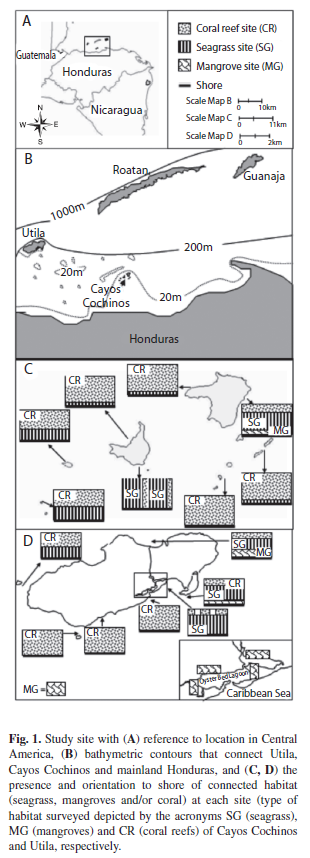
<body><![CDATA[In the present study, ontogenetic shifters used nursery habitat     (seagrass beds, mangroves) as juveniles, but were found primarily on     reefs as adults; therefore these fish species were classified as     nursery species.    <br> <br style="font-family: verdana;"> </span></font><font size="2"><span style="font-family: verdana;">In the Caribbean, most studies have quantified fish assemblages from the island nations of the Eastern region (Nagelkerken <span style="font-style: italic;">et al.</span> 2000a, Layman <span style="font-style: italic;">et al.</span> 2004, Gratwicke <span style="font-style: italic;">et al.</span> 2006, Dorenbosch <span style="font-style: italic;">et al.</span> 2007, Aguilar-Perera &amp; Appeldoorn 2008). The Mesoamerican Barrier Reef System (MBRS: Yucatan Peninsula, Belize, Honduras) is the second largest barrier reef in the world and is located closer to continental Central America compared to the island nations of the Eastern Caribbean. Scientists have performed surveys to quantify MBRS fish assemblages in seagrass beds, mangrove, and coral reef habitats of Belize and Mexico (Mumby <span  style="font-style: italic;">et al. </span>2004, Chittaro <span  style="font-style: italic;">et al.</span> 2005). However, studies of Honduran reefs are limited to Clifton &amp; Clifton (1998) who provided a comprehensive list of fish species found on the coral reefs of Honduran archipelago Cayos Cochinos, and Greenfield &amp; Johnson (1990a, 1990b) who performed multiple habitat surveys focusing on fish from the blennioid and cardinalfish families. Although Honduran reefs comprise more than 30% of the MBRS, fis huse of shallow back reef habitat has never been studied. The Honduran islands of Utila and Cayos Cochinos were chosen because they are surrounded by a diverse array of coral reefs, mangroves, and seagrass beds, including a simple isolated mangrove lagoon, coral with adjacent seagrass beds, and a highly connected coral-seagrass-mangrove continuum.</span></font><br  style="font-family: verdana;"> <font size="2"></font><br style="font-family: verdana;"> <font size="2"><span style="font-family: verdana;">The objectives of the present study in Honduras were to survey multiple habitats and to use the obtained data to answer the following questions: (1) Which fish species occupy a specific habitat? and are there any differences in fish species richness and overall abundance between seagrass beds, mangroves and corals? (2) Do juvenile fish of coral reefs use seagrass beds and mangroves as nursery grounds (NF and EJH)? And does life-stage habitat partitioning suggest habitat connectivity? (3) Do fish communities differ between habitat types?</span></font><br  style="font-family: verdana;"> <font size="2"></font><br style="font-family: verdana;"> <font style="font-weight: bold;" size="3"><span  style="font-family: verdana;">Materials and methods</span></font><br  style="font-family: verdana;"> <font size="2"></font><br style="font-family: verdana;"> <font size="2"><span style="font-family: verdana;">Study site: Cayos Cochinos (Cayos Mejor, Cayos Menor, and cays; 15&deg;56&#8217;3&#8217;&#8217; - 15&deg;58&#8217;49&#8217;&#8217; N and 86&deg;28&#8217;02&#8217;&#8217; - 86&deg;31&#8217;24&#8217;&#8217; W) and Utila (Southernmost of the Bay Islands, 16&deg;03&#8217;47&#8217;&#8217; - 16&deg;07&#8217;07&#8217;&#8217; N and 86&deg;53&#8217;01&#8217;&#8217; - 86&deg;59&#8217;41&#8217;&#8217; W) are islands off the Caribbean coast of Honduras that are surrounded by seagrass beds (from now on seagrass) followed by coral reefs in slightly deeper waters (<a href="#Fig_1">Fig. 1</a>). Although percent hard coral on surveyed reefs was reasonably high (~18%), algae dominated the reefs (~40%). Cayos Cochinos supports a very small (&lt;250m) mangrove stand (fringing mangroves in an open system located adjacent to seagrass and coral reefs) on the Eastern side of Cayos Mejor. Mangroves dominate the interior of Utila and the coastline on its North side (mangrove stands). However, mangroves on Utila&#8217;s South side are limited to two large lagoons (shallow, highly sedimentous bodies of water semi-separated from the open sea) and a few highly-fragmented stands of mangroves on the Southern coastline. Oyster Bed Lagoon is surrounded by ~5.5km of <span style="font-style: italic;">Rhizopora mangle</span> (Red Mangroves), while its interior substrate is dominated by algal beds and silt. A 75m wide channel connects Oyster Bed Lagoon to open seagrass and coral reef habitats of the Caribbean Sea. Mangrove trees reached an average height of 2m with dense prop roots extending into water at a mean depth of 50cm. Seagrass species <span style="font-style: italic;">Thalassia testudinum</span> (Turtle Grass) and <span style="font-style: italic;">Syringodium filiforme</span> (Manatee Grass) dominated the beds with blade density ~65 blades per cm and blade height ~25cm. </span></font><font  size="2"><span style="font-family: verdana;">The islands experience stable sea conditions with only a small tidal range of approximately &plusmn;20cm, and very little freshwater input during the dry season. Both islands and the waters separating the islands from Honduras mainland are within the 200m depth contour (<a href="#Fig_1">Fig. 1B</a>). Riverine influence is minimal with the mouth of the closest river, Rio El Congrejal, located 30km away on mainland Honduras. In 1993, the islands of Cayos Cochinos were designated a marine reserve; the protected area spans 489km2 and only allows artisanal fishing. Therefore, Utila, which is also a busy tourist destination, most likely suffers from more anthropogenic influence than Cayos Cochinos.    <br>     <br> </span></font>     <div style="text-align: center;"><font size="2"><a name="Fig_1"></a><img      alt="" src="/img/revistas/rbt/v60n2/a14i1.jpg"      style="width: 310px; height: 858px;"><span     ]]></body>
<body><![CDATA[ style="font-family: verdana;"></span></font><br      style="font-family: verdana;">     <font size="2"><span style="font-family: verdana;"></span></font></div>     <br style="font-family: verdana;">     <font size="2"><span style="font-family: verdana;"><span      style="font-weight: bold;">Visual survey methods (belt     transects):</span> SCUBA and snorkel underwater visual censuses were     performed     on seagrass, mangroves and coral reefs during July 2<sup>nd </sup>-     Aug. 27th 2007     ]]></body>
<body><![CDATA[and June 22<sup>nd</sup> - Aug 17<sup>th</sup>, 2008. After deploying a     metered tape,     surveyors waited five minutes for the fish to resume normal activity     before commencing (Tolimieri 1995). All fish, with the exception of     small cryptic fish (e.g. gobies, blennies, fish larvae), were visually     surveyed. Their sizes were estimated to the nearest 5cm fork length     (FL), and color variation was noted. Distances between sampling sites     were based on findings from previous research (Chapman &amp; Kramer     2000, Verweij <span style="font-style: italic;">et al. </span>2007).     To ensure that distance&nbsp; between sites     ]]></body>
<body><![CDATA[were larger than fish home-ranges (and therefore independent), coral     reef sites were separated by more than 750m, mangrove sites were     separated by more than 150m, and seagrass sites more than 100m. </span></font><br      style="font-family: verdana;">     <font size="2"></font><br style="font-family: verdana;">     <font size="2"><span style="font-family: verdana;">Fish on coral reefs     were surveyed     in 11 sites (Utila, n=five and Cayos Cochinos, n=six). Within each     site, eight non-overlapping 50m belt transects were laid out randomly     (separated by &gt;10m) on the reef flat parallel to the reef wall     ]]></body>
<body><![CDATA[(following the depth contour=4-9m). Fish within 1m on each side of the     tape and 2.5m above the tape were identified and recorded. Fish in     seagrass sites (n=six), which were located more than 20m from coral     reefs, were surveyed in six 30x2m transects per site (depth=1.4-2.1m).</span></font><br      style="font-family: verdana;">     <font size="2"></font><br style="font-family: verdana;">     <font size="2"><span style="font-family: verdana;">Mangrove sites were     either located     in Oyster Bed Lagoon on the Southside of Util (n=four) or in fringing     mangrove stands immediately adjacent to seagrass and coral reefs     ]]></body>
<body><![CDATA[(n=two). In each lagoon site, six 30x2m randomly laid transects with at     least 10m separation were laid abutting grounded prop roots and     underneath overhanging roots, while number of transects per site in     fringing mangrove stands were limited to five on Utila and three on     Cayos Mejor due to fragmentation (depth=0.2-1.2m). Mangrove prop roots     were dense (linear prop root count per meter ~40) making it impossible     to swim between grounded roots. However, tidal inundation extended no     more than one meter from the seaward edge of the mangrove forest,     making it possible to survey fish within the grounded prop roots from     the outside. All fish within primary prop roots and under overhanging     ]]></body>
<body><![CDATA[roots (transect width of 2m) were identified to the species level.</span></font><br      style="font-family: verdana;">     <font size="2"></font><br style="font-family: verdana;">     <font size="2"><span style="font-family: verdana;">For data analyses,     life stage     distinctions (juveniles vs. adults) were based on gonad studies from     Munro (1983). Fish species not included in Munro (1983) were defined as     juveniles if they were less than 1/3<sup>rd</sup> asymptotic length.     Length of     mature stages was determined to be approximately 2/3<sup>rd</sup> of     ]]></body>
<body><![CDATA[the     asymptotic length (Jensen 1997). However, length of reproductive     maturity decreases with small fish stocks (McGovern <span      style="font-style: italic;">et al.</span> 1998, Haugen     &amp; Vollestad 2001, Reznick &amp; Ghalambor 2005, Sharpe &amp; Hendry     2009). Due to fishing, a conservative value of 1/3<sup>rd</sup>     asymptotic length     (based on Humann &amp; Deloach 2002, Froese &amp; Pauly 2009) was used.     Using this calculation, all values were within 10% of Munro&#8217;s (1983)     findings. In addition, many juveniles have distinctly different     ]]></body>
<body><![CDATA[coloration than their adult counterparts (e.g. horizontal stripes on     juveniles of the family Haemulidae and typical ontogenetic coloration     changes of the families Labridae and Scaridae).</span></font><br      style="font-family: verdana;">     <font size="2"></font><br style="font-family: verdana;">     <font size="2"><span style="font-family: verdana;">Since surveyed areas     differed in     size between habitat types (mangrove and seagrass belt transects=60m<sup>2</sup>,     coral surveys=100m<sup>2</sup>), all abundances were divided by total     area of each     ]]></body>
<body><![CDATA[transect to convert to densities, then expressed as individuals per     100m<sup>2</sup>. For analyses, fish density in belt transects were     summed within     each&nbsp; site in order to avoid pseudoreplication. Shapiro-tests (R     2.10.1 software by Comprehensive R Archive Network) were used to test     for normality, and square-root transformations were used when needed.     Non-normal data (mean species richness per site) were analyzed using a     generalized linear model (R 2.10.1) with quasipoisson error     distributions. Poisson errors were used because total fish densities     were based on count data; quasipoisson errors were used when data was     ]]></body>
<body><![CDATA[over dispersed (Crawley 2007). For each habitat type, total juvenile     and adult densities were calculated by pooling all fish from each     survey. Total juvenile densities and individual species&#8217; densities were     tested with a parametric, one-way ANOVA model (R 2.10.1), while a     generalized linear model (with quasipoisson errors) was used for total     adult densities on Cayos Cochinos. Within each habitat, comparisons of     juvenile density with adult density were performed with oneway ANOVA     models. Comparisons in seagrass habitat required square-root     transformed data. Fringing mangrove stands could not be statistically     compared, because n&lt;three. </span></font><br     ]]></body>
<body><![CDATA[ style="font-family: verdana;">     <font size="2"></font><br style="font-family: verdana;">     <font size="2"><span style="font-family: verdana;">In order to     calculate nursery     function (NF) and effective juvenile habitat (EJH), relative     contribution and estimated percent surface area of each habitat type     were first calculated. Relative contribution was the amount of     juveniles in each habitat compared to total juveniles. Percent surface     area of each habitat type was estimated using satellite images,     underwater surveys, and maps from www.cayoscochinos.     ]]></body>
<body><![CDATA[org: Cayos (69%     coral reefs, 29% seagrass and 0.02% mangroves) and Utila (57% coral     reefs, 33% seagrass and 0.28% mangroves).</span></font><br      style="font-family: verdana;">     <font size="2"></font><br style="font-family: verdana;">     <font size="2"><span style="font-family: verdana;">To determine if     community structure     differed between habitat types, square-root transformed fish assemblage     data was used with Bray-Curtis dissimilarities (sum of absolute     differences divided by the total abundance) in an Analysis of     ]]></body>
<body><![CDATA[Similarity test (ANOSIM; Community Analysis Package (CAP), copyright     PISCES 2008). Seagrass, mangrove and coral reef fish density data were     separated into juvenile and adult life stages. Community structure     comparisons were displayed in a Multidimensional Scaling (MDS) plot     with sites bearing similar communities clustering together. Goodness of     fit in two dimensions was measured by stress tests (zero represents a     perfect fit); acceptable levels are less than 0.2 (Clarke 1993).</span></font><br      style="font-family: verdana;">     <font size="2"></font><br style="font-family: verdana;">     <font style="font-weight: bold;" size="3"><span     ]]></body>
<body><![CDATA[ style="font-family: verdana;">Results</span></font><br      style="font-family: verdana; font-weight: bold;">     <font style="font-weight: bold;" size="2"></font><br      style="font-family: verdana;">     <font size="2"><span style="font-family: verdana;"><span      style="font-weight: bold;">Distribution of fish found on     seagrass beds, mangroves and coral reefs: </span>Surveys found 113     species of     fish from 32 families in the three habitat types. Fish species richness     was significantly higher on coral reefs (mean=49.1, SE=2.4) than     ]]></body>
<body><![CDATA[seagrass (12.4, 1.2) and mangroves (14.9, 0.9) (Generalized Linear     Model, n=23, both comparisons p&lt;0.001). When fish data were     separated by islands, species richness remained significantly different     amongst habitats types of both Cayos Cochinos (p&lt;0.001) and Utila     (p&lt;0.001). Coral reef surveys were dominated by juveniles of the     families Labridae (wrasse) and Scaridae (parrotfish) and adults of the     family Pomacentridae (damselfish). Seagrass beds were characterized by     the families: Labridae, Scaridae and Haemulidae (grunts). Numerical     dominant families found in mangrove surveys included juveniles of     Lutjanidae (snapper), Gerreidae (mojarra) and Chaetodontidae     ]]></body>
<body><![CDATA[(butterflyfish), and resident habitat specialists such as     Tetraodontidae (pufferfish) and Rivulidae (killifish). Many fish     species used multiple habitat types (<a      href="/img/revistas/rbt/v60n2/a14t1.gif">Table 1</a>), but densities     of     commercially important fish varied greatly between sites (<a      href="/img/revistas/rbt/v60n2/a14i2.jpg">Fig. 2</a>).</span></font><br      style="font-family: verdana;">     <font size="2"></font><br style="font-family: verdana;">     <font size="2"><span style="font-family: verdana;"><span     ]]></body>
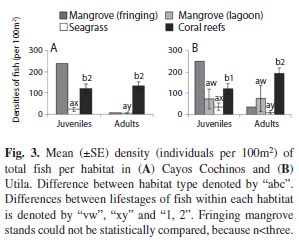
<body><![CDATA[ style="font-weight: bold;">Nursery function:</span> Many fish species     spent their juvenile life stage in seagrass and mangroves. Juvenile and     adult densities (individuals per 100m<sup>2</sup>) were significantly     higher on     coral reefs relative to seagrass on both Utila (ANOVA, juveniles: F<sub>2,9</sub>=2.95,     p=0.038, adults: F<sub>2,9</sub>=10.99, p&lt;0.001, <a href="#Fig_3">Fig.     3A</a>) and Cayos     Cochinos (Cayos) (ANOVA, juveniles: F<sub>1,7</sub>=2.95, p&lt;0.001;     Generalized     Linear Model, n=9, p&lt;0.001, <a href="#Fig_3">Fig. 3B</a>). On     ]]></body>
<body><![CDATA[Utila, there were     significantly more adult fish on coral reefs than in mangroves     (p=0.019). Although there appeared to be more juvenile and adult fish     in Utila&#8217;s mangroves than in seagrass, this difference was not     significant. Fringing mangrove stands housed the greatest densities of     fish; however statistical differences could not be calculated.     Therefore, mangrove sites were combined (fringing and lagoon mangroves;     Cayos and Utila), resulting in significantly greater densities of fish     in mangroves compared to seagrass ANOVA, juveniles: F<sub>2,19</sub>=10.88,     p=0.04; Generalized Linear Model, adults: n=23, p=0.02), but fewer fish     ]]></body>
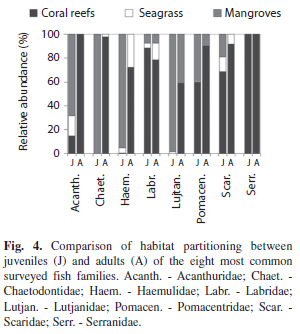
<body><![CDATA[than in coral reefs (juveniles: p=0.03, adults: p=0.005).    <br>     <br> </span></font>     <div style="text-align: center;"><font size="2"><a name="Fig_3"></a><img  alt="" src="/img/revistas/rbt/v60n2/a14i3.jpg"  style="width: 299px; height: 243px;"><span  style="font-family: verdana;"></span></font><br  style="font-family: verdana;"> <font size="2"><span style="font-family: verdana;"></span></font></div> <br style="font-family: verdana;"> <font size="2"><span style="font-family: verdana;">Mean densities of adult fish were significantly higher on Utila&#8217;s coral reefs compared to density of juveniles (ANOVA, F<sub>1,8</sub>=8.058, p=0.022) contrasting with surveys in seagrass which found more juvenile fish than adults from both islands (Cayos: F<sub>1,4</sub>=12.53, p=0.024; Utila: F<sub>1,4</sub>=12.75, p=0.023, <a href="#Fig_3">Fig. 3</a>). Juvenile densities in mangroves were comparable to adult densities due to resident habitat specialist species which comprised 94% of adults (seagrass has &lt;10% resident habitat specialists).</span></font><br  style="font-family: verdana;"> <font size="2"></font><br style="font-family: verdana;"> <font size="2"><span style="font-family: verdana;">By separating juvenile and adult stages into families and calculating percent distribution in the habitat types, it was evident that families have distinct ontogenetic partitioning. Chaetodontidae (Butterflyfish) juveniles were restricted to the mangrove habitat, but adults were located mainly on coral reefs (Fig. 4).    <br>     <br> </span></font>     <div style="text-align: center;"><font size="2"><a name="Fig_4"></a><img      alt="" src="/img/revistas/rbt/v60n2/a14i4.jpg"      style="width: 300px; height: 334px;"><span      style="font-family: verdana;"></span></font><br     ]]></body>
<body><![CDATA[ style="font-family: verdana;">     <font size="2"><span style="font-family: verdana;"></span></font></div>     <br style="font-family: verdana;">     <font size="2"><span style="font-family: verdana;">Haemulidae and     Lutjanidae juveniles     were found in seagrass but in relatively few numbers compared to     mangroves, while both had higher percentages on coral reefs as adults.     Although Acanthuridae (Surgeonfish) and Pomacentridae adults were found     mainly on coral reefs, their juveniles were found in multiple habitat     types. </span></font><font size="2"><span style="font-family: verdana;">In     ]]></body>
<body><![CDATA[contrast, all life stages from     the families Scaridae, Labridae and Serranidae (Groupers) occurred     primarily on coral reefs. Haemulidae and Lutjanidae size-frequency     distributions suggest fork length sizes at which fish m&iacute;grate to     coral reefs (<a href="/img/revistas/rbt/v60n2/a14i5.jpg">Fig. 5</a>). <span      style="font-style: italic;">Lutjanus apodus</span>     (Walbaum, 1792) and <span style="font-style: italic;">H.     flavolineatum</span> (Desmarest, 1823) migrate directly from mangroves     to     coral reefs, while <span style="font-style: italic;">Haemulon plumieri     ]]></body>
<body><![CDATA[</span>(Lacep&egrave;de, 1801) and <span style="font-style: italic;">H.     sciurus </span>(Shaw, 1803) use seagrass as an intermediate habitat     during     ontogenetic migration. Juveniles of the Yellowtail Snapper <span      style="font-style: italic;">Ocyurus     chrysurus</span> (Bloch, 1791) were only found in seagrass sites (<a      href="/img/revistas/rbt/v60n2/a14t1.gif">Table     1</a>,     <a href="/img/revistas/rbt/v60n2/a14i5.jpg">Fig. 5</a>).</span></font><br      style="font-family: verdana;">     ]]></body>
<body><![CDATA[<font size="2"></font><br style="font-family: verdana;">     <font size="2"><span style="font-family: verdana;">Families whose     juveniles were found     in more than one habitat type often included some species that occurred     in only one habitat and others occurring in two or three. Importance,     measured by nursery function (NF) and effective juvenile habitat (EJH),     of seagrass and mangrove nurseries varied greatly according to species.     For example, the striped parrotfish <span style="font-style: italic;">Scarus     iseri</span> (Bloch, 1789) was the     most common in relative abundance, comprising 12% of total individuals     ]]></body>
<body><![CDATA[surveyed in the present study. <span style="font-style: italic;">S.     iseri</span> juveniles were not only present     on coral reefs, but also in mangroves and seagrass (<a      href="/img/revistas/rbt/v60n2/a14t1.gif">Table 1</a>). All <span      style="font-style: italic;">S.     iseri </span>adults were found on coral reefs, and it is unknown if     juveniles     found in mangroves and seagrass undergo ontogenetic migration or move     freely between multiple habitats. Although mangroves contributed the     most <span style="font-style: italic;">S. iseri</span> juveniles per     ]]></body>
<body><![CDATA[area (NF), coral reefs were an effective     juvenile habitat due to great densities of juveniles in this large     habitat. In contrast, the corallivorous Four-eye Butterflyfish     <span style="font-style: italic;">Chaetodon capistratus</span>     (Linnaeus, 1758) and snapper juveniles <span      style="font-style: italic;">Lutjanus     griseus</span> (Linnaeus, 1758) and L. apodus were found primarily in     mangroves (considered both NF and EJH) while in the juvenile life stage     (<a href="/img/revistas/rbt/v60n2/a14t1.gif">Table 1</a>). Very few     adult-sized fish (&lt;10% of total) from the family     ]]></body>
<body><![CDATA[Lutjanidae were found in the mangroves, and these adults were     relatively small (&lt;25% larger than 25cm with 1% larger than 35cm).     Acanthurid juveniles were observed in all three habitat types,     primarily because <span style="font-style: italic;">Acanthurus bahianus</span>     juveniles (Castelnau, 1855) were     found in seagrass (EJH on Utila) and mangroves (both EJH and NF), while     both <span style="font-style: italic;">A. coeruleus</span> (Bloch     &amp; Schneider, 1801) juveniles (Cayos     densities: mean=0.3, SE=0.3; Utila densities: 0.5, 0.4) and adults     (Cayos densities: 2.7; 3.0; Utila densities: 7.2, 7.8) resided on coral     ]]></body>
<body><![CDATA[reefs. Like <span style="font-style: italic;">A. coeruleus</span>,     many coral reef fish species in this survey     were found to be reef specialists i.e. they did not exploit nursery     grounds away from reefs; all their juveniles were found only on coral     reefs. The three most common coral reef habitat specialists include     Bicolor Damselfish <span style="font-style: italic;">Stegastes partitus</span>     (Poey, 1868; combined juvenile     and adult densities, Cayos: mean=25.9, SE=8.0; Utila: 30.8, 7.6), Blue     Chromis<span style="font-style: italic;"> Chromis cyanea</span> (Poey,     1860; combined juvenile and adult     ]]></body>
<body><![CDATA[densities, Cayos: 6.7, 3.7; Utila: 38.1, 15.7), and Yellowhead Wrasse     <span style="font-style: italic;">Halichoeres garnoti </span>(Valenciennes,     1839; combined juvenile and adult     densities, Cayos: 12.7, 3.1; Utila: 20.0, 4.7).</span></font><br      style="font-family: verdana;">     <font size="2"></font><br style="font-family: verdana;">     <font size="2"><span style="font-family: verdana;"><span      style="font-weight: bold;">Fish community differences between     habitat types: </span>On the juvenile life stage MDS ordination plot,     three     ]]></body>
<body><![CDATA[major clusters could be distinguished corresponding to seagrass,     mangrove and coral reef habitats, and there was a significant     difference amongst all three fish assemblage clusters (Analysis of     Similarity, R=0.93, p&lt;0.001, <a      href="/img/revistas/rbt/v60n2/a14i6.jpg">Fig. 6A</a>). Adult fish     assemblages showed     a similar pattern (overall groups were significantly different, R=0.88,     p&lt;0.001), except fish assemblages in fringing mangrove stands were     clustered closer to seagrass than those in mangrove lagoons (<a      href="/img/revistas/rbt/v60n2/a14i6.jpg">Fig. 6B</a>).</span></font><br     ]]></body>
<body><![CDATA[ style="font-family: verdana;">     <font size="2"></font><br style="font-family: verdana;">     <font style="font-weight: bold;" size="3"><span      style="font-family: verdana;">Discussion</span></font><br      style="font-family: verdana;">     <font size="2"></font><br style="font-family: verdana;">     <font size="2"><span style="font-family: verdana;"><span      style="font-weight: bold;">Fish distribution:</span> The present     study showed that the fish communities in all three habitats were     distinctly different. Seagrass, mangroves and coral reefs contained     ]]></body>
<body><![CDATA[high numbers of fish species paralleling numbers of species found in     Aguilar-Perera &amp; Appeldoorn&#8217;s Puerto Rican study (102 species in     2008) and Chittaro <span style="font-style: italic;">et al.</span>     Bahamas, Mexico, and Belize study (82 species     in 2005). We found very few <span style="font-style: italic;">Lutjanus     apodus</span> juveniles outside of     mangroves, which correspond with previous studies suggesting that     mangroves provide an important nursery habitat for these juveniles     (Nagelkerken <span style="font-style: italic;">et al.</span> 2000a,     Mumby <span style="font-style: italic;">et al.</span> 2004, Chittaro <span     ]]></body>
<body><![CDATA[ style="font-style: italic;">et al.</span> 2005,     Aguilar-Perera &amp; Appeldoorn 2007). Honduran ichthyofaunal     composition was comparable with findings from many Caribbean studies;     however there were a few notable differences particularly at the     species level. Surveys from Honduras (present study), the British     Virgin Islands (Gratwicke <span style="font-style: italic;">et al.</span>     2006) and the coral reefs of Cayos     Cochinos, Honduras (Clifton &amp; Clifton 1998) shared domination by     the Striped Parrotfish Scarus iseri. However, Chittaro <span      style="font-style: italic;">et al.</span> (2005)     ]]></body>
<body><![CDATA[study in Belize, Mexico, and Bahamas found the Blackear Wrasse     Halichoeres poeyi (Steindachner, 1867) was the most abundant individual     found during surveys, which differs from the present study&#8217;s low     densities. In addition to <span style="font-style: italic;">S. iseri</span>,     Bluehead Wrasse <span style="font-style: italic;">Thalassoma     bifasciatum</span> and Bicolored Damselfish <span      style="font-style: italic;">Stegastes partitus</span> dominated the     coral reefs of Honduras, Puerto Rico (Aguilar-Perera &amp; Appeldoorn     2008) and Curacao (Nagelkerken <span style="font-style: italic;">et     al. </span>2000a). Most nonestuarine studies     ]]></body>
<body><![CDATA[found Lutjanidae, Scaridae and Haemulidae as the most abundant families     in seagrass and mangroves, although dominant species within these     families varied between studies (Nagelkerken <span      style="font-style: italic;">et al. </span>2000a,     Aguilar-Perera &amp; Appeldoorn 2007, Dorenbosch <span      style="font-style: italic;">et al.</span> 2007). For     example, <span style="font-style: italic;">Haemulon flavolineatum</span>     was the most abundant fish species in     both seagrass and mangrove habitats of Curacao (Nagelkerken <span      style="font-style: italic;">et al.     ]]></body>
<body><![CDATA[</span>2000a). In contrast, the present study in Honduras found that <span      style="font-style: italic;">Lutjanus     apodus</span> dominated mangrove surveys, and <span      style="font-style: italic;">Haemulon flavolineatum</span> was not     present in seagrass. These differences in fish distributions amongst     studies emphasize the importance of determining nursery function at a     site level.</span></font><br style="font-family: verdana;">     <font size="2"></font><br style="font-family: verdana;">     <font size="2"><span style="font-family: verdana;"><span      style="font-weight: bold;">Nursery function:</span> The present study     ]]></body>
<body><![CDATA[in Honduras, like other Caribbean studies, found that mangroves and     seagrass habitats were characterized by juvenile fish occupancy     (Sedberry &amp; Carter 1993, Nagelkerken <span      style="font-style: italic;">et al. </span>2000a). This pattern     illustrates the role of these two h&aacute;bitats as fish nursery     grounds. In fact, out of 48 juvenile species surveyed, 52% were found     on h&aacute;bitat types other than coral reefs, suggesting that these     alternative habitats are very important. It is significant to note that     use of habitat does not imply nursery value. For example, although     <span style="font-style: italic;">Lutjanus griseus</span> juveniles and     ]]></body>
<body><![CDATA[many Labridae juveniles were found in     seagrass habitats, these did not have a nursery ground use by these     individuals. <span style="font-style: italic;">L. griseus</span>     densities were too low to result in NF and EJH,     while the Labridae individuals were habitat generalists, using multiple     habitat types at all life stages. Within families, closely related     species sometimes used different juvenile habitat types, and therefore     differed in which habitats had nursery value (NF and EJH). Although all     Chaetodontidae juveniles used mangroves as nurseries, juvenile habitat     association of species such as from the Scaridae family differed     ]]></body>
<body><![CDATA[between species. In particular, <span style="font-style: italic;">Sparisoma     aurofrenatum</span> juveniles     (Redband Parrotfish) were found in highest numbers in seagrass beds,     while <span style="font-style: italic;">Scarus iseri</span> (Striped     Parrotfish) were found in all three     h&aacute;bitat types with highest densities on coral reefs. In contrast     to findings in Honduras and one Belize study (Chittaro<span      style="font-style: italic;"> et al.</span> 2005),     studies in Curacao (Nagelkerken <span style="font-style: italic;">et     al. </span>2002) and another in Belize     ]]></body>
<body><![CDATA[(Mumby <span style="font-style: italic;">et al. </span>2004) found     the majority of S. iseri in non-coral     habitats. These niche differentiations emphasize the need to evaluate     fish distribution amongst habitats to the species level, in addition to     the site level. In fact, use of nursery habitat varied on a small     spatial scale within the geographic scope of the present study. For     example, although seagrass contributed a large percentage to total     habitat, only one site (16&deg;05&#8217;15&#8217;&#8217; N - 86&deg;53&#8217;38&#8217;&#8217; W) contained     fish     densities greater than 100 individuals per 100m<sup>2</sup>. This site     ]]></body>
<body><![CDATA[contained     more than three times the fish densities than other seagrass sites. The     site was part of a small fringing mangrove-seagrass-coral reef     continuum as was two out of the five other seagrass sites, therefore     seascape is most likely not the explanation behind these differences.     Faunce &amp; Serafy (2006) review of mangrove studies has cautioned     against generalizing nursery value of mangroves on a spatial scale     &gt;500m, however findings from the present study in Honduras, Chittaro     <span style="font-style: italic;">et al.</span> (2005), and Dorenbosch <span      style="font-style: italic;">et al.</span> (2007)&nbsp; Caribbean     ]]></body>
<body><![CDATA[studies     suggest that nursery value be determined at a site level.</span></font><br      style="font-family: verdana;">     <font size="2"></font><br style="font-family: verdana;">     <font size="2"><span style="font-family: verdana;"><span      style="font-weight: bold;">Habitat connectivity:</span> Seascape     ecology implies that habitats do not &#8216;function in isolation&#8217;; instead,     the spatial arrangement of seagrass, mangrove and coral reef habitats     in relation to each other may influence fish distribution (Dorenbosch     <span style="font-style: italic;">et al.</span> 2007, Pittman <span     ]]></body>
<body><![CDATA[ style="font-style: italic;">et al. </span>2007). Habitat     configuration dictates     h&aacute;bitat connectivity, and fish move between h&aacute;bitats via     the larval recruitment process (Roberts <span      style="font-style: italic;">et al. </span>1997, Paris <span      style="font-style: italic;">et al.</span>     2007), daily migration (Nagelkerken <span style="font-style: italic;">et     al.</span> 2000b, Nagelkerken <span style="font-style: italic;">et al.</span>     (2008) and ontogenetic migration (Nakamura <span      style="font-style: italic;">et al. </span>2008, Verweij <span     ]]></body>
<body><![CDATA[ style="font-style: italic;">et al.</span>     2008). In the present study, adult fish assemblages found in fringing     mangrove stands on Cayos Cochinos and Utila&#8217;s Northside were similar to     seagrass beds, and had higher species richness and more juveniles from     the grunt and parrotfish families than found in mangroves in Oyster Bed     Lagoon. Because Cayos Cochinos had only a small mangrove stand and the     majority of mangroves on Utila were located in geographically     semi-isolated lagoons, most nursery species preferred either mangroves     or seagrass, and most species that were found in both h&aacute;bitats     were all found in fringing mangrove stands adjacent to seagrass     ]]></body>
<body><![CDATA[(themselves adjacent to the coral reefs). Daily migration out of     mangroves is much more feasible when adjacent habitats (e.g. seagrass)     are available than when mangroves are isolated. Previous fish studies     of mangroves in Curacao found most nursery species were residing in     both seagrass and mangroves (Nagelkerken <span      style="font-style: italic;">et al.</span> 2000a, 2002). Like the     fringing mangrove stands of the present study, Nagelkerken&#8217;s studies     were performed in sites with highly connected fringing mangroves. Both     fish communities had to migrate only a short distance in the     seagrassmangrove continuum, and likely used both habitats. Differences     ]]></body>
<body><![CDATA[between connected versus isolated mangroves were also found in a study     performed in Florida where greater abundances of Haemulidae were found     in mangroves with adjacent seagrass than in isolated mangroves (Pittman     2007). Likewise, Dorenbosch et al. (2007) found significantly more     adult species on mangroves near reefs compared to semi-isolated     mangroves. Thus, results agree with previous research (Gratwicke <span      style="font-style: italic;">et al.</span>     2006, Dorenbosch <span style="font-style: italic;">et al.</span>     2007), which have found spatial patterns and     density distributions of fish depend on complexity of connectivity with     ]]></body>
<body><![CDATA[more connected habitats housing higher abundances and greater species     richness.</span></font><br style="font-family: verdana;">     <font size="2"></font><br style="font-family: verdana;">     <font size="2"><span style="font-family: verdana;">Although visual     surveys found     resident habitat specialists in non-coral reef h&aacute;bitat (e.g.     mangrove specialist<span style="font-style: italic;"> Sphoeroides     testudineus</span>, Checkered Pufferfish),     most fish juveniles found in alternate habitat types were surveyed on     coral reefs in the adult life stage. Fish settlement often occurs in a     ]]></body>
<body><![CDATA[habitat different from that used by adults (Cocheret de la     Morini&egrave;re <span style="font-style: italic;">et al. </span>2004,     Adams &amp; Ebersole 2004). Size     frequency distribution of the Haemulidae and Lutjanidae families in the     present study implies habitat connectivity through ontogenetic     migration. Sizes at which these fish families were first found on     Honduran coral reefs parallels those of Cocheret de la     Morini&egrave;re&#8217;s <span style="font-style: italic;">et al.</span>(2003)     Curacao study (&gt;10cm FL). Cocheret     de la Morini&egrave;re&#8217;s <span style="font-style: italic;">et al.</span>     ]]></body>
<body><![CDATA[(2003) study also found that Haemulidae     undergo a change in diet and gonadal maturation just prior to migration     from nursery habitats, while Lutjanidae migrate to coral reefs before     sexual maturation (diet plays larger role). Furthermore, two Australian     species from the family Lutjanidae were found to be reproductively     immature when located in mangrove estuaries despite their large sizes     (Sheaves 1995). Therefore, it must be noted that the large Lutjanidae     classified as adults (according to Munro 1983) in the present study&#8217;s     mangrove habitat may in fact be immature. Further studies are needed to     investigate whether findings regarding Australian Lutjanidae can be     ]]></body>
<body><![CDATA[applied in the Caribbean. </span></font><br      style="font-family: verdana;">     <font size="2"></font><br style="font-family: verdana;">     <font size="2"><span style="font-family: verdana;">As mentioned above,     most large,     adult fish were observed in coral reefs. However, there was a distinct     paucity (&lt;1%) of large fish over 45cm FL in this Honduran fish     survey. In particular, commercially important groupers, which are     benthic coral reef fish, were found in very low densities (mean density     of groupers &lt;1.0 individual per 100m<sup>2</sup>). The most     ]]></body>
<body><![CDATA[prevalent grouper     found in the surveys were the Graysby Grouper, <span      style="font-style: italic;">Cephalopholis cruentatus</span>     (Lacep&egrave;de, 1802), which is one of the smallest species belonging     to the grouper family. Other studies in the Caribbean have also     reported low numbers of groupers, attributing population decline to     overfishing and reef degradation (Rogers &amp; Beets 2001,     Aguilar-Perera <span style="font-style: italic;">et al.</span> 2009).     Although groupers (coral reef specialists)     are not directly affected by the presence of nursery habitats, they may     ]]></body>
<body><![CDATA[be indirectly influenced through food chain dynamics. </span></font><br      style="font-family: verdana;">     <font size="2"></font><br style="font-family: verdana;">     <font size="2"><span style="font-family: verdana;">Previous studies     have shown that     juvenile fish communities, in particular those located in nursery     habitats, may shape adult fish communities on coral reefs (Mumby <span      style="font-style: italic;">et al.</span>     2004,Verweij <span style="font-style: italic;">et al.</span> 2008).     Results from Harm <span style="font-style: italic;">et al.</span>     ]]></body>
<body><![CDATA[(2008) indicated     the presence&nbsp; of mangroves in Honduras enhanced densities of seven     species of coral reef fish adults. Generally, fish distributions in     Honduras&#8217;s seagrass, mangrove&nbsp; and coral reef habitats were     similar to previous studies in the Caribbean and MBRS. However, nursery     value appeared to differ amongst species and sites, revealing the     importance of performing local surveys before determining which     locations and combination of h&aacute;bitats should be prioritized for     conservation action.</span></font><br style="font-family: verdana;">     <font size="2"></font><br style="font-family: verdana;">     ]]></body>
<body><![CDATA[<font style="font-weight: bold;" size="3"><span      style="font-family: verdana;">Acknowledgments</span></font><br      style="font-family: verdana;">     <font size="2"></font><br style="font-family: verdana;">     <font size="2"><span style="font-family: verdana;">We thank St.     Catherines College     (Oxford) and Operation Wallacea (and their partners in Honduras) for     their financial contributions. We would also like to thank Clive     Hambler, Peter Henderson, Mark Jaxion, Owen Harris, Emily Kearns, and     Mikki Haig for their assistance with study design, aid with statistics,     ]]></body>
<body><![CDATA[and help in the field.</span></font><br style="font-family: verdana;">     <font size="2"></font><br style="font-family: verdana;">     <font style="font-weight: bold;" size="2"><span      style="font-family: verdana;"></span></font>     <hr style="width: 100%; height: 2px;"><font style="font-weight: bold;"      size="3"><span style="font-family: verdana;">References</span></font><br      style="font-family: verdana;">     <font size="2"></font><br style="font-family: verdana;">     <font size="2"><span style="font-family: verdana;">Adams, A.J. &amp;     J.P. Ebersole.     ]]></body>
<body><![CDATA[2004. Processes influencing recruitment inferred from distributions of     <!-- ref -->coral reef fishes. Bull. Mar. Sci. 75: 153-174.    &nbsp;&nbsp;&nbsp;&nbsp;&nbsp;&nbsp;&nbsp;&nbsp;[&#160;<a href="javascript:void(0);" onclick="javascript: window.open('/scielo.php?script=sci_nlinks&ref=1491949&pid=S0034-7744201200020001400001&lng=','','width=640,height=500,resizable=yes,scrollbars=1,menubar=yes,');">Links</a>&#160;]<!-- end-ref --><!-- ref --></span></font><br  style="font-family: verdana;"> <font size="2"></font><br style="font-family: verdana;"> <font size="2"><span style="font-family: verdana;">Adams, A.J., C.P. Dahlgren, G.T. Kellison, M.S. Kendall, C.A. Layman, J.A. Ley, I. Nagelkerken &amp; J.E. Serafy. 2006. Nursery function of tropical back-reef systems. Mar. Ecol. Progr. 318: 287-301.    &nbsp;&nbsp;&nbsp;&nbsp;&nbsp;&nbsp;&nbsp;&nbsp;[&#160;<a href="javascript:void(0);" onclick="javascript: window.open('/scielo.php?script=sci_nlinks&ref=1491950&pid=S0034-7744201200020001400002&lng=','','width=640,height=500,resizable=yes,scrollbars=1,menubar=yes,');">Links</a>&#160;]<!-- end-ref --><!-- ref --></span></font><br  style="font-family: verdana;"> <font size="2"></font><br style="font-family: verdana;"> <font size="2"><span style="font-family: verdana;">Aguilar-Perera, A. &amp; R.S. Appeldoorn. 2007. Variation in juvenile fish density along the mangrove-seagrasscoral reef continuum in SW Puerto Rico. Mar. Ecol. Progr. 348: 139-148.    &nbsp;&nbsp;&nbsp;&nbsp;&nbsp;&nbsp;&nbsp;&nbsp;[&#160;<a href="javascript:void(0);" onclick="javascript: window.open('/scielo.php?script=sci_nlinks&ref=1491951&pid=S0034-7744201200020001400003&lng=','','width=640,height=500,resizable=yes,scrollbars=1,menubar=yes,');">Links</a>&#160;]<!-- end-ref --><!-- ref --></span></font><br style="font-family: verdana;"> <font size="2"></font><br style="font-family: verdana;"> <font size="2"><span style="font-family: verdana;">Aguilar-Perera, A. &amp; R.S. Appeldoorn. 2008. Spatial distribution of marine fishes along a cross-shelf gradient containing a continuum of mangrove-seagrass-coral reefs off southwestern Puerto Rico. Estuar. Coast. Shelf. Sci. 76: 378-394.    &nbsp;&nbsp;&nbsp;&nbsp;&nbsp;&nbsp;&nbsp;&nbsp;[&#160;<a href="javascript:void(0);" onclick="javascript: window.open('/scielo.php?script=sci_nlinks&ref=1491952&pid=S0034-7744201200020001400004&lng=','','width=640,height=500,resizable=yes,scrollbars=1,menubar=yes,');">Links</a>&#160;]<!-- end-ref --><!-- ref --></span></font><br style="font-family: verdana;"> <font size="2"></font><br style="font-family: verdana;"> <font size="2"><span style="font-family: verdana;">Aguilar-Perera, A., C. Gonzalez-Salas, A. Tuz-Sulub &amp; H. Villegas-Hernandez. 2009. Fishery of the Goliath grouper, <span style="font-style: italic;">Epinephelus itajara</span> (Teleostei: Epinephelidae) based on local ecological knowledge and fishery records in Yucatan, Mexico. Rev. Biol. Trop. 57: 557-566.    &nbsp;&nbsp;&nbsp;&nbsp;&nbsp;&nbsp;&nbsp;&nbsp;[&#160;<a href="javascript:void(0);" onclick="javascript: window.open('/scielo.php?script=sci_nlinks&ref=1491953&pid=S0034-7744201200020001400005&lng=','','width=640,height=500,resizable=yes,scrollbars=1,menubar=yes,');">Links</a>&#160;]<!-- end-ref --><!-- ref --></span></font><br  style="font-family: verdana;"> <font size="2"></font><br style="font-family: verdana;"> <font size="2"><span style="font-family: verdana;">Almany, G.R. 2004. Does increased habitat complexity reduce predation and competition in coral reef fish assemblages? Oikos 106: 275-284.    &nbsp;&nbsp;&nbsp;&nbsp;&nbsp;&nbsp;&nbsp;&nbsp;[&#160;<a href="javascript:void(0);" onclick="javascript: window.open('/scielo.php?script=sci_nlinks&ref=1491954&pid=S0034-7744201200020001400006&lng=','','width=640,height=500,resizable=yes,scrollbars=1,menubar=yes,');">Links</a>&#160;]<!-- end-ref --><!-- ref --></span></font><br  style="font-family: verdana;"> <font size="2"></font><br style="font-family: verdana;"> <font size="2"><span style="font-family: verdana;">Anonymous (Food and Agriculture Organization of the United Nations). 2007. The world&#8217;s mangroves 1980&#8211;2005. FAO Forestry Paper 153. FAO, Rome (Downloaded: 01 May, 2010, <a href="http://www.fao.org/docrep/010/a1427e/a1427e00.htm">http://www.fao.org/docrep/010/a1427e/a1427e00.htm</a>).    &nbsp;&nbsp;&nbsp;&nbsp;&nbsp;&nbsp;&nbsp;&nbsp;[&#160;<a href="javascript:void(0);" onclick="javascript: window.open('/scielo.php?script=sci_nlinks&ref=1491955&pid=S0034-7744201200020001400007&lng=','','width=640,height=500,resizable=yes,scrollbars=1,menubar=yes,');">Links</a>&#160;]<!-- end-ref --><!-- ref --></span></font><br  style="font-family: verdana;"> <font size="2"></font><br style="font-family: verdana;"> <font size="2"><span style="font-family: verdana;">Beck, M.W., K.L. Heck, K.W. Able, D.L. Childers, D.B. Eggleston, B.M. Gillanders, B. Halpern, C.G. Hays, K. Hoshino, T.J. Minello, R.J. Orth, P.F. Sheridan &amp; M.P. Weinstein. 2001. The identification, conservation, and management of estuarine and marine nurseries for fish and invertebrates. Bioscience 51: 633-641.    &nbsp;&nbsp;&nbsp;&nbsp;&nbsp;&nbsp;&nbsp;&nbsp;[&#160;<a href="javascript:void(0);" onclick="javascript: window.open('/scielo.php?script=sci_nlinks&ref=1491956&pid=S0034-7744201200020001400008&lng=','','width=640,height=500,resizable=yes,scrollbars=1,menubar=yes,');">Links</a>&#160;]<!-- end-ref --><!-- ref --></span></font><br style="font-family: verdana;"> <font size="2"></font><br style="font-family: verdana;"> <font size="2"><span style="font-family: verdana;">Chapman, M.R. &amp; D.L. Kramer. 2000. Movements of fishes within and among fringing coral reefs in Barbados. Environ. Biol. Fish. 57: 11-24.    &nbsp;&nbsp;&nbsp;&nbsp;&nbsp;&nbsp;&nbsp;&nbsp;[&#160;<a href="javascript:void(0);" onclick="javascript: window.open('/scielo.php?script=sci_nlinks&ref=1491957&pid=S0034-7744201200020001400009&lng=','','width=640,height=500,resizable=yes,scrollbars=1,menubar=yes,');">Links</a>&#160;]<!-- end-ref --><!-- ref --></span></font><br  style="font-family: verdana;"> <font size="2"></font><br style="font-family: verdana;"> <font size="2"><span style="font-family: verdana;">Clarke, K.R. 1993. Nonparametric multivariate analyses of changes in community structure. Aust. J. Ecol. 18: 117-143.    &nbsp;&nbsp;&nbsp;&nbsp;&nbsp;&nbsp;&nbsp;&nbsp;[&#160;<a href="javascript:void(0);" onclick="javascript: window.open('/scielo.php?script=sci_nlinks&ref=1491958&pid=S0034-7744201200020001400010&lng=','','width=640,height=500,resizable=yes,scrollbars=1,menubar=yes,');">Links</a>&#160;]<!-- end-ref --><!-- ref --></span></font><br style="font-family: verdana;"> <font size="2"></font><br style="font-family: verdana;"> <font size="2"><span style="font-family: verdana;">Clifton, K.E. &amp; L.M. Clifton. 1998. A survey of fishes from various coral reef habitats within the Cayos Cochinos Marine Reserve, Honduras. Rev. Biol. Trop. 46: 109-124.    &nbsp;&nbsp;&nbsp;&nbsp;&nbsp;&nbsp;&nbsp;&nbsp;[&#160;<a href="javascript:void(0);" onclick="javascript: window.open('/scielo.php?script=sci_nlinks&ref=1491959&pid=S0034-7744201200020001400011&lng=','','width=640,height=500,resizable=yes,scrollbars=1,menubar=yes,');">Links</a>&#160;]<!-- end-ref --><!-- ref --></span></font><br  style="font-family: verdana;"> <font size="2"></font><br style="font-family: verdana;"> <font size="2"><span style="font-family: verdana;">Chittaro, P.M., P. Usseglio &amp; P. Sale. 2005. Variation in fish density, assemblage composition and relative rates of predation among mangrove, seagrass and coral reef habitats. Environ. Biol. Fish. 72: 175-187.    &nbsp;&nbsp;&nbsp;&nbsp;&nbsp;&nbsp;&nbsp;&nbsp;[&#160;<a href="javascript:void(0);" onclick="javascript: window.open('/scielo.php?script=sci_nlinks&ref=1491960&pid=S0034-7744201200020001400012&lng=','','width=640,height=500,resizable=yes,scrollbars=1,menubar=yes,');">Links</a>&#160;]<!-- end-ref --><!-- ref --></span></font><br  style="font-family: verdana;"> <font size="2"></font><br style="font-family: verdana;"> <font size="2"><span style="font-family: verdana;">Cocheret de la Morini&egrave;re, E., B.J.A. Pollux, I. Nagelkerken &amp; G. van der Velde. 2003. Diet shifts of Caribbean grunts (Haemulidae) and snappers (Lutjanidae) and the relation with nursery-to-coral reef migrations. Est. Coast. Shelf Sci. 57: 1079-1089.    &nbsp;&nbsp;&nbsp;&nbsp;&nbsp;&nbsp;&nbsp;&nbsp;[&#160;<a href="javascript:void(0);" onclick="javascript: window.open('/scielo.php?script=sci_nlinks&ref=1491961&pid=S0034-7744201200020001400013&lng=','','width=640,height=500,resizable=yes,scrollbars=1,menubar=yes,');">Links</a>&#160;]<!-- end-ref --><!-- ref --></span></font><br style="font-family: verdana;"> <font size="2"></font><br style="font-family: verdana;"> <font size="2"><span style="font-family: verdana;">Cocheret de la Morini&egrave;re, E., I. Nagelkerken, H. van der Meij &amp; G. van der Velde. 2004. What attracts juvenile coral reef fish to mangroves: habitat complexity or shade? Mar. Biol. 144: 139-145.    &nbsp;&nbsp;&nbsp;&nbsp;&nbsp;&nbsp;&nbsp;&nbsp;[&#160;<a href="javascript:void(0);" onclick="javascript: window.open('/scielo.php?script=sci_nlinks&ref=1491962&pid=S0034-7744201200020001400014&lng=','','width=640,height=500,resizable=yes,scrollbars=1,menubar=yes,');">Links</a>&#160;]<!-- end-ref --><!-- ref --></span></font><br  style="font-family: verdana;"> <font size="2"></font><br style="font-family: verdana;"> <font size="2"><span style="font-family: verdana;">Crawley, M.J. 2007. The R Book. John Wiley and Sons, West Sussex, United Kingdom.    &nbsp;&nbsp;&nbsp;&nbsp;&nbsp;&nbsp;&nbsp;&nbsp;[&#160;<a href="javascript:void(0);" onclick="javascript: window.open('/scielo.php?script=sci_nlinks&ref=1491963&pid=S0034-7744201200020001400015&lng=','','width=640,height=500,resizable=yes,scrollbars=1,menubar=yes,');">Links</a>&#160;]<!-- end-ref --><br>     <!-- ref --><br> Dahlgren, C.P., G.T. Kellison, A.J. Adams, B.M. Gillanders, M.S. Kendall, C.A. Layman, J.A. Ley, I. Nagelkerken &amp; J.E. Serafy. 2006. Marine nurseries and effective juvenile habitats: concepts and applications. Mar. Ecol. Progr. 312: 291-295.    &nbsp;&nbsp;&nbsp;&nbsp;&nbsp;&nbsp;&nbsp;&nbsp;[&#160;<a href="javascript:void(0);" onclick="javascript: window.open('/scielo.php?script=sci_nlinks&ref=1491965&pid=S0034-7744201200020001400016&lng=','','width=640,height=500,resizable=yes,scrollbars=1,menubar=yes,');">Links</a>&#160;]<!-- end-ref --><!-- ref --></span></font><br style="font-family: verdana;"> <font size="2"></font><br style="font-family: verdana;"> <font size="2"><span style="font-family: verdana;">Dorenbosch, M., W. Verberk, I. Nagelkerken &amp; G. van der Velde. 2007. Influence of habitat configuration on connectivity between fish assemblages of Caribbean seagrass beds, mangroves and coral reefs. Mar. Ecol. Progr. 334: 103-116.    &nbsp;&nbsp;&nbsp;&nbsp;&nbsp;&nbsp;&nbsp;&nbsp;[&#160;<a href="javascript:void(0);" onclick="javascript: window.open('/scielo.php?script=sci_nlinks&ref=1491966&pid=S0034-7744201200020001400017&lng=','','width=640,height=500,resizable=yes,scrollbars=1,menubar=yes,');">Links</a>&#160;]<!-- end-ref --><!-- ref --></span></font><br style="font-family: verdana;"> <font size="2"></font><br style="font-family: verdana;"> <font size="2"><span style="font-family: verdana;">Faunce, C.H. &amp; J.E. Serafy. 2006. Mangroves as fish habitat: 50 years of field studies. Mar. Ecol. Progr. 318: 1-18.    &nbsp;&nbsp;&nbsp;&nbsp;&nbsp;&nbsp;&nbsp;&nbsp;[&#160;<a href="javascript:void(0);" onclick="javascript: window.open('/scielo.php?script=sci_nlinks&ref=1491967&pid=S0034-7744201200020001400018&lng=','','width=640,height=500,resizable=yes,scrollbars=1,menubar=yes,');">Links</a>&#160;]<!-- end-ref --><!-- ref --></span></font><br style="font-family: verdana;"> <font size="2"></font><br style="font-family: verdana;"> <font size="2"><span style="font-family: verdana;">Froese, F. &amp; D. Pauly. 2009. FishBase. (Downloaded: 01 May, 2010, <a href="mailto:www.fishbase.org">www.fishbase.org</a>).    &nbsp;&nbsp;&nbsp;&nbsp;&nbsp;&nbsp;&nbsp;&nbsp;[&#160;<a href="javascript:void(0);" onclick="javascript: window.open('/scielo.php?script=sci_nlinks&ref=1491968&pid=S0034-7744201200020001400019&lng=','','width=640,height=500,resizable=yes,scrollbars=1,menubar=yes,');">Links</a>&#160;]<!-- end-ref --><!-- ref --></span></font><br  style="font-family: verdana;"> <font size="2"></font><br style="font-family: verdana;"> <font size="2"><span style="font-family: verdana;">Gratwicke, B., C. Petrovic &amp; M.R. Speight. 2006. Fish distribution and ontogenetic habitat preferences in non-estuarine lagoons and adjacent reefs. Environ. Biol. Fish. 76: 191-210.    &nbsp;&nbsp;&nbsp;&nbsp;&nbsp;&nbsp;&nbsp;&nbsp;[&#160;<a href="javascript:void(0);" onclick="javascript: window.open('/scielo.php?script=sci_nlinks&ref=1491969&pid=S0034-7744201200020001400020&lng=','','width=640,height=500,resizable=yes,scrollbars=1,menubar=yes,');">Links</a>&#160;]<!-- end-ref --><!-- ref --></span></font><br style="font-family: verdana;"> <font size="2"></font><br style="font-family: verdana;"> <font size="2"><span style="font-family: verdana;">Greenfield, D.W. &amp; R.K. Johnson. 1990a. Community structure of western Caribbean blennioid fishes. Copeia 433-448.    &nbsp;&nbsp;&nbsp;&nbsp;&nbsp;&nbsp;&nbsp;&nbsp;[&#160;<a href="javascript:void(0);" onclick="javascript: window.open('/scielo.php?script=sci_nlinks&ref=1491970&pid=S0034-7744201200020001400021&lng=','','width=640,height=500,resizable=yes,scrollbars=1,menubar=yes,');">Links</a>&#160;]<!-- end-ref --><!-- ref --></span></font><br style="font-family: verdana;"> <font size="2"></font><br style="font-family: verdana;"> <font size="2"><span style="font-family: verdana;">Greenfield, D.W. &amp; R.K. Johnson. 1990b. Heterogeneity in habitat choice in cardinalfish community structure. Copeia 1107-1114.    &nbsp;&nbsp;&nbsp;&nbsp;&nbsp;&nbsp;&nbsp;&nbsp;[&#160;<a href="javascript:void(0);" onclick="javascript: window.open('/scielo.php?script=sci_nlinks&ref=1491971&pid=S0034-7744201200020001400022&lng=','','width=640,height=500,resizable=yes,scrollbars=1,menubar=yes,');">Links</a>&#160;]<!-- end-ref --><!-- ref --></span></font><br  style="font-family: verdana;"> <font size="2"></font><br style="font-family: verdana;"> <font size="2"><span style="font-family: verdana;">Halpern, B.S., S. Walbridge, K.A. Selkoe, C.V. Kappel, F. Micheli, C. D&#8217;Agrosa, J.F. Bruno, K.S. Casey, C. Ebert, H.E. Fox, R. Fujita, D. Heinemann, H.S. Lenihan, E.M.P. Madin, M.T. Perry, E.R. Selig, M. Spalding, R. Steneck &amp; R. Watson. 2008. A global map of human impact on marine ecosystems. Science 319: 948-952.    &nbsp;&nbsp;&nbsp;&nbsp;&nbsp;&nbsp;&nbsp;&nbsp;[&#160;<a href="javascript:void(0);" onclick="javascript: window.open('/scielo.php?script=sci_nlinks&ref=1491972&pid=S0034-7744201200020001400023&lng=','','width=640,height=500,resizable=yes,scrollbars=1,menubar=yes,');">Links</a>&#160;]<!-- end-ref --><!-- ref --></span></font><br style="font-family: verdana;"> <font size="2"></font><br style="font-family: verdana;"> <font size="2"><span style="font-family: verdana;">Harm, J., E. Kearns &amp; M.R. Speight. 2008. Differences in coral-reef fish assemblages between mangrove-rich and mangrove-poor islands of Honduras islands. Proc. 11th. Intl. Coral. Reef. Symp. 1: 302-306.    &nbsp;&nbsp;&nbsp;&nbsp;&nbsp;&nbsp;&nbsp;&nbsp;[&#160;<a href="javascript:void(0);" onclick="javascript: window.open('/scielo.php?script=sci_nlinks&ref=1491973&pid=S0034-7744201200020001400024&lng=','','width=640,height=500,resizable=yes,scrollbars=1,menubar=yes,');">Links</a>&#160;]<!-- end-ref --><!-- ref --></span></font><br  style="font-family: verdana;"> <font size="2"></font><br style="font-family: verdana;"> <font size="2"><span style="font-family: verdana;">Haugen, T.O. &amp; L.A. V&oslash;llestad. 2001. A century of lifehistory evolution in grayling. Genetica 112: 475-491.    &nbsp;&nbsp;&nbsp;&nbsp;&nbsp;&nbsp;&nbsp;&nbsp;[&#160;<a href="javascript:void(0);" onclick="javascript: window.open('/scielo.php?script=sci_nlinks&ref=1491974&pid=S0034-7744201200020001400025&lng=','','width=640,height=500,resizable=yes,scrollbars=1,menubar=yes,');">Links</a>&#160;]<!-- end-ref --><!-- ref --></span></font><br style="font-family: verdana;"> <font size="2"></font><br style="font-family: verdana;"> <font size="2"><span style="font-family: verdana;">Humann, P. &amp; N. Deloach. 2002. Reef fish identification: Florida, Caribbean, Bahamas. New World, Jacksonville, Florida, USA.    &nbsp;&nbsp;&nbsp;&nbsp;&nbsp;&nbsp;&nbsp;&nbsp;[&#160;<a href="javascript:void(0);" onclick="javascript: window.open('/scielo.php?script=sci_nlinks&ref=1491975&pid=S0034-7744201200020001400026&lng=','','width=640,height=500,resizable=yes,scrollbars=1,menubar=yes,');">Links</a>&#160;]<!-- end-ref --><!-- ref --></span></font><br  style="font-family: verdana;"> <font size="2"></font><br style="font-family: verdana;"> <font size="2"><span style="font-family: verdana;">Jensen, A.L. 1997. Origin of the relation between K and L-inf and synthesis of relations among life history parameters. Can. J. Fish. Aquat. Sci. 54: 987-989.    &nbsp;&nbsp;&nbsp;&nbsp;&nbsp;&nbsp;&nbsp;&nbsp;[&#160;<a href="javascript:void(0);" onclick="javascript: window.open('/scielo.php?script=sci_nlinks&ref=1491976&pid=S0034-7744201200020001400027&lng=','','width=640,height=500,resizable=yes,scrollbars=1,menubar=yes,');">Links</a>&#160;]<!-- end-ref --><!-- ref --></span></font><br  style="font-family: verdana;"> <font size="2"></font><br style="font-family: verdana;"> <font size="2"><span style="font-family: verdana;">Layman, C.A., D.A. Arrington, R.B. Langerhans &amp; B.R. Silliman. 2004. Degree of fragmentation affects fish assemblage structure in Andros Island (Bahamas) estuaries. Caribb. J. Sci. 40:232-244.    &nbsp;&nbsp;&nbsp;&nbsp;&nbsp;&nbsp;&nbsp;&nbsp;[&#160;<a href="javascript:void(0);" onclick="javascript: window.open('/scielo.php?script=sci_nlinks&ref=1491977&pid=S0034-7744201200020001400028&lng=','','width=640,height=500,resizable=yes,scrollbars=1,menubar=yes,');">Links</a>&#160;]<!-- end-ref --><!-- ref --></span></font><br style="font-family: verdana;"> <font size="2"></font><br style="font-family: verdana;"> <font size="2"><span style="font-family: verdana;">Laegdsgaard, P. &amp; C. Johnson. 2001. Why do juvenile fish utilize mangrove habitats? J. Exp. Mar. Biol. Ecol. 257: 229-253.    &nbsp;&nbsp;&nbsp;&nbsp;&nbsp;&nbsp;&nbsp;&nbsp;[&#160;<a href="javascript:void(0);" onclick="javascript: window.open('/scielo.php?script=sci_nlinks&ref=1491978&pid=S0034-7744201200020001400029&lng=','','width=640,height=500,resizable=yes,scrollbars=1,menubar=yes,');">Links</a>&#160;]<!-- end-ref --><!-- ref --></span></font><br style="font-family: verdana;"> <font size="2"></font><br style="font-family: verdana;"> <font size="2"><span style="font-family: verdana;">McGovern, J.C., D.W. Wyanski, O. Pashuk, C.S. Manooch III &amp; G.R. Sedberry. 1998. Changes in the sex ratio and size at maturity of gag, <span style="font-style: italic;">Mycteroperca microlepis</span>, from the Atlantic coast of the southeastern United States during 1976-1995. Fish. Bull. 96: 797-807.    &nbsp;&nbsp;&nbsp;&nbsp;&nbsp;&nbsp;&nbsp;&nbsp;[&#160;<a href="javascript:void(0);" onclick="javascript: window.open('/scielo.php?script=sci_nlinks&ref=1491979&pid=S0034-7744201200020001400030&lng=','','width=640,height=500,resizable=yes,scrollbars=1,menubar=yes,');">Links</a>&#160;]<!-- end-ref --><!-- ref --></span></font><br style="font-family: verdana;"> <font size="2"></font><br style="font-family: verdana;"> <font size="2"><span style="font-family: verdana;">Mumby, P.J., A.J. Edwards, J.E. Arlas-Gonzalez, K.C. Lindeman, P.G. Blackwell, A. Gall, M.I. Gorczynska, A.R. Harborne, C.L. Pescod, H. Renken, C.C.C. Wabnitz &amp; G. Llewellyn. 2004. Mangroves enhance the biomass of coral reef fish communities in the Caribbean. Nature 427: 533-536.    &nbsp;&nbsp;&nbsp;&nbsp;&nbsp;&nbsp;&nbsp;&nbsp;[&#160;<a href="javascript:void(0);" onclick="javascript: window.open('/scielo.php?script=sci_nlinks&ref=1491980&pid=S0034-7744201200020001400031&lng=','','width=640,height=500,resizable=yes,scrollbars=1,menubar=yes,');">Links</a>&#160;]<!-- end-ref --><!-- ref --></span></font><br  style="font-family: verdana;"> <font size="2"></font><br style="font-family: verdana;"> <font size="2"><span style="font-family: verdana;">Munro, J.L. 1983. Caribbean coral reef fishery resources. The WorldFish Center, Manila, Philippines.    &nbsp;&nbsp;&nbsp;&nbsp;&nbsp;&nbsp;&nbsp;&nbsp;[&#160;<a href="javascript:void(0);" onclick="javascript: window.open('/scielo.php?script=sci_nlinks&ref=1491981&pid=S0034-7744201200020001400032&lng=','','width=640,height=500,resizable=yes,scrollbars=1,menubar=yes,');">Links</a>&#160;]<!-- end-ref --><br>     <!-- ref --><br> Nagelkerken, I., M. Dorenbosch, W. Verberk, E. Cocheret de la Morini&egrave;re &amp; G. van der Velde. 2000a. Importance of shallow-water biotopes of a Caribbean bay for juvenile coral reef fishes: patterns in biotope association, community structure and spatial distribution. Mar. Ecol. Progr. 202: 175-192.    &nbsp;&nbsp;&nbsp;&nbsp;&nbsp;&nbsp;&nbsp;&nbsp;[&#160;<a href="javascript:void(0);" onclick="javascript: window.open('/scielo.php?script=sci_nlinks&ref=1491983&pid=S0034-7744201200020001400033&lng=','','width=640,height=500,resizable=yes,scrollbars=1,menubar=yes,');">Links</a>&#160;]<!-- end-ref --><!-- ref --></span></font><br  style="font-family: verdana;"> <font size="2"></font><br style="font-family: verdana;"> <font size="2"><span style="font-family: verdana;">Nagelkerken, I., M. Dorenbosch, E. Cocheret de la Morini&egrave;re, W.C.E.P. Verberk &amp; G. van der Velde. 2000b. Day-night shifts of fishes between shallow-water biotopes of a Caribbean bay, with emphasis on the nocturnal feeding of Haemulidae and Lutjanidae. Mar. Ecol. Progr. 194: 55-64.    &nbsp;&nbsp;&nbsp;&nbsp;&nbsp;&nbsp;&nbsp;&nbsp;[&#160;<a href="javascript:void(0);" onclick="javascript: window.open('/scielo.php?script=sci_nlinks&ref=1491984&pid=S0034-7744201200020001400034&lng=','','width=640,height=500,resizable=yes,scrollbars=1,menubar=yes,');">Links</a>&#160;]<!-- end-ref --><!-- ref --></span></font><br  style="font-family: verdana;"> <font size="2"></font><br style="font-family: verdana;"> <font size="2"><span style="font-family: verdana;">Nagelkerken, I., C.M. Roberts, G. van der Velde, M. Dorenbosch, M.C. van Riel, E. Cocheret de la Morini&egrave;re &amp; P.H. Nienhuis. 2002. How important are mangroves and seagrass beds for coral reef fish? The nursery hypothesis tested on an island scale. Mar. Ecol. Progr. 244: 299-305.    &nbsp;&nbsp;&nbsp;&nbsp;&nbsp;&nbsp;&nbsp;&nbsp;[&#160;<a href="javascript:void(0);" onclick="javascript: window.open('/scielo.php?script=sci_nlinks&ref=1491985&pid=S0034-7744201200020001400035&lng=','','width=640,height=500,resizable=yes,scrollbars=1,menubar=yes,');">Links</a>&#160;]<!-- end-ref --><!-- ref --></span></font><br  style="font-family: verdana;"> <font size="2"></font><br style="font-family: verdana;"> <font size="2"><span style="font-family: verdana;">Nagelkerken, I., J. Bothwell, R.S. Nemeth, J.M. Pitt &amp; G. van der Velde. 2008. Interlinkage between Caribbean coral reefs and seagrass beds through feeding migrations by grunts (Haemulidae) depends on h&aacute;bitat accessibility. Mar. Ecol. Progr. 368: 155-164.    &nbsp;&nbsp;&nbsp;&nbsp;&nbsp;&nbsp;&nbsp;&nbsp;[&#160;<a href="javascript:void(0);" onclick="javascript: window.open('/scielo.php?script=sci_nlinks&ref=1491986&pid=S0034-7744201200020001400036&lng=','','width=640,height=500,resizable=yes,scrollbars=1,menubar=yes,');">Links</a>&#160;]<!-- end-ref --><!-- ref --></span></font><br style="font-family: verdana;"> <font size="2"></font><br style="font-family: verdana;"> <font size="2"><span style="font-family: verdana;">Nakamura, Y., M. Horinouchi, T. Shibuno, Y. Tanaka, T. Miyajima, I. Koike, H. Kurokura &amp; M. Sano. 2008. Evidence of ontogenetic migration from mangroves to coral reefs by black-tail snapper Lutjanus fulvus: stable isotope approach. Mar. Ecol. Progr. 355: 257-266.    &nbsp;&nbsp;&nbsp;&nbsp;&nbsp;&nbsp;&nbsp;&nbsp;[&#160;<a href="javascript:void(0);" onclick="javascript: window.open('/scielo.php?script=sci_nlinks&ref=1491987&pid=S0034-7744201200020001400037&lng=','','width=640,height=500,resizable=yes,scrollbars=1,menubar=yes,');">Links</a>&#160;]<!-- end-ref --><!-- ref --></span></font><br  style="font-family: verdana;"> <font size="2"></font><br style="font-family: verdana;"> <font size="2"><span style="font-family: verdana;">Paris, C.B., L.M. Ch&eacute;rubin &amp; R.K. Cowen. 2007. Surfing, spinning, or diving from reef to reef: effects on population connectivity. Mar. Ecol. Progr. 347: 285-300.    &nbsp;&nbsp;&nbsp;&nbsp;&nbsp;&nbsp;&nbsp;&nbsp;[&#160;<a href="javascript:void(0);" onclick="javascript: window.open('/scielo.php?script=sci_nlinks&ref=1491988&pid=S0034-7744201200020001400038&lng=','','width=640,height=500,resizable=yes,scrollbars=1,menubar=yes,');">Links</a>&#160;]<!-- end-ref --><!-- ref --></span></font><br  style="font-family: verdana;"> <font size="2"></font><br style="font-family: verdana;"> <font size="2"><span style="font-family: verdana;">Pittman, S.J., C.A. McAlpine &amp; K.M. Pittman. 2004. Linking fish and prawns to their environment: a hierarchical landscape approach. Mar. Ecol. Progr. 283: 233-254.    &nbsp;&nbsp;&nbsp;&nbsp;&nbsp;&nbsp;&nbsp;&nbsp;[&#160;<a href="javascript:void(0);" onclick="javascript: window.open('/scielo.php?script=sci_nlinks&ref=1491989&pid=S0034-7744201200020001400039&lng=','','width=640,height=500,resizable=yes,scrollbars=1,menubar=yes,');">Links</a>&#160;]<!-- end-ref --><!-- ref --></span></font><br  style="font-family: verdana;"> <font size="2"></font><br style="font-family: verdana;"> <font size="2"><span style="font-family: verdana;">Pittman, S.J., C. Caldow, S.D. Hile &amp; M.E. Monaco. 2007. Using seascape types to explain the spatial patterns of fish in the mangroves of SW Puerto Rico. Mar. Ecol.</span></font><br  style="font-family: verdana;"> <font size="2"><span style="font-family: verdana;">Progr. 348: 273-284.    &nbsp;&nbsp;&nbsp;&nbsp;&nbsp;&nbsp;&nbsp;&nbsp;[&#160;<a href="javascript:void(0);" onclick="javascript: window.open('/scielo.php?script=sci_nlinks&ref=1491990&pid=S0034-7744201200020001400040&lng=','','width=640,height=500,resizable=yes,scrollbars=1,menubar=yes,');">Links</a>&#160;]<!-- end-ref --><!-- ref --></span></font><br  style="font-family: verdana;"> <font size="2"></font><br style="font-family: verdana;"> <font size="2"><span style="font-family: verdana;">Reznick, D.N. &amp; C.K. Ghalambor. 2005. Can commercial fishing cause evolution? Answers from guppies (<span style="font-style: italic;">Poecilia reticulata</span>). Can. J. Fish. Aquat. Sci. 62: 791-801.    &nbsp;&nbsp;&nbsp;&nbsp;&nbsp;&nbsp;&nbsp;&nbsp;[&#160;<a href="javascript:void(0);" onclick="javascript: window.open('/scielo.php?script=sci_nlinks&ref=1491991&pid=S0034-7744201200020001400041&lng=','','width=640,height=500,resizable=yes,scrollbars=1,menubar=yes,');">Links</a>&#160;]<!-- end-ref --><!-- ref --></span></font><br  style="font-family: verdana;"> <font size="2"></font><br style="font-family: verdana;"> <font size="2"><span style="font-family: verdana;">Roberts, C.M. 1997. Connectivity and management of Caribbean coral reefs. Science 278: 1454-1457.    &nbsp;&nbsp;&nbsp;&nbsp;&nbsp;&nbsp;&nbsp;&nbsp;[&#160;<a href="javascript:void(0);" onclick="javascript: window.open('/scielo.php?script=sci_nlinks&ref=1491992&pid=S0034-7744201200020001400042&lng=','','width=640,height=500,resizable=yes,scrollbars=1,menubar=yes,');">Links</a>&#160;]<!-- end-ref --><!-- ref --></span></font><br  style="font-family: verdana;"> <font size="2"></font><br style="font-family: verdana;"> <font size="2"><span style="font-family: verdana;">Rogers, C.S. &amp; J. Beets. 2001. Degradation of marine ecosystems and decline of fishery resources in marine protected areas in the US Virgin Islands. Environ. Cons. 28: 312-322.    &nbsp;&nbsp;&nbsp;&nbsp;&nbsp;&nbsp;&nbsp;&nbsp;[&#160;<a href="javascript:void(0);" onclick="javascript: window.open('/scielo.php?script=sci_nlinks&ref=1491993&pid=S0034-7744201200020001400043&lng=','','width=640,height=500,resizable=yes,scrollbars=1,menubar=yes,');">Links</a>&#160;]<!-- end-ref --><!-- ref --></span></font><br style="font-family: verdana;"> <font size="2"></font><br style="font-family: verdana;"> <font size="2"><span style="font-family: verdana;">Sedberry, G.R. &amp; J. Carter. 1993. The fish community of a shallow tropical lagoon in Belize, Central America. Estuaries 16: 198-215.    &nbsp;&nbsp;&nbsp;&nbsp;&nbsp;&nbsp;&nbsp;&nbsp;[&#160;<a href="javascript:void(0);" onclick="javascript: window.open('/scielo.php?script=sci_nlinks&ref=1491994&pid=S0034-7744201200020001400044&lng=','','width=640,height=500,resizable=yes,scrollbars=1,menubar=yes,');">Links</a>&#160;]<!-- end-ref --><!-- ref --></span></font><br  style="font-family: verdana;"> <font size="2"></font><br style="font-family: verdana;"> <font size="2"><span style="font-family: verdana;">Sharpe, D.M.T. &amp; A.P. Hendry. 2009. Life history change in commercially exploited fish stocks: an analysis of trends across studies. Evol. Appl. 2: 260-275.    &nbsp;&nbsp;&nbsp;&nbsp;&nbsp;&nbsp;&nbsp;&nbsp;[&#160;<a href="javascript:void(0);" onclick="javascript: window.open('/scielo.php?script=sci_nlinks&ref=1491995&pid=S0034-7744201200020001400045&lng=','','width=640,height=500,resizable=yes,scrollbars=1,menubar=yes,');">Links</a>&#160;]<!-- end-ref --><!-- ref --></span></font><br  style="font-family: verdana;"> <font size="2"></font><br style="font-family: verdana;"> <font size="2"><span style="font-family: verdana;">Sheaves, M. 1995. Large lutjanid and serranid fishes in tropical estuaries: Are they adults or juveniles? Mar. Ecol. Progr. 129: 31-40.    &nbsp;&nbsp;&nbsp;&nbsp;&nbsp;&nbsp;&nbsp;&nbsp;[&#160;<a href="javascript:void(0);" onclick="javascript: window.open('/scielo.php?script=sci_nlinks&ref=1491996&pid=S0034-7744201200020001400046&lng=','','width=640,height=500,resizable=yes,scrollbars=1,menubar=yes,');">Links</a>&#160;]<!-- end-ref --><!-- ref --></span></font><br  style="font-family: verdana;"> <font size="2"></font><br style="font-family: verdana;"> <font size="2"><span style="font-family: verdana;">Tolimieri, N. 1995. Effects of microhabitat characteristics on the settlement and recruitment of a coral reef fish at two spatial scales. Oecologia 102: 52-63.    &nbsp;&nbsp;&nbsp;&nbsp;&nbsp;&nbsp;&nbsp;&nbsp;[&#160;<a href="javascript:void(0);" onclick="javascript: window.open('/scielo.php?script=sci_nlinks&ref=1491997&pid=S0034-7744201200020001400047&lng=','','width=640,height=500,resizable=yes,scrollbars=1,menubar=yes,');">Links</a>&#160;]<!-- end-ref --><!-- ref --></span></font><br  style="font-family: verdana;"> <font size="2"></font><br style="font-family: verdana;"> <font size="2"><span style="font-family: verdana;">Verweij, M.C., I. Nagelkerken, S.L.J. Wartenbergh, I.R. Pen &amp; G. van der Velde. 2006. Caribbean mangroves and seagrass beds as daytime feeding habitats for juvenile French grunts,<span style="font-style: italic;"> Haemulon flavolineatum</span>. Mar. Biol. 149: 1291-1299.    &nbsp;&nbsp;&nbsp;&nbsp;&nbsp;&nbsp;&nbsp;&nbsp;[&#160;<a href="javascript:void(0);" onclick="javascript: window.open('/scielo.php?script=sci_nlinks&ref=1491998&pid=S0034-7744201200020001400048&lng=','','width=640,height=500,resizable=yes,scrollbars=1,menubar=yes,');">Links</a>&#160;]<!-- end-ref --><!-- ref --></span></font><br  style="font-family: verdana;"> <font size="2"></font><br style="font-family: verdana;"> <font size="2"><span style="font-family: verdana;">Verweij, M.C., I. Nagelkerken, K.E.M. Hol, A. van den Beld &amp; G. van der Velde. 2007. Space use of <span style="font-style: italic;">Lutjanus apodus</span> including movement between a putative nursery and a coral reef. Bull. Mar. Sci. 81: 127-138.    &nbsp;&nbsp;&nbsp;&nbsp;&nbsp;&nbsp;&nbsp;&nbsp;[&#160;<a href="javascript:void(0);" onclick="javascript: window.open('/scielo.php?script=sci_nlinks&ref=1491999&pid=S0034-7744201200020001400049&lng=','','width=640,height=500,resizable=yes,scrollbars=1,menubar=yes,');">Links</a>&#160;]<!-- end-ref --><!-- ref --></span></font><br  style="font-family: verdana;"> <font size="2"></font><br style="font-family: verdana;"> <font size="2"><span style="font-family: verdana;">Verweij, M.C., I. Nagelkerken, I. Hans, S.M. Ruseler &amp; P.R.D. Mason. 2008. Seagrass nurseries contribute to coral reef fish populations. Limnol. Oceanogr. 53: </span></font><font  size="2"><span style="font-family: verdana;">1540-1547.    &nbsp;&nbsp;&nbsp;&nbsp;&nbsp;&nbsp;&nbsp;&nbsp;[&#160;<a href="javascript:void(0);" onclick="javascript: window.open('/scielo.php?script=sci_nlinks&ref=1492000&pid=S0034-7744201200020001400050&lng=','','width=640,height=500,resizable=yes,scrollbars=1,menubar=yes,');">Links</a>&#160;]<!-- end-ref --><!-- ref --></span></font><br  style="font-family: verdana;"> <font size="2"></font><br style="font-family: verdana;"> <font size="2"><span style="font-family: verdana;">Waycott, M., C.M. Duarte, T.J.B Carruthers, R.J. Orth, W.C. Dennison, S. Olyarnik, A. Calladine, J.W. Fourqurean, K.L. Heck, A.R. Hughes, G.A. Kendrick, W.J. Kenworthy, F.T. Short &amp; S.L. Williams. 2009. Accelerating loss of seagrasses across the globe threatens coastal ecosystems. Proc. Natl. Acad. Sci. USA. 106: 12377-12381.    &nbsp;&nbsp;&nbsp;&nbsp;&nbsp;&nbsp;&nbsp;&nbsp;[&#160;<a href="javascript:void(0);" onclick="javascript: window.open('/scielo.php?script=sci_nlinks&ref=1492001&pid=S0034-7744201200020001400051&lng=','','width=640,height=500,resizable=yes,scrollbars=1,menubar=yes,');">Links</a>&#160;]<!-- end-ref --><!-- ref --></span></font><br style="font-family: verdana;"> <font size="2"></font><br style="font-family: verdana;"> <font size="2"><span style="font-family: verdana;">Wilkinson, C. 2008. Status of coral reefs of the world: 2008. Global Coral Reef Monitoring Network/Australian Institute of Marine Science (Downloaded: 01 May, 2010, <a href="www.gcrmn.org">www.gcrmn.org</a>).    &nbsp;&nbsp;&nbsp;&nbsp;&nbsp;&nbsp;&nbsp;&nbsp;[&#160;<a href="javascript:void(0);" onclick="javascript: window.open('/scielo.php?script=sci_nlinks&ref=1492002&pid=S0034-7744201200020001400052&lng=','','width=640,height=500,resizable=yes,scrollbars=1,menubar=yes,');">Links</a>&#160;]<!-- end-ref --><br>     <br>     <br> <a name="Correspondencia1"></a><a href="#Correspondencia2">*</a>Correspondencia a: </span></font><font size="2"> <span style="font-family: verdana;">Jessica Jaxion-Harm &amp; Martin R. Speight: </span></font><font size="2"><span  style="font-family: verdana;">Department of Zoology, University of Oxford, South Parks Rd., OX1 3PS, UK; <a href="mailto:jessica.jaxion.harm@gmail.com">jessica.jaxion.harm@gmail.com</a>, <a href="mailto:martin.speight@zoo.ox.ac.uk">martin.speight@zoo.ox.ac.uk</a></span></font><br  style="font-family: verdana;"> <font size="2"><span style="font-family: verdana;">James Saunders:</span></font><font size="2"><span  style="font-family: verdana;">Coral View Research Center, Utila, Honduras; <a href="mailto:jesaunders25@gmail.com">jesaunders25@gmail.com</a></span></font><br  style="font-family: verdana;">     <br> <font size="2"><span style="font-family: verdana;"><a name="1"></a><a  href="#3">1</a>. Department of Zoology, University of Oxford, South Parks Rd., OX1 3PS, UK; <a href="mailto:jessica.jaxion.harm@gmail.com">jessica.jaxion.harm@gmail.com</a>, <a href="mailto:martin.speight@zoo.ox.ac.uk">martin.speight@zoo.ox.ac.uk</a></span></font><br  style="font-family: verdana;"> <font size="2"><span style="font-family: verdana;"><a name="2"></a><a  href="#4">2</a>. Coral View Research Center, Utila, Honduras; <a href="mailto:jesaunders25@gmail.com">jesaunders25@gmail.com</a></span></font><br  style="font-family: verdana;"> <font size="2"></font>     <div style="text-align: center;"><font size="2"><span  style="font-family: verdana;"></span></font> <hr style="width: 100%; height: 2px;"><font size="2"><span  style="font-family: verdana;">Received 14-IV-2011. Corrected 02-X-2011. Accepted 04-XI-2011.</span></font></div> <font size="2"></font></div>     ]]></body>
<body><![CDATA[ ]]></body><back>
<ref-list>
<ref id="B1">
<nlm-citation citation-type="journal">
<person-group person-group-type="author">
<name>
<surname><![CDATA[Adams]]></surname>
<given-names><![CDATA[A.J]]></given-names>
</name>
<name>
<surname><![CDATA[Ebersole]]></surname>
<given-names><![CDATA[J.P]]></given-names>
</name>
</person-group>
<article-title xml:lang="en"><![CDATA[Processes influencing recruitment inferred from distributions of coral reef fishes]]></article-title>
<source><![CDATA[Bull. Mar. Sci]]></source>
<year>2004</year>
<volume>75</volume>
<page-range>153-174</page-range></nlm-citation>
</ref>
<ref id="B2">
<nlm-citation citation-type="journal">
<person-group person-group-type="author">
<name>
<surname><![CDATA[Adams]]></surname>
<given-names><![CDATA[A.J]]></given-names>
</name>
<name>
<surname><![CDATA[Dahlgren]]></surname>
<given-names><![CDATA[C.P]]></given-names>
</name>
<name>
<surname><![CDATA[Kellison]]></surname>
<given-names><![CDATA[G.T]]></given-names>
</name>
<name>
<surname><![CDATA[Kendall]]></surname>
<given-names><![CDATA[M.S]]></given-names>
</name>
<name>
<surname><![CDATA[Layman]]></surname>
<given-names><![CDATA[C.A]]></given-names>
</name>
<name>
<surname><![CDATA[Ley]]></surname>
<given-names><![CDATA[J.A]]></given-names>
</name>
<name>
<surname><![CDATA[Nagelkerken]]></surname>
<given-names><![CDATA[I]]></given-names>
</name>
<name>
<surname><![CDATA[Serafy]]></surname>
<given-names><![CDATA[J.E]]></given-names>
</name>
</person-group>
<article-title xml:lang="en"><![CDATA[Nursery function of tropical back-reef systems]]></article-title>
<source><![CDATA[Mar. Ecol. Progr]]></source>
<year>2006</year>
<volume>318</volume>
<page-range>287-301</page-range></nlm-citation>
</ref>
<ref id="B3">
<nlm-citation citation-type="journal">
<person-group person-group-type="author">
<name>
<surname><![CDATA[Aguilar-Perera]]></surname>
<given-names><![CDATA[A]]></given-names>
</name>
<name>
<surname><![CDATA[Appeldoorn]]></surname>
<given-names><![CDATA[R.S]]></given-names>
</name>
</person-group>
<article-title xml:lang="en"><![CDATA[Variation in juvenile fish density along the mangrove-seagrasscoral reef continuum in SW Puerto Rico]]></article-title>
<source><![CDATA[Mar. Ecol. Progr]]></source>
<year>2007</year>
<volume>348</volume>
<page-range>139-148</page-range></nlm-citation>
</ref>
<ref id="B4">
<nlm-citation citation-type="journal">
<person-group person-group-type="author">
<name>
<surname><![CDATA[Aguilar-Perera]]></surname>
<given-names><![CDATA[A]]></given-names>
</name>
<name>
<surname><![CDATA[Appeldoorn]]></surname>
<given-names><![CDATA[R.S]]></given-names>
</name>
</person-group>
<article-title xml:lang="en"><![CDATA[Spatial distribution of marine fishes along a cross-shelf gradient containing a continuum of mangrove-seagrass-coral reefs off southwestern Puerto Rico]]></article-title>
<source><![CDATA[Estuar. Coast. Shelf. Sci]]></source>
<year>2008</year>
<volume>76</volume>
<page-range>378-394</page-range></nlm-citation>
</ref>
<ref id="B5">
<nlm-citation citation-type="journal">
<person-group person-group-type="author">
<name>
<surname><![CDATA[Aguilar-Perera]]></surname>
<given-names><![CDATA[A]]></given-names>
</name>
<name>
<surname><![CDATA[Gonzalez-Salas]]></surname>
<given-names><![CDATA[C]]></given-names>
</name>
<name>
<surname><![CDATA[Tuz-Sulub]]></surname>
<given-names><![CDATA[A]]></given-names>
</name>
<name>
<surname><![CDATA[Villegas-Hernandez]]></surname>
<given-names><![CDATA[H]]></given-names>
</name>
</person-group>
<article-title xml:lang="en"><![CDATA[Fishery of the Goliath grouper, Epinephelus itajara (Teleostei: Epinephelidae) based on local ecological knowledge and fishery records in Yucatan, Mexico]]></article-title>
<source><![CDATA[Rev. Biol. Trop]]></source>
<year>2009</year>
<volume>57</volume>
<page-range>557-566</page-range></nlm-citation>
</ref>
<ref id="B6">
<nlm-citation citation-type="journal">
<person-group person-group-type="author">
<name>
<surname><![CDATA[Almany]]></surname>
<given-names><![CDATA[G.R]]></given-names>
</name>
</person-group>
<article-title xml:lang="en"><![CDATA[Does increased habitat complexity reduce predation and competition in coral reef fish assemblages?]]></article-title>
<source><![CDATA[Oikos]]></source>
<year>2004</year>
<volume>106</volume>
<page-range>275-284</page-range></nlm-citation>
</ref>
<ref id="B7">
<nlm-citation citation-type="journal">
<collab>Anonymous (Food and Agriculture Organization of the United Nations</collab>
<article-title xml:lang="en"><![CDATA[The world&#8217;s mangroves 1980-2005]]></article-title>
<source><![CDATA[FAO Forestry Paper]]></source>
<year>2007</year>
<volume>153</volume>
<publisher-name><![CDATA[FAO]]></publisher-name>
</nlm-citation>
</ref>
<ref id="B8">
<nlm-citation citation-type="journal">
<person-group person-group-type="author">
<name>
<surname><![CDATA[Beck]]></surname>
<given-names><![CDATA[M.W]]></given-names>
</name>
<name>
<surname><![CDATA[Heck]]></surname>
<given-names><![CDATA[K.L]]></given-names>
</name>
<name>
<surname><![CDATA[Able]]></surname>
<given-names><![CDATA[K.W]]></given-names>
</name>
<name>
<surname><![CDATA[Childers]]></surname>
<given-names><![CDATA[D.L]]></given-names>
</name>
<name>
<surname><![CDATA[Eggleston]]></surname>
<given-names><![CDATA[D.B]]></given-names>
</name>
<name>
<surname><![CDATA[Gillanders]]></surname>
<given-names><![CDATA[B.M]]></given-names>
</name>
<name>
<surname><![CDATA[Halpern]]></surname>
<given-names><![CDATA[B]]></given-names>
</name>
<name>
<surname><![CDATA[Hays]]></surname>
<given-names><![CDATA[C.G]]></given-names>
</name>
<name>
<surname><![CDATA[Hoshino]]></surname>
<given-names><![CDATA[K]]></given-names>
</name>
<name>
<surname><![CDATA[Minello]]></surname>
<given-names><![CDATA[T.J]]></given-names>
</name>
<name>
<surname><![CDATA[Orth]]></surname>
<given-names><![CDATA[R.J]]></given-names>
</name>
<name>
<surname><![CDATA[Sheridan]]></surname>
<given-names><![CDATA[P.F]]></given-names>
</name>
<name>
<surname><![CDATA[Weinstein]]></surname>
<given-names><![CDATA[M.P]]></given-names>
</name>
</person-group>
<article-title xml:lang="en"><![CDATA[The identification, conservation, and management of estuarine and marine nurseries for fish and invertebrates]]></article-title>
<source><![CDATA[Bioscience]]></source>
<year>2001</year>
<volume>51</volume>
<page-range>633-641</page-range></nlm-citation>
</ref>
<ref id="B9">
<nlm-citation citation-type="journal">
<person-group person-group-type="author">
<name>
<surname><![CDATA[Chapman]]></surname>
<given-names><![CDATA[M.R]]></given-names>
</name>
<name>
<surname><![CDATA[Kramer]]></surname>
<given-names><![CDATA[D.L]]></given-names>
</name>
</person-group>
<article-title xml:lang="en"><![CDATA[Movements of fishes within and among fringing coral reefs in Barbados]]></article-title>
<source><![CDATA[Environ. Biol. Fish]]></source>
<year>2000</year>
<volume>57</volume>
<page-range>11-24</page-range></nlm-citation>
</ref>
<ref id="B10">
<nlm-citation citation-type="journal">
<person-group person-group-type="author">
<name>
<surname><![CDATA[Clarke]]></surname>
<given-names><![CDATA[K.R]]></given-names>
</name>
</person-group>
<article-title xml:lang="en"><![CDATA[Nonparametric multivariate analyses of changes in community structure]]></article-title>
<source><![CDATA[Aust. J. Ecol]]></source>
<year>1993</year>
<volume>18</volume>
<page-range>117-143</page-range></nlm-citation>
</ref>
<ref id="B11">
<nlm-citation citation-type="journal">
<person-group person-group-type="author">
<name>
<surname><![CDATA[Clifton]]></surname>
<given-names><![CDATA[K.E]]></given-names>
</name>
<name>
<surname><![CDATA[Clifton]]></surname>
<given-names><![CDATA[L.M]]></given-names>
</name>
</person-group>
<article-title xml:lang="en"><![CDATA[A survey of fishes from various coral reef habitats within the Cayos Cochinos Marine Reserve, Honduras]]></article-title>
<source><![CDATA[Rev. Biol. Trop]]></source>
<year>1998</year>
<volume>46</volume>
<page-range>109-124</page-range></nlm-citation>
</ref>
<ref id="B12">
<nlm-citation citation-type="journal">
<person-group person-group-type="author">
<name>
<surname><![CDATA[Chittaro]]></surname>
<given-names><![CDATA[P.M]]></given-names>
</name>
<name>
<surname><![CDATA[Usseglio]]></surname>
<given-names><![CDATA[P]]></given-names>
</name>
<name>
<surname><![CDATA[Sale]]></surname>
<given-names><![CDATA[P]]></given-names>
</name>
</person-group>
<article-title xml:lang="en"><![CDATA[Variation in fish density, assemblage composition and relative rates of predation among mangrove, seagrass and coral reef habitats]]></article-title>
<source><![CDATA[Environ. Biol. Fish]]></source>
<year>2005</year>
<volume>72</volume>
<page-range>175-187</page-range></nlm-citation>
</ref>
<ref id="B13">
<nlm-citation citation-type="journal">
<person-group person-group-type="author">
<name>
<surname><![CDATA[Cocheret de la Moriničre]]></surname>
<given-names><![CDATA[E]]></given-names>
</name>
<name>
<surname><![CDATA[Pollux]]></surname>
<given-names><![CDATA[B.J.A]]></given-names>
</name>
<name>
<surname><![CDATA[Nagelkerken]]></surname>
<given-names><![CDATA[I]]></given-names>
</name>
<name>
<surname><![CDATA[van der Velde]]></surname>
<given-names><![CDATA[G]]></given-names>
</name>
</person-group>
<article-title xml:lang="en"><![CDATA[Diet shifts of Caribbean grunts (Haemulidae) and snappers (Lutjanidae) and the relation with nursery-to-coral reef migrations]]></article-title>
<source><![CDATA[Est. Coast. Shelf Sci]]></source>
<year>2003</year>
<volume>57</volume>
<page-range>1079-1089</page-range></nlm-citation>
</ref>
<ref id="B14">
<nlm-citation citation-type="journal">
<person-group person-group-type="author">
<name>
<surname><![CDATA[Cocheret de la Moriničre]]></surname>
<given-names><![CDATA[E]]></given-names>
</name>
<name>
<surname><![CDATA[Nagelkerken]]></surname>
<given-names><![CDATA[I]]></given-names>
</name>
<name>
<surname><![CDATA[van der Meij]]></surname>
<given-names><![CDATA[H]]></given-names>
</name>
<name>
<surname><![CDATA[van der Velde]]></surname>
<given-names><![CDATA[G]]></given-names>
</name>
</person-group>
<article-title xml:lang="en"><![CDATA[What attracts juvenile coral reef fish to mangroves: habitat complexity or shade?]]></article-title>
<source><![CDATA[Mar. Biol]]></source>
<year>2004</year>
<volume>144</volume>
<page-range>139-145</page-range></nlm-citation>
</ref>
<ref id="B15">
<nlm-citation citation-type="book">
<person-group person-group-type="author">
<name>
<surname><![CDATA[Crawley]]></surname>
<given-names><![CDATA[M.J]]></given-names>
</name>
</person-group>
<source><![CDATA[The R Book]]></source>
<year>2007</year>
<publisher-loc><![CDATA[West Sussex ]]></publisher-loc>
<publisher-name><![CDATA[John Wiley and Sons]]></publisher-name>
</nlm-citation>
</ref>
<ref id="B16">
<nlm-citation citation-type="journal">
<person-group person-group-type="author">
<name>
<surname><![CDATA[Dahlgren]]></surname>
<given-names><![CDATA[C.P]]></given-names>
</name>
<name>
<surname><![CDATA[Kellison]]></surname>
<given-names><![CDATA[G.T]]></given-names>
</name>
<name>
<surname><![CDATA[Adams]]></surname>
<given-names><![CDATA[A.J]]></given-names>
</name>
<name>
<surname><![CDATA[Gillanders]]></surname>
<given-names><![CDATA[B.M]]></given-names>
</name>
<name>
<surname><![CDATA[Kendall]]></surname>
<given-names><![CDATA[M.S]]></given-names>
</name>
<name>
<surname><![CDATA[Layman]]></surname>
<given-names><![CDATA[C.A]]></given-names>
</name>
<name>
<surname><![CDATA[Ley]]></surname>
<given-names><![CDATA[J.A]]></given-names>
</name>
<name>
<surname><![CDATA[Nagelkerken]]></surname>
<given-names><![CDATA[I]]></given-names>
</name>
<name>
<surname><![CDATA[Serafy]]></surname>
<given-names><![CDATA[J.E]]></given-names>
</name>
</person-group>
<article-title xml:lang="en"><![CDATA[Marine nurseries and effective juvenile habitats: concepts and applications]]></article-title>
<source><![CDATA[Mar. Ecol. Progr]]></source>
<year>2006</year>
<volume>312</volume>
<page-range>291-295</page-range></nlm-citation>
</ref>
<ref id="B17">
<nlm-citation citation-type="journal">
<person-group person-group-type="author">
<name>
<surname><![CDATA[Dorenbosch]]></surname>
<given-names><![CDATA[M]]></given-names>
</name>
<name>
<surname><![CDATA[Verberk]]></surname>
<given-names><![CDATA[W]]></given-names>
</name>
<name>
<surname><![CDATA[Nagelkerken]]></surname>
<given-names><![CDATA[I]]></given-names>
</name>
<name>
<surname><![CDATA[van der Velde]]></surname>
<given-names><![CDATA[G]]></given-names>
</name>
</person-group>
<article-title xml:lang="en"><![CDATA[Influence of habitat configuration on connectivity between fish assemblages of Caribbean seagrass beds, mangroves and coral reefs]]></article-title>
<source><![CDATA[Mar. Ecol. Progr]]></source>
<year>2007</year>
<volume>334</volume>
<page-range>103-116</page-range></nlm-citation>
</ref>
<ref id="B18">
<nlm-citation citation-type="journal">
<person-group person-group-type="author">
<name>
<surname><![CDATA[Faunce]]></surname>
<given-names><![CDATA[C.H]]></given-names>
</name>
<name>
<surname><![CDATA[Serafy]]></surname>
<given-names><![CDATA[J.E]]></given-names>
</name>
</person-group>
<article-title xml:lang="en"><![CDATA[Mangroves as fish habitat: 50 years of field studies]]></article-title>
<source><![CDATA[Mar. Ecol. Progr]]></source>
<year>2006</year>
<volume>318</volume>
<page-range>1-18</page-range></nlm-citation>
</ref>
<ref id="B19">
<nlm-citation citation-type="">
<person-group person-group-type="author">
<name>
<surname><![CDATA[Froese]]></surname>
<given-names><![CDATA[F]]></given-names>
</name>
<name>
<surname><![CDATA[Pauly]]></surname>
<given-names><![CDATA[D]]></given-names>
</name>
</person-group>
<source><![CDATA[FishBase]]></source>
<year>2009</year>
</nlm-citation>
</ref>
<ref id="B20">
<nlm-citation citation-type="journal">
<person-group person-group-type="author">
<name>
<surname><![CDATA[Gratwicke]]></surname>
<given-names><![CDATA[B]]></given-names>
</name>
<name>
<surname><![CDATA[Petrovic]]></surname>
<given-names><![CDATA[C]]></given-names>
</name>
<name>
<surname><![CDATA[Speight]]></surname>
<given-names><![CDATA[M.R]]></given-names>
</name>
</person-group>
<article-title xml:lang="en"><![CDATA[Fish distribution and ontogenetic habitat preferences in non-estuarine lagoons and adjacent reefs]]></article-title>
<source><![CDATA[Environ. Biol. Fish]]></source>
<year>2006</year>
<volume>76</volume>
<page-range>191-210</page-range></nlm-citation>
</ref>
<ref id="B21">
<nlm-citation citation-type="journal">
<person-group person-group-type="author">
<name>
<surname><![CDATA[Greenfield]]></surname>
<given-names><![CDATA[D.W]]></given-names>
</name>
<name>
<surname><![CDATA[Johnson]]></surname>
<given-names><![CDATA[R.K]]></given-names>
</name>
</person-group>
<article-title xml:lang="en"><![CDATA[Community structure of western Caribbean blennioid fishes]]></article-title>
<source><![CDATA[Copeia]]></source>
<year>1990</year>
<page-range>433-448</page-range></nlm-citation>
</ref>
<ref id="B22">
<nlm-citation citation-type="journal">
<person-group person-group-type="author">
<name>
<surname><![CDATA[Greenfield]]></surname>
<given-names><![CDATA[D.W]]></given-names>
</name>
<name>
<surname><![CDATA[Johnson]]></surname>
<given-names><![CDATA[R.K]]></given-names>
</name>
</person-group>
<article-title xml:lang="en"><![CDATA[Heterogeneity in habitat choice in cardinalfish community structure]]></article-title>
<source><![CDATA[Copeia]]></source>
<year>1990</year>
<page-range>1107-1114</page-range></nlm-citation>
</ref>
<ref id="B23">
<nlm-citation citation-type="journal">
<person-group person-group-type="author">
<name>
<surname><![CDATA[Halpern]]></surname>
<given-names><![CDATA[B.S]]></given-names>
</name>
<name>
<surname><![CDATA[Walbridge]]></surname>
<given-names><![CDATA[S]]></given-names>
</name>
<name>
<surname><![CDATA[Selkoe]]></surname>
<given-names><![CDATA[K.A]]></given-names>
</name>
<name>
<surname><![CDATA[Kappel]]></surname>
<given-names><![CDATA[C.V]]></given-names>
</name>
<name>
<surname><![CDATA[Micheli]]></surname>
<given-names><![CDATA[F]]></given-names>
</name>
<name>
<surname><![CDATA[D&#8217;Agrosa]]></surname>
<given-names><![CDATA[C]]></given-names>
</name>
<name>
<surname><![CDATA[Bruno]]></surname>
<given-names><![CDATA[J.F]]></given-names>
</name>
<name>
<surname><![CDATA[Casey]]></surname>
<given-names><![CDATA[K.S]]></given-names>
</name>
<name>
<surname><![CDATA[Ebert]]></surname>
<given-names><![CDATA[C]]></given-names>
</name>
<name>
<surname><![CDATA[Fox]]></surname>
<given-names><![CDATA[H.E]]></given-names>
</name>
<name>
<surname><![CDATA[Fujita]]></surname>
<given-names><![CDATA[R]]></given-names>
</name>
<name>
<surname><![CDATA[Heinemann]]></surname>
<given-names><![CDATA[D]]></given-names>
</name>
<name>
<surname><![CDATA[Lenihan]]></surname>
<given-names><![CDATA[H.S]]></given-names>
</name>
<name>
<surname><![CDATA[Madin]]></surname>
<given-names><![CDATA[E.M.P]]></given-names>
</name>
<name>
<surname><![CDATA[Perry]]></surname>
<given-names><![CDATA[M.T]]></given-names>
</name>
<name>
<surname><![CDATA[Selig]]></surname>
<given-names><![CDATA[E.R]]></given-names>
</name>
<name>
<surname><![CDATA[Spalding]]></surname>
<given-names><![CDATA[M]]></given-names>
</name>
<name>
<surname><![CDATA[Steneck]]></surname>
<given-names><![CDATA[R]]></given-names>
</name>
<name>
<surname><![CDATA[Watson]]></surname>
<given-names><![CDATA[R]]></given-names>
</name>
</person-group>
<article-title xml:lang="en"><![CDATA[A global map of human impact on marine ecosystems]]></article-title>
<source><![CDATA[Science]]></source>
<year>2008</year>
<volume>319</volume>
<page-range>948-952</page-range></nlm-citation>
</ref>
<ref id="B24">
<nlm-citation citation-type="journal">
<person-group person-group-type="author">
<name>
<surname><![CDATA[Harm]]></surname>
<given-names><![CDATA[J]]></given-names>
</name>
<name>
<surname><![CDATA[Kearns]]></surname>
<given-names><![CDATA[E]]></given-names>
</name>
<name>
<surname><![CDATA[Speight]]></surname>
<given-names><![CDATA[M.R]]></given-names>
</name>
</person-group>
<article-title xml:lang="en"><![CDATA[Differences in coral-reef fish assemblages between mangrove-rich and mangrove-poor islands of Honduras islands]]></article-title>
<source><![CDATA[Proc. 11th. Intl. Coral. Reef. Symp]]></source>
<year>2008</year>
<volume>1</volume>
<page-range>302-306</page-range></nlm-citation>
</ref>
<ref id="B25">
<nlm-citation citation-type="journal">
<person-group person-group-type="author">
<name>
<surname><![CDATA[Haugen]]></surname>
<given-names><![CDATA[T.O]]></given-names>
</name>
<name>
<surname><![CDATA[Vřllestad]]></surname>
<given-names><![CDATA[L.A]]></given-names>
</name>
</person-group>
<article-title xml:lang="en"><![CDATA[A century of lifehistory evolution in grayling]]></article-title>
<source><![CDATA[Genetica]]></source>
<year>2001</year>
<volume>112</volume>
<page-range>475-491</page-range></nlm-citation>
</ref>
<ref id="B26">
<nlm-citation citation-type="book">
<person-group person-group-type="author">
<name>
<surname><![CDATA[Humann]]></surname>
<given-names><![CDATA[P]]></given-names>
</name>
<name>
<surname><![CDATA[Deloach]]></surname>
<given-names><![CDATA[N]]></given-names>
</name>
</person-group>
<source><![CDATA[Reef fish identification: Florida, Caribbean, Bahamas]]></source>
<year>2002</year>
<publisher-loc><![CDATA[Jacksonville^eFlorida Florida]]></publisher-loc>
<publisher-name><![CDATA[New World]]></publisher-name>
</nlm-citation>
</ref>
<ref id="B27">
<nlm-citation citation-type="journal">
<person-group person-group-type="author">
<name>
<surname><![CDATA[Jensen]]></surname>
<given-names><![CDATA[A.L]]></given-names>
</name>
</person-group>
<article-title xml:lang="en"><![CDATA[Origin of the relation between K and L-inf and synthesis of relations among life history parameters]]></article-title>
<source><![CDATA[Can. J. Fish. Aquat. Sci]]></source>
<year>1997</year>
<volume>54</volume>
<page-range>987-989</page-range></nlm-citation>
</ref>
<ref id="B28">
<nlm-citation citation-type="journal">
<person-group person-group-type="author">
<name>
<surname><![CDATA[Layman]]></surname>
<given-names><![CDATA[C.A]]></given-names>
</name>
<name>
<surname><![CDATA[Arrington]]></surname>
<given-names><![CDATA[D.A]]></given-names>
</name>
<name>
<surname><![CDATA[Langerhans]]></surname>
<given-names><![CDATA[R.B]]></given-names>
</name>
<name>
<surname><![CDATA[Silliman]]></surname>
<given-names><![CDATA[B.R]]></given-names>
</name>
</person-group>
<article-title xml:lang="en"><![CDATA[Degree of fragmentation affects fish assemblage structure in Andros Island (Bahamas) estuaries]]></article-title>
<source><![CDATA[Caribb. J. Sci]]></source>
<year>2004</year>
<volume>40</volume>
<page-range>232-244</page-range></nlm-citation>
</ref>
<ref id="B29">
<nlm-citation citation-type="journal">
<person-group person-group-type="author">
<name>
<surname><![CDATA[Laegdsgaard]]></surname>
<given-names><![CDATA[P]]></given-names>
</name>
<name>
<surname><![CDATA[Johnson]]></surname>
<given-names><![CDATA[C]]></given-names>
</name>
</person-group>
<article-title xml:lang="en"><![CDATA[Why do juvenile fish utilize mangrove habitats?]]></article-title>
<source><![CDATA[J. Exp. Mar. Biol. Ecol]]></source>
<year>2001</year>
<volume>257</volume>
<page-range>229-253</page-range></nlm-citation>
</ref>
<ref id="B30">
<nlm-citation citation-type="journal">
<person-group person-group-type="author">
<name>
<surname><![CDATA[McGovern]]></surname>
<given-names><![CDATA[J.C]]></given-names>
</name>
<name>
<surname><![CDATA[Wyanski]]></surname>
<given-names><![CDATA[D.W]]></given-names>
</name>
<name>
<surname><![CDATA[Pashuk]]></surname>
<given-names><![CDATA[O]]></given-names>
</name>
<name>
<surname><![CDATA[Manooch III]]></surname>
<given-names><![CDATA[C.S]]></given-names>
</name>
<name>
<surname><![CDATA[Sedberry]]></surname>
<given-names><![CDATA[G.R]]></given-names>
</name>
</person-group>
<article-title xml:lang="en"><![CDATA[Changes in the sex ratio and size at maturity of gag, Mycteroperca microlepis, from the Atlantic coast of the southeastern United States during 1976-1995]]></article-title>
<source><![CDATA[Fish. Bull]]></source>
<year>1998</year>
<volume>96</volume>
<page-range>797-807</page-range></nlm-citation>
</ref>
<ref id="B31">
<nlm-citation citation-type="journal">
<person-group person-group-type="author">
<name>
<surname><![CDATA[Mumby]]></surname>
<given-names><![CDATA[P.J]]></given-names>
</name>
<name>
<surname><![CDATA[Edwards]]></surname>
<given-names><![CDATA[A.J]]></given-names>
</name>
<name>
<surname><![CDATA[Arlas-Gonzalez]]></surname>
<given-names><![CDATA[J.E]]></given-names>
</name>
<name>
<surname><![CDATA[Lindeman]]></surname>
<given-names><![CDATA[K.C]]></given-names>
</name>
<name>
<surname><![CDATA[Blackwell]]></surname>
<given-names><![CDATA[P.G]]></given-names>
</name>
<name>
<surname><![CDATA[Gall]]></surname>
<given-names><![CDATA[A]]></given-names>
</name>
<name>
<surname><![CDATA[Gorczynska]]></surname>
<given-names><![CDATA[M.I]]></given-names>
</name>
<name>
<surname><![CDATA[Harborne]]></surname>
<given-names><![CDATA[A.R]]></given-names>
</name>
<name>
<surname><![CDATA[Pescod]]></surname>
<given-names><![CDATA[C.L]]></given-names>
</name>
<name>
<surname><![CDATA[Renken]]></surname>
<given-names><![CDATA[H]]></given-names>
</name>
<name>
<surname><![CDATA[Wabnitz]]></surname>
<given-names><![CDATA[C.C.C]]></given-names>
</name>
<name>
<surname><![CDATA[Llewellyn]]></surname>
<given-names><![CDATA[G]]></given-names>
</name>
</person-group>
<article-title xml:lang="en"><![CDATA[Mangroves enhance the biomass of coral reef fish communities in the Caribbean]]></article-title>
<source><![CDATA[Nature]]></source>
<year>2004</year>
<volume>427</volume>
<page-range>533-536</page-range></nlm-citation>
</ref>
<ref id="B32">
<nlm-citation citation-type="book">
<person-group person-group-type="author">
<name>
<surname><![CDATA[Munro]]></surname>
<given-names><![CDATA[J.L]]></given-names>
</name>
</person-group>
<source><![CDATA[Caribbean coral reef fishery resources]]></source>
<year>1983</year>
<publisher-loc><![CDATA[Manila ]]></publisher-loc>
<publisher-name><![CDATA[The WorldFish Center]]></publisher-name>
</nlm-citation>
</ref>
<ref id="B33">
<nlm-citation citation-type="journal">
<person-group person-group-type="author">
<name>
<surname><![CDATA[Nagelkerken]]></surname>
<given-names><![CDATA[I]]></given-names>
</name>
<name>
<surname><![CDATA[Dorenbosch]]></surname>
<given-names><![CDATA[M]]></given-names>
</name>
<name>
<surname><![CDATA[Verberk]]></surname>
<given-names><![CDATA[W]]></given-names>
</name>
<name>
<surname><![CDATA[Cocheret de la Moriničre]]></surname>
<given-names><![CDATA[E]]></given-names>
</name>
<name>
<surname><![CDATA[van der Velde]]></surname>
<given-names><![CDATA[G]]></given-names>
</name>
</person-group>
<article-title xml:lang="en"><![CDATA[Importance of shallow-water biotopes of a Caribbean bay for juvenile coral reef fishes: patterns in biotope association, community structure and spatial distribution]]></article-title>
<source><![CDATA[Mar. Ecol. Progr]]></source>
<year>2000</year>
<volume>202</volume>
<page-range>175-192</page-range></nlm-citation>
</ref>
<ref id="B34">
<nlm-citation citation-type="journal">
<person-group person-group-type="author">
<name>
<surname><![CDATA[Nagelkerken]]></surname>
<given-names><![CDATA[I]]></given-names>
</name>
<name>
<surname><![CDATA[Dorenbosch]]></surname>
<given-names><![CDATA[M]]></given-names>
</name>
<name>
<surname><![CDATA[Cocheret de la Moriničre]]></surname>
<given-names><![CDATA[E]]></given-names>
</name>
<name>
<surname><![CDATA[Verberk]]></surname>
<given-names><![CDATA[W.C.E.P]]></given-names>
</name>
<name>
<surname><![CDATA[van der Velde]]></surname>
<given-names><![CDATA[G]]></given-names>
</name>
</person-group>
<article-title xml:lang="en"><![CDATA[Day-night shifts of fishes between shallow-water biotopes of a Caribbean bay, with emphasis on the nocturnal feeding of Haemulidae and Lutjanidae]]></article-title>
<source><![CDATA[Mar. Ecol. Progr]]></source>
<year>2000</year>
<volume>194</volume>
<page-range>55-64</page-range></nlm-citation>
</ref>
<ref id="B35">
<nlm-citation citation-type="journal">
<person-group person-group-type="author">
<name>
<surname><![CDATA[Nagelkerken]]></surname>
<given-names><![CDATA[I]]></given-names>
</name>
<name>
<surname><![CDATA[Roberts]]></surname>
<given-names><![CDATA[C.M]]></given-names>
</name>
<name>
<surname><![CDATA[van der Velde]]></surname>
<given-names><![CDATA[G]]></given-names>
</name>
<name>
<surname><![CDATA[Dorenbosch]]></surname>
<given-names><![CDATA[M]]></given-names>
</name>
<name>
<surname><![CDATA[van Riel]]></surname>
<given-names><![CDATA[M.C]]></given-names>
</name>
<name>
<surname><![CDATA[Cocheret de la Moriničre]]></surname>
<given-names><![CDATA[E]]></given-names>
</name>
<name>
<surname><![CDATA[Nienhuis]]></surname>
<given-names><![CDATA[P.H]]></given-names>
</name>
</person-group>
<article-title xml:lang="en"><![CDATA[How important are mangroves and seagrass beds for coral reef fish?: The nursery hypothesis tested on an island scale]]></article-title>
<source><![CDATA[Mar. Ecol. Progr]]></source>
<year>2002</year>
<volume>244</volume>
<page-range>299-305</page-range></nlm-citation>
</ref>
<ref id="B36">
<nlm-citation citation-type="journal">
<person-group person-group-type="author">
<name>
<surname><![CDATA[Nagelkerken]]></surname>
<given-names><![CDATA[I]]></given-names>
</name>
<name>
<surname><![CDATA[Bothwell]]></surname>
<given-names><![CDATA[J]]></given-names>
</name>
<name>
<surname><![CDATA[Nemeth]]></surname>
<given-names><![CDATA[R.S]]></given-names>
</name>
<name>
<surname><![CDATA[Pitt]]></surname>
<given-names><![CDATA[J.M]]></given-names>
</name>
<name>
<surname><![CDATA[van der Velde]]></surname>
<given-names><![CDATA[G]]></given-names>
</name>
</person-group>
<article-title xml:lang="en"><![CDATA[Interlinkage between Caribbean coral reefs and seagrass beds through feeding migrations by grunts (Haemulidae) depends on hábitat accessibility]]></article-title>
<source><![CDATA[Mar. Ecol. Progr]]></source>
<year>2008</year>
<volume>368</volume>
<page-range>155-164</page-range></nlm-citation>
</ref>
<ref id="B37">
<nlm-citation citation-type="journal">
<person-group person-group-type="author">
<name>
<surname><![CDATA[Nakamura]]></surname>
<given-names><![CDATA[Y]]></given-names>
</name>
<name>
<surname><![CDATA[Horinouchi]]></surname>
<given-names><![CDATA[M]]></given-names>
</name>
<name>
<surname><![CDATA[Shibuno]]></surname>
<given-names><![CDATA[T]]></given-names>
</name>
<name>
<surname><![CDATA[Tanaka]]></surname>
<given-names><![CDATA[Y]]></given-names>
</name>
<name>
<surname><![CDATA[Miyajima]]></surname>
<given-names><![CDATA[T]]></given-names>
</name>
<name>
<surname><![CDATA[Koike]]></surname>
<given-names><![CDATA[I]]></given-names>
</name>
<name>
<surname><![CDATA[Kurokura]]></surname>
<given-names><![CDATA[H]]></given-names>
</name>
<name>
<surname><![CDATA[Sano]]></surname>
<given-names><![CDATA[M]]></given-names>
</name>
</person-group>
<article-title xml:lang="en"><![CDATA[Evidence of ontogenetic migration from mangroves to coral reefs by black-tail snapper Lutjanus fulvus: stable isotope approach]]></article-title>
<source><![CDATA[Mar. Ecol. Progr]]></source>
<year>2008</year>
<volume>355</volume>
<page-range>257-266</page-range></nlm-citation>
</ref>
<ref id="B38">
<nlm-citation citation-type="journal">
<person-group person-group-type="author">
<name>
<surname><![CDATA[Paris]]></surname>
<given-names><![CDATA[C.B]]></given-names>
</name>
<name>
<surname><![CDATA[Chérubin]]></surname>
<given-names><![CDATA[L.M]]></given-names>
</name>
<name>
<surname><![CDATA[Cowen]]></surname>
<given-names><![CDATA[R.K]]></given-names>
</name>
</person-group>
<article-title xml:lang="en"><![CDATA[Surfing, spinning, or diving from reef to reef: effects on population connectivity]]></article-title>
<source><![CDATA[Mar. Ecol. Progr]]></source>
<year>2007</year>
<volume>347</volume>
<page-range>285-300</page-range></nlm-citation>
</ref>
<ref id="B39">
<nlm-citation citation-type="journal">
<person-group person-group-type="author">
<name>
<surname><![CDATA[Pittman]]></surname>
<given-names><![CDATA[S.J]]></given-names>
</name>
<name>
<surname><![CDATA[McAlpine]]></surname>
<given-names><![CDATA[C.A]]></given-names>
</name>
<name>
<surname><![CDATA[Pittman]]></surname>
<given-names><![CDATA[K.M]]></given-names>
</name>
</person-group>
<article-title xml:lang="en"><![CDATA[Linking fish and prawns to their environment: a hierarchical landscape approach]]></article-title>
<source><![CDATA[Mar. Ecol. Progr]]></source>
<year>2004</year>
<volume>283</volume>
<page-range>233-254</page-range></nlm-citation>
</ref>
<ref id="B40">
<nlm-citation citation-type="journal">
<person-group person-group-type="author">
<name>
<surname><![CDATA[Pittman]]></surname>
<given-names><![CDATA[S.J]]></given-names>
</name>
<name>
<surname><![CDATA[Caldow]]></surname>
<given-names><![CDATA[C]]></given-names>
</name>
<name>
<surname><![CDATA[Hile]]></surname>
<given-names><![CDATA[S.D]]></given-names>
</name>
<name>
<surname><![CDATA[Monaco]]></surname>
<given-names><![CDATA[M.E]]></given-names>
</name>
</person-group>
<article-title xml:lang="en"><![CDATA[Using seascape types to explain the spatial patterns of fish in the mangroves of SW Puerto Rico]]></article-title>
<source><![CDATA[Mar. Ecol. Progr]]></source>
<year>2007</year>
<volume>348</volume>
<page-range>273-284</page-range></nlm-citation>
</ref>
<ref id="B41">
<nlm-citation citation-type="journal">
<person-group person-group-type="author">
<name>
<surname><![CDATA[Reznick]]></surname>
<given-names><![CDATA[D.N]]></given-names>
</name>
<name>
<surname><![CDATA[Ghalambor]]></surname>
<given-names><![CDATA[C.K]]></given-names>
</name>
</person-group>
<article-title xml:lang="en"><![CDATA[Can commercial fishing cause evolution?: Answers from guppies (Poecilia reticulata)]]></article-title>
<source><![CDATA[Can. J. Fish. Aquat. Sci]]></source>
<year>2005</year>
<volume>62</volume>
<page-range>791-801</page-range></nlm-citation>
</ref>
<ref id="B42">
<nlm-citation citation-type="journal">
<person-group person-group-type="author">
<name>
<surname><![CDATA[Roberts]]></surname>
<given-names><![CDATA[C.M]]></given-names>
</name>
</person-group>
<article-title xml:lang="en"><![CDATA[Connectivity and management of Caribbean coral reefs]]></article-title>
<source><![CDATA[Science]]></source>
<year>1997</year>
<volume>278</volume>
<page-range>1454-1457</page-range></nlm-citation>
</ref>
<ref id="B43">
<nlm-citation citation-type="journal">
<person-group person-group-type="author">
<name>
<surname><![CDATA[Rogers]]></surname>
<given-names><![CDATA[C.S]]></given-names>
</name>
<name>
<surname><![CDATA[Beets]]></surname>
<given-names><![CDATA[J]]></given-names>
</name>
</person-group>
<article-title xml:lang="en"><![CDATA[Degradation of marine ecosystems and decline of fishery resources in marine protected areas in the US Virgin Islands]]></article-title>
<source><![CDATA[Environ. Cons]]></source>
<year>2001</year>
<volume>28</volume>
<page-range>312-322</page-range></nlm-citation>
</ref>
<ref id="B44">
<nlm-citation citation-type="journal">
<person-group person-group-type="author">
<name>
<surname><![CDATA[Sedberry]]></surname>
<given-names><![CDATA[G.R]]></given-names>
</name>
<name>
<surname><![CDATA[Carter]]></surname>
<given-names><![CDATA[J]]></given-names>
</name>
</person-group>
<article-title xml:lang="en"><![CDATA[The fish community of a shallow tropical lagoon in Belize, Central America]]></article-title>
<source><![CDATA[Estuaries]]></source>
<year>1993</year>
<volume>16</volume>
<page-range>198-215</page-range></nlm-citation>
</ref>
<ref id="B45">
<nlm-citation citation-type="journal">
<person-group person-group-type="author">
<name>
<surname><![CDATA[Sharpe]]></surname>
<given-names><![CDATA[D.M.T]]></given-names>
</name>
<name>
<surname><![CDATA[Hendry]]></surname>
<given-names><![CDATA[A.P]]></given-names>
</name>
</person-group>
<article-title xml:lang="en"><![CDATA[Life history change in commercially exploited fish stocks: an analysis of trends across studies]]></article-title>
<source><![CDATA[Evol. Appl]]></source>
<year>2009</year>
<volume>2</volume>
<page-range>260-275</page-range></nlm-citation>
</ref>
<ref id="B46">
<nlm-citation citation-type="journal">
<person-group person-group-type="author">
<name>
<surname><![CDATA[Sheaves]]></surname>
<given-names><![CDATA[M]]></given-names>
</name>
</person-group>
<article-title xml:lang="en"><![CDATA[Large lutjanid and serranid fishes in tropical estuaries: Are they adults or juveniles?]]></article-title>
<source><![CDATA[Mar. Ecol. Progr]]></source>
<year>1995</year>
<volume>129</volume>
<page-range>31-40</page-range></nlm-citation>
</ref>
<ref id="B47">
<nlm-citation citation-type="journal">
<person-group person-group-type="author">
<name>
<surname><![CDATA[Tolimieri]]></surname>
<given-names><![CDATA[N]]></given-names>
</name>
</person-group>
<article-title xml:lang="en"><![CDATA[Effects of microhabitat characteristics on the settlement and recruitment of a coral reef fish at two spatial scales]]></article-title>
<source><![CDATA[Oecologia]]></source>
<year>1995</year>
<volume>102</volume>
<page-range>52-63</page-range></nlm-citation>
</ref>
<ref id="B48">
<nlm-citation citation-type="journal">
<person-group person-group-type="author">
<name>
<surname><![CDATA[Verweij]]></surname>
<given-names><![CDATA[M.C]]></given-names>
</name>
<name>
<surname><![CDATA[Nagelkerken]]></surname>
<given-names><![CDATA[I]]></given-names>
</name>
<name>
<surname><![CDATA[Wartenbergh]]></surname>
<given-names><![CDATA[S.L.J]]></given-names>
</name>
<name>
<surname><![CDATA[Pen]]></surname>
<given-names><![CDATA[I.R]]></given-names>
</name>
<name>
<surname><![CDATA[van der Velde]]></surname>
<given-names><![CDATA[G]]></given-names>
</name>
</person-group>
<article-title xml:lang="en"><![CDATA[Caribbean mangroves and seagrass beds as daytime feeding habitats for juvenile French grunts, Haemulon flavolineatum]]></article-title>
<source><![CDATA[Mar. Biol]]></source>
<year>2006</year>
<volume>149</volume>
<page-range>1291-1299</page-range></nlm-citation>
</ref>
<ref id="B49">
<nlm-citation citation-type="journal">
<person-group person-group-type="author">
<name>
<surname><![CDATA[Verweij]]></surname>
<given-names><![CDATA[M.C]]></given-names>
</name>
<name>
<surname><![CDATA[Nagelkerken]]></surname>
<given-names><![CDATA[I]]></given-names>
</name>
<name>
<surname><![CDATA[Hol]]></surname>
<given-names><![CDATA[K.E.M]]></given-names>
</name>
<name>
<surname><![CDATA[van den Beld]]></surname>
<given-names><![CDATA[A]]></given-names>
</name>
<name>
<surname><![CDATA[van der Velde]]></surname>
<given-names><![CDATA[G]]></given-names>
</name>
</person-group>
<article-title xml:lang="en"><![CDATA[Space use of Lutjanus apodus including movement between a putative nursery and a coral reef]]></article-title>
<source><![CDATA[Bull. Mar. Sci]]></source>
<year>2007</year>
<volume>81</volume>
<page-range>127-138</page-range></nlm-citation>
</ref>
<ref id="B50">
<nlm-citation citation-type="journal">
<person-group person-group-type="author">
<name>
<surname><![CDATA[Verweij]]></surname>
<given-names><![CDATA[M.C]]></given-names>
</name>
<name>
<surname><![CDATA[Nagelkerken]]></surname>
<given-names><![CDATA[I]]></given-names>
</name>
<name>
<surname><![CDATA[Hans]]></surname>
<given-names><![CDATA[I]]></given-names>
</name>
<name>
<surname><![CDATA[Ruseler]]></surname>
<given-names><![CDATA[S.M]]></given-names>
</name>
<name>
<surname><![CDATA[Mason]]></surname>
<given-names><![CDATA[P.R.D]]></given-names>
</name>
</person-group>
<article-title xml:lang="en"><![CDATA[Seagrass nurseries contribute to coral reef fish populations]]></article-title>
<source><![CDATA[Limnol. Oceanogr]]></source>
<year>2008</year>
<volume>53</volume>
<page-range>1540-1547</page-range></nlm-citation>
</ref>
<ref id="B51">
<nlm-citation citation-type="journal">
<person-group person-group-type="author">
<name>
<surname><![CDATA[Waycott]]></surname>
<given-names><![CDATA[M]]></given-names>
</name>
<name>
<surname><![CDATA[Duarte]]></surname>
<given-names><![CDATA[C.M]]></given-names>
</name>
<name>
<surname><![CDATA[Carruthers]]></surname>
<given-names><![CDATA[T.J.B]]></given-names>
</name>
<name>
<surname><![CDATA[Orth]]></surname>
<given-names><![CDATA[R.J]]></given-names>
</name>
<name>
<surname><![CDATA[Dennison]]></surname>
<given-names><![CDATA[W.C]]></given-names>
</name>
<name>
<surname><![CDATA[Olyarnik]]></surname>
<given-names><![CDATA[S]]></given-names>
</name>
<name>
<surname><![CDATA[Calladine]]></surname>
<given-names><![CDATA[A]]></given-names>
</name>
<name>
<surname><![CDATA[Fourqurean]]></surname>
<given-names><![CDATA[J.W]]></given-names>
</name>
<name>
<surname><![CDATA[Heck]]></surname>
<given-names><![CDATA[K.L]]></given-names>
</name>
<name>
<surname><![CDATA[Hughes]]></surname>
<given-names><![CDATA[A.R]]></given-names>
</name>
<name>
<surname><![CDATA[Kendrick]]></surname>
<given-names><![CDATA[G.A]]></given-names>
</name>
<name>
<surname><![CDATA[Kenworthy]]></surname>
<given-names><![CDATA[W.J]]></given-names>
</name>
<name>
<surname><![CDATA[Short]]></surname>
<given-names><![CDATA[F.T]]></given-names>
</name>
<name>
<surname><![CDATA[Williams]]></surname>
<given-names><![CDATA[S.L]]></given-names>
</name>
</person-group>
<article-title xml:lang="en"><![CDATA[Accelerating loss of seagrasses across the globe threatens coastal ecosystems]]></article-title>
<source><![CDATA[Proc. Natl. Acad. Sci. USA]]></source>
<year>2009</year>
<volume>106</volume>
<page-range>12377-12381</page-range></nlm-citation>
</ref>
<ref id="B52">
<nlm-citation citation-type="book">
<person-group person-group-type="author">
<name>
<surname><![CDATA[Wilkinson]]></surname>
<given-names><![CDATA[C]]></given-names>
</name>
</person-group>
<source><![CDATA[Status of coral reefs of the world: 2008]]></source>
<year>2008</year>
<publisher-name><![CDATA[Global Coral Reef Monitoring Network/Australian Institute of Marine Science]]></publisher-name>
</nlm-citation>
</ref>
</ref-list>
</back>
</article>