<?xml version="1.0" encoding="ISO-8859-1"?><article xmlns:mml="http://www.w3.org/1998/Math/MathML" xmlns:xlink="http://www.w3.org/1999/xlink" xmlns:xsi="http://www.w3.org/2001/XMLSchema-instance">
<front>
<journal-meta>
<journal-id>0034-7744</journal-id>
<journal-title><![CDATA[Revista de Biología Tropical]]></journal-title>
<abbrev-journal-title><![CDATA[Rev. biol. trop]]></abbrev-journal-title>
<issn>0034-7744</issn>
<publisher>
<publisher-name><![CDATA[Universidad de Costa Rica]]></publisher-name>
</publisher>
</journal-meta>
<article-meta>
<article-id>S0034-77442012000200010</article-id>
<title-group>
<article-title xml:lang="en"><![CDATA[Orchid bee (Hymenoptera: Apidae) community from a gallery forest in the Brazilian Cerrado]]></article-title>
</title-group>
<contrib-group>
<contrib contrib-type="author">
<name>
<surname><![CDATA[Silva]]></surname>
<given-names><![CDATA[Francinaldo S]]></given-names>
</name>
<xref ref-type="aff" rid="A01"/>
</contrib>
</contrib-group>
<aff id="A01">
<institution><![CDATA[,Centro de Ciências Agrárias e Ambientais Campus IV ]]></institution>
<addr-line><![CDATA[Bairro Boa Vista, Chapadinha Maranhão]]></addr-line>
<country>Brazil</country>
</aff>
<pub-date pub-type="pub">
<day>00</day>
<month>06</month>
<year>2012</year>
</pub-date>
<pub-date pub-type="epub">
<day>00</day>
<month>06</month>
<year>2012</year>
</pub-date>
<volume>60</volume>
<numero>2</numero>
<fpage>625</fpage>
<lpage>633</lpage>
<copyright-statement/>
<copyright-year/>
<self-uri xlink:href="http://www.scielo.sa.cr/scielo.php?script=sci_arttext&amp;pid=S0034-77442012000200010&amp;lng=en&amp;nrm=iso"></self-uri><self-uri xlink:href="http://www.scielo.sa.cr/scielo.php?script=sci_abstract&amp;pid=S0034-77442012000200010&amp;lng=en&amp;nrm=iso"></self-uri><self-uri xlink:href="http://www.scielo.sa.cr/scielo.php?script=sci_pdf&amp;pid=S0034-77442012000200010&amp;lng=en&amp;nrm=iso"></self-uri><abstract abstract-type="short" xml:lang="en"><p><![CDATA[The orchid bees are a very important group of pollinators distributed in the Neotropics. Although a lot of studies concerning male euglossine bees have been done in this region, few works have so far been carried out in the Cerrado biome. This manuscript has the main objective to present the orchid bee community from a Gallery Forest in the Northeastern Brazilian Cerrado landscape, taking account the species composition, abundance, seasonality and hourly distribution. Male euglossine bees were collected monthly from October 2007 to May 2009, in the Reserva Florestal da Itamacaoca belonging to the Companhia de Água e Esgoto do Maranhão, in Chapadinha municipality, Maranhão State. The scents eucalyptol, eugenol and vanillin were utilized, between 07:00 and 17:00hr, to attract the euglossine males. Cotton balls were dampened with the scents and suspended by a string on tree branches 1.5m above soil level, set 8m from one another. The specimens were captured with entomological nets, killed with ethyl acetate and transported to the laboratory to be identified. A total of 158 individuals and 14 species of bees were recorded. The genus Eulaema was the most representative group of euglossine bees in relation to the total number of the sampled individuals, accounting for 50.6% of bees followed by Euglossa (26.6%), Eufriesea (15.2%) and Exaerete (7.6%). The most frequent species were Eulaema nigrita (27.8%), Eulaema cingulata (19%) and Euglossa cordata (18.3%). Many species typical of forested environments were found in samples, like Euglossa avicula, Euglossa violaceifrons and Eulaema meriana, emphasizing the role played by the Gallery Forests as bridge sites to connect the two great biomes of Amazonia and Atlantic Forest. The occurrence of Exaerete guaykuru represents the second record of this species for the Neotropical region, and both records coming from the Gallery Forest zones. The male euglossine bees were sampled mainly in the dry season, where 62.5% of the individuals were collected in that period. Eufriesea species appeared at the baits only in the wet season. The hourly frequency of bees at scent baits showed a clear preference for the morning period, where 87.9% visited the baits from 07:00 to 12:00hr. The euglossine bee fauna found in the Northeastern Maranhão Cerrado is represented chiefly by species of large geographic distribution and by some forest bee species, where their occurrence is maybe related to to the environmental conditions supported by the Gallery Forest ecosystem. Rev. Biol. Trop. 60 (2): 625-633. Epub 2012 June 01.]]></p></abstract>
<abstract abstract-type="short" xml:lang="es"><p><![CDATA[Las abejas de las orquídeas son un grupo muy importante de polinizadores distribuido en el Neotrópico, incluyendo Brasil. Aunque una gran cantidad de estudios sobre las abejas euglosinas se han hecho en esa región, pocos trabajos han sido hasta ahora llevado a cabo en el bioma del Cerrado. Este manuscrito tiene como objetivo principal mostrar la comunidad de abejas de orquídeas de un bosque de galería en el Cerrado brasileño, así como la composición de las especies, abundancia, estacionalidad y distribución horaria. Abejas euglosinas fueron capturadas mensualmente desde octubre 2007 hasta mayo 2009 en la Reserva Forestal da Itamacaoca perteneciente a la Companhia de Água e Esgoto do Maranhão, en el municipio de Chapadinha, Maranhão, Brasil. Eucaliptol, eugenol y vainillina se utilizaron para atraer las abejas, entre las 07:00 y 17:00hr. Bolas de algodón fueron impregnadas con los respectivos compuestos aromáticos y suspendidas por un cordel en ramas de los árboles alrededor de 1.5m sobre el nivel del suelo, separados 8m entre sí. Los especímenes fueron capturados con redes entomológicas, fijados con acetato de etilo y transportados al laboratorio para su identificación. Un total de 158 individuos y 14 especies de abejas fueron registrados. El género Eulaema fue el grupo más representativo de las abejas euglosinas, lo que representa el 50.6% de las abejas seguido por Euglossa (26.6%), Eufriesea (15.2%) y Exaerete (7.6%). Las especies más frecuentes fueron: Eulaema nigrita (27.8%), cingulata Eulaema (19%) y Euglossa cordata (18.3%). Muchas especies típicas de los ambientes forestales fueron capturadas, como Euglossa avicula, Euglossa violaceifrons y Eulaema meriana. La aparición de Exaerete guaykuru representa el segundo registro de esta especie para la región Neotropical, y ambos registros procedentes de las zonas de bosque de galería. Las abejas euglosinas fueron recolectadas principalmente en la estación seca (62.5%), pero el género Eufriesea apareció sobre todo en la estación lluviosa. Las abejas mostraron una clara preferencia por el período de la mañana, donde el 87.9% visitó los cebos aromáticos entre 07:00 y las 12:00hr. La fauna de abejas euglosinas está representada principalmente por especies de distribución geográfica amplia y por algunas especies forestales. La aparición de estas especies puede deberse a las condiciones ambientales presentes en el bosque de galería.]]></p></abstract>
<kwd-group>
<kwd lng="en"><![CDATA[diversity]]></kwd>
<kwd lng="en"><![CDATA[Euglossini]]></kwd>
<kwd lng="en"><![CDATA[Exaerete guaykuru]]></kwd>
<kwd lng="en"><![CDATA[Cerrado]]></kwd>
<kwd lng="en"><![CDATA[scent bait]]></kwd>
<kwd lng="es"><![CDATA[diversidad]]></kwd>
<kwd lng="es"><![CDATA[Euglossini]]></kwd>
<kwd lng="es"><![CDATA[Exaerete guaykuru]]></kwd>
<kwd lng="es"><![CDATA[Cerrado]]></kwd>
<kwd lng="es"><![CDATA[cebos aromáticos]]></kwd>
</kwd-group>
</article-meta>
</front><body><![CDATA[ <div style="text-align: justify;">     <div style="text-align: justify;">     <div style="text-align: center; font-weight: bold;"><font size="4"><span  style="font-family: verdana;">Orchid bee (Hymenoptera: Apidae) community from a gallery forest in the Brazilian Cerrado</span></font><br  style="font-family: verdana;"> </div> <br style="font-family: verdana;">     <div style="text-align: center;"><font size="2"><span  style="font-family: verdana;">Francinaldo S. Silva<sup><a href="#1">1</a><a  name="2"></a>*</sup></span></font><br style="font-family: verdana;"> </div> <font size="2"><span style="font-family: verdana;"><a  href="mailto:sandflybr@yahoo.com.br"></a>    <br>     <a name="Correspondencia2"></a>*<a href="#Correspondencia1">Direcci&oacute;n     para correspondencia:</a></span></font><br style="font-family: verdana;">     <font style="font-weight: bold;" size="2"><span      style="font-family: verdana;"></span></font>     <hr style="width: 100%; height: 2px;"><font style="font-weight: bold;"     ]]></body>
<body><![CDATA[ size="3"><span style="font-family: verdana;">Abstract</span></font><br      style="font-family: verdana;">     <font size="2"></font><br style="font-family: verdana;">     <font size="2"><span style="font-family: verdana;">The orchid bees are     a very     important group of pollinators distributed in the Neotropics. Although     a lot of studies concerning male euglossine bees have been done in this     region, few works have so far been carried out in the Cerrado biome.     This manuscript has the main objective to present the orchid bee     community from a Gallery Forest in the Northeastern Brazilian Cerrado     ]]></body>
<body><![CDATA[landscape, taking account the species composition, abundance,     seasonality and hourly distribution. Male euglossine bees were     collected monthly from October 2007 to May 2009, in the Reserva     Florestal da Itamacaoca belonging to the Companhia de &Aacute;gua e     Esgoto do Maranh&atilde;o, in Chapadinha municipality, Maranh&atilde;o     State. The scents eucalyptol, eugenol and vanillin were utilized,     between 07:00 and 17:00hr, to attract the euglossine males. Cotton     balls were dampened with the scents and suspended by a string on tree     branches 1.5m above soil level, set 8m from one another. The specimens     were captured with entomological nets, killed with ethyl acetate and     ]]></body>
<body><![CDATA[transported to the laboratory to be identified. A total of 158     individuals and 14 species of bees were recorded. The genus<span      style="font-style: italic;"> Eulaema</span> was     the most representative group of euglossine bees in relation to the     total number of the sampled individuals, accounting for 50.6% of bees     followed by <span style="font-style: italic;">Euglossa</span> (26.6%),     <span style="font-style: italic;">Eufriesea</span> (15.2%) and <span      style="font-style: italic;">Exaerete</span> (7.6%).     The most frequent species were <span style="font-style: italic;">Eulaema     nigrita</span> (27.8%), <span style="font-style: italic;">Eulaema     ]]></body>
<body><![CDATA[cingulata</span> (19%) and <span style="font-style: italic;">Euglossa     cordata</span> (18.3%). Many species typical of     forested environments were found in samples, like E<span      style="font-style: italic;">uglossa avicula,     Euglossa violaceifrons</span> and <span style="font-style: italic;">Eulaema     meriana</span>, emphasizing the role played     by the Gallery Forests as bridge sites to connect the two great biomes     of Amazonia and Atlantic Forest. The occurrence of <span      style="font-style: italic;">Exaerete guaykuru</span>     represents the second record of this species for the Neotropical     ]]></body>
<body><![CDATA[region, and both records coming from the Gallery Forest zones. The male     euglossine bees were sampled mainly in the dry season, where 62.5% of     the individuals were collected in that period. <span      style="font-style: italic;">Eufriesea</span> species     appeared at the baits only in the wet season. The hourly frequency of     bees at scent baits showed a clear preference for the morning period,     where 87.9% visited the baits from 07:00 to 12:00hr. The euglossine bee     fauna found in the Northeastern Maranh&atilde;o Cerrado is represented     chiefly by species of large geographic distribution and by some forest     bee species, where their occurrence is maybe related to to the     ]]></body>
<body><![CDATA[environmental conditions supported by the Gallery Forest ecosystem.     Rev. Biol. Trop. 60 (2): 625-633. Epub 2012 June 01.</span></font><br      style="font-family: verdana;">     <font size="2"></font><br style="font-family: verdana;">     <font size="2"><span style="font-family: verdana;"><span      style="font-weight: bold;">Key words: </span>diversity, Euglossini,     <span style="font-style: italic;">Exaerete guaykuru</span>, Cerrado,     scent bait.</span></font><br style="font-family: verdana;">     <font size="2"></font><br style="font-family: verdana;">     <font style="font-weight: bold;" size="3"><span     ]]></body>
<body><![CDATA[ style="font-family: verdana;">Resumen</span></font><br      style="font-family: verdana;">     <font size="2"></font><br style="font-family: verdana;">     <font size="2"><span style="font-family: verdana;">Las abejas de las     orqu&iacute;deas     son un grupo muy importante de polinizadores distribuido en el     Neotr&oacute;pico, incluyendo Brasil. Aunque una gran cantidad de     estudios sobre las abejas euglosinas se han hecho en esa regi&oacute;n,     pocos trabajos han sido hasta ahora llevado a cabo en el bioma del     Cerrado. Este manuscrito tiene como objetivo principal mostrar la     ]]></body>
<body><![CDATA[comunidad de abejas de orqu&iacute;deas de un bosque de galer&iacute;a     en el Cerrado brasile&ntilde;o, as&iacute; como la composici&oacute;n     de las especies, abundancia, estacionalidad y distribuci&oacute;n     horaria. Abejas euglosinas fueron capturadas mensualmente desde octubre     2007 hasta mayo 2009 en la Reserva Forestal da Itamacaoca perteneciente     a la Companhia de &Aacute;gua e Esgoto do Maranh&atilde;o, en el     municipio de Chapadinha, Maranh&atilde;o, Brasil. Eucaliptol, eugenol y     vainillina se utilizaron para atraer las abejas, entre las 07:00 y     17:00hr. Bolas de algod&oacute;n fueron impregnadas con los respectivos     compuestos arom&aacute;ticos y suspendidas por un cordel en ramas de     ]]></body>
<body><![CDATA[los &aacute;rboles alrededor de 1.5m sobre el nivel del suelo,     separados 8m entre s&iacute;. Los espec&iacute;menes fueron capturados     con redes entomol&oacute;gicas, fijados con acetato de etilo y     transportados al laboratorio para su identificaci&oacute;n. Un total de     158 individuos y 14 especies de abejas fueron registrados. El     g&eacute;nero Eulaema fue el grupo m&aacute;s representativo de las     abejas euglosinas, lo que representa el 50.6% de las abejas seguido por     <span style="font-style: italic;">Euglossa </span>(26.6%), <span      style="font-style: italic;">Eufriesea</span> (15.2%) y <span      style="font-style: italic;">Exaerete</span> (7.6%). Las especies     ]]></body>
<body><![CDATA[m&aacute;s frecuentes fueron: <span style="font-style: italic;">Eulaema     nigrita</span> (27.8%), <span style="font-style: italic;">cingulata     Eulaema</span> (19%) y <span style="font-style: italic;">Euglossa     cordata</span> (18.3%). Muchas especies     t&iacute;picas de los ambientes forestales fueron capturadas, como     <span style="font-style: italic;">Euglossa avicula, Euglossa     violaceifrons</span> y<span style="font-style: italic;"> Eulaema meriana</span>.     La     aparici&oacute;n de <span style="font-style: italic;">Exaerete guaykuru</span>     representa el segundo registro de     ]]></body>
<body><![CDATA[esta especie para la regi&oacute;n Neotropical, y ambos registros     procedentes de las zonas de bosque de galer&iacute;a. Las abejas     euglosinas fueron recolectadas principalmente en la estaci&oacute;n     seca (62.5%), pero el g&eacute;nero <span style="font-style: italic;">Eufriesea</span>     apareci&oacute; sobre     todo en la estaci&oacute;n lluviosa. Las abejas mostraron una clara     preferencia por el per&iacute;odo de la ma&ntilde;ana, donde el 87.9%     visit&oacute; los cebos arom&aacute;ticos entre 07:00 y las 12:00hr. La     fauna de abejas euglosinas est&aacute; representada principalmente por     especies de distribuci&oacute;n geogr&aacute;fica amplia y por algunas     ]]></body>
<body><![CDATA[especies forestales. La aparici&oacute;n de estas especies puede     deberse a las condiciones ambientales presentes en el bosque de     galer&iacute;a.</span></font><br style="font-family: verdana;">     <font size="2"></font><br style="font-family: verdana;">     <font size="2"><span style="font-family: verdana;"><span      style="font-weight: bold;">Palabras clave: </span>diversidad,     Euglossini, <span style="font-style: italic;">Exaerete guaykuru</span>,     Cerrado, cebos arom&aacute;ticos.</span></font><br      style="font-family: verdana;">     <font size="2"></font><br style="font-family: verdana;">     ]]></body>
<body><![CDATA[<font size="2"><span style="font-family: verdana;"></span></font>     <hr style="width: 100%; height: 2px;"><font size="2"><span      style="font-family: verdana;">Cerrado is the designation given to     the Brazilian savanna vegetation. The Cerrado landscape is     characterized by extensive savanna formations crossed by Gallery     Forests and stream valleys. It occupies an area of two million km2     accounting for 23% of the Brazilian territory, being exceeded only by     the Amazonian forest (Ratter <span style="font-style: italic;">et al.</span>     1997). Biologically, Cerrado is the     richest savanna in the entire world (Castro <span     ]]></body>
<body><![CDATA[ style="font-style: italic;">et al. </span>1999). </span></font><br      style="font-family: verdana;">     <font size="2"></font><br style="font-family: verdana;">     <font size="2"><span style="font-family: verdana;">This biome has been     largely     disturbed and such changes may truly have huge consequences to the     biodiversity maintenance (Klink &amp; Machado 2005). In the last 35     years, more than half of the Brazilian Cerrado has been transformed     into pasture, agricultural crops and other uses, and, in Northeastern     Maranh&atilde;o, the deforestation process continues to be intense,     ]]></body>
<body><![CDATA[mainly because of the increasing propagation of soy monoculture. It     results in the Cerrado fragmentation and in the disruption of the     reproductive biology of many pollinator species, especially bees (Cane     2001). </span></font><br style="font-family: verdana;">     <font size="2"></font><br style="font-family: verdana;">     <font size="2"><span style="font-family: verdana;">Euglossini bees,     also known as     orchid bees, are an important group of Neotropical pollinators. This     tribe is composed of five genera and about 200 species (Cameron 2004,     Moure et al. 2007). They are characterized by their very long tongues     ]]></body>
<body><![CDATA[and a conspicuous behavior displayed by males: they take up aromatic     compounds from a variety of source as flowers, dead wood, feces and     afterwards transfer the collected material to their enlarged hind     tibia. However, the biological meaning of such behavior is still     unclear (Eltz et al. 2005). Some Neotropical orchids attract euglossine     bees which work as their exclusive pollinators in a co-evolutionary way     (Dressler 1982). </span></font><br style="font-family: verdana;">     <font size="2"></font><br style="font-family: verdana;">     <font size="2"><span style="font-family: verdana;">Euglossine bees show     close     ]]></body>
<body><![CDATA[associations with a large number of plant species (Dodson et al. 1969,     Williams &amp; Dodson 1972), and may be extremely sensitive to the     environmental fragmentation which can lead to a heavy loss of native     flora (Brosi 2009). Generally, bees are good indicators of     environmental quality and may be a useful tool in studies of impact of     forest fragmentation (Brosi <span style="font-style: italic;">et al.</span>     2008). Studying euglossine bees in a     threatened landscape is very important for future research, where the     impact on how the land-use changes affecting the abundance and     community composition can be better evaluated.</span></font><br     ]]></body>
<body><![CDATA[ style="font-family: verdana;">     <font size="2"></font><br style="font-family: verdana;">     <font size="2"><span style="font-family: verdana;">In this vast     tropical savanna     biome, even with the continuous deforestation process, few works have     been made on the euglossine bee fauna (Reb&ecirc;lo &amp; Cabral 1997,     Nem&eacute;sio &amp; Faria 2004, Anjos-Silva <span      style="font-style: italic;">et al.</span> 2006, Carvalho <span      style="font-style: italic;">et     al.</span> 2006, Alvarenga <span style="font-style: italic;">et al.</span>     ]]></body>
<body><![CDATA[2007, Anjos-Silva 2007, 2010). So, the     objectives of this work, was to study the species composition,     abundance and the seasonal and hourly distribution of euglossine bees     in a Gallery Forest in the Brazilian Cerrado.</span></font><br      style="font-family: verdana;">     <font size="2"></font><br style="font-family: verdana;">     <font style="font-weight: bold;" size="3"><span      style="font-family: verdana;">Material and methods</span></font><br      style="font-family: verdana;">     <font size="2"></font><br style="font-family: verdana;">     ]]></body>
<body><![CDATA[<font size="2"><span style="font-family: verdana;">The study area is in     the     Northeastern part of Maranh&atilde;o state, Brazil (3&ordm;44&#8217;17&#8217;&#8217; S -     43&ordm;20&#8217;29&#8217;&#8217; W), about 300km far away from S&atilde;o Lu&iacute;s,     the capital of the state. The Maranh&atilde;o state Cerrado occupies a     large transitional area positioned between three Brazilian regions:     North, Northeast and Central-West. The research was undertaken in a     Gallery Forest situated in Chapadinha, one of the 33 Maranh&atilde;o     municipalities found in the Cerrado zone, which occupies 30 percent of     the geographical area of the state. The Gallery Forest grows along the     ]]></body>
<body><![CDATA[Reserva Florestal da Itamacaoca water course, which belongs to the     Companhia de &Aacute;gua e Esgoto do Maranh&atilde;o, in Chapadinha.     The reserve has a total land area of 460ha and is composed of a variety     of plant habitats, and the main feature is still covered by the     original vegetation (Silva <span style="font-style: italic;">et al.</span>     2008). It is bordered on the     North-Northeast side by urbanized areas; on the North-Northwest side by     the University campus and on the South-Southeast side by Cerrado     vegetation. The reserve is composed of a mosaic of vegetation types,     such as Riparian and Gallery Forests, &#8220;Campo Cerrado&#8221; (a savannic     ]]></body>
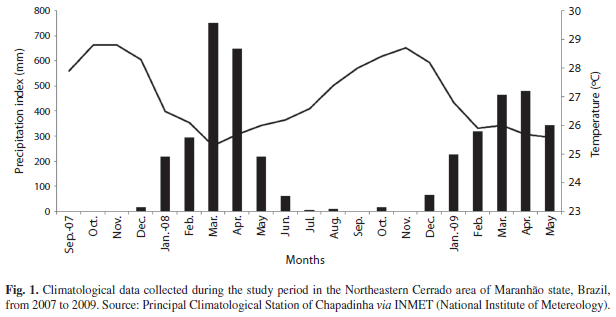
<body><![CDATA[intermediate formation) and &#8220;cerrad&otilde;es&#8221; (a forest formation)     (Silva <span style="font-style: italic;">et al. </span>2008).</span></font><br      style="font-family: verdana;">     <font size="2"></font><br style="font-family: verdana;">     <font size="2"><span style="font-family: verdana;">In the region the     climate is hot     and semihumid with an annual average temperature ranging from     28&deg;C-30&deg;C (<a href="/img/revistas/rbt/v60n2/a10i1.jpg">Fig. 1</a>).     There is a precipitation regime of 1 600-2     000mm/year. The region undergoes a dry season, from July to December,     ]]></body>
<body><![CDATA[and a wet season, from January to June, according to Instituto     Brasileiro de Geografia e Estat&iacute;stica (IBGE 1984). </span></font><br      style="font-family: verdana;">     <font size="2"></font><br style="font-family: verdana;">     <font size="2"><span style="font-family: verdana;">The bee captures     were carried out     monthly from September 2007 to May 2009, between 07:00 and 17:00hr, by     means of odoriferous baits. The scent lures used to attract males were     eucalyptol (1.8-cineole) (Biodin&acirc;mica &reg;), eugenol (clove oil)     (Biodin&acirc;mica&reg;) and vanillin (4-hydroxy-3-methoxybenzaldehyde)     ]]></body>
<body><![CDATA[(Reagen&reg;). These above-mentioned aromatic compounds have     effectively been used in field bioassays as attractant for most male     euglossine bees (Reb&ecirc;lo 2001). Eucalyptol and eugenol were used     without any dilution and vanillin was dissolved in distilled water     before use. Cotton balls were dampened with the respective scent each     hour and hanged on tree branches 1.5m above soil level. The baits were     set 8m from one another, according to Reb&ecirc;lo &amp;     Gar&oacute;falo (1991).</span></font><br style="font-family: verdana;">     <font size="2"></font><br style="font-family: verdana;">     <font size="2"><span style="font-family: verdana;">The specimens were     ]]></body>
<body><![CDATA[captured with     entomological nets, killed with ethyl acetate vapor in killing jars and     then placed in labeled plastic bags. In the laboratory, males were     pinned and identified to species. All the captured specimens are     deposited in the insect collection of the Universidade Federal do     Maranh&atilde;o, S&atilde;o Luis, Maranh&atilde;o, Brazil. The     Mann-Whitney test was used for statistical analysis using GraphPad (San     Diego, CA) Prism Software.</span></font><br      style="font-family: verdana;">     <font size="2"></font><br style="font-family: verdana;">     ]]></body>
<body><![CDATA[<font style="font-weight: bold;" size="3"><span      style="font-family: verdana;">Results</span></font><br      style="font-family: verdana;">     <font size="2"></font><br style="font-family: verdana;">     <font size="2"><span style="font-family: verdana;">Over this 21-month     follow-up study,     a total of 158 individuals and 14 species distributed in the four     genera of euglossine bees were recorded. <span      style="font-style: italic;">Eulaema</span> Lepeletier was     represented by 80 individuals and three species,<span     ]]></body>
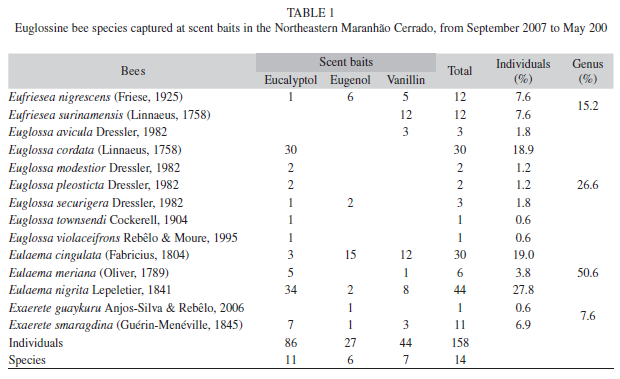
<body><![CDATA[ style="font-style: italic;"> Euglossa</span> Latreille (42     individuals; seven species), <span style="font-style: italic;">Eufriesea</span>     Cockerell (24 individuals; two     species) and <span style="font-style: italic;">Exaerete</span>     Hoffmannsegg (12 individuals; two species) (<a      href="/img/revistas/rbt/v60n2/a10t1.gif">Table     1</a>). The most frequent species at baits were <span      style="font-style: italic;">Eulaema nigrita</span>     (Lepeletier, 1841), accounting for 27.8% of the total sampled     individuals, followed by <span style="font-style: italic;">Eulaema     ]]></body>
<body><![CDATA[cingulata</span> (Fabricius, 1804) (19%) and     <span style="font-style: italic;">Euglossa cordata</span> (Linnaeus,     1758) (18.3%). </span></font><br style="font-family: verdana;">     <font size="2"></font><br style="font-family: verdana;">     <font size="2"><span style="font-family: verdana;">The most attractive     scent bait was     eucalyptol (11 species; 86 individuals), followed by vanillin (seven     species; 44 individuals) and eugenol (six species; 27 individuals). <span      style="font-style: italic;">E.     nigrita</span> was the most frequent species collected at     ]]></body>
<body><![CDATA[eucalyptol-scented     baits, followed by<span style="font-style: italic;"> E. cordata</span>     (39.5% and 34.8%, respectively). Vanillin     was more visited by <span style="font-style: italic;">E. cingulata</span>     and <span style="font-style: italic;">E. surinamensis</span>     (Linnaeus, 1758),     both accounting for 27.2% of the collected individuals at that scent.     Eugenol was represented mainly by <span style="font-style: italic;">E.     cingulata</span> (55.5%).</span></font><br style="font-family: verdana;">     <font size="2"></font><br style="font-family: verdana;">     ]]></body>
<body><![CDATA[<font size="2"><span style="font-family: verdana;">The genus Eulaema     was the most     representative group of euglossine bees in relation to the total number     of the sampled individuals, accounting for 50.6% of bees followed by     <span style="font-style: italic;">Euglossa</span> (26.6%), <span      style="font-style: italic;">Eufriesea</span> (15.2%) and <span      style="font-style: italic;">Exaerete</span> (7.6%) (<a      href="/img/revistas/rbt/v60n2/a10t1.gif">Table 1</a>).</span></font><br      style="font-family: verdana;">     <font size="2"></font><br style="font-family: verdana;">     ]]></body>
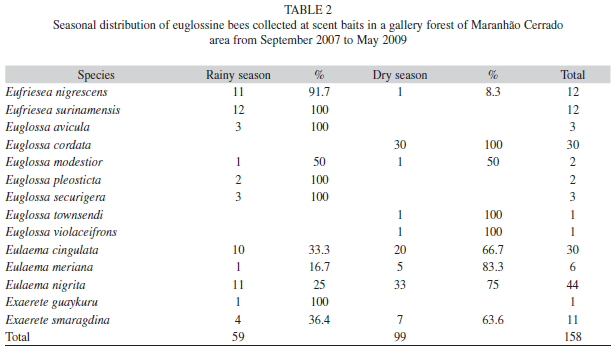
<body><![CDATA[<font size="2"><span style="font-family: verdana;">The euglossine bees     were sampled     mainly in the dry season, where 62.5% of the individuals were captured     in that period (<a href="/img/revistas/rbt/v60n2/a10t2.gif">Table 2</a>).     However, these results are not statistically     significant (p&lt;0.05). <span style="font-style: italic;">E. cordata</span>     occurred exclusively in the dry     period and the <span style="font-style: italic;">Eulaema</span>     species were mostly found in the dry season. <span      style="font-style: italic;">E.     ]]></body>
<body><![CDATA[cordata</span> and the two more frequent <span      style="font-style: italic;">Eulaema</span> species <span      style="font-style: italic;">E. nigrita</span> and <span      style="font-style: italic;">E.     cingulata </span>accounted for 83.8% of the sampled bees, being     responsible     for the seasonality configuration observed herein. <span      style="font-style: italic;">Eufriesea</span> species     appeared at the baits only in the wet season, with one individual of <span      style="font-style: italic;">E.     ]]></body>
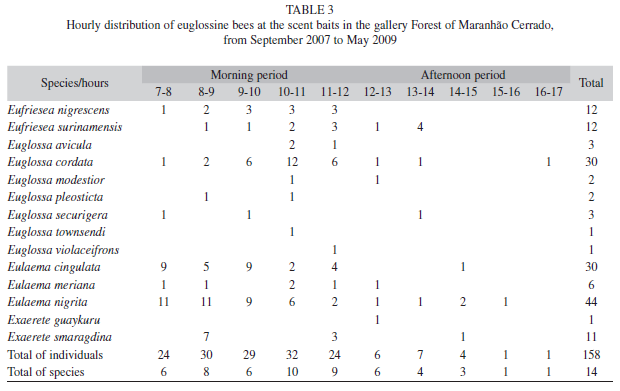
<body><![CDATA[nigrescens</span> (Friese, 1925) sampled in the dry period.</span></font><br      style="font-family: verdana;">     <font size="2"></font><br style="font-family: verdana;">     <font size="2"><span style="font-family: verdana;">The hourly frequency     of bees at     scent baits showed a clear preference for the morning period, where     87.9% visited the baits from 7:00 to 12:00hr (<a      href="/img/revistas/rbt/v60n2/a10t3.gif">Table 3</a>). The statistical     analysis showed significant difference (p&lt;0.05) between the morning     and afternoon samples, regarding the number of individuals and species.     ]]></body>
<body><![CDATA[<span style="font-style: italic;">Euglossa</span> cordata males were     present during all morning period while <span      style="font-style: italic;">E.     nigrita</span> and <span style="font-style: italic;">E. cingulata</span>     appeared more frequently at the baits early in     the morning. The males of both <span style="font-style: italic;">Eufriesea</span>     species visited the baits all     morning and reaching two more hour intervals at the beginning of the     afternoon period, particularly in the rainy days.</span></font><br      style="font-family: verdana;">     ]]></body>
<body><![CDATA[<font size="2"></font><br style="font-family: verdana;">     <font style="font-weight: bold;" size="3"><span      style="font-family: verdana;">Discussion</span></font><br      style="font-family: verdana;">     <font size="2"></font><br style="font-family: verdana;">     <font size="2"><span style="font-family: verdana;">The three most     frequent species     surveyed in the Itamacaoca Reserve Gallery Forest are commonly found in     open and dry Neotropical areas. <span style="font-style: italic;">E.     nigrita</span> is generally found in     ]]></body>
<body><![CDATA[several brazilian ecosystems, from Amazonian areas (Silva &amp;     Reb&ecirc;lo 1999) to Southern Brazil (Sofia <span      style="font-style: italic;">et al.</span> 2004) and it is one     of the fewer euglossine species found in the caatinga, a semi-arid     brazilian ecosystem characterized by scrub vegetation and presenting a     low and highly seasonal rainfall (Lopes <span      style="font-style: italic;">et al.</span> 2007). The orchid bee <span      style="font-style: italic;">E.     cordata</span> is well represented in open, disturbed and dry areas     (Silva     ]]></body>
<body><![CDATA[&amp; Reb&ecirc;lo 2002), and also was recorded in the caatinga     ecosystem, as well as <span style="font-style: italic;">E. securigera</span>     (Dressler, 1982) (Lopes et al.     2007). <span style="font-style: italic;">Eulaema cingulata,</span>     like <span style="font-style: italic;">Eulaema nigrita</span> and <span      style="font-style: italic;">Euglossa cordata</span>,     are a species commonly found in forested areas (Silva &amp;     Reb&ecirc;lo 1999, Nem&eacute;sio &amp; Silveira 2007) and in the     Brazilian Cerrado (Silva &amp; Reb&ecirc;lo 1999, Reb&ecirc;lo &amp;     Cabral 1997, Mendes <span style="font-style: italic;">et al.</span>     ]]></body>
<body><![CDATA[2008, Carvalho <span style="font-style: italic;">et al.</span> 2006).</span></font><br      style="font-family: verdana;">     <font size="2"></font><br style="font-family: verdana;">     <font size="2"><span style="font-family: verdana;"><span      style="font-style: italic;">Euglossa avicula</span> (Dressler, 1982)     has been found in Amazonian forested areas (Oliveira &amp; Campos 1995,     Silva &amp; Reb&ecirc;lo 1999). In the Cerrado landscape it was     recorded from a riparian forest in Northeastern Maranh&atilde;o by     Carvalho <span style="font-style: italic;">et al.</span> (2006). <span      style="font-style: italic;">Euglossa pleosticta</span> (Dressler, 198)     ]]></body>
<body><![CDATA[is also     well known in Northern forest environments (Silva &amp; Reb&ecirc;lo     1999, Silva &amp; Reb&ecirc;lo 2002) and in the Atlantic forest of     Brazil (South of Bahia, Esp&iacute;rito Santo, Rio de Janeiro,     Northeast of S&atilde;o Paulo) (Reb&ecirc;lo 2001). It is also found in     the Cerrado zone of Minas Gerais state, Southeastern Brazil (Alvarenga     <span style="font-style: italic;">et al.</span> 2007). <span      style="font-style: italic;">Euglossa modestior</span> (Dressler, 1982)     is found in Amazonian     basin and has already been described from the Cerrado zones of     ]]></body>
<body><![CDATA[Maranh&atilde;o state (Reb&ecirc;lo &amp; Cabral 1997). <span      style="font-style: italic;">Euglossa     violaceifrons</span> (Reb&ecirc;lo &amp; Moure, 1995) was recorded from     Brazilian forests of South Maranh&atilde;o (Silva &amp; Reb&ecirc;lo     1999) and Northeast of S&atilde;o Paulo state, Southeastern Brazil     (Reb&ecirc;lo &amp; Moure 1996). <span style="font-style: italic;">Eufriesea     nigrescens</span> has been recorded     from the Amazonian basin and Paraguay as well as the open areas of     Maranh&atilde;o state (Reb&ecirc;lo 2001, Silva <span      style="font-style: italic;">et al.</span> 2009). <span     ]]></body>
<body><![CDATA[ style="font-style: italic;">Eulaema     meriana</span> (Olivier, 1789) was collected for the first time in the     Cerrado     landscape. It is a typical species found in forested areas (Silva &amp;     Reb&ecirc;lo 1999, Oliveira &amp; Campos 1995) avoiding urban     environments (Parra-H &amp; Nates-Parra 2007).</span></font><br      style="font-family: verdana;">     <font size="2"></font><br style="font-family: verdana;">     <font size="2"><span style="font-family: verdana;">In this context, the     occurrence of     ]]></body>
<body><![CDATA[<span style="font-style: italic;">Exaerete guaykuru</span> (Anjos-Silva     &amp; Reb&ecirc;lo, 2006) in the Gallery     Forest of Northeastern Cerrado represents the second record for the     Neotropical region, since this species was recently described from a     Gallery Forest environment of Mato Grosso state, Brazil (Anjos-Silva     &amp; Reb&ecirc;lo 2006). However, it is extremely important to protect     those kinds of habitats because so many species of animals are     profoundly responsive to environmental disturbances and use the Gallery     Forest zones as refuge sites inside the degradation context of the     Cerrado vegetation (Moura &amp; Schlindwein 2009).</span></font><br     ]]></body>
<body><![CDATA[ style="font-family: verdana;">     <font size="2"></font><br style="font-family: verdana;">     <font size="2"><span style="font-family: verdana;"><span      style="font-style: italic;">Eulaema</span> species were the     predominant visitors to the odoriferous baits, different from the     results obtained by other researches in the Neotropical region using a     similar methodology, showing that <span style="font-style: italic;">Euglossa</span>     is the most expressive group     at the scent baits, in both individuals and species (Janzen <span      style="font-style: italic;">et al.</span>     ]]></body>
<body><![CDATA[1982, Ackerman 1983, Oliveira &amp; Campos 1995, Neves &amp; Viana     1997, Reb&ecirc;lo &amp; Gar&oacute;falo 1997, Silva &amp; Reb&ecirc;lo     1999, Silva &amp; Reb&ecirc;lo 2002, Carvalho <span      style="font-style: italic;">et al.</span> 2006). The two     <span style="font-style: italic;">Eulaema</span> species more sampled     in the gallery forest, <span style="font-style: italic;">E. nigrita </span>and     <span style="font-style: italic;">E.     cingulata</span>, accounted together for 46.8% of the total number of     individuals. These species have a large geographic distribution and one     of them, <span style="font-style: italic;">E. nigrita</span>, is     ]]></body>
<body><![CDATA[frequently associated with open and dry areas     (Reb&ecirc;lo &amp; Gar&oacute;falo 1991, Silva &amp; Reb&ecirc;lo     2002).</span></font><br style="font-family: verdana;">     <font size="2"></font><br style="font-family: verdana;">     <font size="2"><span style="font-family: verdana;"><span      style="font-style: italic;">Eulaema</span> male activities are favored     by satisfactory climate conditions and thus visit </span></font><font      size="2"><span style="font-family: verdana;">the scent baits early in     the     morning as already observed by Silva &amp; Reb&ecirc;lo (1999).     ]]></body>
<body><![CDATA[<span style="font-style: italic;">Euglossa</span> species arrive late     at the scent baits and the hot and dry     climate conditions appear to be the main limiting factors. <span      style="font-style: italic;">Eulaema</span>     species are large, black and have densely pubescent thoraces and     <span style="font-style: italic;">Euglossa</span> species are smaller,     lack external pubescence and are brightly     colored, metallic blue or green (Reb&ecirc;lo 2001). The morphological     aspects and the pubescence have an effect on the flight activity of     <span style="font-style: italic;">Eulaema</span> species (Casey <span     ]]></body>
<body><![CDATA[ style="font-style: italic;">et al.</span> 1985) where the thoracic     temperature can     be maintained high at low temperature conditions favoring them to visit     the baits early.</span></font><br style="font-family: verdana;">     <font size="2"></font><br style="font-family: verdana;">     <font size="2"><span style="font-family: verdana;">The most frequent     species captured     in the gallery forest of Maranh&atilde;o Cerrado depicted an unfamiliar     seasonality curve that is divergent from the most researches undertaken     in the Neotropics in which a high number of species and individuals     ]]></body>
<body><![CDATA[have been found in the rainy season (Silva &amp; Reb&ecirc;lo 1999,     2002). The species <span style="font-style: italic;">E. cordata, E.     cingulata</span> and E. nigrita were     responsible for that unusual pattern of seasonal distribution. But, in     view of the statistical analysis, there is no significant difference     between the two seasons. Silva <span style="font-style: italic;">et al.</span>     (2009) observed that <span style="font-style: italic;">E. cingulata</span>     and <span style="font-style: italic;">E. cordata</span> were most     frequently found in the dry period in the     eastern Maranh&atilde;o &#8220;restinga&#8221;. The same pattern was observed by     ]]></body>
<body><![CDATA[Silva &amp; Reb&ecirc;lo (1999) in Amazonian Forest areas, Aguiar &amp;     Gaglianone (2008), in remnants of lowland forest in the Rio de Janeiro     State, and by Farias <span style="font-style: italic;">et al.</span>     (2008) in forest fragments of Paraiba     State. Neves &amp; Viana (1999) observed that most sampled euglossine     males in riparian forest in areas of Bahia semi-arid region occurred     after the rainy season and the increased flower production together     with a moderate temperature and humidity favored that seasonal     distribution pattern. In that research, 50% of the captured individuals     were <span style="font-style: italic;">E. cordata</span> (Neves &amp;     ]]></body>
<body><![CDATA[Viana 1999).</span></font><br style="font-family: verdana;">     <font size="2"></font><br style="font-family: verdana;">     <font size="2"><span style="font-family: verdana;">Euglossine bees are     usually found     at baits in the morning period (Braga 1976, Neves &amp; Viana 1999,     Bezerra &amp; Martins 2001, Silva &amp; Reb&ecirc;lo 2002), where the     weather conditions are favorable to bee activities. In the studied     area, the weather conditions were represented chiefly by increasing     temperature and decreasing humidity along the day, forcing bees to     occur mostly in the morning period (from seven am to noon), where     ]]></body>
<body><![CDATA[relative humidity was higher and temperature and light intensity were     moderate. The wind speed at the collecting site was mostly low or not     detectable, mainly in the afternoon periods (data not shown),     influencing strongly on the scent dispersal and the frequency of bees     at the scent baits. It was not feasible to measure the real impact of     weather changes on the bee activity during the day, which should become     a potential target for further researches in the Cerrado area. In     general, bees visit flowers mostly at the morning period due to the </span></font><font      size="2"><span style="font-family: verdana;">good climate conditions     and floral     ]]></body>
<body><![CDATA[resources availability (Melo <span style="font-style: italic;">et al.</span>     2009, Oliveira <span style="font-style: italic;">et al.</span> 2011)     and     this may explain the male euglossine bee activity at the baits.</span></font><br      style="font-family: verdana;">     <font size="2"></font><br style="font-family: verdana;">     <font size="2"><span style="font-family: verdana;">In conclusion, the     euglossine bee     fauna found in the Northeastern Maranh&atilde;o Cerrado is represented     chiefly by species of large geographic distribution. Some forest bee     ]]></body>
<body><![CDATA[species in a less extent maybe require particular environmental     conditions found in the Gallery Forest ecosystem. The most frequent     bees were sampled at the baits after the rainy season, in a different     way of the most researches carried out in the Neotropical areas. The     bee frequency at the scent baits was most pronounced in the morning     period, possibly controlled by the peculiar climate variables found in     the Cerrado areas.</span></font><br style="font-family: verdana;">     <font size="2"></font><br style="font-family: verdana;">     <font style="font-weight: bold;" size="3"><span      style="font-family: verdana;">Acknowledgments</span></font><br     ]]></body>
<body><![CDATA[ style="font-family: verdana;">     <font size="2"></font><br style="font-family: verdana;">     <font size="2"><span style="font-family: verdana;">I would like to     acknowledge     Jos&eacute; Manuel Mac&aacute;rio Reb&ecirc;lo by helpful support in     the species identification.</span></font><br      style="font-family: verdana;">     <font size="2"></font><br style="font-family: verdana;">     <font style="font-weight: bold;" size="2"><span      style="font-family: verdana;"></span></font>     ]]></body>
<body><![CDATA[<hr style="width: 100%; height: 2px;"><font style="font-weight: bold;"      size="3"><span style="font-family: verdana;">References</span></font><br      style="font-family: verdana;">     <font size="2"></font><br style="font-family: verdana;">     <font size="2"><span style="font-family: verdana;">Ackerman, J.D. 1983.     Diversity and     seasonality of male euglossine bees (Hymenoptera, Apidae) in Central     <!-- ref -->Panam&aacute;. Ecology 64: 274-283.    &nbsp;&nbsp;&nbsp;&nbsp;&nbsp;&nbsp;&nbsp;&nbsp;[&#160;<a href="javascript:void(0);" onclick="javascript: window.open('/scielo.php?script=sci_nlinks&ref=1490860&pid=S0034-7744201200020001000001&lng=','','width=640,height=500,resizable=yes,scrollbars=1,menubar=yes,');">Links</a>&#160;]<!-- end-ref --><!-- ref --></span></font><br  style="font-family: verdana;"> <font size="2"></font><br style="font-family: verdana;"> <font size="2"><span style="font-family: verdana;">Aguiar, W.M. &amp; M.C Gaglianone. 2008. Comunidade de abelhas Euglossina (Hymenoptera: Apidae) em remanescentes de mata estacional semidec&iacute;dua sobre tabuleiro no estado do Rio de Janeiro. Neotrop. Entomol. 37: 118-125.    &nbsp;&nbsp;&nbsp;&nbsp;&nbsp;&nbsp;&nbsp;&nbsp;[&#160;<a href="javascript:void(0);" onclick="javascript: window.open('/scielo.php?script=sci_nlinks&ref=1490861&pid=S0034-7744201200020001000002&lng=','','width=640,height=500,resizable=yes,scrollbars=1,menubar=yes,');">Links</a>&#160;]<!-- end-ref --><!-- ref --></span></font><br  style="font-family: verdana;"> <font size="2"></font><br style="font-family: verdana;"> <font size="2"><span style="font-family: verdana;">Alvarenga, P.E.F., R.F. Freitas &amp; S.C. Augusto. 2007. Diversidade de Euglossini Hymenoptera: Apidae) em &aacute;reas de Cerrado do tri&acirc;ngulo mineiro, MG. J. Biosci. 23: 30-37.    &nbsp;&nbsp;&nbsp;&nbsp;&nbsp;&nbsp;&nbsp;&nbsp;[&#160;<a href="javascript:void(0);" onclick="javascript: window.open('/scielo.php?script=sci_nlinks&ref=1490862&pid=S0034-7744201200020001000003&lng=','','width=640,height=500,resizable=yes,scrollbars=1,menubar=yes,');">Links</a>&#160;]<!-- end-ref --><!-- ref --></span></font><br style="font-family: verdana;"> <font size="2"></font><br style="font-family: verdana;"> <font size="2"><span style="font-family: verdana;">Anjos-Silva, E.J. 2007. Occurrence of <span style="font-style: italic;">Eulaema (Apeulaema) pseudocingulata</span> Oliveira (Hymenoptera: Apidae: Euglossini) in the Platina Basin, Mato Grosso State, Brazil. Neotrop. Entomol. 36: 484-486.    &nbsp;&nbsp;&nbsp;&nbsp;&nbsp;&nbsp;&nbsp;&nbsp;[&#160;<a href="javascript:void(0);" onclick="javascript: window.open('/scielo.php?script=sci_nlinks&ref=1490863&pid=S0034-7744201200020001000004&lng=','','width=640,height=500,resizable=yes,scrollbars=1,menubar=yes,');">Links</a>&#160;]<!-- end-ref --><!-- ref --></span></font><br style="font-family: verdana;"> <font size="2"></font><br style="font-family: verdana;"> <font size="2"><span style="font-family: verdana;">Anjos-Silva, E.J. 2010. <span style="font-style: italic;">Eufriesea pulchra</span> Smith (Hymenoptera: Apidae: Euglossini): extended geographic distribution and filling gaps in Mato Grosso State, Brazil. Neotrop. Entomol. 39: 133-136.    &nbsp;&nbsp;&nbsp;&nbsp;&nbsp;&nbsp;&nbsp;&nbsp;[&#160;<a href="javascript:void(0);" onclick="javascript: window.open('/scielo.php?script=sci_nlinks&ref=1490864&pid=S0034-7744201200020001000005&lng=','','width=640,height=500,resizable=yes,scrollbars=1,menubar=yes,');">Links</a>&#160;]<!-- end-ref --><!-- ref --></span></font><br style="font-family: verdana;"> <font size="2"></font><br style="font-family: verdana;"> <font size="2"><span style="font-family: verdana;">Anjos-Silva, E.J. &amp; J.M.M. Reb&ecirc;lo. 2006. A new species of <span style="font-style: italic;">Exaerete</span> Hoffmannsegg (Hymenoptera: Apidae: Euglossini) from Brazil. Zootaxa 1105: 27-35.    &nbsp;&nbsp;&nbsp;&nbsp;&nbsp;&nbsp;&nbsp;&nbsp;[&#160;<a href="javascript:void(0);" onclick="javascript: window.open('/scielo.php?script=sci_nlinks&ref=1490865&pid=S0034-7744201200020001000006&lng=','','width=640,height=500,resizable=yes,scrollbars=1,menubar=yes,');">Links</a>&#160;]<!-- end-ref --><!-- ref --></span></font><br  style="font-family: verdana;"> <font size="2"></font><br style="font-family: verdana;"> <font size="2"><span style="font-family: verdana;">Anjos-Silva, E.J., E. Camillo &amp; C.A. Gar&oacute;falo. 2006. Occurrence of <span  style="font-style: italic;">Aglae caerulea</span> Lepeletier &amp; Serville (Hymenoptera: Apidae: Euglossini) in the Parque Nacional da Chapada dos Guimar&atilde;es, Mato Grosso State, Brazil. Neotrop. Entomol. 34: 868-870.    &nbsp;&nbsp;&nbsp;&nbsp;&nbsp;&nbsp;&nbsp;&nbsp;[&#160;<a href="javascript:void(0);" onclick="javascript: window.open('/scielo.php?script=sci_nlinks&ref=1490866&pid=S0034-7744201200020001000007&lng=','','width=640,height=500,resizable=yes,scrollbars=1,menubar=yes,');">Links</a>&#160;]<!-- end-ref --><!-- ref --></span></font><br style="font-family: verdana;"> <font size="2"></font><br style="font-family: verdana;"> <font size="2"><span style="font-family: verdana;">Bezerra, C.P. &amp; C.F. Martins. 2001. Diversidade de Euglossinae (Hymenoptera, Apidae) em dois fragmentos de Mata Atl&acirc;ntica localizados na regi&atilde;o urbana de Jo&atilde;o</span></font><br style="font-family: verdana;"> <font size="2"><span style="font-family: verdana;">Pessoa, Para&iacute;ba, Brasil. Rev. Bras. Zool. 18: 823-825.    &nbsp;&nbsp;&nbsp;&nbsp;&nbsp;&nbsp;&nbsp;&nbsp;[&#160;<a href="javascript:void(0);" onclick="javascript: window.open('/scielo.php?script=sci_nlinks&ref=1490867&pid=S0034-7744201200020001000008&lng=','','width=640,height=500,resizable=yes,scrollbars=1,menubar=yes,');">Links</a>&#160;]<!-- end-ref --><!-- ref --> </span></font><br  style="font-family: verdana;"> <font size="2"></font><br style="font-family: verdana;"> <font size="2"><span style="font-family: verdana;">Braga, P.I.S. 1976. Atra&ccedil;&atilde;o de abelhas polinizadoras de Orchidaceae com aux&iacute;lio de iscas-odores na campina, campinarana e floresta tropical &uacute;mida da regi&atilde;o de Manaus. Cienc. Cult. 28: 767-773.    &nbsp;&nbsp;&nbsp;&nbsp;&nbsp;&nbsp;&nbsp;&nbsp;[&#160;<a href="javascript:void(0);" onclick="javascript: window.open('/scielo.php?script=sci_nlinks&ref=1490868&pid=S0034-7744201200020001000009&lng=','','width=640,height=500,resizable=yes,scrollbars=1,menubar=yes,');">Links</a>&#160;]<!-- end-ref --><!-- ref --></span></font><br style="font-family: verdana;"> <font size="2"></font><br style="font-family: verdana;"> <font size="2"><span style="font-family: verdana;">Brosi, B.J. 2009. The effects of forest fragmentation on euglossine bee communities (Hymenoptera: Apidae: Euglossini). Biol. Conserv. 142: 414-423.    &nbsp;&nbsp;&nbsp;&nbsp;&nbsp;&nbsp;&nbsp;&nbsp;[&#160;<a href="javascript:void(0);" onclick="javascript: window.open('/scielo.php?script=sci_nlinks&ref=1490869&pid=S0034-7744201200020001000010&lng=','','width=640,height=500,resizable=yes,scrollbars=1,menubar=yes,');">Links</a>&#160;]<!-- end-ref --><!-- ref --></span></font><br  style="font-family: verdana;"> <font size="2"></font><br style="font-family: verdana;"> <font size="2"><span style="font-family: verdana;">Brosi, B.J., G.C. Daily, T.M. Shih, F. Oviedo &amp; G. Dur&aacute;n. 2008. The effects of forest fragmentation on bee communities in tropical countryside. J. Appl. Ecol. 45: 773-783.    &nbsp;&nbsp;&nbsp;&nbsp;&nbsp;&nbsp;&nbsp;&nbsp;[&#160;<a href="javascript:void(0);" onclick="javascript: window.open('/scielo.php?script=sci_nlinks&ref=1490870&pid=S0034-7744201200020001000011&lng=','','width=640,height=500,resizable=yes,scrollbars=1,menubar=yes,');">Links</a>&#160;]<!-- end-ref --><!-- ref --></span></font><br style="font-family: verdana;"> <font size="2"></font><br style="font-family: verdana;"> <font size="2"><span style="font-family: verdana;">Cameron, S.A. 2004. Phylogeny and biology of Neotropical orchid bees (Euglossini). Ann. Rev. Entomol. 49: 377-404.    &nbsp;&nbsp;&nbsp;&nbsp;&nbsp;&nbsp;&nbsp;&nbsp;[&#160;<a href="javascript:void(0);" onclick="javascript: window.open('/scielo.php?script=sci_nlinks&ref=1490871&pid=S0034-7744201200020001000012&lng=','','width=640,height=500,resizable=yes,scrollbars=1,menubar=yes,');">Links</a>&#160;]<!-- end-ref --><!-- ref --></span></font><br style="font-family: verdana;"> <font size="2"></font><br style="font-family: verdana;"> <font size="2"><span style="font-family: verdana;">Cane, J.H. 2001. Habitat fragmentation and native bees: a premature verdict? Ecol. Soc 5: 3. (available on line: <a href="http://www.consecol.org/vol5/iss1/art3/">http://www.consecol.org/vol5/iss1/art3/</a>).    &nbsp;&nbsp;&nbsp;&nbsp;&nbsp;&nbsp;&nbsp;&nbsp;[&#160;<a href="javascript:void(0);" onclick="javascript: window.open('/scielo.php?script=sci_nlinks&ref=1490872&pid=S0034-7744201200020001000013&lng=','','width=640,height=500,resizable=yes,scrollbars=1,menubar=yes,');">Links</a>&#160;]<!-- end-ref --><!-- ref --></span></font><br  style="font-family: verdana;"> <font size="2"></font><br style="font-family: verdana;"> <font size="2"><span style="font-family: verdana;">Carvalho, C.C., M.M.C. Rego &amp; F.N. Mendes. 2006. Din&acirc;mica de popula&ccedil;&atilde;o de Euglossina (Hymenoptera, Apidae) em mata ciliar, Urbano Santos, Maranh&atilde;o, Brasil. Iheringia 96: 249-256.    &nbsp;&nbsp;&nbsp;&nbsp;&nbsp;&nbsp;&nbsp;&nbsp;[&#160;<a href="javascript:void(0);" onclick="javascript: window.open('/scielo.php?script=sci_nlinks&ref=1490873&pid=S0034-7744201200020001000014&lng=','','width=640,height=500,resizable=yes,scrollbars=1,menubar=yes,');">Links</a>&#160;]<!-- end-ref --><!-- ref --></span></font><br  style="font-family: verdana;"> <font size="2"></font><br style="font-family: verdana;"> <font size="2"><span style="font-family: verdana;">Casey, T.M., M.L. May &amp; K.R. Morgan. 1985. Flight energetics of euglossine bees in relation to morphology and wing stroke frequency. J. Exp. Biol. 116: 271-289.    &nbsp;&nbsp;&nbsp;&nbsp;&nbsp;&nbsp;&nbsp;&nbsp;[&#160;<a href="javascript:void(0);" onclick="javascript: window.open('/scielo.php?script=sci_nlinks&ref=1490874&pid=S0034-7744201200020001000015&lng=','','width=640,height=500,resizable=yes,scrollbars=1,menubar=yes,');">Links</a>&#160;]<!-- end-ref --><!-- ref --></span></font><br  style="font-family: verdana;"> <font size="2"></font><br style="font-family: verdana;"> <font size="2"><span style="font-family: verdana;">Castro, A.A.J.F., F.R. Martins, J.Y. Tamashiro &amp; G.J. Shepherd. 1999. How rich is the flora of Brazilian cerrados? Ann. Missouri Bot. Gard. 86: 192-224.    &nbsp;&nbsp;&nbsp;&nbsp;&nbsp;&nbsp;&nbsp;&nbsp;[&#160;<a href="javascript:void(0);" onclick="javascript: window.open('/scielo.php?script=sci_nlinks&ref=1490875&pid=S0034-7744201200020001000016&lng=','','width=640,height=500,resizable=yes,scrollbars=1,menubar=yes,');">Links</a>&#160;]<!-- end-ref --><!-- ref --></span></font><br  style="font-family: verdana;"> <font size="2"></font><br style="font-family: verdana;"> <font size="2"><span style="font-family: verdana;">Dodson, C.H., R.L. Dressler, H.G. Hills, R.M. Adams &amp; N.H. Williams. 1969. Biologically active compounds in orchid fragrances. Science 164: 1243-1249.    &nbsp;&nbsp;&nbsp;&nbsp;&nbsp;&nbsp;&nbsp;&nbsp;[&#160;<a href="javascript:void(0);" onclick="javascript: window.open('/scielo.php?script=sci_nlinks&ref=1490876&pid=S0034-7744201200020001000017&lng=','','width=640,height=500,resizable=yes,scrollbars=1,menubar=yes,');">Links</a>&#160;]<!-- end-ref --><!-- ref --></span></font><br  style="font-family: verdana;"> <font size="2"></font><br style="font-family: verdana;"> <font size="2"><span style="font-family: verdana;">Dressler, R.L. 1982. Biology of orchid bees (Euglossini). Ann. Rev. Ecol. Syst. 13: 373-394.    &nbsp;&nbsp;&nbsp;&nbsp;&nbsp;&nbsp;&nbsp;&nbsp;[&#160;<a href="javascript:void(0);" onclick="javascript: window.open('/scielo.php?script=sci_nlinks&ref=1490877&pid=S0034-7744201200020001000018&lng=','','width=640,height=500,resizable=yes,scrollbars=1,menubar=yes,');">Links</a>&#160;]<!-- end-ref --><!-- ref --></span></font><br  style="font-family: verdana;"> <font size="2"></font><br style="font-family: verdana;"> <font size="2"><span style="font-family: verdana;">Eltz, T., A. Sager &amp; K. Lunau. 2005. Juggling with volatiles: exposure of perfumes by displaying male orchid bees. J. Comp. Physiol. 191: 575-581.    &nbsp;&nbsp;&nbsp;&nbsp;&nbsp;&nbsp;&nbsp;&nbsp;[&#160;<a href="javascript:void(0);" onclick="javascript: window.open('/scielo.php?script=sci_nlinks&ref=1490878&pid=S0034-7744201200020001000019&lng=','','width=640,height=500,resizable=yes,scrollbars=1,menubar=yes,');">Links</a>&#160;]<!-- end-ref --><!-- ref --></span></font><br  style="font-family: verdana;"> <font size="2"></font><br style="font-family: verdana;"> <font size="2"><span style="font-family: verdana;">Farias, R.C.A.P., M.C. Madeira-da-Silva, M.H. Pereira-Peixoto &amp; C.F. Martins. 2008. Composi&ccedil;&atilde;o e sazonalidade de esp&eacute;cies de Euglossina (Hymenoptera, Apidae) em mata e duna na &aacute;rea de prote&ccedil;&atilde;o ambiental da Barra do Rio Mamanguape, Rio Tinto, PB. Neotrop. Entomol. 37: 253-258.    &nbsp;&nbsp;&nbsp;&nbsp;&nbsp;&nbsp;&nbsp;&nbsp;[&#160;<a href="javascript:void(0);" onclick="javascript: window.open('/scielo.php?script=sci_nlinks&ref=1490879&pid=S0034-7744201200020001000020&lng=','','width=640,height=500,resizable=yes,scrollbars=1,menubar=yes,');">Links</a>&#160;]<!-- end-ref --><!-- ref --></span></font><br  style="font-family: verdana;"> <font size="2"></font><br style="font-family: verdana;"> <font size="2"><span style="font-family: verdana;">IBGE. Instituto Brasileiro de Geografia e Estat&iacute;stica. 1984. Atlas do Maranh&atilde;o. Edi&ccedil;&atilde;o em conv&ecirc;nio com o Governo do Estado do Maranh&atilde;o, Rio de Janeiro, Brasil.    &nbsp;&nbsp;&nbsp;&nbsp;&nbsp;&nbsp;&nbsp;&nbsp;[&#160;<a href="javascript:void(0);" onclick="javascript: window.open('/scielo.php?script=sci_nlinks&ref=1490880&pid=S0034-7744201200020001000021&lng=','','width=640,height=500,resizable=yes,scrollbars=1,menubar=yes,');">Links</a>&#160;]<!-- end-ref --><!-- ref --><br> <br style="font-family: verdana;"> </span></font><font size="2"><span style="font-family: verdana;">Janzen, D.H., P.G. Devries, M.L. Higgins &amp; L.S. Kimsey. 1982. Seasonal and site variation in Costa Rican Euglossine bees at chemical baits in lowland deciduous and evergreen forests. Ecology 63: 66-74.    &nbsp;&nbsp;&nbsp;&nbsp;&nbsp;&nbsp;&nbsp;&nbsp;[&#160;<a href="javascript:void(0);" onclick="javascript: window.open('/scielo.php?script=sci_nlinks&ref=1490881&pid=S0034-7744201200020001000022&lng=','','width=640,height=500,resizable=yes,scrollbars=1,menubar=yes,');">Links</a>&#160;]<!-- end-ref --><!-- ref --></span></font><br  style="font-family: verdana;"> <font size="2"></font><br style="font-family: verdana;"> <font size="2"><span style="font-family: verdana;">Klink, C.A. &amp; R.B. Machado. 2005. Conservation of the Brazilian Cerrado. Conserv. Biol. 19: 707-713.    &nbsp;&nbsp;&nbsp;&nbsp;&nbsp;&nbsp;&nbsp;&nbsp;[&#160;<a href="javascript:void(0);" onclick="javascript: window.open('/scielo.php?script=sci_nlinks&ref=1490882&pid=S0034-7744201200020001000023&lng=','','width=640,height=500,resizable=yes,scrollbars=1,menubar=yes,');">Links</a>&#160;]<!-- end-ref --><!-- ref --></span></font><br  style="font-family: verdana;"> <font size="2"></font><br style="font-family: verdana;"> <font size="2"><span style="font-family: verdana;">Lopes, A.V., I.C. Machado, A.V. Aguiar &amp; J.M.M. Reb&ecirc;lo. 2007. A scientific note on the occurrence of euglossini bees in the catinga, a Brazilian tropical dry forest. Apidologie 38: 472-473.    &nbsp;&nbsp;&nbsp;&nbsp;&nbsp;&nbsp;&nbsp;&nbsp;[&#160;<a href="javascript:void(0);" onclick="javascript: window.open('/scielo.php?script=sci_nlinks&ref=1490883&pid=S0034-7744201200020001000024&lng=','','width=640,height=500,resizable=yes,scrollbars=1,menubar=yes,');">Links</a>&#160;]<!-- end-ref --><!-- ref --></span></font><br  style="font-family: verdana;"> <font size="2"></font><br style="font-family: verdana;"> <font size="2"><span style="font-family: verdana;">Melo, P.N., M. Gimenes &amp; A.O. Neto. 2009. Daily activity patterns of visits by males of four species of <span style="font-style: italic;">Eulaema</span> (Apidae: Euglossina) to odor baits in a tropical forest fragment in Bahia, Brasil. Zoologia 26: 204-212.    &nbsp;&nbsp;&nbsp;&nbsp;&nbsp;&nbsp;&nbsp;&nbsp;[&#160;<a href="javascript:void(0);" onclick="javascript: window.open('/scielo.php?script=sci_nlinks&ref=1490884&pid=S0034-7744201200020001000025&lng=','','width=640,height=500,resizable=yes,scrollbars=1,menubar=yes,');">Links</a>&#160;]<!-- end-ref --><!-- ref --></span></font><br  style="font-family: verdana;"> <font size="2"></font><br style="font-family: verdana;"> <font size="2"><span style="font-family: verdana;">Mendes, F.N., M.M.C. R&ecirc;go &amp; C.C. Carvalho. 2008. Abelhas Euglossina (Hymenoptera, Apidae) coletadas em uma monocultura de eucalipto circundada por Cerrado em Urbano Santos, Maranh&atilde;o, Brasil. Iheringia 98: 285-290.    &nbsp;&nbsp;&nbsp;&nbsp;&nbsp;&nbsp;&nbsp;&nbsp;[&#160;<a href="javascript:void(0);" onclick="javascript: window.open('/scielo.php?script=sci_nlinks&ref=1490885&pid=S0034-7744201200020001000026&lng=','','width=640,height=500,resizable=yes,scrollbars=1,menubar=yes,');">Links</a>&#160;]<!-- end-ref --><!-- ref --></span></font><br  style="font-family: verdana;"> <font size="2"></font><br style="font-family: verdana;"> <font size="2"><span style="font-family: verdana;">Moura, D.C. &amp; C. Schlindwein. 2009. Mata ciliar do Rio S&atilde;o Francisco como biocorredor para Euglossini (Hymenoptera: Apidae) de florestas tropicais &uacute;midas. Neotrop. Entomol. 38: 281-284.    &nbsp;&nbsp;&nbsp;&nbsp;&nbsp;&nbsp;&nbsp;&nbsp;[&#160;<a href="javascript:void(0);" onclick="javascript: window.open('/scielo.php?script=sci_nlinks&ref=1490886&pid=S0034-7744201200020001000027&lng=','','width=640,height=500,resizable=yes,scrollbars=1,menubar=yes,');">Links</a>&#160;]<!-- end-ref --><!-- ref --></span></font><br  style="font-family: verdana;"> <font size="2"></font><br style="font-family: verdana;"> <font size="2"><span style="font-family: verdana;">Moure, J.S., G.A.R. Melo &amp; L.R.R. Faria Jr. 2007. Tribe Euglossini, p. 214-255. <span  style="font-style: italic;">In</span> J.S. Moure, D. Urban &amp; G.A.R. Melo (eds.). Catalogue of Bees (Hymenoptera, Apoidea) in the Neotropical Region. Sociedade Brasileira de Entomologia, Curitiba, Paran&aacute;, Brazil.    &nbsp;&nbsp;&nbsp;&nbsp;&nbsp;&nbsp;&nbsp;&nbsp;[&#160;<a href="javascript:void(0);" onclick="javascript: window.open('/scielo.php?script=sci_nlinks&ref=1490887&pid=S0034-7744201200020001000028&lng=','','width=640,height=500,resizable=yes,scrollbars=1,menubar=yes,');">Links</a>&#160;]<!-- end-ref --><!-- ref --></span></font><br  style="font-family: verdana;"> <font size="2"></font><br style="font-family: verdana;"> <font size="2"><span style="font-family: verdana;">Nem&eacute;sio, A. &amp; L.L.R. Faria. 2004. First assesment of the orchid-bee fauna (Hymenoptera: Apidae) at Parque Estadual do Rio Preto, a Cerrado area in southeastern Brazil. Lundiana 5: 113-117.    &nbsp;&nbsp;&nbsp;&nbsp;&nbsp;&nbsp;&nbsp;&nbsp;[&#160;<a href="javascript:void(0);" onclick="javascript: window.open('/scielo.php?script=sci_nlinks&ref=1490888&pid=S0034-7744201200020001000029&lng=','','width=640,height=500,resizable=yes,scrollbars=1,menubar=yes,');">Links</a>&#160;]<!-- end-ref --><!-- ref --></span></font><br  style="font-family: verdana;"> <font size="2"></font><br style="font-family: verdana;"> <font size="2"><span style="font-family: verdana;">Nem&eacute;sio, A. &amp; F.A. Silveira. 2007. Orchid bee fauna (Hymenoptera: Apidae: Euglossina) of Atlantic Forest fragments inside an urban area in southeastern Brazil. Neotrop. Entomol. 36: 186-191.    &nbsp;&nbsp;&nbsp;&nbsp;&nbsp;&nbsp;&nbsp;&nbsp;[&#160;<a href="javascript:void(0);" onclick="javascript: window.open('/scielo.php?script=sci_nlinks&ref=1490889&pid=S0034-7744201200020001000030&lng=','','width=640,height=500,resizable=yes,scrollbars=1,menubar=yes,');">Links</a>&#160;]<!-- end-ref --><!-- ref --></span></font><br  style="font-family: verdana;"> <font size="2"></font><br style="font-family: verdana;"> <font size="2"><span style="font-family: verdana;">Neves, E.L. &amp; B.F. Viana. 1997. Invent&aacute;rio da fauna de Euglossinae (Hymenoptera: Apidae) do baixo sul da Bahia, Brasil. Rev. Bras. Zool. 14: 831-837.    &nbsp;&nbsp;&nbsp;&nbsp;&nbsp;&nbsp;&nbsp;&nbsp;[&#160;<a href="javascript:void(0);" onclick="javascript: window.open('/scielo.php?script=sci_nlinks&ref=1490890&pid=S0034-7744201200020001000031&lng=','','width=640,height=500,resizable=yes,scrollbars=1,menubar=yes,');">Links</a>&#160;]<!-- end-ref --><!-- ref --></span></font><br  style="font-family: verdana;"> <font size="2"></font><br style="font-family: verdana;"> <font size="2"><span style="font-family: verdana;">Neves, E.L. &amp; B.F. Viana. 1999. Comunidade de machos de Euglossinae (Hymenoptera: Apidae) das matas ciliares da margem esquerda do M&eacute;dio Rio S&atilde;o Francisco, Bahia. An. Soc. Entomol. Bras. 28: 201-210.    &nbsp;&nbsp;&nbsp;&nbsp;&nbsp;&nbsp;&nbsp;&nbsp;[&#160;<a href="javascript:void(0);" onclick="javascript: window.open('/scielo.php?script=sci_nlinks&ref=1490891&pid=S0034-7744201200020001000032&lng=','','width=640,height=500,resizable=yes,scrollbars=1,menubar=yes,');">Links</a>&#160;]<!-- end-ref --><!-- ref --></span></font><br  style="font-family: verdana;"> <font size="2"></font><br style="font-family: verdana;"> <font size="2"><span style="font-family: verdana;">Oliveira, M.L. &amp; L.A.O. Campos. 1995. Abund&acirc;ncia, riqueza e diversidade de abelhas Euglossinae (Hymenoptera, Apidae) em florestas cont&iacute;nuas de terra firme na Amaz&ocirc;nia Central, Brasil. Rev. Bras. Zool. 12: 547-556.    &nbsp;&nbsp;&nbsp;&nbsp;&nbsp;&nbsp;&nbsp;&nbsp;[&#160;<a href="javascript:void(0);" onclick="javascript: window.open('/scielo.php?script=sci_nlinks&ref=1490892&pid=S0034-7744201200020001000033&lng=','','width=640,height=500,resizable=yes,scrollbars=1,menubar=yes,');">Links</a>&#160;]<!-- end-ref --><!-- ref --></span></font><br  style="font-family: verdana;"> <font size="2"></font><br style="font-family: verdana;"> <font size="2"><span style="font-family: verdana;">Oliveira, F.S., M.W.A. Mendon&ccedil;a, M.C.S. Vidigal, M.M.C. R&ecirc;go &amp; P.M.C. Albuquerque. 2011. Comunidade de abelhas (Hymenoptera, Apoidea) em ecossistema de dunas na praia de Panaquatira, S&atilde;o Jos&eacute; de Ribamar, Maranh&atilde;o, Brasil. Rev. Bras. Entomol. 54: 82-90.    &nbsp;&nbsp;&nbsp;&nbsp;&nbsp;&nbsp;&nbsp;&nbsp;[&#160;<a href="javascript:void(0);" onclick="javascript: window.open('/scielo.php?script=sci_nlinks&ref=1490893&pid=S0034-7744201200020001000034&lng=','','width=640,height=500,resizable=yes,scrollbars=1,menubar=yes,');">Links</a>&#160;]<!-- end-ref --><!-- ref --></span></font><br  style="font-family: verdana;"> <font size="2"></font><br style="font-family: verdana;"> <font size="2"><span style="font-family: verdana;">Parra-H, A. &amp; G. Nates-Parra. 2007. Variaci&oacute;n de la comunidad de abejas de las orqu&iacute;deas (Hymenoptera: Apidae) en tres ambientes perturbados del piedemonte llanero colombiano. Rev. Biol. Trop. 55: 931-941.    &nbsp;&nbsp;&nbsp;&nbsp;&nbsp;&nbsp;&nbsp;&nbsp;[&#160;<a href="javascript:void(0);" onclick="javascript: window.open('/scielo.php?script=sci_nlinks&ref=1490894&pid=S0034-7744201200020001000035&lng=','','width=640,height=500,resizable=yes,scrollbars=1,menubar=yes,');">Links</a>&#160;]<!-- end-ref --><!-- ref --></span></font><br  style="font-family: verdana;"> <font size="2"></font><br style="font-family: verdana;"> <font size="2"><span style="font-family: verdana;">Ratter, J.A., J.F. Ribeiro &amp; S. Bridgewater. 1997. The brazilian Cerrado vegetation and threats to its biodiversity. Ann. Bot. 80: 223-230.    &nbsp;&nbsp;&nbsp;&nbsp;&nbsp;&nbsp;&nbsp;&nbsp;[&#160;<a href="javascript:void(0);" onclick="javascript: window.open('/scielo.php?script=sci_nlinks&ref=1490895&pid=S0034-7744201200020001000036&lng=','','width=640,height=500,resizable=yes,scrollbars=1,menubar=yes,');">Links</a>&#160;]<!-- end-ref --><!-- ref --></span></font><br  style="font-family: verdana;"> <font size="2"></font><br style="font-family: verdana;"> <font size="2"><span style="font-family: verdana;">Reb&ecirc;lo, J.M.M. 2001. Hist&oacute;ria Natural das Eugloss&iacute;neas. As abelhas das orqu&iacute;deas. Lithograf, S&atilde;o Luis, Maranh&atilde;o, Brasil.    &nbsp;&nbsp;&nbsp;&nbsp;&nbsp;&nbsp;&nbsp;&nbsp;[&#160;<a href="javascript:void(0);" onclick="javascript: window.open('/scielo.php?script=sci_nlinks&ref=1490896&pid=S0034-7744201200020001000037&lng=','','width=640,height=500,resizable=yes,scrollbars=1,menubar=yes,');">Links</a>&#160;]<!-- end-ref --><!-- ref --></span></font><br  style="font-family: verdana;"> <font size="2"></font><br style="font-family: verdana;"> <font size="2"><span style="font-family: verdana;">Reb&ecirc;lo, J.M.M. &amp; A.J. Cabral. 1997. Abelhas Euglossinae de Barreirinhas, zona do litoral da baixada oriental maranhense. Acta Amazon. 27: 145-152.    &nbsp;&nbsp;&nbsp;&nbsp;&nbsp;&nbsp;&nbsp;&nbsp;[&#160;<a href="javascript:void(0);" onclick="javascript: window.open('/scielo.php?script=sci_nlinks&ref=1490897&pid=S0034-7744201200020001000038&lng=','','width=640,height=500,resizable=yes,scrollbars=1,menubar=yes,');">Links</a>&#160;]<!-- end-ref --><!-- ref --></span></font><br  style="font-family: verdana;"> <font size="2"></font><br style="font-family: verdana;"> <font size="2"><span style="font-family: verdana;">Reb&ecirc;lo, J.M.M &amp; A.A. Gar&oacute;falo. 1991. Diversidade e sazonalidade de machos de Euglossinae (Hymenoptera: Apidae) e prefer&ecirc;ncias por iscas-odores em um fragmento de florestas no sudeste do Brasil. Rev. Bras. Biol. 51: 787-799.    &nbsp;&nbsp;&nbsp;&nbsp;&nbsp;&nbsp;&nbsp;&nbsp;[&#160;<a href="javascript:void(0);" onclick="javascript: window.open('/scielo.php?script=sci_nlinks&ref=1490898&pid=S0034-7744201200020001000039&lng=','','width=640,height=500,resizable=yes,scrollbars=1,menubar=yes,');">Links</a>&#160;]<!-- end-ref --><!-- ref --></span></font><br style="font-family: verdana;"> <font size="2"></font><br style="font-family: verdana;"> <font size="2"><span style="font-family: verdana;">Reb&ecirc;lo, J.M.M. &amp; C.A. Gar&oacute;falo. 1997. Comunidades de machos de Euglossinae (Hymenoptera, Apidae) em matas semidec&iacute;duas do nordeste do estado de S&atilde;o Paulo. An. Soc. Entomol. Brasil. 26: 787-799.    &nbsp;&nbsp;&nbsp;&nbsp;&nbsp;&nbsp;&nbsp;&nbsp;[&#160;<a href="javascript:void(0);" onclick="javascript: window.open('/scielo.php?script=sci_nlinks&ref=1490899&pid=S0034-7744201200020001000040&lng=','','width=640,height=500,resizable=yes,scrollbars=1,menubar=yes,');">Links</a>&#160;]<!-- end-ref --><!-- ref --></span></font><br  style="font-family: verdana;"> <font size="2"></font><br style="font-family: verdana;"> <font size="2"><span style="font-family: verdana;">Reb&ecirc;lo, J.M.M. &amp; J.S. Moure. 1996. As esp&eacute;cies de Euglossa Latreille do Nordeste de S&atilde;o Paulo (Apidae, Euglossinae). Rev. Bras. Zool. 12: 445-466.    &nbsp;&nbsp;&nbsp;&nbsp;&nbsp;&nbsp;&nbsp;&nbsp;[&#160;<a href="javascript:void(0);" onclick="javascript: window.open('/scielo.php?script=sci_nlinks&ref=1490900&pid=S0034-7744201200020001000041&lng=','','width=640,height=500,resizable=yes,scrollbars=1,menubar=yes,');">Links</a>&#160;]<!-- end-ref --><!-- ref --></span></font><br  style="font-family: verdana;"> <font size="2"></font><br style="font-family: verdana;"> <font size="2"><span style="font-family: verdana;">Silva, F.S. &amp; J.M.M. Reb&ecirc;lo. 1999. Eugloss&iacute;ne bees (Hymenoptera, Apidae) of Buriticupu, amaz&ocirc;nia of Maranh&atilde;o, Brazil. Acta Amazon. 29: 472-786.    &nbsp;&nbsp;&nbsp;&nbsp;&nbsp;&nbsp;&nbsp;&nbsp;[&#160;<a href="javascript:void(0);" onclick="javascript: window.open('/scielo.php?script=sci_nlinks&ref=1490901&pid=S0034-7744201200020001000042&lng=','','width=640,height=500,resizable=yes,scrollbars=1,menubar=yes,');">Links</a>&#160;]<!-- end-ref --><!-- ref --></span></font><br style="font-family: verdana;"> <font size="2"></font><br style="font-family: verdana;"> <font size="2"><span style="font-family: verdana;">Silva, F.S. &amp; J.M.M. Reb&ecirc;lo. 2002. Population dynamics of Euglossinae bees (Hymenoptera, Apidae) in an early second-growth forest of Cajual island, in the state of Maranh&atilde;o, Brazil. Braz. J. Biol. 62: 15-23.    &nbsp;&nbsp;&nbsp;&nbsp;&nbsp;&nbsp;&nbsp;&nbsp;[&#160;<a href="javascript:void(0);" onclick="javascript: window.open('/scielo.php?script=sci_nlinks&ref=1490902&pid=S0034-7744201200020001000043&lng=','','width=640,height=500,resizable=yes,scrollbars=1,menubar=yes,');">Links</a>&#160;]<!-- end-ref --><!-- ref --></span></font><br style="font-family: verdana;"> <font size="2"></font><br style="font-family: verdana;"> <font size="2"><span style="font-family: verdana;">Silva, A.L.G., F. Martins, R. Santos &amp; J.L.S. Nunes. 2008. Conserva&ccedil;&atilde;o da Reserva da Itamacaoca de Chapadinha/ MA, pp. 97-104. <span  style="font-style: italic;">In</span>: J.F. Selbach &amp; J.R.S.A. Leite (eds.). Meio Ambiente no Baixo Parna&iacute;ba: olhos no mundo, p&eacute;s na regi&atilde;o. EDUFMA, S&atilde;o Lu&iacute;s, Brasil.    &nbsp;&nbsp;&nbsp;&nbsp;&nbsp;&nbsp;&nbsp;&nbsp;[&#160;<a href="javascript:void(0);" onclick="javascript: window.open('/scielo.php?script=sci_nlinks&ref=1490903&pid=S0034-7744201200020001000044&lng=','','width=640,height=500,resizable=yes,scrollbars=1,menubar=yes,');">Links</a>&#160;]<!-- end-ref --><!-- ref --></span></font><br style="font-family: verdana;"> <font size="2"></font><br style="font-family: verdana;"> <font size="2"><span style="font-family: verdana;">Silva, O, M.M. R&ecirc;go, P.M.C. Albuquerque &amp; M.C. Ramos. 2009. Abelhas euglossina (Hymenoptera: Apidae) em &aacute;rea de restinga do nordeste do Maranh&atilde;o. Neotrop.&nbsp; Entomol. 38: 186-196.    &nbsp;&nbsp;&nbsp;&nbsp;&nbsp;&nbsp;&nbsp;&nbsp;[&#160;<a href="javascript:void(0);" onclick="javascript: window.open('/scielo.php?script=sci_nlinks&ref=1490904&pid=S0034-7744201200020001000045&lng=','','width=640,height=500,resizable=yes,scrollbars=1,menubar=yes,');">Links</a>&#160;]<!-- end-ref --><!-- ref --></span></font><br  style="font-family: verdana;"> <font size="2"></font><br style="font-family: verdana;"> <font size="2"><span style="font-family: verdana;">Sofia, S.H., A.M. Santos &amp; C.R.M. Silva. 2004. Euglossine bees (Hymenoptera, Apidae) in a remnant of Atlantic Forest in Paran&aacute; State, Brazil. Iheringia 94: 217-222.    &nbsp;&nbsp;&nbsp;&nbsp;&nbsp;&nbsp;&nbsp;&nbsp;[&#160;<a href="javascript:void(0);" onclick="javascript: window.open('/scielo.php?script=sci_nlinks&ref=1490905&pid=S0034-7744201200020001000046&lng=','','width=640,height=500,resizable=yes,scrollbars=1,menubar=yes,');">Links</a>&#160;]<!-- end-ref --><!-- ref --></span></font><br style="font-family: verdana;"> <font size="2"></font><br style="font-family: verdana;"> <font size="2"><span style="font-family: verdana;">Williams, N.H. &amp; C.H. Dodson. 1972. Selective attraction of euglossine bees to orchid floral fragrances and its importance in long distance pollen flow. Evolution 26: 84-95.    &nbsp;&nbsp;&nbsp;&nbsp;&nbsp;&nbsp;&nbsp;&nbsp;[&#160;<a href="javascript:void(0);" onclick="javascript: window.open('/scielo.php?script=sci_nlinks&ref=1490906&pid=S0034-7744201200020001000047&lng=','','width=640,height=500,resizable=yes,scrollbars=1,menubar=yes,');">Links</a>&#160;]<!-- end-ref --><br>     <br>     <br> <a name="Correspondencia1"></a><a href="#Correspondencia2">*</a>Correspondencia a: </span></font><font size="2"> <span style="font-family: verdana;">Francinaldo S. Silva</span></font><font  size="2"><span style="font-family: verdana;">: Centro de Ci&ecirc;ncias Agr&aacute;rias e Ambientais, s/n, Rodovia MA 230, Campus IV, Bairro Boa Vista, Chapadinha, Maranh&atilde;o, Brazil. CEP: 65500-000; </span></font><font  size="2"><span style="font-family: verdana;"><a  href="mailto:sandflybr@yahoo.com.br">sandflybr@yahoo.com.br</a>    <br>     <br> </span></font><font size="2"><span style="font-family: verdana;"><a  name="1"></a><a href="#2">1</a>. Centro de Ci&ecirc;ncias Agr&aacute;rias e Ambientais, s/n, Rodovia MA 230, Campus IV, Bairro Boa Vista, Chapadinha, Maranh&atilde;o, Brazil. CEP: 65500-000; <a href="mailto:sandflybr@yahoo.com.br">sandflybr@yahoo.com.br</a></span></font><font  size="2"><span style="font-family: verdana;"><br  style="font-family: verdana;"> </span></font><font size="2"><span style="font-family: verdana;"></span></font> <hr style="width: 100%; height: 2px;">     <div style="text-align: center;"><font size="2"><span  style="font-family: verdana;">Received 24-VI-2011. Corrected 29-IX-2011. Accepted 31-X-2011.</span></font><br  style="font-family: verdana;"> </div> </div>     ]]></body>
<body><![CDATA[<div style="text-align: center;"><font size="2"></font></div> </div> <font size="2"></font>      ]]></body><back>
<ref-list>
<ref id="B1">
<nlm-citation citation-type="journal">
<person-group person-group-type="author">
<name>
<surname><![CDATA[Ackerman]]></surname>
<given-names><![CDATA[J.D]]></given-names>
</name>
</person-group>
<article-title xml:lang="en"><![CDATA[Diversity and seasonality of male euglossine bees (Hymenoptera, Apidae) in Central Panamá]]></article-title>
<source><![CDATA[Ecology]]></source>
<year>1983</year>
<volume>64</volume>
<page-range>274-283</page-range></nlm-citation>
</ref>
<ref id="B2">
<nlm-citation citation-type="journal">
<person-group person-group-type="author">
<name>
<surname><![CDATA[Aguiar]]></surname>
<given-names><![CDATA[W.M]]></given-names>
</name>
<name>
<surname><![CDATA[Gaglianone]]></surname>
<given-names><![CDATA[M.C]]></given-names>
</name>
</person-group>
<article-title xml:lang="pt"><![CDATA[Comunidade de abelhas Euglossina (Hymenoptera: Apidae) em remanescentes de mata estacional semidecídua sobre tabuleiro no estado do Rio de Janeiro]]></article-title>
<source><![CDATA[Neotrop. Entomol]]></source>
<year>2008</year>
<volume>37</volume>
<page-range>118-125</page-range></nlm-citation>
</ref>
<ref id="B3">
<nlm-citation citation-type="journal">
<person-group person-group-type="author">
<name>
<surname><![CDATA[Alvarenga]]></surname>
<given-names><![CDATA[P.E.F]]></given-names>
</name>
<name>
<surname><![CDATA[Freitas]]></surname>
<given-names><![CDATA[R.F]]></given-names>
</name>
<name>
<surname><![CDATA[Augusto]]></surname>
<given-names><![CDATA[S.C]]></given-names>
</name>
</person-group>
<article-title xml:lang="pt"><![CDATA[Diversidade de Euglossini Hymenoptera: Apidae) em áreas de Cerrado do triângulo mineiro, MG]]></article-title>
<source><![CDATA[J. Biosci]]></source>
<year>2007</year>
<volume>23</volume>
<page-range>30-37</page-range></nlm-citation>
</ref>
<ref id="B4">
<nlm-citation citation-type="journal">
<person-group person-group-type="author">
<name>
<surname><![CDATA[Anjos-Silva]]></surname>
<given-names><![CDATA[E.J]]></given-names>
</name>
</person-group>
<article-title xml:lang="en"><![CDATA[Occurrence of Eulaema (Apeulaema) pseudocingulata Oliveira (Hymenoptera: Apidae: Euglossini) in the Platina Basin, Mato Grosso State, Brazil]]></article-title>
<source><![CDATA[Neotrop. Entomol]]></source>
<year>2007</year>
<volume>36</volume>
<page-range>484-486</page-range></nlm-citation>
</ref>
<ref id="B5">
<nlm-citation citation-type="journal">
<person-group person-group-type="author">
<name>
<surname><![CDATA[Anjos-Silva]]></surname>
<given-names><![CDATA[E.J]]></given-names>
</name>
</person-group>
<article-title xml:lang="en"><![CDATA[Eufriesea pulchra Smith (Hymenoptera: Apidae: Euglossini): extended geographic distribution and filling gaps in Mato Grosso State, Brazil]]></article-title>
<source><![CDATA[Neotrop. Entomol]]></source>
<year>2010</year>
<volume>39</volume>
<page-range>133-136</page-range></nlm-citation>
</ref>
<ref id="B6">
<nlm-citation citation-type="journal">
<person-group person-group-type="author">
<name>
<surname><![CDATA[Anjos-Silva]]></surname>
<given-names><![CDATA[E.J]]></given-names>
</name>
<name>
<surname><![CDATA[Rebêlo]]></surname>
<given-names><![CDATA[J.M.M]]></given-names>
</name>
</person-group>
<article-title xml:lang="en"><![CDATA[A new species of Exaerete Hoffmannsegg (Hymenoptera: Apidae: Euglossini) from Brazil]]></article-title>
<source><![CDATA[Zootaxa]]></source>
<year>2006</year>
<volume>1105</volume>
<page-range>27-35</page-range></nlm-citation>
</ref>
<ref id="B7">
<nlm-citation citation-type="journal">
<person-group person-group-type="author">
<name>
<surname><![CDATA[Anjos-Silva]]></surname>
<given-names><![CDATA[E.J]]></given-names>
</name>
<name>
<surname><![CDATA[Camillo]]></surname>
<given-names><![CDATA[E]]></given-names>
</name>
<name>
<surname><![CDATA[Garófalo]]></surname>
<given-names><![CDATA[C.A]]></given-names>
</name>
</person-group>
<article-title xml:lang="en"><![CDATA[Occurrence of Aglae caerulea Lepeletier & Serville (Hymenoptera: Apidae: Euglossini) in the Parque Nacional da Chapada dos Guimarães, Mato Grosso State, Brazil]]></article-title>
<source><![CDATA[Neotrop. Entomol]]></source>
<year>2006</year>
<volume>34</volume>
<page-range>868-870</page-range></nlm-citation>
</ref>
<ref id="B8">
<nlm-citation citation-type="journal">
<person-group person-group-type="author">
<name>
<surname><![CDATA[Bezerra]]></surname>
<given-names><![CDATA[C.P]]></given-names>
</name>
<name>
<surname><![CDATA[Martins]]></surname>
<given-names><![CDATA[C.F]]></given-names>
</name>
</person-group>
<article-title xml:lang="pt"><![CDATA[Diversidade de Euglossinae (Hymenoptera, Apidae) em dois fragmentos de Mata Atlântica localizados na região urbana de João Pessoa, Paraíba, Brasil]]></article-title>
<source><![CDATA[Rev. Bras. Zool]]></source>
<year>2001</year>
<volume>18</volume>
<page-range>823-825</page-range></nlm-citation>
</ref>
<ref id="B9">
<nlm-citation citation-type="journal">
<person-group person-group-type="author">
<name>
<surname><![CDATA[Braga]]></surname>
<given-names><![CDATA[P.I.S]]></given-names>
</name>
</person-group>
<article-title xml:lang="pt"><![CDATA[Atração de abelhas polinizadoras de Orchidaceae com auxílio de iscas-odores na campina, campinarana e floresta tropical úmida da região de Manaus]]></article-title>
<source><![CDATA[Cienc. Cult]]></source>
<year>1976</year>
<volume>28</volume>
<page-range>767-773</page-range></nlm-citation>
</ref>
<ref id="B10">
<nlm-citation citation-type="journal">
<person-group person-group-type="author">
<name>
<surname><![CDATA[Brosi]]></surname>
<given-names><![CDATA[B.J]]></given-names>
</name>
</person-group>
<article-title xml:lang="en"><![CDATA[The effects of forest fragmentation on euglossine bee communities (Hymenoptera: Apidae: Euglossini)]]></article-title>
<source><![CDATA[Biol. Conserv]]></source>
<year>2009</year>
<volume>142</volume>
<page-range>414-423</page-range></nlm-citation>
</ref>
<ref id="B11">
<nlm-citation citation-type="journal">
<person-group person-group-type="author">
<name>
<surname><![CDATA[Brosi]]></surname>
<given-names><![CDATA[B.J]]></given-names>
</name>
<name>
<surname><![CDATA[Daily]]></surname>
<given-names><![CDATA[G.C]]></given-names>
</name>
<name>
<surname><![CDATA[Shih]]></surname>
<given-names><![CDATA[T.M]]></given-names>
</name>
<name>
<surname><![CDATA[Oviedo]]></surname>
<given-names><![CDATA[F]]></given-names>
</name>
<name>
<surname><![CDATA[Durán]]></surname>
<given-names><![CDATA[G]]></given-names>
</name>
</person-group>
<article-title xml:lang="en"><![CDATA[The effects of forest fragmentation on bee communities in tropical countryside]]></article-title>
<source><![CDATA[J. Appl. Ecol]]></source>
<year>2008</year>
<volume>45</volume>
<page-range>773-783</page-range></nlm-citation>
</ref>
<ref id="B12">
<nlm-citation citation-type="journal">
<person-group person-group-type="author">
<name>
<surname><![CDATA[Cameron]]></surname>
<given-names><![CDATA[S.A]]></given-names>
</name>
</person-group>
<article-title xml:lang="en"><![CDATA[Phylogeny and biology of Neotropical orchid bees (Euglossini)]]></article-title>
<source><![CDATA[Ann. Rev. Entomol]]></source>
<year>2004</year>
<volume>49</volume>
<page-range>377-404</page-range></nlm-citation>
</ref>
<ref id="B13">
<nlm-citation citation-type="journal">
<person-group person-group-type="author">
<name>
<surname><![CDATA[Cane]]></surname>
<given-names><![CDATA[J.H]]></given-names>
</name>
</person-group>
<article-title xml:lang="en"><![CDATA[Habitat fragmentation and native bees: a premature verdict?]]></article-title>
<source><![CDATA[Ecol. Soc]]></source>
<year>2001</year>
<volume>5</volume>
<page-range>3</page-range><page-range>http://www.consecol.org/vol5/iss1/art3/</page-range></nlm-citation>
</ref>
<ref id="B14">
<nlm-citation citation-type="journal">
<person-group person-group-type="author">
<name>
<surname><![CDATA[Carvalho]]></surname>
<given-names><![CDATA[C.C]]></given-names>
</name>
<name>
<surname><![CDATA[Rego]]></surname>
<given-names><![CDATA[M.M.C]]></given-names>
</name>
<name>
<surname><![CDATA[Mendes]]></surname>
<given-names><![CDATA[F.N]]></given-names>
</name>
</person-group>
<article-title xml:lang="pt"><![CDATA[Dinâmica de população de Euglossina (Hymenoptera, Apidae) em mata ciliar, Urbano Santos, Maranhão, Brasil]]></article-title>
<source><![CDATA[Iheringia]]></source>
<year>2006</year>
<volume>96</volume>
<page-range>249-256</page-range></nlm-citation>
</ref>
<ref id="B15">
<nlm-citation citation-type="journal">
<person-group person-group-type="author">
<name>
<surname><![CDATA[Casey]]></surname>
<given-names><![CDATA[T.M]]></given-names>
</name>
<name>
<surname><![CDATA[May]]></surname>
<given-names><![CDATA[M.L]]></given-names>
</name>
<name>
<surname><![CDATA[Morgan]]></surname>
<given-names><![CDATA[K.R]]></given-names>
</name>
</person-group>
<article-title xml:lang="en"><![CDATA[Flight energetics of euglossine bees in relation to morphology and wing stroke frequency]]></article-title>
<source><![CDATA[J. Exp. Biol]]></source>
<year>1985</year>
<volume>116</volume>
<page-range>271-289</page-range></nlm-citation>
</ref>
<ref id="B16">
<nlm-citation citation-type="journal">
<person-group person-group-type="author">
<name>
<surname><![CDATA[Castro]]></surname>
<given-names><![CDATA[A.A.J.F]]></given-names>
</name>
<name>
<surname><![CDATA[Martins]]></surname>
<given-names><![CDATA[F.R]]></given-names>
</name>
<name>
<surname><![CDATA[Tamashiro]]></surname>
<given-names><![CDATA[J.Y]]></given-names>
</name>
<name>
<surname><![CDATA[Shepherd]]></surname>
<given-names><![CDATA[G.J]]></given-names>
</name>
</person-group>
<article-title xml:lang="en"><![CDATA[How rich is the flora of Brazilian cerrados?]]></article-title>
<source><![CDATA[Ann. Missouri Bot. Gard]]></source>
<year>1999</year>
<volume>86</volume>
<page-range>192-224</page-range></nlm-citation>
</ref>
<ref id="B17">
<nlm-citation citation-type="journal">
<person-group person-group-type="author">
<name>
<surname><![CDATA[Dodson]]></surname>
<given-names><![CDATA[C.H]]></given-names>
</name>
<name>
<surname><![CDATA[Dressler]]></surname>
<given-names><![CDATA[R.L]]></given-names>
</name>
<name>
<surname><![CDATA[Hills]]></surname>
<given-names><![CDATA[H.G]]></given-names>
</name>
<name>
<surname><![CDATA[Adams]]></surname>
<given-names><![CDATA[R.M]]></given-names>
</name>
<name>
<surname><![CDATA[Williams]]></surname>
<given-names><![CDATA[N.H]]></given-names>
</name>
</person-group>
<article-title xml:lang="en"><![CDATA[Biologically active compounds in orchid fragrances]]></article-title>
<source><![CDATA[Science]]></source>
<year>1969</year>
<volume>164</volume>
<page-range>1243-1249</page-range></nlm-citation>
</ref>
<ref id="B18">
<nlm-citation citation-type="journal">
<person-group person-group-type="author">
<name>
<surname><![CDATA[Dressler]]></surname>
<given-names><![CDATA[R.L]]></given-names>
</name>
</person-group>
<article-title xml:lang="en"><![CDATA[Biology of orchid bees (Euglossini)]]></article-title>
<source><![CDATA[Ann. Rev. Ecol. Syst]]></source>
<year>1982</year>
<volume>13</volume>
<page-range>373-394</page-range></nlm-citation>
</ref>
<ref id="B19">
<nlm-citation citation-type="journal">
<person-group person-group-type="author">
<name>
<surname><![CDATA[Eltz]]></surname>
<given-names><![CDATA[T]]></given-names>
</name>
<name>
<surname><![CDATA[Sager]]></surname>
<given-names><![CDATA[A]]></given-names>
</name>
<name>
<surname><![CDATA[Lunau]]></surname>
<given-names><![CDATA[K]]></given-names>
</name>
</person-group>
<article-title xml:lang="en"><![CDATA[Juggling with volatiles: exposure of perfumes by displaying male orchid bees]]></article-title>
<source><![CDATA[J. Comp. Physiol]]></source>
<year>2005</year>
<volume>191</volume>
<page-range>575-581</page-range></nlm-citation>
</ref>
<ref id="B20">
<nlm-citation citation-type="journal">
<person-group person-group-type="author">
<name>
<surname><![CDATA[Farias]]></surname>
<given-names><![CDATA[R.C.A.P]]></given-names>
</name>
<name>
<surname><![CDATA[Madeira-da-Silva]]></surname>
<given-names><![CDATA[M.C]]></given-names>
</name>
<name>
<surname><![CDATA[Pereira-Peixoto]]></surname>
<given-names><![CDATA[M.H]]></given-names>
</name>
<name>
<surname><![CDATA[Martins]]></surname>
<given-names><![CDATA[C.F]]></given-names>
</name>
</person-group>
<article-title xml:lang="pt"><![CDATA[Composição e sazonalidade de espécies de Euglossina (Hymenoptera, Apidae) em mata e duna na área de proteção ambiental da Barra do Rio Mamanguape, Rio Tinto, PB]]></article-title>
<source><![CDATA[Neotrop. Entomol]]></source>
<year>2008</year>
<volume>37</volume>
<page-range>253-258</page-range></nlm-citation>
</ref>
<ref id="B21">
<nlm-citation citation-type="book">
<collab>IBGE. Instituto Brasileiro de Geografia e Estatística</collab>
<source><![CDATA[Atlas do Maranhão]]></source>
<year>1984</year>
<publisher-loc><![CDATA[Rio de Janeiro ]]></publisher-loc>
<publisher-name><![CDATA[Edição em convênio com o Governo do Estado do Maranhão]]></publisher-name>
</nlm-citation>
</ref>
<ref id="B22">
<nlm-citation citation-type="journal">
<person-group person-group-type="author">
<name>
<surname><![CDATA[Janzen]]></surname>
<given-names><![CDATA[D.H]]></given-names>
</name>
<name>
<surname><![CDATA[Devries]]></surname>
<given-names><![CDATA[P.G]]></given-names>
</name>
<name>
<surname><![CDATA[Higgins]]></surname>
<given-names><![CDATA[M.L]]></given-names>
</name>
<name>
<surname><![CDATA[Kimsey]]></surname>
<given-names><![CDATA[L.S]]></given-names>
</name>
</person-group>
<article-title xml:lang="en"><![CDATA[Seasonal and site variation in Costa Rican Euglossine bees at chemical baits in lowland deciduous and evergreen forests]]></article-title>
<source><![CDATA[Ecology]]></source>
<year>1982</year>
<volume>63</volume>
<page-range>66-74</page-range></nlm-citation>
</ref>
<ref id="B23">
<nlm-citation citation-type="journal">
<person-group person-group-type="author">
<name>
<surname><![CDATA[Klink]]></surname>
<given-names><![CDATA[C.A]]></given-names>
</name>
<name>
<surname><![CDATA[Machado]]></surname>
<given-names><![CDATA[R.B]]></given-names>
</name>
</person-group>
<article-title xml:lang="en"><![CDATA[Conservation of the Brazilian Cerrado]]></article-title>
<source><![CDATA[Conserv. Biol]]></source>
<year>2005</year>
<volume>19</volume>
<page-range>707-713</page-range></nlm-citation>
</ref>
<ref id="B24">
<nlm-citation citation-type="journal">
<person-group person-group-type="author">
<name>
<surname><![CDATA[Lopes]]></surname>
<given-names><![CDATA[A.V]]></given-names>
</name>
<name>
<surname><![CDATA[Machado]]></surname>
<given-names><![CDATA[I.C]]></given-names>
</name>
<name>
<surname><![CDATA[Aguiar]]></surname>
<given-names><![CDATA[A.V]]></given-names>
</name>
<name>
<surname><![CDATA[Rebêlo]]></surname>
<given-names><![CDATA[J.M.M]]></given-names>
</name>
</person-group>
<article-title xml:lang="en"><![CDATA[A scientific note on the occurrence of euglossini bees in the catinga, a Brazilian tropical dry forest]]></article-title>
<source><![CDATA[Apidologie]]></source>
<year>2007</year>
<volume>38</volume>
<page-range>472-473</page-range></nlm-citation>
</ref>
<ref id="B25">
<nlm-citation citation-type="journal">
<person-group person-group-type="author">
<name>
<surname><![CDATA[Melo]]></surname>
<given-names><![CDATA[P.N]]></given-names>
</name>
<name>
<surname><![CDATA[Gimenes]]></surname>
<given-names><![CDATA[M]]></given-names>
</name>
<name>
<surname><![CDATA[Neto]]></surname>
<given-names><![CDATA[A.O]]></given-names>
</name>
</person-group>
<article-title xml:lang="en"><![CDATA[Daily activity patterns of visits by males of four species of Eulaema (Apidae: Euglossina) to odor baits in a tropical forest fragment in Bahia, Brasil]]></article-title>
<source><![CDATA[Zoologia]]></source>
<year>2009</year>
<volume>26</volume>
<page-range>204-212</page-range></nlm-citation>
</ref>
<ref id="B26">
<nlm-citation citation-type="journal">
<person-group person-group-type="author">
<name>
<surname><![CDATA[Mendes]]></surname>
<given-names><![CDATA[F.N]]></given-names>
</name>
<name>
<surname><![CDATA[Rêgo]]></surname>
<given-names><![CDATA[M.M.C]]></given-names>
</name>
<name>
<surname><![CDATA[Carvalho]]></surname>
<given-names><![CDATA[C.C]]></given-names>
</name>
</person-group>
<article-title xml:lang="pt"><![CDATA[Abelhas Euglossina (Hymenoptera, Apidae) coletadas em uma monocultura de eucalipto circundada por Cerrado em Urbano Santos, Maranhão, Brasil]]></article-title>
<source><![CDATA[Iheringia]]></source>
<year>2008</year>
<volume>98</volume>
<page-range>285-290</page-range></nlm-citation>
</ref>
<ref id="B27">
<nlm-citation citation-type="journal">
<person-group person-group-type="author">
<name>
<surname><![CDATA[Moura]]></surname>
<given-names><![CDATA[D.C]]></given-names>
</name>
<name>
<surname><![CDATA[Schlindwein]]></surname>
<given-names><![CDATA[C]]></given-names>
</name>
</person-group>
<article-title xml:lang="pt"><![CDATA[Mata ciliar do Rio São Francisco como biocorredor para Euglossini (Hymenoptera: Apidae) de florestas tropicais úmidas]]></article-title>
<source><![CDATA[Neotrop. Entomol]]></source>
<year>2009</year>
<volume>38</volume>
<page-range>281-284</page-range></nlm-citation>
</ref>
<ref id="B28">
<nlm-citation citation-type="book">
<person-group person-group-type="author">
<name>
<surname><![CDATA[Moure]]></surname>
<given-names><![CDATA[J.S]]></given-names>
</name>
<name>
<surname><![CDATA[Melo]]></surname>
<given-names><![CDATA[G.A.R]]></given-names>
</name>
<name>
<surname><![CDATA[Faria Jr]]></surname>
<given-names><![CDATA[L.R.R]]></given-names>
</name>
</person-group>
<article-title xml:lang="en"><![CDATA[Tribe Euglossini]]></article-title>
<person-group person-group-type="editor">
<name>
<surname><![CDATA[Moure]]></surname>
<given-names><![CDATA[J.S]]></given-names>
</name>
<name>
<surname><![CDATA[Urban]]></surname>
<given-names><![CDATA[D]]></given-names>
</name>
<name>
<surname><![CDATA[Melo]]></surname>
<given-names><![CDATA[G.A.R]]></given-names>
</name>
</person-group>
<source><![CDATA[Catalogue of Bees (Hymenoptera, Apoidea) in the Neotropical Region]]></source>
<year>2007</year>
<page-range>214-255</page-range><publisher-loc><![CDATA[Curitiba^eParaná Paraná]]></publisher-loc>
<publisher-name><![CDATA[Sociedade Brasileira de Entomologia]]></publisher-name>
</nlm-citation>
</ref>
<ref id="B29">
<nlm-citation citation-type="journal">
<person-group person-group-type="author">
<name>
<surname><![CDATA[Nemésio]]></surname>
<given-names><![CDATA[A]]></given-names>
</name>
<name>
<surname><![CDATA[Faria]]></surname>
<given-names><![CDATA[L.L.R]]></given-names>
</name>
</person-group>
<article-title xml:lang="pt"><![CDATA[First assesment of the orchid-bee fauna (Hymenoptera: Apidae) at Parque Estadual do Rio Preto, a Cerrado area in southeastern Brazil]]></article-title>
<source><![CDATA[Lundiana]]></source>
<year>2004</year>
<volume>5</volume>
<page-range>113-117</page-range></nlm-citation>
</ref>
<ref id="B30">
<nlm-citation citation-type="journal">
<person-group person-group-type="author">
<name>
<surname><![CDATA[Nemésio]]></surname>
<given-names><![CDATA[A]]></given-names>
</name>
<name>
<surname><![CDATA[Silveira]]></surname>
<given-names><![CDATA[F.A]]></given-names>
</name>
</person-group>
<article-title xml:lang="en"><![CDATA[Orchid bee fauna (Hymenoptera: Apidae: Euglossina) of Atlantic Forest fragments inside an urban area in southeastern Brazil]]></article-title>
<source><![CDATA[Neotrop. Entomol]]></source>
<year>2007</year>
<volume>36</volume>
<page-range>186-191</page-range></nlm-citation>
</ref>
<ref id="B31">
<nlm-citation citation-type="journal">
<person-group person-group-type="author">
<name>
<surname><![CDATA[Neves]]></surname>
<given-names><![CDATA[E.L]]></given-names>
</name>
<name>
<surname><![CDATA[Viana]]></surname>
<given-names><![CDATA[B.F]]></given-names>
</name>
</person-group>
<article-title xml:lang="pt"><![CDATA[Inventário da fauna de Euglossinae (Hymenoptera: Apidae) do baixo sul da Bahia, Brasil]]></article-title>
<source><![CDATA[Rev. Bras. Zool]]></source>
<year>1997</year>
<volume>14</volume>
<page-range>831-837</page-range></nlm-citation>
</ref>
<ref id="B32">
<nlm-citation citation-type="journal">
<person-group person-group-type="author">
<name>
<surname><![CDATA[Neves]]></surname>
<given-names><![CDATA[E.L]]></given-names>
</name>
<name>
<surname><![CDATA[Viana]]></surname>
<given-names><![CDATA[B.F]]></given-names>
</name>
</person-group>
<article-title xml:lang="pt"><![CDATA[Comunidade de machos de Euglossinae (Hymenoptera: Apidae) das matas ciliares da margem esquerda do Médio Rio São Francisco, Bahia]]></article-title>
<source><![CDATA[An. Soc. Entomol. Bras]]></source>
<year>1999</year>
<volume>28</volume>
<page-range>201-210</page-range></nlm-citation>
</ref>
<ref id="B33">
<nlm-citation citation-type="journal">
<person-group person-group-type="author">
<name>
<surname><![CDATA[Oliveira]]></surname>
<given-names><![CDATA[M.L]]></given-names>
</name>
<name>
<surname><![CDATA[Campos]]></surname>
<given-names><![CDATA[L.A.O]]></given-names>
</name>
</person-group>
<article-title xml:lang="pt"><![CDATA[Abundância, riqueza e diversidade de abelhas Euglossinae (Hymenoptera, Apidae) em florestas contínuas de terra firme na Amazônia Central, Brasil]]></article-title>
<source><![CDATA[Rev. Bras. Zool]]></source>
<year>1995</year>
<volume>12</volume>
<page-range>547-556</page-range></nlm-citation>
</ref>
<ref id="B34">
<nlm-citation citation-type="journal">
<person-group person-group-type="author">
<name>
<surname><![CDATA[Oliveira]]></surname>
<given-names><![CDATA[F.S]]></given-names>
</name>
<name>
<surname><![CDATA[Mendonça]]></surname>
<given-names><![CDATA[M.W.A]]></given-names>
</name>
<name>
<surname><![CDATA[Vidigal]]></surname>
<given-names><![CDATA[M.C.S]]></given-names>
</name>
<name>
<surname><![CDATA[Rêgo]]></surname>
<given-names><![CDATA[M.M.C]]></given-names>
</name>
<name>
<surname><![CDATA[Albuquerque]]></surname>
<given-names><![CDATA[P.M.C]]></given-names>
</name>
</person-group>
<article-title xml:lang="pt"><![CDATA[Comunidade de abelhas (Hymenoptera, Apoidea) em ecossistema de dunas na praia de Panaquatira, São José de Ribamar, Maranhão, Brasil]]></article-title>
<source><![CDATA[Rev. Bras. Entomol]]></source>
<year>2011</year>
<volume>54</volume>
<page-range>82-90</page-range></nlm-citation>
</ref>
<ref id="B35">
<nlm-citation citation-type="journal">
<person-group person-group-type="author">
<name>
<surname><![CDATA[Parra-H]]></surname>
<given-names><![CDATA[A]]></given-names>
</name>
<name>
<surname><![CDATA[Nates-Parra]]></surname>
<given-names><![CDATA[G]]></given-names>
</name>
</person-group>
<article-title xml:lang="es"><![CDATA[Variación de la comunidad de abejas de las orquídeas (Hymenoptera: Apidae) en tres ambientes perturbados del piedemonte llanero colombiano]]></article-title>
<source><![CDATA[Rev. Biol. Trop]]></source>
<year>2007</year>
<volume>55</volume>
<page-range>931-941</page-range></nlm-citation>
</ref>
<ref id="B36">
<nlm-citation citation-type="journal">
<person-group person-group-type="author">
<name>
<surname><![CDATA[Ratter]]></surname>
<given-names><![CDATA[J.A]]></given-names>
</name>
<name>
<surname><![CDATA[Ribeiro]]></surname>
<given-names><![CDATA[J.F]]></given-names>
</name>
<name>
<surname><![CDATA[Bridgewater]]></surname>
<given-names><![CDATA[S]]></given-names>
</name>
</person-group>
<article-title xml:lang="en"><![CDATA[The brazilian Cerrado vegetation and threats to its biodiversity]]></article-title>
<source><![CDATA[Ann. Bot]]></source>
<year>1997</year>
<volume>80</volume>
<page-range>223-230</page-range></nlm-citation>
</ref>
<ref id="B37">
<nlm-citation citation-type="book">
<person-group person-group-type="author">
<name>
<surname><![CDATA[Rebêlo]]></surname>
<given-names><![CDATA[J.M.M]]></given-names>
</name>
</person-group>
<source><![CDATA[História Natural das Euglossíneas: As abelhas das orquídeas]]></source>
<year>2001</year>
<publisher-loc><![CDATA[São Luis^eMaranhão Maranhão]]></publisher-loc>
<publisher-name><![CDATA[Lithograf]]></publisher-name>
</nlm-citation>
</ref>
<ref id="B38">
<nlm-citation citation-type="journal">
<person-group person-group-type="author">
<name>
<surname><![CDATA[Rebêlo]]></surname>
<given-names><![CDATA[J.M.M]]></given-names>
</name>
<name>
<surname><![CDATA[Cabral]]></surname>
<given-names><![CDATA[A.J]]></given-names>
</name>
</person-group>
<article-title xml:lang="pt"><![CDATA[Abelhas Euglossinae de Barreirinhas, zona do litoral da baixada oriental maranhense]]></article-title>
<source><![CDATA[Acta Amazon]]></source>
<year>1997</year>
<volume>27</volume>
<page-range>145-152</page-range></nlm-citation>
</ref>
<ref id="B39">
<nlm-citation citation-type="journal">
<person-group person-group-type="author">
<name>
<surname><![CDATA[Rebêlo]]></surname>
<given-names><![CDATA[J.M.M]]></given-names>
</name>
<name>
<surname><![CDATA[Garófalo]]></surname>
<given-names><![CDATA[A.A]]></given-names>
</name>
</person-group>
<article-title xml:lang="pt"><![CDATA[Diversidade e sazonalidade de machos de Euglossinae (Hymenoptera: Apidae) e preferências por iscas-odores em um fragmento de florestas no sudeste do Brasil]]></article-title>
<source><![CDATA[Rev. Bras. Biol]]></source>
<year>1991</year>
<volume>51</volume>
<page-range>787-799</page-range></nlm-citation>
</ref>
<ref id="B40">
<nlm-citation citation-type="journal">
<person-group person-group-type="author">
<name>
<surname><![CDATA[Rebêlo]]></surname>
<given-names><![CDATA[J.M.M]]></given-names>
</name>
<name>
<surname><![CDATA[Garófalo]]></surname>
<given-names><![CDATA[C.A]]></given-names>
</name>
</person-group>
<article-title xml:lang="pt"><![CDATA[Comunidades de machos de Euglossinae (Hymenoptera, Apidae) em matas semidecíduas do nordeste do estado de São Paulo]]></article-title>
<source><![CDATA[An. Soc. Entomol. Brasil.]]></source>
<year>1997</year>
<volume>26</volume>
<page-range>787-799</page-range></nlm-citation>
</ref>
<ref id="B41">
<nlm-citation citation-type="journal">
<person-group person-group-type="author">
<name>
<surname><![CDATA[Rebêlo]]></surname>
<given-names><![CDATA[J.M.M]]></given-names>
</name>
<name>
<surname><![CDATA[Moure]]></surname>
<given-names><![CDATA[J.S]]></given-names>
</name>
</person-group>
<article-title xml:lang="pt"><![CDATA[As espécies de Euglossa Latreille do Nordeste de São Paulo (Apidae, Euglossinae)]]></article-title>
<source><![CDATA[Rev. Bras. Zool]]></source>
<year>1996</year>
<volume>12</volume>
<page-range>445-466</page-range></nlm-citation>
</ref>
<ref id="B42">
<nlm-citation citation-type="journal">
<person-group person-group-type="author">
<name>
<surname><![CDATA[Silva]]></surname>
<given-names><![CDATA[F.S]]></given-names>
</name>
<name>
<surname><![CDATA[Rebêlo]]></surname>
<given-names><![CDATA[J.M.M]]></given-names>
</name>
</person-group>
<article-title xml:lang="en"><![CDATA[Euglossíne bees (Hymenoptera, Apidae) of Buriticupu, amazônia of Maranhão, Brazil]]></article-title>
<source><![CDATA[Acta Amazon]]></source>
<year>1999</year>
<volume>29</volume>
<page-range>472-786</page-range></nlm-citation>
</ref>
<ref id="B43">
<nlm-citation citation-type="journal">
<person-group person-group-type="author">
<name>
<surname><![CDATA[Silva]]></surname>
<given-names><![CDATA[F.S]]></given-names>
</name>
<name>
<surname><![CDATA[Rebêlo]]></surname>
<given-names><![CDATA[J.M.M]]></given-names>
</name>
</person-group>
<article-title xml:lang="en"><![CDATA[Population dynamics of Euglossinae bees (Hymenoptera, Apidae) in an early second-growth forest of Cajual island, in the state of Maranhão, Brazil]]></article-title>
<source><![CDATA[Braz. J. Biol]]></source>
<year>2002</year>
<volume>62</volume>
<page-range>15-23</page-range></nlm-citation>
</ref>
<ref id="B44">
<nlm-citation citation-type="book">
<person-group person-group-type="author">
<name>
<surname><![CDATA[Silva]]></surname>
<given-names><![CDATA[A.L.G]]></given-names>
</name>
<name>
<surname><![CDATA[Martins]]></surname>
<given-names><![CDATA[F]]></given-names>
</name>
<name>
<surname><![CDATA[Santos]]></surname>
<given-names><![CDATA[R]]></given-names>
</name>
<name>
<surname><![CDATA[Nunes]]></surname>
<given-names><![CDATA[J.L.S]]></given-names>
</name>
</person-group>
<article-title xml:lang="pt"><![CDATA[Conservação da Reserva da Itamacaoca de Chapadinha/ MA]]></article-title>
<person-group person-group-type="editor">
<name>
<surname><![CDATA[Selbach]]></surname>
<given-names><![CDATA[J.F]]></given-names>
</name>
<name>
<surname><![CDATA[Leite]]></surname>
<given-names><![CDATA[J.R.S.A]]></given-names>
</name>
</person-group>
<source><![CDATA[Meio Ambiente no Baixo Parnaíba: olhos no mundo, pés na região]]></source>
<year>2008</year>
<page-range>97-104</page-range><publisher-loc><![CDATA[São Luís ]]></publisher-loc>
<publisher-name><![CDATA[EDUFMA]]></publisher-name>
</nlm-citation>
</ref>
<ref id="B45">
<nlm-citation citation-type="journal">
<person-group person-group-type="author">
<name>
<surname><![CDATA[Silva]]></surname>
<given-names><![CDATA[O]]></given-names>
</name>
<name>
<surname><![CDATA[Rêgo]]></surname>
<given-names><![CDATA[M.M]]></given-names>
</name>
<name>
<surname><![CDATA[Albuquerque]]></surname>
<given-names><![CDATA[P.M.C]]></given-names>
</name>
<name>
<surname><![CDATA[Ramos]]></surname>
<given-names><![CDATA[M.C]]></given-names>
</name>
</person-group>
<article-title xml:lang="pt"><![CDATA[Abelhas euglossina (Hymenoptera: Apidae) em área de restinga do nordeste do Maranhão]]></article-title>
<source><![CDATA[Neotrop. Entomol]]></source>
<year>2009</year>
<volume>38</volume>
<page-range>186-196</page-range></nlm-citation>
</ref>
<ref id="B46">
<nlm-citation citation-type="journal">
<person-group person-group-type="author">
<name>
<surname><![CDATA[Sofia]]></surname>
<given-names><![CDATA[S.H]]></given-names>
</name>
<name>
<surname><![CDATA[Santos]]></surname>
<given-names><![CDATA[A.M]]></given-names>
</name>
<name>
<surname><![CDATA[Silva]]></surname>
<given-names><![CDATA[C.R.M]]></given-names>
</name>
</person-group>
<article-title xml:lang="en"><![CDATA[Euglossine bees (Hymenoptera, Apidae) in a remnant of Atlantic Forest in Paraná State, Brazil]]></article-title>
<source><![CDATA[Iheringia]]></source>
<year>2004</year>
<volume>94</volume>
<page-range>217-222</page-range></nlm-citation>
</ref>
<ref id="B47">
<nlm-citation citation-type="journal">
<person-group person-group-type="author">
<name>
<surname><![CDATA[Williams]]></surname>
<given-names><![CDATA[N.H]]></given-names>
</name>
<name>
<surname><![CDATA[Dodson]]></surname>
<given-names><![CDATA[C.H]]></given-names>
</name>
</person-group>
<article-title xml:lang="en"><![CDATA[Selective attraction of euglossine bees to orchid floral fragrances and its importance in long distance pollen flow]]></article-title>
<source><![CDATA[Evolution]]></source>
<year>1972</year>
<volume>26</volume>
<page-range>84-95</page-range></nlm-citation>
</ref>
</ref-list>
</back>
</article>