<?xml version="1.0" encoding="ISO-8859-1"?><article xmlns:mml="http://www.w3.org/1998/Math/MathML" xmlns:xlink="http://www.w3.org/1999/xlink" xmlns:xsi="http://www.w3.org/2001/XMLSchema-instance">
<front>
<journal-meta>
<journal-id>0034-7744</journal-id>
<journal-title><![CDATA[Revista de Biología Tropical]]></journal-title>
<abbrev-journal-title><![CDATA[Rev. biol. trop]]></abbrev-journal-title>
<issn>0034-7744</issn>
<publisher>
<publisher-name><![CDATA[Universidad de Costa Rica]]></publisher-name>
</publisher>
</journal-meta>
<article-meta>
<article-id>S0034-77442012000200006</article-id>
<title-group>
<article-title xml:lang="en"><![CDATA[A new species of the genus Alterosa (Trichoptera: Philopotaminae) from Southeastern Brazil]]></article-title>
</title-group>
<contrib-group>
<contrib contrib-type="author">
<name>
<surname><![CDATA[Abrantes Jardim]]></surname>
<given-names><![CDATA[Gabriela]]></given-names>
</name>
<xref ref-type="aff" rid="A01"/>
</contrib>
<contrib contrib-type="author">
<name>
<surname><![CDATA[Lourenço Dumas]]></surname>
<given-names><![CDATA[Leandro]]></given-names>
</name>
<xref ref-type="aff" rid="A01"/>
</contrib>
</contrib-group>
<aff id="A01">
<institution><![CDATA[,, Universidade Federal do Rio de Janeiro Instituto de Biologia Departamento de Zoologia]]></institution>
<addr-line><![CDATA[Rio de Janeiro RJ]]></addr-line>
<country>Brazil</country>
</aff>
<pub-date pub-type="pub">
<day>00</day>
<month>06</month>
<year>2012</year>
</pub-date>
<pub-date pub-type="epub">
<day>00</day>
<month>06</month>
<year>2012</year>
</pub-date>
<volume>60</volume>
<numero>2</numero>
<fpage>577</fpage>
<lpage>580</lpage>
<copyright-statement/>
<copyright-year/>
<self-uri xlink:href="http://www.scielo.sa.cr/scielo.php?script=sci_arttext&amp;pid=S0034-77442012000200006&amp;lng=en&amp;nrm=iso"></self-uri><self-uri xlink:href="http://www.scielo.sa.cr/scielo.php?script=sci_abstract&amp;pid=S0034-77442012000200006&amp;lng=en&amp;nrm=iso"></self-uri><self-uri xlink:href="http://www.scielo.sa.cr/scielo.php?script=sci_pdf&amp;pid=S0034-77442012000200006&amp;lng=en&amp;nrm=iso"></self-uri><abstract abstract-type="short" xml:lang="en"><p><![CDATA[Philopotamidae is a large caddisfly family with 20 extant genera comprising about 1 000 described species worldwide. Alterosa contains 22 described species distributed in South and Southeastern Brazil. Adults of the genus are very similar in general structure, but are remarkable for their wide variation in male genitalic morphology. The specimens were collected with Pennsylvania light traps and preserved in 80% ethanol. Alterosa nessimiani sp. nov. is described and figured from male specimens collected in streams of Rio de Janeiro state, Southeastern Brazil. The new species is closely related to A. jordaensis Blahnik 2005, from which it can be distinguished by the presence of two spines on the intermediate appendages and by the shape of tergum X. Rev. Biol. Trop. 60 (2): 577-580. Epub 2012 June 01.]]></p></abstract>
<abstract abstract-type="short" xml:lang="es"><p><![CDATA[Philopotamidae es una familia grande de tricópteros la cual está actualmente compuesta por 20 géneros y cerca de 1 000 especies descritas en todo el mundo. El género Alterosa posee 22 especies descritas y están distribuidas en el sur y sureste de Brasil. Los adultos del género son muy similares en su estructura general, pero se diferencian por su amplia variación presente en la morfología de la genitalia masculina. Los ejemplares fueron recolectados en trampas luminosas Pennsylvania y conservados en etanol al 80%. Alterosa nessimiani sp. nov. es descrita e ilustrada basada en ejemplares machos recolectados en el estado de Río de Janeiro, sureste de Brasil. La nueva especie es similar a A. jordaensis Blahnik, 2005, pero puede ser diferenciada por la presencia de dos espinas en los apéndices intermediarios y por la forma del tergo X.]]></p></abstract>
<kwd-group>
<kwd lng="en"><![CDATA[Alterosa nessimiani]]></kwd>
<kwd lng="en"><![CDATA[Atlantic Forest]]></kwd>
<kwd lng="en"><![CDATA[caddisfly]]></kwd>
<kwd lng="en"><![CDATA[Neotropical region]]></kwd>
<kwd lng="en"><![CDATA[taxonomy]]></kwd>
<kwd lng="es"><![CDATA[Alterosa nessimiani]]></kwd>
<kwd lng="es"><![CDATA[región Neotropical]]></kwd>
<kwd lng="es"><![CDATA[selva Atlántica]]></kwd>
<kwd lng="es"><![CDATA[taxonomía]]></kwd>
<kwd lng="es"><![CDATA[tricópteros]]></kwd>
</kwd-group>
</article-meta>
</front><body><![CDATA[ <div style="text-align: justify;">     <div style="text-align: justify;">     <div style="text-align: center;"><font style="font-weight: bold;"  size="4"><span style="font-family: verdana;">A new species of the genus </span></font><font size="4"><span style="font-family: verdana;"><span  style="font-style: italic;">Alterosa</span></span></font><font  style="font-weight: bold;" size="4"><span style="font-family: verdana;"> (Trichoptera: Philopotaminae) from Southeastern Brazil</span></font><br  style="font-family: verdana;"> </div> <br style="font-family: verdana;">     <div style="text-align: center;"><font size="2"><span  style="font-family: verdana;">Gabriela Abrantes Jardim<sup><a href="#1">1</a><a name="2"></a>*</sup> &amp; Leandro Louren&ccedil;o Dumas<a href="#1"><sup>1</sup></a></span></font>    <br> <font size="2"><span style="font-family: verdana;"></span></font></div> <font size="2"><span style="font-family: verdana;"><a  href="mailto:dumas_bioufrj@yahoo.com.br"></a>    <br>     <a name="Correspondencia2"></a>*<a href="#Correspondencia1">Direcci&oacute;n     para correspondencia:</a></span></font><br style="font-family: verdana;">     <font style="font-weight: bold;" size="2"><span      style="font-family: verdana;"></span></font>     ]]></body>
<body><![CDATA[<hr style="width: 100%; height: 2px;"><font style="font-weight: bold;"      size="3"><span style="font-family: verdana;">Abstract</span></font><br      style="font-family: verdana;">     <font size="2"></font><br style="font-family: verdana;">     <font size="2"><span style="font-family: verdana;">Philopotamidae is a     large caddisfly     family with 20 extant genera comprising about 1 000 described species     worldwide. <span style="font-style: italic;">Alterosa</span> contains     22 described species distributed in South     and Southeastern Brazil. Adults of the genus are very similar in     ]]></body>
<body><![CDATA[general structure, but are remarkable for their wide variation in male     genitalic morphology. The specimens were collected with Pennsylvania     light traps and preserved in 80% ethanol.<span      style="font-style: italic;"> Alterosa nessimiani</span> sp. nov.     is described and figured from male specimens collected in streams of     Rio de Janeiro state, Southeastern Brazil. The new species is closely     related to <span style="font-style: italic;">A. jordaensis</span>     Blahnik 2005, from which it can be     distinguished by the presence of two spines on the intermediate     appendages and by the shape of tergum X. Rev. Biol. Trop. 60 (2):     ]]></body>
<body><![CDATA[577-580. Epub 2012 June 01.</span></font><br      style="font-family: verdana;">     <font size="2"></font><br style="font-family: verdana;">     <font size="2"><span style="font-family: verdana;"><span      style="font-weight: bold;">Key words:</span> <span      style="font-style: italic;">Alterosa nessimiani</span>,     Atlantic Forest, caddisfly, Neotropical region, taxonomy.</span></font><br      style="font-family: verdana;">     <font size="2"></font><br style="font-family: verdana;">     <font style="font-weight: bold;" size="3"><span     ]]></body>
<body><![CDATA[ style="font-family: verdana;">Resumen</span></font><br      style="font-family: verdana;">     <font size="2"></font><br style="font-family: verdana;">     <font size="2"><span style="font-family: verdana;">Philopotamidae es     una familia     grande de tric&oacute;pteros la cual est&aacute; actualmente compuesta     por 20 g&eacute;neros y cerca de 1 000 especies descritas en todo el     mundo. El g&eacute;nero <span style="font-style: italic;">Alterosa</span>     posee 22 especies descritas y     est&aacute;n distribuidas en el sur y sureste de Brasil. Los adultos     ]]></body>
<body><![CDATA[del g&eacute;nero son muy similares en su estructura general, pero se     diferencian por su amplia variaci&oacute;n presente en la     morfolog&iacute;a de la genitalia masculina. Los ejemplares fueron     recolectados en trampas luminosas Pennsylvania y conservados en etanol     al 80%. <span style="font-style: italic;">Alterosa nessimiani</span>     sp. nov. es descrita e ilustrada basada en     ejemplares machos recolectados en el estado de R&iacute;o de Janeiro,     sureste de Brasil. La nueva especie es similar a <span      style="font-style: italic;">A. jordaensis</span> Blahnik,     2005, pero puede ser diferenciada por la presencia de dos espinas en     ]]></body>
<body><![CDATA[los ap&eacute;ndices intermediarios y por la forma del tergo X.</span></font><br      style="font-family: verdana;">     <font size="2"></font><br style="font-family: verdana;">     <font size="2"><span style="font-family: verdana;"><span      style="font-weight: bold;">Palabras clave:</span> <span      style="font-style: italic;">Alterosa     nessimiani</span>, regi&oacute;n Neotropical, selva Atlantica,     taxonom&iacute;a, tric&oacute;pteros.</span></font><br      style="font-family: verdana;">     <font size="2"></font><br style="font-family: verdana;">     ]]></body>
<body><![CDATA[<font size="2"><span style="font-family: verdana;"></span></font>     <hr style="width: 100%; height: 2px;"><font size="2"><span      style="font-family: verdana;">Philopotamidae is a large caddisfly     family with 20 extant genera comprising about&nbsp; 1 000 described     species worldwide (Holzenthal <span style="font-style: italic;">et al.</span>     2007). The family is currently     divided into three subfamilies: Rossodinae &Ouml;zdikmen &amp; Darilmaz     2008, Chimarrinae Rambur 1842 and Philopotaminae Stephens 1829     (Holzenthal et al. 2007, &Ouml;zdikmen &amp; Darilmaz 2008). <span      style="font-style: italic;">Alterosa</span>     ]]></body>
<body><![CDATA[Blahnik 2005 is placed in the subfamily Philopotaminae, and is     restricted in distribution to South and Southeastern Brazil. The genus     was recently erected by Blahnik (2005) to include two described     species, <span style="font-style: italic;">Dolophilodes</span> <span      style="font-style: italic;">(Sortosa) sanctipauli</span> Flint 1971     and <span style="font-style: italic;">Dolophilodes     (Sortosa) marinonii </span>Almeida &amp; Duarte 2003, and 20 new     species,     totaling 22 species included within the genus. The two described     Brazilian species of <span style="font-style: italic;">Dolophilodes     ]]></body>
<body><![CDATA[(Sortosa) </span>(as recognized by Ross     1956) share more similarities with Alterosa than with the Chilean genus     <span style="font-style: italic;">Sortosa</span> Nav&aacute;s 1918,     where they were previously inserted (Blahnik     2005).</span></font><br style="font-family: verdana;">     <font size="2"></font><br style="font-family: verdana;">     <font size="2"><span style="font-family: verdana;">Adults of <span      style="font-style: italic;">Alterosa</span> are very similar     in general structure, but are remarkable for their wide variation in     male genitalic morphology. They are usually found in Atlantic Forest     ]]></body>
<body><![CDATA[pristine headwaters, in rapids of streams or small rivers. However,     there is a lack of knowledge of most aspects of the biology, ecology     and distribution of the species, including their immature stages, which     are unknown.</span></font><br style="font-family: verdana;">     <font size="2"></font><br style="font-family: verdana;">     <font size="2"><span style="font-family: verdana;">A new species of <span      style="font-style: italic;">Alterosa</span> was     collected in the Atlantic Forest, Rio de Janeiro state, Southeastern     Brazil. Herein, we describe and illustrate the male of this species.     The female and the immature stages are unknown.</span></font><br     ]]></body>
<body><![CDATA[ style="font-family: verdana;">     <font size="2"></font><br style="font-family: verdana;">     <font style="font-weight: bold;" size="3"><span      style="font-family: verdana;">Material and methods</span></font><br      style="font-family: verdana;">     <font size="2"></font><br style="font-family: verdana;">     <font size="2"><span style="font-family: verdana;">The material was     collected with     Pennsylvania light traps (Frost 1957) and the specimens were preserved     in 80% ethanol. In order to observe the genitalic structures, the     ]]></body>
<body><![CDATA[abdomen was removed and cleared in 10% KOH. The illustrations were made     under a stereomicroscope and an optical microscope, both equipped with     a camera lucida. The terminology used in the descriptions follows that     of Blahnik (2005). The type specimens are deposited in     Cole&ccedil;&atilde;o Entomol&oacute;gica Professor Jos&eacute; Alfredo     Pinheiro Dutra, Departamento de Zoologia, Universidade Federal do Rio     de Janeiro (DZRJ), Rio de Janeiro state.</span></font><br      style="font-family: verdana;">     <font size="2"></font>    <br> <small style="font-weight: bold;"><span style="font-family: verdana;">Alterosa nessimiani, new species</span><br style="font-family: verdana;"> <span style="font-family: verdana;">Figs. 1-5</span></small>    ]]></body>
<body><![CDATA[<br>     <br style="font-family: verdana;">     <font size="2"><span style="font-family: verdana;"><span      style="font-style: italic;">Alterosa nessimiani</span> sp. nov. can be     considered a member of <span style="font-style: italic;">A. falcata </span>Group,     as defined by Blahnik (2005),     by possessing arched, curved intermediate appendages and a small number     of large phallic spines. While the other species of the group have     unarmed interm&eacute;diate appendages, the new species bears a pair of     small spines on each intermediate appendage. Among the species of the     ]]></body>
<body><![CDATA[<span style="font-style: italic;">A. falcata</span> Group, </span></font><font      size="2"><span style="font-family: verdana;">the new species is most     similar to     and closely related to <span style="font-style: italic;">A. jordaensis</span>     Blahnik 2005, sharing arched and     apically curved interm&eacute;diate appendages, and short preanal     appendages, bearing an abruptly narrowed, subacuminate projection at     its apex. <span style="font-style: italic;">Alterosa nessimiani</span>     sp. nov. can be distinguished by the     presence of two spines on the intermediate appendages, the shape of     ]]></body>
<body><![CDATA[tergum X, which is clavate apically, the wide 2<sup>nd</sup> article of     inferior     appendages, and the smaller number of phallic spines. Additionally, the     intermediate appendages of <span style="font-style: italic;">A.     nessimiani</span> sp. nov. are nearly half the     length of tergum X, whereas on <span style="font-style: italic;">A.     jordaensis</span> they are about 2/3<sup>rd</sup> the     length of tergum X.</span></font><br style="font-family: verdana;">     <font size="2"></font><br style="font-family: verdana;">     <font size="2"><span style="font-family: verdana;"><span     ]]></body>
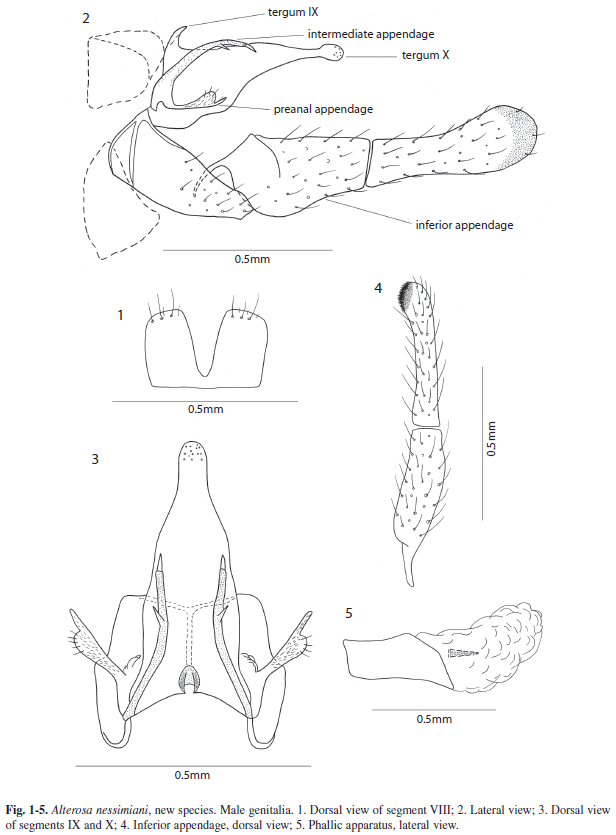
<body><![CDATA[ style="font-weight: bold;">Description. Adult: </span>Color (in     alcohol) brown; legs, palps and antennae pale brown, wing pattern not     discernable, but costal margin with some paler areas. Male forewing     5.1- 6.4mm (n=3).</span></font><br style="font-family: verdana;">     <font size="2"></font><br style="font-family: verdana;">     <font size="2"><span style="font-family: verdana;"><span      style="font-weight: bold;">Male genitalia:</span> Tergum VIII with     posteromesal margin deeply emarginate, emargination V-shaped and     extending more than half way to anterior margin, almost completely     divided (<a href="/img/revistas/rbt/v60n2/a06i1.jpg">Fig. 1</a>).     ]]></body>
<body><![CDATA[Sternum IX narrow, with anterolateral margin weakly     rounded; posteroventral margin greatly produced, extending sinuously     from dorsum (<a href="/img/revistas/rbt/v60n2/a06i1.jpg">Fig. 2</a>).     Tergum IX reduced or partially fused to base of     tergum X, dorsally folded into a small mesal projection over base of     tergum X, hood-like in dorsal view (<a      href="/img/revistas/rbt/v60n2/a06i1.jpg">Fig. 2 and 3</a>). Tergum X,     in dorsal     view, subtriangular, tapered from base, slightly expanded at midlength,     rounded at &aacute;pex (<a href="/img/revistas/rbt/v60n2/a06i1.jpg">Fig.     ]]></body>
<body><![CDATA[3</a>); in lateral view, slightly constricted     subapically, with apex slightly enlarged, rounded (<a      href="/img/revistas/rbt/v60n2/a06i1.jpg">Fig. 2</a>).     Intermediate appendages heavily sclerotized, elongate, extending past     preanal appendages, rod-like, arched, &aacute;pex curved downward, with     two small spines, one subapical and one apical (<a      href="/img/revistas/rbt/v60n2/a06i1.jpg">Fig. 2 and 3</a>). Preanal     appendages short, narrow, constricted basally, not greatly modified,     with scant small setae; apex abruptly narrowed, forming subacuminate     projection (<a href="/img/revistas/rbt/v60n2/a06i1.jpg">Fig. 2 and 3</a>).     ]]></body>
<body><![CDATA[Inferior appendages elongate, linear,     flattened on mesal surface, setose; 1<sup>st</sup> article, in lateral     view,     short, robust, nearly as wide as long; 2<sup>nd</sup> article longer     than 1<sup>st</sup>,     relatively broad, nearly uniform in width; apex rounded, with small pad     of short, stiff apicomesal setae (<a      href="/img/revistas/rbt/v60n2/a06i1.jpg">Fig. 2 and 4</a>). Phallobase     tubular,     short, slightly curved near base; endotheca with 1-3 large phallic     ]]></body>
<body><![CDATA[spines (holotype with a single spine); phallotremal sclerite indistinct     (<a href="/img/revistas/rbt/v60n2/a06i1.jpg">Fig. 5</a>).</span></font><br      style="font-family: verdana;">     <font size="2"></font><br style="font-family: verdana;">     <font size="2"><span style="font-family: verdana;"><span      style="font-weight: bold;">Holotype male: BRAZIL: Rio de     Janeiro:</span> Nova Friburgo, Cascata, Rio Maca&eacute;, Cachoeira da     Fuma&ccedil;a, 22&deg;21&#8217;56.1&#8221; S - 42&deg;15&#8217;13.1&#8221; W, 368m,     08.iii.2009, JL Nessimian, GA Jardim &amp; BHL Sampaio leg. (DZRJ 3416).</span></font><br      style="font-family: verdana;">     ]]></body>
<body><![CDATA[<font size="2"></font><br style="font-family: verdana;">     <font size="2"><span style="font-family: verdana;"><span      style="font-weight: bold;">Paratypes: BRAZIL: Rio de Janeiro:</span>     Nova Friburgo, Lumiar, Rio Boa Vista, Cachoeira Indiana Jones,     22&deg;19&#8217;02.1&#8221; S - 42&deg;17&#8217;28.5&#8221; W, 900m, 14.xi.2008, JL Nessimian,     GA Jardim &amp; IC Gon&ccedil;alves leg., 1 male (DZRJ 3417); Nova     Friburgo, Lumiar, 2nd order tributary of Rio Santiago, 22&deg;21&#8217;05.6&#8221;     S - 42&deg;22&#8217;31.6&#8221; W, 790m, 29.x.2010, FA Capistrano leg., 1 male     (DZRJ 3418).</span></font><br style="font-family: verdana;">     <font size="2"></font><br style="font-family: verdana;">     ]]></body>
<body><![CDATA[<font size="2"><span style="font-family: verdana;"><span      style="font-weight: bold;">Distribution:</span> Southeastern Brazil     (Rio de Janeiro state).</span></font><br style="font-family: verdana;">     <font size="2"></font><br style="font-family: verdana;">     <font size="2"><span style="font-family: verdana;"><span      style="font-weight: bold;">Etymology:</span> It is with great     pleasure that we dedicate this species to Prof. Dr. Jorge Luiz     Nessimian, in recognition of his significant contributions to Brazilian     entomological studies.</span></font><br style="font-family: verdana;">     <font size="2"></font><br style="font-family: verdana;">     ]]></body>
<body><![CDATA[<font style="font-weight: bold;" size="3"><span      style="font-family: verdana;">Acknowledgments</span></font><br      style="font-family: verdana;">     <font size="2"></font><br style="font-family: verdana;">     <font size="2"><span style="font-family: verdana;">We thank the     Laborat&oacute;rio de     Entomologia (UFRJ) team for aid in collecting specimens. Juan Pablo     Botero is thanked for translating the Spanish resumen. We also thank     anonymous referees for improving the manuscript. The Instituto     Brasileiro do Meio Ambiente e dos Recursos Naturais Renov&aacute;veis     ]]></body>
<body><![CDATA[(IBAMA) and the Instituto Chico Mendes de Conserva&ccedil;&atilde;o da     Biodiversidade (ICMBio) are thanked for issuing collecting permits     (IBAMA 14591-2). This study was partially funded by CNPq, FAPERJ and     CAPES.</span></font><br style="font-family: verdana;">     <font size="2"></font><br style="font-family: verdana;">     <font size="2"><span style="font-family: verdana;"></span></font>     <hr style="width: 100%; height: 2px;"><font style="font-weight: bold;"      size="3"><span style="font-family: verdana;">References</span></font><br      style="font-family: verdana;">     <font size="2"></font><br style="font-family: verdana;">     ]]></body>
<body><![CDATA[<font size="2"><span style="font-family: verdana;">Blahnik, R.J. 2005. <span      style="font-style: italic;">Alterosa</span>, a new     caddisfly genus from Brazil (Trichoptera: Philopotamidae). Zootaxa 991:     <!-- ref -->1-60.    &nbsp;&nbsp;&nbsp;&nbsp;&nbsp;&nbsp;&nbsp;&nbsp;[&#160;<a href="javascript:void(0);" onclick="javascript: window.open('/scielo.php?script=sci_nlinks&ref=1491791&pid=S0034-7744201200020000600001&lng=','','width=640,height=500,resizable=yes,scrollbars=1,menubar=yes,');">Links</a>&#160;]<!-- end-ref --><!-- ref --></span></font><br style="font-family: verdana;"> <font size="2"></font><br style="font-family: verdana;"> <font size="2"><span style="font-family: verdana;">Frost, S.W. 1957. The Pennsylvania insect light trap. J. Econ. Entomol. 50: 287-292.    &nbsp;&nbsp;&nbsp;&nbsp;&nbsp;&nbsp;&nbsp;&nbsp;[&#160;<a href="javascript:void(0);" onclick="javascript: window.open('/scielo.php?script=sci_nlinks&ref=1491792&pid=S0034-7744201200020000600002&lng=','','width=640,height=500,resizable=yes,scrollbars=1,menubar=yes,');">Links</a>&#160;]<!-- end-ref --><!-- ref --></span></font><br  style="font-family: verdana;"> <font size="2"></font><br style="font-family: verdana;"> <font size="2"><span style="font-family: verdana;">Holzenthal, R.W., R.J. Blahnik, A.P. Prather &amp; K.M. Kjer. 2007. Order Trichoptera Kirby, 1813 (Insecta), Caddisflies. Zootaxa 1668: 639-698.    &nbsp;&nbsp;&nbsp;&nbsp;&nbsp;&nbsp;&nbsp;&nbsp;[&#160;<a href="javascript:void(0);" onclick="javascript: window.open('/scielo.php?script=sci_nlinks&ref=1491793&pid=S0034-7744201200020000600003&lng=','','width=640,height=500,resizable=yes,scrollbars=1,menubar=yes,');">Links</a>&#160;]<!-- end-ref --><!-- ref --></span></font><br  style="font-family: verdana;"> <font size="2"></font><br style="font-family: verdana;"> <font size="2"><span style="font-family: verdana;">&Ouml;zdikmen, H. &amp; M.C. Darilmaz. 2008. New subfamily and genus names, <span  style="font-style: italic;">Rossodinae </span>nom. nov. and Rossodes nom. nov., for the finger-net caddisflies (Trichoptera: Philopotamidae). Mun. Ent. Zool. 3: 162-164.    &nbsp;&nbsp;&nbsp;&nbsp;&nbsp;&nbsp;&nbsp;&nbsp;[&#160;<a href="javascript:void(0);" onclick="javascript: window.open('/scielo.php?script=sci_nlinks&ref=1491794&pid=S0034-7744201200020000600004&lng=','','width=640,height=500,resizable=yes,scrollbars=1,menubar=yes,');">Links</a>&#160;]<!-- end-ref --><!-- ref --></span></font><br  style="font-family: verdana;"> <font size="2"></font><br style="font-family: verdana;"> <font size="2"><span style="font-family: verdana;">Ross, H.H. 1956. Evolution and classification of the mountain caddisflies. University of Illinois, Urbana, Illinois, USA.    &nbsp;&nbsp;&nbsp;&nbsp;&nbsp;&nbsp;&nbsp;&nbsp;[&#160;<a href="javascript:void(0);" onclick="javascript: window.open('/scielo.php?script=sci_nlinks&ref=1491795&pid=S0034-7744201200020000600005&lng=','','width=640,height=500,resizable=yes,scrollbars=1,menubar=yes,');">Links</a>&#160;]<!-- end-ref --><br>     <br>     ]]></body>
<body><![CDATA[<br> <a name="Correspondencia1"></a><a href="#Correspondencia2">*</a>Correspondencia a: </span></font><font size="2"><span style="font-family: verdana;">Gabriela Abrantes Jardim &amp; Leandro Louren&ccedil;o Dumas: Departamento de Zoologia, Instituto de Biologia, Universidade Federal do Rio de Janeiro, Caixa Postal 68044, Cidade Universit&aacute;ria, 21941-971, Rio de Janeiro, RJ, Brazil; </span></font><font  size="2"><span style="font-family: verdana;"><a  href="mailto:gabiajardim@gmail.com">gabiajardim@gmail.com</a>, <a  href="mailto:dumas_bioufrj@yahoo.com.br">dumas_bioufrj@yahoo.com.br</a>    <br> </span></font><font size="2"><span style="font-family: verdana;"><a  name="1"></a><a href="#2">1</a>. Departamento de Zoologia, Instituto de Biologia, Universidade Federal do Rio de Janeiro, Caixa Postal 68044, Cidade Universit&aacute;ria, 21941-971, Rio de Janeiro, RJ, Brazil; <a href="mailto:gabiajardim@gmail.com">gabiajardim@gmail.com</a>, <a  href="mailto:dumas_bioufrj@yahoo.com.br">dumas_bioufrj@yahoo.com.br</a></span></font><font  size="2"><span style="font-family: verdana;"><br  style="font-family: verdana;"> </span></font><font size="2"></font><font size="2"><span  style="font-family: verdana;"></span></font> <hr style="width: 100%; height: 2px;">     <div style="text-align: center;"><font size="2"><span  style="font-family: verdana;">Received 21-VI-2011. Corrected 20-IX-2011. Accepted 26-X-2011.</span></font></div> </div>     <div style="text-align: center;"><font size="2"></font></div> </div> <font size="2"></font>      ]]></body><back>
<ref-list>
<ref id="B1">
<nlm-citation citation-type="journal">
<person-group person-group-type="author">
<name>
<surname><![CDATA[Blahnik]]></surname>
<given-names><![CDATA[R.J]]></given-names>
</name>
</person-group>
<article-title xml:lang="en"><![CDATA[Alterosa, a new caddisfly genus from Brazil (Trichoptera: Philopotamidae)]]></article-title>
<source><![CDATA[Zootaxa]]></source>
<year>2005</year>
<volume>991</volume>
<page-range>1-60</page-range></nlm-citation>
</ref>
<ref id="B2">
<nlm-citation citation-type="journal">
<person-group person-group-type="author">
<name>
<surname><![CDATA[Frost]]></surname>
<given-names><![CDATA[S.W]]></given-names>
</name>
</person-group>
<article-title xml:lang="en"><![CDATA[The Pennsylvania insect light trap]]></article-title>
<source><![CDATA[J. Econ. Entomol]]></source>
<year>1957</year>
<volume>50</volume>
<page-range>287-292</page-range></nlm-citation>
</ref>
<ref id="B3">
<nlm-citation citation-type="journal">
<person-group person-group-type="author">
<name>
<surname><![CDATA[Holzenthal]]></surname>
<given-names><![CDATA[R.W]]></given-names>
</name>
<name>
<surname><![CDATA[Blahnik]]></surname>
<given-names><![CDATA[R.J]]></given-names>
</name>
<name>
<surname><![CDATA[Prather]]></surname>
<given-names><![CDATA[A.P]]></given-names>
</name>
<name>
<surname><![CDATA[Kjer]]></surname>
<given-names><![CDATA[K.M]]></given-names>
</name>
</person-group>
<article-title xml:lang="en"><![CDATA[Order Trichoptera Kirby, 1813 (Insecta), Caddisflies]]></article-title>
<source><![CDATA[Zootaxa]]></source>
<year>2007</year>
<volume>1668</volume>
<page-range>639-698</page-range></nlm-citation>
</ref>
<ref id="B4">
<nlm-citation citation-type="journal">
<person-group person-group-type="author">
<name>
<surname><![CDATA[Özdikmen]]></surname>
<given-names><![CDATA[H]]></given-names>
</name>
<name>
<surname><![CDATA[Darilmaz]]></surname>
<given-names><![CDATA[M.C]]></given-names>
</name>
</person-group>
<article-title xml:lang="en"><![CDATA[New subfamily and genus names, Rossodinae nom. nov. and Rossodes nom. nov., for the finger-net caddisflies (Trichoptera: Philopotamidae)]]></article-title>
<source><![CDATA[Mun. Ent. Zool]]></source>
<year>2008</year>
<volume>3</volume>
<page-range>162-164</page-range></nlm-citation>
</ref>
<ref id="B5">
<nlm-citation citation-type="book">
<person-group person-group-type="author">
<name>
<surname><![CDATA[Ross]]></surname>
<given-names><![CDATA[H.H]]></given-names>
</name>
</person-group>
<source><![CDATA[Evolution and classification of the mountain caddisflies]]></source>
<year>1956</year>
<publisher-loc><![CDATA[Urbana^eIllinois Illinois]]></publisher-loc>
<publisher-name><![CDATA[University of Illinois]]></publisher-name>
</nlm-citation>
</ref>
</ref-list>
</back>
</article>