<?xml version="1.0" encoding="ISO-8859-1"?><article xmlns:mml="http://www.w3.org/1998/Math/MathML" xmlns:xlink="http://www.w3.org/1999/xlink" xmlns:xsi="http://www.w3.org/2001/XMLSchema-instance">
<front>
<journal-meta>
<journal-id>0034-7744</journal-id>
<journal-title><![CDATA[Revista de Biología Tropical]]></journal-title>
<abbrev-journal-title><![CDATA[Rev. biol. trop]]></abbrev-journal-title>
<issn>0034-7744</issn>
<publisher>
<publisher-name><![CDATA[Universidad de Costa Rica]]></publisher-name>
</publisher>
</journal-meta>
<article-meta>
<article-id>S0034-77442012000200004</article-id>
<title-group>
<article-title xml:lang="en"><![CDATA[Reproduction of Omalonyx matheroni (Gastropoda: Succineidae) under laboratory conditions]]></article-title>
</title-group>
<contrib-group>
<contrib contrib-type="author">
<name>
<surname><![CDATA[Montresor]]></surname>
<given-names><![CDATA[Lângia]]></given-names>
</name>
<xref ref-type="aff" rid="A02"/>
</contrib>
<contrib contrib-type="author">
<name>
<surname><![CDATA[Teixeira]]></surname>
<given-names><![CDATA[Ana]]></given-names>
</name>
<xref ref-type="aff" rid="A01"/>
</contrib>
<contrib contrib-type="author">
<name>
<surname><![CDATA[Paglia]]></surname>
<given-names><![CDATA[Adriano]]></given-names>
</name>
<xref ref-type="aff" rid="A03"/>
</contrib>
<contrib contrib-type="author">
<name>
<surname><![CDATA[Vidigal]]></surname>
<given-names><![CDATA[Teofânia]]></given-names>
</name>
<xref ref-type="aff" rid="A01"/>
</contrib>
</contrib-group>
<aff id="A01">
<institution><![CDATA[,Universidade Federal de Minas Gerais Departamento de Zoologia ]]></institution>
<addr-line><![CDATA[Belo Horizonte MG]]></addr-line>
<country>Brazil</country>
</aff>
<aff id="A02">
<institution><![CDATA[,Instituto Oswaldo Cruz Laboratório de Malacologia ]]></institution>
<addr-line><![CDATA[Av. Brasil 4365, Rio de Janeiro RJ]]></addr-line>
<country>Brazil</country>
</aff>
<aff id="A03">
<institution><![CDATA[,Universidade Federal de Minas Gerais Departamento de Biologia Geral ]]></institution>
<addr-line><![CDATA[Belo Horizonte MG]]></addr-line>
<country>Brazil</country>
</aff>
<pub-date pub-type="pub">
<day>00</day>
<month>06</month>
<year>2012</year>
</pub-date>
<pub-date pub-type="epub">
<day>00</day>
<month>06</month>
<year>2012</year>
</pub-date>
<volume>60</volume>
<numero>2</numero>
<fpage>553</fpage>
<lpage>566</lpage>
<copyright-statement/>
<copyright-year/>
<self-uri xlink:href="http://www.scielo.sa.cr/scielo.php?script=sci_arttext&amp;pid=S0034-77442012000200004&amp;lng=en&amp;nrm=iso"></self-uri><self-uri xlink:href="http://www.scielo.sa.cr/scielo.php?script=sci_abstract&amp;pid=S0034-77442012000200004&amp;lng=en&amp;nrm=iso"></self-uri><self-uri xlink:href="http://www.scielo.sa.cr/scielo.php?script=sci_pdf&amp;pid=S0034-77442012000200004&amp;lng=en&amp;nrm=iso"></self-uri><abstract abstract-type="short" xml:lang="en"><p><![CDATA[The life histories of succineids have received relatively little attention. To evaluate life history characteristics of Omalonyx matheroni, we studied a Brazilian population (Reserva Particular do Patrimônio Natural Feliciano Miguel Abdala, in Caratinga, Minas Gerais, Brazil) under laboratory conditions. The aims of the present study were (1) to describe in detail an appropriate rearing method; (2) to investigate the effects of different temperature and photoperiod conditions; and (3) to assess the effects of self and cross-fertilization on the reproductive biology of these mollusks. We studied the oviposition site, the time to sexual maturity and the influences of photoperiod and temperature on reproductive parameters of O. matheroni reared under laboratory conditions. We tested three combinations of temperature and photoperiod, designated A, B and C (A: 25ºC, 24 hours of light; B: environmental conditions of temperature and photoperiod, characterized as follows: average máximum temperature=27.1ºC, average minimum temperature=18.3ºC, average day length=12.06 hours; and C: 25ºC, zero hours of light) and two rearing densities (I: isolated and G: grouped) on reproductive parameters (number of eggs per egg mass, number of unviable eggs per mass, egg mass incubation period, and duration of the hatching period). A total of 186 individuals and 565 egg masses were studied. Data were analyzed by Student&#8217;s t-test, two-way ANOVA and Chi-Square test. Eight generations were produced (March/2004-March/2006), from 35 field specimens, 91% of 3 197 eggs hatched. The time to sexual maturity was approximately three months for individuals reared in groups or in isolation (Student&#8217;s t-test: t=1.41, df=31, p=0.16); however, they differed significantly in weight (Student&#8217;s t-test: t=3.6, df=31, p<0.001). Regarding the influences of temperatura and photoperiod on reproductive parameters, under natural environmental conditions, individuals produced a greater number of eggs per mass (ANOVA: F2,573=84.15, p<0.001), with a longer incubation period (ANOVA: F2;559=170.05, p<0.001). The extreme photoperiod conditions of 24 hours of light or zero hours of light likely imposed stress and could be related to the significant reductions in the number of eggs per mass, and egg incubation period as well as the increased synchrony in egg hatching. No correlations were observed between the number of unviable eggs per mass and the temperature, photoperiod (ANOVA: F2,573=0.87, p=0.92) or rearing density (ANOVA: F1,573=0.21, p=0.64). Individuals reared in isolation under natural conditions produced more eggs per mass and did not presented any disadvantage with respect to the variables analyzed as compared to the animals reared in groups. These results indicate that O. matheroni can successfully reproduce by selfing. Rev. Biol. Trop. 60 (2): 553-566. Epub 2012 June 01.]]></p></abstract>
<abstract abstract-type="short" xml:lang="es"><p><![CDATA[En vista de que las historias de vida de los Succineidae han recibido relativamente poca atención, se estudio una población de Omalonyx matheroni, de Brasil (Reserva Privada y Patrimonio Natural Feliciano Miguel Abdala, en Caratinga, Minas Gerais, Brazil), en condiciones de laboratorio. Los objetivos de este trabajo fueron: (1) describir una metodología para el cultivo en laboratorio de Omalonyx matheroni; (2) investigar los efectos de diferentes condiciones de temperatura y fotoperíodo en su cultivo y, (3) verificar los efectos de la autofecundación y de la fecundación cruzada en la biología reproductiva de estos moluscos. Se estudiaron 186 individuos y 565 masas de huevos. La edad de madurez sexual fue aproximadamente de tres meses, igual para los animales aislados que para los que estuvieron en grupo (Student&#8217;s t-test: t=1.41, df=31,p=0.16). En condiciones más cercanas a la naturaleza se presentaron más huevos por masa (ANOVA: F2,573=84.15,p<0.001) y un tiempo más largo de eclosión (ANOVA: F2,559=170.05, p<0.001). En condiciones más extremas, debido probablemente al estrés producido por las mismas, se observó una reducción en el número de huevos por masa, en el tiempo de incubación y una eclosión más sincrónica. No se encontró una correlación entre el número de huevos inviables y las condiciones de temperatura y fotoperíodo (ANOVA: F2,573=0.87, p=0.92) y la densidad de cultivo (ANOVA: F1,573=0.21, p=0.64). Animales en aislamiento se reprodujeron con éxito lo que muestra la capacidad que tiene O. matheroni para la autofecundación.]]></p></abstract>
<kwd-group>
<kwd lng="en"><![CDATA[reproduction]]></kwd>
<kwd lng="en"><![CDATA[life history]]></kwd>
<kwd lng="en"><![CDATA[mollusk]]></kwd>
<kwd lng="en"><![CDATA[temperature]]></kwd>
<kwd lng="en"><![CDATA[photoperiod]]></kwd>
<kwd lng="en"><![CDATA[laboratory maintenance]]></kwd>
<kwd lng="es"><![CDATA[reproducción]]></kwd>
<kwd lng="es"><![CDATA[historia de vida]]></kwd>
<kwd lng="es"><![CDATA[molusco]]></kwd>
<kwd lng="es"><![CDATA[fotoperíodo]]></kwd>
<kwd lng="es"><![CDATA[temperatura]]></kwd>
<kwd lng="es"><![CDATA[mantenimiento en laboratorio]]></kwd>
</kwd-group>
</article-meta>
</front><body><![CDATA[ <div style="text-align: justify;">     <div style="text-align: center;"><font style="font-weight: bold;"  size="4"><span style="font-family: verdana;">Reproduction of </span></font><font  size="4"><span style="font-family: verdana;"><span  style="font-style: italic;">Omalonyx matheroni</span></span></font><font  style="font-weight: bold;" size="4"><span style="font-family: verdana;"> (Gastropoda: Succineidae) under laboratory conditions</span></font><br  style="font-family: verdana; font-weight: bold;"> </div> <br style="font-family: verdana;">     <div style="text-align: center;"><font size="2"><span  style="font-family: verdana;">L&acirc;ngia Montresor<sup><a href="#1">1</a><a name="4"></a>*,<a href="#2">2</a><a  name="5"></a>*</sup>, Ana Teixeira<a href="#1"><sup>1</sup></a>, Adriano Paglia<sup><a href="#3">3</a><a  name="6"></a>*</sup> &amp; Teof&acirc;nia Vidigal<a href="#1"><sup>1</sup></a></span></font><br  style="font-family: verdana;"> </div> <font size="2"><span style="font-family: verdana;">    <br>     <a name="Correspondencia2"></a>*<a href="#Correspondencia1">Direcci&oacute;n     para correspondencia:</a></span></font><br style="font-family: verdana;">     <font style="font-weight: bold;" size="2"><span      style="font-family: verdana;"></span></font>     <hr style="width: 100%; height: 2px;"><font style="font-weight: bold;"      size="3"><span style="font-family: verdana;">Abstract</span></font><br     ]]></body>
<body><![CDATA[ style="font-family: verdana;">     <br style="font-family: verdana;">     <font size="2"><span style="font-family: verdana;">The life histories     of succineids     have received relatively little attention. To evaluate life history     characteristics of <span style="font-style: italic;">Omalonyx matheroni</span>,     we studied a Brazilian     population (Reserva Particular do Patrim&ocirc;nio Natural Feliciano     Miguel Abdala, in Caratinga, Minas Gerais, Brazil) under laboratory     conditions. The aims of the present study were (1) to describe in     ]]></body>
<body><![CDATA[detail an appropriate rearing method; (2) to investigate the effects of     different temperature and photoperiod conditions; and (3) to assess the     effects of self and cross-fertilization on the reproductive biology of     these mollusks. We studied the oviposition site, the time to sexual     maturity and the influences of photoperiod and temperature on     reproductive parameters of <span style="font-style: italic;">O.     matheroni</span> reared under laboratory     conditions. We tested three combinations of temperature and     photoperiod, designated A, B and C (A: 25&ordm;C, 24 hours of light; B:     environmental conditions of temperature and photoperiod, characterized     ]]></body>
<body><![CDATA[as follows: average m&aacute;ximum temperature=27.1&ordm;C, average     minimum temperature=18.3&ordm;C, average day length=12.06 hours; and C:     25&ordm;C, zero hours of light) and two rearing densities (I: isolated     and G: grouped) on reproductive parameters (number of eggs per egg     mass, number of unviable eggs per mass, egg mass incubation period, and     duration of the hatching period). A total of 186 individuals and 565     egg masses were studied. Data were analyzed by Student&#8217;s t-test,     two-way ANOVA and Chi-Square test. Eight generations were produced     (March/2004-March/2006), from 35 field specimens, 91% of 3 197 eggs     hatched. The time to sexual maturity was approximately three months for     ]]></body>
<body><![CDATA[individuals reared in groups or in isolation (Student&#8217;s t-test: t=1.41,     df=31, p=0.16); however, they differed significantly in weight     (Student&#8217;s t-test: t=3.6, df=31, p&lt;0.001). Regarding the influences     of temperatura and photoperiod on reproductive parameters, under     natural environmental conditions, individuals produced a greater number     of eggs per mass (ANOVA: F<sub>2,573</sub>=84.15, p&lt;0.001), with a     longer     incubation period (ANOVA: F<sub>2;559</sub>=170.05, p&lt;0.001). The     extreme     photoperiod conditions of 24 hours of light or zero hours of light     ]]></body>
<body><![CDATA[likely imposed stress and could be related to the significant     reductions in the number of eggs per mass, and egg incubation period as     well as the increased synchrony in egg hatching. No correlations were     observed between the number of unviable eggs per mass and the     temperature, photoperiod (ANOVA: F<sub>2,573</sub>=0.87, p=0.92) or     rearing     density (ANOVA: F<sub>1,573</sub>=0.21, p=0.64). Individuals reared in     isolation     under natural conditions produced more eggs per mass and did not     presented any disadvantage with respect to the variables analyzed as     ]]></body>
<body><![CDATA[compared to the animals reared in groups. These results indicate that     <span style="font-style: italic;">O. matheroni </span>can successfully     reproduce by selfing. Rev. Biol. Trop. 60     (2): 553-566. Epub 2012 June 01.</span></font><br      style="font-family: verdana;">     <br style="font-family: verdana; font-weight: bold;">     <font size="2"><span style="font-family: verdana;"><span      style="font-weight: bold;">Key words: </span>reproduction, life     history, mollusk, temperature, photoperiod, laboratory maintenance.</span></font><br      style="font-family: verdana;">     ]]></body>
<body><![CDATA[<br style="font-family: verdana; font-weight: bold;">     <font style="font-weight: bold;" size="3"><span      style="font-family: verdana;">Resumen</span></font><br      style="font-family: verdana;">     <br style="font-family: verdana;">     <font size="2"><span style="font-family: verdana;">En vista de que las     historias de     vida de los Succineidae han recibido relativamente poca     atenci&oacute;n, se estudio una poblaci&oacute;n de <span      style="font-style: italic;">Omalonyx matheroni,</span>     ]]></body>
<body><![CDATA[de Brasil (Reserva </span></font><font size="2"><span      style="font-family: verdana;">Privada y Patrimonio Natural     Feliciano Miguel Abdala, en Caratinga, Minas Gerais, Brazil), en     condiciones de laboratorio. Los objetivos de este trabajo fueron: (1)     describir una metodolog&iacute;a para el cultivo en laboratorio de     <span style="font-style: italic;">Omalonyx matheroni</span>; (2)     investigar los efectos de diferentes     condiciones de temperatura y fotoper&iacute;odo en su cultivo y, (3)     verificar los efectos de la autofecundaci&oacute;n y de la     fecundaci&oacute;n cruzada en la biolog&iacute;a reproductiva de estos     ]]></body>
<body><![CDATA[moluscos. Se estudiaron 186 individuos y 565 masas de huevos. La edad     de madurez sexual fue aproximadamente de tres meses, igual para los     animales aislados que para los que estuvieron en grupo (Student&#8217;s     t-test: t=1.41, df=31,p=0.16). En condiciones m&aacute;s cercanas a la     naturaleza se presentaron m&aacute;s huevos por masa (ANOVA:     F<sub>2,573</sub>=84.15,p&lt;0.001) y un tiempo m&aacute;s largo de     eclosi&oacute;n (ANOVA: F<sub>2,559</sub>=170.05, p&lt;0.001). En     condiciones     m&aacute;s extremas, debido probablemente al estr&eacute;s producido     por las mismas, se observ&oacute; una reducci&oacute;n en el     ]]></body>
<body><![CDATA[n&uacute;mero de huevos por masa, en el tiempo de incubaci&oacute;n y     una eclosi&oacute;n m&aacute;s sincr&oacute;nica. No se encontr&oacute;     una correlaci&oacute;n entre el n&uacute;mero de huevos inviables y las     condiciones de temperatura y fotoper&iacute;odo (ANOVA: F<sub>2,573</sub>=0.87,     p=0.92) y la densidad de cultivo (ANOVA: F<sub>1,573</sub>=0.21,     p=0.64). Animales     en aislamiento se reprodujeron con &eacute;xito lo que muestra la     capacidad que tiene <span style="font-style: italic;">O. matheroni </span>para     la autofecundaci&oacute;n.</span></font><br      style="font-family: verdana;">     ]]></body>
<body><![CDATA[<br style="font-family: verdana;">     <font size="2"><span style="font-family: verdana;"><span      style="font-weight: bold;">Palabras clave:     </span>reproducci&oacute;n, historia de vida, molusco,     fotoper&iacute;odo,     temperatura, mantenimiento en laboratorio.</span></font><br      style="font-family: verdana;">     <br style="font-family: verdana;">     <font size="2"><span style="font-family: verdana;"></span></font>     <hr style="width: 100%; height: 2px;"><font size="2"><span     ]]></body>
<body><![CDATA[ style="font-family: verdana;">The genus <span      style="font-style: italic;">Omalonyx </span>d&#8217;Orbigny 1837,     belongs to the family Succineidae and represents one of the lineages     with a reduced flat shell and slug-like body shape (Patterson 1971,     Tillier 1981, Barker 2001). Species of this genus are distributed     throughout South America; in Brazil, they are widely distributed in all     regions of the country (Lange de Morretes 1949, Tiller 1981,     Dutra-Clarke <span style="font-style: italic;">et al. </span>2001,     Salgado <span style="font-style: italic;">&amp;</span> Coelho 2003,     Simone 2006,     ]]></body>
<body><![CDATA[Arruda <span style="font-style: italic;">et al.</span> 2009,     Coscarelli <span style="font-style: italic;">&amp;</span> Vidigal     2011).</span></font><br style="font-family: verdana;">     <br style="font-family: verdana;">     <font size="2"><span style="font-family: verdana;">In spite of their     abundance and     widespread distribution, research on the life history of succineids,     including <span style="font-style: italic;">Omalonyx</span>, has     received relatively little attention (Hermann     &amp; Dundee 1967, Patterson 1970, Villalobos <span     ]]></body>
<body><![CDATA[ style="font-style: italic;">et al.</span> 1995, Rundell     &amp; Cowie 2003, Villalobos &amp; Monge- N&aacute;jera 2004, Brown <span      style="font-style: italic;">et     al. </span>2006, Dillen <span style="font-style: italic;">et al. </span>2009).     Laboratory studies on the life history     of pulmonates are considered to be extremelyimportant for developing an     understanding of their complex reproductive processes and determining     the environmental factors that influence them (Gomot de Vaufleury 2001,     Heller 2001). Influences of temperature, photoperiod and rearing     density (individuals raised in isolation or in a group) on reproduction     ]]></body>
<body><![CDATA[have been demonstrated in several pulmonate species, including     succineids (Enee <span style="font-style: italic;">et al.</span> 1982,     South 1992, Gomot de Vaufleury 2001,     Hommay <span style="font-style: italic;">et al.</span> 2001, Meireles <span      style="font-style: italic;">et al.</span> 2008, Dillen <span      style="font-style: italic;">et al.</span> 2009). </span></font><br      style="font-family: verdana;">     <br style="font-family: verdana;">     <font size="2"><span style="font-family: verdana;">According to Parodiz     (1963),     ]]></body>
<body><![CDATA[species of the <span style="font-style: italic;">Omalonyx</span> genus     are found in humid sites and are never     far from water. They are often found submerged among aquatic plants or     in the mud at the bottom of freshwater systems. Information concerning     the natural habitat and lifestyle of <span style="font-style: italic;">Omalonyx</span>     is somewhat controversial     (Parodiz 1963, Hermann &amp; Dundee 1967, Patterson 1971, Poi de Neiff     <span style="font-style: italic;">et al.</span> 1977, Olazarri 1979,     Tillier 1981, Cazzaniga 1985); however, all     of the authors agree that this genus is strongly associated with     ]]></body>
<body><![CDATA[freshwater systems such as swamps, lakes and river margins, as well as     the surrounding vegetation.</span></font><br      style="font-family: verdana;">     <br style="font-family: verdana;">     <font size="2"><span style="font-family: verdana;">Hermann &amp; Dundee     (1967) studied     the habitat of <span style="font-style: italic;">Omalonyx matheroni</span>     (Pontiez &amp; Michaud 1835) in     Ecuador and found that individuals in freshwater systems could be     reared in plastic containers with water and vegetation from the lake,     ]]></body>
<body><![CDATA[where they had been collected. Patterson (1970, 1971) described a     generalized rearing methodology for succineids that involved separating     egg masses and young and adult individuals into different containers     and providing a diet based on lettuce and chopped cereal grasses.     Sterilized sand with clay and calcium carbonate was added to the bottom     of the containers. A different diet was fed to juveniles. Employing     this methodology for two years, Patterson (1971) reared 16 generations     of <span style="font-style: italic;">Omalonyx</span>. However, further     details regarding the success of this     rearing methodology and other life history data were not mentioned.</span></font><br     ]]></body>
<body><![CDATA[ style="font-family: verdana;">     <br style="font-family: verdana;">     <font size="2"><span style="font-family: verdana;">To evaluate life     history     characteristics of <span style="font-style: italic;">O. matheroni</span>,     we studied a Brazilian population     under laboratory conditions. The aims of the present study were (1) to     describe in detail an appropriate rearing method; (2) to investigate     the effects of different temperature and photoperiod conditions; and     (3) to assess the effects of self and cross-fertilization on the     ]]></body>
<body><![CDATA[reproductive biology of these mollusks.</span></font><br      style="font-family: verdana;">     <br style="font-family: verdana;">     <font style="font-weight: bold;" size="3"><span      style="font-family: verdana;">Materials and methods</span></font><br      style="font-family: verdana; font-weight: bold;">     <br style="font-family: verdana;">     <font size="2"><span style="font-family: verdana;"><span      style="font-weight: bold;">Field collection and laboratory     rearing of mollusks: </span>A laboratory population of </span></font><font     ]]></body>
<body><![CDATA[ size="2"><span style="font-family: verdana;"><span      style="font-style: italic;">Omalonyx </span>was established from 35     individuals collected in March 2004 at the Reserva Particular do     Patrim&ocirc;nio Natural Feliciano Miguel Abdala, a private nature     preserve in Caratinga, Minas Gerais, Brazil (19<sup>o</sup>43&#8217;55&#8217;&#8217; S -     41&deg;49&#8217;03&#8217;&#8217;W). The snails were identified as <span      style="font-style: italic;">O. matheroni</span> by means of     comparative morphology based on their reproductive organs, according to     the criteria defined by Tillier (1981). Voucher specimens were     deposited in the malacology collection of the Laborat&oacute;rio de     ]]></body>
<body><![CDATA[Malacologia e Sistem&aacute;tica Molecular (LMSM), Departamento de     Zoologia, Universidade Federal de Minas Gerais, Belo Horizonte, Brazil,     under the catalog number LMSM 1 128. The individuals were manually     collected from wet soil and vegetation in the vicinity of freshwater     systems. The mollusks were maintained at room temperature in two     plastic containers (28.2L) with perforated lids containing 17-18     individuals each. The mollusks were reared based on the     procedures&nbsp; described by Hermann &amp; Dundee (1967) and Patterson     (1970, 1971) with some modifications as described below. The rearing     containers were prepared with a thin layer of water at the bottom     ]]></body>
<body><![CDATA[(approximately 600mL) to maintain a high-humidity environment.     Specimens of <span style="font-style: italic;">Pistia stratiotes</span>     (Araceae), popularly known as water     lettuce, were used as a substrate for egglaying and shelter. Water     lettuce obtained from the field was washed in tap water and placed in     the rearing containers. Mollusks were fed daily with lettuce and     supplied with powdered rodent chow to which ten percent calcium     carbonate (CaCO<sub>3</sub>) was added; this mixture was renewed every     two days.     The chow was placed in a round plastic container (diameter: 30mm;     ]]></body>
<body><![CDATA[height: 7mm) to avoid contact with the water. As the eggs were laid,     they were transferred to a separate container, which was called the     nursery (Nr) and is described below. </span></font><br      style="font-family: verdana;">     <br style="font-family: verdana;">     <font size="2"><span style="font-family: verdana;">Rearing was divided     into stages     according to the ages of the specimens. The cleaning procedure was     performed every two days. Chow and fecal residues were removed with tap     w&aacute;ter and a thin paint brush. We avoided touching the animals in     ]]></body>
<body><![CDATA[order to reduce the number of stress factors. Each day, the egg masses     were individually transferred from the main container (Mn) to the     nursery (Nr) and cleaned with tap water and a thin paint brush. </span></font><br      style="font-family: verdana;">     <br style="font-family: verdana;">     <font size="2"><span style="font-family: verdana;">Nursery (Nr):     Hatching-day five.     Glass Petri dishes (diameter: 80mm; height: 17mm) with moistened filter     paper at the bottom were used to create the moist chambers. Petri     dishes were labeled with the container from which the egg mass was     ]]></body>
<body><![CDATA[taken and the date of oviposition. The moist chambers were visually     inspected every day. The filter papers were kept permanently wet. After     hatching, the newly hatched young were fed twice a week with macerated     lettuce and approximately 10mg of chow. </span></font><br      style="font-family: verdana;">     <br style="font-family: verdana;">     <font size="2"><span style="font-family: verdana;">Growth (Gr): Day     six-30.     Individuals were kept in transparent plastic containers (diameter:     75mm, height: 55mm) with perforated lids. The bottoms of the containers     ]]></body>
<body><![CDATA[were covered with a thin layer of water (approximately 3mL) and one <span      style="font-style: italic;">P.     stratiotes</span> specimen. Up to five six-dayold individuals were     placed in     each container and fed macerated lettuce three times a week and 20mg of     chow diet twice a week. The containers were visually inspected every     day, and dead specimens were removed when necessary. </span></font><br      style="font-family: verdana;">     <br style="font-family: verdana;">     <font size="2"><span style="font-family: verdana;">Maintenance (Mn):     ]]></body>
<body><![CDATA[More than 30 days     old. Mollusks were placed in transparent plastic containers (diameter:     145mm, height: 95mm) with perforated lids. The bottom of each container     was covered with a thin layer of w&aacute;ter (approximately 10mL) and     one <span style="font-style: italic;">P. stratiotes</span> specimen.     Up to four 30-day-old individuals were     placed in each container and fed lettuce three times a week and chow     diet twice a week (25mg per individual). Isolated individuals were kept     in the smaller plastic container (diameter: 75mm, height: 55mm).</span></font><br      style="font-family: verdana;">     ]]></body>
<body><![CDATA[<br style="font-family: verdana; font-weight: bold;">     <font size="2"><span style="font-family: verdana;"><span      style="font-weight: bold;">Oviposition in the laboratory: </span>The     mollusks collected in the field (35 individuals) were kept in the     laboratory under natural conditions (condition B, according to <a      href="/img/revistas/rbt/v60n2/a04t1.gif">table 1</a>)     in two containers with perforated lids (17-18 individuals in each     container). These mollusks were reared as described above for stage Mn.     The containers were checked every day for new egg masses. The egg     masses were cleaned and kept as described above for stage Nr. The     ]]></body>
<body><![CDATA[number of viable and unviable eggs was determined. Egg diameter was     measured using an ocularmicrometer (Leica, Germany, MZ12).</span></font><br      style="font-family: verdana;">     <br style="font-family: verdana;">     <font size="2"><span style="font-family: verdana;">To determine the     preferred     egg-laying site, we analyzed 100 egg masses from ten individuals reared     in groups (condition B). The containers were checked every day or new     egg masses, which were removed daily, counted and identified according     to the site at which they were laid (water lettuce or container wall).</span></font><br     ]]></body>
<body><![CDATA[ style="font-family: verdana;">     <br style="font-family: verdana; font-weight: bold;">     <font size="2"><span style="font-family: verdana;"><span      style="font-weight: bold;">Time to sexual maturity in the     laboratory:</span> Mollusks were considered sexually mature at their     first     oviposition. Data on the age, weight and size of specimens (F1     generation) reared under natural conditions (condition B) in isolation     (16 specimens) or in groups (17 specimens in groups of three or four     individuals) at first egg-laying were analyzed by Student&#8217;s t-test.</span></font><br     ]]></body>
<body><![CDATA[ style="font-family: verdana;">     <br style="font-family: verdana; font-weight: bold;">     <font size="2"><span style="font-family: verdana;"><span      style="font-weight: bold;">Measurement of specimens from each     rearing stage: </span>From each rearing tage, 20 individuals were     randomly     selected (Nr: five days old; Gr: 30 days old; Mn: more than 100 days     old), measured using an ocular micrometer (length of the body and shell     and width of the shell) (stereoscopic microscope: Leica, Germany, MZ12)     and weighed with an analytical balance (sensitivity 0.001g, Marte, AL     ]]></body>
<body><![CDATA[500).</span></font><br style="font-family: verdana;">     <br style="font-family: verdana; font-weight: bold;">     <font size="2"><span style="font-family: verdana;"><span      style="font-weight: bold;">Influence of the rearing density     and conditions on reproductive parameters:</span> The F1 generation was     subjected to three different temperature and photoperiod conditions (A:     25&ordm;C, 24 hours of light; B: environmental conditions of     temperature and photoperiod, characterized as follows: average maximum     temperature=27.1&ordm;C, average minimum temperature=18.3&ordm;C,     average day length=12.06 hours; and C: 25&ordm;C, zero hours of light)     ]]></body>
<body><![CDATA[and two rearing densities (I: isolated and G: grouped). These     conditions are described in <a href="/img/revistas/rbt/v60n2/a04t1.gif">table     1</a> along with the numbers of     individuals in each condition. Individuals were divided into different     rearing densities (I or G) when they were six days old and maintained     in isolation or in groups until the end of the experiment. For     treatment I, after being transferred from the Nr, six-day-old specimens     were individually maintained in 75mm containers until the end of the     experiment. For treatment G, two to four specimens were initially     maintained in 75mm containers (Gr) and then transferred to 145mm     ]]></body>
<body><![CDATA[containers (Mn) until the end of the experiment. </span></font><br      style="font-family: verdana;">     <br style="font-family: verdana;">     <font size="2"><span style="font-family: verdana;">The following     parameters were     analyzed for all of the egg masses laid under the different conditions:     number of eggs per egg mass, number of unviable eggs per mass, egg mass     incubation period and duration of the hatching period, i.e., the time     elapsed between the hatching of the first egg and the hatching of the     last egg in a given egg mass.</span></font><br     ]]></body>
<body><![CDATA[ style="font-family: verdana;">     <br style="font-family: verdana;">     <font size="2"><span style="font-family: verdana;">Two-way ANOVA (Zar     2009) was used     to test the effects of the temperature and photoperiod (A, B, and C)     and rearing density (I and G) conditions on the following     log-transformed variables: number of eggs per egg mass, number of     unviable eggs per egg mass, and egg mass incubation period. The     duration of the egg mass hatching period was categorized as synchronous     (hatching period=zero days) or nonsynchronous (hatching period=one or     ]]></body>
<body><![CDATA[more days), and the association of this variable with the temperature     and photoperiod conditions (A, B and C) and rearing&nbsp; densities (I     and G) was tested using the chi-square test (Zar 2009). </span></font><br      style="font-family: verdana;">     <br style="font-family: verdana;">     <font style="font-weight: bold;" size="3"><span      style="font-family: verdana;">Results</span></font><br      style="font-family: verdana;">     <br style="font-family: verdana;">     <font size="2"><span style="font-family: verdana;"><span     ]]></body>
<body><![CDATA[ style="font-weight: bold;">Field collection and laboratory     rearing of mollusks:</span> Eight generations were reared in 24 months     with     the methodology described above. Aspects of the rearing procedure     considered important for the success of laboratory maintenance include     the following: (1) Defining rearing stages according to age. This     technique improved the laboratory maintenance of <span      style="font-style: italic;">O. matheroni </span>and     allowed us to achieve the specific demands of each developmental phase     (newly-hatched and adult specimens are shown in <a href="#Fig_1">Fig.     ]]></body>
<body><![CDATA[1A</a> and <a href="#Fig_1">1B</a>,     respectively). (2) Maintaining the humidity in the rearing containers     (moist chambers were used for Nr, and w&aacute;ter was placed at the     bottom of the container for Gr and Mn). (3) Separating egg masses into     individual moist chambers (in the nursery). This procedure facilitated     observations of hatching and the development of the egg. (4) Improving     the diet with chow. Providing a source of calcium carbonate is an     essential component for any&nbsp; gastropod rearing strategy. Mollusks     demonstrated a clear preference for the chow </span></font><font      size="2"><span style="font-family: verdana;">diet when they were     ]]></body>
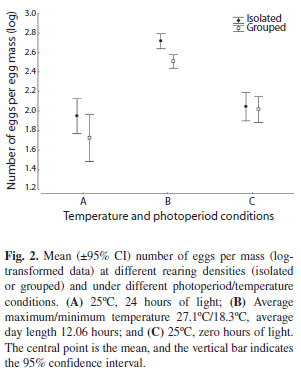
<body><![CDATA[simultaneously     presented with chow and lettuce.     <br>     <br> </span></font><font size="2">    <br> </font>     <div style="text-align: center;"><font size="2"><a name="Fig_1"></a></font><font  size="2"><img alt="" src="../img/revistas/rbt/v60n2/a04i1.jpg"  style="width: 304px; height: 482px;"></font><br  style="font-family: verdana;"> </div> <br style="font-family: verdana;"> <font size="2"><span style="font-family: verdana;">As observed in field populations, laboratory-reared individuals did not stay in the water. Exceptions occurred when they were laying eggs at the roots, under the leaves or on the leaf axis of the water lettuce or when they were moving to another site. Most of the time, the individuals remained on the substrate (container wall or water lettuce leaves). <span  style="font-style: italic;">P. stratiotes</span> was not consumed as food, but it was an excellent egg-laying site.</span></font><br  style="font-family: verdana;"> <br style="font-family: verdana;"> <font size="2"><span style="font-family: verdana;"><span  style="font-weight: bold;">Oviposition in the laboratory:</span> From the 35 field specimens kept in the laboratory under condition B, 218 egg masses were obtained after 125 days of observation, and 91% of the 3 197 eggs hatched. Each individual laid a mean of 91.34 eggs during this period. The egg diameter was 2.1&plusmn;0.3mm (mean&plusmn;SD). Only 4% of the egg masses were laid on the plastic container wall; 96% were found on <span style="font-style: italic;">P. stratiotes</span>. In addition to being readily available, <span  style="font-style: italic;">P. stratiotes</span> is very manageable and can be kept alive in the laboratory for over a month. Reciprocal copulation was observed when mollusks were housed in groups (<a href="#Fig_1">Fig. 1C</a>).    <br>     <br> </span></font> <font size="2"><span style="font-family: verdana;"><span  style="font-weight: bold;">Time to sexual maturity in the laboratory:</span> No significant differences in the time to sexual maturity were observed between specimens reared in groups or in isolation under condition B (Grouped=91.7&plusmn;7.6 days; Isolated=86.2&plusmn;14.1 days) (Student&#8217;s t-test: t=1.41, df=31, p=0.16). However, they significantly differed in weight (Grouped=181&plusmn;80mg; Isolated=320&plusmn;133mg) (Student&#8217;s t-test: t=3.6, df=31, p&lt;0.001), and the p-value obtained for size was very close to significance (Grouped=14&plusmn;0.44mm; Isolated=16.6&plusmn;0.28mm) (Student&#8217;s t-test:t=1.84, df=31, p=0.072).</span></font><br  style="font-family: verdana;"> <br style="font-family: verdana; font-weight: bold;"> <font size="2"><span style="font-family: verdana;"><span  style="font-weight: bold;">Measurement of specimens from each rearing stage:</span> The mean body length, body weight, and shell size of specimens reared in groups under natural environmental conditions (B/G) are shown in <a href="/img/revistas/rbt/v60n2/a04t2.gif">table 2</a>.</span></font><br  style="font-family: verdana;"> <br style="font-family: verdana;"> <font size="2"><span style="font-family: verdana;"><span  style="font-weight: bold;">Influence of the rearing density and conditions on reproductive parameters:</span> Each egg mass was analyzed in relation to four reproductive parameters and these results are presented separately below.</span></font><br  style="font-family: verdana;"> <br style="font-family: verdana;"> <font size="2"><span style="font-family: verdana;">Number of eggs per egg mass: Significant effects of rearing density (ANOVA: F<sub>1,573</sub>=5.81, p=0.016) and temperature and photoperiod conditions (ANOVA: F<sub>2,573</sub>=84.15, p&lt;0.001) on the number of eggs per mass were observed. At both rearing densities (I and G), the number of eggs per mass was higher under natural environmental conditions (B); however, isolated individuals laid more eggs per mass as compared to grouped individuals (<a href="#Fig_2">Fig. 2</a> and <a  href="/img/revistas/rbt/v60n2/a04t3.gif">Table 3</a>). The effect of the interaction between rearing density and the temperature and photoperiod conditions was not significant (ANOVA: F<sub>2, 573</sub>=1.12, p=0.28).    <br>     <br> </span></font>     ]]></body>
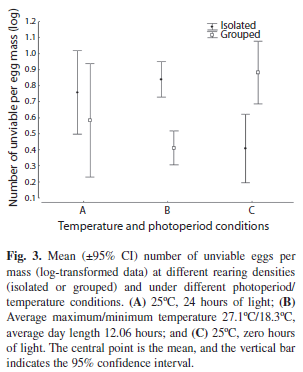
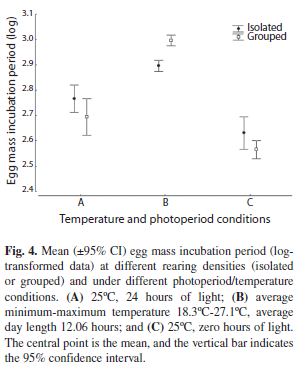
<body><![CDATA[<div style="text-align: center;"><font size="2"><a name="Fig_2"></a><img  alt="" src="/img/revistas/rbt/v60n2/a04i2.jpg"  style="width: 301px; height: 374px;"><span  style="font-family: verdana;"></span></font><br  style="font-family: verdana;"> <font size="2"><span style="font-family: verdana;"></span></font></div> <br style="font-family: verdana;"> <font size="2"><span style="font-family: verdana;">Number of unviable eggs per egg mass: There were no significant differences in the number of unviable eggs, neither among the different temperature/photoperiod conditions (A, B and C) (ANOVA: F<sub>2,573</sub>=0.87, p=0.92) nor between the rearing densities (G and I) (ANOVA: F<sub>1,573</sub>=0.21, p=0.64). However, the interaction between these factors presented a significant effect (ANOVA: F<sub>2,573</sub>=14.62, p&lt;0.001). Isolated individuals produced more unviable eggs per egg mass than grouped individuals under condition B, but under condition C, they produced fewer unviable eggs per egg mass (<a href="#Fig_3">Fig. 3</a> and <a  href="/img/revistas/rbt/v60n2/a04t3.gif">Table 3</a>).    <br>     <br> </span></font>     <div style="text-align: center;"><font size="2"><a name="Fig_3"></a><img  alt="" src="/img/revistas/rbt/v60n2/a04i3.jpg"  style="width: 303px; height: 372px;"><span  style="font-family: verdana;"></span></font><br  style="font-family: verdana;"> <font size="2"><span style="font-family: verdana;"></span></font></div> <br style="font-family: verdana;"> <font size="2"><span style="font-family: verdana;">Egg mass incubation period: There was a significant difference in egg mass incubation period among the temperature and photoperiod conditions (A, B and C) (ANOVA: F<sub>2,559</sub>=170.05, p&lt;0.001) but not between the two rearing densities (ANOVA: F<sub>2,559</sub>=0.41, p=0.52). The interaction between rearing density and temperature and photoperiod conditions was significant (ANOVA: F<sub>2,559</sub>=13.03, p&lt;0.001). The egg mass incubation period was longer in condition B than in either of the extreme conditions (A and C). Under condition B, the egg mass incubation period was longer for grouped specimens than for isolated individuals. In conditions A and C, no significant differences were observed between isolated and grouped individuals (<a href="#Fig_4">Fig. 4</a> and <a  href="/img/revistas/rbt/v60n2/a04t3.gif">Table 3</a>).    <br>     <br> </span></font>     <div style="text-align: center;"><font size="2"><a name="Fig_4"></a><img  alt="" src="/img/revistas/rbt/v60n2/a04i4.jpg"  style="width: 300px; height: 370px;"><span  style="font-family: verdana;"></span></font><br  style="font-family: verdana;"> <font size="2"><span style="font-family: verdana;"></span></font></div> <br style="font-family: verdana;"> <font size="2"><span style="font-family: verdana;">Duration of egg mass hatching period: There was a significant association between the rearing condition and the synchrony of hatching (&#967;<sup>2</sup>=377.6, df=2, p&lt;0.001). Egg hatching was not synchronous under condition A or B; however, under condition C, 71% of hatching events were synchronous (Table 4). We also found an association between rearing density and the duration of the egg mass hatching period (&#967;<sup>2</sup>=23.9, df=1, p&lt;0.001). The egg masses from isolated individuals were synchronous in 5.1% of the hatching events, compared to 18.8% of egg masses from grouped specimens (<a  href="/img/revistas/rbt/v60n2/a04t3.gif">Tables 3</a> and <a href="/img/revistas/rbt/v60n2/a04t4.gif">4</a>).</span></font><br  style="font-family: verdana;"> <br style="font-family: verdana; font-weight: bold;"> <font style="font-weight: bold;" size="3"><span  style="font-family: verdana;">Discussion</span></font><br  style="font-family: verdana;"> <br style="font-family: verdana;"> <font size="2"><span style="font-family: verdana;">Pulmonates are simultaneous hermaphrodites, well-known for their broad variation in life history characteristics. Snails of the genus <span style="font-style: italic;">Omalonyx</span> are capable of reproduction by both outcrossing and apparent self-fertilization (Patterson 1970). The ability to rear stable populations in the laboratory allows for controlled laboratory trials and consequently informative studies on life history. Studying life history aspects such as rearing density, fecundity and fertility rates allows for a better understanding of pulmonate population structure, and contributes to the management and conservation plans for these mollusks. Data of this sort also enable further studies on snail parasitology (e.g., studies on snail-fluke interactions) and physiology (e.g., regulation of growth and reproduction) (South 1992, Lam 1994, Villalobos <span  style="font-style: italic;">et al.</span> 1995, Gomot de Vaufleury 2001, Hommay <span style="font-style: italic;">et al.</span> 2001, Daoust <span style="font-style: italic;">et al. </span>2009, Dillen <span style="font-style: italic;">et al. </span>2009).</span></font><br style="font-family: verdana;"> <br style="font-family: verdana;"> <font size="2"><span style="font-family: verdana;">The use of local vegetation as shelter and substrate for egg-laying was first reported by Hermann &amp; Dundee (1967). According to these authors, in the laboratory setting, eggs were preferentially laid on the walls of the plastic containers, with plants serving as a second choice. In the present study, <span style="font-style: italic;">P. stratiotes</span> was not consumed as food but was the first choice for an egg-laying site, contrary to the results of Hermann &amp; Dundee (1967). </span></font><br style="font-family: verdana;"> <br style="font-family: verdana;"> <font size="2"><span style="font-family: verdana;">In the absence of a partner, some hermaphrodites, including <span style="font-style: italic;">Omalonyx</span>, do not cease reproduction, and apparent self-fertilization occurs (Patterson 1970). Thus, by rearing <span style="font-style: italic;">O. matheroni</span> in isolation or in groups, we favored selfing (parthenogenesis or self-fertilization) or cross-fertilization, respectively. Diverse hermaphroditic mollusks, including <span  style="font-style: italic;">Omalonyx</span>, copulate reciprocally. The first observation of reciprocal copulation in <span style="font-style: italic;">Omalonyx </span>was recorded by Hermann &amp; Dundee (1967). During our routine observations of the grouped individuals, we verified the occurrence of reciprocal copulation.     <br>     <br style="font-family: verdana;">     </span></font><font size="2"><span style="font-family: verdana;">Information     ]]></body>
<body><![CDATA[on the life history of     a given species allows inferences about its ecology. Oviposition     comprises an important life history characteristic. Laboratory trials     are needed to determinate the range of this variable, due to the     difficulty in studying life history characteristics in the field. The     hatching rate of <span style="font-style: italic;">Succinea costaricana</span>     von Martens 1898     (Stylommatophora: Succineidae), is close to 100% when proper laboratory     conditions are available (Villalobos <span style="font-style: italic;">et     al.</span> 1995). However, this rate     ]]></body>
<body><![CDATA[is likely very different from that which occurs in the wild, where     several factors that cannot be controlled, such as dryness, predators     and parasites, likely destroy most of the eggs (Villalobos <span      style="font-style: italic;">et al.</span>     1995). In the present work, oviposition data for <span      style="font-style: italic;">O. matheroni</span> revealed     a hatching rate of 91% and a mean production of 91.34 eggs per     individual over a period of 125 days. An 80% hatching success rate and     a mean production of 23.4 eggs per snail in the laboratory over the     same period were observed for the succineid <span     ]]></body>
<body><![CDATA[ style="font-style: italic;">Catinella rotundata</span> (Gould     1846) (Stylommatophora: Succineidae) (Rundell &amp; Cowie 2003).     Likewise, in the same period of time, a production of 71.44 eggs per     individual and an 81.22% hatching rate were reported for <span      style="font-style: italic;">Bradybaena     similaris</span> (F&eacute;russac 1821) (Stylommatophora:     Bradybaenidae)     (Almeida &amp; Bessa 2001). The authors also commented about the large     intraspecific and interspecific variation in these variables among     several different mollusks. These reproductive variables are related to     ]]></body>
<body><![CDATA[the species&#8217; success in their natural habitat and are important for     laboratory rearing trials and for the development of pest control     methods (Villalobos <span style="font-style: italic;">et al.</span>     1995, Hommay <span style="font-style: italic;">et al.</span> 2001).     The egg size of     stylommatophoran mollusks varies under different ecological and     environmental conditions (Peake 1978). Villalobos <span      style="font-style: italic;">et al.</span> (1995)     reported an egg diameter of 1.367&plusmn;0.163mm for the succineid <span      style="font-style: italic;">S.     ]]></body>
<body><![CDATA[costaricana</span>. The egg diameter of <span      style="font-style: italic;">Omalonyx</span> measured in the present     work     (2.1&plusmn;0.3mm) fell in the range expected for eggs lacking a     calcium carbonate cover (one-eight mm) (Peake 1978).</span></font><br      style="font-family: verdana;">     <br style="font-family: verdana;">     <font size="2"><span style="font-family: verdana;">The time to sexual     maturity is an     important life history characteristic that can present large     ]]></body>
<body><![CDATA[intraspecific and interspecific variation and be influenced by several     factors (Roff 1992, Stearns 1992). The time to sexual maturity observed     in this work did not vary among groups; despite the fact that they were     larger, specimens reared in isolation reached sexual maturity at the     same time as grouped individuals. This result is in accordance with the     observations of <span style="font-style: italic;">Succinea thaanumi</span>     (Ancey 1899) performed by Rundell     &amp; Cowie (2003) and with the period estimated by Hermann &amp;     Dundee (1967) for <span style="font-style: italic;">Omalonyx</span>.     The time to sexual maturity in all of these     ]]></body>
<body><![CDATA[cases was approximately three months.</span></font><br      style="font-family: verdana;">     <br style="font-family: verdana;">     <font size="2"><span style="font-family: verdana;">Variation in weight     was substantial     among individuals of the same age at all of the rearing stages studied     herein. Hommay et al. (2001) observed a significant variation in the     weight of <span style="font-style: italic;">Limax valentianus</span>     F&eacute;rrusac 1823 (Stylommatophora:     Limacidae), particularly in the first days after hatching. Peake (1978)     ]]></body>
<body><![CDATA[suggested that the nutritional content in individual eggs may be an     important factor determining future growth patterns in pulmonates.     Several Works have also demonstrated that increased size is related to     increased fecundity in many animals, including mollusks (Stearns &amp;     Koella 1986, Heller 2001, D&#8217;&Aacute;vila &amp; Bessa 2005). Considering     that isolated individuals were larger and produced more eggs per egg     mass, further studies might investigate the relation between size and     fecundity in <span style="font-style: italic;">O. matheroni</span>.</span></font><br      style="font-family: verdana;">     <br style="font-family: verdana;">     ]]></body>
<body><![CDATA[<font size="2"><span style="font-family: verdana;">We expected to     observe a clear     disadvantage in the reproductive parameters of isolated individuals     relative to those of grouped individuals. However, our results indicate     that selfing may be a successful reproductive strategy for <span      style="font-style: italic;">O.     matheroni</span>. This supposition is based on the fact that under     natural     environmental conditions (B), isolated individuals (I) laid egg masses     containing more eggs than the individuals maintained in groups (G). The     ]]></body>
<body><![CDATA[two rearing densities presented similar results for the time of sexual     maturity, the number of eggs per egg mass under extreme conditions (A     and C) and the number of fertile eggs under condition A. However, the     influence of self-fertilization on the life history characters of     succineids seems to vary. A study performed by Dillen <span      style="font-style: italic;">et al.</span> (2009)     demonstrated that the succineid <span style="font-style: italic;">Succiena     putris</span> (Linnaeus 1758) is     predominantly an outcrosser. These authors observed that mated     individuals laid clutches with more eggs and demonstrated a higher     ]]></body>
<body><![CDATA[fertility rate than unmated individuals. On the other hand, Silva <span      style="font-style: italic;">et     al.</span> (2009) verified an increase in the reproductive success of     <span style="font-style: italic;">Habroconus semenlini</span> (Moricand     1846) (Stylommatophora: Euconulidae)     reared in isolation. To verify the impact of cross-fertilization and     selfing on life history traits of <span style="font-style: italic;">O.     matheroni</span>, further studies should     determine the number of descendants that reach the adult phase.</span></font><br      style="font-family: verdana;">     ]]></body>
<body><![CDATA[<br style="font-family: verdana;">     <font size="2"><span style="font-family: verdana;">Temperature and     photoperiod are     important factors that influence life history. Animals adapt to     photoperiod to allow efficient timing relative to the favorable part of     the season. Several aspects of development are determined by     environmental cues, of which the photoperiod is perhaps the most     important (Beck 1980). In turn, temperature can initiate responses or     affect rates of development, growth and reproduction (Atkinson 1996).     The effect of temperature depends on both mean temperatura and the     ]]></body>
<body><![CDATA[frequency and magnitude of any fluctuations (Ratte 1985, Cossins &amp;     Bowler 1987).</span></font><br style="font-family: verdana;">     <br style="font-family: verdana;">     <font size="2"><span style="font-family: verdana;">In the present     study, the extreme     photoperiod conditions (A: 24 hours of light and C: zero hours of     light, both at 25&deg;C) resulted in reductions in the number of eggs     per egg mass, the incubation period and the egg mass hatchingperiod.     However, the consequences of these extreme conditions on the growth and     survival of the snails were not evaluated. Despite the longer egg     ]]></body>
<body><![CDATA[incubation period, a greater number of eggs per egg mass were produced     under natural conditions (B), indicating that in the absence of a     day-night cycle (in A and C), individuals produced fewer eggs per egg     mass. Indeed, temperature and light incidence vary daily and over time     under natural conditions (B), which was not the case in condition A or     C. </span></font><br style="font-family: verdana;">     <br style="font-family: verdana;">     <font size="2"><span style="font-family: verdana;">Variations in the     number of eggs     per egg mass have been reported by several authors. Dimitrieva (1975)     ]]></body>
<body><![CDATA[and Heller (2001) noted the influence of factors such as age, size,     environmental conditions and seasonality on the clutch size (number of     eggs per clutch) for several terrestrial mollusks. Lam (1994) mentioned     interpopulational differences in clutch size that were likely     environmentally determined, and Heller (2001) discussed     interpopulational differences in clutch size among mollusks of the same     size maintained under the same conditions.</span></font><br      style="font-family: verdana;">     <br style="font-family: verdana;">     <font size="2"><span style="font-family: verdana;">The average numbers     ]]></body>
<body><![CDATA[of eggs per egg     mass for the succineids <span style="font-style: italic;">S.     costaricana, S. thaanumi </span>and <span style="font-style: italic;">C.     rotundata</span>     were 6.8&plusmn;4.5, 9 (range 1-16, n=21) and 12.0 (range 3-19, n=4),     respectively (Villalobos <span style="font-style: italic;">et al. </span>1995,     Rundell &amp; Cowie 2003).     Hermann &amp; Dundee (1967) observed a range of four to 20 eggs per egg     mass in <span style="font-style: italic;">Omalonyx </span>populations,     with occasional drops to one to three     ]]></body>
<body><![CDATA[eggs per egg mass. The mean number of eggs per egg mass found in the     present investigation varied from 6.4&plusmn;3.5 (A/G) to     16.5&plusmn;7.2 (B/I), which is approximately the same range observed     by Hermann &amp; Dundee (1967), Villalobos<span      style="font-style: italic;"> et al.</span> (1995) and Rundell     &amp; Cowie (2003). </span></font><br style="font-family: verdana;">     <br style="font-family: verdana;">     <font size="2"><span style="font-family: verdana;">Despite the higher     number of eggs     per egg mass produced by isolated individuals under natural conditions     ]]></body>
<body><![CDATA[(B), these snails also yielded more unviable eggs and shorter     incubation periods as compared to the grouped individuals. Tompa (1984)     and Hommay <span style="font-style: italic;">et al.</span> (2001)     mentioned that slug eggs are highly     temperature-sensitive. Thus, further studies that include more     temperature variations are necessary to identify the factors that may     influence the number of unviable eggs.</span></font><br      style="font-family: verdana;">     <br style="font-family: verdana;">     <font size="2"><span style="font-family: verdana;">Development is     ]]></body>
<body><![CDATA[highly influenced by     photoperiod (Beck 1980). Several works have demonstrated that     continuous light accelerates development and induces egg hatching in     avians and crustaceans, while continuous darkness inhibits hatching     (Jones 1970, Horiguchi <span style="font-style: italic;">et al. </span>2009).     In this work, the extreme     photoperiods in conditions A and C (continuous light and continuous     darkness, respectively) were associated with shorter egg incubation     periods relative to that observed under natural conditions (B). This     finding suggests that continuous light and continuous dark both     ]]></body>
<body><![CDATA[resulted in the acceleration of development. These conditions probably     represent stress factors that led to the production of fewer eggs per     egg mass and reductions in the egg incubation period.</span></font><br      style="font-family: verdana;">     <br style="font-family: verdana;">     <font size="2"><span style="font-family: verdana;">The mean incubation     period in our     study varied from 13.0&plusmn;1.1-20.5&plusmn;4.5 days. Hermann &amp;     Dundee (1967) reported that the median incubation period for <span      style="font-style: italic;">Omalonyx</span>     ]]></body>
<body><![CDATA[populations from the Lesser Antilles was 11 days. They did not report     methodological details regarding the number of specimens studied, the     statistical analysis or the environmental conditions under which these     observations were conducted. Different species of the same genus can     show variations in the incubation period, as demonstrated in <span      style="font-style: italic;">Succinea</span>     (Rundell &amp; Cowie 2003, Dillen <span style="font-style: italic;">et     al.</span> 2009). Variations in     incubation period were previously reported for slugs and snails, and     temperature was identified as an influential factor (Carrick 1942,     ]]></body>
<body><![CDATA[Almeida &amp; Bessa 2001). Carrick (1942) mentioned that the incubation     period decreases with increasing temperature. Hommay <span      style="font-style: italic;">et al.</span> (2001)     reported that small differences between temperatures did not produce     substantial differences in incubation period for <span      style="font-style: italic;">L. valentianus</span>. In our     study, variation in temperature occurred only in the natural conditions     (B), in contrast to the constant temperature maintained in conditions A     and C. Further investigations into the life history characteristics of     <span style="font-style: italic;">O. matheroni</span> should include     ]]></body>
<body><![CDATA[diverse daily variations in temperature.</span></font><br      style="font-family: verdana;">     <br style="font-family: verdana;">     <font size="2"><span style="font-family: verdana;">Concerning the     duration of the egg     hatching period, shorter hatching periods were observed in the absence     of light, indicating that this condition stimulated synchronous egg     hatching. In contrast, Hommay et al. (2001) observed that temperature,     but not photoperiod, influenced the egg hatching period of <span      style="font-style: italic;">L.     ]]></body>
<body><![CDATA[valentianus</span>. These authors also showed that variation in the egg     hatching period was lower for the animals reared in isolation compared     to those maintained in groups. In the present work, the duration of the     egg mass hatching period was not influenced by rearing density.    <br> <br style="font-family: verdana;"> </span></font><font size="2"><span style="font-family: verdana;">Rearing density is known to affect several life history characters in mollusks, including growth and reproduction (South 1982). Several studies demonstrated that crowding increases mortality and decreases the growth rate of snails (Charrier 1981, Lazaridou-Dimitriadou &amp; Daguzan 1981, Dan &amp; Bailey 1982, Lucarz &amp; Gomot 1985, Jess &amp; Marks 1995) and that snails reared in isolated conditions presented less variation in weight, a higher growth rate and were generally heavier than those raised in groups (South 1982, Guti&eacute;rrez <span style="font-style: italic;">et al.</span> 2001). However, Hommay <span style="font-style: italic;">et al. </span>(2001) commented that contrary to <span  style="font-style: italic;">Deroceras reticulatum</span> (M&uuml;ller 1774) (Stylommatophora: Agriolimacidae) and <span  style="font-style: italic;">Limax pseudoflavus</span> Evans, <span style="font-style: italic;">L. valentianus</span> did not reach higher weights when raised in isolation vs. groups. Our results indicate that rearing density did affect the analyzed variables when individuals were maintained under natural environmental conditions (B). Isolated individuals were larger at the time of sexual maturity, produced more eggs per egg mass and more unviable eggs and presented shorter incubation periods as compared to individuals housed in groups (condition B). Under the extreme temperature and photoperiod conditions (A and C), the differences among isolated and grouped individuals were attenuated, probably due to the greater influence of the stressful photoperiod conditions. The only exception was the number of unviable eggs per egg mass under condition C, which was significantly smaller for isolated individuals.</span></font><br  style="font-family: verdana;"> <br style="font-family: verdana;"> <font size="2"><span style="font-family: verdana;">Life history characters are known to be influenced by diverse factors, present wide intraspecific and interspecific variation and be related to life history evolution (Roff 1992, Stearns 1992, Silva <span style="font-style: italic;">et al. </span>2009). Research on mollusks reaffirms this statement (South 1982, Dillen <span style="font-style: italic;">et al.</span> 2009). Efforts to better understand the life histories of mollusks are essential to understanding the biology of these animals and to the improvement of conservation efforts.</span></font><br style="font-family: verdana;"> <br style="font-family: verdana;"> <font style="font-weight: bold;" size="3"><span  style="font-family: verdana;">Acknowledgments</span></font><br  style="font-family: verdana;"> <br style="font-family: verdana;"> <font size="2"><span style="font-family: verdana;">This work was supported by grants from the foundation for research from the State </span></font><font  size="2"><span style="font-family: verdana;">of Minas Gerais (Fapemig). We thank Daniel Coscarelli, Henry Lima, Eliane Silveira </span></font><font  size="2"><span style="font-family: verdana;">(Laborat&oacute;rio de Malacologia e Sistem&aacute;tica Molecular, UFMG) for the field collection of <span style="font-style: italic;">Omalonyx</span> and for laboratory assistance. Silvia Chiarello, Alfredo Wieloch and Marcelo Lorenzo provided valuable comments on an earlier version of this manuscript. We also thank Queila Garcia in whose laboratory part of this work was performed. Almir Pepato, Diego Zorio and Mario Cozzuol helped to write the Spanish abstract. Photography was by L&acirc;ngia Montresor (<a href="#Fig_1">Fig. 1A</a> and <a  href="#Fig_1">1C</a>) and Andr&eacute; Fernandes (<a href="#Fig_1">Fig. 1B</a>).</span></font><br  style="font-family: verdana;"> <br style="font-family: verdana;"> <font style="font-weight: bold;" size="2"><span  style="font-family: verdana;"></span></font> <hr style="width: 100%; height: 2px;">    <!-- ref --><br> <font style="font-weight: bold;" size="3"><span  style="font-family: verdana;">Referencias</span></font><br  style="font-family: verdana;"> <br style="font-family: verdana;"> <font size="2"><span style="font-family: verdana;">Almeida, M.N. &amp; E.C.A. Bessa. 2001. Estudo do crescimento e da reprodu&ccedil;&atilde;o de <span  style="font-style: italic;">Bradybaena similares</span> (Mollusca, Xanthonychidae) em laborat&oacute;rio. Rev. Bras. Zool. 18: 1115-1122.    &nbsp;&nbsp;&nbsp;&nbsp;&nbsp;&nbsp;&nbsp;&nbsp;[&#160;<a href="javascript:void(0);" onclick="javascript: window.open('/scielo.php?script=sci_nlinks&ref=1478920&pid=S0034-7744201200020000400001&lng=','','width=640,height=500,resizable=yes,scrollbars=1,menubar=yes,');">Links</a>&#160;]<!-- end-ref --><!-- ref --></span></font><br style="font-family: verdana;"> <br style="font-family: verdana;"> <font size="2"><span style="font-family: verdana;">Arruda, J.O., D. Pereira, P.E.A Bergonci, C.P. Santos &amp; M.C.D. Mansur. 2009. Novos registros de <span style="font-style: italic;">Omalonyx matheroni </span>(Potiez &amp; Michaud, 1835) (Mollusca, Gastropoda, Succineidae) para os Estados de S&atilde;o Paulo e Paran&aacute;, Brasil. Biotemas 22: 187-190.    &nbsp;&nbsp;&nbsp;&nbsp;&nbsp;&nbsp;&nbsp;&nbsp;[&#160;<a href="javascript:void(0);" onclick="javascript: window.open('/scielo.php?script=sci_nlinks&ref=1478921&pid=S0034-7744201200020000400002&lng=','','width=640,height=500,resizable=yes,scrollbars=1,menubar=yes,');">Links</a>&#160;]<!-- end-ref --><!-- ref --></span></font><br  style="font-family: verdana;"> <br style="font-family: verdana;"> <font size="2"><span style="font-family: verdana;">Atkinson, D. 1996. Ectotherm life history responses to developmental temperature, p. 183-204. <span  style="font-style: italic;">In</span> I.A. Johnston &amp; A.F. Bennett (eds.). Animals and temperature: Phenotypic and evolutionary adaptation. Cambridge University, Cambridge, Massachusetts, USA.    &nbsp;&nbsp;&nbsp;&nbsp;&nbsp;&nbsp;&nbsp;&nbsp;[&#160;<a href="javascript:void(0);" onclick="javascript: window.open('/scielo.php?script=sci_nlinks&ref=1478922&pid=S0034-7744201200020000400003&lng=','','width=640,height=500,resizable=yes,scrollbars=1,menubar=yes,');">Links</a>&#160;]<!-- end-ref --><!-- ref --></span></font><br style="font-family: verdana;"> <br style="font-family: verdana;"> <font size="2"><span style="font-family: verdana;">Barker, M.G. 2001. Gastropods on land: phylogeny, diversity and adaptative morphology, p. 01-146. <span  style="font-style: italic;">In</span> M.G. Barker (ed.). The biology of terrestrial mollusks. CABI, New York, New York, USA.    &nbsp;&nbsp;&nbsp;&nbsp;&nbsp;&nbsp;&nbsp;&nbsp;[&#160;<a href="javascript:void(0);" onclick="javascript: window.open('/scielo.php?script=sci_nlinks&ref=1478923&pid=S0034-7744201200020000400004&lng=','','width=640,height=500,resizable=yes,scrollbars=1,menubar=yes,');">Links</a>&#160;]<!-- end-ref --><!-- ref --><br> <br style="font-family: verdana;"> </span></font><font size="2"><span style="font-family: verdana;">Beck, S.D. 1980. Insect photoperiodism. Academic, New York, New York, USA.    &nbsp;&nbsp;&nbsp;&nbsp;&nbsp;&nbsp;&nbsp;&nbsp;[&#160;<a href="javascript:void(0);" onclick="javascript: window.open('/scielo.php?script=sci_nlinks&ref=1478924&pid=S0034-7744201200020000400005&lng=','','width=640,height=500,resizable=yes,scrollbars=1,menubar=yes,');">Links</a>&#160;]<!-- end-ref --><!-- ref --></span></font><br  style="font-family: verdana;"> <br style="font-family: verdana;"> <font size="2"><span style="font-family: verdana;">Brown, S.G., J.M. Spain &amp; M. Arizumi. 2006. A field study of the life history of the endemic hawaiian snail <span style="font-style: italic;">Succinea newcombiana</span>. Malacologia 48: 295-298.    &nbsp;&nbsp;&nbsp;&nbsp;&nbsp;&nbsp;&nbsp;&nbsp;[&#160;<a href="javascript:void(0);" onclick="javascript: window.open('/scielo.php?script=sci_nlinks&ref=1478925&pid=S0034-7744201200020000400006&lng=','','width=640,height=500,resizable=yes,scrollbars=1,menubar=yes,');">Links</a>&#160;]<!-- end-ref --><!-- ref --></span></font><br style="font-family: verdana;"> <br style="font-family: verdana;"> <font size="2"><span style="font-family: verdana;">Carrick, R. 1942. The grey field slug <span style="font-style: italic;">Agriolimax agrestis</span> L. and its environment. Ann. Appl. Biol. 29: 43-55.    &nbsp;&nbsp;&nbsp;&nbsp;&nbsp;&nbsp;&nbsp;&nbsp;[&#160;<a href="javascript:void(0);" onclick="javascript: window.open('/scielo.php?script=sci_nlinks&ref=1478926&pid=S0034-7744201200020000400007&lng=','','width=640,height=500,resizable=yes,scrollbars=1,menubar=yes,');">Links</a>&#160;]<!-- end-ref --><!-- ref --></span></font><br style="font-family: verdana;"> <br style="font-family: verdana;"> <font size="2"><span style="font-family: verdana;">Cazzaniga, N.J. 1985. Anotaciones sobre algunos gaster&oacute;podos no marinos de la Argentina. Comun. Soc. Malacol. Uruguay 6: 329-331.    &nbsp;&nbsp;&nbsp;&nbsp;&nbsp;&nbsp;&nbsp;&nbsp;[&#160;<a href="javascript:void(0);" onclick="javascript: window.open('/scielo.php?script=sci_nlinks&ref=1478927&pid=S0034-7744201200020000400008&lng=','','width=640,height=500,resizable=yes,scrollbars=1,menubar=yes,');">Links</a>&#160;]<!-- end-ref --><!-- ref --></span></font><br  style="font-family: verdana;"> <br style="font-family: verdana;"> <font size="2"><span style="font-family: verdana;">Charrier, M. 1981. Contribution &agrave; l&#8217;&eacute;tude des effets du groupement sur la croissance de l&#8217;escargot petit-gris <span style="font-style: italic;">Helix aspersa</span> M&uuml;ller (Gast&eacute;ropode: Pulmon&eacute;: Stylommatophore). Arch. Zool. Exp. G&eacute;n. 122: 29-38.    &nbsp;&nbsp;&nbsp;&nbsp;&nbsp;&nbsp;&nbsp;&nbsp;[&#160;<a href="javascript:void(0);" onclick="javascript: window.open('/scielo.php?script=sci_nlinks&ref=1478928&pid=S0034-7744201200020000400009&lng=','','width=640,height=500,resizable=yes,scrollbars=1,menubar=yes,');">Links</a>&#160;]<!-- end-ref --><!-- ref --></span></font><br style="font-family: verdana;"> <br style="font-family: verdana;"> <font size="2"><span style="font-family: verdana;">Coscarelli, D. &amp; T.H.D.A. Vidigal. 2011. Mollusca, Gastropoda, Succineidae, <span  style="font-style: italic;">Omalonyx unguis</span> (d&#8217;Orbigny, 1835): Distribution extension and new records for </span></font><font  size="2"><span style="font-family: verdana;">Brazil. Check List 7: 400-403.    &nbsp;&nbsp;&nbsp;&nbsp;&nbsp;&nbsp;&nbsp;&nbsp;[&#160;<a href="javascript:void(0);" onclick="javascript: window.open('/scielo.php?script=sci_nlinks&ref=1478929&pid=S0034-7744201200020000400010&lng=','','width=640,height=500,resizable=yes,scrollbars=1,menubar=yes,');">Links</a>&#160;]<!-- end-ref --><!-- ref --></span></font><br style="font-family: verdana;"> <br style="font-family: verdana;"> <font size="2"><span style="font-family: verdana;">Cossins, A.R. &amp; K. Bowler. 1987. Temperature biology of animals. Chapman &amp; Hall, London, London, United Kingdom.    &nbsp;&nbsp;&nbsp;&nbsp;&nbsp;&nbsp;&nbsp;&nbsp;[&#160;<a href="javascript:void(0);" onclick="javascript: window.open('/scielo.php?script=sci_nlinks&ref=1478930&pid=S0034-7744201200020000400011&lng=','','width=640,height=500,resizable=yes,scrollbars=1,menubar=yes,');">Links</a>&#160;]<!-- end-ref --><!-- ref --></span></font><br style="font-family: verdana;"> <br style="font-family: verdana;"> <font size="2"><span style="font-family: verdana;">Dan, N. &amp; S.E.R. Bailey. 1982. Growth, mortality, and feeding rates of the snail <span  style="font-style: italic;">Helix</span> <span  style="font-style: italic;">aspersa</span> at different population densities in the laboratory, and the depression of activity of helicid snails by other individuals, or their mucus. J. Mollus. Stud. 48: 257-265.    &nbsp;&nbsp;&nbsp;&nbsp;&nbsp;&nbsp;&nbsp;&nbsp;[&#160;<a href="javascript:void(0);" onclick="javascript: window.open('/scielo.php?script=sci_nlinks&ref=1478931&pid=S0034-7744201200020000400012&lng=','','width=640,height=500,resizable=yes,scrollbars=1,menubar=yes,');">Links</a>&#160;]<!-- end-ref --><!-- ref --></span></font><br  style="font-family: verdana;"> <br style="font-family: verdana;"> <font size="2"><span style="font-family: verdana;">Daoust, S.P., B.J. Mader, J.D. McLaughlin &amp; M.E. Rau. 2009. <span style="font-style: italic;">Plagiorchis elegans</span> (Trematoda) and incompatible snail hosts: implications for snail life history traits and biocontrol of human schistosomiasis. J. Parasitol. 95: 1383-1386.    &nbsp;&nbsp;&nbsp;&nbsp;&nbsp;&nbsp;&nbsp;&nbsp;[&#160;<a href="javascript:void(0);" onclick="javascript: window.open('/scielo.php?script=sci_nlinks&ref=1478932&pid=S0034-7744201200020000400013&lng=','','width=640,height=500,resizable=yes,scrollbars=1,menubar=yes,');">Links</a>&#160;]<!-- end-ref --><!-- ref --></span></font><br  style="font-family: verdana;"> <br style="font-family: verdana;"> <font size="2"><span style="font-family: verdana;">D&#8217;&Aacute;vila, S. &amp; E.C.A. Bessa. 2005. Influ&ecirc;ncia do substrato sobre o crescimento de <span style="font-style: italic;">Subulina octona</span> (Brug&uuml;i&egrave;re) (Mollusca, Subulinidae), sob condi&ccedil;&otilde;es de laborat&oacute;rio. Rev. Bras. Zool. 22: 205-211.    &nbsp;&nbsp;&nbsp;&nbsp;&nbsp;&nbsp;&nbsp;&nbsp;[&#160;<a href="javascript:void(0);" onclick="javascript: window.open('/scielo.php?script=sci_nlinks&ref=1478933&pid=S0034-7744201200020000400014&lng=','','width=640,height=500,resizable=yes,scrollbars=1,menubar=yes,');">Links</a>&#160;]<!-- end-ref --><!-- ref --></span></font><br style="font-family: verdana;"> <br style="font-family: verdana;"> <font size="2"><span style="font-family: verdana;">Dillen, L., K. Jordaens &amp; T. Backeljau. 2009. Life-history variation and breeding system in the hermaphroditic land snail <span style="font-style: italic;">Succinea putris</span> (Pulmonata: Succineidae). J. Mollus. Stud. 75: 311-313.    &nbsp;&nbsp;&nbsp;&nbsp;&nbsp;&nbsp;&nbsp;&nbsp;[&#160;<a href="javascript:void(0);" onclick="javascript: window.open('/scielo.php?script=sci_nlinks&ref=1478934&pid=S0034-7744201200020000400015&lng=','','width=640,height=500,resizable=yes,scrollbars=1,menubar=yes,');">Links</a>&#160;]<!-- end-ref --><!-- ref --></span></font><br  style="font-family: verdana;"> <br style="font-family: verdana;"> <font size="2"><span style="font-family: verdana;">Dimitrieva, E.F. 1975. The influence of temperature and moisture of the upper soil layer on the hatching intensity of the slug <span style="font-style: italic;">Deroceras reticulatum</span> M&uuml;ller. Malacol. Rev. 10: 32-45.    &nbsp;&nbsp;&nbsp;&nbsp;&nbsp;&nbsp;&nbsp;&nbsp;[&#160;<a href="javascript:void(0);" onclick="javascript: window.open('/scielo.php?script=sci_nlinks&ref=1478935&pid=S0034-7744201200020000400016&lng=','','width=640,height=500,resizable=yes,scrollbars=1,menubar=yes,');">Links</a>&#160;]<!-- end-ref --><!-- ref --></span></font><br style="font-family: verdana;"> <br style="font-family: verdana;"> <font size="2"><span style="font-family: verdana;">Dutra-Clarke, A.V.C., C. Williams, R. Dickstein, N. Kaufer &amp; J.R. Spotila. 2001. Inferences on the phylogenetic relationships of Succineidae (Mollusca, Pulmonata) based on 18S rRNA gene. Malacologia 43: 223-236.    &nbsp;&nbsp;&nbsp;&nbsp;&nbsp;&nbsp;&nbsp;&nbsp;[&#160;<a href="javascript:void(0);" onclick="javascript: window.open('/scielo.php?script=sci_nlinks&ref=1478936&pid=S0034-7744201200020000400017&lng=','','width=640,height=500,resizable=yes,scrollbars=1,menubar=yes,');">Links</a>&#160;]<!-- end-ref --><!-- ref --></span></font><br  style="font-family: verdana;"> <br style="font-family: verdana;"> <font size="2"><span style="font-family: verdana;">Enee, J., R. Bonnefoy-Claudet &amp; L. Gomot. 1982. Effets de la photoperiode artificielle sur la reproduction de l&#8217;escargot <span style="font-style: italic;">Helix aspersa</span> Muller. Compt. Rend. Acad. Sci. 294: 357-360.    &nbsp;&nbsp;&nbsp;&nbsp;&nbsp;&nbsp;&nbsp;&nbsp;[&#160;<a href="javascript:void(0);" onclick="javascript: window.open('/scielo.php?script=sci_nlinks&ref=1478937&pid=S0034-7744201200020000400018&lng=','','width=640,height=500,resizable=yes,scrollbars=1,menubar=yes,');">Links</a>&#160;]<!-- end-ref --><!-- ref --></span></font><br style="font-family: verdana;"> <br style="font-family: verdana;"> <font size="2"><span style="font-family: verdana;">Gomot de Vaufleury, A. 2001. Regulation of growth and reproduction, p. 331-355. <span  style="font-style: italic;">In</span> M.G. Barker (ed.). The biology of terrestrial mollusks. CABI, New York, New York, USA.    &nbsp;&nbsp;&nbsp;&nbsp;&nbsp;&nbsp;&nbsp;&nbsp;[&#160;<a href="javascript:void(0);" onclick="javascript: window.open('/scielo.php?script=sci_nlinks&ref=1478938&pid=S0034-7744201200020000400019&lng=','','width=640,height=500,resizable=yes,scrollbars=1,menubar=yes,');">Links</a>&#160;]<!-- end-ref --><!-- ref --></span></font><br style="font-family: verdana;"> <br style="font-family: verdana;"> <font size="2"><span style="font-family: verdana;">Guti&eacute;rrez, A., G. Perera, M. Young &amp; L. Wong. 2001. The effect of isolation on the life-history traits of <span style="font-style: italic;">Pseudosuccinea columella</span> (Pulmonata: Lymnaeidae). Mem. Inst. Oswaldo Cruz 96: 577-581.    &nbsp;&nbsp;&nbsp;&nbsp;&nbsp;&nbsp;&nbsp;&nbsp;[&#160;<a href="javascript:void(0);" onclick="javascript: window.open('/scielo.php?script=sci_nlinks&ref=1478939&pid=S0034-7744201200020000400020&lng=','','width=640,height=500,resizable=yes,scrollbars=1,menubar=yes,');">Links</a>&#160;]<!-- end-ref --><!-- ref --></span></font><br style="font-family: verdana;"> <br style="font-family: verdana;"> <font size="2"><span style="font-family: verdana;">Heller, J. 2001. Life history strategies, p. 413-445. <span style="font-style: italic;">In</span> M.G. Barker (ed.). The biology of terrestrial mollusks. CABI, New York, New York, USA.    &nbsp;&nbsp;&nbsp;&nbsp;&nbsp;&nbsp;&nbsp;&nbsp;[&#160;<a href="javascript:void(0);" onclick="javascript: window.open('/scielo.php?script=sci_nlinks&ref=1478940&pid=S0034-7744201200020000400021&lng=','','width=640,height=500,resizable=yes,scrollbars=1,menubar=yes,');">Links</a>&#160;]<!-- end-ref --><!-- ref --></span></font><br  style="font-family: verdana;"> <br style="font-family: verdana;"> <font size="2"><span style="font-family: verdana;">Hermann, P.W. &amp; D.S. Dundee. 1967. Notes on <span style="font-style: italic;">Omalonyx</span>. Sterkiana 28: 1-6.    &nbsp;&nbsp;&nbsp;&nbsp;&nbsp;&nbsp;&nbsp;&nbsp;[&#160;<a href="javascript:void(0);" onclick="javascript: window.open('/scielo.php?script=sci_nlinks&ref=1478941&pid=S0034-7744201200020000400022&lng=','','width=640,height=500,resizable=yes,scrollbars=1,menubar=yes,');">Links</a>&#160;]<!-- end-ref --><!-- ref --></span></font><br style="font-family: verdana;"> <br style="font-family: verdana;"> <font size="2"><span style="font-family: verdana;">Hommay, G., J.C. Kienlen, C. Gertz &amp; A. Hill. 2001. Growth and reproduction of the slug <span  style="font-style: italic;">Limax valentianus </span>F&egrave;russac in experimental conditions. J. Mollus. Stud. 67: 191-207.    &nbsp;&nbsp;&nbsp;&nbsp;&nbsp;&nbsp;&nbsp;&nbsp;[&#160;<a href="javascript:void(0);" onclick="javascript: window.open('/scielo.php?script=sci_nlinks&ref=1478942&pid=S0034-7744201200020000400023&lng=','','width=640,height=500,resizable=yes,scrollbars=1,menubar=yes,');">Links</a>&#160;]<!-- end-ref --><!-- ref --></span></font><br style="font-family: verdana;"> <br style="font-family: verdana;"> <font size="2"><span style="font-family: verdana;">Horiguchi, T., C. Ito &amp; H. Numata. 2009. Regulation of embryogenesis by light and its ecological significance in the Asian tadpole shrimp <span  style="font-style: italic;">Triops granarius</span>. Zool. Sci. 26: 483-490.    &nbsp;&nbsp;&nbsp;&nbsp;&nbsp;&nbsp;&nbsp;&nbsp;[&#160;<a href="javascript:void(0);" onclick="javascript: window.open('/scielo.php?script=sci_nlinks&ref=1478943&pid=S0034-7744201200020000400024&lng=','','width=640,height=500,resizable=yes,scrollbars=1,menubar=yes,');">Links</a>&#160;]<!-- end-ref --><!-- ref --></span></font><br style="font-family: verdana;"> <br style="font-family: verdana;"> <font size="2"><span style="font-family: verdana;">Jess, S. &amp; R.J. Marks. 1995. Population density effects on growth in culture of the edible snail<span  style="font-style: italic;"> Helix aspersa var. maxima</span>. J. Mollus. Stud. 61: 313-323.    &nbsp;&nbsp;&nbsp;&nbsp;&nbsp;&nbsp;&nbsp;&nbsp;[&#160;<a href="javascript:void(0);" onclick="javascript: window.open('/scielo.php?script=sci_nlinks&ref=1478944&pid=S0034-7744201200020000400025&lng=','','width=640,height=500,resizable=yes,scrollbars=1,menubar=yes,');">Links</a>&#160;]<!-- end-ref --><!-- ref --></span></font><br  style="font-family: verdana;"> <br style="font-family: verdana;"> <font size="2"><span style="font-family: verdana;">Jones, P.C.T. 1970. Temperature and light-mediated alterations of ATP level in the chick embryo in egg; and their role in morphogenesis. Comp. Biochem. Physiol. 36: 87-92.    &nbsp;&nbsp;&nbsp;&nbsp;&nbsp;&nbsp;&nbsp;&nbsp;[&#160;<a href="javascript:void(0);" onclick="javascript: window.open('/scielo.php?script=sci_nlinks&ref=1478945&pid=S0034-7744201200020000400026&lng=','','width=640,height=500,resizable=yes,scrollbars=1,menubar=yes,');">Links</a>&#160;]<!-- end-ref --><!-- ref --></span></font><br  style="font-family: verdana;"> <br style="font-family: verdana;"> <font size="2"><span style="font-family: verdana;">Lam, P.K.S. 1994. Intraspecific life-history variation in <span style="font-style: italic;">Radix plicatulus</span> (Gastropoda: Pulmonata: Lymnaeidae). J. Zool. Lond. 232: 435-446.    &nbsp;&nbsp;&nbsp;&nbsp;&nbsp;&nbsp;&nbsp;&nbsp;[&#160;<a href="javascript:void(0);" onclick="javascript: window.open('/scielo.php?script=sci_nlinks&ref=1478946&pid=S0034-7744201200020000400027&lng=','','width=640,height=500,resizable=yes,scrollbars=1,menubar=yes,');">Links</a>&#160;]<!-- end-ref --><!-- ref --></span></font><br  style="font-family: verdana;"> <br style="font-family: verdana;"> <font size="2"><span style="font-family: verdana;">Lange de Morretes, F. 1949. Ensaio de cat&aacute;logo dos moluscos do Brasil. Arq. Mus. Paranaense 7: 5-216.    &nbsp;&nbsp;&nbsp;&nbsp;&nbsp;&nbsp;&nbsp;&nbsp;[&#160;<a href="javascript:void(0);" onclick="javascript: window.open('/scielo.php?script=sci_nlinks&ref=1478947&pid=S0034-7744201200020000400028&lng=','','width=640,height=500,resizable=yes,scrollbars=1,menubar=yes,');">Links</a>&#160;]<!-- end-ref --><!-- ref --></span></font><br style="font-family: verdana;"> <br style="font-family: verdana;"> <font size="2"><span style="font-family: verdana;">Lazaridou-Dimitriadou, M. &amp; J. Daguzan. 1981. Etude de l&#8217;effet du &#8220;groupement&#8221; des individus chez <span style="font-style: italic;">Theba pisana</span> (Mollusque: Gasteropode: Pulmone: Stylommatophore). Malacologia 20: 195-204.    &nbsp;&nbsp;&nbsp;&nbsp;&nbsp;&nbsp;&nbsp;&nbsp;[&#160;<a href="javascript:void(0);" onclick="javascript: window.open('/scielo.php?script=sci_nlinks&ref=1478948&pid=S0034-7744201200020000400029&lng=','','width=640,height=500,resizable=yes,scrollbars=1,menubar=yes,');">Links</a>&#160;]<!-- end-ref --><!-- ref --></span></font><br style="font-family: verdana;"> <br style="font-family: verdana;"> <font size="2"><span style="font-family: verdana;">Lucarz, A. &amp; L. Gomot. 1985. Influence de la densite de population sur la croissance diametrale et ponderale de l&#8217;escargot <span style="font-style: italic;">Helix Aspersa</span> M&uuml;ller dans diferentes conditions d&#8217;elevage. J. Mollus. Stud. 51: 105-115.    &nbsp;&nbsp;&nbsp;&nbsp;&nbsp;&nbsp;&nbsp;&nbsp;[&#160;<a href="javascript:void(0);" onclick="javascript: window.open('/scielo.php?script=sci_nlinks&ref=1478949&pid=S0034-7744201200020000400030&lng=','','width=640,height=500,resizable=yes,scrollbars=1,menubar=yes,');">Links</a>&#160;]<!-- end-ref --><!-- ref --></span></font><br  style="font-family: verdana;"> <br style="font-family: verdana;"> <font size="2"><span style="font-family: verdana;">Meireles, L.M.O., L.C. Silva, F.O. Junqueira &amp; E.C.A. Bessa. 2008. The influence of diet and isolation on growth and survival in the land snail <span  style="font-style: italic;">Bulimulus tenuissimus</span> (Mollusca: Bulimulidae) in laboratory. Rev. Bras. Zool. 25: 224-227.    &nbsp;&nbsp;&nbsp;&nbsp;&nbsp;&nbsp;&nbsp;&nbsp;[&#160;<a href="javascript:void(0);" onclick="javascript: window.open('/scielo.php?script=sci_nlinks&ref=1478950&pid=S0034-7744201200020000400031&lng=','','width=640,height=500,resizable=yes,scrollbars=1,menubar=yes,');">Links</a>&#160;]<!-- end-ref --><!-- ref --></span></font><br  style="font-family: verdana;"> <br style="font-family: verdana;"> <font size="2"><span style="font-family: verdana;">Olazarri, J. 1979. Los Moluscos plaga de los cultivos de &#8220;berro&#8221; en Salto, Uruguay. Comun. Soc. Malacol. Uruguay 5: 63-69.    &nbsp;&nbsp;&nbsp;&nbsp;&nbsp;&nbsp;&nbsp;&nbsp;[&#160;<a href="javascript:void(0);" onclick="javascript: window.open('/scielo.php?script=sci_nlinks&ref=1478951&pid=S0034-7744201200020000400032&lng=','','width=640,height=500,resizable=yes,scrollbars=1,menubar=yes,');">Links</a>&#160;]<!-- end-ref --><!-- ref --></span></font><br  style="font-family: verdana;"> <br style="font-family: verdana;"> <font size="2"><span style="font-family: verdana;">Parodiz, J.J. 1963. Observaciones anatomicas sobre <span style="font-style: italic;">Omalonyx patera</span> Doer., com una nota biografica acerca de Adolfo Doering (1848-1926). Sterkiana 12: 1-7.    &nbsp;&nbsp;&nbsp;&nbsp;&nbsp;&nbsp;&nbsp;&nbsp;[&#160;<a href="javascript:void(0);" onclick="javascript: window.open('/scielo.php?script=sci_nlinks&ref=1478952&pid=S0034-7744201200020000400033&lng=','','width=640,height=500,resizable=yes,scrollbars=1,menubar=yes,');">Links</a>&#160;]<!-- end-ref --><!-- ref --></span></font><br  style="font-family: verdana;"> <br style="font-family: verdana;"> <font size="2"><span style="font-family: verdana;">Patterson, C.M. 1970. Self-fertilization in the land snail family Succineidae. J. Conch. 108: 61-62.    &nbsp;&nbsp;&nbsp;&nbsp;&nbsp;&nbsp;&nbsp;&nbsp;[&#160;<a href="javascript:void(0);" onclick="javascript: window.open('/scielo.php?script=sci_nlinks&ref=1478953&pid=S0034-7744201200020000400034&lng=','','width=640,height=500,resizable=yes,scrollbars=1,menubar=yes,');">Links</a>&#160;]<!-- end-ref --><!-- ref --></span></font><br style="font-family: verdana;"> <br style="font-family: verdana;"> <font size="2"><span style="font-family: verdana;">Patterson, C.M. 1971. Taxonomic studies of the land snail family Succineidae. Mal. Rev. 4: 131-202.    &nbsp;&nbsp;&nbsp;&nbsp;&nbsp;&nbsp;&nbsp;&nbsp;[&#160;<a href="javascript:void(0);" onclick="javascript: window.open('/scielo.php?script=sci_nlinks&ref=1478954&pid=S0034-7744201200020000400035&lng=','','width=640,height=500,resizable=yes,scrollbars=1,menubar=yes,');">Links</a>&#160;]<!-- end-ref --><!-- ref --></span></font><br  style="font-family: verdana;"> <br style="font-family: verdana;"> <font size="2"><span style="font-family: verdana;">Peake, J. 1978. Distribution and ecology of the Stylommatophora, p. 429-526. <span  style="font-style: italic;">In</span> V. Fretter &amp; J. Peake (eds.). Pulmonates. Academic, New York, New York, USA.    &nbsp;&nbsp;&nbsp;&nbsp;&nbsp;&nbsp;&nbsp;&nbsp;[&#160;<a href="javascript:void(0);" onclick="javascript: window.open('/scielo.php?script=sci_nlinks&ref=1478955&pid=S0034-7744201200020000400036&lng=','','width=640,height=500,resizable=yes,scrollbars=1,menubar=yes,');">Links</a>&#160;]<!-- end-ref --><!-- ref --></span></font><br  style="font-family: verdana;"> <br style="font-family: verdana;"> <font size="2"><span style="font-family: verdana;">Poi de Neiff, A., J.J. Neiff &amp; A. Bonetto. 1977. Enemigos naturales de <span  style="font-style: italic;">Eichornia crassipes</span> en el nordeste argentino y posibilidades de su aplicaci&oacute;n el control </span></font><font  size="2"><span style="font-family: verdana;">biol&oacute;gico. Ecosur 4: 137-156.    &nbsp;&nbsp;&nbsp;&nbsp;&nbsp;&nbsp;&nbsp;&nbsp;[&#160;<a href="javascript:void(0);" onclick="javascript: window.open('/scielo.php?script=sci_nlinks&ref=1478956&pid=S0034-7744201200020000400037&lng=','','width=640,height=500,resizable=yes,scrollbars=1,menubar=yes,');">Links</a>&#160;]<!-- end-ref --><!-- ref --></span></font><br style="font-family: verdana;"> <br style="font-family: verdana;"> <font size="2"><span style="font-family: verdana;">Ratte, H.T. 1985. Temperature and insect development, p. 33-66. <span style="font-style: italic;">In</span> K.H. Hoffmann (ed.). Environmental physiology and biochemistry of insects. Springer Verlag, Berlin, Berlin, Germany.    &nbsp;&nbsp;&nbsp;&nbsp;&nbsp;&nbsp;&nbsp;&nbsp;[&#160;<a href="javascript:void(0);" onclick="javascript: window.open('/scielo.php?script=sci_nlinks&ref=1478957&pid=S0034-7744201200020000400038&lng=','','width=640,height=500,resizable=yes,scrollbars=1,menubar=yes,');">Links</a>&#160;]<!-- end-ref --><!-- ref --></span></font><br style="font-family: verdana;"> <br style="font-family: verdana;"> <font size="2"><span style="font-family: verdana;">Roff, D.A. 1992. The evolution of life histories: theory and analysis. Chapman &amp; Hall, New York, New York, USA.    &nbsp;&nbsp;&nbsp;&nbsp;&nbsp;&nbsp;&nbsp;&nbsp;[&#160;<a href="javascript:void(0);" onclick="javascript: window.open('/scielo.php?script=sci_nlinks&ref=1478958&pid=S0034-7744201200020000400039&lng=','','width=640,height=500,resizable=yes,scrollbars=1,menubar=yes,');">Links</a>&#160;]<!-- end-ref --><!-- ref --></span></font><br style="font-family: verdana;"> <br style="font-family: verdana;"> <font size="2"><span style="font-family: verdana;">Rundell, R.J. &amp; R.H. Cowie. 2003. Growth and reproduction in Hawaiian succineid land snails. J. Mollus. Stud. 69: 288-289.    &nbsp;&nbsp;&nbsp;&nbsp;&nbsp;&nbsp;&nbsp;&nbsp;[&#160;<a href="javascript:void(0);" onclick="javascript: window.open('/scielo.php?script=sci_nlinks&ref=1478959&pid=S0034-7744201200020000400040&lng=','','width=640,height=500,resizable=yes,scrollbars=1,menubar=yes,');">Links</a>&#160;]<!-- end-ref --><!-- ref --></span></font><br  style="font-family: verdana;"> <br style="font-family: verdana;"> <font size="2"><span style="font-family: verdana;">Salgado, N.C. &amp; A.C.S. Coelho. 2003. Moluscos terrestres do Brasil (Gastr&oacute;podes operculados ou n&atilde;o, exclusive Veronicellidae, Milacidae e Limacidae). Rev. Biol. Trop. 51: 149-189.    &nbsp;&nbsp;&nbsp;&nbsp;&nbsp;&nbsp;&nbsp;&nbsp;[&#160;<a href="javascript:void(0);" onclick="javascript: window.open('/scielo.php?script=sci_nlinks&ref=1478960&pid=S0034-7744201200020000400041&lng=','','width=640,height=500,resizable=yes,scrollbars=1,menubar=yes,');">Links</a>&#160;]<!-- end-ref --><!-- ref --></span></font><br style="font-family: verdana;"> <br style="font-family: verdana;"> <font size="2"><span style="font-family: verdana;">Silva, L., L. Meireles, T. Vargas, F.O. Junqueira &amp; E.C.A. Bessa. 2009. Life history of the land snail <span style="font-style: italic;">Habroconus semenlini</span> (Stylommatophora: Euconulidae) under laboratory conditions. Rev. Biol. Trop. 57: 1217-1222.    &nbsp;&nbsp;&nbsp;&nbsp;&nbsp;&nbsp;&nbsp;&nbsp;[&#160;<a href="javascript:void(0);" onclick="javascript: window.open('/scielo.php?script=sci_nlinks&ref=1478961&pid=S0034-7744201200020000400042&lng=','','width=640,height=500,resizable=yes,scrollbars=1,menubar=yes,');">Links</a>&#160;]<!-- end-ref --><!-- ref --></span></font><br  style="font-family: verdana;"> <br style="font-family: verdana;"> <font size="2"><span style="font-family: verdana;">Simone, L.R.L. 2006. Land and freshwater mollusks of Brazil. Fapesp, S&atilde;o Paulo, S&atilde;o Paulo, Brazil.    &nbsp;&nbsp;&nbsp;&nbsp;&nbsp;&nbsp;&nbsp;&nbsp;[&#160;<a href="javascript:void(0);" onclick="javascript: window.open('/scielo.php?script=sci_nlinks&ref=1478962&pid=S0034-7744201200020000400043&lng=','','width=640,height=500,resizable=yes,scrollbars=1,menubar=yes,');">Links</a>&#160;]<!-- end-ref --><!-- ref --></span></font><br style="font-family: verdana;"> <br style="font-family: verdana;"> <font size="2"><span style="font-family: verdana;">South, A. 1982. A comparison of the life cycles of the slugs <span style="font-style: italic;">Deroceras reticulatum</span> (M&uuml;ller) and <span style="font-style: italic;">Arion intermedius</span> Normand on permanent pasture. J. Mollus. Stud. 55: 9-22.    &nbsp;&nbsp;&nbsp;&nbsp;&nbsp;&nbsp;&nbsp;&nbsp;[&#160;<a href="javascript:void(0);" onclick="javascript: window.open('/scielo.php?script=sci_nlinks&ref=1478963&pid=S0034-7744201200020000400044&lng=','','width=640,height=500,resizable=yes,scrollbars=1,menubar=yes,');">Links</a>&#160;]<!-- end-ref --><!-- ref --></span></font><br style="font-family: verdana;"> <br style="font-family: verdana;"> <font size="2"><span style="font-family: verdana;">South, A. 1992. Terrestrial Slugs: Biology, ecology and control. Chapman &amp; Hall, London, London, United Kingdom.    &nbsp;&nbsp;&nbsp;&nbsp;&nbsp;&nbsp;&nbsp;&nbsp;[&#160;<a href="javascript:void(0);" onclick="javascript: window.open('/scielo.php?script=sci_nlinks&ref=1478964&pid=S0034-7744201200020000400045&lng=','','width=640,height=500,resizable=yes,scrollbars=1,menubar=yes,');">Links</a>&#160;]<!-- end-ref --><!-- ref --></span></font><br style="font-family: verdana;"> <br style="font-family: verdana;"> <font size="2"><span style="font-family: verdana;">Stearns, S.C. &amp; J.C. Koella. 1986. The evolution of phenotypic plasticity in life-history traits: predictions of reaction norms for age and size at maturity. Evolution</span></font><br  style="font-family: verdana;"> <font size="2"><span style="font-family: verdana;">40: 893-913.    &nbsp;&nbsp;&nbsp;&nbsp;&nbsp;&nbsp;&nbsp;&nbsp;[&#160;<a href="javascript:void(0);" onclick="javascript: window.open('/scielo.php?script=sci_nlinks&ref=1478965&pid=S0034-7744201200020000400046&lng=','','width=640,height=500,resizable=yes,scrollbars=1,menubar=yes,');">Links</a>&#160;]<!-- end-ref --><!-- ref --></span></font><br  style="font-family: verdana;"> <br style="font-family: verdana;"> <font size="2"><span style="font-family: verdana;">Stearns, S.C. 1992. The evolution of life histories. Oxford University, Oxford, Oxfordshire, United Kingdom.    &nbsp;&nbsp;&nbsp;&nbsp;&nbsp;&nbsp;&nbsp;&nbsp;[&#160;<a href="javascript:void(0);" onclick="javascript: window.open('/scielo.php?script=sci_nlinks&ref=1478966&pid=S0034-7744201200020000400047&lng=','','width=640,height=500,resizable=yes,scrollbars=1,menubar=yes,');">Links</a>&#160;]<!-- end-ref --><!-- ref --></span></font><br style="font-family: verdana;"> <br style="font-family: verdana;"> <font size="2"><span style="font-family: verdana;">Tillier, S. 1981. South American and Juan Fernandez succineid slugs (Pulmonata). J. Mollus. Stud. 47: 125-146.    &nbsp;&nbsp;&nbsp;&nbsp;&nbsp;&nbsp;&nbsp;&nbsp;[&#160;<a href="javascript:void(0);" onclick="javascript: window.open('/scielo.php?script=sci_nlinks&ref=1478967&pid=S0034-7744201200020000400048&lng=','','width=640,height=500,resizable=yes,scrollbars=1,menubar=yes,');">Links</a>&#160;]<!-- end-ref --><!-- ref --></span></font><br style="font-family: verdana;"> <br style="font-family: verdana;"> <font size="2"><span style="font-family: verdana;">Tompa, A.S. 1984. Land snails (Stylommatophora), p. 47-139. <span style="font-style: italic;">In</span> A.S. Tompa, N.H. Verdonk &amp; J.A.M. Van Den Biggelaar (eds.). The Mollusca, vol. 7. Reproduction. Academic, New York, New York, USA.    &nbsp;&nbsp;&nbsp;&nbsp;&nbsp;&nbsp;&nbsp;&nbsp;[&#160;<a href="javascript:void(0);" onclick="javascript: window.open('/scielo.php?script=sci_nlinks&ref=1478968&pid=S0034-7744201200020000400049&lng=','','width=640,height=500,resizable=yes,scrollbars=1,menubar=yes,');">Links</a>&#160;]<!-- end-ref --><!-- ref --></span></font><br style="font-family: verdana;"> <br style="font-family: verdana;"> <font size="2"><span style="font-family: verdana;">Villalobos, C.M., J. Monge-N&aacute;jera, Z. Barrientos &amp; J. Franco. 1995. Life-cycle and field abundance of the snail <span style="font-style: italic;">Succinea costaricana </span>(Stylommatophora: Succineidae), a tropical agricultural pest. Rev. Biol. Trop. 43: 181-188.    &nbsp;&nbsp;&nbsp;&nbsp;&nbsp;&nbsp;&nbsp;&nbsp;[&#160;<a href="javascript:void(0);" onclick="javascript: window.open('/scielo.php?script=sci_nlinks&ref=1478969&pid=S0034-7744201200020000400050&lng=','','width=640,height=500,resizable=yes,scrollbars=1,menubar=yes,');">Links</a>&#160;]<!-- end-ref --><!-- ref --></span></font><br style="font-family: verdana;"> <br style="font-family: verdana;"> <font size="2"><span style="font-family: verdana;">Villalobos, C.M. &amp; J. Monge-N&aacute;jera. 2004. Yearly body size distribution in the terrestrial snail <span style="font-style: italic;">Succinea costaricana </span>(Stylommatophora: Succineidae). Brenesia 62: 47-50.    &nbsp;&nbsp;&nbsp;&nbsp;&nbsp;&nbsp;&nbsp;&nbsp;[&#160;<a href="javascript:void(0);" onclick="javascript: window.open('/scielo.php?script=sci_nlinks&ref=1478970&pid=S0034-7744201200020000400051&lng=','','width=640,height=500,resizable=yes,scrollbars=1,menubar=yes,');">Links</a>&#160;]<!-- end-ref --><!-- ref --></span></font><br style="font-family: verdana;"> <br style="font-family: verdana;"> <font size="2"><span style="font-family: verdana;">Zar, J.H. 2009. Biostatistical analysis. Prentice Hall, Upper Saddle River, New Jersey, USA.    &nbsp;&nbsp;&nbsp;&nbsp;&nbsp;&nbsp;&nbsp;&nbsp;[&#160;<a href="javascript:void(0);" onclick="javascript: window.open('/scielo.php?script=sci_nlinks&ref=1478971&pid=S0034-7744201200020000400052&lng=','','width=640,height=500,resizable=yes,scrollbars=1,menubar=yes,');">Links</a>&#160;]<!-- end-ref --><br>     <br>     <br> <a name="Correspondencia1"></a><a href="#Correspondencia2">*</a>Correspondencia a: </span></font><font size="2"> <span style="font-family: verdana;">L&acirc;ngia Montresor, Ana Teixeira &amp; Teof&acirc;nia Vidigal</span></font>: <font size="2"><span  style="font-family: verdana;">1. Departamento de Zoologia, Universidade Federal de Minas Gerais, Av. Presidente Ant&ocirc;nio Carlos 6627, Belo Horizonte, MG, Brazil, CEP 31270-901; </span></font><font  size="2"><span style="font-family: verdana;"><a  href="mailto:lcmontresor@gmail.com">lcmontresor@gmail.com</a>, <a  href="mailto:annabio@pop.com.br">annabio@pop.com.br</a>, <a  href="mailto:teofania.vidigal@gmail.com">teofania.vidigal@gmail.com</a></span></font><br  style="font-family: verdana;"> <font size="2"><span style="font-family: verdana;">L&acirc;ngia Montresor: </span></font><font size="2"><span  style="font-family: verdana;">Laborat&oacute;rio de Malacologia, Instituto Oswaldo Cruz, FIOCRUZ, Av. Brasil 4365, Rio de Janeiro, RJ, Brazil, CEP 21.040-900; <a  href="mailto:lcmontresor@gmail.com">lcmontresor@gmail.com</a></span></font><br  style="font-family: verdana;"> <font size="2"><span style="font-family: verdana;">Adriano Paglia:</span></font><font  size="2"><span style="font-family: verdana;">Departamento de Biologia Geral, Universidade Federal de Minas Gerais, Av. Presidente Ant&ocirc;nio Carlos 6627, Belo Horizonte, MG, Brazil, CEP 31270-901; <a href="mailto:apaglia@icb.ufmg.br">apaglia@icb.ufmg.br</a>    ]]></body>
<body><![CDATA[<br>     <br> </span></font><font size="2"><span style="font-family: verdana;"><a  name="1"></a><a href="#4">1</a>. Departamento de Zoologia, Universidade Federal de Minas Gerais, Av. Presidente Ant&ocirc;nio Carlos 6627, Belo Horizonte, MG, Brazil, CEP 31270-901; <a href="mailto:lcmontresor@gmail.com">lcmontresor@gmail.com</a>, <a  href="mailto:annabio@pop.com.br">annabio@pop.com.br</a>, <a  href="mailto:teofania.vidigal@gmail.com">teofania.vidigal@gmail.com</a></span></font><br  style="font-family: verdana;"> <font size="2"><span style="font-family: verdana;"><a name="2"></a><a  href="#5">2</a>. Laborat&oacute;rio de Malacologia, Instituto Oswaldo Cruz, FIOCRUZ, Av. Brasil 4365, Rio de Janeiro, RJ, Brazil, CEP 21.040-900; <a  href="mailto:lcmontresor@gmail.com">lcmontresor@gmail.com</a></span></font><br  style="font-family: verdana;"> <font size="2"><span style="font-family: verdana;"><a name="3"></a><a  href="#6">3</a>. Departamento de Biologia Geral, Universidade Federal de Minas Gerais, Av. Presidente Ant&ocirc;nio Carlos 6627, Belo Horizonte, MG, Brazil, CEP 31270-901; <a href="mailto:apaglia@icb.ufmg.br">apaglia@icb.ufmg.br</a></span></font><br  style="font-family: verdana;"> <font size="2"><span style="font-family: verdana;"></span></font> <hr  style="width: 100%; height: 2px; margin-left: 0px; margin-right: 0px;">     <div style="text-align: center;"><font size="2"><span  style="font-family: verdana;">Received 01-VI-2011. Corrected 20-X-2011. Accepted 18-XI-2011.</span></font><br  style="font-family: verdana;"> </div> </div>      ]]></body><back>
<ref-list>
<ref id="B1">
<nlm-citation citation-type="journal">
<person-group person-group-type="author">
<name>
<surname><![CDATA[Almeida]]></surname>
<given-names><![CDATA[M.N]]></given-names>
</name>
<name>
<surname><![CDATA[Bessa]]></surname>
<given-names><![CDATA[E.C.A]]></given-names>
</name>
</person-group>
<article-title xml:lang="pt"><![CDATA[Estudo do crescimento e da reprodução de Bradybaena similares (Mollusca, Xanthonychidae) em laboratório]]></article-title>
<source><![CDATA[Rev. Bras. Zool]]></source>
<year>2001</year>
<volume>18</volume>
<page-range>1115-1122</page-range></nlm-citation>
</ref>
<ref id="B2">
<nlm-citation citation-type="journal">
<person-group person-group-type="author">
<name>
<surname><![CDATA[Arruda]]></surname>
<given-names><![CDATA[J.O]]></given-names>
</name>
<name>
<surname><![CDATA[Pereira]]></surname>
<given-names><![CDATA[D]]></given-names>
</name>
<name>
<surname><![CDATA[Bergonci]]></surname>
<given-names><![CDATA[P.E.A]]></given-names>
</name>
<name>
<surname><![CDATA[Santos]]></surname>
<given-names><![CDATA[C.P]]></given-names>
</name>
<name>
<surname><![CDATA[Mansur]]></surname>
<given-names><![CDATA[M.C.D]]></given-names>
</name>
</person-group>
<article-title xml:lang="pt"><![CDATA[Novos registros de Omalonyx matheroni (Potiez & Michaud, 1835) (Mollusca, Gastropoda, Succineidae) para os Estados de São Paulo e Paraná, Brasil]]></article-title>
<source><![CDATA[Biotemas]]></source>
<year>2009</year>
<volume>22</volume>
<page-range>187-190</page-range></nlm-citation>
</ref>
<ref id="B3">
<nlm-citation citation-type="book">
<person-group person-group-type="author">
<name>
<surname><![CDATA[Atkinson]]></surname>
<given-names><![CDATA[D]]></given-names>
</name>
</person-group>
<article-title xml:lang="en"><![CDATA[Ectotherm life history responses to developmental temperature]]></article-title>
<person-group person-group-type="editor">
<name>
<surname><![CDATA[Johnston]]></surname>
<given-names><![CDATA[I.A]]></given-names>
</name>
<name>
<surname><![CDATA[Bennett]]></surname>
<given-names><![CDATA[A.F]]></given-names>
</name>
</person-group>
<source><![CDATA[Animals and temperature: Phenotypic and evolutionary adaptation]]></source>
<year>1996</year>
<page-range>183-204</page-range><publisher-loc><![CDATA[Cambridge^eMassachusetts Massachusetts]]></publisher-loc>
<publisher-name><![CDATA[Cambridge University]]></publisher-name>
</nlm-citation>
</ref>
<ref id="B4">
<nlm-citation citation-type="book">
<person-group person-group-type="author">
<name>
<surname><![CDATA[Barker]]></surname>
<given-names><![CDATA[M.G]]></given-names>
</name>
</person-group>
<article-title xml:lang="en"><![CDATA[Gastropods on land: phylogeny, diversity and adaptative morphology]]></article-title>
<person-group person-group-type="editor">
<name>
<surname><![CDATA[Barker]]></surname>
<given-names><![CDATA[M.G]]></given-names>
</name>
</person-group>
<source><![CDATA[The biology of terrestrial mollusks]]></source>
<year>2001</year>
<page-range>01-146</page-range><publisher-loc><![CDATA[New York^eNew York New York]]></publisher-loc>
<publisher-name><![CDATA[CABI]]></publisher-name>
</nlm-citation>
</ref>
<ref id="B5">
<nlm-citation citation-type="book">
<person-group person-group-type="author">
<name>
<surname><![CDATA[Beck]]></surname>
<given-names><![CDATA[S.D]]></given-names>
</name>
</person-group>
<source><![CDATA[Insect photoperiodism]]></source>
<year>1980</year>
<publisher-loc><![CDATA[New York^eNew York New York]]></publisher-loc>
<publisher-name><![CDATA[Academic]]></publisher-name>
</nlm-citation>
</ref>
<ref id="B6">
<nlm-citation citation-type="journal">
<person-group person-group-type="author">
<name>
<surname><![CDATA[Brown]]></surname>
<given-names><![CDATA[S.G]]></given-names>
</name>
<name>
<surname><![CDATA[Spain]]></surname>
<given-names><![CDATA[J.M]]></given-names>
</name>
<name>
<surname><![CDATA[Arizumi]]></surname>
<given-names><![CDATA[M]]></given-names>
</name>
</person-group>
<article-title xml:lang="en"><![CDATA[A field study of the life history of the endemic hawaiian snail Succinea newcombiana]]></article-title>
<source><![CDATA[Malacologia]]></source>
<year>2006</year>
<volume>48</volume>
<page-range>295-298</page-range></nlm-citation>
</ref>
<ref id="B7">
<nlm-citation citation-type="journal">
<person-group person-group-type="author">
<name>
<surname><![CDATA[Carrick]]></surname>
<given-names><![CDATA[R]]></given-names>
</name>
</person-group>
<article-title xml:lang="en"><![CDATA[The grey field slug Agriolimax agrestis L. and its environment]]></article-title>
<source><![CDATA[Ann. Appl. Biol]]></source>
<year>1942</year>
<volume>29</volume>
<page-range>43-55</page-range></nlm-citation>
</ref>
<ref id="B8">
<nlm-citation citation-type="journal">
<person-group person-group-type="author">
<name>
<surname><![CDATA[Cazzaniga]]></surname>
<given-names><![CDATA[N.J]]></given-names>
</name>
</person-group>
<article-title xml:lang="es"><![CDATA[Anotaciones sobre algunos gasterópodos no marinos de la Argentina]]></article-title>
<source><![CDATA[Comun. Soc. Malacol. Uruguay]]></source>
<year>1985</year>
<volume>6</volume>
<page-range>329-331</page-range></nlm-citation>
</ref>
<ref id="B9">
<nlm-citation citation-type="journal">
<person-group person-group-type="author">
<name>
<surname><![CDATA[Charrier]]></surname>
<given-names><![CDATA[M]]></given-names>
</name>
</person-group>
<article-title xml:lang="fr"><![CDATA[Contribution à l&#8217;étude des effets du groupement sur la croissance de l&#8217;escargot petit-gris Helix aspersa Müller (Gastéropode: Pulmoné: Stylommatophore)]]></article-title>
<source><![CDATA[Arch. Zool. Exp. Gén]]></source>
<year>1981</year>
<volume>122</volume>
<page-range>29-38</page-range></nlm-citation>
</ref>
<ref id="B10">
<nlm-citation citation-type="journal">
<person-group person-group-type="author">
<name>
<surname><![CDATA[Coscarelli]]></surname>
<given-names><![CDATA[D]]></given-names>
</name>
<name>
<surname><![CDATA[Vidigal]]></surname>
<given-names><![CDATA[T.H.D.A]]></given-names>
</name>
</person-group>
<article-title xml:lang="en"><![CDATA[Mollusca, Gastropoda, Succineidae, Omalonyx unguis (d&#8217;Orbigny, 1835): Distribution extension and new records for Brazil]]></article-title>
<source><![CDATA[Check List]]></source>
<year>2011</year>
<volume>7</volume>
<page-range>400-403</page-range></nlm-citation>
</ref>
<ref id="B11">
<nlm-citation citation-type="book">
<person-group person-group-type="author">
<name>
<surname><![CDATA[Cossins]]></surname>
<given-names><![CDATA[A.R]]></given-names>
</name>
<name>
<surname><![CDATA[Bowler]]></surname>
<given-names><![CDATA[K]]></given-names>
</name>
</person-group>
<source><![CDATA[Temperature biology of animals]]></source>
<year>1987</year>
<publisher-loc><![CDATA[London^eLondon London]]></publisher-loc>
<publisher-name><![CDATA[Chapman & Hall]]></publisher-name>
</nlm-citation>
</ref>
<ref id="B12">
<nlm-citation citation-type="journal">
<person-group person-group-type="author">
<name>
<surname><![CDATA[Dan]]></surname>
<given-names><![CDATA[N]]></given-names>
</name>
<name>
<surname><![CDATA[Bailey]]></surname>
<given-names><![CDATA[S.E.R]]></given-names>
</name>
</person-group>
<article-title xml:lang="en"><![CDATA[Growth, mortality, and feeding rates of the snail Helix aspersa at different population densities in the laboratory, and the depression of activity of helicid snails by other individuals, or their mucus]]></article-title>
<source><![CDATA[J. Mollus. Stud]]></source>
<year>1982</year>
<volume>48</volume>
<page-range>257-265</page-range></nlm-citation>
</ref>
<ref id="B13">
<nlm-citation citation-type="journal">
<person-group person-group-type="author">
<name>
<surname><![CDATA[Daoust]]></surname>
<given-names><![CDATA[S.P]]></given-names>
</name>
<name>
<surname><![CDATA[Mader]]></surname>
<given-names><![CDATA[B.J]]></given-names>
</name>
<name>
<surname><![CDATA[McLaughlin]]></surname>
<given-names><![CDATA[J.D]]></given-names>
</name>
<name>
<surname><![CDATA[Rau]]></surname>
<given-names><![CDATA[M.E]]></given-names>
</name>
</person-group>
<article-title xml:lang="en"><![CDATA[Plagiorchis elegans (Trematoda) and incompatible snail hosts: implications for snail life history traits and biocontrol of human schistosomiasis]]></article-title>
<source><![CDATA[J. Parasitol]]></source>
<year>2009</year>
<volume>95</volume>
<page-range>1383-1386</page-range></nlm-citation>
</ref>
<ref id="B14">
<nlm-citation citation-type="journal">
<person-group person-group-type="author">
<name>
<surname><![CDATA[D&#8217;Ávila]]></surname>
<given-names><![CDATA[S]]></given-names>
</name>
<name>
<surname><![CDATA[Bessa]]></surname>
<given-names><![CDATA[E.C.A]]></given-names>
</name>
</person-group>
<article-title xml:lang="pt"><![CDATA[Influência do substrato sobre o crescimento de Subulina octona (Brugüière) (Mollusca, Subulinidae), sob condições de laboratório]]></article-title>
<source><![CDATA[Rev. Bras. Zool]]></source>
<year>2005</year>
<volume>22</volume>
<page-range>205-211</page-range></nlm-citation>
</ref>
<ref id="B15">
<nlm-citation citation-type="journal">
<person-group person-group-type="author">
<name>
<surname><![CDATA[Dillen]]></surname>
<given-names><![CDATA[L]]></given-names>
</name>
<name>
<surname><![CDATA[Jordaens]]></surname>
<given-names><![CDATA[K]]></given-names>
</name>
<name>
<surname><![CDATA[Backeljau]]></surname>
<given-names><![CDATA[T]]></given-names>
</name>
</person-group>
<article-title xml:lang="en"><![CDATA[Life-history variation and breeding system in the hermaphroditic land snail Succinea putris (Pulmonata: Succineidae)]]></article-title>
<source><![CDATA[J. Mollus. Stud]]></source>
<year>2009</year>
<volume>75</volume>
<page-range>311-313</page-range></nlm-citation>
</ref>
<ref id="B16">
<nlm-citation citation-type="journal">
<person-group person-group-type="author">
<name>
<surname><![CDATA[Dimitrieva]]></surname>
<given-names><![CDATA[E.F]]></given-names>
</name>
</person-group>
<article-title xml:lang="en"><![CDATA[The influence of temperature and moisture of the upper soil layer on the hatching intensity of the slug Deroceras reticulatum Müller]]></article-title>
<source><![CDATA[Malacol. Rev]]></source>
<year>1975</year>
<volume>10</volume>
<page-range>32-45</page-range></nlm-citation>
</ref>
<ref id="B17">
<nlm-citation citation-type="journal">
<person-group person-group-type="author">
<name>
<surname><![CDATA[Dutra-Clarke]]></surname>
<given-names><![CDATA[A.V.C]]></given-names>
</name>
<name>
<surname><![CDATA[Williams]]></surname>
<given-names><![CDATA[C]]></given-names>
</name>
<name>
<surname><![CDATA[Dickstein]]></surname>
<given-names><![CDATA[R]]></given-names>
</name>
<name>
<surname><![CDATA[Kaufer]]></surname>
<given-names><![CDATA[N]]></given-names>
</name>
<name>
<surname><![CDATA[Spotila]]></surname>
<given-names><![CDATA[J.R]]></given-names>
</name>
</person-group>
<article-title xml:lang="en"><![CDATA[Inferences on the phylogenetic relationships of Succineidae (Mollusca, Pulmonata) based on 18S rRNA gene]]></article-title>
<source><![CDATA[Malacologia]]></source>
<year>2001</year>
<volume>43</volume>
<page-range>223-236</page-range></nlm-citation>
</ref>
<ref id="B18">
<nlm-citation citation-type="journal">
<person-group person-group-type="author">
<name>
<surname><![CDATA[Enee]]></surname>
<given-names><![CDATA[J]]></given-names>
</name>
<name>
<surname><![CDATA[Bonnefoy-Claudet]]></surname>
<given-names><![CDATA[R]]></given-names>
</name>
<name>
<surname><![CDATA[Gomot]]></surname>
<given-names><![CDATA[L]]></given-names>
</name>
</person-group>
<article-title xml:lang="en"><![CDATA[Effets de la photoperiode artificielle sur la reproduction de l&#8217;escargot Helix aspersa Muller]]></article-title>
<source><![CDATA[Compt. Rend. Acad. Sci]]></source>
<year>1982</year>
<volume>294</volume>
<page-range>357-360</page-range></nlm-citation>
</ref>
<ref id="B19">
<nlm-citation citation-type="book">
<person-group person-group-type="author">
<name>
<surname><![CDATA[Gomot de Vaufleury]]></surname>
<given-names><![CDATA[A]]></given-names>
</name>
</person-group>
<article-title xml:lang="en"><![CDATA[Regulation of growth and reproduction]]></article-title>
<person-group person-group-type="editor">
<name>
<surname><![CDATA[Barker]]></surname>
<given-names><![CDATA[M.G]]></given-names>
</name>
</person-group>
<source><![CDATA[The biology of terrestrial mollusks]]></source>
<year>2001</year>
<page-range>331-355</page-range><publisher-loc><![CDATA[New York^eNew York New York]]></publisher-loc>
<publisher-name><![CDATA[CABI]]></publisher-name>
</nlm-citation>
</ref>
<ref id="B20">
<nlm-citation citation-type="journal">
<person-group person-group-type="author">
<name>
<surname><![CDATA[Gutiérrez]]></surname>
<given-names><![CDATA[A]]></given-names>
</name>
<name>
<surname><![CDATA[Perera]]></surname>
<given-names><![CDATA[G]]></given-names>
</name>
<name>
<surname><![CDATA[Young]]></surname>
<given-names><![CDATA[M]]></given-names>
</name>
<name>
<surname><![CDATA[Wong]]></surname>
<given-names><![CDATA[L]]></given-names>
</name>
</person-group>
<article-title xml:lang="en"><![CDATA[The effect of isolation on the life-history traits of Pseudosuccinea columella (Pulmonata: Lymnaeidae)]]></article-title>
<source><![CDATA[Mem. Inst. Oswaldo Cruz]]></source>
<year>2001</year>
<volume>96</volume>
<page-range>577-581</page-range></nlm-citation>
</ref>
<ref id="B21">
<nlm-citation citation-type="book">
<person-group person-group-type="author">
<name>
<surname><![CDATA[Heller]]></surname>
<given-names><![CDATA[J]]></given-names>
</name>
</person-group>
<article-title xml:lang="en"><![CDATA[Life history strategies]]></article-title>
<person-group person-group-type="editor">
<name>
<surname><![CDATA[Barker]]></surname>
<given-names><![CDATA[M.G]]></given-names>
</name>
</person-group>
<source><![CDATA[The biology of terrestrial mollusks]]></source>
<year>2001</year>
<page-range>413-445</page-range><publisher-loc><![CDATA[New York^eNew York New York]]></publisher-loc>
<publisher-name><![CDATA[CABI]]></publisher-name>
</nlm-citation>
</ref>
<ref id="B22">
<nlm-citation citation-type="journal">
<person-group person-group-type="author">
<name>
<surname><![CDATA[Hermann]]></surname>
<given-names><![CDATA[P.W]]></given-names>
</name>
<name>
<surname><![CDATA[Dundee]]></surname>
<given-names><![CDATA[D.S]]></given-names>
</name>
</person-group>
<article-title xml:lang="en"><![CDATA[Notes on Omalonyx]]></article-title>
<source><![CDATA[Sterkiana]]></source>
<year>1967</year>
<volume>28</volume>
<page-range>1-6</page-range></nlm-citation>
</ref>
<ref id="B23">
<nlm-citation citation-type="journal">
<person-group person-group-type="author">
<name>
<surname><![CDATA[Hommay]]></surname>
<given-names><![CDATA[G]]></given-names>
</name>
<name>
<surname><![CDATA[Kienlen]]></surname>
<given-names><![CDATA[J.C]]></given-names>
</name>
<name>
<surname><![CDATA[Gertz]]></surname>
<given-names><![CDATA[C]]></given-names>
</name>
<name>
<surname><![CDATA[Hill]]></surname>
<given-names><![CDATA[A]]></given-names>
</name>
</person-group>
<article-title xml:lang="en"><![CDATA[Growth and reproduction of the slug Limax valentianus Fèrussac in experimental conditions]]></article-title>
<source><![CDATA[J. Mollus. Stud]]></source>
<year>2001</year>
<volume>67</volume>
<page-range>191-207</page-range></nlm-citation>
</ref>
<ref id="B24">
<nlm-citation citation-type="journal">
<person-group person-group-type="author">
<name>
<surname><![CDATA[Horiguchi]]></surname>
<given-names><![CDATA[T]]></given-names>
</name>
<name>
<surname><![CDATA[Ito]]></surname>
<given-names><![CDATA[C]]></given-names>
</name>
<name>
<surname><![CDATA[Numata]]></surname>
<given-names><![CDATA[H]]></given-names>
</name>
</person-group>
<article-title xml:lang="en"><![CDATA[Regulation of embryogenesis by light and its ecological significance in the Asian tadpole shrimp Triops granarius]]></article-title>
<source><![CDATA[Zool. Sci]]></source>
<year>2009</year>
<volume>26</volume>
<page-range>483-490</page-range></nlm-citation>
</ref>
<ref id="B25">
<nlm-citation citation-type="journal">
<person-group person-group-type="author">
<name>
<surname><![CDATA[Jess]]></surname>
<given-names><![CDATA[S]]></given-names>
</name>
<name>
<surname><![CDATA[Marks]]></surname>
<given-names><![CDATA[R.J]]></given-names>
</name>
</person-group>
<article-title xml:lang="en"><![CDATA[Population density effects on growth in culture of the edible snail Helix aspersa var. maxima]]></article-title>
<source><![CDATA[J. Mollus. Stud]]></source>
<year>1995</year>
<volume>61</volume>
<page-range>313-323</page-range></nlm-citation>
</ref>
<ref id="B26">
<nlm-citation citation-type="journal">
<person-group person-group-type="author">
<name>
<surname><![CDATA[Jones]]></surname>
<given-names><![CDATA[P.C.T]]></given-names>
</name>
</person-group>
<article-title xml:lang="en"><![CDATA[Temperature and light-mediated alterations of ATP level in the chick embryo in egg; and their role in morphogenesis]]></article-title>
<source><![CDATA[Comp. Biochem. Physiol]]></source>
<year>1970</year>
<volume>36</volume>
<page-range>87-92</page-range></nlm-citation>
</ref>
<ref id="B27">
<nlm-citation citation-type="journal">
<person-group person-group-type="author">
<name>
<surname><![CDATA[Lam]]></surname>
<given-names><![CDATA[P.K.S]]></given-names>
</name>
</person-group>
<article-title xml:lang="en"><![CDATA[Intraspecific life-history variation in Radix plicatulus (Gastropoda: Pulmonata: Lymnaeidae]]></article-title>
<source><![CDATA[J. Zool. Lond]]></source>
<year>1994</year>
<volume>232</volume>
<page-range>435-446</page-range></nlm-citation>
</ref>
<ref id="B28">
<nlm-citation citation-type="journal">
<person-group person-group-type="author">
<name>
<surname><![CDATA[Lange de Morretes]]></surname>
<given-names><![CDATA[F]]></given-names>
</name>
</person-group>
<article-title xml:lang="pt"><![CDATA[Ensaio de catálogo dos moluscos do Brasil]]></article-title>
<source><![CDATA[Arq. Mus. Paranaense]]></source>
<year>1949</year>
<volume>7</volume>
<page-range>5-216</page-range></nlm-citation>
</ref>
<ref id="B29">
<nlm-citation citation-type="journal">
<person-group person-group-type="author">
<name>
<surname><![CDATA[Lazaridou-Dimitriadou]]></surname>
<given-names><![CDATA[M]]></given-names>
</name>
<name>
<surname><![CDATA[Daguzan]]></surname>
<given-names><![CDATA[J]]></given-names>
</name>
</person-group>
<article-title xml:lang="fr"><![CDATA[Etude de l&#8217;effet du &#8220;groupement&#8221; des individus chez Theba pisana (Mollusque: Gasteropode: Pulmone: Stylommatophore)]]></article-title>
<source><![CDATA[Malacologia]]></source>
<year>1981</year>
<volume>20</volume>
<page-range>195-204</page-range></nlm-citation>
</ref>
<ref id="B30">
<nlm-citation citation-type="journal">
<person-group person-group-type="author">
<name>
<surname><![CDATA[Lucarz]]></surname>
<given-names><![CDATA[A]]></given-names>
</name>
<name>
<surname><![CDATA[Gomot]]></surname>
<given-names><![CDATA[L]]></given-names>
</name>
</person-group>
<article-title xml:lang="fr"><![CDATA[Influence de la densite de population sur la croissance diametrale et ponderale de l&#8217;escargot Helix Aspersa Müller dans diferentes conditions d&#8217;elevage]]></article-title>
<source><![CDATA[J. Mollus. Stud]]></source>
<year>1985</year>
<volume>51</volume>
<page-range>105-115</page-range></nlm-citation>
</ref>
<ref id="B31">
<nlm-citation citation-type="journal">
<person-group person-group-type="author">
<name>
<surname><![CDATA[Meireles]]></surname>
<given-names><![CDATA[L.M.O]]></given-names>
</name>
<name>
<surname><![CDATA[Silva]]></surname>
<given-names><![CDATA[L.C]]></given-names>
</name>
<name>
<surname><![CDATA[Junqueira]]></surname>
<given-names><![CDATA[F.O]]></given-names>
</name>
<name>
<surname><![CDATA[Bessa]]></surname>
<given-names><![CDATA[E.C.A]]></given-names>
</name>
</person-group>
<article-title xml:lang="en"><![CDATA[The influence of diet and isolation on growth and survival in the land snail Bulimulus tenuissimus (Mollusca: Bulimulidae) in laboratory]]></article-title>
<source><![CDATA[Rev. Bras. Zool]]></source>
<year>2008</year>
<volume>25</volume>
<page-range>224-227</page-range></nlm-citation>
</ref>
<ref id="B32">
<nlm-citation citation-type="journal">
<person-group person-group-type="author">
<name>
<surname><![CDATA[Olazarri]]></surname>
<given-names><![CDATA[J]]></given-names>
</name>
</person-group>
<article-title xml:lang="es"><![CDATA[Los Moluscos plaga de los cultivos de &#8220;berro&#8221; en Salto, Uruguay]]></article-title>
<source><![CDATA[Comun. Soc. Malacol. Uruguay]]></source>
<year>1979</year>
<volume>5</volume>
<page-range>63-69</page-range></nlm-citation>
</ref>
<ref id="B33">
<nlm-citation citation-type="journal">
<person-group person-group-type="author">
<name>
<surname><![CDATA[Parodiz]]></surname>
<given-names><![CDATA[J.J]]></given-names>
</name>
</person-group>
<article-title xml:lang="en"><![CDATA[Observaciones anatomicas sobre Omalonyx patera Doer: una nota biografica acerca de Adolfo Doering (1848-1926)]]></article-title>
<source><![CDATA[Sterkiana]]></source>
<year>1963</year>
<volume>12</volume>
<page-range>1-7</page-range></nlm-citation>
</ref>
<ref id="B34">
<nlm-citation citation-type="journal">
<person-group person-group-type="author">
<name>
<surname><![CDATA[Patterson]]></surname>
<given-names><![CDATA[C.M]]></given-names>
</name>
</person-group>
<article-title xml:lang="en"><![CDATA[Self-fertilization in the land snail family Succineidae]]></article-title>
<source><![CDATA[J. Conch]]></source>
<year>1970</year>
<volume>108</volume>
<page-range>61-62</page-range></nlm-citation>
</ref>
<ref id="B35">
<nlm-citation citation-type="journal">
<person-group person-group-type="author">
<name>
<surname><![CDATA[Patterson]]></surname>
<given-names><![CDATA[C.M]]></given-names>
</name>
</person-group>
<article-title xml:lang="en"><![CDATA[Taxonomic studies of the land snail family Succineidae]]></article-title>
<source><![CDATA[Mal. Rev]]></source>
<year>1971</year>
<volume>4</volume>
<page-range>131-202</page-range></nlm-citation>
</ref>
<ref id="B36">
<nlm-citation citation-type="book">
<person-group person-group-type="author">
<name>
<surname><![CDATA[Peake]]></surname>
<given-names><![CDATA[J]]></given-names>
</name>
</person-group>
<article-title xml:lang="en"><![CDATA[Distribution and ecology of the Stylommatophora]]></article-title>
<person-group person-group-type="editor">
<name>
<surname><![CDATA[Fretter]]></surname>
<given-names><![CDATA[V]]></given-names>
</name>
<name>
<surname><![CDATA[Peake]]></surname>
<given-names><![CDATA[J]]></given-names>
</name>
</person-group>
<source><![CDATA[Pulmonates]]></source>
<year>1978</year>
<page-range>429-526</page-range><publisher-loc><![CDATA[New York^eNew York New York]]></publisher-loc>
<publisher-name><![CDATA[Academic]]></publisher-name>
</nlm-citation>
</ref>
<ref id="B37">
<nlm-citation citation-type="journal">
<person-group person-group-type="author">
<name>
<surname><![CDATA[Poi de Neiff]]></surname>
<given-names><![CDATA[A]]></given-names>
</name>
<name>
<surname><![CDATA[Neiff]]></surname>
<given-names><![CDATA[J.J]]></given-names>
</name>
<name>
<surname><![CDATA[Bonetto]]></surname>
<given-names><![CDATA[A]]></given-names>
</name>
</person-group>
<article-title xml:lang="es"><![CDATA[Enemigos naturales de Eichornia crassipes en el nordeste argentino y posibilidades de su aplicación el control biológico]]></article-title>
<source><![CDATA[Ecosur]]></source>
<year>1977</year>
<volume>4</volume>
<page-range>137-156</page-range></nlm-citation>
</ref>
<ref id="B38">
<nlm-citation citation-type="book">
<person-group person-group-type="author">
<name>
<surname><![CDATA[Ratte]]></surname>
<given-names><![CDATA[H.T]]></given-names>
</name>
</person-group>
<article-title xml:lang="en"><![CDATA[Temperature and insect development]]></article-title>
<person-group person-group-type="editor">
<name>
<surname><![CDATA[Hoffmann]]></surname>
<given-names><![CDATA[K.H]]></given-names>
</name>
</person-group>
<source><![CDATA[Environmental physiology and biochemistry of insects]]></source>
<year>1985</year>
<page-range>33-66</page-range><publisher-loc><![CDATA[Berlin^eBerlin Berlin]]></publisher-loc>
<publisher-name><![CDATA[Springer Verlag]]></publisher-name>
</nlm-citation>
</ref>
<ref id="B39">
<nlm-citation citation-type="book">
<person-group person-group-type="author">
<name>
<surname><![CDATA[Roff]]></surname>
<given-names><![CDATA[D.A]]></given-names>
</name>
</person-group>
<source><![CDATA[The evolution of life histories: theory and analysis]]></source>
<year>1992</year>
<publisher-loc><![CDATA[New York^eNew York New York]]></publisher-loc>
<publisher-name><![CDATA[Chapman & HallUSA]]></publisher-name>
</nlm-citation>
</ref>
<ref id="B40">
<nlm-citation citation-type="journal">
<person-group person-group-type="author">
<name>
<surname><![CDATA[Rundell]]></surname>
<given-names><![CDATA[R.J]]></given-names>
</name>
<name>
<surname><![CDATA[Cowie]]></surname>
<given-names><![CDATA[R.H]]></given-names>
</name>
</person-group>
<article-title xml:lang="en"><![CDATA[Growth and reproduction in Hawaiian succineid land snails]]></article-title>
<source><![CDATA[J. Mollus. Stud]]></source>
<year>2003</year>
<volume>69</volume>
<page-range>288-289</page-range></nlm-citation>
</ref>
<ref id="B41">
<nlm-citation citation-type="journal">
<person-group person-group-type="author">
<name>
<surname><![CDATA[Salgado]]></surname>
<given-names><![CDATA[N.C]]></given-names>
</name>
<name>
<surname><![CDATA[Coelho]]></surname>
<given-names><![CDATA[A.C.S]]></given-names>
</name>
</person-group>
<article-title xml:lang="pt"><![CDATA[Moluscos terrestres do Brasil (Gastrópodes operculados ou não, exclusive Veronicellidae, Milacidae e Limacidae)]]></article-title>
<source><![CDATA[Rev. Biol. Trop]]></source>
<year>2003</year>
<volume>51</volume>
<page-range>149-189</page-range></nlm-citation>
</ref>
<ref id="B42">
<nlm-citation citation-type="journal">
<person-group person-group-type="author">
<name>
<surname><![CDATA[Silva]]></surname>
<given-names><![CDATA[L]]></given-names>
</name>
<name>
<surname><![CDATA[Meireles]]></surname>
<given-names><![CDATA[L]]></given-names>
</name>
<name>
<surname><![CDATA[Vargas]]></surname>
<given-names><![CDATA[T]]></given-names>
</name>
<name>
<surname><![CDATA[Junqueira]]></surname>
<given-names><![CDATA[F.O]]></given-names>
</name>
<name>
<surname><![CDATA[Bessa]]></surname>
<given-names><![CDATA[E.C.A]]></given-names>
</name>
</person-group>
<article-title xml:lang="en"><![CDATA[Life history of the land snail Habroconus semenlini (Stylommatophora: Euconulidae) under laboratory conditions]]></article-title>
<source><![CDATA[Rev. Biol. Trop]]></source>
<year>2009</year>
<volume>57</volume>
<page-range>1217-1222</page-range></nlm-citation>
</ref>
<ref id="B43">
<nlm-citation citation-type="book">
<person-group person-group-type="author">
<name>
<surname><![CDATA[Simone]]></surname>
<given-names><![CDATA[L.R.L]]></given-names>
</name>
</person-group>
<source><![CDATA[Land and freshwater mollusks of Brazil]]></source>
<year>2006</year>
<publisher-loc><![CDATA[São Paulo,^eSão Paulo São Paulo]]></publisher-loc>
<publisher-name><![CDATA[Fapesp]]></publisher-name>
</nlm-citation>
</ref>
<ref id="B44">
<nlm-citation citation-type="journal">
<person-group person-group-type="author">
<name>
<surname><![CDATA[South]]></surname>
<given-names><![CDATA[A]]></given-names>
</name>
</person-group>
<article-title xml:lang="en"><![CDATA[A comparison of the life cycles of the slugs Deroceras reticulatum (Müller) and Arion intermedius Normand on permanent pasture]]></article-title>
<source><![CDATA[J. Mollus. Stud]]></source>
<year>1982</year>
<volume>55</volume>
<page-range>9-22</page-range></nlm-citation>
</ref>
<ref id="B45">
<nlm-citation citation-type="book">
<person-group person-group-type="author">
<name>
<surname><![CDATA[South]]></surname>
<given-names><![CDATA[A]]></given-names>
</name>
</person-group>
<source><![CDATA[Terrestrial Slugs: Biology, ecology and control]]></source>
<year>1992</year>
<publisher-loc><![CDATA[London^eLondon London]]></publisher-loc>
<publisher-name><![CDATA[Chapman & Hall]]></publisher-name>
</nlm-citation>
</ref>
<ref id="B46">
<nlm-citation citation-type="journal">
<person-group person-group-type="author">
<name>
<surname><![CDATA[Stearns]]></surname>
<given-names><![CDATA[S.C]]></given-names>
</name>
<name>
<surname><![CDATA[Koella]]></surname>
<given-names><![CDATA[J.C]]></given-names>
</name>
</person-group>
<article-title xml:lang="en"><![CDATA[The evolution of phenotypic plasticity in life-history traits: predictions of reaction norms for age and size at maturity]]></article-title>
<source><![CDATA[Evolution]]></source>
<year>1986</year>
<volume>40</volume>
<page-range>893-913</page-range></nlm-citation>
</ref>
<ref id="B47">
<nlm-citation citation-type="book">
<person-group person-group-type="author">
<name>
<surname><![CDATA[Stearns]]></surname>
<given-names><![CDATA[S.C]]></given-names>
</name>
</person-group>
<source><![CDATA[The evolution of life histories]]></source>
<year>1992</year>
<publisher-loc><![CDATA[Oxford^eOxfordshire Oxfordshire]]></publisher-loc>
<publisher-name><![CDATA[Oxford University]]></publisher-name>
</nlm-citation>
</ref>
<ref id="B48">
<nlm-citation citation-type="journal">
<person-group person-group-type="author">
<name>
<surname><![CDATA[Tillier]]></surname>
<given-names><![CDATA[S]]></given-names>
</name>
</person-group>
<article-title xml:lang="en"><![CDATA[South American and Juan Fernandez succineid slugs (Pulmonata)]]></article-title>
<source><![CDATA[J. Mollus. Stud]]></source>
<year>1981</year>
<volume>47</volume>
<page-range>125-146</page-range></nlm-citation>
</ref>
<ref id="B49">
<nlm-citation citation-type="book">
<person-group person-group-type="author">
<name>
<surname><![CDATA[Tompa]]></surname>
<given-names><![CDATA[A.S]]></given-names>
</name>
</person-group>
<article-title xml:lang="en"><![CDATA[Land snails (Stylommatophora)]]></article-title>
<person-group person-group-type="editor">
<name>
<surname><![CDATA[Tompa]]></surname>
<given-names><![CDATA[A.S]]></given-names>
</name>
<name>
<surname><![CDATA[Verdonk]]></surname>
<given-names><![CDATA[N.H]]></given-names>
</name>
<name>
<surname><![CDATA[Van Den Biggelaar]]></surname>
<given-names><![CDATA[J.A.M]]></given-names>
</name>
</person-group>
<source><![CDATA[The Mollusca, vol. 7. Reproduction]]></source>
<year>1984</year>
<page-range>47-139</page-range><publisher-loc><![CDATA[New York^eNew York New York]]></publisher-loc>
<publisher-name><![CDATA[Academic]]></publisher-name>
</nlm-citation>
</ref>
<ref id="B50">
<nlm-citation citation-type="journal">
<person-group person-group-type="author">
<name>
<surname><![CDATA[Villalobos]]></surname>
<given-names><![CDATA[C.M]]></given-names>
</name>
<name>
<surname><![CDATA[Monge-Nájera]]></surname>
<given-names><![CDATA[J]]></given-names>
</name>
<name>
<surname><![CDATA[Barrientos]]></surname>
<given-names><![CDATA[Z]]></given-names>
</name>
<name>
<surname><![CDATA[Franco]]></surname>
<given-names><![CDATA[J]]></given-names>
</name>
</person-group>
<article-title xml:lang="en"><![CDATA[Life-cycle and field abundance of the snail Succinea costaricana (Stylommatophora: Succineidae), a tropical agricultural pest]]></article-title>
<source><![CDATA[Rev. Biol. Trop]]></source>
<year>1995</year>
<volume>43</volume>
<page-range>181-188</page-range></nlm-citation>
</ref>
<ref id="B51">
<nlm-citation citation-type="journal">
<person-group person-group-type="author">
<name>
<surname><![CDATA[Villalobos]]></surname>
<given-names><![CDATA[C.M]]></given-names>
</name>
<name>
<surname><![CDATA[Monge-Nájera]]></surname>
<given-names><![CDATA[J]]></given-names>
</name>
</person-group>
<article-title xml:lang="en"><![CDATA[Yearly body size distribution in the terrestrial snail Succinea costaricana (Stylommatophora: Succineidae)]]></article-title>
<source><![CDATA[Brenesia]]></source>
<year>2004</year>
<volume>62</volume>
<page-range>47-50</page-range></nlm-citation>
</ref>
<ref id="B52">
<nlm-citation citation-type="book">
<person-group person-group-type="author">
<name>
<surname><![CDATA[Zar]]></surname>
<given-names><![CDATA[J.H]]></given-names>
</name>
</person-group>
<source><![CDATA[Biostatistical analysis]]></source>
<year>2009</year>
<publisher-loc><![CDATA[Upper Saddle River^eNew Jersey New Jersey]]></publisher-loc>
<publisher-name><![CDATA[Prentice Hall]]></publisher-name>
</nlm-citation>
</ref>
</ref-list>
</back>
</article>