<?xml version="1.0" encoding="ISO-8859-1"?><article xmlns:mml="http://www.w3.org/1998/Math/MathML" xmlns:xlink="http://www.w3.org/1999/xlink" xmlns:xsi="http://www.w3.org/2001/XMLSchema-instance">
<front>
<journal-meta>
<journal-id>0034-7744</journal-id>
<journal-title><![CDATA[Revista de Biología Tropical]]></journal-title>
<abbrev-journal-title><![CDATA[Rev. biol. trop]]></abbrev-journal-title>
<issn>0034-7744</issn>
<publisher>
<publisher-name><![CDATA[Universidad de Costa Rica]]></publisher-name>
</publisher>
</journal-meta>
<article-meta>
<article-id>S0034-77442012000200001</article-id>
<title-group>
<article-title xml:lang="en"><![CDATA[Spatial variability of disease incidence and mortality in the sea fan Gorgonia ventalina in Puerto Rico (Alcyonacea: Goorgoniidae)]]></article-title>
</title-group>
<contrib-group>
<contrib contrib-type="author">
<name>
<surname><![CDATA[Zuluaga-Montero]]></surname>
<given-names><![CDATA[Anabella]]></given-names>
</name>
<xref ref-type="aff" rid="A01"/>
</contrib>
<contrib contrib-type="author">
<name>
<surname><![CDATA[M. Sabat]]></surname>
<given-names><![CDATA[Alberto]]></given-names>
</name>
<xref ref-type="aff" rid="A01"/>
</contrib>
</contrib-group>
<aff id="A01">
<institution><![CDATA[,University of Puerto Rico - Río Piedras Department of Biology ]]></institution>
<addr-line><![CDATA[San Juan Puerto Rico]]></addr-line>
<country>USA</country>
</aff>
<pub-date pub-type="pub">
<day>00</day>
<month>06</month>
<year>2012</year>
</pub-date>
<pub-date pub-type="epub">
<day>00</day>
<month>06</month>
<year>2012</year>
</pub-date>
<volume>60</volume>
<numero>2</numero>
<fpage>517</fpage>
<lpage>526</lpage>
<copyright-statement/>
<copyright-year/>
<self-uri xlink:href="http://www.scielo.sa.cr/scielo.php?script=sci_arttext&amp;pid=S0034-77442012000200001&amp;lng=en&amp;nrm=iso"></self-uri><self-uri xlink:href="http://www.scielo.sa.cr/scielo.php?script=sci_abstract&amp;pid=S0034-77442012000200001&amp;lng=en&amp;nrm=iso"></self-uri><self-uri xlink:href="http://www.scielo.sa.cr/scielo.php?script=sci_pdf&amp;pid=S0034-77442012000200001&amp;lng=en&amp;nrm=iso"></self-uri><abstract abstract-type="short" xml:lang="en"><p><![CDATA[Populations of the common sea fan (Gorgonia ventalina) were decimated by an aspergillosis outbreak throughout the Caribbean two decades ago. Since then, aspergillosis has been considered as the principal cause of mortality in sea fans. However, prevalence and presumably incidence of this disease have been declining in the Caribbean since the mid 1990s. Incidence indicates new cases of disease in previously healthy colonies, while prevalence indicates percent of diseased colonies at a given sample. Most coral disease studies use prevalence rather than incidence to assess the temporal dynamics of diseases. Nevertheless, conclusions based only on prevalence should be handled carefully to avoid misinterpretation. This study was carried out at six reefs in Eastern Puerto Rico. We monitored a total of 448 colonies to (1) obtain estimates of incidence and prevalence of disease and other types of lesions, and (2) to determine causes of sea fan mortality plus their spatial and temporal variation. Three transects (10x1m) were haphazardly placed at each study site. At each transect, every colony was numbered and photographed and its height measured to the nearest cm. Transects were monitored at six months intervals and health status of the colonies was recorded. Also, the colonies were divided into height classes (small, medium and large) for incidence, prevalence and mortality analyses. Incidence and prevalence of disease were low in all reefs, suggesting that disease currently plays a minor role in the regulation of sea fans populations. Detachment was the main cause of mortality, and size structure data suggest that recruitment may compensate for mortality rates in two of the reefs. Spatial differences in size structure and density may be related to environmental and physical characteristics at the reef scale that allow sea fans to reach a safe colony size. Rev. Biol. Trop. 60 (2): 517-526. Epub 2012 June 01.]]></p></abstract>
<abstract abstract-type="short" xml:lang="es"><p><![CDATA[Las poblaciones de abanicos de mar (Gorgonia ventalina) fueron diezmadas por una epidemia de aspergilosis que afectó gran parte del Caribe, hace más de dos décadas. Desde entonces, a la aspergilosis se le ha considerado como la causa principal de mortalidad en los abanicos de mar. Sin embargo, la prevalencia e incidencia de esta enfermedad han disminuido en el Caribe desde mediados de los años 90. La incidencia se mide como la aparición de nuevos casos de la enfermedad en colonias previamente sanas, mientras que, la prevalencia indica el porcentaje de colonias enfermas en una muestra. La mayoría de los estudios en enfermedades de corales utilizan la prevalencia, en lugar de incidencia para evaluar la dinámica temporal de las enfermedades. No obstante, las conclusiones basadas sólo en prevalencia se deben manejar con precaución, para así evitar interpretaciones erróneas al respecto. En este estudio, 448 colonias de abanicos de mar ubicadas en seis arrecifes al este de Puerto Rico fueron examinadas durante un año, con el fin de: (1) estimar la incidencia y prevalencia de aspergilosis y de otros tipos de lesiones, (2) determinar las causas de mortalidad en abanicos de mar, además de su variación espacial y temporal. Las colonias presentes a lo largo de tres transectos establecidos al azar (10x1m) fueron marcadas y fotografiadas en cada arrecife al inicio del estudio. También, se midió la altura para determinar la categoría de tamaño de cada colonia (pequeña, mediana o grande). Las colonias fueron seguidas a lo largo de un año, y en cada visita se registró su condición de salud. Los resultados indicaron que la incidencia y prevalencia de aspergilosis fueron bajas en todos los arrecifes, lo cual sugiere que actualmente la enfermedad desempeña un rol menor en la regulación de las poblaciones de abanicos. El desprendimiento fue la principal causa de mortalidad, y los datos de estructura de tamaño sugieren que el reclutamiento puede compensar por las tasas de mortalidad en dos de los arrecifes. Las diferencias en densidades y estructuras de tamaño de los abanicos entre los sitios de estudio, pueden estar influenciados por características abióticas propias de cada arrecife. Esto puede permitir que los abanicos de mar alcancen un tamaño seguro para la sobrevivencia de la colonia.]]></p></abstract>
<kwd-group>
<kwd lng="en"><![CDATA[Gorgonia ventalina]]></kwd>
<kwd lng="en"><![CDATA[disease]]></kwd>
<kwd lng="en"><![CDATA[prevalence]]></kwd>
<kwd lng="en"><![CDATA[mortality]]></kwd>
<kwd lng="en"><![CDATA[Caribbean]]></kwd>
<kwd lng="en"><![CDATA[sea fans]]></kwd>
<kwd lng="es"><![CDATA[Gorgonia ventalina]]></kwd>
<kwd lng="es"><![CDATA[aspergilosis]]></kwd>
<kwd lng="es"><![CDATA[prevalencia]]></kwd>
<kwd lng="es"><![CDATA[mortalidad]]></kwd>
<kwd lng="es"><![CDATA[abanicos de mar]]></kwd>
<kwd lng="es"><![CDATA[Caribe]]></kwd>
</kwd-group>
</article-meta>
</front><body><![CDATA[ <div style="text-align: justify;">     <div style="text-align: justify;">     <div style="text-align: center;"><font style="font-weight: bold;"  size="4"><span style="font-family: verdana;">Spatial variability of disease incidence and mortality in the sea fan </span></font><font  style="font-style: italic;" size="2"><span  style="font-family: verdana;"></span></font><font  style="font-style: italic;" size="4"><span  style="font-family: verdana;">Gorgonia ventalina</span></font><font  style="font-weight: bold;" size="4"><span style="font-family: verdana;"> in Puerto Rico (Alcyonacea: Goorgoniidae)</span></font><br  style="font-family: verdana;"> </div> <br style="font-family: verdana;">     <div style="text-align: center;"><font size="2"><span  style="font-family: verdana;">Anabella Zuluaga-Montero<sup><a href="#1">1</a><a name="2"></a>*</sup> &amp; Alberto M. Sabat<a href="#1"><sup>1</sup></a></span></font><br  style="font-family: verdana;"> </div> <font size="2"><span style="font-family: verdana;">    <br>     <a name="Correspondencia2"></a>*<a href="#Correspondencia1">Direcci&oacute;n     para correspondencia:</a></span></font><br style="font-family: verdana;">     <font size="2"><span style="font-family: verdana;"></span></font>     <hr style="width: 100%; height: 2px;"><font style="font-weight: bold;"      size="3"><span style="font-family: verdana;">Abstract</span></font><br     ]]></body>
<body><![CDATA[ style="font-family: verdana;">     <font size="2"></font><br style="font-family: verdana;">     <font size="2"><span style="font-family: verdana;">Populations of the     common sea fan     (<span style="font-style: italic;">Gorgonia ventalina</span>) were     decimated by an aspergillosis outbreak     throughout the Caribbean two decades ago. Since then, aspergillosis has     been considered as the principal cause of mortality in sea fans.     However, prevalence and presumably incidence of this disease have been     declining in the Caribbean since the mid 1990s. Incidence indicates new     ]]></body>
<body><![CDATA[cases of disease in previously healthy colonies, while prevalence     indicates percent of diseased colonies at a given sample. Most coral     disease studies use prevalence rather than incidence to assess the     temporal dynamics of diseases. Nevertheless, conclusions based only on     prevalence should be handled carefully to avoid misinterpretation. This     study was carried out at six reefs in Eastern Puerto Rico. We monitored     a total of 448 colonies to (1) obtain estimates of incidence and     prevalence of disease and other types of lesions, and (2) to determine     causes of sea fan mortality plus their spatial and temporal variation.     Three transects (10x1m) were haphazardly placed at each study site. At     ]]></body>
<body><![CDATA[each transect, every colony was numbered and photographed and its     height measured to the nearest cm. Transects were monitored at six     months intervals and health status of the colonies was recorded. Also,     the colonies were divided into height classes (small, medium and large)     for incidence, prevalence and mortality analyses. Incidence and     prevalence of disease were low in all reefs, suggesting that disease     currently plays a minor role in the regulation of sea fans populations.     Detachment was the main cause of mortality, and size structure data     suggest that recruitment may compensate for mortality rates in two of     the reefs. Spatial differences in size structure and density may be     ]]></body>
<body><![CDATA[related to environmental and physical characteristics at the reef scale     that allow sea fans to reach a safe colony size. Rev. Biol. Trop. 60     (2): 517-526. Epub 2012 June 01.</span></font><br      style="font-family: verdana;">     <font size="2"></font><br style="font-family: verdana;">     <font size="2"><span style="font-family: verdana;"><span      style="font-weight: bold;">Key words:</span> <span      style="font-style: italic;">Gorgonia ventalina</span>,     disease, prevalence, mortality, Caribbean, sea fans.</span></font><br      style="font-family: verdana;">     ]]></body>
<body><![CDATA[<font size="2"></font><br style="font-family: verdana;">     <font style="font-weight: bold;" size="3"><span      style="font-family: verdana;">Resumen</span></font><br      style="font-family: verdana;">     <font size="2"></font><br style="font-family: verdana;">     <font size="2"><span style="font-family: verdana;">Las poblaciones de     abanicos de mar     (Gorgonia ventalina) fueron diezmadas por una epidemia de aspergilosis     que afect&oacute; gran parte del Caribe, hace m&aacute;s de dos     d&eacute;cadas. Desde entonces, a la aspergilosis se le ha considerado     ]]></body>
<body><![CDATA[como la causa principal de mortalidad en los abanicos de mar. Sin     embargo, la prevalencia e incidencia de esta enfermedad han disminuido     en el Caribe desde mediados de los a&ntilde;os 90. La incidencia se     mide como la aparici&oacute;n de nuevos casos de la enfermedad en     colonias previamente sanas, mientras que, la prevalencia indica el     porcentaje de colonias enfermas en una muestra. La mayor&iacute;a de     los estudios en enfermedades de corales utilizan la prevalencia, en     lugar de incidencia para evaluar la din&aacute;mica temporal de las     enfermedades. No obstante, las conclusiones basadas s&oacute;lo en     prevalencia se deben manejar con precauci&oacute;n, para as&iacute;     ]]></body>
<body><![CDATA[evitar interpretaciones err&oacute;neas al respecto. En este estudio,     448 colonias de abanicos de mar ubicadas en seis arrecifes al este de     Puerto Rico fueron examinadas durante un a&ntilde;o, con el fin de: (1)     estimar la incidencia y prevalencia de aspergilosis y de otros tipos de     lesiones, (2) determinar las causas de mortalidad en abanicos de mar,     adem&aacute;s de su variaci&oacute;n espacial y temporal. Las colonias     presentes a lo largo de tres transectos establecidos al azar (10x1m)     fueron marcadas y fotografiadas en cada arrecife al inicio del estudio.     Tambi&eacute;n, se midi&oacute; la altura para determinar la     categor&iacute;a de tama&ntilde;o de cada colonia (peque&ntilde;a,     ]]></body>
<body><![CDATA[mediana o grande). Las colonias fueron seguidas a lo largo de un     a&ntilde;o, y en cada visita se registr&oacute; su condici&oacute;n de     salud. Los resultados indicaron que la incidencia y prevalencia de     aspergilosis fueron bajas en todos los arrecifes, lo cual sugiere que     actualmente la enfermedad desempe&ntilde;a un rol menor en la     regulaci&oacute;n de las poblaciones de abanicos. El desprendimiento     fue la principal causa de mortalidad, y los datos de estructura de     tama&ntilde;o sugieren que el reclutamiento puede compensar por las     tasas de mortalidad en dos de los arrecifes. Las diferencias en     densidades y estructuras de tama&ntilde;o de los abanicos entre los     ]]></body>
<body><![CDATA[sitios de estudio, pueden estar influenciados por     caracter&iacute;sticas abi&oacute;ticas propias de cada arrecife. Esto     puede permitir que los abanicos de mar alcancen un tama&ntilde;o seguro     para la sobrevivencia de la colonia.</span></font><br      style="font-family: verdana;">     <font size="2"></font><br      style="font-family: verdana; font-weight: bold;">     <font size="2"><span style="font-family: verdana;"><span      style="font-weight: bold;">Palabras clave:</span> Gorgonia ventalina,     aspergilosis, prevalencia, mortalidad, abanicos de mar, Caribe.</span></font><br     ]]></body>
<body><![CDATA[ style="font-family: verdana;">     <font size="2"></font><br style="font-family: verdana;">     <font size="2"><span style="font-family: verdana;"></span></font>     <hr style="width: 100%; height: 2px;"><font size="2"><span      style="font-family: verdana;">Mass mortality of sea fans,     especially of <span style="font-style: italic;">Gorgonia ventalina</span>     (Linnaeus, 1758) populations, occurred     throughout of the Caribbean during the 1980s-1990s (Guzm&aacute;n &amp;     Cort&eacute;s 1984, Garz&oacute;n-Ferreira &amp; Zea 1992, Nagelkerken     <span style="font-style: italic;">et al. </span>1997). Since then, the     ]]></body>
<body><![CDATA[focus has been in understanding the     impact of the disease (aspergillosis) in the local abundance of sea     fans particularly in the Florida Keys, Puerto Rico and Yucat&aacute;n     (Kim &amp; Harvell 2004, Kim <span style="font-style: italic;">et al.</span>     2006, Mullen <span style="font-style: italic;">et al. </span>2006,     Toledo-Hern&aacute;ndez <span style="font-style: italic;">et al.</span>     2007); and the&nbsp; identification for     the causative agent(s) of this disease (Smith <span      style="font-style: italic;">et al.</span> 1996,     Toledo-Hern&aacute;ndez <span style="font-style: italic;">et al. </span>2008,     ]]></body>
<body><![CDATA[Zuluaga-Montero <span style="font-style: italic;">et al.</span> 2010).     Most studies of sea fans around the Caribbean have shown aspergillosis     as an important cause of colony mortality (Kim &amp; Harvell 2004,     Mullen <span style="font-style: italic;">et al.</span> 2006, Nugues     &amp; Nagelkerken 2006). However, given that     prevalence and presumably incidence have been declining in the     Caribbean since the mid 1990s (Kim &amp; Harvell 2004, Bruno <span      style="font-style: italic;">et al.     </span>2011), other causes of mortality such as detachment, fracture of     the     ]]></body>
<body><![CDATA[skeleton, tumors, and fouling organisms could now be more important tan     during the aspergillosis epizootics (Birkeland 1974, Morse <span      style="font-style: italic;">et al.</span> 1981,     Yoshioka &amp; Yoshioka 1991). In fact, disease can be better     understood as interacting with other causes of colony mortality (Toledo     <span style="font-style: italic;">et al. </span>2008), with their     relative contribution varying spatially and     temporally with habitat. For example, areas with high wave energy such     shallow areas in the fore reef should experience high mortality due to     detachment (Birkeland 1974).</span></font><br     ]]></body>
<body><![CDATA[ style="font-family: verdana;">     <font size="2"></font><br style="font-family: verdana;">     <font size="2"><span style="font-family: verdana;">The demography of     gorgonians is     strongly size-dependent. Sites subjected to horizontal bedload movement     can experience high mortality of small colonies due to smothering by     sediments (Yoshioka &amp; Yoshioka 1989, Yoshioka 1994). High mortality     of small sea fan colonies can also be expected in sites with high     disease incidence, since disease mainly kills small colonies     (Toledo-Hern&aacute;ndez <span style="font-style: italic;">et al. </span>2009).     ]]></body>
<body><![CDATA[However, if detachment is the     main cause of mortality, then large colonies of sea fans should exhibit     more mortality than small ones, because they are more likely to detach     due to an increase in drag force with surface area. </span></font><br      style="font-family: verdana;">     <font size="2"></font><br style="font-family: verdana;">     <font size="2"><span style="font-family: verdana;">In this study, we     followed 448     colonies for one year to evaluate differences in disease incidence and     prevalence, and in factors causing mortality across these reefs,     ]]></body>
<body><![CDATA[particularly disease vs. detachment. We also analyzed small, medium and     large colonies separately to identify potential size-based differences     in mortality patterns. We hypothesized that if disease incidence and     prevalence are low (follow the declining tendency reported in the last     five years), detachment and smothering should be the main causes of     mortality in large and small colonies respectively. Even so, given a     high disease incidence, mortality should be observed mostly in small     colonies.</span></font><br style="font-family: verdana;">     <font size="2"></font><br      style="font-family: verdana; font-weight: bold;">     ]]></body>
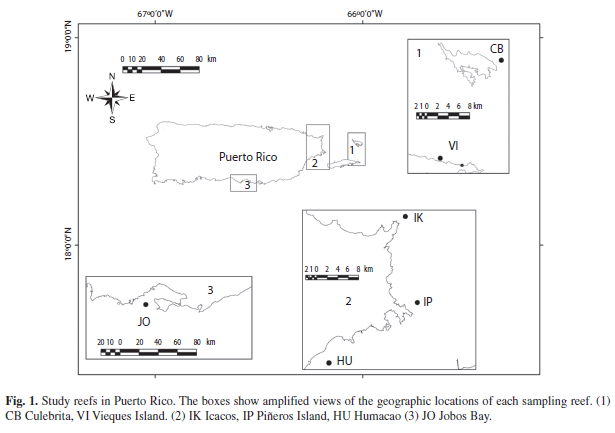
<body><![CDATA[<font style="font-weight: bold;" size="3"><span      style="font-family: verdana;">Materials and methods</span></font><br      style="font-family: verdana;">     <font size="2"></font><br style="font-family: verdana;">     <font size="2"><span style="font-family: verdana;"><span      style="font-weight: bold;">Study sites:</span> The study was carried     out at six reefs in Puerto Rico: Culebrita (CB), Vieques (VI), Humacao     (HU), Icacos (IK), Pi&ntilde;eros (IP) and Jobos (JO) (<a      href="/img/revistas/rbt/v60n2/a01i1.jpg">Fig. 1</a>) between     September 2006 and September 2007. The study sites can be classified as     ]]></body>
<body><![CDATA[low-relief, hard-ground reefs dominated by gorgonians following the     NOAA&#8217;s National Ocean Service benthic classification (Kendall <span      style="font-style: italic;">et al.     </span>2001). Most reefs had moderate water transparency, with the     exception     of JO which showed poor water quality with high sedimentation and low     transparency.</span></font><br style="font-family: verdana;">     <font size="2"></font><br style="font-family: verdana;">     <font size="2"><span style="font-family: verdana;"><span      style="font-weight: bold;">Sea fan monitoring:</span> Three transects     ]]></body>
<body><![CDATA[(10x1m) were haphazardly placed at each study site between 3-5m depth.     At each transect, every colony of <span style="font-style: italic;">G.     ventalina</span> was numbered with an     aluminum tag nailed near its base, photographed and its height measured     to the nearest cm. Transects were monitored at six months intervals.     The health status of each colony was recorded by examination of the     photographs. We defined healthy colonies as those with no lesions,     purple spots or overgrowth of fouling organisms. Diseased colonies were     defined as those with an active disease lesion as described for     aspergillosis: a necrotic area surrounded by a purple halo (Petes <span     ]]></body>
<body><![CDATA[ style="font-style: italic;">et     al. </span>2003). Colonies with purple spots were those with no     necrotic     tissue, and having few or numerous small purple spots. Fouled colonies     were those showing fouling organisms such as algae or fire corals     colonizing the blade. Predated colonies were those showing predation     marks by <span style="font-style: italic;">Cyphoma gibbossum</span>.     Colonies were also divided into three     height classes: small (&lt;20cm), m&eacute;dium (20-50cm), and large     (50-90cm). Differences in colony density and size (height) among reefs     ]]></body>
<body><![CDATA[were tested with a Kruskal Wallis nonparametric analysis (Sokal &amp;     Rohlf 1981). Differences in the frequency of health states of sea fans     among reefs and among size classes were tested using chi-square     analyses.</span></font><br style="font-family: verdana;">     <font size="2"></font><br style="font-family: verdana;">     <font size="2"><span style="font-family: verdana;"><span      style="font-weight: bold;">Incidence and prevalence of     disease:</span> Incidence indicates new cases of disease in previously     healthy     colonies, while prevalence indicates percent of diseased colonies at a     ]]></body>
<body><![CDATA[given sample. Incidence was calculated as the number of new cases of     disease after the first survey for each site (Stedman 2000). Prevalence     was calculated as percent of colonies with disease during each survey.     Chi square analyses were used to test differences in prevalence of     disease among sites and size classes. Changes in the prevalence over     time were tested using repeated measures ANOVA with the reefs as     independent factors. Prior to analysis, data were pooled by transects     and arcsine transformed. Given that purple spots were classified in     early literature as a symptom of aspergillosis (Nagelkerken <span      style="font-style: italic;">et al.</span>     ]]></body>
<body><![CDATA[1997, Jolles <span style="font-style: italic;">et al.</span> 2002,     Mullen <span style="font-style: italic;">et al.</span> 2006), we also     analyzed     prevalence of diseased colonies adding colonies with purple spots in     order to compare prevalence levels with the previous literature.</span></font><br      style="font-family: verdana;">     <font size="2"></font><br style="font-family: verdana;">     <font size="2"><span style="font-family: verdana;"><span      style="font-weight: bold;">Mortality of sea fans:</span> Mortality     was categorized as caused by: (1) disease when 100% of the colony area     ]]></body>
<body><![CDATA[appeared necrotic, (2) detachment, when the colony disappeared from its     known location, or (3) overgrowth when at least 90% of the colony area     was covered by algae, fire coral (<span style="font-style: italic;">Millepora</span>     spp.), or other fouling     organisms. Chi square analyses were used to test for differences in the     causes of mortality among sites and size classes.</span></font><br      style="font-family: verdana;">     <font size="2"></font><br style="font-family: verdana;">     <font style="font-weight: bold;" size="3"><span      style="font-family: verdana;">Results</span></font><br     ]]></body>
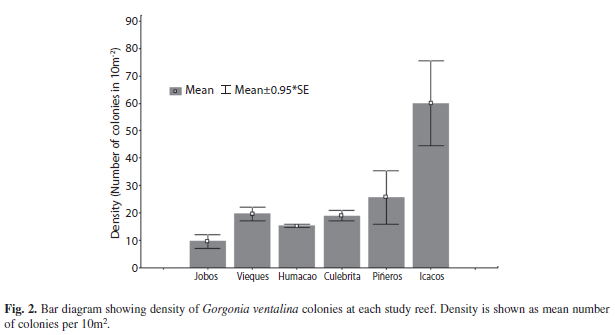
<body><![CDATA[ style="font-family: verdana;">     <font size="2"></font><br style="font-family: verdana;">     <font size="2"><span style="font-family: verdana;">A total of 448     colonies of <span style="font-style: italic;">G.     ventalina</span> were tagged in the studied reefs. Colony density     differed     among reefs (Kruskal-Wallis test, H=23.47, p=0.0003, <a      href="/img/revistas/rbt/v60n2/a01i2.jpg">Fig. 2</a>), with     Icacos (IK) showing the highest density (6 colonies m<sup>-2</sup>&plusmn;16.25     SE), while, Humacao (1.53 colonies m<sup>-2</sup>&plusmn;0.66 SE), and     ]]></body>
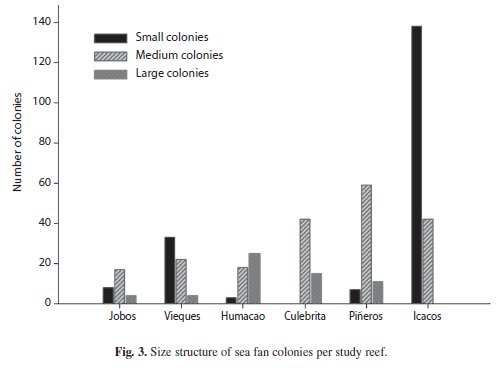
<body><![CDATA[Jobos (0.97     colonies m<sup>-2</sup>&plusmn;2.60 SE) the lowest. Median colony     height differed     significantly among reefs, (Kruskal-Wallis test, H=233.079,     p&lt;0.001), with Icacos being dominated by small colonies (&lt;20cm),     and Humacao and Culebrita by large ones (<a href="#Fig_3">Fig. 3</a>).     A posteriory test for     colony height showed Icacos as significantly different from the other     reefs, except Vieques; it also showed that Humacao and Culebrita     differed significantly from Icacos and Vieques.    ]]></body>
<body><![CDATA[<br>     <br> </span></font>     <div style="text-align: center;"><font size="2"><a name="Fig_3"></a><img      alt="" src="/img/revistas/rbt/v60n2/a01i3.jpg"      style="width: 502px; height: 371px;"><span      style="font-family: verdana;"></span></font><br      style="font-family: verdana;">     <font size="2"><span style="font-family: verdana;"></span></font></div>     <br style="font-family: verdana;">     <font size="2"><span style="font-family: verdana;"><span     ]]></body>
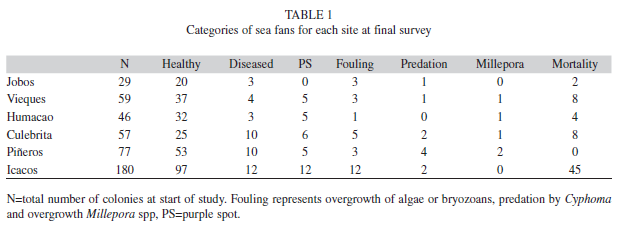
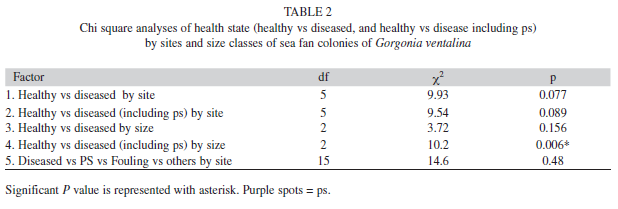
<body><![CDATA[ style="font-weight: bold;">Prevalence and Incidence of     disease:</span> Healthy sea fans were the most common state at all     reefs     (<a href="/img/revistas/rbt/v60n2/a01t1.gif">Table 1</a>).&nbsp;     Colonies with aspergillosis and purple spots were     observed at similar proportions (<a      href="/img/revistas/rbt/v60n2/a01t2.gif">Table 2</a>). Injuries caused     by predation     and overgrowth by <span style="font-style: italic;">Millepora</span>     were rarely observed. No significant     ]]></body>
<body><![CDATA[differences were found between diseased and the other lesion categories     among sites (<a href="/img/revistas/rbt/v60n2/a01t2.gif">Table 2</a>).     Disease prevalence (strict definition) varied     between 0%-32%. However, this variability was not significantly     different (repeated measure ANOVA, prevalence by reef: df=5, F=0.90,     p=0.51; by time: df=2, F=1.39, p=0.26; interaction time-reef: df=10,     F=1.26, p=0.30). The same tendency was observed among size clases     (&#967;<sup>2</sup>=3.72, df=2, p=0.15). If colonies with purple spots are     pooled with     diseased colonies, prevalence increases from 3.45%-32.7% (<a     ]]></body>
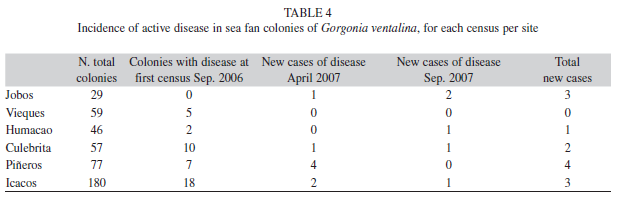
<body><![CDATA[ href="/img/revistas/rbt/v60n2/a01t3.gif">Table 3</a>).     Although, this difference in prevalence was not significant among     sites, it was significant among size classes (<a      href="/img/revistas/rbt/v60n2/a01t2.gif">Table 2</a>). The incidence     of lesions characterized as aspergillosis was very low, with only eight     new cases between the first and second census, and five between the     second and third census (<a href="/img/revistas/rbt/v60n2/a01t4.gif">Table     4</a>).</span></font><br style="font-family: verdana;">     <font size="2"></font><br style="font-family: verdana;">     <font size="2"><span style="font-family: verdana;"><span     ]]></body>
<body><![CDATA[ style="font-weight: bold;">Mortality:</span> 74 of 448 colonies     (16.5%) died during the study period.&nbsp; Probability of death varied     among reefs (&#967;<sup>2</sup>=39.8, df=5, p&lt;0.001) and&nbsp; among size     classes     (&#967;<sup>2</sup>=22.1, df=2, p&lt;0.001). Icacos experienced the highest     mortality     (29%) and Pi&ntilde;eros the least (0%). Small fans experienced     proportionally higher mortality than the medium and large colonies. The     main cause of mortality at all reefs was detachment, followed by     disease lesions and overgrowth (<a     ]]></body>
<body><![CDATA[ href="/img/revistas/rbt/v60n2/a01t5.gif">Table 5</a>). The proportion     of detachment     varied significantly among reefs (&#967;<sup>2</sup>=35.4, df=5,     p&lt;0.001). Icacos     experienced twice the expected number of detached colonies, while Jobos     and Humacao showed the least. Significant differences were also found     in the proportion of detached colonies among sizes (&#967;<sup>2</sup>=12.5,     df=2,     p=0.002). Small colonies detached proportionally more. Probability of     detachment did not vary with the health state of the colony (&#967;<sup>2</sup>=3.56,     ]]></body>
<body><![CDATA[df=3, p=0.31).</span></font><br style="font-family: verdana;">     <font size="2"></font><br style="font-family: verdana;">     <font style="font-weight: bold;" size="3"><span      style="font-family: verdana;">Discussion</span></font><br      style="font-family: verdana;">     <font size="2"></font><br style="font-family: verdana;">     <font size="2"><span style="font-family: verdana;"><span      style="font-weight: bold;">Incidence and prevalence of     aspergillosis:</span> Measuring incidence and prevalence are important     to     ]]></body>
<body><![CDATA[understand disease dynamics. Nevertheless, prevalence is more widely     used than incidence to assess the temporal dynamics in coral diseases.     Incidence requires tagging individual colonies and following them     through time to notice changes in health state. Therefore, incidence     helps to establish infection rate and pathogen spatial     dispersi&oacute;n through a host population. Prevalence data is also     used to infer pathogen-host dynamics. However, the conclusions based     only on prevalence should be carefully construed to avoid     misinterpretation, especially for diseases with low virulence, because     diseased individuals are likely to remain in a population for a long     ]]></body>
<body><![CDATA[time. Thus, prevalence may increase with time even with a low constant     incidence. </span></font><br style="font-family: verdana;">     <font size="2"></font><br style="font-family: verdana;">     <font size="2"><span style="font-family: verdana;">In our case,     incidence of     aspergillosis was very low among sites and through time. Thereby, we     can infer that infection rate of aspergillosis was very low and no     epizootic was occurring in these reefs. The low prevalence observed     supports this inference. Prevalence was similar over time at each reef,     with no spatial or temporal variation. In fact, there is a general     ]]></body>
<body><![CDATA[perception that prevalence has decreased since 1994 (Kim &amp; Harvell     2004, Bruno <span style="font-style: italic;">et al.</span> 2011). In     the Caribbean, reports suggest     geographical variability in the prevalence of aspergillosis. Prevalence     of 8.4-22% has been reported for the Florida Keys (Kim &amp; Harvell     2004), and in Venezuela and Bermuda of 10% 12.5% (Weil 2004). However,     higher prevalences have been reported in Curacao with 52% (Nugues &amp;     Nagelkerken 2006), the Florida Keys with 42-58% (Jolles<span      style="font-style: italic;"> et al.</span> 2002,     Kim <span style="font-style: italic;">et al.</span> 2006), and Yucatan     ]]></body>
<body><![CDATA[with 30-50% (Mullen <span style="font-style: italic;">et al.</span>     2006). It is     possible that part of the variation among these studies is explained by     differences in the definition of disease. Tumors, purple spots and     colonized tissue can be included within the definition (Petes <span      style="font-style: italic;">et al.     </span>2003, Nagelkerken <span style="font-style: italic;">et al.</span>     1997) and sometimes what is considered as     diseased colony is not defined. When we pooled colonies with purple     spots with diseased ones, prevalence increased dramatically for most of     ]]></body>
<body><![CDATA[our sites and values were similar to those reported in the studies with     high prevalence levels. Thus, a precise definition of the type of     lesions is very important to avoid misinterpretation of the results     (Work <span style="font-style: italic;">et al. </span>2008). </span></font><br      style="font-family: verdana;">     <font size="2"></font><br style="font-family: verdana;">     <font size="2"><span style="font-family: verdana;">Anthropogenic     stressors such as     elevated temperatures, high sedimentation rates, or low water quality     can compromise the immune response of sea fan colonies and make them     ]]></body>
<body><![CDATA[more susceptible to pathogens or invasive organisms (Bruno <span      style="font-style: italic;">et al.</span> 2003,     Ward <span style="font-style: italic;">et al.</span> 2007). Given that     these factors can exhibit local     differences, they may affect infection rate and virulence which may     result in spatial variation in disease incidence or prevalence (Kim     &amp; Harvell 2004, Mullen <span style="font-style: italic;">et al.</span>     2006, Nugues &amp; Nagelkerken 2007,     Ward <span style="font-style: italic;">et al.</span> 2007). In Eastern     Puerto Rico, low prevalence and incidence     ]]></body>
<body><![CDATA[of disease was expected to follow the regional reduction of disease.     The lack of temporal and spatial variability found in this study is in     agreement with the previous studies. Although the causality of this     tendency is more difficult to test, others attribute it to an increase     in the immune response of sea fans toward pathogens, or virulence     reduction of pathogen(s) as a result of natural selection favoring     resistant genotypes after the epizootics that have impacted the     Caribbean (Bruno <span style="font-style: italic;">et al.</span>     2011). However, temporal and spatial     variability was found in Western Puerto Rico (La Parguera, Flynn &amp;     ]]></body>
<body><![CDATA[Weil 2009). They explained this variability as resulting from changes     in temperature or susceptibility of sea fans to anthropogenic     influences due to reduction of water quality. In our case, Culebrita (a     site with good w&aacute;ter quality) showed the highest prevalence.     Jobos and Pi&ntilde;eros, located near-shore and with high     sedimentation and poor water quality, did not show high prevalence     contrary to expectation. These results suggest that local factors such     as composition of the fungal community (Zuluaga <span      style="font-style: italic;">et al.</span> 2010) maybe more     important than anthropogenic stressors in determining disease     ]]></body>
<body><![CDATA[prevalence.</span></font><br style="font-family: verdana;">     <font size="2"></font><br style="font-family: verdana;">     <font size="2"><span style="font-family: verdana;"><span      style="font-weight: bold;">Effect of density and size     structure of sea fans on disease:</span> There are several studies that     suggest disease prevalence is density dependent, because neighboring     colonies can be more susceptible to infection (Nagelkerken <span      style="font-style: italic;">et al.</span> 1997,     Jolles <span style="font-style: italic;">et al.</span> 2002). However,     our results do not support the conclusion     ]]></body>
<body><![CDATA[that horizontal transmission of sea fan disease is density dependent.     For example, reefs with high density such as Icacos and Pi&ntilde;eros     showed disease prevalence that was below sites with low density such as     Culebrita. Diseased colonies in transects were haphazardly distributed     and no pattern was evident.</span></font><br      style="font-family: verdana;">     <font size="2"></font><br style="font-family: verdana;">     <font size="2"><span style="font-family: verdana;">The observed spatial     variability in     sea fan abundance and size structure can be explained by the     ]]></body>
<body><![CDATA[refuge-size hypothesis (Yoshioka 1994). In our study, dominance of a     particular size category was evident at each site. According to the     hypothesis, there is a direct relationship between colony size and     survivorship. Thus, relatively abundant size classes may reflect local     size refuges. For instance, we can explain the lack of small colonies     in Culebrita, Pi&ntilde;eros and Humacao reefs as resulting from a     recruitment bottleneck and the lack of large ones at Vieques and Icacos     reefs suggests either high mortality of large colonies or blade     fragmentation. On the other hand, at Humacao the relatively high     abundance of large colonies and lack of small ones suggests high     ]]></body>
<body><![CDATA[survivorship of large ones, but low recruitment. In this case, it is     possible that the higher depth of this reef (8m) explains this result,     because smothering is more likely to occur in deeper sites, because     there is less energy (Yoshioka 1994).</span></font><br      style="font-family: verdana;">     <font size="2"></font><br style="font-family: verdana;">     <font size="2"><span style="font-family: verdana;">Our results also     suggest that     spatial differences in size structure and density may be related to     abiotic factors at the reef scale. Such as, although good water quality     ]]></body>
<body><![CDATA[was observed in most of our reefs, Jobos, the site with the lowest sea     fan density, showed high turbidity and sedimentation. This can be     explained, because sedimentation reduces density of sea fans by     smothering, especially in small colonies (Yoshioka 1996). On the other     hand, high energy wave action may maintain hard substrates free of     sediments and promote recruitment by detaching other sessile organisms     that compete with sea fans for space (Kojis &amp; Quinn 2001).</span></font><br      style="font-family: verdana;">     <font size="2"></font><br style="font-family: verdana;">     <font size="2"><span style="font-family: verdana;"><span     ]]></body>
<body><![CDATA[ style="font-weight: bold;">Mortality in sea fans:</span> Detachment     was the main cause of mortality in sea fans in the studied reefs. Death     of colonies by disease or injuries was rare. This is consistent with     the low prevalence of disease found in the study sites. Detachment is     considered one of the main causes of mortality in most species of     gorgonians (Birkeland 1974, Yoshioka &amp; Yoshioka 1991,     Toledo-Hern&aacute;ndez <span style="font-style: italic;">et al.</span>     2009), and wave action is considered as     the principal cause of detachment (Yoshioka &amp; Yoshioka 1989). It     also tends to be restricted to shallow water and exposed zones (Whale     ]]></body>
<body><![CDATA[1985). Three of our reefs showed low mortality by detachment     (Pi&ntilde;eros 0%, Jobos 6.9%, and Humacao 8.7%). Pi&ntilde;eros is a     hard ground protected from wave action, and therefore, colonies will     suffer less detachment. Jobos was an interesting reef because some of     the sea fans were attached to loose stones that may roll over when     exposed to high currents or wave action - we observed living colonies     moved from their initial location with signs of abrasion. Colonies     located in deeper waters (&gt;6m) will be less impacted by wave action,     reducing the chance of detachment as observed in Humacao reef.</span></font><br      style="font-family: verdana;">     ]]></body>
<body><![CDATA[<font size="2"></font><br style="font-family: verdana;">     <font size="2"><span style="font-family: verdana;">Health status did     not affect the     probability of detachment, but colony size did: small colonies were     more susceptible. This result is consistent with     Toledo-Hern&aacute;ndez <span style="font-style: italic;">et al.</span>     (2009), who found high mortality in     small sea fans especially healthy ones by detachment. Large colonies     were less affected by detachment contrary to expectation. They should     be more likely to detach due to increase in the drag-force resistance     ]]></body>
<body><![CDATA[that should be directly proportional to size (Lasker <span      style="font-style: italic;">et al.</span> 2003). In     our study, the lower probability of detachment observed in large     colonies could be explained by size refuge hypothesis. Sites with less     energy (currents, waves), may promote growth to a large size; while     sites with high energy will promote growth to a relatively smaller     size. In general, sea fans are adapted to withstand high energy due to     wave action or currents and they are mainly observed in the crest of     the reefs. Another explanation, might be small scale variability in     reef quality related to protection from high energy. In a reef with     ]]></body>
<body><![CDATA[&#8220;good and bad&#8221; spots, in terms of the protection they offer from wave     action, the good spots (with high protection) are more likely to be     occupied by large colonies than by smaller ones, because of the higher     survivorship. We would also expect more turn-over in the bad spots, and     thus they would tend to be occupied by small ones as is the case in the     Icacos reef.</span></font><br style="font-family: verdana;">     <font size="2"></font><br style="font-family: verdana;">     <font size="2"><span style="font-family: verdana;">In conclusion, sea     fans populations     from Eastern Puerto Rico are not currently affected by an epizootic. It     ]]></body>
<body><![CDATA[is not known why incidence and prevalence of aspergillosis has     declined, but this seems to be a regional tendency. Detachment was the     main source of mortality at all reefs, in particular small colonies,     contrary to expectation. Wave energy was likely the main cause of     detachment given that most of our sites were shallow areas exposed to     strong wave energy. Size structure and density could be a response to     local physical conditions that allow sea fans to reach a safe colony     size. A clear and specific description of disease features will avoid     confusion and facilitate comparisons between studies.</span></font><br      style="font-family: verdana;">     ]]></body>
<body><![CDATA[<font size="2"></font><br style="font-family: verdana;">     <font style="font-weight: bold;" size="3"><span      style="font-family: verdana;">Acknowledgments</span></font><br      style="font-family: verdana;">     <font size="2"></font><br style="font-family: verdana;">     <font size="2"><span style="font-family: verdana;">This study was     supported by grants     from UPR Sea Grant (NOAA award NA16RG2278, project R-92-1-04 and NOAA     award NA16RG2278, project R-R-92-2-08), NOAA-CRES program, NIH-SCORE     Grant #S06GM08102, and NSF-CREST. Anabella Zuluaga-Montero thanks the     ]]></body>
<body><![CDATA[International Society for Reef Studies (ISRS) for an ISRS/TOC Coral     Reef Conservation Award (2006) and PBDT fellowship (2007) from the Dean     of Graduate Studies and Research, University of Puerto Rico, R&iacute;o     Piedras Campus. We are grateful to Carlos Toledo-Hern&aacute;ndez,     Patricia Rinc&oacute;n-D&iacute;az and Adriana Herrera-Montes for     assistance in the field, and to Carlos Zambrana for help with the map.     Special thanks to Angel Dieppa and Don Claudio for help collecting and     monitoring of sea fans in Jobos Bay National Estuarine Research Reserve     (JOBANER). Comments from Juan Luis Torres and Paul Bayman greatly     improved this manuscript.</span></font><br style="font-family: verdana;">     ]]></body>
<body><![CDATA[<font size="2"></font><br style="font-family: verdana;">     <font size="2"><span style="font-family: verdana;"></span></font>     <hr style="width: 100%; height: 2px;"><font style="font-weight: bold;"      size="3"><span style="font-family: verdana;">References</span></font><br      style="font-family: verdana; font-weight: bold;">     <font style="font-weight: bold;" size="2"></font><br      style="font-family: verdana;">     <font size="2"><span style="font-family: verdana;">Birkeland, C. 1974.     The effect of     wave action on the population dynamics of <span     ]]></body>
<body><![CDATA[ style="font-style: italic;">Gorgonia ventalina</span>     <!-- ref -->(Linnaeus). Stud. Trop. Oceanogr. 12: 115-126.    &nbsp;&nbsp;&nbsp;&nbsp;&nbsp;&nbsp;&nbsp;&nbsp;[&#160;<a href="javascript:void(0);" onclick="javascript: window.open('/scielo.php?script=sci_nlinks&ref=1477059&pid=S0034-7744201200020000100001&lng=','','width=640,height=500,resizable=yes,scrollbars=1,menubar=yes,');">Links</a>&#160;]<!-- end-ref --><!-- ref --></span></font><br  style="font-family: verdana;"> <font size="2"></font><br style="font-family: verdana;"> <font size="2"><span style="font-family: verdana;">Bruno, J.F., L.E. Petes, C.D. Harvell &amp; A. Hettinger. 2003. Nutrient enrichment can increase the severity of coral diseases. Ecol. Lett. 6: 1056-1061.    &nbsp;&nbsp;&nbsp;&nbsp;&nbsp;&nbsp;&nbsp;&nbsp;[&#160;<a href="javascript:void(0);" onclick="javascript: window.open('/scielo.php?script=sci_nlinks&ref=1477060&pid=S0034-7744201200020000100002&lng=','','width=640,height=500,resizable=yes,scrollbars=1,menubar=yes,');">Links</a>&#160;]<!-- end-ref --><!-- ref --></span></font><br  style="font-family: verdana;"> <font size="2"></font><br style="font-family: verdana;"> <font size="2"><span style="font-family: verdana;">Bruno, J.F., S.P. Ellner, I. Vu, K. Kim &amp; C.D. Harvell. 2011. Impacts of aspergillosis on sea fan coral demography: modeling a moving target. Ecol. Monogr. 1: 123-139.    &nbsp;&nbsp;&nbsp;&nbsp;&nbsp;&nbsp;&nbsp;&nbsp;[&#160;<a href="javascript:void(0);" onclick="javascript: window.open('/scielo.php?script=sci_nlinks&ref=1477061&pid=S0034-7744201200020000100003&lng=','','width=640,height=500,resizable=yes,scrollbars=1,menubar=yes,');">Links</a>&#160;]<!-- end-ref --><!-- ref --></span></font><br  style="font-family: verdana;"> <font size="2"></font><br style="font-family: verdana;"> <font size="2"><span style="font-family: verdana;">Flynn, K. &amp; E. Weil. 2009. Variability of aspergillosis in <span style="font-style: italic;">Gorgonia ventalina</span> in La Parguera, Puerto Rico. Carib. J. Sci. 2-3: 215-220.    &nbsp;&nbsp;&nbsp;&nbsp;&nbsp;&nbsp;&nbsp;&nbsp;[&#160;<a href="javascript:void(0);" onclick="javascript: window.open('/scielo.php?script=sci_nlinks&ref=1477062&pid=S0034-7744201200020000100004&lng=','','width=640,height=500,resizable=yes,scrollbars=1,menubar=yes,');">Links</a>&#160;]<!-- end-ref --><!-- ref --></span></font><br  style="font-family: verdana;"> <font size="2"></font><br style="font-family: verdana;"> <font size="2"><span style="font-family: verdana;">Garz&oacute;n-Ferreira, J. &amp; S. Zea. 1992. A mass mortality of <span style="font-style: italic;">Gorgonia ventalina</span> (Cnidaria: Gorgonidae) in the Santa Marta area, Caribbean coast of Colombia. Bull. Mar. Sci. 50: 522-526.    &nbsp;&nbsp;&nbsp;&nbsp;&nbsp;&nbsp;&nbsp;&nbsp;[&#160;<a href="javascript:void(0);" onclick="javascript: window.open('/scielo.php?script=sci_nlinks&ref=1477063&pid=S0034-7744201200020000100005&lng=','','width=640,height=500,resizable=yes,scrollbars=1,menubar=yes,');">Links</a>&#160;]<!-- end-ref --><!-- ref --></span></font><br style="font-family: verdana;"> <font size="2"></font><br style="font-family: verdana;"> <font size="2"><span style="font-family: verdana;">Guzm&aacute;n, H.M. &amp; J. Cort&eacute;s. 1984. Mortandad de <span style="font-style: italic;">Gorgonia flabellum</span> Linnaeus (Octocorallia: Gorgoniidae) en la costa Caribe de Costa Rica. Rev. Biol. Trop. 32: 305-308.    &nbsp;&nbsp;&nbsp;&nbsp;&nbsp;&nbsp;&nbsp;&nbsp;[&#160;<a href="javascript:void(0);" onclick="javascript: window.open('/scielo.php?script=sci_nlinks&ref=1477064&pid=S0034-7744201200020000100006&lng=','','width=640,height=500,resizable=yes,scrollbars=1,menubar=yes,');">Links</a>&#160;]<!-- end-ref --><!-- ref --></span></font><br style="font-family: verdana;"> <font size="2"></font><br style="font-family: verdana;"> <font size="2"><span style="font-family: verdana;">Jolles, A., P. Sullivan, A.P. Alker, C.D. Harvell. 2002. Disease transmission of aspergillosis in sea fans: inferring process from spatial pattern. Ecology 83: 2373-2378.    &nbsp;&nbsp;&nbsp;&nbsp;&nbsp;&nbsp;&nbsp;&nbsp;[&#160;<a href="javascript:void(0);" onclick="javascript: window.open('/scielo.php?script=sci_nlinks&ref=1477065&pid=S0034-7744201200020000100007&lng=','','width=640,height=500,resizable=yes,scrollbars=1,menubar=yes,');">Links</a>&#160;]<!-- end-ref --><!-- ref --></span></font><br  style="font-family: verdana;"> <font size="2"></font><br style="font-family: verdana;"> <font size="2"><span style="font-family: verdana;">Kendall, M.S., M.E. Monaco, K.R. Buja, J.D. Christensen, C.R. Kruer, M. Finkbeiner &amp; R.A. Warner. 2001.&nbsp; Methods used to map the benthic habitats of Puerto Rico and the U.S. Virgin Islands. Oceanic and Atmospheric Administration, Washington DC, USA. (Downloaded: May 2005, <a  href="http://biogeo.nos.noaa.gov/%20projects/mapping/caribbean/startup.htm">http://biogeo.nos.noaa.gov/ projects/mapping/caribbean/startup.htm</a>).    &nbsp;&nbsp;&nbsp;&nbsp;&nbsp;&nbsp;&nbsp;&nbsp;[&#160;<a href="javascript:void(0);" onclick="javascript: window.open('/scielo.php?script=sci_nlinks&ref=1477066&pid=S0034-7744201200020000100008&lng=','','width=640,height=500,resizable=yes,scrollbars=1,menubar=yes,');">Links</a>&#160;]<!-- end-ref --><!-- ref --></span></font><br  style="font-family: verdana;"> <font size="2"></font><br style="font-family: verdana;"> <font size="2"><span style="font-family: verdana;">Kim, K. &amp; C.D. Harvell. 2004. The rise and fall of a sixyear coral-fungal epizootic. Am. Nat. 164: S52-S63.    &nbsp;&nbsp;&nbsp;&nbsp;&nbsp;&nbsp;&nbsp;&nbsp;[&#160;<a href="javascript:void(0);" onclick="javascript: window.open('/scielo.php?script=sci_nlinks&ref=1477067&pid=S0034-7744201200020000100009&lng=','','width=640,height=500,resizable=yes,scrollbars=1,menubar=yes,');">Links</a>&#160;]<!-- end-ref --><!-- ref --></span></font><br style="font-family: verdana;"> <font size="2"></font><br style="font-family: verdana;"> <font size="2"><span style="font-family: verdana;">Kim, K., A. Alker, K. Shuster, C. Quirolo &amp; C.D. Harvell. 2006. Longitudinal study of aspergillosis in sea fan corals. Dis. Aquat. Org. 69: 95-99.    &nbsp;&nbsp;&nbsp;&nbsp;&nbsp;&nbsp;&nbsp;&nbsp;[&#160;<a href="javascript:void(0);" onclick="javascript: window.open('/scielo.php?script=sci_nlinks&ref=1477068&pid=S0034-7744201200020000100010&lng=','','width=640,height=500,resizable=yes,scrollbars=1,menubar=yes,');">Links</a>&#160;]<!-- end-ref --><!-- ref --></span></font><br  style="font-family: verdana;"> <font size="2"></font><br style="font-family: verdana;"> <font size="2"><span style="font-family: verdana;">Kojis, B.L. &amp; N.J. Quinn. 2001. The importance of regional differences in hard coral recruitment rates for determining the need for coral restoration. Bull. Mar. Sci. 69: 967-974.    &nbsp;&nbsp;&nbsp;&nbsp;&nbsp;&nbsp;&nbsp;&nbsp;[&#160;<a href="javascript:void(0);" onclick="javascript: window.open('/scielo.php?script=sci_nlinks&ref=1477069&pid=S0034-7744201200020000100011&lng=','','width=640,height=500,resizable=yes,scrollbars=1,menubar=yes,');">Links</a>&#160;]<!-- end-ref --><!-- ref --></span></font><br style="font-family: verdana;"> <font size="2"></font><br style="font-family: verdana;"> <font size="2"><span style="font-family: verdana;">Lasker, H.R., M. Boller, J. Castanaro &amp; J.A. S&aacute;nchez. 2003. Determinate growth and modularity in a gorgonian coral. Biol. Bull. 205: 319-330.    &nbsp;&nbsp;&nbsp;&nbsp;&nbsp;&nbsp;&nbsp;&nbsp;[&#160;<a href="javascript:void(0);" onclick="javascript: window.open('/scielo.php?script=sci_nlinks&ref=1477070&pid=S0034-7744201200020000100012&lng=','','width=640,height=500,resizable=yes,scrollbars=1,menubar=yes,');">Links</a>&#160;]<!-- end-ref --><!-- ref --></span></font><br  style="font-family: verdana;"> <font size="2"></font><br style="font-family: verdana;"> <font size="2"><span style="font-family: verdana;">Morse, D.E., A. Morse, H. Duncan &amp; R.K. Trench. 1981. Algal tumors in the Caribbean octocorallian,<span  style="font-style: italic;"> Gorgonia ventalina</span> II. Biochemical characterization of the algae, and first epidemiological observations. Bull. Mar. Sci. 31: 399-409.    &nbsp;&nbsp;&nbsp;&nbsp;&nbsp;&nbsp;&nbsp;&nbsp;[&#160;<a href="javascript:void(0);" onclick="javascript: window.open('/scielo.php?script=sci_nlinks&ref=1477071&pid=S0034-7744201200020000100013&lng=','','width=640,height=500,resizable=yes,scrollbars=1,menubar=yes,');">Links</a>&#160;]<!-- end-ref --><!-- ref --></span></font><br  style="font-family: verdana;"> <font size="2"></font><br style="font-family: verdana;"> <font size="2"><span style="font-family: verdana;">Mullen, K.M., C.D Harvell, A.P Alker, D. Dube, E. Jord&aacute;n- Dahlgren, J.R. Ward &amp; L.E. Petes. 2006. Host range and antifungal resistance to aspergillosis in three sea fan species from the Yucatan. Mar. Biol. 149: 1355-1364.    &nbsp;&nbsp;&nbsp;&nbsp;&nbsp;&nbsp;&nbsp;&nbsp;[&#160;<a href="javascript:void(0);" onclick="javascript: window.open('/scielo.php?script=sci_nlinks&ref=1477072&pid=S0034-7744201200020000100014&lng=','','width=640,height=500,resizable=yes,scrollbars=1,menubar=yes,');">Links</a>&#160;]<!-- end-ref --><!-- ref --></span></font><br  style="font-family: verdana;"> <font size="2"></font><br style="font-family: verdana;"> <font size="2"><span style="font-family: verdana;">Nagelkerken, I., K. Buchan, G.W. Smith, K. Bonair, P. Bush, J. Garz&oacute;n Ferreira, L. Botero, P. Gayle, C.D. Harvell, C. Heberer, K. Kim, C. Petrovic, L. Pors &amp; P. Yoshioka. 1997. Widespread disease in Caribbean sea fans: II. Patterns of infection and tissue loss. Mar. Ecol. Prog. Ser. 160: 255-263.    &nbsp;&nbsp;&nbsp;&nbsp;&nbsp;&nbsp;&nbsp;&nbsp;[&#160;<a href="javascript:void(0);" onclick="javascript: window.open('/scielo.php?script=sci_nlinks&ref=1477073&pid=S0034-7744201200020000100015&lng=','','width=640,height=500,resizable=yes,scrollbars=1,menubar=yes,');">Links</a>&#160;]<!-- end-ref --><!-- ref --></span></font><br  style="font-family: verdana;"> <font size="2"></font><br style="font-family: verdana;"> <font size="2"><span style="font-family: verdana;">Nugues, M.M. &amp; I. Nagelkerken. 2006. Status of aspergillosis and sea fan populations in Cura&ccedil;ao ten years after the 1995 Caribbean epizootic. Rev. Biol. Trop. 54: 153-160.    &nbsp;&nbsp;&nbsp;&nbsp;&nbsp;&nbsp;&nbsp;&nbsp;[&#160;<a href="javascript:void(0);" onclick="javascript: window.open('/scielo.php?script=sci_nlinks&ref=1477074&pid=S0034-7744201200020000100016&lng=','','width=640,height=500,resizable=yes,scrollbars=1,menubar=yes,');">Links</a>&#160;]<!-- end-ref --><!-- ref --></span></font><br style="font-family: verdana;"> <font size="2"></font><br style="font-family: verdana;"> <font size="2"><span style="font-family: verdana;">Petes, L., C.D. Harvell, E.C. Peters, M.A.H. Webb &amp; K.M. Mullen. 2003. Pathogens compromise reproduction and induce melanization in Caribbean sea fans. Mar. Ecol. Prog. Ser. 264: 167-171.    &nbsp;&nbsp;&nbsp;&nbsp;&nbsp;&nbsp;&nbsp;&nbsp;[&#160;<a href="javascript:void(0);" onclick="javascript: window.open('/scielo.php?script=sci_nlinks&ref=1477075&pid=S0034-7744201200020000100017&lng=','','width=640,height=500,resizable=yes,scrollbars=1,menubar=yes,');">Links</a>&#160;]<!-- end-ref --><!-- ref --></span></font><br style="font-family: verdana;"> <font size="2"></font><br style="font-family: verdana;"> <font size="2"><span style="font-family: verdana;">Smith, G.W., L.D. Ives, I.A. Nagelkerken &amp; K.B. Ritchie. 1996. Caribbean sea fan mortalities. Nature 383: 487.    &nbsp;&nbsp;&nbsp;&nbsp;&nbsp;&nbsp;&nbsp;&nbsp;[&#160;<a href="javascript:void(0);" onclick="javascript: window.open('/scielo.php?script=sci_nlinks&ref=1477076&pid=S0034-7744201200020000100018&lng=','','width=640,height=500,resizable=yes,scrollbars=1,menubar=yes,');">Links</a>&#160;]<!-- end-ref --><!-- ref --></span></font><br style="font-family: verdana;"> <font size="2"></font><br style="font-family: verdana;"> <font size="2"><span style="font-family: verdana;">Sokal, R.R. &amp; F.J. Rholf. 1981. Biometry: The principles and practice of statistics in biological research. Freeman, New York, New York, USA.    &nbsp;&nbsp;&nbsp;&nbsp;&nbsp;&nbsp;&nbsp;&nbsp;[&#160;<a href="javascript:void(0);" onclick="javascript: window.open('/scielo.php?script=sci_nlinks&ref=1477077&pid=S0034-7744201200020000100019&lng=','','width=640,height=500,resizable=yes,scrollbars=1,menubar=yes,');">Links</a>&#160;]<!-- end-ref --><!-- ref --></span></font><br  style="font-family: verdana;"> <font size="2"></font><br style="font-family: verdana;"> <font size="2"><span style="font-family: verdana;">Stedman, T.L. 2000. Stedman&#8217;s medical dictionary. Lippincott Williams &amp; Wilkins, Philadelphia, USA.    &nbsp;&nbsp;&nbsp;&nbsp;&nbsp;&nbsp;&nbsp;&nbsp;[&#160;<a href="javascript:void(0);" onclick="javascript: window.open('/scielo.php?script=sci_nlinks&ref=1477078&pid=S0034-7744201200020000100020&lng=','','width=640,height=500,resizable=yes,scrollbars=1,menubar=yes,');">Links</a>&#160;]<!-- end-ref --><!-- ref --></span></font><br style="font-family: verdana;"> <font size="2"></font><br style="font-family: verdana;"> <font size="2"><span style="font-family: verdana;">Toledo-Hern&aacute;ndez, C., A. Sabat &amp; A. Zuluaga-Montero. 2007. Density, size structure and aspergillosis prevalence in <span style="font-style: italic;">Gorgonia ventalina</span> at six localities in Puerto Rico. Mar. Biol. 152: 527-535.    &nbsp;&nbsp;&nbsp;&nbsp;&nbsp;&nbsp;&nbsp;&nbsp;[&#160;<a href="javascript:void(0);" onclick="javascript: window.open('/scielo.php?script=sci_nlinks&ref=1477079&pid=S0034-7744201200020000100021&lng=','','width=640,height=500,resizable=yes,scrollbars=1,menubar=yes,');">Links</a>&#160;]<!-- end-ref --><!-- ref --></span></font><br  style="font-family: verdana;"> <font size="2"></font><br style="font-family: verdana;"> <font size="2"><span style="font-family: verdana;">Toledo-Hern&aacute;ndez, C., A. Zuluaga-Montero, A. Bones- Gonz&aacute;lez, A.M. Sabat &amp; P. Bayman 2008. Fungi in healthy and diseased sea fans (<span  style="font-style: italic;">Gorgonia ventalina</span>): is <span style="font-style: italic;">Aspergillus sydowii</span> always the pathogen? Coral Reef 27: 707-714.    &nbsp;&nbsp;&nbsp;&nbsp;&nbsp;&nbsp;&nbsp;&nbsp;[&#160;<a href="javascript:void(0);" onclick="javascript: window.open('/scielo.php?script=sci_nlinks&ref=1477080&pid=S0034-7744201200020000100022&lng=','','width=640,height=500,resizable=yes,scrollbars=1,menubar=yes,');">Links</a>&#160;]<!-- end-ref --><!-- ref --></span></font><br  style="font-family: verdana;"> <font size="2"></font><br style="font-family: verdana;"> <font size="2"><span style="font-family: verdana;">Toledo-Hern&aacute;ndez, C., P. Yoshioka, P. Bayman &amp; A.M. Sabat. 2009. Impact of disease and detachment on growth and survivorship of sea fans <span  style="font-style: italic;">Gorgonia ventalina</span>. Mar. Ecol. Prog. Ser. 393: 47-54.    &nbsp;&nbsp;&nbsp;&nbsp;&nbsp;&nbsp;&nbsp;&nbsp;[&#160;<a href="javascript:void(0);" onclick="javascript: window.open('/scielo.php?script=sci_nlinks&ref=1477081&pid=S0034-7744201200020000100023&lng=','','width=640,height=500,resizable=yes,scrollbars=1,menubar=yes,');">Links</a>&#160;]<!-- end-ref --><!-- ref --></span></font><br  style="font-family: verdana;"> <font size="2"></font><br style="font-family: verdana;"> <font size="2"><span style="font-family: verdana;">Ward, J., K. Kim &amp; C.D. Harvell. 2007. Temperature affects coral disease resistance and pathogen growth. Mar. Ecol. Prog. Ser. 329: 115-121.    &nbsp;&nbsp;&nbsp;&nbsp;&nbsp;&nbsp;&nbsp;&nbsp;[&#160;<a href="javascript:void(0);" onclick="javascript: window.open('/scielo.php?script=sci_nlinks&ref=1477082&pid=S0034-7744201200020000100024&lng=','','width=640,height=500,resizable=yes,scrollbars=1,menubar=yes,');">Links</a>&#160;]<!-- end-ref --><!-- ref --></span></font><br  style="font-family: verdana;"> <font size="2"></font><br style="font-family: verdana;"> <font size="2"><span style="font-family: verdana;">Weil, E. 2004. Coral reef diseases in the Wider Caribbean, p. 35-68.<span style="font-style: italic;"> In</span> E. Rosenberg &amp; Y. Loya (eds.). Coral health and Disease. Springer, New York, USA.    &nbsp;&nbsp;&nbsp;&nbsp;&nbsp;&nbsp;&nbsp;&nbsp;[&#160;<a href="javascript:void(0);" onclick="javascript: window.open('/scielo.php?script=sci_nlinks&ref=1477083&pid=S0034-7744201200020000100025&lng=','','width=640,height=500,resizable=yes,scrollbars=1,menubar=yes,');">Links</a>&#160;]<!-- end-ref --><!-- ref --></span></font><br  style="font-family: verdana;"> <font size="2"></font><br style="font-family: verdana;"> <font size="2"><span style="font-family: verdana;">Whale, C.M. 1985. Habitat-related patterns of injury and mortality among Jamaican gorgonians. Bull. Mar. Sci. 37: 905-927.    &nbsp;&nbsp;&nbsp;&nbsp;&nbsp;&nbsp;&nbsp;&nbsp;[&#160;<a href="javascript:void(0);" onclick="javascript: window.open('/scielo.php?script=sci_nlinks&ref=1477084&pid=S0034-7744201200020000100026&lng=','','width=640,height=500,resizable=yes,scrollbars=1,menubar=yes,');">Links</a>&#160;]<!-- end-ref --><!-- ref --></span></font><br style="font-family: verdana;"> <font size="2"></font><br style="font-family: verdana;"> <font size="2"><span style="font-family: verdana;">Work, T.M., L.L. Richardson, T.L. Reynolds &amp; B.L. Willis. 2008. Biomedical and veterinary science can increase our understanding of coral disease. J. Exp. Mar. Biol. Ecol. 346: 36-44.    &nbsp;&nbsp;&nbsp;&nbsp;&nbsp;&nbsp;&nbsp;&nbsp;[&#160;<a href="javascript:void(0);" onclick="javascript: window.open('/scielo.php?script=sci_nlinks&ref=1477085&pid=S0034-7744201200020000100027&lng=','','width=640,height=500,resizable=yes,scrollbars=1,menubar=yes,');">Links</a>&#160;]<!-- end-ref --><!-- ref --></span></font><br style="font-family: verdana;"> <font size="2"></font><br style="font-family: verdana;"> <font size="2"><span style="font-family: verdana;">Yoshioka, P.M. 1994. Size-specific life history pattern of a shallow-water gorgonian. J. Exp. Mar. Biol. Ecol. 184: 111-122.    &nbsp;&nbsp;&nbsp;&nbsp;&nbsp;&nbsp;&nbsp;&nbsp;[&#160;<a href="javascript:void(0);" onclick="javascript: window.open('/scielo.php?script=sci_nlinks&ref=1477086&pid=S0034-7744201200020000100028&lng=','','width=640,height=500,resizable=yes,scrollbars=1,menubar=yes,');">Links</a>&#160;]<!-- end-ref --></span></font><br style="font-family: verdana;"> <font size="2"><span style="font-family: verdana;">    ]]></body>
<body><![CDATA[<!-- ref --><br> Yoshioka, P.M. 1996. Variable recruitment and its effects on the population and community structure of shallow- water gorgonians. Bull. Mar. Sci. 59: 433-443.    &nbsp;&nbsp;&nbsp;&nbsp;&nbsp;&nbsp;&nbsp;&nbsp;[&#160;<a href="javascript:void(0);" onclick="javascript: window.open('/scielo.php?script=sci_nlinks&ref=1477088&pid=S0034-7744201200020000100029&lng=','','width=640,height=500,resizable=yes,scrollbars=1,menubar=yes,');">Links</a>&#160;]<!-- end-ref --><!-- ref --></span></font><br  style="font-family: verdana;"> <font size="2"></font><br style="font-family: verdana;"> <font size="2"><span style="font-family: verdana;">Yoshioka, P.M. &amp; B.B. Yoshioka. 1991. A comparison of the survivorship and growth of shallow-water gorgonian species of Puerto Rico. Mar. Ecol. Prog. Ser. 69: 253-260.    &nbsp;&nbsp;&nbsp;&nbsp;&nbsp;&nbsp;&nbsp;&nbsp;[&#160;<a href="javascript:void(0);" onclick="javascript: window.open('/scielo.php?script=sci_nlinks&ref=1477089&pid=S0034-7744201200020000100030&lng=','','width=640,height=500,resizable=yes,scrollbars=1,menubar=yes,');">Links</a>&#160;]<!-- end-ref --><!-- ref --></span></font><br  style="font-family: verdana;"> <font size="2"></font><br style="font-family: verdana;"> <font size="2"><span style="font-family: verdana;">Yoshioka, P.M. &amp; B.B. Yoshioka. 1989. Effects of wave energy, topographic relief and sediment transport on the distribution of shallow-water gorgonians of Puerto Rico. Coral Reefs 8: 145-152.    &nbsp;&nbsp;&nbsp;&nbsp;&nbsp;&nbsp;&nbsp;&nbsp;[&#160;<a href="javascript:void(0);" onclick="javascript: window.open('/scielo.php?script=sci_nlinks&ref=1477090&pid=S0034-7744201200020000100031&lng=','','width=640,height=500,resizable=yes,scrollbars=1,menubar=yes,');">Links</a>&#160;]<!-- end-ref --><!-- ref --></span></font><br style="font-family: verdana;"> <font size="2"></font><br style="font-family: verdana;"> <font size="2"><span style="font-family: verdana;">Zuluaga-Montero, A., C. Toledo-Hern&aacute;ndez, J.A. Rodr&iacute;guez, A.M. Sabat &amp; P. Bayman. 2010. Spatial variation in fungal communities isolated from healthy and diseased sea fans <span style="font-style: italic;">Gorgonia ventalina </span>and seawater. Aquat. Biol. 8: 151-160.    &nbsp;&nbsp;&nbsp;&nbsp;&nbsp;&nbsp;&nbsp;&nbsp;[&#160;<a href="javascript:void(0);" onclick="javascript: window.open('/scielo.php?script=sci_nlinks&ref=1477091&pid=S0034-7744201200020000100032&lng=','','width=640,height=500,resizable=yes,scrollbars=1,menubar=yes,');">Links</a>&#160;]<!-- end-ref --> </span></font><br style="font-family: verdana;"> <font size="2"></font>    <br>     <br> <font size="2"><span style="font-family: verdana;"><a  name="Correspondencia1"></a><a href="#Correspondencia2">*</a>Correspondencia a: </span></font><font size="2"> <span style="font-family: verdana;">Anabella Zuluaga-Montero &amp; Alberto M. Sabat: </span></font><font size="2"><span  style="font-family: verdana;">Department of Biology, University of Puerto Rico - R&iacute;o Piedras, PO Box 23360, San Juan, Puerto Rico 00931-3360 USA; <a href="mailto:abzuluaga@gmail.com">abzuluaga@gmail.com</a>, <a href="mailto:amsabat@gmail.com">amsabat@gmail.com</a>    <br> </span></font><font size="2"><span style="font-family: verdana;"><a  name="1"></a><a href="#2">1</a>. Department of Biology, University of Puerto Rico - R&iacute;o Piedras, PO Box 23360, San Juan, Puerto Rico 00931-3360 USA; </span></font><font size="2"><span  style="font-family: verdana;"><a href="mailto:abzuluaga@gmail.com">abzuluaga@gmail.com</a>, <a href="mailto:amsabat@gmail.com">amsabat@gmail.com</a></span></font><font  size="2"><span style="font-family: verdana;"> </span></font><font  size="2"><span style="font-family: verdana;"><br  style="font-family: verdana;"> </span></font><font size="2"><span style="font-family: verdana;"></span></font> <hr style="width: 100%; height: 2px;">     <div style="text-align: center;"><font size="2"><span  style="font-family: verdana;">Received 03-V-2011. Corrected 02-IX-2011. Accepted 03-X-2011.</span></font></div> </div> <font size="2"></font></div> <font size="2"></font>      ]]></body><back>
<ref-list>
<ref id="B1">
<nlm-citation citation-type="journal">
<person-group person-group-type="author">
<name>
<surname><![CDATA[Birkeland]]></surname>
<given-names><![CDATA[C]]></given-names>
</name>
</person-group>
<article-title xml:lang="en"><![CDATA[The effect of wave action on the population dynamics of Gorgonia ventalina (Linnaeus)]]></article-title>
<source><![CDATA[Stud. Trop. Oceanogr]]></source>
<year>1974</year>
<volume>12</volume>
<page-range>115-126</page-range></nlm-citation>
</ref>
<ref id="B2">
<nlm-citation citation-type="journal">
<person-group person-group-type="author">
<name>
<surname><![CDATA[Bruno]]></surname>
<given-names><![CDATA[J.F]]></given-names>
</name>
<name>
<surname><![CDATA[Petes]]></surname>
<given-names><![CDATA[L.E]]></given-names>
</name>
<name>
<surname><![CDATA[Harvell]]></surname>
<given-names><![CDATA[C.D]]></given-names>
</name>
<name>
<surname><![CDATA[Hettinger]]></surname>
<given-names><![CDATA[A]]></given-names>
</name>
</person-group>
<article-title xml:lang="en"><![CDATA[Nutrient enrichment can increase the severity of coral diseases]]></article-title>
<source><![CDATA[Ecol. Lett]]></source>
<year>2003</year>
<volume>6</volume>
<page-range>1056-1061</page-range></nlm-citation>
</ref>
<ref id="B3">
<nlm-citation citation-type="journal">
<person-group person-group-type="author">
<name>
<surname><![CDATA[Bruno]]></surname>
<given-names><![CDATA[J.F]]></given-names>
</name>
<name>
<surname><![CDATA[Ellner]]></surname>
<given-names><![CDATA[S.P]]></given-names>
</name>
<name>
<surname><![CDATA[Vu]]></surname>
<given-names><![CDATA[I]]></given-names>
</name>
<name>
<surname><![CDATA[Kim]]></surname>
<given-names><![CDATA[K]]></given-names>
</name>
<name>
<surname><![CDATA[Harvell]]></surname>
<given-names><![CDATA[C.D]]></given-names>
</name>
</person-group>
<article-title xml:lang="en"><![CDATA[Impacts of aspergillosis on sea fan coral demography: modeling a moving target]]></article-title>
<source><![CDATA[Ecol. Monogr]]></source>
<year>2011</year>
<volume>1</volume>
<page-range>123-139</page-range></nlm-citation>
</ref>
<ref id="B4">
<nlm-citation citation-type="journal">
<person-group person-group-type="author">
<name>
<surname><![CDATA[Flynn]]></surname>
<given-names><![CDATA[K]]></given-names>
</name>
<name>
<surname><![CDATA[Weil]]></surname>
<given-names><![CDATA[E]]></given-names>
</name>
</person-group>
<article-title xml:lang="en"><![CDATA[Variability of aspergillosis in Gorgonia ventalina in La Parguera, Puerto Rico]]></article-title>
<source><![CDATA[Carib. J. Sci]]></source>
<year>2009</year>
<volume>2-3</volume>
<page-range>215-220</page-range></nlm-citation>
</ref>
<ref id="B5">
<nlm-citation citation-type="journal">
<person-group person-group-type="author">
<name>
<surname><![CDATA[Garzón-Ferreira]]></surname>
<given-names><![CDATA[J]]></given-names>
</name>
<name>
<surname><![CDATA[Zea]]></surname>
<given-names><![CDATA[S]]></given-names>
</name>
</person-group>
<article-title xml:lang="en"><![CDATA[A mass mortality of Gorgonia ventalina (Cnidaria: Gorgonidae) in the Santa Marta area, Caribbean coast of Colombia]]></article-title>
<source><![CDATA[Bull. Mar. Sci]]></source>
<year>1992</year>
<volume>50</volume>
<page-range>522-526</page-range></nlm-citation>
</ref>
<ref id="B6">
<nlm-citation citation-type="journal">
<person-group person-group-type="author">
<name>
<surname><![CDATA[Guzmán]]></surname>
<given-names><![CDATA[H.M]]></given-names>
</name>
<name>
<surname><![CDATA[Cortés]]></surname>
<given-names><![CDATA[J]]></given-names>
</name>
</person-group>
<article-title xml:lang="es"><![CDATA[Mortandad de Gorgonia flabellum Linnaeus (Octocorallia: Gorgoniidae) en la costa Caribe de Costa Rica]]></article-title>
<source><![CDATA[Rev. Biol. Trop]]></source>
<year>1984</year>
<volume>32</volume>
<page-range>305-308</page-range></nlm-citation>
</ref>
<ref id="B7">
<nlm-citation citation-type="journal">
<person-group person-group-type="author">
<name>
<surname><![CDATA[Jolles]]></surname>
<given-names><![CDATA[A]]></given-names>
</name>
<name>
<surname><![CDATA[Sullivan]]></surname>
</name>
<name>
<surname><![CDATA[Alker]]></surname>
<given-names><![CDATA[A.P]]></given-names>
</name>
<name>
<surname><![CDATA[Harvell]]></surname>
<given-names><![CDATA[C.D]]></given-names>
</name>
</person-group>
<article-title xml:lang="en"><![CDATA[Disease transmission of aspergillosis in sea fans: inferring process from spatial pattern]]></article-title>
<source><![CDATA[Ecology]]></source>
<year>2002</year>
<volume>83</volume>
<page-range>2373-2378</page-range></nlm-citation>
</ref>
<ref id="B8">
<nlm-citation citation-type="book">
<person-group person-group-type="author">
<name>
<surname><![CDATA[Kendall]]></surname>
<given-names><![CDATA[M.S]]></given-names>
</name>
<name>
<surname><![CDATA[Monaco]]></surname>
<given-names><![CDATA[M.E]]></given-names>
</name>
<name>
<surname><![CDATA[Buja]]></surname>
<given-names><![CDATA[K.R]]></given-names>
</name>
<name>
<surname><![CDATA[Christensen]]></surname>
<given-names><![CDATA[J.D]]></given-names>
</name>
<name>
<surname><![CDATA[Kruer]]></surname>
<given-names><![CDATA[C.R]]></given-names>
</name>
<name>
<surname><![CDATA[Finkbeiner]]></surname>
<given-names><![CDATA[M]]></given-names>
</name>
<name>
<surname><![CDATA[Warner]]></surname>
<given-names><![CDATA[R.A]]></given-names>
</name>
</person-group>
<source><![CDATA[Methods used to map the benthic habitats of Puerto Rico and the U.S. Virgin Islands]]></source>
<year>2001</year>
<publisher-loc><![CDATA[Washington DC ]]></publisher-loc>
<publisher-name><![CDATA[Oceanic and Atmospheric Administration]]></publisher-name>
</nlm-citation>
</ref>
<ref id="B9">
<nlm-citation citation-type="journal">
<person-group person-group-type="author">
<name>
<surname><![CDATA[Kim]]></surname>
<given-names><![CDATA[K]]></given-names>
</name>
<name>
<surname><![CDATA[Harvell]]></surname>
<given-names><![CDATA[C.D]]></given-names>
</name>
</person-group>
<article-title xml:lang="en"><![CDATA[The rise and fall of a sixyear coral-fungal epizootic]]></article-title>
<source><![CDATA[Am. Nat]]></source>
<year>2004</year>
<volume>164</volume>
<page-range>S52-S63</page-range></nlm-citation>
</ref>
<ref id="B10">
<nlm-citation citation-type="journal">
<person-group person-group-type="author">
<name>
<surname><![CDATA[Kim]]></surname>
<given-names><![CDATA[K]]></given-names>
</name>
<name>
<surname><![CDATA[Alker]]></surname>
<given-names><![CDATA[A]]></given-names>
</name>
<name>
<surname><![CDATA[Shuster]]></surname>
<given-names><![CDATA[K]]></given-names>
</name>
<name>
<surname><![CDATA[Quirolo]]></surname>
<given-names><![CDATA[C]]></given-names>
</name>
<name>
<surname><![CDATA[Harvell]]></surname>
<given-names><![CDATA[C.D]]></given-names>
</name>
</person-group>
<article-title xml:lang="en"><![CDATA[Longitudinal study of aspergillosis in sea fan corals]]></article-title>
<source><![CDATA[Dis. Aquat. Org]]></source>
<year>2006</year>
<volume>69</volume>
<page-range>95-99</page-range></nlm-citation>
</ref>
<ref id="B11">
<nlm-citation citation-type="journal">
<person-group person-group-type="author">
<name>
<surname><![CDATA[Kojis]]></surname>
<given-names><![CDATA[B.L]]></given-names>
</name>
<name>
<surname><![CDATA[Quinn]]></surname>
<given-names><![CDATA[N.J]]></given-names>
</name>
</person-group>
<article-title xml:lang="en"><![CDATA[The importance of regional differences in hard coral recruitment rates for determining the need for coral restoration]]></article-title>
<source><![CDATA[Bull. Mar. Sci]]></source>
<year>2001</year>
<volume>69</volume>
<page-range>967-974</page-range></nlm-citation>
</ref>
<ref id="B12">
<nlm-citation citation-type="journal">
<person-group person-group-type="author">
<name>
<surname><![CDATA[Lasker]]></surname>
<given-names><![CDATA[H.R]]></given-names>
</name>
<name>
<surname><![CDATA[Boller]]></surname>
<given-names><![CDATA[M]]></given-names>
</name>
<name>
<surname><![CDATA[Castanaro]]></surname>
<given-names><![CDATA[J]]></given-names>
</name>
<name>
<surname><![CDATA[Sánchez]]></surname>
<given-names><![CDATA[J.A]]></given-names>
</name>
</person-group>
<article-title xml:lang="en"><![CDATA[Determinate growth and modularity in a gorgonian coral]]></article-title>
<source><![CDATA[Biol. Bull]]></source>
<year>2003</year>
<volume>205</volume>
<page-range>319-330</page-range></nlm-citation>
</ref>
<ref id="B13">
<nlm-citation citation-type="journal">
<person-group person-group-type="author">
<name>
<surname><![CDATA[Morse]]></surname>
<given-names><![CDATA[D.E]]></given-names>
</name>
<name>
<surname><![CDATA[Morse]]></surname>
<given-names><![CDATA[A]]></given-names>
</name>
<name>
<surname><![CDATA[Duncan]]></surname>
<given-names><![CDATA[H]]></given-names>
</name>
<name>
<surname><![CDATA[Trench]]></surname>
<given-names><![CDATA[R.K]]></given-names>
</name>
</person-group>
<article-title xml:lang="en"><![CDATA[Algal tumors in the Caribbean octocorallian, Gorgonia ventalina II: Biochemical characterization of the algae, and first epidemiological observations]]></article-title>
<source><![CDATA[Bull. Mar. Sci]]></source>
<year>1981</year>
<volume>31</volume>
<page-range>399-409</page-range></nlm-citation>
</ref>
<ref id="B14">
<nlm-citation citation-type="journal">
<person-group person-group-type="author">
<name>
<surname><![CDATA[Mullen]]></surname>
<given-names><![CDATA[K.M]]></given-names>
</name>
<name>
<surname><![CDATA[Harvell]]></surname>
<given-names><![CDATA[C.D]]></given-names>
</name>
<name>
<surname><![CDATA[Alker]]></surname>
<given-names><![CDATA[A.P]]></given-names>
</name>
<name>
<surname><![CDATA[Dube]]></surname>
<given-names><![CDATA[D]]></given-names>
</name>
<name>
<surname><![CDATA[Jordán-Dahlgren]]></surname>
<given-names><![CDATA[E]]></given-names>
</name>
<name>
<surname><![CDATA[Ward]]></surname>
<given-names><![CDATA[J.R]]></given-names>
</name>
<name>
<surname><![CDATA[Petes]]></surname>
<given-names><![CDATA[L.E]]></given-names>
</name>
</person-group>
<article-title xml:lang="en"><![CDATA[Host range and antifungal resistance to aspergillosis in three sea fan species from the Yucatan]]></article-title>
<source><![CDATA[Mar. Biol]]></source>
<year>2006</year>
<volume>149</volume>
<page-range>1355-1364</page-range></nlm-citation>
</ref>
<ref id="B15">
<nlm-citation citation-type="journal">
<person-group person-group-type="author">
<name>
<surname><![CDATA[Nagelkerken]]></surname>
<given-names><![CDATA[I]]></given-names>
</name>
<name>
<surname><![CDATA[Buchan]]></surname>
<given-names><![CDATA[K]]></given-names>
</name>
<name>
<surname><![CDATA[Smith]]></surname>
<given-names><![CDATA[G.W]]></given-names>
</name>
<name>
<surname><![CDATA[Bonair]]></surname>
<given-names><![CDATA[K]]></given-names>
</name>
<name>
<surname><![CDATA[Bush]]></surname>
<given-names><![CDATA[P]]></given-names>
</name>
<name>
<surname><![CDATA[Garzón Ferreira]]></surname>
<given-names><![CDATA[J]]></given-names>
</name>
<name>
<surname><![CDATA[Botero]]></surname>
<given-names><![CDATA[L]]></given-names>
</name>
<name>
<surname><![CDATA[Gayle]]></surname>
<given-names><![CDATA[P]]></given-names>
</name>
<name>
<surname><![CDATA[Harvell]]></surname>
<given-names><![CDATA[C.D]]></given-names>
</name>
<name>
<surname><![CDATA[Heberer]]></surname>
<given-names><![CDATA[C]]></given-names>
</name>
<name>
<surname><![CDATA[Kim]]></surname>
<given-names><![CDATA[K]]></given-names>
</name>
<name>
<surname><![CDATA[Petrovic]]></surname>
<given-names><![CDATA[C]]></given-names>
</name>
<name>
<surname><![CDATA[Pors]]></surname>
<given-names><![CDATA[L]]></given-names>
</name>
<name>
<surname><![CDATA[Yoshioka]]></surname>
<given-names><![CDATA[P]]></given-names>
</name>
</person-group>
<article-title xml:lang="en"><![CDATA[Widespread disease in Caribbean sea fans: II. Patterns of infection and tissue loss]]></article-title>
<source><![CDATA[Mar. Ecol. Prog. Ser]]></source>
<year>1997</year>
<volume>160</volume>
<page-range>255-263</page-range></nlm-citation>
</ref>
<ref id="B16">
<nlm-citation citation-type="journal">
<person-group person-group-type="author">
<name>
<surname><![CDATA[Nugues]]></surname>
<given-names><![CDATA[M.M]]></given-names>
</name>
<name>
<surname><![CDATA[Nagelkerken]]></surname>
<given-names><![CDATA[I]]></given-names>
</name>
</person-group>
<article-title xml:lang="en"><![CDATA[Status of aspergillosis and sea fan populations in Curaçao ten years after the 1995 Caribbean epizootic]]></article-title>
<source><![CDATA[Rev. Biol. Trop]]></source>
<year>2006</year>
<volume>54</volume>
<page-range>153-160</page-range></nlm-citation>
</ref>
<ref id="B17">
<nlm-citation citation-type="journal">
<person-group person-group-type="author">
<name>
<surname><![CDATA[Petes]]></surname>
<given-names><![CDATA[L]]></given-names>
</name>
<name>
<surname><![CDATA[Harvell]]></surname>
<given-names><![CDATA[C.D]]></given-names>
</name>
<name>
<surname><![CDATA[Peters]]></surname>
<given-names><![CDATA[E.C]]></given-names>
</name>
<name>
<surname><![CDATA[Webb]]></surname>
<given-names><![CDATA[M.A.H]]></given-names>
</name>
<name>
<surname><![CDATA[Mullen]]></surname>
</name>
</person-group>
<article-title xml:lang="en"><![CDATA[Pathogens compromise reproduction and induce melanization in Caribbean sea fans]]></article-title>
<source><![CDATA[Mar. Ecol. Prog. Ser]]></source>
<year>2003</year>
<volume>264</volume>
<page-range>167-171</page-range></nlm-citation>
</ref>
<ref id="B18">
<nlm-citation citation-type="journal">
<person-group person-group-type="author">
<name>
<surname><![CDATA[Smith]]></surname>
<given-names><![CDATA[G.W]]></given-names>
</name>
<name>
<surname><![CDATA[Ives]]></surname>
<given-names><![CDATA[L.D]]></given-names>
</name>
<name>
<surname><![CDATA[Nagelkerken]]></surname>
<given-names><![CDATA[I.A]]></given-names>
</name>
<name>
<surname><![CDATA[Ritchie]]></surname>
<given-names><![CDATA[K.B]]></given-names>
</name>
</person-group>
<article-title xml:lang="en"><![CDATA[Caribbean sea fan mortalities]]></article-title>
<source><![CDATA[Nature]]></source>
<year>1996</year>
<volume>383</volume>
<page-range>487</page-range></nlm-citation>
</ref>
<ref id="B19">
<nlm-citation citation-type="book">
<person-group person-group-type="author">
<name>
<surname><![CDATA[Sokal]]></surname>
<given-names><![CDATA[R.R]]></given-names>
</name>
<name>
<surname><![CDATA[Rholf]]></surname>
<given-names><![CDATA[F.J]]></given-names>
</name>
</person-group>
<source><![CDATA[Biometry: The principles and practice of statistics in biological research]]></source>
<year>1981</year>
<publisher-loc><![CDATA[New York^eNew York New York]]></publisher-loc>
<publisher-name><![CDATA[Freeman]]></publisher-name>
</nlm-citation>
</ref>
<ref id="B20">
<nlm-citation citation-type="book">
<person-group person-group-type="author">
<name>
<surname><![CDATA[Stedman]]></surname>
<given-names><![CDATA[T.L]]></given-names>
</name>
</person-group>
<source><![CDATA[Stedman&#8217;s medical dictionary]]></source>
<year>2000</year>
<publisher-loc><![CDATA[Philadelphia ]]></publisher-loc>
<publisher-name><![CDATA[Lippincott Williams & Wilkins]]></publisher-name>
</nlm-citation>
</ref>
<ref id="B21">
<nlm-citation citation-type="journal">
<person-group person-group-type="author">
<name>
<surname><![CDATA[Toledo-Hernández]]></surname>
<given-names><![CDATA[C]]></given-names>
</name>
<name>
<surname><![CDATA[Sabat]]></surname>
</name>
<name>
<surname><![CDATA[Zuluaga-Montero]]></surname>
<given-names><![CDATA[A]]></given-names>
</name>
</person-group>
<article-title xml:lang="en"><![CDATA[Density, size structure and aspergillosis prevalence in Gorgonia ventalina at six localities in Puerto Rico]]></article-title>
<source><![CDATA[Mar. Biol]]></source>
<year>2007</year>
<volume>152</volume>
<page-range>527-535</page-range></nlm-citation>
</ref>
<ref id="B22">
<nlm-citation citation-type="journal">
<person-group person-group-type="author">
<name>
<surname><![CDATA[Toledo-Hernández]]></surname>
<given-names><![CDATA[C]]></given-names>
</name>
<name>
<surname><![CDATA[Zuluaga-Montero]]></surname>
<given-names><![CDATA[A]]></given-names>
</name>
<name>
<surname><![CDATA[Bones-González]]></surname>
<given-names><![CDATA[A]]></given-names>
</name>
<name>
<surname><![CDATA[Sabat]]></surname>
<given-names><![CDATA[A.M]]></given-names>
</name>
<name>
<surname><![CDATA[Bayman]]></surname>
<given-names><![CDATA[P]]></given-names>
</name>
</person-group>
<article-title xml:lang="en"><![CDATA[Fungi in healthy and diseased sea fans (Gorgonia ventalina):: is Aspergillus sydowii always the pathogen?]]></article-title>
<source><![CDATA[Coral Reef]]></source>
<year>2008</year>
<volume>27</volume>
<page-range>707-714</page-range></nlm-citation>
</ref>
<ref id="B23">
<nlm-citation citation-type="journal">
<person-group person-group-type="author">
<name>
<surname><![CDATA[Toledo-Hernández]]></surname>
<given-names><![CDATA[C]]></given-names>
</name>
<name>
<surname><![CDATA[Yoshioka]]></surname>
<given-names><![CDATA[P]]></given-names>
</name>
<name>
<surname><![CDATA[Bayman]]></surname>
<given-names><![CDATA[P]]></given-names>
</name>
<name>
<surname><![CDATA[Sabat]]></surname>
<given-names><![CDATA[A.M]]></given-names>
</name>
</person-group>
<article-title xml:lang="en"><![CDATA[Impact of disease and detachment on growth and survivorship of sea fans Gorgonia ventalina]]></article-title>
<source><![CDATA[Mar. Ecol. Prog. Ser]]></source>
<year>2009</year>
<volume>393</volume>
<page-range>47-54</page-range></nlm-citation>
</ref>
<ref id="B24">
<nlm-citation citation-type="journal">
<person-group person-group-type="author">
<name>
<surname><![CDATA[Ward]]></surname>
<given-names><![CDATA[J]]></given-names>
</name>
<name>
<surname><![CDATA[Kim]]></surname>
<given-names><![CDATA[K]]></given-names>
</name>
<name>
<surname><![CDATA[Harvell]]></surname>
<given-names><![CDATA[C.D]]></given-names>
</name>
</person-group>
<article-title xml:lang="en"><![CDATA[Temperature affects coral disease resistance and pathogen growth]]></article-title>
<source><![CDATA[Mar. Ecol. Prog. Ser]]></source>
<year>2007</year>
<volume>329</volume>
<page-range>115-121</page-range></nlm-citation>
</ref>
<ref id="B25">
<nlm-citation citation-type="book">
<person-group person-group-type="author">
<name>
<surname><![CDATA[Weil]]></surname>
<given-names><![CDATA[E]]></given-names>
</name>
</person-group>
<article-title xml:lang="en"><![CDATA[Coral reef diseases in the Wider Caribbean]]></article-title>
<person-group person-group-type="editor">
<name>
<surname><![CDATA[Rosenberg]]></surname>
<given-names><![CDATA[E]]></given-names>
</name>
<name>
<surname><![CDATA[Loya]]></surname>
<given-names><![CDATA[Y]]></given-names>
</name>
</person-group>
<source><![CDATA[Coral health and Disease]]></source>
<year>2004</year>
<page-range>35-68</page-range><publisher-loc><![CDATA[New York ]]></publisher-loc>
<publisher-name><![CDATA[Springer]]></publisher-name>
</nlm-citation>
</ref>
<ref id="B26">
<nlm-citation citation-type="journal">
<person-group person-group-type="author">
<name>
<surname><![CDATA[Whale]]></surname>
<given-names><![CDATA[C.M]]></given-names>
</name>
</person-group>
<article-title xml:lang="en"><![CDATA[Habitat-related patterns of injury and mortality among Jamaican gorgonians]]></article-title>
<source><![CDATA[Bull. Mar. Sci]]></source>
<year>1985</year>
<volume>37</volume>
<page-range>905-927</page-range></nlm-citation>
</ref>
<ref id="B27">
<nlm-citation citation-type="journal">
<person-group person-group-type="author">
<name>
<surname><![CDATA[Work]]></surname>
<given-names><![CDATA[T.M]]></given-names>
</name>
<name>
<surname><![CDATA[Richardson]]></surname>
<given-names><![CDATA[L.L]]></given-names>
</name>
<name>
<surname><![CDATA[Reynolds]]></surname>
<given-names><![CDATA[T.L]]></given-names>
</name>
<name>
<surname><![CDATA[Willis]]></surname>
<given-names><![CDATA[B.L]]></given-names>
</name>
</person-group>
<article-title xml:lang="en"><![CDATA[Biomedical and veterinary science can increase our understanding of coral disease]]></article-title>
<source><![CDATA[J. Exp. Mar. Biol. Ecol]]></source>
<year>2008</year>
<volume>346</volume>
</nlm-citation>
</ref>
<ref id="B28">
<nlm-citation citation-type="journal">
<person-group person-group-type="author">
<name>
<surname><![CDATA[Yoshioka]]></surname>
<given-names><![CDATA[P.M]]></given-names>
</name>
</person-group>
<article-title xml:lang="en"><![CDATA[Size-specific life history pattern of a shallow-water gorgonian]]></article-title>
<source><![CDATA[J. Exp. Mar. Biol. Ecol]]></source>
<year>1994</year>
<volume>184</volume>
<page-range>111-122</page-range></nlm-citation>
</ref>
<ref id="B29">
<nlm-citation citation-type="journal">
<person-group person-group-type="author">
<name>
<surname><![CDATA[Yoshioka]]></surname>
<given-names><![CDATA[P.M]]></given-names>
</name>
</person-group>
<article-title xml:lang="en"><![CDATA[Variable recruitment and its effects on the population and community structure of shallow- water gorgonians]]></article-title>
<source><![CDATA[Bull. Mar. Sci]]></source>
<year>1996</year>
<volume>59</volume>
<page-range>433-443</page-range></nlm-citation>
</ref>
<ref id="B30">
<nlm-citation citation-type="journal">
<person-group person-group-type="author">
<name>
<surname><![CDATA[Yoshioka]]></surname>
<given-names><![CDATA[P.M]]></given-names>
</name>
<name>
<surname><![CDATA[Yoshioka]]></surname>
<given-names><![CDATA[B.B]]></given-names>
</name>
</person-group>
<article-title xml:lang="en"><![CDATA[A comparison of the survivorship and growth of shallow-water gorgonian species of Puerto Rico]]></article-title>
<source><![CDATA[Mar. Ecol. Prog. Ser]]></source>
<year>1991</year>
<volume>69</volume>
<page-range>253-260</page-range></nlm-citation>
</ref>
<ref id="B31">
<nlm-citation citation-type="journal">
<person-group person-group-type="author">
<name>
<surname><![CDATA[Yoshioka]]></surname>
<given-names><![CDATA[P.M]]></given-names>
</name>
<name>
<surname><![CDATA[Yoshioka]]></surname>
<given-names><![CDATA[B.B]]></given-names>
</name>
</person-group>
<article-title xml:lang="en"><![CDATA[Effects of wave energy, topographic relief and sediment transport on the distribution of shallow-water gorgonians of Puerto Rico]]></article-title>
<source><![CDATA[Coral Reefs]]></source>
<year>1989</year>
<volume>8</volume>
<page-range>145-152</page-range></nlm-citation>
</ref>
<ref id="B32">
<nlm-citation citation-type="journal">
<person-group person-group-type="author">
<name>
<surname><![CDATA[Zuluaga-Montero]]></surname>
<given-names><![CDATA[A]]></given-names>
</name>
<name>
<surname><![CDATA[Toledo-Hernández]]></surname>
<given-names><![CDATA[C]]></given-names>
</name>
<name>
<surname><![CDATA[Rodríguez]]></surname>
<given-names><![CDATA[J.A]]></given-names>
</name>
<name>
<surname><![CDATA[Sabat]]></surname>
<given-names><![CDATA[A.M]]></given-names>
</name>
<name>
<surname><![CDATA[Bayman]]></surname>
<given-names><![CDATA[P]]></given-names>
</name>
</person-group>
<article-title xml:lang="en"><![CDATA[Spatial variation in fungal communities isolated from healthy and diseased sea fans Gorgonia ventalina and seawater]]></article-title>
<source><![CDATA[Aquat. Biol]]></source>
<year>2010</year>
<volume>8</volume>
<page-range>151-160</page-range></nlm-citation>
</ref>
</ref-list>
</back>
</article>